Copyright © Lakshan Ushantha
Sri Lanka Accounting Standard –
LKAS 20
Accounting for Government Grants &
Disclosure of Government Assistance
Copyright © Lakshan Ushantha
Learning Outcomes
 Identify the Scope of the Standard.
 Definitions
 Government Assistance
 Government Grants
 Grants Related to Assets
 Grants Related to Income
 Describe the background and implementation guidance of the
Standard.
 Discuss the practical scenarios.
Copyright © Lakshan Ushantha
Scope of the Standard
1. This standard shall be applied in accounting for, and in
the disclosure of, government grants and other forms
of government assistant.
Copyright © Lakshan Ushantha
Scope of the Standard (cont..)
2. This standard does not deal with;
 Special problems arising in accounting for government grants in financial statements
reflecting the effects of changing price or supplementary information of a similar nature.
 Government assistance that is provided for an entity in the form of benefits that are
available in determining taxable profit or loss, or are determined or limited on the basis of
income tax liability
(E.g.: income tax holidays, investment tax credits, accelerated depreciation
allowances and reduced income tax rates)
 Government participation in the ownership of the entity.
 Government grants covered by LKAS 41 Agriculture
Copyright © Lakshan Ushantha
Government Assistance
 Government assistance is action by government designed to
provide an economic benefit specific to an entity or range of
entities qualifying under certain criteria.
 Government assistance for the purpose of this Standard does not
include benefits provided only indirectly through action affecting
general trading conditions
E.g..: provision of infrastructure in development areas or
the imposition of trading constraints on competitors.
Copyright © Lakshan Ushantha
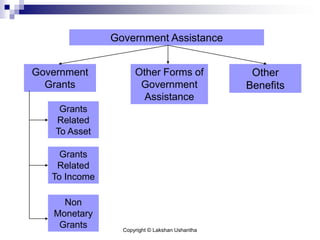
Government Assistance
Other
Benefits
Grants
Related
To Asset
Other Forms of
Government
Assistance
Government
Grants
Grants
Related
To Income
Non
Monetary
Grants
Copyright © Lakshan Ushantha
Government Grants
 Government grants are;
 Assistance by government,
 In the form of transfers of resources to an entity,
 In return for past or future compliance with certain conditions relating to
the operating activities of the entity.
 Exclude forms of government assistance which cannot reasonably have
a value placed upon them and which cannot be distinguished from the
normal trading transactions of the entity.
Copyright © Lakshan Ushantha
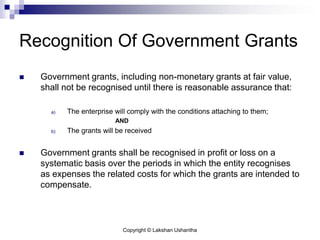
Recognition Of Government Grants
 Government grants, including non-monetary grants at fair value,
shall not be recognised until there is reasonable assurance that:
a) The enterprise will comply with the conditions attaching to them;
AND
b) The grants will be received
 Government grants shall be recognised in profit or loss on a
systematic basis over the periods in which the entity recognises
as expenses the related costs for which the grants are intended to
compensate.
Copyright © Lakshan Ushantha
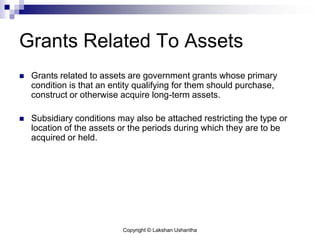
Grants Related To Assets
 Grants related to assets are government grants whose primary
condition is that an entity qualifying for them should purchase,
construct or otherwise acquire long-term assets.
 Subsidiary conditions may also be attached restricting the type or
location of the assets or the periods during which they are to be
acquired or held.
Copyright © Lakshan Ushantha
Grants Related To Assets (cont..)
 Government grants related to assets, including non-monetary grants
at fair value, shall be presented in the statement of financial position
either;
By setting up the grant as deferred income
By deducting the grant in arriving at the carrying amount
of the asset.
[Recognise in the profit and loss on a systematic basis over the
useful life of the asset]
OR
[Recognise in the profit and loss over a life of a depreciable assets as
a reduced depreciation expenses]
[Recognise in the profit and loss on a systematic basis over the
useful life of the asset]
Copyright © Lakshan Ushantha
Grants Related To Assets (cont..)
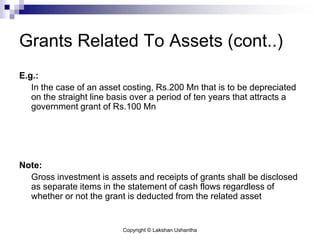
E.g.:
In the case of an asset costing, Rs.200 Mn that is to be depreciated
on the straight line basis over a period of ten years that attracts a
government grant of Rs.100 Mn
Note:
Gross investment is assets and receipts of grants shall be disclosed
as separate items in the statement of cash flows regardless of
whether or not the grant is deducted from the related asset
Copyright © Lakshan Ushantha
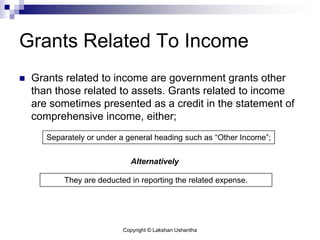
Grants Related To Income
 Grants related to income are government grants other
than those related to assets. Grants related to income
are sometimes presented as a credit in the statement of
comprehensive income, either;
Separately or under a general heading such as “Other Income”;
They are deducted in reporting the related expense.
Alternatively
Copyright © Lakshan Ushantha
Grants Related To Income (cont..)
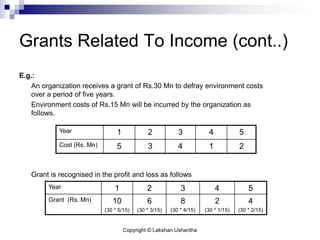
E.g.:
An organization receives a grant of Rs.30 Mn to defray environment costs
over a period of five years.
Environment costs of Rs.15 Mn will be incurred by the organization as
follows.
Grant is recognised in the profit and loss as follows
Year 1 2 3 4 5
Cost (Rs. Mn) 5 3 4 1 2
Year 1 2 3 4 5
Grant (Rs. Mn) 10
(30 * 5/15)
6
(30 * 3/15)
8
(30 * 4/15)
2
(30 * 1/15)
4
(30 * 2/15)
Copyright © Lakshan Ushantha
Non-Monetary Government Grants
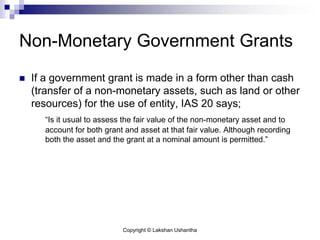
 If a government grant is made in a form other than cash
(transfer of a non-monetary assets, such as land or other
resources) for the use of entity, IAS 20 says;
“Is it usual to assess the fair value of the non-monetary asset and to
account for both grant and asset at that fair value. Although recording
both the asset and the grant at a nominal amount is permitted.”
Copyright © Lakshan Ushantha
Non-Monetary Government Grants (cont..)
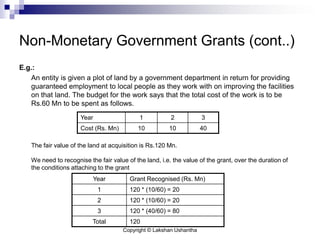
E.g.:
An entity is given a plot of land by a government department in return for providing
guaranteed employment to local people as they work with on improving the facilities
on that land. The budget for the work says that the total cost of the work is to be
Rs.60 Mn to be spent as follows.
The fair value of the land at acquisition is Rs.120 Mn.
We need to recognise the fair value of the land, i.e. the value of the grant, over the duration of
the conditions attaching to the grant
Year Grant Recognised (Rs. Mn)
1 120 * (10/60) = 20
2 120 * (10/60) = 20
3 120 * (40/60) = 80
Total 120
Year 1 2 3
Cost (Rs. Mn) 10 10 40
Copyright © Lakshan Ushantha
Repayment Of Government Grants
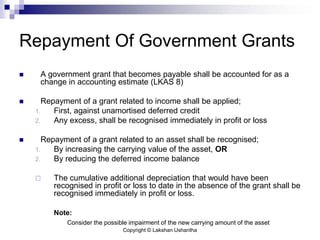
 A government grant that becomes payable shall be accounted for as a
change in accounting estimate (LKAS 8)
 Repayment of a grant related to income shall be applied;
1. First, against unamortised deferred credit
2. Any excess, shall be recognised immediately in profit or loss
 Repayment of a grant related to an asset shall be recognised;
1. By increasing the carrying value of the asset, OR
2. By reducing the deferred income balance
 The cumulative additional depreciation that would have been
recognised in profit or loss to date in the absence of the grant shall be
recognised immediately in profit or loss.
Note:
Consider the possible impairment of the new carrying amount of the asset
Copyright © Lakshan Ushantha
Special Cases & Examples
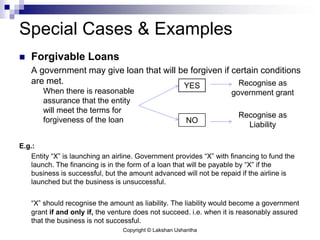
 Forgivable Loans
A government may give loan that will be forgiven if certain conditions
are met.
E.g.:
Entity “X” is launching an airline. Government provides “X” with financing to fund the
launch. The financing is in the form of a loan that will be payable by “X” if the
business is successful, but the amount advanced will not be repaid if the airline is
launched but the business is unsuccessful.
“X” should recognise the amount as liability. The liability would become a government
grant if and only if, the venture does not succeed. i.e. when it is reasonably assured
that the business is not successful.
When there is reasonable
assurance that the entity
will meet the terms for
forgiveness of the loan
YES
Recognise as
Liability
NO
Recognise as
government grant
Copyright © Lakshan Ushantha
Special Cases & Examples (cont...)
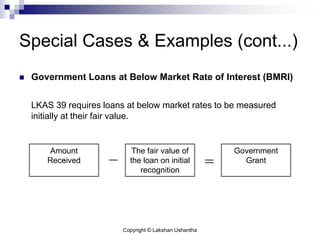
 Government Loans at Below Market Rate of Interest (BMRI)
LKAS 39 requires loans at below market rates to be measured
initially at their fair value.
Amount
Received
The fair value of
the loan on initial
recognition
Government
Grant
Copyright © Lakshan Ushantha
Special Cases & Examples (cont...)
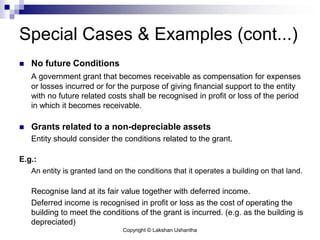
 No future Conditions
A government grant that becomes receivable as compensation for expenses
or losses incurred or for the purpose of giving financial support to the entity
with no future related costs shall be recognised in profit or loss of the period
in which it becomes receivable.
 Grants related to a non-depreciable assets
Entity should consider the conditions related to the grant.
E.g.:
An entity is granted land on the conditions that it operates a building on that land.
Recognise land at its fair value together with deferred income.
Deferred income is recognised in profit or loss as the cost of operating the
building to meet the conditions of the grant is incurred. (e.g. as the building is
depreciated)
Copyright © Lakshan Ushantha
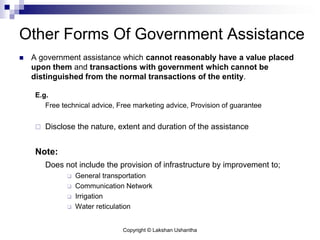
Other Forms Of Government Assistance
 A government assistance which cannot reasonably have a value placed
upon them and transactions with government which cannot be
distinguished from the normal transactions of the entity.
E.g.
Free technical advice, Free marketing advice, Provision of guarantee
 Disclose the nature, extent and duration of the assistance
Note:
Does not include the provision of infrastructure by improvement to;
 General transportation
 Communication Network
 Irrigation
 Water reticulation
Copyright © Lakshan Ushantha
SIC 10: No Specific Relation To Operating Activities
Issues
 In some countries government assistance to entities may be aimed at
encouragement or long-term support of business activities either in certain
regions or industry sectors.
 Conditions to receive such assistance may not be specifically related to the
operating activities of the entity.
 Examples of such assistance are transfer of resources by government to
entities which;
 Operate in particular industry.
 Continue operating in recently privatized industries, OR
 Start or continue to run their business in undeveloped areas.
 The issue is whether such government assistance is a “Government Grant”
within the scope of LKAS 20?
Copyright © Lakshan Ushantha
SIC 10: No Specific Relation To Operating Act. (cont..)
Consensus
 Government assistance to entities meets the definition of government
grants in LKAS 20, even if there are no conditions specifically relating to the
operating activities of the entity other than the requirement to operate in
certain regions or industry sectors.
 Such grants are therefore not credited directly to shareholders interest and
are thus required to be recognised in profit or loss.
Copyright © Lakshan Ushantha
Disclosure
1. The accounting policy adopted for government grants, including the
methods of presentation adopted in the financial statements;
2. The nature and extent of government grants recognised in the financial
statements and an indication of other forms of government assistance
from which the entity has benefited;
3. Unfulfilled conditions and other contingencies attaching to government
assistance that has been recognised.
Copyright © Lakshan Ushantha

Lkas20

  • 1.
    Copyright © LakshanUshantha Sri Lanka Accounting Standard – LKAS 20 Accounting for Government Grants & Disclosure of Government Assistance
  • 2.
    Copyright © LakshanUshantha Learning Outcomes  Identify the Scope of the Standard.  Definitions  Government Assistance  Government Grants  Grants Related to Assets  Grants Related to Income  Describe the background and implementation guidance of the Standard.  Discuss the practical scenarios.
  • 3.
    Copyright © LakshanUshantha Scope of the Standard 1. This standard shall be applied in accounting for, and in the disclosure of, government grants and other forms of government assistant.
  • 4.
    Copyright © LakshanUshantha Scope of the Standard (cont..) 2. This standard does not deal with;  Special problems arising in accounting for government grants in financial statements reflecting the effects of changing price or supplementary information of a similar nature.  Government assistance that is provided for an entity in the form of benefits that are available in determining taxable profit or loss, or are determined or limited on the basis of income tax liability (E.g.: income tax holidays, investment tax credits, accelerated depreciation allowances and reduced income tax rates)  Government participation in the ownership of the entity.  Government grants covered by LKAS 41 Agriculture
  • 5.
    Copyright © LakshanUshantha Government Assistance  Government assistance is action by government designed to provide an economic benefit specific to an entity or range of entities qualifying under certain criteria.  Government assistance for the purpose of this Standard does not include benefits provided only indirectly through action affecting general trading conditions E.g..: provision of infrastructure in development areas or the imposition of trading constraints on competitors.
  • 6.
    Copyright © LakshanUshantha Government Assistance Other Benefits Grants Related To Asset Other Forms of Government Assistance Government Grants Grants Related To Income Non Monetary Grants
  • 7.
    Copyright © LakshanUshantha Government Grants  Government grants are;  Assistance by government,  In the form of transfers of resources to an entity,  In return for past or future compliance with certain conditions relating to the operating activities of the entity.  Exclude forms of government assistance which cannot reasonably have a value placed upon them and which cannot be distinguished from the normal trading transactions of the entity.
  • 8.
    Copyright © LakshanUshantha Recognition Of Government Grants  Government grants, including non-monetary grants at fair value, shall not be recognised until there is reasonable assurance that: a) The enterprise will comply with the conditions attaching to them; AND b) The grants will be received  Government grants shall be recognised in profit or loss on a systematic basis over the periods in which the entity recognises as expenses the related costs for which the grants are intended to compensate.
  • 9.
    Copyright © LakshanUshantha Grants Related To Assets  Grants related to assets are government grants whose primary condition is that an entity qualifying for them should purchase, construct or otherwise acquire long-term assets.  Subsidiary conditions may also be attached restricting the type or location of the assets or the periods during which they are to be acquired or held.
  • 10.
    Copyright © LakshanUshantha Grants Related To Assets (cont..)  Government grants related to assets, including non-monetary grants at fair value, shall be presented in the statement of financial position either; By setting up the grant as deferred income By deducting the grant in arriving at the carrying amount of the asset. [Recognise in the profit and loss on a systematic basis over the useful life of the asset] OR [Recognise in the profit and loss over a life of a depreciable assets as a reduced depreciation expenses] [Recognise in the profit and loss on a systematic basis over the useful life of the asset]
  • 11.
    Copyright © LakshanUshantha Grants Related To Assets (cont..) E.g.: In the case of an asset costing, Rs.200 Mn that is to be depreciated on the straight line basis over a period of ten years that attracts a government grant of Rs.100 Mn Note: Gross investment is assets and receipts of grants shall be disclosed as separate items in the statement of cash flows regardless of whether or not the grant is deducted from the related asset
  • 12.
    Copyright © LakshanUshantha Grants Related To Income  Grants related to income are government grants other than those related to assets. Grants related to income are sometimes presented as a credit in the statement of comprehensive income, either; Separately or under a general heading such as “Other Income”; They are deducted in reporting the related expense. Alternatively
  • 13.
    Copyright © LakshanUshantha Grants Related To Income (cont..) E.g.: An organization receives a grant of Rs.30 Mn to defray environment costs over a period of five years. Environment costs of Rs.15 Mn will be incurred by the organization as follows. Grant is recognised in the profit and loss as follows Year 1 2 3 4 5 Cost (Rs. Mn) 5 3 4 1 2 Year 1 2 3 4 5 Grant (Rs. Mn) 10 (30 * 5/15) 6 (30 * 3/15) 8 (30 * 4/15) 2 (30 * 1/15) 4 (30 * 2/15)
  • 14.
    Copyright © LakshanUshantha Non-Monetary Government Grants  If a government grant is made in a form other than cash (transfer of a non-monetary assets, such as land or other resources) for the use of entity, IAS 20 says; “Is it usual to assess the fair value of the non-monetary asset and to account for both grant and asset at that fair value. Although recording both the asset and the grant at a nominal amount is permitted.”
  • 15.
    Copyright © LakshanUshantha Non-Monetary Government Grants (cont..) E.g.: An entity is given a plot of land by a government department in return for providing guaranteed employment to local people as they work with on improving the facilities on that land. The budget for the work says that the total cost of the work is to be Rs.60 Mn to be spent as follows. The fair value of the land at acquisition is Rs.120 Mn. We need to recognise the fair value of the land, i.e. the value of the grant, over the duration of the conditions attaching to the grant Year Grant Recognised (Rs. Mn) 1 120 * (10/60) = 20 2 120 * (10/60) = 20 3 120 * (40/60) = 80 Total 120 Year 1 2 3 Cost (Rs. Mn) 10 10 40
  • 16.
    Copyright © LakshanUshantha Repayment Of Government Grants  A government grant that becomes payable shall be accounted for as a change in accounting estimate (LKAS 8)  Repayment of a grant related to income shall be applied; 1. First, against unamortised deferred credit 2. Any excess, shall be recognised immediately in profit or loss  Repayment of a grant related to an asset shall be recognised; 1. By increasing the carrying value of the asset, OR 2. By reducing the deferred income balance  The cumulative additional depreciation that would have been recognised in profit or loss to date in the absence of the grant shall be recognised immediately in profit or loss. Note: Consider the possible impairment of the new carrying amount of the asset
  • 17.
    Copyright © LakshanUshantha Special Cases & Examples  Forgivable Loans A government may give loan that will be forgiven if certain conditions are met. E.g.: Entity “X” is launching an airline. Government provides “X” with financing to fund the launch. The financing is in the form of a loan that will be payable by “X” if the business is successful, but the amount advanced will not be repaid if the airline is launched but the business is unsuccessful. “X” should recognise the amount as liability. The liability would become a government grant if and only if, the venture does not succeed. i.e. when it is reasonably assured that the business is not successful. When there is reasonable assurance that the entity will meet the terms for forgiveness of the loan YES Recognise as Liability NO Recognise as government grant
  • 18.
    Copyright © LakshanUshantha Special Cases & Examples (cont...)  Government Loans at Below Market Rate of Interest (BMRI) LKAS 39 requires loans at below market rates to be measured initially at their fair value. Amount Received The fair value of the loan on initial recognition Government Grant
  • 19.
    Copyright © LakshanUshantha Special Cases & Examples (cont...)  No future Conditions A government grant that becomes receivable as compensation for expenses or losses incurred or for the purpose of giving financial support to the entity with no future related costs shall be recognised in profit or loss of the period in which it becomes receivable.  Grants related to a non-depreciable assets Entity should consider the conditions related to the grant. E.g.: An entity is granted land on the conditions that it operates a building on that land. Recognise land at its fair value together with deferred income. Deferred income is recognised in profit or loss as the cost of operating the building to meet the conditions of the grant is incurred. (e.g. as the building is depreciated)
  • 20.
    Copyright © LakshanUshantha Other Forms Of Government Assistance  A government assistance which cannot reasonably have a value placed upon them and transactions with government which cannot be distinguished from the normal transactions of the entity. E.g. Free technical advice, Free marketing advice, Provision of guarantee  Disclose the nature, extent and duration of the assistance Note: Does not include the provision of infrastructure by improvement to;  General transportation  Communication Network  Irrigation  Water reticulation
  • 21.
    Copyright © LakshanUshantha SIC 10: No Specific Relation To Operating Activities Issues  In some countries government assistance to entities may be aimed at encouragement or long-term support of business activities either in certain regions or industry sectors.  Conditions to receive such assistance may not be specifically related to the operating activities of the entity.  Examples of such assistance are transfer of resources by government to entities which;  Operate in particular industry.  Continue operating in recently privatized industries, OR  Start or continue to run their business in undeveloped areas.  The issue is whether such government assistance is a “Government Grant” within the scope of LKAS 20?
  • 22.
    Copyright © LakshanUshantha SIC 10: No Specific Relation To Operating Act. (cont..) Consensus  Government assistance to entities meets the definition of government grants in LKAS 20, even if there are no conditions specifically relating to the operating activities of the entity other than the requirement to operate in certain regions or industry sectors.  Such grants are therefore not credited directly to shareholders interest and are thus required to be recognised in profit or loss.
  • 23.
    Copyright © LakshanUshantha Disclosure 1. The accounting policy adopted for government grants, including the methods of presentation adopted in the financial statements; 2. The nature and extent of government grants recognised in the financial statements and an indication of other forms of government assistance from which the entity has benefited; 3. Unfulfilled conditions and other contingencies attaching to government assistance that has been recognised.
  • 24.