LIVE LOAD MANAGEMENT
WORKSHOP
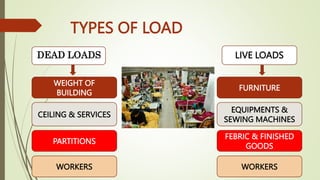
TYPES OF LOAD
LIVE LOADS
DEAD LOADS
FURNITURE
EQUIPMENTS &
SEWING MACHINES
FEBRIC & FINISHED
GOODS
WORKERS
WEIGHT OF
BUILDING
CEILING & SERVICES
PARTITIONS
WORKERS
LIVE LOAD MANAGEMENT
ď‚´Load Management is of Paramount
Importance in Buildings Where the
Assessed Structural Capacity is below
code compliance for the Intended Use.
LIVE LOAD MANAGEMENT
Load exceeding the
structural capacity may lead
to structural damage and
potential failure .
Some structural elements
may not show signs of
distress(brittle failure).
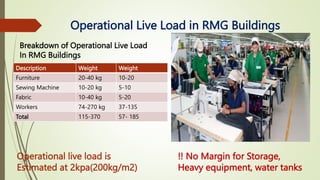
Operational Live Load in RMG Buildings
Operational live load is
Estimated at 2kpa(200kg/m2)
Breakdown of Operational Live Load
In RMG Buildings
Description Weight Weight
Furniture 20-40 kg 10-20
Sewing Machine 10-20 kg 5-10
Fabric 10-40 kg 5-20
Workers 74-270 kg 37-135
Total 115-370 57- 185
!! No Margin for Storage,
Heavy equipment, water tanks
Structural Risk Rating vs Structural Capacity
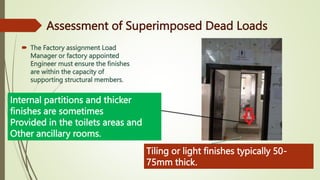
Assessment of Superimposed Dead Loads
ď‚´ The Factory assignment Load
Manager or factory appointed
Engineer must ensure the finishes
are within the capacity of
supporting structural members.
Tiling or light finishes typically 50-
75mm thick.
Internal partitions and thicker
finishes are sometimes
Provided in the toilets areas and
Other ancillary rooms.
Stacking of Fabric rolls
Equivalent for calculations
Examples
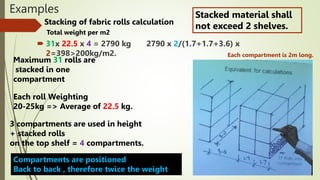
ď‚´ 31x 22.5 x 4 = 2790 kg 2790 x 2/(1.7+1.7+3.6) x
2=398>200kg/m2.
Stacking of fabric rolls calculation
Each compartment is 2m long.
Total weight per m2
Maximum 31 rolls are
stacked in one
compartment
Each roll Weighting
20-25kg => Average of 22.5 kg.
3 compartments are used in height
+ stacked rolls
on the top shelf = 4 compartments.
Compartments are positioned
Back to back , therefore twice the weight.
Stacked material shall
not exceed 2 shelves.
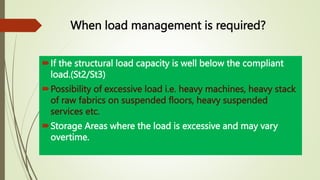
When load management is required?
ď‚´If the structural load capacity is well below the compliant
load.(St2/St3)
ď‚´Possibility of excessive load i.e. heavy machines, heavy stack
of raw fabrics on suspended floors, heavy suspended
services etc.
ď‚´Storage Areas where the load is excessive and may vary
overtime.
How to monitor
ď‚´ Factory to assign a full time live load manager and provide him with training.
ď‚´ Factory Engineer to prepare live load plans and display them on floors.
ď‚´ Provide load marking on all floors.
ď‚´ Relocate excess loads (beyond capacity) to ground floors.
ď‚´ Keep minimum required fabrics in sewing lines and remove completed items
on regular basis.
ď‚´ Keep record of, Daily checked of live load , Database sheets of heavy
equipment's, Calculation of live load in critical areas(storage, water tanks etc.)
Engineer calculations/certifications that demonstrates the structural capacity.
Benefits of live load management
ď‚´Preserving lives
ď‚´Preserving assets and enhancing its longevity
ď‚´Install good practice within workers
ď‚´Organized and tidy layout
ď‚´Comply NTPA requirement

LIVE LOAD MANAGEMENT.pptx

  • 1.
  • 2.
    TYPES OF LOAD LIVELOADS DEAD LOADS FURNITURE EQUIPMENTS & SEWING MACHINES FEBRIC & FINISHED GOODS WORKERS WEIGHT OF BUILDING CEILING & SERVICES PARTITIONS WORKERS
  • 3.
    LIVE LOAD MANAGEMENT ď‚´LoadManagement is of Paramount Importance in Buildings Where the Assessed Structural Capacity is below code compliance for the Intended Use.
  • 4.
    LIVE LOAD MANAGEMENT Loadexceeding the structural capacity may lead to structural damage and potential failure . Some structural elements may not show signs of distress(brittle failure).
  • 5.
    Operational Live Loadin RMG Buildings Operational live load is Estimated at 2kpa(200kg/m2) Breakdown of Operational Live Load In RMG Buildings Description Weight Weight Furniture 20-40 kg 10-20 Sewing Machine 10-20 kg 5-10 Fabric 10-40 kg 5-20 Workers 74-270 kg 37-135 Total 115-370 57- 185 !! No Margin for Storage, Heavy equipment, water tanks
  • 6.
    Structural Risk Ratingvs Structural Capacity
  • 7.
    Assessment of SuperimposedDead Loads ď‚´ The Factory assignment Load Manager or factory appointed Engineer must ensure the finishes are within the capacity of supporting structural members. Tiling or light finishes typically 50- 75mm thick. Internal partitions and thicker finishes are sometimes Provided in the toilets areas and Other ancillary rooms.
  • 8.
    Stacking of Fabricrolls Equivalent for calculations
  • 9.
    Examples ď‚´ 31x 22.5x 4 = 2790 kg 2790 x 2/(1.7+1.7+3.6) x 2=398>200kg/m2. Stacking of fabric rolls calculation Each compartment is 2m long. Total weight per m2 Maximum 31 rolls are stacked in one compartment Each roll Weighting 20-25kg => Average of 22.5 kg. 3 compartments are used in height + stacked rolls on the top shelf = 4 compartments. Compartments are positioned Back to back , therefore twice the weight. Stacked material shall not exceed 2 shelves.
  • 12.
    When load managementis required? ď‚´If the structural load capacity is well below the compliant load.(St2/St3) ď‚´Possibility of excessive load i.e. heavy machines, heavy stack of raw fabrics on suspended floors, heavy suspended services etc. ď‚´Storage Areas where the load is excessive and may vary overtime.
  • 13.
    How to monitor ď‚´Factory to assign a full time live load manager and provide him with training. ď‚´ Factory Engineer to prepare live load plans and display them on floors. ď‚´ Provide load marking on all floors. ď‚´ Relocate excess loads (beyond capacity) to ground floors. ď‚´ Keep minimum required fabrics in sewing lines and remove completed items on regular basis. ď‚´ Keep record of, Daily checked of live load , Database sheets of heavy equipment's, Calculation of live load in critical areas(storage, water tanks etc.) Engineer calculations/certifications that demonstrates the structural capacity.
  • 14.
    Benefits of liveload management ď‚´Preserving lives ď‚´Preserving assets and enhancing its longevity ď‚´Install good practice within workers ď‚´Organized and tidy layout ď‚´Comply NTPA requirement