Download free for 30 days
Sign in
Upload
Language (EN)
Support
Business
Mobile
Social Media
Marketing
Technology
Art & Photos
Career
Design
Education
Presentations & Public Speaking
Government & Nonprofit
Healthcare
Internet
Law
Leadership & Management
Automotive
Engineering
Software
Recruiting & HR
Retail
Sales
Services
Science
Small Business & Entrepreneurship
Food
Environment
Economy & Finance
Data & Analytics
Investor Relations
Sports
Spiritual
News & Politics
Travel
Self Improvement
Real Estate
Entertainment & Humor
Health & Medicine
Devices & Hardware
Lifestyle
Change Language
Language
English
Español
Português
Français
Deutsche
Cancel
Save
Submit search
EN
Uploaded by
IRJET Journal
5 views
Literature review on FRP wrapping over structural components
https://www.irjet.net/archives/V9/i4/IRJET-V9I488.pdf
Engineering
◦
Read more
0
Save
Share
Embed
Embed presentation
Download
Download to read offline
1
/ 6
2
/ 6
3
/ 6
4
/ 6
5
/ 6
6
/ 6
More Related Content
PDF
Utilizing Biomedical Waste for Sustainable Brick Manufacturing: A Novel Appro...
by
IRJET Journal
PDF
DESIGN AND DEVELOPMENT OF BATTERY THERMAL MANAGEMENT SYSTEM USING PHASE CHANG...
by
IRJET Journal
PDF
A Review on Influence of Fluid Viscous Damper on The Behaviour of Multi-store...
by
IRJET Journal
PDF
Kiona – A Smart Society Automation Project
by
IRJET Journal
PDF
Enhanced heart disease prediction using SKNDGR ensemble Machine Learning Model
by
IRJET Journal
PDF
Wireless Arduino Control via Mobile: Eliminating the Need for a Dedicated Wir...
by
IRJET Journal
PDF
SPACE WATCH YOUR REAL-TIME SPACE INFORMATION HUB
by
IRJET Journal
PDF
Invest in Innovation: Empowering Ideas through Blockchain Based Crowdfunding
by
IRJET Journal
Utilizing Biomedical Waste for Sustainable Brick Manufacturing: A Novel Appro...
by
IRJET Journal
DESIGN AND DEVELOPMENT OF BATTERY THERMAL MANAGEMENT SYSTEM USING PHASE CHANG...
by
IRJET Journal
A Review on Influence of Fluid Viscous Damper on The Behaviour of Multi-store...
by
IRJET Journal
Kiona – A Smart Society Automation Project
by
IRJET Journal
Enhanced heart disease prediction using SKNDGR ensemble Machine Learning Model
by
IRJET Journal
Wireless Arduino Control via Mobile: Eliminating the Need for a Dedicated Wir...
by
IRJET Journal
SPACE WATCH YOUR REAL-TIME SPACE INFORMATION HUB
by
IRJET Journal
Invest in Innovation: Empowering Ideas through Blockchain Based Crowdfunding
by
IRJET Journal
More from IRJET Journal
PDF
Utilizing Biomedical Waste for Sustainable Brick Manufacturing: A Novel Appro...
by
IRJET Journal
PDF
DESIGN AND DEVELOPMENT OF BATTERY THERMAL MANAGEMENT SYSTEM USING PHASE CHANG...
by
IRJET Journal
PDF
A Novel System for Recommending Agricultural Crops Using Machine Learning App...
by
IRJET Journal
PDF
Breast Cancer Detection using Computer Vision
by
IRJET Journal
PDF
Advancements in CFD Analysis of Shell and Tube Heat Exchangers with Nanofluid...
by
IRJET Journal
PDF
Kiona – A Smart Society Automation Project
by
IRJET Journal
PDF
BRAIN TUMOUR DETECTION AND CLASSIFICATION
by
IRJET Journal
PDF
Wireless Arduino Control via Mobile: Eliminating the Need for a Dedicated Wir...
by
IRJET Journal
PDF
The Project Manager as an ambassador of the contract. The case of NEC4 ECC co...
by
IRJET Journal
PDF
Analysis of high energy charge particle in the Heliosphere
by
IRJET Journal
PDF
Explainable AI(XAI) using LIME and Disease Detection in Mango Leaf by Transfe...
by
IRJET Journal
PDF
Auto-Charging E-Vehicle with its battery Management.
by
IRJET Journal
PDF
Auto-Charging E-Vehicle with its battery Management.
by
IRJET Journal
PDF
A Review on Influence of Fluid Viscous Damper on The Behaviour of Multi-store...
by
IRJET Journal
PDF
"Enhanced Heat Transfer Performance in Shell and Tube Heat Exchangers: A CFD ...
by
IRJET Journal
PDF
FIR filter-based Sample Rate Convertors and its use in NR PRACH
by
IRJET Journal
PDF
Analysis of high energy charge particle in the Heliosphere
by
IRJET Journal
PDF
AR Application: Homewise VisionMs. Vaishali Rane, Om Awadhoot, Bhargav Gajare...
by
IRJET Journal
PDF
SPACE WATCH YOUR REAL-TIME SPACE INFORMATION HUB
by
IRJET Journal
PDF
Invest in Innovation: Empowering Ideas through Blockchain Based Crowdfunding
by
IRJET Journal
Utilizing Biomedical Waste for Sustainable Brick Manufacturing: A Novel Appro...
by
IRJET Journal
DESIGN AND DEVELOPMENT OF BATTERY THERMAL MANAGEMENT SYSTEM USING PHASE CHANG...
by
IRJET Journal
A Novel System for Recommending Agricultural Crops Using Machine Learning App...
by
IRJET Journal
Breast Cancer Detection using Computer Vision
by
IRJET Journal
Advancements in CFD Analysis of Shell and Tube Heat Exchangers with Nanofluid...
by
IRJET Journal
Kiona – A Smart Society Automation Project
by
IRJET Journal
BRAIN TUMOUR DETECTION AND CLASSIFICATION
by
IRJET Journal
Wireless Arduino Control via Mobile: Eliminating the Need for a Dedicated Wir...
by
IRJET Journal
The Project Manager as an ambassador of the contract. The case of NEC4 ECC co...
by
IRJET Journal
Analysis of high energy charge particle in the Heliosphere
by
IRJET Journal
Explainable AI(XAI) using LIME and Disease Detection in Mango Leaf by Transfe...
by
IRJET Journal
Auto-Charging E-Vehicle with its battery Management.
by
IRJET Journal
Auto-Charging E-Vehicle with its battery Management.
by
IRJET Journal
A Review on Influence of Fluid Viscous Damper on The Behaviour of Multi-store...
by
IRJET Journal
"Enhanced Heat Transfer Performance in Shell and Tube Heat Exchangers: A CFD ...
by
IRJET Journal
FIR filter-based Sample Rate Convertors and its use in NR PRACH
by
IRJET Journal
Analysis of high energy charge particle in the Heliosphere
by
IRJET Journal
AR Application: Homewise VisionMs. Vaishali Rane, Om Awadhoot, Bhargav Gajare...
by
IRJET Journal
SPACE WATCH YOUR REAL-TIME SPACE INFORMATION HUB
by
IRJET Journal
Invest in Innovation: Empowering Ideas through Blockchain Based Crowdfunding
by
IRJET Journal
Literature review on FRP wrapping over structural components
1.
International Research Journal
of Engineering and Technology (IRJET) e-ISSN: 2395-0056 Volume: 09 Issue: 04 | Apr 2022 www.irjet.net p-ISSN: 2395-0072 © 2022, IRJET | Impact Factor value: 7.529 | ISO 9001:2008 Certified Journal | Page 486 Literature review on FRP wrapping over structural components Jemin Meriyam Jibu1, Neethu Joseph2 1M. Tech Structural and Construction Management, St. Joseph's College of Engineering and Technology, Palai, Kerala India 2Assistant professor of the Civil Engineering Department, St. Joseph's College of Engineering and Technology, Palai, Kerala India ---------------------------------------------------------------------***--------------------------------------------------------------------- Abstract – Most of the researchers use FRP to strengthen and retrofit structural components. Fiber reinforced polymer is a composite, in which the matrix is a polymer and the fibers used for reinforcement are aramid fiber, carbon fiber, glass fiber, and basalt fiber. In which external wrapping of FRP on structural components has become a popularpractice. Among these, AFRP (aramid fiber reinforced polymer) has thehighest tensile strength, but it is not widely used in industries. Because AFRP has a cost, it is more than basalt and glass fiber. Using FRP for external strengthening does not change the buckling shape of steel tubular structures. It can effectively delay local buckling, prevent outward buckling, and also delay overall buckling. Key Words: Fiber reinforced polymer, Aramid, Steel structures, Wrapping, Strength. 1.INTRODUCTION Several studies were conductedtodeterminethebehaviorof FRP - strengthened steel structures, subjected to static axial compression loading, and therefore the results are well documented in several analysis articles [5]. New developments in polymer technology have introduced new things like fibers and fiber reinforced polymers (FRP) to strengthen and improve the overall behavior of concrete structures [11]. Synthetic fiber reinforced compound (FRP) has been widely utilized in building construction, due to its high durability and low weight [8]. Retrofitting structures from natural calamities like floods, fire, and sensitive earthquakes has become a necessary construction activity for both concrete and steel structures.So,theintroductionof FRP material is a great advantage forstructural components. Previous experimental studies in this field demonstrated a significant positive impact on the retrofitting of structures using fiber reinforced polymers (FRPs) [7]. 1.1 FRP A fiber-reinforced polymer(FRP)is a chemical component.It consists of a matrix and fiber. It is usually used in industries like construction, transport, and marine to make structures resistant to deformation. Furthermore, it also improves the strength, safety, durability and reduces the formation of cracks. A skilled person will be needed for the installation process. Installation of FRP includes the following procedures, like site preparation, in which wet surfaces should be avoided because they cause the formation of bubbles. The next step is surface preparation. The surface should be cleaned and roughened to ensure the bond between resin and FRP. After that epoxy is applied on the surface and then FRP sheet is installed. There are various types of wrapping styles in the external bonding of FRP. They are fully wrapped in style, with strip type wrapping at various angles like 0°, 45°, 90°, and U- wrapping style. Fig -1: FRP (Fiber-reinforced polymer) Some advantages of using FRP are It is lightweight, so the dead load will not increase. Corrosion-resistant High impact strength Electrical insulation Easy installation Low operating expenses Durable Low cost Waterproof
2.
International Research Journal
of Engineering and Technology (IRJET) e-ISSN: 2395-0056 Volume: 09 Issue: 04 | Apr 2022 www.irjet.net p-ISSN: 2395-0072 © 2022, IRJET | Impact Factor value: 7.529 | ISO 9001:2008 Certified Journal | Page 487 Easily recyclable Long service life Reduces the formation of cracks. . Fig -2: FRP wrapping on column 1.2 Epoxy resin For the installation of FRP on the surface of structural components, polyester resins are most typically used. It is a viscous liquid resin containing polyester and a compound, chiefly phenylethylene. These resins are very easy to use, cure quickly, and can withstand hightemperatures.They are made by the reaction of an epoxide with a hardener or polyamine. So, they will have a strong cross-linking bond to create a very tough and stiff structure. The most commonly used epoxy resin is diglycidyl ether bisphenol A. Some examples of hardeners are polyaminoamides, aromatic amines, and aliphatic amines. On curing, epoxy has very low shrinkage, so it gives more stability. The viscosity of epoxies is higher than that of polyesters. 900 centipoises are the starting range of most of the epoxies. Epoxy resins are applied to the dry fiber sheets in the field, and then they can be cured in-situ. This will ultimately provide strength.Itacts as an adhesive that holds the fiber sheet to the substrate. Some advantages of epoxy are Good adhesion Chemical resistance Heat resistance Good mechanical properties. Outstanding electrical insulation properties. It is used in construction, automotive, electrical, and aerospace. The chemical resistance of epoxies is good against basic solutions. Epoxies are costlier than polyesters, and cure times are longer. Fig -3: A epoxy resin structure (Di glycidyl ether of bisphenol 2. TYPES OF FIBER 2.1 Aramid Fiber Aramid fiber was first developed by Stephanie Kwolek (a Polish-American chemist) in the 1970s. The development of aromatic polyamides was mainly due to the discovery of lyotropic liquid crystalline aramid. They are mainly a bright golden yellow. They have a density of 1.44 g/cm3 and a Young's modulus of 70.5-112.4 GPa. Aramid Fiber is additionally called Kevlar fiber. It is the primary organic fiber with a high tensile modulus and strength. Aramid shares a high degree of orientation with alternative fibers like ultra-high-molecular-weight synthetic resin, a characteristic that dominates their properties. Aramid fiber is additionally known for its high durability, toughness, and extremely high-destined organic fiber manufactured from polymeric amide. This fiber has abrasive resistance; they may abrade against one another by weakening the sheets. Aramid fiber is createdfrom artificial products characterized by strength (five times stronger than steel on an equal weight basis) and heat-resistance. [12]. Fig -4: Aramid fiber
3.
International Research Journal
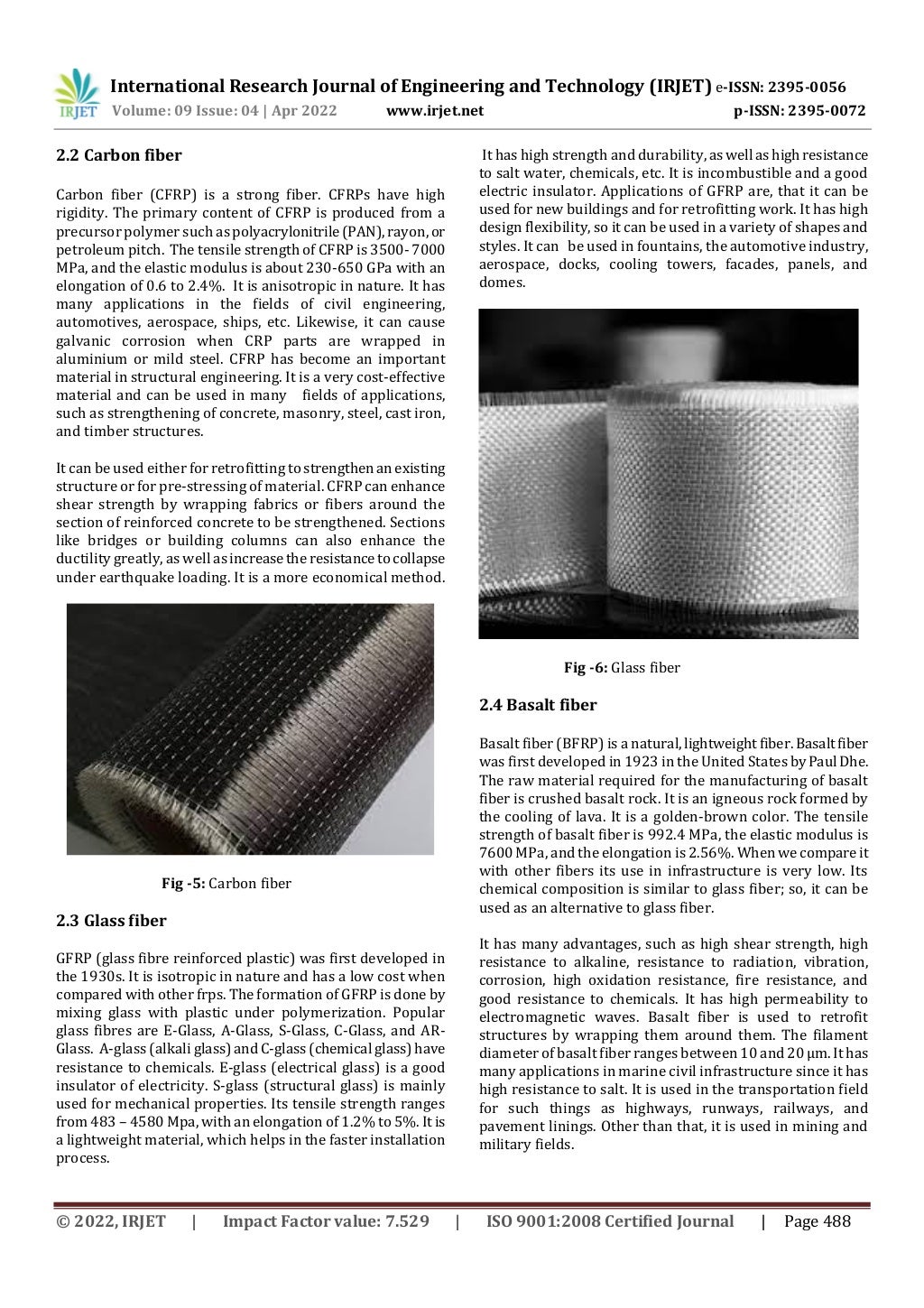
of Engineering and Technology (IRJET) e-ISSN: 2395-0056 Volume: 09 Issue: 04 | Apr 2022 www.irjet.net p-ISSN: 2395-0072 © 2022, IRJET | Impact Factor value: 7.529 | ISO 9001:2008 Certified Journal | Page 488 2.2 Carbon fiber Carbon fiber (CFRP) is a strong fiber. CFRPs have high rigidity. The primary content of CFRP is produced from a precursor polymer such aspolyacrylonitrile(PAN),rayon,or petroleum pitch. The tensile strength of CFRP is 3500-7000 MPa, and the elastic modulus is about 230-650 GPa with an elongation of 0.6 to 2.4%. It is anisotropic in nature. It has many applications in the fields of civil engineering, automotives, aerospace, ships, etc. Likewise, it can cause galvanic corrosion when CRP parts are wrapped in aluminium or mild steel. CFRP has become an important material in structural engineering. It is a very cost-effective material and can be used in many fields of applications, such as strengthening of concrete, masonry, steel, cast iron, and timber structures. It can be used either for retrofitting to strengthenanexisting structure or for pre-stressing of material. CFRP can enhance shear strength by wrapping fabrics or fibers around the section of reinforced concrete to be strengthened. Sections like bridges or building columns can also enhance the ductility greatly, as well asincreasetheresistancetocollapse under earthquake loading. It is a more economical method. Fig -5: Carbon fiber 2.3 Glass fiber GFRP (glass fibre reinforced plastic) was first developed in the 1930s. It is isotropic in nature and has a low cost when compared with other frps. The formation of GFRP is done by mixing glass with plastic under polymerization. Popular glass fibres are E-Glass, A-Glass, S-Glass, C-Glass, and AR- Glass. A-glass (alkali glass)andC-glass(chemical glass)have resistance to chemicals. E-glass (electrical glass) is a good insulator of electricity. S-glass (structural glass) is mainly used for mechanical properties. Its tensile strength ranges from 483 – 4580 Mpa, with an elongation of 1.2% to 5%. Itis a lightweight material, which helps in the faster installation process. It has high strength and durability, aswell ashighresistance to salt water, chemicals, etc. It is incombustible and a good electric insulator. Applications of GFRP are, that it can be used for new buildings and for retrofitting work. It has high design flexibility, so it can be used in a variety of shapes and styles. It can be used in fountains, the automotive industry, aerospace, docks, cooling towers, facades, panels, and domes. Fig -6: Glass fiber 2.4 Basalt fiber Basalt fiber (BFRP) is a natural,lightweightfiber.Basaltfiber was first developed in 1923 in the United States byPaul Dhe. The raw material required for the manufacturing of basalt fiber is crushed basalt rock. It is an igneous rock formed by the cooling of lava. It is a golden-brown color. The tensile strength of basalt fiber is 992.4 MPa, the elastic modulus is 7600 MPa, and the elongation is 2.56%. When wecompareit with other fibers its use in infrastructure is very low. Its chemical composition is similar to glass fiber; so, it can be used as an alternative to glass fiber. It has many advantages, such as high shear strength, high resistance to alkaline, resistance to radiation, vibration, corrosion, high oxidation resistance, fire resistance, and good resistance to chemicals. It has high permeability to electromagnetic waves. Basalt fiber is used to retrofit structures by wrapping them around them. The filament diameter of basalt fiber ranges between 10 and 20 μm.It has many applications in marine civil infrastructure since it has high resistance to salt. It is used in the transportation field for such things as highways, runways, railways, and pavement linings. Other than that, it is used in mining and military fields.
4.
International Research Journal
of Engineering and Technology (IRJET) e-ISSN: 2395-0056 Volume: 09 Issue: 04 | Apr 2022 www.irjet.net p-ISSN: 2395-0072 © 2022, IRJET | Impact Factor value: 7.529 | ISO 9001:2008 Certified Journal | Page 489 Fig -7: Basalt fiber 3. LITERATURE REVIEW These are the following experimental study carried out by various researchers. 3.1 R. Al- Rousan et al.,2013 A nonlinear finite element analysis was conducted on a concrete beam model retrofitted with FRP wrapping around it. Where the u-wrap had fiber orientations of 45° and 90°. Two types of fiber were used:carbonandglass.FRPwasused in strips as well as in sheets to improve the load carrying capacity of the RC beam, which was sulphate damaged and had a deficiency in shear carrying capacity. When using the strip type of frp wrapping, the load carrying capacity was enhanced by 10-39%, and for the sheet type of frp, the load carrying capacity was improved by 4-32%. Glass FRP sheet gives an overall better performance than carbon fibers [1]. 3.2 Alabdulhady et al.,2017 The paper presents the results of an experimental study on the effect of externally strengthening rectangular RC beams with PBO-FRCM composite material in different wrapping configurations. To study the torsional behavior as a function of strength, rotational ductility, failure mode, and yield strength. “PBO-FRCM” stands for Fiber Reinforced Cementitious Matrix with PBO compositefiber (p-Phenylene Benzobis Oxazole) [2]. The specimen used is an RC beam with a rectangular shape. The dimensions of the specimen are 203.2 mm wide, 304.8 mm tall, and 2133.6 mm long, with reinforcement detailing according to code ACI 318. A four-sided wrapping configuration resulted in greater cracking torque, greater torsional strength, and higher values of twist, relative to a control beam. A three-sided wrapping configuration, on the other hand, was less effective than a four-sided wrapping configuration. 3.3 Kandekar et al., 2018 He studied the torsional behavior of an RC beam wrapped with aramid fiber. The cross -section of thebeamis150mmx 300 mm and its length is 1 m. And he only considers fully and strips with a width of 100 mm wrapping. The load applied to the beam was 1000 KN using UTM. Torsional reinforcement design detailing was according to IS the code 456-2000. Overall, twelve specimens were used in the test. The result shows that a fully wrapped RC beam has taken 140% more moment at first crack as compared to the control beam. In addition, the strip type of wrapping required 80% more moments than the control. A RC beam wrapped with aramid has 25% less torsional moment. And there is an overall reduction in crack formation when it iswrappedwitharamid fiber [3]. 3.4 Bouziadi et al.,2019 A nonlinear numerical analysis is carried out to predict the creep response of reinforced concrete(RC) beamsexternally strengthened using carbon fiber-reinforced polymer (CFRP) and glass fiber-reinforcedpolymer(GFRP)laminates.Astatic four -point bending test was used. Different orientations of fibers were used in the test. These were 0°, 45°, and 90°. The elastic modulus of GFRP and CFRP plates is 21 GPa and 165 Gpa, respectively [4]. A burger rheological model was used for the evaluation of creep response. Both compressive and flexural creep were validated during the test. As comparedtocompressivecreep, tensile creep is more pronounced at all the stages. By increasing the thickness of CFRP,creepstrainislowered.And CFRP laminates show a better result than GFRP in creep response. CFRP with fibre orientation at 45° shows the overall best result when compared with other fibres and orientations. 3.5 Djerrad et al., 2019 In this paper, 15 specimens of a thin-walled circular hollow section (CHS) steel tube strengthened with AFRP in the hoop direction were subjected to a static axial compressive load. All specimens were tested to study the effect of AFRP (Aramid fiber-reinforced polymer) retrofitting on maximum load carrying capacity, stiffness and failure modes. For the test, both experimental and analytical studies were conducted. For modelling, ANSYS Workbench Ver. 19.0 and ACP (ANSYSCompositePrep/Post)toolswereused.Longand short circular hollow tubes of length 900 mm and 200 mm were used. For the study, variousAFRPthicknessessuchas1, 2, and 3 mm were used. The slenderness ratio was10kl/rfor short tubes and 47 kl/r forlong tubes.Theresultshowedthat by using AFRP externally, the strength of the short column was enhanced by 96 % and that of the long column by 23 % by using 3 mm thick AFRP [5].
5.
International Research Journal
of Engineering and Technology (IRJET) e-ISSN: 2395-0056 Volume: 09 Issue: 04 | Apr 2022 www.irjet.net p-ISSN: 2395-0072 © 2022, IRJET | Impact Factor value: 7.529 | ISO 9001:2008 Certified Journal | Page 490 3.6 Abu-Sena et al.,2019 He conducted experimental and numerical investigationinto twenty short square andrectangularbeams.Thelengthofthe steel specimen was 700 mm. A load of 2000 KN was applied to the specimen using a universal testing machine. Both experimental as well as analytical studies were conducted. The software used for the analytical study was ANSYS.15.0. The CFRP wrapping effectively delays the local buckling of fully strengthened specimens [6]. Mainly, failure occurs at non- strengthened zones between the strips of CFRP in the case of partially strengthened specimens. The enhancement in ultimate capacity ranges between 19.1% and 34.5% for SHS (square hollow section), and between 18% and 41.3% for RHS (rectangular hollow section) specimens. The improvement in the strength of a specimen having two-layer strips of CFRP is limited when compared with one layer of strips of CFRP. 3.7 Sivasankar et al.,2019 He used AFRP (Aramid Fiber Reinforced Polymer) sheets to improve the performance of the RC cylindricalmembers,and it was found to be useful. An axial load test was conducted on the universal testing machine. When compared to the unwrapped specimen, the load-carrying capability of the RC cylinders wrapped with three layers of AFRP sheets increased by 39.60%. And the vertical displacement of the specimen was decreased. The cost of AFRP is less when compared with CFRP [7]. 3.8 Chen et al., 2020 In this paper, the flexural strengthening of an RC beam with natural FRP (NFRP) was analyzed. Instead of synthetic FRP, here NFRP was used because it is eco-friendly, and biodegradable. The main two types of NFRP used for the study were jute and flax. Of these, flax FRP shows a higher ultimate strain and ultimate tensile strength as compared with jute FRP. Lica-100 was the epoxy resin used to bind the FRP to the specimen. Overall, sixspecimenswereusedforthe study, and the loadingwasfour-pointbending.Acostanalysis was also conducted, and it showeda20%to40%efficiencyin cost as compared with carbon fiber. And it has a 41% higher load -carrying capacity than CFRP [8]. 3.9 Nayak et al., 2021 In this paper, the effect of AFRP on a steel beam was studied. Five types of strengthening were applied to a hollow square section. Experimental as well as analytical studies were conducted on this test. Ansys 16 software was used to model the section. Five types of wrapping styles were used in that tubular steel beam. First is wrapping on one sideofthebeam, second is wrapping on two sidesofthebeam,thenthreesides and four sides of the AFRP sheet, and finally the strip type of wrapping style was tested. Compressive and flexural tests were conducted on the specimen. The four-side wrapping styles give a better performance than the other styles. In the compression test, there was an overall increase of 24.77% for beams strengthened using afrp sheet as compared to unstrengthened beams. And for flexural tests, an increase of 25.71% for strengthened beams [9]. 3.10 Chittaranjan et al.,2021 In this research, the flexural and cracking behavior of an RC T-beam strengthened with BFRP (Basalt Fiber Reinforced Polymer) was analyzed. The strip type of wrapping was adopted with the orientation of fibers at 45 ° and 90 °, in which each stripeis50mmwide.Experimentalandanalytical studies were conducted. The software used forthe analytical study was ABAQUS CAE. A one-point loading system with a load of 100KN was applied to a simply supported T-beam. The result shows that the wrapping of BFRP reduced the deflection of the beam by 19.56% and 22.34% for the strip type of wrapping with an orientation of 90 °and 45 °, respectively. Load-carrying capacity was increased by 46.61% for 45 ° wrapping and 39.94% for 90 ° strip wrapping. The yield points of 45 ° BFRP and 90 ° BFRP are 92.33 KN and 90.13 KN, respectively. By using BFRP sheets, Von misses’ stresses were reduced. 45° BFRP strip wrapping shows a better performance when compared with 90 ° BFRP because it covers more surface area. Over all, by using the BFRP sheet, the load carrying capacity was increased, and it is more economical when compared to the control RC T -Beam [10]. 3.11 Kheyroddin et al., 2021 He studied the impact resistance of concrete structures with GFRP wrapping and polypropylene fibers. He uses 52 samples of concrete cylinders with dimensions of 150 x 300 mm2. Compressive strengths of 20, 30, and 40 MPa were used for the test. For the load test, an impact loading device was used. A square shaped cast iron weight was used for dropping in the impact test. The dimension of the weight is 300 x 300 mm2. GFRP wrapping along shows an impact resistance of 150% higher than polypropylene fibers. Combining the use of polypropylene fibers and GFRP wrapping shows a better result when compared with GFRP wrapping alone. But in the case of using GFRP fibers only, it is more cost-efficient than the combined use of GFRP and polypropylene. Overall, there is improvement intheimpactresistanceofconcretecylinders by wrapping them in GFRP, and it reduces the number of cracks and damage intensity [11]. 4. CONCLUSION FRP will be in high demand in the future since it is an innovative material. It has many advantages,likeitincreases the life span of structures, durability, less maintenance cost,
6.
International Research Journal
of Engineering and Technology (IRJET) e-ISSN: 2395-0056 Volume: 09 Issue: 04 | Apr 2022 www.irjet.net p-ISSN: 2395-0072 © 2022, IRJET | Impact Factor value: 7.529 | ISO 9001:2008 Certified Journal | Page 491 high strength to weight ratio, high tensile strength, high resistance to corrosion, etc. Other than that, it has some disadvantages like high initial cost, lack of design code, lack of technology, and moistureabsorption.Muchresearchwork has been conducted for the application of FRP. There is no standard code for FRP in India, so the real-life application of FRP is limited. REFERENCES [1] R. Al-Rousan and R. Haddad, (2013) “NLFEA sulfate- damage reinforced concrete beams strengthened with FRP composites”, Composite Structures 96 ,433–445. [2] Meyyada Y. Alabdulhady, Lesley H. Sneed, Christian Carloni, (2017) “Torsional behavior of RC beams strengthened with PBO-FRCM composite – An experimental study” Engineering Structures 136 ,393– 405. [3] Sachin B. Kandekar, Rajshekhar S. Talikoti, (2018) “Torsional behaviour of reinforced concrete beam wrapped with aramid fiber”, Journal of King Saud University – Engineering Sciences. [4] Farid Bouziadia, Bensaid Boulekbachea, Abdelkader Haddib, Mostefa Hamrata,Chafika Djelalb,(2019)“Finite element modeling of creep behavior of FRP-externally strengthened reinforced concrete beams”, Engineering Structures. [5] Abderrahim Djerrada, Feng Fana, Xudong Zhia, Qijian Wu, (2019) “Experimental and FEM analysis of AFRP strengthened short and long steel tube under axial, compression”, Thin-Walled Structures 139,9–23. [6] Anwar Badawy Badawy Abu-Sena, Mohamed Said, M.A. Zaki, Mohamed Dokmak, (2019) “Behavior of hollow steel sections strengthened with CFRP”, Construction and Building Materials 205,306–320. [7] S. Sivasankar L. Ponraj Sankar, A. Praveen Kumar c, M. Shunmugasundaram, (2019) “Compression behavior of cylinder reinforced with aramid fiber reinforced polymer” Materials Today: Proceedings. [8] Cheng Chen, Yancai Yang, JinboYu, Jinming Yu,Haizheng Tan, Lili Sui, Yingwu Zhou, (2020) “Eco-friendly and mechanically reliable alternative to synthetic FRP in externally bonded strengthening of RC beams: Natural FRP”, Composite Structures 241,112081. [9] Chittaranjan B. Nayak, Giridhar N. Narule, Harshwardhan R. Surwase, (2021) “Structural and cracking behaviour of RC T-beams strengthened with BFRP sheets by experimental and analytical investigation”, Journal of King Saud University – Engineering Sciences. [10] Chittaranjan B. Nayak, (2021) “Experimental and numerical investigation on compressive and flexural behavior of structural steel tubularbeamsstrengthened with AFRP composites”, Journal of King Saud University – Engineering Sciences 33, 88–94. [11] A. Kheyroddin, H. Arshadi a, M.R. Ahadi,G.Taban,M. Kioumarsi, (2021) “The impact resistance of Fiber- Reinforced concrete with polypropylene fibers and GFRP wrapping” Materials Today: Proceedings. [12] Sachin B. Kandekar, Rajshekhar S. Talikoti, (2018) “Torsional behaviour of reinforced concrete beam wrapped with aramid fiber” Engineering Sciences. [13] Amirreza Bastania, Sreekanta Dasb, Sara Kennoc, (2019) “Rehabilitation of thin-walled steel beams using CFRP fabric” Thin-Walled Structures 143,106215. [14] Meyyada Y. Alabdulhady, Khalid Aljabery, and Lesley H. Sneed, (2019) “Analytical Study on the Torsional Behavior of Reinforced Concrete Beams Strengthened with FRCM Composite” J. Compos. Constr, 23(2): 04019006. DOI: 10.1061/(ASCE) CC.1943- 5614.0000927. © 2019 American Society of Civil Engineers. [15] Nabajyoti Modak, S. Sivasankar, V.M. Sounthararajan, S. Gunaselvi, (2020) “Behavior of hollow circular steel columnsincompression retrofitted with aramid fibre reinforced polymer composites”. Materials Today: Proceedings. [16] Valarmathi T.N, Sangeetha M., Goutham Gedela Venkata, Dhanesh Muppala, Siva R, (2021) “Hygro- thermal degradation studies on E-glass woven rovings and aramid fiber composites”, Materials Today: Proceedings 44,3823–3828.
Download
![International Research Journal of Engineering and Technology (IRJET) e-ISSN: 2395-0056
Volume: 09 Issue: 04 | Apr 2022 www.irjet.net p-ISSN: 2395-0072
© 2022, IRJET | Impact Factor value: 7.529 | ISO 9001:2008 Certified Journal | Page 486
Literature review on FRP wrapping over structural components
Jemin Meriyam Jibu1, Neethu Joseph2
1M. Tech Structural and Construction Management, St. Joseph's College of Engineering and Technology, Palai,
Kerala India
2Assistant professor of the Civil Engineering Department, St. Joseph's College of Engineering and Technology, Palai,
Kerala India
---------------------------------------------------------------------***---------------------------------------------------------------------
Abstract – Most of the researchers use FRP to strengthen
and retrofit structural components. Fiber reinforced polymer
is a composite, in which the matrix is a polymer and the fibers
used for reinforcement are aramid fiber, carbon fiber, glass
fiber, and basalt fiber. In which external wrapping of FRP on
structural components has become a popularpractice. Among
these, AFRP (aramid fiber reinforced polymer) has thehighest
tensile strength, but it is not widely used in industries. Because
AFRP has a cost, it is more than basalt and glass fiber. Using
FRP for external strengthening does not change the buckling
shape of steel tubular structures. It can effectively delay local
buckling, prevent outward buckling, and also delay overall
buckling.
Key Words: Fiber reinforced polymer, Aramid, Steel
structures, Wrapping, Strength.
1.INTRODUCTION
Several studies were conductedtodeterminethebehaviorof
FRP - strengthened steel structures, subjected to static axial
compression loading, and therefore the results are well
documented in several analysis articles [5]. New
developments in polymer technology have introduced new
things like fibers and fiber reinforced polymers (FRP) to
strengthen and improve the overall behavior of concrete
structures [11]. Synthetic fiber reinforced compound (FRP)
has been widely utilized in building construction, due to its
high durability and low weight [8]. Retrofitting structures
from natural calamities like floods, fire, and sensitive
earthquakes has become a necessary construction activity
for both concrete and steel structures.So,theintroductionof
FRP material is a great advantage forstructural components.
Previous experimental studies in this field demonstrated a
significant positive impact on the retrofitting of structures
using fiber reinforced polymers (FRPs) [7].
1.1 FRP
A fiber-reinforced polymer(FRP)is a chemical component.It
consists of a matrix and fiber. It is usually used in industries
like construction, transport, and marine to make structures
resistant to deformation. Furthermore, it also improves the
strength, safety, durability and reduces the formation of
cracks. A skilled person will be needed for the installation
process. Installation of FRP includes the following
procedures, like site preparation, in which wet surfaces
should be avoided because they cause the formation of
bubbles. The next step is surface preparation. The surface
should be cleaned and roughened to ensure the bond
between resin and FRP. After that epoxy is applied on the
surface and then FRP sheet is installed. There are various
types of wrapping styles in the external bonding of FRP.
They are fully wrapped in style, with strip type wrapping at
various angles like 0°, 45°, 90°, and U- wrapping style.
Fig -1: FRP (Fiber-reinforced polymer)
Some advantages of using FRP are
It is lightweight, so the dead load will not increase.
Corrosion-resistant
High impact strength
Electrical insulation
Easy installation
Low operating expenses
Durable
Low cost
Waterproof](https://image.slidesharecdn.com/irjet-v9i488-220923104821-c1b81a9c/95/Literature-review-on-FRP-wrapping-over-structural-components-1-1024.jpg)
![International Research Journal of Engineering and Technology (IRJET) e-ISSN: 2395-0056
Volume: 09 Issue: 04 | Apr 2022 www.irjet.net p-ISSN: 2395-0072
© 2022, IRJET | Impact Factor value: 7.529 | ISO 9001:2008 Certified Journal | Page 487
Easily recyclable
Long service life
Reduces the formation of cracks.
.
Fig -2: FRP wrapping on column
1.2 Epoxy resin
For the installation of FRP on the surface of structural
components, polyester resins are most typically used. It is a
viscous liquid resin containing polyester and a compound,
chiefly phenylethylene. These resins are very easy to use,
cure quickly, and can withstand hightemperatures.They are
made by the reaction of an epoxide with a hardener or
polyamine. So, they will have a strong cross-linking bond to
create a very tough and stiff structure. The most commonly
used epoxy resin is diglycidyl ether bisphenol A. Some
examples of hardeners are polyaminoamides, aromatic
amines, and aliphatic amines. On curing, epoxy has very low
shrinkage, so it gives more stability. The viscosity of epoxies
is higher than that of polyesters. 900 centipoises are the
starting range of most of the epoxies. Epoxy resins are
applied to the dry fiber sheets in the field, and then they can
be cured in-situ. This will ultimately provide strength.Itacts
as an adhesive that holds the fiber sheet to the substrate.
Some advantages of epoxy are
Good adhesion
Chemical resistance
Heat resistance
Good mechanical properties.
Outstanding electrical insulation properties.
It is used in construction, automotive, electrical,
and aerospace. The chemical resistance of epoxies
is good against basic solutions. Epoxies are costlier
than polyesters, and cure times are longer.
Fig -3: A epoxy resin structure (Di glycidyl ether of
bisphenol
2. TYPES OF FIBER
2.1 Aramid Fiber
Aramid fiber was first developed by Stephanie Kwolek (a
Polish-American chemist) in the 1970s. The development of
aromatic polyamides was mainly due to the discovery of
lyotropic liquid crystalline aramid. They are mainly a bright
golden yellow. They have a density of 1.44 g/cm3 and a
Young's modulus of 70.5-112.4 GPa. Aramid Fiber is
additionally called Kevlar fiber. It is the primary organic
fiber with a high tensile modulus and strength.
Aramid shares a high degree of orientation with alternative
fibers like ultra-high-molecular-weight synthetic resin, a
characteristic that dominates their properties. Aramid fiber
is additionally known for its high durability, toughness, and
extremely high-destined organic fiber manufactured from
polymeric amide. This fiber has abrasive resistance; they
may abrade against one another by weakening the sheets.
Aramid fiber is createdfrom artificial products characterized
by strength (five times stronger than steel on an equal
weight basis) and heat-resistance. [12].
Fig -4: Aramid fiber](https://image.slidesharecdn.com/irjet-v9i488-220923104821-c1b81a9c/95/Literature-review-on-FRP-wrapping-over-structural-components-2-1024.jpg)
![International Research Journal of Engineering and Technology (IRJET) e-ISSN: 2395-0056
Volume: 09 Issue: 04 | Apr 2022 www.irjet.net p-ISSN: 2395-0072
© 2022, IRJET | Impact Factor value: 7.529 | ISO 9001:2008 Certified Journal | Page 489
Fig -7: Basalt fiber
3. LITERATURE REVIEW
These are the following experimental study carried out by
various researchers.
3.1 R. Al- Rousan et al.,2013
A nonlinear finite element analysis was conducted on a
concrete beam model retrofitted with FRP wrapping around
it. Where the u-wrap had fiber orientations of 45° and 90°.
Two types of fiber were used:carbonandglass.FRPwasused
in strips as well as in sheets to improve the load carrying
capacity of the RC beam, which was sulphate damaged and
had a deficiency in shear carrying capacity. When using the
strip type of frp wrapping, the load carrying capacity was
enhanced by 10-39%, and for the sheet type of frp, the load
carrying capacity was improved by 4-32%. Glass FRP sheet
gives an overall better performance than carbon fibers [1].
3.2 Alabdulhady et al.,2017
The paper presents the results of an experimental study on
the effect of externally strengthening rectangular RC beams
with PBO-FRCM composite material in different wrapping
configurations. To study the torsional behavior as a function
of strength, rotational ductility, failure mode, and yield
strength. “PBO-FRCM” stands for Fiber Reinforced
Cementitious Matrix with PBO compositefiber (p-Phenylene
Benzobis Oxazole) [2].
The specimen used is an RC beam with a rectangular shape.
The dimensions of the specimen are 203.2 mm wide, 304.8
mm tall, and 2133.6 mm long, with reinforcement detailing
according to code ACI 318. A four-sided wrapping
configuration resulted in greater cracking torque, greater
torsional strength, and higher values of twist, relative to a
control beam. A three-sided wrapping configuration, on the
other hand, was less effective than a four-sided wrapping
configuration.
3.3 Kandekar et al., 2018
He studied the torsional behavior of an RC beam wrapped
with aramid fiber. The cross -section of thebeamis150mmx
300 mm and its length is 1 m. And he only considers fully and
strips with a width of 100 mm wrapping. The load applied to
the beam was 1000 KN using UTM. Torsional reinforcement
design detailing was according to IS the code 456-2000.
Overall, twelve specimens were used in the test. The result
shows that a fully wrapped RC beam has taken 140% more
moment at first crack as compared to the control beam. In
addition, the strip type of wrapping required 80% more
moments than the control. A RC beam wrapped with aramid
has 25% less torsional moment. And there is an overall
reduction in crack formation when it iswrappedwitharamid
fiber [3].
3.4 Bouziadi et al.,2019
A nonlinear numerical analysis is carried out to predict the
creep response of reinforced concrete(RC) beamsexternally
strengthened using carbon fiber-reinforced polymer (CFRP)
and glass fiber-reinforcedpolymer(GFRP)laminates.Astatic
four -point bending test was used. Different orientations of
fibers were used in the test. These were 0°, 45°, and 90°. The
elastic modulus of GFRP and CFRP plates is 21 GPa and 165
Gpa, respectively [4].
A burger rheological model was used for the evaluation of
creep response. Both compressive and flexural creep were
validated during the test. As comparedtocompressivecreep,
tensile creep is more pronounced at all the stages. By
increasing the thickness of CFRP,creepstrainislowered.And
CFRP laminates show a better result than GFRP in creep
response. CFRP with fibre orientation at 45° shows the
overall best result when compared with other fibres and
orientations.
3.5 Djerrad et al., 2019
In this paper, 15 specimens of a thin-walled circular hollow
section (CHS) steel tube strengthened with AFRP in the hoop
direction were subjected to a static axial compressive load.
All specimens were tested to study the effect of AFRP
(Aramid fiber-reinforced polymer) retrofitting on maximum
load carrying capacity, stiffness and failure modes. For the
test, both experimental and analytical studies were
conducted. For modelling, ANSYS Workbench Ver. 19.0 and
ACP (ANSYSCompositePrep/Post)toolswereused.Longand
short circular hollow tubes of length 900 mm and 200 mm
were used. For the study, variousAFRPthicknessessuchas1,
2, and 3 mm were used. The slenderness ratio was10kl/rfor
short tubes and 47 kl/r forlong tubes.Theresultshowedthat
by using AFRP externally, the strength of the short column
was enhanced by 96 % and that of the long column by 23 %
by using 3 mm thick AFRP [5].](https://image.slidesharecdn.com/irjet-v9i488-220923104821-c1b81a9c/95/Literature-review-on-FRP-wrapping-over-structural-components-4-1024.jpg)
![International Research Journal of Engineering and Technology (IRJET) e-ISSN: 2395-0056
Volume: 09 Issue: 04 | Apr 2022 www.irjet.net p-ISSN: 2395-0072
© 2022, IRJET | Impact Factor value: 7.529 | ISO 9001:2008 Certified Journal | Page 490
3.6 Abu-Sena et al.,2019
He conducted experimental and numerical investigationinto
twenty short square andrectangularbeams.Thelengthofthe
steel specimen was 700 mm. A load of 2000 KN was applied
to the specimen using a universal testing machine. Both
experimental as well as analytical studies were conducted.
The software used for the analytical study was ANSYS.15.0.
The CFRP wrapping effectively delays the local buckling of
fully strengthened specimens [6].
Mainly, failure occurs at non- strengthened zones between
the strips of CFRP in the case of partially strengthened
specimens. The enhancement in ultimate capacity ranges
between 19.1% and 34.5% for SHS (square hollow section),
and between 18% and 41.3% for RHS (rectangular hollow
section) specimens. The improvement in the strength of a
specimen having two-layer strips of CFRP is limited when
compared with one layer of strips of CFRP.
3.7 Sivasankar et al.,2019
He used AFRP (Aramid Fiber Reinforced Polymer) sheets to
improve the performance of the RC cylindricalmembers,and
it was found to be useful. An axial load test was conducted on
the universal testing machine. When compared to the
unwrapped specimen, the load-carrying capability of the RC
cylinders wrapped with three layers of AFRP sheets
increased by 39.60%. And the vertical displacement of the
specimen was decreased. The cost of AFRP is less when
compared with CFRP [7].
3.8 Chen et al., 2020
In this paper, the flexural strengthening of an RC beam with
natural FRP (NFRP) was analyzed. Instead of synthetic FRP,
here NFRP was used because it is eco-friendly, and
biodegradable. The main two types of NFRP used for the
study were jute and flax. Of these, flax FRP shows a higher
ultimate strain and ultimate tensile strength as compared
with jute FRP. Lica-100 was the epoxy resin used to bind the
FRP to the specimen. Overall, sixspecimenswereusedforthe
study, and the loadingwasfour-pointbending.Acostanalysis
was also conducted, and it showeda20%to40%efficiencyin
cost as compared with carbon fiber. And it has a 41% higher
load -carrying capacity than CFRP [8].
3.9 Nayak et al., 2021
In this paper, the effect of AFRP on a steel beam was studied.
Five types of strengthening were applied to a hollow square
section. Experimental as well as analytical studies were
conducted on this test. Ansys 16 software was used to model
the section. Five types of wrapping styles were used in that
tubular steel beam. First is wrapping on one sideofthebeam,
second is wrapping on two sidesofthebeam,thenthreesides
and four sides of the AFRP sheet, and finally the strip type of
wrapping style was tested.
Compressive and flexural tests were conducted on the
specimen. The four-side wrapping styles give a better
performance than the other styles. In the compression test,
there was an overall increase of 24.77% for beams
strengthened using afrp sheet as compared to
unstrengthened beams. And for flexural tests, an increase of
25.71% for strengthened beams [9].
3.10 Chittaranjan et al.,2021
In this research, the flexural and cracking behavior of an RC
T-beam strengthened with BFRP (Basalt Fiber Reinforced
Polymer) was analyzed. The strip type of wrapping was
adopted with the orientation of fibers at 45 ° and 90 °, in
which each stripeis50mmwide.Experimentalandanalytical
studies were conducted. The software used forthe analytical
study was ABAQUS CAE. A one-point loading system with a
load of 100KN was applied to a simply supported T-beam.
The result shows that the wrapping of BFRP reduced the
deflection of the beam by 19.56% and 22.34% for the strip
type of wrapping with an orientation of 90 °and 45 °,
respectively.
Load-carrying capacity was increased by 46.61% for 45 °
wrapping and 39.94% for 90 ° strip wrapping. The yield
points of 45 ° BFRP and 90 ° BFRP are 92.33 KN and 90.13
KN, respectively. By using BFRP sheets, Von misses’ stresses
were reduced. 45° BFRP strip wrapping shows a better
performance when compared with 90 ° BFRP because it
covers more surface area. Over all, by using the BFRP sheet,
the load carrying capacity was increased, and it is more
economical when compared to the control RC T -Beam [10].
3.11 Kheyroddin et al., 2021
He studied the impact resistance of concrete structures with
GFRP wrapping and polypropylene fibers. He uses 52
samples of concrete cylinders with dimensions of 150 x 300
mm2. Compressive strengths of 20, 30, and 40 MPa were
used for the test. For the load test, an impact loading device
was used. A square shaped cast iron weight was used for
dropping in the impact test. The dimension of the weight is
300 x 300 mm2.
GFRP wrapping along shows an impact resistance of 150%
higher than polypropylene fibers. Combining the use of
polypropylene fibers and GFRP wrapping shows a better
result when compared with GFRP wrapping alone. But in the
case of using GFRP fibers only, it is more cost-efficient than
the combined use of GFRP and polypropylene. Overall, there
is improvement intheimpactresistanceofconcretecylinders
by wrapping them in GFRP, and it reduces the number of
cracks and damage intensity [11].
4. CONCLUSION
FRP will be in high demand in the future since it is an
innovative material. It has many advantages,likeitincreases
the life span of structures, durability, less maintenance cost,](https://image.slidesharecdn.com/irjet-v9i488-220923104821-c1b81a9c/95/Literature-review-on-FRP-wrapping-over-structural-components-5-1024.jpg)
![International Research Journal of Engineering and Technology (IRJET) e-ISSN: 2395-0056
Volume: 09 Issue: 04 | Apr 2022 www.irjet.net p-ISSN: 2395-0072
© 2022, IRJET | Impact Factor value: 7.529 | ISO 9001:2008 Certified Journal | Page 491
high strength to weight ratio, high tensile strength, high
resistance to corrosion, etc. Other than that, it has some
disadvantages like high initial cost, lack of design code, lack
of technology, and moistureabsorption.Muchresearchwork
has been conducted for the application of FRP. There is no
standard code for FRP in India, so the real-life application of
FRP is limited.
REFERENCES
[1] R. Al-Rousan and R. Haddad, (2013) “NLFEA sulfate-
damage reinforced concrete beams strengthened with
FRP composites”, Composite Structures 96 ,433–445.
[2] Meyyada Y. Alabdulhady, Lesley H. Sneed, Christian
Carloni, (2017) “Torsional behavior of RC beams
strengthened with PBO-FRCM composite – An
experimental study” Engineering Structures 136 ,393–
405.
[3] Sachin B. Kandekar, Rajshekhar S. Talikoti, (2018)
“Torsional behaviour of reinforced concrete beam
wrapped with aramid fiber”, Journal of King Saud
University – Engineering Sciences.
[4] Farid Bouziadia, Bensaid Boulekbachea, Abdelkader
Haddib, Mostefa Hamrata,Chafika Djelalb,(2019)“Finite
element modeling of creep behavior of FRP-externally
strengthened reinforced concrete beams”, Engineering
Structures.
[5] Abderrahim Djerrada, Feng Fana, Xudong Zhia, Qijian
Wu, (2019) “Experimental and FEM analysis of AFRP
strengthened short and long steel tube under axial,
compression”, Thin-Walled Structures 139,9–23.
[6] Anwar Badawy Badawy Abu-Sena, Mohamed Said, M.A.
Zaki, Mohamed Dokmak, (2019) “Behavior of hollow
steel sections strengthened with CFRP”, Construction
and Building Materials 205,306–320.
[7] S. Sivasankar L. Ponraj Sankar, A. Praveen Kumar c, M.
Shunmugasundaram, (2019) “Compression behavior of
cylinder reinforced with aramid fiber reinforced
polymer” Materials Today: Proceedings.
[8] Cheng Chen, Yancai Yang, JinboYu, Jinming Yu,Haizheng
Tan, Lili Sui, Yingwu Zhou, (2020) “Eco-friendly and
mechanically reliable alternative to synthetic FRP in
externally bonded strengthening of RC beams: Natural
FRP”, Composite Structures 241,112081.
[9] Chittaranjan B. Nayak, Giridhar N. Narule,
Harshwardhan R. Surwase, (2021) “Structural and
cracking behaviour of RC T-beams strengthened with
BFRP sheets by experimental and analytical
investigation”, Journal of King Saud University –
Engineering Sciences.
[10] Chittaranjan B. Nayak, (2021) “Experimental and
numerical investigation on compressive and flexural
behavior of structural steel tubularbeamsstrengthened
with AFRP composites”, Journal of King Saud University
– Engineering Sciences 33, 88–94.
[11] A. Kheyroddin, H. Arshadi a, M.R. Ahadi,G.Taban,M.
Kioumarsi, (2021) “The impact resistance of Fiber-
Reinforced concrete with polypropylene fibers and
GFRP wrapping” Materials Today: Proceedings.
[12] Sachin B. Kandekar, Rajshekhar S. Talikoti, (2018)
“Torsional behaviour of reinforced concrete beam
wrapped with aramid fiber” Engineering Sciences.
[13] Amirreza Bastania, Sreekanta Dasb, Sara Kennoc,
(2019) “Rehabilitation of thin-walled steel beams using
CFRP fabric” Thin-Walled Structures 143,106215.
[14] Meyyada Y. Alabdulhady, Khalid Aljabery, and
Lesley H. Sneed, (2019) “Analytical Study on the
Torsional Behavior of Reinforced Concrete Beams
Strengthened with FRCM Composite” J. Compos. Constr,
23(2): 04019006. DOI: 10.1061/(ASCE) CC.1943-
5614.0000927. © 2019 American Society of Civil
Engineers.
[15] Nabajyoti Modak, S. Sivasankar, V.M.
Sounthararajan, S. Gunaselvi, (2020) “Behavior of
hollow circular steel columnsincompression retrofitted
with aramid fibre reinforced polymer composites”.
Materials Today: Proceedings.
[16] Valarmathi T.N, Sangeetha M., Goutham Gedela
Venkata, Dhanesh Muppala, Siva R, (2021) “Hygro-
thermal degradation studies on E-glass woven rovings
and aramid fiber composites”, Materials Today:
Proceedings 44,3823–3828.](https://image.slidesharecdn.com/irjet-v9i488-220923104821-c1b81a9c/95/Literature-review-on-FRP-wrapping-over-structural-components-6-1024.jpg)


