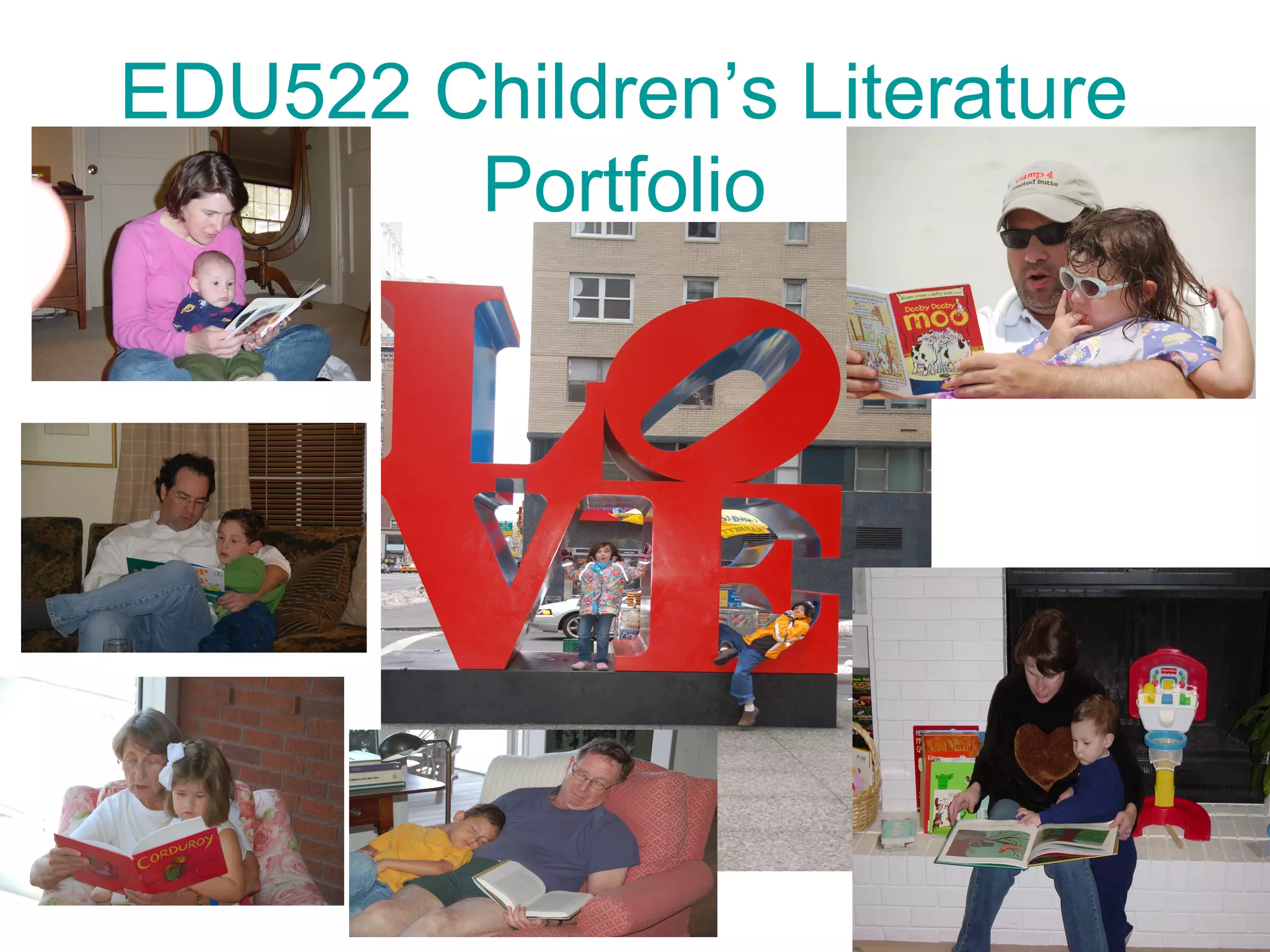
EDU522 Children’s Literature
        Portfolio
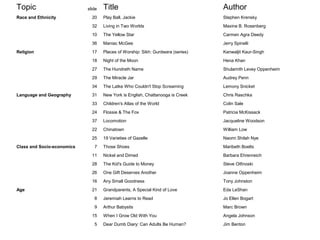
Topic                       slide   Title                                        Author
Race and Ethnicity            20    Play Ball, Jackie                            Stephen Krensky
                              32    Living in Two Worlds                         Maxine B. Rosenberg
                              10    The Yellow Star                              Carmen Agra Deedy
                              36    Maniac McGee                                 Jerry Spinelli
Religion                      17    Places of Worship: Sikh: Gurdwara (series)   Kanwaljit Kaur-Singh
                              18    Night of the Moon                            Hena Khan
                              27    The Hundreth Name                            Shulamith Levey Oppenheim
                              29    The Miracle Jar                              Audrey Penn
                              34    The Latke Who Couldn't Stop Screaming        Lemony Snicket
Language and Geography        31    New York is English, Chattanooga is Creek    Chris Raschka
                              33    Children's Atlas of the World                Colin Sale
                              24    Flossie & The Fox                            Patricia McKissack
                              37    Locomotion                                   Jacqueline Woodson
                              22    Chinatown                                    William Low
                              25    19 Varieties of Gazelle                      Naomi Shilah Nye
Class and Socio-economics      7    Those Shoes                                  Maribeth Boelts
                              11    Nickel and Dimed                             Barbara Ehrenreich
                              28    The Kid's Guide to Money                     Steve Otfinoski
                              26    One Gift Deserves Another                    Joanne Oppenheim
                              16    Any Small Goodness                           Tony Johnston
Age                           21    Grandparents, A Special Kind of Love         Eda LeShan
                               8    Jeremiah Learns to Read                      Jo Ellen Bogart
                               9    Arthur Babysits                              Marc Brown
                              15    When I Grow Old With You                     Angela Johnson
                               5    Dear Dumb Diary: Can Adults Be Human?        Jim Benton
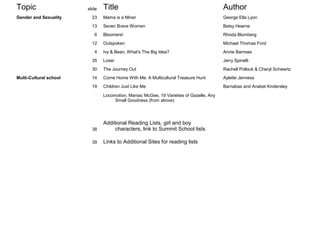
Topic                   slide   Title                                                    Author
Gender and Sexuality      23    Mama is a Miner                                          George Ella Lyon
                          13    Seven Brave Women                                        Betsy Hearne
                           6    Bloomers!                                                Rhoda Blumberg
                          12    Outspoken                                                Michael Thomas Ford
                           4    Ivy & Bean, What's The Big Idea?                         Annie Barrows
                          35    Loser                                                    Jerry Spinelli
                          30    The Journey Out                                          Rachell Pollock & Cheryl Schwartz
Multi-Cultural school     14    Come Home With Me: A Multicultural Treasure Hunt         Aylette Jenness
                          19    Children Just Like Me                                    Barnabas and Anabel Kindersley

                                Locomotion, Maniac McGee, 19 Varieties of Gazelle, Any
                                     Small Goodness (from above)


                                Additional Reading Lists, girl and boy
                          38         characters, link to Summit School lists

                          39    Links to Additional Sites for reading lists
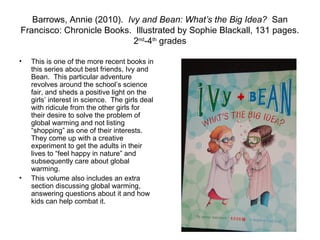
Barrows, Annie (2010). Ivy and Bean: What’s the Big Idea? San
Francisco: Chronicle Books. Illustrated by Sophie Blackall, 131 pages.
                            2nd-4th grades

•   This is one of the more recent books in
    this series about best friends, Ivy and
    Bean. This particular adventure
    revolves around the school’s science
    fair, and sheds a positive light on the
    girls’ interest in science. The girls deal
    with ridicule from the other girls for
    their desire to solve the problem of
    global warming and not listing
    “shopping” as one of their interests.
    They come up with a creative
    experiment to get the adults in their
    lives to “feel happy in nature” and
    subsequently care about global
    warming.
•   This volume also includes an extra
    section discussing global warming,
    answering questions about it and how
    kids can help combat it.
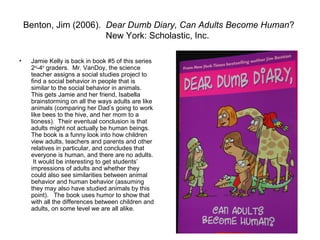
Benton, Jim (2006). Dear Dumb Diary, Can Adults Become Human?
                        New York: Scholastic, Inc.

•    Jamie Kelly is back in book #5 of this series
     2nd-4th graders. Mr. VanDoy, the science
     teacher assigns a social studies project to
     find a social behavior in people that is
     similar to the social behavior in animals.
     This gets Jamie and her friend, Isabella
     brainstorming on all the ways adults are like
     animals (comparing her Dad’s going to work
     like bees to the hive, and her mom to a
     lioness). Their eventual conclusion is that
     adults might not actually be human beings.
     The book is a funny look into how children
     view adults, teachers and parents and other
     relatives in particular, and concludes that
     everyone is human, and there are no adults.
      It would be interesting to get students’
     impressions of adults and whether they
     could also see similarities between animal
     behavior and human behavior (assuming
     they may also have studied animals by this
     point). The book uses humor to show that
     with all the differences between children and
     adults, on some level we are all alike.
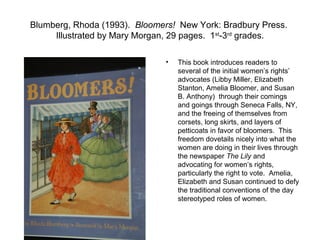
Blumberg, Rhoda (1993). Bloomers! New York: Bradbury Press.
     Illustrated by Mary Morgan, 29 pages. 1st-3rd grades.

                               •   This book introduces readers to
                                   several of the initial women’s rights’
                                   advocates (Libby Miller, Elizabeth
                                   Stanton, Amelia Bloomer, and Susan
                                   B. Anthony) through their comings
                                   and goings through Seneca Falls, NY,
                                   and the freeing of themselves from
                                   corsets, long skirts, and layers of
                                   petticoats in favor of bloomers. This
                                   freedom dovetails nicely into what the
                                   women are doing in their lives through
                                   the newspaper The Lily and
                                   advocating for women’s rights,
                                   particularly the right to vote. Amelia,
                                   Elizabeth and Susan continued to defy
                                   the traditional conventions of the day
                                   stereotyped roles of women.
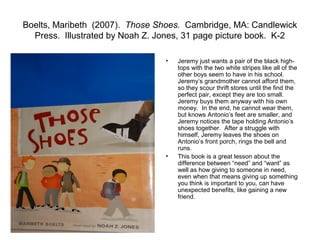
Boelts, Maribeth (2007). Those Shoes. Cambridge, MA: Candlewick
  Press. Illustrated by Noah Z. Jones, 31 page picture book. K-2

                                 •   Jeremy just wants a pair of the black high-
                                     tops with the two white stripes like all of the
                                     other boys seem to have in his school.
                                     Jeremy’s grandmother cannot afford them,
                                     so they scour thrift stores until the find the
                                     perfect pair, except they are too small.
                                     Jeremy buys them anyway with his own
                                     money. In the end, he cannot wear them,
                                     but knows Antonio’s feet are smaller, and
                                     Jeremy notices the tape holding Antonio’s
                                     shoes together. After a struggle with
                                     himself, Jeremy leaves the shoes on
                                     Antonio’s front porch, rings the bell and
                                     runs.
                                 •   This book is a great lesson about the
                                     difference between “need” and “want” as
                                     well as how giving to someone in need,
                                     even when that means giving up something
                                     you think is important to you, can have
                                     unexpected benefits, like gaining a new
                                     friend.
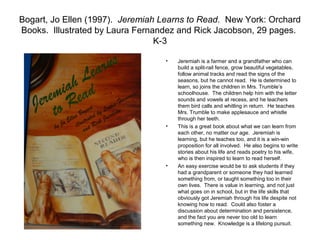
Bogart, Jo Ellen (1997). Jeremiah Learns to Read. New York: Orchard
Books. Illustrated by Laura Fernandez and Rick Jacobson, 29 pages.
                                 K-3

                                  •   Jeremiah is a farmer and a grandfather who can
                                      build a split-rail fence, grow beautiful vegetables,
                                      follow animal tracks and read the signs of the
                                      seasons, but he cannot read. He is determined to
                                      learn, so joins the children in Mrs. Trumble’s
                                      schoolhouse. The children help him with the letter
                                      sounds and vowels at recess, and he teachers
                                      them bird calls and whitling in return. He teaches
                                      Mrs. Trumble to make applesauce and whistle
                                      through her teeth.
                                  •   This is a great book about what we can learn from
                                      each other, no matter our age. Jeremiah is
                                      learning, but he teaches too, and it is a win-win
                                      proposition for all involved. He also begins to write
                                      stories about his life and reads poetry to his wife,
                                      who is then inspired to learn to read herself.
                                  •   An easy exercise would be to ask students if they
                                      had a grandparent or someone they had learned
                                      something from, or taught something too in their
                                      own lives. There is value in learning, and not just
                                      what goes on in school, but in the life skills that
                                      obviously got Jeremiah through his life despite not
                                      knowing how to read. Could also foster a
                                      discussion about determination and persistence,
                                      and the fact you are never too old to learn
                                      something new. Knowledge is a lifelong pursuit.
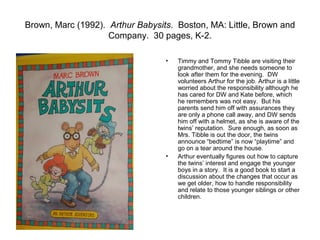
Brown, Marc (1992). Arthur Babysits. Boston, MA: Little, Brown and
                    Company. 30 pages, K-2.

                                  •   Timmy and Tommy Tibble are visiting their
                                      grandmother, and she needs someone to
                                      look after them for the evening. DW
                                      volunteers Arthur for the job. Arthur is a little
                                      worried about the responsibility although he
                                      has cared for DW and Kate before, which
                                      he remembers was not easy. But his
                                      parents send him off with assurances they
                                      are only a phone call away, and DW sends
                                      him off with a helmet, as she is aware of the
                                      twins’ reputation. Sure enough, as soon as
                                      Mrs. Tibble is out the door, the twins
                                      announce “bedtime” is now “playtime” and
                                      go on a tear around the house.
                                  •   Arthur eventually figures out how to capture
                                      the twins’ interest and engage the younger
                                      boys in a story. It is a good book to start a
                                      discussion about the changes that occur as
                                      we get older, how to handle responsibility
                                      and relate to those younger siblings or other
                                      children.
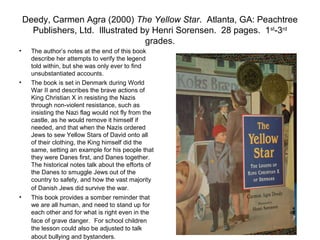
Deedy, Carmen Agra (2000) The Yellow Star. Atlanta, GA: Peachtree
      Publishers, Ltd. Illustrated by Henri Sorensen. 28 pages. 1 st-3rd
                                    grades.
•     The author’s notes at the end of this book
      describe her attempts to verify the legend
      told within, but she was only ever to find
      unsubstantiated accounts.
•     The book is set in Denmark during World
      War II and describes the brave actions of
      King Christian X in resisting the Nazis
      through non-violent resistance, such as
      insisting the Nazi flag would not fly from the
      castle, as he would remove it himself if
      needed, and that when the Nazis ordered
      Jews to sew Yellow Stars of David onto all
      of their clothing, the King himself did the
      same, setting an example for his people that
      they were Danes first, and Danes together.
      The historical notes talk about the efforts of
      the Danes to smuggle Jews out of the
      country to safety, and how the vast majority
      of Danish Jews did survive the war.
•     This book provides a somber reminder that
      we are all human, and need to stand up for
      each other and for what is right even in the
      face of grave danger. For school children
      the lesson could also be adjusted to talk
      about bullying and bystanders.
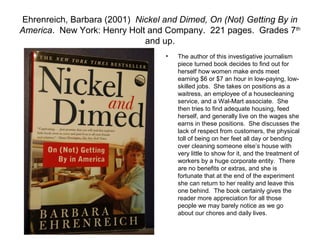
Ehrenreich, Barbara (2001) Nickel and Dimed, On (Not) Getting By in
America. New York: Henry Holt and Company. 221 pages. Grades 7 th
                             and up.
                                  •   The author of this investigative journalism
                                      piece turned book decides to find out for
                                      herself how women make ends meet
                                      earning $6 or $7 an hour in low-paying, low-
                                      skilled jobs. She takes on positions as a
                                      waitress, an employee of a housecleaning
                                      service, and a Wal-Mart associate. She
                                      then tries to find adequate housing, feed
                                      herself, and generally live on the wages she
                                      earns in these positions. She discusses the
                                      lack of respect from customers, the physical
                                      toll of being on her feet all day or bending
                                      over cleaning someone else’s house with
                                      very little to show for it, and the treatment of
                                      workers by a huge corporate entity. There
                                      are no benefits or extras, and she is
                                      fortunate that at the end of the experiment
                                      she can return to her reality and leave this
                                      one behind. The book certainly gives the
                                      reader more appreciation for all those
                                      people we may barely notice as we go
                                      about our chores and daily lives.
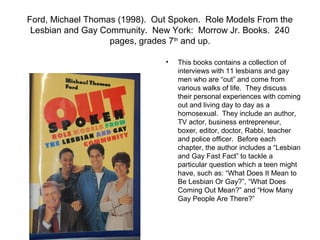
Ford, Michael Thomas (1998). Out Spoken. Role Models From the
 Lesbian and Gay Community. New York: Morrow Jr. Books. 240
                   pages, grades 7th and up.

                               •   This books contains a collection of
                                   interviews with 11 lesbians and gay
                                   men who are “out” and come from
                                   various walks of life. They discuss
                                   their personal experiences with coming
                                   out and living day to day as a
                                   homosexual. They include an author,
                                   TV actor, business entrepreneur,
                                   boxer, editor, doctor, Rabbi, teacher
                                   and police officer. Before each
                                   chapter, the author includes a “Lesbian
                                   and Gay Fast Fact” to tackle a
                                   particular question which a teen might
                                   have, such as: “What Does It Mean to
                                   Be Lesbian Or Gay?”, “What Does
                                   Coming Out Mean?” and “How Many
                                   Gay People Are There?”
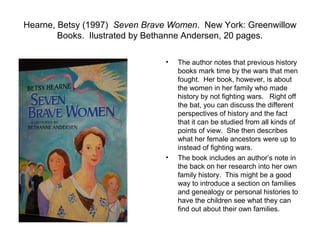
Hearne, Betsy (1997) Seven Brave Women. New York: Greenwillow
        Books. Ilustrated by Bethanne Andersen, 20 pages.

                               •   The author notes that previous history
                                   books mark time by the wars that men
                                   fought. Her book, however, is about
                                   the women in her family who made
                                   history by not fighting wars. Right off
                                   the bat, you can discuss the different
                                   perspectives of history and the fact
                                   that it can be studied from all kinds of
                                   points of view. She then describes
                                   what her female ancestors were up to
                                   instead of fighting wars.
                               •   The book includes an author’s note in
                                   the back on her research into her own
                                   family history. This might be a good
                                   way to introduce a section on families
                                   and genealogy or personal histories to
                                   have the children see what they can
                                   find out about their own families.
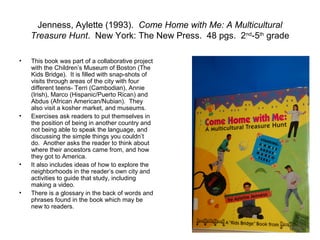
Jenness, Aylette (1993). Come Home with Me: A Multicultural
    Treasure Hunt. New York: The New Press. 48 pgs. 2nd-5th grade

•   This book was part of a collaborative project
    with the Children’s Museum of Boston (The
    Kids Bridge). It is filled with snap-shots of
    visits through areas of the city with four
    different teens- Terri (Cambodian), Annie
    (Irish), Marco (Hispanic/Puerto Rican) and
    Abdus (African American/Nubian). They
    also visit a kosher market, and museums.
•   Exercises ask readers to put themselves in
    the position of being in another country and
    not being able to speak the language, and
    discussing the simple things you couldn’t
    do. Another asks the reader to think about
    where their ancestors came from, and how
    they got to America.
•   It also includes ideas of how to explore the
    neighborhoods in the reader’s own city and
    activities to guide that study, including
    making a video.
•   There is a glossary in the back of words and
    phrases found in the book which may be
    new to readers.
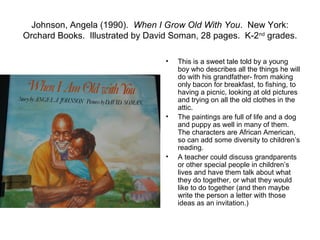
Johnson, Angela (1990). When I Grow Old With You. New York:
Orchard Books. Illustrated by David Soman, 28 pages. K-2 nd grades.

                                  •   This is a sweet tale told by a young
                                      boy who describes all the things he will
                                      do with his grandfather- from making
                                      only bacon for breakfast, to fishing, to
                                      having a picnic, looking at old pictures
                                      and trying on all the old clothes in the
                                      attic.
                                  •   The paintings are full of life and a dog
                                      and puppy as well in many of them.
                                      The characters are African American,
                                      so can add some diversity to children’s
                                      reading.
                                  •   A teacher could discuss grandparents
                                      or other special people in children’s
                                      lives and have them talk about what
                                      they do together, or what they would
                                      like to do together (and then maybe
                                      write the person a letter with those
                                      ideas as an invitation.)
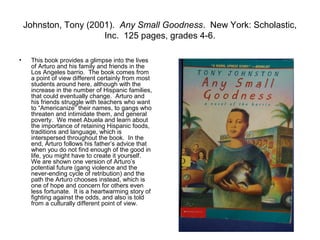
Johnston, Tony (2001). Any Small Goodness. New York: Scholastic,
                       Inc. 125 pages, grades 4-6.

•    This book provides a glimpse into the lives
     of Arturo and his family and friends in the
     Los Angeles barrio. The book comes from
     a point of view different certainly from most
     students around here, although with the
     increase in the number of Hispanic families,
     that could eventually change. Arturo and
     his friends struggle with teachers who want
     to “Americanize” their names, to gangs who
     threaten and intimidate them, and general
     poverty. We meet Abuela and learn about
     the importance of retaining Hispanic foods,
     traditions and language, which is
     interspersed throughout the book. In the
     end, Arturo follows his father’s advice that
     when you do not find enough of the good in
     life, you might have to create it yourself.
     We are shown one version of Arturo’s
     potential future (gang violence and the
     never-ending cycle of retribution) and the
     path the Arturo chooses instead, which is
     one of hope and concern for others even
     less fortunate. It is a heartwarming story of
     fighting against the odds, and also is told
     from a culturally different point of view.
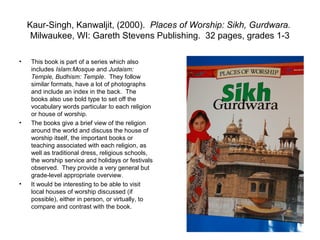
Kaur-Singh, Kanwaljit, (2000). Places of Worship: Sikh, Gurdwara.
     Milwaukee, WI: Gareth Stevens Publishing. 32 pages, grades 1-3

•    This book is part of a series which also
     includes Islam:Mosque and Judaism:
     Temple, Budhism: Temple. They follow
     similar formats, have a lot of photographs
     and include an index in the back. The
     books also use bold type to set off the
     vocabulary words particular to each religion
     or house of worship.
•    The books give a brief view of the religion
     around the world and discuss the house of
     worship itself, the important books or
     teaching associated with each religion, as
     well as traditional dress, religious schools,
     the worship service and holidays or festivals
     observed. They provide a very general but
     grade-level appropriate overview.
•    It would be interesting to be able to visit
     local houses of worship discussed (if
     possible), either in person, or virtually, to
     compare and contrast with the book.
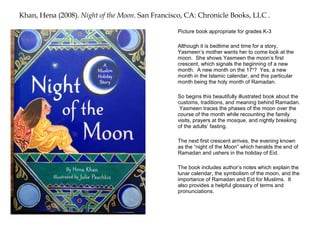
Khan, Hena (2008). Night of the Moon. San Francisco, CA: Chronicle Books, LLC .

                                                 Picture book appropriate for grades K-3

                                                 Although it is bedtime and time for a story,
                                                 Yasmeen’s mother wants her to come look at the
                                                 moon. She shows Yasmeen the moon’s first
                                                 crescent, which signals the beginning of a new
                                                 month. A new month on the 17 th? Yes, a new
                                                 month in the Islamic calendar, and this particular
                                                 month being the holy month of Ramadan.

                                                 So begins this beautifully illustrated book about the
                                                 customs, traditions, and meaning behind Ramadan.
                                                  Yasmeen traces the phases of the moon over the
                                                 course of the month while recounting the family
                                                 visits, prayers at the mosque, and nightly breaking
                                                 of the adults’ fasting.

                                                 The next first crescent arrives, the evening known
                                                 as the “night of the Moon” which heralds the end of
                                                 Ramadan and ushers in the holiday of Eid.

                                                 The book includes author’s notes which explain the
                                                 lunar calendar, the symbolism of the moon, and the
                                                 importance of Ramadan and Eid for Muslims. It
                                                 also provides a helpful glossary of terms and
                                                 pronunciations.
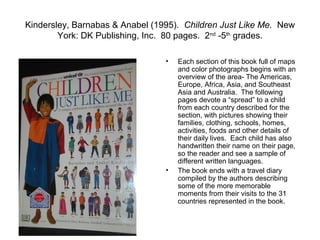
Kindersley, Barnabas & Anabel (1995). Children Just Like Me. New
        York: DK Publishing, Inc. 80 pages. 2nd -5th grades.

                                 •   Each section of this book full of maps
                                     and color photographs begins with an
                                     overview of the area- The Americas,
                                     Europe, Africa, Asia, and Southeast
                                     Asia and Australia. The following
                                     pages devote a “spread” to a child
                                     from each country described for the
                                     section, with pictures showing their
                                     families, clothing, schools, homes,
                                     activities, foods and other details of
                                     their daily lives. Each child has also
                                     handwritten their name on their page,
                                     so the reader and see a sample of
                                     different written languages.
                                 •   The book ends with a travel diary
                                     compiled by the authors describing
                                     some of the more memorable
                                     moments from their visits to the 31
                                     countries represented in the book.
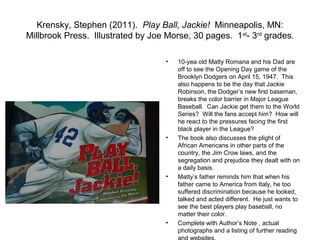
Krensky, Stephen (2011). Play Ball, Jackie! Minneapolis, MN:
Millbrook Press. Illustrated by Joe Morse, 30 pages. 1st- 3rd grades.

                                    •   10-yea old Matty Romana and his Dad are
                                        off to see the Opening Day game of the
                                        Brooklyn Dodgers on April 15, 1947. This
                                        also happens to be the day that Jackie
                                        Robinson, the Dodger’s new first baseman,
                                        breaks the color barrier in Major League
                                        Baseball. Can Jackie get them to the World
                                        Series? Will the fans accept him? How will
                                        he react to the pressures facing the first
                                        black player in the League?
                                    •   The book also discusses the plight of
                                        African Americans in other parts of the
                                        country, the Jim Crow laws, and the
                                        segregation and prejudice they dealt with on
                                        a daily basis.
                                    •   Matty’s father reminds him that when his
                                        father came to America from Italy, he too
                                        suffered discrimination because he looked,
                                        talked and acted different. He just wants to
                                        see the best players play baseball, no
                                        matter their color.
                                    •   Complete with Author’s Note , actual
                                        photographs and a listing of further reading
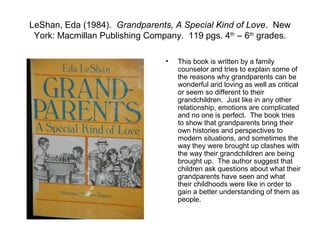
LeShan, Eda (1984). Grandparents, A Special Kind of Love. New
 York: Macmillan Publishing Company. 119 pgs. 4th – 6th grades.

                                •   This book is written by a family
                                    counselor and tries to explain some of
                                    the reasons why grandparents can be
                                    wonderful and loving as well as critical
                                    or seem so different to their
                                    grandchildren. Just like in any other
                                    relationship, emotions are complicated
                                    and no one is perfect. The book tries
                                    to show that grandparents bring their
                                    own histories and perspectives to
                                    modern situations, and sometimes the
                                    way they were brought up clashes with
                                    the way their grandchildren are being
                                    brought up. The author suggest that
                                    children ask questions about what their
                                    grandparents have seen and what
                                    their childhoods were like in order to
                                    gain a better understanding of them as
                                    people.
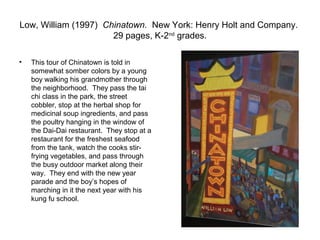
Low, William (1997) Chinatown. New York: Henry Holt and Company.
                      29 pages, K-2nd grades.

•   This tour of Chinatown is told in
    somewhat somber colors by a young
    boy walking his grandmother through
    the neighborhood. They pass the tai
    chi class in the park, the street
    cobbler, stop at the herbal shop for
    medicinal soup ingredients, and pass
    the poultry hanging in the window of
    the Dai-Dai restaurant. They stop at a
    restaurant for the freshest seafood
    from the tank, watch the cooks stir-
    frying vegetables, and pass through
    the busy outdoor market along their
    way. They end with the new year
    parade and the boy’s hopes of
    marching in it the next year with his
    kung fu school.
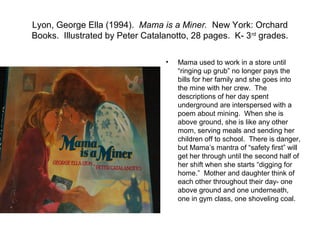
Lyon, George Ella (1994). Mama is a Miner. New York: Orchard
Books. Illustrated by Peter Catalanotto, 28 pages. K- 3rd grades.

                                 •   Mama used to work in a store until
                                     “ringing up grub” no longer pays the
                                     bills for her family and she goes into
                                     the mine with her crew. The
                                     descriptions of her day spent
                                     underground are interspersed with a
                                     poem about mining. When she is
                                     above ground, she is like any other
                                     mom, serving meals and sending her
                                     children off to school. There is danger,
                                     but Mama’s mantra of “safety first” will
                                     get her through until the second half of
                                     her shift when she starts “digging for
                                     home.” Mother and daughter think of
                                     each other throughout their day- one
                                     above ground and one underneath,
                                     one in gym class, one shoveling coal.
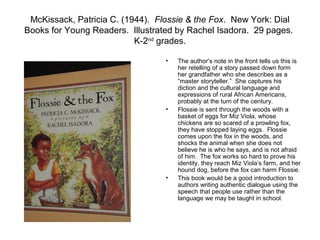
McKissack, Patricia C. (1944). Flossie & the Fox. New York: Dial
Books for Young Readers. Illustrated by Rachel Isadora. 29 pages.
                           K-2nd grades.

                                  •   The author’s note in the front tells us this is
                                      her retelling of a story passed down form
                                      her grandfather who she describes as a
                                      “master storyteller.” She captures his
                                      diction and the cultural language and
                                      expressions of rural African Americans,
                                      probably at the turn of the century.
                                  •   Flossie is sent through the woods with a
                                      basket of eggs for Miz Viola, whose
                                      chickens are so scared of a prowling fox,
                                      they have stopped laying eggs. Flossie
                                      comes upon the fox in the woods, and
                                      shocks the animal when she does not
                                      believe he is who he says, and is not afraid
                                      of him. The fox works so hard to prove his
                                      identity, they reach Miz Viola’s farm, and her
                                      hound dog, before the fox can harm Flossie.
                                  •   This book would be a good introduction to
                                      authors writing authentic dialogue using the
                                      speech that people use rather than the
                                      language we may be taught in school.
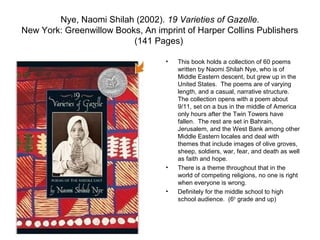
Nye, Naomi Shilah (2002). 19 Varieties of Gazelle.
New York: Greenwillow Books, An imprint of Harper Collins Publishers
                          (141 Pages)

                                   •   This book holds a collection of 60 poems
                                       written by Naomi Shilah Nye, who is of
                                       Middle Eastern descent, but grew up in the
                                       United States. The poems are of varying
                                       length, and a casual, narrative structure.
                                       The collection opens with a poem about
                                       9/11, set on a bus in the middle of America
                                       only hours after the Twin Towers have
                                       fallen. The rest are set in Bahrain,
                                       Jerusalem, and the West Bank among other
                                       Middle Eastern locales and deal with
                                       themes that include images of olive groves,
                                       sheep, soldiers, war, fear, and death as well
                                       as faith and hope.
                                   •   There is a theme throughout that in the
                                       world of competing religions, no one is right
                                       when everyone is wrong.
                                   •   Definitely for the middle school to high
                                       school audience. (6th grade and up)
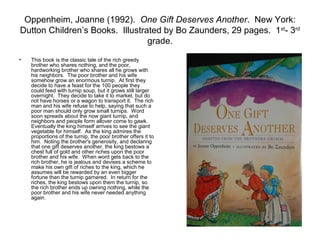
Oppenheim, Joanne (1992). One Gift Deserves Another. New York:
Dutton Children’s Books. Illustrated by Bo Zaunders, 29 pages. 1 st- 3rd
                                 grade.
•   This book is the classic tale of the rich greedy
    brother who shares nothing, and the poor,
    hardworking brother who shares all he grows with
    his neighbors. The poor brother and his wife
    somehow grow an enormous turnip. At first they
    decide to have a feast for the 100 people they
    could feed with turnip soup, but it grows still larger
    overnight. They decide to take it to market, but do
    not have horses or a wagon to transport it. The rich
    man and his wife refuse to help, saying that such a
    poor man should only grow small turnips. Word
    soon spreads about the now giant turnip, and
    neighbors and people form allover come to gawk.
    Eventually the king himself arrives to see the giant
    vegetable for himself. As the king admires the
    proportions of the turnip, the poor brother offers it to
    him. Noting the brother's generosity, and declaring
    that one gift deserves another, the king bestows a
    chest full of gold and other riches upon the poor
    brother and his wife. When word gets back to the
    rich brother, he is jealous and devises a scheme to
    make his own gift of riches to the king, which he
    assumes will be rewarded by an even bigger
    fortune than the turnip garnered. In return for the
    riches, the king bestows upon them the turnip, so
    the rich brother ends up owning nothing, while the
    poor brother and his wife never needed anything
    again.
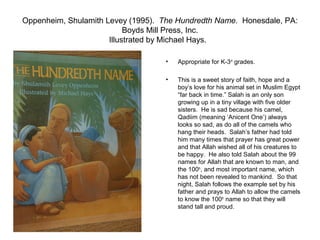
Oppenheim, Shulamith Levey (1995). The Hundredth Name. Honesdale, PA:
                           Boyds Mill Press, Inc.
                      Illustrated by Michael Hays.

                                   •   Appropriate for K-3rd grades.

                                   •   This is a sweet story of faith, hope and a
                                       boy’s love for his animal set in Muslim Egypt
                                       “far back in time.” Salah is an only son
                                       growing up in a tiny village with five older
                                       sisters. He is sad because his camel,
                                       Qadiim (meaning ‘Anicent One’) always
                                       looks so sad, as do all of the camels who
                                       hang their heads. Salah’s father had told
                                       him many times that prayer has great power
                                       and that Allah wished all of his creatures to
                                       be happy. He also told Salah about the 99
                                       names for Allah that are known to man, and
                                       the 100th, and most important name, which
                                       has not been revealed to mankind. So that
                                       night, Salah follows the example set by his
                                       father and prays to Allah to allow the camels
                                       to know the 100th name so that they will
                                       stand tall and proud.
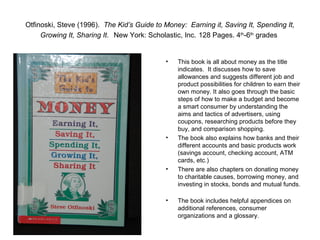
Otfinoski, Steve (1996). The Kid’s Guide to Money: Earning it, Saving It, Spending It,
     Growing It, Sharing It. New York: Scholastic, Inc. 128 Pages. 4th-6th grades


                                            •   This book is all about money as the title
                                                indicates. It discusses how to save
                                                allowances and suggests different job and
                                                product possibilities for children to earn their
                                                own money. It also goes through the basic
                                                steps of how to make a budget and become
                                                a smart consumer by understanding the
                                                aims and tactics of advertisers, using
                                                coupons, researching products before they
                                                buy, and comparison shopping.
                                            •   The book also explains how banks and their
                                                different accounts and basic products work
                                                (savings account, checking account, ATM
                                                cards, etc.)
                                            •   There are also chapters on donating money
                                                to charitable causes, borrowing money, and
                                                investing in stocks, bonds and mutual funds.

                                            •   The book includes helpful appendices on
                                                additional references, consumer
                                                organizations and a glossary.
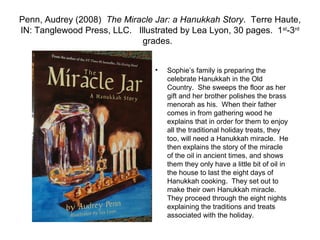
Penn, Audrey (2008) The Miracle Jar: a Hanukkah Story. Terre Haute,
IN: Tanglewood Press, LLC. Illustrated by Lea Lyon, 30 pages. 1st-3rd
                             grades.


                                 •   Sophie’s family is preparing the
                                     celebrate Hanukkah in the Old
                                     Country. She sweeps the floor as her
                                     gift and her brother polishes the brass
                                     menorah as his. When their father
                                     comes in from gathering wood he
                                     explains that in order for them to enjoy
                                     all the traditional holiday treats, they
                                     too, will need a Hanukkah miracle. He
                                     then explains the story of the miracle
                                     of the oil in ancient times, and shows
                                     them they only have a little bit of oil in
                                     the house to last the eight days of
                                     Hanukkah cooking. They set out to
                                     make their own Hanukkah miracle.
                                     They proceed through the eight nights
                                     explaining the traditions and treats
                                     associated with the holiday.
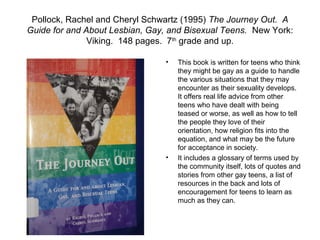
Pollock, Rachel and Cheryl Schwartz (1995) The Journey Out. A
Guide for and About Lesbian, Gay, and Bisexual Teens. New York:
               Viking. 148 pages. 7th grade and up.

                                •   This book is written for teens who think
                                    they might be gay as a guide to handle
                                    the various situations that they may
                                    encounter as their sexuality develops.
                                    It offers real life advice from other
                                    teens who have dealt with being
                                    teased or worse, as well as how to tell
                                    the people they love of their
                                    orientation, how religion fits into the
                                    equation, and what may be the future
                                    for acceptance in society.
                                •   It includes a glossary of terms used by
                                    the community itself, lots of quotes and
                                    stories from other gay teens, a list of
                                    resources in the back and lots of
                                    encouragement for teens to learn as
                                    much as they can.
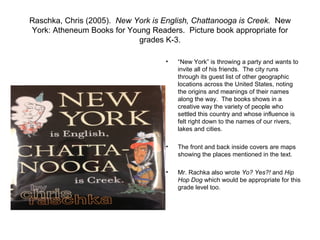
Raschka, Chris (2005). New York is English, Chattanooga is Creek. New
York: Atheneum Books for Young Readers. Picture book appropriate for
                            grades K-3.

                                    •   “New York” is throwing a party and wants to
                                        invite all of his friends. The city runs
                                        through its guest list of other geographic
                                        locations across the United States, noting
                                        the origins and meanings of their names
                                        along the way. The books shows in a
                                        creative way the variety of people who
                                        settled this country and whose influence is
                                        felt right down to the names of our rivers,
                                        lakes and cities.

                                    •   The front and back inside covers are maps
                                        showing the places mentioned in the text.

                                    •   Mr. Rachka also wrote Yo? Yes?! and Hip
                                        Hop Dog which would be appropriate for this
                                        grade level too.
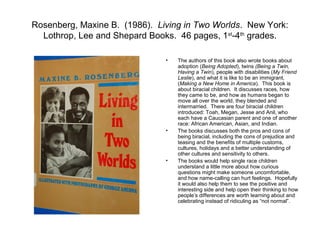
Rosenberg, Maxine B. (1986). Living in Two Worlds. New York:
  Lothrop, Lee and Shepard Books. 46 pages, 1st-4th grades.

                               •   The authors of this book also wrote books about
                                   adoption (Being Adopted), twins (Being a Twin,
                                   Having a Twin), people with disabilities (My Friend
                                   Leslie), and what it is like to be an immigrant,
                                   (Making a New Home in America). This book is
                                   about biracial children. It discusses races, how
                                   they came to be, and how as humans began to
                                   move all over the world, they blended and
                                   intermarried. There are four biracial children
                                   introduced: Toah, Megan, Jesse and Anil, who
                                   each have a Caucasian parent and one of another
                                   race: African American, Asian, and Indian.
                               •   The books discusses both the pros and cons of
                                   being biracial, including the cons of prejudice and
                                   teasing and the benefits of multiple customs,
                                   cultures, holidays and a better understanding of
                                   other cultures and sensitivity to others.
                               •   The books would help single race children
                                   understand a little more about how curious
                                   questions might make someone uncomfortable,
                                   and how name-calling can hurt feelings. Hopefully
                                   it would also help them to see the positive and
                                   interesting side and help open their thinking to how
                                   people’s differences are worth learning about and
                                   celebrating instead of ridiculing as “not normal”.
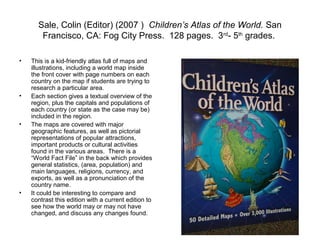
Sale, Colin (Editor) (2007 ) Children’s Atlas of the World. San
       Francisco, CA: Fog City Press. 128 pages. 3rd- 5th grades.

•   This is a kid-friendly atlas full of maps and
    illustrations, including a world map inside
    the front cover with page numbers on each
    country on the map if students are trying to
    research a particular area.
•   Each section gives a textual overview of the
    region, plus the capitals and populations of
    each country (or state as the case may be)
    included in the region.
•   The maps are covered with major
    geographic features, as well as pictorial
    representations of popular attractions,
    important products or cultural activities
    found in the various areas. There is a
    “World Fact File” in the back which provides
    general statistics, (area, population) and
    main languages, religions, currency, and
    exports, as well as a pronunciation of the
    country name.
•   It could be interesting to compare and
    contrast this edition with a current edition to
    see how the world may or may not have
    changed, and discuss any changes found.
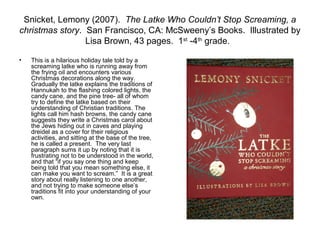
Snicket, Lemony (2007). The Latke Who Couldn’t Stop Screaming, a
christmas story. San Francisco, CA: McSweeny’s Books. Illustrated by
                 Lisa Brown, 43 pages. 1st -4th grade.

•   This is a hilarious holiday tale told by a
    screaming latke who is running away from
    the frying oil and encounters various
    Christmas decorations along the way.
    Gradually the latke explains the traditions of
    Hannukah to the flashing colored lights, the
    candy cane, and the pine tree- all of whom
    try to define the latke based on their
    understanding of Christian traditions. The
    lights call him hash browns, the candy cane
    suggests they write a Christmas carol about
    the Jews hiding out in caves and playing
    dreidel as a cover for their religious
    activities, and sitting at the base of the tree,
    he is called a present. The very last
    paragraph sums it up by noting that it is
    frustrating not to be understood in the world,
    and that “if you say one thing and keep
    being told that you mean something else, it
    can make you want to scream.” It is a great
    story about really listening to one another,
    and not trying to make someone else’s
    traditions fit into your understanding of your
    own.
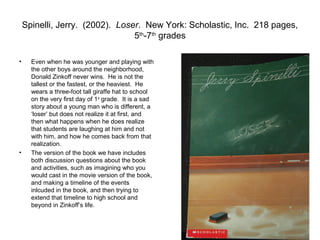
Spinelli, Jerry. (2002). Loser. New York: Scholastic, Inc. 218 pages,
                                 5th-7th grades

•     Even when he was younger and playing with
      the other boys around the neighborhood,
      Donald Zinkoff never wins. He is not the
      tallest or the fastest, or the heaviest. He
      wears a three-foot tall giraffe hat to school
      on the very first day of 1st grade. It is a sad
      story about a young man who is different, a
      ‘loser’ but does not realize it at first, and
      then what happens when he does realize
      that students are laughing at him and not
      with him, and how he comes back from that
      realization.
•     The version of the book we have includes
      both discussion questions about the book
      and activities, such as imagining who you
      would cast in the movie version of the book,
      and making a timeline of the events
      inlcuded in the book, and then trying to
      extend that timeline to high school and
      beyond in Zinkoff’s life.
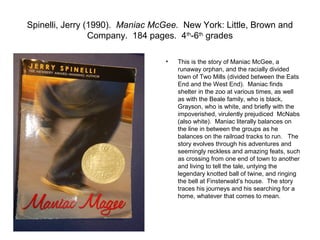
Spinelli, Jerry (1990). Maniac McGee. New York: Little, Brown and
                 Company. 184 pages. 4th-6th grades

                                 •   This is the story of Maniac McGee, a
                                     runaway orphan, and the racially divided
                                     town of Two Mills (divided between the Eats
                                     End and the West End). Maniac finds
                                     shelter in the zoo at various times, as well
                                     as with the Beale family, who is black,
                                     Grayson, who is white, and briefly with the
                                     impoverished, virulently prejudiced McNabs
                                     (also white). Maniac literally balances on
                                     the line in between the groups as he
                                     balances on the railroad tracks to run. The
                                     story evolves through his adventures and
                                     seemingly reckless and amazing feats, such
                                     as crossing from one end of town to another
                                     and living to tell the tale, untying the
                                     legendary knotted ball of twine, and ringing
                                     the bell at Finsterwald’s house. The story
                                     traces his journeys and his searching for a
                                     home, whatever that comes to mean.
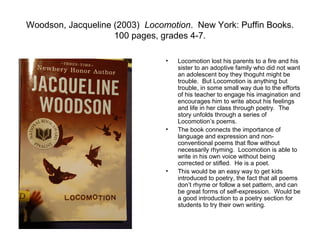
Woodson, Jacqueline (2003) Locomotion. New York: Puffin Books.
                    100 pages, grades 4-7.

                                •   Locomotion lost his parents to a fire and his
                                    sister to an adoptive family who did not want
                                    an adolescent boy they thoguht might be
                                    trouble. But Locomotion is anything but
                                    trouble, in some small way due to the efforts
                                    of his teacher to engage his imagination and
                                    encourages him to write about his feelings
                                    and life in her class through poetry. The
                                    story unfolds through a series of
                                    Locomotion’s poems.
                                •   The book connects the importance of
                                    language and expression and non-
                                    conventional poems that flow without
                                    necessarily rhyming. Locomotion is able to
                                    write in his own voice without being
                                    corrected or stifled. He is a poet.
                                •   This would be an easy way to get kids
                                    introduced to poetry, the fact that all poems
                                    don’t rhyme or follow a set pattern, and can
                                    be great forms of self-expression. Would be
                                    a good introduction to a poetry section for
                                    students to try their own writing.
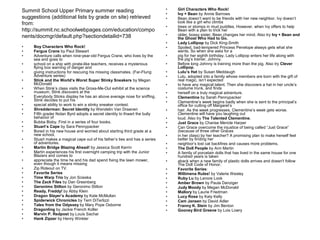
Summit School Upper Primary summer reading                                   •   Girl Characters Who Rock!
                                                                             •   Ivy + Bean by Annie Barrows
suggestions (additional lists by grade on site) retrieved                    •   Bean doesn’t want to be friends with her new neighbor. Ivy doesn’t
from:                                                                            look like a girl who climbs
                                                                             •   trees or stomps in mud puddles. However, when Ivy offers to help
http://summit.nc.schoolwebpages.com/education/compo                              Bean with a plan to trick her
nents/docmgr/default.php?sectiondetailid=738                                 •   older, bossy sister, Bean changes her mind. Also try Ivy + Bean and
                                                                                 the Ghost Who Had to Go.
                                                                             •   Lady Lollipop by Dick King-Smith
•    Boy Characters Who Rock!                                                •   Spoiled, bad-tempered Princess Penelope always gets what she
•    Fergus Crane by Paul Stewart                                                wants. So when she asks for a
•    Adventure calls when nine-year-old Fergus Crane, who lives by the       •   pig for her eighth birthday, Lady Lollipop enters her life along with
     sea and goes to                                                             the pig’s trainer, Johnny.
•    school on a ship with pirate-like teachers, receives a mysterious       •   Before long Johnny is training more than the pig. Also try Clever
     flying box warning of danger and                                            Lollipop.
•    giving instructions for rescuing his missing classmates. (Far-Flung     •   Lulu’s Hat by Susan Meddaugh
     Adventure series)                                                       •   Lulu, adopted into a family whose members are born with the gift of
•    Stink and the World’s Worst Super Stinky Sneakers by Megan                  real magic, isn’t expected
     McDonald                                                                •   to have any magical talent. Then she discovers a hat in her uncle’s
•    When Stink’s class visits the Gross-Me-Out exhibit at the science           costume trunk, and finds
     museum, Stink discovers at the                                          •   herself on a truly magical adventure.
•    Everybody Stinks display he has an above average nose for sniffing.     •   Clementine by Sarah Pennypacker
     Stink decides to put his                                                •   Clementine’s week begins badly when she is sent to the principal’s
•    special ability to work to win a stinky sneaker contest.                    office for cutting off Margaret’s
•    Shredderman: Secret Identity by Wendelin Van Draanen                    •   hair. As the week progresses, Clementine’s week gets worse.
•    Fifth grader Nolan Byrd adopts a secret identity to thwart the bully        Clementine will have you laughing out
     behavior of                                                             •   loud. Also try The Talented Clementine.
•    Bubba Bixby. First in a series of four books.                           •   Just Grace by Charise Mericle Harper
•    Stuart’s Cape by Sara Pennypacker                                       •   Can Grace overcome the injustice of being called “Just Grace”
•    Bored in his new house and worried about starting third grade at a          (because of three other Graces
     new school,                                                             •   in her class) by her teacher? A promising plan to make herself feel
•    Stuart makes a magical cape out of his father’s ties and has a series       better by finding her
     of adventures.                                                          •   neighbor’s lost cat backfires and causes more problems.
•    Martin Bridge Blazing Ahead! by Jessica Scott Kerrin                    •   The Doll People by Ann Martin
•    Martin experiences his first overnight camping trip with the Junior     •   A family of porcelain dolls that has lived in the same house for one
     Blazers and comes to                                                        hundred years is taken
•    appreciate the time he and his dad spend fixing the lawn mower,         •   aback when a new family of plastic dolls arrives and doesn't follow
     even though it means missing                                                The Doll Code of Honor.
•    Zip Rideout on TV.                                                      •   Favorite Series:
•    Favorite Series                                                         •   Willimena Rules! by Valerie Wesley
•    Time Warp Trio by Jon Scieska                                           •   Ruby Lu by Lenore Look
•    The Zack Files by Dan Greenberg                                         •   Amber Brown by Paula Danziger
•    Geronimo Stilton by Geronimo Stilton                                    •   Judy Moody by Megan McDonald
•    Ready, Freddy! by Abby Klein                                            •   Mallory by Laurie Friedman
•    Dragon Slayer’s Academy by Kate McMullan                                •   Lucy Rose by Katy Kelly
•    Spiderwick Chronicles by Terri DiTerlizzi                               •   Cam Jansen by David Adler
•    Tales from the Odyssey by Mary Pope Osborne                             •   Franny K. Stein by Jim Benton
•    Dragonling by Jackie French Koller                                      •   Gooney Bird Greene by Lois Lowry
•    Marvin P. Redpost by Louis Sachar
•    Hank Zipzer by Henry Winkler
Links to additional reading lists
•   For Newbery medal winners:
•   http://www.ala.org/alsc/awardsgrants/bookmed
•   For additional Award winners:
•   http://www.ala.org/alsc/awardsgrants/notalists

• For specific lists for grades 4-6:
• http://summitreaders4-6.wikispaces.com/

Literature portfolio EDU522

  • 1.
  • 2.
    Topic slide Title Author Race and Ethnicity 20 Play Ball, Jackie Stephen Krensky 32 Living in Two Worlds Maxine B. Rosenberg 10 The Yellow Star Carmen Agra Deedy 36 Maniac McGee Jerry Spinelli Religion 17 Places of Worship: Sikh: Gurdwara (series) Kanwaljit Kaur-Singh 18 Night of the Moon Hena Khan 27 The Hundreth Name Shulamith Levey Oppenheim 29 The Miracle Jar Audrey Penn 34 The Latke Who Couldn't Stop Screaming Lemony Snicket Language and Geography 31 New York is English, Chattanooga is Creek Chris Raschka 33 Children's Atlas of the World Colin Sale 24 Flossie & The Fox Patricia McKissack 37 Locomotion Jacqueline Woodson 22 Chinatown William Low 25 19 Varieties of Gazelle Naomi Shilah Nye Class and Socio-economics 7 Those Shoes Maribeth Boelts 11 Nickel and Dimed Barbara Ehrenreich 28 The Kid's Guide to Money Steve Otfinoski 26 One Gift Deserves Another Joanne Oppenheim 16 Any Small Goodness Tony Johnston Age 21 Grandparents, A Special Kind of Love Eda LeShan 8 Jeremiah Learns to Read Jo Ellen Bogart 9 Arthur Babysits Marc Brown 15 When I Grow Old With You Angela Johnson 5 Dear Dumb Diary: Can Adults Be Human? Jim Benton
  • 3.
    Topic slide Title Author Gender and Sexuality 23 Mama is a Miner George Ella Lyon 13 Seven Brave Women Betsy Hearne 6 Bloomers! Rhoda Blumberg 12 Outspoken Michael Thomas Ford 4 Ivy & Bean, What's The Big Idea? Annie Barrows 35 Loser Jerry Spinelli 30 The Journey Out Rachell Pollock & Cheryl Schwartz Multi-Cultural school 14 Come Home With Me: A Multicultural Treasure Hunt Aylette Jenness 19 Children Just Like Me Barnabas and Anabel Kindersley Locomotion, Maniac McGee, 19 Varieties of Gazelle, Any Small Goodness (from above) Additional Reading Lists, girl and boy 38 characters, link to Summit School lists 39 Links to Additional Sites for reading lists
  • 4.
    Barrows, Annie (2010).Ivy and Bean: What’s the Big Idea? San Francisco: Chronicle Books. Illustrated by Sophie Blackall, 131 pages. 2nd-4th grades • This is one of the more recent books in this series about best friends, Ivy and Bean. This particular adventure revolves around the school’s science fair, and sheds a positive light on the girls’ interest in science. The girls deal with ridicule from the other girls for their desire to solve the problem of global warming and not listing “shopping” as one of their interests. They come up with a creative experiment to get the adults in their lives to “feel happy in nature” and subsequently care about global warming. • This volume also includes an extra section discussing global warming, answering questions about it and how kids can help combat it.
  • 5.
    Benton, Jim (2006).Dear Dumb Diary, Can Adults Become Human? New York: Scholastic, Inc. • Jamie Kelly is back in book #5 of this series 2nd-4th graders. Mr. VanDoy, the science teacher assigns a social studies project to find a social behavior in people that is similar to the social behavior in animals. This gets Jamie and her friend, Isabella brainstorming on all the ways adults are like animals (comparing her Dad’s going to work like bees to the hive, and her mom to a lioness). Their eventual conclusion is that adults might not actually be human beings. The book is a funny look into how children view adults, teachers and parents and other relatives in particular, and concludes that everyone is human, and there are no adults. It would be interesting to get students’ impressions of adults and whether they could also see similarities between animal behavior and human behavior (assuming they may also have studied animals by this point). The book uses humor to show that with all the differences between children and adults, on some level we are all alike.
  • 6.
    Blumberg, Rhoda (1993).Bloomers! New York: Bradbury Press. Illustrated by Mary Morgan, 29 pages. 1st-3rd grades. • This book introduces readers to several of the initial women’s rights’ advocates (Libby Miller, Elizabeth Stanton, Amelia Bloomer, and Susan B. Anthony) through their comings and goings through Seneca Falls, NY, and the freeing of themselves from corsets, long skirts, and layers of petticoats in favor of bloomers. This freedom dovetails nicely into what the women are doing in their lives through the newspaper The Lily and advocating for women’s rights, particularly the right to vote. Amelia, Elizabeth and Susan continued to defy the traditional conventions of the day stereotyped roles of women.
  • 7.
    Boelts, Maribeth (2007).Those Shoes. Cambridge, MA: Candlewick Press. Illustrated by Noah Z. Jones, 31 page picture book. K-2 • Jeremy just wants a pair of the black high- tops with the two white stripes like all of the other boys seem to have in his school. Jeremy’s grandmother cannot afford them, so they scour thrift stores until the find the perfect pair, except they are too small. Jeremy buys them anyway with his own money. In the end, he cannot wear them, but knows Antonio’s feet are smaller, and Jeremy notices the tape holding Antonio’s shoes together. After a struggle with himself, Jeremy leaves the shoes on Antonio’s front porch, rings the bell and runs. • This book is a great lesson about the difference between “need” and “want” as well as how giving to someone in need, even when that means giving up something you think is important to you, can have unexpected benefits, like gaining a new friend.
  • 8.
    Bogart, Jo Ellen(1997). Jeremiah Learns to Read. New York: Orchard Books. Illustrated by Laura Fernandez and Rick Jacobson, 29 pages. K-3 • Jeremiah is a farmer and a grandfather who can build a split-rail fence, grow beautiful vegetables, follow animal tracks and read the signs of the seasons, but he cannot read. He is determined to learn, so joins the children in Mrs. Trumble’s schoolhouse. The children help him with the letter sounds and vowels at recess, and he teachers them bird calls and whitling in return. He teaches Mrs. Trumble to make applesauce and whistle through her teeth. • This is a great book about what we can learn from each other, no matter our age. Jeremiah is learning, but he teaches too, and it is a win-win proposition for all involved. He also begins to write stories about his life and reads poetry to his wife, who is then inspired to learn to read herself. • An easy exercise would be to ask students if they had a grandparent or someone they had learned something from, or taught something too in their own lives. There is value in learning, and not just what goes on in school, but in the life skills that obviously got Jeremiah through his life despite not knowing how to read. Could also foster a discussion about determination and persistence, and the fact you are never too old to learn something new. Knowledge is a lifelong pursuit.
  • 9.
    Brown, Marc (1992).Arthur Babysits. Boston, MA: Little, Brown and Company. 30 pages, K-2. • Timmy and Tommy Tibble are visiting their grandmother, and she needs someone to look after them for the evening. DW volunteers Arthur for the job. Arthur is a little worried about the responsibility although he has cared for DW and Kate before, which he remembers was not easy. But his parents send him off with assurances they are only a phone call away, and DW sends him off with a helmet, as she is aware of the twins’ reputation. Sure enough, as soon as Mrs. Tibble is out the door, the twins announce “bedtime” is now “playtime” and go on a tear around the house. • Arthur eventually figures out how to capture the twins’ interest and engage the younger boys in a story. It is a good book to start a discussion about the changes that occur as we get older, how to handle responsibility and relate to those younger siblings or other children.
  • 10.
    Deedy, Carmen Agra(2000) The Yellow Star. Atlanta, GA: Peachtree Publishers, Ltd. Illustrated by Henri Sorensen. 28 pages. 1 st-3rd grades. • The author’s notes at the end of this book describe her attempts to verify the legend told within, but she was only ever to find unsubstantiated accounts. • The book is set in Denmark during World War II and describes the brave actions of King Christian X in resisting the Nazis through non-violent resistance, such as insisting the Nazi flag would not fly from the castle, as he would remove it himself if needed, and that when the Nazis ordered Jews to sew Yellow Stars of David onto all of their clothing, the King himself did the same, setting an example for his people that they were Danes first, and Danes together. The historical notes talk about the efforts of the Danes to smuggle Jews out of the country to safety, and how the vast majority of Danish Jews did survive the war. • This book provides a somber reminder that we are all human, and need to stand up for each other and for what is right even in the face of grave danger. For school children the lesson could also be adjusted to talk about bullying and bystanders.
  • 11.
    Ehrenreich, Barbara (2001)Nickel and Dimed, On (Not) Getting By in America. New York: Henry Holt and Company. 221 pages. Grades 7 th and up. • The author of this investigative journalism piece turned book decides to find out for herself how women make ends meet earning $6 or $7 an hour in low-paying, low- skilled jobs. She takes on positions as a waitress, an employee of a housecleaning service, and a Wal-Mart associate. She then tries to find adequate housing, feed herself, and generally live on the wages she earns in these positions. She discusses the lack of respect from customers, the physical toll of being on her feet all day or bending over cleaning someone else’s house with very little to show for it, and the treatment of workers by a huge corporate entity. There are no benefits or extras, and she is fortunate that at the end of the experiment she can return to her reality and leave this one behind. The book certainly gives the reader more appreciation for all those people we may barely notice as we go about our chores and daily lives.
  • 12.
    Ford, Michael Thomas(1998). Out Spoken. Role Models From the Lesbian and Gay Community. New York: Morrow Jr. Books. 240 pages, grades 7th and up. • This books contains a collection of interviews with 11 lesbians and gay men who are “out” and come from various walks of life. They discuss their personal experiences with coming out and living day to day as a homosexual. They include an author, TV actor, business entrepreneur, boxer, editor, doctor, Rabbi, teacher and police officer. Before each chapter, the author includes a “Lesbian and Gay Fast Fact” to tackle a particular question which a teen might have, such as: “What Does It Mean to Be Lesbian Or Gay?”, “What Does Coming Out Mean?” and “How Many Gay People Are There?”
  • 13.
    Hearne, Betsy (1997)Seven Brave Women. New York: Greenwillow Books. Ilustrated by Bethanne Andersen, 20 pages. • The author notes that previous history books mark time by the wars that men fought. Her book, however, is about the women in her family who made history by not fighting wars. Right off the bat, you can discuss the different perspectives of history and the fact that it can be studied from all kinds of points of view. She then describes what her female ancestors were up to instead of fighting wars. • The book includes an author’s note in the back on her research into her own family history. This might be a good way to introduce a section on families and genealogy or personal histories to have the children see what they can find out about their own families.
  • 14.
    Jenness, Aylette (1993).Come Home with Me: A Multicultural Treasure Hunt. New York: The New Press. 48 pgs. 2nd-5th grade • This book was part of a collaborative project with the Children’s Museum of Boston (The Kids Bridge). It is filled with snap-shots of visits through areas of the city with four different teens- Terri (Cambodian), Annie (Irish), Marco (Hispanic/Puerto Rican) and Abdus (African American/Nubian). They also visit a kosher market, and museums. • Exercises ask readers to put themselves in the position of being in another country and not being able to speak the language, and discussing the simple things you couldn’t do. Another asks the reader to think about where their ancestors came from, and how they got to America. • It also includes ideas of how to explore the neighborhoods in the reader’s own city and activities to guide that study, including making a video. • There is a glossary in the back of words and phrases found in the book which may be new to readers.
  • 15.
    Johnson, Angela (1990).When I Grow Old With You. New York: Orchard Books. Illustrated by David Soman, 28 pages. K-2 nd grades. • This is a sweet tale told by a young boy who describes all the things he will do with his grandfather- from making only bacon for breakfast, to fishing, to having a picnic, looking at old pictures and trying on all the old clothes in the attic. • The paintings are full of life and a dog and puppy as well in many of them. The characters are African American, so can add some diversity to children’s reading. • A teacher could discuss grandparents or other special people in children’s lives and have them talk about what they do together, or what they would like to do together (and then maybe write the person a letter with those ideas as an invitation.)
  • 16.
    Johnston, Tony (2001).Any Small Goodness. New York: Scholastic, Inc. 125 pages, grades 4-6. • This book provides a glimpse into the lives of Arturo and his family and friends in the Los Angeles barrio. The book comes from a point of view different certainly from most students around here, although with the increase in the number of Hispanic families, that could eventually change. Arturo and his friends struggle with teachers who want to “Americanize” their names, to gangs who threaten and intimidate them, and general poverty. We meet Abuela and learn about the importance of retaining Hispanic foods, traditions and language, which is interspersed throughout the book. In the end, Arturo follows his father’s advice that when you do not find enough of the good in life, you might have to create it yourself. We are shown one version of Arturo’s potential future (gang violence and the never-ending cycle of retribution) and the path the Arturo chooses instead, which is one of hope and concern for others even less fortunate. It is a heartwarming story of fighting against the odds, and also is told from a culturally different point of view.
  • 17.
    Kaur-Singh, Kanwaljit, (2000).Places of Worship: Sikh, Gurdwara. Milwaukee, WI: Gareth Stevens Publishing. 32 pages, grades 1-3 • This book is part of a series which also includes Islam:Mosque and Judaism: Temple, Budhism: Temple. They follow similar formats, have a lot of photographs and include an index in the back. The books also use bold type to set off the vocabulary words particular to each religion or house of worship. • The books give a brief view of the religion around the world and discuss the house of worship itself, the important books or teaching associated with each religion, as well as traditional dress, religious schools, the worship service and holidays or festivals observed. They provide a very general but grade-level appropriate overview. • It would be interesting to be able to visit local houses of worship discussed (if possible), either in person, or virtually, to compare and contrast with the book.
  • 18.
    Khan, Hena (2008).Night of the Moon. San Francisco, CA: Chronicle Books, LLC . Picture book appropriate for grades K-3 Although it is bedtime and time for a story, Yasmeen’s mother wants her to come look at the moon. She shows Yasmeen the moon’s first crescent, which signals the beginning of a new month. A new month on the 17 th? Yes, a new month in the Islamic calendar, and this particular month being the holy month of Ramadan. So begins this beautifully illustrated book about the customs, traditions, and meaning behind Ramadan. Yasmeen traces the phases of the moon over the course of the month while recounting the family visits, prayers at the mosque, and nightly breaking of the adults’ fasting. The next first crescent arrives, the evening known as the “night of the Moon” which heralds the end of Ramadan and ushers in the holiday of Eid. The book includes author’s notes which explain the lunar calendar, the symbolism of the moon, and the importance of Ramadan and Eid for Muslims. It also provides a helpful glossary of terms and pronunciations.
  • 19.
    Kindersley, Barnabas &Anabel (1995). Children Just Like Me. New York: DK Publishing, Inc. 80 pages. 2nd -5th grades. • Each section of this book full of maps and color photographs begins with an overview of the area- The Americas, Europe, Africa, Asia, and Southeast Asia and Australia. The following pages devote a “spread” to a child from each country described for the section, with pictures showing their families, clothing, schools, homes, activities, foods and other details of their daily lives. Each child has also handwritten their name on their page, so the reader and see a sample of different written languages. • The book ends with a travel diary compiled by the authors describing some of the more memorable moments from their visits to the 31 countries represented in the book.
  • 20.
    Krensky, Stephen (2011).Play Ball, Jackie! Minneapolis, MN: Millbrook Press. Illustrated by Joe Morse, 30 pages. 1st- 3rd grades. • 10-yea old Matty Romana and his Dad are off to see the Opening Day game of the Brooklyn Dodgers on April 15, 1947. This also happens to be the day that Jackie Robinson, the Dodger’s new first baseman, breaks the color barrier in Major League Baseball. Can Jackie get them to the World Series? Will the fans accept him? How will he react to the pressures facing the first black player in the League? • The book also discusses the plight of African Americans in other parts of the country, the Jim Crow laws, and the segregation and prejudice they dealt with on a daily basis. • Matty’s father reminds him that when his father came to America from Italy, he too suffered discrimination because he looked, talked and acted different. He just wants to see the best players play baseball, no matter their color. • Complete with Author’s Note , actual photographs and a listing of further reading
  • 21.
    LeShan, Eda (1984).Grandparents, A Special Kind of Love. New York: Macmillan Publishing Company. 119 pgs. 4th – 6th grades. • This book is written by a family counselor and tries to explain some of the reasons why grandparents can be wonderful and loving as well as critical or seem so different to their grandchildren. Just like in any other relationship, emotions are complicated and no one is perfect. The book tries to show that grandparents bring their own histories and perspectives to modern situations, and sometimes the way they were brought up clashes with the way their grandchildren are being brought up. The author suggest that children ask questions about what their grandparents have seen and what their childhoods were like in order to gain a better understanding of them as people.
  • 22.
    Low, William (1997)Chinatown. New York: Henry Holt and Company. 29 pages, K-2nd grades. • This tour of Chinatown is told in somewhat somber colors by a young boy walking his grandmother through the neighborhood. They pass the tai chi class in the park, the street cobbler, stop at the herbal shop for medicinal soup ingredients, and pass the poultry hanging in the window of the Dai-Dai restaurant. They stop at a restaurant for the freshest seafood from the tank, watch the cooks stir- frying vegetables, and pass through the busy outdoor market along their way. They end with the new year parade and the boy’s hopes of marching in it the next year with his kung fu school.
  • 23.
    Lyon, George Ella(1994). Mama is a Miner. New York: Orchard Books. Illustrated by Peter Catalanotto, 28 pages. K- 3rd grades. • Mama used to work in a store until “ringing up grub” no longer pays the bills for her family and she goes into the mine with her crew. The descriptions of her day spent underground are interspersed with a poem about mining. When she is above ground, she is like any other mom, serving meals and sending her children off to school. There is danger, but Mama’s mantra of “safety first” will get her through until the second half of her shift when she starts “digging for home.” Mother and daughter think of each other throughout their day- one above ground and one underneath, one in gym class, one shoveling coal.
  • 24.
    McKissack, Patricia C.(1944). Flossie & the Fox. New York: Dial Books for Young Readers. Illustrated by Rachel Isadora. 29 pages. K-2nd grades. • The author’s note in the front tells us this is her retelling of a story passed down form her grandfather who she describes as a “master storyteller.” She captures his diction and the cultural language and expressions of rural African Americans, probably at the turn of the century. • Flossie is sent through the woods with a basket of eggs for Miz Viola, whose chickens are so scared of a prowling fox, they have stopped laying eggs. Flossie comes upon the fox in the woods, and shocks the animal when she does not believe he is who he says, and is not afraid of him. The fox works so hard to prove his identity, they reach Miz Viola’s farm, and her hound dog, before the fox can harm Flossie. • This book would be a good introduction to authors writing authentic dialogue using the speech that people use rather than the language we may be taught in school.
  • 25.
    Nye, Naomi Shilah(2002). 19 Varieties of Gazelle. New York: Greenwillow Books, An imprint of Harper Collins Publishers (141 Pages) • This book holds a collection of 60 poems written by Naomi Shilah Nye, who is of Middle Eastern descent, but grew up in the United States. The poems are of varying length, and a casual, narrative structure. The collection opens with a poem about 9/11, set on a bus in the middle of America only hours after the Twin Towers have fallen. The rest are set in Bahrain, Jerusalem, and the West Bank among other Middle Eastern locales and deal with themes that include images of olive groves, sheep, soldiers, war, fear, and death as well as faith and hope. • There is a theme throughout that in the world of competing religions, no one is right when everyone is wrong. • Definitely for the middle school to high school audience. (6th grade and up)
  • 26.
    Oppenheim, Joanne (1992).One Gift Deserves Another. New York: Dutton Children’s Books. Illustrated by Bo Zaunders, 29 pages. 1 st- 3rd grade. • This book is the classic tale of the rich greedy brother who shares nothing, and the poor, hardworking brother who shares all he grows with his neighbors. The poor brother and his wife somehow grow an enormous turnip. At first they decide to have a feast for the 100 people they could feed with turnip soup, but it grows still larger overnight. They decide to take it to market, but do not have horses or a wagon to transport it. The rich man and his wife refuse to help, saying that such a poor man should only grow small turnips. Word soon spreads about the now giant turnip, and neighbors and people form allover come to gawk. Eventually the king himself arrives to see the giant vegetable for himself. As the king admires the proportions of the turnip, the poor brother offers it to him. Noting the brother's generosity, and declaring that one gift deserves another, the king bestows a chest full of gold and other riches upon the poor brother and his wife. When word gets back to the rich brother, he is jealous and devises a scheme to make his own gift of riches to the king, which he assumes will be rewarded by an even bigger fortune than the turnip garnered. In return for the riches, the king bestows upon them the turnip, so the rich brother ends up owning nothing, while the poor brother and his wife never needed anything again.
  • 27.
    Oppenheim, Shulamith Levey(1995). The Hundredth Name. Honesdale, PA: Boyds Mill Press, Inc. Illustrated by Michael Hays. • Appropriate for K-3rd grades. • This is a sweet story of faith, hope and a boy’s love for his animal set in Muslim Egypt “far back in time.” Salah is an only son growing up in a tiny village with five older sisters. He is sad because his camel, Qadiim (meaning ‘Anicent One’) always looks so sad, as do all of the camels who hang their heads. Salah’s father had told him many times that prayer has great power and that Allah wished all of his creatures to be happy. He also told Salah about the 99 names for Allah that are known to man, and the 100th, and most important name, which has not been revealed to mankind. So that night, Salah follows the example set by his father and prays to Allah to allow the camels to know the 100th name so that they will stand tall and proud.
  • 28.
    Otfinoski, Steve (1996).The Kid’s Guide to Money: Earning it, Saving It, Spending It, Growing It, Sharing It. New York: Scholastic, Inc. 128 Pages. 4th-6th grades • This book is all about money as the title indicates. It discusses how to save allowances and suggests different job and product possibilities for children to earn their own money. It also goes through the basic steps of how to make a budget and become a smart consumer by understanding the aims and tactics of advertisers, using coupons, researching products before they buy, and comparison shopping. • The book also explains how banks and their different accounts and basic products work (savings account, checking account, ATM cards, etc.) • There are also chapters on donating money to charitable causes, borrowing money, and investing in stocks, bonds and mutual funds. • The book includes helpful appendices on additional references, consumer organizations and a glossary.
  • 29.
    Penn, Audrey (2008)The Miracle Jar: a Hanukkah Story. Terre Haute, IN: Tanglewood Press, LLC. Illustrated by Lea Lyon, 30 pages. 1st-3rd grades. • Sophie’s family is preparing the celebrate Hanukkah in the Old Country. She sweeps the floor as her gift and her brother polishes the brass menorah as his. When their father comes in from gathering wood he explains that in order for them to enjoy all the traditional holiday treats, they too, will need a Hanukkah miracle. He then explains the story of the miracle of the oil in ancient times, and shows them they only have a little bit of oil in the house to last the eight days of Hanukkah cooking. They set out to make their own Hanukkah miracle. They proceed through the eight nights explaining the traditions and treats associated with the holiday.
  • 30.
    Pollock, Rachel andCheryl Schwartz (1995) The Journey Out. A Guide for and About Lesbian, Gay, and Bisexual Teens. New York: Viking. 148 pages. 7th grade and up. • This book is written for teens who think they might be gay as a guide to handle the various situations that they may encounter as their sexuality develops. It offers real life advice from other teens who have dealt with being teased or worse, as well as how to tell the people they love of their orientation, how religion fits into the equation, and what may be the future for acceptance in society. • It includes a glossary of terms used by the community itself, lots of quotes and stories from other gay teens, a list of resources in the back and lots of encouragement for teens to learn as much as they can.
  • 31.
    Raschka, Chris (2005).New York is English, Chattanooga is Creek. New York: Atheneum Books for Young Readers. Picture book appropriate for grades K-3. • “New York” is throwing a party and wants to invite all of his friends. The city runs through its guest list of other geographic locations across the United States, noting the origins and meanings of their names along the way. The books shows in a creative way the variety of people who settled this country and whose influence is felt right down to the names of our rivers, lakes and cities. • The front and back inside covers are maps showing the places mentioned in the text. • Mr. Rachka also wrote Yo? Yes?! and Hip Hop Dog which would be appropriate for this grade level too.
  • 32.
    Rosenberg, Maxine B.(1986). Living in Two Worlds. New York: Lothrop, Lee and Shepard Books. 46 pages, 1st-4th grades. • The authors of this book also wrote books about adoption (Being Adopted), twins (Being a Twin, Having a Twin), people with disabilities (My Friend Leslie), and what it is like to be an immigrant, (Making a New Home in America). This book is about biracial children. It discusses races, how they came to be, and how as humans began to move all over the world, they blended and intermarried. There are four biracial children introduced: Toah, Megan, Jesse and Anil, who each have a Caucasian parent and one of another race: African American, Asian, and Indian. • The books discusses both the pros and cons of being biracial, including the cons of prejudice and teasing and the benefits of multiple customs, cultures, holidays and a better understanding of other cultures and sensitivity to others. • The books would help single race children understand a little more about how curious questions might make someone uncomfortable, and how name-calling can hurt feelings. Hopefully it would also help them to see the positive and interesting side and help open their thinking to how people’s differences are worth learning about and celebrating instead of ridiculing as “not normal”.
  • 33.
    Sale, Colin (Editor)(2007 ) Children’s Atlas of the World. San Francisco, CA: Fog City Press. 128 pages. 3rd- 5th grades. • This is a kid-friendly atlas full of maps and illustrations, including a world map inside the front cover with page numbers on each country on the map if students are trying to research a particular area. • Each section gives a textual overview of the region, plus the capitals and populations of each country (or state as the case may be) included in the region. • The maps are covered with major geographic features, as well as pictorial representations of popular attractions, important products or cultural activities found in the various areas. There is a “World Fact File” in the back which provides general statistics, (area, population) and main languages, religions, currency, and exports, as well as a pronunciation of the country name. • It could be interesting to compare and contrast this edition with a current edition to see how the world may or may not have changed, and discuss any changes found.
  • 34.
    Snicket, Lemony (2007).The Latke Who Couldn’t Stop Screaming, a christmas story. San Francisco, CA: McSweeny’s Books. Illustrated by Lisa Brown, 43 pages. 1st -4th grade. • This is a hilarious holiday tale told by a screaming latke who is running away from the frying oil and encounters various Christmas decorations along the way. Gradually the latke explains the traditions of Hannukah to the flashing colored lights, the candy cane, and the pine tree- all of whom try to define the latke based on their understanding of Christian traditions. The lights call him hash browns, the candy cane suggests they write a Christmas carol about the Jews hiding out in caves and playing dreidel as a cover for their religious activities, and sitting at the base of the tree, he is called a present. The very last paragraph sums it up by noting that it is frustrating not to be understood in the world, and that “if you say one thing and keep being told that you mean something else, it can make you want to scream.” It is a great story about really listening to one another, and not trying to make someone else’s traditions fit into your understanding of your own.
  • 35.
    Spinelli, Jerry. (2002).Loser. New York: Scholastic, Inc. 218 pages, 5th-7th grades • Even when he was younger and playing with the other boys around the neighborhood, Donald Zinkoff never wins. He is not the tallest or the fastest, or the heaviest. He wears a three-foot tall giraffe hat to school on the very first day of 1st grade. It is a sad story about a young man who is different, a ‘loser’ but does not realize it at first, and then what happens when he does realize that students are laughing at him and not with him, and how he comes back from that realization. • The version of the book we have includes both discussion questions about the book and activities, such as imagining who you would cast in the movie version of the book, and making a timeline of the events inlcuded in the book, and then trying to extend that timeline to high school and beyond in Zinkoff’s life.
  • 36.
    Spinelli, Jerry (1990).Maniac McGee. New York: Little, Brown and Company. 184 pages. 4th-6th grades • This is the story of Maniac McGee, a runaway orphan, and the racially divided town of Two Mills (divided between the Eats End and the West End). Maniac finds shelter in the zoo at various times, as well as with the Beale family, who is black, Grayson, who is white, and briefly with the impoverished, virulently prejudiced McNabs (also white). Maniac literally balances on the line in between the groups as he balances on the railroad tracks to run. The story evolves through his adventures and seemingly reckless and amazing feats, such as crossing from one end of town to another and living to tell the tale, untying the legendary knotted ball of twine, and ringing the bell at Finsterwald’s house. The story traces his journeys and his searching for a home, whatever that comes to mean.
  • 37.
    Woodson, Jacqueline (2003)Locomotion. New York: Puffin Books. 100 pages, grades 4-7. • Locomotion lost his parents to a fire and his sister to an adoptive family who did not want an adolescent boy they thoguht might be trouble. But Locomotion is anything but trouble, in some small way due to the efforts of his teacher to engage his imagination and encourages him to write about his feelings and life in her class through poetry. The story unfolds through a series of Locomotion’s poems. • The book connects the importance of language and expression and non- conventional poems that flow without necessarily rhyming. Locomotion is able to write in his own voice without being corrected or stifled. He is a poet. • This would be an easy way to get kids introduced to poetry, the fact that all poems don’t rhyme or follow a set pattern, and can be great forms of self-expression. Would be a good introduction to a poetry section for students to try their own writing.
  • 38.
    Summit School UpperPrimary summer reading • Girl Characters Who Rock! • Ivy + Bean by Annie Barrows suggestions (additional lists by grade on site) retrieved • Bean doesn’t want to be friends with her new neighbor. Ivy doesn’t from: look like a girl who climbs • trees or stomps in mud puddles. However, when Ivy offers to help http://summit.nc.schoolwebpages.com/education/compo Bean with a plan to trick her nents/docmgr/default.php?sectiondetailid=738 • older, bossy sister, Bean changes her mind. Also try Ivy + Bean and the Ghost Who Had to Go. • Lady Lollipop by Dick King-Smith • Boy Characters Who Rock! • Spoiled, bad-tempered Princess Penelope always gets what she • Fergus Crane by Paul Stewart wants. So when she asks for a • Adventure calls when nine-year-old Fergus Crane, who lives by the • pig for her eighth birthday, Lady Lollipop enters her life along with sea and goes to the pig’s trainer, Johnny. • school on a ship with pirate-like teachers, receives a mysterious • Before long Johnny is training more than the pig. Also try Clever flying box warning of danger and Lollipop. • giving instructions for rescuing his missing classmates. (Far-Flung • Lulu’s Hat by Susan Meddaugh Adventure series) • Lulu, adopted into a family whose members are born with the gift of • Stink and the World’s Worst Super Stinky Sneakers by Megan real magic, isn’t expected McDonald • to have any magical talent. Then she discovers a hat in her uncle’s • When Stink’s class visits the Gross-Me-Out exhibit at the science costume trunk, and finds museum, Stink discovers at the • herself on a truly magical adventure. • Everybody Stinks display he has an above average nose for sniffing. • Clementine by Sarah Pennypacker Stink decides to put his • Clementine’s week begins badly when she is sent to the principal’s • special ability to work to win a stinky sneaker contest. office for cutting off Margaret’s • Shredderman: Secret Identity by Wendelin Van Draanen • hair. As the week progresses, Clementine’s week gets worse. • Fifth grader Nolan Byrd adopts a secret identity to thwart the bully Clementine will have you laughing out behavior of • loud. Also try The Talented Clementine. • Bubba Bixby. First in a series of four books. • Just Grace by Charise Mericle Harper • Stuart’s Cape by Sara Pennypacker • Can Grace overcome the injustice of being called “Just Grace” • Bored in his new house and worried about starting third grade at a (because of three other Graces new school, • in her class) by her teacher? A promising plan to make herself feel • Stuart makes a magical cape out of his father’s ties and has a series better by finding her of adventures. • neighbor’s lost cat backfires and causes more problems. • Martin Bridge Blazing Ahead! by Jessica Scott Kerrin • The Doll People by Ann Martin • Martin experiences his first overnight camping trip with the Junior • A family of porcelain dolls that has lived in the same house for one Blazers and comes to hundred years is taken • appreciate the time he and his dad spend fixing the lawn mower, • aback when a new family of plastic dolls arrives and doesn't follow even though it means missing The Doll Code of Honor. • Zip Rideout on TV. • Favorite Series: • Favorite Series • Willimena Rules! by Valerie Wesley • Time Warp Trio by Jon Scieska • Ruby Lu by Lenore Look • The Zack Files by Dan Greenberg • Amber Brown by Paula Danziger • Geronimo Stilton by Geronimo Stilton • Judy Moody by Megan McDonald • Ready, Freddy! by Abby Klein • Mallory by Laurie Friedman • Dragon Slayer’s Academy by Kate McMullan • Lucy Rose by Katy Kelly • Spiderwick Chronicles by Terri DiTerlizzi • Cam Jansen by David Adler • Tales from the Odyssey by Mary Pope Osborne • Franny K. Stein by Jim Benton • Dragonling by Jackie French Koller • Gooney Bird Greene by Lois Lowry • Marvin P. Redpost by Louis Sachar • Hank Zipzer by Henry Winkler
  • 39.
    Links to additionalreading lists • For Newbery medal winners: • http://www.ala.org/alsc/awardsgrants/bookmed • For additional Award winners: • http://www.ala.org/alsc/awardsgrants/notalists • For specific lists for grades 4-6: • http://summitreaders4-6.wikispaces.com/