Download free for 30 days
Sign in
Upload
Language (EN)
Support
Business
Mobile
Social Media
Marketing
Technology
Art & Photos
Career
Design
Education
Presentations & Public Speaking
Government & Nonprofit
Healthcare
Internet
Law
Leadership & Management
Automotive
Engineering
Software
Recruiting & HR
Retail
Sales
Services
Science
Small Business & Entrepreneurship
Food
Environment
Economy & Finance
Data & Analytics
Investor Relations
Sports
Spiritual
News & Politics
Travel
Self Improvement
Real Estate
Entertainment & Humor
Health & Medicine
Devices & Hardware
Lifestyle
Change Language
Language
English
Español
Português
Français
Deutsche
Cancel
Save
EN
Uploaded by
Satoshi imai
PDF, PPTX
1,792 views
Lispmeetup #53 PythonベースのLisp方言、 Hyのすすめ
Lispmeetup #53 PythonベースのLisp方言、 Hyのすすめ
Technology
◦
Read more
2
Save
Share
Embed
Embed presentation
Download
Download as PDF, PPTX
1
/ 27
2
/ 27
3
/ 27
4
/ 27
5
/ 27
6
/ 27
7
/ 27
8
/ 27
9
/ 27
10
/ 27
11
/ 27
12
/ 27
13
/ 27
14
/ 27
15
/ 27
16
/ 27
17
/ 27
18
/ 27
19
/ 27
20
/ 27
21
/ 27
22
/ 27
23
/ 27
24
/ 27
25
/ 27
26
/ 27
27
/ 27
More Related Content
PPTX
Computer Language Translator
by
Ranjeet Kumar
PDF
Multi Camera Production (MCP) Proposal Presentation Slide
by
Rodzidah Mohd Rodzi
PPTX
КАТЕРИНА АБЗЯТОВА «ISTQB exam tips_ from A to Z» Online QADay 2022 #2
by
QADay
PPTX
Qbasic
by
Fercie Caseria
PPTX
assembly language and high level language.pptx
by
sahajoydev20
PDF
Chapter 1 -introduction_to_computers csc
by
Tyrah Ira
PPTX
Interpreter
by
IGZ Software house
PDF
Lisp tutorial for Pythonista : Day 2
by
Ransui Iso
Computer Language Translator
by
Ranjeet Kumar
Multi Camera Production (MCP) Proposal Presentation Slide
by
Rodzidah Mohd Rodzi
КАТЕРИНА АБЗЯТОВА «ISTQB exam tips_ from A to Z» Online QADay 2022 #2
by
QADay
Qbasic
by
Fercie Caseria
assembly language and high level language.pptx
by
sahajoydev20
Chapter 1 -introduction_to_computers csc
by
Tyrah Ira
Interpreter
by
IGZ Software house
Lisp tutorial for Pythonista : Day 2
by
Ransui Iso
Similar to Lispmeetup #53 PythonベースのLisp方言、 Hyのすすめ
PDF
Lisp tutorial for Pythonista : Day 1
by
Ransui Iso
PDF
すごいHaskell楽しく学ぼう 第6章
by
aomori ringo
KEY
ひのきのぼうだけで全クリ目指す
by
AromaBlack
PPT
Pythonintro
by
Mikio Kubo
PDF
Pythonで始めるDropboxAPI
by
Daisuke Igarashi
PDF
関数型言語テイスティング: Haskell, Scala, Clojure, Elixirを比べて味わう関数型プログラミングの旨さ
by
Kent Ohashi
KEY
Algebraic DP: 動的計画法を書きやすく
by
Hiromi Ishii
PDF
すごいHaskell読書会 第六章 発表資料
by
Hiromasa Ohashi
PDF
プログラミングHaskell(第2章)
by
yaju88
PDF
Lisp Tutorial for Pythonista : Day 3
by
Ransui Iso
PDF
Scalaプログラミング・マニアックス
by
Tomoharu ASAMI
KEY
Hello World Python featuring GAE
by
Maito Kuwahara
PDF
Haskell超入門 Part.1
by
Yuichi Watanabe
PDF
純LISPから考える関数型言語のプリミティブ: Clojure, Elixir, Haskell, Scala
by
Kent Ohashi
PDF
関数型プログラミング入門 with OCaml
by
Haruka Oikawa
PDF
Clojure
by
Uehara Junji
PDF
Lisp Tutorial for Pythonista Day 6
by
Ransui Iso
PDF
R language definition3.1_3.2
by
Yoshiteru Kamiyama
KEY
How wonderful to be (statically) typed 〜型が付くってスバラシイ〜
by
Hiromi Ishii
PDF
「Python言語」はじめの一歩 / First step of Python / 2016 Jan 12
by
Takanori Suzuki
Lisp tutorial for Pythonista : Day 1
by
Ransui Iso
すごいHaskell楽しく学ぼう 第6章
by
aomori ringo
ひのきのぼうだけで全クリ目指す
by
AromaBlack
Pythonintro
by
Mikio Kubo
Pythonで始めるDropboxAPI
by
Daisuke Igarashi
関数型言語テイスティング: Haskell, Scala, Clojure, Elixirを比べて味わう関数型プログラミングの旨さ
by
Kent Ohashi
Algebraic DP: 動的計画法を書きやすく
by
Hiromi Ishii
すごいHaskell読書会 第六章 発表資料
by
Hiromasa Ohashi
プログラミングHaskell(第2章)
by
yaju88
Lisp Tutorial for Pythonista : Day 3
by
Ransui Iso
Scalaプログラミング・マニアックス
by
Tomoharu ASAMI
Hello World Python featuring GAE
by
Maito Kuwahara
Haskell超入門 Part.1
by
Yuichi Watanabe
純LISPから考える関数型言語のプリミティブ: Clojure, Elixir, Haskell, Scala
by
Kent Ohashi
関数型プログラミング入門 with OCaml
by
Haruka Oikawa
Clojure
by
Uehara Junji
Lisp Tutorial for Pythonista Day 6
by
Ransui Iso
R language definition3.1_3.2
by
Yoshiteru Kamiyama
How wonderful to be (statically) typed 〜型が付くってスバラシイ〜
by
Hiromi Ishii
「Python言語」はじめの一歩 / First step of Python / 2016 Jan 12
by
Takanori Suzuki
More from Satoshi imai
PDF
lispmeetup #73 Common Lispで関係データ学習-スパース非負値テンソル分解の実装
by
Satoshi imai
PDF
lispmeetup#63 Common Lispでゼロから作るDeep Learning
by
Satoshi imai
PDF
Portacle : Common Lispのオールインワン開発環境
by
Satoshi imai
PDF
Lispmeetup #56 Common lispによるwebスクレイピング技法
by
Satoshi imai
PDF
Lispmeetup #50 cl-random-forest: Common Lispによるランダムフォレストの実装
by
Satoshi imai
PDF
Lispmeetup48 cl-online-learningによる文書分類
by
Satoshi imai
PDF
Lispmeetup #45 Common Lispで音声合成
by
Satoshi imai
PDF
Lispmeetup #39 MGLの紹介: Common Lispによるディープラーニング
by
Satoshi imai
PDF
Lisp meetup #29 cl-online-learningの紹介
by
Satoshi imai
lispmeetup #73 Common Lispで関係データ学習-スパース非負値テンソル分解の実装
by
Satoshi imai
lispmeetup#63 Common Lispでゼロから作るDeep Learning
by
Satoshi imai
Portacle : Common Lispのオールインワン開発環境
by
Satoshi imai
Lispmeetup #56 Common lispによるwebスクレイピング技法
by
Satoshi imai
Lispmeetup #50 cl-random-forest: Common Lispによるランダムフォレストの実装
by
Satoshi imai
Lispmeetup48 cl-online-learningによる文書分類
by
Satoshi imai
Lispmeetup #45 Common Lispで音声合成
by
Satoshi imai
Lispmeetup #39 MGLの紹介: Common Lispによるディープラーニング
by
Satoshi imai
Lisp meetup #29 cl-online-learningの紹介
by
Satoshi imai
Lispmeetup #53 PythonベースのLisp方言、 Hyのすすめ
1.
PythonベースのLisp方言、 Hyのすすめ Satoshi Imai Twitter: @masatoi0 GitHub:
masatoi
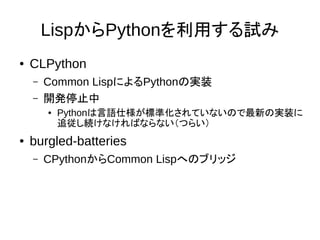
2.
LispからPythonを利用する試み ● CLPython – Common
LispによるPythonの実装 – 開発停止中 ● Pythonは言語仕様が標準化されていないので最新の実装に 追従し続けなければならない(つらい) ● burgled-batteries – CPythonからCommon Lispへのブリッジ
3.
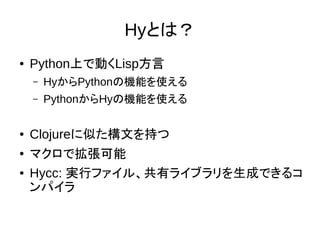
Hyとは? ● Python上で動くLisp方言 – HyからPythonの機能を使える –
PythonからHyの機能を使える ● Clojureに似た構文を持つ ● マクロで拡張可能 ● Hycc: 実行ファイル、共有ライブラリを生成できるコ ンパイラ
4.
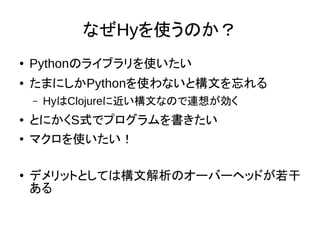
なぜHyを使うのか? ● Pythonのライブラリを使いたい ● たまにしかPythonを使わないと構文を忘れる –
HyはClojureに近い構文なので連想が効く ● とにかくS式でプログラムを書きたい ● マクロを使いたい! ● デメリットとしては構文解析のオーバーヘッドが若干 ある
5.
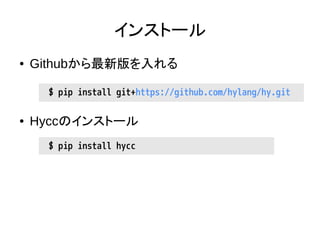
インストール ● Githubから最新版を入れる ● Hyccのインストール $
pip install git+https://github.com/hylang/hy.git $ pip install hycc
6.
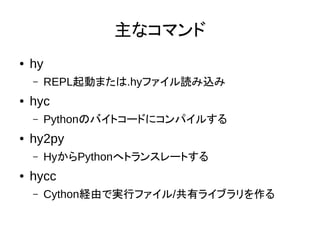
主なコマンド ● hy – REPL起動または.hyファイル読み込み ●
hyc – Pythonのバイトコードにコンパイルする ● hy2py – HyからPythonへトランスレートする ● hycc – Cython経由で実行ファイル/共有ライブラリを作る
7.
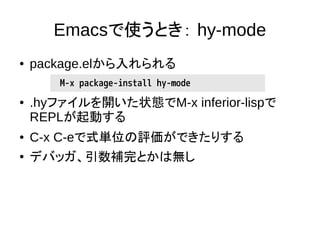
Emacsで使うとき: hy-mode ● package.elから入れられる ●
.hyファイルを開いた状態でM-x inferior-lispで REPLが起動する ● C-x C-eで式単位の評価ができたりする ● デバッガ、引数補完とかは無し M-x package-install hy-mode
8.
構文はClojureに似ている ● 関数定義 ● 変数定義/代入 (defn
fact [n] "docstring" (if (= n 0) 1 (* n (fact (- n 1))))) (def x 10) (setv y 20 z (* x y)) (print (.format "x: {0}, y: {1}, z: {2}" x y z)) ;; x: 10, y: 20, z: 200
9.
● オプショナル引数 ● 可変長引数 (defn
optional-arg [pos1 pos2 &optional keyword1 [keyword2 42]] [pos1 pos2 keyword1 keyword2]) (optional-arg 'pos1 'pos2 'key1) ; => ['pos1', 'pos2', 'key1', 42] (optional-arg 'pos1 'pos2 :keyword2 420) ; => ['pos1', 'pos2', None, 420] (defn plus [&rest args] (setv sum 0) (for [i args] (setv sum (+ sum i))) sum) (plus 1 2 3) ; => 6
10.
● 無名関数はClojureと同様にfn ● PythonはLISP-1(関数と変数で名前空間が共通) –
Schemeっぽい関数定義も可能 ((fn [one two three] (print one two three)) 1 2 3) ;; 1 2 3 (def fact2 (fn [n] (if (= n 0) 1 (* n (fact2 (- n 1))))))
11.
loop/recurマクロ ● 再帰呼び出しできるが末尾再帰最適化はしないの で、Clojureと同様にloop/recurマクロが用意されて いる (require [hy.contrib.loop
[*]]) (defn fact3 [n] (loop [[cnt 1] [acc 1]] (if (= cnt n) acc (recur (inc cnt) (* acc cnt)))))
12.
その他の制御構造 ● cond ● Pythonのfor (setv
val 20) (cond [(> val 30) (print "too big")] [(< val 10) (print "too small")] [True (print "just size!")]) ;; just size! (for [x (range 0 10)] (print x) (if (= (% x 2) 0) (continue)) (print "not even!"))
13.
● Clojureのスレッドマクロ ● 例外処理 (+
(- (* 2 3) 4) 5) ; => 7 (-> (* 2 3) (- 4) (+ 5)) ; => 7 (+ 5 (- 4 (* 2 3))) ; => 3 (->> (* 2 3) (- 4) (+ 5)) ; => 3 (as-> (* 2 3) x (- x 4) (+ x 5)) ; => 7 (as-> (* 2 3) x (- 4 x) (+ x 5)) ; => 3 (try (/ 2 0) (except [e ZeroDivisionError] (print "Division by zero")) (except [e TypeError] (print "Type Error")) (else (print "no errors")) (finally (print "all done")))
14.
マクロ定義 ● 伝統的マクロ – バッククォートとアンクォート(~、~@)で組み立てる –
変数捕捉の回避にはgensymが使える – 展開結果の確認にはmacroexpandが使える ;; letはlambdaのシンタックスシュガー (let ((one 1) (two 2) (three 3)) (print one two three)) ((fn [one two three] (print one two three)) 1 2 3) (defmacro let [var-pairs &rest body] (setv var-names (list (map first var-pairs)) var-vals (list (map second var-pairs))) `((fn [~@var-names] ~@body) ~@var-vals)) 展開
15.
データ構造 ● リスト '(1 2
3) (type '(1 2 3)) ; <class 'hy.models.expression.HyExpression'> ;; 参照はnth (nth '(1 2 3) 2) ; => 3 ;; map/reduce/filter (list (map inc (range 1 10))) ; => [2, 3, 4, 5, 6, 7, 8, 9, 10] (reduce + (map inc (range 1 10))) ; => 54 (list (filter (fn [x] (= (% x 2) 0)) (range 1 10))) ; => [2, 4, 6, 8]
16.
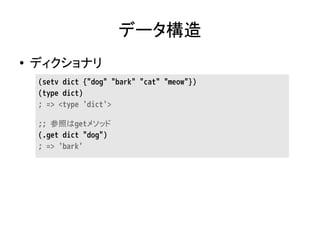
データ構造 ● ディクショナリ (setv dict
{"dog" "bark" "cat" "meow"}) (type dict) ; => <type 'dict'> ;; 参照はgetメソッド (.get dict "dog") ; => 'bark'
17.
importとrequire ● importでHy/Pythonのパッケージを読み込む ● パッケージがHyのマクロを含む場合はマクロ展開の ステップを挟む必要があるのでrequireを使う (import
sys ; 特定の関数だけをインポート [os.path [exists isdir :as dir? isfile :as file?]] ; 別名をつけてインポート [numpy :as np]) (require [hy.contrib.loop [*]] [hy.extra.anaphoric [*]])
18.
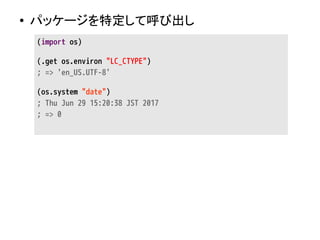
● パッケージを特定して呼び出し (import os) (.get
os.environ "LC_CTYPE") ; => 'en_US.UTF-8' (os.system "date") ; Thu Jun 29 15:20:38 JST 2017 ; => 0
19.
クラス定義 ● selfの属性に代入することでスロットを作る (defclass FooBar
[object] ;; コンストラクタ (defn --init-- [self x] (setv self.x x)) ;; アクセサ (defn get-x [self] self.x)) (setv obj (FooBar 1)) (.get-x obj) ; => 1
20.
クラス定義 ● クラスの継承 (defclass Dog
[object] (defn --init-- [self name] (setv self.name name))) (defclass SubDog [Dog] (defn --init-- [self name type] ;; 親クラスの--init--メソッドを呼び出す (.--init-- (super SubDog self) name) (setv self.type type))) (setv sd1 (SubDog "taro" "akita")) (print sd1.name) ; => taro (print sd1.type) ; => akita
21.
NumPyで行列のかけ算をしてみる (import [numpy :as
np]) (def arr (np.array [[1 2 3] [4 5 6] [7 8 9]])) arr.ndim ; => 2 arr.size ; => 9 arr.dtype ; => dtype('int64') ;; スカラー倍 (* arr 3) ;; 要素積 (* arr arr) ;; 行列積 (np.dot arr arr)
22.
● timeモジュールで処理時間を測ってみる (import time [numpy.random
:as rand]) ;; 1000×1000の乱数行列をつくる (def bigarr1 (rand.rand 1000 1000)) (def bigarr2 (rand.rand 1000 1000)) ;; 行列積にかかる時間を計測 (do (def start (time.time)) (np.dot bigarr1 bigarr2) (def elapsed-time (- (time.time) start)) (print (+ (.format "Evaluation took:: {0}" elapsed-time) " seconds"))) ; Evaluation took:: 0.07291960716247559 seconds
23.
timeitマクロを定義する (defmacro timeit [&rest
body] (setv start (gensym) end (gensym)) `(do (setv ~start (time.time)) ~@body (setv ~end (time.time)) (print (+ (.format "Evaluation took: {0}" (- ~end ~start)) " seconds")))) (timeit (np.dot bigarr1 bigarr2)) ; Evaluation took:: 0.07291960716247559 seconds
24.
Kerasでニューラルネットのモデルを定義してみる (def model (Sequential)) (.add
model (Dense :input-dim 784 :units 512)) (.add model (Activation "relu")) (.add model (Dropout 0.2)) (.add model (Dense :units 512)) (.add model (Activation "relu")) (.add model (Dropout 0.2)) (.add model (Dense :units 10)) (.add model (Activation "softmax")) (.compile model :loss "categorical_crossentropy" :optimizer (Adam) :metrics ["accuracy"]) (define-sequential model [(Dense :input-dim 784 :units 512) (Activation "relu") (Dropout 0.2) (Dense :units 512) (Activation "relu") (Dropout 0.2) (Dense :units 10) (Activation "softmax")] {:loss "categorical_crossentropy" :optimizer (Adam) :metrics ["accuracy"]})
25.
PythonからHyを呼ぶ ● Hyで書かれたモジュールを読み込む前にHy自体 をimportしておく import hy import
greetings greetings.greet("Foo") # Hello from hy, Foo print(greetings.THIS_WILL_BE_IN_CAPS_AND_UNDERSCORES) # See? (setv *this-will-be-in-caps-and-underscores* "See?") (defn greet [name] (print "hello from hy," name)) greetings.hy
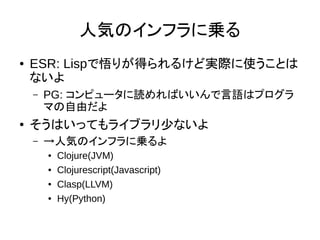
26.
人気のインフラに乗る ● ESR: Lispで悟りが得られるけど実際に使うことは ないよ –
PG: コンピュータに読めればいいんで言語はプログラ マの自由だよ ● そうはいってもライブラリ少ないよ – →人気のインフラに乗るよ ● Clojure(JVM) ● Clojurescript(Javascript) ● Clasp(LLVM) ● Hy(Python)
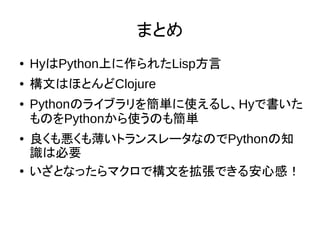
27.
まとめ ● HyはPython上に作られたLisp方言 ● 構文はほとんどClojure ●
Pythonのライブラリを簡単に使えるし、Hyで書いた ものをPythonから使うのも簡単 ● 良くも悪くも薄いトランスレータなのでPythonの知 識は必要 ● いざとなったらマクロで構文を拡張できる安心感!
Download

![構文はClojureに似ている
● 関数定義
● 変数定義/代入
(defn fact [n]
"docstring"
(if (= n 0)
1
(* n (fact (- n 1)))))
(def x 10)
(setv y 20
z (* x y))
(print (.format "x: {0}, y: {1}, z: {2}" x y z))
;; x: 10, y: 20, z: 200](https://image.slidesharecdn.com/hy-170629104550/85/Lispmeetup-53-Python-Lisp-Hy-8-320.jpg)
![● オプショナル引数
● 可変長引数
(defn optional-arg [pos1 pos2 &optional keyword1 [keyword2 42]]
[pos1 pos2 keyword1 keyword2])
(optional-arg 'pos1 'pos2 'key1)
; => ['pos1', 'pos2', 'key1', 42]
(optional-arg 'pos1 'pos2 :keyword2 420)
; => ['pos1', 'pos2', None, 420]
(defn plus [&rest args]
(setv sum 0)
(for [i args]
(setv sum (+ sum i)))
sum)
(plus 1 2 3) ; => 6](https://image.slidesharecdn.com/hy-170629104550/85/Lispmeetup-53-Python-Lisp-Hy-9-320.jpg)
![● 無名関数はClojureと同様にfn
● PythonはLISP-1(関数と変数で名前空間が共通)
– Schemeっぽい関数定義も可能
((fn [one two three]
(print one two three))
1 2 3)
;; 1 2 3
(def fact2
(fn [n]
(if (= n 0)
1
(* n (fact2 (- n 1))))))](https://image.slidesharecdn.com/hy-170629104550/85/Lispmeetup-53-Python-Lisp-Hy-10-320.jpg)
![loop/recurマクロ
● 再帰呼び出しできるが末尾再帰最適化はしないの
で、Clojureと同様にloop/recurマクロが用意されて
いる
(require [hy.contrib.loop [*]])
(defn fact3 [n]
(loop [[cnt 1] [acc 1]]
(if (= cnt n)
acc
(recur (inc cnt) (* acc cnt)))))](https://image.slidesharecdn.com/hy-170629104550/85/Lispmeetup-53-Python-Lisp-Hy-11-320.jpg)
![その他の制御構造
● cond
● Pythonのfor
(setv val 20)
(cond [(> val 30) (print "too big")]
[(< val 10) (print "too small")]
[True (print "just size!")])
;; just size!
(for [x (range 0 10)]
(print x)
(if (= (% x 2) 0)
(continue))
(print "not even!"))](https://image.slidesharecdn.com/hy-170629104550/85/Lispmeetup-53-Python-Lisp-Hy-12-320.jpg)
![● Clojureのスレッドマクロ
● 例外処理
(+ (- (* 2 3) 4) 5) ; => 7
(-> (* 2 3) (- 4) (+ 5)) ; => 7
(+ 5 (- 4 (* 2 3))) ; => 3
(->> (* 2 3) (- 4) (+ 5)) ; => 3
(as-> (* 2 3) x (- x 4) (+ x 5)) ; => 7
(as-> (* 2 3) x (- 4 x) (+ x 5)) ; => 3
(try
(/ 2 0)
(except [e ZeroDivisionError] (print "Division by zero"))
(except [e TypeError] (print "Type Error"))
(else (print "no errors"))
(finally (print "all done")))](https://image.slidesharecdn.com/hy-170629104550/85/Lispmeetup-53-Python-Lisp-Hy-13-320.jpg)
![マクロ定義
● 伝統的マクロ
– バッククォートとアンクォート(~、~@)で組み立てる
– 変数捕捉の回避にはgensymが使える
– 展開結果の確認にはmacroexpandが使える
;; letはlambdaのシンタックスシュガー
(let ((one 1) (two 2) (three 3))
(print one two three))
((fn [one two three]
(print one two three))
1 2 3)
(defmacro let [var-pairs &rest body]
(setv var-names (list (map first var-pairs))
var-vals (list (map second var-pairs)))
`((fn [~@var-names] ~@body) ~@var-vals))
展開](https://image.slidesharecdn.com/hy-170629104550/85/Lispmeetup-53-Python-Lisp-Hy-14-320.jpg)
![データ構造
● リスト
'(1 2 3)
(type '(1 2 3)) ; <class 'hy.models.expression.HyExpression'>
;; 参照はnth
(nth '(1 2 3) 2) ; => 3
;; map/reduce/filter
(list (map inc (range 1 10)))
; => [2, 3, 4, 5, 6, 7, 8, 9, 10]
(reduce + (map inc (range 1 10)))
; => 54
(list (filter (fn [x] (= (% x 2) 0)) (range 1 10)))
; => [2, 4, 6, 8]](https://image.slidesharecdn.com/hy-170629104550/85/Lispmeetup-53-Python-Lisp-Hy-15-320.jpg)
![importとrequire
● importでHy/Pythonのパッケージを読み込む
● パッケージがHyのマクロを含む場合はマクロ展開の
ステップを挟む必要があるのでrequireを使う
(import sys
; 特定の関数だけをインポート
[os.path [exists
isdir :as dir?
isfile :as file?]]
; 別名をつけてインポート
[numpy :as np])
(require [hy.contrib.loop [*]]
[hy.extra.anaphoric [*]])](https://image.slidesharecdn.com/hy-170629104550/85/Lispmeetup-53-Python-Lisp-Hy-17-320.jpg)
![クラス定義
● selfの属性に代入することでスロットを作る
(defclass FooBar [object]
;; コンストラクタ
(defn --init-- [self x]
(setv self.x x))
;; アクセサ
(defn get-x [self]
self.x))
(setv obj (FooBar 1))
(.get-x obj) ; => 1](https://image.slidesharecdn.com/hy-170629104550/85/Lispmeetup-53-Python-Lisp-Hy-19-320.jpg)
![クラス定義
● クラスの継承
(defclass Dog [object]
(defn --init-- [self name]
(setv self.name name)))
(defclass SubDog [Dog]
(defn --init-- [self name type]
;; 親クラスの--init--メソッドを呼び出す
(.--init-- (super SubDog self) name)
(setv self.type type)))
(setv sd1 (SubDog "taro" "akita"))
(print sd1.name) ; => taro
(print sd1.type) ; => akita](https://image.slidesharecdn.com/hy-170629104550/85/Lispmeetup-53-Python-Lisp-Hy-20-320.jpg)
![NumPyで行列のかけ算をしてみる
(import [numpy :as np])
(def arr (np.array [[1 2 3]
[4 5 6]
[7 8 9]]))
arr.ndim ; => 2
arr.size ; => 9
arr.dtype ; => dtype('int64')
;; スカラー倍
(* arr 3)
;; 要素積
(* arr arr)
;; 行列積
(np.dot arr arr)](https://image.slidesharecdn.com/hy-170629104550/85/Lispmeetup-53-Python-Lisp-Hy-21-320.jpg)
![● timeモジュールで処理時間を測ってみる
(import time
[numpy.random :as rand])
;; 1000×1000の乱数行列をつくる
(def bigarr1 (rand.rand 1000 1000))
(def bigarr2 (rand.rand 1000 1000))
;; 行列積にかかる時間を計測
(do
(def start (time.time))
(np.dot bigarr1 bigarr2)
(def elapsed-time (- (time.time) start))
(print (+ (.format "Evaluation took:: {0}" elapsed-time) " seconds")))
; Evaluation took:: 0.07291960716247559 seconds](https://image.slidesharecdn.com/hy-170629104550/85/Lispmeetup-53-Python-Lisp-Hy-22-320.jpg)
![timeitマクロを定義する
(defmacro timeit [&rest body]
(setv start (gensym)
end (gensym))
`(do
(setv ~start (time.time))
~@body
(setv ~end (time.time))
(print (+ (.format "Evaluation took: {0}" (- ~end ~start))
" seconds"))))
(timeit (np.dot bigarr1 bigarr2))
; Evaluation took:: 0.07291960716247559 seconds](https://image.slidesharecdn.com/hy-170629104550/85/Lispmeetup-53-Python-Lisp-Hy-23-320.jpg)
![Kerasでニューラルネットのモデルを定義してみる
(def model (Sequential))
(.add model (Dense :input-dim 784 :units 512))
(.add model (Activation "relu"))
(.add model (Dropout 0.2))
(.add model (Dense :units 512))
(.add model (Activation "relu"))
(.add model (Dropout 0.2))
(.add model (Dense :units 10))
(.add model (Activation "softmax"))
(.compile model
:loss "categorical_crossentropy"
:optimizer (Adam)
:metrics ["accuracy"])
(define-sequential model
[(Dense :input-dim 784 :units 512)
(Activation "relu")
(Dropout 0.2)
(Dense :units 512)
(Activation "relu")
(Dropout 0.2)
(Dense :units 10)
(Activation "softmax")]
{:loss "categorical_crossentropy"
:optimizer (Adam)
:metrics ["accuracy"]})](https://image.slidesharecdn.com/hy-170629104550/85/Lispmeetup-53-Python-Lisp-Hy-24-320.jpg)
![PythonからHyを呼ぶ
● Hyで書かれたモジュールを読み込む前にHy自体
をimportしておく
import hy
import greetings
greetings.greet("Foo")
# Hello from hy, Foo
print(greetings.THIS_WILL_BE_IN_CAPS_AND_UNDERSCORES)
# See?
(setv *this-will-be-in-caps-and-underscores* "See?")
(defn greet [name]
(print "hello from hy," name))
greetings.hy](https://image.slidesharecdn.com/hy-170629104550/85/Lispmeetup-53-Python-Lisp-Hy-25-320.jpg)