22
First things first
I know nothing about my talk. And I am not intended to offend any one of you.
Talking with others is always tough. 1. Different minds. 2. Terminology.
33
Matter,
energy,
space, time,
force,
motion
A physical world
44
Mental Consciousness is our ultimate eyes to see
the Invisible world.
What could human do? Observation via senses
Albert Buddh
55
Steam
What could human do? Change or Creation via causality
Dr. Manhattan can control atom
Programmer can
control bits
66
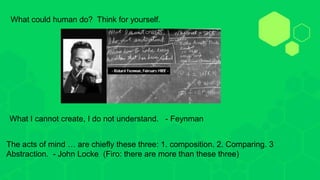
What could human do? Think for yourself.
What I cannot create, I do not understand. - Feynman
The acts of mind … are chiefly these three: 1. composition. 2. Comparing. 3
Abstraction. - John Locke (Firo: there are more than these three)
77
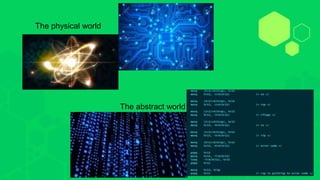
The physical world
The abstract world
88
Read
Write
Compute
Spac
e
So what is
computation?
99
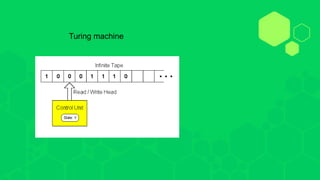
Turing machine
1010
Von Neumann
architecture
1111
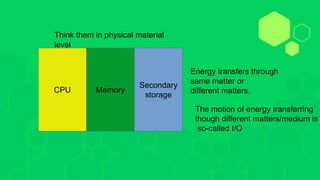
CPU Memory
Secondary
storage
Think them in physical material
level
Energy transfers through
same matter or
different matters.
The motion of energy transferring
though different matters/medium is
so-called I/O
1212
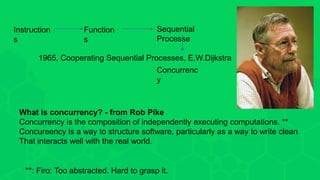
Instruction
s
Function
s
Sequential
Processe
Concurrenc
y
1965, Cooperating Sequential Processes, E.W.Dijkstra
What is concurrency? - from Rob Pike
Concurrency is the composition of independently executing computations. **
Concureency is a way to structure software, particularly as a way to write clean
That interacts well with the real world.
**: Firo: Too abstracted. Hard to grasp it.
1313
Interrupt handler vs
exception handler
vs
Thread/Process vs
Signal
1414
1515
Scheduling
RR vs FIFO vs CFS
1616
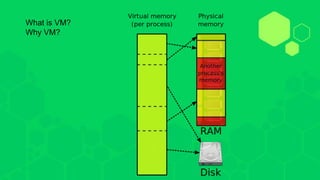
What is VM?
Why VM?
1717
1956 Fritz Rudolf Güntsch’s doctoral dissertation
Logical Design of a Digital Computer with Multiple Asynchronous Rotating Drums and Automatic High Speed Memory O
[Origin of the virtual memory concept](https://ieeexplore.ieee.org/stamp/stamp.jsp?arnumber=1369143)
1959 Atlas prototype
[Working prototypes of paging had been developed by
1959.](http://160592857366.free.fr/joe/ebooks/ShareData/Before%20Memory%20was%20Virtual%20By%20Peter%20J
m%20George%20Mason%20University.pdf)
1962 Paged VM on Atlas
[A Must-read on paging: One-Level Storage System](http://www.dcs.gla.ac.uk/~wpc/grcs/kilburn.pdf)
[A Must-read on virtual address space decoupling address and memory location: Dynamic Storage Allocation in the Atla
an Automatic Use of a Backing Store](https://users.soe.ucsc.edu/~sbrandt/221/Papers/History/fotheringham-cacm61.pd
1978 Mark1 and Atals
[The Manchester Mark I and Atlas: A Historical Perspective](https://dl.acm.org/citation.cfm?id=359331)
1979 Paged VM on Unix.
[Design and Implementation of the Berkeley Virtual Memory Extensions to the UNIX Operating
System](http://citeseerx.ist.psu.edu/viewdoc/download?doi=10.1.1.107.9119&rep=rep1&type=pdf)
1987 SunOS implementation
[Virtual Memory Architecture in SunOS](http://kos.enix.org/pub/gingell8.pdf)
History of Virtual memory(VM)
1818
Pag
e
1959 paging
[Paging](https://en.wikipedia.org/wiki/Paging) according to [History of
VM](https://en.wikipedia.org/wiki/Virtual_memory) is developed at
1959.
Fixed memory partitioning
[buddy system 1965 a fast storage allocator.](http://sci-hub.tw/https://dl.acm.org/citat
Principle of Page fault: COW
Page frame reclamation: rmap, workingset
1919
Put it all together.
2. Memory consistency model.
1.
Stack
3. Synchronization
Dijkstra, E. W. (1960). "Recursive
Programming"](https://link.springer.com/article/10.10
Locking,
atomic
Thank you for your time and attention.
21
Reference
Rob Pike:
https://talks.golang.org/2012/waza.slide#1
2222
Unpublished Work of SUSE LLC. All Rights Reserved.
This work is an unpublished work and contains confidential, proprietary and trade secret information of SUSE LLC.
Access to this work is restricted to SUSE employees who have a need to know to perform tasks within the scope of their
assignments. No part of this work may be practiced, performed, copied, distributed, revised, modified, translated,
abridged, condensed, expanded, collected, or adapted without the prior written consent of SUSE.
Any use or exploitation of this work without authorization could subject the perpetrator to criminal and civil liability.
General Disclaimer
This document is not to be construed as a promise by any participating company to develop, deliver, or market a
product. It is not a commitment to deliver any material, code, or functionality, and should not be relied upon in making
purchasing decisions. SUSE makes no representations or warranties with respect to the contents of this document, and
specifically disclaims any express or implied warranties of merchantability or fitness for any particular purpose. The
development, release, and timing of features or functionality described for SUSE products remains at the sole discretion
of SUSE. Further, SUSE reserves the right to revise this document and to make changes to its content, at any time,
without obligation to notify any person or entity of such revisions or changes. All SUSE marks referenced in this
presentation are trademarks or registered trademarks of Novell, Inc. in the United States and other countries. All third-
party trademarks are the property of their respective owners.

Linux kernel introduction

  • 1.
    22 First things first Iknow nothing about my talk. And I am not intended to offend any one of you. Talking with others is always tough. 1. Different minds. 2. Terminology.
  • 2.
  • 3.
    44 Mental Consciousness isour ultimate eyes to see the Invisible world. What could human do? Observation via senses Albert Buddh
  • 4.
    55 Steam What could humando? Change or Creation via causality Dr. Manhattan can control atom Programmer can control bits
  • 5.
    66 What could humando? Think for yourself. What I cannot create, I do not understand. - Feynman The acts of mind … are chiefly these three: 1. composition. 2. Comparing. 3 Abstraction. - John Locke (Firo: there are more than these three)
  • 6.
  • 7.
  • 8.
  • 9.
  • 10.
    1111 CPU Memory Secondary storage Think themin physical material level Energy transfers through same matter or different matters. The motion of energy transferring though different matters/medium is so-called I/O
  • 11.
    1212 Instruction s Function s Sequential Processe Concurrenc y 1965, Cooperating SequentialProcesses, E.W.Dijkstra What is concurrency? - from Rob Pike Concurrency is the composition of independently executing computations. ** Concureency is a way to structure software, particularly as a way to write clean That interacts well with the real world. **: Firo: Too abstracted. Hard to grasp it.
  • 12.
    1313 Interrupt handler vs exceptionhandler vs Thread/Process vs Signal
  • 13.
  • 14.
  • 15.
  • 16.
    1717 1956 Fritz RudolfGüntsch’s doctoral dissertation Logical Design of a Digital Computer with Multiple Asynchronous Rotating Drums and Automatic High Speed Memory O [Origin of the virtual memory concept](https://ieeexplore.ieee.org/stamp/stamp.jsp?arnumber=1369143) 1959 Atlas prototype [Working prototypes of paging had been developed by 1959.](http://160592857366.free.fr/joe/ebooks/ShareData/Before%20Memory%20was%20Virtual%20By%20Peter%20J m%20George%20Mason%20University.pdf) 1962 Paged VM on Atlas [A Must-read on paging: One-Level Storage System](http://www.dcs.gla.ac.uk/~wpc/grcs/kilburn.pdf) [A Must-read on virtual address space decoupling address and memory location: Dynamic Storage Allocation in the Atla an Automatic Use of a Backing Store](https://users.soe.ucsc.edu/~sbrandt/221/Papers/History/fotheringham-cacm61.pd 1978 Mark1 and Atals [The Manchester Mark I and Atlas: A Historical Perspective](https://dl.acm.org/citation.cfm?id=359331) 1979 Paged VM on Unix. [Design and Implementation of the Berkeley Virtual Memory Extensions to the UNIX Operating System](http://citeseerx.ist.psu.edu/viewdoc/download?doi=10.1.1.107.9119&rep=rep1&type=pdf) 1987 SunOS implementation [Virtual Memory Architecture in SunOS](http://kos.enix.org/pub/gingell8.pdf) History of Virtual memory(VM)
  • 17.
    1818 Pag e 1959 paging [Paging](https://en.wikipedia.org/wiki/Paging) accordingto [History of VM](https://en.wikipedia.org/wiki/Virtual_memory) is developed at 1959. Fixed memory partitioning [buddy system 1965 a fast storage allocator.](http://sci-hub.tw/https://dl.acm.org/citat Principle of Page fault: COW Page frame reclamation: rmap, workingset
  • 18.
    1919 Put it alltogether. 2. Memory consistency model. 1. Stack 3. Synchronization Dijkstra, E. W. (1960). "Recursive Programming"](https://link.springer.com/article/10.10 Locking, atomic
  • 19.
    Thank you foryour time and attention.
  • 20.
  • 21.
    2222 Unpublished Work ofSUSE LLC. All Rights Reserved. This work is an unpublished work and contains confidential, proprietary and trade secret information of SUSE LLC. Access to this work is restricted to SUSE employees who have a need to know to perform tasks within the scope of their assignments. No part of this work may be practiced, performed, copied, distributed, revised, modified, translated, abridged, condensed, expanded, collected, or adapted without the prior written consent of SUSE. Any use or exploitation of this work without authorization could subject the perpetrator to criminal and civil liability. General Disclaimer This document is not to be construed as a promise by any participating company to develop, deliver, or market a product. It is not a commitment to deliver any material, code, or functionality, and should not be relied upon in making purchasing decisions. SUSE makes no representations or warranties with respect to the contents of this document, and specifically disclaims any express or implied warranties of merchantability or fitness for any particular purpose. The development, release, and timing of features or functionality described for SUSE products remains at the sole discretion of SUSE. Further, SUSE reserves the right to revise this document and to make changes to its content, at any time, without obligation to notify any person or entity of such revisions or changes. All SUSE marks referenced in this presentation are trademarks or registered trademarks of Novell, Inc. in the United States and other countries. All third- party trademarks are the property of their respective owners.