Linguistic Dimensions Of Crisis Talk Formalising
Structures In A Controlled Language Paul
Mcilvenny download
https://ebookbell.com/product/linguistic-dimensions-of-crisis-
talk-formalising-structures-in-a-controlled-language-paul-
mcilvenny-1640254
Explore and download more ebooks at ebookbell.com
Here are some recommended products that we believe you will be
interested in. You can click the link to download.
The Linguistic Dimension Of Kants Thought Historical And Critical
Essays Frank Schalow
https://ebookbell.com/product/the-linguistic-dimension-of-kants-
thought-historical-and-critical-essays-frank-schalow-5387454
Rashi Linguist Despite Himself A Study Of The Linguistic Dimension Of
Rabbi Solomon Yishaqis Commentary On Deuteronomy Jonathan Kearney
https://ebookbell.com/product/rashi-linguist-despite-himself-a-study-
of-the-linguistic-dimension-of-rabbi-solomon-yishaqis-commentary-on-
deuteronomy-jonathan-kearney-4953696
Dimensions Of Forensic Linguistics John Gibbons M Teresa Turell
https://ebookbell.com/product/dimensions-of-forensic-linguistics-john-
gibbons-m-teresa-turell-1392880
Multidimensional Viewpoints On The Origin Of Tibetan Tones 2017th
Edition Kong Jiangping
https://ebookbell.com/product/multidimensional-viewpoints-on-the-
origin-of-tibetan-tones-2017th-edition-kong-jiangping-43768606
Middle And Modern English Corpus Linguistics A Multidimensional
Approach Manfred Markus Et Al
https://ebookbell.com/product/middle-and-modern-english-corpus-
linguistics-a-multidimensional-approach-manfred-markus-et-al-4147700
Linguistic Semiotics Mingyu Wang
https://ebookbell.com/product/linguistic-semiotics-mingyu-
wang-46236662
Linguistic Organisation And Native Title The Wik Case Australia Peter
Sutton
https://ebookbell.com/product/linguistic-organisation-and-native-
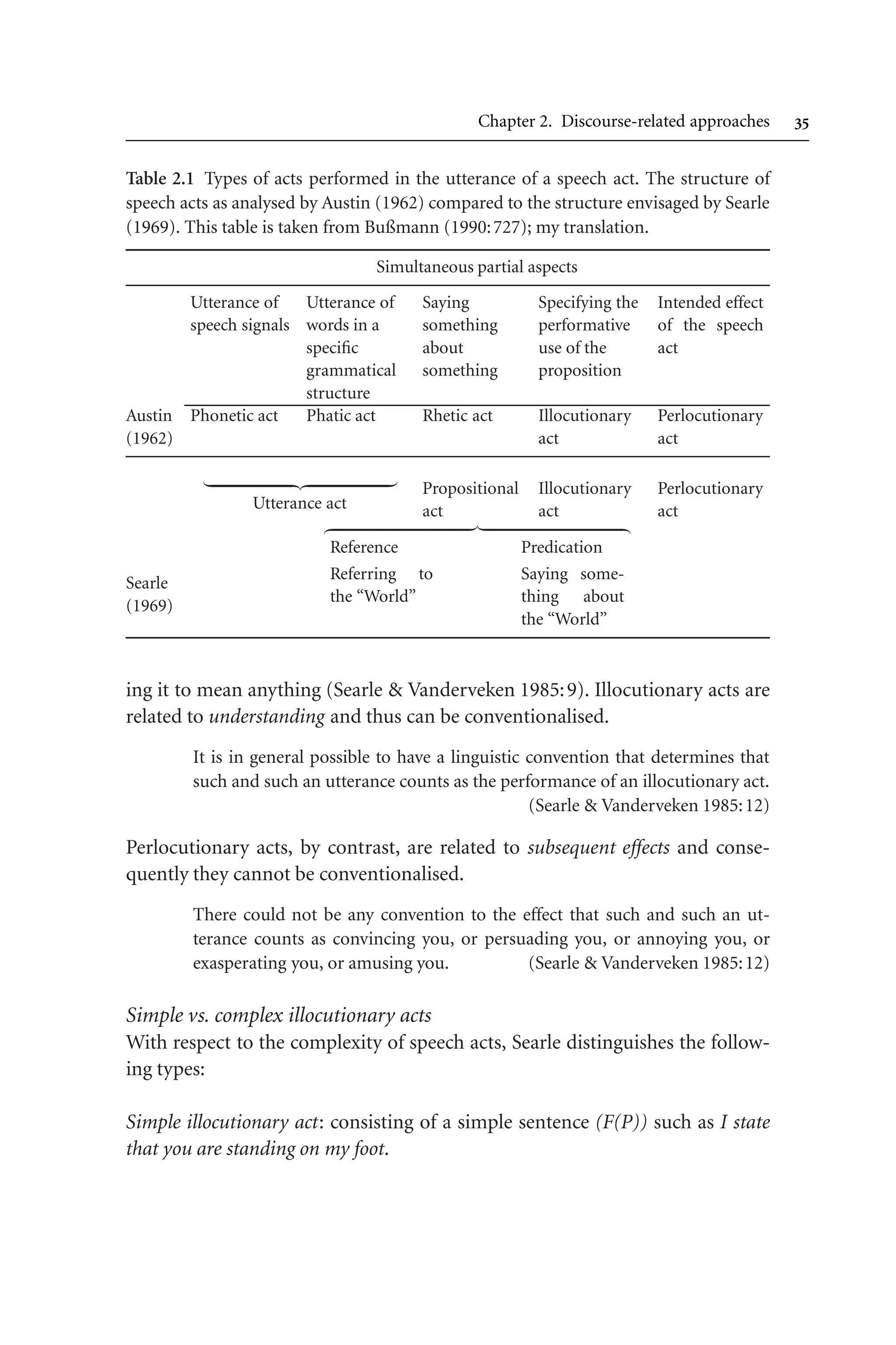
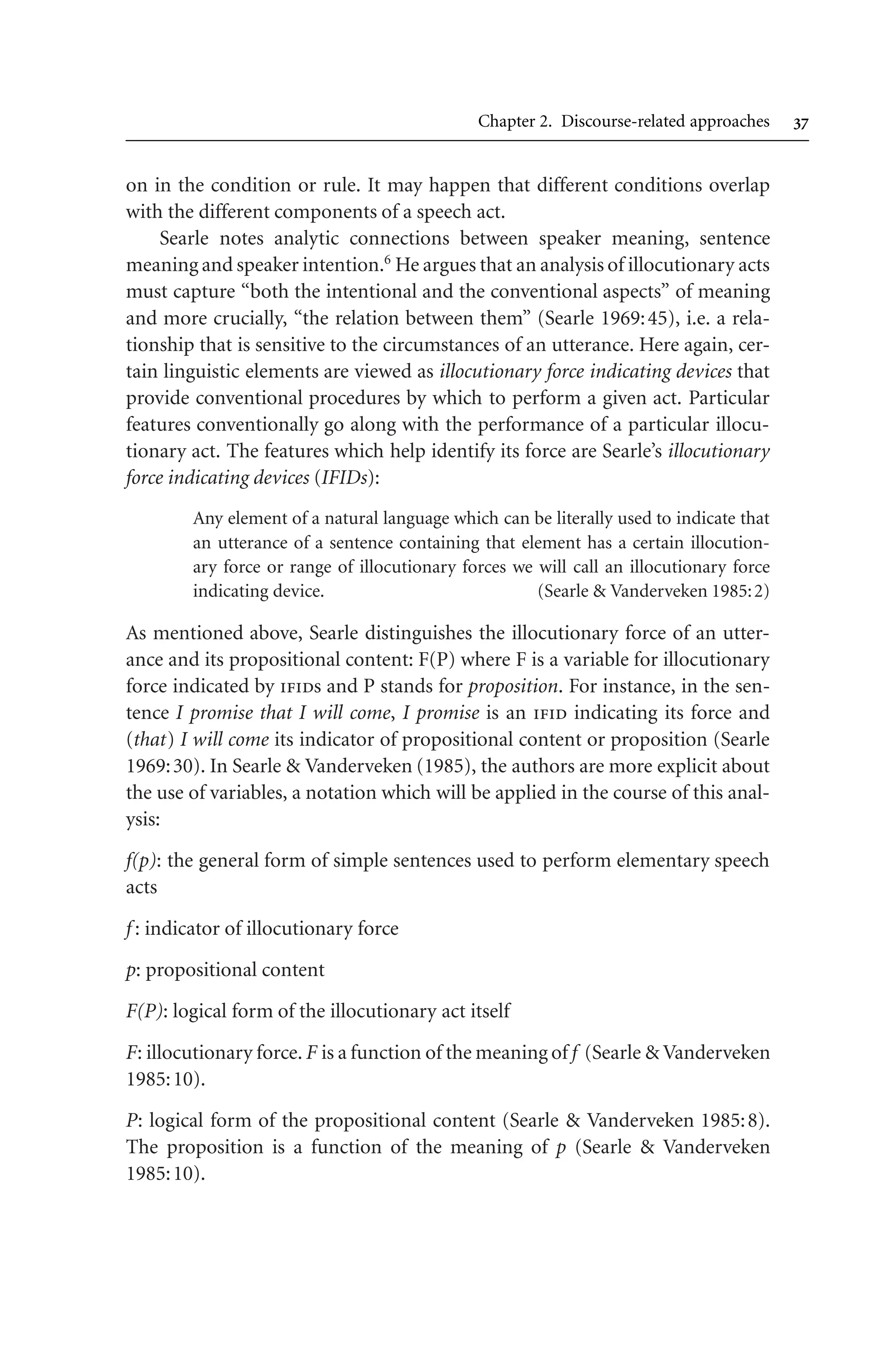
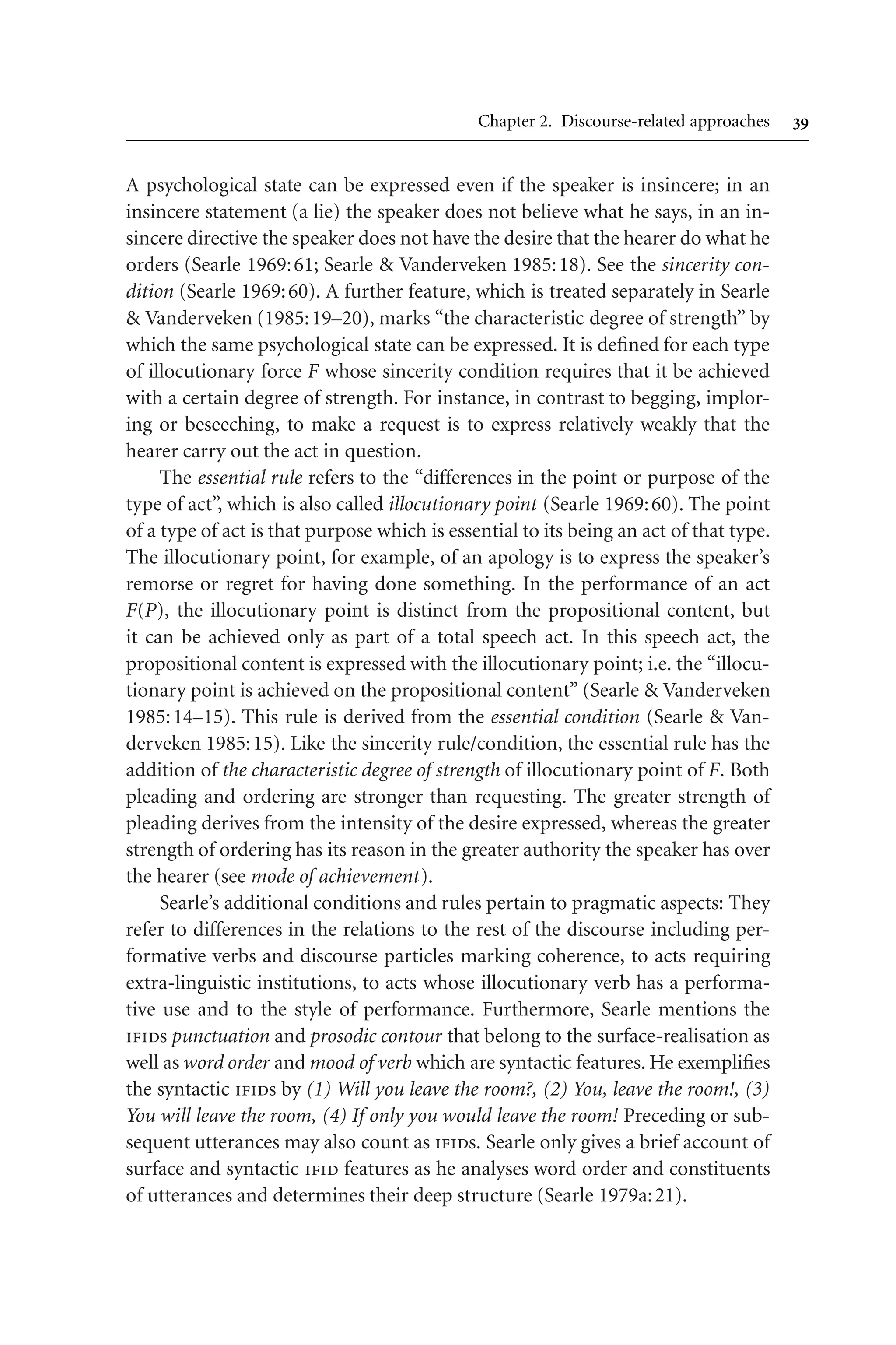
title-the-wik-case-australia-peter-sutton-46417304
Linguistic Response To The Taboo Of Death In Egyptian Arabic Magdalena
Zawrotna
https://ebookbell.com/product/linguistic-response-to-the-taboo-of-
death-in-egyptian-arabic-magdalena-zawrotna-46963700
Linguistic Foundations Of Identity Readings In Language Literature And
Contemporary Cultures Om Prakash
https://ebookbell.com/product/linguistic-foundations-of-identity-
readings-in-language-literature-and-contemporary-cultures-om-
prakash-47205154
Linguistic Dimensions of Crisis Talk
Pragmatics & Beyond New Series
Editor
Andreas H. Jucker
University of Zurich, English Department
Plattenstrasse 47, CH-8032 Zurich, Switzerland
e-mail: ahjucker@es.unizh.ch
Associate Editors
Jacob L. Mey
University of Southern Denmark
Herman Parret
Belgian National Science Foundation, Universities of Louvain and Antwerp
Jef Verschueren
Belgian National Science Foundation, University of Antwerp
Editorial Board
Shoshana Blum-Kulka
Hebrew University of Jerusalem
Jean Caron
Université de Poitiers
Robyn Carston
University College London
Bruce Fraser
Boston University
Thorstein Fretheim
University of Trondheim
John Heritage
University of California at Los Angeles
Susan Herring
University of Texas at Arlington
Masako K. Hiraga
St.Paul’s (Rikkyo) University
David Holdcroft
University of Leeds
Sachiko Ide
Japan Women’s University
Catherine Kerbrat-Orecchioni
University of Lyon 2
Claudia de Lemos
University of Campinas, Brazil
Marina Sbisà
University of Trieste
Emanuel Schegloff
University of California at Los Angeles
Deborah Schiffrin
Georgetown University
Paul O. Takahara
Sandra Thompson
University of California at Santa Barbara
Teun A. Van Dijk
Pompeu Fabra, Barcelona
Richard J. Watts
University of Berne
Volume 136
Linguistic Dimensions of Crisis Talk:
Formalising structures in a controlled language
by Claudia Sassen
Linguistic Dimensions
of Crisis Talk
Formalising structures
in a controlled language
Claudia Sassen
Universität Dortmund
John Benjamins Publishing Company
Amsterdam/Philadelphia
The paper used in this publication meets the minimum requirements
8
TM
of American National Standard for Information Sciences – Permanence
of Paper for Printed Library Materials, ansi z39.48-1984.
Library of Congress Cataloging-in-Publication Data
Claudia Sassen
Linguistic Dimensions of Crisis Talk : Formalising structures in a
controlled language / Claudia Sassen.
p. cm. (Pragmatics  Beyond, New Series, issn 0922-842X ; v. 136)
Includes bibliographical references and indexes.
1. Dialogue analysis. 2. Speech acts (Linguistics) 3. Head-driven
phrase structure grammar. 4. Air traffic control--Language. I. Title. II.
Pragmatics  beyond ; new ser., 136.
P95.455.S277 2005
401’.41--dc22 2005048398
isbn 90 272 5379 X (Eur.) / 1 58811 642 5 (US) (Hb; alk. paper)
© 2005 – John Benjamins B.V.
No part of this book may be reproduced in any form, by print, photoprint, microfilm, or
any other means, without written permission from the publisher.
John Benjamins Publishing Co. · P.O. Box 36224 · 1020 me Amsterdam · The Netherlands
John Benjamins North America · P.O. Box 27519 · Philadelphia pa 19118-0519 · usa
For Inge and Thea
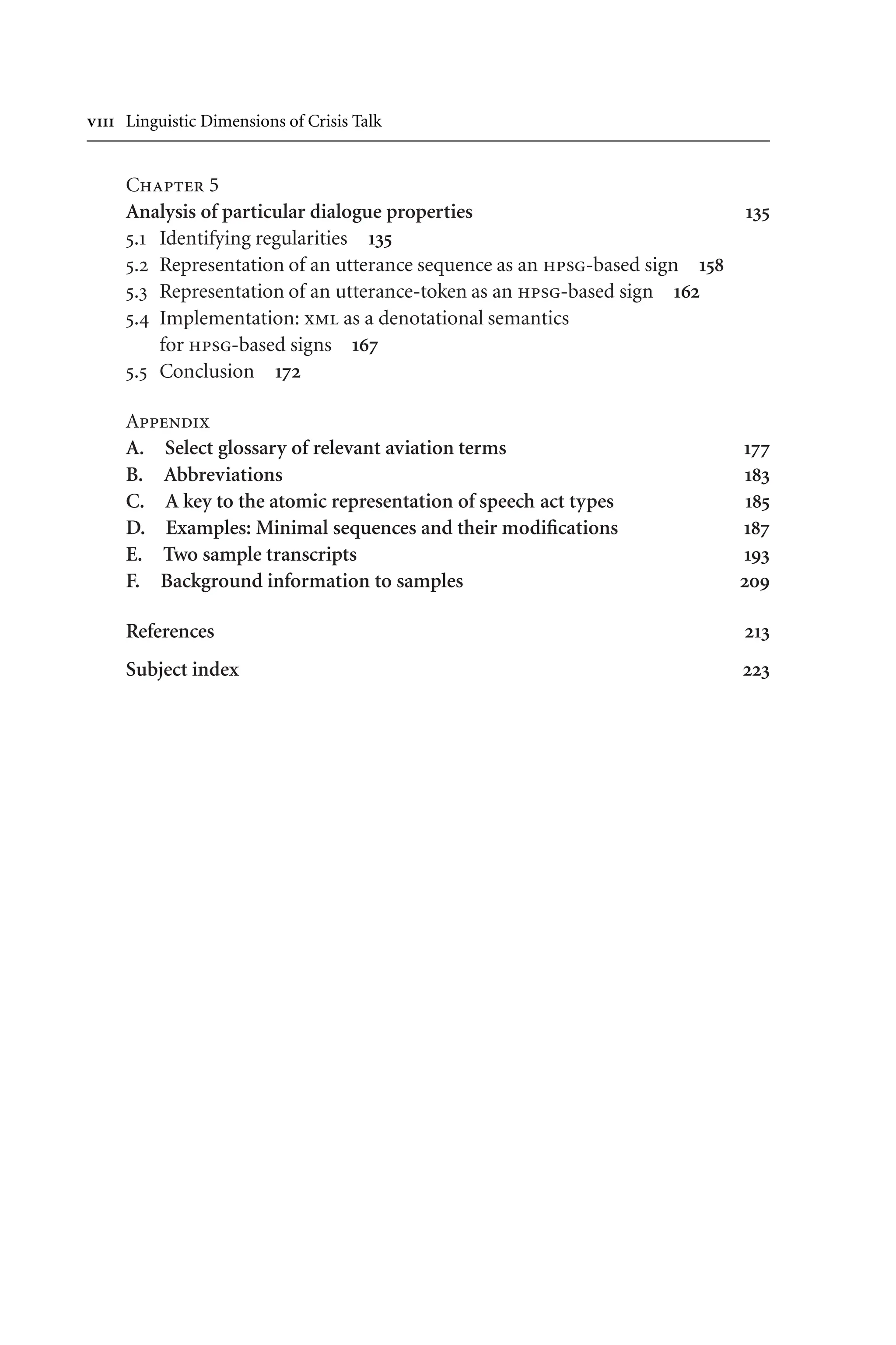
Table of contents
Acknowledgments ix
Chapter 1
Towards an analysis of crisis talk 1
1.1 Objectives and requirements 3
1.2 The scenario: Air traffic control 6
1.3 Overview of presentation 27
Chapter 2
Discourse-related approaches 31
2.1 Speech act theory 32
2.2 An illocutionary logic: Searle  Vanderveken 43
2.3 An alternative: Ross’s performative analysis 45
2.4 Approaches to discourse structure 46
Chapter 3
Linguistic and corpus methodology 53
3.1 Formalisms, methods and linguistic theory 53
3.2 Dialogues and theories: Some general considerations 59
3.3 Head-driven phrase structure grammar (hpsg)
for illocutionary acts 63
3.4 Creating a crisis talk corpus 74
3.5 Linguistic annotation: Standards and schemata 77
Chapter 4
Analysis of general dialogue properties 87
4.1 Dialogue typology 89
4.2 Documenting and standardising the atc/cvr-data 92
4.3 xml-markup of the standardised data 114
4.4 Phases in aviation communication 119
4.5 Discourse-control processes 124
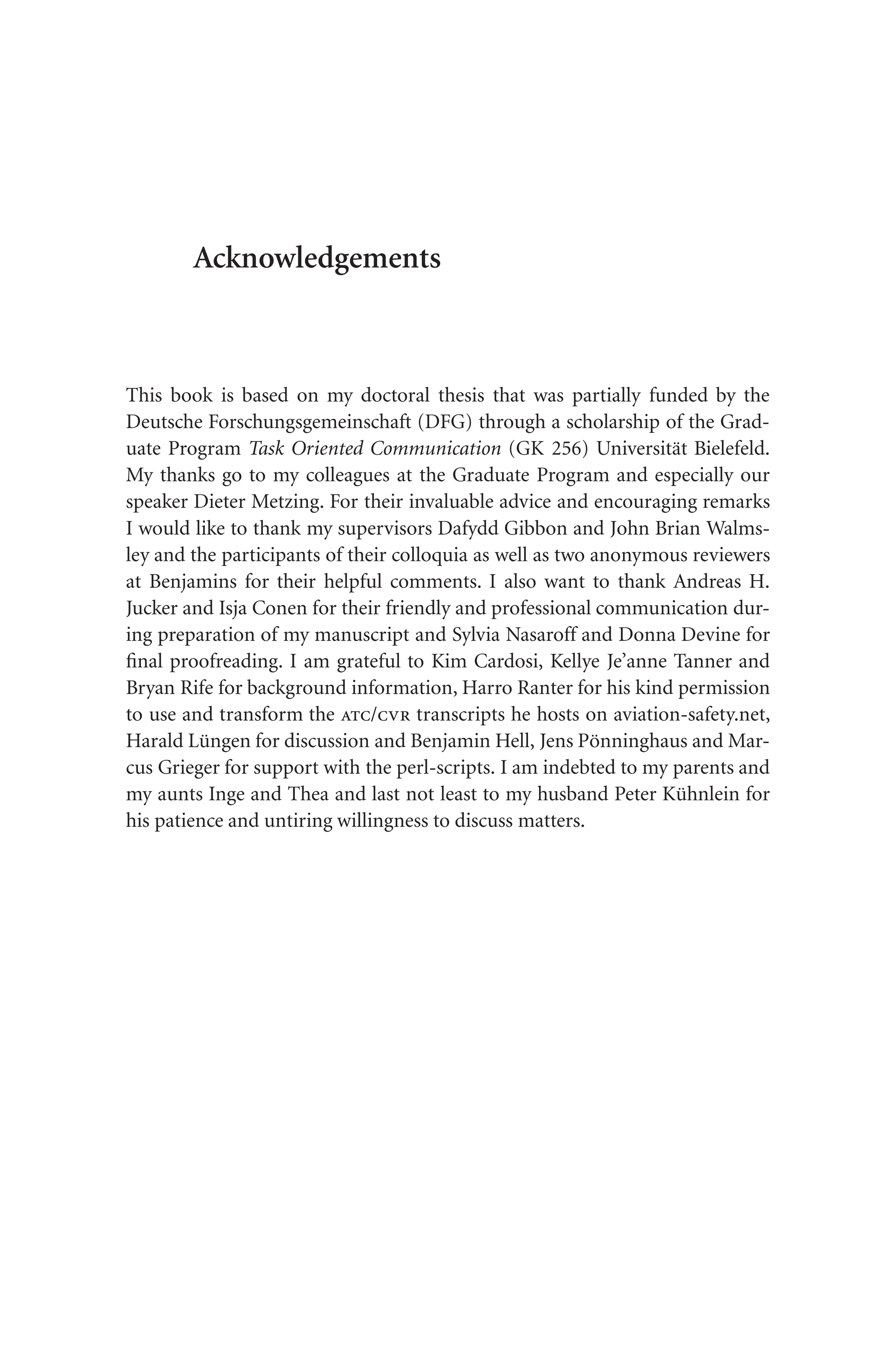
 Linguistic Dimensions of Crisis Talk
Chapter 5
Analysis of particular dialogue properties 135
5.1 Identifying regularities 135
5.2 Representation of an utterance sequence as an hpsg-based sign 158
5.3 Representation of an utterance-token as an hpsg-based sign 162
5.4 Implementation: xml as a denotational semantics
for hpsg-based signs 167
5.5 Conclusion 172
Appendix
A. Select glossary of relevant aviation terms 177
B. Abbreviations 183
C. A key to the atomic representation of speech act types 185
D. Examples: Minimal sequences and their modifications 187
E. Two sample transcripts 193
F. Background information to samples 209
References 213
Subject index 223
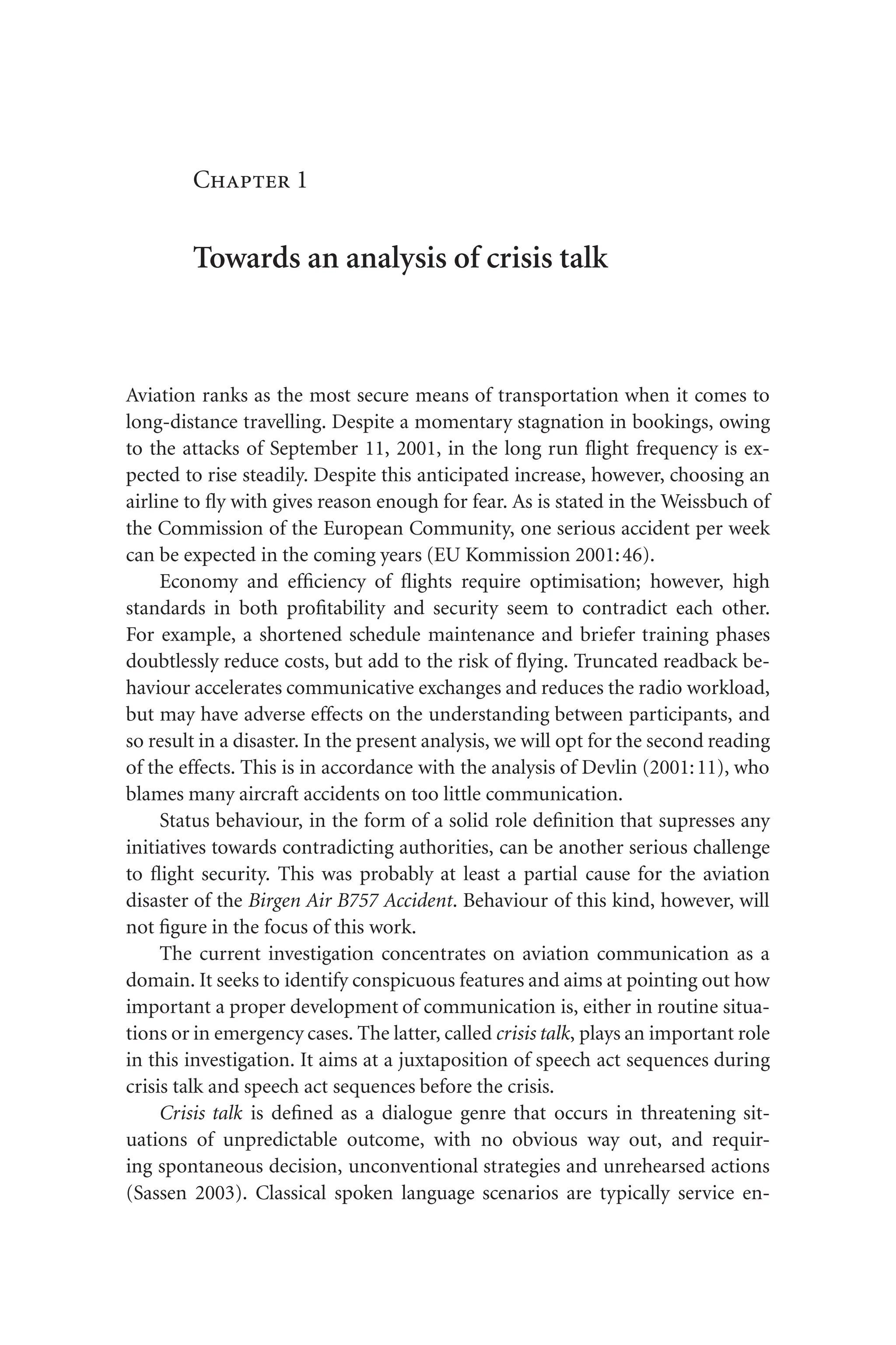
Acknowledgements
This book is based on my doctoral thesis that was partially funded by the
Deutsche Forschungsgemeinschaft (DFG) through a scholarship of the Grad-
uate Program Task Oriented Communication (GK 256) Universität Bielefeld.
My thanks go to my colleagues at the Graduate Program and especially our
speaker Dieter Metzing. For their invaluable advice and encouraging remarks
I would like to thank my supervisors Dafydd Gibbon and John Brian Walms-
ley and the participants of their colloquia as well as two anonymous reviewers
at Benjamins for their helpful comments. I also want to thank Andreas H.
Jucker and Isja Conen for their friendly and professional communication dur-
ing preparation of my manuscript and Sylvia Nasaroff and Donna Devine for
final proofreading. I am grateful to Kim Cardosi, Kellye Je’anne Tanner and
Bryan Rife for background information, Harro Ranter for his kind permission
to use and transform the atc/cvr transcripts he hosts on aviation-safety.net,
Harald Lüngen for discussion and Benjamin Hell, Jens Pönninghaus and Mar-
cus Grieger for support with the perl-scripts. I am indebted to my parents and
my aunts Inge and Thea and last not least to my husband Peter Kühnlein for
his patience and untiring willingness to discuss matters.
Chapter 1
Towards an analysis of crisis talk
Aviation ranks as the most secure means of transportation when it comes to
long-distance travelling. Despite a momentary stagnation in bookings, owing
to the attacks of September 11, 2001, in the long run flight frequency is ex-
pected to rise steadily. Despite this anticipated increase, however, choosing an
airline to fly with gives reason enough for fear. As is stated in the Weissbuch of
the Commission of the European Community, one serious accident per week
can be expected in the coming years (EU Kommission 2001:46).
Economy and efficiency of flights require optimisation; however, high
standards in both profitability and security seem to contradict each other.
For example, a shortened schedule maintenance and briefer training phases
doubtlessly reduce costs, but add to the risk of flying. Truncated readback be-
haviour accelerates communicative exchanges and reduces the radio workload,
but may have adverse effects on the understanding between participants, and
so result in a disaster. In the present analysis, we will opt for the second reading
of the effects. This is in accordance with the analysis of Devlin (2001:11), who
blames many aircraft accidents on too little communication.
Status behaviour, in the form of a solid role definition that supresses any
initiatives towards contradicting authorities, can be another serious challenge
to flight security. This was probably at least a partial cause for the aviation
disaster of the Birgen Air B757 Accident. Behaviour of this kind, however, will
not figure in the focus of this work.
The current investigation concentrates on aviation communication as a
domain. It seeks to identify conspicuous features and aims at pointing out how
important a proper development of communication is, either in routine situa-
tions or in emergency cases. The latter, called crisis talk, plays an important role
in this investigation. It aims at a juxtaposition of speech act sequences during
crisis talk and speech act sequences before the crisis.
Crisis talk is defined as a dialogue genre that occurs in threatening sit-
uations of unpredictable outcome, with no obvious way out, and requir-
ing spontaneous decision, unconventional strategies and unrehearsed actions
(Sassen 2003). Classical spoken language scenarios are typically service en-
 Linguistic Dimensions of Crisis Talk
counters and construction dialogues. They are genres in the sense of Grice’s
conversational maxims (Grice 1975): cooperative, well-formed and often re-
hearsed. Unlike these scenarios, crisis talk is more disfluent; it violates Gricean
maxims, is usually emotional, and shows high taboo word frequency, unter-
minated uptake loops (Gibbon 1981) and iterated utterances as well as greater
speech output quantity. Crisis talk typically occurs in negotiations with crim-
inals, political summits, interpersonal conflicts and disaster scenarios. In the
context of this book, crisis talk relates to aviation disasters, namely, to cockpit
voice recordings, which acoustically document the actions undertaken by the
crew in order to avoid a disaster during the last few minutes before their air-
plane crashes. In aviation communication, crisis talk usually occurs during a
plane’s take-off or landing because during these phases safety and thus people’s
lives are most at risk.
This outline of the term crisis talk will undergo further specification in the
course of the analysis. Crisis talk will be introduced as a technical term, which,
according to an internet search and to bibliographical research of printed texts,
is not widely used. Every type of conversation that does not bear the features
of crisis talk will be called non-crisis talk.
Crises are acutely dangerous situations. They are less likely to have happy
endings although they need not end in fatal results. They are situations with a
turning point of unpredictable outcome, resulting from an unbearable problem
or conflict and are connotated with personal traumas or political emergencies.
Often unexpected, difficult and dangerous, a crisis may put the face or even the
lives of the persons affected at risk, and to be resolved it requires quick deci-
sion and action (Kienle 1982; Sinclair 1987). Specific decisions and actions help
solve or at least mitigate the situation. Crises develop from particular kinds of
behaviour that deviate from everyday routines, partly because a person’s con-
fidence in someone or something is undermined to such a large extent that
it is doubtful whether it can ever be fully regained. As a result, crises cannot
be mastered by conventional problem-solving techniques, but instead require
unorthodox strategies (Fuchs et al. 1978).
A problem is a state of affairs that causes difficulties for people and awaits
resolution. A crisis is a possible result of a problem; i.e. if a problem cannot
be conventionally solved because there is no convention for resolution, a crisis
will unfold. A crisis presupposes a problem, whereas the occurrence of a prob-
lem in a situation does not necessarily mark a concomitant crisis. There are no
clear-cut criteria that help decide at what point a problem turns into a crisis.
Chapter 1. Towards an analysis of crisis talk 
Starting with these intuitive definitions, a method will be elaborated that allows
for determining formal criteria for the definition of crisis talk and non-crisis
talk.
. Objectives and requirements
The data for the present investigation are constituted by atc/cvr (air traffic
control/cockpit voice recordings) transcripts that document the recordings of
airplane crashes. It is grounded in a corpus-linguistic and speech act-based ap-
proach, and relies upon the constraint-based grammar hpsg that is extended
to speech acts. Modelling hpsg is achieved by employing xml as a denotational
semantics. The analysis is an attempt at formalising discourse theoretical struc-
tures that especially occur in crisis situations involving aviation disasters. Of
particular importance in this context are topic-oriented discourse sequences
that help secure uptake among the crew and between crew and tower in order
to coordinate actions that might result in avoiding a potential disaster.
The analysis is aimed at proposing a methodology for a speech act-based
documentation and analysis of data that is extendable to other sets of crisis talk
data. A central goal is to develop a model for the description and disambigua-
tion of speech acts which does not only serve to (semi-)automatically identify
illocutions in highly stereotyped communication, but also enables researchers
to spot leaky points, i.e. non-professional communication within a professional
setting (Gibbon 1981), in the efficiency of communication. Ideally, the analysis
could assist in achieving more successful exchanges in crisis situations, which
might allow a de-escalation of communicative crises, its long-term objective in
this very special case being to make flights safer.
For an effective access to discourse sequences such as uptake securing, the
data are subjected to empirical and formal processing. To generate a corpus of
crisis talk data, the empirical process passes through corpus design, its collec-
tion and representation:The individual transcript files, which were prepared by
various institutionalised transcribers, show differences and inconsistencies in
their notational framework. Therefore, the format of the corpus has to be stan-
dardised (see Section 4.2) so that it can be used for retrieval software such as
concordance programs (kwic-concordance)1
and, more importantly, to sim-
plify semi-automatic annotation. Annotation will be accomplished by using
the attribute value archiving and retrieval formalism xml. In doing so, the
categories already provided by the transcribers can be documented. Further
requirements, specifically of the crisis talk scenario, will be fulfilled by an en-
 Linguistic Dimensions of Crisis Talk
HPSG
Speech act
Theory
Augmented
HPSG
XML
Implementation
ACT/CVR
Other sets of
crisis talk
Other sets of
crisis talk
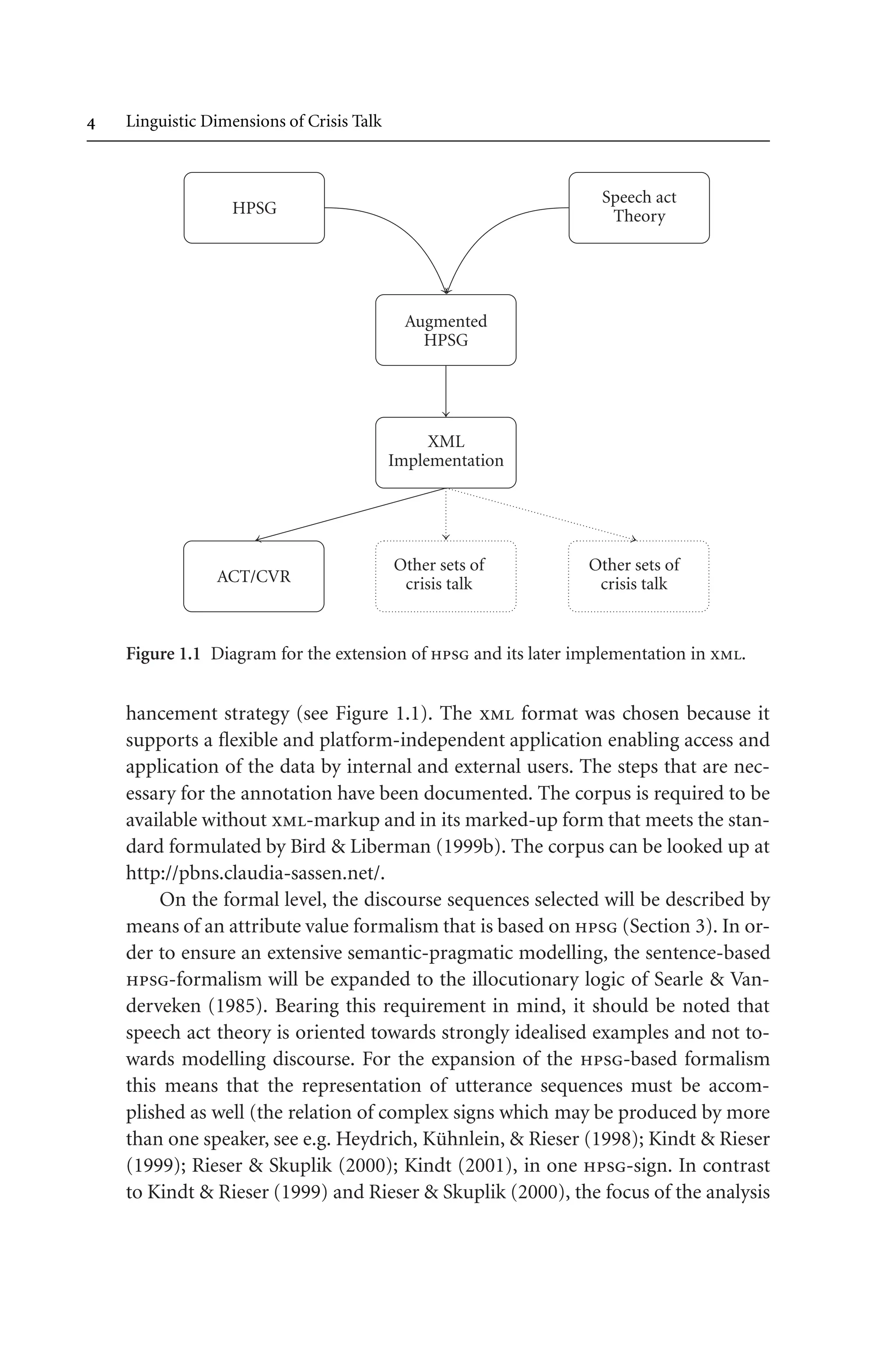
Figure 1.1 Diagram for the extension of hpsg and its later implementation in xml.
hancement strategy (see Figure 1.1). The xml format was chosen because it
supports a flexible and platform-independent application enabling access and
application of the data by internal and external users. The steps that are nec-
essary for the annotation have been documented. The corpus is required to be
available without xml-markup and in its marked-up form that meets the stan-
dard formulated by Bird  Liberman (1999b). The corpus can be looked up at
http://pbns.claudia-sassen.net/.
On the formal level, the discourse sequences selected will be described by
means of an attribute value formalism that is based on hpsg (Section 3). In or-
der to ensure an extensive semantic-pragmatic modelling, the sentence-based
hpsg-formalism will be expanded to the illocutionary logic of Searle  Van-
derveken (1985). Bearing this requirement in mind, it should be noted that
speech act theory is oriented towards strongly idealised examples and not to-
wards modelling discourse. For the expansion of the hpsg-based formalism
this means that the representation of utterance sequences must be accom-
plished as well (the relation of complex signs which may be produced by more
than one speaker, see e.g. Heydrich, Kühnlein,  Rieser (1998); Kindt  Rieser
(1999); Rieser  Skuplik (2000); Kindt (2001), in one hpsg-sign. In contrast
to Kindt  Rieser (1999) and Rieser  Skuplik (2000), the focus of the analysis
Chapter 1. Towards an analysis of crisis talk 
is not primarily on the cooperative production of single utterances, but on the
interactive production of sequences thereof.2
Thus, regularities of speech act
sequences will be established while a modified hpsg-formalism for the integra-
tion of illocutionary logic and the disambiguation of speech acts is postulated.
The investigation does not offer an analysis of individual words, but concen-
trates on functions that are independent of the lexicon. Lexical analyses and
their results are presupposed.
The augmented hpsg formalism will be employed further in developing a
new annotation category set by implementing hpsg-based attribute value ma-
trices into the xml semantics (Section 5.4), see Figure 1.1. A strategy like this
is necessary because the crisis talk scenario requirements are more demand-
ing than the descriptive sets of existing annotation systems (e.g. the tei): Crisis
talk annotation requires detailed syntactic, semantic and pragmatic features for
which a principled approach is preferred. xml is potentially flexible enough to
be suitable for fulfilling crisis talk annotation requirements. xml annotation
has been criticised for lacking a valid semantics. This problem will be circum-
vented by using xml simply as an algebra for domain structuring in a semantic
document model: Together with the appropriate processing mechanisms, xml
provides a denotational semantics for the attribute-value description. Starting
from a basic xml data annotation, and based on the attribute-value descrip-
tion, an extended dtd (Document Type Definition) will be developed and the
basic dialogue annotations enhanced semi-automatically. In a sense, the pro-
cedure extends, formalises and operationalises older proposals to formulate
markup in terms of feature structures. Based on the theoretical background
and its extensions proposed above, the following predictions are made:
– Crisis talk is different from non-crisis talk with respect to interactional
patterns;
– In order to disambiguate speech acts, the model of Searle’s and Van-
derveken’s illocutionary logic requires more precision with regard to the
propositional content that is presupposed. This extension can be achieved
by an hpsg-based formalism;
– An extended hpsg-formalism is an adequate model for the representation,
description and explanation of the disambiguation of illocutionary acts;
– It is possible to extend hpsg-based structures and principles from the inter-
active sentence level to the utterance level. An extension of the hpsg-based
inventory from the utterance level to the discourse level is also possible:
speech act sequences may be modelled by one hpsg-based sign.
 Linguistic Dimensions of Crisis Talk
– xml uses an attribute value archiving and retrieval formalism, and is po-
tentially flexible enough to fulfill the requirements of crisis talk annotation.
. The scenario: Air traffic control
The term atc has at least two different meanings. The first is “part of aviation
parlance” and applies to the tasks which include the controller. The second
meaning is metaphorical and explicitly pertains to the two-way communica-
tion between controllers and the cockpit and could be phrased more exactly by
atc-system or atc-communication. Consequently, for reasons of clarity from
now on the term atc-communication will be employed to refer to the verbal
exchange between tower and crew as a procedure. The term atc may even
have a third reading in that the regulated routine communication between the
pilots in the cockpit is also a component of controlling air traffic. In order
to distinguish cockpit-tower communication from communication within the
cockpit, the former is called extra-cockpit communication and the latter intra-
cockpit communication. This terminology deliberately stresses the cockpit side
because more data are available from cockpit voice recordings than from atc-
recordings. The terms atc and also cvr will be used in connection with the
terms corpus and transcript if the documents that contain these data are re-
ferred to. Aviation communication is a general term that subsumes the two sorts
of communication.
Constraints and consequences
Communication is a critical component in aviation. It is shaped by accuracy
and efficiency constraints. Controllers and pilots use a “combination of English
and special conventions that have developed in response to these constraints”
(Morrow et al. 1994:235). The accurate understanding of every unit of infor-
mation is vital for air safety and has resulted in the explicit acknowledgement
procedures, such as readbacks, that enable addressees (e.g. pilots) to repeat the
sender’s (e.g. the controller’s) message so that the sender can check its inter-
pretation. As important as accuracy is the efficiency-related factor of rapidity.
Aviation communication must be rapid because all participants are involved
in dynamically changing situations. A central type of transaction that requires
quick behaviour is exchange via radio transmission, as many different pilots
use the same radio frequency to talk to the same controller.
Chapter 1. Towards an analysis of crisis talk 
Consequently, aviation language is highly compressed, as becomes obvious
from its abbreviated terminology and phrasal syntax. According to Morrow et
al. (1994), both routine and non-routine operations are influenced by accuracy
and efficiency constraints. Routine operations relate to transactions free from
communication problems. Non-routine operations, in the present study called
crisis talk, refer to sender and addressee interrupting their routine transaction
in order to resolve a communication problem or a technical problem. The lat-
ter involves deviation from some standard collaborative scheme as perceived
by Morrow et al. (1994), which people follow in order to ensure mutual un-
derstanding. Their standard collaborative scheme consists of the components
“initiation of a transaction, presentation of new information about a topic”
and “collaboration of sender and addressee(s) in order to accept the informa-
tion as mutually understood and appropriate to the context” (Morrow et al.
1994:236, see also Ringle  Bruce 1982 and Clark  Schaefer 1987).
For basic routine atc-communication this means that controllers open
a transaction with the intended call sign of the aircraft. Then they present a
message by means of particular speech acts, e.g. statements about airspace con-
ditions or instructions on the flight level. If pilots understand the message they
update a mental model3
of the flight conditions. Finally, pilots and controllers
terminate the transaction by accepting the message as mutually understood
and appropriate: Pilots acknowledge it using their call sign and a readback of
it, while the controller validates the readback for accuracy (hearback) (Morrow
 Rodvold 1993:324).
Standard collaboration, of which the scheme is a convention, implies that
communication takes place against a background of shared knowledge about
language, here English, aviation communication conventions and the opera-
tional environment (the task to fulfill). As Morrow puts it,
Controllers and pilots must agree that they share the same mental model
before continuing to the next turn or transaction. (...) With understanding
problems, addressees do not correctly update their mental model from the
presented information (or speakers do not receive evidence that addressees
did so). (Morrow et al. 1994:237)
The main function of extra-cockpit communication is to preventa collision be-
tween aircraft that operate in the system and to coordinate and expedite the or-
derly flow of traffic (Federal Aviation Administration (2001a:Chapter: 2.1.1)).
This service is provided by air traffic controllers. They stay on the ground, or-
ganise the routes that aircraft are allowed to take through the sky and stay in
contact with the pilots by radio and radar. If indicated, the service includes
 Linguistic Dimensions of Crisis Talk
safety alerts such as reporting abnormalities in weather conditions (Federal
Aviation Administration 2001a:Chapter: 3.1.10, 4.), bird activity information
(Federal Aviation Administration 2001a:Chapter:2.1.22) or unknown aircraft
in the area of the aircraft currently under jurisdiction.
atc-communication involves entering into a highly rule-governed process.
The Airman’s Information Manual (AIM), which forms part of the Aeronautical
Information Manual, as well as the Pilot/Controller Glossary (Federal Aviation
Administration 2000a)4
along with the Federal Aviation Administration Order
(FAAO)5
equip aviation professionals in the United States by means of phrase-
ologies with strict rules to achieve a standard of linguistic exchange that is
(acoustically and semantically) unequivocal.6
The pilots’ and controllers’ duty is to use the words and phrases of these
regulations to secure a complete and effective atc-communication. Some ex-
amples of FAAO-regulations are given below. The following phraseology con-
sists of an utterance without variables. Its context of use is cited first:
In situations where the controller does not want the pilot to change frequency
but the pilot is expecting or may want a frequency change, use the following
phraseology:
PHRASEOLOGY – REMAIN THIS FREQUENCY
(Federal Aviation Administration 2001a:2.1.17)
Example (1) displays a phraseology that consists of an utterance including a
variable that is printed in round brackets. The template is used as a response to
a request from another controller, a pilot or vehicle operator:
(1) Restate the request in complete or abbreviated terms followed by the word
“APPROVED.” The phraseology “APPROVED AS REQUESTED” may be
substituted in lieu of a lengthy readback.
PHRASEOLOGY– (requested operation) APPROVED or APPROVED AS
REQUESTED. (Federal Aviation Administration 2001a:2.1.18a)
Restating a request or instructions verbatim or by a completely synony-
mous equivalent is called full readback in aviation register (Cushing 1994;
Rife 2000). The readback pattern represents an important part of the gram-
mar of atc-communication. Full readback is mandatory to attain clarity with
regard to commands and responses. There are instances when readback is es-
pecially requested by the controller (see Example (2) and also Federal Aviation
Administration 2001a:4.2.3c).
(2) Request a readback of runway hold short instructions when it is not re-
ceived from the pilot [...]. NOTE- Readback hold instructions phraseology
Chapter 1. Towards an analysis of crisis talk 
may be initiated for any point on a movement area when the controller be-
lieves the readback is necessary.
(Federal Aviation Administration 2001a:3.7.2d)
Unless otherwise indicated, readback may be abbreviated to backchannelling
behaviour, called acknowledgements here (Rife 2000) and, according to other
sources, one-word acknowledgement (Morrow et al. 1994; see Example (3) on
backchanneling).
(3) When issuing clearances or instructions ensure acknowledgement by the
pilot. [...] Pilots may acknowledge clearances, instructions, or other in-
formation by using “Wilco, “Roger, “Affirmative, or other words or
remarks. (Federal Aviation Administration 2001a:2.4.3a; see also 2.1.18)7
To prevent the fatal consequences of misunderstandings the controller is
obliged to execute a linguistic repair mechanism (see Section 4.5):
If altitude, heading, or other items are read back by the pilot, ensure the read-
back is correct. If incorrect or incomplete, make corrections as appropriate.
(Federal Aviation Administration 2001a:2.4.3b)
Example (4) displays an extract from an exchange between a pilot (caller) who
contacts the controller (receiver) and illustrates the principle of a full readback:
(4) The caller states his or her operating initials. EXAMPLE- Caller- “Den-
ver High, R Twenty-five.” Receiver- “Denver high.” Caller- “Request direct
Denver for Northwest Three Twenty-eight.” Receiver- “Northwest Three
twenty-eight direct Denver approved. H.F.” Caller- “G.M.”
(Federal Aviation Administration 2001a:2.4.12)
An AIR (Aviation Interface Research) System Controller Grammar can be found
in Cushing 1994:137.
Apart from extra-cockpit communication, phraseologies are also indis-
pensable for intra cockpit communication to secure an accurate and effective
exchange between the pilot and his copilot.
Unlike extra-cockpit communication, there are no federal regulations gov-
erning communication between pilots. However, at all U.S. airlines a Flight Op-
erations Manual (FOM) is prepared by the company and details the procedures
that are used by flight crews. The FOM is reviewed by a Federal Aviation Ad-
ministration (FAA) Principal Operations Inspector who approves and certifies
the original FOM and revisions to the FOM.
The FOM is very detailed and lists the required procedures for completing
any task. For instance, it contains detailed instructions on how a takeoff is per-
 Linguistic Dimensions of Crisis Talk
formed and the required callouts by the non-flying pilot. The callouts are quite
specific and intended to be followed to the letter. Any deviation from these pro-
cedures could result in a FAA violation for the flight crew for failing to follow
required procedures.8
The Pacific Northwest National Laboratory Manual 530 (PNNL-MA-530)9
has been selected as one representative of the FOM. Like all the other FOMs
that were found on the internet and acquired through contacts with aviation
companies it does not contain the exact phrasing that should be used, but sim-
ply states the required procedure in a descriptive manner. This is exemplified
for an altitude callout (Example (5)) and a flight level callout (Example (6)):
(5) Altitude Callout
Both pilots call out and acknowledge each altitude callout of 1000ft, prior
to the assigned altitude (Federal Aviation Administration 1998:4.3.1.2).
(6) Flight Level 180 Callout
Both pilots call out the climb and descent altimeter settings for flight level
(FL) 180 (18,000ft) (Federal Aviation Administration 1998:4.3.1.2).
The Approach Briefing is executed as follows:
Upon receiving the appropriate approach information and verifying that both
altimeters are correctly set, the Pilot Not Flying (PNF) will pull the approach
plate for review by the Pilot Flying.
(Federal Aviation Administration 1998:4.3.1.14)
Since the phraseologies assembled in the airline-specific FOMs are propri-
etary,10
exemplifying phrases were taken from MD-80 sample oral questions
(Hoesch 2000), a source that was found on the World Wide Web. It was designed
to help pilots train for their exams. The chronological list of PF (pilot flying)
and PNF (pilot not flying) callouts during a missed approach is embedded in
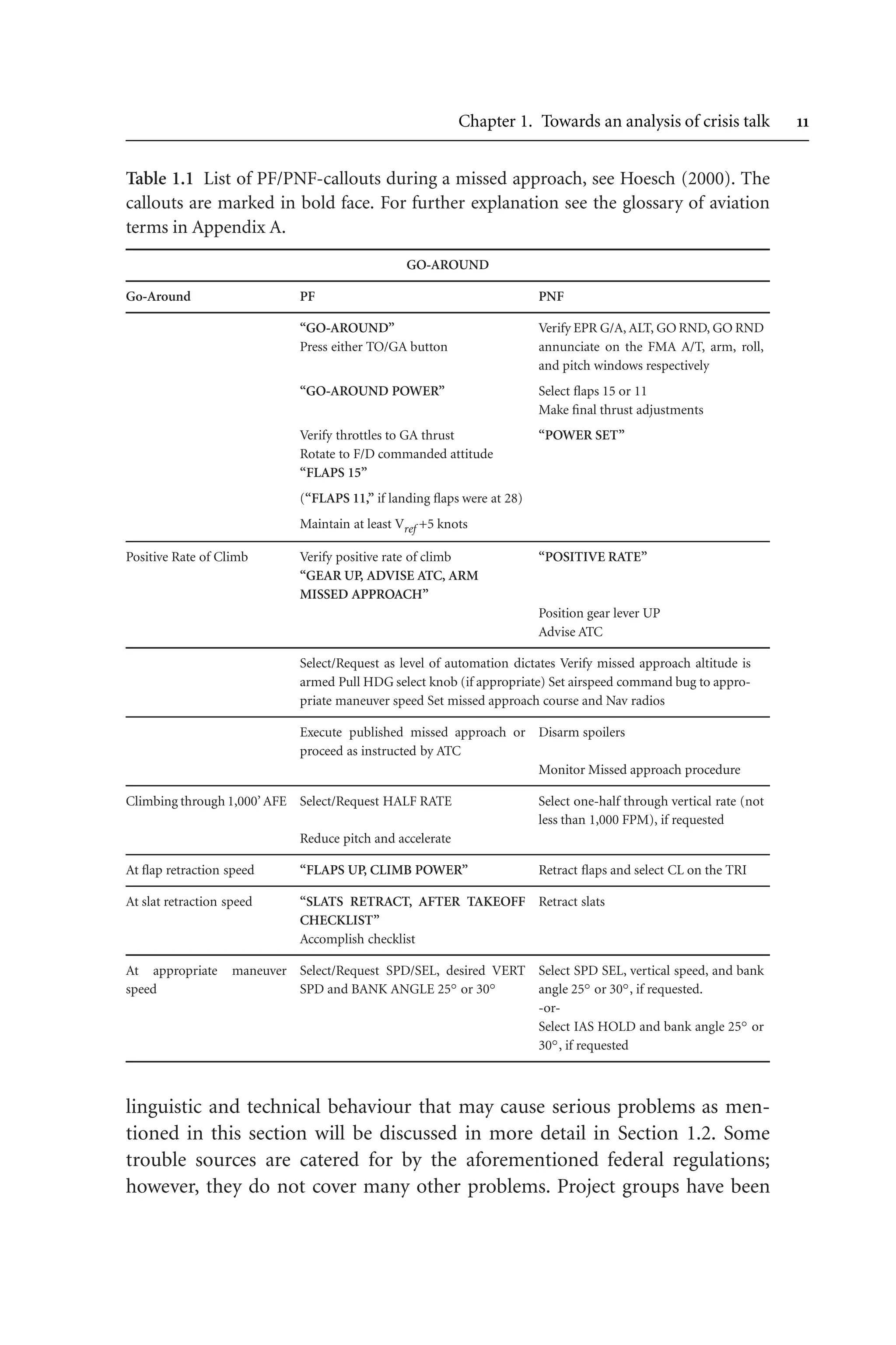
the prescribed actions that the pilots have to execute (see Table 1.1).
Intra- and extra-cockpit communication represent a critical link in the avi-
ation system. Radio communication, for instance, can be a strong bond be-
tween pilot and controller. The interruption of radio communication can have
disastrous results, as the following quotation implies:
The single, most important thought in pilot-controller communication is
understanding. (Federal Aviation Administration 2000c:4.2.1)
Factors influencing the quality of controller/pilot communication are vol-
ume of traffic, frequency congestion, quality of radar, or controller workload
(Federal Aviation Administration 1995:2.1.1). Some aspects of the situational,
Chapter 1. Towards an analysis of crisis talk 
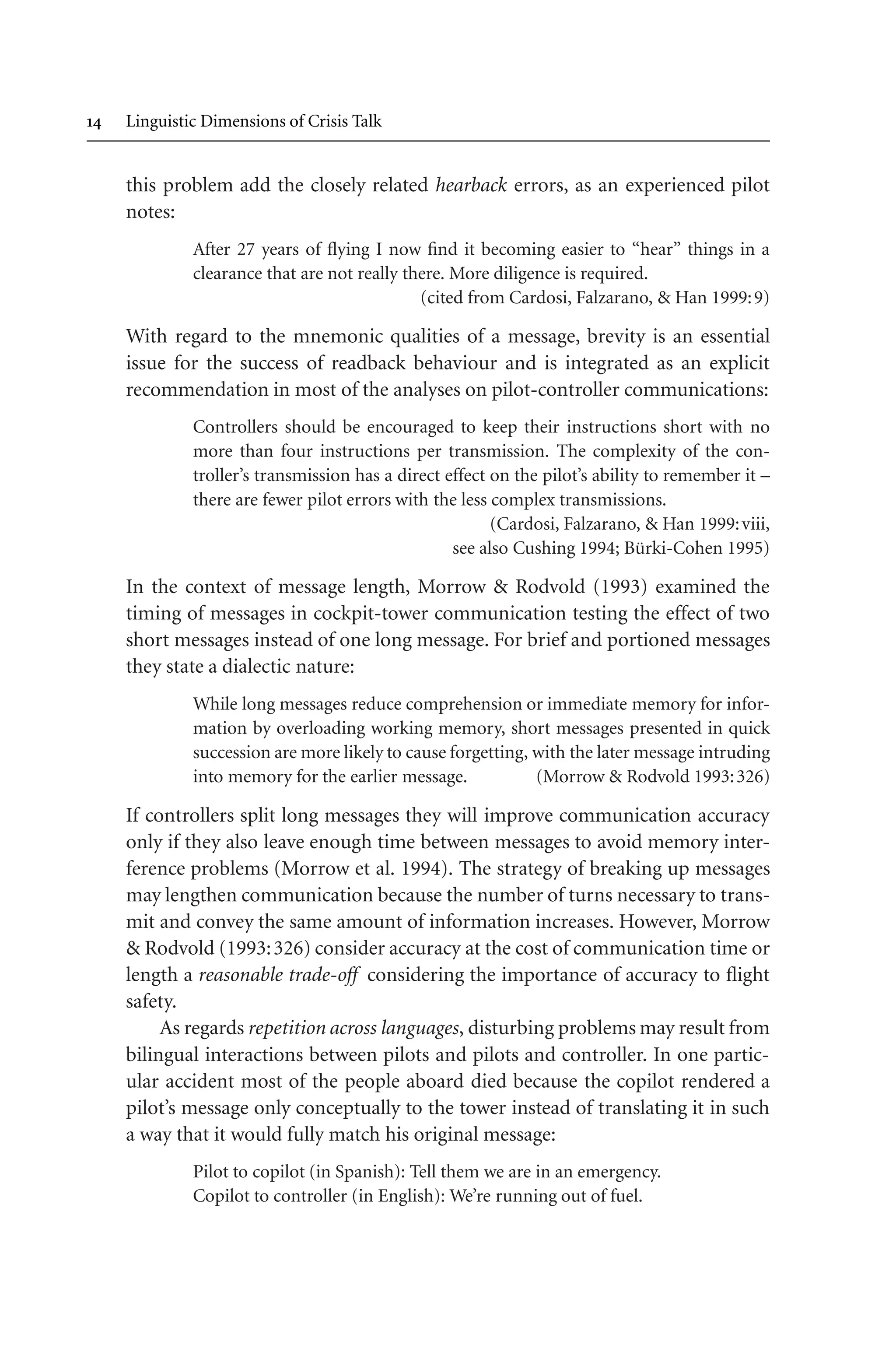
Table 1.1 List of PF/PNF-callouts during a missed approach, see Hoesch (2000). The
callouts are marked in bold face. For further explanation see the glossary of aviation
terms in Appendix A.
GO-AROUND
Go-Around PF PNF
“GO-AROUND” Verify EPR G/A, ALT, GO RND, GO RND
Press either TO/GA button annunciate on the FMA A/T, arm, roll,
and pitch windows respectively
“GO-AROUND POWER” Select flaps 15 or 11
Make final thrust adjustments
Verify throttles to GA thrust “POWER SET”
Rotate to F/D commanded attitude
“FLAPS 15”
(“FLAPS 11,” if landing flaps were at 28)
Maintain at least Vref +5 knots
Positive Rate of Climb Verify positive rate of climb “POSITIVE RATE”
“GEAR UP, ADVISE ATC, ARM
MISSED APPROACH”
Position gear lever UP
Advise ATC
Select/Request as level of automation dictates Verify missed approach altitude is
armed Pull HDG select knob (if appropriate) Set airspeed command bug to appro-
priate maneuver speed Set missed approach course and Nav radios
Execute published missed approach or
proceed as instructed by ATC
Disarm spoilers
Monitor Missed approach procedure
Climbing through 1,000’ AFE Select/Request HALF RATE Select one-half through vertical rate (not
less than 1,000 FPM), if requested
Reduce pitch and accelerate
At flap retraction speed “FLAPS UP, CLIMB POWER” Retract flaps and select CL on the TRI
At slat retraction speed “SLATS RETRACT, AFTER TAKEOFF
CHECKLIST”
Retract slats
Accomplish checklist
At appropriate maneuver
speed
Select/Request SPD/SEL, desired VERT
SPD and BANK ANGLE 25◦ or 30◦
Select SPD SEL, vertical speed, and bank
angle 25◦ or 30◦, if requested.
-or-
Select IAS HOLD and bank angle 25◦ or
30◦, if requested
linguistic and technical behaviour that may cause serious problems as men-
tioned in this section will be discussed in more detail in Section 1.2. Some
trouble sources are catered for by the aforementioned federal regulations;
however, they do not cover many other problems. Project groups have been
 Linguistic Dimensions of Crisis Talk
formed by organisations such as NASA in order to analyse the leaky points,
i.e. non-professional communication in aviation transactions and to formu-
late recommendations that help avoid the occurrence of problems. Extracts
from the regulations as well as recommendations designed to prevent potential
problems will be included wherever possible.
Sources of error in extra- and intra-cockpit communication
According to Cardosi, Falzarano,  Han (1999:viii), pilot-controller commu-
nications (see e.g. Morrow, Lee,  Rodvold 1993; Cardosi 1994; Buerki-Cohen
1995) display an astonishingly low error rate. Corresponding studies reveal that
less than one percent of the aviation communication analysed led to a commu-
nication error that would vitiate the accuracy of the exchange. Although the
error rate is low, it does not reduce the potential seriousness of even a sin-
gle error. Cardosi, Falzarano,  Han (1999:viii) particularly point out that the
number of these errors per hour are close to one. In order to decrease the num-
ber of communication errors, several research projects have been inaugurated,
because the first measure taken against communication errors must be to iden-
tify why they happen in the first place. Some of their results will be reviewed
here. They can be categorised as factors that apply to personal and contex-
tual aspects, to linguistic issues and to technical problems. As will be seen in
the course of this section, however, the distinction is not selective, because the
factors form a continuum.
Personal and situational factors
Personal and situational factors pertain to the personality of participants in
aviation communication and to the situations they are in. Readback behaviour
(or the lack of it) is considered a most critical and controversial factor of
atc-communication (Rife 2000). Despite an explicit appeal in the federal
regulations to make use of full readback (Federal Aviation Administration
2001a:2.4.3), this type of response tends to fall victim to routine behaviour on
the one hand and to misunderstood efficiency on the other. Pilots acknowl-
edging a controller’s command with a partial readback leave the controller
insufficiently informed on whether his instructions were interpreted as in-
tended. The following instance comes from a three-hour listening session at
a major airport: Although the controller issued the instruction Squawk 1735
the pilot reduced it in his readback to Squawkin’. A similar instruction was
read back by another pilot simply with Awrightee (see Cushing 1994:40). Rife
concludes:
Chapter 1. Towards an analysis of crisis talk 
Pilots should acknowledge each radio communication with atc using the ap-
propriate aircraft identification, and read back critical information such as
runway and altitude assignment. When critical information is not read back,
the opportunity for the controller to correct the error is lost.
(Rife 2000, see also Bürki-Cohen 1995; Cardosi, Falzarano,  Han 1999)
Rife cites an instance in which a lack of readback resulted in one aircraft enter-
ing another controllers airspace without coordination or approval.
Lax behaviour is frequently observed when it comes to the completeness
of responses. Completeness does not only imply that the addressee is required
to repeat the message of the sender verbatim but also that he prefix it with the
call sign in question. According to a study conducted by the Volpe Center,11
on
average, 38 percent of pilots do not use their complete call sign (also known
as aircraft identifier) in response to controllers. A lack of either component
might result in misunderstandings and confusions. For this reason, Cardosi,
Falzarano,  Han (1999:10) issue the warning that it is not an excuse to omit
the aircraft identification claiming that it [tends] to clutter the frequency). They
cite an incident in which a pilot, who did not believe in complete readbacks of
clearances because of possible radio overload, acknowledged the clearance po-
sition and hold that was addressed at another aircraft with a mere roger. In
the end, this runway transgression made a go-around for an incoming aircraft
necessary.
Cushing makes the critical point that the requirement of full readback
along with other official constraints on language use can only be expected to
be a valuable means in uptake securing when both interlocutors are
fully cognizant of the subtle nuances of the language they are using and fully
engaged in their role as interlocutors. (Cushing 1994:45)
As a central source of error with regard to the subtlety of a language he names
speakers of languages in which explicit prepositions are not as essential for
meaning as in English. They were more likely to omit words like these unless
the potential danger of omittance was not clearly brought to their attention in
training.
Routine behaviour ranks as a severe factor adding to the eventual inef-
ficiency of full readbacks. Aviation communication is a matter of routine to
a large extent, and particularly characterised by a massive amount of repeti-
tion. Therefore, it induces ritualisation whereby utterances and situations “lose
their cognitive impact and participants [fall] into a pattern of simply going
through the motions for their own sake” as Cushing (1994:46) observes. To
 Linguistic Dimensions of Crisis Talk
this problem add the closely related hearback errors, as an experienced pilot
notes:
After 27 years of flying I now find it becoming easier to “hear” things in a
clearance that are not really there. More diligence is required.
(cited from Cardosi, Falzarano,  Han 1999:9)
With regard to the mnemonic qualities of a message, brevity is an essential
issue for the success of readback behaviour and is integrated as an explicit
recommendation in most of the analyses on pilot-controller communications:
Controllers should be encouraged to keep their instructions short with no
more than four instructions per transmission. The complexity of the con-
troller’s transmission has a direct effect on the pilot’s ability to remember it –
there are fewer pilot errors with the less complex transmissions.
(Cardosi, Falzarano,  Han 1999:viii,
see also Cushing 1994; Bürki-Cohen 1995)
In the context of message length, Morrow  Rodvold (1993) examined the
timing of messages in cockpit-tower communication testing the effect of two
short messages instead of one long message. For brief and portioned messages
they state a dialectic nature:
While long messages reduce comprehension or immediate memory for infor-
mation by overloading working memory, short messages presented in quick
succession are more likely to cause forgetting, with the later message intruding
into memory for the earlier message. (Morrow  Rodvold 1993:326)
If controllers split long messages they will improve communication accuracy
only if they also leave enough time between messages to avoid memory inter-
ference problems (Morrow et al. 1994). The strategy of breaking up messages
may lengthen communication because the number of turns necessary to trans-
mit and convey the same amount of information increases. However, Morrow
 Rodvold (1993:326) consider accuracy at the cost of communication time or
length a reasonable trade-off considering the importance of accuracy to flight
safety.
As regards repetition across languages, disturbing problems may result from
bilingual interactions between pilots and pilots and controller. In one partic-
ular accident most of the people aboard died because the copilot rendered a
pilot’s message only conceptually to the tower instead of translating it in such
a way that it would fully match his original message:
Pilot to copilot (in Spanish): Tell them we are in an emergency.
Copilot to controller (in English): We’re running out of fuel.
Chapter 1. Towards an analysis of crisis talk 
The copilot’s message does not make the proper degree of urgency explicit
to the controller so that the conceptual repetition of the pilot’s message is
incorrect. Cushing comments:
The problem is probably compounded here [...] by the fact that the language
being used is a technical variant of a language other than the speaker’s own,
leaving him twice removed from the vernacular with which he is most familiar.
(Cushing 1994:45)
Risky inferencescan also be the result of the use of unfamiliar terminology as far
as the addressee is concerned. This may be the case with young and inexperi-
enced pilots and controllers, or have evolved with pilots from different cultures
or simply different surroundings in which different conventions have evolved.
The reason may also lie in sheer ignorance. In an example that Cushing cites,
the pilot addressed was unfamiliar with an abbreviation. When the Approach
Control told him
We have the REIL [runway end identifier lights]12
lights up all the way; do you
have the runway in sight?
the pilot responded after some hesitation:
How do you tell the difference between real lights and imitation lights?
(Cushing 1994:29)
The pilot inferred a non-existent distinction of lights right on the evidence that
he was not acquainted with the abbreviation of REIL.
In another case, adaptation to different surroundings lay at the core of an
understanding problem. The string ladies, legal, lights, liquids issued by the
non-flying pilot were new to the copilot, so that passing through 10,000 feet
on descent the aircraft fell too quickly to 8,300 feet and needed to climb back.
The pilot had used the terminology of his former airline which was used to
remind crew members at 10,000 feet to turn on the seatbelt sign, reduce air-
speed to less than 250 knots, turn on the lights for recognition, and make sure
the hydraulic pumps and fuel boost pumps are turned on.
(Cushing 1994:31)
Inference is a further trouble source in aviation communication. It means that
a hearer derives meaning from a sentence that is explicit in its words (lexical
inference) or grammar (structural inference) (see Cushing 1994:24). More on
inference and a good overview of related literature can be found in Rickheit 
Strohner (1985); Rickheit  Strohner (1997). Cushing describes aviation inci-
dents that were caused by lexical inference. In one of them, which resulted in a
 Linguistic Dimensions of Crisis Talk
near miss, a captain was told twenty miles from his airport of destination “to
intercept the localizer and descend to 4,000 [feet]”. When the captain was five
miles outside the outer marker at the commanded level the Center told him
that the other aircraft on the approach in front of him had landed. The Cen-
ter continued: “you are number one for the approach”. These very words were
interpreted by the crew as meaning cleared for the approach, although the clear-
ance was not given. They reduced their flight level and two miles outside the
marker, at 3,600 feet, the Center informed the crew that they were only cleared
to 4,000 feet. Another aircraft was departing (Cushing 1994:28). In another in-
cident, the Center told the captain that he would have to be moved to either FL
[flight level] 310 or FL 350. Asked which flight level he would prefer, the cap-
tain replied “flight level 350”. Ten minutes later the Center enquired about his
altitude and he replied “flight level 350”, but was told he had not been cleared
to this flight level. According to the first officer, he (presumably F/O, Cushing
is not explicit about this) had received a clearance and had reported vacating
FL 330 for 350. Cushing concludes that the clearance was erroneously inferred
from the Center’s initial question about the altitude and that the first officer’s
report was unnoticed (Cushing 1994:29).
Confusion over the identity of the intended addressee, which often results in
garbling call-signs, is a common error in aviation communication and clearly
interferes with the required efficiency in information transfer. Identity gar-
blings may occur because of technical problems such as frequency mix-ups
and incomplete transmission or because of hearback errors owing to fatigue or
homophony phenomena. Apart from verbally based terminology, non-verbal
terminology can also be dangerously misinterpreted when unfamiliar to the
addressee. A copilot pointing down and showing four fingers was taken by the
pilot to confirm that the aircraft had been cleared to descend to 4,000 feet and
so he left his flight level. The copilot, however, had intended to signal that the
aircraft had been instructed to park via ramp 4 on arrival (Cushing 1994:34).
Here the problem was caused by pilots from different countries.
There is a vast range of reasons a flight crew or a controller may be di-
verted and hence endanger the lives of hundreds of people, which may be
subsumed under the term distractions. For example, a pilot’s personal situa-
tion may add to his exhaustion, or an overworked controller may not notice
a faulty readback that, consequently, prevents him from correcting a misun-
derstood instruction. In general, however, according to the study of Cardosi,
Falzarano,  Han (1999), it is the nature of the controller’s job to plan one
action while acting out another; thus it would be useless to suggest that con-
Chapter 1. Towards an analysis of crisis talk 
trollers should protect themselves against being distracted during readbacks.
Cardosi et al. suggest
that controllers regard the readbacks as they would any other piece of incom-
ing information – by using it. Actively listen to the readback and check it
against the flight strips notations to ensure that the message the pilot received
was the correct one. (Cardosi, Falzarano,  Han 1999:9)
Other distractions that are often not directly related to aviation can cause trou-
ble as well. These distractions may include the delivery of the crew’s meals,
which may result in a missed frequency change. A passenger question or excess
and nonessential radio communications might break the chain of thought and
hinder the crew from concentrating on monitoring their instruments properly.
A bird strike may distract the crew from changing over to tower control, and
the same could happen to a pilot pre-occupied with instructing a new copilot.
Often enough, the reasons a crew did not notice important occurrences such
as instructions or equipment failure remain obscure (Cushing 1994:71–74). At
times, disaster is avoided thanks to technical support such as warning signals
or to a controller who effectively regains a distracted crew’s attention or even
to chance factors.
However, it would be foolish to count on having such good luck.
(Cushing 1994:74)
Despite the need for speed, which is closely related to the efficiency constraint,
communication effectiveness can clearly be undermined by impatience. Cush-
ing reports several incidents in which clearances and other instructions are
given by controllers in too rapid a manner so that pilots have to ask for repeti-
tion. Because multiple aircraft are connected to the control tower via the same
frequency, effective radio communication is impeded by traffic overload, with
overlapping requests from different pilots. This situation requires a restatement
of instructions (Cushing 1994:74–75).
Another likely cause of dangerous incidents and serious accidents could be
a lack of cooperation among the crew. Many cases involved one member want-
ing to get others fired from their position because of competitive job facilities.
Particularly disturbing are incidents that resulted from mere frivolousness, e.g.
from the misuse of radio frequency for messages that were irrelevant to avia-
tion instructions and navigation matters. In an incident that resulted in a near
miss, instructors of a young pilot did not handle their flight situation with ad-
equate conscientiousness. They told jokes and conversed freely back and forth
 Linguistic Dimensions of Crisis Talk
and so missed an important controller instruction that the pilot needed to turn
in a certain direction immediately because of departing traffic.
Linguistic factors
Trouble sources that are of a mainly linguistic origin branch into aspects
of semantics, pragmatics and surface interpretation. According to Cushing
(1994:8), ambiguity is an ever-present source of potential misunderstandings
in aviation communication. In general, ambiguity means that a sign or a
string of signs (word, phrase, sentence) has more than one meaning. It can
have both a lexical and a structural basis, as with sentences like “The man
watched the girl with the telescope” or “She saw her duck” (Bach 2001).
Lexical ambiguity, as the more common type of ambiguity, applies if one
word has more than one meaning (Bach 2001). Consider the following ex-
ample: In aviation parlance pilots use the term PD as an abbreviation for
both of the expressions pilot’s discretion and profile descent. The most devas-
tating disaster in aviation history, the accident at Los Rodeos Airport, Tener-
ife, presumably was in part the result of lexical ambiguity (Cushing 1994:10;
Aviation Safety Network 2002d:10). On March 27, 1977, a KLM Boeing 747
(Flight 4805) attempted to take off from Tenerife for a flight to Las Palmas. A
PanAm Boeing 747 was still taxiing down the runway. Both aircraft collided
and burst into flames. All 248 persons on board the KLM flight as well as 335
PanAm occupants died (Aviation Safety Network 2002a). The misunderstand-
ing arose from the phrase at takeoff, which the pilots used to indicate that they
were in the process of taking off, but was interpreted by the controller as mean-
ing at the takeoff point (Cushing 1994:1, 7, 11). Consequently, he did not tell
the pilot to abort his takeoff. The misunderstanding on the pilots’ side was pre-
sumably triggered off by a prior misinterpretation of the controller’s utterance:
You are cleared to the Papa Beacon, climb to and maintain flight level nine
zero, right turn after takeoff. (Cushing 1994:7)
The wording after takeoff is not necessarily equivalent to permission to take
off, but the pilot obviously interpreted the controller’s clearance as permission
to fly to the Papa Beacon, whereas the controller obviously intended to issue a
subsequent command that would tell the pilot to fly to the beacon only after
having received further clearance to leave the ground. Cushing concludes:
The use of alternative unambiguous phrases for the clearance and the takeoff
announcement would have enabled the controller to advise some action that
might have averted the collision or prevented the takeoff roll in the first place.
(Cushing 1994:10)
Chapter 1. Towards an analysis of crisis talk 
Structural ambiguity occurs when a phrase or sentence has more than one
underlying structure, such as the phrase “Flying planes can be dangerous”
(Cushing 1994; Bach 2001). It can be represented structurally in two differ-
ent ways: in the first reading flying can be interpreted as an adjective to the
noun planes in the sense that planes that are flying can be dangerous. In the sec-
ond reading flying might be interpreted as to fly planes can be dangerous. In
terms of hpsg, this fact can be stated thus: In the first case flying is a modi-
fier, while plane is the head of the phrasal sign. In the second case, flying is the
head, while planes is a complement. In both cases, of course, the np constitutes
the complement to the verb phrase so that the potential of being dangerous is
predicated of the respective entity or entities. From this point of view, this type
of ambiguity might be classified as a matter of syntax.
A special type of structural ambiguity leads to confusion of the speech
act type that is performed in an utterance. For example, it might be un-
clear whether a controller utters a declaration or an instruction. Such a case
is reported about a pilot who had received the following message from the
controller:
traffic at ten o’clock, three miles, level at 6,000, to pass under you
The pilot was observed descending through 6,800 feet because he had miscon-
strued the phrase level at 6,000 as an instruction in the sense of Descend to
and remain level at 6,000. The controller, however, had intended his utterance
declaratively meaning The traffic is level at 6,000 (Cushing 1994:16).
The disambiguation of illocutionary acts figures as an essential part of the
present study and will be discussed in detail in Chapter 5. Particular instances
of ambiguity are indirect speech acts through which the speaker intends to
express a certain communicative function by literally expressing another one.
Ambiguity in spoken language can be traced back to two main factors: ho-
mophony, a case in which two lexemes having the same pronunciation but dif-
ferent meanings, and unspecified prosody that leads to an indistinguishability
of, e.g. speech act types.
The problems described are all of a phonetic nature such as homophony,
either because of similar sounds or unclear production. In the context of avia-
tion parlance, the notion of homophony is extended to sounds that are nearly
alike. Owing to the quality of the transmission channel, some sounds that are
articulatorily distinct may become auditorily indistinguishable. Not only for
non-native speakers of English might homophony be a source of misinterpre-
tation with severe consequences. A well known example of homophony that
 Linguistic Dimensions of Crisis Talk
may lead to fatal consequences in aviation communication is the preposition
to which equals the pronunciation of the numeral two.
Cushing reports the incident of a pilot whom the tower observed to be
“somewhat higher than called for in the procedure, and flying in the wrong
direction”. He turned out to have misheard the clearance a Maspeth climb as
the clearance a massive climb. Maspeth is a fix in the New York metropolitan
area; however, the pilot was unacquainted with the region’s geographical data
(Cushing 1994:13).
Another common mistake occurs when different aircraft whose identifi-
cations sound nearly alike are communicating with the same controller. They
may have the same flight number (such as AAL 123 and UAL 123), similar
sounding numbers (such as two and ten), or identical numbers in different po-
sitions (such as four thirty-two and three forty-two). The problem worsens when
aircraft with the same airline name also have numbers that sound similar. The
call-sign problem easily increases particularly at airline hubs, where many air-
craft will have the same company name (Cardosi, Falzarano,  Han 1999:14).
In their regulation, the FAAO cater for this potential trouble source with an
Emphasis for Clarity:
Emphasize appropriate digits, letters, or similar sounding words to aid in dis-
tinguishing between similar sounding aircraft identifications [...].
(Federal Aviation Administration 1995:2.4.15)
Cardosi, Falzarano,  Han (1999) go even further in their discussion of pilot-
controller communication errors and write:
When there are similar call signs on the frequency, controllers should an-
nounce this fact; this will alert pilots and may help to reduce the incidence
of pilots accepting a clearance intended for another aircraft.
(Cardosi, Falzarano,  Han 1999:22)
Mistakes on the suprasegmental level such as unspecified prosody may
equally lead to similar sorts of confusion with ill effects. An incident that in-
volves problems with intonation is reported by a flight instructor who was
checking out a pilot in a small airplane. The instructor noticed considerable
power on a few seconds before touching down. He thought he uttered the com-
mand Back-on the power which was interpreted by the pilot as Back on – the
power. The utterances differ in the location of the pause (indicated by a dash)
and the stress of on (Cushing 1994:16). Backing off (back) means basically to
go “backward” in terms of what is being done, in this situation because the
power had come back on, (on the power) and was an aviation hazard.13
In
this context, Kadmon (2001:12–13) stresses the connection between identify-
ing the focus of an utterance and prosodic intonation patterns. For the current
Chapter 1. Towards an analysis of crisis talk 
analysis, prosody counts as an important factor that helps determine speech
act types.
The recommendation made at this point addresses the sender and advises
him to clearly articulate his words and instructs the recipient to listen care-
fully (Cardosi, Falzarano,  Han 1999:14). Further, acoustics-related problems
pertain to speech rate and human voice. Morrow  Rodvold (1998) identify
as trouble sources utterances which are made in too hasty, unarticulated or
low-voiced a manner. Cardosi, Falzarano,  Han (1999) comment:
Controllers should be encouraged to speak slowly and distinctly. [...] With a
normal rate of speech (156 words per minute), 5% of the controller’s instruc-
tions resulted in a readback error or a request for repeat. This rate rose to 12%
when the controller spoke somewhat faster (210 words per minute).
(Cardosi, Falzarano,  Han 1999:22)
Instead, Cardosi, Falzarano,  Han recommend a normal, conversational tone.
Technical factors
The main trouble source of technical factors in aviation communication is
radio transmission and its use. Parts of calls or responses may get lost for a
number of radio-related reasons: Probably the most obvious source of mis-
communication in aviation is having no radio at all. A predicament like this
may have various causes: complete electrical failure or poor radio reception,
an earpiece disconnecting from the pilot’s headset or a pilot unintentionally
turning down the volume on the VOR (Very High Frequency Omni-directional
Range) and VHF (Very High Frequency) at the same time. Tower and cockpit
losing contact just for a few seconds could lead to identifier-guessing or de-
fective inferences and result in risky actions. In his book, Cushing lists several
incidents where aircraft came close to disaster because of the absence of radio
contact (Cushing 1994:63).
Non-use of radio may be purely accidental in that the pilot “just flat forgot
to contact Tower” (Cushing 1994:65) or it may be motivated by absurd ad-
vice such as that of an airport manager who told a helicopter crew before flight
to keep radio communication to a minimum before and after flight that “ra-
dios in many aircraft were not turned on, to save wear and tear on equipment”
(Cushing 1994:67). Another important factor of non-use of radio is that the
crew is not able to employ the radio because someone else in the same traffic
area blocks it off by a stuck microphone, or too much radio traffic occurs at
the same time because crews are transmitting on the wrong frequency. With
unclear frequency the pilot fails to search a clear frequency when he wants to
 Linguistic Dimensions of Crisis Talk
establish contact with ground control. This will probably jam the receivers of
other aircraft so that their calls have to be repeated. Any interferences of this
kind may impair the communication of aircraft in jeopardy (and can cost valu-
able seconds), let alone the situation of the current aircraft (Federal Aviation
Administration 2001a). Cushing writes about an instance in which a pilot got
off lightly:
[He] finally taxied to the active runway and contacted Tower, having never
gotten through to Ground, because Ground Control frequency was totally
clogged with numerous aircraft trying to call at once. (Cushing 1994:66)
He reports a separate instance in which a pilot waited for a pause in the very
busy radio traffic to send his call, while several calls were cut out by people
transmitting over each other. When he finally got through his call was partly
deleted. The pilot concludes:
So much confusion could be avoided if everybody would use common radio
courtesy and listen before transmitting. (Cushing 1994:67)
In some situations, pilots fail to recognise that their microphone is stuck in the
transmit position, so they cannot receive instructions from the controller. This
may cause frequency blockage for other aircraft tuned to the same frequency
in the same area and result in unintentional transmitter operation. Frequency
blockage may likewise be caused through inadvertent keying of the transmitter
by the controller. There may be other reasons the pilot does not hear from
the controller, for instance, when the volume is down, or the frequency is not
the same as the controller’s (Cushing 1994; Federal Aviation Administration
2001a).
“Recurring stuck mike problems reported by an atc facility” prompted
NASA’s Aviation Safety Reporting System to issue an alert in late 1992.
(Cushing 1994:66)
Incomplete transmission applies when the pilot or controller begins to speak
too early after pressing the microphone button so that the first words are not
transmitted to the controller. A sender’s precipitation is often based on the fact
that aviation transactions are constrained by the need for speed, which seems
to override the need for accuracy. The situation is worsened by outdated radio
equipment that produces a time lag between the keying of a mike and the trans-
mitter’s actual output. This results in uncertain addressees owing to missing
identifiers and causes many repeats which impose a load on the communica-
tion frequency and thus counteract the efficiency constraint (Cushing 1994:20;
Chapter 1. Towards an analysis of crisis talk 
Bürki-Cohen 1995:27; Federal Aviation Administration 2001a). An additional
factor could be that the microphone is not close enough to the sender’s lips.
An incident is reported involving two aircraft from differentcompanies but
which had the same flight number. They were on the same frequency while the
controller was issuing commands and failed to transmit the company prefix
with the identifier. The unintended addressee ended up following the con-
troller’s instructions and could only remedy his mistake by a quick return to
his aircraft’s prior position (Cushing 1994:20).
Conclusion
Trouble sources in aviation communication can be attributed to factors that
concern the general behaviour of the persons involved and the situation they
are in. It could be argued that it was preferable to assign trouble sources such
as readback behaviour to the category of linguistic features. Indeed, readback
largely pertains to language because participants are required to produce lan-
guage; however, the difficulty often does not lie in the production of speech
itself, but in the addition of a multitude of external factors. What is classified
as linguistic factors has more to do with the structure of language than with the
way in which it is used.
Some factors may overlap with the features of readback behaviour. Read-
back behaviour is verbatim repetition of information, while repetition across
languages relates to the re-formulation of a message in a target language that
differs from that of the source. This factor may again be categorised as a lin-
guistic source of error, but in the example displayed here a proper translation
would not have resulted in a disaster.
The subsequent order of unfamiliar terminology followed by inference is
based on the fact that misinterpretation of given information is closer to correct
readback behaviour than the reconstruction of missing information. The com-
plete absence of a cornerstone that allows even for the inference of information
is described in the section about uncertain addressee; the failure in at least per-
ceiving given information may be caused by distractions. Distractions may in
turn be the result of impatience. Non-cooperation and frivolousness deviate
from the pattern. They are trouble sources that cannot standardly be traced
back to the inability of using given information, but to the sheer unwillingness
to do so.
Among the factors unequivocally attributable to language, ambiguity fig-
ures as a main error source. There are two sources of ambiguity: one lexically
based and another with its origin in syntactic structure. With regard to speech,
two central causes of ambiguity become manifest: homophony, i.e. sameness in
 Linguistic Dimensions of Crisis Talk
pronunciation with different meanings, and unspecified prosody, i.e. sameness
in suprasegmental properties of an utterance.
With regard to the purely technical factors that may affect aviation com-
munication and increase the probability of accidents, the main trouble source
is the unavailability or misuse of radio, which may be caused by electrical stall
or an earpiece that happens to disconnect, i.e. factors which do not primarily
rely on intentional behaviour, but on technical failure and accidental occur-
rences. A further reason may be mainly intentional, such as human behaviour
resulting in the non-use or misuse of radio. The users may have been misin-
formed by their authorities or may not have been in a position to estimate
the importance of the medium. In some cases, however, radio use was simply
disregarded. Connected with the different uses of radio is the distinction be-
tween unclear and blocked frequency, which may be ascribed to the degree of
the pilot’s or controller’s efficiency in use of radio. Blockages or unclear fre-
quencies could result in a message not being transmitted properly and lead to
misunderstandings, with hair-raising consequences. These factors doubtlessly
also have a linguistic component; however, the controlling issue of the problem
is technically based and overrides any linguistic behaviour.
Regarding these trouble sources, the personal and situational error factors
turn out to be of highest relevance, as can be seen in Cardosi, Falzarano,  Han
(1999), who list as the most important factors:
– similar call signs on the same radio channel,
– pilot expectations (cf. the case of wishful hearing in routine behaviour) that
deviate conspicuously from the controllers’ instructions and
– high controller workload.
These communication errors most commonly resulted in
– the wrong flight level (altitude deviation),
– loss of standard separation,
– pilots landing on the wrong runway and
– runway transgressions.
Linter and Buckles conclude:
Regardless of the level of sophistication that the air traffic system achieves by
the turn of the century, the effectiveness of our system will always come down
to how successfully we communicate. (Linter  Buckles 1993)
Miscommunication in aviation is well documented. Unfortunately, less is
known about the reasons for these communication problems and how to avoid
Chapter 1. Towards an analysis of crisis talk 
them (Morrow  Rodvold 1993:324). The findings compiled in this section
are based on experiments and their discussion, on reporters, i.e. pilots or con-
trollers filing an ASRS (Aviation Safety and Reporting System) report, listening
sessions of radio communication and on voice recordings of tower and/or
cockpit communication. The latter two, particularly the recordings found in
black boxes, are of special importance for the present study.
Cockpit voice recordings (CVRs)
Large commercial aircraft and some smaller commercial, corporate and private
aircraft must be equipped with two kinds of black boxes that record information
about a flight. Both recorders are designed to help reconstruct the events lead-
ing to an aircraft accident. The one described here, the cockpit voice recorder,
records human and technical sounds. The other, the flight data recorder, mon-
itors parameters such as airspeed, altitude and heading. Both recorders are
installed in that part of the aircraft least susceptible to crash damage, usually the
tail section (National Safety Board 2000). Older recorders are analogue units
using one-quarter inch magnetic tape. Newer recorders use digital technology
and memory chips. Sounds are picked up via a system of cockpit microphones,
known as cockpit area microphones (CAM), public address microphones (PA)
and radio microphones (RDO) (Kilroy 2001).
Each recorder is equipped with an underwater locator beacon to assist in
locating it in the event of an accident over water. A device called a pinger is
activated when the recorder falls into water. Owing to the limited length of
the recording cycle of a flight recorder, instantaneous action is mandatory to
quarantine any black boxes after an incident or accident to make sure that the
data are not overwritten. In fact, black boxes are painted orange to help in
their recovery (Commonwealth Department of Transport and Regional Ser-
vices 1999).
Following an accident, both recorders are brought to a particular institu-
tion which has the statutory power to take into custody and process any flight
recorders from an aircraft that has been involved in an incident, a serious in-
cident or an accident (Commonwealth Department of Transport and Regional
Services 1999). In the United States this is the National Safety Board (NTSB)
headquarters in Washington D.C., in Australia the Bureau of Air Safety Investi-
gation (BASI). By means of computer and audio equipment, the information
stored on the recorders is extracted and translated into an understandable for-
mat. This information is used to determine the probable cause of an accident
(National Safety Board 2000).
 Linguistic Dimensions of Crisis Talk
The concept of a crash-and-fire protected device to record both the crew’s
conversation and the instrument readings was first conceived by David Warren,
a young scientist at the Aeronautical Research Laboratories (ARL) in Melbourne,
Australia (DSTO Commonwealth of Australia 1999; DSTO Commonwealth
of Australia 2000). Warren was struck by the idea in the course of otherwise
fruitless discussions about the possible causes of a crash of the jet-powered air-
liner Comet in 1953. The main problem was that investigation committees had
hardly any clues to work with.
There were no witnesses, no survivors, and all that was left of the aircraft were
massive tangles of bent metal. [...] [Warren] reasoned that [...] there was a
good chance [...] that the flight crew might have known, and it might well
have been revealed in their conversation in trying to deal with the emergency.
(DSTO Commonwealth of Australia 1999)
In 1954, Warren published his ideas in a report entitled A Device for Assisting
Investigation into Aircraft Accidents, which nevertheless evoked little initial in-
terest. A demonstrator unit produced in 1957 was received enthusiastically in
Britain, however, where it was further developed, although the Australian avi-
ation authorities did not approve of the demonstrator. However, following an
unexplained aircraft accident in Queensland in 1960, Australia became the first
country to make flight recorders obligatory in aircraft. Today, every airline in
the world flies with data recorders (DSTO Commonwealth of Australia 1999;
DSTO Commonwealth of Australia 2000).
The cockpit voice recorder, of course, records simply everything audible
that happens in the area of the microphones. Of importance to investigators of
the cockpit voice recording are engine noise, stall warnings and landing gear
extension and retraction. Sounds of this sort can help deduce parameters such
as engine and aircraft speed, system failures and the time at which particular
events occur. Of special interest for the present analysis is the verbal informa-
tion, as there are radio signals of extra-cockpit communication, intra-cockpit
communication and ground or cabin crew as well as automated radio weather
briefings.
In the case of an accident, the usual procedure is the following: a cvr com-
mittee is formed to listen to the recording. In the United States, for instance,
this committee usually consists of members of the National Safety Board, the
Federal Aviation Administration, the operator of the aircraft, the manufacturer
of the airplane and the engines, and the pilots union. A written transcript is
created of the tape to be used during the investigation. The transcript contains
Chapter 1. Towards an analysis of crisis talk 
all pertinent portions of the recording and can be released to the public at the
time of the Safety Board’s hearing.
The treatment of cockpit voice recordings is different from that of other
factual information obtained in an accident investigation. Because of the highly
sensitive nature of the verbal communications inside the cockpit, the Safety
Board is not allowed to release any part of a cvr tape. A high degree of security
is provided for the tape and its transcript: the content and timing of release of
the transcript are strictly regulated. Transcripts of pertinent portions of cvrs
are released under federal law, at a Safety Board public hearing on the acci-
dent or, in the event that no hearing is held, when a majority of the factual
reports are made public (National Safety Board 2000). The airlines that own
the original recording are legally allowed to release it if they choose to (Kilroy
2001).
Meanwhile, many atc/cvr-transcripts are available on the Internet (Avia-
tion Safety Network 2000a), often in extensive extracts. Fragmented cvr tapes
are sometimes also available for listening (Aviation Safety Network 2000b).
The Aviation Safety Network comments upon the value of the recordings
to investigators as follows:
Both the Flight Data Recorder and the Cockpit Voice Recorder have proven
to be valuable tools in the accident investigation process. They can provide
information that may be difficult or impossible to obtain by other means.
When used in conjunction with other information gained in the investigation,
the recorders are playing an ever increasing role in determining the Probable
Cause of an aircraft accident (National Safety Board 2000).
(see also Commonwealth Department of Transport and Regional Services
1999)
. Overview of presentation
Having introduced aviation communication with its fragile system of informa-
tion exchange, the analysis will now focus on the description and formalisa-
tion of linguistic features of aviation communication. Chapter 2 introduces
the main theoretical background. It thereby presents approaches contribut-
ing to the understanding of discourse among which the speech act theory of
Searle and Searle  Vanderveken will receive priority of discussion. Chapter 3
deals with the reasons for a formal treatment of linguistic data, and then an
attribute value-based method for the analysis of aviation data is developed.
Sections on creating a corpus, annotation standards and schemata refer to the
 Linguistic Dimensions of Crisis Talk
methodological steps essential for the generation of an xml-based corpus of
aviation data. A discussion of the concept of meta-data and current markup
systems is included. Chapter 4 offers documentations of the data that had al-
ready been prepared by transcribers and about the modifications necessary
to semi-automatise an xml-markup of the atc/cvr-corpus. Furthermore, it
contains comments upon phases as well as discourse control processes in avi-
ation communication. On the whole, Chapter 4 pertains to general properties
of the atc/cvr-data, whereas Chapter 5 treats particular features of crisis talk
in aviation communication. Its main purpose is to identify regularities of the
speech scenario and to juxtapose aviational crisis talk with aviational non-
crisis talk. One aspect of the regularities will be captured by one hpsg-sign,
followed by the application and more detailed description of the formalism
elaborated in Section 3.3. The glossary in Appendix A helps one to understand
the most important aviation terms used in this analysis. The appendix contin-
ues with a key to the abbreviations used for the hpsg-based structures (see Ap-
pendix B) and the atomic representation of speech acts (see Appendix C) along
with additional examples (Appendix D). Furthermore, background informa-
tion along with the complete transcripts is given for the two sample transcripts
that are investigated in more detail in the present analysis (see Appendices E
and F).
Notes
. The kwic-(Keyword in context) concordance is a dynamic context-based dictionary
that allows retrieval of a specified string in a text corpus and generating an output of the
requested string framed by its immediate linguistic context.
. This is also the case with Heydrich, Kühnlein,  Rieser (1998)
. This property of utterances has been called context change potential in recent writings.
Chierchia (1995:81), for example, explains the idea of dynamic semantics informally as
follows: A given sentence has some kind of
hook onto which incoming information can be hung. In this sense, [S ∧ p] can be viewed as a represen-
tation of the options one has available as a consequence of uttering S in the initial context – that is, as
the context change potential of S. [. . .] More specifically, a discourse, which in simple cases is built up by
adding sentences one by one, will involve integrating the corresponding context change potentials.
(S in the quoted text passage denotes the semantics of S.) Apart from Chierchia’s conflating
sentences and utterances, this expresses exactly the same idea.
. This manual is published by the FAA and
designed to provide the aviation community with basic flight information and atc procedures for use in
the National Airspace System (NAS) of the United States. An international version called the Aeronautical
Chapter 1. Towards an analysis of crisis talk 
Information Publication contains parallel information, as well as specific information on the international
airports for use by the international community (Federal Aviation Administration 2000f).
(see also Federal Aviation Administration 2000d)
. As cited from the FAAOs foreword:
This order prescribes air traffic control procedures and phraseology for use by personnel providing air
traffic control services. Controllers are required to be familiar with the provisions of this order that pertain
to their operational responsibilities and to exercise their best judgment if they encounter situations not
covered by it. (Federal Aviation Administration 2001b)
. The Federal Aviation Administration (FAA) has responsibility over the
safe, and secure use of the Nations airspace, by military as well as civil aviation, for promoting safety in
air commerce [...]. The activities required to carry out these responsibilities include: safety regulations;
airspace management and the establishment, operation, and maintenance of a civil-military common
system of air traffic control (atc) [...]. (Federal Aviation Administration 2000f)
. Clearance is the authorisation for an aircraft to proceed under conditions specified by an
air traffic control unit (Federal Aviation Administration 2000e).
. Dave Fahrenwald, Piedmont Airlines FCIS, personal communication
. To cite from this manual:
This manual provides a guideline for PNNL staff and management personnel in the operation and use of
leased, chartered, or PNNT-owned aircraft. The procedures and policies contained here are supplemental
to Federal Aviation Regulations (FAR) and to DOE orders and PNNL policies designed to provide for safe
and correct operating practices. Flight and maintenance personnel are required to become familiar with
the contents of this manual and with the procedures for the planning and performance of all flight activi-
ties.
Under most circumstances, this manual provides acceptable practices: all operating personnel are expected
to adhere to the provisions of this manual and the applicable FARs in the performance of PNNL flight op-
erations. However, this manual is not intended as a substitute for common sense and the sound judgment
of the Pilot in Command (PIC) especially in matters that may require the modification of such procedures
in the light of emergencies, adverse weather, or other extenuating circumstances.
(Federal Aviation Administration 1998)
. Doug Hoesch, personal communication
. www.volpe.dot.gov
. pronunciation is /ri:l/
. Kellye Je’anne Tanner in an e-mail dated April 5, 2002
Chapter 2
Discourse-related approaches
The underlying theory adopted in the present volume is the formal illocu-
tionary logic of Searle  Vanderveken (1985) that developed from the prag-
matist accounts of language use (cf. Austin 1962; Searle 1969; Searle 1979a;
Searle 1979b). The question arises of why speech act theory was chosen as
a level of modelling and why it was chosen as the only basic level although
it is not as closely related to discourse as, e.g. conversation analysis. Other
alternatives would have been conversational move types (CMT), which clas-
sify utterances with respect to their discourse function. With an example of
CMT-modelling in Section 3.3, it will become clear that an approach like this
has severe drawbacks. However, the principal point is that the methodology
adopted for the present investigation is committed to a reductive view: There
is an assumption that the properties of ontologically more complex objects
are constituted by the properties of their simpler components plus the rela-
tions between them. This means that the features of the descriptions are also
constituted by the features of the component descriptions plus rules reflect-
ing the relations. As CMTs are types of descriptions richer than speech acts, an
intermediate level of description would be omitted if speech act theory was ne-
glected. hpsg, the grammatical theory that is the foundation of the modelling
process for the current analysis, incorporates the reductive principle advocated
here.
The more general aspect regarding use of illocutionary logic is that this
theory is the most elaborate formal system of speech act theory. It is, however,
not free from faults, as can be seen from the critical remarks in Section 2.2. The
choice of illocutionary logic can be justified in two ways. First, it seems that the
approach can be corrected. Second, those parts of the theory that are faulty
will not be used in the present analysis. Thus the use of the theory does not
affect the results given in Chapters 4–5. In order to protect the analysis against
attacks, however, all of the relevant parts are understood to be conditionalised:
The analysis is valid under the assumption of a valid form of illocutionary logic.
 Linguistic Dimensions of Crisis Talk
. Speech act theory
Speech act theory as proposed by Austin is principally a lexical classification of
illocutionary verbs, and was further elaborated by Searle (1969); Searle (1979a)
and Searle  Vanderveken (1985), whose work is basically a classification of
acts. Conditions and rules are important for determining the identity of a
speech act.
Austin: A seminal work
Austin has widely been acknowledged as the founding father of the speech act
theory (see e.g. Allan 1998). Austin distinguishes two types of sentences1
and
calls them constatives, which have truth values, and performatives, which do
not. Austin argues that with a performative utterance under the right circum-
stances, the speaker performs, for instance, an act of naming, of apologising,
welcoming or advising.2
These sentences all have in common the occurrence
of the same type of verb, viz. a performative verb. It realises a particular ac-
tion, i.e. the action that the verb labels when it is uttered in a certain context.
Contexts may include the aspect of setting, physical objects, institutional iden-
tities or roles. To some extent, the context may require a specific response,
such as uptake with respect to a bet. Apart from these appropriate circumstances
(Austin 1962:13), performatives also require the appropriate language so that
they meet certain contextual and textual conditions.
Austin identifies conditions of success which performatives have in place
of truth conditions. The conditions function as templates by checking whether
they allow for a performative (see e.g. Austin 1962:14–15). They include the
existence of “an accepted conventional procedure having a certain conven-
tional effect” that allows deciding whether the circumstances of the speech act
and its participants are appropriate to its being performed successfully (Austin
1962:26, 34). Allan identifies this as preparatory condition (Allan 1998:929).
Further on, they include “the correct and complete execution of a procedure”
(Austin 1962:36), and “certain thoughts, feelings, or intentions”. If all the rel-
evant conditions are fulfilled for the utterance in question, Austin judges it
happy or felicitous (Austin 1962:14). If one or more conditions were not satis-
fied, Austin describes it as unhappy. He also notices nuances in the classification
of unhappy acts: They can either misfire, i.e. not go through at all, or go through
in a way that is not completely satisfactory.
All utterances are performances of speech acts that consist of a locutionary
act (what is necessary when someone makes an utterance), whose components
Chapter 2. Discourse-related approaches 
are the phonetic act (the act of uttering certain noises), the phatic act (the act
of uttering certain vocables or words within a certain grammatical construc-
tion) and the rhetic act (the act of determining a certain meaning or reference
and predication (Austin 1962:92)). In addition, an utterance also includes
the performance of an illocutionary act (the “performance of an act in saying
something as opposed to performance of an act of saying something” (Austin
1962:99)) and a perlocutionary act (the effects on the emotions, thoughts and
actions of the hearer, (Austin 1962:108)). The idea of perlocutionary act will
not be pursued in the analysis.3
In combination, the different acts form a total speech act which must
be studied in the total speech situation. For a critism of this see Allwood
(1977:54). A postulate like this prompts Austin to insist that not the sentence
needs to be studied but “the issuing of an utterance in a speech situation”
(Austin 1962:138). Within the framework of a context-dependent analysis of
speech acts, Austin stresses the relation between speaker and hearer. One pur-
pose of speaking is to cause an effect on the hearer, which Austin describes as
securing uptake. A characteristic consequence of missing uptake is
[...] the doubt about whether I stated something if it was not heard or under-
stood. (Austin 1962:138)
According to Austin’s theory, securing uptake is a precondition for the per-
formance of the respective speech act. Uptake-securing is an essential aspect
of Searle’s felicity conditions which, however, he abandons in his later work.
Lyons points out that Austin, like Wittgenstein, emphasises the importance of
relating the functions of language to the social contexts in which languages op-
erate. The complete pragmatic context must be taken into account in order
to understand what sort of illocutionary act the speaker has produced. Austin
further insists that the philosopher should be concerned not only about de-
scriptive, but also non-descriptive utterances (see Lyons (1977:728) and also
Wittgenstein’s Sprachspiel, Wittgenstein (1961) and Lewandowski (1990:425)).
Searle: An elaboration
In 1969, seven years after Austin, Searle published his book Speech Acts build-
ing upon Austin’s ideas by developing a systematic framework with the goal of
incorporating speech acts into linguistic theory.
Searle agrees with Austin in claiming that “the speech act is the basic unit
of communication” (Searle 1969:21).4
Searle splits utterances into four speech
acts:
 Linguistic Dimensions of Crisis Talk
The utterance act: the production of words (morphemes and sentences) (Searle
1969). The utterance of an expression (Searle  Vanderveken 1985:9). It is
performed in the utterance of a sentence of the form f(p) (Searle  Van-
derveken 1985:10). There may be utterance acts that are not speech acts,
i.e. those that lack the p.
The propositional act: constituted by reference and predication (Searle 1969).
If the utterance act fulfills particular conditions the speaker will have ex-
pressed the proposition that P and thereby a propositional act is performed
(Searle  Vanderveken 1985:10).
The illocutionary act: what the speaker is doing with words in relation to the
hearer (Searle 1969). If further conditions are satisfied, the speaker will
have expressed some proposition P with the illocutionary force F. Thereby
the illocutionary act of the form F(P) is expressed. Illocutionary acts are
central to Searle’s theory. He defines five elementary classes of illocutionary
act assertives, directives, commissives, expressives and declaratives.
The perlocutionary act: the consequences of illocutionary acts such as the ef-
fects on actions, thoughts or beliefs of hearers (Searle 1969). They may
be achieved intentionally, for instance when a speaker gets a hearer to do
something by asking him to do it. They may be unintentional, for instance
when a speaker annoys or exasperates his audience without intending to
do so (Searle  Vanderveken 1985:12). In Searle’s work, perlocutions are
of secondary importance.
Table 2.1 illustrates the differences between Austin’s and Searle’s approach to
speech act theory. Searle keeps Austin’s structure of locution, illocution and
perlocution, summarising the phonetic and phatic act under the heading of an
utterance act, while splitting the rhetic act into the components reference and
predication. It is possible to perform the same illocutionary act in the perfor-
mance of two different utterance acts, for example, as by saying It’s raining in
English and Il pleut in French, or by using synonymous sentences in the same
language, as in Mary loves John and John is loved by Mary. This will be im-
portant in the context of atc/cvr-transcripts, which are only available in their
English translation. In turn, it is possible that one utterance act can occur in the
performance of different illocutionary acts. This is the case with two different
persons saying I am happy. The difference between the two utterance acts lies
in their different denotations and hence in the proposition they convey. Within
the frameworkof aviation communication, this may lead to misunderstandings
(see the error sources in Section 1.2). An utterance act is performed without an
illocutionary act, for example, when a person voices a word without intend-
Chapter 2. Discourse-related approaches 
Table 2.1 Types of acts performed in the utterance of a speech act. The structure of
speech acts as analysed by Austin (1962) compared to the structure envisaged by Searle
(1969). This table is taken from Bußmann (1990:727); my translation.
Simultaneous partial aspects
Utterance of
speech signals
Utterance of
words in a
specific
grammatical
structure
Saying
something
about
something
Specifying the
performative
use of the
proposition
Intended effect
of the speech
act
Austin
(1962)
Phonetic act Phatic act Rhetic act Illocutionary
act
Perlocutionary
act
  
Utterance act
Propositional
act
Illocutionary
act
Perlocutionary
act
Searle
(1969)
  
Reference Predication
Referring to
the “World”
Saying some-
thing about
the “World”
ing it to mean anything (Searle  Vanderveken 1985:9). Illocutionary acts are
related to understanding and thus can be conventionalised.
It is in general possible to have a linguistic convention that determines that
such and such an utterance counts as the performance of an illocutionary act.
(Searle  Vanderveken 1985:12)
Perlocutionary acts, by contrast, are related to subsequent effects and conse-
quently they cannot be conventionalised.
There could not be any convention to the effect that such and such an ut-
terance counts as convincing you, or persuading you, or annoying you, or
exasperating you, or amusing you. (Searle  Vanderveken 1985:12)
Simple vs. complex illocutionary acts
With respect to the complexity of speech acts, Searle distinguishes the follow-
ing types:
Simple illocutionary act: consisting of a simple sentence (F(P)) such as I state
that you are standing on my foot.
 Linguistic Dimensions of Crisis Talk
Complex illocutionary act: consisting of simple illocutionary acts which by us-
ing illocutionary connectives such as and or but are conjoined in one utterance.
They come in forms such as F1(P1)  F2(P2), which is a particular case called
illocutionary conjunction. Example: He promised to phone me tonight, but will
I be here? Not every pair of sentences grammatically admits every illocution-
ary connective (Searle  Vanderveken 1985:4). For example, the use of the
conjunction and in When did John come and I order you to leave the room?
is syntactically ill-formed. Similar conditions hold for illocutionary denegation
and conditionals (Searle  Vanderveken 1985).
Searle proposes that “speaking a language is engaging in a highly complex
rule-governed form of behaviour” (Searle 1969:12). As Schiffrin5
puts it:
A methodological consequence of this is that linguistic characterizations do
not report “the behaviour of a group”. Rather, they describe aspects of speak-
ers mastery of a rule-governed skill (p. 12) that can be obtained by relying
heavily on the intuitions (and linguistic characterization) of native speakers
(p. 15). What such intuitions can provide are “idealized models” (p. 56) of the
conditions that are necessary and sufficient for the utterance of a given sen-
tence to be a successful, non-defective performance of a given act.
(Schiffrin 1994:55)
From these felicity conditions, as they are called, rules are generated. Searle
terms constitutive the rules that apply to speech acts. They “create or define
new forms of behaviour” (Searle 1969:33) and are opposed to regulative rules
that govern “[antecedently] or independently existing forms of behaviour”
(Searle 1969:33). The forms of the two types of rules reflect their different
status: regulative rules are expressed or can be paraphrased as imperatives,
while constitutive rules are more definitional, e.g. X counts as Y in context C
(Searle 1969:35). The two types of rules can also be applied to aviation com-
munication. Regulative rules play a role insofar as aviation communication is a
controlled language and each deviation might be sanctioned by adverse effects.
Constitutive rules are violated in the case of deviations from the controlled
language, in particular with regard to crisis talk.
As in Austin (1962), Searle’s conditions and rules draw upon both context
and text. They also elevate intentions and other psychological states and condi-
tions that enable a speech act by assigning them their own type of rule. Also, in
accordance with Austin, Searle classifies conditions and rules according to their
importance for the act. In contrast to Austin, Searle classifies different kinds of
conditions and rules according to what aspect of text and context is focussed
Chapter 2. Discourse-related approaches 
on in the condition or rule. It may happen that different conditions overlap
with the different components of a speech act.
Searle notes analytic connections between speaker meaning, sentence
meaning and speaker intention.6
He argues that an analysis of illocutionary acts
must capture “both the intentional and the conventional aspects” of meaning
and more crucially, “the relation between them” (Searle 1969:45), i.e. a rela-
tionship that is sensitive to the circumstances of an utterance. Here again, cer-
tain linguistic elements are viewed as illocutionary force indicating devices that
provide conventional procedures by which to perform a given act. Particular
features conventionally go along with the performance of a particular illocu-
tionary act. The features which help identify its force are Searle’s illocutionary
force indicating devices (IFIDs):
Any element of a natural language which can be literally used to indicate that
an utterance of a sentence containing that element has a certain illocution-
ary force or range of illocutionary forces we will call an illocutionary force
indicating device. (Searle  Vanderveken 1985:2)
As mentioned above, Searle distinguishes the illocutionary force of an utter-
ance and its propositional content: F(P) where F is a variable for illocutionary
force indicated by ifids and P stands for proposition. For instance, in the sen-
tence I promise that I will come, I promise is an ifid indicating its force and
(that) I will come its indicator of propositional content or proposition (Searle
1969:30). In Searle  Vanderveken (1985), the authors are more explicit about
the use of variables, a notation which will be applied in the course of this anal-
ysis:
f(p): the general form of simple sentences used to perform elementary speech
acts
f : indicator of illocutionary force
p: propositional content
F(P): logical form of the illocutionary act itself
F: illocutionary force. F is a function of the meaning of f (Searle  Vanderveken
1985:10).
P: logical form of the propositional content (Searle  Vanderveken 1985:8).
The proposition is a function of the meaning of p (Searle  Vanderveken
1985:10).
 Linguistic Dimensions of Crisis Talk
Semantic rules
For the use of ifids, a set of rules is generated from a set of conditions. Central
to Searle’s theory are verbs and their semantic rules:
The propositional content rule refers to the differences in the propositional con-
tent. The type of force F generally controls what can occur in the propositional
content P; i.e. it imposes certain conditions on P. Example: the content of a
promise must be that the speaker perform some future course of action, while
reports can be about past or present. This rule is derived from the “propo-
sitional content conditions 2 and 3” (Searle 1969:57; Searle  Vanderveken
1985:16).
The preparatory rule refers to the “differences in the way the utterance relates to
the interests of speaker and hearer”, to what is “good or bad for them”. Exam-
ple: in promising something, the speaker presupposes that he can perform the
promised act and that it is in the hearer’s interest to do it. Likewise, a speaker
who apologises presupposes that what he apologises for is bad or reprehensi-
ble (Searle  Vanderveken 1985:17). This rule also refers to the “differences in
the status or position of speaker and hearer”.7
Example: When a general asks a
private to clean up his room this is a command or an order; if a private asks a
general to clean up his room this is a request or a suggestion (Searle 1969:57).
Generally speaking, the preparatory rule “tells us (at least part of) what [the
speaker] implies in the performance of the act.” These states of affairs have to
obtain in order for the act to be successful and non-defective. This rule is de-
rived from the “preparatory conditions 4 and 5” (Searle 1969:65). That the
features determining the preparatory conditions are internalised by speakers
and hearers and that the rules are reflected in their psychology should not lead
to the inference that the preparatory rule is about the psychological states of
speakers or hearers. This, however, is the case with the following sincerity rule
(Searle  Vanderveken 1985:17).
The sincerity rule refers to the “differences in the expressed psychological
states”, e.g. assertives express a belief, directives a desire, commissives an in-
tention. In general, in performing an illocutionary act with a propositional
content, the speaker expresses8
some attitude to that propositional content.
Searle and Vanderveken claim that
whenever one performs an illocutionary act with a propositional content one
expresses a certain psychological state with that same content. [...] The propo-
sitional content of the illocutionary act is in general identical with the propo-
sitional content of the expressed psychological state.
(Searle  Vanderveken 1985:18)
Chapter 2. Discourse-related approaches 
A psychological state can be expressed even if the speaker is insincere; in an
insincere statement (a lie) the speaker does not believe what he says, in an in-
sincere directive the speaker does not have the desire that the hearer do what he
orders (Searle 1969:61; Searle  Vanderveken 1985:18). See the sincerity con-
dition (Searle 1969:60). A further feature, which is treated separately in Searle
 Vanderveken (1985:19–20), marks “the characteristic degree of strength” by
which the same psychological state can be expressed. It is defined for each type
of illocutionary force F whose sincerity condition requires that it be achieved
with a certain degree of strength. For instance, in contrast to begging, implor-
ing or beseeching, to make a request is to express relatively weakly that the
hearer carry out the act in question.
The essential rule refers to the “differences in the point or purpose of the
type of act”, which is also called illocutionary point (Searle 1969:60). The point
of a type of act is that purpose which is essential to its being an act of that type.
The illocutionary point, for example, of an apology is to express the speaker’s
remorse or regret for having done something. In the performance of an act
F(P), the illocutionary point is distinct from the propositional content, but
it can be achieved only as part of a total speech act. In this speech act, the
propositional content is expressed with the illocutionary point; i.e. the “illocu-
tionary point is achieved on the propositional content” (Searle  Vanderveken
1985:14–15). This rule is derived from the essential condition (Searle  Van-
derveken 1985:15). Like the sincerity rule/condition, the essential rule has the
addition of the characteristic degree of strength of illocutionary point of F. Both
pleading and ordering are stronger than requesting. The greater strength of
pleading derives from the intensity of the desire expressed, whereas the greater
strength of ordering has its reason in the greater authority the speaker has over
the hearer (see mode of achievement).
Searle’s additional conditions and rules pertain to pragmatic aspects: They
refer to differences in the relations to the rest of the discourse including per-
formative verbs and discourse particles marking coherence, to acts requiring
extra-linguistic institutions, to acts whose illocutionary verb has a performa-
tive use and to the style of performance. Furthermore, Searle mentions the
ifids punctuation and prosodic contour that belong to the surface-realisation as
well as word order and mood of verb which are syntactic features. He exemplifies
the syntactic ifids by (1) Will you leave the room?, (2) You, leave the room!, (3)
You will leave the room, (4) If only you would leave the room! Preceding or sub-
sequent utterances may also count as ifids. Searle only gives a brief account of
surface and syntactic ifid features as he analyses word order and constituents
of utterances and determines their deep structure (Searle 1979a:21).
Random documents with unrelated
content Scribd suggests to you:
has stood voiceless, though a muffled knell, when a storm is coming
up, is heard beneath the waves. What then was our righteous wrath
on finding this venerable edifice all newly done up in pink frescoes,—
yes, and with an ornate bell-rope of scarlet twist hanging beneath
the tower!
The harbour of Boscastle is a rock-walled inlet somewhat resembling
that of Pasajes in the north of Spain. Curving promontories shut in a
tidal stream that runs green in the sun and purple in the shadow.
Swift lines of creaming foam glint across where the river yields itself
up to the strong currents of the sea,—a sea which, as we saw it that
brilliant September afternoon, twinkled with myriad points of
intolerable light.
How can the pen cease from writing about Cornwall? And yet it
must. There is a devil—a printer's devil—that counts our idle words.
I may not tell of wind-swept Morwenstow, where Tennyson and
Hawker roamed the wave-fretted cliffs together and talked of the
Table Round, nor of lofty Launceston, with its ivied Norman keep
and great granite church whose outer walls are covered with
elaborate carving. The sculptured figure of Mary Magdalen at the
east end, lying on her face in an attitude of extreme dejection, is
regularly stoned by the boys for luck, and flints and shards were
lodged, when we saw her, all over her poor back. I may not tell of
Bodwin, either, with its memory of a mayor who took a prominent
part in the West Country revolt against the reformed service. As a
consequence, when the agitation was over he was called upon to
entertain the royal commissioner, who hanged his host after dinner.
It is a pity not to have space to suggest the softer beauties of the
south coast. From Truro, after a visit to its new cathedral with its
holy memory of Henry Martyn, we drove by way of Sunny Cove to
Malpas. The gulls were screaming as they sought their dinner on the
flats, and a man, wading through the pools, was gathering up
belated little fishes in his hands. We sailed between wooded banks
down the Fal to Falmouth, which is watched over by the garrisoned
castle looming on Pendennis Head. The old port lies in picturesque
disorder along the inlet, while the new town stands handsomely on
the height above. Here we saw, in lawns and gardens, a semi-
tropical vegetation, yuccas, acacias, bamboos, aloes, palms, and
pampas grass. Would that there were time to tell the smuggling
scandals of the Killigrews, that witty and graceless family who ought
to have learned better from their Quaker neighbours, the Foxes! It
was by a Killigrew that Falmouth was founded in the reign of the first
Stuart, and Killigrews made merry in Arwenach House, and made
free with the merchandise of foreign ships, for many a pleasant year.
The time when piracy could be counted an aristocratic amusement
has gone by in Falmouth, as well as the bustling days when this port
was an important packet station whence coaches and postchaises
went speeding up to London. It is now putting on the gentler graces
and coming into repute as a winter resort, though it has not yet
attained the popularity of Penzance.
On our way from the one to the other we passed through the mining
town of Redruth, near which, in the hollow known as Gwennap Pit,
Wesley addressed vast audiences. On one occasion the number was
reckoned as thirty-two thousand. I shall scarce see a larger
congregation, he wrote, till we meet in the air. The more mystical
doctrines of Fox took little hold on the rough fishermen and miners
of Cornwall, but Wesley practically converted the Duchy, turning it
from the most lawless corner of England, a lair of smugglers and
wreckers, into a sober, well-conducted community. As little flames
are said to be seen playing about a converted Cornishman, Wesley's
path across the county must have been a veritable Milky Way. In
such natural amphitheatres as Gwennap Pit, it may be that the
Cornish Miracle Plays, so far excelling the English in freedom of
fancy and symbolic suggestion, were given. We looked wistfully from
Hayle over to St. Ives, with its long line of fishing boats tied up like
horses to a church fence, but since we could follow only one road at
once, held on our way to Penzance.
THE LIZARD LIGHT, CORNWALL
Beautiful for situation, the Holy Headland looks out over waters
exquisitely coloured toward
the great Vision of the Guarded Mount,
St. Michael's Mount, a solemn cone, fortress-crowned, above which a
praying hermit, when the setting sun was flooding the skies with
splendour, might easily have deemed he saw the guardian wings of
the Archangel. As all Cornish children know, this mount was built by
the giant Cormoran and rose, in those days when Mount's Bay was a
fertile plain of several parishes, from the midst of a forest, a hoare
rock in a wood. It was the scene of the glorious exploit of Jack the
Giant-Killer, who was afterwards appointed tutor to King Arthur's
eldest son in that special branch of warfare. Cornwall is so fond of its
old giants that it sometimes, so folklorists say, confuses their deeds
with those of the saints. But it loves its saints, too, who are said to
be more numerous than the saints in Paradise. Cornish churches
stand open all day long, and old Cornwall's affectionate name for the
Virgin was Aunt Mary.
The view ranges on across Mount's Bay to The Lizard, that peninsula
so beautiful with its serpentine cliffs and Cornish heath, the wildest
and loneliest part of all wild and lonely Cornwall; but our route lay to
its companion point on the southwest. Our driver literally knew every
inch of the road and pointed out to us cross after cross, and
cromlech after cromlech,—such vague old stones, worn featureless
and almost formless, built into walls, half sunken under the turf,
embedded in banks, peering at us from across a field, thrusting a
grey visage through a hedge,—sometimes a mere time-eaten stump,
sometimes a heathen monolith with the afterthought of a crucifix
rudely graved upon it, sometimes a complete square cross. These
last we often found in churchyards, set up on stone platforms
approached by a flight of steps. Such was the one we noted in the
churchyard of St. Buryan, another of those long, low, lofty-towered
old churches characteristic of Cornwall.
As we neared Penberth Cove, the Atlantic opened out to view, its
sparkling turquoise relieved by one white sail. It was in Penberth
Cove that there once lived a bedridden old woman, a good old soul,
about whose one-roomed cottage the Small People, to divert her,
used to sport all day, catching her mice and riding them in and out
of holes in the thatch, dancing the dust off the rafters and giving
trapeze and tight-rope performances on the cobwebs. The valley
runs green to the sea and we left the carriage for a walk across the
fields, a walk diversified by stiles of all known species, to Treryn
Castle. This monstrous fastness of heaped rock and jagged crag was
built by a giant who was such a clever necromancer that all he had
to do was to sit in the Giant's Easy-chair, to whose discomfort we
can testify, and will the castle to rise out of the sea. For latter-day
necromancy, our guide pointed out Porthcurnow Beach, where, he
said, six submarine cables land. He was a native of the coast, a
fisherman, and gave us eyes to see the gulls rejoicing over their
feast of pilchards, and ears to hear the whistle of a young otter. The
Lion of Treryn is the Logan Rock, but we first encountered, in our
scramble over the crags, Lady Logan, a stumpy personage whose
hood and skirt, though recognisable, are of the Stone Age fashion.
This granite beauty is so sensitive in her feelings that she trembles
at a touch. As we climbed higher among the rocks, in the
exhilarating air, we won views ever more wonderful of rolling green
billows shattered into clouds of spray upon the shore. The Logan
itself is an enormous rocking-stone,—a boulder weighing some
seventy tons delicately balanced on cubical masses of rock. It does
not, like the rocking-stone in Burma on which a little pagoda has
been built, oscillate in the wind, but swings at a sturdy push. It was
formerly more easily swayed than now, for a mischievous young
Goldsmith, nephew of the poet who was himself so prankishly
inclined, undertook in 1824, when commanding a revenue cutter off
this coast, to dispel the popular notion that no human force could
dislodge Logan Rock. On the eighth of April, though the first would
have been more appropriate, he landed with a crew of eight men,
meaning to tip the stone over into the sea. But he only succeeded in
moving it some four feet to the left and, even so, found his
escapade an expensive one, for it cost ten thousand dollars to
replace the ponderous mass—as the anger of the people compelled
the Admiralty to order him to do—on its original pivot. With all his
efforts, he could not hit the perfect poise, and whereas Logan Rock
once had the power of healing sick children who were rocked upon
it, that spell no longer works. It was not the right hour for us to
ascertain whether touching the stone thrice three times would still
make a woman a witch. This test should be undertaken at midnight,
when a battalion of sympathetic hags, mounted on stems of
ragwort, would be hooting encouragement from their favourite
rendezvous at the towering crag south of Logan Rock known as
Castle Peak.
LAND'S END
We returned to our carriage and drove on. The fields of gorse and
heather suddenly slipped over foaming reefs and we were at Land's
End. Great waves were churning themselves white against the
ledges. A few sails glinted on the horizon; a few gulls were perching
on the rocks; but we were, at first, aware of nothing save the steep,
broken wall of granite and the strange, compelling song of the
Atlantic. By degrees we noted light-houses, bays, and a curious
cavern, with such wave-eaten arches as we had seen at Biarritz,
beneath our very feet. We walked along the edge of the cliffs, green
with turf to the sheer plunge. At places, indeed, the heather runs
down the rocks to meet the tide. We passed close by gulls that stood
unstartled in this their own domain of crags and spray-dashed
gorges, eyeing severely the approach of uninvited guests.
The sun was setting and we could distinguish the Scilly Isles like
gold cloudlets resting on the sea. Between these islands and Land's
End once bloomed the lost Arthurian realm of Lyonesse. But weary
of the past and its dim fables, our hearts followed that rippling line
of splendour further and further west, far out across the Atlantic to
the land of hope and promise, the strong young land that fronts the
future, vowed to the great adventure of human brotherhood.
The University Press, Cambridge, U. S. A.
FOOTNOTES:
[1] Blaze.
[2] Made.
[3] Inquire.
[4] Irons.
[5] Mad.
[6] From the account given by Sir William Dugdale, the celebrated
antiquary, who was born at Shustoke, eight miles west of
Nuneaton, in 1605, and educated at Coventry. The Antiquities of
Warwickshire he published in 1656. He died in 1686, and his
tomb, with his own inscription, may be seen in the chancel of
Shustoke Church.
[7] Leland.
[8] Gregory's Chronicle. In Historical Collections of a Citizen of
London in the Fifteenth Century. Camden Society: 1876.
[9] Tennyson's The Holy Grail, 36-64.
Transcriber's Notes:
Obvious printer's errors repaired. Otherwise, unusual
spellings and grammar--including hyphenation
inconsistencies--were retained as in the original.
P. 253, Both fine and cleane...; Although opening quotes
usually indicate a new stanza, in this case there was no blank
line between this line and the line before it.
*** END OF THE PROJECT GUTENBERG EBOOK FROM GRETNA
GREEN TO LAND'S END: A LITERARY JOURNEY IN ENGLAND. ***
Updated editions will replace the previous one—the old editions will
be renamed.
Creating the works from print editions not protected by U.S.
copyright law means that no one owns a United States copyright in
these works, so the Foundation (and you!) can copy and distribute it
in the United States without permission and without paying
copyright royalties. Special rules, set forth in the General Terms of
Use part of this license, apply to copying and distributing Project
Gutenberg™ electronic works to protect the PROJECT GUTENBERG™
concept and trademark. Project Gutenberg is a registered trademark,
and may not be used if you charge for an eBook, except by following
the terms of the trademark license, including paying royalties for use
of the Project Gutenberg trademark. If you do not charge anything
for copies of this eBook, complying with the trademark license is
very easy. You may use this eBook for nearly any purpose such as
creation of derivative works, reports, performances and research.
Project Gutenberg eBooks may be modified and printed and given
away—you may do practically ANYTHING in the United States with
eBooks not protected by U.S. copyright law. Redistribution is subject
to the trademark license, especially commercial redistribution.
START: FULL LICENSE
THE FULL PROJECT GUTENBERG LICENSE
PLEASE READ THIS BEFORE YOU DISTRIBUTE OR USE THIS WORK
To protect the Project Gutenberg™ mission of promoting the free
distribution of electronic works, by using or distributing this work (or
any other work associated in any way with the phrase “Project
Gutenberg”), you agree to comply with all the terms of the Full
Project Gutenberg™ License available with this file or online at
www.gutenberg.org/license.
Section 1. General Terms of Use and
Redistributing Project Gutenberg™
electronic works
1.A. By reading or using any part of this Project Gutenberg™
electronic work, you indicate that you have read, understand, agree
to and accept all the terms of this license and intellectual property
(trademark/copyright) agreement. If you do not agree to abide by all
the terms of this agreement, you must cease using and return or
destroy all copies of Project Gutenberg™ electronic works in your
possession. If you paid a fee for obtaining a copy of or access to a
Project Gutenberg™ electronic work and you do not agree to be
bound by the terms of this agreement, you may obtain a refund
from the person or entity to whom you paid the fee as set forth in
paragraph 1.E.8.
1.B. “Project Gutenberg” is a registered trademark. It may only be
used on or associated in any way with an electronic work by people
who agree to be bound by the terms of this agreement. There are a
few things that you can do with most Project Gutenberg™ electronic
works even without complying with the full terms of this agreement.
See paragraph 1.C below. There are a lot of things you can do with
Project Gutenberg™ electronic works if you follow the terms of this
agreement and help preserve free future access to Project
Gutenberg™ electronic works. See paragraph 1.E below.
1.C. The Project Gutenberg Literary Archive Foundation (“the
Foundation” or PGLAF), owns a compilation copyright in the
collection of Project Gutenberg™ electronic works. Nearly all the
individual works in the collection are in the public domain in the
United States. If an individual work is unprotected by copyright law
in the United States and you are located in the United States, we do
not claim a right to prevent you from copying, distributing,
performing, displaying or creating derivative works based on the
work as long as all references to Project Gutenberg are removed. Of
course, we hope that you will support the Project Gutenberg™
mission of promoting free access to electronic works by freely
sharing Project Gutenberg™ works in compliance with the terms of
this agreement for keeping the Project Gutenberg™ name associated
with the work. You can easily comply with the terms of this
agreement by keeping this work in the same format with its attached
full Project Gutenberg™ License when you share it without charge
with others.
1.D. The copyright laws of the place where you are located also
govern what you can do with this work. Copyright laws in most
countries are in a constant state of change. If you are outside the
United States, check the laws of your country in addition to the
terms of this agreement before downloading, copying, displaying,
performing, distributing or creating derivative works based on this
work or any other Project Gutenberg™ work. The Foundation makes
no representations concerning the copyright status of any work in
any country other than the United States.
1.E. Unless you have removed all references to Project Gutenberg:
1.E.1. The following sentence, with active links to, or other
immediate access to, the full Project Gutenberg™ License must
appear prominently whenever any copy of a Project Gutenberg™
work (any work on which the phrase “Project Gutenberg” appears,
or with which the phrase “Project Gutenberg” is associated) is
accessed, displayed, performed, viewed, copied or distributed:
This eBook is for the use of anyone anywhere in the United
States and most other parts of the world at no cost and with
almost no restrictions whatsoever. You may copy it, give it away
or re-use it under the terms of the Project Gutenberg License
included with this eBook or online at www.gutenberg.org. If you
are not located in the United States, you will have to check the
laws of the country where you are located before using this
eBook.
1.E.2. If an individual Project Gutenberg™ electronic work is derived
from texts not protected by U.S. copyright law (does not contain a
notice indicating that it is posted with permission of the copyright
holder), the work can be copied and distributed to anyone in the
United States without paying any fees or charges. If you are
redistributing or providing access to a work with the phrase “Project
Gutenberg” associated with or appearing on the work, you must
comply either with the requirements of paragraphs 1.E.1 through
1.E.7 or obtain permission for the use of the work and the Project
Gutenberg™ trademark as set forth in paragraphs 1.E.8 or 1.E.9.
1.E.3. If an individual Project Gutenberg™ electronic work is posted
with the permission of the copyright holder, your use and distribution
must comply with both paragraphs 1.E.1 through 1.E.7 and any
additional terms imposed by the copyright holder. Additional terms
will be linked to the Project Gutenberg™ License for all works posted
with the permission of the copyright holder found at the beginning
of this work.
1.E.4. Do not unlink or detach or remove the full Project
Gutenberg™ License terms from this work, or any files containing a
part of this work or any other work associated with Project
Gutenberg™.
1.E.5. Do not copy, display, perform, distribute or redistribute this
electronic work, or any part of this electronic work, without
prominently displaying the sentence set forth in paragraph 1.E.1
with active links or immediate access to the full terms of the Project
Gutenberg™ License.
1.E.6. You may convert to and distribute this work in any binary,
compressed, marked up, nonproprietary or proprietary form,
including any word processing or hypertext form. However, if you
provide access to or distribute copies of a Project Gutenberg™ work
in a format other than “Plain Vanilla ASCII” or other format used in
the official version posted on the official Project Gutenberg™ website
(www.gutenberg.org), you must, at no additional cost, fee or
expense to the user, provide a copy, a means of exporting a copy, or
a means of obtaining a copy upon request, of the work in its original
“Plain Vanilla ASCII” or other form. Any alternate format must
include the full Project Gutenberg™ License as specified in
paragraph 1.E.1.
1.E.7. Do not charge a fee for access to, viewing, displaying,
performing, copying or distributing any Project Gutenberg™ works
unless you comply with paragraph 1.E.8 or 1.E.9.
1.E.8. You may charge a reasonable fee for copies of or providing
access to or distributing Project Gutenberg™ electronic works
provided that:
• You pay a royalty fee of 20% of the gross profits you derive
from the use of Project Gutenberg™ works calculated using the
method you already use to calculate your applicable taxes. The
fee is owed to the owner of the Project Gutenberg™ trademark,
but he has agreed to donate royalties under this paragraph to
the Project Gutenberg Literary Archive Foundation. Royalty
payments must be paid within 60 days following each date on
which you prepare (or are legally required to prepare) your
periodic tax returns. Royalty payments should be clearly marked
as such and sent to the Project Gutenberg Literary Archive
Foundation at the address specified in Section 4, “Information
about donations to the Project Gutenberg Literary Archive
Foundation.”
• You provide a full refund of any money paid by a user who
notifies you in writing (or by e-mail) within 30 days of receipt
that s/he does not agree to the terms of the full Project
Gutenberg™ License. You must require such a user to return or
destroy all copies of the works possessed in a physical medium
and discontinue all use of and all access to other copies of
Project Gutenberg™ works.
• You provide, in accordance with paragraph 1.F.3, a full refund of
any money paid for a work or a replacement copy, if a defect in
the electronic work is discovered and reported to you within 90
days of receipt of the work.
• You comply with all other terms of this agreement for free
distribution of Project Gutenberg™ works.
1.E.9. If you wish to charge a fee or distribute a Project Gutenberg™
electronic work or group of works on different terms than are set
forth in this agreement, you must obtain permission in writing from
the Project Gutenberg Literary Archive Foundation, the manager of
the Project Gutenberg™ trademark. Contact the Foundation as set
forth in Section 3 below.
1.F.
1.F.1. Project Gutenberg volunteers and employees expend
considerable effort to identify, do copyright research on, transcribe
and proofread works not protected by U.S. copyright law in creating
the Project Gutenberg™ collection. Despite these efforts, Project
Gutenberg™ electronic works, and the medium on which they may
be stored, may contain “Defects,” such as, but not limited to,
incomplete, inaccurate or corrupt data, transcription errors, a
copyright or other intellectual property infringement, a defective or
damaged disk or other medium, a computer virus, or computer
codes that damage or cannot be read by your equipment.
1.F.2. LIMITED WARRANTY, DISCLAIMER OF DAMAGES - Except for
the “Right of Replacement or Refund” described in paragraph 1.F.3,
the Project Gutenberg Literary Archive Foundation, the owner of the
Project Gutenberg™ trademark, and any other party distributing a
Project Gutenberg™ electronic work under this agreement, disclaim
all liability to you for damages, costs and expenses, including legal
fees. YOU AGREE THAT YOU HAVE NO REMEDIES FOR
NEGLIGENCE, STRICT LIABILITY, BREACH OF WARRANTY OR
BREACH OF CONTRACT EXCEPT THOSE PROVIDED IN PARAGRAPH
1.F.3. YOU AGREE THAT THE FOUNDATION, THE TRADEMARK
OWNER, AND ANY DISTRIBUTOR UNDER THIS AGREEMENT WILL
NOT BE LIABLE TO YOU FOR ACTUAL, DIRECT, INDIRECT,
CONSEQUENTIAL, PUNITIVE OR INCIDENTAL DAMAGES EVEN IF
YOU GIVE NOTICE OF THE POSSIBILITY OF SUCH DAMAGE.
1.F.3. LIMITED RIGHT OF REPLACEMENT OR REFUND - If you
discover a defect in this electronic work within 90 days of receiving
it, you can receive a refund of the money (if any) you paid for it by
sending a written explanation to the person you received the work
from. If you received the work on a physical medium, you must
return the medium with your written explanation. The person or
entity that provided you with the defective work may elect to provide
a replacement copy in lieu of a refund. If you received the work
electronically, the person or entity providing it to you may choose to
give you a second opportunity to receive the work electronically in
lieu of a refund. If the second copy is also defective, you may
demand a refund in writing without further opportunities to fix the
problem.
1.F.4. Except for the limited right of replacement or refund set forth
in paragraph 1.F.3, this work is provided to you ‘AS-IS’, WITH NO
OTHER WARRANTIES OF ANY KIND, EXPRESS OR IMPLIED,
INCLUDING BUT NOT LIMITED TO WARRANTIES OF
MERCHANTABILITY OR FITNESS FOR ANY PURPOSE.
1.F.5. Some states do not allow disclaimers of certain implied
warranties or the exclusion or limitation of certain types of damages.
If any disclaimer or limitation set forth in this agreement violates the
law of the state applicable to this agreement, the agreement shall be
interpreted to make the maximum disclaimer or limitation permitted
by the applicable state law. The invalidity or unenforceability of any
provision of this agreement shall not void the remaining provisions.
1.F.6. INDEMNITY - You agree to indemnify and hold the Foundation,
the trademark owner, any agent or employee of the Foundation,
anyone providing copies of Project Gutenberg™ electronic works in
accordance with this agreement, and any volunteers associated with
the production, promotion and distribution of Project Gutenberg™
electronic works, harmless from all liability, costs and expenses,
including legal fees, that arise directly or indirectly from any of the
following which you do or cause to occur: (a) distribution of this or
any Project Gutenberg™ work, (b) alteration, modification, or
additions or deletions to any Project Gutenberg™ work, and (c) any
Defect you cause.
Section 2. Information about the Mission
of Project Gutenberg™
Project Gutenberg™ is synonymous with the free distribution of
electronic works in formats readable by the widest variety of
computers including obsolete, old, middle-aged and new computers.
It exists because of the efforts of hundreds of volunteers and
donations from people in all walks of life.
Volunteers and financial support to provide volunteers with the
assistance they need are critical to reaching Project Gutenberg™’s
goals and ensuring that the Project Gutenberg™ collection will
remain freely available for generations to come. In 2001, the Project
Gutenberg Literary Archive Foundation was created to provide a
secure and permanent future for Project Gutenberg™ and future
generations. To learn more about the Project Gutenberg Literary
Archive Foundation and how your efforts and donations can help,
see Sections 3 and 4 and the Foundation information page at
www.gutenberg.org.
Section 3. Information about the Project
Gutenberg Literary Archive Foundation
The Project Gutenberg Literary Archive Foundation is a non-profit
501(c)(3) educational corporation organized under the laws of the
state of Mississippi and granted tax exempt status by the Internal
Revenue Service. The Foundation’s EIN or federal tax identification
number is 64-6221541. Contributions to the Project Gutenberg
Literary Archive Foundation are tax deductible to the full extent
permitted by U.S. federal laws and your state’s laws.
The Foundation’s business office is located at 809 North 1500 West,
Salt Lake City, UT 84116, (801) 596-1887. Email contact links and up
to date contact information can be found at the Foundation’s website
and official page at www.gutenberg.org/contact
Section 4. Information about Donations to
the Project Gutenberg Literary Archive
Foundation
Project Gutenberg™ depends upon and cannot survive without
widespread public support and donations to carry out its mission of
increasing the number of public domain and licensed works that can
be freely distributed in machine-readable form accessible by the
widest array of equipment including outdated equipment. Many
small donations ($1 to $5,000) are particularly important to
maintaining tax exempt status with the IRS.
The Foundation is committed to complying with the laws regulating
charities and charitable donations in all 50 states of the United
States. Compliance requirements are not uniform and it takes a
considerable effort, much paperwork and many fees to meet and
keep up with these requirements. We do not solicit donations in
locations where we have not received written confirmation of
compliance. To SEND DONATIONS or determine the status of
compliance for any particular state visit www.gutenberg.org/donate.
While we cannot and do not solicit contributions from states where
we have not met the solicitation requirements, we know of no
prohibition against accepting unsolicited donations from donors in
such states who approach us with offers to donate.
International donations are gratefully accepted, but we cannot make
any statements concerning tax treatment of donations received from
outside the United States. U.S. laws alone swamp our small staff.
Please check the Project Gutenberg web pages for current donation
methods and addresses. Donations are accepted in a number of
other ways including checks, online payments and credit card
donations. To donate, please visit: www.gutenberg.org/donate.
Section 5. General Information About
Project Gutenberg™ electronic works
Professor Michael S. Hart was the originator of the Project
Gutenberg™ concept of a library of electronic works that could be
freely shared with anyone. For forty years, he produced and
distributed Project Gutenberg™ eBooks with only a loose network of
volunteer support.
Project Gutenberg™ eBooks are often created from several printed
editions, all of which are confirmed as not protected by copyright in
the U.S. unless a copyright notice is included. Thus, we do not
necessarily keep eBooks in compliance with any particular paper
edition.
Most people start at our website which has the main PG search
facility: www.gutenberg.org.
This website includes information about Project Gutenberg™,
including how to make donations to the Project Gutenberg Literary
Archive Foundation, how to help produce our new eBooks, and how
to subscribe to our email newsletter to hear about new eBooks.
Welcome to our website – the perfect destination for book lovers and
knowledge seekers. We believe that every book holds a new world,
offering opportunities for learning, discovery, and personal growth.
That’s why we are dedicated to bringing you a diverse collection of
books, ranging from classic literature and specialized publications to
self-development guides and children's books.
More than just a book-buying platform, we strive to be a bridge
connecting you with timeless cultural and intellectual values. With an
elegant, user-friendly interface and a smart search system, you can
quickly find the books that best suit your interests. Additionally,
our special promotions and home delivery services help you save time
and fully enjoy the joy of reading.
Join us on a journey of knowledge exploration, passion nurturing, and
personal growth every day!
ebookbell.com

Linguistic Dimensions Of Crisis Talk Formalising Structures In A Controlled Language Paul Mcilvenny

  • 1.
    Linguistic Dimensions OfCrisis Talk Formalising Structures In A Controlled Language Paul Mcilvenny download https://ebookbell.com/product/linguistic-dimensions-of-crisis- talk-formalising-structures-in-a-controlled-language-paul- mcilvenny-1640254 Explore and download more ebooks at ebookbell.com
  • 2.
    Here are somerecommended products that we believe you will be interested in. You can click the link to download. The Linguistic Dimension Of Kants Thought Historical And Critical Essays Frank Schalow https://ebookbell.com/product/the-linguistic-dimension-of-kants- thought-historical-and-critical-essays-frank-schalow-5387454 Rashi Linguist Despite Himself A Study Of The Linguistic Dimension Of Rabbi Solomon Yishaqis Commentary On Deuteronomy Jonathan Kearney https://ebookbell.com/product/rashi-linguist-despite-himself-a-study- of-the-linguistic-dimension-of-rabbi-solomon-yishaqis-commentary-on- deuteronomy-jonathan-kearney-4953696 Dimensions Of Forensic Linguistics John Gibbons M Teresa Turell https://ebookbell.com/product/dimensions-of-forensic-linguistics-john- gibbons-m-teresa-turell-1392880 Multidimensional Viewpoints On The Origin Of Tibetan Tones 2017th Edition Kong Jiangping https://ebookbell.com/product/multidimensional-viewpoints-on-the- origin-of-tibetan-tones-2017th-edition-kong-jiangping-43768606
  • 3.
    Middle And ModernEnglish Corpus Linguistics A Multidimensional Approach Manfred Markus Et Al https://ebookbell.com/product/middle-and-modern-english-corpus- linguistics-a-multidimensional-approach-manfred-markus-et-al-4147700 Linguistic Semiotics Mingyu Wang https://ebookbell.com/product/linguistic-semiotics-mingyu- wang-46236662 Linguistic Organisation And Native Title The Wik Case Australia Peter Sutton https://ebookbell.com/product/linguistic-organisation-and-native- title-the-wik-case-australia-peter-sutton-46417304 Linguistic Response To The Taboo Of Death In Egyptian Arabic Magdalena Zawrotna https://ebookbell.com/product/linguistic-response-to-the-taboo-of- death-in-egyptian-arabic-magdalena-zawrotna-46963700 Linguistic Foundations Of Identity Readings In Language Literature And Contemporary Cultures Om Prakash https://ebookbell.com/product/linguistic-foundations-of-identity- readings-in-language-literature-and-contemporary-cultures-om- prakash-47205154
  • 6.
  • 7.
    Pragmatics & BeyondNew Series Editor Andreas H. Jucker University of Zurich, English Department Plattenstrasse 47, CH-8032 Zurich, Switzerland e-mail: ahjucker@es.unizh.ch Associate Editors Jacob L. Mey University of Southern Denmark Herman Parret Belgian National Science Foundation, Universities of Louvain and Antwerp Jef Verschueren Belgian National Science Foundation, University of Antwerp Editorial Board Shoshana Blum-Kulka Hebrew University of Jerusalem Jean Caron Université de Poitiers Robyn Carston University College London Bruce Fraser Boston University Thorstein Fretheim University of Trondheim John Heritage University of California at Los Angeles Susan Herring University of Texas at Arlington Masako K. Hiraga St.Paul’s (Rikkyo) University David Holdcroft University of Leeds Sachiko Ide Japan Women’s University Catherine Kerbrat-Orecchioni University of Lyon 2 Claudia de Lemos University of Campinas, Brazil Marina Sbisà University of Trieste Emanuel Schegloff University of California at Los Angeles Deborah Schiffrin Georgetown University Paul O. Takahara Sandra Thompson University of California at Santa Barbara Teun A. Van Dijk Pompeu Fabra, Barcelona Richard J. Watts University of Berne Volume 136 Linguistic Dimensions of Crisis Talk: Formalising structures in a controlled language by Claudia Sassen
  • 8.
    Linguistic Dimensions of CrisisTalk Formalising structures in a controlled language Claudia Sassen Universität Dortmund John Benjamins Publishing Company Amsterdam/Philadelphia
  • 9.
    The paper usedin this publication meets the minimum requirements 8 TM of American National Standard for Information Sciences – Permanence of Paper for Printed Library Materials, ansi z39.48-1984. Library of Congress Cataloging-in-Publication Data Claudia Sassen Linguistic Dimensions of Crisis Talk : Formalising structures in a controlled language / Claudia Sassen. p. cm. (Pragmatics Beyond, New Series, issn 0922-842X ; v. 136) Includes bibliographical references and indexes. 1. Dialogue analysis. 2. Speech acts (Linguistics) 3. Head-driven phrase structure grammar. 4. Air traffic control--Language. I. Title. II. Pragmatics beyond ; new ser., 136. P95.455.S277 2005 401’.41--dc22 2005048398 isbn 90 272 5379 X (Eur.) / 1 58811 642 5 (US) (Hb; alk. paper) © 2005 – John Benjamins B.V. No part of this book may be reproduced in any form, by print, photoprint, microfilm, or any other means, without written permission from the publisher. John Benjamins Publishing Co. · P.O. Box 36224 · 1020 me Amsterdam · The Netherlands John Benjamins North America · P.O. Box 27519 · Philadelphia pa 19118-0519 · usa
  • 10.
  • 12.
    Table of contents Acknowledgmentsix Chapter 1 Towards an analysis of crisis talk 1 1.1 Objectives and requirements 3 1.2 The scenario: Air traffic control 6 1.3 Overview of presentation 27 Chapter 2 Discourse-related approaches 31 2.1 Speech act theory 32 2.2 An illocutionary logic: Searle Vanderveken 43 2.3 An alternative: Ross’s performative analysis 45 2.4 Approaches to discourse structure 46 Chapter 3 Linguistic and corpus methodology 53 3.1 Formalisms, methods and linguistic theory 53 3.2 Dialogues and theories: Some general considerations 59 3.3 Head-driven phrase structure grammar (hpsg) for illocutionary acts 63 3.4 Creating a crisis talk corpus 74 3.5 Linguistic annotation: Standards and schemata 77 Chapter 4 Analysis of general dialogue properties 87 4.1 Dialogue typology 89 4.2 Documenting and standardising the atc/cvr-data 92 4.3 xml-markup of the standardised data 114 4.4 Phases in aviation communication 119 4.5 Discourse-control processes 124
  • 13.
     Linguistic Dimensionsof Crisis Talk Chapter 5 Analysis of particular dialogue properties 135 5.1 Identifying regularities 135 5.2 Representation of an utterance sequence as an hpsg-based sign 158 5.3 Representation of an utterance-token as an hpsg-based sign 162 5.4 Implementation: xml as a denotational semantics for hpsg-based signs 167 5.5 Conclusion 172 Appendix A. Select glossary of relevant aviation terms 177 B. Abbreviations 183 C. A key to the atomic representation of speech act types 185 D. Examples: Minimal sequences and their modifications 187 E. Two sample transcripts 193 F. Background information to samples 209 References 213 Subject index 223
  • 14.
    Acknowledgements This book isbased on my doctoral thesis that was partially funded by the Deutsche Forschungsgemeinschaft (DFG) through a scholarship of the Grad- uate Program Task Oriented Communication (GK 256) Universität Bielefeld. My thanks go to my colleagues at the Graduate Program and especially our speaker Dieter Metzing. For their invaluable advice and encouraging remarks I would like to thank my supervisors Dafydd Gibbon and John Brian Walms- ley and the participants of their colloquia as well as two anonymous reviewers at Benjamins for their helpful comments. I also want to thank Andreas H. Jucker and Isja Conen for their friendly and professional communication dur- ing preparation of my manuscript and Sylvia Nasaroff and Donna Devine for final proofreading. I am grateful to Kim Cardosi, Kellye Je’anne Tanner and Bryan Rife for background information, Harro Ranter for his kind permission to use and transform the atc/cvr transcripts he hosts on aviation-safety.net, Harald Lüngen for discussion and Benjamin Hell, Jens Pönninghaus and Mar- cus Grieger for support with the perl-scripts. I am indebted to my parents and my aunts Inge and Thea and last not least to my husband Peter Kühnlein for his patience and untiring willingness to discuss matters.
  • 16.
    Chapter 1 Towards ananalysis of crisis talk Aviation ranks as the most secure means of transportation when it comes to long-distance travelling. Despite a momentary stagnation in bookings, owing to the attacks of September 11, 2001, in the long run flight frequency is ex- pected to rise steadily. Despite this anticipated increase, however, choosing an airline to fly with gives reason enough for fear. As is stated in the Weissbuch of the Commission of the European Community, one serious accident per week can be expected in the coming years (EU Kommission 2001:46). Economy and efficiency of flights require optimisation; however, high standards in both profitability and security seem to contradict each other. For example, a shortened schedule maintenance and briefer training phases doubtlessly reduce costs, but add to the risk of flying. Truncated readback be- haviour accelerates communicative exchanges and reduces the radio workload, but may have adverse effects on the understanding between participants, and so result in a disaster. In the present analysis, we will opt for the second reading of the effects. This is in accordance with the analysis of Devlin (2001:11), who blames many aircraft accidents on too little communication. Status behaviour, in the form of a solid role definition that supresses any initiatives towards contradicting authorities, can be another serious challenge to flight security. This was probably at least a partial cause for the aviation disaster of the Birgen Air B757 Accident. Behaviour of this kind, however, will not figure in the focus of this work. The current investigation concentrates on aviation communication as a domain. It seeks to identify conspicuous features and aims at pointing out how important a proper development of communication is, either in routine situa- tions or in emergency cases. The latter, called crisis talk, plays an important role in this investigation. It aims at a juxtaposition of speech act sequences during crisis talk and speech act sequences before the crisis. Crisis talk is defined as a dialogue genre that occurs in threatening sit- uations of unpredictable outcome, with no obvious way out, and requir- ing spontaneous decision, unconventional strategies and unrehearsed actions (Sassen 2003). Classical spoken language scenarios are typically service en-
  • 17.
     Linguistic Dimensionsof Crisis Talk counters and construction dialogues. They are genres in the sense of Grice’s conversational maxims (Grice 1975): cooperative, well-formed and often re- hearsed. Unlike these scenarios, crisis talk is more disfluent; it violates Gricean maxims, is usually emotional, and shows high taboo word frequency, unter- minated uptake loops (Gibbon 1981) and iterated utterances as well as greater speech output quantity. Crisis talk typically occurs in negotiations with crim- inals, political summits, interpersonal conflicts and disaster scenarios. In the context of this book, crisis talk relates to aviation disasters, namely, to cockpit voice recordings, which acoustically document the actions undertaken by the crew in order to avoid a disaster during the last few minutes before their air- plane crashes. In aviation communication, crisis talk usually occurs during a plane’s take-off or landing because during these phases safety and thus people’s lives are most at risk. This outline of the term crisis talk will undergo further specification in the course of the analysis. Crisis talk will be introduced as a technical term, which, according to an internet search and to bibliographical research of printed texts, is not widely used. Every type of conversation that does not bear the features of crisis talk will be called non-crisis talk. Crises are acutely dangerous situations. They are less likely to have happy endings although they need not end in fatal results. They are situations with a turning point of unpredictable outcome, resulting from an unbearable problem or conflict and are connotated with personal traumas or political emergencies. Often unexpected, difficult and dangerous, a crisis may put the face or even the lives of the persons affected at risk, and to be resolved it requires quick deci- sion and action (Kienle 1982; Sinclair 1987). Specific decisions and actions help solve or at least mitigate the situation. Crises develop from particular kinds of behaviour that deviate from everyday routines, partly because a person’s con- fidence in someone or something is undermined to such a large extent that it is doubtful whether it can ever be fully regained. As a result, crises cannot be mastered by conventional problem-solving techniques, but instead require unorthodox strategies (Fuchs et al. 1978). A problem is a state of affairs that causes difficulties for people and awaits resolution. A crisis is a possible result of a problem; i.e. if a problem cannot be conventionally solved because there is no convention for resolution, a crisis will unfold. A crisis presupposes a problem, whereas the occurrence of a prob- lem in a situation does not necessarily mark a concomitant crisis. There are no clear-cut criteria that help decide at what point a problem turns into a crisis.
  • 18.
    Chapter 1. Towardsan analysis of crisis talk  Starting with these intuitive definitions, a method will be elaborated that allows for determining formal criteria for the definition of crisis talk and non-crisis talk. . Objectives and requirements The data for the present investigation are constituted by atc/cvr (air traffic control/cockpit voice recordings) transcripts that document the recordings of airplane crashes. It is grounded in a corpus-linguistic and speech act-based ap- proach, and relies upon the constraint-based grammar hpsg that is extended to speech acts. Modelling hpsg is achieved by employing xml as a denotational semantics. The analysis is an attempt at formalising discourse theoretical struc- tures that especially occur in crisis situations involving aviation disasters. Of particular importance in this context are topic-oriented discourse sequences that help secure uptake among the crew and between crew and tower in order to coordinate actions that might result in avoiding a potential disaster. The analysis is aimed at proposing a methodology for a speech act-based documentation and analysis of data that is extendable to other sets of crisis talk data. A central goal is to develop a model for the description and disambigua- tion of speech acts which does not only serve to (semi-)automatically identify illocutions in highly stereotyped communication, but also enables researchers to spot leaky points, i.e. non-professional communication within a professional setting (Gibbon 1981), in the efficiency of communication. Ideally, the analysis could assist in achieving more successful exchanges in crisis situations, which might allow a de-escalation of communicative crises, its long-term objective in this very special case being to make flights safer. For an effective access to discourse sequences such as uptake securing, the data are subjected to empirical and formal processing. To generate a corpus of crisis talk data, the empirical process passes through corpus design, its collec- tion and representation:The individual transcript files, which were prepared by various institutionalised transcribers, show differences and inconsistencies in their notational framework. Therefore, the format of the corpus has to be stan- dardised (see Section 4.2) so that it can be used for retrieval software such as concordance programs (kwic-concordance)1 and, more importantly, to sim- plify semi-automatic annotation. Annotation will be accomplished by using the attribute value archiving and retrieval formalism xml. In doing so, the categories already provided by the transcribers can be documented. Further requirements, specifically of the crisis talk scenario, will be fulfilled by an en-
  • 19.
     Linguistic Dimensionsof Crisis Talk HPSG Speech act Theory Augmented HPSG XML Implementation ACT/CVR Other sets of crisis talk Other sets of crisis talk Figure 1.1 Diagram for the extension of hpsg and its later implementation in xml. hancement strategy (see Figure 1.1). The xml format was chosen because it supports a flexible and platform-independent application enabling access and application of the data by internal and external users. The steps that are nec- essary for the annotation have been documented. The corpus is required to be available without xml-markup and in its marked-up form that meets the stan- dard formulated by Bird Liberman (1999b). The corpus can be looked up at http://pbns.claudia-sassen.net/. On the formal level, the discourse sequences selected will be described by means of an attribute value formalism that is based on hpsg (Section 3). In or- der to ensure an extensive semantic-pragmatic modelling, the sentence-based hpsg-formalism will be expanded to the illocutionary logic of Searle Van- derveken (1985). Bearing this requirement in mind, it should be noted that speech act theory is oriented towards strongly idealised examples and not to- wards modelling discourse. For the expansion of the hpsg-based formalism this means that the representation of utterance sequences must be accom- plished as well (the relation of complex signs which may be produced by more than one speaker, see e.g. Heydrich, Kühnlein, Rieser (1998); Kindt Rieser (1999); Rieser Skuplik (2000); Kindt (2001), in one hpsg-sign. In contrast to Kindt Rieser (1999) and Rieser Skuplik (2000), the focus of the analysis
  • 20.
    Chapter 1. Towardsan analysis of crisis talk  is not primarily on the cooperative production of single utterances, but on the interactive production of sequences thereof.2 Thus, regularities of speech act sequences will be established while a modified hpsg-formalism for the integra- tion of illocutionary logic and the disambiguation of speech acts is postulated. The investigation does not offer an analysis of individual words, but concen- trates on functions that are independent of the lexicon. Lexical analyses and their results are presupposed. The augmented hpsg formalism will be employed further in developing a new annotation category set by implementing hpsg-based attribute value ma- trices into the xml semantics (Section 5.4), see Figure 1.1. A strategy like this is necessary because the crisis talk scenario requirements are more demand- ing than the descriptive sets of existing annotation systems (e.g. the tei): Crisis talk annotation requires detailed syntactic, semantic and pragmatic features for which a principled approach is preferred. xml is potentially flexible enough to be suitable for fulfilling crisis talk annotation requirements. xml annotation has been criticised for lacking a valid semantics. This problem will be circum- vented by using xml simply as an algebra for domain structuring in a semantic document model: Together with the appropriate processing mechanisms, xml provides a denotational semantics for the attribute-value description. Starting from a basic xml data annotation, and based on the attribute-value descrip- tion, an extended dtd (Document Type Definition) will be developed and the basic dialogue annotations enhanced semi-automatically. In a sense, the pro- cedure extends, formalises and operationalises older proposals to formulate markup in terms of feature structures. Based on the theoretical background and its extensions proposed above, the following predictions are made: – Crisis talk is different from non-crisis talk with respect to interactional patterns; – In order to disambiguate speech acts, the model of Searle’s and Van- derveken’s illocutionary logic requires more precision with regard to the propositional content that is presupposed. This extension can be achieved by an hpsg-based formalism; – An extended hpsg-formalism is an adequate model for the representation, description and explanation of the disambiguation of illocutionary acts; – It is possible to extend hpsg-based structures and principles from the inter- active sentence level to the utterance level. An extension of the hpsg-based inventory from the utterance level to the discourse level is also possible: speech act sequences may be modelled by one hpsg-based sign.
  • 21.
     Linguistic Dimensionsof Crisis Talk – xml uses an attribute value archiving and retrieval formalism, and is po- tentially flexible enough to fulfill the requirements of crisis talk annotation. . The scenario: Air traffic control The term atc has at least two different meanings. The first is “part of aviation parlance” and applies to the tasks which include the controller. The second meaning is metaphorical and explicitly pertains to the two-way communica- tion between controllers and the cockpit and could be phrased more exactly by atc-system or atc-communication. Consequently, for reasons of clarity from now on the term atc-communication will be employed to refer to the verbal exchange between tower and crew as a procedure. The term atc may even have a third reading in that the regulated routine communication between the pilots in the cockpit is also a component of controlling air traffic. In order to distinguish cockpit-tower communication from communication within the cockpit, the former is called extra-cockpit communication and the latter intra- cockpit communication. This terminology deliberately stresses the cockpit side because more data are available from cockpit voice recordings than from atc- recordings. The terms atc and also cvr will be used in connection with the terms corpus and transcript if the documents that contain these data are re- ferred to. Aviation communication is a general term that subsumes the two sorts of communication. Constraints and consequences Communication is a critical component in aviation. It is shaped by accuracy and efficiency constraints. Controllers and pilots use a “combination of English and special conventions that have developed in response to these constraints” (Morrow et al. 1994:235). The accurate understanding of every unit of infor- mation is vital for air safety and has resulted in the explicit acknowledgement procedures, such as readbacks, that enable addressees (e.g. pilots) to repeat the sender’s (e.g. the controller’s) message so that the sender can check its inter- pretation. As important as accuracy is the efficiency-related factor of rapidity. Aviation communication must be rapid because all participants are involved in dynamically changing situations. A central type of transaction that requires quick behaviour is exchange via radio transmission, as many different pilots use the same radio frequency to talk to the same controller.
  • 22.
    Chapter 1. Towardsan analysis of crisis talk  Consequently, aviation language is highly compressed, as becomes obvious from its abbreviated terminology and phrasal syntax. According to Morrow et al. (1994), both routine and non-routine operations are influenced by accuracy and efficiency constraints. Routine operations relate to transactions free from communication problems. Non-routine operations, in the present study called crisis talk, refer to sender and addressee interrupting their routine transaction in order to resolve a communication problem or a technical problem. The lat- ter involves deviation from some standard collaborative scheme as perceived by Morrow et al. (1994), which people follow in order to ensure mutual un- derstanding. Their standard collaborative scheme consists of the components “initiation of a transaction, presentation of new information about a topic” and “collaboration of sender and addressee(s) in order to accept the informa- tion as mutually understood and appropriate to the context” (Morrow et al. 1994:236, see also Ringle Bruce 1982 and Clark Schaefer 1987). For basic routine atc-communication this means that controllers open a transaction with the intended call sign of the aircraft. Then they present a message by means of particular speech acts, e.g. statements about airspace con- ditions or instructions on the flight level. If pilots understand the message they update a mental model3 of the flight conditions. Finally, pilots and controllers terminate the transaction by accepting the message as mutually understood and appropriate: Pilots acknowledge it using their call sign and a readback of it, while the controller validates the readback for accuracy (hearback) (Morrow Rodvold 1993:324). Standard collaboration, of which the scheme is a convention, implies that communication takes place against a background of shared knowledge about language, here English, aviation communication conventions and the opera- tional environment (the task to fulfill). As Morrow puts it, Controllers and pilots must agree that they share the same mental model before continuing to the next turn or transaction. (...) With understanding problems, addressees do not correctly update their mental model from the presented information (or speakers do not receive evidence that addressees did so). (Morrow et al. 1994:237) The main function of extra-cockpit communication is to preventa collision be- tween aircraft that operate in the system and to coordinate and expedite the or- derly flow of traffic (Federal Aviation Administration (2001a:Chapter: 2.1.1)). This service is provided by air traffic controllers. They stay on the ground, or- ganise the routes that aircraft are allowed to take through the sky and stay in contact with the pilots by radio and radar. If indicated, the service includes
  • 23.
     Linguistic Dimensionsof Crisis Talk safety alerts such as reporting abnormalities in weather conditions (Federal Aviation Administration 2001a:Chapter: 3.1.10, 4.), bird activity information (Federal Aviation Administration 2001a:Chapter:2.1.22) or unknown aircraft in the area of the aircraft currently under jurisdiction. atc-communication involves entering into a highly rule-governed process. The Airman’s Information Manual (AIM), which forms part of the Aeronautical Information Manual, as well as the Pilot/Controller Glossary (Federal Aviation Administration 2000a)4 along with the Federal Aviation Administration Order (FAAO)5 equip aviation professionals in the United States by means of phrase- ologies with strict rules to achieve a standard of linguistic exchange that is (acoustically and semantically) unequivocal.6 The pilots’ and controllers’ duty is to use the words and phrases of these regulations to secure a complete and effective atc-communication. Some ex- amples of FAAO-regulations are given below. The following phraseology con- sists of an utterance without variables. Its context of use is cited first: In situations where the controller does not want the pilot to change frequency but the pilot is expecting or may want a frequency change, use the following phraseology: PHRASEOLOGY – REMAIN THIS FREQUENCY (Federal Aviation Administration 2001a:2.1.17) Example (1) displays a phraseology that consists of an utterance including a variable that is printed in round brackets. The template is used as a response to a request from another controller, a pilot or vehicle operator: (1) Restate the request in complete or abbreviated terms followed by the word “APPROVED.” The phraseology “APPROVED AS REQUESTED” may be substituted in lieu of a lengthy readback. PHRASEOLOGY– (requested operation) APPROVED or APPROVED AS REQUESTED. (Federal Aviation Administration 2001a:2.1.18a) Restating a request or instructions verbatim or by a completely synony- mous equivalent is called full readback in aviation register (Cushing 1994; Rife 2000). The readback pattern represents an important part of the gram- mar of atc-communication. Full readback is mandatory to attain clarity with regard to commands and responses. There are instances when readback is es- pecially requested by the controller (see Example (2) and also Federal Aviation Administration 2001a:4.2.3c). (2) Request a readback of runway hold short instructions when it is not re- ceived from the pilot [...]. NOTE- Readback hold instructions phraseology
  • 24.
    Chapter 1. Towardsan analysis of crisis talk  may be initiated for any point on a movement area when the controller be- lieves the readback is necessary. (Federal Aviation Administration 2001a:3.7.2d) Unless otherwise indicated, readback may be abbreviated to backchannelling behaviour, called acknowledgements here (Rife 2000) and, according to other sources, one-word acknowledgement (Morrow et al. 1994; see Example (3) on backchanneling). (3) When issuing clearances or instructions ensure acknowledgement by the pilot. [...] Pilots may acknowledge clearances, instructions, or other in- formation by using “Wilco, “Roger, “Affirmative, or other words or remarks. (Federal Aviation Administration 2001a:2.4.3a; see also 2.1.18)7 To prevent the fatal consequences of misunderstandings the controller is obliged to execute a linguistic repair mechanism (see Section 4.5): If altitude, heading, or other items are read back by the pilot, ensure the read- back is correct. If incorrect or incomplete, make corrections as appropriate. (Federal Aviation Administration 2001a:2.4.3b) Example (4) displays an extract from an exchange between a pilot (caller) who contacts the controller (receiver) and illustrates the principle of a full readback: (4) The caller states his or her operating initials. EXAMPLE- Caller- “Den- ver High, R Twenty-five.” Receiver- “Denver high.” Caller- “Request direct Denver for Northwest Three Twenty-eight.” Receiver- “Northwest Three twenty-eight direct Denver approved. H.F.” Caller- “G.M.” (Federal Aviation Administration 2001a:2.4.12) An AIR (Aviation Interface Research) System Controller Grammar can be found in Cushing 1994:137. Apart from extra-cockpit communication, phraseologies are also indis- pensable for intra cockpit communication to secure an accurate and effective exchange between the pilot and his copilot. Unlike extra-cockpit communication, there are no federal regulations gov- erning communication between pilots. However, at all U.S. airlines a Flight Op- erations Manual (FOM) is prepared by the company and details the procedures that are used by flight crews. The FOM is reviewed by a Federal Aviation Ad- ministration (FAA) Principal Operations Inspector who approves and certifies the original FOM and revisions to the FOM. The FOM is very detailed and lists the required procedures for completing any task. For instance, it contains detailed instructions on how a takeoff is per-
  • 25.
     Linguistic Dimensionsof Crisis Talk formed and the required callouts by the non-flying pilot. The callouts are quite specific and intended to be followed to the letter. Any deviation from these pro- cedures could result in a FAA violation for the flight crew for failing to follow required procedures.8 The Pacific Northwest National Laboratory Manual 530 (PNNL-MA-530)9 has been selected as one representative of the FOM. Like all the other FOMs that were found on the internet and acquired through contacts with aviation companies it does not contain the exact phrasing that should be used, but sim- ply states the required procedure in a descriptive manner. This is exemplified for an altitude callout (Example (5)) and a flight level callout (Example (6)): (5) Altitude Callout Both pilots call out and acknowledge each altitude callout of 1000ft, prior to the assigned altitude (Federal Aviation Administration 1998:4.3.1.2). (6) Flight Level 180 Callout Both pilots call out the climb and descent altimeter settings for flight level (FL) 180 (18,000ft) (Federal Aviation Administration 1998:4.3.1.2). The Approach Briefing is executed as follows: Upon receiving the appropriate approach information and verifying that both altimeters are correctly set, the Pilot Not Flying (PNF) will pull the approach plate for review by the Pilot Flying. (Federal Aviation Administration 1998:4.3.1.14) Since the phraseologies assembled in the airline-specific FOMs are propri- etary,10 exemplifying phrases were taken from MD-80 sample oral questions (Hoesch 2000), a source that was found on the World Wide Web. It was designed to help pilots train for their exams. The chronological list of PF (pilot flying) and PNF (pilot not flying) callouts during a missed approach is embedded in the prescribed actions that the pilots have to execute (see Table 1.1). Intra- and extra-cockpit communication represent a critical link in the avi- ation system. Radio communication, for instance, can be a strong bond be- tween pilot and controller. The interruption of radio communication can have disastrous results, as the following quotation implies: The single, most important thought in pilot-controller communication is understanding. (Federal Aviation Administration 2000c:4.2.1) Factors influencing the quality of controller/pilot communication are vol- ume of traffic, frequency congestion, quality of radar, or controller workload (Federal Aviation Administration 1995:2.1.1). Some aspects of the situational,
  • 26.
    Chapter 1. Towardsan analysis of crisis talk  Table 1.1 List of PF/PNF-callouts during a missed approach, see Hoesch (2000). The callouts are marked in bold face. For further explanation see the glossary of aviation terms in Appendix A. GO-AROUND Go-Around PF PNF “GO-AROUND” Verify EPR G/A, ALT, GO RND, GO RND Press either TO/GA button annunciate on the FMA A/T, arm, roll, and pitch windows respectively “GO-AROUND POWER” Select flaps 15 or 11 Make final thrust adjustments Verify throttles to GA thrust “POWER SET” Rotate to F/D commanded attitude “FLAPS 15” (“FLAPS 11,” if landing flaps were at 28) Maintain at least Vref +5 knots Positive Rate of Climb Verify positive rate of climb “POSITIVE RATE” “GEAR UP, ADVISE ATC, ARM MISSED APPROACH” Position gear lever UP Advise ATC Select/Request as level of automation dictates Verify missed approach altitude is armed Pull HDG select knob (if appropriate) Set airspeed command bug to appro- priate maneuver speed Set missed approach course and Nav radios Execute published missed approach or proceed as instructed by ATC Disarm spoilers Monitor Missed approach procedure Climbing through 1,000’ AFE Select/Request HALF RATE Select one-half through vertical rate (not less than 1,000 FPM), if requested Reduce pitch and accelerate At flap retraction speed “FLAPS UP, CLIMB POWER” Retract flaps and select CL on the TRI At slat retraction speed “SLATS RETRACT, AFTER TAKEOFF CHECKLIST” Retract slats Accomplish checklist At appropriate maneuver speed Select/Request SPD/SEL, desired VERT SPD and BANK ANGLE 25◦ or 30◦ Select SPD SEL, vertical speed, and bank angle 25◦ or 30◦, if requested. -or- Select IAS HOLD and bank angle 25◦ or 30◦, if requested linguistic and technical behaviour that may cause serious problems as men- tioned in this section will be discussed in more detail in Section 1.2. Some trouble sources are catered for by the aforementioned federal regulations; however, they do not cover many other problems. Project groups have been
  • 27.
     Linguistic Dimensionsof Crisis Talk formed by organisations such as NASA in order to analyse the leaky points, i.e. non-professional communication in aviation transactions and to formu- late recommendations that help avoid the occurrence of problems. Extracts from the regulations as well as recommendations designed to prevent potential problems will be included wherever possible. Sources of error in extra- and intra-cockpit communication According to Cardosi, Falzarano, Han (1999:viii), pilot-controller commu- nications (see e.g. Morrow, Lee, Rodvold 1993; Cardosi 1994; Buerki-Cohen 1995) display an astonishingly low error rate. Corresponding studies reveal that less than one percent of the aviation communication analysed led to a commu- nication error that would vitiate the accuracy of the exchange. Although the error rate is low, it does not reduce the potential seriousness of even a sin- gle error. Cardosi, Falzarano, Han (1999:viii) particularly point out that the number of these errors per hour are close to one. In order to decrease the num- ber of communication errors, several research projects have been inaugurated, because the first measure taken against communication errors must be to iden- tify why they happen in the first place. Some of their results will be reviewed here. They can be categorised as factors that apply to personal and contex- tual aspects, to linguistic issues and to technical problems. As will be seen in the course of this section, however, the distinction is not selective, because the factors form a continuum. Personal and situational factors Personal and situational factors pertain to the personality of participants in aviation communication and to the situations they are in. Readback behaviour (or the lack of it) is considered a most critical and controversial factor of atc-communication (Rife 2000). Despite an explicit appeal in the federal regulations to make use of full readback (Federal Aviation Administration 2001a:2.4.3), this type of response tends to fall victim to routine behaviour on the one hand and to misunderstood efficiency on the other. Pilots acknowl- edging a controller’s command with a partial readback leave the controller insufficiently informed on whether his instructions were interpreted as in- tended. The following instance comes from a three-hour listening session at a major airport: Although the controller issued the instruction Squawk 1735 the pilot reduced it in his readback to Squawkin’. A similar instruction was read back by another pilot simply with Awrightee (see Cushing 1994:40). Rife concludes:
  • 28.
    Chapter 1. Towardsan analysis of crisis talk  Pilots should acknowledge each radio communication with atc using the ap- propriate aircraft identification, and read back critical information such as runway and altitude assignment. When critical information is not read back, the opportunity for the controller to correct the error is lost. (Rife 2000, see also Bürki-Cohen 1995; Cardosi, Falzarano, Han 1999) Rife cites an instance in which a lack of readback resulted in one aircraft enter- ing another controllers airspace without coordination or approval. Lax behaviour is frequently observed when it comes to the completeness of responses. Completeness does not only imply that the addressee is required to repeat the message of the sender verbatim but also that he prefix it with the call sign in question. According to a study conducted by the Volpe Center,11 on average, 38 percent of pilots do not use their complete call sign (also known as aircraft identifier) in response to controllers. A lack of either component might result in misunderstandings and confusions. For this reason, Cardosi, Falzarano, Han (1999:10) issue the warning that it is not an excuse to omit the aircraft identification claiming that it [tends] to clutter the frequency). They cite an incident in which a pilot, who did not believe in complete readbacks of clearances because of possible radio overload, acknowledged the clearance po- sition and hold that was addressed at another aircraft with a mere roger. In the end, this runway transgression made a go-around for an incoming aircraft necessary. Cushing makes the critical point that the requirement of full readback along with other official constraints on language use can only be expected to be a valuable means in uptake securing when both interlocutors are fully cognizant of the subtle nuances of the language they are using and fully engaged in their role as interlocutors. (Cushing 1994:45) As a central source of error with regard to the subtlety of a language he names speakers of languages in which explicit prepositions are not as essential for meaning as in English. They were more likely to omit words like these unless the potential danger of omittance was not clearly brought to their attention in training. Routine behaviour ranks as a severe factor adding to the eventual inef- ficiency of full readbacks. Aviation communication is a matter of routine to a large extent, and particularly characterised by a massive amount of repeti- tion. Therefore, it induces ritualisation whereby utterances and situations “lose their cognitive impact and participants [fall] into a pattern of simply going through the motions for their own sake” as Cushing (1994:46) observes. To
  • 29.
     Linguistic Dimensionsof Crisis Talk this problem add the closely related hearback errors, as an experienced pilot notes: After 27 years of flying I now find it becoming easier to “hear” things in a clearance that are not really there. More diligence is required. (cited from Cardosi, Falzarano, Han 1999:9) With regard to the mnemonic qualities of a message, brevity is an essential issue for the success of readback behaviour and is integrated as an explicit recommendation in most of the analyses on pilot-controller communications: Controllers should be encouraged to keep their instructions short with no more than four instructions per transmission. The complexity of the con- troller’s transmission has a direct effect on the pilot’s ability to remember it – there are fewer pilot errors with the less complex transmissions. (Cardosi, Falzarano, Han 1999:viii, see also Cushing 1994; Bürki-Cohen 1995) In the context of message length, Morrow Rodvold (1993) examined the timing of messages in cockpit-tower communication testing the effect of two short messages instead of one long message. For brief and portioned messages they state a dialectic nature: While long messages reduce comprehension or immediate memory for infor- mation by overloading working memory, short messages presented in quick succession are more likely to cause forgetting, with the later message intruding into memory for the earlier message. (Morrow Rodvold 1993:326) If controllers split long messages they will improve communication accuracy only if they also leave enough time between messages to avoid memory inter- ference problems (Morrow et al. 1994). The strategy of breaking up messages may lengthen communication because the number of turns necessary to trans- mit and convey the same amount of information increases. However, Morrow Rodvold (1993:326) consider accuracy at the cost of communication time or length a reasonable trade-off considering the importance of accuracy to flight safety. As regards repetition across languages, disturbing problems may result from bilingual interactions between pilots and pilots and controller. In one partic- ular accident most of the people aboard died because the copilot rendered a pilot’s message only conceptually to the tower instead of translating it in such a way that it would fully match his original message: Pilot to copilot (in Spanish): Tell them we are in an emergency. Copilot to controller (in English): We’re running out of fuel.
  • 30.
    Chapter 1. Towardsan analysis of crisis talk  The copilot’s message does not make the proper degree of urgency explicit to the controller so that the conceptual repetition of the pilot’s message is incorrect. Cushing comments: The problem is probably compounded here [...] by the fact that the language being used is a technical variant of a language other than the speaker’s own, leaving him twice removed from the vernacular with which he is most familiar. (Cushing 1994:45) Risky inferencescan also be the result of the use of unfamiliar terminology as far as the addressee is concerned. This may be the case with young and inexperi- enced pilots and controllers, or have evolved with pilots from different cultures or simply different surroundings in which different conventions have evolved. The reason may also lie in sheer ignorance. In an example that Cushing cites, the pilot addressed was unfamiliar with an abbreviation. When the Approach Control told him We have the REIL [runway end identifier lights]12 lights up all the way; do you have the runway in sight? the pilot responded after some hesitation: How do you tell the difference between real lights and imitation lights? (Cushing 1994:29) The pilot inferred a non-existent distinction of lights right on the evidence that he was not acquainted with the abbreviation of REIL. In another case, adaptation to different surroundings lay at the core of an understanding problem. The string ladies, legal, lights, liquids issued by the non-flying pilot were new to the copilot, so that passing through 10,000 feet on descent the aircraft fell too quickly to 8,300 feet and needed to climb back. The pilot had used the terminology of his former airline which was used to remind crew members at 10,000 feet to turn on the seatbelt sign, reduce air- speed to less than 250 knots, turn on the lights for recognition, and make sure the hydraulic pumps and fuel boost pumps are turned on. (Cushing 1994:31) Inference is a further trouble source in aviation communication. It means that a hearer derives meaning from a sentence that is explicit in its words (lexical inference) or grammar (structural inference) (see Cushing 1994:24). More on inference and a good overview of related literature can be found in Rickheit Strohner (1985); Rickheit Strohner (1997). Cushing describes aviation inci- dents that were caused by lexical inference. In one of them, which resulted in a
  • 31.
     Linguistic Dimensionsof Crisis Talk near miss, a captain was told twenty miles from his airport of destination “to intercept the localizer and descend to 4,000 [feet]”. When the captain was five miles outside the outer marker at the commanded level the Center told him that the other aircraft on the approach in front of him had landed. The Cen- ter continued: “you are number one for the approach”. These very words were interpreted by the crew as meaning cleared for the approach, although the clear- ance was not given. They reduced their flight level and two miles outside the marker, at 3,600 feet, the Center informed the crew that they were only cleared to 4,000 feet. Another aircraft was departing (Cushing 1994:28). In another in- cident, the Center told the captain that he would have to be moved to either FL [flight level] 310 or FL 350. Asked which flight level he would prefer, the cap- tain replied “flight level 350”. Ten minutes later the Center enquired about his altitude and he replied “flight level 350”, but was told he had not been cleared to this flight level. According to the first officer, he (presumably F/O, Cushing is not explicit about this) had received a clearance and had reported vacating FL 330 for 350. Cushing concludes that the clearance was erroneously inferred from the Center’s initial question about the altitude and that the first officer’s report was unnoticed (Cushing 1994:29). Confusion over the identity of the intended addressee, which often results in garbling call-signs, is a common error in aviation communication and clearly interferes with the required efficiency in information transfer. Identity gar- blings may occur because of technical problems such as frequency mix-ups and incomplete transmission or because of hearback errors owing to fatigue or homophony phenomena. Apart from verbally based terminology, non-verbal terminology can also be dangerously misinterpreted when unfamiliar to the addressee. A copilot pointing down and showing four fingers was taken by the pilot to confirm that the aircraft had been cleared to descend to 4,000 feet and so he left his flight level. The copilot, however, had intended to signal that the aircraft had been instructed to park via ramp 4 on arrival (Cushing 1994:34). Here the problem was caused by pilots from different countries. There is a vast range of reasons a flight crew or a controller may be di- verted and hence endanger the lives of hundreds of people, which may be subsumed under the term distractions. For example, a pilot’s personal situa- tion may add to his exhaustion, or an overworked controller may not notice a faulty readback that, consequently, prevents him from correcting a misun- derstood instruction. In general, however, according to the study of Cardosi, Falzarano, Han (1999), it is the nature of the controller’s job to plan one action while acting out another; thus it would be useless to suggest that con-
  • 32.
    Chapter 1. Towardsan analysis of crisis talk  trollers should protect themselves against being distracted during readbacks. Cardosi et al. suggest that controllers regard the readbacks as they would any other piece of incom- ing information – by using it. Actively listen to the readback and check it against the flight strips notations to ensure that the message the pilot received was the correct one. (Cardosi, Falzarano, Han 1999:9) Other distractions that are often not directly related to aviation can cause trou- ble as well. These distractions may include the delivery of the crew’s meals, which may result in a missed frequency change. A passenger question or excess and nonessential radio communications might break the chain of thought and hinder the crew from concentrating on monitoring their instruments properly. A bird strike may distract the crew from changing over to tower control, and the same could happen to a pilot pre-occupied with instructing a new copilot. Often enough, the reasons a crew did not notice important occurrences such as instructions or equipment failure remain obscure (Cushing 1994:71–74). At times, disaster is avoided thanks to technical support such as warning signals or to a controller who effectively regains a distracted crew’s attention or even to chance factors. However, it would be foolish to count on having such good luck. (Cushing 1994:74) Despite the need for speed, which is closely related to the efficiency constraint, communication effectiveness can clearly be undermined by impatience. Cush- ing reports several incidents in which clearances and other instructions are given by controllers in too rapid a manner so that pilots have to ask for repeti- tion. Because multiple aircraft are connected to the control tower via the same frequency, effective radio communication is impeded by traffic overload, with overlapping requests from different pilots. This situation requires a restatement of instructions (Cushing 1994:74–75). Another likely cause of dangerous incidents and serious accidents could be a lack of cooperation among the crew. Many cases involved one member want- ing to get others fired from their position because of competitive job facilities. Particularly disturbing are incidents that resulted from mere frivolousness, e.g. from the misuse of radio frequency for messages that were irrelevant to avia- tion instructions and navigation matters. In an incident that resulted in a near miss, instructors of a young pilot did not handle their flight situation with ad- equate conscientiousness. They told jokes and conversed freely back and forth
  • 33.
     Linguistic Dimensionsof Crisis Talk and so missed an important controller instruction that the pilot needed to turn in a certain direction immediately because of departing traffic. Linguistic factors Trouble sources that are of a mainly linguistic origin branch into aspects of semantics, pragmatics and surface interpretation. According to Cushing (1994:8), ambiguity is an ever-present source of potential misunderstandings in aviation communication. In general, ambiguity means that a sign or a string of signs (word, phrase, sentence) has more than one meaning. It can have both a lexical and a structural basis, as with sentences like “The man watched the girl with the telescope” or “She saw her duck” (Bach 2001). Lexical ambiguity, as the more common type of ambiguity, applies if one word has more than one meaning (Bach 2001). Consider the following ex- ample: In aviation parlance pilots use the term PD as an abbreviation for both of the expressions pilot’s discretion and profile descent. The most devas- tating disaster in aviation history, the accident at Los Rodeos Airport, Tener- ife, presumably was in part the result of lexical ambiguity (Cushing 1994:10; Aviation Safety Network 2002d:10). On March 27, 1977, a KLM Boeing 747 (Flight 4805) attempted to take off from Tenerife for a flight to Las Palmas. A PanAm Boeing 747 was still taxiing down the runway. Both aircraft collided and burst into flames. All 248 persons on board the KLM flight as well as 335 PanAm occupants died (Aviation Safety Network 2002a). The misunderstand- ing arose from the phrase at takeoff, which the pilots used to indicate that they were in the process of taking off, but was interpreted by the controller as mean- ing at the takeoff point (Cushing 1994:1, 7, 11). Consequently, he did not tell the pilot to abort his takeoff. The misunderstanding on the pilots’ side was pre- sumably triggered off by a prior misinterpretation of the controller’s utterance: You are cleared to the Papa Beacon, climb to and maintain flight level nine zero, right turn after takeoff. (Cushing 1994:7) The wording after takeoff is not necessarily equivalent to permission to take off, but the pilot obviously interpreted the controller’s clearance as permission to fly to the Papa Beacon, whereas the controller obviously intended to issue a subsequent command that would tell the pilot to fly to the beacon only after having received further clearance to leave the ground. Cushing concludes: The use of alternative unambiguous phrases for the clearance and the takeoff announcement would have enabled the controller to advise some action that might have averted the collision or prevented the takeoff roll in the first place. (Cushing 1994:10)
  • 34.
    Chapter 1. Towardsan analysis of crisis talk  Structural ambiguity occurs when a phrase or sentence has more than one underlying structure, such as the phrase “Flying planes can be dangerous” (Cushing 1994; Bach 2001). It can be represented structurally in two differ- ent ways: in the first reading flying can be interpreted as an adjective to the noun planes in the sense that planes that are flying can be dangerous. In the sec- ond reading flying might be interpreted as to fly planes can be dangerous. In terms of hpsg, this fact can be stated thus: In the first case flying is a modi- fier, while plane is the head of the phrasal sign. In the second case, flying is the head, while planes is a complement. In both cases, of course, the np constitutes the complement to the verb phrase so that the potential of being dangerous is predicated of the respective entity or entities. From this point of view, this type of ambiguity might be classified as a matter of syntax. A special type of structural ambiguity leads to confusion of the speech act type that is performed in an utterance. For example, it might be un- clear whether a controller utters a declaration or an instruction. Such a case is reported about a pilot who had received the following message from the controller: traffic at ten o’clock, three miles, level at 6,000, to pass under you The pilot was observed descending through 6,800 feet because he had miscon- strued the phrase level at 6,000 as an instruction in the sense of Descend to and remain level at 6,000. The controller, however, had intended his utterance declaratively meaning The traffic is level at 6,000 (Cushing 1994:16). The disambiguation of illocutionary acts figures as an essential part of the present study and will be discussed in detail in Chapter 5. Particular instances of ambiguity are indirect speech acts through which the speaker intends to express a certain communicative function by literally expressing another one. Ambiguity in spoken language can be traced back to two main factors: ho- mophony, a case in which two lexemes having the same pronunciation but dif- ferent meanings, and unspecified prosody that leads to an indistinguishability of, e.g. speech act types. The problems described are all of a phonetic nature such as homophony, either because of similar sounds or unclear production. In the context of avia- tion parlance, the notion of homophony is extended to sounds that are nearly alike. Owing to the quality of the transmission channel, some sounds that are articulatorily distinct may become auditorily indistinguishable. Not only for non-native speakers of English might homophony be a source of misinterpre- tation with severe consequences. A well known example of homophony that
  • 35.
     Linguistic Dimensionsof Crisis Talk may lead to fatal consequences in aviation communication is the preposition to which equals the pronunciation of the numeral two. Cushing reports the incident of a pilot whom the tower observed to be “somewhat higher than called for in the procedure, and flying in the wrong direction”. He turned out to have misheard the clearance a Maspeth climb as the clearance a massive climb. Maspeth is a fix in the New York metropolitan area; however, the pilot was unacquainted with the region’s geographical data (Cushing 1994:13). Another common mistake occurs when different aircraft whose identifi- cations sound nearly alike are communicating with the same controller. They may have the same flight number (such as AAL 123 and UAL 123), similar sounding numbers (such as two and ten), or identical numbers in different po- sitions (such as four thirty-two and three forty-two). The problem worsens when aircraft with the same airline name also have numbers that sound similar. The call-sign problem easily increases particularly at airline hubs, where many air- craft will have the same company name (Cardosi, Falzarano, Han 1999:14). In their regulation, the FAAO cater for this potential trouble source with an Emphasis for Clarity: Emphasize appropriate digits, letters, or similar sounding words to aid in dis- tinguishing between similar sounding aircraft identifications [...]. (Federal Aviation Administration 1995:2.4.15) Cardosi, Falzarano, Han (1999) go even further in their discussion of pilot- controller communication errors and write: When there are similar call signs on the frequency, controllers should an- nounce this fact; this will alert pilots and may help to reduce the incidence of pilots accepting a clearance intended for another aircraft. (Cardosi, Falzarano, Han 1999:22) Mistakes on the suprasegmental level such as unspecified prosody may equally lead to similar sorts of confusion with ill effects. An incident that in- volves problems with intonation is reported by a flight instructor who was checking out a pilot in a small airplane. The instructor noticed considerable power on a few seconds before touching down. He thought he uttered the com- mand Back-on the power which was interpreted by the pilot as Back on – the power. The utterances differ in the location of the pause (indicated by a dash) and the stress of on (Cushing 1994:16). Backing off (back) means basically to go “backward” in terms of what is being done, in this situation because the power had come back on, (on the power) and was an aviation hazard.13 In this context, Kadmon (2001:12–13) stresses the connection between identify- ing the focus of an utterance and prosodic intonation patterns. For the current
  • 36.
    Chapter 1. Towardsan analysis of crisis talk  analysis, prosody counts as an important factor that helps determine speech act types. The recommendation made at this point addresses the sender and advises him to clearly articulate his words and instructs the recipient to listen care- fully (Cardosi, Falzarano, Han 1999:14). Further, acoustics-related problems pertain to speech rate and human voice. Morrow Rodvold (1998) identify as trouble sources utterances which are made in too hasty, unarticulated or low-voiced a manner. Cardosi, Falzarano, Han (1999) comment: Controllers should be encouraged to speak slowly and distinctly. [...] With a normal rate of speech (156 words per minute), 5% of the controller’s instruc- tions resulted in a readback error or a request for repeat. This rate rose to 12% when the controller spoke somewhat faster (210 words per minute). (Cardosi, Falzarano, Han 1999:22) Instead, Cardosi, Falzarano, Han recommend a normal, conversational tone. Technical factors The main trouble source of technical factors in aviation communication is radio transmission and its use. Parts of calls or responses may get lost for a number of radio-related reasons: Probably the most obvious source of mis- communication in aviation is having no radio at all. A predicament like this may have various causes: complete electrical failure or poor radio reception, an earpiece disconnecting from the pilot’s headset or a pilot unintentionally turning down the volume on the VOR (Very High Frequency Omni-directional Range) and VHF (Very High Frequency) at the same time. Tower and cockpit losing contact just for a few seconds could lead to identifier-guessing or de- fective inferences and result in risky actions. In his book, Cushing lists several incidents where aircraft came close to disaster because of the absence of radio contact (Cushing 1994:63). Non-use of radio may be purely accidental in that the pilot “just flat forgot to contact Tower” (Cushing 1994:65) or it may be motivated by absurd ad- vice such as that of an airport manager who told a helicopter crew before flight to keep radio communication to a minimum before and after flight that “ra- dios in many aircraft were not turned on, to save wear and tear on equipment” (Cushing 1994:67). Another important factor of non-use of radio is that the crew is not able to employ the radio because someone else in the same traffic area blocks it off by a stuck microphone, or too much radio traffic occurs at the same time because crews are transmitting on the wrong frequency. With unclear frequency the pilot fails to search a clear frequency when he wants to
  • 37.
     Linguistic Dimensionsof Crisis Talk establish contact with ground control. This will probably jam the receivers of other aircraft so that their calls have to be repeated. Any interferences of this kind may impair the communication of aircraft in jeopardy (and can cost valu- able seconds), let alone the situation of the current aircraft (Federal Aviation Administration 2001a). Cushing writes about an instance in which a pilot got off lightly: [He] finally taxied to the active runway and contacted Tower, having never gotten through to Ground, because Ground Control frequency was totally clogged with numerous aircraft trying to call at once. (Cushing 1994:66) He reports a separate instance in which a pilot waited for a pause in the very busy radio traffic to send his call, while several calls were cut out by people transmitting over each other. When he finally got through his call was partly deleted. The pilot concludes: So much confusion could be avoided if everybody would use common radio courtesy and listen before transmitting. (Cushing 1994:67) In some situations, pilots fail to recognise that their microphone is stuck in the transmit position, so they cannot receive instructions from the controller. This may cause frequency blockage for other aircraft tuned to the same frequency in the same area and result in unintentional transmitter operation. Frequency blockage may likewise be caused through inadvertent keying of the transmitter by the controller. There may be other reasons the pilot does not hear from the controller, for instance, when the volume is down, or the frequency is not the same as the controller’s (Cushing 1994; Federal Aviation Administration 2001a). “Recurring stuck mike problems reported by an atc facility” prompted NASA’s Aviation Safety Reporting System to issue an alert in late 1992. (Cushing 1994:66) Incomplete transmission applies when the pilot or controller begins to speak too early after pressing the microphone button so that the first words are not transmitted to the controller. A sender’s precipitation is often based on the fact that aviation transactions are constrained by the need for speed, which seems to override the need for accuracy. The situation is worsened by outdated radio equipment that produces a time lag between the keying of a mike and the trans- mitter’s actual output. This results in uncertain addressees owing to missing identifiers and causes many repeats which impose a load on the communica- tion frequency and thus counteract the efficiency constraint (Cushing 1994:20;
  • 38.
    Chapter 1. Towardsan analysis of crisis talk  Bürki-Cohen 1995:27; Federal Aviation Administration 2001a). An additional factor could be that the microphone is not close enough to the sender’s lips. An incident is reported involving two aircraft from differentcompanies but which had the same flight number. They were on the same frequency while the controller was issuing commands and failed to transmit the company prefix with the identifier. The unintended addressee ended up following the con- troller’s instructions and could only remedy his mistake by a quick return to his aircraft’s prior position (Cushing 1994:20). Conclusion Trouble sources in aviation communication can be attributed to factors that concern the general behaviour of the persons involved and the situation they are in. It could be argued that it was preferable to assign trouble sources such as readback behaviour to the category of linguistic features. Indeed, readback largely pertains to language because participants are required to produce lan- guage; however, the difficulty often does not lie in the production of speech itself, but in the addition of a multitude of external factors. What is classified as linguistic factors has more to do with the structure of language than with the way in which it is used. Some factors may overlap with the features of readback behaviour. Read- back behaviour is verbatim repetition of information, while repetition across languages relates to the re-formulation of a message in a target language that differs from that of the source. This factor may again be categorised as a lin- guistic source of error, but in the example displayed here a proper translation would not have resulted in a disaster. The subsequent order of unfamiliar terminology followed by inference is based on the fact that misinterpretation of given information is closer to correct readback behaviour than the reconstruction of missing information. The com- plete absence of a cornerstone that allows even for the inference of information is described in the section about uncertain addressee; the failure in at least per- ceiving given information may be caused by distractions. Distractions may in turn be the result of impatience. Non-cooperation and frivolousness deviate from the pattern. They are trouble sources that cannot standardly be traced back to the inability of using given information, but to the sheer unwillingness to do so. Among the factors unequivocally attributable to language, ambiguity fig- ures as a main error source. There are two sources of ambiguity: one lexically based and another with its origin in syntactic structure. With regard to speech, two central causes of ambiguity become manifest: homophony, i.e. sameness in
  • 39.
     Linguistic Dimensionsof Crisis Talk pronunciation with different meanings, and unspecified prosody, i.e. sameness in suprasegmental properties of an utterance. With regard to the purely technical factors that may affect aviation com- munication and increase the probability of accidents, the main trouble source is the unavailability or misuse of radio, which may be caused by electrical stall or an earpiece that happens to disconnect, i.e. factors which do not primarily rely on intentional behaviour, but on technical failure and accidental occur- rences. A further reason may be mainly intentional, such as human behaviour resulting in the non-use or misuse of radio. The users may have been misin- formed by their authorities or may not have been in a position to estimate the importance of the medium. In some cases, however, radio use was simply disregarded. Connected with the different uses of radio is the distinction be- tween unclear and blocked frequency, which may be ascribed to the degree of the pilot’s or controller’s efficiency in use of radio. Blockages or unclear fre- quencies could result in a message not being transmitted properly and lead to misunderstandings, with hair-raising consequences. These factors doubtlessly also have a linguistic component; however, the controlling issue of the problem is technically based and overrides any linguistic behaviour. Regarding these trouble sources, the personal and situational error factors turn out to be of highest relevance, as can be seen in Cardosi, Falzarano, Han (1999), who list as the most important factors: – similar call signs on the same radio channel, – pilot expectations (cf. the case of wishful hearing in routine behaviour) that deviate conspicuously from the controllers’ instructions and – high controller workload. These communication errors most commonly resulted in – the wrong flight level (altitude deviation), – loss of standard separation, – pilots landing on the wrong runway and – runway transgressions. Linter and Buckles conclude: Regardless of the level of sophistication that the air traffic system achieves by the turn of the century, the effectiveness of our system will always come down to how successfully we communicate. (Linter Buckles 1993) Miscommunication in aviation is well documented. Unfortunately, less is known about the reasons for these communication problems and how to avoid
  • 40.
    Chapter 1. Towardsan analysis of crisis talk  them (Morrow Rodvold 1993:324). The findings compiled in this section are based on experiments and their discussion, on reporters, i.e. pilots or con- trollers filing an ASRS (Aviation Safety and Reporting System) report, listening sessions of radio communication and on voice recordings of tower and/or cockpit communication. The latter two, particularly the recordings found in black boxes, are of special importance for the present study. Cockpit voice recordings (CVRs) Large commercial aircraft and some smaller commercial, corporate and private aircraft must be equipped with two kinds of black boxes that record information about a flight. Both recorders are designed to help reconstruct the events lead- ing to an aircraft accident. The one described here, the cockpit voice recorder, records human and technical sounds. The other, the flight data recorder, mon- itors parameters such as airspeed, altitude and heading. Both recorders are installed in that part of the aircraft least susceptible to crash damage, usually the tail section (National Safety Board 2000). Older recorders are analogue units using one-quarter inch magnetic tape. Newer recorders use digital technology and memory chips. Sounds are picked up via a system of cockpit microphones, known as cockpit area microphones (CAM), public address microphones (PA) and radio microphones (RDO) (Kilroy 2001). Each recorder is equipped with an underwater locator beacon to assist in locating it in the event of an accident over water. A device called a pinger is activated when the recorder falls into water. Owing to the limited length of the recording cycle of a flight recorder, instantaneous action is mandatory to quarantine any black boxes after an incident or accident to make sure that the data are not overwritten. In fact, black boxes are painted orange to help in their recovery (Commonwealth Department of Transport and Regional Ser- vices 1999). Following an accident, both recorders are brought to a particular institu- tion which has the statutory power to take into custody and process any flight recorders from an aircraft that has been involved in an incident, a serious in- cident or an accident (Commonwealth Department of Transport and Regional Services 1999). In the United States this is the National Safety Board (NTSB) headquarters in Washington D.C., in Australia the Bureau of Air Safety Investi- gation (BASI). By means of computer and audio equipment, the information stored on the recorders is extracted and translated into an understandable for- mat. This information is used to determine the probable cause of an accident (National Safety Board 2000).
  • 41.
     Linguistic Dimensionsof Crisis Talk The concept of a crash-and-fire protected device to record both the crew’s conversation and the instrument readings was first conceived by David Warren, a young scientist at the Aeronautical Research Laboratories (ARL) in Melbourne, Australia (DSTO Commonwealth of Australia 1999; DSTO Commonwealth of Australia 2000). Warren was struck by the idea in the course of otherwise fruitless discussions about the possible causes of a crash of the jet-powered air- liner Comet in 1953. The main problem was that investigation committees had hardly any clues to work with. There were no witnesses, no survivors, and all that was left of the aircraft were massive tangles of bent metal. [...] [Warren] reasoned that [...] there was a good chance [...] that the flight crew might have known, and it might well have been revealed in their conversation in trying to deal with the emergency. (DSTO Commonwealth of Australia 1999) In 1954, Warren published his ideas in a report entitled A Device for Assisting Investigation into Aircraft Accidents, which nevertheless evoked little initial in- terest. A demonstrator unit produced in 1957 was received enthusiastically in Britain, however, where it was further developed, although the Australian avi- ation authorities did not approve of the demonstrator. However, following an unexplained aircraft accident in Queensland in 1960, Australia became the first country to make flight recorders obligatory in aircraft. Today, every airline in the world flies with data recorders (DSTO Commonwealth of Australia 1999; DSTO Commonwealth of Australia 2000). The cockpit voice recorder, of course, records simply everything audible that happens in the area of the microphones. Of importance to investigators of the cockpit voice recording are engine noise, stall warnings and landing gear extension and retraction. Sounds of this sort can help deduce parameters such as engine and aircraft speed, system failures and the time at which particular events occur. Of special interest for the present analysis is the verbal informa- tion, as there are radio signals of extra-cockpit communication, intra-cockpit communication and ground or cabin crew as well as automated radio weather briefings. In the case of an accident, the usual procedure is the following: a cvr com- mittee is formed to listen to the recording. In the United States, for instance, this committee usually consists of members of the National Safety Board, the Federal Aviation Administration, the operator of the aircraft, the manufacturer of the airplane and the engines, and the pilots union. A written transcript is created of the tape to be used during the investigation. The transcript contains
  • 42.
    Chapter 1. Towardsan analysis of crisis talk  all pertinent portions of the recording and can be released to the public at the time of the Safety Board’s hearing. The treatment of cockpit voice recordings is different from that of other factual information obtained in an accident investigation. Because of the highly sensitive nature of the verbal communications inside the cockpit, the Safety Board is not allowed to release any part of a cvr tape. A high degree of security is provided for the tape and its transcript: the content and timing of release of the transcript are strictly regulated. Transcripts of pertinent portions of cvrs are released under federal law, at a Safety Board public hearing on the acci- dent or, in the event that no hearing is held, when a majority of the factual reports are made public (National Safety Board 2000). The airlines that own the original recording are legally allowed to release it if they choose to (Kilroy 2001). Meanwhile, many atc/cvr-transcripts are available on the Internet (Avia- tion Safety Network 2000a), often in extensive extracts. Fragmented cvr tapes are sometimes also available for listening (Aviation Safety Network 2000b). The Aviation Safety Network comments upon the value of the recordings to investigators as follows: Both the Flight Data Recorder and the Cockpit Voice Recorder have proven to be valuable tools in the accident investigation process. They can provide information that may be difficult or impossible to obtain by other means. When used in conjunction with other information gained in the investigation, the recorders are playing an ever increasing role in determining the Probable Cause of an aircraft accident (National Safety Board 2000). (see also Commonwealth Department of Transport and Regional Services 1999) . Overview of presentation Having introduced aviation communication with its fragile system of informa- tion exchange, the analysis will now focus on the description and formalisa- tion of linguistic features of aviation communication. Chapter 2 introduces the main theoretical background. It thereby presents approaches contribut- ing to the understanding of discourse among which the speech act theory of Searle and Searle Vanderveken will receive priority of discussion. Chapter 3 deals with the reasons for a formal treatment of linguistic data, and then an attribute value-based method for the analysis of aviation data is developed. Sections on creating a corpus, annotation standards and schemata refer to the
  • 43.
     Linguistic Dimensionsof Crisis Talk methodological steps essential for the generation of an xml-based corpus of aviation data. A discussion of the concept of meta-data and current markup systems is included. Chapter 4 offers documentations of the data that had al- ready been prepared by transcribers and about the modifications necessary to semi-automatise an xml-markup of the atc/cvr-corpus. Furthermore, it contains comments upon phases as well as discourse control processes in avi- ation communication. On the whole, Chapter 4 pertains to general properties of the atc/cvr-data, whereas Chapter 5 treats particular features of crisis talk in aviation communication. Its main purpose is to identify regularities of the speech scenario and to juxtapose aviational crisis talk with aviational non- crisis talk. One aspect of the regularities will be captured by one hpsg-sign, followed by the application and more detailed description of the formalism elaborated in Section 3.3. The glossary in Appendix A helps one to understand the most important aviation terms used in this analysis. The appendix contin- ues with a key to the abbreviations used for the hpsg-based structures (see Ap- pendix B) and the atomic representation of speech acts (see Appendix C) along with additional examples (Appendix D). Furthermore, background informa- tion along with the complete transcripts is given for the two sample transcripts that are investigated in more detail in the present analysis (see Appendices E and F). Notes . The kwic-(Keyword in context) concordance is a dynamic context-based dictionary that allows retrieval of a specified string in a text corpus and generating an output of the requested string framed by its immediate linguistic context. . This is also the case with Heydrich, Kühnlein, Rieser (1998) . This property of utterances has been called context change potential in recent writings. Chierchia (1995:81), for example, explains the idea of dynamic semantics informally as follows: A given sentence has some kind of hook onto which incoming information can be hung. In this sense, [S ∧ p] can be viewed as a represen- tation of the options one has available as a consequence of uttering S in the initial context – that is, as the context change potential of S. [. . .] More specifically, a discourse, which in simple cases is built up by adding sentences one by one, will involve integrating the corresponding context change potentials. (S in the quoted text passage denotes the semantics of S.) Apart from Chierchia’s conflating sentences and utterances, this expresses exactly the same idea. . This manual is published by the FAA and designed to provide the aviation community with basic flight information and atc procedures for use in the National Airspace System (NAS) of the United States. An international version called the Aeronautical
  • 44.
    Chapter 1. Towardsan analysis of crisis talk  Information Publication contains parallel information, as well as specific information on the international airports for use by the international community (Federal Aviation Administration 2000f). (see also Federal Aviation Administration 2000d) . As cited from the FAAOs foreword: This order prescribes air traffic control procedures and phraseology for use by personnel providing air traffic control services. Controllers are required to be familiar with the provisions of this order that pertain to their operational responsibilities and to exercise their best judgment if they encounter situations not covered by it. (Federal Aviation Administration 2001b) . The Federal Aviation Administration (FAA) has responsibility over the safe, and secure use of the Nations airspace, by military as well as civil aviation, for promoting safety in air commerce [...]. The activities required to carry out these responsibilities include: safety regulations; airspace management and the establishment, operation, and maintenance of a civil-military common system of air traffic control (atc) [...]. (Federal Aviation Administration 2000f) . Clearance is the authorisation for an aircraft to proceed under conditions specified by an air traffic control unit (Federal Aviation Administration 2000e). . Dave Fahrenwald, Piedmont Airlines FCIS, personal communication . To cite from this manual: This manual provides a guideline for PNNL staff and management personnel in the operation and use of leased, chartered, or PNNT-owned aircraft. The procedures and policies contained here are supplemental to Federal Aviation Regulations (FAR) and to DOE orders and PNNL policies designed to provide for safe and correct operating practices. Flight and maintenance personnel are required to become familiar with the contents of this manual and with the procedures for the planning and performance of all flight activi- ties. Under most circumstances, this manual provides acceptable practices: all operating personnel are expected to adhere to the provisions of this manual and the applicable FARs in the performance of PNNL flight op- erations. However, this manual is not intended as a substitute for common sense and the sound judgment of the Pilot in Command (PIC) especially in matters that may require the modification of such procedures in the light of emergencies, adverse weather, or other extenuating circumstances. (Federal Aviation Administration 1998) . Doug Hoesch, personal communication . www.volpe.dot.gov . pronunciation is /ri:l/ . Kellye Je’anne Tanner in an e-mail dated April 5, 2002
  • 46.
    Chapter 2 Discourse-related approaches Theunderlying theory adopted in the present volume is the formal illocu- tionary logic of Searle Vanderveken (1985) that developed from the prag- matist accounts of language use (cf. Austin 1962; Searle 1969; Searle 1979a; Searle 1979b). The question arises of why speech act theory was chosen as a level of modelling and why it was chosen as the only basic level although it is not as closely related to discourse as, e.g. conversation analysis. Other alternatives would have been conversational move types (CMT), which clas- sify utterances with respect to their discourse function. With an example of CMT-modelling in Section 3.3, it will become clear that an approach like this has severe drawbacks. However, the principal point is that the methodology adopted for the present investigation is committed to a reductive view: There is an assumption that the properties of ontologically more complex objects are constituted by the properties of their simpler components plus the rela- tions between them. This means that the features of the descriptions are also constituted by the features of the component descriptions plus rules reflect- ing the relations. As CMTs are types of descriptions richer than speech acts, an intermediate level of description would be omitted if speech act theory was ne- glected. hpsg, the grammatical theory that is the foundation of the modelling process for the current analysis, incorporates the reductive principle advocated here. The more general aspect regarding use of illocutionary logic is that this theory is the most elaborate formal system of speech act theory. It is, however, not free from faults, as can be seen from the critical remarks in Section 2.2. The choice of illocutionary logic can be justified in two ways. First, it seems that the approach can be corrected. Second, those parts of the theory that are faulty will not be used in the present analysis. Thus the use of the theory does not affect the results given in Chapters 4–5. In order to protect the analysis against attacks, however, all of the relevant parts are understood to be conditionalised: The analysis is valid under the assumption of a valid form of illocutionary logic.
  • 47.
     Linguistic Dimensionsof Crisis Talk . Speech act theory Speech act theory as proposed by Austin is principally a lexical classification of illocutionary verbs, and was further elaborated by Searle (1969); Searle (1979a) and Searle Vanderveken (1985), whose work is basically a classification of acts. Conditions and rules are important for determining the identity of a speech act. Austin: A seminal work Austin has widely been acknowledged as the founding father of the speech act theory (see e.g. Allan 1998). Austin distinguishes two types of sentences1 and calls them constatives, which have truth values, and performatives, which do not. Austin argues that with a performative utterance under the right circum- stances, the speaker performs, for instance, an act of naming, of apologising, welcoming or advising.2 These sentences all have in common the occurrence of the same type of verb, viz. a performative verb. It realises a particular ac- tion, i.e. the action that the verb labels when it is uttered in a certain context. Contexts may include the aspect of setting, physical objects, institutional iden- tities or roles. To some extent, the context may require a specific response, such as uptake with respect to a bet. Apart from these appropriate circumstances (Austin 1962:13), performatives also require the appropriate language so that they meet certain contextual and textual conditions. Austin identifies conditions of success which performatives have in place of truth conditions. The conditions function as templates by checking whether they allow for a performative (see e.g. Austin 1962:14–15). They include the existence of “an accepted conventional procedure having a certain conven- tional effect” that allows deciding whether the circumstances of the speech act and its participants are appropriate to its being performed successfully (Austin 1962:26, 34). Allan identifies this as preparatory condition (Allan 1998:929). Further on, they include “the correct and complete execution of a procedure” (Austin 1962:36), and “certain thoughts, feelings, or intentions”. If all the rel- evant conditions are fulfilled for the utterance in question, Austin judges it happy or felicitous (Austin 1962:14). If one or more conditions were not satis- fied, Austin describes it as unhappy. He also notices nuances in the classification of unhappy acts: They can either misfire, i.e. not go through at all, or go through in a way that is not completely satisfactory. All utterances are performances of speech acts that consist of a locutionary act (what is necessary when someone makes an utterance), whose components
  • 48.
    Chapter 2. Discourse-relatedapproaches  are the phonetic act (the act of uttering certain noises), the phatic act (the act of uttering certain vocables or words within a certain grammatical construc- tion) and the rhetic act (the act of determining a certain meaning or reference and predication (Austin 1962:92)). In addition, an utterance also includes the performance of an illocutionary act (the “performance of an act in saying something as opposed to performance of an act of saying something” (Austin 1962:99)) and a perlocutionary act (the effects on the emotions, thoughts and actions of the hearer, (Austin 1962:108)). The idea of perlocutionary act will not be pursued in the analysis.3 In combination, the different acts form a total speech act which must be studied in the total speech situation. For a critism of this see Allwood (1977:54). A postulate like this prompts Austin to insist that not the sentence needs to be studied but “the issuing of an utterance in a speech situation” (Austin 1962:138). Within the framework of a context-dependent analysis of speech acts, Austin stresses the relation between speaker and hearer. One pur- pose of speaking is to cause an effect on the hearer, which Austin describes as securing uptake. A characteristic consequence of missing uptake is [...] the doubt about whether I stated something if it was not heard or under- stood. (Austin 1962:138) According to Austin’s theory, securing uptake is a precondition for the per- formance of the respective speech act. Uptake-securing is an essential aspect of Searle’s felicity conditions which, however, he abandons in his later work. Lyons points out that Austin, like Wittgenstein, emphasises the importance of relating the functions of language to the social contexts in which languages op- erate. The complete pragmatic context must be taken into account in order to understand what sort of illocutionary act the speaker has produced. Austin further insists that the philosopher should be concerned not only about de- scriptive, but also non-descriptive utterances (see Lyons (1977:728) and also Wittgenstein’s Sprachspiel, Wittgenstein (1961) and Lewandowski (1990:425)). Searle: An elaboration In 1969, seven years after Austin, Searle published his book Speech Acts build- ing upon Austin’s ideas by developing a systematic framework with the goal of incorporating speech acts into linguistic theory. Searle agrees with Austin in claiming that “the speech act is the basic unit of communication” (Searle 1969:21).4 Searle splits utterances into four speech acts:
  • 49.
     Linguistic Dimensionsof Crisis Talk The utterance act: the production of words (morphemes and sentences) (Searle 1969). The utterance of an expression (Searle Vanderveken 1985:9). It is performed in the utterance of a sentence of the form f(p) (Searle Van- derveken 1985:10). There may be utterance acts that are not speech acts, i.e. those that lack the p. The propositional act: constituted by reference and predication (Searle 1969). If the utterance act fulfills particular conditions the speaker will have ex- pressed the proposition that P and thereby a propositional act is performed (Searle Vanderveken 1985:10). The illocutionary act: what the speaker is doing with words in relation to the hearer (Searle 1969). If further conditions are satisfied, the speaker will have expressed some proposition P with the illocutionary force F. Thereby the illocutionary act of the form F(P) is expressed. Illocutionary acts are central to Searle’s theory. He defines five elementary classes of illocutionary act assertives, directives, commissives, expressives and declaratives. The perlocutionary act: the consequences of illocutionary acts such as the ef- fects on actions, thoughts or beliefs of hearers (Searle 1969). They may be achieved intentionally, for instance when a speaker gets a hearer to do something by asking him to do it. They may be unintentional, for instance when a speaker annoys or exasperates his audience without intending to do so (Searle Vanderveken 1985:12). In Searle’s work, perlocutions are of secondary importance. Table 2.1 illustrates the differences between Austin’s and Searle’s approach to speech act theory. Searle keeps Austin’s structure of locution, illocution and perlocution, summarising the phonetic and phatic act under the heading of an utterance act, while splitting the rhetic act into the components reference and predication. It is possible to perform the same illocutionary act in the perfor- mance of two different utterance acts, for example, as by saying It’s raining in English and Il pleut in French, or by using synonymous sentences in the same language, as in Mary loves John and John is loved by Mary. This will be im- portant in the context of atc/cvr-transcripts, which are only available in their English translation. In turn, it is possible that one utterance act can occur in the performance of different illocutionary acts. This is the case with two different persons saying I am happy. The difference between the two utterance acts lies in their different denotations and hence in the proposition they convey. Within the frameworkof aviation communication, this may lead to misunderstandings (see the error sources in Section 1.2). An utterance act is performed without an illocutionary act, for example, when a person voices a word without intend-
  • 50.
    Chapter 2. Discourse-relatedapproaches  Table 2.1 Types of acts performed in the utterance of a speech act. The structure of speech acts as analysed by Austin (1962) compared to the structure envisaged by Searle (1969). This table is taken from Bußmann (1990:727); my translation. Simultaneous partial aspects Utterance of speech signals Utterance of words in a specific grammatical structure Saying something about something Specifying the performative use of the proposition Intended effect of the speech act Austin (1962) Phonetic act Phatic act Rhetic act Illocutionary act Perlocutionary act Utterance act Propositional act Illocutionary act Perlocutionary act Searle (1969) Reference Predication Referring to the “World” Saying some- thing about the “World” ing it to mean anything (Searle Vanderveken 1985:9). Illocutionary acts are related to understanding and thus can be conventionalised. It is in general possible to have a linguistic convention that determines that such and such an utterance counts as the performance of an illocutionary act. (Searle Vanderveken 1985:12) Perlocutionary acts, by contrast, are related to subsequent effects and conse- quently they cannot be conventionalised. There could not be any convention to the effect that such and such an ut- terance counts as convincing you, or persuading you, or annoying you, or exasperating you, or amusing you. (Searle Vanderveken 1985:12) Simple vs. complex illocutionary acts With respect to the complexity of speech acts, Searle distinguishes the follow- ing types: Simple illocutionary act: consisting of a simple sentence (F(P)) such as I state that you are standing on my foot.
  • 51.
     Linguistic Dimensionsof Crisis Talk Complex illocutionary act: consisting of simple illocutionary acts which by us- ing illocutionary connectives such as and or but are conjoined in one utterance. They come in forms such as F1(P1) F2(P2), which is a particular case called illocutionary conjunction. Example: He promised to phone me tonight, but will I be here? Not every pair of sentences grammatically admits every illocution- ary connective (Searle Vanderveken 1985:4). For example, the use of the conjunction and in When did John come and I order you to leave the room? is syntactically ill-formed. Similar conditions hold for illocutionary denegation and conditionals (Searle Vanderveken 1985). Searle proposes that “speaking a language is engaging in a highly complex rule-governed form of behaviour” (Searle 1969:12). As Schiffrin5 puts it: A methodological consequence of this is that linguistic characterizations do not report “the behaviour of a group”. Rather, they describe aspects of speak- ers mastery of a rule-governed skill (p. 12) that can be obtained by relying heavily on the intuitions (and linguistic characterization) of native speakers (p. 15). What such intuitions can provide are “idealized models” (p. 56) of the conditions that are necessary and sufficient for the utterance of a given sen- tence to be a successful, non-defective performance of a given act. (Schiffrin 1994:55) From these felicity conditions, as they are called, rules are generated. Searle terms constitutive the rules that apply to speech acts. They “create or define new forms of behaviour” (Searle 1969:33) and are opposed to regulative rules that govern “[antecedently] or independently existing forms of behaviour” (Searle 1969:33). The forms of the two types of rules reflect their different status: regulative rules are expressed or can be paraphrased as imperatives, while constitutive rules are more definitional, e.g. X counts as Y in context C (Searle 1969:35). The two types of rules can also be applied to aviation com- munication. Regulative rules play a role insofar as aviation communication is a controlled language and each deviation might be sanctioned by adverse effects. Constitutive rules are violated in the case of deviations from the controlled language, in particular with regard to crisis talk. As in Austin (1962), Searle’s conditions and rules draw upon both context and text. They also elevate intentions and other psychological states and condi- tions that enable a speech act by assigning them their own type of rule. Also, in accordance with Austin, Searle classifies conditions and rules according to their importance for the act. In contrast to Austin, Searle classifies different kinds of conditions and rules according to what aspect of text and context is focussed
  • 52.
    Chapter 2. Discourse-relatedapproaches  on in the condition or rule. It may happen that different conditions overlap with the different components of a speech act. Searle notes analytic connections between speaker meaning, sentence meaning and speaker intention.6 He argues that an analysis of illocutionary acts must capture “both the intentional and the conventional aspects” of meaning and more crucially, “the relation between them” (Searle 1969:45), i.e. a rela- tionship that is sensitive to the circumstances of an utterance. Here again, cer- tain linguistic elements are viewed as illocutionary force indicating devices that provide conventional procedures by which to perform a given act. Particular features conventionally go along with the performance of a particular illocu- tionary act. The features which help identify its force are Searle’s illocutionary force indicating devices (IFIDs): Any element of a natural language which can be literally used to indicate that an utterance of a sentence containing that element has a certain illocution- ary force or range of illocutionary forces we will call an illocutionary force indicating device. (Searle Vanderveken 1985:2) As mentioned above, Searle distinguishes the illocutionary force of an utter- ance and its propositional content: F(P) where F is a variable for illocutionary force indicated by ifids and P stands for proposition. For instance, in the sen- tence I promise that I will come, I promise is an ifid indicating its force and (that) I will come its indicator of propositional content or proposition (Searle 1969:30). In Searle Vanderveken (1985), the authors are more explicit about the use of variables, a notation which will be applied in the course of this anal- ysis: f(p): the general form of simple sentences used to perform elementary speech acts f : indicator of illocutionary force p: propositional content F(P): logical form of the illocutionary act itself F: illocutionary force. F is a function of the meaning of f (Searle Vanderveken 1985:10). P: logical form of the propositional content (Searle Vanderveken 1985:8). The proposition is a function of the meaning of p (Searle Vanderveken 1985:10).
  • 53.
     Linguistic Dimensionsof Crisis Talk Semantic rules For the use of ifids, a set of rules is generated from a set of conditions. Central to Searle’s theory are verbs and their semantic rules: The propositional content rule refers to the differences in the propositional con- tent. The type of force F generally controls what can occur in the propositional content P; i.e. it imposes certain conditions on P. Example: the content of a promise must be that the speaker perform some future course of action, while reports can be about past or present. This rule is derived from the “propo- sitional content conditions 2 and 3” (Searle 1969:57; Searle Vanderveken 1985:16). The preparatory rule refers to the “differences in the way the utterance relates to the interests of speaker and hearer”, to what is “good or bad for them”. Exam- ple: in promising something, the speaker presupposes that he can perform the promised act and that it is in the hearer’s interest to do it. Likewise, a speaker who apologises presupposes that what he apologises for is bad or reprehensi- ble (Searle Vanderveken 1985:17). This rule also refers to the “differences in the status or position of speaker and hearer”.7 Example: When a general asks a private to clean up his room this is a command or an order; if a private asks a general to clean up his room this is a request or a suggestion (Searle 1969:57). Generally speaking, the preparatory rule “tells us (at least part of) what [the speaker] implies in the performance of the act.” These states of affairs have to obtain in order for the act to be successful and non-defective. This rule is de- rived from the “preparatory conditions 4 and 5” (Searle 1969:65). That the features determining the preparatory conditions are internalised by speakers and hearers and that the rules are reflected in their psychology should not lead to the inference that the preparatory rule is about the psychological states of speakers or hearers. This, however, is the case with the following sincerity rule (Searle Vanderveken 1985:17). The sincerity rule refers to the “differences in the expressed psychological states”, e.g. assertives express a belief, directives a desire, commissives an in- tention. In general, in performing an illocutionary act with a propositional content, the speaker expresses8 some attitude to that propositional content. Searle and Vanderveken claim that whenever one performs an illocutionary act with a propositional content one expresses a certain psychological state with that same content. [...] The propo- sitional content of the illocutionary act is in general identical with the propo- sitional content of the expressed psychological state. (Searle Vanderveken 1985:18)
  • 54.
    Chapter 2. Discourse-relatedapproaches  A psychological state can be expressed even if the speaker is insincere; in an insincere statement (a lie) the speaker does not believe what he says, in an in- sincere directive the speaker does not have the desire that the hearer do what he orders (Searle 1969:61; Searle Vanderveken 1985:18). See the sincerity con- dition (Searle 1969:60). A further feature, which is treated separately in Searle Vanderveken (1985:19–20), marks “the characteristic degree of strength” by which the same psychological state can be expressed. It is defined for each type of illocutionary force F whose sincerity condition requires that it be achieved with a certain degree of strength. For instance, in contrast to begging, implor- ing or beseeching, to make a request is to express relatively weakly that the hearer carry out the act in question. The essential rule refers to the “differences in the point or purpose of the type of act”, which is also called illocutionary point (Searle 1969:60). The point of a type of act is that purpose which is essential to its being an act of that type. The illocutionary point, for example, of an apology is to express the speaker’s remorse or regret for having done something. In the performance of an act F(P), the illocutionary point is distinct from the propositional content, but it can be achieved only as part of a total speech act. In this speech act, the propositional content is expressed with the illocutionary point; i.e. the “illocu- tionary point is achieved on the propositional content” (Searle Vanderveken 1985:14–15). This rule is derived from the essential condition (Searle Van- derveken 1985:15). Like the sincerity rule/condition, the essential rule has the addition of the characteristic degree of strength of illocutionary point of F. Both pleading and ordering are stronger than requesting. The greater strength of pleading derives from the intensity of the desire expressed, whereas the greater strength of ordering has its reason in the greater authority the speaker has over the hearer (see mode of achievement). Searle’s additional conditions and rules pertain to pragmatic aspects: They refer to differences in the relations to the rest of the discourse including per- formative verbs and discourse particles marking coherence, to acts requiring extra-linguistic institutions, to acts whose illocutionary verb has a performa- tive use and to the style of performance. Furthermore, Searle mentions the ifids punctuation and prosodic contour that belong to the surface-realisation as well as word order and mood of verb which are syntactic features. He exemplifies the syntactic ifids by (1) Will you leave the room?, (2) You, leave the room!, (3) You will leave the room, (4) If only you would leave the room! Preceding or sub- sequent utterances may also count as ifids. Searle only gives a brief account of surface and syntactic ifid features as he analyses word order and constituents of utterances and determines their deep structure (Searle 1979a:21).
  • 55.
    Random documents withunrelated content Scribd suggests to you:
  • 56.
    has stood voiceless,though a muffled knell, when a storm is coming up, is heard beneath the waves. What then was our righteous wrath on finding this venerable edifice all newly done up in pink frescoes,— yes, and with an ornate bell-rope of scarlet twist hanging beneath the tower! The harbour of Boscastle is a rock-walled inlet somewhat resembling that of Pasajes in the north of Spain. Curving promontories shut in a tidal stream that runs green in the sun and purple in the shadow. Swift lines of creaming foam glint across where the river yields itself up to the strong currents of the sea,—a sea which, as we saw it that brilliant September afternoon, twinkled with myriad points of intolerable light. How can the pen cease from writing about Cornwall? And yet it must. There is a devil—a printer's devil—that counts our idle words. I may not tell of wind-swept Morwenstow, where Tennyson and Hawker roamed the wave-fretted cliffs together and talked of the Table Round, nor of lofty Launceston, with its ivied Norman keep and great granite church whose outer walls are covered with elaborate carving. The sculptured figure of Mary Magdalen at the east end, lying on her face in an attitude of extreme dejection, is regularly stoned by the boys for luck, and flints and shards were lodged, when we saw her, all over her poor back. I may not tell of Bodwin, either, with its memory of a mayor who took a prominent part in the West Country revolt against the reformed service. As a consequence, when the agitation was over he was called upon to entertain the royal commissioner, who hanged his host after dinner. It is a pity not to have space to suggest the softer beauties of the south coast. From Truro, after a visit to its new cathedral with its holy memory of Henry Martyn, we drove by way of Sunny Cove to Malpas. The gulls were screaming as they sought their dinner on the flats, and a man, wading through the pools, was gathering up belated little fishes in his hands. We sailed between wooded banks down the Fal to Falmouth, which is watched over by the garrisoned castle looming on Pendennis Head. The old port lies in picturesque
  • 57.
    disorder along theinlet, while the new town stands handsomely on the height above. Here we saw, in lawns and gardens, a semi- tropical vegetation, yuccas, acacias, bamboos, aloes, palms, and pampas grass. Would that there were time to tell the smuggling scandals of the Killigrews, that witty and graceless family who ought to have learned better from their Quaker neighbours, the Foxes! It was by a Killigrew that Falmouth was founded in the reign of the first Stuart, and Killigrews made merry in Arwenach House, and made free with the merchandise of foreign ships, for many a pleasant year. The time when piracy could be counted an aristocratic amusement has gone by in Falmouth, as well as the bustling days when this port was an important packet station whence coaches and postchaises went speeding up to London. It is now putting on the gentler graces and coming into repute as a winter resort, though it has not yet attained the popularity of Penzance. On our way from the one to the other we passed through the mining town of Redruth, near which, in the hollow known as Gwennap Pit, Wesley addressed vast audiences. On one occasion the number was reckoned as thirty-two thousand. I shall scarce see a larger congregation, he wrote, till we meet in the air. The more mystical doctrines of Fox took little hold on the rough fishermen and miners of Cornwall, but Wesley practically converted the Duchy, turning it from the most lawless corner of England, a lair of smugglers and wreckers, into a sober, well-conducted community. As little flames are said to be seen playing about a converted Cornishman, Wesley's path across the county must have been a veritable Milky Way. In such natural amphitheatres as Gwennap Pit, it may be that the Cornish Miracle Plays, so far excelling the English in freedom of fancy and symbolic suggestion, were given. We looked wistfully from Hayle over to St. Ives, with its long line of fishing boats tied up like horses to a church fence, but since we could follow only one road at once, held on our way to Penzance.
  • 58.
    THE LIZARD LIGHT,CORNWALL Beautiful for situation, the Holy Headland looks out over waters exquisitely coloured toward the great Vision of the Guarded Mount, St. Michael's Mount, a solemn cone, fortress-crowned, above which a praying hermit, when the setting sun was flooding the skies with splendour, might easily have deemed he saw the guardian wings of the Archangel. As all Cornish children know, this mount was built by the giant Cormoran and rose, in those days when Mount's Bay was a fertile plain of several parishes, from the midst of a forest, a hoare rock in a wood. It was the scene of the glorious exploit of Jack the Giant-Killer, who was afterwards appointed tutor to King Arthur's eldest son in that special branch of warfare. Cornwall is so fond of its old giants that it sometimes, so folklorists say, confuses their deeds with those of the saints. But it loves its saints, too, who are said to be more numerous than the saints in Paradise. Cornish churches
  • 59.
    stand open allday long, and old Cornwall's affectionate name for the Virgin was Aunt Mary. The view ranges on across Mount's Bay to The Lizard, that peninsula so beautiful with its serpentine cliffs and Cornish heath, the wildest and loneliest part of all wild and lonely Cornwall; but our route lay to its companion point on the southwest. Our driver literally knew every inch of the road and pointed out to us cross after cross, and cromlech after cromlech,—such vague old stones, worn featureless and almost formless, built into walls, half sunken under the turf, embedded in banks, peering at us from across a field, thrusting a grey visage through a hedge,—sometimes a mere time-eaten stump, sometimes a heathen monolith with the afterthought of a crucifix rudely graved upon it, sometimes a complete square cross. These last we often found in churchyards, set up on stone platforms approached by a flight of steps. Such was the one we noted in the churchyard of St. Buryan, another of those long, low, lofty-towered old churches characteristic of Cornwall. As we neared Penberth Cove, the Atlantic opened out to view, its sparkling turquoise relieved by one white sail. It was in Penberth Cove that there once lived a bedridden old woman, a good old soul, about whose one-roomed cottage the Small People, to divert her, used to sport all day, catching her mice and riding them in and out of holes in the thatch, dancing the dust off the rafters and giving trapeze and tight-rope performances on the cobwebs. The valley runs green to the sea and we left the carriage for a walk across the fields, a walk diversified by stiles of all known species, to Treryn Castle. This monstrous fastness of heaped rock and jagged crag was built by a giant who was such a clever necromancer that all he had to do was to sit in the Giant's Easy-chair, to whose discomfort we can testify, and will the castle to rise out of the sea. For latter-day necromancy, our guide pointed out Porthcurnow Beach, where, he said, six submarine cables land. He was a native of the coast, a fisherman, and gave us eyes to see the gulls rejoicing over their feast of pilchards, and ears to hear the whistle of a young otter. The
  • 60.
    Lion of Trerynis the Logan Rock, but we first encountered, in our scramble over the crags, Lady Logan, a stumpy personage whose hood and skirt, though recognisable, are of the Stone Age fashion. This granite beauty is so sensitive in her feelings that she trembles at a touch. As we climbed higher among the rocks, in the exhilarating air, we won views ever more wonderful of rolling green billows shattered into clouds of spray upon the shore. The Logan itself is an enormous rocking-stone,—a boulder weighing some seventy tons delicately balanced on cubical masses of rock. It does not, like the rocking-stone in Burma on which a little pagoda has been built, oscillate in the wind, but swings at a sturdy push. It was formerly more easily swayed than now, for a mischievous young Goldsmith, nephew of the poet who was himself so prankishly inclined, undertook in 1824, when commanding a revenue cutter off this coast, to dispel the popular notion that no human force could dislodge Logan Rock. On the eighth of April, though the first would have been more appropriate, he landed with a crew of eight men, meaning to tip the stone over into the sea. But he only succeeded in moving it some four feet to the left and, even so, found his escapade an expensive one, for it cost ten thousand dollars to replace the ponderous mass—as the anger of the people compelled the Admiralty to order him to do—on its original pivot. With all his efforts, he could not hit the perfect poise, and whereas Logan Rock once had the power of healing sick children who were rocked upon it, that spell no longer works. It was not the right hour for us to ascertain whether touching the stone thrice three times would still make a woman a witch. This test should be undertaken at midnight, when a battalion of sympathetic hags, mounted on stems of ragwort, would be hooting encouragement from their favourite rendezvous at the towering crag south of Logan Rock known as Castle Peak.
  • 61.
    LAND'S END We returnedto our carriage and drove on. The fields of gorse and heather suddenly slipped over foaming reefs and we were at Land's End. Great waves were churning themselves white against the ledges. A few sails glinted on the horizon; a few gulls were perching on the rocks; but we were, at first, aware of nothing save the steep, broken wall of granite and the strange, compelling song of the Atlantic. By degrees we noted light-houses, bays, and a curious cavern, with such wave-eaten arches as we had seen at Biarritz, beneath our very feet. We walked along the edge of the cliffs, green with turf to the sheer plunge. At places, indeed, the heather runs down the rocks to meet the tide. We passed close by gulls that stood unstartled in this their own domain of crags and spray-dashed gorges, eyeing severely the approach of uninvited guests. The sun was setting and we could distinguish the Scilly Isles like gold cloudlets resting on the sea. Between these islands and Land's
  • 62.
    End once bloomedthe lost Arthurian realm of Lyonesse. But weary of the past and its dim fables, our hearts followed that rippling line of splendour further and further west, far out across the Atlantic to the land of hope and promise, the strong young land that fronts the future, vowed to the great adventure of human brotherhood. The University Press, Cambridge, U. S. A. FOOTNOTES: [1] Blaze. [2] Made. [3] Inquire. [4] Irons. [5] Mad. [6] From the account given by Sir William Dugdale, the celebrated antiquary, who was born at Shustoke, eight miles west of Nuneaton, in 1605, and educated at Coventry. The Antiquities of Warwickshire he published in 1656. He died in 1686, and his tomb, with his own inscription, may be seen in the chancel of Shustoke Church. [7] Leland. [8] Gregory's Chronicle. In Historical Collections of a Citizen of London in the Fifteenth Century. Camden Society: 1876. [9] Tennyson's The Holy Grail, 36-64. Transcriber's Notes:
  • 63.
    Obvious printer's errorsrepaired. Otherwise, unusual spellings and grammar--including hyphenation inconsistencies--were retained as in the original. P. 253, Both fine and cleane...; Although opening quotes usually indicate a new stanza, in this case there was no blank line between this line and the line before it.
  • 64.
    *** END OFTHE PROJECT GUTENBERG EBOOK FROM GRETNA GREEN TO LAND'S END: A LITERARY JOURNEY IN ENGLAND. *** Updated editions will replace the previous one—the old editions will be renamed. Creating the works from print editions not protected by U.S. copyright law means that no one owns a United States copyright in these works, so the Foundation (and you!) can copy and distribute it in the United States without permission and without paying copyright royalties. Special rules, set forth in the General Terms of Use part of this license, apply to copying and distributing Project Gutenberg™ electronic works to protect the PROJECT GUTENBERG™ concept and trademark. Project Gutenberg is a registered trademark, and may not be used if you charge for an eBook, except by following the terms of the trademark license, including paying royalties for use of the Project Gutenberg trademark. If you do not charge anything for copies of this eBook, complying with the trademark license is very easy. You may use this eBook for nearly any purpose such as creation of derivative works, reports, performances and research. Project Gutenberg eBooks may be modified and printed and given away—you may do practically ANYTHING in the United States with eBooks not protected by U.S. copyright law. Redistribution is subject to the trademark license, especially commercial redistribution. START: FULL LICENSE
  • 65.
    THE FULL PROJECTGUTENBERG LICENSE
  • 66.
    PLEASE READ THISBEFORE YOU DISTRIBUTE OR USE THIS WORK To protect the Project Gutenberg™ mission of promoting the free distribution of electronic works, by using or distributing this work (or any other work associated in any way with the phrase “Project Gutenberg”), you agree to comply with all the terms of the Full Project Gutenberg™ License available with this file or online at www.gutenberg.org/license. Section 1. General Terms of Use and Redistributing Project Gutenberg™ electronic works 1.A. By reading or using any part of this Project Gutenberg™ electronic work, you indicate that you have read, understand, agree to and accept all the terms of this license and intellectual property (trademark/copyright) agreement. If you do not agree to abide by all the terms of this agreement, you must cease using and return or destroy all copies of Project Gutenberg™ electronic works in your possession. If you paid a fee for obtaining a copy of or access to a Project Gutenberg™ electronic work and you do not agree to be bound by the terms of this agreement, you may obtain a refund from the person or entity to whom you paid the fee as set forth in paragraph 1.E.8. 1.B. “Project Gutenberg” is a registered trademark. It may only be used on or associated in any way with an electronic work by people who agree to be bound by the terms of this agreement. There are a few things that you can do with most Project Gutenberg™ electronic works even without complying with the full terms of this agreement. See paragraph 1.C below. There are a lot of things you can do with Project Gutenberg™ electronic works if you follow the terms of this agreement and help preserve free future access to Project Gutenberg™ electronic works. See paragraph 1.E below.
  • 67.
    1.C. The ProjectGutenberg Literary Archive Foundation (“the Foundation” or PGLAF), owns a compilation copyright in the collection of Project Gutenberg™ electronic works. Nearly all the individual works in the collection are in the public domain in the United States. If an individual work is unprotected by copyright law in the United States and you are located in the United States, we do not claim a right to prevent you from copying, distributing, performing, displaying or creating derivative works based on the work as long as all references to Project Gutenberg are removed. Of course, we hope that you will support the Project Gutenberg™ mission of promoting free access to electronic works by freely sharing Project Gutenberg™ works in compliance with the terms of this agreement for keeping the Project Gutenberg™ name associated with the work. You can easily comply with the terms of this agreement by keeping this work in the same format with its attached full Project Gutenberg™ License when you share it without charge with others. 1.D. The copyright laws of the place where you are located also govern what you can do with this work. Copyright laws in most countries are in a constant state of change. If you are outside the United States, check the laws of your country in addition to the terms of this agreement before downloading, copying, displaying, performing, distributing or creating derivative works based on this work or any other Project Gutenberg™ work. The Foundation makes no representations concerning the copyright status of any work in any country other than the United States. 1.E. Unless you have removed all references to Project Gutenberg: 1.E.1. The following sentence, with active links to, or other immediate access to, the full Project Gutenberg™ License must appear prominently whenever any copy of a Project Gutenberg™ work (any work on which the phrase “Project Gutenberg” appears, or with which the phrase “Project Gutenberg” is associated) is accessed, displayed, performed, viewed, copied or distributed:
  • 68.
    This eBook isfor the use of anyone anywhere in the United States and most other parts of the world at no cost and with almost no restrictions whatsoever. You may copy it, give it away or re-use it under the terms of the Project Gutenberg License included with this eBook or online at www.gutenberg.org. If you are not located in the United States, you will have to check the laws of the country where you are located before using this eBook. 1.E.2. If an individual Project Gutenberg™ electronic work is derived from texts not protected by U.S. copyright law (does not contain a notice indicating that it is posted with permission of the copyright holder), the work can be copied and distributed to anyone in the United States without paying any fees or charges. If you are redistributing or providing access to a work with the phrase “Project Gutenberg” associated with or appearing on the work, you must comply either with the requirements of paragraphs 1.E.1 through 1.E.7 or obtain permission for the use of the work and the Project Gutenberg™ trademark as set forth in paragraphs 1.E.8 or 1.E.9. 1.E.3. If an individual Project Gutenberg™ electronic work is posted with the permission of the copyright holder, your use and distribution must comply with both paragraphs 1.E.1 through 1.E.7 and any additional terms imposed by the copyright holder. Additional terms will be linked to the Project Gutenberg™ License for all works posted with the permission of the copyright holder found at the beginning of this work. 1.E.4. Do not unlink or detach or remove the full Project Gutenberg™ License terms from this work, or any files containing a part of this work or any other work associated with Project Gutenberg™. 1.E.5. Do not copy, display, perform, distribute or redistribute this electronic work, or any part of this electronic work, without prominently displaying the sentence set forth in paragraph 1.E.1
  • 69.
    with active linksor immediate access to the full terms of the Project Gutenberg™ License. 1.E.6. You may convert to and distribute this work in any binary, compressed, marked up, nonproprietary or proprietary form, including any word processing or hypertext form. However, if you provide access to or distribute copies of a Project Gutenberg™ work in a format other than “Plain Vanilla ASCII” or other format used in the official version posted on the official Project Gutenberg™ website (www.gutenberg.org), you must, at no additional cost, fee or expense to the user, provide a copy, a means of exporting a copy, or a means of obtaining a copy upon request, of the work in its original “Plain Vanilla ASCII” or other form. Any alternate format must include the full Project Gutenberg™ License as specified in paragraph 1.E.1. 1.E.7. Do not charge a fee for access to, viewing, displaying, performing, copying or distributing any Project Gutenberg™ works unless you comply with paragraph 1.E.8 or 1.E.9. 1.E.8. You may charge a reasonable fee for copies of or providing access to or distributing Project Gutenberg™ electronic works provided that: • You pay a royalty fee of 20% of the gross profits you derive from the use of Project Gutenberg™ works calculated using the method you already use to calculate your applicable taxes. The fee is owed to the owner of the Project Gutenberg™ trademark, but he has agreed to donate royalties under this paragraph to the Project Gutenberg Literary Archive Foundation. Royalty payments must be paid within 60 days following each date on which you prepare (or are legally required to prepare) your periodic tax returns. Royalty payments should be clearly marked as such and sent to the Project Gutenberg Literary Archive Foundation at the address specified in Section 4, “Information
  • 70.
    about donations tothe Project Gutenberg Literary Archive Foundation.” • You provide a full refund of any money paid by a user who notifies you in writing (or by e-mail) within 30 days of receipt that s/he does not agree to the terms of the full Project Gutenberg™ License. You must require such a user to return or destroy all copies of the works possessed in a physical medium and discontinue all use of and all access to other copies of Project Gutenberg™ works. • You provide, in accordance with paragraph 1.F.3, a full refund of any money paid for a work or a replacement copy, if a defect in the electronic work is discovered and reported to you within 90 days of receipt of the work. • You comply with all other terms of this agreement for free distribution of Project Gutenberg™ works. 1.E.9. If you wish to charge a fee or distribute a Project Gutenberg™ electronic work or group of works on different terms than are set forth in this agreement, you must obtain permission in writing from the Project Gutenberg Literary Archive Foundation, the manager of the Project Gutenberg™ trademark. Contact the Foundation as set forth in Section 3 below. 1.F. 1.F.1. Project Gutenberg volunteers and employees expend considerable effort to identify, do copyright research on, transcribe and proofread works not protected by U.S. copyright law in creating the Project Gutenberg™ collection. Despite these efforts, Project Gutenberg™ electronic works, and the medium on which they may be stored, may contain “Defects,” such as, but not limited to, incomplete, inaccurate or corrupt data, transcription errors, a copyright or other intellectual property infringement, a defective or
  • 71.
    damaged disk orother medium, a computer virus, or computer codes that damage or cannot be read by your equipment. 1.F.2. LIMITED WARRANTY, DISCLAIMER OF DAMAGES - Except for the “Right of Replacement or Refund” described in paragraph 1.F.3, the Project Gutenberg Literary Archive Foundation, the owner of the Project Gutenberg™ trademark, and any other party distributing a Project Gutenberg™ electronic work under this agreement, disclaim all liability to you for damages, costs and expenses, including legal fees. YOU AGREE THAT YOU HAVE NO REMEDIES FOR NEGLIGENCE, STRICT LIABILITY, BREACH OF WARRANTY OR BREACH OF CONTRACT EXCEPT THOSE PROVIDED IN PARAGRAPH 1.F.3. YOU AGREE THAT THE FOUNDATION, THE TRADEMARK OWNER, AND ANY DISTRIBUTOR UNDER THIS AGREEMENT WILL NOT BE LIABLE TO YOU FOR ACTUAL, DIRECT, INDIRECT, CONSEQUENTIAL, PUNITIVE OR INCIDENTAL DAMAGES EVEN IF YOU GIVE NOTICE OF THE POSSIBILITY OF SUCH DAMAGE. 1.F.3. LIMITED RIGHT OF REPLACEMENT OR REFUND - If you discover a defect in this electronic work within 90 days of receiving it, you can receive a refund of the money (if any) you paid for it by sending a written explanation to the person you received the work from. If you received the work on a physical medium, you must return the medium with your written explanation. The person or entity that provided you with the defective work may elect to provide a replacement copy in lieu of a refund. If you received the work electronically, the person or entity providing it to you may choose to give you a second opportunity to receive the work electronically in lieu of a refund. If the second copy is also defective, you may demand a refund in writing without further opportunities to fix the problem. 1.F.4. Except for the limited right of replacement or refund set forth in paragraph 1.F.3, this work is provided to you ‘AS-IS’, WITH NO OTHER WARRANTIES OF ANY KIND, EXPRESS OR IMPLIED,
  • 72.
    INCLUDING BUT NOTLIMITED TO WARRANTIES OF MERCHANTABILITY OR FITNESS FOR ANY PURPOSE. 1.F.5. Some states do not allow disclaimers of certain implied warranties or the exclusion or limitation of certain types of damages. If any disclaimer or limitation set forth in this agreement violates the law of the state applicable to this agreement, the agreement shall be interpreted to make the maximum disclaimer or limitation permitted by the applicable state law. The invalidity or unenforceability of any provision of this agreement shall not void the remaining provisions. 1.F.6. INDEMNITY - You agree to indemnify and hold the Foundation, the trademark owner, any agent or employee of the Foundation, anyone providing copies of Project Gutenberg™ electronic works in accordance with this agreement, and any volunteers associated with the production, promotion and distribution of Project Gutenberg™ electronic works, harmless from all liability, costs and expenses, including legal fees, that arise directly or indirectly from any of the following which you do or cause to occur: (a) distribution of this or any Project Gutenberg™ work, (b) alteration, modification, or additions or deletions to any Project Gutenberg™ work, and (c) any Defect you cause. Section 2. Information about the Mission of Project Gutenberg™ Project Gutenberg™ is synonymous with the free distribution of electronic works in formats readable by the widest variety of computers including obsolete, old, middle-aged and new computers. It exists because of the efforts of hundreds of volunteers and donations from people in all walks of life. Volunteers and financial support to provide volunteers with the assistance they need are critical to reaching Project Gutenberg™’s goals and ensuring that the Project Gutenberg™ collection will
  • 73.
    remain freely availablefor generations to come. In 2001, the Project Gutenberg Literary Archive Foundation was created to provide a secure and permanent future for Project Gutenberg™ and future generations. To learn more about the Project Gutenberg Literary Archive Foundation and how your efforts and donations can help, see Sections 3 and 4 and the Foundation information page at www.gutenberg.org. Section 3. Information about the Project Gutenberg Literary Archive Foundation The Project Gutenberg Literary Archive Foundation is a non-profit 501(c)(3) educational corporation organized under the laws of the state of Mississippi and granted tax exempt status by the Internal Revenue Service. The Foundation’s EIN or federal tax identification number is 64-6221541. Contributions to the Project Gutenberg Literary Archive Foundation are tax deductible to the full extent permitted by U.S. federal laws and your state’s laws. The Foundation’s business office is located at 809 North 1500 West, Salt Lake City, UT 84116, (801) 596-1887. Email contact links and up to date contact information can be found at the Foundation’s website and official page at www.gutenberg.org/contact Section 4. Information about Donations to the Project Gutenberg Literary Archive Foundation Project Gutenberg™ depends upon and cannot survive without widespread public support and donations to carry out its mission of increasing the number of public domain and licensed works that can be freely distributed in machine-readable form accessible by the widest array of equipment including outdated equipment. Many
  • 74.
    small donations ($1to $5,000) are particularly important to maintaining tax exempt status with the IRS. The Foundation is committed to complying with the laws regulating charities and charitable donations in all 50 states of the United States. Compliance requirements are not uniform and it takes a considerable effort, much paperwork and many fees to meet and keep up with these requirements. We do not solicit donations in locations where we have not received written confirmation of compliance. To SEND DONATIONS or determine the status of compliance for any particular state visit www.gutenberg.org/donate. While we cannot and do not solicit contributions from states where we have not met the solicitation requirements, we know of no prohibition against accepting unsolicited donations from donors in such states who approach us with offers to donate. International donations are gratefully accepted, but we cannot make any statements concerning tax treatment of donations received from outside the United States. U.S. laws alone swamp our small staff. Please check the Project Gutenberg web pages for current donation methods and addresses. Donations are accepted in a number of other ways including checks, online payments and credit card donations. To donate, please visit: www.gutenberg.org/donate. Section 5. General Information About Project Gutenberg™ electronic works Professor Michael S. Hart was the originator of the Project Gutenberg™ concept of a library of electronic works that could be freely shared with anyone. For forty years, he produced and distributed Project Gutenberg™ eBooks with only a loose network of volunteer support.
  • 75.
    Project Gutenberg™ eBooksare often created from several printed editions, all of which are confirmed as not protected by copyright in the U.S. unless a copyright notice is included. Thus, we do not necessarily keep eBooks in compliance with any particular paper edition. Most people start at our website which has the main PG search facility: www.gutenberg.org. This website includes information about Project Gutenberg™, including how to make donations to the Project Gutenberg Literary Archive Foundation, how to help produce our new eBooks, and how to subscribe to our email newsletter to hear about new eBooks.
  • 76.
    Welcome to ourwebsite – the perfect destination for book lovers and knowledge seekers. We believe that every book holds a new world, offering opportunities for learning, discovery, and personal growth. That’s why we are dedicated to bringing you a diverse collection of books, ranging from classic literature and specialized publications to self-development guides and children's books. More than just a book-buying platform, we strive to be a bridge connecting you with timeless cultural and intellectual values. With an elegant, user-friendly interface and a smart search system, you can quickly find the books that best suit your interests. Additionally, our special promotions and home delivery services help you save time and fully enjoy the joy of reading. Join us on a journey of knowledge exploration, passion nurturing, and personal growth every day! ebookbell.com