LINEAR ELASTIC MODEL
The linear elastic model is used to describe materials that respond as follows:
 the strains in the material are small (linear)
 the stress is proportional to the strain, (linear)
 the material returns to its original shape when the loads are removed, and the
unloading path is the same as the loading path (elastic)
 there is no dependence on the rate of loading or straining (elastic)
STRESS STRAIN CURVE OF LINEAR ELASTIC MODEL
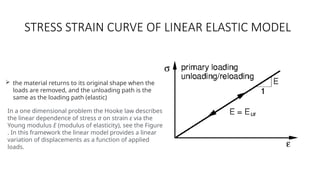
 the material returns to its original shape when the
loads are removed, and the unloading path is the
same as the loading path (elastic)
In a one dimensional problem the Hooke law describes
the linear dependence of stress σ on strain ε via the
Young modulus E (modulus of elasticity), see the Figure
. In this framework the linear model provides a linear
variation of displacements as a function of applied
loads.
MODELLING
Linear elastic behaviour could be represented
by a simple mechanical model, a linear spring
with stiffness E. When a load of magnitude σ
is applied to the spring, a deformation ε is
obtained, with the condition that it will return
to the initial position when the spring is
unloaded, throughout a process without
energy dissipation
LINEAR ELASTIC-PERFECTLY PLASTIC MODEL
• It is a combination of elastic model and plastic model
• In elastic perfectly plastic models,the plastic stresses will lie on yield
surface
• Does not include strain hardening
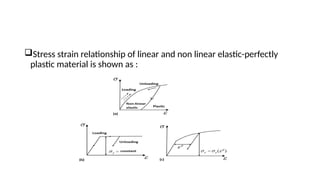
Stress strain relationship of linear and non linear elastic-perfectly
plastic material is shown as :
MODELLING
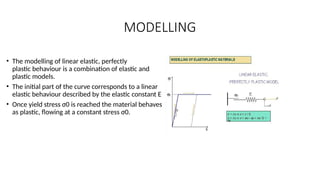
• The modelling of linear elastic, perfectly
plastic behaviour is a combination of elastic and
plastic models.
• The initial part of the curve corresponds to a linear
elastic behaviour described by the elastic constant E
• Once yield stress σ0 is reached the material behaves
as plastic, flowing at a constant stress σ0.
• The mechanical model used to describe this behaviour has a linear elastic spring with constant E
and a friction plane with constant σ0 in series connection.
• The load along both elements is the same.
• It reflects an elastic deformation of the spring until the stress reference level of the friction plane is
reached.
• Once this limit value is reached, displacement continues under constant load. If the system is
unloaded the spring recovers its initial length, but the strain generated at the friction plane (plastic)
remains permanent.
THANK YOU….

LINEAR ELASTIC MODEL IN GEOTECHNICAL ENGINEERING

  • 1.
    LINEAR ELASTIC MODEL Thelinear elastic model is used to describe materials that respond as follows:  the strains in the material are small (linear)  the stress is proportional to the strain, (linear)  the material returns to its original shape when the loads are removed, and the unloading path is the same as the loading path (elastic)  there is no dependence on the rate of loading or straining (elastic)
  • 2.
    STRESS STRAIN CURVEOF LINEAR ELASTIC MODEL  the material returns to its original shape when the loads are removed, and the unloading path is the same as the loading path (elastic) In a one dimensional problem the Hooke law describes the linear dependence of stress σ on strain ε via the Young modulus E (modulus of elasticity), see the Figure . In this framework the linear model provides a linear variation of displacements as a function of applied loads.
  • 3.
    MODELLING Linear elastic behaviourcould be represented by a simple mechanical model, a linear spring with stiffness E. When a load of magnitude σ is applied to the spring, a deformation ε is obtained, with the condition that it will return to the initial position when the spring is unloaded, throughout a process without energy dissipation
  • 4.
    LINEAR ELASTIC-PERFECTLY PLASTICMODEL • It is a combination of elastic model and plastic model • In elastic perfectly plastic models,the plastic stresses will lie on yield surface • Does not include strain hardening
  • 5.
    Stress strain relationshipof linear and non linear elastic-perfectly plastic material is shown as :
  • 6.
    MODELLING • The modellingof linear elastic, perfectly plastic behaviour is a combination of elastic and plastic models. • The initial part of the curve corresponds to a linear elastic behaviour described by the elastic constant E • Once yield stress σ0 is reached the material behaves as plastic, flowing at a constant stress σ0.
  • 7.
    • The mechanicalmodel used to describe this behaviour has a linear elastic spring with constant E and a friction plane with constant σ0 in series connection. • The load along both elements is the same. • It reflects an elastic deformation of the spring until the stress reference level of the friction plane is reached. • Once this limit value is reached, displacement continues under constant load. If the system is unloaded the spring recovers its initial length, but the strain generated at the friction plane (plastic) remains permanent.
  • 8.