Linear Systems Theory
Ramkrishna Pasumarthy
Department of Electrical Engineering,
Indian Institute of Technology Madras
Module 1
Lecture 1
Introduction to Linear Systems
Linear Systems Theory Module 1 Lecture 1 Ramkrishna P. 1/18
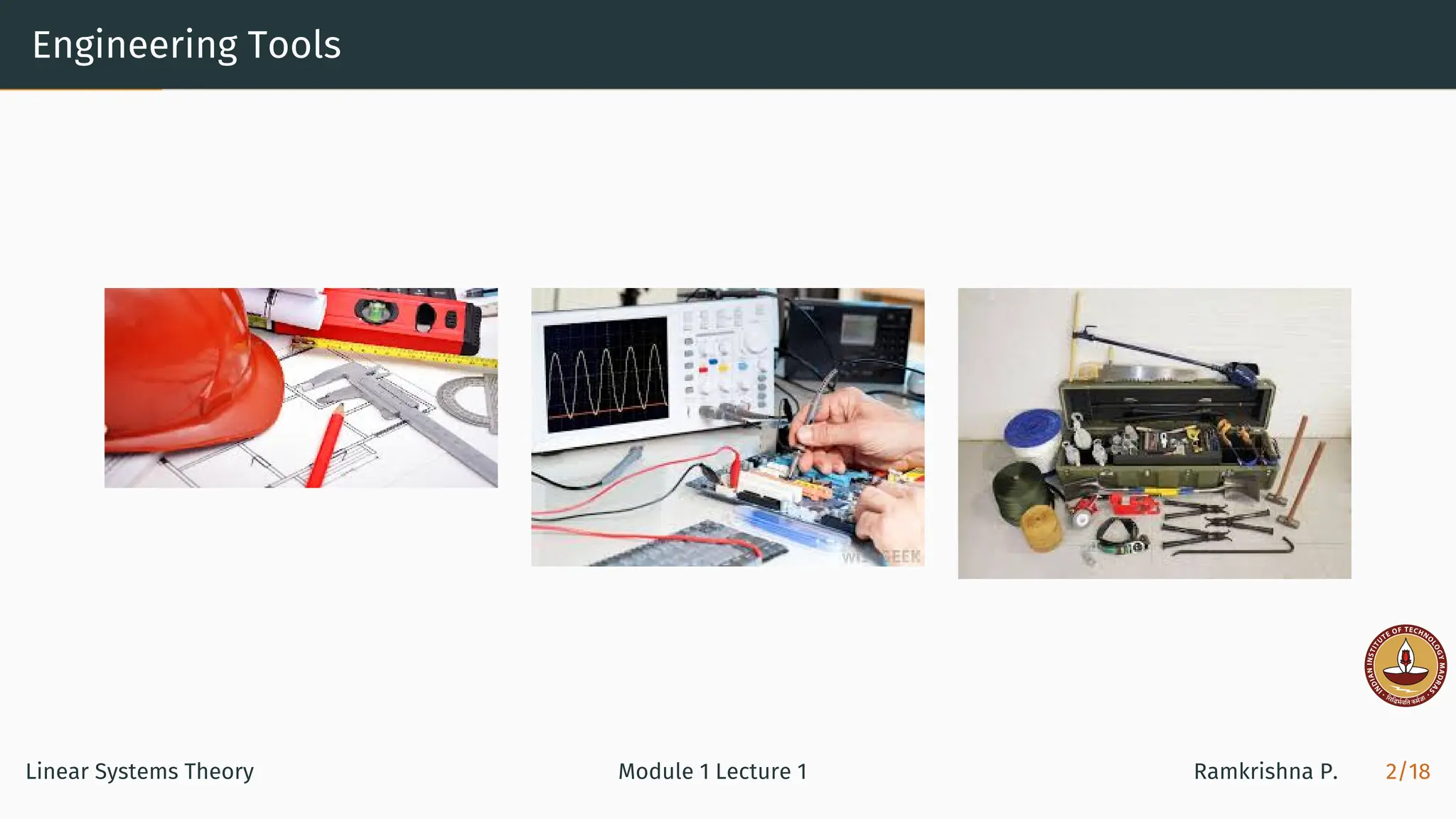
Engineering Tools
Linear Systems Theory Module 1 Lecture 1 Ramkrishna P. 2/18
The Importance of Math
On Teaching Mathematics https://www.uni-muenster.de/Physik.TP/ munsteg/arnold.html
▶ Mathematics is a part of physics.
Linear Systems Theory Module 1 Lecture 1 Ramkrishna P. 3/18
The Importance of Math
On Teaching Mathematics https://www.uni-muenster.de/Physik.TP/ munsteg/arnold.html
▶ Mathematics is a part of physics.
▶ Physics is an experimental science, a part of natural science.
Linear Systems Theory Module 1 Lecture 1 Ramkrishna P. 3/18
The Importance of Math
On Teaching Mathematics https://www.uni-muenster.de/Physik.TP/ munsteg/arnold.html
▶ Mathematics is a part of physics.
▶ Physics is an experimental science, a part of natural science.
▶ Mathematics is the part of physics where experiments are cheap.
Linear Systems Theory Module 1 Lecture 1 Ramkrishna P. 3/18
System Modelling
What is a Model?
▶ Models are mathematical representations to help understand dynamical behaviour
of systems.
▶ Can describe behaviour of a physical process. Eg. How long would it take for a fan to
come to a halt, once switched off?
▶ Can predict response of a system to certain inputs. Eg.- Effect of GST on economy.
▶ This is important because in most cases the system response is not instantaneous,
but evolves with time.
Linear Systems Theory Module 1 Lecture 1 Ramkrishna P. 4/18
What is a Good Model?
▶ Depends on the purpose of the model.
▶ Should incorporate the factors that govern the dynamics or evolution of a system
with time.
▶ The same system can be represented by different models.
Eg.- A lumped and distributed parameter model of a transmission line.
▶ The model abstraction must be compact, as opposed to a rule based formulation.
▶ How accurate should the model be?
Linear Systems Theory Module 1 Lecture 1 Ramkrishna P. 5/18
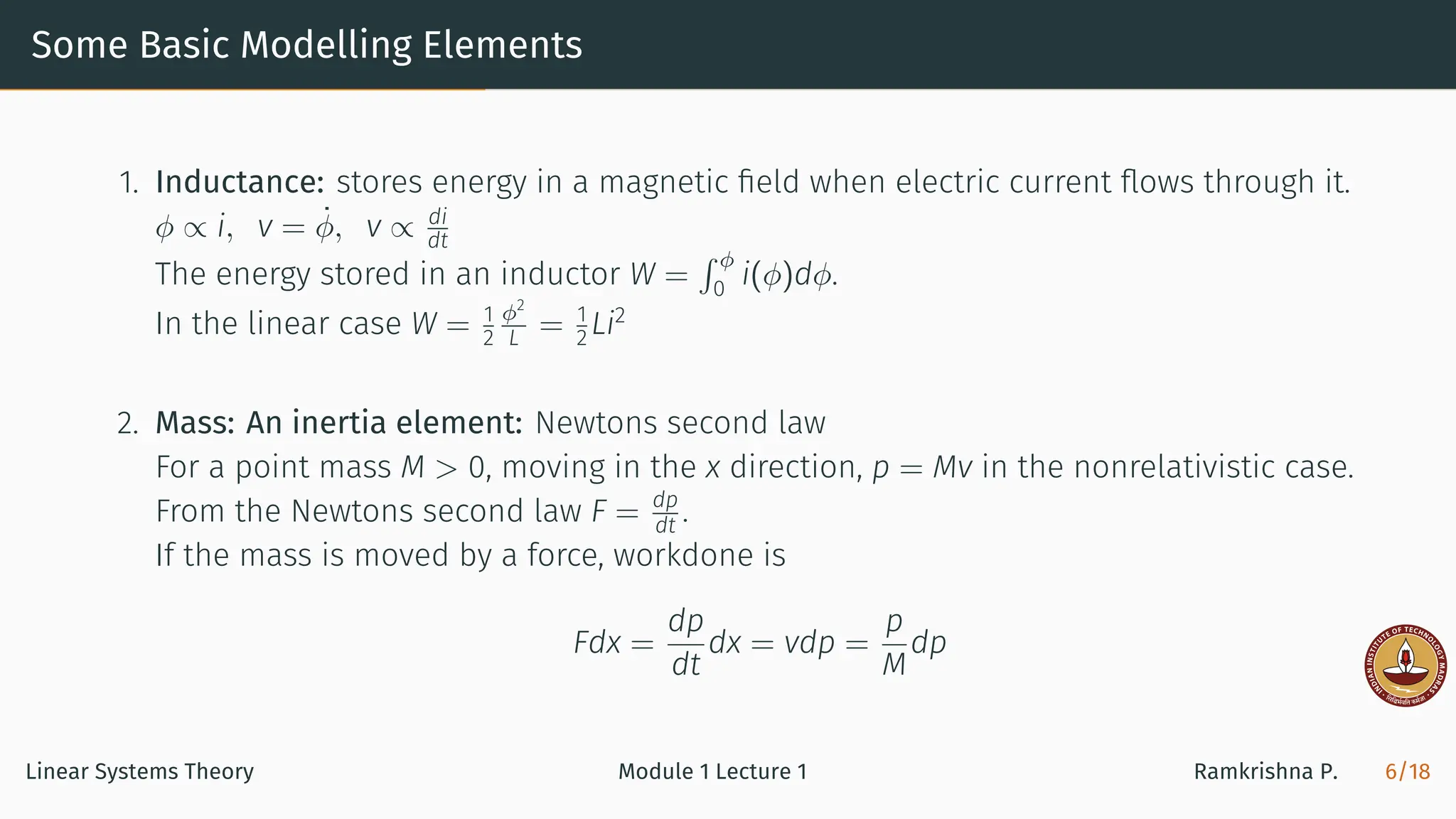
Some Basic Modelling Elements
1. Inductance: stores energy in a magnetic field when electric current flows through it.
ϕ ∝ i, v = ϕ̇, v ∝ di
dt
The energy stored in an inductor W =
∫ ϕ
0
i(ϕ)dϕ.
In the linear case W = 1
2
ϕ2
L = 1
2 Li2
2. Mass: An inertia element: Newtons second law
For a point mass M > 0, moving in the x direction, p = Mv in the nonrelativistic case.
From the Newtons second law F = dp
dt .
If the mass is moved by a force, workdone is
Fdx =
dp
dt
dx = vdp =
p
M
dp
Linear Systems Theory Module 1 Lecture 1 Ramkrishna P. 6/18
Some Basic Modelling Elements
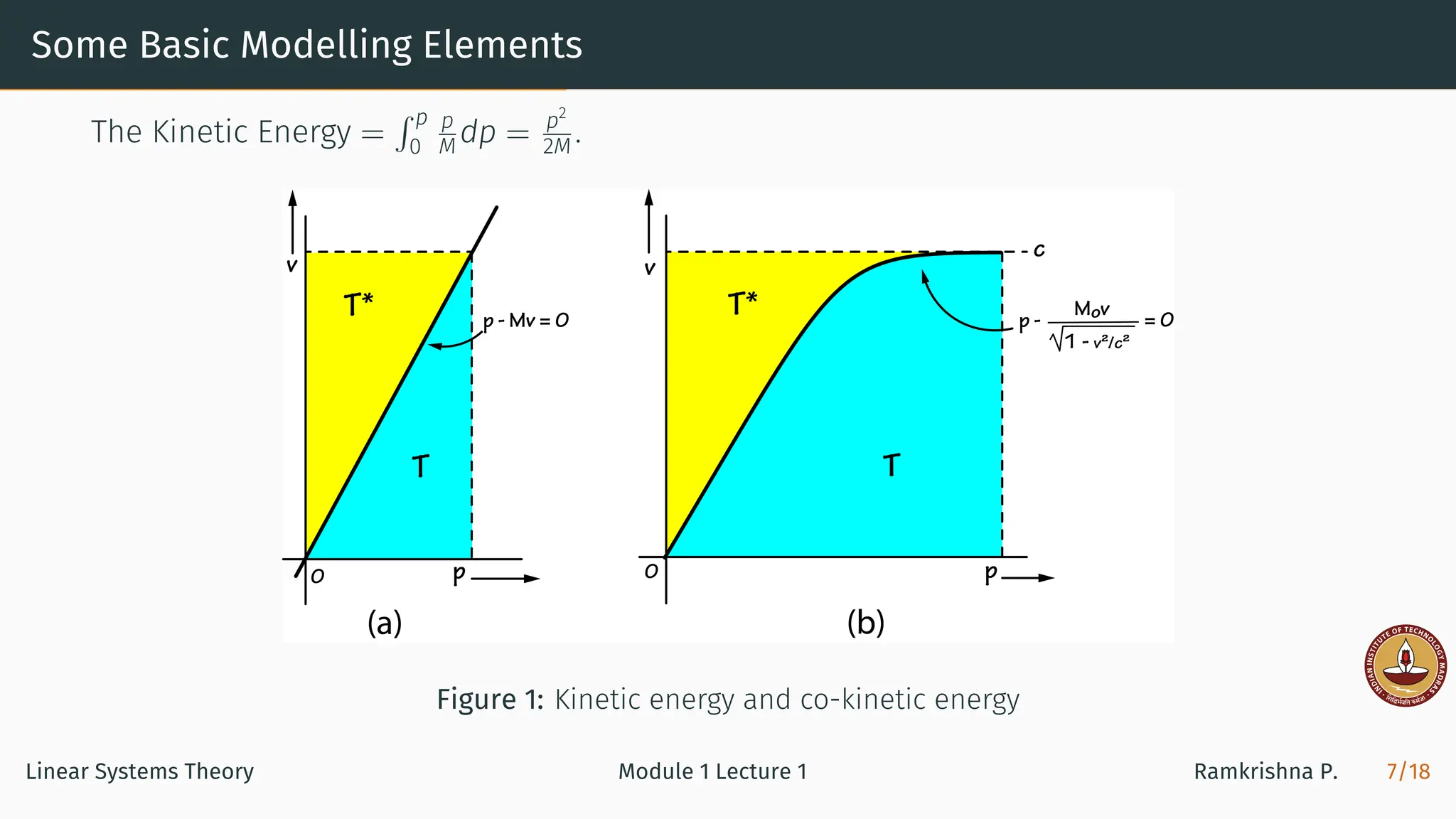
The Kinetic Energy =
∫ p
0
p
M dp = p2
2M .
Figure 1: Kinetic energy and co-kinetic energy
Linear Systems Theory Module 1 Lecture 1 Ramkrishna P. 7/18
Examples of Systems and their
Models
A Simple Mechanical System
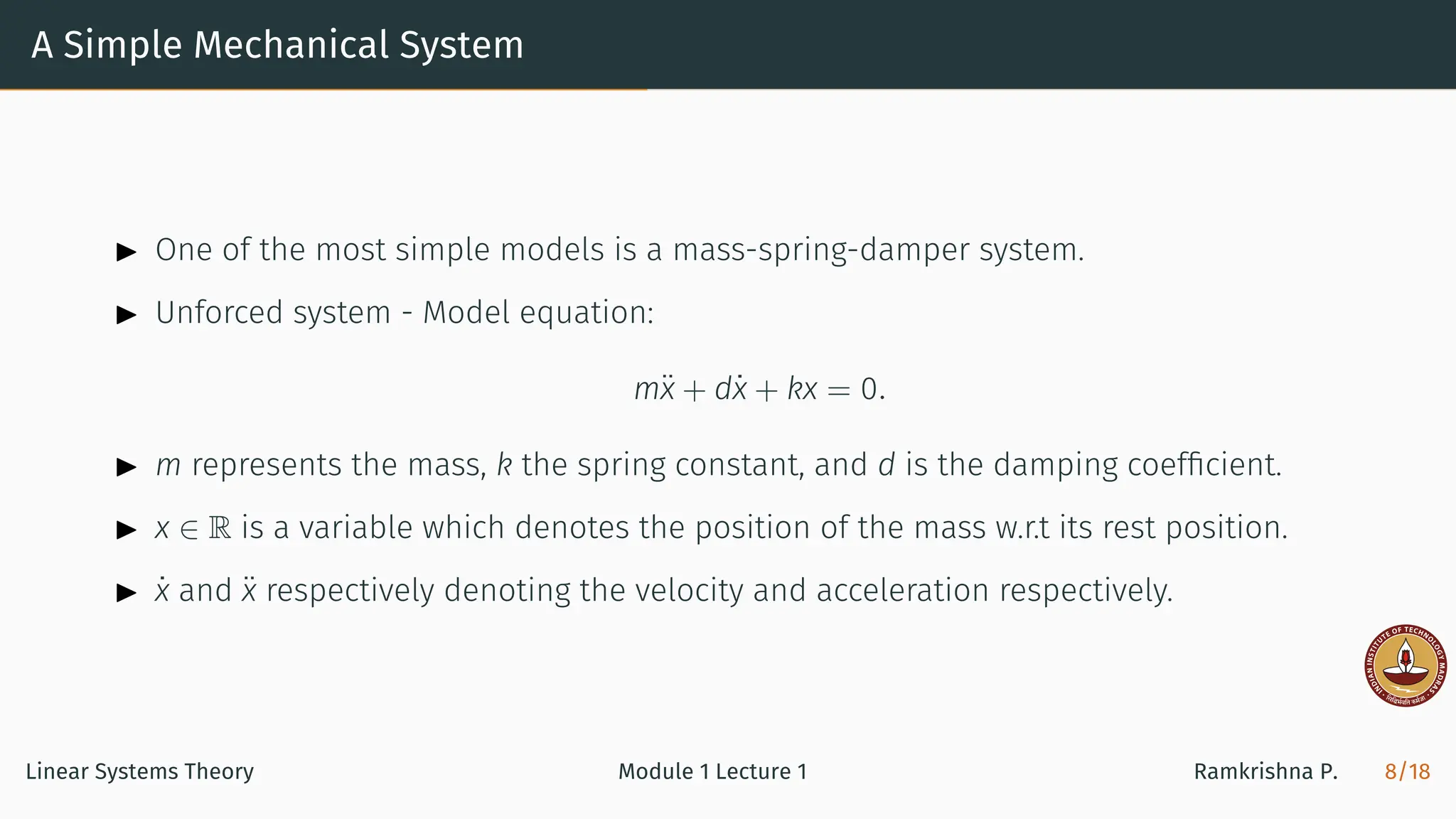
▶ One of the most simple models is a mass-spring-damper system.
▶ Unforced system - Model equation:
mẍ + dẋ + kx = 0.
▶ m represents the mass, k the spring constant, and d is the damping coefficient.
▶ x ∈ R is a variable which denotes the position of the mass w.r.t its rest position.
▶ ẋ and ẍ respectively denoting the velocity and acceleration respectively.
Linear Systems Theory Module 1 Lecture 1 Ramkrishna P. 8/18
A Simple Mechanical System
▶ This system can also be written as
x = x1
ẋ1 = x2
ẋ2 = −
d
m
x2 −
k
m
x1
▶ Or in a structured way of the form
[
ẋ1
ẋ2
]
=
[
0 1
− k
m − d
m
]
| {z }
The state matrix A
[
x1
x2
]
|{z}
state vector x
ẋ = Ax
Linear Systems Theory Module 1 Lecture 1 Ramkrishna P. 9/18
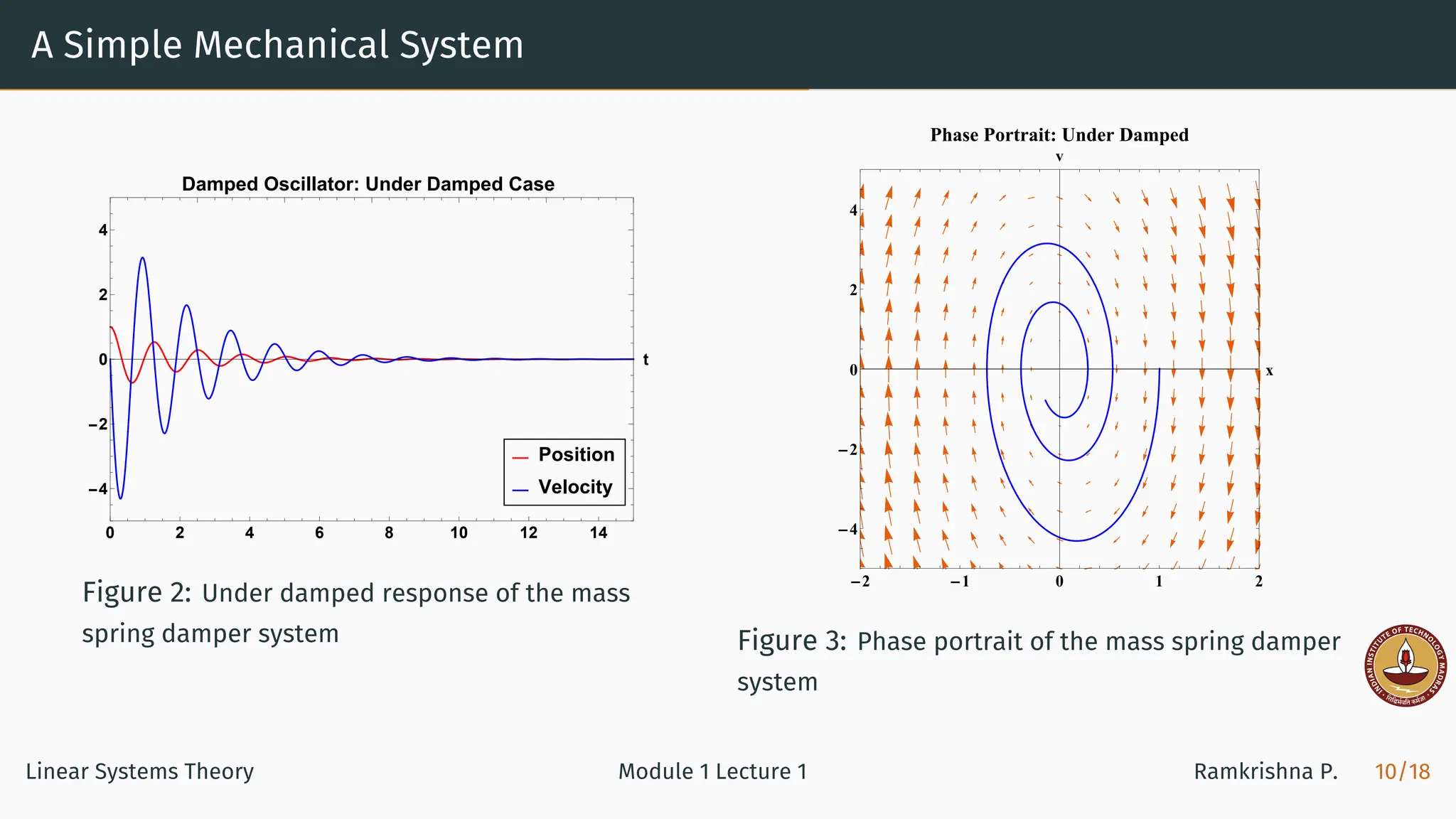
A Simple Mechanical System
0 2 4 6 8 10 12 14
-4
-2
0
2
4
t
Position
Velocity
Damped Oscillator: Under Damped Case
Figure 2: Under damped response of the mass
spring damper system
-2 -1 0 1 2
-4
-2
0
2
4
x
v
Phase Portrait: Under Damped
Figure 3: Phase portrait of the mass spring damper
system
Linear Systems Theory Module 1 Lecture 1 Ramkrishna P. 10/18
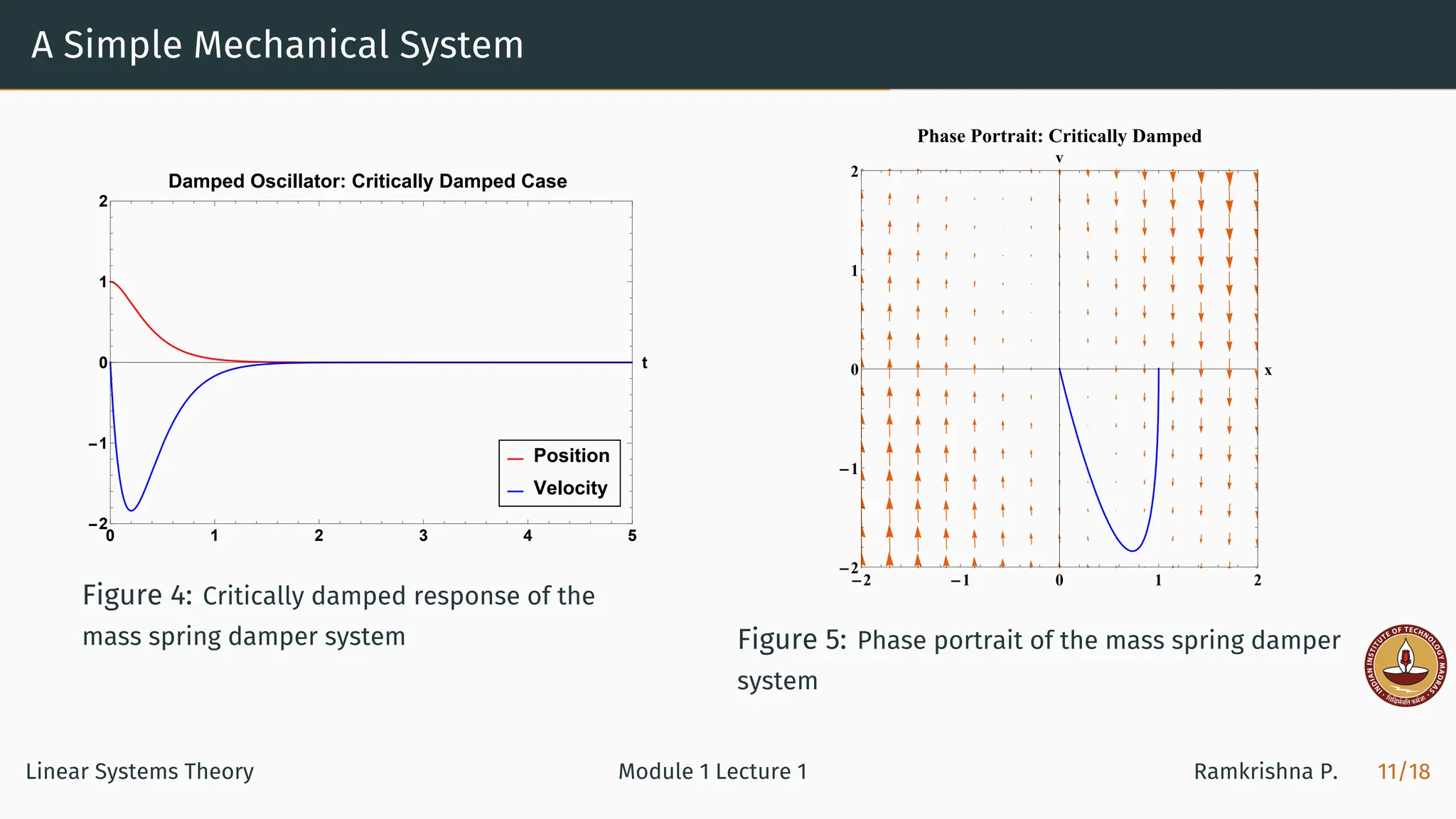
A Simple Mechanical System
0 1 2 3 4 5
-2
-1
0
1
2
t
Position
Velocity
Damped Oscillator: Critically Damped Case
Figure 4: Critically damped response of the
mass spring damper system
-2 -1 0 1 2
-2
-1
0
1
2
x
v
Phase Portrait: Critically Damped
Figure 5: Phase portrait of the mass spring damper
system
Linear Systems Theory Module 1 Lecture 1 Ramkrishna P. 11/18
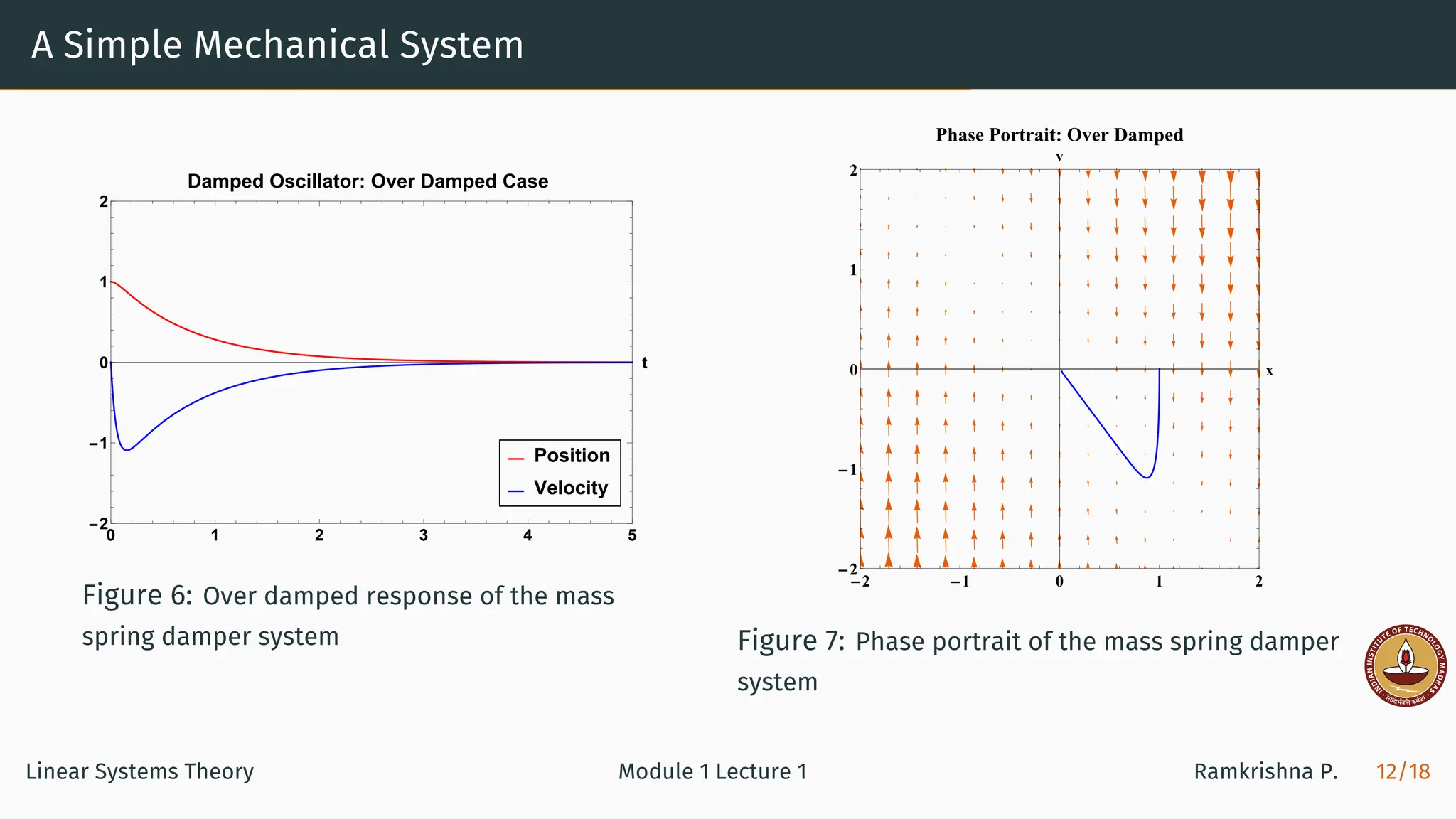
A Simple Mechanical System
0 1 2 3 4 5
-2
-1
0
1
2
t
Position
Velocity
Damped Oscillator: Over Damped Case
Figure 6: Over damped response of the mass
spring damper system
-2 -1 0 1 2
-2
-1
0
1
2
x
v
Phase Portrait: Over Damped
Figure 7: Phase portrait of the mass spring damper
system
Linear Systems Theory Module 1 Lecture 1 Ramkrishna P. 12/18
A Simple Electrical System
▶ Series RLC Circuit with voltage source
▶ The governing equations of the system are
V = RiL + L
diL
dt
+ vC
iL = C
dvC
dt
▶ Written in the state space form as
[
dvC
dt
diL
dt
]
=
[
0 1
C
−1
L −R
L
]
| {z }
A
[
vC
iL
]
|{z}
x
+
[
0
1
L
]
|{z}
The input matrix B
V (The Control input u)
ẋ = Ax + Bu
Linear Systems Theory Module 1 Lecture 1 Ramkrishna P. 13/18
A Simple Electrical System
Impulse Response
0 0.01 0.02 0.03 0.04 0.05 0.06 0.07 0.08 0.09 0.1
Time [s]
-1
0
1
2
3
4
5
Current
[A]
10-5 Current for Impulse Input
Figure 8: Current through the RLC circuit
0 0.01 0.02 0.03 0.04 0.05 0.06 0.07 0.08 0.09 0.1
Time [s]
-0.5
0
0.5
1
1.5
2
2.5
Voltage
[V]
10-3 Voltage across Capacitor for Impulse Input
Figure 9: Voltage across the capacitor
Linear Systems Theory Module 1 Lecture 1 Ramkrishna P. 14/18
A Simple Electrical System
Step Response
0 0.01 0.02 0.03 0.04 0.05 0.06 0.07 0.08 0.09 0.1
Time [s]
-0.5
0
0.5
1
1.5
2
2.5
3
3.5
Current
[A]
10-3 Current for Step Input
Figure 10: Current through the RLC circuit
0 0.01 0.02 0.03 0.04 0.05 0.06 0.07 0.08 0.09 0.1
Time [s]
0
0.2
0.4
0.6
0.8
1
1.2
Voltage
[V]
Voltage across Capacitor for Step Input
Figure 11: Voltage across the capacitor
Linear Systems Theory Module 1 Lecture 1 Ramkrishna P. 15/18
A Simple Electrical System
Response to Sinusoidal Input
0 0.2 0.4 0.6 0.8 1 1.2 1.4 1.6 1.8 2
Time [s]
-1
-0.8
-0.6
-0.4
-0.2
0
0.2
0.4
0.6
0.8
1
Current
[A]
10-4 Current for Sinusoidal Input
Figure 12: Current through the RLC circuit
0 0.2 0.4 0.6 0.8 1 1.2 1.4 1.6 1.8 2
Time [s]
-1
-0.8
-0.6
-0.4
-0.2
0
0.2
0.4
0.6
0.8
1
Voltage
[V]
Voltage across Capacitor for Sinusoidal Input
Figure 13: Voltage across the capacitor
Linear Systems Theory Module 1 Lecture 1 Ramkrishna P. 16/18
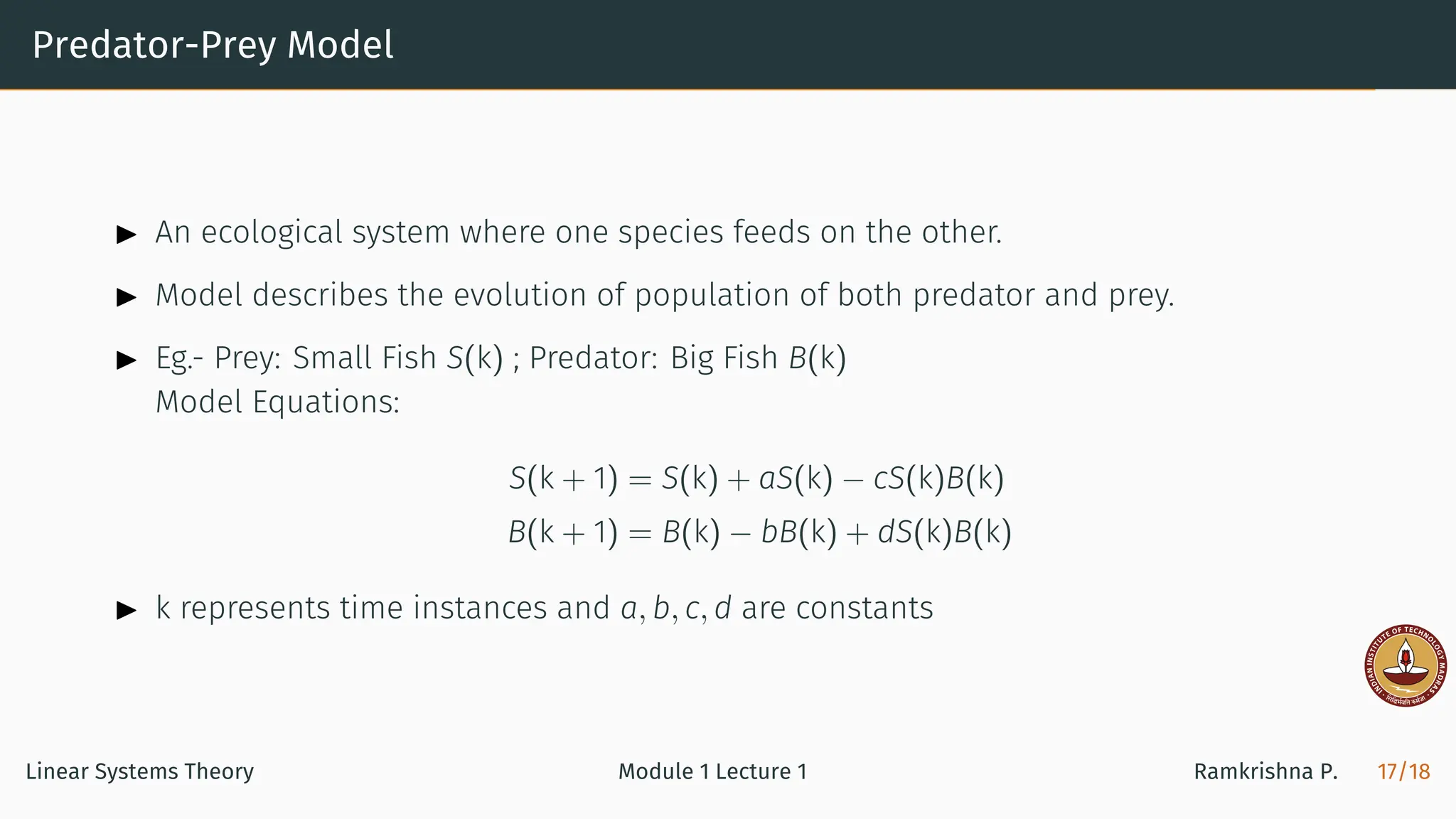
Predator-Prey Model
▶ An ecological system where one species feeds on the other.
▶ Model describes the evolution of population of both predator and prey.
▶ Eg.- Prey: Small Fish S(k) ; Predator: Big Fish B(k)
Model Equations:
S(k + 1) = S(k) + aS(k) − cS(k)B(k)
B(k + 1) = B(k) − bB(k) + dS(k)B(k)
▶ k represents time instances and a, b, c, d are constants
Linear Systems Theory Module 1 Lecture 1 Ramkrishna P. 17/18
Predator-Prey Model
▶ The populations of both the small and Big fish are oscillatory in nature.
0 10 20 30 40 50 60 70 80 90
Years
0
5
10
15
20
25
30
Population
in
Thousands
Predator Prey Model
Prey
Predator
Figure 14: Population of predator and prey for 90 years
Linear Systems Theory Module 1 Lecture 1 Ramkrishna P. 18/18

Linear control systems Automatic Control

  • 1.
    Linear Systems Theory RamkrishnaPasumarthy Department of Electrical Engineering, Indian Institute of Technology Madras
  • 2.
    Module 1 Lecture 1 Introductionto Linear Systems Linear Systems Theory Module 1 Lecture 1 Ramkrishna P. 1/18
  • 3.
    Engineering Tools Linear SystemsTheory Module 1 Lecture 1 Ramkrishna P. 2/18
  • 4.
    The Importance ofMath On Teaching Mathematics https://www.uni-muenster.de/Physik.TP/ munsteg/arnold.html ▶ Mathematics is a part of physics. Linear Systems Theory Module 1 Lecture 1 Ramkrishna P. 3/18
  • 5.
    The Importance ofMath On Teaching Mathematics https://www.uni-muenster.de/Physik.TP/ munsteg/arnold.html ▶ Mathematics is a part of physics. ▶ Physics is an experimental science, a part of natural science. Linear Systems Theory Module 1 Lecture 1 Ramkrishna P. 3/18
  • 6.
    The Importance ofMath On Teaching Mathematics https://www.uni-muenster.de/Physik.TP/ munsteg/arnold.html ▶ Mathematics is a part of physics. ▶ Physics is an experimental science, a part of natural science. ▶ Mathematics is the part of physics where experiments are cheap. Linear Systems Theory Module 1 Lecture 1 Ramkrishna P. 3/18
  • 7.
  • 8.
    What is aModel? ▶ Models are mathematical representations to help understand dynamical behaviour of systems. ▶ Can describe behaviour of a physical process. Eg. How long would it take for a fan to come to a halt, once switched off? ▶ Can predict response of a system to certain inputs. Eg.- Effect of GST on economy. ▶ This is important because in most cases the system response is not instantaneous, but evolves with time. Linear Systems Theory Module 1 Lecture 1 Ramkrishna P. 4/18
  • 9.
    What is aGood Model? ▶ Depends on the purpose of the model. ▶ Should incorporate the factors that govern the dynamics or evolution of a system with time. ▶ The same system can be represented by different models. Eg.- A lumped and distributed parameter model of a transmission line. ▶ The model abstraction must be compact, as opposed to a rule based formulation. ▶ How accurate should the model be? Linear Systems Theory Module 1 Lecture 1 Ramkrishna P. 5/18
  • 10.
    Some Basic ModellingElements 1. Inductance: stores energy in a magnetic field when electric current flows through it. ϕ ∝ i, v = ϕ̇, v ∝ di dt The energy stored in an inductor W = ∫ ϕ 0 i(ϕ)dϕ. In the linear case W = 1 2 ϕ2 L = 1 2 Li2 2. Mass: An inertia element: Newtons second law For a point mass M > 0, moving in the x direction, p = Mv in the nonrelativistic case. From the Newtons second law F = dp dt . If the mass is moved by a force, workdone is Fdx = dp dt dx = vdp = p M dp Linear Systems Theory Module 1 Lecture 1 Ramkrishna P. 6/18
  • 11.
    Some Basic ModellingElements The Kinetic Energy = ∫ p 0 p M dp = p2 2M . Figure 1: Kinetic energy and co-kinetic energy Linear Systems Theory Module 1 Lecture 1 Ramkrishna P. 7/18
  • 12.
    Examples of Systemsand their Models
  • 13.
    A Simple MechanicalSystem ▶ One of the most simple models is a mass-spring-damper system. ▶ Unforced system - Model equation: mẍ + dẋ + kx = 0. ▶ m represents the mass, k the spring constant, and d is the damping coefficient. ▶ x ∈ R is a variable which denotes the position of the mass w.r.t its rest position. ▶ ẋ and ẍ respectively denoting the velocity and acceleration respectively. Linear Systems Theory Module 1 Lecture 1 Ramkrishna P. 8/18
  • 14.
    A Simple MechanicalSystem ▶ This system can also be written as x = x1 ẋ1 = x2 ẋ2 = − d m x2 − k m x1 ▶ Or in a structured way of the form [ ẋ1 ẋ2 ] = [ 0 1 − k m − d m ] | {z } The state matrix A [ x1 x2 ] |{z} state vector x ẋ = Ax Linear Systems Theory Module 1 Lecture 1 Ramkrishna P. 9/18
  • 15.
    A Simple MechanicalSystem 0 2 4 6 8 10 12 14 -4 -2 0 2 4 t Position Velocity Damped Oscillator: Under Damped Case Figure 2: Under damped response of the mass spring damper system -2 -1 0 1 2 -4 -2 0 2 4 x v Phase Portrait: Under Damped Figure 3: Phase portrait of the mass spring damper system Linear Systems Theory Module 1 Lecture 1 Ramkrishna P. 10/18
  • 16.
    A Simple MechanicalSystem 0 1 2 3 4 5 -2 -1 0 1 2 t Position Velocity Damped Oscillator: Critically Damped Case Figure 4: Critically damped response of the mass spring damper system -2 -1 0 1 2 -2 -1 0 1 2 x v Phase Portrait: Critically Damped Figure 5: Phase portrait of the mass spring damper system Linear Systems Theory Module 1 Lecture 1 Ramkrishna P. 11/18
  • 17.
    A Simple MechanicalSystem 0 1 2 3 4 5 -2 -1 0 1 2 t Position Velocity Damped Oscillator: Over Damped Case Figure 6: Over damped response of the mass spring damper system -2 -1 0 1 2 -2 -1 0 1 2 x v Phase Portrait: Over Damped Figure 7: Phase portrait of the mass spring damper system Linear Systems Theory Module 1 Lecture 1 Ramkrishna P. 12/18
  • 18.
    A Simple ElectricalSystem ▶ Series RLC Circuit with voltage source ▶ The governing equations of the system are V = RiL + L diL dt + vC iL = C dvC dt ▶ Written in the state space form as [ dvC dt diL dt ] = [ 0 1 C −1 L −R L ] | {z } A [ vC iL ] |{z} x + [ 0 1 L ] |{z} The input matrix B V (The Control input u) ẋ = Ax + Bu Linear Systems Theory Module 1 Lecture 1 Ramkrishna P. 13/18
  • 19.
    A Simple ElectricalSystem Impulse Response 0 0.01 0.02 0.03 0.04 0.05 0.06 0.07 0.08 0.09 0.1 Time [s] -1 0 1 2 3 4 5 Current [A] 10-5 Current for Impulse Input Figure 8: Current through the RLC circuit 0 0.01 0.02 0.03 0.04 0.05 0.06 0.07 0.08 0.09 0.1 Time [s] -0.5 0 0.5 1 1.5 2 2.5 Voltage [V] 10-3 Voltage across Capacitor for Impulse Input Figure 9: Voltage across the capacitor Linear Systems Theory Module 1 Lecture 1 Ramkrishna P. 14/18
  • 20.
    A Simple ElectricalSystem Step Response 0 0.01 0.02 0.03 0.04 0.05 0.06 0.07 0.08 0.09 0.1 Time [s] -0.5 0 0.5 1 1.5 2 2.5 3 3.5 Current [A] 10-3 Current for Step Input Figure 10: Current through the RLC circuit 0 0.01 0.02 0.03 0.04 0.05 0.06 0.07 0.08 0.09 0.1 Time [s] 0 0.2 0.4 0.6 0.8 1 1.2 Voltage [V] Voltage across Capacitor for Step Input Figure 11: Voltage across the capacitor Linear Systems Theory Module 1 Lecture 1 Ramkrishna P. 15/18
  • 21.
    A Simple ElectricalSystem Response to Sinusoidal Input 0 0.2 0.4 0.6 0.8 1 1.2 1.4 1.6 1.8 2 Time [s] -1 -0.8 -0.6 -0.4 -0.2 0 0.2 0.4 0.6 0.8 1 Current [A] 10-4 Current for Sinusoidal Input Figure 12: Current through the RLC circuit 0 0.2 0.4 0.6 0.8 1 1.2 1.4 1.6 1.8 2 Time [s] -1 -0.8 -0.6 -0.4 -0.2 0 0.2 0.4 0.6 0.8 1 Voltage [V] Voltage across Capacitor for Sinusoidal Input Figure 13: Voltage across the capacitor Linear Systems Theory Module 1 Lecture 1 Ramkrishna P. 16/18
  • 22.
    Predator-Prey Model ▶ Anecological system where one species feeds on the other. ▶ Model describes the evolution of population of both predator and prey. ▶ Eg.- Prey: Small Fish S(k) ; Predator: Big Fish B(k) Model Equations: S(k + 1) = S(k) + aS(k) − cS(k)B(k) B(k + 1) = B(k) − bB(k) + dS(k)B(k) ▶ k represents time instances and a, b, c, d are constants Linear Systems Theory Module 1 Lecture 1 Ramkrishna P. 17/18
  • 23.
    Predator-Prey Model ▶ Thepopulations of both the small and Big fish are oscillatory in nature. 0 10 20 30 40 50 60 70 80 90 Years 0 5 10 15 20 25 30 Population in Thousands Predator Prey Model Prey Predator Figure 14: Population of predator and prey for 90 years Linear Systems Theory Module 1 Lecture 1 Ramkrishna P. 18/18