LillyPad
A simple model to teach you how a child
experiences harassment, intimidation, and
bullying (HIB) in schools.
By Patricia Kienholz ©2015
1
Introduction:
§  Since 2010 the Washington State Legislature has strict
laws prohibiting harassment, intimidation, and bullying
(HIB) in public schools.
ê
§  The Office of Superintendent of Public Instruction
(OSPI) interprets/translates HIB legislation and sets
policy for all Washington State Public Schools.
ê
§  Public school districts implement OSPI policy. School
districts apply “progressive discipline” policy addressing
“aggressors” in HIB, with the intention of remediating
relations between “aggressors” and “targets,” and
hopefully returning the school environment to a happy
and healthy one for all children.
2
The Problem:
§  Missing from District 81 and many other
“progressive discipline” policies is a way to address
what “targets” experience as the result of repeated
incidents of harassment, intimidation and bullying.
§  Most Washington “progressive discipline” policies
which address HIB, do not require notification to a
“targets” parents.
§  What does this mean? It means your child may
experience multiple incidents of harassment,
intimidation, and bullying, and you may never even
know it.
§  Potential results are problems studying, fear of
going to class, depression, retaliation, low-self
esteem, lowered grades, increased drop-out rates,
and suicide.
3
Outcomes:
§  When a child experiences HIB, the harassing behavior
usually begins with a “ring-leader” and 1 or 2 other
students.
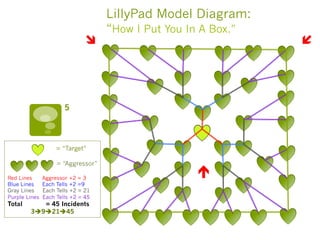
§  If each of those 3 students brings in 2 more students,
the number of incidents can increase to 9 incidents.
§  If each of those additional students tells 2 more
students, the number of incidents can increase to 21
incidents; then 45 incidents and so on.
§  If the “ring-leader” is disciplined the first time,
“progressive discipline” will treat this incident as 1
incident and will not require a call home to parents of
either the “target” or the “aggressor.” The results leave
the “target” feeling isolated and “put in a box.”
4
LillyPad Model Diagram:
“How I Put You In A Box.”
= “Target”
= “Aggressor”
Red Lines Aggressor +2 = 3
Blue Lines Each Tells +2 =9
Gray Lines Each Tells +2 = 21
Purple Lines Each Tells +2 = 45
Total = 45 Incidents
3è9è21è45
î í
é
5
The Math:
1=1; 1≠3, ≠9, ≠21,or ≠45
3=1
9=1
21=1
45=1
Progressive discipline equivalents for the number of
incidents experienced by the “target” and “aggressor.”
6
Stress/Cortisol Load:
è è è
“Target” stress load as each child tells 2 more children.
7
LillyPad Solution:
§  The solution to the problem is weighting an incident
of HIB differently.
§  When a “targeted” child experiences incidents of
HIB, Washington State, OSPI, and public school
districts progressive discipline policy address the
complaint as 1 incident, when often the child is
experiencing multiple incidents of HIB.
§  Changing the way we weight HIB relative to
“targets” and teaching students, teachers,
administrators, and parents about the affects HIB
has on the target, is a more holistic approach to
recognizing the affects HIB has on a “targeted”
child.
8
LillyPad Notes:
§  The LillyPad Model is named for a child victim of HIB in Washington
State Public Schools. Research for this project began in 2008.
§  The LillyPad Model is a systems approach policy solution which
demonstrates how HIB law and policy affects “targets” of bullying in
the public school system. LillyPad provides a simple model for
addressing law and policy relative to parent notification to “targets”
of HIB, and focuses on reducing incidents of retaliation.
§  The choice of the lily pad as a descriptor for teaching about HIB law
in public schools, provides a visual whereby children and adults can
understand how HIB spreads across a classroom or a school, like
lilies on a lily pond.
§  Dedicated to victims of teen suicide in Spokane Washington during
the 2014-2015 school year.
©Patricia Kienholz 2015
Provided by the Citizens Law and Safety Research Center 501(c)(3)
For use of this free LillyPad Model as a teaching tool contact:
CLSRC, 324 W. Pacific Ave., Spokane WA. (509) 847-3073
9

Lilly pad model_pdf2_06.25.15.pak

  • 1.
    LillyPad A simple modelto teach you how a child experiences harassment, intimidation, and bullying (HIB) in schools. By Patricia Kienholz ©2015 1
  • 2.
    Introduction: §  Since 2010the Washington State Legislature has strict laws prohibiting harassment, intimidation, and bullying (HIB) in public schools. ê §  The Office of Superintendent of Public Instruction (OSPI) interprets/translates HIB legislation and sets policy for all Washington State Public Schools. ê §  Public school districts implement OSPI policy. School districts apply “progressive discipline” policy addressing “aggressors” in HIB, with the intention of remediating relations between “aggressors” and “targets,” and hopefully returning the school environment to a happy and healthy one for all children. 2
  • 3.
    The Problem: §  Missingfrom District 81 and many other “progressive discipline” policies is a way to address what “targets” experience as the result of repeated incidents of harassment, intimidation and bullying. §  Most Washington “progressive discipline” policies which address HIB, do not require notification to a “targets” parents. §  What does this mean? It means your child may experience multiple incidents of harassment, intimidation, and bullying, and you may never even know it. §  Potential results are problems studying, fear of going to class, depression, retaliation, low-self esteem, lowered grades, increased drop-out rates, and suicide. 3
  • 4.
    Outcomes: §  When achild experiences HIB, the harassing behavior usually begins with a “ring-leader” and 1 or 2 other students. §  If each of those 3 students brings in 2 more students, the number of incidents can increase to 9 incidents. §  If each of those additional students tells 2 more students, the number of incidents can increase to 21 incidents; then 45 incidents and so on. §  If the “ring-leader” is disciplined the first time, “progressive discipline” will treat this incident as 1 incident and will not require a call home to parents of either the “target” or the “aggressor.” The results leave the “target” feeling isolated and “put in a box.” 4
  • 5.
    LillyPad Model Diagram: “HowI Put You In A Box.” = “Target” = “Aggressor” Red Lines Aggressor +2 = 3 Blue Lines Each Tells +2 =9 Gray Lines Each Tells +2 = 21 Purple Lines Each Tells +2 = 45 Total = 45 Incidents 3è9è21è45 î í é 5
  • 6.
    The Math: 1=1; 1≠3,≠9, ≠21,or ≠45 3=1 9=1 21=1 45=1 Progressive discipline equivalents for the number of incidents experienced by the “target” and “aggressor.” 6
  • 7.
    Stress/Cortisol Load: è èè “Target” stress load as each child tells 2 more children. 7
  • 8.
    LillyPad Solution: §  Thesolution to the problem is weighting an incident of HIB differently. §  When a “targeted” child experiences incidents of HIB, Washington State, OSPI, and public school districts progressive discipline policy address the complaint as 1 incident, when often the child is experiencing multiple incidents of HIB. §  Changing the way we weight HIB relative to “targets” and teaching students, teachers, administrators, and parents about the affects HIB has on the target, is a more holistic approach to recognizing the affects HIB has on a “targeted” child. 8
  • 9.
    LillyPad Notes: §  TheLillyPad Model is named for a child victim of HIB in Washington State Public Schools. Research for this project began in 2008. §  The LillyPad Model is a systems approach policy solution which demonstrates how HIB law and policy affects “targets” of bullying in the public school system. LillyPad provides a simple model for addressing law and policy relative to parent notification to “targets” of HIB, and focuses on reducing incidents of retaliation. §  The choice of the lily pad as a descriptor for teaching about HIB law in public schools, provides a visual whereby children and adults can understand how HIB spreads across a classroom or a school, like lilies on a lily pond. §  Dedicated to victims of teen suicide in Spokane Washington during the 2014-2015 school year. ©Patricia Kienholz 2015 Provided by the Citizens Law and Safety Research Center 501(c)(3) For use of this free LillyPad Model as a teaching tool contact: CLSRC, 324 W. Pacific Ave., Spokane WA. (509) 847-3073 9