Chapter 10
Social and Personality
Development in
Adolescence


                         12-1
Self Concept and Self Esteem
What am I like?

How do I like myself?

Identity and self-expression?
Risk taking? Rebellion?


                                                   12-2
Self-esteem is influenced by:

Gender
SES
Race
Ethnogender


                                         12-3
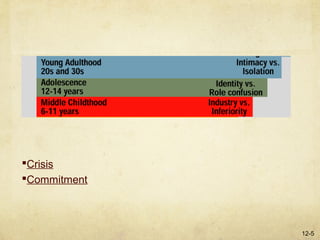
Erikson
Identity formation: Crisis or change?
Identity vs role (identity) confusion

Psychological difficulties in search for identity =
     “the adolescent identity crisis” [Next]


                  Westernized teens seek:
                    •Individualism
                    •Independence
                    •Autonomy


                                                      12-4
Crisis
Commitment


              12-5
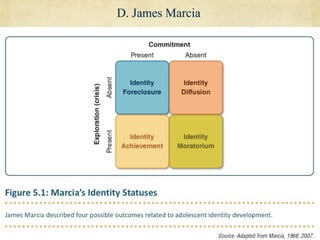
D. James Marcia
Four categories
Either a Crisis (exploration) or a Commitment (decision)


                                                           12-6
E. Identity, Race & Ethnicity

               Cultural assimilation model: identities
               should be assimilated; “melting pot”

               Pluralistic society model: diverse, coequal
               cultural groups; “tossed salad”

               Bicultural identity: can draw from own
               culture and integrate into dominant


                •Stress related to:
                    –Language
                    –Support network
                    –Family obligations (work)
                    –Change in SES
                    –Acculturation

                                                     12-7
The Generation Gap


“Generation Gap” is largely a myth.
   E.g., on social, political, and religious issues.
   The difference in values between teens is greater
   w/parents.
   Most parents and teens get along well.

Conduct more than values

Most teenagers have stable family relationships; ~20
percent have a rough time.


                                                       12-8
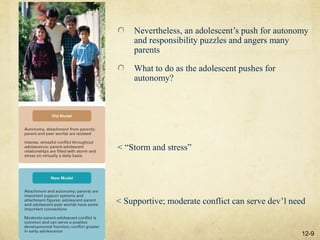
Nevertheless, an adolescent’s push for autonomy
    and responsibility puzzles and angers many
    parents

    What to do as the adolescent pushes for
    autonomy?


< “Storm and stress”


< Supportive; moderate conflict can serve dev’l need


                                                   12-9
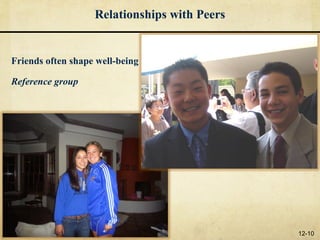
Relationships with Peers


Friends often shape well-being

Reference group


                                              12-10
Cliques and Crowds

    Stereotypes ?
    Cliques > [text] ~2 to 12 people;
    frequent interaction; usu same sex
•   Crowds > larger groups share some
    characteristics; less personal; based
    on reputation.
•   Strong expectations that people in a
    particular crowd behave in specific
    ways. (A self-fulfilling prophecy?)
•   Less impt by end of adolescence


                                            12-11
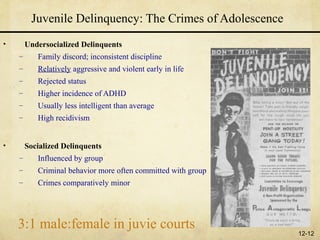
Juvenile Delinquency: The Crimes of Adolescence
•       Undersocialized Delinquents
    –      Family discord; inconsistent discipline
    –      Relatively aggressive and violent early in life
    –      Rejected status
    –      Higher incidence of ADHD
    –      Usually less intelligent than average
    –      High recidivism


•       Socialized Delinquents
    –      Influenced by group
    –      Criminal behavior more often committed with group
    –      Crimes comparatively minor


    3:1 male:female in juvie courts
                                                               12-12
Dating, Sexual Behavior, and Teen Pregnancy

 •     Dating
       –   Age?
       –   How much freedom?
       –   Roles (I.D.)?

 •     What is “hooking up?”


 Those who date are more likely to be:
      accepted by peers
      perceived as more physically attractive
 Early dating and hooking up is associated with adolescent
pregnancy and problems at home and school
                                                              12-13
Adolescent Sexuality
• Curiosity, exploration; experimentation
• Media influence?
• Tied to ID
     • Skills to avoid undesirable consequences
     • Gender/orientation
• Developing new forms of intimacy


                                                  12-14
Dating, Sexual Behavior, and Teen Pregnancy


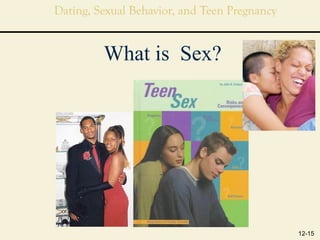
         What is Sex?


                                              12-15
Timing of Adolescent
                Sexuality
 How do you know if ready?
   Early sexual activity > linked
   with risky behaviors: drug use,
   delinquency, school problems
   Low parental monitoring >
   linked with early sex, more
   partners, less condom use
   Oral sex > heavier drinkers,
   perception of peer approval;
   often recreational


                                     12-16
Sexual Intercourse


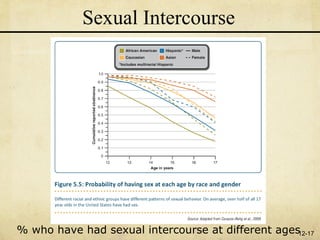
% who have had sexual intercourse at different ages12-17
Sex
•   Intercourse
    – Ages for sexual intercourse have been declining.
    – ~20% have had sex before the age of 15, 80 percent at 21.
    – Numbers postponing sex is rising.

•   “Outercourse”
•   Oral Sex
    – Increase in last 10-15 yrs
    – Is it sex? Still virgin?
    – Perception that it is likely to be safer


                                                                  12-18
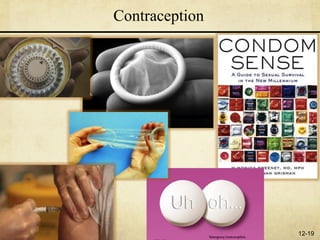
Contraception


                12-19
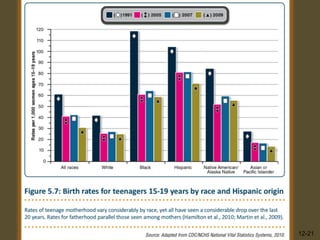
Teen Pregnancy
•   Teen pregnancy rate is declining
    across all ethnic groups in U.S.
    [next].
•   Still higher in U.S. than in other
    industrialized countries.
•   Teenage mothers do not fare well:
    – Poor health
        •   Increased neurological problems,
            childhood illness; low birth wt.
    –   Poor school performance
    –   Cycle of poverty


                                               12-20
Teen Pregnancy


   (Per 100,000)   12-21
Teen Pregnancy
•   Key factors in preventing/breaking the poverty-pregnancy
    cycle are:
–           Completing high school
–           Postponing future births
–           Education
–    Supportive family


                                                               12-22
Sexual Orientation


•   Same-sex encounters:
    •   Females: 11% of 18 - 44 in 2005; 4% 18 - 59 in 1994)
    •   Males: 6% of those less than 30
    •   Far fewer numbers become exclusive; 1 to 4 percent.


                                                               12-23

Lifespan Chapter 10 Online Stud

  • 1.
    Chapter 10 Social andPersonality Development in Adolescence 12-1
  • 2.
    Self Concept andSelf Esteem What am I like? How do I like myself? Identity and self-expression? Risk taking? Rebellion? 12-2
  • 3.
    Self-esteem is influencedby: Gender SES Race Ethnogender 12-3
  • 4.
    Erikson Identity formation: Crisisor change? Identity vs role (identity) confusion Psychological difficulties in search for identity = “the adolescent identity crisis” [Next] Westernized teens seek: •Individualism •Independence •Autonomy 12-4
  • 5.
  • 6.
    D. James Marcia Fourcategories Either a Crisis (exploration) or a Commitment (decision) 12-6
  • 7.
    E. Identity, Race& Ethnicity Cultural assimilation model: identities should be assimilated; “melting pot” Pluralistic society model: diverse, coequal cultural groups; “tossed salad” Bicultural identity: can draw from own culture and integrate into dominant •Stress related to: –Language –Support network –Family obligations (work) –Change in SES –Acculturation 12-7
  • 8.
    The Generation Gap “GenerationGap” is largely a myth. E.g., on social, political, and religious issues. The difference in values between teens is greater w/parents. Most parents and teens get along well. Conduct more than values Most teenagers have stable family relationships; ~20 percent have a rough time. 12-8
  • 9.
    Nevertheless, an adolescent’spush for autonomy and responsibility puzzles and angers many parents What to do as the adolescent pushes for autonomy? < “Storm and stress” < Supportive; moderate conflict can serve dev’l need 12-9
  • 10.
    Relationships with Peers Friendsoften shape well-being Reference group 12-10
  • 11.
    Cliques and Crowds Stereotypes ? Cliques > [text] ~2 to 12 people; frequent interaction; usu same sex • Crowds > larger groups share some characteristics; less personal; based on reputation. • Strong expectations that people in a particular crowd behave in specific ways. (A self-fulfilling prophecy?) • Less impt by end of adolescence 12-11
  • 12.
    Juvenile Delinquency: TheCrimes of Adolescence • Undersocialized Delinquents – Family discord; inconsistent discipline – Relatively aggressive and violent early in life – Rejected status – Higher incidence of ADHD – Usually less intelligent than average – High recidivism • Socialized Delinquents – Influenced by group – Criminal behavior more often committed with group – Crimes comparatively minor 3:1 male:female in juvie courts 12-12
  • 13.
    Dating, Sexual Behavior,and Teen Pregnancy • Dating – Age? – How much freedom? – Roles (I.D.)? • What is “hooking up?”  Those who date are more likely to be:  accepted by peers  perceived as more physically attractive  Early dating and hooking up is associated with adolescent pregnancy and problems at home and school 12-13
  • 14.
    Adolescent Sexuality • Curiosity,exploration; experimentation • Media influence? • Tied to ID • Skills to avoid undesirable consequences • Gender/orientation • Developing new forms of intimacy 12-14
  • 15.
    Dating, Sexual Behavior,and Teen Pregnancy What is Sex? 12-15
  • 16.
    Timing of Adolescent Sexuality  How do you know if ready? Early sexual activity > linked with risky behaviors: drug use, delinquency, school problems Low parental monitoring > linked with early sex, more partners, less condom use Oral sex > heavier drinkers, perception of peer approval; often recreational 12-16
  • 17.
    Sexual Intercourse % whohave had sexual intercourse at different ages12-17
  • 18.
    Sex • Intercourse – Ages for sexual intercourse have been declining. – ~20% have had sex before the age of 15, 80 percent at 21. – Numbers postponing sex is rising. • “Outercourse” • Oral Sex – Increase in last 10-15 yrs – Is it sex? Still virgin? – Perception that it is likely to be safer 12-18
  • 19.
  • 20.
    Teen Pregnancy • Teen pregnancy rate is declining across all ethnic groups in U.S. [next]. • Still higher in U.S. than in other industrialized countries. • Teenage mothers do not fare well: – Poor health • Increased neurological problems, childhood illness; low birth wt. – Poor school performance – Cycle of poverty 12-20
  • 21.
    Teen Pregnancy (Per 100,000) 12-21
  • 22.
    Teen Pregnancy • Key factors in preventing/breaking the poverty-pregnancy cycle are: – Completing high school – Postponing future births – Education – Supportive family 12-22
  • 23.
    Sexual Orientation • Same-sex encounters: • Females: 11% of 18 - 44 in 2005; 4% 18 - 59 in 1994) • Males: 6% of those less than 30 • Far fewer numbers become exclusive; 1 to 4 percent. 12-23