Mini Hi-Fi System
SERVICE MANUAL
MODEL: RAT375 (RAS375F/W)
CAUTION
BEFORE SERVICING THE UNIT, READ THE “SAFETY PRECAUTIONS”
IN THIS MANUAL.
MODEL:RAT375(RAS375F/W)SERVICEMANUAL
P/NO : AFN73972613 MARCH, 2010
Website http://biz.lgservice.com
Internal Use Only
1-1
[CONTENTS]
SECTION 1. GENERAL
• SERVICING PRECAUTIONS. . . . . . . . . . . . . . . . . . . . . . . . . . . . . . . . . . . . . . . . . . . . . . . . . 1-2
• ESD PRECAUTIONS . . . . . . . . . . . . . . . . . . . . . . . . . . . . . . . . . . . . . . . . . . . . . . . . . . . . . . . 1-4
• SERVICE INFORMATION FOR EEPROM . . . . . . . . . . . . . . . . . . . . . . . . . . . . . . . . . . . . . . 1-5
• PROGRAM DOWNLOAD GUIDE. . . . . . . . . . . . . . . . . . . . . . . . . . . . . . . . . . . . . . . . . . . . . . . . . . . . . . . . . . . 1-6
• SPECIFICATIONS . . . . . . . . . . . . . . . . . . . . . . . . . . . . . . . . . . . . . . . . . . . . . . . . . . . . . . . . . 1-8
SECTION 2. EXPLODED VIEWS . . . . . . . . . . . . . . . . . . . . . . . . . . . . . . . . . . . . . . . . . . . . . 2-1
• CABINET AND MAIN FRAME SECTION. . . . . . . . . . . . . . . . . . . . . . . . . . . . . . . . . . . . . . . . 2-1
• MECHANISM DECK SECTION (CDM-345). . . . . . . . . . . . . . . . . . . . . . . . . . . . . . . . . . . . . . 2-3
• SPEAKER SECTION . . . . . . . . . . . . . . . . . . . . . . . . . . . . . . . . . . . . . . . . . . . . . . . . . . . . . . . 2-5
• PACKING ACCESSORY SECTION. . . . . . . . . . . . . . . . . . . . . . . . . . . . . . . . . . . . . . . . . . . . 2-7
SECTION 3. ELECTRICAL PART
• TROUBLESHOOTING GUIDE . . . . . . . . . . . . . . . . . . . . . . . . . . . . . . . . . . . . . . . . . . . . . . . . 3-1
• DETAILS AND WAVEFORMS ON SYSTEM TEST AND DEBUGGING. . . . . . . . . . . . . . . 3-14
• WIRING DIAGRAM . . . . . . . . . . . . . . . . . . . . . . . . . . . . . . . . . . . . . . . . . . . . . . . . . . . . . . . 3-18
• BLOCK DIAGRAMS . . . . . . . . . . . . . . . . . . . . . . . . . . . . . . . . . . . . . . . . . . . . . . . . . . . . . . 3-19
• CIRCUIT DIAGRAMS. . . . . . . . . . . . . . . . . . . . . . . . . . . . . . . . . . . . . . . . . . . . . . . . . . . . . . 3-21
• CIRCUIT VOLTAGE CHART . . . . . . . . . . . . . . . . . . . . . . . . . . . . . . . . . . . . . . . . . . . . . . . . 3-33
• PRINTED CIRCUIT DIARGAMS . . . . . . . . . . . . . . . . . . . . . . . . . . . . . . . . . . . . . . . . . . . . . 3-35
SECTION 4. REPLACEMENT PARTS LIST . . . . . . . . . . . . . . . . . . . . . . . . . . . . . . . . . . . 4-1
1-2
SERVICING PRECAUTIONS
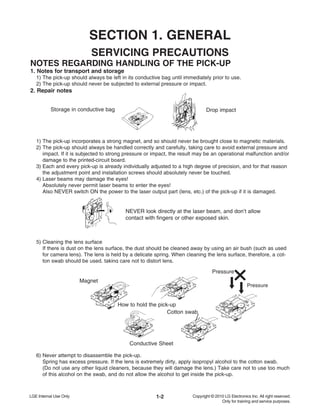
NOTES REGARDING HANDLING OF THE PICK-UP
1. Notes for transport and storage
1) The pick-up should always be left in its conductive bag until immediately prior to use.
2) The pick-up should never be subjected to external pressure or impact.
2. Repair notes
1) The pick-up incorporates a strong magnet, and so should never be brought close to magnetic materials.
2) The pick-up should always be handled correctly and carefully, taking care to avoid external pressure and
impact. If it is subjected to strong pressure or impact, the result may be an operational malfunction and/or
damage to the printed-circuit board.
3) Each and every pick-up is already individually adjusted to a high degree of precision, and for that reason
the adjustment point and installation screws should absolutely never be touched.
4) Laser beams may damage the eyes!
Absolutely never permit laser beams to enter the eyes!
Also NEVER switch ON the power to the laser output part (lens, etc.) of the pick-up if it is damaged.
5) Cleaning the lens surface
If there is dust on the lens surface, the dust should be cleaned away by using an air bush (such as used
for camera lens). The lens is held by a delicate spring. When cleaning the lens surface, therefore, a cot-
ton swab should be used, taking care not to distort lens.
6) Never attempt to disassemble the pick-up.
Spring has excess pressure. If the lens is extremely dirty, apply isopropyl alcohol to the cotton swab.
(Do not use any other liquid cleaners, because they will damage the lens.) Take care not to use too much
of this alcohol on the swab, and do not allow the alcohol to get inside the pick-up.
Storage in conductive bag Drop impact
NEVER look directly at the laser beam, and don’t allow
contact with fingers or other exposed skin.
Magnet
How to hold the pick-up
Conductive Sheet
Cotton swab
Pressure
Pressure
SECTION 1. GENERAL
1-3
NOTES REGARDING COMPACT DISC PLAYER REPAIRS
1. Preparations
1) Compact disc players incorporate a great many ICs as well as the pick-up (laser diode). These components
are sensitive to, and easily affected by, static electricity. If such static electricity is high voltage, components
can be damaged, and for that reason components should be handled with care.
2) The pick-up is composed of many optical components and other high-precision components. Care must be
taken, therefore, to avoid repair or storage where the temperature or humidity is high, where strong magne-
tism is present, or where there is excessive dust.
2. Notes for repair
1) Before replacing a component part, first disconnect the power supply lead wire from the unit
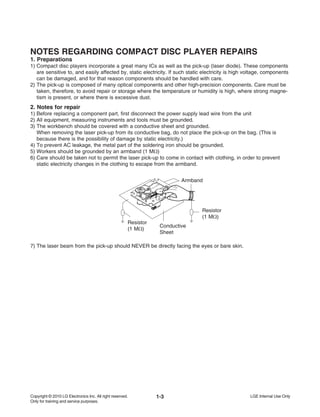
2) All equipment, measuring instruments and tools must be grounded.
3) The workbench should be covered with a conductive sheet and grounded.
When removing the laser pick-up from its conductive bag, do not place the pick-up on the bag. (This is
because there is the possibility of damage by static electricity.)
4) To prevent AC leakage, the metal part of the soldering iron should be grounded.
5) Workers should be grounded by an armband (1 MΩ)
6) Care should be taken not to permit the laser pick-up to come in contact with clothing, in order to prevent
static electricity changes in the clothing to escape from the armband.
7) The laser beam from the pick-up should NEVER be directly facing the eyes or bare skin.
Resistor
(1 MΩ)
Conductive
Sheet
Resistor
(1 MΩ)
Armband
1-4
ESD PRECAUTIONS
Electrostatically Sensitive Devices (ESD)
Some semiconductor (solid state) devices can be damaged easily by static electricity. Such components
commonly are called Electrostatically Sensitive Devices (ESD). Examples of typical ESD devices are integrated
circuits and some field-effect transistors and semiconductor chip components. The following techniques should
be used to help reduce the incidence of component damage caused by static electricity.
1. Immediately before handling any semiconductor component or semiconductor-equipped assembly, drain off
any electrostatic charge on your body by touching a known earth ground. Alternatively, obtain and wear a
commercially available discharging wrist strap device, which should be removed for potential shock reasons
prior to applying power to the unit under test.
2. After removing an electrical assembly equipped with ESD devices, place the assembly on a conductive surface
such as aluminum foil, to prevent electrostatic charge buildup or exposure of the assembly.
3. Use only a grounded-tip soldering iron to solder or unsolder ESD devices.
4. Use only an anti-static solder removal device. Some solder removal devices not classified as "anti-static" can
generate electrical charges sufficient to damage ESD devices.
5. Do not use freon-propelled chemicals. These can generate electrical charges sufficient to damage ESD
devices.
6. Do not remove a replacement ESD device from its protective package until immediately before you are
ready to install it. (Most replacement ESD devices are packaged with leads electrically shorted together by
conductive foam, aluminum foil or comparable conductive materials).
7. Immediately before removing the protective material from the leads of a replacement ESD device, touch the
protective material to the chassis or circuit assembly into which the device will by installed.
CAUTION : BE SURE NO POWER IS APPLIED TO THE CHASSIS OR CIRCUIT, AND OBSERVE ALL OTHER
SAFETY PRECAUTIONS.
8. Minimize bodily motions when handing unpackaged replacement ESD devices. (Otherwise harmless motion
such as the brushing together of your clothes fabric or the lifting of your foot from a carpeted floor can generate
static electricity sufficient to damage an ESD device).
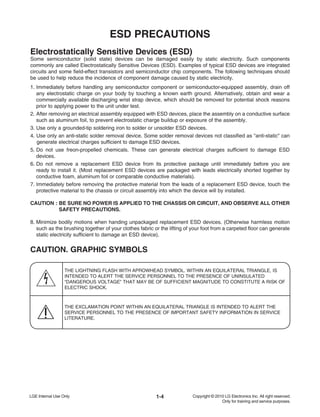
CAUTION. GRAPHIC SYMBOLS
THE LIGHTNING FLASH WITH APROWHEAD SYMBOL. WITHIN AN EQUILATERAL TRIANGLE, IS
INTENDED TO ALERT THE SERVICE PERSONNEL TO THE PRESENCE OF UNINSULATED
“DANGEROUS VOLTAGE” THAT MAY BE OF SUFFICIENT MAGNITUDE TO CONSTITUTE A RISK OF
ELECTRIC SHOCK.
THE EXCLAMATION POINT WITHIN AN EQUILATERAL TRIANGLE IS INTENDED TO ALERT THE
SERVICE PERSONNEL TO THE PRESENCE OF IMPORTANT SAFETY INFORMATION IN SERVICE
LITERATURE.
1-5
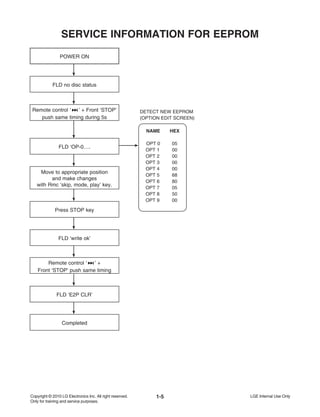
SERVICE INFORMATION FOR EEPROM
POWER ON
FLD no disc status
Remote control ‘ ’ + Front ‘STOP’
push same timing during 5s
FLD ‘OP-0….
Move to appropriate position
and make changes
with Rmc ‘skip, mode, play’ key.
Press STOP key
FLD ‘write ok’
Remote control ‘ ’ +
Front ‘STOP’ push same timing
FLD ‘E2P CLR’
Completed
NAME
OPT 0
OPT 1
OPT 2
OPT 3
OPT 4
OPT 5
OPT 6
OPT 7
OPT 8
OPT 9
DETECT NEW EEPROM
(OPTION EDIT SCREEN)
HEX
05
00
00
00
00
68
80
05
50
00
1-6
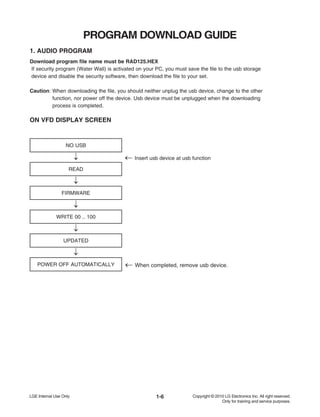
PROGRAM DOWNLOAD GUIDE
1. AUDIO PROGRAM
Download program file name must be RAD125.HEX
If security program (Water Wall) is activated on your PC, you must save the file to the usb storage
device and disable the security software, then download the file to your set.
Caution: When downloading the file, you should neither unplug the usb device, change to the other
function, nor power off the device. Usb device must be unplugged when the downloading
process is completed.
ON VFD DISPLAY SCREEN
NO USB
↓ ← Insert usb device at usb function
READ
↓
FIRMWARE
↓
WRITE 00 .. 100
↓
UPDATED
↓
POWER OFF AUTOMATICALLY ← When completed, remove usb device.
1-7
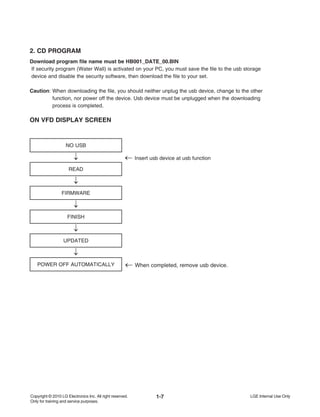
2. CD PROGRAM
Download program file name must be HB001_DATE_00.BIN
If security program (Water Wall) is activated on your PC, you must save the file to the usb storage
device and disable the security software, then download the file to your set.
Caution: When downloading the file, you should neither unplug the usb device, change to the other
function, nor power off the device. Usb device must be unplugged when the downloading
process is completed.
ON VFD DISPLAY SCREEN
NO USB
↓ ← Insert usb device at usb function
READ
↓
FIRMWARE
↓
FINISH
↓
UPDATED
↓
POWER OFF AUTOMATICALLY ← When completed, remove usb device.
1-8
SPECIFICATIONS
• GENERAL
Power supply Refer to main label
Power consumption 60 W
Net Weight 3.5 kg
External dimensions (W x H x D) 202 x 307 x 278 mm
Bus Power Supply (USB) DC 5 V 500 mA
Operating conditions Temperature 5 °C ~ 35 °C,
Operation status: Horizontal
Operating humidity 5 % ~ 85 %
Laser Semiconductor laser, wavelength 650 nm
• TUNER FM/AM [MW]
FM Tuning Range (87.5 ~ 108.0) MHz or (87.50 ~ 108.00) MHz
FM Intermediate Frequency 128 kHz
AM Tuning Range (522 ~ 1 620) kHz, (520 ~ 1 710) kHz or
(522 ~ 1 710) kHz
AM Intermediate Frequency 45 kHz
• AMPLIFIER
Output Power Front : 110 W + 110 W (4 Ω at 1 kHz, THD 10 %)
Sub Woofer : 150 W (3 Ω at 60 Hz, THD 10 %)
• CD
Frequency Response (40 ~ 20 000) Hz
Signal-to-noise ratio 75 dB
Dynamic range 80 dB
• SPEAKERS
Front Speaker Sub Woofer
Type 2 Way 2 Speaker 1 Way 1 Speaker
Impedance 4 Ω 3 Ω
Rated Input Power 110 W 150 W
Max. Input Power 220 W 300 W
Net Dimensions (W x H x D) 232 x 346 x 289 mm 250 x 346 x 356 mm
Net Weight 3.3 kg 5.5 kg
Designs and specifications are subject to change without prior notice
D
H
G
C
C
F
E
B
A
F
E
H
G
D
A
B
FRONT
USB
SMPS
I
258C
255L
260L
256L 255R
256R
258B
258A
251
253
252
250
254
460
460
261 460
460
264
451
A47
276
265
259
A26
460
460
A46
300
460
460
273 274
460
279
460
460
262
460
257
CABLE2
260R
A43
A44
A42
460
I
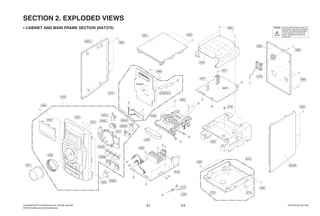
SECTION 2. EXPLODED VIEWS
• CABINET AND MAIN FRAME SECTION (RAT375)
2-1 2-2
NOTES) THE EXCLAMATION POINT WITHIN AN
EQUILATERAL TRIANGLE IS INTENDED
TO ALERT THE SERVICE PERSONNEL
TO THE PRESENCE OF IMPORTANT
SAFETY INFORMATION IN SERVICE
LITERATURE.
2-3 2-4
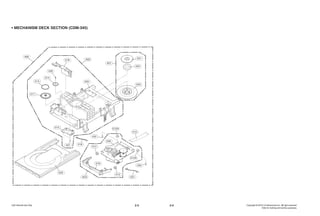
• MECHANISM DECK SECTION (CDM-345)
018
439
014
013
017
019
026
015
431
020
A01
A02 001
002
003
016
036
010
012
012A
012A
012
432
432
037A03
A26
2-5
A60
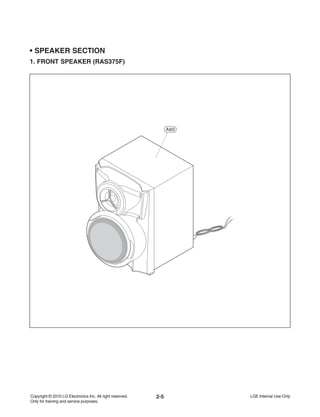
• SPEAKER SECTION
1. FRONT SPEAKER (RAS375F)
2-6
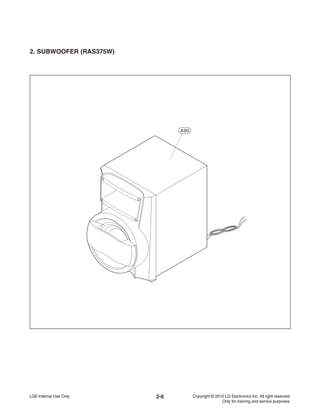
2. SUBWOOFER (RAS375W)
A90
2-7
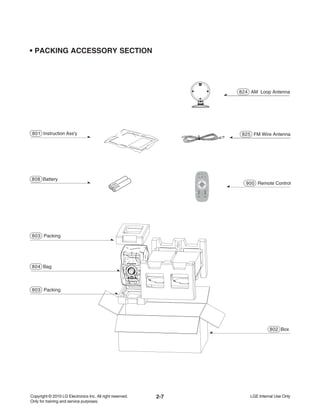
• PACKING ACCESSORY SECTION
825 FM Wire Antenna
900 Remote Control
803 Packing
803 Packing
808 Battery
802 Box
801 Instruction Ass'y
804 Bag
824 AM Loop Antenna
2-8
MEMO
3-1
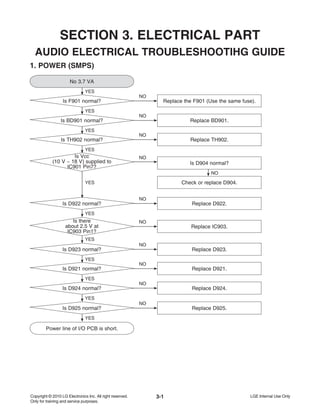
SECTION 3. ELECTRICAL PART
AUDIO ELECTRICAL TROUBLESHOOTIHG GUIDE
1. POWER (SMPS)
No 3.7 VA
YES
Is F901 normal? Replace the F901 (Use the same fuse).
YES
NO
Is BD901 normal? Replace BD901.
YES
NO
Is TH902 normal? Replace TH902.
YES
NO
Is Vcc
(10 V ~ 18 V) supplied to
IC901 Pin7?
Is D904 normal?
YES
NO
Check or replace D904.
Is there
about 2.5 V at
IC903 Pin1?
Replace IC903.
YES
NO
Is D923 normal? Replace D923.
YES
NO
Is D921 normal? Replace D921.
YES
NO
Is D924 normal? Replace D924.
YES
NO
Is D925 normal? Replace D925.
YES
NO
Is D922 normal? Replace D922.
YES
NO
Power line of I/O PCB is short.
NO
3-2
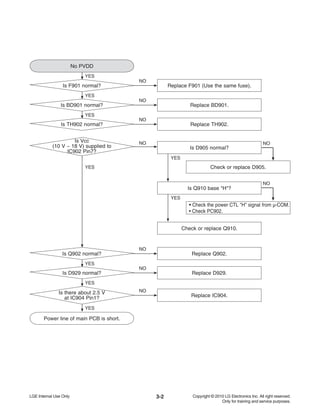
No PVDD
YES
Is F901 normal? Replace F901 (Use the same fuse).
YES
NO
Is BD901 normal? Replace BD901.
YES
NO
Is TH902 normal? Replace TH902.
YES
YES
NO
Is Vcc
(10 V ~ 18 V) supplied to
IC902 Pin7?
Is D905 normal?
YES
NO
Check or replace D905.
• Check the power CTL "H" signal from μ-COM.
• Check PC902.
Is Q902 normal? Replace Q902.
Check or replace Q910.
YES
NO
Is D929 normal? Replace D929.
YES
NO
Is there about 2.5 V
at IC904 Pin1? Replace IC904.
YES
NO
Is Q910 base "H"?
Power line of main PCB is short.
NO
NO
3-3
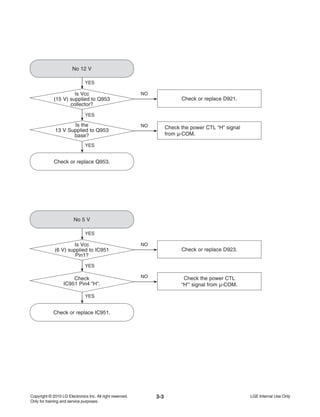
No 12 V
Is Vcc
(15 V) supplied to Q953
collector?
Check or replace D921.
YES
YES
NO
Is the
13 V Supplied to Q953
base?
Check the power CTL “H” signal
from μ-COM.
YES
NO
Check or replace Q953.
No 5 V
Is Vcc
(6 V) supplied to IC951
Pin1?
Check or replace D923.
YES
YES
NO
Check
IC951 Pin4 "H".
Check the power CTL
“H”’ signal from μ-COM.
YES
NO
Check or replace IC951.
3-4
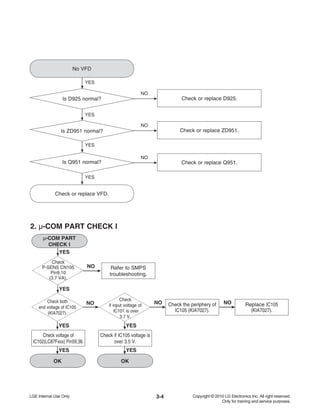
2. μ-COM PART CHECK I
YES
μ-COM PART
CHECK I
Check
P-SENS CN105
Pin9,10
(3.7 VA).
Check
if input voltage of
IC101 is over
3.7 V.
Check both
end voltage of IC105
(KIA7027).
Refer to SMPS
troubleshooting.
NO
NO
Check voltage of
IC102(LC87Fxxx) Pin59,36.
Check the periphery of
IC105 (KIA7027).
NO Replace IC105
(KIA7027).
NO
Check if IC105 voltage is
over 3.5 V.
OK OK
YES
YES
YES
YES
YES
No VFD
Is D925 normal? Check or replace D925.
YES
YES
NO
Is ZD951 normal?
Is Q951 normal?
Check or replace ZD951.
Check or replace Q951.
YES
YES
NO
NO
Check or replace VFD.
3-5
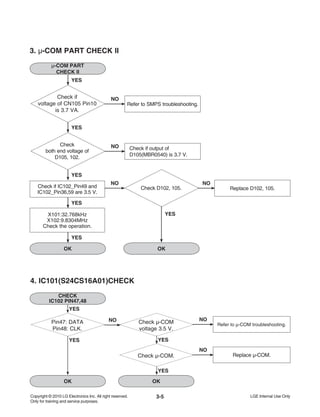
3. μ-COM PART CHECK II
μ-COM PART
CHECK II
Refer to SMPS troubleshooting.
NOCheck if
voltage of CN105 Pin10
is 3.7 VA.
Check if output of
D105(MBR0540) is 3.7 V.
NOCheck
both end voltage of
D105, 102.
Check if IC102_Pin49 and
IC102_Pin36,59 are 3.5 V.
YES
Check D102, 105. Replace D102, 105.
NONO
X101:32.768kHz
X102:9.8304MHz
Check the operation.
OK
YES
YES
YES
YES
YES
OK
4. IC101(S24CS16A01)CHECK
CHECK
IC102 PIN47,48
Refer to μ-COM troubleshooting.
NOPin47: DATA
Pin48: CLK.
Replace μ-COM.
NO
YES
Check μ-COM
voltage 3.5 V.
Check μ-COM.
YES
OK OK
YES
YES
NO
3-6
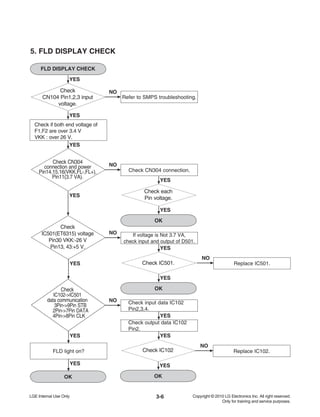
5. FLD DISPLAY CHECK
FLD DISPLAY CHECK
OK
YES
Check
CN104 Pin1,2,3 input
voltage.
YES
Check if both end voltage of
F1,F2 are over 3.4 V
VKK : over 26 V.
NO
Refer to SMPS troubleshooting.
YES
Check CN304
connection and power
Pin14,15,16(VKK,FL-,FL+),
Pin11(3.7 VA).
YES
OK
NO
Check CN304 connection.
YES
Check each
Pin voltage.
YES
Check
IC501(ET6315) voltage
Pin30 VKK:-26 V
Pin13, 43:+5 V.
YES
Check
IC102->IC501
data communication
3Pin->9Pin STB
2Pin->7Pin DATA
4Pin->8Pin CLK
FLD light on?
OK
NO If voltage is Not 3.7 VA,
check input and output of D501.
YES
Check IC501.
YES
NO
Replace IC501.
NO Check input data IC102
Pin2,3,4.
YES
OK
Check IC102
YES
NO
Replace IC102.
Check output data IC102
Pin2.
YESYES
YES
3-7
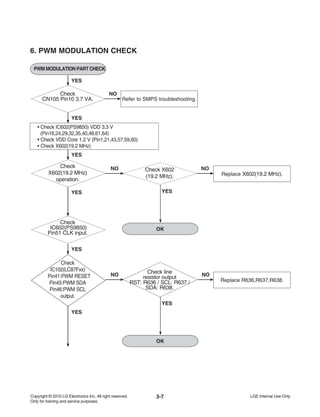
6. PWM MODULATION CHECK
PWM MODULATION PART CHECK
Check
CN105 Pin10 3.7 VA.
• Check IC602(PS9850) VDD 3.3 V
(Pin16,24,29,32,35,40,48,61,64)
• Check VDD Core 1.2 V (Pin1,21,43,57,59,60)
• Check X602(19.2 MHz)
NO
Refer to SMPS troubleshooting.
Check
X602(19.2 MHz)
operation.
NO
Replace X602(19.2 MHz).
Check X602
(19.2 MHz).
OK
YES
NO
Check
IC602(PS9850)
Pin51 CLK input.
Check
IC102(LC87Fxx)
Pin41:PWM RESET
Pin45:PWM SDA
Pin46:PWM SCL
output.
NO
Replace R636,R637,R638.
Check line
resistor output
RST: R636 / SCL: R637 /
SDA: R638.
NO
YES
YES
YES
YES
YES
YES
OK
YES
3-8
OK
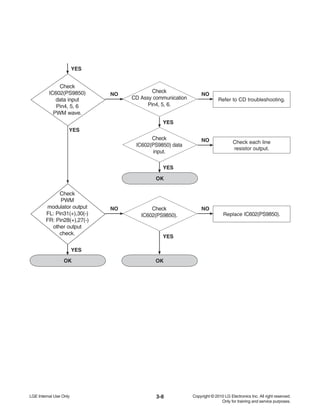
Check
IC602(PS9850)
data input
Pin4, 5, 6
PWM wave.
NO
Refer to CD troubleshooting.
Check
CD Assy communication
Pin4, 5, 6.
OK
NO
NO Check each line
resistor output.
Check
IC602(PS9850) data
input.
Check
PWM
modulator output
FL: Pin31(+),30(-)
FR: Pin28(+),27(-)
other output
check.
NO
Replace IC602(PS9850).
Check
IC602(PS9850).
NO
OK
YES
YES
YES
YES
YES
YES
3-9
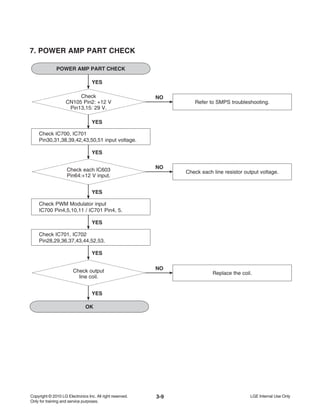
7. POWER AMP PART CHECK
POWER AMP PART CHECK
Refer to SMPS troubleshooting.
NOCheck
CN105 Pin2: +12 V
Pin13,15: 29 V.
YES
YES
Check IC700, IC701
Pin30,31,38,39,42,43,50,51 input voltage.
YES
Check each line resistor output voltage.
NOCheck each IC603
Pin64:+12 V input.
Check IC701, IC702
Pin28,29,36,37,43,44,52,53.
Replace the coil.
NOCheck output
line coil.
Check PWM Modulator input
IC700 Pin4,5,10,11 / IC701 Pin4, 5.
YES
YES
YES
YES
OK
3-10
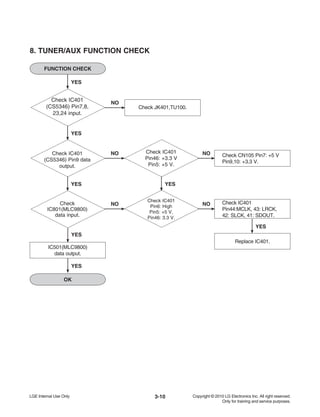
8. TUNER/AUX FUNCTION CHECK
FUNCTION CHECK
Check JK401,TU100.
NO
YES
Check IC401
(CS5346) Pin7,8,
23,24 input.
YES
YES
Check IC401
(CS5346) Pin9 data
output.
YES
Check IC401
Pin46: +3.3 V
Pin5: +5 V.
Check CN105 Pin7: +5 V
Pin9,10: +3.3 V.
NONO
Check
IC801(MLC9800)
data input.
YES
YES
Check IC401
Pin6: High
Pin5: +5 V,
Pin46: 3.3 V.
Check IC401
Pin44:MCLK, 43: LRCK,
42: SLCK, 41: SDOUT.
NONO
Replace IC401.
IC501(MLC9800)
data output.
OK
YES
3-11
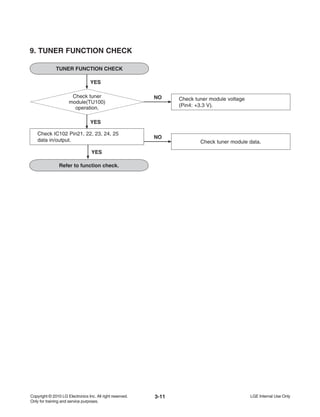
9. TUNER FUNCTION CHECK
TUNER FUNCTION CHECK
Check tuner module voltage
(Pin4: +3.3 V).
NOCheck tuner
module(TU100)
operation.
YES
YES
Check IC102 Pin21, 22, 23, 24, 25
data in/output. Check tuner module data.
NO
YES
Refer to function check.
3-12
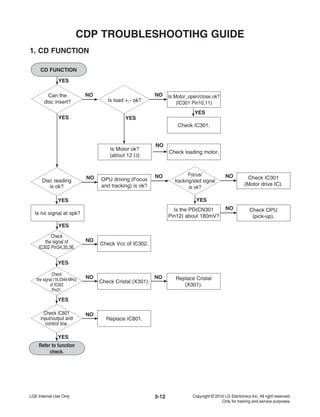
CDP TROUBLESHOOTIHG GUIDE
CD FUNCTION
YES
Can the
disc insert?
NO Is Motor_open/close ok?
(IC301 Pin10,11)
NO
Refer to function
check.
YES
Disc reading
is ok?
Is no signal at spk?
YES
Is Motor ok?
(about 12 Ω)
Is load +,- ok?
YES
Check
the signal of
IC302 Pin34,35,36.
NO
YES
Check
the signal (16.0344 MHz)
of IC302
Pin31.
NO
YES
Check IC801
input/output and
control line.
NO
YES
YES
Check loading motor.
NO
OPU driving (Focus
and tracking) is ok?
NO
Focus/
tracking/sled signal
is ok?
NO Check IC301
(Motor drive IC).
NO
Is the PD(CN301
Pin12) about 180mV?
YES
Check Vcc of IC302.
Check Cristal (X301).
NO Replace Cristal
(X301).
Replace IC801.
Check IC301.
YES
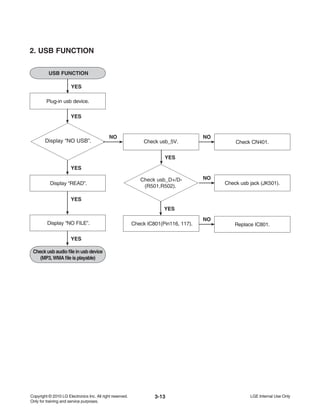
1. CD FUNCTION
Check OPU
(pick-up).
NO
3-13
USB FUNCTION
Check usb_5V.Display “NO USB”.
YES
YES
Check usb_D+/D-
(R501,R502).
YES
Plug-in usb device.
Check CN401.
NONO
YES
Display “READ”.
YES
Display “NO FILE”.
YES
Check usb jack (JK501).
NO
Replace IC801.
NO
Check IC801(Pin116, 117).
Check usb audio file in usb device
(MP3, WMA file is playable)
YES
2. USB FUNCTION
3-14
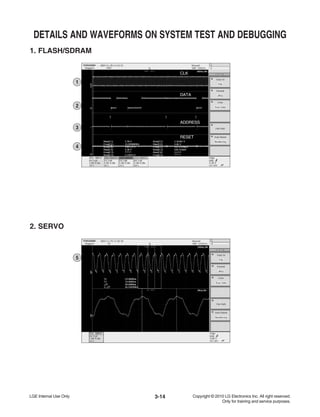
DETAILS AND WAVEFORMS ON SYSTEM TEST AND DEBUGGING
1. FLASH/SDRAM
1
2
3
4
CLK
DATA
ADDRESS
RESET
2. SERVO
5
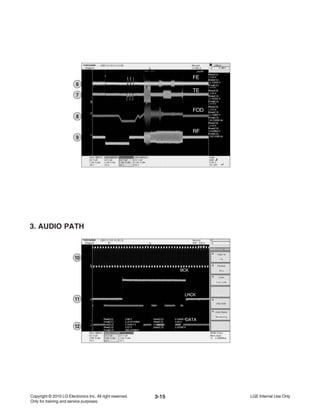
3-15
6
7
8
9
FE
TE
FOD
RF
3. AUDIO PATH
10
11
12
BCK
LRCK
DATA
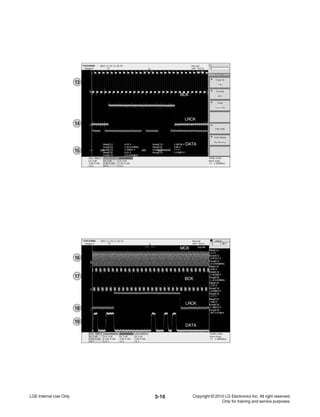
3-16
13
14
15
BCK
LRCK
DATA
16
17
18
MCK
BCK
LRCK
DATA
19
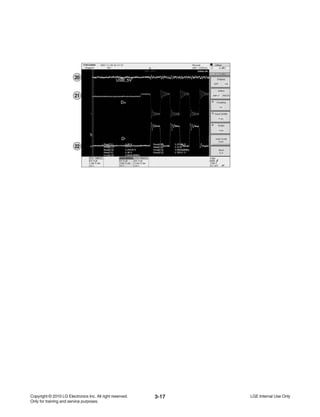
3-17
20
21
22
USB_5V
D+
D-
3-18
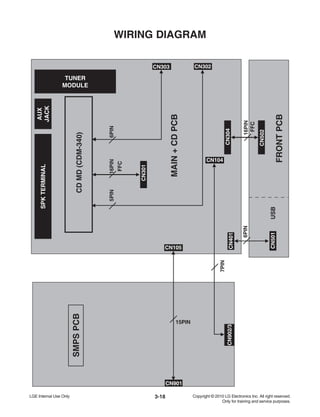
WIRING DIAGRAM
16PIN5PIN
SPKTERMINAL
TUNER
MODULE
CDMD(CDM-340)
MAIN+CDPCB
16PIN
USB
FRONTPCB
SMPSPCB
6PIN
CN501
CN502
CN304
CN401
CN301
FFC
FFC
7PIN
AUX
JACK
6PIN
15PIN
CN105
CN302CN303
CN901
CN902/3
CN104
3-19
BLOCK DIAGRAMS
1. MAIN BLOCK DIAGRAM
P/UP
M
A,B,C,D,E,F
PD
LD
CD_DIN_DOUT
CD_MCK/CD_R/W
BUSY;CD-16M SUBSYQ;
9543-RST;
VFD
AMP
TAS5612
DMA[0..11],DB[0..15
]
DSCK#,CKE,CS0#,RAS0
#
TDO
SLDO
SPDO
FDO
12MHZ
16.93MHZ
POWER
I/F
3.7V
12V
DAT, CLK, RST, CE, INT
RST, WEN#,CE#
A[0.. 18], DB[0..15]
OP/CL
OP/CLLI
MIT
CD-BCK/LRCK/DOUTA
DAC-MCLK
P-SENSE
PWM
PS9850
DO
STB
CLK
ADC-CLK
ADC-DAT
ADC-RST
ADC-DATA
R/L
R/L
I2SCLK
DAC-BCK/LRCK/MCLK
DAC-DATA
PWM-RST
PWM-CLK
PWM-DAT
PDN
SD; OTW
FL+
FL-
FR+
FR-
D+/-
P-CTRL
R
L
DAT
CLK
SPI-DO/DI/CLK/CS
RMCKEY
9.8304MH
Z
32.766khz
NewPWM
SWSW+
SW-
3-20
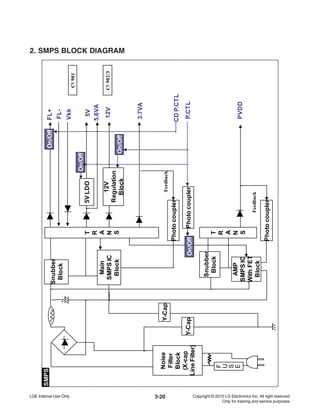
2. SMPS BLOCK DIAGRAM
PVDD
+
¡
Noise
Filter
Block
(X-cap
LineFilter)
Snubber
Block
Main
SMPSIC
Block
T
R
A
N
S
Snubber
Block
¡
¡
Photocoupler
Photocoupler
Photocoupler
FL+
FL-
On/Off
Vkk
On/Off
5V5VLDO
12V12V
Regulation
Block
3.7VA
P.CTL
On/Off
On/Off
¡
¡
¡
¡
¡
¡
¡
¡
AMP
SMPSIC
WithFET
Block
¡
F
U
S
E
Y-Cap
Y-Cap
¡
T
R
A
N
S
SMPS
¡
5.6VA
CDP.CTL
CN901
CN902/3
Feedback
Feedback
A
1
2
3
4
5
6
7
8
9
10
11
12
B C D E F G H I J K L M N O P Q R S T
CAUTION:
Danger if fuse is incorrectly replaced.
Replace only with the type identical to fuse rating
and(or) model name described in main label.
Warning
Parts that are shaded are critical with
respect to risk of fire or electrical shock.
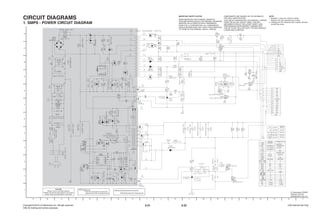
D’ Schemetics POWER
RAD125, RAT375
EBY60749101 Rev 4.2
IMPORTANT SAFETY NOTICE
WHEN SERVICING THIS CHASSIS, UNDER NO
CIRCUMSTANCES SHOULD THE ORIGINAL DESIGN BE
MODIFIED OR ALTERED WITHOUT PERMISSION
FROM THE LG CORPORATION. ALL COMPONENTS
SHOULD BE REPLACED ONLY WITH TYPES IDENTICAL
TO THOSE IN THE ORIGINAL CIRCUIT. SPECIAL
COMPONENTS ARE SHADED ON THE SCHEMATIC
FOR EASY IDENTIFICATION.
THIS CIRCUIT DIAGRAM MAY OCCASIONALLY DIFFER
FROM THE ACTUAL CIRCUIT USED. THIS WAY,
IMPLEMENTATION OF THE LATEST SAFETY AND
PERFORMANCE IMPROVEMENT CHANGES INTO
THE SET IS NOT DELAYED UNTIL THE NEW SERVICE
LITERATURE IS PRINTED.
NOTE :
1. Shaded( ) parts are critical for safety.
Replace only with specified part number.
2. Voltages are DC-measured with a digital voltmeter
during Play mode.
CIRCUIT DIAGRAMS
1. SMPS - POWER CIRCUIT DIAGRAM
3-21 3-22
A
1
2
3
4
5
6
7
8
9
10
11
12
B C D E F G H I J K L M N O P Q R S T
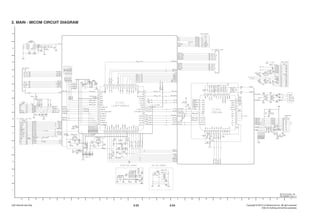
RAT375 µCOM + AD
EBY60808601 Rev 4.1
2. MAIN - MICOM CIRCUIT DIAGRAM
3-23 3-24
A
1
2
3
4
5
6
7
8
9
10
11
12
B C D E F G H I J K L M N O P Q R S T
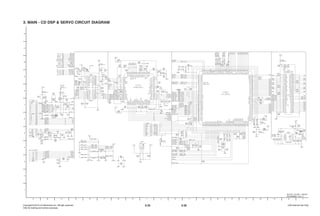
RAT375 CD DSP + SERVO
EBY60808601 Rev 4.1
3. MAIN - CD DSP & SERVO CIRCUIT DIAGRAM
3-25 3-26
A
1
2
3
4
5
6
7
8
9
10
11
12
B C D E F G H I J K L M N O P Q R S T
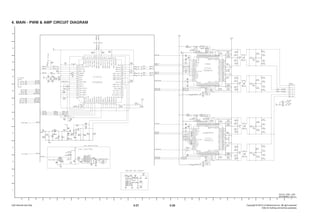
RAT375 PWM + AMP
EBY60808601 Rev 4.1
3-27 3-28
4. MAIN - PWM & AMP CIRCUIT DIAGRAM
A
1
2
3
4
5
6
7
8
9
10
11
12
B C D E F G H I J K L M N O P Q R S T
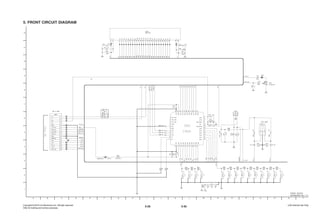
FRONT RAT375
EBY56948501 Rev 1.13
5. FRONT CIRCUIT DIAGRAM
3-29 3-30
A
1
2
3
4
5
6
7
8
9
10
11
12
B C D E F G H I J K L M N O P Q R S T
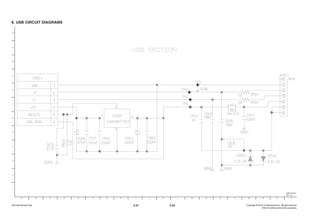
USB RAT375
Rev 1.13
6. USB CIRCUIT DIAGRAMS
3-31 3-32
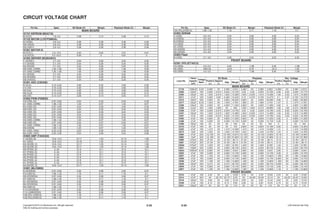
CIRCUIT VOLTAGE CHART
3-33 3-34
Pin No. Spec. EE Mode (V) Margin Playback Mode (V) Margin
MAIN BOARD
IC101 EEPROM (M24C16)
8 (VCC) 1.8~5.5 3.38 2.12 3.38 2.12
IC102 MICOM (LC87F5M64A)
9 (VDD2) 2.8~5.5 3.38 0.58 3.38 0.58
36 (VDD3) 2.8~5.5 3.38 0.58 3.38 0.58
59 (VDD1) 2.8~5.5 3.38 0.58 3.38 0.58
IC301 MOTOR IC
8 (VCC1) 4.3~13.2 4.94 0.64 4.91 0.61
19 (VCC2) 4.3~Vcc1 4.94 0 4.91 0
IC302 SERVER (BU9543KV)
1 (AVDD1) 2.7~3.6 3.34 0.26 3.25 0.35
17 (DVDD) 2.7~3.6 3.34 0.26 3.25 0.35
33 (DVDD) 2.7~3.6 3.34 0.26 3.25 0.35
26 (VDD_CORE) 1.35~1.65 1.56 0.09 1.56 0.09
37 (VDD_CORE) 1.35~1.65 1.56 0.09 1.56 0.09
47 (DVDD) 2.7~3.6 3.34 0.26 3.25 0.35
53 (DVDD2) 2.7~3.6 3.34 0.26 3.25 0.35
58 (AVDD2) 2.7~3.6 3.34 0.26 3.25 0.35
IC401 ADC (CS5346)
5 (VLC) 3.13~5.25 4.93 0.32 4.93 0.32
14 (VA) 4.75~5.25 4.93 0.32 4.93 0.32
30 (VA) 4.75~5.25 4.93 0.32 4.93 0.32
36 (VLS) 3.13~5.25 3.26 0.13 3.25 0.12
46 (VD) 3.13~3.47 3.26 0.13 3.25 0.12
IC602 PWM (PS9850)
16 (VDD_IO) 2.97~3.63 3.24 0.33 3.24 0.33
21 (VDD_CORE) 1.08~1.32 1.25 0.07 1.25 0.07
24 (VDD_IO) 2.97~3.63 3.24 0.33 3.24 0.33
29 (VDD_IO) 2.97~3.63 3.24 0.33 3.24 0.33
32 (VDD_IO) 2.97~3.63 3.24 0.33 3.24 0.33
35 (VDD_IO) 2.97~3.63 3.24 0.33 3.24 0.33
40 (VDD_IO) 2.97~3.63 3.24 0.33 3.24 0.33
43 (VDD_CORE) 1.08~1.32 1.25 0.07 1.25 0.07
48 (VDD_IO) 2.97~3.63 3.24 0.27 3.24 0.27
57 (VDD_CORE) 1.08~1.32 1.25 0.07 1.25 0.07
59 (VDDA) 1.08~1.32 1.25 0.07 1.25 0.07
61 (VDD_VIN2) 2.20~3.30 3.24 0.06 3.24 0.06
64 (VDD_VIN1) 2.20~3.30 3.24 0.06 3.24 0.06
IC603 AMP (TAS5342)
1 (GVDD_B) 10.8~13.2 12.17 1.03 12.14 1.06
21 (VDD) 10.8~13.2 12.16 1.04 12.13 1.07
22 (GVDD_C) 10.8~13.2 12.17 1.03 12.14 1.06
23 (GVDD_D) 10.8~13.2 12.17 1.03 12.14 1.06
26 (PVDD_D) 0~34 21.9 12.1 21.9 12.1
27 (PVDD_D) 0~34 21.9 12.1 21.9 12.1
32 (PVDD_C) 0~34 21.9 12.1 21.9 12.1
35 (PVDD_B) 0~34 21.9 12.1 21.9 12.1
40 (PVDD_A) 0~34 21.9 12.1 21.9 12.1
41 (PVDD_A) 0~34 21.9 12.1 21.9 12.1
44 (GVDD_A) 10.8~13.2 12.17 1.03 12.14 1.06
IC801 (MLC9800)
2 (AVDD33) 2.97~3.63 3.35 0.08 3.26 0.07
13 (VDD12) 1.08~1.32 1.19 0.11 1.18 0.1
30 (IOVDD33) 2.97~3.63 3.35 0.08 3.26 0.07
47 (VDD12) 1.08~1.32 1.19 0.11 1.18 0.1
51 (IOVDD33) 2.97~3.63 3.35 0.08 3.26 0.07
84 (IOVDD33) 2.97~3.63 3.35 0.08 3.26 0.07
94 (VDD12) 1.08~1.32 1.19 0.11 1.18 0.1
113 (IOVDD33) 2.97~3.63 3.35 0.08 3.26 0.07
115 (USBVDD33) 2.97~3.63 3.35 0.08 3.26 0.07
120 (PLL1VDD12) 1.08~1.32 1.19 0.11 1.18 0.1
122 (PLL3VDD12) 1.08~1.32 1.19 0.11 1.18 0.1
Pin No. Spec. EE Mode (V) Margin Playback Mode (V) Margin
124 (PLL2VDD12) 1.08~1.32 1.19 0.11 1.18 0.1
IC802 SDRAM
1 (VDD) 3.0~3.6 3.34 0.26 3.26 0.24
3 (VDDQ) 3.0~3.6 3.34 0.26 3.26 0.24
9 (VDDQ) 3.0~3.6 3.34 0.26 3.26 0.24
14 (VDD) 3.0~3.6 3.34 0.26 3.26 0.24
27 (VDD) 3.0~3.6 3.34 0.26 3.26 0.24
43 (VDDQ) 3.0~3.6 3.34 0.26 3.26 0.24
49 (VDDQ) 3.0~3.6 3.34 0.26 3.26 0.24
IC803 Flash
8 (VDD) 2.7~3.6 3.26 0.34 3.25 0.35
FRONT BOARD
IC501 VFD (ET16315)
13 (VDD) 4.5~5.5 3.42 -1.08 3.42 -1.08
30 (VEE) VDD-35 -24.8 6.78 -24.3 7.28
43 (VDD) 4.5~5.5 3.42 -1.08 3.42 -1.08
Loca No.
Value
Capacitor
(uF)
Voltage
Spec.
EE Mode Playback Rec. Voltage
Positive
(+)
Negative
(-)
Gap Margin
Positive
(+)
Negative
(-)
Gap Margin
Positive
(+)
Negative
(-)
Gap Margin
MAIN BOARD
C118 1000uF 6.3V 3.39V 0V 3.39V 2.91V 3.38V 0V 3.38V 2.92V 3.39V 0V 3.39V 2.91V
C302 100uF 16V 3.26V 0.01V 3.25V 12.75V 3.25 0.03 3.22V 12.78V 3.26 0.03 3.23V 12.77V
C304 100uF 16V 1.63V 0.01V 1.62V 14.38V 1.64V 0.03V 1.61V 14.39V 1.64 0.03 1.61V 14.39V
C311 47uF 16V 3.26V 2.8V 0.46V 15.54V 3.1V 2.37V 0.73V 15.27V 3.1 2.37 0.73V 15.27V
C313 100nF 50V 4.95V 0V 4.95V 45.05V 4.92V 0V 4.92V 45.08V 4.92 0 4.92V 45.08V
C317 100uF 6.3V 1.55V 0V 1.55V 4.75V 1.56V 0V 1.56V 4.74V 1.57 0 1.57V 4.73V
C326 100uF 16V 4.95V 0V 4.95V 11.05V 4.92V 0V 4.92V 11.08V 4.92 0 4.92V 11.08V
C336 3.3uF 50V 1.63V 1.63V 0V 50V 1.65V 1.64V 0.01V 49.99V 1.65 1.64 0.01V 49.99V
C338 47uF 16V 3.26V 0.01V 3.25V 12.75V 3.25 0.03 3.22V 12.78V 3.25 0.03 3.22V 12.78V
C347 100uF 16V 1.63V 0.01V 1.62V 14.38V 1.64V 0.03V 1.61V 14.39V 1.64 0.03 1.61V 14.39V
C357 47uF 16V 3.26V 0.01V 3.25V 12.75V 3.25V 0.03V 3.22V 12.78V 3.25 0.03 3.22V 12.78V
C403 47uF 16V 4.95V 0V 4.95V 11.05V 4.95V 0V 4.95V 11.05V 4.95 0 4.95V 11.05V
C406 47uF 16V 3.26V 0V 3.26V 12.74V 3.26V 0V 3.26V 12.74V 3.26 0 3.26V 12.74V
C408 100uF 16V 0V 0V 0V 16V 0V 0V 0V 16V 0 0 0V 16V
C410 47uF 16V 3V 0V 3V 13V 3.82V 0V 3.82V 12.18V 3.65 0 3.65V 12.35V
C423 47uF 16V 1.41V 0V 1.41V 14.59V 1.41V 0V 1.41V 14.59V 1.41 0 1.41V 14.59V
C613 10uF 16V 1.25V 0V 1.25V 14.75V 1.24V 0V 1.24V 14.76V 1.24 0 1.24V 14.76V
C664 47uF 25V 12.19V 0V 12.19V 12.81V 12.15V 0V 12.15V 12.85V 12.16 0 12.16V 12.84V
C665 10uF 50V 12.18V 0V 12.18V 37.82V 12.14V 0V 12.14V 37.86V 12.14 0 12.14V 37.86V
C690 470uF 50V 21.9V 0V 21.9V 28.1V 21.9V 0V 21.9V 28.1V 21.9 0 21.9V 28.1V
C691 470uF 50V 21.9V 0V 21.9V 28.1V 21.9V 0V 21.9V 28.1V 21.9 0 21.9V 28.1V
C6A0 470uF 10V 1.25V 0V 1.25V 8.75V 1.24V 0V 1.24V 8.76V 1.24 0 1.24V 8.76V
C6A1 100pF 50V 3.26V 0V 3.26V 46.74V 3.25V 0V 3.25V 46.75V 3.25 0 3.25V 46.75V
C6A4 1000uF 6.3V 3.26V 0V 3.26V 3.04V 3.26V 0V 3.26V 3.04V 3.26 0 3.26V 3.04V
C825 47uF 16V 3.26V 0V 3.26V 12.74V 3.26V 0V 3.26V 12.74V 3.26 0 3.26V 12.74V
C827 47uF 16V 1.18V 0V 1.18V 14.82V 1.18V 0V 1.18V 14.82V 1.18V 0V 1.18V 14.82V
C828 47uF 16V 3.26V 0V 3.26V 12.74V 3.26V 0V 3.26V 12.74V 3.26V 0V 3.26V 12.74V
C848 47uF 16V 1.18V 0V 1.18V 14.82V 1.18V 0V 1.18V 14.82V 1.18V 0V 1.18V 14.82V
C849 100nF 50V 3.27V 0V 3.27V 46.73V 3.26V 0V 3.26V 46.74V 3.26V 0V 3.26V 46.74V
C8F6 47uF 16V 3.26V 0V 3.26V 12.74V 3.26V 0V 3.26V 12.74V 3.26 0 3.26V 12.74V
C8F7 47uF 16V 1.18V 0V 1.18V 14.82V 1.18V 0V 1.18V 14.82V 1.18 0 1.18V 14.82V
FRONT BOARD
C510 47uF 16V 3.4V 0V 3.4V 12.6V 3.4V 0V 3.4V 12.6V 3.4V 0V 3.4V 12.6V
C514 47uF 35V 0V -25.7V 25.7V 9.3V 0V -24.9V 24.9V 10.1V 0V -24.2V 24.2V 10.8V
C516 100uF 16V 3.6V 0V 3.6V 12.4V 3.6V 0V 3.6V 12.4V 3.6V 0V 3.6V 12.4V
C549 47uF 16V 6.1V 0V 6.1V 9.9V 5.8V 0V 5.8V 10.2V 5.7V 0V 5.7V 10.3V
C551 100uF 16V 5V 0V 5V 11V 5V 0V 5V 11V 5V 0V 5V 11V
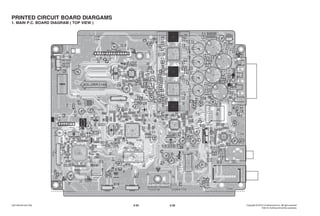
PRINTED CIRCUIT BOARD DIARGAMS
1. MAIN P.C. BOARD DIAGRAM ( TOP VIEW )
3-35 3-36
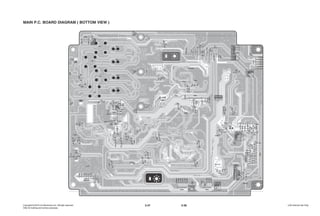
MAIN P.C. BOARD DIAGRAM ( BOTTOM VIEW )
3-37 3-38
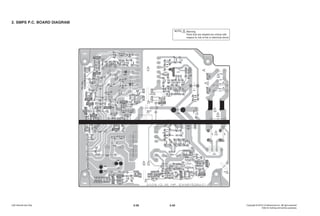
2. SMPS P.C. BOARD DIAGRAM
3-39 3-40
Warning
Parts that are shaded are critical with
respect to risk of fire or electrical shock.
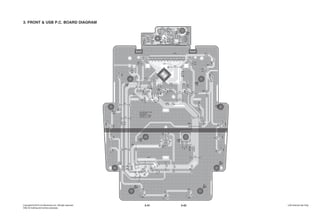
3. FRONT & USB P.C. BOARD DIAGRAM
3-41 3-42
3-43 3-44
MEMO MEMO

LG RAT375B

  • 1.
    Mini Hi-Fi System SERVICEMANUAL MODEL: RAT375 (RAS375F/W) CAUTION BEFORE SERVICING THE UNIT, READ THE “SAFETY PRECAUTIONS” IN THIS MANUAL. MODEL:RAT375(RAS375F/W)SERVICEMANUAL P/NO : AFN73972613 MARCH, 2010 Website http://biz.lgservice.com Internal Use Only
  • 2.
    1-1 [CONTENTS] SECTION 1. GENERAL •SERVICING PRECAUTIONS. . . . . . . . . . . . . . . . . . . . . . . . . . . . . . . . . . . . . . . . . . . . . . . . . 1-2 • ESD PRECAUTIONS . . . . . . . . . . . . . . . . . . . . . . . . . . . . . . . . . . . . . . . . . . . . . . . . . . . . . . . 1-4 • SERVICE INFORMATION FOR EEPROM . . . . . . . . . . . . . . . . . . . . . . . . . . . . . . . . . . . . . . 1-5 • PROGRAM DOWNLOAD GUIDE. . . . . . . . . . . . . . . . . . . . . . . . . . . . . . . . . . . . . . . . . . . . . . . . . . . . . . . . . . . 1-6 • SPECIFICATIONS . . . . . . . . . . . . . . . . . . . . . . . . . . . . . . . . . . . . . . . . . . . . . . . . . . . . . . . . . 1-8 SECTION 2. EXPLODED VIEWS . . . . . . . . . . . . . . . . . . . . . . . . . . . . . . . . . . . . . . . . . . . . . 2-1 • CABINET AND MAIN FRAME SECTION. . . . . . . . . . . . . . . . . . . . . . . . . . . . . . . . . . . . . . . . 2-1 • MECHANISM DECK SECTION (CDM-345). . . . . . . . . . . . . . . . . . . . . . . . . . . . . . . . . . . . . . 2-3 • SPEAKER SECTION . . . . . . . . . . . . . . . . . . . . . . . . . . . . . . . . . . . . . . . . . . . . . . . . . . . . . . . 2-5 • PACKING ACCESSORY SECTION. . . . . . . . . . . . . . . . . . . . . . . . . . . . . . . . . . . . . . . . . . . . 2-7 SECTION 3. ELECTRICAL PART • TROUBLESHOOTING GUIDE . . . . . . . . . . . . . . . . . . . . . . . . . . . . . . . . . . . . . . . . . . . . . . . . 3-1 • DETAILS AND WAVEFORMS ON SYSTEM TEST AND DEBUGGING. . . . . . . . . . . . . . . 3-14 • WIRING DIAGRAM . . . . . . . . . . . . . . . . . . . . . . . . . . . . . . . . . . . . . . . . . . . . . . . . . . . . . . . 3-18 • BLOCK DIAGRAMS . . . . . . . . . . . . . . . . . . . . . . . . . . . . . . . . . . . . . . . . . . . . . . . . . . . . . . 3-19 • CIRCUIT DIAGRAMS. . . . . . . . . . . . . . . . . . . . . . . . . . . . . . . . . . . . . . . . . . . . . . . . . . . . . . 3-21 • CIRCUIT VOLTAGE CHART . . . . . . . . . . . . . . . . . . . . . . . . . . . . . . . . . . . . . . . . . . . . . . . . 3-33 • PRINTED CIRCUIT DIARGAMS . . . . . . . . . . . . . . . . . . . . . . . . . . . . . . . . . . . . . . . . . . . . . 3-35 SECTION 4. REPLACEMENT PARTS LIST . . . . . . . . . . . . . . . . . . . . . . . . . . . . . . . . . . . 4-1
  • 3.
    1-2 SERVICING PRECAUTIONS NOTES REGARDINGHANDLING OF THE PICK-UP 1. Notes for transport and storage 1) The pick-up should always be left in its conductive bag until immediately prior to use. 2) The pick-up should never be subjected to external pressure or impact. 2. Repair notes 1) The pick-up incorporates a strong magnet, and so should never be brought close to magnetic materials. 2) The pick-up should always be handled correctly and carefully, taking care to avoid external pressure and impact. If it is subjected to strong pressure or impact, the result may be an operational malfunction and/or damage to the printed-circuit board. 3) Each and every pick-up is already individually adjusted to a high degree of precision, and for that reason the adjustment point and installation screws should absolutely never be touched. 4) Laser beams may damage the eyes! Absolutely never permit laser beams to enter the eyes! Also NEVER switch ON the power to the laser output part (lens, etc.) of the pick-up if it is damaged. 5) Cleaning the lens surface If there is dust on the lens surface, the dust should be cleaned away by using an air bush (such as used for camera lens). The lens is held by a delicate spring. When cleaning the lens surface, therefore, a cot- ton swab should be used, taking care not to distort lens. 6) Never attempt to disassemble the pick-up. Spring has excess pressure. If the lens is extremely dirty, apply isopropyl alcohol to the cotton swab. (Do not use any other liquid cleaners, because they will damage the lens.) Take care not to use too much of this alcohol on the swab, and do not allow the alcohol to get inside the pick-up. Storage in conductive bag Drop impact NEVER look directly at the laser beam, and don’t allow contact with fingers or other exposed skin. Magnet How to hold the pick-up Conductive Sheet Cotton swab Pressure Pressure SECTION 1. GENERAL
  • 4.
    1-3 NOTES REGARDING COMPACTDISC PLAYER REPAIRS 1. Preparations 1) Compact disc players incorporate a great many ICs as well as the pick-up (laser diode). These components are sensitive to, and easily affected by, static electricity. If such static electricity is high voltage, components can be damaged, and for that reason components should be handled with care. 2) The pick-up is composed of many optical components and other high-precision components. Care must be taken, therefore, to avoid repair or storage where the temperature or humidity is high, where strong magne- tism is present, or where there is excessive dust. 2. Notes for repair 1) Before replacing a component part, first disconnect the power supply lead wire from the unit 2) All equipment, measuring instruments and tools must be grounded. 3) The workbench should be covered with a conductive sheet and grounded. When removing the laser pick-up from its conductive bag, do not place the pick-up on the bag. (This is because there is the possibility of damage by static electricity.) 4) To prevent AC leakage, the metal part of the soldering iron should be grounded. 5) Workers should be grounded by an armband (1 MΩ) 6) Care should be taken not to permit the laser pick-up to come in contact with clothing, in order to prevent static electricity changes in the clothing to escape from the armband. 7) The laser beam from the pick-up should NEVER be directly facing the eyes or bare skin. Resistor (1 MΩ) Conductive Sheet Resistor (1 MΩ) Armband
  • 5.
    1-4 ESD PRECAUTIONS Electrostatically SensitiveDevices (ESD) Some semiconductor (solid state) devices can be damaged easily by static electricity. Such components commonly are called Electrostatically Sensitive Devices (ESD). Examples of typical ESD devices are integrated circuits and some field-effect transistors and semiconductor chip components. The following techniques should be used to help reduce the incidence of component damage caused by static electricity. 1. Immediately before handling any semiconductor component or semiconductor-equipped assembly, drain off any electrostatic charge on your body by touching a known earth ground. Alternatively, obtain and wear a commercially available discharging wrist strap device, which should be removed for potential shock reasons prior to applying power to the unit under test. 2. After removing an electrical assembly equipped with ESD devices, place the assembly on a conductive surface such as aluminum foil, to prevent electrostatic charge buildup or exposure of the assembly. 3. Use only a grounded-tip soldering iron to solder or unsolder ESD devices. 4. Use only an anti-static solder removal device. Some solder removal devices not classified as "anti-static" can generate electrical charges sufficient to damage ESD devices. 5. Do not use freon-propelled chemicals. These can generate electrical charges sufficient to damage ESD devices. 6. Do not remove a replacement ESD device from its protective package until immediately before you are ready to install it. (Most replacement ESD devices are packaged with leads electrically shorted together by conductive foam, aluminum foil or comparable conductive materials). 7. Immediately before removing the protective material from the leads of a replacement ESD device, touch the protective material to the chassis or circuit assembly into which the device will by installed. CAUTION : BE SURE NO POWER IS APPLIED TO THE CHASSIS OR CIRCUIT, AND OBSERVE ALL OTHER SAFETY PRECAUTIONS. 8. Minimize bodily motions when handing unpackaged replacement ESD devices. (Otherwise harmless motion such as the brushing together of your clothes fabric or the lifting of your foot from a carpeted floor can generate static electricity sufficient to damage an ESD device). CAUTION. GRAPHIC SYMBOLS THE LIGHTNING FLASH WITH APROWHEAD SYMBOL. WITHIN AN EQUILATERAL TRIANGLE, IS INTENDED TO ALERT THE SERVICE PERSONNEL TO THE PRESENCE OF UNINSULATED “DANGEROUS VOLTAGE” THAT MAY BE OF SUFFICIENT MAGNITUDE TO CONSTITUTE A RISK OF ELECTRIC SHOCK. THE EXCLAMATION POINT WITHIN AN EQUILATERAL TRIANGLE IS INTENDED TO ALERT THE SERVICE PERSONNEL TO THE PRESENCE OF IMPORTANT SAFETY INFORMATION IN SERVICE LITERATURE.
  • 6.
    1-5 SERVICE INFORMATION FOREEPROM POWER ON FLD no disc status Remote control ‘ ’ + Front ‘STOP’ push same timing during 5s FLD ‘OP-0…. Move to appropriate position and make changes with Rmc ‘skip, mode, play’ key. Press STOP key FLD ‘write ok’ Remote control ‘ ’ + Front ‘STOP’ push same timing FLD ‘E2P CLR’ Completed NAME OPT 0 OPT 1 OPT 2 OPT 3 OPT 4 OPT 5 OPT 6 OPT 7 OPT 8 OPT 9 DETECT NEW EEPROM (OPTION EDIT SCREEN) HEX 05 00 00 00 00 68 80 05 50 00
  • 7.
    1-6 PROGRAM DOWNLOAD GUIDE 1.AUDIO PROGRAM Download program file name must be RAD125.HEX If security program (Water Wall) is activated on your PC, you must save the file to the usb storage device and disable the security software, then download the file to your set. Caution: When downloading the file, you should neither unplug the usb device, change to the other function, nor power off the device. Usb device must be unplugged when the downloading process is completed. ON VFD DISPLAY SCREEN NO USB ↓ ← Insert usb device at usb function READ ↓ FIRMWARE ↓ WRITE 00 .. 100 ↓ UPDATED ↓ POWER OFF AUTOMATICALLY ← When completed, remove usb device.
  • 8.
    1-7 2. CD PROGRAM Downloadprogram file name must be HB001_DATE_00.BIN If security program (Water Wall) is activated on your PC, you must save the file to the usb storage device and disable the security software, then download the file to your set. Caution: When downloading the file, you should neither unplug the usb device, change to the other function, nor power off the device. Usb device must be unplugged when the downloading process is completed. ON VFD DISPLAY SCREEN NO USB ↓ ← Insert usb device at usb function READ ↓ FIRMWARE ↓ FINISH ↓ UPDATED ↓ POWER OFF AUTOMATICALLY ← When completed, remove usb device.
  • 9.
    1-8 SPECIFICATIONS • GENERAL Power supplyRefer to main label Power consumption 60 W Net Weight 3.5 kg External dimensions (W x H x D) 202 x 307 x 278 mm Bus Power Supply (USB) DC 5 V 500 mA Operating conditions Temperature 5 °C ~ 35 °C, Operation status: Horizontal Operating humidity 5 % ~ 85 % Laser Semiconductor laser, wavelength 650 nm • TUNER FM/AM [MW] FM Tuning Range (87.5 ~ 108.0) MHz or (87.50 ~ 108.00) MHz FM Intermediate Frequency 128 kHz AM Tuning Range (522 ~ 1 620) kHz, (520 ~ 1 710) kHz or (522 ~ 1 710) kHz AM Intermediate Frequency 45 kHz • AMPLIFIER Output Power Front : 110 W + 110 W (4 Ω at 1 kHz, THD 10 %) Sub Woofer : 150 W (3 Ω at 60 Hz, THD 10 %) • CD Frequency Response (40 ~ 20 000) Hz Signal-to-noise ratio 75 dB Dynamic range 80 dB • SPEAKERS Front Speaker Sub Woofer Type 2 Way 2 Speaker 1 Way 1 Speaker Impedance 4 Ω 3 Ω Rated Input Power 110 W 150 W Max. Input Power 220 W 300 W Net Dimensions (W x H x D) 232 x 346 x 289 mm 250 x 346 x 356 mm Net Weight 3.3 kg 5.5 kg Designs and specifications are subject to change without prior notice
  • 10.
    D H G C C F E B A F E H G D A B FRONT USB SMPS I 258C 255L 260L 256L 255R 256R 258B 258A 251 253 252 250 254 460 460 261 460 460 264 451 A47 276 265 259 A26 460 460 A46 300 460 460 273274 460 279 460 460 262 460 257 CABLE2 260R A43 A44 A42 460 I SECTION 2. EXPLODED VIEWS • CABINET AND MAIN FRAME SECTION (RAT375) 2-1 2-2 NOTES) THE EXCLAMATION POINT WITHIN AN EQUILATERAL TRIANGLE IS INTENDED TO ALERT THE SERVICE PERSONNEL TO THE PRESENCE OF IMPORTANT SAFETY INFORMATION IN SERVICE LITERATURE.
  • 11.
    2-3 2-4 • MECHANISMDECK SECTION (CDM-345) 018 439 014 013 017 019 026 015 431 020 A01 A02 001 002 003 016 036 010 012 012A 012A 012 432 432 037A03 A26
  • 12.
    2-5 A60 • SPEAKER SECTION 1.FRONT SPEAKER (RAS375F)
  • 13.
  • 14.
    2-7 • PACKING ACCESSORYSECTION 825 FM Wire Antenna 900 Remote Control 803 Packing 803 Packing 808 Battery 802 Box 801 Instruction Ass'y 804 Bag 824 AM Loop Antenna
  • 15.
  • 16.
    3-1 SECTION 3. ELECTRICALPART AUDIO ELECTRICAL TROUBLESHOOTIHG GUIDE 1. POWER (SMPS) No 3.7 VA YES Is F901 normal? Replace the F901 (Use the same fuse). YES NO Is BD901 normal? Replace BD901. YES NO Is TH902 normal? Replace TH902. YES NO Is Vcc (10 V ~ 18 V) supplied to IC901 Pin7? Is D904 normal? YES NO Check or replace D904. Is there about 2.5 V at IC903 Pin1? Replace IC903. YES NO Is D923 normal? Replace D923. YES NO Is D921 normal? Replace D921. YES NO Is D924 normal? Replace D924. YES NO Is D925 normal? Replace D925. YES NO Is D922 normal? Replace D922. YES NO Power line of I/O PCB is short. NO
  • 17.
    3-2 No PVDD YES Is F901normal? Replace F901 (Use the same fuse). YES NO Is BD901 normal? Replace BD901. YES NO Is TH902 normal? Replace TH902. YES YES NO Is Vcc (10 V ~ 18 V) supplied to IC902 Pin7? Is D905 normal? YES NO Check or replace D905. • Check the power CTL "H" signal from μ-COM. • Check PC902. Is Q902 normal? Replace Q902. Check or replace Q910. YES NO Is D929 normal? Replace D929. YES NO Is there about 2.5 V at IC904 Pin1? Replace IC904. YES NO Is Q910 base "H"? Power line of main PCB is short. NO NO
  • 18.
    3-3 No 12 V IsVcc (15 V) supplied to Q953 collector? Check or replace D921. YES YES NO Is the 13 V Supplied to Q953 base? Check the power CTL “H” signal from μ-COM. YES NO Check or replace Q953. No 5 V Is Vcc (6 V) supplied to IC951 Pin1? Check or replace D923. YES YES NO Check IC951 Pin4 "H". Check the power CTL “H”’ signal from μ-COM. YES NO Check or replace IC951.
  • 19.
    3-4 2. μ-COM PARTCHECK I YES μ-COM PART CHECK I Check P-SENS CN105 Pin9,10 (3.7 VA). Check if input voltage of IC101 is over 3.7 V. Check both end voltage of IC105 (KIA7027). Refer to SMPS troubleshooting. NO NO Check voltage of IC102(LC87Fxxx) Pin59,36. Check the periphery of IC105 (KIA7027). NO Replace IC105 (KIA7027). NO Check if IC105 voltage is over 3.5 V. OK OK YES YES YES YES YES No VFD Is D925 normal? Check or replace D925. YES YES NO Is ZD951 normal? Is Q951 normal? Check or replace ZD951. Check or replace Q951. YES YES NO NO Check or replace VFD.
  • 20.
    3-5 3. μ-COM PARTCHECK II μ-COM PART CHECK II Refer to SMPS troubleshooting. NOCheck if voltage of CN105 Pin10 is 3.7 VA. Check if output of D105(MBR0540) is 3.7 V. NOCheck both end voltage of D105, 102. Check if IC102_Pin49 and IC102_Pin36,59 are 3.5 V. YES Check D102, 105. Replace D102, 105. NONO X101:32.768kHz X102:9.8304MHz Check the operation. OK YES YES YES YES YES OK 4. IC101(S24CS16A01)CHECK CHECK IC102 PIN47,48 Refer to μ-COM troubleshooting. NOPin47: DATA Pin48: CLK. Replace μ-COM. NO YES Check μ-COM voltage 3.5 V. Check μ-COM. YES OK OK YES YES NO
  • 21.
    3-6 5. FLD DISPLAYCHECK FLD DISPLAY CHECK OK YES Check CN104 Pin1,2,3 input voltage. YES Check if both end voltage of F1,F2 are over 3.4 V VKK : over 26 V. NO Refer to SMPS troubleshooting. YES Check CN304 connection and power Pin14,15,16(VKK,FL-,FL+), Pin11(3.7 VA). YES OK NO Check CN304 connection. YES Check each Pin voltage. YES Check IC501(ET6315) voltage Pin30 VKK:-26 V Pin13, 43:+5 V. YES Check IC102->IC501 data communication 3Pin->9Pin STB 2Pin->7Pin DATA 4Pin->8Pin CLK FLD light on? OK NO If voltage is Not 3.7 VA, check input and output of D501. YES Check IC501. YES NO Replace IC501. NO Check input data IC102 Pin2,3,4. YES OK Check IC102 YES NO Replace IC102. Check output data IC102 Pin2. YESYES YES
  • 22.
    3-7 6. PWM MODULATIONCHECK PWM MODULATION PART CHECK Check CN105 Pin10 3.7 VA. • Check IC602(PS9850) VDD 3.3 V (Pin16,24,29,32,35,40,48,61,64) • Check VDD Core 1.2 V (Pin1,21,43,57,59,60) • Check X602(19.2 MHz) NO Refer to SMPS troubleshooting. Check X602(19.2 MHz) operation. NO Replace X602(19.2 MHz). Check X602 (19.2 MHz). OK YES NO Check IC602(PS9850) Pin51 CLK input. Check IC102(LC87Fxx) Pin41:PWM RESET Pin45:PWM SDA Pin46:PWM SCL output. NO Replace R636,R637,R638. Check line resistor output RST: R636 / SCL: R637 / SDA: R638. NO YES YES YES YES YES YES OK YES
  • 23.
    3-8 OK Check IC602(PS9850) data input Pin4, 5,6 PWM wave. NO Refer to CD troubleshooting. Check CD Assy communication Pin4, 5, 6. OK NO NO Check each line resistor output. Check IC602(PS9850) data input. Check PWM modulator output FL: Pin31(+),30(-) FR: Pin28(+),27(-) other output check. NO Replace IC602(PS9850). Check IC602(PS9850). NO OK YES YES YES YES YES YES
  • 24.
    3-9 7. POWER AMPPART CHECK POWER AMP PART CHECK Refer to SMPS troubleshooting. NOCheck CN105 Pin2: +12 V Pin13,15: 29 V. YES YES Check IC700, IC701 Pin30,31,38,39,42,43,50,51 input voltage. YES Check each line resistor output voltage. NOCheck each IC603 Pin64:+12 V input. Check IC701, IC702 Pin28,29,36,37,43,44,52,53. Replace the coil. NOCheck output line coil. Check PWM Modulator input IC700 Pin4,5,10,11 / IC701 Pin4, 5. YES YES YES YES OK
  • 25.
    3-10 8. TUNER/AUX FUNCTIONCHECK FUNCTION CHECK Check JK401,TU100. NO YES Check IC401 (CS5346) Pin7,8, 23,24 input. YES YES Check IC401 (CS5346) Pin9 data output. YES Check IC401 Pin46: +3.3 V Pin5: +5 V. Check CN105 Pin7: +5 V Pin9,10: +3.3 V. NONO Check IC801(MLC9800) data input. YES YES Check IC401 Pin6: High Pin5: +5 V, Pin46: 3.3 V. Check IC401 Pin44:MCLK, 43: LRCK, 42: SLCK, 41: SDOUT. NONO Replace IC401. IC501(MLC9800) data output. OK YES
  • 26.
    3-11 9. TUNER FUNCTIONCHECK TUNER FUNCTION CHECK Check tuner module voltage (Pin4: +3.3 V). NOCheck tuner module(TU100) operation. YES YES Check IC102 Pin21, 22, 23, 24, 25 data in/output. Check tuner module data. NO YES Refer to function check.
  • 27.
    3-12 CDP TROUBLESHOOTIHG GUIDE CDFUNCTION YES Can the disc insert? NO Is Motor_open/close ok? (IC301 Pin10,11) NO Refer to function check. YES Disc reading is ok? Is no signal at spk? YES Is Motor ok? (about 12 Ω) Is load +,- ok? YES Check the signal of IC302 Pin34,35,36. NO YES Check the signal (16.0344 MHz) of IC302 Pin31. NO YES Check IC801 input/output and control line. NO YES YES Check loading motor. NO OPU driving (Focus and tracking) is ok? NO Focus/ tracking/sled signal is ok? NO Check IC301 (Motor drive IC). NO Is the PD(CN301 Pin12) about 180mV? YES Check Vcc of IC302. Check Cristal (X301). NO Replace Cristal (X301). Replace IC801. Check IC301. YES 1. CD FUNCTION Check OPU (pick-up). NO
  • 28.
    3-13 USB FUNCTION Check usb_5V.Display“NO USB”. YES YES Check usb_D+/D- (R501,R502). YES Plug-in usb device. Check CN401. NONO YES Display “READ”. YES Display “NO FILE”. YES Check usb jack (JK501). NO Replace IC801. NO Check IC801(Pin116, 117). Check usb audio file in usb device (MP3, WMA file is playable) YES 2. USB FUNCTION
  • 29.
    3-14 DETAILS AND WAVEFORMSON SYSTEM TEST AND DEBUGGING 1. FLASH/SDRAM 1 2 3 4 CLK DATA ADDRESS RESET 2. SERVO 5
  • 30.
  • 31.
  • 32.
  • 33.
  • 34.
    3-19 BLOCK DIAGRAMS 1. MAINBLOCK DIAGRAM P/UP M A,B,C,D,E,F PD LD CD_DIN_DOUT CD_MCK/CD_R/W BUSY;CD-16M SUBSYQ; 9543-RST; VFD AMP TAS5612 DMA[0..11],DB[0..15 ] DSCK#,CKE,CS0#,RAS0 # TDO SLDO SPDO FDO 12MHZ 16.93MHZ POWER I/F 3.7V 12V DAT, CLK, RST, CE, INT RST, WEN#,CE# A[0.. 18], DB[0..15] OP/CL OP/CLLI MIT CD-BCK/LRCK/DOUTA DAC-MCLK P-SENSE PWM PS9850 DO STB CLK ADC-CLK ADC-DAT ADC-RST ADC-DATA R/L R/L I2SCLK DAC-BCK/LRCK/MCLK DAC-DATA PWM-RST PWM-CLK PWM-DAT PDN SD; OTW FL+ FL- FR+ FR- D+/- P-CTRL R L DAT CLK SPI-DO/DI/CLK/CS RMCKEY 9.8304MH Z 32.766khz NewPWM SWSW+ SW-
  • 35.
    3-20 2. SMPS BLOCKDIAGRAM PVDD + ¡ Noise Filter Block (X-cap LineFilter) Snubber Block Main SMPSIC Block T R A N S Snubber Block ¡ ¡ Photocoupler Photocoupler Photocoupler FL+ FL- On/Off Vkk On/Off 5V5VLDO 12V12V Regulation Block 3.7VA P.CTL On/Off On/Off ¡ ¡ ¡ ¡ ¡ ¡ ¡ ¡ AMP SMPSIC WithFET Block ¡ F U S E Y-Cap Y-Cap ¡ T R A N S SMPS ¡ 5.6VA CDP.CTL CN901 CN902/3 Feedback Feedback
  • 36.
    A 1 2 3 4 5 6 7 8 9 10 11 12 B C DE F G H I J K L M N O P Q R S T CAUTION: Danger if fuse is incorrectly replaced. Replace only with the type identical to fuse rating and(or) model name described in main label. Warning Parts that are shaded are critical with respect to risk of fire or electrical shock. D’ Schemetics POWER RAD125, RAT375 EBY60749101 Rev 4.2 IMPORTANT SAFETY NOTICE WHEN SERVICING THIS CHASSIS, UNDER NO CIRCUMSTANCES SHOULD THE ORIGINAL DESIGN BE MODIFIED OR ALTERED WITHOUT PERMISSION FROM THE LG CORPORATION. ALL COMPONENTS SHOULD BE REPLACED ONLY WITH TYPES IDENTICAL TO THOSE IN THE ORIGINAL CIRCUIT. SPECIAL COMPONENTS ARE SHADED ON THE SCHEMATIC FOR EASY IDENTIFICATION. THIS CIRCUIT DIAGRAM MAY OCCASIONALLY DIFFER FROM THE ACTUAL CIRCUIT USED. THIS WAY, IMPLEMENTATION OF THE LATEST SAFETY AND PERFORMANCE IMPROVEMENT CHANGES INTO THE SET IS NOT DELAYED UNTIL THE NEW SERVICE LITERATURE IS PRINTED. NOTE : 1. Shaded( ) parts are critical for safety. Replace only with specified part number. 2. Voltages are DC-measured with a digital voltmeter during Play mode. CIRCUIT DIAGRAMS 1. SMPS - POWER CIRCUIT DIAGRAM 3-21 3-22
  • 37.
    A 1 2 3 4 5 6 7 8 9 10 11 12 B C DE F G H I J K L M N O P Q R S T RAT375 µCOM + AD EBY60808601 Rev 4.1 2. MAIN - MICOM CIRCUIT DIAGRAM 3-23 3-24
  • 38.
    A 1 2 3 4 5 6 7 8 9 10 11 12 B C DE F G H I J K L M N O P Q R S T RAT375 CD DSP + SERVO EBY60808601 Rev 4.1 3. MAIN - CD DSP & SERVO CIRCUIT DIAGRAM 3-25 3-26
  • 39.
    A 1 2 3 4 5 6 7 8 9 10 11 12 B C DE F G H I J K L M N O P Q R S T RAT375 PWM + AMP EBY60808601 Rev 4.1 3-27 3-28 4. MAIN - PWM & AMP CIRCUIT DIAGRAM
  • 40.
    A 1 2 3 4 5 6 7 8 9 10 11 12 B C DE F G H I J K L M N O P Q R S T FRONT RAT375 EBY56948501 Rev 1.13 5. FRONT CIRCUIT DIAGRAM 3-29 3-30
  • 41.
    A 1 2 3 4 5 6 7 8 9 10 11 12 B C DE F G H I J K L M N O P Q R S T USB RAT375 Rev 1.13 6. USB CIRCUIT DIAGRAMS 3-31 3-32
  • 42.
    CIRCUIT VOLTAGE CHART 3-333-34 Pin No. Spec. EE Mode (V) Margin Playback Mode (V) Margin MAIN BOARD IC101 EEPROM (M24C16) 8 (VCC) 1.8~5.5 3.38 2.12 3.38 2.12 IC102 MICOM (LC87F5M64A) 9 (VDD2) 2.8~5.5 3.38 0.58 3.38 0.58 36 (VDD3) 2.8~5.5 3.38 0.58 3.38 0.58 59 (VDD1) 2.8~5.5 3.38 0.58 3.38 0.58 IC301 MOTOR IC 8 (VCC1) 4.3~13.2 4.94 0.64 4.91 0.61 19 (VCC2) 4.3~Vcc1 4.94 0 4.91 0 IC302 SERVER (BU9543KV) 1 (AVDD1) 2.7~3.6 3.34 0.26 3.25 0.35 17 (DVDD) 2.7~3.6 3.34 0.26 3.25 0.35 33 (DVDD) 2.7~3.6 3.34 0.26 3.25 0.35 26 (VDD_CORE) 1.35~1.65 1.56 0.09 1.56 0.09 37 (VDD_CORE) 1.35~1.65 1.56 0.09 1.56 0.09 47 (DVDD) 2.7~3.6 3.34 0.26 3.25 0.35 53 (DVDD2) 2.7~3.6 3.34 0.26 3.25 0.35 58 (AVDD2) 2.7~3.6 3.34 0.26 3.25 0.35 IC401 ADC (CS5346) 5 (VLC) 3.13~5.25 4.93 0.32 4.93 0.32 14 (VA) 4.75~5.25 4.93 0.32 4.93 0.32 30 (VA) 4.75~5.25 4.93 0.32 4.93 0.32 36 (VLS) 3.13~5.25 3.26 0.13 3.25 0.12 46 (VD) 3.13~3.47 3.26 0.13 3.25 0.12 IC602 PWM (PS9850) 16 (VDD_IO) 2.97~3.63 3.24 0.33 3.24 0.33 21 (VDD_CORE) 1.08~1.32 1.25 0.07 1.25 0.07 24 (VDD_IO) 2.97~3.63 3.24 0.33 3.24 0.33 29 (VDD_IO) 2.97~3.63 3.24 0.33 3.24 0.33 32 (VDD_IO) 2.97~3.63 3.24 0.33 3.24 0.33 35 (VDD_IO) 2.97~3.63 3.24 0.33 3.24 0.33 40 (VDD_IO) 2.97~3.63 3.24 0.33 3.24 0.33 43 (VDD_CORE) 1.08~1.32 1.25 0.07 1.25 0.07 48 (VDD_IO) 2.97~3.63 3.24 0.27 3.24 0.27 57 (VDD_CORE) 1.08~1.32 1.25 0.07 1.25 0.07 59 (VDDA) 1.08~1.32 1.25 0.07 1.25 0.07 61 (VDD_VIN2) 2.20~3.30 3.24 0.06 3.24 0.06 64 (VDD_VIN1) 2.20~3.30 3.24 0.06 3.24 0.06 IC603 AMP (TAS5342) 1 (GVDD_B) 10.8~13.2 12.17 1.03 12.14 1.06 21 (VDD) 10.8~13.2 12.16 1.04 12.13 1.07 22 (GVDD_C) 10.8~13.2 12.17 1.03 12.14 1.06 23 (GVDD_D) 10.8~13.2 12.17 1.03 12.14 1.06 26 (PVDD_D) 0~34 21.9 12.1 21.9 12.1 27 (PVDD_D) 0~34 21.9 12.1 21.9 12.1 32 (PVDD_C) 0~34 21.9 12.1 21.9 12.1 35 (PVDD_B) 0~34 21.9 12.1 21.9 12.1 40 (PVDD_A) 0~34 21.9 12.1 21.9 12.1 41 (PVDD_A) 0~34 21.9 12.1 21.9 12.1 44 (GVDD_A) 10.8~13.2 12.17 1.03 12.14 1.06 IC801 (MLC9800) 2 (AVDD33) 2.97~3.63 3.35 0.08 3.26 0.07 13 (VDD12) 1.08~1.32 1.19 0.11 1.18 0.1 30 (IOVDD33) 2.97~3.63 3.35 0.08 3.26 0.07 47 (VDD12) 1.08~1.32 1.19 0.11 1.18 0.1 51 (IOVDD33) 2.97~3.63 3.35 0.08 3.26 0.07 84 (IOVDD33) 2.97~3.63 3.35 0.08 3.26 0.07 94 (VDD12) 1.08~1.32 1.19 0.11 1.18 0.1 113 (IOVDD33) 2.97~3.63 3.35 0.08 3.26 0.07 115 (USBVDD33) 2.97~3.63 3.35 0.08 3.26 0.07 120 (PLL1VDD12) 1.08~1.32 1.19 0.11 1.18 0.1 122 (PLL3VDD12) 1.08~1.32 1.19 0.11 1.18 0.1 Pin No. Spec. EE Mode (V) Margin Playback Mode (V) Margin 124 (PLL2VDD12) 1.08~1.32 1.19 0.11 1.18 0.1 IC802 SDRAM 1 (VDD) 3.0~3.6 3.34 0.26 3.26 0.24 3 (VDDQ) 3.0~3.6 3.34 0.26 3.26 0.24 9 (VDDQ) 3.0~3.6 3.34 0.26 3.26 0.24 14 (VDD) 3.0~3.6 3.34 0.26 3.26 0.24 27 (VDD) 3.0~3.6 3.34 0.26 3.26 0.24 43 (VDDQ) 3.0~3.6 3.34 0.26 3.26 0.24 49 (VDDQ) 3.0~3.6 3.34 0.26 3.26 0.24 IC803 Flash 8 (VDD) 2.7~3.6 3.26 0.34 3.25 0.35 FRONT BOARD IC501 VFD (ET16315) 13 (VDD) 4.5~5.5 3.42 -1.08 3.42 -1.08 30 (VEE) VDD-35 -24.8 6.78 -24.3 7.28 43 (VDD) 4.5~5.5 3.42 -1.08 3.42 -1.08 Loca No. Value Capacitor (uF) Voltage Spec. EE Mode Playback Rec. Voltage Positive (+) Negative (-) Gap Margin Positive (+) Negative (-) Gap Margin Positive (+) Negative (-) Gap Margin MAIN BOARD C118 1000uF 6.3V 3.39V 0V 3.39V 2.91V 3.38V 0V 3.38V 2.92V 3.39V 0V 3.39V 2.91V C302 100uF 16V 3.26V 0.01V 3.25V 12.75V 3.25 0.03 3.22V 12.78V 3.26 0.03 3.23V 12.77V C304 100uF 16V 1.63V 0.01V 1.62V 14.38V 1.64V 0.03V 1.61V 14.39V 1.64 0.03 1.61V 14.39V C311 47uF 16V 3.26V 2.8V 0.46V 15.54V 3.1V 2.37V 0.73V 15.27V 3.1 2.37 0.73V 15.27V C313 100nF 50V 4.95V 0V 4.95V 45.05V 4.92V 0V 4.92V 45.08V 4.92 0 4.92V 45.08V C317 100uF 6.3V 1.55V 0V 1.55V 4.75V 1.56V 0V 1.56V 4.74V 1.57 0 1.57V 4.73V C326 100uF 16V 4.95V 0V 4.95V 11.05V 4.92V 0V 4.92V 11.08V 4.92 0 4.92V 11.08V C336 3.3uF 50V 1.63V 1.63V 0V 50V 1.65V 1.64V 0.01V 49.99V 1.65 1.64 0.01V 49.99V C338 47uF 16V 3.26V 0.01V 3.25V 12.75V 3.25 0.03 3.22V 12.78V 3.25 0.03 3.22V 12.78V C347 100uF 16V 1.63V 0.01V 1.62V 14.38V 1.64V 0.03V 1.61V 14.39V 1.64 0.03 1.61V 14.39V C357 47uF 16V 3.26V 0.01V 3.25V 12.75V 3.25V 0.03V 3.22V 12.78V 3.25 0.03 3.22V 12.78V C403 47uF 16V 4.95V 0V 4.95V 11.05V 4.95V 0V 4.95V 11.05V 4.95 0 4.95V 11.05V C406 47uF 16V 3.26V 0V 3.26V 12.74V 3.26V 0V 3.26V 12.74V 3.26 0 3.26V 12.74V C408 100uF 16V 0V 0V 0V 16V 0V 0V 0V 16V 0 0 0V 16V C410 47uF 16V 3V 0V 3V 13V 3.82V 0V 3.82V 12.18V 3.65 0 3.65V 12.35V C423 47uF 16V 1.41V 0V 1.41V 14.59V 1.41V 0V 1.41V 14.59V 1.41 0 1.41V 14.59V C613 10uF 16V 1.25V 0V 1.25V 14.75V 1.24V 0V 1.24V 14.76V 1.24 0 1.24V 14.76V C664 47uF 25V 12.19V 0V 12.19V 12.81V 12.15V 0V 12.15V 12.85V 12.16 0 12.16V 12.84V C665 10uF 50V 12.18V 0V 12.18V 37.82V 12.14V 0V 12.14V 37.86V 12.14 0 12.14V 37.86V C690 470uF 50V 21.9V 0V 21.9V 28.1V 21.9V 0V 21.9V 28.1V 21.9 0 21.9V 28.1V C691 470uF 50V 21.9V 0V 21.9V 28.1V 21.9V 0V 21.9V 28.1V 21.9 0 21.9V 28.1V C6A0 470uF 10V 1.25V 0V 1.25V 8.75V 1.24V 0V 1.24V 8.76V 1.24 0 1.24V 8.76V C6A1 100pF 50V 3.26V 0V 3.26V 46.74V 3.25V 0V 3.25V 46.75V 3.25 0 3.25V 46.75V C6A4 1000uF 6.3V 3.26V 0V 3.26V 3.04V 3.26V 0V 3.26V 3.04V 3.26 0 3.26V 3.04V C825 47uF 16V 3.26V 0V 3.26V 12.74V 3.26V 0V 3.26V 12.74V 3.26 0 3.26V 12.74V C827 47uF 16V 1.18V 0V 1.18V 14.82V 1.18V 0V 1.18V 14.82V 1.18V 0V 1.18V 14.82V C828 47uF 16V 3.26V 0V 3.26V 12.74V 3.26V 0V 3.26V 12.74V 3.26V 0V 3.26V 12.74V C848 47uF 16V 1.18V 0V 1.18V 14.82V 1.18V 0V 1.18V 14.82V 1.18V 0V 1.18V 14.82V C849 100nF 50V 3.27V 0V 3.27V 46.73V 3.26V 0V 3.26V 46.74V 3.26V 0V 3.26V 46.74V C8F6 47uF 16V 3.26V 0V 3.26V 12.74V 3.26V 0V 3.26V 12.74V 3.26 0 3.26V 12.74V C8F7 47uF 16V 1.18V 0V 1.18V 14.82V 1.18V 0V 1.18V 14.82V 1.18 0 1.18V 14.82V FRONT BOARD C510 47uF 16V 3.4V 0V 3.4V 12.6V 3.4V 0V 3.4V 12.6V 3.4V 0V 3.4V 12.6V C514 47uF 35V 0V -25.7V 25.7V 9.3V 0V -24.9V 24.9V 10.1V 0V -24.2V 24.2V 10.8V C516 100uF 16V 3.6V 0V 3.6V 12.4V 3.6V 0V 3.6V 12.4V 3.6V 0V 3.6V 12.4V C549 47uF 16V 6.1V 0V 6.1V 9.9V 5.8V 0V 5.8V 10.2V 5.7V 0V 5.7V 10.3V C551 100uF 16V 5V 0V 5V 11V 5V 0V 5V 11V 5V 0V 5V 11V
  • 43.
    PRINTED CIRCUIT BOARDDIARGAMS 1. MAIN P.C. BOARD DIAGRAM ( TOP VIEW ) 3-35 3-36
  • 44.
    MAIN P.C. BOARDDIAGRAM ( BOTTOM VIEW ) 3-37 3-38
  • 45.
    2. SMPS P.C.BOARD DIAGRAM 3-39 3-40 Warning Parts that are shaded are critical with respect to risk of fire or electrical shock.
  • 46.
    3. FRONT &USB P.C. BOARD DIAGRAM 3-41 3-42
  • 47.