No.5/2018
•  JEDGEMENT
•  ENFORCEMENT
JUDGEMENT
ENFORCEMENT
in Vietnam
©2018 LE & TRAN. All rights reserved. We accept no liability for contents and information and printing/producing errors. Attorney Advertising.
Authors
Mr. Stephen Le Hoang Chuong
Senior Litigator - Managing Partner
hoangchuong.le@letranlaw.com
Mr. Derek Phan Van Cong Danh
Litigator
congdanh.phan@letranlaw.com
Mr. Chad L. Meek
Affiliate Counsel
chadmeek@letranlaw.com
Contents
Difficulties of enforcement of judgements and awards
in Vietnam.
Navigating the vague language in court judgements
and arbitral awards.
Negotiations and agreements regarding the scope
of enforcement.
Issues surrounding foreign court judgements and
awards.
Freezing and seizing of the debtor’s assets.
4
7
9
8
10
4
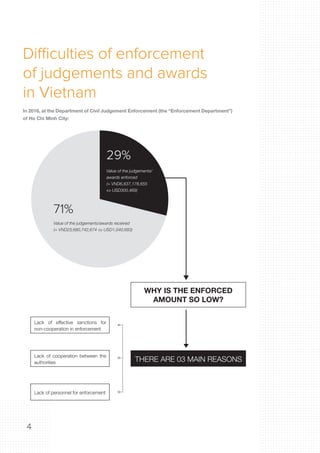
In 2016, at the Department of Civil Judgement Enforcement (the “Enforcement Department”)
of Ho Chi Minh City:
Difficulties of enforcement
of judgements and awards
in Vietnam
71%
29%
WHY IS THE ENFORCED
AMOUNT SO LOW?
THERE ARE 03 MAIN REASONS
Value of the judgements/
awards enforced
(= VND6,837,178,655
⇔ USD300,469)
Value of the judgements/awards received
(= VND23,680,742,674 ⇔ USD1,040,683)
Lack of effective sanctions for
non-cooperation in enforcement
Lack of cooperation between the
authorities
Lack of personnel for enforcement
5
Lack of effective sanctions for non-cooperation
in enforcement
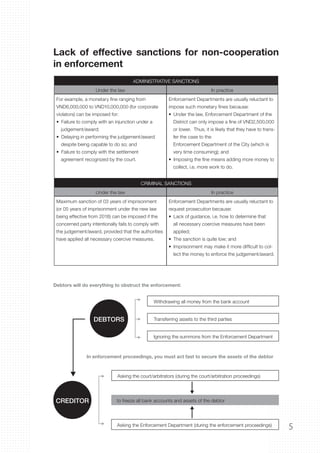
ADMINISTRATIVE SANCTIONS
Under the law In practice
For example, a monetary fine ranging from
VND6,000,000 to VND10,000,000 (for corporate
violators) can be imposed for:
•  Failure to comply with an injunction under a
judgement/award;
•  Delaying in performing the judgement/award
despite being capable to do so; and
•  Failure to comply with the settlement
agreement recognized by the court.
Enforcement Departments are usually reluctant to
impose such monetary fines because:
•  Under the law, Enforcement Department of the
District can only impose a fine of VND2,500,000
or lower. Thus, it is likely that they have to trans-
fer the case to the
Enforcement Department of the City (which is
very time consuming); and
•  Imposing the fine means adding more money to
collect, i.e. more work to do.
CRIMINAL SANCTIONS
Under the law In practice
Maximum sanction of 03 years of imprisonment
(or 05 years of imprisonment under the new law
being effective from 2018) can be imposed if the
concerned party intentionally fails to comply with
the judgement/award, provided that the authorities
have applied all necessary coercive measures.
Enforcement Departments are usually reluctant to
request prosecution because:
•  Lack of guidance, i.e. how to determine that
all necessary coercive measures have been
applied;
•  The sanction is quite low; and
•  Imprisonment may make it more difficult to col-
lect the money to enforce the judgement/award.
In enforcement proceedings, you must act fast to secure the assets of the debtor
to freeze all bank accounts and assets of the debtorCREDITOR
Asking the Enforcement Department (during the enforcement proceedings)
Asking the court/arbitrators (during the court/arbitration proceedings)
Debtors will do everything to obstruct the enforcement:
DEBTORS
Withdrawing all money from the bank account
Transferring assets to the third parties
Ignoring the summons from the Enforcement Department
6
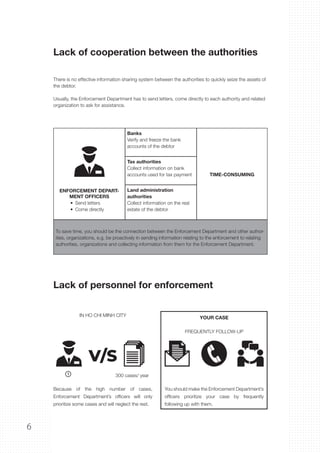
There is no effective information sharing system between the authorities to quickly seize the assets of
the debtor.
Usually, the Enforcement Department has to send letters, come directly to each authority and related
organization to ask for assistance.
Lack of cooperation between the authorities
Lack of personnel for enforcement
ENFORCEMENT DEPART-
MENT OFFICERS
•  Send letters
•  Come directly
Banks
Verify and freeze the bank
accounts of the debtor
TIME-CONSUMING
Tax authorities
Collect information on bank
accounts used for tax payment
Land administration
authorities
Collect information on the real
estate of the debtor
To save time, you should be the connection between the Enforcement Department and other author-
ities, organizations, e.g. be proactively in sending information relating to the enforcement to relating
authorities, organizations and collecting information from them for the Enforcement Department.
IN HO CHI MINH CITY
300 cases/ year
Because of the high number of cases,
Enforcement Department’s officers will only
prioritize some cases and will neglect the rest.
V/S
FREQUENTLY FOLLOW-UP
You should make the Enforcement Department’s
officers prioritize your case by frequently
following up with them.
YOUR CASE
7
Negotiations and agreements
regarding the scope of
enforcement
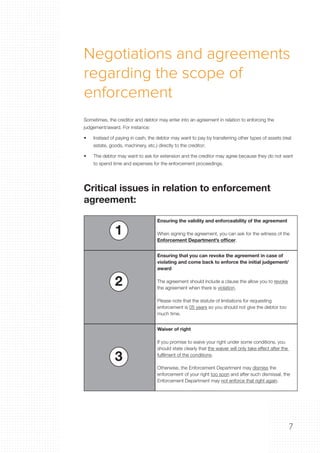
Sometimes, the creditor and debtor may enter into an agreement in relation to enforcing the
judgement/award. For instance:
•	 Instead of paying in cash, the debtor may want to pay by transferring other types of assets (real
estate, goods, machinery, etc.) directly to the creditor;
•	 The debtor may want to ask for extension and the creditor may agree because they do not want
to spend time and expenses for the enforcement proceedings.
Critical issues in relation to enforcement
agreement:
Ensuring the validity and enforceability of the agreement
When signing the agreement, you can ask for the witness of the
Enforcement Department’s officer.
Ensuring that you can revoke the agreement in case of
violating and come back to enforce the initial judgement/
award
The agreement should include a clause the allow you to revoke
the agreement when there is violation.
Please note that the statute of limitations for requesting
enforcement is 05 years so you should not give the debtor too
much time.
Waiver of right
If you promise to waive your right under some conditions, you
should state clearly that the waiver will only take effect after the
fulfilment of the conditions.
Otherwise, the Enforcement Department may dismiss the
enforcement of your right too soon and after such dismissal, the
Enforcement Department may not enforce that right again.
1
2
3
8
•	 Money in the debtor’s bank accounts is the easiest and fastest one to seize
•	 Seizing other types of assets will be more time-consuming because these assets must be evaluated
for their values and are usually sold via auction
•	 You may consider taking some actions to pressure the debtors so that they will pay you sooner:
	  Banning the legal representative of the debtor from leaving the country.
	  Disclosing the judgement/award to the public.
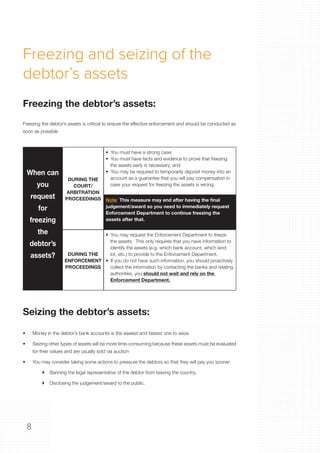
Freezing the debtor’s assets is critical to ensure the effective enforcement and should be conducted as
soon as possible
Freezing the debtor’s assets:
Seizing the debtor’s assets:
When can
you
request
for
freezing
the
debtor’s
assets?
DURING THE
COURT/
ARBITRATION
PROCEEDINGS
•  You must have a strong case;
•  You must have facts and evidence to prove that freezing
the assets early is necessary; and
•  You may be required to temporarily deposit money into an
account as a guarantee that you will pay compensation in
case your request for freezing the assets is wrong.
Note: This measure may end after having the final
judgement/award so you need to immediately request
Enforcement Department to continue freezing the
assets after that.
DURING THE
ENFORCEMENT
PROCEEDINGS
•  You may request the Enforcement Department to freeze
the assets. This only requires that you have information to
identify the assets (e.g. which bank account, which land
lot, etc.) to provide to the Enforcement Department.
•  If you do not have such information, you should proactively
collect the information by contacting the banks and relating
authorities, you should not wait and rely on the
Enforcement Department.
Freezing and seizing of the
debtor’s assets
9
Navigating the vague
language in court judgements
and arbitral awards
ARBITRATORSCOURT
COME BACK TO ASK
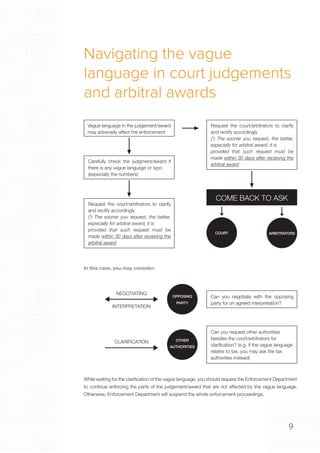
Vague language in the judgement/award
may adversely affect the enforcement
Carefully check the judgment/award if
there is any vague language or typo
(especially the numbers)
Request the court/arbitrators to clarify
and rectify accordingly
(*) The sooner you request, the better,
especially for arbitral award, it is
provided that such request must be
made within 30 days after receiving the
arbitral award
Request the court/arbitrators to clarify
and rectify accordingly
(*) The sooner you request, the better,
especially for arbitral award, it is
provided that such request must be
made within 30 days after receiving the
arbitral award
In this case, you may consider:
While waiting for the clarification of the vague language, you should request the Enforcement Department
to continue enforcing the parts of the judgement/award that are not affected by the vague language.
Otherwise, Enforcement Department will suspend the whole enforcement proceedings.
OTHER
AUTHORITIES
OPPOSING
PARTY
Can you negotiate with the opposing
party for an agreed interpretation?
Can you request other authorities
besides the court/arbitrators for
clarification? (e.g. if the vague language
relates to tax, you may ask the tax
authorities instead)
NEGOTIATING
INTERPRETATION
CLARIFICATION
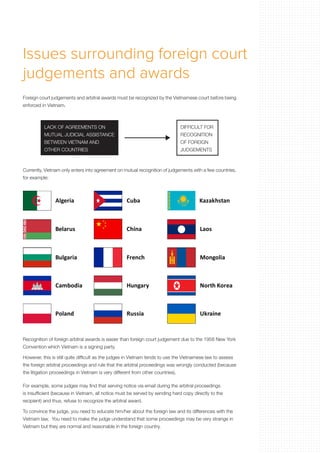
Issues surrounding foreign court
judgements and awards
Foreign court judgements and arbitral awards must be recognized by the Vietnamese court before being
enforced in Vietnam.
Currently, Vietnam only enters into agreement on mutual recognition of judgements with a few countries,
for example:
LACK OF AGREEMENTS ON
MUTUAL JUDICIAL ASSISTANCE
BETWEEN VIETNAM AND
OTHER COUNTRIES
DIFFICULT FOR
RECOGNITION
OF FOREIGN
JUDGEMENTS
Belarus Laos
Russia
China
Bulgaria MongoliaFrench
Ukraine
HungaryCambodia North Korea
Algeria
Poland
Cuba Kazakhstan
Recognition of foreign arbitral awards is easier than foreign court judgement due to the 1958 New York
Convention which Vietnam is a signing party.
However, this is still quite difficult as the judges in Vietnam tends to use the Vietnamese law to assess
the foreign arbitral proceedings and rule that the arbitral proceedings was wrongly conducted (because
the litigation proceedings in Vietnam is very different from other countries).
For example, some judges may find that serving notice via email during the arbitral proceedings
is insufficient (because in Vietnam, all notice must be served by sending hard copy directly to the
recipient) and thus, refuse to recognize the arbitral award.
To convince the judge, you need to educate him/her about the foreign law and its differences with the
Vietnam law. You need to make the judge understand that some proceedings may be very strange in
Vietnam but they are normal and reasonable in the foreign country.
LE & TRAN Building
No.9, Area 284 Nguyen Trong Tuyen Street,
Ward 10, Phu Nhuan District, Ho Chi Minh City.
T: (+84 28) 38 42 12 42/ F: (+84 28) 38 44 40 80
E: info@letranlaw.com/ www.letranlaw.com
R
ECOMMENDEDFIR
M
R
ECOMMENDE
D
Highly Ranked
2017
Highly Ranked
2017
The winer of
Dispute Star of the Year
2017
PROFESSIONAL INDEMNITY INSURANCE VALUED AT USD1,000,000 UNDER THE INSURANCE POLICY CONTRACTED WITH QBE INSURANCE (VIETNAM)
EXCELLENT TAX ACHIEVEMENT in the 2017 Fiscal Year

LeTran.Litigation Law Review. No.5/2018

  • 1.
    No.5/2018 •  JEDGEMENT •  ENFORCEMENT JUDGEMENT ENFORCEMENT inVietnam ©2018 LE & TRAN. All rights reserved. We accept no liability for contents and information and printing/producing errors. Attorney Advertising.
  • 2.
    Authors Mr. Stephen LeHoang Chuong Senior Litigator - Managing Partner hoangchuong.le@letranlaw.com Mr. Derek Phan Van Cong Danh Litigator congdanh.phan@letranlaw.com Mr. Chad L. Meek Affiliate Counsel chadmeek@letranlaw.com
  • 3.
    Contents Difficulties of enforcementof judgements and awards in Vietnam. Navigating the vague language in court judgements and arbitral awards. Negotiations and agreements regarding the scope of enforcement. Issues surrounding foreign court judgements and awards. Freezing and seizing of the debtor’s assets. 4 7 9 8 10
  • 4.
    4 In 2016, atthe Department of Civil Judgement Enforcement (the “Enforcement Department”) of Ho Chi Minh City: Difficulties of enforcement of judgements and awards in Vietnam 71% 29% WHY IS THE ENFORCED AMOUNT SO LOW? THERE ARE 03 MAIN REASONS Value of the judgements/ awards enforced (= VND6,837,178,655 ⇔ USD300,469) Value of the judgements/awards received (= VND23,680,742,674 ⇔ USD1,040,683) Lack of effective sanctions for non-cooperation in enforcement Lack of cooperation between the authorities Lack of personnel for enforcement
  • 5.
    5 Lack of effectivesanctions for non-cooperation in enforcement ADMINISTRATIVE SANCTIONS Under the law In practice For example, a monetary fine ranging from VND6,000,000 to VND10,000,000 (for corporate violators) can be imposed for: •  Failure to comply with an injunction under a judgement/award; •  Delaying in performing the judgement/award despite being capable to do so; and •  Failure to comply with the settlement agreement recognized by the court. Enforcement Departments are usually reluctant to impose such monetary fines because: •  Under the law, Enforcement Department of the District can only impose a fine of VND2,500,000 or lower. Thus, it is likely that they have to trans- fer the case to the Enforcement Department of the City (which is very time consuming); and •  Imposing the fine means adding more money to collect, i.e. more work to do. CRIMINAL SANCTIONS Under the law In practice Maximum sanction of 03 years of imprisonment (or 05 years of imprisonment under the new law being effective from 2018) can be imposed if the concerned party intentionally fails to comply with the judgement/award, provided that the authorities have applied all necessary coercive measures. Enforcement Departments are usually reluctant to request prosecution because: •  Lack of guidance, i.e. how to determine that all necessary coercive measures have been applied; •  The sanction is quite low; and •  Imprisonment may make it more difficult to col- lect the money to enforce the judgement/award. In enforcement proceedings, you must act fast to secure the assets of the debtor to freeze all bank accounts and assets of the debtorCREDITOR Asking the Enforcement Department (during the enforcement proceedings) Asking the court/arbitrators (during the court/arbitration proceedings) Debtors will do everything to obstruct the enforcement: DEBTORS Withdrawing all money from the bank account Transferring assets to the third parties Ignoring the summons from the Enforcement Department
  • 6.
    6 There is noeffective information sharing system between the authorities to quickly seize the assets of the debtor. Usually, the Enforcement Department has to send letters, come directly to each authority and related organization to ask for assistance. Lack of cooperation between the authorities Lack of personnel for enforcement ENFORCEMENT DEPART- MENT OFFICERS •  Send letters •  Come directly Banks Verify and freeze the bank accounts of the debtor TIME-CONSUMING Tax authorities Collect information on bank accounts used for tax payment Land administration authorities Collect information on the real estate of the debtor To save time, you should be the connection between the Enforcement Department and other author- ities, organizations, e.g. be proactively in sending information relating to the enforcement to relating authorities, organizations and collecting information from them for the Enforcement Department. IN HO CHI MINH CITY 300 cases/ year Because of the high number of cases, Enforcement Department’s officers will only prioritize some cases and will neglect the rest. V/S FREQUENTLY FOLLOW-UP You should make the Enforcement Department’s officers prioritize your case by frequently following up with them. YOUR CASE
  • 7.
    7 Negotiations and agreements regardingthe scope of enforcement Sometimes, the creditor and debtor may enter into an agreement in relation to enforcing the judgement/award. For instance: • Instead of paying in cash, the debtor may want to pay by transferring other types of assets (real estate, goods, machinery, etc.) directly to the creditor; • The debtor may want to ask for extension and the creditor may agree because they do not want to spend time and expenses for the enforcement proceedings. Critical issues in relation to enforcement agreement: Ensuring the validity and enforceability of the agreement When signing the agreement, you can ask for the witness of the Enforcement Department’s officer. Ensuring that you can revoke the agreement in case of violating and come back to enforce the initial judgement/ award The agreement should include a clause the allow you to revoke the agreement when there is violation. Please note that the statute of limitations for requesting enforcement is 05 years so you should not give the debtor too much time. Waiver of right If you promise to waive your right under some conditions, you should state clearly that the waiver will only take effect after the fulfilment of the conditions. Otherwise, the Enforcement Department may dismiss the enforcement of your right too soon and after such dismissal, the Enforcement Department may not enforce that right again. 1 2 3
  • 8.
    8 • Money inthe debtor’s bank accounts is the easiest and fastest one to seize • Seizing other types of assets will be more time-consuming because these assets must be evaluated for their values and are usually sold via auction • You may consider taking some actions to pressure the debtors so that they will pay you sooner:  Banning the legal representative of the debtor from leaving the country.  Disclosing the judgement/award to the public. Freezing the debtor’s assets is critical to ensure the effective enforcement and should be conducted as soon as possible Freezing the debtor’s assets: Seizing the debtor’s assets: When can you request for freezing the debtor’s assets? DURING THE COURT/ ARBITRATION PROCEEDINGS •  You must have a strong case; •  You must have facts and evidence to prove that freezing the assets early is necessary; and •  You may be required to temporarily deposit money into an account as a guarantee that you will pay compensation in case your request for freezing the assets is wrong. Note: This measure may end after having the final judgement/award so you need to immediately request Enforcement Department to continue freezing the assets after that. DURING THE ENFORCEMENT PROCEEDINGS •  You may request the Enforcement Department to freeze the assets. This only requires that you have information to identify the assets (e.g. which bank account, which land lot, etc.) to provide to the Enforcement Department. •  If you do not have such information, you should proactively collect the information by contacting the banks and relating authorities, you should not wait and rely on the Enforcement Department. Freezing and seizing of the debtor’s assets
  • 9.
    9 Navigating the vague languagein court judgements and arbitral awards ARBITRATORSCOURT COME BACK TO ASK Vague language in the judgement/award may adversely affect the enforcement Carefully check the judgment/award if there is any vague language or typo (especially the numbers) Request the court/arbitrators to clarify and rectify accordingly (*) The sooner you request, the better, especially for arbitral award, it is provided that such request must be made within 30 days after receiving the arbitral award Request the court/arbitrators to clarify and rectify accordingly (*) The sooner you request, the better, especially for arbitral award, it is provided that such request must be made within 30 days after receiving the arbitral award In this case, you may consider: While waiting for the clarification of the vague language, you should request the Enforcement Department to continue enforcing the parts of the judgement/award that are not affected by the vague language. Otherwise, Enforcement Department will suspend the whole enforcement proceedings. OTHER AUTHORITIES OPPOSING PARTY Can you negotiate with the opposing party for an agreed interpretation? Can you request other authorities besides the court/arbitrators for clarification? (e.g. if the vague language relates to tax, you may ask the tax authorities instead) NEGOTIATING INTERPRETATION CLARIFICATION
  • 10.
    Issues surrounding foreigncourt judgements and awards Foreign court judgements and arbitral awards must be recognized by the Vietnamese court before being enforced in Vietnam. Currently, Vietnam only enters into agreement on mutual recognition of judgements with a few countries, for example: LACK OF AGREEMENTS ON MUTUAL JUDICIAL ASSISTANCE BETWEEN VIETNAM AND OTHER COUNTRIES DIFFICULT FOR RECOGNITION OF FOREIGN JUDGEMENTS Belarus Laos Russia China Bulgaria MongoliaFrench Ukraine HungaryCambodia North Korea Algeria Poland Cuba Kazakhstan Recognition of foreign arbitral awards is easier than foreign court judgement due to the 1958 New York Convention which Vietnam is a signing party. However, this is still quite difficult as the judges in Vietnam tends to use the Vietnamese law to assess the foreign arbitral proceedings and rule that the arbitral proceedings was wrongly conducted (because the litigation proceedings in Vietnam is very different from other countries). For example, some judges may find that serving notice via email during the arbitral proceedings is insufficient (because in Vietnam, all notice must be served by sending hard copy directly to the recipient) and thus, refuse to recognize the arbitral award. To convince the judge, you need to educate him/her about the foreign law and its differences with the Vietnam law. You need to make the judge understand that some proceedings may be very strange in Vietnam but they are normal and reasonable in the foreign country.
  • 11.
    LE & TRANBuilding No.9, Area 284 Nguyen Trong Tuyen Street, Ward 10, Phu Nhuan District, Ho Chi Minh City. T: (+84 28) 38 42 12 42/ F: (+84 28) 38 44 40 80 E: info@letranlaw.com/ www.letranlaw.com R ECOMMENDEDFIR M R ECOMMENDE D Highly Ranked 2017 Highly Ranked 2017 The winer of Dispute Star of the Year 2017 PROFESSIONAL INDEMNITY INSURANCE VALUED AT USD1,000,000 UNDER THE INSURANCE POLICY CONTRACTED WITH QBE INSURANCE (VIETNAM) EXCELLENT TAX ACHIEVEMENT in the 2017 Fiscal Year