LESSON 2
Question 1 of 20
0.0/ 5.0 Points
Use Gaussian elimination to find the complete solution to the
system of equations, or state that none exists.
3x - 2y + 2z - w = 2
4x + y + z + 6w = 8
-3x + 2y - 2z + w = 5
5x + 3z - 2w = 1
A. {(2, 0, -
,
)}
B. {(1, -
,
, 6)}
C. ∅
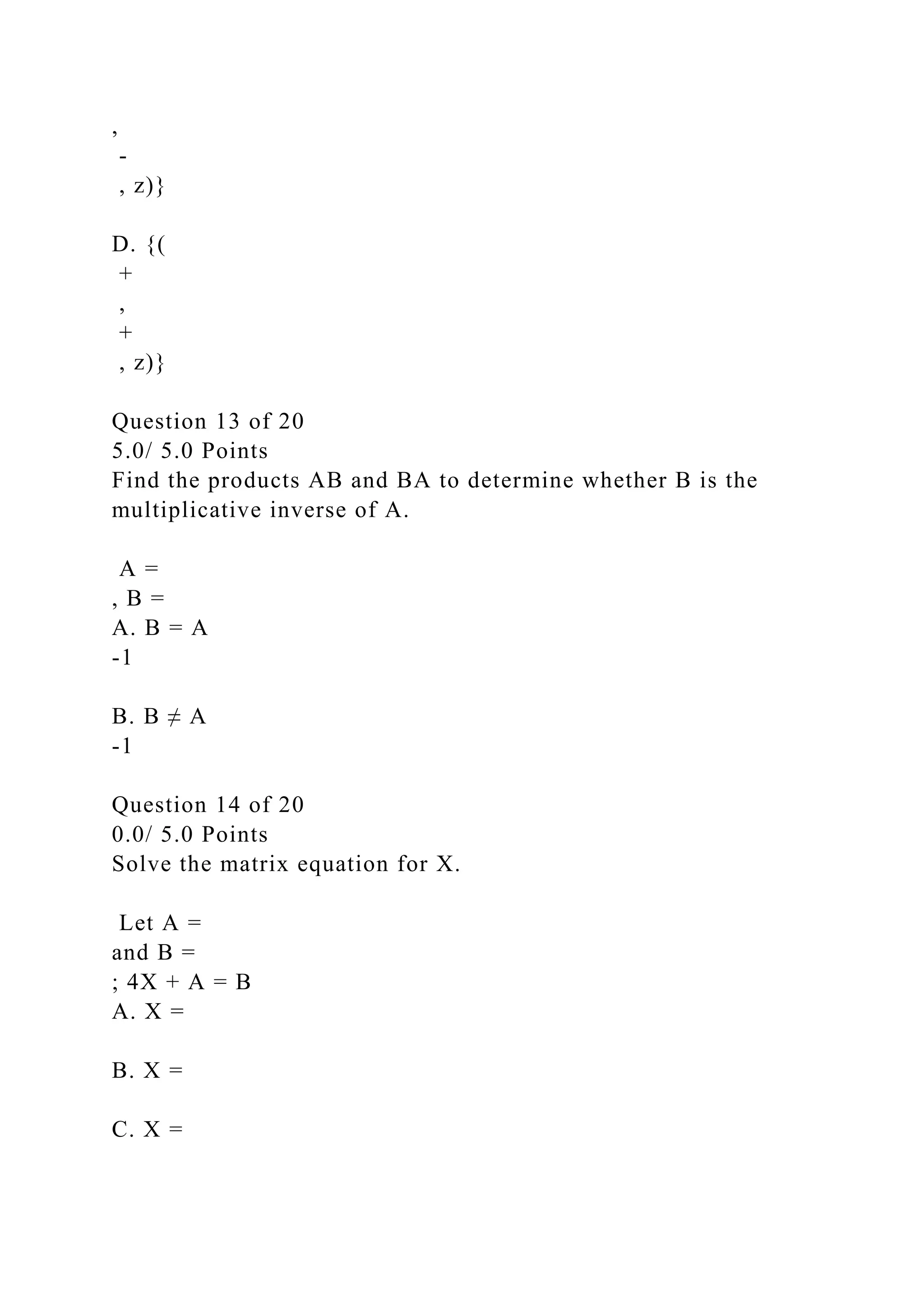
D. {(
, 0, -
,
)}
Question 2 of 20
0.0/ 5.0 Points
Solve the system of equations using matrices. Use Gauss-Jordan
elimination.
3x - 7 - 7z = 7
6x + 4y - 3z = 67
-6x - 3y + z = -62
A. {( 7, 1, 7)}
B. {( 14, 7, -7)}
C. {( -7, 7, 14)}
D. {( 7, 7, 1)}
Question 3 of 20
0.0/ 5.0 Points
Find the product AB, if possible.
A =
, B =
A.
B.
C.
D.
Question 4 of 20
0.0/ 5.0 Points
Use Cramer's rule to solve the system. 2x + 4y - z = 32 x - 2y +
2z = -5 5x + y + z = 20
A. {( 1, -9, -6)}
B. {( 2, 7, 6)}
C. {( 9, 6, 9)}
D. {( 1, 9, 6)}
Question 5 of 20
0.0/ 5.0 Points
Find the products AB and BA to determine whether B is the
multiplicative inverse of A.
A =
, B =
A. B = A
-1
B. B ≠ A
-1
Question 6 of 20
5.0/ 5.0 Points
Let A =
and B =
. Find A - 3B.
A.
B.
C.
D.
Question 7 of 20
5.0/ 5.0 Points
Find the inverse of the matrix, if possible.
A =
A.
B.
C.
D.
Question 8 of 20
0.0/ 5.0 Points
Let B = [-1 3 6 -3]. Find -4B.
A. [-4 12 24 -12]
B. [-3 1 4 -5]
C. [4 -12 -24 12]
D. [4 3 6 -3]
Question 9 of 20
0.0/ 5.0 Points
Evaluate the determinant.
A.
B.
C.
D.
Question 10 of 20
0.0/ 5.0 Points
Give the order of the matrix, and identify the given element of
the matrix.
; a12
A. 4 × 2; -11
B. 4 × 2; 14
C. 2 × 4; 14
D. 2 × 4; -11
Question 11 of 20
0.0/ 5.0 Points
Find the product AB, if possible.
A =
, B =
A.
B. AB is not defined.
C.
D.
Question 12 of 20
5.0/ 5.0 Points
Use Gaussian elimination to find the complete solution to the
system of equations, or state that none exists.
x + y + z = 9
2x - 3y + 4z = 7
x - 4y + 3z = -2
A. {(-
+
,
+
, z)}
B. {(
+
,
-
, z)}
C. {(-
+
,
-
, z)}
D. {(
+
,
+
, z)}
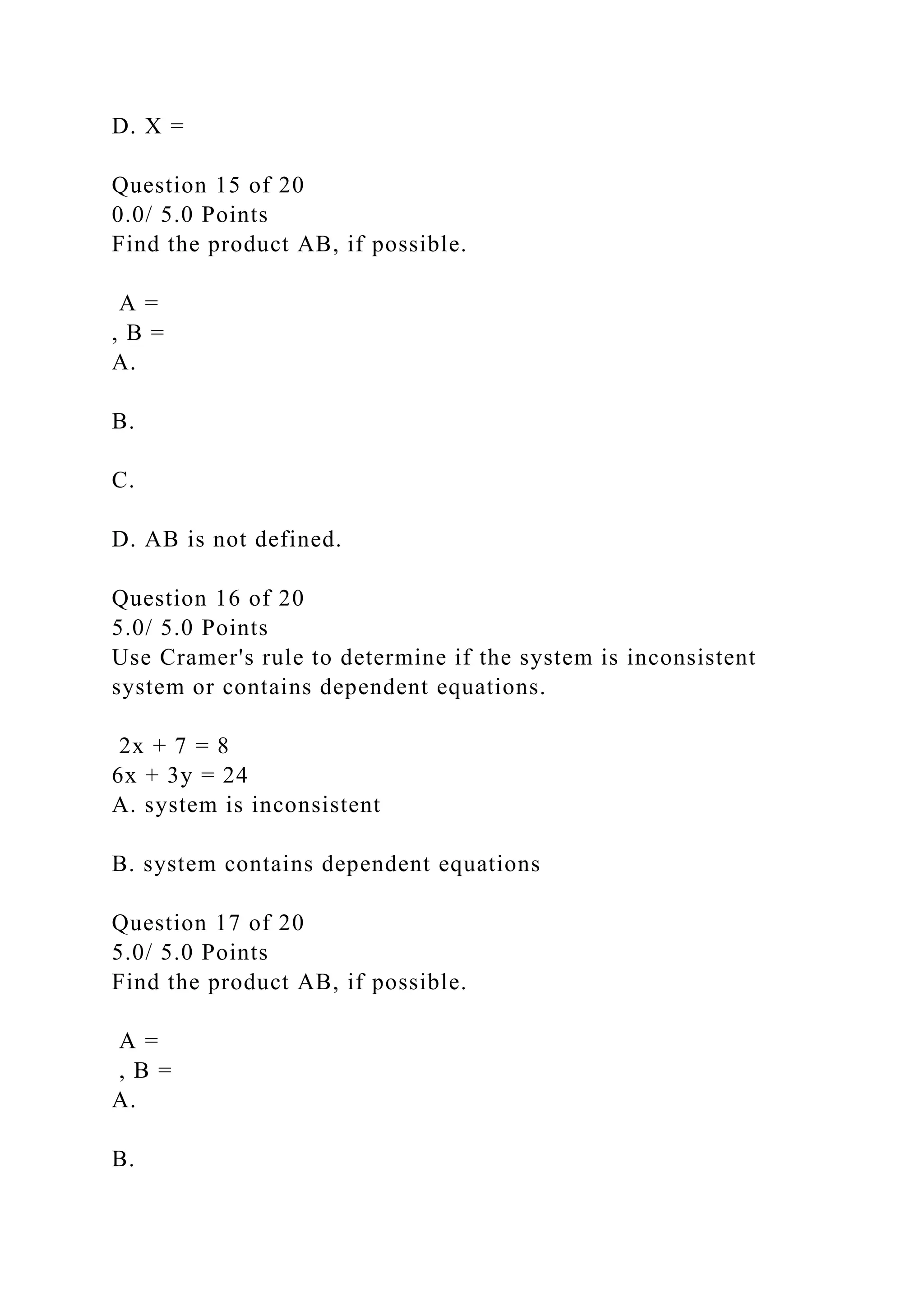
Question 13 of 20
5.0/ 5.0 Points
Find the products AB and BA to determine whether B is the
multiplicative inverse of A.
A =
, B =
A. B = A
-1
B. B ≠ A
-1
Question 14 of 20
0.0/ 5.0 Points
Solve the matrix equation for X.
Let A =
and B =
; 4X + A = B
A. X =
B. X =
C. X =
D. X =
Question 15 of 20
0.0/ 5.0 Points
Find the product AB, if possible.
A =
, B =
A.
B.
C.
D. AB is not defined.
Question 16 of 20
5.0/ 5.0 Points
Use Cramer's rule to determine if the system is inconsistent
system or contains dependent equations.
2x + 7 = 8
6x + 3y = 24
A. system is inconsistent
B. system contains dependent equations
Question 17 of 20
5.0/ 5.0 Points
Find the product AB, if possible.
A =
, B =
A.
B.
C.
D. AB is not defined.
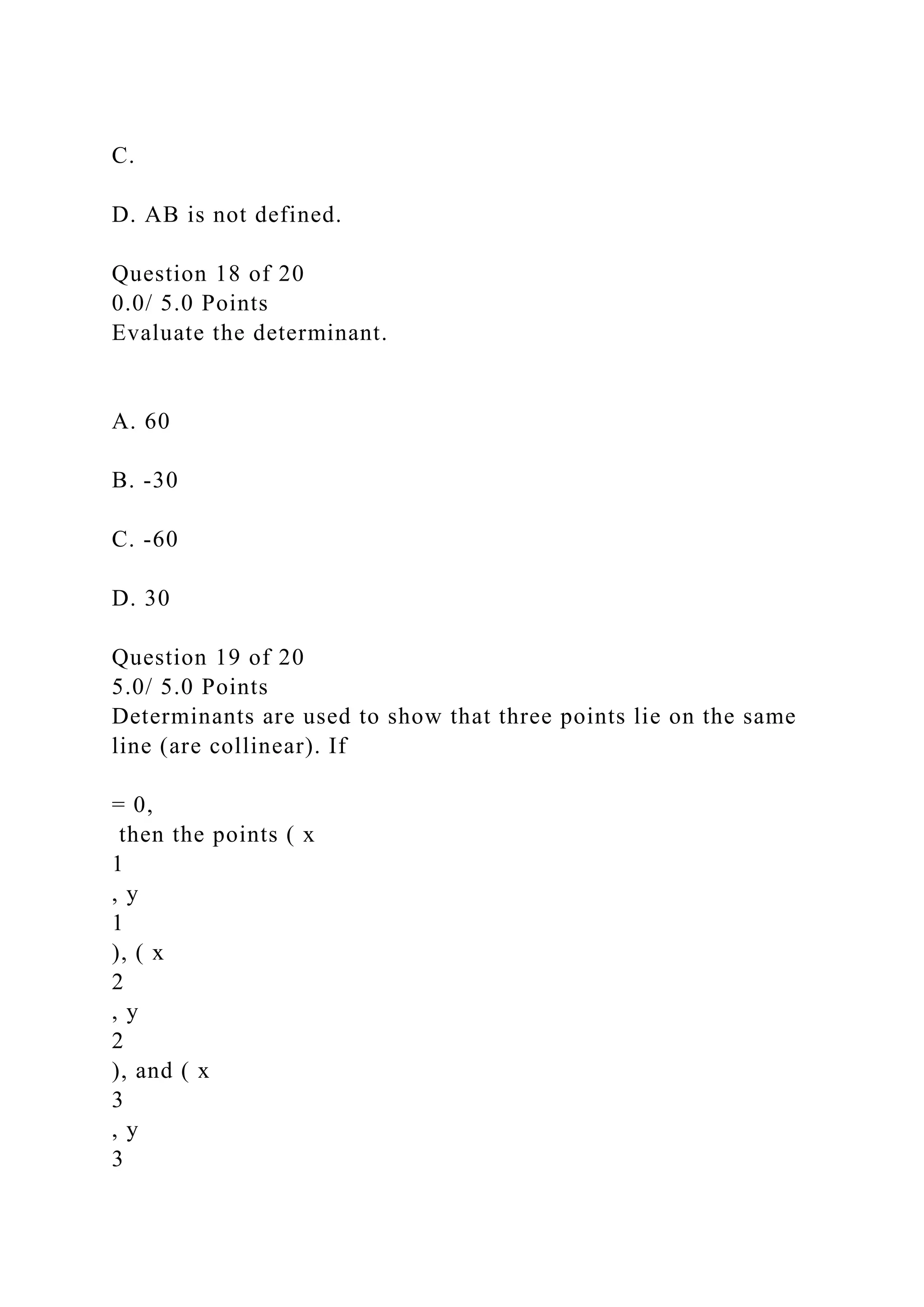
Question 18 of 20
0.0/ 5.0 Points
Evaluate the determinant.
A. 60
B. -30
C. -60
D. 30
Question 19 of 20
5.0/ 5.0 Points
Determinants are used to show that three points lie on the same
line (are collinear). If
= 0,
then the points ( x
1
, y
1
), ( x
2
, y
2
), and ( x
3
, y
3
) are collinear. If the determinant does not equal 0, then the
points are not collinear. Are the points (-2, -1), (0, 9), (-6, -21)
and collinear?
A. Yes
B. No
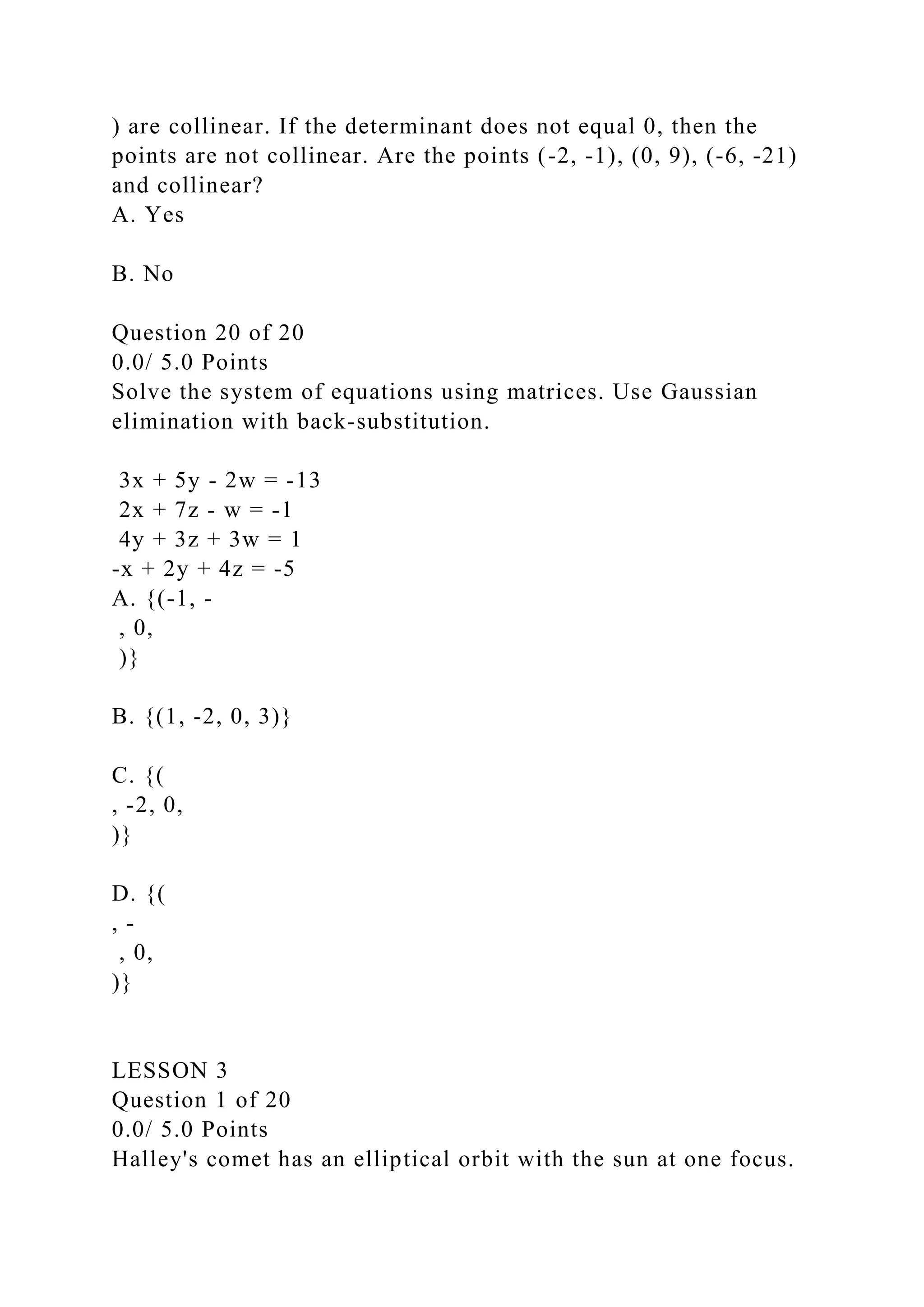
Question 20 of 20
0.0/ 5.0 Points
Solve the system of equations using matrices. Use Gaussian
elimination with back-substitution.
3x + 5y - 2w = -13
2x + 7z - w = -1
4y + 3z + 3w = 1
-x + 2y + 4z = -5
A. {(-1, -
, 0,
)}
B. {(1, -2, 0, 3)}
C. {(
, -2, 0,
)}
D. {(
, -
, 0,
)}
LESSON 3
Question 1 of 20
0.0/ 5.0 Points
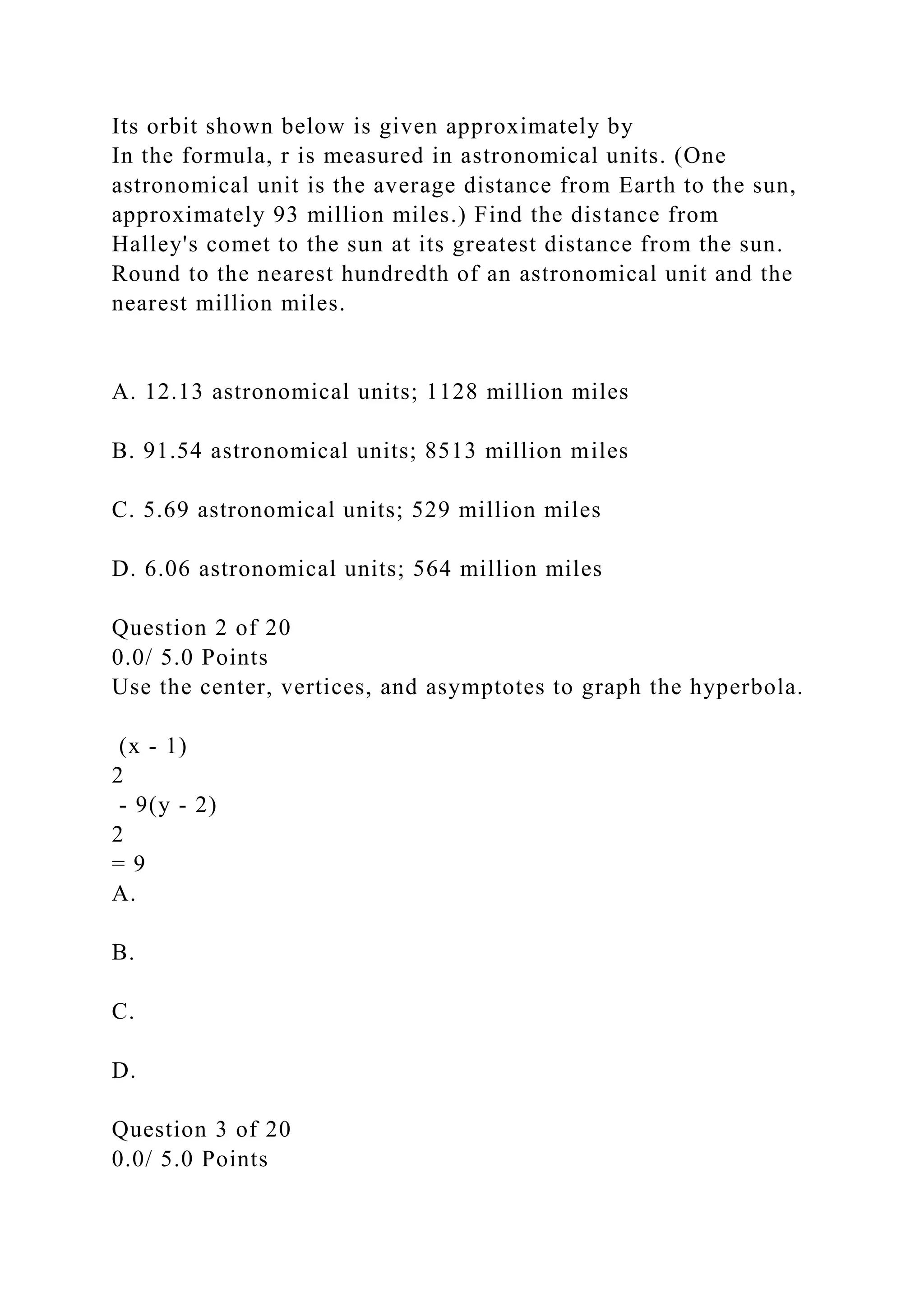
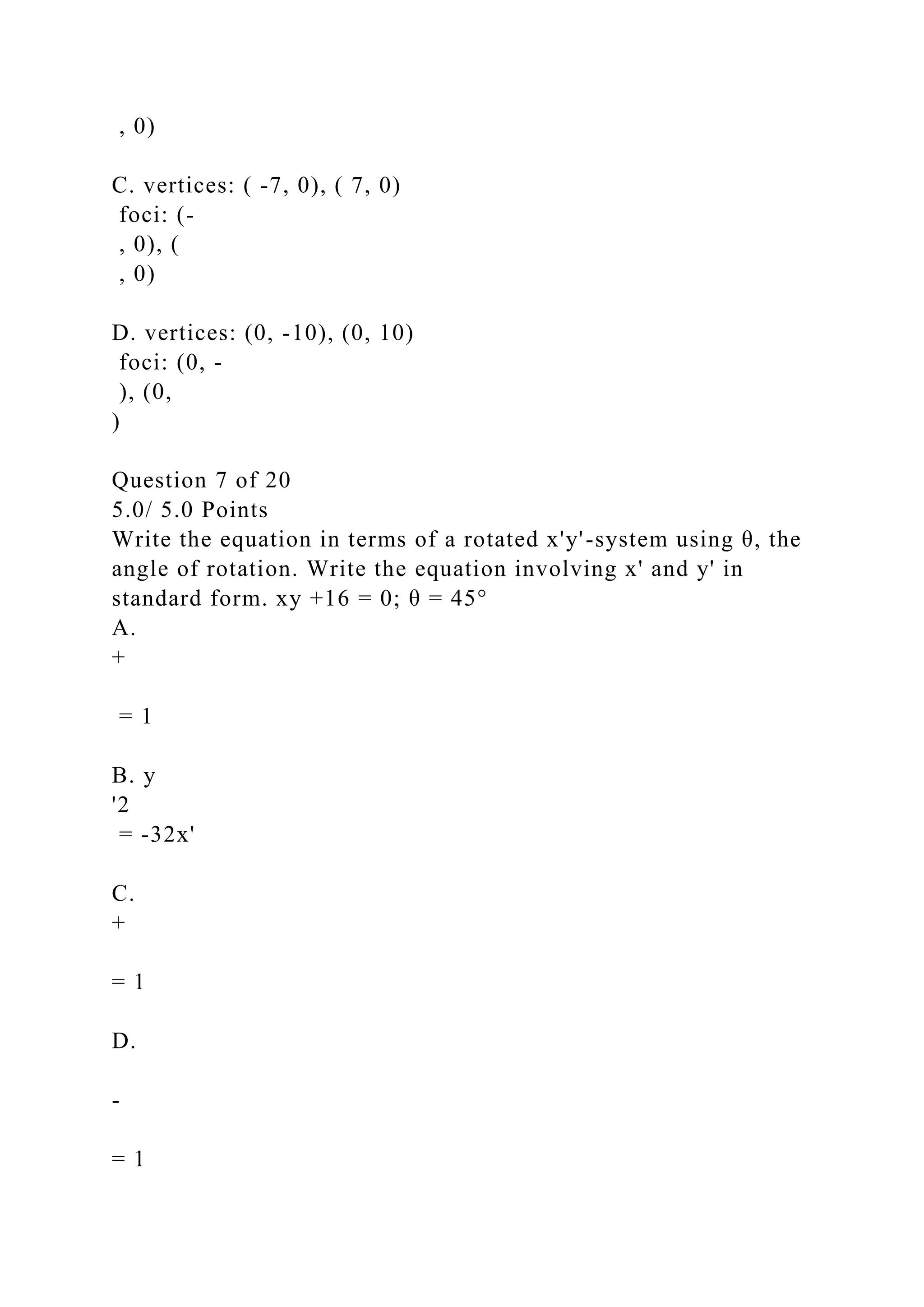
Halley's comet has an elliptical orbit with the sun at one focus.
Its orbit shown below is given approximately by
In the formula, r is measured in astronomical units. (One
astronomical unit is the average distance from Earth to the sun,
approximately 93 million miles.) Find the distance from
Halley's comet to the sun at its greatest distance from the sun.
Round to the nearest hundredth of an astronomical unit and the
nearest million miles.
A. 12.13 astronomical units; 1128 million miles
B. 91.54 astronomical units; 8513 million miles
C. 5.69 astronomical units; 529 million miles
D. 6.06 astronomical units; 564 million miles
Question 2 of 20
0.0/ 5.0 Points
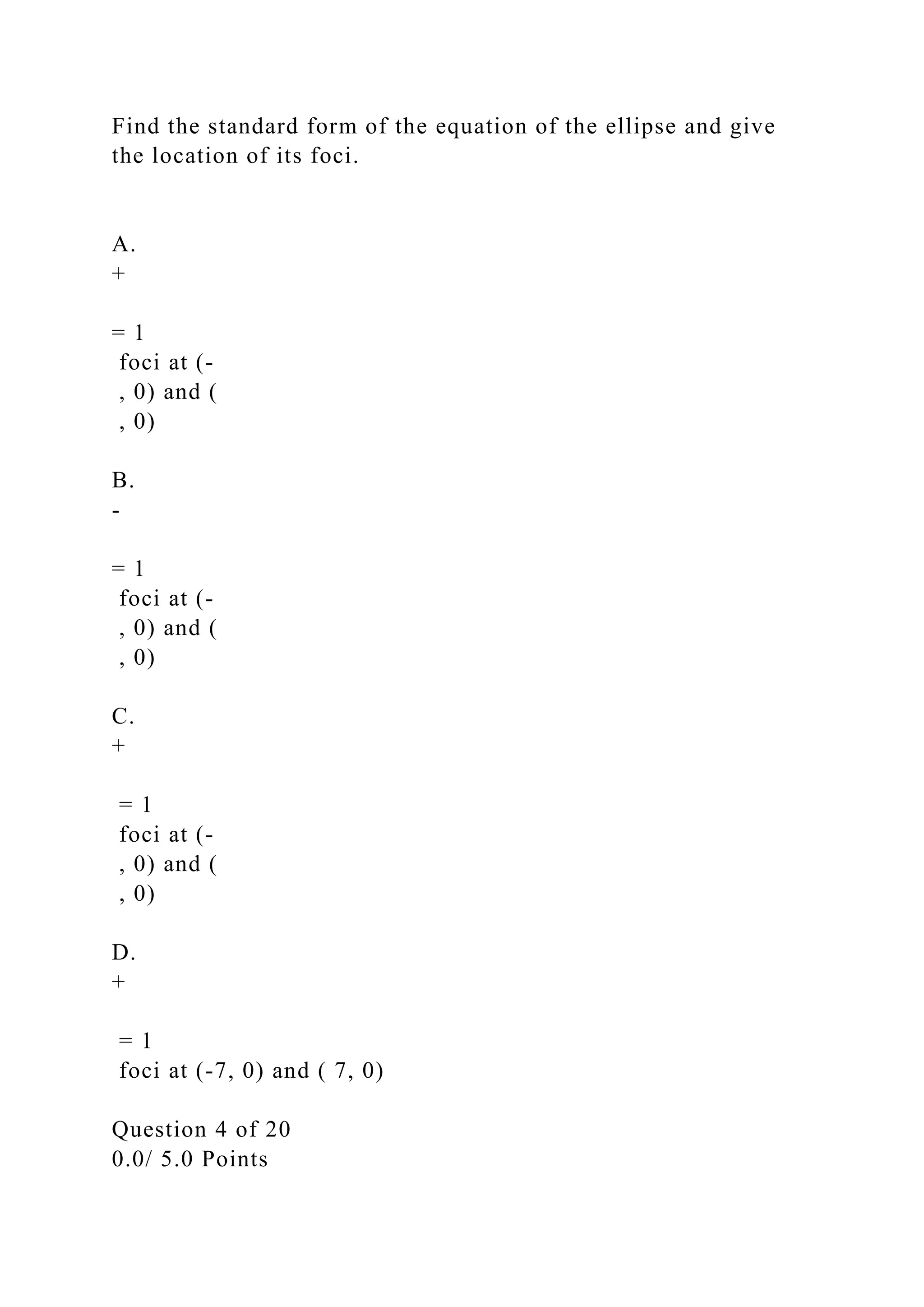
Use the center, vertices, and asymptotes to graph the hyperbola.
(x - 1)
2
- 9(y - 2)
2
= 9
A.
B.
C.
D.
Question 3 of 20
0.0/ 5.0 Points
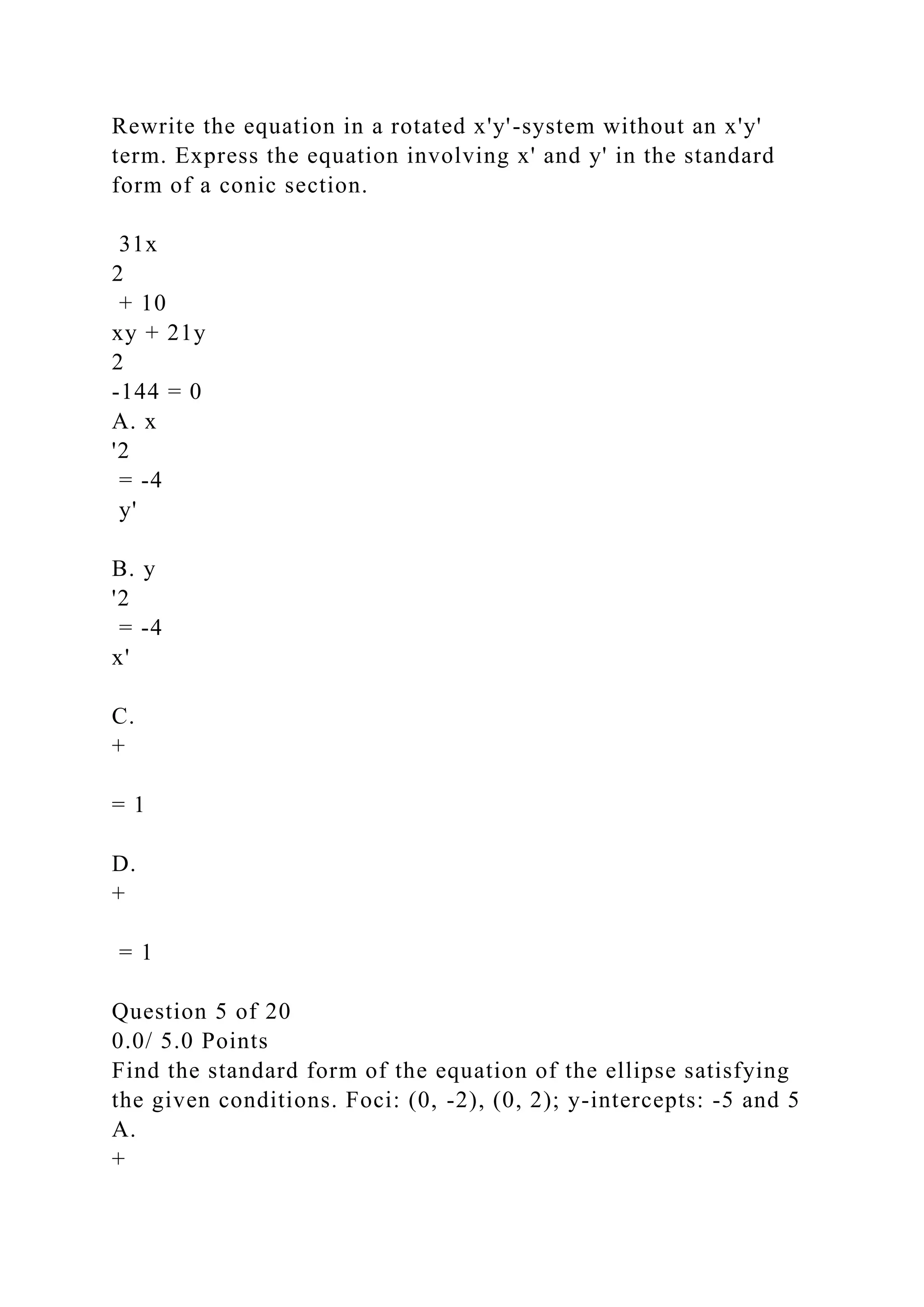
Find the standard form of the equation of the ellipse and give
the location of its foci.
A.
+
= 1
foci at (-
, 0) and (
, 0)
B.
-
= 1
foci at (-
, 0) and (
, 0)
C.
+
= 1
foci at (-
, 0) and (
, 0)
D.
+
= 1
foci at (-7, 0) and ( 7, 0)
Question 4 of 20
0.0/ 5.0 Points
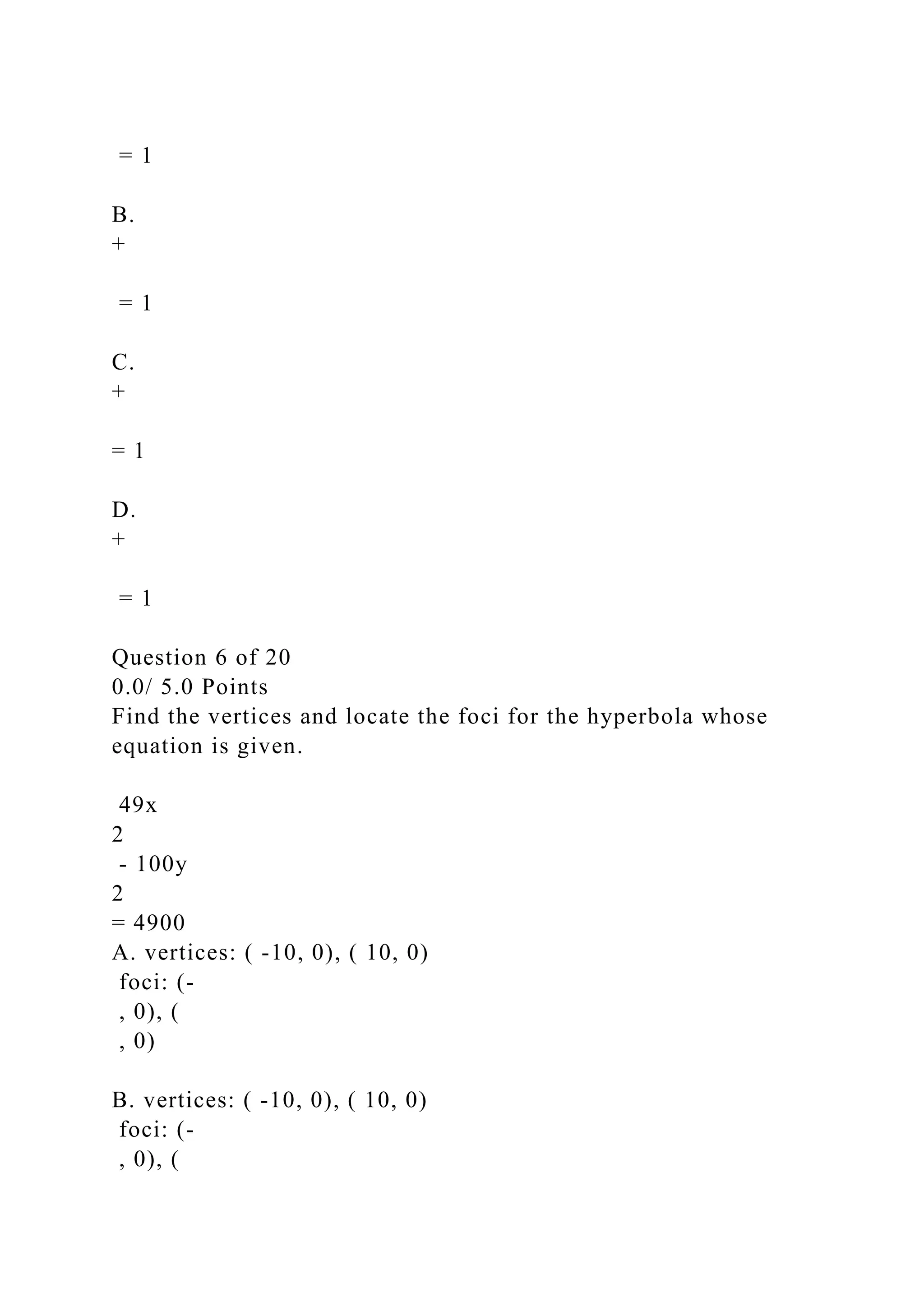
Rewrite the equation in a rotated x'y'-system without an x'y'
term. Express the equation involving x' and y' in the standard
form of a conic section.
31x
2
+ 10
xy + 21y
2
-144 = 0
A. x
'2
= -4
y'
B. y
'2
= -4
x'
C.
+
= 1
D.
+
= 1
Question 5 of 20
0.0/ 5.0 Points
Find the standard form of the equation of the ellipse satisfying
the given conditions. Foci: (0, -2), (0, 2); y-intercepts: -5 and 5
A.
+
= 1
B.
+
= 1
C.
+
= 1
D.
+
= 1
Question 6 of 20
0.0/ 5.0 Points
Find the vertices and locate the foci for the hyperbola whose
equation is given.
49x
2
- 100y
2
= 4900
A. vertices: ( -10, 0), ( 10, 0)
foci: (-
, 0), (
, 0)
B. vertices: ( -10, 0), ( 10, 0)
foci: (-
, 0), (
, 0)
C. vertices: ( -7, 0), ( 7, 0)
foci: (-
, 0), (
, 0)
D. vertices: (0, -10), (0, 10)
foci: (0, -
), (0,
)
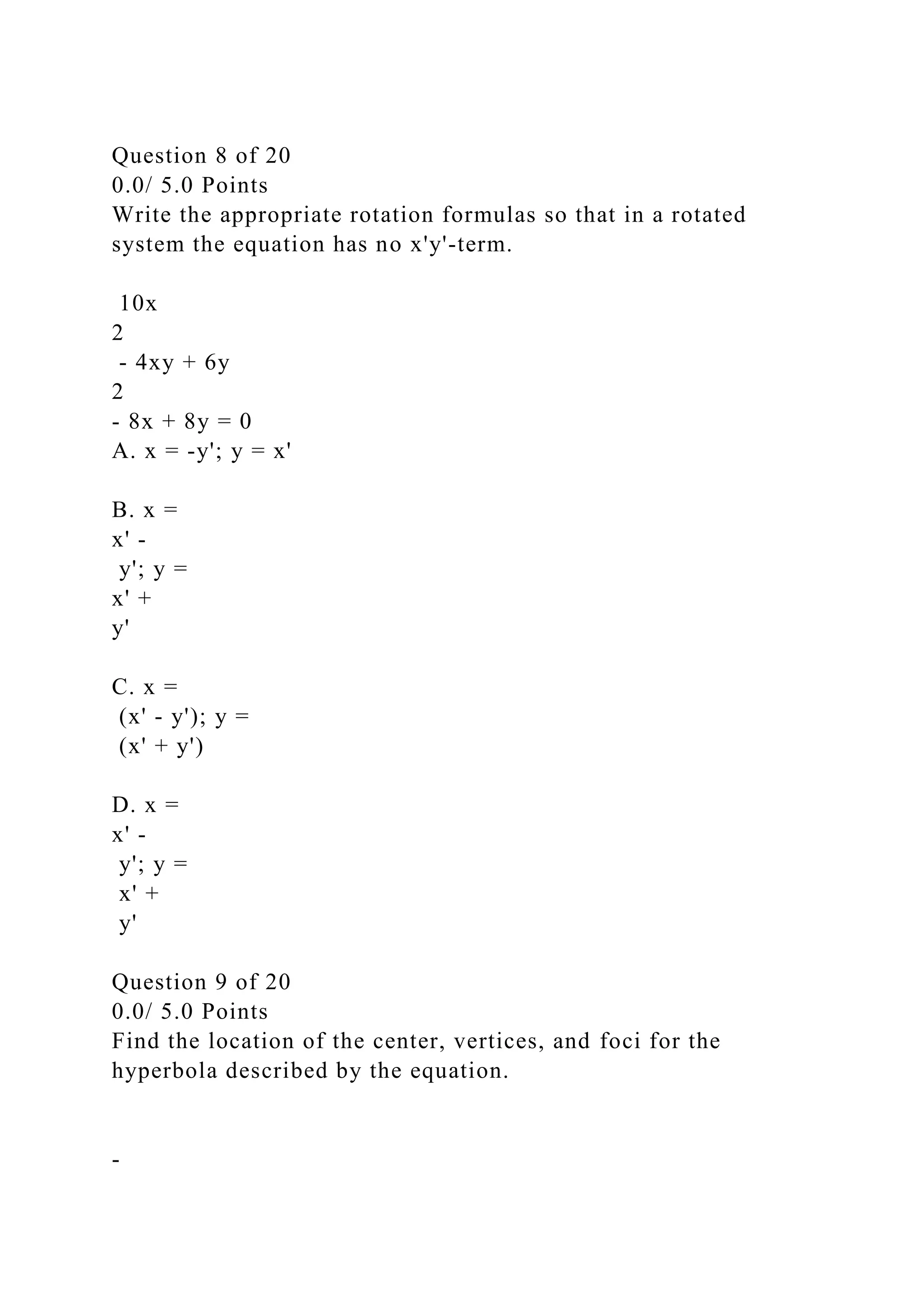
Question 7 of 20
5.0/ 5.0 Points
Write the equation in terms of a rotated x'y'-system using θ, the
angle of rotation. Write the equation involving x' and y' in
standard form. xy +16 = 0; θ = 45°
A.
+
= 1
B. y
'2
= -32x'
C.
+
= 1
D.
-
= 1
Question 8 of 20
0.0/ 5.0 Points
Write the appropriate rotation formulas so that in a rotated
system the equation has no x'y'-term.
10x
2
- 4xy + 6y
2
- 8x + 8y = 0
A. x = -y'; y = x'
B. x =
x' -
y'; y =
x' +
y'
C. x =
(x' - y'); y =
(x' + y')
D. x =
x' -
y'; y =
x' +
y'
Question 9 of 20
0.0/ 5.0 Points
Find the location of the center, vertices, and foci for the
hyperbola described by the equation.
-
= 1
A. Center: ( -4, 1); Vertices: ( -10, 1) and ( 2, 1); Foci:
and
(
B. Center: ( -4, 1); Vertices: ( -9, 1) and ( 3, 1); Foci: ( -3 +
, 2) and ( 2 +
, 2)
C. Center: ( -4, 1); Vertices: ( -10, -1) and ( 2, -1); Foci: ( -4 -
, -1) and ( -4 +
, -1)
D. Center: ( 4, -1); Vertices: ( -2, -1) and ( 10, -1); Foci:
and
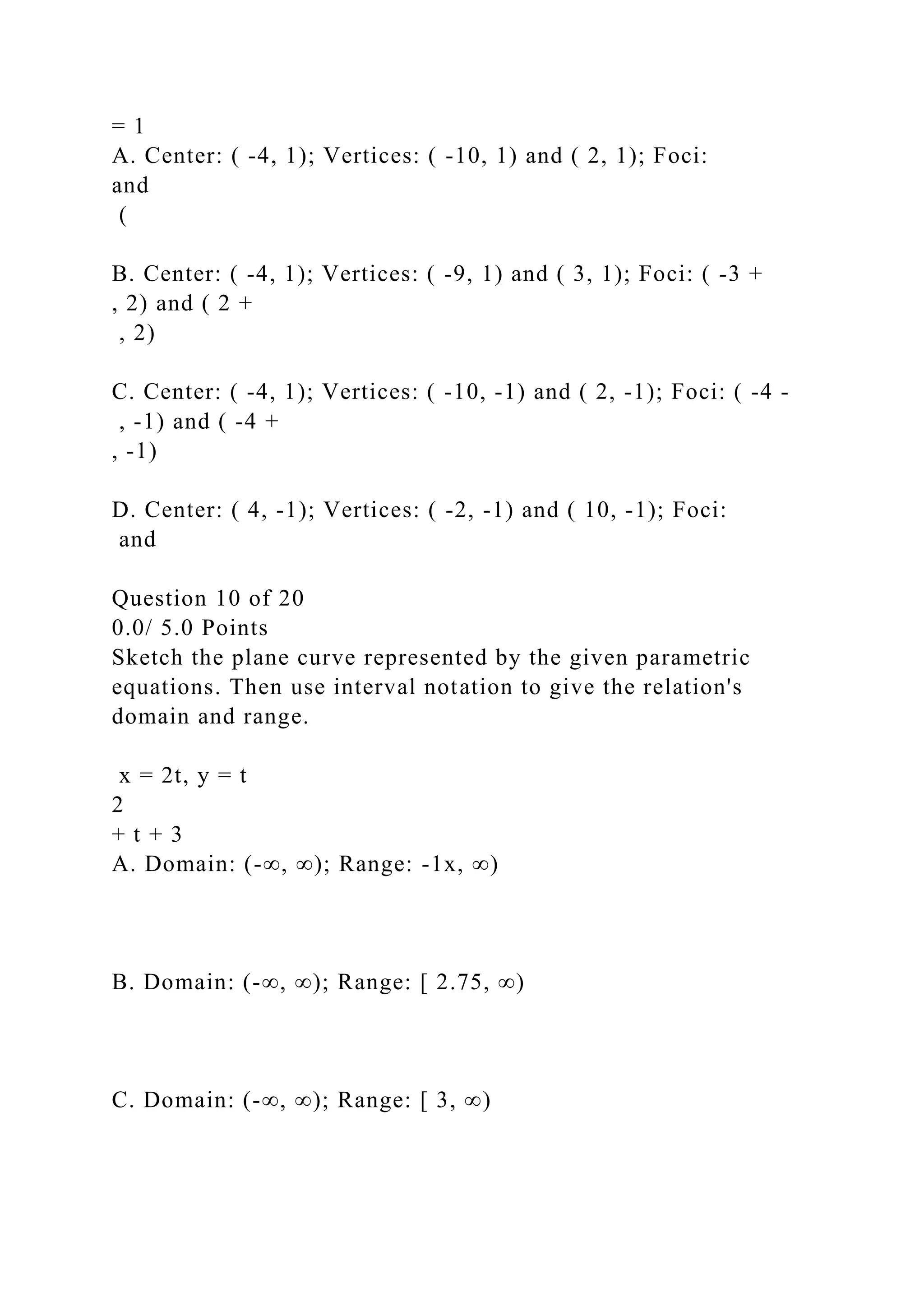
Question 10 of 20
0.0/ 5.0 Points
Sketch the plane curve represented by the given parametric
equations. Then use interval notation to give the relation's
domain and range.
x = 2t, y = t
2
+ t + 3
A. Domain: (-∞, ∞); Range: -1x, ∞)
B. Domain: (-∞, ∞); Range: [ 2.75, ∞)
C. Domain: (-∞, ∞); Range: [ 3, ∞)
D. Domain: (-∞, ∞); Range: [ 2.75, ∞)
Question 11 of 20
0.0/ 5.0 Points
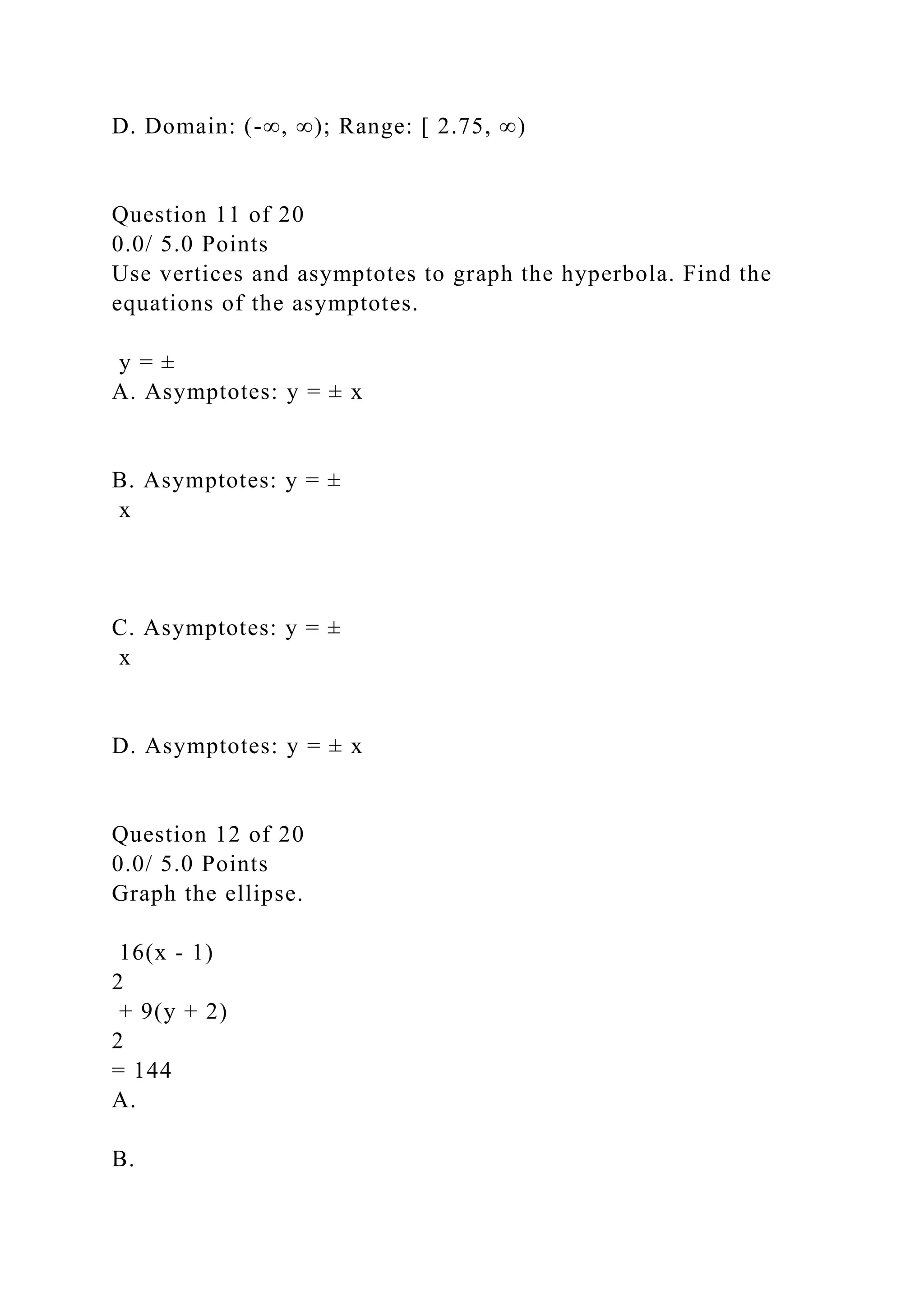
Use vertices and asymptotes to graph the hyperbola. Find the
equations of the asymptotes.
y = ±
A. Asymptotes: y = ± x
B. Asymptotes: y = ±
x
C. Asymptotes: y = ±
x
D. Asymptotes: y = ± x
Question 12 of 20
0.0/ 5.0 Points
Graph the ellipse.
16(x - 1)
2
+ 9(y + 2)
2
= 144
A.
B.
C.
D.
Question 13 of 20
0.0/ 5.0 Points
Is the relation a function?
y = x
2
+ 12x + 31
A. Yes
B. No
Question 14 of 20
5.0/ 5.0 Points
Determine the direction in which the parabola opens, and the
vertex.
y
2
= + 6x + 14
A. Opens upward; ( -3, 5)
B. Opens upward; ( 3, 5)
C. Opens to the right; ( 5, 3)
D. Opens to the right; ( 5, -3)
Question 15 of 20
0.0/ 5.0 Points
Match the equation to the graph.
x
2
= 7y
A.
B.
C.
D.
Question 16 of 20
0.0/ 5.0 Points
y
2
= -2x
A.
B.
C.
D.
Question 17 of 20
0.0/ 5.0 Points
Convert the equation to the standard form for a hyperbola by
completing the square on x and y.
x
2
- y
2
+ 6x - 4y + 4 = 0
A. (x + 3)
2
+ (y + 2)
2
= 1
B.
-
= 1
C. (x + 3)
2
- (y + 2)
2
= 1
D. (y + 3)
2
- (x + 2)
2
= 1
Question 18 of 20
0.0/ 5.0 Points
Eliminate the parameter t. Find a rectangular equation for the
plane curve defined by the parametric equations.
x = 6 cos t, y = 6 sin t; 0 ≤ t ≤ 2π
A. x
2
- y
2
= 6; -6 ≤ x ≤ 6
B. x
2
- y
2
= 36; -6 ≤ x ≤ 6
C. x
2
+ y
2
= 6; -6 ≤ x ≤ 6
D. x
2
+ y
2
= 36; -6 ≤ x ≤ 6
Question 19 of 20
5.0/ 5.0 Points
Convert the equation to the standard form for a parabola by
completing the square on x or y as appropriate.
y
2
+ 2y - 2x - 3 = 0
A. (y + 1)
2
= 2(x + 2)
B. (y - 1)
2
= -2(x + 2)
C. (y + 1)
2
= 2(x - 2)
D. (y - 1)
2
= 2(x + 2)
Question 20 of 20
0.0/ 5.0 Points
Convert the equation to the standard form for a hyperbola by
completing the square on x and y.
y
2
- 25x
2
+ 4y + 50x - 46 = 0
A.
- (x - 2)
2
= 1
B.
- (y - 1)
2
= 1
C. (x - 1)
2
-
= 1
D.
- (x - 1)
2
= 1
LESSON 4
Question 1 of 20
0.0/ 5.0 Points
The finite sequence whose general term is a
n
= 0.17n
2
- 1.02n + 6.67 where n = 1, 2, 3, ..., 9 models the total
operating costs, in millions of dollars, for a company from 1991
through 1999.
Find
A. $21.58 million
B. $27.4 million
C. $23.28 million
D. $29.1 million
Question 2 of 20
5.0/ 5.0 Points
Use the formula for the sum of the first n terms of a geometric
sequence to solve. Find the sum of the first 8 terms of the
geometric sequence: -8, -16, -32, -64, -128, . . . .
A. -2003
B. -2040
C. -2060
D. -2038
Question 3 of 20
5.0/ 5.0 Points
Find the probability. What is the probability that a card drawn
from a deck of 52 cards is not a 10?
A. 12/13
B. 9/10
C. 1/13
D. 1/10
Question 4 of 20
0.0/ 5.0 Points
Find the common difference for the arithmetic sequence. 6, 11,
16, 21, . . .
A. -15
B. -5
C. 5
D. 15
Question 5 of 20
0.0/ 5.0 Points
Find the indicated sum.
A. 28
B. 16
C. 70
D. 54
Question 6 of 20
0.0/ 5.0 Points
Evaluate the expression.
1 -
A.
B.
C.
D.
Question 7 of 20
0.0/ 5.0 Points
Find the sum of the infinite geometric series, if it exists. 4 - 1 +
-
+ . . .
A. - 1
B. 3
C.
D. does not exist
Question 8 of 20
0.0/ 5.0 Points
Find the probability. One digit from the number 3,151,221 is
written on each of seven cards. What is the probability of
drawing a card that shows 3, 1, or 5?
A. 5/7
B. 2/7
C. 4/7
D. 3/7
Question 9 of 20
0.0/ 5.0 Points
A game spinner has regions that are numbered 1 through 9. If
the spinner is used twice, what is the probability that the first
number is a 3 and the second is a 6?
A. 1/18
B. 1/81
C. 1/9
D. 2/3
Question 10 of 20
5.0/ 5.0 Points
Use the formula for the sum of the first n terms of a geometric
sequence to solve. Find the sum of the first four terms of the
geometric sequence: 2, 10, 50, . . . .
A. 312
B. 62
C. 156
D. 19
Question 11 of 20
0.0/ 5.0 Points
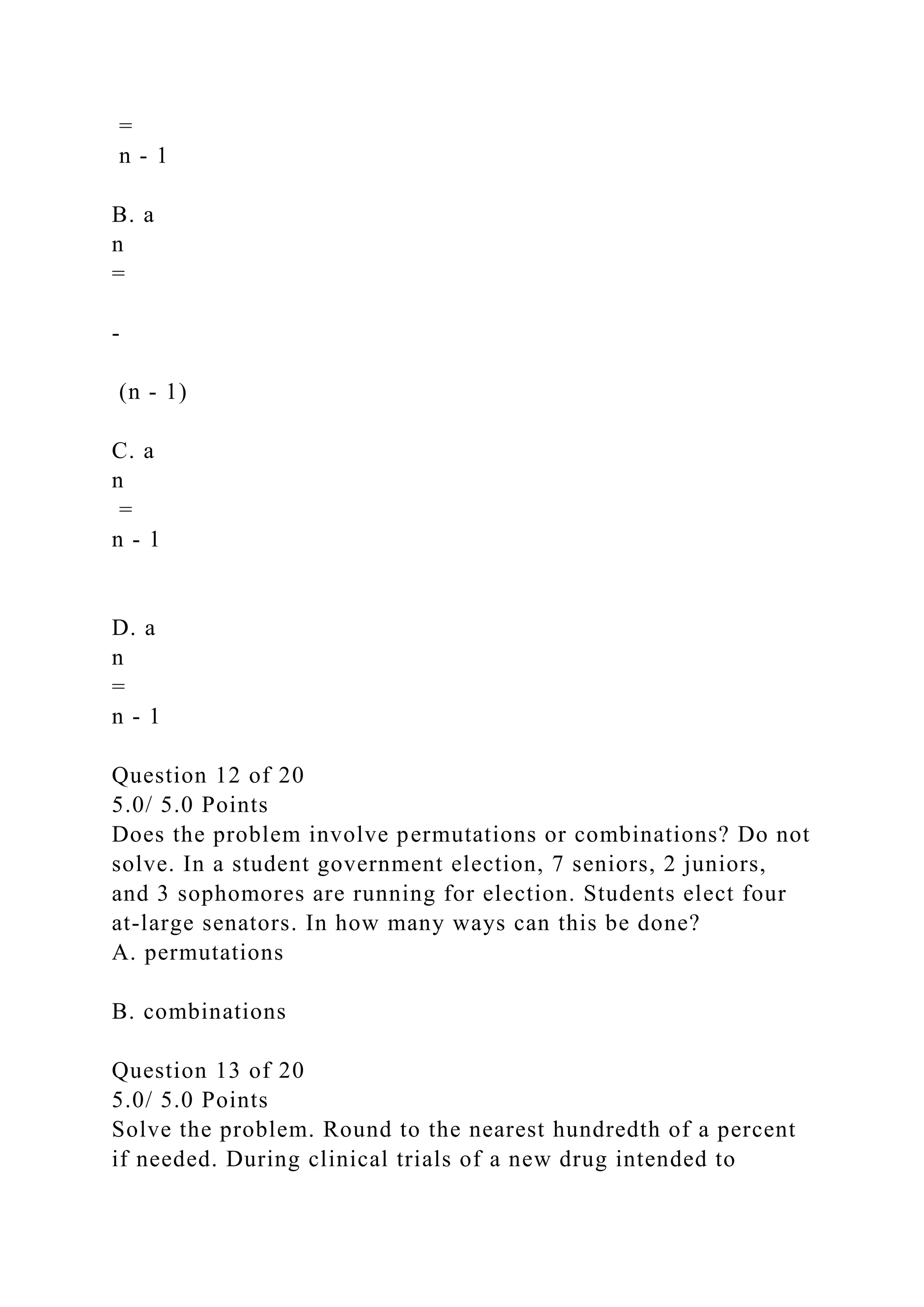
Write a formula for the general term (the nth term) of the
geometric sequence.
, -
,
, -
, . . .
A. a
n
=
n - 1
B. a
n
=
-
(n - 1)
C. a
n
=
n - 1
D. a
n
=
n - 1
Question 12 of 20
5.0/ 5.0 Points
Does the problem involve permutations or combinations? Do not
solve. In a student government election, 7 seniors, 2 juniors,
and 3 sophomores are running for election. Students elect four
at-large senators. In how many ways can this be done?
A. permutations
B. combinations
Question 13 of 20
5.0/ 5.0 Points
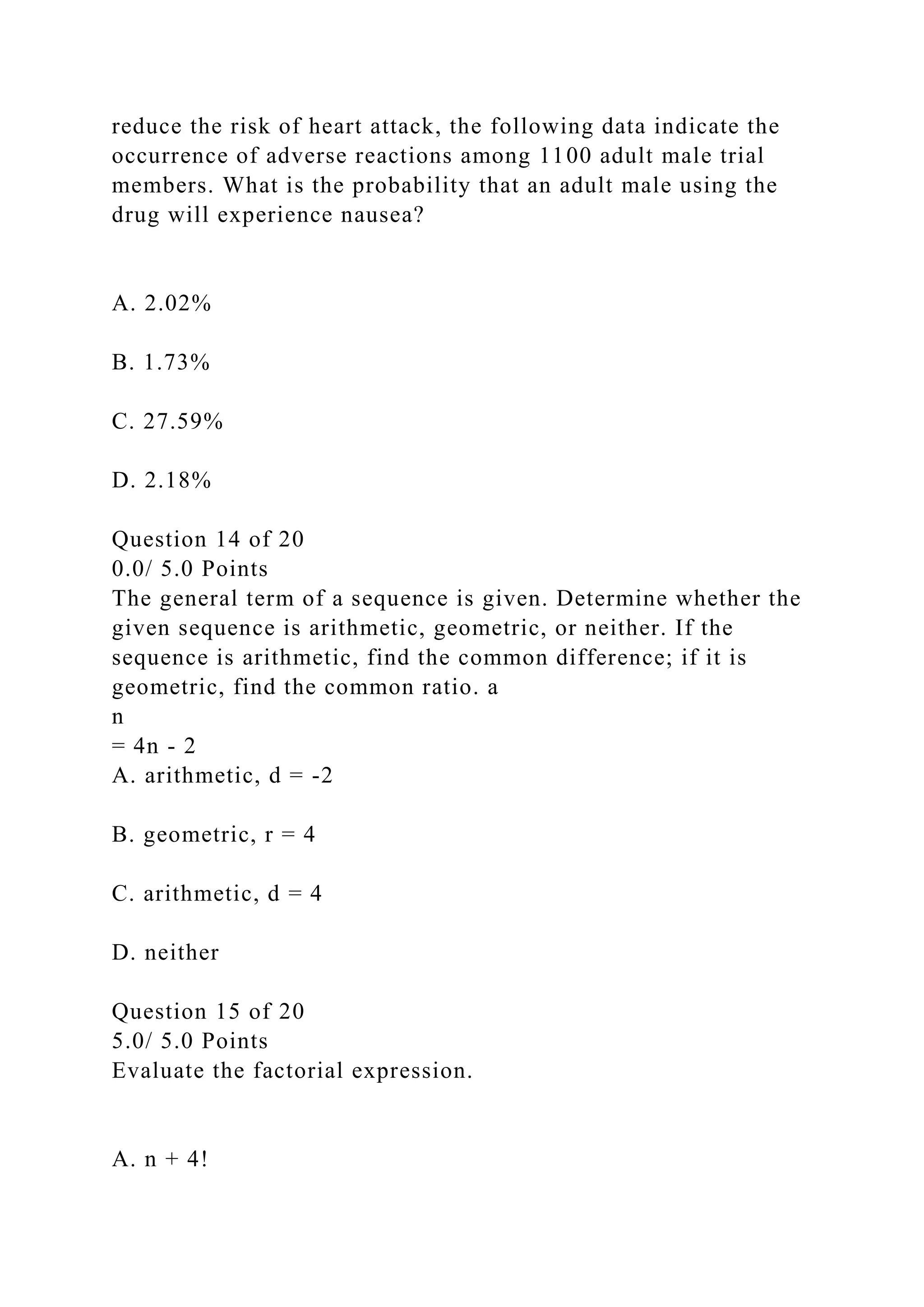
Solve the problem. Round to the nearest hundredth of a percent
if needed. During clinical trials of a new drug intended to
reduce the risk of heart attack, the following data indicate the
occurrence of adverse reactions among 1100 adult male trial
members. What is the probability that an adult male using the
drug will experience nausea?
A. 2.02%
B. 1.73%
C. 27.59%
D. 2.18%
Question 14 of 20
0.0/ 5.0 Points
The general term of a sequence is given. Determine whether the
given sequence is arithmetic, geometric, or neither. If the
sequence is arithmetic, find the common difference; if it is
geometric, find the common ratio. a
n
= 4n - 2
A. arithmetic, d = -2
B. geometric, r = 4
C. arithmetic, d = 4
D. neither
Question 15 of 20
5.0/ 5.0 Points
Evaluate the factorial expression.
A. n + 4!
B. 4!
C. (n + 3)!
D. 1
Question 16 of 20
5.0/ 5.0 Points
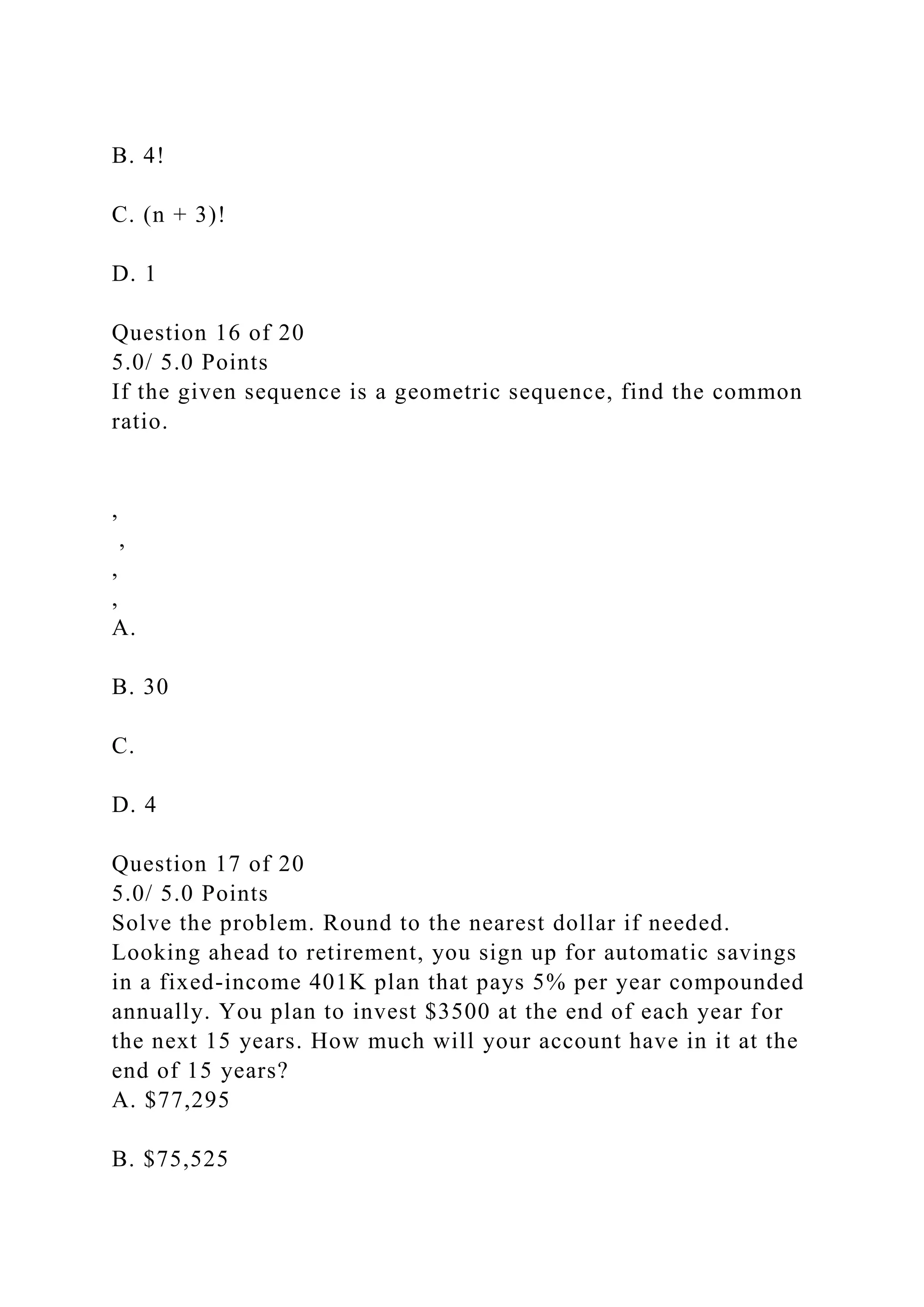
If the given sequence is a geometric sequence, find the common
ratio.
,
,
,
,
A.
B. 30
C.
D. 4
Question 17 of 20
5.0/ 5.0 Points
Solve the problem. Round to the nearest dollar if needed.
Looking ahead to retirement, you sign up for automatic savings
in a fixed-income 401K plan that pays 5% per year compounded
annually. You plan to invest $3500 at the end of each year for
the next 15 years. How much will your account have in it at the
end of 15 years?
A. $77,295
B. $75,525
C. $76,823
D. $73,982
Question 18 of 20
0.0/ 5.0 Points
Find the term indicated in the expansion.
(x - 3y)
11
; 8th term
A. -721,710x
7
y
4
B. -721,710x
4
y
7
C. 240,570x
7
y
4
D. 240,570x
4
y
8
Question 19 of 20
0.0/ 5.0 Points
Find the probability. Two 6-sided dice are rolled. What is the
probability that the sum of the two numbers on the dice will be
greater than 10?
A. 1/12
B. 5/18
C. 3
D. 1/18
Question 20 of 20
5.0/ 5.0 Points
Does the problem involve permutations or combinations? Do not
solve. A club elects a president, vice-president, and secretary-
treasurer. How many sets of officers are possible if there are 15
members and any member can be elected to each position? No
person can hold more than one office.
A. permutations
B. combinations
LESSON 5
Question 1 of 20
0.0/ 5.0 Points
Find the slope of the tangent line to the graph of f at the given
point.
f(x) =
at ( 36, 6)
A.
B. 12
C. 3
D.
Question 2 of 20
5.0/ 5.0 Points
Use properties of limits to find the indicated limit. It may be
necessary to rewrite an expression before limit properties can be
applied.
A. 16
B. does not exist
C. -16
D. 0
Question 3 of 20
0.0/ 5.0 Points
Use properties of limits to find the indicated limit. It may be
necessary to rewrite an expression before limit properties can be
applied.
(2x
2
+ 2x + 3)
2
A. -9
B. 9
C. does not exist
D. 1
Question 4 of 20
0.0/ 5.0 Points
Complete the table for the function and find the indicated limit.
A. -0.0300, -0.0200, -0.0100, 0.0100, 0.0200, 0.0300 limit = -1
B. -0.0300, -0.0200, -0.0100, 0.0100, 0.0200, 0.0300 limit = 0
C. -0.0300, -0.0200, -0.0100, 0.0100, 0.0200, 0.0300 limit = 0.1
D. -0.0300, -0.0200, -0.0100, 0.0100, 0.0200, 0.0300 limit = 1
Question 5 of 20
0.0/ 5.0 Points
Use the definition of continuity to determine whether f is
continuous at a.
f(x) = 5x
4
- 9x
3
+ x - 7a = 7
A. Not continuous
B. Continuous
Question 6 of 20
0.0/ 5.0 Points
Find the slope of the tangent line to the graph of f at the given
point.
f(x) = x
2
+ 5x at (4, 36)
A. 13
B. 21
C. 9
D. 3
Question 7 of 20
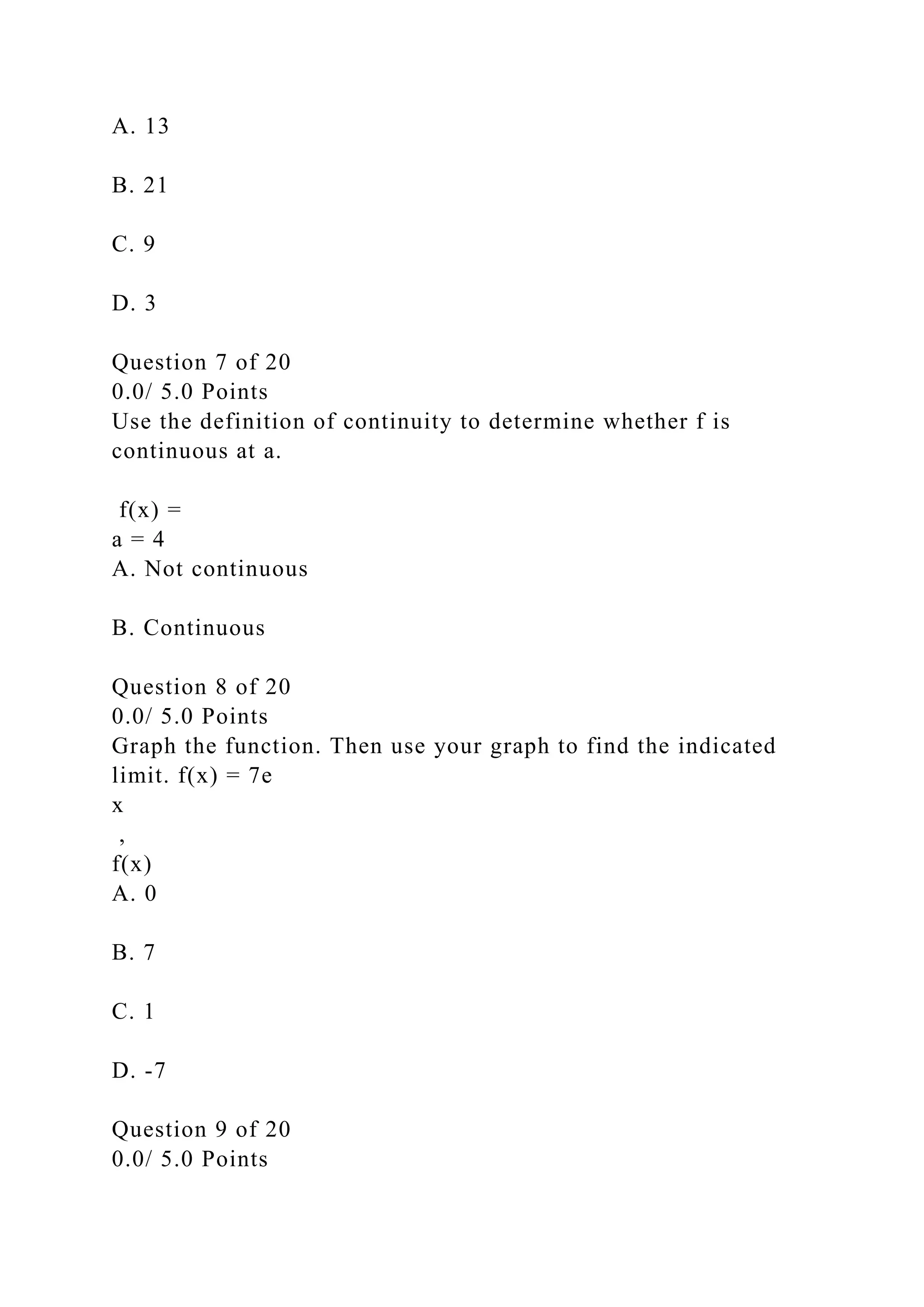
0.0/ 5.0 Points
Use the definition of continuity to determine whether f is
continuous at a.
f(x) =
a = 4
A. Not continuous
B. Continuous
Question 8 of 20
0.0/ 5.0 Points
Graph the function. Then use your graph to find the indicated
limit. f(x) = 7e
x
,
f(x)
A. 0
B. 7
C. 1
D. -7
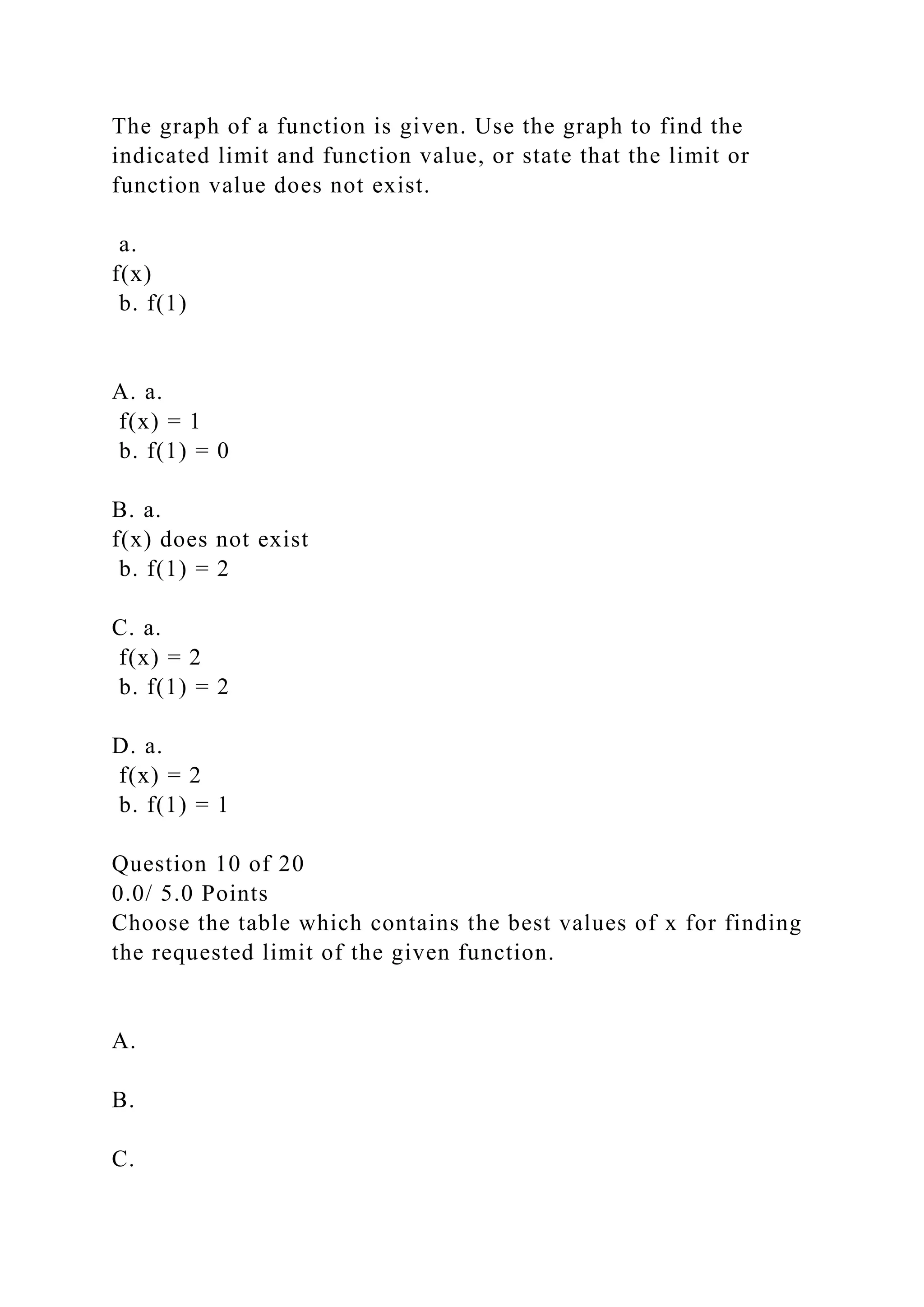
Question 9 of 20
0.0/ 5.0 Points
The graph of a function is given. Use the graph to find the
indicated limit and function value, or state that the limit or
function value does not exist.
a.
f(x)
b. f(1)
A. a.
f(x) = 1
b. f(1) = 0
B. a.
f(x) does not exist
b. f(1) = 2
C. a.
f(x) = 2
b. f(1) = 2
D. a.
f(x) = 2
b. f(1) = 1
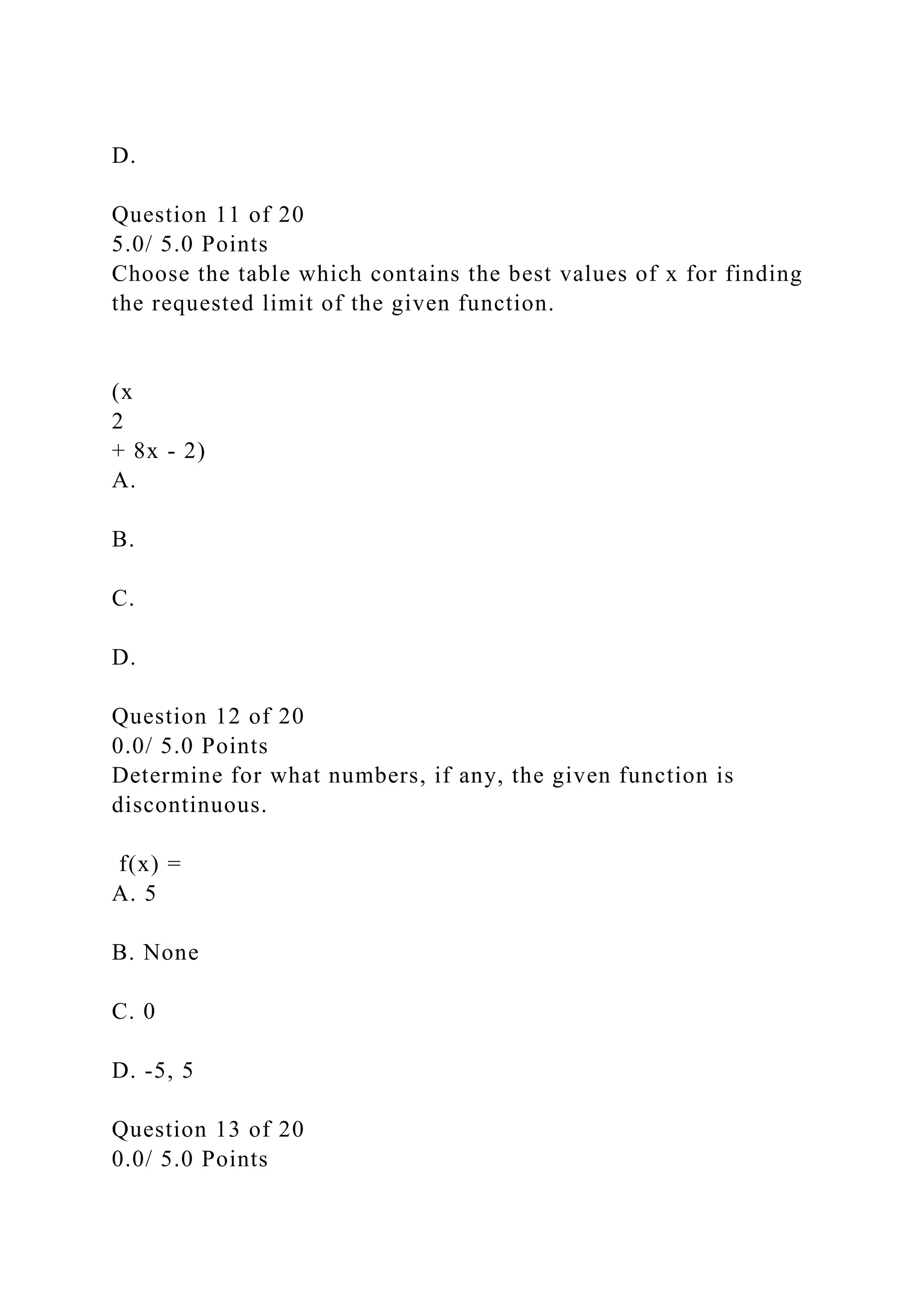
Question 10 of 20
0.0/ 5.0 Points
Choose the table which contains the best values of x for finding
the requested limit of the given function.
A.
B.
C.
D.
Question 11 of 20
5.0/ 5.0 Points
Choose the table which contains the best values of x for finding
the requested limit of the given function.
(x
2
+ 8x - 2)
A.
B.
C.
D.
Question 12 of 20
0.0/ 5.0 Points
Determine for what numbers, if any, the given function is
discontinuous.
f(x) =
A. 5
B. None
C. 0
D. -5, 5
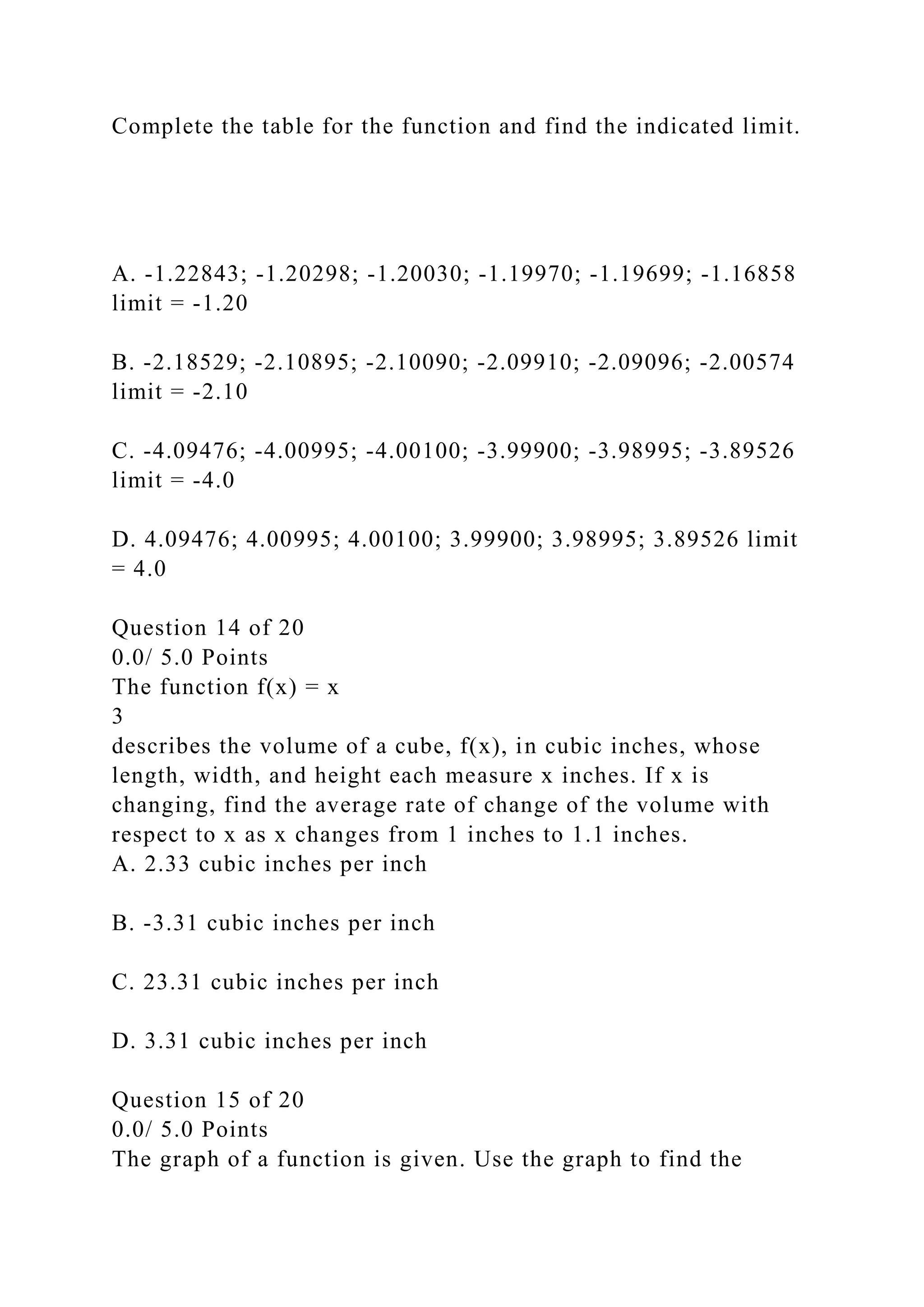
Question 13 of 20
0.0/ 5.0 Points
Complete the table for the function and find the indicated limit.
A. -1.22843; -1.20298; -1.20030; -1.19970; -1.19699; -1.16858
limit = -1.20
B. -2.18529; -2.10895; -2.10090; -2.09910; -2.09096; -2.00574
limit = -2.10
C. -4.09476; -4.00995; -4.00100; -3.99900; -3.98995; -3.89526
limit = -4.0
D. 4.09476; 4.00995; 4.00100; 3.99900; 3.98995; 3.89526 limit
= 4.0
Question 14 of 20
0.0/ 5.0 Points
The function f(x) = x
3
describes the volume of a cube, f(x), in cubic inches, whose
length, width, and height each measure x inches. If x is
changing, find the average rate of change of the volume with
respect to x as x changes from 1 inches to 1.1 inches.
A. 2.33 cubic inches per inch
B. -3.31 cubic inches per inch
C. 23.31 cubic inches per inch
D. 3.31 cubic inches per inch
Question 15 of 20
0.0/ 5.0 Points
The graph of a function is given. Use the graph to find the
indicated limit and function value, or state that the limit or
function value does not exist.
a.
f(x)
b. f(3)
A. a.
f(x) = 3
b. f(3) = 5
B. a.
f(x) = 5
b. f(3) = 5
C. a.
f(x) = 4
b. f(3) does not exist
D. a.
f(x) does not exist
b. f(3) = 5
Question 16 of 20
0.0/ 5.0 Points
Use the definition of continuity to determine whether f is
continuous at a.
f(x) =
a = -5
A. Not continuous
B. Continuous
Question 17 of 20
0.0/ 5.0 Points
Use the graph and the viewing rectangle shown below the graph
to find the indicated limit.
( x
2
- 2)
[-6, 6, 1] by [-6, 6, 1]
A.
(x
2
- 2) = -6
B.
(x
2
- 2) = 2
C.
(x
2
- 2) = -2
D.
(x
2
- 2) = 6
Question 18 of 20
5.0/ 5.0 Points
Use properties of limits to find the indicated limit. It may be
necessary to rewrite an expression before limit properties can be
applied.
5
A. -5
B. 0
C. 5
D. 2
Question 19 of 20
0.0/ 5.0 Points
Find the derivative of f at x. That is, find f '(x). f(x) = 7x + 8; x
= 5
A. 40
B. 8
C. 35
D. 7
Question 20 of 20
0.0/ 5.0 Points
Graph the function. Then use your graph to find the indicated
limit.
f(x) =
,
f(x)
A. 6
B. -2
C. -6
D. 2

LESSON 2Question 1 of 200.0 5.0 PointsUse Gaussian eliminatio.docx

  • 1.
    LESSON 2 Question 1of 20 0.0/ 5.0 Points Use Gaussian elimination to find the complete solution to the system of equations, or state that none exists. 3x - 2y + 2z - w = 2 4x + y + z + 6w = 8 -3x + 2y - 2z + w = 5 5x + 3z - 2w = 1 A. {(2, 0, - , )} B. {(1, - , , 6)} C. ∅ D. {( , 0, - , )} Question 2 of 20 0.0/ 5.0 Points Solve the system of equations using matrices. Use Gauss-Jordan elimination. 3x - 7 - 7z = 7 6x + 4y - 3z = 67 -6x - 3y + z = -62 A. {( 7, 1, 7)}
  • 2.
    B. {( 14,7, -7)} C. {( -7, 7, 14)} D. {( 7, 7, 1)} Question 3 of 20 0.0/ 5.0 Points Find the product AB, if possible. A = , B = A. B. C. D. Question 4 of 20 0.0/ 5.0 Points Use Cramer's rule to solve the system. 2x + 4y - z = 32 x - 2y + 2z = -5 5x + y + z = 20 A. {( 1, -9, -6)} B. {( 2, 7, 6)} C. {( 9, 6, 9)} D. {( 1, 9, 6)} Question 5 of 20 0.0/ 5.0 Points Find the products AB and BA to determine whether B is the multiplicative inverse of A.
  • 3.
    A = , B= A. B = A -1 B. B ≠ A -1 Question 6 of 20 5.0/ 5.0 Points Let A = and B = . Find A - 3B. A. B. C. D. Question 7 of 20 5.0/ 5.0 Points Find the inverse of the matrix, if possible. A = A. B. C. D. Question 8 of 20 0.0/ 5.0 Points
  • 4.
    Let B =[-1 3 6 -3]. Find -4B. A. [-4 12 24 -12] B. [-3 1 4 -5] C. [4 -12 -24 12] D. [4 3 6 -3] Question 9 of 20 0.0/ 5.0 Points Evaluate the determinant. A. B. C. D. Question 10 of 20 0.0/ 5.0 Points Give the order of the matrix, and identify the given element of the matrix. ; a12 A. 4 × 2; -11 B. 4 × 2; 14 C. 2 × 4; 14 D. 2 × 4; -11
  • 5.
    Question 11 of20 0.0/ 5.0 Points Find the product AB, if possible. A = , B = A. B. AB is not defined. C. D. Question 12 of 20 5.0/ 5.0 Points Use Gaussian elimination to find the complete solution to the system of equations, or state that none exists. x + y + z = 9 2x - 3y + 4z = 7 x - 4y + 3z = -2 A. {(- + , + , z)} B. {( + , - , z)} C. {(- +
  • 6.
    , - , z)} D. {( + , + ,z)} Question 13 of 20 5.0/ 5.0 Points Find the products AB and BA to determine whether B is the multiplicative inverse of A. A = , B = A. B = A -1 B. B ≠ A -1 Question 14 of 20 0.0/ 5.0 Points Solve the matrix equation for X. Let A = and B = ; 4X + A = B A. X = B. X = C. X =
  • 7.
    D. X = Question15 of 20 0.0/ 5.0 Points Find the product AB, if possible. A = , B = A. B. C. D. AB is not defined. Question 16 of 20 5.0/ 5.0 Points Use Cramer's rule to determine if the system is inconsistent system or contains dependent equations. 2x + 7 = 8 6x + 3y = 24 A. system is inconsistent B. system contains dependent equations Question 17 of 20 5.0/ 5.0 Points Find the product AB, if possible. A = , B = A. B.
  • 8.
    C. D. AB isnot defined. Question 18 of 20 0.0/ 5.0 Points Evaluate the determinant. A. 60 B. -30 C. -60 D. 30 Question 19 of 20 5.0/ 5.0 Points Determinants are used to show that three points lie on the same line (are collinear). If = 0, then the points ( x 1 , y 1 ), ( x 2 , y 2 ), and ( x 3 , y 3
  • 9.
    ) are collinear.If the determinant does not equal 0, then the points are not collinear. Are the points (-2, -1), (0, 9), (-6, -21) and collinear? A. Yes B. No Question 20 of 20 0.0/ 5.0 Points Solve the system of equations using matrices. Use Gaussian elimination with back-substitution. 3x + 5y - 2w = -13 2x + 7z - w = -1 4y + 3z + 3w = 1 -x + 2y + 4z = -5 A. {(-1, - , 0, )} B. {(1, -2, 0, 3)} C. {( , -2, 0, )} D. {( , - , 0, )} LESSON 3 Question 1 of 20 0.0/ 5.0 Points Halley's comet has an elliptical orbit with the sun at one focus.
  • 10.
    Its orbit shownbelow is given approximately by In the formula, r is measured in astronomical units. (One astronomical unit is the average distance from Earth to the sun, approximately 93 million miles.) Find the distance from Halley's comet to the sun at its greatest distance from the sun. Round to the nearest hundredth of an astronomical unit and the nearest million miles. A. 12.13 astronomical units; 1128 million miles B. 91.54 astronomical units; 8513 million miles C. 5.69 astronomical units; 529 million miles D. 6.06 astronomical units; 564 million miles Question 2 of 20 0.0/ 5.0 Points Use the center, vertices, and asymptotes to graph the hyperbola. (x - 1) 2 - 9(y - 2) 2 = 9 A. B. C. D. Question 3 of 20 0.0/ 5.0 Points
  • 11.
    Find the standardform of the equation of the ellipse and give the location of its foci. A. + = 1 foci at (- , 0) and ( , 0) B. - = 1 foci at (- , 0) and ( , 0) C. + = 1 foci at (- , 0) and ( , 0) D. + = 1 foci at (-7, 0) and ( 7, 0) Question 4 of 20 0.0/ 5.0 Points
  • 12.
    Rewrite the equationin a rotated x'y'-system without an x'y' term. Express the equation involving x' and y' in the standard form of a conic section. 31x 2 + 10 xy + 21y 2 -144 = 0 A. x '2 = -4 y' B. y '2 = -4 x' C. + = 1 D. + = 1 Question 5 of 20 0.0/ 5.0 Points Find the standard form of the equation of the ellipse satisfying the given conditions. Foci: (0, -2), (0, 2); y-intercepts: -5 and 5 A. +
  • 13.
    = 1 B. + = 1 C. + =1 D. + = 1 Question 6 of 20 0.0/ 5.0 Points Find the vertices and locate the foci for the hyperbola whose equation is given. 49x 2 - 100y 2 = 4900 A. vertices: ( -10, 0), ( 10, 0) foci: (- , 0), ( , 0) B. vertices: ( -10, 0), ( 10, 0) foci: (- , 0), (
  • 14.
    , 0) C. vertices:( -7, 0), ( 7, 0) foci: (- , 0), ( , 0) D. vertices: (0, -10), (0, 10) foci: (0, - ), (0, ) Question 7 of 20 5.0/ 5.0 Points Write the equation in terms of a rotated x'y'-system using θ, the angle of rotation. Write the equation involving x' and y' in standard form. xy +16 = 0; θ = 45° A. + = 1 B. y '2 = -32x' C. + = 1 D. - = 1
  • 15.
    Question 8 of20 0.0/ 5.0 Points Write the appropriate rotation formulas so that in a rotated system the equation has no x'y'-term. 10x 2 - 4xy + 6y 2 - 8x + 8y = 0 A. x = -y'; y = x' B. x = x' - y'; y = x' + y' C. x = (x' - y'); y = (x' + y') D. x = x' - y'; y = x' + y' Question 9 of 20 0.0/ 5.0 Points Find the location of the center, vertices, and foci for the hyperbola described by the equation. -
  • 16.
    = 1 A. Center:( -4, 1); Vertices: ( -10, 1) and ( 2, 1); Foci: and ( B. Center: ( -4, 1); Vertices: ( -9, 1) and ( 3, 1); Foci: ( -3 + , 2) and ( 2 + , 2) C. Center: ( -4, 1); Vertices: ( -10, -1) and ( 2, -1); Foci: ( -4 - , -1) and ( -4 + , -1) D. Center: ( 4, -1); Vertices: ( -2, -1) and ( 10, -1); Foci: and Question 10 of 20 0.0/ 5.0 Points Sketch the plane curve represented by the given parametric equations. Then use interval notation to give the relation's domain and range. x = 2t, y = t 2 + t + 3 A. Domain: (-∞, ∞); Range: -1x, ∞) B. Domain: (-∞, ∞); Range: [ 2.75, ∞) C. Domain: (-∞, ∞); Range: [ 3, ∞)
  • 17.
    D. Domain: (-∞,∞); Range: [ 2.75, ∞) Question 11 of 20 0.0/ 5.0 Points Use vertices and asymptotes to graph the hyperbola. Find the equations of the asymptotes. y = ± A. Asymptotes: y = ± x B. Asymptotes: y = ± x C. Asymptotes: y = ± x D. Asymptotes: y = ± x Question 12 of 20 0.0/ 5.0 Points Graph the ellipse. 16(x - 1) 2 + 9(y + 2) 2 = 144 A. B.
  • 18.
    C. D. Question 13 of20 0.0/ 5.0 Points Is the relation a function? y = x 2 + 12x + 31 A. Yes B. No Question 14 of 20 5.0/ 5.0 Points Determine the direction in which the parabola opens, and the vertex. y 2 = + 6x + 14 A. Opens upward; ( -3, 5) B. Opens upward; ( 3, 5) C. Opens to the right; ( 5, 3) D. Opens to the right; ( 5, -3) Question 15 of 20 0.0/ 5.0 Points Match the equation to the graph.
  • 19.
    x 2 = 7y A. B. C. D. Question 16of 20 0.0/ 5.0 Points y 2 = -2x A. B. C. D. Question 17 of 20 0.0/ 5.0 Points Convert the equation to the standard form for a hyperbola by completing the square on x and y. x 2 - y 2 + 6x - 4y + 4 = 0 A. (x + 3) 2
  • 20.
    + (y +2) 2 = 1 B. - = 1 C. (x + 3) 2 - (y + 2) 2 = 1 D. (y + 3) 2 - (x + 2) 2 = 1 Question 18 of 20 0.0/ 5.0 Points Eliminate the parameter t. Find a rectangular equation for the plane curve defined by the parametric equations. x = 6 cos t, y = 6 sin t; 0 ≤ t ≤ 2π A. x 2 - y 2 = 6; -6 ≤ x ≤ 6 B. x 2 - y
  • 21.
    2 = 36; -6≤ x ≤ 6 C. x 2 + y 2 = 6; -6 ≤ x ≤ 6 D. x 2 + y 2 = 36; -6 ≤ x ≤ 6 Question 19 of 20 5.0/ 5.0 Points Convert the equation to the standard form for a parabola by completing the square on x or y as appropriate. y 2 + 2y - 2x - 3 = 0 A. (y + 1) 2 = 2(x + 2) B. (y - 1) 2 = -2(x + 2) C. (y + 1) 2 = 2(x - 2) D. (y - 1)
  • 22.
    2 = 2(x +2) Question 20 of 20 0.0/ 5.0 Points Convert the equation to the standard form for a hyperbola by completing the square on x and y. y 2 - 25x 2 + 4y + 50x - 46 = 0 A. - (x - 2) 2 = 1 B. - (y - 1) 2 = 1 C. (x - 1) 2 - = 1 D. - (x - 1) 2 = 1 LESSON 4 Question 1 of 20 0.0/ 5.0 Points
  • 23.
    The finite sequencewhose general term is a n = 0.17n 2 - 1.02n + 6.67 where n = 1, 2, 3, ..., 9 models the total operating costs, in millions of dollars, for a company from 1991 through 1999. Find A. $21.58 million B. $27.4 million C. $23.28 million D. $29.1 million Question 2 of 20 5.0/ 5.0 Points Use the formula for the sum of the first n terms of a geometric sequence to solve. Find the sum of the first 8 terms of the geometric sequence: -8, -16, -32, -64, -128, . . . . A. -2003 B. -2040 C. -2060 D. -2038 Question 3 of 20 5.0/ 5.0 Points Find the probability. What is the probability that a card drawn from a deck of 52 cards is not a 10? A. 12/13
  • 24.
    B. 9/10 C. 1/13 D.1/10 Question 4 of 20 0.0/ 5.0 Points Find the common difference for the arithmetic sequence. 6, 11, 16, 21, . . . A. -15 B. -5 C. 5 D. 15 Question 5 of 20 0.0/ 5.0 Points Find the indicated sum. A. 28 B. 16 C. 70 D. 54 Question 6 of 20 0.0/ 5.0 Points Evaluate the expression. 1 -
  • 25.
    A. B. C. D. Question 7 of20 0.0/ 5.0 Points Find the sum of the infinite geometric series, if it exists. 4 - 1 + - + . . . A. - 1 B. 3 C. D. does not exist Question 8 of 20 0.0/ 5.0 Points Find the probability. One digit from the number 3,151,221 is written on each of seven cards. What is the probability of drawing a card that shows 3, 1, or 5? A. 5/7 B. 2/7 C. 4/7 D. 3/7 Question 9 of 20 0.0/ 5.0 Points
  • 26.
    A game spinnerhas regions that are numbered 1 through 9. If the spinner is used twice, what is the probability that the first number is a 3 and the second is a 6? A. 1/18 B. 1/81 C. 1/9 D. 2/3 Question 10 of 20 5.0/ 5.0 Points Use the formula for the sum of the first n terms of a geometric sequence to solve. Find the sum of the first four terms of the geometric sequence: 2, 10, 50, . . . . A. 312 B. 62 C. 156 D. 19 Question 11 of 20 0.0/ 5.0 Points Write a formula for the general term (the nth term) of the geometric sequence. , - , , - , . . . A. a n
  • 27.
    = n - 1 B.a n = - (n - 1) C. a n = n - 1 D. a n = n - 1 Question 12 of 20 5.0/ 5.0 Points Does the problem involve permutations or combinations? Do not solve. In a student government election, 7 seniors, 2 juniors, and 3 sophomores are running for election. Students elect four at-large senators. In how many ways can this be done? A. permutations B. combinations Question 13 of 20 5.0/ 5.0 Points Solve the problem. Round to the nearest hundredth of a percent if needed. During clinical trials of a new drug intended to
  • 28.
    reduce the riskof heart attack, the following data indicate the occurrence of adverse reactions among 1100 adult male trial members. What is the probability that an adult male using the drug will experience nausea? A. 2.02% B. 1.73% C. 27.59% D. 2.18% Question 14 of 20 0.0/ 5.0 Points The general term of a sequence is given. Determine whether the given sequence is arithmetic, geometric, or neither. If the sequence is arithmetic, find the common difference; if it is geometric, find the common ratio. a n = 4n - 2 A. arithmetic, d = -2 B. geometric, r = 4 C. arithmetic, d = 4 D. neither Question 15 of 20 5.0/ 5.0 Points Evaluate the factorial expression. A. n + 4!
  • 29.
    B. 4! C. (n+ 3)! D. 1 Question 16 of 20 5.0/ 5.0 Points If the given sequence is a geometric sequence, find the common ratio. , , , , A. B. 30 C. D. 4 Question 17 of 20 5.0/ 5.0 Points Solve the problem. Round to the nearest dollar if needed. Looking ahead to retirement, you sign up for automatic savings in a fixed-income 401K plan that pays 5% per year compounded annually. You plan to invest $3500 at the end of each year for the next 15 years. How much will your account have in it at the end of 15 years? A. $77,295 B. $75,525
  • 30.
    C. $76,823 D. $73,982 Question18 of 20 0.0/ 5.0 Points Find the term indicated in the expansion. (x - 3y) 11 ; 8th term A. -721,710x 7 y 4 B. -721,710x 4 y 7 C. 240,570x 7 y 4 D. 240,570x 4 y 8 Question 19 of 20 0.0/ 5.0 Points Find the probability. Two 6-sided dice are rolled. What is the probability that the sum of the two numbers on the dice will be
  • 31.
    greater than 10? A.1/12 B. 5/18 C. 3 D. 1/18 Question 20 of 20 5.0/ 5.0 Points Does the problem involve permutations or combinations? Do not solve. A club elects a president, vice-president, and secretary- treasurer. How many sets of officers are possible if there are 15 members and any member can be elected to each position? No person can hold more than one office. A. permutations B. combinations LESSON 5 Question 1 of 20 0.0/ 5.0 Points Find the slope of the tangent line to the graph of f at the given point. f(x) = at ( 36, 6) A. B. 12 C. 3 D.
  • 32.
    Question 2 of20 5.0/ 5.0 Points Use properties of limits to find the indicated limit. It may be necessary to rewrite an expression before limit properties can be applied. A. 16 B. does not exist C. -16 D. 0 Question 3 of 20 0.0/ 5.0 Points Use properties of limits to find the indicated limit. It may be necessary to rewrite an expression before limit properties can be applied. (2x 2 + 2x + 3) 2 A. -9 B. 9 C. does not exist D. 1 Question 4 of 20
  • 33.
    0.0/ 5.0 Points Completethe table for the function and find the indicated limit. A. -0.0300, -0.0200, -0.0100, 0.0100, 0.0200, 0.0300 limit = -1 B. -0.0300, -0.0200, -0.0100, 0.0100, 0.0200, 0.0300 limit = 0 C. -0.0300, -0.0200, -0.0100, 0.0100, 0.0200, 0.0300 limit = 0.1 D. -0.0300, -0.0200, -0.0100, 0.0100, 0.0200, 0.0300 limit = 1 Question 5 of 20 0.0/ 5.0 Points Use the definition of continuity to determine whether f is continuous at a. f(x) = 5x 4 - 9x 3 + x - 7a = 7 A. Not continuous B. Continuous Question 6 of 20 0.0/ 5.0 Points Find the slope of the tangent line to the graph of f at the given point. f(x) = x 2 + 5x at (4, 36)
  • 34.
    A. 13 B. 21 C.9 D. 3 Question 7 of 20 0.0/ 5.0 Points Use the definition of continuity to determine whether f is continuous at a. f(x) = a = 4 A. Not continuous B. Continuous Question 8 of 20 0.0/ 5.0 Points Graph the function. Then use your graph to find the indicated limit. f(x) = 7e x , f(x) A. 0 B. 7 C. 1 D. -7 Question 9 of 20 0.0/ 5.0 Points
  • 35.
    The graph ofa function is given. Use the graph to find the indicated limit and function value, or state that the limit or function value does not exist. a. f(x) b. f(1) A. a. f(x) = 1 b. f(1) = 0 B. a. f(x) does not exist b. f(1) = 2 C. a. f(x) = 2 b. f(1) = 2 D. a. f(x) = 2 b. f(1) = 1 Question 10 of 20 0.0/ 5.0 Points Choose the table which contains the best values of x for finding the requested limit of the given function. A. B. C.
  • 36.
    D. Question 11 of20 5.0/ 5.0 Points Choose the table which contains the best values of x for finding the requested limit of the given function. (x 2 + 8x - 2) A. B. C. D. Question 12 of 20 0.0/ 5.0 Points Determine for what numbers, if any, the given function is discontinuous. f(x) = A. 5 B. None C. 0 D. -5, 5 Question 13 of 20 0.0/ 5.0 Points
  • 37.
    Complete the tablefor the function and find the indicated limit. A. -1.22843; -1.20298; -1.20030; -1.19970; -1.19699; -1.16858 limit = -1.20 B. -2.18529; -2.10895; -2.10090; -2.09910; -2.09096; -2.00574 limit = -2.10 C. -4.09476; -4.00995; -4.00100; -3.99900; -3.98995; -3.89526 limit = -4.0 D. 4.09476; 4.00995; 4.00100; 3.99900; 3.98995; 3.89526 limit = 4.0 Question 14 of 20 0.0/ 5.0 Points The function f(x) = x 3 describes the volume of a cube, f(x), in cubic inches, whose length, width, and height each measure x inches. If x is changing, find the average rate of change of the volume with respect to x as x changes from 1 inches to 1.1 inches. A. 2.33 cubic inches per inch B. -3.31 cubic inches per inch C. 23.31 cubic inches per inch D. 3.31 cubic inches per inch Question 15 of 20 0.0/ 5.0 Points The graph of a function is given. Use the graph to find the
  • 38.
    indicated limit andfunction value, or state that the limit or function value does not exist. a. f(x) b. f(3) A. a. f(x) = 3 b. f(3) = 5 B. a. f(x) = 5 b. f(3) = 5 C. a. f(x) = 4 b. f(3) does not exist D. a. f(x) does not exist b. f(3) = 5 Question 16 of 20 0.0/ 5.0 Points Use the definition of continuity to determine whether f is continuous at a. f(x) = a = -5 A. Not continuous B. Continuous
  • 39.
    Question 17 of20 0.0/ 5.0 Points Use the graph and the viewing rectangle shown below the graph to find the indicated limit. ( x 2 - 2) [-6, 6, 1] by [-6, 6, 1] A. (x 2 - 2) = -6 B. (x 2 - 2) = 2 C. (x 2 - 2) = -2 D. (x 2 - 2) = 6 Question 18 of 20 5.0/ 5.0 Points Use properties of limits to find the indicated limit. It may be necessary to rewrite an expression before limit properties can be applied.
  • 40.
    5 A. -5 B. 0 C.5 D. 2 Question 19 of 20 0.0/ 5.0 Points Find the derivative of f at x. That is, find f '(x). f(x) = 7x + 8; x = 5 A. 40 B. 8 C. 35 D. 7 Question 20 of 20 0.0/ 5.0 Points Graph the function. Then use your graph to find the indicated limit. f(x) = , f(x) A. 6 B. -2 C. -6
  • 41.