LESSON 1: What is Research?
ACCTG 327
"I believe in innovation and that the way
you get innovation is you fund research
and you learn the basic facts." -Bill Gates
"In much of society, research means to
investigate something you do not know or
understand. It is creating new
knowledge." -Neil Armstrong
What is research?
- defined as a careful, systematic study in a field of knowledge,
undertaken to discover or establish facts or principles.
- a systematic process of collecting and analyzing data to find an answer
to a question or a solution to a problem, to validate or test an existing
theory.
- a process that should follow systematic procedures, ask the
appropriate questions and use reliable and valid instruments.
- a careful consideration of study regarding a particular concern or
problem using scientific methods.
- a systematic inquiry to describe, explain, predict, and control the
observed phenomenon. Research involves inductive and deductive
methods.
What is accounting research?
- examines how accounting is used by individuals, organizations and
government as well as the consequences that these practices have
- studies the roles of accounting in organizations and society and the
consequences that these practices have for individuals, organizations,
governments and capital markets.
Accounting research plays an essential part in creating new
knowledge. The hard sciences have produced models of research and
testing that can be used and applied over many disciplines, including
accounting research. Using these models along with evidence such as
financial statements, stock prices, surveys, experiments, computer
simulations, and mathematical proofs, we can gain a scientific
perspective and basis for the following:
• Deciding and implementing new accounting or auditing
standards
• Presenting unusual economic transactions in the financial
statements
• Learning how new tax laws impact clients and employers
• Discerning how the accounting profession affects the capital
markets through academic accounting research
Importance of accounting research
Accounting researchers perform two main types of
research:
Positive research is the branch of academic research
in accounting that seeks to explain and predict
actual accounting practices.
Normative research, in contrast, seeks to derive and
prescribe "optimal" accounting standards.
Accounting Research
Topical Areas
Reference:
https://www.byuaccounting.net/mediawiki/index.php?title=What_is_
accounting_research%3F
Auditing
Studies that address issues related to an audit topic.
These studies vary widely and include, but are not limited
to, the study of the external and internal audit
environment, auditor decision making, auditor
independence, the effects of auditing on the financial
reporting process, and auditor fees.
Financial Accounting
Studies that address the topical content of financial
accounting, capital markets, and decision making based
on financial accounting information.
Managerial (Management Accounting)
Studies that examine issues regarding budgeting,
compensation, decision-making within an enterprise,
incentives, and the allocation of resources within an
enterprise.
Taxation
Studies that examine issues related to taxpayer
decision-making, tax allocations, tax computations,
structuring of accounting transactions to meet tax
goals, tax incentives, or market reactions to tax
disclosures and policies.
Accounting Information Systems (AIS)
Studies that address issues related to systems and the users
of systems that collect, store, and generate accounting
information. Users are defined broadly to include those
involved in collection, storage, or use of accounting
information or even the implementation of the system.
These systems may be electronic or not. Research streams
include, but are not limited to, design science, ontological
investigations, expert systems, decision aides, support
systems, processing assurance, security, controls, system
usability, and system performance.
Accounting Research Paper Topic Ideas in Financial Accounting
1. How financial accounting is helpful in business decisions.
2. What are the important roles of accounting software in financial accounting?
3. What are the latest authentic software business organizations using for financial
accounting?
4. How to carry out research on the data collected from financial accounting?
5. What types of decisions could be taken with the help of financial accounting in a
business firm?
List of Accounting Research Topics in Auditing
1. Why it is important to keep a check on the financial activities of a company through
auditing accounting?
2. What types of financial decisions are considered in auditing by accountants?
3. Explain the process of auditing accounting with useful instances?
4. What if a business company does not involve in the auditing accounting process?
5. Describe the use of software that is used in auditing accounting by companies in
the present time.
Topics for Research Paper in Management Accounting
1. How the management accounting support certain important decisions of the
company?
2. Role of management accounting in the employee appraisals and increments.
3. What types of roles are given to a management accountant in a business
organization to handle the managerial accounting process?
4. What happens when a company does not bother about its management accounts?
5. What is the lucrative software that is drawing every eye in management
accounting nowadays?
Accounting Topics for Research Paper in Taxation
1. Why it is important to keep the taxation accounting software in business
companies?
2. How does taxation accounting keep track of the taxes that a business firm pays?
3. What are the major areas in taxation accounting that must be handled carefully?
4. What is the Software that is used in taxation accounting by accountants?
5. Is it easy for a business to run smoothly without taxation accounting?
Forensic Accounting Topics for Research Paper
1. How to check the fake financial transactions in business through forensic
accounting.
2. What are the significant tools of forensic accounting that accountants use?
3. Explain the role of a forensic accountant to save a business organization from
heavy loss.
4. Is it possible to track fraud in the fiancés of a business through forensic
accounting software?
5. Benefits of forensic accounting to big businessmen of the world.
Business Accounting Research Paper Topics
1. What are the main building blocks of a business account?
2. How the financial activities of a business could be tracked with business accounting.
3. Why it is important to keep a record of the business expenditure through business
accountings.
4. How balance sheet could be prepared with the help of business accounting in a firm?
5.Is it important to install powerful software for business accounting?
Three main categories of accounting research methods:
1. Experimental – uses experiences and experimentation with
specific accounting cases to evaluate results, which typically
involves manipulating variables. Researchers who utilize
experimental methods base analysis and conclusions on
data the researcher gathered by administering treatments to
subjects. Usually these studies employ random assignment;
however, if the researcher selects different populations in an
attempt to “manipulate” a variable, we include these as
experimental in nature (e.g., participants of different
experience levels were selected for participation).
Experimental research can include analyzing both
economic and behavioral factors.
2. Analytical - attempts to look at things in mathematical terms.
Researchers who utilize analytical methods base analysis
and conclusions on formally modeling theories or
substantiated ideas in mathematical terms. These analytical
studies use math to predict, explain, or give substance to
theory.
3. Archival - gathers information from other sources; often uses the
basis of qualifying citations as research itself. Researchers who
utilize archival methods base analysis and conclusions on
objective data collected from repositories of third parties. Also
included are studies in which the researchers collected the data
and in which the data has objective amounts such as net
income,
Skills necessary to be a successful researcher
•The ability to know and stay abreast of current work within your
field of research.
Staying abreast of the research being performed and the
publication of such work is important as you further your own
research, discover new questions and problems, and contribute to
your fellow researchers.
• The ability to understand and recognize research problems.
Researchers need not only stay abreast of current research being
performed and published; they also need to understand and
recognize difficulties in performing their own research and the
difficulties of research performed by others. This understanding
is crucial to overcoming these difficulties.
• The ability to understand research content.
The ability to read and understand the content of research
articles is an important skill for academics and practitioners alike.
• The ability to think critically and analytically.
As you perform research, the ability to examine assumptions, assess
evidence, discern hidden values, and evaluate the conclusion will be
greatly utilized. Additionally, the ability to break a concept or paradigm
into its constituent parts and then study the parts to find and evaluate
the relationships between those parts is also a useful skill.
The ability to formulate plans to meet goals and deadlines.
Having the ability to identify goals and then construct plans around
your many responsibilities to achieve those goals is important.
•The ability to discover where you can make a contribution and
evaluate/re-evaluate your contribution.
The ability to discern a topic that will add knowledge to the field
and trigger your interests is a great strength. Additionally, being
able to evaluate the causality, strength, and validity of your
research is important, not only when initially writing it, but to
return and re-evaluate later and see if it needs to be edited or
expanded.
•The ability to master appropriate experimental, mathematical,
and computational research skills.
It is necessary to build a strong base of mathematical and
statistical tools to be able to draw on and enable you to build
experiments that have good construct and internal validity.
• The ability to follow good research practices.
Being able to develop experiments or studies that are built on good
solid research practices will strengthen the research you do and
lend credibility to your work that fellow users can rely on.
The ability to document and report your work.
After the data is gathered and analyzed and conclusions are
developed and confirmed, the researcher needs the ability to
effectively communicate their work in a paper such as a thesis
paper. Documenting others who have worked in similar areas,
contributed to your work, or were otherwise used to further your
research is important.
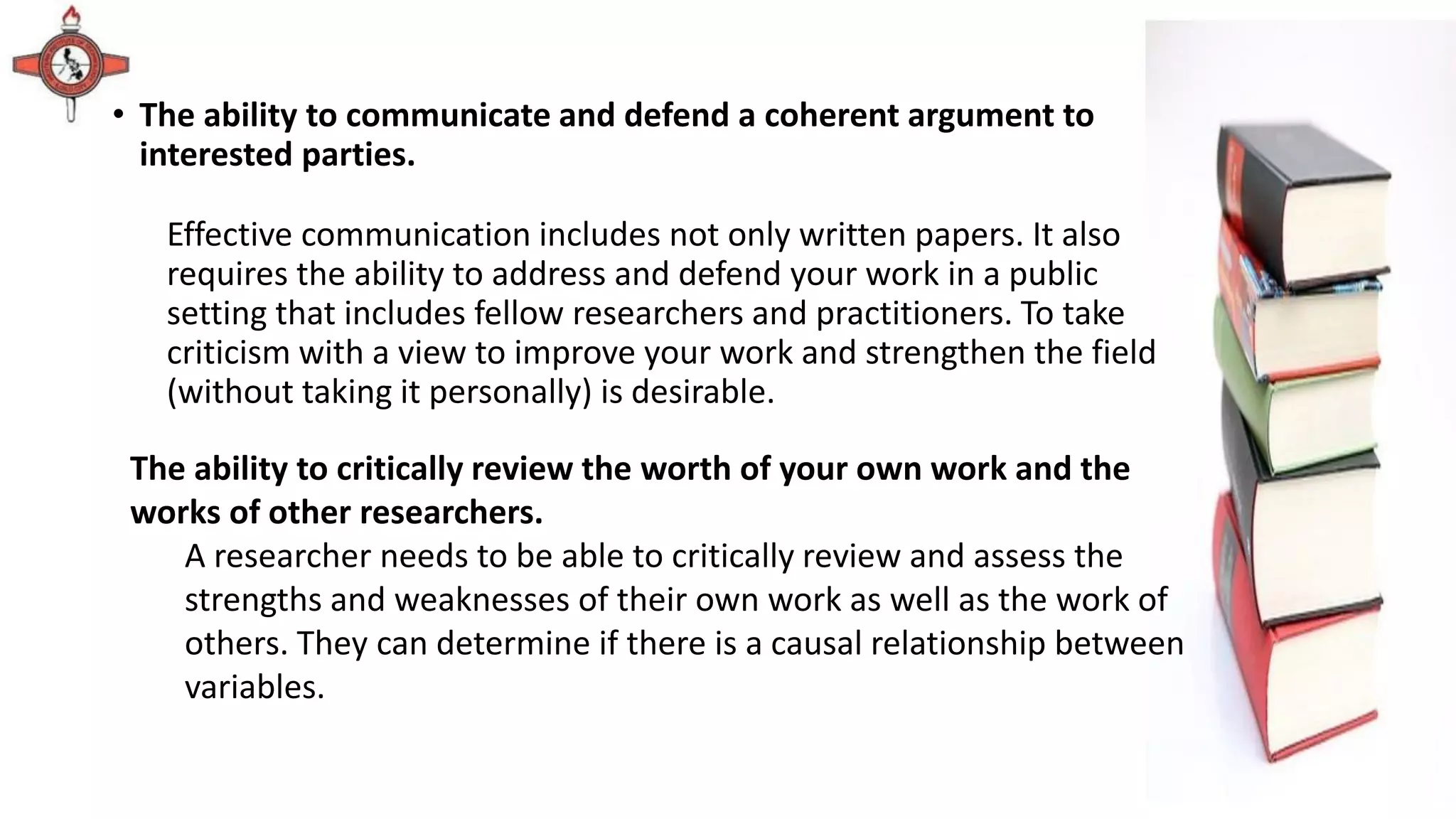
• The ability to communicate and defend a coherent argument to
interested parties.
Effective communication includes not only written papers. It also
requires the ability to address and defend your work in a public
setting that includes fellow researchers and practitioners. To take
criticism with a view to improve your work and strengthen the field
(without taking it personally) is desirable.
The ability to critically review the worth of your own work and the
works of other researchers.
A researcher needs to be able to critically review and assess the
strengths and weaknesses of their own work as well as the work of
others. They can determine if there is a causal relationship between
variables.
- They should also be able to assess the various types of validity,
as follows:
a) Internal Validity - what is the strength of the controlled
experiment?
b) Construct Validity - Does what you are measuring
actually capture the ideas and events in the
hypothesis?
c) Statistical Conclusion Validity - Once everything is in
place, is there strong enough evidence to prove an
actual difference?
d) External Validity - once you have proven this is valid in
this situation, how well does it transfer to other
situations and other subjects?
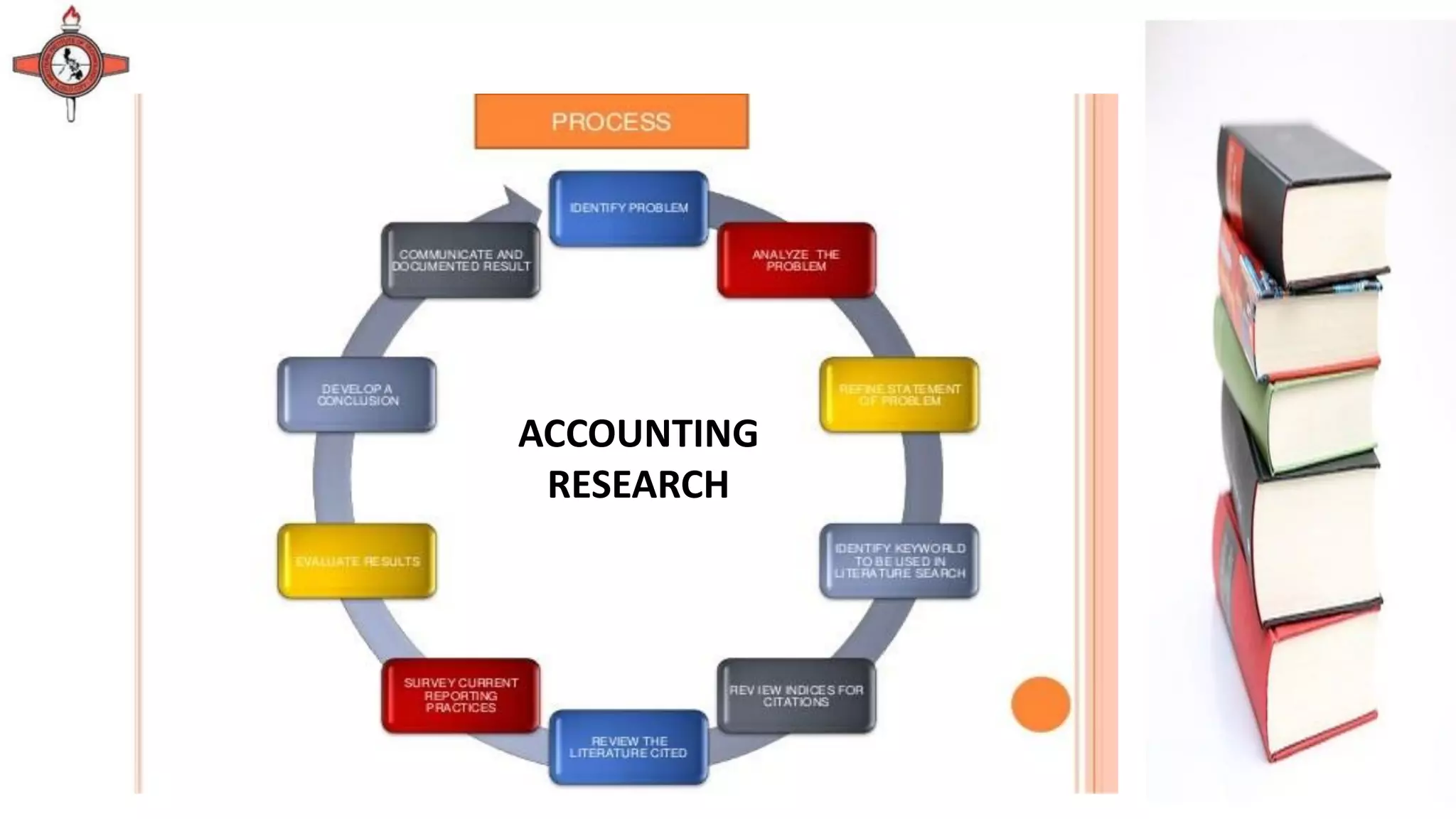
ACCOUNTING
RESEARCH
Assignment for next meeting:
1. Share information on a research work you have done.
2. Discuss the process you went through.
3. Explain how you tackled the completion of a particular
phase in doing your research

Lesson 1 What is Research.pdf

  • 1.
    LESSON 1: Whatis Research? ACCTG 327
  • 2.
    "I believe ininnovation and that the way you get innovation is you fund research and you learn the basic facts." -Bill Gates "In much of society, research means to investigate something you do not know or understand. It is creating new knowledge." -Neil Armstrong
  • 3.
    What is research? -defined as a careful, systematic study in a field of knowledge, undertaken to discover or establish facts or principles. - a systematic process of collecting and analyzing data to find an answer to a question or a solution to a problem, to validate or test an existing theory. - a process that should follow systematic procedures, ask the appropriate questions and use reliable and valid instruments. - a careful consideration of study regarding a particular concern or problem using scientific methods. - a systematic inquiry to describe, explain, predict, and control the observed phenomenon. Research involves inductive and deductive methods.
  • 4.
    What is accountingresearch? - examines how accounting is used by individuals, organizations and government as well as the consequences that these practices have - studies the roles of accounting in organizations and society and the consequences that these practices have for individuals, organizations, governments and capital markets.
  • 5.
    Accounting research playsan essential part in creating new knowledge. The hard sciences have produced models of research and testing that can be used and applied over many disciplines, including accounting research. Using these models along with evidence such as financial statements, stock prices, surveys, experiments, computer simulations, and mathematical proofs, we can gain a scientific perspective and basis for the following: • Deciding and implementing new accounting or auditing standards • Presenting unusual economic transactions in the financial statements • Learning how new tax laws impact clients and employers • Discerning how the accounting profession affects the capital markets through academic accounting research Importance of accounting research
  • 6.
    Accounting researchers performtwo main types of research: Positive research is the branch of academic research in accounting that seeks to explain and predict actual accounting practices. Normative research, in contrast, seeks to derive and prescribe "optimal" accounting standards.
  • 7.
  • 8.
    Auditing Studies that addressissues related to an audit topic. These studies vary widely and include, but are not limited to, the study of the external and internal audit environment, auditor decision making, auditor independence, the effects of auditing on the financial reporting process, and auditor fees. Financial Accounting Studies that address the topical content of financial accounting, capital markets, and decision making based on financial accounting information.
  • 9.
    Managerial (Management Accounting) Studiesthat examine issues regarding budgeting, compensation, decision-making within an enterprise, incentives, and the allocation of resources within an enterprise. Taxation Studies that examine issues related to taxpayer decision-making, tax allocations, tax computations, structuring of accounting transactions to meet tax goals, tax incentives, or market reactions to tax disclosures and policies.
  • 10.
    Accounting Information Systems(AIS) Studies that address issues related to systems and the users of systems that collect, store, and generate accounting information. Users are defined broadly to include those involved in collection, storage, or use of accounting information or even the implementation of the system. These systems may be electronic or not. Research streams include, but are not limited to, design science, ontological investigations, expert systems, decision aides, support systems, processing assurance, security, controls, system usability, and system performance.
  • 11.
    Accounting Research PaperTopic Ideas in Financial Accounting 1. How financial accounting is helpful in business decisions. 2. What are the important roles of accounting software in financial accounting? 3. What are the latest authentic software business organizations using for financial accounting? 4. How to carry out research on the data collected from financial accounting? 5. What types of decisions could be taken with the help of financial accounting in a business firm? List of Accounting Research Topics in Auditing 1. Why it is important to keep a check on the financial activities of a company through auditing accounting? 2. What types of financial decisions are considered in auditing by accountants? 3. Explain the process of auditing accounting with useful instances? 4. What if a business company does not involve in the auditing accounting process? 5. Describe the use of software that is used in auditing accounting by companies in the present time.
  • 12.
    Topics for ResearchPaper in Management Accounting 1. How the management accounting support certain important decisions of the company? 2. Role of management accounting in the employee appraisals and increments. 3. What types of roles are given to a management accountant in a business organization to handle the managerial accounting process? 4. What happens when a company does not bother about its management accounts? 5. What is the lucrative software that is drawing every eye in management accounting nowadays? Accounting Topics for Research Paper in Taxation 1. Why it is important to keep the taxation accounting software in business companies? 2. How does taxation accounting keep track of the taxes that a business firm pays? 3. What are the major areas in taxation accounting that must be handled carefully? 4. What is the Software that is used in taxation accounting by accountants? 5. Is it easy for a business to run smoothly without taxation accounting?
  • 13.
    Forensic Accounting Topicsfor Research Paper 1. How to check the fake financial transactions in business through forensic accounting. 2. What are the significant tools of forensic accounting that accountants use? 3. Explain the role of a forensic accountant to save a business organization from heavy loss. 4. Is it possible to track fraud in the fiancés of a business through forensic accounting software? 5. Benefits of forensic accounting to big businessmen of the world. Business Accounting Research Paper Topics 1. What are the main building blocks of a business account? 2. How the financial activities of a business could be tracked with business accounting. 3. Why it is important to keep a record of the business expenditure through business accountings. 4. How balance sheet could be prepared with the help of business accounting in a firm? 5.Is it important to install powerful software for business accounting?
  • 14.
    Three main categoriesof accounting research methods: 1. Experimental – uses experiences and experimentation with specific accounting cases to evaluate results, which typically involves manipulating variables. Researchers who utilize experimental methods base analysis and conclusions on data the researcher gathered by administering treatments to subjects. Usually these studies employ random assignment; however, if the researcher selects different populations in an attempt to “manipulate” a variable, we include these as experimental in nature (e.g., participants of different experience levels were selected for participation). Experimental research can include analyzing both economic and behavioral factors.
  • 15.
    2. Analytical -attempts to look at things in mathematical terms. Researchers who utilize analytical methods base analysis and conclusions on formally modeling theories or substantiated ideas in mathematical terms. These analytical studies use math to predict, explain, or give substance to theory. 3. Archival - gathers information from other sources; often uses the basis of qualifying citations as research itself. Researchers who utilize archival methods base analysis and conclusions on objective data collected from repositories of third parties. Also included are studies in which the researchers collected the data and in which the data has objective amounts such as net income,
  • 16.
    Skills necessary tobe a successful researcher •The ability to know and stay abreast of current work within your field of research. Staying abreast of the research being performed and the publication of such work is important as you further your own research, discover new questions and problems, and contribute to your fellow researchers.
  • 17.
    • The abilityto understand and recognize research problems. Researchers need not only stay abreast of current research being performed and published; they also need to understand and recognize difficulties in performing their own research and the difficulties of research performed by others. This understanding is crucial to overcoming these difficulties. • The ability to understand research content. The ability to read and understand the content of research articles is an important skill for academics and practitioners alike.
  • 18.
    • The abilityto think critically and analytically. As you perform research, the ability to examine assumptions, assess evidence, discern hidden values, and evaluate the conclusion will be greatly utilized. Additionally, the ability to break a concept or paradigm into its constituent parts and then study the parts to find and evaluate the relationships between those parts is also a useful skill. The ability to formulate plans to meet goals and deadlines. Having the ability to identify goals and then construct plans around your many responsibilities to achieve those goals is important.
  • 19.
    •The ability todiscover where you can make a contribution and evaluate/re-evaluate your contribution. The ability to discern a topic that will add knowledge to the field and trigger your interests is a great strength. Additionally, being able to evaluate the causality, strength, and validity of your research is important, not only when initially writing it, but to return and re-evaluate later and see if it needs to be edited or expanded. •The ability to master appropriate experimental, mathematical, and computational research skills. It is necessary to build a strong base of mathematical and statistical tools to be able to draw on and enable you to build experiments that have good construct and internal validity.
  • 20.
    • The abilityto follow good research practices. Being able to develop experiments or studies that are built on good solid research practices will strengthen the research you do and lend credibility to your work that fellow users can rely on. The ability to document and report your work. After the data is gathered and analyzed and conclusions are developed and confirmed, the researcher needs the ability to effectively communicate their work in a paper such as a thesis paper. Documenting others who have worked in similar areas, contributed to your work, or were otherwise used to further your research is important.
  • 21.
    • The abilityto communicate and defend a coherent argument to interested parties. Effective communication includes not only written papers. It also requires the ability to address and defend your work in a public setting that includes fellow researchers and practitioners. To take criticism with a view to improve your work and strengthen the field (without taking it personally) is desirable. The ability to critically review the worth of your own work and the works of other researchers. A researcher needs to be able to critically review and assess the strengths and weaknesses of their own work as well as the work of others. They can determine if there is a causal relationship between variables.
  • 22.
    - They shouldalso be able to assess the various types of validity, as follows: a) Internal Validity - what is the strength of the controlled experiment? b) Construct Validity - Does what you are measuring actually capture the ideas and events in the hypothesis? c) Statistical Conclusion Validity - Once everything is in place, is there strong enough evidence to prove an actual difference? d) External Validity - once you have proven this is valid in this situation, how well does it transfer to other situations and other subjects?
  • 23.
  • 24.
    Assignment for nextmeeting: 1. Share information on a research work you have done. 2. Discuss the process you went through. 3. Explain how you tackled the completion of a particular phase in doing your research