Industrial
Industrial
Engineering
Engineering
“
“IE is about lots of career possibilities
IE is about lots of career possibilities
…
…..exciting career possibilities.”
..exciting career possibilities.”
is concerned with the
design,
design, improvement
improvement, and installation
installation of
integrated systems of people, materials,
equipment, energy and information.
It draws upon specialized knowledge and skills in
the mathematical, physical and social sciences
together with the principles and methods of
engineering analysis and design to specify,
predict, and evaluate the results to be obtained
from such systems.
Industrial Engineering
What is Industrial Engineering?
Industrial Engineering
Institute of Industrial Engineers
by
by
Industrial Engineering
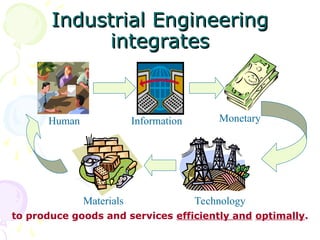
integrates
integrates
to produce goods and services efficiently and optimally.
Information
Human Monetary
Materials Technology
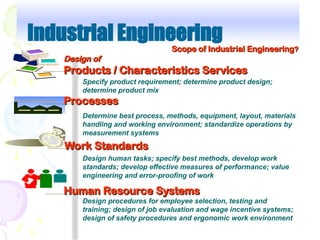
Specify product requirement; determine product design;
determine product mix
Determine best process, methods, equipment, layout, materials
handling and working environment; standardize operations by
measurement systems
Design human tasks; specify best methods, develop work
standards; develop effective measures of performance; value
engineering and error-proofing of work
Design procedures for employee selection, testing and
training; design of job evaluation and wage incentive systems;
design of safety procedures and ergonomic work environment
Industrial Engineering
Scope of Industrial Engineering
Scope of Industrial Engineering?
?
Design of
Design of
Products / Characteristics Services
Processes
Processes
Work Standards
Work Standards
Human Resource Systems
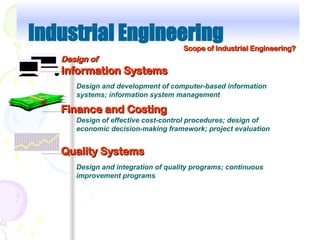
Design and development of computer-based information
systems; information system management
Design of effective cost-control procedures; design of
economic decision-making framework; project evaluation
Design and integration of quality programs; continuous
improvement programs
Industrial Engineering
Scope of Industrial Engineering?
Design of
Design of
Information Systems
Information Systems
Finance and Costing
Finance and Costing
Quality Systems
Quality Systems
What is IE?
What is IE?
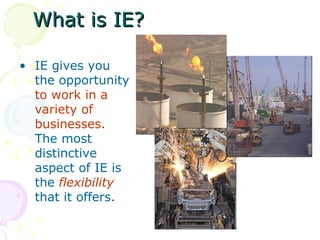
• IE gives you
the opportunity
to work in a
variety of
businesses.
The most
distinctive
aspect of IE is
the flexibility
that it offers.
What is an Industrial
Engineer?
Engineer?
A Systems
Integrator.
A big-picture
thinker, in other
words.
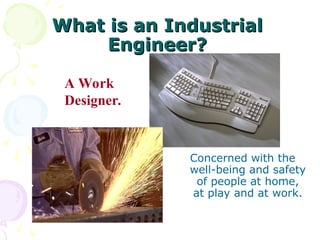
Concerned with the
well-being and safety
of people at home,
at play and at work.
What is an Industrial
Engineer?
Engineer?
A Work
Designer.
Figures out how to do things
What is an Industrial
Engineer?
Engineer?
A Smart Worker.
What is an Industrial
Engineer?
Engineer?
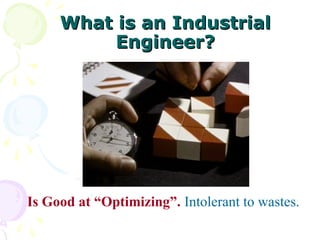
Is Good at “Optimizing”. Intolerant to wastes.
Industrial Engineering
The Industrial Engineering Practice
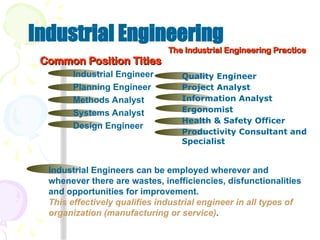
Industrial Engineers can be employed wherever and
whenever there are wastes, inefficiencies, disfunctionalities
and opportunities for improvement.
This effectively qualifies industrial engineer in all types of
organization (manufacturing or service).
Common Position Titles
Industrial Engineer
Planning Engineer
Methods Analyst
Systems Analyst
Design Engineer
Quality Engineer
Project Analyst
Information Analyst
Ergonomist
Health & Safety Officer
Productivity Consultant and
Specialist
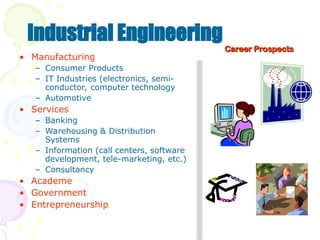
• Manufacturing
– Consumer Products
– IT Industries (electronics, semi-
conductor, computer technology
– Automotive
• Services
– Banking
– Warehousing & Distribution
Systems
– Information (call centers, software
development, tele-marketing, etc.)
– Consultancy
• Academe
• Government
• Entrepreneurship
Industrial Engineering
Career Prospects
Career Prospects
• Membership in Professional and Industry
Associations
– Philippine Institute of Industrial Engineers (PIIE)
– Operations Research Society of the Philippines (ORSP)
– Philippine Ergonomics Society (PhilErgo)
• Continuing IE Education
– Seminars or Short Courses
– Conferences & Congresses
– Publications
• Advanced Studies
– Master’s degree, Ph.D.
• IE Certification
– PIIE IE Certification Program
– ASEAN Engineer or APEC Engineer
Industrial Engineering
Professional Advancement
IE Certification
• Currently, industrial engineers in the Philippines
have practiced their profession without the need
for licensure.
• IE Certification in the early 70s
– Association of Management & Industrial Engineers of the
Philippines (AMIEP).
– Members came from various fields such as mechanical
engineering, architecture, and management among
others.
– Program was suspended along with the organization’s
inactivity towards the 1990s.
Introduction
• Senate Bill No. 781
– Sponsored and introduced by Sen.
Ernesto Herrera in the early 1990s
– 1st
draft was circulated and discussed in
various forums (including AMIEP)
– September 9, 1996, 2nd
Hearing by the
Senate Committee on Civil Service and
Government Reorganization
• Chaired by Sen. Nikki Coseteng
IE Legislation
• Workshop on the IE Certification Program
– October 5, 2002 at the Wack-wack Country
Club
• Resolutions
1. PIIE shall move towards the institution of a PIIE
Certification and defer any action towards
government licensure.
2. The PIIE Certification shall be along the
following lines:
Phase I – Certification of IE degree holders
Phase II – Certification of Non-IE degree
holders
PIIE Initiative
PIIE Initiative
PIIE Initiative
PIIE Initiative
• Resolutions
3. PIIE shall pursue capability-building programs
that will assist universities/colleges and their
respective faculty and graduates in qualifying
for the certification.
4. PIIE shall constitute a Working Committee with
the mandate to draft the mechanics of the
Certification, to consult all stakeholders, and to
recommend the program for adoption and
implementation by the Institute.
PIIE Initiative
PIIE Initiative
• Resolutions
5. PIIE recognizes that this initiative
must be a united stand by the PIIE
National and all local chapters. As
such, all members and local chapters
shall be advised by the PIIE
accordingly of the moves taken
towards this end.
Manila Declaration
Manila Declaration
(Oct 17, 2003)
(Oct 17, 2003)
• Entered into by the APIEMS, CIIE and PIIE
during the PIIE Research Conference
• Declarations:
– That they have collectively agreed and
accepted to pursue a "Mutual Recognition
Initiative" (MRI) of industrial engineering
practice in the Asia-Pacific
– That this strategic undertaking is vital to the
development, growth and prospects of
industrial engineering practitioners
PIIE IE Certification, Inc.
• SEC Registered as a non-stock, non-
profit organization (PIIE-Cert)
• Shall constitute the IE Certification
Board whose principal purpose is to
design and administer the process,
including competence/skills exams,
for certifying the qualifications of IE
practitioners.
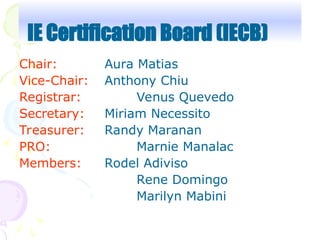
Chair: Aura Matias
Vice-Chair: Anthony Chiu
Registrar: Venus Quevedo
Secretary: Miriam Necessito
Treasurer: Randy Maranan
PRO: Marnie Manalac
Members: Rodel Adiviso
Rene Domingo
Marilyn Mabini
IE Certification Board (IECB)
• Mark of a professional
– Help promote a clearer public awareness and
understanding of the role of the IEs in society,
and to aid in ensuring that fellow IEs perform
their services in a manner which recognizes as
paramount public health and safety
• Employers look to licensure or certification
in evaluating the advancement potential of
employees
Why get Certified?
• Enhanced status in the eyes of the public
– Equates the industrial engineer with other
professionals licensed in other fields.
• Assurance that the individual IE has
passed at least a minimum screen of
competence.
• Adds credibility and respect
– It polishes one’s reputation as a qualified
industrial engineer
Why get Certified?
• IE Certification is a voluntary process, which
validates an individual's qualifications in the field
of industrial engineering (IE) professional
practice.
• It demonstrates to employers, clients, and peers
the individual's knowledge and experience and
signifies his or her commitment to continued
excellence in IE professional practice.
• In addition, it increases visibility, builds
credibility, and validates expertise with those
outside the profession.
PIIE Certification
A practitioner is defined as an individual who has:
(1) a mastery of basic industrial engineering
knowledge
(2) a command of the methodologies used by
industrial engineers in applying that knowledge to
the design of a product, process, or environment;
and
(3) has applied his or her knowledge to the
analysis, design, test, implementation and
evaluation of products, processes, and
environments.
The IE Practitioner
Level 1 The Certified Industrial
Engineering (CIE)
Engineering (CIE)
• The CIE is the designation for associate practice.
• The criteria for CIE certification are:
– A Filipino citizen
– A bachelor’s degree in Industrial Engineering from CHED-
recognized school/university with an accredited B.S.I.E.
program or an internationally accredited program
– A passing score on the CIE written examination on IE Core
Knowledge.
• The CIE applies a general breadth of knowledge to analysis
and evaluation. He should exhibit the minimum standards of
competency for Industrial Engineering practice. The scope of
practice for the CIE is limited to the use of commonly accepted
tools and techniques for the analysis and enhancement of
performance in existing systems.
• Degree Name:
Bachelor of Science in Industrial Engineering (BSIE)
• Program Coverage:
– Work Standards
– Statistical Process Control Systems
– Production Planning and Materials Control
Systems
– Manufacturing and Service Facilities
– Operations Research Models for Production and
Operations
– Information Systems
CHED Policies & Standards
(Revision 2007)
(Revision 2007)
• Non-TECHNICAL COURSES
– Social Sciences (12 units)
– Humanities (9 units)
– Languages (15 units)
– Mandated Course (3 units)
• TECHNICAL COURSES
– Mathematics (26 units)
– Natural Sciences (12 units)
– Basic Engineering Sciences (21 units)
– Allied Courses (26 units)
– Professional Courses (56 units)
• TOTAL UNITS = 185 credit units
CHED Curriculum Standards
Entry Level Compentency
Standards for an IE
Standards for an IE
1. Establish work and safety standards
• Perform time studies and develop time
standards
• Balance work loads
• Evaluate task, tool, equipment, workplace
and environmental risk factors
• Formulate safety programs and enforce work
safety practices
• Design incentive and compensation systems
Entry Level Compentency
Standards for an IE
Standards for an IE
2. Perform production planning, scheduling,
and control functions
• Forecast demand
• Identify manufacturing processes and
calculate manufacturing parameters
• Plan production control measures
• Schedule and sequence production
operations
Entry Level Compentency
Standards for an IE
Standards for an IE
3. Design and implement quality assurance
systems
• Implement Statistical Process Control (SPC)
principles
• Perform capability analysis and acceptance
sampling plans
• Analyze processes and measure component
and system reliability
• Design and implement quality systems for
continuous improvement
• Perform quality audits
Entry Level Compentency
Standards for an IE
Standards for an IE
4. Prepare logistics plan
• Design inventory control systems
• Design warehousing operations
• Design distribution network and fleet
management
Entry Level Compentency
Standards for an IE
Standards for an IE
5. Draw up facilities design and layout
• Calculate resource and space
requirements
• Optimize flow of resources, materials,
people and information
• Select method for materials handling
• Conduct capacity and process flow
analysis
Entry Level Compentency
Standards for an IE
Standards for an IE
6. Develop efficient information systems
• Conduct systems analysis to define
information requirements
• Formulate systems and procedures, forms
flow and design
• Identify appropriate data collection and
processing systems
• Plan, design,and implement a computer-
based information system
Entry Level Compentency
Standards for an IE
Standards for an IE
7. Conduct research and development
• Formulate the appropriate design of
experiment
• Undertake an experiment
• Analyze and validate data
• Draw conclusions and
recommendations from the results of
the experiment
• Write and present technical reports
Level 2 The Professional IE
(PIE)
(PIE)
• The PIE is the designation for professional practice.
• The criteria for PIE certification are:
– A master’s degree in Industrial Engineering, or its
equivalent:
• or CIE with master’s degree +2 years of relevant IE experience
• or CIE + 5 years of relevant IE experience
• or 10 years of relevant IE experience
– Testimonial of major IE work experience
– A passing score on the PIE written examination on a
Specialization Area.
• The PIE applies and develops methodologies for analyzing,
designing, testing, and evaluating systems. The professional
practitioner addresses complex problems and advances in
industrial engineering technologies and methods in his/her
area of specialization.
• Production & Manufacturing Systems
• Operations Research
• Human Factors and Ergonomics
• Quality Engineering
• Supply-Chain Management/Logistics
• Service & Management Systems
Areas of Specialization
• Official Launching
– December 5, 2006
PIIE General Membership Meeting
Mandarin Oriental Hotel, Makati City
– March 8-9, 2007
PIIE Annual National Congress
Waterfront Hotel, Cebu City
PIIE Certification
Grandfather Rule
Grandfather Rule
• The Grandfather Rule applies to the
designation for professional practice
(equivalent to PIE).
• The criteria for PIE certification under the
grandfather rule are:
– Active PIIE member
– Filipino citizen/ naturalized (NSO certified)
– Endorsement from 1 PIIE member (in active
status) & 1 PIIE Board
– A minimum score of 50 points in the Sources
of Points
Sources of Points
Sources of Points
• Educational Activities
• Seminars/Conferences
• Technical/Research Output
• Professional Activities
• Extension Services
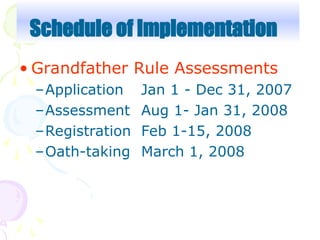
• Grandfather Rule Assessments
–Application Jan 1 - Dec 31, 2007
–Assessment Aug 1- Jan 31, 2008
–Registration Feb 1-15, 2008
–Oath-taking March 1, 2008
Schedule of Implementation
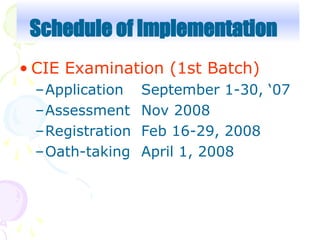
• CIE Examination (1st Batch)
–Application September 1-30, ‘07
–Assessment Nov 2008
–Registration Feb 16-29, 2008
–Oath-taking April 1, 2008
Schedule of Implementation
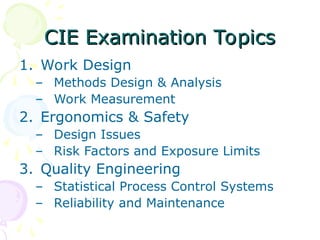
CIE Examination Topics
1. Work Design
– Methods Design & Analysis
– Work Measurement
2. Ergonomics & Safety
– Design Issues
– Risk Factors and Exposure Limits
3. Quality Engineering
– Statistical Process Control Systems
– Reliability and Maintenance
CIE Examination Topics
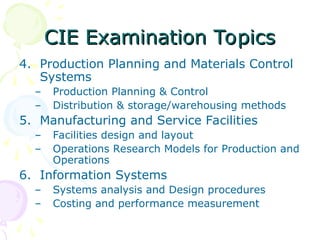
4. Production Planning and Materials Control
Systems
– Production Planning & Control
– Distribution & storage/warehousing methods
5. Manufacturing and Service Facilities
– Facilities design and layout
– Operations Research Models for Production and
Operations
6. Information Systems
– Systems analysis and Design procedures
– Costing and performance measurement
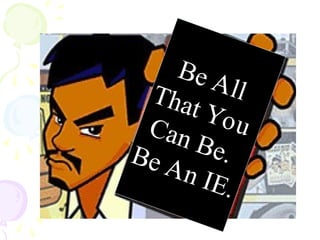
Be All
That You
Can Be.
Be An IE.

Lesson 1 PIIE Certification Presentation

  • 1.
    Industrial Industrial Engineering Engineering “ “IE is aboutlots of career possibilities IE is about lots of career possibilities … …..exciting career possibilities.” ..exciting career possibilities.”
  • 2.
    is concerned withthe design, design, improvement improvement, and installation installation of integrated systems of people, materials, equipment, energy and information. It draws upon specialized knowledge and skills in the mathematical, physical and social sciences together with the principles and methods of engineering analysis and design to specify, predict, and evaluate the results to be obtained from such systems. Industrial Engineering What is Industrial Engineering? What is Industrial Engineering? Industrial Engineering Industrial Engineering Institute of Industrial Engineers Institute of Industrial Engineers by by
  • 3.
    Industrial Engineering Industrial Engineering integrates integrates toproduce goods and services efficiently and optimally. Information Human Monetary Materials Technology
  • 4.
    Specify product requirement;determine product design; determine product mix Determine best process, methods, equipment, layout, materials handling and working environment; standardize operations by measurement systems Design human tasks; specify best methods, develop work standards; develop effective measures of performance; value engineering and error-proofing of work Design procedures for employee selection, testing and training; design of job evaluation and wage incentive systems; design of safety procedures and ergonomic work environment Industrial Engineering Scope of Industrial Engineering Scope of Industrial Engineering? ? Design of Design of Products / Characteristics Services Products / Characteristics Services Processes Processes Work Standards Work Standards Human Resource Systems Human Resource Systems
  • 5.
    Design and developmentof computer-based information systems; information system management Design of effective cost-control procedures; design of economic decision-making framework; project evaluation Design and integration of quality programs; continuous improvement programs Industrial Engineering Scope of Industrial Engineering? Scope of Industrial Engineering? Design of Design of Information Systems Information Systems Finance and Costing Finance and Costing Quality Systems Quality Systems
  • 6.
    What is IE? Whatis IE? • IE gives you the opportunity to work in a variety of businesses. The most distinctive aspect of IE is the flexibility that it offers.
  • 7.
    What is anIndustrial What is an Industrial Engineer? Engineer? A Systems Integrator. A big-picture thinker, in other words.
  • 8.
    Concerned with the well-beingand safety of people at home, at play and at work. What is an Industrial What is an Industrial Engineer? Engineer? A Work Designer.
  • 9.
    Figures out howto do things What is an Industrial What is an Industrial Engineer? Engineer? A Smart Worker.
  • 10.
    What is anIndustrial What is an Industrial Engineer? Engineer? Is Good at “Optimizing”. Intolerant to wastes.
  • 11.
    Industrial Engineering The IndustrialEngineering Practice The Industrial Engineering Practice Industrial Engineers can be employed wherever and whenever there are wastes, inefficiencies, disfunctionalities and opportunities for improvement. This effectively qualifies industrial engineer in all types of organization (manufacturing or service). Common Position Titles Common Position Titles Industrial Engineer Planning Engineer Methods Analyst Systems Analyst Design Engineer Quality Engineer Project Analyst Information Analyst Ergonomist Health & Safety Officer Productivity Consultant and Specialist
  • 12.
    • Manufacturing – ConsumerProducts – IT Industries (electronics, semi- conductor, computer technology – Automotive • Services – Banking – Warehousing & Distribution Systems – Information (call centers, software development, tele-marketing, etc.) – Consultancy • Academe • Government • Entrepreneurship Industrial Engineering Career Prospects Career Prospects
  • 13.
    • Membership inProfessional and Industry Associations – Philippine Institute of Industrial Engineers (PIIE) – Operations Research Society of the Philippines (ORSP) – Philippine Ergonomics Society (PhilErgo) • Continuing IE Education – Seminars or Short Courses – Conferences & Congresses – Publications • Advanced Studies – Master’s degree, Ph.D. • IE Certification – PIIE IE Certification Program – ASEAN Engineer or APEC Engineer Industrial Engineering Professional Advancement Professional Advancement
  • 14.
  • 15.
    • Currently, industrialengineers in the Philippines have practiced their profession without the need for licensure. • IE Certification in the early 70s – Association of Management & Industrial Engineers of the Philippines (AMIEP). – Members came from various fields such as mechanical engineering, architecture, and management among others. – Program was suspended along with the organization’s inactivity towards the 1990s. Introduction
  • 16.
    • Senate BillNo. 781 – Sponsored and introduced by Sen. Ernesto Herrera in the early 1990s – 1st draft was circulated and discussed in various forums (including AMIEP) – September 9, 1996, 2nd Hearing by the Senate Committee on Civil Service and Government Reorganization • Chaired by Sen. Nikki Coseteng IE Legislation
  • 17.
    • Workshop onthe IE Certification Program – October 5, 2002 at the Wack-wack Country Club • Resolutions 1. PIIE shall move towards the institution of a PIIE Certification and defer any action towards government licensure. 2. The PIIE Certification shall be along the following lines: Phase I – Certification of IE degree holders Phase II – Certification of Non-IE degree holders PIIE Initiative PIIE Initiative
  • 18.
    PIIE Initiative PIIE Initiative •Resolutions 3. PIIE shall pursue capability-building programs that will assist universities/colleges and their respective faculty and graduates in qualifying for the certification. 4. PIIE shall constitute a Working Committee with the mandate to draft the mechanics of the Certification, to consult all stakeholders, and to recommend the program for adoption and implementation by the Institute.
  • 19.
    PIIE Initiative PIIE Initiative •Resolutions 5. PIIE recognizes that this initiative must be a united stand by the PIIE National and all local chapters. As such, all members and local chapters shall be advised by the PIIE accordingly of the moves taken towards this end.
  • 20.
    Manila Declaration Manila Declaration (Oct17, 2003) (Oct 17, 2003) • Entered into by the APIEMS, CIIE and PIIE during the PIIE Research Conference • Declarations: – That they have collectively agreed and accepted to pursue a "Mutual Recognition Initiative" (MRI) of industrial engineering practice in the Asia-Pacific – That this strategic undertaking is vital to the development, growth and prospects of industrial engineering practitioners
  • 21.
    PIIE IE Certification,Inc. PIIE IE Certification, Inc. • SEC Registered as a non-stock, non- profit organization (PIIE-Cert) • Shall constitute the IE Certification Board whose principal purpose is to design and administer the process, including competence/skills exams, for certifying the qualifications of IE practitioners.
  • 23.
    Chair: Aura Matias Vice-Chair:Anthony Chiu Registrar: Venus Quevedo Secretary: Miriam Necessito Treasurer: Randy Maranan PRO: Marnie Manalac Members: Rodel Adiviso Rene Domingo Marilyn Mabini IE Certification Board (IECB)
  • 24.
    • Mark ofa professional – Help promote a clearer public awareness and understanding of the role of the IEs in society, and to aid in ensuring that fellow IEs perform their services in a manner which recognizes as paramount public health and safety • Employers look to licensure or certification in evaluating the advancement potential of employees Why get Certified?
  • 25.
    • Enhanced statusin the eyes of the public – Equates the industrial engineer with other professionals licensed in other fields. • Assurance that the individual IE has passed at least a minimum screen of competence. • Adds credibility and respect – It polishes one’s reputation as a qualified industrial engineer Why get Certified?
  • 26.
    • IE Certificationis a voluntary process, which validates an individual's qualifications in the field of industrial engineering (IE) professional practice. • It demonstrates to employers, clients, and peers the individual's knowledge and experience and signifies his or her commitment to continued excellence in IE professional practice. • In addition, it increases visibility, builds credibility, and validates expertise with those outside the profession. PIIE Certification
  • 27.
    A practitioner isdefined as an individual who has: (1) a mastery of basic industrial engineering knowledge (2) a command of the methodologies used by industrial engineers in applying that knowledge to the design of a product, process, or environment; and (3) has applied his or her knowledge to the analysis, design, test, implementation and evaluation of products, processes, and environments. The IE Practitioner
  • 28.
    Level 1 TheCertified Industrial Level 1 The Certified Industrial Engineering (CIE) Engineering (CIE) • The CIE is the designation for associate practice. • The criteria for CIE certification are: – A Filipino citizen – A bachelor’s degree in Industrial Engineering from CHED- recognized school/university with an accredited B.S.I.E. program or an internationally accredited program – A passing score on the CIE written examination on IE Core Knowledge. • The CIE applies a general breadth of knowledge to analysis and evaluation. He should exhibit the minimum standards of competency for Industrial Engineering practice. The scope of practice for the CIE is limited to the use of commonly accepted tools and techniques for the analysis and enhancement of performance in existing systems.
  • 29.
    • Degree Name: Bachelorof Science in Industrial Engineering (BSIE) • Program Coverage: – Work Standards – Statistical Process Control Systems – Production Planning and Materials Control Systems – Manufacturing and Service Facilities – Operations Research Models for Production and Operations – Information Systems CHED Policies & Standards CHED Policies & Standards (Revision 2007) (Revision 2007)
  • 30.
    • Non-TECHNICAL COURSES –Social Sciences (12 units) – Humanities (9 units) – Languages (15 units) – Mandated Course (3 units) • TECHNICAL COURSES – Mathematics (26 units) – Natural Sciences (12 units) – Basic Engineering Sciences (21 units) – Allied Courses (26 units) – Professional Courses (56 units) • TOTAL UNITS = 185 credit units CHED Curriculum Standards CHED Curriculum Standards
  • 31.
    Entry Level Compentency EntryLevel Compentency Standards for an IE Standards for an IE 1. Establish work and safety standards • Perform time studies and develop time standards • Balance work loads • Evaluate task, tool, equipment, workplace and environmental risk factors • Formulate safety programs and enforce work safety practices • Design incentive and compensation systems
  • 32.
    Entry Level Compentency EntryLevel Compentency Standards for an IE Standards for an IE 2. Perform production planning, scheduling, and control functions • Forecast demand • Identify manufacturing processes and calculate manufacturing parameters • Plan production control measures • Schedule and sequence production operations
  • 33.
    Entry Level Compentency EntryLevel Compentency Standards for an IE Standards for an IE 3. Design and implement quality assurance systems • Implement Statistical Process Control (SPC) principles • Perform capability analysis and acceptance sampling plans • Analyze processes and measure component and system reliability • Design and implement quality systems for continuous improvement • Perform quality audits
  • 34.
    Entry Level Compentency EntryLevel Compentency Standards for an IE Standards for an IE 4. Prepare logistics plan • Design inventory control systems • Design warehousing operations • Design distribution network and fleet management
  • 35.
    Entry Level Compentency EntryLevel Compentency Standards for an IE Standards for an IE 5. Draw up facilities design and layout • Calculate resource and space requirements • Optimize flow of resources, materials, people and information • Select method for materials handling • Conduct capacity and process flow analysis
  • 36.
    Entry Level Compentency EntryLevel Compentency Standards for an IE Standards for an IE 6. Develop efficient information systems • Conduct systems analysis to define information requirements • Formulate systems and procedures, forms flow and design • Identify appropriate data collection and processing systems • Plan, design,and implement a computer- based information system
  • 37.
    Entry Level Compentency EntryLevel Compentency Standards for an IE Standards for an IE 7. Conduct research and development • Formulate the appropriate design of experiment • Undertake an experiment • Analyze and validate data • Draw conclusions and recommendations from the results of the experiment • Write and present technical reports
  • 38.
    Level 2 TheProfessional IE Level 2 The Professional IE (PIE) (PIE) • The PIE is the designation for professional practice. • The criteria for PIE certification are: – A master’s degree in Industrial Engineering, or its equivalent: • or CIE with master’s degree +2 years of relevant IE experience • or CIE + 5 years of relevant IE experience • or 10 years of relevant IE experience – Testimonial of major IE work experience – A passing score on the PIE written examination on a Specialization Area. • The PIE applies and develops methodologies for analyzing, designing, testing, and evaluating systems. The professional practitioner addresses complex problems and advances in industrial engineering technologies and methods in his/her area of specialization.
  • 39.
    • Production &Manufacturing Systems • Operations Research • Human Factors and Ergonomics • Quality Engineering • Supply-Chain Management/Logistics • Service & Management Systems Areas of Specialization
  • 40.
    • Official Launching –December 5, 2006 PIIE General Membership Meeting Mandarin Oriental Hotel, Makati City – March 8-9, 2007 PIIE Annual National Congress Waterfront Hotel, Cebu City PIIE Certification
  • 41.
    Grandfather Rule Grandfather Rule •The Grandfather Rule applies to the designation for professional practice (equivalent to PIE). • The criteria for PIE certification under the grandfather rule are: – Active PIIE member – Filipino citizen/ naturalized (NSO certified) – Endorsement from 1 PIIE member (in active status) & 1 PIIE Board – A minimum score of 50 points in the Sources of Points
  • 42.
    Sources of Points Sourcesof Points • Educational Activities • Seminars/Conferences • Technical/Research Output • Professional Activities • Extension Services
  • 43.
    • Grandfather RuleAssessments –Application Jan 1 - Dec 31, 2007 –Assessment Aug 1- Jan 31, 2008 –Registration Feb 1-15, 2008 –Oath-taking March 1, 2008 Schedule of Implementation
  • 44.
    • CIE Examination(1st Batch) –Application September 1-30, ‘07 –Assessment Nov 2008 –Registration Feb 16-29, 2008 –Oath-taking April 1, 2008 Schedule of Implementation
  • 45.
    CIE Examination Topics CIEExamination Topics 1. Work Design – Methods Design & Analysis – Work Measurement 2. Ergonomics & Safety – Design Issues – Risk Factors and Exposure Limits 3. Quality Engineering – Statistical Process Control Systems – Reliability and Maintenance
  • 46.
    CIE Examination Topics CIEExamination Topics 4. Production Planning and Materials Control Systems – Production Planning & Control – Distribution & storage/warehousing methods 5. Manufacturing and Service Facilities – Facilities design and layout – Operations Research Models for Production and Operations 6. Information Systems – Systems analysis and Design procedures – Costing and performance measurement
  • 47.
    Be All That You CanBe. Be An IE.