Legislative Outlook for the 87th
Legislative Session
TAGD Business Meeting
January 27, 2021
Robby Cook, Eichler & Cook
Ty Embrey, Lloyd Gosselink
Sarah Kirkle, TWCA
Shauna Sledge, SledgeLaw Group PLLC
• COVID Response
• Budget
• Redistricting
• Elections
• Policing Reform
• # of Bills filed
Interim Reports to the 87th Legislature
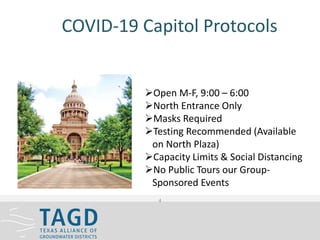
COVID-19 Capitol Protocols
4
Open M-F, 9:00 – 6:00
North Entrance Only
Masks Required
Testing Recommended (Available
on North Plaza)
Capacity Limits & Social Distancing
No Public Tours our Group-
Sponsored Events
COVID-19 Protocols
House
 Testing NOT required for members or
guests
Senate
 Negative test required for senators or
visitors to enter chamber or committee
hearing
House and Senate Rules Both:
• Require masks & social distancing
• Allow members to require testing
for their offices
• Require the public to testify in person or
submit comments in writing, but allow the
public to watch virtually
House and Senate Rules
Senate
• Amended number of
votes to bring bill to
floor from 3/5ths to
5/9ths
• Committee structure
modified
House
• New Rule 16
• Quorum for committee
requires two members
present while other
members may
participate virtually
• Committee structure
remains the same
87th Senate Water, Agriculture, and
Rural Affairs Committee
Sen. Charles Perry, Chair
Sen. Drew Springer, Vice-Chair
Sen. Brandon Creighton
Sen. Sarah Eckhardt
Sen. Roland Gutierrez
Sen. Nathan Johnson
Sen. Lois Kolkhorst
Sen. Beverly Powell
Sen. Larry Taylor
87th House Natural Resources
Committee
???????
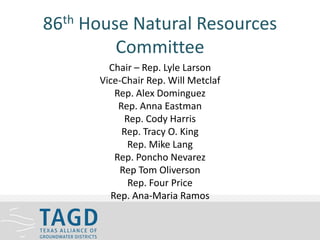
86th House Natural Resources
Committee
Chair – Rep. Lyle Larson
Vice-Chair Rep. Will Metclaf
Rep. Alex Dominguez
Rep. Anna Eastman
Rep. Cody Harris
Rep. Tracy O. King
Rep. Mike Lang
Rep. Poncho Nevarez
Rep Tom Oliverson
Rep. Four Price
Rep. Ana-Maria Ramos
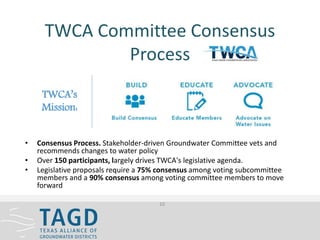
TWCA Committee Consensus
Process
• Consensus Process. Stakeholder-driven Groundwater Committee vets and
recommends changes to water policy
• Over 150 participants, largely drives TWCA's legislative agenda.
• Legislative proposals require a 75% consensus among voting subcommittee
members and a 90% consensus among voting committee members to move
forward
TWCA’s
Mission:
10
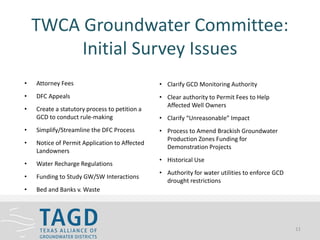
TWCA Groundwater Committee:
Initial Survey Issues
• Attorney Fees
• DFC Appeals
• Create a statutory process to petition a
GCD to conduct rule-making
• Simplify/Streamline the DFC Process
• Notice of Permit Application to Affected
Landowners
• Water Recharge Regulations
• Funding to Study GW/SW Interactions
• Bed and Banks v. Waste
11
• Clarify GCD Monitoring Authority
• Clear authority to Permit Fees to Help
Affected Well Owners
• Clarify “Unreasonable” Impact
• Process to Amend Brackish Groundwater
Production Zones Funding for
Demonstration Projects
• Historical Use
• Authority for water utilities to enforce GCD
drought restrictions
TWCA Groundwater Subcommittees
The committee created six subcommittees to
consider:
• Which DFC applies in the management plan submitted to TWDB if a DFC is
declared unreasonable
• Process to petition a GCD for rulemaking
• Notice of a permit application to affected landowners (proposal didn't meet
75% threshold)
• Deadline for filing suit on a final decision of a district (proposal didn't meet
75% threshold)
• Bed and banks permit v. “waste” (no proposal)
• Use of permit fees to set up no-fault funds for affected well owners (no
proposal)
The Groundwater Committee also took up attorney fees as a committee of the whole.
(proposal didn't meet 90% threshold)
12
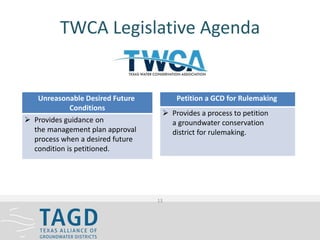
TWCA Legislative Agenda
13
Unreasonable Desired Future
Conditions
 Provides guidance on
the management plan approval
process when a desired future
condition is petitioned.
Petition a GCD for Rulemaking
 Provides a process to petition
a groundwater conservation
district for rulemaking.
Groundwater Bills
SB 152 (Perry) Relating to the regulation of
groundwater conservation districts (companion
HB 668 (Harris)).
HB 966 (Burns) Relating to the award of
attorney’s fees and other costs in certain suits
involving a groundwater conservation district
SB 152 / HB 668
3 Components
• Petition to Change Rules (new 36.1025)
– TWCA consensus language approved
• Attorney’s Fees (36.066(g))
– No TWCA consensus
• Notice Required for Application for Permit or
Permit Amendment (new 36.1141)
– No TWCA consensus, but alternative language developed
Additional Bills Potentially
Affecting Groundwater
• Produced water?
• Bills from prior sessions?
• Issues that have groundwater nexus?
• Local groundwater bills?
Government Bills
SB 234/HB 749 (Hall/Middleton) Relating to the use of a political
subdivision of public funds for lobbying activities
HB 634 (Morales) Relating to type of newspaper required for
publication of notices by governmental entities or representatives
in certain counties
HB 1030 (Shaheen) Relating to the publication of required notice
by a political subdivision by alternative media
HB 1154 (Jetton) Relating to the requirement that certain political
subdivisions cause certain information to be posted on an internet
website
HB 768 (Patterson) Relating to the requirement that certain
governmental bodies make audio and video recordings of open
meetings available on the internet
Questions?

Legislative Outlook for the 87th Legislative Session

  • 1.
    Legislative Outlook forthe 87th Legislative Session TAGD Business Meeting January 27, 2021 Robby Cook, Eichler & Cook Ty Embrey, Lloyd Gosselink Sarah Kirkle, TWCA Shauna Sledge, SledgeLaw Group PLLC
  • 2.
    • COVID Response •Budget • Redistricting • Elections • Policing Reform • # of Bills filed
  • 3.
    Interim Reports tothe 87th Legislature
  • 4.
    COVID-19 Capitol Protocols 4 OpenM-F, 9:00 – 6:00 North Entrance Only Masks Required Testing Recommended (Available on North Plaza) Capacity Limits & Social Distancing No Public Tours our Group- Sponsored Events
  • 5.
    COVID-19 Protocols House  TestingNOT required for members or guests Senate  Negative test required for senators or visitors to enter chamber or committee hearing House and Senate Rules Both: • Require masks & social distancing • Allow members to require testing for their offices • Require the public to testify in person or submit comments in writing, but allow the public to watch virtually
  • 6.
    House and SenateRules Senate • Amended number of votes to bring bill to floor from 3/5ths to 5/9ths • Committee structure modified House • New Rule 16 • Quorum for committee requires two members present while other members may participate virtually • Committee structure remains the same
  • 7.
    87th Senate Water,Agriculture, and Rural Affairs Committee Sen. Charles Perry, Chair Sen. Drew Springer, Vice-Chair Sen. Brandon Creighton Sen. Sarah Eckhardt Sen. Roland Gutierrez Sen. Nathan Johnson Sen. Lois Kolkhorst Sen. Beverly Powell Sen. Larry Taylor
  • 8.
    87th House NaturalResources Committee ???????
  • 9.
    86th House NaturalResources Committee Chair – Rep. Lyle Larson Vice-Chair Rep. Will Metclaf Rep. Alex Dominguez Rep. Anna Eastman Rep. Cody Harris Rep. Tracy O. King Rep. Mike Lang Rep. Poncho Nevarez Rep Tom Oliverson Rep. Four Price Rep. Ana-Maria Ramos
  • 10.
    TWCA Committee Consensus Process •Consensus Process. Stakeholder-driven Groundwater Committee vets and recommends changes to water policy • Over 150 participants, largely drives TWCA's legislative agenda. • Legislative proposals require a 75% consensus among voting subcommittee members and a 90% consensus among voting committee members to move forward TWCA’s Mission: 10
  • 11.
    TWCA Groundwater Committee: InitialSurvey Issues • Attorney Fees • DFC Appeals • Create a statutory process to petition a GCD to conduct rule-making • Simplify/Streamline the DFC Process • Notice of Permit Application to Affected Landowners • Water Recharge Regulations • Funding to Study GW/SW Interactions • Bed and Banks v. Waste 11 • Clarify GCD Monitoring Authority • Clear authority to Permit Fees to Help Affected Well Owners • Clarify “Unreasonable” Impact • Process to Amend Brackish Groundwater Production Zones Funding for Demonstration Projects • Historical Use • Authority for water utilities to enforce GCD drought restrictions
  • 12.
    TWCA Groundwater Subcommittees Thecommittee created six subcommittees to consider: • Which DFC applies in the management plan submitted to TWDB if a DFC is declared unreasonable • Process to petition a GCD for rulemaking • Notice of a permit application to affected landowners (proposal didn't meet 75% threshold) • Deadline for filing suit on a final decision of a district (proposal didn't meet 75% threshold) • Bed and banks permit v. “waste” (no proposal) • Use of permit fees to set up no-fault funds for affected well owners (no proposal) The Groundwater Committee also took up attorney fees as a committee of the whole. (proposal didn't meet 90% threshold) 12
  • 13.
    TWCA Legislative Agenda 13 UnreasonableDesired Future Conditions  Provides guidance on the management plan approval process when a desired future condition is petitioned. Petition a GCD for Rulemaking  Provides a process to petition a groundwater conservation district for rulemaking.
  • 14.
    Groundwater Bills SB 152(Perry) Relating to the regulation of groundwater conservation districts (companion HB 668 (Harris)). HB 966 (Burns) Relating to the award of attorney’s fees and other costs in certain suits involving a groundwater conservation district
  • 15.
    SB 152 /HB 668 3 Components • Petition to Change Rules (new 36.1025) – TWCA consensus language approved • Attorney’s Fees (36.066(g)) – No TWCA consensus • Notice Required for Application for Permit or Permit Amendment (new 36.1141) – No TWCA consensus, but alternative language developed
  • 16.
    Additional Bills Potentially AffectingGroundwater • Produced water? • Bills from prior sessions? • Issues that have groundwater nexus? • Local groundwater bills?
  • 17.
    Government Bills SB 234/HB749 (Hall/Middleton) Relating to the use of a political subdivision of public funds for lobbying activities HB 634 (Morales) Relating to type of newspaper required for publication of notices by governmental entities or representatives in certain counties HB 1030 (Shaheen) Relating to the publication of required notice by a political subdivision by alternative media HB 1154 (Jetton) Relating to the requirement that certain political subdivisions cause certain information to be posted on an internet website HB 768 (Patterson) Relating to the requirement that certain governmental bodies make audio and video recordings of open meetings available on the internet
  • 18.

Editor's Notes

  • #2 Next up is our legislative outlook panel – something I know is of interest to many in the audience. I am excited to have a great group here to provide their thoughts and perspectives on what the upcoming session may look like, and what it may mean for groundwater. Each of these folks is familiar to you all, I am sure.   Robby Cook, a former member of the house of representatives, was an advisor to former Speaker Dennis Bonnen, and long-time legislative consultant with experience in groundwater.   Ty Embrey, Principal at Lloyd Gosselink, with extensive experience at the capital working first as legislative staff and currently representing clients on legislative affairs, he has a robust legal practice representing groundwater conservation districts and other special districts.   Sarah Kirkle, legislative and policy director at TWCA, before that rule, spent over a decade working at the Sunset Commission Shauna Sledge, Partner at SledgeLaw – experienced attorney with a focus on legislative affairs, water, and government.
  • #3 Ty, I was hoping you could take two minutes and give the audience a brief overview of the big picture for the session n- what are the big priorities?
  • #4 And Shauna – it was an interim like no other, but we did see both House natural Resources and Senate Water and Rural Affairs issue interim reports – what do those tell us about the current session?
  • #5 Ok, so something many of us have been wondering for some time is how the session will go with COVID. The session began week before last and we got some clarity on how COVID is going to impact session logistics.   Sarah, could you cover those for us? the Texas Constitution requires that sessions of each House be open, except when the Senate is in executive session.  So when the Legislature meets for session in the Capitol, it must be open and accessible to the public. However, the Legislature may impose reasonable content-neutral conditions (so as to not violate the first amendment) for the time, place, and manner of access.  the Texas Constitution provides that each “House may determine the rules of its own proceedings.” such as procedures for providing public access, conducting public testimony, debate, and voting on legislation during the legislative session.  The rules set by the House and Senate have historically required voting and debate to occur in person & that's b/c the constitution ties concept of quorum to attendance, which courts could interpret as physical presence.  The House rules also authorized members to cast votes for legislation “from a secure portable device” if they are inside the chamber, in the gallery or “in an adjacent room or hallway on the same level as the House floor or gallery,” such as the speaker’s committee room or member lounge.
  • #6  With those protocols in place, it does make a person wonder how folks should go about engaging with their legislators and staff. Shauna do you have any advice on that?   Robby, do you have any other thoughts on that? S - senators or employees who test positive must "promptly" leave the Capitol complex. They can return in 10 days if their symptoms are "lessening" and there has been no fever for the previous 24 hours, or they can return in seven days upon a negative COVID-19 test. If test positive outside at north plaza, up to you what you do, nothing would prevent you from entering the capitol building, but can't go in Senate chamber or committee room, or some members' offices
  • #7 Ok, so in addition to COVID protocols, the House and Senate have adopted their procedural rules that will govern the session. Ty could you touch on the key changes to the House and Senate Rules folks should be aware of?
  • #8 Next I’d like to cover house and senate committees that oversee groundwater. On the Senate side, appointments have been made to committees. Robby, I was hoping you could provide us some insights on this committee makeup and what it might tell us in terms of groundwater?
  • #9 And on the house side, Dade Phalen was elected speaker, but we have not seen committee assignments – could you share your thoughts on who we may see on that committee, and how that committee makeup will impact groundwater legislation?
  • #11  And now I’d like to Segway into groundwater legislation for the upcoming legislation. TWCA has been the place where consensus water legislation is born. Sarah, could you take a few minutes to tell the audience about the consensus process and specifically the groundwater committee work this fall? Committees often take on tough issues that have been up for discussion for multiple sessions
  • #12 Conducted a survey in late spring; These are the issues on our TWCA groundwater committee members’ minds. A few of these things are big issues or relate to big issues: joint planning process, dfc appeals all related; questions on how gcd’s use fees relate to how GCDs are funded But most issues are bit-size things we can tackle
  • #13 Created six subcommittees.  -bed and banks permit v. waste (right to transport groundwater using the state's watercourses under a TCEQ bed and banks permit vs. claim by some GCDs that constitutes "waste.”);  Clear authority for GCDs to Permit Fees to Help Affected Well Owners.  Grant clear authority to GCDs to use permit fees to set up non-discriminatory no-fault funds to help well owners affected by district-wide pumping.  Tabled: Ellis re: DFC appeals, funding for demonstration projects, gw language in a real estate contract re: potential impacts to property value
  • #15 So, we have already seen a few groundwater bills filed. [read titles from slides].
  • #16 Ty, SB 152 has these three components – one is a petition for rulemaking piece. You co-chaired that subcommittee at TWCA, could you tell us about what’s in the bill and also what came out of TWCA – how those differ? Robby, do you have anything you’d like to add on the petition for rulemaking?   Ty, could you also tell us about the attorneys fees component in SB 152 and HB 966?   Shauna, do you have any thigh you’d like to add on attorney’s fees? And Shauna, sticking with you, could you take a minute to discuss the notice provision in SB 152, and also touch upon the language that was discussed – but ultimately not successful in getting consensus at TWCA?
  • #17 Shauna, what about produced water? We just heard from Senator Perry, what might we expect to see on that topic this session?   So, right now, the list of groundwater bills is pretty short – Robby, what are your thoughts on whether and what types of other groundwater bills we might see this session? Sarah, there are some other bills that might affect, or are adjacent to groundwater that some GCDs might want to pay attention to. What should we be looking at there? Ty, returning to you. What about local groundwater bills. We’ve seen one filed, can you briefly touch on that, and might we see more local groundwater bills?
  • #18 Moving on now. There have been some bills in the “government” category that could affect GCDs and their operations [read] SB 234, and taxpayer funded lobbying – that’s something that was a big deal last session and we are already hearing a lot about that. It could affect tax based GCDs, as well as organizations like TAGD that have taxing entities as members. Could you cover that issue for us – it’s MUCH bigger than GCDs, right, and what should GCDs be aware of? Sarah, could you briefly cover HB 634, HB 1030, and HB 1154? What do we need to know? Ty, could you speak to HB 768? And Ty, what about other bills dealing with open meetings – should we expect to see more and what might those look like? Robby, what are your thoughts on additional open meetings bills?
  • #19 HB 307? Similar rules? What about TDLR sunset? Thanks so much to all of you for joining, I really appreciate it – this has been a great panel, a lot of important information on what I imagine will be a constantly evolving legislative session.