This powerpoint presentation talks about the legislative framework of IP Administration in India. This has been originally created by Dr. DPS Parmar, Deputy Controller of Patents and Controller.
Legislative Framework of
LegislativeFramework of
IP Administration
IP Administration
DPS PARMAR
DPS PARMAR
Deputy Controller of Patents and Designs
Deputy Controller of Patents and Designs
2.
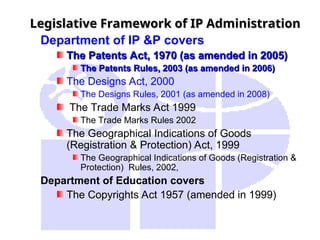
Legislative Framework ofIP Administration
Legislative Framework of IP Administration
Department of IP &P covers
The Patents Act, 1970 (as amended in 2005)
The Patents Act, 1970 (as amended in 2005)
The Patents Rules, 2003 (as amended in 2006)
The Patents Rules, 2003 (as amended in 2006)
The Designs Act, 2000
The Designs Rules, 2001 (as amended in 2008)
The Trade Marks Act 1999
The Trade Marks Rules 2002
The Geographical Indications of Goods
(Registration & Protection) Act, 1999
The Geographical Indications of Goods (Registration &
Protection) Rules, 2002,
Department of Education covers
The Copyrights Act 1957 (amended in 1999)
3.
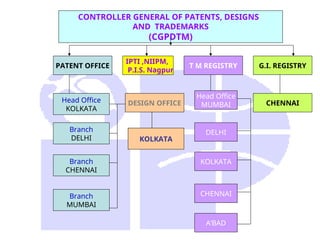
CONTROLLER GENERAL OFPATENTS, DESIGNS
AND TRADEMARKS
(CGPDTM)
T M REGISTRY
DESIGN OFFICE
G.I. REGISTRY
Head Office
KOLKATA
Branch
DELHI
Branch
CHENNAI
Branch
MUMBAI
Head Office
MUMBAI
DELHI
KOLKATA
CHENNAI
A’BAD
IPTI ,NIIPM,
P.I.S. Nagpur
KOLKATA
PATENT OFFICE
CHENNAI
4.
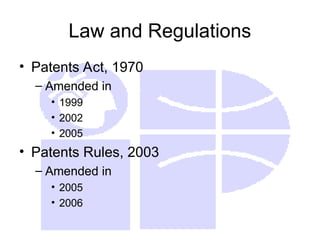
Law and Regulations
•Patents Act, 1970
– Amended in
• 1999
• 2002
• 2005
• Patents Rules, 2003
– Amended in
• 2005
• 2006
5.
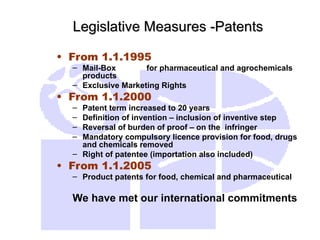
Legislative Measures -Patents
LegislativeMeasures -Patents
• From 1.1.1995
– Mail-Box for pharmaceutical and agrochemicals
products
– Exclusive Marketing Rights
• From 1.1.2000
– Patent term increased to 20 years
– Definition of invention – inclusion of inventive step
– Reversal of burden of proof – on the infringer
– Mandatory compulsory licence provision for food, drugs
and chemicals removed
– Right of patentee (importation also included)
• From 1.1.2005
– Product patents for food, chemical and pharmaceutical
We have met our international commitments
6.
6
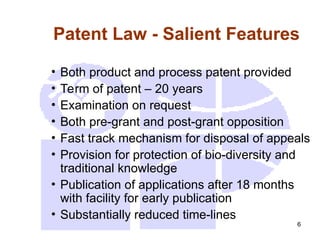
Patent Law -Salient Features
• Both product and process patent provided
• Term of patent – 20 years
• Examination on request
• Both pre-grant and post-grant opposition
• Fast track mechanism for disposal of appeals
• Provision for protection of bio-diversity and
traditional knowledge
• Publication of applications after 18 months
with facility for early publication
• Substantially reduced time-lines
7.
7
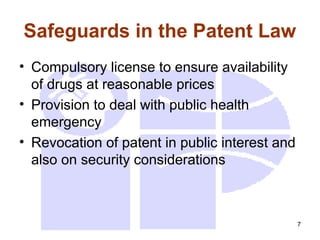
Safeguards in thePatent Law
• Compulsory license to ensure availability
of drugs at reasonable prices
• Provision to deal with public health
emergency
• Revocation of patent in public interest and
also on security considerations
8.
Scope of PatentabilityUnder
Scope of Patentability Under
The Patents Act
The Patents Act
9.
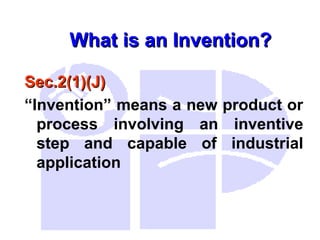
What is anInvention?
What is an Invention?
Sec.2(1)(J)
Sec.2(1)(J)
“Invention” means a new product or
process involving an inventive
step and capable of industrial
application
10.
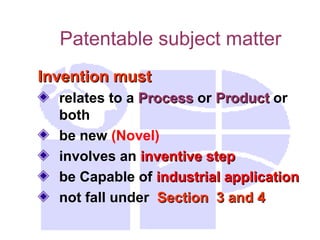
Patentable subject matter
Inventionmust
Invention must
relates to a Process
Process or Product
Product or
both
be new (Novel)
involves an inventive step
inventive step
be Capable of industrial application
industrial application
not fall under Section 3 and 4
Section 3 and 4
11.
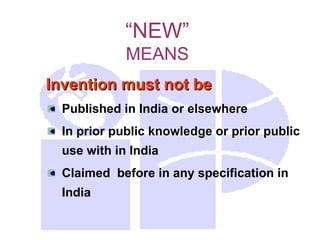
“NEW”
MEANS
Invention must notbe
Invention must not be
Published in India or elsewhere
In prior public knowledge or prior public
use with in India
Claimed before in any specification in
India
12.
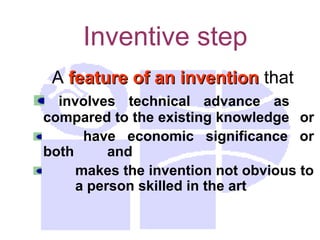
Inventive step
A featureof an invention
feature of an invention that
involves technical advance as
compared to the existing knowledge or
have economic significance or
both and
makes the invention not obvious to
a person skilled in the art
Section 3 exclusions
Section3(a)
Section 3(a)
• Frivolous inventions
• Inventions contrary to well
established natural laws
Examples
Examples
Machine that gives more than 100%
performance
Perpetual machine
15.
Section 3 exclusions
Section3(b)
Section 3(b)
Commercial exploitation or primary use
Commercial exploitation or primary use
of inventions, which is
of inventions, which is
Contrary to
public order or
Morality
Examples
Examples
– Gambling machine,
– Device for house-breaking ,
16.
Section 3 exclusions
Section3(b)
Section 3(b)
Commercial exploitation or primary use
Commercial exploitation or primary use
of inventions , which
of inventions , which
Causes serious Prejudice to
health or
human, animal, plant life or
to the environment
Examples
Examples
Biological warfare material or device,
weapons of mass destruction
Terminator gene technology,
Embryonic stem cell
17.
Checks and Balances
Section3(b)
Section 3(b)
Excludes patents on
• GMOs – exploitation of which could be
contrary public order or morality or
prejudicial to human, animal or plant life or
health or to the environment
Effect : Only genetically modified micro-
organisms (GMOs) which do not fall under
section 3 (b) are patentable.
18.
Section 3 exclusions
Section3 ( c )
Section 3 ( c )
• Mere Discovery of a Scientific Principle or
• formulation of an Abstract Theory or
• discovery of any living thing or
• discovery of non–living substance occurring in
nature
Examples
Examples
Newton’s Laws
Superconducting Phenomenon as such
Property of certain material to withstand
mechanical shock
Discovery of micro-organism
Discovery of natural gas or a mineral
19.
Checks and Balances
Section3(c)
Section 3(c)
Excludes patents on
•Naturally occurring Micro-organisms
Effect
Genetically modified microorganisms (GMOs)
are however, patentable.
20.
Section 3 exclusions
Section3(d)
Section3 (d)
The mere discovery of a new form
The mere discovery of a new form
of a
of a known substance which does not
known substance which does not
result
result in the enhancement of the
in the enhancement of the
known efficacy of that substance
known efficacy of that substance
21.
Section 3 exclusions
Section3(d)
Section3 (d) Explanation
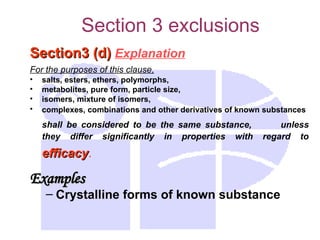
For the purposes of this clause,
• salts, esters, ethers, polymorphs,
• metabolites, pure form, particle size,
• isomers, mixture of isomers,
• complexes, combinations and other derivatives of known substances
shall be considered to be the same substance, unless
they differ significantly in properties with regard to
efficacy
efficacy.
Examples
Examples
– Crystalline forms of known substance
22.
Checks and Balances
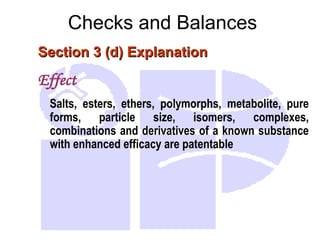
Section3 (d) Explanation
Section 3 (d) Explanation
Effect
Salts, esters, ethers, polymorphs, metabolite, pure
forms, particle size, isomers, complexes,
combinations and derivatives of a known substance
with enhanced efficacy are patentable
23.
Section 3 exclusions
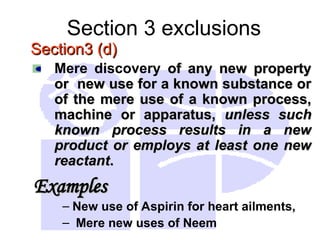
Section3(d)
Section3 (d)
Mere discovery of any new property
of any new property
or new use for a known substance or
or new use for a known substance or
of the mere use of a known process,
of the mere use of a known process,
machine or apparatus,
machine or apparatus, unless such
unless such
known process results in a new
known process results in a new
product or employs at least one new
product or employs at least one new
reactant
reactant.
.
Examples
Examples
– New use of Aspirin for heart ailments,
– Mere new uses of Neem
24.
Section 3 exclusions
Section3(e)
Section 3(e)
Substance obtained by mere admixture
mere admixture resulting only in
the aggregation of the properties of the components thereof or
a process for producing such substance
Examples
Examples
Combiflam [Paracetamol (Antipyretic) + Brufen (analgesic)]
Solution of sugar and color additives in water to form a soft
drink
However,
However,
A mixture resulting into synergistic properties of
mixture of ingredients however, may be patentable
- Soap, Detergents, lubricants etc
25.
Checks and Balances
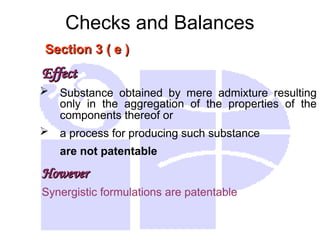
Section3 ( e )
Section 3 ( e )
Effect
Effect
Substance obtained by mere admixture resulting
only in the aggregation of the properties of the
components thereof or
a process for producing such substance
are not patentable
However
However
Synergistic formulations are patentable
26.
Section 3 exclusions
Section3 ( f )
Section 3 ( f )
Mere arrangement or re-arrangement
or duplication of known devices, each
functioning independently of one
another in a known way
Examples
Examples
A Bucket fitted with torch,
An Umbrella with fan
A Clock and radio in a single cabinet
A flour-mill provided with sieving
27.
Section 3(h)
Section 3(h)
Methodof Agriculture or Horticulture
Examples
Examples
Cultivation of algae ,
Producing new form of a known plant,
Preparation of an improved soil
However,
However,
Agricultural Equipments are patentable
Section 3 exclusions
Section 3 exclusions
28.
Section 3(i)
Section 3(i)
Anyprocess for medicinal, surgical, curative, prophylactic,
diagnostic, therapeutic or other treatment of human beings
or a similar treatment of animals to render them free of
disease or to increase their economic value or that of their
products
Examples
Examples
Removal of cancer tumor
Removal of dental plaque and carries
Surgical processes
Processes relating to therapy
Method of vaccination,
Blood transfusion
Section 3 exclusions
Section 3 exclusions
However ,
Treatment performed on tissues or fluids permanently removed from the body
Surgical,therapeutic or diagnostic Apparatus or instruments
are patentable
29.
Section3 exclusions
Section 3(j)
Section3(j)
Plants & animals in whole or any part
thereof other than micro- organisms,
but including seeds, varieties an d
species and essentially biological
process for production or propagation
of plants & animals
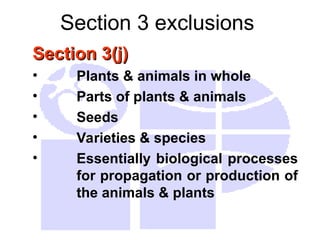
30.
Section 3 exclusions
Section3(j)
Section 3(j)
• Plants & animals in whole
• Parts of plants & animals
• Seeds
• Varieties & species
• Essentially biological processes
for propagation or production of
the animals & plants
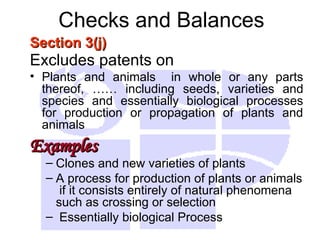
31.
Checks and Balances
Section3(j)
Section 3(j)
Excludes patents on
• Plants and animals in whole or any parts
thereof, …… including seeds, varieties and
species and essentially biological processes
for production or propagation of plants and
animals
Examples
Examples
– Clones and new varieties of plants
– A process for production of plants or animals
if it consists entirely of natural phenomena
such as crossing or selection
– Essentially biological Process
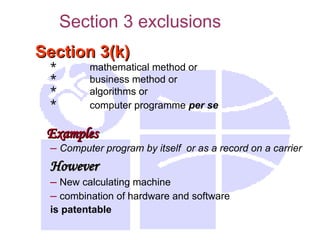
32.
Section 3(k)
Section 3(k)
*mathematical method or
* business method or
* algorithms or
* computer programme per se
Examples
Examples
– Computer program by itself or as a record on a carrier
However
However
– New calculating machine
– combination of hardware and software
is patentable
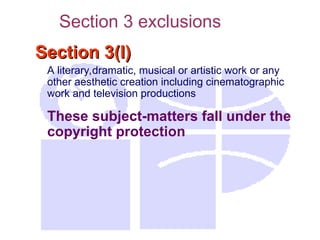
Section 3 exclusions
33.
Section 3(l)
Section 3(l)
Aliterary,dramatic, musical or artistic work or any
other aesthetic creation including cinematographic
work and television productions
These subject-matters fall under the
copyright protection
Section 3 exclusions
34.
Section 3(m)
Section 3(m)
Amere scheme or rule or method of performing mental
act or method of playing game
Examples
Examples
•Scheme for learning a language
•Method for solving a crossword puzzle,
•Method of learning a language
•Method of teaching /learning
However,
•Novel apparatus for playing game or carrying
out a scheme is patentable
Section 3 exclusions
35.
Section 3 (n)
Section3 (n)
Presentation of information
Examples
Examples
Any manner or method of expressing
information whether by
spoken words
Visual display
symbols
diagrams
Information recorded on a carrier
Section
Section 3 exclusions
3 exclusions
Section 3 (p)
Section3 (p)
Inventions which are
Traditional Knowledge or an aggregation or duplication of known
properties of traditionally known component or components
Examples
Examples
Traditional Knowledge already in public domain
- Wound healing property of Haldi
However,
Any value-addition using Traditional Knowledge leading to
a new process or product ,which is novel with inventive
step and industrial applicability,
Extraction of Azadirachtin from Neem
can be patented
Section
Section 3 exclusions
3 exclusions
38.
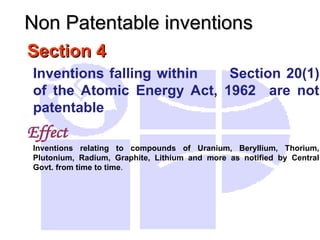
Section 4
Section 4
Inventionsfalling within Section 20(1)
of the Atomic Energy Act, 1962 are not
patentable
Effect
Inventions relating to compounds of Uranium, Beryllium, Thorium,
Plutonium, Radium, Graphite, Lithium and more as notified by Central
Govt. from time to time.
Non Patentable inventions
Non Patentable inventions
39.
Stages from filingto grant
Stages from filing to grant
of a patent
of a patent
40.
Obtaining a patent
•File an application for patent
– With one of the patent offices based on territorial
jurisdiction of the place of office or residence of the
applicant /agent
– Pay the required fee
• Information concerning application form and
details of fee available at www.ipindia.nic.in
• Guidelines for applicants also available on this
website
41.
Formality Check
• AnExaminer checks the formal
requirements before accepting the
application and the fee – this is done
immediately
• Issue of application number and the cash
receipt – this is done the same day
• In case of receipt of application by post,
cash receipt, application number is sent by
post within 2-3 days
42.
Publication
• Application iskept secret for a period of 18
months from the date of filing
• In 19th
month, the application is published in the
official journal – this journal is made available on
the website weekly
• Applicant has an option to get his application
published before 18 months also
• In that case, application is published within one
month of the request
43.
Request for Examination
•Application is examined on request
• Request for examination can be made
either by the applicant or by a third party
• A period of 48 months, from the date of
filing, is available for making request for
examination
44.
Examination
• Application issent to an Examiner within
1 month from the date of request for
examination
• Examiner undertakes examination w.r.t.
– whether the claimed invention is not
prohibited for grant of patent
– whether the invention meets the criteria of
patentability
45.
Issue of FER
•A period of 1 to 3 months is available to
Examiner to submit the report to the
Controller
• 1 month’s time available to Controller to
vet the Examiner’s report
• First Examination Report (FER) containing
gist of the objections is issued within 6
months from the date of filing of request
46.
Response from theApplicant
• 12 months’ time, from the date of issue of
FER, is available to the applicant to meet
the objections
• If objections are met, grant of patent is
approved by the Controller – within a
period of 1 month
47.
Pre-grant Opposition
• Afterpublication, an opposition can be
filed within a period of 6 months
• Opportunity of hearing the opponent is
also available
Consideration of
Pre-grant Opposition
•After examining the opposition and the
submissions made during the hearing,
Controller may
– Either reject the opposition and grant the
patent
– Or accept the opposition and modify/reject the
patent application
• This is to be done within a period of 1
month from the date of completion of
opposition proceedings
50.
Grant of aPatent
• A certificate of patent is issued within 7
days
• Grant of patent is published in the official
journal
51.
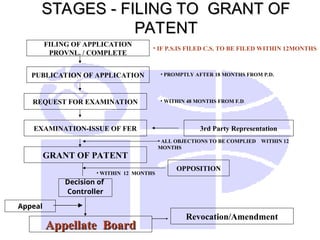
STAGES - FILINGTO GRANT OF
STAGES - FILING TO GRANT OF
PATENT
PATENT
PUBLICATION OF APPLICATION
REQUEST FOR EXAMINATION
GRANT OF PATENT
3rd Party Representation
Revocation/Amendment
OPPOSITION
• PROMPTLY AFTER 18 MONTHS FROM P.D.
• WITHIN 48 MONTHS FROM F.D.
• ALL OBJECTIONS TO BE COMPLIED WITHIN 12
MONTHS
• IF P.S.IS FILED C.S. TO BE FILED WITHIN 12MONTHS
• WITHIN 12 MONTHS
FILING OF APPLICATION
PROVNL. / COMPLETE
Decision of
Controller
EXAMINATION-ISSUE OF FER
Appeal
Appellate
Appellate Board
Board
52.
Renewal Fee
• Tobe paid within 3+6 months from date of
recording in the register [sec 142 (4) ]
• No fee for 1st
and 2nd
year
• Renewal fee, on yearly basis, is required to be
paid for 3rd
to 20th
for keeping the patent in force
• Delay upto six months from due date permissible
on payment of fee for extension of time
• Patent lapses if renewal fee is not paid within the
prescribed period
53.
D.P.S. PARMAR
D.P.S. PARMAR
DeputyController of Patents and Designs
Deputy Controller of Patents and Designs
Tele-Fax 091-11-23062307
Tele 091-11-28084310
Website: www.ipindia.nic.in
E-mail- dps.parmar@nic.in

![Section 3 exclusions
Section 3(e)
Section 3(e)
Substance obtained by mere admixture
mere admixture resulting only in
the aggregation of the properties of the components thereof or
a process for producing such substance
Examples
Examples
Combiflam [Paracetamol (Antipyretic) + Brufen (analgesic)]
Solution of sugar and color additives in water to form a soft
drink
However,
However,
A mixture resulting into synergistic properties of
mixture of ingredients however, may be patentable
- Soap, Detergents, lubricants etc](https://image.slidesharecdn.com/wiposmesdel08www116733-part2-250503081041-76091132/85/Legislative-framework-of-IP-Administration-24-320.jpg)
![Renewal Fee
• To be paid within 3+6 months from date of
recording in the register [sec 142 (4) ]
• No fee for 1st
and 2nd
year
• Renewal fee, on yearly basis, is required to be
paid for 3rd
to 20th
for keeping the patent in force
• Delay upto six months from due date permissible
on payment of fee for extension of time
• Patent lapses if renewal fee is not paid within the
prescribed period](https://image.slidesharecdn.com/wiposmesdel08www116733-part2-250503081041-76091132/85/Legislative-framework-of-IP-Administration-52-320.jpg)


![Patents by dps parmar [compatibility mode]](https://cdn.slidesharecdn.com/ss_thumbnails/patentsbydpsparmarcompatibilitymode-121009092243-phpapp01-thumbnail.jpg?width=640&height=640&fit=bounds)


