Legal Protection OfDatabases Mark J Davison
download
https://ebookbell.com/product/legal-protection-of-databases-mark-
j-davison-1221970
Explore and download more ebooks at ebookbell.com
2.
Here are somerecommended products that we believe you will be
interested in. You can click the link to download.
The Legal Protection Of Databases A Comparative Analysis Estelle
Derclaye
https://ebookbell.com/product/the-legal-protection-of-databases-a-
comparative-analysis-estelle-derclaye-2139908
The Legal Protection Of Women From Violence Normative Gaps In
International Law Rashida Manjoo
https://ebookbell.com/product/the-legal-protection-of-women-from-
violence-normative-gaps-in-international-law-rashida-manjoo-48687118
The Legal Protection Of Rights In Australia 1st Edition Matthew Groves
https://ebookbell.com/product/the-legal-protection-of-rights-in-
australia-1st-edition-matthew-groves-50236138
The Legal Protection Of Foreign Investment A Comparative Study Wenhua
Shan Editor
https://ebookbell.com/product/the-legal-protection-of-foreign-
investment-a-comparative-study-wenhua-shan-editor-50671210
3.
The Legal ProtectionOf The Intangible Cultural Heritage A Comparative
Perspective 1st Ed Pier Luigi Petrillo
https://ebookbell.com/product/the-legal-protection-of-the-intangible-
cultural-heritage-a-comparative-perspective-1st-ed-pier-luigi-
petrillo-10489394
The International Legal Protection Of Persons In Humanitarian Crises
Exploring The Acquis Humanitaire Dug Cubie
https://ebookbell.com/product/the-international-legal-protection-of-
persons-in-humanitarian-crises-exploring-the-acquis-humanitaire-dug-
cubie-50216000
Licensing Laws And Animal Welfare The Legal Protection Of Wild Animals
1st Ed Elizabeth Tyson
https://ebookbell.com/product/licensing-laws-and-animal-welfare-the-
legal-protection-of-wild-animals-1st-ed-elizabeth-tyson-22504538
The Struggle For The Health And Legal Protection Of Farm Workers El
Cortito Maurice Mo Jourdane
https://ebookbell.com/product/the-struggle-for-the-health-and-legal-
protection-of-farm-workers-el-cortito-maurice-mo-jourdane-10133718
Labour Migration In Europe Volume Ii Exploitation And Legal Protection
Of Migrant Workers 1st Ed Marco Borraccetti
https://ebookbell.com/product/labour-migration-in-europe-volume-ii-
exploitation-and-legal-protection-of-migrant-workers-1st-ed-marco-
borraccetti-7323240
The Legal Protectionof Databases
Mark Davison examines several legal models designed to protect data-
bases, considering in particular the 1996 European Union Directive, the
history of its adoption and its transposition into national laws. He com-
pares the Directive with various American legislative proposals, as well
as the principles of misappropriation that underpin them. In addition,
the book also contains a commentary on the appropriateness of the var-
ious models in the context of moves for an international agreement on
the topic.
This book will be of interest to academics and practitioners, including
those involved with databases and other forms of new media.
. is Associate Professor in the Faculty of Law at
Monash University. He has published articles on intellectual property
and restrictive trade practices in Australia, China, England, Germany,
Indonesia and Thailand.
8.
Cambridge Studies inIntellectual Property Rights
As its economic potential has rapidly expanded, intellectual property
has become a subject of front-rank legal importance. Cambridge Studies
in Intellectual Property Rights is a series of monograph studies of major
current issues in intellectual property. Each volume will contain a mix
of international, European, comparative and national law, making this
a highly significant series for practitioners, judges and academic
researchers in many countries.
Series editor
Professor William R. Cornish, University of Cambridge
Advisory editors
Professor François Dessemontet, University of Lausanne
Professor Paul Goldstein, Stanford University
The Hon. Sir Justice Robin Jacob, The High Court, England and
Wales
A list of books in the series can be found at the end of this volume.
Contents
Foreword by WilliamR. Cornish page xv
Acknowledgments xvi
Table of cases xvii
Table of legislation xxiii
Table of European Union legislation xxxiv
Table of treaties, conventions, other international and
regional instruments xxxviii
1 Introduction 1
Why have databases become an important issue 2
The structure of this book 3
2 Some basic principles 10
Basic copyright principles concerning databases 11
Compilations and collections 11
Originality 13
The ‘sweat of the brow’ approach 14
An intellectual creation 15
European standards of originality 16
The spectrum of originality 17
Originality as it applies to compilations and databases 17
Authorship 21
Some technical aspects of database creation 22
Infringement 24
A substantial part of a work: qualitative rather than
quantitative tests 25
Rights that are infringed 28
Right of reproduction 29
Right of rental 31
Right of distribution 31
Right of communication to the public 31
Protection against circumvention of technological protection
devices 32
Exceptions to copyright 32
Compulsory licensing 34
Summary of copyright 36
vii
14.
viii Contents
Principles ofunfair competition 37
Contract law and databases 40
Competition law 43
The paradigm does not fit 43
The legal model for protection may generate the possibility of
legitimate market power being created 46
The logistics of government regulation 47
Government policy towards competition law 48
Aspects of distributive justice 48
3 Protection of databases in the EU 50
History of the Directive 51
The Green Paper 52
The First Draft 53
Justification for a Directive 54
Definition of a database 54
Copyright in a database 54
Relationship to copyright in computer programs 55
Exceptions to copyright 55
Relationship between copyright and contract law 56
The sui generis right 57
Compulsory licensing 57
Exceptions to the sui generis right 58
Term of protection 59
Protection for databases outside the EU 59
Retrospectivity 59
Preservation of other legal provisions 59
Summary of the First Draft 60
Opinion of the Economic and Social Committee of the Council 60
Definition of a database 62
Protection for databases outside the EU 63
Duration of protection 63
Authorship of databases and circumvention of technological
protection of databases 64
Summary of the Committee’s Opinion 64
Amendments to the Directive by the European Parliament 65
Definition of a database 66
The sui generis right 66
Compulsory licensing 66
Exceptions to the sui generis right 67
The duration of protection 67
Summary of the 1993 Amendments 67
The common position of 10 July 1995 68
The final version of the Directive 68
The recitals 69
The need for uniform laws 69
Explanation of the substantive provisions of the Directive 70
Scope of the Directive and the definition of a database 70
Computer programs 74
Copyright in databases 75
15.
Contents ix
Authors ofdatabases 76
Restricted acts 76
Exceptions to copyright in databases 77
The sui generis right 81
The maker of a database 82
A qualitatively or quantitatively substantial investment in
obtaining, verifying or presenting 83
Right to prevent extraction and/or re-utilisation 87
Infringement of the right of extraction and re-utilisation 89
Exceptions to the sui generis right 91
Duration of the sui generis right 92
Retrospectivity 93
Territorial qualification for protection 97
Compulsory licensing and competition law 97
Saving of existing legal regimes 98
Final provisions 98
Summary of the Directive 99
Circumvention of protection measures 100
4 Transposition of the Directive 103
Belgium 109
Copyright before and after transposition 109
Unfair competition laws 111
Sui generis protection 111
Right to extract or re-utilise an insubstantial part 112
Exceptions 113
Term of protection 113
France 113
Copyright before and after transposition 113
Unfair competition law 115
Sui generis protection 116
Right to extract or re-utilise an insubstantial part 117
Exceptions 117
Term of protection 118
Germany 118
Copyright before and after transposition 118
Unfair competition laws 123
Sui generis protection 124
Right to extract or re-utilise an insubstantial part 125
Exceptions 126
Term of protection 126
Ireland 126
Copyright protection before and after transposition 126
Unfair competition laws 127
Sui generis protection 128
The right to extract or re-utilise an insubstantial part 128
Exceptions 128
Term of protection 128
Licensing schemes 128
Technological protection measures 129
16.
x Contents
Italy 129
Copyrightbefore and after transposition 129
Unfair competition laws 131
Sui generis protection 132
The right to extract or re-utilise an insubstantial part 133
Exceptions 133
The Netherlands 133
Copyright before and after transposition of databases prior
to the Directive 133
Unfair competition laws 134
Sui generis protection 135
The right to extract or re-utilise an insubstantial part 136
Exceptions 137
Term of protection 137
Spain 138
Copyright before and after transposition 138
Unfair competition laws 139
Sui generis protection 140
The right to extract or re-utilise an insubstantial part 140
Exceptions 140
Term of protection 140
Sweden 141
Copyright before and after transposition 141
Unfair competition laws 142
Sui generis protection 142
United Kingdom 143
Copyright before and after transposition 143
Unfair competition laws 146
Sui generis protection 147
Right to extract or re-utilise an insubstantial part 151
Exceptions 151
Term of protection 151
Licensing schemes 152
Summary of the transposition of the Directive 152
Harmonisation of copyright 152
The investment necessary to qualify for sui generis protection 153
Nature of the right and the test of infringement 155
Definition of a lawful user 156
Lack of harmonisation of the exceptions 156
The period of protection 156
Relationship to unfair competition laws 157
Single source databases 157
Conclusion 158
5 Protection of databases in the United States of America 160
Copyright 162
Some decisions since Feist 162
Circumvention of technological measures 164
The fair use defence 167
Summary of the copyright position 170
17.
Contents xi
Nature andhistory of the American tort of misappropriation 171
International News Service v. Associated Press 172
Subject matter of protection 173
Protection against whom 174
Nature of the protection 174
The dissenting judgment in International News Service v.
Associated Press 175
Summary of the position in International News Service v.
Associated Press 176
The chequered history of the decision in International News
Service v. Associated Press 178
Limitations on the scope of the tort of misappropriation 179
Pre-emption by the Federal Constitution and intellectual property
legislation 180
Direct competition between the parties 183
Time-sensitivity 185
Reducing the plaintiff’s incentive 187
Summary of American unfair competition law 189
Legislative proposals for sui generis protection 190
The Database Investment and Intellectual Property Antipiracy
Bill of 1996 190
Definition of a database 191
The sui generis right 191
Comparisons with misappropriation 192
Comparisons with the Directive 192
The Collections of Information Antipiracy Bill 1997 193
Definition of a Database 194
Prerequisite for sui generis protection 194
Nature of the sui generis right 195
Potential market 195
Circumvention of database protection systems and protection
of database management information 197
Permitted acts 197
Exclusions 198
Preservation of contract law and other legal regimes 199
Pre-emption of state law 199
Comparisons with the Directive 199
Comparisons with misappropriation 200
The Collections of Information Antipiracy Bill of 1999 200
Definition of a collection of information 201
Material harm 201
The market protected 202
A substantial part 203
Fair use 204
Reasonable uses for educational, scientific or research purposes 205
Other reasonable uses 206
Special provisions for securities and commodities market
information and digital on-line communications 207
Special provisions regarding genealogical information 207
Investigative, protective or intelligence activities 207
18.
xii Contents
Computer programsand digital on-line communications 208
Government collections of information 208
Duration of protection 209
Retrospectivity 211
Remedies 211
Study and report 211
Comparisons with the Directive 211
Comparisons with misappropriation 212
The Consumer and Investor Access to Information Bill of 1999 213
Summary of the American position 213
6 International aspects of protection of databases 217
International agreements concerning copyright protection of
databases 218
National treatment, most favoured nation status and the
Directive 221
Public international obligations and the American legislation 226
Steps towards a WIPO Treaty on the Protection of Databases 226
The Draft Treaty 227
Further moves towards a database treaty by WIPO 228
WIPO information meeting on intellectual property in databases,
Geneva, 17–19 September 1997 229
Observations by WMO and UNESCO 229
Outcome of the information meeting 230
Summary of moves to adopt a database treaty 231
EU and bilateral arrangements 234
Conclusion 235
7 The appropriate model for the legal protection
of databases 237
The argument in favour of sui generis protection 239
Economic theory 241
Price discrimination 242
The costs of intellectual property rights 244
Rent seeking 245
Loss of public good benefits 247
Transaction costs 254
Enforcement costs 257
Limiting the costs of property rights 257
Summary of economic theory 258
Anecdotal and empirical evidence 259
Evidence of the Directive’s impact 263
Non-economic roles of information 264
Limits of the tragedy of the commons 266
Examples of scientific cooperation 269
The Health WIZ project 269
World Meteorological Organization (WMO) 271
Some suggestions for protection of databases 272
Defining the subject matter of protection narrowly so as to avoid
unnecessary and unintended consequences 273
19.
Contents xiii
Separation ofthe subject matter of sui generis protection for sweat of
the brow from copyright protection 274
Differentiation of sui generis rights from copyright 275
Exceptions to copyright to permit use of underlying
information 276
Exceptions to prohibitions on circumvention protection devices 277
An equivalent to the fair use defence 277
Relationship with contract law and compulsory licences 278
Modification of competition law principles 280
Duration of the period of protection 280
Remedies 281
Excise some areas of scientific cooperation from any treaty
or legislation 282
Government information 282
Conclusion 283
Addendum 285
Canadian approach to originality 285
Reports to WIPO on the impact of database protection
on developing countries 286
Glossary 288
Bibliography 290
Index 296
21.
Foreword
Mark Davison’s bookon database protection covers a vital aspect of the
digital revolution. Indeed, the whole issue cries out for a place in this
series. Databases stand at the juncture between information as such and
the expression of literary and artistic ideas. From the first perspective,
information appears to be a necessary element in social existence and so
arguably it should be freely accessible to all. From the second, the need to
provide an incentive for the costly business of assembling large databases
argues for an equivalent appropriation to that given to creators and their
producers by copyright. Deciding how to structure this crossroads – be
it with filter lanes or with stop signs – calls for refined legal engineering.
What has been done so far to regulate this space has in considerable degree
depended on attitudes towards traffic which were formed in a horsedrawn
era. Now, motorised vehicles bearing enormous loads of information bear
down and have somehow to be accommodated. Hard-pressed legislators
and courts have done what struck them as best, but it is far too early to
say whether anything like a reasonable balance has been reached between
free flow and controlled access.
It will be some time before we can see whether by and large we are
offering stimulants to investment in data accumulation which are what
is needed, but not evidently more than that. Mark Davison draws on the
experience to date in the United States, the British Commonwealth and
the European Union. He shows the effects of pressure groups on emerging
solutions and, with a candid objectivity, demonstrates how much has as
yet to be treated as experimental. His writing is a refreshing antidote to
those who abjure any idea of intellectual property in this sphere, as much
as to those who battle for extensive intellectual property rights as the one
and only cause in the new and ever expanding market for organised data.
The book deserves to reach a wide audience.
Series Editor .
xv
22.
Acknowledgments
In writing thisbook I received help from a number of people and organ-
isations. In particular, I would like to thank Keith Akers for his generous
assistance and the Australian Research Council for providing me and Sam
Ricketson with research funds. Sam Ricketson read and commented on
a number of chapters and provided generous support in many ways. I
also received comments from Tony Duggan, Philip Williams and Russell
Smyth. A large number of other people were very generous with their time
and/or in providing documentation or commentary, including: Teresa
Arnesen, Christian Auingier, Toby Bainton, Stuart Booth, Clive Bradley,
Andrew Christie, Charles Clark, Chris Cresswell, Peter Drahos, Sir Roger
Elliott, Janet Ford, Jens Gaster, Teresa Hackett, Beth Heyde, Bernt
Hugenholtz, Anne Joseph, Stephen Maurer, Wilma Mossink, Sandy
Norman, Oliver Oosterbaan, Dennis Pearce, Jerome Reichman, Andrew
Treloar and John Zillman. Stephen Parker read a number of chapters
and, as Dean of the Faculty of Law at Monash University, supported me
in many ways.
Bill Cornish supported the proposal for the book and provided valu-
able advice and assistance at critical times. Finola O’Sullivan and Jennie
Rubio from Cambridge University Press were both patient and very
understanding and helpful. Lisa Gardaro did excellent work in the
final editing of the manuscript.
URLs
The publisher has used its best endeavours to ensure that the URLs for
external websites referred to in this book are correct and active at the
time of going to press. However, the publisher has no responsibility for
the websites and can make no guarantee that a site will remain live or that
the content is or will remain appropriate.
xvi
23.
Table of cases
APRAv. Ceridale Pty Ltd (1991) ATPR 41–074 page 47
Addressograph-Multigraph Corp. v. American Expansion
Bolt and Manufacturing Co., 7th Cir, 124 F 2d 706
(1942) 179
Advanced Computer Servs v. MAI Sys. Corp., 845 F
Supp. 356, 362 (ED Va, 1994) 30
Algemeen Dagblad and Others v. Eureka President, District
Court of Rotterdam, 22 August 2000 156
American Geophysical Union v. Texaco Inc., 802 F Supp. 1, 17
(SDNY, 1992) 169
Apple Computer Inc. v. Computer Edge Pty Ltd (1984)
53 ALR 225 273
Armond Budish v. Harley Gordon, 784 F Supp. 1320
(1992) 164
Associated Press v. United States, 326 US 1, 65 S. Ct 1416
(1945) 176
BN Marconi SRL v. Marchi & Marchi SRL, Court of Genoa,
19 June 1993, 1994 Foro It. Pt 1, 2559 132
Baumann v. Fussell [1978] RPC 485 27
Bellsouth Advertising & Publishing Corporation v. Donnelly
Information Publishing Inc., 999 F 2d 1436 (1993) 162
Board of Trade v. Dow Jones and Co., 456 NE 2d 84
(S. Ct Ill., 1983) 179
CD Law Inc. v. Lawworks Inc., 35 USPQ 2d (BNA) 1352
(1994) 182
Campbell v. Acuff-Rose Music Inc., 114 S. Ct 1164, 1170
(1994) 169
Capitol Records Inc. v. Spies, 130 Ill. App. 2d 429, 264 NE
874 (1970) 179
Cheney Bros. v. Doris Silk Corp., 35 F 2d 279
(2nd Cir. 1929) 160
xvii
24.
xviii Table ofcases
Columbia Broadcasting System Inc. v. De Costa, 377 F 2d 315
(Ct App. 1st Cir. 1967) 178
Commercial Bank of Australia v. Amadio (1983) 151
CLR 447 42
Compco Corp. v. Day-Brite Lighting Inc., 376 US 234,
84 S. Ct 779 (1964) 181
Continental Casualty Co. v. Beardsley US Dist Ct SD NY
151 F Supp. 28 (1957) 179
Data Access Corporation v. Powerflex Services Pty Ltd [1999]
HCA 49 75
De Costa v. Viacom Int. Inc., 981 F 2d 602
(1st Cir. 1992) 178
Decoras SA and L’Esprit du Vin SARL v. Art Metal SARL and
Marioni Alfredi [1991] PIBD 510 III-655 (CA Paris) 116
Del Madera Properties v. Rhodes and Gardner Inc., 820 F 2d
973, 976 (9th Cir. 1987) 181
Denda International v. KPN., 5 August, 1997, [1997]
Informatierecht, AMI 218, Court of Appeal of
Amsterdam 45, 136
Diamond v. Am-Law Corp., 745 F 2d 142 (2nd Cir. 1984) 169
Electre v. TI Communication and Maxotex, Tribunal de
Commerce de Paris, 7 March 1999 117
Erie Railroad v. Tompkins, 304 US 64 (1938) 178
Feist Publications Inc. v. Rural Telephone Service Co.,
499 US 340 (1991) 14, 15, 28, 83, 95, 162,
169, 171, 175, 182, 196,
219, 244, 256, 274, 276
Financial Information Inc. v. Moody’s Investors Service Inc.,
808 F 2d 204 (1986) 186
Fixtures Marketing Ltd v. AB Svenska, Spel, T 99-99, 11 April
2001 155
Football League Ltd v. Littlewoods Pools Ltd [1959] 1
Ch 637 144
France Telecom v. MA Editions, Tribunal de Commerce de
Paris, 18 June 1999 117
Fred Wehrenberge Circuit of Theatres Inc. v. Moviefone Inc., 73
F Supp. 2d 1044 (1999) 187
Gilmore v. Sammons, 269 SW 861 (1925) 186
Goldstein v. California, 412 US 546 (1973) 182
Groupe Moniteur and Others v. Observatoire des Marches,
Public Cour d’appel de Paris, 18 June 1999 114, 116,
117, 157
25.
Table of casesxix
Harper & Row, Publishers, Inc. v. National Enterprises, 471 US
539 (1985) 168
Hawkes and Son (London) v. Paramount Film Service Ltd
[1934] 1 Ch 593 26
Hodgkinson & Corby Ltd and Roho Inc. v. Wards Mobility
Services Ltd [1995] FSR 169 38, 146
Illinois Bell Telephone Company v. Haines and Co. Inc., 932 F
2d 610 (7th Cir. 1991) 162
Infinity Broadcast Corp. v. Kirkwood, 150 F 3d 104, 109
(2nd Cir. 1998) 169
Information Handling Service Inc. v. LRP Publications Inc., 54
USPQ 2d (BNA) 1571 (2000) 182
International News Service v. Associated Press, 248 US 215
(1918) 39, 160, 161, 172–178,
180, 183, 184, 189, 198
Iowa State University Research Foundation Inc. v. American
Broadcasting Co., 621 F 2d 57 (2nd Cir. 1980) 168
KPN v. Denda International and Others, District Court Almelo,
6 December 2000 45
KPN v. Denda International, Court of Appeal Arnhem, 15 April
1997 136
KPN v. XSO President, District Court of the Hague, 14 January
2000 136
KVOS v. Associated Press, 299 US 269 (1936); 80 F 2d 575
(1935); 9 F Supp. 279 (1934) 183
Kewanee Oil Co. v. Bicron Corp., 416 US 470 (1974) 182
Key Publications Inc. v. Chinatown Today Publishing
Enterprises Inc., 945 F 2d 509 (2nd Cir. 1991) 164
Koninklijke Vermande BV v. Bojkovski, 98/147 Court Decision
of 20 March 1998 (District Court of The Hague) 134
Kregos v. Associated Press, 3 F 3d 656 (2nd Cir. 1993) 12, 182
Ladbroke (Football) Ltd v. William Hill (Football) Ltd [1964] 1
All ER 465, [1964] 1 WLR 273 37
Lego v. Oku Hobby Speelgoed BV/Frits de Vrites Agenturen BV
Lima Srl, President District Court of Utrecht, 10 September
1998 135
Loeb v. Turner et al., 257 SW 2d 800 (Ct Civ. App.
Tex. 1953) 185
Lynch, Jones & Ryan Inc. v. Standard & Poor’s, 47 USPQ 2d
BNA 1759 (S. Ct NY, 1998) 187
MAI Sys. Corp. v. Peak Computer Inc., 991 F 2d 511
(9th Cir. 1993) 30
26.
xx Table ofcases
MacMillan & Co. v. Cooper (1924) 93 LJPC 113 14
Mars UK Ltd v. Teknowledge Ltd [2000] FSR 138, [1999] ALL
ER 600 (QB) 71, 194
Matthew Bender & Co. v. West Publishing Co., 158 F 3d 674
(2nd Cir. NY 1998) 163
Matthew Bender Co. Inc. v. West Publishing Co., 158 F 3d 693
(1998) 163
Maxtone-Graham v. Burtchaell, 631 F Supp. 1432 (SDNY
1986) 169
McCord Co. v. Plotnick, 108 Cal. App. 2d 392, 239 P 2d 32
(1951) 184
Mercury Record Productions Inc. v. Economic Consultants Inc.,
218 NW 2d 705 (Wis. 1974) 178
Metropolitan Opera Association v. Wagner-Nichols Recorder
Corp., 199 Misc 786, 101 NYS 2d 483 (S. Ct, NY 1950) at
492 179
Mirror Newspapers Ltd v. Queensland Newspapers Pty Ltd
[1982] Qd R 305 20
Montgomery County Association of Realtors Inc. v. Realty Photo
Master Corporation, 878 F Supp. 84 (1995) 164, 262
Moorgate Tobacco Co. Ltd v. Philip Morris Ltd (1984) 156
CLR 414 38
NFL v. Governor of Delaware, 435 F Supp. 1372, (US Dist Ct,
1977) 185
NV Holdingmaatschappij de Telegraf v. Nederlandes Omroep
Stichting, Court of Appeal, The Hague 99/165, 30 January
2001 154
NVM v. De Telegraaf, Court of Appeal, The Hague,
21 December 2000 136, 137, 154
National Basketball Association v. Motorola Inc., 105 F
3d 841 (2nd Cir. 1997). 39, 160, 162, 179, 180,
182, 185–188, 198,
200, 201, 206, 214
National Business Lists Inc. v. Dun & Bradstreet, 552 F Supp.
89 (1982) 196
National Council on Compensation Insurance Inc. (NCCI) v.
Insurance Data Resources Inc., 40 USPQ 2d (BNA) 1362
(1996) 163
National Exhibition Co. v. Tele-Flash Inc., 24 F Supp. 810
(Dist Ct, SD NY 1936) 183
Nationwide News Pty Ltd and Others v. Copyright Agency Ltd,
No. NG94 of 1995, Federal Court of Australia 37
27.
Table of casesxxi
Neal v. Thomas Organ Co., 241 F Supp. 1020 (US Dist Ct, SD
Cal. 1965) 178
Oasis Publishing Co. v. West Publishing Co., 924 F Supp. 918
(Minn. 1996) 163
P.I.C. Design Corp. v. Sterling Precision Corp., 231 F Supp. 106
(2nd Cir. US Dist Ct, SD NY, 1964) 178
Philips Electronics NV v. Ingman Ltd and the Video Duplicating
Company Ltd [1995] FSR 530 46
Pittsburgh Athletic Co. v. KQV Broadcasting Co., 24 F Supp.
490 (D Pa. 1934) 183
R R Donnelly & Sons Co. v. Haber, 43 F Supp. 456 (1942) 182
Radio Telefis Eireann (RTE) and Independent Television
Publications Ltd (ITP) v. Commission of the European
Communities (Magill’s case) [1995] ECR I – 743 [1995] 4
CMLR 718 45
Re.: CBS Records and Gross, No. G337 of 1989, Federal Court
of Australia 69 38
SARL Parfum Ungaro v. SARL JJ Vivier Paris, 18 May 1989,
D 1990 116
Salinger v. Random House Inc., 650 F Supp. 413 at 425
(SD NY, 1986) 168
San Fernando Valley Board of Realtors Inc. v. Mayflower
Transit Inc., No. CV 91–5872-WJR- (Kx) (CD Cal.
1993) 260
Sears, Roebuck & Co. v. Stiffel Co., 376 US 225, 84 S. Ct 784
(1964) 181
Skinder-Strauss Associates v. Massachusetts Continuing
Legal Education Inc., 914 F Supp. 665 (D. Mass.
1995) 28, 182, 260
Standard & Poor’s Corporation Inc. v. Commodity Exchange
Inc., 683 F 2d 704 (2nd Cir. 1982) 196
Stewarts v. Abend, 495 US 207 (1990) 168
Synercom Technology Inc. v. University Computing Company
and Engineering Dynamics Inc., 474 F Supp. 37 (ND Tex.
1979) 179
Tele-Direct (Publication) Inc. v. American Business Information
Inc. (1996) 74 CPR (3d) 72 162, 236
Telstra v. Desktop Marketing Pty Ltd [2001] FCA 612 10
The British Horseracing Board Ltd v. William Hill Ltd,
(HC 2000 1335), judgment 9 February 2001 137, 147–159
Tierce Ladbroke SA v. The Commission, case T-504/93 [1997]
ECR II 923 46
28.
xxii Table ofcases
Transwestern Publishing Company LP v. Multimedia Marketing
Associates Inc., 133 F3d 773 162
Triangle Publications Inc. v. New England Newspaper, 46 F
Supp. 198, (Dist Ct, 1942) 179
UNMS v. Belpharma Communication, Court of Brussels,
16 March 1999 112
University of London Press Ltd v. University Tutorial Press Ltd
[1916] 2 Ch 601 37
US Ex Rel Berge v. Board of Trustees of University of Alabama,
104 F 3d 1453 (4th Cir. 1997) 182
Victor Lalli Enterprises Inc. v. Big Red Apple Inc., 936 F 2d 671
(2nd Cir. 1991) 163
Waterlow Publishers Ltd. v. Rose (1990) 17 IPR 493 28
West Publishing Co. v. Matthew Bender & Co., Cert. denied S.
Ct, 522 US 3732 (1999) 163
West Publishing Co. v. Mead Data Central Inc., 616 F Supp.
1571 (D. Minn. 1985); 799 F 2d 1219 (8th Cir. 1986); 479
US 1070 (US S. Ct 1987) 163
West Publishing v. Hyperlaw Inc., Cert. denied S. Ct, 526 US
1154 (1999) 163
29.
Table of legislation
Australia
CopyrightAct 1968
Part VB page 34
Part VI, Divison 3 34
s. 10 12
14(1) 26, 34
116A 220
Foreign Proceedings (Excess of Jurisdiction) Act 1984 48
Trade Practices Act 1974
Part V, Division 2 43
s. 46 46
Belgium
Civil Code
Arts. 1382–1384 111
Law on Copyright and Neighbouring Rights, 30 June 1994
(as amended)
Art. 1, s. 1 105, 109
3(3) 109
4(2) 109
8 109
20(2) 109
20(4) 109
20ter 105, 110
22 106, 110
22(1) 106, 110, 153
22(2) 106, 110
22(4) 106, 110
22bis(1) 106, 110
xxiii
30.
xxiv Table oflegislation
22bis(4) 106, 110, 113
22bis(5) 106, 110
23 106, 110
23(3) 111
59 111
60 111
61ter 111
Legal Protection of Databases Act 1998
Art. 2(1) 107
2(2)(3) 107, 108
2(4) 107, 112
2(5) 107, 111
3 107
6 108, 113
7(1) 107, 113
7(2) 107
7(3) 108, 113
8 112
Denmark
Copyright Act 1995
s. 5 12
71 59, 260
Finland
Copyright Act 1961
Art. 49 59, 260
France
Copyright Act
Art. L341–1 82, 107
Law No. 98-536 of 1 July 1998 82, 104, 225
Law No. 92-597 of 1 July 1992, Code of Intellectual Property
(relative au code de la propriété intellectuelle (partie législative))
L111-1 21
L112-1 16, 114
xxxii Table oflegislation
1408(b) 208, 209
1408(c) 208, 209, 212
1409 210
Constitution of the United States
Art. I, cl. 8 171
Consumer and Investor Access to Information Bill of 1999
(HR 1858 of the 106th Congress)
s. 102 213
103(d) 213
104 213
Copyright Act of 1976
s. 102 182
103 183
106 182
107 168, 204
301 182
1201 197
Database Investment and Intellectual Property Antipiracy Bill of
1996 (HR 3531 of 1996)
s. 2 191
3(a) 191
3(d) 191
4(a)(1) 191
4(a)(2) 191
4(b) 191
6 192
6(a) 192
6(b) 192
9(c) 193
11 192
Digital Millennium Copyright Act of 1998 (12 Stat. 2860 (1998))
generally 165, 200
s. 1201 165
1201(a)(1)(A) 165
1201(a)(1)(B) 165
1201(a)(1)(C) 165
1201(d) 165
1201(d)(2) 165
1201(f) 165
39.
Table of legislationxxxiii
Restatement of the Law, Third, Unfair Competition 1995,
s. 38 161
Sherman Act, Statute 209 of 1890 as amended by 15 USCA 2
(1973), s. 2 45
40.
Table of EuropeanUnion legislation
Common Position (EC) No. 48/2000 regarding the proposal for a
Council Directive on the legal protection of databases,
OJ No. C 288, 30 October 1995, Art. 6(2) page 220
Copyright Directive (2001//29/EC; OJ No. L 167, 22 June 2001)
Art. 6 91, 101
6(1) 91, 100
6(2) 100
6(3) 100
6(4) 101
Directive 96/9/EC of 11 March 1996 on the legal protection of
databases, (OJ No. L 77, 27 March 1996)
Recital 2 69
3 69
4 69
6 69
7 69, 82, 89
8 68
10 69, 71, 82
11 69, 82
12 71, 82, 89
13 69, 82
16 76
17 72, 73, 85
18 55, 73
19 73, 82, 85
20 91
22 71
23 71
24 77
34 77
36 78
xxxiv
xxxvi Table ofEuropean Union legislation
10 92, 93, 108, 134, 138
10(1) 134
10(2) 92
10(3) 92, 93
11 5, 97, 98
11(2) 97
11(3) 97
13 98, 138
14 94, 242
14(1) 94
15 91
16 98
16(3) 97
Explanatory Memorandum to the Proposal for a Council Directive
on the legal protection of databases COM(92) 24 Final – SYN 393,
Brussels, 13 May 1992 2, 53, 54, 55,
57, 58, 61
Green Paper on Copyright and the College of Technology 1988, Doc.
Ref. Com(88) 172 final 52, 53, 54, 96
Opinion on the Proposal for a Council Directive on the
legal protection of databases of the Economic
and Social Committee 16, 60, 61, 62, 63,
64, 65, 66, 67, 68,
70, 83, 94, 95, 97,
99, 100, 224, 241
Proposal for a Council Directive on the legal protection of databases
COM(92) 24 final – SYN 393 Brussels, 13 May 1992
Art. 1(1) 54, 55
1(2) 57
2 58
2(3) 54
2(4) 54
5 56
6 56
6(1) 56, 78
6(2) 56, 78
7(1) 55
7(2) 55
8(1) 58
Table of treaties,conventions, other
international and regional instruments
Agreement on Trade Related Aspects of Intellectual Property (TRIPS)
(entered into force 1 January 1995), UNTS 31874
Art 1(1) page 222
1(2) 223
1(3) 222
1–7 223
3 222
3(1) 221
4 222
9 223
11 29, 31, 89
13 79, 224
Part III 223, 281
Basic Proposal for the Substantive Provisions of the Treaty on
Intellectual Property in respect of Databases Considered by the
Diplomatic Conference on Copyright and Neighbouring Rights
Questions, Geneva, December, 1996
Art. 2 227
3 227
5 227
6 227
Berne Convention for the Protection of Literary and Artistic Works
(Paris Act of 24 July 1971, as amended), 8L8 UNTS 221
Art. 1-21 30, 223
2(5) 52, 54, 218
7 225
9 28, 29
9(2) 36, 79, 224
10(2) 36, 55
11bis(2) 36
xxxviii
45.
Table of conventionsand treaties xxxix
13(1) 36
18 95
Convention for the Protection of Producés of Phonograms 1971
(UNTS 12430) 231
EEC Treaty of Rome (25 March 1957; entered into force 1 January
1958) [UNTS/ILM Ref ]
Art. 86 45
WIPO Copyright Treaty 1996, 36 ILM 65(1997)
Art. 1(4) 29, 30
4 219
6 29, 31, 88, 89
7 29, 31, 89
8 29, 31, 88, 89, 219, 220
11 29, 32, 220
12 220, 221
12(2) 221
47.
1 Introduction
We livein the Age of Information. Information is money. So is time. The
economies of the First World are dominated by the creation, manipulation
and use of information and the time it takes to do so. These economies do
not suffer from a shortage of information; they suffer from the difficulties
associated with collecting, organising, accessing, maintaining and pre-
senting it. Databases are designed to help deal with these difficulties. They
are collections of information arranged in such a way that one or more
items of information within them may be retrieved by any person with
access to the collection containing those items.1
Therefore, databases are
big business because they contain important and copious amounts of in-
formation and they reduce the time taken to access that information.2
And where there is big business, the law and lawyers inevitably follow.
But information is more than money and databases are more than
big business. Information and databases are critical to science, the legal
system itself, education and all those aspects of life that are improved by
them. Consequently, there are important issues of social and political pol-
icy to be considered in the regulation of access to, and use of, databases.
Again, where there are such critical issues at stake, the law has a role to
play.
There is an inevitable tension between the commercial and the socio-
political role of databases that leads to complexities in developing an
appropriate model for their legal protection. In fact, given the diverse
range of areas in which databases can be used, any one of a variety of legal
models may be appropriate in any given context. One of the criticisms
of general references to the importance of information is that they fail
1 This is a very rough working definition of a database. The various issues concerning the
definition of a database are discussed in later chapters, especially Chapters 3 and 4.
2 ‘In 1989, the world-wide turnover for online database and real time information services
accounted for around 8.5 billion ECU.’ In 1996, the estimated size of the European
Market electronic information supply market was £5.138 billion. A Consultative Paper
on United Kingdom Implementation: Directive 96/9/EC of 11 March 1996 on the legal
protection of databases copyright directorate, The Patent Office, DTI, August, 1997 at
para. 2.1.5 and Annex 2.
1
48.
2 Introduction
to differentiatebetween different categories of information.3
The same
criticism could be levelled at any legal system that applied a ‘one size fits
all’ approach to the regulation of databases. It is no surprise then that a
number of different legal models for protection of, and access to, data
and databases have arisen.
Why have databases become an important issue
The transition of many First World economies from industrially based
economies to information-based economies is a relatively recent phe-
nomenon. It is a consequence of an explosion in information and the
means by which it can be disseminated that results in turn from
far-reaching technological and scientific developments.4
In particular,
advances in digital technology have facilitated the creation of databases.
Large amounts of data can be created in, or converted into, digital form,
and scanners and other devices permit the digital conversion of data.
Alternatively, data can be originally produced and stored in digital forms
that are perceived by humans as text, pictures, tables, spreadsheets and
other easily recognisable formats. The digitisation of data in turn reduces
storage costs. For example, if the DNA structure of the human genome
were compiled in hardcopy it would occupy 200,000 pages.5
The phys-
ical storage of such documentation in digital form can be achieved with
a few CDs.
This expanded capacity to store data is complemented by an increased
capacity to access and use it. It is facilitated by computer programs that
enable quick and reliable searching and retrieval of data. Computer net-
works also allow on-line use of databases, thus increasing ease of access
and marketability. These increased abilities to store and disseminate in-
formation, in turn, have increased the production of information. This
is due to the relationship between the production of information and the
availability of existing information. Existing information and access to it
are critical to the creation of new data and information.6
This creative
process is like a spiral in which the users of existing data actually add
3 See Chapter 6 for a discussion of this point.
4 ‘It has been estimated that the volume of the increase annually in information generated
today equals the total information in circulation in the world fifty years ago.’ Explanatory
Memorandum to the Proposal for a Council Directive on the legal protection of databases
COM(92) 24 final – SYN 393, Brussels, 13 May 1992.
5 Human Genome Project Information at http://www.ornl.gov/hgmis/publicat/primer/
fig14.html.
6 At this point, the terms ‘data’ and ‘information’ are being used interchangeably. Possible
distinctions between the two and the relevance of those distinctions are discussed in
Chapter 6.
49.
The structure ofthis book 3
value to that data in the process of using it, thus generating more new
data and information.
The pressure to provide specific legislative protection for databases
has arisen from the increase in the mass of raw data available in almost
every area of commerce and science, the increased technological ability
to create databases containing those data and to provide easy access to
them. These are coupled with the increased technological ability of others
to reproduce those databases and a perceived lack of adequate protection
from existing legal regimes, such as copyright. The same technology that
has expanded the role and usefulness of databases permits quick and
easy reproduction of those databases or large parts of the data contained
within them. ‘Robots’ and other computer technology can be used to
download data from databases with little effort or human intervention.
This reproduction can take place anywhere on the planet, provided the
person arranging for the reproduction has access to the necessary com-
puter infrastructure. Consequently, database owners have claimed that
they require additional legislative protection to protect their investment in
the creation and marketing of databases from free-riders who can quickly
and easily reproduce the databases created and maintained by them.
The structure of this book
This book examines various models of legal protection for databases. A
brief explanation of those models is given at the beginning of Chapter 2,
where the various basic legal principles relevant to nearly all jurisdictions
are covered. In particular, Chapter 2 deals with some basic principles of
copyright, unfair competition law, contract and competition or anti-trust
law as they apply to databases. These principles are referred to throughout
the book.
Chapter 3 examines the European Union (EU) Directive on the Legal
Protection of Databases 1996 (the Directive),7
including both the copy-
right protection and the sui generis protection that has been conferred
by the Directive. This examination includes the history of the Directive,
the justifications provided for it and its important features. In addition,
Chapter 3 examines the impact on database protection of the provi-
sions of the EU Copyright Directive on the harmonisation of certain
aspects of copyright and related rights in the information Society 2001
(the Copyright Directive).8
The provisions of the Copyright Directive
7 Directive 96/9/EC of 11 March 1996 on the Legal Protection of Databases, OJ No. L77,
27 March 1996, pp. 20–8.
8 Directive 2001/29/EC, OJ No. L167, 22 June 2001, pp. 10–19.
50.
4 Introduction
concerning thecircumvention of effective technological measures that
are designed to protect copyright material also apply to the sui generis
right conferred by the Directive. Consequently, those provisions are an
important aspect of the protection provided for databases.
The examination in Chapter 3 of the history of the Directive reveals
that the initial EU moves for sui generis protection proposed a very limited
protection clearly separated from the copyright protection of databases.
However, Chapter 3 also shows that the final form of sui generis protec-
tion under the Directive is, in fact, a hybrid of the generous scope of
protection under former UK copyright law and the restrictive exceptions
provided in the copyright law of many continental countries. The latter
are probably quite justified in a copyright scheme that requires high levels
of originality before conferring any copyright protection at all. However,
they are inadequate in a legislative scheme that confers protection on un-
original databases. The effect of this hybrid approach has been to confer
an extraordinary degree of sui generis protection. The argument is also
made that the sui generis protection provided by the Directive is inap-
propriately and inextricably entwined with copyright law and that, in a
number of technical respects, the Directive is worded in such a way that
it provides protection, even beyond its intended scope. An example of
this latter point is the broad definition of a database.
Chapter 4 examines the legislation transposing the Directive in a num-
ber of the Member States and some of the emerging case law relating to
that legislation. This examination further illuminates some of the ambi-
guities in the wording of the Directive and different approaches that have
been taken to its transposition.
Chapter 5 examines the protection provided by copyright and the tort
of misappropriation in the United States. Copyright and misappropria-
tion principles have underpinned the different proposals that have been
made in the United States for sui generis protection. Yet the tort of mis-
appropriation has itself had a chequered history. Considerable judicial
attention has been given to the theoretical basis of the tort and its con-
sequent scope with resulting differences in the operation of the tort.
Consequently, it is not surprising that different pieces of proposed legis-
lation that have all been (allegedly) based on misappropriation have
proposed quite different degrees of protection. The lesson to be learned
from this is that if the concept of misappropriation is to be incorporated
into sui generis legislation, it needs to be defined with some precision.
Chapter 5 also examines the different pieces of proposed legislation and
compares them with the tort of misappropriation and the Directive.
This examination reveals a move away from the approach taken in
the Directive towards one with wider exceptions to protection and a less
51.
The structure ofthis book 5
restrictive approach to the use of information for transformative or
wealth-producing uses of information. There are also provisions that are
designed to ensure public access to information produced by government
or with government funds.
Chapter 6 examines moves to provide additional protection for data-
bases outside of the EU. In 1996, a draft treaty based on the Directive
and legislation that had been proposed in the United States9
was briefly
considered at a diplomatic conference hosted by the World Intellectual
Property Organization (WIPO). The draft treaty was not adopted but the
issue has continued to receive consideration by WIPO since that time.
The failure to pass any of the proposed pieces of legislation in the United
States has no doubt hampered that process but once such legislation is
in place, moves for a treaty are likely to intensify. To date, the EU has
suggested its Directive as a template for a treaty on the topic but this
has encountered considerable resistance from developing countries.
Resistance has also come from international science organisations that
are concerned about the potential impact of any sui generis legislation on
the exchange of scientific information. The relevance of their views to sui
generis protection is considered in Chapter 7.
In response to this resistance at WIPO, the EU has shifted its focus
to its bilateral arrangements with other countries such as those seeking
membership of the EU. Consequently, over fifty countries, including the
fifteen Member States, either have sui generis protection for databases or
will acquire it within the next few years.
There are other significant international aspects to the protection of
databases associated with these moves. For example, the Directive pro-
vides that sui generis protection for overseas databases will only be con-
ferred if the nations from which those databases originate also provide
materially the same protection for EU databases.10
This use of reciprocity
provisions in intellectual property regimes is a relatively rare departure
from the usual international practice of according national treatment to
nationals from other nations. One of the reasons for this approach is to
place pressure on countries such as the United States to provide recipro-
cal protection and to create a de facto international model for protection.
The implications of this are discussed. In particular, Chapter 6 argues
that the EU may be obliged by international agreements to provide na-
tional treatment to overseas databases and, consequently, the pressure to
provide reciprocal protection is not as great as it may seem. Part of the
9 The Database Investment and Intellectual Property Antipiracy Act of 1996, HR 3531
of 1996.
10 Article 11 of the Directive.
52.
6 Introduction
basis ofthis argument relates back to the point made in Chapter 3 that
sui generis protection is inextricably entwined with copyright. While the
Directive describes it as being separate from copyright, a close inspection
of the subject matter of protection, the rights conferred and exceptions
to those rights suggests that sui generis protection is, in reality, a form of
copyright.
Chapter 7 analyses the arguments for and against the different models
for sui generis protection from a theoretical perspective. As with every
intellectual property regime, the law in relation to the protection of
databases needs to achieve an appropriate balance between the rights
of users and the rights of producers or owners of intellectual property.
The ultimate objective of this balancing act is to achieve an optimal pro-
duction and dissemination of the material that is, or could be, contained
within databases. Hence, database owners have argued that greater pro-
tection is required for databases in order to protect their investment in
production. This emphasis on protection of the database maker’s invest-
ment undoubtedly underpinned the Directive, as making a substantial
investment is the litmus test for whether the Directive’s sui generis pro-
tection extends to a particular database.11
However, this emphasis rep-
resents a significant shift in the general approach to the recognition and
protection of intellectual property. At least in common law countries, the
emphasis in other intellectual property regimes has been on the creation
and maintenance of a social contract between creators and users. While
encouraging investment is a desirable goal of this social contract, the real
question is whether the investment in question is an optimal investment
for public purposes. This in itself is a controversial issue, as what consti-
tutes ‘optimal’ investment is debatable.
In the context of databases, this relationship between producers and
users is complicated by the fact that in a number of contexts, the users
themselves make significant contributions to the production of the in-
formation that is contained within those databases; and this information
production is often subsidised by public funds. A particular concern is
the relationship between protection of databases and the impact of that
protection on research and education, activities essential to the continued
production of the very information that finds its way into many databases.
Consequently, the book examines the impact of the models for sui generis
protection on research and education.
As the justification for sui generis protection of databases is primar-
ily an economic one, an analysis of that justification inevitably requires
some examination of economic arguments for protection; hence, some
11 Article 7(1) of the Directive.
53.
The structure ofthis book 7
of Chapter 7 is taken up with this. However, the validity of such theories
is ultimately dependent on empirical evidence.12
At the present time,
there is no clear empirical evidence justifying a strong form of sui generis
protection.13
Consequently, while those theories are important, they
should be treated with some caution, particularly when they suggest the
creation of strong intellectual property rights which, if created, will be
effectively impossible to rescind. In addition, there are important non-
economic aspects of the debate concerning protection of, and access to,
databases that receive attention in Chapter 7. One example concerns the
availability of information for news reporting and political debate.
The book concludes with a list of basic principles that need to be
considered and incorporated into any sui generis protection of databases.
This list is explained by reference to the preceding analysis in Chapter 7
of the arguments for and against different forms of sui generis protection,
and is compared with particular aspects of the Directive and the various
American bills on the topic that are examined in Chapters 3, 4 and 5.
A couple of points need to be made about the issues with which the
book does not deal. In particular, it does not cover in any detail the law of
confidential information or trade secrets as it applies to databases. This is
because the emphasis is upon databases that are available to the public, or
at least those members of the public with sufficient resources and interest
to acquire access to them. Consequently, the emphasis in the legal analysis
is upon proposals for sui generis protection for databases that cannot rely
upon the protection of the law of confidential information. Legal issues
surrounding privacy and databases are also not considered here, although
obviously privacy in the context of databases is an important issue in its
own right. Nevertheless, the emphasis in this book is on database owners,
rights and their appropriate nature and extent, rather than the privacy
rights of those whose details may be included in a database.
While it would be superfluous to repeat the details of Chapter 7 here,
a couple of general observations about the book’s conclusions are worth-
while to assist the reader in the course of the following chapters. The
ultimate conclusion of the book is that there is justification for some sui
generis protection of the investment involved in the creation and presenta-
tion of databases. This view is taken by various independent organisations
and even those who have expressed concerns about the possibly exces-
sive nature of any sui generis protection.14
In many jurisdictions, the pro-
tection provided by copyright is insufficient. However, the justification
12 P. Drahos, A Philosophy of Intellectual Property (Dartmouth, Aldershot, 1996), p. 7.
13 US Copyright Office Report on Legal Protection for Databases, August 1997, pp. 76–7.
14 Ibid., p. 78. Statements of Andrew Pincus, General Counsel, US Department of
Commerce, Joshua Lederberg (on behalf of the National Academy of Science and Ors),
54.
8 Introduction
only extendsto quite limited protection over and above that presently
conferred by copyright, contract and other means. Any international
agreement or legislation on the topic needs to acknowledge and respond
to the diverse types of information in databases and the diversity of their
potential uses. A simplistic approach which confers strong exclusive prop-
erty rights in all databases and which applies to all uses of those databases
does not meet that need. Such an approach runs the risk of treating all
information as a commodity for all purposes.
In particular, there is a need to ensure that public access to informa-
tion created with government funds or subsidies is not completely lost.
This is an important issue. For example, governments, universities and
other non-profit organisations supply more than one-third of the funds
devoted to research and development15
and the process of government
also generates large amounts of information that are valuable both in a
commercial sense and to the democratic process.
The latest American proposals for sui generis protection based on mis-
appropriation principles have addressed some of the difficulties, and
demonstrate an appreciation of the complexities associated with legis-
lation concerning such a diffuse area. Hence, there are a number of ex-
ceptions provided for in the latest proposed legislation and protection is
based on misappropriation principles. Nevertheless, it is too simplistic
to just accept the view that any sui generis protection should be based on
misappropriation principles. As argued in Chapter 6, misappropriation
is a nebulous concept and it must be given a concrete form that is rel-
evant to the area of its application. The latest American proposals still
provide generous protection that approximates exclusive property rights,
even though they are ostensibly based on misappropriation principles.
In addition, the relationship between any prohibition on misappropria-
tion, copyright and contract law needs to be addressed in some detail.
While those proposals have considered these issues, there is some room
for improvement.
In contrast to the more sophisticated American response to the issue
of sui generis protection, the Directive adopts an approach conferring
broad exclusive property rights with few, if any, meaningful exceptions.
and Charles Phelps (on behalf of the Association of American Universities and Ors) to
the Subcommittee on Courts and Intellectual Property of the Judiciary Committee on
the 1999 Bill (Collections of Information Antipiracy Act of 1999) on 18 March 1999,
pp. 62–506 (Pincus, pp. 51–100; Lederberg, pp. 189–205; Phelps, pp. 223–53).
15 E.g. between 1992 and 1997 more than 33 per cent of all research and development
in the USA was funded by government, universities or other non-profit organisations.
‘Statistical Abstract of the United States’ (Bureau of Statistics, Washington DC, 1998).
The same was also true for the UK between 1992 and 1996: ‘Annual Abstract of Statistics
No. 135 of 1999, Table 19.1’ (Office for National Statistics, London, 1999).
"The Emperor!" shecried in a tone of surprise.
"More than that: I have told him all, and he has acknowledged my
title," and I showed her the Imperial letter.
Her face shone with pride and delight.
"I can forgive every one now, for it has all ended so splendidly for
you," she said.
"For us," I corrected; and she acknowledged the correction with a
blush and a smile of love which exasperated the Baroness Gratz,
who had been listening to us in indignant silence.
"Then I suppose you have no more use for me?" she declared, with
an angry toss of the head, as she turned to leave us.
"I am afraid you yourself have made it difficult for you to share in
my happiness—in our happiness, I mean," said Minna gently. "I am
so happy that I have no room for any thought on that score but
regret that it should be so."
"You were always an ungrateful girl, Minna," replied the old lady
very ungraciously, bitter to the end against me. "And I have no wish
to share with you, or deprive you of any part of, such happiness as
you may expect to find in company with a man who is sometimes
play-actor, sometimes Prince, and always an impostor," and with that
parting taunt she flung away.
"Poor aunt Gratz!" sighed Minna.
Then she put her hands in mine, and, nestling close to me, asked
with a winsome coquettishness:
"Am I ungrateful, Karl?"
My answer may be guessed, and it took long in telling. But we
returned after a time to the ways of common sense, and then I told
her what had passed during the audience with the Kaiser; that I was
57.
to travel fora year, and then return to Berlin to take up formally my
old title and position.
At first the news brought a cloud to her happy face.
"A year is a long time, Karl," she murmured. "Shall you never be in
either Munich or Gramberg all that time?"
"I think not. I expect it means at least a year away from the
Fatherland."
She was silent and looked almost sad.
"But a year will soon pass," I whispered.
A gesture of pretty reproach answered me.
"If you would make a little sacrifice, it would help, I think."
"Sacrifice!" she echoed, not catching my meaning. And when I did
not reply she lifted her head from my shoulder and peered into my
eyes, her own full of curiosity.
"You used to pride yourself on reading my secrets," said I.
She thought a minute; then a look of wonderment shone in her
eyes, followed almost directly by a great, glad blush that spread all
over her face, dyeing her cheeks with crimson and driving her to
hide them against my shoulder.
"I don't guess this one," she said.
But I was sure she had.
"Don't?"
"Won't, then," she murmured into my coat lapel.
"It could not be yet, of course," said I. "But in three months——"
"You said sacrifice," she interrupted, and glanced up with a quick
darting of the eyes.
58.
"It would haveto be very quiet—very, very quiet."
"It is no sacrifice to travel—in company."
And there we left it; but we knew well enough each other's hopes
and desires.
To accomplish our purpose called for some little tact and effort,
because the Emperor was for having Minna taken to Berlin when the
Munich troubles had been arranged.
His prompt and drastic measures soon settled these, indeed.
An official announcement was made that the King had been
suffering from an indisposition, but had happily recovered
completely; and a couple of days later saw him back at the palace—
but with a change in the executive which was calculated to work
vastly beneficial results for the country. The Heckscher party was
broken up, their influence destroyed, and their leaders dealt with
secretly, but in some cases none the less severely. The question of
the succession to the throne was settled upon a sound basis—one of
the points being the renunciation by Minna of all the Gramberg
claims.
And it was in settling this that the matter of her marriage was
mooted and the Imperial consent gained to her becoming my wife.
We succeeded, too, in getting the necessary interval fixed at three
months.
The time passed very pleasantly. It was the sweet preface to a life-
long romance.
As the outcome of the dash we had made for the throne I had one
or two arrangements to complete, and in some respects the most
difficult of these was in regard to the Corsican Praga. I could not
retain him in my service, because of his association with the death
59.
of Minna's brother;while I hoped, too, that the time would never
recur when I might have need of his clever, sharp, ready sword. I
told him the case plainly, and he was too careless to make demur.
He was going to marry and settle in Berlin, he assured me—his bride
was to be the actress, Clara Weylin, who had made her peace with
him in the score of her act of treachery—and he meant to be the
greatest fencing master in Berlin, he declared. I gave him as a
wedding present a considerable sum of money, and we parted with
many assurances, characteristic and voluble, on his part that he
would ever be devoted to me and my interests.
Steinitz I kept with me as secretary, and von Krugen was to remain
as guardian of our interests at Gramberg. There was one
commission we gave to the two just before our marriage—to go to
Charmes and endeavor to bring the real von Fromberg to Munich to
be present at the marriage.
Minna and I were together when they started, and she was looking
more radiant and beautiful than ever in the anticipative joy of the
marriage.
I gave them full instructions, and then, with a smile, I turned to von
Krugen.
"Be more careful this time," I said, "and be sure you bring the right
man."
"I could not have brought a better man last time, count," he replied.
And in the tone and earnestness spoke all the regard and esteem of
a stanch and sincere friend.
"What do you say to that, Minna?" I asked as they drove off.
"A happier mistake was never made, but I don't want him to do it
again. The only throne I care for is won now," and, reaching up on
tiptoe, she put up her face to mine for a tribute of my loyalty, and I
paid it willingly.
60.
THE END
New AmsterdamBook Company
Popular Books
IN
Paper Covers at a Popular Price
During the Spring and Summer of 1899 the New Amsterdam Book
Company will publish a New Edition of Clark Russell's greatest story,
"The Copsford Mystery," Grant Allan's "Under Sealed Orders,"
and some other popular novels by well known authors, which have
heretofore been obtainable only in an expensive cloth binding. The
titles of these will be announced later.
The paper and presswork will be up to the high standard maintained
by the New Amsterdam Book Company, the covers attractive and
unique, the price reasonable, and the selling qualities of the titles
unquestioned.
They will start the series with
By Right of Sword
BY ARTHUR W. MARCHMONT
Fully Illustrated
This deservedly popular military novel has already gone through six
editions in cloth, and the advance orders for it in its new form bid
fair to eclipse its former success.
Ready early in February.
61.
*** END OFTHE PROJECT GUTENBERG EBOOK A DASH FOR A
THRONE ***
Updated editions will replace the previous one—the old editions will
be renamed.
Creating the works from print editions not protected by U.S.
copyright law means that no one owns a United States copyright in
these works, so the Foundation (and you!) can copy and distribute it
in the United States without permission and without paying
copyright royalties. Special rules, set forth in the General Terms of
Use part of this license, apply to copying and distributing Project
Gutenberg™ electronic works to protect the PROJECT GUTENBERG™
concept and trademark. Project Gutenberg is a registered trademark,
and may not be used if you charge for an eBook, except by following
the terms of the trademark license, including paying royalties for use
of the Project Gutenberg trademark. If you do not charge anything
for copies of this eBook, complying with the trademark license is
very easy. You may use this eBook for nearly any purpose such as
creation of derivative works, reports, performances and research.
Project Gutenberg eBooks may be modified and printed and given
away—you may do practically ANYTHING in the United States with
eBooks not protected by U.S. copyright law. Redistribution is subject
to the trademark license, especially commercial redistribution.
START: FULL LICENSE
PLEASE READ THISBEFORE YOU DISTRIBUTE OR USE THIS WORK
To protect the Project Gutenberg™ mission of promoting the free
distribution of electronic works, by using or distributing this work (or
any other work associated in any way with the phrase “Project
Gutenberg”), you agree to comply with all the terms of the Full
Project Gutenberg™ License available with this file or online at
www.gutenberg.org/license.
Section 1. General Terms of Use and
Redistributing Project Gutenberg™
electronic works
1.A. By reading or using any part of this Project Gutenberg™
electronic work, you indicate that you have read, understand, agree
to and accept all the terms of this license and intellectual property
(trademark/copyright) agreement. If you do not agree to abide by all
the terms of this agreement, you must cease using and return or
destroy all copies of Project Gutenberg™ electronic works in your
possession. If you paid a fee for obtaining a copy of or access to a
Project Gutenberg™ electronic work and you do not agree to be
bound by the terms of this agreement, you may obtain a refund
from the person or entity to whom you paid the fee as set forth in
paragraph 1.E.8.
1.B. “Project Gutenberg” is a registered trademark. It may only be
used on or associated in any way with an electronic work by people
who agree to be bound by the terms of this agreement. There are a
few things that you can do with most Project Gutenberg™ electronic
works even without complying with the full terms of this agreement.
See paragraph 1.C below. There are a lot of things you can do with
Project Gutenberg™ electronic works if you follow the terms of this
agreement and help preserve free future access to Project
Gutenberg™ electronic works. See paragraph 1.E below.
64.
1.C. The ProjectGutenberg Literary Archive Foundation (“the
Foundation” or PGLAF), owns a compilation copyright in the
collection of Project Gutenberg™ electronic works. Nearly all the
individual works in the collection are in the public domain in the
United States. If an individual work is unprotected by copyright law
in the United States and you are located in the United States, we do
not claim a right to prevent you from copying, distributing,
performing, displaying or creating derivative works based on the
work as long as all references to Project Gutenberg are removed. Of
course, we hope that you will support the Project Gutenberg™
mission of promoting free access to electronic works by freely
sharing Project Gutenberg™ works in compliance with the terms of
this agreement for keeping the Project Gutenberg™ name associated
with the work. You can easily comply with the terms of this
agreement by keeping this work in the same format with its attached
full Project Gutenberg™ License when you share it without charge
with others.
1.D. The copyright laws of the place where you are located also
govern what you can do with this work. Copyright laws in most
countries are in a constant state of change. If you are outside the
United States, check the laws of your country in addition to the
terms of this agreement before downloading, copying, displaying,
performing, distributing or creating derivative works based on this
work or any other Project Gutenberg™ work. The Foundation makes
no representations concerning the copyright status of any work in
any country other than the United States.
1.E. Unless you have removed all references to Project Gutenberg:
1.E.1. The following sentence, with active links to, or other
immediate access to, the full Project Gutenberg™ License must
appear prominently whenever any copy of a Project Gutenberg™
work (any work on which the phrase “Project Gutenberg” appears,
or with which the phrase “Project Gutenberg” is associated) is
accessed, displayed, performed, viewed, copied or distributed:
65.
This eBook isfor the use of anyone anywhere in the United
States and most other parts of the world at no cost and with
almost no restrictions whatsoever. You may copy it, give it away
or re-use it under the terms of the Project Gutenberg License
included with this eBook or online at www.gutenberg.org. If you
are not located in the United States, you will have to check the
laws of the country where you are located before using this
eBook.
1.E.2. If an individual Project Gutenberg™ electronic work is derived
from texts not protected by U.S. copyright law (does not contain a
notice indicating that it is posted with permission of the copyright
holder), the work can be copied and distributed to anyone in the
United States without paying any fees or charges. If you are
redistributing or providing access to a work with the phrase “Project
Gutenberg” associated with or appearing on the work, you must
comply either with the requirements of paragraphs 1.E.1 through
1.E.7 or obtain permission for the use of the work and the Project
Gutenberg™ trademark as set forth in paragraphs 1.E.8 or 1.E.9.
1.E.3. If an individual Project Gutenberg™ electronic work is posted
with the permission of the copyright holder, your use and distribution
must comply with both paragraphs 1.E.1 through 1.E.7 and any
additional terms imposed by the copyright holder. Additional terms
will be linked to the Project Gutenberg™ License for all works posted
with the permission of the copyright holder found at the beginning
of this work.
1.E.4. Do not unlink or detach or remove the full Project
Gutenberg™ License terms from this work, or any files containing a
part of this work or any other work associated with Project
Gutenberg™.
1.E.5. Do not copy, display, perform, distribute or redistribute this
electronic work, or any part of this electronic work, without
prominently displaying the sentence set forth in paragraph 1.E.1
66.
with active linksor immediate access to the full terms of the Project
Gutenberg™ License.
1.E.6. You may convert to and distribute this work in any binary,
compressed, marked up, nonproprietary or proprietary form,
including any word processing or hypertext form. However, if you
provide access to or distribute copies of a Project Gutenberg™ work
in a format other than “Plain Vanilla ASCII” or other format used in
the official version posted on the official Project Gutenberg™ website
(www.gutenberg.org), you must, at no additional cost, fee or
expense to the user, provide a copy, a means of exporting a copy, or
a means of obtaining a copy upon request, of the work in its original
“Plain Vanilla ASCII” or other form. Any alternate format must
include the full Project Gutenberg™ License as specified in
paragraph 1.E.1.
1.E.7. Do not charge a fee for access to, viewing, displaying,
performing, copying or distributing any Project Gutenberg™ works
unless you comply with paragraph 1.E.8 or 1.E.9.
1.E.8. You may charge a reasonable fee for copies of or providing
access to or distributing Project Gutenberg™ electronic works
provided that:
• You pay a royalty fee of 20% of the gross profits you derive
from the use of Project Gutenberg™ works calculated using the
method you already use to calculate your applicable taxes. The
fee is owed to the owner of the Project Gutenberg™ trademark,
but he has agreed to donate royalties under this paragraph to
the Project Gutenberg Literary Archive Foundation. Royalty
payments must be paid within 60 days following each date on
which you prepare (or are legally required to prepare) your
periodic tax returns. Royalty payments should be clearly marked
as such and sent to the Project Gutenberg Literary Archive
Foundation at the address specified in Section 4, “Information
67.
about donations tothe Project Gutenberg Literary Archive
Foundation.”
• You provide a full refund of any money paid by a user who
notifies you in writing (or by e-mail) within 30 days of receipt
that s/he does not agree to the terms of the full Project
Gutenberg™ License. You must require such a user to return or
destroy all copies of the works possessed in a physical medium
and discontinue all use of and all access to other copies of
Project Gutenberg™ works.
• You provide, in accordance with paragraph 1.F.3, a full refund of
any money paid for a work or a replacement copy, if a defect in
the electronic work is discovered and reported to you within 90
days of receipt of the work.
• You comply with all other terms of this agreement for free
distribution of Project Gutenberg™ works.
1.E.9. If you wish to charge a fee or distribute a Project Gutenberg™
electronic work or group of works on different terms than are set
forth in this agreement, you must obtain permission in writing from
the Project Gutenberg Literary Archive Foundation, the manager of
the Project Gutenberg™ trademark. Contact the Foundation as set
forth in Section 3 below.
1.F.
1.F.1. Project Gutenberg volunteers and employees expend
considerable effort to identify, do copyright research on, transcribe
and proofread works not protected by U.S. copyright law in creating
the Project Gutenberg™ collection. Despite these efforts, Project
Gutenberg™ electronic works, and the medium on which they may
be stored, may contain “Defects,” such as, but not limited to,
incomplete, inaccurate or corrupt data, transcription errors, a
copyright or other intellectual property infringement, a defective or
68.
damaged disk orother medium, a computer virus, or computer
codes that damage or cannot be read by your equipment.
1.F.2. LIMITED WARRANTY, DISCLAIMER OF DAMAGES - Except for
the “Right of Replacement or Refund” described in paragraph 1.F.3,
the Project Gutenberg Literary Archive Foundation, the owner of the
Project Gutenberg™ trademark, and any other party distributing a
Project Gutenberg™ electronic work under this agreement, disclaim
all liability to you for damages, costs and expenses, including legal
fees. YOU AGREE THAT YOU HAVE NO REMEDIES FOR
NEGLIGENCE, STRICT LIABILITY, BREACH OF WARRANTY OR
BREACH OF CONTRACT EXCEPT THOSE PROVIDED IN PARAGRAPH
1.F.3. YOU AGREE THAT THE FOUNDATION, THE TRADEMARK
OWNER, AND ANY DISTRIBUTOR UNDER THIS AGREEMENT WILL
NOT BE LIABLE TO YOU FOR ACTUAL, DIRECT, INDIRECT,
CONSEQUENTIAL, PUNITIVE OR INCIDENTAL DAMAGES EVEN IF
YOU GIVE NOTICE OF THE POSSIBILITY OF SUCH DAMAGE.
1.F.3. LIMITED RIGHT OF REPLACEMENT OR REFUND - If you
discover a defect in this electronic work within 90 days of receiving
it, you can receive a refund of the money (if any) you paid for it by
sending a written explanation to the person you received the work
from. If you received the work on a physical medium, you must
return the medium with your written explanation. The person or
entity that provided you with the defective work may elect to provide
a replacement copy in lieu of a refund. If you received the work
electronically, the person or entity providing it to you may choose to
give you a second opportunity to receive the work electronically in
lieu of a refund. If the second copy is also defective, you may
demand a refund in writing without further opportunities to fix the
problem.
1.F.4. Except for the limited right of replacement or refund set forth
in paragraph 1.F.3, this work is provided to you ‘AS-IS’, WITH NO
OTHER WARRANTIES OF ANY KIND, EXPRESS OR IMPLIED,
69.
INCLUDING BUT NOTLIMITED TO WARRANTIES OF
MERCHANTABILITY OR FITNESS FOR ANY PURPOSE.
1.F.5. Some states do not allow disclaimers of certain implied
warranties or the exclusion or limitation of certain types of damages.
If any disclaimer or limitation set forth in this agreement violates the
law of the state applicable to this agreement, the agreement shall be
interpreted to make the maximum disclaimer or limitation permitted
by the applicable state law. The invalidity or unenforceability of any
provision of this agreement shall not void the remaining provisions.
1.F.6. INDEMNITY - You agree to indemnify and hold the Foundation,
the trademark owner, any agent or employee of the Foundation,
anyone providing copies of Project Gutenberg™ electronic works in
accordance with this agreement, and any volunteers associated with
the production, promotion and distribution of Project Gutenberg™
electronic works, harmless from all liability, costs and expenses,
including legal fees, that arise directly or indirectly from any of the
following which you do or cause to occur: (a) distribution of this or
any Project Gutenberg™ work, (b) alteration, modification, or
additions or deletions to any Project Gutenberg™ work, and (c) any
Defect you cause.
Section 2. Information about the Mission
of Project Gutenberg™
Project Gutenberg™ is synonymous with the free distribution of
electronic works in formats readable by the widest variety of
computers including obsolete, old, middle-aged and new computers.
It exists because of the efforts of hundreds of volunteers and
donations from people in all walks of life.
Volunteers and financial support to provide volunteers with the
assistance they need are critical to reaching Project Gutenberg™’s
goals and ensuring that the Project Gutenberg™ collection will
70.
remain freely availablefor generations to come. In 2001, the Project
Gutenberg Literary Archive Foundation was created to provide a
secure and permanent future for Project Gutenberg™ and future
generations. To learn more about the Project Gutenberg Literary
Archive Foundation and how your efforts and donations can help,
see Sections 3 and 4 and the Foundation information page at
www.gutenberg.org.
Section 3. Information about the Project
Gutenberg Literary Archive Foundation
The Project Gutenberg Literary Archive Foundation is a non-profit
501(c)(3) educational corporation organized under the laws of the
state of Mississippi and granted tax exempt status by the Internal
Revenue Service. The Foundation’s EIN or federal tax identification
number is 64-6221541. Contributions to the Project Gutenberg
Literary Archive Foundation are tax deductible to the full extent
permitted by U.S. federal laws and your state’s laws.
The Foundation’s business office is located at 809 North 1500 West,
Salt Lake City, UT 84116, (801) 596-1887. Email contact links and up
to date contact information can be found at the Foundation’s website
and official page at www.gutenberg.org/contact
Section 4. Information about Donations to
the Project Gutenberg Literary Archive
Foundation
Project Gutenberg™ depends upon and cannot survive without
widespread public support and donations to carry out its mission of
increasing the number of public domain and licensed works that can
be freely distributed in machine-readable form accessible by the
widest array of equipment including outdated equipment. Many
71.
small donations ($1to $5,000) are particularly important to
maintaining tax exempt status with the IRS.
The Foundation is committed to complying with the laws regulating
charities and charitable donations in all 50 states of the United
States. Compliance requirements are not uniform and it takes a
considerable effort, much paperwork and many fees to meet and
keep up with these requirements. We do not solicit donations in
locations where we have not received written confirmation of
compliance. To SEND DONATIONS or determine the status of
compliance for any particular state visit www.gutenberg.org/donate.
While we cannot and do not solicit contributions from states where
we have not met the solicitation requirements, we know of no
prohibition against accepting unsolicited donations from donors in
such states who approach us with offers to donate.
International donations are gratefully accepted, but we cannot make
any statements concerning tax treatment of donations received from
outside the United States. U.S. laws alone swamp our small staff.
Please check the Project Gutenberg web pages for current donation
methods and addresses. Donations are accepted in a number of
other ways including checks, online payments and credit card
donations. To donate, please visit: www.gutenberg.org/donate.
Section 5. General Information About
Project Gutenberg™ electronic works
Professor Michael S. Hart was the originator of the Project
Gutenberg™ concept of a library of electronic works that could be
freely shared with anyone. For forty years, he produced and
distributed Project Gutenberg™ eBooks with only a loose network of
volunteer support.
72.
Project Gutenberg™ eBooksare often created from several printed
editions, all of which are confirmed as not protected by copyright in
the U.S. unless a copyright notice is included. Thus, we do not
necessarily keep eBooks in compliance with any particular paper
edition.
Most people start at our website which has the main PG search
facility: www.gutenberg.org.
This website includes information about Project Gutenberg™,
including how to make donations to the Project Gutenberg Literary
Archive Foundation, how to help produce our new eBooks, and how
to subscribe to our email newsletter to hear about new eBooks.
73.
Welcome to ourwebsite – the perfect destination for book lovers and
knowledge seekers. We believe that every book holds a new world,
offering opportunities for learning, discovery, and personal growth.
That’s why we are dedicated to bringing you a diverse collection of
books, ranging from classic literature and specialized publications to
self-development guides and children's books.
More than just a book-buying platform, we strive to be a bridge
connecting you with timeless cultural and intellectual values. With an
elegant, user-friendly interface and a smart search system, you can
quickly find the books that best suit your interests. Additionally,
our special promotions and home delivery services help you save time
and fully enjoy the joy of reading.
Join us on a journey of knowledge exploration, passion nurturing, and
personal growth every day!
ebookbell.com





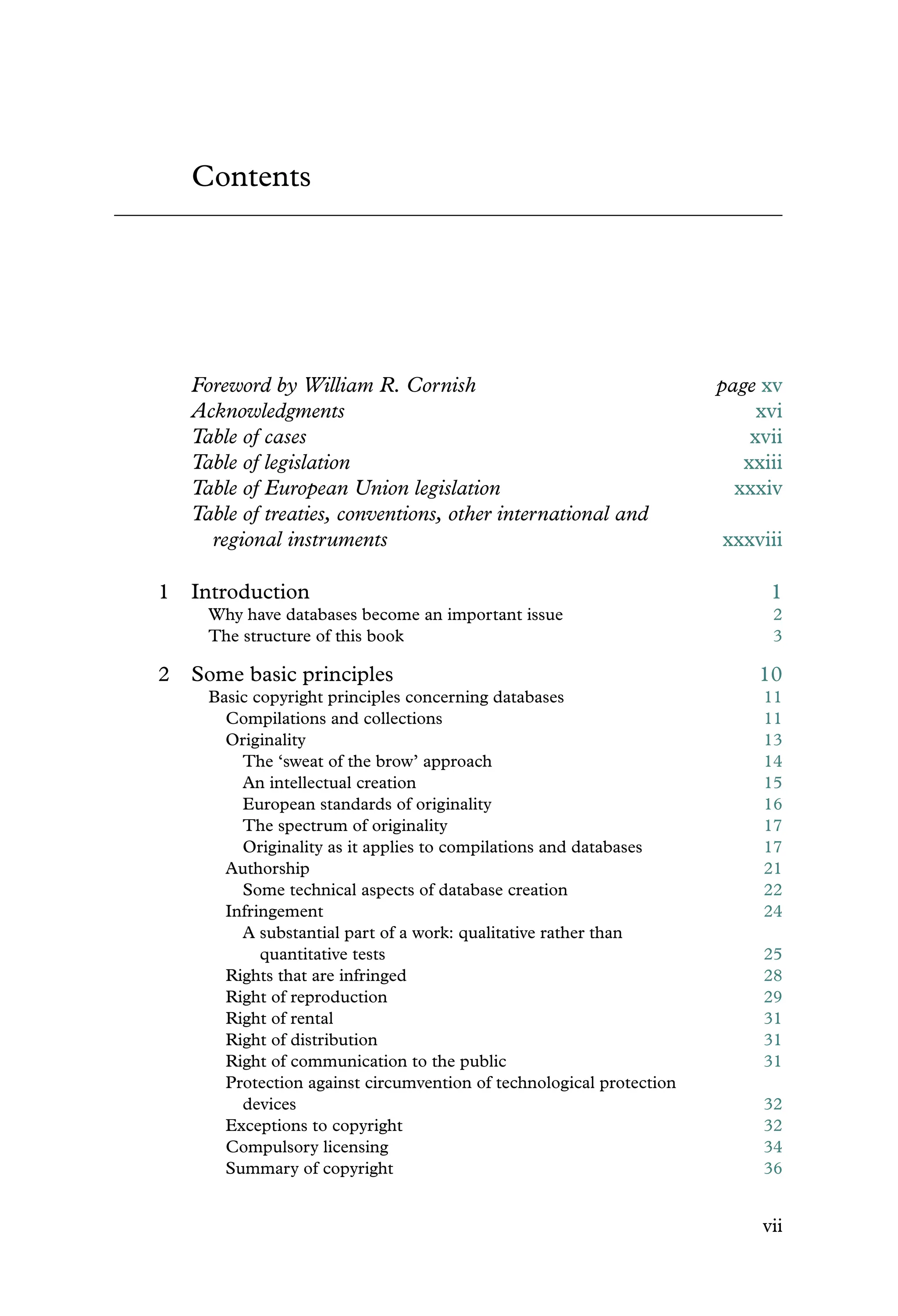
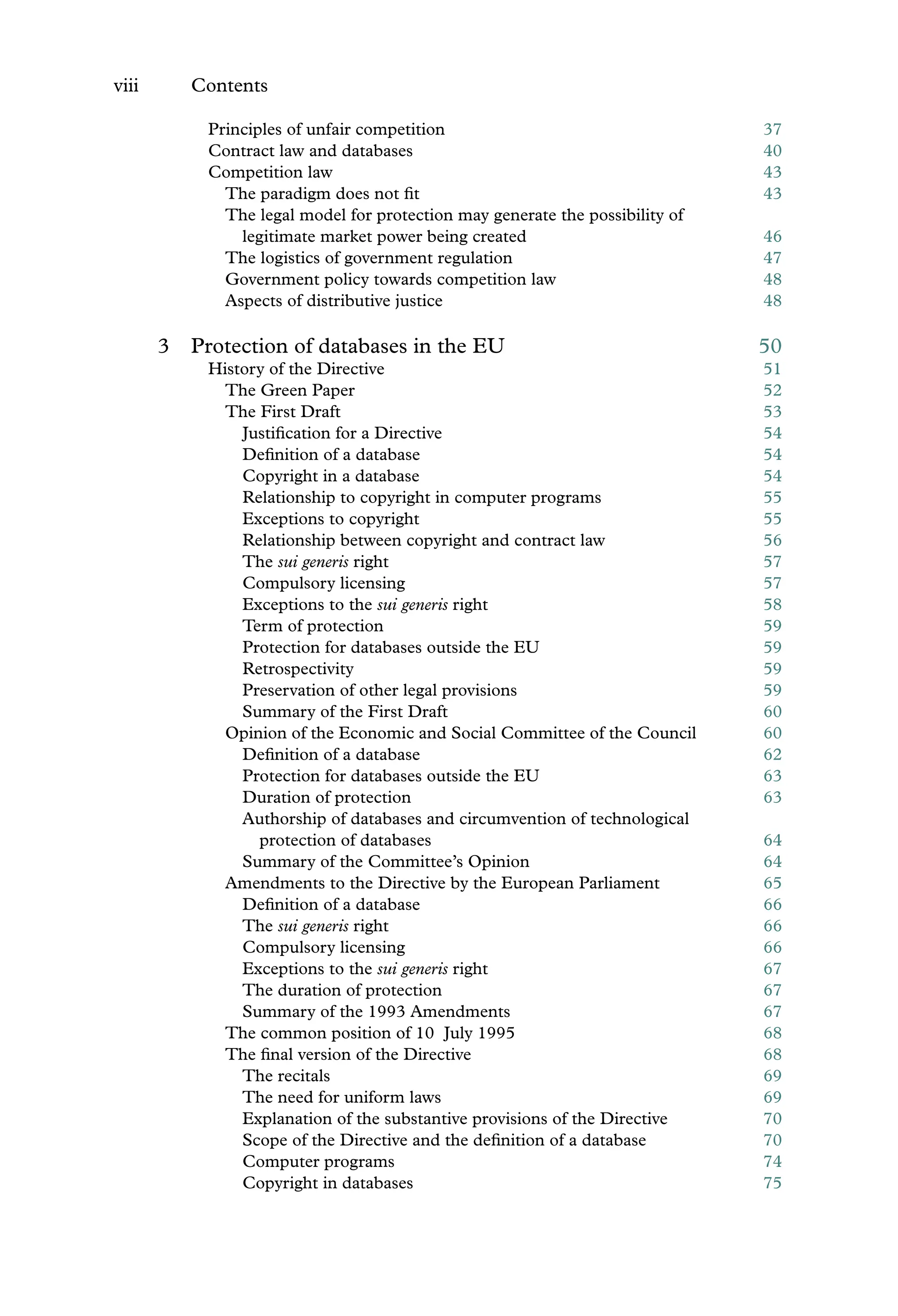
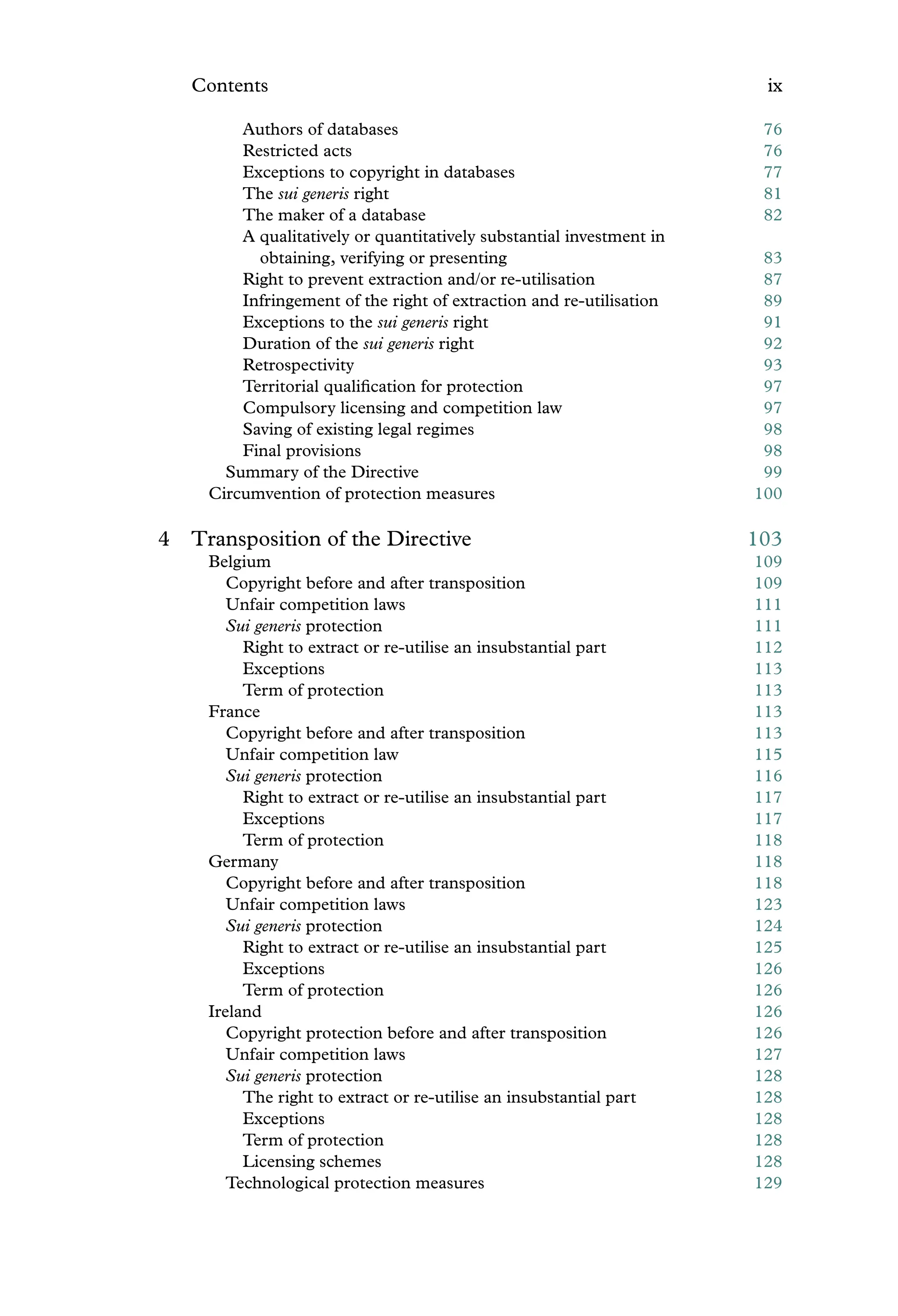
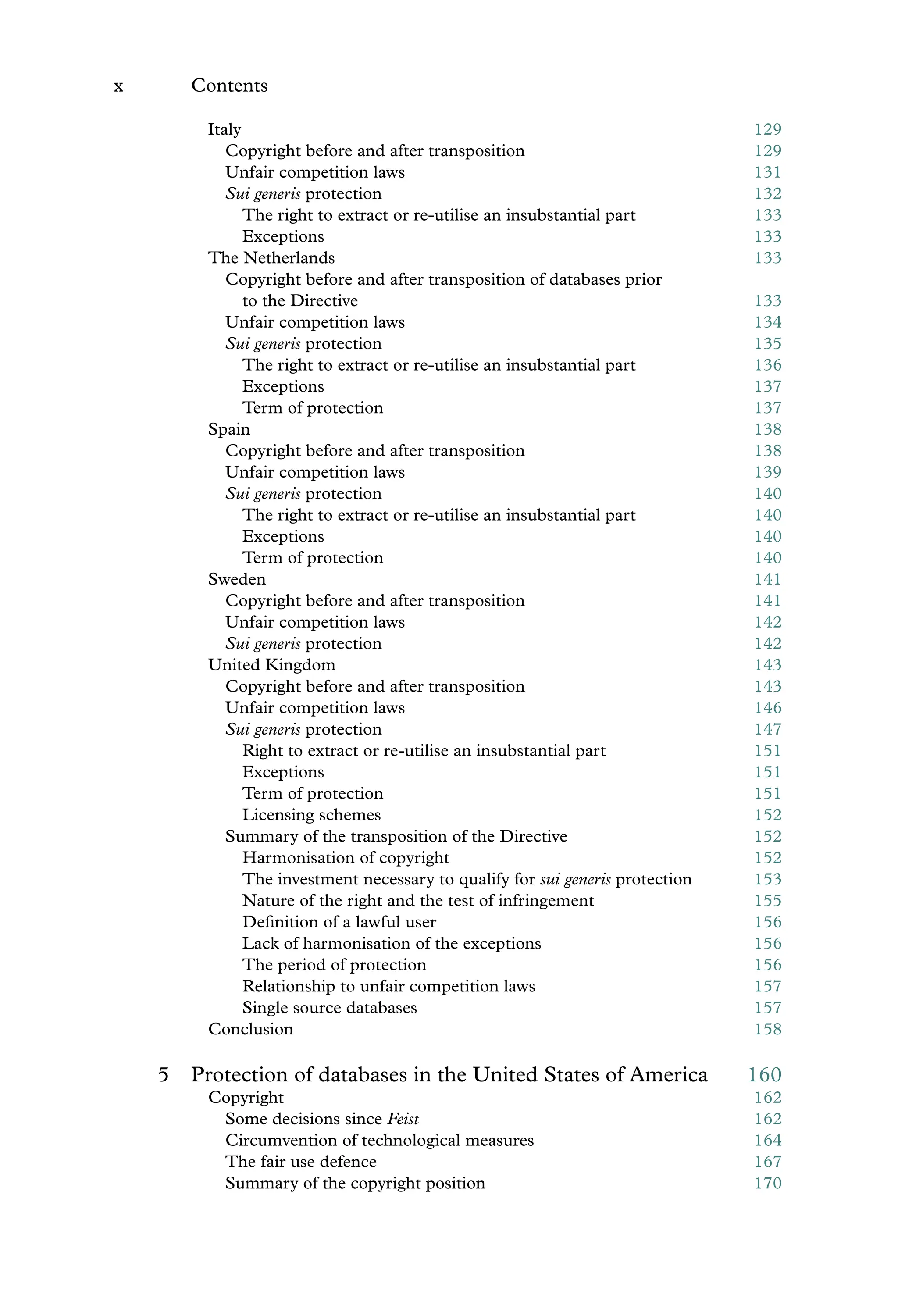
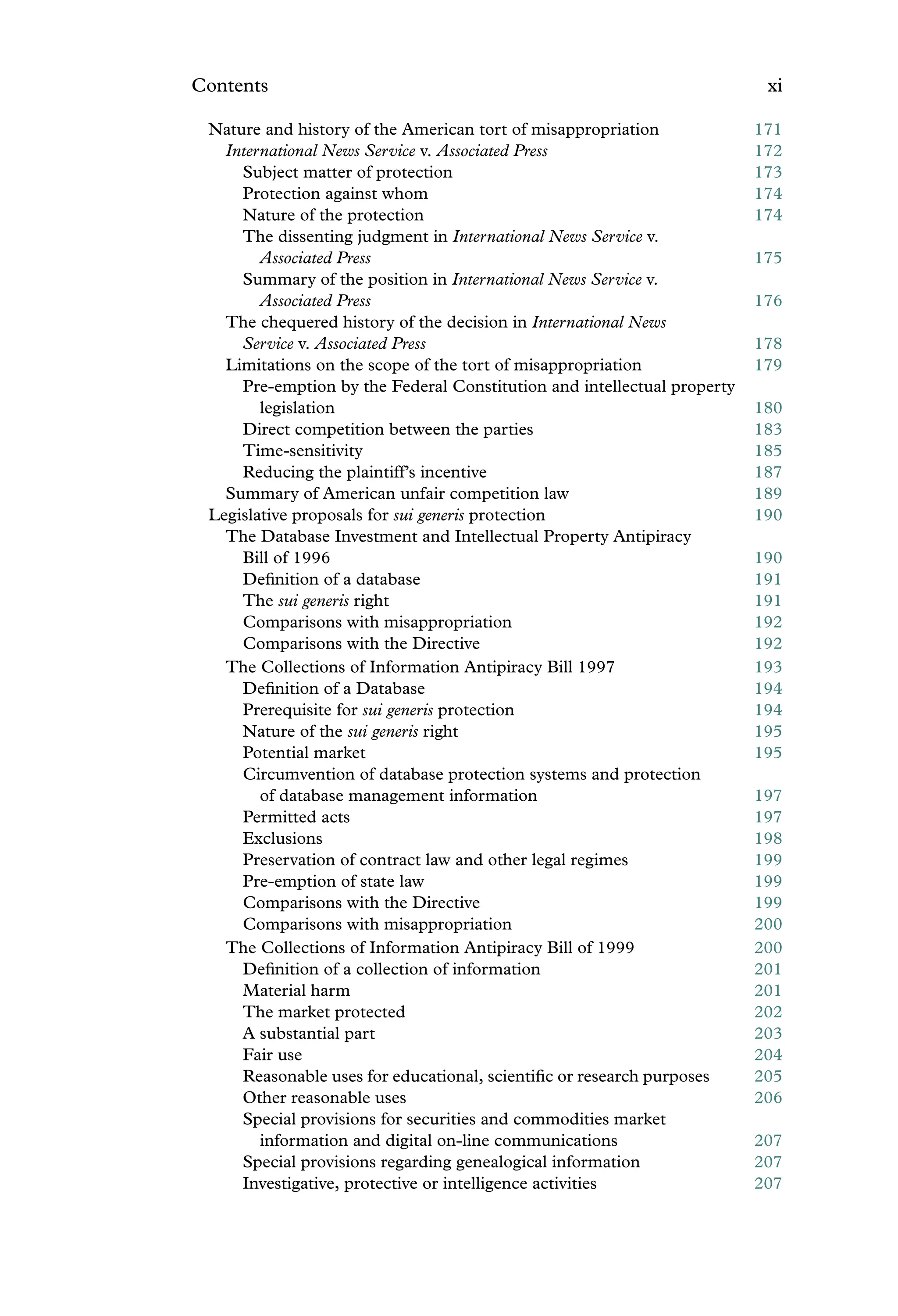
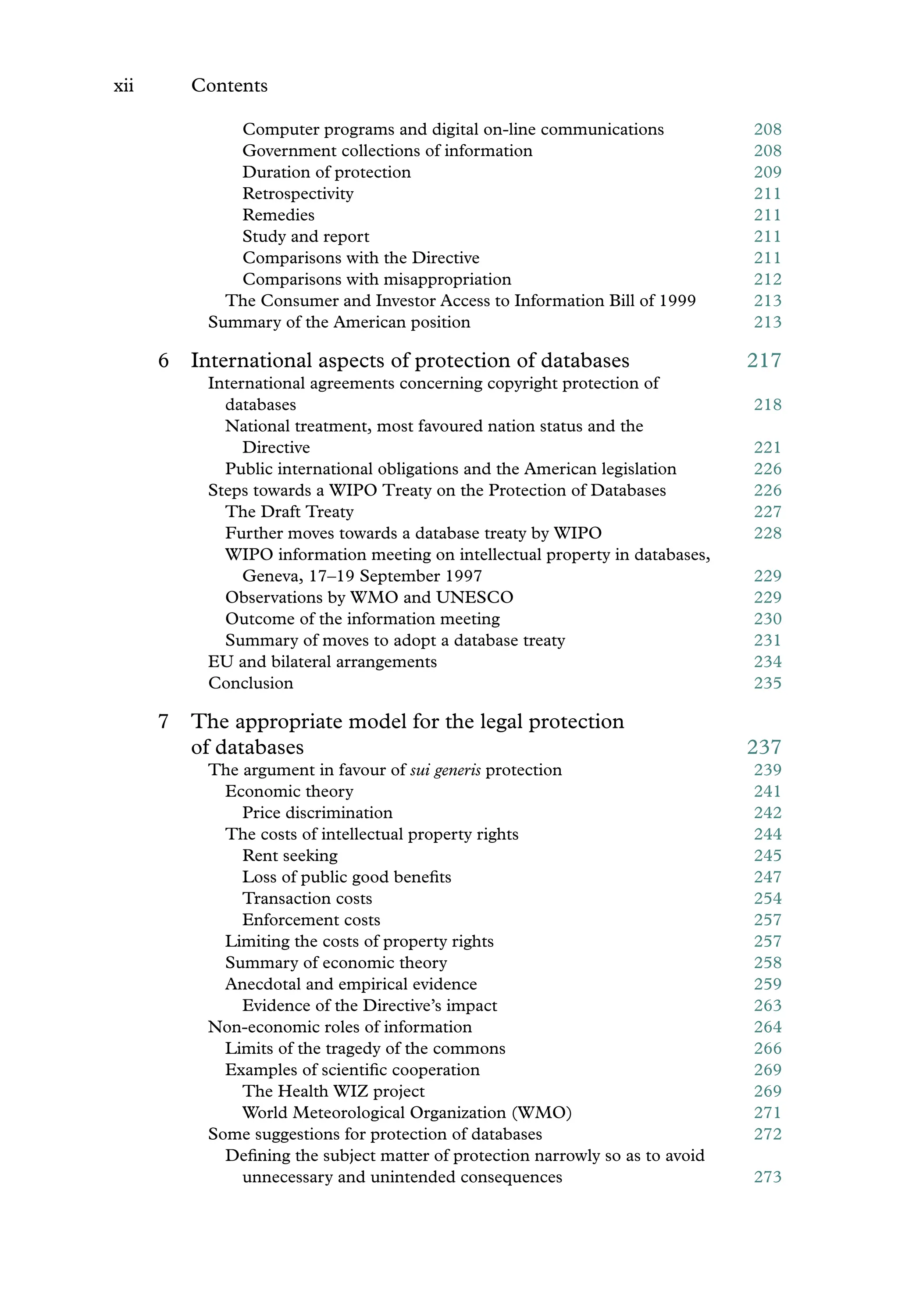
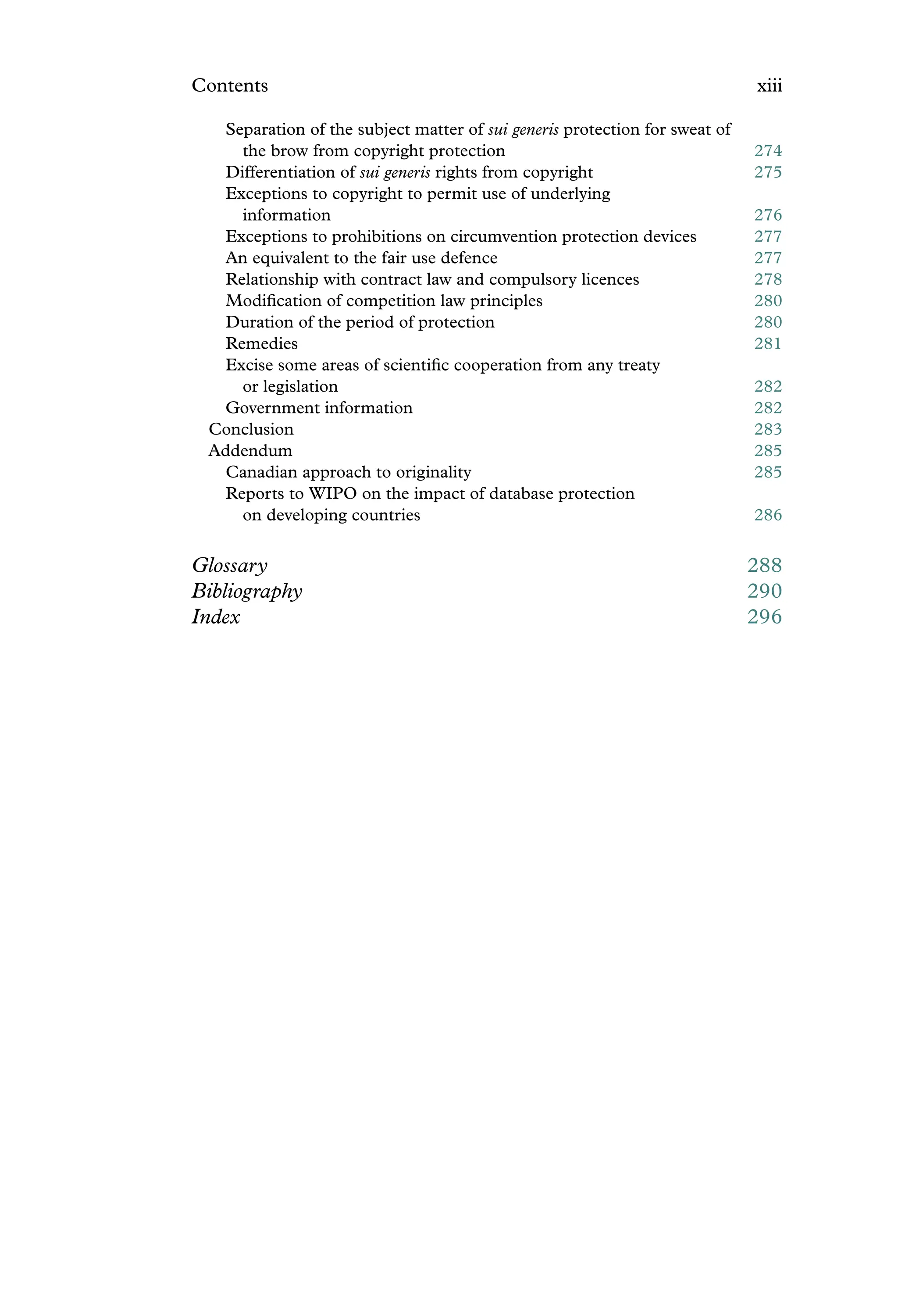

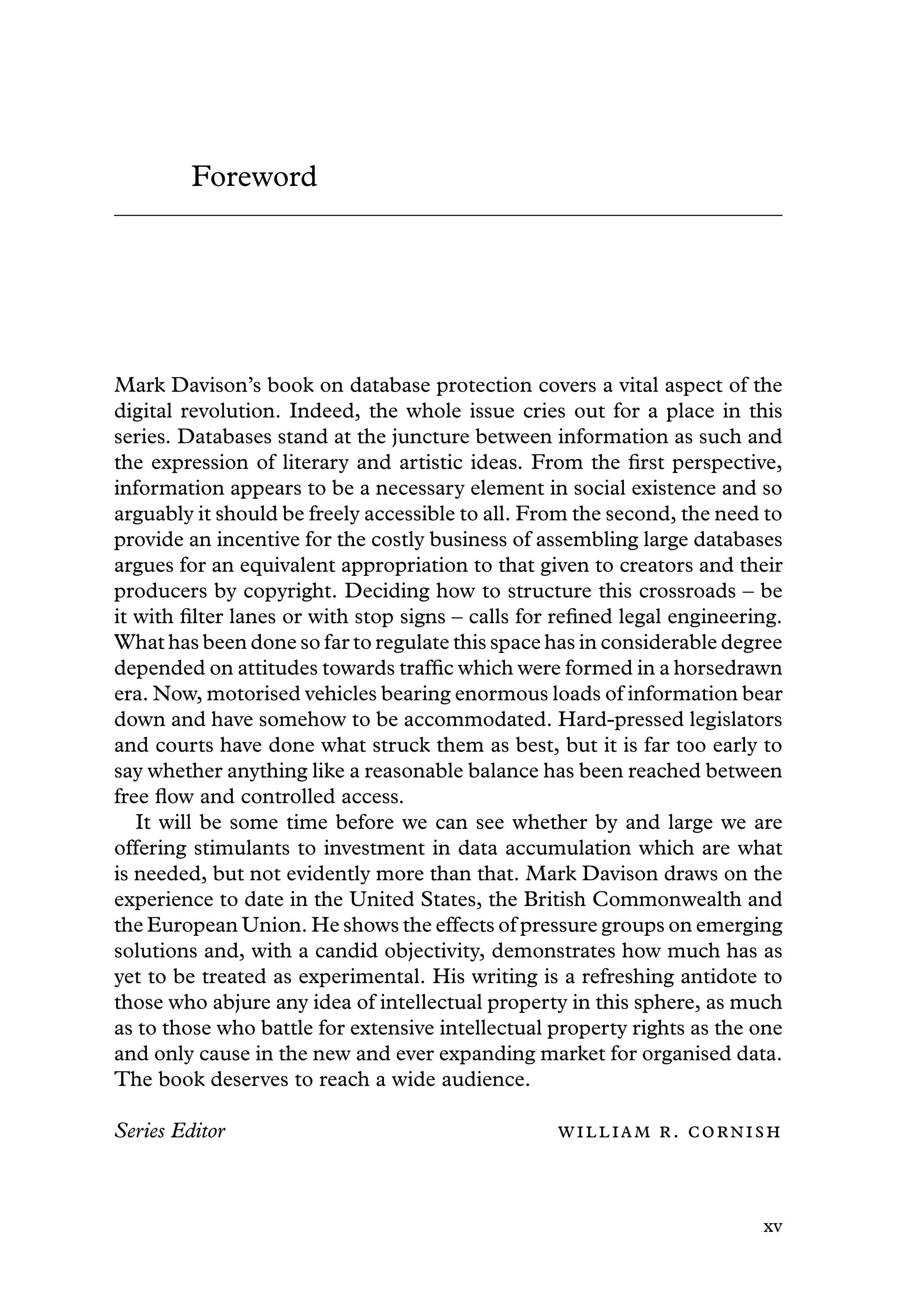
![Table of cases
APRA v. Ceridale Pty Ltd (1991) ATPR 41–074 page 47
Addressograph-Multigraph Corp. v. American Expansion
Bolt and Manufacturing Co., 7th Cir, 124 F 2d 706
(1942) 179
Advanced Computer Servs v. MAI Sys. Corp., 845 F
Supp. 356, 362 (ED Va, 1994) 30
Algemeen Dagblad and Others v. Eureka President, District
Court of Rotterdam, 22 August 2000 156
American Geophysical Union v. Texaco Inc., 802 F Supp. 1, 17
(SDNY, 1992) 169
Apple Computer Inc. v. Computer Edge Pty Ltd (1984)
53 ALR 225 273
Armond Budish v. Harley Gordon, 784 F Supp. 1320
(1992) 164
Associated Press v. United States, 326 US 1, 65 S. Ct 1416
(1945) 176
BN Marconi SRL v. Marchi & Marchi SRL, Court of Genoa,
19 June 1993, 1994 Foro It. Pt 1, 2559 132
Baumann v. Fussell [1978] RPC 485 27
Bellsouth Advertising & Publishing Corporation v. Donnelly
Information Publishing Inc., 999 F 2d 1436 (1993) 162
Board of Trade v. Dow Jones and Co., 456 NE 2d 84
(S. Ct Ill., 1983) 179
CD Law Inc. v. Lawworks Inc., 35 USPQ 2d (BNA) 1352
(1994) 182
Campbell v. Acuff-Rose Music Inc., 114 S. Ct 1164, 1170
(1994) 169
Capitol Records Inc. v. Spies, 130 Ill. App. 2d 429, 264 NE
874 (1970) 179
Cheney Bros. v. Doris Silk Corp., 35 F 2d 279
(2nd Cir. 1929) 160
xvii](https://image.slidesharecdn.com/610985-250713224405-775ff47b/75/Legal-Protection-Of-Databases-Mark-J-Davison-23-2048.jpg)
![xviii Table of cases
Columbia Broadcasting System Inc. v. De Costa, 377 F 2d 315
(Ct App. 1st Cir. 1967) 178
Commercial Bank of Australia v. Amadio (1983) 151
CLR 447 42
Compco Corp. v. Day-Brite Lighting Inc., 376 US 234,
84 S. Ct 779 (1964) 181
Continental Casualty Co. v. Beardsley US Dist Ct SD NY
151 F Supp. 28 (1957) 179
Data Access Corporation v. Powerflex Services Pty Ltd [1999]
HCA 49 75
De Costa v. Viacom Int. Inc., 981 F 2d 602
(1st Cir. 1992) 178
Decoras SA and L’Esprit du Vin SARL v. Art Metal SARL and
Marioni Alfredi [1991] PIBD 510 III-655 (CA Paris) 116
Del Madera Properties v. Rhodes and Gardner Inc., 820 F 2d
973, 976 (9th Cir. 1987) 181
Denda International v. KPN., 5 August, 1997, [1997]
Informatierecht, AMI 218, Court of Appeal of
Amsterdam 45, 136
Diamond v. Am-Law Corp., 745 F 2d 142 (2nd Cir. 1984) 169
Electre v. TI Communication and Maxotex, Tribunal de
Commerce de Paris, 7 March 1999 117
Erie Railroad v. Tompkins, 304 US 64 (1938) 178
Feist Publications Inc. v. Rural Telephone Service Co.,
499 US 340 (1991) 14, 15, 28, 83, 95, 162,
169, 171, 175, 182, 196,
219, 244, 256, 274, 276
Financial Information Inc. v. Moody’s Investors Service Inc.,
808 F 2d 204 (1986) 186
Fixtures Marketing Ltd v. AB Svenska, Spel, T 99-99, 11 April
2001 155
Football League Ltd v. Littlewoods Pools Ltd [1959] 1
Ch 637 144
France Telecom v. MA Editions, Tribunal de Commerce de
Paris, 18 June 1999 117
Fred Wehrenberge Circuit of Theatres Inc. v. Moviefone Inc., 73
F Supp. 2d 1044 (1999) 187
Gilmore v. Sammons, 269 SW 861 (1925) 186
Goldstein v. California, 412 US 546 (1973) 182
Groupe Moniteur and Others v. Observatoire des Marches,
Public Cour d’appel de Paris, 18 June 1999 114, 116,
117, 157](https://image.slidesharecdn.com/610985-250713224405-775ff47b/75/Legal-Protection-Of-Databases-Mark-J-Davison-24-2048.jpg)
![Table of cases xix
Harper & Row, Publishers, Inc. v. National Enterprises, 471 US
539 (1985) 168
Hawkes and Son (London) v. Paramount Film Service Ltd
[1934] 1 Ch 593 26
Hodgkinson & Corby Ltd and Roho Inc. v. Wards Mobility
Services Ltd [1995] FSR 169 38, 146
Illinois Bell Telephone Company v. Haines and Co. Inc., 932 F
2d 610 (7th Cir. 1991) 162
Infinity Broadcast Corp. v. Kirkwood, 150 F 3d 104, 109
(2nd Cir. 1998) 169
Information Handling Service Inc. v. LRP Publications Inc., 54
USPQ 2d (BNA) 1571 (2000) 182
International News Service v. Associated Press, 248 US 215
(1918) 39, 160, 161, 172–178,
180, 183, 184, 189, 198
Iowa State University Research Foundation Inc. v. American
Broadcasting Co., 621 F 2d 57 (2nd Cir. 1980) 168
KPN v. Denda International and Others, District Court Almelo,
6 December 2000 45
KPN v. Denda International, Court of Appeal Arnhem, 15 April
1997 136
KPN v. XSO President, District Court of the Hague, 14 January
2000 136
KVOS v. Associated Press, 299 US 269 (1936); 80 F 2d 575
(1935); 9 F Supp. 279 (1934) 183
Kewanee Oil Co. v. Bicron Corp., 416 US 470 (1974) 182
Key Publications Inc. v. Chinatown Today Publishing
Enterprises Inc., 945 F 2d 509 (2nd Cir. 1991) 164
Koninklijke Vermande BV v. Bojkovski, 98/147 Court Decision
of 20 March 1998 (District Court of The Hague) 134
Kregos v. Associated Press, 3 F 3d 656 (2nd Cir. 1993) 12, 182
Ladbroke (Football) Ltd v. William Hill (Football) Ltd [1964] 1
All ER 465, [1964] 1 WLR 273 37
Lego v. Oku Hobby Speelgoed BV/Frits de Vrites Agenturen BV
Lima Srl, President District Court of Utrecht, 10 September
1998 135
Loeb v. Turner et al., 257 SW 2d 800 (Ct Civ. App.
Tex. 1953) 185
Lynch, Jones & Ryan Inc. v. Standard & Poor’s, 47 USPQ 2d
BNA 1759 (S. Ct NY, 1998) 187
MAI Sys. Corp. v. Peak Computer Inc., 991 F 2d 511
(9th Cir. 1993) 30](https://image.slidesharecdn.com/610985-250713224405-775ff47b/75/Legal-Protection-Of-Databases-Mark-J-Davison-25-2048.jpg)
![xx Table of cases
MacMillan & Co. v. Cooper (1924) 93 LJPC 113 14
Mars UK Ltd v. Teknowledge Ltd [2000] FSR 138, [1999] ALL
ER 600 (QB) 71, 194
Matthew Bender & Co. v. West Publishing Co., 158 F 3d 674
(2nd Cir. NY 1998) 163
Matthew Bender Co. Inc. v. West Publishing Co., 158 F 3d 693
(1998) 163
Maxtone-Graham v. Burtchaell, 631 F Supp. 1432 (SDNY
1986) 169
McCord Co. v. Plotnick, 108 Cal. App. 2d 392, 239 P 2d 32
(1951) 184
Mercury Record Productions Inc. v. Economic Consultants Inc.,
218 NW 2d 705 (Wis. 1974) 178
Metropolitan Opera Association v. Wagner-Nichols Recorder
Corp., 199 Misc 786, 101 NYS 2d 483 (S. Ct, NY 1950) at
492 179
Mirror Newspapers Ltd v. Queensland Newspapers Pty Ltd
[1982] Qd R 305 20
Montgomery County Association of Realtors Inc. v. Realty Photo
Master Corporation, 878 F Supp. 84 (1995) 164, 262
Moorgate Tobacco Co. Ltd v. Philip Morris Ltd (1984) 156
CLR 414 38
NFL v. Governor of Delaware, 435 F Supp. 1372, (US Dist Ct,
1977) 185
NV Holdingmaatschappij de Telegraf v. Nederlandes Omroep
Stichting, Court of Appeal, The Hague 99/165, 30 January
2001 154
NVM v. De Telegraaf, Court of Appeal, The Hague,
21 December 2000 136, 137, 154
National Basketball Association v. Motorola Inc., 105 F
3d 841 (2nd Cir. 1997). 39, 160, 162, 179, 180,
182, 185–188, 198,
200, 201, 206, 214
National Business Lists Inc. v. Dun & Bradstreet, 552 F Supp.
89 (1982) 196
National Council on Compensation Insurance Inc. (NCCI) v.
Insurance Data Resources Inc., 40 USPQ 2d (BNA) 1362
(1996) 163
National Exhibition Co. v. Tele-Flash Inc., 24 F Supp. 810
(Dist Ct, SD NY 1936) 183
Nationwide News Pty Ltd and Others v. Copyright Agency Ltd,
No. NG94 of 1995, Federal Court of Australia 37](https://image.slidesharecdn.com/610985-250713224405-775ff47b/75/Legal-Protection-Of-Databases-Mark-J-Davison-26-2048.jpg)
![Table of cases xxi
Neal v. Thomas Organ Co., 241 F Supp. 1020 (US Dist Ct, SD
Cal. 1965) 178
Oasis Publishing Co. v. West Publishing Co., 924 F Supp. 918
(Minn. 1996) 163
P.I.C. Design Corp. v. Sterling Precision Corp., 231 F Supp. 106
(2nd Cir. US Dist Ct, SD NY, 1964) 178
Philips Electronics NV v. Ingman Ltd and the Video Duplicating
Company Ltd [1995] FSR 530 46
Pittsburgh Athletic Co. v. KQV Broadcasting Co., 24 F Supp.
490 (D Pa. 1934) 183
R R Donnelly & Sons Co. v. Haber, 43 F Supp. 456 (1942) 182
Radio Telefis Eireann (RTE) and Independent Television
Publications Ltd (ITP) v. Commission of the European
Communities (Magill’s case) [1995] ECR I – 743 [1995] 4
CMLR 718 45
Re.: CBS Records and Gross, No. G337 of 1989, Federal Court
of Australia 69 38
SARL Parfum Ungaro v. SARL JJ Vivier Paris, 18 May 1989,
D 1990 116
Salinger v. Random House Inc., 650 F Supp. 413 at 425
(SD NY, 1986) 168
San Fernando Valley Board of Realtors Inc. v. Mayflower
Transit Inc., No. CV 91–5872-WJR- (Kx) (CD Cal.
1993) 260
Sears, Roebuck & Co. v. Stiffel Co., 376 US 225, 84 S. Ct 784
(1964) 181
Skinder-Strauss Associates v. Massachusetts Continuing
Legal Education Inc., 914 F Supp. 665 (D. Mass.
1995) 28, 182, 260
Standard & Poor’s Corporation Inc. v. Commodity Exchange
Inc., 683 F 2d 704 (2nd Cir. 1982) 196
Stewarts v. Abend, 495 US 207 (1990) 168
Synercom Technology Inc. v. University Computing Company
and Engineering Dynamics Inc., 474 F Supp. 37 (ND Tex.
1979) 179
Tele-Direct (Publication) Inc. v. American Business Information
Inc. (1996) 74 CPR (3d) 72 162, 236
Telstra v. Desktop Marketing Pty Ltd [2001] FCA 612 10
The British Horseracing Board Ltd v. William Hill Ltd,
(HC 2000 1335), judgment 9 February 2001 137, 147–159
Tierce Ladbroke SA v. The Commission, case T-504/93 [1997]
ECR II 923 46](https://image.slidesharecdn.com/610985-250713224405-775ff47b/75/Legal-Protection-Of-Databases-Mark-J-Davison-27-2048.jpg)
![xxii Table of cases
Transwestern Publishing Company LP v. Multimedia Marketing
Associates Inc., 133 F3d 773 162
Triangle Publications Inc. v. New England Newspaper, 46 F
Supp. 198, (Dist Ct, 1942) 179
UNMS v. Belpharma Communication, Court of Brussels,
16 March 1999 112
University of London Press Ltd v. University Tutorial Press Ltd
[1916] 2 Ch 601 37
US Ex Rel Berge v. Board of Trustees of University of Alabama,
104 F 3d 1453 (4th Cir. 1997) 182
Victor Lalli Enterprises Inc. v. Big Red Apple Inc., 936 F 2d 671
(2nd Cir. 1991) 163
Waterlow Publishers Ltd. v. Rose (1990) 17 IPR 493 28
West Publishing Co. v. Matthew Bender & Co., Cert. denied S.
Ct, 522 US 3732 (1999) 163
West Publishing Co. v. Mead Data Central Inc., 616 F Supp.
1571 (D. Minn. 1985); 799 F 2d 1219 (8th Cir. 1986); 479
US 1070 (US S. Ct 1987) 163
West Publishing v. Hyperlaw Inc., Cert. denied S. Ct, 526 US
1154 (1999) 163](https://image.slidesharecdn.com/610985-250713224405-775ff47b/75/Legal-Protection-Of-Databases-Mark-J-Davison-28-2048.jpg)

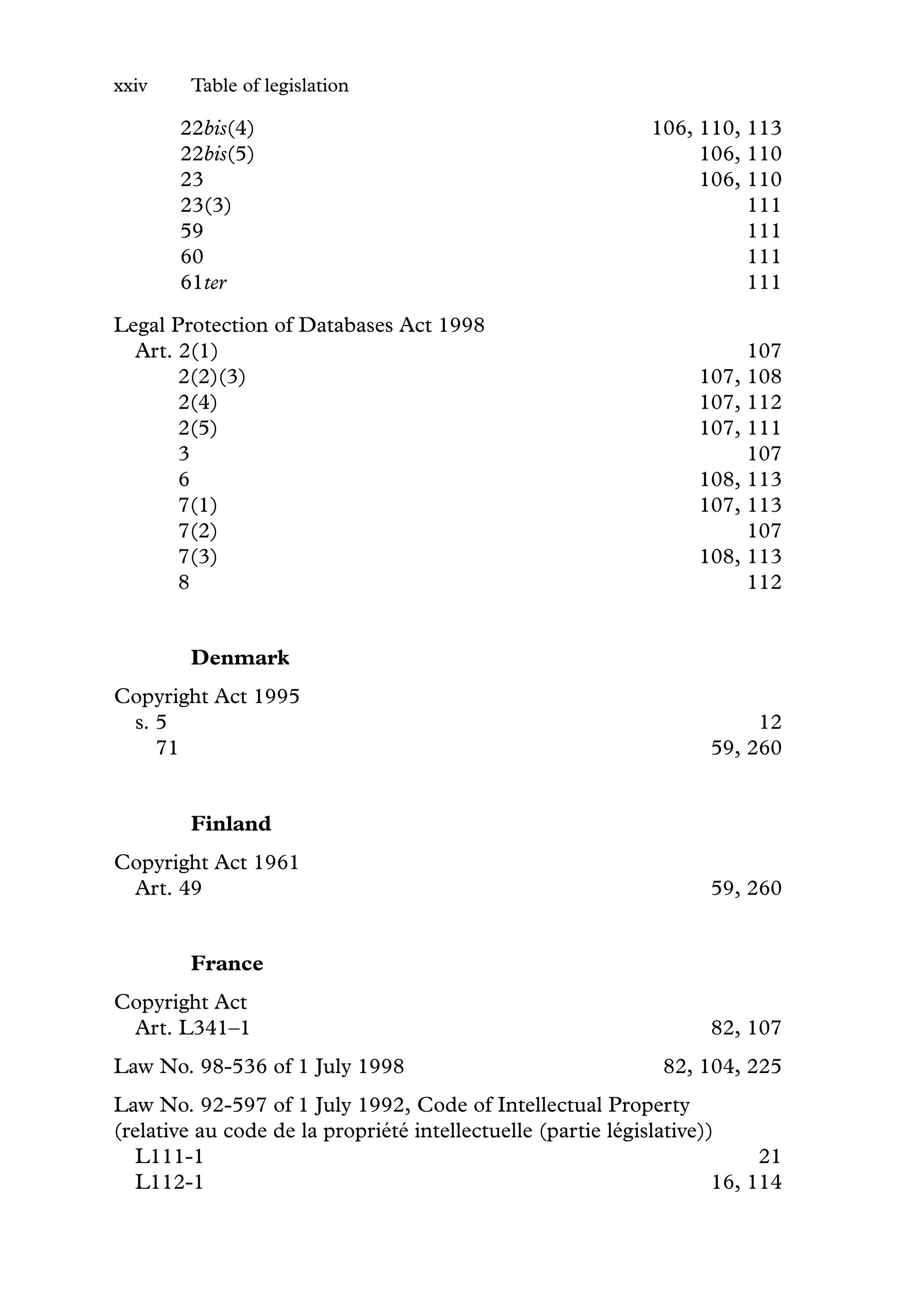



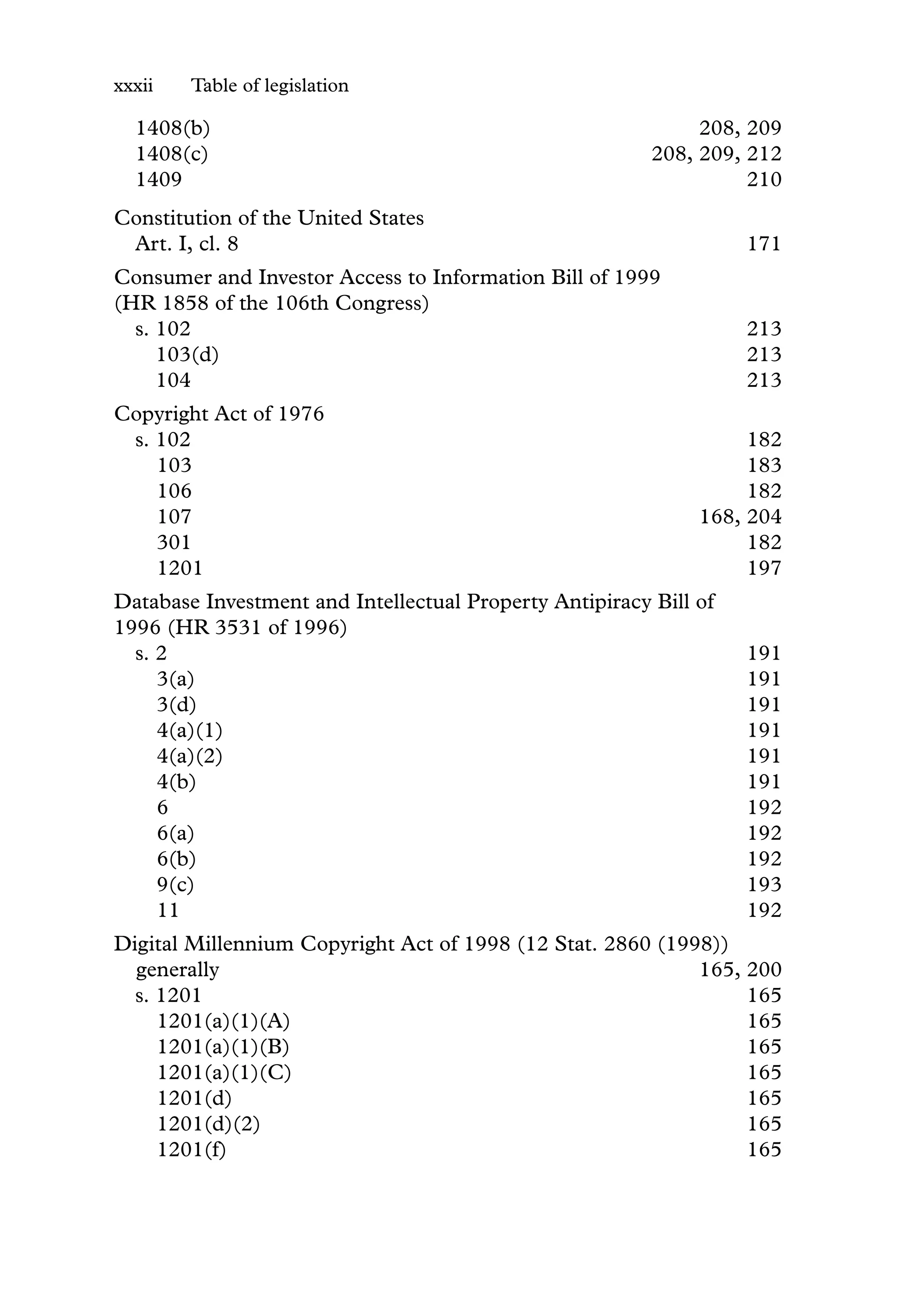
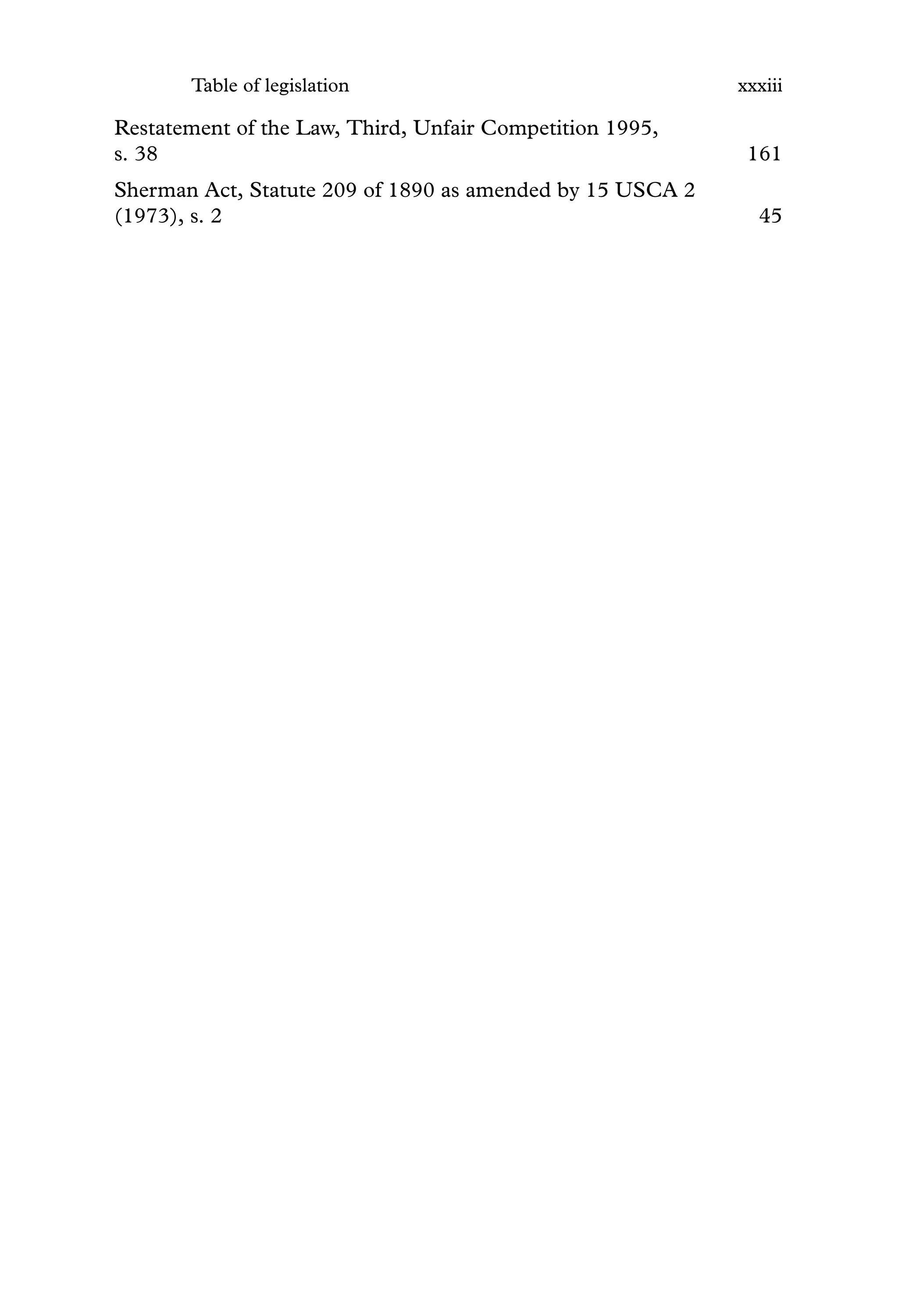
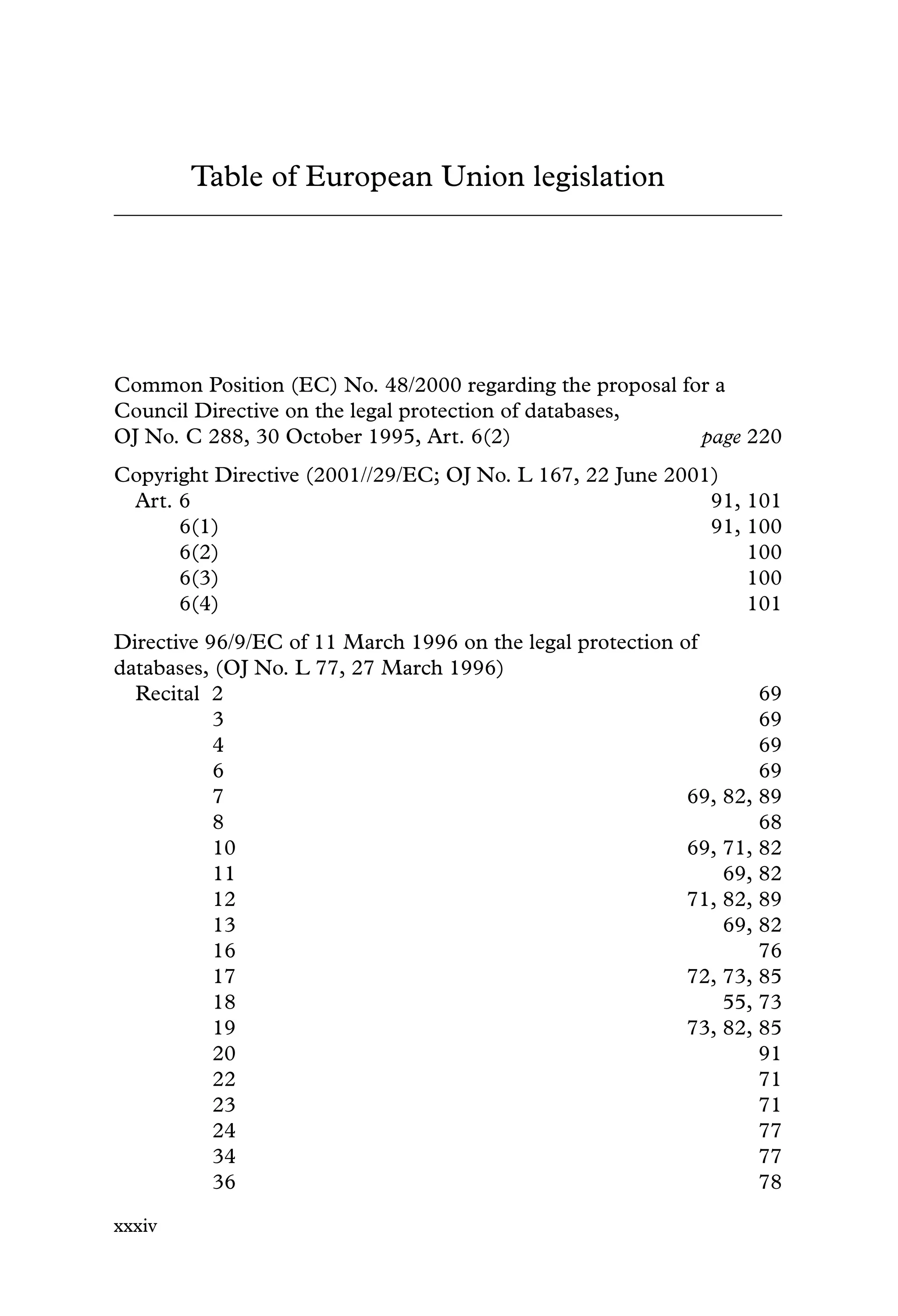
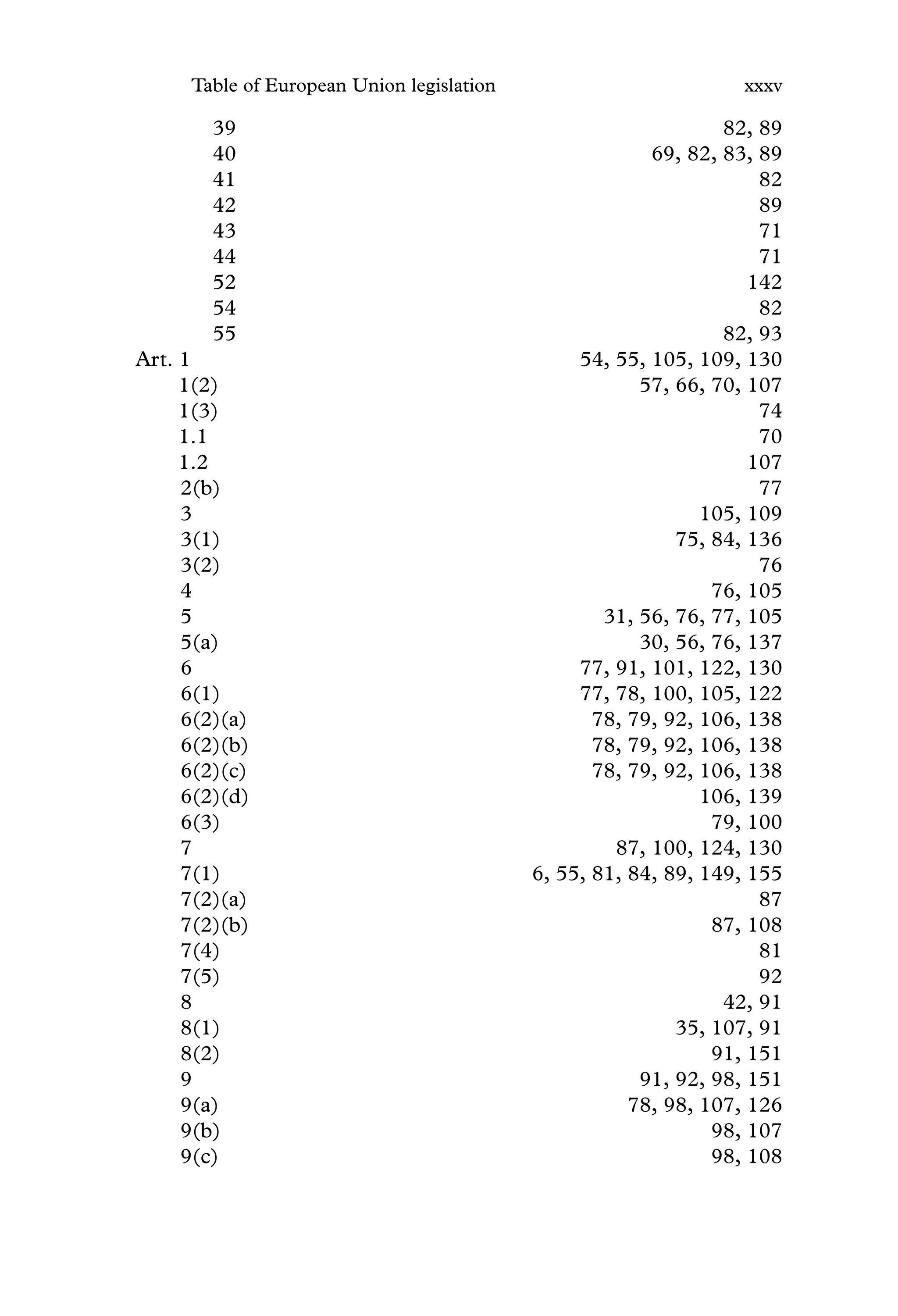
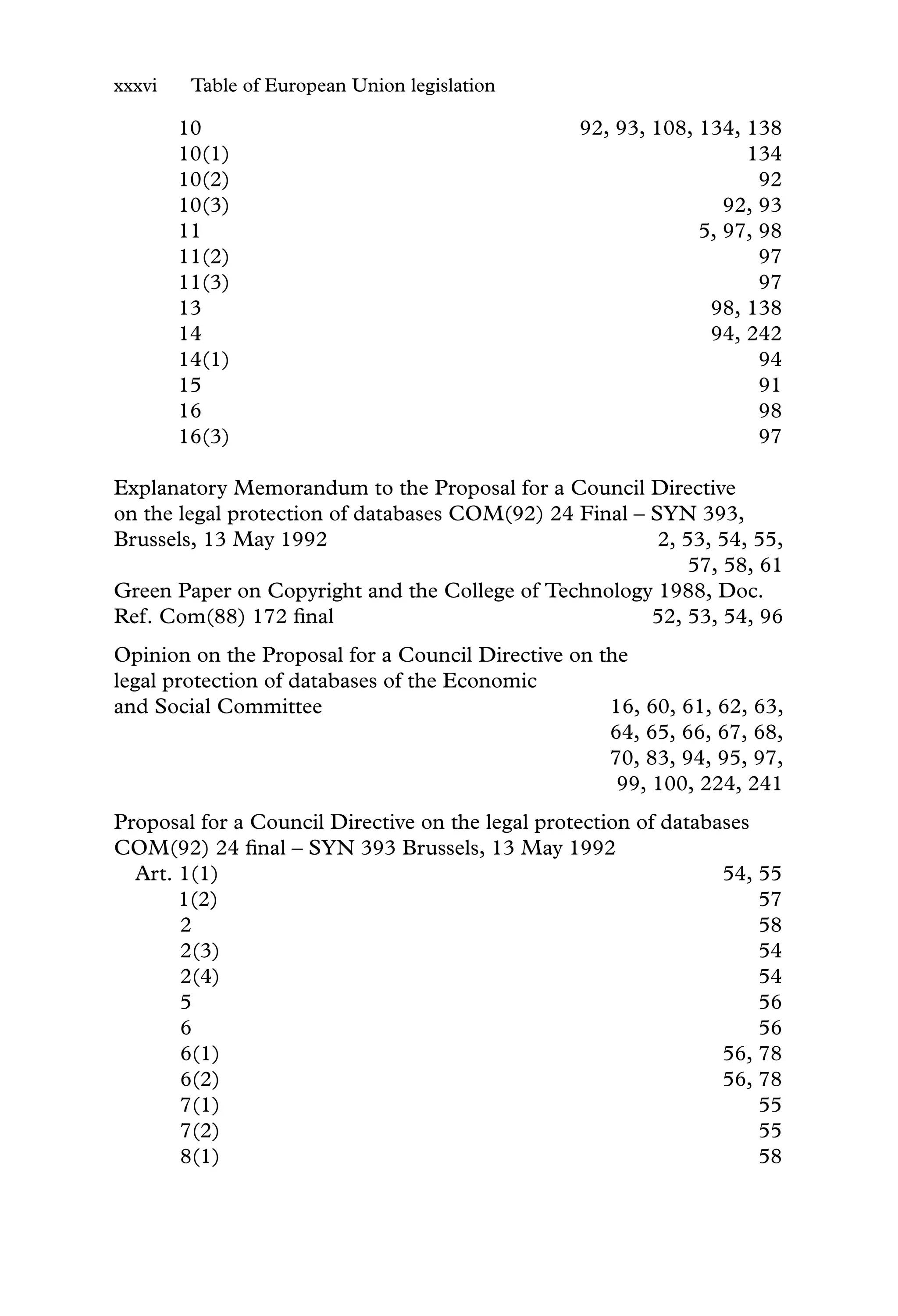


![Table of conventions and treaties xxxix
13(1) 36
18 95
Convention for the Protection of Producés of Phonograms 1971
(UNTS 12430) 231
EEC Treaty of Rome (25 March 1957; entered into force 1 January
1958) [UNTS/ILM Ref ]
Art. 86 45
WIPO Copyright Treaty 1996, 36 ILM 65(1997)
Art. 1(4) 29, 30
4 219
6 29, 31, 88, 89
7 29, 31, 89
8 29, 31, 88, 89, 219, 220
11 29, 32, 220
12 220, 221
12(2) 221](https://image.slidesharecdn.com/610985-250713224405-775ff47b/75/Legal-Protection-Of-Databases-Mark-J-Davison-45-2048.jpg)







![LEGAL PROTECTION OF IN[1] CADD pharmaceutics](https://cdn.slidesharecdn.com/ss_thumbnails/legalprotectionofin1-240320035446-be6dd039-thumbnail.jpg?width=640&height=640&fit=bounds)


