OOP in Python
To map with real world scenarios, we started using objects in code.
This is called object oriented programming.
Apna College
Class & Object in Python
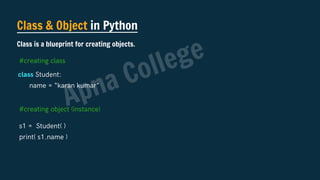
Class is a blueprint for creating objects.
class Student:
name = “karan kumar”
#creating class
#creating object (instance)
s1 = Student( )
print( s1.name )
Apna College
Class & Instance Attributes
Class.attr
obj.attr
Apna College
_ _init_ _ Function
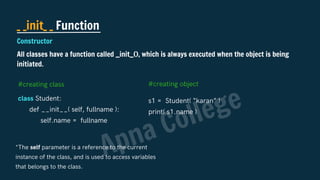
All classes have a function called __init__(), which is always executed when the object is being
initiated.
class Student:
def __init__( self, fullname ):
self.name = fullname
#creating class #creating object
s1 = Student( “karan” )
print( s1.name )
Constructor
*The self parameter is a reference to the current
instance of the class, and is used to access variables
that belongs to the class.
Apna College
Methods
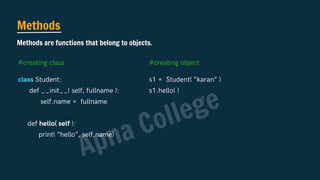
Methods are functions that belong to objects.
class Student:
def __init__( self, fullname ):
self.name = fullname
def hello( self ):
print( “hello”, self.name)
#creating class #creating object
s1 = Student( “karan” )
s1.hello( )
Apna College
Let‘s Practice
Create student class that takes name & marks of 3 subjects as arguments in constructor.
Then create a method to print the average.
Apna College
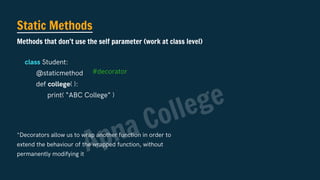
Static Methods
Methods that don’t use the self parameter (work at class level)
class Student:
@staticmethod
def college( ):
print( “ABC College” )
#decorator
*Decorators allow us to wrap another function in order to
extend the behaviour of the wrapped function, without
permanently modifying it
Apna College
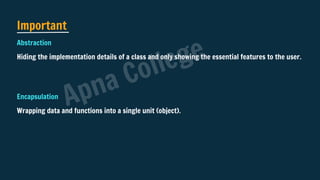
Important
Abstraction
Encapsulation
Hiding the implementation details of a class and only showing the essential features to the user.
Wrapping data and functions into a single unit (object).
Apna College
Let‘s Practice
Create Account class with 2 attributes - balance & account no.
Create methods for debit, credit & printing the balance.
Apna College

Lecture8_python in artificial intelligence.

  • 1.
    OOP in Python Tomap with real world scenarios, we started using objects in code. This is called object oriented programming. Apna College
  • 2.
    Class & Objectin Python Class is a blueprint for creating objects. class Student: name = “karan kumar” #creating class #creating object (instance) s1 = Student( ) print( s1.name ) Apna College
  • 3.
    Class & InstanceAttributes Class.attr obj.attr Apna College
  • 4.
    _ _init_ _Function All classes have a function called __init__(), which is always executed when the object is being initiated. class Student: def __init__( self, fullname ): self.name = fullname #creating class #creating object s1 = Student( “karan” ) print( s1.name ) Constructor *The self parameter is a reference to the current instance of the class, and is used to access variables that belongs to the class. Apna College
  • 5.
    Methods Methods are functionsthat belong to objects. class Student: def __init__( self, fullname ): self.name = fullname def hello( self ): print( “hello”, self.name) #creating class #creating object s1 = Student( “karan” ) s1.hello( ) Apna College
  • 6.
    Let‘s Practice Create studentclass that takes name & marks of 3 subjects as arguments in constructor. Then create a method to print the average. Apna College
  • 7.
    Static Methods Methods thatdon’t use the self parameter (work at class level) class Student: @staticmethod def college( ): print( “ABC College” ) #decorator *Decorators allow us to wrap another function in order to extend the behaviour of the wrapped function, without permanently modifying it Apna College
  • 8.
    Important Abstraction Encapsulation Hiding the implementationdetails of a class and only showing the essential features to the user. Wrapping data and functions into a single unit (object). Apna College
  • 9.
    Let‘s Practice Create Accountclass with 2 attributes - balance & account no. Create methods for debit, credit & printing the balance. Apna College