Learning outcomes
• Explainthe importance of human resources in the
provision of quality pharmacist services
• Identify crucial steps in the recruitment and selection
of employees
• Compare and contrast job orientation, training, and
development
• Discuss the roles of motivation and rewards in
employee performance feedback
• List and explain the steps involved in progressive
discipline
3.
Introduction
• Human ResourcesManagement (HRM), is an
essential duty for any pharmacist who must
interact with or supervise others.
• HRM is important because it can make the
difference between a smoothly running
pharmacy and a dysfunctional, unsuccessful
one.
4.
Introduction cont..
• Humanresources management (HRM) is defined as the
process of achieving organizational objectives through
the management of people.
• Tasks associated with HRM include recruiting, hiring,
training, developing, and firing employees.
• When these tasks are done well, pharmacy employees
know their responsibilities and receive sufficient
feedback to meet them successfully.
• When these tasks are done poorly, pharmacy
employees are given little or inconsistent direction in
their tasks and often are frustrated in their jobs.
5.
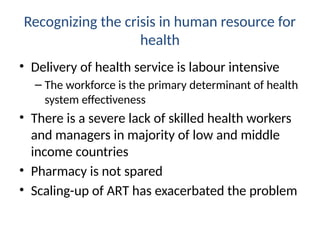
Recognizing the crisisin human resource for
health
• Delivery of health service is labour intensive
– The workforce is the primary determinant of health
system effectiveness
• There is a severe lack of skilled health workers
and managers in majority of low and middle
income countries
• Pharmacy is not spared
• Scaling-up of ART has exacerbated the problem
6.
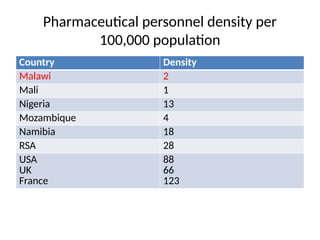
Pharmaceutical personnel densityper
100,000 population
Country Density
Malawi 2
Mali 1
Nigeria 13
Mozambique 4
Namibia 18
RSA 28
USA
UK
France
88
66
123
7.
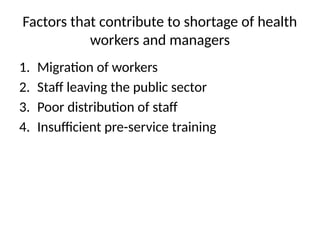
Factors that contributeto shortage of health
workers and managers
1. Migration of workers
2. Staff leaving the public sector
3. Poor distribution of staff
4. Insufficient pre-service training
8.
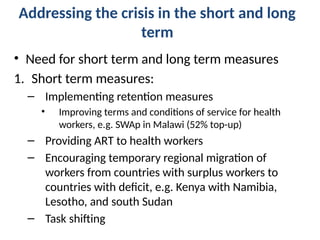
Addressing the crisisin the short and long
term
• Need for short term and long term measures
1. Short term measures:
– Implementing retention measures
• Improving terms and conditions of service for health
workers, e.g. SWAp in Malawi (52% top-up)
– Providing ART to health workers
– Encouraging temporary regional migration of
workers from countries with surplus workers to
countries with deficit, e.g. Kenya with Namibia,
Lesotho, and south Sudan
– Task shifting
9.
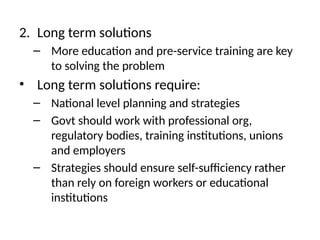
2. Long termsolutions
– More education and pre-service training are key
to solving the problem
• Long term solutions require:
– National level planning and strategies
– Govt should work with professional org,
regulatory bodies, training institutions, unions
and employers
– Strategies should ensure self-sufficiency rather
than rely on foreign workers or educational
institutions
10.
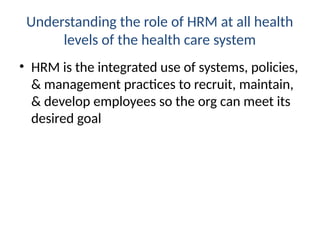
Understanding the roleof HRM at all health
levels of the health care system
• HRM is the integrated use of systems, policies,
& management practices to recruit, maintain,
& develop employees so the org can meet its
desired goal
11.
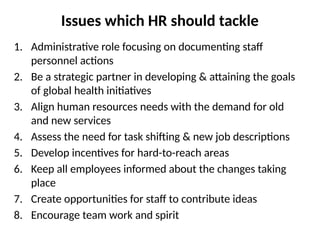
Issues which HRshould tackle
1. Administrative role focusing on documenting staff
personnel actions
2. Be a strategic partner in developing & attaining the goals
of global health initiatives
3. Align human resources needs with the demand for old
and new services
4. Assess the need for task shifting & new job descriptions
5. Develop incentives for hard-to-reach areas
6. Keep all employees informed about the changes taking
place
7. Create opportunities for staff to contribute ideas
8. Encourage team work and spirit
12.
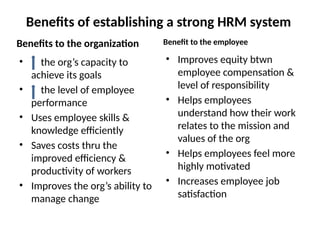
Benefits of establishinga strong HRM system
Benefits to the organization
• the org’s capacity to
achieve its goals
• the level of employee
performance
• Uses employee skills &
knowledge efficiently
• Saves costs thru the
improved efficiency &
productivity of workers
• Improves the org’s ability to
manage change
Benefit to the employee
• Improves equity btwn
employee compensation &
level of responsibility
• Helps employees
understand how their work
relates to the mission and
values of the org
• Helps employees feel more
highly motivated
• Increases employee job
satisfaction
13.
Assessing the strengthof HRM in the
organization
• Question the setup and everything to do with
HRM.
14.
Key issues whichmust be considered in
order to establish a strong HRM are:
a) Encouraging human resources leadership at
the organizational level
b) Assessing staffing levels
c) Developing & maintaining a performance
management system
d) Establishing a responsive supervisory system
e) Improving staff motivation & performance
thru better human resources practices
15.
a) Encouraging humanresource leadership at
the organizational level
• Create a positive climate for human resources
• Create a management structure for human
resources
• Define what needs to be done
• Forge new organizational arrangement that foster
employee participation, teamwork, & growth
• Ensure that human resources activities are
integrated throughout the org
16.
a) Encouraging humanresource leadership at
the organizational level
• Involve staff at all levels & from all depts in HRM
• Dedicate staff and budget to building human
resources capacity within the org
• Make learning and organizational priority
• Provide a link btwn internal HRM and external
stakeholders
• Influence health policy makers
• Influence curricula offered by pre-service training
orgs
17.
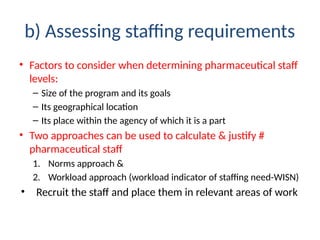
b) Assessing staffingrequirements
• Factors to consider when determining pharmaceutical staff
levels:
– Size of the program and its goals
– Its geographical location
– Its place within the agency of which it is a part
• Two approaches can be used to calculate & justify #
pharmaceutical staff
1. Norms approach &
2. Workload approach (workload indicator of staffing need-WISN)
• Recruit the staff and place them in relevant areas of work
18.
Importance of recruitmentand placement
• Hiring competent, self-motivated
professionals results in:
– Less problems on issues such as motivation and
performance
– Diminished employee dissatisfaction and turnover
– Is a source of competitive advantage in the market
– Reduces cost of hiring and training
– Less costly to the organization
19.
Consequences Associated withLosing a
Pharmacist in a private sector
• The pharmacy may have to reduce store hours until a
replacement can be found.
• Patients may go to competitors.
• The remaining pharmacists and employees have to
cover the responsibilities of the missing pharmacist.
• The employer incurs costs to replace the pharmacist.
– The employer may pay to advertise the position in
newspaper want ads or professional journals.
– Salary costs are spent on personnel involved in related
clerical and interviewing tasks.
20.
Consequences Associated withLosing a
Pharmacist
• Personnel need to be freed up from normal
responsibilities to train newly hired pharmacists.
• The new pharmacist may spend up to 1 year or
more before becoming 100 percent productive
to the employer.
– Productivity is reduced while the pharmacist learns
job details such as the location of drugs, computer
system procedures, and proper handling of insurance
forms.
21.
Recruiting
• The purposeof recruiting is to attract the most
qualified candidates to interview for vacant job
positions
• It is easier if employers use a proactive approach:
1. continually recruit and network,
2. maintain a pleasant work environment where
people want to be employed,
3. establish a positive image in the minds of potential
recruits
22.
Recruiting cont…
• Itseasier to get employees through word of
mouth, otherwise put an advert
• When you want to advertise look at:
– Whom do you want to recruit
– Type of media to be used
– Cost
23.
Placement
• Placement refersto candidate application, screening,
interviewing, selection, and hiring processes.
• Pharmacists are assisted in this process personnel
offices which offers valuable assistance in
– Advertising positions,
– Managing applications and paperwork,
– Screening candidates,
– Advising about legal and policy questions,
– Checking references,
– Extending job offers.
24.
Placement cont…
• Pharmacistsneed to monitor and influence
the personnel office’s performance in the
placement process due:
– Personnel employees do not understand as well as
pharmacists the requirements of pharmacy
practice.
– The personnel office does not have to suffer as
much from the consequences of a bad employee
choice.
25.
Placement cont…
• Placementinvolves:
– Application
– Screening: the process that attempts to weed out
unqualified applicants.
• Behaviors, tasks, and outcomes required of the employee on
the job
• Skills, capabilities, and knowledge required
• Physical requirements
• Required information, technology, and resources
• Expected interpersonal relationships
• Budget and managerial responsibilities
– Interviewing
26.
Placement cont…
• Placementinvolves:
– Interviewing: preparation steps
• Send information about the position to the candidate
• Identify interview objectives
• Review the position description and performance
standards.
• Develop a list of interview questions
• Study the applications and resumes
• Schedule a quiet, uninterrupted interview
27.
• Placement cont….
–Interviews can be conducted in several different
ways:
1. Traditional interviews
2. Situation (or role-play) interview
3. Stress interviews
4. Behaviour interviews
– Select candidate
– Hiring
28.
Interview Mistakes ThatMay Immediately
Exclude a Job Candidate from Consideration
• Arriving late
• Dressing inappropriately
• Poor body language
• Arrogance and being unengaged in the interview
• focusing on self-interest over that of the hiring company
• Ignorance about the hiring organization and job itself
• Irritating speech patterns, such as not speaking clearly or
an overreliance on slang words
• Failing to answer questions asked
• Showing under-confidence or over-confidence
29.
Training and development
•Training is meant to improve employee
performance with current tasks and jobs,
whereas development prepares employees for
new responsibilities and positions.
• Training comes in two primary forms:
orientation and job training.
30.
Training and development
•The purpose of orientation training is to
welcome new employees, present a positive
first impression, provide information that will
permit them to settle into their new
responsibilities, and establish early
expectations of performance and behavior.
• It also involves familiarizing new hires with the
company’s/department’s mission, goals,
cultural norms, and expectations.
31.
Training and development
•Job training helps current employees learn
new information and skills to do their jobs and
refresh capabilities that may have diminished
over time.
• Job training is a responsibility of both the
individual and the organization.
32.
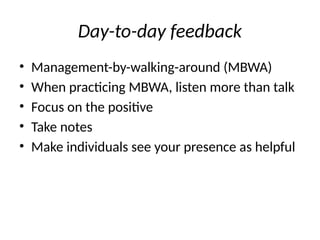
Performance feedback
• Managerscommonly provide employee
feedback in three ways.
1. Day-to-day feedback provided on the job.
2. Annual (or semiannual ) performance reviews
3. Ad hoc performance reviews
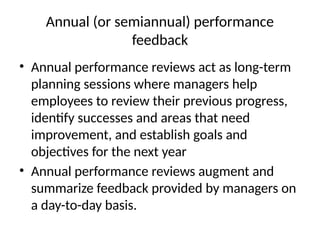
Annual (or semiannual)performance
feedback
• Annual performance reviews act as long-term
planning sessions where managers help
employees to review their previous progress,
identify successes and areas that need
improvement, and establish goals and
objectives for the next year
• Annual performance reviews augment and
summarize feedback provided by managers on
a day-to-day basis.
35.
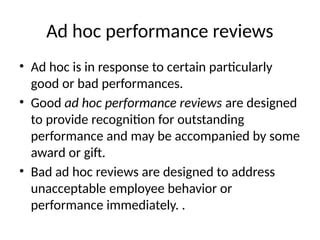
Ad hoc performancereviews
• Ad hoc is in response to certain particularly
good or bad performances.
• Good ad hoc performance reviews are designed
to provide recognition for outstanding
performance and may be accompanied by some
award or gift.
• Bad ad hoc reviews are designed to address
unacceptable employee behavior or
performance immediately. .
36.
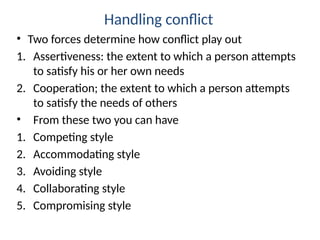
Handling conflict
• Twoforces determine how conflict play out
1. Assertiveness: the extent to which a person attempts
to satisfy his or her own needs
2. Cooperation; the extent to which a person attempts
to satisfy the needs of others
• From these two you can have
1. Competing style
2. Accommodating style
3. Avoiding style
4. Collaborating style
5. Compromising style
37.
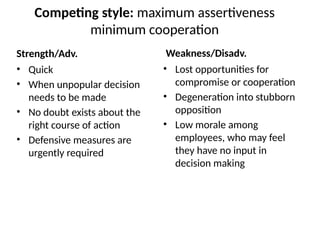
Competing style: maximumassertiveness
minimum cooperation
Strength/Adv.
• Quick
• When unpopular decision
needs to be made
• No doubt exists about the
right course of action
• Defensive measures are
urgently required
Weakness/Disadv.
• Lost opportunities for
compromise or cooperation
• Degeneration into stubborn
opposition
• Low morale among
employees, who may feel
they have no input in
decision making
38.
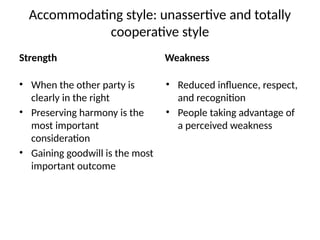
Accommodating style: unassertiveand totally
cooperative style
Strength
• When the other party is
clearly in the right
• Preserving harmony is the
most important
consideration
• Gaining goodwill is the most
important outcome
Weakness
• Reduced influence, respect,
and recognition
• People taking advantage of
a perceived weakness
39.
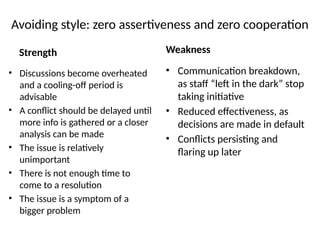
Avoiding style: zeroassertiveness and zero cooperation
Strength
• Discussions become overheated
and a cooling-off period is
advisable
• A conflict should be delayed until
more info is gathered or a closer
analysis can be made
• The issue is relatively
unimportant
• There is not enough time to
come to a resolution
• The issue is a symptom of a
bigger problem
Weakness
• Communication breakdown,
as staff “left in the dark” stop
taking initiative
• Reduced effectiveness, as
decisions are made in default
• Conflicts persisting and
flaring up later
40.
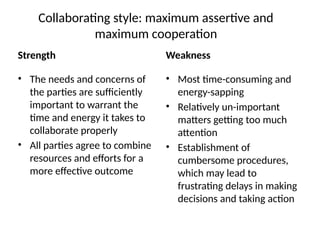
Collaborating style: maximumassertive and
maximum cooperation
Strength
• The needs and concerns of
the parties are sufficiently
important to warrant the
time and energy it takes to
collaborate properly
• All parties agree to combine
resources and efforts for a
more effective outcome
Weakness
• Most time-consuming and
energy-sapping
• Relatively un-important
matters getting too much
attention
• Establishment of
cumbersome procedures,
which may lead to
frustrating delays in making
decisions and taking action
41.
Compromising style: mid-wayof all the previous four
techniques
Strengths
• The parties are strongly
committed to mutually
exclusive goals, and it is clear
that no solution will be wholly
satisfactory to both of them.
• The goals of both parties are
important but not worthy the
effort needed for collaboration
• Temporary solutions are sought
for complex issues because the
time for decision making is
short
Weakness
• Important principles might
be disregarded
• The value of the enterprise
may be diminished
42.
Progressive discipline
• Progressivediscipline is defined as a series of acts
taken by management in response to unacceptable
performance by employees.
• The role of progressive discipline is to escalate the
consequences of poor employee performance
incrementally with a goal of improving that behavior.
• Responses by management to undesirable behavior
become progressively severe until the employee
either improves, resigns, or is terminated from the
position.
43.
Steps of Progressivediscipline
1. Verbal warning
2. Written warning
3. Suspension
44.
Termination of employees
•Prior to the termination meeting, the manager must
be certain that all the following statements are true:
– The employee is not being terminated for anything but
poor job performance or breaking major rules (e.g., theft
or fighting).
– The reason for termination can be stated in measurable,
factual terms.
– The employee has been given specific feedback regarding
the performance deficiency in measurable, factual terms.
– The organization’s policies and procedures regarding
discipline have been observed and actions documented.
45.
Termination cont…
– Theemployee has been given ample opportunity
to correct the poor performance.
– Employee treatment is consistent with similar
situations of employee performance.
– The personnel department has been kept
informed throughout the disciplinary process and
is currently aware of plans to terminate the
employee.
#29 Therefore, training is essential for meeting current needs, and development is an investment in future needs.
#30 Have a checklist for this to avoid excluding important steps
#31 Although pharmacists are highly trained professionals, the changing nature of medical and business practice requires continual training throughout their careers.
#34 Annual performance
reviews are discussed in greater detail in next topic
#35 These negative ad hoc reviews are part of a process called progressive discipline



![HEALTH SYSTEMS MANAGEMENT II UNIT TWO [Autosaved].pptx](https://cdn.slidesharecdn.com/ss_thumbnails/healthsystemsmanagementiiunittwoautosaved-240218181923-21e24621-thumbnail.jpg?width=640&height=640&fit=bounds)


![7. Ischaemic Heart Disease and Acute Coronary Syndromes [Autosaved].pptx](https://cdn.slidesharecdn.com/ss_thumbnails/7-251128082316-c3f9588b-thumbnail.jpg?width=640&height=640&fit=bounds)


![4._Sedative_hypnotics[1].pptx pharmacy students](https://cdn.slidesharecdn.com/ss_thumbnails/4-251117163021-acac7ad2-thumbnail.jpg?width=640&height=640&fit=bounds)
![5._Anxiolytics[1].ppt pharmacological dta](https://cdn.slidesharecdn.com/ss_thumbnails/5-251117063512-b65b6ba0-thumbnail.jpg?width=640&height=640&fit=bounds)


