Relationship among Theory,Research, and
Practice
By
Ashfaq Ahmad Nasar
Lecturer KMU-INS
Acknowledgment: Shahla Arshad
Lecturer KMU-INS
2.
By the endof this session the learners will be able to :
Discuss Perspective of Nursing theory.
Understand Nursing Theoretical evolution.
Describe relationship between theory and research.
Discuss relationship between theory and practice.
OBJECTIVES
3.
Historical Perspectives ofNursing Theories
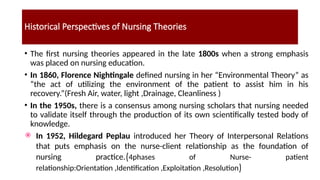
• The first nursing theories appeared in the late 1800s when a strong emphasis
was placed on nursing education.
• In 1860, Florence Nightingale defined nursing in her “Environmental Theory” as
“the act of utilizing the environment of the patient to assist him in his
recovery.”(Fresh Air, water, light ,Drainage, Cleanliness )
• In the 1950s, there is a consensus among nursing scholars that nursing needed
to validate itself through the production of its own scientifically tested body of
knowledge.
In 1952, Hildegard Peplau introduced her Theory of Interpersonal Relations
that puts emphasis on the nurse-client relationship as the foundation of
nursing practice.(4phases of Nurse- patient
relationship:Orientation ,Identification ,Exploitation ,Resolution)
4.
Historical Perspectives ofNursing Theories
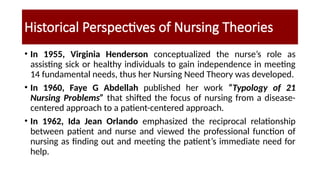
• In 1955, Virginia Henderson conceptualized the nurse’s role as
assisting sick or healthy individuals to gain independence in meeting
14 fundamental needs, thus her Nursing Need Theory was developed.
• In 1960, Faye G Abdellah published her work “Typology of 21
Nursing Problems” that shifted the focus of nursing from a disease-
centered approach to a patient-centered approach.
• In 1962, Ida Jean Orlando emphasized the reciprocal relationship
between patient and nurse and viewed the professional function of
nursing as finding out and meeting the patient’s immediate need for
help.
5.
Historical Perspectives ofNursing Theories
• In 1968, Dorothy Johnson pioneered the Behavioral System Model
and upheld the fostering of efficient and effective behavioral
functioning in the patient to prevent illness.
• In 1970, Martha Rogers viewed nursing as both a science and an art
as it provides a way to view the unitary human being, who is integral
with the universe.(Five Assumption,4 major concepts,3 major principles)
• In 1971, Dorothea Orem states in her theory that nursing care is
required if the client is unable to fulfill biological, psychological,
developmental, or social needs. (Composed of three interrelated theories:
The theory of self-care ,The self-care deficit theory, The theory of nursing system)
6.
Historical Perspectives ofNursing Theories
• In 1971, Imogene King‘s Theory of Goal attainment states that the nurse is considered
part of the patient’s environment and the nurse-patient relationship is for meeting goals
towards good health.
• In 1972, Betty Neuman in her theory states that many needs exist, and each may disrupt
client balance or stability. Stress reduction is the goal of the system model of nursing
practice.(System Model)
• In 1979, Callista Roy viewed the individual as a set of interrelated systems who strives to
maintain the balance between these various stimuli.
• In 1979, Jean Watson developed the philosophy of caring highlighted humanistic aspects
of nursing as they intertwine with scientific knowledge and nursing practice. (10 Carative
Factors)
• (Carative is the philosophy and theory of human caring. Dr. Jean Watson uses the term “carative”
instead of “curative” to distinguish between nursing and medicine.)
7.
Despite thedevelopment, evolution, and study of nursing theory in the past
a few decades, the “gap” between theory and practice is a common
perception among nurses. Practicing nurses rarely use the language of
nursing theory
Many nurses lack a true understanding of the interrelationship among
theory, research, and practice and its importance to the continuing
development of nursing as a profession (Pryjmachuk, 1996).
As early as the 1970s, nursing scholars commented on the relationships
among theory, research, and practice.
Nursing leaders insisted that nursing research be combined with theory
development to provide a rational basis for practice (Flaskerud, 1984; Moody, 1990
Perspective of Nursing theory
8.
The primarypurpose of theory in the profession of nursing is to improve
practice by positively influence the health and quality of life of patients.
In applied disciplines such as nursing, practice is based on the theories that
are validated through research.
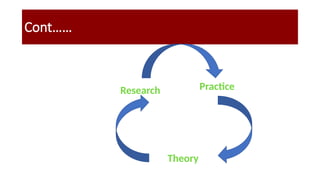
Thus, theory, research, and practice affect each other in a reciprocal, cyclical,
and interactive way (Hickman, 2002; Marrs & Lowry, 2006)
Perspective of Nursing theory
9.
Relationship between theoryand research
In any discipline, science is the result of the relationship between the
process of inquiry (research) and the product of knowledge (theory).
The relationship between theory and practice is cyclical or
reciprocal. Practice is the basis for the development of nursing
theory whereas nursing theory must be validated in practice.
Theory is integral to the research process where it is important
to use theory as a framework to provide perspective and guidance
to the research study.
Theory can also be used to guide the research process by generating
and testing phenomena of interest.
Research validates andmodifies theory.
In nursing, theories stimulate nurse scientists to explore significant
problems in the field of nursing. In doing so, the potential for the
development of nursing knowledge increases (Meleis, 2007).
When empirically tested, the results of research can be used to
verify, modify, disprove, or support a theoretical proposition.
Relationship Between Theory and Research
12.
Research isthe key to the development of a discipline.
Middle range and practice theories may be tested in practice through
clinical research (Hickman, 2002).
If individual practitioners are to develop expertise, they must
participate in research.
In summary, there is a need to encourage nurses to test and refine
theories and models to develop their own personal models of practice
(Marrs & Lowry, 2006; Pryjmachuk, 1996).
Relationship Between Research and Practice
13.
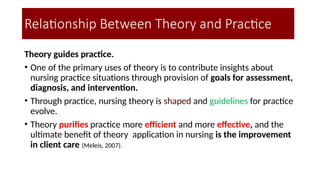
Theory guides practice.
•One of the primary uses of theory is to contribute insights about
nursing practice situations through provision of goals for assessment,
diagnosis, and intervention.
• Through practice, nursing theory is shaped and guidelines for practice
evolve.
• Theory purifies practice more efficient and more effective, and the
ultimate benefit of theory application in nursing is the improvement
in client care (Meleis, 2007).
Relationship Between Theory and Practice
14.
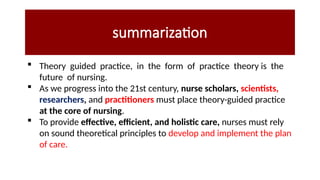
summarization
Theory guidedpractice, in the form of practice theory is the
future of nursing.
As we progress into the 21st century, nurse scholars, scientists,
researchers, and practitioners must place theory-guided practice
at the core of nursing.
To provide effective, efficient, and holistic care, nurses must rely
on sound theoretical principles to develop and implement the plan
of care.




![UNIT 02 MYK.pptx [Autosaved].pptxhhhhhhh](https://cdn.slidesharecdn.com/ss_thumbnails/unit02myk-240821073648-d3e4be07-thumbnail.jpg?width=640&height=640&fit=bounds)

![Theory, research and practice [autosaved]](https://cdn.slidesharecdn.com/ss_thumbnails/theoryresearchandpracticeautosaved-180430220514-thumbnail.jpg?width=640&height=640&fit=bounds)


![Theory development strategies [AG].pptx](https://cdn.slidesharecdn.com/ss_thumbnails/3theorydevelopmentstrategiesag-230516131256-74549fd8-thumbnail.jpg?width=640&height=640&fit=bounds)


