Quantum Mechanics ofHydrogen Atom
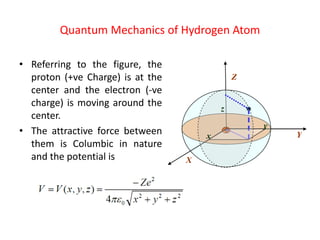
• Referring to the figure, the
proton (+ve Charge) is at the
center and the electron (-ve
charge) is moving around the
center.
• The attractive force between
them is Columbic in nature
and the potential is
3.
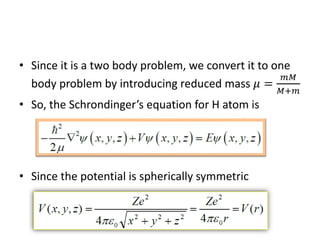
• Since itis a two body problem, we convert it to one
body problem by introducing reduced mass 𝜇 =
𝑚𝑀
𝑀+𝑚
• So, the Schrondinger’s equation for H atom is
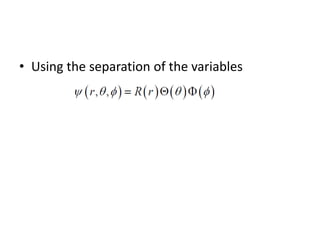
• Since the potential is spherically symmetric
4.
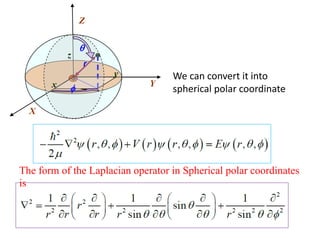
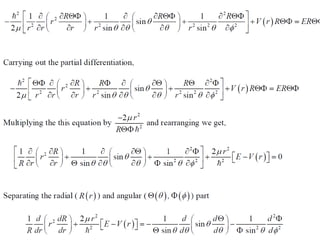
We can convertit into
spherical polar coordinate
The form of the Laplacian operator in Spherical polar coordinates
is
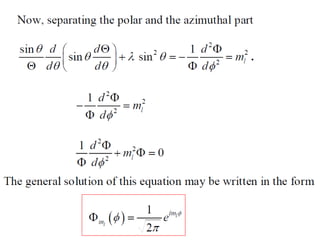
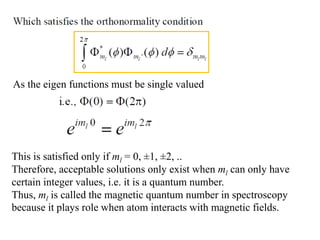
As the eigenfunctions must be single valued
This is satisfied only if ml = 0, ±1, ±2, ..
Therefore, acceptable solutions only exist when ml can only have
certain integer values, i.e. it is a quantum number.
Thus, ml is called the magnetic quantum number in spectroscopy
because it plays role when atom interacts with magnetic fields.
10.
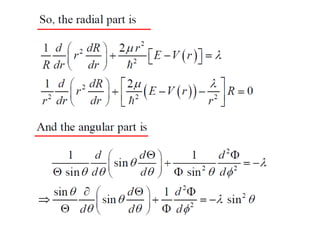
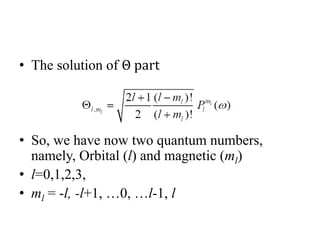
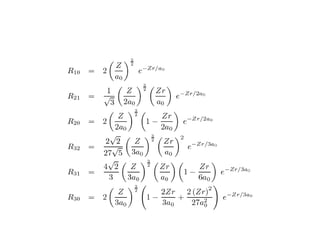
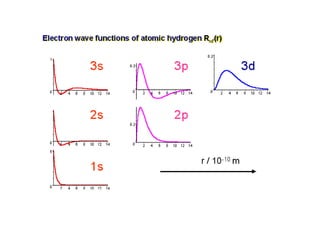
• The solutionof Θ part
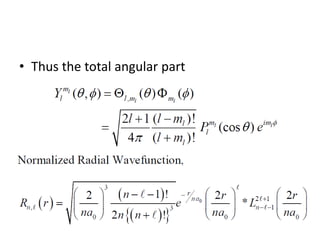
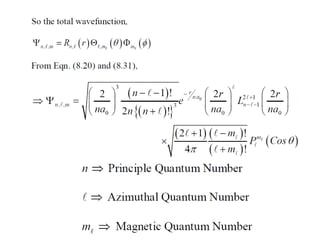
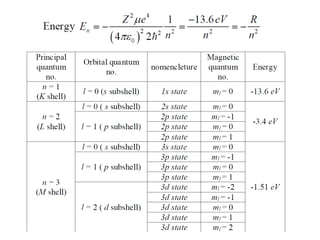
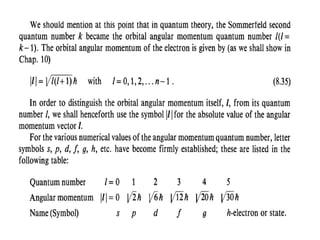
• So, we have now two quantum numbers,
namely, Orbital (l) and magnetic (ml)
• l=0,1,2,3,
• ml = -l, -l+1, …0, …l-1, l



![제 23회 보아즈(BOAZ) 빅데이터 컨퍼런스 - [MBOAX] : ABSA를 활용한 소비자 반응 분석 기반 운영 효율화 대시보드 설계](https://cdn.slidesharecdn.com/ss_thumbnails/3-1boaz23rdconferencemboax-260203102709-9d519923-thumbnail.jpg?width=640&height=640&fit=bounds)


