www.dmp.wa.gov.au/ResourcesSafety
Electrical hazard awareness
www.dmp.wa.gov.au/ResourcesSafety
What does hazard mean?
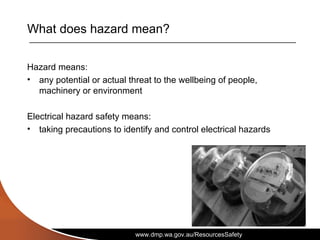
Hazard means:
• any potential or actual threat to the wellbeing of people,
machinery or environment
Electrical hazard safety means:
• taking precautions to identify and control electrical hazards
www.dmp.wa.gov.au/ResourcesSafety
The Importance of Electrical Safety
Approximately 1100 people die from electric
shock each year in the United States. During
your daily routine, you are probably exposed
to many potentially dangerous situations
involving electricity. Modern life depends on
electricity to run machinery, to provide heat
and light, and to do many of the jobs people
take for granted. Handled with care and
respect, electricity is safe and useful, but
when handled carelessly, it can be a killer.
www.dmp.wa.gov.au/ResourcesSafety
Why know about it?
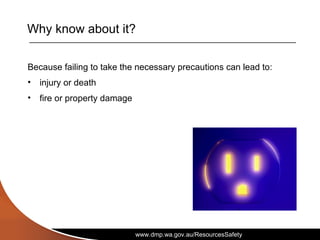
Because failing to take the necessary precautions can lead to:
• injury or death
• fire or property damage
www.dmp.wa.gov.au/ResourcesSafety
What are the safety priorities?
Electrical hazards exist in almost every workplace. Common
causes of electrocution are:
•making contact with overhead wires
•undertaking maintenance on live equipment
•working with damaged electrical equipment, such as extension
leads, plugs and sockets
•using equipment affected by rain or water ingress
www.dmp.wa.gov.au/ResourcesSafety
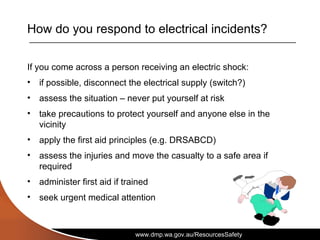
How do you respond to electrical incidents?
If you come across a person receiving an electric shock:
• if possible, disconnect the electrical supply (switch?)
• assess the situation – never put yourself at risk
• take precautions to protect yourself and anyone else in the
vicinity
• apply the first aid principles (e.g. DRSABCD)
• assess the injuries and move the casualty to a safe area if
required
• administer first aid if trained
• seek urgent medical attention
www.dmp.wa.gov.au/ResourcesSafety
Do you want to be a victim?
You could be the victim if you:
•don’t follow proper procedures around electricity
•use electrical equipment improperly
•use faulty electrical equipment
www.dmp.wa.gov.au/ResourcesSafety
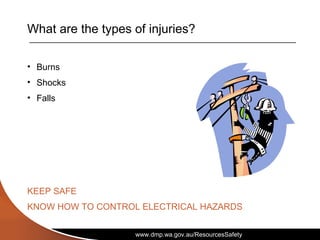
What are the types of injuries?
• Burns
• Shocks
• Falls
KEEP SAFE
KNOW HOW TO CONTROL ELECTRICAL HAZARDS
www.dmp.wa.gov.au/ResourcesSafety
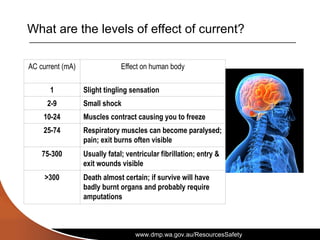
What are the levels of effect of current?
AC current (mA) Effect on human body
1 Slight tingling sensation
2-9 Small shock
10-24 Muscles contract causing you to freeze
25-74 Respiratory muscles can become paralysed;
pain; exit burns often visible
75-300 Usually fatal; ventricular fibrillation; entry &
exit wounds visible
>300 Death almost certain; if survive will have
badly burnt organs and probably require
amputations
www.dmp.wa.gov.au/ResourcesSafety
What should you do in an electrical emergency?
For low voltage electricity >50 V AC and 110 V DC
• remove the source of electricity supply
• commence CPR if trained
• call the emergency number on site
For high voltage electricity >1000 V
• call the emergency number for your site
• don’t go near the casualty
• don’t touch the casualty or try to free them with anything
www.dmp.wa.gov.au/ResourcesSafety
Should you report electrical incidents?
• Electricity is invisible – this in itself makes it dangerous
• It has great potential to seriously injure or kill
• The company has a duty of care to its employees and
contractors
• Everyone is exposed to electrical hazards, not just electricians
• Report all electrical shocks and near misses
ALL EMPLOYEES CAN BE EXPOSED TO ELECTRICAL
HAZARDS. THEY SHOULD RECEIVE ELECTRICAL HAZARD
TRAINING AT THE COMMENCEMENT OF THEIR
EMPLOYMENT AND REGULAR REFRESHER TRAINING.
www.dmp.wa.gov.au/ResourcesSafety
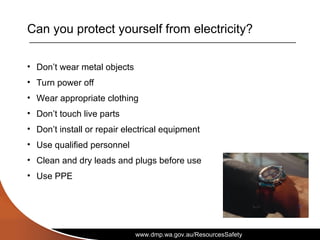
Can you protect yourself from electricity?
• Don’t wear metal objects
• Turn power off
• Wear appropriate clothing
• Don’t touch live parts
• Don’t install or repair electrical equipment
• Use qualified personnel
• Clean and dry leads and plugs before use
• Use PPE
www.dmp.wa.gov.au/ResourcesSafety
What are other safety measures?
• Heed warning signs
• Use the right equipment
• Study the operation manual
• Take care of extension leads
• Use only approved extension lamps
• Don’t pull on leads
• Use residual current devices – RCDs
• Use the proper fuses and circuit breakers
www.dmp.wa.gov.au/ResourcesSafety
Regular safety inspections
are a part of YOUR job...
• Electrical equipment should be checked each time
before use for defects
• If not tagged or the tag is out of date then report it and
place it out of service
www.dmp.wa.gov.au/ResourcesSafety
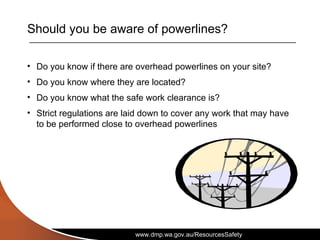
Should you be aware of powerlines?
• Do you know if there are overhead powerlines on your site?
• Do you know where they are located?
• Do you know what the safe work clearance is?
• Strict regulations are laid down to cover any work that may have
to be performed close to overhead powerlines
www.dmp.wa.gov.au/ResourcesSafety
What are electric shock hazards?
• Arc welding can and has killed people in high risk environments
• Everyone involved needs to better understand the hazards,
adopt sound practice and use appropriate safety devices
• Study and adhere to the Code of Practice: WTIA Tech Note 7-04
• Use safety devices such as manual trigger switches and voltage
reducing devices (VRDs)
• Under adverse conditions, strive to improve control measures
(e.g. presence of moisture as sweat or rain)
www.dmp.wa.gov.au/ResourcesSafety
A welding incident…
• Assistant hands welder a metal object.
Resultant current is 35 mA
I = V/R = 67/1900 = 35 mA
Result = Assistant survived but welder died
www.dmp.wa.gov.au/ResourcesSafety
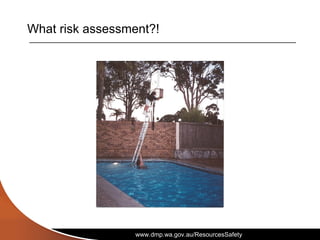
What risk assessment?!
www.dmp.wa.gov.au/ResourcesSafety
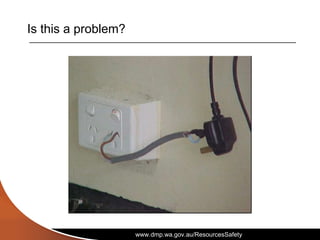
Is this a problem?
www.dmp.wa.gov.au/ResourcesSafety
Controlling Workplace Hazards
Once a hazard has been identified and the risk assessed, control
measures should be put into place. A simple list of control measures can
be utilized - the hierarchy of control.
1. Identify the Hazard
Identify the source of the problem
www.dmp.wa.gov.au/ResourcesSafety
Controlling Workplace Hazards
2. Assess the Risk
• Risk assessment is the process where you:
• Identify hazards,
• Analyze or evaluate the risk associated with
that hazard.
• Determine appropriate ways to eliminate or
control the hazard
www.dmp.wa.gov.au/ResourcesSafety
Controlling Workplace Hazards
3. Eliminate the Hazard Or Risk
Elimination of a specific hazard or hazardous
work process, or preventing it from entering
the workplace, is the most effective method
of control. Eliminating a hazard means
removing it completely.
www.dmp.wa.gov.au/ResourcesSafety
Controlling Workplace Hazards
4. Engineering Control
It may mean changing a piece of machinery
(for example, using proper machine guards) or
a work process to reduce exposure to a
hazard.
www.dmp.wa.gov.au/ResourcesSafety
Controlling Workplace Hazards
5. Administrative Controls
Working a limited number of hours in a
hazardous area is an example of an
administrative control for example, job rotation.
www.dmp.wa.gov.au/ResourcesSafety
Controlling Workplace Hazards
6. Substitution
It is one measure of replacing one
hazardous agent or work process with a less
dangerous one. It is important to consider
worker health and safety when work
processes are still in the planning stages.

lectricalHazardAwarenessandriskassessment.ppt

  • 1.
  • 2.
    www.dmp.wa.gov.au/ResourcesSafety What does hazardmean? Hazard means: • any potential or actual threat to the wellbeing of people, machinery or environment Electrical hazard safety means: • taking precautions to identify and control electrical hazards
  • 3.
    www.dmp.wa.gov.au/ResourcesSafety The Importance ofElectrical Safety Approximately 1100 people die from electric shock each year in the United States. During your daily routine, you are probably exposed to many potentially dangerous situations involving electricity. Modern life depends on electricity to run machinery, to provide heat and light, and to do many of the jobs people take for granted. Handled with care and respect, electricity is safe and useful, but when handled carelessly, it can be a killer.
  • 4.
    www.dmp.wa.gov.au/ResourcesSafety Why know aboutit? Because failing to take the necessary precautions can lead to: • injury or death • fire or property damage
  • 5.
    www.dmp.wa.gov.au/ResourcesSafety What are thesafety priorities? Electrical hazards exist in almost every workplace. Common causes of electrocution are: •making contact with overhead wires •undertaking maintenance on live equipment •working with damaged electrical equipment, such as extension leads, plugs and sockets •using equipment affected by rain or water ingress
  • 6.
    www.dmp.wa.gov.au/ResourcesSafety How do yourespond to electrical incidents? If you come across a person receiving an electric shock: • if possible, disconnect the electrical supply (switch?) • assess the situation – never put yourself at risk • take precautions to protect yourself and anyone else in the vicinity • apply the first aid principles (e.g. DRSABCD) • assess the injuries and move the casualty to a safe area if required • administer first aid if trained • seek urgent medical attention
  • 7.
    www.dmp.wa.gov.au/ResourcesSafety Do you wantto be a victim? You could be the victim if you: •don’t follow proper procedures around electricity •use electrical equipment improperly •use faulty electrical equipment
  • 8.
    www.dmp.wa.gov.au/ResourcesSafety What are thetypes of injuries? • Burns • Shocks • Falls KEEP SAFE KNOW HOW TO CONTROL ELECTRICAL HAZARDS
  • 9.
    www.dmp.wa.gov.au/ResourcesSafety What are thelevels of effect of current? AC current (mA) Effect on human body 1 Slight tingling sensation 2-9 Small shock 10-24 Muscles contract causing you to freeze 25-74 Respiratory muscles can become paralysed; pain; exit burns often visible 75-300 Usually fatal; ventricular fibrillation; entry & exit wounds visible >300 Death almost certain; if survive will have badly burnt organs and probably require amputations
  • 10.
    www.dmp.wa.gov.au/ResourcesSafety What should youdo in an electrical emergency? For low voltage electricity >50 V AC and 110 V DC • remove the source of electricity supply • commence CPR if trained • call the emergency number on site For high voltage electricity >1000 V • call the emergency number for your site • don’t go near the casualty • don’t touch the casualty or try to free them with anything
  • 11.
    www.dmp.wa.gov.au/ResourcesSafety Should you reportelectrical incidents? • Electricity is invisible – this in itself makes it dangerous • It has great potential to seriously injure or kill • The company has a duty of care to its employees and contractors • Everyone is exposed to electrical hazards, not just electricians • Report all electrical shocks and near misses ALL EMPLOYEES CAN BE EXPOSED TO ELECTRICAL HAZARDS. THEY SHOULD RECEIVE ELECTRICAL HAZARD TRAINING AT THE COMMENCEMENT OF THEIR EMPLOYMENT AND REGULAR REFRESHER TRAINING.
  • 12.
    www.dmp.wa.gov.au/ResourcesSafety Can you protectyourself from electricity? • Don’t wear metal objects • Turn power off • Wear appropriate clothing • Don’t touch live parts • Don’t install or repair electrical equipment • Use qualified personnel • Clean and dry leads and plugs before use • Use PPE
  • 13.
    www.dmp.wa.gov.au/ResourcesSafety What are othersafety measures? • Heed warning signs • Use the right equipment • Study the operation manual • Take care of extension leads • Use only approved extension lamps • Don’t pull on leads • Use residual current devices – RCDs • Use the proper fuses and circuit breakers
  • 14.
    www.dmp.wa.gov.au/ResourcesSafety Regular safety inspections area part of YOUR job... • Electrical equipment should be checked each time before use for defects • If not tagged or the tag is out of date then report it and place it out of service
  • 15.
    www.dmp.wa.gov.au/ResourcesSafety Should you beaware of powerlines? • Do you know if there are overhead powerlines on your site? • Do you know where they are located? • Do you know what the safe work clearance is? • Strict regulations are laid down to cover any work that may have to be performed close to overhead powerlines
  • 16.
    www.dmp.wa.gov.au/ResourcesSafety What are electricshock hazards? • Arc welding can and has killed people in high risk environments • Everyone involved needs to better understand the hazards, adopt sound practice and use appropriate safety devices • Study and adhere to the Code of Practice: WTIA Tech Note 7-04 • Use safety devices such as manual trigger switches and voltage reducing devices (VRDs) • Under adverse conditions, strive to improve control measures (e.g. presence of moisture as sweat or rain)
  • 17.
    www.dmp.wa.gov.au/ResourcesSafety A welding incident… •Assistant hands welder a metal object. Resultant current is 35 mA I = V/R = 67/1900 = 35 mA Result = Assistant survived but welder died
  • 18.
  • 19.
  • 20.
    www.dmp.wa.gov.au/ResourcesSafety Controlling Workplace Hazards Oncea hazard has been identified and the risk assessed, control measures should be put into place. A simple list of control measures can be utilized - the hierarchy of control. 1. Identify the Hazard Identify the source of the problem
  • 21.
    www.dmp.wa.gov.au/ResourcesSafety Controlling Workplace Hazards 2.Assess the Risk • Risk assessment is the process where you: • Identify hazards, • Analyze or evaluate the risk associated with that hazard. • Determine appropriate ways to eliminate or control the hazard
  • 22.
    www.dmp.wa.gov.au/ResourcesSafety Controlling Workplace Hazards 3.Eliminate the Hazard Or Risk Elimination of a specific hazard or hazardous work process, or preventing it from entering the workplace, is the most effective method of control. Eliminating a hazard means removing it completely.
  • 23.
    www.dmp.wa.gov.au/ResourcesSafety Controlling Workplace Hazards 4.Engineering Control It may mean changing a piece of machinery (for example, using proper machine guards) or a work process to reduce exposure to a hazard.
  • 24.
    www.dmp.wa.gov.au/ResourcesSafety Controlling Workplace Hazards 5.Administrative Controls Working a limited number of hours in a hazardous area is an example of an administrative control for example, job rotation.
  • 25.
    www.dmp.wa.gov.au/ResourcesSafety Controlling Workplace Hazards 6.Substitution It is one measure of replacing one hazardous agent or work process with a less dangerous one. It is important to consider worker health and safety when work processes are still in the planning stages.

Editor's Notes

  • #6 D - Danger R - Response S – Send for help A - Airway B - Breathing C - CPR D - Defibrillation
  • #19 This absolute shocker is a shocker in the literal sense. If you look carefully, you will notice that the power lead plug-top is not designed and intended for use within an Australian socket outlet. This should have warned the user that the appliance may not have been designed for use within the Australian 240 Volt system, but rather the 110 Volt system in so many other countries. But it seems that some people just wont take the hint. What we see here is a dangerously novel variation on the age-old stupidity of trying to force a square peg into a round hole. If it won’t fit – don’t use it!