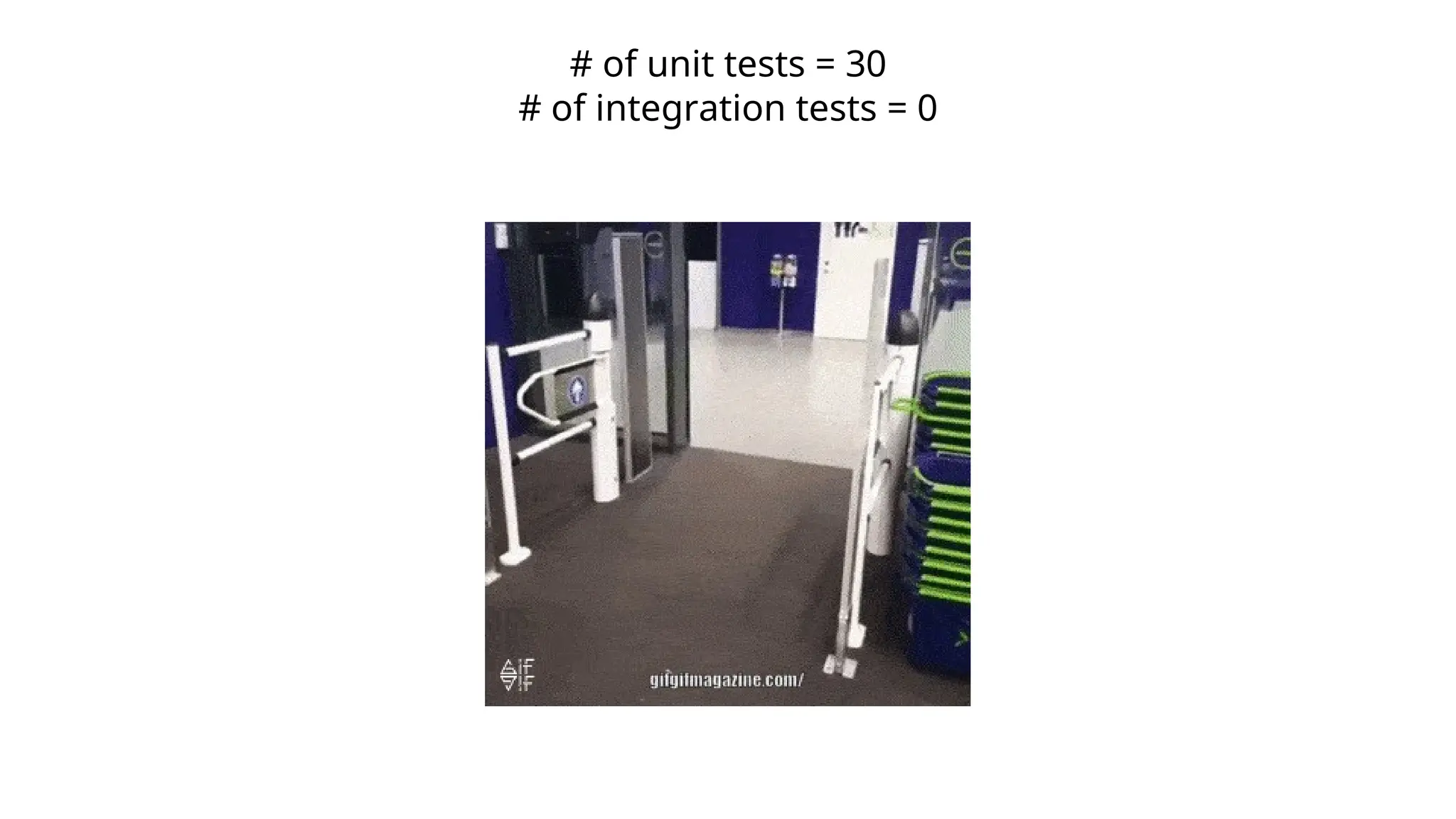
# of unit tests = 30
# of integration tests = 0
Continuous Testing I
Outline
• Today we look at the role of testing in software maintenance, and the
need for continuous testing methods
• We’ll look at :
• software maintenance and evolution
• corrective, adaptive, perfective and preventive maintenance
• continuous testing methods
• maintaining functionality, failure, operational test suites
• regression testing
Software Maintenance
Evolution
• Maintenance is the phase of development in which the software
is in production day to day by real users
• For successful software, this is almost all of its lifetime, and the
software evolves in response to observed failures and new
requirements
• Usual estimate is that over 85% of the total software effort is in
maintenance
• Four kinds of software maintenance: corrective, adaptive, perfective
and preventive
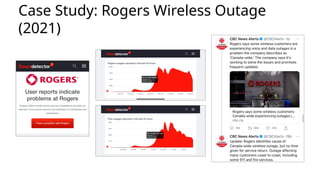
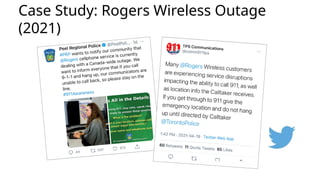
Case Study: Rogers Wireless Outage
(2021)
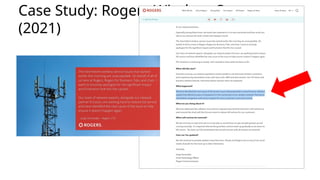
Case Study: Rogers Wireless Outage
(2021)
Case Study: Rogers Wireless Outage
(2021)
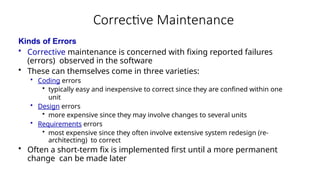
Corrective Maintenance
Kinds of Errors
• Corrective maintenance is concerned with fixing reported failures
(errors) observed in the software
• These can themselves come in three varieties:
• Coding errors
• typically easy and inexpensive to correct since they are confined within one
unit
• Design errors
• more expensive since they may involve changes to several units
• Requirements errors
• most expensive since they often involve extensive system redesign (re-
architecting) to correct
• Often a short-term fix is implemented first until a more permanent
change can be made later
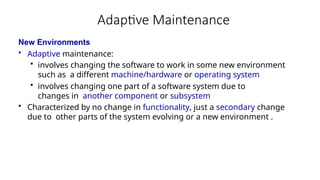
Adaptive Maintenance
New Environments
• Adaptive maintenance:
• involves changing the software to work in some new environment
such as a different machine/hardware or operating system
• involves changing one part of a software system due to
changes in another component or subsystem
• Characterized by no change in functionality, just a secondary change
due to other parts of the system evolving or a new environment .
Perfective Maintenance
Improving Performance and more…
• Perfective maintenance includes changes made to improve the
performance, maintainability, etc. of the program
• It does not always occur as the result of failures or faults in the source
code.
• e.g., improving architecture to enhance performance
• e.g., improving documentation or code formatting to increase
readability
Preventive Maintenance
Changes to Prevent Failure
• Preventive maintenance involves changes that may result from
faults uncovered by a programmer who addresses the fault so that
it does not become a failure.
e.g., better exception handling in a Java program
Maintenance Tests
Maintaining Quality
• As time goes on, the software is often maintained by
programmers not involved in the initial design and development
• These programmers tend to be more focused on the changes
than the whole product
• For this reason, testing has an even more important role in quality
assurance in the maintenance phase than it does in initial development
and delivery
• it helps to make sure that changes have not broken anything
Continuous Testing Methods
Testing as a Maintenance Activity
• Thus, testing is not a one-time thing – we’re never “done” testing
• As software is maintained, if we are to maintain consistent quality, we
must continue testing - both of old existing functionality, and of new
introduced functionality
• For this reason, Agile calls for continuous testing
• test every version, every day
• At a minimum, we must re-test thoroughly after every set of changes,
before the changed software is released
Test Suites
Tests Are Part of the Product
• Most projects maintain test suites, sets of tests to be run on every
release of the software
• Maintained in parallel with the software - often with at least as much
effort as the software itself
• as we have already seen, automation is essential to make this practical
Kinds of Test Suites
• Three (related) kinds of continuous tests are normally performed
and maintained continuously in software maintenance
• Functionality (or acceptance) testing, failure testing,
operational testing
Continuous Functionality Testing
Functionality Suites
• We have already seen functionality and acceptance testing suites.
• When used continuously over the evolution of the software, we maintain the
functionality tests by:
• Every time a new feature is added, new tests specifically aimed at testing that
feature are permanently added to the test suite
(In Agile we must have these new tests since they form the specification
for the new software capabilities)
• Every time a feature is changed or extended, we change or extend the
corresponding functionality tests to correspond
Failure Testing
Failure Suites
• Failure tests are suites of examples that have been observed to cause a failure
of the software in the past
• To be effective, failure tests must be maintained over the evolution of the
software, by:
• Before correcting any observed failure, characterize the failure by creating a "failure
test" that causes it
• This becomes the specification of the fix - the changed software must at a
minimum correct the error for the test
• The failure test must cause the error in the old software and not cause the error
in the new software
• We keep all such tests in a failure test suite to be re-run on all future versions
of the software, to ensure that the failure does not reappear due to a future
change
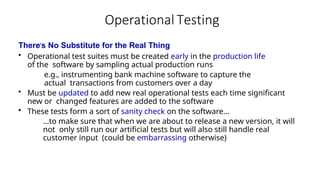
Operational Testing
There’s No Substitute for the Real Thing
• Operational tests are suites of tests that are actual production runs
observed in the use of the software
• e.g., for our Banking back end, all of the banking transaction files
from a set of real front ends run all day on a particular day
Operational Testing
There’s No Substitute for the Real Thing
• Operational test suites must be created early in the production life
of the software by sampling actual production runs
e.g., instrumenting bank machine software to capture the
actual transactions from customers over a day
• Must be updated to add new real operational tests each time significant
new or changed features are added to the software
• These tests form a sort of sanity check on the software…
…to make sure that when we are about to release a new version, it will
not only still run our artificial tests but will also still handle real
customer input (could be embarrassing otherwise)
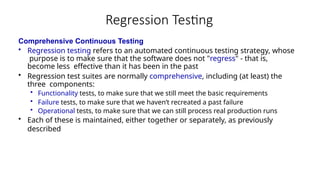
Regression Testing
Comprehensive Continuous Testing
• Regression testing refers to an automated continuous testing strategy, whose
purpose is to make sure that the software does not "regress" - that is,
become less effective than it has been in the past
• Regression test suites are normally comprehensive, including (at least) the
three components:
• Functionality tests, to make sure that we still meet the basic requirements
• Failure tests, to make sure that we haven’t recreated a past failure
• Operational tests, to make sure that we can still process real production runs
• Each of these is maintained, either together or separately, as previously
described
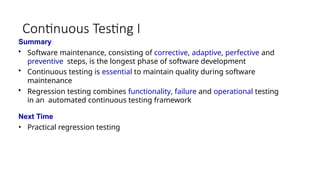
Continuous Testing I
Summary
• Software maintenance, consisting of corrective, adaptive, perfective and
preventive steps, is the longest phase of software development
• Continuous testing is essential to maintain quality during software
maintenance
• Regression testing combines functionality, failure and operational testing
in an automated continuous testing framework
Next Time
• Practical regression testing

Lect_10-software Continuous Testing.pptx

  • 1.
    # of unittests = 30 # of integration tests = 0
  • 2.
    Continuous Testing I Outline •Today we look at the role of testing in software maintenance, and the need for continuous testing methods • We’ll look at : • software maintenance and evolution • corrective, adaptive, perfective and preventive maintenance • continuous testing methods • maintaining functionality, failure, operational test suites • regression testing
  • 3.
    Software Maintenance Evolution • Maintenanceis the phase of development in which the software is in production day to day by real users • For successful software, this is almost all of its lifetime, and the software evolves in response to observed failures and new requirements • Usual estimate is that over 85% of the total software effort is in maintenance • Four kinds of software maintenance: corrective, adaptive, perfective and preventive
  • 4.
    Case Study: RogersWireless Outage (2021)
  • 5.
    Case Study: RogersWireless Outage (2021)
  • 6.
    Case Study: RogersWireless Outage (2021)
  • 7.
    Corrective Maintenance Kinds ofErrors • Corrective maintenance is concerned with fixing reported failures (errors) observed in the software • These can themselves come in three varieties: • Coding errors • typically easy and inexpensive to correct since they are confined within one unit • Design errors • more expensive since they may involve changes to several units • Requirements errors • most expensive since they often involve extensive system redesign (re- architecting) to correct • Often a short-term fix is implemented first until a more permanent change can be made later
  • 8.
    Adaptive Maintenance New Environments •Adaptive maintenance: • involves changing the software to work in some new environment such as a different machine/hardware or operating system • involves changing one part of a software system due to changes in another component or subsystem • Characterized by no change in functionality, just a secondary change due to other parts of the system evolving or a new environment .
  • 9.
    Perfective Maintenance Improving Performanceand more… • Perfective maintenance includes changes made to improve the performance, maintainability, etc. of the program • It does not always occur as the result of failures or faults in the source code. • e.g., improving architecture to enhance performance • e.g., improving documentation or code formatting to increase readability
  • 10.
    Preventive Maintenance Changes toPrevent Failure • Preventive maintenance involves changes that may result from faults uncovered by a programmer who addresses the fault so that it does not become a failure. e.g., better exception handling in a Java program
  • 11.
    Maintenance Tests Maintaining Quality •As time goes on, the software is often maintained by programmers not involved in the initial design and development • These programmers tend to be more focused on the changes than the whole product • For this reason, testing has an even more important role in quality assurance in the maintenance phase than it does in initial development and delivery • it helps to make sure that changes have not broken anything
  • 12.
    Continuous Testing Methods Testingas a Maintenance Activity • Thus, testing is not a one-time thing – we’re never “done” testing • As software is maintained, if we are to maintain consistent quality, we must continue testing - both of old existing functionality, and of new introduced functionality • For this reason, Agile calls for continuous testing • test every version, every day • At a minimum, we must re-test thoroughly after every set of changes, before the changed software is released
  • 13.
    Test Suites Tests ArePart of the Product • Most projects maintain test suites, sets of tests to be run on every release of the software • Maintained in parallel with the software - often with at least as much effort as the software itself • as we have already seen, automation is essential to make this practical Kinds of Test Suites • Three (related) kinds of continuous tests are normally performed and maintained continuously in software maintenance • Functionality (or acceptance) testing, failure testing, operational testing
  • 14.
    Continuous Functionality Testing FunctionalitySuites • We have already seen functionality and acceptance testing suites. • When used continuously over the evolution of the software, we maintain the functionality tests by: • Every time a new feature is added, new tests specifically aimed at testing that feature are permanently added to the test suite (In Agile we must have these new tests since they form the specification for the new software capabilities) • Every time a feature is changed or extended, we change or extend the corresponding functionality tests to correspond
  • 15.
    Failure Testing Failure Suites •Failure tests are suites of examples that have been observed to cause a failure of the software in the past • To be effective, failure tests must be maintained over the evolution of the software, by: • Before correcting any observed failure, characterize the failure by creating a "failure test" that causes it • This becomes the specification of the fix - the changed software must at a minimum correct the error for the test • The failure test must cause the error in the old software and not cause the error in the new software • We keep all such tests in a failure test suite to be re-run on all future versions of the software, to ensure that the failure does not reappear due to a future change
  • 16.
    Operational Testing There’s NoSubstitute for the Real Thing • Operational tests are suites of tests that are actual production runs observed in the use of the software • e.g., for our Banking back end, all of the banking transaction files from a set of real front ends run all day on a particular day
  • 17.
    Operational Testing There’s NoSubstitute for the Real Thing • Operational test suites must be created early in the production life of the software by sampling actual production runs e.g., instrumenting bank machine software to capture the actual transactions from customers over a day • Must be updated to add new real operational tests each time significant new or changed features are added to the software • These tests form a sort of sanity check on the software… …to make sure that when we are about to release a new version, it will not only still run our artificial tests but will also still handle real customer input (could be embarrassing otherwise)
  • 18.
    Regression Testing Comprehensive ContinuousTesting • Regression testing refers to an automated continuous testing strategy, whose purpose is to make sure that the software does not "regress" - that is, become less effective than it has been in the past • Regression test suites are normally comprehensive, including (at least) the three components: • Functionality tests, to make sure that we still meet the basic requirements • Failure tests, to make sure that we haven’t recreated a past failure • Operational tests, to make sure that we can still process real production runs • Each of these is maintained, either together or separately, as previously described
  • 19.
    Continuous Testing I Summary •Software maintenance, consisting of corrective, adaptive, perfective and preventive steps, is the longest phase of software development • Continuous testing is essential to maintain quality during software maintenance • Regression testing combines functionality, failure and operational testing in an automated continuous testing framework Next Time • Practical regression testing