NA-352
Marine Engineering
Lecture 5: Fuels and Emissions
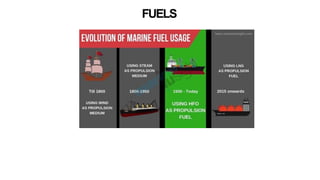
FUELS
FUELS
Fuel important properties:
1. Density
2. Viscosity: Resistance to Flow
3. Ignition Quality: is measured by the time delay between injection and combustion, which should
be short for good controlled burning. Ignition quality is indicated as cetane number
4. Flash Point: the temperature at which the fuel will give off sufficient vapours to ignite when a flame
is applied (important for safe storage temperature)
5. Pour Point: pour point is slightly above the temperature at which the fuel just flows under its own
weight. It is the lowest temperature at which the fuel can be easily handled
6. Cloud Point: At the cloud point waxes will form in the fuel. Below the cloud point temperature, pipe
or filter blocking may occur
7. Residual Carbon: carbon residue forming property of a fuel after burning
8. Sulfur Content: it is considered a cause of engine wear. A maximum limit, expressed as a
percentage by weight, is usually included in specifications
9. Calorific Value: is the heat energy released during combustion (HHV=Higher Heating Value,
LHV=Lower Heating Value)
FUELS
Marine gasoil (MGO):
• Marine gasoil is similar to diesel fuel, but has a higher density. Unlike heavy fuel oil (HFO), marine
gasoil does not have to be heated during storage
• Marine gasoil is used in smaller medium- to high-speed auxiliary units or auxiliary motors and ship’s
engines
• The latter are typically found on fishing boats, small ferries or tugs
• Unlike heavy fuel oil or heavy marine diesel oil (MDO) with a large proportion of heavy fuel oil,
marine gasoil, which is based on the lighter distillates, has a low viscosity and can easily be pumped
into the engine at temperatures of around 20°C
Distillate marine diesel (MDO)
• Marine Diesel Oil (MDO) is a type of fuel oil and is a blend of gasoil and heavy fuel oil, with more
gasoil than intermediate fuel oil used in the maritime field
• MDO is widely used by medium speed and medium/high speed marine diesel engines
• Due to its lower price compared to more refined fuel, MDO is favored particularly by shipping
industry.
FUELS
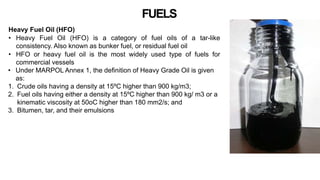
Heavy Fuel Oil (HFO)
• Heavy Fuel Oil (HFO) is a category of fuel oils of a tar-like
consistency. Also known as bunker fuel, or residual fuel oil
• HFO or heavy fuel oil is the most widely used type of fuels for
commercial vessels
• Under MARPOL Annex 1, the definition of Heavy Grade Oil is given
as:
1. Crude oils having a density at 15ºC higher than 900 kg/m3;
2. Fuel oils having either a density at 15ºC higher than 900 kg/ m3 or a
kinematic viscosity at 50oC higher than 180 mm2/s; and
3. Bitumen, tar, and their emulsions
HeavyFuelOil(HFO)
Problems Of Burning HFO:
1. Water in Fuel: Water in fuel creates issues such as a decrease in heat transfer rate, loss in efficiency and wear
of cylinder liner surface etc. Water can mix with fuel oil in different ways such as change of temperature leading to
condensation, leaking steam pipe inside the fuel oil tank, improper storage of fuel oil etc.
2. Sludge formation: A ship needs to carry heavy fuel oil in abundance to ensure a continuous supply of fuel to
engines and boilers during the long voyage. The heavy fuel oil is stored in the ship’s bunker tanks. Storage of such
a large quantity of fuel leads to sludge formation which involves a thick layer on the bottom surface of the tanks.
The sludge also sticks on the heat transfer surface of the steam pipes.
3. Pumpability: Many times, if the heating system of the bunker tanks fails or face a problem, it becomes difficult
for the ship’s staff to pump the heavy fuel oil from bunker to settling tank due to the high viscosity of the oil. If the
heavy fuel oil is of inferior quality, it will choke the filter frequently, increasing the workload of the ship staff onboard
ship.
4. Mixing of different grades: Two different grades of heavy oils when mixed together in ship’s storage tanks can
lead to stability problems. The number of bunker tanks on ships is limited, and when receiving fuel of different
grades, it is a challenge for ship’s officer to store different grades of oils in separate tanks.
5. Combustion: The combustion of heavy fuel oil remains an issue with the ship operator as the oil need to be
heated to bring the viscosity below 20cst for achieving proper atomization. If there is an issue in the heating and
pumping system, the atomisation will be affected, leading to carbon deposits on the piston and liner surfaces.
6. Abrasion: The heavy fuel oil contains deposits such as vanadium, sulphur, nickel, sodium, silicon etc. which are
difficult to remove and have an abrasive effect on the liner and piston surfaces.
7. Corrosion: Elements such as vanadium and sulphur, which are present in the heavy fuel oil, leads to high
temperature and low-temperature corrosion respectively.
HeavyFuelOil(HFO)
Vanadium when comes in contact with sodium and sulphur during the combustion, forms a compound with a low
melting point of 530°C
This molten compound is highly corrosive and attacks the oxide layers on the steel liner and piston (which is used
to protect the steel surface), leading to corrosion.
Sulphur is also present in the heavy grade fuel. When sulphur combines with oxygen to form sulphur dioxide or
sulphur trioxide, it further reacts with moisture (which can be due to low load operation) to form vapours of
sulphuric acid. When the metal temperature is below the dew point of acid, the vapours condense on the surface
and cause low-temperature corrosion.
Related Read: Understanding Hot And Cold Corrosion In Marine Engines
8. Lube oil contamination: During the operation, the heavy fuel oil can always enter the lubrication system and
contaminate the lubricating oil. It can be due to leakage through the stuffing box, leaking fuel pumps, or unburned
HFO that remains on the cylinder walls and washes down into the sump.
EXHAUSTEMISSIONS
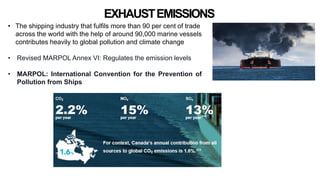
• The shipping industry that fulfils more than 90 per cent of trade
across the world with the help of around 90,000 marine vessels
contributes heavily to global pollution and climate change
• Revised MARPOL Annex VI: Regulates the emission levels
• MARPOL: International Convention for the Prevention of
Pollution from Ships
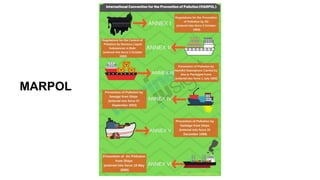
MARPOL
EXHAUSTEMISSIONS
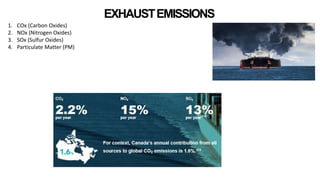
1. COx (Carbon Oxides)
2. NOx (Nitrogen Oxides)
3. SOx (Sulfur Oxides)
4. Particulate Matter (PM)
EXHAUSTEMISSIONS
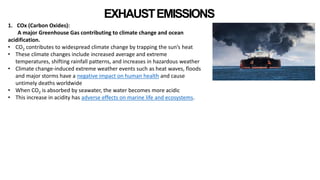
1. COx (Carbon Oxides):
A major Greenhouse Gas contributing to climate change and ocean
acidification.
• CO2 contributes to widespread climate change by trapping the sun’s heat
• These climate changes include increased average and extreme
temperatures, shifting rainfall patterns, and increases in hazardous weather
• Climate change-induced extreme weather events such as heat waves, floods
and major storms have a negative impact on human health and cause
untimely deaths worldwide
• When CO2 is absorbed by seawater, the water becomes more acidic
• This increase in acidity has adverse effects on marine life and ecosystems.
EXHAUSTEMISSIONS
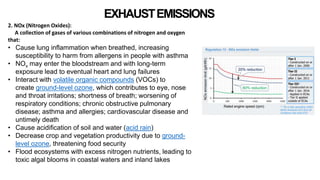
2. NOx (Nitrogen Oxides):
A collection of gases of various combinations of nitrogen and oxygen
that:
• Cause lung inflammation when breathed, increasing
susceptibility to harm from allergens in people with asthma
• NOx may enter the bloodstream and with long-term
exposure lead to eventual heart and lung failures
• Interact with volatile organic compounds (VOCs) to
create ground-level ozone, which contributes to eye, nose
and throat irritations; shortness of breath; worsening of
respiratory conditions; chronic obstructive pulmonary
disease; asthma and allergies; cardiovascular disease and
untimely death
• Cause acidification of soil and water (acid rain)
• Decrease crop and vegetation productivity due to ground-
level ozone, threatening food security
• Flood ecosystems with excess nitrogen nutrients, leading to
toxic algal blooms in coastal waters and inland lakes
EXHAUSTEMISSIONS
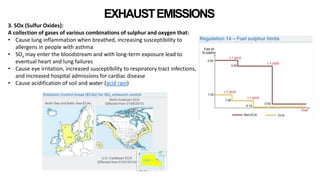
3. SOx (Sulfur Oxides):
A collection of gases of various combinations of sulphur and oxygen that:
• Cause lung inflammation when breathed, increasing susceptibility to
allergens in people with asthma
• SOx may enter the bloodstream and with long-term exposure lead to
eventual heart and lung failures
• Cause eye irritation, increased susceptibility to respiratory tract infections,
and increased hospital admissions for cardiac disease
• Cause acidification of soil and water (acid rain)
EXHAUSTEMISSIONS
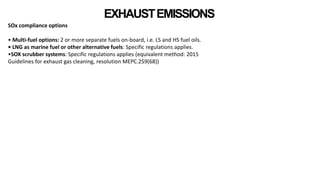
SOx compliance options
• Multi-fuel options: 2 or more separate fuels on-board, i.e. LS and HS fuel oils.
• LNG as marine fuel or other alternative fuels: Specific regulations applies.
•SOX scrubber systems: Specific regulations applies (equivalent method: 2015
Guidelines for exhaust gas cleaning, resolution MEPC.259(68))
EXHAUSTEMISSIONS
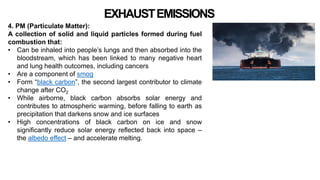
4. PM (Particulate Matter):
A collection of solid and liquid particles formed during fuel
combustion that:
• Can be inhaled into people’s lungs and then absorbed into the
bloodstream, which has been linked to many negative heart
and lung health outcomes, including cancers
• Are a component of smog
• Form “black carbon”, the second largest contributor to climate
change after CO2
• While airborne, black carbon absorbs solar energy and
contributes to atmospheric warming, before falling to earth as
precipitation that darkens snow and ice surfaces
• High concentrations of black carbon on ice and snow
significantly reduce solar energy reflected back into space –
the albedo effect – and accelerate melting.
EXHAUSTEMISSIONS
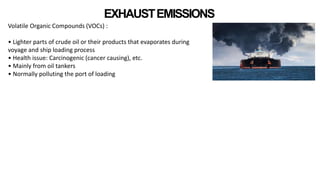
Volatile Organic Compounds (VOCs) :
• Lighter parts of crude oil or their products that evaporates during
voyage and ship loading process
• Health issue: Carcinogenic (cancer causing), etc.
• Mainly from oil tankers
• Normally polluting the port of loading
EXHAUSTEMISSIONCONTROL:IMOTIERS
• The IMO Marine Environment Protection Committee consider
• ways to reduce the pollutants in exhaust emissions
• New engine technology may reduce NOx formation and thus
emissions
• Carbon oxides can be reduced by good plant maintenance
• Selective Catalytic Reduction Systems are in use on some
vessels, which are said to reduce NOX emissions by 90 per
cent and carbon oxides by 80 per cent
• The equipment has been successfully operated recently as a
retrofit on existing ships
• Major research initiatives are underway by engine builders,
and
• classification societies, in cooperation with shipowners, in
order to obtain data regarding achievable targets and suitable
methods of measurement
• This data will enable IMO and National Authorities to develop
realistic legislation with which owners can readily comply on
new and existing vessels
Tier I, II and III

Lec5- Fuel and Emissions 1Dec22.pptx

  • 1.
  • 2.
  • 3.
    FUELS Fuel important properties: 1.Density 2. Viscosity: Resistance to Flow 3. Ignition Quality: is measured by the time delay between injection and combustion, which should be short for good controlled burning. Ignition quality is indicated as cetane number 4. Flash Point: the temperature at which the fuel will give off sufficient vapours to ignite when a flame is applied (important for safe storage temperature) 5. Pour Point: pour point is slightly above the temperature at which the fuel just flows under its own weight. It is the lowest temperature at which the fuel can be easily handled 6. Cloud Point: At the cloud point waxes will form in the fuel. Below the cloud point temperature, pipe or filter blocking may occur 7. Residual Carbon: carbon residue forming property of a fuel after burning 8. Sulfur Content: it is considered a cause of engine wear. A maximum limit, expressed as a percentage by weight, is usually included in specifications 9. Calorific Value: is the heat energy released during combustion (HHV=Higher Heating Value, LHV=Lower Heating Value)
  • 4.
    FUELS Marine gasoil (MGO): •Marine gasoil is similar to diesel fuel, but has a higher density. Unlike heavy fuel oil (HFO), marine gasoil does not have to be heated during storage • Marine gasoil is used in smaller medium- to high-speed auxiliary units or auxiliary motors and ship’s engines • The latter are typically found on fishing boats, small ferries or tugs • Unlike heavy fuel oil or heavy marine diesel oil (MDO) with a large proportion of heavy fuel oil, marine gasoil, which is based on the lighter distillates, has a low viscosity and can easily be pumped into the engine at temperatures of around 20°C Distillate marine diesel (MDO) • Marine Diesel Oil (MDO) is a type of fuel oil and is a blend of gasoil and heavy fuel oil, with more gasoil than intermediate fuel oil used in the maritime field • MDO is widely used by medium speed and medium/high speed marine diesel engines • Due to its lower price compared to more refined fuel, MDO is favored particularly by shipping industry.
  • 5.
    FUELS Heavy Fuel Oil(HFO) • Heavy Fuel Oil (HFO) is a category of fuel oils of a tar-like consistency. Also known as bunker fuel, or residual fuel oil • HFO or heavy fuel oil is the most widely used type of fuels for commercial vessels • Under MARPOL Annex 1, the definition of Heavy Grade Oil is given as: 1. Crude oils having a density at 15ºC higher than 900 kg/m3; 2. Fuel oils having either a density at 15ºC higher than 900 kg/ m3 or a kinematic viscosity at 50oC higher than 180 mm2/s; and 3. Bitumen, tar, and their emulsions
  • 6.
    HeavyFuelOil(HFO) Problems Of BurningHFO: 1. Water in Fuel: Water in fuel creates issues such as a decrease in heat transfer rate, loss in efficiency and wear of cylinder liner surface etc. Water can mix with fuel oil in different ways such as change of temperature leading to condensation, leaking steam pipe inside the fuel oil tank, improper storage of fuel oil etc. 2. Sludge formation: A ship needs to carry heavy fuel oil in abundance to ensure a continuous supply of fuel to engines and boilers during the long voyage. The heavy fuel oil is stored in the ship’s bunker tanks. Storage of such a large quantity of fuel leads to sludge formation which involves a thick layer on the bottom surface of the tanks. The sludge also sticks on the heat transfer surface of the steam pipes. 3. Pumpability: Many times, if the heating system of the bunker tanks fails or face a problem, it becomes difficult for the ship’s staff to pump the heavy fuel oil from bunker to settling tank due to the high viscosity of the oil. If the heavy fuel oil is of inferior quality, it will choke the filter frequently, increasing the workload of the ship staff onboard ship. 4. Mixing of different grades: Two different grades of heavy oils when mixed together in ship’s storage tanks can lead to stability problems. The number of bunker tanks on ships is limited, and when receiving fuel of different grades, it is a challenge for ship’s officer to store different grades of oils in separate tanks. 5. Combustion: The combustion of heavy fuel oil remains an issue with the ship operator as the oil need to be heated to bring the viscosity below 20cst for achieving proper atomization. If there is an issue in the heating and pumping system, the atomisation will be affected, leading to carbon deposits on the piston and liner surfaces. 6. Abrasion: The heavy fuel oil contains deposits such as vanadium, sulphur, nickel, sodium, silicon etc. which are difficult to remove and have an abrasive effect on the liner and piston surfaces. 7. Corrosion: Elements such as vanadium and sulphur, which are present in the heavy fuel oil, leads to high temperature and low-temperature corrosion respectively.
  • 7.
    HeavyFuelOil(HFO) Vanadium when comesin contact with sodium and sulphur during the combustion, forms a compound with a low melting point of 530°C This molten compound is highly corrosive and attacks the oxide layers on the steel liner and piston (which is used to protect the steel surface), leading to corrosion. Sulphur is also present in the heavy grade fuel. When sulphur combines with oxygen to form sulphur dioxide or sulphur trioxide, it further reacts with moisture (which can be due to low load operation) to form vapours of sulphuric acid. When the metal temperature is below the dew point of acid, the vapours condense on the surface and cause low-temperature corrosion. Related Read: Understanding Hot And Cold Corrosion In Marine Engines 8. Lube oil contamination: During the operation, the heavy fuel oil can always enter the lubrication system and contaminate the lubricating oil. It can be due to leakage through the stuffing box, leaking fuel pumps, or unburned HFO that remains on the cylinder walls and washes down into the sump.
  • 8.
    EXHAUSTEMISSIONS • The shippingindustry that fulfils more than 90 per cent of trade across the world with the help of around 90,000 marine vessels contributes heavily to global pollution and climate change • Revised MARPOL Annex VI: Regulates the emission levels • MARPOL: International Convention for the Prevention of Pollution from Ships
  • 9.
  • 10.
    EXHAUSTEMISSIONS 1. COx (CarbonOxides) 2. NOx (Nitrogen Oxides) 3. SOx (Sulfur Oxides) 4. Particulate Matter (PM)
  • 11.
    EXHAUSTEMISSIONS 1. COx (CarbonOxides): A major Greenhouse Gas contributing to climate change and ocean acidification. • CO2 contributes to widespread climate change by trapping the sun’s heat • These climate changes include increased average and extreme temperatures, shifting rainfall patterns, and increases in hazardous weather • Climate change-induced extreme weather events such as heat waves, floods and major storms have a negative impact on human health and cause untimely deaths worldwide • When CO2 is absorbed by seawater, the water becomes more acidic • This increase in acidity has adverse effects on marine life and ecosystems.
  • 12.
    EXHAUSTEMISSIONS 2. NOx (NitrogenOxides): A collection of gases of various combinations of nitrogen and oxygen that: • Cause lung inflammation when breathed, increasing susceptibility to harm from allergens in people with asthma • NOx may enter the bloodstream and with long-term exposure lead to eventual heart and lung failures • Interact with volatile organic compounds (VOCs) to create ground-level ozone, which contributes to eye, nose and throat irritations; shortness of breath; worsening of respiratory conditions; chronic obstructive pulmonary disease; asthma and allergies; cardiovascular disease and untimely death • Cause acidification of soil and water (acid rain) • Decrease crop and vegetation productivity due to ground- level ozone, threatening food security • Flood ecosystems with excess nitrogen nutrients, leading to toxic algal blooms in coastal waters and inland lakes
  • 13.
    EXHAUSTEMISSIONS 3. SOx (SulfurOxides): A collection of gases of various combinations of sulphur and oxygen that: • Cause lung inflammation when breathed, increasing susceptibility to allergens in people with asthma • SOx may enter the bloodstream and with long-term exposure lead to eventual heart and lung failures • Cause eye irritation, increased susceptibility to respiratory tract infections, and increased hospital admissions for cardiac disease • Cause acidification of soil and water (acid rain)
  • 14.
    EXHAUSTEMISSIONS SOx compliance options •Multi-fuel options: 2 or more separate fuels on-board, i.e. LS and HS fuel oils. • LNG as marine fuel or other alternative fuels: Specific regulations applies. •SOX scrubber systems: Specific regulations applies (equivalent method: 2015 Guidelines for exhaust gas cleaning, resolution MEPC.259(68))
  • 15.
    EXHAUSTEMISSIONS 4. PM (ParticulateMatter): A collection of solid and liquid particles formed during fuel combustion that: • Can be inhaled into people’s lungs and then absorbed into the bloodstream, which has been linked to many negative heart and lung health outcomes, including cancers • Are a component of smog • Form “black carbon”, the second largest contributor to climate change after CO2 • While airborne, black carbon absorbs solar energy and contributes to atmospheric warming, before falling to earth as precipitation that darkens snow and ice surfaces • High concentrations of black carbon on ice and snow significantly reduce solar energy reflected back into space – the albedo effect – and accelerate melting.
  • 16.
    EXHAUSTEMISSIONS Volatile Organic Compounds(VOCs) : • Lighter parts of crude oil or their products that evaporates during voyage and ship loading process • Health issue: Carcinogenic (cancer causing), etc. • Mainly from oil tankers • Normally polluting the port of loading
  • 17.
    EXHAUSTEMISSIONCONTROL:IMOTIERS • The IMOMarine Environment Protection Committee consider • ways to reduce the pollutants in exhaust emissions • New engine technology may reduce NOx formation and thus emissions • Carbon oxides can be reduced by good plant maintenance • Selective Catalytic Reduction Systems are in use on some vessels, which are said to reduce NOX emissions by 90 per cent and carbon oxides by 80 per cent • The equipment has been successfully operated recently as a retrofit on existing ships • Major research initiatives are underway by engine builders, and • classification societies, in cooperation with shipowners, in order to obtain data regarding achievable targets and suitable methods of measurement • This data will enable IMO and National Authorities to develop realistic legislation with which owners can readily comply on new and existing vessels Tier I, II and III