Dictionaries
 the dictionary ADT
 binary search
 Hashing
Dictionaries
 Dictionaries store elements so that they
  can be located quickly using keys
 A dictionary may hold bank accounts
   each  account is an object that is identified by
    an account number
   each account stores a wealth of additional
    information
      including the current balance,
      the name and address of the account holder, and
      the history of deposits and withdrawals performed
   an application wishing to operate on an
    account would have to provide the account
    number as a search key
The Dictionary ADT
 A dictionary is an abstract model of a database
    A dictionary stores key-element pairs
    The main operation supported by a dictionary
     is searching by key
 simple container methods: size(), isEmpty(),
  elements()
 query methods: findElem(k), findAllElem(k)
 update methods: insertItem(k,e), removeElem(k),
  removeAllElem(k)
 special element: NIL, returned by an
  unsuccessful search
The Dictionary ADT

 Supporting  order (methods min, max,
 successor, predecessor ) is not required,
 thus it is enough that keys are
 comparable for equality
The Dictionary ADT
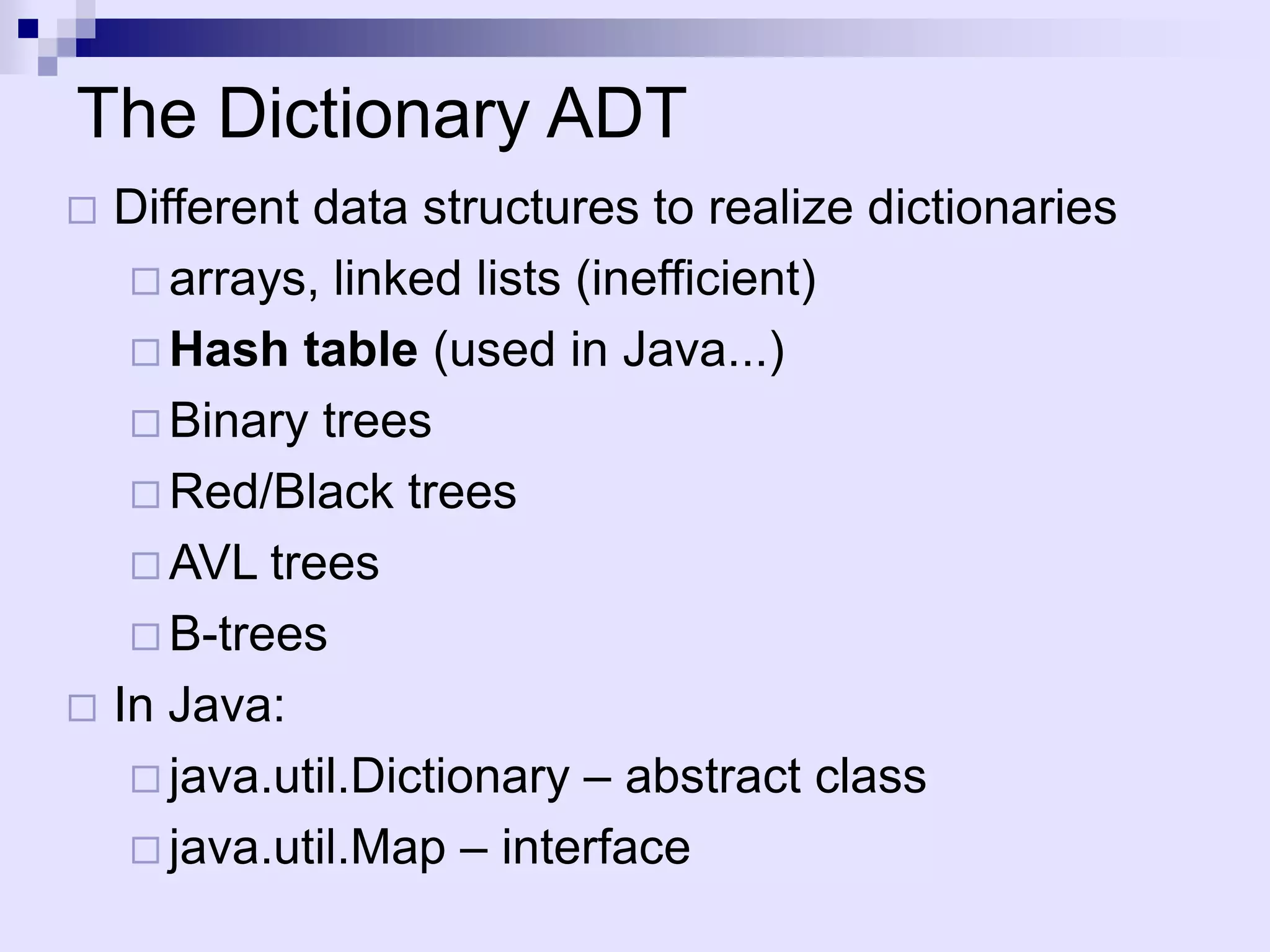
 Different data structures to realize dictionaries
    arrays, linked lists (inefficient)
    Hash table (used in Java...)
    Binary trees
    Red/Black trees
    AVL trees
    B-trees
 In Java:
    java.util.Dictionary – abstract class
    java.util.Map – interface
Searching
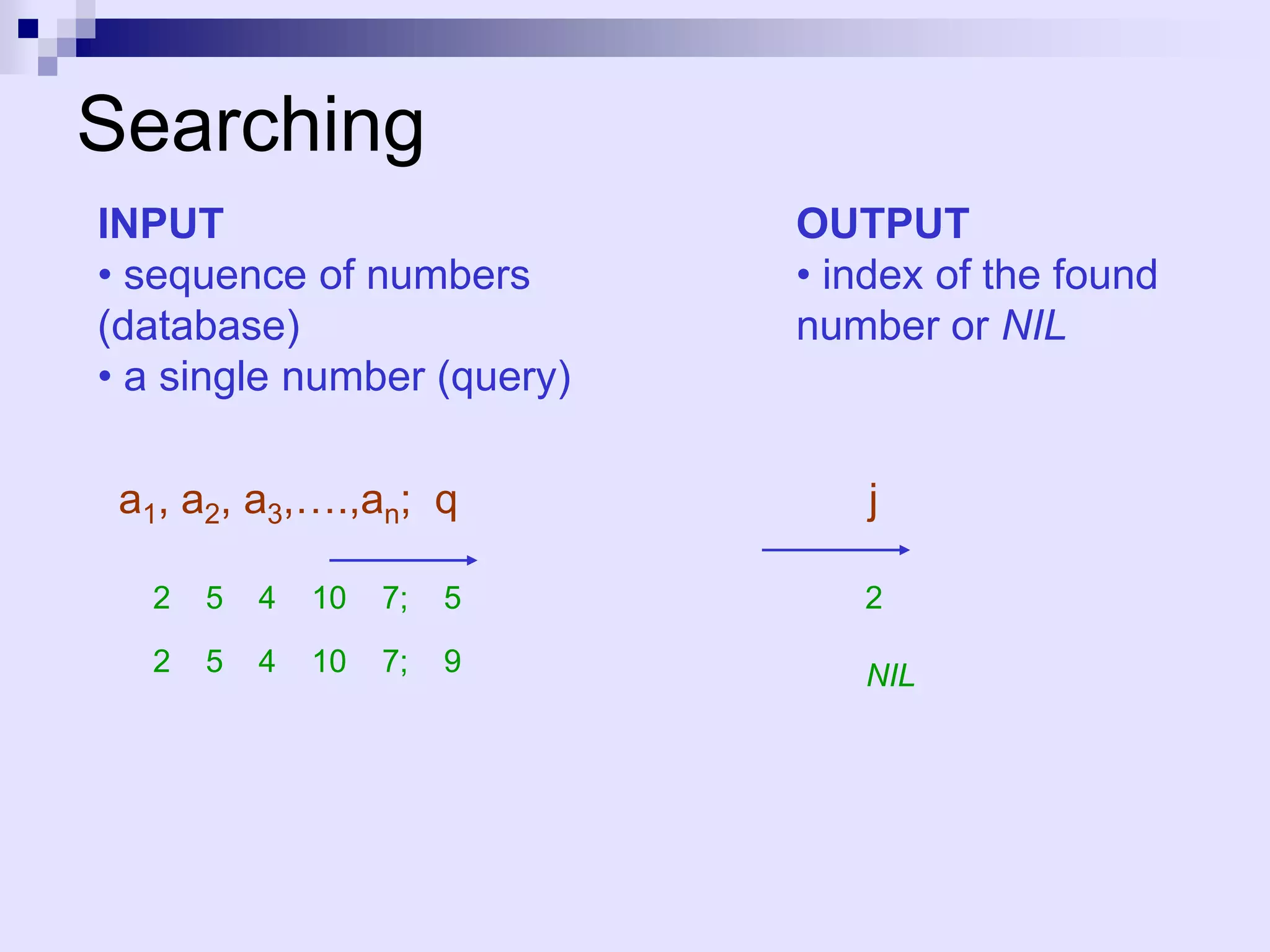
INPUT                       OUTPUT
• sequence of numbers       • index of the found
(database)                  number or NIL
• a single number (query)

 a1, a2, a3,….,an; q            j

  2   5   4   10   7;   5      2

  2   5   4   10   7;   9      NIL
Binary Search
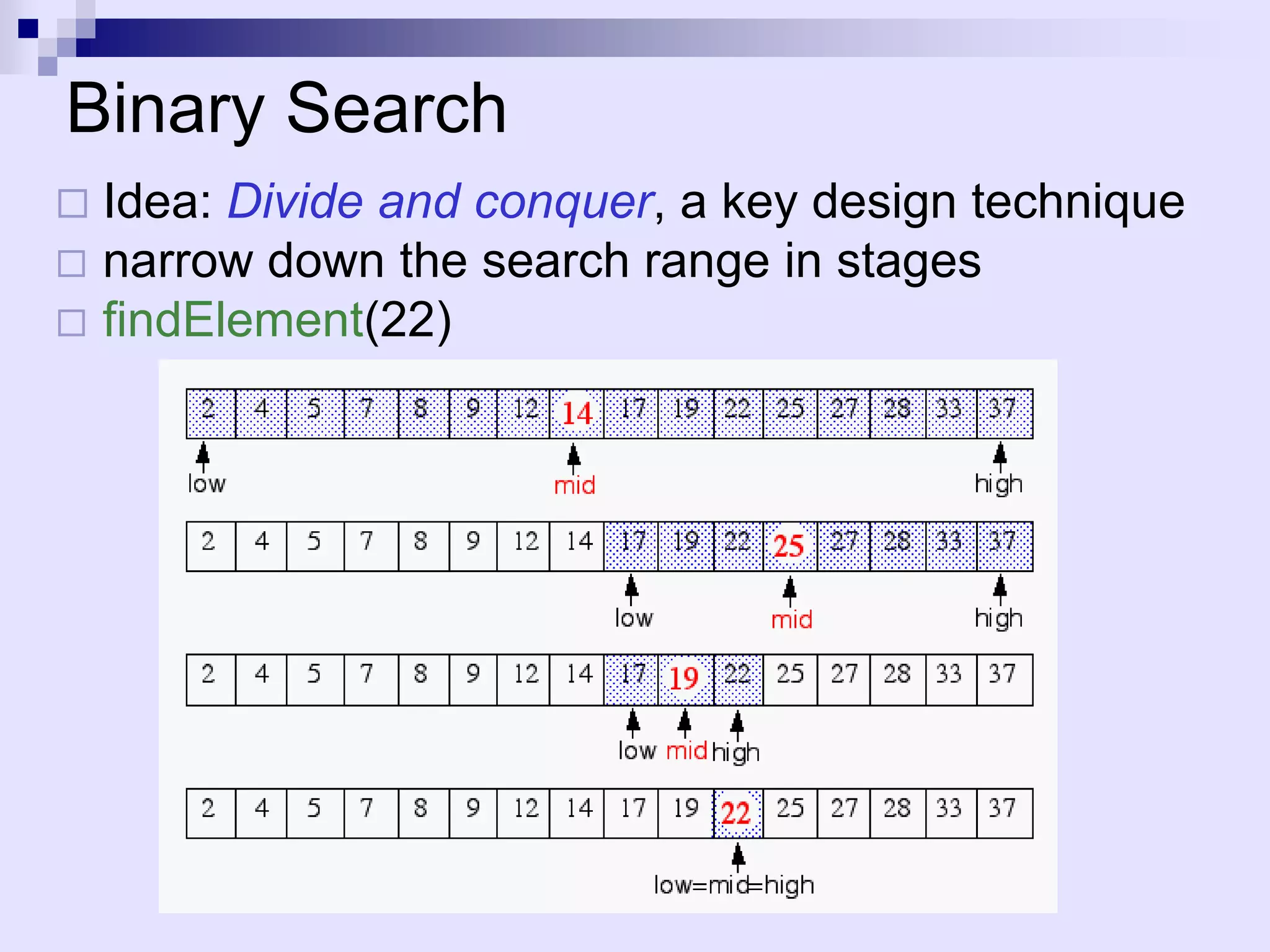
 Idea: Divide and conquer, a key design technique
 narrow down the search range in stages
 findElement(22)
A recursive procedure
Algorithm BinarySearch(A, k, low, high)
if low > high then return Nil
else mid       (low+high) / 2
       if k = A[mid] then return mid
       elseif k < A[mid] then
             return BinarySearch(A, k, low, mid-1)
       else return BinarySearch(A, k, mid+1, high)
     2    4   5   7   8   9   12   14    17    19   22   25    27   28   33    37

    low                            mid                                        high

     2    4   5   7   8   9   12   14    17    19   22   25    27   28   33    37

                                         low             mid                  high

     2    4   5   7   8   9   12   14    17    19 22     25    27   28   33    37

                                         low mid
An iterative procedure
INPUT: A[1..n] – a sorted (non-decreasing) array of
  integers, key – an integer.
OUTPUT: an index j such that A[j] = k.
          NIL, if j (1 j n): A[j] k
                              2    4   5   7   8   9   12   14    17    19   22   25    27   28   33    37

low 1                        low                            mid                                        high


high     n                    2    4   5   7   8   9   12   14    17    19   22   25    27   28   33    37


do                            2    4   5   7   8   9   12   14
                                                                  low

                                                                  17    19 22
                                                                                  mid

                                                                                  25    27   28   33
                                                                                                       high

                                                                                                        37


   mid     (low+high)/2                                           low mid


   if A[mid] = k then return mid
   else if A[mid] > k then high   mid-1
                      else low   mid+1
while low <= high
return NIL
Running Time of Binary Search
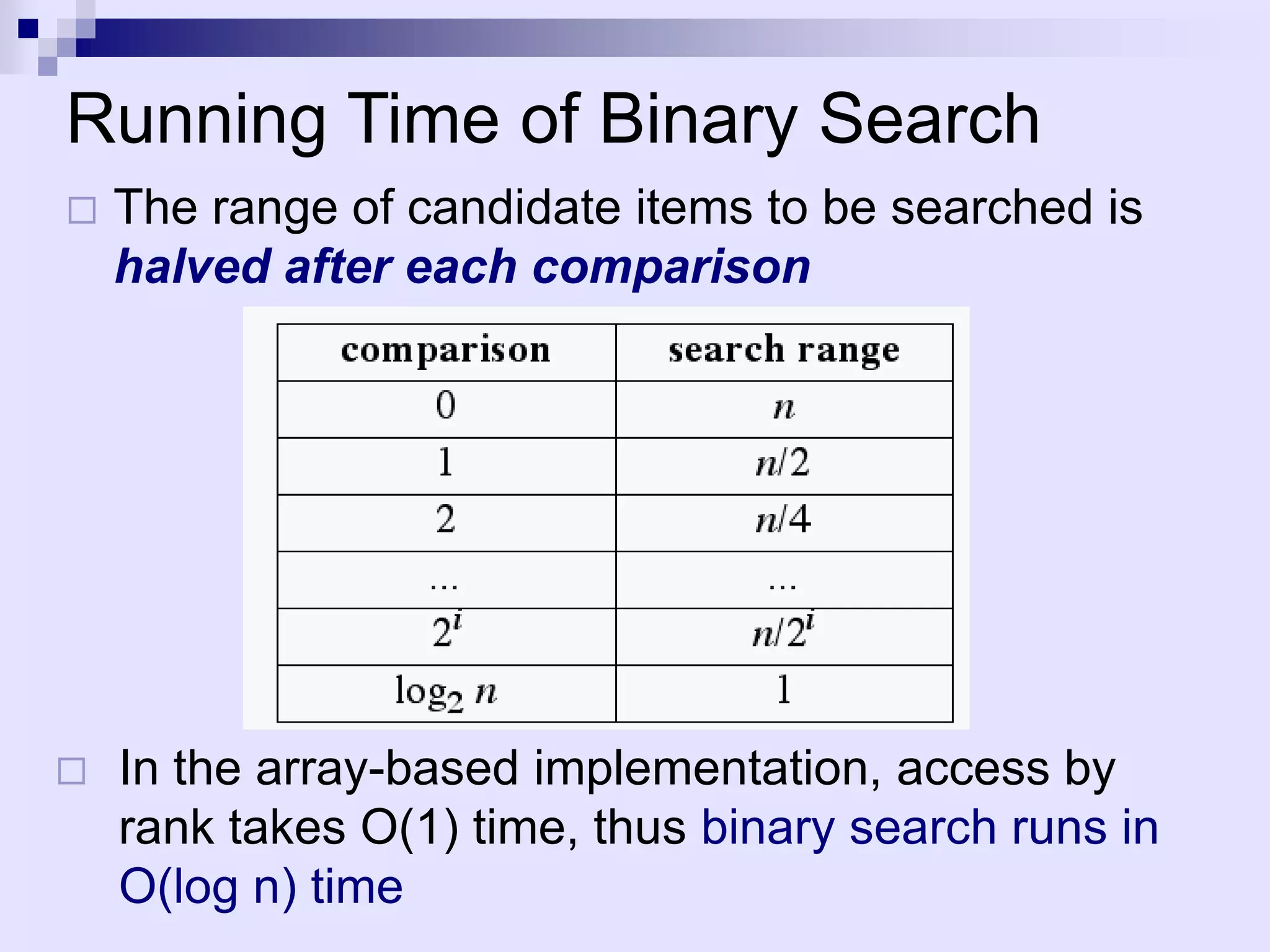
   The range of candidate items to be searched is
    halved after each comparison


   In the array-based implementation, access by
    rank takes O(1) time, thus binary search runs in
    O(log n) time
Searching in an unsorted array
INPUT: A[1..n] – an array of integers, q – an integer.
OUTPUT: an index j such that A[j] = q. NIL, if j (1 j n):
  A[j] q
j   1
while j n and A[j] q
   do j++
if j n then return j
        else return NIL


 Worst-case running time: O(n), average-case:
  O(n)
 We can’t do better. This is a lower bound for the
  problem of searching in an arbitrary sequence.
The Problem

T&T is a large phone company, and they
  want to provide caller ID capability:
 given a phone number, return the caller’s
  name
 phone numbers range from 0 to r = 108 -1
 There are n phone numbers, n << r.
 want to do this as efficiently as possible
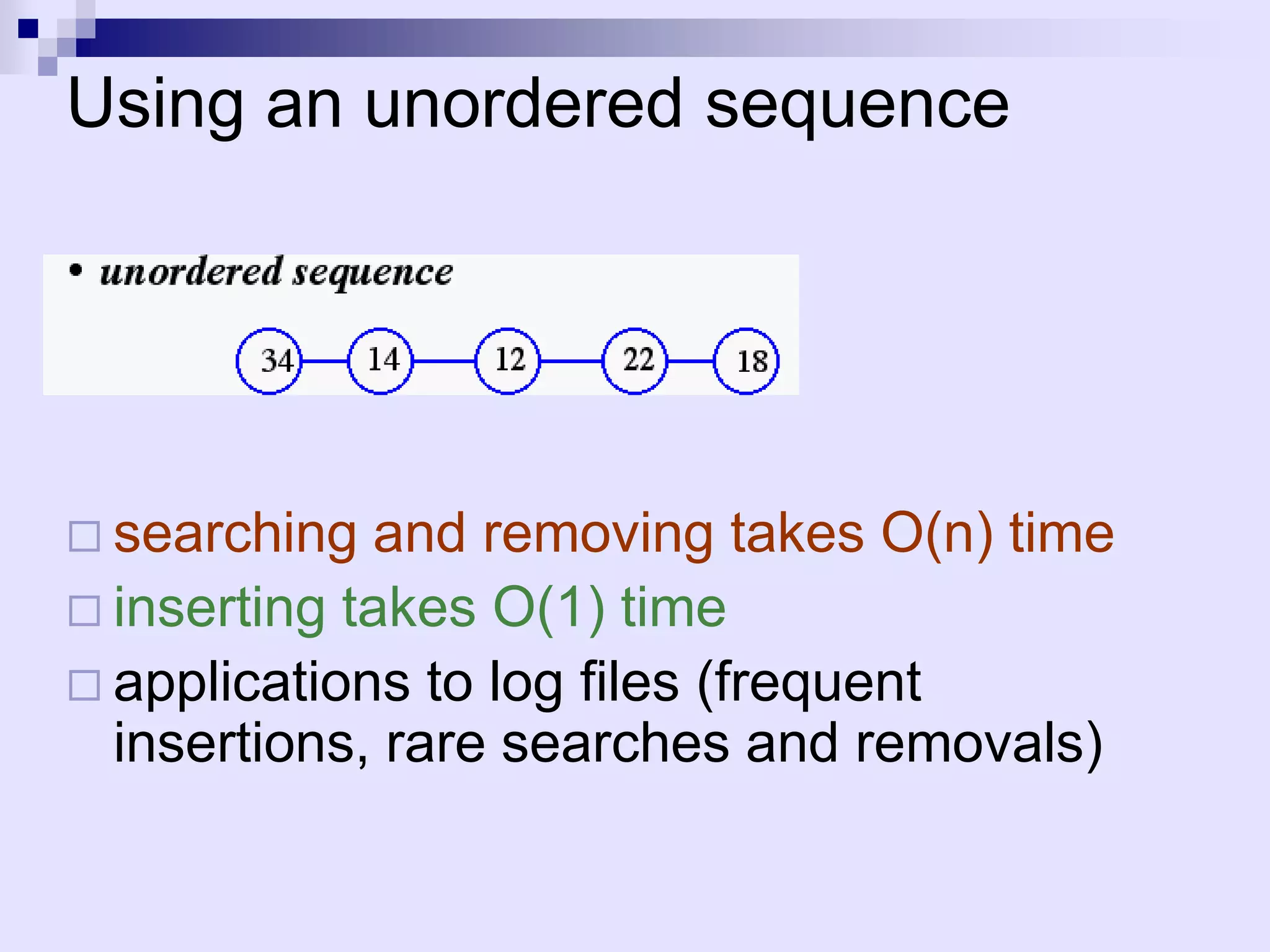
Using an unordered sequence


 searching  and removing takes O(n) time
 inserting takes O(1) time
 applications to log files (frequent
  insertions, rare searches and removals)
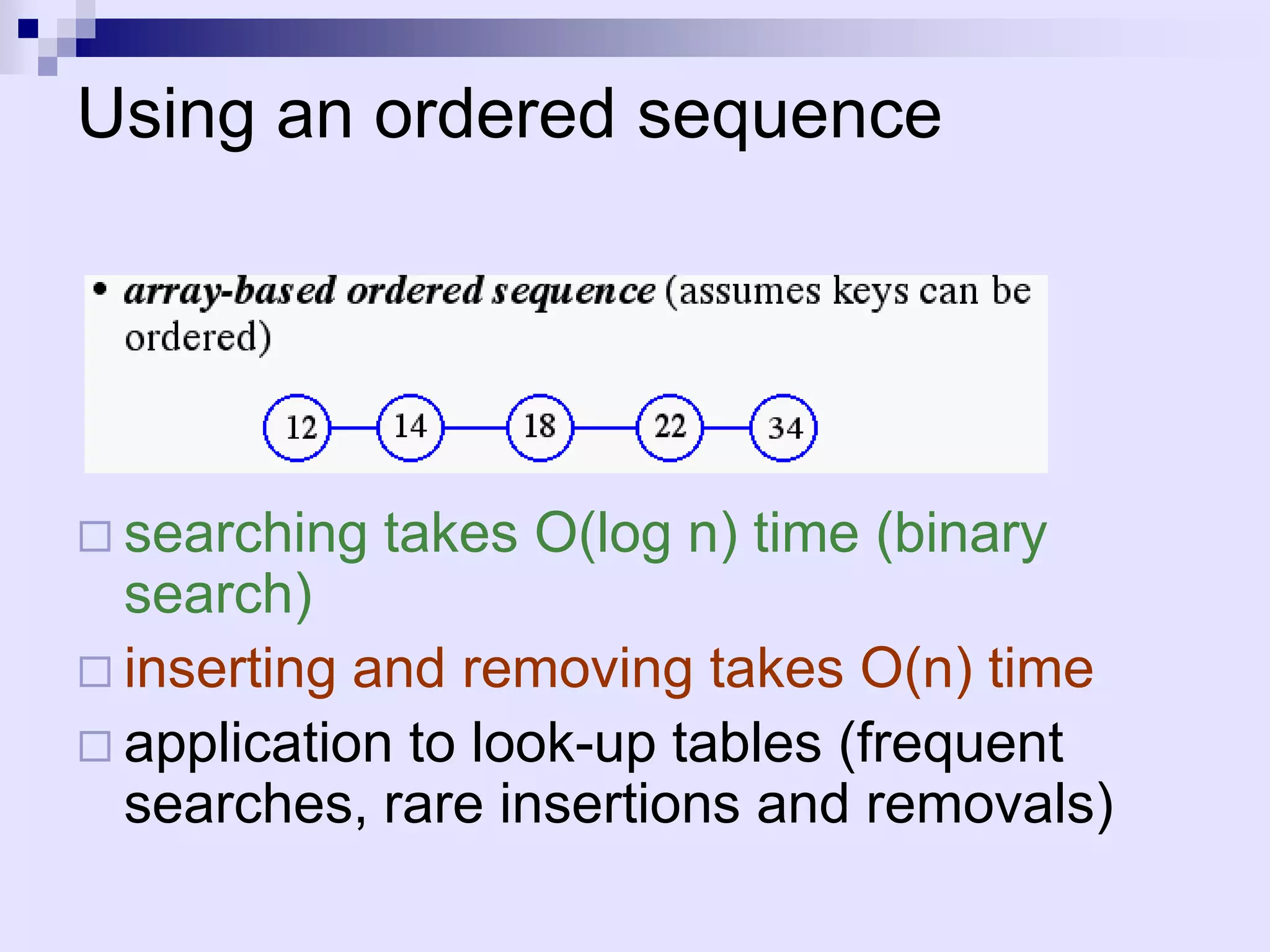
Using an ordered sequence


 searching   takes O(log n) time (binary
  search)
 inserting and removing takes O(n) time
 application to look-up tables (frequent
  searches, rare insertions and removals)
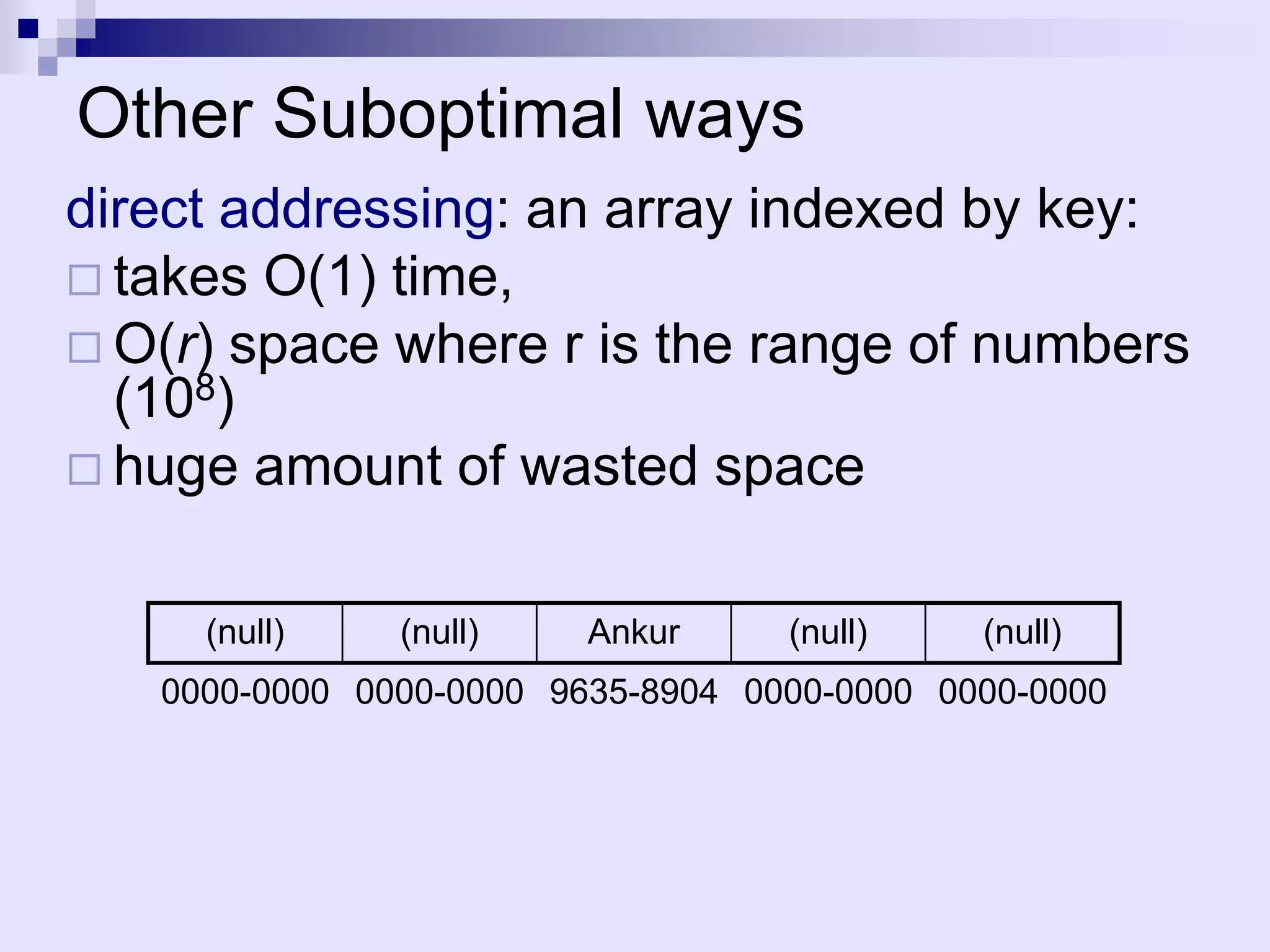
Other Suboptimal ways
direct addressing: an array indexed by key:
 takes O(1) time,
 O(r) space where r is the range of numbers
  (108)
 huge amount of wasted space


     (null)    (null)    Ankur     (null)    (null)
   0000-0000 0000-0000 9635-8904 0000-0000 0000-0000
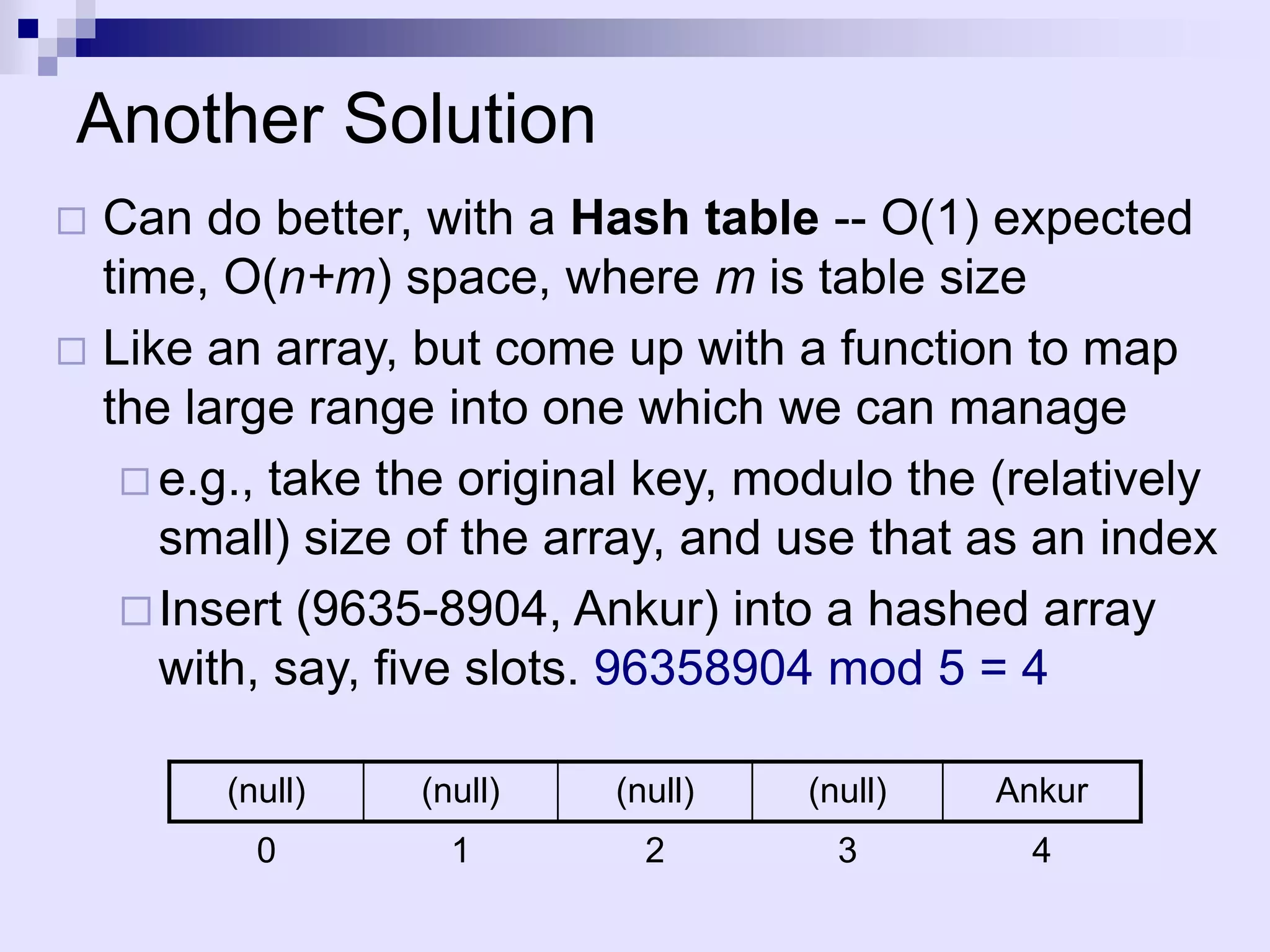
Another Solution
 Can do better, with a Hash table -- O(1) expected
  time, O(n+m) space, where m is table size
 Like an array, but come up with a function to map
  the large range into one which we can manage
    e.g., take the original key, modulo the (relatively
     small) size of the array, and use that as an index
    Insert (9635-8904, Ankur) into a hashed array
     with, say, five slots. 96358904 mod 5 = 4

        (null)   (null)    (null)   (null)   Ankur
          0        1         2        3        4
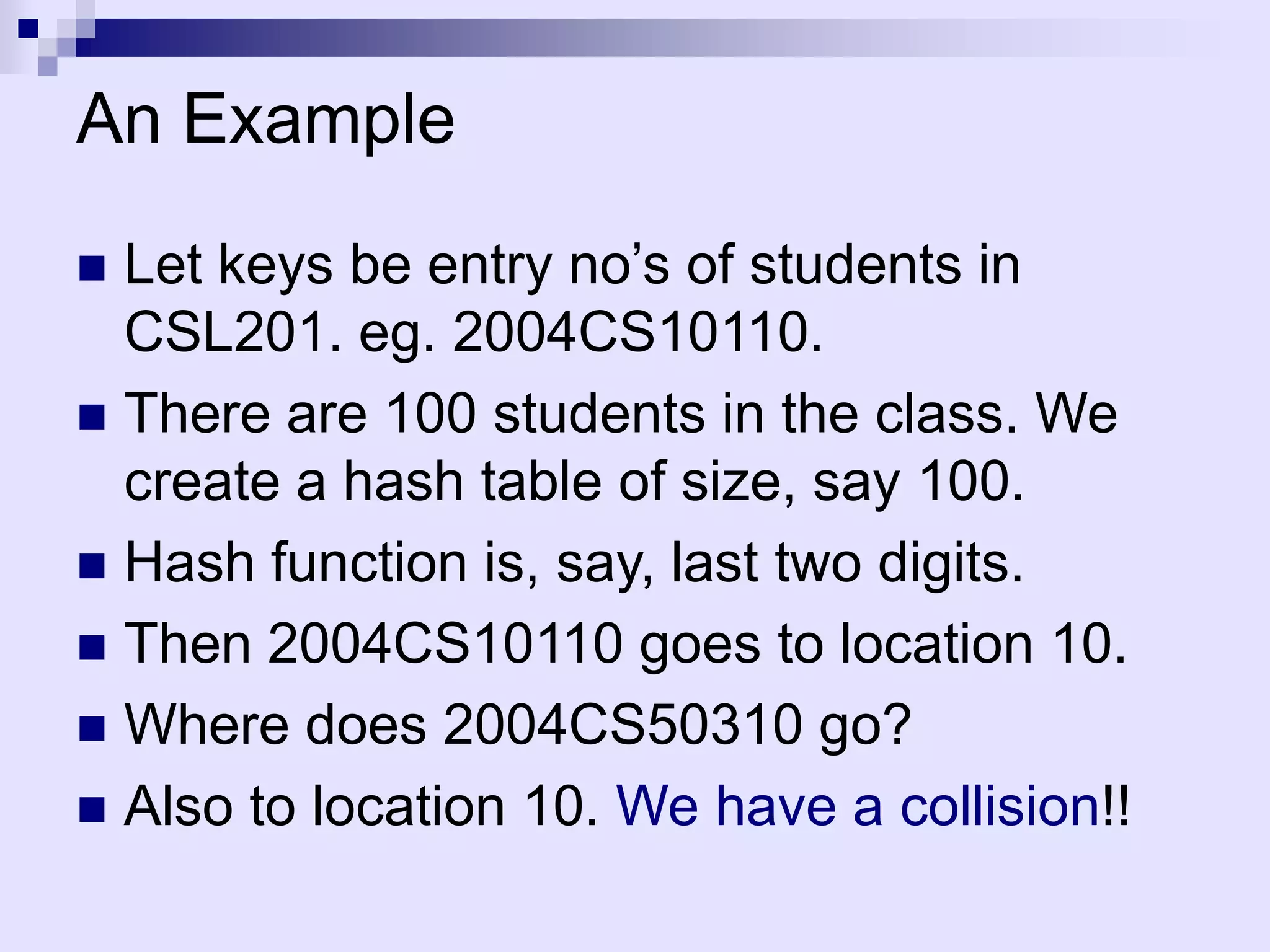
An Example
 Let keys be entry no’s of students in
  CSL201. eg. 2004CS10110.
 There are 100 students in the class. We
  create a hash table of size, say 100.
 Hash function is, say, last two digits.
 Then 2004CS10110 goes to location 10.
 Where does 2004CS50310 go?
 Also to location 10. We have a collision!!
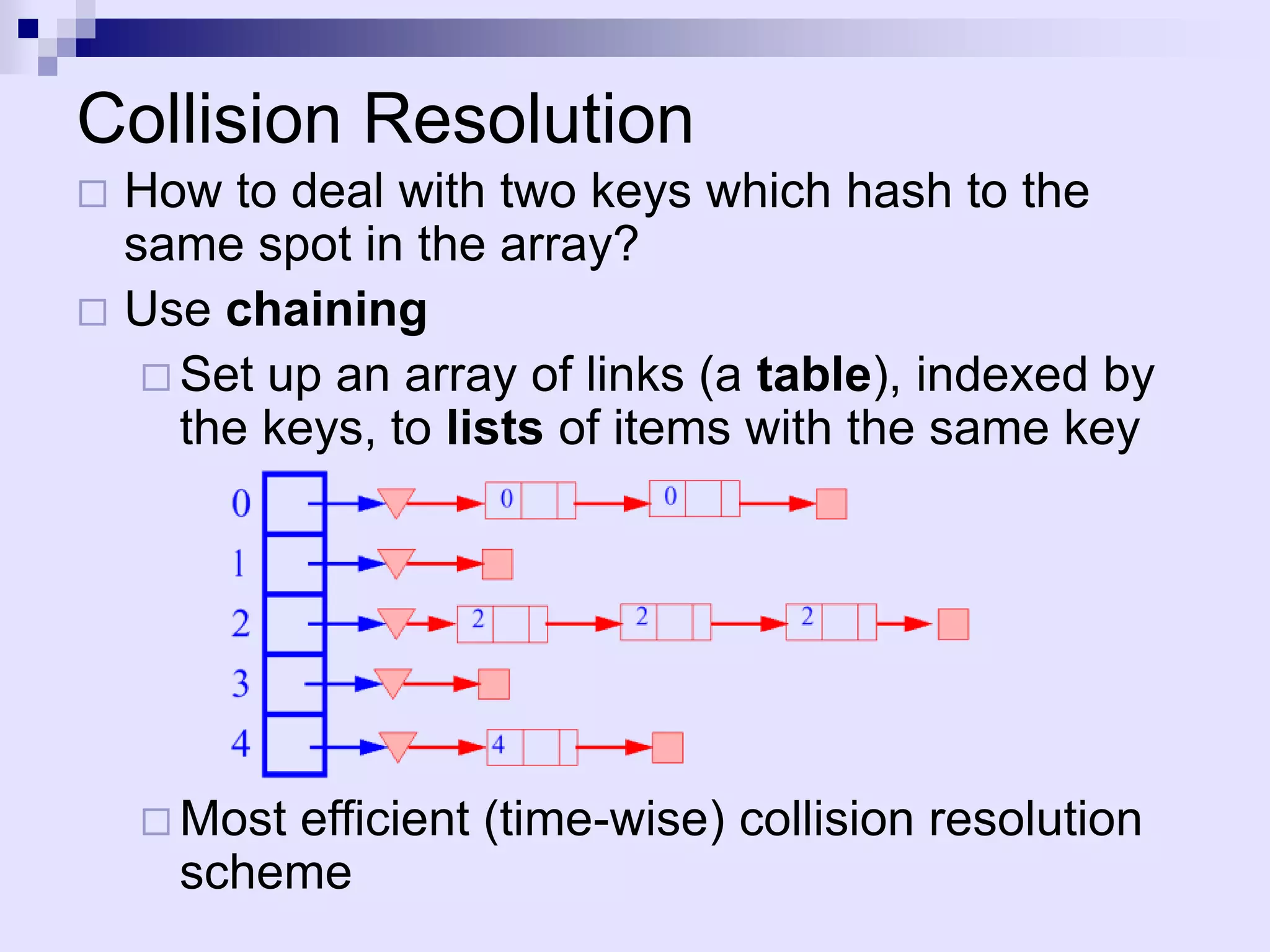
Collision Resolution
 How to deal with two keys which hash to the
  same spot in the array?
 Use chaining
    Set up an array of links (a table), indexed by
     the keys, to lists of items with the same key


     Most
         efficient (time-wise) collision resolution
     scheme
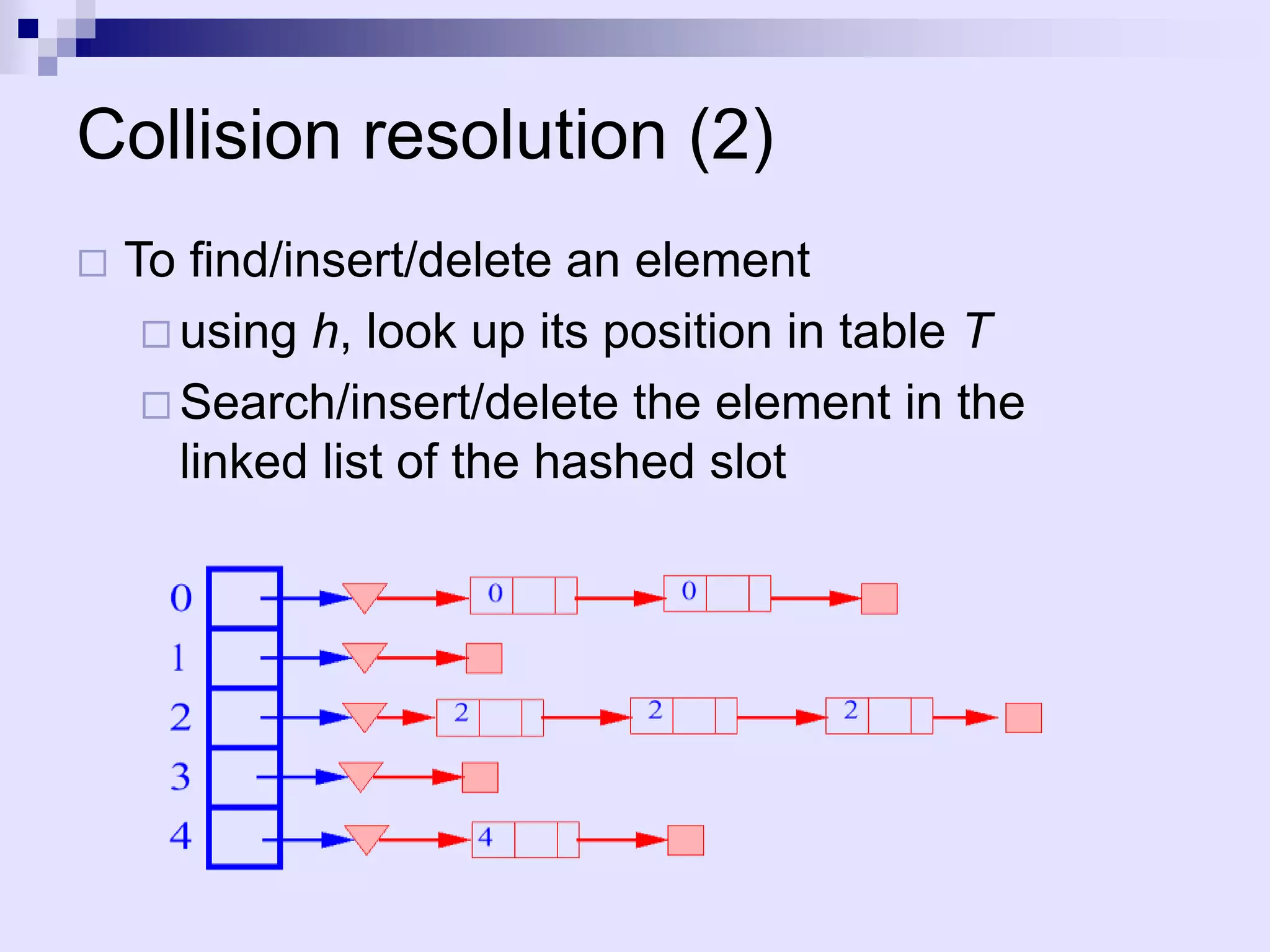
Collision resolution (2)
   To find/insert/delete an element
      using h, look up its position in table T
      Search/insert/delete the element in the
       linked list of the hashed slot
Analysis of Hashing
 An  element with key k is stored in slot
  h(k) (instead of slot k without hashing)
 The hash function h maps the universe U
  of keys into the slots of hash table
  T[0...m-1]
       h :U     0,1,..., m 1
 Assume      time to compute h(k) is   (1)
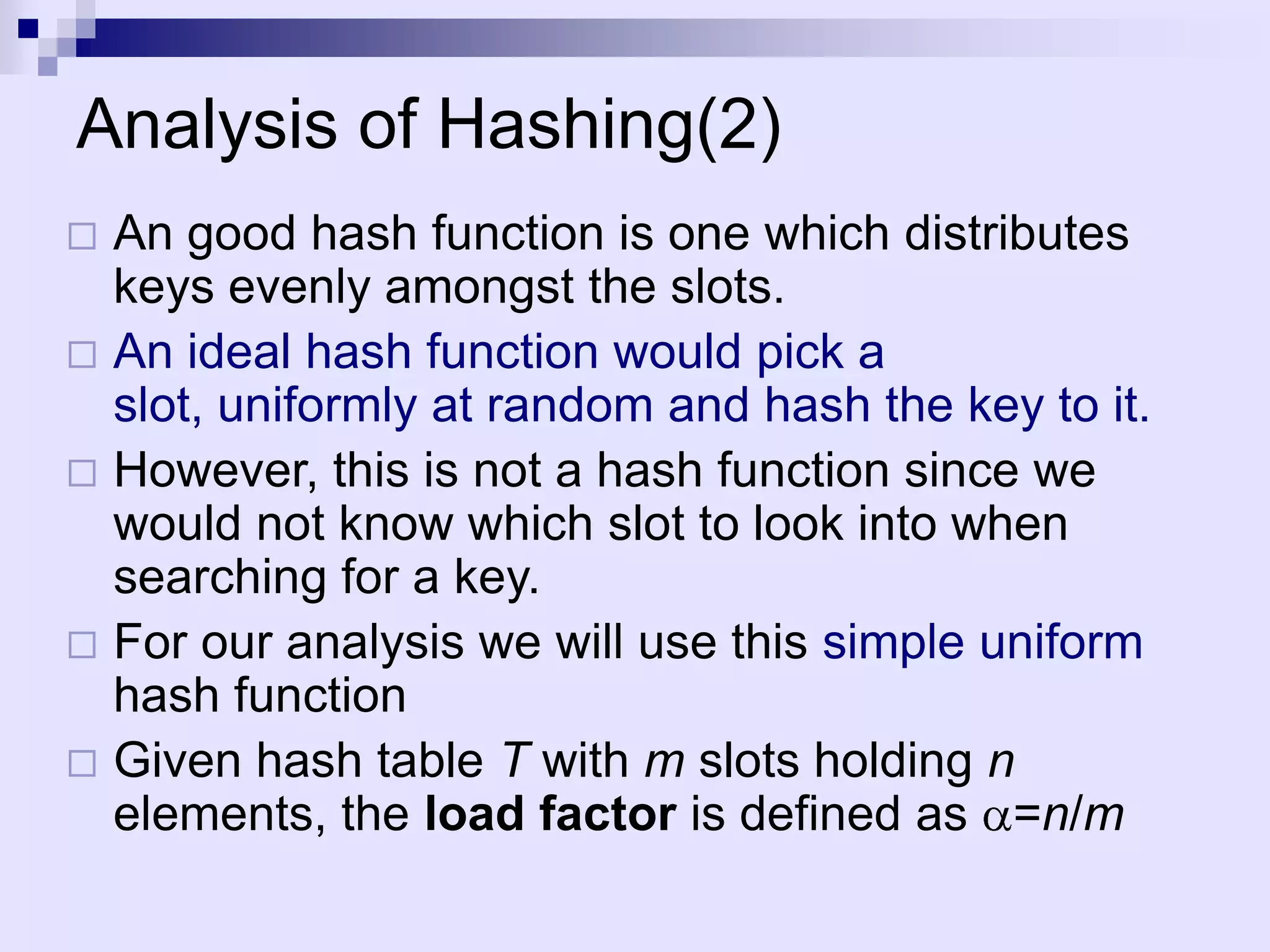
Analysis of Hashing(2)
 An good hash function is one which distributes
  keys evenly amongst the slots.
 An ideal hash function would pick a
  slot, uniformly at random and hash the key to it.
 However, this is not a hash function since we
  would not know which slot to look into when
  searching for a key.
 For our analysis we will use this simple uniform
  hash function
 Given hash table T with m slots holding n
  elements, the load factor is defined as =n/m
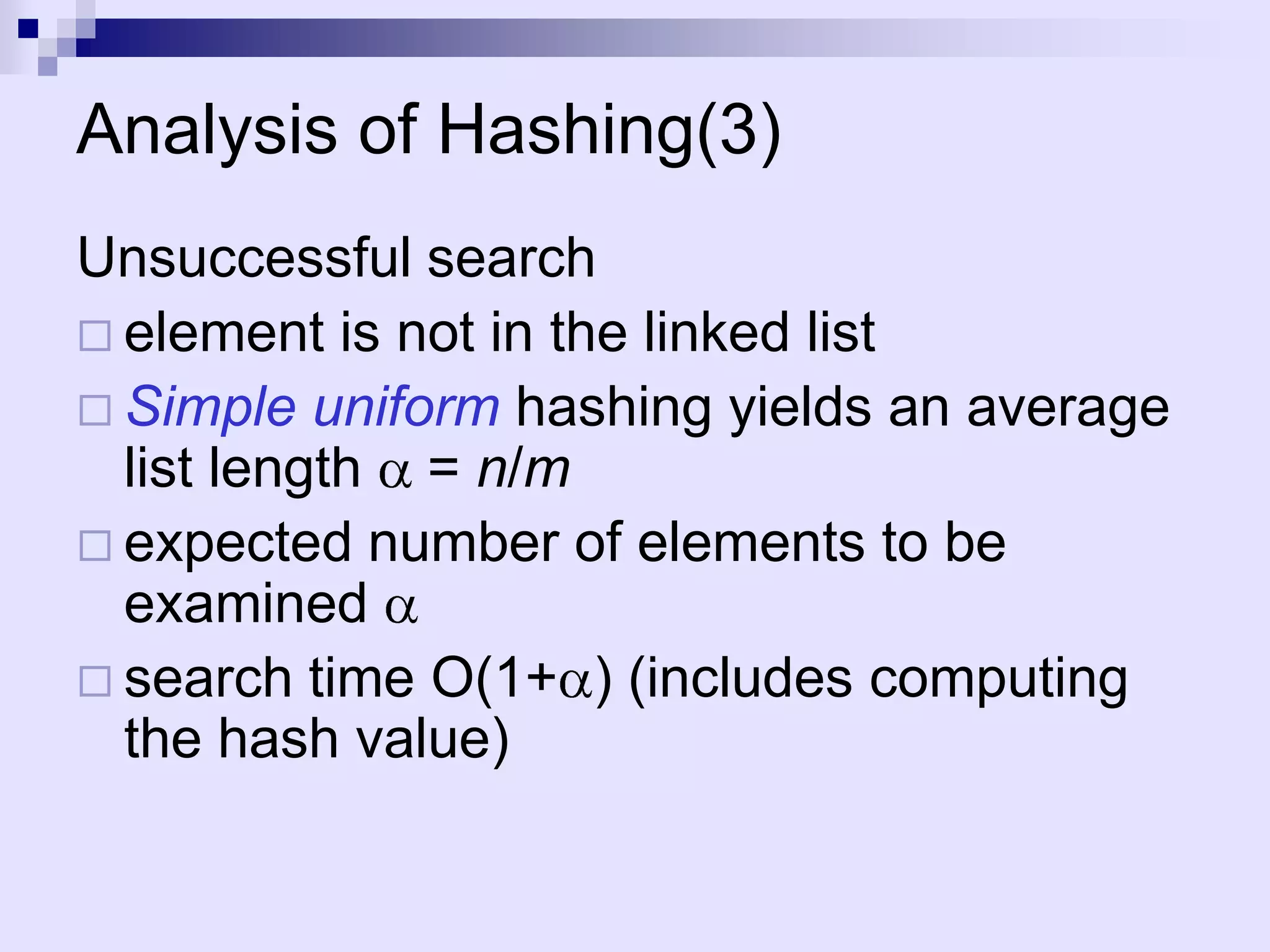
Analysis of Hashing(3)
Unsuccessful search
 element is not in the linked list
 Simple uniform hashing yields an average
  list length = n/m
 expected number of elements to be
  examined
 search time O(1+ ) (includes computing
  the hash value)
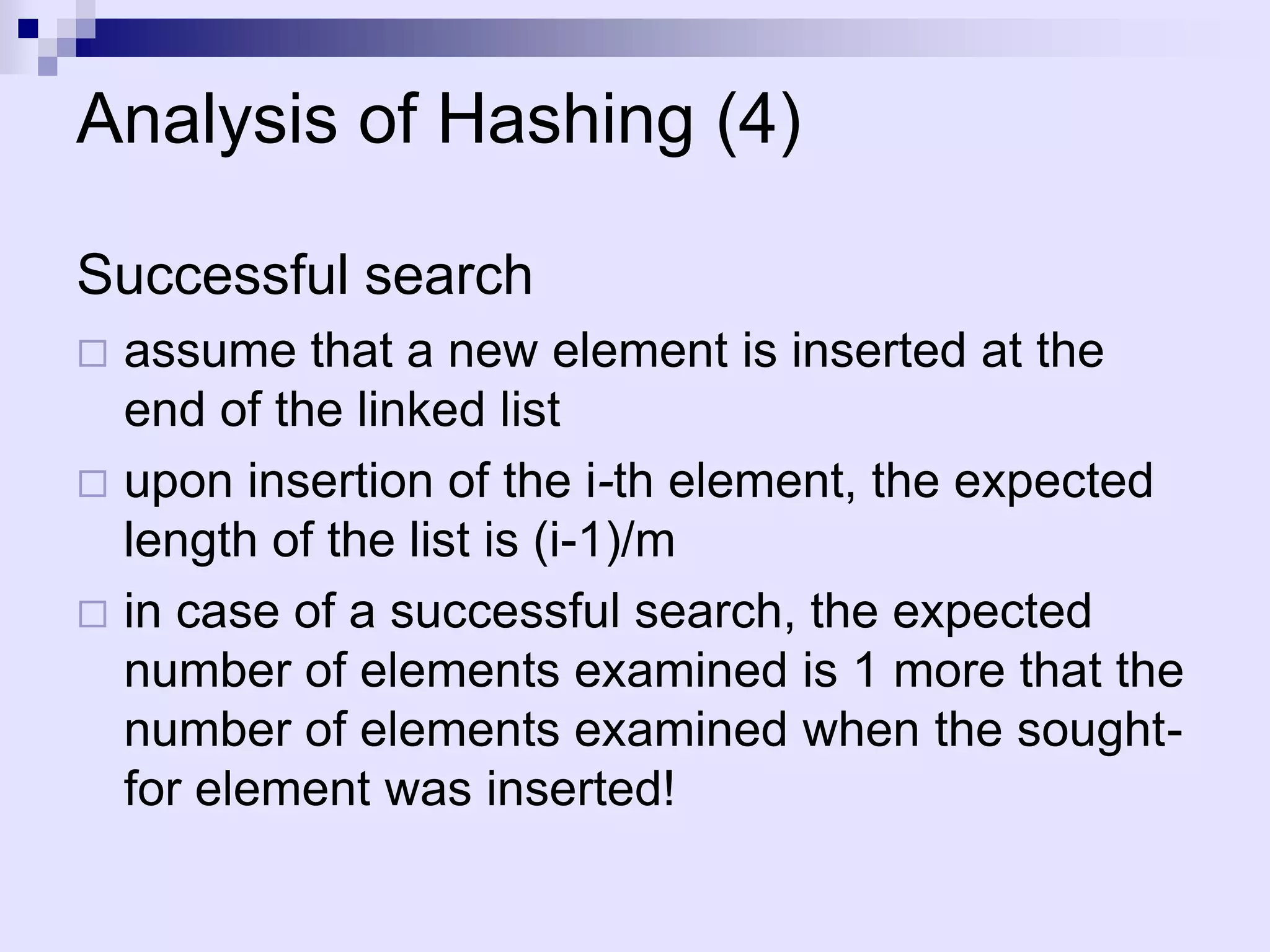
Analysis of Hashing (4)

Successful search
 assume that a new element is inserted at the
  end of the linked list
 upon insertion of the i-th element, the expected
  length of the list is (i-1)/m
 in case of a successful search, the expected
  number of elements examined is 1 more that the
  number of elements examined when the sought-
  for element was inserted!
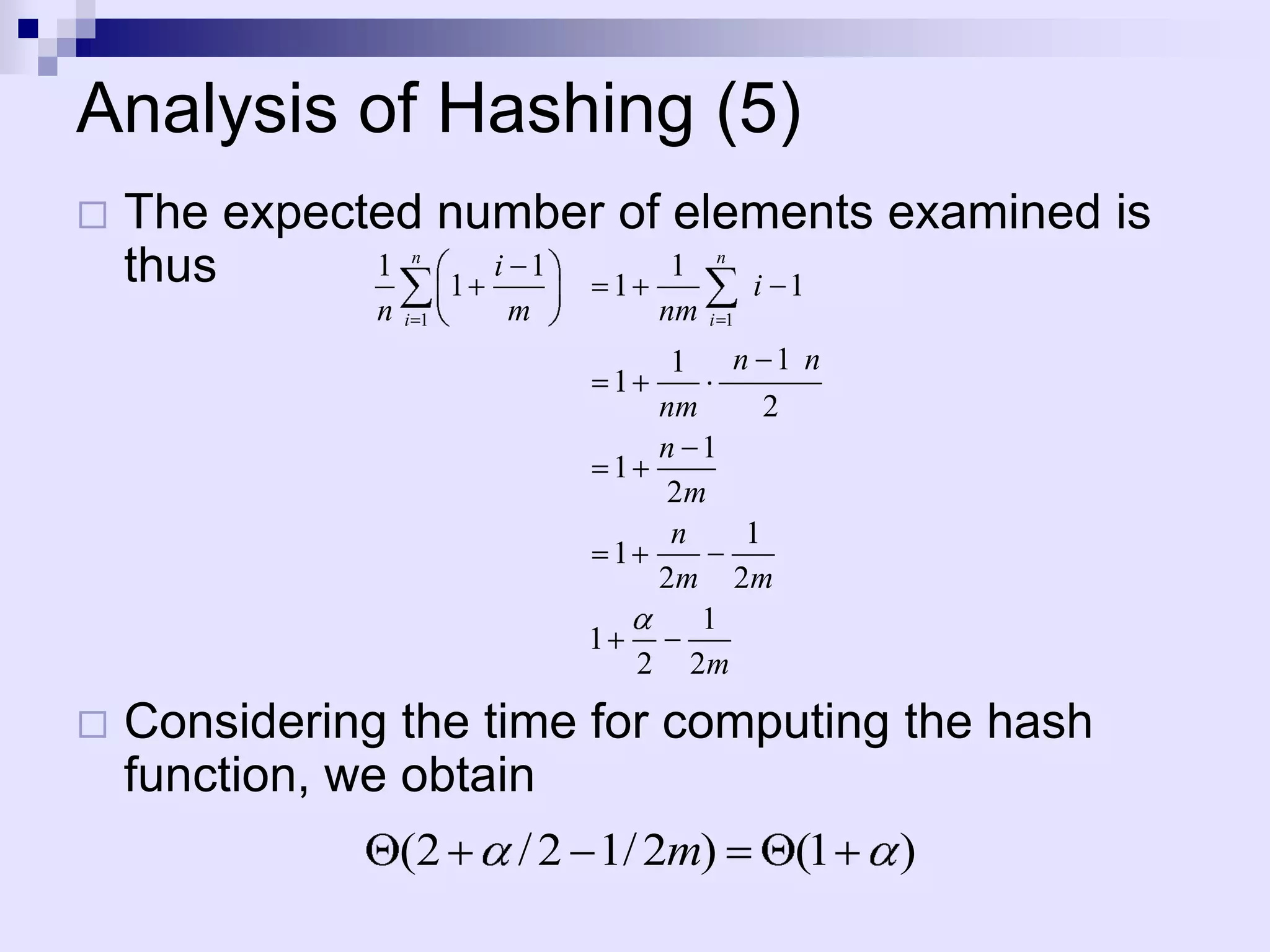
Analysis of Hashing (5)
   The expected number of elements examined is
    thus      1
                 1
                   n
                   i 1
                        1
                           1
                              i 1
                                       n


               n   i 1   m        nm   i 1

                                   1 n 1 n
                              1
                                  nm     2
                                  n 1
                               1
                                  2m
                                   n   1
                               1
                                  2m 2m
                                     1
                             1
                                 2 2m

   Considering the time for computing the hash
    function, we obtain
                   (2    / 2 1/ 2m)          (1   )
Analysis of Hashing (6)
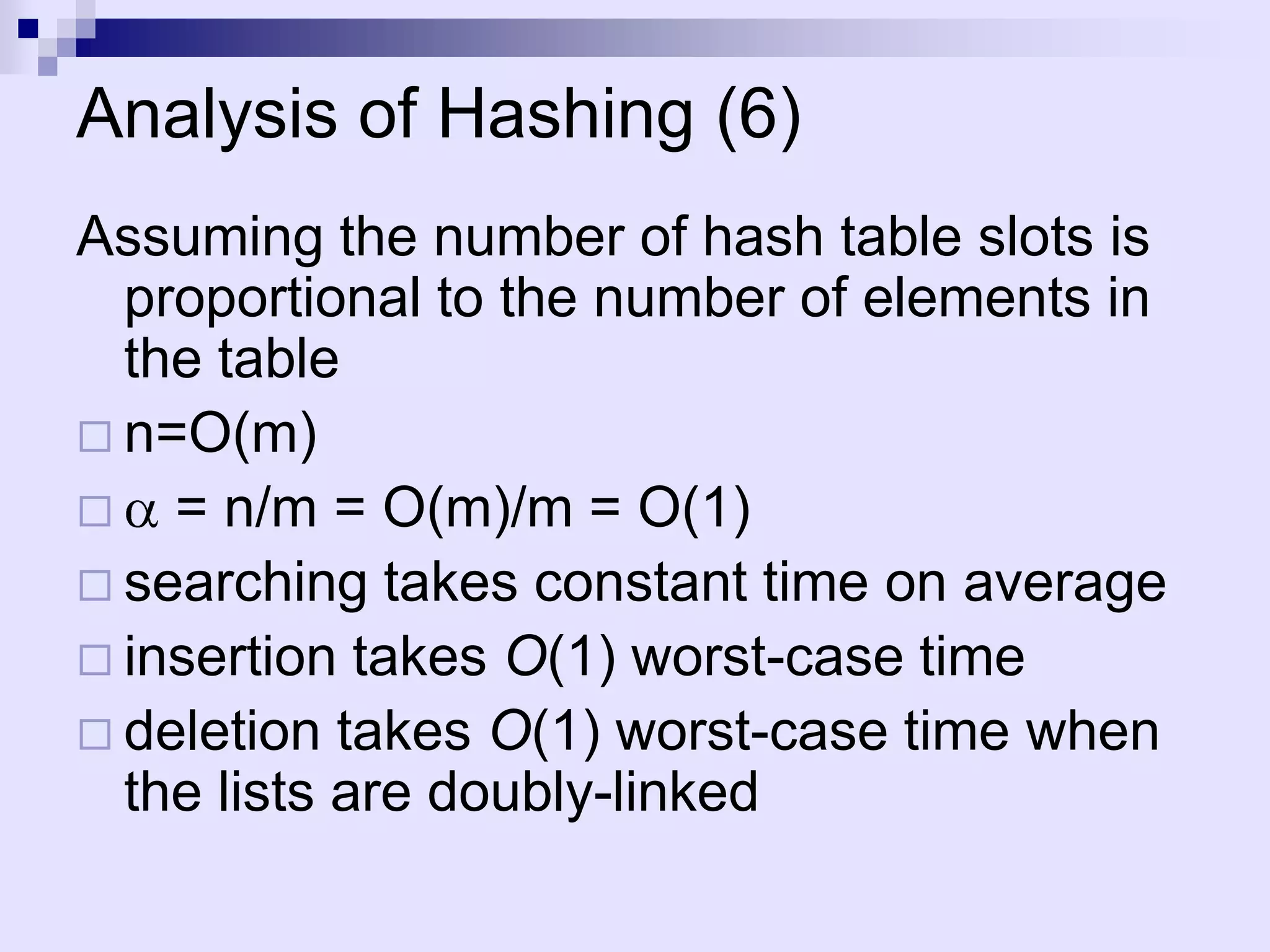
Assuming the number of hash table slots is
  proportional to the number of elements in
  the table
 n=O(m)
 = n/m = O(m)/m = O(1)
 searching takes constant time on average
 insertion takes O(1) worst-case time
 deletion takes O(1) worst-case time when
  the lists are doubly-linked

Lec4

  • 1.
    Dictionaries  the dictionaryADT  binary search  Hashing
  • 2.
    Dictionaries  Dictionaries storeelements so that they can be located quickly using keys  A dictionary may hold bank accounts  each account is an object that is identified by an account number  each account stores a wealth of additional information  including the current balance,  the name and address of the account holder, and  the history of deposits and withdrawals performed  an application wishing to operate on an account would have to provide the account number as a search key
  • 3.
    The Dictionary ADT A dictionary is an abstract model of a database  A dictionary stores key-element pairs  The main operation supported by a dictionary is searching by key  simple container methods: size(), isEmpty(), elements()  query methods: findElem(k), findAllElem(k)  update methods: insertItem(k,e), removeElem(k), removeAllElem(k)  special element: NIL, returned by an unsuccessful search
  • 4.
    The Dictionary ADT Supporting order (methods min, max, successor, predecessor ) is not required, thus it is enough that keys are comparable for equality
  • 5.
    The Dictionary ADT Different data structures to realize dictionaries  arrays, linked lists (inefficient)  Hash table (used in Java...)  Binary trees  Red/Black trees  AVL trees  B-trees  In Java:  java.util.Dictionary – abstract class  java.util.Map – interface
  • 6.
    Searching INPUT OUTPUT • sequence of numbers • index of the found (database) number or NIL • a single number (query) a1, a2, a3,….,an; q j 2 5 4 10 7; 5 2 2 5 4 10 7; 9 NIL
  • 7.
    Binary Search  Idea:Divide and conquer, a key design technique  narrow down the search range in stages  findElement(22)
  • 8.
    A recursive procedure AlgorithmBinarySearch(A, k, low, high) if low > high then return Nil else mid (low+high) / 2 if k = A[mid] then return mid elseif k < A[mid] then return BinarySearch(A, k, low, mid-1) else return BinarySearch(A, k, mid+1, high) 2 4 5 7 8 9 12 14 17 19 22 25 27 28 33 37 low mid high 2 4 5 7 8 9 12 14 17 19 22 25 27 28 33 37 low mid high 2 4 5 7 8 9 12 14 17 19 22 25 27 28 33 37 low mid
  • 9.
    An iterative procedure INPUT:A[1..n] – a sorted (non-decreasing) array of integers, key – an integer. OUTPUT: an index j such that A[j] = k. NIL, if j (1 j n): A[j] k 2 4 5 7 8 9 12 14 17 19 22 25 27 28 33 37 low 1 low mid high high n 2 4 5 7 8 9 12 14 17 19 22 25 27 28 33 37 do 2 4 5 7 8 9 12 14 low 17 19 22 mid 25 27 28 33 high 37 mid (low+high)/2 low mid if A[mid] = k then return mid else if A[mid] > k then high mid-1 else low mid+1 while low <= high return NIL
  • 10.
    Running Time ofBinary Search  The range of candidate items to be searched is halved after each comparison  In the array-based implementation, access by rank takes O(1) time, thus binary search runs in O(log n) time
  • 11.
    Searching in anunsorted array INPUT: A[1..n] – an array of integers, q – an integer. OUTPUT: an index j such that A[j] = q. NIL, if j (1 j n): A[j] q j 1 while j n and A[j] q do j++ if j n then return j else return NIL  Worst-case running time: O(n), average-case: O(n)  We can’t do better. This is a lower bound for the problem of searching in an arbitrary sequence.
  • 12.
    The Problem T&T isa large phone company, and they want to provide caller ID capability:  given a phone number, return the caller’s name  phone numbers range from 0 to r = 108 -1  There are n phone numbers, n << r.  want to do this as efficiently as possible
  • 13.
    Using an unorderedsequence  searching and removing takes O(n) time  inserting takes O(1) time  applications to log files (frequent insertions, rare searches and removals)
  • 14.
    Using an orderedsequence  searching takes O(log n) time (binary search)  inserting and removing takes O(n) time  application to look-up tables (frequent searches, rare insertions and removals)
  • 15.
    Other Suboptimal ways directaddressing: an array indexed by key:  takes O(1) time,  O(r) space where r is the range of numbers (108)  huge amount of wasted space (null) (null) Ankur (null) (null) 0000-0000 0000-0000 9635-8904 0000-0000 0000-0000
  • 16.
    Another Solution  Cando better, with a Hash table -- O(1) expected time, O(n+m) space, where m is table size  Like an array, but come up with a function to map the large range into one which we can manage  e.g., take the original key, modulo the (relatively small) size of the array, and use that as an index  Insert (9635-8904, Ankur) into a hashed array with, say, five slots. 96358904 mod 5 = 4 (null) (null) (null) (null) Ankur 0 1 2 3 4
  • 17.
    An Example  Letkeys be entry no’s of students in CSL201. eg. 2004CS10110.  There are 100 students in the class. We create a hash table of size, say 100.  Hash function is, say, last two digits.  Then 2004CS10110 goes to location 10.  Where does 2004CS50310 go?  Also to location 10. We have a collision!!
  • 18.
    Collision Resolution  Howto deal with two keys which hash to the same spot in the array?  Use chaining  Set up an array of links (a table), indexed by the keys, to lists of items with the same key  Most efficient (time-wise) collision resolution scheme
  • 19.
    Collision resolution (2)  To find/insert/delete an element  using h, look up its position in table T  Search/insert/delete the element in the linked list of the hashed slot
  • 20.
    Analysis of Hashing An element with key k is stored in slot h(k) (instead of slot k without hashing)  The hash function h maps the universe U of keys into the slots of hash table T[0...m-1] h :U 0,1,..., m 1  Assume time to compute h(k) is (1)
  • 21.
    Analysis of Hashing(2) An good hash function is one which distributes keys evenly amongst the slots.  An ideal hash function would pick a slot, uniformly at random and hash the key to it.  However, this is not a hash function since we would not know which slot to look into when searching for a key.  For our analysis we will use this simple uniform hash function  Given hash table T with m slots holding n elements, the load factor is defined as =n/m
  • 22.
    Analysis of Hashing(3) Unsuccessfulsearch  element is not in the linked list  Simple uniform hashing yields an average list length = n/m  expected number of elements to be examined  search time O(1+ ) (includes computing the hash value)
  • 23.
    Analysis of Hashing(4) Successful search  assume that a new element is inserted at the end of the linked list  upon insertion of the i-th element, the expected length of the list is (i-1)/m  in case of a successful search, the expected number of elements examined is 1 more that the number of elements examined when the sought- for element was inserted!
  • 24.
    Analysis of Hashing(5)  The expected number of elements examined is thus 1 1 n i 1 1 1 i 1 n n i 1 m nm i 1 1 n 1 n 1 nm 2 n 1 1 2m n 1 1 2m 2m 1 1 2 2m  Considering the time for computing the hash function, we obtain (2 / 2 1/ 2m) (1 )
  • 25.
    Analysis of Hashing(6) Assuming the number of hash table slots is proportional to the number of elements in the table  n=O(m)  = n/m = O(m)/m = O(1)  searching takes constant time on average  insertion takes O(1) worst-case time  deletion takes O(1) worst-case time when the lists are doubly-linked