(2,4) Trees

   What are they?
     They are search Trees (but not binary search trees)
     They are also known as 2-4, 2-3-4 trees
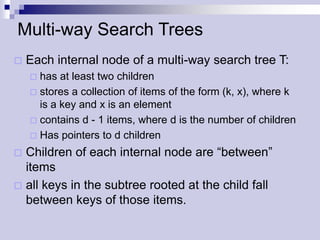
Multi-way Search Trees
   Each internal node of a multi-way search tree T:
     has at least two children
     stores a collection of items of the form (k, x), where k
      is a key and x is an element
     contains d - 1 items, where d is the number of children
     Has pointers to d children

 Children of each internal node are “between”
  items
 all keys in the subtree rooted at the child fall
  between keys of those items.
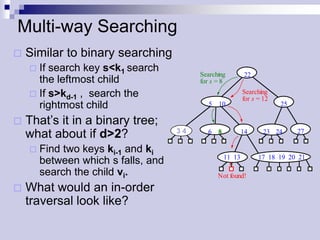
Multi-way Searching
   Similar to binary searching
     If search key s<k1 search
                                            Searching       22
      the leftmost child                    for s = 8
     If s>kd-1 , search the                                Searching
                                                            for s = 12
      rightmost child                          5 10                      25

   That’s it in a binary tree;
                                     3 4
                                      3 4     6 8           14      23 24     27
    what about if d>2?
       Find two keys ki-1 and ki
                                                    11 13         17 18 19 20 21
        between which s falls, and
        search the child vi.                      Not found!
   What would an in-order
    traversal look like?
(2,4) Trees

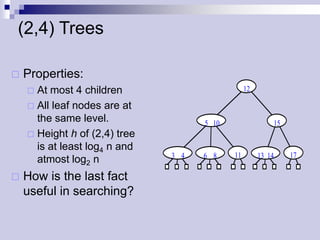
   Properties:
     At most 4 children                         12

     All leaf nodes are at
      the same level.                5 10                 15
     Height h of (2,4) tree
      is at least log4 n and
                               3 4   6 8    11        13 14    17
      atmost log2 n
   How is the last fact
    useful in searching?
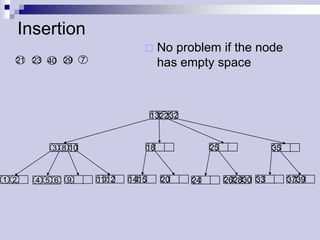
Insertion
                                        No problem if the node
  21 23 40 29       7                    has empty space


                                        13 22 32


           3 8 10                   18                  25                 35


1 2     4 5 6   9       11 12   14 15      20      24        26 28 30 33        37 39
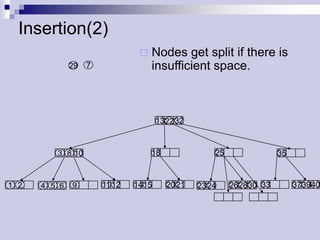
Insertion(2)
                                   Nodes get split if there is
              29   7                insufficient space.


                                       13 22 32


         3 8 10                     18                25                 35


1 2   4 5 6   9        11 12   14 15      20 21   23 24    26 28 30 33        37 39 40
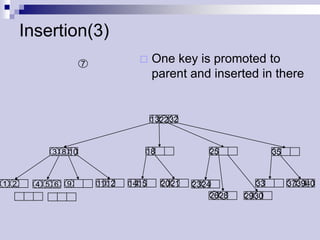
Insertion(3)
                    7                  One key is promoted to
                                        parent and inserted in there


                                        13 22 32


           3 8 10                   18                 25               35


1 2     4 5 6   9       11 12   14 15      20 21   23 24           33        37 39 40
                                                        26 28   29 30
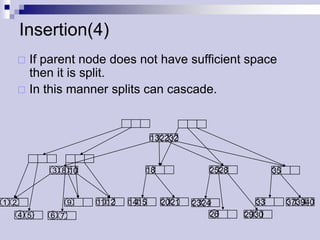
Insertion(4)
       If parent node does not have sufficient space
        then it is split.
       In this manner splits can cascade.


                                      13 22 32


            3 8 10                18                 25 28           35


1 2               9   11 12   14 15      20 21   23 24          33        37 39 40
      4 5   6 7                                       26     29 30
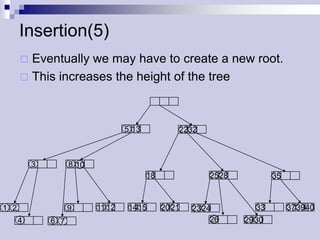
Insertion(5)
       Eventually we may have to create a new root.
       This increases the height of the tree


                                   5 13            2232


          3         8 10
                                          18               25 28           35


1 2                 9      11 12   14 15       20 21   23 24          33        37 39 40
      4       6 7                                           26     29 30
Time for Search and Insertion

    A search visits O(log N) nodes
    An insertion requires O(log N) node splits
    Each node split takes constant time
    Hence, operations Search and Insert each take time
     O(log N)
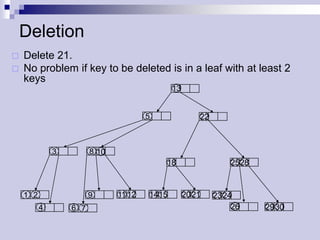
Deletion
   Delete 21.
   No problem if key to be deleted is in a leaf with at least 2
    keys
                                               13


                                       5                22


              3         8 10
                                           18                    25 28


    1 2                 9      11 12   14 15        20 21    23 24
          4       6 7                                             26     29 30
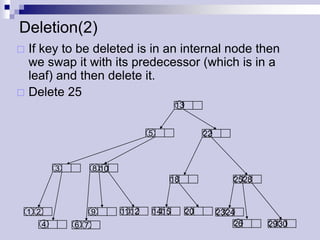
Deletion(2)
 If key to be deleted is in an internal node then
  we swap it with its predecessor (which is in a
  leaf) and then delete it.
 Delete 25
                                               13


                                       5                 22


              3         8 10
                                           18                     25 28


    1 2                 9      11 12   14 15        20        23 24
          4       6 7                                              26     29 30
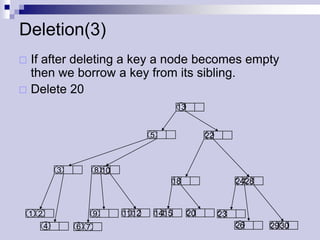
Deletion(3)
 If after deleting a key a node becomes empty
  then we borrow a key from its sibling.
 Delete 20
                                               13


                                       5                 22


              3         8 10
                                           18                      24 28


    1 2                 9      11 12   14 15        20        23
          4       6 7                                              26      29 30
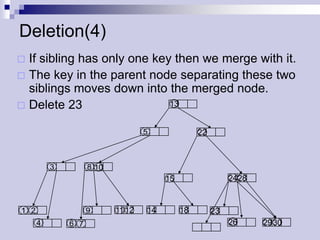
Deletion(4)
 If sibling has only one key then we merge with it.
 The key in the parent node separating these two
  siblings moves down into the merged node.
 Delete 23                  13


                                   5              22


          3         8 10
                                        15                  24 28


1 2                 9      11 12   14        18        23
      4       6 7                                           26      29 30
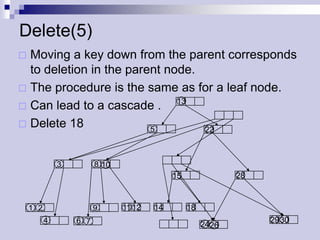
Delete(5)
 Moving a key down from the parent corresponds
  to deletion in the parent node.
 The procedure is the same as for a leaf node.
                              13
 Can lead to a cascade .
 Delete 18              5        22


              3         8 10
                                            15                28


    1 2                 9      11 12   14        18
          4       6 7                                              29 30
                                                      24 26
(2,4) Conclusion
 The  height of a (2,4) tree is O(log n).
 Split, transfer, and merge each take O(1).
 Search, insertion and deletion each take
  O(log n) .
 Why are we doing this?
   (2,4)trees are fun! Why else would we do it?
   Well, there’s another reason, too.
   They’re pretty fundamental to the idea of
    Red-Black trees as well.

Lec13

  • 1.
    (2,4) Trees  What are they?  They are search Trees (but not binary search trees)  They are also known as 2-4, 2-3-4 trees
  • 2.
    Multi-way Search Trees  Each internal node of a multi-way search tree T:  has at least two children  stores a collection of items of the form (k, x), where k is a key and x is an element  contains d - 1 items, where d is the number of children  Has pointers to d children  Children of each internal node are “between” items  all keys in the subtree rooted at the child fall between keys of those items.
  • 3.
    Multi-way Searching  Similar to binary searching  If search key s<k1 search Searching 22 the leftmost child for s = 8  If s>kd-1 , search the Searching for s = 12 rightmost child 5 10 25  That’s it in a binary tree; 3 4 3 4 6 8 14 23 24 27 what about if d>2?  Find two keys ki-1 and ki 11 13 17 18 19 20 21 between which s falls, and search the child vi. Not found!  What would an in-order traversal look like?
  • 4.
    (2,4) Trees  Properties:  At most 4 children 12  All leaf nodes are at the same level. 5 10 15  Height h of (2,4) tree is at least log4 n and 3 4 6 8 11 13 14 17 atmost log2 n  How is the last fact useful in searching?
  • 5.
    Insertion  No problem if the node 21 23 40 29 7 has empty space 13 22 32 3 8 10 18 25 35 1 2 4 5 6 9 11 12 14 15 20 24 26 28 30 33 37 39
  • 6.
    Insertion(2)  Nodes get split if there is 29 7 insufficient space. 13 22 32 3 8 10 18 25 35 1 2 4 5 6 9 11 12 14 15 20 21 23 24 26 28 30 33 37 39 40
  • 7.
    Insertion(3) 7  One key is promoted to parent and inserted in there 13 22 32 3 8 10 18 25 35 1 2 4 5 6 9 11 12 14 15 20 21 23 24 33 37 39 40 26 28 29 30
  • 8.
    Insertion(4)  If parent node does not have sufficient space then it is split.  In this manner splits can cascade. 13 22 32 3 8 10 18 25 28 35 1 2 9 11 12 14 15 20 21 23 24 33 37 39 40 4 5 6 7 26 29 30
  • 9.
    Insertion(5)  Eventually we may have to create a new root.  This increases the height of the tree 5 13 2232 3 8 10 18 25 28 35 1 2 9 11 12 14 15 20 21 23 24 33 37 39 40 4 6 7 26 29 30
  • 10.
    Time for Searchand Insertion  A search visits O(log N) nodes  An insertion requires O(log N) node splits  Each node split takes constant time  Hence, operations Search and Insert each take time O(log N)
  • 11.
    Deletion  Delete 21.  No problem if key to be deleted is in a leaf with at least 2 keys 13 5 22 3 8 10 18 25 28 1 2 9 11 12 14 15 20 21 23 24 4 6 7 26 29 30
  • 12.
    Deletion(2)  If keyto be deleted is in an internal node then we swap it with its predecessor (which is in a leaf) and then delete it.  Delete 25 13 5 22 3 8 10 18 25 28 1 2 9 11 12 14 15 20 23 24 4 6 7 26 29 30
  • 13.
    Deletion(3)  If afterdeleting a key a node becomes empty then we borrow a key from its sibling.  Delete 20 13 5 22 3 8 10 18 24 28 1 2 9 11 12 14 15 20 23 4 6 7 26 29 30
  • 14.
    Deletion(4)  If siblinghas only one key then we merge with it.  The key in the parent node separating these two siblings moves down into the merged node.  Delete 23 13 5 22 3 8 10 15 24 28 1 2 9 11 12 14 18 23 4 6 7 26 29 30
  • 15.
    Delete(5)  Moving akey down from the parent corresponds to deletion in the parent node.  The procedure is the same as for a leaf node. 13  Can lead to a cascade .  Delete 18 5 22 3 8 10 15 28 1 2 9 11 12 14 18 4 6 7 29 30 24 26
  • 16.
    (2,4) Conclusion  The height of a (2,4) tree is O(log n).  Split, transfer, and merge each take O(1).  Search, insertion and deletion each take O(log n) .  Why are we doing this?  (2,4)trees are fun! Why else would we do it?  Well, there’s another reason, too.  They’re pretty fundamental to the idea of Red-Black trees as well.