TRIPS - GeneralObligations - substantive
requirement of the TRIPS agreement in the
WTO
2.
Trade-Related aspects ofIntellectual Property Rights
agreement (TRIPS)
• It was adopted under the framework of the WTO in 1993.
• It provides legal system for promoting intellectual property system into the integration process.
• TRIPS agreement achieved the goal to link international trade with people‘s intellectual property
rights.
• It not only to expand intellectual property protection to the outside of the traditional areas of trade, but
also penetrate into the technical trade and service trade, etc. all aspects of international trade, and
accelerate the international trade into a new trade pattern.
3.
Inclusion of TRIPSin WTO:
• For intellectual property issues in general, the negotiators were required to clarify GATT provisions and
elaborate as appropriate new rules and disciplines in order to reduce distortions and impediments to
‖
international trade. As technology became more important in goods and commodities, having higher
proportion of invention and design (intellectual creativity) in their value, IPR became important in
international trade
• The inclusion of TRIPS was the culmination of an intense lobbying effort by the United States,
supported by the European Union, Japan and other developed nations.
• Campaigns of unilateral economic encouragement under the Generalized System of Preferences and
Coercion under Section 301 of the Trade Act played an important role in defeating competing policy
positions that were favoured by developing countries, most notably Korea and Brazil, but also
including Thailand, India and Caribbean Basin states.
4.
• In turn,the United States‘ strategy of linking trade policy to intellectual property standards can be
traced back to the entrepreneurship of senior management at Pfizer in the early 1980s, who
mobilized corporations in the United States and made maximizing intellectual property privileges,
the number one priority of trade policy in the United States
• TRIPS is the most important multilateral instrument for the globalization of intellectual property
laws. States like Russia and China that were very unlikely to join the Berne Convention have found
the prospect of WTO membership a powerful enticement. Furthermore, unlike other agreements on
intellectual property, TRIPS has a powerful enforcement mechanism. States can be disciplined
through the WTO's dispute settlement mechanism.
5.
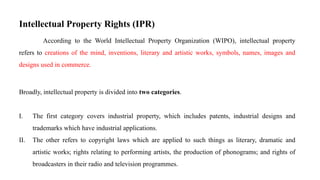
Intellectual Property Rights(IPR)
According to the World Intellectual Property Organization (WIPO), intellectual property
refers to creations of the mind, inventions, literary and artistic works, symbols, names, images and
designs used in commerce.
Broadly, intellectual property is divided into two categories.
I. The first category covers industrial property, which includes patents, industrial designs and
trademarks which have industrial applications.
II. The other refers to copyright laws which are applied to such things as literary, dramatic and
artistic works; rights relating to performing artists, the production of phonograms; and rights of
broadcasters in their radio and television programmes.
6.
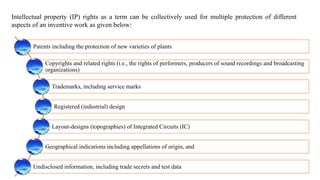
Intellectual property (IP)rights as a term can be collectively used for multiple protection of different
aspects of an inventive work as given below:
Patents including the protection of new varieties of plants
Copyrights and related rights (i.e., the rights of performers, producers of sound recordings and broadcasting
organizations)
Trademarks, including service marks
Registered (industrial) design
Layout-designs (topographies) of Integrated Circuits (IC)
Geographical indications including appellations of origin, and
Undisclosed information, including trade secrets and test data
7.
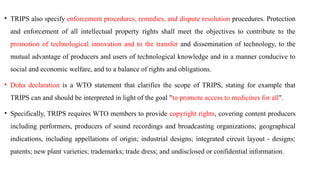
• TRIPS alsospecify enforcement procedures, remedies, and dispute resolution procedures. Protection
and enforcement of all intellectual property rights shall meet the objectives to contribute to the
promotion of technological innovation and to the transfer and dissemination of technology, to the
mutual advantage of producers and users of technological knowledge and in a manner conducive to
social and economic welfare, and to a balance of rights and obligations.
• Doha declaration is a WTO statement that clarifies the scope of TRIPS, stating for example that
TRIPS can and should be interpreted in light of the goal "to promote access to medicines for all".
• Specifically, TRIPS requires WTO members to provide copyright rights, covering content producers
including performers, producers of sound recordings and broadcasting organizations; geographical
indications, including appellations of origin; industrial designs; integrated circuit layout - designs;
patents; new plant varieties; trademarks; trade dress; and undisclosed or confidential information.
8.
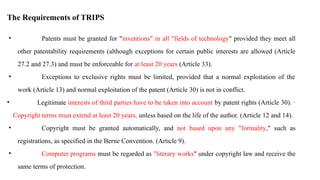
The Requirements ofTRIPS
• Patents must be granted for "inventions" in all "fields of technology" provided they meet all
other patentability requirements (although exceptions for certain public interests are allowed (Article
27.2 and 27.3) and must be enforceable for at least 20 years (Article 33).
• Exceptions to exclusive rights must be limited, provided that a normal exploitation of the
work (Article 13) and normal exploitation of the patent (Article 30) is not in conflict.
• Legitimate interests of third parties have to be taken into account by patent rights (Article 30). ·
Copyright terms must extend at least 20 years, unless based on the life of the author. (Article 12 and 14).
• Copyright must be granted automatically, and not based upon any "formality," such as
registrations, as specified in the Berne Convention. (Article 9).
• Computer programs must be regarded as "literary works" under copyright law and receive the
same terms of protection.
9.
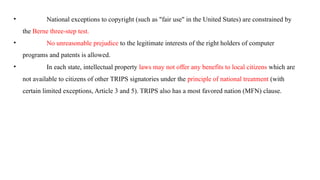
• National exceptionsto copyright (such as "fair use" in the United States) are constrained by
the Berne three-step test.
• No unreasonable prejudice to the legitimate interests of the right holders of computer
programs and patents is allowed.
• In each state, intellectual property laws may not offer any benefits to local citizens which are
not available to citizens of other TRIPS signatories under the principle of national treatment (with
certain limited exceptions, Article 3 and 5). TRIPS also has a most favored nation (MFN) clause.
10.
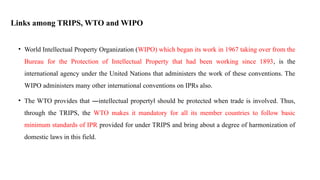
Links among TRIPS,WTO and WIPO
• World Intellectual Property Organization (WIPO) which began its work in 1967 taking over from the
Bureau for the Protection of Intellectual Property that had been working since 1893, is the
international agency under the United Nations that administers the work of these conventions. The
WIPO administers many other international conventions on IPRs also.
• The WTO provides that ―intellectual property should be
‖ protected when trade is involved. Thus,
through the TRIPS, the WTO makes it mandatory for all its member countries to follow basic
minimum standards of IPR provided for under TRIPS and bring about a degree of harmonization of
domestic laws in this field.
11.
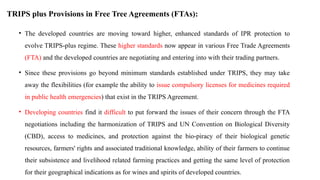
TRIPS plus Provisionsin Free Tree Agreements (FTAs):
• The developed countries are moving toward higher, enhanced standards of IPR protection to
evolve TRIPS-plus regime. These higher standards now appear in various Free Trade Agreements
(FTA) and the developed countries are negotiating and entering into with their trading partners.
• Since these provisions go beyond minimum standards established under TRIPS, they may take
away the flexibilities (for example the ability to issue compulsory licenses for medicines required
in public health emergencies) that exist in the TRIPS Agreement.
• Developing countries find it difficult to put forward the issues of their concern through the FTA
negotiations including the harmonization of TRIPS and UN Convention on Biological Diversity
(CBD), access to medicines, and protection against the bio-piracy of their biological genetic
resources, farmers' rights and associated traditional knowledge, ability of their farmers to continue
their subsistence and livelihood related farming practices and getting the same level of protection
for their geographical indications as for wines and spirits of developed countries.
12.
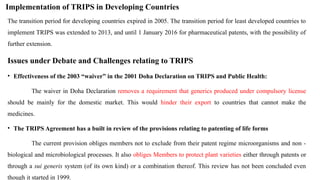
Implementation of TRIPSin Developing Countries
The transition period for developing countries expired in 2005. The transition period for least developed countries to
implement TRIPS was extended to 2013, and until 1 January 2016 for pharmaceutical patents, with the possibility of
further extension.
Issues under Debate and Challenges relating to TRIPS
• Effectiveness of the 2003 “waiver” in the 2001 Doha Declaration on TRIPS and Public Health:
The waiver in Doha Declaration removes a requirement that generics produced under compulsory license
should be mainly for the domestic market. This would hinder their export to countries that cannot make the
medicines.
• The TRIPS Agreement has a built in review of the provisions relating to patenting of life forms
The current provision obliges members not to exclude from their patent regime microorganisms and non -
biological and microbiological processes. It also obliges Members to protect plant varieties either through patents or
through a sui generis system (of its own kind) or a combination thereof. This review has not been concluded even
though it started in 1999.
13.
• TRIPS Article27 requirements for patentability "in all fields of technology", and whether or not this
necessitates the granting of software and business method patents.
• Protection of the innovations of indigenous and local farming communities and the continuation of the
traditional farming practices
• Grant of the same level of protection of geographical indications in other products as is granted to wines and
spirits
• TRIPS's wealth concentration effects (moving money from people in developing countries to copyright and
patent owners in developed countries) and its imposition of artificial scarcity on the citizens of countries that
would otherwise have had weaker intellectual property laws, are common bases for such criticisms.
• At the 21st century, IPR system is faced with new challenges. The adverse effects of IPR system appear
gradually. In some developing countries, the protection of IPR has enhanced the costs of some medical or
necessaries; the price of some product with IPR is so high that it cannot meet the needs of poor people.
International Union forthe protection of New Varieties of plants
(UPOV)
• IPRs confer legal ownership to the person or a business of a discovery or an invention attached to a
particular product or process, which prohibits others from unauthorized use.
• Among the listed IPR‘s, the main concern is on patents, as India being a member of WTO, needs to
provide for protection of plant varieties (PPV) either through patents or by an effective sui generic
system or a combination there of and thus the whole issue of plant variety protection (PVP) (Plant
Breeders Rights – PBR) became an intensely debatable subject.
• The adoption of IPRs in agriculture has a recent origin, but in the USA, the Plant Patent Act was enacted
in 1930. This Act, however, covered only asexually propagated plants (plants not normally sown from
seeds), and was thus aimed at excluding the major food species and so prevented the emergence of grain
monopolies.
16.
• The Europeanplant breeders pushed for Plant Breeders‘ Rights (PBRs), which were more
comprehensive in the coverage of varieties to be granted legal protection.
• The origins of this movement for Intellectual Property Protection (IPP) for agricultural products go
back to the late 19th century with the growth in the European seed trade and the development of
breeders‘ associations, which was followed by various seed control systems and attempts to provide
Plant Variety Protection (PVP).
• In the early part of the 20th century, the potential benefit of systematic plant breeding to society and
lack of an effective protection and reward system were felt and this led to the formation of the Inter
Governmental International Union for the Protection of New Varieties of Plants commonly known
as UPOV (based on its initials in French – (Union Internationale pour la Protection des
ObtentionsVégétales) with mostly developed countries as member states, after an International
Convention in Paris in 1961.
17.
• The UPOVis an intergovernmental organization with headquarters in Geneva (Switzerland).
Belgium, France, the Federal Republic of Germany (FRG), Italy and the Netherlands were the
original signatories on 2 December 1961. UPOV came into force only in August 1968 after the UK,
FRG and the Netherlands had ratified it.
• The convention has undergone revisions in 1972, 1978 and 1991 and has as on today, there are 53
member states.
• The purpose of the UPOV convention is to ensure Plant Breeders‘ Right (PBR) by making available
to them an exclusive property right on new plant varieties in order to provide incentive to the
development of agriculture and to safeguard the interests of plant breeders. To be eligible for
protection, varieties have to be (i) distinct from existing commonly known varieties, (ii) sufficiently
uniform, and (iii) stable and new in the sense that they must not have been commercialized.
18.
UPOV ‗78 didnot limit the farmers‘ rights and kept the rights of plant breeders within levels
supported by some developing countries. Under the UPOV ‘78, the breeder could produce a new plant variety
and had a monopoly via marketing right sale of seed.
But the system allowed two important exemptions.
• One, the breeder‘s exemption, which allowed other plant breeders to use the protected variety for breeding
purposes and the other one was that of the farmer‘s rights.
• The farmers were allowed to use seeds from their harvest to plant the next crop, even if the seed was
protected by the PBR.
• Last amendment in 1991 introduced far reaching changes to the structure of protection, significantly
strengthening PBRs. The more significant of these are the restrictions on the reuse of seeds, which could
have implications for the farming communities using the protected varieties; in addition, the inclusion of
Essentially Derived Varieties (EDVs) affects the ability of breeders to freely use protected varieties for
research
19.
• Thus, UPOV‗91, urged upon the WTO by the USA, contains an extensive protection for plant
breeders to the prejudice of farmers‘ rights and severely restricts the scope of other breeders to
innovate around protected varieties (the breeders‘ exemption), thereby disturbingly affecting the
food security and equity goals of developing countries on the whole.
• The breeder‘s exemption was almost done away with in the UPOV ‘91 making way for royalty
payments to the PBR holder from the breeders, if their new variety bears some resemblance to the
protected variety even if the new variety has been bred for different characters. Besides, farmers
cannot use farm saved seeds from protected varieties, without paying compensation
• The UPOV ‗91 raises the alarm that unfavourable regimes could be imposed on unwilling
developing countries by incorporating the obligations of UPOV ‗91 into the WTO agreement
20.
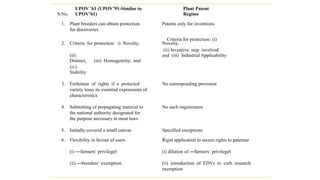
S.No.
UPOV ’61 (UPOV’91-Similarto
UPOV’61)
Plant Patent
Regime
1. Plant breeders can obtain protection Patents only for inventions
for discoveries
2. Criteria for protection: i) Novelty,
Criteria for protection: (i)
Novelty,
(ii)
Distinct, (iii) Homogeneity, and
(ii) Inventive step involved
and (iii) Industrial Applicability
(iv)
Stability
3. Forfeiture of rights if a protected No corresponding provision
variety loses its essential expressions of
characteristics
4. Submitting of propagating material to No such requirement
the national authority designated for
the purpose necessary in most laws
5. Initially covered a small canvas Specified exceptions
6. Flexibility in favour of users Rigid application to secure rights to patentee
(i) ―farmers‘ privilege‖ (i) dilution of ―farmers‘ privilege‖
(ii) ―breeders‘ exemption (ii) introduction of EDVs to curb research
exemption
21.
TREATIES AND INTERNATIONALAGREEMENTS
Agreementon Trade-Related Aspects of Intellectual Property Rights (TRIPS)
TRIPS is an international agreement that sets minimum standards for intellectual property
protection for all World Trade Organization countries.
Anti-Counterfeiting Trade Agreement (ACTA)
Adopted in 2011, ACTA is a multilateral trade agreement that regulates counterfeiting, generic
medicines, and online copyright infringement.
It is a groundbreaking initiative by key trading partners to strengthen the international legal
framework for effectively combating global proliferation of commercial-scale counterfeiting and piracy.
In addition to calling for strong legal frameworks, the agreement also includes innovative
provisions to deepen international cooperation and to promote strong intellectual property rights (IPR)
enforcement practices
22.
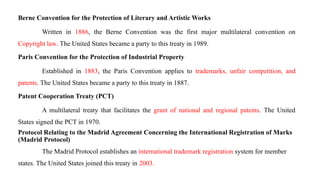
Berne Convention forthe Protection of Literary and Artistic Works
Written in 1886, the Berne Convention was the first major multilateral convention on
Copyright law. The United States became a party to this treaty in 1989.
Paris Convention for the Protection of Industrial Property
Established in 1883, the Paris Convention applies to trademarks, unfair competition, and
patents. The United States became a party to this treaty in 1887.
Patent Cooperation Treaty (PCT)
A multilateral treaty that facilitates the grant of national and regional patents. The United
States signed the PCT in 1970.
Protocol Relating to the Madrid Agreement Concerning the International Registration of Marks
(Madrid Protocol)
The Madrid Protocol establishes an international trademark registration system for member
states. The United States joined this treaty in 2003.
23.
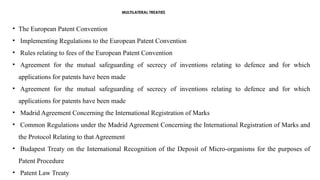
MULTILATERAL TREATIES
• TheEuropean Patent Convention
• Implementing Regulations to the European Patent Convention
• Rules relating to fees of the European Patent Convention
• Agreement for the mutual safeguarding of secrecy of inventions relating to defence and for which
applications for patents have been made
• Agreement for the mutual safeguarding of secrecy of inventions relating to defence and for which
applications for patents have been made
• Madrid Agreement Concerning the International Registration of Marks
• Common Regulations under the Madrid Agreement Concerning the International Registration of Marks and
the Protocol Relating to that Agreement
• Budapest Treaty on the International Recognition of the Deposit of Micro-organisms for the purposes of
Patent Procedure
• Patent Law Treaty
24.
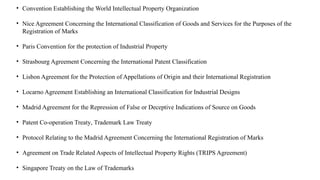
• Convention Establishingthe World Intellectual Property Organization
• Nice Agreement Concerning the International Classification of Goods and Services for the Purposes of the
Registration of Marks
• Paris Convention for the protection of Industrial Property
• Strasbourg Agreement Concerning the International Patent Classification
• Lisbon Agreement for the Protection of Appellations of Origin and their International Registration
• Locarno Agreement Establishing an International Classification for Industrial Designs
• Madrid Agreement for the Repression of False or Deceptive Indications of Source on Goods
• Patent Co-operation Treaty, Trademark Law Treaty
• Protocol Relating to the Madrid Agreement Concerning the International Registration of Marks
• Agreement on Trade Related Aspects of Intellectual Property Rights (TRIPS Agreement)
• Singapore Treaty on the Law of Trademarks