Intersecting Leave Laws –
Managing the Interplay between
FMLA/ADA/NC Workers’ Comp Act
Presented by: Holly E.R. Hammer, Esq.
Founder, Hammer Law PPLC
CAI November 1, 2018
www.hammerlf.com
Legal Disclaimer
www.hammerlf.com
This presentation is for informational purposes
only and should not be relied upon or construed
as legal advice. This content and your attendance
at today’s seminar establishes no legal
relationship between you and Hammer Law
PLLC. You should consult with your own attorney
concerning your own situation(s) and any
specific legal questions you may have.
Objectives:
www.hammerlf.com
•Review and discussion of laws providing medical leave
• FMLA
•ADA
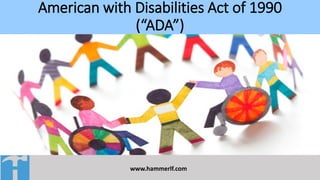
•North Carolina Workers’ Compensation Act
•Understand how ADA/FMLA/NCWCA intersect
•Understand how to effectively manage employee
leave under ADA/FMLA/NCWCA
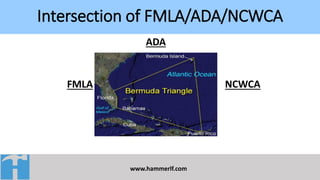
Intersection of FMLA/ADA/NCWCA
www.hammerlf.com
ADA
FMLA NCWCA
Application of Leave to FMLA/ADA/NCWCA
www.hammerlf.com
• Family Medical Leave Act (“FMLA”)
• Applies to private employers with 50 or more employees on payroll for 20
or more workweeks in current or previous calendar year; provides up to
12 weeks of job protected leave for FMLA qualified events
• American with Disabilities Act (“ADA”)
• Applies to private employers with 15 or more employees on payroll for at
least 20 or more workweeks in current or previous calendar year;
requires employers to provide reasonable accommodations to covered
employees with a qualified disability; leave of absence is considered one
type of reasonable accommodation
Application of Leave to FMLA/ADA/NCWCA
www.hammerlf.com
• North Carolina Workers’ Compensation Act (“NCWCA”)
• Applies to employers with 3 or more employees regularly employed in
the same business or establishment
• Provides reduced pay to employees who suffer a compensable
workplace injury and are required to miss work
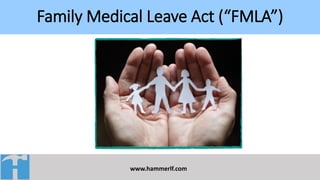
Family Medical Leave Act (“FMLA”)
www.hammerlf.com
FMLA Leave - Application and Analysis
www.hammerlf.com
•FMLA is most significant leave law and has the largest
administrative impact on employers
•Extremely complex area of law with multiple notice,
form and timing requirements applicable to employers
• EEOC guidelines and applicable FMLA forms are available
at www.dol.gov/whd/fmla/forms.htm
FMLA Leave - Application and Analysis
www.hammerlf.com
•If FMLA applies, it generally entitles:
1. Eligible employees of
2. Covered employers
3. To take job-protected, unpaid leave for FMLA qualifying
events during the employer-specified 12 month period
for 12 workweeks (26 if military leave applies), and
4. Employer must reinstate employee to same or equivalent job
upon return from FMLA leave
FMLA Issue 1 – Are you a “Covered Employer
www.hammerlf.com
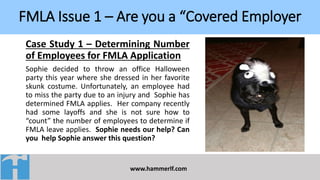
Case Study 1 – Determining Number
of Employees for FMLA Application
Sophie decided to throw an office Halloween
party this year where she dressed in her favorite
skunk costume. Unfortunately, an employee had
to miss the party due to an injury and Sophie has
determined FMLA applies. Her company recently
had some layoffs and she is not sure how to
“count” the number of employees to determine if
FMLA leave applies. Sophie needs our help? Can
you help Sophie answer this question?
FMLA Issue 1 – Are you a “Covered Employer”?
www.hammerlf.com
• Determining number of employees for FMLA 50-person
minimum:
• Full-time employees?
• Part-time employees?
• Employees on FMLA leave?
• Employees on ADA leave?
• Suspended employees?
• If you are close, call your attorney!
FMLA Issue 2 – Is this an “Eligible Employee”?
www.hammerlf.com
• To be an “Eligible Employee” for FMLA leave purposes, employee
must have worked
1. At location where there are at least 50 employees employed at
that location or within a 75-mile radius;
2. For at least 12 months (do not need to be consecutive); and
3. For at least 1,250 hours during the 12-month period
immediately preceding the first day of requested FMLA leave
• Note: while an employer can have 50 or more employees for FMLA
purposes, not all employees will be entitled to FMLA leave (for
example, if the employer has several small multi-state locations)
FMLA Issue 3 – Is there a “Qualifying Event”?
www.hammerlf.com
• There must be a “qualifying event” for FMLA to
apply:
1. Birth, adoption or foster care placement of a child within
12 months;
2. Employee’s own serious health condition;
3. To care for spouse, child or parent with a serious health
condition;
4. For the care of a covered service member or for a
qualifying military exigency
FMLA Issue 3 – Is there a “Qualifying Event”?
www.hammerlf.com
• “Serious Health Condition” includes injury, illness, impairment, or
physical/mental condition
• Following qualify as “serious health condition” for FMLA purposes:
 Overnight stay (hospital or residential care facility)
 Incapacity of > 3 calendar days PLUS
• At least 2 visits to health care provider within 30 days, with first to
occur within 7 days, OR
• 1 in-person visit with continuing treatment prescribed
 Absences due to pregnancy or prenatal care
 Chronic medical conditions causing absences that require 2 or
more visits/per year to health care provider
FMLA Issue 3 – Is there a “Qualifying Event”?
www.hammerlf.com
“Chronic Medical Conditions” include:
 Depression
 Migraine headaches
 Asthma
 Alzheimer’s
 Diabetes
 Conditions that require multiple treatments (i.e., restorative surgery after
injury/accident or a condition that without treatment would cause a period
of incapacity of > 3 consecutive days – for example, cancer)
FMLA Issue 4 – Management of FMLA Leave
www.hammerlf.com
• Employee request for FMLA Leave:
• Generally, employee should provide 30 days advance notice when FMLA
leave is foreseeable.
• If not reasonably foreseeable, notice should be provided as soon as
practicable.
• But….employer beware!
• Employee does not need to specifically assert or even mention FMLA to
be entitled to FMLA leave
FMLA Issue 4 – Management of FMLA Leave
www.hammerlf.com
• Employee request for FMLA leave:
• Words “I need FMLA leave” do not need to be used
• Employer need only have sufficient information to determine that FMLA
leave may apply
• Err on the side of caution and provide FMLA paperwork
• Note that failure to advise employee of right to FMLA leave can lead to
legal liability and damages
• Train your managers and supervisors to look for FMLA “warning
signs” and to notify HR immediately!
FMLA Issue 4 – Management of FMLA Leave
www.hammerlf.com
• Employer Obligations:
• Within 5 business days of FMLA leave request or notice that FMLA may
apply, provide:
• Notice of Eligibility and Rights and Responsibilities (DOL Form WD-381)
• Applicable Certification of Healthcare Provider Form
• Within 15 calendar days, completed Certification of HealthCare Provider
Form must be returned
• Within 5 business days of receiving Certification of HealthCare Provider
Form, must provide Designation Notice to employee (WH-382)
FMLA Issue 4 – Management of FMLA Leave
www.hammerlf.com
• Employer Obligations - Incomplete/Insufficient Certification
Form:
• Advise employee in writing what additional information is needed and
give the employee seven calendar days (longer, if necessary, despite
employee’s diligent good faith efforts) to complete and return the form
• A certification is considered insufficient if it contains information that is
vague, ambiguous, or non-responsive
• Failure to correct means employer can deny FMLA leave request
FMLA Issue 4 – Management of FMLA Leave
www.hammerlf.com
• IF FMLA leave is granted:
• Leave can be taken continuously for up to 12 weeks or it can be taken
intermittently over the 12-month period subject
• No statutory requirement that FMLA leave be paid or that PTO be
used while on FMLA leave
• Employer policy dictates
• Can be unpaid,
• Can allow employees to use PTO
• Can mandate that employees use PTO while on FMLA leave (unless
leave is covered by NCWCA)
FMLA Issue 4 – Management of FMLA Leave
www.hammerlf.com
• IF FMLA leave is granted:
• Group health insurance must be continued on same terms and
conditions during FMLA leave (employer continues to pay %)
• Employee has right to return to same or equivalent job position at end
of FMLA leave unless “key employee exception” applies
American with Disabilities Act of 1990
(“ADA”)
www.hammerlf.com
ADA – Application and Analysis
www.hammerlf.com
Under the ADA….
1. A covered employer
2. Must provide a qualified individual with a covered disability
3. A reasonable accommodation unless granting the accommodation would
cause undue hardship to the employer (i.e., significant burden or
expense)
4. Leave can be a reasonable accommodation
5. Employee generally entitled to return to “original position” at end of
ADA leave
ADA Issue 1 – Is this a “Qualified Individual”?
www.hammerlf.com
• For the purposes of the ADA, a “Qualified Individual:”
• Has the required knowledge, education and experience for the position
(particularly applicable to job applicant)
• Can perform essential job functions of position, with or without a
reasonable accommodation
• Job description is vital: always include attendance as essential function and
other key requirements, even if apparent/obvious
• No minimum length of employment is required to be a “qualified
individual” for the purposes of the ADA (differs from FMLA)
ADA Issue 1 – Is this a “Qualified Individual”?
www.hammerlf.com
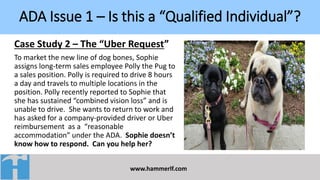
Case Study 2 – The “Uber Request”
To market the new line of dog bones, Sophie
assigns long-term sales employee Polly the Pug to
a sales position. Polly is required to drive 8 hours
a day and travels to multiple locations in the
position. Polly recently reported to Sophie that
she has sustained “combined vision loss” and is
unable to drive. She wants to return to work and
has asked for a company-provided driver or Uber
reimbursement as a “reasonable
accommodation” under the ADA. Sophie doesn’t
know how to respond. Can you help her?
ADA Issue 1 – Is this a “Qualified Individual”?
www.hammerlf.com
• Direct Sophie to the case of Stephenson v. Pfizer (4th Cir. March
2016) for guidance:
• Similar facts as those presented here – sales employee sustained eye
injury and asked for Uber or driver as a “reasonable accommodation”
• Company denied request, finding employee was not a “qualified
individual” for purposes of ADA
• Judge denied company’s request for dismissal and on the grounds that
the company failed to identify driving by the employee as an essential
function of the position in the job description; therefore, there was a
triable issue of material fact to be decided by the jury at trial
ADA Issue 2 – Is there a “Covered Disability”?
www.hammerlf.com
• “Covered Disability” for the purposes of the ADA includes a physical or
mental impairment that substantially limits one or more major life
activities, including a record of such impairment
• Under expanded definition of disability under ADA:
• Assume
• Disabled
• Always
• Best practice for employers: err the side of caution and assume a
disability exists when in doubt
ADA Issue 3 - Is there an ADA Accommodation Request?
www.hammerlf.com
• “Accommodation Request” for purposes of ADA does not require any
“magic words”
• Words “help” or “I need assistance” can trigger application of ADA
• Employer has an obligation to engage in the interactive process if:
1. Employer knows employee has a disability (i.e., apparent and obvious) or
suspects a disability exists, and
2. Reasonably believes employee is having issues in the workplace because of
disability or may require an accommodation
• Because ADA applies when FMLA does not, employers should consider
any request for leave as a “triggering event”
ADA Issue 4 – Leave Under the ADA
www.hammerlf.com
• Leave under the ADA: providing leave is generally considered a reasonable
accommodation under the ADA if:
• No other effective accommodation exits
• Providing leave will not cause an undue hardship on employer
• Length of leave provided that is reasonable under ADA varies:
• How much leave does employee needs because of disability?
• Does the duration required create an undue hardship on employer’s business?
• What is reasonable varies based on factors such as position and company size
• Leave of unspecified/indefinite duration will never be a reasonable
accommodation but courts are split on amount of leave that is reasonable
ADA Issue 4 – Leave Under the ADA
www.hammerlf.com
• Inflexible, “maximum leave” policies will generally violate the ADA
• Example: “Employees who cannot return to work after four (4) months
will be terminated.”
• According to EEOC, such inflexible policies violates employer’s
obligation to engage in interactive process
ADA Issue 4 –Leave Under the ADA
www.hammerlf.com
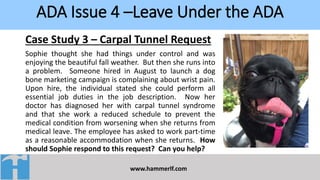
Case Study 3 – Carpal Tunnel Request
Sophie thought she had things under control and was
enjoying the beautiful fall weather. But then she runs into
a problem. Someone hired in August to launch a dog
bone marketing campaign is complaining about wrist pain.
Upon hire, the individual stated she could perform all
essential job duties in the job description. Now her
doctor has diagnosed her with carpal tunnel syndrome
and that she work a reduced schedule to prevent the
medical condition from worsening when she returns from
medical leave. The employee has asked to work part-time
as a reasonable accommodation when she returns. How
should Sophie respond to this request? Can you help?
ADA Issue 4 – Leave Under the ADA
www.hammerlf.com
• Responding to a Request for Accommodation EEOC
Recommendations (in order):
1. First option: reinstate and accommodate within same job, unless
undue hardship
2. Second option: Reassign to an open, equivalent position to
accommodate request if vacant option is available
3. Third option: Reassign to lower level position, if open and available
and employee is qualified
4. Option of Last Resort: if no position whatsoever if available, employer
is not required to continue to accommodate. Terminate employment.
ADA Issue 4 – Leave Under the ADA
www.hammerlf.com
• Employer Best Practices – ADA Accommodation Requests:
• Have employee put ADA accommodation request in writing
• Provide ADA-Compliant Accommodation Medical Certification Form with Job
Description if disability/need for accommodation is not apparent or obvious
• Consult with health care provider only if written consent or release is provided by
employee
• Medical examinations and inquiries is also permitted to determine whether current
employees can still perform their essential job functions AND extent that an
accommodation is reasonable
• Can be used to identify “light at end of tunnel”
• Is doctor confident…additional leave will support a viable return?
• Focus on request for “reasonable medical certainty” to nail down response
North Carolina Workers’ Compensation Act
(“NCWCA”)
www.hammerlf.com
NCWCA – Overlap with FMLA/ADA
www.hammerlf.com
• Leave under NCWCA:
• NCWCA is not a leave law and does not require employers to provide
job-protected leave unless FMLA or ADA applies. No right to
reinstatement at end of leave period absent such protection
• However, NCWCA will generally provide paid leave for so long as
employee is recovering from injury and until it is determined return to
work is not possible
• Employers may have “light duty” positions to address workers
recovering from job-related injuries but if FMLA applies, cannot
require light duty instead of leave!
NCWCA - Generally
www.hammerlf.com
• Unlike FMLA/ADA, workers’ compensation is governed by law of each
state
• Under NCWCA, eligible employees are entitled to compensation for
injuries “arising out of and sustained in the course of employment”
• “Going and coming rule” applies, subject to some exceptions
• Compensable injuries under NCWCA include:
• Course and scope, furthering employer’s business (smoke breaks, bathroom)
• Horseplay
• “Special missions”
• Company sponsored events (mandatory versus voluntary)
• Aggravation of pre-existing condition
NCWCA - Generally
www.hammerlf.com
Case Study 4 – Joe Works From Home
Joe was recently hired and is one of the
company’s best new employees. He works
from home. One day he calls Sophie and
says he has been injured. He was going
downstairs to get a cup of coffee, slipped and
fell down the stairs. He has broken his leg
and is going to be out on leave for 3 weeks.
Help Sophie! Does the NCWCA apply to this
claim?
NCWCA - Generally
www.hammerlf.com
Let’s help Sophie!
• NCWCA applies to telecommuters/remote employees
• Injury must arise in course and scope of doing the job
• Generally, a compensable injury for a remote employee involves immediate
injury or injury sustained over time because of job duties (i.e., Carpal Tunnel
Syndrome)
• Falling down the stairs to get coffee would likely not be a covered injury for
workers compensation did not occur while doing the job and was not
related to job duties
• Tell Sophie to err on the side of caution – call attorney or WC claims
adjuster!
NCWCA – Overlap with FMLA/ADA
www.hammerlf.com
Best Practices for Employers – Approach to NCWCA Analysis:
1. Does NCWCA apply and is employee out of out of work due to a
compensable workplace injury?
2. If answer to #1 is YES, is employee also entitled to FMLA-protected
leave?
• If YES, provide forms and notify employee FMLA-protected leave
3. If leave expires, or FMLA does not apply, does ADA apply?
• If YES, is the employee entitled to leave as a reasonable accommodation
under ADA? If so, engage in interactive process, document and advise
employee appropriately
Questions?
www.hammerlf.com
Holly E.R. Hammer
8313 Six Forks Road, Suite 211
Raleigh, NC 27615
Phone: (919) 727-1509
Fax: (919) 727-1510
Email: holly@hammerlf.com
www.hammerlf.com
Visit me on LinkedIn: www.linkedin.com/in/hollyhammeresq

Leave Requirements & Interplay between FMLA, ADA and Workers Compensation

  • 1.
    Intersecting Leave Laws– Managing the Interplay between FMLA/ADA/NC Workers’ Comp Act Presented by: Holly E.R. Hammer, Esq. Founder, Hammer Law PPLC CAI November 1, 2018 www.hammerlf.com
  • 2.
    Legal Disclaimer www.hammerlf.com This presentationis for informational purposes only and should not be relied upon or construed as legal advice. This content and your attendance at today’s seminar establishes no legal relationship between you and Hammer Law PLLC. You should consult with your own attorney concerning your own situation(s) and any specific legal questions you may have.
  • 3.
    Objectives: www.hammerlf.com •Review and discussionof laws providing medical leave • FMLA •ADA •North Carolina Workers’ Compensation Act •Understand how ADA/FMLA/NCWCA intersect •Understand how to effectively manage employee leave under ADA/FMLA/NCWCA
  • 4.
  • 5.
    Application of Leaveto FMLA/ADA/NCWCA www.hammerlf.com • Family Medical Leave Act (“FMLA”) • Applies to private employers with 50 or more employees on payroll for 20 or more workweeks in current or previous calendar year; provides up to 12 weeks of job protected leave for FMLA qualified events • American with Disabilities Act (“ADA”) • Applies to private employers with 15 or more employees on payroll for at least 20 or more workweeks in current or previous calendar year; requires employers to provide reasonable accommodations to covered employees with a qualified disability; leave of absence is considered one type of reasonable accommodation
  • 6.
    Application of Leaveto FMLA/ADA/NCWCA www.hammerlf.com • North Carolina Workers’ Compensation Act (“NCWCA”) • Applies to employers with 3 or more employees regularly employed in the same business or establishment • Provides reduced pay to employees who suffer a compensable workplace injury and are required to miss work
  • 7.
    Family Medical LeaveAct (“FMLA”) www.hammerlf.com
  • 8.
    FMLA Leave -Application and Analysis www.hammerlf.com •FMLA is most significant leave law and has the largest administrative impact on employers •Extremely complex area of law with multiple notice, form and timing requirements applicable to employers • EEOC guidelines and applicable FMLA forms are available at www.dol.gov/whd/fmla/forms.htm
  • 9.
    FMLA Leave -Application and Analysis www.hammerlf.com •If FMLA applies, it generally entitles: 1. Eligible employees of 2. Covered employers 3. To take job-protected, unpaid leave for FMLA qualifying events during the employer-specified 12 month period for 12 workweeks (26 if military leave applies), and 4. Employer must reinstate employee to same or equivalent job upon return from FMLA leave
  • 10.
    FMLA Issue 1– Are you a “Covered Employer www.hammerlf.com Case Study 1 – Determining Number of Employees for FMLA Application Sophie decided to throw an office Halloween party this year where she dressed in her favorite skunk costume. Unfortunately, an employee had to miss the party due to an injury and Sophie has determined FMLA applies. Her company recently had some layoffs and she is not sure how to “count” the number of employees to determine if FMLA leave applies. Sophie needs our help? Can you help Sophie answer this question?
  • 11.
    FMLA Issue 1– Are you a “Covered Employer”? www.hammerlf.com • Determining number of employees for FMLA 50-person minimum: • Full-time employees? • Part-time employees? • Employees on FMLA leave? • Employees on ADA leave? • Suspended employees? • If you are close, call your attorney!
  • 12.
    FMLA Issue 2– Is this an “Eligible Employee”? www.hammerlf.com • To be an “Eligible Employee” for FMLA leave purposes, employee must have worked 1. At location where there are at least 50 employees employed at that location or within a 75-mile radius; 2. For at least 12 months (do not need to be consecutive); and 3. For at least 1,250 hours during the 12-month period immediately preceding the first day of requested FMLA leave • Note: while an employer can have 50 or more employees for FMLA purposes, not all employees will be entitled to FMLA leave (for example, if the employer has several small multi-state locations)
  • 13.
    FMLA Issue 3– Is there a “Qualifying Event”? www.hammerlf.com • There must be a “qualifying event” for FMLA to apply: 1. Birth, adoption or foster care placement of a child within 12 months; 2. Employee’s own serious health condition; 3. To care for spouse, child or parent with a serious health condition; 4. For the care of a covered service member or for a qualifying military exigency
  • 14.
    FMLA Issue 3– Is there a “Qualifying Event”? www.hammerlf.com • “Serious Health Condition” includes injury, illness, impairment, or physical/mental condition • Following qualify as “serious health condition” for FMLA purposes:  Overnight stay (hospital or residential care facility)  Incapacity of > 3 calendar days PLUS • At least 2 visits to health care provider within 30 days, with first to occur within 7 days, OR • 1 in-person visit with continuing treatment prescribed  Absences due to pregnancy or prenatal care  Chronic medical conditions causing absences that require 2 or more visits/per year to health care provider
  • 15.
    FMLA Issue 3– Is there a “Qualifying Event”? www.hammerlf.com “Chronic Medical Conditions” include:  Depression  Migraine headaches  Asthma  Alzheimer’s  Diabetes  Conditions that require multiple treatments (i.e., restorative surgery after injury/accident or a condition that without treatment would cause a period of incapacity of > 3 consecutive days – for example, cancer)
  • 16.
    FMLA Issue 4– Management of FMLA Leave www.hammerlf.com • Employee request for FMLA Leave: • Generally, employee should provide 30 days advance notice when FMLA leave is foreseeable. • If not reasonably foreseeable, notice should be provided as soon as practicable. • But….employer beware! • Employee does not need to specifically assert or even mention FMLA to be entitled to FMLA leave
  • 17.
    FMLA Issue 4– Management of FMLA Leave www.hammerlf.com • Employee request for FMLA leave: • Words “I need FMLA leave” do not need to be used • Employer need only have sufficient information to determine that FMLA leave may apply • Err on the side of caution and provide FMLA paperwork • Note that failure to advise employee of right to FMLA leave can lead to legal liability and damages • Train your managers and supervisors to look for FMLA “warning signs” and to notify HR immediately!
  • 18.
    FMLA Issue 4– Management of FMLA Leave www.hammerlf.com • Employer Obligations: • Within 5 business days of FMLA leave request or notice that FMLA may apply, provide: • Notice of Eligibility and Rights and Responsibilities (DOL Form WD-381) • Applicable Certification of Healthcare Provider Form • Within 15 calendar days, completed Certification of HealthCare Provider Form must be returned • Within 5 business days of receiving Certification of HealthCare Provider Form, must provide Designation Notice to employee (WH-382)
  • 19.
    FMLA Issue 4– Management of FMLA Leave www.hammerlf.com • Employer Obligations - Incomplete/Insufficient Certification Form: • Advise employee in writing what additional information is needed and give the employee seven calendar days (longer, if necessary, despite employee’s diligent good faith efforts) to complete and return the form • A certification is considered insufficient if it contains information that is vague, ambiguous, or non-responsive • Failure to correct means employer can deny FMLA leave request
  • 20.
    FMLA Issue 4– Management of FMLA Leave www.hammerlf.com • IF FMLA leave is granted: • Leave can be taken continuously for up to 12 weeks or it can be taken intermittently over the 12-month period subject • No statutory requirement that FMLA leave be paid or that PTO be used while on FMLA leave • Employer policy dictates • Can be unpaid, • Can allow employees to use PTO • Can mandate that employees use PTO while on FMLA leave (unless leave is covered by NCWCA)
  • 21.
    FMLA Issue 4– Management of FMLA Leave www.hammerlf.com • IF FMLA leave is granted: • Group health insurance must be continued on same terms and conditions during FMLA leave (employer continues to pay %) • Employee has right to return to same or equivalent job position at end of FMLA leave unless “key employee exception” applies
  • 22.
    American with DisabilitiesAct of 1990 (“ADA”) www.hammerlf.com
  • 23.
    ADA – Applicationand Analysis www.hammerlf.com Under the ADA…. 1. A covered employer 2. Must provide a qualified individual with a covered disability 3. A reasonable accommodation unless granting the accommodation would cause undue hardship to the employer (i.e., significant burden or expense) 4. Leave can be a reasonable accommodation 5. Employee generally entitled to return to “original position” at end of ADA leave
  • 24.
    ADA Issue 1– Is this a “Qualified Individual”? www.hammerlf.com • For the purposes of the ADA, a “Qualified Individual:” • Has the required knowledge, education and experience for the position (particularly applicable to job applicant) • Can perform essential job functions of position, with or without a reasonable accommodation • Job description is vital: always include attendance as essential function and other key requirements, even if apparent/obvious • No minimum length of employment is required to be a “qualified individual” for the purposes of the ADA (differs from FMLA)
  • 25.
    ADA Issue 1– Is this a “Qualified Individual”? www.hammerlf.com Case Study 2 – The “Uber Request” To market the new line of dog bones, Sophie assigns long-term sales employee Polly the Pug to a sales position. Polly is required to drive 8 hours a day and travels to multiple locations in the position. Polly recently reported to Sophie that she has sustained “combined vision loss” and is unable to drive. She wants to return to work and has asked for a company-provided driver or Uber reimbursement as a “reasonable accommodation” under the ADA. Sophie doesn’t know how to respond. Can you help her?
  • 26.
    ADA Issue 1– Is this a “Qualified Individual”? www.hammerlf.com • Direct Sophie to the case of Stephenson v. Pfizer (4th Cir. March 2016) for guidance: • Similar facts as those presented here – sales employee sustained eye injury and asked for Uber or driver as a “reasonable accommodation” • Company denied request, finding employee was not a “qualified individual” for purposes of ADA • Judge denied company’s request for dismissal and on the grounds that the company failed to identify driving by the employee as an essential function of the position in the job description; therefore, there was a triable issue of material fact to be decided by the jury at trial
  • 27.
    ADA Issue 2– Is there a “Covered Disability”? www.hammerlf.com • “Covered Disability” for the purposes of the ADA includes a physical or mental impairment that substantially limits one or more major life activities, including a record of such impairment • Under expanded definition of disability under ADA: • Assume • Disabled • Always • Best practice for employers: err the side of caution and assume a disability exists when in doubt
  • 28.
    ADA Issue 3- Is there an ADA Accommodation Request? www.hammerlf.com • “Accommodation Request” for purposes of ADA does not require any “magic words” • Words “help” or “I need assistance” can trigger application of ADA • Employer has an obligation to engage in the interactive process if: 1. Employer knows employee has a disability (i.e., apparent and obvious) or suspects a disability exists, and 2. Reasonably believes employee is having issues in the workplace because of disability or may require an accommodation • Because ADA applies when FMLA does not, employers should consider any request for leave as a “triggering event”
  • 29.
    ADA Issue 4– Leave Under the ADA www.hammerlf.com • Leave under the ADA: providing leave is generally considered a reasonable accommodation under the ADA if: • No other effective accommodation exits • Providing leave will not cause an undue hardship on employer • Length of leave provided that is reasonable under ADA varies: • How much leave does employee needs because of disability? • Does the duration required create an undue hardship on employer’s business? • What is reasonable varies based on factors such as position and company size • Leave of unspecified/indefinite duration will never be a reasonable accommodation but courts are split on amount of leave that is reasonable
  • 30.
    ADA Issue 4– Leave Under the ADA www.hammerlf.com • Inflexible, “maximum leave” policies will generally violate the ADA • Example: “Employees who cannot return to work after four (4) months will be terminated.” • According to EEOC, such inflexible policies violates employer’s obligation to engage in interactive process
  • 31.
    ADA Issue 4–Leave Under the ADA www.hammerlf.com Case Study 3 – Carpal Tunnel Request Sophie thought she had things under control and was enjoying the beautiful fall weather. But then she runs into a problem. Someone hired in August to launch a dog bone marketing campaign is complaining about wrist pain. Upon hire, the individual stated she could perform all essential job duties in the job description. Now her doctor has diagnosed her with carpal tunnel syndrome and that she work a reduced schedule to prevent the medical condition from worsening when she returns from medical leave. The employee has asked to work part-time as a reasonable accommodation when she returns. How should Sophie respond to this request? Can you help?
  • 32.
    ADA Issue 4– Leave Under the ADA www.hammerlf.com • Responding to a Request for Accommodation EEOC Recommendations (in order): 1. First option: reinstate and accommodate within same job, unless undue hardship 2. Second option: Reassign to an open, equivalent position to accommodate request if vacant option is available 3. Third option: Reassign to lower level position, if open and available and employee is qualified 4. Option of Last Resort: if no position whatsoever if available, employer is not required to continue to accommodate. Terminate employment.
  • 33.
    ADA Issue 4– Leave Under the ADA www.hammerlf.com • Employer Best Practices – ADA Accommodation Requests: • Have employee put ADA accommodation request in writing • Provide ADA-Compliant Accommodation Medical Certification Form with Job Description if disability/need for accommodation is not apparent or obvious • Consult with health care provider only if written consent or release is provided by employee • Medical examinations and inquiries is also permitted to determine whether current employees can still perform their essential job functions AND extent that an accommodation is reasonable • Can be used to identify “light at end of tunnel” • Is doctor confident…additional leave will support a viable return? • Focus on request for “reasonable medical certainty” to nail down response
  • 34.
    North Carolina Workers’Compensation Act (“NCWCA”) www.hammerlf.com
  • 35.
    NCWCA – Overlapwith FMLA/ADA www.hammerlf.com • Leave under NCWCA: • NCWCA is not a leave law and does not require employers to provide job-protected leave unless FMLA or ADA applies. No right to reinstatement at end of leave period absent such protection • However, NCWCA will generally provide paid leave for so long as employee is recovering from injury and until it is determined return to work is not possible • Employers may have “light duty” positions to address workers recovering from job-related injuries but if FMLA applies, cannot require light duty instead of leave!
  • 36.
    NCWCA - Generally www.hammerlf.com •Unlike FMLA/ADA, workers’ compensation is governed by law of each state • Under NCWCA, eligible employees are entitled to compensation for injuries “arising out of and sustained in the course of employment” • “Going and coming rule” applies, subject to some exceptions • Compensable injuries under NCWCA include: • Course and scope, furthering employer’s business (smoke breaks, bathroom) • Horseplay • “Special missions” • Company sponsored events (mandatory versus voluntary) • Aggravation of pre-existing condition
  • 37.
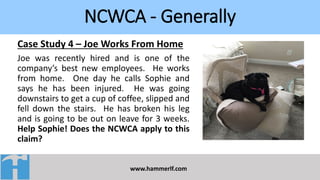
    NCWCA - Generally www.hammerlf.com CaseStudy 4 – Joe Works From Home Joe was recently hired and is one of the company’s best new employees. He works from home. One day he calls Sophie and says he has been injured. He was going downstairs to get a cup of coffee, slipped and fell down the stairs. He has broken his leg and is going to be out on leave for 3 weeks. Help Sophie! Does the NCWCA apply to this claim?
  • 38.
    NCWCA - Generally www.hammerlf.com Let’shelp Sophie! • NCWCA applies to telecommuters/remote employees • Injury must arise in course and scope of doing the job • Generally, a compensable injury for a remote employee involves immediate injury or injury sustained over time because of job duties (i.e., Carpal Tunnel Syndrome) • Falling down the stairs to get coffee would likely not be a covered injury for workers compensation did not occur while doing the job and was not related to job duties • Tell Sophie to err on the side of caution – call attorney or WC claims adjuster!
  • 39.
    NCWCA – Overlapwith FMLA/ADA www.hammerlf.com Best Practices for Employers – Approach to NCWCA Analysis: 1. Does NCWCA apply and is employee out of out of work due to a compensable workplace injury? 2. If answer to #1 is YES, is employee also entitled to FMLA-protected leave? • If YES, provide forms and notify employee FMLA-protected leave 3. If leave expires, or FMLA does not apply, does ADA apply? • If YES, is the employee entitled to leave as a reasonable accommodation under ADA? If so, engage in interactive process, document and advise employee appropriately
  • 40.
    Questions? www.hammerlf.com Holly E.R. Hammer 8313Six Forks Road, Suite 211 Raleigh, NC 27615 Phone: (919) 727-1509 Fax: (919) 727-1510 Email: holly@hammerlf.com www.hammerlf.com Visit me on LinkedIn: www.linkedin.com/in/hollyhammeresq