Future of
Learning
Technologies:
Putting it in its
place
Stephen Abram
Leatherstocking Conference:
Vernon NY
Nov. 19, 2015
2
These are
Millennials
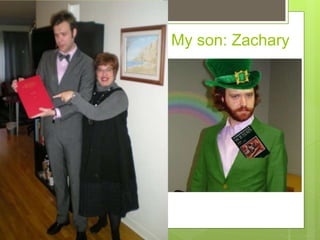
My son: Zachary
Nota Bene
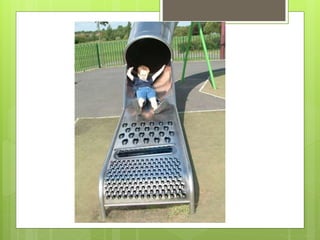
You’re dealing with post-
millennials and they’re very
different
And the same
Why Invest 60 minutes with Me?
 Librarian
 Technology and Digital Education Futurist
 Author, researcher, teacher, professor, board
member, start-ups, founder, etc.
 Learning object designer (MBA, Law, K-12,
Higher-Ed, corporate, etc.)
 SchoolRooms, eTextBooks, eBooks, Online
learning, MOOCs, Databases, Web, School&
Library Culture
The Big Picture
Change is just starting to increase
The education sector is a target (follow the money)
Student vs. Learner
Education vs. Learning
Credits vs. Lifelong Skills
School Librarians
 Faculty …Teachers
 Curriculum Leaders
 Administration
 Whole School
 High Impact
21st Century Learning
Based on research, demographics and need
This isn’t a fad – whether politics renames it or not.
Critical Thinking
What is critical thinking?
 “Critical thinking is that mode of thinking — about any
subject, content, or problem — in which the thinker
improves the quality of his or her thinking by skillfully
analyzing, assessing, and reconstructing it. Critical
thinking is self-directed, self-disciplined, self-monitored,
and self-corrective thinking. It presupposes assent to
rigorous standards of excellence and mindful command of
their use. It entails effective communication and problem-
solving abilities, as well as a commitment to overcome our
native egocentrism and sociocentrism.”
 http://www.criticalthinking.org/pages/our-concept-of-
critical-thinking/411
What is creative thinking?
 A way of looking at problems or situations from a
fresh perspective that suggests
unorthodox solutions (which may look unsettling
at first). Creative thinking can be stimulated
both by an unstructured process such
as brainstorming, and by a structured process
such as lateral thinking.
 http://www.businessdictionary.com/definition/crea
tive-thinking.html#ixzz2ZbaI9BaK
What is creative thinking?
 Creativity is a phenomenon whereby
something new and valuable is created (such
as an idea, a joke, a literary work, a painting
or musical composition, a solution, an
invention etc.). It is also the qualitative
impetus behind any given act of creation, and
it is generally perceived to be associated with
intelligence and cognition.
 https://en.wikipedia.org/wiki/Creativity
STEM, STEAM and the real
issue
National competitiveness
Silly focus on manufacturing and 20th Century
measurements (GDP)
Beyond 3R’s
3R’s are solidified by Grade 4 at the latest and then the
interventions happen
Beyond grade 4 we build thinkers, creators, and build on
their natural talents – to each his/her own
Real Issues
Technology
Scalability
Multiple intelligences / learning styles
Costs and impact
Training
Alignment
Equity
Real Issues
Students – boys and girls
Engagement – dropouts, fun, boredom.
Success
Employment and workplace or Higher-Ed readiness
Real Issues
Staff colleagues
Introduction of technology in a stressful workplace with multiple demands
Aging
Learning Curve
Tech readiness
Teamwork preparedness versus classroom sovereignty
Changing Learners
 Increased IQ
 Genetics and Learning Styles
 Gender issues and Developmental Differences
 Boys and Girls
 Reading is Up…
 Brain development –reasoning skills and frontal
lobe
 Demographics and diversity
 Games, gamification, lead . . .
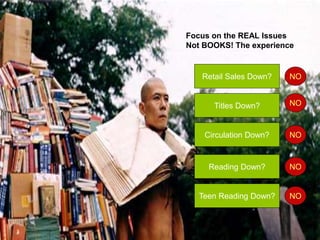
Retail Sales Down?
Teen Reading Down?
Titles Down?
Circulation Down?
Reading Down?
NO
NO
NO
NO
NO
Focus on the REAL Issues
Not BOOKS! The experience
Changing Education
 Flipped classroom
 E-Textbooks and coursepacks
 eLearning and digital learning environments are
proven successes
 Online high schools rising
 MOOCs
 Distance education
 Learning modules
 Blended learning
Impact Studies
150+ studies
 Dr. Keith Curry-Lance (CO)
 Dr. Ken Haycock (USC, UBC, SJSU)
 Dr. Ross Todd (Rutgers)
 Dr. Steve Krashen (UCLA)
 Dr. David Loertscher (SJSU)
 Worldwide and repeatedly
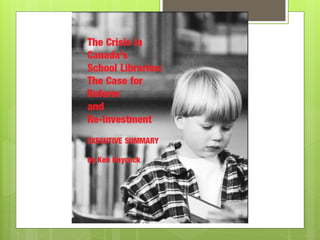
Do school libraries make a
difference?
 Yes. Simply yes and a big one.
 Standardized testing scores
 Second only to a parent reading to you.
 Public Library partnerships
 Summer reading, story hours, etc.
 Top and bottom of class
 Equity
 Digital/hybrid Strategy Leadership
Special Skills and Tools
Addressing:
Learning differences
Disability spectrum is about different abilities not disabilities
Behavioural differences
Intelligence- especially top and challenged learners
At their fingertips
 Consortial access at great savings effectiveness –
quality, real life search, structured
 ReadSpeak
 Font size
 Lexiles and search
 Search and Find
 Quality resources – primary secondary and tertiary
sources, non fiction, active collection
 Specialized targeted programs
 Fluid formats (e.g. for reading and learning issues)
Research and Network Effects
 Digital agnosticism
 NYPL,BPL, QBPL, NYDOE
 Vendor agnosticism (vs. Apple or Google
Education partnerships)
 Research on apps, sites, tools, smartphones,
tablets, 3D printing, etc.
 Learning standards
 Curriculum resources
 Copyright compliance and risk reduction
The Virtual Handout
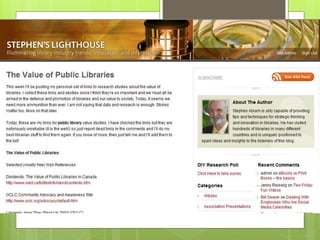
 The Value of Public Libraries
http://stephenslighthouse.com/2010/04/06/the-value-of-public-
libraries/
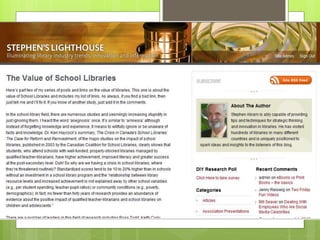
 The Value of School Libraries
http://stephenslighthouse.com/2010/04/06/the-value-of-school-
libraries/
 The Value of Academic and College Libraries
http://stephenslighthouse.com/2010/04/07/value-of-academic-
and-college-libraries/
 The Value of Special Libraries
http://stephenslighthouse.com/2010/04/07/value-of-special-
libraries/
 Library Advocacy: Save the Library Campaigns
http://stephenslighthouse.com/2010/04/01/save-the-library-
campaigns/
The Library as Sandbox
For leaners and Teachers
Stephen Abram, MLS, FSLA
Principal
Lighthouse Consulting
Cel: 416-669-4855
stephen.abram@gmail.com
Stephen’s Lighthouse Blog
http://stephenslighthouse.com

Leatherstocking keynote

  • 1.
    Future of Learning Technologies: Putting itin its place Stephen Abram Leatherstocking Conference: Vernon NY Nov. 19, 2015
  • 2.
  • 3.
  • 4.
  • 12.
    Nota Bene You’re dealingwith post- millennials and they’re very different And the same
  • 13.
    Why Invest 60minutes with Me?  Librarian  Technology and Digital Education Futurist  Author, researcher, teacher, professor, board member, start-ups, founder, etc.  Learning object designer (MBA, Law, K-12, Higher-Ed, corporate, etc.)  SchoolRooms, eTextBooks, eBooks, Online learning, MOOCs, Databases, Web, School& Library Culture
  • 14.
    The Big Picture Changeis just starting to increase The education sector is a target (follow the money)
  • 15.
  • 16.
  • 17.
  • 18.
    School Librarians  Faculty…Teachers  Curriculum Leaders  Administration  Whole School  High Impact
  • 19.
    21st Century Learning Basedon research, demographics and need This isn’t a fad – whether politics renames it or not.
  • 20.
  • 21.
    What is criticalthinking?  “Critical thinking is that mode of thinking — about any subject, content, or problem — in which the thinker improves the quality of his or her thinking by skillfully analyzing, assessing, and reconstructing it. Critical thinking is self-directed, self-disciplined, self-monitored, and self-corrective thinking. It presupposes assent to rigorous standards of excellence and mindful command of their use. It entails effective communication and problem- solving abilities, as well as a commitment to overcome our native egocentrism and sociocentrism.”  http://www.criticalthinking.org/pages/our-concept-of- critical-thinking/411
  • 22.
    What is creativethinking?  A way of looking at problems or situations from a fresh perspective that suggests unorthodox solutions (which may look unsettling at first). Creative thinking can be stimulated both by an unstructured process such as brainstorming, and by a structured process such as lateral thinking.  http://www.businessdictionary.com/definition/crea tive-thinking.html#ixzz2ZbaI9BaK
  • 23.
    What is creativethinking?  Creativity is a phenomenon whereby something new and valuable is created (such as an idea, a joke, a literary work, a painting or musical composition, a solution, an invention etc.). It is also the qualitative impetus behind any given act of creation, and it is generally perceived to be associated with intelligence and cognition.  https://en.wikipedia.org/wiki/Creativity
  • 24.
    STEM, STEAM andthe real issue National competitiveness Silly focus on manufacturing and 20th Century measurements (GDP)
  • 25.
    Beyond 3R’s 3R’s aresolidified by Grade 4 at the latest and then the interventions happen Beyond grade 4 we build thinkers, creators, and build on their natural talents – to each his/her own
  • 26.
    Real Issues Technology Scalability Multiple intelligences/ learning styles Costs and impact Training Alignment Equity
  • 27.
    Real Issues Students –boys and girls Engagement – dropouts, fun, boredom. Success Employment and workplace or Higher-Ed readiness
  • 28.
    Real Issues Staff colleagues Introductionof technology in a stressful workplace with multiple demands Aging Learning Curve Tech readiness Teamwork preparedness versus classroom sovereignty
  • 29.
    Changing Learners  IncreasedIQ  Genetics and Learning Styles  Gender issues and Developmental Differences  Boys and Girls  Reading is Up…  Brain development –reasoning skills and frontal lobe  Demographics and diversity  Games, gamification, lead . . .
  • 30.
    Retail Sales Down? TeenReading Down? Titles Down? Circulation Down? Reading Down? NO NO NO NO NO Focus on the REAL Issues Not BOOKS! The experience
  • 31.
    Changing Education  Flippedclassroom  E-Textbooks and coursepacks  eLearning and digital learning environments are proven successes  Online high schools rising  MOOCs  Distance education  Learning modules  Blended learning
  • 32.
  • 33.
    150+ studies  Dr.Keith Curry-Lance (CO)  Dr. Ken Haycock (USC, UBC, SJSU)  Dr. Ross Todd (Rutgers)  Dr. Steve Krashen (UCLA)  Dr. David Loertscher (SJSU)  Worldwide and repeatedly
  • 34.
    Do school librariesmake a difference?  Yes. Simply yes and a big one.  Standardized testing scores  Second only to a parent reading to you.  Public Library partnerships  Summer reading, story hours, etc.  Top and bottom of class  Equity  Digital/hybrid Strategy Leadership
  • 35.
    Special Skills andTools Addressing: Learning differences Disability spectrum is about different abilities not disabilities Behavioural differences Intelligence- especially top and challenged learners
  • 36.
    At their fingertips Consortial access at great savings effectiveness – quality, real life search, structured  ReadSpeak  Font size  Lexiles and search  Search and Find  Quality resources – primary secondary and tertiary sources, non fiction, active collection  Specialized targeted programs  Fluid formats (e.g. for reading and learning issues)
  • 37.
    Research and NetworkEffects  Digital agnosticism  NYPL,BPL, QBPL, NYDOE  Vendor agnosticism (vs. Apple or Google Education partnerships)  Research on apps, sites, tools, smartphones, tablets, 3D printing, etc.  Learning standards  Curriculum resources  Copyright compliance and risk reduction
  • 39.
    The Virtual Handout The Value of Public Libraries http://stephenslighthouse.com/2010/04/06/the-value-of-public- libraries/  The Value of School Libraries http://stephenslighthouse.com/2010/04/06/the-value-of-school- libraries/  The Value of Academic and College Libraries http://stephenslighthouse.com/2010/04/07/value-of-academic- and-college-libraries/  The Value of Special Libraries http://stephenslighthouse.com/2010/04/07/value-of-special- libraries/  Library Advocacy: Save the Library Campaigns http://stephenslighthouse.com/2010/04/01/save-the-library- campaigns/
  • 44.
    The Library asSandbox For leaners and Teachers
  • 45.
    Stephen Abram, MLS,FSLA Principal Lighthouse Consulting Cel: 416-669-4855 stephen.abram@gmail.com Stephen’s Lighthouse Blog http://stephenslighthouse.com