
Tim Rudd, Futurelab Learning Spaces Seminar
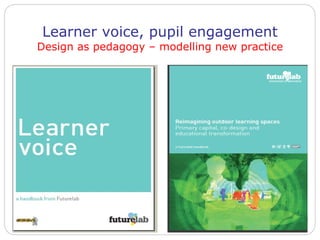
Learner voice, pupil engagement Design as pedagogy – modelling new practice
  Beyond Current Horizons  Information landscape -  “know more stuff about more stuff” - gather, store, use, share more data  Importance of geography  -   both less and more important Institutional boundaries -  weakened & porous; info not tied to institution; blurring ‘work’ & ‘leisure’ Socio-technological trends  – more communication, collaboration, content creation, social etc. ‘ Digital natives’ grow up  –   over   50% pop. 50+ by 2030?; extended life expectancy; adult-child relationships changing  Working with machines  – redefining intelligence; challenging dependencies
 
 
Discussion: Learning in the future How will we learn? Who with? When and what for? What skills and competencies? Spatial implications?
 
Should a school/learning space be a learning experience in and of itself? Intelligent, interactive, engaging, stimulating? Should the space be open 24/7/365? Does this have implications for ‘footprint’? Everyone in the same place and at same time? Should the space be a whole community space? Should it be one of a number of learning satellites or hubs?
Should learning be supported by a range of experts – remote, experts, communities of interest and practice? Will the role of expert and learner be transient and interchangeable?  Should any space be flexible for any ‘type’ of class/grouping?  Within the space should there be a range of different and flexible/re-configurable specific and generic learning spaces.
Should emphasis be more on building learners capacities rather than on fixed content.  Should learners be utilising more collaborative , communication and content creation tools? .  Should locative portable and locative technologies be used to increase dynamism and the degree of learning, information and play spaces available? Should we first design – experimental or ‘pilot’ learning spaces? Places for risk taking and failure?
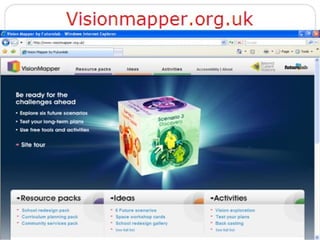
More from Futurelab : Resources/Publications: Thinking Space   (workshop resource)  www.futurelab.org.uk/resources/publications-reports-articles/handbooks/Handbook1570 What if..? Reimagining learning spaces   (Opening Education report) 'Live-lab Academy': a hypothetical case study  (Opening Education report) Reimagining outdoor learning spaces  (handbook) Transforming schools for the future  (provocation papers) Personalisation and Digital Technologies : (Opening Education Report) Fountaineers: Exploring the impact of whole-school co-design projects  (project and case study reports) Learner Voice handbook  (handbook) Learning spaces workshop cards  (workshop resource): http://www.visionmapper.org.uk/ideas/spaceworkshopcards.php School redesign pack  (workshop activities) http://www.visionmapper.org.uk/resource/schoolredesignpack.php   Podcasts: Reimagining the design of outdoor learning and play spaces  (January 2009) Reimagining teaching for the 21st century  (October 2008) Building Schools for the Future  (June 2008) Web articles: A school for the 21st century  - Kim Thomas (July 2009) All on board for an IKEA of learning spaces?  - Merlin John (March 2009) The management of chaos: flexible learning in an inflexible system  - Jim Fanning (February 2009)

Learning spaces seminar

  • 1.
    Tim Rudd, FuturelabLearning Spaces Seminar
  • 2.
    Learner voice, pupilengagement Design as pedagogy – modelling new practice
  • 3.
    BeyondCurrent Horizons Information landscape - “know more stuff about more stuff” - gather, store, use, share more data Importance of geography - both less and more important Institutional boundaries - weakened & porous; info not tied to institution; blurring ‘work’ & ‘leisure’ Socio-technological trends – more communication, collaboration, content creation, social etc. ‘ Digital natives’ grow up – over 50% pop. 50+ by 2030?; extended life expectancy; adult-child relationships changing Working with machines – redefining intelligence; challenging dependencies
  • 4.
  • 5.
  • 6.
    Discussion: Learning inthe future How will we learn? Who with? When and what for? What skills and competencies? Spatial implications?
  • 7.
  • 8.
    Should a school/learningspace be a learning experience in and of itself? Intelligent, interactive, engaging, stimulating? Should the space be open 24/7/365? Does this have implications for ‘footprint’? Everyone in the same place and at same time? Should the space be a whole community space? Should it be one of a number of learning satellites or hubs?
  • 9.
    Should learning besupported by a range of experts – remote, experts, communities of interest and practice? Will the role of expert and learner be transient and interchangeable? Should any space be flexible for any ‘type’ of class/grouping? Within the space should there be a range of different and flexible/re-configurable specific and generic learning spaces.
  • 10.
    Should emphasis bemore on building learners capacities rather than on fixed content. Should learners be utilising more collaborative , communication and content creation tools? . Should locative portable and locative technologies be used to increase dynamism and the degree of learning, information and play spaces available? Should we first design – experimental or ‘pilot’ learning spaces? Places for risk taking and failure?
  • 11.
    More from Futurelab: Resources/Publications: Thinking Space (workshop resource) www.futurelab.org.uk/resources/publications-reports-articles/handbooks/Handbook1570 What if..? Reimagining learning spaces (Opening Education report) 'Live-lab Academy': a hypothetical case study (Opening Education report) Reimagining outdoor learning spaces (handbook) Transforming schools for the future (provocation papers) Personalisation and Digital Technologies : (Opening Education Report) Fountaineers: Exploring the impact of whole-school co-design projects (project and case study reports) Learner Voice handbook (handbook) Learning spaces workshop cards (workshop resource): http://www.visionmapper.org.uk/ideas/spaceworkshopcards.php School redesign pack (workshop activities) http://www.visionmapper.org.uk/resource/schoolredesignpack.php   Podcasts: Reimagining the design of outdoor learning and play spaces (January 2009) Reimagining teaching for the 21st century (October 2008) Building Schools for the Future (June 2008) Web articles: A school for the 21st century - Kim Thomas (July 2009) All on board for an IKEA of learning spaces? - Merlin John (March 2009) The management of chaos: flexible learning in an inflexible system - Jim Fanning (February 2009)

Editor's Notes

  • #3 This book glows in the dark – how cool!!!