
MILAGE -MathematIcs
bLended Augmented GamE
INTERACTIVE MATHEMATICS BY
IMPLEMENTING A BLENDED-LEARNING
MODEL WITH AUGMENTED REALITY AND
GAME BOOKS
Universidade do Algarve
By José Bidarra
MILAGE - MathematIcs bLended Augmented Game
September 2015
Blended Learning
Perspectives
2
3
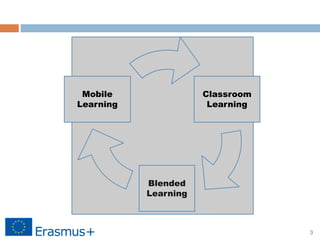
Classroom
Learning
Blended
Learning
Mobile
Learning
4
Context of a XXI Century literacy
 Digital Literacy – the ability to communicate with an ever-
expanding community to discuss issues, gather information,
and seek help;
 Global Literacy - the capacity to read, interpret, respond,
and contextualize messages from a global and networked
perspective;
 Technology Literacy - the ability to use computers and other
technology to improve learning, productivity, and
performance;
 Visual Literacy - the ability to understand, produce and
communicate through visual images;
 Information Literacy - the ability to find, evaluate and
synthesize information.
(Brown et al., 2005)
5
Digital lyfestyle & learning
 Analyze and produce digital information where and
when the user wants
 Master an operational knowledge about digital
media and global communications
 Make decisions in the context of an information
society
 Apply creative skills to solve new problems
(technological and methodological)
 Engage in collaborative work with other users
6
Pervasive learning
 Pervasive learning is a social process that
connects learners to communities consisting of
devices, people, and culture, so that students can
construct relevant and meaningful learning
experiences authoring specific content (text,
images, audio, video), in locations and at times
that they find meaningful and relevant.
 This allows learners to experience a continuous or
seamless learning process, across contexts,
integrating these various learning experiences by
means of the affordances reachable via mobile
and b-learning technology.
7
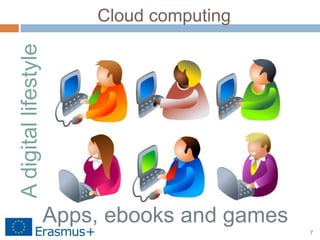
Cloud computing
Apps, ebooks and games
Adigitallifestyle
8
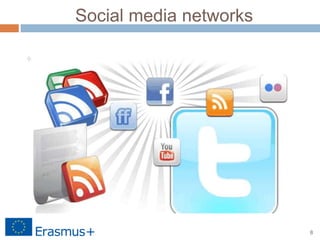
Social media networks
9
Educational technologies
 For the first time in history we have educational
technologies that cost nothing to governments
and schools:
 Smart mobile phones (most students have one);
 Networking software (freely available, e.g.
Hangouts, Messenger, Skype);
 Learning applications (freely and increasingly
available, e.g. Apple Store, Google Play);
 Open educational resources (in growing supply,
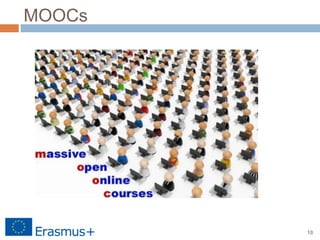
e.g. MOOCs, iTunes U, Khan Academy).
10
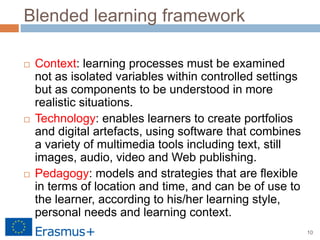
Blended learning framework
 Context: learning processes must be examined
not as isolated variables within controlled settings
but as components to be understood in more
realistic situations.
 Technology: enables learners to create portfolios
and digital artefacts, using software that combines
a variety of multimedia tools including text, still
images, audio, video and Web publishing.
 Pedagogy: models and strategies that are flexible
in terms of location and time, and can be of use to
the learner, according to his/her learning style,
personal needs and learning context.
11
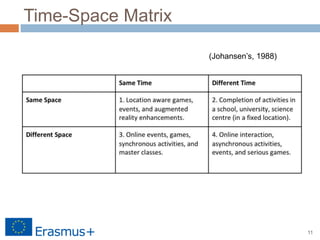
Time-Space Matrix
(Johansen’s, 1988)
12
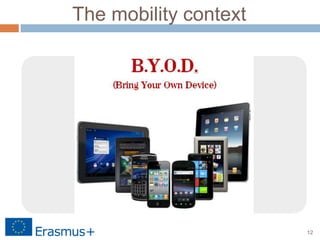
The mobility context
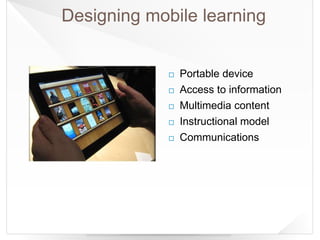
Designing mobile learning
 Portable device
 Access to information
 Multimedia content
 Instructional model
 Communications
14
Designing mobile learning
 mobile learning evolves around the social
environment of the student (sharing podcasts,
images, texts and notes),
 learning activities are mainly based on online
resources and on interaction with other people
(often through academic work);
 collaboration networks and group work are an
important aspect of mobile interaction anytime,
anywhere;
 the ease of instantly publishing content online
stimulates students to become researchers and
authors.
15
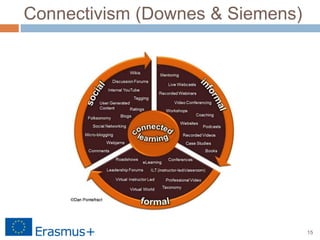
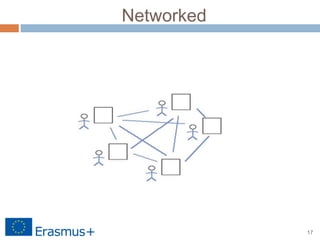
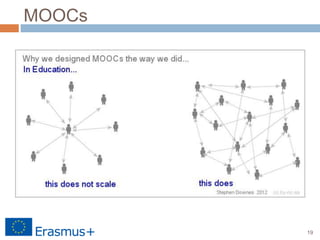
Connectivism (Downes & Siemens)
16
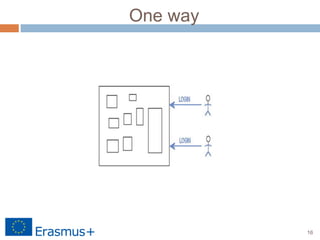
One way
17
Networked
18
MOOCs
19
MOOCs
20
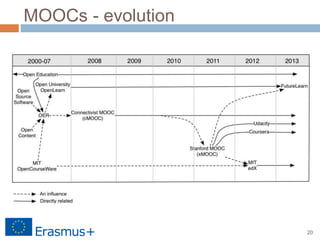
MOOCs - evolution
21
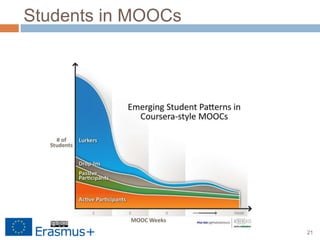
Students in MOOCs
22
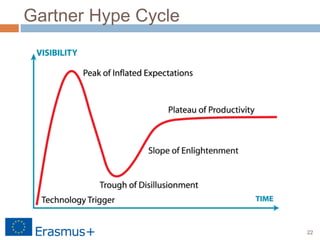
Gartner Hype Cycle
23
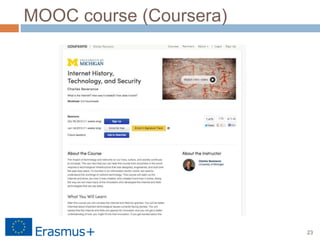
MOOC course (Coursera)
24
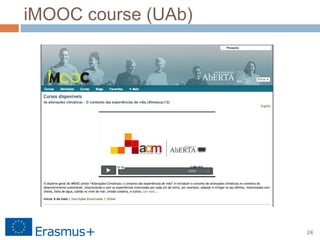
iMOOC course (UAb)
25
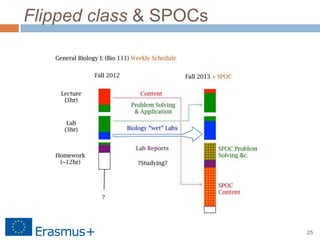
Flipped class & SPOCs
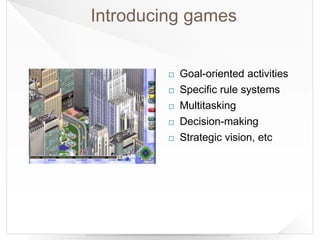
Introducing games
 Goal-oriented activities
 Specific rule systems
 Multitasking
 Decision-making
 Strategic vision, etc
27
Gamification
 "the use of game design elements in non-game
contexts" (Deterding et al., 2011, p.1)
 A common implementation of gamification is to
take the scoring elements of video games,
such as points, levels, and achievements, and
apply them to a work or educational context.
 The concept has been around for some time
through loyalty systems like frequent flyer
miles, green stamps, and library summer
reading programs.
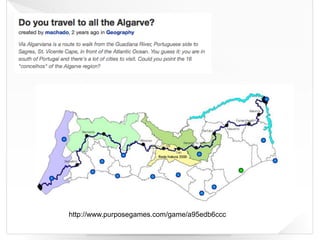
http://www.purposegames.com/game/a95edb6ccc
29
Digital storytelling
 Storytelling is based
on a set of four
elements that are still
valid in the digital age:
 A narrator
 A plot
 A setting
 Characters
 There is usually a
conflict of some kind,
for example:
 Conflict between one
person and another or
between groups;
 Conflict between a
person and the natural
environment;
 Conflict between an
individual and the
society.
30
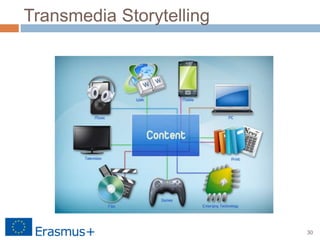
Transmedia Storytelling
31
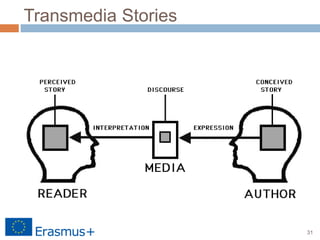
Transmedia Stories
32
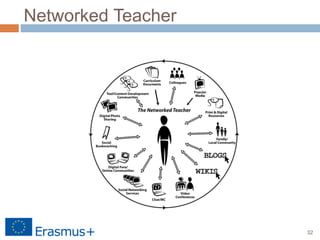
Networked Teacher
Thank you
bidarra@gmail.com

Blended Learning Perspectives

  • 1.
    MILAGE -MathematIcs bLended AugmentedGamE INTERACTIVE MATHEMATICS BY IMPLEMENTING A BLENDED-LEARNING MODEL WITH AUGMENTED REALITY AND GAME BOOKS Universidade do Algarve
  • 2.
    By José Bidarra MILAGE- MathematIcs bLended Augmented Game September 2015 Blended Learning Perspectives 2
  • 3.
  • 4.
    4 Context of aXXI Century literacy  Digital Literacy – the ability to communicate with an ever- expanding community to discuss issues, gather information, and seek help;  Global Literacy - the capacity to read, interpret, respond, and contextualize messages from a global and networked perspective;  Technology Literacy - the ability to use computers and other technology to improve learning, productivity, and performance;  Visual Literacy - the ability to understand, produce and communicate through visual images;  Information Literacy - the ability to find, evaluate and synthesize information. (Brown et al., 2005)
  • 5.
    5 Digital lyfestyle &learning  Analyze and produce digital information where and when the user wants  Master an operational knowledge about digital media and global communications  Make decisions in the context of an information society  Apply creative skills to solve new problems (technological and methodological)  Engage in collaborative work with other users
  • 6.
    6 Pervasive learning  Pervasivelearning is a social process that connects learners to communities consisting of devices, people, and culture, so that students can construct relevant and meaningful learning experiences authoring specific content (text, images, audio, video), in locations and at times that they find meaningful and relevant.  This allows learners to experience a continuous or seamless learning process, across contexts, integrating these various learning experiences by means of the affordances reachable via mobile and b-learning technology.
  • 7.
    7 Cloud computing Apps, ebooksand games Adigitallifestyle
  • 8.
  • 9.
    9 Educational technologies  Forthe first time in history we have educational technologies that cost nothing to governments and schools:  Smart mobile phones (most students have one);  Networking software (freely available, e.g. Hangouts, Messenger, Skype);  Learning applications (freely and increasingly available, e.g. Apple Store, Google Play);  Open educational resources (in growing supply, e.g. MOOCs, iTunes U, Khan Academy).
  • 10.
    10 Blended learning framework Context: learning processes must be examined not as isolated variables within controlled settings but as components to be understood in more realistic situations.  Technology: enables learners to create portfolios and digital artefacts, using software that combines a variety of multimedia tools including text, still images, audio, video and Web publishing.  Pedagogy: models and strategies that are flexible in terms of location and time, and can be of use to the learner, according to his/her learning style, personal needs and learning context.
  • 11.
  • 12.
  • 13.
    Designing mobile learning Portable device  Access to information  Multimedia content  Instructional model  Communications
  • 14.
    14 Designing mobile learning mobile learning evolves around the social environment of the student (sharing podcasts, images, texts and notes),  learning activities are mainly based on online resources and on interaction with other people (often through academic work);  collaboration networks and group work are an important aspect of mobile interaction anytime, anywhere;  the ease of instantly publishing content online stimulates students to become researchers and authors.
  • 15.
  • 16.
  • 17.
  • 18.
  • 19.
  • 20.
  • 21.
  • 22.
  • 23.
  • 24.
  • 25.
  • 26.
    Introducing games  Goal-orientedactivities  Specific rule systems  Multitasking  Decision-making  Strategic vision, etc
  • 27.
    27 Gamification  "the useof game design elements in non-game contexts" (Deterding et al., 2011, p.1)  A common implementation of gamification is to take the scoring elements of video games, such as points, levels, and achievements, and apply them to a work or educational context.  The concept has been around for some time through loyalty systems like frequent flyer miles, green stamps, and library summer reading programs.
  • 28.
  • 29.
    29 Digital storytelling  Storytellingis based on a set of four elements that are still valid in the digital age:  A narrator  A plot  A setting  Characters  There is usually a conflict of some kind, for example:  Conflict between one person and another or between groups;  Conflict between a person and the natural environment;  Conflict between an individual and the society.
  • 30.
  • 31.
  • 32.
  • 33.

Editor's Notes

  • #15 (for example, when interacting in Facebook, Twitter, Flicker or YouTube).