Learning Cornish in Arizona


                              Drew Wills
                      Welsh League of Arizona
           Irish Cultural Center, May 7th, 2011
Prag y Tyskav Kernewek?

• Lifetime interest in ancient languages
• Always wanted to learn a Celtic language in
  particular
• Appreciate the (considerable) challenge
• Family connection
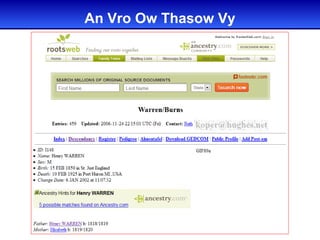
An Vro Ow Thasow Vy
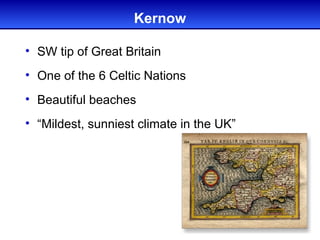
Kernow

• SW tip of Great Britain
• One of the 6 Celtic Nations
• Beautiful beaches
• “Mildest, sunniest climate in the UK”
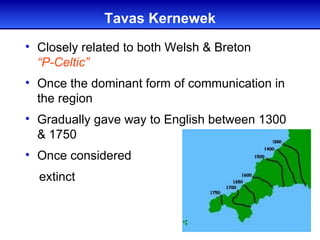
Tavas Kernewek
• Closely related to both Welsh & Breton
  “P-Celtic”
• Once the dominant form of communication in
  the region
• Gradually gave way to English between 1300
  & 1750
• Once considered
  extinct
Oft-Quoted, Oft-disputed Claims

• Chesten Marchant: last monoglot speaker(?),
  d. 1676 Gwithian
• Dorothy Pentreath: last native speaker, d.
  1777 Mousehole
• William Bodinar: learned as a boy, d. 1794
• John Davey: last person taught by a native
  speaker, d. 1891 Zennor
William Bodinar's letter (1776)
[Ow] bloedh vy [yw] tri ugens ha pymp.
Yth esov vy den boghosek an puskes.
My a wrug dyski Kernewek [y'n] termyn [ha] my a veu maw.
My a veu dhe'n mor gans [ow] sira vy ha pymp den moy y'n kok.
My a wrug skantlowr klywes unn ger Sowsnek y'n kok rag seythun
warbarth.
Ny wruga vy bythkweyth gweles lyver Kernewek.
My a wrug dyski Kernewek ow mos dhe'n mor gans tus koth.
Nyns eus moy es peswar po pymp y'n trev ni a yll klappya Kernewek
lemmyn,
pobel goth peswar ugens bloedh.
Kernewek yw oll ankevys gans pobel yowynk.
Cornish Revival

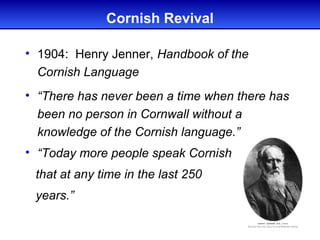
• 1904: Henry Jenner, Handbook of the
  Cornish Language
• “There has never been a time when there has
  been no person in Cornwall without a
  knowledge of the Cornish language.”
• “Today more people speak Cornish
 that at any time in the last 250
 years.”
Language Features

• Initial consonant mutation
• Inflected prepositions
• Long & short forms of bos (to be)
• 3rd-person singular verb form for all subjects
  in simple, affirmative sentences
• No word for “yes” or “no”
Lytherennansow

• Unified Cornish [UC]: early 1900s, based on
  Middle Cornish (14th & 15th cent.)
• Modern Cornish [MC]: 1980s, based on
  latest written examples (17th & 18th cent.)
• Kernewek Kemmyn [KK]: 1986, Middle
  Cornish base, but with phonetic spelling;
  adopted by Kesva an Tavas Kernewek as
  their preferred system
Lytherennansow

• Unified Cornish Revised [UCR]: 1995, a re-boot
  of UC with more regular spellings
-Independent Cornish Lang. Commission (2007)-
• Kernowek Standard [KS]: based on traditional
  orthographic forms, phonetic spelling
• Standard Written Form [SWF]: Ratified May,
  2008, by all represented parties as a standard
  for public life
Lavarow

Dydh da Hello
Myttin da Good morning
Dha weles See you (1 person)
Agas gweles See you (more than 1 person)
Mar pleg Please
Meur ras Thank you
Penn bloodh lowen! Happy birth day!
Chons da! Good luck!
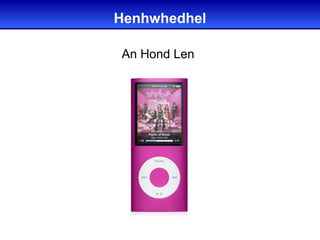
Henhwhedhel

An Hond Len
Govynnow?


  Drew Wills
  wills.drew@gmail.com

Learning Cornish in Arizona

  • 1.
    Learning Cornish inArizona Drew Wills Welsh League of Arizona Irish Cultural Center, May 7th, 2011
  • 2.
    Prag y TyskavKernewek? • Lifetime interest in ancient languages • Always wanted to learn a Celtic language in particular • Appreciate the (considerable) challenge • Family connection
  • 3.
    An Vro OwThasow Vy
  • 4.
    Kernow • SW tipof Great Britain • One of the 6 Celtic Nations • Beautiful beaches • “Mildest, sunniest climate in the UK”
  • 5.
    Tavas Kernewek • Closelyrelated to both Welsh & Breton “P-Celtic” • Once the dominant form of communication in the region • Gradually gave way to English between 1300 & 1750 • Once considered extinct
  • 6.
    Oft-Quoted, Oft-disputed Claims •Chesten Marchant: last monoglot speaker(?), d. 1676 Gwithian • Dorothy Pentreath: last native speaker, d. 1777 Mousehole • William Bodinar: learned as a boy, d. 1794 • John Davey: last person taught by a native speaker, d. 1891 Zennor
  • 7.
    William Bodinar's letter(1776) [Ow] bloedh vy [yw] tri ugens ha pymp. Yth esov vy den boghosek an puskes. My a wrug dyski Kernewek [y'n] termyn [ha] my a veu maw. My a veu dhe'n mor gans [ow] sira vy ha pymp den moy y'n kok. My a wrug skantlowr klywes unn ger Sowsnek y'n kok rag seythun warbarth. Ny wruga vy bythkweyth gweles lyver Kernewek. My a wrug dyski Kernewek ow mos dhe'n mor gans tus koth. Nyns eus moy es peswar po pymp y'n trev ni a yll klappya Kernewek lemmyn, pobel goth peswar ugens bloedh. Kernewek yw oll ankevys gans pobel yowynk.
  • 8.
    Cornish Revival • 1904:Henry Jenner, Handbook of the Cornish Language • “There has never been a time when there has been no person in Cornwall without a knowledge of the Cornish language.” • “Today more people speak Cornish that at any time in the last 250 years.”
  • 9.
    Language Features • Initialconsonant mutation • Inflected prepositions • Long & short forms of bos (to be) • 3rd-person singular verb form for all subjects in simple, affirmative sentences • No word for “yes” or “no”
  • 10.
    Lytherennansow • Unified Cornish[UC]: early 1900s, based on Middle Cornish (14th & 15th cent.) • Modern Cornish [MC]: 1980s, based on latest written examples (17th & 18th cent.) • Kernewek Kemmyn [KK]: 1986, Middle Cornish base, but with phonetic spelling; adopted by Kesva an Tavas Kernewek as their preferred system
  • 11.
    Lytherennansow • Unified CornishRevised [UCR]: 1995, a re-boot of UC with more regular spellings -Independent Cornish Lang. Commission (2007)- • Kernowek Standard [KS]: based on traditional orthographic forms, phonetic spelling • Standard Written Form [SWF]: Ratified May, 2008, by all represented parties as a standard for public life
  • 12.
    Lavarow Dydh da Hello Myttinda Good morning Dha weles See you (1 person) Agas gweles See you (more than 1 person) Mar pleg Please Meur ras Thank you Penn bloodh lowen! Happy birth day! Chons da! Good luck!
  • 13.
  • 14.
    Govynnow? DrewWills wills.drew@gmail.com