LEADING
PHILOSOPHERS
REPORTER: MICHELLEG. ANTOQUE
PLATO
• The Athenian logician Plato (c. 428–347 BC)
is a standout amongst ancient Greek
philosophers, and his ideas have formed the
basis of much Western ideology.
• He was a student of Socrates and he
carried on many of Socrates’ teachings
in his work. He established the Academy,
thought to be the world’s first college,
and in it he taught his most noteworthy
student, Aristotle.
1. Established the First University in Europe
• The Akademia or the Academy was established
outside the city limits of old Athens and offered a
wide range of subjects taught by experts in their
field. The Academy was thought to be the principal
college in Europe and attracted scholars such as
Eudoxus of Cnidus and Theaetetus, both
mathematicians, and Aristotle, the philosopher.
GREATEST CONTRIBUTIONS OF PLATO
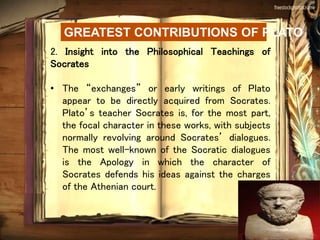
2. Insight into the Philosophical Teachings of
Socrates
• The “exchanges” or early writings of Plato
appear to be directly acquired from Socrates.
Plato’s teacher Socrates is, for the most part,
the focal character in these works, with subjects
normally revolving around Socrates’ dialogues.
The most well-known of the Socratic dialogues
is the Apology in which the character of
Socrates defends his ideas against the charges
of the Athenian court.
3. The Theory of Forms
• The idea of structure is key to Plato’s
philosophy and may be directly linked to the
teachings of Socrates. The idea is that non-
physical forms, or ideas, are the most accurate
reality, and the marvels of the physical world are
an imperfect reverberation of the ideal, perfect
model that exists outside of reality.
• In his work Republic, Plato demonstrates this
theory of forms in a representation called “The
Allegory of the Cave.”
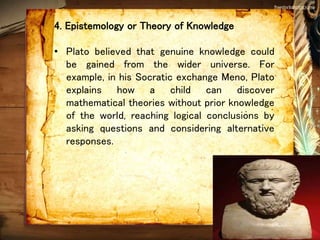
4. Epistemology or Theory of Knowledge
• Plato believed that genuine knowledge could
be gained from the wider universe. For
example, in his Socratic exchange Meno, Plato
explains how a child can discover
mathematical theories without prior knowledge
of the world, reaching logical conclusions by
asking questions and considering alternative
responses.
5. Division of Labor
• Plato recognized the need for humans to
work together in society for mutual benefit
and profit. He believed that everyone had
different skills and attributes, and these
could be combined to meet the needs of the
whole of society.
6. Politics
• Following on from the division of labor and the
three main types of people in society, Plato
was able to establish a political and economic
model which worked for the benefit of all. In
this society, people could work together for
mutual gain, which would, in turn, lead to a
prosperous and thriving political and economic
structure.
7. Platonic Love
• Plato investigates different perspectives through
these characters. The character of Socrates talks
about how men should begin with an attachment to a
specific individual, which then leads to love and
admiration of their physical and moral excellence.
One should also adore an individual for their
knowledge and, lastly, cherish and welcome their
individuality.
8. Craftsmanship and Verse
• In the Republic, Plato often objects to Homer’s
verse, but in his Ion, the character of Socrates
gives no trace of this criticism.
• The Ion proposes that Homer’s Iliad had a
similar role in the ancient Greek world to the
Bible today: It was inspired by the supernatural
yet still performed the function of a moral
discourse.
9. Purposeful Anecdotes
• Plato recognized that fantasy often depended on
logical thinking and could lead to a clear
understanding of a subject. He believed that
while philosophical discourse was limited to just
a few intellectuals, everyone could understand
these arguments if they were presented as
stories. Plato based some of his fantasies on old
stories, some he adapted, and some he made
up himself.
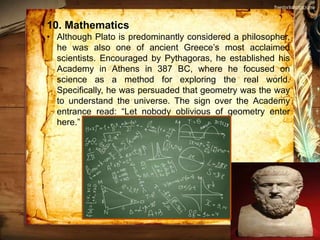
10. Mathematics
• Although Plato is predominantly considered a philosopher,
he was also one of ancient Greece’s most acclaimed
scientists. Encouraged by Pythagoras, he established his
Academy in Athens in 387 BC, where he focused on
science as a method for exploring the real world.
Specifically, he was persuaded that geometry was the way
to understand the universe. The sign over the Academy
entrance read: “Let nobody oblivious of geometry enter
here.”
12. Laws and Timaeus
• Plato’s Timaeus is famous for documenting the
creation of the universe by the demiurge. In contrast to
the medieval creation stories, Plato’s demiurge does
not make the universe out of nothing but creates it from
essential matter similar to eternal forms.
• Plato takes the four elements – fire, air, water, and
earth – and states that these are combined into what
he calls the “body of the universe”.
• Out of all of Plato’s works, the Timaeus deals most
directly with what we regard as the essential sciences
such as material science, space science, etc.
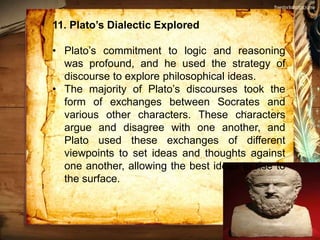
11. Plato’s Dialectic Explored
• Plato’s commitment to logic and reasoning
was profound, and he used the strategy of
discourse to explore philosophical ideas.
• The majority of Plato’s discourses took the
form of exchanges between Socrates and
various other characters. These characters
argue and disagree with one another, and
Plato used these exchanges of different
viewpoints to set ideas and thoughts against
one another, allowing the best ideas to rise to
the surface.
LUTHER
Martin Luther (1483 – 1546) was a German professor of
theology, monk and hymnodist whose actions and
teachings led to the Protestant Reformation, the
movement that caused a split in Christianity between
Roman Catholicism and Protestantism.
MAJOR CONTRIBUTIONS
1. HE PROTESTED SUCCESSFULLY AGAINST THE CORRUPT
PRACTICE OF INDULGENCES
2.HE WROTE THE HUGELY INFLUENTIAL NINETY-FIVE
THESES
French philosopher Michel de Montaigne was a
significant figure of the French Renaissance in the 16th
century. He is credited for popularizing the essay as a
literary genre. His massive collection of essays was
published in the volume Essais. His work had a direct
influence on Western writers, including René Descartes,
Francis Bacon, Blaise Pascal, and Voltaire.
3. MARTIN LUTHER STOOD FIRM ON HIS STANCE AT
THE DIET OF WORMS
French philosopher Michel de Montaigne was a
significant figure of the French Renaissance in the 16th
century. He is credited for popularizing the essay as a
literary genre. His massive collection of essays was
published in the volume Essais. His work had a direct
influence on Western writers, including René Descartes,
Francis Bacon, Blaise Pascal, and Voltaire.
4. HE PUT FORWARD MANY IDEAS WHICH WERE HIGHLY
RADICAL FOR THE TIME
5. LUTHER BIBLE WAS WIDELY READ SPREADING ITS
TEACHING TO THE COMMON PEOPLE
French philosopher Michel de Montaigne was a
significant figure of the French Renaissance in the 16th
century. He is credited for popularizing the essay as a
literary genre. His massive collection of essays was
published in the volume Essais. His work had a direct
influence on Western writers, including René Descartes,
Francis Bacon, Blaise Pascal, and Voltaire.
6. HE WROTE THE LARGE AND THE SMALL CATECHISMS
7. LUTHER IS REGARDED AS A PIONEER OF PROTESTANT
HYMNODY
French philosopher Michel de Montaigne was a
significant figure of the French Renaissance in the 16th
century. He is credited for popularizing the essay as a
literary genre. His massive collection of essays was
published in the volume Essais. His work had a direct
influence on Western writers, including René Descartes,
Francis Bacon, Blaise Pascal, and Voltaire.
8. HE MADE HYMNS AN INTEGRAL PART OF LUTHERANISM
9. HE IS ONE OF THE MOST INFLUENTIAL FIGURES IN HISTORY
OF CHRISTIANITY
10. LUTHERANISM REMAINS ONE OF THE LARGEST
PROTESTANT TRADITIONS.
ERASMUS
ERASMUS
• Desiderius Erasmus was one of the leading activists and
thinkers of the European Renaissance. His main activity was
to write letters to the leading statesmen, humanists, printers,
and theologians of the first three and a half decades of the
sixteenth century.
• Erasmus was an indefatigable correspondent, controversialist,
self-publicist, satirist, translator, commentator, editor, and
provocateur of Renaissance culture.
• He was perhaps above all renowned and repudiated for his
work on the Christian New Testament. He was not a
systematic thinker, and he did not found a system or school
of philosophy.
• Desiderius Erasmus is considered to be one of
the greatest scholars of the Renaissance. He
contributed to the Renaissance by revising
ancient works and translating them into Greek
and Latin.
• During his lifetime, Erasmus also contributed to
the Reformation by calling for reform in the
Church through his various works. He was a
prolific writer and exerted such great influence
during his time that he was called “The Prince of
the Humanists.”
GREATEST CONTRIBUTIONS OF ERASMUS
MONTAIGNE
• Michel de Montaigne was one of the most influential
writers of the French Renaissance. He is known for popularizing
the essay as a literary genre and is popularly thought of as the
father of Modern Skepticism.
• He was very popular for his smooth capability to combine serious
intellectual speculation with casual anecdotes and autobiography.
• In both the form and content of his large volume work Essais,
Montaigne achieved a remarkable combination of inner tranquility
and detachment, together with the independence and freedom of
an unfettered mind. For the social historian, his Essais and Travel
Journey are invaluable sources for glimpses of daily life in
sixteenth-century Europe.
Leading Philosophers.pptx

Leading Philosophers.pptx

  • 1.
  • 2.
  • 3.
    • The Athenianlogician Plato (c. 428–347 BC) is a standout amongst ancient Greek philosophers, and his ideas have formed the basis of much Western ideology. • He was a student of Socrates and he carried on many of Socrates’ teachings in his work. He established the Academy, thought to be the world’s first college, and in it he taught his most noteworthy student, Aristotle.
  • 4.
    1. Established theFirst University in Europe • The Akademia or the Academy was established outside the city limits of old Athens and offered a wide range of subjects taught by experts in their field. The Academy was thought to be the principal college in Europe and attracted scholars such as Eudoxus of Cnidus and Theaetetus, both mathematicians, and Aristotle, the philosopher. GREATEST CONTRIBUTIONS OF PLATO
  • 5.
    GREATEST CONTRIBUTIONS OFPLATO 2. Insight into the Philosophical Teachings of Socrates • The “exchanges” or early writings of Plato appear to be directly acquired from Socrates. Plato’s teacher Socrates is, for the most part, the focal character in these works, with subjects normally revolving around Socrates’ dialogues. The most well-known of the Socratic dialogues is the Apology in which the character of Socrates defends his ideas against the charges of the Athenian court.
  • 6.
    3. The Theoryof Forms • The idea of structure is key to Plato’s philosophy and may be directly linked to the teachings of Socrates. The idea is that non- physical forms, or ideas, are the most accurate reality, and the marvels of the physical world are an imperfect reverberation of the ideal, perfect model that exists outside of reality. • In his work Republic, Plato demonstrates this theory of forms in a representation called “The Allegory of the Cave.”
  • 7.
    4. Epistemology orTheory of Knowledge • Plato believed that genuine knowledge could be gained from the wider universe. For example, in his Socratic exchange Meno, Plato explains how a child can discover mathematical theories without prior knowledge of the world, reaching logical conclusions by asking questions and considering alternative responses.
  • 8.
    5. Division ofLabor • Plato recognized the need for humans to work together in society for mutual benefit and profit. He believed that everyone had different skills and attributes, and these could be combined to meet the needs of the whole of society.
  • 9.
    6. Politics • Followingon from the division of labor and the three main types of people in society, Plato was able to establish a political and economic model which worked for the benefit of all. In this society, people could work together for mutual gain, which would, in turn, lead to a prosperous and thriving political and economic structure.
  • 10.
    7. Platonic Love •Plato investigates different perspectives through these characters. The character of Socrates talks about how men should begin with an attachment to a specific individual, which then leads to love and admiration of their physical and moral excellence. One should also adore an individual for their knowledge and, lastly, cherish and welcome their individuality.
  • 11.
    8. Craftsmanship andVerse • In the Republic, Plato often objects to Homer’s verse, but in his Ion, the character of Socrates gives no trace of this criticism. • The Ion proposes that Homer’s Iliad had a similar role in the ancient Greek world to the Bible today: It was inspired by the supernatural yet still performed the function of a moral discourse.
  • 12.
    9. Purposeful Anecdotes •Plato recognized that fantasy often depended on logical thinking and could lead to a clear understanding of a subject. He believed that while philosophical discourse was limited to just a few intellectuals, everyone could understand these arguments if they were presented as stories. Plato based some of his fantasies on old stories, some he adapted, and some he made up himself.
  • 13.
    10. Mathematics • AlthoughPlato is predominantly considered a philosopher, he was also one of ancient Greece’s most acclaimed scientists. Encouraged by Pythagoras, he established his Academy in Athens in 387 BC, where he focused on science as a method for exploring the real world. Specifically, he was persuaded that geometry was the way to understand the universe. The sign over the Academy entrance read: “Let nobody oblivious of geometry enter here.”
  • 14.
    12. Laws andTimaeus • Plato’s Timaeus is famous for documenting the creation of the universe by the demiurge. In contrast to the medieval creation stories, Plato’s demiurge does not make the universe out of nothing but creates it from essential matter similar to eternal forms. • Plato takes the four elements – fire, air, water, and earth – and states that these are combined into what he calls the “body of the universe”. • Out of all of Plato’s works, the Timaeus deals most directly with what we regard as the essential sciences such as material science, space science, etc.
  • 15.
    11. Plato’s DialecticExplored • Plato’s commitment to logic and reasoning was profound, and he used the strategy of discourse to explore philosophical ideas. • The majority of Plato’s discourses took the form of exchanges between Socrates and various other characters. These characters argue and disagree with one another, and Plato used these exchanges of different viewpoints to set ideas and thoughts against one another, allowing the best ideas to rise to the surface.
  • 16.
  • 17.
    Martin Luther (1483– 1546) was a German professor of theology, monk and hymnodist whose actions and teachings led to the Protestant Reformation, the movement that caused a split in Christianity between Roman Catholicism and Protestantism.
  • 18.
    MAJOR CONTRIBUTIONS 1. HEPROTESTED SUCCESSFULLY AGAINST THE CORRUPT PRACTICE OF INDULGENCES
  • 19.
    2.HE WROTE THEHUGELY INFLUENTIAL NINETY-FIVE THESES
  • 20.
    French philosopher Michelde Montaigne was a significant figure of the French Renaissance in the 16th century. He is credited for popularizing the essay as a literary genre. His massive collection of essays was published in the volume Essais. His work had a direct influence on Western writers, including René Descartes, Francis Bacon, Blaise Pascal, and Voltaire. 3. MARTIN LUTHER STOOD FIRM ON HIS STANCE AT THE DIET OF WORMS
  • 21.
    French philosopher Michelde Montaigne was a significant figure of the French Renaissance in the 16th century. He is credited for popularizing the essay as a literary genre. His massive collection of essays was published in the volume Essais. His work had a direct influence on Western writers, including René Descartes, Francis Bacon, Blaise Pascal, and Voltaire. 4. HE PUT FORWARD MANY IDEAS WHICH WERE HIGHLY RADICAL FOR THE TIME 5. LUTHER BIBLE WAS WIDELY READ SPREADING ITS TEACHING TO THE COMMON PEOPLE
  • 22.
    French philosopher Michelde Montaigne was a significant figure of the French Renaissance in the 16th century. He is credited for popularizing the essay as a literary genre. His massive collection of essays was published in the volume Essais. His work had a direct influence on Western writers, including René Descartes, Francis Bacon, Blaise Pascal, and Voltaire. 6. HE WROTE THE LARGE AND THE SMALL CATECHISMS 7. LUTHER IS REGARDED AS A PIONEER OF PROTESTANT HYMNODY
  • 23.
    French philosopher Michelde Montaigne was a significant figure of the French Renaissance in the 16th century. He is credited for popularizing the essay as a literary genre. His massive collection of essays was published in the volume Essais. His work had a direct influence on Western writers, including René Descartes, Francis Bacon, Blaise Pascal, and Voltaire. 8. HE MADE HYMNS AN INTEGRAL PART OF LUTHERANISM 9. HE IS ONE OF THE MOST INFLUENTIAL FIGURES IN HISTORY OF CHRISTIANITY 10. LUTHERANISM REMAINS ONE OF THE LARGEST PROTESTANT TRADITIONS.
  • 24.
  • 25.
    • Desiderius Erasmuswas one of the leading activists and thinkers of the European Renaissance. His main activity was to write letters to the leading statesmen, humanists, printers, and theologians of the first three and a half decades of the sixteenth century. • Erasmus was an indefatigable correspondent, controversialist, self-publicist, satirist, translator, commentator, editor, and provocateur of Renaissance culture. • He was perhaps above all renowned and repudiated for his work on the Christian New Testament. He was not a systematic thinker, and he did not found a system or school of philosophy.
  • 26.
    • Desiderius Erasmusis considered to be one of the greatest scholars of the Renaissance. He contributed to the Renaissance by revising ancient works and translating them into Greek and Latin. • During his lifetime, Erasmus also contributed to the Reformation by calling for reform in the Church through his various works. He was a prolific writer and exerted such great influence during his time that he was called “The Prince of the Humanists.” GREATEST CONTRIBUTIONS OF ERASMUS
  • 27.
  • 28.
    • Michel deMontaigne was one of the most influential writers of the French Renaissance. He is known for popularizing the essay as a literary genre and is popularly thought of as the father of Modern Skepticism. • He was very popular for his smooth capability to combine serious intellectual speculation with casual anecdotes and autobiography. • In both the form and content of his large volume work Essais, Montaigne achieved a remarkable combination of inner tranquility and detachment, together with the independence and freedom of an unfettered mind. For the social historian, his Essais and Travel Journey are invaluable sources for glimpses of daily life in sixteenth-century Europe.