LEADERSHIP AND
TRUST
Chapter 9
Group 3
LEARNING OBJECTIVES :
1. Contrast leadership and management.
2. Summarize the conclusions of trait theories of leadership.
3. Identify the central tenets and main limitations of behavioral theories.
4. Assess contingency theories of leadership by their level of support.
5. Contrast charismatic and transformational leadership.
6. Describe the roles of ethics and trust in authentic leadership.
7. Demonstrate the role mentoring plays in our understanding of leadership.
8. Address challenges to the effectiveness of leadership.
9. Describe how organizations can find or create effective leaders.
After studying this chapter, you should be able to:
2
3
WHAT IS
LEADERSHIP?
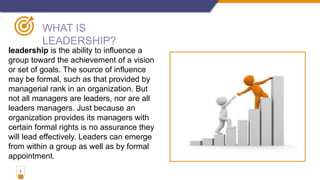
leadership is the ability to influence a
group toward the achievement of a vision
or set of goals. The source of influence
may be formal, such as that provided by
managerial rank in an organization. But
not all managers are leaders, nor are all
leaders managers. Just because an
organization provides its managers with
certain formal rights is no assurance they
will lead effectively. Leaders can emerge
from within a group as well as by formal
appointment.
Difference between leadership and
management
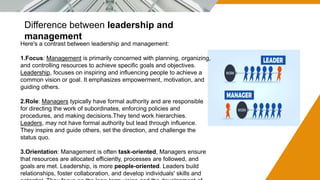
Here's a contrast between leadership and management:
1.Focus: Management is primarily concerned with planning, organizing,
and controlling resources to achieve specific goals and objectives.
Leadership, focuses on inspiring and influencing people to achieve a
common vision or goal. It emphasizes empowerment, motivation, and
guiding others.
2.Role: Managers typically have formal authority and are responsible
for directing the work of subordinates, enforcing policies and
procedures, and making decisions.They tend work hierarchies.
Leaders, may not have formal authority but lead through influence.
They inspire and guide others, set the direction, and challenge the
status quo.
3.Orientation: Management is often task-oriented, Managers ensure
that resources are allocated efficiently, processes are followed, and
goals are met. Leadership, is more people-oriented. Leaders build
relationships, foster collaboration, and develop individuals' skills and
5
TRAIT THEORIES
Strong leaders have been described by their
traits. Therefore, leadership research has long
sought to identify the personality, social,
physical, or intellectual attributes that
differentiate leaders from non-leaders. In
recent research, the trait theories of leadership
focus on personal qualities and characteristics,
some of which have been shown to be
particularly predictive of leadership ability.
6
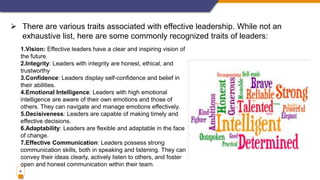
 There are various traits associated with effective leadership. While not an
exhaustive list, here are some commonly recognized traits of leaders:
1.Vision: Effective leaders have a clear and inspiring vision of
the future.
2.Integrity: Leaders with integrity are honest, ethical, and
trustworthy
3.Confidence: Leaders display self-confidence and belief in
their abilities.
4.Emotional Intelligence: Leaders with high emotional
intelligence are aware of their own emotions and those of
others. They can navigate and manage emotions effectively.
5.Decisiveness: Leaders are capable of making timely and
effective decisions.
6.Adaptability: Leaders are flexible and adaptable in the face
of change.
7.Effective Communication: Leaders possess strong
communication skills, both in speaking and listening. They can
convey their ideas clearly, actively listen to others, and foster
open and honest communication within their team.
7
BEHAVIORAL
THEORIES
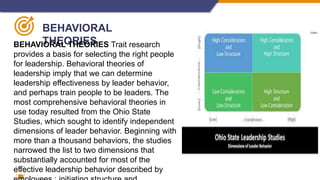
BEHAVIORAL THEORIES Trait research
provides a basis for selecting the right people
for leadership. Behavioral theories of
leadership imply that we can determine
leadership effectiveness by leader behavior,
and perhaps train people to be leaders. The
most comprehensive behavioral theories in
use today resulted from the Ohio State
Studies, which sought to identify independent
dimensions of leader behavior. Beginning with
more than a thousand behaviors, the studies
narrowed the list to two dimensions that
substantially accounted for most of the
effective leadership behavior described by
8
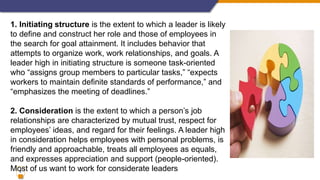
1. Initiating structure is the extent to which a leader is likely
to define and construct her role and those of employees in
the search for goal attainment. It includes behavior that
attempts to organize work, work relationships, and goals. A
leader high in initiating structure is someone task-oriented
who “assigns group members to particular tasks,” “expects
workers to maintain definite standards of performance,” and
“emphasizes the meeting of deadlines.”
2. Consideration is the extent to which a person’s job
relationships are characterized by mutual trust, respect for
employees’ ideas, and regard for their feelings. A leader high
in consideration helps employees with personal problems, is
friendly and approachable, treats all employees as equals,
and expresses appreciation and support (people-oriented).
Most of us want to work for considerate leaders
9
CHARISMATIC LEADERSHIP AND TRANSFORMATIONAL
LEADERSHIP
Do you think that leaders are born not made, or do you think they are
made not born? True, an individual may be literally born into a leadership
position, be endowed with a leadership position due to past
accomplishments (like CEOs who worked their way up the organizational
ranks), or be informally acknowledged as a leader (like a Microsoft
employee who knows everything because he was “there at the start”). But
here we are talking not about the inputs into leadership role attainment;
rather, we are focused on what makes great leaders extraordinary. Two
contemporary leadership theories—charismatic leadership and
transformational leadership—share a common theme in the great leader
debate: They view leaders as individuals who inspire followers through
words, ideas, and behaviors.
10
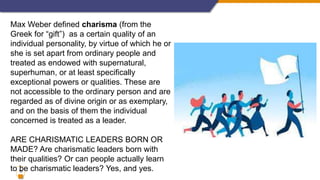
Max Weber defined charisma (from the
Greek for “gift”) as a certain quality of an
individual personality, by virtue of which he or
she is set apart from ordinary people and
treated as endowed with supernatural,
superhuman, or at least specifically
exceptional powers or qualities. These are
not accessible to the ordinary person and are
regarded as of divine origin or as exemplary,
and on the basis of them the individual
concerned is treated as a leader.
ARE CHARISMATIC LEADERS BORN OR
MADE? Are charismatic leaders born with
their qualities? Or can people actually learn
to be charismatic leaders? Yes, and yes.
11
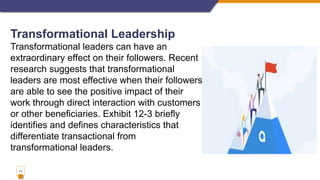
Transformational Leadership
Transformational leaders can have an
extraordinary effect on their followers. Recent
research suggests that transformational
leaders are most effective when their followers
are able to see the positive impact of their
work through direct interaction with customers
or other beneficiaries. Exhibit 12-3 briefly
identifies and defines characteristics that
differentiate transactional from
transformational leaders.
12
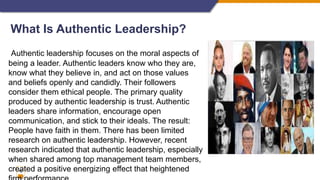
What Is Authentic Leadership?
Authentic leadership focuses on the moral aspects of
being a leader. Authentic leaders know who they are,
know what they believe in, and act on those values
and beliefs openly and candidly. Their followers
consider them ethical people. The primary quality
produced by authentic leadership is trust. Authentic
leaders share information, encourage open
communication, and stick to their ideals. The result:
People have faith in them. There has been limited
research on authentic leadership. However, recent
research indicated that authentic leadership, especially
when shared among top management team members,
created a positive energizing effect that heightened
13
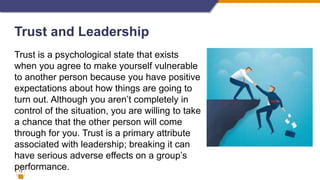
Trust and Leadership
Trust is a psychological state that exists
when you agree to make yourself vulnerable
to another person because you have positive
expectations about how things are going to
turn out. Although you aren’t completely in
control of the situation, you are willing to take
a chance that the other person will come
through for you. Trust is a primary attribute
associated with leadership; breaking it can
have serious adverse effects on a group’s
performance.
14
What Are the Consequences of
Trust?
Trust between supervisors and employees has a
number of advantages. Here are just a few that
research has shown:
• Trust encourages taking risks. Whenever
employees decide to deviate from the usual way of
doing things, or to take their supervisors’ word on a new
direction, they are taking a risk. In both cases, a trusting
relationship can facilitate that leap.
• Trust facilitates information sharing. One big
reason employees fail to express concerns at work is
that they don’t feel psychologically safe revealing their
views. When managers demonstrate they will give
employees’ ideas a fair hearing and actively make
changes, employees are more willing to speak out.
“QUOTE”
"Leadership is the capacity to
translate a vision into reality." —
Warren Bennis.

Leadership and trust.pptx

  • 1.
  • 2.
    LEARNING OBJECTIVES : 1.Contrast leadership and management. 2. Summarize the conclusions of trait theories of leadership. 3. Identify the central tenets and main limitations of behavioral theories. 4. Assess contingency theories of leadership by their level of support. 5. Contrast charismatic and transformational leadership. 6. Describe the roles of ethics and trust in authentic leadership. 7. Demonstrate the role mentoring plays in our understanding of leadership. 8. Address challenges to the effectiveness of leadership. 9. Describe how organizations can find or create effective leaders. After studying this chapter, you should be able to: 2
  • 3.
    3 WHAT IS LEADERSHIP? leadership isthe ability to influence a group toward the achievement of a vision or set of goals. The source of influence may be formal, such as that provided by managerial rank in an organization. But not all managers are leaders, nor are all leaders managers. Just because an organization provides its managers with certain formal rights is no assurance they will lead effectively. Leaders can emerge from within a group as well as by formal appointment.
  • 4.
    Difference between leadershipand management Here's a contrast between leadership and management: 1.Focus: Management is primarily concerned with planning, organizing, and controlling resources to achieve specific goals and objectives. Leadership, focuses on inspiring and influencing people to achieve a common vision or goal. It emphasizes empowerment, motivation, and guiding others. 2.Role: Managers typically have formal authority and are responsible for directing the work of subordinates, enforcing policies and procedures, and making decisions.They tend work hierarchies. Leaders, may not have formal authority but lead through influence. They inspire and guide others, set the direction, and challenge the status quo. 3.Orientation: Management is often task-oriented, Managers ensure that resources are allocated efficiently, processes are followed, and goals are met. Leadership, is more people-oriented. Leaders build relationships, foster collaboration, and develop individuals' skills and
  • 5.
    5 TRAIT THEORIES Strong leadershave been described by their traits. Therefore, leadership research has long sought to identify the personality, social, physical, or intellectual attributes that differentiate leaders from non-leaders. In recent research, the trait theories of leadership focus on personal qualities and characteristics, some of which have been shown to be particularly predictive of leadership ability.
  • 6.
    6  There arevarious traits associated with effective leadership. While not an exhaustive list, here are some commonly recognized traits of leaders: 1.Vision: Effective leaders have a clear and inspiring vision of the future. 2.Integrity: Leaders with integrity are honest, ethical, and trustworthy 3.Confidence: Leaders display self-confidence and belief in their abilities. 4.Emotional Intelligence: Leaders with high emotional intelligence are aware of their own emotions and those of others. They can navigate and manage emotions effectively. 5.Decisiveness: Leaders are capable of making timely and effective decisions. 6.Adaptability: Leaders are flexible and adaptable in the face of change. 7.Effective Communication: Leaders possess strong communication skills, both in speaking and listening. They can convey their ideas clearly, actively listen to others, and foster open and honest communication within their team.
  • 7.
    7 BEHAVIORAL THEORIES BEHAVIORAL THEORIES Traitresearch provides a basis for selecting the right people for leadership. Behavioral theories of leadership imply that we can determine leadership effectiveness by leader behavior, and perhaps train people to be leaders. The most comprehensive behavioral theories in use today resulted from the Ohio State Studies, which sought to identify independent dimensions of leader behavior. Beginning with more than a thousand behaviors, the studies narrowed the list to two dimensions that substantially accounted for most of the effective leadership behavior described by
  • 8.
    8 1. Initiating structureis the extent to which a leader is likely to define and construct her role and those of employees in the search for goal attainment. It includes behavior that attempts to organize work, work relationships, and goals. A leader high in initiating structure is someone task-oriented who “assigns group members to particular tasks,” “expects workers to maintain definite standards of performance,” and “emphasizes the meeting of deadlines.” 2. Consideration is the extent to which a person’s job relationships are characterized by mutual trust, respect for employees’ ideas, and regard for their feelings. A leader high in consideration helps employees with personal problems, is friendly and approachable, treats all employees as equals, and expresses appreciation and support (people-oriented). Most of us want to work for considerate leaders
  • 9.
    9 CHARISMATIC LEADERSHIP ANDTRANSFORMATIONAL LEADERSHIP Do you think that leaders are born not made, or do you think they are made not born? True, an individual may be literally born into a leadership position, be endowed with a leadership position due to past accomplishments (like CEOs who worked their way up the organizational ranks), or be informally acknowledged as a leader (like a Microsoft employee who knows everything because he was “there at the start”). But here we are talking not about the inputs into leadership role attainment; rather, we are focused on what makes great leaders extraordinary. Two contemporary leadership theories—charismatic leadership and transformational leadership—share a common theme in the great leader debate: They view leaders as individuals who inspire followers through words, ideas, and behaviors.
  • 10.
    10 Max Weber definedcharisma (from the Greek for “gift”) as a certain quality of an individual personality, by virtue of which he or she is set apart from ordinary people and treated as endowed with supernatural, superhuman, or at least specifically exceptional powers or qualities. These are not accessible to the ordinary person and are regarded as of divine origin or as exemplary, and on the basis of them the individual concerned is treated as a leader. ARE CHARISMATIC LEADERS BORN OR MADE? Are charismatic leaders born with their qualities? Or can people actually learn to be charismatic leaders? Yes, and yes.
  • 11.
    11 Transformational Leadership Transformational leaderscan have an extraordinary effect on their followers. Recent research suggests that transformational leaders are most effective when their followers are able to see the positive impact of their work through direct interaction with customers or other beneficiaries. Exhibit 12-3 briefly identifies and defines characteristics that differentiate transactional from transformational leaders.
  • 12.
    12 What Is AuthenticLeadership? Authentic leadership focuses on the moral aspects of being a leader. Authentic leaders know who they are, know what they believe in, and act on those values and beliefs openly and candidly. Their followers consider them ethical people. The primary quality produced by authentic leadership is trust. Authentic leaders share information, encourage open communication, and stick to their ideals. The result: People have faith in them. There has been limited research on authentic leadership. However, recent research indicated that authentic leadership, especially when shared among top management team members, created a positive energizing effect that heightened
  • 13.
    13 Trust and Leadership Trustis a psychological state that exists when you agree to make yourself vulnerable to another person because you have positive expectations about how things are going to turn out. Although you aren’t completely in control of the situation, you are willing to take a chance that the other person will come through for you. Trust is a primary attribute associated with leadership; breaking it can have serious adverse effects on a group’s performance.
  • 14.
    14 What Are theConsequences of Trust? Trust between supervisors and employees has a number of advantages. Here are just a few that research has shown: • Trust encourages taking risks. Whenever employees decide to deviate from the usual way of doing things, or to take their supervisors’ word on a new direction, they are taking a risk. In both cases, a trusting relationship can facilitate that leap. • Trust facilitates information sharing. One big reason employees fail to express concerns at work is that they don’t feel psychologically safe revealing their views. When managers demonstrate they will give employees’ ideas a fair hearing and actively make changes, employees are more willing to speak out.
  • 15.
    “QUOTE” "Leadership is thecapacity to translate a vision into reality." — Warren Bennis.