READINESS

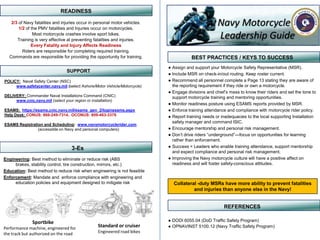
   2/3 of Navy fatalities and injuries occur in personal motor vehicles.
       1/2 of the PMV fatalities and Injuries occur on motorcycles.
                                                                                                    Navy Motorcycle
               Most motorcycle crashes involve sport bikes.
      Training is very effective at preventing fatalities and injuries.
                                                                                                    Leadership Guide
              Every Fatality and Injury Affects Readiness
         Riders are responsible for completing required training.
  Commands are responsible for providing the opportunity for training.                BEST PRACTICES / KEYS TO SUCCESS
                                                                           ● Assign and support your Motorcycle Safety Representative (MSR).
                                 SUPPORT
                                                                           ● Include MSR on check-in/out routing. Keep roster current.
POLICY: Naval Safety Center (NSC)                                          ● Recommend all personnel complete a Page 13 stating they are aware of
     www.safetycenter.navy.mil (select Ashore/Motor Vehicle/Motorcycle)      the reporting requirement if they ride or own a motorcycle.
                                                                           ● Engage divisions and chief’s mess to know their riders and set the tone to
DELIVERY: Commander Naval Installations Command (CNIC)                       support motorcycle training and mentoring opportunities.
     www.cnic.navy.mil (select your region or installation)
                                                                           ● Monitor readiness posture using ESAMS reports provided by MSR.
ESAMS: https://esams.cnic.navy.mil/esams_gen_2/loginesams.aspx             ● Enforce training attendance and compliance with motorcycle rider policy.
Help Desk: CONUS: 866-249-7314, OCONUS: 809-463-3376                       ● Report training needs or inadequacies to the local supporting Installation
                                                                             safety manager and command ISIC.
ESAMS Registration and Scheduling: www.navymotorcyclerider.com
                (accessible on Navy and personal computers)                ● Encourage mentorship and personal risk management.
                                                                           ● Don’t drive riders “underground”—focus on opportunities for learning
                                                                             rather than enforcement.
                                   3-Es                                    ● Success = Leaders who enable training attendance, support mentorship
                                                                             and expect compliance and personal risk management.
Engineering: Best method to eliminate or reduce risk (ABS                  ● Improving the Navy motorcycle culture will have a positive affect on
     brakes, stability control, tire construction, mirrors, etc.)            readiness and will foster safety-conscious attitudes.
Education: Best method to reduce risk when engineering is not feasible
Enforcement: Mandate and enforce compliance with engineering and
     education policies and equipment designed to mitigate risk              Collateral -duty MSRs have more ability to prevent fatalities
                                                                                      and injuries than anyone else in the Navy!


                                                                                                       REFERENCES

              Sportbike                                                    ● DODI 6055.04 (DoD Traffic Safety Program)
Performance machine, engineered for
                                                 Standard or cruiser       ● OPNAVINST 5100.12 (Navy Traffic Safety Program)
the track but authorized on the road             Engineered road bikes
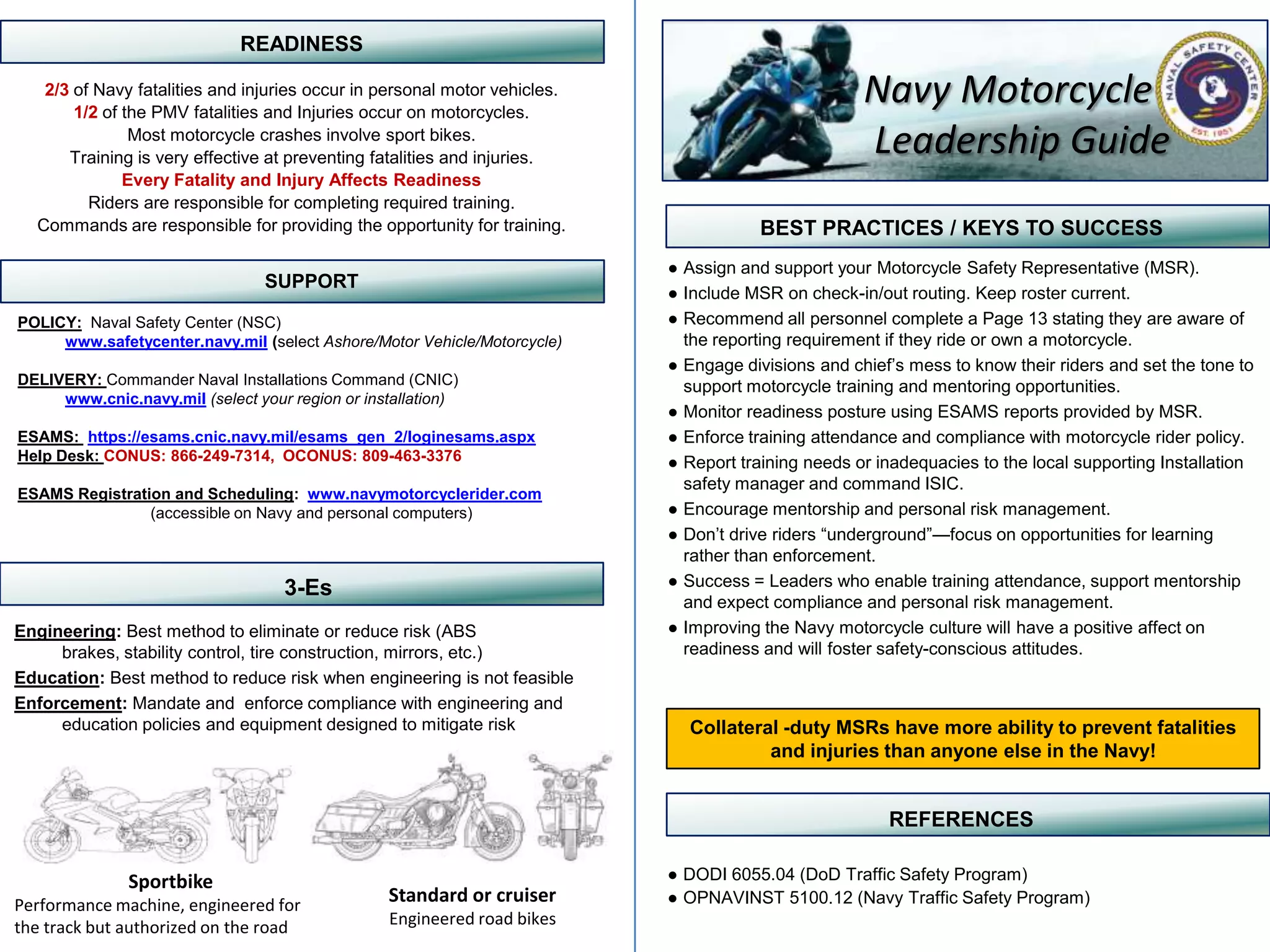
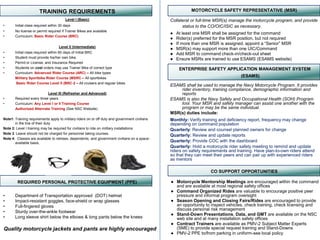
TRAINING REQUIREMENTS                                                               MOTORCYCLE SAFETY REPRESENTATIVE (MSR)

                                        Level I (Basic)                                         Collateral or full-time MSR(s) manage the motorcycle program, and provide
•      Initial class required within 30 days                                                          status to the CO/OIC/ISIC as necessary.
•      No license or permit required if Trainer Bikes are available
                                                                                                ●   At least one MSR shall be assigned for the command
•      Curriculum: Basic Rider Course (BRC)
                                                                                                ●   Rider(s) preferred for the MSR position, but not required
                                                                                                ●   If more than one MSR is assigned, appoint a “Senior” MSR
                                    Level II (Intermediate)
                                                                                                ●   MSR(s) may support more than one UIC/Command
•      Initial class required within 60 days of Initial BRC                                     ●   Add MSR to command check-in/check-out sheet
•      Student must provide his/her own bike.                                                   ●   Ensure MSRs are trained to use ESAMS (ESAMS website)
•      Permit or License, and Insurance Required
•      Students on cost orders may use Trainer Bike of correct type                                  ENTERPRISE SAFETY APPLICATION MANAGEMENT SYSTEM
•      Curriculum: Advanced Rider Course (ARC) – All bike types
       Military Sportbike Rider Course (MSRC – All sportbikes
                                                                                                                                    (ESAMS)
        Basic Rider Course Level II (BRC-2 – All cruisers and regular bikes
                                                                                                ESAMS shall be used to manage the Navy Motorcycle Program. It provides
                                                                                                    rider inventory, training compliance, demographic information and
                           Level III (Refresher and Advanced)                                       reports
•      Required every three years                                                               ESAMS is also the Navy Safety and Occupational Health (SOH) Program
•      Curriculum: Any Level I or II Training Course                                                tool. Your MSR and safety manager can assist one another with the
       Authorized Alternate Training (See NSC Website)                                              program or may be the same individual.
                                                                                                MSR(s) duties include:
Note1: Training requirements apply to military riders on or off duty and government civilians   Monthly: Verify training and deficiency report, frequency may change
       in the line of their duty                                                                depending on command population
Note 2: Level I training may be required for civilians to ride on military installations        Quarterly: Review and counsel planned owners for change
Note 3: Leave should not be charged for personnel taking courses.
                                                                                                Quarterly: Review and update reports
Note 4: Classes are available to retirees, dependents, and government civilians on a space-
       available basis.
                                                                                                Quarterly: Provide COC with the dashboard
                                                                                                Quarterly: Hold a motorcycle rider safety meeting to remind and update
                                                                                                riders on safety requirements and training. Have plan-to-own riders attend
                                                                                                so that they can meet their peers and can pair up with experienced riders
                                                                                                as mentors

                                                                                                                     CO SUPPORT OPPORTUNITIES

         REQUIRED PERSONAL PROTECTIVE EQUIPMENT (PPE)                                           ● Motorcycle Mentorship Meetings are encouraged within the command
                                                                                                  and are available at most regional safety offices
                                                                                                ● Command Organized Rides are valuable to encourage positive peer
•      Department of Transportation approved (DOT) helmet                                         pressure and informal program oversight
•      Impact-resistant goggles, face-shield or wrap glasses                                    ● Season Opening and Closing Fairs/Rides are encouraged to provide
•      Full-fingered gloves                                                                       an opportunity to inspect vehicles, check training, check licensing and
                                                                                                  discuss personal risk management
•      Sturdy over-the-ankle footwear
                                                                                                ● Stand-Down Presentations, Data, and GMT are available on the NSC
•      Long sleeve shirt below the elbows & long pants below the knees                            web site and at many installation safety offices
                                                                                                ● Contract Trainers are available as PMV-2 Subject Matter Experts
Quality motorcycle jackets and pants are highly encouraged                                        (SME) to provide special request training and Stand-Downs
                                                                                                ● PMV-2 PPE to/from parking in uniform-see local policy

Leader brief

  • 1.
    READINESS 2/3 of Navy fatalities and injuries occur in personal motor vehicles. 1/2 of the PMV fatalities and Injuries occur on motorcycles. Navy Motorcycle Most motorcycle crashes involve sport bikes. Training is very effective at preventing fatalities and injuries. Leadership Guide Every Fatality and Injury Affects Readiness Riders are responsible for completing required training. Commands are responsible for providing the opportunity for training. BEST PRACTICES / KEYS TO SUCCESS ● Assign and support your Motorcycle Safety Representative (MSR). SUPPORT ● Include MSR on check-in/out routing. Keep roster current. POLICY: Naval Safety Center (NSC) ● Recommend all personnel complete a Page 13 stating they are aware of www.safetycenter.navy.mil (select Ashore/Motor Vehicle/Motorcycle) the reporting requirement if they ride or own a motorcycle. ● Engage divisions and chief’s mess to know their riders and set the tone to DELIVERY: Commander Naval Installations Command (CNIC) support motorcycle training and mentoring opportunities. www.cnic.navy.mil (select your region or installation) ● Monitor readiness posture using ESAMS reports provided by MSR. ESAMS: https://esams.cnic.navy.mil/esams_gen_2/loginesams.aspx ● Enforce training attendance and compliance with motorcycle rider policy. Help Desk: CONUS: 866-249-7314, OCONUS: 809-463-3376 ● Report training needs or inadequacies to the local supporting Installation safety manager and command ISIC. ESAMS Registration and Scheduling: www.navymotorcyclerider.com (accessible on Navy and personal computers) ● Encourage mentorship and personal risk management. ● Don’t drive riders “underground”—focus on opportunities for learning rather than enforcement. 3-Es ● Success = Leaders who enable training attendance, support mentorship and expect compliance and personal risk management. Engineering: Best method to eliminate or reduce risk (ABS ● Improving the Navy motorcycle culture will have a positive affect on brakes, stability control, tire construction, mirrors, etc.) readiness and will foster safety-conscious attitudes. Education: Best method to reduce risk when engineering is not feasible Enforcement: Mandate and enforce compliance with engineering and education policies and equipment designed to mitigate risk Collateral -duty MSRs have more ability to prevent fatalities and injuries than anyone else in the Navy! REFERENCES Sportbike ● DODI 6055.04 (DoD Traffic Safety Program) Performance machine, engineered for Standard or cruiser ● OPNAVINST 5100.12 (Navy Traffic Safety Program) the track but authorized on the road Engineered road bikes
  • 2.
    TRAINING REQUIREMENTS MOTORCYCLE SAFETY REPRESENTATIVE (MSR) Level I (Basic) Collateral or full-time MSR(s) manage the motorcycle program, and provide • Initial class required within 30 days status to the CO/OIC/ISIC as necessary. • No license or permit required if Trainer Bikes are available ● At least one MSR shall be assigned for the command • Curriculum: Basic Rider Course (BRC) ● Rider(s) preferred for the MSR position, but not required ● If more than one MSR is assigned, appoint a “Senior” MSR Level II (Intermediate) ● MSR(s) may support more than one UIC/Command • Initial class required within 60 days of Initial BRC ● Add MSR to command check-in/check-out sheet • Student must provide his/her own bike. ● Ensure MSRs are trained to use ESAMS (ESAMS website) • Permit or License, and Insurance Required • Students on cost orders may use Trainer Bike of correct type ENTERPRISE SAFETY APPLICATION MANAGEMENT SYSTEM • Curriculum: Advanced Rider Course (ARC) – All bike types Military Sportbike Rider Course (MSRC – All sportbikes (ESAMS) Basic Rider Course Level II (BRC-2 – All cruisers and regular bikes ESAMS shall be used to manage the Navy Motorcycle Program. It provides rider inventory, training compliance, demographic information and Level III (Refresher and Advanced) reports • Required every three years ESAMS is also the Navy Safety and Occupational Health (SOH) Program • Curriculum: Any Level I or II Training Course tool. Your MSR and safety manager can assist one another with the Authorized Alternate Training (See NSC Website) program or may be the same individual. MSR(s) duties include: Note1: Training requirements apply to military riders on or off duty and government civilians Monthly: Verify training and deficiency report, frequency may change in the line of their duty depending on command population Note 2: Level I training may be required for civilians to ride on military installations Quarterly: Review and counsel planned owners for change Note 3: Leave should not be charged for personnel taking courses. Quarterly: Review and update reports Note 4: Classes are available to retirees, dependents, and government civilians on a space- available basis. Quarterly: Provide COC with the dashboard Quarterly: Hold a motorcycle rider safety meeting to remind and update riders on safety requirements and training. Have plan-to-own riders attend so that they can meet their peers and can pair up with experienced riders as mentors CO SUPPORT OPPORTUNITIES REQUIRED PERSONAL PROTECTIVE EQUIPMENT (PPE) ● Motorcycle Mentorship Meetings are encouraged within the command and are available at most regional safety offices ● Command Organized Rides are valuable to encourage positive peer • Department of Transportation approved (DOT) helmet pressure and informal program oversight • Impact-resistant goggles, face-shield or wrap glasses ● Season Opening and Closing Fairs/Rides are encouraged to provide • Full-fingered gloves an opportunity to inspect vehicles, check training, check licensing and discuss personal risk management • Sturdy over-the-ankle footwear ● Stand-Down Presentations, Data, and GMT are available on the NSC • Long sleeve shirt below the elbows & long pants below the knees web site and at many installation safety offices ● Contract Trainers are available as PMV-2 Subject Matter Experts Quality motorcycle jackets and pants are highly encouraged (SME) to provide special request training and Stand-Downs ● PMV-2 PPE to/from parking in uniform-see local policy