Childhood lead poisoning is preventable. The Centers for Disease Control
and Prevention (CDC) and Environmental Protection Agency (EPA)
recommend:
Public health officials can use SSG’s Casetivity-CLPPP to:
Educating adults, parents, caregivers, and businesses on the dangers
of lead exposure and where it is most likely to be found, including
lead-based paint in homes built before 1978, lead dust, and
contaminated drinking water, soil, and air.
Testing children at risk of lead exposure for elevated blood lead
levels and remember that no safe blood lead level in children has
been identified.
Providing timely follow-up care and treatment to children with
elevated blood lead levels while monitoring their symptoms.
Inspecting and remediating lead-based hazards in the community
as soon as they have been detected.
The event takes place October 22–28 in the U.S. to
raise awareness about lead poisoning prevention,
including how state, local, and tribal governments
can reduce childhood lead exposure with
regular testing, home and environmental
inspections, and proper data collection.
NATIONAL LEAD POISONING
PREVENTION WEEK
How to Prevent Childhood
Lead Poisoning
Reducing Childhood Lead
Poisoning with Casetivity-CLPPP
SSG’s Childhood Lead Poisoning Prevention
Program (CLPPP) application simplifies the
data collection process for state, local, and
tribal governments to reduce the number of
children with lead poisoning. It’s a modular,
configurable, web-based software solution
designed to increase efficiency for public
health departments working to mitigate
childhood lead poisoning. Outdated paper
records systems and siloed data prevent
timely analysis and remediation.
Give public health
workers more time to
follow up with
patients and
implement effective
prevention strategies
Adhere to privacy
regulations, including
HIPAA, FERPA, and
other public sector
security standards
Remotely manage
and authenticate
user access based on
their role within the
organization
Manage the outreach, care,
and coordination of services
for a child who tests positive
for lead poisoning
Coordinate timely site
inspections of affected
areas while managing
the cleanup process
Quickly adjust the modular
design and user interface as
the reporting guidelines
change
Automate end-to-end
workflows, such as creating
checklists, gathering signatures,
and populating multiple forms,
to free additional resources
Cleanse incoming
patient and
community health
data for system
integration
Instantly send
and receive patient
test data from labs
and other private
healthcare providers
and organizations
Every child deserves to be lead-free. Contact SSG to learn more about the benefits of
Our Childhood Lead Poisoning Prevention Program solution
ssg-llc.com

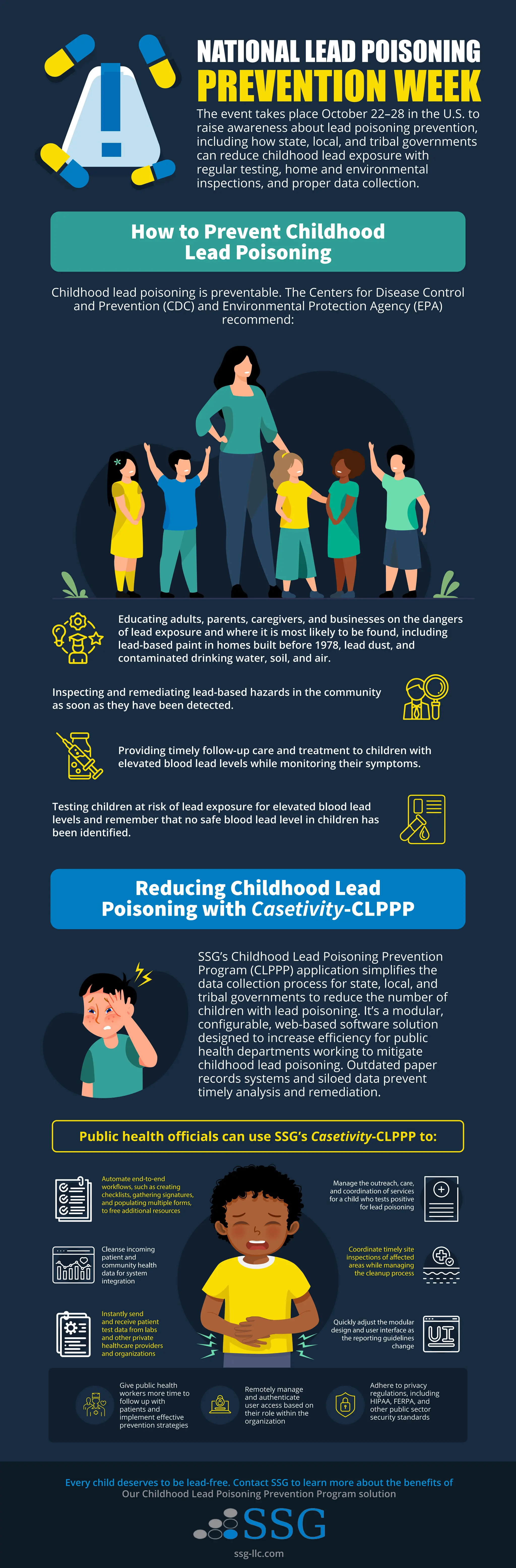
Lead Poisoning Prevention Week Infographic

  • 1.
    Childhood lead poisoningis preventable. The Centers for Disease Control and Prevention (CDC) and Environmental Protection Agency (EPA) recommend: Public health officials can use SSG’s Casetivity-CLPPP to: Educating adults, parents, caregivers, and businesses on the dangers of lead exposure and where it is most likely to be found, including lead-based paint in homes built before 1978, lead dust, and contaminated drinking water, soil, and air. Testing children at risk of lead exposure for elevated blood lead levels and remember that no safe blood lead level in children has been identified. Providing timely follow-up care and treatment to children with elevated blood lead levels while monitoring their symptoms. Inspecting and remediating lead-based hazards in the community as soon as they have been detected. The event takes place October 22–28 in the U.S. to raise awareness about lead poisoning prevention, including how state, local, and tribal governments can reduce childhood lead exposure with regular testing, home and environmental inspections, and proper data collection. NATIONAL LEAD POISONING PREVENTION WEEK How to Prevent Childhood Lead Poisoning Reducing Childhood Lead Poisoning with Casetivity-CLPPP SSG’s Childhood Lead Poisoning Prevention Program (CLPPP) application simplifies the data collection process for state, local, and tribal governments to reduce the number of children with lead poisoning. It’s a modular, configurable, web-based software solution designed to increase efficiency for public health departments working to mitigate childhood lead poisoning. Outdated paper records systems and siloed data prevent timely analysis and remediation. Give public health workers more time to follow up with patients and implement effective prevention strategies Adhere to privacy regulations, including HIPAA, FERPA, and other public sector security standards Remotely manage and authenticate user access based on their role within the organization Manage the outreach, care, and coordination of services for a child who tests positive for lead poisoning Coordinate timely site inspections of affected areas while managing the cleanup process Quickly adjust the modular design and user interface as the reporting guidelines change Automate end-to-end workflows, such as creating checklists, gathering signatures, and populating multiple forms, to free additional resources Cleanse incoming patient and community health data for system integration Instantly send and receive patient test data from labs and other private healthcare providers and organizations Every child deserves to be lead-free. Contact SSG to learn more about the benefits of Our Childhood Lead Poisoning Prevention Program solution ssg-llc.com