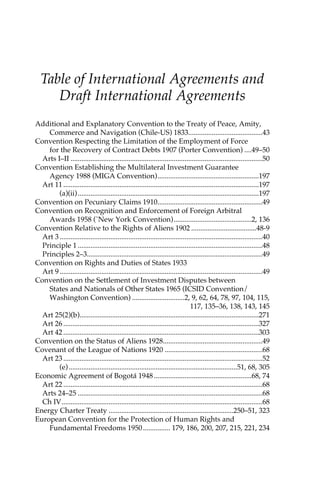
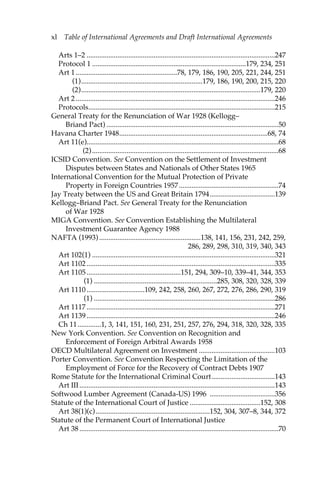
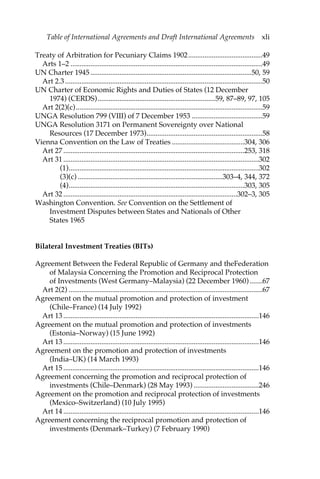
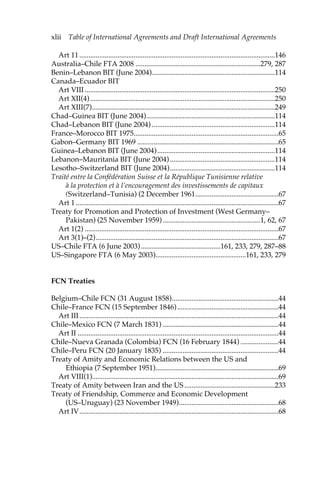
STATE LIABILITY IN INVESTMENT TREATY ARBITRATION 
Today there are more than 2,500 bilateral investment treaties (BITs) 
around the world. Most of these investment protection treaties offer for-eign 
investors a direct cause of action to claim damages against host-states 
before international arbitral tribunals. This procedure, together with the 
requirement of compensation in indirect expropriations and the fair and 
equitable treatment standard, have transformed the way we think about 
state liability in international law. 
We live in the BIT generation, a world where BITs define the scope and 
conditions according to which states are economically accountable for the 
consequences of regulatory change and administrative action. Investment 
arbitration in the BIT generation carries new functions which pose 
unprecedented normative challenges, such as the arbitral bodies estab-lished 
to resolve investor/state disputes defining the relationship between 
property rights and the public interest. They also review state action for 
arbitrariness, and define the proper tests under which that review should 
proceed. 
State Liability in Investment Treaty Arbitration is an interdisciplinary 
work, aimed at academics and practitioners, which focuses on five key 
dimensions of BIT arbitration. First, it analyses the past practice of state 
responsibility for injuries to aliens, placing the BIT generation in historical 
perspective. Second, it develops a descriptive law-and-economics model 
that explains the proliferation of BITs, and why they are all worded so sim-ilarly. 
Third, it addresses the legitimacy deficits of this new form of dis-pute 
settlement, weighing its potential advantages and democratic 
shortfalls. Fourth, it gives a comparative overview of the universal tension 
between property rights and the public interest, and the problems and 
challenges associated with liability grounded in illegal and arbitrary state 
action. Finally, it presents a detailed legal study of the current state of BIT 
jurisprudence regarding indirect expropriations and the fair and equitable 
treatment clause. 
Volume 26 in the series Studies in International Law
Studies in International Law 
Volume 1: Between Light and Shadow: The World Bank, the International 
Monetary Fund and International Human Rights Law Mac Darrow 
Volume 2: Toxics and Transnational Law: International and European Regulation 
of Toxic Substances as Legal Symbolism Marc Pallemaerts 
Volume 3: The Chapter VII Powers of the United Nations Security Council Erika 
de Wet 
Volume 4: Enforcing International Law Norms Against Terrorism Edited by 
Andrea Bianchi 
Volume 5: The Permanent International Criminal Court Edited by Dominic 
McGoldrick, Peter Rowe and Eric Donnelly. 
Volume 6: Regional Organisations and the Development of Collective Security 
Ademola Abass Volume 7: Islamic State Practices, International Law and the 
Threat from Terrorism: A Critique of the ‘Clash of Civilizations’ in the New 
World Order Javaid Rehman 
Volume 8: Predictablity and Flexibility in the Law of Maritime Delimitation 
Yoshifumi Tanaka 
Volume 9: Biotechnology and International Law Edited by Francesco Francioni and 
Tullio Scovazzi 
Volume 10: The Development of Human Rights Law by the Judges of the 
International Court of Justice Shiv Bedi 
Volume 11: The Environmental Accountability of the World Bank to Third Party 
Non-State Actors Alix Gowlland-Gualtieri 
Volume 12: Transnational Corporations and Human Rights Edited by Olivier De 
Schutter 
Volume 13: Biotechnologies and International Human Rights Edited by Francesco 
Francioni 
Volume 14: Human Security and International Law: Prospects and Problems 
Barbara Von Tigerstrom 
Volume 15: The Arms Trade and International Law Zeray Yihdego 
Volume 16: Africa: Mapping New Boundaries in International Law Edited by 
Jeremy Levitt 
Volume 17: Forced Migration, Human Rights and Security Edited by Jane 
McAdam 
Volume 18: The Use of Nuclear Weapons and the Protection of the Environment 
during International Armed Conflict Erik Koppe 
Volume 19: The Shifting Allocation of Authority in International Law: Considering 
Sovereignty, Supremacy and Subsidiarity Edited by Tomer Broude and Yuval 
Shany 
Volume 20: Counterterrorism: Democracy’s Challenge Edited by Andrea Bianchi 
and Alexis Keller 
Volume 21: Amnesty, Human Rights and Political Transitions Louise Mallinder 
Volume 22: Property Rights and Natural Resources Richard Barnes 
Volume 23: Human Dignity and the Foundations of International Law Patrick 
Capps 
Volume 24: Sovereignty and the Stateless Nation: Gibraltar in the Modern Legal 
Context Keith Azopardi 
Volume 25: The International Court of Justice and Self-Defence in International 
Law James A Green
State Liability in 
Investment Treaty 
Arbitration 
Global Constitutional and 
Administrative Law in the BIT 
Generation 
Santiago Montt 
OXFORD AND PORTLAND, OREGON 
2009
Published in North America (US and Canada) by 
Hart Publishing 
c/o International Specialized Book Services 
920 NE 58th Avenue, Suite 300 
Portland, OR 97213-3786 
USA 
Tel: +1-503-287-3093 or toll-free: (1)-800-944-6190 
Fax: +1 503 280 8832 
E-mail: orders@isbs.com 
Website: www.isbs.com 
© Santiago Montt 2009 
Santiago Montt has asserted his right under the Copyright, Designs and Patents Act 1988, 
to be identified as the author of this work. 
All rights reserved. No part of this publication may be reproduced, stored in a retrieval 
system, or transmitted, in any form or by any means, without the prior permission of 
Hart Publishing, or as expressly permitted by law or under the terms agreed with 
the appropriate reprographic rights organisation. Enquiries concerning reproduction 
which may not be covered by the above should be addressed to Hart Publishing at the 
address below. 
Hart Publishing, 16C Worcester Place, Oxford, OX1 2JW 
Telephone: +44 (0)1865 517530 Fax: +44(0)1865 510710 
E-mail: mail@hartpub.co.uk 
Website: http://www.hartpub.co.uk 
British Library Cataloguing in Publication Data 
Data Available 
ISBN: 978-1-84113-856-5 
Typeset by Hope Services, Abingdon, Oxon 
Printed and bound in Great Britain by 
TJ International Ltd, Padstow, Cornwall
For Alejandra, Violeta, and Matilde
Foreword 
The international investment regime has changed dramatically in recent 
decades. Emerging economies throughout the world are attracting foreign 
direct investment (FDI) that goes beyond the traditional concentration on 
natural resources and agricultural products. Infrastructure projects and 
manufacturing for export and for the domestic market account for an 
important share of FDI. Furthermore, a growing share involves contracts 
or joint ventures between multinational corporations (MNCs) and domes-tic 
firms, rather than the state. Although the global economic slowdown 
has had an important negative impact on emerging economies worldwide, 
a key role for foreign capital and, in particular, for FDI will remain. In the 
face of overall declines in investment spending, competition for the 
remaining private funds will be intense. 
Multi-national investors can no longer view emerging economies as 
passive recipients of whatever benefits investors wish to bestow or as 
dominated by corruptible leaders willing to make deals for personal gain. 
Of course, corruption and self-dealing remain in some quarters and are 
facilitated by long-standing MNC business practices. However, the 
strengthening of democratic regimes worldwide acts as a check on unfet-tered 
deal-making and has introduced demands for political accountabil-ity 
into the international investment environment. These demands, 
however, are rising to prominence just as more and more investment pro-jects 
are essentially private arrangements that require state acquiescence 
but no direct state financial participation. The state may give tax breaks, 
low-interest loans, and regulatory exemptions, but it does not have an 
ownership stake. Even when the FDI is part of a counter-part investment 
surrounding a military contract, it nominally may be a private deal. Even 
when the state has an ownership stake, it may be unable to control man-agement 
decisions. 
The tension between rising democratic demands and growing private 
FDI comes into focus in Santiago Montt’s major study of Bilateral 
Investment Treaties (BITs). Montt argues that the rise of BITs to over 2500 
worldwide represents a major shift in investor-state relations in develop-ing 
and emerging economies worldwide. 
BITs and the investment chapters of free trade agreements govern the 
relationships between investors from wealthy countries and host states. 
They are most commonly signed between wealthy countries and develop-ing 
or emerging economies where investors believe that the host coun-tries’ 
legal regimes lack key protections. Many low income countries have
viii Foreword 
also signed BITs with each other, but they account only for a small share 
of world FDI volume. Although firms’ contractual relations are increas-ingly 
with private firms, BITs frame that relationship by imposing obliga-tions 
on host states that limit their ability to interfere with investors’ 
expectations. A key aspect of most BITs is the ability of private firms to 
trigger their enforcement by bringing cases before the World Bank’s arbi-tration 
facility, the International Center for the Settlement of International 
Disputes (ICSID). Hence, private firms can initiate actions to enforce these 
treaties even if the MNCs’ home countries are not supportive. This feature 
provides extra benefits to MNCs and can encourage them to invest in 
otherwise risky environments, but it also can challenge the political inde-pendence 
of host countries struggling to create modern, democratic states. 
For a state that is both an emerging economy and an emerging democracy 
conflicts may arise between investors’ interest in preserving a favorable 
status quo and popular demands for more effective regulation; better, 
increased tax-financed infrastructure and social services; and investments 
that generate and preserve jobs. 
Montt’s ambitious and wide-ranging study of Bilateral Investment 
Treaties takes on these fundamental issues and recommends a balanced 
resolution. He links important issues in international investment law with 
the domestic political legitimacy of an accountable administrative law sys-tem. 
Montt asks whether international treaties, especially Bilateral 
Investment Treaties (BITs), limit the ability of emerging democracies to 
make domestic policy that may impose costs on international investors. 
He makes empirical claims about the way in which the BIT’s regime oper-ates, 
in practice, and develops his own normative arguments about how 
the BIT’s regime ought to develop in order to balance concerns for state 
sovereignty and regulatory reform against the encouragement of inter-national 
investment. Montt draws on a deep and extensive knowledge of 
the way the BIT’s regime operates and the way disputes are resolved 
through arbitration. 
Montt claims that the growing BIT’s regime is creating bandwagon or 
network effects. As experience with BITs grows, a specialized bar has 
arisen to deal with disputes. These lawyers, acting as both advocates and 
arbitrators, are playing a key role in interpreting poorly defined terms that 
recur in many treaties, most of which originate in model treaties drafted 
by countries whose firms are prominent source of FDI. Over time, this 
developing expertise encourages more and more countries to sign BITs 
and enhances their value by removing a source of uncertainty. At the same 
time, the increasing coverage of BITs means that a country that signs a 
treaty does not stand out as an especially attractive locale for investment 
because all if its competitors also have signed BITs. True, those outside the 
regime are disadvantaged, but those in the regime are in an increasingly 
competitive situation. Nevertheless, if Montt is correct that learning over
Foreword ix 
time lowers costs for investors, the regime has the character of a focal point 
that will be stable even in the face of serious problems with the way it 
operates in practice. 
In this regard, Montt worries that ICSID arbitral tribunals will interpret 
the treaties in a way that is too close to the rules of private contract law. 
The arbitrator may not take account of the character of BITs as treaties 
between sovereign states that ought to be accountable to their citizens over 
time. He argues that international investors should not be protected 
against broad-based domestic policy shifts. His standard is the operation 
of takings law in wealthy, developed countries; in his view, international 
investors should have no greater protections abroad than they have at 
home. This seems an eminently sensible position, but one that would 
require arbitral tribunals to move beyond a focus on international law 
jurisprudence to examine domestic constitutional texts. Perhaps it is also 
a call for broadening the personnel of such tribunals to include some who 
specialize in constitutional law, especially with respect to the protection of 
property rights and role of the state as regulator and taxing authority. 
States with constitutionally mandated takings clauses, which require com-pensation 
for the expropriation of private property, nevertheless, both 
regulate and tax. Laws limit discharges of pollutants, control workplace 
health and safety, and affect the risk of products. The law requires busi-nesses 
to comply without obtaining compensation for lost profits. There is 
no constitutional right to impose risks and other costs on society. 
Similarly, taxes are constitutionally permitted that reduce profits and raise 
prices. In Montt’s view arbitrators’ interpretations of BITs needs to recog-nize 
and accept constitutionally-permitted policymaking and use the 
more well-developed jurisprudence of MNCs home countries as a guide-line 
or benchmark. This observation is particularly important once one 
recognizes that emerging democracies often must engage in massive 
amounts of law reform to bring their systems up to date. Thus FDI will 
often occur in a very dynamic environment, and investors would be naïve 
to suppose that the current inherited pattern of laws will remain frozen in 
place. They will likely benefit from some legal reforms that improve the 
operation of courts and bureaucracies and that clarify the rules, but they 
can also expect other reforms to impose costs. Investors should not be able 
to use BITs to pick and choose—benefiting from some reforms and gain-ing 
exemption from others. 
Mont argues that international investment law can and should have an 
impact on the domestic legal and political systems in host countries. He is 
optimistic about the ‘halo effect’ of international investment law insofar as 
it can equalize the position of foreign and domestic investors by improv-ing 
the status of the latter. International investment law should help 
emerging economies develop their own regulatory takings jurisprudence 
without imposing rigid rules that could prevent policy innovation in such
countries. It should aim to improve the position of domestic investors con-sistent 
with democratic values, not undermine local initiative and local 
democracy. 
Montt’s study is a comprehensive and thoughtful contribution to the 
ongoing debates over foreign direct investment and bilateral investment 
treaties in particular. Practitioners in the field will add to their knowledge 
of the area and find many issues to debate. In addition, Montt has opened 
up a new area of study and concern for those interested in the develop-ment 
of constitutional and administrative law in emerging democracies 
worldwide. Henceforth, comparative constitutional and administrative 
law will need to take account of the way the international investment 
regime interacts with domestic political and policy imperatives. 
Susan Rose-Ackerman 
Yale University 
New Haven CT 
July 15, 2009 
x Foreword
Acknowledgements 
This book is a revised and updated version of the JSD dissertation that I 
wrote at Yale Law School between 2004 and 2006. I came to Yale in 2003, 
to pursue a Masters’ and Doctorate in administrative law and regulation. 
Prior to this, I had practised law in Chile, where my work primarily 
involved defending domestic and foreign companies against government 
measures, particularly in the fishing industry, which was one of the most 
heavily regulated industries in the country. 
During my first semester as an LLM, I stumbled across the Metalclad 
award.1 Being completely ignorant at that time on the subject of invest-ment 
treaties and their system of investor–state arbitration, I was stunned. 
My immediate reaction was to realise that several of the disputes that I 
previously handled in Chilean courts—and, of course, many similar 
ones—would now be litigated before arbitral tribunals pursuant to invest-ment 
treaty standards. 
In addition, the administrative legal scholar in me reacted with deep 
shock at the reasoning and tone of the award. Although I did not disagree 
with the outcome itself, many of the arguments adopted by the Tribunal 
would not have been remotely possible for plaintiffs suing government 
under any Western public law tradition. Moreover, the Tribunal tended to 
disregard domestic law, effectively downplaying the importance it 
deserved in this case. More importantly, in the award, I could not find the 
deferential and modest attitude normally displayed by public law judges 
who review decisions made by the political branches of government. 
I am neither ‘pro-state’ nor ‘pro-investor’. Instead, I would like to 
describe myself as ‘pro-appropriate equilibrium’. In fact, in terms of my 
background if anything I would be more on ‘pro-investor’ side: just before 
beginning my graduate studies at Yale, I wrote a book on administrative 
law, galvanised by the consistently poor treatment that a foreign investor, 
in whose defence I participated, received at the hands of a public entity. 
This book was designed with the purpose of clarifying and resolving sev-eral 
inadequacies that I found in the Chilean legal system.2 
The important point is that I had the impression, while reading the 
Metalclad award and later confirmed from other decisions, that inter-national 
investment law was failing to seriously take into account the 
1 Metalclad Corporation v Mexico, ICSID Case No ARB(AF)/97/1 (Lauterpacht, Civiletti, 
Siqueiros), Award (30 August 2000). 
2 Santiago Montt, El Dominio Público. Estudio de su Régimen Especial de Protección y Utilización 
(Santiago de Chile, Conosur-Lexis, 2002).
xii Acknowledgements 
enormous reservoir of human experience that had accumulated over 
many decades, at the domestic level. This struck me as a significant 
oversight, since domestic public law generally possesses a much more 
refined conceptual framework than international law for dealing with the 
problems that typically arise in the confrontation between private inter-ests 
and the public good. 
I decided, then, to embark upon a project that would examine invest-ment 
treaty arbitration against the more well-established background of 
domestic constitutional and administrative law. My ultimate purpose— 
which I hope the reader may appreciate throughout the present book— 
was and continues to be to contribute to the development of an investment 
treaty jurisprudence characterised by moderation and deference, in which 
the interests and expectations of foreign investors will be properly bal-anced 
against the regulatory state’s exercise of its powers. 
Given this agenda, it should come as no surprise that this book does not 
follow what has become the canon in international investment law. A brief 
scanning of the table of contents will undoubtedly reveal that the book 
provides an alternative, multidisciplinary approach to the subject, incor-porating 
historical, economic and legal analysis that places a strong 
emphasis on issues of constitutional law and expropriations, and of 
administrative law and arbitrariness. 
I had the privilege of working on this project at three of the most intel-lectually 
stimulating and vibrant places that a legal scholar can possibly 
find: Yale Law School, Columbia Law School, and the Woodrow Wilson 
School of Public and International Affairs at Princeton University. I would 
like to generally thank all of the people who work at these three institu-tions, 
and in particular, their librarians and library personnel. 
I am particularly indebted to Yale, my graduated alma mater, for deeply 
changing the way in which I understand the law and its relationship to 
other social sciences. Professor Susan Rose-Ackerman was the most 
inspiring and generous supervisor that a JSD student could wish to have, 
and Professor Michael Reisman served as an endless source of knowledge 
and wisdom. Professor Michael Levine introduced me to public choice 
and positive approaches to economic regulation. I am grateful for all the 
hours spent on this project by such talented people, as well as the volumi-nous 
number of insights and perspectives that they offered me. 
At Yale, I also wish to thank Professors George Priest, Rudolf Dolzer 
and Amy Chua; and my classmates and colleagues Mariana Mota, Maciek 
Kisilowski, Yoon-Ho Alex Lee, Laura Saldivia, and Johanna Kalb. At 
Columbia Law School, I would like to thank Sylvia T Polo, the Dean of 
Graduate Legal Studies. At Princeton University, I am indebted to 
Professors Kim Scheppele, Ingolf Pernice, and George Bustin; and to my 
classmates and fellows Dan Firger, Matt Jacobs, Nick Poletti, Scott 
Withrow, Julien Jeanneney, and Mareike Kleine.
Acknowledgements xiii 
I would also like to thank the participants of the New York University 
GAL project held in Buenos Aires, Professor Richard Stewart, Benedict 
Kingsbury, and Katrina Wyman; my hosts in Madrid during August, 2005, 
Professor Gaspar Ariño, and the Fundación de Estudios de la Regulación; 
Professor Matthew Mirow; my good friend María José Poblete; and two 
anonymous readers from Hart Publishing. Special thanks to Rachel 
Turner and Mel Hamill at Hart, for their patience; to Christopher Schuck, 
my proofreader, who supplied prompt and deft assistance with respect to 
my limited English; to my former bosses and friends at Weil, Gotshal and 
Manges, Guillermo Aguilar-Alvarez, Eric Ordway, and Chip Roh, for the 
many hours spent discussing the various dimensions of investment treaty 
arbitration; and, finally, to Ramón Vergara Grez for his generosity in 
authorising me to use his painting ‘Carta Abierta a Europa’—undoubtedly 
one of the most important Chilean artworks of the 20th century—which 
can be fully appreciated on the back cover of this book. 
Writing any book in the midst of other work and study is a selfish act. 
Without the support of my wife Alejandra, and the inspiration of my 
daughters Violeta and Matilde, this would have been impossible. If there 
is any specific expropriation which they have come to know while I worked 
on this project, it is that their husband and dad has been taken to the 
library. In return—though this constitutes far from prompt, adequate, and 
effective compensation—I dedicate this book to them, with love. 
Of course, in the midst of all this tremendous help and support, all faults 
and errors are exclusively mine. 
Princeton 
1 March 2009
Table of Contents 
Foreword vii 
Acknowledgements xi 
Table of Cases xxi 
Table of Legislation xxxv 
Table of International Agreements and Draft International 
Agreements xxxix 
Introduction 1 
First Part: A Framework of Analysis 29 
Chapter 1: The Latin American Position on State Responsibility. 
Looking into the Past for Lessons on the Future 31 
Introduction: The Latin American Struggle against Diplomatic 
Protection 31 
I The Calvo Doctrine and Clause: Two Nineteenth Century 
Anti-Diplomatic Protection Institutions 35 
A The Practice of Diplomatic Protection in the Nineteenth 
Century 36 
B The Calvo Doctrine 38 
C The Calvo Clause 45 
II The End of Gunboat Diplomacy 48 
III From the Calvo Doctrine to Expropriation Without 
Compensation 55 
IV International Minimum Standards Strike Back 62 
V Updating the Calvo Doctrine in the BIT Generation 74 
Conclusions: Building a Normative Stance Based on Equality 80 
Chapter 2: The BIT Generation’s Emergence as a Collective Action 
Problem. Prisoner’s Dilemma or Network Effects? 83 
Introduction: Why Do Developing Countries Sign BITs? 83 
I The BIT Generation as a Prisoner’s Dilemma 87 
II Weak Competition and Network Effects 90 
III A Formal Model of the BIT Generation as a Virtual Network 96 
IV Evidence of the BIT Generation as a Virtual Network 104 
A Five Structural Arguments 104 
B Positive Externalities of the BIT System 112
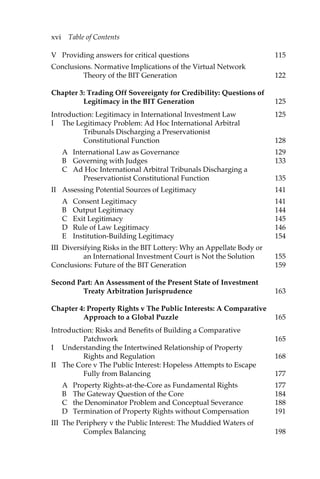
xvi Table of Contents 
V Providing answers for critical questions 115 
Conclusions. Normative Implications of the Virtual Network 
Theory of the BIT Generation 122 
Chapter 3: Trading Off Sovereignty for Credibility: Questions of 
Legitimacy in the BIT Generation 125 
Introduction: Legitimacy in International Investment Law 125 
I The Legitimacy Problem: Ad Hoc International Arbitral 
Tribunals Discharging a Preservationist 
Constitutional Function 128 
A International Law as Governance 129 
B Governing with Judges 133 
C Ad Hoc International Arbitral Tribunals Discharging a 
Preservationist Constitutional Function 135 
II Assessing Potential Sources of Legitimacy 141 
A Consent Legitimacy 141 
B Output Legitimacy 144 
C Exit Legitimacy 145 
D Rule of Law Legitimacy 146 
E Institution-Building Legitimacy 154 
III Diversifying Risks in the BIT Lottery: Why an Appellate Body or 
an International Investment Court is Not the Solution 155 
Conclusions: Future of the BIT Generation 159 
Second Part: An Assessment of the Present State of Investment 
Treaty Arbitration Jurisprudence 163 
Chapter 4: Property Rights v The Public Interests: A Comparative 
Approach to a Global Puzzle 165 
Introduction: Risks and Benefits of Building a Comparative 
Patchwork 165 
I Understanding the Intertwined Relationship of Property 
Rights and Regulation 168 
II The Core v The Public Interest: Hopeless Attempts to Escape 
Fully from Balancing 177 
A Property Rights-at-the-Core as Fundamental Rights 177 
B The Gateway Question of the Core 184 
C the Denominator Problem and Conceptual Severance 188 
D Termination of Property Rights without Compensation 191 
III The Periphery v the Public Interest: The Muddied Waters of 
Complex Balancing 198
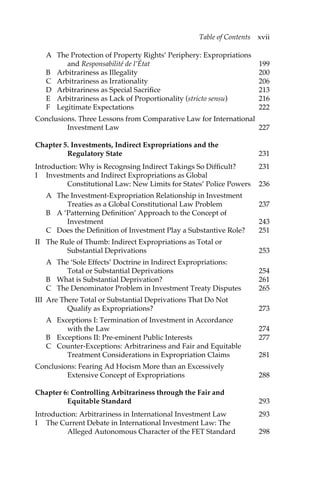
Table of Contents xvii 
A The Protection of Property Rights’ Periphery: Expropriations 
and Responsabilité de l’État 199 
B Arbitrariness as Illegality 200 
C Arbitrariness as Irrationality 206 
D Arbitrariness as Special Sacrifice 213 
E Arbitrariness as Lack of Proportionality (stricto sensu) 216 
F Legitimate Expectations 222 
Conclusions. Three Lessons from Comparative Law for International 
Investment Law 227 
Chapter 5. Investments, Indirect Expropriations and the 
Regulatory State 231 
Introduction: Why is Recognsing Indirect Takings So Difficult? 231 
I Investments and Indirect Expropriations as Global 
Constitutional Law: New Limits for States’ Police Powers 236 
A The Investment-Expropriation Relationship in Investment 
Treaties as a Global Constitutional Law Problem 237 
B A ‘Patterning Definition’ Approach to the Concept of 
Investment 243 
C Does the Definition of Investment Play a Substantive Role? 251 
II The Rule of Thumb: Indirect Expropriations as Total or 
Substantial Deprivations 253 
A The ‘Sole Effects’ Doctrine in Indirect Expropriations: 
Total or Substantial Deprivations 254 
B What is Substantial Deprivation? 261 
C The Denominator Problem in Investment Treaty Disputes 265 
III Are There Total or Substantial Deprivations That Do Not 
Qualify as Expropriations? 273 
A Exceptions I: Termination of Investment in Accordance 
with the Law 274 
B Exceptions II: Pre-eminent Public Interests 277 
C Counter-Exceptions: Arbitrariness and Fair and Equitable 
Treatment Considerations in Expropriation Claims 281 
Conclusions: Fearing Ad Hocism More than an Excessively 
Extensive Concept of Expropriations 288 
Chapter 6: Controlling Arbitrariness through the Fair and 
Equitable Standard 293 
Introduction: Arbitrariness in International Investment Law 293 
I The Current Debate in International Investment Law: The 
Alleged Autonomous Character of the FET Standard 298
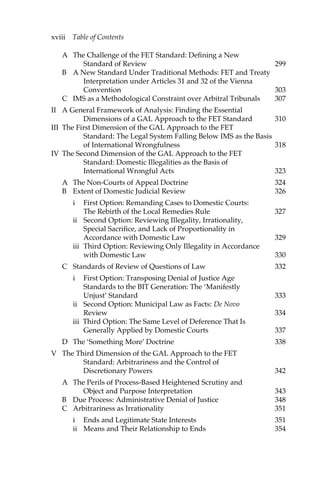
xviii Table of Contents 
A The Challenge of the FET Standard: Defining a New 
Standard of Review 299 
B A New Standard Under Traditional Methods: FET and Treaty 
Interpretation under Articles 31 and 32 of the Vienna 
Convention 303 
C IMS as a Methodological Constraint over Arbitral Tribunals 307 
II A General Framework of Analysis: Finding the Essential 
Dimensions of a GAL Approach to the FET Standard 310 
III The First Dimension of the GAL Approach to the FET 
Standard: The Legal System Falling Below IMS as the Basis 
of International Wrongfulness 318 
IV The Second Dimension of the GAL Approach to the FET 
Standard: Domestic Illegalities as the Basis of 
International Wrongful Acts 323 
A The Non-Courts of Appeal Doctrine 324 
B Extent of Domestic Judicial Review 326 
i First Option: Remanding Cases to Domestic Courts: 
The Rebirth of the Local Remedies Rule 327 
ii Second Option: Reviewing Illegality, Irrationality, 
Special Sacrifice, and Lack of Proportionality in 
Accordance with Domestic Law 329 
iii Third Option: Reviewing Only Illegality in Accordance 
with Domestic Law 330 
C Standards of Review of Questions of Law 332 
i First Option: Transposing Denial of Justice Age 
Standards to the BIT Generation: The ‘Manifestly 
Unjust’ Standard 333 
ii Second Option: Municipal Law as Facts: De Novo 
Review 334 
iii Third Option: The Same Level of Deference That Is 
Generally Applied by Domestic Courts 337 
D The ‘Something More’ Doctrine 338 
V The Third Dimension of the GAL Approach to the FET 
Standard: Arbitrariness and the Control of 
Discretionary Powers 342 
A The Perils of Process-Based Heightened Scrutiny and 
Object and Purpose Interpretation 343 
B Due Process: Administrative Denial of Justice 348 
C Arbitrariness as Irrationality 351 
i Ends and Legitimate State Interests 351 
ii Means and Their Relationship to Ends 354
D Arbitrariness as Special Sacrifice and Lack of 
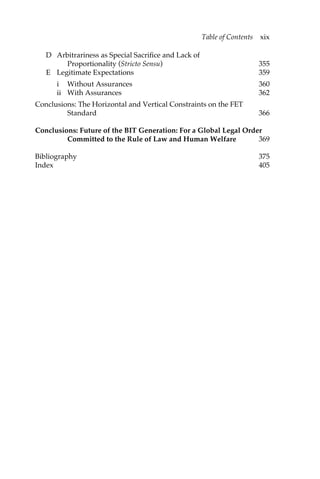
Table of Contents xix 
Proportionality (Stricto Sensu) 355 
E Legitimate Expectations 359 
i Without Assurances 360 
ii With Assurances 362 
Conclusions: The Horizontal and Vertical Constraints on the FET 
Standard 366 
Conclusions: Future of the BIT Generation: For a Global Legal Order 
Committed to the Rule of Law and Human Welfare 369 
Bibliography 375 
Index 405
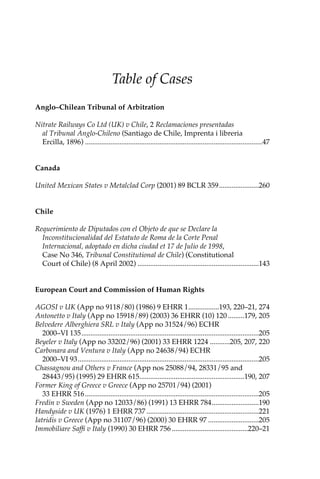
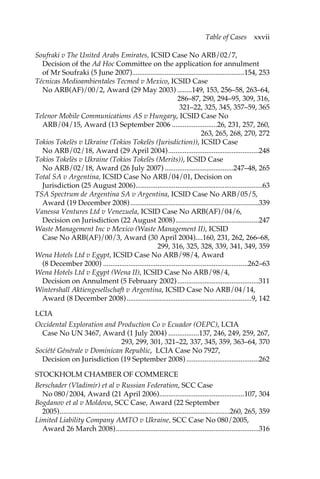
Table of Cases 
Anglo–Chilean Tribunal of Arbitration 
Nitrate Railways Co Ltd (UK) v Chile, 2 Reclamaciones presentadas 
al Tribunal Anglo-Chileno (Santiago de Chile, Imprenta i libreria 
Ercilla, 1896) ..................................................................................................47 
Canada 
United Mexican States v Metalclad Corp (2001) 89 BCLR 359......................260 
Chile 
Requerimiento de Diputados con el Objeto de que se Declare la 
Inconstitucionalidad del Estatuto de Roma de la Corte Penal 
Internacional, adoptado en dicha ciudad et 17 de Julio de 1998, 
Case No 346, Tribunal Constitutional de Chile) (Constitutional 
Court of Chile) (8 April 2002) ...................................................................143 
European Court and Commission of Human Rights 
AGOSI v UK (App no 9118/80) (1986) 9 EHRR 1.................193, 220–21, 274 
Antonetto v Italy (App no 15918/89) (2003) 36 EHRR (10) 120 .........179, 205 
Belvedere Alberghiera SRL v Italy (App no 31524/96) ECHR 
2000–VI 135..................................................................................................205 
Beyeler v Italy (App no 33202/96) (2001) 33 EHRR 1224 ...........205, 207, 220 
Carbonara and Ventura v Italy (App no 24638/94) ECHR 
2000–VI 93....................................................................................................205 
Chassagnou and Others v France (App nos 25088/94, 28331/95 and 
28443/95) (1995) 29 EHRR 615..........................................................190, 207 
Former King of Greece v Greece (App no 25701/94) (2001) 
33 EHRR 516................................................................................................205 
Fredin v Sweden (App no 12033/86) (1991) 13 EHRR 784..........................190 
Handyside v UK (1976) 1 EHRR 737 ..............................................................221 
Iatridis v Greece (App no 31107/96) (2000) 30 EHRR 97 ............................205 
Immobiliare Saffi v Italy (1990) 30 EHRR 756 ..........................................220–21
xxii Table of Cases 
James and Others v UK (App no 8793/79) (1986) 
8 EHRR 123..............................................................207, 215–16, 220–21, 345 
Matos E Silva Lda v Portugal (App no 15777/89 (1997) 
24 EHRR 573........................................................................................186, 255 
Pressos Compania Naviera SA and Others v Belgium 
(App no 17849/91) (1996) 21 EHRR 301..................................207, 220, 244 
Ryder v UK (App no 12360/86) (1987) 11 EHRR 80 ...................................193 
Saffi. See Immobiliare Saffi v Italy 
Sporrong and Lönnroth v Sweden (App nos 7151/75 and 7152/75) 
(1983) 5 EHRR 35 ............................................179–80, 186, 220–21, 238, 255 
Tre Traktörer Aktiebolag v Sweden (App no 10873/84) (1989) 
13 EHRR 309................................................................................................190 
European Court of Justice and Court of First Instance 
Aktien–Zuckerfabrik Schöppenstedt v Council (Case 5/71) [1971] 
ECR 975 ........................................................................................................204 
Atlanta AG and Others v Council (Case T–521/93) [1996] ECR 
II–1707 ..........................................................................................................225 
Bayerische HNL and Others v Council and Commission (Case 83/76) 
[1978] ECR 1209 ..........................................................................................171 
Candiotte (Elena) v Council (Case T–108/94) [1996] ECR II–87..................205 
Chomel (Jean–Louis) v Commission (Case T–123/89) [1990] ECR 
II–131 ............................................................................................................225 
CNTA v Commission (Case 74/74) [1975] ECR 533.....................................224 
Consorzio gruppo di azione locale `Murgia Messapicá’ v Commission 
(Case T–465/93) [1994] ECR II–361..........................................................225 
De Boer Buizen BV v Council and Commission (Case 81/86) [1987] 
ECR 3677 ......................................................................................................214 
Dorsch Consult v Council and Commission (Case C–237/98) [2000] 
ECR I–4549...................................................................................................214 
Edeka Zentrale AG v Germany (Case 245/81) [1982] ECR 2745..................224 
Fabbrica italiana accumulatori motocarri Montecchio Spa (FIAMM) 
et al (Cases C–120/2006P and C–121/2006P) [2008] ECR I–6513 ........214 
Faust (W) v Commission (Case 52/81) [1982] ECR 3762 .............................224 
Firma Anton Dürbeck v Hauptzollamt Frankfurt am Main–Flughafen 
(Case 112/80) [1981] ECR 1095.................................................................226 
Geotronics SA v Commission (Case C–395/95) [1997] ECR I–2271 ............205 
Hauptzollamt Krefeld v Maizena GmbH (Case 5/82) [1982] ECR 4602 .......225 
Ireks–Arkady GmbH v Council and Commission (Case 238/78) [1979] 
ECR 2955 ......................................................................................................204 
Kingdom of Spain v Council (Case C–284/94) [1988] ECR I–7309..............224 
Lefebvre v Commission (Case T–571/93) [1995] ECR II–2379 .....................225
Table of Cases xxiii 
Mulder v Minister van Landbouw en Visserij (Case 120/86) [1988] 
ECR 2321 ......................................................................................................224 
R v MAFF, ex p Fedesa (Case C–331/88) [1990] ECR I–4023..............208, 216 
Société Anonyme a Participation Ouvrière Compagnie Nationale Air 
France v Commission (Case T–2/93) [1994] ECR II–323..........................225 
Société nouvelle des usines de Pontlieue – Aciéries du Temple (SNUPAT) v 
High Authority of the European Coal and Steel Community (Cases 42/59 
and 49/59) [1961] ECR 53 (English Spec Ed)..........................................225 
Van den Bergh en Jurgens v Commission (Case 265/85) [1987] ECR 
1155 ...............................................................................................................225 
Zaninotto (Galileo) v Ispettorato Centrale Repressione Frodi and Others (Case 
C–375/96) [1998] ECR I–6629....................................................................224 
France 
Compagnie general de la Grande Pêche, Conseil d’Etat, 14 January 1938......195 
Institut technique de Dunkerque, Conseil d’Etat, 25 April 1980 ....................212 
Rouillon, Conseil d’Etat, 14 December 1984 ..................................................195 
Ste des Ets Aupinel et autres, Conseil d’Etat, 8 January 1965........................195 
Ste Stambouli, Conseil d’Etat, 11 July 1990 ....................................................195 
Société anonyme des produits laitiers `La Fleurette’, Conseil d’Etat, 
14 January 1938 ...........................................................................................212 
Société Charron et cie, Conseil d’Etat, 10 March 1940....................................195 
Ville de Paris v Driancourt, Conseil d’Etat, 26 January 1973 ........................204 
Germany 
Gravel Decision, BVerGE 58, 300 (1981).......................................................243 
Naßauskiesung case, Federal Constitutional Court.....................................196 
Right of Pre–Emption Case, Constitutional Court, BVerGE 83, 201 
(1991) ....................................................................................................197, 281 
Investment Arbitration 
ICSID 
ADC Affiliate Ltd et al v Hungary, ICSID Case No ARB/03/16, 
Award (2 October 2006)...........................................5, 107, 150, 285, 352–53 
ADF Group Inc v US, ICSID Case No ARB(AF)/00/1, Award 
(9 January 2003).........................................308–9, 321, 324, 338–39, 346, 359 
AES Corporation v Argentine, ICSID Case No ARB/02/17, Decision on 
Jurisdiction (26 April 2005) .......................................................................107
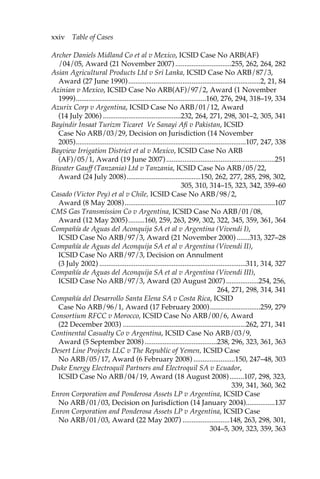
Archer Daniels Midland Co et al v Mexico, ICSID Case No ARB(AF) 
/04/05, Award (21 November 2007) ...............................255, 262, 264, 282 
Asian Agricultural Products Ltd v Sri Lanka, ICSID Case No ARB/87/3, 
Award (27 June 1990) .........................................................................2, 21, 84 
Azinian v Mexico, ICSID Case No ARB(AF)/97/2, Award (1 November 
1999)........................................................................160, 276, 294, 318–19, 334 
Azurix Corp v Argentina, ICSID Case No ARB/01/12, Award 
(14 July 2006) ...........................................232, 264, 271, 298, 301–2, 305, 341 
Bayindir Insaat Turizm Ticaret Ve Sanayi Afi v Pakistan, ICSID 
Case No ARB/03/29, Decision on Jurisdiction (14 November 
2005)..............................................................................................107, 247, 338 
Bayview Irrigation District et al v Mexico, ICSID Case No ARB 
(AF)/05/1, Award (19 June 2007) ............................................................251 
Biwater Gauff (Tanzania) Ltd v Tanzania, ICSID Case No ARB/05/22, 
Award (24 July 2008).........................................150, 262, 277, 285, 298, 302, 
305, 310, 314–15, 323, 342, 359–60 
Casado (Victor Pey) et al v Chile, ICSID Case No ARB/98/2, 
Award (8 May 2008)...................................................................................107 
CMS Gas Transmission Co v Argentina, ICSID Case No ARB/01/08, 
Award (12 May 2005).........160, 259, 263, 299, 302, 322, 345, 359, 361, 364 
Compañía de Aguas del Aconquija SA et al v Argentina (Vivendi I), 
ICSID Case No ARB/97/3, Award (21 November 2000) .......313, 327–28 
Compañía de Aguas del Aconquija SA et al v Argentina (Vivendi II), 
ICSID Case No ARB/97/3, Decision on Annulment 
(3 July 2002) .................................................................................311, 314, 327 
Compañía de Aguas del Aconquija SA et al v Argentina (Vivendi III), 
ICSID Case No ARB/97/3, Award (20 August 2007) ..................254, 256, 
264, 271, 298, 314, 341 
Compañía del Desarrollo Santa Elena SA v Costa Rica, ICSID 
Case No ARB/96/1, Award (17 February 2000)............................259, 279 
Consortium RFCC v Morocco, ICSID Case No ARB/00/6, Award 
(22 December 2003) ....................................................................262, 271, 341 
Continental Casualty Co v Argentina, ICSID Case No ARB/03/9, 
Award (5 September 2008) ........................................238, 296, 323, 361, 363 
Desert Line Projects LLC v The Republic of Yemen, ICSID Case 
No ARB/05/17, Award (6 February 2008) .......................150, 247–48, 303 
Duke Energy Electroquil Partners and Electroquil SA v Ecuador, 
ICSID Case No ARB/04/19, Award (18 August 2008) ........107, 298, 323, 
339, 341, 360, 362 
Enron Corporation and Ponderosa Assets LP v Argentina, ICSID Case 
No ARB/01/03, Decision on Jurisdiction (14 January 2004)................137 
Enron Corporation and Ponderosa Assets LP v Argentina, ICSID Case 
No ARB/01/03, Award (22 May 2007) ..........................148, 263, 298, 301, 
304–5, 309, 323, 359, 363 
xxiv Table of Cases
Table of Cases xxv 
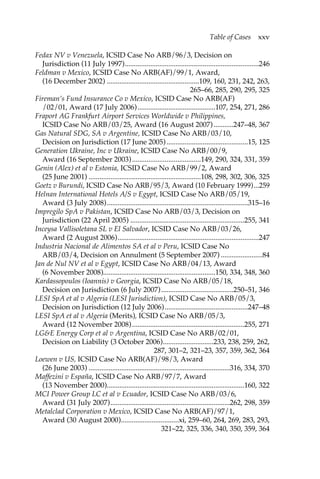
Fedax NV v Venezuela, ICSID Case No ARB/96/3, Decision on 
Jurisdiction (11 July 1997)..........................................................................246 
Feldman v Mexico, ICSID Case No ARB(AF)/99/1, Award, 
(16 December 2002) ...................................................109, 160, 231, 242, 263, 
265–66, 285, 290, 295, 325 
Fireman’s Fund Insurance Co v Mexico, ICSID Case No ARB(AF) 
/02/01, Award (17 July 2006) ...........................................107, 254, 271, 286 
Fraport AG Frankfurt Airport Services Worldwide v Philippines, 
ICSID Case No ARB/03/25, Award (16 August 2007) ...........247–48, 367 
Gas Natural SDG, SA v Argentine, ICSID Case No ARB/03/10, 
Decision on Jurisdiction (17 June 2005) .............................................15, 125 
Generation Ukraine, Inc v Ukraine, ICSID Case No ARB/00/9, 
Award (16 September 2003) ......................................149, 290, 324, 331, 359 
Genin (Alex) et al v Estonia, ICSID Case No ARB/99/2, Award 
(25 June 2001) ..............................................................108, 298, 302, 306, 325 
Goetz v Burundi, ICSID Case No ARB/95/3, Award (10 February 1999)...259 
Helnan International Hotels A/S v Egypt, ICSID Case No ARB/05/19, 
Award (3 July 2008)..............................................................................315–16 
Impregilo SpA v Pakistan, ICSID Case No ARB/03/3, Decision on 
Jurisdiction (22 April 2005) ...............................................................255, 341 
Inceysa Vallisoletana SL v El Salvador, ICSID Case No ARB/03/26, 
Award (2 August 2006)..............................................................................247 
Industria Nacional de Alimentos SA et al v Peru, ICSID Case No 
ARB/03/4, Decision on Annulment (5 September 2007) .......................84 
Jan de Nul NV et al v Egypt, ICSID Case No ARB/04/13, Award 
(6 November 2008)..............................................................150, 334, 348, 360 
Kardassopoulos (Ioannis) v Georgia, ICSID Case No ARB/05/18, 
Decision on Jurisdiction (6 July 2007) ........................................250–51, 346 
LESI SpA et al v Algeria (LESI Jurisdiction), ICSID Case No ARB/05/3, 
Decision on Jurisdiction (12 July 2006) ..............................................247–48 
LESI SpA et al v Algeria (Merits), ICSID Case No ARB/05/3, 
Award (12 November 2008) ..............................................................255, 271 
LG&E Energy Corp et al v Argentina, ICSID Case No ARB/02/01, 
Decision on Liability (3 October 2006)............................233, 238, 259, 262, 
287, 301–2, 321–23, 357, 359, 362, 364 
Loewen v US, ICSID Case No ARB(AF)/98/3, Award 
(26 June 2003) ..............................................................................316, 334, 370 
Maffezini v España, ICSID Case No ARB/97/7, Award 
(13 November 2000)............................................................................160, 322 
MCI Power Group LC et al v Ecuador, ICSID Case No ARB/03/6, 
Award (31 July 2007)..................................................................262, 298, 359 
Metalclad Corporation v Mexico, ICSID Case No ARB(AF)/97/1, 
Award (30 August 2000)................................xi, 259–60, 264, 269, 283, 293, 
321–22, 325, 336, 340, 350, 359, 364
xxvi Table of Cases 
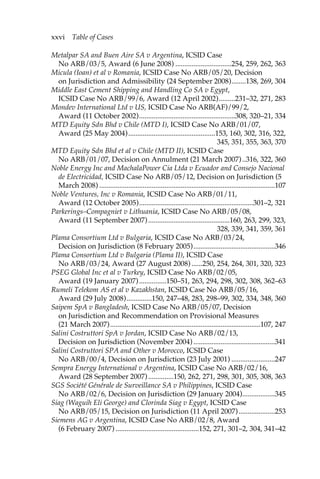
Metalpar SA and Buen Aire SA v Argentina, ICSID Case 
No ARB/03/5, Award (6 June 2008) ...............................254, 259, 262, 363 
Micula (Ioan) et al v Romania, ICSID Case No ARB/05/20, Decision 
on Jurisdiction and Admissibility (24 September 2008)........138, 269, 304 
Middle East Cement Shipping and Handling Co SA v Egypt, 
ICSID Case No ARB/99/6, Award (12 April 2002).........231–32, 271, 283 
Mondev International Ltd v US, ICSID Case No ARB(AF)/99/2, 
Award (11 October 2002).....................................................308, 320–21, 334 
MTD Equity Sdn Bhd v Chile (MTD I), ICSID Case No ARB/01/07, 
Award (25 May 2004)................................................153, 160, 302, 316, 322, 
345, 351, 355, 363, 370 
MTD Equity Sdn Bhd et al v Chile (MTD II), ICSID Case 
No ARB/01/07, Decision on Annulment (21 March 2007) ..316, 322, 360 
Noble Energy Inc and MachalaPower Cia Ltda v Ecuador and Consejo Nacional 
de Electricidad, ICSID Case No ARB/05/12, Decision on Jurisdiction (5 
March 2008) .................................................................................................107 
Noble Ventures, Inc v Romania, ICSID Case No ARB/01/11, 
Award (12 October 2005)...............................................................301–2, 321 
Parkerings–Compagniet v Lithuania, ICSID Case No ARB/05/08, 
Award (11 September 2007) .............................................160, 263, 299, 323, 
328, 339, 341, 359, 361 
Plama Consortium Ltd v Bulgaria, ICSID Case No ARB/03/24, 
Decision on Jurisdiction (8 February 2005).............................................346 
Plama Consortium Ltd v Bulgaria (Plama II), ICSID Case 
No ARB/03/24, Award (27 August 2008) ......250, 254, 264, 301, 320, 323 
PSEG Global Inc et al v Turkey, ICSID Case No ARB/02/05, 
Award (19 January 2007) ...............150–51, 263, 294, 298, 302, 308, 362–63 
Rumeli Telekom AS et al v Kazakhstan, ICSID Case No ARB/05/16, 
Award (29 July 2008)..............150, 247–48, 283, 298–99, 302, 334, 348, 360 
Saipem SpA v Bangladesh, ICSID Case No ARB/05/07, Decision 
on Jurisdiction and Recommendation on Provisional Measures 
(21 March 2007) ...................................................................................107, 247 
Salini Costruttori SpA v Jordan, ICSID Case No ARB/02/13, 
Decision on Jurisdiction (November 2004) .............................................341 
Salini Costruttori SPA and Other v Morocco, ICSID Case 
No ARB/00/4, Decision on Jurisdiction (23 July 2001) ........................247 
Sempra Energy International v Argentina, ICSID Case No ARB/02/16, 
Award (28 September 2007) ..............150, 262, 271, 298, 301, 305, 308, 363 
SGS Société Générale de Surveillance SA v Philippines, ICSID Case 
No ARB/02/6, Decision on Jurisdiction (29 January 2004)..................345 
Siag (Waguih Eli George) and Clorinda Siag v Egypt, ICSID Case 
No ARB/05/15, Decision on Jurisdiction (11 April 2007) ....................253 
Siemens AG v Argentina, ICSID Case No ARB/02/8, Award 
(6 February 2007) ..............................................152, 271, 301–2, 304, 341–42
Table of Cases xxvii 
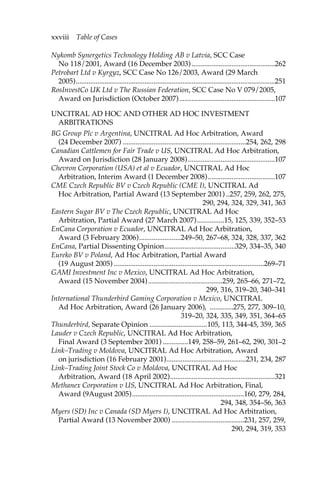
Soufraki v The United Arabs Emirates, ICSID Case No ARB/02/7, 
Decision of the Ad Hoc Committee on the application for annulment 
of Mr Soufraki (5 June 2007)..............................................................154, 253 
Técnicas Medioambientales Tecmed v Mexico, ICSID Case 
No ARB(AF)/00/2, Award (29 May 2003) ........149, 153, 256–58, 263–64, 
286–87, 290, 294–95, 309, 316, 
321–22, 325, 345, 357–59, 365 
Telenor Mobile Communications AS v Hungary, ICSID Case No 
ARB/04/15, Award (13 September 2006 .........................26, 231, 257, 260, 
263, 265, 268, 270, 272 
Tokios Tokelès v Ukraine (Tokios Tokelès (Jurisdiction)), ICSID Case 
No ARB/02/18, Award (29 April 2004)..................................................248 
Tokios Tokelès v Ukraine (Tokios Tokelès (Merits)), ICSID Case 
No ARB/02/18, Award (26 July 2007) ......................................247–48, 265 
Total SA v Argentina, ICSID Case No ARB/04/01, Decision on 
Jurisdiction (25 August 2006)......................................................................63 
TSA Spectrum de Argentina SA v Argentina, ICSID Case No ARB/05/5, 
Award (19 December 2008) .......................................................................339 
Vanessa Ventures Ltd v Venezuela, ICSID Case No ARB(AF)/04/6, 
Decision on Jurisdiction (22 August 2008)..............................................247 
Waste Management Inc v Mexico (Waste Management II), ICSID 
Case No ARB(AF)/00/3, Award (30 April 2004)....160, 231, 262, 266–68, 
299, 316, 325, 328, 339, 341, 349, 359 
Wena Hotels Ltd v Egypt, ICSID Case No ARB/98/4, Award 
(8 December 2000) ................................................................................262–63 
Wena Hotels Ltd v Egypt (Wena II), ICSID Case No ARB/98/4, 
Decision on Annulment (5 February 2002) .............................................311 
Wintershall Aktiengesellschaft v Argentina, ICSID Case No ARB/04/14, 
Award (8 December 2008) .....................................................................9, 142 
LCIA 
Occidental Exploration and Production Co v Ecuador (OEPC), LCIA 
Case No UN 3467, Award (1 July 2004) .................137, 246, 249, 259, 267, 
293, 299, 301, 321–22, 337, 345, 359, 363–64, 370 
Société Générale v Dominican Republic, LCIA Case No 7927, 
Decision on Jurisdiction (19 September 2008) ........................................262 
STOCKHOLM CHAMBER OF COMMERCE 
Berschader (Vladimir) et al v Russian Federation, SCC Case 
No 080/2004, Award (21 April 2006)...............................................107, 304 
Bogdanov et al v Moldova, SCC Case, Award (22 September 
2005)..............................................................................................260, 265, 359 
Limited Liability Company AMTO v Ukraine, SCC Case No 080/2005, 
Award 26 March 2008)...............................................................................316
Nykomb Synergetics Technology Holding AB v Latvia, SCC Case 
No 118/2001, Award (16 December 2003) ..............................................262 
Petrobart Ltd v Kyrgyz, SCC Case No 126/2003, Award (29 March 
2005)..............................................................................................................251 
RosInvestCo UK Ltd v The Russian Federation, SCC Case No V 079/2005, 
Award on Jurisdiction (October 2007).....................................................107 
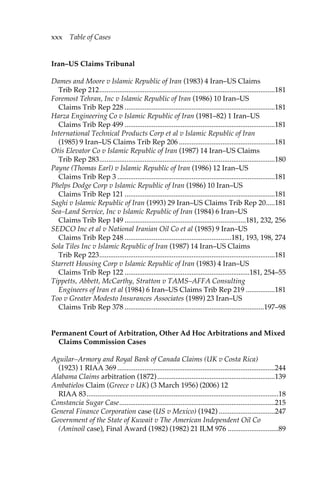
UNCITRAL AD HOC AND OTHER AD HOC INVESTMENT 
ARBITRATIONS 
BG Group Plc v Argentina, UNCITRAL Ad Hoc Arbitration, Award 
(24 December 2007) ....................................................................254, 262, 298 
Canadian Cattlemen for Fair Trade v US, UNCITRAL Ad Hoc Arbitration, 
Award on Jurisdiction (28 January 2008) ................................................107 
Chevron Corporation (USA) et al v Ecuador, UNCITRAL Ad Hoc 
Arbitration, Interim Award (1 December 2008).....................................107 
CME Czech Republic BV v Czech Republic (CME I), UNCITRAL Ad 
Hoc Arbitration, Partial Award (13 September 2001) ..257, 259, 262, 275, 
290, 294, 324, 329, 341, 363 
Eastern Sugar BV v The Czech Republic, UNCITRAL Ad Hoc 
Arbitration, Partial Award (27 March 2007)...............15, 125, 339, 352–53 
EnCana Corporation v Ecuador, UNCITRAL Ad Hoc Arbitration, 
Award (3 February 2006).......................249–50, 267–68, 324, 328, 337, 362 
EnCana, Partial Dissenting Opinion.......................................329, 334–35, 340 
Eureko BV v Poland, Ad Hoc Arbitration, Partial Award 
(19 August 2005) ...................................................................................269–71 
GAMI Investment Inc v Mexico, UNCITRAL Ad Hoc Arbitration, 
Award (15 November 2004) .........................................259, 265–66, 271–72, 
299, 316, 319–20, 340–341 
International Thunderbird Gaming Corporation v Mexico, UNCITRAL 
Ad Hoc Arbitration, Award (26 January 2006), .............275, 277, 309–10, 
319–20, 324, 335, 349, 351, 364–65 
Thunderbird, Separate Opinion ................................105, 113, 344-45, 359, 365 
Lauder v Czech Republic, UNCITRAL Ad Hoc Arbitration, 
Final Award (3 September 2001) ..............149, 258–59, 261–62, 290, 301–2 
Link–Trading v Moldova, UNCITRAL Ad Hoc Arbitration, Award 
on jurisdiction (16 February 2001)............................................231, 234, 287 
Link–Trading Joint Stock Co v Moldova, UNCITRAL Ad Hoc 
Arbitration, Award (18 April 2002)..........................................................321 
Methanex Corporation v US, UNCITRAL Ad Hoc Arbitration, Final, 
Award (9August 2005)..............................................................160, 279, 284, 
294, 348, 354–56, 363 
Myers (SD) Inc v Canada (SD Myers I), UNCITRAL Ad Hoc Arbitration, 
Partial Award (13 November 2000) ........................................231, 257, 259, 
290, 294, 319, 353 
xxviii Table of Cases
Table of Cases xxix 
Mytilineos Holdings SA v The State Union of Serbia and Montenegro 
and the Republic of Serbia, UNCITRAL Ad Hoc Case, Partial Award 
on Jurisdiction (8 September 2006)...........................................................247 
Pope & Talbot Inc v Canada (Pope & Talbot I), UNCITRAL Ad Hoc 
Arbitration, Interim Award (26 June 2000).258–59, 262–63, 266, 272, 290 
Pope & Talbot Inc v Canada (Pope & Talbot II), UNCITRAL Ad Hoc 
Arbitration, Award (10 April 2001)....................................................356–57 
Pope & Talbot Inc v Canada (Pope & Talbot III) UNCITRAL Ad Hoc 
Arbitration, Award on Damages (31 May 2002) ....................................310 
Saluka Investments BV v Czech Republic, UNCITRAL Ad Hoc Arbitration, 
Partial Award (17 March 2006)....................149, 233, 276, 279–80, 298–99, 
302, 305, 323, 339, 346, 348, 356, 359–60, 362 
United Parcel Services of America Inc v Canada, UNCITRAL Ad Hoc 
Arbitration, Award (24 May 2007) ...........................................................370 
International Court of Justice and Permanent Court of International 
Justice 
Barcelona Traction, Light & Power Co Ltd (Belgium v Spain) 
(Second Phase) [1970] ICJ Rep 4 .......................18, 21, 61, 160, 244–45, 248 
Certain German Interests in Polish Upper Silesia [1926] PCIJ Rep Ser 
A No 7 ..........................................................................................................334 
Certain Norwegian Loans (France v Norway) [1957] ICJ Rep 9 ....................318 
Diallo (Ahmadou Sadio) (Republic of Guinea v Democratic Republic of 
the Congo (Preliminary Objections) ............................................................32 
Elettronica Sicula SpA (ELSI) (US v Italy) [1989] ICJ Rep 15 ..301–2, 311, 313 
Exchange of Greek and Turkish Populations [1925] PCIJ Rep Ser 
B No 10 .........................................................................................................312 
Lighthouses Case (France v Greece) [1934] PCIJ Rep Ser A/B No 62 ..........333 
Mavrommatis Palestine Concessions Case (Greece v UK) [1924] PCIJ 
Rep Series A No 2 .........................................................................................32 
Nationality Decree in Tunis and Morocco [1923] PCIJ Rep Ser B No 7........324 
Oil Platforms (Iran v US) [1996] ICJ Rep 803................................................305 
Oscar Chinn Case (UK v Belgium) [1934] PCIJ Rep Series A/B 
No 63.............................................................................................166, 232, 344 
Panevezys–Saldutiskis Railway (Estonia v Lithuania) [1939] PCIJ 
Rep Ser A/B No 76 .....................................................................................244 
Payment in Gold of Brazilian Loans Contracted in France [1929] 
PCIJ Rep Ser A No 21...........................................................................329–30 
Payment of Various Serbian Loans Issued in France [1929] PCIJ 
Rep Ser A No 20..........................................................................................330 
Treatment of Polish Nationals and Other Persons of Polish origin or Speech 
in the Danzig Territory [1932] PCIJ Rep Series A/B No 44.....................312
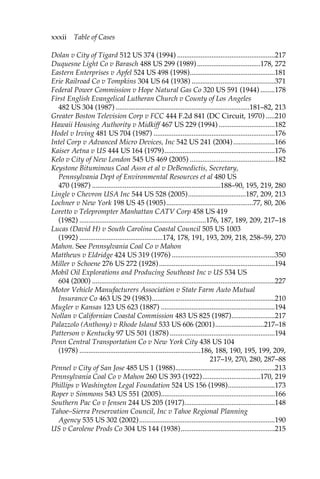
xxx Table of Cases 
Iran–US Claims Tribunal 
Dames and Moore v Islamic Republic of Iran (1983) 4 Iran–US Claims 
Trib Rep 212.................................................................................................181 
Foremost Tehran, Inc v Islamic Republic of Iran (1986) 10 Iran–US 
Claims Trib Rep 228 ...................................................................................181 
Harza Engineering Co v Islamic Republic of Iran (1981–82) 1 Iran–US 
Claims Trib Rep 499 ...................................................................................181 
International Technical Products Corp et al v Islamic Republic of Iran 
(1985) 9 Iran–US Claims Trib Rep 206 .....................................................181 
Otis Elevator Co v Islamic Republic of Iran (1987) 14 Iran–US Claims 
Trib Rep 283.................................................................................................180 
Payne (Thomas Earl) v Islamic Republic of Iran (1986) 12 Iran–US 
Claims Trib Rep 3 .......................................................................................181 
Phelps Dodge Corp v Islamic Republic of Iran (1986) 10 Iran–US 
Claims Trib Rep 121 ...................................................................................181 
Saghi v Islamic Republic of Iran (1993) 29 Iran–US Claims Trib Rep 20.....181 
Sea–Land Service, Inc v Islamic Republic of Iran (1984) 6 Iran–US 
Claims Trib Rep 149 ...................................................................181, 232, 256 
SEDCO Inc et al v National Iranian Oil Co et al (1985) 9 Iran–US 
Claims Trib Rep 248 ...........................................................181, 193, 198, 274 
Sola Tiles Inc v Islamic Republic of Iran (1987) 14 Iran–US Claims 
Trib Rep 223.................................................................................................181 
Starrett Housing Corp v Islamic Republic of Iran (1983) 4 Iran–US 
Claims Trib Rep 122 .....................................................................181, 254–55 
Tippetts, Abbett, McCarthy, Stratton v TAMS–AFFA Consulting 
Engineers of Iran et al (1984) 6 Iran–US Claims Trib Rep 219 ................181 
Too v Greater Modesto Insurances Associates (1989) 23 Iran–US 
Claims Trib Rep 378 .............................................................................197–98 
Permanent Court of Arbitration, Other Ad Hoc Arbitrations and Mixed 
Claims Commission Cases 
Aguilar–Armory and Royal Bank of Canada Claims (UK v Costa Rica) 
(1923) 1 RIAA 369 .......................................................................................244 
Alabama Claims arbitration (1872) .................................................................139 
Ambatielos Claim (Greece v UK) (3 March 1956) (2006) 12 
RIAA 83..........................................................................................................18 
Constancia Sugar Case......................................................................................215 
General Finance Corporation case (US v Mexico) (1942) ...............................247 
Government of the State of Kuwait v The American Independent Oil Co 
(Aminoil case), Final Award (1982) (1982) 21 ILM 976 ............................89
Table of Cases xxxi 
Kennedy (George Adams) (USA) v United Mexican States (1927) 
4 RIAA 194.............................................................................................21, 301 
Life–Insurance Claims Case (1924) ....................................................................76 
Martini Case (Italy v Venezuela), Award (3 May 1930)................................333 
Neer (LFH) and Pauline Neer (USA) v United Mexican States (1926) 
4 RIAA 60.....................................................................................152, 299, 308 
Norwegian Shipowners’ Claim (Norway v US) (1922) 1 RIAA 307 ..............318 
United Kingdom 
Council of Civil Service Unions v Minister for the Civil Service [1985] 
AC 374 ..........................................................................................................211 
R v Secretary of State for Trade and Industry, ex p Lonrho Plc [1989] 
1 WLR 525....................................................................................................211 
Republic of Ecuador v Occidental Exploration and Production Co 
[2006] EWHC (Comm) 345 ........................................................................137 
Three Rivers District Council v Bank of England (No 3) [2000] 2 WLR 
1220, HL .......................................................................................................201 
X (Minors) v Bedfordshire County Council [1995] 2 AC 633, HL .................202 
United States 
Allied–General Nuclear Services v US 839 F.2d 1572 (1988).........................227 
American Pelagic Fishing Co LP v US 379 F.3d 1363 (2004).........................227 
Andrus v Allard 444 US 51 (1979) ..........................................................170, 190 
Armstrong v US 364 US 40 (1960)............................................................11, 213 
Banco Nacional de Cuba v Sabbatino 376 US 398 (1964)..................................62 
Bennis v Michigan 516 US 442 (1996) ............................................................193 
Bivens v Six Unknown Named Agents of the Federal Bureau of Narcotics 
403 US 388 (1971) ........................................................................................203 
Chevron, USA Inc v Natural Resources Defense Council, Inc 467 US 837 
(1984) ............................................................................................................209 
Citizens to Preserve Overton Park, Inc v Volpe, Secretary of 
Transportation 401 US 402 (1971)...............................................................344 
Collins v Harker Heights 503 US 115 (1992)...................................................203 
Concrete Pipe and Prods v Construction Laborers Pension Trust 508 
US 602 (1993) ...............................................................................................190 
Connelly v Pension Ben Guaranty Corp 475 US 211 (1986)...........................170 
Conroy v Aniskoff 507 US 511 (1993)..............................................................166 
Conti v US 48 Fed Cl 532 (2001) ....................................................................227 
Coppage v Kansas 236 US 1 (1915)....................................................................77 
Correctional Services Corp v Malesko 534 US 61 (2001).................................203
xxxii Table of Cases 
Dolan v City of Tigard 512 US 374 (1994) ......................................................217 
Duquesne Light Co v Barasch 488 US 299 (1989) ...................................178, 272 
Eastern Enterprises v Apfel 524 US 498 (1998)...............................................181 
Erie Railroad Co v Tompkins 304 US 64 (1938) ..............................................371 
Federal Power Commission v Hope Natural Gas Co 320 US 591 (1944) ........178 
First English Evangelical Lutheran Church v County of Los Angeles 
482 US 304 (1987) ..........................................................................181–82, 213 
Greater Boston Television Corp v FCC 444 F.2d 841 (DC Circuit, 1970) .....210 
Hawaii Housing Authority v Midkiff 467 US 229 (1994) ...............................182 
Hodel v Irving 481 US 704 (1987) ...................................................................176 
Intel Corp v Advanced Micro Devices, Inc 542 US 241 (2004) .......................166 
Kaiser Aetna v US 444 US 164 (1979).............................................................176 
Kelo v City of New London 545 US 469 (2005) ...............................................182 
Keystone Bituminous Coal Assn et al v DeBenedictis, Secretary, 
Pennsylvania Dept of Environmental Resources et al 480 US 
470 (1987) .......................................................................188–90, 195, 219, 280 
Lingle v Chevron USA Inc 544 US 528 (2005)................................187, 209, 213 
Lochner v New York 198 US 45 (1905)................................................77, 80, 206 
Loretto v Teleprompter Manhattan CATV Corp 458 US 419 
(1982) ......................................................................176, 187, 189, 209, 217–18 
Lucas (David H) v South Carolina Coastal Council 505 US 1003 
(1992) ..............................................174, 178, 191, 193, 209, 218, 258–59, 270 
Mahon. See Pennsylvania Coal Co v Mahon 
Matthews v Eldridge 424 US 319 (1976) .........................................................350 
Miller v Schoene 276 US 272 (1928) ................................................................194 
Mobil Oil Explorations and Producing Southeast Inc v US 534 US 
604 (2000) .....................................................................................................227 
Motor Vehicle Manufacturers Association v State Farm Auto Mutual 
Insurance Co 463 US 29 (1983)....................................................................210 
Mugler v Kansas 123 US 623 (1887) ...............................................................194 
Nollan v Californian Coastal Commission 483 US 825 (1987)........................217 
Palazzolo (Anthony) v Rhode Island 533 US 606 (2001)...........................217–18 
Patterson v Kentucky 97 US 501 (1878) ..........................................................194 
Penn Central Transportation Co v New York City 438 US 104 
(1978) ...................................................................186, 188, 190, 195, 199, 209, 
217–19, 270, 280, 287–88 
Pennel v City of San Jose 485 US 1 (1988).......................................................213 
Pennsylvania Coal Co v Mahon 260 US 393 (1922)................................170, 219 
Phillips v Washington Legal Foundation 524 US 156 (1998)..........................173 
Roper v Simmons 543 US 551 (2005)...............................................................166 
Southern Pac Co v Jensen 244 US 205 (1917)..................................................148 
Tahoe–Sierra Preservation Council, Inc v Tahoe Regional Planning 
Agency 535 US 302 (2002)...........................................................................190 
US v Carolene Prods Co 304 US 144 (1938)....................................................215
Table of Cases xxxiii 
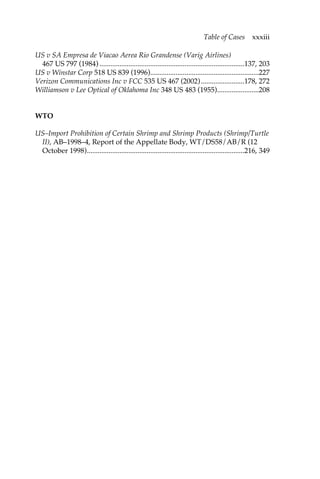
US v SA Empresa de Viacao Aerea Rio Grandense (Varig Airlines) 
467 US 797 (1984) ................................................................................137, 203 
US v Winstar Corp 518 US 839 (1996)............................................................227 
Verizon Communications Inc v FCC 535 US 467 (2002) ........................178, 272 
Williamson v Lee Optical of Oklahoma Inc 348 US 483 (1955).......................208 
WTO 
US–Import Prohibition of Certain Shrimp and Shrimp Products (Shrimp/Turtle 
II), AB–1998–4, Report of the Appellate Body, WT/DS58/AB/R (12 
October 1998).......................................................................................216, 349
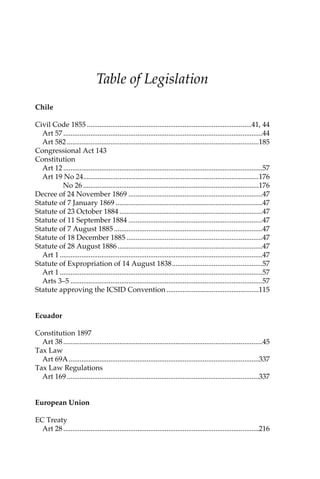
Table of Legislation 
Chile 
Civil Code 1855 ...........................................................................................41, 44 
Art 57 ..............................................................................................................44 
Art 582 ..........................................................................................................185 
Congressional Act 143 
Constitution 
Art 12 ..............................................................................................................57 
Art 19 No 24.................................................................................................176 
No 26 .................................................................................................176 
Decree of 24 November 1869 ..........................................................................47 
Statute of 7 January 1869 .................................................................................47 
Statute of 23 October 1884 ...............................................................................47 
Statute of 11 September 1884 ..........................................................................47 
Statute of 7 August 1885 ..................................................................................47 
Statute of 18 December 1885 ...........................................................................47 
Statute of 28 August 1886 ................................................................................47 
Art 1 ................................................................................................................47 
Statute of Expropriation of 14 August 1838..................................................57 
Art 1 ................................................................................................................57 
Arts 3–5 ..........................................................................................................57 
Statute approving the ICSID Convention ...................................................115 
Ecuador 
Constitution 1897 
Art 38 ..............................................................................................................45 
Tax Law 
Art 69A.........................................................................................................337 
Tax Law Regulations 
Art 169 ..........................................................................................................337 
European Union 
EC Treaty 
Art 28 ............................................................................................................216
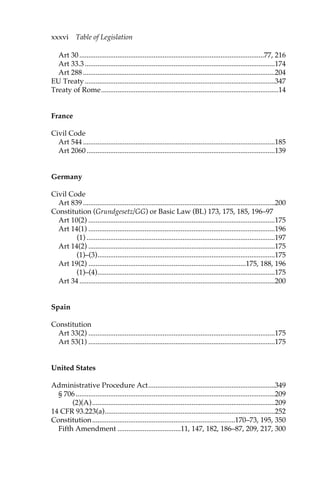
xxxvi Table of Legislation 
Art 30 ......................................................................................................77, 216 
Art 33.3 .........................................................................................................174 
Art 288 ..........................................................................................................204 
EU Treaty .........................................................................................................347 
Treaty of Rome..................................................................................................14 
France 
Civil Code 
Art 544 ..........................................................................................................185 
Art 2060 ........................................................................................................139 
Germany 
Civil Code 
Art 839 ..........................................................................................................200 
Constitution (Grundgesetz/GG) or Basic Law (BL) 173, 175, 185, 196–97 
Art 10(2) .......................................................................................................175 
Art 14(1) .......................................................................................................196 
(1) ........................................................................................................197 
Art 14(2) .......................................................................................................175 
(1)–(3)..................................................................................................175 
Art 19(2) .......................................................................................175, 188, 196 
(1)–(4)..................................................................................................175 
Art 34 ............................................................................................................200 
Spain 
Constitution 
Art 33(2) .......................................................................................................175 
Art 53(1) .......................................................................................................175 
United States 
Administrative Procedure Act......................................................................349 
§ 706 ..............................................................................................................209 
(2)(A).....................................................................................................209 
14 CFR 93.223(a)..............................................................................................252 
Constitution...............................................................................170–73, 195, 350 
Fifth Amendment ...................................11, 147, 182, 186–87, 209, 217, 300
Table of Legislation xxxvii 
Fourteenth Amendment ............................................................................194 
Due Process Clause ............................................................................208–9 
Taking Clause..............................................................................................219 
Federal Tort Claims Act.................................................................................202 
§ 2680(a) .......................................................................................................203 
Kansas Constitution 1880 ..............................................................................194 
Restatement of the Law (2d): Foreign Relations Law 1962 ......151, 244, 307 
§ 165.2 .............................................................................................71, 152, 307 
(a)–(b)...................................................................................................72 
§ 185 ..............................................................................................................244 
Restatement of the Law (3d): Foreign Relations Law 1987 ......192, 197, 278 
§ 712 ........................................................................192, 197, 274–75, 279, 282 
Venezuela 
Constitution 1893 
Art 10 ..............................................................................................................45 
Art 149 ............................................................................................................45
Table of International Agreements and 
Draft International Agreements 
Additional and Explanatory Convention to the Treaty of Peace, Amity, 
Commerce and Navigation (Chile-US) 1833.........................................43 
Convention Respecting the Limitation of the Employment of Force 
for the Recovery of Contract Debts 1907 (Porter Convention) ....49–50 
Arts I–II ..........................................................................................................50 
Convention Establishing the Multilateral Investment Guarantee 
Agency 1988 (MIGA Convention)........................................................197 
Art 11 ............................................................................................................197 
(a)(ii) ....................................................................................................197 
Convention on Pecuniary Claims 1910..........................................................49 
Convention on Recognition and Enforcement of Foreign Arbitral 
Awards 1958 (`New York Convention)...........................................2, 136 
Convention Relative to the Rights of Aliens 1902 ....................................48-9 
Art 3 ................................................................................................................40 
Principle 1 ......................................................................................................48 
Principles 2–3.................................................................................................49 
Convention on Rights and Duties of States 1933 
Art 9 ................................................................................................................49 
Convention on the Settlement of Investment Disputes between 
States and Nationals of Other States 1965 (ICSID Convention/ 
Washington Convention) .............................2, 9, 62, 64, 78, 97, 104, 115, 
117, 135–36, 138, 143, 145 
Art 25(2)(b)...................................................................................................271 
Art 26 ............................................................................................................327 
Art 42 ............................................................................................................303 
Convention on the Status of Aliens 1928.......................................................49 
Covenant of the League of Nations 1920 ......................................................68 
Art 23 ..............................................................................................................52 
(e) .............................................................................................51, 68, 305 
Economic Agreement of Bogotá 1948 ......................................................68, 74 
Art 22 ..............................................................................................................68 
Arts 24–25 ......................................................................................................68 
Ch IV...............................................................................................................68 
Energy Charter Treaty .....................................................................250–51, 323 
European Convention for the Protection of Human Rights and 
Fundamental Freedoms 1950............... 179, 186, 200, 207, 215, 221, 234
xl Table of International Agreements and Draft International Agreements 
Arts 1–2 ........................................................................................................247 
Protocol 1 .....................................................................................179, 234, 251 
Art 1 ........................................................78, 179, 186, 190, 205, 221, 244, 251 
(1)...................................................................179, 186, 190, 200, 215, 220 
(2)...................................................................................................179, 220 
Art 2 ..............................................................................................................246 
Protocols.......................................................................................................215 
General Treaty for the Renunciation of War 1928 (Kellogg– 
Briand Pact) ...............................................................................................50 
Havana Charter 1948..................................................................................68, 74 
Art 11(e)..........................................................................................................68 
(2) .......................................................................................................68 
ICSID Convention. See Convention on the Settlement of Investment 
Disputes between States and Nationals of Other States 1965 
International Convention for the Mutual Protection of Private 
Property in Foreign Countries 1957 .......................................................74 
Jay Treaty between the US and Great Britain 1794....................................139 
Kellogg–Briand Pact. See General Treaty for the Renunciation 
of War 1928 
MIGA Convention. See Convention Establishing the Multilateral 
Investment Guarantee Agency 1988 
NAFTA (1993) ........................................................138, 141, 156, 231, 242, 259, 
286, 289, 298, 310, 319, 340, 343 
Art 102(1) .....................................................................................................321 
Art 1102 ........................................................................................................335 
Art 1105 ....................................................151, 294, 309–10, 339–41, 344, 353 
(1) ....................................................................285, 308, 320, 328, 339 
Art 1110 ................................109, 242, 258, 260, 267, 272, 276, 286, 290, 319 
(1) ....................................................................................................286 
Art 1117 ........................................................................................................271 
Art 1139 ........................................................................................................246 
Ch 11.............1, 3, 141, 151, 160, 231, 251, 257, 276, 294, 318, 320, 328, 335 
New York Convention. See Convention on Recognition and 
Enforcement of Foreign Arbitral Awards 1958 
OECD Multilateral Agreement on Investment ..........................................103 
Porter Convention. See Convention Respecting the Limitation of the 
Employment of Force for the Recovery of Contract Debts 1907 
Rome Statute for the International Criminal Court...................................143 
Art III ............................................................................................................143 
Softwood Lumber Agreement (Canada-US) 1996 ....................................356 
Statute of the International Court of Justice .......................................152, 308 
Art 38(1)(c) ...............................................................152, 304, 307–8, 344, 372 
Statute of the Permanent Court of International Justice 
Art 38 ..............................................................................................................70
Table of International Agreements and Draft International Agreements xli 
Treaty of Arbitration for Pecuniary Claims 1902.........................................49 
Arts 1–2 ..........................................................................................................49 
UN Charter 1945 .........................................................................................50, 59 
Art 2.3 .............................................................................................................50 
UN Charter of Economic Rights and Duties of States (12 December 
1974) (CERDS).................................................................59, 87–89, 97, 105 
Art 2(2)(c) .......................................................................................................59 
UNGA Resolution 799 (VIII) of 7 December 1953 .......................................59 
UNGA Resolution 3171 on Permanent Sovereignty over National 
Resources (17 December 1973)................................................................58 
Vienna Convention on the Law of Treaties ........................................304, 306 
Art 27 ....................................................................................................253, 318 
Art 31 ............................................................................................................302 
(1).........................................................................................................302 
(3)(c) ................................................................................303–4, 344, 372 
(4).................................................................................................303, 305 
Art 32 ................................................................................................302–3, 305 
Washington Convention. See Convention on the Settlement of 
Investment Disputes between States and Nationals of Other 
States 1965 
Bilateral Investment Treaties (BITs) 
Agreement Between the Federal Republic of Germany and theFederation 
of Malaysia Concerning the Promotion and Reciprocal Protection 
of Investments (West Germany–Malaysia) (22 December 1960) .......67 
Art 2(2) ...........................................................................................................67 
Agreement on the mutual promotion and protection of investment 
(Chile–France) (14 July 1992) 
Art 13 ............................................................................................................146 
Agreement on the mutual promotion and protection of investments 
(Estonia–Norway) (15 June 1992) 
Art 13 ............................................................................................................146 
Agreement on the promotion and protection of investments 
(India–UK) (14 March 1993) 
Art 15 ............................................................................................................146 
Agreement concerning the promotion and reciprocal protection of 
investments (Chile–Denmark) (28 May 1993) ....................................246 
Agreement on the promotion and reciprocal protection of investments 
(Mexico–Switzerland) (10 July 1995) 
Art 14 ............................................................................................................146 
Agreement concerning the reciprocal promotion and protection of 
investments (Denmark–Turkey) (7 February 1990)
xlii Table of International Agreements and Draft International Agreements 
Art 11 ............................................................................................................146 
Australia–Chile FTA 2008 .....................................................................279, 287 
Benin–Lebanon BIT (June 2004)....................................................................114 
Canada–Ecuador BIT 
Art VIII .........................................................................................................250 
Art XII(4) ......................................................................................................250 
Art XIII(7).....................................................................................................249 
Chad–Guinea BIT (June 2004).......................................................................114 
Chad–Lebanon BIT (June 2004) ....................................................................114 
France–Morocco BIT 1975................................................................................65 
Gabon–Germany BIT 1969 ..............................................................................65 
Guinea–Lebanon BIT (June 2004).................................................................114 
Lebanon–Mauritania BIT (June 2004) ..........................................................114 
Lesotho–Switzerland BIT (June 2004)..........................................................114 
Traité entre la Confédération Suisse et la République Tunisienne relative 
à la protection et à l’encouragement des investissements de capitaux 
(Switzerland–Tunisia) (2 December 1961..............................................67 
Art 1 ................................................................................................................67 
Treaty for Promotion and Protection of Investment (West Germany– 
Pakistan) (25 November 1959) ......................................................1, 62, 67 
Art 1(2) ...........................................................................................................67 
Art 3(1)–(2).....................................................................................................67 
US–Chile FTA (6 June 2003) ............................................161, 233, 279, 287–88 
US–Singapore FTA (6 May 2003)..................................................161, 233, 279 
FCN Treaties 
Belgium–Chile FCN (31 August 1858)...........................................................44 
Chile–France FCN (15 September 1846)........................................................44 
Art III ..............................................................................................................44 
Chile–Mexico FCN (7 March 1831) ................................................................44 
Art II ...............................................................................................................44 
Chile–Nueva Granada (Colombia) FCN (16 February 1844) .....................44 
Chile–Peru FCN (20 January 1835) ................................................................44 
Treaty of Amity and Economic Relations between the US and 
Ethiopia (7 September 1951)....................................................................69 
Art VIII(1).......................................................................................................69 
Treaty of Amity between Iran and the US ..................................................233 
Treaty of Friendship, Commerce and Economic Development 
(US–Uruguay) (23 November 1949).......................................................68 
Art IV..............................................................................................................68
Table of International Agreements and Draft International Agreements xliii 
US–Chile FCN 
Art 10 ..............................................................................................................43 
US–France FCN (25 November 1959) 
Art I.................................................................................................................69 
US–Germany FCN (29 October 1954) 
Art I(1) ............................................................................................................69 
US–Ireland FCN (21 January 1950) 
Art V ...............................................................................................................69 
US–Israel FCN (23 August 1951) 
Art I.................................................................................................................69 
US–Muscat and Oman FCN (20 December 1958) 
Art IV(1) .........................................................................................................69 
US–Netherlands FCN (27 March 1953) 
Art I(1) ............................................................................................................69 
US–Nicaragua FCN (21 January 1956) 
Art I.................................................................................................................69 
US–Pakistan FCN (12 November 1959) 
Art I.................................................................................................................69
Introduction 
[T]akings theory is ultimately about political theory—specifically, about how 
much faith one has in government.1 
I WHY THIS BOOK 
SINCE GERMANY AND Pakistan signed the first BIT in 1959, the 
number of concluded bilateral investment treaties (BITs) has grown 
globally to 2,608.2 Most of them were signed subsequent to the fall of 
the USSR, on the understanding that foreign direct investment (FDI) is a 
key factor for development which should be actively pursued.3 
BITs, as well as other investment treaties such as free trade agreements 
(FTAs) containing investment chapters,4 regulate the admission, treat-ment 
and expropriation of foreign investment. This is accomplished, in 
short, through their dual function of providing a set of open-ended prin-ciples 
that govern state behavior towards foreign investors, and establish-ing 
a neutral forum for the resolution of investor–state disputes. 
What makes these treaties truly unique is the fact that they are designed 
to function without the political involvement of either host- or home 
governments. Indeed, an overwhelming majority of BITs allow foreign 
investors to file damages actions directly against host states before 
international arbitral tribunals. Foreign investors are entitled to claim 
that legislative, administrative or judicial measures have breached the 
1 David A Dana and Tomas W Merrill, Property. Takings (New York, Foundation Press, 
2002) 57. 
2 Data through the end of 2007. See United Nations Conference on Trade and 
Development (UNCTAD), World Investment Report (New York, United Nations, 2008) 13. 
A comprehensive list of BITs—although incomplete—can be found at UNCTAD website: 
http://www.unctadxi.org/templates/DocSearch____779.aspx. 
3 See Kenneth J Vandevelde, ‘US Bilateral Investment Treaties: The Second Wave’ (1993) 
14 Michigan Journal of International Law 621, and Jeswald W Salacuse, ‘BIT by BIT: The Growth 
of Bilateral Investment Treaties and Their Impact on Foreign Investment in Developing 
Countries’ (1990) 24 International Lawyer 655. 
4 As ironically pointed out by José E Alvarez, ‘Critical Theory and the North American 
Free Trade Agreement’s Chapter Eleven’ (1997) 28 University of Miami Inter-American Law 
Review 303, 304, NAFTA Chapter 11 is ‘a US bilateral investment treaty on steroids’.
2 Introduction 
substantive principles of these treaties, and they can do so without 
exhausting local remedies at host states’ courts, and without securing 
authorisation from or endorsement by their own home states. Moreover, 
under the authority of the New York Convention5 or ICSID Convention,6 
awards issued by these tribunals are directly enforceable in courts sitting 
in signatory states throughout the world. 
As a consequence of this favourable legal architecture, foreign investors 
have been filing claims against host states at a pace of 25–45 per year,7 
with a cumulative total of about 300 known cases (up to 2007).8 These 
claims have placed and will continue to place, a truly impressive array of 
regulatory action under the direct and immediate scrutiny of arbitral tri-bunals. 
These range from environmental policies, banking sector reforms, 
implementation of treaty obligations, and responses to economic crises; to 
revocations of licenses and permits, termination of concession contracts, 
contractual disagreements of all kinds, and application of tax laws, just to 
name a few. 
One of the most distinctive features of this ‘worldwide BIT network’,9 is 
the degree of similarity to be found among core substantive provisions.10 
As McLachlan et al have noted before, ‘this patchwork of interlocking but 
separate treaties—each the product of its own negotiation—in fact betrays 
a surprising pattern of common features’. (emphasis added)11 
Notwithstanding difference in wording, from a sociological perspec-tive 
the language used by BITs’ key provisions is sufficiently uniform to 
have given birth to a common legal practice. As a result, since the first arbit-ral 
award based on a BIT was rendered in 1990,12 investment treaty arbit-ration 
has become a distinctive field in international law. In Duprey’s 
words, investment treaties have given way to ‘the establishment of a 
genuine arbitration case law specific to the field of investment’.13 Using 
5 Convention on Recognition and Enforcement of Foreign Arbitral Awards (adopted 10 June 
1958, entered into force 7 June 1959) 330 UNTS 38 (hereinafter, New York Convention). 
6 Convention on the Settlement of Investment Disputes between States and Nationals of Other 
States (adopted 18 March 1965, entered into force 14 October 1966) 575 UNTS 159 (hereinafter 
ICSID Convention). 
7 This pace corresponds to the period 2002–2007, which can be considered to represent 
the mature equilibrium of the system. 
8 See UNCTAD, n 2, 17. 
9 Asian Agricultural Products Ltd v Sri Lanka, ICSID Case No ARB/87/3 (El-Kosheri, 
Goldman, Asante), Award (27 June 1990) ¶ 49 (hereinafter, Asian Agricultural Products). 
10 See eg Rainer Geiger, ‘The Multifaceted Nature of International Investment Law’ in Karl 
Sauvant (ed), Appeals Mechanisms in International Investment Law (New York, OUP, 2008) 17, 
18 (noting that ‘the treaty practice of most countries show a certain degree of convergence in 
investment protection provisions’). 
11 Campbell McLachlan et al, International Investment Arbitration. Substantive Principles 
(New York, OUP, 2007) 5–6. 
12 The first award was rendered in Asian Agricultural Products. 
13 Pierre Duprey, ‘Do Arbitral Awards Constitute Precedents? Should Commercial 
Arbitration Be Distinguished from Arbitration Based on Investment Treaties’ in Emmanuel 
Gaillard (ed), Towards a Uniform International Arbitration Law? (Huntington, Juris Publishing,
Why This Book 3 
the expression coined by Reisman and Sloane, today we live in the ‘BIT 
generation’.14 
Investment treaty arbitration, also referred to here as investment arbit-ration, 
or international investment law, is certainly a new development in 
international law. While having roots in general international law—par-ticularly 
in the traditional field of protection of aliens and their property— 
international investment law confronts challenges so novel, that older 
precedents, doctrines, and modes of thought, by their very nature, are 
suddenly of limited value. Indeed, never before has international law 
enjoyed so much authority over the regulatory state on a permanent basis 
and without the previous intervention of domestic courts. 
The difficulty of the challenges that confront us in investment treaty 
arbitration derives not only from the novelty of the enterprise, but more 
importantly, from an absence of guidance provided by the relevant 
treaties. Indeed, investment treaties do not establish concrete rules, but 
only the most abstract and open-ended standards. As a consequence, arbit-ral 
tribunals are placed in the position of having to develop concrete 
norms of state behavior toward foreign investors. In international invest-ment 
law, ‘[c]ase law thus plays a fundamental role in developing the 
scope of treaty obligations’.15 This effectively converts investment treaty 
arbitration into a form of global governance, which, moreover, to the 
extent that there is no central authority but only a constellation of arbitral 
panels, is private and decentralised. 
Today, after 19 years of investment treaty arbitration practice, we are 
beginning to gain a clearer idea of what BITs’ key open-ended provisions 
actually mean. Although the precise content of these provisions is still far 
from settled, we are now in the position of determining, to a certain extent, 
conceptual ‘bands’ that apply to the potential meaning of those concepts. 
Stated more formally, to adapt Coe’s comment on NAFTA Chapter 11, we 
may say that ‘[t]hough a mature jurisprudence has by no means emerged, 
substantive trends have been established and several of investment treaties’ 
distinctive features, strengths, and weaknesses have been illuminated’.16 
There is no doubt that, at present, the most pro-investor and the 
pro-state bounds for possible interpretations of investment treaties’ key 
2005) 251, 276–77. See also Jeffrey P Commission, ‘Precedent in Investment Treaty 
Arbitration’ (2006) 24 Journal of International Arbitration 129, 129 (noting that ‘the develop-ment 
of an investment treaty case law or jurisprudence is unmistakable’). 
14 W Michael Reisman and Robert D Sloane, ‘Indirect Takings and its Valuations in the BIT 
Generation’ (2003) 74 British Ybk of Intl Law 115. 
15 Andrea K Bjorklund, ‘Investment Treaty Arbitral Decisions as Jurisprudence Constante’ 
in Colin B Picker et al (eds), International Economic Law. The State and Future of the Discipline 
(Portland, Hart Publishing, 2008) 265, 265. 
16 Jack J Coe Jr, ‘Taking Stock of NAFTA Chapter 11 in Its Tenth Year: An Interim Sketch 
of Selected Themes, Issues, and Methods’ (2003) 36 Vanderbilt Journal of Transnational Law 
1381, 1385.
4 Introduction 
provisions remain significantly different. Yet, their relative positions are 
already close enough to allow for an adequate discussion of the goals and 
functions of international investment law, and to more precisely identify 
the normative equilibria that should be sought in the process of balancing 
investors’ interests and the regulatory state’s powers. 
Moreover, to the extent that jurisprudence in the short- and mid- term 
future will have to adopt various positions within this more narrow and 
more closely- defined context, international investment law is now enter-ing 
its most critical phase. I believe that awards to be issued in the next few 
years will largely determine the future of the BIT generation—either as a 
successful institutional arrangement of global governance, or as a failed 
experiment that spawned an illegitimate and conservative system geared 
toward the excessive protection of investments. Fortunately, because there 
still exists a reasonable probability that BITs’ key provisions will stabilise 
at appropriate equilibria, I remain optimistic about the future of the BIT 
generation. 
With this general framework in mind, this book attempts to contribute 
to our general understanding of international investment law; particularly 
the policy objectives that should guide its development, and the norma-tive 
equilibria that should be considered to represent its successful 
achievements. The timing is highly appropriate: we are in the midst of a 
once-in-a-century financial and economic crisis, which is bringing about 
globalisation’s ‘biggest reversal in the modern era’,17 and which will 
certainly test the soundness of the institutional foundations of the BIT gen-eration 
(along with other arrangements of global governance). 
Following earlier seminal works, investment arbitration is presented 
here as a form of public law adjudication.18 This means that the functions 
of arbitral tribunals do not substantially differ from those of public law 
courts throughout the Western world. They must review state action for 
unlawfulness, and ascertain whether the political branches of government 
have achieved a proper balance between private and public interests.19 
Accordingly, state liability in investment arbitration is understood and 
explained here as a form of global constitutional and administrative law. 
As a Chilean citizen, in this book I have tried to reflect the perspective 
of developing countries;20 specifically, those that are seriously committed 
to democracy, the rule of law, and regulatory capitalism.21 Given the 
17 The Economist, 7–13 February 2009, ‘The Return of Economic Nationalism’ 9. 
18 See Gus Van Harten and Martin Loughlin, ‘Investment Treaty Arbitration as a Species 
of Global Administrative Law (2006) 17 European Journal of International Law 121, 131. 
19 See Gus Van Harten, Investment Treaty Arbitration and Public Law (New York, OUP, 2007) 
10. 
20 Of course, other views reflecting the perspective of developing countries can disagree 
with the ideas defended in this book. I do not claim any monopoly over such a perspective. 
21 See eg John Braithwaite, Regulatory Capitalism. How it Works, Ideas for Making it Work 
Better (Edward Elgar, Northampton 2008).
Why This Book 5 
current dimensions of foreign direct investment and its relevance to the 
developing countries’ economies, investment arbitration can make con-siderable 
demands in terms of sovereignty and democracy, even more so 
than international trade regimes.22 We should not forget that, as Wälde 
has observed, ‘[i]nvestment treaties as international law disciplines inter-fere 
in domestic regulatory and administrative sovereignty; that is their 
very purpose’. (emphasis added)23 
Yet, notwithstanding the enormous intrusive potential of this new form 
of global public law, there has been relatively little analysis of the political 
and legal consequences to the commitments adopted by developing coun-tries 
in investment treaties. This book tries to fill in some of these gaps, 
drawing inspiration from the nineteenth-century Latin American publi-cists— 
primarily Andrés Bello—who were active members in the debate 
concerning state responsibility for injuries to aliens. 
Of course, today’s challenges are not those of the nineteenth century. 
Nor are we in need of a Manichean stance favouring developing countries, 
that disregards investors’ expectations and rights as a matter of principle, 
as was the case during the highly-polarised twentieth century. Instead, the 
true challenge ahead is the achievement of a proper balance between 
investors’ rights and expectations on the one hand, and valid and legit-imate 
regulatory goals on the other.24 Only such a compromise can, in the 
field of investment arbitration, overcome what Keohane has referred to 
more generally as the ‘governance dilemmas’ of globalisation: 
I have asked how we can overcome the governance dilemma on a global scale. 
That is, how can we gain benefits from institutions without becoming their vic-tims? 
How can we help design institutions for a partially globalized world that 
performs valuable functions while respecting democratic values? And how can 
we foster beliefs that maintain benign institutions? . . . [O]ur objective should be 
to help our students, colleagues, and the broader public understand both the 
necessity for governance in a partially globalized world and the principles that 
22 See eg Graham Mayeda, ‘Playing Fair: The Meaning of Fair and Equitable Treatment in 
Bilateral Investment Treaties’ (2007) 41 Journal of World Trade 273, 291, and Joachim Karl, 
‘International Investment Arbitration: A Threat to State Sovereignty’ in Wenhua Shan et al 
(eds), Redefining Sovereignty in International Economic Law (Portland, Hart Publishing, 2008) 
225. 
23 Thomas W Wälde, ‘Investment Arbitration under the Energy Charter Treaty: An 
Overview of Selected Key Issues Based on Recent Litigation Experience’ in Norbert Horn and 
Stefan Kröll (eds), Arbitrating Foreign Investment Disputes (The Hague, Kluwer Law 
International, 2004) 193, 210. See also, Jan Paulsson, ‘Avoiding Unintended Consequences’ in 
Karl Sauvant (ed), Appeals Mechanisms in International Investment Law (New York, OUP, 2008) 
241, 245; and, Tai Heng Cheng, ‘Power, Authority, and International Investment Law’ (2005) 
20 American University International Law Review 465, 482. Among arbitral decisions, see eg 
ADC Affiliate Ltd et al v Hungary, ICSID Case No ARB/03/16 (Kaplan, Brower, van den Berg), 
Award (2 October 2006), ¶ 423. 
24 See Rainer Geiger, ‘Regulatory Expropriations in International Law: Lessons from the 
Multilateral Agreement on Investment’ (2002) 11 New York University Environmental Law 
Journal 94, 108.
6 Introduction 
would make such governance legitimate . . . If global institutions are designed 
well, they will promote human welfare. But if we bungle the job, the results 
could be disastrous.25 
In sum, this book constitutes an effort to answer some of these questions 
in the context of the global institutional arrangements created for the pro-tection 
of foreign investment. It takes an interdisciplinary approach which 
attempts to organise the key normative dimensions of international 
investment law, and to provide a critical assessment of the various arbitral 
decisions and academic commentary produced up until the present. 
II WHAT THIS BOOK IS ABOUT 
In the pages ahead lies an ambitious and novel understanding of state lia-bility 
in investment arbitration, with an emphasis on the principles of no 
expropriation without compensation, and fair and equitable treatment 
(FET), the two most expansive and influential standards contained in 
investment treaties. 
Having already touched upon a general summary of investment treaty 
arbitration, I will now provide a brief overview of the remaining building 
blocks of this work, which shape its overall tone and spirit. As the title 
indicates, this book is about: State Liability in Investment Treaty Arbitration, 
Global Constitutional and Administrative law, and the BIT Generation. 
A State Liability in Investment Treaty Arbitration 
The first major theme of this book is the idea of state liability, or more pre-cisely, 
regulatory state liability. Because the regulatory state has the power 
to harm citizens and investors, state liability is explained and justified by 
a much more complex mixture of corrective and distributive justice ratio-nales 
than tort liability in private law: not every intentional harm caused 
by the state is a wrong, not even prima facie; and, the state may be 
required to pay compensation even in the absence of wrongdoing. The 
public law nature of state liability deserves then a brief explanation at the 
outset. 
As is well known, the administrative state that emerged in the first half 
of the twentieth century radically expanded the scope and depth of the 
public domain. In contrast to the laissez-faire liberal state, this form of 
25 Robert O Keohane, ‘Governance in a Partially Globalized World: Presidential Address, 
American Political Science Association, 2000’ (2001) 95 American Political Science Review 1, 
11–12.
What This Book is About 7 
state—as Ackerman observes—‘surveys the outcome of market processes 
and finds them wanting. Armed with a prodigious array of legal tools, it 
sets about improving upon the invisible hand—taxing here, subsidising 
there, regulating everywhere’.26 
Today, throughout Western nations and even beyond, the administra-tive 
state has adopted a particular form: the regulatory state.27 The 
latter is the result of a transformative process that began with privatisa-tions 
and deregulations in the 1970s and 1980s, and eventually replaced 
the previous dirigiste version of the administrative state.28 According to 
Harlow, this form of state is characterised by having ubiquitous regu-latory 
functions: 
The modern state, in which today I sit and write these words, is characterised 
above all by its regulatory functions. The regulatory state operates on the risk-averse 
society, where regulation is pervasive and the routine use of the vocabu-lary 
and procedural tools for purposes of social control is both accepted and 
acceptable.29 
Regulation’s central role at the beginning of the twenty-first century 
reminds us that the state possesses the constitutional power to redefine 
and readjust the relationship between private interests and the public 
interest. Put differently, it has the constitutional duty to allocate burdens 
and benefits across society in its permanent quest for the public good. The 
constant upsetting of the status quo, hence, is part of the essence of the reg-ulatory 
state. As Craig notes, ‘legislation is constantly being passed which 
is explicitly or implicitly aimed at benefiting one section of the population 
at the expense of another. It is a matter of conscious legislative policy’. 
(emphasis added)30 
This legitimate power to harm—which may surprise those not trained 
in public law—constitutes a fundamental aspect of state liability, which 
any serious approach to the subject in international law must take into 
26 Bruce Ackerman, Private Property and the Constitution (New Haven, Yale University 
Press, 1977) 1. 
27 See David Levi-Faur, ‘The Global Diffusion of Regulatory Capitalism’ (2005) 598 Annals 
of the American Academy of Political and Social Sciences 12–32 (identifying transitions from 
laissez-faire capitalism, to welfare capitalism, to regulatory capitalism). Some commentators 
prefer the term ‘regulatory capitalism’ to ‘regulatory state’, because it would better capture 
a new order that is less state-centered. See David Levi-Faur, ‘Foreword’ in John Braithwaite, 
Regulatory Capitalism. How it Works, Ideas for Making it Work Better (Northampton, Edward 
Elgar, 2008) viii. 
28 See Giandomenico Majone, ‘The Rise of the Regulatory State in Europe’ (1994) 17 West 
European Politics 77, 97, and Ferran Pons Cànovas, La incidencia de las intervenciones adminis-trativas 
en el derecho de propiedad. Perspectivas actuales (Madrid, Marcial Pons, 2004) 17. 
29 Carol Harlow, State Responsibility: Tort Law and Beyond (New York, OUP, 2004) 6. See 
also, Levi-Faur, n 27, viii; and Thomas Waelde and Abba Kolo, ‘Environmental Regulation, 
Investment Protection and ‘Regulatory Taking’ in International Law’ (2001) 50 ICLQ 811, 813. 
30 Paul P Craig, ‘Compensation in Public Law’ (1980) 96 Law Quarterly Review 413, 450. 
Note that givings, the opposite of takings, have been generally overlooked. See Abraham Bell 
and Gideon Parchomovsky, ‘Givings’ (2001) 111 Yale Law Journal 547.
8 Introduction 
account. As Caranta notes, because ‘administrative decisions can legally 
encroach on citizens’ rights’,31 ‘[h]arm alone cannot therefore be sufficient 
to establish liability’.32 Something more than a demonstration of economic 
damages is needed in order to successfully demand that the government 
pay compensation. 
Of course, this does not mean that private interests may always be sac-rificed 
without consequence. There are circumstances in which private 
rights and expectations should prevail over the public interest, and others 
in which the affected citizen must at least be compensated. Here lies 
the dilemma of state liability that Ackerman so accurately sums up in the 
following words: 
[W]elfare gains can rarely be purchased without social cost—though many may 
gain, some will lose as a result of the new governmental initiative. And it is the 
fate of those called upon to sacrifice for the public good that will concern us in 
this essay: When may they justly demand that the state compensate them for the 
financial sacrifices they are called upon to make?33 
It should be noted that defining state liability in the context of the regu-latory 
state is a decidedly new task for international law. As recently as 
1983, Judge Higgins commented that such a function was a ‘somewhat 
newer theme’,34 referring specifically to the question that lies at the core of 
the state liability dilemma: ‘do interventions by the State that leave title 
untouched in the hands of plaintiff, but nonetheless occasion him loss, 
give rise to a right of compensation?’35 
Notwithstanding the lack of experience characterising general inter-national 
law in this area,36 investment treaty arbitration has been charged 
with the mission of ‘solving’ the state liability dilemma.37 Up until now, 
31 Roberto Caranta, ‘Public Law Illegality and Governmental Liability’, in Duncan 
Fairgrieve et al (eds), Tort Liability of Public Authorities in Comparative Perspective (London, The 
British Institute of International and Comparative Law, 2002) 271, 272. 
32 ibid. 
33 Ackerman, n 26, 1. Similarly, Jeremy Paul, ‘The Hidden Structure of Takings Law’ 
(1991) 64 Southern California Law Review 1393, 1406, poses the following question: ‘When do 
individual contributions to collective welfare cease to be a proper price of communal citi-zenship 
and become an unfair sacrifice of the few to the many?’ 
34 See Rosalyn Higgins, ‘The Taking of Property by the State. Recent Developments in 
International Law’ in Académie de Droit International, 176 Recueil des Cours. Collected Courses of 
the Hague Academy of International Law, 1982-III (The Hague, M Nijhoff, 1983) 259, 269. 
35 ibid. 
36 See Ethan Shenkman, ‘Could Principles of Fifth Amendment Takings Jurisprudence Be 
Helpful in Analyzing Regulatory Expropriation Claims under International Law?’ (2002) 11 
New York University Environmental Law Journal 174, 174 (commenting that ‘our experience 
with regulatory expropriation claims under international law is fairly limited’). 
37 See Mads Andenas, ‘An Introduction to the British Institute of International and 
Comparative Law’s Investment Forum’ in Federico Ortino et al (eds), Investment Treaty Law. 
Current Issues I (London, The British Institute of International and Comparative Law, 2006) 
7, 7, noting that ‘[i]nvestment treaty law raises many difficult issues concerning the proper 
balance to be found between the rights of investors and rights of states’. See also, Kaj Hobér,
What This Book is About 9 
traditional views of investment arbitration, which are typically embedded 
in private law, have not fully grasped the proper scope and extent of this 
mission.38 The late professor Thomas W Wälde, to whom the international 
investment law community will always be in debt, remarked upon this 
point in at least two separate articles: 
The commercial arbitration community . . . has in fact taken over investment 
arbitration and runs it as a new form of commercial arbitration business, with 
little understanding that enforcing disciplines against States is quite different 
from holding mature and experienced international commercial players to their 
bargains.39 
Investment arbitration is not international commercial arbitration. It is essen-tially 
a form of international judicial review of governmental (regulatory, 
administrative and at times fiscal) action, though using the forms of commercial 
arbitration. This is not always appreciated by lawyers used in the traditions of 
commercial arbitration [sic].40 
When viewed from a public law adjudication perspective, state liability 
comprises two different areas: torts and expropriations. Together, they 
constitute what the Germans referred to as staatliche Ersatzleistungen or 
‘public indemnifications’.41 This broad category—which I will classify in 
this work under the general heading of state liability—covers, on the one 
hand, indemnifications grounded in fault and negligence, including ille-gality 
and irrationality; and, on the other hand, indemnifications 
grounded in proportionality and equality. 
Harlow refers to the first group as liability—which, to avoid confusion, 
I will refer to here as liability (stricto sensu)—and to the second as compen-sation. 
42 Liability (stricto sensu) is governed mainly by principles of correc-tive 
justice. Generally speaking, this form of justice—which has 
traditionally lain at the heart of private law, at least of tort law43—centers 
Investment Arbitration in Eastern Europe. In Search of a Definition of Expropriation (Huntington, 
JurisNet, 2007) 224. 
38 There are notable exceptions. For instance, in Wintershall Aktiengesellschaft v Argentina, 
ICSID Case No ARB/04/14 (Nariman, Torres, Bernardini), Award (8 December 2008), ¶ 160 
No 2, the Tribunal expressly noted that ‘[t]he ICSID Convention, under which this arbitra-tion 
case has been registered, combines a public law system of State liability with private arbitra-tion’ 
(emphasis added). 
39 Thomas W Wälde, ‘The Present State of Research Carried Out by the English-Speaking 
Section of the Centre for Studies and Research’ in Centre for Studies and Research in 
International Law and International Relations (eds), New Aspects of International Investment 
Law (Leiden, Nijhoff 2006) 63, 114–15. 
40 Wälde, n 23, 211. See also, Van Harten and Loughlin, n 18, 148 (‘Rather than being 
viewed as an offshoot of commercial arbitration, investment arbitration should be treated as 
a unique, internationally-organized strand of the administrative law systems of states’). 
41 See ch 4, 177 n 45. 
42 See Harlow, n 29, 56–68. 
43 See Jules Coleman, The Practice of Principle. In Defence of a Pragmatic Approach to Legal 
Theory (New York, OUP, 2001) 12 and Risks and Wrongs (New York, OUP, 1992) 373–74 (argu-ing 
that tort law is best explained by corrective justice). See also, Richard W Wright, ‘Right, 
Justice, and Tort Law’ in David G Owen (ed), Philosophical Foundations of Tort Law (New York,
10 Introduction 
attention on the direct and immediate relationship between two parties, 
and the wrongful character of the actions of one of them. Weinrib sum-marises 
the concept in the following terms: 
[Corrective justice] focuses on a quantity that represents what rightfully belongs 
to one party but is now wrongly possessed by another party and therefore must 
be shifted back to its rightful owner. Corrective justice embraces quantitative 
equality in two ways. First, because one party has what belongs to the other 
party, the actor’s gain is equal to the victim’s loss. Second, what the parties 
would have held had the wrong not occurred provides the baseline from which 
the gain and the loss are computed . . . A violation of corrective justice involves 
one party’s gain at the other’s expense. As compared with the mean of initial 
equality, the actor now has too much and the victim too little.44 
In a Rechtsstaat or rule-of-law-state, citizens and investors may resist ille-gal 
or irrational burdens and harms. Consequently, liability is sometimes 
imposed in cases of wrongful behavior,45 whereby the decision-maker must 
review the potentially unlawful character of state action or inaction.46 As 
Mashaw has observed more generally, claimants who seek damages 
‘invariably question the legality of administrative conduct. To that degree, 
suits against the government and its officials sounding essentially in tort, 
contract, or property also invite judicial review of administrative action’.47 
On the other hand, compensation is guided by principles of distributive 
justice.48 Distributive justice, as Perry observes, is ‘most plausibly con-strued 
as social justice’.49 This implies that, in contrast to corrective justice, 
distributive justice focuses on multilateral considerations, particularly the 
substantive criteria determining the allocation of burdens and benefits 
between winners and losers. Wright provides a precise overview of this 
form of justice: 
Distributive justice claims are multilateral. To determine the resources to which 
a person is entitled as a matter of distributive justice, we must know both the 
OUP, 1995) 159, 182 (arguing that ‘[t]ort claims, being based on interactional injuries, fall 
within the domain of corrective justice’ and that ‘corrective justice . . . explains, justifies and 
illuminates the general structure, content and institutions of tort law’). See also, William 
Lucy, Philosophy of Private Law (New York, OUP, 2007) 268–326. 
44 Ernest J Weinrib, The Idea of Private Law (Cambridge, Mass, Harvard University Press, 
1995) 62–63. 
45 The standard remedy is the nullification of the wrongful measure. 
46 The extent to which different legal systems view or don’t view the principle of legality 
as the state’s individualised duty towards each and every citizen, affects the connection 
between corrective justice and illegality, and indeed, explains differences in state liability 
regimes across legal cultures. These differences are explored in ch 4. 
47 Jerry L Mashaw et al, Administrative Law. The American Public Law System. Cases and 
Materials, 5th edn (St Paul, MN, Thomson/West, 2003) 780. 
48 See Harlow, n 29, 3. 
49 Stephen R Perry, ‘On the Relationship Between Corrective and Distributive Justice’ in 
Jeremy Horder (ed), Oxford Essays in Jurisprudence (New York, OUP, 2000) 237, 239.
What This Book is About 11 
total amount of resources that exist in the community and the person’s relative 
ranking according to the distributive criterion in comparison with all others in 
the community. All those persons who have too little under the distributive cri-terion 
have distributive justice claims against all those who have too much. 
Thus, proper implementation of distributive justice requires concurrent assess-ments 
against all those who have too much and disbursements to all those who 
have too little.50 
The distributive justice rationale of state liability dictates that citizens 
and investors receive compensation when the state harms them dis-proportionately 
or unequally, even if the process of burden allocation has 
been lawfully conducted. Given the anti-redistributive strength that prop-erty 
rights and investments possess in almost all legal cultures,51 courts 
and tribunals, to a certain extent, must (and do) control the design and 
implementation of regulatory programs by the political branches of 
government.52 
To take an example, in Armstrong, for instance, the United States 
Supreme Court stated, in a much cited holding, that: 
The Fifth Amendment’s guarantee that private property shall not be taken for a 
public use without just compensation was designed to bar Government from 
forcing some people alone to bear public burdens which, in all fairness and 
justice, should be borne by the public as a whole.53 
As Dagan points out, in this case the Supreme Court placed ‘the 
Aristotelian notion of distributive justice—which requires that recipients 
of benefits and burdens receive their share according to some criterion—at 
the heart of takings jurisprudence’.54 
In short, this work analyses state liability in investment treaty arbitra-tion, 
within the framework of public law adjudication. The key proposi-tions 
put forth are that the regulatory state has the power to harm citizens 
and investors, but only if acting diligently and legitimately, and only if 
the resulting allocation of burdens and benefits complies with the 
50 Wright, n 43, 177. In the same vein, according to Weinrib, n 44, 62: ‘[D]istributive justice 
divides a benefit or burden in accordance with some criterion. An exercise of distributive 
justice consists of three elements: the benefit or burden being distributed, the persons among 
whom it is distributed, and the criterion according to which it is distributed. The criterion 
determines the parties’ comparative merit for a particular distribution. The greater a partic-ular 
party’s merit under the criterion of distribution, the larger the party’s share in the thing 
being distributed.’ 
51 See Frank I Michelman, ‘Possession vs Distribution in the Constitutional Idea of 
Property’ (1987) 72 Iowa Law Review 1319, 1319 (noting that ‘we primarily understand prop-erty 
in its constitutional sense as an antiredistributive principle, opposed to governmental 
interventions into the extant regime of holdings for the sake of distributive ends’). 
52 See Hanoch Dagan, ‘Takings and Distributive Justice’ (1999) 85 Virginia Law Review 741. 
53 Armstrong v US (1960) 364 US 40, 49. 
54 Dagan, n 52, 742. See also, David A Dana and Thomas W Merrill, Property: Takings (New 
York, Foundation Press, 2002) 33–34, and Nestor M Davidson, ‘The Problem of Equality in 
Takings’ (2008) 102 Northwestern University Law Review 1, 20–28.
12 Introduction 
constraints imposed by the anti-distributive strength of property rights 
and investments. 
B Global Constitutional and Administrative Law 
A second core idea explored in this book is the claim that investment treaty 
tribunals are involved in the process of developing a new form of global con-stitutional 
law (GCL), and of global administrative law (GAL). Investment 
treaties were deliberately designed to constrain sovereignty,55 and arbitral 
tribunals’ concrete expressions of those constraints can be usefully under-stood 
as matters of constitutional and administrative law character. 
Indeed, by redefining the scope and limits of the rules for state liability, 
investment tribunals are currently creating a new body of law that trumps 
domestic constitutional law within the state’s own territory, as lex specialis 
applicable to foreign investors.56 This means that, since investment treaties 
delegate jurisdiction of constitutional character to arbitral tribunals, consti-tutional 
adjudication no longer resides exclusively in domestic supreme or 
constitutional courts.57 
In this regard, international investment law clearly demonstrates that, 
in the current era of global law, as Walter notes, domestic constitutional 
law ‘loses its claim to regulate comprehensively the exercise of public 
authority within the territorial limits of the state’.58 It also proves, in 
Cottier and Hertig’s words, that: 
The Constitution itself can no longer pretend anymore to provide a comprehen-sive 
regulatory framework of the state on its own . . . [T]he national 
Constitution today and in the future is to be considered a ‘partial constitution,’ 
which is completed by the other levels of governance.59 
I am aware that the terms constitution and constitutionalization have 
proven difficult and controversial when trying to relate them to inter- 
55 See Paulsson, n 23, 245; and Van Harten and Loughlin, n 18, 146. 
56 See David Schneiderman, Constitutionalizing Economic Globalization. Investment Rules and 
Democracy’s Promise (New York, CUP, 2008) 3 (commenting that ‘the investment rules regime 
can be seen as disciplining and reshaping the constitutional law of various states across the 
globe’). 
57 In strict terms, domestic constitutional law remains intact. The constitutional nature of 
the delegation of jurisdiction is only ‘philosophical’, not of a domestic law character. 
International investment law presents an alternative forum for foreign investors, that is, a 
substitute for domestic constitutional (and administrative) law. To the extent that these are 
indeed substitutes, and given what it is a stake in the decision of these disputes—for the rea-sons 
provided below—they share the same basic ‘constitutional’ nature. 
58 Christian Walter, ‘Constitutionalizing (Inter)national Governance—Possibilities for and 
Limits to the Development of an International Constitutional Law’ (2001) 44 German Yearbook 
of International Law 170, 194. 
59 Thomas Cottier and Maya Hertig, ‘The Prospects of 21st Century Constitutionalism’ 
(2003) 7 Max Planck Yearbook of United Nations Law 261, 303–4.
What This Book is About 13 
national law and institutions, particularly in the absence of a relevant 
global polity. The lack of a democratic foundation for global governance 
mechanisms presents a formidable obstacle to any attempt to give a con-stitutionalised 
account of post-Cold War international law. The absence of 
any relevant political community, or global demos, renders most charged 
visions of what constitutional law is and should be, completely incompat-ible 
with the new phenomena that presently face us. 
Several authors have tried to determine whether these notions can be 
expanded—or at least a minimum threshold recognised—so that they can 
be applied to global governance arrangements.60 Drawing upon some of 
those efforts, I have arrived at the opinion that the idea of constitutional 
law at the global level remains attractive.61 In all, there are five pragmatic 
reasons for insisting upon the notion that the BIT generation is a global 
constitutional phenomenon. 
First, the key substantive provisions contained in investment treaties 
constitute a clear limit to states’ police powers within their own territory.62 
This represents an external redefinition of the domestic equilibrium and 
boundaries between property rights and regulatory powers. To use Bruce 
Ackerman’s nomenclature, this redefinition has the functional status of 
higher lawmaking, because it transcends ordinary politics.63 In this sense, it 
would not be an exaggeration to say that investment treaties create a new 
‘economic constitution’ favouring a relevant set of actors, as is the case 
with foreign investors in developing countries.64 
60 See eg Joel P Trachtman, ‘The Constitutions of the WTO’ (2006) 17 European Journal of 
International Law 623; Ingolf Pernice, ‘The Global Dimension of Multilevel Constitutionalism: 
A Legal Response to the Challenges of Globalisation’ in Pierre-Marie Dupuy et al (eds), 
Common Values in International Law. Essays in Honour of Christian Tomuschat (Kehl, NP Engel 
Verlag, 2006) 973; Deborah Z Cass, The Constitutionalization of the World Trade Organization. 
Legitimacy, Democracy, and Community in the International Trading System (New York, OUP, 
2005); Robert Howse and Kalypso Nicolaidis, ‘Legitimacy through ‘Higher Law’? Why 
Constitutionalizing the WTO is a Step Too Far’ in Thomas Cottier and Petros C Mavroidis 
(eds), The Role of the Judge in International Trade Regulation. Experiences and Lessons for the WTO 
(Ann Arbor, University of Michigan, 2003) 307; Neil Walker, ‘The EU and the WTO: 
Constitutionalism in a New Key’ in Gráinne de Búrca and Joanne Scott (eds), The EU and the 
WTO. Legal and Constitutional Issues (Portland, Hart Publishing, 2001) 31. 
61 See Miguel Poiares Maduro, ‘Legal Travels and the Risk of Legal Jet-Lag. The Judicial 
and Constitutional Challenges of Legal Globalisation’ in Mario Monti et al (eds), Economic 
Law and Justice in Times of Globalization. Festschrift for Carl Baudenbacher (Baden Baden, Nomos 
Verlagsgesellschaft, 2007) 175. 
62 See Schneiderman, n 56, 37 (noting that, ‘[a]t bottom, the investment rule regime repre-sents 
a form of constitutional precommitment binding across generations that unreasonably 
constrains the capacity of self-government’). See also, Cheng, n 23, 482 (commenting that 
‘[i]nternational investment law diminishes the authority and power of a state by restraining 
its internal decision-makers’). 
63 See Bruce Ackerman, 1 We the People (Cambridge, Mass, Belknap Press of Harvard 
University Press, 1991) 9 ff, and 266 ff. I state that this global law carries the ‘functional sta-tus’ 
of higher law because it does not fulfill the normative elements that Ackerman requires 
of constitutional moments in a well-ordered dualist society. 
64 See Stephan W Schill, Fair and Equitable Treatment under Investment Treaties as an 
Embodiment of the Rule of Law, IILJ Working Paper 2006/6. Global Administrative Law Series
14 Introduction 
The second reason—observable from the EU’s institutional experience— 
is already a classical one that involves the elements of direct effect, 
supremacy, and judicial review, all characteristics observed in investment 
treaty law.65 Although for Anglo-American lawyers those elements may be 
descriptively insufficient and normatively unacceptable, for continental 
lawyers—who are presumably more accustomed to, and therefore more 
afraid of non-democratic regimes—they represent a relatively standard 
approach to constitutional law.66 From this more formalistic perspective, 
international investment law would clearly qualify as GCL. Investment 
treaties possess direct effect and confer causes of actions to foreign 
investors, prevail over domestic law in the case of conflict, and charge arbi-tral 
tribunals with the function of reviewing state action and inaction.67 
Third, constitutional law is also a methodology for approaching certain 
types of political and legal problems. Weiler has taken this view before in 
defending the idea of constitutional law and constitutionalisation in 
supranational contexts: 
[Constitutionalism is also] a prism through which one can observe a landscape 
in a certain way, an academic artifact with which one can organize the mile-stones 
and landmarks within the landscape (indeed, determine what is a 
4 (2006) (noting that the FET standard plays ‘a quasi-constitutional function that serves as a 
yardstick for the exercise of host states’ administrative, judicial or legislative activitiy vis-à-vis 
foreign investors’). 
65 See eg Alec Stone Sweet, The Judicial Construction of Europe (OUP, Oxford 2004) 65, who 
explains constitutionalization in the EU context in the following terms: ‘The constitutionaliza-tion 
of the EC refers to the process by which the Rome Treaty evolved from a set of legal 
arrangements binding upon sovereign states into a vertically integrated legal regime confer-ring 
judicially enforceable rights and obligations on legal persons and entities, public and 
private, within EC territory. The phrase thus captures the transformation of an intergovern-mental 
organization governed by international law into a multi-tiered system of governance 
founded on higher-law constitutionalism’. 
66 See Jed Rubenfeld, ‘Unilateralism and Constitutionalism’ (2004) 79 New York University 
Law Review 1971, 1974–75, who explains this difference in the following terms: ‘American 
constitutionalism differs in certain fundamental respects from contemporary European con-stitutionalism 
. . . On this view [the American], which I will call “democratic constitutional-ism”, 
a constitution is, first and foremost, supposed to be the foundational law a particular 
polity has given itself through a special act of popular lawmaking. A very different account 
sees constitutionalism not as an act of democracy, but as a set of checks or restraints on 
democracy. These restraints are thought to be entitled to special authority because they 
express universal rights and principles, which in theory transcend national boundaries, 
applying to all societies alike. From this universalistic perspective, constitutional law is 
fundamentally antidemocratic; one of its central purposes is to put limits on democratic self-government’. 
See also, Christoph Möllers, ‘ “We are (afraid of) the People”: Constituent 
Power in German Constitutionalism’ in Martin Loughlin and Neil Walker, The Paradox of 
Constitutionalism. Constituent Power and Constitutional Form (New York, OUP, 2007) 87. 
67 Following the classification proposed by Neil Walker, ‘Beyond Boundary Disputes and 
Basic Grids: Mapping the Global Disorder of Normative Orders’ (2008) 6 International Journal 
of Constitutional Law 373, 379, investment treaty arbitration seems to fit the category of ‘insti-tutional 
incorporation’, the closest ‘institutional embrace’ in his framework, whereby ‘the 
host normative order makes general provision for the normative decisions of an external 
agency to be incorporated and, to that extent, to be treated as authoritative within the host 
normative order’.
What This Book is About 15 
landmark or milestone), an intellectual construct by which one can assign mean-ing 
to, or even constitute, that which is observed.68 
In the case of BITs, constitutional law traditions around the world have 
created different techniques and methodologies with which to assess state 
liability as well as the protective scope of property rights and investments. 
It is a generally accepted fact that there exists a constitutional law practice 
whose main objective is to identify the conditions and requirements by 
which citizens and investors are permitted to claim damages when they 
have been harmed by state action or inaction. 
Fourth, investment treaties replace domestic public law remedies with 
international remedies. At the domestic level, the legal architecture of 
public law remedies—a combination of judicial review and state liabil-ity— 
is clearly a matter of constitutional law. It reflects, operatively and 
procedurally, sensitive considerations about the proper balance of power 
between the judiciary, executive and legislature.69 Therefore, by providing 
foreign investors with a completely new remedial ‘toolkit’—which is, inci-dentlly, 
in the Eastern Sugar Tribunal’s words, ‘the most essential provi-sion 
of Bilateral Investment Treaties’70—investment treaty law can be 
characterised as global constitutional law. 
Fifth, from a structural perspective, the standards of review adopted by 
arbitral panels directly reflect—or more precisely, define—the distribution 
of powers that must inevitably exist between those tribunals and the 
national bodies under control. This structural issue is a classic constitu-tional 
law topic, demarcating the boundary between the political and judi-cial 
branches of government.71 
These five factors build a case for conceptualising investment treaty law 
as a form of global constitutional law. In this regard, I should be particularly 
explicit in clarifying what is not intended here when characterising this field 
as global constitutional law. Investments frequently clash with legitimate 
68 JHH Weiler, ‘Introduction: The Reformation of European Constitutionalism’, in 
JHH Weiler, The Constitution of Europe (New York, CUP, 1999) 221, 223. 
69 For example, in the UK, the impact of EU law has led Harlow, n 29, 62, to assert 
that ‘[l]iability is, after all, a highly intrusive remedy, with considerable impact on national 
constitution’. 
70 Eastern Sugar BV v The Czech Republic, UNCITRAL Ad-Hoc Arbitration (Karrer, 
Volterra, Gaillard), Partial Award (27 March 2007), ¶ 165. See also Gas Natural SDG, SA v 
Argentine, ICSID Case No ARB/03/10 (Lowenfeld, Alvarez, Nikken), Decision on 
Jurisdiction (17 June 2005), ¶ 29. 
71 See Cottier and Hertig, n 59, 317 (stating that ‘[i]n a multilayered system, defining the 
relationship and the boundaries between the different levels of governance are essential con-stitutional 
functions’). See also, Deborah Z Cass, ‘The ‘Constitutionalization’ of International 
Trade Law: Judicial Norm-Generation as the Engine of Constitutional Development in 
International Trade’ (2001) 12 European Journal of International Law 39, 42. Standard of review 
issues have been the focus of attention by WTO commentators, but not by investment treaty 
ones; see eg Matthias Oesch, Standards of Review in WTO Dispute Resolution (New York, OUP, 
2003), and Steven P Croley and John H Jackson, ‘WTO Disputes Procedures, Standards of 
Review, and Deference to National Governments’ (1996) 90 AJIL 193.
16 Introduction 
regulatory goals (that is, economic or non-economic public interests). The 
idea of GCL, in this context, does not imply that the concept of investments 
is a super-value overriding all competing values in the set of ‘investment and 
. . .’ dichotomies. Nor does it suggest that investment treaty adjudication is 
legitimate per se, simply because it provides judicial review according to a 
set of rights that had been predefined as constitutional in nature.72 
Again, global constitutionalism refers here to the terms of the contest, 
the mere form of judicial review; not to the alleged trumping power of 
investments with respect to the outcome. It is a methodology that inquires 
about the conditions which, according to corrective justice rationales, 
demand the payment of damages in cases of wrongful state action, and, 
according to distributive justice rationales, demand payment in cases of 
proper and lawful state action. Ultimately, treating this field as GCL 
serves to increase awareness in the international investment law commu-nity 
of the serious and delicate nature of cases that involve state liability 
pursuant to investment treaties. 
In addition, this book claims that international investment law consti-tutes 
a form of global administrative law. Those who agree with the char-acterisation 
of investment treaty law as a form of public law adjudication, 
but reject the idea of global constitutional law, may easily expand the con-cept 
of GAL to encompass this new field of international law. In this 
regard, the same reasons provided earlier in favour of investment treaty 
law as a form of GCL apply to the GAL thesis. 
Not many commentators have recognised the GAL character of invest-ment 
treaty arbitration. Van Harten and Loughlin deserve special recog-nition 
for being among the first to connect investment arbitration with the 
nascent concept of global administrative law: 
[T]he regime of international investment arbitration which has been rapidly 
developing since the 1990s provides not simply a singularly important and 
under-appreciated manifestation of an evolving system of global administrative 
law but that, owing to its unique features, it may in fact offer the only exemplar 
of global administrative law, strictly construed, yet to have emerged . . . [I]t is 
precisely because of the potential of these internationally generated adjudica-tive 
norms and mechanisms to exert a strong disciplinary influence over domes-tic 
administrative programmes that investment arbitration should be seen to 
constitute a powerful species of global administrative law.73 
72 I am following Mattias Kumm, ‘The Legitimacy of International Law: A Constitutionalist 
Framework of Analysis’ (2004) 15 European Journal of International Law 907, 930, who warns 
about this possible danger in the use of constitutional language. 
73 Van Harten and Loughlin, n 23, 122. See ibid 149: ‘Indeed, if one adopts a strict defini-tion 
of global administrative law—as a system akin to domestic judicial review in that it 
keeps public authorities within the bounds of legality and provides enforceable remedies to 
individuals harmed by unlawful state conduct—then investment arbitration would appear 
to be the only case of global administrative law in the world today’.
What This Book is About 17 
Here, I follow a continental law approach, which conceptualises admin-istrative 
law, to recall Werner’s classic phrase, as ‘constitutional law 
concretized’.74 By this understanding, GAL should not be regarded as 
opposing GCL, but rather, as a specific manifestation of it. The somewhat 
arbitrary line adopted here divides the global public law ‘pie’ into the 
following two portions: one slice, GCL, covers the protection of the core of 
investments in more or less absolute terms, representing fixed limits that 
the regulatory state cannot cross; and the other slice, GAL, covers the pro-tection 
of the periphery of property rights and investments in relative 
terms, and subject to different types of arbitrariness tests. 
In other words, the principle of no expropriation without compensation, 
and its corresponding focus on the scope of property rights and invest-ments, 
is defined here as the ‘centre of gravity’ of GCL; and the FET stand-ard, 
with its focus on arbitrariness, as the corresponding center of GAL. 
This perspective is consistent with traditional domestic public law views, 
where questions posed by expropriation clauses and the protective scope 
of property rights are usually matters to be settled within the realm of 
constitutional law, and questions of arbitrariness, within the realm 
of administrative law. 
C The BIT Generation 
The narrative of this book is deeply rooted in the sociological concept of 
the BIT generation. This concept, as used here, refers to the emergence of 
a common legal practice, addressing a distinctive set of legal and normative 
problems, which have resulted from having a network of thousands of 
investment treaties all worded in similar terms while simultaneously 
waiving the customary rule of exhaustion of local remedies. 
Probably the best way of grasping the most critical aspects of the BIT 
generation is to contrast it with the previous legal practice that existed 
before investment treaties became predominant. In this regard, the most 
distinctive feature of that previous era, referred to in this work as the 
‘denial of justice age’, was that state responsibility could only emerge or, 
at least, be claimed at the international level, once domestic courts had 
acted on the case under dispute.75 
Given the rule of exhaustion of local remedies, international law gener-ally 
had to assess the judicial system of defendant states or, more 
74 Werner, cited by Luciano Parejo Alfonso, Derecho Administrativo: Instituciones Generales: 
Bases, Fuentes, Organización y Sujetos, Actividad y Control (Barcelona, Ariel, 2003) 64. 
75 The legal literature on this point is extensive. The classic texts are, among other, the fol-lowing: 
Edwin M Borchard, The Diplomatic Protection of Citizens Abroad (New York, The Banks 
Law Publishing Co, 1916); Clyde Eagleton, The Responsibility of States in International Law 
(New York, New York University Press, 1928); and, Alwyn Freeman, The International 
Responsibility of States for Denial of Justice (New York, Longmans, Green and Co, 1938).
18 Introduction 
precisely, the domestic legal system as applied by domestic courts.76 In 
the words of the Commission of Arbitration in the Ambatielos case, ‘[i]t 
is the whole system of legal protection, as provided by municipal law, 
which must have been put to the test before a State, as the protector of its 
nationals, can prosecute the claim on the international plane’.77 Or, as 
Judge Morelli expressed in his separate opinion in the Barcelona Traction 
case, ‘[t]he conduct which international law renders incumbent upon a 
State with regards to the rights which the same State confers on foreign 
nationals within its own municipal order consists, in the first place, in the 
judicial protection of those rights’. (emphasis added)78 
Consequently, in this earlier era, international law was essentially con-cerned 
with the proper administration of justice and adequate main-tenance 
of the ordre publique, both central functions of the nineteenth 
century ‘night-watchman’ state. State responsibility for injuries to aliens 
was conceived as the obligation of states ‘to maintain and operate a 
machinery for protecting the rights of aliens’.79 In Freeman’s words, ‘the 
proper scope of the concept [denial of justice] is one bound up with the 
operation of the machinery for the vindication and enforcement of rights: 
the mechanism by which justice is administered’.80 
During the denial of justice age, the technical term denial of justice—that 
is, the ‘failure of redress in the prosecution of local remedies’81—was the 
most important legal category in the area of state responsibility for injuries 
to aliens and their property.82 As indicated by one of the main publicists, 
76 In the words of Eagleton, n 75, 113, exhaustion of remedies and denial of justice were 
then ‘interlocking and inseparable’. See also Borchard, n 75, 179–180 (‘Again, before the inter-national 
responsibility of the state may be invoked, the alien must under normal conditions 
exhaust his local remedies and establish a denial or undue delay of justice, which in last analy-sis 
is the fundamental basis of an international claim’) (emphasis added). 
77 Ambatielos Claim (Greece v UK) (3 March 1956) (2006) 12 RIAA 83, 120 (2006) (available 
at http://www.un.org/law/riaa/). See Campbell McLachlan QC, ‘Investment Treaties and 
General International Law’ (2008) 57 ICLQ 361, 366, commenting precisely that: ‘In practice, 
save in cases of a refusal to investigate or prosecute, the cases on the international minimum 
standard and denial of justice were almost always concerned with alleged failures in the judi-cial 
system of the host State. Any failures in the administrative decision-making would not 
give rise themselves to an international claim, since they would first have had to be tested by 
the investor in the local courts’. 
78 Separate Opinion of Judge Morelli in Barcelona Traction, Light & Power Co Ltd (Belgium v 
Spain) (Second Phase) [1970] ICJ Rep 4, 39, 233–34. 
79 Freeman, n 75, 45. 
80 ibid 162. 
81 Edwin M Borchard, ‘Theoretical Aspects of the International Responsibility of States’ 
(1929) 1 Zeitschrift für ausländisches öffentliches Recht und Völkerrecht 242, 245. As 
GG Fitzmaurice, ‘The Meaning of the Term “Denial of Justice” ’ (1932) 13 British Ybk of Intl 
Law 93, 108–09, explains, a denial of justice may consist in ‘a failure to redress a previous 
wrong [by the Executive or the Congress], or in an original wrong committed by the court or 
other organ itself’. See also Charles Cheney Hyde, 1 International law: Chiefly as Interpreted and 
Applied by the United States (Boston, Little, Brown, 1922) 547. 
82 In fact, denial of justice was so important, that in one of its meaning it was equated with 
the idea of state responsibility for injuries to aliens in its entirety. See 1 Hyde, n 81, 491.
What This Book is About 19 
Edwin Borchard, ‘[p]erhaps no concept and term in the law of state 
responsibility is more important than that of “denial of justice” ’83. This 
was certainly true statistically speaking: most cases of state responsibility 
involved denial of justice allegations84. 
In the denial of justice age, international law was characterised by a 
strong respect for state sovereignty. International courts and tribunals 
were reluctant to interfere with the ways in which domestic policy and law 
were created and implemented by the political branches of government.85 
Domestic law and its application were considered matters of domestic 
jurisdiction86, forming part of the domaine réservé.87 A pronounced 
dualism, in which national and international law were kept completely 
separate, was considered to best describe the proper relationship between 
the two legal orders88. 
The BIT generation presents a stark contrast to the denial of justice age. 
Today, the primary object of scrutiny for investment treaty tribunals is not 
judicial decisions, but regulatory action or inaction. As Reisman and 
Sloane explain, BITs require governments to ‘establish and maintain an 
appropriate legal, administrative, and regulatory framework, the legal 
environment that modern investment theory has come to recognise as a 
conditio sine qua non of the success of private enterprise,’89 which includes 
an ‘efficient and legally restrained bureaucracy’.90 As a result of the waiver 
of the rule of exhaustion of local remedies, international investment law 
today is in charge of controlling the regulatory state. 
As noted, the idea of the BIT generation as a common legal practice crit-ically 
depends on the existence of a system that contains thousands of 
investment treaties, all having substantive provisions worded in closely 
similar terms. This system of treaties has given way to a common vocabu-lary, 
framework of argumentation, and epistemic community. Courses on 
investment arbitration are taught in elite law schools, seminars on the topic 
are conducted throughout the world, and groups specialising in this area 
83 Borchard, n 81, 242. 
84 See Fitzmaurice, n 81, 93. 
85 As noted by Karl Joseph Partsch, ‘International Law and Municipal Law’ in Rudolf 
Bernhard (ed), 2 Encyclopedia of Public International Law (North-Holland, New York 1992) 
1183, 1185, international law has traditionally been ‘extremely reticent as regards to the com-petence 
of States to govern their internal affairs’. 
86 See Humphrey Waldock, ‘General Course on Public International Law’ in Académie de 
Droit International, 106 Recueil des Cours—1962-II (Leyde, AW Sijthoff, 1963) 1, 123 (‘Nor can 
there be any doubt that the internal law of a State and the administration of its internal law 
are, in principle, matters of domestic jurisdiction’). 
87 See ibid 191. Still today, Ian Brownlie, Principles of Public International Law, 6th ed (New 
York, OUP, 2003) 39, affirms that ‘[i]nternational tribunals cannot declare the internal inva-lidity 
of rules of national law since the international legal order must respect the reserved 
domain of domestic jurisdiction’. 
88 See Partsch, n 85, 1184. 
89 Reisman and Sloan, n 14, 117. 
90 ibid 117.
20 Introduction 
are included in law firms. Books that give a comprehensive treatment of this 
subject-matter—among others the recent Law and Practice of Investment 
Treaties,91 Principles of International Investment Law,92 The Oxford Handbook of 
International Investment Law,93 Standards of Investment Protection,94 and 
International Investment Arbitration. Substantive Principles95—are indeed, 
some of the best examples of what I mean here by a common legal practice. 
Ultimately, as McLachlan et al have recently observed, we are witnessing 
the emergence of a ‘common law of investment protection’96: 
[W]hat is emerging is a common law of investment protection, with a substan-tially 
shared understanding of its general tenets. This still depends for the most 
part on the existence of a treaty forming the basis for the enforceable rights. It 
will always yield to particular provisions of a treaty which diverge from the 
general rule, or to other contrary indications resulting from the application of 
the rules of treaty interpretation. But the differences between treaties, and 
indeed between treaty and the substantive rights in custom, may be less than the 
common elements.97 
Chapter 2 will take this idea even further, envisioning the BIT generation 
as a network of treaties in a more precise technical sense. The substantive 
similarity of wording among the treaties’ main provisions—particularly the 
expropriation and FET clauses—is such, that case law developed under one 
treaty influences the future interpretation of all other treaties. This occurs 
because, even in the absence of a formal concept of precedent, the inter-national 
investment community, to a certain extent, takes previous deci-sions 
seriously, and cares about the coherence and consistency of the 
system. This constitutes a true ‘network externality’—a positive demand-side 
externality, growing in magnitude with the number of existing 
treaties—which, effectively, defines the BIT generation as a virtual network. 
91 Andrew Newcombe and Lluís Paradell, Law and Practice of Investment Treaties. Standards 
of Treatment (Alphen Aan Den Rijn, Kluwer Law and Business, 2009). Unfortunately, this 
excellent book was published just a few weeks before I sent the manuscript for publication. 
92 Rudolf Dolzer and Christoph Schreuer, Principles of International Investment Law (New 
York, OUP, 2008). 
93 Peter Muchlinski et al (eds), The Oxford Handbook of International Investment Law (New 
York, OUP, 2008). 
94 August Reinisch (ed), Standards of Investment Protection (New York, OUP, 2008). 
95 McLachlan et al, n 11. 
96 ibid 19. See also, Thomas W Wälde, ‘The Present State of Research Carried Out by the 
English-Speaking Section of the Centre for Studies and Research’ in Centre for Studies and 
Research in International Law and International Relations, New Aspects of International 
Investment Law (Leiden, Nijhoff, 2006) 63, 120 (observing the emergence of a ‘common law of 
world investment . . . with an increasingly dense and increasingly similar and sometimes in 
the core identical treaty network as foundation’). 
97 McLachlan et al, n 11, 19.
The Book’s Main Normative Claims 21 
III THE BOOK’S MAIN NORMATIVE CLAIMS 
Because this book adopts a critical position with respect to several devel-opments 
within international investment law, it is important at the outset 
to summarise some of the main normative claims that underpin the entire 
work. To be clear, this book does not adopt a pro-state stance, nor is it a 
blatant critique of investment treaty arbitration from the perspective of 
developing countries’ sovereignty. At the same time, no sentimental rem-iniscences 
of the new international economic order (NIEO) and its various 
doctrines of lack of responsibility in international law will be found in 
these pages. 
Instead, it is claimed here that state liability in investment treaty arbi-tration, 
as a form of global constitutional and administrative law, should 
be concerned with the development of a balanced and prudent system of 
protection of foreign investment. Such a system, as stated by McLachlan et 
al, would be one characterised by ‘an appropriate balance between pro-tection 
of the rights of foreign investors on the one hand, and recognition 
of the legitimate sphere of operation of the host State on the other’.98 
This means that the objective of international investment law should not 
be the super-protection of investments and property rights.99 By contrast, 
following the reasoning of the Mexican–United States General Claims 
Commission, in the BIT generation, states should only be liable for the 
‘failure to maintain the usual order which it is the duty of every state to 
maintain within its territory’. (emphasis added)100 In other words, as 
observed in the very first award based on a BIT, a ‘reasonably well orga-nized 
modern State’101 should not be liable. In sum, when applying the 
key common substantive standards of BITs, investment treaty tribunals 
must limit themselves to defining minimum thresholds of what is 
expected from a ‘reasonably well-behaved regulatory state’. 
Note that these minimum thresholds do not pose an obstacle to those 
investors who may wish to secure more demanding commitments; they 
remain free to conclude tailor-made concession contracts and investment 
98 ibid, 21. 
99 In the extreme, as the ICJ held in Barcelona Traction, Light, and Power Company, Limited 
(Second Phase) (Belgium v Spain) [1970] ICJ Rep 3, ¶ 87: ‘When a State admits into its territory 
foreign investments or foreign nationals it is, as indicated in paragraph 33, bound to extend 
to them the protection of the law. However, it does not thereby become an insurer of that part 
of another State’s wealth which these investments represent. Every investment of this kind 
carries certain risks’. 
100 George Adams Kennedy (USA) v United Mexican States (1927) 4 RIAA 194, 198, ¶ 7 (avail-able 
at http://www.un.org/law/riaa/). 
101 Asian Agricultural Products, ¶ 77. The Tribunal took the concept from Alwyn V 
Freeman, ‘Responsibility of states for unlawful acts of their armed forces’ in Académie de Droit 
International, 88 Recueil des Cours—1955 II (AW Sijthoff, Leyde 1956) 263, 277–78 (who refers 
to the concept of ‘well-administered government’).
22 Introduction 
agreements with host states. There is no question of states’ obligation to 
honor those agreements in accordance with the rules and principles of the 
applicable law, and the right of investors to enforce them before the proper 
fora.102 
A critical requirement for the development of such a balanced system of 
protection of investments is that the necessary ‘attitude’ dominate among 
arbitral tribunals. International investment law, understood as global 
constitutional and administrative law, demands that arbitral tribunals be 
guided by a principle of ‘judicial restraint’.103 Justice Breyer’s words, 
crafted in the context of constitutional adjudication, fit the case of invest-ment 
arbitration equally well: 
A judge, when interpreting such open-ended provisions, must avoid being 
‘willful, in the sense of enforcing individual views.’ A judge cannot ‘enforce 
what he thinks best.’ ‘In the exercise of’ the ‘high power’ of judicial review, says 
Justice Louis Brandeis, ‘we must be ever on our guard, lest we erect our preju-dices 
into legal principles’.104 
This, indeed, constitutes one of the most important normative claims of 
this book: arbitral tribunals, when reviewing whether the state has 
behaved in accordance with the standards of a reasonably well-behaved 
regulatory state, should demonstrate deference and respect toward gov-ernments. 
In short, the BIT generation should place a special premium 
maintaining a jurisprudence of ‘modesty’.105 
Only such a reasonable and well-balanced international investment 
jurisprudence, guided by judicial modesty, can achieve one of the struc-tural 
conditions for minimal legitimacy of the BIT generation which this 
work refers to as the updated Calvo Doctrine. The Doctrine states that BIT 
jurisprudence should not crystallise rules of protection of investments that 
are more demanding than those which developed countries’ courts apply in 
favour of their own national investors. 
It is shocking to consider that a United States investor may lose a case 
against its government in the United States Supreme Court, a German 
102 In the absence of umbrella clauses or broad jurisdictional clauses, investment treaty tri-bunals 
are not competent to entertain contract claims. This is, of course, without prejudice of 
the treaty claims that investors may have in such situations. 
103 Stephen Breyer, Active Liberty. Interpreting Our Democratic Constitution (New York, 
Knopf, 2005) 17. 
104 ibid 18–19 (internal citations omitted). 
105 See Stephen Breyer, ‘Our Democratic Constitution’, The Fall 2001 James Madison 
Lecture New York University Law School New York, New York October 22, 2001 (available 
at http://www.supremecourtus.gov/publicinfo/speeches/sp_10-22-01.html), who explains 
judicial modesty in the following terms: ‘That modesty embodies an understanding of the 
judges’ own expertise compared, for example, with that of a legislature. It reflects the concern 
that a judiciary too ready to “correct” legislative error may deprive “the people” of “the polit-ical 
experience and the moral education that come from . . . correcting their own errors.” It 
encompasses that doubt, caution, prudence, and concern—that state of not being “too sure” 
of oneself—that Learned Hand described as the “spirit of liberty”. In a word, it argues for tra-ditional 
“judicial restraint”’. (internal citations omitted).
The Book’s Main Normative Claims 23 
investor may lose the same case in the Bundesverfassungsgericht 
(Constitutional Court), and a French investor may lose it in the Conseil 
d’État, but, nevertheless, that any of them may win it against a Sri Lanka 
or Bolivia on the basis of such open-ended BIT principles as no expropria-tion 
without compensation or FET. 
There is no major Western legal tradition today in which property rights 
and economic liberties receive the strongest possible protection against 
the public interest. In the United States, such a tradition existed during the 
early twentieth century, and was made possible by a ‘singular lack of 
[judicial] modesty’.106 Yet today, such a commitment to the status quo is 
deemed incompatible with larger goals that transcend the maximisation of 
wealth.107 In simple terms, most capital exporting countries have long 
been committed to broader collective goals such as the protection of 
health, safety and the environment, and more generally, the self-determi-nation 
and welfare of their citizens. 
Note that this updated Calvo Doctrine does not defend the old Latin 
American idea of equality, defined as ‘national treatment is the maxi-mum’. 
International investment law can certainly provide higher protec-tion 
than domestic law. By contrast, the most problematic scenario today, 
as noted, is that the general and open-ended standards of investment 
treaties—which should be interpreted in the proper context of general 
international law, international minimum standards, general principles of 
the law, and comparative law108—may end up being more protective 
of investors’ rights than developed countries’ own legal systems. The idea 
of equality—the key normative element of the Calvo Doctrine in the 
nineteenth century—is updated and defended here as that of ‘developed 
countries’ standards as the maximum’. 
106 According to Justice Breyer, n 103, 41, the failing of Lochner—the case that represents 
those times of heightened judicial scrutiny of economic regulation—was due to a ‘singular 
lack of modesty’. 
107 Such a commitment to the status quo is not even justified on efficiency grounds. For 
law and economics approaches to expropriations, see Lawrence Blume and Daniel L 
Rubinfeld, ‘Compensation for Takings: An Economic Analysis’ (1984) 72 California Law 
Review 569; Lawrence Blume et al, ‘The Taking of Land: When Should Compensation Be 
Paid?’ (1984) 99 Quarterly Journal of Economics 71 (1984); Louis Kaplow, ‘An Economic 
Analysis of Legal Transitions’ (1986) 99 Harvard Law Review 509; William A Fischel, 
‘Introduction: Utilitarian Balancing and Formalism in Takings’ (1988) 88 Columbia Law Review 
1581; William A Fischel and Perry Shapiro, ‘Takings, Insurance, and Michelman: Comments 
on Economic Interpretations of ‘Just Compensation’ Law’ (1988) 17 Journal of Legal Studies 
269; and Susan Rose-Ackerman, ‘Against Ad Hocery: A Comment on Michelman’ (1988) 88 
Columbia Law Review 1697. 
108 For the complete explanation of the ‘transmission belt’ linking general international 
law to comparative law, see ch 6, 303–310.
IV THE BOOK’S PLAN 
24 Introduction 
This book is divided into two parts. The First Part addresses the key 
descriptive and normative questions confronted by the BIT generation: 
How did developing countries end up as part of this network of treaties, 
after more than 150 years defending the idea of national treatment as the 
maximum? Why did they delegate sovereign powers to arbitral tribunals? 
Are these treaties convenient for developing countries? Are they legitimate? 
Chapter 1 situates these questions within a historical timeline. It begins by 
providing a detailed explanation of the traditional Latin American posi-tion 
against diplomatic protection during the nineteenth century. Then, it 
proceeds to study the development of state responsibility during the 
twentieth century. This includes the victories made by developing coun-tries 
before the Cold War—the definitive prohibition of forcible self-help 
in diplomatic protection—and later—the advancement of NIEO, accord-ing 
to which expropriations did not require the payment of prompt, ade-quate, 
and effective compensation. 
One of the main objectives of chapter 1 is to show that the foundations 
of the Calvo Doctrine—at least, as it was originally conceived by Andres 
Bello in the first half of the nineteenth century—if properly updated, can 
help us to establish minimal proper conditions of legitimacy for the BIT 
generation. After pointing out the potential fallacy of conflating the Calvo 
Doctrine with NIEO—there are more than 100 years of distance between 
the two of them—this chapter argues that this Doctrine, with its emphasis 
on equality, should be interpreted today as establishing the aforemen-tioned 
principle of ‘developed countries’ standards as the maximum’. 
Chapter 2 studies the BIT generation descriptively. One of the basic 
goals of this chapter is to dispute the theory that was recently advanced by 
Guzman, and later refined by that author together with Elkins and 
Simmons (EGS). In Guzman’s account, the current world order of thous-ands 
of BITs is the result of a prisoner’s dilemma among developing coun-tries, 
whereby those countries, competing against each other to attract 
FDI, have all ended up worse off by signing the treaties. This model of the 
BIT generation is unsatisfactory; as some commentators on game theory 
and the law have warned us, the situation has been ‘too quickly identified 
as a prisoner’s dilemma’.109 
Although that theory is correct when identifying a collective action 
problem that arises from competition, it fails to take into account two 
highly relevant aspects of this particular ‘game’ that distinguish it from a 
prisoner’s dilemma: first, its sequential/evolutionary nature, stemming 
109 Douglas G Baird, Robert H Gertner, and Randal C Picker, Game Theory and the Law 
(Chicago, Chicago University Press, 1994) 188.
The Book’s Plan 25 
from the fact that developing countries have been joining (and rejecting) 
the BIT network at different points in time since 1959; and, second, the 
positive externalities or network effects of having a system of treaties, 
nearly all of which share the same key substantive clauses. Once those two 
factors are taken into consideration, a new theory emerges: the BIT gener-ation 
as a virtual network. 
Chapter 3 develops a framework to analyse the set of normative 
questions previously identified as the key ones surrounding the BIT gen-eration. 
It explores the legitimacy deficits that the BIT generation faces as 
a scheme of global governance, and then assesses alternative sources of 
legitimacy for the system, which include consent-legitimacy, output-legitimacy, 
exit-legitimacy, rule of law-legitimacy, and institution 
building-legitimacy. 
In addition, this chapter evaluates the idea of creating an appellate body 
or international court of investment arbitration. The conclusion is that 
developing countries should reject such a project; the main concern is the 
additional danger that investment treaty jurisprudence, under such a 
regime, could ultimately crystallise standards and rules which are signific-antly 
more favourable to investors than those which constitutional courts 
and supreme courts of developed capitalist countries apply to their own 
investors (that is, the updated Calvo Doctrine). 
The Second Part analyses the current state of investment treaty arbitra-tion 
jurisprudence, in accordance with the normative framework 
developed in the First Part. The objective of this part is to determine, from 
a pragmatic perspective, whether investment treaty jurisprudence is cur-rently 
ensuring a higher protection of property rights than that provided 
by the constitutional and administrative courts of developed countries. 
Accordingly, chapter 4 analyses, through a comparative approach, the 
modern regulatory state and its power to harm citizens and investors. The 
purpose is to show that according to the constitutions of several Western 
regimes, regulatory reforms will nearly always, by explicit design, harm 
some groups of citizens and investors. Therefore, legal systems must 
impose conditions and requirements for the right to claim damages that go 
substantially beyond the mere fact of harm. Those structural conditions 
and requirements are the focus of this chapter. 
Chapter 5 studies indirect takings in the BIT generation. The focus is on 
the perennial question of how to distinguish regulation from expropria-tion. 
Rather than analyse cases concerning outrageous deprivations, or 
creeping forms of takings adopted by government that are trying to 
remove the property of foreign investors—both of which are less frequent 
110 According to Jan Paulsson and Zachary Douglas, ‘Indirect Expropriation in Investment 
Treaty Arbitrations’ in Norbert Horn and Stefan Kröll (eds), Arbitrating Foreign Investment 
Disputes (Kluwer Law International, The Hague 2004) 145, 151, ‘[d]irect expropriations are 
now overshadowed by the more prevalent paradigm of indirect expropriations’. See also
26 Introduction 
today110—I focus attention here on non-discriminatory and bona fide reg-ulation 
adopted in the genuine pursuit of the public interest. 
One of the key questions of this chapter can be stated in the following 
terms: Which burdens that are justified by the public interest must, never-theless, 
not be borne by foreign investors? Or, in other words, how much 
anti-redistributive strength does the concept of investments confer to 
investors’ interests? Expressed this way, the scope of indirect takings in 
investment treaties, and the judicial norm-creation that concretises the 
precise meaning of those treaties’ clauses, are strictly matters of global 
constitutional law. 
Chapter 6 provides a fresh and original approach to the most complex 
problem touched upon in this work: the FET clause and the quest for oper-ative 
standards of arbitrariness in the BIT generation. If the expropriation 
clause is reserved for total or substantial deprivations—as it appears from 
the analysis of investment treaty jurisprudence—then the most difficult 
cases, which involve non-destructive state interventions, are left to be 
resolved by application of the FET clause. 
According to the global administrative law approach proposed here, 
this clause must fulfill two different functions, both included in the gen-eral 
concept of ‘arbitrariness’. From a corrective justice perspective, it 
must recognise the criteria for identifying those wrongful state acts that 
have caused harm to investors, and which entitle them to damages; 
namely, ‘arbitrariness as illegality’ and ‘arbitrariness as irrationality’. 
From a distributive justice perspective, it must define the limits that 
investment treaties impose upon states in determining which private sac-rifices 
will not be compensated, particularly when those states are gen-uinely 
acting in the public interest; that is, ‘arbitrariness as special 
sacrifice’ and ‘arbitrariness as lack of proportionality’. ‘Administrative 
due process’ is another category that is dealt with in this chapter. 
Finally, the Conclusions reiterate just how critical it is that the BIT gen-eration 
achieves a balanced and ‘modest’ jurisprudence when it comes to 
investment protection. While I remain optimistic, I also emphasise here 
that the absence of constraints over the arbitral tribunals’ discretion con-tinues 
to be a source of major concern. Given this concern, the Conclusions 
insist on the importance of constraints on at least two dimensions. These 
consist of a vertical dimension, which demands that investment treaty tri-bunals 
develop a much richer and more complex view of domestic law’s 
role in investor-state disputes; and, a horizontal dimension, according to 
which investment treaty tribunals should refrain from leaping to any 
Steven R Ratner, ‘Regulatory Takings in Institutional Context: Beyond the Fear of 
Fragmented International Law’ (2008) 102 AJIL 475, 477. In Telenor Mobile Communications 
AS v Hungary, ICSID Case No ARB/04/15 (Goode, Allard, Marriott), Award (13 September 
2006), ¶ 69, the Tribunal noted that ‘[n]owadays direct expropriation is the exception rather 
than the rule’.
The Book’s Plan 27 
conclusion that might simply appear ‘equitable’, ‘just’ or ‘common sense’, 
without having first taken into consideration the existing public law 
traditions of developed countries. 
I sincerely hope that the following pages will contribute to this debate, 
and ultimately, that they can enrich our understanding of international 
investment law as a form of global governance and public law adjudication.
First Part 
A Framework of Analysis 
The First Part of this work provides a framework of analysis for assessing 
the BIT generation. The BIT network, a system of more than 2,500 treaties, 
all having key substantive terms worded in a very similar manner, is 
hardly a trivial reality to the present world order. There are important 
descriptive and normative questions regarding it that need to be con-fronted. 
How did developing countries end up (or even begin) as part of 
this network? Or, as Salacuse and Sullivan, pose it, ‘why would develop-ing 
countries enter into such agreements? Why would they constrain their 
sovereignty by entering into treaties that specifically limit their ability to 
take necessary legislative and administrative actions to advance and 
protect their national interests?’1 Even more important, are these treaties 
legitimate for developing countries? Are they convenient? 
Chapter 1 provides the necessary historical context to begin answering 
these questions. It explains the traditional Latin American position that 
opposed diplomatic protection during the nineteenth century, as well as 
the development of state responsibility during the twentieth century, 
presenting ultimately an updated version of the traditional Calvo 
Doctrine (as originally conceived). Chapter 2 studies the BIT generation 
descriptively. Its main purpose is to present a new theory which views the 
BIT generation as the result of competition among developing countries in 
a sequential/evolutionary game with network effects. Chapter 3 presents 
some of the main normative problems that challenges the BIT generation, 
and then advances an assessment of the system’s potential sources of legit-imacy, 
including a discussion of the convenience of creating an appellate 
body or court in international investment law. 
1 Jeswald W Salacuse and Nicholas P Sullivan, ‘Do BITs Really Work?: An Evaluation of 
Bilateral Investment Treaties and Their Grand Bargain’ (2005) 46 Harvard International Law 
Journal 67, 77.
1 
The Latin American Position on 
State Responsibility: Looking into the 
Past for Lessons on the Future 
INTRODUCTION: THE LATIN AMERICAN STRUGGLE 
AGAINST DIPLOMATIC PROTECTION 
IT IS DIFFICULT to understand the BIT generation without looking 
first at the broader historical picture. Any descriptive and normative 
assessment of the BIT generation—such as the one attempted later in 
this work—requires, first, a review of the evolution of state responsibility 
for injuries to aliens under international law during the nineteenth and 
twentieth centuries. 
Latin America has been a major player in the development of rules and 
principles governing state responsibility; this was particularly true during 
the nineteenth century. After claiming their independence from the 
Spanish Empire, the new states found themselves in need of nation-building. 
1 An early step taken toward this end was to encourage 
Europeans to settle the vast and unoccupied territories comprising the 
new republics. While colonial times had been characterised by the strict 
prohibition against travel by non-Spanish citizens to the Indias—ie, 
America—the new countries now implemented policies that intensively 
fostered European immigration and investment.2 
1 See Mario Góngora, Ensayo Histórico sobre la Noción de Estado en Chile en los Siglos XIX y 
XX (Santiago de Chile, Editorial Universitaria, 1986) (arguing that, in the case of Chile, the 
state built the nation). 
2 See Alejandro Alvarez, ‘Latin American and International Law’ (1909) 3 American Journal 
of International Law 269, 305, who explains that ‘Latin America felt a growing need not only 
of the culture and intellectual material and the commerce of Europe, but also of its capital and 
population to develop its wealth and populate its territories . . . [I]t is to the interest of the 
American states, colonizing their own territory, to bring from Europe the greatest possible 
number of skilled workmen fitted to develop the industries of the country’. In 1832, Andrés 
Bello, Principios de Derecho de Jentes, 1st edn (Santiago de Chile, Imprenta de la Opinion, 1832) 
53–54, explained why it was necessary to encourage immigration and why laws and statutes 
should eliminate all civil differences between nationals and aliens: ‘Las restricciones y desven-tajas 
a que por las leyes de muchos países están sujetos los estranjeros, se miran jeneralmente como 
contrarias al incremento de la poblacion y al adelantamiento de la industria y los paises que han hecho
32 The Latin American Position on State Responsibility 
These Europeans brought great progress to Latin American countries. 
However, they also brought one of the most serious international political 
problems to face the continent in more than a century: diplomatic protec-tion. 
As defined by the Permanent Court of International Justice (PCIJ), 
diplomatic protection consists of the State’s right ‘to protect its subjects, 
when injured by acts contrary to international law committed by another 
State, from whom they have been unable to obtain satisfaction through the 
ordinary channels’.3 
During the nineteenth century and first part of the twentieth century, 
diplomatic protection—in contrast to today—was not a peaceful method of 
dispute resolution.4 In fact, the process was usually quite nasty. As 
Paulsson notes, ‘[t]he diplomatic component of the expression “diplomatic 
protection” was, in such circumstances, an ironic but hardly subtle fic-tion’. 
5 Indeed, diplomatic protection was a process associated with ‘the 
exercise of military, political or economic pressure by stronger against 
weaker States’.6 The option of military self-help transformed diplomatic 
protection into a ‘gunboat diplomacy’.7 
Undoubtedly, European and US citizens suffered injuries at one time 
or another in Latin America during this ‘organisational’ era characterised 
by civil wars and periods of political unrest.8 The precarious political 
conditions of Latin American societies frequently meant levels of justice 
and law enforcement that fell below international minimum standards 
mas progresos en las artes y comercio y se han elevado a un grado mas alto de riqueza y poder, son 
cabalmente aquellos que han tratado con mas humanidad y liberalidad a los estranjeros’. 
3 Mavrommatis Palestine Concessions Case (Greece v UK) [1924] PCIJ Rep Series A No 2, 12. 
The PCIJ, ibid, also noted that ‘[b]y taking up the case of one of its subjects and by resorting 
to diplomatic action or international judicial proceedings on his behalf, a State is in reality 
asserting its own rights—its right to ensure, in the person of its subjects, respect for the rules 
of international law’. 
4 Today, diplomatic protection is a peaceful method of dispute settlement. See Ahmadou 
Sadio Diallo (Republic of Guinea v Democratic Republic of the Congo) (Preliminary Objections) ¶ 
39 (available at www.icj-cij.org/docket/files/103/13856.pdf, where the ICJ held that: ‘The 
Court will recall that under customary international law, as reflected in Article 1 of the draft 
Articles on Diplomatic Protection of the International Law Commission (hereinafter the 
“ILC”), “diplomatic protection consists of the invocation by a State, through diplomatic 
action or other means of peaceful settlement, of the responsibility of another State for an injury 
caused by an internationally wrongful act of that State to a natural or legal person that is a 
national of the former State with a view to the implementation of such responsibility” 
(Article 1 of the draft Articles on Diplomatic Protection adopted by the ILC at its Fifty-eighth 
Session (2006), ILC Report, doc A/61/10, p 24)’. (emphasis added) 
5 Jan Paulsson, Denial of Justice in International Law (New York, CUP, 2005) 15. 
6 C Wilfred Jenks, The Prospects of International Adjudication (Dobbs Ferry, NY, Oceana 
Publications, 1964) 514–15. 
7 Richard Lillich, ‘The Current Status of the Law of State Responsibility for Injuries to 
Aliens’ in Richard Lillich (ed), International Law of State Responsibility for Injuries to Aliens 
(Charlottesville, University Press of Virginia, 1983) 1, 3. 
8 See Alvarez, n 2 above, 273 (noting that the nineteenth century was a period of sudden 
political change in Latin America, including civil wars, dictatorships and constant modifica-tions 
of fundamental rules).
The Latin American Struggle against Diplomatic Protection 33 
(IMS).9 This fact notwithstanding, the insurmountable military imbalance 
between European and Latin American countries made diplomatic 
protection an intrinsically illegitimate process. Both actual military inter-ventions 
and mere ‘credible threats’, forced the region to accept many 
compensation schemes and arbitration agreements which would have 
been clearly rejected otherwise. 
The new Latin American republics fiercely resisted such gunboat diplo-macy. 
As this chapter will show, the regional opposition to the abuses of 
diplomatic protection was structured through two institutions: the so-called 
Calvo Doctrine and Calvo Clause.10 Contrary to what is usually 
assumed, neither the Doctrine nor the Clause was an ideological or acad-emic 
invention. They were not even created by their namesake, the 
Argentine jurist Carlos Calvo. Furthermore, few international law com-mentators 
have recognised the true significance of the Calvo Doctrine: it 
was part of a framework designed to incentive foreign investment in the 
region. Foreign investors were offered and provided full civil (non-political) 
legal equality, a revolutionary statement for those times. The 
Doctrine represented the other side of that basic equality created to pro-mote 
immigration and investment: if investors wanted such a benefit, then 
they could not ask for more than equality (unless they could prove a denial 
of justice). 
The rather distorted contemporary understanding of the Doctrine 
maybe due to Marxist and revisionist developments in international law 
after the Second World War. These much later trends had the effect of 
obfuscating both the history and content of this institution, particularly 
during the Cold War, when many developing countries adopted national-isation 
and import substitution industrialisation policies. The inter-national 
agenda sought at that time to minimise the implementation costs 
of the latter policies. 
But that was not the case during the nineteenth century. At the time 
when the Calvo Doctrine was originally launched, the main international 
dispute was between ‘national standards’—espoused by developing 
countries—and ‘international minimum standards’—espoused by dev-eloped 
countries. This conflict was quite different in nature from the 
9 See Alwyn V Freeman, The International Responsibility of States for Denial of Justice 456 
(New York, Longmans, Green and Co, 1938), and Frederick Sherwood Dunn, The Diplomatic 
Protection of Americans in Mexico (New York, Columbia University Press, 1933) 55. 
10 See also, FV Garcia-Amador, ‘Calvo Doctrine, Calvo Clause’ in Rudolph Bernhardt (ed), 
2 Encyclopedia of Public International Law 521 (New York, North-Holland, 1992) 521 (arguing 
that the main function of the Calvo Doctrine was to prevent the abuse of diplomatic protec-tion), 
and Frank Griffith Dawson, ‘International Law, National Tribunals and the Rights of 
Aliens: The Latin American Experience’ (1968) 21 Vanderbilt Law Review 712, 712 (explaining 
the difference between the Latin American and the European and African experiences, and 
how the former developed ‘a unique body of law, clustered around the Calvo Doctrine and 
the principle of national or equal treatment’).
34 The Latin American Position on State Responsibility 
more blatant dispute in the second half of the twentieth century between 
‘expropriation with the compensation deemed appropriate by the host 
state’ or, more simple, ‘expropriation without compensation’—espoused 
by developing countries—and the Hull Rule (‘prompt, adequate, and 
effective compensation’11)—espoused by developed countries. 
The original intent of the Calvo Doctrine was thus far from being a 
principle of irresponsibility in international law or a standard such as 
‘expropriation without compensation’. The Doctrine was elaborated and 
adopted during a time when Latin American republics were under the 
control of people who believed in liberalism, property rights and individ-ual 
economic freedom, including the right of foreign investors to come to 
Latin America and acquire key assets of the national economies. 
One of the main claims of this chapter is that the Calvo Doctrine—when 
correctly understood in its historical light—presents important lessons for 
developing countries in the BIT generation. A careful historical review of 
the field of state responsibility for injuries to aliens and their property in 
the twentieth century demonstrates that by signing investment treaties, 
developing countries have finally managed to adhere to IMS and the Hull 
Rule (but not beyond IMS12). In other words, history has spiraled full 
circle, with the result that we now find ourselves in a position somewhat 
similar to that of the nineteenth century. This permits us to evaluate the 
BIT generation according to some of the same perspectives and values that 
were predominant in the region during the nineteenth century, particu-larly 
those embodied in the original conception of the Calvo Doctrine. 
The regulatory capitalist paradigm of the twenty-first century poses sev-eral 
of the same questions that Latin America was trying to resolve in the 
nineteenth century.13 In the twenty-first century globalised world, the mar-ket- 
based regulatory state has won general—yet not unanimous—accep-tance. 
With the fall of communism, the ideological tensions of the twentieth 
century have dissipated substantially, and we find ourselves in a scenario 
that resembles certain aspects of the liberal nineteenth century.14 Once 
11 See United States, ‘The Secretary of State of the United States (Cordell Hull) to Mexican 
Ambassador at Washington DC’ (1938) 32 American Journal of International Law Supp 181. 
12 See ch 6, 298–310, which provides a more complete discussion regarding why the inter-pretation 
positing that the ‘fair and equitable treatment’ clause goes beyond the ‘inter-national 
minimum standards’ should be rejected. In this chapter, I will simply show evidence 
proving why that interpretation is historically unacceptable. 
13 See eg John Braithwaite, Regulatory Capitalism. How it Works, Ideas for Making it Work 
Better (Northampton, Edward Elgar, 2008), and David Levi-Faur, ‘The Global Diffusion of 
Regulatory Capitalism’ in David Levi-Faur (ed), The Rise of Regulatory Capitalism: The Global 
Diffusion of a New Order (Thousand Oaks, SAGE Publications, 2005) 12, 12–32. 
14 According to Paul Hirst and Grahame Thompson, ‘Globalization and the Future of the 
Nation State’ (1995) 24 Economy and Society 408, 428, ‘[m]ost globalizers have foreshortened 
memories: they forget that the international economy was in many respects as open between 
1870 and 1914 as it is today and that determined efforts were made to recreate it after 1918’. 
See also, Niall Ferguson, ‘Sinking Globalization’ (2005) 84(2) Foreign Affairs 64 (noting that 
‘[f]rom around 1870 until World War I, the world economy thrived in ways that look
The Calvo Doctrine and Clause 35 
more, we believe in property rights and market-based (though regulated) 
economies.15 And, in the field of foreign investment, we are again witness-ing 
a world in which foreign investors own, operate, and exert control over 
infrastructure, natural resources and other capital-intensive industries. 
This chapter proceeds as follows. Section I explores the historical phe-nomenon 
of gunboat diplomacy, and analyses the foundation of the Calvo 
Doctrine and Clause. Section II moves forward to the twentieth century, 
describing how Latin American countries were able to eliminate forcible 
self-help and put the problem of gunboat diplomacy to rest. Section III 
presents the development of state responsibility for injury to aliens after 
the Second World War, when developing countries defended the so-called 
New International Economic Order (NIEO), including the new substan-tive 
position of expropriation without compensation. Section IV describes 
how IMS reentered the international law scene in the form of bilateral 
investment treaties (BITs). Section V puts forth the argument that the 
similarities between the nineteenth and twenty-first centuries justify our 
taking lessons from the past in updating the Calvo Doctrine. The conclu-sions 
remark upon the value of adopting a normative stance based on 
equality, which the updated Calvo Doctrine would intend to do. 
I THE CALVO DOCTRINE AND CLAUSE: TWO 
NINETEENTH CENTURY ANTI-DIPLOMATIC 
PROTECTION INSTITUTIONS 
The Calvo Doctrine and Clause have not received sufficient attention 
among contemporary commentators. Today it is incorrectly assumed that 
they symbolise state irresponsibility in international law. In order to 
rectify this misunderstanding, this section presents a brief overview of 
diplomatic protection during the nineteenth century, an era that—as 
mentioned—resembles ours in several aspects. It then analyses the 
Doctrine’s and Clause’s historical foundations as institutions oriented to 
fight diplomatic protection. 
familiar today’). See also, Harold James, The End of Globalization: Lessons From the Great 
Depression (Harvard Cambridge, CUP, 2002), and Robert O Keohane, ‘Governance in a 
Partially Globalized World. Presidential Address, American Political Science Association, 
2000’ (2001) 95 American Political Science Review 1, 1. 
15 As pointed out by Ian Ayres and John Braithwaite, Responsive Regulation. Transcending 
the Deregulation Debate (New York, OUP, 1992) 12: ‘The nineteenth century saw an 
expansion of markets into traditional domains of pre-existing communities. In the twentieth 
century, the state asserted itself over domains that had become the prerogative of the market 
during the nineteenth century. By the late twentieth century, however, strong countercur-rents 
had developed. One was the deregulation push to win back some of the encroachment 
the state had made on the market’.
36 The Latin American Position on State Responsibility 
A The Practice of Diplomatic Protection in the Nineteenth Century 
The Calvo Doctrine and Clause were designed ‘to protect the state from 
the alien, extraordinary though it may sound’.16 As Mexico once argued, 
equality of treatment was established to defend ‘weak states against the 
unjustified pretension of foreigners who, alleging supposed international 
laws, demanded a privileged position’.17 The objective of these institu-tions 
was none other than to combat diplomatic protection and its more 
threatening manifestation, military self-help. In 1906, when defending the 
Clause that now bears his name—a clause indeed derived from the Calvo 
Doctrine18—the Argentine diplomat Luis Drago expressed the spirit of the 
original Latin American stance regarding gunboat diplomacy: 
[I]t was in obedience to that sentiment of common defense . . . that in a critical 
moment the Argentine Republic proclaimed the impropriety of the forcible 
collection of public debts by European nations, not as an abstract principle of 
academic value or as a legal rule of universal application outside of this 
continent (which is not incumbent on us to maintain), but as a principle of 
American diplomacy which, whilst being founded on equity and justice, has for 
its exclusive object to spare the peoples of this continent the calamities of con-quest 
disguised under the mask of financial intervention.19 
The practice of diplomatic protection constitutes a key dimension of the 
international law landscape of the nineteenth century. The Great Powers’ 
use of forcible self-help to advance the claims of their citizens living or 
investing abroad transformed diplomatic protection into an institution 
well-suited to major abuses. The uneven balance of power between the 
North Atlantic countries and the new Latin American republics permitted 
the former to espouse not only legitimate claims but also bogus ones, on 
the part of their citizens.20 As Summers remarks, ‘the North Atlantic 
16 Andres H Roth, The Minimum Standard of International Law Applied to Aliens (Leiden, 
AW Sijthoff, 1949) 117. 
17 Mexico, ‘Translation of Note from the Minister of Foreign Affairs of Mexico to the 
American Ambassador at Mexico City (2 September 1938)’ (1938) 32 American Journal of 
International Law Supp 201, 205. 
18 See Luis M Drago, ‘State Loans in their Relation to International Policy’ (1907) 1 
American Journal of International Law 692, and Amos S Hershey, ‘The Calvo and Drago 
Doctrines’ (1907) 1 American Journal of International Law 26. 
19 Cited in James Brown Scott (ed), 1 The Hague Peace Conferences of 1899 and 1907. A Series 
of Lectures Delivered Before the John Hopkins University in the Year 1908 (John Hopkins 
University, Baltimore 1909) 421. 
20 According to Carlos Calvo, 1 Derecho Internacional Teorico y Practico de Europa y America, 
1st edn (Paris, D’Amyot, 1869) 188, §91: ‘[E]stas indemnizaciones pecuniarias hechas sin exámen 
alguno de causa y como á la aventura, pero con la amenaza siempre, por parte de los gobiernos 
européos, de apoyar con la fuerza sus reclamaciones, ha sido la fuente mas copiosa de las intervenciones 
de dichos gobiernos en America. Pero lo cierto es que en derecho internacional, no se puede admitir 
como legítimo este motivo de intervencion, y que tampoco lo han admitido en sus relaciones reciprocas 
los Estados européos. ¿Por qué, pues, se aplica por estos en sus relaciones con los Estados americanos?’
The Calvo Doctrine and Clause 37 
powers have often intervened diplomatically without a sufficient examin-ation 
of the facts of the particular case, taking it for granted that their 
action was justified, when the reverse may have been true’.21 Neither was 
Lillich mistaken when concluding that there is ‘no doubt’ that ‘the Great 
Powers sometimes stretched the substantive standards and abused the 
diplomatic protection process’.22 
The writer José María Torres Caicedo—cited by Carlos Calvo in his 
treatise23—provides an interesting description of what was happening in 
the region during the nineteenth century in this regard: 
Pero há mucho tiempo que se quiere explotar otra veta, otro filon de esa rica mina de 
indemnizaciones. Unos ó muchos extranjeros reciben daño á consecuencia de una de esas 
revoluciones en que es tan fecunda la América latina. Los extranjeros así perjudicados 
pidem que se les indemnice (si han perdido 1, reclaman 100); el Ministro respectivo 
apoya su reclamacion; sigue la historia de las escuadras, la protesta del Gobierno injus-tamente 
amenazado, y el pago inmediato, ó la promesa de pago hecha por ese Gobierno, 
al cual se le quita la palabra mostrándole la boca de los cañones.24 
Torres did not exaggerate. Just to cite a few examples of military inter-vention 
in the region from a very long list: France blocked Argentina’s 
main ports from 1838 to 1840 for the purpose of giving protection to its cit-izens’ 
property and credits; then England and France intervened in Rio de 
la Plata from 1843 to 1850. Similarly, France invaded Mexico in 1838 in the 
so-called ‘pastry war’ (among the injured was a French restaurant owner 
who suffered an assault on his supply of pastry). Once again, between 
1861 and 1867, France, with the help of Spain and England, not only 
attacked Mexico but also established the Austrian Archduke Maximilian 
as the Emperor there. Another well-documented case is the German, 
British and Italian blockage of the Venezuelan coast in 1902–1903. After 
the three countries bombed Puerto Cabello and seised military and mer-chant 
ships, they settled upon a peace treaty that included the administra-tion 
of Venezuelan customs by Belgian officers.25 
In order to emphasise the unfairness characterising the practice of 
diplomatic protection at the time, one need not point to actual military 
interventions. The mere possibility of forcible self-help—a very ‘credible 
21 Lionel M Summers, ‘The Calvo Clause’ (1933) 19 Virginia Law Review 459, 459. 
22 Lillich, n 7, 3. See also, Dunn, n 9, 6. 
23 Carlos Calvo, 3 Le Droit International Théorique et Pratique; Précédé d’un Exposé Historique 
Des Progrès de la Science du Droit des Gens, 5th edn (Paris, Arthur Rousseau, 1896) 148, §1290. 
24 JM Torres Caicedo, 2 Mis Ideas y Mis Principios (Paris, Imprenta Nueva, 1875) 262. 
25 See Miguel Cruchaga Tocornal, 1 Nociones de Derecho International, 3rd edn (Madrid, 
Reus, 1923) 212 ff, and Luis A Podesta Costa, ‘La Responsabilidad Internacional del Estado’ in 2 
Cursos Monográficos (La Habana, Academia Interamericana de Derecho Comparado e 
Internacional, 1952) 171–93. Calvo provides a more detailed history of interventions during 
the nineteenth century; see 1 Calvo, n 23, 281–355, §§145–209. For a more recent account of 
the interventions suffered by Argentina, see Horacio A Grigera Naón, ‘Arbitration in Latin 
America: Progress and Setbacks’ (2004) 21 Arbitration International 127.
38 The Latin American Position on State Responsibility 
threat’, using the language of game theory26—deeply altered the relative 
positions of the parties at the bargaining table.27 Confronting this reality, 
Latin America fought strongly against diplomatic protection as well as 
one of its legal manifestations, the so-called international minimum stand-ards. 
Nor was it fond of arbitration,28 which was frequently imposed as 
the sole alternative to undesirable intervention—including invasions, 
bombings, and the seizure of customs.29 
B The Calvo Doctrine 
The Calvo Doctrine constitutes perhaps the finest legal/political product 
to be developed in this regional crusade against diplomatic protection.30 
At its core lay equality:31 among nations,32 but more importantly, between 
26 See Jon Hovi, Games, Threats and Treaties. Understanding Commitments in International 
Relations (Pinter, Washington 1998) 11 (‘[A] threat is contingent assertion signaling an inten-tion 
to hurt somebody—physically, economically or otherwise—unless that somebody acts 
in the way prescribed by the thereatener’). Indeed, as Hovi remarks, ibid 33: ‘[O]ne of the 
most fundamental international legal principles [developed in the twentieth century] is that 
the use of force is prohibited, except in self-defence . . . [Therefore] it was probably easier for 
Western leaders in the nineteenth century to make credible threats of violence than it is for 
their present-day successors’. 
27 See eg Frank Griffith Dawson and Ivan L Head, International Law, National Tribunals, and 
the Rights of Aliens (Syracuse, Syracuse University Press, 1971) 44–45 (‘Although, in fact, the 
use of forcible self-help to secure conforming behavior was the exception and not the rule, 
the possibility of its invocation in a variety of situations in earlier times must have been con-tinuously 
present in the minds of decision-makers’). 
28 See Alvarez, n 3, 299, n 36. According to Lionel M Summers, ‘Arbitration and Latin 
America’ (1972) 3 California Western International Law Journal 1, 6–7, between 1794 and 1938 
Latin American countries participated in nearly 200 arbitration arrangements, and in almost all 
of these cases, arbitration was a less harmful alternative as compared with military interven-tion. 
See also Guillermo Aguilar Alvarez and William W Park, ‘The New Face of Investment 
Arbitration: NAFTA Chapter 11’ (2003) 28 Yale Journal of International Law 365, 367 (explaining 
how ‘[d]uring the late nineteenth and early twentieth centuries, developing countries often 
perceived investment arbitration as little more than an extension of gunboat diplomacy’). 
29 As W Michael Reisman, ‘International Arbitration and Sovereignty’ (2002) 18 Arbitration 
International 231, 232, points out, ‘[i]f foreign governments did violate what Europe and the 
United States considered commercial law or market morality, gunboats could seize the cus-toms 
houses of the violators and manage them until debts were discharged’. 
30 Grigera Naón, n 26, 131, captured this idea earlier: ‘[T]he Calvo Doctrine is a response to 
the menace of foreign European intervention in South America, epitomised by the utterances 
of Thiers, the minister of Napoleon III, who considered Latin American countries as imperfect, 
bankrupted republics, which because of social and political instability and unrest, their failure 
to honour their debts, ensure personal security and provide proper police protection, and their 
inefficient and slow court system, were not to be considered equal to the countries of Europe’. 
31 See Donald Richard Shea, The Calvo Clause: A Problem of Inter-American and International 
Law and Diplomacy (Minneapolis, University of Minnesota Press, 1955) 19, and Denise 
Manning-Cabrol, ‘The Imminent Death of the Calvo Clause and the Rebirth of the Calvo 
Doctrine: Equality of Foreign and National Investors’ (1995) 26 Law and Policy in International 
Business 1169, 1172. 
32 See, Calvo, n 20, 396–97, §294, who insists on this point: ‘En derecho internacional hay 
que recordar ante todo que los Estados soberanos son independientes é iguales, principio olvidado 
completamente por los que sostienen la necesidad de las convenciones extranjeras [demandas de in-
The Calvo Doctrine and Clause 39 
foreigners and nationals.33 This equality consisted of two sides, one 
positive and one negative, that were each part of the same conceptual 
framework. First, in order to foster foreign immigration and foreign 
investment in the region—both important public policies in Latin 
American during the nineteenth century34—equality dictated that aliens 
establishing themselves in Latin America were to receive the same treat-ment 
as nationals; that is, they would enjoy the same rights and the same 
protection in domestic courts as those given to indigenous people. It 
should be noted that this positive component was ‘a great advance for the 
times, not only in limiting the territorial sovereignty of the State, but also 
in promoting human rights’.35 In fact, even today such a principle has not 
been fully accepted in customary international law.36 
At the same time—far from being a ‘perversion of their early laudable 
attempts’ to give foreigners the same rights as nationals37—equality was 
understood according to the phrase ‘equality is the maximum’.38 As 
Carlos Calvo explains, ‘the responsibility of governments toward foreign-ers 
cannot be greater than the responsibility of governments toward their 
own citizens’.39 Accepting more extensive responsibility one the part of 
demnización] ó de la aplicación de la regla inglesa [empleo de la fuerza] á los Estados americanos. Entre 
estos y los de Europa no cabe mas que una relacion de derecho, que debe estar fundada en su completa 
igualdad’. 
33 As Calvo, ibid 393, §294, explains: ‘[L]a regla que en mas de un caso han tratado imponer las 
primeras [las potencias Europeas] á los segundos [los Estados Americanos] es, que los extranjeros 
merecen mas consideracion y mayores respetos y privilegios que los mismos naturales del país en que 
residen. Este principio, cuya aplicación es notoriamente injusta y atentatoria á la ley de la igualdad de 
los Estados, y cuyas consideraciones son esencialmente perturbadoras, no constituye regla de derecho 
aplicable en las relaciones internacionales de los de Europa, y siempre que se ha exigido por alguno, la 
contestacion del otro ha sido absolutamente negativa. Y debia ser así, porque de lo contrario los pueb-los 
relativamente débiles estarian a merced de los poderosos, y los ciudadanos de un país tendrían 
menos derechos y garantías que los residentes extranjeros’. 
34 British investors were the leaders in the region. See Robert E Grosse, Multinationals in 
Latin America (New York, Routledge, 1989) 7–10. (Ch 1, ‘A History of MNE [Multi National 
Enterprises] in Latin America’, provides an overview of the history of foreign direct invest-ment 
in the region). See also, J Fred Rippy, ‘The British Investment “Boom” of the 1880s in 
Latin America’ (1949) 29(2) The Hispanic-American Historical Review 281 (describing the large 
sums that British capitalists invested in the region during the period from 1880–1890). 
35 Dawson and Head, n 28, 7. According to Lillich, n 8, 5, Latin American countries, ‘laud-ably’ 
went ‘beyond then-existing international law’ by ‘granting aliens equality of treatment 
with nationals’. See also, Alvarez, n 3, 344. 
36 As Campbell McLachlan QC et al, International Investment Arbitration. Substantive 
Principles (New York, OUP, 2007) 212–13, explain, ‘the non-contingent standards of national 
treatment and MFN treatment . . . have always developed exclusively through express 
grants by treaty. Customary international law does not require that States accord either form 
of treatment to aliens’. See also, Ian Brownlie, Principles of Public International Law, 6th edn 
(New York, OUP, 2003) 498. 
37 Lillich, n 8, 5. 
38 Freeman, n 10, 468. 
39 3 Calvo, n 23, 138, §1276. In the original: ‘La responsabilité des gouvernements envers les 
étrangers ne peut être plus grande que celle que ces gouvernements ont à l’égard de leurs propres 
citoyens. On ne saurait prétendre, en effet, que les droits d’hospitalité puissent restreindre le droit qui 
appartient à un gouvernement d’user de tous les moyens légaux pour pourvoir à la conservation de 
l’Etat, ou que les étrangers puissent obtenir une position privilégiée’.
40 The Latin American Position on State Responsibility 
the state toward foreigners would be ‘souverainement injuste ’.40 Hence, if 
aliens were to reside in those countries and take full advantage of the 
equality being offered, they should accept their legal systems ‘as is’: ‘aliens 
who establish in a country are entitled to the same rights to protection 
enjoyed by nationals; they cannot expect to have a more extended protec-tion’. 
41 
These two dimensions of equality reflect the equilibrium that Latin 
America tried to strike between the goals of fostering foreign immigration 
and investment, and confronting the abuses that diplomatic protection of 
those same aliens and investments would create in the future. In any case, 
as an instrument designed to combat abusive diplomatic protection but 
not to oppose foreign investors and their investments, the Calvo Doctrine 
‘was never a bar to those international claims based on breaches of well-established 
international obligations regarding the treatment of aliens’.42 
Indeed, the Doctrine recognised that, in cases of denial of justice construed 
in more or less narrow terms, aliens could have recourse to diplomatic 
protection.43 As Garcia-Amador explains: 
[A]dvocates of the doctrine—both governmental officials and learned publi-cists, 
beginning with Calvo himself—have always admitted that, in cases of 
denial of justice and other well-established wrongful or arbitrary acts and omis-sions 
under international law, the State of residence is responsible whether or 
not the nationals have sustained injuries from those acts or omissions.44 
A clear demonstration of this proposition can be found in Article 3 of the 
Convention Relative to the Rights of Aliens, accorded during the Second 
Panamerican Conference (1902), a provision that embodied the Calvo 
Doctrine and the denial of justice exception: 
Whenever an alien shall have claims or complaints of a civil, criminal or admin-istrative 
order against a State, or its citizens, he shall present his claims to a 
40 ibid 140, §1278. 
41 6 Calvo, n 23, 231, §256 (‘Il est certain que les étrangers qui se fixent dans un pays ont au même 
titre que ses nationaux droit à la protection, mais ils ne peuvent prétendre à une protection plus éten-due’). 
See also, 3 Calvo, n 24, 140, §1278. 
42 Garcia-Amador, n 11, 521. See ibid 522 (‘[T]he doctrine cannot be characterized as an 
absolute ban to the exercise of diplomatic protection’). See also, Alwyn V Freeman, ‘Recent 
Aspects of the Calvo Doctrine and the Challenge to International Law’ (1946) 40 American 
Journal of International Law 121, 132–33 (‘The plea [of Carlos Calvo], in other words, was 
for recognition of the general principle of submission of foreign subjects to the local law—a 
thoroughly reasonable demand. But it did not go to the extent of maintaining that equality with 
nationals under that law was in itself a bar to any international inquiry’.) (emphasis added) 
43 The concept of denial of justice was at the centre of the North–South conflict. Not 
surprisingly, according to Freeman, n 9, 460–61, Latin American States would have wanted 
to define diplomatic protection as being available only in cases where denial of justice was 
narrowly defined according to municipal law. See also, Summers, n 21, 460. 
44 FV Garcia-Amador, 1 The Changing Law of International Claims (New York, Oceana 
Publications, 1984) 56.
The Calvo Doctrine and Clause 41 
competent Court of the country and such claims shall not be made through 
diplomatic channels, except in the cases where there shall have been on the part of the 
Court, a manifest denial of justice, or unusual delay, or evident violation of the prin-ciples 
of international law. (emphasis added)45 
The most solid proof that the Calvo Doctrine was not designed to immu-nise 
Latin American countries from aliens, or to justify the abuses com-mitted 
against them, can be found in the intellectual and political 
background of the scholar, jurist, and statesman who first envisioned this 
institution. Contrary to what is usually assumed, Carlos Calvo did not cre-ate 
the Doctrine.46 Even learned contemporary commentators incorrectly 
attribute its authorship to the Argentinean jurist and diplomat. The real 
author was the Venezuelan jurist Andrés Bello, one of the greatest intel-lectuals 
that the region ever produced.47 
Among other impressive achievements, Bello was the first Latin 
American internationalist—having written the first treatise on the subject 
in the region—the drafter of the Chilean Civil Code of 1855, the founder of 
Universidad de Chile (and its first President), and the author of a Spanish 
(Castilian) language grammar. More importantly, in Chile and several 
other Latin American countries, Andrés Bello is considered a symbol of 
the rule of law. Far from being a revisionist or ideologue of any sort, he 
was a strong supporter of property rights.48 
45 See James Brown Scott, The International Conferences of American States 1889–1928: A 
Collection of the Conventions, Recommendations, Resolutions, Reports, and Motions Adopted By the 
First Six International Conferences of the American States, and Documents Relating to the 
Organization of the Conferences (New York, OUP, 1931) 90–91. 
46 Almost all sources provide an inaccurate historical explanation, depicting Calvo as the 
founder of the Calvo Doctrine. See eg Rudolf Dolzer and Christoph Schreuer, Principles of 
International Investment Law (New York, OUP, 2008) 12; Oscar M Garibaldi, ‘Carlos Calvo 
Redivivus: The Rediscovery of the Calvo Doctrine in the Era of Investment Treaties’ (2006) 
3(5) Transnational Dispute Management 4; Paulsson, n 6, 20; Grigera Naón, n 25, 131; Bernardo 
Cremades, ‘Disputes Arising Out of Foreign Direct Investment in Latin America: A New 
Look at the Calvo Doctrine and Other Jurisdictional Issues’ (2004) 59 Dispute Resolution 
Journal 78, 80; Donald Shea, ‘Calvo, Carlos’ in 5 The Encyclopedia Americana. International 
Edition (Danbury, Grolier, 1997) 242; Dunn, n 9, 56; FV García-Amador, ‘Draft Articles on 
the Responsibility of the State for Injuries Caused in Its Territory to the Person or Property 
of Aliens’ in FV Garcia-Amador, Louis B Sohn and RR Baxter (eds), Recent Codification of the 
Law of State Responsibility for Injuries to Aliens (Dobbs Ferry, NY, Oceana Publications, 1974) 
1, 3. 
47 There are scores of biographies of Andrés Bello. An extraordinary insightful and well 
researched work can be found in Ivan Jaksi´ c, Andrés Bello: Scholarship and Nation-Building in 
Nineteenth-Century Latin America (New York, CUP, 2001), and Ivan Jaksi´ c, Andrés Bello: La 
pasión por el orden (Santiago de Chile, Editorial Universitaria, 2001). 
48 See eg Pedro Lira Urqueta, El Código Civil Chileno y Su Epoca (Santiago de Chile, Editorial 
Jurídica, 1956) 67–70 (explaining how private property was one of the central normative 
axes of the Chilean Civil Code of 1855). For instance, Lira, ibid 67, quotes the following words 
of Bello: ‘La propiedad ha vivificado, extendido, agrandado nuestra propia existencia; por medio 
de la propiedad la industria del hombre, este espíritu de progreso y de vida que todo lo anima, ha hecho 
desarrollar en los más diversos climas todos los gérmenes de riqueza y de poder’.
42 The Latin American Position on State Responsibility 
This is not the first time that Bello’s authorship over the Doctrine has 
been claimed.49 Dawson noted earlier that Bello was ‘the first publicist to 
express the doctrine [of non-intervention] in Spanish, thereby shaping the 
thoughts of generations of Latin-American jurists and statesmen’.50 
Indeed, in the first Latin American international law treatise—Derecho de 
Jentes, published in 1832—Bello strongly defended the principles of 
non-intervention and equality among nations. This treatise—a highly 
influential work that all regional commentators deeply admired, includ-ing 
Calvo himself51—was written 36 years before the first edition of 
Calvo’s Derecho Internacional Teórico y Práctico de Europa y América (1868), 
and more than half a century before the augmented French fifth edition of 
the same work—Le droit international théorique et pratique; précédé d’un 
exposé historique des progrès de la science du droit des gens (1896, six vols). 
As Bello explained in 1832, the alien entering a foreign state ‘agrees 
tacitly to be subject to the local laws and jurisdiction’.52 He also acknow-ledged 
that States must apply their laws to aliens in a just manner,53 and 
protect them against abuses at the hands of indigenous people.54 
Diplomatic protection could be requested, but only in the event of a denial 
of justice.55 In the 1844 Edition of his Treatise, this time titled Principios de 
49 Historical mismatches between authors and theories occur not only in the social sci-ences, 
but also in mathematics and natural science. According to Roger Penrose, The Road to 
Reality. A Complete Guide to the Laws of the Universe (New York, AA Knopf, 2004) 45, ‘there are 
other instances in mathematics where the mathematician(s) whose name(s) are attached to a 
result did not even know of the result in question’. 
50 Frank Griffith Dawson, ‘The Influence of Andres Bello on Latin-American perceptions 
of the non-intervention and State Responsibility’ (1986) 57 British Ybk of Intl Law 253, 273. 
Then, ibid 287, he explains that ‘the alien’s obligation to submit to local laws and jurisdiction 
which was to be an important constituent of the late nineteenth century Calvo Doctrine thus 
was first expressed by Bello as early as 1832’. See ibid 307. 
51 See 1 Calvo, n 23, 109–10: ‘Un des hommes les plus remarquables qu’ait produit l’Amerique 
latine est sans contredit Andres Bello, né à Caracas (Venezuela) en 1780 et mort en 1863. Bello s’est 
acquis une juste renommée à la fois comme homme d’État et comme écrivain . . . En 1832, Bello, met-tant 
à profit l’experience des affaires internationales que lui avaient donnée ses fonctions de secrétaire 
de diverses légations vénézuéliennes en Europe et le poste élevé qu’il occupait dans la direction des 
relations extérieures du Chili, publia, sous le titre de: Principios de derecho de gentes (Principes 
du droit des gens), un traité élémentaire, dans lequel, quoique en un cadre restreint, sont résolues 
toutes les questions essentielles sur la matière . . . On peut le considérer comme le précurseur de 
Wheaton, le publiciste américain, qui lui a emprunté de nombreuses citations. Du reste, les auteurs les 
plus distingués sont unanimes à parler de l’oevre de Bello avec éloge’. 
52 Bello, n 2, 55 (‘[A]l poner el pié en el territorio de un estado estranjero, contraemos, segun se ha 
dicho, la obligacion de someternos a sus leyes, y por consiguiente a las reglas que tienen establecidas 
para la administracion de justicia’). 
53 ibid 54 (‘El estranjero a su entrada contrae tácitamente la obligacion de sujetarse a las leyes y la 
jurisdiccion local, y el estado le ofrece de la misma manera la protección de la autoridad pública, deposi-tada 
en los tribunales’.) 
54 ibid (‘En fin, es obligacion del soberano que les da acojida atender a su seguridad, haciéndoles 
justicia en sus pleitos, y protejiéndolos aun contra los naturales, demasiado dispuestos a maltratarlos 
y vejarlos, particularmente en países de atrasada civilizacion y cultura’.) 
55 ibid (‘Si éstos [los Estados] contra derecho rehusaren oir sus quejas, o le hiciesen una injusticia 
manifiesta, puede entónces interponer la autoridad de su propio soberano’.)
The Calvo Doctrine and Clause 43 
Derecho Internacional (Principles of International Law), Bello expanded 
those words to the following set of carefully crafted ideas, which can be 
considered the first clear and solid formulation of the Calvo Doctrine: 
[E]s obligación del soberano que les da acogida [a los extranjeros] atender á su seguri-dad, 
haciéndoles justicia en sus pleitos, y protegiéndolos aun contra los naturales, 
demasiado dispuestos á maltratarlos y vejarlos, particularmente en paises de atrasada 
civilizacion y cultura. El estranjero á su entrada contrae tácitamente la obligacion de 
sujetarse á las leyes y á la jurisdiccion local, y el Estado le ofrece de la misma manera la 
proteccion de la autoridad pública, depositada en los tribunales. Si estos contra derecho 
rehusasen oir sus quejas, ó le hiciesen una injusticia manifiesta, puede entónces inter-poner 
la autoridad de su propio soberano, para que solicite se le oiga en su juicio, ó se le 
indemnizen los perjuicios causados. Los actos jurisdiccionales de una nacion sobre los 
estranjeros que en ella residen, deben ser respetados de las otras naciones; porque al 
poner el pié en el territorio de un Estado estranjero, contraemos, segun se ha dicho, la 
obligacion de someternos á sus leyes, y por consiguiente á las reglas que tiene estableci-das 
para la administracion de justicia. Pero el Estado contrae tambien por su parte la 
obligacion de observarlas respecto del extranjero, y en el caso de una palpable infraccion, 
el daño que se infiere á este, es una injuria contra la sociedad de que es miembro. Si el 
Estado instiga, aprueba ó tolera los actos de injusticia ó violencia de sus súbditos contra 
los estranjeros, los hace verdaderamente suyos, y se constituye responsable de ellos para 
con las otras naciones.56 
Apart from being a prominent scholar, Bello was also a statesman and a 
diplomat. From 1829 to his death in 1865, Bello lived in Chile, where he 
held an important position at the Chilean Ministry of Foreign Relations 
(1830–1852).57 One can discern traces of the Calvo Doctrine in his work 
there. For example, when negotiating as a Chilean representative to the 
United States, Bello signed the ‘Additional and Explanatory Convention 
to the Treaty of Peace, Amity, Commerce and Navigation’ (1 September 
1833). This convention clarified the meaning of the ‘full protection and 
security’ (FPS) clause contained in Article 10 of the Friendship, Commerce 
and Navigation (FCN) treaty, recently concluded between both nations 
(16 May 1833). The Doctrine is unmistakably present behind the follow-ing 
words: 
It being agreed by the 10th article of the aforesaid treaty, that the citizens of the 
United States of America, personally or by their agents, shall have the right of 
being present at the decisions and sentences of the tribunals, in all cases which 
may concern them, and at the examination of witnesses and declarations that 
may be taken in their trials;—and as the strict enforcement of this article may be 
56 Andrés Bello, Principios de Derecho Internacional, 2nd edn (Caracas, JM De Rojas, 1847) 77 
(The ortography in this citation and previous footnotes—the Bello ortography—is different 
from modern Castilian ortography). 
57 See Jaksi´ c, Andrés Bello: La pasión . . ., n 47, 135.
44 The Latin American Position on State Responsibility 
in opposition of the present due administration of justice, it is mutually under-stood, 
that the Republic of Chili [sic] is only bound by the aforesaid stipulation to 
maintain the most perfect equality in this respect between American and Chilian [sic] 
citizens, the former to enjoy all the rights and benefits of the present or future provisions 
which the laws grant to the latter in their judicial tribunals, but no special favors or priv-ileges. 
(emphasis added)58 
Similarly, many FCN treaties concluded between Chile and other Latin 
American countries while Bello was at the Ministry of Foreign Affairs 
included provisions espousing what has been previously referred to as the 
positive dimension of equality of treatment—ie, the full equality of treat-ment 
to foreigners. This is the case, for example, with the Chile–Mexico 
FCN (7 March 1831),59 the Chile–Peru FCN (20 January 1835),60 and the 
Chile–Nueva Granada (Colombia) FCN (16 February 1844).61 In addition, 
there are at least two examples of FCNs concluded between Chile and 
European Powers that evidence similar clauses. One is the Chile–France 
FCN (15 September 1846), and the other, the Belgium–Chile FCN (31 
August 1858)62. Article III of the former provided that: 
Les sujets et citoyens respectifs jouiront, dans les deux Etats, d’une complète et con-stante 
protection pour leurs personnes et leurs propriété. Ils auront un libre et facile, 
accès auprès des tribunaux de justice pour la poursuite et la défense de leurs droits. Ils 
seront maîtres d’employer, dans toutes les circonstances, les avocats, avoués ou agents 
de toute classe qu’ils jugeront à propos. Enfin, ils joiront sous ce rapport des mêmes 
droits et privilèges accordés aux nationaux eux-mêmes. (emphasis added)63 
Furthermore, the Chilean Civil Code (1855), also drafted by Bello, recog-nised 
civil equality between aliens and nationals. Its Article 57, which is 
still in force, provides for this principle: ‘La ley no reconoce diferencias entre 
el chileno y el extranjero en cuanto a la adquisición y goce de los derechos civiles 
que regla este código’.64 
58 William M Malloy (ed), 1 Treaties, Conventions, International Acts, Protocols and 
Agreements between the United States of America and Other Powers, 1776–1909 (Washington DC, 
Government Printing Office, 1910) 171, 182. 
59 Clive Parry (ed), 81 The Consolidated Treaty Series (Dobbs Ferry, NY, Oceana, 1969) 261. 
See eg its Art II: ‘The Contracting Parties declare that Chilians and Mexicans respectively, 
immediately upon their entering the territory of either Republic, shall enjoy the same respect, 
rights and privileges, as are lawfully enjoy in each respective Country by those who obtained 
letters of naturalization’. 
60 Clive Parry (ed), 85 The Consolidated Treaty Series (Dobbs Ferry, NY, Oceana, 1969) 35. 
61 Clive Parry (ed), 96 The Consolidated Treaty Series (Dobbs Ferry, NY, Oceana, 1969) 150. 
62 Clive Parry (ed), 119 The Consolidated Treaty Series (Dobbs Ferry, NY, Oceana, 1969) 437 
ff. See, ibid 440, Art III: ‘Dans tous ces actes, les citoyens des deux Parties Contractantes jouiront 
respectivement de la même protection et de la même sécurité dans leurs personnes, leurs biens et l’exer-cise 
de leur industrie, que les nationaux exus-mêmes, suivant les lois des deux pays respectivement’. 
63 Clive Parry (ed), 100 The Consolidated Treaty Series (Dobbs Ferry, NY, Oceana, 1969) 175, 
178. 
64 According to Edwin Borchard, ‘The ‘Minimum Standard’ of Treatment of Aliens’ (1940) 
38 Michigan Law Review 445, 450, equality between foreigners and nationals ‘was first intro-duced 
into modern civil codes by Andrés Bello, the famous Venezuelan who in 1855 drafted 
the Chilean Civil Code’.
The Calvo Doctrine and Clause 45 
In summary, the Calvo Doctrine—at least as Andrés Bello originally 
envisioned it—did not intend to dismantle state responsibility. Neither 
was it—as Sohn and Baxter affirm—a ‘reflection of a fundamental hostil-ity 
on the part of some nations to the idea of accountability of state for 
asserted violations of the rights of aliens’,65 or —as expressed by Goebel— 
a ‘repudiation of the theory of responsibility’66 and ‘a final effort to regu-late 
the liability of the state by municipal legislation’.67 On the contrary, as 
Wälde notes, ‘the Calvo-doctrine, much opposed by Western govern-ments 
with respect to developing countries, has in fact been—and still is— 
the dominant maxim of Western countries themselves’.68 
C The Calvo Clause 
If the Calvo Doctrine has been the subject of historical and conceptual mis-understandings, 
then, the Calvo Clause has suffered a similar fate. The 
Calvo Clause required foreigners to be subjected exclusively to domestic 
law and tribunals, and to renounce diplomatic protection.69 It appeared 
either as a contractual provision in agreements, or as a provision of 
Statutes and Constitutions that forced its explicit or implicit incorporation 
into concession or construction contracts.70 Like the Doctrine, the Clause 
was also the product of weak countries’ efforts to protect themselves from 
colonialist Powers.71 
Despite this shared goal, the Clause is not a mere byproduct of the 
Doctrine, as sometimes assumed,72 but reveals at least two important dif-ferences. 
First, it did not operate unilaterally but bilaterally, that is, the 
investor ‘has consented of his own free will to the abandonment of diplo-matic 
protection’73. Second, the Clause went further than the Doctrine by 
attempting to completely forbid diplomatic protection, even in cases 
65 Louis B Sohn and R Baxter, Convention on the International Responsibility of States for 
Injuries to Aliens. Preliminary Draft with Explanatory Notes (Cambridge, Mass, Harvard Law 
School, 1959) 36. 
66 Julius Goebel Jr, ‘The International Responsibility of States for Injuries Sustained by 
Aliens on Account of Mob Violence, Insurrections, and Civil Wars’ (1914) 8 American Journal 
of International Law 802, 832. 
67 ibid. 
68 Thomas W Wälde, ‘Investment Arbitration under the Energy Charter Treaty—From 
Dispute Settlement to Treaty Implementation’ (1996) 12 Arbitration International 429, 446. 
69 See Freeman, n 9, 456–57. 
70 See eg, Arts 10 and 149 of the Constitution of Venezuela of 1893 and Art 38 of the 
Constitution of Ecuador of 1897. See Freeman, n 9, 455–90. 
71 See Summers, n 21, 482. 
72 See eg Cremades, n 46, 80 (‘The Calvo doctrine gave rise to the Calvo clause, which pre-cluded 
arbitration and instead required disputes to be resolved in national courts’). See also, 
Grigera Naón, n 25, 137. 
73 Summers, n 21, 465.
46 The Latin American Position on State Responsibility 
where there was a denial of justice.74 Note that, in principle, the Clause 
was not an arbitrary attempt to unilaterally eliminate state responsibility 
in international law; in the liberal nineteenth century, the Clause specifi-cally 
invoked the freedom of contract as its basis of legitimacy. 
As was the case with the Doctrine, Carlos Calvo did not invent the 
Clause.75 The earliest evidence for a Calvo Clause of which I am aware is 
a decree that Peru issued in 1846 (as noted before, the first edition of 
Calvo’s treatise is from 1868).76 In Chile, one of the most stable and for-eign- 
investor friendly countries in Latin America during the nineteenth 
century,77 the first observable Clause appeared in the construction con-tract 
for completion of the most important railroad line in the nation.78 
That contract, concluded between the Chilean government and US citizen 
Henry Meiggs on 14 September 1861—at a time when Bello was a highly 
influential statesman—regulated the construction of what would become 
the second line in Chile’s history, linking its two main cities (Santiago and 
Valparaiso). 
The Latin American praxis of incorporating Calvo Clauses in contracts 
and concessions can be observed throughout the nineteenth century.79 To 
74 See FV García-Amador, El Derecho Internacional del Desarrollo. Una Nueva Dimensión del 
Derecho Internacional Económico (Madrid, Civitas, 1987) 212. 
75 The conventional wisdom is that Calvo invented the Clause. See eg Edwin M Borchard, 
The Diplomatic Protection of Citizens Abroad; or, The Law of International Claims (New York, The 
Banks Law Publishing Co, 1915) 792, and AH Feller, The Mexican Claims Commissions 
1923–1934; A Study In the Law and Procedure of International Tribunals (New York, The 
Macmillan Co, 1935) 185. 
76 Cited by Alexander Alvarez, Le Droit International Américain, Son Fondement—Sa Nature 
D’Après L’Histoire Diplomatique Des États du Nouveau Monde et Leur Vie Politique et Économique 
(Paris, A Pedone, 1910) 120. 
77 According to The Times (London 22 April 1880), Chile was ‘the model republic of South 
America’, cited by Harold Blakemore, British Nitrates and Chilean Politics, 1886–1896: 
Balmaceda and North (London, Athlone Press, 1974) 1. 
78 See Emilio Jofré, 1 Boletín de Leyes y Decretos sobre Ferrocarriles dictados por la República de 
Chile desde 1848 hasta 1890 (Santiago de Chile Imprenta ‘Santiago’, 1891) 71–76. The Clause 
provided that: ‘El contratista don Enrique Meiggs, se somete desde luego a las autoridades y tri-bunales 
del país, en todo lo que concierna a la ejecución del fallo que pronuncien los árbitros y a los 
efectos del presente contrato, renunciando de la manera más formal y solemne al derecho que las prác-ticas, 
usos internacionales y tratados ó convenciones diplomáticas acuerdan a los extranjeros, para 
invocar la protección de los Ministros y Agentes Diplomáticos o Consulares de sus respectivos países, 
siempre que se vean vejados o perjudicados por las autoridades del Estado, en cuyo territorio residen; 
pues es su voluntad ponerse para todos y cada uno de los efectos de este contrato, en cualquier tiempo 
que se produzcan, a la par de los ciudadanos chilenos, sin que pueda hacer uso de otras prerrogativas, 
exenciones o derechos que los que les competen a dichos ciudadanos chilenos; y si de otros derechos o 
privilegios quisiere hacer uso, conviene desde ahora en que no se le oiga y permita el ejercicio de ellos, 
facultando a las autoridades de Chile para que hagan valer esta formal renuncia contra las reclama-ciones 
que pudiera entablar por la vía diplomática; y para que en consecuencia se excusen de admitir-las 
y contestarlas, como si no se hubieren elevado nunca o como si después de elevados, el interesado 
mismo conviniere voluntariamente en retractarlas’. 
79 As Shea, n 31, 9–10, observed in 1955: ‘The Calvo Clause has existed as a legal and diplo-matic 
problem for about eighty years. It is closely related to, and a result of, the development 
and exploitation of the natural resources in the underdeveloped regions of the world that 
occurred in the latter part of the nineteenth century and the early part of the twentieth . . .
The Calvo Doctrine and Clause 47 
continue with Chile as a case study, the Clause was commonly used in rail-road 
construction contracts in the 1860s,80 and finally included in a more 
general regulation passed by the Ministry of Industries and Public in 
1888.81 In railway concession contracts (BOTs), it made its appearance in 
the 1880s.82 The later date for BOTs may be explained by the fact that most 
initial concessions were given to Chilean citizens. By 1886, as part of what 
seems to have been a general trend in Latin America during the last three 
decades of the nineteenth century,83 the Congress passed a general Statute 
requiring the incorporation of a Calvo Clause into every concession 
contract.84 
Another early example is the Calvo Clause appearing in the case Nitrate 
Railways Co Ltd (UK) v Chile.85 Here, a British investor acquired three rail-road 
concessions from Montero Hermanos, a Peruvian partnership that had 
in turn obtained them from the Peruvian government between 1869 and 
1871 (Chile annexed the territories where the railroad was located as a con-sequence 
of the War of the Pacific, 1879–1884). In this case, the Tribunal 
upheld the Calvo Clause—a somewhat rare instance in the practice of 
nineteenth century claims commissions—seeming to find the following 
Chilean defense persuasive: 
Los Gobiernos americanos han procurado poner coto a una situación tan molesta, por lo 
menos en los casos en que hacían concesiones a extranjeros o contrataban con ellos. Para 
este efecto, han consignado en las leyes, decretos y contratos, la condición de que el con-tratista 
o concesionario extranjero renunciaría al derecho de ocurrir a la vía diplomática, 
sometiendo sus cuestiones con el Gobierno a la jurisdicción de la justicia ordinaria o de 
jueces árbitros designados por las partes. Tal es el origen de la cláusula que contiene cada 
uno de los tres contratos celebrados con Montero Hermanos para la construcción de las 
[T]he exploitation generally came in the form of large foreign investment and a consequent 
migration of foreigners to these countries to supervise and direct the development of their 
natural resources’. See also ibid 121–193 (ch VI, ‘Arbitral Decisions Involving Calvo Clauses 
up to 1926’), where Shea refers to several Calvo Clauses agreed upon during the nineteenth 
century. 
80 One example of this trend in Chile is the ‘Licitación ramal desde San Felipe a la línea central, 
1869’, authorised by Decree of November 24, 1869, and by Statute of January 7, 1869. Its Art 
15 provides that: ‘El contratista o contratistas si fueren extranjeros, se considerarán para los efectos 
del contrato como ciudadanos chilenos. En consecuencia, renunciarán a la protección que pudieran 
implorar de sus respectivos gobiernos o que éstos pudieran oficiosamente prestarles en apoyo de sus 
pretensiones’. (1 Jofré, n 78, 82–85). 
81 1 Jofré, n 78, 232–33. 
82 See eg Chilean Statute of 23 October 1884, Statute of 11 September 1884, Statute of 
18 December 1885, Statute of 28 August 1886 and Statute of 7 August 1885. 
83 See Dawson, n 50, 307–11. 
84 Chilean Statute of 28 August 1886: ‘Artículo único: Siempre que se otorguen permisos o 
concesiones para la construcción de una obra o trabajo público, o para el goce de algún derecho a una 
persona o empresa particular, ellas o quienes sus derechos representen, aun cuando sean extranjeras y 
no residan en Chile, se considerarán como domiciliadas en la República, y quedarán sujetas a las leyes 
del país, como si fueran chilenas, para la resolución de todas las cuestiones que se susciten con motivo 
de la obra para el cual se otorgan el permiso o las concesiones’. 
85 Anglo–Chilean Tribunal of Arbitration, 2 Reclamaciones presentadas al Tribunal Anglo- 
Chileno (Santiago de Chile, Imprenta i libreria Ercilla, 1896) 220 ff.
48 The Latin American Position on State Responsibility 
diversas líneas férreas de Tarapacá, por la cual no se permite la transmisión a extranjeros 
de los derechos conferidos a esos señores, sin poder hacer uso de ningún recurso 
diplomático.86 
In sum, the Calvo Doctrine and Clause embodied the principle of 
national treatment as an attempt to curb the excesses of diplomatic pro-tection. 
The Doctrine did not deny aliens and foreign investors’ their 
rights under international law,87 and the Clause did so only under the 
authority vested in the free will and freedom of contract of those aliens 
and foreign investors. When viewed in a proper historical light, the Calvo 
Doctrine and Clause illustrate the tensions inherent in Latin American pol-icy 
between the priorities of fostering foreign immigration and investment 
on the one hand, and avoiding military self-help on the other. 
II THE END OF GUNBOAT DIPLOMACY 
Latin American countries fought a long and organised battle against the 
use of forcible self-help as the extreme form of diplomatic protection. As 
this section will show, throughout the nineteenth century and during the 
first part of the twentieth century, they strongly defended the national 
treatment standard—as opposed to IMS, the legal key opening the door to 
military self-help—as well as exhaustion of local remedies, equality of 
states, and, in general, the Calvo Doctrine.88 Although it took a long time, 
they were eventually to succeed in converting diplomatic protection into 
a peaceful dispute resolution mechanism. 
Latin American countries typically pursued this agenda at the 
International Conferences of the American States. In nearly all the 
Conferences, there were references to the Calvo Doctrine, as well as attempts 
to establish rules and principles that would embody it.89 Eventually, after 
86 ibid, n 85, 282. 
87 As García-Amador, n 74, 212, explains, the Calvo Doctrine was not an instrument of 
international irresponsibility: ‘Dado su verdadero y único propósito —esto es, el de evitar el abuso 
del derecho a la protección diplomática—, la Doctrina Calvo no es incompatible con la responsabilidad 
internacional en que puede incurrir el Estado con motivo del incumplimiento de sus obligaciones hacia 
los extranjeros’. 
88 See Freeman, n 10, 466 (explaining how Latin American countries continually fought for 
their doctrines). 
89 See Scott, n 46. During the First International Conference (1889–1890), ibid 45, the major-ity 
of states passed—against US opposition—the following Recommendation: ‘The International 
American Conference recommends to the Governments of the countries therein represented 
the adoption, as principle of American international law, of the following: (1) Foreigners are 
entitled to enjoy all the civil rights enjoyed by natives; and they shall be accorded all the bene-fits 
of said rights in all that is essential as well as in the form or procedure, and the legal reme-dies 
incident thereto, absolutely in like manner as said natives. (2) A nation has not, nor 
recognizes in favor of foreigners, any other obligations or responsibilities than those which in 
favor of the natives are established, in like cases, by the constitutions and the laws’. 
The Second Conference (1902) adopted the Convention Relative to the Rights of Aliens (ibid 
90–91), which prescribed, among other things, the following principles: ‘First: Aliens shall
The End of Gunboat Diplomacy 49 
careful study by an agency established for the codification of international 
law, the Seventh Montevideo Conference (1933) unanimously—ie, including 
the US—adopted the Calvo Doctrine.90 Article 9 of the Convention on Rights 
and Duties of States provided that: ‘The jurisdiction of states within the lim-its 
of national territory applies to all the inhabitants. Nationals and foreign-ers 
are under the same protection of the law and the national authorities and 
the foreigners may not claim rights other or more extensive than those of the 
nationals’.91 
These Pan-American conferences primarily represented the position of 
capital importing countries. European countries were absent, and the 
US—notwithstanding the treaty adopted at the Seventh Montevideo 
Conference—opposed almost all anti-diplomatic protection and anti-IMS 
initiatives. Consequently, Latin America sought wider forums in which to 
defend its position. In the end, it succeeded in at least one key dimension 
of its agenda: the proscription of the use of force. Indeed, three inter-national 
conventions were produced during the first half of the twentieth 
century with the purpose of preventing forcible self-help in the context of 
diplomatic protection. 
enjoy all civil rights pertaining to citizens, and make use thereof in substance, form or pro-cedure, 
and in the recourses which result therefrom, under exactly the same terms as the said 
citizens, except as may be otherwise provided by the Constitution of each country. Second: 
The States do not owe to nor recognize in favor of foreigners any obligation or responsibili-ties 
other than those established by their constitutions and laws in favor of their citizens. 
Third. Whenever an alien shall have claims or complaints of a civil, criminal or administra-tive 
order against a State, or its citizens, he shall present his claims to a competent Court of 
the country and such claims shall not be made through diplomatic channels except in the 
cases where there shall been on the part of the Court, a manifest denial of justice, or unusual 
delay, or evident violation of the principles of international law’. 
Also, in order to avoid forcible self-help, the Conference accorded the Treaty of Arbitration 
for Pecuniary Claims (ibid 100–04), that was later confirmed in the Third Conference (ibid 
132–33). In this treaty, the parties agreed to ‘submit to arbitration all claims for pecuniary loss 
or damage which may be presented by their respective citizens’ (Art 1), and in particular ‘to 
submit [them] to the decision of the Permanent Court of Arbitration’ (Art 2). 
During the Third Conference (1906), a Resolution on Public Debts was issued that recom-mended 
the invitation to the ‘the Second Peace Conference, at The Hague, to examine the 
question of the compulsory collection of public debts, and, in general tending to diminish 
between Nations conflicts having an exclusively pecuniary origin’. As will be seen below, 
that Conference at The Hague ended up producing the Porter Convention (ibid 135–36). 
The Fourth Conference (1910) included another Convention on Pecuniary Claims (ibid 
183–85), which gave jurisdiction to the Permanent Court of Arbitration over ‘all claims for 
pecuniary loss or damage which may be presented by their respective citizens and which 
cannot be amicably adjusted through diplomatic channels’ (ibid 184). In the Sixth Conference 
(1928), a Convention on the Status of Aliens was concluded, but, in an exception, did not con-tain 
any provision embodying the Calvo Doctrine. 
90 Freeman, n 10, 466 explains the US position in this Conference: ‘This resolution was 
unanimously adopted, not excepting the United States whose acquiescence was probably 
stimulated by the proviso that “should no agreement on said difference be reached through 
diplomatic channels, within a reasonable period of time, the matter shall be referred to 
arbitration” ’. 
91 FV García-Amador, 1 The Inter-American System. Treaties, Conventions and Other Documents 
(New York, Oceana, 1983) 82.
50 The Latin American Position on State Responsibility 
The first was the Convention Respecting the Limitation of the Employment of 
Force for the Recovery of Contract Debts—the so-called Porter Convention92— 
concluded at the Second Hague Conference in 1907 (known also as the 
Second International Peace Conference).93 According to this Treaty, the use 
of forcible self-help in the collection of ‘contracts debts’ was limited to cases 
in which the involved country did not want to avail itself of arbitration.94 
The second was the General Treaty for the Renunciation of War of 1928 
(Kellogg-Briand Pact).95 The third, and most important, was the UN Charter 
(1945), which finally banned definitively and unconditionally, the use of 
force for protecting property of aliens abroad.96 
With the progressive retirement of military self-help, the confrontation 
between the North and the South became more theoretical than political, as 
independence and sovereignty were no longer directly threatened. While 
the central legal conflict between national treatment and IMS was far from 
over, now, having less at stake, developing countries could defend their 
position with greater strength, and paralyse all international attempts to 
produce substantive norms on state responsibility for damage to aliens. 
92 The name refers to General Porter, the US representative, who presented the proposi-tion 
that ultimately gave birth to the treaty. See A Pearce Higgins, The Hague Peace Conferences 
and Other International Conferences Concerning the Laws and Usages of War (Cambridge, CUP, 
1909) 188 ff. 
93 See 1 Scott, n 19, 386–422, and George Winfield Scott’s, ‘Hague Convention Restricting 
the Use of Force to Recover Contract Claims’ (1908) 2 American Journal of International Law 78. 
94 For the text of the Convention Respecting the Limitation of the Employment of Force for the 
Recovery of Contracts Debt, see 2 Scott, n 20, 356–62. It may also be found reprinted in (1908) 2 
American Journal of International Law Supp 1 ff. Art 1 of the Porter Convention, ibid 82, estab-lishes 
that: ‘The contracting powers agree not to have recourse to armed force for the recov-ery 
of contracts debts claimed from the government of one country by the government of 
another country as being due to its nationals. This undertaking is, however, only applicable 
when the debtor states refuses or neglects to reply to an offer of arbitration, or, after accept-ing 
the offer, prevents any ‘compromis’ from being agreed, or, after the arbitration, fails to 
submit to the award’. 
The French version is clearer: ‘Les Puissances contractantes sont convenues de nes pas avoir 
recours à la force armée le recouvrements de dettes contractuelles réclamées au Gouvernement d’un 
pays par le Gouvernement d’un autre pays comme dues à ses nationaux. Toutefois, cette stipulation 
ne pourra être appliquée quand l’Etat débiteur refuse ou laisse sans réponse une offre d’arbitrage, ou, 
en case d’accèptation, rend impossible l’éstablissement du compromis, ou, après l’arbitrage, manque de 
se conformer à la sentence rendue’. 
95 The two relevant Articles of this Convention agreed upon in Paris on 27 August 27 
1928, reprinted in (1928) 22 American Journal of International Law Supp 171 ff, are the follow-ing: 
‘Article I: The High Contracting Parties solemnly declare in the names of their respective 
peoples that they condemn recourse to war for the solution of international controversies, 
and renounce it, as an instrument of national policy in their relations with one another. 
Article II: The High Contracting Parties agree that the settlement or solution of all disputes 
or conflicts of whatever nature or of whatever origin they may be, which may arise among 
them, shall never be sought except by pacific means’. 
96 See Art 2.3 of the Charter of the United Nations (adopted 26 June 1945, entered into force 
24 October 1945) 59 Stat 1031, TS 993, 3 Bevans 1153: ‘All members shall settle their inter-national 
disputes by peaceful means in such a manner that international peace and security, 
and justice, are not endangered . . . All Members shall refrain in their international relations 
from the threat or use of force against the territorial integrity or political independence of any 
state, or in any other manner inconsistent with the Purposes of the United Nations’.
The End of Gunboat Diplomacy 51 
And, indeed, many efforts were made to reach an agreement in this area 
of the law. Two such attempts, conducted under the auspices of the 
League of Nations, deserve special attention. The first, the failed Draft 
Convention on the Treatment of Foreigners, was expressly inspired by the 
‘equitable treatment’ principle recognised in Article 23(e) of the Covenant 
of the League of Nations: 
Subject to and in accordance with the provisions of international conventions 
existing or hereafter to be agreed upon, the Members of the League: . . . (e) will 
make provision to secure and maintain freedom of communications and of tran-sit 
and equitable treatment for the commerce of all Members of the League. In this 
connection, the special necessities of the regions devastated during the war of 
1914–1918 shall be borne in mind. (emphasis added)97 
In 1921, the League of Nations passed a Resolution, directing its Economic 
Committee to ‘consider and report upon the meaning and scope of the 
provision relating to equitable treatment of commerce contained in Article 
23(e) of the Covenant’.98 Then, the following year, the Economic 
Committee reported four areas to be covered under the norm, three relat-ing 
to trade matters—unfair competition, customs issues, and unjust dis-crimination 
regarding goods or ships—and one relating to what we would 
refer to today as ‘investment’: ‘The application by any Member of the 
League of unjust or oppressive treatment in fiscal or other matters to the 
nationals, firms or companies of other Members of the League exercising 
their commerce, industry or other occupation in its territories’.99 
97 The Covenant entered into force 10 January 1920 (available at www.yale.edu/ 
lawweb/avalon/leagcov.htm. See Theodore Kill, ‘Don’t Cross the Streams: Past and Present 
Overstatement of Customary International Law in Connection with Conventional Fair and 
Equitable Treatment Obligations’ (2008) 106 Michigan Law Review 853, 859. 
98 League of Nations. Report presented to the Assembly from the Economic and Financial 
Organisation in accordance with the Council’s resolution of September 16th 1922 (Official No 
A.59.1922.II.(EFS342b)(EF103b)) in League of Nations, League of Nations Publications: II: 
Economic and Financial (1922) 13. 
99 ibid 14. Also, ibid 16, the Committee explained its understanding of this aspect of Art 
23(e) of the Covenant, which implicitly reveals the North–South conflict: ‘The Committee 
realise that this subject is a very wide one and naturally divides itself into two parts, both of 
great importance: (1) The regime to be applied to foreign persons and organisations who 
have been duly admitted by law to carry on their occupation within the territories of a State; 
(2) The conditions governing the admission of such persons and organisations to carry on 
their occupation in another State. The Committee are strongly of opinion that the principle of 
equitable treatment ought to apply in both cases. They have so far found it impracticable in 
the present political and economic conditions of the world to formulate any general rule 
applicable to the second branch of the subject, namely, the conditions of admission, which 
they could recommend for general adoption, without such important and numerous excep-tions 
as to deprive the rule of all practical value. They have therefore confined their attention 
exclusively to the first heading and have endeavoured to formulate principles which should 
be observed in the treatment of persons, firms and companies from arbitrary fiscal treatment 
and unjust discrimination. In the course of this examination the Economic Committee have 
encountered many difficulties, mainly of a technical character, which required a wider and 
more detailed enquiry to solve. While, therefore, they are agreed as to the general principles
52 The Latin American Position on State Responsibility 
Six years later, in 1928, the same Economic Committee produced the 
Draft Convention on the Treatment of Foreigners,100 a document carefully 
discussed at the International Conference on Treatment of Aliens, held in 
Paris between 5 November and 5 December 1929.101 However, because 
this Draft Convention did not go beyond the principle of national treat-ment— 
Articles 1, 2, 3, 4, 6, 7, 9, 10 and 11, for instance, adopted the 
national treatment standard102—and even fell short of that treatment—as 
in the case of Article 7(2), which permitted important exceptions to it—the 
proposed text was not adopted.103 
At the same time, the League of Nations also tried to produce a treaty 
on the topic as part of a series of efforts to codify international law, but to 
no avail.104 First, from 1925 to 1928, a Committee of Experts worked to sys-tematise 
several areas of international law. In the field of state responsi-bility 
for damages to aliens, it produced a Report, which was prepared by 
the great jurist from El Salvador and later Judge of the PCIJ, José Gustavo 
Guerrero (the so-called Guerrero Report).105 In 1929, a Preparatory 
which should guide Members of the League in respect of the above mentioned matters, they 
have been compelled with regret to postpone the submission of a definitive recommendation 
for practical action until they are in possession of the further detailed information they are 
now taking steps to collect. They hope, however, to be able to frame a definite proposal on 
the subject at an early date’. 
100 League of Nations, Economic Committee, ‘Draft Convention on the Treatment of 
Foreigners’ (Official No C.174.M.153.1928.II), in League of Nations, League of Nations 
Publications: II: Economic and Financial (1928) 14–37. 
101 League of Nations. Proceedings of the International Conference on Treatment of Foreigners. 
First Session, Paris, November 5th—December 5th, 1929 (1930) (Official No C.97.M.23.1930.II). In 
the First Plenary Meeting held in Paris on 5 November 1929, the President of the Conference, 
M Devèze, described the mission of the meeting in these terms: ‘The preparatory studies of 
which our Conference is the fruit owe their inception to Article 23 of the Covenant, which 
lays down that the Members of the League of Nations will ensure the equitable treatment of 
international commerce in their countries. This text would remain a dead letter if the nation-als 
of the State Members did not enjoy the most extensive guarantees in foreign countries as 
regards their private rights and economic activities . . . Our ideal will be to elaborate a stable 
contractual system based on law and equity and embodying the minimum guarantees which 
will henceforward constitute a charter for foreigners and for international trade’. 
102 In this Draft Convention, even compensation for expropriation was subject to national 
treatment (see Art 11(5)). According the Economic Committee’s official commentaries, n 100, 
29, ‘the principle of national treatment was finally adopted by the Economic Committee and 
embodied in the clause contained in Article 11’. 
103 According to Edwin M Borchard, ‘ “Responsibility of States,” at the Hague 
Codification Conference’ (1930) 24 American Journal of International Law 517, 538, ‘the pro-posed 
Convention of Paris, November, 1929, . . . broke down on the issue of equality . . . 
because, it is understood, it would not concede equality to foreigners in municipal law’. 
104 See Green H Hackworth, ‘Responsibility of States for Damages Caused in Their 
Territory to the Person or Property of Foreigners. The Hague Conference for the Codification 
of International Law’ (1930) 24 American Journal of International Law 500, 500 (‘It was, how-ever, 
left for the League of Nations to launch upon a world-wide effort to place in code form 
those rules which are regarded as the body of law’). 
105 See Guerrero Report, League of Nations, ‘Report of the Sub-Committee of the Committee 
of Experts for the Progressive Codification of International Law’ (1926) 20 American Journal of 
International Law Spec Supp 177, 182. For the history, minutes and documents of this Committee
The End of Gunboat Diplomacy 53 
Committee drew up the ‘Bases for Discussion’, which included 31 Bases 
on the topic of ‘Responsibility of States for Damages caused in their 
Territory to the Person or Property of Foreigners’.106 
Those Bases were later discussed at The Hague Codification Conference 
held from 13 March to 12 April 1930.107 However, the Third Committee 
of the Conference—which was charged with producing a draft on state 
responsibility for damages to aliens—failed to reach an agreement.108 As 
expected, Latin America and other developing countries109 strongly 
defended the principle of national treatment and the Calvo Doctrine.110 In 
this regard, the Guerrero Report played a key role in articulating the posi-tion 
of capital importing countries’ at the Conference (according to 
Borchard, this Report was one of the key causes of the Conference’s fail-ure111). 
Among its main assertions, one can find a clear defense of the 
national treatment standard: 
[I]t [international law] does not thereby recognise the right to claim for the for-eigner 
more favourable treatment than is accorded to nationals. The maximum 
that may be claimed for a foreigner is civil equality with nationals . . . [A] State 
of Experts, see Shabtai Rosenne (ed), League of Nations. Committee of Experts for the Progressive 
Codification of International Law [1925–1928] (Dobbs Ferry, NY, Oceana, 1972). 
106 See League of Nations, ‘Conference for the Codification of International Law: III: 
Responsibility of States for Damages caused in their Territory to the Person or Property or 
Foreigners’ (Official Document No C.75.M.69.1929.V), in Shabtai Rosenne (ed), 2 League of 
Nations Conference for the Codification of International Law [1930] (Dobbs Ferry, NY, Oceana, 
1975) 423–702. 
107 See its history, minutes and documents in Rosenne, n 106 (4 vols). The two representa-tives 
of the US, Green H Hackworth and Edwin M Borchard of the Committee on 
Responsibility of States, reported their observations in two articles published by the 
American Journal of International Law. See Hackworth, n 104, and Borchard, n 103. 
108 Because of the lack of two thirds majority required to reach an agreement, the 
Committee on Responsibility of States—the Third Committee—was unable to complete its 
work, and therefore, no report was sent to the Conference. For the minutes of the Third 
Committee, see 4 Rosenne, n 106, 1427–61. 
109 The Latin American countries—Brazil, Chile, Uruguay, Colombia, Cuba, Nicaragua, 
Mexico, and El Salvador—were joined by China, the Free City of Danzig, Hungary, Persia, 
Poland, Portugal, Rumania, Czechoslovakia, Turkey and the Kingdom of Yugoslavia. 
110 For example, in its general observations submitted in relation to the Bases of 
Discussion, Chile—who clearly supported the Calvo Doctrine—noted that: ‘[I]t is inadmissi-ble 
and impossible to reach conclusions which would grant more favourable treatment to for-eigners 
than to nationals. When institutions of the State place foreigners on the same footing 
as nationals in respect of individual guarantees, the acquisition and enjoyment of civil rights, 
and the right to bring judicial actions before the courts of the country—as is the case in 
Chile—actions for damages which foreigners may desire to bring against the State, its offi-cials 
or private individuals, should be brought by these before the competent national 
authority, and claims through the diplomatic channel are only allowable in the case of a 
denial of justice’. (2 Rosenne, n 106, 433). 
See also, Borchard, n 103, 537–38, who thought that: ‘[Developing countries] insistence 
upon a categorical rule that equality of treatment with nationals was, presumably, the 
maximum that an alien could demand, moved seventeen nations to vote against the due dili-gence 
rule as framed, and ultimately served to prevent that two-third vote without which a 
convention could not be concluded’. 
111 See Borchard, n 103, 517.
54 The Latin American Position on State Responsibility 
owes nothing more than that to foreigners, and any pretension to the contrary 
would be inadmissible and unjust both morally and juridically.112 
The capital exporting countries, meanwhile, were no less organised. 
They arrived at the Conference with a complete draft prepared by 
Harvard Law School, which, of course, supported IMS.113 The following 
provisions of the Harvard Draft provide a useful overview of these stand-ards, 
including the definition of state responsibility in accordance with 
international law,114 the imposition of minimum standards regarding 
government conduct— ie, direct responsibility—and the ‘duty of diligence’ 
regarding the conduct of private individuals—ie, indirect responsibility: 
Article 2: The responsibility of a state is determined by international law or 
treaty, anything in its national law, in the decisions of its national courts, or in 
its agreements with aliens, to the contrary notwithstanding. 
Article 4: A state has a duty to maintain governmental organization adequate, 
under normal conditions, for the performance of its obligations under inter-national 
law and treaties . . . 
Article 10: A State is responsible if an injury to an alien results from its failure to 
exercise due diligence to prevent the injury, if local remedies have been exhausted 
without adequate redress for such failure. The diligence required may vary with 
the private or public character of the alien and the circumstances of the case. 
Such radical divergence between national treatment and IMS made the 
goal of codifying state responsibility utterly impossible to achieve.115 As 
Green Hackworth, the US representative to the Conference, noted, ‘[o]ne 
would perhaps not be accused of extravagance of expression if he sug-gested 
that a more difficult subject could hardly have been selected for the 
first Codification Conference’.116 
The result was that, by the 1940s, developing countries had effectively 
resolved the primary obstacle of forcible self-help, as well as the secondary 
problem of arbitration as a last-resort alternative to military interventions. 
Moreover, they accomplished this without having agreed to any general 
substantive norm of state responsibility for injuries to aliens, prolonging 
the irremediable clash between the national standard and IMS. Not 
112 See Guerrero Report, n 105, 182. 
113 Harvard Law School (Research in International Law Series), The Law of Responsibility of 
States for Damage Done in Their Territory to the Person or Property of Foreigners (Harvard Law 
School, Cambridge 1929). This Draft can also be found at (1929) 23 American Journal of 
International Law Spec Supp 133. 
114 Note that, as Borchard, n 64, 447, explains, ‘[i]f it is true that the doctrine of equality is 
the final test of international responsibility, then the source of international responsibility lies 
in municipal law’. See also, ibid 452. 
115 According to Borchard, n 103, 538, ‘the proposed Hague Convention on the 
international responsibility of states arising out of injuries to foreigners . . . broke down on 
the issue of equality . . . because equality under all circumstances was not deemed by the 
majority sufficient’. 
116 Hackworth, n 107, 516.
From the Calvo Doctrine to Expropriation Without Compensation 55 
surprisingly, arbitration involving state responsibility substantially 
decreased in the worldwide after the 1940s, and even earlier in Latin 
America.117 The reason for this is obvious: without the threat of military 
intervention, developing countries no longer accepted arbitration as a dis-pute 
resolution mechanism. In Vagts’ words, ‘[w]hen the pressure exerted 
by one state upon another does not involve the use of armed force, the 
degree of consensus is appreciably lower’.118 
In consequence, after more than a hundred years of collective efforts by 
developing countries, diplomatic protection was finally on the ropes. In 
1940, the Yale Law School Professor of international law and author of the 
most complete work ever on diplomatic protection, Edwin Borchard, 
wrote that ‘[w]hile at times diplomatic protection in the hands of domi-nant 
powers has oppressed weak states, I venture to say that the shoe is 
now on the other foot’.119 
III FROM THE CALVO DOCTRINE TO EXPROPRIATION 
WITHOUT COMPENSATION 
This section explores the stance adopted by developing countries during the 
twentieth century, particularly after the Cold War. This new stance can be 
summarised in the idea of expropriation without compensation. With the 
elimination of military self-help, developing countries began to fight for new 
substantive rules of state responsibility in international law, leaving behind 
the traditional national standard espoused during the nineteenth century. 
We should recall that Latin America advanced and achieved the prohi-bition 
of forcible self-help before the Cold War’s polarisation of the world. 
The efforts leading to this outcome were rooted in a regional concern, not 
in an ideological stance of any kind. Of course, everything changed with 
the Cold War. Although the First World War had already marked the 
beginning of a general abandonment of liberalism and laissez faire,120 the 
Cold War ‘deformed the traditional international law that had developed 
117 See Clive Parry, ‘Some Considerations upon the Protection of Individuals in 
International Law’ in Académie de Droit International, 90 Recueil des Cours—1956-III (Leyde, 
Sijthoff, 1957) 653, 659–60, and Lillich, n 8, 7–8. 
118 Detlev F Vagts, ‘Coercion and Foreign Investment Rearrangements’ (1978) 72 American 
Journal of International Law 17, 28. See also, Lillich, n 8, 8 (noting that because developing 
states ‘now no longer need contemplate the possibility of being subjected to coercive mea-sures 
at the end of the diplomatic protection continuum, they naturally have less incentive 
than in the past to agree to submit such claims to third-party adjudication’). 
119 Borchard, n 64, 449. 
120 According to Georg Schwarzenberger, ‘The Province and Standards of International 
Economic Law’ (1948) 2 ILQ 402, 403: ‘The turning point, however, was the first World War. 
Then the picture changed rapidly. The disequilibrium caused by the war, the problems of 
reparations and inter-Allied debt, the growth of economic nationalism and protectionist 
and last, but certainly not least, the general trend towards control by the State of activities 
formerly reserved to the individual, deeply affected national and international economies’.
56 The Latin American Position on State Responsibility 
over centuries to facilitate and regulate political, economic and other 
human relationships across national boundaries’.121 As Dawson and Head 
explain, ‘[the] international legal order, which had developed in the late 
nineteenth century and had survived well into the twentieth century was 
destroyed forever by the emergence after the World War II of the two rival 
superpowers—the United States and the Soviet Union’.122 
In this new world order, developing countries rapidly and radically 
changed their expectations concerning the standards of protection to 
property of aliens, carrying to extremes their previously moderate posi-tions. 
Beyond defending national treatment against IMS, they moved to 
significantly alter the substantive law of expropriations. At this point, the 
standard pursued became the compensation that the state deems appro-priate, 
or more simply, ‘expropriation without compensation’. 
For example, Mexico famously defended the principle of expropriation 
without compensation against the US, in a note written on August 3, 1938 
(that is, shortly before the Cold War). In that note, the Government of 
Mexico contested the United States’s claim to compensation for land 
belonging to US citizens, that had been expropriated since 1927: 
My Government maintains, on the contrary, that there is in international law no 
rule universally accepted in theory nor carried out in practice, which makes 
obligatory the payment of immediate compensation nor even of deferred com-pensation, 
for expropriations of a general and impersonal character like those 
which Mexico has carried out for the purpose of redistribution of the land.123 
The famous letter by the US Secretary of State Cordell Hull, which is the 
origin of the Hull Rule, was written in response to that statement.124 This 
demonstrate that the rule of ‘prompt, adequate, and effective compensa-tion’, 
which according to many commentators reflected customary 
international law at the time,125 had to be formally defended through 
121 W Michael Reisman, ‘International Law after the Cold War’ (1990) 84 American Journal 
of International Law 859, 860. 
122 Dawson and Head, n 27, 31. See also, García-Amador, n 74, 26. 
123 ‘Translation of note from the Minister of Foreign Affairs of Mexico to the American 
Ambassador at Mexico City (August 3, 1938)’ (1938) 32 American Journal of International Law 
Supp 186, 186. 
124 ‘The Secretary of State of the United States (Cordell Hull) to Mexican Ambassador at 
Washington DC’ (1938) 32 American Journal of International Law Supp 181 ff. 
125 See Rudolf Dolzer, ‘New Foundations of the Law of Expropriation of Alien Property’ 
(1981) 75 American Journal of International Law 553, 558–59, citing cases in proof of that assertion. 
See also, Alexander P Farichi, ‘International Law and the Property of Aliens’ (1929) 10 British 
Ybk of Intl Law 32, 55, who after reviewing several international law cases of the 19th and 20th 
centuries, concluded that: ‘[I]t is a general rule of international law that if a state expropriates 
the physical property of an alien without the payment of full compensation commits a wrong of 
which the state of the alien affected is entitled to complain, even if the measure of expropriation 
applies indiscriminately to nationals and aliens’. But see, John Fischer Williams, ‘International 
Law and the Property of Aliens’ (1928) 9 British Ybk of Intl Law 1, 28, concluding that ‘where no 
treaty or other contractual or quasi-contractual obligation exists by which a state is bound in its 
relations to foreign owners of property, no general principal of international law compels it not 
to expropriate except on terms of paying full or “adequate” compensation’.
From the Calvo Doctrine to Expropriation Without Compensation 57 
diplomatic channels for the first time only in 1938, 106 years after the first 
appearance of the Calvo Doctrine in Andrés Bello’s Derecho de Jentes (1832). 
As Lillich explains, in the second half of the twentieth century, all dis-cussions 
of minimum standards and the national standard turned out, in 
reality, to be about expropriation and compensation, and nothing more.126 
Thus, the classic claim—the nineteenth century Calvo Doctrine, whose aim 
had not been to erode the rule of law but to terminate forcible self-help 
through national treatment—was transmuted into a new and opportunistic 
one: expropriation without compensation. 
The new claim was opportunistic in the sense of being strategic. 
Expropriation without compensation dovetailed perfectly with the cycle 
of nationalisations that developing countries were facing between the 
1950s and 1970s.127 Such a standard minimised the costs of any nationali-sation 
programs being carried out or planned for launch in the near future. 
Yet, in Latin America, that claim was inconsistent with the nineteenth cen-tury 
republican legal tradition—including the legal thought of Andres 
Bello128—and even with the pre-republican Spanish law tradition. The lat-ter 
not only speaks to the roots of Latin American legal history, but was 
also positive law in many of these countries throughout the nineteenth 
century. This included the famous Las Siete Partidas (written between 1256 
and 1265),129 a text that contained explicit rules of expropriation by the 
king and the compensation due in favour of his subjects: 
Otrosi dezimos, que quando el Emperador quisiesse tomar heredamiento, o alguna otra 
cosa a algunos para si, o para darla a otro; como quier que el sea Señor de todos los del 
Imperio, para ampararlos de fuerza, e para mantenerlos en Justicia, con todo esso non 
126 See Richard B Lillich, ‘Duties of states regarding the civil rights of aliens’ in Académie 
de Droit International, 161 Recueil des Cours. Collected Courses of The Hague Academy of 
International Law, 1978-III (Alphen aan den Rijn, Sijthoff and Noordhoff, 1980) 329, 364–65, 
and 368–69. 
127 See eg B.A Wortley, Expropriation in Public International Law (Cambridge, CUP, 1959) 
58–71; Subhash C Jain, Nationalization of Foreign Property: A Study in North–South Dialogue 
(Deep and Deep, New Delhi 1983) 231–41; Stephen J Kobrin, ‘Foreign Enterprise and Forced 
Divestments in LCDs’ (1980) 34 International Organization 65; and, Amy L Chua, ‘The 
Privatization-Nationalization Cycle: The Link Between Markets and Ethnicity in Developing 
Countries’ (1995) 95 Columbia Law Review 223. 
128 See eg, the Chilean Statute of Expropriation of August 14, 1838, surely written by 
Mariano Egaña under the influence of Andrés Bello, in Ricardo Anguita, 1 Leyes Publicadas en 
Chile desde 1810 hasta el 1o de junio de 1912 (Santiago de Chile, Imprenta Barcelona, 1912) 312: 
‘Artículo 1.° La espropiacion por causa de utilidad pública, a que hubiere lugar, con arreglo a lo dis-puesto 
en el número 5, art. 12 de la Constitucion, solo podrá llevarse a efecto por decreto de la autori-dad 
judicial . . . Art 3.° El juez dispondrá que se proceda en efecto a la tasación, nombrándose para ella 
por cada una de las partes un tasador, i un tercero para el caso de discordia. Art 4.° No aviniéndose el 
propietario ni el comprador en el nombramiento del tercero, lo hará el juez de oficio, nombrando a un 
perito de notoria buena reputación . . . Art 5.° Declarado por el juez el legítimo valor de la especie, con 
arreglo a la tasación, decretará que éste se cubra por el comprador, i sin su previo y entero cubierto, no 
mandará dar posesión a éste de la especie sobre que ha recaído la expropiación, a menos que intervenga 
consentimiento expreso del propietario’. 
129 See Las Siete Partidas in Los Códigos Españoles Concordados y Anotados (Madrid, Imprenta 
de la Publicidad, 1848).
58 The Latin American Position on State Responsibility 
puede el tomar a ninguno de lo suyo sin su plazer, si non fiziesse tal cosa, porque lo 
deuiesse perder segund ley. E si por auentura gelo oviesse a tomar por razon que el que 
el Emperador oviesse menester de fazer alguna cosa en ello, que se tornasse a pro comu-nal 
de la tierra, tenudo es por derecho de le dar ante buen cambio, que va a tanto a mas, 
de guisa que el fin que pagado a bien vista de omes buenos.130 
The claim here is not that what was good in the past would be good in the 
present or in the future. The point is only to emphasise the very real differ-ence 
between the Calvo Doctrine and ‘expropriation without compensation’, 
in order to show that the Hull Rule is not foreign to the Spanish rule of law 
that had applied in the region ever since Columbus discovered it in 1491. 
As is well known, the new standard of expropriation without compen-sation 
was part of a broader agenda, the new international economic order 
(NIEO), that capital importing countries pursued during the second half 
of the twentieth century.131 The history of NIEO is well documented in 
international law, so it will not be repeated here.132 The important thing to 
note here is that during the 1960s, developing countries intensified their 
efforts to implement their values and perspectives. The turning point 
came in 1973, when the General Assembly adopted Resolution 3171 on 
Permanent Sovereignty over Natural Resources (17 December 1973),133 
130 Partida 2a, Tit I, Ley II, in 2 ibid 320. See also, Partida 3a, Tit. XVIII, Ley XXXI in 3 ibid 
200: ‘Contra derecho natural non deue dar priuillejo, nin carta, Emperador ni Rey, ni otro Señor. E si 
la diere, non deue valer: e contra derecho natural seria, si diessen por priuillejo las cosas de un ome a 
otro, non auiendo fecho cosa, por que los deuiessen perder aquel cuyas eran. Fueras ende, si el Rey las 
ouiesse menester, por fazer dellas, o en ellas alguna lauor, o como si fuesse alguna heredad, en que 
oviessen a fazer castillo, o torre, o puente, o alguna otra cosa semajante destas, que tornasse a pro, o a 
amparamiento de todos, o de algun lugar señaladamente. Pero estos deuen fazer en una destas dos 
maneras: dandole cambio por ello primeramente, o comprandozelo segun que valiere’. 
See also, F Clemente de Diego, ‘Notas sobre la evolución doctrinal de la expropiación for-zosa 
por causa de utilidad pública. Glosadores y Postglosadores’ (1922) 9 Revista de Derecho 
Privado 289 ff (1922) (studying expropriation and due compensation in Middle Age’s legal 
culture), and Gaspar Ariño Ortiz, ‘Derechos del Rey, Derechos del Pueblo’ in Instituto de 
Estudios Administrativos, Actas del II Symposium Historia de la Administración (Madrid, 
Instituto de Estudios Administrativos, 1971) 41 (analysing expropriation in the Siete Partidas). 
131 According to Dolzer, n 125, 556, ‘expropriation is in many corners considered to be the 
(symbolic or real) central issue in the struggle for a new international economic order’. 
132 See eg Rosalyn Higgins, ‘The Taking of Property by the State. Recent Developments in 
International Law’ in Académie de Droit International, 176 Recueil des Cours. Collected Courses 
of the Hague Academy of International Law, 1982-III (The Hague, M Nijhoff, 1983) 259, 279–97; 
see Dolzer, n 125, 553; Detlev F Vagts, ‘Foreign Investment Risk Reconsidered: The View 
from the 1980s’ (1980) 2 Foreign Investment Law Journal 1; Ian Brownlie, ‘Legal Status of 
Natural Resources in International Law (Some Aspects)’ in Académie de Droit International, 
162 Recueil des Cours. Collected Courses of the Hague Acadamy of International Law (Alphen aan 
den Rijn, Sijthoff and Noordhoff, 1980) 244, 255–71; and Nico Schrijver, Sovereignty Over 
Natural Resources: Balancing Rights and Duties (New York, CUP, 1997) 82 ff. 
133 GA Res 3171, UN GAOR, 28th Sess, Supp 30, at 52, UN Doc. A/9030 (1974) reprinted 
in (1974) 13 ILM 238: ‘[T]he application of the principle of nationalization carried out by 
States, as an expression of their sovereignty in order to safeguard their natural resources, 
implies that each State is entitled to determine the amount of possible compensation and the 
mode of payment, and that any dispute which might arise should be settled in accordance 
with the national legislation of each State carrying out such measures’.
From the Calvo Doctrine to Expropriation Without Compensation 59 
and one year later with the adoption of the Charter of Economic Rights 
and Duties of States (12 December 1974) (CERDS).134 
At the same time, to no one’s surprise, efforts to codify the law govern-ing 
state responsibility for injuries to aliens, which continued under the 
auspices of the United Nations, completely failed to produce an acceptable 
document. The process that ultimately gave birth to the International Law 
Commission’s (ILC) Draft Articles on State Responsibility in 2002 is a long 
and detailed one, and has been described elsewhere.135 I will only provide 
a short summary, stressing those aspects that are relevant from the per-spective 
of damage to aliens. 
This history begins with the General Assembly Resolution 799 (VIII) of 
7 December 1953, which ordered the ILC to initiate the task of codifying 
the field of state responsibility. Its first Special Rapporteur, the Cuban 
jurist FV Garcia-Amador, tried to obtain state consent on ‘primary rules’ 
of behaviour, that is, on rules of state responsibility regarding injuries suf-fered 
by aliens to their persons or property. Garcia-Amador’s project was 
based on the idea of ‘minimum standards’, but this time rooted in human 
rights norms. Notwithstanding his efforts to develop a relevant treaty 
based on this philosophy of ‘noble synthesis’136—ie, an amalgam of 
national treatment and IMS137—his draft failed to obtain the consent of 
developing countries. 
134 Art 2(2)(c) of the Charter of Economic Rights and Duties of States, GA Res 3281, UN 
GAOR, UN Doc A/9631 (1975), reprinted in (1975) 14 ILM 251, establishes that compensation 
should be ‘appropriate’ according to the ‘domestic law of the nationalizing State and by its 
tribunals’. For the developed world explanation of CERDS and its impact in international 
law, see Burns H Weston, ‘The Charter of Economic Rights and Duties and the Deprivation 
of Foreign Owned Wealth’ (1981) 75 American Journal of International Law 437, and Charles N 
Brower and John B Tepe Jr, ‘The Charter of Economic Rights and Duties of States: A 
Reflection or Rejection of International Law?’ (1975) 9 International Lawyer 295, and Andres 
Rozental, ‘The Charter of Economic Rights and Duties of States and the New International 
Economic Order’ (1976) Virginia Journal of International Law 309. 
135 See James Crawford (ed), The International Law Commission’s Articles on State 
Responsibility: Introduction, Text, and Commentaries (Cambridge, CUP, 2002); Y Matsui, 
‘The Transformation of the Law of State Responsibility’ (1993) 20 Thesaurus Acroasium 5 ff; 
Shabtai Rosenne (ed), The International Law Commission’s Draft Articles on State Responsibility 
(M Nijhoff, Boston 1991); and Marina Spinedi and Bruno Simma (eds), United Nations 
Codification of State Responsibility (New York, Oceana, 1987). A summary and table of 
contents for all actions and documents may be found at http://untreaty.un.org/ilc/guide/ 
9_6.htm. 
136 Garcia-Amador’s Draft Articles and Reports, with some minor changes, can be found 
in Garcia-Amador, n 46. 
137 See Garcia-Amador, n 46, 5: ‘Now, both the “international standard of justice” and the 
principle of equality between nationals and aliens, hitherto considered as antagonistic and 
irreconcilable, can well be reformulated and integrated into a new legal rule incorporating 
the essential elements and serving the main purpose of both. The basis of this new principle 
would be the “universal respect for, and observance of, human rights and fundamental free-doms” 
referred to in the Charter of the United Nations and in other general, regional and 
bilateral instruments’.
60 The Latin American Position on State Responsibility 
Simultaneously, the Director of the Codification Division of the Office of 
Legal Affairs of the United Nations ‘suggested’138 to the Harvard Law 
School the production of a Draft Agreement on the matter. Between 
1959–1961, under the direction of Louis Sohn and Richard Baxter, a 
Commission produced several versions of a draft entitled ‘Convention on 
the International Responsibility of States for Injuries to Aliens’.139 Not 
surprisingly, this Draft Convention recognised rules and principles in 
accordance with IMS. 
From 1969 to 1979, the Italian professor Roberto Ago succeeded García- 
Amador in the task of codifying state responsibility as Special Rapporteur. 
His strategy was radically different from that of his predecessor. He 
sought to ‘reconceptualise’ the field, setting aside the primary rules of 
state responsibility for the treatment of aliens, in order to focus exclusively 
on general and abstract rules of responsibility, particularly those known as 
‘secondary rules’. These rules dealt with the nature and consequences of 
breaches to international obligations, across all branches of international 
law. As a result, the more specific topics of diplomatic protection, as well 
as damages to aliens and their property, were abandoned to the murky 
waters of customary international law.140 
Even these abstract and general principles would encounter a winding 
road ahead. After forty-five years of debate, the General Assembly of the 
United Nations in its 85th plenary meeting held on 12 December 2001, took 
note and welcomed the Articles that had been prepared by Ago and later 
completed by Willem Riphagen, Gaetano Arangio-Ruiz and James 
Crawford.141 However useful these Articles are in general terms, they did 
not resolve (nor did they even attempt to resolve) the long-standing con-flict 
between national treatment and IMS. As indicated earlier, they are 
abstract and doctrinaire in character, and contain nothing in the way of 
primary rules for state behaviour regarding injuries to aliens.142 
138 According to Louis B Sohn and RR Baxter, ‘Final Draft with Explanatory Notes. 
Convention on the International Responsibility of States for Injuries to Aliens’, in FV Garcia- 
Amador, Louis B Sohn and RR Baxter (eds), Recent Codification of the Law of State Responsibility 
for Injuries to Aliens (Dobbs Ferry Oceana Publications, 1974) 133, 135, ‘[t]his draft Convention 
was prepared at the suggestion of Dr. Yuen-li Liang . . . [who] expressed the view that such a 
draft Convention would be of considerable usefulness to the International Law Commission’. 
139 ibid 135. For previous versions, see Sohn and Baxter, n 65, and Louis B Sohn and 
R Baxter, Convention on the International Responsibility of States for Injuries to Aliens. Draft No 12 
with Explanatory Notes (Cambridge, Mass, Harvard Law School, 1961). 
140 In the words of Richard R Baxter, ‘Reflection on Codification in Light of the 
International Law of State Responsibility for Injuries to Aliens’ (1965) 16 Syracuse Law Review 
745, 746, ‘the Commission had decided to drop the subject of State responsibility for injuries 
to aliens and to take up a new and markedly different subject—the international responsi-bility 
of states in general’. 
141 GA Res 83, UN GAOR, 56th Sess, at UN Doc A/56/589 (2002). 
142 Not surprisingly, they have come under criticism from scholars such as McDougal and 
Lillich. Indeed, according to Myres S McDougal et al, Human Rights and World Public Order. 
The Basic Policies of an International Law of Human Dignity (New Haven, Yale University Press, 
1980) 762, these Articles have been defined ‘at such a high level of abstraction as to shed but
From the Calvo Doctrine to Expropriation Without Compensation 61 
In any case, it is not an exaggeration to affirm that, by the mid-1970s, 
developing countries had won crucial aspects of the battle over the defini-tion 
of substantive law regarding compensation in expropriations.143 By 
strenuously advocating the standards embodied in NIEO, they succeeded 
at introducing enough confusion into the discussion that formerly accepted 
standards of state responsibility began to resemble unsound law.144 
Two cases decided in the 1960s and 1970s—at two of the most important 
world forums—reflect the weakening status of pre-NIEO international 
minimum standards. In the Barcelona Traction case (1970), the ICJ used lan-guage 
that cast doubt upon classic rules and principles of international law: 
Considering the important developments of the last half-century, the growth of 
foreign investments and the expansion of the international activities of corpora-tions, 
in particular of holding companies, which are often multinational, and 
considering the way in which the economic interests of States have proliferated, 
it may at first sight appear surprising that the evolution of law has not gone fur-ther 
and that no generally accepted rules in the matter have crystallized on the 
international plane. Nevertheless, a more thorough examination of the facts 
shows that the law on the subject has been formed in a period characterized by 
an intense conflict of systems and interests.145 
a dim light upon specific controversies’. Similarly, Lillich, n 7, 21, notes that ‘Ago’s work, in 
marked contrast to García-Amador’s, offers little or no guidance to persons concerned with 
fashioning a contemporary international law governing the treatment of aliens’. 
143 See Andrew T Guzman, ‘Why LDCs Sign Treaties That Hurt Them: Explaining the 
Popularity of Bilateral Investment Treaties’ (1998) 38 Virginia Journal of International Law 639, 
651 (‘[D]eveloping countries had won a clear victory. The international rules governing 
North–South investment were entirely uncertain and individual states were in a position to 
determine what constituted appropriate compensation’). 
144 See eg, Dolzer, n 125, 553 (‘The present state of customary international law regarding 
expropriation of alien property has remained obscure in its basic aspects’). See also, Mark K 
Neville Jr, ‘The Present Status of Compensation by Foreign States for the Taking of Alien- 
Owned Property’ (1980) 13 Vanderbilt Journal of Transnational Law 51, 51 (noting that ‘no other 
exercise of the prerogatives of national sovereignty during the past two decades has proven 
so divisive to the community of nations or created such uncertainty in international 
commerce as the taking of alien investor’s property by host States’); Greta Gainer, 
‘Nationalization: The Dichotomy Between the Western and Third World Perspectives in 
International Law’ (1983) 26 Howard Law Journal 1547, 1554–55, and 1563 (stating that ‘there 
is no global consensus on what constitutes controlling international law in this area [the stan-dard 
of compensation in cases of expropriations]’, including the question of ‘whether the 
nationalizing state is obligated to compensate an alien for expropriated property’); and Oscar 
Schachter, ‘Compensation for Expropriation’ (1984) 78 American Journal of International Law 
121, 121 (observing that no subject of international law has aroused as much debate as the 
question of the standard for compensation in case of expropriation). 
145 Barcelona Traction, Light, and Power Co, Ltd (Second Phase) (Belgium v Spain) [1970] 
ICJ Rep 3, ¶ 89. It also added, ibid, that: ‘It is essentially bilateral relations which have been 
concerned, relations in which the rights of both the State exercising diplomatic protection 
and the State in respect of which protection is sought have had to be safeguarded. Here as 
elsewhere, a body of rules could only have developed with the consent of those concerned. 
The difficulties encountered have been reflected in the evolution of the law on the subject’. 
See also, ibid ¶¶ 61–63, which shows how the court sympathises with rules of compensa-tion 
that do not correspond to the Hull Rule, and how it disregards the jurisprudential value 
of previous international arbitration awards.
62 The Latin American Position on State Responsibility 
Even more striking, in Sabbatino (1964), the US Supreme Court declined, 
under the act of state doctrine, to review an expropriation that had 
occurred in Cuba, because among other reasons, ‘[t]here are a few if any 
issues in international law today on which opinion seems to be so divided 
as the limitations on a state’s power to expropriate the property of 
aliens’.146 The court then went on to say that: 
The disagreement as to relevant international law standards reflects an even 
more basic divergence between the national interests of capital importing and 
capital exporting nations and between the social ideologies of those countries 
that favor state control of a considerable portion of the means of production and 
those that adhere to a free enterprise system. It is difficult to imagine the courts 
of this country embarking on adjudication in an area which touches more 
sensitively the practical and ideological goals of the various members of the 
community of nations.147 
The result of all this is that by the end of the 1970s, both the classic and 
opportunistic claims made by Latin American and developing countries 
had been successfully advanced in international law. The first half of the 
twentieth century witnessed the dominance of the classic claim, and dur-ing 
the second half its opportunistic counterpart gained enough momen-tum 
to wreak havoc on the entire question of state responsibility, by 
making it hopelessly ambiguous. 
IV INTERNATIONAL MINIMUM STANDARDS STRIKE BACK 
It was in the midst of this ‘dark night’ of IMS that bilateral investment 
treaties began to emerge like small stars, re-enacting pre-NIEO minimum 
standards (as defended by developed countries) on a country-by-country 
basis. This section explores the initial years of the BIT generation, a period 
the proper understanding of which is essential to grasping the essence of 
BITs and the protection they offer. 
The first BIT was concluded between Germany and Pakistan in 1959, and 
the ICSID Convention came into force on 14 October 1966.148 Both BITs 
and the ICSID Convention emerged against the confusing background of 
customary international law well-described in the previous section.149 
146 Banco Nacional de Cuba v Sabbatino (1964) 376 US 398, 428. 
147 ibid 430. 
148 It came into force after 20 countries—17 of which were developing nations, mostly 
African states—ratified the Convention; see Christoph H Schreuer, The ICSID Convention: 
A Commentary (New York, CUP, 2001) 1274. 
149 See Eileen Denza and Shelagh Brooks, ‘Investment Protection Treaties: United 
Kingdom Experience’ (1987) 36 ICLQ 908, 910, observing that: ‘It was against this back-ground 
of apparently eroding standards that the UK formulated its first Model Agreement 
for the Promotion and Protection of Investments. The impetus came from a White Paper pub-lished 
in 1971 in which the government announced its intention of preparing such a draft and
International Minimum Standards Strike Back 63 
Ironically, it was precisely the relative success of NIEO that made BITs 
desirable:150 both developed and developing countries now had solid rea-sons 
to adopt ‘primary rules’ of state responsibility on a bilateral basis.151 
In the words of a BIT Tribunal: ‘[t]he impressive development of BITs has 
been a response to the uncertainty of customary international law relating 
to foreign investment’.152 
From a historical perspective, there are at least two features of BITs that 
tend to be overlooked in the usual recounting of the BIT generation’s 
emergence. With respect to procedure, BITs originally relied on state-to-state 
arbitration as the proper means of dispute resolution. With respect to 
substance, BITs sought the re-enactment of classical pre-NIEO IMS (that is, 
IMS as espoused by developed countries).153 
seeking negotiations with as many developing countries as possible’. See also, Jeswald W 
Salacuse, ‘BIT by BIT: The Growth of Bilateral Investment Treaties and Their Impact on 
Foreign Investment in Developing Countries’ (1990) 24 International Lawyer 655, 659 (‘Not 
only did customary international law contain no generally accepted rules on the subject, it 
also lacked a binding mechanism to resolve investment disputes’); and M Sornarajah, The 
International Law on Foreign Investment (New York, CUP, 1994) 233 (‘In this confused state of 
conflicting norms [referring to customary international law], bilateral investment treaties 
provided the parties with the opportunity to set out the definite norms that would apply to 
the investments their nationals make in each other’s state’). 
150 See Kenneth J Vandevelde, ‘The Political Economy of a Bilateral Investment Treaty’ 
(1998) 92 American Journal of International Law 621, 628. From the perspective of the US, this 
author comments how it was in direct response to the United Nations General Assembly 
debates on the measure of compensation that ‘the United States launched its BIT program in 
1977’. He also notes, ibid, that ‘[s]everal other developed states also inaugurated their pro-grams 
in the 1970s. France concluded its first BIT in 1972, the United Kingdom in 1975, 
Austria in 1976, and Japan in 1977’. See also, Kenneth J Vandevelde, ‘The Bilateral Investment 
Treaty Program of the United States’ (1988) 21 Cornell International Law Journal 201, 209, and 
K Scott Gudgeon, ‘Arbitration Provisions of US Bilateral Investment Treaties’ (1985) 20 
Studies in Transnational Legal Policy 41, 42. More recently, Thomas W Wälde, ‘The “Umbrella” 
Clause in Investment Arbitration. A Comment on Original Intentions and Recent Cases’ 
(2005) 6 Journal of World Investment and Trade 183, 198–99, has observed that: ‘BIT practice can 
be much explained by its function to provide a legally binding alternative to the advocacy of 
absolute sovereignty propounded by the NIEO, its legal instruments (mainly UN General 
Assembly resolutions of 1974) and its proponents . . . BIT practice was then intentionally 
developed into an instrument to counter these NIEO positions’. 
151 See eg Herman Walker Jr, ‘Treaties for the Encouragement and Protection of Foreign 
Investment: Present United States Practice’ (1956) 5 American Journal of Comparative Law 229, 
243 (explaining that FCN treaties—the US equivalent of BITs during the 1950s—’illustrate 
also the feasibilities of bilateralism’). 
152 Total SA v Argentina, ICSID Case No ARB/04/01 (Sacerdoti, Alvarez, Herrera), 
Decision on Jurisdiction (25 August 2006) ¶ 78. 
153 See David Schneiderman, Constitutionalizing Economic Globalization. Investment Rules 
and Democracy’s Promise (New York, CUP, 2008) 62 (commenting that ‘[t]he post-1989 
investment rules regime signals, it is argued, the final universal acceptance of the minimum 
standard of treatment long espoused by capital-exporting European and European-derived 
legal systems’). See also, Tom Ginsburg, ‘International Substitutes for Domestic Institutions: 
Bilateral Investment Treaties and Governance’ (2005) International Review of Law and 
Economics 107, 111 (stating that BITs ‘constituted an attempt, on a bilateral basis, to restore the 
Hull Rule’.) (emphasis added)
64 The Latin American Position on State Responsibility 
The popular conflation of BITs with investor–state arbitration—that is, 
the assumption that BITs, by definition, permit investors to make claims 
against states before international arbitral tribunals—is an erroneous gen-eralisation. 
154 After a careful survey of the dispute settlement provisions 
for a large proportion of BITs signed between 1959 and 1989,155 I have 
classified these BITs into three groups: first, those that provide only state-to- 
state arbitration (state-to-state BITs); second, those that allow investors 
to have recourse to international arbitration for violations of any provision 
of the treaty (investor–state BITs); and third, those that provide 
investor–state arbitration, but only in relation to the amount of compensa-tion 
in cases where states recognise the existence of a formal expropriation 
(limited investor–state BITs).156 
State-to-state BITs were most popular during the first historical phase of 
BIT development. In aggregate terms, they comprised the majority of all 
BITs concluded until 1986 (inclusive). This proves a relatively obvious but 
important fact: BITs were not designed with the purpose of giving direct cause 
of action to investors. By contrast, they were intended to function in the tra-ditional 
state-to-state setting of international law, including the customary 
rule of exhaustion of domestic remedies. 
Investor-state BITs can be regarded as an historical accident, resulting 
from the combination of three separate institutional experiments: first, the 
original state-to-state BITs which provided the substantive provisions; sec-ond, 
the ICSID Convention, which expanded the agenda of investor–state 
arbitration into international investment law, albeit with concession con-tracts 
rather than treaties in mind; and third, the 1959 Abs-Shawcross Draft 
Convention—followed by the 1963–1967 OECD Draft Convention—whose 
Article 7 first mentioned investor–state arbitration in an investment treaty 
(though still requiring consent in a separate document).157 
154 See Zachary Elkins, Andrew T Guzman and Beth Simmons, ‘Competing for Capital: 
The Diffusion of Bilateral Investment Treaties, 1960–2000’ (2006) 60 International Organization 
811, 822, noting that ‘the core terms of the treaties are almost always present: mandatory dis-pute 
resolution before an international arbitration body, a private right of action for 
investors, monetary compensation in the event of a violation, national treatment, and most-favored- 
nation treatment. 
155 The source of those treaties is the UNCTAD database (available at http://www. 
unctadxi.org/templates/DocSearch____779.aspx). When the database was incomplete, I 
referred to the UN treaty series. Still, some treaties mentioned in the ICSID website’s BITs 
lists can be found neither on the UNCTAD database nor on the UN treaty series. 
156 Only 2 treaties from this period do not fit these categories, due to the fact that they pro-vide 
no dispute resolution mechanism whatsoever. 
157 The Abs-Shawcross Draft Convention, reprinted in ‘The Proposed Convention to 
Protect Private Foreign Investment’ (1960) 9 Journal of Public Law 115, 117. See also Art 7(b) of 
the OECD Draft Convention On the Protection of Property, Adopted by the Council in its 150th 
Meeting on 12 October 1967 (1968) 7 ILM 117, 132–33 (the 1963 Draft can be found in (1963) 2 
ILM 241), including Commentary No 7, ‘Acceptance of Jurisdiction’, ibid 135.
International Minimum Standards Strike Back 65 
The first investor–state BIT was concluded between Gabon and 
Germany in 1969, and the first limited investor–state BIT between France 
and Morocco in 1975. Yet, as late recently as 1987, both investor–state and 
limited investor–state BITs (taken together) began to outnumber state-to-state 
BITs. The limited investor–state BITs were primarily used during 
the 1980s by communist countries, and peaked in 1989, a year for which 
they were the most popular investment treaty. Figures 1 and 2 present 
comprehensive data on the type of BITs concluded between 1959 and 
1989.158 
The state-to-state jurisdiction established in most BITs until the mid- 
1980s underscores the ‘conservative’ or non-innovative origin of these 
Figure 1: State-to-State BITs (BITs A), Investor–State BITs (BITs B), and 
Limited Investor–State BITs (BITs C), By Year (1959–1989) 
Number of treaties 
50 
45 
40 
35 
30 
25 
20 
15 
10 
5 
0 
1959 
1962 
1968 
1965 
1971 
1974 
1977 
1980 
1983 
1986 
1989 
Total BITs BITs A BITs B+C 
158 See also the excellent empirical study of Jason Webb Yackee, ‘Conceptual Difficulties 
in the Empirical Studies of Bilateral Investment Treaties’, Legal Studies Research Paper No 
1053, October 2007 (available at http://ssrn.com/abstract=1015088), in which the author 
analyses the dispute settlement provisions of nearly 1,000 BITs, observing also that ‘[t]he 
majority of BITs in force until the early- to mid-1990s were weak BITs—those containing no 
trace of investor-state dispute settlement provisions—and BITs with highly imperfect such 
provisions’ (ibid 28).
66 The Latin American Position on State Responsibility 
Figure 2: State-to-State BITs (BITs A), and Investor–State BITs (BITs B) plus 
Limited Investor–State BITs (BITs C), Cumulative (1959–1989) 
200 
180 
160 
140 
120 
100 
80 
60 
40 
20 
0 
Number of Treatise 
1959 
1961 
1963 
1965 
1967 
1969 
1971 
1973 
1975 
1977 
1979 
1981 
1983 
1985 
1987 
BITs A BITs B+C 
treaties.159 It also reminds us that, from a substantive perspective, BITs did 
not attempt to advance anything novel, but merely to re-enact pre-NIEO 
IMS—including the Hull Rule, the most important provision at the 
time.160 The basic quid pro quo was none other than IMS for an expected 
increase in foreign investment. Lord Shawcross, a key player during the 
early phase of BITs, described this ‘deal’ in the following terms: 
The quid pro quo for the borrowing States’ undertakings is, in fact, in the English 
vernacular the provision of the ‘quids,’ that the capital importing countries in 
return for agreeing to abide by the generally recognised procedures of International 
159 Commentators usually infer the wrong conclusions as a consequence of believing that 
BITs were originally designed with investor-state dispute settlement mechanisms, particu-larly 
in the context of the IMS v FET debate. See eg Ioana Tudor, ‘The Fair and Equitable 
Treatment Standard’ in The International Law of Foreign Investment (New York, OUP, 2008) 67: 
‘The main problem with equalizing FET with IMS is that it limits the scope of FET. The IMS 
provides for action only in extreme cases. In other words, the rights of the foreign Investor 
have to be violated in a serious manner in order for the Investor to obtain reparation from the 
host State. In contrast, it appears that FET offers the foreign Investor a type of guarantee 
which is much more generous and designed to be operational. Moreover, the IMS was intended 
to function in a State-to-State type of settlement of dispute organized around the diplomatic protec-tion 
mechanism not in an Investor-State one, as it is today the case in the existing BITs and agree-ments’. 
(emphasis added) 
160 See eg, Denza and Brooks, n 149, 911–12, explaining that in the UK BIT program the 
most politically sensitive provision was the expropriation clause. See also, Herman Walker 
Jr, ‘Modern Treaties of Friendship, Commerce and Navigation’ (1958) 42 Minnesota Law 
Review 805, 823, a US diplomat who, after reviewing the provisions on ‘Protection of Persons 
and Property’ contained in the sixteen FCNs concluded by the US between 1946 and 1958, 
noted that: ‘Most importantly, any sequestration or expropriation must be accompanied by 
prompt, just and effective compensation . . . This is an especially valuable right in a day when 
nationalizations, often entailing great losses to the private owners, has tended to become not 
uncommon’. (emphasis added)
International Minimum Standards Strike Back 67 
Law will receive more private investment and with the capital, the benefits of the 
technical and commercial skills which go with them than would otherwise be 
the case. (emphasis added)161 
An individual review of the original provisions proves this assertion. 
Because there has been a striking de facto convergence among BITs toward 
what game-theory experts call a ‘non-cooperative standard’,162 the main 
provisions we see today in BITs first appeared, worded in closely similar 
terms, in the earliest German and Swiss BITs concluded between 1959 and 
1961. That convergence—amplified by the effect of the MFN clause— 
justifies paying special attention to the original formulations that thou-sands 
of forthcoming BITs would later copy and paste. 
The standards of no expropriation without compensation, national 
treatment, and FPS date from the 1959 Germany–Pakistan treaty (the first 
BIT).163 Similarly, the most favoured nation clause (MFN) dates from the 
1960 Germany–Malaysia treaty (third BIT),164 and the fair and equitable 
treatment standard (FET) from the 1961 Switzerland–Tunisia treaty 
(seventh BIT).165 
Yet, none of these provisions were original to those first BITs. No expro-priation 
without compensation, including the Hull Rule, had already been 
the pre-NIEO customary international law rule on the matter.166 Full 
protection and security—including variations such as ‘protection and 
security’ and ‘the most constant protection and security’—was a recurring 
clause in the nineteenth century FCN treaties.167 National treatment was 
nothing less than the essence of the Calvo Doctrine, and was a usual pro-vision 
of the FCN treaties. Similarly, the MFN clause has a long tradition 
in the general history of treaties.168 
161 Cited by Earl Snyder, ‘Protection of Foreign Investment, Examination and Appraisal’ 
(1961) 10 ICLQ 469, 482. 
162 See ch 2, pp 90–103. 
163 See Treaty for Promotion and Protection of Investment (West Germany-Pakistan) (25 
November 1959) 457 UNTS 23 (available at www.unctad.org/sections/dite/iia/docs/bits/ 
germany_pakistan.pdf), Arts 1(2), 3(1), (2). 
164 See Agreement Between the Federal Republic of Germany and the Federation of Malaysia 
Concerning the Promotion and Reciprocal Protection of Investments (West Germany–Malaysia) 
(22 December 1960) (available at www.unctad.org/sections/dite/iia/docs/bits/germany_ 
malaysia.pdf), Art 2(2). 
165 See Traité entre la Confédération Suisse et la République Tunisienne relatif à la protection et à 
l’encouragement des investissements de capitaux (Switzerland–Tunisia) (2 December 1961) (avail-able 
at www.unctad.org/sections/dite/iia/docs/bits/switzerland_tunisia_fr.pdf). The FET 
standard was established here as follows: Article 1: ‘Les investissements ainsi que les biens, droits 
et intérêts appartenant à des ressortissants, fondations, associations ou sociétés d’une des Hautes Parties 
Contractantes dans le territoire de l’autre bénéficieront d’un traitement juste et équitable, au moins 
égal à celui qui est reconnu par chaque Partie à ses nationaux’. (emphasis added) 
166 See n 125. 
167 See also, Robert R Wilson, ‘Property-Protection Provisions in United States Com-mercial 
Treaties’ (1951) 45 American Journal of International Law 83, 92. 
168 ibid 94.
68 The Latin American Position on State Responsibility 
The case of the FET standard is no different. As previously explained, it 
first appeared in Article 23(e) of the League of Nations Covenants as the 
‘equitable treatment’ standard. Then, the failed Havana Charter of 1948 
incorporated a ‘just and equitable treatment’ into its Article 11(e), 
although this was not directly applicable for the protection of investors 
and investments.169 Later, in 1948, the Ninth International Conference of 
American States, adopted the Economic Agreement of Bogotá—never 
ratified and subject to a significant number of reservations at the time of its 
signature170—whose Article 22 established: 
Foreign capital shall receive equitable treatment. The States therefore agree not to 
take unjustified, unreasonable or discriminatory measures that would impair 
the legally acquired rights or interests of nationals of other countries in the 
enterprises, capital, skills, arts or technology they have supplied. (emphasis 
added)171 
Following the language of the League of Nations Covenant and the 
Economic Agreement of Bogotá, many US FCNs concluded since 1949 
contained an ‘equitable treatment’ clause.172 However, several other US 
169 See Art 11(2), reprinted in Clair Wilcox, A Charter for World Trade (New York, 
Macmillan Co, 1949). As Stephen Vasciannie, ‘The Fair and Equitable Treatment Standard in 
International Investment Law and Practice’ (1999) 70 British Ybk of Intl Law 99, 108, explains, 
‘[the Havana Charter] did not itself seek to guarantee this standard of treatment for investors. 
Instead, it merely authorized the International Trade Organization to recommend that this 
standard be included in future agreements; as such, Article 11(2) was even less than a pactum 
de contrahendo’. 
170 Several countries made reservations to Chapter IV of the Economic Agreement of 
Bogotá—‘Private Investment’—at the time of signature, including Argentina, Cuba, 
Ecuador, Guatemala, México, Uruguay, and Venezuela. The Mexican reservation—in 
Secretaría de Relaciones Exteriores (Mexicana), Conferencias Internacionales Americanas. 
Segundo Suplemento 1945–1954 (México, Secretaría de Relaciones Exteriores, 1956) 169—is 
particularly telling: ‘Reserva de la Delegación de México a los Artículos 22, 24 y 25 del Convenio 
Económico de Bogotá :.. 2. Aun estando de acuerdo con el espíritu de equidad en que se inspiran el 
párrafo tercero del artículo 22 y el primer párrafo del artículo 24, la Delegación de México hace tam-bién 
reserva expresa sobre sus textos, por cuanto, en la forma en que están redactados, pudieran inter-pretarse 
como una limitación al principio según el cual los extranjeros están sujetos, como los 
nacionales, a las leyes y a los tribunales del país’. (emphasis added) 
The excessive number of reservations to Chapter IV of this Agreement was the object of 
study by a special commission. See Report of the Special Commission on Reservations con-cerning 
the Economic Agreement of Bogotá (Pan American Union, Washington, 13 July 1949, 
Spanish original), cited by Walker, n 151, 241. Furthermore, it is worth noting that, at the 
time, the main focus of the discussions was the expropriation provision (Art 25). See eg 
Dardo Regules, La Lucha por la Justicia y por el Derecho. Apuntes sobre la IX Conferencia reunida 
en Bogotá durante el mes de abril de 1948 (Montevideo, Barreiro y Ramos, 1949) 88 (‘Este tercero 
aspecto [expropiación y compensación] fué uno de los más debatidos en la Conferencia’), and Ninth 
International Conference of American States. Bogotá, Colombia, March 30-May 2, 1948. Report of the 
Delegation of the United States of America With Related Documents (1948) 64–68. 
171 Ninth International Conference . . ., n 170, 207–08. 
172 See eg the Treaty of Friendship, Commerce and Economic Development signed between the US 
and Uruguay (23 November 1949). Its Art IV provided that: ‘Each High Contracting Party 
shall at all times accord equitable treatment to the capital of nationals and companies of the 
other Party. Neither Party shall take unreasonable or discriminatory measures that would 
impair the legally acquired rights or interests of such nationals and companies in the
International Minimum Standards Strike Back 69 
FCNs concluded in the same time period used the slightly different 
expression of ‘fair and equitable treatment’.173 Note that according to 
Vandevelde, counsel to the US BIT negotiating teams during the 1980s— 
both formulations ‘equitable treatment’ and ‘fair and equitable treat-ment’— 
are equivalent.174 
If the historical background is to be taken seriously, then the FET stand-ard, 
when first used, could not have meant anything higher than IMS. At 
a time when the opposing North–South legal camps were, respectively, 
IMS and national treatment, the FET standard could not have referred to 
either an autonomous standard or to a higher standard than those minima. 
The League of Nations’ equitable treatment standard certainly did not 
imply something autonomous or higher than IMS; indeed, as we have 
seen, the Draft Convention that was attempted under its guidance failed 
even to achieve the national treatment standard. Neither did US negotia-tors 
promote such a standard as part of the FCN program.175 At best, FET 
originally meant IMS; at worst, something less than that. 
Why, then, did negotiators use the expression ‘fair and equitable treat-ment’, 
instead of the more direct ‘international minimum standards’?176 
From the perspective of developed countries, there were at least three 
enterprises which they have established or in the capital, skills, arts or technology which they 
have supplied’. (Cited by Wilson, n 167, 102). See also the following FCNs concluded by the 
US during the 1950s: (1) Ireland (Art V), 21 January 1950, TIAS No 2185; (2) Israel (Art I), 23 
August 1951, TIAS No 2948; (3) Nicaragua (Art I), 21 January 1956, TIAS No 4024; (4) France 
(Art I), 25 November 1959, TIAS No 4625; (5) Pakistan (Art I), 12 November 1959, TIAS 
No 4683. 
173 See the Treaty of Amity and Economic Relations between the US and Ethiopia (7 September 
1951) TIAS No 2864. Its Art VIII(1) provided that: ‘Each High Contracting Party shall at all 
times accord fair and equitable treatment to nationals and companies of the other High 
Contracting Party, and to their property and enterprises; shall refrain from applying unrea-sonable 
or discriminatory measures that would impair their legally acquired rights and 
interests; and shall assure that their lawful contractual rights are afforded effective means 
of enforcement, in conformity with the applicable laws’. See also the following FCNs, 
concluded by the US during the 1950s: (1) Germany (29 October 1954) TIAS No 3593, Art I(1); 
(2) Netherlands, 27 March 1953, TIAS No 3942, Art I(1); (3) Muscat and Oman, 20 December 
1958, TIAS No 4530, Art IV(1). 
174 See Vandevelde, n 150, ‘The Bilateral Investment . . .’, 221 (‘[I]nvestments of compan-ies 
and nationals of the other party must be accorded “fair and equitable treatment”, the 
equivalent of the “equitable treatment” required by the modern FCNs’). See also, United 
Nations Conference on Trade and Development (UNCTAD), Fair and Equitable Treatment 
(New York, United Nations, 1999) 14. 
175 According to a US diplomat, Walker, n 160, 811–12: ‘[T]he utility of the approach [of 
non-contingent or absolute standards] is in fact quite limited . . . [T]he non-contingent stan-dard 
generally finds its best utility in a few context in which, no contingent standard being 
adequate, some recognizable body of applicable international law and terms of art has nevertheless 
evolved’. (emphasis added) 
176 In my opinion, UNCTAD, n 174, 13, puts too much emphasis on the textual dimension 
without giving sufficient consideration to the history of the standard: ‘If States and investors 
believe that the fair and equitable standard is entirely interchangeable with the international 
minimum standard, they could indicate this clearly in their investment instruments; but 
most investment instruments do not make an explicit link between the two standards’.
70 The Latin American Position on State Responsibility 
reasons to follow this strategy: first, to avoid using such a politically 
loaded expression; second, to avoid specifying those standards in further 
detail (which would have been a deal-breaker);177 and, third, to expand 
the limited scope of the nineteenth century full protection and security 
clause (FPS). 
Indeed, the FPS clause—the traditional expression of IMS—corre-sponded, 
in essence, to the ‘duty of diligence’ standard. It mainly covered 
‘indirect responsibility’, that is, failures to maintain the ordre publique and 
to properly operate the criminal law system—both main functions of the 
nineteenth-century Nightwatch State. Due to the explosive expansion of the 
State’s activities and functions during the twentieth century, the FET 
clause was enacted to ensure coverage of the ‘direct responsibility’ dimen-sion 
of IMS, which FPS tended to neglect.178 
This identification of the FET standard with IMS is less problematic than 
it might seem because, at the time, IMS were also considered to be 
dynamic standards,179 embodying ‘nothing more nor less than the ideas 
which are conceived to be essential to continuation of the existing social 
and economic order of European capitalistic civilization’.180 In 1940, writ-ing 
on IMS, Borchard remarked upon the connection between IMS and 
general principles of law recognised by civilised nations—principles of 
indisputably evolutionary nature: 
[International law] is also composed of the uniform practices of the civilized 
states of the western world who gave birth and nourishment to international 
law. Long before article 38 of the Statute of the Permanent Court of International 
Justice made the ‘general principles of law recognized by civilized states’ a 
source of common international law, foreign offices and arbitral tribunals had 
relied on such general principles to work out a loose minimum which they 
applied constantly in interstate practice.181 . . . The international standard is 
compounded of general principles recognised by the domestic law of practically 
177 See Walker, n 160, 811–12: ‘There is also a certain margin for the play of non-contingent 
standards, or “absolute” rules, in the formulation of treaty provisions . . . The scope of these 
treaties is such that, to be manageable, their content of rules must be stated essentially in a 
summary or simple fashion. A summary contingent rule has definiteness, because its content 
is measured against a determinable pole of reference. But a summary non-contingent rule 
may often be considerably less than so, when reduced to language of agreement between 
nations of unlike faculties of appreciation and different cultural and juridic backgrounds 
. . . An attempt to construct a treaty primarily in non-contingent terms can prove self-defeating 
because increases in specificity spawn corresponding increases in reservations’. (emphasis added) 
178 As Schwarzenberger, n 120, 411, explained in 1948, ‘[t]he last standard which can claim 
to be of general interest in this field is the standard of equitable treatment. The special importance 
of this standard lies in spheres affected by an increase in State planning’. (emphasis added) 
179 See eg Borchard, n 64, 457–58. 
180 Frederick Sherwood Dunn, ‘International Law and Private Property Rights’ (1928) 28 
Columbia Law Review 166, 175. 
181 Borchard, n 64, 448–49.
International Minimum Standards Strike Back 71 
every civilized country, and it is not to be supposed that any normal state would 
repudiate it or, if able, fail to observe it.182 
Before BITs’ leap in popularity during the late 1980s—and before 
Mann’s 1981 article initiating the opposite trend183—many BIT commen-tators 
expressed certainty that the FET standard was equivalent to IMS.184 
One of the most authoritative examples can be found in the official com-mentary 
to the OECD Draft of 1967.185 It should be noted that this Draft, 
though never opened for signature, ‘represented the collective view and 
dominant trend of OECD countries on investment issues and influenced 
the pattern of deliberations on foreign investment in that period’.186 
182 ibid 458. In 1965, the American Law Institute also identified IMS with general prin-ciples 
of the law. See Restatement of the Law, Second: Foreign Relations Law of the United States, 
as Adopted and Promulgated by the American Law Institute, May 26, 1962 (St Paul, MN, American 
Law Institute, 1965) 501, ¶ 165.2: ‘The international standard of justice . . . is the standard 
required for the treatment of aliens by: (a) the applicable principles of international law as 
established by international custom, judicial and arbitral decisions, and other recognized 
sources or, in the absence of such applicable principles, (b) analogous principles of justice 
generally recognized by States that have reasonably developed legal systems’. (emphasis added) See 
also, Comments (d) and (e), ibid 503 (for full citation, see ch 6, n 68). 
183 See FA Mann, ‘British Treaties for the Promotion and Protection of Investments’ (1981) 
52 British Ybk of Intl Law 241, 244 (‘The terms ‘fair and equitable treatment’ envisage con-duct 
which goes far beyond the minimum standard and afford protection to a greater extent 
and according to a much more objective standard than any previously employed form of 
words’) (later included also in FA Mann, Further Studies in International Law (New York, OUP, 
1990)). Following Mann, many modern commentators have adopted this position, including: 
(1) Rudolf Dolzer and Margrete Stevens, Bilateral Investment Treaties (Boston, M Nijhoff, 1995) 
60; (2) UNCTAD, n 174, 37–40; (3) Vasciannie, n 169, 144; (4) Christoph H Schreuer, ‘Fair 
and Equitable Treatment in Arbitral Practice’ (2005) 6 Journal of World Investment and Trade 
357, 364; and (5) Tudor, n 159, 65–68. Georg Schwarzenberger, Foreign Investments and 
International Law (New York, Praeger, 1969) 114–15, is sometimes credited for having first 
advanced this theory, but a careful review of his words does not lead to a clear conclusion. It 
should be remarked that, in a later book, Mann changed his mind; see F A Mann, The Legal 
Aspect of Money, 5th edn (New York, OUP, 1992) 526 (referring to ‘the overriding principle of 
‘fair and equitable treatment’, which, it must be repeated, in turns is perhaps no more than a 
(welcome) contractual recognition and affirmation of that principle of customary inter-national 
law which requires States to act in good faith, reasonably, without abuse, arbitrari-ness, 
or discrimination’). It should also be noted that, before Mann, at least one commentator 
advanced the idea of FET as a standard different from IMS: Roy Preiswerk, ‘New 
Developments in Bilateral Investment Protection (With Special Reference to Belgian 
Practice)’ (1967) 3 Revue Belge du Droit International 173, 186. 
184 That is also the case with FCN commentators. See Walker, n 151, 232 (‘It has become 
settled, also, that he [the alien] and his property shall receive not only equal protection, but 
also a certain minimum degree of protection, as under international law, regardless of a 
Government’s possible lapses with respect to its own citizens’. (emphasis added)). See also, 
JC Thomas, ‘Reflections on Article 1105 of NAFTA: History, State Practice and the Influence 
of Commentators’ (2002) 17 ICSID Review—Foreign Investment Law Journal 21, 39–58 (provid-ing 
an excellent historical overview, including a critical assessment of Mann’s article). 
185 See n 157. 
186 See Organisation of Economic Co-Operation and Development (OECD), Fair and 
Equitable Treatment Standard in International Investment Law, Working Papers on International 
Investment No 2004/3 (2004) at 4–5 (available at www.oecd.org/dataoecd/22/53/ 
33776498.pdf).
72 The Latin American Position on State Responsibility 
The FET clause of the OECD Draft—which had been taken from the 
Abs-Shawcross Draft Convention of 1959187—came accompanied by the 
following observation: 
The phrase ‘fair and equitable treatment’, customary in relevant bilateral agree-ments, 
indicates the standard set by international law for the treatment due by each 
State with regard to the property of foreign nationals. The standard requires that— 
subject to essential security interests [see Article 6(i)]—protection afforded 
under the Convention shall be that generally accorded by the Party concerned 
to its own nationals, but, being set by international law, the standard may be 
more exacting where rules of national law or national administrative practices 
fall short of the requirements of international law. The standard required conforms 
in effect to the ‘minimum standard’ which forms part of customary international law. 
(emphasis added)188 
Similarly, in 1980, the Swiss Foreign Office—the bureau in charge of the 
BIT program containing the oldest FET clause—stated that: ‘On se réfère 
ainsi au principe classique du droit de gens selon lequel les États doivent mettre 
les étrangers se trouvant sur leur territoire et leurs biens au bénéfice du ‘standard 
minimum’ international c’est-à-dire leur accorder un minimum de droits person-nels, 
procéduraux et économiques’.189 
In 1984, the OECD insisted again that the FET clause ‘introduced a sub-stantive 
legal standard referring to general principles of international law 
even if this is not explicitly stated’.190 Explaining the origins of the US BIT 
program, Pamela B Gann noted in 1985—after working with the USTR 
Investment Division—that: 
[T]his standard [FET] is meant to supplement the nondiscrimination provisions 
in paragraphs 1 and 2 [of the US Model BIT] by providing a residual, but 
absolute minimum, degree of treaty protection to investments, regardless of 
possible vagaries in the host party’s national laws and their administration, or 
187 See n 157. The Abs–Shawcross Draft Convention also reflected the view of capital-exporting 
countries. See eg Arthur Larson, ‘Recipients’ Rights Under an International 
Investment Code’ (1960) 9 Journal of Public Law 172, 172 (‘The principal flaw in the Draft 
Convention is its one-sidedness. In form it is even-handed . . . In substance, however, the 
entire concern of the Convention is the protection of the rights of the investor’). Note that, 
according to Antonio R Parra, ‘Applicable Substantive Law in ICSID Arbitration Initiated 
Under Investment Treaties’ (2001) 16 ICSID Review—Foreign Investment Law Journal 20, 22, 
‘the first BITs were made in the period 1959–1969. Much of the inspiration for these and the 
later treaties came from the 1959 Abs–Shawcross Draft Convention on Investments Abroad 
and the 1967 OECD Draft Convention on the Protection of Foreign Property’. 
188 See OECD Draft Convention on the Protection of Property, n 157, 120, Notes and 
Comments to Art 1, No 4(a). 
189 Annuaire suisse de droit international 178 (1980), cited by Mann, n 183, Further Studies 
. . ., 244. By the early 1980s, scholars in developing countries had a similar understanding. See 
eg Iván Meznerics, ‘Guarantees for Foreign Investors’, in Zotan Peteri and Vanda Lamm 
(eds), General Reports to the 10th International Congress of Comparative Law (Budapest, 
Akadémiai Kiadó, 1981) 331, 350. 
190 OECD, Intergovernmental Agreements Relating to Investment in Developing Countries 
(1984), cited by OECD, n 186, 3.
International Minimum Standards Strike Back 73 
of a host party’s lapses with respect to treatment of its own nationals and 
companies. The standard provides, in effect, a ‘minimum standard’ which forms part 
of customary international law. (emphasis added)191 
Similarly, when commenting generally on the first UK BIT draft, in 1987, 
Denza and Brooks explained that although there were interest groups 
strongly advocating for principles that provided ‘higher’ standards of pro-tection, 
the most important provisions did not attempt to go further than 
international law: 
Some of the articles in the draft would of course impose obligations which did 
not derive from customary international law—for example the provisions for 
most-favoured-nation treatment and national treatment, on exchange control 
freedom for investments and returns from them, on subrogation and on com-pulsory 
arbitration. But the most political sensitive provisions—on expropriation, 
compensation for damage sustained during armed conflict or revolt and on the 
nationality of individuals and companies—were drafted in considerable detail 
but not so as to go beyond what was thought to reflect international law.192 . . . The 
effect [of nearly 300 treaties] has been to create an infrastructure of agreements 
based on realistic accommodations rather than political rhetoric, and to provide 
important support for those standards of customary international law which had seemed 
to be slipping away. (emphasis added)193 
In one further example, in 1988, the United Nations Centre on 
Transnational Corporations clearly affirmed that: 
Fair and equitable treatment is a classical international law standard. As such, 
although not precisely defined, the principle has been shaped by State practice, 
doctrine and decisions of international tribunals . . . Classical international law 
doctrine normally considers certain elements to be firm ingredients of fair and 
equitable treatment, including non-discrimination, the international minimum 
standards and the duty of protection of foreign property by the host State. 
(emphasis added)194 
In summary, BITs were launched in response to NIEO and the ambigu-ous 
status of customary international law by the second half of the 
twentieth century. BITs, as originally conceived, were not ‘novel’ in any 
relevant sense. They did not provide for investor–state arbitration, but 
only for traditional state-to-state arbitration. BITs did not embody stand-ards 
more demanding than IMS, since capital exporting countries during 
this time were not fighting for such a thing. In the political context of the 
1950s and 1960s, it is rather difficult to envision negotiators of capital 
191 Pamela B Gann, ‘The US Bilateral Investment Treaty Program’ (1985) 21 Stanford 
Journal of International Law 373, 389. 
192 Denza and Brooks, n 149, 911–12. 
193 ibid 913. 
194 United Nations Centre on Transnational Corporations, Bilateral Investment Treaties 
(Graham and Trotman, Boston 1988) 30–31.
74 The Latin American Position on State Responsibility 
exporting countries trying to impose a standard that would delegate to 
arbitrators the power to decide investment disputes according to 
whatever ‘fair and equitable’ could have meant as an ‘autonomous’ stand-ard. 
Even more difficult is to envision negotiators of capital importing-countries 
accepting it. 
This step-by-step bilateral plan to re-impose IMS to capital importing 
countries enjoyed only modest until the late 1980s.195 However—as 
chapter 2 will analyse in detail—by then, it eventually began to expand 
exponentially throughout the world. As a consequence, we live today in 
an era—the BIT generation—in which IMS, or even more demanding 
standards according to some, reign once more in international law. More 
than 2,600 BITs have enabled principles that were long resisted to be 
accepted today as general and irrefutable truths of the legal landscape. 
V UPDATING THE CALVO DOCTRINE IN THE BIT GENERATION 
This section represents a move from the descriptive to the normative. It 
claims that the paradigm shift occurring after the end of the Cold War 
revisits several of the same questions that Latin American jurists and 
statesmen were attempting to resolve during the nineteenth century. 
Although the challenges we face today are very different from those of the 
nineteenth century, this section seeks to look to the past for lessons on the 
future. Its central purpose is to update the Calvo Doctrine, and to assess 
the BIT generation according to the perspectives and values embodied in 
its original formulation. 
What can we say today about the BIT generation as a pillar of the new 
world order, in light of the classic claims made by Bello, Calvo, Guerrero 
and other Latin American statesmen and jurists? At the core of the Calvo 
Doctrine was equality between nations, and between aliens and nationals. 
From this historical perspective, the critical normative question should 
therefore be whether the BIT generation currently fosters, and will con-tinue 
to foster, that universal value. 
In my opinion, developing countries, have not frustrated the ideal of 
equality by the mere fact of signing BITs. The abstract principles set down 
in BITs do not constitute an abdication of Latin America’s nineteenth 
century heritage in this regard. After all, those principles per se are, as 
195 It should be noted, again, how all multilateral efforts failed, including: (1) Draft 
Convention on the Treatment of Foreigners, Paris (1928–1929); (2) Hague Codification 
Conference (1930); (3) the Havana Charter (1948); (4) the Economic Agreement of Bogotá 
(1948); and (5) the ‘International Convention for the Mutual Protection of Private Property in 
Foreign Countries’, promoted by the Society to Advance the Protection of Foreign 
Investments (1957). For this last effort, see Arthur S Miller, ‘Protection of Private Foreign 
Investment by Multilateral Convention’ (1959) 53 American Journal of International Law 371. 
See also, Walker, n 151, 239–41.
Updating the Calvo Doctrine in the BIT Generation 75 
Reisman and Arsanjani remark, no more than mere ‘indulgences’.196 
Indeed, in the absence of military self-help, Bello would certainly have 
adhered to principles as reasonable as FET/IMS, national treatment, and 
no expropriation without compensation. And, if international commercial 
arbitration is able to work as a truly neutral and reliable mechanism for 
dispute settlement, Bello would have not rejected it. 
Although investment treaty provisions are not objectionable in them-selves, 
the concrete jurisprudence resulting from them may easily end up 
posing a serious threat to developing countries’ sovereignty and indepen-dence. 
The point is that by signing BITs, developing countries gave rise to 
a dynamic process which has the ultimate potential to lead to either 
equality or inequality. As will be shown in chapters 2 and 3, by adhering 
to such principles—particularly if they are considered not to be restraint 
by general international law and IMS—developing countries have institu-tionalised 
a process of judicial norm-creation whose final result is still 
largely uncertain. 
If the BIT generation is going to be an instrument of global governance 
and expansion of the rule of law, rather than a set of privileges created and 
maintained to the exclusive favour of foreign investors, the regional his-tory 
tells us that two minimal conditions of legitimacy must be fulfilled: 
first, BIT jurisprudence on basic substantive standards should not crys-tallise 
in more protective terms than those applied by the courts of devel-oped 
countries toward their own national investors; and second, that BIT 
jurisprudence—if it complies with the first condition—should permeate 
developing countries’ legal systems, with the effect of improving the 
content of domestic public law. In EU nomenclature, the goal is to avoid 
any potential reverse discrimination,197 where local citizens receive less 
favourable treatment than foreigners. This, succinctly, is the updated 
Calvo Doctrine. 
The updated Doctrine is not, in principle, concerned with IMS, but with 
the process of judicial norm-creation that results from excessively broad 
and undefined standards. There is, hence, a significant difference between 
196 Michael Reisman and Mahnoush H Arsanjani, ‘The Question of Unilateral 
Governmental Statements as Applicable Law in International Disputes’ (2004) 19 ICSID 
Review—Foreign Investment Law Journal 328, 343. 
197 See W van Gerven, ‘Mutual Permeation of Public and Private Law at the National and 
Supranational Level’ (1998) 5 Maastricht Journal of European and Comparative Law 7, 23–24 
(1998), who explains reverse discrimination in these terms: ‘Multiple mutual permeation is a 
good thing. Let us, where possible, promote it . . . [I]n conformity with the principle of equal 
treatment it is a good thing that persons who are in the same situation, irrespective of the 
legal area involved, receive equal treatment, first and foremost, in the field of legal protec-tion. 
It is indeed a matter of principle that equivalent positions, irrespective of the legal area, 
be judged equally, except where there are objective reasons justifying inequality of treat-ment’. 
See also, Miguel Poiares Maduro, We The Court. The European Court of Justice and The 
European Economic Constitution. A Critical Reading of Article 30 of the EC Treaty (Oxford, Hart 
Publishing, 1998) 71.
76 The Latin American Position on State Responsibility 
the updated and original versions of the Calvo Doctrine. The main threat 
existing today is that BITs might be interpreted as providing standards 
higher than IMS and, therefore, higher than those generally applied in 
developed countries. 
Undoubtedly, BITs require from states the creation, implementation, 
and proper management of functional domestic regulatory systems. They 
can therefore act as rule-of law-enhancers, a desirable outcome. However, 
BIT jurisprudence can also end up crystallising concrete rules that protect 
property rights and economic freedoms to a much greater extent than 
what constitutional and supreme courts in the US and Europe have tradi-tionally 
done. It is indeed somewhat shocking—and, once barred by the 
principle of allegans contraria non est audiendus198—that a US investor 
may lose a case against its government in the US Supreme Court, a 
German investor may lose the same case in the Bundesverfassungsgericht 
(Constitutional Court), and a French investor may lose it in the Conseil 
d’État; but, nevertheless, any of them may win it against a developing 
country before an investment treaty tribunal. 
Speaking very broadly, BIT jurisprudence can crystallise at two different 
equilibria: one, the good case or BITs-as-developed-countries-constitutional-law-and- 
no-more, in which BIT jurisprudence recognises standards of protection 
of investments no higher than those that state courts in developed coun-tries 
apply to their own nationals; and at the other extreme, the bad case or 
BITs-as-gunboat-arbitration,199 which corresponds to a jurisprudence that 
converts investment treaties into a conservative system of overprotection 
of investments and the status quo, where most diminutions in value result-ing 
from state action give investors the right to be compensated. 
The good case or BITs-as-developed-countries-constitutional-law-and-no-more 
constitutes more than an aspiration based on the general principle of 
equality. It is also a matter of positive law. Unless there is an unambigu-ous 
textual provision to the contrary,200 I see no way to interpret the core 
198 According to Bin Cheng, General Principles of Law: As Applied by International Courts and 
Tribunals (Grotius Publications, Cambridge 1987) 143, in the state-to-state context of diplo-matic 
protection, this has indeed been an application of the principle of allegans contraria non 
est audiendus: ‘This principle was also applied by the German-United States Mixed Claims 
Commission (1922) in the Life-Insurance Claims Case (1924) to preclude a State from asserting 
claims which, on general principles of law, its own courts would not admit, for instance, 
claims involving damages which its own municipal courts, in similar cases, would consider 
too remote. Incidentally, this case also shows one of the means whereby general principles of 
law find their application in the international sphere. A State may not disregard such principles 
as it recognises in its own municipal system, except of course where there is a rule of international law 
to the contrary’. (emphasis added) 
199 I am following the classic nineteenth century Latin American characterisation of diplo-matic 
protection as gunboat diplomacy. 
200 Of course, other standards such as national treatment, MFN, and free transfer of funds, 
or specific provisions such as umbrella clauses, go beyond general international law as well 
as beyond what can be found in comparative law. Yet, this is not the case for the two key 
standards of no expropriation without compensation and FET.
Updating the Calvo Doctrine in the BIT Generation 77 
substantive provisions of BITs, mainly the standards of no expropriation 
without compensation and FET, as giving foreign investors higher protec-tion 
than developed legal systems do.201 BITs’s key standards embody 
IMS, and the latter, as Borchard explains, are essentially ‘general prin-ciples 
recognized by the domestic law of practically every civilized coun-try’. 
202 Neither developed nor developing countries have domestic legal 
systems characterised by a Lochnerian203 conception of property rights— 
that is, a court stance that is ‘synonymous with inappropriate judicial 
intervention in the legislative process’204—and, accordingly, they could 
not have adopted such a strong commitment to the status quo when 
concluding BITs. 
Like all developed legal systems, the BIT network must achieve an 
acceptable equilibrium between investments and the public interest. Most 
capital exporting countries have, in fact, been long committed to broader 
collective goals such as the protection of health, safety and the environ-ment, 
and more generally, to personal autonomy and human welfare. The 
jurisprudence of the BIT generation, therefore, cannot adopt a libertarian 
stance that would generally be deemed incompatible with more progres-sive 
goals transcending the maximisation of wealth.205 
The second condition of legitimacy—equality between aliens and 
nationals—is of domestic character; thus, developing countries must 
attain it via their own internal political processes. This condition requires 
that substantive BIT standards, once they have crystallised at a reasonable 
201 This proposition will be analysed in detail in ch 6. 
202 See n 182. 
203 See Lochner v New York (1905) 198 US 45. In that case, the US Supreme Court struck 
down a New York statute establishing maximum hours of labor for bakers. The right to con-tract 
affirmed in Lochner was later expanded to cover property rights in Coppage v Kansas 236 
US 1 (1915). 
204 Kathleen M Sullivan and Gerald Gunther, Constitutional Law, 14th edn (New York, 
Foundation Press, 2001) 463. According to Gregory S Alexander, The Global Debate over 
Constitutional Property. Lessons from American Takings Jurisprudence (The University of Chicago 
Press, Chicago 2006) 32: ‘The conventional story of Lochner equates constitutional property 
with the substantive due process jurisprudence that was antiredistributive, politically 
motivated, unprincipled, and undemocratic. The term “Lochner”, in fact, is a trope signifying 
judicial activism protecting the property rights of a few at the expense of the democratic will 
of majorities’. See also, Stephen Breyer, Active Liberty: Interpreting Our Democratic Constitution 
(New York, Knopf, 2005) 10. 
205 Considering the European experience, investment treaty tribunals should conduct a 
form of ‘majoritarian activism’. Poiares Maduro, n 197, 78 devised this concept, explaining it 
along these lines: ‘What the Court [ECJ] does when it considers Article 30 is not to impose a 
certain constitutional conception of public intervention in the market, but to compensate for 
the lack of Community harmonisation. This is why the regulatory balance set by the Court 
normally corresponds to the view of the Commission, and to the legislation of the majority of 
Member States. On the one hand, the Court is not imposing its own particular economic model of 
regulation. On the other hand, the Court does not accept State’s different economic models, 
even if non-protectionist. Its yardstick is what the Court identifies as the European Union 
majority policy, in this way subjecting States regulation to harmonisation in the Court’. 
(emphasis added)
78 The Latin American Position on State Responsibility 
level according to the previous condition, must extend to all investors 
doing business in those territories. Constitutional equal protection provi-sions 
in developing countries must be taken seriously; nationals must 
receive the same treatment as foreigners.206 
Unlike other commentators, I do not go so far as to claim that the pro-cedural 
safeguards that BITs confer to foreign investors should also be 
extended to domestic investors.207 My claim extends only to the key sub-stantive 
standards of protection of investment and property rights. Any 
policy that discriminates between national and foreign investors, on a 
structural/constitutional level as basic as the standards of protection of 
property rights and economic freedoms, should be deemed inappropriate. 
As Been and Beauvais remark, ‘[t]his discrimination seems objectionable 
on its face’.208 
Yet, even provided that standards of protection of property rights under 
BIT jurisprudence are reasonable, how will these new standards be incor-porated 
by developing countries into their own legal systems? If we do not 
wish BITs to become ‘legal enclaves’ for foreign investors,209 then the 
mechanisms for internalisation and implementation of these standards 
remain highly relevant concerns for the updated Calvo Doctrine. 
It would be somewhat naive to assume that international law can 
enhance domestic legal systems—and the rule of law—all by itself. 
Neither the ‘halo effect’,210 the ‘desideratum effect’,211 nor the ‘signaling 
effect’212 possesses sufficient strength to introduce reasonable inter-national 
standards into a country’s internal legal culture. Something more 
is required in order to fully exploit the BIT generation’s potential for 
206 In the European context, Søren J Schønberg, Legitimate Expectations in Administrative 
Law (New York, OUP, 2000) 27, does not accept that reverse discrimination breaches the prin-ciple 
of equality. 
207 See eg Wälde, n 150, 188 (noting that the ‘aim should be an external governance disci-pline 
available to both national and foreign investors—such as Article 1 of the Additional 
Protocol of the European Convention on Human Rights’). 
208 Vicki Been and Joel C Beauvais, ‘The Global Fifth Amendment? NAFTA’s Investment 
Protections and the Misguided Quest for an International ‘Regulatory Takings’ Doctrine’ 
(2003) 78 New York University Law Review 30, 129. 
209 The term was coined by Ronald J Daniels, ‘Defecting on Development: Bilateral 
Investment Treaties and the Subversion of the Rule of Law in the Developing World’ (Draft) 
(available at www.unisi.it/lawandeconomics/stile2004/daniels.pdf). 
210 World Bank, World Development Report (New York, OUP, 2005) 179 (‘While ICSID is 
designed to encourage foreign investment, domestic firms can benefit from the halo effect pro-vided 
by stronger constraints on arbitrary government action’). (emphasis added) 
211 Sohn and Baxter, n 65, 28 (‘By the establishment of an international minimum standard, 
the law has not only protected aliens but has also suggested a desideratum for States in their 
relationships with their own nationals’). (emphasis added) 
212 Wälde, n 150, 188 (‘The example effect of treaty-based contract protection is likely to 
have an indirect effect also on the treatment of domestic investors, as it signals to the host- 
State institutions what a proper, international and universal standard of governance is. Such 
signaling effect provides a benchmark for domestic judicial procedures as well’). (emphasis 
added)
Updating the Calvo Doctrine in the BIT Generation 79 
enhancing the rule of law, while successfully avoiding the creation of 
‘legal enclaves’. 
The two cases represented by the internalisation of the international law 
of human rights, and the ‘constitutionalisation’ of European Law, provide 
valuable lessons for the updated Calvo Doctrine. Following those exam-ples, 
one useful policy might be to recognise BITs as self-executing 
treaties, that is, as treaties containing norms which are directly applicable 
to foreign investors before local courts.213 
Of course, this policy by itself does not directly achieve equality. Even if 
BITs are self-executing, they continue to be lex specialis, applying only to 
foreign investors. In other words, because national investors are not treaty 
beneficiaries, they cannot claim any treaty violation before domestic 
courts. Nevertheless, this policy can produce a significant ‘communicating 
vessels’ effect, in which BIT minima are incorporated as ‘real domestic 
law’ by domestic tribunals. Foreign investors would then be able to bring 
causes of action under BITs, in substitution for small and medium-sise 
cases that otherwise would have been litigated not in international arbitral 
tribunals, but under domestic constitutional and administrative law 
schemes. 
This solution should not be considered a mere legal technicality. As the 
history of European law illustrates—albeit in a very different historical, 
institutional and legal setting—a ‘direct effect’ policy can have powerful 
implications for governance in domestic legal systems.214 Domestic tri-bunals, 
working as international tribunals, would begin to develop 
jurisprudence that would inevitably cross-fertilise domestic law with ele-ments 
and principles of international law.215 As a result, international law 
and institutions would no longer be seen to represent esoteric categories 
divorced from the domestic political and legal process. 
213 For an approach requiring domestic administrative law to ‘improve’ its internal regime 
of liability in order to avoid reverse discrimination, see Santiago Montt, ‘Aplicación de los 
tratados bilaterales de protección de inversiones por tribunales chilenos. Responsabilidad 
del estado y expropiaciones regulatorias en un mundo crecientemente globalizado’ (2005) 32 
Revista Chilena de Derecho 19. 
214 See JHH Weiler, ‘The Transformation of Europe’ (1991) 100 Yale Law Journal 2403, 
2413–14, who explains how the doctrine of direct effect played a crucial role in the ‘constitu-tionalization’ 
of the Community Legal Structure. See also, Alex Stone Sweet, The Judicial 
Construction of Europe (New York, OUP, 2004) 64 ff (explaining how supremacy, direct effect, 
and related constitutional doctrines created by the ECJ ‘reconfigured the normative founda-tions 
of the Community, thereby upgrading the capacity of the legal system to respond to the 
demands of transnational society’; ibid 65). For more detailed legal studies of the doctrine of 
direct effect, see Paul Craig and Gráinne de Búrca, EC Law. Text, Cases, and Materials (New 
York, OUP, 1995) 151 ff, and Brunno de Witte, ‘Direct Effect, Supremacy, and the Nature of 
the Legal Order’ in Paul Craig and Gráinne de Búrca (eds), The Evolution of EU Law (New 
York, OUP, 1999) 177. 
215 See Claire L’Heureux-Dube, ‘The Importance of Dialogue: Globalization and the 
International Impact of the Rehnquist Court’ (1998) 34 Tulsa Law Journal 15, and Anne-Marie 
Slaughter, ‘Judicial Globalization’ (2000) 40 Virginia Journal of International Law 1103.
80 The Latin American Position on State Responsibility 
But, more importantly, domestic politics will be more effective in its role 
if BITs are self-executing. Only when domestic tribunals apply two differ-ent 
standards, will domestic constituencies fully realise the need for a seri-ous 
revision of their own standards in those areas where such gaps 
disadvantage nationals. Intense pressure will then fall upon the political 
branches of government to reform the legal system in order to forestall 
future discrimination against national investors. 
In sum, it is essential that we update the Calvo Doctrine to specifically 
meet the governance dilemmas that the BIT generation presents to us. Those 
dilemmas remind us, as Keohane remarks, that ‘[a]lthough institutions are 
essential for human life, they are also dangerous’.216 As explained, the 
excessively broad principles contained in BITs can lead to a Lochnerian BIT 
jurisprudence that protects investors to a higher extent than the rules and 
principles currently in place in mature regulatory capitalist nations. From 
an international perspective, this is the greatest danger, and it presents a 
serious risk to the achievement of equality and the rule of law. 
CONCLUSIONS: BUILDING A NORMATIVE STANCE BASED 
ON EQUALITY 
This chapter has presented the long history of confrontation between 
developed and developing countries in the field of protection of aliens and 
their property. It explored in particular detail the developments of diplo-matic 
protection during the nineteenth century, an era characterised by 
gunboat diplomacy and military self-help. As shown here, the national 
treatment standard and Calvo Doctrine defended by Latin American 
countries at the time, when viewed in their proper historical context, share 
little in common with the position of no responsibility that became domin-ant 
during the revisionist second half of the twentieth century. 
Against this nuanced historical background, which distinguishes the 
realities of the nineteenth and twentieth centuries, the chapter explained 
the emergence of the BIT generation in terms of a re-establishment of pre- 
NIEO international minimum standards, as traditionally espoused by 
developed countries. Given this return to traditional standards, which 
coincides with a simultaneous abandonment of the more radical NIEO 
stance, the BIT generation constitutes a new paradigm that, nevertheless, 
puts forward questions and dilemmas similar to those that preoccupied 
Andrés Bello and other Latin American jurist statesmen during the nine-teenth 
century—in particular, the potential inequalities that this system of 
global governance may generate in developing countries. 
By taking the nineteenth century Latin American efforts seriously, 
then, this historical chapter—in addition to correcting various historical 
216 Keohane, n 14, 1.
Conclusions: Building a Normative Stance Based on Equality 81 
misperceptions about BITs and their provisions—defended an updated 
version of the Calvo Doctrine that helps us in confronting these potential 
inequalities. As explained before, this ‘new’ Calvo Doctrine demands that 
the BIT generation meet at least two minimal conditions of legitimacy, if it 
is to be considered a just and successful instrument of global governance 
and the rule of law. 
First, unless an explicit textual provision to the contrary, investment 
treaty jurisprudence should not crystallise rules and norms for protection 
of property rights in terms more rigorous than those generally applied by 
domestic courts in developed countries. Second, the substantive standards 
of BITs, if crystallised at a reasonable level, should be extended to nation-als 
and all investors doing business in developing nations. The first con-dition— 
the one that we must demand from the investment treaty law 
jurisprudence, as opposed to the second, which is of domestic nature and 
depends on the will of developing countries—defines the normative 
stance from which this work will assess the BIT generation. 
The updated Calvo Doctrine differs from the original nineteenth-century 
version. Instead of arguing that national treatment is the maxi-mum, 
this updated version claims that BIT minima should be reasonable 
as compared to domestic public law in developed countries, and if so, 
should be extended to domestic investors.217 More than half a century ago, 
Roth commented that ‘South America was and remains the centre of the 
propaganda which maintains that the alien can have no different nor 
greater rights than the nationals’.218 The new Calvo Doctrine intends to 
rescue that tradition, but this time by leveling the playing field in an 
upward, and not downward, direction. 
A BIT jurisprudence equilibrium like the one envisioned by the updated 
Calvo Doctrine should not be underestimated. The protection of property 
rights and economic liberties in developed countries, as practised today, 
has proven to be a more than sufficient condition for the healthy perfor-mance 
of regulatory capitalist societies. And, imposing a reasonable 
jurisprudence top-down from the international level—by virtue of the sec-ond 
minimal condition of legitimacy—may be an effective means of 
bypassing the powerful practices of local elites and special interest groups, 
who are some of the main culprits responsible for the institutional weak-nesses 
of developing countries.219 The political process in many of those 
217 As explained by W Michael Reisman and Robert D Sloane, ‘Indirect Takings and its 
Valuation in the BIT generation’ (2003) 74 BYIL 115, 118, ‘BITs consciously seek to approxi-mate 
in the developing, capital-importing state the minimal legal, administrative, and regulatory 
framework that fosters and sustains investment in industrialized capital-exporting states’. (empha-sis 
added) 
218 Roth, n 16, 69. 
219 John O McGinnis and Mark L Movsesian, ‘The World Trade Constitution’ (2000) 114 
Harvard Law Review 511, make a similar argument in the context of the WTO. They argue, ibid 
512, that ‘the WTO can be understood as a constitutive structure that, by reducing the power
82 The Latin American Position on State Responsibility 
countries will continue to be slow to enhance the rule of law. The inter-national 
legal process represents one possible—if admittedly, partial— 
solution to this problem. 
Keohane has noted that ‘[i]f global institutions are designed well, they 
will promote human welfare. But if we bungle the job, the results could be 
disastrous’.220 The Calvo Doctrine, duly updated, tells us what we should 
demand from the BIT generation: a commitment to equality and to the rule 
of law, and ultimately, to personal autonomy and human welfare. 
Excessive protection of property rights and investments, and the corre-sponding 
limitation of the State’s power to pursue public interest regula-tion, 
represent real threats to these commitments. Again, as Keohane 
reminds us, ‘[t]o make a partially globalised world benign, we need not 
just effective governance, but the right kind of governance’.221 
of protectionist interest groups, can simultaneously promote international trade and domes-tic 
democracy’. For the EU case, see Karl-Heinz Ladeur, ‘Globalization and the Conversion 
of Democracy to Polycentric Networks: Can Democracy Survive the End of the Nation State?’ 
in Karl-Heinz Ladeur (ed), Public Governance in the Age of Globalization (Burlington, Ashgate, 
2004) 89, 117–18 (‘In spite of the rhetoric of democratic decision-making, political processes 
in Member States are increasingly characterized by a dominance of special interest groups. 
This is due to the fact that the integrative function of representative ‘encompassing’ groups 
(Olson) is breaking down, whereas constraints of reciprocity and compliance may exclude 
narrow short-term interests at the European level’). 
220 Keohane, n 14, 12. 
221 ibid 1.
2 
The BIT Generation’s Emergence 
as a Collective Action Problem: 
Prisoner’s Dilemma or 
Network Effects?1 
INTRODUCTION: WHY DO DEVELOPING COUNTRIES SIGN BITS? 
THE BIT GENERATION, that is, the common legal practice of 
investment arbitration that currently prevails, is possible thanks to 
the existence of a network containing thousands of investment 
treaties. The network grew from 245 treaties in 1985 to 422 in 1990, 1,149 
in 1995 to 1,916 in 2000, and finally, to the current size of 2,608 treaties by 
2007.2 A quick survey of the treaties that make up this pool reveals two 
characteristics which, while crucial to understanding the emergence of the 
BIT generation, have been somewhat overlooked by scholars and com-mentators. 
The first of these is that BITs are written using extremely broad and 
open-ended terms, particularly concerning their two most important sub-stantive 
provisions: no expropriation without compensation and fair and 
equitable treatment. In this regard, investment treaty language resembles 
constitutional language, and it is no exaggeration to state that the treaties 
represent the actual economic constitutions for foreign investors doing 
business in those countries that have adopted them. 
1 A previous version of this chapter was awarded the 2007 Cooter–Microsoft Award for 
scholarship in law and economics, conferred by the Latin American and Caribbean Law and 
Economics Association, and was published in (2007) 2(1) Latin American and Caribbean Journal 
of Legal Studies (electronic journal available at http://services.bepress.com/lacjls/vol2/ 
iss1/). 
2 The data was obtained from ICSID and UNCTAD (various publications). See also, 
United Nations Centre on Transnational Corporations, Bilateral Investment Treaties (Boston, 
Graham and Trotman, 1988) 6–7; Rudolf Dolzer and Margrete Stevens, Bilateral Investment 
Treaties (Boston, M Nijhoff, 1995) xii, and 267–326; and, United Nations Conference on Trade 
and Development, Bilateral Investment Treaties 1959–1999 (New York, United Nations, 2000) 
1 (available at www.unctad.org/en/docs/poiteiiad2.en.pdf); and, United Nations 
Conference on Trade and Development (UNCTAD), World Investment Report (New York, 
United Nations, 2008) 13.
84 The BIT Generation’s Emergence 
The second, somewhat under-reported feature of BITs is that their key 
substantive provisions are worded in closely similar terms.3 As one 
French commentator remarks, ‘whilst these treaties are signed during dif-ferent 
periods of time and with different states, they remain similar in con-tent. 
Numerous provisions of these treaties are identical. They use specific 
investment law vocabulary,’4 citing notions such as ‘fair and equitable 
treatment’, ‘expropriation’, ‘measures tantamount to expropriation’, ‘fork 
in the road’, and ‘umbrella clauses’.5 Given the bilateral nature of most of 
these treaties, we have witnessed a de facto standardisation, in which 
all countries have adopted the same set of core substantive standards of 
treatment.6 As McLachlan et al explain: 
[T]his patchwork quilt of interlocking but separate treaties—each the product of 
its own negotiation—in fact betrays a surprising pattern of common features. No 
doubt part of the ready success of the investment treaty phenomenon has been 
the willingness of negotiators to confine their texts, for the most part, to a lim-ited 
number of rather general guarantees, each expressed in conventional form 
. . . This means that it is possible to speak of a common lexicon of investment 
treaty law. (emphasis added)7 
The combination of these two aspects means that BIT interpretation has 
given rise to a genuine constitutional jurisprudence, by which I mean a 
process of judicial norm-creation that gives actual specific content to the 
overly general provisions of the treaties. Indeed, we can see today how, 
since the first arbitral award was rendered in 1990,8 international invest-ment 
law has gradually become its own distinct field of international law. 
There is, beyond doubt, ‘a genuine arbitration case law specific to the field 
3 Certainly, this is not the first time that the similarity in language between BITs has been 
noted. See eg Rainer Geiger, ‘The Multifaceted Nature of International Investment Law’ in 
Karl Sauvant (ed), Appeals Mechanisms in International Investment Law (New York, OUP, 2008) 
17, 18; Calvin A Hamilton and Paula I Rochwerger, ‘Trade and Investment: Foreign Direct 
Investment Through Bilateral and Multilateral Treaties’ (2005) 18 New York International Law 
Review 1, 8; Pierre Duprey, ‘Do Arbitral Awards Constitute Precedents? Should Commercial 
Arbitration Be Distinguished from Arbitration Based on Investment Treaties’ in Emmanuel 
Gaillard (ed), Towards a Uniform International Arbitration Law? (Huntington, Juris Publishing, 
2005) 251, 276; Tom Ginsburg, ‘International Substitutes for Domestic Institutions: Bilateral 
Investment Treaties and Governance’ (2005) International Review of Law and Economics 107, 
116; Zachary Douglas, ‘The Hybrid Foundation of Investment Treaty Arbitration’ (2004) 74 
BYIL 151, 159; and, Vaughan Lowe, ‘Regulation or Expropriation’ (2002) 55 Current Legal 
Problems 447, 451. See also the Introduction to this Work, n 97 and accompanying text. 
4 Duprey, n 3, 276. 
5 Ibid. See also, Geiger, n 3, 18. 
6 See Industria Nacional de Alimentos SA et al v Peru, ICSID Case No ARB/03/4 (Danelius, 
Berman, Giardina), Decision on Annulment (5 September 2007), ¶ 69 (distinguishing 
between ‘boilerplate’ provisions and particularised clauses in BITs). See also, Ginsburg, n 3, 
116 (observing a ‘substantial convergence in the substance of BITs over time’). 
7 Campbell McLachlan et al, International Investment Arbitration. Substantive Principles 
(New York, OUP, 2007) 5–6. 
8 See Asian Agricultural Products Ltd v Sri Lanka, ICSID Case No ARB/87/3 (El-Kosheri, 
Goldman, Asante), Award (27 June 1990) (hereinafter, Asian Agricultural Products).
Introduction: Why Do Developing Countries Sign BITs? 85 
of investment’.9 Again, McLachlan et al have captured this key aspect of 
the BIT generation when noting that ‘the very iterative process of the 
formulation and conclusion of investment treaties, and the vindication of 
the rights contained in those treaties in arbitration, is producing a set 
of general international principles about the meaning of the common 
substantive clauses’.10 
This chapter focuses on the descriptive side of the BIT revolution. 
Salacuse and Sullivan pose the relevant questions in very precise terms: 
‘why would developing countries enter into such agreements? Why 
would they constrain their sovereignty by entering into treaties that 
specifically limit their ability to take necessary legislative and administra-tive 
actions to advance and protect their national interests?’11 These ques-tions 
are of particular importance for Latin America, a region that 
defended the Calvo Doctrine and the Calvo Clause for more than 150 
years.12 As one commentator ironically notes, ‘[n]o region of the world has 
so completely moved from a principle-based rejection of any international 
role in the protection of foreign investment, to its near wholesale accep-tance 
as reflected in the signing of investment treaties’.13 
At present, Andrew Guzman has offered one of the best-articulated 
explanations for the emergence of the BIT generation, which he later 
refined in a piece written together with Elkins and Simmons (hereinafter, 
EGS). In Guzman’s account, the current situation, in which thousands of 
BITs exist, is the result of a prisoner’s dilemma among developing coun-tries 
in which these countries, competing against each other to attract 
foreign direct investment (FDI), have all ended up worse off.14 
This chapter presents a different theory of what transpired in the last 
fifty years. While acknowledging the existence of competition between 
developing countries to attract FDI, as well as the problem of collective 
action, it disputes the idea that the BIT generation must be explained as a 
prisoner’s dilemma. This work claims, as some legal and game theory 
experts have also noted more generally, that Guzman has identified the 
situation too quickly with a prisoner’s dilemma.15 
9 Duprey, n 3, 276–77. 
10 McLachlan et al, n 7, 20. 
11 Jeswald W Salacuse and Nicholas P Sullivan, ‘Do BITs Really Work?: An Evaluation of 
Bilateral Investment Treaties and Their Grand Bargain’ (2005) 46 Harvard International Law 
Journal 67, 77. 
12 See ch 1, 38–55. 
13 Carlos G Garcia, ‘All the Other Dirty Little Secrets: Investment Treaties, Latin America, 
and the Necessary Evil of Investor-State Arbitration’ (2004) 16 Florida Journal of International 
Law 301, 318. 
14 Andrew T Guzman, ‘Why LDCs Sign Treaties That Hurt Them: Explaining the 
Popularity of Bilateral Investment Treaties’ (1998) 38 Virginia Journal of International Law 639, 
651; and Zachary Elkins, Andrew T Guzman and Beth Simmons, ‘Competing for Capital: The 
Diffusion of Bilateral Investment Treaties, 1960–2000’ (2006) 60 International Organization 811. 
15 See Douglas G Baird et al, Game Theory and the Law (Cambridge, Mass, CUP, 1994) 188 
(noting that ‘[a] problem is often too quickly identified as a prisoner’s dilemma’).
86 The BIT Generation’s Emergence 
In fact, the BIT generation ‘game’ differs from a prisoner’s dilemma in 
two key respects. First, it has a sequential/evolutionary nature, stemming 
from the fact that developing countries have been joining (and rejecting) 
the network at various times since 1959. Indeed, from that point on, devel-oping 
countries have been constantly confronted with the decision of 
whether or not to adopt the BIT program.16 Second, unlike the prisoner’s 
dilemma, the BIT system demonstrates the positive externalities or net-work 
effects of having one system of treaties defined in closely similar 
terms. Taking into account those two differences, a new theory emerges: 
the BIT generation as a virtual network.17 
The BIT system bears remarkable similarity to a sequential/evolutionary 
collective action game. The most notable of these similarities is the fact that 
the common language contained in BITs has become a de facto standard, 
and therefore, the group of BITs a virtual network. As stated, over the 
course of nearly half a century, most countries have adopted treaties con-taining 
the same or very similar core substantive provisions. The central 
claim here is that network externalities—represented, in brief, by the play-ers’ 
anticipation of future BIT-case law created by arbitral tribunals— 
explain this de facto standardisation. At the same time, these externalities 
support my most serious contention with Guzman and EGS’s theory: that 
the equilibrium represented by BITs is not the worst-case scenario for 
developing countries. 
This new theory intends to address four key questions left unanswered 
by Guzman’s and EGS’ account, which any attempt to understand the 
phenomenon of the BIT generation must consider. First, why did all devel-oping 
countries adopt more or less the same substantive rules; that is, why 
did such a high level of uniformity prevail? Secondly, why did developing 
countries adopt the particular set of rules that we see today in BITs as 
opposed to others, be they more favourable or unfavourable for host 
states? Thirdly, why did those rules exist in the ‘market’ for more than 20 
years without being widely adopted? And, fourthly, why did BIT sub-stantive 
rules constitute a sub-optimal equilibrium, ie, why did states not 
erode all rents when concluding BITs? 
This chapter proceeds as follows. Section I presents theories by Guzman 
and, to a lesser degree, EGS. Section II summarises the two basic ideas 
underpinning the new theory presented here: weak competition among 
countries and network effects. Section III presents a formal model of the 
16 In their own work, EGS, n 14, 821, present evidence that demonstrates that the decision 
of whether or not to sign BITs is typically the decision of whether or not to adopt the BIT pro-gram, 
that is, the decision to conclude BITs on a systematic basis. 
17 Several authors have used the word ‘network’ before (in a non-technical sense) to refer 
to the BIT regime. See eg Americo Beviglia Zampetti and Pierre Sauvé, ‘International 
Investment’ in Andrew Guzman and Alan O Sykes (eds), Research Handbook in International 
Economic Law (Northampton, E Elgar, 2007) 211, and 215, and Geiger, n 3, 17–18. See also, 
Asian Agricultural Products ¶ 49, where the Tribunal refers to the ‘worldwide BIT network’.
The BIT Generation as a Prisoner’s Dilemma 87 
BIT generation as a virtual network. Section IV provides evidence, and 
section V tries to answer the key questions outlined above. The conclu-sions 
remark upon some of the normative implications of this new virtual 
network theory, which posits—in contrast to the prisoners’ dilemma 
model—that developing countries may actually end up better off. 
I THE BIT GENERATION AS A PRISONER’S DILEMMA 
This section summarises Andrew Guzman’s account of the BIT genera-tion’s 
emergence. He explains the present popularity of BITs in terms of a 
prisoner’s dilemma. In this game, developing countries, competing 
against each other to increase the flow of FDI, bid away all their benefits 
and, especially, any advantages that could have been secured under a 
multilateral treaty. For Guzman, the formerly collaborative dynamic 
among developing countries that had prevailed during the 1960s and 
1970s—represented mainly by the Charter of Economic Rights and Duties 
of States (CERDS), enacted by the General Assembly of the UN in 197418— 
was destroyed, because it was now in the best interest of each individual 
state to defect and sign BITs. 
The core of his theory is the identification of a collective action problem. 
In this game, ‘an individual country has a strong incentive to negotiate with 
and offer concessions to potential investors—thereby making itself a more 
attractive location relative to other potential hosts’.19 At the same time, 
‘developing countries as a group are likely to benefit from forcing investors 
to enter contracts with host countries that cannot be enforced in an inter-national 
forum, thereby giving the host a much greater ability to extract 
value from the investment’.20 He sees then a frustrated cartel: ‘developing 
countries as a group have sufficient market power in the ‘sale’ of their 
resources that they stand to gain more when they act collectively than 
when they compete against one another’.21 Hence, the most probable out-come 
is that ‘BITs increase global efficiency, [but] they likely reduce the 
overall welfare of developing states’.22 
In Guzman’s opinion, less developed countries [LDCs] thus face a 
prisoner’s dilemma. It is in the best interest of LDC, as a group, to reject 
the Hull Rule—ie, prompt, adequate, and effective compensation—but 
individually each LDC ‘is better off “defecting” from the group by signing 
a BIT that gives it an advantage over other LDCs in the competition to 
18 The Charter of Economic Rights and Duties of States, GA Res 3281, UN GAOR, UN Doc 
A/9631 (1975) reprinted in (1975) 14 ILM 251. 
19 Guzman, n 14, 643. 
20 ibid. 
21 ibid. 
22 ibid.
88 The BIT Generation’s Emergence 
attract foreign investors’.23 Assuming that the ‘market’ for FDI is perfect, 
developing countries compete for larger portions of inflows, and this com-petition 
comes at the expense of other developing countries (assuming a 
fixed pool of capital).24 In that highly competitive environment, the results 
are unfavourable because ‘the potential hosts will continue to bid against 
one another until the benefit enjoyed by the host from the investment is 
zero’.25 
By contrast, in a world of collective action, all developing countries 
would be better off by colluding, and adhering to customary international 
law rules such as those contained in CERDS. In the absence of BITs, host 
countries can extract value from irreversible investment made by foreign 
investors by unilaterally changing the conditions under which the firms 
operate.26 ‘The disadvantage of CERDS, however, is that there will be 
fewer investments because the inefficiencies of the regime make it more 
costly to invest’.27 Whether the net result of moving from CERDS to BITs 
is positive or negative is uncertain, but the critical issue here is the sensi-tivity 
of investment in relation to its costs: 
[I]f the level of investment dropped below a certain point, LDCs would be worse 
off as a group under the CERDS regime that they would be under a BIT regime. 
On the other hand, if there is only a small reduction in the overall level of invest-ment, 
LDCs may be better off under CERDS because they can receive a larger 
share of the return from investments.28 
Although Guzman recognises that a definitive answer will require 
empirical information not yet available,29 he provides various arguments 
that make the CERDS case, prima facie, the better scenario for developing 
countries.30 In his opinion, developing countries as a group ‘may be better 
off in a regime that leaves them unable to enter binding contracts with 
investors’.31 His main argument follows along these lines: As in the case of 
23 ibid 667. 
24 ibid 670, and 674. He states this condition in the following terms: ‘[The theoretical 
claims] are true only if the flow of investment into LDCs as a group is relatively insensitive 
to the terms on which that investment is made as compared to the flow of investment into a 
single developing country. In economic terms, the demand for resources of LDCs as a group 
must be relatively inelastic while the demand for the resources of a single country must be 
relatively elastic’. (ibid 674–75). 
25 ibid 671. He also notes that ‘as in any competitive market, the seller—here the host coun-try— 
will receive no economic profit. The entire profit will be enjoyed by the investor’ (ibid 
672). Nevertheless, in a footnote, he observes that the winner will not need to bid away all 
benefits in cases where countries are not identical with each other in nature and characteris-tics 
(ibid 672 fn 103). 
26 ibid 673. 
27 ibid. 
28 ibid 673–74. 
29 ibid 674–76. 
30 ibid. 
31 ibid 674. Guzman assumes that without BITs, there are no contracts in international law. 
One possible explanation is that Guzman considers the New International Economic Order
The BIT Generation as a Prisoner’s Dilemma 89 
a cartel, developing countries acting together to support CERDS could 
have kept all rents, or at least a larger share of them, for themselves.32 
Collective action could have secured monopoly rents by using the market 
power that is essential to the cartel.33 
In EGS’ later work, the prisoner’s dilemma scenario is significantly 
softened, as they opt just to stress the competitive origins of the BIT gen-eration. 
The authors, in fact, remain silent on the issue.34 According to 
EGS, BITs are signed, most significantly, to ‘make credible commitments 
because they raise the ex post costs of non-compliance above those that 
might be incurred in the absence of the treaty’.35 Notwithstanding the 
tautology of explaining why a contract or treaty is concluded by reference 
to the idea of a credible commitment device,36 the use of game theory lan-guage 
permits EGS to highlight the strength of BITs, whose investor–state 
arbitration clauses serve as the ‘teeth’ of enforcement. This institutional 
design, hence, increases the ex post costs involved in the violation of BITs, 
which includes diplomatic costs, arbitration costs, reputation costs, and 
sovereignty costs.37 
The collective action problem introduced by Guzman is still present, but 
depicted in different terms. Acting individually, countries receive reputa-tional 
advantages that may allow them to attract more FDI (investment 
which would otherwise have gone to other developing countries). 
However, signing BITs involves costs for the host government, the major-ity 
of which the authors characterise as ‘sovereignty costs’. These include 
‘the political costs of assembling a coalition in support of foreign investors’ 
rights, as well as the costs associated with giving up a broad range of pol-icy 
instruments relevant to domestic social or developmental purposes 
(taxation, regulation, performance requirements, property seizure, cur-rency 
and capital restrictions.)’38 But most importantly, these costs include 
(NIEO) to have been, at some point of time, jus cogens in international law. But that is a claim 
that has been rejected in international law and one which only a very small number of com-mentators 
would agree with. See eg FV García-Amador, El Derecho Internacional del Desarrollo. 
Una Nueva Dimensión del Derecho Internacional Económico (Madrid, Civitas, 1987) 251. 
Moreover, it was expressly rejected in the Aminoil case, in The Government of the State of Kuwait 
v The American Independent Oil Co, Final Award (1982) reprinted in (1982) 21 ILM 976, 1021. 
32 Guzman, n 14, 683. 
33 ibid 677. 
34 They say only that, ‘[c]ollectively, they might be better off resisting the demands of 
investors (avoiding the sovereignty costs described above), but individually, it is rational to 
sign, in hopes of stimulating capital inflows’ (ibid 825). 
35 EGS, n 14, 823. 
36 People conclude contracts and states signs treaties because they need to commit them-selves 
credibly in order to overcome a dynamic inconsistency problem. Explaining contracts 
or treaties as credible commitment devices, then, does not add any new information. The 
relevant question is why people make credible commitments at certain specific points in 
time; here, why countries massively concluded BITs during the 1980s and 1990s. 
37 See EGS, n 14, 824. 
38 ibid 825.
90 The BIT Generation’s Emergence 
the ones associated with delegating adjudicative authority to international 
arbitral tribunals.39 
If developing countries believed that the benefits of signing these 
treaties outweighed the sovereignty costs, EGS argue, they were wrong: 
‘[i]n many cases, the answer is no’.40 The writers fail to provide any deeper 
explanation or empirical justification for the collective action problem. 
However, Guzman’s original account seems to still be present here, at least 
implicitly. While defection is still a dominant strategy for developing 
countries, the more of them that sign BITs according to their individual 
interests, the more that any benefits of defection tend to be cancelled out. 
Assuming a limited pool of foreign investment, the benefits of defection 
eventually disappear entirely, and all former members of the cartel are left 
only with ‘sovereignty costs’. 
II WEAK COMPETITION AND NETWORK EFFECTS 
The theory advanced in this chapter asserts that the success of BITs is 
better explained using the model of a sequential/evolutionary game, 
characterised by network effects. It is a well-known fact that network 
effects create collective action problems.41 The sequential decisionmaking 
structure of these games clearly distinguishes them from a prisoner’s 
dilemma, in which non-cooperative forces lead the parties to adopt the 
worst possible solution. However, before presenting this theory, two ideas 
that play an important role in explaining the BIT generation’s emergence 
must be reviewed: competition for capital among states, and network 
externalities. 
The model described in this chapter does not assume strong competi-tion 
among developing countries. States are not and do not behave as 
firms. Competition for FDI is a highly distorted process, and accordingly, 
any model based on strong competition is necessarily a flawed represen-tation 
of reality. As Bell and Parchomovsky remind us in their study of 
competition between US states in property law, the supply side of 
government services is far more complicated than any idealised market 
representation: 
A variety of political institutions, most importantly elected legislative bodies, 
produce property laws. These bodies, in turn, are staffed by decisionmakers 
who ideally have no direct pecuniary interest in the legislative outcome, but 
who often seek to maximize ideological preferences, personal reputation, reelec-tion 
opportunities, and other political rents, sometimes at the expense of state 
39 ibid. 
40 ibid. 
41 See Baird et al, n 15, 208.
Weak Competition and Network Effects 91 
profits or the public welfare. The agency problem that plagues corporate law 
thus expresses itself even more sharply in the political context.42 
Therefore, the network theory of the BIT generation explained below 
does not adopt a strong version of state competition. While accepting the 
fact that countries have competed for FDI, it depicts this competition as a 
‘weaker’ version of the classic market-based process. Indeed, in this 
weaker competition model, developing countries that wish to attract FDI 
are interested in signaling their commitment to property rights and the 
rule of law, but only up to a certain point, and subject to all the distortions 
of the political process.43 In such a context, competition may only partially 
explain why countries accept rules that, prima facie, are not ‘favourable’ 
to them, and that would have never been adopted in the absence of those 
competitive forces. 
In addition to weak competition, the theory developed here relies on the 
notion of network effects and, more precisely, on that idea’s previous 
application to the field of corporate law, particularly in the context of 
states’ competition for corporate charters in the United States.44 Network 
effects—also referred to as ‘bandwagon effects’—is an economic concept 
describing those markets in which the utility derived from the consump-tion 
of a good or service increases as more users consume the same good 
or service.45 In other words, network effects are positive consumption 
externalities.46 They are external demand-side scale economies arising 
from the fact that the number of users who demand a product or service 
increases the future number of users.47 Each consumer who decides to buy 
42 Abraham Bell and Gideon Parchomovsky, ‘Of Property and Federalism’ (2005) 115 Yale 
Law Journal 72, 98. See also, Robert H Sitkoff and Max M Schanzenbach, ‘Jurisdictional 
Competition for Trust Funds: An Empirical Analysis of Perpetuities and Taxes’ (2005) 115 
Yale Law Journal 356, 363 (analysing state competition with respect to trust funds regulation 
in the US, and concluding that ‘[o]ur findings not only contradict the simple, state-revenue-based 
model but also cast doubt on recent high-profile work that, by showing a lack of tax 
revenue from attracting new business, questions the existence of the phenomenon’). 
43 See United Nations Conference on Trade and Development, South-South Cooperation in 
International Investment Arrangements (New York, United Nations, 2005) 7 (available at 
www.unctad.org/en/docs/iteiit20053_en.pdf) (observing that ‘[t]he signing of a BIT has the 
effect of signaling that a country wishes to provide a stable, transparent and predictable 
investment environment in which investments can thrive . . . In other words, signing is 
signaling—enforcing is another matter’). 
44 See Michael Klausner, ‘Corporations, Corporate Law, and Network of Contracts’ (1995) 
81 Virginia Law Review 757. For a general analysis of network effects and the law, see Mark A 
Lemley and David McGowan, ‘Legal Implications of Network Economic Effects’ (1998) 86 
California Law Review 479. 
45 See Michael Katz and Carl Shapiro, ‘Network Externalities, Competition and 
Compatibility’ (1985) 75 American Economic Review 424, 424. 
46 See Robert B Ahdieh, ‘Making Markets: Networks Effects and the Role of Law in the 
Creation of Strong Securities Markets’ (2003) 76 Southern California Law Review 277, 288. 
47 See Jeffrey H Rohlfs, Bandwagon Effects in High-Technology Industries (Cambridge, Mass, 
MIT Press, 2001) 20–21.
92 The BIT Generation’s Emergence 
the product affects the decision of the rest, increasing the utility that the 
latter would derive from consuming the same good.48 
The most typical examples of network products are telephones and 
faxes, where the individual products lack any inherent value outside the 
physical network. Yet there are other products—such as computers and 
their operative systems, as well as typewriter standards (such as 
QWERTY)—that form ‘virtual networks’: in those cases the products have 
inherent value, but their total worth appears only when bound to a group 
of people using the same standard. 
Networks effects produce considerable distortions within standard 
microeconomic models of competition. They may even lead to market fail-ure. 
Products that have network effects ‘have dynamics that differ from 
those of conventional products and services. They are quite difficult to get 
started and often end up in a ditch before they can get under way. Once 
enough consumers have gotten on a bandwagon, however, it may be 
unstoppable’.49 These products are especially prone to ‘tipping’ or de facto 
standardisation, ‘which is the tendency of one system to pull away from 
its rivals in popularity once it has gained an initial edge’.50 For the same 
reasons, once a product has become the dominant standard in the market, 
the accrued network externalities lend it an advantage over newly intro-duced 
innovations.51 Changing such a product would be costly ‘because 
new relation-specific investments have to be made. In such a situation, 
systems that are expected to be popular—and thus have widely available 
components—will be more popular for that very reason’.52 
These products display lock-in effects—also called ‘inertia’53 or ‘excess 
inertia’54—that enable them to outsell competitors even in the event that 
those competitors are inherently superior. As Rohlfs explains, ‘the best prod-uct 
does not necessarily win the bandwagon effect. On the contrary, if an 
inferior product for any reason gets an early edge in number of customers, it 
may well win the race’.55 That is, ‘once one option has enough of a head start, 
superior technological alternatives may never get the chance to develop’.56 
48 See Ahdieh, n 46, 298. 
49 Rohlfs, n 47, 4. 
50 Michael Katz and Carl Shapiro, ‘System Competition and Network Effects’ (1994) 8 
Journal of Economic Perspectives 93, 106. 
51 See Klausner, n 44, 791. 
52 Katz and Shapiro, n 50, 94. 
53 See H Peyton Young, Individual Strategy and Social Structure (Princeton, Princeton 
University Press, 1998) 15. 
54 See Joseph Farrell and Garth Saloner, ‘Standardization, Compatibility, and Innovation’ 
(1985) 16 RAND Journal of Economics 70, 71 (‘[Excess inertia] impedes the collective switch 
from a common standard or technology to a possibly superior new standard or technology’). 
See also, Baird, n 15, 212 (observing, as well, that consumers ‘may reject a new, superior prod-uct 
because a network already exists for the old one’). 
55 Rohlfs, n 47, 43. 
56 Avinash Dixit and Barry Nalebuff, Thinking Strategically (New York, Norton, 1991) 238.
Weak Competition and Network Effects 93 
Alternative products that fail to infiltrate the market may have yielded to a 
more efficient equilibrium.57 
One important consequence is that in the presence of network effects, an 
equilibrium may not exist or multiple equilibria may exist,58 but regard-less, 
nobody can be assured that the optimal result will be reached.59 This 
suggests, as Katz and Shapiro remark, that if someone is trying to explain 
the actual equilibrium reached by a product with network effects, ‘one 
would like to have a theory that includes the factors that lead to one out-come 
or the other’.60 The same idea is endorsed by Peyton, according to 
whom ‘equilibrium can be understood only within a dynamic framework 
that explains how it comes about (if in fact it does)’.61 Moreover, as David 
posits, ‘[a]ny economist who would explain the particular equilibrium 
outcome (among the multiplicity of eligible candidates) towards which 
this system converges must necessarily have recourse to the historical details of 
its evolution’. (emphasis added)62 
The first detailed application of network effects to the field of law was 
put forth by Michael Klausner in a ground-breaking article about cor-porate 
law’s role as a virtual network of contracts.63 The core concept of 
Klausner’s theory is that corporate contracts, if worded using the same 
terms, form networks. These contracts ‘have network externality qualities, 
and the firms that use a particular contract term form a “network” analo-gous 
to the network of PC users. Unlike a telephone network, where units 
are physically connected, a contractual network (like a PC network) is 
linked together by commonly used complementary products’.64 
According to Klausner, when a contract clause or term is widely-used, 
many factors contribute to elevate its value, all of which share in common 
at least one thing: they enhance predictability, one of the core attributes of 
the rule of law.65 In his view: 
More judicial precedents can be expected, on average, to enhance the clarity of 
the term. Common business practices implementing the term may become 
57 See Peyton, n 53, 14. 
58 See Katz and Shapiro, n 50, 94. 
59 See Brett H McDonnell, ‘Getting Stuck’ (2003) 31 Hofstra Law Review 681, 704–05. See 
also, Paul A David, Path Dependence, its Critics and the Quest for ‘Historical Economics’ 9 (avail-able 
at http://129.3.20.41/eps/eh/papers/0502/0502003.pdf). See also his seminal work on 
the subject, Paul A David, ‘Clio and the Economics of QWERTY’ (1985) 75 American Economic 
Review 332. 
60 Katz and Shapiro, n 50, 96–97. 
61 Peyton, n 53, 4. 
62 Paul A David, Path Dependence and the Quest for Historical Economics: One More Chorus of 
the Ballad of Qwerty, University of Oxford, Discussion Papers in Economic and Social History 
No 20, November 1997, at 21 (available at www.nuffield.ox.ac.uk/economics/history/ 
paper20/david3.pdf). 
63 Klausner, n 44, 761. 
64 ibid 775. 
65 See also, McDonnell, n 59, 701.
94 The BIT Generation’s Emergence 
established, further reducing uncertainty. Legal advice, opinion letters and 
related documentation will be more readily available, more timely, less costly, 
and more certain. Finally, firms may find it easier to market their securities.66 
Network effects are directly tied to the vagueness and ambiguity that is 
pervasive, and sometimes desirable, in the law.67 On the one hand, the 
inherent value of a clause or legal term depends on its autonomous clarity 
(that is, textual interpretation). On the other hand, network benefits derive 
from several different sources, the most important of which is the network 
externalities that reduce uncertainty. The more firms that adopt the same 
charter term, the more the term will be litigated, and therefore, the more 
future judicial interpretations will be provided.68 In other words, ‘the 
expected quantity and frequency of judicial interpretations is positively 
related to the number of firms that adopt the term. Thus, to the extent that 
future judicial interpretations are beneficial, they are network benefits 
associated with particular corporate contract terms’.69 Hence, a substantial 
source of value for the term lies in future interpretations.70 
Alec Stone Sweet, in the context of judicial governance, provides valu-able 
insights that help to explain network effects in the law.71 Stone Sweet 
argues that legal institutions and adjudication are ‘fundamentally condi-tioned 
by how earlier legal disputes in that area of the law have been 
sequenced and resolved’.72 An essential element of his account is the exist-ence 
of ‘some minimally robust conception of precedent’.73 Stone Sweet 
describes his theory in the following terms: 
[H]ow courts typically operate and how legal actors typically behave are likely 
to provoke and then sustain the path dependent development of litigation and 
judicial rule-making. Given some underlying notion of precedent, these 
processes can be expected to exhibit some significant degree of randomness— 
through the vagaries of sequencing—and non-ergodicity—through the survival 
of rules announced in past rulings; and judicial rule-making can be expected to 
provoke positive feedback effects—more litigation and the construction of 
litigation networks—and to move the law along paths that are relatively inflex-ible— 
that is, costly or impossible to reverse.74 
66 Klausner, n 44, 761. 
67 See Colin S Diver, ‘The Optimal Precision of Administrative Rules (1983) 93 Yale Law 
Journal 65, and Louis Kaplow, ‘Rules versus Standards: An Economic Analysis’ (1992) 42 
Duke Law Journal 557. 
68 See Klausner, n 44, 776. 
69 ibid. 
70 ibid 778. Benefits from past decisions are not network effects, but learning effects (where 
‘past’ means with respect to the date of adoption of the term by the party). 
71 See Alec Stone Sweet, ‘Path Dependency, Precedent, and Judicial Power’ in Martin 
Shapiro and Alec Stone Sweet, On Law, Politics, and Judicialization (New York, OUP, 2002) 112 
ff. 
72 ibid 113. 
73 ibid 118. 
74 ibid 120–21.
Weak Competition and Network Effects 95 
As shown in Figure 3, Stone Sweet’s starting point is that legal norms 
are essentially indeterminate, and all bodies of law are imperfect and 
incomplete (point ID in Figure 3).75 But legal reasoning has the power, 
through analogy, to create doctrinal or argumentation frameworks, that is, 
‘discursive structures that organize (1) how parties to a legal dispute ask 
questions of judges and engage one another’s respective arguments, and 
(2) how courts frame their decisions’.76 These doctrines and frameworks 
reduce the degree of indeterminacy among legal norms. According to the 
author, ‘[b]y formalizing the results of analogic reasoning into precedents 
. . . judges give the legal system a measure of “relative determinacy” ’.77 
More precisely, ‘[j]udicial rule-making, being more or less authoritative, 
should function to reduce uncertainty about the nature and scope of the 
standard, and also to provoke and reinforce feedback effects’.78 The out-come 
is that, over time, we move from ID towards AD (the latter which 
represents the ideal of absolute determinacy): 
Figure 3: Stone Sweet’s propagation of argumentation frameworks 
ID t1 t2 t3 AD 
It is precisely this process of judicial rule-making, based on legal provi-sions 
commonly adopted by a certain group of users, which constitutes the 
key network effect observed in the law. In any case, future interpretation 
of ambiguous language is not the only bandwagon externality that a net-work 
of contracts may display. First, certain common business practices 
also constitute network externalities; as in the case of future precedents, 
they reduce uncertainty. The assumption here is that the more firms to use 
a given contract term, ‘the larger, and possibly more varied, the base of 
common practice will be’.79 
75 ibid 122. 
76 ibid 124. 
77 ibid. 
78 ibid 117. 
79 Klausner, n 44, 780.
96 The BIT Generation’s Emergence 
Second, enhancement of legal services and an experienced judiciary are 
important sources of externalities. ‘[T]he legal services available for a com-monly 
used term may be superior, either in terms of cost or quality, to 
those provided for a less commonly used term’.80 Once a term is adopted, 
firms need not expend money in drafting and negotiation costs. The costs 
of research and interpretation of a term are also reduced when the term is 
widely used.81 In addition, with a commonly used term, the judiciary will 
become more experienced and able to decide cases in an expedient and 
well-considered way.82 Firms can trust that future decisions will be con-sistent 
and correct. 
Third, there are marketing externalities. Firms need to attract investors, 
who must analyse and price the new stocks. A common term may permit 
investors and securities analysts to estimate the value of the firm’s securi-ties 
through routine financial analysis, at relatively low cost.83 Meanwhile, 
an idiosyncratic or uncommon term will be priced in a manner reflecting 
the uncertainty and lack of knowledge associated with it, leading to higher 
costs of pricing services. In consequence, ‘the cost of capital for firms that 
use common charter terms may be lower than the cost for those that use 
uncommon terms’.84 
III A FORMAL MODEL OF THE BIT GENERATION AS A 
VIRTUAL NETWORK 
The theory of the BIT generation as a virtual network rests on a fairly sim-ple 
idea: there are economies of scale to having a global regime of treaties 
worded using closely similar substantive terms, particularly when those 
terms are as open-ended as the ones contained in BITs. This section pro-vides 
a formal model for that theory. 
The model takes as one of its starting points an important assumption 
regarding the different credibility and commitment mechanisms available 
to developing countries. Considering that the latter are reasonably inter-ested 
in attracting FDI and protecting property rights, I assume here the 
following ranking of preferences, which are listed in increasing order of 
sovereignty costs for a given level of investment (following EGS, these 
costs represents a combination of two factors: loss of governmental 
regulatory power over internal economic activity, and the loss of jurisdic-tion 
by domestic courts): 
80 ibid 782. 
81 See Roberta Romano, ‘Law as a Product’ (1985) 1 Journal of Law, Economic and 
Organization 225, 274–75. 
82 See McDonnell, n 59, 703–04. 
83 See Klausner, n 44, 785. 
84 ibid.
A Formal Model of the BIT Generation as a Virtual Network 97 
a) Only domestic law remedies plus customary international law (state of 
affairs before the emergence of the BIT generation). This means, essen-tially, 
no international forum where to litigate investment disputes, 
which are therefore left to domestic courts and diplomatic protection 
under customary international law.85 
b) BIT-like-minus treaties, that is, treaties with substantive standards less 
convenient to foreign investors, worded in terms different from those 
commonly used in BITs; 
c) BITs as we know them today (that is, treaties containing the key sub-stantive 
provisions of no expropriation with compensation, fair and 
equitable treatment, national treatment, full protection and security, 
most favoured nation, among others); 
d) BIT-like-plus treaties, that is, treaties with substantive standards more 
convenient to foreign investors, though worded in terms different from 
those commonly used in BITs; 
e) Tailor-made contracts, containing ICSID arbitration clauses, that fully 
extract all rents from developing countries. (This category may include 
BITs that contain umbrella clauses, clearly the type most harmful in 
terms of sovereignty costs.86). 
Farrell and Saloner created the formal model of network externalities 
that I am following here to explain the emergence of the BIT generation, ie, 
the jump from a) to c). The game has two players (countries). The use of 
domestic law plus customary international law is the old standard (X), 
and the emergence of BITs with their common substantive terms, the new 
competing standard (Y). 
In this game, at time t1, players can switch to the new standard (an irre-versible 
decision), or stay with the older one; at time t2, those who stayed 
with the old standard may decide to switch to the new one. Each player is 
uncertain of whether the other would follow if the former switches 
(incomplete information). A particularly important assumption for our 
purposes is that due to network effects, it is better for both parties to be 
under the same standard. That is, they are better off together in X, or in Y, 
than separately under X or Y, respectively. If Bi(a,U) is the benefit function 
of each country—where i represents the type of country according to its 
political/legal/cultural preferences, and a the number of countries adopt-ing 
standard U, be it X or Y—then Bi(2,X) > Bi(1,X) and Bi(2,Y) > Bi(1,Y). 
85 In contrast to Guzman, I do not consider CERDS to be the best alternative for develop-ing 
countries. Instead, I assume that the best option for developing countries in terms of sov-ereignty 
costs is for them to simply retain full control over their own domestic legal systems 
and institutions, signaling their commitment to property rights using domestic public law. 
86 Guzman, n 14, 655, and 680, seems to assume—incorrectly—that all BITs contain 
umbrella clauses.
98 The BIT Generation’s Emergence 
This means that even in the case where the first country to sign a BIT 
captures a higher proportion of FDI, the net benefits captured are smaller 
than if the two countries had joined the system together. This is due to the 
presence of network effects. In other words, network benefits are assumed 
to be higher than the net benefits associated with any extra FDI/sover-eignty 
costs that a country can induce/bear from being the first and lone 
mover.87 Underlying this assumption is the idea that the inherent value of 
BITs is much lower than normally regarded; the first treaty is merely an 
esoteric document with extremely broad provisions, and nobody knows 
whether it will work, or how it will work. 
As explained before, i reflects the individual country’s preferences, 
where countries with stronger preference (indexed by higher values of i) 
‘are more eager to switch to Y, both unilaterally and if the other firm 
[countries] also switches’.88 Developing countries may therefore be classi-fied 
according to three different categories of i: first, those that are not 
interested in attracting foreign investment, including countries that 
strongly prefer to protect their sovereignty and countries who do not place 
too much faith in the new standard as a means for attracting FDI (lower 
values of i, in the extreme i = 0);89 second, countries that urgently need to 
attract foreign investment and are therefore anxious to signal their com-mitment 
to protect foreign property, whatever the sovereignty costs, 
which includes countries that do not particularly value their sovereignty 
and countries that have high expectations about the effectiveness of BITs 
for increasing FDI (higher values of i, in the extreme, i = 1); and, third, 
countries in the intermediate scenario, who value foreign investment, but 
are at the same time sensitive to the sovereignty costs of signing BITs and 
reasonably optimistic regarding their efficacy (middle values of i). 
Farrell and Saloner make a particularly interesting assumption 
that suits the BIT model very well; namely, that B1(1,Y) > 0 and that 
B0(2,Y) < B0(1,X). Their explanation is clear: 
Unilateral switching is worthwhile for at least one possible type of firm [coun-try], 
and (at the other end of the spectrum) there are some types that would 
rather remain alone with the old technology [legal standard] than join the other 
firm [country] with the new technology [legal standard]. This assumption also 
implies that for intermediate values of i, a firm’s [country’s] decision will at least 
sometimes depend on its predecessor’s decision: this is what makes the model 
interesting.90 
87 In contrast, Ryan Bubb and Susan Rose-Ackerman, ‘BITs and Bargains: Strategic 
Aspects of Bilateral and Multilateral Regulation of Foreign Investment’ (2007) 27 International 
Review of Law and Economics 291, 302, begin their analysis from the opposite assumption. 
88 Farrell and Saloner, n 54, 76. 
89 This was the case for countries involved in import substitution industrialisation 
policies. According to Paul C Szasz, ‘The Investment Disputes Convention and Latin 
America’ (1970) 11 Virginia Journal of International Law 256, 260, ‘[i]t must be recognized that 
not all governments are uniformly eager to attract foreign private investment’. 
90 Farrell and Saloner, n 54, 76.
A Formal Model of the BIT Generation as a Virtual Network 99 
This model, in other words, includes the realistic assumption that 
whereas some countries were ready to sign BITs whatever their sover-eignty 
costs, at the same time, there were countries that preferred to pre-serve 
the integrity of their domestic legal and political systems and 
institutions at any price. 
Relying upon these assumptions, as well as some more technical ones that 
do not alter the basic idea explained here, Farrell and Saloner prove that, 
under certain conditions, there exists a unique ‘bandwagon equilibrium’. In 
our context, this means that there is an equilibrium (that is, a Perfect 
Bayesian equilibrium) in which each country plays the following ‘band-wagon 
strategy’: First, if i > i*, then the country switches at time t1; second, 
if i* > i ≥ ı–, then the country waits until time t2 and changes only after 
observing that the other country switched at time t1; and, third, if i < ı–, then 
the country does not move away from standard X.91 This equilibrium, in 
which each player follows the strategy depicted above, is shown in Figure 4: 
Figure 4: An illustration of Farrel and Saloner’s derivation of critical levels ı–, i0, 
and i* (ı˜ was added for more clarity) 
BENEFITS 
B i (2,Y) 
i 
B (1,Y) 
i 
B (2,X) 
i 
B (1,X) 
ı ı0 ı * ˜ı 
i 
Source: Joseph Farrell and Garth Saloner, ‘Standarization, Compatibility, and 
Innovation’ (1985) 16 RAND J Econ 70, 78 (the original graph has been simplified 
and slightly modified). 
91 ibid 76. For a full proof of the value and existence of i*, see Farrell and Saloner, ibid.
100 The BIT Generation’s Emergence 
The difference between the curves Bi(1,Y) and Bi(2,Y) represents the net-work 
effects of standard Y. These benefits will be explained in greater 
detail in the next section, though for now it can be said that they follow the 
profile suggested by Klausner in the corporate law field. Similarly, the dif-ference 
between the curves Bi(1,X) and Bi(2,X) corresponds to the network 
effects of standard X. The network benefits of domestic law plus custom-ary 
international law, then, represent the flipside of BITs. Indeed, if a 
country can gain a larger slice of the FDI pie by signing BITs—even if only 
slightly larger—then countries abandoning domestic law plus customary 
international law may impose costs (externalities)—a smaller FDI pie—on 
countries remaining under those rules.92 
In this model, it is crucial to understand the relative positions of ı–, i0, i*, 
and ı˜. First, note that the point ı– corresponds to the country which is indif-ferent 
with respect to staying with the old standard or switching to the 
new one (that is, Bı–(2,Y) = Bı–(1,X)). Second, that the point i* is located 
above i0. Here, the intuitive explanation of that relative position is that a 
country which is thinking of changing at time t1 needs to obtain substan-tial 
benefits from network effects in order to balance the risk that the other 
country will not change at time t2 due to having i < ı– (a piece of informa-tion 
inaccessible to the first country at time t1).93 
Third, given the assumption of incomplete information, i* has a lower 
value than ı˜ (i* < ı˜). This is a key aspect of the model. Note that ı˜ repre-sents 
the point where Bı˜ (1,Y) = Bı˜ (2,X) = 0; therefore, for values of i above 
ı˜, the country will be better off switching to Y at time t1, whether or not the 
other country follows the lead later at time t2. Yet, for values of i between 
i* and ı˜ (that is, i* ≤ i < ı˜), the country will take the risk of switching to Y at 
time t1, in the hope that the other country belongs to the group that 
changes at time t2 (having an i such that ı– ≤ i < i*). According to Farrell and 
Saloner: 
There are also some types just above i* for which Bi (1,Y) < 0 [ie, i* ≤ i < ı˜]. These 
types start the bandwagon rolling, but if it turns out that the other firm was of a 
type below ıı– (so that their lead is not followed), they regret their decision ex post. 
Here, again, there is straightforward intuition. Types in this range sufficiently 
favor technology Y that they risk starting the bandwagon even though they 
know with positive probability that they are up against an ‘intransigent’ with 
type less than ı– and will end up worse off if this turns out to be so.94 
92 If BITs have inherent value—ie, without yet including any network effects—then coun-tries 
signing BITs (or at least, some of them) may be able to decrease the cost of capital and 
therefore redirect some portion of FDI from the limited common pool available for all devel-oping 
countries. 
93 See Farrell and Saloner, n 54, 77. See ibid, where they also formally prove that Bi*(1,Y) < 
0 and Bi*(2,Y) > 0. 
94 ibid 79.
A Formal Model of the BIT Generation as a Virtual Network 101 
Hence, given these values of ı–, i0, i*, and ı˜, developing countries can be 
classified according to one of the following four types (displayed from left 
to right in Figure 3). First, from 0 to ı–: the country does not change at time 
t1 or at time t2. Second, from ı– to i0: the country does not change at time t1 
but changes at time t2 if the other country already did so at time t1; how-ever, 
the change represents a negative outcome for this country. Third, 
from i 0 to i*: the same scenario exists as the previous one, but the country 
is better off under the new standard. Fourth, from i* to ı˜ : the country 
changes at time t1, but does so at a risk because it will be better off only if 
the other country changes at times t1 or t2. Fifth, above ı˜: the country 
changes at time t1 and is better off whether or not the other country 
changes to the new standard. 
Following this framework, there are several reasons why a country 
signs a BIT (standard Y). First, if a country has i > i*, then it will join the 
BIT network at time t1 simply because it benefits more from the inherent 
value of BITs than it would by remaining under the old standard (i > ı˜ ), 
or because it anticipates that future countries will follow its lead (ı– < i < i*). 
In the former case, the inherent value of BITs is significant enough to jus-tify 
the change to the new standard. For the latter case, network effects are 
essential; as noted in the previous extended citation of Farrell and Saloner, 
‘[t]hese types start the bandwagon rolling, but if it turns out that the other 
firm [country] was of a type below ı– (so that their lead is not followed), 
they regret their decision ex post’. 
Second, a country may join the BIT network at time t2 after seeing that 
other countries have joined it (ı– ≤ i < i*). Here again, it is possible to iden-tify 
two different groups. One is comprised of countries that switch to the 
new standard but would have preferred that everybody stayed with the 
old one (ı– ≤ i < i0); the other is comprised of countries that find themselves 
better off with the new standard (i0 < i < i*). The former group is of particu-lar 
importance because it represents countries that switch if and only if 
the other country also switches, yet would have preferred that the new 
standard had not come along.95 
There is a third simpler explanation exogenous to this model that also 
should not be rejected. Basic changes in domestic political preferences 
may increase the value of i to the point that a previously recalcitrant coun-try 
is willing to sign BITs—from below ı–, to above ı–, or even above i*.96 The 
experience of China and Eastern Europe in the 1980s proves that a coun-try 
may jump from i < ı– to i > i*. In fact, as already pointed out, it is diffi-cult 
to deny that the emergence of the BIT generation during the late 1980s 
and early 1990s is linked to the fall of the Soviet Union, and consequently, 
95 ibid. 
96 However, as pointed out by David M Kreps, ‘Intrinsic Motivation and Extrinsic 
Incentives’ (1997) 87(2) American Economic Review 359, 362, ‘[e]conomists are loathe to rely on 
this sort of explanation, with good reason: it simply assumes the answer’.
102 The BIT Generation’s Emergence 
the Communist Bloc. In other words, the values of i increased for the entire 
world. 
It must be acknowledged that it is difficult, even impossible, to know 
which of the previous reasons specifically explains why a particular coun-try 
began or did not begin to sign BITs. Nevertheless, the bandwagon 
effects model remains valid. Crucially, it provides an explanation of why 
countries that would have preferred to remain in full control of their 
domestic legal systems and institutions—and, therefore, opposed to any 
change to customary international law and any attempt to create an 
investment treaty—were forced by circumstances to join the BIT network. 
One of the main advantages of this model is its effectiveness in provid-ing 
answers to efficiency questions. I use the term efficiency in its Kaldor- 
Hicks sense (the movement away from domestic law plus customary 
international law toward a BIT network, in order to be considered Pareto-superior, 
would require that all countries should have i > i0; a condition 
obviously too strong to hold in reality). The analytic structure devised by 
Farrell and Saloner demonstrates that this movement might or might not 
be efficient from the perspective of developing countries. It is certainly 
possible that winners won more than what losers lost. But it is also pos-sible 
that losers lost more, and therefore, that it would have been better for 
the entire group to stay with the old standard. Ultimately, the solution is 
empirical in nature, and would require us to know the values of i for all 
countries.97 
It is worth noting that the movement from domestic law plus customary 
international law to BITs may have been inefficient even without its having 
resulted from a prisoner’s dilemma. In network effect terms, this is a case 
of ‘excess momentum’98: ‘It is possible that the switch will be made even 
though the sum of the benefits is negative. This occurs when one of the 
firms [countries] favours the switch and, although the other opposes it 
strongly, the latter prefers switching to remaining alone with the old 
technology’.99 However, this is only a hypothesis, not a necessary outcome. 
Following the same analysis, we can now invert the roles and compare 
the BIT network—now put as standard X—with a potential new standard 
Y. One might envision developing countries meeting around the table 
(even as a very small group), creating a new BIT-like-minus treaty with 
provisions more favourable to them than actual BITs, and then proposing 
it to the rest of the world. Why, then, has this not occurred? Aside from the 
reality that developing countries lack the bargaining capacity to impose 
such a standard on developed countries, the answer may be in part that 
97 In the model by Bubb and Rose-Ackerman, n 87, 302, and in contrast to the model of 
Guzman, the prisoner’s dilemma result ‘is by no means necessary’. 
98 Farrel and Saloner, n 54, 79. 
99 ibid 78–79.
A Formal Model of the BIT Generation as a Virtual Network 103 
developing countries are prone to ‘excess inertia,’100 defined as a situation 
‘that impedes the collective switch from a common standard or techno-logy 
to a possibly superior new standard or technology’.101 
If two countries belong to the area where i0≤ i < i*—where Bi(2,Y) > 0— 
“the switch will not be made, although it would have been made in a 
world of complete information and although both firms [countries] would 
then be better off . . . The intuition is clear. Both firms [countries] are fencesit-ters, 
happy to jump on the bandwagon if it gets rolling but insufficiently keen to 
set it rolling themselves?” (emphasis added)102. This result is even more pro-nounced 
in the case where one country fits the previous description, but 
the other is located in the area ı– ≤ i < i0 —where Bi(2,Y) < 0. In this latter 
scenario, the sum of the benefits may be positive, and therefore the 
switch—had it occurred—would have been efficient for the group of 
developing countries. 
In other words, countries choose not to abandon a bandwagon treaty, 
because they are ‘reluctant to give up the bandwagon benefits that they 
currently enjoy’.103 Uncertainty about whether other users will follow the 
same path impedes them from changing to a more efficient standard, or 
even making the effort to do so. Once the extremely high organisational 
and transactional costs of concluding a new bilateral or multilateral treaty 
are taken into account (particularly when countries with i < ı– are also at 
the table), the failure to reach such a treaty should be clear.104 
Setting aside the fact that the OECD Multilateral Agreement on 
Investment (MAI) failed primarily due to disagreement among developed 
countries—not due to developing countries’ nonparticipation in the nego-tiations 
(except a few observers)105—excessive inertia point to the fact that 
it may not be in the best interest of any individual state to advance or 
ascribe to a new standard, be it bilateral or multilateral, until enough coun-tries 
have already done so (unless, of course, the new standard has enough 
substantial inherent benefits). The BIT virtual network displays lock-in 
effects that explain why countries sign BITs and why, at the same time, fail 
to make any efforts to reach a new treaty that may be inherently superior. 
100 ibid 78. 
101 ibid 71. 
102 ibid 78. 
103 Rohlfs, n 47, 43. 
104 Bubb and Rose-Ackerman, n 87, 309, reach a similar conclusion: ‘Negotiating and 
concluding an MAI is a costly process. As the surplus achievable by an MAI narrows, it is less 
likely that countries will be willing to bear the transaction costs of creating an MAI’. 
105 See M Sornarajah, The International Law on Foreign Investment, 2nd edn (CUP, 
Cambridge 2004) 291 ff; Rainer Geiger, ‘Regulatory Expropriations in International Law: 
Lessons from the Multilateral Agreement on Investment’ (2002) 11 New York University 
Environmental Law Journal 94; and, David Singh Grewal, ‘Network Power and Global 
Standardization: The Controversy Over the Multilateral Agreement on Investment’ (2005) 36 
Metaphilosophy 128.
104 The BIT Generation’s Emergence 
IV EVIDENCE OF THE BIT GENERATION AS A VIRTUAL NETWORK 
This section presents evidence in favour of the virtual network theory of 
the BIT generation. First, it advances five structural arguments, that is, 
general features of virtual networks which can also be found in the BIT 
system. Then, it identifies the positive externalities of the BIT network, the 
main one being the fact that interpretations rendered by arbitral tribunals 
under one BIT affects the content of other BITs. 
A Five Structural Arguments 
These five structural arguments seek to prove that the BIT system shares 
many of the typical characteristics of products presenting network external-ities. 
The first is that, as network effects theory dictates, there must 
exist a ‘community of interests’ among players.106 Following the logic of 
Guzman and EGS, there is undeniable a group of developing countries inter-ested 
in attracting FDI, which presumably must be obtained from a rela-tively 
limited common pool controlled by investors of developed countries. 
As previously stated, the assumption here is of only ‘weak’ competition. 
In order to illustrate some of the propositions outlined by this section 
and the following one, I will use Chile as a case study. The Chilean case is 
particularly interesting because that country was a pioneer in liberalising 
its economy; by the mid-1980s, it had already become renowned for its 
demonstrated commitment to property rights and economic liberties 
through domestic constitutional law. Notwithstanding that fact, Chile 
joined the BIT system in the early 1990s. Competition to attract FDI indeed 
played an important role, at least judging from the rhetoric employed by 
the dominant coalition who pitched the ICSID Convention and initial BITs 
to congressmen at the beginning of the 1990s. There were special concerns 
about the movement toward economic liberalisation in formerly 
Communist European countries, as well as the rest of Latin America;107 
that threatened to erode Chile’s competitive edge. 
106 Rohlfs, n 47, 21. 
107 The discussion in the Chilean Congress sheds some light on the importance that both 
the President of the country and congressmen attached to competition among developing 
countries. See eg Mensaje de Su Excelencia el Presidente de la República con el que inicia un proyecto 
de Acuerdo que aprueba el Convenio sobre Arreglo de Diferencias Relativas a Inversiones entre 
Estados y Nacionales de Otros Estados, Senado, Sesión 37a, martes 12 de marzo de 1991, Legislatura 
321a Extraordinaria, 3574–5: ‘[V]arios países de América Latina están tratando de salir de las difi-cultades 
económicas y políticas que los afectaron en la década pasada. Estos hechos hacen prever que la 
competencia internacional por atraer capitales extranjeros se hará cada vez más difícil y que nuestro 
país deberá esforzarse para mantener los índices de inversión extranjera alcanzados. Una condición 
básica para continuar atrayendo a los inversionistas es que Chile no pierda ventajas frente a
Evidence of the BIT Generation as a Virtual Network 105 
However, not all developing countries have been ongoing players 
in this race, and certainly, not all have displayed the same intensity of 
preference for attracting FDI over that relevant period. From 1959 to the 
mid-1980s, and especially during the period when support for CERDS was 
high, a prominent group of countries displayed a very weak interest in 
attracting FDI. Instead, they were involved in import substitution indus-trialisation 
policies that made them reluctant to have foreigners own and 
control any fraction of the national economy. Strong ideological and polit-ical 
opposition to liberalisation and FDI—ie, low values of i in the formal 
model—were real barriers that, again, in hindsight, cast into doubt the 
assumption of strong competition for FDI. 
The second structural argument is represented by the notion of de facto 
standardisation. All BITs signed from 1959 up until today, though not 
identical, have very similar substantive provisions. As explained in chap-ter 
1, the four most important of these—expropriation with compensation, 
fair and equitable treatment, national treatment, and most favoured 
nation—appeared as early as in the first two years of the network’s exis-tence 
(1959–1961), although rooted in previous treaties of the nineteenth 
and twentieth centuries. We have thus witnessed a clear convergence 
toward a ‘non co-operative standard’,108 or de facto standard, created very 
early in BIT history.109 
Indeed, the wording of these provisions remains relatively consistent 
across treaties.110 For instance, according to Wälde, the fair and equitable 
treatment clause is ‘a standard that is repeated, more or less identically, in 
most of the other over 2500 investment treaties in force at present’.111 
Furthermore, any small difference in scope and effect that does exist may 
end up being erased by the very application of the MFN clause. 
Lawyers—whose practice substantially resolves around language 
nuances—could retort that all BITs are different. Indeed, it is not unusual 
that BIT awards take the differences among treaties into account. But this 
critique does not really contradict the idea of the BIT generation as a net-work. 
The degree to which all BITs must be similar in order to be able to 
generate a common professional practice, is a sociological question. Of 
course, there is a legal component to that sociological question as well: 
otros países competidores. En este orden de ideas, el Gobierno ha reestructurado la postura de Chile 
respecto de tratados que tienen por propósito la protección de inversiones extranjeros entre los Estados 
signatarios’. See also, Discusión General, Senado, Sesión 39a, miércoles 20 de marzo de 1991, 
Legislatura 321a Extraordinaria, 3850 ff. 
108 Farrell and Saloner, n 54, 72 (‘One of the clearest features of noncooperative standards 
setting is its bandwagon quality. When compatibility is an important consideration for a firm 
setting its product specifications, early movers can influence later movers’ decisions’). ibid 
72, fn 5. 
109 See n 6. 
110 See nn 3, 4, and 5. 
111 International Thunderbird Gaming Corporation v Mexico, UNCITRAL Ad Hoc Arbitration 
(van den Berg, Wälde, Portal), Award (26 January 2006), Separate Opinion ¶ 25.
106 The BIT Generation’s Emergence 
legal language must show sufficient commonality if it is to permit that 
social practice to exist. 
In my opinion, the way in which international investment law is prac-tised 
today in the context of BITs, meets that critical threshold of similar-ity. 
Today, we can talk about a international investment law or investment 
treaty law because there is already a common practice in the process of 
becoming a new and distinctive legal field. As indicated in the main 
empirical work currently available on BIT precedents, ‘the development of 
an investment treaty case law or jurisprudence is unmistakable, and has 
not gone unnoticed in recent times, by treaty tribunals, and by those 
appearing before them’.112 
Similarly, one of the best articulated recent treatises on this subject states 
that we are watching the emergence of a ‘common law of investment pro-tection, 
with a substantially shared understanding of its general tenets’.113 
Wälde also noted that we are witnessing the emergence of a ‘common law 
of world investment . . . with an increasingly dense and increasingly similar 
and sometimes in the core identical treaty network as a foundation’ (emphasis 
added).114 And, in the same vein, Bishop notes how ‘ICSID Tribunals and 
ad hoc tribunals are carefully reviewing the previous decisions’,115 and 
how ‘they are refining the law from one case to the next . . . seeking to har-monize 
their decisions with the earlier decisions and not simply ignoring 
them’.116 
112 Jeffrey P Commission, ‘Precedent in Investment Treaty Arbitration’ (2006) 24 Journal of 
International Arbitration 129, 129. See also, VV Veeder, ‘The Necessary Safeguards of an 
Appellate System’ in Federico Ortino et al (eds), Investment Treaty Law. Current Issues I 
(London, The British Institute of International and Comparative Law, 2006) 9, 9, observing 
that: ‘[F]or the unsuccessful investor, an adverse final award is obviously adversely final and 
the result or reasoning of the award can act as a defect of precedent for other investors fac-ing 
the same issues . . . Likewise for a State, an award’s reasoning may also become an 
important defect of precedent in future disputes under the same or similar investment law or 
BIT without being a legal precedent at all’. 
113 McLachlan et al, n 7, 19. 
114 Thomas W Wälde, ‘The Present State of Research Carried Out by the English-Speaking 
Section of the Centre for Studies and Research’ in Centre for Studies and Research in 
International Law and International Relations, New Aspects of International Investment Law 
(Leiden, Nijhoff, 2006) 63, 120. 
115 Doak Bishop, ‘The Case for an Appellate Panel and Its Scope of Review’ in Federico 
Ortino et al (eds), Investment Treaty Law: Current Issues I (London, The British Institute of 
International and Comparative Law, 2006) 15, 16. 
116 ibid 17. See also, Judith Gill, ‘Inconsistent Decisions: An Issue to Be Addressed or a Fact 
of Life?’ in Federico Ortino et al (eds), Investment Treaty Law. Current Issues I (London, The 
British Institute of International and Comparative Law, 2006) 23, 25 (‘[O]ne only has to read 
the awards given in published cases to see the importance that is attributed to previous deci-sions 
by investment arbitration tribunals. They are, in practice, treated as “soft precedent” ’). 
Even when tribunals dissent from previous decisions, they tend to discuss those decisions, 
and to adopt a respectful and considered stance.
Evidence of the BIT Generation as a Virtual Network 107 
At this point in time, arbitral case law is very clear on the existence of 
network effects. Among scores of decisions proving this point,117 a repre-sentative 
one can be found in Bayindir, where the Tribunal held that: 
In support of their position, both parties relied extensively on previous ICSID 
decisions or awards, either to conclude that the same solution should be 
adopted in the present case or in an effort to explain why this Tribunal should 
depart from that solution . . . The Tribunal agrees that it is not bound by earlier 
decisions, but will certainly carefully consider such decisions whenever appropriate. 
(emphasis added)118 
In Noble Energy, the Tribunal more strongly stated that: 
The Tribunal considers that it is not bound by previous decisions. At the same 
time, it is of the opinion that it must give due consideration to earlier decisions 
of international tribunals. It believes that, subject to compelling contrary grounds, it 
should adopt solutions established in a series of consistent cases. It also believes that, 
subject to the specific provisions of a given treaty; to the circumstances of 
the actual case and the evidence tendered, it should seek to foster the harmonious 
development of investment law and thereby to meet the legitimate expectations of the 
community of States and investors towards certainty of the rule of law. (emphasis 
added)119 
Taking the above into account, the case of BITs, and investment treaties 
in general, can be depicted as indicated in Figure 5. The four circles repre-sent 
the protection afforded to investors by four different BITs. The BITs 
are not identical, but they all share an important area (X). Moreover, three 
of these four also share a distinctive area (Y). And, of course, there are 
117 See eg Chevron Corporation (USA) et al v Ecuador, UNCITRAL Ad Hoc Arbitration 
(Böckstiegel, Brower, van den Berg), Interim Award (1 December 2008), ¶ 123; Duke Energy 
Electroquil Partners and Electroquil SA v Ecuador, ICSID Case No ARB/04/19 (Kaufmann- 
Kohler, Gómez, van den Berg), Award (18 August 2008), ¶¶ 116, 117, and 333; Victor Pey 
Casado et al v Chile, ICSID Case No ARB/98/2 (Lalive, Chemloul, Gaillard), Award (8 May 
2008), ¶119; Canadian Cattlemen for Fair Trade v US, UNCITRAL Ad Hoc Arbitration 
(Böckstiegel, Bacchus, Low), Award on Jurisdiction (28 January 2008), ¶¶ 51, and 194 ff; 
RosInvestCo UK Ltd v The Russian Federation, SCC Case No V 079/2005 (Böckstiegel, Steyn, 
Berman), Award on Jurisdiction (October 2007), ¶ 49; Saipem SpA v Bangladesh, ICSID Case 
No ARB/05/07 (Kaufmann-Kohler, Schreuer, Otton), Decision on Jurisdiction and 
Recommendation on Provisional Measures (21 March 2007), ¶ 67; ADC Affiliate Ltd et al v 
Hungary, ICSID Case No ARB/03/16 (Kaplan, Brower, van den Berg), Award (2 October 
2006), ¶ 293; Fireman’s Fund Insurance Co v Mexico, ICSID Case No ARB(AF)/02/01 (van den 
Berg, Lowenfeld, Saavedra), Award (17 July 2006), ¶172; Vladimir Berschader et al v Russian 
Federation, SCC Case No 080/2004 (Sjövall, Lebedev, Weiler), Award (21 April 2006), ¶ 97; 
and, AES Corporation v Argentine, ICSID Case No ARB/02/17 (Dupuy, Böckstiegel, Bello), 
Decision on Jurisdiction (26 April 2005), ¶ 31. 
118 Bayindir Insaat Turizm Ticaret Ve Sanayi AS¸ v Pakistan, ICSID Case No Arb/03/29 
(Kaufmann-Kohler, Berman, Böckstiegel), Decision on Jurisdiction (14 November 2005), ¶¶ 
73, and 76. 
119 Noble Energy Inc and MachalaPower Cia Ltda v Ecuador and Consejo Nacional de Electricidad, 
ICSID Case No ARB/05/12 (Kaufmann-Kohler, Cremades, Alvarez), Decision on Jurisdiction 
(5 March 2008), ¶ 50.
108 The BIT Generation’s Emergence 
Figure 5: Representation of BITs’ similarity 
BIT A 
BIT B 
Y 
X 
BIT C 
BIT D 
Z 
areas specific to each BIT (for example, area Z is unique to BIT D). The rele-vant 
point is that the four circles must be sufficiently close to one another 
so that area X be broad enough to permit the development of a common 
practice. Again, my impression and experience is that this is the case for 
BITs.120 
The third structural argument is related to the fact that this ‘standard’ 
very much resembles the legal structure of constitutions; it contains 
extremely open-ended and ambiguous provisions that are quite wide in 
scope, and which do not provide immediate answers for resolving cases. 
As Klausner observed, this lack of determinacy is an essential condition 
for the presence of network effects in the law. 
Indeed, the two key non-contingent standards in BITs, which have 
proven to be the most important provisions in practice, are perfect exam-ples 
of this phenomenon. It is indeed difficult, or even impossible, to envi-sion 
a broader standard than ‘fair and equitable treatment’. One BIT 
Tribunal has candidly held that ‘the exact content of this standard [fair and 
equitable treatment] is not clear’.121 The concept of indirect expropriation 
120 See McLachlan et al, n 7, 19, according to whom ‘the differences between treaties, and 
indeed between treaty and the substantive rights in custom, may be less than the common 
elements’. See also, Campbell McLachlan, ‘The Principle of Systemic Integration and Article 
31(3)(c) of the Vienna Convention’ (2005) 54 ICLQ 279, 283–84. 
121 Genin v Estonia, ICSID Case No ARB/99/2 (Fortier, Heth, van den Berg), Award, 
(25 June 2001), ¶ 367.
Evidence of the BIT Generation as a Virtual Network 109 
is no less indefinite. The conceptual hurdles and corresponding lack of 
determinacy that characterise regulatory takings and state liability are 
well-understood throughout the world. In the investment law context, one 
NAFTA Chapter 11 Tribunal has noted that ‘[t]he Article 1110 [of NAFTA] 
language is of such generality [the expropriation clause] as to be difficult 
to apply in specific cases’.122 
BITs are, in a sense, concise economic constitutions that apply to foreign 
investors. Because the resolution of cases depends on jurisprudential 
developments among international arbitral tribunals, the ultimate payoff 
from BITs depends not so much on the text of treaties already concluded, 
but on the interpretations adopted among the collection of awards that we 
are just beginning to see.123 As with domestic constitutions, which are 
essentially linked to present and future judicial interpretation, BIT provi-sions 
are more likely to have network value than inherent value. This is 
Wälde’s opinion, among others: 
[M]odern international investment law develops now mainly out of cases, and 
less out of treaties. Treaties may provide a jurisdictional basis, a structure of 
argument and major concepts to start and categorize the required more detailed 
line of inquiry, but the way treaty language develops into operative law—i.e. 
specific principles and rules governing the way tribunals decide—is now 
mainly a matter of emerging case law.124 
Of course, as Stone Sweet demonstrates, for this to be the case, previous 
awards must be at least somewhat valued in international investment 
adjudication. This is true of BIT practice, as the second structural argu-ment 
illustrates; almost all awards and parties’ briefs contain multiple ref-erences 
to previous decisions. The prior decisions prove to hold a much 
more important role than that of mere citations: they structure the debate 
and determine the way in which both the parties and tribunals advance 
their legal arguments and reasoning. It is certainly worth noting that the 
absence of a central authority in the BIT system—such as the WTO 
Appellate Body— though slowing the impact of network effects, does not 
erase them. In the end, the problem is only one of speed.125 
122 Feldman v Mexico, Award, ICSID Case No ARB(AF)/99/1 (Kerameus, Covarrubias, 
Gantz), Award (16 December 2002), ¶ 98. 
123 As mentioned above, n 8, the first BIT award is from 1990. 
124 Wälde, n 114, 66. 
125 See Andrea K Bjorklund, ‘Investment Treaty Arbitral Decisions as Jurisprudence 
Constante’ in Colin B Picker et al (eds), International Economic Law: The State and Future of the 
Discipline (Portland, Hart Publishing, 2008) 265, 265 (commenting that ‘[t]he informal and 
dispersed regime of investment treaty arbitrations is not well suited to developing a system 
of formal precedent. Eventually, however, an accretion of decisions will likely develop a 
jurisprudence constante—a ‘persisting jurisprudence’ that secures ‘unification and stability of 
judicial activity’’). See also Gill, n 116, 27, who points precisely in this direction when advo-cating 
against an appellate system in investment arbitration: ‘The second basis on which I 
would say that an appellate system is not necessary in treaty arbitration is that it may in any 
event be the case that over time the position in relation to many of the issues that are
110 The BIT Generation’s Emergence 
The fourth structural argument stems from the fact that BITs did not 
represent the best institutional alternative for foreign investors. If BITs 
were the product of competition among developing countries, that com-petition 
did not erode all rents for those countries. As seen, there were 
more preferable alternatives for investors. Those included what I have 
called ‘BIT-like-plus treaties’, that is, treaties that could have offered more 
convenient standards to foreign investors—such as the US Friendship, 
Commerce and Navigation (FCN) program—and tailor-made contracts 
containing ICSID clauses, that would fully extract all rents. In other words, 
for investors, BITs did not represent the most convenient outcome of a 
‘race to the top’. Indeed, in 1990, when there was no BIT jurisprudence, 
Detlev Vagts commented that tailor-made contracts were quite preferable 
from the perspective of the investor: 
A priori it would seem that such an agreement [BIT], with a clause providing for 
resort to the International Court of Justice or an ad hoc international tribunal, 
would be comforting to the investor. One does have the suspicion that specific 
investor-host contracts would be better at addressing the specific problems that 
worry that particular investor.126 
Therefore, existing BITs are clearly not the consequence of any race to 
the top. Even taking into account the competition between developing 
countries, this race has ended up at neither the top nor the bottom. In sum-mary, 
the history of BITs cannot be compared to a static Bertrand equilib-rium 
in a free market context, where, as a consequence of free market 
forces, the price ends up equaling marginal costs and eroding all pro-ducer’s 
rents.127 
The fifth and final structural argument is that the historical pattern of 
BITs perfectly fits the S-shape diffusion curve of network effect products 
(See Figures 6 and 7).128 
The period from 1959 to the late 1980s corresponds to the stage at which 
the network had not yet reached its critical mass. In that period, countries 
concluding BITs were only those that strongly valued BITs, and for whom 
the sole inherent benefits outweighed all sovereignty costs.129 It is worth 
noting that, during this period, the predominant BIT format did not 
involve investor–state arbitration (only state-to-state), and therefore, had 
currently being debated will become more settled. In other words, the inconsistent decisions 
themselves will give rise to one approach being generally regarded as more preferable than 
another and so it will be adopted more frequently thereafter’. 
126 Detlev F Vagts, ‘Protecting Foreign Direct Investment: An International Law 
Perspective’ in Cynthia Day Wallace (ed), Foreign Direct Investment in the 1990s: A New Climate 
in the Third World (Boston, M Nijhoff, 1990) 112, 112. 
127 See Guzman, n 14, 672 n 104, who applies the concept of Bertrand equilibrium in his 
account. 
128 See Dixit and Nalebuff, n 56, 231. 
129 See Rohlfs, n 47, 23–24.
Evidence of the BIT Generation as a Virtual Network 111 
Figure 6: The ‘S-Shaped’ Diffusion Curve of Network Effect Products 
(Source: UNCTAD and ICSID). 
● 
A 
Percentage of people who have adopted the product 
Chance of the 
next person 
adopting 
the product 
Figure 7: The ‘S-Shaped’ BIT diffusion curve
112 The BIT Generation’s Emergence 
much lower sovereignty costs.130 After reaching the critical point—some 
time in the late 1980s—BIT development began to display a pronounced 
bandwagon roll. As is the case for other network products, once a critical 
mass of users has been reached, the effect may be almost unstoppable.131 
It seems that the incorporation of China, Russia, and former Communist 
countries into the BIT program played an enormous part in helping it to 
reach that critical mass. Similarly, the US’s adoption of the BIT program— 
also during the 1980s—must have been relevant. 
B Positive Externalities of the BIT System 
If the BIT system is really a virtual network, then these treaties’ provisions 
must display both inherent value and network effects. The idea behind 
inherent value is straightforward. By signing BITs, countries commit 
themselves to protecting foreign investors’ property rights. This helps to 
overcome the dynamic inconsistency problem and signals the host state’s 
credibility to investors of the contracting state, and to a lesser extent, 
investors of other developed countries. The object is, of course, to reduce 
the cost of capital, and therefore to increase FDI.132 But the strength of this 
commitment depends at least partially on network effects: investors will 
rely on BITs only when they have received assurance that the system 
works, and the reliability of that system depends—as I argue here—on the 
number of countries joining the system. 
With respect to inherent value, it should be noted that—with the excep-tion 
of domestic courts133—BITs do not replace domestic law and institu-tions. 
Therefore, their real effectiveness in reducing the cost of capital is far 
from obvious. Moreover, from an empirical perspective, the extent to 
which concluding BITs reduces the cost of capital in countries lacking 
political and legal domestic stability is even less clear. In fact, there may 
well exist a paradoxical situation in which those countries are more will-ing 
to conclude BITs—those unable to send the appropriate signals of 
commitment through domestic institutions—are the ones for whom BITs 
are less effective.134 
130 See ch 1, Figure 1, pp 65–66. See Jason Webb Yackee, ‘Conceptual Difficulties in the 
Empirical Studies of Bilateral Investment Treaties’, Legal Studies Research Paper No 1053, 
October 2007 (available at http://ssrn.com/abstract=1015088). 
131 See Nicholas Economides and Charles Himmelberg, Critical Mass and Network Size 
with Application to the US Fax Market (available at http://www.stern.nyu.edu/networks/ 
95-11.pdf). 
132 See Guillermo Aguilar Alvarez and William W Park, ‘The New Face of Investment 
Arbitration: NAFTA Chapter 11’ (2003) 28 Yale Journal of International Law 365, 368. 
133 See ch 3, n 4 and accompanying text. 
134 See Mary Hallward-Driemeier, Do Bilateral Investment Treaties Attract FDI? Only a Bit 
. . . and They Bite (June 2003), World Bank Policy Research Working Paper No 3121, 23 (avail-able 
at http://ssrn.com/abstract=636541); and Eric Neumayer and Laura Spess, Do Bilateral
Evidence of the BIT Generation as a Virtual Network 113 
What then, exactly, are the network effects of BITs? As suggested earlier, 
it is possible to observe the same network externalities that Klausner pre-viously 
identified in the corporate context. Most of these effects derive 
from the fact that BITs are worded using extremely broad and open-ended 
terms. The following four are the most important examples. 
First, there are interpretative externalities. As previously explained,135 
although arbitral awards applying BITs do not formally carry precedential 
value for future cases (regarding the same BIT, as well as other BITs), in 
practice they have strong persuasive force. Even though there is no formal 
doctrine of stare decisis in international law, in investment treaty arbitra-tion 
we can properly speak of soft precedents or de facto precedents.136 As 
Wälde points out in his separate opinion in Thunderbird, ‘[w]hile there is 
no formal rule of precedent in international law, such awards and their 
reasoning form part of an emerging international investment law jurispru-dence’. 
137 In the end, future decisions, on the whole, will reduce the high 
uncertainty of BIT standards. 
Note that the beneficial character of these interpretative network 
effects—at least, from the perspective of developing countries—depends 
on whether future BIT jurisprudence will stabilise at reasonable levels of 
protection of investments. More concretely, it depends on whether BIT 
jurisprudence will crystallise in accordance to what chapter 1 identified as 
the good case or BITs-as-developed-countries-constitutional-law-and-no-more, 
that is, the updated Calvo Doctrine. In this equilibrium, BIT jurisprudence 
protects investments in terms not higher than those that courts in devel-oped 
countries apply to their own nationals. Certainly, when developing 
countries concluded BITs they expected the good case, though they might 
have anticipated the bad case as a possible scenario.138 
A second externality can be found in the same common practices that 
Klausner identifies in the corporate world. Developing countries will 
Investment Treaties Increase Foreign Direct Investment to Developing Countries? (May 2005) 5 
(available at http://ssrn.com/abstract=616242). See also, Susan Rose-Ackerman and Jennifer 
Tobin, ‘Do BITs Benefit Developing Countries?’, in Roger P Alford and Catherine A Rogers 
(eds), The Future of Investment Arbitration (Oxford, OUP, forthcoming 2009) (noting that ‘BITs 
cannot entirely substitute for a host country’s weak political environment for investment. 
Rather, the marginal impact of BITs is greater in countries that already have moderately 
effective legal regimes’) (see full quotation in n 163). 
135 See nn 118–119 and accompanying text. 
136 McLachlan et al, n 7, 18 (noting that ‘while no de jure doctrine of precedent exists in 
investment arbitration, a de facto doctrine has in fact been building for some time’); see also, 
ibid 72–76. More recently, see Bjorklund, n 125. 
137 Thunderbird, Separate Opinion, n 111, ¶ 15. See also, ibid ¶ 16: ‘While individual arbi-tral 
awards by themselves do not as yet constitute a binding precedent, a consistent line of 
reasoning developing a principle and a particular interpretation of specific treaty obligations 
should be respected; if an authoritative jurisprudence evolves, it will acquire the character of 
customary international law and must be respected’. 
138 As explained in ch 1, 76–77, the bad case or BITs-as-gunboat-arbitration, corresponds to a 
libertarian jurisprudence that is not currently in place in any developed country.
114 The BIT Generation’s Emergence 
begin to treat investment treaty law as a new layer added to the existing 
body of law regulating state behaviour. BITs will thus be assumed to be a 
new form of global constitutional and administrative law, and experts on 
foreign investment law will be consulted on a daily basis by states and 
firms about the compatibility of regulatory reform and state behaviour 
with investment treaty law. 
Thirdly, the quality/price ratio of legal services—both during bargain-ing 
and implementation of treaties—may be substantially increased by 
having a single, basic set of key substantive standards of treatment. 
Consider first the legal cost of bargaining and drafting. It is precisely the 
network effects of BITs that have enabled countries to sign thousands 
since 1990, without even discussing their terms. Probably the most dra-matic— 
and amusing—example of this phenomenon is the set of experi-ments 
conducted by UNCTAD. The organisation puts several developing 
and developed countries into the same room for a short period of time, 
and asks them to conclude treaties.139 At the end of the meeting, thanks to 
network effects, they usually conclude a fair number of them. 
The cost of research and interpretation is also reduced when a term is 
widely used. Lawyers can invest in this transaction-specific asset—know-ledge 
of BITs and investment treaty law—and having done so, are 
equipped to deal with those rules on a long-term basis.140 More treatises, 
books and law journal articles are published every year on the topic of 
BITs. More seminars, professional gatherings, and even comprehensive 
courses are dedicated to investment law in law schools all over the world. 
Top law firms are increasingly developing new departments and practices 
focused on investment arbitration.141 Meanwhile, there is an increasing 
number of experienced arbitrators coalescing around a single body of 
international investment law. The accumulated expertise in that field 
should help cases to be decided in a more efficient and considered way 
(with the caveat expressed before, that is, the good case vs the bad case). 
Fourthly, marketing externalities are extremely relevant in the case of 
BITs. Countries wish to attract foreign investors, and the latter must 
139 See eg www.unctadxi.org/templates/Event____149.aspx, where UNCTAD explains 
its strategy: ‘UNCTAD organized BITs signing ceremonies during UNCTAD X in 2000 and 
the LDC III Conference in Brussels in 2001. On the occasion of UNCTAD XI, the Secretariat 
organized a high-level signing ceremony for Bilateral Investment Treaties in Sao Paulo, 
Brazil on 15 and 16 June 2004. Six bilateral agreements were signed at the ministerial level 
by seven countries (Benin, Chad, Guinea, Lebanon, Lesotho, Mauritania and Switzerland). 
The BITs were signed by and between: Benin and Lebanon, Chad and Lebanon, Chad and 
Guinea, Guinea and Lebanon, Lebanon and Mauritania, Lesotho and Switzerland’. See also, 
www.unctadxi.org/templates/Event____149.aspx?selected=context. 
140 This argument is taken from Romano, n 81, 275–76, who explains the impact of legal 
counsel in helping Delaware to dominate the corporate charter competition. 
141 As Alec Stone Sweet, The Judicial Construction of Europe (New York, OUP, 2004) 41, has 
observed, ‘[w]e have good reasons to think that the development of legal institutions will 
provoke the development of networks of legal actors specializing in that area of the law. For 
these actors, existing argumentation frameworks establish the basic parameters for action’.
Providing Answers For Critical Questions 115 
analyse and price political and regulatory risks. Treaties which are 
phrased in idiosyncratic terms will be priced higher than those using the 
generally accepted standards of BITs. Once a certain number of BITs are in 
existence, the cost of capital may be lower when adopting a BIT rather than 
a different treaty. This may be true even in the event that some of those 
idiosyncratic provisions are, on their face, more favourable to investors. 
Probably the best example is the case of political risk insurance. It seems 
that, in some cases, political risk insurance premiums have been priced 
lower for countries that signed a BIT with the investor’s home state.142 In 
Chile, this externality was pivotal to its decision to join the BIT network. 
In the travaux préparatoires of the Statute approving the ICSID Convention, 
the President of the Republic cited it as one of the most important factors: 
[Concluding BITs and the ICSID Convention] will permit foreign investors to 
obtain lower insurance premiums than those actually obtained in the normal sit-uation 
[without a BIT]. Therefore, the accession of Chile to this type of treaties 
would permit the country to keep an advantaged position in order to attract 
foreign investment.143 
After interviewing the former chief legal officer (Fiscal) of the Chilean 
Agency that studied and implemented foreign investment policies at the 
time—Comité de Inversiones Extranjeras—I can corroborate the fact that 
lower premiums were highly relevant to Chile’s decision to join the BIT 
system.144 
V PROVIDING ANSWERS FOR CRITICAL QUESTIONS 
This section attempts to answer the four key questions that any theory of 
the BIT generation must necessarily confront: First, why did all develop-ing 
countries adopt more or less the same rules? Second, why did they 
142 There is one international institution, MIGA (Multilateral Investment Guarantee 
Agency) that provides this kind of insurance. Similarly, several governmental agencies pro-vide 
insurance to their nationals: OPIC in the US, COFACE in France, CESCE in Spain, UK 
Trade and Investment in the UK, Netherlands Foreign Investment Agency in the 
Netherlands, and KfW Bankegruppe in Germany. There are also private insurance compan-ies 
that provide this service. 
143 Mensaje de Su Excelencia el Presidente de la República con el que inicia un proyecto de Acuerdo 
que aprueba el Convenio sobre Arreglo de Diferencias Relativas a Inversiones entre Estados y 
Nacionales de Otros Estados, Senado, Sesión 37a, martes 12 de marzo de 1991, Legislatura 321a 
Extraordinaria, 3574, 3575: ‘Los tratados de protección de inversiones tienen dos ventajas para el 
inversionista: primero, representan una condición para que operen los mecanismos de seguros públi-cos 
de inversión de sus respectivos países. Esto último permite al inversionista acceder a pólizas 
de seguro para su inversión a un costo menor del que deberían afrontar normalmente. De este 
modo, la incorporación de Chile a este tipo de tratados permitiría mantener al país en una situación 
ventajosa para atraer inversión extranjera. En este aspecto Chile está concediendo actualmente una 
ventaja en favor de aquellos países que sí han suscrito estos tratados’. (emphasis added) 
144 Interview with Roberto Mayorga, former Fiscal of Comité de Inversiones Extranjeras 
(Santiago de Chile 9 November 2005).
116 The BIT Generation’s Emergence 
adopt the specific set of rules that we see today in BITs, as opposed to others? 
Third, why did those rules exist in the ‘market’ for more than 20 years 
before being widely adopted? And fourth, why do BITs constitute an equi-librium 
that is neither the worst possible scenario for host states nor the 
best scenario for investors? 
When first presenting the theory of the BIT generation as a virtual net-work, 
I answered the first and last of these questions: Developing coun-tries 
have concluded BITs, all worded in closely similar terms, because of 
the network effects implicit to a system of such treaties. The movement 
from domestic law plus customary international law to BITs might or 
might not have been efficient for the group of developing countries; even 
if inefficient, however, an excess of momentum would explain such a sce-nario 
without our needing to have recourse to a prisoner’s dilemma. 
Moreover, there were institutional arrangements more costly than BITs— 
tailor-made contracts with ICSID clauses or more demanding treaties, 
such as the US FCN program—which prove that BITs do not represent the 
worst possible case for developing countries. 
Now I will deal with the two remaining questions. According to the 
theory of network externalities, this requires an analysis of the history and 
politics of the system. As explained before, understanding the equilibrium 
that prevails in the presence of network effects demands that one refer to 
‘the factors that lead to one outcome or the other’.145 Indeed, any account 
trying to explain ‘the particular equilibrium outcome (among the multi-plicity 
of eligible candidates) towards which this system converges must 
necessarily have recourse to the historical details of its evolution’.146 It is 
noteworthy, then, that the theory of the BIT generation as a virtual net-work 
revisits several classical theories rejected by both Guzman and EGS 
when presenting their competition model.147 
Any political-historical account of the BIT system’s development 
requires that we separate the two successive stages of the bandwagon 
effect: from 1959 to the second half of the 1980s, and then up to the present. 
Using the language of network externalities theory, during the first phase 
only a small group of ‘initial users’ adopted the standard.148 In our case, 
only developing countries that were highly interested in attracting FDI, 
and those that considered the inherent value of BITs to be higher than the 
sovereignty costs involved, concluded BITs. 
145 See n 60. 
146 See n 62. 
147 See Guzman, n 14, 667–69. See also, EGS, n 14, 826, who label these rejected theories as 
‘hegemonic, cognitive, or idealistic’. 
148 Rohlfs, n 47, 23 ([the initial user set] corresponds to ‘individual entities and small 
groups (mainly pairs) of entities that that [sic] can justify purchasing the service, even if no 
others purchase it’).
Providing Answers For Critical Questions 117 
During this period, developing countries that joined the BIT system 
only concluded a small number of BITs.149 Indeed, they individually 
signed fewer BITs than developed countries. A comparison of the five 
developed and developing countries that, in each respective category, 
signed the most BITs in the first 20 years of the network’s history, makes 
this evident: Germany (45), Switzerland (32), France (19), Netherlands 
(15), Belgium (9), versus Egypt (12), Korea (7), Romania (7), Singapore (7), 
Malaysia (6).150 At the same time, the sovereignty costs of signing BITs 
were much lower than they are today, since most treaties did not provide 
investor–state arbitration. 
As noted, this first stage fits reasonably well, to various degrees, with 
several of the theories that Guzman and EGS reject when arguing for their 
competition model.151 For example, the cases of Korea and Malaysia may 
well be explained by ‘enlightenment theories’, that is, cases of developing 
countries which understood that they would be better off under an insti-tutional 
setting of free market and property rights. At the same time, many 
of the Asian and African countries that signed treaties with Germany and 
Switzerland from 1959–79 may exemplify ‘power-based’ or ‘coercive’ the-ories, 
or even more accurately, trade-off theories (in which developing 
countries sign BITs to obtain specific benefits from developed countries). 
Indeed, this was an explanation suggested by Rudolf Dolzer in the early 
1980s152, and more recently by Salacuse and Sullivan in 2005.153 
In addition, there are three specific aspects to the first historical stage of 
the BIT system that help us to understand its network aspects. First, as 
already mentioned, for countries concluding BITs, the program might 
have appeared visibly less expensive in terms of sovereignty costs than its 
two main competitors: the US FCN program and the original understand-ing 
of the ICSID Convention (that is, contracts with ICSID arbitration 
clauses). Not surprisingly, BITs outperformed both of them. 
149 In the period 1959–79, the following developing countries concluded two or more BITs: 
Benin (2), Cameroon (3), Central African Republic (2), Chad (3), Congo (2), Cote d’Ivoire (5), 
Ecuador (2), Egypt (12), Gabon (5), Guinea (3), Indonesia (6), Jordan (4), Korea (7), Liberia (3), 
Madagascar (4), Malaysia (6), Mali (2), Malta (3), Mauritius (2), Morocco (6), Niger (2), 
Pakistan (2), Romania (7), Rwanda (2), Senegal (4), Singapore (7), Sudan (5), Syria (3), 
Tanzania (3), Thailand (3), Togo (2), Tunisia (6), Uganda (3), Yugoslavia (4), and Zaire (4). 
150 When looking at the whole period—1959–2000—due to the impact of what happened 
during the 1990s, EGS, n 14, 822, arrive at the opposite conclusion: ‘[I]t is clear that the distri-bution 
of BITs over the past forty years is significantly more peaked (less uniform) for the host 
than it is for home countries . . . The standard deviation of their distributions is also lower for 
host countries than it is for home . . . suggesting a more clustered pattern of activity for the 
host. If BITs are driven by home country programs, it is not especially apparent in the data’. 
151 As previously noted, I do not reject these classical theories. Indeed, a network theory 
is particularly concerned with the history of how one standard overcame the others, and 
those theories play an important role in this regard. 
152 See Rudolf Dolzer, ‘New Foundations of the Law of Expropriation of Alien Property’ 
(1981) 75 American Journal of International Law 553, 567. 
153 See Salacuse and Sullivan, n 11, 77–78.
118 The BIT Generation’s Emergence 
Second, the BIT programs launched by Germany in 1959, and 
Switzerland in 1960, clearly served as focal points for countries that later 
wished to launch investment treaty programs, and also signal their com-mitment 
to property rights and economic liberalisation. Focal points are 
extremely relevant to network products. As Klausner explains, ‘the factors 
that make a contract term focal are matters of perception rather than 
logic’.154 This includes ‘historical accidents’ of all types. The original 
German and Swiss BIT models served as an excellent template: very brief, 
reasonable and open-ended provisions, and therefore, relatively easy to 
negotiate. Consequently, countries wishing to pursue property rights and 
economic liberties—at least, on a bilateral basis—may have found an easy 
and inexpensive device to pursue that objective, in the form of BITs.155 
Third, it is a remarkable fact that, by the mid-1980s and as recently as the 
end of that decade, there were doubts as to whether BITs would survive in 
the future. This indicates that the critical threshold for the bandwagon 
effect had not yet been reached at that time, or if so, without anyone’s 
awareness. The following comment made by the UN Centre on 
Transnational Corporations in 1988 is very telling: 
[I]n spite of their growing popularity, bilateral investment treaties remain a lim-ited 
phenomenon . . . Nevertheless, it is obvious that the present number of 
bilateral investment treaties remains far below the number of treaties that could 
be concluded by all the countries concerned with such investment relations, if 
they were prepared to do so; and although the number of bilateral investment 
treaties will no doubt continue to increase in the coming years, it is doubtful 
whether the gap [between the actual number and the number of treaties and 
could be signed] will ever be closed.156 
The second stage of the BIT network development displays the band-wagon 
effect. The normal pattern with network effect products is that once 
the critical mass of users has been attained, the effect may be irreversible. 
With respect to the BIT context, it seems that the addition of China and the 
former Communist countries provided that critical mass during the 1980s. 
These countries needed to send a clear signal to the world that, at least in 
their relations with foreign investors, they had abandoned the communist 
political and economic models and were now ready to embrace property 
rights and contracts. In the expectation that the inherent value of BITs 
would help them to reduce the cost of capital; they began using BITs that 
contained investor–state arbitration provisions. 
154 Klausner, n 44, 800. 
155 The signaling function of constitutional law for developing countries is studied by 
Daniel A Farber, ‘Rights as Signals’ (2002) 31 Journal of Legal Studies 83, 83–98, and those argu-ments 
can be transposed to international law. In general, for the case of international law, see 
Beth A Simmons, ‘Money and the Law: Why Comply with the Public International Law of 
Money’ (2000) 25 Yale Journal of International Law 323. 
156 United Nations Centre on Transnational Corporations, Bilateral Investment Treaties 
(Boston, Graham and Trotman, 1988), 105–06.
Providing Answers For Critical Questions 119 
After BITs began to be widely accepted, the calculus for developing 
countries changed. For those seeking to attract FDI, BITs now offered not 
only the original inherent value of these treaties, but also network benefits. 
If the network effects were assumed to be positive, as was very probably 
the case, then for many developing countries the net value of joining the 
BIT network—BIT inherent value plus network benefits less sovereignty 
costs—may have began to be positive. For others, even in the absence of 
that positive net value, it may still have been better to join the BIT network 
than to remain isolated under the old standard of domestic law plus cus-tomary 
international law. 
It should be reiterated that there was and still is great uncertainty 
regarding the main variable of this network calculus: whether the 
jurisprudence will crystallise at the equilibrium to which I have referred 
as the good case (BITs-as-developed-countries-constitutional-law-and-no-more). 
Commentators usually overlook the uncertain character of BIT jurispru-dence. 
As noted previously, the first BIT case was decided in 1990. That 
same year, Vagts commented that ‘BITs have not yet been put to the test 
so that we do not really know how much they enhance the security of 
foreign investment’.157 Still eight years later, UNCTAD affirmed that ‘it is 
nevertheless remarkable that, after nearly 40 years of BIT practice, 
information on the experience with the application of BITs still remains 
rather sketchy and anecdotal’.158 Yet, given the apparently reasonable 
character of the main BIT provisions, capital-importing states during the 
1990s might have assumed that the odds favoured the good case. 
Moreover, during this second stage, countries that did not conclude BITs 
may have begun to experience two adverse effects. First, they may have 
started to lose FDI from the common pool, as it was redirected to countries 
concluding BITs; secondly, they may have been punished for sending the 
wrong message to the ‘market’. As Beth Simmons explains, ‘as more coun-tries 
commit themselves to a rule, non-commitment sends a strong negative 
signal’.159 Been and Beauvais recognise the same effect: ‘signaling in a com-petitive 
market can have a “snowball” effect: As more countries commit 
themselves to a particular standard, “holdouts” are more likely to develop 
a negative reputation, making it more difficult to attract investment’.160 
Farber, however, explains this effect with the greatest degree of precision. 
157 Vagts, n 126, 112. 
158 United Nations Conference on Trade and Development, Bilateral Investment Treaties in 
the Mid-1990s (New York, United Nations, 1998) 141. UNCTAD also notes, ibid 140, that ‘lit-tle 
is known about how individual protection standards have been applied in practice, and 
there are few judicial or arbitral authorities to shed light on this aspect’. 
159 Simmons, n 155, 323. 
160 Vicki Been and Joel C Beauvais, ‘The Global Fifth Amendment? NAFTA’s Investment 
Protections and the Misguided Quest for an International ‘Regulatory Takings’ Doctrine’ 
(2003) 78 New York University Law Review 30, 120.
120 The BIT Generation’s Emergence 
Although writing about constitutionalism, he expresses it in terms perfectly 
applicable to BITs: 
[T]he collective surge by countries toward constitutionalism in regions like east-ern 
Europe is also explainable on the basis of signaling. If no one else has adopted 
constitutionalism, failure to do so may not be particularly meaningful. When 
everyone else in a region is adopting constitutionalism, however, failure to do so 
becomes a sharp negative signal. This signal is particularly important because 
other countries in the same region are likely to be in competition for the same 
sources of financial and human capital. Thus, being a holdout against a regional 
trend can be expensive, and as a result an entire region may shift suddenly into 
the constitutionalist column once a tipping point is reached.161 
If this account is correct, then network effects and the concept of exces-sive 
inertia would explain one of the greatest mysteries surrounding the 
BIT generation: why developing countries suddenly rushed to join the BIT 
network during the second half of the 1980s and early 1990s, more than 20 
years after the program was first created (that is, why BITs existed in the 
‘market’ for a long time without being adopted).162 Similarly, network 
effects explain why developing countries strongly opposed abandoning 
the standard of ‘domestic law plus customary international law’, and why 
they have rejected the idea of any multilateral investment treaty. More 
specifically, network effects show why an important group of countries— 
whose i is such that ı– < i < i*—may have preferred to stay during time t1 
with the old standard—domestic law plus customary international law— 
switching to BITs only after a reasonable number of countries have 
already concluded such treaties. Furthermore, there is an important sub-group 
of countries that switched—whose i is such that ı– < i < i0—who 
would have ideally preferred to have remained permanently with the old 
standard, rather than switching to the new one. 
Finally, an important question must be addressed: how does this model 
explain the correlation (or lack of) between BITs and FDI? Studies to date 
have shown contradictory evidence, most of them concluding that there is 
no correlation, or that it is very weak.163 But these studies only represent 
161 Farber, n 155, 96. 
162 Bubb and Rose-Ackerman, n 87, 307, recognise that ‘the timing of the sudden increase 
in BIT signings that occurred in the 1990s’ is generally an ‘an empirical puzzle’. 
163 There are two studies concluding that BITs fulfilled their expected objective: 
Neumayer and Spess, n 134, 27 (finding that ‘[d]eveloping countries that sign more BITs with 
developed countries receive more FDI inflows’, particularly in countries with poor institu-tional 
quality); and Tim Büthe and Helen V Milner, The Politics of Foreign Direct Investment 
into Developing Countries: Increasing FDI through Policy Commitment via Trade Agreements 
and Investment Treaties?, Draft (available at http://nathanjensen.wustl.edu/me/files/ 
ButheMilner.pdf) at 35 (finding that ‘countries can fruitfully use international investment 
treaties to induce foreign investment’). But see the following studies that do not conclude a 
clear positive correlation: (1) Jennifer Tobin and Susan Rose-Ackerman, Foreign Direct 
Investment and the Business Environment in Developing Countries: The Impact of Bilateral 
Investment Treaties, Yale Law School (May 2005) at 31 (available at http://ssrn.com/ 
abstract=557121) (concluding that the relationship between BITs and FDI is weak: ‘BITs, by
Providing Answers For Critical Questions 121 
early efforts, and as such, their methodologies are subject to debate. Here, 
I should add the following concerns. Comparing all BITs without control-ling 
for type—ie, whether or not they have investor–state arbitration pro-visions— 
could potentially lead to incorrect conclusions. Also, it would be 
interesting to see what results are obtained if we control for the inherent 
network benefits of BITs. We still do not know if BITs truly had inherent 
value, that is, if signing BITs could really reduce the cost of capital and 
attract FDI for countries with higher values of i at a time when the BIT 
program was not popular (between 1959 and the late 1980s). 
Similarly, the correlation between the value of BITs, and the stability of 
domestic legal systems and institutions, is still not well understood. One 
thing is clear: it would be false to present BITs as displaying their effects 
independently of domestic law. BIT legal design does not replace domes-tic 
law and institutions, but rather, controls them. As Reisman and Sloane 
assert, BITs require that developing countries ‘establish and maintain an 
appropriate legal, administrative, and regulatory framework’ and an ‘effi-cient 
and legally restrained bureaucracy’.164 We therefore need to know 
which countries with high values of i would actually be able to capitalise 
upon the alleged inherent value of BIT: all of them, or only those with well 
established legal systems and institutions.165 Only with more empirical 
data on inherent value it will be possible to effectively study the second 
themselves, appear to have little impact on FDI’); (2) Hallward-Driemeier, n 134 (finding that 
BITs do not lead to increases in DFI); (3) Salacuse and Sullivan, n 11, 105–06, 120–21 (strictly 
finding a positive effect, under certain circumstances, for US BITs, but not for those of OECD 
countries); and, (4) Peter Egger and Micheal Pfaffermayr, ‘The Impact of Bilateral Investment 
Treaties on Foreign Direct Investment’ (2004) 32 Journal of Comparative Economics 788, 790, and 
801 (concluding that ‘BITs exert a positive and significant effect on real stocks of outward 
FDI’ but that ‘the advantages of simply signing a BIT are inconsequential’). In their most 
recent article, Rose-Ackerman and Tobin, n 134, 2–3, summarised their conclusions in the fol-lowing 
terms: ‘Our statistical work provides evidence for three claims. First, the number of 
BITs signed by a developing host country with wealthy home countries generally has a pos-itive 
impact on overall FDI in subsequent periods. Second, the marginal impact of a country’s 
own BITs on its ability to attract FDI falls as the global coverage of BITs grows. Although the 
growing world total of BITs is likely to have stimulated overall FDI to the developing world, 
countries compete with each other for FDI funds. Hence, the marginal value of BITs as a sig-nal 
of a strong investment environment in a particular country is dampened by the greater 
availability of BITs. As the worldwide coverage of BITs increases, the benefit from one’s own 
BITs, although remaining positive, falls. Third, the political-economic environment in a 
country matters for how BITs affect FDI flows. BITs cannot entirely substitute for a host coun-try’s 
weak political environment for investment. Rather, the marginal impact of BITs is 
greater in countries that already have moderately effective legal regimes. Furthermore, the 
general economic environment in a host country interacts with the number of BITs to 
enhance or dampen BITs’ impact on FDI. Overall, the relationship between BITs and FDI is 
powerfully influenced by both the global and local environments for FDI. The impact of BITs 
on FDI seems to vary a good deal across time for countries at different levels of development. 
BITs are not a panacea. Countries with very poor investment environments need to improve 
domestic conditions before BITs can have an impact on flows of FDI’. 
164 W Michael Reisman and Robert D Sloane, ‘Indirect Takings and Its Valuation in the BIT 
Generation’ (2003) 74 BYIL 115, 117. 
165 See nn 134 and 163.
122 The BIT Generation’s Emergence 
stage of BIT history and network effects, and by implication, the whole BIT 
system. 
I must acknowledge that my virtual network account of the BIT gener-ation 
may be difficult to either verify or debunk (although, if evidence con-cerning 
lower insurance premiums holds, it would be a solid empirical 
argument in its favour). Among other reasons, this is due to the fact that 
in network products, a standard may have been adopted given its focal 
properties, which depend more on perception than on logic. This means 
that developing countries’ beliefs about inherent value and network effects 
may have been the more relevant factor in the adoption of BITs, as 
opposed to the actual presence of those effects. 
CONCLUSIONS: NORMATIVE IMPLICATIONS OF THE VIRTUAL 
NETWORK THEORY OF THE BIT GENERATION 
The theory advanced here demands detailed empirical study. Nevertheless, 
I hope that I have been able to provide sufficient arguments to support my 
belief that a prisoner’s dilemma model presents an incomplete and incorrect 
picture of what occurred during the last fifty years of state responsibility for 
injuries to aliens. There are collective action problems, to be sure, but due to 
the non-simultaneous timing of the decision to conclude BITs and the pres-ence 
of network effects, the resultant game varies considerably from the one 
which Guzman proposes. 
The BIT generation is more accurately depicted as a virtual network. 
Because the treaties’ key substantive provisions are worded in such similar 
terms, investors and countries are able to benefit from a single, relatively 
unified body of international investment law. As illustrated, it is the anti-cipation 
of that future body of law by the relevant players that constitutes 
the bulk of network effects in this case, lending BITs a particular credibility 
as compared to more idiosyncratic and lesser-known treaties. This is what 
ultimately motivated all members of the network to adopt essentially the 
same standards, rather than negotiate tailor-made provisions. 
The descriptive model defended in this chapter has substantial implica-tions 
for the normative questions raised by the emergence of the BIT gen-eration. 
A theory in which competition leads capital-importing states to 
adopt treaties containing standardised substantive provisions, that are 
open-ended and reasonable in character, appears much more favourable 
to developing countries than Guzman and EGS’s account, where countries 
erode all benefits in their race to attract investment. The equilibrium in the 
theory presented here is sub-optimal, and does not reflect a race to the 
bottom among developing countries. 
Undoubtedly, when joining the BIT network, developing countries 
traded sovereignty for credibility. But as we have seen, this trade-off was
Normative Implications of Virtual Network Theory of the BIT Generation 123 
made under essential conditions of uncertainty: as to whether the future 
BIT-case law would crystallise in what chapter 1 has referred to as the good 
case—BITs-as-developed-countries-constitutional-law-and-no-more—or 
whether it would crystallise in what is referred to as the bad case—BITs-as-gunboat- 
arbitration. Even today, it is not possible to know which scenario 
will ultimately prevail. Investment treaty law is continuing to evolve, and 
remains highly dependent upon the specifics of each case. But step-by-step, 
the jurisprudence is slowly crystallising. The richness and complex-ity 
that characterises the legal argumentation today would have been 
unheard of at the birth of the process almost twenty years ago with the first 
award. 
Under a network effects theory, there is still room for the hope that the 
BIT generation will go down in history as a valuable experiment in global 
governance, fostering a fair and just world order; or, in the words of 
Slaugther, ‘a system of global governance that institutionalizes coopera-tion 
and sufficiently contains conflict such that all nations and their people 
may achieve greater peace and prosperity, improve their stewardship of 
the earth, and reach minimum standards of human dignity’.166 
166 Anne-Marie Slaughter, A New World Order (Princeton, Princeton University Press, 
2004) 15.
3 
Trading off Sovereignty for Credibility: 
Questions of Legitimacy in the 
BIT Generation 
INTRODUCTION: LEGITIMACY IN INTERNATIONAL 
INVESTMENT LAW 
DEVELOPING COUNTRIES DELEGATED sovereign powers 
when signing BITs and other investment treaties that contained 
investor–state arbitration provisions.1 Investment treaties and 
their arbitral tribunals represent one of the most powerful versions of 
what Slaughter refers to as vertical networks. These treaties form a global 
governance scheme that has real teeth and whose performance does not 
depend on the will of foreign affairs ministries and diplomats.2 From a 
merely descriptive perspective, BITs represent a movement that tran-scends 
democracy and sovereignty.3 
The delegation of sovereign powers under modern BITs has not been 
trivial. Although these investment treaties do not replace domestic law 
and institutions, they do replace domestic tribunals for international 
arbitration, removing de facto a substantial component of municipal 
courts’ jurisdiction.4 Investment treaty tribunals entertain claims that 
1 In Gas Natural SDG, SA v Argentine, ICSID Case No ARB/03/10 (Lowenfeld, Alvarez, 
Nikken), Decision on Jurisdiction (17 June 2005), ¶ 29 (hereinafter, Gas Natural), the Tribunal 
noted that ‘the provision for independent international arbitration of disputes between 
investors and host states’ is ‘a crucial element—indeed perhaps the most crucial element’ of 
BITs. See also, Eastern Sugar BV v The Czech Republic, UNCITRAL Ad Hoc Arbitration (Karrer, 
Volterra, Gaillard), Partial Award (27 March 2007), ¶ 165. 
2 See Anne-Marie Slaughter, A New World Order (Princeton, Princeton University Press, 
2004) 20. 
3 See Eric Stein, ‘International Integration and Democracy: No Love at First Sight’ (2001) 
95 American Journal of International Law 489. 
4 In Gas Natural ¶ 29, the Tribunal noted that ‘[t]he creation of ICSID and the adoption of 
bilateral investment treaties offered to investors assurances that disputes that might flow 
from their investments would not be subject to the perceived hazards of delays and political 
pressures of adjudication in national courts’. According to Guillermo Aguilar Alvarez and 
William W Park, ‘The New Face of Investment Arbitration: NAFTA Chapter 11’ (2003) 28 
Yale Journal of International Law 365, 369, the establishment of arbitration responds to 
investors’ apprehension about ‘home town justice’; arbitration provides ‘a forum that is more
126 Trading Off Sovereignty for Credibility 
would otherwise lie within the exclusive province of constitutional and 
supreme courts in host states.5 
One of the claims of this work is that BITs create an ‘economic constitu-tion’ 
that regulates the economic activities of foreign investors, meaning 
that the jurisdiction delegated to arbitral tribunals is of constitutional and 
administrative law character. Investment treaty tribunals have the power 
to redefine the relationship between property rights and the public inter-est, 
and also the authority to review the legitimacy of state actions and 
omissions according to undefined standards of review. As Van Harten 
acutely observes, investment treaty arbitration is better understood as ‘a 
unique form of public law adjudication; that is, as a treaty-based regime 
that uses rules and structures of international law and private arbitration 
to make governmental choices regarding the regulatory relationship 
between individuals and the state’.6 
Until recently, legal scholars debated whether international law was 
really ‘law’.7 However, now that supra-national organisations have been 
vested with real power, we are faced with the opposite question: where 
does the legitimacy of international law and institutions of global gover-nance 
truly lie? The new post-Cold War global order is posing questions 
of legitimacy which, only a number of years ago, we could not even imag-ine. 
Those questions, in a nutshell, refer to issues of authority, justification, 
and obedience, as well as the rational exercise of power.8 Legitimacy, and 
neutral than host country courts, both politically and procedurally’. Similarly, W Michael 
Reisman, ‘International Arbitration and Sovereignty’ (2002) 18 Arbitration International 231, 
235, observes that ‘[t]he private actor is generally unwilling to subject itself to the jurisdiction 
of courts in command economies or economies in transition and even when a local judiciary 
can boast a degree of independence’. See also, Andreas F Lowenfeld, International Economic 
Law (New York, OUP, 2002) 473–88, and Surya P Subedi, International Investment Law. 
Reconciling Policy and Principle (Portland, Hart Publishing, 2008) 2. 
5 See Horacio A Grigera Naón, ‘Arbitration in Latin America: Progress and Setbacks’ 
(2005) 21 Arbitration International 127, 182. 
6 Gus Van Harten, Investment Treaty Arbitration and Public Law (New York, OUP, 2007) 10. 
7 See Ernest A Young, ‘Institutional Settlement in a Globalising Judicial System’ (2005) 54 
Duke Law Journal 1143, 1145–46 (noting that ‘[t]here was a time when international lawyers 
had to defend their discipline against the charge that “international law” is an oxymoron . . . 
These debates seem to be fading now’). See also, Jenny S Martinez, ‘Toward an International 
Judicial System’ (2003) 56 Stanford Law Review 429, 432 (stating that ‘it is no longer possible to 
dismiss the topic of international adjudication with a version of the cynical critique that 
“international law is not really law” along the lines that “international courts are not really 
courts” ’). 
8 As Mattias Kumm, ‘The Legitimacy of International Law: A Constitutionalist 
Framework of Analysis’ (2004) 15 European Journal of International Law 907, 908, explains: 
‘[Questions of legitimacy] can be reframed as questions about the moral force of international 
law or, to use more traditional jurisprudential vocabulary, the duty to obey international law. 
The very idea of legitimacy develops clearer contours when connected to questions of obe-dience. 
Only if and to the extent that international law is legitimate is there a moral duty to 
obey international law’.
Introduction: Legitimacy in International Investment Law 127 
how the relevant players perceive it, is also a key factor in the long-term 
stability and sustainability of any legal regime or institution.9 
In the legal literature, questions of legitimacy concerning supra-national 
entities emerged mainly with the process of European integration. Later, 
during the 1990s, they were extended to the WTO and its institutional 
arrangement (among other global institutions).10 Yet, little has been said 
about the BIT generation in this regard, notwithstanding the fact that its 
impact on domestic public law and politics, at least from the perspective 
of developing countries, may be greater than that of the WTO. 
This chapter focuses on the major legitimacy deficits of the BIT genera-tion: 
the lack of democratic pedigree characterising both investor–state 
arbitral tribunals, and the body of law that those tribunals create through 
the adjudication of investment disputes.11 As will be explored below, the 
essence of these legitimacy problems resides in the use of ‘adjudicative 
law-making’ arbitration to control the regulatory state.12 
Investment treaties limit the political and policy alternatives available to 
developing countries’ governments.13 These treaties constrain states 
through highly broad and open-ended substantive standards, particularly 
those of no expropriation without compensation (including, with special 
emphasis, indirect expropriations) and fair and equitable treatment (FET). 
This means that arbitral tribunals are in charge of supervising the states’ 
handling of what Judge Higgins calls the innate tension between private 
property and public powers.14 Hence, in the present regulatory state era, 
where all relevant economic sectors are heavily regulated, the BIT genera-tion’s 
legitimacy problem poses a serious concern.15 
9 According to Jürgen Habermas, Between Facts and Norms (Cambridge, Mass, MIT Press, 
1996) 67, this idea belongs to Weber: ‘[It is] Weber’s view that social orders can only be main-tained 
in the long run as legitimate orders’. 
10 See Stein, n 3, 489. 
11 These are, in essence, input-legitimacy or democratic-legitimacy problems. See eg Fritz 
W Scharpf, Governing in Europe: Effective and Democratic? (New York, OUP, 1999) 6 (‘Input-oriented 
democracy thought emphasizes “government by the people”. Political choices are 
legitimate if and because they reflect the “will of the people”—that is, if they can be derived 
from the authentic preferences of the members of a community’). According to Habermas, n 
9, 263, ‘[o]nly the procedural conditions for the democratic genesis of legal statutes secures the legit-imacy 
of enacted law’. 
12 See Jose E Alvarez, International Organizations as Law Makers (New York, OUP, 2005) 
531 ff (explaining the term ‘adjudicative law-making’). 
13 See Tai Heng Cheng, ‘Power, Authority, and International Investment Law’ (2005) 20 
American University International Law Review 465, 482 (2005) (‘International investment law 
diminishes the authority and power of a state by restraining its internal decision-makers’). 
14 Rosalyn Higgins, ‘The Taking of Property by the State. Decent Developments in 
International Law’ in Académie de Droit International, 176 Recueil des Cours. Collected Courses 
of the Hague Academy of International Law, 1982-III (The Hague, M Nijhoff, 1983) 259, 274. 
15 For a general description of the advances of the regulatory state, see DJ Galligan, 
‘Judicial Review and the Textbook Writers’ (1976) 2 Oxford Journal of Legal Studies 257, 257; 
Giandomenico Majone, ‘The Rise of the Regulatory State in Europe’ (1994) 17 West European 
Politics 77, 97; and more recently, John Braithwaite, Regulatory Capitalism: How it Works, Ideas 
for Making it Work Better (Northampton, Edward Elgar, 2008).
128 Trading Off Sovereignty for Credibility 
In joining the BIT system, capital-importing countries traded sover-eignty 
and democracy for credibility. They surrendered a significant 
amount of jurisdiction on the part of their highest courts, and lost the abil-ity 
to exert democratic checks and balances—that is, legislative reversals— 
over the decisions rendered in connection with foreign investment 
conducted in their territory. That was the cost of seeking additional FDI 
inflows, and these governments knew and accepted it when they decided 
to join the BIT network. 
This general description alerts us to this chapter’s main purpose: to 
analyse the nature and scope of the legitimacy deficits of the BIT genera-tion. 
It attempts, indeed, to provide of a realistic understanding and 
assessment of the normative weaknesses inherent to the BIT generation, 
taking democratic deficits seriously, but also trying to go beyond simplis-tic 
critiques based on sovereignty.16 Such an analysis is particularly rele-vant 
for discussing about institutional reform. The wrong prognosis leads 
to the wrong remedies, as for example, with the proposal to establish an 
appellate body or international investment court in the BIT system. 
This chapter proceeds as follows. Section I presents the legitimacy prob-lem 
of the BIT generation, paying special attention to the general context 
of international law since the end of the Cold War. Section II reviews the 
potential sources of legitimacy—consent, output, exit, rule of law, and 
institution-building—and presents a provisional assessment of each. 
Section III tackles the question of whether the establishment of an appel-late 
body or international investment court represents wise policy. It 
argues that in the absence of a new and denser investment treaty—one 
defining the obligations of states in a more specific way—this would not 
be a good idea. The conclusions revisit the first requirement that the 
updated Calvo Doctrine imposes on the BIT generation, namely, and as 
described in chapter 1, that BIT jurisprudence must end up generating 
proper and reasonable rules of protection of investment. 
I THE LEGITIMACY PROBLEM: AD HOC INTERNATIONAL 
ARBITRAL TRIBUNALS DISCHARGING A PRESERVATIONIST 
CONSTITUTIONAL FUNCTION 
The nature and characteristics of the BIT generation legitimacy problem 
deserves closer attention. This section provides a descriptive approach, 
summarised by the idea of ad hoc international arbitral tribunals discharging 
a preservationist constitutional function. However, to avoid any unfair over- 
16 See Aguilar Alvarez and Park, n 4, 398–99 (noting that ‘[a]ssertions of “sovereignty” 
may end up being slippery and unhelpful abstractions, serving simply as a justification for 
the exercise of unfettered government power’).
The Legitimacy Problem 129 
magnification of the legitimacy deficits of investment treaty arbitration, 
I begin by placing the BIT generation in the more general context of inter-national 
law as governance. 
A International Law as Governance 
The BIT generation is not a completely unique case in the history of mod-ern 
international law and institutions. Such new concepts as ‘international 
law as governance’17 or ‘global governance’ reminds us that it is part of a 
more general trend—a New World Order—dating from the end of the 
Cold War.18 An overview of this historical pattern is therefore required 
in order to fully grasp the legitimacy problems that threaten the BIT 
generation. 
Globalisation is a reality of the current post-Cold War world.19 The end 
of the Cold War, as Koh observes, ‘initiated the era of global law in which 
we now live’.20 One of the most remarkable characteristics of this global 
law era is the expansion of supra-national governance mechanisms.21 The 
degree of interdependence existing in the modern global world, indeed, 
demands that there be effective supra-national governance mechanisms.22 
These systems of cooperation and coordination require nations to system-atically 
delegate power to international institutions.23 
17 Kumm, n 8, 915. 
18 ibid 912–13. See also, Sol Picciotto, ‘Constitutionalizing Multilevel Governance’ in 
(2008) 6 International Journal of Constitutional Law 457; and Colin Scott, ‘Regulation in the Age 
of Governance: The Rise of the Post-Regulatory State’ in Jacint Jordana and David Levi-Faur 
(eds), The Politics of Regulation: Institutions and Regulatory Reform for the Age of Governance 
(Northampton, Edward Elgar, 2004). 
19 See Thomas W Wälde, ‘Investment Arbitration as a Discipline for Good-Governance’ in 
Todd Weiler (ed), NAFTA Investment Law and Arbitration: Past Issues, Current Practice, Future 
Prospect (Ardsley, Transnational Publishers, 2003) 475, 475. 
20 Harold H Koh, ‘Review Essay: Why Do Nations Obey International Law?’ (1997) 106 
Yale Law Journal 2599, 2630. 
21 See Laurence R Helfer and Graeme B Dinwoodie, ‘Designing Non-National Systems: 
The Case of the Uniform Domain Name Dispute Resolution Policy’ (2001) 43 William and 
Mary Law Review 141, 144–45 nn 1–5; Daniel C Esty, ‘Good Governance at the Supranational 
Scale: Globalizing Administrative Law’ (2006) 115 Yale Law Journal 1490, 1495; and David 
Held, ‘The Transformation of Political Community: Rethinking Democracy in the Context of 
Globalization’ in Ian Shapiro and Casiano Hacker-Cordón (eds), Democracy’s Edges (New 
York, CUP, 1999) 84, 84. 
22 See Stein, n 3, 489–90; Esty, n 21, 1493, and 1500; and, Laurence R Helfer, ‘Constitutional 
Analogies in the International Legal System’ (2003) 37 Loyola Los Angeles Law Review 193, 
194–95. 
23 See Thomas Cottier and Maya Hertig, ‘The Prospects of 21st Century Constitutionalism’ 
(2003) 7 Max Planck Yearbook of United Nations Law 261, 302. See also Esty, n 21, 1518; Alvarez, 
n 12, 401 ff; and, the collection of articles published in Thomas M Franck (ed), Delegating State 
Powers: The Effect of Treaty Regimes on Democracy and Sovereignty (Ardsley, Transnational 
Publishers, 2000).
130 Trading Off Sovereignty for Credibility 
Such transfers of power, as well as the regulatory outcomes to which they 
lead, severely erode traditional concepts of sovereignty,24 democracy,25 and 
key public values such as accountability and citizen participation in public 
affairs. The new post-Cold War international law thus presents us with 
serious normative puzzles.26 According to Kumm, we may indeed be 
witnessing the decline of the liberal constitutional democracy: 
In the 15 years following the end of the Cold War, developments in international 
law have brought serious legitimacy issues to the fore. The moment of triumph 
for the post-World War II model of liberal constitutional democracy at the end 
of the Cold War is increasingly feared to have been the prelude to its decline. 
This decline is linked to the emergence of an international legal order that 
increasingly serves—if not as an iron cage—certainly as a firmly structured nor-mative 
web that makes an increasingly plausible claim to authority. It tends to 
exert influence on national political and legal processes and often exerts pres-sure 
on nations not in compliance with its norms. Actors in constitutional 
democracies are increasingly engaging seriously with international law’s claim 
to authority. What they find once they seriously engage international law gives 
rise to concern. Citizens find themselves in a double bind: the meaning of partic-ipation 
in the democratic process on the domestic level is undermined as inter-national 
law increasingly limits the realm in which national self-government 
can take place.27 
24 See Slaughter, n 2, 266–67 (‘Theorists, pundits, and policymakers all recognize that 
traditional conceptions of sovereignty are inadequate to capture the complexity of contem-porary 
international relations. The result is seemingly endless debate about the changing 
nature of sovereignty: what does it mean? Does it still exist? Is it useful?’). See also, Andrea 
Hamann and Hélène Ruiz Fabri, ‘Transnational Networks and Constitutionalism’ (2008) 6 
International Journal of Constitutional Law 481, 481; Karl-Heinz Ladeur, ‘Globalisation and the 
Conversion of Democracy to Polycentric Networks: Can Democracy Survive the End of the 
Nation State?’ in Karl-Heinz Ladeur (ed), Public Governance in the Age of Globalization 
(Burlington, Ashgate, 2004) 89, 110; Kal Raustiala, ‘Rethinking the Sovereignty Debate in 
International Economic Law’ (2003) 6 Journal of International Economic Law 841, 843; Koh, n 20, 
2631; Stein, n 3, 492; and, John J Jackson, ‘Sovereignty-Modern: A New Approach to an 
Outdated Concept’ (2003) 97 American Journal of International Law 782, 786. 
25 See Stein, n 3, 490 (‘[I]nternationalization almost invariably means a loss of democracy’). 
See also, Thomas M Franck, ‘Can the United States Delegate Aspect of Sovereignty to 
International Regimes’ in Thomas Franck (ed), Delegating State Powers: The Effect of Treaty 
Regimes on Democracy and Sovereignty (Ardsley, Transnational Publishers, 2000) 1, 2–3: ‘The 
general lack of democratic accountability in most [international] regimes, however, has been 
the subject of intense criticism . . . [T]here can be little disagreement that the lack of direct 
popular accountability of international regimes creates a constitutional/political problems 
for American participation in transnational institutions that have acquired significant deci-sion- 
making power’. 
26 Esty, n 21, 1515, notes how ‘many scholars thus see democratic foundations for the 
exercise of power as the sine qua non of legitimacy. To the extent that this is true, global gov-ernance 
is doomed to illegitimacy’. See also, Martin Shapiro, ‘Administrative Law 
Unbounded: Reflection on Government and Governance’ (2001) 8 Indiana Journal of Global 
Legal Studies 369, 374–75 (‘Transnational or global governance, however, raises more serious 
problems for administrative law. Under this form of governance, decision-making processes 
are relatively new and tend to be elitist and opaque, with few participants and no agreed 
upon protocol’). 
27 Kumm, n 8, 912–13.
The Legitimacy Problem 131 
From a descriptive perspective, there is one aspect of this new inter-national 
law of which there is no doubt: the state’s monopolistic preten-sions 
with respect to the norms and regulations applying within its own 
territory have ended.28 Globalisation as a process ‘takes away from 
individual States the ability to control day-to-day activities within their 
territories. With globalization, a country is no longer “an island into 
itself” ’.29 
Governance is an imprecise yet popular concept.30 On first glance, in the 
global context, it denotes the ordering and control of both economic and 
non-economic activity in the absence of a supra-national sovereign 
authority,31 and where the traditional limits between the public and the 
private spheres have become considerably blurred.32 At the same time, 
however, governance reminds us that states still figure crucially within the 
global scenario. They are, indeed, ‘pivots between international agencies 
and sub-national activities . . . [T]hey provide legitimacy as the exclusive 
voice of a territorially-bounded population’.33 Even if states have lost their 
monopoly over the law, they continue to wield substantial ‘market power’ 
over it. 
The result is that the mechanisms of global governance created by the 
post-Cold War international law are dramatically changing our views of 
public law, including constitutional and administrative law. In the past, 
28 See Slaughter, n 24, 262 (citing Wolfgang Reinecket, who notes that ‘national govern-ments 
are losing their ability to formulate and implement national public policy within ter-ritorial 
borders rendered increasingly porous by the forces of globalization, immigration, 
and the information revolution’). See also, Edward T Hayes, ‘Changing Notion of 
Sovereignty and Federalism in the International Economic System: A Reassessment of WTO 
Regulation of Federal States and the Regional and Local Governments Within their 
Territories’ (2004) 25 Northwestern Journal of International Law and Business 1, 8. 
29 Trevor C Hartley, European Union Law in a Global Context (New York, CUP, 2004) xv. 
30 See Ladeur, n 24, 110. 
31 See JHH Weiler and Iulia Motoc, ‘Taking Democracy Seriously: The Normative 
Challenges to the International Legal System’ in Stefan Griller (ed), International Economic 
Governance and Non-Economic Concerns (New York, Springer, 2003) 47, 69. 
32 See Shapiro, n 26, 369–70, who explains this feature in the following terms: ‘In today’s 
public administration and political science literature, however, the word “governance” has 
largely replaced the word “government.” This change in vocabulary announces a significant 
erosion of the boundaries separating what lies inside a government and its administration 
and what lies outside them . . . [T]he very distinction between governmental and non-governmental 
has become blurred, since the real decision-making process now continually 
involves, and combines, public and private actors’. See also, Gunther Teubner, ‘Global 
Private Regimes: Neo-Spontaneous Law and Dual Constitution of Autonomous Sectors?’ in 
Karl-Heinz Ladeur (ed), Public Governance in the Age of Globalization (Burlington, Ashgate, 
2004) 71, 73 (referring to the ‘cancerous spread of private regulation, agreements and dispute 
resolution’). 
33 Paul Hirst and Grahame Thompson, ‘Globalization and the Future of the Nation State’ 
(1995) 24 Economy and Society 408, 431. See also, Lawrence M Friedman, ‘Frontiers: National and 
Transnational Order’ in Karl-Heinz Ladeur (ed), Public Governance in the Age of Globalization 
(Burlington, Ashgate, 2004) 25, 41 (observing that all international institutions depend, in the 
last resort, ‘on the goodwill of national courts’).
132 Trading Off Sovereignty for Credibility 
domestic public law used to be considered part of the domaine réservé of the 
state.34 By contrast, the new treaties and institutions, as Helfer remarks, 
‘exert significant influence on domestic law and politics’.35 This impact is 
substantial enough that, in the opinion of one commentator, constitutional 
law ‘loses its claim to regulate comprehensively the exercise of public 
authority within the territorial limits of the state’.36 Cottier and Hertig 
have incisively commented that: 
The Constitution itself can no longer pretend anymore to provide a compre-hensive 
regulatory framework of the state on its own. Of course, there are 
differences among states, essentially based upon power and might, and gradu-ations 
exist in different regulatory areas. But conceptually, due to the increasing 
‘outsourcing of constitutional functions’, the national Constitution today and in 
the future is to be considered a ‘partial constitution’, which is completed by the 
other levels of governance.37 
Today, public law ‘also originates from international institutions and 
bodies, which now “proliferate” ’.38 As a result, the dominant image in 
continental law of domestic legal systems as a Kelsenian pyramid, no 
longer holds. The same can be said of another powerful concept intro-duced 
by Kelsen: the identification of the state with the law. Both pyramid 
and equation are broken because the public law produced by global 
governance institutions ‘penetrates national legal systems by dictating 
principles and criteria that national administrations must respect and that 
private actors may wield in their own interest’.39 
34 See Sabino Cassese, ‘Global Standards for National Administrative Procedure’ (2005) 68 
Law and Contemporary Problems 109, 112, who provides a powerful insight into what used to 
be the traditional perspective: ‘Historically, administrative law has sprung from national 
states. Public administrations belong to a national community, and they depend structurally 
on national, or state, governments. Because of the principle of legality, these administrations 
are subjected to laws and regulated by them. Administrative law is thus fundamentally 
state law . . . [H]istory suggests the impossibility of global governance of national adminis-trative 
laws, because only within the state can there be an administration that enjoys a 
monopoly of executive power, and only within the state can there be the authority versus lib-erty 
dialectic that characterizes administrative law. A global system governing national 
administrative law cannot exist, in short, because administrative governance finds its source 
exclusively in national law. As Otto Mayer, one of the founders of German administrative 
law, observed, the national public power is the lord in its own domain, to the exclusion of all 
others’. 
35 Helfer, n 22, 195. 
36 Christian Walter, ‘Constitutionalizing (Inter)national Governance—Possibilities for and 
Limits to the Development of an International Constitutional Law’ (2001) 44 German Yearbook 
of International Law 170, 194. See also, Miguel Poiares Maduro, ‘Legal Travels and the Risk of 
Legal Jet-Lag. The Judicial and Constitutional Challenges of Legal Globalization’ in Mario 
Monti et al (eds), Economic Law and Justice in Times of Globalisation. Festschrift for Carl 
Baudenbacher (Baden Baden, Nomos Verlagsgesellschaft, 2007) 175, 176. 
37 Cottier and Hertig, n 23, 303–04. 
38 Giacinto de la Cananea, ‘Beyond the State: the Europeanization and Globalisation of 
Procedural Administrative Law’ (2003) 9 European Public Law 563, 576. 
39 Cassese, n 34, 110. See also, Picciotto, n 18, 461–63.
The Legitimacy Problem 133 
In the twenty-first century, the correct picture of the domestic legal 
systems is that of a pluralist/polycentric legal entity, which resembles a 
network instead of a pyramid.40 In this expanded supra-national network, 
the state is not only constrained by the rules and principles derived from 
its own norm-creating process—undoubtedly still the node of highest rele-vance— 
but also by those generated from other points of the network. 
International law as governance—the general context for BIT adjudica-tion— 
raises complicated questions of legitimacy and authority that go 
well beyond the scope of this work. But, to summarise, if states are con-strained 
by these new rules and principles, then the domestic political 
process becomes equally limited. As Von Bogdandy explains, ‘national 
politics are now found to be bound by a multiplicity of legal and factual 
constraints originating outside the nation-state. To the extent that national 
politics reflect democratic processes, globalization and democracy 
clash’.41 Supranational entities can and do impose regulatory solutions, 
which in many instances supersedes those that had been adopted domes-tically 
in accordance with the preferences and values of the people.42 
B Governing with Judges43 
Among the various possible global institutional arrangements,44 the adop-tion 
of agreements containing a combination of broad principles and 
strong dispute settlement mechanisms has been a common strategy. As a 
result, Lindseth notes, ‘ “supranational normative power” tends to be 
40 For the idea that we have moved from a pyramid-system to a network-system, see F Ost 
and M Van der Kerchove, De la pirámide au réseau? Pour une théorie dialectique du droit 
(Brussels, Facultés Universitaires Saint-Louis, 2002), cited by Guy Haarscher, ‘Some 
Contemporary Trends in Continental Philosophy of Law’ in Martin Golding and William A 
Edmundson (eds), The Blackwell Guide to the Philosophy of Law and Legal Theory (Malden, 
Blackwell, 2005) 300 ff. See also, Hamann and Ruiz Fabri, n 24, 482–83. 
41 Armin Von Bogdandy, ‘Globalization and Europe: How to Square Democracy, 
Globalization, and International Law’ (2004) 15 European Journal of International Law 885, 889. 
42 See Helfer, n 22, 197, according to whom ‘[w]here treaty obligations are dynamic and 
evolve through institutional processes outside of any one state’s control, compliance with 
those obligations may clash with domestic preferences and raise trenchant legitimacy con-cerns’. 
43 The title of this section was taken from Alec Stone Sweet, Governing with Judges. 
Constitutional Politics in Europe (New York, OUP, 2000). 
44 Esty, n 21, 1497–98 provides a comprehensive list of alternatives: ‘Supranational gover-nance 
might therefore refer to any number of policymaking processes and institutions that 
help to manage international interdependence, including (1) negotiation by nation-states 
leading to a treaty; . . . (3) rule-making by international bodies in support of treaty imple-mentation; 
(4) development of government-backed codes of conduct, guidelines, and norms; 
(5) pre-negotiation agenda-setting and issue analysis in support of treatymaking; (5) [sic] 
technical standard-setting to facilitate trade; (6) networking and policy coordination by reg-ulators; 
(7) structured public-private efforts at norm creation; (8) informal workshops at 
which policymakers, NGOs, business leaders, and academics exchange ideas; and (8) [sic] 
private sector policymaking activities’.
134 Trading Off Sovereignty for Credibility 
adjudicative’.45 Investment treaty tribunals are, then, just one more exam-ple 
of the number of international institutions with adjudicative powers to 
have proliferated in the last 16 years.46 
This speaks, as Helfer and Slaughter point out, to a ‘renewed millennial 
faith in the ability of courts to hold states to their international obliga-tions’. 
47 We are, indeed, ‘increasingly surrounded by supranational 
courts’.48 Yet, these new courts and tribunals fulfill a different function 
than that traditionally played by international bodies. They are instead 
performing what Alvarez refers to as ‘adjudicative law-making’,49 which 
‘results from, at least in part, the relative absence of precision in applica-ble 
law and from treaty-makers’ tendency to use their dispute settlers to 
‘complete’ their treaty contracts’.50 
In fact, this particular form of adjudication derives directly from the 
highly open-ended character of treaties’ provisions. Instead of concluding 
detailed treaties or ‘dense’ binding documents—which, together with 
other policy alternatives, presuppose a lesser erosion of state sover-eignty— 
state negotiators have typically preferred to agree only on very 
general principles, leaving the task of concretising them to dispute settle-ment 
bodies.51 This constitutes, as Esty remarks, one of the key forms of 
global policy-making: 
45 Peter L Lindseth, ‘Democratic Legitimacy and the Administrative Character of 
Supranationalism: The Example of the European Community’ (1999) 99 Columbia Law Review 
628, 631. 
46 See generally Martinez, n 8, 430, and Roger P Alford, ‘The Proliferation of International 
Courts and Tribunals: International Adjudication in Ascendance’ (2000) 94 American Society 
of International Law Proceedings 160, 160, both noting that ‘more than fifty international courts 
and tribunals are now in existence, with more than thirty of these established in the past 
twenty years’. See also, Chester Brown, A Common Law of International Adjudication (New 
York, OUP, 2007) 15–34 (analysing the proliferation of international courts and tribunals, and 
the fragmentation of international law); Poiares Maduro, n 36, 175 (exploring ‘the judiciali-sation 
of international relations’); and Cesare PR Romano, ‘The Proliferation of International 
Judicial Bodies: The Pieces of the Puzzle’ (1999) 31 New York University Journal of International 
Law and Policy 709 (discussing the expanding number of international tribunals). For a com-plete 
description of all international tribunals, see the NYU Project on International Courts 
and Tribunals, available at www.pict-pcti.org. 
47 Laurence R Helfer and Anne-Marie Slaughter, ‘Toward a Theory of Effective 
Supranational Adjudication’ (1997) 107 Yale Law Journal 273, 387. 
48 Young, n 7, 1146. 
49 Alvarez, n 12, 531 ff. 
50 ibid 523–24. He, ibid 462, also adds that ‘[t]he level of judicial discretion is all the greater 
within the context of the rudimentary international legal system as even its most sophisti-cated 
and evolved treaty regimes, such as WTO’s covered agreements, are replete with sub-stantive 
and procedural lacunae that adjudicators need to fill’. 
51 As Kumm, n 8, 914 explains: ‘Treaties today, though still binding only on those who rat-ify 
them, increasingly delegate powers to treaty-based bodies with a quasi-legislative or 
quasi-judicial character. Within their circumscribed subject-matter jurisdiction, these bodies 
are authorized under the treaty to develop and determine the specific content of the obliga-tions 
that states are under’. See more generally, Nico Krisch and Benedict Kingsbury, 
‘Introduction: Global Governance and Global Administrative Law in the International Legal 
Order’ (2006) 17 European Journal of International Law 1, 1.
The Legitimacy Problem 135 
International policymaking can be carried out through government-to-government 
negotiations and the contractual exchange of specific commitments 
in treaties. Alternatively, governments can coordinate policies by mutual recog-nition 
of each others’ national rules. But when nation-states agree not on specific 
substantive outcomes but rather on decision-processes, they create mechanisms of global 
policymaking or supranational governance. (emphasis added)52 
Similarly, Trachtman has observed that the lack of density in treaties 
results in the delegation of power to international bodies: 
[W]here decision-making authority is allocated to a dispute resolution body, 
less specific standards are consistent with a transfer of power to an international 
organization—the dispute resolution body itself—while more specific rules are 
more consistent with the reservation of continuing power by member states. 
From a more critical standpoint, it might be argued that allocation of authority 
to a transnational dispute resolution body by virtue of standards can be used as 
a method to integrate sub rosa, and outside the visibility of democratic controls.53 
The obvious legitimacy problem raised by this ‘governing with judges’ 
form of global governance is that it converts adjudicators—ie, unelected 
officers—into policymakers. Adjudication that is not based on rules, but 
on overly broad principles, implicitly places in the hands of courts and tri-bunals 
a discretion that is a qualitatively greater than the classic interstitial 
powers they possess at the domestic level.54 As Stone Sweet notes, ‘judges 
who enforce such [open-ended] standards behave as relatively pure 
policymakers, in that they use their discretion to evaluate and control the 
law-making of others?55 
C Ad Hoc International Arbitral Tribunals Discharging a 
Preservationist Constitutional Function 
Investment treaties perfectly exemplify the ‘governing with judges’ model 
of global governance. BITs have at least two basic characteristics that help 
them to serve as textbook examples. First, the dispute settlement mecha-nism 
created by these treaties is truly supra-national; investment treaty tri-bunals 
constitute a decentralised institutional arrangement that lacks 
roots in any particular state.56 Second, and more importantly, investment 
52 Esty, n 21, 1499. 
53 Joel P Trachtman, ‘The Domain of WTO Dispute Resolution’ (1999) 40 Harvard 
International Law Journal 333, 335. 
54 See nn 125 and 126, and accompanying text. 
55 Alec Stone Sweet, The Judicial Construction of Europe (New York, OUP, 2004) 119. See 
also, Alvarez, n 12, 473 (‘Rules are made by legislators, or, in this case, the treaty drafters. 
Standards, however, because they rely on adjudicators to apply them, implicitly leave deci-sions 
to them’). 
56 Strictly speaking, this assertion is only completely true in the case of investment 
arbitration conducted in accordance with the ICSID Convention, the only international 
commercial arbitration system that is fully de-nationalised.
136 Trading Off Sovereignty for Credibility 
treaty tribunals perform ‘adjudicative law-making’ by interpreting and 
applying highly open-ended and legally indeterminate norms of public 
law character.57 
As already said, BITs define a new economic constitution that applies as 
lex specialis to foreign investors. Following Ackerman’s nomenclature, the 
BIT generation can be envisioned as a (non-democratic) constitutional 
moment, where the enactment of BITs amounts to ‘higher law-making’. 
The protective content of these treaties has been intentionally left beyond 
the reach of the domestic political process, functioning in its ‘normal law-making’ 
mode.58 In the institutional architecture of investment treaties, ad 
hoc arbitral bodies are entrusted ‘to discharge [a] preservationist 
function’,59 and even—to the extent that they perform adjudicative law-making— 
a constructive function. What we see today in the BIT genera-tion, 
in other words, is ad hoc international arbitral tribunals discharging 
a preservationist constitutional function. 
It is worth noting that the efficacy of this economic constitution is 
unprecedented in international law. Investment treaty arbitration replaces 
public law litigation in host states, and eliminates any possible political 
intervention on the part of home states. Foreign investors not only can file 
claims against host states without any form of governmental screening, 
but they can also enforce arbitral awards in most courts around the world 
without political scrutiny60 (thanks to the ICSID Convention61 and the 
New York Convention62). As stated earlier, this shows the BIT generation 
to be a clear example of what Slaughter terms ‘vertical governmental 
network’.63 
The main point here is that entities such as these ad hoc international 
arbitral tribunals that discharge a preservationist constitutional function 
57 It is also worth noting that investment treaty tribunals’ institutional nature is private; 
international commercial arbitration is, indeed, a typically private form of dispute settle-ment. 
This brings to mind Sassen’s comments on globalization and privatisation. See Saskia 
Sassen, ‘De-Nationalized State Agendas end Privatized Norm-Making’ in Karl-Heinz Ladeur 
(ed), Public Governance in the Age of Globalization (Burlington, Ashgate, 2004) 51, 63: ‘Economic 
globalization has been accompanied by the creation of new legal regimes and legal practices 
and the expansion and renovation of some older forms that bypass national legal systems. 
This is evident in the rising importance of international commercial arbitration . . . The 
emerging privatized institutional framework to govern the global economy has possibly 
major implications for the exclusive authority of the modern national state over its territory, 
that is, its exclusive territoriality’. 
58 See Bruce Ackerman, 1 We the People. Foundations (Cambridge, Mass, Belknap Press of 
Harvard, CUP, 1991). 
59 ibid 9, and 266 ff. 
60 See Slaughter, n 2, 21, and Stein, n 3, 490–91. 
61 Convention on the Settlement of Investment Disputes between States and Nationals of Other 
States (adopted 18 March 1965, entered into force 14 October 1966) 17 UST 1270, 575 UNTS 
159. 
62 Convention on Recognition and Enforcement of Foreign Arbitral Awards (adopted 10 June 
1958, entered into force 7 June 1959) 330 UNTS 38. 
63 See n 2 and accompanying text.
The Legitimacy Problem 137 
are highly problematic for at least four related ways: they are tribunals 
(that is, they adjudicate), they are international, they are arbitral, and they 
function on an ad hoc basis. The first problem speaks to the fact that these 
tribunals—given their role as public law adjudicators—face every well-known 
counter-majoritarian objection received by constitutional judicial 
review at the domestic level.64 
Commentators do not always appreciate the judicial review dimension 
of investment treaty adjudication. They sometimes assume that arbitral 
tribunals merely award damages against host states. However, anyone 
trained in public law is aware, as Mashaw observes, that plaintiffs who 
seek damages ‘also invariably question the legality of administrative 
conduct. To that degree, suits against the government and its officials 
sounding essentially in tort, contract, or property also invite judicial 
review of administrative action’.65 
Besides, it is current matter of debate whether the jurisdiction of invest-ment 
treaty tribunals does, in fact, include ‘pure’ judicial review.66 In an 
unprecedented decision, the OEPC Tribunal not only issued a damage 
award, but also declared an Ecuadorian tax decree null and void.67 The 
English court later upheld the latter portion of the award—the locus of the 
arbitration was London—but softened it with a confusing dualist (that is, 
non-monist) declaration.68 Although in my opinion tribunals cannot and 
64 Two classic works on the matter are Alexander Bickel, The Least Dangerous Branch 
(Indianapolis, Bobbs-Merrill, 1962), and John H Ely, Democracy and Distrust: A Theory of 
Judicial Review (Cambridge, Mass, Harvard University Press 1980). More recently, see Jeremy 
Waldron, Law and Disagreement (New York, OUP, 1999). 
65 Jerry L Mashaw et al, Administrative Law. The American Public Law System. Cases and 
Materials, 5th edn (St Paul, Thomson/West, 2003) 780. In the US, the Supreme Court has 
stated that the judicial review implicitly present in tort cases against the government is the 
precise reason that Congress chose to ban them. See, US v SA Empresa de Viacao Aerea Rio 
Grandense (Varig Airlines) (1984) 467 US 797, 814: ‘This emphasis upon protection for regula-tory 
activities suggest an underlying basis for the inclusion of an exception for the discre-tionary 
functions in the Act: Congress wished to prevent judicial “second-guessing” of 
legislative and administrative decision grounded in social, economic, and political policy 
through the medium of an action in tort’. 
66 See Christoph Schreuer, ‘Non-pecuniary Remedies in ICSID’ (2004) 20 Arbitration 
International 325, and before that, Christoph Schreuer, ‘Commentary on the ICSID 
Convention’ (1999) 15 ICSID Review—Foreign Investment Law Journal 46, 101 (concluding that 
remedies are not limited to damage awards). 
67 See Occidental Exploration and Production Co v Ecuador, LCIA Case No UN 3467 (Orrego, 
Brower, Barrera), Award (1 July, 2004), ¶ 202: ‘The Respondent cannot order the Claimant to 
return the amounts of VAT refunded by the Granting Resolutions as OEPC had a right to 
such refunds because no alternative mechanism was included in the Contract as the SRI 
believed. The Tribunal accordingly holds that the Claimant is entitled to retain the amounts so 
refunded and that the SRI Denying Resolutions requiring the return of those amounts are without 
legal effect’. (emphasis added) Before OEPC, the Tribunal in Enron Corporation and Ponderosa 
Assets, LP v Argentina, ICSID Case No ARB/01/03 (Orrego, Gros, Tschanz), Decision on 
Jurisdiction (14 January 2004), ¶¶ 75–81, mentioned as obiter dicta that injunctions were an 
available remedy in the BIT context. 
68 See Republic of Ecuador v Occidental Exploration and Production Co [2006] EWHC (Comm) 
345, ¶ 124: ‘As I read that sentence in paragraph 202 [of the arbitral award], the tribunal is
138 Trading Off Sovereignty for Credibility 
should not award remedies different from damages, one tribunal recently 
reached the opposite conclusion, holding that ‘under the ICSID 
Convention, a tribunal has the power to order pecuniary o non-pecuniary 
remedies, including restitution, i.e., re-establishing the situation which 
existed before a wrongful act was committed’.69 
The second problem, the international character of investment treaty 
tribunals, is also a target for legitimacy critiques. Martinez provides a 
helpful summary, noting that ‘[i]f the so-called counter-majoritarian diffi-culty 
is a central dilemma in defining the judicial role in the United States, 
the prospect of an international judicial system presents this difficulty 
multiplied by 10: All the counter-majoritarian features of a court, com-bined 
with all the democratic deficit of an international institution’.70 Yet, 
as Keohane reminds us, it is unfair to demand too much from international 
institutions, because they ‘will probably never meet the standards of 
electoral accountability and participation that we expect of domestic 
democracies, so at best they will be low on a democratic scale’.71 
This familiar debate in international law is outside the scope of this 
work. One dimension of it, however, deserves special attention. In con-trast 
to constitutional courts and supreme courts, investment treaty tri-bunals 
can and do adopt treaty interpretations which democratic 
institutions cannot control and overturn by proper amendment72 (as in the 
case, for instance, of new idea of FET as an autonomous standard73). 
Hence, arbitral tribunals partially deprive the people of control over the 
declaring the rights of OEPC, as a matter of international law. That is how I read the third 
and fourth sentences also. The tribunal is declaring that the statements in SRI Resolutions 
ordering the return to the SRI of VAT that has been reimbursed to OEPC are in breach of 
OEPC’s international law rights. It must be within the powers of the tribunal to declare that 
the statements by the SRI are in breach of international law, and so, as a matter of inter-national 
law, “are without legal effect”’. 
69 Ioan Micula et al v Romania, ICSID Case No ARB/05/20 (Lévy, Alexandrov, Ehlermann), 
Decision on Jurisdiction and Admissibility (24 September 2008), ¶ 166. 
70 Martinez, n 8, 461. 
71 Robert O Keohane, ‘Governance in a Partially Globalized World. Presidential Address, 
American Political Science Association, 2000’ (2001) 95 American Political Science Review 1, 9 
(internal citations omitted). 
72 See Armin von Bogdandy, ‘Legitimacy of International Economic Governance: 
Interpretative Approaches to WTO law and the Prospects of its Proceduralization’ in Stefan 
Griller (ed), International Economic Governance and Non-Economic Concerns (New York, 
Springer, 2003) 103, 111, noting that ‘[i]n fully developed legal systems, the creative function of 
the judges is democratically embedded since the legislator can intervene at any given moment. This 
possibility of intervention entails political responsibility and, consequently, democratic legit-imacy 
for those developments’. (emphasis added) 
73 In an exceptional occurrence, in the context of NAFTA, the three governments agreed 
to halt the perpetuation of an erroneous interpretation. See the NAFTA Free Trade 
Commission, Notes of Interpretation of Certain Chapter 11 Provisions (31 July 2001) ¶ B.1 (avail-able 
at www.sice.oas.org/TPD/NAFTA/Commission/CH11understanding_e.asp: ‘Article 
1105(1) prescribes the customary international law minimum standard of treatment of aliens 
as the minimum standard of treatment to be afforded to investments of investors of another 
Party’.
The Legitimacy Problem 139 
content of their legal system applicable within the state’s territory, and 
consequently over the policy choices that they would consider to better fit 
their collective goals and preferences. 
Third, the arbitral nature of investment treaty tribunals—or more 
precisely, its commercial nature74—constitutes an additional normative 
puzzle. Arbitration has traditionally been considered unacceptable in pub-lic 
law matters. One commentator notes that ‘there were areas where the 
interests of the general public were so intricately interwoven in a dispute 
that this essentially private form of dispute settlement was considered 
inappropriate’.75 From a comparative perspective, a good example can be 
found in French law. Article 2060 of the French Civil Code prohibits arbi-tration 
in domestic cases involving the public interest, or involving bodies 
or juridical persons of public nature: ‘On ne peut compromettre . . . sur les 
contestations intéressant les collectivités publiques et les établissements publics et 
plus généralement dans toutes les matières qui intéressent l’ordre public’.76 
The underlying rationale, at least in continental public law, is that only 
public authorities can exert public powers. This also applies to the review 
of the exercise of such powers. Only state courts may nullify, issue injunc-tions 
against, and more generally, impose liability on government agen-cies. 
From an institutional perspective, state courts are part of a complex 
system of checks, balances and guarantees—including judicial account-ability, 
openness, and independence77—that justifies such monopoly of 
review. This entire framework is considered to represent a legal conquest 
of the rule of law—the Rechtsstaat, or ‘state-law’.78 
Finally, the ad hoc nature of the arbitral process is problematic for the 
legitimacy of the BIT generation. Ad-hoc adjudication compromises coher-ence— 
ie, treating like cases alike—and consistency—that is, applying rules 
74 By contrast, state-to-state arbitration is nothing new in international law. It is well-known 
that modern arbitration for conflicts dealing with damages to property of aliens, in 
the form of mixed commissions, began in 1794 with the Jay Treaty between the US and Great 
Britain. It then gained popularity and impetus after the Alabama Claims arbitration (1872), 
also conducted between those two nations. Given its long history in international law and the 
fact that it is usually constrained by several legal institutions, including denial of justice and 
exhaustion of local remedies, state-to-state arbitration does not pose a serious question of 
democratic deficit. See Ian Brownlie, Principles of Public International Law, 6th edn (New York, 
OUP, 2003) 672; John G Collier and Vaugham Lowe, The Settlement of Disputes in International 
Law. Institutions and Procedures (New York, OUP, 1999); Alexander Marie Stuyt, Survey of 
International Arbitration, 1794–1989 (Boston, M Nijhoff, 1990); and, John L Simpson and Hazel 
Fox, International Arbitration. Law and Practice (New York, Praeger, 1959) 1 ff. 
75 Shane Spelliscy, ‘Burning the Idols of Non-Arbitrability: Arbitrating Administrative 
Law Disputes with Foreign Investors’ (2001) 12 American Review of International Arbitration 95, 
95. 
76 Code Civil (France), Art 2060. 
77 See Van Harten, n 6, 5. See ibid 152–84. 
78 See Neil MacCormick, Questioning Sovereignty: Law, State, and Nation in the European 
Commonwealth (New York, OUP, 1999) 9.
140 Trading Off Sovereignty for Credibility 
uniformly in every ‘similar’ or ‘applicable’ instance79—both of which are 
‘preconditions for the rationality of any field of knowledge’.80 A lack of con-sistency 
and coherence generates uncertainty, undermining the legitimate 
expectations of investors and states.81 We know from Habermas that ‘con-sistent 
decision making’ is an essential condition of ‘the socially integrative 
function of the legal order and the legitimacy claim of law’.82 Furthermore, 
as one commentator notes, consistency and coherence are ‘necessary to 
give the decisions of various [international] institutions the legitimacy that 
ameliorates domestic opposition’.83 
A reading of international investment arbitral awards demonstrates 
that the accusations of incoherence and inconsistency cannot be over-looked. 
84 Although a body of case law is currently forming, many of the 
key BITs clauses have been applied in dissimilar and even contradictory 
ways, without clear justification in different textual formulations in 
treaties. In the specific context of investment treaty law, we see what 
Charney previously noted about international law institutions in general: 
incoherence and inconsistency are, in part, the price of having a system 
based on ‘a multitude of separate forums without a supreme international 
court to provide definitive interpretations’.85 This situation, in Charney’s 
79 See Thomas M Franck, Fairness in International Law (New York, OUP, 1995) 38. 
According to Françoise Rigaux, ‘The Meaning of the Concept ‘Coherence in Law’’ in Bob 
Brouwer and PW Brouwer (eds), Coherence and Conflict in Law: Proceedings of the 3rd Benelux- 
Scandinavian Symposium in Legal Theory, Amsterdam, January 3–5, 1991 (Boston, Kluwer Law 
and Taxation Publishers, 1992) 17, 17: ‘[C]oherence is a state of peace of the mind, of a logi-cal 
mind which is disturbed when two competing concepts or rules or two different mean-ings 
of the same concept are conflicting. Incoherence also means the intellectual 
dissatisfaction facing a legal reasoning which is not in concordance with a logical process. 
One of the goals of an appropriate method of legal reasoning is to restore to the lawyers that peace of 
mind which can be called coherence’. (emphasis added) 
80 Robert Alexy, A Theory of Constitutional Rights (New York, OUP, 2002) 10. See also, Aulis 
Aarnio, Philosophical Perspectives in Jurisprudence (Helsinki, Philosophical Society of Finland, 
1983). 
81 See Susan D Franck, ‘The Legitimacy Crisis in Investment Treaty Arbitration: 
Privatizing Public International Law through Inconsistent Decisions’ (2005) 73 Fordham Law 
Review 1521, 1558. See also, ibid 1584: ‘Without the clarity and consistency of both the rules 
of law and their application, there is a detrimental impact upon those governed by the rules 
and their willingness and ability to adhere to such rules, which can lead to a crisis of legiti-macy. 
Legitimacy depends in large part upon factors such as determinacy and coherence, 
which can in turn beget predictability and reliability’. See also, Johanna Kalb, ‘Creating an 
ICSID Appellate Body’ (2005) 10 UCLA Journal of International Law and Foreign Affairs 179, 
200. 
82 Habermas, n 9, 198. 
83 Raj Bhala, ‘Symposium: Global Trade Issues in the New Millenium: The Power of the 
Past: Towards de Jure Stare Decisis in WTO Adjudication (Part Three of a Trilogy)’ (2001) 33 
George Washington International Law Review 873, 894. 
84 See eg Franck, n 81, 1558–82. See also Kalb, n 81, 186–96. 
85 Jonathan I Charney, ‘Is international law threatened by multiple international tri-bunals?’ 
in Académie de Droit International, 271 Recueil des Cours. Collected Courses of the 
Hague Academy of International Law, 1998 (The Hague, M Nijhoff, 1999) 101, 117.
Assessing Potential Sources of Legitimacy 141 
words, ‘can lead to such diversity of opinion that the coherence of inter-national 
law and, thus, its legitimacy might be at risk’.86 
In sum, the BIT generation is fraught with legitimacy problems. 
International arbitral tribunals discharging a preservationist function constitute 
a serious normative conundrum for any reasonable account that claims to 
take democratic legitimacy seriously. But this comes at no surprise. 
Legitimacy questions are brought to the fore when international law and 
institutions work effectively. In this case, BITs are treaties with teeth, and 
their arbitral tribunals act as the teeth of the system. 
II ASSESSING POTENTIAL SOURCES OF LEGITIMACY 
The previous section presented a brief summary of the main legitimacy 
deficits of the BIT generation. Those deficits were, in essence, the price that 
developing countries accepted in exchange for the benefits of joining the 
BIT network, as a trade-off of sovereignty for credibility and, conse-quently, 
the expectation of additional FDI. It is time to examine and assess 
the system’s benefits, as well as its other potential sources of legitimacy. 
A Consent Legitimacy 
The first obvious logical response to legitimacy questions is consent. 
That is, states voluntarily concluded investment treaties, accepting their 
open-ended standards as well as investor–state arbitration. However, this 
explanation is far from satisfactory. It faces at least two serious problems: 
first, the way in which States gave their consent; and second, the incom-plete 
nature of BITs and the corresponding global governance character of 
BIT adjudication. 
The first of these problems deals with the manner in which developing 
countries acceded to the BIT network. One striking feature of the BIT 
generation is that it emerged outside the scope and control of the general 
public.87 However, this must be placed in a larger context. The dearth of 
86 ibid. See also, Jonathan I Charney, ‘The Impact on the International Legal System of the 
Growth of International Courts and Tribunals’ (1999) 31 New York University Journal of 
International Law and Politics 697, 699, commenting also that, ‘if like cases are not treated alike, 
the very essence of a normative system of law will be lost. Should this develop, the legitimacy 
of international law as a whole will be placed at risk’. 
87 Commenting on NAFTA Ch 11, Vicki Been and Joel C Beauvais, ‘The Global Fifth 
Amendment? NAFTA’s Investment Protections and the Misguided Quest for an 
International “Regulatory Takings” Doctrine’ (2003) 78 New York University Law Review 30, 
137, mention that ‘there was virtually no public awareness of or debate concerning the poten-tial 
impact of NAFTA’s investor protections . . . [T]he specifics of Chapter 11 were negotiated 
and approved without significant public comment’. See also, Van Harten, n 6, 179.
142 Trading Off Sovereignty for Credibility 
public information about international relations processes is a well-known 
fact.88 Investment treaties represent a clear example of Dahl’s observation 
regarding foreign affairs: 
Yet the weight of elite consensus and the weakness of other citizens’ views 
means that the interests and perspectives of some, possibly a majority, are inad-equately 
represented in decisions. Views that might be strengthened among 
ordinary citizens if these views were more effectively brought to their attention 
in political discussion and debate remain dormant. The alternatives are poorly 
explored among ordinary citizens, if not among the policy elites. Yet if citizens 
had gained a better understanding of their interests and if their views had then 
been more fully developed, expressed, and mobilized, the decisions might have 
gone another way. These conditions probably exist more often on foreign affairs 
than on domestic issues. Sometimes elites predominantly favor one of the major 
alternatives; many citizens are confused, hold weak opinions, or have no opin-ions 
at all; and those who do have opinions may favor an alternative that the 
political leaders and activists oppose. So public debate is one-sided and incom-plete, 
and in the end the views and interests of the political leaders and activists 
prevail.89 
The political economy of BITs also helps to explain the speed—and con-sequent 
lack of opportunity for public discussion—with which develop-ing 
countries joined the network. Case-by-case dispute mechanisms like 
the ones established by BITs bear little cost for politicians who adopt them. 
For each concluded BIT, first claims will presumably arise during the next 
government; the chances of having a claim and an award during the same 
political period are low.90 
The informational lag that derived from the complexities of international 
processes, coupled with the absence of personal costs, granted politicians 
the necessary ‘slack’ to join the BIT network without the approval or 
assessment, not to mention preference, of their constituencies.91 With the 
exception of special interest groups that benefited from these treaties— 
88 See Robert A Dahl, ‘Can International Organizations Be Democratic? A Skeptic’s View’ 
in Ian Shapiro and Casiano Hacker-Cordón (eds), Democracy’s Edges (New York, CUP, 1999) 
19, 21. 
89 ibid 27. 
90 The Tribunal in Wintershall Aktiengesellschaft v Argentina, ICSID Case No ARB/04/14 
(Nariman, Torres, Bernardini), Award (8 December 2008), ¶ 85, cites the expert opinion of 
Christoph Schreuer for the proposition that BITs are usually concluded without proper dis-cussion 
and analysis: ‘[M]any times, in fact in the majority of times, BITs are among clauses 
[sic] of treaties that are not properly negotiated. BITs are very often pulled out of a drawer, 
often on the basis of some sort of a model, and are put forward on the occasion of state visits 
when the heads of states need something to sign, and the typical two candidates in a situa-tion 
like that are Bilateral Investment Treaties, and treaties for cultural co-operation. In other 
words, they are very often not negotiated at all, they are just being put on the table, and I have 
heard several representatives who have actually been active in this Treaty-making process, 
if you can call it that, say that, “We had no idea that this would have real consequences in the 
real world”’. 
91 See Michael E Levine and Jennifer L Forrence, ‘Regulatory Capture, Public Interest, and 
the Public Agenda: Toward a Synthesis’ (1990) 6 Journal of Law, Economics and Organization 167.
Assessing Potential Sources of Legitimacy 143 
mainly foreign investors that, contrary to what is assumed, are highly effec-tive 
politically, at least in ‘normal’ times92—the general population was 
unconcerned with the negotiation and ratification of these instruments.93 
Chile’s experience may be of interest on this point. On grounds of sov-ereign 
integrity, the Constitutional Court struck down the Congressional 
Act approving the Rome Statute for the International Criminal Court.94 
The decision followed what in the US would have been an Article III argu-ment, 
or what John Jackson calls a ‘sovereignty argument’.95 This salient 
and politically sensitive case—particularly in a country like Chile, with its 
recent record of human rights violations—contrasts with the 39 BITs con-cluded 
by Chile since the early 1990s that are currently in effect, and five 
FTAs with investment chapters also in effect.96 Those BITs—particularly 
the early ones that opened the gates—together with the 1965 Washington 
(ICISD) Convention, received no serious constitutional attention.97 This 
confirms the accuracy of Esty’s observation that ‘[i]t is striking that some 
supranational governance activities go virtually unnoticed, while others 
generate great controversy and consternation about limited accountability 
and lost national sovereignty’.98 
The second problem with consent as a potential basis for legitimacy is 
that there is an inversely proportional relationship between consent and 
incompleteness. That is, the more incomplete an agreement, the less con-sent 
serves to justify its legitimacy. Indeed, we know from the millenary 
wisdom of common law that indefinite agreements are not enforceable. 
According to Farnsworth, indefiniteness as a ground for refusing the 
enforcement of contracts reminds us of the ‘fundamental requirement that 
the parties must have reached an agreement’.99 
But more critically, the argument of consent-legitimacy overlooks invest-ment 
treaties’ fundamental nature as a mechanism of global governance. 
92 By contrast, in times of ‘crisis’, foreign investors are favorite targets for redistribution. 
93 See Weiler and Motoc, n 31, 65, who make a similar argument with respect to certain 
economic and trade treaties. 
94 Requerimiento de Diputados con el Objeto de que se Declare la Inconstitucionalidad del Estatuto 
de Roma de la Corte Penal Internacional, adoptado en dicha ciudad el 17 de julio de 1998, Case No 
346, Tribunal Constitutional de Chile [Constitutional Court of Chile] (8 April 2002), ¶¶ 45–58 
(available at www.tribunalconstitucional.cl/index.php/sentencias/download/pdf/274). 
95 See John H Jackson, ‘The Great 1994 Debate: United States Acceptance and 
Implementation of the Uruguay Round Results’ (1997) 36 Columbia Journal of Transnational 
Law 157, 157 ff. 
96 Data through the end of 2008. 
97 There was only one instance in which these treaties received constitutional attention. In 
order to convince the Congress that BITs were constitutional, the Executive Branch asked 
four very well-known public law professors to write a legal opinion in favor of BITs. See Raul 
Bertelsen et al, ‘Informe en Derecho. Arbitrajes Internacionales por Inversiones Extranjeras en Chile’ 
in Roberto Mayorga and Luis Montt, Inversión Extranjera en Chile. Marco Legal General Nacional 
e Internacional (Santiago de Chile, Cono-Sur, 1993) 251 ff. 
98 Esty, n 21, 1509. 
99 E Allan Farnsworth, Contracts, 4th edn (New York, Aspen Publishers, 2004) 201.
144 Trading Off Sovereignty for Credibility 
BITs are incomplete agreements. Through the use of highly open-ended 
principles and standards, they delegate to arbitral tribunals the specific task 
of creating actual rules of government conduct.100 Consent therefore func-tions 
here at the level of decisionmaking, but not at the level of outcomes. 
As Kumm explains: 
Treaties today, though still biding only on those who ratify them, increasingly 
delegate powers to treaty-based bodies with a quasi-legislative or quasi-judicial 
character . . . This means that, though states have consented to the treaty as a frame-work 
for dealing with a specified range of issues, once they have signed on, the specific 
rights and obligations are determined without their consent by these treaty-based 
bodies. (emphasis added)101 
So, while States did agree on BITs, consent does not provide a satisfac-tory 
answer to the system’s legitimacy problems. The manner in which 
rules of conduct are created through global governance mechanisms 
‘increasingly attenuates the link between state consent and the existence of 
an obligation under international law’.102 In Helfer’s words, ‘[t]he formal 
rules of state consent to treaties do little to ameliorate these concerns, sug-gesting 
the need for alternative sources of legitimacy to support adherence 
to international agreements and institutions’.103 
B Output Legitimacy 
If input legitimacy—that is, democratic legitimacy—connects to the idea of 
‘government by the people’, then output legitimacy does so with ‘government 
for the people’.104 In this version of legitimacy, ‘political choices are legit-imate 
if and because they effectively promote the common welfare of the 
constituency in question’.105 In other words, the BIT network, which 
resulted from a series of trade-offs, exhibits not only deficits, but also pos-sible 
surpluses. Countries each reached a deal, and we must assess what 
has been gained as a result of that deal. 
Output-legitimacy in the BIT context translates into the question of 
whether BITs reduced the cost of capital, and enlarged both the common 
pool of FDI and the fraction of that pool going to developing countries. 
100 See eg Lluís Paradell, ‘The BIT Experience of the Fair and Equitable Treatment 
Standard’ in Federico Ortino et al (eds), Investment Treaty Law: Current Issues II: Nationality 
and Investment Treaty Claims. Fair and Equitable Treatment in Investment Treaty Law (London, 
The British Institute of International and Comparative Law, 2007) 117, 129 (noting that, ‘[i]n 
applying the standard to specific circumstances, investment treaty tribunals have given spe-cific 
content to fair and equitable treatment’). See more generally, ch 6, 299–306. 
101 Kumm, n 8, 914. See also, Hamann and Ruiz Fabri, n 24, 490–91. 
102 Kumm, n 8, 914. 
103 Helfer, n 22, 197. 
104 See Scharpf, n 11, 6. 
105 ibid.
Assessing Potential Sources of Legitimacy 145 
That was the essence of the original deal: sovereignty for extra FDI. As 
chapter 2 observes, the empirical evidence thus far provides no definitive 
answer on these points, though it tends not to appear particularly promis-ing 
for the expectations of developing countries.106 
C Exit Legitimacy 
Apart from consent and the surpluses that output-legitimacy tries to cap-ture, 
an additional dimension to consider is exit-legitimacy.107 In this 
usage, exit is, as Weiler explains, ‘the mechanism of organizational aban-donment 
in the face of unsatisfactory performance’.108 
Following Hirschman’s nomenclature, ‘voice’—that is, democracy—is 
essential only when members of institutions have long-term attachments 
(‘loyalty’), or when they have no alternative option.109 But, when compet-ing 
institutions exist or can be established, then exit may serve as a proper 
source of legitimacy.110 In our specific context, ‘[e]xit mechanisms take the 
form of denunciation clauses that allow any ratifying state unilaterally to 
withdraw from a treaty, thereby terminating its obligations’.111 
The main legitimacy question for us is then whether exiting the BIT net-work 
is ‘prohibitively’ costly to developing countries. If it is not, then their 
actual membership in the network should not necessarily be considered 
illegitimate. This requires us to assess the nature and magnitude of these 
exiting costs, an enterprise which can be organised around two different 
questions. First, how easy is it for developing countries, to exit the BIT net-work, 
from a legal perspective;112 and second, how feasible is it in terms of 
reputational costs. 
Regarding the first question, denunciation of or withdrawal from BITs 
is usually not possible during the first period in which the treaty is in force 
(in many instances, ten years). Although this varies on a case-by-case 
106 See ch 2, 120–121. 
107 See Albert O Hirschman, Exit, Voice, and Loyalty. Responses to Decline in Firms, 
Organizations, and States (Harvard, Cambridge, Mass, CUP, 1970). 
108 JHH Weiler, ‘The Transformation of Europe’ (1991) 100 Yale Law Journal 2403, 2411. 
109 See James Tobin, ‘A Comment on Dahl’s Skepticism’ in Ian Shapiro and Casiano 
Hacker-Cordón (eds), Democracy’s Edges (New York, CUP, 1999) 37, 37 (noting that ‘[e]xit is 
fair when competing institutions or can be established. Equity requires democracy when exit 
is infeasible or very costly’). 
110 ibid. 
111 Helfer, n 22, 228. As Helfer, ibid 230, also notes, ‘[e]xit can also function as the ultimate 
check on international institutions, allowing states to influence their actions and, if necessary, 
create alternative organizations that better serve their interests’. 
112 This is a different question from that concerning the denunciation of the ICSID 
Convention. Bolivia withdrew from the ICSID Convention in 2007. Yet, its denunciation is 
merely symbolic; aside from the theoretical discussion of whether the denunciation might 
affect offers to arbitrate under the ICSID Convention that are currently contained in BITs, 
BITs generally authorise ad hoc arbitration pursuant to the UNCITRAL Rules.
146 Trading Off Sovereignty for Credibility 
basis, many BITs are automatically renewed, at which point either party 
can terminate it. However, even if terminated, BITs’ protection of invest-ments 
already made typically persist for 10 more years beyond the date of 
termination.113 
Moreover, in BITs there is no selective exit, as opposed to total exit. In con-trast 
to the general status of international law—particularly in countries 
where the doctrine of dualism applies—investment treaties have direct 
effect. This means that investors can bring treaty claims directly before 
international arbitral tribunals. The result is that governments lack the 
power to selectively ignore certain BIT provisions. The situation is similar 
to that of EU law; as Weiler explains it: 
Selective Exit . . . [is] the practice of the Member States of retaining membership 
but seeking to avoid their obligations under the Treaty, be it by omission or 
commission . . . The ‘closure of selective Exit’ signifies the process curtailing the 
ability of the Member States to practice a selective application of the acquis com-munautaire, 
the erection of restraints on their ability to violate or disregard their 
binding obligations under the Treaties and the laws adopted by Community 
institutions.114 
With respect to the second question, a more functional perspective of 
legitimacy requires that exiting BITs be feasible in terms of reputation costs, 
in particular, in terms of the country’s cost of capital. If the network account 
of the BIT generation presented in chapter 2 is correct, exiting can be expen-sive 
for developing countries, particularly for the first-movers. In any case, 
we have no empirical measure of what these costs might be, though a pre-liminary 
analysis suggests that disassociating from the BIT network, while 
not impossible, may be an onerous policy for developing countries. 
D Rule of Law Legitimacy 
The rule of law offers another basis of legitimacy, on which treaty makers 
have relied intensively. As Stein generally observes, ‘adjudication proce-dures 
have formed the vanguard in the path toward closer integration, 
offering legitimacy as an aspect of the rule of law’.115 When compared 
113 See eg the post-termination effectiveness of the following BITs: (1) Agreement on the 
mutual promotion and protection of investments (Estonia–Norway) (15 June 1992) 1748 UNTS 
231 (providing for 20 years, Art 13); (2) Agreement on the mutual promotion and protection of 
investment (Chile–France) (14 July 1992) 1928 UNTS 13 (providing for 10 years, Art 13); 
(3) Agreement concerning the reciprocal promotion and protection of investments (Denmark– 
Turkey) (7 February 1990) 1722 UNTS 251 (providing for 10 years, Art 11); (4) Agreement for 
the promotion and protection of investments (India–UK) (14 March 1993) (providing for 10 years, 
Art 15); and, (5) Agreement on the promotion and reciprocal protection of investments 
(Mexico–Switzerland) (10 July 1995) 1965 UNTS 269 (providing for 10 years, Art 14). 
114 Weiler, n 108, 2412. 
115 Stein, n 3, 530.
Assessing Potential Sources of Legitimacy 147 
with the unadorned power of rule-making, the norm-application-oriented 
structure of adjudication makes it appear less damaging to sovereignty.116 
The idea underlying rule of law legitimacy is none other than the 
age-old aspiration to live in a world ruled by laws, and not by men. This 
classic ideal is also embodied by the French term légalité and the German 
Rechtsstaatlichkeit, both of which have been just as influential as the Anglo- 
American rule of law. In any case, whichever tradition is followed, the cen-tral 
message is the same: ‘a system of objective and accessible commands, 
law which can be seen to flow from collective agreement rather than from 
the exercise of discretion or preference by those persons who happen to be 
in position of authority’.117 
A key element of the rule of law is the presence of an independent judi-ciary, 
118 which ensure that state powers are ‘exercised within a framework 
of recognized rules and principles’.119 Rule of law legitimacy demands 
two critical factors: first, that a higher-ranking authority produces those 
rules and principles; and, second, that the norms created predate the adju-dicative 
process.120 When those conditions are fulfilled, the rule of law 
enables the legitimacy of the adjudication to be shifted to that of the norms 
being applied.121 
At first glance, using these criteria, the BIT generation would seem to be 
legitimate. BITs are treaties that establish an ex ante set of standards, and 
then charge independent adjudicators with the function of applying them. 
Nevertheless, a closer look reveals that the rule of law legitimacy—like 
consent-based legitimacy—is severely compromised by the extremely 
broad and vague nature of the treaties’ main clauses, particularly the no 
expropriation without compensation122 and FET standards.123 
116 See John O McGinnis and Mark L Movsesian, ‘The World Trade Constitution’ (2000) 
114 Harvard Law Review 512, 514. 
117 Jerry L Mashaw, Greed, Chaos, and Governance. Using Public Choice to Improve Public Law 
(New Haven, Yale University Press, 1997) 138–39. 
118 See Stein, n 3, 493. Of course, another important dimension is the procedural one. 
According to Alvarez, n 12, 526–27, who follows here VS Mani, International Adjudication: 
Procedural Aspects (Boston, M Nijhoff, 1980) 25, the following rights must be ‘reasonably’ ful-filled 
in international adjudication: ‘the right to be heard, the right to due deliberation by a 
duly constituted tribunal, the right to a reasoned judgment, the right to a tribunal free from 
corruption, the right to proceeding free from fraud . . . [and] the right to composition of the 
tribunal’. 
119 Galligan, n 15, 259. 
120 See Habermas, n 9, 261–62. 
121 ibid 238. 
122 This reminds us of the comment that Bruce Ackerman, Private Property and the 
Constitution (New Haven, Yale University Press, 1977) 6, makes in relation to the US Fifth 
Amendment right to compensation: ‘Like many other fundamental provisions, however, the 
compensation clause is couched in language of such abstraction as to strike terror in the hearts of 
the literalists who imagine that the constitutional text will somehow reveal its secrets without 
the further intervention of human minds’. (emphasis added) 
123 See eg Stephan W Schill, Fair and Equitable Treatment under Investment Treaties as an 
Embodiment of the Rule of Law, IILJ Working Paper 2006/6, Global Administrative Law Series 
5 (2006) (available at http://iilj.org/publications/documents/2006-6-GAL-Schill-web.pdf)
148 Trading Off Sovereignty for Credibility 
As noted before, investment treaty-makers faced a choice: treaty speci-fication 
or delegation of power to the dispute resolution bodies. Using 
open-ended and ambiguous provisions of wide scope, they chose the sec-ond 
alternative, creating arbitral tribunals with ‘adjudicate law-making’ 
powers. The point is that the ‘adjudicative law-making’ that we see in 
investment treaty adjudication, in turn, erodes the legitimacy of the rule of 
law. 
Undoubtedly, all adjudicative work to a certain extent requires the 
creation of new law. As Lauterpacht points out, ‘judicial law-making is a 
permanent feature of administration of justice in every society’.124 However, 
there is more than a merely quantitative difference between the ‘intersti-tial’ 
125 powers that judges typically wield in sophisticated legal systems 
when adjudicating in ‘penumbral areas’, and ‘adjudicative law-making’.126 
In the case of BITs, arbitral tribunals frequently conduct their affairs in 
complete obscurity, as opposed to penumbra.127 The general comments 
made by Alvarez are perfectly applicable to adjudication under invest-ment 
treaties: 
Whatever doubts one may have as to the existence of ‘pre-existing’ law within 
reasonably developed domestic legal systems, such concern multiply when one 
moves to the rudimentary international legal system where gaps in the existing 
37 (commenting that ‘[t]he vagueness of the fair and equitable treatment standard constitutes 
structural problems for the principle’s interpretation and construction by arbitral tribunals’); 
and, Enron Corporation and Ponderose Assets, LP v Argentina, ICSID Case No ARB/01/3 
(Orrego, van den Berg, Tschanz), Award (22 May 2007), ¶ 256 (holding that ‘[the] fair and 
equitable treatment is a standard none too clear and precise’). See also, ch 6, n 60, and accom-panying 
text. 
124 Hersch Lauterpacht, The Development of International Law by the International Court (New 
York, Praeger, 1958) 155. 
125 The idea of ‘interstitial’ powers comes from Justice Holmes. See Southern Pac Co v Jensen 
244 US 205, 221 (1917) (Holmes, J, dissenting) (‘I recognize without hesitation that judges do 
and must legislate, but they can do so only interstitially; they are confined from molar to mol-ecular 
motions’.) 
126 The idea of ‘penumbra’ comes from HLA Hart, The Concept of Law, 1st edn (Oxford, 
Clarendon Press, 1961) 123, 141–42, and 144. Scott Shapiro, ‘HLA Hart’ in AP Martinich and 
David Sosa (eds), A Companion to Analytic Philosophy (Malden, Blackwell, 2001) 169, 172, sum-marises 
Hart’s position: ‘Hart, however, was not disturbed by the fact of judicial legislation. 
He thought that judges should be given free rein to decide some cases, as it enables them to 
fashion sensible solutions to unforeseen problems. Moreover, given the inherent limitation of 
natural language, he believed that judicial legislation was unavoidable. According to Hart, all 
general terms in natural language (e.g. vehicle) contained a core of settled meaning (eg car) and 
a penumbra where the reference class is ill-defined (e.g. tractor). When a case falls into the core 
of a general term of the rule, the rule applies and the judge is legally obliged to apply the rule. 
However, when in the penumbra, the law runs out and the judge must exercise his discretion. 
By necessity, the judge cannot find the law, because there is no law to find, and hence must 
make new law’. In the end, Hart was not concerned because he implicitly assumed that the 
core was much larger than the penumbra. See David Dysenhaus, Legality and Legitimacy. Carl 
Schmitt, Hans Kelsen and Herman Heller in Weimar (New York, OUP, 1997) 7. 
127 See Schill, n 123, 5 (noting that ‘[v]agueness and indeterminacy of fair and equitable 
treatment are not matter of the penumbra of a rule in the Hartian sense . . . but concern the 
very core of the provision’).
Assessing Potential Sources of Legitimacy 149 
law are manifest on virtually every topic, and where a primary task of inter-national 
judges . . . is often to interpret vague or contradictory general prin-ciples 
or standards. In other cases, the notion that international judges are 
charged only with applying pre-existing law seems laughable, given the lack of 
precision as to relevant choice of law rules.128 
In investment treaty adjudication, arbitral tribunals must, among other 
things, define the proper balance between property rights and the public 
interest—through the expropriation clause—as well as define arbitrari-ness 
and unreasonableness in state action—through the FET clause. How 
are these tribunals going to perform their adjudicative mission in the 
absence of legal definitions in the relevant treaties? And more import-antly, 
how will they legitimately ‘make law’ and fill existing gaps in such 
sensitive areas as those of expropriations and FET? 
These questions are particularly relevant from a legitimacy perspective. 
Franck observes that ‘[t]he power of a court to do justice depends, rather, 
on the persuasiveness of the judges’ discourse, persuasive in the sense that 
it reflects not their own, but society’s value preferences’.129 Where, then, 
are investment treaty tribunals going to find the equivalent of ‘society’s 
value preferences’? Given the absence of a global polity, and the thinness 
of general international law when it comes to controlling the regulatory 
state, these questions have no simple answer. 
Even more worrisome, BIT practice illustrates that many tribunals, con-fronted 
with these undefined and ambiguous provisions, are deciding to 
adjudicate based on their subjective impressions of the case. Indeed, both 
the no expropriation without compensation and FET standards have been 
subject to such centrifugal forces, which distance them from the rule of 
law. For example, it is has been said that expropriation cases are ‘to be 
decided on the basis of its attending circumstances’,130 or ‘to be examined 
on a case-by-case basis’,131 and that ‘[t]he outcome is a judgment, i.e. the 
product of discernment, and not the printout of a computer pro-gramme’. 
132 
Similarly, other tribunals have noted that the application of FET clauses 
is ‘a matter of appreciation by the Tribunal in light of all relevant circum-stances’, 
133 or a matter ‘to be determined under the specific circumstances 
128 Alvarez, n 12, 523–24. 
129 Franck, n 79, 34. See also, Adrian TL Chua, ‘Precedent and Principles of WTO Panel 
Jurisprudence’ (1998) 16 Berkeley Journal of International Law 171, 173–74. 
130 Lauder v Czech Republic, UNCITRAL Ad Hoc Arbitration (Breiner, Cutler, Klein), Final 
Award (3 September 2001), ¶ 200. 
131 Tecnicas Medioambientales Tecmed v Mexico, ICSID Case N°ARB(AF)/00/2 (Grigera, 
Fernández, Bernal), Award (29 May 2003), ¶ 114 (hereinafter, Tecmed). 
132 Generation Ukraine, Inc v Ukraine, ICSID Case No ARB/00/9 (Paulsson, Salpius, Voss), 
Award (16 September 2003), ¶ 20.29. 
133 Saluka Investments BV v Czech Republic, UNCITRAL Ad Hoc Arbitration (Watts, Fortier, 
Behrens), Partial Award (17 March 2006), ¶ 285 (hereinafter, Saluka).
150 Trading Off Sovereignty for Credibility 
of each specific case’.134 Two extremes cases are PSEG and the Sempra. In 
the former, the Tribunal declared that the FET standard ‘changes from 
case to case . . . [y]et, it clearly does allow for justice to be done in the absence 
of the more traditional breaches of international law standards’;135 in the 
latter, the Tribunal stated that the FET standard ‘ensures that even where 
there is no clear justification for making a finding of expropriation . . . there 
is still a standard which serves the purpose of justice and can of itself redress 
damage that is unlawful and that would otherwise pass unattended’.136 
It is a truism that all cases need must be decided individually, on their 
own terms, and in light of all relevant circumstances. So, when tribunals 
state and highlight these propositions in the context of the treaties’ 
extremely vague language, it may mean something else. Many times, what 
is really being said is that the tribunal will reach its decision according to 
its own sense of justice and fairness. Phrases such as ‘to allow for justice to 
be done’ and the ‘servicing the purpose of justice’ are extreme manifestation of 
this phenomenon. Note that this occurs notwithstanding the indisputable 
fact that, under BITs, cases are not to be decided ex aequo et bono137. 
It goes without saying that this is precisely the opposite of the rule of 
law.138 As noted, determinacy and legal certainty are essential conditions 
for any account of rule of law legitimacy.139 By applying their own 
134 ADC Affiliate Ltd et al v Hungary, ICSID Case No ARB/03/16 (Kaplan, Brower, van den 
Berg), Award (2 October 2006), ¶ 445. See also, Desert Line Projects LLC v The Republic of Yemen, 
ICSID Case No ARB/05/17 (Tercier, Paulson, El-Kosheri), Award (6 February 2008), ¶ 192; 
Biwater Gauff (Tanzania) Ltd v Tanzania, ICSID Case No ARB/05/22 (Hanotiau, Born, 
Landau), Award (24 July 2008), ¶¶ 595, 603; Rumeli Telekom AS et al v Kazakhstan, ICSID Case 
No ARB/05/16 (Hanotiau, Boyd, Lalonde), Award (29 July 2008), ¶ 610; and, Jan de Nul NV 
et al v Egypt, ICSID Case No ARB/04/13 (Kaufmann-Kohler, Mayer, Stern), Award (6 
November 2008), ¶ 185. 
135 PSEG Global Inc et al v Turkey, ICSID Case No ARB/02/05 (Orrego, Fortier, Kaufmann- 
Kohler), Award (19 January 2007), ¶ 239 [hereinafter PSEG Global] (emphasis added) 
136 Sempra Energy International v Argentina, ICSID Case No ARB/02/16 (Orrego, Lalonde, 
Morelli), Award (28 September 2007), ¶ 300 (emphasis added) 
137 See Schill, n 123, 2 (expressing the general and non-refutable understanding that ‘the 
fair and equitable treatment undoubtedly constitutes a legal standard, not an empowerment 
of arbitral tribunals to render decisions ex aequo et bono’). 
138 From an international law perspective, JG Merrills, International Dispute Settlement, 3rd 
edn (New York, CUP, 1998) 294, observes the precise characteristic of the rule of law that is 
not being achieved by these applications of the FET standard: ‘A further aspect of adjudica-tion, 
bound up with the issue of impartiality and hinted at above, is that the resolution of dis-putes 
by legal means employ a special sort of justification. For the reference of a dispute to 
arbitration or to the International Court demonstrates more than a desire for an impartial 
decision. It also shows that the parties want a decision which can be justified in a particular 
way, in terms of rules or principles rather than expediency or the judges’ whim’. 
139 See Habermas, n 9, 143, who states that: ‘The contribution of political power to the 
intrinsic function of law, hence to the stabilization of behavioral expectations, is to engender 
a legal certainty that enables the addressees of law to calculate the consequences of their own 
and other’s behavior. From this point of view, legal norms must assume the form of com-prehensible, 
consistent, and precise specifications, which normally are formulated in writing;
Assessing Potential Sources of Legitimacy 151 
personal criteria, investment treaty tribunal members fail to respect and 
stabilise expectations, rendering norms illegitimate.140 
Furthermore, because FET has emerged as the ‘alpha and omega’ of 
the BIT generation,141 one of the most erosive situations concerning rule of 
law legitimacy derives from the interpretation that considers the FET 
standard to be autonomous or separate from international minimum 
standards (IMS).142 As explained in chapter 1, IMS has traditionally been a 
dynamic standard,143 embodying ‘nothing more nor less than the ideas 
which are conceived to be essential to continuation of the existing social 
and economic order of European capitalistic civilization’.144 This means 
that IMS traditionally provided two fundamental restraints upon adjudi-cators: 
those of general international law and those of comparative law. 
The Restatement (Second) of Foreign Relations Law explains this function of 
IMS: 
The international standard of justice . . . is the standard required for the 
treatment of aliens by: (a) the applicable principles of international law as 
established by international custom, judicial and arbitral decisions, and 
other recognized sources or, in the absence of such applicable principles, 
they must be made known to all addressees, hence be public; they may not claim retroactive 
validity; and they must regulate the given set of circumstances or ‘fact situation’ in terms of 
general features and connect these with legal consequences in such a way that they can be 
applied to all persons and all comparable cases in the same way. These requirements are met 
by a codification that provides legal rules with a high degree of consistency and conceptual 
explication’. See also, Franck, n 79, 31–33. 
140 See Habermas, n 9, 198 (‘Rational procedures for making and applying law promise to 
legitimate the expectations that are stabilized in this way; the norms deserve legal obedience. 
Such legitimacy should allow a law-abiding behavior that, based on respect for the law, 
involves more than sheer compliance’). See also, Esty, n 21, 1518, explaining this same aspect 
of the rule of law. 
141 See Charles H Brower, II, ‘Fair and Equitable Treatment Under NAFTA’s Investment 
Chapter’ (2002) 96 American Society of International Law Proceedings 9, 9 (stating that Art 1105, 
which provides for the FET standard, ‘has become the alpha and omega of investor-state arbi-tration 
under Chapter 11 of NAFTA’). See also, Robert Wisner, ‘The Modern View of the ‘Fair 
and Equitable Treatment’ Standard in the Review of Regulatory Action by States’ (2007) 20 
International Law Practicum 129, 129 (noting that ‘[n]early every investor-state arbitration 
today involves an allegation of a breach of the ‘fair and equitable treatment’ obligation’); Peter 
Muchlinski, ‘Policy Issues’ in Peter Muchlinski et al (eds), The Oxford Handbook of International 
Investment Law (New York, OUP, 2008) 3, 24 (commenting that ‘currently the most important 
standard, from the perspective of investor protection, is the fair and equitable treatment stan-dard’). 
BITs tribunals are well aware of this fact; see PSEG Global ¶ 238 (‘The standard of fair 
and equitable treatment has acquired prominence in investment arbitration as a consequence 
of the fact that other standards traditionally provided by international law might not in the 
circumstances of each case be entirely appropriate’). 
142 See all cases and commentators cited in ch 6, 298–299. 
143 See eg Edwin Borchard, ‘The ‘Minimum Standard’ of Treatment of Aliens’ (1940) 38 
Michigan Law Review 445, 457–58, and all other sources cited in ch 1, 69–71. 
144 Frederick Sherwood Dunn, ‘International Law and Private Property Rights’ (1928) 28 
Columbia Law Review 166, 175.
152 Trading Off Sovereignty for Credibility 
(b) analogous principles of justice generally recognized by States that have rea-sonably 
developed legal systems.145 
Comments (d) and (e) in that paragraph are even more precise: 
The test for determining whether conduct attributable to a state complies with 
the international standard is two fold. It must, in the first place, comply with the 
requirements specified by international law as established by the usual sources 
of such law . . . However, where authority from such sources is conflicting or 
absent, international law adopts, in this as in many other areas, analogous prin-ciples 
from reasonably developed legal countries . . . Reference to the inter-national 
standard of justice as the standard of ‘civilized states’ is customary in 
the literature of international law, and the Statute of the International Court of 
Justice lists among the sources of law to be applied by the Court those derived 
from ‘the general principles of law recognized by civilized nations’. Article 
38(1)(c).146 
The correct interpretation—that is, the one connecting FET with IMS— 
has been discredited through a ‘straw man’: the Neer case (1926).147 In 
Neer, the Commission concluded that the treatment of an alien, in order to 
be a violation of international law, ‘should amount to an outrage, to bad 
faith, to wilful neglect of duty, or to an insufficiency of governmental 
action so far short of international standards that every reasonable and 
impartial man would readily recognize its insufficiency’.148 That holding 
has been used today to falsely identify IMS—and even the FET stand-ard149— 
with ‘bad faith’, ‘wilful neglect of duty’ and ‘outrage’.150 
However, those attacking the FET-IMS connection fail to see that Neer is 
a ‘denial of justice’ case. Neer constitutes an allegation of judicial malfunc-tioning, 
consisting of the failure to apprehend and punish.151 The decision 
rendered in that case would probably still be good law for a denial of 
145 See Restatement of the Law, Second: Foreign Relations Law of the United States, as Adopted 
and Promulgated by the American Law Institute, May 26, 1962 (St Paul, American Law Institute, 
1965) 501, ¶165.2. 
146 ibid 502. 
147 LFH Neer and Pauline Neer (USA) v United Mexican States (1926) 4 RIAA 60 (available at 
http://www.un.org/law/riaa/) (hereinafter, Neer). 
148 ibid 61–62. 
149 In Siemens AG v Argentina, ICSID Case No ARB/02/8 (Rigo, Brower, Bello), Award 
(6 February 2007), ¶ 293, the Tribunal wrongly stated that the Commission in Neer applied 
the FET standard itself; the Tribunal also failed to see that the Neer case was a denial of jus-tice 
case concerning the functioning of the criminal law system. 
150 See eg, Ioana Tudor, The Fair and Equitable Treatment Standard in The International Law 
of Foreign Investment (New York, OUP, 2008) 67, who made the following incorrect statement: 
‘The main problem with equalizing FET with IMS is that it limits the scope of FET. The IMS 
provides for action only in extreme cases. In other words, the rights of the foreign Investor have 
to be violated in a serious manner in order for the Investor to obtain reparation from the host 
State’. (emphasis added) 
151 The claim was, Neer at 61, that the ‘Mexican authorities showed an unwarrantable lack 
of diligence or an unwarrantable lack of intelligent investigation in prosecuting the culprits’ 
that killed Mr. Neer.
Assessing Potential Sources of Legitimacy 153 
justice case based on improper execution of state prosecutorial functions 
(which are, typically, highly discretionary in nature). Indeed, the Mexican 
authorities had investigated the crime—albeit not as thoroughly as the 
claimant had desired—and, in consequence, the Commission reached 
probably the same conclusion that an investment treaty tribunal would 
reach today: 
[I]n the view of the Commission there is a long way between holding that a more 
active and more efficient course of procedure might have been pursued, on the 
one hand, and holding that this record presents such lack of diligence and of 
intelligent investigation as constitutes an international delinquency, on the 
other hand.152 
The main point—which will be expanded in chapter 6—is that if FET 
is seen as an autonomous or separate standard, arbitrators will consider 
(as have already considered) themselves authorised to unleash their dis-cretion 
and ‘creativity’ without restraint.153 Spontaneous generation or 
Creationism—ie, the relatively free invention of new rules without proper 
methodological foundation—runs the risk of becoming a common prac-tice 
in the BIT generation.154 The inappropriate liberation of adjudicators 
from the Darwinist restraints imposed by general international law and 
comparative law is indeed one of the most serious threats to the rule of law 
legitimacy of the BIT generation. 
A final source of concern from this perspective is the lack of attention 
paid to domestic law by many investment treaty tribunals. Indeed, there 
has been a regrettable tendency to adopt a completely outmoded stance of 
‘radical dualism’ with respect to the relationship between international 
and domestic law. Douglas has previously noted this phenomenon.155 
Yet, arbitral tribunals cannot ignore domestic constitutional and admin-istrative 
law without compromising the legitimacy of the system. In fact, 
there are several essential dimensions of investment treaty adjudication 
that are directly impacted by considerations of domestic law. The content, 
extent and limits of property rights and assets—all essential elements of 
the notion of investment, as will be proven in chapter 5—are defined at the 
152 ibid 61. 
153 Brownlie, n 74, 503, comments acutely that ‘[a] source of difficulty has been the ten-dency 
of writers and tribunals to give the international standard a too ambitious content, 
ignoring the old standards observed in many areas under the administration of governments 
with a “Western” pattern of civilization within the last century or so’. 
154 For a clear example of spontaneous generation, see Tecmed ¶ 154, followed later in 
MTD Equity Sdn Bhd v Chile, ICSID Case No ARB/01/07, Award (25 May 2004), ¶ 114 [here-inafter, 
MTDI]. As correctly pointed out by Zachary Douglas, ‘Nothing If Not Critical for 
Investment Treaty Arbitration: Occidental, Eureko and Methanex’ (2006) 22 Arbitration 
International 27, 28, ‘the quoted obiter dictum in that award [Tecmed ¶ 154], unsupported by 
any authority, is now frequently cited by tribunals as the only and therefore definitive author-ity 
for the requirements of fair and equitable treatment’. 
155 Zachary Douglas, ‘The Hybrid Foundation of Investment Treaty Arbitration’ (2004) 74 
BYIL 151, 155. See ch 6, n 87, and accompanying text.
154 Trading Off Sovereignty for Credibility 
domestic level.156 The legality or illegality of the regulatory state action 
that harms foreign investors—sometimes, but not always, a necessary fac-tor 
in the application of the FET clause—is also defined pursuant to 
domestic law.157 
In summary, the legitimacy of the rule of law does not lend a great deal 
of capital to the BIT generation. Adjudicative law-making based on exces-sively 
open-ended standards is far from being fully legitimised by the rule 
of law. If arbitrators continue to make every possible effort to unfetter their 
discretion from any potentially useful legal system, and fail to restrain 
themselves through general international law, comparative law, and 
domestic law, they will inevitably exhaust this potential basis of legitimacy. 
E Institution-Building Legitimacy 
BITs require developing countries to ‘establish and maintain an appropri-ate 
legal, administrative, and regulatory framework’, including an ‘effi-cient 
and legally restrained bureaucracy’.158 If the original purpose was 
that these achievements would benefit foreign investors, there was also a 
high expectation that this would spill over to the general population. Such 
an institution-building capacity on the part of the BIT generation rep-resents, 
yet, another basis of legitimacy.159 
As seen earlier, this optimistic view has a long history in international 
law. In 1959, in their comments to the Draft Convention on The 
International Responsibility of States for Injuries to Aliens (Harvard 
Convention), Sohn and Baxter affirmed that ‘by the establishment of an 
international minimum standard, the law has not only protected aliens but 
has also suggested a desideratum for States in their relationships with 
their own nationals’.160 In 1983, Lillich followed along the same lines.161 
156 See ch 5, 243–253. Note that, at this point in time, it is becoming clear that the determi-nation 
of the nationality of the investor requires direct reference to domestic law. See Soufraki v 
The United Arab Emirates, ICSID Case No ARB/02/7 (Feliciano, Nabulsi, Stern), Decision of the 
Ad Hoc Committee on the application for annulment of Mr. Soufraki (5 June 2007), ¶¶ 83–114. 
157 See ch 6, 323–342. 
158 W Michael Reisman and Robert D Sloane, ‘Indirect Takings and its Valuation in the BIT 
generation’ (2003) 74 British Ybk Intl Law 115, 117. 
159 See Schill, n 123, 32 ff (exploring the relevance of the rule of law, economic growth, and 
development in the context of international investment treaties). For a description of what an 
institution-building dynamic would look like, and some preliminary empirical analysis in 
this regard—with results that certainly do not serve the BIT cause—see Tom Ginsburg, 
‘International Substitutes for Domestic Institutions: Bilateral Investment Treaties and 
Governance’ (2005) International Review of Law and Economics 107, 118 ff. 
160 Louis B Sohn and R Baxter, Convention on the International Responsibility of States for 
Injuries to Aliens. Preliminary Draft with Explanatory Notes (Cambridge, Mass, Harvard Law 
School, 1959) 28. 
161 See Richard Lillich, ‘The Current Status of the Law of State Responsibility for Injuries 
to Aliens’ in Richard Lillich (ed), International Law of State Responsibility for Injuries to Aliens 
(Charlottesville, VA, University Press of Virginia, 1983) 1, 13.
Diversifying Risks in the BIT Lottery 155 
More recently, Wälde has referred to this ‘signaling effect,’162 and the 
World Bank has claimed the existence of a ‘halo effect’.163 
Of course, this basis of legitimacy demands that, as extensively argued 
in chapter 1, the two requirements of the updated Calvo Doctrine be met. 
One the one hand, BIT jurisprudence should not crystallise in more pro-tective 
terms than those applied by the courts of developed countries toward 
their own national investors. Instead, it should crystallise in what was 
referred as the good case or BITs-as-developed-countries-constitutional-law-and- 
no-more. 
With this in mind, the second part of this book will analyse the current 
state of BIT jurisprudence. Although it is too early to come up with any 
definitive assessment, both good and bad decisions can be observed 
within the pool of awards that exist currently. Not surprisingly, the qual-ity 
of the decisions is highly dependent upon the identity of the particular 
arbitrators that participate in each tribunal. 
On the other hand, international investment law jurisprudence must 
permeate developing countries’ legal regimes, improving the content of 
domestic constitutional and administrative law. Regarding this point, and 
aside from the preliminary work by Ginsburg—who, as noted, does not 
provide good evidence for the BIT cause164—I am not aware of any study 
that shows a correlation, or lack of, between BITs and institution-building 
effects. In any case, as was previously indicated, it is developing countries’ 
responsibility to eliminate instances of reverse discrimination, and to extend 
BIT standards—provided they are crystallised according to the good case— 
to all citizens, foreign and nationals.165 
III DIVERSIFYING RISKS IN THE BIT LOTTERY: 
WHY AN APPELLATE BODY OR AN INTERNATIONAL 
INVESTMENT COURT IS NOT THE SOLUTION 
As seen, many of the most serious legitimacy problems of the BIT genera-tion 
derive from the use of ad hoc international arbitral tribunals for 
resolving disputes between investors and states. The natural solution 
would seem to be the establishment of an appellate body—similar to the 
162 Thomas W Wälde, ‘The “Umbrella” Clause in Investment Arbitration. A Comment on 
Original Intentions and Recent Cases’ (2005) 6 Journal of World Investment and Trade 183, 188. 
163 World Bank, World Development Report 2005 (Washington DC, World Bank–OUP, 2005) 
179. 
164 Ginsburg, n 159, 118 ff. He, ibid 122, concludes that ‘the impact on BITs on subsequent 
governance [i.e., governance levels after the BIT is concluded] is ambiguous, and the results 
here suggest that under some circumstances BITs may lead to lower institutional quality in 
subsequent years’. 
165 As Ginsburg notes, ibid 121, without the internalisation of the benefits of institutional 
quality, ‘[t]he availability of international alternatives, then, may perpetuate poor domestic 
institutions by allowing powerful actors to exit’.
156 Trading Off Sovereignty for Credibility 
WTO Appellate Body166—or an international investment court.167 
However, if such a reform is not accompanied by the conclusion of a more 
detailed, precise, and well-balanced ‘model’ BIT or equivalent multilateral 
agreement, it may do more harm than good. 
To prove this assertion, we must first understand why investment 
treaty-makers decided to delegate power to ad hoc arbitral bodies pur-suant 
to open-ended provisions. One classic but incomplete explanation is 
that it was to avoid the ex ante costs of having to specify more precise rules; 
that is, to avoid transactional costs.168 For instance, according to one of 
NAFTA’s negotiators: 
[We] tried for some time to consider putting a line in the text that would distin-guish 
between legitimate regulation on the one hand, bona fide and nondiscrim-inatory, 
and a taking on the other hand. We quickly gave up that enterprise. If 
the U.S. Supreme Court could not do it in over 150 years, it was unlikely that we 
were going to do it in a matter of weeks with one exception. We wished to make 
clear that a measure, generally applicable, which merely had the effect of lessen-ing 
the economic fortunes of a particular enterprise, such that that enterprise 
could not repay a debt and therefore it could not be argued to be an expropria-tion 
. . . The parties were not able to agree upon more clarification than that.169 
However, there are more nuanced explanations. According to 
Trachtman—who has studied this phenomenon in greater depth in inter-national 
law—the incompleteness of treaties permits treaty-makers either 
‘(i) to agree to disagree for the moment in order to avoid the political price 
that may arise from immediate hard decisions or (ii) to cloak the hard deci-sions 
in the false inevitability of judicial interpretation’.170 
Trachtman’s theory is consistent with public choice accounts of the ‘del-egation 
doctrine’. Aranson, Gellhorn and Robinson, in trying to explain 
why Congress delegates too broad an authority to administrative agencies, 
developed a ‘responsibility-shifting’ model based on ‘credit-claiming, 
blaming avoiding’ behaviour by legislators, and on a public-policy lottery 
166 ICSID presented the idea of an Appellate Body in the discussion paper ‘Possible 
Improvement of the Framework of ICSID Arbitration’, available at http://icsid.worldbank. 
org/ICSID/FrontServlet?requestType=CasesRH&actionVal=OpenPage&PageType= 
AnnouncementsFrame&FromPage=NewsReleases&pageName=Archive_+Announcement 
14. See also, Franck, n 81, 1617–25, in favor of an Appellate Body. 
167 See Van Harten, n 6, 180–84, in favor of an international investment court. 
168 See Alvarez, n 12, 472–73. 
169 Daniel M Price, ‘Chapter 11—Private Party vs Government, Investor–State Dispute 
Settlement: Frankenstein or Safety Valve?’ (2000) 26 Canada–United States Law Journal 107, 
111–12. 
170 Trachtman, n 53, 351. See also, Alvarez, n 12, 472–73, stating that: ‘Treaty-makers opt 
for less precise standards that only give general guidance (e.g., calling for application of “due 
process” or banning “takings”), either to avoid the ex ante costs of specifying more precise 
rules more amenable to routine application, or as a result of a more explicitly political deci-sion 
to “agree to disagree”, or to “cloak the hard decisions in the false inevitably of judicial 
interpretation”’. (internal citations omitted).
Diversifying Risks in the BIT Lottery 157 
model.171 In the first case, when legislators realise that some potential reg-ulation 
may benefit one group while harming another, they will approve a 
bill containing vague terms. This enables them to take credit for helping 
those who win, while shifting blame to those who lose, and therefore, side-stepping 
any opposition in the next election. 
In the second case, when legislators confront opposing groups and can-not 
reach a policy agreement, they too will recur to vagueness. If action is 
preferable to the status quo, then legislators will pass a vague statute, even 
without knowing which concrete policy decision will ultimately be 
adopted. As explained by Aranson, Gellhorn and Robinson, ‘legislators 
will accept risks over the range of possibilities, preferring the gamble 
implicit in delegated legislative authority—the regulatory lottery—to the 
equivalent ex ante regulatory certainty’.172 
In the BIT system we can observe a similar lottery: the ‘BIT lottery’. In 
this lottery, investment treaty negotiators preferred to leave the formation 
of actual rules of international investment law to ad hoc arbitral adjudica-tion, 
avoiding the long and painstaking treaty-making process, including 
the costs deriving from the opposition by powerful domestic interest 
groups. By using broad provisions, BIT negotiators could, in Tracthman’s 
words, ‘agree to disagree for the moment in order to avoid the political 
price that may arise from immediate hard decisions’.173 
Once the decision of adopting open-ended substantive provisions of 
investment treaties had been made, treaty-negotiators confronted the 
following two alternative institutional designs. They could choose ad hoc 
arbitral panels—as they ultimately did—and risk a lack of coherence in the 
system, or choose an appellate body or international investment court, 
and risk coherence in the wrong direction.174 By the latter risk I mean, what 
in this work has been previously referred to as the bad case or BITs-as-gunboat- 
arbitration: a situation corresponding to a Lochnerian jurispru-dence, 
that overprotects investment and property rights. Negotiators, 
then, faced a clear trade-off of risks: lack of coherence v coherence in the wrong 
direction. 
171 Peter H Aranson et al, ‘A Theory of Legislative Delegation’ (1982) 68 Cornell Law Review 
1, 77, 55 ff. 
172 ibid 61. See also, Mashaw, n 117, 140–42. 
173 See n 170. 
174 In this sense, we should be aware of the crucial question posed by Asif H Qureshi and 
Shandana Gulzar Khan, ‘Implications of an Appellate Body for Invstment Disputes from a 
Developing Country Point of View’ in Karl Sauvant (ed), Appeals Mechanisms in International 
Investment Law (New York, OUP, 2008), 267, 277: ‘[I]s the justification for an appellate system 
on the basis of “consistency and coherence” in judicial outcomes not really an argument for 
moulding a particular kind of “consistency and coherence” into the disorganized inter-national 
investment system—given that interpretation in an appellate process is a form of 
legislation? Is the objection of “inconsistency” not really a call for normative uniformity?’
158 Trading Off Sovereignty for Credibility 
My claim here is that even if countries were risk-takers to the extent of 
signing investment treaties and participating in the BIT lottery175 they 
were not sufficient risk-takers to accept a single global body or court. 
Given the less than remote possibility that the wrong members might end 
up being appointed to the appellate body or court—that is, highly conser-vative 
judges willing to protect investments in higher terms than those 
typically accepted in developed countries176—it was and still is a rational 
choice for countries to adopt a case-by-case resolution structure like the 
one we see today in investment treaties.177 The risk of coherence in the 
wrong direction—as Legum clearly observes here—is quite serious, and 
developing countries should remain alert: 
The wrong sort of appellate body for investment disputes could do a tremen-dous 
amount of damage. Imagine an appellate body that considered its role as 
a sort of constitutional court in investment matters, and consistently took an 
activist stand in favor of the investors/claimants in every case to come before it. 
This could be an economic disaster for developing countries, a political disaster 
175 Indeed, in their ‘responsibility-shifting’ model, Aranson et al n 171, 60, assume that leg-islators 
are risk-takers. 
176 Today, a relevant proportion of the existing arbitrators can be ‘profiled’ as pro-investor 
or pro-state. See Judith Gill, ‘Inconsistent Decisions: An Issue to Be Addressed or a Fact of 
Life?’ in Federico Ortino et al (eds), Investment Treaty Law. Current Issues I (London, The 
British Institute of International and Comparative Law, 2006) 23, 26: ‘Particular arbitrators 
gain a reputation for being perhaps “pro jurisdiction” or “pro investor” and for every arbi-trator 
with such a reputation, one can find someone who is perceived as taking a different 
and perhaps opposite view. We all know that this “profiling” is part of the process that par-ties 
and their legal representatives already engage in . . . The questions raised by these issues 
lead one to ask whether an appellate system would resolve the issue’. 
See also, Howard Mann, ‘Transparency and Consistency in International Investment Law: 
Can the Problems Be Fixed by Tinkering’ in Karl Sauvant (ed), Appeals Mechanisms in 
International Investment Law (New York, OUP, 2008) 213, 220 (‘Indeed, it is becoming increas-ingly 
clear that some major law firms have a chosen group of arbitrators they like to draw 
from, while others choose people they know have rather fixed views on the law, or what the 
law should be’); and Katia Yannaca-Small, ‘Improving the System of Investor-Dispute 
Settlement: The OECD Governments’ Perspective’ in Karl Sauvant (ed), Appeals Mechanisms in 
International Investment Law (New York, OUP, 2008) 223, 225–26 (noting how an appellate 
body could ‘politicize the system’). Even Van Harten, n 6, 181, who advocates a single court, 
recognises that ‘[p]erhaps the most difficult question is how to appoint members of the court 
in a manner that balances representation of the different interests at stake in regulatory 
disputes between international business and states’. Later, ibid 183, he notes that ‘[m]ore dif-ficult 
is the question of how this authority [to appoint] should be allocated among different 
groups of states’. 
177 See also, Michael Schneider, ‘Does the WTO Confirm the Need for a More General 
Appellate System in Investment Disputes?’ in Federico Ortino et al (eds), Investment Treaty 
Law. Current Issues I (London, The British Institute of International and Comparative Law, 
2006) 103, 104, who similarly notes that ‘it is preferable to let these systems develop in paral-lel, 
sort out the possible contradictions as the system develop rather than building on clay 
feet a system which does not have proper foundation for the harmonization function of an 
appellate body’. More generally, Martinez, n 8, 434, argues that, in international law, ‘a high 
degree of centralization of power at the international level is not only infeasible in light of 
political reality but is undesirable normatively because it would have adverse effects in terms 
of democratic accountability’.
Conclusions: Future of the BIT Generation 159 
for developed countries, and a generalized disaster for the future of inter-national 
investment law.178 
Of course, the risk of coherence in the wrong direction remains present in 
the current decentralised setting. The body of international investment 
law that is slowly forming may also end up in the bad case or as gunboat arbi-tration. 
Nevertheless, case-by-case arbitration allows countries to diversify 
that risk.179 It also permits them to react against bad cases, and to take 
defensive measures against arbitrators that exhibit too clear a pro-investor 
stance (and vice-versa). 
The situation has not changed and will not change, until countries are 
able to sit at the table to produce an extensive and detailed treaty, that 
reduces the adjudicative discretion available to arbitrators under the cur-rent 
overly broad investment treaty standards.180 Lawyers place too much 
emphasis on coherence, without realising how much is at stake politically. 
Kalb asks: ‘can we live with these increasing inconsistencies?’;181 I would 
ask instead: ‘can we live with an appellate body dominated by the wrong 
people?’. Lack of coherence is undoubtedly preferable to coherence in the 
wrong direction. The premature establishment of an appellate body or 
international investment court could prove disastrous for the system’s 
legitimacy. 
CONCLUSIONS: FUTURE OF THE BIT GENERATION 
After reviewing the main possible sources of legitimacy for the BIT net-work, 
it appears to be too early to reach any kind of unified conclusion, 
overall. Definitive answers on these matters depend on information not 
yet available to us, mainly the correlation between BITs and FDI, and how 
investment treaty jurisprudence will crystallise the actual content of the no 
178 Barton Legum, ‘Options to Establish an Appellate Mechanism for Investment 
Disputes’ in Karl Sauvant (ed), Appeals Mechanisms in International Investment Law (New York, 
OUP, 2008) 231, 238. 
179 Asif Qureshi, ‘Development Perspectives on the Establishment of an Appellate Process 
in the Investment Sphere’ in Federico Ortino et al (eds), Investment Treaty Law. Current Issues 
I (London, The British Institute of International and Comparative Law, 2006) 99, 102, makes 
an observation that points somewhat in the same direction: ‘An appellate process without an 
organized normative system would lead to the multilateralization of bilaterally negotiated 
agreements. An appellate process that is set up against the background of a disorganized 
normative framework in the investment sphere will also be set against a soft doctrine of 
precedent. It will inevitably fan out the normative sphere of what are essentially bilaterally 
negotiated arrangements’. 
180 Kalb, n 81, 203, recognises that ‘[c]reating an appellate mechanism would not neces-sarily 
correct this problem [the lack of coherence]. If these unresolved political conflicts 
between states are the source of the incoherence, the appellate body would likely continue to 
reflect them’. See also, Jan Paulsson, ‘Avoiding Unintended Consequences’ in Karl Sauvant 
(ed), Appeals Mechanisms in International Investment Law (New York, OUP, 2008), 258–62. 
181 Kalb, n 81, 196.
160 Trading Off Sovereignty for Credibility 
expropriation without compensation and FET standards. Developing 
countries should pay close attention to the evolution of that jurisprudence. 
The BIT network is still in the process of defining a consistent body of 
law.182 Although I remain optimistic about the network’s future, capital-importing 
countries should remain cognisant of the level of protection of 
property rights and investments that the network tends to achieve. Many 
BIT (and FTA) tribunals have expressed the truism that investment treaty 
law does not provide insurance against all risks to foreign investors.183 
Others have gone further, expressing the view that BITs (and investment 
chapters in FTAs) do not limit reasonable regulation.184 More recently, a 
BIT tribunal has notably stated that: 
It is each State’s undeniable right and privilege to exercise its sovereign legisla-tive 
power. A State has the right to enact, modify or cancel a law at its own dis-cretion. 
Save for the existence of an agreement, in the form of a stabilisation 
clause or otherwise, there is nothing objectionable about the amendment 
brought to the regulatory framework existing at the time an investor made its 
investment. As a matter of fact, any businessman or investor knows that laws 
will evolve over time.185 
But cases such as the latter are not necessarily representative of the cur-rent 
pool of investment treaty decisions. In parallel to these, it is possible 
to find several others that point in the wrong direction (that is, gunboat 
arbitration). If an equilibrium is finally reached at a level consistently 
higher than that of the major legal traditions of Western capital exporting 
countries, then developing countries should seriously consider abandon-ing 
the BIT network. 
182 Commenting on NAFTA ch 11, Jack J Coe Jr, ‘Taking Stock of NAFTA Chapter 11 in Its 
Tenth Year: An Interim Sketch of Selected Themes, Issues, and Methods’ (2003) 36 Vanderbilt 
Journal of Transnational Law 1381, 1385, notes that ‘[t]hough a mature jurisprudence has by no 
means emerged, substantive trends have been established and several of Chapter 11’s dis-tinctive 
features, strengths, and weaknesses have been illuminated’. A similar comment may 
be made, more generally, with respect to the key substantive provisions of BITs. 
183 See CMS Gas Transmission Co v Argentina, ICSID Case No ARB/01/08 (Orrego, 
Lalonde, Rezek), Award (12 May 2005), ¶ 248; MTD I, ¶ 178; Waste Management Inc v Mexico, 
ICSID Case No ARB(AF)/00/3 (Crawford, Civiletti, Magallón), Award (30 April 2004), ¶ 177; 
Maffezini v España, ICSID Case No ARB/97/7 (Orrego, Buergenthal, Wolf), Award (13 
November 2000), ¶ 64; and, Azinian v Mexico, ICSID Case No ARB(AF)/97/2 (Paulsson, 
Civiletti, von Wobeser), Award (1 November 1999), ¶ 83. There is an older precedent for this 
truism in Barcelona Traction, Light and Power Co Ltd (Belgium v Spain) (Second Phase) [1970] 
ICJ Rep. 4 ¶ 87: ‘When a State admits into its territory foreign investments or foreign nation-als 
it is, as indicated in paragraph 33, bound to extend to them the protection of the law. 
However, it does not thereby become an insurer of that part of another State’s wealth which 
these investments represent. Every investment of this kind carries certain risk’. 
184 See eg Marvin Feldman v Mexico, ICSID Case No ARB(AF)/99/1 (Kerameus, 
Covarrubias, Gantz), Award (16 December 2002), ¶¶ 103, and 112; and Methanex Corporation 
v US, UNCITRAL Ad Hoc Arbitration (Veeder, Rowley, Reisman) Final, Award (9 August 
2005), Pt IV, Ch D, at 4, ¶ 7, and Pt IV, Ch D, at 5, ¶ 9. 
185 Parkerings-Compagniet v Lithuania, ICSID Case No ARB/05/08 (Lévy, Lalonde, Lew), 
Award (11 September 2007), ¶ 332.
Conclusions: Future of the BIT Generation 161 
Considering an exit strategy is an essential dimension of the legitimacy 
supporting the BIT network. One partial alternative that developing coun-tries 
should certainly consider, is the creation of a new model BIT, whose 
content is more complete and well-balanced than that of current 
treaties.186 This new treaty, while protecting investment and investors 
through the same basic standards—that is, no expropriation without com-pensation, 
FET, full protection and security, etc.—would be designed to 
curtail the excesses of current BIT jurisprudence. This would include the 
provision for a clearer definition of the relationship between property 
rights and the public interest, and the establishment of standards of 
review for arbitrariness in state action. The strategy should therefore fol-low 
the US’s lead—ie, 2004 US Model BIT187 and most recent FTAs188—as 
well as Norway’s example—that is, the 2008 Norway Model BIT.189 A 
wholesale repudiation of BITs—in the form of full exit—may be unneces-sary, 
if the network benefits can be preserved under a new and better-crafted 
treaty. 
If the BIT generation is to continue to play any role in the future, capital-exporting 
countries should follow the examples set by the US and 
Norway, and refrain from pressing BIT protection beyond a reasonable 
level for protection of investments. Otherwise, as van Aaken has noted, 
they run the long-term risk of weakening investment protection in 
general.190 Following Breyer’s observation, the lack of modesty that char-acterised 
the failing of the Lochner era in US constitutional law history, 
should be repudiated in the BIT generation.191 
186 See Joachim Karl, ‘International Investment Arbitration: A Threat to State Sovereignty’ 
in Wenhua Shan et al (eds), Redefining Sovereignty in International Economic Law (Portland, 
Hart Publishing, 2008) 225, 238 (calling for the clarification of BIT standards, as the US and 
Canada have already done). 
187 Available at www.state.gov/documents/organization/117601.pdf. 
188 See United States–Chile Free Trade Agreement (Chile–US) (6 June 2003) (available at 
www.ustr.gov/Trade_Agreements/Bilateral/Chile_FTA/Section_Index.html); United States– 
Singapore Free Trade Agreement (Singapore–US) (6 May 2003) (available at www.ustr.gov/ 
Trade_Agreements/Bilateral/Singapore_FTA/Section_Index.html). 
189 A description of this new model can be found in Investment Treaty News (25 March 
2008) (available at http://www.iisd.org/pdf/2008/itn_mar27_2008.pdf). 
190 See Anne van Aaken, ‘Perils of Success? The Case of International Investment 
Protection’ (2008) European Business Organization Law Review 1, 4, observing the possibility 
that: ‘ “[O]verprotection” of foreign investment may lead to reactions that in the long run will 
weaken investment protection. In other words, international investment law has possibly 
passed a threshold of protection for FDI in the long run’. See also, ibid 21 (concluding that 
‘[i]nternational investment law may become too successful from the viewpoint of States, 
which may lead to less protection in the long run’). 
191 See Stephen G Breyer, Active Liberty. Interpreting Our Democratic Constitution (New 
York, Knopf, 2005) 41.
Second Part 
An Assessment of the Present State of 
Investment Treaty Arbitration Jurisprudence 
The Second Part of this work—in keeping with the normative focus of the 
First Part, particularly the updated Calvo Doctrine—assesses the present 
state of investment treaty jurisprudence in terms of the two most import-ant 
treaty standards: no expropriation without compensation and fair and 
equitable treatment. The central question that lies behind the discussion 
throughout this Second Part is whether investment treaty law is protect-ing 
foreign investors to a greater extent than constitutional and adminis-trative 
law in developed countries. 
Addressing this question, the Second Part analyses state liability in 
domestic public law and international investment law. In regulatory cap-italist 
systems, investors must usually but not always bear the negative 
consequences of government action and inaction. To properly determine 
the contents and limits of state liability in such systems, this Second Part 
relies heavily upon two different rationales. From a corrective justice per-spective, 
for damages to be acceptable and bearable to citizens and 
investors, they must have resulted from a diligent, rational and legitimate 
exercise of power by public authorities. In addition, from a distributive 
justice perspective, the resulting allocation of burdens and benefits, even 
when legally and legitimately decided, must also be reasonable and pro-portionate. 
With this dual framework in mind, chapter 4 analyses, from a compar-ative 
law perspective, the modern regulatory state and its power to harm 
citizens and investors. The main objective is to establish a benchmark for 
rules and principles governing state liability, including expropriations. 
Chapters 5 and 6 then analyse the current state of investment treaty 
jurisprudence regarding expropriations and the fair and equitable treat-ment, 
respectively, juxtaposing it with the comparative benchmarks 
presented in chapter 4.
4 
Property Rights v the Public Interest: 
A Comparative Approach to a 
Global Puzzle 
INTRODUCTION: RISKS AND BENEFITS OF BUILDING A 
COMPARATIVE PATCHWORK 
THE REGULATORY STATE in which we live today has the consti-tutional 
power, recognised by international law, to harm citizens, 
including investors. This does not mean that citizens and investors 
must always bear the consequences of state action or inaction. Yet, neither 
does it mean that all injuries must be compensated.1 
Most constitutional systems face the considerable normative hurdle of 
separating compensable harms from the burdens that represent the neces-sary 
price of living in society. International investment law—the global 
legal system of protection of investment—is no exception. Given the lack of 
content which characterises investment treaties, as well as the low 
density of general international law in this area, a comparative study of 
developed countries’ legal systems is essential to understand not only what 
arbitral tribunals must do, but also to assess what they are actually doing. 
As indicated in the First Part of this work, a desirable normative goal for 
the BIT generation is that investment treaty tribunals crystallise a jurispru-dence 
that does not protect property rights beyond what can be found 
today in developed countries. This goal does not deny the right and capa-city 
of developing countries to establish stricter standards of investment 
protection when concluding individual concession contracts or agree-ments 
with investors. States are sophisticated parties; as such there are no 
1 A thorough defense of the idea that governments should pay compensation for (almost) 
every damage incurred by regulation can be found in Richard A Epstein, Takings: Private 
Property and the Power of Eminent Domain (Harvard Cambridge, CUP, 1985), in particular, 
Sections 4.19–4.25, and more recently, in Richard A Epstein, Supreme Neglect. How to Revive 
Constitutional Protection for Private Property (New York, OUP, 2008) 46, where he summarises 
his position succinctly: ‘[I]magine the bundle of rights in a piece of land—in space, over time, 
and against neighbors—is a salami. Any slice of that salami is still salami, so that the state has 
to pay for each slice of the salami it cuts for itself, no matter how thin. The more it takes, the 
more it pays’.
166 Property Rights v the Public Interest 
a priori reasons to limit the specific commitments that they may conclude 
with foreign investors. However, concepts as broad and open-textured as 
the key substantive standards contained in BITs should not be unduly 
expanded beyond comparative law benchmarks.2 
With this agenda in mind, this chapter will attempt, at a high level of 
abstraction, to structure the different comparative rationales that normally 
play relevant roles in the general division between compensable harms 
and non-compensable burdens. In short, the purpose is to produce a brief 
comparative survey of the relationship between property rights and the 
public interest. 
Since, as the US Supreme Court has noted, ‘comparison of systems is 
slippery business’,3 my aim here is not ambitious. I do not attempt to pro-duce 
a complete and detailed comparative law analysis of expropriations 
and state liability. Such a study is well beyond the scope of this work, and 
can be found elsewhere.4 Instead, at the risk of being overly general, I will 
present a more limited but workable patchwork—usually a counterpoint 
between two transatlantic national or supra-national systems, including 
references to general and human rights international law—in an attempt 
to shed light on some of the relevant methodological and political prob-lems 
that arise when determining state liability. 
I am aware of the inherent risks of this kind of selective comparison 
work, whereby reference is made to foreign legal systems and inter-national 
courts that are often poorly understood.5 Even if I was able to suc-cessfully 
overcome that obstacle, Judge Leventhal’s powerful image 
remains: ‘the equivalent of entering a crowded cocktail party and looking 
over the heads of the guest for one’s friends’.6 But the existence of these 
dangers does not preclude the need for this endeavor. Investment treaty 
jurisprudence must be nourished and inspired by reliable sources, not 
according to the whims of arbitrators. 
2 As the Permanent Court of International Justice held in The Oscar Chinn Case (UK v 
Belgium) [1934] PCIJ Rep Series A/B No 63, 84, ‘it cannot be supposed that the contracting 
Parties adopted new provisions with the idea that they might lend themselves to a broad 
interpretation going beyond what was expressly laid down’. 
3 Intel Corp v Advanced Micro Devices, Inc (2004) 542 US 241, 263 fn 15. 
4 See eg Duncan Fairgrieve, State Liability in Tort. A Comparative Law Study (New York, 
OUP, 2003); and, Duncan Fairgrieve et al (eds), Tort Liability of Public Authorities in 
Comparative Perspective (London, The British Institute of International and Comparative Law, 
2002); and John Bell and Anthony W Bradley (eds), Governmental Liability: A Comparative 
Study (London, UKNCCL, 1991). 
5 See Carol Harlow, State Liability. Tort Law and Beyond (New York, OUP, 2004) 62, citing 
P Atiyah, The Damages Lottery (Oxford, Hart Publishing, 1997). 
6 Cited by Patricia Wald, ‘Some Observations on the Use of Legislative History in the 1981 
Supreme Court Term’ (1983) 68 Iowa Law Review 195, 214. For the application of Judge 
Leventhal’s critique to the use of comparative law, see the dissenting opinion of Justice Scalia 
in Roper v Simmons (2005) 543 US 551, 617 (observing that ‘all the Court has done today, to 
borrow from another context, is to look over the heads of the crowd and pick out its friends’, 
referring to his concurring opinion in Conroy v Aniskoff (1993) 507 US 511, 519, where he cited 
Judge Leventhal).
Property Rights v the Public Interest 167 
Such a patchwork, even if moderately successful, carries both method-ological 
and normative value. Although judges and arbitrators are not 
political philosophers, they usually have strong views when it comes to 
investments and state powers.7 Yet, because of the nature of legal argumen-tation, 
those views are usually buried within legal doctrines of allegedly 
neutral character. The point is that a comparative enterprise like the one 
developed here should help us to highlight the value-laden doctrines where 
normative views hide, and thus clarify the roles that political or philosophi-cal 
stances have actually been playing in the concrete resolution of cases. 
This chapter proceeds as follows. Section I analyses the intertwined rela-tionship 
between property rights and regulation. It reviews the nature and 
function of constitutional protection of property rights in democratic 
regimes, where majorities have the power to enact regulatory programs 
that redistribute resources among the population. It then explains how 
constitutional systems attempt to resolve the tension between democracy 
and property rights by relying on the familiar concept of vested rights, as 
well as the distinction between the core and periphery of property rights. 
Section II explores the limits that the core, or essence, of property rights 
imposed on state behaviour. In principle—and subject to exceptions— 
property rights at the core cannot be freely sacrificed when pursing the 
public interest. The basic rule—established in order to avoiding complex 
balancing—dictates that when governments impact rights at their core, 
compensation should be paid regardless of circumstance. However, the 
determination of when property rights are truly affected at their core has 
proven extremely difficult to reduce to a simple, mechanical test. 
Section III studies the periphery of property rights and its relation with 
the public interest. This outer dimension of property rights is generally 
dispensable in the process of regulatory reform, although only if proper 
tests of non-arbitrariness are satisfied. This includes the following four 
general tests: first, ‘arbitrariness as illegality’, which reviews the legality of 
the process and substance of the adopted measures; second, ‘arbitrariness 
as irrationality’, which scrutinises rationality, and, particularly, the pres-ence 
of a proper relationship between means and ends; third, ‘arbitrari-ness 
as special sacrifice’, which assesses considerations of equality in the 
allocation of burdens among affected citizens and the general population; 
and, fourth, ‘arbitrariness as lack of proportionality’, which weighs and 
compares the harm suffered against the benefits derived as a consequence 
of state action or omission. 
7 According to Michael Abramowicz, ‘En Bank Revisited’ (2000) 100 Columbia Law Review 
1600, 1605, ‘[e]ven if judges are not consciously seeking to advance their political agendas, 
law is indeterminate, and a judge who is liberal or conservative cannot always escape her 
personal philosophy in balancing competing arguments’. More in general, see William N 
Eskridge Jr and Kevin S Schwartz, ‘Chevron and Agency Norm-Entrepreneurship’ (2006) 115 
Yale Law Journal 2623, 2630–31, and James J Brudney and Corey Ditslear, ‘Canons of 
Construction and the Elusive Quest for Neutral Reasoning’ (2005) 58 Vanderbilt Law Review 1.
168 Property Rights v the Public Interest 
The conclusions stress the existing tension between democracy and 
property rights. Such a tension accounts for the fact that, in mature regu-latory 
capitalist nations, a strong conception of property rights is unnec-essary, 
and even normatively problematic. As Rose-Ackerman and Rossi 
note, ‘[a] state that has a strong underlying commitment to the market 
economy need not be overly worried about establishing sweeping con-stitutional 
protections against government actions’.8 The comparative 
overview presented in this chapter demonstrates that in protecting 
property rights and the rule of law, judges of developed nations show con-siderable 
deference toward the political branches of the state. 
I THE INTERTWINED RELATIONSHIP OF PROPERTY RIGHTS 
AND REGULATION 
This section explores the following set of ideas. In regulatory capitalist 
regimes, marked by pervasive regulation, the value of assets depends on 
present and future legal rules. Given this endogenous relationship 
between rights and norms, majorities—who, in democratic regimes, are 
empowered to adopt new rules—constantly redistribute value among 
different groups. To place a limit on the power of majorities to effectuate 
non-voluntary redistributions, constitutions usually (but not always) 
define property rights as fundamental rights. However, in the absence of 
a generally accepted account of property rights as fundamental rights, any 
such constitutional limitations face a problem of circularity; as Singer asks, 
‘[h]ow can the state both define property rights and be limited by them?’.9 
Two concepts help us to partially escape the latter problem: acquired 
rights, and the distinction between the core and the periphery of property 
rights. 
In the regulatory state, the existence, content, and limits of property 
rights depend on the exercise of public powers by legislatures and admin-istrative 
agencies.10 From an economic perspective, the initial premise is 
straightforward. What assets are worth depends on, among other things, 
present and future legal norms. According to Kaplow, ‘a substantial 
portion of all statutes, regulations, and court decisions—even those that 
are nominally prospective—alter the value of prior investments simply 
because the future value of such investments will depend upon what rules 
8 Susan Rose-Ackerman and Jim Rossi, ‘Disentangling Deregulatory Takings’ (2000) 86 
Virginia Law Review 1435, 1479. 
9 Joseph William Singer, Property Law: Rules, Policies, and Practices (Boston, Little, Brown 
and Company, 1993) 1174. 
10 See DJ Galligan, Discretionary Powers: A Legal Study of Official Discretion (New York, 
OUP, 1986) 183 ff.
The Intertwined Relationship of Property Rights and Regulation 169 
are then in force’;11 ‘[a]lmost any change in legal rules or market condi-tions 
that is not fully anticipated will affect the value of firms, assets, or 
other investments that are directly targeted, as well as that of many 
others—such as those competing with the targeted investments’.12 
From a political economy perspective, all regulatory changes, whether 
or not intended to be restrictive or expansive towards economic rights and 
freedoms, generate both winners and losers. In Dahl’s opinion, ‘[w]e can 
take it as axiomatic that virtually all decisions by any government, includ-ing 
a democratic government, are disadvantageous to some people. If they 
produce gains, they also result in costs’.13 Similarly, Joskow and Noll 
remark that ‘with any major change in government regulation that has 
important impacts on price, market structure, cost, and product quality, 
some groups will gain while others lose’.14 
While regulatory changes may be Pareto-superior—that is, where at least 
one party is better off and no one else is worse off—the reality demon-strates 
to us that this is rarely the case. The standard state of affairs is that 
new regulations are efficient in the Kaldor-Hicks sense—ie, winners win 
more than what losers lose, the test being whether winners could compen-sate 
losers—or that they are simply inefficient—that is, losers lose more 
than what winners win. The key point is that ‘losses are ubiquitous: any legal 
change restricts someone’s opportunity set, that is, engenders losses’.15 
Democratic constitutions do not and cannot require all new regulations 
to be Pareto-superior. By definition, democratic constitutions design the 
collective choice functioning of legislatures according to the majority rule 
(or more complex versions, which are more or less equivalent). This means 
that majorities can adopt legislation that imposes costs on defeated 
minorities. The constitutional structure of all Western democratic coun-tries, 
therefore, permits the regulatory state to harm citizens to a certain 
degree.16 
11 Louis Kaplow, ‘An Economic Analysis of Legal Transitions’ (1986) 99 Harvard Law 
Review 509, 515. See also, Michael Graetz, ‘Legal Transitions: The Case of Retroactivity in 
Income Tax Revision’ (1977) 47 University of Pennsylvania Law Review 47. 
12 Kaplow, n 11, 517. 
13 Robert A Dahl, ‘Can International Organizations Be Democratic? A Skeptic’s View’ in Ian 
Shapiro and Casiano Hacker-Cordón (eds), Democracy’s Edges (New York, CUP, 1999) 19, 25. 
14 Paul L Joskow and Roger C Noll, ‘Regulation in Theory and Practice: An Overview’ in 
Gary Fromm (ed), Studies in Public Regulation (Cambridge, Mass, MIT Press, 1981) 1, 8. As 
pointed out by Jerry L Mashaw, Greed, Chaos, and Governance. Using Public Choice to Improve 
Public Law (New Haven, Yale University Press, 1997) 34, ‘[s]tatutes always shift rights or 
expectations’. 
15 Steven G Medema, ‘Making Choices and Making Law: An Institutional Perspective on 
the Taking Issue’ in Nicholas Mercuro (ed), Taking Property and Just Compensation: Law and 
Economics Perspectives of The Takings Issue (Boston, Kluwer Academic, 1992) 45, 46. 
16 See Eduardo García De Enterría, La Responsabilidad Patrimonial Del Estado Legislador 
(Madrid, Civitas, 2005) 35 (commenting that ‘[u]na democracia no podría existir, simplemente, si 
cualquier cambio en el orden jurídico tuviese que ser indemnizado a los beati possidentis instalados 
en la legislación anterior’).
170 Property Rights v the Public Interest 
It must be noted that the only collective decisionmaking mechanism 
that can assure that nobody—even a single individual—will pay the costs 
of policy changes, is the rule of unanimity. As Buchanan and Tullock have 
explained before: 
To our knowledge little or nothing has been said about the external costs 
imposed on the individual by collective action. Yet the existence of such exter-nal 
costs is inherent in the operation of any collective decision-making rule other 
than that of unanimity. Indeed, the essence of the collective-choice process 
under majority voting rules is the fact that the minority of voters are forced to 
accede to actions which they cannot prevent and for which they cannot claim 
compensation for damages resulting.17 
Obviously, democratic constitutions neither follow the unanimity rule, 
nor require that all regulatory losers receive compensation (a condition 
which would indeed be functionally equivalent to the unanimity rule18). 
From a US perspective, Rose-Ackerman accurately observes that ‘the 
United States Constitution, in permitting policies to be adopted by major-ity 
votes in representative assemblies and approved by the President, did 
not contemplate that all statutes would meet with unanimous approval. 
Some people would suffer losses while others benefited’.19 
This general overview of the tension between democracy and property 
interests is a well-known fact in domestic public law. Indeed, courts from 
a variety of traditions demonstrate awareness of what is really at stake 
when deciding damages actions against the government, and therefore do 
not equate harm with the duty to pay compensation. In the US, the 
Supreme Court has held that ‘government regulation—by definition— 
involves the adjustment of rights for the public good. Often this adjust-ment 
curtails some potential for the use or economic exploitation of 
private property. To require compensation in all such circumstances 
would effectively compel the government to regulate by purchase’.20 
Similarly, the European Court of Justice (ECJ) has expressed that: 
Although these principles vary considerably from one member state to another 
[principles concerning state liability as a consequence of damage caused by 
17 James M Buchanan and Gordon Tullock, The Calculus of Consent (Ann Arbor, Michigan 
University Press, 1965) 89–90 . 
18 See ibid 91 (‘The unanimity test is, in fact, identical to the compensation test if compen-sation 
is interpreted as that payment, negative or positive, which is required to secure agree-ment’.). 
19 Susan Rose-Ackerman, ‘Against Ad Hocery: A Comment on Michelman’ (1988) 88 
Columbia Law Review 1697, 1708. 
20 Andrus v Allard (1979) 444 US 51, 65 (hereinafter, Andrus). Justice Holmes held some-thing 
similar in Pennsylvania Coal Co v Mahon (1922) 260 US 393, 413 (hereinafter, Mahon): 
‘Government hardly could go on if to some extent values incident to property could not be 
diminished without paying for every such change in the general law’. See also, Connelly v 
Pension Ben Guaranty Corp (1986) 475 US 211, 225; and, Laurence Tribe, Constitutional Choices 
(Harvard, Cambridge, Mass, CUP, 1985) 167.
The Intertwined Relationship of Property Rights and Regulation 171 
legislative measures], it is however possible to state that the public authorities 
can only exceptionally and in special circumstances incur liability for legislative 
measures which are the result of choices of economic policy . . . It follows from 
these considerations that individuals may be required, in the sectors coming within the 
economic policy of the Community, to accept within reasonable limits certain harmful 
effects on their economic interests as a result of a legislative measure without being able 
to obtain compensation from public funds. (emphasis added)21 
It is important to highlight that the conflict between property rights and 
the public interest is inherent to any collective decisionmaking process 
that deviates from the unanimity rule. This conflict is not the result of a 
clash between the ‘liberal state’ and the ‘social state’, as sometimes 
depicted in the continental law world, although certainly the expansion of 
what constitutes acceptable public interests during the last one hundred 
years has exacerbated this tension.22 
For the very same reasons explored before, constitutions do not leave 
citizens and investors to the mercy of majorities.23 Property rights are usu-ally 
but not always defined as a fundamental right,24 that is, they provide 
redistributive limits to the collective decisionmaking processes. At a min-imum, 
property rights as a fundamental right forbids naked transfers— 
that is, transfers lacking any public interest justification.25 In Mashaw’s 
terms, ‘[a]ny citizen should be entitled to an explanation of why her pri-vate 
harm is at least arguably outweighed by some coherent and plausible 
conception of the public good’.26 
But, of course, that is less than sufficient protection. The next step, how-ever, 
requires us to have recourse to a theory of rights. In Dworkin’s 
account—one of the most popular existing theories—rights are conceived 
as trumps that defeat competing policy considerations. In his view, 
‘[r]ights are best understood as trumps over some background justification 
21 Case 83/76 Bayerische HNL and Others v Council and Commission [1978] ECR 1209 ¶¶ 5–6 
(hereinafter, HNL). 
22 See eg Gregory S Alexander, The Global Debate over Constitutional Property. Lessons from 
American Takings Jurisprudence (Chicago, The University of Chicago Press, 2006) 104–13 
(exploring the reconciliation between the Rechtsstaat and the Sozialsstaat). See also, AJ van der 
Walt, Constitutional Property Clauses. A Comparative Analysis (Cambridge, Kluwer Law 
International, 1999) 122. 
23 See John Hart Ely, Democracy and Distrust: A Theory of Judicial Review (Harvard, 
Cambridge, Mass, CUP, 1980) 7. 
24 Alexander, n 22, 23 (noting that ‘the constitutions of most democracies throughout the 
world do contain property clauses, but several advanced democracies with written constitu-tions 
or a charter of rights do not’). 
25 See Cass R Sunstein, ‘Naked Preferences and the Constitution’ (1984) 84 Columbia Law 
Review 1689, 1730 (commenting that ‘[m]any of the provisions of the Constitution are aimed 
at a single evil: the distribution of resources to one person or group rather than another on 
the sole ground that those benefited have exercised the raw political power needed to obtain 
government assistance’). See also, ibid 1692, and Tribe, n 20, 165–66. 
26 Mashaw, n 14, 68. According to Mashaw, ibid 80, ‘[c]itizens have a constitutional right 
to demand that public law be public-regarding. Otherwise, their private harms are constitu-tionally 
inexplicable’.
172 Property Rights v the Public Interest 
for political decisions that states a goal for the community as a whole’.27 In 
other words, even if the majority favours the adoption of a political deci-sion 
that is properly seen to represent the public interest, it cannot do so 
because the fundamental rights of certain minority groups—here, property 
rights—would be sacrificed. 
Yet, the application of this theory to property rights is problematic. We 
have already noted that property rights do not and cannot receive 
absolute protection in democratic regimes. As a consequence, we need 
some intermediate conception of property rights that, while recognising 
compensation in some cases, does not freeze the operation of the majority 
rule. But, how do we choose among the alternative intermediate theories that com-pete 
to provide a solution to this problem? 
Following on that question—which applies more generally to all funda-mental 
rights—Waldron has formulated a critique of Dworkin’s theory 
that is particularly relevant in the context of property rights. He argues 
that in the presence of disagreement about the content of rights, as well as 
the trumping capacity of those rights, we require of a theory of authority. 
By this, he refers to a theory properly articulating the idea that on frequent 
occasions, we may end up with an outcome or policy that is undesirable 
or unfavourable to us: 
[A] substantive theory of rights is not itself the theory of authority that is needed 
in the face of disagreement about rights. An adequate answer to the question of 
authority must really settle the issue. It is no good saying that when people dis-agree 
about rights, the view which should prevail is the truth about rights or the 
best account of the rights we have. Each theorist regards his own view as better than 
any of the others . . . [W]e cannot say that the whole point of rights is to ‘trump’ 
or override majority decisions. Rights may be the very thing that the members 
of the society are disagreeing about, the very issue they are using a system of 
voting to settle. If we say, in a situation in which people disagree about rights, 
that rights may ‘trump’ a majority decision, it is incumbent on us to announce 
which of the competing conceptions of rights is to do the trumping, and how 
that is to be determined. But to make such an announcement in the name of the 
whole society is of course to beg the very question at issue.28 
So, following Waldron, we should change the question posed above and 
ask instead: who is the authority to decide the extent to which property 
rights are protected when they conflict with a valid public interest? The ini-tial 
and partial answer to this question is that this authority is the legisla-ture. 
Indeed, in contrast to other fundamental rights such as due process, 
free speech, life, etc., property rights are not created by constitutions.29 The 
27 Ronald M Dworkin, ‘Rights as Trumps’ in Jeremy Waldron (ed), Theories of Rights (New 
York, OUP, 1984) 153, 153. 
28 Jeremy Waldron, Law and Disagreement (New York, OUP, 1999) 245–46 . 
29 David A Dana and Tomas W Merrill, Property. Takings (New York, Foundation Press, 
2002) 62, observe that ‘private property is not itself a right created by the Constitution’. In
The Intertwined Relationship of Property Rights and Regulation 173 
general situation, paraphrasing Fischel, is that ‘there is little constitutional 
property law’.30 Property rights are creatures of civil and common law in 
particular, and of legislation in general.31 
Therefore, although it is true that property rights constitute a limit to the 
majority, it is the same majority who defines, at least ab initio, those lim-its. 
32 This does not mean that legislatures have the power to determine the 
definition of property rights for constitutional purposes, but rather that 
they define the extent and characteristics of the interests that later come 
under constitutional scrutiny. In other words, legislatures have few con-stitutional 
limitations when creating, ex novo, general rules that define cat-egories 
of property rights. Although constitutional interpretation may 
establish some outer limits that curb the possibility of either ‘too little’ or 
‘too much’ property rights relative to other values,33 legislatures are given 
Germany, Otto Kimminich, ‘Property Rights’ in Christian Starck (ed), Rights, Institutions and 
Impact of International Law according to the German Basic Law (Baden-Baden, Nomos 
Verlagsgesellschaft, 1987) 75, 82, notes that ‘[s]ince the Basic Law does not define the notion 
of property, legislation and jurisdiction are called upon to elaborate this definition within the 
framework of the Constitution’. 
30 William A Fischel, Regulatory Takings: Law, Economics And Politics (Harvard, Cambridge, 
Mass, CUP, 1995) 66. Fischel, ibid, continues by noting that ‘[w]hat constitutes property for 
the purposes of the Takings Clause must be established mainly by state sources of law, 
including common law, statutes, and state constitutions’. Tribe, n 20, 169, notes also that 
‘property and contracts, the Supreme Court has recognized, are for the most part what the 
state says they are’. See also, Carol M Rose, ‘Mahon Reconstructed: Why the Takings Issue is 
Still a Muddle’ (1984) 57 Southern California Law Review 561, 594. For the German case, see 
Otto Kimminich ‘La Propiedad en la Constitución Alemana’, in Javier Barnés (ed), Propiedad, 
Expropiación y Responsabilidad. Derecho Comparado Europeo (Madrid, Tecnos, 1995) 151, 151–52. 
In Spain, see Javier Barnés, ‘El Derecho de Propiedad en la Constitución Española de 1978’ in 
Javier Barnés (ed), Propiedad, Expropiación y Responsabilidad. Derecho Comparado Europeo 
(Madrid, Tecnos, 1995) 25, 27, who remarks the same point: ‘El apartado 2.° del art. 33 CE cons-tituye 
la clave de bóveda del precepto y es el que plantea mayores problemas interpretativos y más 
incertidumbres, tanto en nuestro sistema constitucional como en los occidentales, pues al tiempo que 
reconoce el derecho de propiedad le atribuye al legislador la delimitación de su contenido: ¿cómo pro-tegerlo 
frente al legislador cuando es éste el llamado a definir su contenido, siendo así que su ámbito de 
protección no se determina fácilmente por la imagen que de la propiedad tenga la conciencia jurídica 
al margen de lo que las normas establezcan —como pudiera ocurrir con la idea de «familia» o de 
«matrimonio»—, sino que resulta precisamente del concreto régimen jurídico atribuido por el legis-lador 
respecto de cada manifestación dominical? O, en otros términos, ¿hasta dónde está obligado el 
propietario a soportar sin indemnización el menoscabo de su derecho?’ 
31 In the US, see eg Phillips v Washington Legal Foundation (1998) 524 US 156, 164 (‘Because 
the Constitution protects rather than creates property interests, the existence of a property 
interest is determine by reference to “existing rules or understandings that stem from an 
independent source such as state law”’.) (internal citation omitted). 
32 Other fundamental rights, while to a lesser degree than property rights, also share this 
paradoxical relationship with legislatures. In Germany, see Christian Starck, ‘Constitutional 
Definition and Protection of Rights and Freedoms’ in Christian Starck (ed), Rights, Institutions 
and Impact of International Law according to the German Basic Law (Baden-Baden, Nomos 
Verlagsgesellschaft, 1987) 19, 25. 
33 See Thomas W Merrill, ‘The Landscape of Constitutional Property’ (2000) 86 Virginia 
Law Review 885, 916–54 (analysing the puzzle of ‘pure positivism’, including the ‘positivist 
trap’, which refers to the complete relinquishment of control that comes with positivism, and 
which leads ‘to either too little or too much property relative to other [constitutional] value 
commitments’). For Germany, see Gunnar Folke Schuppert, ‘The Right of Property’ in Ulrich
174 Property Rights v the Public Interest 
ample discretion, including, in certain circumstances, the power to revoke 
rights without paying compensation.34 
The legislative authority, however, is not complete. Otherwise, we will 
confront a circular problem, where property rights would determine lim-its 
to the state, although defined at will by the state itself. In this regard, 
one of the traditional attempts to solve to this problem of circularity relies 
on the notion of acquired rights.35 While legislatures enjoy an almost unbri-dled 
power when it comes to defining property rights, that does not 
extend to the modification or extinction of existing rights. The limitations 
imposed by property rights over majorities function, hence, as principles 
of coherence, consistency, and expectations.36 This is, indeed, the medieval 
notion of iura quaesita or vested rights. 
The notion of vested rights forces us to rephrase the question of author-ity: 
Who is to decide the extent of vested right when they conflict with 
valid public interests? This is one of the central constitutional questions 
concerning the protection of property rights, and the absence of a doctri-nal 
or scientific answer is the clearest demonstration that the notion of 
acquired rights does not solve the problem of circularity mentioned above. 
In any case, to the extent that courts throughout the world strike down 
statutes and regulations, or provide for the payment of compensation, we 
witness that, as constitutional interpreters of last resort, they do display 
some degree of authority concerning the protection of acquired rights 
against ex post modifications or limitations.37 Yet, due to the counter-majoritarian 
objection,38 courts show considerable but certainly less than 
Karpen (ed), The Constitution of the Federal Republic of Germany (Baden-Baden, Nomos 
Verlagsgesellschaft, 1988) 107, 108–11, and van der Walt, n 22, 129–33 (explaining the concept 
of Institutsgarantie, which provides limitations to the legislature’s discretion when defining 
property rights’ content (Inhalt)). 
34 In the US, in David H Lucas v South Carolina Coastal Council (1992) 505 US 1003, 1029 
(hereinafter, Lucas), the Supreme Court noted that ‘[a]ny limitation so severe cannot be newly 
legislated or decreed (without compensation), but must inhere in the title itself’. (emphasis 
added) In the continental world, this situation is known as administrative precarius. See 
Santiago Montt, ‘La cláusula de precario y la utilización del dominio público: límites consti-tucionales 
a una institución leonina’. (2002) 212 Revista de Derecho 507. 
35 In Spain, Barnés, n 30, 28, follows this position: ‘Ahora bien, ello no significa que el domi-nus 
quede por completo abandonado a su suerte, puesto que, una vez que el ordenamiento jurídico 
reconoce determinadas situaciones jurídicas de contenido patrimonial o regula una concreta forma de 
propiedad, el art. 33 CE asegura su conservación y mantenimiento frente al poder político y, desde 
luego, su conversión en su equivalente económico en caso de privación (Art 33.3 CE)’. For Germany, 
see van der Walt, n 22, 153 (observing that the constitution protects ‘only those rights that 
have already vested or been acquired, and not mere expectancies’). 
36 RY Jennings, State Contracts in International Law (1961) 37 British Ybk of Intl Law 156, 
174, from an international law perspective, remarks that the concept of acquired rights ‘pre-vents 
the municipal law from going back on what it has itself created’. 
37 As Alexander, n 22, 31, observes, ‘[c]onstitutionalizing property does not mean that 
property rights become trumps, to use Ronald Dworkin’s term, but it does mean that majori-tarian 
politics does not always get its way’. 
38 The two classic texts in this regard are Alexander M Bickel, The Least Dangerous Branch: 
The Supreme Court at The Bar Of Politics (Indianapolis, Bobbs-Merrill, 1962), and Ely, n 23.
The Intertwined Relationship of Property Rights and Regulation 175 
total deference towards legislatures’ conceptions of property rights. Again, 
this division of authority between legislatures and courts reflects the great 
degree of tension also existing between property rights and democracy.39 
From a comparative perspective, there is an important doctrinal frame-work 
that, while not resolving this tension (and the circularity problem), 
helps us to understand the dilemmas raised by this division of authority. 
In order to avoid either an overprotection of the status quo, or the evis-ceration 
of acquired rights through an overreliance on legislatures, con-stitutional 
interpretation usually follows a two-tiered strategy: a strong 
protection is provided to property rights at their core or essence, and a 
weak protection is granted to them at their periphery. 
In the cases of some countries, this dual treatment receives explicit 
constitutional recognition, as, for example, in Germany,40 Spain41 and 
39 Exploring the tension between democracy and property, see Frank Michelman, 
‘Takings, 1987’ (1988) 88 Columbia Law Review 1600, 1625–26. For a longer citation of 
Michelman on this tension, see n 313. For an overview of the topic, see Rose, n 30, 596, accord-ing 
to whom: ‘The takings dilemma is thus not simply a confusion over legal terms, to be 
solved by adopting a scientific policy. Like the dilemma over state action, the takings 
dilemma is a legal manifestation of a much deeper cultural and political argument about the 
civic nature of what Holmes would have called the “human animal”. This impasse is partic-ularly 
unfortunate because both views of property have considerable commonsensible 
appeal. The argument for protecting acquisitiveness rests on the intuitive propositions that 
human beings act to further their own material well-being, that it is fruitless to attempt to 
suppress this characteristic entirely, and that the ability of individuals to act in their own best 
interest may have substantial social benefits. The civic arguments rests on the equally intu-itive 
propositions that any community—including one that protects private property—must 
rely on some moral qualities of public spiritedness and mutual forbearance in its individual 
members to bond the community together, and that a democracy may be particularly depen-dent 
on these qualities because it relies not on force, but on voluntary compliance with the 
norms of the community’. 
40 This distinction is made explicit in two articles of the German Constitution (Grundgesetz 
(GG) or Basic Law (BL)): ‘Art 14(2) [Property, inheritance, expropriation]: (1) Property and 
the right of inheritance shall be guaranteed. Their content and limits shall be defined by the laws. 
(2) Property entails obligations. Its use shall also serve the public good. (3) Expropriation 
shall only be permissible for the public good. It may only be ordered by or pursuant to a law 
that determines the nature and extent of compensation. Such compensation shall be deter-mined 
by establishing an equitable balance between the public interest and the interests of 
those affected. In case of dispute respecting the amount of compensation, recourse may be 
had to the ordinary courts’. (emphasis added) 
Art 19(2) [Constitution] [Restriction of basic rights]: (1) Insofar as, under this Basic Law, a 
basic right may be restricted by or pursuant to a law, such law must apply generally and not 
merely to a single case. In addition, the law must specify the basic right affected and the 
Article in which it appears. (2) In no case may the essence of a basic right be affected. (3) The basic 
rights shall also apply to domestic artificial [juridical] persons to the extent that the nature of 
such rights permits. (4) Should any person’s rights be violated by public authority, he may 
have recourse to the courts. If no other jurisdiction has been established, recourse shall be to 
the ordinary courts. The second sentence of paragraph (2) of Article 10 shall not be affected 
by this paragraph. (emphasis added): available at www.iuscomp.org/gla/statutes/GG.htm. 
According to Kimminich, n 29, 86, ‘[Art 14(2)] forms the constitutional basis for legislative 
acts restricting the exercise of property rights without compensation to the owner’. 
41 Concepts similar to those of the German Constitution appear in Arts 33(2) and 53(1) of 
the Spanish Constitution, written under German influence.
176 Property Rights v the Public Interest 
Chile.42 In other cases, such as the US, it has been introduced through 
constitutional jurisprudence.43 In France, leading constitutional scholars 
characterise property as le droit artichaut (the artichoke right): ‘Even if 
many of its attributes are withdrawn from it, it remains the same, except 
if its heart is touched, case in which it disappears’.44 
This means that democratic adjustments of rights and redistributions of 
wealth cannot, in principle, destroy the core of the interests that the legal 
system has accepted and recognised in the past as acquired rights. 
Moreover, even when those adjustments and redistributions do not affect 
the core, they still must be carried out in accordance with principles and 
values such as legality, equality, proportionality, democratic legal process, 
and legitimate expectations. 
This dual classification embodies a popular division of labour between 
courts and legislatures. Courts tend to claim more authority—though short 
of monopoly—in cases concerning the destruction of property rights at 
their core, and conversely, show a higher degree of deference towards leg-islatures 
and executive agencies’ decisions in cases affecting property 
rights’ periphery. The ‘gateway’ question regarding the definition of the 
core remains a highly contingent one; non-interventionist courts strug-gle— 
not very successfully—to find objective parameters that will help 
them to support the claim that they do not arbitrarily bring cases within 
their own zone of authority. 
The rest of this chapter will analyse the relationship between property 
rights and the public interest using the core/periphery dichotomy. 
However, an additional clarification is needed. In all major legal sys-tems, 
state responsibility is comprised of two different categories: state 
42 Again, the same two concepts appear in Art 19 No 24 and No 26 of the Chilean 
Constitution, written under Spanish and German influence. 
43 Jed Rubenfeld, ‘Usings’ (1993) 102 Yale Law Journal 1077, 1097, critically explains the 
nature of this essentialism or fundamentalism in US constitutional law: ‘Thus the question 
for takings doctrine ineluctably must be: when is a taking of property not a taking of prop-erty? 
To which the Court’s consistent answer has been: when the property taken isn’t really 
property in some fundamental sense, or when the taking isn’t really so fundamental a depriva-tion 
that it counts for constitutional purposes. The logic that has structured takings has not 
been the logic of fundamental contradiction, but that of fundamental rights. The harm princi-ple, 
the Loretto rule, and the economic-viability test all are predictable outgrowths of an effort 
to define those incidents of ownership that are fundamental to property holding, either 
because they involve “treasured” freedoms of ownership or because they are somehow 
implicit in the very concept of an individual having property’. 
For example, in Hodel v Irving (1987) 481 US 704, 716 (hereinafter, Hodel), and Kaiser Aetna 
v US (1979) 444 US 164, 176, the Court analysed whether regulation destroyed ‘one of the 
most essential sticks in the bundle of rights that are commonly characterized as property— 
the right to exclude others’. 
44 Bertrand Mathieu and Michel Verpeaux, Contentieux Constitutionnel des Droits 
Fondamentaux (Paris, LGDJ, 2002) 585, citing Louis Favoreu (‘Même si on lui retire un série 
d’attributs, il reste lui-même, sauf si l’on toucheau coeur, auquel cas il disparaît’).
The Core v The Public Interest 177 
liability in tort and expropriations. Together, they constitute what the 
Germans referred to as staatliche Ersatzleistungen or ‘public indem-nifications’. 
45 Although torts tend to cover situations that fall under the 
conceptual scope of corrective justice—mainly fault and negligence, 
including illegality and irrationality—and expropriations situations that 
fall under the conceptual scope of both corrective and distributive justice, 
they can overlap. Indeed, it is not infrequent for fact-patterns to qualify as 
expropriations in one country, while in others to fall within the realm of 
state liability in tort. The critical consideration here is to not cede to the 
temptation to focus solely on expropriations without paying attention to 
state liability in tort. 
II THE CORE V THE PUBLIC INTEREST: 
HOPELESS ATTEMPTS TO ESCAPE FULLY FROM BALANCING 
This section explores the tension between property rights at their core and 
the public interest. It begins analysing how the core of property rights 
functions as a fundamental right. Then it tackles the gateway question of 
what defines the core, discussing the related normative puzzles of con-ceptual 
severance and the denominator problem. Finally, it reviews those 
situations in which acquired rights completely cede to the public interest 
without compensation. 
A Property Rights-at-the-Core as Fundamental Rights 
If legal systems are not prepared to accept either of two extreme solu-tions— 
absolute protection of property rights, or no protection of those 
rights at all—then they will face the hurdles of fundamentalism or essential-ism. 
This means that property rights exert their main protective force 
45 In Germany, staatliche Ersatzleistungen is the general concept which includes all types of 
compensations/damages that the State may have to pay to citizens, particularly: (1) torts or 
state responsibility stricto sensu (Amtshaftung); (2) various legal concepts linked to expropria-tion, 
including: (a) expropriation stricto sensu; (b) state interventions tantamount to expropria-tion 
of illegitimate character (unlawful quasi-expropriatory encroachments) (enteignungsgleicher 
Eingriff); (c) state interventions tantamount to expropriation of legitimate character (enteignen-der 
Eingriff), now included in the more modern concept of ‘limitation of rights that requires pay-ment 
of compensation’ (ausgleichspflichtige Inhaltsbestimmung) and, (d) unequal burdens or 
special sacrifices in relation to non-patrimonial rights (Aufopferungsanspruch). See Mahendra P 
Singh, German Administrative Law in Common Law Perspective, 2nd edn (Springer, Berlin 2001) 244 
ff; Oriol Mir Puigpelat, La responsabilidad patrimonial de la Administración. Hacia un nuevo Sistema 
(Madrid, Civitas, 2002) 71 ff; and Wolfgang Rüfner, ‘Basic Elements of German Law on State 
Liability’ in John Bell and Anthony W Bradley (eds), Governmental Liability: A Comparative Study 
(London, UKNCCL, 1991) 249.
178 Property Rights v the Public Interest 
only when the majority intends to sacrifice what actual legal rules and 
principles recognise as the core of acquired property. 
Property rights can be compared to balloons. Upon their initial cre-ation, 
legislatures decide how much to inflate them. Once this inflation 
has taken place, the same legislatures cannot deflate them beyond a 
threshold determined by the core of the balloon according to its original 
inflation (that is, the time at which property rights were acquired). Or, 
using the metaphor of the artichoke, we might say that legislatures decide 
its original size, but once the artichoke has been acquired, the state can-not 
touch its heart. 
Property rights at their core stand out among other fundamental rights, 
because they are, at the same time, stronger and weaker than the latter. On 
the one hand, they are stronger because, except in rare circumstances, they 
cannot be fully sacrificed against the public interest. While most funda-mental 
rights can be suppressed when the proper tests are satisfied, prop-erty 
rights cannot: the owner is generally entitled to claim compensation. 
In the US regulatory takings jurisprudence, the stronger nature of prop-erty 
rights is reflected in the so-called Lucas categorical rule. This rule 
mandates compensation when property rights have been emptied out of 
all economically beneficial uses. In the court’s words, ‘when the owner of 
real property has been called upon to sacrifice all economically beneficial 
uses in the name of the common good, that is, to leave his property eco-nomically 
idle, he has suffered a taking’.46 A more favourable rule, still 
somewhat related to the idea of total deprivation, is applied in cases deal-ing 
with price regulation of public utilities (see eg Hope Natural Gas47 and 
Duquesne Light48). As summarised by Rose-Ackerman and Rossi, the 
46 Lucas 505 US 1019. See also, ibid 1015. 
47 Federal Power Commission v Hope Natural Gas Co (1944) 320 US 591, 602. 
48 Duquesne Light Co v Barasch (1989) 488 US 299. In this case, the plaintiffs had invested 
more than $40 million in projects to build nuclear plants that were later cancelled. When set-ting 
rates, the regulator did not agree to include those expenses in the rate base. Given that 
the rates fixed by the regulator nevertheless permitted the utilities to obtain a reasonable 
rate of return, the court dismissed the case. It held, ibid 312, that: ‘[T]he overall impact of the 
rate orders, then, is not constitutionally objectionable. No argument has been made that 
these slightly reduced rates jeopardize the financial integrity of the companies, either by 
leaving them insufficient operating capital or by impeding their ability to raise future 
capital. Nor has it been demonstrated that these rates are inadequate to compensate current 
equity holders for the risk associated with their investments under a modified prudent 
investment scheme’. 
In the field of telecommunications, in a case of ‘deregulatory takings’, Verizon 
Communications Inc v FCC (2002) 535 US 467, 523–24, the Court insisted that to qualify as 
takings, the new rates should threaten the ‘incumbent’s “financial integrity”’. See generally, 
J Gregory Sidak and Daniel F Spulberg, Deregulatory Takings and the Regulatory Contract (New 
York, CUP, 1997); William J Baumol and Thomas W Merrill, ‘Deregulatory Takings, Breach 
of the Regulatory Contract, and the Telecommunications Act of 1996’ (1997) 72 New York 
University Law Review 1037; and Herbert Hovenkamp, ‘The Takings Clause and Improving 
Regulatory Bargains’ (1999) 108 Yale Law Journal 801.
The Core v The Public Interest 179 
Supreme Court has held that only when ‘regulators threaten the financial 
integrity of a utility or provide inadequate compensation to current equity 
owners for the risks associated with their investment, they may effectuate 
a taking’.49 
At the international level, the core’s stronger nature can be observed 
in the jurisprudence of the European Court of Human Rights (ECHR), 
particularly in the application of the second rule of Article 1 of Protocol 1 of 
the European Convention on the Protection of Human Rights.50 
According to the ECHR jurisprudence, Article P1-1 contains three differ-ent 
rules: the first rule (Article P1-1 first paragraph, first sentence test), that 
covers the protection of the peaceful enjoyment of property; the second rule 
(Article P1-1 first paragraph, second sentence test), that covers the protec-tion 
against deprivations of ‘possessions’; and, the third rule (Article P1-1 
second paragraph test), that recognises the ‘right of a State to enforce such 
laws as it deems necessary to control the use of property in accordance 
with the general interest or to secure the payment of taxes or other con-tributions 
or penalties’.51 
Article P1-1 first paragraph, second sentence—the second rule—provides 
that ‘no one shall be deprived of his possessions except in the public inter-est 
and subject to the conditions provided for by law and by the general 
principles of international law’. According to the ECHR, this rule protects 
property right—or ‘possessions’, in the Convention nomenclature52— 
only against total deprivations. That is, the second rule requires that 
49 Rose-Ackerman and Rossi, n 8, 1456. See also, Richard Goldsmith, ‘Utility Rates and 
‘Takings’ (1989) 10 Energy Law Journal 241, and Dana and Merrill, n 29, 164–68. 
50 Convention for the Protection of Human Rights and Fundamental Freedoms (adopted 4 
November 1950, entered into force 3 September 1953) 213 UNTS 221; and, Protocol [No 1] to 
the Convention for the Protection of Human Rights and Fundamental Freedoms (adopted 20 March 
1952; entered into force 18 May 1954) 213 UNTS 262. 
51 The ECHR frequently explains the structure of Art P1–1. For instance, in Antonetto v 
Italy (App no 15918/89) (2003) 36 EHRR (10) 120, 127, ¶ 33, the ECHR held that: ‘According 
to the Court’s case law, Article 1 of Protocol No 1 which in substance guarantees the right of 
property, contains three distinct rules: the first rule, set out in the first sentence of the first 
paragraph, is of a general nature and enunciates the principle of the peaceful enjoyment of 
property; the second rule, contained in the second sentence of the first paragraph, covers 
deprivations of possessions and subjects it to certain conditions; the third rule, stated in the 
second paragraph, recognises that the Contracting States are entitled, amongst other things, 
to control the use of property in accordance with the general interests’. See also, See eg 
Sporrong and Lönnroth v Sweden (Apps no. 7151/75, 7152/75) (1983) 5 EHRR 35, ¶ 61 (here-inafter, 
Sporrong). 
52 The broad concept of ‘possessions’ encompasses rights ‘in rem’ and ‘in personam’, 
immovable and movable property, interests in property, shares, securities, patents, contrac-tual 
rights, licences, etc. See Claire Weir and Richard Moules, ‘Article 1 of Protocol No 1: 
Protection of Property’ in Jessica Simor and Ben Emmerson, Human Rights Practice (rev 13 
February 2007) (London, Sweet and Maxwell, 2008) ch 15, 15.004–15.
180 Property Rights v the Public Interest 
government must have taken away ‘all meaningful use of the property in ques-tion’, 
53 in which case compensation must be paid.54 
This stronger protection of the core can also be found in the Iran–US 
Claims Tribunals case law. The text of the Claims Settlement Declaration55 
distinguishes between ‘expropriations’, and other types of interference 
referred to as ‘measures affecting property rights’.56 In this framework, to 
find a compensable expropriation, the Tribunal requires a ‘sufficient degree 
of interference’, where sufficient means that it represents a ‘deprivation’.57 
According to the summary provided by Pellonpää, expropriation cases 
decided by this Tribunal ‘have used somewhat varying general formula-tions, 
with certain awards speaking of “unreasonable interference” in the 
use of property, while other awards require more than just “ephemeral” 
deprivation of “fundamental rights of ownership” or of rendering the 
53 Ali Riza Çoban, Protection of Property Rights within the European Convention On Human 
Rights (Burlington, Ashgate, 2004) 176 (emphasis added) See also, Weir and Moules, n 52, 
15.016–20. The leading case in this regard is Sporrong ¶ 63, in which the court held that: ‘In 
the absence of a formal expropriation, that is to say a transfer of ownership, the Court con-siders 
that it must look behind the appearances and investigate the realities of the situation 
complained of . . . [I]t has to be ascertained whether that situation amounted to a de facto 
expropriation, as was argued by the applicants. In the Court’s opinion, all the effects 
complained of stemmed from the reduction of the possibility of disposing of the properties 
concerned. Those effects were occasioned by limitations imposed on the right of property, 
which right had become precarious, and from the consequences of those limitations on the 
value of the premises. However, although the right in question lost some of its substance, it did not 
disappear. The effects of the measures involved are not such that they can be assimilated to a depriva-tion 
of possessions’. (internal references omitted and emphasis added). 
54 See Weir and Moules, n 52, 15.015 (observing that ‘[a] deprivation . . . necessarily gives 
rise to a right to compensation save in the most exceptional circumstances’). 
55 See The Declaration of the Government of the Democratic and Popular Republic of Algeria con-cerning 
the Settlement of Claims by the Government of the United States of America and the 
Government of the Islamic Republic of Iran, reprinted in (1981) 75 American Journal of International 
Law 422. 
56 Art II.1 of the Claims Settlement Declaration, ibid 423, establishes that: ‘An International 
Arbitral Tribunal (the Iran–United States Claims Tribunal) is hereby established for the pur-pose 
of deciding claims of nationals of the United States against Iran and claims of nationals 
of Iran against the United States, and any counterclaim which arises out of the same contract, 
transaction or occurrence that constitutes the subject matter of that national’s claim, if such 
claims and counterclaims are outstanding on the date of this Agreement, whether or not filed 
with any court, and arise out of debts, contracts (including transactions which are the subject 
of letters of credit or bank guarantees), expropriations or other measures affecting property rights’ 
(emphasis added) 
57 See Iran–US Claims Tribunal Otis Elevator Co v Islamic Republic of Iran (1987) 14 Iran–US 
Claims Trib Rep 283, 293 ¶ 29 (‘The Tribunal must . . . examine the acts of interference Otis 
complains of and determine . . . whether any or all, by themselves or collectively, constitute 
a sufficient degree of interference to warrant a finding that deprivation of property has 
occurred’) (emphasis added) See also, Matti Pellonpää, ‘Compensable Claims Before the 
Tribunal: Expropriation Claims’ in Richard B Lillich and Daniel Barstow Magraw (eds), The 
Iran–United States Claims Tribunal: Its Contribution to the Law Of State Responsibility (Irvington-on- 
Hudson, Transnational Publishers, 1998) 185, 257–58; and, Allahyar Mouri, The 
International Law of Expropriation as Reflected in the Work of the Iran–US Claim Tribunals (Boston, 
M Nijhoff, 1994) 100 ff.
The Core v The Public Interest 181 
property “useless” to the owner’.58 In any case, a review of the relevant 
decisions shows that the Tribunal has generally required substantial, not 
ephemeral, deprivation.59 
Yet, as mentioned before, while property rights are stronger than other 
fundamental rights in the respects discussed above, they are also weaker. 
This relative weakness stems from the fact that the core can be easily con-verted 
into compensation. Public officers enjoy a relatively great amount 
of discretion in determining whether to deprive owners of property if 
compensation is paid. The US Supreme Court has elaborated upon this 
point, noting that the protection of property rights does not constitute ‘a 
substantive or absolute limit on the Government’s power to act. The 
Clause operates as a conditional limitation, permitting the Government to 
do what it wants so long as it pays the charge’.60 
58 Pellonpää, n 57, 223. See eg Iran–US Claims Tribunal International Technical Products 
Corp et al v Islamic Republic of Iran (1985) 9 Iran–US Claims Trib Rep 206, 238, 240 (‘unreason-able 
interference’ and ‘more or less irreversible deprivation of property’). 
59 In one of the more recent decisions, Iran–US Claims Tribunal Saghi v Islamic Republic of 
Iran (1993) 29 Iran–US Claims Trib Rep 20, 44, the Tribunal summarised its practice in this 
field: ‘The assumption of control over property by a government—for example, through the 
appointment of ‘temporary management’—does not, ipso facto, mean that the property has 
been taken by the government, thus requiring compensation under international law. The 
appointment of such managers is, however, an important factor in finding a taking. If the 
appointments were part of a process by which the owner of the property was deprived of funda-mental 
rights of ownership and if the deprivation is not ephemeral, then one must conclude that 
compensation is required’. (emphasis added) 
See also the following cases: Tippetts, Abbett, McCarthy, Stratton v TAMS-AFFA Consulting 
Engineers of Iran et. el. (1984) 6 Iran–US Claims Trib Rep 219, 225 (hereinafter, Tippetts) (defin-ing 
takings as a case in which ‘the owner was deprived of fundamental rights of ownership 
and it appears that this deprivation is not merely ephemeral’, that is, ‘interference by a state 
in the use of that property with the enjoyment of its benefits, even where legal title to the 
property is not affected’); Foremost Tehran, Inc and Islamic Republic of Iran (1986) 10 Iran–US 
Claims Trib Rep 228, 247 (stating that the deprivation of declared cash dividends did not 
amount to expropriation of the company’s property interests, ‘when set against the back-ground 
of Foremost’s continued, albeit circumscribed, participation in the affairs of the com-pany’); 
Phelps Dodge Corp v Islamic Republic of Iran (1986) 10 Iran–US Claims Trib Rep 121, 130 
¶ 22 (finding an expropriation in a case in which a company has been deprived of ‘virtually 
all of the value of its property rights’, a situation that was ‘likely to continue indefinitely’); 
Dames and Moore v Islamic Republic of Iran (1983) 4 Iran–US Claims Trib Rep 212, 223 (observ-ing 
that ‘unilateral taking of possession of property and the denial of its use to the rightful 
owners may amount to an expropriation even without a formal decree regarding title to the 
property’); Harza Engineering Co v Islamic Republic of Iran (1981–82) 1 Iran–US Claims Trib Rep 
499, 504 (noting that ‘a taking of property may occur under international law . . . if a govern-ment 
has interfered unreasonably with the use of property’); Sea-Land Service, Inc v Islamic 
Republic of Iran (1984) 6 Iran–US Claims Trib Rep 149, 166 (stating that ‘[a] finding of expro-priation 
would require, at the very least, that the Tribunal be satisfied that there was delib-erate 
governmental interference with the conduct of the use and benefit of its investment’). 
Other relevant cases are Starret Housing Corp v Islamic Republic of Iran (1983) 4 Iran–US Claims 
Trib Rep 122, 154–57 (hereinafter, Starret); SEDCO Inc et al v National Iranian Oil Co et al (1985) 
9 Iran–US Claims Trib Rep 248, 278 (hereinafter, SEDCO); Thomas Earl Payne v Islamic Republic 
of Iran, 12 Iran–US Claims Trib Rep 3, 9–11 (1986); and, Sola Tiles Inc v Islamic Republic of Iran 
(1987) 14 Iran–US Claims Trib Rep 223, 230–34. 
60 Eastern Enterprises v Apfel (1998) 524 US 498, 545. See also, First English Evangelical 
Lutheran Church v County of Los Angeles (1987) 482 US 304, 315 (hereinafter, First English
182 Property Rights v the Public Interest 
Following the nomenclature of the Calabresi and Melamed’s 
Cathedral,61 Fischel highlights this aspect of property rights by pointing 
out that, regarding owners’ relationship with the state, property confers 
only liability-rule protection but no property-rule protection (that is, it 
does not include the right to ‘just say no’62). Moreover, the general unwill-ingness 
of constitutional and supreme courts to review the public interest 
requirement for takings accentuates this liability-rule character of prop-erty 
rights.63 
There are multiple reasons for protecting the core of property rights in 
such a dichotomous, strong/weak manner.64 Following a division used 
throughout this work, I group these reasons in two: corrective and dis-tributive 
justice rationales. The corrective justice rationale has a lengthy 
historical pedigree (in the Spanish legal tradition, since at least the thir-teenth 
century65). The protection of the core of property rights insulates 
citizens and investors from their political enemies, including unscrupu-lous 
bureaucrats and their associated friends. Property may neither be 
appropriated by the state or third parties, nor illegally destroyed, without 
paying compensation.66 
Evangelical Lutheran Church) (holding that the Fifth Amendment ‘is designed not to limit the 
governmental interference with property rights per se, but rather to secure compensation in 
the event of otherwise proper interference amounting to a taking’). 
61 See Guido Calabresi and Douglas Melamed, ‘Property Rules, Liability Rules and 
Inalienability: One View of the Cathedral’ (1972) 85 Harvard Law Review 1089. 
62 See Fischel, n 30, 67–68, who notes that: ‘A homeowner has property-rule protection 
against the demands of other private parties, but only liability-rule protection against the 
demands of government or others endowed with the power of eminent domain . . . The prop-erty 
rule/liability shows that the Takings Clause is less protective of private property than it 
is sometimes made out to be. The Takings Clause dictates that private property is protected 
only by a liability rule with respect to the government or some other party granted the power 
of eminent domain. It allows property to be taken without consent’. 
63 In the US, the Supreme Court is reluctant to review the public interest invoked by the 
state. See Kelo v City of New London (2005) 545 US 469 (2005) (hereinafter, Kelo), and Hawaii 
Housing Authority v Midkiff (1994) 467 US 229 (hereinafter, Hawaii Housing Authority). 
According to Alexander, n 22, 65, ‘[t]he Court’s approach has been highly deferential to leg-islative 
judgments about what uses satisfy the public-use requirement’. For the French case, 
Louis Favoreau and Loïc Philip, Les Grandes Décisions du Conseil Constitutionnel, 7th edn 
(Paris, Sirey, 1993) 283, observe that there is also a very weak constitutional control over this 
requirement. Germany seems to be an exception in this regard; according to Kimminich, 
n 30, 168, the Federal Constitutional Court controls the public interest condition more strictly. 
64 Dana and Merrill, n 29, 33 (observing that ‘the practice of providing compensation for 
government takings of property has multiple rationales’). 
65 See Las Siete Partidas in Los Códigos Españoles Concordados y Anotados (Madrid, Imprenta 
de la Publicidad, 1848). See ch 1, nn 129–130 and accompanying text. 
66 See Andrew Newcombe, ‘The Boundaries of Regulatory Expropriation in International 
Law’ (2005) 20 ICSID Review—Foreign Investment Law Journal 1, 8, who provides the follow-ing 
explanation: ‘Looking at expropriation as a question of appropriation is consistent with 
the primary rationale for international protection of property rights: to ensure states do not 
take acquired rights without compensation. The classic international decisions on expropri-ation 
refer to the principle of respect for acquired rights. Respect for acquired rights finds 
expression in the principles of corrective justice and unjust enrichment’.
The Core v The Public Interest 183 
On the other hand, citizens and investors receive protection by virtue of 
their having to bear an unequal share of the public burden. This is also a 
classic rationale for the payment of compensation, based on the notion of 
distributive justice. Building an important highway is indisputably a pub-lic 
interest, and the highway must necessarily cross some properties. 
Nevertheless, those unfortunate owners whose properties are required for 
this public purpose have the right to claim that the community as a whole 
should bear the cost of building a new highway. 
The emergence of the regulatory state, and its unlimited interventionist 
and redistributive pretensions, have led to an emphasis on this second 
rationale.67 Sometimes these regulatory activities, even when not consti-tuting 
an apropriation, wipe out the substantial value of the rights of citi-zens 
and investors. This reality poses a key normative question to 
constitutional systems: Should the rule of compensation for physical 
appropriations be extended to these new scenarios? Or, should regula-tions 
be considered mere ‘risks’, that investors bear just as they do 
‘natural’ ones? 
If we were certain that the state truly acted in the public interest, we 
would probably make no distinction between the risk of expropriaton and 
other natural risks (fires, hurricanes, floods, etc.).68 But we are not. This is 
why, in the end, as Dana and Merrill point out, ‘takings theory is ulti-mately 
about political theory—specifically, about how much faith one has 
in government’.69 In this regard, the literature on economic regulation 
teaches us two lessons.70 On the one hand, as Kenneth Arrow has demon-strated, 
we lack a rational, non-dictatorial way of aggregating private pref-erences 
in order to determine what the public interest really is; thus, there 
is no simple way of knowing whether any piece of regulation truly pur-sues 
the public interest.71 On the other hand, even if we overcame the the-oretical 
social choice barriers just mentioned, we must also recognise that 
67 As pointed out by Bruce Ackerman, Private Property and the Constitution (New Haven, 
Yale University Press, 1977) 1, the state is no longer a night-watchman, and, ‘[a]rmed with a 
prodigious array of legal tools, it sets about improving upon the invisible hand—taxing here, 
subsidizing there, regulating everywhere’. 
68 Not everybody agrees with this proposition. For example, Frank I Michelman, ‘Property, 
Utility, and Fairness: Comments on the Ethical Foundations of “Just Compensation” Law’ 
(1967) 80 Harvard Law Review 1165, 1214 ff, argues that the destruction of property right with-out 
compensation because of governmental action—in contrast of natural causes—creates 
‘demoralization costs’. Others have claimed that the problems of adverse selection and moral 
hazard can be more severe in the case of the risk of expropriation. See Lawrence Blume and 
Daniel L Rubinfeld, ‘Compensation for Takings: An Economic Analysis’ (1984) 72 California 
Law Review 569, 592–97. 
69 Dana and Merrill, n 29, 57. 
70 A good survey of theories of regulation can be found in Steven Croley, ‘Theories of 
Regulation: Incorporating the Administrative Process’ (1999) 98 Columbia Law Review 1. 
71 See Michael E Levine and Jennifer L Forrence, ‘Regulatory Capture, Public Interest, and 
the Public Agenda: Towards a Synthesis’ (1990) 6 Journal of Law, Economics and Organization 
167 (1990).
184 Property Rights v the Public Interest 
empirically, as the Chicago and Virginia Schools remind us, the state does 
not always pursue the public interest; indeed, a considerable component 
of the state’s activity is the result of regulatory capture.72 
Hence, in a world of pervasive economic regulation, our agnosticism 
about the public interest and our suspicions about regulatory capture, 
which exists alongside our ideal of a democratic government pursuing the 
common good, lead us to conclude pragmatically that we cannot place 
courts or tribunals in the position of deciding, with strict rigor, whether or 
not regulatory programs are public-regarding. It is simply unwise to allow 
the entire field of expropriation to depend on judicial review of regulatory 
goals.73 Apart from the intellectual challenge of such a mission, assigning 
it to courts is simply too dangerous. It would lead to the substitution of 
judges for the people when it comes to making policy decisions, not to 
mention the prospect of judicial capture. 
So, as in the earlier history of physical takings, we see today how cor-rective 
and distributive justice rationales converge in the justification of a 
simple rule—a rule of thumb—that commands the payment of compensa-tion 
for non-appropriatory destructions of property rights. In the age of 
the regulatory state, the corrective justice rationale alerts us to the over-whelming 
likelihood that regulations are not truly public-regarding. The 
distributive justice rationale insists that citizens should not be excessively 
or disproportionedly burdened, at least to the point that their acquired 
interests are destroyed. 
Many constitutional traditions, therefore, have concluded that it makes 
sense to retain the traditional protection against direct physical expropri-ations, 
and expand it to the modern scenario, in which full deprivations of 
property derive from regulatory activity. That is, in principle, and regard-less 
of any purpose of intent, if the government destroys certain property 
rights when pursuing the public interest, then it must pay compensation 
to the owner. 
B The Gateway Question of the Core 
As previously explained, courts generally claim the authority of having 
the last word on the protection of property rights in cases where their core 
has been destroyed. By contrast, outside that domain, they tend to recog-nise 
the authority of legislatures and executive agencies. This raises two 
72 In his excellent, recent study on regulation and the public interest, Steven P Croley, 
Regulation and the Public Interest. The Possibility of Good Regulatory Government (Princeton, 
Princeton University Press, 2008) 306, concludes that ‘[s]ome regulation has undermined 
social welfare; much important regulation has not. Empirical studies goes both ways’. 
73 For a more general case against judicial review, see Jeremy Waldron, ‘The Core of the 
Case Against Judicial Review’ (2006) 115 Yale Law Journal 1346.
The Core v The Public Interest 185 
questions: How should the core or essence of property rights be defined? 
And, who should be the final authority in this characterisation? 
There are two contending methodologies that attempt to provide the 
necessary clues to these questions: those of lawyers, and those of econo-mists. 
74 The first methodology, which is probably more influential, reflects 
the wisdom of the old school of thought of private law. In most Western 
legal traditions that, to a certain extent, are tributaries of Roman law, prop-erty 
is associated with the essential bundles of jus utendi and jus abutendi. 
In this classic account, property is the ‘sole and despotic dominion which 
one man claims and exercises over the external things of the world, in total 
exclusion of the right of any other individual in the universe’.75 
The legal ‘sciences’ have long striven to pinpoint the essential elements of 
property, and this has resulted in a kind of ‘privatisation’ of the constitu-tional 
notion of property. Indeed, older legal teachings have ended up play-ing 
prominent roles in the constitutional definition of the core of property. 
In Germany, for example, Kimminich comments that ‘the starting point for 
the determination of the concept of property [in the Constitution] continues 
to be civil [private] law’;76 and in the US, Alexander notes that ‘[t]he private 
law meaning of property invariably anchors the constitutional meaning’.77 
As noted, the legal methodology is not alone in this endeavor. In light of 
the critiques of formalism made by legal realists and their successors, cou-pled 
with the growing importance of economics among the social sciences, 
considerations of value, profit and cash flows are challenging the tradi-tional 
dominance of legalistic considerations. In a nutshell, economists 
74 Jeremy Paul, ‘The Hidden Structure of Takings Law’ (1991) 64 Southern California Law 
Review 1393, 1416–29 presents two ‘property models’: physicalism and the market model. His 
idea of physicalism is different from what I refer to here as the lawyers’ approach, although 
of course physicalism plays a relevant role in the traditional legal conception of property. 
75 William Blackstone, Commentaries on the Laws of England (New York, From the 19th 
London Edition, WE Dean, 1847) Vol I Book 2, 1. Compare Blackstone’s with Art 544 of the 
French Civil Code (‘La propriété este le droit de jouir et disponer des choses de la manière la plus 
absolute, pourvu qu’on n’en fas pas un usage prohibé par les lois our par les règlaments’), and with 
Art 582 of the Chilean Civil Code (written by Andrés Bello) (‘El dominio (que se llama también 
propiedad) es el derecho real en una cosa corporal, para gozar y disponer de ella arbitrariamente; no 
siendo contra la ley o contra derecho ajeno’). 
76 Kimminich, n 30, 125. Certainly, the constitutional concept of property is not deter-mined 
by private law; as Kimminich notes, it only constitutes ‘a starting point’. Van der Walt, 
n 22, 127, observes also that the constitutional property concept is ‘appreciably wider than 
the civil-law concept’, but also, ibid 152, that ‘the development of a specifically constitutional 
property concept nevertheless used the private-law property concept as its point of depar-ture’. 
See also, Hanri Mostert, The Constitutional Protection and Regulation of Property and its 
Influence on the Reform of Private Law and Landownership in South Africa and Germany. A 
Comparative Analysis (New York, Springer, 2002) 247–48; and, Donald P Kommers, The 
Constitutional Jurisprudence of the Federal Republic of Germany, 2nd edn (Durham, NC, Duke 
University Press, 1997) 254. 
77 Alexander, n 22, 60. He also notes, ibid, that ‘[e]ven if the constitutional concept of prop-erty 
is formally uncoupled from the traditional private law concept, the latter will continue 
to influence the former. The constitution’s concept may have its own life, but that life begins 
in the private law concept’.
186 Property Rights v the Public Interest 
approach the problem of the core through valuation techniques, all of 
which generally focus on market value and the present value of dis-counted 
future cash flows. 
Unfortunately, economics as a science does not provide normative cri-teria 
to decide which diminutions in value impact the core. More critically, 
it cannot even distinguish between those cash flows to which the owner 
is or is not entitled.78 Nor does economics respond to even more basic 
questions, such as which kind of losses should be compensated. Should 
compensation occur for losses of more than 50 per cent of the original 
value, or more than 90 per cent? Or, should it apply to changes that bring 
company figures from blue to red?79 
In light of this confrontation between lawyers and economists, two 
accounts of the core have typically been employed. First, there is a ‘pure’ 
legal account, whereby the core protects against total or substantial legal 
deprivations, that is, interferences that destroy or neutralise all or substan-tially 
all of the owner’s legal powers and capacities. For example, this 
seems to be the case of the demanding test that the ECHR uses in its Article 
P1-1 first paragraph, second sentence jurisprudence (the second rule).80 
Second, there is a blended approach, whereby decisionmakers adopt a 
pragmatic and undefined combination of economic and legal methodolo-gies 
in order to decide whether or not the core was affected. This appears 
to be the case, for instance, with the Iran–United States Claims Tribunal’s 
jurisprudence. The case law, that sometimes refers to lawyers and some-times 
to economists, makes it difficult to conclude whether this Tribunal 
has opted for one criterion over the other. 
78 This distinction can be highly complicated. For example, in the US, the Supreme Court 
has distinguished between government action that interferes with interests that are suffi-ciently 
bound up with the owner’s expectation, and action that does not interfere with such 
interests. See eg Penn Central Transportation Co v New York City (1978) 438 US 104, 124–25 (here-inafter, 
Penn Central), where the Court noted that ‘[it] has dismissed ‘taking’ challenges on the 
ground that, while the challenged government action caused economic harm, it did not inter-fere 
with interests that were sufficiently bound up with the reasonable expectations of the 
claimant to constitute “property” for Fifth Amendment purposes’. (emphasis added) 
79 For an analysis of the conceptual and practical difficulties that arise when approaching 
the problem from an economic perspective, see Burns H Weston, ‘ “Constructive Takings” 
under International Law: A Modest Foray into the Problems of “Creeping Expropriations” ’ 
(1975) 16 Virginia Journal of International Law 103, 119–20. 
80 As noted above, in Sporrong, n 53, 5 EHRR 51 ¶ 63, the ECHR held that the test for prov-ing 
a de facto expropriation is a very strict one. Similarly, in Matos E Silva Lda v Portugal (App 
no 15777/89) (1997) 24 EHRR 573, 600–01 ¶ 85, the ECHR held that: ‘[T]here was no formal 
or de facto expropriation in the present case. The effects of the measures are not such that 
they can be equated with deprivations of possessions . . . The restrictions on the right to prop-erty 
stemmed from the reduced ability to dispose of the property and from the damage sus-tained 
by reason of the fact that expropriation was contemplated. Although the right in question 
has lost some of its substance, it had not disappeared. The Court notes, for example, that all rea-sonable 
manner of exploiting the property had not disappeared seeing that the applicants 
continued to work the land’. (emphasis added). See also, Çoban, n 53, 176, and Weir and 
Moules, n 52, 15.016–20.
The Core v The Public Interest 187 
The US Fifth Amendment jurisprudence also follows this blended 
approach. While the Supreme Court followed an economic approach in 
one of the categorical rules—the Lucas rule—in the other categorical rule— 
Loretto81—the Court held that any permanent physical occupation 
requires the payment of compensation, regardless of whether the eco-nomic 
impact is negligible.82 Indeed, in Loretto, the court found a taking in 
spite of the fact that the case involved only a few square feet in the roof of 
a building for the setup of a TV cable box. The language used by the court 
deserves closer attention: 
The historical rule that a permanent physical occupation of another’s property 
is a taking has more than tradition to commend it. Such an appropriation is per-haps 
the most serious form of invasion of an owner’s property interests . . . 
[T]he government does not simply take a single ‘strand’ from the ‘bundle’ of 
property rights: it chops through the bundle, taking a slice of every strand. 
Property rights in a physical thing have been described as the rights ‘to possess, 
use and dispose of it.’ To the extent that the government permanently occupies 
physical property, it effectively destroys each of these rights. First, the owner has 
no right to possess the occupied space himself, and also has no power to exclude 
the occupier from possession and use of the space. The power to exclude has tra-ditionally 
been considered one of the most treasured strands in an owner’s bun-dle 
of property rights. Second, the permanent physical occupation of property 
forever denies the owner any power to control the use of the property; he not 
only cannot exclude others, but can make no nonpossessory use of the property 
. . . Finally, even though the owner may retain the bare legal right to dispose of 
the occupied space by transfer or sale, the permanent occupation of that space 
by a stranger will ordinarily empty the right of any value, since the purchaser 
will also be unable to make any use of the property.83 
In the end, it seems difficult for sophisticated legal systems to avoid the 
blending of both approaches. The unavoidable outcome is a jurisprudence 
that combines economic and legal readings of the core in unpredictable 
ways. This is indeed one of the reasons that explains why the law of takings 
and state liability in tort is in doctrinal disarray worldwide, and why cases 
are resolved not in accordance with pre-established rules, but according to 
ad hoc tests that grant tribunals considerable discretion over the matter.84 
81 Loretto v Teleprompter Manhattan CATV Corp (1982) 458 US 419 (hereinafter, Loretto). 
82 A summary of the per se takings rules can be found in Lingle v Chevron USA Inc (2005) 
544 US 528, 538: ‘Our precedents stake out two categories of regulatory action that generally 
will be deemed È takings for Fifth Amendment purposes. First, where government requires 
an owner to suffer a permanent physical invasion of her property—however minor—it must 
provide just compensation. A second categorical rule applies to regulations that completely 
deprive an owner of “all economically beneficial use” of her property’. (internal citations 
omitted). 
83 Loretto, 458 US 435–36 (internal citations omitted). 
84 See Rose-Ackerman, n 19. Similarly, in Spain, see Mir, n 45, 293, and Ferrán Pons Cànovas, 
La Incidencia de las Intervenciones Administrativas en el Derecho de Propiedad. Perspectivas Actuales 
(Madrid, Marcial Pons, 2004) 83–84.
188 Property Rights v the Public Interest 
This leads us to the second question posed earlier: Who should define 
what is the core in particular instances, courts or legislatures/executive 
agencies? Chronologically speaking, legislatures and executive agencies 
decide first. By labeling measures as ‘regulation’ instead of ‘expropria-tion’, 
and refusing to compensate those harmed by the decisions adopted, 
they implicitly define the effects of those measures as not affecting the 
core. 
Yet, to the extent that courts generally protect the core of acquired 
rights, this means that the authority to define the core lies in the hands of 
the judiciary, as well.85 Otherwise, there would be no judicial review and 
expropriatory control of regulation. In other words, courts follow previ-ous 
legal and economic doctrinal understandings of the core of property 
rights, even at the cost of choosing paths that are unacceptable to the polit-ical 
branches of government. 
Because the entire question of whether compensation is due is sub-stantially 
determined by the way in which the core is characterised, courts 
show a substantial degree of deference towards legislatures and execu-tives 
agencies. In the absence of deference, courts could easily neutralise 
the policy judgments of legislatures and executives by the simple recourse 
of using strict conceptions of the core of property rights, an outcome that 
is evidently inappropriate for any democratic system. 
C The Denominator Problem and Conceptual Severance 
The distinction between the core and the periphery, and by implication, 
the prospect of any rule-of-thumb determination of property rights 
encroachments that necessitate the payment of compensation, experience 
a number of ‘unexpected’ difficulties. Two of them are particularly seri-ous, 
and place the entire distinction between the core and periphery at 
risk: the ‘denominator problem’, and ‘conceptual severance’.86 Not sur-prisingly, 
both of them are central to many takings cases.87 
The main issue here is that the meanings of ‘total’ and ‘substantial’ 
deprivations are relative. A comparison between two figures must always 
85 Concerning Germany, Alexander, n 22, 123, notes that ‘Article 19(2) [of the German 
Constitution] enjoins the legislature against encroaching upon the “essence” of the property 
rights. It is the Federal Constitutional Court’s task to determine what that essence is’. 
86 The latter term was coined by Margaret Jane Radin, ‘The Liberal Conception of 
Property: Cross Currents in the Jurisprudence of Takings’ (1988) 88 Columbia Law Review 
1667, 1677. 
87 Epstein, Supreme Neglect . . ., n 1, 124, notes that ‘[w]ith regulations, however, the thresh-old 
question is whether the fraction in value lost is large enough to require compensation. 
Now denominators are everything’. (emphasis added). See eg, Penn Central, 438 US 104, and 
Keystone Bituminous Coal Assn v DeBenedictis (1987) 480 US 470 (hereinafter, Keystone), where 
the denominator problem determined the difference in positions between the majority and 
the dissenting members of the Court.
The Core v The Public Interest 189 
be made. In mathematical terms, this involves a fraction, where the 
numerator represents the harm suffered by the citizen or investor, and the 
denominator the referential unity of property. But, which denominator? In 
Keystone, the US Supreme Court described the denominator problem in 
the following terms: 
Because our test for regulatory taking requires us to compare the value that has 
been taken from the property with the value that remains in the property, one 
of the critical questions in determining how to define the unit of property 
‘whose value is to furnish the denominator of the fraction’.88 
This question is essentially linked to the concept of property that is to be 
ultimately adopted. Grosso modo, the referential unity of property rights 
may be set at one of several levels: (a) the whole set of the claimant’s assets; 
(b) each asset or a certain subset of assets, including the case of a contract 
as a whole; (c) one or more of the bundles of rights that are the constituent 
parts of an asset or a contract; (d) the same bundles of rights, but divided 
into spatial units—eg air rights over property—or divided into time 
units—eg, days, months or years. The idea of ‘conceptual severance’ refers 
to the logical step of setting the denominator at levels (c) or (d). 
The battles over the denominator are very similar to those over the def-inition 
of markets’ scope in certain antitrust cases (that is, monopolisation 
and horizontal mergers). If the market is broadly defined, then the defen-dant 
has a smaller market share. This smaller market share means that 
he/she has a higher chance of winning the case. In contrast, if the market 
is narrowly defined, then the defendant will have a higher share of the 
market, and the odds will be against him/her.89 In our case, if property 
rights are defined in broad terms—that is, with no conceptual severance— 
then the state will tend to win the case; if property is severed, the state’s 
chances of winning the case decrease.90 In the extreme case, if property 
rights are always conceptually severed up to level (d), then the state will 
always lose takings cases using the rule of thumb of protecting the core— 
every regulation would amount to a taking. 
A comparative approach indicates, for example, that neither US 
courts—except in cases of physical takings, ie, the Loretto rule—nor 
German courts, nor the ECHR, accept the idea of ‘conceptual severance’. 
Indeed, the US Supreme Court has held that, ‘where an owner possesses a 
88 Keystone, 480 US 497, citing Michelman, n 68, 1192. 
89 See Jonathan B Baker, ‘Market Definition: An Analytical Overview’ (2007) 74 Antitrust 
Law Journal 129, 129 (noting that ‘the outcome of more [antitrust] cases has surely turned on 
market definition than on any substantive issue. Market definition is often the most critical 
step in evaluation market power’). 
90 See Merrill, n 33, 899, who notes that ‘conceptual severance makes it more likely that a 
court will find a government regulation is a taking’. Therefore, as Alexander, n 22, 78, points 
out, ‘[t]he bundle-of-rights theory supplies the foundation for a technique that has become 
the primary theoretical device for an aggressive, indeed, activist, interpretation of the taking 
clause’.
190 Property Rights v the Public Interest 
full “bundle” of property rights, the destruction of one “strand” of the 
bundle is not a taking, because the aggregate must be viewed in its 
entirety’.91 In Penn Central it also held that: 
‘Taking’ jurisprudence does not divide a single parcel into discrete segments 
and attempt to determine whether rights in a particular segment have been 
entirely abrogated. In deciding whether a particular governmental action has 
effected a taking, this Court focuses rather both on the character of the action 
and on the nature and extent of the interference with rights in the parcel as a 
whole.92 
In his comparative constitutional law study of property clauses, van der 
Walt comments that German courts do not divide property rights into 
minor subdivisions or bundles of rights when assessing whether they 
have been inappropriately interfered with: 
[P]roperty is regarded as a unitary right rather than a bundle of entitlements, 
with the result that the separate protection of specific entitlements becomes 
more difficult than in some other jurisdictions. This does not mean that specific, 
traditional limited real rights (such as servitudes) cannot be distinguished and 
regarded as separate, independent property rights for purposes of the [consti-tutional] 
guarantee, but it does mean that entitlements cannot be split up in 
terms of what is sometimes referred to as ‘conceptual severance’.93 
Similarly, the ECHR has rejected the ‘bundle of rights’ theory.94 In Tre 
Traktörer Aktiebolag, the Court held that a licence to sell alcohol should not 
be separated from the restaurant to which it was attached: 
Severe though it may have been, the interference at issue did not fall within the 
ambit of the second sentence of the first paragraph [i.e., the second rule]. The 
applicant company, although it could no longer operate Le Cardinal as a restau-rant 
business, kept some economic interests represented by the leasing of the 
premises and the property assets contained therein, which it finally sold in June 
1984 . . . There was accordingly no deprivation of property in terms of Article 1 
of the Protocol (P1-1).95 
It should be noted that the denominator problem reminds us of the 
reality that legal distinctions and doctrines cannot be fully replaced by 
91 Andrus, 444 US 65–66. More recently, see eg Keystone, 480 US 498, and Tahoe-Sierra 
Preservation Council, Inc v Tahoe Regional Planning Agency (2002) 535 US 302, 327. 
92 Penn Central, 438 US 130. In Concrete Pipe and Prods v Construction Laborers Pension Trust 
(1993) 508 US 602, 644, the Court stated that ‘a claimant’s parcel of property could not first be 
divided into what was taken and what was left for the purpose of demonstrating the taking 
of the former to be complete and hence compensable’. 
93 Van der Walt, n 22, 155. 
94 See Çoban, n 53, 175–76, who explains that ‘[t]he Court does not accept the bundle of 
rights theory of property. Accordingly it does not accept different rights arising from prop-erty 
as different property rights but use of property’. See eg Chassagnou and Others v France 
(App nos 25088/94, 28331/95 and 28443/95) (1999) 29 EHRR 615, 674 ¶ 74. 
95 Tre Traktörer Aktiebolag v Sweden (App no 10873/84) (1989) 13 EHRR 309 ¶ 55. See also, 
Fredin v Sweden (App no 12033/86) (1991) 13 EHRR 784 ¶¶ 44–45.
The Core v The Public Interest 191 
economic analysis. Even those jurisdictions that that have moved towards 
a more economic approach to property rights—such as the US under the 
Lucas rule—are irresistibly drawn back to legal doctrines. Indeed, in Lucas 
itself, the US Supreme Court held that: 
Regrettably, the rhetorical force of our ‘deprivation of all economically feasible 
use’ rule is greater than its precision, since the rule does not make clear the 
‘property interest’ against which the loss of value is to be measured. When, for 
example, a regulation requires a developer to leave 90% of a rural tract in its nat-ural 
state, it is unclear whether we would analyze the situation as one in which 
the owner has been deprived of all economically beneficial use of the burdened 
portion of the tract, or as one in which the owner has suffered a mere diminu-tion 
in value of the tract as a whole . . . Unsurprisingly, this uncertainty regard-ing 
the composition of the denominator in our ‘deprivation’ fraction has 
produced inconsistent pronouncements by the Court . . . The answer to this diffi-cult 
question may lie in how the owner’s reasonable expectations have been shaped by 
the State’s law of property—i.e., whether and to what degree the State’s law has accorded 
legal recognition and protection to the particular interest in land with respect to which 
the takings claimant alleges a diminution in (or elimination of) value. (emphasis 
added)96 
The importance of legal doctrines derives not only from the fact that 
courts are presided by lawyers, but more importantly, from the fact that it 
is law that provides the focal points around which reasonable expectations 
form. Economic and financial analyses come after the law. 
In the end, conceptual severance and the denominator problem demon-strate 
that courts and tribunals cannot avoid balancing when resolving 
expropriation cases. Judges and arbitrators must have recourse to values 
and conceptions that transcend an automatic application of legal rules. 
For precisely the same reason, judges in different legal traditions use the 
discretion inherent in the protection of the core of property rights in a def-erential 
way towards political branches of government. 
D Termination of Property Rights without Compensation 
As previously explained, the distinction between the core and the periph-ery 
allows courts to claim authority in certain circumstances, and to apply 
a rule of thumb: full destruction of property rights should entitle citizens 
and investors to receive compensation. With this strategy, all explicit com-plex 
balancing—including a very deferential stance towards legislatures 
and executives—is related to the protection of the periphery. 
However, if this distinction is obscured by the legal and economic 
approaches to property, as well as the denominator problem and conceptual 
severance, then any possibility of a mechanical approach to expropriations 
96 Lucas, 505 US 1016 fn 7
192 Property Rights v the Public Interest 
is completely undermined by what the US constitutional lawyers refer to as 
the nuisance exception, or, what their French colleagues call pre-eminent public 
interests. 
To understand these latter concepts, the relationship between property 
and the law must first be explored. For purposes of takings, this relationship 
can be classified as ‘internal’ or ‘external’. By ‘internal’, I refer to the process 
of determining whether we are dealing with property rights in the very first 
place, including their original content and limits. For example, if an investor 
starts an illegal business—drug traffic, prostitution, gambling, etc—that is 
later closed by the government, he cannot claim that a taking has occurred. 
The internal relation tells us that property rights never existed, or, at least, 
that those rights never had the scope argued by the investor. 
The relationship between property rights and the law can also be exter-nal. 
This relationship tells us whether or not the extinction or further 
restriction of pre-existing entitlements is appropriate. For example, an 
investor has an alcohol licence that is subsequently revoked in accordance 
with the law, because he sold beer to minors. If that revocation is legal and 
non-arbitrary, he cannot claim an expropriation. His property was ‘taken’, 
but not expropriated. Similar conclusions can be reached with respect to 
forfeiture or confiscation of property involved in crimes. 
Although the test of ‘arbitrariness as illegality’ will be analysed in more 
detail below, an important point to note is that the specific nature of the 
relationship between property rights and the law explains why several 
cases involving destruction of property in accordance with the law are not 
expropriations. 
Starting with international law, it has traditionally been recognised that 
states are not responsible for the full destruction of property rights, when 
they have properly followed the applicable legal rules. For example, ‘an 
alien could not complain if explosives or arms which were in his posses-sion 
in violation of the law of the State concerned were destroyed by the 
police or by the military authorities’.97 This situation is clearly recognised 
and articulated in general terms in Sohn and Baxter’s Draft Convention on 
the International Responsibility of States for Injuries to the Economic Interests of 
Aliens (Harvard Draft): 
Article 9.2: A destruction of the property of an alien resulting from the judgment 
of a competent tribunal or from the action of the competent authorities of the 
State in the maintenance of public order, health, or morality shall not be consid-ered 
wrongful, provided there has not been: (a) a clear and discriminatory 
97 Louis B Sohn and Richard Baxter, ‘Draft Convention on the International Responsibility 
of States for Injuries to the Economic Interests of Aliens’ (1961) 55 American Journal of 
International Law, 545, 552 (hereinafter, Sohn and Baxter’s Draft Articles). See also, 2 
Restatement of the Law (Third): The Foreign Relations Law of the United States (St Paul, MN, 
American Law Institute Publishers, 1987) 201, §712, Comment g (‘A state is not responsible 
for loss of property or for other economic disadvantage resulting from . . . forfeiture for 
crime’) (hereinafter, Restatement (Third) of Foreign Relations Law).
The Core v The Public Interest 193 
violation of the law of the State concerned; (b) a violation of any provision of 
Article 6 to 8 of this Convention [denial of justice]; (c) an unreasonable depar-ture 
from the principles of justice recognized by the principal legal systems of 
the world; or (d) an abuse of the powers specified in this paragraph for the pur-pose 
of depriving an alien of his property.98 
Similarly, Brownlie observes that ‘[j]urists supporting the compensation 
rule recognize the existence of exceptions, the most widely accepted of 
which are as follows: . . . confiscations as a penalty for crimes; seizure by 
way of taxation or other fiscal measures’.99 The caselaw of various inter-national 
tribunals and courts supports this position. In the SEDCO case, 
the Iran–United State Claims Tribunal held that ‘forfeiture for crime’ is an 
exception to the rule of expropriation, in the sense that the ‘person(s) 
affected do not rightfully possess title to the property in question’.100 
Along similar lines, the ECHR held in AGOSI that: 
The forfeiture of the coins [which applicant AGOSI had sought to import into 
the United Kingdom against the law] did, of course, involve a deprivation of 
property, but in the circumstances the deprivation formed a constituent element 
of the procedure for the control of the use in the United Kingdom of gold coins 
[finding therefore that the claimant was not entitled to compensation].101 
The relationship between property and the law does not always fall into 
these neat categories. There is one particular dimension of this relationship 
that leads us directly into muddied waters: property rights are conferred or 
recognised by the legal system under the explicit or implicit condition of 
not causing harm to third parties.102 As Higgins remarks, ‘international 
law, like municipal law, has come to affirm that property rights be exer-cised 
in a manner that is not dangerous and does not harm others’.103 From 
a domestic law perspective, Ogus comments that in Swiss law, ‘the enjoy-ment 
of property rights is subject to the implied reservation that they do 
not cause harm in terms of public health, safety, or order’.104 
98 Sohn and Baxter’s Draft Articles, n 97, 551. See also, Art 10.5, ibid 554. 
99 See also, Ian Brownlie, Principles of International Law, 6th edn (New York, OUP, 2003) 
511–12. 
100 See also, SEDCO, 9 Iran–US Claims Trib Rep 275. For US law, see Bennis v Michigan 
(1996) 516 US 442, where the court upheld the forfeiture of an automobile used in a crime. 
101 AGOSI v UK (App no 9118/80) (1986) 9 EHRR 1 ¶ 51 (hereinafter, AGOSI). In Ryder v 
UK (App 12360/86) (1987) 11 EHRR 80, the court held that the cessation of unlawful activi-ties 
was not subject to the payment of compensation. 
102 See Laura S Underkuffler, The Idea of Property: Its Meaning and Power (New York, OUP, 
2003) 20 (‘It is an established legal principle that landowners cannot engage in activities that 
constitute a nuisance to the land use of others’). See also, Lucas, 505 US 1030–31 (‘Principles 
of nuisance and [state] property law are part of a landowner’s title’). 
103 Rosalyn Higgins, ‘The Taking of Property by the State: Recent Developments in 
International Law’ in Académie de Droit International, 176 Recueil des Cours. Collected Courses 
of the Hague Academy of International Law, 1982-III (The Hague, M Nijhoff, 1983) 259, 275–76. 
104 Anthony Ogus, ‘Property Rights and Freedom of Economic Activity’ in Louis Henkin 
and Albert Rosenthal (eds), Constitutionalism and Rights. The Influence of the United States 
Constitution Abroad (New York, Columbia University Press, 1990) 125, 133.
194 Property Rights v the Public Interest 
In many cases involving compelling public interests, we have no way of 
really knowing whether the new regulation simply ‘clarified’ pre-existing 
limits of property rights, or imposed ex post restrictions on the scope of 
existing rights. This becomes a serious problem for constitutional law in at 
least two instances. The first is when new scientific evidence shows us that 
previous uses of property, that were at the time considered normal and 
proper, are, in fact harmful to valuable public interests (health, environ-ment, 
etc.). The second case is represented by changes in people’s prefer-ences, 
which can cause certain public interests to be much more sensitive 
today than they had been in the past. In some cases, this may require the 
complete banning of previously accepted entitlements. Of course, these 
two scenarios may be quite connected: because we have more scientific 
evidence, we change our preferences. 
Those cases introduce us to what Americans refer to as the nuisance 
exception. In common law traditions, a nuisance is a harmful interference 
with the rights of others or the interests of the general public. Describing 
this exception to expropriations in the American constitutional jurispru-dence, 
Rose-Ackerman explains that: 
Compensation should not be paid when the complainant cannot legitimately 
claim to be entitled to the benefits that are lost when the government acts. For 
example, courts have found that individuals do not have the right to create a 
nuisance. Thus, if the state imposes regulations or confiscates a nuisance, the 
owner has no right to claim compensation. Nothing has been taken that the indi-vidual 
had a right to claim as his own.105 
In the US, one of the leading nuisance exception cases is Mugler v Kansas 
(1887).106 Peter Mugler had owned and operated a brewery in the state of 
Kansas since 1877. In 1880, reflecting a change in morality, the Kansas 
Constitution was amended, providing the following new article: ‘The 
manufacture and sale of intoxicating liquors shall be forever prohibited in 
this state, except for medical, scientific, and mechanical purposes’. When 
deciding the expropriation case brought by Mr Mugler, the US Supreme 
Court held that: 
The principle, that no person shall be deprived of life, liberty, or property, with-out 
due process of law, was embodied, in substance, in the constitutions of 
nearly all, if not all, of the States at the time of the adoption of the Fourteenth 
Amendment; and it has never been regarded as incompatible with the principle, 
equally vital, because essential to the peace and safety of society, that all prop-erty 
in this country is held under the implied obligation that the owner’s use of 
it shall not be injurious to the community.107 
105 Rose-Ackerman, n 21, 1708. 
106 Mugler v Kansas (1887) 123 US 623 (hereinafter, Mugler). Another famous case along 
these same lines is Miller v Schoene (1928) 276 US 272. 
107 Mugler, 123 US 665. The court cited, among others, Patterson v Kentucky (1878) 97 US 
501, 504: ‘By the settled doctrines of this court the police power extends, at least, to the 
protection of the lives, the health, and the property of the community against the injurious
The Core v The Public Interest 195 
This holding continues to be valid law in the US. 100 years later, in 
Keystone, the Supreme Court insisted again that risks taken by private indi-viduals 
‘cannot estop the Commonwealth from exercising its police power 
to abate activity akin to a public nuisance’.108 
This does not mean that any regulation that effects a deprivation with-out 
compensation passes constitutional muster. The crucial point is that 
US courts must be satisfied that the destructive exercise of the police pow-ers 
is aimed at abating a nuisance. In other words, the scope of police pow-ers 
is not ‘coterminous’ with the nuisance exception; the former is much 
broader than the latter.109 As Underkuffler points out, the public interest 
involved in these cases must be ‘of unusual urgency’,110 which ensures 
that these cases ‘remain (most certainly) rarities’.111 
In France, the jurisprudence of the Conseil d’État distinguishes between 
two types of public interests: classic public interests—requiring the pay-ment 
of compensation in the case of expropriation—and superior or pre-eminent 
public interests—which do not require such payment. According 
to Moderne, the latter may be admitted in cases in which ‘statutes forbid 
certain kinds of activities that can jeopardize the public health, public 
security, the security of the children, public morality, etc’.112 
The situation in France and the US is structurally similar: property 
rights do not entitle the owner to harm others, so, in certain extreme 
circumstances where the state exercises its police powers and forbids 
harming uses, the destruction of entitlements is not technically an expro-priation. 
It is worth observing how two commentators from two disparate 
legal traditions arrive at similar conclusions. In France, Moderne affirms 
exercise by any citizen of his own rights. State legislation, strictly and legitimately for police 
purposes, does not, in the sense of the Constitution, necessarily intrench upon any authority 
which has been confided, expressly or by implication, to the national government. The 
Kentucky statute under examination manifestly belongs to that class of legislation. It is, in the 
best sense, a mere police regulation, deemed essential to the protection of the lives and prop-erty 
of citizens’. 
108 Keystone, 480 US 488. 
109 In a dissenting opinion, Justice Rehnquist reminds us that ‘[t]he nuisance exception to 
the taking guarantee is not coterminous with the police power itself. The question is whether 
the forbidden use is dangerous to the safety, health, or welfare of others’ (Penn Central, 438 
US 145). 
110 Underkuffler, n 102, 89. 
111 ibid. 
112 Frank Moderne, ‘La Responsabilidad por Actos del Legislador y por los Tratados 
Internacionales en Francia’ in Javier Barnés (ed), Propiedad, Expropiación y Responsabilidad. 
Derecho Comparado Europeo (Madrid, Tecnos, 1995) 955, 965. He cites the following cases of the 
Conseil d’État, in which pre-eminent public interests were recognised: (1) Compagnie général 
de la Grande Pêche, 14 January 1938 (Statute forbidding the exportation of alcohol to the US); 
(2) Société Charron et cie, 10 March 1940 (Statute forbidding the manufacture of a product 
harmful to health); (3) Ste. des Ets Aupinel et autres, 8 January 1965 (Statute forbidding fraud 
in alcohol); (4) Ste. Stambouli, 11 July 1990 (Statute forbidding gambling machines in the inter-est 
of public health); and, (5) Rouillon, 14 December 1984 (Statute entrenching property in 
order to protect the environment).
196 Property Rights v the Public Interest 
that ‘we found out, then, a curious dichotomy of the public interest, which 
operates at two levels: at the superior level, it results in the absence of State 
responsibility; at the inferior one, it allows for the establishment of State 
liability, if damages suffered are abnormal’.113 In the US, in the context of 
land-use regulation, Michelman points out that: 
[T]he Court seems by implication to sort the class of regulatory public purposes 
into two subclasses. One subclass includes regulations restricting or preventing 
nuisance-like uses—roughly meaning those that a court will recognize as harm-ful 
to legitimate and significant interests of the community or its members. The 
other subclass contains regulations affirmatively securing whatever other pub-lic 
benefits the device of land-use regulation may legitimately be used to 
secure.114 
Germany seems to follow a somewhat similar path, yet some particular 
characteristics of its legal system require a more detailed analysis. The 
German Constitution protects owners against uncompensated destruction 
of the core of property rights.115 However, the Federal Constitutional 
Court has attempted—with only partial succes, as will be explained 
later—to limit the remedies available in cases of violation of this norm 
only to nullification.116 According to the court, expropriations are only 
those which the legislature and executive so define;117 the judiciary cannot 
convert inappropriate interferences with the core of property rights— 
which are null and void—into valid expropriations by providing compen-sation. 
118 
This different remedial structure has resulted in a constitutional adju-dicative 
process that is more focused on proportionality—particularly, on 
the principle of prohibition against regulatory excess (Übermaßverbot)119— 
than on defining a rule of thumb centered around the core or essence of 
property rights.120 Yet, this framework does not imply an outcome differ-ent 
from the one just observed in the cases of the US and France. According 
to the Federal Constitutional Court, in extreme instances, the core of rights 
may be completely destroyed without violating the Constitution: 
113 ibid 966. 
114 Michelman, n 39, 1603. 
115 See Arts 14(1) and 19(2), n 40. See also, Mostert, n 76, 220, 278–79, 308–10, and 
Alexander, n 22, 123. 
116 See Van der Walt, n 22, 141–45. 
117 See Alexander, n 22, 120 (explaining that in the Naßauskiesung case, the Federal 
Constitutional Court held that ‘[r]egulatory intention, not impact . . . was the basis for deter-mining 
whether the restriction was a regulation or an expropriation’). 
118 See Van der Walt, n 22, 149 (noting that, in Germany, ‘excessive regulation is invalid 
and cannot be transformed into an expropriation through an award of compensation’). See 
also, Alexander, n 22, 116–17, 121. 
119 See Van der Walt, n 22, 133, 135; Mostert, n 76, 290. 
120 See Van der Walt, n 22, 160–61 (observing that ‘[Art 19(2)] has played a very limited 
part in the decisions of the Federal Constitutional Court with regard to property’, and 
explaining that this was due to the ‘impact of the proportionality principle’).
The Core v The Public Interest 197 
Even the total abolition of previously existing rights protected by the property 
guarantee [of the Constitution] can be permissible under certain circumstances 
. . . The violation of rights that came into existence under previous law must be 
justified by public interest considerations, taking account of the principle of pro-portionality 
. . . The public interest considerations favouring such a violation 
must be so significant that they ought to be given preference over the citizen’s 
trust in the continuing existence of his right which is protected by the guarantee 
contained in Art. 14(1)(1) BL [Basic Law or Grundgesetz] . . . The legislator does not 
always have to mitigate the transformation or abolition of a right by the means of com-pensation 
or temporary regulations. The complete abolition of a right without a transi-tion 
period and without compensation, however, may only be considered under special 
circumstances. (emphasis added)121 
General international law appears to be consistent with this compara-tive 
trend. For example, Article 10.5 of Sohn and Baxter’s Draft Articles 
declares that public order, health and morality can be pre-eminent public 
interests: 
An uncompensated taking of property of an alien or a deprivation of the use or 
enjoyment of property of an alien which results . . . from the action of the compe-tent 
authorities of the State in the maintenance of public order, health or morality; or 
from the valid exercise of belligerent rights; or is otherwise incidental to the normal 
operation of the laws of the State shall not be considered wrongful. (emphasis 
added)122 
Similarly, Article 11(a)(ii) of the MIGA Convention exempts from 
expropriation and its compensatory rules ‘non-discriminatory measures 
of general application which governments normally take for the purpose 
of regulating economic activity in their territories’.123 The Restatement 
(Third) of Foreign Relations Law affirms, as well, that ‘[a] state is not respon-sible 
for loss of property or for other economic disadvantage resulting 
from bona fide general taxation, regulation . . . or other action of the kind 
that is commonly accepted as within the police power of states’.124 And, in 
Greater Modesto Insurance, the Iran–US Claims Tribunal affirmed that: 
A State is not responsible for loss of property or for other economic disadvan-tage 
resulting from bona fide general taxation or any other action that is 
commonly accepted as within the police power of States, provided it is not 
121 Right of Pre-Emption Case, BVerGE 83, 201, 212–213 (1991) (cited in Sabine Michalowski 
and Lorna Woods, German Constitutional Law. The Protection of Civil Liberties (Brookfield, 
Ashgate/Dartmouth, 1999) 328). 
122 Sohn and Baxter’s Draft Articles, n 97, 554. 
123 Convention Establishing the Multilateral Investment Guarantee Agency (entered into force 
12 April 1988) 1508 UNTS 181, reprinted in 24 ILM 1605, Art 11: ‘Covered Risks: . . . 
Expropriation and Similar Measures: any legislative action or administrative action or omis-sion 
attributable to the host government which has the effect of depriving the holder of a 
guarantee of his ownership or control of, or a substantial benefit from, his investment, with 
the exception of non-discriminatory measures of general application which the governments 
normally take for the purpose of regulating economic activity in their territories’. 
124 2 Restatement (Third) of Foreign Relations Law, n 97, 200–01, §712, Comment g.
198 Property Rights v the Public Interest 
discriminatory and is not designed to cause the alien to abandon the property to 
the State or to sell it at a distress price.125 
The rationale behind the nuisance exception and pre-eminent public 
interests is the same everywhere. Corrective and distributive justice con-siderations, 
that command the state to pay for entitlements sacrificed 
while pursuing the public interest, do not apply when the state deprives a 
party of assets or entitlements that are harmful to legitimate interests of 
the community. Of course, the key question remains: How are judges sup-posed 
to determine which public interests give owners and investors the 
right to claim compensation? 
Instead of trying to answer this question, I will merely conclude here by 
noting how difficult it is—sometimes impossible—to escape from balanc-ing, 
even at the core. The original purpose of distinguishing the core and 
the periphery was, in theory, to simplify the courts’ decisionmaking 
process. The need to define pre-eminent public interests or nuisance 
exceptions contradicts such simplicity, though in truth the real-world 
implications of this fact should not be exaggerated, since these special 
interests apply only in rare circumstances. 
III THE PERIPHERY V THE PUBLIC INTEREST: 
THE MUDDIED WATERS OF COMPLEX BALANCING 
The power of the regulatory state to harm citizens and investors is partic-ularly 
notorious in the periphery of property rights. As Craig points out, 
‘legislation is constantly being passed which is explicitly or implicitly 
aimed at benefiting one section of the population at the expense of 
another. It is a matter of conscious legislative policy’.126 Of course, as pre-viously 
noted, this does not mean that investors or citizens must always 
bear the negative consequences of the state’s actions and omissions. 
In the periphery of property rights—that is, in the area of non-destructive 
limitations to pre-existing entitlements—the tension between 
contradictory goals such as stability and flexibility, expectations and 
change, and individual autonomy and public welfare, proves to be 
125 Too v Greater Modesto Insurances Associates (1989) 23 Iran–US Claims Trib Rep 378, 387 
¶ 26. See also, SEDCO, 9 Iran–US Claims Trib Rep 275 (holding that ‘it is also an accepted 
principle of international law that a State is not liable for economic injury which is a conse-quence 
of bona fide “regulation” within the accepted police power of states’) (internal cita-tions 
omitted). 
126 Paul P Craig, ‘Compensation in Public Law’ (1980) 96 LQR 413, 450. See also Henry G 
Schemers, ‘Introduction’ in Henry G Schemers et al (eds), Non-Contractual Liability of the 
European Communities (Boston, M Nijhoff, 1988) xii; and Søren J Schønberg, Legitimate 
Expectations in Administrative Law (New York, OUP, 2000) 11.
The Periphery v The Public Interest 199 
irreducible.127 Here, there is no space for rules of thumb; on the contrary, 
it is indeed recognised that it is impossible to avoid the application of 
explicit and complex balancing tests, where both the quantity and quality 
of the harm suffered by the investor, and the nature of government action, 
are compared and assessed. 
This Section will provide a brief description of the protection of prop-erty 
rights’ periphery, and then examine four general tests used both in 
judicial review and damages actions settings: ‘arbitrariness as illegality’, 
which focuses on the unlawful or ultra vires behaviour of state agencies; 
‘arbitrariness as irrationality’, which reviews the absence of a rationally 
acceptable means-ends relationship; ‘arbitrariness as special sacrifice’, 
which is concerned with the unequal imposition of burdens over certain 
groups or individuals; and ‘arbitrariness as lack of proportionality’, which 
centres attention on whether the burdens imposed are disproportionate in 
the light of the ends sought. Finally, it will review the specific case of ‘legit-imate 
expectations’. 
A The Protection of Property Rights’ Periphery: Expropriations and 
Responsabilité de l’État 
From a comparative perspective, the protection of the periphery is carried 
out through more than one legal institution. Apart from judicial review 
(that is, nullification), the periphery is typically protected by either expro-priation 
or state liability in tort. For instance, in the US the concept of 
expropriation protects the periphery, as in the Penn Central rule of regula-tory 
takings; in contrast, in France the concept of responsabilité de l’État, 
including the case of the responsabilité du fait des lois, appears to be used for 
that same purpose.128 
As already explained, in Germany, in cases of property rights violations, 
the Federal Constitutional Court has expressly limited available remedies 
to judicial review. However, the older practice by regular courts of recog-nising 
quasi-expropriatory encroachments on the basis of state liability in 
tort has proven resilient.129 This practice includes the following categories: 
state interventions tantamount to expropriation of illegitimate character 
(enteignungsgleicher Eingriff ); state interventions tantamount to expropria-tion 
of legitimate character (enteignender Eingriff); and, the more modern 
127 See Rose-Ackerman and Rossi, n 8, 1441 (observing that ‘[t]he key legal and policy 
issue is how to draw the line between the preservation of “investment-backed expectations” 
and the preservation of government flexibility’). For an equivalent comment in Spain, see 
Gaspar Ariño Ortiz, El Nuevo Servicio Público (Madrid, Marcial Pons, 1997) 52–53. 
128 See René Chapus, 1 Droit Administratif Général, 15th edn (Paris, Montchrestien, 2001) 
1227 ff, 1363–85. 
129 See Van der Walt, n 22, 143, 160; Mostert, n 76, 282–83.
200 Property Rights v the Public Interest 
concept of ‘equalisation right’ or delimitation of rights that requires the 
payment of compensation (ausgleichspflichtige Inhaltsbestimmung or 
Ausgleichsanspruch).130 These categories have usually been inspired by the 
doctrines of special sacrifice (Sonderopfertheorie) and intensity of sacrifice 
(Schweretheorie).131 In addition, state liability in tort (Amtshaftung) also 
protects citizens and investors against improper behaviour of public 
officers132. 
In international law, the institution that typically applies to the core—ie, 
expropriation—does not protect the periphery. For instance, in the case of 
the ECHR, the concept of expropriation protects property rights against 
total deprivations (that is, the so-called second rule, which appears in arti-cle 
P1-1 first paragraph, second sentence). Yet, a ‘fair balance’ test protects 
property against excessive individual burdens amounting to less than 
total deprivations.133 Similarly, in the case of the Iran–United States 
Claims Tribunals, the periphery is protected under the heading of ‘mea-sures 
affecting property rights’, and not that of ‘expropriations’.134 
Nevertheless, beyond the specific labels or concepts used to protect 
property rights’ periphery, the award of damages typically follows one (or 
both) of the following rationales. One the one hand, the rationale of cor-rective 
justice demands that governmental interferences be conducted in a 
legal and rational manner; wrongful encroachment must therefore be 
accompanied by the payment of compensation. On the other hand, the 
rationale of distributive justice requires that the process of allocating 
burdens be conducted in an equal and proportionate way; otherwise, the 
payment of compensation is required. 
B Arbitrariness as Illegality 
The regulatory state is a Rechtsstaat, meaning a state-under-law, or law-state. 
135 In this type of state, as MacCormick points out, ‘the question what 
exercises of executive power are valid is a question of law; the political 
power of the executive is restrained under the authority of law’.136 In the 
realm of property rights, this means that the regulatory state must act law-fully 
in order to impose burdens and limitations. In other words, because 
130 See Singh, n 45, 244 ff; van der Walt, n 22, 141–43; Mostert, n 76, 281–82. 
131 See Mostert, n 76, 311–12, and Kimminich, n 29, 87. 
132 See Art 839 of the German Civil Code and Art 34 of the German Constitution. See also, 
Singh, n 45, 246; Alexander, n 22, 117–18, 
133 See Weir and Moules, n 52, 15.030/1–31. 
134 See nn 55 and 56. 
135 Neil MacCormick, Questioning Sovereignty. Law, State, And Nation in The European 
Commonwealth (New York, OUP, 1999) 9. 
136 ibid.
The Periphery v The Public Interest 201 
‘[h]arm alone cannot therefore be sufficient to establish liability’,137 then— 
as Caranta reminds us—’[i]llegality is going to be a most relevant issue’.138 
The test of arbitrariness as illegality is unquestionably more relevant and 
intense when judges confront administrative agencies’ measures, than 
when they challenge legislative’ statutes. The constitution gives ample 
discretion to legislatures, so the finding of hard-edged unlawfulness (in 
contrast to soft-edged unconstitutionality) is rare. In the end, arbitrariness 
as illegality is mainly about judges reviewing administrative agencies’ ful-fillment 
of the substantive and procedural requirements established by 
law. As the German Federal Constitutional Court explains, the objective is 
indeed to verify compliance with the rule of law: 
The rule of law requires that the administration can interfere with the rights of 
an individual only with the authority of law and that the authorisation must be 
clearly limited in its content, subject-matter, purpose and extent so that the 
interference is determinable and to a certain extent is foreseeable and calculable 
by the citizen.139 
The relationship between harm, illegality and liability does not receive 
the same treatment in all legal systems. As a matter of public policy, many 
systems have decided to restrict the use of this corrective justice rationale 
to judicial review, and not extend it to expropriations or state liability in 
tort. Usually, in those countries, it is assumed that the state’s obligation 
to abide by the principle of legality does not imply a duty of care toward 
citizens. 
Indeed, common law countries, to a certain degree, still seem to follow 
the premise from the Middle Ages that ‘the king can do no wrong’. This 
means that, in those countries, ‘the principle of sovereignty immunity 
still survives’.140 For instance, in the UK, as the House of Lords has held, 
‘[i]llegality without more does not give rise to a cause of action’.141 An 
unlawful decision ‘does not give rise to a prima facie right to damages’.142 
The basic position is that ‘governmental bodies may be sued and held 
liable in tort in the same way and to the same extent as private individu-als 
and corporations’.143 As Caranta notes, ‘[s]omething more than an 
137 Roberto Caranta, ‘Public Law Illegality and Governmental Liability’ in Duncan 
Fairgrieve et al (eds), Tort Liability Of Public Authorities In Comparative Perspective (London, 
The British Institute of International and Comparative Law, 2002) 271, 272. 
138 ibid. 
139 Cited by Singh, n 45, 153. 
140 ibid 244. 
141 Three Rivers District Council v Bank of England (No 3) [2000] 2 WLR 1220 (HL) 1220, 1268 
(Lord Hobhouse). 
142 Schønberg, n 126, 183. 
143 Peter Cane, Introduction to Administrative Law, 3rd edn (New York, OUP, 1996) 241. See 
Anthony W Bradley and John Bell, ‘Governmental Liability: A Preliminary Assessment’ in 
John Bell and Anthony W Bradley (eds), Governmental Liability: A Comparative Study (London, 
UKNCCL, 1991) 1, 12–13.
202 Property Rights v the Public Interest 
illegality is thus needed to hold a public organisation liable. What more 
depends on each specific tort’.144 
Hence, a plaintiff in the UK must prove the existence of a private law 
tort, which may come under one of three headings: breach of statutory 
duty, negligence, and misfeasance.145 Under British jurisprudence, these 
torts impose several difficult requirements, which are indeed ‘rarely satis-fied’. 
146 Among others, there must exist a particularised duty of care on 
the part of the official in favour of the individual plaintiff, which should 
also be considered ‘just and reasonable’, as well as compatible with the 
statute that was allegedly breached.147 Schønberg explains the policy con-siderations 
that underpin this restricted approach: 
Modern English case law is imbued with the view that damages liability is an 
improper response to the problems caused by unlawful administrative decision-making 
. . . The courts fear that liability will lead officials to approach their duties 
in an over-cautious manner (the chilling effect), that great volumes of—mostly 
hopeless—litigation will be created (the floodgates effects), that the courts are not 
able to set appropriate standards of care for difficult decisions and should not get 
involved in second-guessing such decisions (the justiciability issue), and that 
damages actions will erode more suitable administrative remedies.148 
Similarly, in US federal law, a plaintiff seeking damages must prove that 
the measure under scrutiny would have caused liability if committed by a 
private person; again, there must be a private law tort. But the plaintiff’s 
case is even more difficult than in the UK: discretionary powers are 
expressly immunised. According to the Federal Tort Claims Act (FTCA), the 
private tort law rule does not apply to: 
144 Caranta, n 138, 288 (emphasis added), referring also to X (Minors) v Bedfordshire County 
Council, [1995] 2 AC 633 (HL) 730, where Lord Wilkinson stated that ‘[t]he breach of a public 
law right by itself rise to no claim for damages. A claim for damages must be based on a pri-vate 
law cause of action’. 
145 The tort of negligence imposes requirements that are difficult to assert and prove. 
According to Cane, n 143, 242, in the negligence tort, ‘the defendant ought to have foreseen 
that the plaintiff might suffer injury or damage if the defendant acted negligently; that there 
was a sufficient relationship of proximity between the plaintiff and the defendant; and that 
it would be just and reasonable to impose a duty of care on the defendant’. Similarly, as Peter 
Cane, Responsibility in Law and Morality (Oxford, Hart Publishing, 2002) 260, explains, the tort 
of misfeasance demands that the public agents know that ‘their conduct was unlawful or, at 
least was aware that their conduct created a risk of harm. In other words, this is a mens rea 
tort, requiring either intention or recklessness in relation both to the quality of the conduct in 
question and to the harm caused’. See also, Peter Leyland and Gordon Anthony, 
Administrative Law, 5th edn (New York, OUP, 2005) 502–17. 
146 Schønberg, n 126, 183 
147 See Schønberg, n 126, 188 (‘The modern approach to “just, fair, and reasonable” and 
justiciability means that public authorities rarely owe a duty of care towards persons affected 
by unlawful administrative decisions’). See also, ibid 189 (‘It emerges that, due to the strictly 
limited duty of care and the requirement of Wednesbury unreasonableness, all but a grossly 
delinquent authority is effectively accorded an immunity for the negligent exercise of a statu-tory 
discretion’). 
148 ibid 182–83.
The Periphery v The Public Interest 203 
Any claim based upon an act or omission of an employee of the Government, 
exercising due care, in the execution of a statute or regulation, whether or not 
such statute or regulation be valid, or based upon the exercise or performance 
or the failure to exercise or perform a discretionary function or duty on the part 
of a federal agency or an employee of the Government, whether or not the dis-cretion 
involved be abused.149 
The purpose of this restriction is none other than to impede courts from 
reviewing discretionary powers. As stated by the US Supreme Court, 
‘Congress wished to prevent judicial “second-guessing” of legislative and 
administrative decisions grounded in social, economic, and political pol-icy 
through the medium of an action in tort’.150 
Another existing remedial alternative in the US is the so-called Bivens 
cause of action. Since Bivens v Six Unknown Named Agents of The Federal 
Bureau of Narcotics,151 the Supreme Court has accepted damages as a pos-sible 
remedy in cases involving violation of constitutional rights. But 
given the expansive potential of this legal action, ‘the Court has been alert, 
however, to restrict Bivens-style actions in ways that would avoid whole-sale 
transformation of tort actions against officials into constitutional 
causes of action’.152 Here, the restrictive rationale of the Court is not very 
different from that revealed earlier: ‘administrative review mechanisms 
crafted by Congress [provide] meaningful redress and thereby foreclosed 
the need to fashion a new, judicially crafted cause of action’.153 
By contrast, in France, faute is the general condition for state liability in 
tort, and illegalities constitute fautes almost by definition.154 Indeed, mere 
illegality ‘is in itself a fault capable of giving rise to liability without 
more’.155 In other words, no extra ‘something more’ is required. As 
Chapus explains, ‘si la décision est illégale, elle est par là même fautive. La com-mission 
d’une illégalité est toujours une faute’.156 The same principle applies 
to a certain degree in countries such as Belgium, Italy and Spain.157 The 
149 Federal Tort Claim Act 1946, 28 USC §2680(a). 
150 US v SA Empresa de Viacao Aerea Rio Grandense (Varig Airlines) (1984) 467 US 797, 814. 
151 (1971) 403 US 388. 
152 Jerry L Mashaw et al, Administrative Law: The American Public Law System: Cases and 
Materials, 5th edn (St Paul, MN, Thomson/West, 2003) 1153. See eg Collins v Harker Heights 
(1992) 503 US 115. 
153 Correctional Services Corp v Malesko (2001) 534 US 61, 68. 
154 See Schønberg, n 126, 171 (explaining that ‘unlawfulness is equated with fault in 
French law (illegalité = faute). A decision which is unlawful, in the sense that it may be 
annulled in judicial review proceedings, always constitutes a service fault (faute de service) 
which is capable of making the administration liable in damage’). See also, Fairgrieve, n 4 
(State Liability in Tort . . .), 28 ff. 
155 L Neville Brown and John S Bell, French Administrative Law, 5th edn (Oxford, 
Clarendon Press, 1998) 190. 
156 Chapus, n 128, 1295. 
157 See Bradley and Bell, n 143, 13; and, Luciano Parejo Alfonso, Derecho Administrativo: 
Instituciones Generales: Bases, Fuentes, Organización y Sujetos, Actividad y Control (Barcelona, 
Ariel, 2003) 867 ff (explaining that illegality qualifies as ‘abnormal functioning of public ser-vices’, 
which is one of the grounds for State liability in tort).
204 Property Rights v the Public Interest 
underlying rationale is that ‘subjects have a genuine right to legality and 
can claim damages for the harmful consequences of the breach of this 
right’.158 
Germany occupies a middle position, of a sort. Although in principle 
any unlawful infringement of property rights can give rise to tortious 
governmental liability,159 the jurisprudence has required an additional 
element, known as the Schutznormtheorie.160 This doctrine requires that the 
legal system must have established the breached norm for the purpose of 
safeguarding the plaintiff’s interests; the mere public interest is not 
sufficient.161 However, because this requirement is usually interpreted in 
flexible terms, the equilibrium of this system of liability seems to be closer 
to France than the UK. 
In EU law, the rules governing torts caused by the European Union 
institutions have been established by taking into consideration general 
principles common to the laws of member states (as required by Article 
288 of the EC Treaty).162 The resulting system clearly resembles those of 
Germany and France. Indeed, on the one hand, when liability is imposed 
as a consequence of community ‘legislation’, the German structure seems 
to predominate. In such cases, claimants must meet two strict require-ments: 
first, the illegality must be sufficiently serious and it must stem 
from the breach of a superior rule of law—the Schöppenstedt formula;163 
and, second, the infringed law must have the intent of conferring rights on 
individuals or safeguarding their interests (Schutznormtheorie).164 These 
158 Brown and Bell, n 155, 190, citing Gentot’s comments to the Ville de Paris c Driancourt 
decision (Conseil d’État, 26 January 1973). In other words, as Schønberg, n 126, 194, explains, 
in France ‘the administration owes a duty of care towards all physical and legal persons. That 
is, the requirement of a duty of care does not limit the scope of liability as in English law’. 
159 Rüfner, n 45, 254–55. 
160 The German Schutznormtheorie is explained by Eberhard Grabitz, ‘Liability for 
Legislative Acts’ in Henry G Schermers et al (eds), Non-Contractual Liability of the European 
Communities (Boston, M Nijhoff, 1988) 1, 6, in the following terms: ‘According to this theory, 
the State is liable for only when, in addition to causing an injury, it breaches a Schutznorm, 
which is a legal norm protecting a subjective public right of the injured party and which is 
intended not only to protect individuals in general, but also to protect a specific circle of indi-viduals 
to which the injured party belongs. The requirement of protection of a specific circle 
of individuals has often been liberally interpreted’. 
161 As Bachof explains, ‘[w]hether the power of an authority to act also implies a corre-sponding 
duty towards a private persons depends on whether the power is given to the 
authority exclusively in the interests of the general public or also in the interests of a specific 
person’ (cited by Singh, n 45, 254). 
162 Treaty Establishing the European Community (2006 OJ C321 29 December 2006 E/37), Art 
288 establishes that: ‘In the case of non-contractual liability, the Community shall, in accor-dance 
with the general principles common to the laws of the Member States, make good any 
damage caused by its institutions or by its servants in the performance of their duties’ (avail-able 
at www.ecb.int/ecb/legal/pdf/ce32120061229en00010331.pdf). 
163 See Harlow, n 5, 58–59. 
164 See eg Case 5/71 Aktien-Zuckerfabrik Schöppenstedt v Council [1971] ECR 975 ¶ 11; 
HNL, fn 21, ¶¶ 4–8; and, Case 238/78 Ireks-Arkady GmbH v Council and Commission [1979] ECR 
2955 ¶ 9.
The Periphery v The Public Interest 205 
conditions are strictly applied, so that ‘whatever reasons the European 
Court or the Court of First Instance may give, they usually end up deny-ing 
recovery’.165 
On the other hand, when liability derives from administrative behav-iour, 
the standard for damages is less strict, and the ECJ tends to follow the 
French principle of illégalité = faute.166 Indeed, as Schønberg explains, ‘[t]he 
fact that a decision was or could be annulled in judicial review proceed-ings 
is normally sufficient to establish that the administration was at 
fault’.167 
In the jurisprudence of the ECHR, the situation does not greatly differ 
from that of countries following the French model. Because interferences 
with property rights are possible only ‘if national law permits [it]’,168 ille-gal 
interferences may lead the court to grant compensation. In the Iatridis 
case, the ECHR held that: 
[T]he first and most important requirement of Article 1 of Protocol No 1 is that 
any interference by a public authority with the peaceful enjoyment of posses-sions 
should be lawful . . . [T]he rule of law, one of the fundamental principles 
of a democratic society, is inherent in all the Articles of the Convention and 
entails a duty on the part of the State or other public authority to comply with 
judicial orders or decisions against it. It follows that the issue of whether a fair 
balance has been struck between the demands of the general interest of the community 
and the requirements of the protection of the individual’s fundamental rights becomes 
relevant only once it has been established that the interference in question satisfied the 
requirement of lawfulness and was not arbitrary.169 (internal citations omitted and 
emphasis added) 
Among all tests of arbitrariness, the one focusing on illegality is the least 
demanding in terms of balancing. This does not mean that the reviewing 
of illegality is merely a mechanical exercise. Assessing it in difficult cases, 
and defining the relationship between illegality and liability—including 
the ‘something more’ elements that restrict liability—are far from simple 
or neutral matters. In any case, the more objective nature of this test is a 
good reason to review illegality before conducting any of the other more 
demanding balancing tests, as the ECHR has recognised.170 
165 Trevor C Hartley, European Union Law in a Global Context (New York, CUP, 2004) 389. 
166 See Schønberg, n 126, 205–06. See eg Case C-395/95 Geotronics SA v Commission [1997] 
ECR I-2271 ¶ 57, and Case T-108/94 Elena Candiotte v Council [1996] ECR II-87 ¶ 54. 
167 Schønberg, n 126, 206. 
168 Çoban, n 53, 196. 
169 Iatridis v Greece (App no 31107/96) (2000) 30 EHRR 97 ¶ 58. See also, The Former King of 
Greece and Ors v Greece (App no 25701/94) (2001) 33 EHRR 516 ¶ 79; and, Carbonara and 
Ventura v Italy (App no 24638/94) ECHR 2000-VI 93 ¶ 63 (hereinafter, Carbonara). 
170 See Carbonara ¶ 62 (‘Furthermore, the issue of whether a fair balance has been struck 
“becomes relevant only once it has been established that the interference in question satisfied 
the requirement of lawfulness and was not arbitrary” ’). See also, Belvedere Alberghiera SRL v 
Italy (App no 31524/96) ECHR 2000-VI 135 ¶ 62; Beyeler v Italy (App no 33202/96) (2001) 33 
EHRR 1224, 1258 ¶¶ 107–08 (hereinafter, Beyeler); and Antonetto ¶ 35.
206 Property Rights v the Public Interest 
C Arbitrariness as Irrationality 
The government has the power to harm citizens, but only when exercising 
that power in a rational or reasonable manner. In the traditional constitu-tional 
law account: 
[A]ll legislation must embody reasonable legislative means in the pursuit of 
some constitutionally acceptable legislative purpose. This promise of nonarbitrari-ness 
helps make acceptable the inevitable sacrifice of private interests in the pursuit of 
collective ends. Therein lies the constitutional necessity of a review of nonarbi-trariness. 
(emphasis added)171 
In this regard, one of the central questions concerning the protection of 
property rights, as Singer notes, is whether regulatory burdens and limi-tations 
are ‘justified by sufficiently strong reasons to overcome the pre-sumption 
of legitimacy [of property rights]’.172 Given the more general 
framework followed in this chapter, I locate the test of ‘arbitrariness as 
irrationality’ within the scope of the corrective justice rationale, because a 
strict or pure assessment of the means-ends relation does not include the 
gravity and specificity of the harm suffered by citizens or investors. The 
inquiry is regarding the wrongful character of state action because of 
the absence of rationality; either the goal is not a public one, or the means 
chosen does not fit the purpose sought. 
The first dimension of the arbitrariness as irrationality test is the review 
of the public interest. A comparative overview shows that in cases of eco-nomic 
regulation, courts display a huge degree of deference towards the 
ends invoked by the government. Because a substantial theory of the pub-lic 
interest has been and still is one of the greatest challenges in political 
philosophy, as well as a highly disputed field in our political practice,173 
there is little doubt that the democratic branches of government should 
take precedence. 
In the US, in the post-Lochner era, the Supreme Court has almost com-pletely 
abdicated the review of the public interest nature of regulation. 
According to Mashaw, US courts live today under a ‘reverse-Lochner, no 
review policy’.174 This is particularly true in the takings jurisprudence,175 
where the Supreme Court has recently stated—in a case that turned on 
171 Mashaw, n 14, 52. 
172 Joseph William Singer, Entitlement: The Paradox of Property (New Haven, Yale University 
Press, 2000) 4. 
173 For a summarised survey, see Aileen McHarg, ‘Reconciling Human Rights and the 
Public Interest: Conceptual Problems and Doctrinal Uncertainty in the Jurisprudence of the 
European Court of Human Rights’ (1999) 62 Modern Law Review 671. For a sceptical view on 
the concept of public interest, see Levine and Forrence, n 71, 167. 
174 Mashaw, n 14, 60. 
175 See eg Epstein, n 1 (Supreme Neglect . . .), 76 (characterising the public use requirement 
of takings in US federal constitutional law as a ‘toothless doctrine’); Thomas W Merrill, ‘The 
Economics of Public Use’ (1986) 72 Cornell Law Review 61, 61 (noting that ‘most observers 
today think the public use limitation is dead letter’); and, Alexander, n 22, 65 (see n 62).
The Periphery v The Public Interest 207 
the question of whether a City’s development plan ‘serves a “public 
purpose”’—that ‘[w]ithout exception, our cases have defined that concept 
broadly, reflecting our longstanding policy of deference to legislative judgments 
in this field’.176 
In international law, the ECHR has adopted a similar stance. On the one 
hand, the court has recognised that the Convention requires a public inter-est 
for state action to interfere with property rights.177 But, on the other 
hand, the court uses an extremely deferential test in reviewing this 
requirement, that is, the manifestly without reasonable foundation test: 
The Court recalls that the national authorities enjoy a certain margin of appreci-ation 
in determining what is ‘in the public interest’, because under the 
Convention system it is for them to make the initial assessment both of the exist-ence 
of a problem of public concern warranting measures of deprivation of 
property rights and of remedial action to be taken. Furthermore, the notion of 
‘public interest’ is necessarily extensive . . . The Court, finding it natural that the 
margin of appreciation available to the legislature in implementing social and 
economic policies should be a wide one, will respect the legislature’s judgment 
as to what is ‘in the public interest’ unless that judgment be manifestly without 
reasonable foundation. (emphasis added)178 
Once the public interest at stake has passed muster, questions of means-ends 
relations come into play. These include—following the nomenclature 
of the first and second prong of the German and EU proportionality (broad 
sense) tests179—questions of suitability, that is, whether the measure 
is capable of achieving the desired public interest;180 and, questions of 
176 Kelo 545 US 480. See n 63. 
177 See eg, Beyeler ¶ 111. 
178 Pressos Compania Naviera SA and Others v Belgium (App no 17849/91) (1996) 21 EHRR 
301 ¶ 37 (hereinafter, Pressos). See also, James ¶¶ 39–45, particularly ¶ 40, and Chassagnou ¶¶ 
76–79. According to Camilo B Schutte, The European Fundamental Right of Property (Deventer, 
Kluwer, 2004) 56, ‘the Court is easily satisfied that the general interest was the aim of mea-sures 
interfering with someone’s property under the “manifestly without reasonable foun-dation” 
test’. Similarly, according to Helen Mountfield, ‘Regulatory Expropriations in 
Europe: The Approach of the European Court of Human Rights’ (2002) 11 New York 
University Environmental Law Journal 136, 140–41, ‘[t]he Court affords signatory governments 
a very significant area of judgment as to what is in the public interest. There is no case in 
which it has rejected a government’s submission that a measure was in the public interest’. 
179 The third prong—proportionality in the narrow sense—falls under the distributive jus-tice 
rationale, and will be analysed below. It is important to note, however, as indicated by 
Richard Gordon QC, EC Law in Judicial Review (New York, OUP, 2007) 292, that ‘the ECJ 
seems, in practice, to have adopted a relatively pragmatic approach without seeking to dis-tinguish 
the various possible elements [of proportionality]’. 
180 See George Gerapetritis, Proportionality in Administrative Law: Judicial Review in France, 
Greece, England and in the European Community (Athens, Sakkoulas, 1997) 54. See also, Evelyn 
Ellis (ed), The Principle of Proportionality in the Laws of Europe (Oxford, Hart Publishing, 1999); 
Yutaka Arai-Takahashi, The Margin of Appreciation Doctrine and the Principle of Proportionality 
in the Jurisprudence of the ECHR (Antwerp, Intersentia, 2002); and, Carlos Bernal Pulido, El 
Principio de Proporcionalidad y los Derechos Fundamentales: El Principio de Proporcionalidad como 
Criterio para Determinar el Contenido de los Derechos Fundamentales Vinculantes para el Legislador, 
2nd edn (Madrid, Centro de Estudios Políticos y Constitucionales, 2005).
208 Property Rights v the Public Interest 
necessity, that is, whether ‘there are alternative means, less restrictive of the 
individual’s interests but equally effective for the realisation of the public 
objective’.181 According to the ECJ: 
The Court has consistently held that the principle of proportionality is one of the 
general principles of Community law. By virtue of that principle, the lawfulness of 
the prohibition of an economic activity is subject to the condition that the pro-hibitory 
measures are appropriate and necessary in order to achieve the objectives 
legitimately pursued by the legislation in question; when there is a choice between 
several appropriate measures recourse must be had to the least onerous.182 
When approaching such questions, constitutional and supreme courts 
must unavoidably formulate opinions that touch upon policy design and 
implementation. Their answers are not value neutral. If the control is too 
strict, courts will replace the policy considerations embodied in the regu-lation 
with their own, an outcome potentially contradictory to constitu-tional 
separation of powers and democratic principles. For that same 
reason, courts that apply the arbitrariness as irrationally test tend to show 
different levels of deference depending on the nature of the body under 
review.183 The more democratic it is, the more deference it deserves (that 
is, legislatures v administrative agencies). 
In the United States, the arbitrariness as irrationality test for legislation is 
insurmountable to plaintiffs. Since the ‘switch in time that saved nine’ in 
1937,184 there has not been a single case in which the Supreme Court struck 
down economic legislation on the basis of violations of the substantive due 
process clause.185 In addition, it must be noted that this test does not per-mit 
plaintiffs to receive compensation; remedies are limited to judicial 
review. Recently, the Supreme Court clarified that the ‘substantially 
advances a legitimate state interest’ test mentioned in previous taking cases 
can only be applied as a stand-alone rationality test in the context of the 
181 Robert Thomas, Legitimate Expectations and Proportionality in Administrative Law 
(Portland, Hart Publishing, 2000) 77. 
182 Case 331/88 R v MAFF, ex p Fedesa [1990] ECR I-4023 ¶ 13. 
183 As pointed out by Thomas, n 181, 79, proportionality is applied ‘on a sliding scale of 
review’. 
184 See William E Leuchtenburg, ‘The Origins of Franklin D Roosevelt’s ‘Court-Packing’ 
Plan’ (1966) 1966 Supreme Court Review 347; Michael E Parrish, ‘The Great Depression, the 
New Deal, and the American Legal Order’ (1984) 59 Washington Law Review 723; Richard D 
Friedman, ‘Switching Time and Other Thought Experiments: The Hughes Court and 
Constitutional Transformation’ (1994) 142 University of Pennsylvania Law Review 1891; and, 
Leonard Baker, Back to Back: The Duel Between FDR and the Supreme Court (New York, 
Macmillan, 1967). 
185 As the Supreme Court held in Williamson v Lee Optical of Oklahoma Inc (1955) 348 US 483, 
488, ‘[t]he day is gone when this Court uses the Due Process Clause of the Fourteenth 
Amendment to strike down state laws, regulatory of business and industrial conditions, 
because they may be unwise, improvident, or out of harmony with a particular school of 
thought’.
The Periphery v The Public Interest 209 
substantive due process clause.186 This means that the review in regulatory 
takings cases should always focus on the citizen’s or investor’s harm, and 
cannot therefore function as a ‘pure’ abstract review of rationality.187 
In the US, the rationality review of administrative actions—although 
not conducive to expropriations or state liability in tort—deserves a short 
mention here. Courts certainly show much less deference towards admin-istrative 
agencies than towards legislatures, while still leaving plenty of 
room for agencies’ discretion. Regarding questions of law, the courts tend 
to respect legal interpretations that properly reflect agencies’ implementa-tion 
of policy. In the famous Chevron case, the Supreme Court held that: 
When a challenge to an agency construction of a statutory provision, fairly con-ceptualized, 
really centers on the wisdom of the agency’s policy, rather than 
whether it is a reasonable choice within a gap left open by Congress, the chal-lenge 
must fail. In such cases, federal judges—who have no constituency—have 
a duty to respect legitimate policy choices made by those who do.188 
Regarding questions of fact and policy, courts use different tests when 
reviewing agencies’ findings.189 Among them, the most important is the 
‘arbitrary and capricious’ test contained in the Administrative Procedure Act 
(APA) section 706(2)(A).190 The deferential nature of this test has changed 
over time, becoming more intrusive.191 Since at the last two decades, the 
186 See Lingle v Chevron USA Inc (2005) 544 US 528. The Court, ibid 542, explained the dif-ference 
between the substantial due process and expropriation tests in the following terms: 
‘The “substantially advances” formula suggests a means–ends test: It asks, in essence, 
whether a regulation of private property is effective in achieving some legitimate public pur-pose. 
An inquiry of this nature has some logic in the context of a due process challenge, for a 
regulation that fails to serve any legitimate governmental objective may be so arbitrary or 
irrational that it runs afoul of the Due Process Clause . . . But such a test is not a valid method of 
discerning whether private property has been “taken” for purposes of the Fifth Amendment. In stark 
contrast to the three regulatory takings tests discussed above [Loretto, Lucas, and Penn Central 
tests], the “substantially advances” inquiry reveals nothing about the magnitude or character of 
the burden a particular regulation imposes upon private property rights. Nor does it provide any 
information about how any regulatory burden is distributed among property owners. In conse-quence, 
this test does not help to identify those regulations whose effects are functionally 
comparable to government appropriation or invasion of private property’. (emphasis added) 
(hereinafter, Lingle). 
187 However, according to some commentators, the difference between the substantive 
due process and the Penn Central test continues to be unclear. See Nestor M Davidson, ‘The 
Problem of Equality in Takings’ (2008) 102 Northwestern University Law Review 1, 31–35; and, 
Steven J Eagle, ‘Property Tests, Due Process Tests, and Regulatory Takings Jurisprudence’ 
(2007) 87 Brigham Young University Law Review 899 (asserting that, even after Lingle, the Penn 
Central tests is a due process test). 
188 Chevron, USA Inc v Natural Resources Defense Council, Inc (1984) 467 US 837, 866. 
189 All these tests are established by the APA, esp 5 USC §706. 
190 5 USC §706(2)(A) (providing that ‘[t]he reviewing court shall . . . hold unlawful and set 
aside agency action, findings, and conclusions found to be . . . arbitrary, capricious, an abuse 
of discretion, or otherwise not in accordance with law’). 
191 As Stephen Breyer, ‘Judicial Review of Questions of Law and Policy’ (1986) 38 
Administrative Law Review 363, 384, comments, ‘[t]he language in several important cases 
decided in the last two decades suggests an increasingly less hesitant judiciary, courts that
210 Property Rights v the Public Interest 
test has stabilised as a heightened form of rationality review.192 As 
explained by Justice Breyer, the ‘hard look’ review ‘require[s] that the 
agency examine all relevant evidence, to explain its decision in detail, to 
justify departures from past practices, and to consider all reasonable alter-natives 
before reaching a final policy decision’.193 According to the 
Supreme Court, a decision is arbitrary under this test if: 
[T]he agency has relied on factors which Congress has not intended it to con-sider, 
entirely failed to consider an important aspect of the problem, offered an 
explanation for its decisions that runs counter to the evidence before the agency, 
or is so implausible that it could not be ascribed to a difference in view or the 
product of agency expertise.194 
Yet, four contextual observations are essential to a proper understand-ing 
of the comparatively high level of intrusiveness characterising the US 
‘hard look’ test of review. First, the relationship between courts and agen-cies 
is seen as a collaborative enterprise;195 in remedial terms, this means 
that courts either uphold the decision or remand the case back to the 
agency for further considerations, without awarding damages.196 
Secondly, high levels of intrusiveness are partially justified by the need to 
control independent agencies, that is, administrative bodies that are theo-retically 
beyond the reach of Congress and the President.197 Thirdly, the 
test, in principle, has a strong procedural element:198 the court must 
are more ready to overturn agency policy decisions that they consider unreasonable’. See 
also, William Funk, ‘Rationality Review of State Administrative Rulemaking’ (1991) 43 
Administrative Law Review 147, 149, and the more recent empirical study of Thomas J Miles 
and Cass R Sunstein, ‘The Real World of Arbitrariness Review’ (2008) 75 University of Chicago 
Law Review 761. 
192 See Sidney A Shapiro and Richard E Levy, ‘Heightened Scrutiny of the Fourth Branch: 
Separation of Powers and the Requirement of Adequate Reasons for Agency Decisions’ 
(1987) 1987 Duke Law Journal 387, 388. 
193 Breyer, n 191, 383. See also, Stephen G Breyer et al, Administrative Law and Regulatory 
Policy. Problems, Texts, and Cases, 4th edn (New York, Aspen Law and Business, 1998) 346. 
194 Motor Vehicle Manufacturers Association v State Farm Auto Mutual Insurance Co (1983) 463 
US 29, 43. 
195 Judge Leventhal, in Greater Boston Television Corp v FCC (1970) 444 F.2d 841, 851–52 (DC 
Circuit), expressed this collaborative relationship between agencies and courts in the follow-ing 
terms: ‘The process thus combines judicial supervision with a salutary principle of judicial 
restraint, an awareness that agencies and courts together constitute a “partnership” in further-ance 
of the public interest, and are “collaborative instrumentalities of justice.” The court is in a 
real sense part of the total administrative process, and not a hostile stranger to the office of first 
instance. This collaborative spirit does not undercut, it rather underlines the court’s rigorous 
insistence on the need for conjunction of articulated standards and reflective findings’. 
196 Breyer et al, n 193, 347 (‘Under the “hard look” or “adequate consideration” approach, 
the court usually does not condemn the agency’s policy choices as irremediably faulty, but 
simply concludes that the agency has not adequately justify its choice. The normal remedy is 
a remand for further proceedings’). 
197 See Shapiro and Levy, n 192, 388, 440. 
198 As Alfred C Aman Jr. and William T Mayton, Administrative Law, 2nd edn (St Paul, MN, 
West Group, 2001) 522, point out, ‘Judge Leventhal did not see this doctrine in power terms. 
Nor did he see it necessarily as a substantive doctrine. Leventhal viewed it as a part of a deci-sion- 
making process, a process in which courts played an integral part’.
The Periphery v The Public Interest 211 
review whether the agencies took a ‘hard look’ at the problem, though 
courts sometimes take a ‘hard look’ on their own.199 Fourthly, the most 
intrusive versions of the test are subject to vigorous academic criticism;200 
for instance, according to Justice Breyer, courts should apply the ‘arbitrary 
and capricious’ standard ‘with traditional attitude of “deference” to 
agency expertise’.201 
In the United Kingdom, judicial review of statutes and damage actions 
stemming from legislative acts has been traditionally barred as a conse-quence 
of the sacred principle of Parliamentary sovereignty. At the 
administrative level, as mentioned before, a plaintiff claiming damages 
must prove the existence of a private law tort. In cases dealing with dis-cretionary 
powers—the general case in economic regulation—the new test 
of proportionality (broad sense), sometimes used in the context of judicial 
review, is not sufficient to prove a tort.202 
British courts, as Lord Keith has clearly stated, are particularly aware of 
‘the danger of judges wrongly though unconsciously substituting their 
own views for the view of the decision-maker who alone is charged and 
authorised by Parliament to exercise discretion’.203 So, in order to prove a 
tort against the government in cases concerning improper exercise of dis-cretionary 
powers, the measure at stake must be ‘Wednesbury unreason-able’. 
204 This test—which, according to Thomas, ‘has come to represent 
judicial restraint’205—is summarised by Lord Diplock in the following 
terms: 
By ‘irrationality’ I mean what can by now be succinctly referred to as 
‘Wednesbury unreasonableness’. It applies to a decision which is so outrageous 
in its defiance of logic or of accepted moral standards that no sensible person 
who had applied his mind to the question to be decided could have arrived at 
it.206 
199 See Breyer et al, n 193, 346. 
200 For example, Sidney A Shapiro and Richard W Murphy, ‘Eight Thing Americans Can’t 
Figure Out About Controlling Administrative Power’ (2009) 60 Administrative Law Review ___ 
(forthcoming) (available at http://papers.ssrn.com/sol3/papers.cfm?abstract_id=1162872) 
affirms that ‘[j]udicial review of the rationality of agency policies . . . has a regrettably strong 
political component of dubious legitimacy’. 
201 Breyer, n 191, 394. 
202 The test of proportionality has been gaining momentum in the UK See William Wade 
and Christopher Forsyth, Administrative Law, 9th edn (New York, OUP, 2004) 371 ff; Paul P 
Craig, Administrative Law, 5th edn (London, Sweet and Maxwell, 2003) 609 ff; and, Thomas, 
n 181, 86 ff. 
203 Lord Keith in R v Secretary of State for Trade and Industry ex p Lonrho Plc, [1989] 1 WLR 
525, 535. See Wade and Forsyth, n 202, 362–63. 
204 See Cane, n 143, 246. See also, Cane, 145, 260. 
205 Thomas, n 181, 86. 
206 Lord Diplock in Council of Civil Service Unions v Minister for the Civil Service [1985] AC 
374, 410 (internal citations omitted). See also, SA De Smith, L Woolf, and K Jowell, Judicial 
Review of Administrative Action, 5th edn (London, Sweet and Maxwell, 1995) 293.
212 Property Rights v the Public Interest 
In France, at the constitutional level, there is no tradition of ex post 
judicial review of legislation. Before the constitutional reform of 2008,207 
citizens did not have standing to challenge the validity of statutes.208 
Notwithstanding this limitation, the Conseil d’État developed an alterna-tive 
means of awarding damages in cases where the Parliament had itself 
violated the principle of l’égalité devant les charges publiques. The resulting 
scheme is not technically an expropriation, but instead a form of no-fault 
state liability which applies only in extreme cases.209 
In cases concerning administrative agencies’ discretionary powers, the 
test of arbitrariness as irrationality, as an instance of unlawfulness and 
fault, can trigger state liability. However, in practice, the traditional French 
conception is that courts should not delve into policy matters. L’opportu-nité— 
as opposed to la legalité—is for the administration, not for the 
judge.210 To temper the excesses of this overly deferential stance,211 the 
Conseil d’État also developed the doctrine of ‘manifest error of assessment 
of the facts’.212 According to this doctrine, ‘the administrator has the right 
to err, to decide wrongly, but not to make a manifestly wrongly decision’.213 
Moreover, under certain circumstances even more stringent tests of irra-tionality 
apply. If the state measure is an administrative regulation, the 
fault must be gross (faute lourde).214 Finally, it must also be noted that, under 
the influence of European law, the proportionality test has expanded the 
potential scope of review of rationality for state action or inaction.215 
207 See Federico Fabbrini, ‘Kelsen in Paris: France’s Constitutional Reform and the 
Introduction of a Posteriori Constitutional Review of Legislation’ (2008) vol 09 no 10 German 
Law Journal 1297 (available at www.germanlawjournal.com/article.php?id=1020). 
208 See John Bell, French Constitutional Law (Oxford, Clarendon Press, 1994) 32. 
209 This is the famous arrêt La Fleurette (Société anonyme des produits laitiers ‘La Fleurette’, 
Conseil d’État, Jan 14, 1938, req n° 51704: Rec, p 25). See Brown and Bell, n 155, 199–200. 
210 According to Brown and Bell, ibid 261, this cause of action is ‘a safety valve to enable 
justice to be done in extreme cases’. 
211 ibid. 
212 As the Conseil d’État held Institut technique de Dunkerque (Conseil d’État, 25 April 1980), 
cited by Chapus, n 128, 1061: ‘ “Si l’autorité administrative compétente exerce en opportunité” ses 
attributions lorsque’elle dispose du pouvior discrétionnaire, ‘la décision qu’elle prend ne doit pas 
reposer sur des faits matériellement inexacts, sur une erreur de droit, sur une erreur manifeste 
d’appréciation ou être entachée de détournement de pouvoir’. (emphasis added) 
213 Brown and Bell, n 155, 262. 
214 See ibid 191–92. See also, Fairgrieve, n 154, 108, who explains this deferential stance in 
the following terms: ‘Traditionally, the courts have taken a restrictive view of liability actions 
against public authorities exercising a regulatory function. So, faute lourde has been required 
for claims in respect of diverse regulatory activities including the supervision of public com-panies, 
social security offices, and friendly societies. In many areas of regulatory activity, the 
standard of faute lourde applied by the courts has been very high: seriously negligent conduct 
has been required. Regulatory bodies have rarely been found to have been negligent enough 
to have committed a gross fault’. The policy basis for this distinction, ibid 115, is that ‘judi-cial 
intervention on restricted grounds accords a certain “margin of manoeuvre” to public 
authorities’. 
215 See ibid 263. See also, W van Gerven, ‘Mutual Permeation of Public and Private Law at 
the National and Supranational Level’ (1998) 5 Maastricht Journal of European and Comparative 
Law 7, 15 (commenting that ‘[i]n France, it [the principle of proportionality] is particularly
The Periphery v The Public Interest 213 
D Arbitrariness as Special Sacrifice 
The distributive justice rationale helps to explain two tests of arbitrariness 
that play key roles in both expropriations and state liability in tort.216 
Because these tests do not involve wrongful action, in the continental 
world they are sometimes grouped under the label of ‘liability for lawful 
action’.217 One is the test of arbitrariness as special sacrifice, which reviews 
the egalitarian nature of the burden imposed on the citizen or investor. 
The other—which will be analysed in the next subsection—is arbitrariness 
as lack of proportionality (stricto sensu), which weights the harm suffered 
and the benefits derived from the regulatory measures, accordingly. 
From a comparative perspective, the principle of equality is undoubt-edly 
one of the classical bases used to find expropriations and liability in 
tort.218 In the United States regulatory taking jurisprudence, the Supreme 
Court has repeatedly stated that the protection against takings of private 
property without just compensation ‘was designed to bar Government 
from forcing some people alone to bear public burdens which, in all fair-ness 
and justice, should be borne by the public as a whole’.219 
The French recognise a constitutional principle of de l’égalité devant les 
charges publiques (equality before public burdens). This principle can give 
way to state liability in tort not only in cases of administrative regulation 
or adjudication,220 but even in the case where the Parliament establishes 
unequal burdens.221 According to Moderne, state liability in this case 
is ‘objective, without fault, and arises from the principle of equality of 
public burdens’.222 
In Germany, as noted, ordinary courts have resisted the Federal 
Constitutional Court attempt to eliminated damage awards from the set 
of remedial alternatives in cases of property rights violations. In the 
relevant as an extension of the ‘principe de légalité’ in testing the lawfulness of administrative 
action in areas in which the authorities have been granted large discretionary powers, such as 
maintenance of public order, economic intervention measures and disciplinary sanctions’). 
216 See Hanoch Dagan, ‘Takings and Distributive Justice’ (1999) 85 Virginia Law Review 
741, 742–43 (noting that distributive justice ‘requires that we consider what distributive cri-teria 
should guide the distribution of the burden of the public project, activity, or regulation 
between the landowner and the community that benefits from this public use’). 
217 See Raymond Schlössels, ‘Liability for Lawful Administrative Action. Observations on 
Common Principles of Law, Judicial Lawmaking and National Courts’ in F Stroink and E van 
der Linden (eds), Judicial Lawmaking and Administrative Law (Antwerp, Intersentia, 2005) 181, 
196 (noting that ‘[t]he principle of égalité devant les charges publiques can be seen as a justice 
ideal of the democratic Rechtsstaat. Applicable here is the notion of justitia distributiva, dis-tributive 
justice’). 
218 See Dana and Merrill, n 29, 33–41. 
219 Armstrong v US (1960) 364 US 40, 49. See also eg, Lingle 544 US 537; Pennel v City of San 
Jose (1988) 485 US 1, 9; and, First English Evangelical Lutheran Church 482 US 318–19. 
220 See Caranta, n 138, 276, and Schlössels, n 217, 187. 
221 See Fairgrieve, n 154, 144 ff. 
222 Moderne, n 112, 961. See also, Schlössels, n 217, 186–88.
214 Property Rights v the Public Interest 
jurisprudence of the High Court of Justice for Civil Matters, legitimate 
and illegitimate quasi-expropriations (enteignender Eingriff and enteig-nungsgleicher 
Eingriff ) and the more modern concept of ‘equalisation 
right’ (ausgleichspflichtige Inhaltsbestimmung or Ausgleichsanspruch) are 
inspired, among other things, by the doctrine of special sacrifice 
(Sonderopfertheorie).223 According to Rüfner, ‘[t]he most important 
element of a claim based on quasi-expropriatory encroachment is the 
‘special sacrifice’ which is to be made good through the compensation’.224 
The ECJ, drawing upon principles of law common to the member states, 
has extended the potential scope of European institutions’ liability in tort 
to cases that go beyond the general rule of unlawfulness.225 It has indeed 
implicitly relied on the French principle of égalité devant les charges 
publiques and the German Sonderopfertheorie. In the Boer Buizen case, the 
ECJ advanced the idea that compensation may be awarded for an unequal 
or disproportionate burden.226 More recently, in the Dorsch Consult case, 
the Court held that ‘in the event of the principle of Community liability for 
a lawful act being recognised in Community law, a precondition for such lia-bility 
would in any event be the existence of ‘unusual’ and ‘special’ damage’. 
(emphasis added)227 
One version of equality deserves particular attention as a rationale for 
finding expropriations/liability. Following the so-called process-based 
constitutional theories—which constitute an effort to overcome the 
counter-majoritarian difficulty of judicial substantive review228—courts 
sometimes control the democratic quality of the process used to reach the 
223 See nn 130 and 132. See also, Kommers, n 76, 253. 
224 Rüfner, n 45, 263. See also, van der Walt, n 22, 141–42. 
225 Although, the general rule, as Paul Craig and Gráinne de Búrca, EC Law: Text, Cases, 
and Materials (New York, OUP, 1995) 514, explain, continues to be that of illegality: ‘in gen-eral, 
the Court has, however, demanded proof of some wrong before imposing liability on 
the Community’. 
226 See Case C-81/86, De Boer Buizen BV v Council and Commission [1987] ECR 3677 ¶ 17, in 
which the court held that: ‘The foregoing considerations do not mean that, when establish-ing 
a licensing scheme for the exportation of tubes and pipes to one of the largest markets, 
the Community Institutions did not bear a degree of responsibility with regard to the partic-ular 
circumstances of undertakings specializing in the distribution of such products, as 
indeed they acknowledged by providing for the possibility of such licences being transferred 
to distributive undertakings. If it transpired that those undertakings, as a category, had to bear a 
disproportionate part of the burden attributable to the restrictions on export markets, it would be for 
the Community Institutions to provide a remedy by adopting the appropriate measures’. (emphasis 
added) 
227 Case C-237/1998 Dorsch Consult v Council and Commission [2000] ECR I-4549 ¶ 19. 
Recently, in Cases C-120/2006 P and C-121/2006 P Fabbrica italiana accumulatori motocarri 
Montecchio SpA (FIAMM) et al [2008] ECR ___ ¶ 184, the ECJ restrictively noted that there is 
no regime of state liability for lawful conduct. However, it also recognised, ibid ¶ 184, that ‘a 
Community legislative measure whose application leads to restrictions of the right to prop-erty 
and the freedom to pursue a trade or profession that impair the very substance of those 
rights in a disproportionate and intolerable manner . . . could give rise to non-contractual liabil-ity 
on the part of the Community’. (emphasis added) 
228 See Bruce Ackerman, ‘Beyond Carolene Products’ (1985) 98 Harvard Law Review 713, 715.
The Periphery v The Public Interest 215 
decision at stake. A classic discussion of this position can be found in Ely’s 
Democracy and Distrust,229 which Fischel has more recently promoted in 
the context of regulatory takings.230 
In essence, as summarised by Tribe, ‘governmental action that burdens 
groups effectively excluded from the political process is constitutionally 
suspect. In its most sophisticated form, the resulting judicial scrutiny is 
seen as a way of invalidating governmental classifications and distribu-tions 
that turn out to have been motivated either by prejudiced hostility or 
by self-serving stereotypes’.231 In the US, the original source of this doc-trine 
is footnote four of the Carolene Products case, where the Supreme 
Court decided to focus its attention on encroachments to ‘discrete 
and insular minorities’.232 Today, with the hindsight provided by social 
sciences, commentators have also proposed extending this rationale to 
protecting diffused majorities from organised minorities.233 
This criterion is particularly relevant because it has also been considered 
at the international level.234 In fact, in James, the ECHR referred to it when 
explaining why the general international law rule of prompt, adequate, 
and effective compensation (the Hull Rule), applies only to foreigners and 
not to nationals (that is, it is not part of the fundamental right of property): 
Finally, the applicants pointed out that to treat the general principles of inter-national 
law as inapplicable to a taking by a State of the property of its own 
nationals would permit differentiation on the ground of nationality . . . As to 
Article 1 (art. 1) of the Convention, it is true that under most provisions of the 
Convention and its Protocols nationals and non-nationals enjoy the same pro-tection 
but this does not exclude exceptions as far as this may be indicated in a 
particular text . . . Especially as regards a taking of property effected in the con-text 
of a social reform, there may well be good grounds for drawing a distinc-tion 
between nationals and non-nationals as far as compensation is concerned. 
To begin with, non-nationals are more vulnerable to domestic legislation: unlike 
nationals, they will generally have played no part in the election or designation 
of its authors nor have been consulted on its adoption. Secondly, although a 
taking of property must always be effected in the public interest, different 
229 Ely, n 23. 
230 See Fischel, n 30, 100, where he ‘invoke[s] the authority of John Hart Ely’s theory of 
constitutional interpretation in support of a selective enforcement of the regulatory takings 
doctrine’. See ibid 139. 
231 Laurence H Tribe, ‘The Puzzling Persistence of Process-Based Constitutional Theories’ 
(1980) 89 Yale Law Journal 1063, 1073. 
232 US v Carolene Prods Co (1938) 304 US 144, 152 n.4. According to Mashaw, n 14, 68, 
‘[n]onlawyers will perhaps be amused to know that the post-Lochner edifice of judicial 
review has been built almost wholly on a footnote in United States v Carolene Products, Inc’. 
See also, Ackerman, n 228, 713. 
233 See Richard A Posner, ‘Democracy and Distrust Revisited’ (1991) 77 Virginia Law 
Review 641, 646; Ackerman, n 228, 745–46; and Mashaw, n 14, 68–69. 
234 It seems that John Basset Moore first presented this argument before the Spanish Treaty 
Claims Commission in the Constancia Sugar Case. See Edwin Borchard, ‘The “Minimum 
Standard” of the Treatment of Aliens’ (1940) 38 Michigan Law Review 445, 453.
216 Property Rights v the Public Interest 
considerations may apply to nationals and non-nationals and there may well be 
legitimate reason for requiring nationals to bear a greater burden in the public 
interest than non-nationals.235 
The quality of the democratic process is a form of participatory and pro-cedural 
equality. As a ‘neutral’ rationale of political and legislative con-trol—‘ 
neutral’, at least, when compared with other review mechanisms 
such as means-end relations, special sacrifice and proportionality—it will 
continue to attract the attention of domestic and international adjudicators 
and commentators.236 
E Arbitrariness as Lack of Proportionality (stricto sensu) 
The second test grounded in distributive justice is the arbitrariness as lack 
of proportionality (stricto sensu) test. This second instance of ‘liability for 
lawful action’—which, in the European and German tradition constitutes 
the third prong of the proportionality (broad sense) test—asks ‘whether 
the advantages of the measure outweigh the financial, social or other costs 
for the citizens or the community’.237 The main point, in ECJ’s words, is 
that ‘[the] disadvantages caused [by the measure] must not be dispropor-tionate 
to the aims pursued’.238 
The test of arbitrariness as lack of proportionality represents a defini-tive, 
although necessary, judicial intrusion into policy grounds. Broadly 
speaking, it is a form of cost-benefit analysis that, if unrestrained, has the 
potential to challenge the wisdom of the policy being reviewed. Beneath 
the words used to dress it up as a rule of law device, its application is 
neither neutral nor formal. For the same reason, although most systems 
235 James and Others v UK (App no 8793/79) (1986) 8 EHRR 123 ¶ 63 (hereinafter, James). 
Along the same lines, Judge Higgins, n 103, 370, in her well-known monograph work on 
expropriations (written before the James decision), also justified special treatment by inter-national 
law in favor of aliens relying on this rationale. 
236 For instance, in the EU law context, Miguel Poiares Maduro, We The Court: The European 
Court of Justice and the European Economic Constitution. A Critical Reading of Article 30 of the EC 
Treaty (Oxford, Hart Publishing, 1998) 173, when studying the relationship between articles 
28 and 30 of the EC Treaty, suggests that ‘the Court of Justice should not second-guess 
national regulatory choices, but should instead ensure that there is no under-representation 
of the interests of nationals of other Member States in the national political process’. In the 
WTO context, Gráinne de Búrca and Joanne Scott, ‘The Impact of the WTO on EU Decision- 
Making’ in Gráinne de Búrca and Joanne Scott (eds), The EU and the WTO. Legal and 
Constitutional Issues (Portland, Hart Publishing, 2001) 1, 27, interpret the famous 
Shrimp/Turtle decision under the same light: ‘[T]he kind of procedural values highlighted 
by the AB [Appellate Body] in the Shrimp/Turtle report may be viewed as operating to pro-mote 
more “inclusive” political processes, whereby “outsiders” in national or other terms 
may secure access to previously closed sites of political authority within states’. 
237 Gerapetritis, n 180, 54. See also, Mads Andena and Stefan Zleptnig, ‘Proportionality: 
WTO Law: in Comparative Perspective’ (2007) 42 Texas International Law Journal 371. 
238 Case C-331/88 R v Ministry of Agriculture, Fisheries and Food, ex parte Fedesa [1990] ECR 
I-4023 ¶ 13.
The Periphery v The Public Interest 217 
use this kind of tests in order to structure a proper balance between prop-erty 
rights and the public interest, they also require that constitutional and 
supreme courts apply them in a substantially deferential manner. Even in 
Germany, a country where courts are comparatively more intervention-ists, 
it is recognised—as Mostert notes—that: 
It must still be possible for the legislature to be creative in order to be functional. 
This so-called Gestaltungsspielraum of the legislature is of the utmost importance 
in the context of the limitation of property rights in the public interest, and 
should therefore always be taken into account by the courts when considering 
whether or not a specific regulation of property is constitutionally justifiable. 
The assessments of the legislature cannot simply be thrown overboard and be 
replaced at whim and fancy when constitutional interpretation is at stake.239 
In the US, the well-known Penn Central test of regulatory takings may be 
located within the scope of the principle of proportionality.240 In federal 
law, the Penn Central test represents the catch-all category that covers all 
regulatory takings not falling under the two categorical rules of depriva-tion 
of all value—the Lucas rule—and physical encroachment—the Loretto 
rule.241 Formally, it includes the following three prongs: 
In engaging in these essentially ad hoc, factual inquiries, the Court’s decisions 
have identified several factors that have particular significance. The economic 
impact of the regulation on the claimant and, particularly, the extent to which the 
regulation has interfered with distinct investment-backed expectations are, of course, 
relevant considerations. So, too, is the character of the governmental action. A ‘tak-ing’ 
may more readily be found when the interference with property can be 
characterized as a physical invasion by government, than when interference 
arises from some public program adjusting the benefits and burdens of eco-nomic 
life to promote the common good. (emphasis added)242 
239 Mostert, n 76, 299. 
240 The Supreme Court has only adopted an explicit proportionality test in cases of exac-tions 
(ie, takings occurring when the government grants development permissions subject to 
the condition that the owner donates certain money or property to the government; see Dana 
and Merrill, n 29, 210–27). See Nollan v Californian Coastal Commission (1987) 483 US 825, and 
Dolan v City of Tigard (1994) 512 US 374. In the latter, ibid 391, the Court affirmed that: ‘We 
think a term such as ‘rough proportionality’ best encapsulates what we hold to be the 
requirement of the Fifth Amendment. No precise mathematical calculation is required, but 
the city must make some sort of individualised determination that the required dedication is 
related both in nature and extent to the impact of the proposed development’. In any case, 
the difference between the Penn Central balancing test and proportionality may be merely 
theoretical; as Alexander, n 22, 203, notes, ‘[t]he actual processes of balancing and propor-tionality 
review substantially overlap and often yield the same result’. 
241 See Dana and Merrill, n 29, 127. 
242 Penn Central 438 US 124 (internal citations omitted) In Anthony Palazzolo v Rhode Island 
(2001) 533 US 606, 607 (hereinafter, Palazzolo), the Supreme Court provided a summarised 
version of the Penn Central test: ‘Where a regulation places limitations on land that fall short 
of eliminating all economically beneficial use, a taking nonetheless may have occurred, 
depending on a complex of factors including the regulation’s economic effect on the 
landowner, the extent to which the regulation interferes with reasonable investment-backed 
expectations, and the character of the government action’.
218 Property Rights v the Public Interest 
This essentially ad hoc and fact-intensive test requires the decision-maker 
to assess whether the regulation imposes an ‘unduly harsh impact 
upon the owner’s use of the property’.243 Indeed, both the first and third 
prongs take into account the interests and harm suffered by the citizen or 
investor. The former—‘diminution in value’—is conceptually straight-forward, 
and can be characterised as a soft version of the Lucas categorical 
rule.244 The latter—‘investment-backed expectations’—is a complex 
amalgam of elements such as vested interests, retroactivity, historical 
understanding of the legal system, and specific individualised govern-mental 
assurances.245 Its essence, as put by Alexander, is the protection of 
‘the owner’s reliance interest’.246 
On the other hand, the second prong, that is, the character of the gov-ernment 
action, performs two separate functions. First, it operates as a 
weakened version of the categorical Loretto rule of physical invasions.247 
As Singer writes, ‘[t]he ‘character of the government action’ concerns the 
issue of whether the regulation is more closely analogous to a physical 
invasion or seizure of a core property right or to a general regulatory pro-gram 
affecting numerous parcels’.248 Second, it allows the court to inquire 
into ‘the relationship between the government’s goal and the claimant’s 
activities’.249 In particular, the weight that the court gives to the public 
interest can play a pivotal role in the case’s outcome.250 
In addition to these three prongs, the Supreme Court noted in Penn 
Central that the rationality of the regulation should be taken into 
account.251 This includes ‘whether the challenged restriction can reason-ably 
be deemed to promote the objectives of the [regulation]’252 and 
whether it is ‘reasonably necessary to the effectuation of a substantial 
public purpose’.253 Moreover, considerations of equality and special sacri-fice 
are particularly explicit in this hyper-balancing test, as the court also 
indicated that it ‘will include consideration of the treatment of similar 
parcels [of property]’.254 This is sometimes referred to as the ‘reciprocity 
243 Penn Central 438 US 127. See Paul, n 74, 1430. 
244 See Dana and Merrill, n 29, 132, 135. 
245 See ibid 156–64. 
246 Alexander, n 22, 71. As he explains, ibid, ‘[a] taking is more likely to be found where 
the regulation interferes with an investment that the owner has already made, relying on 
some pre-existing regulatory arrangement rather than some future investment opportunity’. 
247 See Dana and Merrill, n 29, 132, 139. 
248 Singer, n 9, 1228. See also, Paul, n 74, 1433–92. 
249 Paul, n 74, 1436. 
250 See ibid 1438. 
251 As mentioned before, nn 186 and 187 and accompanying text, the review of rationality 
in regulatory taking cases is not pure, but forms an integral part of the three-prong test 
explained above. 
252 Penn Central 438 US 133 (internal citations omitted). 
253 ibid 127. 
254 ibid 133. In Palazzolo 533 US 607, the Supreme Court stated that the Penn Central test 
encompassed the review of equal distribution of public burdens: ‘[T]hese inquiries [those of
The Periphery v The Public Interest 219 
of advantages’,255 meaning that the ‘owner has not been singled out for 
adverse treatment, but instead is simply being required to abide by a rea-sonably 
general requirement of widespread applicability’.256 
In the end, the Penn Central test is not a proportionality test per se, but 
rather, an overly broad test that includes almost all versions of arbitrari-ness 
analysed in this chapter: irrationality, special sacrifice, and propor-tionality 
stricto sensu (including, in particular, the gravity or intensity of the 
damage suffered by the owner). The result, not surprisingly, is conceptual 
uncertainty. In the words of Dana and Merrill, ‘[a]ll one can say for certain 
is that the method is ad hoc, meaning that a variety of factors of uncertain 
priority or weight are potentially relevant, and there is no fixed method or 
procedure for relating these factors to each other or to the final determin-ation 
whether a regulation is a taking’.257 Yet, because of the deference 
usually applied by the courts, the final outcome is not unpredictable;258 as 
Alexander notes, ‘[c]onstitutional challenges to property regulations 
rarely win. In the vast majority of taking cases where the extant balancing 
approach applies, the outcome is nearly always in favor of the govern-ment’. 
259 
In Germany, as previously indicated, the principle of proportionality is 
understood to be a prohibition against regulatory excesses (Übermaßver-bot). 
Its function, as van der Walt observes, is ‘to ensure that the regulation 
starts with but also ends with the public interest, and that it respects and 
protects both the public interest and the individual interests equally’.260 
More concretely, proportionality stricto sensu ensures that the regulatory 
burdens are not disproportionate with respect to the benefits, and with 
respect to the individual situation of interest in concreto (unverhältnismäßig, 
also unzumutbar).261 
In the realm of state liability, the Federal Administrative Court, in 
contrast to the High Court of Justice for Civil Matters, has applied the cat-egories 
of legitimate and illegitimate quasi-expropriations (enteignender 
the Penn Central test] are informed by the purpose of the Taking Clause, which is to prevent 
the government, from “forcing some people alone to bear public burdens which, in all fair-ness 
and justice, should be borne by the public as a whole” ’. See also, Dana and Merrill, n 29, 
152–56. 
255 See Keystone 480 US 491, where the court explains that: ‘The Court’s hesitance to find a 
taking when the State merely restrains uses of property that are tantamount to public nui-sances 
is consistent with the notion of ‘reciprocity of advantage’ that Justice Holmes referred 
to in Pennsylvania Coal. Under our system of government, one of the State’s primary ways of 
preserving the public weal is restricting the uses individuals can make of their property. 
While each of us is burdened somewhat by such restrictions, we, in turn, benefit greatly from 
the restrictions that are placed on others’. 
256 Dana and Merrill, n 29, 153. 
257 ibid 131. 
258 See Alexander, n 22, 217. 
259 ibid 206. 
260 Van der Walt, n 22, 135. 
261 See ibid 135; and Mostert, n 76, 289.
220 Property Rights v the Public Interest 
Eingriff and enteignungsgleicher Eingriff) and ‘equalisation right’ (ausgleich-spflichtige 
Inhaltsbestimmung or Ausgleichsanspruch), with a special emphasis 
on the intensity of the damage and not its specialness (Schweretheorie).262 For 
the jurisprudence of the administrative courts ‘it is the intensity of the 
administrative measure directed against the property and the weight of the 
burden placed upon the owner which makes it transgress the borderline of 
the social obligation of property and enter the area of expropriation’. 
(emphasis added)263 
A brief overview of the ECHR jurisprudence also demonstrates the 
relevance of the proportionality principle and the deferential manner in 
which is applied. Both the first rule—Article P1-1 first paragraph-first 
sentence test, that covers the protection of the peaceful enjoyment of prop-erty— 
and the third rule—Article P1-1 second paragraph test—that recog-nises 
the right of a State to control the use of property—protect property 
rights in the periphery. When reviewing alleged violations to both rules, 
the ECHR applies a ‘fair balance’ test.264 
According to the Court, what must be assessed is whether ‘a fair bal-ance 
was struck between the demands of the general interests of the com-munity 
and the requirements of the protection of the individual’s 
fundamental rights’.265 This test explicitly controls the proportionality 
that must exist between the means employed and ends sought in the deci-sion 
under review.266 The emphasis is usually placed on the excessive 
individual burden.267 
262 See nn 130 and 132. See also, Kommers, n 76, 253; and, Mostert, n 76, 311. 
263 Kimminich, n 29, 87. 
264 See nn 133, and 169, and accompanying text. 
265 Sporrong ¶ 69 (applying the fair balance test in the context of the first rule). See also, 
AGOSI ¶ 52 (applying the fair balance test in the context of the third rule): ‘In determining 
whether a fair balance exists, the Court recognises that the State enjoys a wide margin of 
appreciation with regard both to choosing the means of enforcement and to ascertaining 
whether the consequences of enforcement are justified in the general interest for the purpose 
of achieving the object of the law in question’. 
266 See eg James ¶ 50 (requiring a ‘a reasonable relationship of proportionality between the 
means employed and the aim sought to be realized’); Pressos ¶ 38 (establishing that compen-sation 
is due if the measure ‘imposes a disproportionate burden on the applicants’); and, 
Beyeler ¶ 114 (holding that the fair balance test controls whether there exists ‘a reasonable 
relationship of proportionality between the means employed and the aim sought to be 
realised’). See also, Marc-André Eissen, ‘The principle of proportionality in the case-law of 
the European Court of Human Rights’ in R St J Macdonald et al (eds), The European System for 
the Protection of Human Rights (Boston, M Nijhoff, 1993) 125, and Jeremy McBride, 
‘Proportionality and the European Convention of Human Rights’ in Evelyn Ellis (ed), The 
Principle of Proportionality in the Laws of Europe (Portland, Hart Publishing, 1999) 23. 
267 See eg Sporrong ¶ 73: ‘Being combined in this way, the two series of measures created a 
situation which upset the fair balance which should be struck between the protection of the 
right of property and the requirements of the general interest: the Sporrong Estate and Mrs. 
Lönnroth bore an individual and excessive burden’. (emphasis added). See also, Inmobiliare Saffi 
v Itally (1999) 30 EHRR 756 ¶ 59 (hereinafter, Inmobiliare Saffi) (finding a violation of the prop-erty 
rights of the claimant because it suffered an ‘excessive burden’).
The Periphery v The Public Interest 221 
The deferential stance of the Court is reflected in the well-known doc-trine 
of the ‘margin of appreciation’.268 According to the ECHR, states 
deserve respect and recognition with respect to their determination of 
both the ends and the means-ends relation chosen.269 However, if the 
court does not wish to abdicate its functions, it must achieve a delicate 
equilibrium between deference and the need to review state action in 
order to protect property rights; this is a concern that was made explicit in 
the Sporrong case: 
[The Court] finds it natural that, in an area as complex and difficult as that of the 
development of large cities, the Contracting States should enjoy a wide margin 
of appreciation in order to implement their town-planning policy. Nevertheless, 
the Court cannot fail to exercise its power of review and must determine 
whether the requisite balance was maintained in a manner consonant with the 
applicants’ right to ‘the peaceful enjoyment of [their] possessions’, within the 
meaning of the first sentence of Article 1 (P1-1).270 
In sum, a comparative view shows that most courts guarding the pro-tection 
of property rights must perform some version of the proportion-ality 
test. This means that they must measure the intensity of the harm, 
and evaluate it in terms of the ‘compelling-ness’ of the public interest 
invoked by the state. The political branches of government do not have 
carte blanche to implement redistributive programs that disproportion-ately 
affect property rights; after all, we have traditionally understood 
property rights as possessing anti-redistributive strength.271 Yet, legisla-tures 
and executive agencies do have the discretion or ‘margin of appre-ciation’ 
to define political and policy goals, and dictate how they should 
268 See eg, AGOSI ¶ 52: ‘In determining whether a fair balance exists, the Court recognises 
that the State enjoys a wide margin of appreciation with regard both to choosing the means 
of enforcement and to ascertaining whether the consequences of enforcement are justified in 
the general interest for the purpose of achieving the object of the law in question’. The gen-eral 
grounds for the margin of appreciation can be found in Handyside v UK (1976) 1 EHRR 
737 ¶ 48. 
269 Regarding the ends, see eg, James ¶ 46: ‘Because of their direct knowledge of their soci-ety 
and its needs, the national authorities are in principle better placed than the international 
judge to appreciate what is ‘in the public interests’. Under the system of protection estab-lished 
by the Convention, it is thus for the national authorities to make the initial assessment 
both of the existence of a problem of public concern warranting measures of deprivation of 
property and of the remedial action to be taken’. Regarding the means-ends relation, see eg, 
Inmobiliare Saffi ¶ 49: ‘There must be a reasonable relationship of proportionality between 
the means employed and the aim pursued. In determining whether this requirement is met, 
the Court recognises that the State enjoys a wide margin of appreciation with regard 
both choosing the means of enforcement and to ascertaining whether the consequences of 
enforcement are justified in the general interest for the purpose of achieving the object of the 
law in question’. 
270 Sporrong ¶ 69. 
271 See Frank I Michelman, ‘Possession vs. Distribution in the Constitutional Ideal of 
Property’ (1987) 72 Iowa Law Review 1319, 1319 (noting that ‘we primarily understand prop-erty 
in its constitutional sense as an antiredistributive principle, opposed to governmental 
interventions into the extant regime of holdings for the sake of distributive ends’).
222 Property Rights v the Public Interest 
be implemented in society. The bottom line is always the same: a proper 
democracy is not a government of judges, but rather, one of the people. 
F Legitimate Expectations 
Finally, particular attention must be paid to a relatively recent develop-ment 
in public law: the protection of legitimate expectations. The basic 
idea here—following the general theme of property rights protection—is 
to ‘ensure that the administration achieves its objectives while, so far as 
possible, protecting the individual’s expectations’.272 
The rationales underpinning legitimate expectations are the ideals of the 
rule of law, and individual fairness and autonomy. The rule of law pre-supposes 
formal equality and a certain level of consistency, certainty and 
stability in the application of the law.273 Individual fairness and autonomy 
demands, as Schønberg explains, that individuals ‘must, at least, be able 
to plan ahead and therefore foresee with some degree of certainty the con-sequences 
of their actions’.274 
The concept of legitimate expectations encompasses two different ideas. 
On the one hand, legitimate expectations-weak sense is just another label 
for property rights’ periphery, including sometimes interests that go 
beyond the periphery (that is, interests that ‘have not traditionally been 
characterised as rights’275). For the same reason, legitimate expectations-weak 
sense only tells us that there are interests which deserve some pro-tection 
against collective action, but not that those interests should prevail 
over the public interest. Legitimate expectations-weak sense thus refers to 
one side of the conflict, not to its solution. 
On the other hand, legitimate expectations-strong sense does describe 
interests that defeat competing public interests, or, equivalently, interests 
that require compensation if sacrificed in the pursuit of collective goals. 
However, the concept proves to be highly circular in nature.276 As previ-ously 
explained, the general rule is that to be compensable, harm received 
in the periphery of property rights (or beyond) must be the product of 
arbitrary state action. Now, legitimate expectations-strong sense tries to 
272 Thomas, n 181, 42. 
273 See Schønberg, n 126, 13–14 (observing that ‘[t]he legal protection of expectations by 
administrative law principles is a way of giving expression to the requirements of pre-dictability, 
formal equality, and constancy inherent in the Rule of Law’). 
274 ibid 12. 
275 Paul Craig, ‘Legitimate Expectations: A Conceptual Analysis’ (1992) 108 LQR 79, 97. In 
Germany, see Kimminich, n 30, 161. 
276 This has been recognised in international investment law. See Newcombe, n 66, 48 
(observing that ‘[t]he difficulty with the concept of legitimate expectations is its circularity’). 
See also, Rudolf Dolzer, ‘Indirect Expropriations: New Developments?’ (2002) 11 New York 
University Environmental Law Journal 64, 78.
The Periphery v The Public Interest 223 
affirm, at the same time, that a state measure may be arbitrary if it affects 
the periphery (or beyond). 
Such circularity makes legitimate expectations vulnerable to activist 
judges, who may wish to impose their own political visions and con-siderations 
regarding the value of individual autonomy and property. The 
concept can be improperly extended to require the compensation of all 
harms, overcoming the democratic rule according to which legislatures 
and executive agencies have the power to allocate burdens and benefits 
among the population.277 
Not surprisingly, nearly all well-structured regulatory capitalist legal 
systems require a fair number of restrictions when protecting expecta-tions. 
278 For the comparative purposes of this chapter, I will only review 
EU law, which is in itself a distillation of member states’ common prin-ciples 
of law.279 The first observation worth making here is that, even 
though EU law has established a ‘generous’ standard for the protection of 
expectations,280 the resulting threshold is still very high.281 As Thomas 
notes, ‘relatively few arguments based on legitimate expectations have 
succeeded’.282 
According to Schønberg, when assessing the strength of legitimate 
expectations under EU law, four scenarios are identified: (1) revocations of 
formal individualised decisions, as in the case of revocations of licences; 
(2) departures from individualised assurance previously obtained by citi-zens 
or investors; (3) departures from general policy statements or repre-sentations 
in particular cases; and (4) departures from general policy 
statements or representations because of a general shift of policy.283 In 
scenarios (1) and (2) there is an individuated component; in scenarios (3) 
and (4) there is not. 
The general rule for scenarios (3) and (4) is that, in principle, expectations 
do not receive protection. Legitimate expectations ‘arise as a result of 
administrative conduct and operate only in the context of a specific rela-tionship 
between an individual, or a specific class of people, and the admin-istration’. 
284 In EU law, ‘the individual must be able to point either to a 
277 See Javier García Luengo, El Principio de la Protección de la Confianza Legítima en el 
Derecho Administrativo (Madrid, Civitas, 2002) 220–21. 
278 See generally, García Luengo, n 277, and Schønberg, n 126. 
279 It is interesting to note that the principle of legitimate expectations has not gained 
approval in French courts. See Elizabeth Snodgrass, ‘Protecting Investors’ Legitimate 
Expectations: Recognizing and Delimiting a General Principle’ (2006) 21 ICSID Review— 
Foreign Investment Law Journal 1, 27. 
280 See Schønberg, n 126, 232 (commenting that ‘the Community judicature . . . has devel-oped 
a fairly generous approach to breach of legitimate expectations created by (correct) 
administrative measures’). 
281 See Thomas, n 181, 46. 
282 ibid 46. 
283 See Schønberg, n 126, 5, 8–9. 
284 Thomas, n 181, 45–46.
224 Property Rights v the Public Interest 
bargain of some form which has been entered into between the individual 
and the authorities, or to a course of conduct or assurance on the part of the 
authorities which can be said to generate the legitimate expectation’.285 
This means that the rules and principles contained in regulatory 
programs do not give away to legitimate expectations. According to 
Schønberg, ‘policies should be, and are known to be, impermanent, they 
cannot reasonably be expected to remain fixed forever. Policies do not bear 
the mark of finality to the same extent as decisions and individualised rep-resentations’. 
286 In this regard, the ECJ has held that: 
Since Community institutions enjoy a margin of discretion in the choice of the 
means needed to achieve their policies, traders are unable to claim that they 
have a legitimate expectation that an existing situation which is capable of being 
altered by decisions taken by those institutions within the limits of their discre-tionary 
power will be maintained.287 
Only in extreme circumstances, such as abrupt policy changes without 
transitional measures,288 or past regulations that clearly encouraged cer-tain 
courses of action,289 can citizens or investors claim legitimate expec-tation 
in the absence of a specific relationship with the administration. 
In scenarios (1) and (2), expectations need to meet several conditions in 
order to obtain legal protection. First, the expectations must be legitimate, 
that is, they cannot be contra legem. The ECJ ‘has refused to admit the 
285 Paul P Craig, ‘Substantive Legitimate Expectations in Domestic and Community Law’ 
(1996) 55 Cambridge Law Journal 289, 307. 
286 Schønberg, n 126, 15. See also, ibid 142, noting that: ‘It is well-recognized principle, in 
English, French, and EC law that authorities have the power to change their policies from 
time to time. Without such a power, authorities would not be able to act effectively in the 
public interest. Individuals can therefore not legitimately expect that a favourable policy or 
practice will be maintained, and the mere fact that a person is disadvantaged by a change 
normally does not give rise to any cause for complaint’. In Spain, see García de Enterría, n 16, 
42. 
287 Case 245/81 Edeka Zentrale AG v Germany [1982] ECR 2745 ¶ 27. See also, Case 
52/81 W Faust v Commission [1982] ECR 3762 ¶ 27; Case C-296 and 307/93 France and Ireland 
v Commission [1996] ECR I-795 ¶ 59; Case C-375/96 Galileo Zaninotto v Ispettorato Centrale 
Repressione Frodi and Others [1998] ECR I-6629 ¶ 50; and Case C-284–94 Kingdom of Spain v 
Council [1998] ECR I-7309 ¶ 43. 
288 See Case 74/74 CNTA v Commission [1975] ECR 533 ¶ 43, where the ECJ stated that: 
‘The Community is therefore liable if, in the absence of an overriding matter of public inter-est, 
the Commission abolished with immediate effect and without warning the application of 
compensatory amounts in a specific sector without adopting transitional measures which 
would at least permit traders either to avoid the loss which would have been suffered in the 
performance of export contracts, the existence and irrevocability of which are established by 
the advance fixing of the refunds, or to be compensated for such loss’. 
289 See eg Case 120/86 J Mulder v Minister van Landbouw en Visserij [1988] ECR 2321 ¶ 24, 
where the court held that: ‘Where such a producer, as in the present case, has been encour-aged 
by a Community measure to suspend marketing for a limited period in the general 
interest and against payment of a premium he may legitimately expect not to be subject, 
upon the expiry of his undertaking, to restrictions which specifically affect him precisely 
because he availed himself of the possibilities offered by the Community provisions’. In any 
case, according to Schønberg, n 126, 145, decisions such as CNTA and Mulder are quite rare 
in EU law.
The Periphery v The Public Interest 225 
possibility of protecting expectations which have arisen as a consequence 
of unlawful administrative activity’.290 In the Air France case, the First 
Instance Court held that ‘a Community institution cannot be forced, by 
virtue of the principle of the protection of legitimate expectations, to apply 
Community rules contra legem’.291 
Second, legitimate expectations require the applicant to have acted in 
good faith and in a diligent and reasonable manner. In the SNUPAT case, 
the ECJ held that an illegal measure can be revoked without paying com-pensation 
if it ‘was adopted on the basis of false or incomplete information 
provided by the beneficiaries’.292 According to Schønberg, ‘[a]n expectation 
is reasonable if a reasonable person acting with diligence would hold it in 
the relevant circumstances’.293 The test here, the ‘knowledge of a prudent 
trader’, is not an easy one to survive. The ECJ, indeed, has established that: 
[A]ny trader in regard to whom an institution has given rise to justified hopes 
may rely on the principle of the protection of legitimate expectation. On the 
other hand, if a prudent and discriminating trader could have foreseen the 
adoption of a Community measure likely to affect his interests, he cannot plead 
that principle if the measure is adopted.294 
Third, expectations that derive from formal decisions—scenario (1)— 
receive more protection than those emanating from assurances—scenario 
(2). Regarding the latter, it must be noted that while the form in which 
written assurances are given—letters, faxes, agreements, circulars, 
reports, communications, codes of conduct, white paper, etc295— does not 
matter, they must be still be ‘specific, precise, unambiguous, and unquali-fied’. 
296 Oral statements and consistent, prolonged conduct, though still 
capable of creating legitimate expectations, receive weaker protection than 
formal assurances.297 
290 Thomas, n 181, 57. See eg Case 5/82 Hauptzollamt Krefeld v Maizena GmbH [1982] ECR 
4602 ¶ 22 (stating that ‘[a] practice of a member state which does not conform to Community 
rules may never give rise to legal situations protected by Community Law’). See also, Rob 
Widdershoven, ‘European Administrative Law’ in René Seerden and Frits Stroink (eds), 
Administrative Law of the European Union and the United States. A Comparative Analysis 
(Antwerp, Intersentia, 2002) 259, 284 (‘[T]he ECJ has, to date, consistently rejected the appli-cation 
of the principle [of legitimate expectations] contra legem’). 
291 Case T-2/93 Societe Anonyme A Participation Ouvriere Compagnie Nationale Air France v 
Commission [1994] ECR II-323 ¶101. 
292 Case 42 and 49/1959 Société nouvelle des usines de Pontlieue—Aciéries du Temple (SNU-PAT) 
v High Authority of the European Coal and Steel Community [1961] ECR 53 (English special 
edition) ¶ 10. 
293 Schønberg, n 126, 6. 
294 Case 265/85 Van den Bergh en Jurgens v Commission [1987] ECR 1155 ¶ 44. 
295 See Schønberg, n 126, 120. 
296 Schønberg, n 126, 125. See also Case T-123/89 Jean-Louis Chomel v Commission [1990] 
ECR II-131 ¶ 26; Case T-465/93 Consorzio gruppo di azione locale ‘Murgia Messapica’ v 
Commission [1994] ECR II-361 ¶ 67; Case T-571/93 Lefebvre v Commission [1995] ECR II-2379 ¶ 
72–74; and, Case T-521/93 Atlanta AG and Others v Council [1996] ECR II-1707 ¶ 57. 
297 See Schønberg, n 126, 121–22.
226 Property Rights v the Public Interest 
Finally, and most importantly, once the applicant has been able to show 
that his/her expectations are legitimate, he/she still must prove that those 
expectations outweigh the public interest. Only in that case will the citizen 
or investor be entitled to claim compensation. Here is where the dual 
notions of public and private interests finally confront one another. This 
is where the Court must take a position, without too much legal help, 
somewhere between the two values that lie at stake in every hard case of 
property rights protection: legal certainty/rule of law and policy flexibil-ity/ 
democracy. In Craig’s words, ‘[l]egal certainty is expressive of the 
individual’s perspective; legality, as manifested through the non-fettering 
doctrine, captures the needs of the public body to develop policy’.298 
Consequently, legitimate expectations force the court, to involve itself 
with policy considerations, and even political evaluations.299 When must 
private expectations overcome the public interests? What constitutes 
sufficient weight for those purposes? And more important, what level of 
deference must courts show towards previous determinations by legisla-tures 
and administrative agencies explicitly or implicitly affirming that the 
public interest must prevail without the payment of compensation? 
In EU law, the ECJ recognises that ‘the initial balance is therefore a task 
for the administration’.300 The Court is clear in its understanding that it 
should not ‘substitute its view of the desired public interest for that of the 
administrator, but to determine whether the disappointment of an expec-tation 
was indispensable for the attainment of that objective’.301 
Ultimately, the concept of legitimate expectations comes back to the test 
of proportionality (broad sense), particularly to considerations of necessity 
and proportionality stricto sensu. Indeed, ‘the Court will examine whether 
the infringement of the expectation was indispensable for the achievement 
of the public interest objective by looking at all relevant circumstances and 
the availability of alternative measures’.302 For example, in Dürbeck, the 
Court held that in the absence of alternative means of achieving a certain 
public interest, the individual expectations must give way.303 In other cases, 
Community courts will only interfere in situations of ‘significant imbalance 
between expectations and countervailing policy considerations’.304 
In sum, under EU law, obtaining compensation on the basis of an 
alleged frustration of expectations is far from easy. The concept of legit- 
298 Craig, n 285, 303. 
299 See Thomas, n 181, 71 (noting that ‘[d]etermining the legitimacy of an expectation 
inevitably involves striking some balance between competing interests’). 
300 ibid 63. 
301 ibid. See also, Schønberg, n 126, 158 (concluding that ‘the study of EC law has shown 
that the principle of legitimate expectations does not lead to substitution of judgment’). 
302 Thomas, n 181, 68. 
303 See Case 112/80, Firma Anton Dürbeck v Hauptzollamt Frankfurt am Main-Flughafen 
[1981] ECR 1095 ¶ 50. 
304 Schønberg, n 126, 158.
Three Lessons From Comparative Law for International Investment Law 227 
imate expectations is not used to override policy programs implemented 
by national or community institutions, nor to demand compensation 
when political branches of government have decided not to do so. Given 
that EU law—already the product of a comparative law effort—is more 
generous than other legal systems in this regard,305 the level of protection 
it confers should serve as a benchmark for any newcomers to the concept 
of legitimate expectations. 
CONCLUSIONS: THREE LESSONS FROM COMPARATIVE LAW 
FOR INTERNATIONAL INVESTMENT LAW 
This chapter has presented a comparative patchwork describing the rela-tionship 
of property rights and the public interest in major Western legal 
traditions. Such an endeavor is highly important to international invest-ment 
law; as mentioned in the First Part of this work, only by examining 
the comparative experiences of developed countries can arbitral tribunals 
crystallise rules of protection for investors’ rights and interests that are 
properly grounded in the legitimacy that the rule of law provides. 
There are essentially three general lessons that we can draw from this 
comparative patchwork. First, there is an inherent tension between 
democracy and the protection of private rights and interests. In democra-tic 
regimes, dominant coalitions are empowered to design and implement 
policies and regulations that better fit their preferences. Democracy, in 
305 In the US, the Supreme Court takes seriously commitments that rise to the level of 
regulatory contracts, including explicit or implicit stabilisation clauses; see US v Winstar Corp 
(1996) 518 US 839, and Mobil Oil Explorations and Producing Southeast Inc v US (2000) 534 US 
604. However, in the absence of contracts, the prospect of damage claims seems to be quite 
modest. For example, in American Pelagic Fishing Co LP v US (2004) 379 F.3d 1363, the Court 
of Appeals for the Federal Circuit rejected a taking claim based on the revocation of a fish per-mit; 
the court concluded, ibid 1374, that the plaintiff ‘did not and could not possess a prop-erty 
interest in its fishery permits’. In Conti v US (2001) 48 Fed Cl 532, 537, the Court of 
Appeals for the Federal Circuit indicated that ‘[a]lthough mere ‘participation in a heavily 
regulated industry’ does not bar a plaintiff from ever prevailing on a takings claim, it does 
greatly reduce the reasonableness of expectations and reliance on regulatory provisions’. 
(internal citations omitted). In Allied-General Nuclear Services v US (1988) 839 F.2d 1572, the 
same court rejected a taking claim brought by companies that had built nuclear electricity 
plants relying on government assurances (with investments up to $200,000,000). The court 
held, ibid 1577–78, that: ‘We find the absence of a contract count in the complaint to be dis-positive 
. . . [T]he assertions about “inducement” in this case are not such as would support 
a good faith count pled along the line suggested. We think the hypothetical is the nearest to 
our actual case the law would go—if it went that far—in attaching significance to “induce-ment” 
by the government to private parties to invest their capital in a business enterprise. 
After all, when the government desires reluctant private capital to invest in risky enterprises, 
it is accustomed to make express contracts to “induce” by reducing or sharing the risk. The 
constitutional control of Congress over the public fisc is an adverse factor against liability for mere 
“jawboning” by government employees not authorized to commit it to legal liability’. (emphasis 
added)
228 Property Rights v the Public Interest 
other words, does not permit a freezing of the status quo.306 Elected 
authorities, and administrative agencies acting by delegation, ‘must be 
able to change policy in the public interest, even if this causes some harm 
to individuals’.307 
At the same time, property and investments are and continue to be 
recognised as limits to the discretion of those dominant coalitions. As a 
result, constitutionalism is placed in the position of aspiring to ‘reconcile 
private property (or, more generally, limited government) with democ-racy’. 
308 Even beyond constitutionalism, as Harlow notes, ‘the balance 
between the Rule of Law doctrine and principles of political and dem-ocratic 
supremacy may be hard to attain and is a subject of controversy’.309 
Second, even though public law judges are institutionally located at the 
centre of this tension between democracy and property rights, the stand-ard 
judicial attitude in all major Western legal traditions is that of restraint 
and deference to the political branches of government. Public law judges 
are generally aware that in democratic regimes, the proper government is 
that of the people, and not of courts. Judges, as the US Supreme Court has 
held, ‘have a duty to respect legitimate policy choice made by those who 
[have constituencies]’.310 If unrestrained, the noble ideal of the rule of law 
is, as Harlow warns us, ‘capable of degenerating into an ideology of law 
courts’.311 The result, as Michelman reminds us, is ‘troubled and limited 
judicial protection of property’312: 
Limited, and probably destined to remain so, because the claims of popular sov-ereignty 
and classical property cannot, in truth, be stably reconciled at a very 
high level of abstraction or generality. Carried on, because the country’s sense 
of constitutional freedom—of how we are both popularly self-governing and 
yet not under democratic tyranny—still motivates and demands respect for the 
idea of a rule of law imaginatively supported, in part, by the classical idea of 
property. Troubled, because the rule-of-law idea still pushes towards the high 
306 In Spain, this is also the opinion of García de Enterría, n 16, 54–55: ‘La democracia, que es 
la que ha creado enteramente el concepto mismo de Legislación sobre el que hoy vivimos, no tolera la 
invocación de ninguna confianza, o comodidad, o interés de nadie en mantener la situación existente 
y que pueda justificar la imposibilidad de que el Legislador pueda cambiar la Ley a su arbitrio . . . «La 
libre configuración», como facultad necesaria del Legislador, resulta insoslayable y echa por tierra 
definitivamente cualquier intento de condicionarla invocando la confianza que cualquie cualquiera 
pudiera haber puesto en una estabilidad normativa cualquiera o gravando su ejercicio con cargas ind-emnizatorias 
en favor de quienes invoquen un perjuicio derivado del cambio normativo’. See also, 
Carlos Bernal Pulido, El Principio de Proporcionalidad y los Derechos Fundamentales, 2nd edn 
(Madrid, CEPC, 2005) 204–05. 
307 Schønberg, n 126, 11. See also, Mountfield, n 178, 140, and 146. 
308 Michelman, n 39, 1625. 
309 Carol Harlow, ‘Francovich and the Problem of the Disobedient State’ (1996) 2 European 
Law Journal 199, 200. 
310 See n 188. 
311 Harlow, n 309, 222. 
312 Michelman, n 39, 1628.
Three Lessons From Comparative Law for International Investment Law 229 
formality of a few, simple, abstract rules; and the price of such high formality, 
in a dynamic and impacted world, is obtuseness.313 
Third, judicial deference toward the state does not mean that citizens 
and investors are left to fend for themselves. Even if the judicial protection 
of property is ‘troubled and limited’, it does provide certain defenses 
against illegal state action, appropriations and redistribution. Indeed, cit-izens 
and investors are usually entitled to claim damages when negatively 
impacted by wrongful government behaviour, including physical appro-priations, 
and also when the burdens allocated to them in the course of 
legitimate regulatory reform have been unequal or disproportionate. As 
noted, in contrast to private law, state liability is explained and justified by 
a much more complex mixture of corrective and distributive justice ratio-nales: 
not every intentional harm caused by the state is a wrong, not even 
prima facie; and, the state may be required to pay compensation even in 
the absence of wrongdoing. 
In the end, an explicit or implicit strategy used in many countries to rec-oncile 
property rights and democracy can be found in the use of a two-layered 
system. In the first layer, excepting unusual circumstances, full 
destruction of property rights demands the payment of damages; in the 
second layer, non-destructive interferences are permitted without com-pensation 
unless the state acted in an illegal, irrational, unequal, or dis-proportionate 
manner (arbitrariness, broad sense). When following this 
structure, courts claim authority over the political branches of govern-ment 
when the owner’s entitlements have been suppressed, but show a 
high degree of deference when assessing the alleged arbitrary character 
of state measures that have only interfered with the exercise of rights and 
expectations. 
313 ibid.
5 
Investments, Indirect Expropriations 
and the Regulatory State 
INTRODUCTION: WHY IS RECOGNISING INDIRECT 
TAKINGS SO DIFFICULT? 
There are certain areas of the law that are in a permanent state of doc-trinal 
disarray. It should come as no surprise that the field of expro-priations 
is one of them. Mere doctrines cannot resolve the deeper 
political and philosophical questions dividing people over issues such as 
the proper balance between property rights and the public interest. This is 
a situation in which, as Posner has noted, ‘[y]ou will not be able to choose 
among these interpretations on semantic or conceptual grounds’.1 
In the case of non-physical and non-direct takings, the disarray begins 
with issues of nomenclature. There are several labels competing to 
describe deprivations that are not easily identifiable: de facto expropria-tions, 
creeping expropriations, regulatory takings, indirect expropriations, 
and situations tantamount to expropriations, just to name a few.2 Here, I 
will use the rubric of indirect expropriations to encompass all these terms. 
1 Richard A Posner, ‘Democracy and Distrust Revisited’ (1991) 77 Virginia Law Review 641, 
650. 
2 Because treaties sometimes mention more than one of those labels, there exists some 
level of dispute regarding the relative applicability of each label. For instance, in the context 
of NAFTA Chapter 11, there has been some controversy regarding the relative scope of the 
terms ‘indirect expropriations’ and ‘situations tantamount to expropriation’. While at least 
two tribunals have held that they are the same—Feldman v Mexico, ICSID Case No 
ARB(AF)/99/1 (Kerameus, Covarrubias, Gantz), Award (16 December 2002), ¶ 100 (here-inafter, 
Feldman), and, SD Myers Inc v Canada, UNCITRAL Ad Hoc Arbitration (Hunter, 
Schwartz, Chiasson), Partial Award (13 November 2000), ¶¶ 285–86 (hereinafter, SD Myers 
I)—on the other hand, one tribunal has held that the term ‘situations tantamount to expro-priation’ 
is wider than ‘indirect expropriations’—see eg Waste Management v Mexico, ICSID 
Case N°ARB(AF)/00/3 (Crawford, Civileti, Magallón), Award (30 April 2004), ¶ 144 (here-inafter, 
Waste Management II). Outside the realm of NAFTA, the Tribunal in Telenor Mobile 
Communications AS v Hungary, ICSID Case No ARB/04/15 (Goode, Allard, Marriott), Award 
(13 September 2006), ¶ 63 (hereinafter, Telenor), held that ‘[p]hrases such as “equivalent to 
expropriation” and “tantamount to expropriation” do not expand the concept of expropria-tion’; 
and, in at least two other cases, tribunals have applied ‘indirect expropriations’ and 
‘measures tantamount to expropriations’ as equivalent categories: Link-Trading v Moldova, 
UNCITRAL Ad Hoc Arbitration (Herzfeld, Buruiana, Zykln), Award on jurisdiction (16 
February 2001), ¶ 8 (hereinafter, Link-Trading); and Middle East Cement Shipping and Handling
232 Investments, Indirect Expropriations and the Regulatory State 
But beyond words and semantics,3 determining what is and is not an 
expropriation is a difficult enterprise. There are at least three reasons that 
explain, from a very general perspective, why this is the case, and they 
deserve immediate clarification. First, the regulatory state has the legiti-mate 
power, recognised by international law, to harm citizens and 
investors, without paying compensation.4 At the same time, international 
law does not accept generally that investors should bear all kinds of bur-dens. 
5 This means that the equilibrium must lie somewhere in between, 
and defining it is a complicated enterprise.6 
Those who tend to overexpand the protective scope of investment 
treaties should be aware that these treaties do not modify the background 
of general international law. Investment treaties do not define expropria-tions, 
7 so that arbitral tribunals must necessarily have recourse to general 
Co SA v Egypt, ICSID Case NoARB/99/6 (Böckstiegel, Bernardini, Wallace), Award (12 April 
2002), ¶¶ 105, 107 (hereinafter, Middle East Cement). 
3 After all, as pointed out by Jack Coe Jr and Noah Rubins, ‘Regulatory Expropriations and 
the TECMED Case: Context and Contributions’ in Todd Weiler (ed), International Investment 
Law and Arbitration: Leading Cases from the ICSID, NAFTA, Bilateral Investment Treaties and 
Customary International Law (London, Cameron May, 2005) 597, 604, ‘the multiplicity and 
overlap in terms and the lack of an agreed-upon typology probably results in little harm’. 
4 As stated in Azurix Corp v Argentina, ICSID Case No ARB/01/12 (Rigo, Lalonde, Martins), 
Award (14 July 2006), ¶ 310 (hereinafter, Azurix), ‘[i]n the exercise of their public policy func-tion, 
governments take all sorts of measures that may affect the economic value of invest-ments 
without such measures giving rise to a need to compensate’. See also, Ian Brownlie, 
Principles of Public International Law, 6th edn (New York, OUP, 2003) 509 (‘[S]tate measures, 
prima facie a lawful exercise of powers of goverments, may affect foreign interests consider-ably 
without amounting to expropriation’); and, Organisation for Economic Co-operation and 
Development (OECD), ‘Indirect Expropriation’ and the ‘Right to Regulate’ in International 
Investment Law, Working Papers on International Investment No 2004/4 (2004) 4 (‘[U]nder 
international law, not all state measures interfering with property are expropriations’). 
5 As Judge Anzilotti observed in his Individual Opinion in the Oscar Chinn case (UK v 
Belgium) (1934) PCIJ Rep Ser A/B No 63, 65, 112, ‘[i]t is clear that international law would be 
merely an empty phrase if it sufficed for a State to invoke the public interest in order to evade 
the fulfillment of its engagements’. 
6 See Christoph H Schreuer, The Concept of Expropriation under the ETC and other Investment 
Protection Treaties, 28, ¶ 78 (available at www.univie.ac.at/intlaw/pdf/csunpublpaper_3.pdf), 
who also implicitly recognises that the equilibrium must lie somewhere in between the two 
extremes: ‘Regulatory measures that are taken by States authorities in the exercise of their pub-lic 
order functions frequently have negative effects on private property rights including those 
of foreign investors. It is impossible to compensate a foreign investor for every measure taken 
by the host State that has some adverse effect, however minimal, on its business operation. 
Such a requirement would severely impair the State in its sovereign functions. On the other 
hand, the fact that a regulatory measure serves some legitimate public purpose cannot auto-matically 
lead to the conclusion that no expropriation has occurred and that, therefore, no com-pensation 
is due’. 
7 This was also recognised by the Iran–United States Claims Tribunals. See Iran–US 
Claims Tribunal Sea-Land Service Inc v Islamic Republic of Iran (1984) 6 Iran–US Claims Trib 
Rep 149, 169 (hereinafter, Sea-Land): ‘There is nothing in either Article II or Article IV of the 
Treaty which extends the scope of either State’s international responsibility beyond those cat-egories 
of acts already recognised by international law as giving rise to liability for a taking. 
The concept of taking is the same in the Treaty as in international law, and, though the Treaty might, 
arguably, affect the level of compensation payable, it does not relieve a Claimant of the burden of
Introduction: Why is Recognising Indirect Takings So Difficult? 233 
international law when deciding about them.8 In the words of the Saluka 
Tribunal, ‘[i]t is clear that the notion of deprivation, as that word is used 
in the context of Article 5 of the Treaty, is to be understood in the meaning it 
has acquired in customary international law’. (emphasis added)9 
Secondly, the concept of expropriation must necessarily be defined as 
something less extensive than ‘unlawful harm caused by the government’. 
Otherwise, we would over-expand expropriations to the point of being 
virtually equal to ‘state liability for injuries to investors’. In reality, expro-priation 
represents only one of the existing causes of action for obtaining 
damages; treaties also include other standards such as fair and equitable 
treatment (FET), full protection and security (FPS), and national treatment 
(NT), among others. 
Concerning the separation of these different causes of action of state lia-bility 
for injuries to investors, there is a long tradition in international 
law—and accepted in the BIT generation—of reserving the concept of 
expropriation for cases dealing with full or substantial deprivations of 
establishing the breach of an international obligation. Accordingly, on the basis of its conclusions 
with regard to Sea-Land’s assertion of expropriation, the Tribunal does not consider that any 
benefit can be derived in this case from reliance on the provisions of the Treaty’. (emphasis 
added) 
Explaining the Iran–US Claims Tribunals, Matti Pellonpää, ‘Compensable Claims Before 
the Tribunal: Expropriation Claims’ in Richard B Lillich and Daniel Barstow Magraw (eds), 
The Iran–United States Claims Tribunal: Its Contribution to the Law of State Responsibility 
(Irvington-on-Hudson, Transnational Publishers, 1998) 185, 187, expresses a similar opinion: 
‘In many cases the Treaty of Amity between Iran and the United States has been regarded as 
the lex specialis to be followed. Nevertheless, as regards the questions of expropriation at 
issue here, there is no indication that the Tribunal conceives the Treaty standards to differ 
from standards of customary international law. Rather, there is positive proof to the contrary, 
in that the Tribunal has emphasized, for example, that the Treaty does not add anything to 
the general rules of international law insofar as concerns the concept of a taking’. 
8 See Coe and Rubins, n 3, 601, who make this precise observation: ‘[r]ather than setting 
forth a definition for “expropriation,” investment protection treaties leave the specific con-tours 
of the concept (like many others) to customary international law’. 
9 Saluka Investments BV v Czech Republic, UNCITRAL Ad Hoc Arbitration (Watts, Fortier, 
Behrens), Partial Award (17 March 2006), ¶ 261 (hereinafter, Saluka). See also, LG&E Energy 
Corp et al v Argentina, ICSID Case No ARB/02/01 (de Maekelt, Rezek, van den Berg), 
Decision on Liability (3 October 2006), ¶ 185 (hereinafter, LGandE). Several commentators 
share this idea: see Campbell McLachlan et al, International Investment Arbitration. Substantive 
Principles (New York, OUP, 2007) 286; Rudolf Dolzer, ‘The Impact of International 
Investment Treaties on Domestic Administrative Law’ (2005) 37 New York University Journal 
of International Law and Politics 953, 958; and, Barry Appleton, ‘Regulatory Takings: The 
International Law Perspective’ (2002) 11 New York University Environmental Law Journal 35, 
40. Moreover, recent US BITs and FTAs make this point explicit; indeed, the 2004 US Model 
BIT, ‘Annex B Expropriations,’ at 38 (available at www.state.gov/documents/organiza-tion/ 
117601.pdf) (hereinafter, 2004 US Model BIT), states that ‘[t]he Parties confirm their 
shared understanding that: 1. Article 6 [expropriation clause] (1) is intended to reflect cus-tomary 
international law concerning the obligation of States with respect to expropriation’. 
See also, United States-Chile Free Trade Agreement (Chile–US) (6 June 2003) (available at 
www.ustr.gov/Trade_Agreements/Bilateral/Chile_FTA/Section_Index.html) (hereinafter, 
US–Chile FTA); and, United States–Singapore Free Trade Agreement (Singapore–US) (6 May 
2003) (available at www.ustr.gov/Trade_Agreements/Bilateral/Singapore_FTA/Section_ 
Index.html) (hereinafter, US-Singapore FTA).
234 Investments, Indirect Expropriations and the Regulatory State 
property rights.10 This permits us to follow a rule of thumb: in principle, if 
destruction of property rights occurs, this lies within the jurisdiction of the 
expropriation clause, and compensation must be paid. By contrast, non-destructive 
harm, which usually falls under the scope of other investment 
treaty clauses—mainly the FET standard—requires the adjudicator to 
focus on the arbitrary character of the state action.11 Yet, however simple 
this distinction may look in the abstract, the exercise of identifying full or 
substantial deprivations turns out to be fraught with difficulty. 
The third reason concerns the nature and function of indirect takings. It 
is generally said that ‘indirect takings’ demarcates the line separating reg-ulation 
from expropriation.12 For example, some commentators find it 
necessary to draw ‘the dividing line between legitimate regulation and 
compensable indirect expropriation,’13 or ‘the line between, on the one 
hand, legitimate regulatory measures imposed by governments on foreign 
business and, on the other hand, illegitimate interference with the rights 
and interests of foreign investors’.14 
Still, this is not entirely precise. The line we are really trying to draw— 
which continues to be a highly complicated task—divides regulation that 
effects a taking from regulation that does not. This means that the deter-mination 
of this boundary is not an ontological enterprise, but a more prag-matic 
one: it is simply the ex-post effects of regulation on one or more 
investors, that causes it to be expropriatory; and it is not expropriatory per 
se, but only with respect to that or those investors. 
A key obstacle in this regard stems from the fact that regulations 
causing deprivation to one or more investors may be ex-ante legitimate. In 
most cases, when the government labels a measure as regulation, and that 
measure ends up amounting to an expropriation, it means that the gov-ernment 
did not properly assess the regulatory benefits and burdens and 
10 As noted in ch 4, 179–181, international law has followed a conceptual division that 
matches expropriations with destructive harm. Interferences that do not amount to depriva-tions 
are left to the scope of clauses worded in terms such as ‘measure affecting property 
rights’ (Iran–US Claims Settlement Agreements) and ‘peaceful enjoyment of his possessions’ 
and ‘use of property in accordance with the general interest’ (European Convention on 
Human Rights). See The Declaration of the Government of the Democratic and Popular Republic of 
Algeria concerning the Settlement of Claims by the Government of the United States of America and 
the Government of the Islamic Republic of Iran, reprinted in (1981) 75 American Journal of 
International Law 422, 423; and Convention for the Protection of Human Rights and Fundamental 
Freedoms, 4 November 1950, 213 UNTS 221, 223, and Protocol [No 1] to the Convention for 
the Protection of Human Rights and Fundamental Freedoms, 20 March 1952, 213 UNTS 262. 
11 See Vaughan Lowe, ‘Regulation or Expropriation’ (2002) 55 Current Legal Problems 447, 
459. For full quotation, see n 86. 
12 See Link-Trading ¶ 8 (noting that ‘commentators on the subject of “indirect expropria-tions” 
have noted how difficult is to draw the line between non-confiscatory regulation and 
indirect expropriation’). 
13 Jan Paulsson and Zachary Douglas, ‘Indirect Expropriation in Investment Treaty 
Arbitrations’ in Norbert Horn and Stefan Kröll (eds), Arbitrating Foreign Investment Disputes 
(The Hague, Kluwer Law International, 2004) 145, 145. 
14 Lowe, n 11, 447. See also, Saluka ¶ 264.
Introduction: Why is Recognising Indirect Takings So Difficult? 235 
their allocation among citizens and investors. It is only in rare instances 
that governments purposely deprive investments under the guise of reg-ulation 
with the purpose of not paying compensation, and those cases, in 
contrast, represent actual instances of direct expropriations. 
The clarification of these three aspects of indirect expropriation pro-vides 
us with a starting point for this chapter, by placing the role of indi-rect 
takings within the larger scheme of state liability. Not all possible 
harms caused by state action or inaction, are compensable. And, even 
among compensable harms, expropriation is not always the proper cause 
of action. At the same time, regulation—a category in which I include acts 
and omissions emanating from all branches of the regulatory state—can be 
the source of compensable full and substantial deprivations, even when 
the state is pursuing a legitimate public interest. 
The main objective of this chapter is to understand expropriations as 
they function in the BIT generation. Although doctrines and legal analysis 
alone cannot resolve political and philosophical disputes, they can help us 
to pinpoint and articulate the precise nature and scope of our disagree-ments. 
In addition, it attempts to assess how intensively investment treaty 
tribunals are protecting, and should protect, foreign investors in the spe-cific 
case of complete or substantial deprivations. 
This chapter proceeds as follows. Section I begins the analysis from a 
fairly obvious assumption: in order to determine the existence of an expro-priation, 
the decision-maker must first establish that an investment exists. 
Investments and expropriations form a symbiotic relationship, very much 
resembling the one between property rights and expropriations in domes-tic 
constitutional law. In addition, this section explores the idea that the 
investment treaty arbitration regime constitutes a form of Global 
Constitutional Law (GCL). The core of investments, as with the core of 
property rights, in principle cannot be sacrificed when pursuing the public 
interest. Investments, thus, impose a new limit on the state’s police pow-ers, 
which derives from international law. The standards adopted by 
investment treaty tribunals for these purposes may be more protective of 
investments than those in domestic constitutional law. If that is the case, 
then—at the global level—BIT jurisprudence will be redefining the limits 
of what governments and people can decide and implement in their own 
territory. 
Section II scrutinises the rule of thumb for expropriation in the BIT gen-eration: 
complete or substantial deprivations of investments that demand 
the payment of compensation. This first step in the analysis—which 
attempts to avoid any complex balancing process—is fairly simple. 
Beyond that, however, two unexpected challenges are encountered: first, 
the definition of what constitutes the threshold for ‘substantial’; and sec-ond, 
the determination of the proper unit of reference to be used when 
assessing full or substantial deprivations (the ‘denominator problem’).
236 Investments, Indirect Expropriations and the Regulatory State 
Section III examines the potential exceptions and counter-exceptions that 
full and substantial deprivations may encounter before they can be legally 
qualified as compensable expropriations. Ultimately, the goal is to deter-mine 
whether there are total or substantial deprivations that fail to meet 
the criteria for compensable expropriations in the BIT generation. 
This section suggests that we should use a three-step reasoning test when 
analysing compensable expropriations.15 The three steps are: first, the gen-eral 
rule stated earlier which defines the prima facie case as total or sub-stantial 
deprivations; second, the exceptions, which refer to those situations 
in which the state, recognising that it has deprived the owner, can still suc-cessfully 
defend itself based on the application of domestic law, or the 
invocation of pre-eminent public interests; and, third, the counter-exceptions, 
which include those claims by investors that the exceptions of step two 
were improperly and arbitrarily applied in their particular case. 
The conclusions provide a general assessment of the current state of BIT 
jurisprudence on the issue of indirect expropriations. In contrast to other, 
more alarmist voices, I consider the overall picture to show neither a rad-ical 
nor abusive application of the expropriation clause. As used today, the 
expropriation clause is indeed a very moderate instrument of protection 
for investors against state measures. However, there is one other source of 
serious concern: the ad hoc manner in which the expropriation clause 
tends to be applied, which makes the adjudication process highly uncer-tain, 
unpredictable, and overy dependent upon the personal biases of 
individual arbitrators. 
I INVESTMENTS AND INDIRECT EXPROPRIATIONS 
AS GLOBAL CONSTITUTIONAL LAW: NEW LIMITS FOR 
STATES’ POLICE POWERS 
This section proceeds from an idea previously explored in the First Part 
of this work: international investment law as Global Constitutional 
Law. It analyses the symbiotic relationship that exists, conceptually 
speaking, between investments and expropriations. Then, it touches upon 
the respective roles of domestic and international law in determining 
whether an investment was taken, defending the thesis that investments 
shouldbe conceived according to a ‘patterning definition’ approach.16 
15 Paulson and Douglas, n 13, 148, have previously identified a two-step analysis for find-ing 
indirect expropriations. Although I agree with them in essence, two important observa-tions 
must be added: first, as I will try to prove in this chapter, the analysis is not two-step, 
but three-step; second, it is better to think of this analysis as comprising the prima facie case 
of expropriation (step one), followed by the ‘exceptions’ (step two), and then the ‘counter-exceptions’ 
(step three). 
16 The term was coined by Thomas W Merrill, ‘The Landscape of Constitutional Property’ 
(2000) 86 Virginia Law Review 885, 927.
Investments and Indirect Expropriations as Global Constitutional Law 237 
Finally, it proposes a residual substantive role for the concept of 
investments. 
A The Investment—Expropriation Relationship in Investment 
Treaties as a Global Constitutional Law Problem 
As noted earlier in this work, few commentators appear to be have noticed 
the ‘constitutional’ character of the BIT generation.17 Wälde and Kolo, 
referring to multilateral investment treaties, point out that ‘one can view 
such international treaties as steps towards a proto-constitutional order of 
the global economy’.18 Yet, given the network effects that characterise the 
BIT system,19 the situation is not very different from multilateral treaties 
in this respect. The BIT network possesses the same proto-constitutional 
character that would, in theory, be present in a multilateral treaty. 
I have already provided several reasons demonstrating why investment 
treaties can generally be characterised as GCL.20 Those reasons apply with 
particular force to the principle of no expropriation without compensa-tion. 
The obligation to pay compensation for the deprivation of invest-ments 
constitutes a limit to states’ police powers within their own 
territory. When applying the expropriation clause, arbitral tribunals limit 
the range of policy choices that would otherwise be open to states’ collec-tive 
decisionmaking processes.21 
The concept of expropriation is a GCL matter, not because expropriation 
norms typically appear printed in many constitutions at the domestic level 
(which, certainly, could serve as evidence in this regard). It is such a mat-ter 
because it constitutes an external redefinition of the proper relationship 
between property rights and regulatory powers. If we substitute the 
phrase ‘individual’s fundamental rights’ for ‘investor’s investment’, the 
mission identified by the European Court of Human Rights (ECHR) is 
17 See David Schneiderman, Constitutionalizing Economic Globalization. Investment Rules and 
Democracy’s Promise (New York, CUP, 2008) 3 (commenting that ‘the investment rules regime 
can be seen as disciplining and reshaping the constitutional law of various states across the 
globe’). See also, Vicki Been and Joel C Beauvais, ‘The Global Fifth Amendment? NAFTA’s 
Investment Protections and the Misguided Quest for an International “Regulatory Takings” 
Doctrine’ (2003) 78 New York University Law Review 30, 120; and, Horacio A Grigera Naón, 
‘Arbitration in Latin America: Progress and Setbacks’ (2005) 21 Arbitration International 127, 
172. 
18 Thomas Wälde and Abba Kolo, ‘Environmental Regulation, Investment Protection and 
“Regulatory Taking” in International Law’ (2001) 50 ICLQ 811, 814. 
19 See ch 2, 96–115. 
20 See Introduction, pp 12–17. 
21 See more generally, Gus Van Harten, Investment Treaty Arbitration and Public Law (New 
York, OUP, 2007) 10 (observing that investment treaty arbitration, as a form of public law 
adjudication, ‘uses rules and structures of international law and private arbitration to make 
governmental choices regarding the regulatory relationship between individuals and the 
state’).
238 Investments, Indirect Expropriations and the Regulatory State 
fully applicable to investment treaty tribunals: They ‘must determine 
whether a fair balance was struck between the demands of the general 
interest of the community and the requirements of the protection of the 
individual’s fundamental rights’.22 Arbitral tribunals have already 
expressly recognised this reality.23 
The precise GCL-character of the principle of no expropriation without 
compensation can be grasped through the lenses of corrective and distrib-utive 
justice.24 The corrective justice rationale covers situations in which 
the government appropriates investments in pursuit of their economic 
value (and because of it). Here, we are within the realm of corrective jus-tice 
because we generally accept that property confers the right to reject 
appropriations attempted by citizens, and also by the state.25 
Sax proposed an earlier classification that should be revisited to help us 
understand the corrective and distributive justice rationales. Although he 
was trying to separate compensable and non-compensable deprivation26— 
a division that certainly should not be accepted in the BIT generation—he 
made the valid distinction between the government acting ‘as an enter-prise’, 
and the government mediating the different conflicts existing 
between private claims.27 The former category—identified here with the 
corrective justice rationale—refers to those cases in which the government 
functions ‘as a participant in the competition for the use of various 
22 Sporrong and Lönnroth v Sweden (Apps no. 7151/75 and 7152/75) (1983) 5 EHRR 35 ¶ 69 
(hereinafter, Sporrong). 
23 See LG&E ¶ 189 (‘In order to establish whether State measures constitute expropriation 
under Art IV(1) of the Bilateral Treaty, the Tribunal must balance two competing interests: 
the degree of the measure’s interference with the right of ownership and the power of the 
State to adopt its policies’). 
24 See eg Continental Casualty Co v Argentina, ICSID Case No ARB/03/9 (Sacerdoti, 
Veeder, Nader), Award (5 September 2008), ¶ 276 (hereinafter, Continental Casualty), which, 
in principle, follows a classification that—as I read it—does not seem very different from the 
corrective/distributive justice division I use in this chapter: ‘[There are] two types of 
encroachments by public authorities on private property: (i) On the one hand, there are cer-tain 
types of measures or state conduct that are considered a form of expropriation because 
of their material impact on property . . . (ii) On the other hand, there are limitations to the use 
of property in the public interest that fall within typical government regulations of property 
entailing mostly inevitable limitations imposed in order to ensure the rights of others or of 
the general public (being ultimately beneficial also to the property affected) . . . These restric-tions 
[the latter] are not therefore considered a form of expropriation and do not require 
indemnification, provided however that they do not affect property in an intolerable, dis-criminatory 
or disproportionate manner’. 
25 As Ernest J Weinrib, The Idea of Private Law (Harvard, Cambridge, Mass, CUP, 1995) 78, 
remarks, ‘[c]orrective justice presupposes the existence of entitlements, which, presumably, 
are the creation not of corrective justice itself but of distributive justice’. So, as discussed 
above, we accept that property, as a matter of entitlements, includes the right of protection 
against state’s appropriation. 
26 The original purpose that Joseph Sax had in mind when developing this division was to 
distinguish compensable and non-compensable takings. See Joseph Sax, ‘Takings and the 
Police Powers’ (1964) 74 Yale Law Journal 36. 
27 See Sax, n 28, 150.
Investments and Indirect Expropriations as Global Constitutional Law 239 
resources’28: 
Government as enterpriser operates in a host of areas, requiring money, equip-ment 
and real estate. It maintains an army which must be fed and clothed and 
supplied; it builds and maintains bridges and roads and buildings, and for these 
it must have land and other economic resources; it operates schools and offices 
and must have money to staff and equip them . . . [T]he concept of government 
in its enterprise capacity as used here describes the economic function of pro-viding 
for and maintaining the material plant, whether that be the state capitol 
or a retail liquor store. In this capacity, government must acquire economic 
resources, which, by one means or another, it must get from the citizenry. It is to 
be noted that in the performance of this enterprise capacity, government is very 
much like those who function in the private sector of the economy, and indeed 
is in its resource-acquiring job a competitor with private enterprisers; it is a con-sumer 
of land, machines, clothing, and the like.29 
The protection of investments under the corrective justice rationale— 
which largely corresponds to the category of ‘direct expropriations’—has 
deep historical roots. As indicated, most constitutional and private law 
traditions have long recognised a degree of corrective-justice ‘strength’ in 
the concept of property rights. Property rights—or, at the international 
law level, investments30—behave as a rule-of-liability against the govern-ment: 
when acting as an enterprise, the state must pay for the citizens’ 
properties/investments if a public interest requires their appropriation. 
The millenary wisdom behind the corrective justice rationale is straight-forward. 
Because there is no operative way of knowing what the public 
interest is or whether it is present in each instance, we cannot treat the use 
of the eminent domain the way we do with other natural risks, which fall 
under the burden of each individual owner. Moreover, we do not wish to 
empower judges or arbitrators with such a function, except in very limited 
instances (that is, egregiously manifest cases). Therefore, we simply 
assume a priori that it is wrong for the government to appropriate the full 
value of property rights or investments, and not pay for them.31 
By contrast, the distributive justice rationale for protecting property 
rights and investments—that is, the anti-redistributive strength of such 
property rights and investments—is more problematic from a constitu-tional 
perspective. Here, following Sax, the state pursues the public 
interest by mediating ‘the disputes of various citizens and groups within 
28 Joseph Sax, ‘Takings, Private Property and Public Rights’ (1971) 81 Yale Law Journal 149, 
150. 
29 Sax, n 26, 62. 
30 International investment law protects ‘investments’ as defined in treaties. The relation-ship 
between property rights and interests in domestic law, and investments in international 
law, is explained below through the concept of ‘patterning’. See Section I B, 243–251. 
31 According to Jules Coleman, Risks and Wrongs (New York, OUP, 1993) 329, ‘[t]here are 
two essential components in the concept of corrective justice. These are wrongfulness and 
responsibility. Only wrongful losses fall within the ambit of corrective justice’.
240 Investments, Indirect Expropriations and the Regulatory State 
the society . . . [and resolving] conflict among competing and conflicting 
alternatives’.32 So, if no appropriation is involved, should compensation 
be paid if property is fully or substantially destroyed? 
This is the main issue in ‘indirect expropriation’, which more or less cor-responds 
to the distributive justice dimension of the protection of property 
and investments: the environment should be preserved, thus the investor’s 
polluting plant must be shut down. The investor’s chicken industry endan-gers 
the public health, so the state health agency commands the killing of 
those birds and halting of further production. New, more stringent and 
more rational banking and financial regulation is necessary, and maybe 
one or more investors will be unable to operate profitably under the new 
rules. There are thousands of similar examples, and in all of them the over-riding 
question is the same: is the investor entitled to claim compensation? 
From our earlier review of constitutional law traditions, we know that 
property rights, almost everywhere, possess anti-redistributive strength. 
As explained in chapter 4, in principle—while subject to several exceptions 
and distinctions—property rights at their core can be sacrificed when pur-suing 
the public interest only after compensation is paid. This means, in 
essence, that the same reasons justifying compensation under the correc-tive 
justice rationale are extended to the realm of distributive justice. The 
pervasive uncertainty surrounding any effort to determine the public 
interest justifies a simple approach, according to which, if property is fully 
or substantially destroyed, compensation must be paid.33 
However, not all commentators agree that the concept of investment 
should carry this anti-redistributive function in international investment 
law. From a GCL perspective, as indicated, the distributive justice ratio-nale 
is considerably more complicated than the traditional corrective just-ice 
rationale. For instance, Newcombe has expressly argued against the 
former’s use in the application of expropriation clauses. In his opinion, 
‘the role of international expropriation law is to provide a minimum stan-dard 
of protection to foreign investors against expropriatory measures. It 
need not, and should not, attempt to find the optimal balance between 
state interests and property protection’.34 
In my own view, that position may excessively constrict the natural 
32 Sax, n 26, 62. 
33 Wälde and Kolo, n 18, 826, provide a ‘public choice’ justification of this rule that is not 
equivalent to the explanation I rely upon: ‘The duty to pay compensation because of a find-ing 
of “regulatory taking” is here part of the normal function of a constitutional guarantee: 
to protect the minority’s right against the majority, to make the majority pause and consider 
the cost of its action—rather than shift the cost to the minority. This applies particularly so 
where there is often no well-reflected and supported action by a true majority, but rather the 
capturing of the government machinery by well-organised interest groups. The constitu-tional 
(or treaty-based) duty to pay compensation means that the cost of such capture of the 
machinery of government should be made transparent’. 
34 Andrew Newcombe, ‘The Boundaries of Regulatory Expropriation in International 
Law’ (2005) 20 ICSID Review—Foreign Investment Law Journal 1, 7. As he further explains, ibid
Investments and Indirect Expropriations as Global Constitutional Law 241 
scope of indirect expropriation and denies the GCL-dimension of expro-priations 
in the BIT generation. If any public interest invoked by the 
regulatory state can successfully trump the core of investments, then pro-tection 
under investment treaties will be useless, leaving foreign investors 
unprotected. Moreover, as a matter of treaty interpretation, we need to 
take into account the traditional legal meaning of the terms in question. By 
using the words investments and expropriations, parties signing investment 
treaties explicitly recognise—as in municipal law—that these concepts 
include a distributive justice component. As Michelman reminds us, ‘we 
primarily understand property in its constitutional sense as an anti-redistributive 
principle, opposed to governmental interventions into the 
extant regime of holdings for the sake of distributive ends’.35 Therefore, 
we cannot claim that that the concept of investment has no anti-redistributive 
strength. 
The question is really one of degree. This is evident when we examine 
the main traditions of constitutional law. Note that, by invoking the word 
expropriation without defining it, and given the thinnes of customary inter-national 
law in this regard,36 investment treaties force us to have recourse 
to comparative law. As claimed ealier in this work—as a matter of treaty 
interpretation—investment treaties cannot end up recognising a higher 
level of protection of investments at their core than that usually accepted 
in most developed countries. Mann put forth this idea long ago: 
No state can be fixed with responsibility for expropriation unless the act com-plained 
of can fairly be said to involve the taking of property within the mean-ing 
attributed to that conception by the general principles of law recognized by 
civilized nations. These principles cannot be ascertained otherwise than by 
comparative law . . . This point requires emphasis. It is unfortunate that no 
international lawyer discussing expropriation, confiscation or nationalization 
has as yet to any appreciable extent investigated the municipal law on such 
54–57, international investment law should only require the payment of compensation in 
three situations, which, as I undestand his argument, seems to fall under the corrective jus-tice 
rationale: ‘(i) direct or indirect appropriations; (ii) arbitrary deprivations that cannot be 
justified by the exercise of state police powers to protect public order, morals, human health 
or the environment; and (iii) abrogation or destruction of contractual commitments or autho-rizations 
upon which an investor has relied’. 
35 Frank I Michelman, ‘Possession vs. Distribution in the Constitutional Ideal of Property’ 
(1987) 72 Iowa Law Review 1319, 1319. 
36 The history of international law, and in particular the precedents of claims com-missions, 
is of small value when controlling the regulatory state in the BIT generation, since 
these precedents were almost exclusively occupied with the corrective justice dimension of 
takings. It is remarkable that, in 1983, in her influential study of expropriations, Rosalyn 
Higgins, ‘The Taking of Property by the State: Recent Developments in International Law’ in 
Académie de Droit International, 176 Recueil des Cours. Collected Courses of the Hague Academy 
of International Law, 1982-III (The Hague, M Nijhoff, 1983) 259, 269, observed that the ques-tion, 
‘do interventions by the State that leave title untouched in the hands of plaintiff, but 
nonetheless occasion him loss, give rise to a right of compensation?’ was a ‘somewhat newer 
theme’.
242 Investments, Indirect Expropriations and the Regulatory State 
fundamental matters as the conception of property, the conception of taking, 
the ambit of the duty to compensate and so forth. This is the principal reason 
why most studies of the international law relating to the taking of property are 
so unsatisfactory.37 
Summarising the architecture laid out in chapter 4, investment treaties’ 
recognition of the protection of investments against indirect expropria-tions 
can be defined and measured along the following five doctrinal com-parative 
dimensions: first, whether the concept of taking is circumscribed 
to full and substantial deprivations, or, conversely, whether it is extended 
to lesser interferences; second, how to draw the line distinguishing sub-stantial 
deprivations from mere interferences when the latter are excluded 
from the scope of expropriations; third, how to resolve the denominator 
problem, that is, how to determine the unit of reference of the fraction to 
be used when finding a total or substantial deprivation; fourth, whether 
the invocation of pre-eminent public interests, as well as the termination 
of rights in accordance with the rules, is allowed under the category of 
acceptable deprivations without compensation; and, fifth, how intensive 
the review of rationality and proportionality should be. 
Investment treaties themselves do not themselves provide answers to 
any of these doctrinal questions.38 Although the treaties define with cer-tainty 
what investments are, the five questions are essentially left open to 
jurisprudential development. Investment treaties are ‘incomplete con-tracts’, 
in which treaty negotiators and drafters deliberately avoided con-fronting 
the difficulties posed by takings and the regulatory state. They 
instead preferred to use broad clauses, delegating arbitral panels the task 
of making them more specific.39 
Investment treaty tribunals, in answering these five doctrinal questions, 
thus redefine the relationship between property rights and the public 
interest, effectively determining new limits for state police powers within 
the state’s territory. Because investments—as defined in investment 
treaties—do possess a variable and uncertain degree of anti-redistributive 
strength, arbitral tribunals must control the equilibrium between property 
rights and the public interests that governments have chosen when assess-ing 
indirect expropriations. In this way, international investment tribunals 
are charged with the mission of developing GCL. 
37 Francis A Mann, ‘State Contracts and State Responsibility’ (1960) 54 American Journal of 
International Law 572, 583 and fn 51. 
38 In the context of NAFTA, see Feldman ¶ 98, where the Tribunal stated that ‘the Article 
1110 language is of such generality as to be difficult to apply in specific cases’. 
39 See Joel P Trachtman, ‘The Domain of WTO Dispute Resolution’ (1999) 40 Harvard 
International Law Journal 333, 346 ff. See Daniel M Price, ‘Chapter 11—Private Party vs, 
Government, Investor-State Dispute Settlement: Frankenstein or Safety Valve?’ (2000) 26 
Canada–United States Law Journal 107, 111–12 (for full citation, see ch 3, n 169).
Investments and Indirect Expropriations as Global Constitutional Law 243 
B A ‘Patterning Definition’ Approach to the Concept of Investment 
This section defends a ‘patterning definition’ approach to the concept of 
investment. First, it analyses the problem of circularity that was previ-ously 
identified in chapter 4—ie, that property rights are limits to the 
state’s powers, yet are determined by the state itself—in the context of gen-eral 
international law. Then, it argues that the concept of investment found 
in investment treaties do not overcome this problem of circularity. 
Consequently, as explained here, a ‘patterning definition’ approach repre-sents 
the best understanding of the concept of investment: treaties deter-mine 
which ‘patterns’ deserve protection—as opposed to others that do 
not rise to the level of investment, such as rights arising from mere trade 
relations—but then, municipal law determines, in concreto, whether the 
claimant possesses an interest which satisfies the pattern’s criteria.40 
To begin, we must recall the problem of circularity explored in chapter 
4.41 To find an expropriation in international law, the existence of an enti-tlement 
must first be demonstrated. As the German Constitutional Court 
has expressed—an observation that can certainly be generalised—’[t]he 
examination of whether a legal event has to be characterised as expropri-ation 
initially requires the determination of whether or not the individual 
concerned, at the time of the encroachment [of his property], had a legal 
position that was susceptible to an expropriation’.42 
Given this symbiotic relation between expropriations and entitlements, 
the problem of circularity arises because property rights set a limit on 
state’s powers that is nevertheless defined by the state itself. As observed, 
we can only partially escape this circularity through recourse to the con-cept 
of acquired or vested rights (iura quaesita). Property rights, as a fun-damental 
right, protect the core of what has been acquired by the owner. The 
anti-redistributive strength of property rights exerts its power only where 
40 I am literally following Merrill, n 16, 893, according to whom, in US constitutional law, 
the relationship between constitutional law and state property law should proceed along to 
the following lines: ‘Under this strategy [the patterning definition approach], courts would 
proceed in two steps. First, they would identify, as a matter of federal constitutional law, gen-eral 
criteria that distinguish constitutional property from other interests or expectancies that 
do not rise to the level of property. Second, they would canvas sources of nonconstitutional 
law (most prominently but not exclusively state law) to determine whether the claimant has 
a legally recognized interest that satisfies these criteria and hence constitutes constitutional 
property’. See also, ibid 927: ‘Federal constitutional law precribes the set of criteria an inter-est 
must have to qualify as property; whether the claimant has an interest that fits the pattern 
is then determined by examining independent sources such as state law’. 
41 See ch 4, 168–177. 
42 The Gravel Decision, BVerGe 58, 300, 336–38 (1981), cited by Sabine Michalowski and 
Lorna Woods, German Constitutional Law. The Protection of Civil Liberties (Brookfield, 
Ashgate/Dartmouth, 1999) 326. See also, Otto Kimminich, ‘La Propiedad en la Constitución 
Alemana’ in Javier Barnés (ed), Propiedad, Expropiación y Responsabilidad. Derecho Comparado 
Europeo (Madrid, Tecnos, 1995) 151, 163.
244 Investments, Indirect Expropriations and the Regulatory State 
the majority intends to sacrifice what actual legal rules and principles recog-nise 
as the core of acquired property. 
We should be aware that general international law does not overcome 
this problem of circularity.43 On the one hand, general international law 
does not provide the decision-maker with a substantive body of rules that 
defines rights, their nature, extent and characteristics. As the PCIJ held in 
the Panevezys-Saldutiskis case, ‘in principle, the property rights and the 
contractual rights of individuals depend in every State on municipal 
law’;44 or, as explained by the Restatement (Second) of Foreign Relations Law, 
‘[r]ights of ownership in property located in the territory of a state are nor-mally 
determined by the law of the state’.45 On the other hand, the reliance 
of international law on the concept of acquired rights should not be exag-gerated, 
because it only represents a partial solution.46 
The relevance of domestic law in international adjudication concerning 
the definition and content of rights and interests—and therefore, the emer-gence 
of the problem of circularity discussed here—was brilliantly 
exposed by Judge Morelli in his separate opinion in the Barcelona Traction 
43 Exceptionally, and theoretically, there may be cases in which domestic rules define 
interests in so egregiously and arbitrary a way as to constitute a breach to public international 
law principles. The ECHR seems to have pointed out this exception in Pressos Compania 
Naviera SA and Others v Belgium (App no 17849/91) (1996) 21 EHRR 301 ¶ 31. See also Claire 
Weir and Richard Moules, ‘Article 1 of Protocol No 1: Protection of Property’ in Jessica Simor 
and Ben Emmerson, Human Rights Practice (rev 13 February 2007) (London, Sweet and 
Maxwell, 2008) ch 15, 15.005: ‘For a claim to constitute a ‘possession’ within the meaning of 
Art 1 of Prot No 1, the applicant must be able to show a legal entitlement to the economic ben-efit 
at issue, or a legitimate exectation that the entitlement will materialise. In most cases, this 
involves establishing an entitlement in domestic law, unless that law runs counter to the object and 
purpose of Art 1 of Prot. No 1’. (emphasis added) 
44 Panevezys-Saldutiskis Railway (Estonia v Lithuania) [1939] PCIJ Rep Ser A/B No 76, 4, 18. 
See also, Aguilar-Armory and Royal Bank of Canada Claims (UK v Costa Rica) (1923) 1 RIAA 369, 
399 (available at www.un.org/law/riaa/), where the Arbitrator—former President and US 
Supreme Court Chief Justice, William H Tafts—concluded that the invalidation of a contract 
in accordance with domestic law was not an internationally wrongful act (in this case, ibid 
372, the applicable law was ‘Agreements, [and] the principles of Public and International 
Law’): ‘My award further is that the Law of Nullities in decreeing the invalidity of the Amory 
concession worked no injury to the Central Costa Rica Petroleum Company, Ltd., the 
assignee of the concession, and the British Controlled Oil Fields, Ltd., its sole stockholder, of 
which Great Britain can complain, because the concession was in fact invalid under the 
Constitution of 1917’. (emphasis added). For a traditional analysis of ultra vires contracts, see 
Theodor Meron, ‘Repudiation of Ultra Vires State Contracts and the International 
Responsibility of States’ (1957) 6 ILQ 273. 
45 Restatement of the Law, Second: Foreign Relations Law of the United States, as Adopted and 
Promulgated by the American Law Institute, 26 May 1962 (St Paul, MN, American Law Institute, 
1965) § 185, Comment (f). 
46 In his study of breaches of contracts and international law, RY Jennings, ‘State Contracts 
in International Law’ (1961) 37 BYIL 156, 174, remarks that: ‘[T]he principle of acquired rights 
provides an instructive way of asking the question which rights international law will pro-tect, 
because it expresses so well the nature of that link between international law and munic-ipal 
law which is at the heart of the problem that arises wherever a right, initially created and 
subsisting within municipal law, is protected by international law’.
Investments and Indirect Expropriations as Global Constitutional Law 245 
case. According to the Italian Judge, the protection of international law 
applies ‘to rights as conferred by the municipal legal order’.47 In other 
words, ‘[i]t is on the hypothesis that the municipal order has adopted this 
attitude, optional in international law [i.e., creation of rights], that the inter-national 
rule imposes certain obligations on the State’.48 In his opinion, 
[T]he international rules of which I now speak refer to that same legal order for 
the purpose of performing a preliminary task, that of determining what inter-ests 
are to be the subject of the protection envisaged. This is so in that the inter-national 
rule postulates a certain attitude on the part of the State legal order, 
inasmuch as it has regard solely to interests which, within that legal order, have 
already received some degree of protection through the attribution of rights or 
other advantageous personal legal situations (faculties, legal powers or expec-tations): 
an attitude on the part of the State legal order which in itself is not 
obligatory in international law.49 . . . [T]he fact that the rules of international law 
in question envisage solely such interests of foreigners as already constitute 
rights in the municipal order is but the necessary consequence of the very 
content of the obligations imposed by those rules; obligations which, precisely, 
presuppose rights conferred on foreigners by the legal order of the State in 
question.50 
As Judge Morelli observed, we should not be surprised or concerned by 
this renvoi to domestic law: 
There is nothing abnormal in this reference of an international rule to the law of 
a given State. It is wholly untenable to object, as the Belgian Government has 
done, that in this way the international responsibility of the State is made to 
depend upon categories of municipal law, thus enabling a State to set up the 
provisions of its own legal order as a means of evading the international conse-quences 
of its acts. In reality, no subordination of international responsibility, as 
such, to the provisions of municipal law is involved; the point is rather that the 
very existence of the international obligation depends on a state of affairs created in 
municipal law, though this is so not by virtue of municipal law but, on the contrary, by 
virtue of the international rule itself, which to that end refers to the law of the State. 
(emphasis added)51 
So, given this ‘weak’ background of international law, are investment 
treaties’ broad definitions of investments not precisely intended to escape 
47 Barcelona Traction, Light and Power Co Ltd (Belgium v Spain) (Second Phase) [1970] ICJ 
Rep 4, 234 (Judge Morelli, Separate Opinion) (hereinafter, Barcelona Traction). That is, inter-national 
law protects aliens’ interests, ibid 233–34, ‘if those interests already enjoy a certain 
degree of protection within the municipal legal system. This means that the international 
rule refers to the municipal legal order in that, to impose upon a State a particular obliga-tion, 
it presupposes a certain freely adopted attitude on the part of the legal order of that 
State’. 
48 ibid 234–35. 
49 ibid 233. 
50 ibid. 
51 ibid 234.
246 Investments, Indirect Expropriations and the Regulatory State 
the use of domestic law in investment disputes?52 The answer, as indi-cated 
before, is no. Following a ‘patterning definition’ approach, the ref-erence 
to domestic law continues to be essential. Following Judge Morelli, 
and adapting Merrill’s words, under this approach municipal law is con-sulted 
not to discover the definition of investments, but to determine 
whether the claimant possesses interests that correspond to the inter-national 
law criteria for the identification of investments.53 
At first glance, a distinction should be made between treaties that refer 
to municipal law—typically, through an ‘in accordance with domestic 
law’ clause—and those that do not.54 If investment treaties contain such a 
52 Certainly, tribunals and commentators have noted the ‘broad’ nature of the definition 
of investments. See Occidental Exploration and Production Co, LCIA Case No UN3467 (Orrego, 
Brower, Barrera), Award (1 July 2004), ¶ 85 (‘It is also noticeable that bilateral investment 
treaties contain broad definitions of investments that can encompass many kinds of assets’). 
(hereinafter, OEPC); Fedax NV v Venezuela, ICSID Case No ARB/96/3 (Orrego, Heth, Owen), 
Decision on Jurisdiction (11 July 1997), ¶ 32 (‘This definition evidences that the Contracting 
Parties to the Agreement intended a very broad meaning for the term “investment” ’); and, L 
Yves Fortier and Stephen L Drymer, ‘Indirect Expropriation in the Law of International 
Investment: I Know It When I See It, or Caveat Investor’ (2004) 19 ICSID Review–Foreign 
Investment Law Journal 293, 296 fn 9. 
53 See Merrill, n 16, 952 (stating that, in the ‘patterning definition’ approach, ‘state law is 
consulted not to discover the definition of property; it is reviewed to determine if interests 
have been created that corresponds to the federal criteria for the identification of constitu-tional 
property’). 
54 Compare, for example, Art 1139 of NAFTA, and Article 1(1)-(2) of the Agreement con-cerning 
the promotion and reciprocal protection of investments (Chile–Denmark) (28 May 1993) 
1935 UNTS 247. The former establishes the following: ‘Investment means: (a) an enterprise; 
(b) an equity security of an enterprise; (c) a debt security of an enterprise (i) where the enter-prise 
is an affiliate of the investor, or (ii) where the original maturity of the debt security is 
at least three years, but does not include a debt security, regardless of original maturity, of 
a state enterprise; (d) a loan to an enterprise (i) where the enterprise is an affiliate of the 
investor, or (ii) where the original maturity of the loan is at least three years, but does not 
include a loan, regardless of original maturity, to a state enterprise; (e) an interest in an 
enterprise that entitles the owner to share in income or profits of the enterprise; (f) an inter-est 
in an enterprise that entitles the owner to share in the assets of that enterprise on disso-lution, 
other than a debt security or a loan excluded from subparagraph (c) or (d); (g) real 
estate or other property, tangible or intangible, acquired in the expectation or used for the 
purpose of economic benefit or other business purposes; and (h) interests arising from the 
commitment of capital or other resources in the territory of a Party to economic activity in 
such territory, such as under (i) contracts involving the presence of an investor’s property 
in the territory of the Party, including turnkey or construction contracts, or concessions, or 
(ii) contracts where remuneration depends substantially on the production, revenues or 
profits of an enterprise’. 
The latter establishes that: ‘(1) “Investment” means every kind of asset irrespective of the 
legal form provided that the investment has been made in accordance with the laws and regula-tions 
of that Contracting Party and shall include in particular, but not exclusively: (a) shares, 
parts or any other firm of participation in companies, (b) returns, reinvested, debentures, 
claims to money or any performance having an economic value, (c) movable and immovable 
property, as well as any other rights such as mortgages, liens, pledges, privileges and guar-antees, 
(d) industrial and intellectual property rights, including copyrights, patents, trade 
names, technology, trade marks, goodwill, know-how and any other similar rights, (e) con-cessions 
conferred by law or under contract, including concessions to search for, extract or 
exploit natural resources. (2) “Returns” means the amounts yielded by an investment and in 
particular though not exclusively, includes profit, interest, capital gains, dividends, royalties
Investments and Indirect Expropriations as Global Constitutional Law 247 
clause, then the renvoi to municipal law is beyond doubt.55 The invest-ment, 
in order to receive the protection of the treaty, must have been 
conducted according to the laws of the host state. A different question, 
however, is whether the issue should be treated as a jurisdictional matter 
(as has generally been the case56). A literal interpretation may seem to lead 
to that position.57 Nevertheless, in my opinion, concluding lack of juris-diction 
from domestic illegality—except under outrageous circumstances 
such as an overall illegality of the business scheme58—would result in the 
unjust enrichment of states, an outcome that does not mesh well with the 
object and purpose of investment treaties.59 
Treating domestic illegality as an issue of merit constitutes, in my opinion, 
a more balanced approach.60 In principle, deprivation of ‘legal’ investments 
or fees. Such amounts, and in case of reinvestment amounts yielded from the reinvestment, 
shall be given the same protection as the investment’. (emphasis added) 
55 That was the case in Fraport AG Frankfurt Airport Services Worldwide v Philippines, ICSID 
Case No ARB/03/25 (Fortier, Reisman, Cremades), Award (16 August 2007), ¶ 394 (hereinafter, 
Fraport), and the Tribunal stated that ‘[t]he BIT is, to be sure, an international instrument, but its 
Articles 1 and 2 and ad Article 2 of the Protocol effect a renvoi to national law . . . A failure to 
comply with the national law to which a treaty refers will have an international legal effect’. 
56 See the following cases treating this issue as a jurisdictional matter: Rumeli Telekom AS 
et.al. v Kazakhstan, ICSID Case No ARB/05/16 (Hanotiau, Boyd, Lalonde), Award (29 July 
2008), ¶ 319; Desert Line Projects LLC v The Republic of Yemen, ICSID Case No ARB/05/17 
(Tercier, Paulsson, El-Kosheri), Award (6 February 2008), ¶ 97–123 (hereinafter, Desert Line); 
Tokios Tokele.s v Ukraine, ICSID Case No ARB/02/18 (Mustill, Bernardini, Price), Award (26 July 
2007), ¶ 97 (hereinafter, Tokios Tokele.s (Merits)); Fraport ¶ 340; Saipem SpA v Bangladesh, ICSID 
Case No ARB/05/07 (Kaufmann-Kohler, Schreuer, Otton), Decision on Jurisdiction and 
Recommendation on Provisional Measures (21 March 2007), ¶ 79 n.11; Mytilineos Holdings SA 
v The State Union of Serbia and Montenegro and the Republic of Serbia, UNCITRAL Ad Hoc 
Arbitration Case (Reinisch, Koussoulis, Mitrovi´c), Partial Award on Jurisdiction (8 September 
2006), ¶¶ 147–57; Inceysa Vallisoletana SL v El Salvador, ICSID Case No ARB/03/26 (Oreamuno, 
Landy, von Wobeser), Award (2 August 2006), ¶ 203 (hereinafter, Inceysa); LESI SpA et al v 
Algeria, ICSID Case No ARB/05/3 (Tercier, Faurès, Gaillard), Decision on Jurisdiction (12 July 
2006), ¶ 83(iii) (hereinafter, LESI (Jurisdiction)); Bayindir Insaat Turizm Ticaret Ve Sanayi AS¸ v 
Pakistan, ICSID Case No Arb/03/29 (Kaufmann-Kohler, Berman, Böckstiegel), Decision on 
Jurisdiction (14 November 2005), ¶ 109; Salini Costruttori SPA and Other v Morocco, ICSID Case 
No ARB/00/4 (Briner, Cremades, Fadlallah), Decision on Jurisdiction (23 July 2001), ¶ 46. 
57 See eg Inceysa ¶ 203 (‘[I]t is clear that the only correct interpretation of said article must 
be in the sense that any investment made against the laws of El Salvador is outside the pro-tection 
of the Agreement and, therefore, from the competence of this Arbitral Tribunal’). 
58 As was the case, eg, in Inceysa and Fraport. 
59 See eg The General Finance Corporation case (US v Mexico) (1942), cited by Meron, n 44, 
282, where the United States Commission held that, notwithstanding the invalidity of the 
contracts, ‘the Government of Mexico, under international law, must reimburse claimant to 
the extent that it has been unjustly enriched’. 
60 See Cremades, Disseting Opinion, Fraport ¶ 38, where he notes that ‘[a]s a matter of 
principle, therefore, the legality of the investor’s conduct is a merit issue’, and ibid ¶ 14, 
where he correctly observes that ‘[i]llegal conduct by the investor might well excuse or limit 
any liability of the State Party in an arbitration pursuant to the BIT, depending on the cir-cumstances’. 
Note that, in Fraport ¶ 345, the Tribunal concluded that illegalities committed 
by the investor after the time of the investment’s inception could also constitute a merit issue. 
A middle ground may be found in Vanessa Ventures Ltd v Venezuela, ICSID Case No 
ARB(AF)/04/6 (Briner, Stern, Brower), Decision on Jurisdiction (22 August 2008), ¶ 3.3.4., 
where the Tribunal joined the jurisdictional question to the merits.
248 Investments, Indirect Expropriations and the Regulatory State 
should fall under the expropriation clause, but deprivation of ‘illegal’ invest-ments 
under the FET standard, with a refutable presumption against liabil-ity 
in the latter case. This solution provides a remedy against the problem of 
states’ unjust enrichment. Moreover, the complexities of assessing domestic 
illegality, and the prudential considerations that have been recently created 
to temper its draconian effect—see, for example, decisions demanding more 
than ‘minor errors’,61 ‘bureaucratic formalities’,62 and ‘mere formalism(s)’,63 
or requiring ‘breach of fundamental legal principles of the host country,’64 or 
conduct that is ‘illegal per se’65—fit better with the FET standard than with 
the more formal jurisdictional analysis.66 
In any case, even in those situations where the relevant treaty does not 
contain an ‘in accordance with domestic law’ clause, the concept of invest-ment 
should still be understood as a ‘patterning definition’. Investment 
treaties do not create an autonomous concept of investments, that is, an 
international notion of substantive rights and interests that does not 
depend on the domestic rules of property law broad sense.67 To reiterate, 
under the approach defended here, treaties determine which ‘patterns’— 
ie, investments— deserve protection, but then municipal law determines, 
in concreto, whether the claimant possesses an interest satisfying the 
requirements prescribed by the pattern. 
Several commentators share the intuitions behind the ‘patterning defin-ition’ 
approach. According to Dolzer, ‘no one doubts, in principle, that 
each state has the right to set its own rules of property which the foreigner 
accepts when investing’.68 Similarly, Newcombe stresses that ‘[w]hen for-eign 
nationals invest in a state, they acquire rights subject to the existing 
domestic regulatory framework. International law looks to domestic law 
to determine the scope of acquired rights’.69 Douglas—who also approves 
of Judge Morelli’s position70—makes one of the strongest cases in favour 
of this approach: 
61 Tokios Tokele.s v Ukraine, ICSID Case No ARB/02/18 (Weil, Bernardini, Price), Decision 
on Jurisdiction (29 April 2004), ¶ 86 (hereinafter, Tokios Tokelòs (Jurisdiction)). 
62 Tokios Tokele.s (Merits), ¶ 97. 
63 Desert Line ¶ 106. 
64 See eg LESI (Jurisdiction), ¶ 83(iii); Desert Line ¶ 104; and, Rumeli Telekom ¶ 319. 
65 Tokios Tokele.s (Jurisdiction), ¶ 86. 
66 See the considerations that the Tribunal pointed out in Fraport ¶ 396. 
67 Broad sense is opposed here to property law as a right in rem, stricto sensu. Note that this 
is not new. In the past, as well, the concept of property in international law did not refer 
exclusively to domestic property law. See Jennings, n 46, 173, who observes that, ‘there is 
good authority for the view that acquired rights are not confined to the notion of property in 
its narrowest sense, but also include rights derived from contract or concession’. 
68 Rudolf Dolzer, ‘Indirect Expropriations: New Developments?’ (2002) 11 New York 
University Environmental Law Journal 64, 78. 
69 Newcombe, n 34, 28. 
70 See Zachary Douglas, ‘The Hybrid Foundation of Investment Treaty Arbitration’ (2004) 
74 British Ybk of Intl Law 151, 201 (2004) (‘The statement of Judge Morelli in the Barcelona 
Traction Case is good law for the investment treaty regime’).
Investments and Indirect Expropriations as Global Constitutional Law 249 
Investment disputes are about investments, investments are about property, 
and property is about specific rights over things cognisable by the municipal 
law of the host State. Customary international law contains no substantive rules 
of property law. They cannot be a source of rights in property. Nor do invest-ment 
treaties purport to lay down rules for acquiring rights in rem that are exer-cisable 
against the world at large. It is therefore the municipal law of the host 
state that determines whether a particular right in rem exists, the scope of that 
right, and in whom it vests. It is the investment treaty, however, that supplies 
the classification of an investment and thus prescribes whether the right in rem 
recognised by the municipal law is subject to the protection afforded by the 
investment treaty.71 
Tribunals have also recognised the relevance of domestic law, as 
claimed here under the ‘patterning definition’ conception of investments. 
The decision rendered in EnCana represents a perfect example.72 The 
Tribunal began its analysis with the premise that, for purposes of the BIT, 
a VAT refund was a proper investment.73 But the decision as to whether 
this particular claimant—here, the EnCana Corporation’s indirectly 
wholly owned subsidiaries—was entitled to VAT refunds in the light of 
the concrete facts of the case, was primarily an issue of Ecuadorian law. 
Even though the BIT did not contain an ‘in accordance with domestic law’ 
clause, the Tribunal correctly concluded that: 
The relevant clause, Article XIII(7) of the BIT [Canada-Ecuador], provides only 
a tribunal exercising jurisdiction under the BIT ‘shall decide the issues in dis-pute 
in accordance with this Agreement and applicable rules of international 
law’. Unlike many BITs there is no express reference to the law of the host State. 
However for there to have been an expropriation of an investment or return (in a situa-tion 
involving legal rights or claims as distinct from the seizure of physical assets) the 
71 ibid 197–98. See also, ibid 198–99. Paulsson and Douglas, n 13, 157–58, raise the point 
again: ‘[O]ne must consider the nature and extent of the property interests of the investor as 
recognized by the lex situs (in the case of tangible property) and determine whether acts 
attributable to the Host State have interfered with these interests in such a manner as to con-stitute 
a taking’. Similarly, McLachlan et al, n 9, 69–70, explicitly follow Douglas on this point: 
‘The fact that the interpretation of BITs is governed by public international law does not 
exclude domestic law from consideration by investment treaty tribunals. The main role of 
domestic law is in defining the scope of the investment protected . . . The investments of non- 
State actors are creatures of private law and tribunals cannot avoid addressing issues arising 
under the law pursuant to which investments owe their existance in adjudicating treaty ques-tions. 
It is only once a right has been created and recognized by domestic law that standards 
of investment protection under the treaty take over in regulating a State’s behaviour towards 
those rights’. See also, ibid 181–83. 
72 Encana Corporation v Ecuador, UNCITRAL Ad Hoc Arbitration (Crawford, Grigera, 
Thomas), Award (3 February 2006) (hereinafter, EnCana). 
73 See ibid ¶¶ 180–83. Interestingly, in a sibling-case, the OEPC Tribunal reached the oppo-site 
conclusion on this point. See OEPC ¶ 86: ‘The Tribunal, however, is not persuaded by the 
Claimant’s arguments that in this case there has been an expropriation. It is not tenable to 
argue that there can be “no doubt that under the Treaty the Refund Claim is an investment 
per se”. However broad the definition of investment might be under the Treaty it would be 
quite extraordinary for a company to invest in a refund claim’.
250 Investments, Indirect Expropriations and the Regulatory State 
rights affected must exist under the law which creates them, in this case, the law of 
Ecuador. The effect of the opening words of Article XII(4) [which says ‘Article 
VIII may be applied to a taxation measure’] is to permit this Tribunal to deter-mine 
and apply the taxation law of Ecuador to the extent that it is necessary to do so in 
order to deal with a claim under Article VIII. (emphasis added)74 
In Plama, the Tribunal concluded that an investment obtained by fraud 
and misrepresentation on the part of the investor could not receive pro-tection 
under the Energy Charter Treaty (ECT): 
The investment in Nova Plama was, therefore, the result of a deliberate con-cealment 
amounting to fraud, calculated to induce the Bulgarian authorities to 
authorize the transfer of shares to an entity that did not have the financial and 
managerial capacities required to resume operation of the Refinery . . . [T]he 
Tribunal is of the view that this behaviour is contrary to other provisions of 
Bulgarian law and to international law and that it, therefore, precludes the 
application of the protections of the ECT.75 
The Tribunal expressly noted that the absence of language in the ECT 
connecting the definition of investments to domestic law did not alter the 
conclusion: 
Unlike a number of Bilateral Investment Treaties, the ECT does not contain a 
provision requiring the conformity of the Investment with a particular law. This 
does not mean, however, that the protections provided for by the ECT cover all 
kinds of investments, including those contrary to domestic or international law. 
. . . [T]he ECT should be interpreted in a manner consistent with the aim of 
encouraging respect for the rule of law. The Arbitral Tribunal concludes that the 
substantive protection of the ET cannot apply to investments that are made con-trary 
to law.76 
In Kardassopoulos, the Tribunal adopted a middle ground, whereby ille-galities 
committed by the investor—but not those committed by the 
State—were relevant to determining whether to deny treaty protection.77 
The Tribunal noted that municipal law was relevant, even if there was no 
explicit reference to such a law in the relevant treaties: 
There is no doubt that a choice of international law by the Parties either in con-junction 
with a national law or on its own is valid and has to be respected by our 
74 EnCana ¶ 184. 
75 Plama Consortium Ltd v Bulgaria, ICSID Case No ARB/03/24 (Salans, van den Berg, 
Veeder), Award (27 August 2008), ¶ 135 (hereinafter, Plama). 
76 ibid ¶¶138–39. 
77 Ioannis Kardassopoulos v Georgia, ICSID Case No ARB/05/18 (Fortier, Orrego, Watts), 
Decision on Jurisdiction (6 July 2007), ¶ 182 (hereinafter, Kardassopoulos). This solution 
should be criticised. State’s illegalities are investor’s illegalities as well. So, the correct 
consideration is whether the state is prevented from raising its own illegality as a defense, 
but not whether the illegalities must come from the state’s side. Besides, from a comparative 
perspective, we must remind ourselves that illegal acts generally do not give rise to legit-imate 
expectations or acquired rights.
Investments and Indirect Expropriations as Global Constitutional Law 251 
Tribunal. While this Tribunal is not authorized to apply Georgian Law, it is well estab-lished 
that there are provisions of international agreements that can only be given mean-ing 
by reference to municipal law. In the present case, Georgian law is relevant as a fact 
to determine whether or not Claimant’s investments is covered by the terms of the ECT 
and the BIT. (emphasis added)78 
In sum, investment treaties define, in broad terms, the categories of 
assets and interests that qualify as investments. They establish ‘patterns’ 
that control which interests are protected as a matter of international law. 
In consequence, a state cannot invoke its own domestic law to assert that 
such interests do not qualify as property or investments. However, by 
renvoi, it is domestic law—ie, the municipal norms regulating each of 
those categories of assets and rights encompassed by the ‘pattern’—that 
ultimately determines whether the investor possesses those rights and 
interests qualifying as investments, in concreto.79 
C Does the Definition of Investment Play a Substantive Role? 
During the formative years of the BIT system, the notion of investment 
was usually thought of in jurisdictional terms.80 Today, there is full con-sensus 
that the concept of investment, from a ratione materia/jurisdictional 
perspective, requires the commitment of capital, or at least some similar 
constraints that distinguish investments from interests created by trade 
relations (that is, the investment v trade debate).81 Taking this a step 
78 Kardassopoulos ¶¶ 145–46. In the context of NAFTA Chapter 11, the Tribunal in Bayview 
Irrigation District et al v Mexico, ICSID Case No ARB(AF)05/1 (Lowe, Gómez-Palacio, Meese), 
Award (19 June 2007), had to answer to the question of whether the treaty protected 
‘national’ investments, that is, investor’s investments in his/her home state. In its analysis, 
ibid ¶ 98, it pointed out that: ‘While this Tribunal does not purport to lay down a compre-hensive 
and definitive test of what constitutes an investment covered by the protections of 
NAFTA Chapter Eleven, it is evident that a salient characteristic will be that the investment is pri-marily 
regulated by the law of a State other than the State of the investor’s nationality, and that this 
law is created and applied by that State which is not the State of the investor’s nationality’. 
(emphasis added) 
79 In the end, the situation in investment treaties to a certain extent resembles that of 
Protocol 1 of the European Convention of Human Rights, whose Art 1 protects ‘possessions’, 
a broader concept than property under the domestic laws of European countries. See Camilo 
B Schutte, The European Fundamental Right of Property (Deventer, Kluwer, 2004) 58. 
80 See Rudolf Dolzer, ‘The Notion of Investment in Recent Practice’ in Steve Charnovitz et 
al (eds), Law in the Service of Human Dignity: Essays in Honour of Florentino Feliciano (New York, 
CUP, 2005) 261, 263 ff (explaining the discussion of the notion of investment in the negotia-tion 
of the ECT and of ICSID). 
81 An exception may be found in Petrobart Ltd v Kyrgyz, SCC Case No 126/2003 (Danelius, 
Bring, Smets), Award (29 March 2005) at 69–72 (concluding that rights deriving from a sales 
of goods contract are investments). However, in my opinion, the case was wrongly decided. 
For a critique of the decision, see Galina Zukova, ‘The Award in Petrobart Limited v Kyrgyz 
Republic’ in Guillermo Aguilar Alvarez and W Michael Reisman (eds), The Reasons 
Requirement in International Investment Arbitration: Critical Case Studies (eds), (Leiden, M 
Nijhoff, 2008) 323.
252 Investments, Indirect Expropriations and the Regulatory State 
further, this section asks whether the definition of investments plays 
any substantive role that goes beyond the patterning function previously 
identified. 
The answer is no. As mentioned before, general international law does 
not contain a body of law concerned with property and investments. 
Similarly, the definition of investments in investment treaties does not 
establish such rules and principles. The substantive dimension of this con-cept 
extends only as far as its ‘patterning ‘ function. Otherwise, it would 
mean that arbitral tribunals had been given the mandate to create a new 
global law of property and investments, a conclusion that is obviously 
wrong. 
Moreover, the idea of a substantive function for investment is norma-tively 
problematic, for at least two reasons. First, states would be forced to 
have substantive regulation in place for each category that investment 
treaties recognise as investments. By not creating rights for each of these 
categories, states would permanently expose themselves to liability. 
However, as Douglas has previously observed, ‘[i]nvestment treaties do 
not oblige the contracting states to protect intangible property rights that 
are not recognized in the legal order of the contracting state’.82 
Second, investment treaties would convert ‘weak property’ into ‘strong 
property’. Real-life situations provide us with interesting cases of ‘weak 
property’, by which I refer to entitlements that can be revoked by the state 
more or less freely, at any moment, without paying compensation. For 
example, in the US, several major airports use a system of slots, which air-lines 
must own in order to land or to take off. Slots have market value, and 
are bought and sold quite frequently. Nevertheless, the regulation that cre-ates 
them establishes that ‘slots do not represent a property right but rep-resent 
an operating privilege subject to absolute FAA control. Slots may be 
withdrawn at any time to fulfill the Department’s operational needs’.83 
The underpinning logic is clear. Regulatory programs that allocate 
scarce resources, such as access to common pools, are usually designed 
and implemented to be provisional. Therefore, the implicit policy decision 
is to reserve the state’s right to withdraw all titles in order to reallocate 
them in the future, hopefully according to a more rational plan. So, what 
happens when this moment arrives, and the regulator, in accordance with 
domestic law, withdraws the airport slots? Can the investor claim 
compensation? Assuming appropriate procedures and timing, I think not, 
nor do I think that investor can claim legitimate expectations in those cir-cumstances. 
Domestic law must continue to have a voice in this matter; its 
definition of rights and interests has not been trumped by investment 
treaties’ definition of investment. 
82 Douglas, n 70, 201. 
83 14 CFR 93.223(a).
Indirect Expropriations as Total or Substantial Deprivations 253 
The fact that the concept of investment does not play a substantive role 
need not be a concern. On the one hand, the ‘patterning function’ does not 
imply that domestic law can serve as a defense in the face of an inter-national 
law breach (as it, similarly, cannot serve that purpose when deter-mining 
the nationality of the investor84). In the case of investments, 
domestic law plays a role in determining the existence of the breach, not 
defining a defense against an existing breach.85 
On the other hand, the concept of investment does not and should not 
play a critical role in investment disputes. Indeed, apart from the jurisdic-tional 
requirement of possessing an investment—which is typically satis-fied, 
unless outrageous circumstances vitiate the entire investor’s business 
scheme—in most BIT clauses, particularly the FET clause, the decision-maker 
should assess the legitimate or illegitimate nature of the harm suf-fered 
by the investor, not the investment as such.86 By contrast, it is only 
when applying the expropriation clause—which protects against full and 
substantial deprivations—that the decision-maker must focus almost 
exclusively on the precise content of investments. 
II THE RULE OF THUMB: INDIRECT EXPROPRIATIONS 
AS TOTAL OR SUBSTANTIAL DEPRIVATIONS 
This section reviews the first-step of the expropriation analysis, the prima 
facie case of expropriation claims, that is, the so-called ‘sole effects doc-trine’, 
according to which indirect expropriations are defined as total or 
substantial deprivations.87 As will be explored here, the prima facie case 
presents at least three problems that makes the finding of an indirect tak-ing 
a difficult enterprise: the divergence between legal and economic 
approaches to assessing what is a substantial deprivation; the denominator 
84 See Waguih Elie George Siag and Clorinda Siag v Egypt, ICSID Case No ARB/05/15 
(Williams, Pryles, Orrego), Decision on Jurisdiction (11 April 2007), ¶ 153; and Soufraki v The 
United Arab Emirates, ICSID Case No ARB/02/7 (Feliciano, Nabulsi, Stern), Decision on 
Annulment (5 June 2007), ¶¶ 83–102. 
85 See James Crawford (ed), The International Law Commission’s Articles on State 
Responsibility: Introduction, Text, and Commentaries (CUP, Cambridge 2002) 61, Art 3 (here-inafter, 
ILC’s Draft Articles and Commentaries): ‘The characterization of an act of a State as 
internationally wrongful is governed by international law. Such characterization is not 
affected by the characterization of the same act as lawful by internal law’. See also, Art 27 of 
the Vienna Convention on the Law of Treaties: ‘A party may not invoke the provisions of its 
internal law as justification for its failure to perform a treaty’. 
86 See Lowe, n 11, 459, who has previously observed that: ‘One can do so very much more 
easily, however, by focusing not upon what rights the investor has, but upon what the 
government does, and by asking, not whether any right of the investor has been infringed by 
government action, but rather whether the government has or has not acted fairly’. 
87 The debate concerning whether there can be full or substantial deprivations that do not 
entitle investors to claim compensation is postponed to section III of this chapter.
254 Investments, Indirect Expropriations and the Regulatory State 
problem; and, the role played by the categories of enterprises, investments, 
rights and legitimate expectations in the determination of the denominator. 
A The ‘Sole Effects’ Doctrine in Indirect Expropriations: Total or 
Substantial Deprivations 
In investment treaty law, the expropriation clause provides a relatively 
simple principle for the protection of investments: when the state effects a 
total or substantial deprivation, compensation must be paid, even if com-pelling 
public interests had justified adopting the measures at stake.88 
Non-destructive harms are left to be dealt with under the scope of other 
treaty standards. 
In the history of BITs, this structural ‘division of labour’ was recognised 
as early as 1967. The official commentary to the influential OECD Draft 
Convention of 1967 makes very clear that ‘the taking of property, within 
the meaning of the Article [3], must result in a loss of title or substance— 
otherwise a claim will not lie’.89 Indeed, ‘Article 3 [takings] deals with 
deprivation of property. Protection against wrongful interference with its 
use by unreasonable or discriminatory measures is, in principle, provided 
in Article 1 [the FET standard]’.90 
As mentioned before, investment treaty jurisprudence is not alone in 
following this structural division. Both the Iran–United States Claims 
Tribunal and ECHR accept indirect expropriations only when full or sub-stantial 
deprivations are present. Lesser interferences not constituting 
deprivations are left to the scope of other clauses.91 In Starrett Housing 
Corporation v Islamic Republic of Islam—a case frequently cited in BIT 
awards—the Iran–United States Claims Tribunal stated that: 
88 The definition of investments as full or substantial deprivations has been widely 
adopted by arbitral tribunals; see eg the following recent cases: Plama ¶ 193 (‘substantially 
complete deprivation’); Metalpar SA and Buen Aire SA v Argentina, ICSID Case No ARB/03/5 
(Oreamuno, Cameron, Chabaneix), Award (6 June 2008), ¶ 172–73 (hereinafter, Metalpar) 
(‘todo o casi todo el valor económico de la inversión’); BG Group Plc. v Argentina, UNCITRAL Ad 
Hoc Arbitration (Aguilar Alvarez, van den Berg, Garro), Award (24 December 2007), ¶ 271 
(hereinafter, BG Group) (‘substantial deprivation’); Compañía de Aguas del Aconquija SA et al v 
Argentina, Case No ARB/97/3 (Rowley, Kaufmann-Kohler, Bernal), Award (20 August 
2007), ¶ 7.5.11 (hereinafter, Vivendi III) (summarising case law as requiring ‘complete or near 
complete deprivation of value’); Fireman’s Fund Insurance Co v Mexico, ICSID Case No 
ARB(AF)/02/1 (van den Berg, Lowenfeld, Saavedra), Award (17 July 2006), ¶ 176 (‘substan-tially 
complete deprivation’). See also below n 108 ff and accompanying text. Among com-mentators, 
see the recent article by Ursula Kriebaum, ‘Partial Expropriation’ (2007) 8 Journal 
of World Investment and Trade 69, 69 (observing that ‘[i]t is widely accepted that an interefer-ence 
with property, in order to amount to an expropriation, must lead to a total or at least 
substantial deprivation’). 
89 OECD Draft Convention On the Protection of Property, Adopted by the Council in its 150th 
Meeting on 12 October 1967 (1968) 7 ILM 117, 126. 
90 ibid 125 . 
91 See n 10.
Indirect Expropriations as Total or Substantial Deprivations 255 
[I]t is recognised in international law that measures taken by a state can interfere 
with property rights to such an extent that these rights are rendered so useless that they 
must be deemed to have been expropriated, even though the state does not purport 
to have expropriated them and the legal title to the property formally remains 
with the original owner. (emphasis added)92 
Similarly, in one of most prominent cases of the ECHR jurisprudence on 
the matter, Sporrong and Lönnroth v Sweden, the Court did not find an 
expropriation because ‘although the right in question lost some of its sub-stance, 
it did not disappear. The effects of the measures involved are not such that 
they can be assimilated to a deprivation of possessions’. (emphasis added)93 
In the BIT generation, Dolzer has referred to this understanding of indi-rect 
expropriations as the ‘sole effects’ doctrine.94 In principle, investment 
treaty tribunals should centre their assessments around the effects of gov-ernment 
measures.95 If these measures effect a complete or substantial 
deprivation of an investment, then an expropriation should be found and 
compensation paid.96 In the words of the Impregilo Tribunal, ‘the effect of 
the measures taken must be of such importance that those measures can 
be considered as having an effect equivalent to expropriation’. (emphasis 
added)97 
92 Iran–US Claims Tribunal Starret Housing Corp v Islamic Republic of Iran (1983) 4 Iran–US 
Claims Trib Rep 122, 154. 
93 Sporrong ¶ 63. See also, Matos E Silva Lda v Portugal (App no 15777/89) (1997) 24 EHRR 
573 ¶ 85 (‘In the Court’s opinion, there was no formal or de facto expropriation in the present 
case. The effects of the measures are not such that they can be equated with deprivation of 
possessions’). According to Ali Riza Çoban, Protection of Property Rights within the European 
Convention on Human Rights (Burlington, Ashgate, 2004) 176, ‘deprivation of one or some of 
the distinct use or disposal rights does not amount to deprivation in the meaning of the sec-ond 
sentence of the first paragraph of P1-1 unless the interference took away all meaningful 
use of the property in question’. (emphasis added) 
94 See Dolzer, n 68, 79. Newcombe, n 34, 10, refers to this doctrine—the ‘orthodox 
approach’—which he recognises to be the dominant conception in international law. In 
Archer Daniels Midland Co et al v Mexico, ICSID Case No ARB(AF)/04/05 (Cremades, Rovine, 
Siqueiros), Award (21 November 2007), ¶ 240 (hereinafter, Archer Daniels), the Tribunal refers 
to it as the ‘effect test’. 
95 See Paulsson and Douglas, n 13, 148. 
96 See Dolzer, n 68, 79–80: ‘No one will seriously doubt that the severity of the impact 
upon the legal status, and the practical impact on the owner’s ability to use and enjoy his 
property, will be a central factor in determining whether a regulatory measure effects a tak-ing. 
What is much more controversial, however, is the question of whether the focus on the 
effect will be the only and exclusive relevant criterion (‘sole effect doctrine’), or whether the 
purpose and the context of the governmental measure may also enter into the takings analy-sis’. 
See also, Schreuer, n 6, 28–29, ¶ 81: ‘Judicial practice indicates that the severity of the 
economic impact is the decisive criterion when it comes to deciding whether an indirect 
expropriation or a measure tantamount to expropriation has taken place. An expropriation 
occurs if the interference is substantial and deprives the investor of all or most of the bene-fits 
of the investment. The deprivation would have to be permanent or for a substantial 
period of time’. 
97 Impregilo SpA v Pakistan, ICSID Case No ARB/03/3 (Guillaume, Cremades, Landau), 
Decision on Jurisdiction (22 April 2005), ¶ 279 (hereinafter, Impregilo). See also, LESI (Merits), 
¶ 132.
256 Investments, Indirect Expropriations and the Regulatory State 
At this point in the development of investment treaty law, there is little 
doubt that the ‘sole effects’ doctrine dominates the prima facie case of expro-priations 
(though, as will be seen below, this dominance does not extend to 
step two of the analysis, the exceptions98). It should be noted that at this 
stage—step one of the analysis—the ‘sole effects’ doctrine had already com-peted 
against a more restrictive position, which argued that investors must 
also prove an expropriatory ‘purpose’.99 The former represents, then, a spe-cific 
alternative to that obsolete approach; Judge Holtzmann went to the 
heart of this matter in his dissenting opinion in the Sea-Land case, when not-ing 
that ‘the critical question is the objective effect of a government’s acts, not 
its subjective intentions. Acts by a government which have the effect of 
depriving an alien of his property are considered expropriatory in inter-national 
law, whatever the government’s intentions’.100 
Although today there is a relatively universal acceptance of the ‘sole 
effects’ doctrine, that consensus is not in itself sufficient to fully resolve the 
first step of the expropriatory analysis. There are still several issues that 
confuse tribunals, commentators and practitioners in understanding the 
proper scope of the prima facie case for expropriations. Among them, two 
deserve special attention: the regulation/expropriation distinction, and 
the threshold necessary for a substantial deprivation. 
The first is a labeling issue: can a regulation effect an expropriation? To 
properly answer this question, we must be aware that the word regulation 
is typically used in two different respects—one formal, another substan-tive. 
The formal usage refers to the highly important state power of label- 
98 This is the case because the position that completely rejects any exceptions to the rule of 
compensation in full and substantial deprivation is not generally accepted. Paulsson and 
Douglas, n 13, 148, have already observed the confusion that arises when applying this doc-trine 
at these two different levels: ‘Investment treaty awards sometimes appear to confuse 
two distinct analytical steps for a finding of expropriation by conflating the questions as to 
whether there has been a taking attributable to the Host State and whether the Host State is 
under an obligation to compensate that taking. The first stage of the analysis should focus on 
the nature or magnitude of the interference to the investor’s property interests in its invest-ment 
caused by measures attributable to the Host State to determine whether those acts 
amount to a taking. The second stage should determine whether this taking or interference 
rises to the level of an expropriation by reference to the relevant treaty standard’. 
99 See eg Técnicas Medioambientales Tecmed v Mexico, ICSID Case N°ARB(AF)/00/2 
(Grigera, Fernández, Bernal), Award (29 May 2003), ¶ 114 (‘Although these forms of expro-priation 
do not have a clear or unequivocal definition, it is generally understood that they 
materialize through actions or conduct, which do not explicitly express the purpose of 
depriving one of rights or assets, but actually have that effect’) (hereinafter, Tecmed); and, 
Vivendi III ¶ 7.5.20 (‘There is extensive authority for the proposition that the state’s intent, or 
its subjective motives are at most a secondary consideration. While intent will weigh in 
favour of showing a measure to be expropriatory, it is not a requirement, because the effect of 
the measure on the investor, not the state’s intent, is the critical factor’). See also W Michael 
Reisman and Robert D Sloane, ‘Indirect Takings and Its Valuation in the BIT Generation’ 
(2003) 74 British Ybk of Intl Law 115, 130–31; Coe and Rubins, n 3, 615; GC Christie, ‘What 
Constitutes a Taking of Property Under International Law?’ (1962) 38 British Ybk of Intl Law 
307, 311; and, Schreuer, n 6, ¶ 80. 
100 Sea-Land ¶ 207.
Indirect Expropriations as Total or Substantial Deprivations 257 
ing measures as regulation (and not expropriation), and thereby ensuring 
that compensation is not due, at least without further intervention of 
courts or tribunals. The substantive usage refers to measures that interfere 
with investments, but do not fully or substantially deprive them. 
There are investment treaty awards, such as CME101 and SD Myers I102, 
which seem to confuse these two different meanings. Yet it is possible to 
read both the CME and SD Myers I awards as simply saying that, in most 
cases, there is a correspondence between regulations in the formal and in 
the substantive sense. This means that, most of the time, the state properly 
labels as regulations measures that do not produce total or substantial 
deprivation of investments. As the SD Myers I tribunal puts it, ‘[e]xpro-priations 
tend to involve the deprivation of ownership rights; regulations 
a lesser interference’.103 
However, the correspondence between regulation-formal sense and 
regulation-substantive sense is not merely a statistical matter. From a nor-mative 
perspective, the regulatory state deserves deference when making 
a characterisation of measures as regulation or expropriations. As Weston 
remarks, there should be a refutable presumption in favour of finding 
that measures labeled as regulations do not amount to expropriation: 
At the outset of the ‘taking’–‘regulation’ problem at the international level, 
therefore, is the necessary presumption that States are ‘regulating’ when they 
say they are ‘regulating,’ and they are especially to be honored when they are 
explicit in this regard. Community harmony and goodwill require no less. But 
like all presumptions, this one, too, is rebuttable.104 
The fact that this is just a presumption implies that regulations can, from 
the perspective of their consequences, cause full or substantial depriva-tions. 
In fact, arbitral tribunals have been rightly clear on this issue. In 
Tecmed, the Tribunal found there is ‘no principle stating that regulatory 
administrative actions are per se excluded from the scope of the Agreement 
. . . particularly if the negative economic impact of such actions on the 
financial position of the investor is sufficient to neutralize in full the value, 
or economic or commercial use of its investment’.105 Similarly, in the con-text 
of NAFTA Chapter 11, the Pope and Talbot Tribunal held that: 
101 CME Czech Republic BV v Czech Republic, UNCITRAL Ad Hoc Arbitration (Kühn, 
Schwebel, Hándl), Partial Award (13 September 2001), ¶ 603 (hereinafter, CME I). 
102 SD Myers I ¶ 281. 
103 SD Myers I ¶ 282 (emphasis added) That seems to be the case also in Telenor ¶ 64: ‘It is 
well established that the mere excercise by government of regulatory powers that create 
impediments to business or entails the payment of taxes or other levies does not of itself con-stitute 
expropriation. Any investor entering into a concession agreement must be aware that 
investment involves risks and that in some degrees the investor’s activities are likely to be reg-ulated 
and payments made for which the investor will not receive compensating advantages’. 
104 Burns H Weston, ‘ “Constructive Takings” under International Law: A Modest Foray 
into the Problems of “Creeping Expropriations” ’ (1975) 16 Virginia Journal of International Law 
103, 121. 
105 Tecmed ¶ 121. See also, ibid ¶¶ 114–15.
258 Investments, Indirect Expropriations and the Regulatory State 
While the exercise of police powers must be analyzed with special care, the 
Tribunal believes that Canada’s formulation [that regulation cannot amount to 
expropriation] goes too far. Regulation can indeed be exercised in a way that 
would constitute creeping expropriation . . . Indeed, much creeping expropria-tion 
could be conducted by regulation, and a blanket exception for regulatory 
measures would create a gaping loophole in international protection against 
expropriation.106 
On this point, the analysis here is neither ontological nor formal, but 
essentially empirical. Tribunals must centre attention upon the effects of 
regulation on recognised specific investments. This means that the evalu-ation 
is relative, in the sense of being performed from the claimant’s per-spective. 
The same measure can serve as regulation for the entire 
community, and yet remain expropriatory exclusively with respect to one 
particular investor. 
The second and more complicated issue refers to the proper quantum 
threshold of the interferences. The extreme case is easy: full deprivations 
qualify, prima facie, as indirect expropriations.107 For example, in Tecmed, 
the tribunal expressed no reservations in deciding that a total destruction 
of value would be considered an expropriation: 
To establish whether the Resolution is a measure equivalent to an expropriation 
under the terms of section 5(1) of the Agreement, it must be first determined if 
the Claimant, due to the Resolution, was radically deprived of the economical use 
and enjoyment of its investments, as if the rights related thereto—such as the 
income or benefits related to the Landfill or to its exploitation—had ceased to 
exist. In other words, if due to the actions of the Respondent, the assets involved 
have lost their value or economic use for their holder and the extent of the loss. This 
determination is important because it is one of the main elements to distinguish, 
from the point of view of an international tribunal, between a regulatory mea-sure, 
which is an ordinary expression of the exercise of the state’s police power 
that entails a decrease in assets or rights, and a de facto expropriation that 
deprives those assets and rights of any real substance. (emphasis added)108 
Similarly, the Lauder Tribunal identified indirect expropriations with 
full deprivations when affirming that the former ‘is a measure that does 
106 Pope & Talbot Inc v Canada, UNCITRAL Ad Hoc Arbitration (Dervaird, Greenberg, 
Belman), Interim Award (26 June 2000), ¶ 99 (hereinafter, Pope & Talbot I). Similarly, ibid ¶ 
96, the Tribunal held that, ‘the scope of that Article [Art 1110 of NAFTA] does cover non-discriminatory 
regulation that might be said to fall within an exercise of a state’s so-called 
police powers’. 
107 As noted in ch 4, 178–179, in the US, one of the categorical rules of regulatory takings, 
the Lucas rule, strictly requires full destruction of economic value. See David H Lucas v South 
Carolina Coastal Council (1992) 505 US 1003 (hereinafter, Lucas). 
108 Tecmed ¶ 115. Coe and Rubins, n 3, 651, note a parallel between Tecmed and the Lucas 
decision in the US: ‘Indeed, the Tecmed standard it is far closer to the jurisprudence of the U.S. 
Supreme Court, according to which a regulatory expropriation can only occur where there is 
“deprivation of all economic benefit ot he property . . . [and if] there was some other use avail-able 
for the property, there was no compensable taking” ’. [refering to Lucas v SC Coastal].
Indirect Expropriations as Total or Substantial Deprivations 259 
not involve an overt taking, but that effectively neutralizes the enjoyment of 
the property’.109 The Pope & Talbot Tribunal seems to have moved in the 
same direction, when applying a test that asks ‘whether that interference 
is sufficiently restrictive to support a conclusion that the property has been 
“taken” from its owner’.110 
At the same time, it has been accepted that cases involving less than full 
deprivation may also qualify as indirect expropriations. Investment treaty 
tribunals ‘have given support for the proposition that partial destruction of 
the value may be tantamount to an expropriation’,111 that is, that ‘in some 
contexts and circumstances, it would be appropriate to view a deprivation 
as amounting to an expropriation, even if it were partial or temporary’.112 
This means that in investment treaty law, the threshold is less strict than 
the Lucas rule in US constitutional law. Still, interferences, as Coe and 
Rubins point out, ‘must approach total impairment’;113 they must wipe out 
‘all or almost all’ the investor’s investments.114 In Metalclad, a seminal case 
on this matter, the Tribunal held that: 
Thus, expropriation under NAFTA includes not only open, deliberate and 
acknowledged takings of property, such as outright seizure or formal or obligatory 
transfer of title in favour of the host State, but also covert or incidental interference 
with the use of property which has the effect of depriving the owner, in whole or in sig-nificant 
part, of the use or reasonably-to-be-expected economic benefit of property 
even if not necessarily to the obvious benefit of the host State.115 (emphasis added) 
After this decision—frequently invoked by arbitral tribunals116—nobody 
seems to put into question the fact that, along with full deprivations, 
109 Lauder v Czech Republic, UNCITRAL Ad Hoc Arbitration (Briner, Cutler, Klein), Award 
(3 September 2001), ¶ 200 (emphasis added) (hereinafter, Lauder). See also, CME I ¶ 604, 
which uses similar language. 
110 Pope and Talbot I ¶ 102. See also, GAMI Investment Inc v Mexico, UNCITRAL Ad Hoc 
Arbitration (Paulsson, Lacarte, Reisman), Award (15 November 2004), ¶ 125 (hereinafter, 
GAMI) (quoting this passage of Pope and Talbot I); see also, Compañía del Desarrollo Santa Elena 
SA v Costa Rica, ICSID Case No ARB/96/1 (Weil, Fortier, Lauterpacht), Award (17 February 
2000), ¶ 77 (hereinafter, Santa Elena); and, Goetz v Burundi, ICSID Case No ARB/95/3 (Weil, 
Bedjaoui, Bredin), Award (10 February 1999), ¶ 124. 
111 GAMI ¶ 131. Note, however, that the GAMI Tribunal did not decide this point: ‘This 
Tribunal need not decide whether partial destruction of shareholding interests may be tanta-mount 
to an expropriation’. (GAMI ¶ 132). 
112 SD Myers I ¶ 283. 
113 Coe and Rubins, n 3, 621. 
114 LG&E ¶ 191: ‘In many arbitral decisions, the compensation has been denied when it 
had not affected all or amost all the investment’s economic value. Interferente with the 
investment’s ability to carry on its business is not satisfied where the investment continues 
to operate, even if profits are diminished. The impact must be substantial in order that com-pensation 
may be claimed for the expropriation’. Following this decision, see Metalpar ¶¶ 
172–73 (requiring that interferences destroy ‘all or almost all the investment’s economic 
value’) (‘todo o casi todo el valor económico de la inversión’). 
115 Metalclad Corporation v Mexico, ICSID Case No ARB(AF)/97/1 (Lauterpacht, Civiletti, 
Siqueiros), Award (30 August 2000), ¶ 103 (hereinafter, Metalclad). 
116 See eg CME I ¶ 606; OEPC ¶¶ 86–89, and CMS Gas Transmission Co v Argentina, ICSID Case 
No ARB/01/08 (Orrego, Lalonde, Rezek), Award (12 May 2005), ¶ 262 (hereinafter, CMS).
260 Investments, Indirect Expropriations and the Regulatory State 
‘significant part-deprivations’ also constitute prima facie indirect tak-ings. 
117 As summarised by the Tribunal in Telenor, ‘[t]hough different tri-bunals 
have formulated the test in different ways, they are all agreed that 
the interference with the investor’s rights must be such as substantially to 
deprive the investor of the economic value, use or enjoyment of its invest-ment’. 
(emphasis added)118 
One exception to this general consensus comes from the Canadian 
Court that entertained the challenge against the Metalclad award. 
Adopting a critical position toward this definition of indirect takings, 
Justice Tysoe held that ‘[t]he Tribunal gave an extremely broad definition 
of expropriation for the purposes of Article 1110 . . . This definition is 
sufficiently broad to include a legitimate rezoning of property by a muni-cipality 
or other zoning authority’.119 
Yet, this critique is inaccurate and unfair. We know already that, as a 
matter of step one of the expropriatory analysis—and not of step two, the 
exceptions—the notion of substantial deprivation limits and not expands 
the notion of indirect expropriation. Given that the idea is to apply a rule 
of thumb for finding expropriations, this limitation is simply saying, ‘if the 
interferences do not destroy or substantially destroy an investment, no 
expropriation can be claimed’. To that extent, as Paulsson and Douglas 
have also recognised, Metalclad is good law.120 
So, in the end, the ‘sole effects’ doctrine is simultaneously restrictive and 
expansive as a prima facie theory of indirect expropriations. The doctrine, 
properly understood to operate at step one of the analysis, asserts that to 
find prima facie expropriation, the claimant must prove a full or substan-tial 
deprivation. It is therefore expansive in the sense of not requiring 
proof of any ulterior motive on the government’s part. But at the same 
time, by requiring proof of ‘full and substantial deprivation?, it is more 
restrictive than those theories that equate any interference—regardless of 
magnitude—with an expropriation. 
117 See August Reinisch, ‘Expropriation’ in Peter Muchlinski et al (eds), The Oxford 
Handbook of International Investment Law (New York, OUP, 2008) 407, 438–39 (noting that 
‘[t]here is a broad consensus that a certain degree or level of interference is required in order 
to qualify as expropriation. What is required is at least a “substantial loss of control or value” 
or “severe economic impact” ’). (internal citations omitted). 
118 Telenor ¶ 65. See also, Bogdanov et al v Moldova, SCC Case (Cordero), Award (22 
September 2005), at 17, ¶ 4.2.5. 
119 The United Mexican States v Metalclad Corp (2001) 89 BCLR 359, ¶ 99. 
120 According to Paulsson and Douglas, n 13, 149, Metalclad should be read as what I refer 
here to as step-one of the taking analysis: ‘Rather than defining expropriation, the intention of 
this statement [Metalclad ¶ 103] may well have been to simply list the type of takings that 
expropriation might encompass, subject to a subsequent determination that the taking in 
question rises to the level of an expropriation for which Mexico was under a duty to 
compensate in accordance with Article 1110 of NAFTA. In other words, the Tribunal might 
not have been suggesting that a diminution of value caused by actions of the Host States 
without more constitutes a breach of Article 1110 of the NAFTA’.
Indirect Expropriations as Total or Substantial Deprivations 261 
B What is Substantial Deprivation? 
Because substantial deprivations qualify as indirect expropriations, we are 
therefore forced to draw a line separating mere interferences from tak-ings. 
121 The attempt to define this line is, as Wälde and Kolo note, one of 
the most contentious issues in international investment law.122 That 
difficulty stems primarily from the fact that legal and economic analyses 
do not converge in their conclusions.123 
Indeed, lawyers and economists provide different criteria for separating 
mere interferences from substantial deprivations. The former refer to con-cepts 
such as uti, frui or abuti, and the latter to notions of discounted future 
cash flows and other techniques of valuation. Lawyers with a sophisti-cated 
understanding of these issues tend to recognise in principle that eco-nomics 
should prevail over legal doctrines with respect to this matter, but 
stop short of fully abdicating those doctrines.124 
In any case, the more traditional legal stance continues to be very influ-ential 
to the BIT generation. In her seminal work on expropriations, Judge 
Higgins noted that the international law tradition follows what I refer to 
here as the trend of lawyers: 
International tribunals have in the main preferred to look and see whether var-ious 
government interferences have left these essential rights intact at the end of 
the day, rather than to see whether they have occasioned a diminution in value. 
The tendency is for a diminution in value to remain uncompensated, so long as rights of 
use, exclusion and alienation remain. (emphasis added)125 
In the BIT generation, several tribunals have followed this legalistic 
stance. For example, in Lauder, the Tribunal held that a ‘a “formal” expro-priation 
is a measure aimed at a “transfer of property”, while a “de facto” 
expropriation occurs when a state deprives the owner of his “right to use, 
121 See Reinisch, n 117, 439. 
122 Wälde and Kolo, n 18, 837–38. 
123 See the general treatment of this matter in ch 4, 185–188. 
124 Wälde and Kolo, n 18, 835 (‘[I]n modern understanding, the key function of property 
is less the tangibility of “things”, but rather the capability of a combination of rights in a com-mercial 
and corporate setting and under a regulatory regime to earn a commercial rate of 
return’). See also, Paulsson and Douglas, n 13, 152–53, according to whom: ‘[R]ather than 
restricting the analysis to the effect of the state measures in question on the triad of owner-ship 
rights to the investor’s property, a more expansive definition of property interest should 
be employed. The “modern understanding” of property advocated by Professor Waelde and 
Dr Kolo is a good starting point . . . Professor Weston’s early study of “constructive takings” 
suggested an alternative, putting the emphasis solely on the economic interests embodied by 
the property through the use of the concept “wealth deprivation”’. See also, Kriebaum, n 88, 
71 (‘The decisive point for an expropriation is the destruction of the capability to make use of 
the investment in an economic sense. The investor . . . has to be deprived of the economic bene-fit 
of the investment’). (emphasis added) 
125 Higgins, n 36, 271.
262 Investments, Indirect Expropriations and the Regulatory State 
let or sell (his) property”’.126 In Nykomb Synergetics—a case in which the 
investment became allegedly worthless—the Tribunal nevertheless held 
that ‘[t]he decisive factor for drawing the border line towards expropria-tion 
must primarily be the degree of possession taking or control over the 
enterprise the disputed measures entail’.127 
More unambiguously, in Biwater Gauff, the Tribunal expressly stated 
that the determination of ‘substantial deprivation’ is a legal issue, and that 
all economic considerations should be relegated to questions of causation 
and damage: 
Equally, whilst accepting that effects of a certain severity must be shown to 
qualify an act as expropriatory, there is nothing to require that such effects be eco-nomic 
in nature. A distinction must be drawn between (a) interference with 
rights and (b) economic loss. A substantial interference with rights may well 
occur without actually causing any economic damage which can be quantified 
in terms of due compensation. In other words, the fact that the effect of conduct 
must be considered in deciding whether an indirect expropriation has occurred, 
does not necessarily import an economic test. In the Arbitral Tribunal’s view, 
the absence of economic loss or damage is primarily a matter of causation and 
quantum—rather than a necessary ingredient in the cause of action of expropri-ation 
itself. Thus, the suffering of substantive and quantifiable economic loss by 
the investor is not a pre-condition for the finding of an expropriation under 
Article 5 of the BIT. There may have been a substantial interference with an 
investor’s rights, so as to amount to an expropriation, even if that interference 
has been overtaken by other events, such that no economic loss actually results, 
or the interference simply cannot be quantified in financial terms. (emphasis 
added—underlined in the original)128 
Most arbitral decisions seem to follow the legal approach, while also 
integrating certain economic elements. This typically means a focus on the 
impairment and neutralisation of the control, enjoyment and use of invest-ments. 
129 In this regard, an important trend was initiated by Pope & Talbot 
I, where the Tribunal stated that: 
126 Lauder ¶ 200. 
127 Nykomb Synergetics Technology Holding AB v Latvia, SCC Case No 118/2001 (Haug, 
Schütze, Gernandt), Award (16 December 2003), ¶ 4.3.1. Immediately after, the Tribunal 
added that, in that case, ‘there is no possession taking of Windau [the investment] or its 
assets, no interference with the shareholder’s rights or with the management’s control over 
and running of the enterprise’. 
128 Biwater Gauff (Tanzania) Ltd v Tanzania, ICSID Case No ARB/05/22 (Hanotiau, Born, 
Landau), Award (24 July 2008), ¶¶464–65 (hereinafter, Biwater Gauff). 
129 See eg Société Général v Dominican Republic, LCIA Case No 7927 (Orrego, Bishop, 
Cremades), Decision on Jurisdiction (19 September 2008), ¶ 64; Metalpar ¶ 174; Sempra Energy 
International v Argentina, ICSID Case No ARB/02/16 (Orrego, Lalonde, Morelli), Award (28 
September 2007), ¶¶ 284–85 (hereinafter, Sempra); BG Group ¶ 271; Archer Daniels ¶¶ 240–45; 
MCI Power Group LC et al v Ecuador, ICSID Case No ARB/03/6 (Vinuesa, Greenberg, 
Irarrázabal), Award (31 July 2007), ¶ 300; LG&E ¶¶ 188, and 190; Waste Management II ¶ 159; 
Consortium RFCC v Morocco, ICSID Case No ARB/00/6 (Briner, Cremades, Fadlallah), 
Award (22 December 2003), ¶ 68 (hereinafter, Consortium RFCC); CME I ¶ 609, and, Wena
Indirect Expropriations as Total or Substantial Deprivations 263 
The Investor’s (and the Investment’s) Operation Controller testified at the hear-ing 
that the Investor remains in control of the Investment, it directs the day-to-day 
operations of the Investment, and no officers or employees of the 
Investment have been detained by virtue of the Regime. Canada does not super-vise 
the work of the officers or employees of the Investment, does not take any 
of the proceeds of company sales (apart from taxation), does not interfere with 
management or shareholders’ activities, does not prevent the Investment from 
paying dividends to its shareholders, does not interfere with the appointment 
of directors or management and does not take any other actions ousting the 
Investor from full ownership and control of the Investment.130 
One of the decisions to follow this precedent,131 CMS, displays an out-standing 
formalist character and demonstrates how legal analysis prevails 
over economic considerations in these more ‘blended’ approaches. The 
Tribunal assessed the economic harm caused by the host state in the 
amount of US$133,200,000,132 and the residual value of the investment, in 
US$7,443,700.133 Notwithstanding that fact, the Tribunal concluded that 
those figures did not prove the existence of an expropriation: 
Substantial deprivation was addressed in detail by the tribunal in the Pope & 
Talbot case. The Government of Argentina has convincingly argued that the list 
of issues to be taken into account for reaching a determination on substantial 
deprivation, as discussed in that case, is not present in the instant dispute. In 
fact, the Respondent has explained, the investor is in control of the investment; 
the Government does not manage the day-to-day operations of the company; 
and the investor has full ownership and control of the investment.134 
By contrast, other arbitral tribunals have expressly favoured the eco-nomic 
approach. The Telenor Tribunal required ‘a major adverse impact on 
the economic value of the investment’, (emphasis added)135 and the Parkerings 
Tribunal, ‘a substantial decrease of the value of the investment’. (emphasis 
added)136 Similarly, in Tecmed, the Tribunal held that the deprivation 
analysis should be focused on ‘economical use and enjoyment of its invest-ments, 
as if the rights related thereto—such as the income or benefits related 
to the Landfill or to its exploitation—had ceased to exist’. (emphasis 
Hotels Ltd v Egypt, ICSID Case No ARB/98/4 (Leigh, Fadlallah, Wallace), Award (8 
December 2000), ¶ 99 (hereinafter, Wena). 
130 Pope & Talbot I ¶ 100. 
131 Other decisions following Pope & Talbot I are: Enron Corporation et al v Argentina, ICSID 
Case No ARB/01/3 (Orrego, van den Berg, Tschanz), Award (22 May 2007), ¶ 245 (here-inafter, 
Enron); PSEG Global Inc et al v Turkey, ICSID Case No ARB/02/5 (Orrego, Fortier, 
Kaufmann-Kohler), Award (19 January 2007), ¶ 278; and, Feldman ¶ 152. 
132 CMS ¶ 468. 
133 ibid ¶ 466. 
134 ibid ¶ 263. 
135 Telenor ¶ 64 
136 Parkerings-Compagniet AS v Lituania, ICSID Case No ARB/05/8 (Lévy, Lew, Lalonde), 
Award (11 September 2007), ¶ 455.
264 Investments, Indirect Expropriations and the Regulatory State 
added)137 In Metalclad, the Tribunal held that substantial deprivation 
refers to ‘the use or reasonably-to-be-expected economic benefit of prop-erty 
even if not necessarily to the obvious benefit of the host State’.138 In 
Vivendi III, the Tribunal summarised its view of the existing case law in the 
following manner: 
Numerous tribunals have looked at the diminution of the value of the investment to 
determine whether the contested measure is expropriatory. The weight of 
authority (further discussed below) appears to draw a distinction between only 
a partial deprivation of value (not an expropriation) and a complete or near 
complete deprivation of value (expropriation). (emphasis added)139 
Yet, even though these tribunals correctly emphasise the relevance of 
the economic approach,140 we should not overreact against legal doc-trines. 
Economics as a science may provide us valuable information about 
the real world, but it does not answer the normative questions that arise in 
expropriation cases. As the Tribunal pointed out in Archer Daniels, ‘the test 
for expropriation . . . cannot be considered in the abstract or based exclu-sively 
on the Claimants’ loss of profits, which is not necessarily a sufficient 
sole criterion for an expropriation’.141 A ‘modern’ economic conception of 
property cannot escape the need to refer back to legal doctrines.142 
Whether we follow lawyers or economists, the key question remains 
open: how to draw the line between mere interferences and substantial 
deprivations? In the world of legal doctrines this difficulty is familiar,143 
and is reflected in continental law’s old ‘property-core’ v ‘property-periphery’ 
debate. If we decide to move toward an economic conception 
of property, the challenges of determining this boundary, far from dis-appearing, 
increase. Is substantial deprivation a diminution in value that 
surpasses a certain threshold? If so, which threshold?: 50 per cent, 70 per 
cent, 90 per cent? Should this threshold always be the same, or should it 
change to reflect the particular importance of the public interest pursued 
137 Tecmed ¶ 115. 
138 Metalclad ¶ 103. See also, Azurix ¶ 316, but see ¶ 322. 
139 See also, Vivendi III ¶ 7.5.11. Note, however, that later, ibid ¶ 7.5.24., the Tribunal also 
incorporated legal elements into the analysis. 
140 A balanced and well-articulated blended approach can be found in Plama ¶ 193: ‘The 
Arbitral Tribunal considers that the decisive elements in the evaluation of Respondent’s con-duct 
in this case are therefore the assessment of (i) substantially complete deprivation of the 
economic use and enjoyment of the rights to the investments, or of indentifiable, distinct 
parts thereof (i.e., approaching total impairment); (ii) the irreversibility and permanence of 
the contested measures (i.e., not ephemeral or temporary); and (iii) the extent of the loss of 
economic value experienced by the investor’. 
141 Archer Daniels ¶ 248. 
142 Ultimately, as Rudolf Dolzer and Christoph Schreuer, Principles of International 
Investment Law (New York, OUP, 2008) 107–08, point out, ‘[a]ny attempt to define an indirect 
expropriation on the basis of one factor alone will not lead to a satisfactory result in all cases’. 
143 See Christie, n 99, 330–36.
Indirect Expropriations as Total or Substantial Deprivations 265 
by the state?144 Should we, instead, focus on whether the investment went 
from being profitable to one causing losses to the investor?145 
Arbitral decisions have not yet provided any conclusive answer to these 
questions. GAMI and Tokios Tokele.s only described the problem.146 
Bognavod confronted the matter, but arrived at a trivial answer because 
that particular case was an easy one on this dimension: 
[T]he Arbitral Tribunal does not find Article 6 of the BIT [the expropriation 
clause] applicable, because the concept of indirect expropriation applies only to 
measures having the effect of expropriation that affect the totality or a substan-tial 
part of the investment. In the instant case, the value of the Transferred Assets, 
upon which the parties agree, corresponds to less than 7% of the nominal value 
of the Privatized Company at the moment of the Privatization Contract, and circa 
3% of the total investment carried out by the Local Investment Company. This is 
not sufficient to turn the lack of compensation for the Transferred Assets into a 
measure affecting the totality or a substantial part of the investment. (internal 
citations omitted)147 
There is no automatic way to draw the line telling us when a loss is so 
great as to constitute a substantial deprivation. The Feldman Tribunal’s 
observation, six years ago, that ‘it is fair to say that no one has come up with 
a fully satisfactory means of drawing this line’,148 continues to be valid. 
This will continue to be the case, because, as Weston pointed out earlier, the 
regulation-taking dilemma ‘cannot be defined, let-alone resolved, by “rules 
of decisions” which look only to one or two of its diverse aspects’. (internal 
citations omitted)149 
C The Denominator Problem in Investment Treaty Disputes 
The rule of thumb for expropriations is thus not as simple as we expected 
it to be, even in the simpler setting of full deprivations. The deprivation 
144 See Weston, n 104, 119. 
145 See Coe and Rubins, n 3, 623. In Telenor ¶¶ 77 and 79, the Tribunal seemed persuaded 
that an expropriation had not occurred because the investment remained a profitable enter-prise. 
146 See GAMI ¶ 133. See esp Tokios Tokele.s (Merits), ¶ 120: ‘A critical factor in the analysis 
of an expropriation claim is the extent of harm caused by the government’s actions. For any 
expropriation—direct or indirect—to occur, the state must deprive the investor of a “sub-stantial” 
part of the value of the investment. Although neither the relevant treaty text nor 
existing jurisprudence have clarified the precise degree of deprivation that will qualify as 
“substantial”, one can reasonably infer that a diminution of 5% of the investment’s value will 
not be enough for a finding of expropriation, while a diminution of 95% would likely be 
sufficient. The determination in any particular case of where along that continuum an expro-priation 
has occurred will turn on the particular facts before the tribunal’. 
147 Bognavod, at 17, ¶ 4.2.5. 
148 Feldman ¶ 100. 
149 Weston, n 104, 120. See also ibid 121, where he concludes that ‘[t]he multidimensional 
“constructive taking” problem simply cannot be handled satisfactorily by unidimensional 
methods. To achieve any commonsense clarity, we must acknowledge the complexity of the 
real world in which we live’.
266 Investments, Indirect Expropriations and the Regulatory State 
must be total, but total with respect to what? This quantitative relationship 
between the harm suffered and a theoretical unit of reference constitutes 
the so-called denominator problem.150 
The denominator problem has not been given much express recognition 
in the BIT generation.151 Among arbitral awards, the closest it has come to 
receiving explicit attention was in GAMI, where the Tribunal asked the 
central question but provided a circular answer: 
Should Pope & Talbot be understood to mean that property is taken only if it is 
so affected in its entirety? That question cannot be answered properly before 
asking: what property? The taking of 50 acres of a farm is equally expropriatory 
whether that is the whole farm or just a fraction. The notion must be understood 
as this: the affected property must be impaired to such an extent that it must be 
seen as “taken”.152 
Such lack of recognition does not mean that the problem has been 
absent, or that arbitral tribunals have not provided at least implicit 
answers. The denominator problem is unavoidable; it is consubstantial to 
the definition of expropriations from the perspective of the effects of mea-sures 
on investments (that is, full or substantial deprivations). Several 
arbitral decisions confirm this observation. 
In Feldman, the Tribunal confronted the question of whether the right to 
export cigarettes—strict definition—or the right to export goods in gen-eral, 
as the company had done in the past—broad definition—constituted 
the proper denominator. The Tribunal opted for the latter, and therefore, 
did not find an expropriation: 
Given that the Claimant here has lost the effective ability to export cigarettes, 
and any profits derived therefrom, application of the Pope & Talbot standard 
might suggest the possibility of an expropriation . . . [H]ere, as in Pope & Talbot, 
the regulatory action (enforcement of long-standing provisions of Mexican law) 
has not deprived the Claimant of control of the investment, CEMSA, interfered 
directly in the internal operations of CEMSA or displaced the Claimant as the 
controlling shareholder. The Claimant is free to pursue other continuing lines of 
export trading, such as exporting alcoholic beverages, photographic supplies, or 
other products for which he can obtain from Mexico the invoices required under 
Article 4, although he is effectively precluded from exporting cigarettes. Thus, 
this Tribunal believes there has been no ‘taking’ under this standard articulated 
in Pope & Talbot, in the present case.153 
The problem appeared again in Waste Management II. The question in 
that instance was whether the Tribunal should analyse the expropriation 
of the whole enterprise, or of one set of assets (in this case, an unpaid debt): 
150 See the general treatment of this matter in ch 4, 188–191. 
151 An exception can be found in Kriebaum, n 88. 
152 GAMI ¶ 126. 
153 Feldman ¶ 152.
Indirect Expropriations as Total or Substantial Deprivations 267 
The Claimant argued that Acaverde’s entire enterprise in Acapulco was expro-priated 
. . . Although the Claimant did not put it in these terms, it could also be 
argued that the persistent failure of the City to pay the amounts due under the 
Concession Agreement was tantamount to an expropriation at least of the 
amount unpaid. In the Tribunal’s view the latter claim is encompassed within 
the former, and is infra petita. It is open to the Tribunal to find a breach of Article 
1110 in a case where certain facts are relied on to show the wholesale expropri-ation 
of an enterprise but the facts establish the expropriation of certain assets 
only. Accordingly the Tribunal will consider first the standard set by Article 
1110, in particular for conduct tantamount to an expropriation, then whether the 
enterprise as a whole was subjected to conduct in breach of Article 1110, and 
finally whether (even if there was no wholesale expropriation of the enterprise 
as such) the facts establish a partial expropriation. 154 
Here, the Tribunal decided to use both denominators, proceeding first 
to analyse the alleged expropriation of the whole enterprise, and then, to 
analyse the alleged expropriation of a small subset of assets (referring to it 
as a ‘partial expropriation’). Note that this smaller denominator was 
applied even though the claimant had not characterised its claim in that 
way. 
The denominator problem can be fully recognised in two sibling cases: 
OEPC—where the Tribunal did not find an expropriation—and EnCana— 
where the Tribunal considered the possibility of a full deprivation, but dis-missed 
the claim on other grounds. In both cases, there was no doubt that 
the enterprise as a whole had not been subject to expropriation. The cen-tral 
aspect of the dispute was, instead, whether or not the denominator 
should be determined using the value of VAT refunds that Ecuador had 
denied (which would have led to the numerator’s exactly matching the 
denominator, that is, a perfectly full deprivation). 
In OEPC, the Tribunal did not accept this position. First, it held— 
wrongly in my opinion—that a VAT refund should not be considered an 
investment under the BIT.155 Then, it observed that ‘even if a refund claim 
is considered to be included in the claims to money and other rights 
mentioned in the definition, still the expropriation has to meet the standards 
required by international law’. (emphasis added)156 Finally, without explain-ing 
precisely how it had arrived at such a conclusion while using a denom-inator 
equal to the VAT refund under dispute, the Tribunal simply stated 
that ‘there has been no deprivation of the use or reasonably expected eco-nomic 
benefit of the investment, let alone measures affecting a significant 
part of the investment’.157 
154 Waste Management II ¶ 141. 
155 OEPC ¶ 86 (‘However broad the definition of investment might be under the Treaty it 
would be quite extraordinary for a company to invest in a refund claim’). 
156 ibid. 
157 ibid ¶ 89.
268 Investments, Indirect Expropriations and the Regulatory State 
In EnCana, the Tribunal adopted a different position. Following the lead 
of the Waste Management II Tribunal—which had been presided over by 
the same arbitrator, James Crawford—the EnCana Tribunal set the denom-inator 
at two different levels: that of the enterprise, and that of the VAT 
refund. Then, it proceeded to analyse the first version of the expropriation 
claim—in which the denominator had been set using the enterprise—dis-missing 
it as clearly meritless.158 Regarding the second version of the 
claim, the Tribunal accepted arguendo that had the Ecuadorian govern-ment 
canceled valid existing debts under Ecuadorian law, an expropria-tion 
of VAT refunds would have been found.159 Nevertheless, it rejected 
the expropriation claim because of the lack of certainty in Ecuadorian law 
on the question of the existence of the VAT refunds. 
Of course, the key question for this section still lies unanswered: how 
should arbitral tribunals set the denominator when assessing indirect 
expropriation claims? In following order of size, they may select the 
enterprise as a whole, certain investments, rights within investments—par-ticularly 
in contractual settings—or legitimate expectations. The time dimen-sion 
should also be taken into consideration: tribunals may measure against 
a lifespan, or a shorter unit of time. The more that the tribunals engage in 
‘conceptual severance’—that is, chopping the denominator along parame-ters 
of space, time, and legal nature160—the easier is to find an expropriation. 
Investment treaty tribunals have not treated the denominator problem 
uniformly. Some of them have refused to include denominators smaller 
than the enterprise as a whole. For example, in Telenor, the Tribunal 
adopted a categorical position: ‘the investment must be viewed as a whole 
and that the test the Tribunal has to apply is whether, viewed as a whole, the 
investment has suffered substantial erosion of value’. (emphasis added)161 
In this non-derivative claim case,162 the claimant’s wholly owned sub-sidiary 
was ‘a very successful and profitable company’,163 and therefore 
158 EnCana ¶¶ 172–178. 
159 ibid ¶¶ 183, 188, 189 and 193. In particular, see ibid ¶ 183: ‘In the Tribunal’s opinion, a 
law which cancels a liability the State already has to an investor . . . is capable of amounting 
to an expropriation’. 
160 See ch 4, 188–191. 
161 Telenor ¶ 67. 
162 See nn 179-184 and accompanying text. The distinction derivative/non-derivative is 
highly relevant. If the claim is derivative the enterprise as a whole is the only denominator 
that the tribunal can adopt. But in this case, the domestic vehicle, Pannon, was a wholly 
owned subsidiary of Telenor, a situation that gave the claim a direct character. Indeed, 
according to the Tribunal, ibid ¶ 27: ‘Though claims based purely on breaches of contract are 
outside the Tribunal’s mandate—a point discussed in detail later—the concession agreement 
between Pannon and Hungary is obviously of central importance in determining the nature 
and extent of the investment. Strictly speaking, Telenor’s investment is in Pannon, not in 
Pannon’s right under the agreement, but since Pannon is Telenor’s wholly owned subsidiary the 
Tribunal considers that in practical terms this can be regarded as a distinction without difference, and 
it is common ground that this is not an issue in the case’. (emphasis added). See also, ibid ¶ 60. 
163 ibid ¶ 77.
Indirect Expropriations as Total or Substantial Deprivations 269 
the effect of the State measures complaint by Telenor fell ‘far short of the 
substantial economic deprivation of its investment required to constitute 
expropriation’.164 
At the other extreme, tribunals have also agreed to use a small subset of 
rights as denominators. Eureko is probably the most pronounced example, 
where mere breaches of contract ended up being equated with indirect 
expropriations.165 In that case, the Tribunal found that the contractual 
right to buy additional shares in a privatised insurance company (PZU) 
served as the proper denominator, even considering that the shares 
already owned by the investor were not affected at all166: 
The Tribunal has found in an earlier section of the present Award that Eureko, 
under the terms of the First Addendum, acquired rights in respect of the hold-ing 
of the IPO and that these rights are ‘assets’. Since the RoP [Republic of 
Poland] deprived Claimant of those assets by conduct which the Tribunal has 
found to be inadmissible, it must follow that Eureko has a claim against the RoP 
under Article 5 of the Treaty [the expropriation clause].167 
These two extreme cases illustrate that the definition of investments in 
BITs and other treaties, while establishing the starting point of the analy-sis, 
does not really solve the denominator problem. This is because invest-ments 
cover the full range of potential denominators: from ‘enterprises’ to 
‘every kind of asset’, ‘claims to money’ and ‘any performance having an 
economic value’.168 So, which ‘investment’, then, among all those indi-cated 
in the treaty, should be used when determining the denominator? 
Should tribunals ‘conceptually sever’ the larger units—typically enter-prises 
or concession contracts as a whole—into the smallest possible units 
contemplated under the treaty, as was the case in Eureko?169 
Before explaining why the idea of ‘conceptual severance’ should be 
rejected in the BIT generation, it is worth noting that economic approaches 
to investments on these questions—including the idea of ‘reasonably-to-be-expected 
economic benefit of property’170—lead us no further. Economic 
analysis cannot distinguish between legitimate and mere expectations. 
164 ibid ¶ 79. 
165 Eureko BV v Poland, Ad Hoc Arbitration (Fortier, Schwebel, Rajski), Partial Award (19 
August 2005) (hereinafter, Eureko). What it is controversial in this case is that the Tribunal set 
the denominator using a subset of rights under the contract, rather than the accepted idea 
that contracts can be expropriated. 
166 ibid ¶ 239 (‘It is plain that Respondent has not deprived Eureko of its shares in PZU 
which it continues to hold and on which it receives dividend’). 
167 ibid ¶ 240. 
168 See the definitions of investments quoted in n 54. 
169 Interestingly, in Ioan Micula et al v Romania, ICSID Case No ARB/05/20 (Lévy, 
Alexandrov, Ehlermann), Decision on Jurisdiction and Admissibility (24 September 2008), ¶ 
128, the Tribunal halted its jurisdictional analysis at the larger unit of possible investments, 
and did not determine whether a smaller unit, some incentives according to domestic law, 
also qualified as investment, leaving the question open for a later expropriatory analysis. 
170 Metalclad ¶ 103.
270 Investments, Indirect Expropriations and the Regulatory State 
Furthermore, economic worth can always be divided into single dollars, the 
absolute extreme of ‘conceptual severance’. 
The point is that any operative notion of ‘reasonably-to-be-expected 
economic benefit’ cannot exist analytically independent of legal entitle-ments. 
We are forced to rely on those focal points generally accepted as 
denominators, which are provided by the legal system and business cul-ture. 
Indeed, this has traditionally been one of the main functions of prop-erty 
law: to specify the units that are considered valid focal points for the 
denominator problem. The US Supreme Court has noted the relevance of 
the applicable background law in this regard: 
Unsurprisingly, this uncertainty regarding the composition of the denominator 
in our ‘deprivation’ fraction has produced inconsistent pronouncements by the 
Court . . . The answer to this difficult question may lie in how the owner’s reasonable 
expectations have been shaped by the State’s law of property—i.e., whether and to 
what degree the State’s law has accorded legal recognition and protection to the par-ticular 
interest in land with respect to which the takings claimant alleges a diminution 
in (or elimination of ) value. In any event, we avoid this difficulty in the present 
case, since the ‘interest in land’ that Lucas has pleaded (a fee simple interest) 
is an estate with a rich tradition of protection at common law. (emphasis 
added)171 
Similarly, the law of contracts (and public contracts)—as well as the 
rules applicable to assurances and representations—are critical factors. 
Contracts, assurances and representations may create not only entitle-ments 
but also denominators where otherwise non would exist. Perhaps 
air rights over land do not qualify as an autonomous denominator—as 
was the case in Penn Central172—but if the investor receives a public con-tract 
or specific authorisation to build a skyscraper on that ‘space’, it may 
later claim an indirect expropriation of those air rights.173 
Let us now return to the main issue under discussion, and address the 
question of how the denominator should be set. Following the consider-ations 
expressed by the US Supreme Court in Lucas, my view is that 
arbitral tribunals should avoid the extremes represented by Telenor and 
Eureko. Instead, they should look for denominators which, properly 
grounded in the applicable law, represent generally shared business 
expectations concerning groups of rights that are accepted as 
autonomous entities. This can be supported by the fact that those rights 
are ‘identifiable distinct parts’ of the investors’ enterprises, (emphasis 
171 Lucas (1992) 505 US 1016 n 7. 
172 See Penn Central Transportation Co v New York City (1978) 438 US 104 (hereinafter, Penn 
Central). 
173 See Paulsson and Douglas, n 13, 157, where they present an example that seems to refer 
to both the entitlement and the denominator.
Indirect Expropriations as Total or Substantial Deprivations 271 
added)174 or that they are ‘capable of economic exploitation independently of 
the remainder of the investment’.175 
So, if an investor owns three buildings, he or she owns three separate 
entities that can be individually expropriated.176 Infrastructure and other 
long-term contracts or concessions—but not bundles of rights within those 
agreements—are also generally autonomous entities, and therefore indi-vidually 
capable of being expropriated.177 Administrative authorisations 
and licences, to the extent that separate business units depend on them for 
their own operation, are equally appropriate for use in the determination 
of a proper denominator.178 As expected, this determination is dependent 
in each case on the nature and characteristics of the investor’s business 
organisation. 
As exception, there are two situations in which the decision-maker must 
necessarily adopt the full enterprise as the proper denominator: derivative 
claims and disputes involving liabilities and public utility rates. As is well 
known, derivative claims are those brought by investors in their capacity 
as shareholders of domestic companies, citing ‘personal’ indirect damage. 
These ‘derivative’ claims should not be confused with those situations in 
which domestic vehicles have standing to sue—as in Article 25(2)(b) of the 
ICSID Convention179—or when investors can sue on behalf of the domes-tic 
vehicles—as in NAFTA Article 1117.180 If the domestic vehicle does not 
have standing to sue but is a wholly owned subsidiary of the investor, then 
174 Fireman’s Fund Insurance Co v Mexico, ICSID Case No ARB(AF)/02/1 (van den Berg, 
Lowenfeld, Saavedra), Award (17 July 2006), ¶ 176. The complete holding is as follows: ‘The 
taking must be a substantially complete deprivation of the economic use and enjoyment of 
the rights to the property, or of identifiable distinct parts thereof (i.e., it approaches total 
impairment)’. 
175 Kriebaum, n 88, 83. The complete solution this author proposes, ibid, is the following: 
‘[U]nder this proposed solution, a partial expropriation should be accepted if the following 
requirements are fulfilled:—the overall investment project can be disassembled into a num-ber 
of discrete rights;—the State has deprived the investor of a right which is covered by one 
of the items in the definition of ‘investment’ in the applicable investment protection treaty;— 
this right is capable of economic exploitation independently of the remainder of the investment’. 
(emphasis added). This reminds us of the requirements that David A Dana and Tomas W 
Merrill, Property. Takings (New York, Foundation Press, 2002) 68–85, advocate in the context 
of US constitutional law: discrete assets, possessing the right to exclude, which might be avail-able 
for exchange on a stand-alone basis. 
176 See GAMI ¶¶ 126–128. 
177 The proposition that contracts can be subject to expropriation is uncontroverted in 
international law; see eg LESI SpA et al v Algeria, ICSID Case No ARB/05/3 (Tercier, 
Hanotiau, Gaillard), Award (12 November 2008), ¶ 131 (hereinafter, LESI (Merits)); Sempra ¶ 
281; Vivendi III ¶7.5.4; Siemens AG v Argentina, ICSID Case No ARB/02/8 (Rigo, Brower, and 
Bello), Award (6 February 2007), ¶ 267; Azurix ¶ 314; Eureko ¶ 241; and, Consortium RFCC ¶ 
60. A complete analysis of this issue can be found in Reinisch, n 117, 410–20, and Dolzer and 
Schreuer, n 142, 115–18. 
178 See Middle East Cement ¶¶ 101–65. 
179 Convention on the Settlement of Investment Disputes between States and Nationals of Other 
States (adopted 18 March 1965, entered into force 14 October 1966) 575 UNTS 159. 
180 NAFTA (1993) 32 ILM 605, 643.
272 Investments, Indirect Expropriations and the Regulatory State 
the latter’s claim may not be treated as a derivative claim (as was the case 
in Telenor)181. 
GAMI provides an excellent example. GAMI, the foreign investor and 
minority shareholder in GAM, the investment, had to prove an indirect 
expropriation of its shares, a condition equivalent to setting the denomi-nator 
at the level of the full enterprise (instead of setting it at the level of 
assets owned by the investment).182 In the Tribunal’s words, ‘GAMI’s 
investment in GAM is protected by Article 1110 only if its shareholding 
was “taken” ’.183 GAM owned five sugar mills, all of which were expro-priated; 
but later, after the arbitral proceedings were initiated, Mexican 
Courts reversed the expropriation, and returned three mills to GAM. 
Confronting this scenario, the Tribunal held that: 
GAM’s own case would thus not have been affected in principle if only one mill 
had been expropriated. GAM’s property rights in that single mill would have 
been ‘taken’ because GAM was formally dispossessed of those rights . . . But 
this Tribunal is not seised by GAM. GAMI’s case is more difficult. The notions 
developed by Pope & Talbot may suggest that the ‘impairment’ of the value of its 
property (i.e. GAMI’s shares in GAM) would not be equivalent to a ‘taking’ of 
that property if only one of five equally valuable GAM mills had been expro-priated 
without compensation. The impairment might on the other hand have 
been total if that single mill was the only one having a positive value.184 
The second situation involves state measures that, without destroying 
assets, augment the liabilities—for example, new taxes—or diminish the 
company’s future income over which there are no formal entitlements. 
This is the case, for instance, with public utilities, when regulators set the 
cash inflow rate at too low a level. So, in cases involving taxation or utility 
rates, it will tend to be difficult for investors to win an indirect expropria-tion 
case. It should be noted that this is a normatively desirable outcome. 
Following the US Supreme Court’s example, investment tribunals should 
avoid a ‘piecemeal’ review of ratemaking when entertaining expropria-tion 
claims;185 that is, they should reject expropriation claims when the 
measure under scrutiny does not threaten the ‘financial integrity’ of the 
company.186 
181 See n 162. 
182 GAMI ¶ 123 (‘GAMI’s shares in GAM have not been expropriated. GAMI must there-fore 
say that its investment in GAM has suffered something tantamount to expropriation’). 
183 ibid ¶ 129. 
184 ibid ¶¶ 127–28. 
185 See Duquesne Light Co v Barasch (1989) 488 US 299, 314. 
186 See Verizon Communications Inc v FCC (2002) 535 US 467, 523–24, where the Court held 
that: ‘At the outset, it is well to understand that the incumbent carriers do not present the por-tent 
of a constitutional taking claim in the way that is usual in ratemaking cases. They do not 
argue that any particular, actual TELRIC rate is “so unjust as to be confiscatory,” that is, as 
threatening an incumbent’s “financial integrity”’. (internal citations omitted).
Total or Substantial Deprivations That do not Qualify as Expropriations? 273 
Ultimately, the denominator problem is probably the most difficult nor-mative 
assessment that decisionmakers face in determining whether a 
state measure effects a full or substantial deprivation. The respective 
ideological backgrounds of these decisionmakers—hidden amidst legal 
technicalities—can easily end up playing an outsised role if denominators 
are set either too small or too large. When too small, the very possibility of 
limiting the prima facie case of indirect expropriation to total or substan-tial 
deprivations is destroyed; when too high, investors are deprived of the 
protection of one of the key provisions of investment treaties. As with 
many other serious legal problems, the challenge is to find a solution rep-resenting 
a prudent middle ground. 
III ARE THERE TOTAL OR SUBSTANTIAL DEPRIVATIONS 
THAT DO NOT QUALIFY AS EXPROPRIATIONS? 
Are there total or substantial deprivations that do not qualify as indirect 
expropriations? This section addresses this question, presenting the excep-tions 
and counter-exceptions, that is, step two and -three of the expropria-tory 
analysis, respectively. The exceptions essentially refer to situations in 
which the state recognises that it has fully or substantially deprived the 
foreign investor, but still argues that compensation is not due. The counter-exceptions 
includes those cases where, in the presence of a total or 
substantial deprivation as well as a theoretically valid exception, the 
investor claims that the measures were applied in an unlawful or illegit-imate 
manner. 
An important terminological clarification must be made before delving 
into these issues. ‘Interferences’, ‘deprivations’, ‘takings’ and ‘expropria-tions’ 
all compete, from different sides of the semantic spectrum, descrip-tively 
and normatively, to dictate when a tribunal must find state liability. 
Given the confusion of these different labels,187 several commentators 
have tried to identify them with different steps of the expropriatory analy-sis. 
188 I take issue with such emphasis being made on the terminology 
problem, believing, like García-Amador, that this ‘is not the crux of the 
matter’.189 Words take on a life of their own. Therefore, we should avoid 
the attempt to resolve analytical problems by redefining old labels. 
187 According to Weston, n 104, 110, one of the factors that contributes to the ‘lack of sys-tematic 
appraisal of the international ‘ “taking”–“regulation” problem’ stems precisely ‘from 
ambiguous and imprecise language’. 
188 See eg Paulsson and Douglas, n 13, 148, and Weston, n 104, 112–13. 
189 FV García-Amador, ‘Draft articles on the responsibility of the State for injuries caused 
in its territory to the person or property of aliens’ in FV Garcia-Amador, Louis B Sohn and 
RR Baxter (eds), Recent Codification of the Law of State Responsibility for Injuries to Aliens (Dobbs 
Ferry, NY, Oceana Publications, 1974) 1, 47.
274 Investments, Indirect Expropriations and the Regulatory State 
This section hence confronts the key question posed by Newcombe: 
‘How can we justify that a certain subset of state measures that result in 
substantial deprivations give rise to a right of compensation while others, 
with a similar effect from the perspective of the investor, do not?’.190 To 
answer this question, the discussion of exceptions is organised around the 
two basic rationales of state liability used in this work: corrective and 
distributive justice. The discussion of counter-exceptions focuses on how 
considerations of arbitrariness that fall within the scope of the FET stand-ard, 
become entangled in the expropriatory analysis. 
A Exceptions I: Termination of Investment in Accordance with the Law 
This first group of exceptions refers to those situations in which a state 
intentionally deprives the investor of his or her investment, but does so in 
accordance with the domestic law rules and principles regulating the 
extinction of such investment. The forfeiture of property involved in 
illegal activities and the general prohibition of such illegal activities, are 
probably the most extreme cases of this type of exceptions. 
It is well established that customary international law does not treat 
either of those cases as compensable takings.191 Relevant decisions may be 
found in the case law of the Iran–United States Claims Tribunal,192 and 
also the European Court of Human Rights.193 Similarly, Article 9.2. of 
Sohn and Baxter’s Draft Convention on the International Responsibility of 
States for Injuries to Aliens (Harvard Draft) affirms that ‘[a] destruction of 
the property of an alien resulting from the judgment of a competent tri-bunal 
or from the action of the competent authorities of the State in the 
maintenance of the public order . . . shall not be considered wrongful’,194 
and Comment ‘g’ of Section 712 of the Restatement (Third) of the Foreign 
190 Newcombe, n 34, 26. 
191 See Brownlie, n 4, 511–12. 
192 SEDCO Inc et al v National Iranian Oil Co et al (1985) 9 Iran–US Claims Trib Rep 248, 275 
(hereinafter, SEDCO), where the Tribunal held that ‘forfeiture for crime’ was an exception to 
the rule of expropriation, in the sense that the ‘person(s) affected do not rightfully possess 
title to the property in question’. 
193 AGOSI v UK (App no 9118/80) (1986) 9 EHRR 1 ¶ 51 (hereinafter, AGOSI): ‘The forfei-ture 
of the coins [which applicant AGOSI had sought to import into the United Kingdom 
against the law] did, of course, involve a deprivation of property, but in the circumstances 
the deprivation formed a constituent element of the procedure for the control of the use in 
the United Kingdom of gold coins such as Kruegerrands [finding therefore that the claimant 
was not entitled to compensation]’. 
194 Louis B Sohn and Richard Baxter, ‘Draft Convention on the International 
Responsibility of States for Injuries to the Economic Interests of Aliens’ (1961) 55 American 
Journal of International Law 545, 551 (hereinafter, Sohn and Baxter’s Draft Articles). In the com-mentaries 
to this Article, ibid 552, they provide a clear example: ‘an alien could not complain 
if explosive or arms which were in his possession in violation of the law of the State con-cerned 
were destroyed by the police or by the military authorities’.
Total or Substantial Deprivations That do not Qualify as Expropriations? 275 
Relations Law indicates that ‘[a] state is not responsible for loss of property 
or for other economic disadvantage resulting from . . . forfeiture for 
crime’.195 
Commentators in the BIT generation do not seem to dispute this rule of 
customary international law. According to UNCTAD, ‘those takings that 
can be characterized as criminal law penalties, resulting from the violation 
of laws of a host State, are not compensable under customary international 
law’.196 Similarly, Coe and Rubins comment that: 
An enterprise that is found through proper criminal proceedings to have used 
its investment property for unlawful activities presumably has no claim for 
compensation when that property is forfeited to the state . . . [A]ssuming that 
no denial of justice or other independent international wrong has occurred, the 
loss is, in a sense, self-inflicted.197 
A representative case among investment treaty awards may be found in 
Thunderbird.198 The investor was engaged in the business of operating 
gaming facilities. The Mexican Government, following a full investigation, 
closed all of the investor’s facilities and seised its machines because they 
constituted illegal gaming equipment under Mexican law. When deciding 
the expropriation claim, the Tribunal held that, ‘compensation is not owed 
for regulatory takings where it can be established that the investor or invest-ment 
never enjoyed a vested right in the business activity that was subsequently 
prohibited’. (emphasis added)199 
In addition, exceptions can also be found in those situations where the 
state annuls, cancels, or revokes a contract or concession, if it does so in 
accordance with the conditions established in the same agreement or in 
the applicable rules of domestic law. If the ex ante definition of those con-ditions 
does not fall below international minimum standards, then the 
appropriate termination of investments should not force the state to pay 
compensation. 
As Vagts points out, there may be a violation of an international obliga-tion 
in cases involving ‘cancellation of the franchise, permit, or authoriza-tion 
to do business in which the investor relies, except in accordance with its 
terms’.200 More recently, Newcombe has argued that state responsibility 
195 2 Restatement of the Law (Third): The Foreign Relations Law of the United States (St Paul, 
MN, American Law Institute Publishers, 1987) 201, §712, Comment g (hereinafter, 
Reinstatement (Third) of Foreign Relations Law). 
196 United Nations Conference on Trade and Development (UNCTAD), Taking of Property 
(New York, United Nations, 2000) 41. 
197 Coe and Rubins, n 3, 637. 
198 International Thunderbird Gaming v Mexico, UNCITRAL Ad Hoc Arbitration (van den 
Berg, Wälde, Portal), Award (26 January 2006) (hereinafter, Thunderbird). 
199 ibid ¶ 208. 
200 Detlev F Vagts, ‘Coercion and Foreign Investment Re-Arrangements’ (1978) 72 American 
Journal of International Law 17, 35. The Tribunal in CME I ¶ 526, cited with approval this 
opinion.
276 Investments, Indirect Expropriations and the Regulatory State 
does not arise ‘for every permit, licence or concession cancellation. The 
rights arising under any form of government authorization will depend 
on the specific regulatory and legislative framework governing the right 
in question’.201 
There are already several cases on record. In Azinian,202 the Mexican 
Municipality of Naucalpan terminated the investor’s concession on two 
grounds: original invalidity and investor’s failure of performance. The 
Municipality took the invalidity case to Mexican courts, which, applying 
Mexican laws, upheld the claim. Confronting this scenario, the NAFTA 
Chapter 11 Tribunal concluded that: 
[T]he Claimants have not even attempted to demonstrate that the Mexican court 
decisions constituted a fundamental departure from established principles of 
Mexican law. The Respondent’s evidence as to the relevant legal standards for 
annulment of public service contracts stands unrebutted. Nor do the Claimants 
contend that these legal standards breach NAFTA Article 1110. The Arbitral 
Tribunal finds nothing in the application of these standards with respect to the 
issue of invalidity that appears arbitrary or unsustainable in light of the eviden-tiary 
record. To the contrary, the evidence positively supports the conclusions 
of the Mexican courts.203 
In Saluka, the Tribunal had to decide whether the termination of an 
investment using bankruptcy-type proceedings was an indirect expropri-ation 
(technically, the banking regulator put the company under ‘forced 
administration’). After observing that ‘Saluka has been deprived of its 
investment’204—ie, step one of the analysis—the Tribunal proceeded to 
review the exceptions, concluding that the behaviour of the defendant state 
was justified under domestic law: 
As will be seen, the CNB’s decision is fully motivated. Having reviewed the 
totality of the evidence which the CNB invoked in support of its decision, the 
Tribunal is of the view that the CNB was justified, under Czech law, in impos-ing 
the forced administration of IPB and appointing an administrator to exercise 
the forced administration. The Czech State, in the person of its banking regula-tor, 
the CNB, had the responsibility to take a decision on 16 June 2000. It enjoyed 
a margin of discretion in the exercise of that responsibility. In reaching its deci-sion, 
it took into consideration facts which, in the opinion of the Tribunal, it was 
very reasonable for it to consider. It then applied the pertinent Czech legislation 
to those facts—again, in a manner that the Tribunal considers reasonable. In the 
absence of clear and compelling evidence that the CNB erred or acted otherwise 
improperly in reaching its decision, which evidence has not been presented to 
201 Newcombe, n 34, 19. 
202 Azinian et al v Mexico, ICSID Case N° ARB(AF)/97/2 (Paulsson, Civiletti, von Wobeser), 
Award (1 November 1999), ¶¶ 93 ff. (hereinafter, Azinian). 
203 ibid ¶ 120. See also, Newcombe, n 34, 19–20. 
204 Saluka ¶ 267.
Total or Substantial Deprivations That do not Qualify as Expropriations? 277 
the Tribunal, the Tribunal must in the circumstances accept the justification 
given by the Czech banking regulator for its decision.205 
Note that these exceptions do not require redistributive or balancing 
exercises. The Tribunal must only check whether the investor acted within 
the scope of legality given by the formal terms of its investment, and 
whether the state exercised its powers without incurring any wrong. The 
analysis is essentially bilateral, focused on the wrongfulness of each 
party’s actions. For the same reason, the decision-maker should pay spe-cial 
attention to domestic law,206 the body of law that generally defines 
what is legal or illegal in the defendant’s state territory, and which also 
defines the conditions for termination of contracts, concessions, and, more 
generally, investments.207 
B Exceptions II: Pre-eminent Public Interests 
A second group of exceptions refers to those situations in which the state 
invokes what Moderne refers to as ‘pre-eminent-public interests’,208 that 
is, public ends that justify the sacrifice of private interests without paying 
compensation.209 The existence of these pre-eminent public interests in 
investment treaty arbitration leads us directly into the realm of dis-tributive 
justice and global constitutional law, and to the question: what 
qualifies as a pre-eminent public interest in the BIT generation? In other 
205 ibid ¶¶ 271–73. See also, ibid ¶ 275: ‘The CNB’s decision is, in the opinion of the 
Tribunal, a lawful and permissible regulatory action by the Czech Republic aimed at the gen-eral 
welfare of the State, and does not fall within the ambit of any of the exceptions to the per-missibility 
of regulatory action which are recognised by customary international law. 
Accordingly, the CNB’s decision did not, fall within the notion of a “deprivation” referred to 
in Article 5 of the Treaty, and thus did not involve a breach of the Respondent’s obligations 
under that Article.’ 
206 See eg Santiago Montt, ‘The Award in Thunderbird v Mexico’ in Guillermo Aguilar 
Alvarez and W Michael Reisman (eds), The Reasons Requirement in International Investment 
Arbitration: Critical Case Studies (M Nijhoff, Leiden 2008) 261 (criticising the award in 
Thunderbird for not giving proper attention to Mexican law). 
207 The relevant law here is usually the domestic law of public contracts. See eg Biwater 
Gauff, ¶¶399–470, where the investor argued that the repudiation of a lease was an indirect 
expropriation. When deciding the expropriation claim, the Tribunal started by noting, ibid ¶ 
469, that its role was not to decide contractual issues. However, it then observed, ibid ¶ 470, 
that ‘in determining the treaty claims as between BGT and the Republic, it is impossible to 
disregard the way in which the Lease Contract was concluded, performed, renegotiated and 
terminated’. Later, it stated clearly, ibid ¶ 471 that because it ‘can only discharge its mandate 
by considering issues relevant to the contractual relationship, it obviously has jurisdiction to 
do so’. See also, Meron, n 44, 275 (noting in this regard that ‘an international tribunal, whose 
normal function is to administer international law, may find it necessary to apply a certain 
domestic law’). 
208 Frank Moderne, ‘La Responsabilidad por Actos del Legislador y por los Tratados 
Internacionales en Francia’ in Javier Barnés (ed), Propiedad, Expropiación y Responsabilidad. 
Derecho Comparado Europeo (Madrid, Tecnos, 1995) 955, 965. 
209 See ch 4, 193–198.
278 Investments, Indirect Expropriations and the Regulatory State 
words, does the state pursue goals of such compelling character that they 
can justify full deprivations without paying compensation?210 
It should be stressed, as explained in chapter 4,211 that the efforts by 
commentators to reduce the problem of pre-eminent public interests to the 
logic of corrective justice have been fruitless. According to this argument, 
property rights do not entitle owners to harm others; therefore, in cases 
involving pre-eminent public interests the government is simply updating 
the original limits of those property rights. In United States’ constitutional 
law, this is the function of the ‘nuisance exception’.212 However, the distinc-tion 
between regulations that avoid harm and those that fosters welfare is 
virtually impossible to maintain, reflecting the fact that the problem touches 
really upon the distribution of burdens and benefits across society.213 
In general international law—however surprising—the existence and 
validity of pre-eminent public interests have traditionally been accepted. 
For example, Article 10.5 of Sohn and Baxter’s Draft Convention on the 
International Responsibility of States for Injuries to Aliens (Harvard Draft) 
declares that the public order, health, and morality may be such kind of 
ends.214 
Similarly, Brownlie lists among the exceptions to the compensation rule 
‘loss caused indirectly by health and planning legislation and the con-comitant 
restrictions on the use of property’.215 The Restatement (Third) of 
Foreign Relations Law affirms as well that ‘[a] state is not responsible for 
loss of property or for other economic disadvantage resulting from bona 
210 See Coe and Rubins, n 3, 598, who pose similar questions: ‘In particular, do non-discriminatory 
measures of a regulatory nature enjoy, simply by virtue of their regulatory 
character, an exemption from the normal operation of expropriation doctrine? If not as a gen-eral 
matter, are there nevertheless certain circumstances, or kinds of regulation, that attract 
preferential treatment?’ Later, ibid 638, they also ask ‘whether some public purposes are so 
compelling that a State pursuing such an end should be absolved of the duty to compensate 
adversely affected foreign investors’. Similarly, Newcombe, n 34, 3, asks: ‘what is a legitimate 
and bona fide exercise of state police powers that justifies a complete deprivation of property 
with no corresponding obligation to pay compensation?’. 
211 See ch 4, 191–198. 
212 As explained by Susan Rose-Ackerman and Jim Rossi, ‘Disentangling Deregulatory 
Takings’ (2000) 86 Virginia Law Review 1435, 1445, ‘[e]ven in total deprivation cases’ the nui-sance 
exception allows ‘for deference to government action intended to address key public 
health, safety, and welfare concerns’. 
213 See Frank Michelman, ‘Property, Utility, and Fairness: Comments on the Ethical 
Foundations of ‘Just Compensation’ Law’ (1967) 80 Harvard Law Review 1165, 1197 (noting 
that the method of distinguising between the prevention of harms and the extraction of bene-fits 
‘will not work unless we can establish a benchmark of “neutral” conduct which enables 
us to say where refusal to confer benefits (not reversible without compensation) slips over 
into readiness to inflict harms (reversible without compensation)’; and, Jeremy Paul, ‘The 
Hidden Structure of Takings Law’ (1991) 64 Southern California Law Review 1393, 1440–41 
(noting that ‘[g]overnment regulators will always be able to characterize specific restrictions 
as harm-preventing’). 
214 Sohn and Baxter’s Draft Articles, n 194, 554. For full citation, see ch 4, n 122, and accom-panying 
text. 
215 See Brownlie, n 191, 511–12.
Total or Substantial Deprivations That do not Qualify as Expropriations? 279 
fide general taxation, regulation . . . or other action of the kind that is com-monly 
accepted as within the police power of states’.216 
In the BIT generation, recent US BITs and FTAs have explicitly stated 
that not all instances of full and substantial deprivations represent expro-priations. 
217 Moreover, even in the absence of express treaty provisions, tri-bunals 
have recognised the existence and validity of pre-eminent public 
interests.218 In Methanex, a Canadian investor challenged the legitimacy of 
a Californian regulation that banned the use of MTBE—a methanol-based 
product used as oxygenate for gasoline—forcing the use of a competing 
ethanol-based product. As a consequence, the investor argued that a sub-stantial 
portion of its investment—defined as its share of the California 
market and the corresponding goodwill—had been deprived. Although 
the Tribunal did not appear persuaded of the existence of a total or sub-stantial 
deprivation, it decided the taking question against the investor on 
more general terms, holding that: 
In the Tribunal’s view, Methanex is correct that an intentionally discriminatory 
regulation against a foreign investor fulfils a key requirement for establishing 
expropriation. But as a matter of general international law, a non-discriminatory reg-ulation 
for a public purpose, which is enacted in accordance with due process and, which 
affects, inter alios, a foreign investor or investment is not deemed expropriatory and 
compensable unless specific commitments had been given by the regulating government 
to the then putative foreign investor contemplating investment that the government 
would refrain from such regulation. (emphasis added)219 
Later, in Saluka, the Tribunal made a similarly categorical statement: ‘It 
is now established in international law that States are not liable to pay 
compensation to a foreign investor when, in the normal exercise of their 
regulatory powers, they adopt in a non-discriminatory manner bona fide 
regulations that are aimed at the general welfare’.220 
It should be noted that there is a huge difference between concluding that 
some public interests are pre-eminent—rare, indeed221—and stating that all 
216 2 Reinstatement of the Law of Foreign Relations (Third), n 195, 200–01, §712 Comment g. 
217 See eg US–Singapore FTA, n 9; US–Chile FTA, n 9; and, the 2004 US Model BIT, n 9. The 
latter, see No 4(b) of Annex B, provides the following: ‘Except in rare circumstances, nondis-criminatory 
regulatory actions by a Party that are designed and applied to protect legitimate 
public welfare objectives, such as public health, safety, and the environment, do not consti-tute 
indirect expropriations’. More recently, the Australia–Chile Free Trade Agreement (signed 
27 May 2008, entered into force on 6 March 2009), Annex 10-B, No 3(b), provides exactly the 
same exception (available at http://www.austlii.edu.au/au/other/dfat/treaties/2009/6/ 
10.html#Heading677) (hereinafter, Australia–Chile FTA). 
218 The Santa Elena case ¶ 72, is sometimes cited to support the opposite proposition that 
there are no pre-eminent public interests in the BIT generation. However ¶ 72 is mere dicta. 
The dispute submitted to the Santa Elena Tribunal included only the amount of compensa-tion, 
not the expropriation itself (see ibid ¶¶18, 54). 
219 Methanex Corporation v US, UNCITRAL Ad Hoc Arbitration (Veeder, Rowley, 
Reisman), Award (9 August 2005), Pt IV, Ch D, at 4, ¶ 7 (hereinafter, Methanex). 
220 Saluka ¶ 255. See also, ibid ¶ 262. 
221 From the perspective of U.S constitutional law, Justice Rehnquist reminds us that ‘[t]he
280 Investments, Indirect Expropriations and the Regulatory State 
bona fide and non-discriminatory regulation permits states to evade the duty 
of paying compensation.222 To affirm otherwise would have the effect of 
completely erasing the protective scope of investment treaties; states could 
always justify their behaviour by invoking some public interest.223 
Public interests are typically non-pre-eminent, and this should also be 
the operative presumption in investment treaty disputes. The distributive 
justice rationale at work reminds us—as Paulsson and Douglas observe— 
that the state should not make a practice of invoking its police powers to 
radically overburden investors: 
Where the value of an investment has been totally destroyed by bona fides regu-lation 
in the public interest, it may well be that international law does not allow 
the Host State to place such a high individual burden on an investor for the pur-suit 
of a regulatory objective for the benefit of the community at large without 
the payment of compensation.224 
Of course, we cannot generate two rigid lists of public interests, one 
encompassing those that are standard and the other, pre-eminent. Public 
interests come in all types and varieties, covering the full spectrum from 
the most weak and ordinary, to the most serious, such as ‘essential inter-ests’ 
that must be safeguarded against ‘grave an imminent peril(s)’ (which, 
under certain circumstances, precludes wrongfulness in international 
law).225 Although the expropriation logic forces us into a summa divisio, the 
decision making process does not work in an all-or-nothing fashion. Here, 
we encounter a complex process of balancing, whereby the decision-maker 
must review the means-ends relationship and proportionality of the state’s 
measures. This means that, on this dimension, step two and -three of the 
expropriatory analysis cannot, in practice, truly be separated.226 
nuisance exception to the taking guarantee is not coterminous with the police power itself. 
The question is whether the forbidden use is dangerous to the safety, health, or welfare of 
others’ (Penn Central (1978) 438 US 145 (Rehnquist J dissenting)), and that the nuisance 
exception is a ‘narrow exception allowing the government to prevent “a misuse or illegal use” ’ 
(Keystone Bituminous Coal Assn et al v DeBenedictis, Secretary, Pennsylvania Dept of Environmental 
Resources et al (1987) 480 US 470, 512 (Rehnquist J dissenting) (internal citation omitted)). See 
Ethan Shenkman, ‘Could Principles of Fifth Amendment Takings Jurisprudence Be Helpful in 
Analyzing Regulatory Expropriation Claims under International Law’ (2002) 11 New York 
University Environmental Law Journal 174, 187. 
222 In this sense, in Saluka ¶ 263, the Tribunal does not seem to consider that all public 
interests are pre-eminent: ‘That being said, international law has yet to identify in a compre-hensive 
and definitive fashion precisely what regulations are considered ‘permissible’ and 
‘commonly accepted’ as falling within the police or regulatory power of States and, thus, 
noncompensable. In other words, it has yet to draw a bright and easily distinguishable line 
between non-compensable regulations on the one hand and, on the other, measures that have 
the effect of depriving foreign investors of their investment and are thus unlawful and com-pensable 
in international law’. 
223 See Coe and Rubins, n 3, 639. 
224 Paulsson and Douglas, n 13, 158. As cited in ch 4, n 121, the German Constitutional 
Court offers arbitral tribunals a convenient path for further exploration. 
225 Art 25(1)(a) of the ILC’s Draft Articles and Commentaries, n 85, 178. 
226 Weston, n 104, 123, proposes an holistic approach which I found too abstract and,
Total or Substantial Deprivations That do not Qualify as Expropriations? 281 
Nevertheless, in chapter 4 I advanced a distinction—general policy 
changes based on new scientific evidence or technology v general policy 
changes based on change in polities’ preferences—that may be useful in dis-cerning 
when compensation must be paid.227 When new evidence or 
technology shows us that previously acceptable uses of property are indeed 
harmful, the prohibition or radical regulatory reform of those uses should 
not, in principle, be considered a compensable expropriation. On the con-trary, 
when changes in the preferences of polities (or politicians) give place 
to regulatory reform, then, in principle, compensation must be paid. I am 
aware that it can be difficult to distinguish between these two situations; 
new scientific knowledge can produce changes in polities’ preferences, and 
the latter may be masked or justified by allegedly new scientific informa-tion. 
But this dichotomy, at least, provides an analytical starting point from 
which to approach the difficult issue of pre-eminent public interests. 
Finally, how much deference do states deserve in their consideration of 
certain public interests as pre-eminent? I would suggest here that states 
deserve little deference; investment treaty tribunals must review with 
heightened scrutiny the pre-eminent character of public interests in accor-dance 
with international law, though with a comparative law benchmark 
in mind.228 The bottom line is that, following the German Constitutional 
Court, only ‘special circumstances’ justify the complete destruction of 
property without paying compensation.229 In the BIT generation, pre-eminent 
public interests should remain ‘rarities’.230 
C Counter-Exceptions: Arbitrariness and Fair and Equitable 
Treatment Considerations in Expropriation Claims 
An investor who faces the termination of an investment in accordance 
with the law or the state’s invocation of a pre-eminent public interest, may 
consequently, difficult to apply to concrete cases: ‘Thus, to resolve the “taking”–“regulation” 
dilemma in the international realm—to decide when compensation should or should not be 
paid for the “regulatory” deprivation of foreign wealth—one should look to see whether, in 
total context, the “regulations” under challenge do or do not advance a world public order 
which holds of at least the prospect of universal security and abundance, the desideratum of 
compensatory decision generally. If so, then deference should be accorded the necessary 
State competence presumption mentioned above and the deprivative intervention held 
liability-free. If not, then the reverse is true, and compensation should be paid’. 
227 I am only interested here in general legislation or regulation. Specific instances of admin-istrative 
action, such as revocations of permits, are analysed in more detail in ch 6, 323–366. 
228 As explained in more detail in ch 6, 303–310, international minimum standards serve 
as the ‘transmission belt’ beween international and comparative law. 
229 Right of Pre-Emption Case, BVerGE 83, 201, 212–213 (1991), cited in ch 4, n 121. 
230 Laura S Underkuffler, The Idea of Property. Its Meaning and Power (New York, OUP, 
2003) 89 (noting, from a US perspective, that ‘we may overcome the power of title claims . . . 
with public interests of unusual urgency. However, such instances are very controversial in 
law, and remain (most certainly) rarities’).
282 Investments, Indirect Expropriations and the Regulatory State 
counter argue that the depriving measure was illegally or arbitrarily 
imposed. As Coe and Rubins explain, ‘[a]ssuming a legitimate objective, it 
remains possible that under the guise of otherwise unobjectionable pre-screening 
or supervising of investment activity, officials may act with such 
arbitrariness and disproportionality that the original objective is besides 
the point’.231 This statement represents a demand that tribunals review— 
as acknowledged in Archer Daniels—’whether the measure was propor-tionate 
or necessary for a legitimate purpose; whether it discriminated in 
law or in practice; whether it was not adopted in accordance with due 
process of law; or whether it interfered with the investor’s legitimate 
expectations when the investment was made’.232 
Step-three of the analysis—the counter-exceptions—thus focuses on all the 
forms of arbitrariness that generally comprise an important part of the FET 
standard (and all of which are carefully studied in the next chapter): ‘arbi-trariness 
as illegality’, ‘administrative due process’, ‘arbitrariness as irra-tionality’, 
‘arbitrariness as special sacrifice’, and ‘arbitrariness as lack of 
proportionality’.233 It is at this stage of the analysis that we observe some 
degree of conceptual overlap between the expropriation and FET clauses.234 
(Discrimination, which usually gives way to a separate national treatment 
claim, also plays an equivalent role in the expropriatory analysis235). 
The function and character of the counter-exceptions depends on the 
exceptions being invoked by the state. For deprivations allegedly justified 
under corrective justice rationales—ie, termination of investments in 
accordance with the law236—counter-exceptions are typically grounded in 
illegality and lack of due process. Also, given that the termination of such 
rights usually function as a sanction, as a matter of retributive justice these 
231 Coe and Rubins, n 3, 642. 
232 Archer Daniels Midland Co et al v Mexico, ICSID Case No ARB(AF)/04/05 (Cremades, 
Rovine, Siqueiros), Award (21 November 2007), ¶ 250. 
233 See ch 6, 323–366. 
234 This raises a methodological question. Should the counter-exceptions or step-three of the 
analysis be part of the expropriation clause, or should it be confined to the application of the 
FET clause? In my opinion, when duly claimed, the ‘counter-exceptions’—legality, rational-ity, 
proportionality, due process, etc.—are proper elements of the no expropriation without 
compensation standard. In other words, there is no monopoly by the FET clause cases over 
such elements, and no dogmatic reason that forbids their consideration in step-three of the 
expropriatory analysis. The main issue is, after all, as pointed out by Yoram Dinstein, 
‘Deprivation of Property of Foreigners under International Law’ in Nisuke Ando et al (eds), 
2 Liber Amicorum Judge Shigeru Oda (New York, Kluwer Law International, 2002) 849, 852, that 
‘whereas the extent of ordinary governmental activities cannot be precisely defined, the 
emphasis must be placed on good faith and reasonableness’. 
235 See 2 Restatement (Third) of Foreign Relations Law, n 195, 201, §712. See also, Arts 9.2 and 
10.5 of Sohn and Baxter’s Draft Articles, n 194, 551, and 553, both of which require a series of 
‘negative’ conditions for non-compensable deprivations, ie, non-discriminatory application 
of domestic law, no denial of justice, no departure from the general principles of the law, and 
no abuse of power (for full citation, see ch 4, n 98, and accompanying text). 
236 See nn 191–207, and accompanying text.
Total or Substantial Deprivations That do not Qualify as Expropriations? 283 
counter-exceptions may be grounded in a lack of proportionality. The 
point is that fines, forfeitures and revocations of contracts and authorisa-tions 
are permissible only when the state proceeds in a manner that is 
legal, procedurally appropriate, and proportionate. 
Metalclad constitutes an interesting example of such a case, in which ille-gality 
played—at least implicitly—a key role. In Metalclad, the Tribunal 
concluded that by illegally denying a permit (ultra vires), a Mexican 
Municipality destroyed the investor’s investment, bringing a compens-able 
expropriation: 
A central point in this case has been whether, in addition to the above-mentioned 
permits, a municipal permit for the construction of a hazardous 
waste landfill was required.237 . . . [T]he Municipality denied the local construc-tion 
permit in part because of the Municipality’s perception of the adverse envi-ronmental 
effects of the hazardous waste landfill and the geological 
unsuitability of the landfill site. In so doing, the Municipality acted outside its 
authority. As stated above, the Municipality’s denial of the construction permit 
without any basis in the proposed physical construction or any defect in the site, 
and extended by its subsequent administrative and judicial actions regarding 
the Convenio, effectively and unlawfully prevented the Claimant’s operation of the 
landfill (emphasis added).238 
In addition, as noted, the lack of due process can transform a lawful 
seizure into an indirect expropriation. In Middle East Cement,239 the 
Tribunal concluded that due to a failure to properly notify the investor of 
the seizure and auction of its vessel Poseidon, the latter ‘was taken by a 
“measure the effects of which would be tantamount to expropriation” and 
that the Claimant is entitled to a compensation’.240 In Rumeli, the termina-tion 
of a contract without having properly followed its established proced-ure 
was held to be a violation of the FET standard, and also part of a 
larger-scale creeping expropriation.241 
Finally, as a matter of retributive justice, arbitral tribunals may review 
whether the seizure of property, termination of contracts or licences, and 
other administrative fines and punishments constitute proportionate 
sanctions that take into account the wrong committed by the investor 
and its consequences. This review should give particular deference to 
sanctions that are defined ex ante within legal or contractual norms, and 
be slightly more intrusive for sanctions that are imposed pursuant admin-istrative 
discretionary powers. 
237 Metalclad ¶ 79. 
238 ibid ¶ 106. 
239 Middle East Cement ¶¶ 139–44. Note the conceptual overlap between the expropriation 
and the FET clauses in ¶ 143. 
240 ibid ¶ 144. 
241 Rumeli Telekom ¶¶ 612–18, 708. Note, again, the conceptual over
Law state liability
Law state liability
Law state liability
Law state liability
Law state liability
Law state liability
Law state liability
Law state liability
Law state liability
Law state liability
Law state liability
Law state liability
Law state liability
Law state liability
Law state liability
Law state liability
Law state liability
Law state liability
Law state liability
Law state liability
Law state liability
Law state liability
Law state liability
Law state liability
Law state liability
Law state liability
Law state liability
Law state liability
Law state liability
Law state liability
Law state liability
Law state liability
Law state liability
Law state liability
Law state liability
Law state liability
Law state liability
Law state liability
Law state liability
Law state liability
Law state liability
Law state liability
Law state liability
Law state liability
Law state liability
Law state liability
Law state liability
Law state liability
Law state liability
Law state liability
Law state liability
Law state liability
Law state liability
Law state liability
Law state liability
Law state liability
Law state liability
Law state liability
Law state liability
Law state liability
Law state liability
Law state liability
Law state liability
Law state liability
Law state liability
Law state liability
Law state liability
Law state liability
Law state liability
Law state liability
Law state liability
Law state liability
Law state liability
Law state liability
Law state liability
Law state liability
Law state liability
Law state liability
Law state liability
Law state liability
Law state liability
Law state liability
Law state liability
Law state liability
Law state liability
Law state liability
Law state liability
Law state liability
Law state liability
Law state liability
Law state liability
Law state liability
Law state liability
Law state liability
Law state liability
Law state liability
Law state liability
Law state liability
Law state liability
Law state liability
Law state liability
Law state liability
Law state liability
Law state liability
Law state liability
Law state liability
Law state liability
Law state liability
Law state liability
Law state liability
Law state liability
Law state liability
Law state liability
Law state liability
Law state liability
Law state liability
Law state liability
Law state liability
Law state liability
Law state liability
Law state liability
Law state liability
Law state liability
Law state liability
Law state liability
Law state liability
Law state liability
Law state liability
Law state liability
Law state liability
Law state liability
Law state liability
Law state liability

Law state liability

  • 2.
    STATE LIABILITY ININVESTMENT TREATY ARBITRATION Today there are more than 2,500 bilateral investment treaties (BITs) around the world. Most of these investment protection treaties offer for-eign investors a direct cause of action to claim damages against host-states before international arbitral tribunals. This procedure, together with the requirement of compensation in indirect expropriations and the fair and equitable treatment standard, have transformed the way we think about state liability in international law. We live in the BIT generation, a world where BITs define the scope and conditions according to which states are economically accountable for the consequences of regulatory change and administrative action. Investment arbitration in the BIT generation carries new functions which pose unprecedented normative challenges, such as the arbitral bodies estab-lished to resolve investor/state disputes defining the relationship between property rights and the public interest. They also review state action for arbitrariness, and define the proper tests under which that review should proceed. State Liability in Investment Treaty Arbitration is an interdisciplinary work, aimed at academics and practitioners, which focuses on five key dimensions of BIT arbitration. First, it analyses the past practice of state responsibility for injuries to aliens, placing the BIT generation in historical perspective. Second, it develops a descriptive law-and-economics model that explains the proliferation of BITs, and why they are all worded so sim-ilarly. Third, it addresses the legitimacy deficits of this new form of dis-pute settlement, weighing its potential advantages and democratic shortfalls. Fourth, it gives a comparative overview of the universal tension between property rights and the public interest, and the problems and challenges associated with liability grounded in illegal and arbitrary state action. Finally, it presents a detailed legal study of the current state of BIT jurisprudence regarding indirect expropriations and the fair and equitable treatment clause. Volume 26 in the series Studies in International Law
  • 3.
    Studies in InternationalLaw Volume 1: Between Light and Shadow: The World Bank, the International Monetary Fund and International Human Rights Law Mac Darrow Volume 2: Toxics and Transnational Law: International and European Regulation of Toxic Substances as Legal Symbolism Marc Pallemaerts Volume 3: The Chapter VII Powers of the United Nations Security Council Erika de Wet Volume 4: Enforcing International Law Norms Against Terrorism Edited by Andrea Bianchi Volume 5: The Permanent International Criminal Court Edited by Dominic McGoldrick, Peter Rowe and Eric Donnelly. Volume 6: Regional Organisations and the Development of Collective Security Ademola Abass Volume 7: Islamic State Practices, International Law and the Threat from Terrorism: A Critique of the ‘Clash of Civilizations’ in the New World Order Javaid Rehman Volume 8: Predictablity and Flexibility in the Law of Maritime Delimitation Yoshifumi Tanaka Volume 9: Biotechnology and International Law Edited by Francesco Francioni and Tullio Scovazzi Volume 10: The Development of Human Rights Law by the Judges of the International Court of Justice Shiv Bedi Volume 11: The Environmental Accountability of the World Bank to Third Party Non-State Actors Alix Gowlland-Gualtieri Volume 12: Transnational Corporations and Human Rights Edited by Olivier De Schutter Volume 13: Biotechnologies and International Human Rights Edited by Francesco Francioni Volume 14: Human Security and International Law: Prospects and Problems Barbara Von Tigerstrom Volume 15: The Arms Trade and International Law Zeray Yihdego Volume 16: Africa: Mapping New Boundaries in International Law Edited by Jeremy Levitt Volume 17: Forced Migration, Human Rights and Security Edited by Jane McAdam Volume 18: The Use of Nuclear Weapons and the Protection of the Environment during International Armed Conflict Erik Koppe Volume 19: The Shifting Allocation of Authority in International Law: Considering Sovereignty, Supremacy and Subsidiarity Edited by Tomer Broude and Yuval Shany Volume 20: Counterterrorism: Democracy’s Challenge Edited by Andrea Bianchi and Alexis Keller Volume 21: Amnesty, Human Rights and Political Transitions Louise Mallinder Volume 22: Property Rights and Natural Resources Richard Barnes Volume 23: Human Dignity and the Foundations of International Law Patrick Capps Volume 24: Sovereignty and the Stateless Nation: Gibraltar in the Modern Legal Context Keith Azopardi Volume 25: The International Court of Justice and Self-Defence in International Law James A Green
  • 4.
    State Liability in Investment Treaty Arbitration Global Constitutional and Administrative Law in the BIT Generation Santiago Montt OXFORD AND PORTLAND, OREGON 2009
  • 5.
    Published in NorthAmerica (US and Canada) by Hart Publishing c/o International Specialized Book Services 920 NE 58th Avenue, Suite 300 Portland, OR 97213-3786 USA Tel: +1-503-287-3093 or toll-free: (1)-800-944-6190 Fax: +1 503 280 8832 E-mail: orders@isbs.com Website: www.isbs.com © Santiago Montt 2009 Santiago Montt has asserted his right under the Copyright, Designs and Patents Act 1988, to be identified as the author of this work. All rights reserved. No part of this publication may be reproduced, stored in a retrieval system, or transmitted, in any form or by any means, without the prior permission of Hart Publishing, or as expressly permitted by law or under the terms agreed with the appropriate reprographic rights organisation. Enquiries concerning reproduction which may not be covered by the above should be addressed to Hart Publishing at the address below. Hart Publishing, 16C Worcester Place, Oxford, OX1 2JW Telephone: +44 (0)1865 517530 Fax: +44(0)1865 510710 E-mail: mail@hartpub.co.uk Website: http://www.hartpub.co.uk British Library Cataloguing in Publication Data Data Available ISBN: 978-1-84113-856-5 Typeset by Hope Services, Abingdon, Oxon Printed and bound in Great Britain by TJ International Ltd, Padstow, Cornwall
  • 6.
  • 8.
    Foreword The internationalinvestment regime has changed dramatically in recent decades. Emerging economies throughout the world are attracting foreign direct investment (FDI) that goes beyond the traditional concentration on natural resources and agricultural products. Infrastructure projects and manufacturing for export and for the domestic market account for an important share of FDI. Furthermore, a growing share involves contracts or joint ventures between multinational corporations (MNCs) and domes-tic firms, rather than the state. Although the global economic slowdown has had an important negative impact on emerging economies worldwide, a key role for foreign capital and, in particular, for FDI will remain. In the face of overall declines in investment spending, competition for the remaining private funds will be intense. Multi-national investors can no longer view emerging economies as passive recipients of whatever benefits investors wish to bestow or as dominated by corruptible leaders willing to make deals for personal gain. Of course, corruption and self-dealing remain in some quarters and are facilitated by long-standing MNC business practices. However, the strengthening of democratic regimes worldwide acts as a check on unfet-tered deal-making and has introduced demands for political accountabil-ity into the international investment environment. These demands, however, are rising to prominence just as more and more investment pro-jects are essentially private arrangements that require state acquiescence but no direct state financial participation. The state may give tax breaks, low-interest loans, and regulatory exemptions, but it does not have an ownership stake. Even when the FDI is part of a counter-part investment surrounding a military contract, it nominally may be a private deal. Even when the state has an ownership stake, it may be unable to control man-agement decisions. The tension between rising democratic demands and growing private FDI comes into focus in Santiago Montt’s major study of Bilateral Investment Treaties (BITs). Montt argues that the rise of BITs to over 2500 worldwide represents a major shift in investor-state relations in develop-ing and emerging economies worldwide. BITs and the investment chapters of free trade agreements govern the relationships between investors from wealthy countries and host states. They are most commonly signed between wealthy countries and develop-ing or emerging economies where investors believe that the host coun-tries’ legal regimes lack key protections. Many low income countries have
  • 9.
    viii Foreword alsosigned BITs with each other, but they account only for a small share of world FDI volume. Although firms’ contractual relations are increas-ingly with private firms, BITs frame that relationship by imposing obliga-tions on host states that limit their ability to interfere with investors’ expectations. A key aspect of most BITs is the ability of private firms to trigger their enforcement by bringing cases before the World Bank’s arbi-tration facility, the International Center for the Settlement of International Disputes (ICSID). Hence, private firms can initiate actions to enforce these treaties even if the MNCs’ home countries are not supportive. This feature provides extra benefits to MNCs and can encourage them to invest in otherwise risky environments, but it also can challenge the political inde-pendence of host countries struggling to create modern, democratic states. For a state that is both an emerging economy and an emerging democracy conflicts may arise between investors’ interest in preserving a favorable status quo and popular demands for more effective regulation; better, increased tax-financed infrastructure and social services; and investments that generate and preserve jobs. Montt’s ambitious and wide-ranging study of Bilateral Investment Treaties takes on these fundamental issues and recommends a balanced resolution. He links important issues in international investment law with the domestic political legitimacy of an accountable administrative law sys-tem. Montt asks whether international treaties, especially Bilateral Investment Treaties (BITs), limit the ability of emerging democracies to make domestic policy that may impose costs on international investors. He makes empirical claims about the way in which the BIT’s regime oper-ates, in practice, and develops his own normative arguments about how the BIT’s regime ought to develop in order to balance concerns for state sovereignty and regulatory reform against the encouragement of inter-national investment. Montt draws on a deep and extensive knowledge of the way the BIT’s regime operates and the way disputes are resolved through arbitration. Montt claims that the growing BIT’s regime is creating bandwagon or network effects. As experience with BITs grows, a specialized bar has arisen to deal with disputes. These lawyers, acting as both advocates and arbitrators, are playing a key role in interpreting poorly defined terms that recur in many treaties, most of which originate in model treaties drafted by countries whose firms are prominent source of FDI. Over time, this developing expertise encourages more and more countries to sign BITs and enhances their value by removing a source of uncertainty. At the same time, the increasing coverage of BITs means that a country that signs a treaty does not stand out as an especially attractive locale for investment because all if its competitors also have signed BITs. True, those outside the regime are disadvantaged, but those in the regime are in an increasingly competitive situation. Nevertheless, if Montt is correct that learning over
  • 10.
    Foreword ix timelowers costs for investors, the regime has the character of a focal point that will be stable even in the face of serious problems with the way it operates in practice. In this regard, Montt worries that ICSID arbitral tribunals will interpret the treaties in a way that is too close to the rules of private contract law. The arbitrator may not take account of the character of BITs as treaties between sovereign states that ought to be accountable to their citizens over time. He argues that international investors should not be protected against broad-based domestic policy shifts. His standard is the operation of takings law in wealthy, developed countries; in his view, international investors should have no greater protections abroad than they have at home. This seems an eminently sensible position, but one that would require arbitral tribunals to move beyond a focus on international law jurisprudence to examine domestic constitutional texts. Perhaps it is also a call for broadening the personnel of such tribunals to include some who specialize in constitutional law, especially with respect to the protection of property rights and role of the state as regulator and taxing authority. States with constitutionally mandated takings clauses, which require com-pensation for the expropriation of private property, nevertheless, both regulate and tax. Laws limit discharges of pollutants, control workplace health and safety, and affect the risk of products. The law requires busi-nesses to comply without obtaining compensation for lost profits. There is no constitutional right to impose risks and other costs on society. Similarly, taxes are constitutionally permitted that reduce profits and raise prices. In Montt’s view arbitrators’ interpretations of BITs needs to recog-nize and accept constitutionally-permitted policymaking and use the more well-developed jurisprudence of MNCs home countries as a guide-line or benchmark. This observation is particularly important once one recognizes that emerging democracies often must engage in massive amounts of law reform to bring their systems up to date. Thus FDI will often occur in a very dynamic environment, and investors would be naïve to suppose that the current inherited pattern of laws will remain frozen in place. They will likely benefit from some legal reforms that improve the operation of courts and bureaucracies and that clarify the rules, but they can also expect other reforms to impose costs. Investors should not be able to use BITs to pick and choose—benefiting from some reforms and gain-ing exemption from others. Mont argues that international investment law can and should have an impact on the domestic legal and political systems in host countries. He is optimistic about the ‘halo effect’ of international investment law insofar as it can equalize the position of foreign and domestic investors by improv-ing the status of the latter. International investment law should help emerging economies develop their own regulatory takings jurisprudence without imposing rigid rules that could prevent policy innovation in such
  • 11.
    countries. It shouldaim to improve the position of domestic investors con-sistent with democratic values, not undermine local initiative and local democracy. Montt’s study is a comprehensive and thoughtful contribution to the ongoing debates over foreign direct investment and bilateral investment treaties in particular. Practitioners in the field will add to their knowledge of the area and find many issues to debate. In addition, Montt has opened up a new area of study and concern for those interested in the develop-ment of constitutional and administrative law in emerging democracies worldwide. Henceforth, comparative constitutional and administrative law will need to take account of the way the international investment regime interacts with domestic political and policy imperatives. Susan Rose-Ackerman Yale University New Haven CT July 15, 2009 x Foreword
  • 12.
    Acknowledgements This bookis a revised and updated version of the JSD dissertation that I wrote at Yale Law School between 2004 and 2006. I came to Yale in 2003, to pursue a Masters’ and Doctorate in administrative law and regulation. Prior to this, I had practised law in Chile, where my work primarily involved defending domestic and foreign companies against government measures, particularly in the fishing industry, which was one of the most heavily regulated industries in the country. During my first semester as an LLM, I stumbled across the Metalclad award.1 Being completely ignorant at that time on the subject of invest-ment treaties and their system of investor–state arbitration, I was stunned. My immediate reaction was to realise that several of the disputes that I previously handled in Chilean courts—and, of course, many similar ones—would now be litigated before arbitral tribunals pursuant to invest-ment treaty standards. In addition, the administrative legal scholar in me reacted with deep shock at the reasoning and tone of the award. Although I did not disagree with the outcome itself, many of the arguments adopted by the Tribunal would not have been remotely possible for plaintiffs suing government under any Western public law tradition. Moreover, the Tribunal tended to disregard domestic law, effectively downplaying the importance it deserved in this case. More importantly, in the award, I could not find the deferential and modest attitude normally displayed by public law judges who review decisions made by the political branches of government. I am neither ‘pro-state’ nor ‘pro-investor’. Instead, I would like to describe myself as ‘pro-appropriate equilibrium’. In fact, in terms of my background if anything I would be more on ‘pro-investor’ side: just before beginning my graduate studies at Yale, I wrote a book on administrative law, galvanised by the consistently poor treatment that a foreign investor, in whose defence I participated, received at the hands of a public entity. This book was designed with the purpose of clarifying and resolving sev-eral inadequacies that I found in the Chilean legal system.2 The important point is that I had the impression, while reading the Metalclad award and later confirmed from other decisions, that inter-national investment law was failing to seriously take into account the 1 Metalclad Corporation v Mexico, ICSID Case No ARB(AF)/97/1 (Lauterpacht, Civiletti, Siqueiros), Award (30 August 2000). 2 Santiago Montt, El Dominio Público. Estudio de su Régimen Especial de Protección y Utilización (Santiago de Chile, Conosur-Lexis, 2002).
  • 13.
    xii Acknowledgements enormousreservoir of human experience that had accumulated over many decades, at the domestic level. This struck me as a significant oversight, since domestic public law generally possesses a much more refined conceptual framework than international law for dealing with the problems that typically arise in the confrontation between private inter-ests and the public good. I decided, then, to embark upon a project that would examine invest-ment treaty arbitration against the more well-established background of domestic constitutional and administrative law. My ultimate purpose— which I hope the reader may appreciate throughout the present book— was and continues to be to contribute to the development of an investment treaty jurisprudence characterised by moderation and deference, in which the interests and expectations of foreign investors will be properly bal-anced against the regulatory state’s exercise of its powers. Given this agenda, it should come as no surprise that this book does not follow what has become the canon in international investment law. A brief scanning of the table of contents will undoubtedly reveal that the book provides an alternative, multidisciplinary approach to the subject, incor-porating historical, economic and legal analysis that places a strong emphasis on issues of constitutional law and expropriations, and of administrative law and arbitrariness. I had the privilege of working on this project at three of the most intel-lectually stimulating and vibrant places that a legal scholar can possibly find: Yale Law School, Columbia Law School, and the Woodrow Wilson School of Public and International Affairs at Princeton University. I would like to generally thank all of the people who work at these three institu-tions, and in particular, their librarians and library personnel. I am particularly indebted to Yale, my graduated alma mater, for deeply changing the way in which I understand the law and its relationship to other social sciences. Professor Susan Rose-Ackerman was the most inspiring and generous supervisor that a JSD student could wish to have, and Professor Michael Reisman served as an endless source of knowledge and wisdom. Professor Michael Levine introduced me to public choice and positive approaches to economic regulation. I am grateful for all the hours spent on this project by such talented people, as well as the volumi-nous number of insights and perspectives that they offered me. At Yale, I also wish to thank Professors George Priest, Rudolf Dolzer and Amy Chua; and my classmates and colleagues Mariana Mota, Maciek Kisilowski, Yoon-Ho Alex Lee, Laura Saldivia, and Johanna Kalb. At Columbia Law School, I would like to thank Sylvia T Polo, the Dean of Graduate Legal Studies. At Princeton University, I am indebted to Professors Kim Scheppele, Ingolf Pernice, and George Bustin; and to my classmates and fellows Dan Firger, Matt Jacobs, Nick Poletti, Scott Withrow, Julien Jeanneney, and Mareike Kleine.
  • 14.
    Acknowledgements xiii Iwould also like to thank the participants of the New York University GAL project held in Buenos Aires, Professor Richard Stewart, Benedict Kingsbury, and Katrina Wyman; my hosts in Madrid during August, 2005, Professor Gaspar Ariño, and the Fundación de Estudios de la Regulación; Professor Matthew Mirow; my good friend María José Poblete; and two anonymous readers from Hart Publishing. Special thanks to Rachel Turner and Mel Hamill at Hart, for their patience; to Christopher Schuck, my proofreader, who supplied prompt and deft assistance with respect to my limited English; to my former bosses and friends at Weil, Gotshal and Manges, Guillermo Aguilar-Alvarez, Eric Ordway, and Chip Roh, for the many hours spent discussing the various dimensions of investment treaty arbitration; and, finally, to Ramón Vergara Grez for his generosity in authorising me to use his painting ‘Carta Abierta a Europa’—undoubtedly one of the most important Chilean artworks of the 20th century—which can be fully appreciated on the back cover of this book. Writing any book in the midst of other work and study is a selfish act. Without the support of my wife Alejandra, and the inspiration of my daughters Violeta and Matilde, this would have been impossible. If there is any specific expropriation which they have come to know while I worked on this project, it is that their husband and dad has been taken to the library. In return—though this constitutes far from prompt, adequate, and effective compensation—I dedicate this book to them, with love. Of course, in the midst of all this tremendous help and support, all faults and errors are exclusively mine. Princeton 1 March 2009
  • 16.
    Table of Contents Foreword vii Acknowledgements xi Table of Cases xxi Table of Legislation xxxv Table of International Agreements and Draft International Agreements xxxix Introduction 1 First Part: A Framework of Analysis 29 Chapter 1: The Latin American Position on State Responsibility. Looking into the Past for Lessons on the Future 31 Introduction: The Latin American Struggle against Diplomatic Protection 31 I The Calvo Doctrine and Clause: Two Nineteenth Century Anti-Diplomatic Protection Institutions 35 A The Practice of Diplomatic Protection in the Nineteenth Century 36 B The Calvo Doctrine 38 C The Calvo Clause 45 II The End of Gunboat Diplomacy 48 III From the Calvo Doctrine to Expropriation Without Compensation 55 IV International Minimum Standards Strike Back 62 V Updating the Calvo Doctrine in the BIT Generation 74 Conclusions: Building a Normative Stance Based on Equality 80 Chapter 2: The BIT Generation’s Emergence as a Collective Action Problem. Prisoner’s Dilemma or Network Effects? 83 Introduction: Why Do Developing Countries Sign BITs? 83 I The BIT Generation as a Prisoner’s Dilemma 87 II Weak Competition and Network Effects 90 III A Formal Model of the BIT Generation as a Virtual Network 96 IV Evidence of the BIT Generation as a Virtual Network 104 A Five Structural Arguments 104 B Positive Externalities of the BIT System 112
  • 17.
    xvi Table ofContents V Providing answers for critical questions 115 Conclusions. Normative Implications of the Virtual Network Theory of the BIT Generation 122 Chapter 3: Trading Off Sovereignty for Credibility: Questions of Legitimacy in the BIT Generation 125 Introduction: Legitimacy in International Investment Law 125 I The Legitimacy Problem: Ad Hoc International Arbitral Tribunals Discharging a Preservationist Constitutional Function 128 A International Law as Governance 129 B Governing with Judges 133 C Ad Hoc International Arbitral Tribunals Discharging a Preservationist Constitutional Function 135 II Assessing Potential Sources of Legitimacy 141 A Consent Legitimacy 141 B Output Legitimacy 144 C Exit Legitimacy 145 D Rule of Law Legitimacy 146 E Institution-Building Legitimacy 154 III Diversifying Risks in the BIT Lottery: Why an Appellate Body or an International Investment Court is Not the Solution 155 Conclusions: Future of the BIT Generation 159 Second Part: An Assessment of the Present State of Investment Treaty Arbitration Jurisprudence 163 Chapter 4: Property Rights v The Public Interests: A Comparative Approach to a Global Puzzle 165 Introduction: Risks and Benefits of Building a Comparative Patchwork 165 I Understanding the Intertwined Relationship of Property Rights and Regulation 168 II The Core v The Public Interest: Hopeless Attempts to Escape Fully from Balancing 177 A Property Rights-at-the-Core as Fundamental Rights 177 B The Gateway Question of the Core 184 C the Denominator Problem and Conceptual Severance 188 D Termination of Property Rights without Compensation 191 III The Periphery v the Public Interest: The Muddied Waters of Complex Balancing 198
  • 18.
    Table of Contentsxvii A The Protection of Property Rights’ Periphery: Expropriations and Responsabilité de l’État 199 B Arbitrariness as Illegality 200 C Arbitrariness as Irrationality 206 D Arbitrariness as Special Sacrifice 213 E Arbitrariness as Lack of Proportionality (stricto sensu) 216 F Legitimate Expectations 222 Conclusions. Three Lessons from Comparative Law for International Investment Law 227 Chapter 5. Investments, Indirect Expropriations and the Regulatory State 231 Introduction: Why is Recognsing Indirect Takings So Difficult? 231 I Investments and Indirect Expropriations as Global Constitutional Law: New Limits for States’ Police Powers 236 A The Investment-Expropriation Relationship in Investment Treaties as a Global Constitutional Law Problem 237 B A ‘Patterning Definition’ Approach to the Concept of Investment 243 C Does the Definition of Investment Play a Substantive Role? 251 II The Rule of Thumb: Indirect Expropriations as Total or Substantial Deprivations 253 A The ‘Sole Effects’ Doctrine in Indirect Expropriations: Total or Substantial Deprivations 254 B What is Substantial Deprivation? 261 C The Denominator Problem in Investment Treaty Disputes 265 III Are There Total or Substantial Deprivations That Do Not Qualify as Expropriations? 273 A Exceptions I: Termination of Investment in Accordance with the Law 274 B Exceptions II: Pre-eminent Public Interests 277 C Counter-Exceptions: Arbitrariness and Fair and Equitable Treatment Considerations in Expropriation Claims 281 Conclusions: Fearing Ad Hocism More than an Excessively Extensive Concept of Expropriations 288 Chapter 6: Controlling Arbitrariness through the Fair and Equitable Standard 293 Introduction: Arbitrariness in International Investment Law 293 I The Current Debate in International Investment Law: The Alleged Autonomous Character of the FET Standard 298
  • 19.
    xviii Table ofContents A The Challenge of the FET Standard: Defining a New Standard of Review 299 B A New Standard Under Traditional Methods: FET and Treaty Interpretation under Articles 31 and 32 of the Vienna Convention 303 C IMS as a Methodological Constraint over Arbitral Tribunals 307 II A General Framework of Analysis: Finding the Essential Dimensions of a GAL Approach to the FET Standard 310 III The First Dimension of the GAL Approach to the FET Standard: The Legal System Falling Below IMS as the Basis of International Wrongfulness 318 IV The Second Dimension of the GAL Approach to the FET Standard: Domestic Illegalities as the Basis of International Wrongful Acts 323 A The Non-Courts of Appeal Doctrine 324 B Extent of Domestic Judicial Review 326 i First Option: Remanding Cases to Domestic Courts: The Rebirth of the Local Remedies Rule 327 ii Second Option: Reviewing Illegality, Irrationality, Special Sacrifice, and Lack of Proportionality in Accordance with Domestic Law 329 iii Third Option: Reviewing Only Illegality in Accordance with Domestic Law 330 C Standards of Review of Questions of Law 332 i First Option: Transposing Denial of Justice Age Standards to the BIT Generation: The ‘Manifestly Unjust’ Standard 333 ii Second Option: Municipal Law as Facts: De Novo Review 334 iii Third Option: The Same Level of Deference That Is Generally Applied by Domestic Courts 337 D The ‘Something More’ Doctrine 338 V The Third Dimension of the GAL Approach to the FET Standard: Arbitrariness and the Control of Discretionary Powers 342 A The Perils of Process-Based Heightened Scrutiny and Object and Purpose Interpretation 343 B Due Process: Administrative Denial of Justice 348 C Arbitrariness as Irrationality 351 i Ends and Legitimate State Interests 351 ii Means and Their Relationship to Ends 354
  • 20.
    D Arbitrariness asSpecial Sacrifice and Lack of Table of Contents xix Proportionality (Stricto Sensu) 355 E Legitimate Expectations 359 i Without Assurances 360 ii With Assurances 362 Conclusions: The Horizontal and Vertical Constraints on the FET Standard 366 Conclusions: Future of the BIT Generation: For a Global Legal Order Committed to the Rule of Law and Human Welfare 369 Bibliography 375 Index 405
  • 22.
    Table of Cases Anglo–Chilean Tribunal of Arbitration Nitrate Railways Co Ltd (UK) v Chile, 2 Reclamaciones presentadas al Tribunal Anglo-Chileno (Santiago de Chile, Imprenta i libreria Ercilla, 1896) ..................................................................................................47 Canada United Mexican States v Metalclad Corp (2001) 89 BCLR 359......................260 Chile Requerimiento de Diputados con el Objeto de que se Declare la Inconstitucionalidad del Estatuto de Roma de la Corte Penal Internacional, adoptado en dicha ciudad et 17 de Julio de 1998, Case No 346, Tribunal Constitutional de Chile) (Constitutional Court of Chile) (8 April 2002) ...................................................................143 European Court and Commission of Human Rights AGOSI v UK (App no 9118/80) (1986) 9 EHRR 1.................193, 220–21, 274 Antonetto v Italy (App no 15918/89) (2003) 36 EHRR (10) 120 .........179, 205 Belvedere Alberghiera SRL v Italy (App no 31524/96) ECHR 2000–VI 135..................................................................................................205 Beyeler v Italy (App no 33202/96) (2001) 33 EHRR 1224 ...........205, 207, 220 Carbonara and Ventura v Italy (App no 24638/94) ECHR 2000–VI 93....................................................................................................205 Chassagnou and Others v France (App nos 25088/94, 28331/95 and 28443/95) (1995) 29 EHRR 615..........................................................190, 207 Former King of Greece v Greece (App no 25701/94) (2001) 33 EHRR 516................................................................................................205 Fredin v Sweden (App no 12033/86) (1991) 13 EHRR 784..........................190 Handyside v UK (1976) 1 EHRR 737 ..............................................................221 Iatridis v Greece (App no 31107/96) (2000) 30 EHRR 97 ............................205 Immobiliare Saffi v Italy (1990) 30 EHRR 756 ..........................................220–21
  • 23.
    xxii Table ofCases James and Others v UK (App no 8793/79) (1986) 8 EHRR 123..............................................................207, 215–16, 220–21, 345 Matos E Silva Lda v Portugal (App no 15777/89 (1997) 24 EHRR 573........................................................................................186, 255 Pressos Compania Naviera SA and Others v Belgium (App no 17849/91) (1996) 21 EHRR 301..................................207, 220, 244 Ryder v UK (App no 12360/86) (1987) 11 EHRR 80 ...................................193 Saffi. See Immobiliare Saffi v Italy Sporrong and Lönnroth v Sweden (App nos 7151/75 and 7152/75) (1983) 5 EHRR 35 ............................................179–80, 186, 220–21, 238, 255 Tre Traktörer Aktiebolag v Sweden (App no 10873/84) (1989) 13 EHRR 309................................................................................................190 European Court of Justice and Court of First Instance Aktien–Zuckerfabrik Schöppenstedt v Council (Case 5/71) [1971] ECR 975 ........................................................................................................204 Atlanta AG and Others v Council (Case T–521/93) [1996] ECR II–1707 ..........................................................................................................225 Bayerische HNL and Others v Council and Commission (Case 83/76) [1978] ECR 1209 ..........................................................................................171 Candiotte (Elena) v Council (Case T–108/94) [1996] ECR II–87..................205 Chomel (Jean–Louis) v Commission (Case T–123/89) [1990] ECR II–131 ............................................................................................................225 CNTA v Commission (Case 74/74) [1975] ECR 533.....................................224 Consorzio gruppo di azione locale `Murgia Messapicá’ v Commission (Case T–465/93) [1994] ECR II–361..........................................................225 De Boer Buizen BV v Council and Commission (Case 81/86) [1987] ECR 3677 ......................................................................................................214 Dorsch Consult v Council and Commission (Case C–237/98) [2000] ECR I–4549...................................................................................................214 Edeka Zentrale AG v Germany (Case 245/81) [1982] ECR 2745..................224 Fabbrica italiana accumulatori motocarri Montecchio Spa (FIAMM) et al (Cases C–120/2006P and C–121/2006P) [2008] ECR I–6513 ........214 Faust (W) v Commission (Case 52/81) [1982] ECR 3762 .............................224 Firma Anton Dürbeck v Hauptzollamt Frankfurt am Main–Flughafen (Case 112/80) [1981] ECR 1095.................................................................226 Geotronics SA v Commission (Case C–395/95) [1997] ECR I–2271 ............205 Hauptzollamt Krefeld v Maizena GmbH (Case 5/82) [1982] ECR 4602 .......225 Ireks–Arkady GmbH v Council and Commission (Case 238/78) [1979] ECR 2955 ......................................................................................................204 Kingdom of Spain v Council (Case C–284/94) [1988] ECR I–7309..............224 Lefebvre v Commission (Case T–571/93) [1995] ECR II–2379 .....................225
  • 24.
    Table of Casesxxiii Mulder v Minister van Landbouw en Visserij (Case 120/86) [1988] ECR 2321 ......................................................................................................224 R v MAFF, ex p Fedesa (Case C–331/88) [1990] ECR I–4023..............208, 216 Société Anonyme a Participation Ouvrière Compagnie Nationale Air France v Commission (Case T–2/93) [1994] ECR II–323..........................225 Société nouvelle des usines de Pontlieue – Aciéries du Temple (SNUPAT) v High Authority of the European Coal and Steel Community (Cases 42/59 and 49/59) [1961] ECR 53 (English Spec Ed)..........................................225 Van den Bergh en Jurgens v Commission (Case 265/85) [1987] ECR 1155 ...............................................................................................................225 Zaninotto (Galileo) v Ispettorato Centrale Repressione Frodi and Others (Case C–375/96) [1998] ECR I–6629....................................................................224 France Compagnie general de la Grande Pêche, Conseil d’Etat, 14 January 1938......195 Institut technique de Dunkerque, Conseil d’Etat, 25 April 1980 ....................212 Rouillon, Conseil d’Etat, 14 December 1984 ..................................................195 Ste des Ets Aupinel et autres, Conseil d’Etat, 8 January 1965........................195 Ste Stambouli, Conseil d’Etat, 11 July 1990 ....................................................195 Société anonyme des produits laitiers `La Fleurette’, Conseil d’Etat, 14 January 1938 ...........................................................................................212 Société Charron et cie, Conseil d’Etat, 10 March 1940....................................195 Ville de Paris v Driancourt, Conseil d’Etat, 26 January 1973 ........................204 Germany Gravel Decision, BVerGE 58, 300 (1981).......................................................243 Naßauskiesung case, Federal Constitutional Court.....................................196 Right of Pre–Emption Case, Constitutional Court, BVerGE 83, 201 (1991) ....................................................................................................197, 281 Investment Arbitration ICSID ADC Affiliate Ltd et al v Hungary, ICSID Case No ARB/03/16, Award (2 October 2006)...........................................5, 107, 150, 285, 352–53 ADF Group Inc v US, ICSID Case No ARB(AF)/00/1, Award (9 January 2003).........................................308–9, 321, 324, 338–39, 346, 359 AES Corporation v Argentine, ICSID Case No ARB/02/17, Decision on Jurisdiction (26 April 2005) .......................................................................107
  • 25.
    Archer Daniels MidlandCo et al v Mexico, ICSID Case No ARB(AF) /04/05, Award (21 November 2007) ...............................255, 262, 264, 282 Asian Agricultural Products Ltd v Sri Lanka, ICSID Case No ARB/87/3, Award (27 June 1990) .........................................................................2, 21, 84 Azinian v Mexico, ICSID Case No ARB(AF)/97/2, Award (1 November 1999)........................................................................160, 276, 294, 318–19, 334 Azurix Corp v Argentina, ICSID Case No ARB/01/12, Award (14 July 2006) ...........................................232, 264, 271, 298, 301–2, 305, 341 Bayindir Insaat Turizm Ticaret Ve Sanayi Afi v Pakistan, ICSID Case No ARB/03/29, Decision on Jurisdiction (14 November 2005)..............................................................................................107, 247, 338 Bayview Irrigation District et al v Mexico, ICSID Case No ARB (AF)/05/1, Award (19 June 2007) ............................................................251 Biwater Gauff (Tanzania) Ltd v Tanzania, ICSID Case No ARB/05/22, Award (24 July 2008).........................................150, 262, 277, 285, 298, 302, 305, 310, 314–15, 323, 342, 359–60 Casado (Victor Pey) et al v Chile, ICSID Case No ARB/98/2, Award (8 May 2008)...................................................................................107 CMS Gas Transmission Co v Argentina, ICSID Case No ARB/01/08, Award (12 May 2005).........160, 259, 263, 299, 302, 322, 345, 359, 361, 364 Compañía de Aguas del Aconquija SA et al v Argentina (Vivendi I), ICSID Case No ARB/97/3, Award (21 November 2000) .......313, 327–28 Compañía de Aguas del Aconquija SA et al v Argentina (Vivendi II), ICSID Case No ARB/97/3, Decision on Annulment (3 July 2002) .................................................................................311, 314, 327 Compañía de Aguas del Aconquija SA et al v Argentina (Vivendi III), ICSID Case No ARB/97/3, Award (20 August 2007) ..................254, 256, 264, 271, 298, 314, 341 Compañía del Desarrollo Santa Elena SA v Costa Rica, ICSID Case No ARB/96/1, Award (17 February 2000)............................259, 279 Consortium RFCC v Morocco, ICSID Case No ARB/00/6, Award (22 December 2003) ....................................................................262, 271, 341 Continental Casualty Co v Argentina, ICSID Case No ARB/03/9, Award (5 September 2008) ........................................238, 296, 323, 361, 363 Desert Line Projects LLC v The Republic of Yemen, ICSID Case No ARB/05/17, Award (6 February 2008) .......................150, 247–48, 303 Duke Energy Electroquil Partners and Electroquil SA v Ecuador, ICSID Case No ARB/04/19, Award (18 August 2008) ........107, 298, 323, 339, 341, 360, 362 Enron Corporation and Ponderosa Assets LP v Argentina, ICSID Case No ARB/01/03, Decision on Jurisdiction (14 January 2004)................137 Enron Corporation and Ponderosa Assets LP v Argentina, ICSID Case No ARB/01/03, Award (22 May 2007) ..........................148, 263, 298, 301, 304–5, 309, 323, 359, 363 xxiv Table of Cases
  • 26.
    Table of Casesxxv Fedax NV v Venezuela, ICSID Case No ARB/96/3, Decision on Jurisdiction (11 July 1997)..........................................................................246 Feldman v Mexico, ICSID Case No ARB(AF)/99/1, Award, (16 December 2002) ...................................................109, 160, 231, 242, 263, 265–66, 285, 290, 295, 325 Fireman’s Fund Insurance Co v Mexico, ICSID Case No ARB(AF) /02/01, Award (17 July 2006) ...........................................107, 254, 271, 286 Fraport AG Frankfurt Airport Services Worldwide v Philippines, ICSID Case No ARB/03/25, Award (16 August 2007) ...........247–48, 367 Gas Natural SDG, SA v Argentine, ICSID Case No ARB/03/10, Decision on Jurisdiction (17 June 2005) .............................................15, 125 Generation Ukraine, Inc v Ukraine, ICSID Case No ARB/00/9, Award (16 September 2003) ......................................149, 290, 324, 331, 359 Genin (Alex) et al v Estonia, ICSID Case No ARB/99/2, Award (25 June 2001) ..............................................................108, 298, 302, 306, 325 Goetz v Burundi, ICSID Case No ARB/95/3, Award (10 February 1999)...259 Helnan International Hotels A/S v Egypt, ICSID Case No ARB/05/19, Award (3 July 2008)..............................................................................315–16 Impregilo SpA v Pakistan, ICSID Case No ARB/03/3, Decision on Jurisdiction (22 April 2005) ...............................................................255, 341 Inceysa Vallisoletana SL v El Salvador, ICSID Case No ARB/03/26, Award (2 August 2006)..............................................................................247 Industria Nacional de Alimentos SA et al v Peru, ICSID Case No ARB/03/4, Decision on Annulment (5 September 2007) .......................84 Jan de Nul NV et al v Egypt, ICSID Case No ARB/04/13, Award (6 November 2008)..............................................................150, 334, 348, 360 Kardassopoulos (Ioannis) v Georgia, ICSID Case No ARB/05/18, Decision on Jurisdiction (6 July 2007) ........................................250–51, 346 LESI SpA et al v Algeria (LESI Jurisdiction), ICSID Case No ARB/05/3, Decision on Jurisdiction (12 July 2006) ..............................................247–48 LESI SpA et al v Algeria (Merits), ICSID Case No ARB/05/3, Award (12 November 2008) ..............................................................255, 271 LG&E Energy Corp et al v Argentina, ICSID Case No ARB/02/01, Decision on Liability (3 October 2006)............................233, 238, 259, 262, 287, 301–2, 321–23, 357, 359, 362, 364 Loewen v US, ICSID Case No ARB(AF)/98/3, Award (26 June 2003) ..............................................................................316, 334, 370 Maffezini v España, ICSID Case No ARB/97/7, Award (13 November 2000)............................................................................160, 322 MCI Power Group LC et al v Ecuador, ICSID Case No ARB/03/6, Award (31 July 2007)..................................................................262, 298, 359 Metalclad Corporation v Mexico, ICSID Case No ARB(AF)/97/1, Award (30 August 2000)................................xi, 259–60, 264, 269, 283, 293, 321–22, 325, 336, 340, 350, 359, 364
  • 27.
    xxvi Table ofCases Metalpar SA and Buen Aire SA v Argentina, ICSID Case No ARB/03/5, Award (6 June 2008) ...............................254, 259, 262, 363 Micula (Ioan) et al v Romania, ICSID Case No ARB/05/20, Decision on Jurisdiction and Admissibility (24 September 2008)........138, 269, 304 Middle East Cement Shipping and Handling Co SA v Egypt, ICSID Case No ARB/99/6, Award (12 April 2002).........231–32, 271, 283 Mondev International Ltd v US, ICSID Case No ARB(AF)/99/2, Award (11 October 2002).....................................................308, 320–21, 334 MTD Equity Sdn Bhd v Chile (MTD I), ICSID Case No ARB/01/07, Award (25 May 2004)................................................153, 160, 302, 316, 322, 345, 351, 355, 363, 370 MTD Equity Sdn Bhd et al v Chile (MTD II), ICSID Case No ARB/01/07, Decision on Annulment (21 March 2007) ..316, 322, 360 Noble Energy Inc and MachalaPower Cia Ltda v Ecuador and Consejo Nacional de Electricidad, ICSID Case No ARB/05/12, Decision on Jurisdiction (5 March 2008) .................................................................................................107 Noble Ventures, Inc v Romania, ICSID Case No ARB/01/11, Award (12 October 2005)...............................................................301–2, 321 Parkerings–Compagniet v Lithuania, ICSID Case No ARB/05/08, Award (11 September 2007) .............................................160, 263, 299, 323, 328, 339, 341, 359, 361 Plama Consortium Ltd v Bulgaria, ICSID Case No ARB/03/24, Decision on Jurisdiction (8 February 2005).............................................346 Plama Consortium Ltd v Bulgaria (Plama II), ICSID Case No ARB/03/24, Award (27 August 2008) ......250, 254, 264, 301, 320, 323 PSEG Global Inc et al v Turkey, ICSID Case No ARB/02/05, Award (19 January 2007) ...............150–51, 263, 294, 298, 302, 308, 362–63 Rumeli Telekom AS et al v Kazakhstan, ICSID Case No ARB/05/16, Award (29 July 2008)..............150, 247–48, 283, 298–99, 302, 334, 348, 360 Saipem SpA v Bangladesh, ICSID Case No ARB/05/07, Decision on Jurisdiction and Recommendation on Provisional Measures (21 March 2007) ...................................................................................107, 247 Salini Costruttori SpA v Jordan, ICSID Case No ARB/02/13, Decision on Jurisdiction (November 2004) .............................................341 Salini Costruttori SPA and Other v Morocco, ICSID Case No ARB/00/4, Decision on Jurisdiction (23 July 2001) ........................247 Sempra Energy International v Argentina, ICSID Case No ARB/02/16, Award (28 September 2007) ..............150, 262, 271, 298, 301, 305, 308, 363 SGS Société Générale de Surveillance SA v Philippines, ICSID Case No ARB/02/6, Decision on Jurisdiction (29 January 2004)..................345 Siag (Waguih Eli George) and Clorinda Siag v Egypt, ICSID Case No ARB/05/15, Decision on Jurisdiction (11 April 2007) ....................253 Siemens AG v Argentina, ICSID Case No ARB/02/8, Award (6 February 2007) ..............................................152, 271, 301–2, 304, 341–42
  • 28.
    Table of Casesxxvii Soufraki v The United Arabs Emirates, ICSID Case No ARB/02/7, Decision of the Ad Hoc Committee on the application for annulment of Mr Soufraki (5 June 2007)..............................................................154, 253 Técnicas Medioambientales Tecmed v Mexico, ICSID Case No ARB(AF)/00/2, Award (29 May 2003) ........149, 153, 256–58, 263–64, 286–87, 290, 294–95, 309, 316, 321–22, 325, 345, 357–59, 365 Telenor Mobile Communications AS v Hungary, ICSID Case No ARB/04/15, Award (13 September 2006 .........................26, 231, 257, 260, 263, 265, 268, 270, 272 Tokios Tokelès v Ukraine (Tokios Tokelès (Jurisdiction)), ICSID Case No ARB/02/18, Award (29 April 2004)..................................................248 Tokios Tokelès v Ukraine (Tokios Tokelès (Merits)), ICSID Case No ARB/02/18, Award (26 July 2007) ......................................247–48, 265 Total SA v Argentina, ICSID Case No ARB/04/01, Decision on Jurisdiction (25 August 2006)......................................................................63 TSA Spectrum de Argentina SA v Argentina, ICSID Case No ARB/05/5, Award (19 December 2008) .......................................................................339 Vanessa Ventures Ltd v Venezuela, ICSID Case No ARB(AF)/04/6, Decision on Jurisdiction (22 August 2008)..............................................247 Waste Management Inc v Mexico (Waste Management II), ICSID Case No ARB(AF)/00/3, Award (30 April 2004)....160, 231, 262, 266–68, 299, 316, 325, 328, 339, 341, 349, 359 Wena Hotels Ltd v Egypt, ICSID Case No ARB/98/4, Award (8 December 2000) ................................................................................262–63 Wena Hotels Ltd v Egypt (Wena II), ICSID Case No ARB/98/4, Decision on Annulment (5 February 2002) .............................................311 Wintershall Aktiengesellschaft v Argentina, ICSID Case No ARB/04/14, Award (8 December 2008) .....................................................................9, 142 LCIA Occidental Exploration and Production Co v Ecuador (OEPC), LCIA Case No UN 3467, Award (1 July 2004) .................137, 246, 249, 259, 267, 293, 299, 301, 321–22, 337, 345, 359, 363–64, 370 Société Générale v Dominican Republic, LCIA Case No 7927, Decision on Jurisdiction (19 September 2008) ........................................262 STOCKHOLM CHAMBER OF COMMERCE Berschader (Vladimir) et al v Russian Federation, SCC Case No 080/2004, Award (21 April 2006)...............................................107, 304 Bogdanov et al v Moldova, SCC Case, Award (22 September 2005)..............................................................................................260, 265, 359 Limited Liability Company AMTO v Ukraine, SCC Case No 080/2005, Award 26 March 2008)...............................................................................316
  • 29.
    Nykomb Synergetics TechnologyHolding AB v Latvia, SCC Case No 118/2001, Award (16 December 2003) ..............................................262 Petrobart Ltd v Kyrgyz, SCC Case No 126/2003, Award (29 March 2005)..............................................................................................................251 RosInvestCo UK Ltd v The Russian Federation, SCC Case No V 079/2005, Award on Jurisdiction (October 2007).....................................................107 UNCITRAL AD HOC AND OTHER AD HOC INVESTMENT ARBITRATIONS BG Group Plc v Argentina, UNCITRAL Ad Hoc Arbitration, Award (24 December 2007) ....................................................................254, 262, 298 Canadian Cattlemen for Fair Trade v US, UNCITRAL Ad Hoc Arbitration, Award on Jurisdiction (28 January 2008) ................................................107 Chevron Corporation (USA) et al v Ecuador, UNCITRAL Ad Hoc Arbitration, Interim Award (1 December 2008).....................................107 CME Czech Republic BV v Czech Republic (CME I), UNCITRAL Ad Hoc Arbitration, Partial Award (13 September 2001) ..257, 259, 262, 275, 290, 294, 324, 329, 341, 363 Eastern Sugar BV v The Czech Republic, UNCITRAL Ad Hoc Arbitration, Partial Award (27 March 2007)...............15, 125, 339, 352–53 EnCana Corporation v Ecuador, UNCITRAL Ad Hoc Arbitration, Award (3 February 2006).......................249–50, 267–68, 324, 328, 337, 362 EnCana, Partial Dissenting Opinion.......................................329, 334–35, 340 Eureko BV v Poland, Ad Hoc Arbitration, Partial Award (19 August 2005) ...................................................................................269–71 GAMI Investment Inc v Mexico, UNCITRAL Ad Hoc Arbitration, Award (15 November 2004) .........................................259, 265–66, 271–72, 299, 316, 319–20, 340–341 International Thunderbird Gaming Corporation v Mexico, UNCITRAL Ad Hoc Arbitration, Award (26 January 2006), .............275, 277, 309–10, 319–20, 324, 335, 349, 351, 364–65 Thunderbird, Separate Opinion ................................105, 113, 344-45, 359, 365 Lauder v Czech Republic, UNCITRAL Ad Hoc Arbitration, Final Award (3 September 2001) ..............149, 258–59, 261–62, 290, 301–2 Link–Trading v Moldova, UNCITRAL Ad Hoc Arbitration, Award on jurisdiction (16 February 2001)............................................231, 234, 287 Link–Trading Joint Stock Co v Moldova, UNCITRAL Ad Hoc Arbitration, Award (18 April 2002)..........................................................321 Methanex Corporation v US, UNCITRAL Ad Hoc Arbitration, Final, Award (9August 2005)..............................................................160, 279, 284, 294, 348, 354–56, 363 Myers (SD) Inc v Canada (SD Myers I), UNCITRAL Ad Hoc Arbitration, Partial Award (13 November 2000) ........................................231, 257, 259, 290, 294, 319, 353 xxviii Table of Cases
  • 30.
    Table of Casesxxix Mytilineos Holdings SA v The State Union of Serbia and Montenegro and the Republic of Serbia, UNCITRAL Ad Hoc Case, Partial Award on Jurisdiction (8 September 2006)...........................................................247 Pope & Talbot Inc v Canada (Pope & Talbot I), UNCITRAL Ad Hoc Arbitration, Interim Award (26 June 2000).258–59, 262–63, 266, 272, 290 Pope & Talbot Inc v Canada (Pope & Talbot II), UNCITRAL Ad Hoc Arbitration, Award (10 April 2001)....................................................356–57 Pope & Talbot Inc v Canada (Pope & Talbot III) UNCITRAL Ad Hoc Arbitration, Award on Damages (31 May 2002) ....................................310 Saluka Investments BV v Czech Republic, UNCITRAL Ad Hoc Arbitration, Partial Award (17 March 2006)....................149, 233, 276, 279–80, 298–99, 302, 305, 323, 339, 346, 348, 356, 359–60, 362 United Parcel Services of America Inc v Canada, UNCITRAL Ad Hoc Arbitration, Award (24 May 2007) ...........................................................370 International Court of Justice and Permanent Court of International Justice Barcelona Traction, Light & Power Co Ltd (Belgium v Spain) (Second Phase) [1970] ICJ Rep 4 .......................18, 21, 61, 160, 244–45, 248 Certain German Interests in Polish Upper Silesia [1926] PCIJ Rep Ser A No 7 ..........................................................................................................334 Certain Norwegian Loans (France v Norway) [1957] ICJ Rep 9 ....................318 Diallo (Ahmadou Sadio) (Republic of Guinea v Democratic Republic of the Congo (Preliminary Objections) ............................................................32 Elettronica Sicula SpA (ELSI) (US v Italy) [1989] ICJ Rep 15 ..301–2, 311, 313 Exchange of Greek and Turkish Populations [1925] PCIJ Rep Ser B No 10 .........................................................................................................312 Lighthouses Case (France v Greece) [1934] PCIJ Rep Ser A/B No 62 ..........333 Mavrommatis Palestine Concessions Case (Greece v UK) [1924] PCIJ Rep Series A No 2 .........................................................................................32 Nationality Decree in Tunis and Morocco [1923] PCIJ Rep Ser B No 7........324 Oil Platforms (Iran v US) [1996] ICJ Rep 803................................................305 Oscar Chinn Case (UK v Belgium) [1934] PCIJ Rep Series A/B No 63.............................................................................................166, 232, 344 Panevezys–Saldutiskis Railway (Estonia v Lithuania) [1939] PCIJ Rep Ser A/B No 76 .....................................................................................244 Payment in Gold of Brazilian Loans Contracted in France [1929] PCIJ Rep Ser A No 21...........................................................................329–30 Payment of Various Serbian Loans Issued in France [1929] PCIJ Rep Ser A No 20..........................................................................................330 Treatment of Polish Nationals and Other Persons of Polish origin or Speech in the Danzig Territory [1932] PCIJ Rep Series A/B No 44.....................312
  • 31.
    xxx Table ofCases Iran–US Claims Tribunal Dames and Moore v Islamic Republic of Iran (1983) 4 Iran–US Claims Trib Rep 212.................................................................................................181 Foremost Tehran, Inc v Islamic Republic of Iran (1986) 10 Iran–US Claims Trib Rep 228 ...................................................................................181 Harza Engineering Co v Islamic Republic of Iran (1981–82) 1 Iran–US Claims Trib Rep 499 ...................................................................................181 International Technical Products Corp et al v Islamic Republic of Iran (1985) 9 Iran–US Claims Trib Rep 206 .....................................................181 Otis Elevator Co v Islamic Republic of Iran (1987) 14 Iran–US Claims Trib Rep 283.................................................................................................180 Payne (Thomas Earl) v Islamic Republic of Iran (1986) 12 Iran–US Claims Trib Rep 3 .......................................................................................181 Phelps Dodge Corp v Islamic Republic of Iran (1986) 10 Iran–US Claims Trib Rep 121 ...................................................................................181 Saghi v Islamic Republic of Iran (1993) 29 Iran–US Claims Trib Rep 20.....181 Sea–Land Service, Inc v Islamic Republic of Iran (1984) 6 Iran–US Claims Trib Rep 149 ...................................................................181, 232, 256 SEDCO Inc et al v National Iranian Oil Co et al (1985) 9 Iran–US Claims Trib Rep 248 ...........................................................181, 193, 198, 274 Sola Tiles Inc v Islamic Republic of Iran (1987) 14 Iran–US Claims Trib Rep 223.................................................................................................181 Starrett Housing Corp v Islamic Republic of Iran (1983) 4 Iran–US Claims Trib Rep 122 .....................................................................181, 254–55 Tippetts, Abbett, McCarthy, Stratton v TAMS–AFFA Consulting Engineers of Iran et al (1984) 6 Iran–US Claims Trib Rep 219 ................181 Too v Greater Modesto Insurances Associates (1989) 23 Iran–US Claims Trib Rep 378 .............................................................................197–98 Permanent Court of Arbitration, Other Ad Hoc Arbitrations and Mixed Claims Commission Cases Aguilar–Armory and Royal Bank of Canada Claims (UK v Costa Rica) (1923) 1 RIAA 369 .......................................................................................244 Alabama Claims arbitration (1872) .................................................................139 Ambatielos Claim (Greece v UK) (3 March 1956) (2006) 12 RIAA 83..........................................................................................................18 Constancia Sugar Case......................................................................................215 General Finance Corporation case (US v Mexico) (1942) ...............................247 Government of the State of Kuwait v The American Independent Oil Co (Aminoil case), Final Award (1982) (1982) 21 ILM 976 ............................89
  • 32.
    Table of Casesxxxi Kennedy (George Adams) (USA) v United Mexican States (1927) 4 RIAA 194.............................................................................................21, 301 Life–Insurance Claims Case (1924) ....................................................................76 Martini Case (Italy v Venezuela), Award (3 May 1930)................................333 Neer (LFH) and Pauline Neer (USA) v United Mexican States (1926) 4 RIAA 60.....................................................................................152, 299, 308 Norwegian Shipowners’ Claim (Norway v US) (1922) 1 RIAA 307 ..............318 United Kingdom Council of Civil Service Unions v Minister for the Civil Service [1985] AC 374 ..........................................................................................................211 R v Secretary of State for Trade and Industry, ex p Lonrho Plc [1989] 1 WLR 525....................................................................................................211 Republic of Ecuador v Occidental Exploration and Production Co [2006] EWHC (Comm) 345 ........................................................................137 Three Rivers District Council v Bank of England (No 3) [2000] 2 WLR 1220, HL .......................................................................................................201 X (Minors) v Bedfordshire County Council [1995] 2 AC 633, HL .................202 United States Allied–General Nuclear Services v US 839 F.2d 1572 (1988).........................227 American Pelagic Fishing Co LP v US 379 F.3d 1363 (2004).........................227 Andrus v Allard 444 US 51 (1979) ..........................................................170, 190 Armstrong v US 364 US 40 (1960)............................................................11, 213 Banco Nacional de Cuba v Sabbatino 376 US 398 (1964)..................................62 Bennis v Michigan 516 US 442 (1996) ............................................................193 Bivens v Six Unknown Named Agents of the Federal Bureau of Narcotics 403 US 388 (1971) ........................................................................................203 Chevron, USA Inc v Natural Resources Defense Council, Inc 467 US 837 (1984) ............................................................................................................209 Citizens to Preserve Overton Park, Inc v Volpe, Secretary of Transportation 401 US 402 (1971)...............................................................344 Collins v Harker Heights 503 US 115 (1992)...................................................203 Concrete Pipe and Prods v Construction Laborers Pension Trust 508 US 602 (1993) ...............................................................................................190 Connelly v Pension Ben Guaranty Corp 475 US 211 (1986)...........................170 Conroy v Aniskoff 507 US 511 (1993)..............................................................166 Conti v US 48 Fed Cl 532 (2001) ....................................................................227 Coppage v Kansas 236 US 1 (1915)....................................................................77 Correctional Services Corp v Malesko 534 US 61 (2001).................................203
  • 33.
    xxxii Table ofCases Dolan v City of Tigard 512 US 374 (1994) ......................................................217 Duquesne Light Co v Barasch 488 US 299 (1989) ...................................178, 272 Eastern Enterprises v Apfel 524 US 498 (1998)...............................................181 Erie Railroad Co v Tompkins 304 US 64 (1938) ..............................................371 Federal Power Commission v Hope Natural Gas Co 320 US 591 (1944) ........178 First English Evangelical Lutheran Church v County of Los Angeles 482 US 304 (1987) ..........................................................................181–82, 213 Greater Boston Television Corp v FCC 444 F.2d 841 (DC Circuit, 1970) .....210 Hawaii Housing Authority v Midkiff 467 US 229 (1994) ...............................182 Hodel v Irving 481 US 704 (1987) ...................................................................176 Intel Corp v Advanced Micro Devices, Inc 542 US 241 (2004) .......................166 Kaiser Aetna v US 444 US 164 (1979).............................................................176 Kelo v City of New London 545 US 469 (2005) ...............................................182 Keystone Bituminous Coal Assn et al v DeBenedictis, Secretary, Pennsylvania Dept of Environmental Resources et al 480 US 470 (1987) .......................................................................188–90, 195, 219, 280 Lingle v Chevron USA Inc 544 US 528 (2005)................................187, 209, 213 Lochner v New York 198 US 45 (1905)................................................77, 80, 206 Loretto v Teleprompter Manhattan CATV Corp 458 US 419 (1982) ......................................................................176, 187, 189, 209, 217–18 Lucas (David H) v South Carolina Coastal Council 505 US 1003 (1992) ..............................................174, 178, 191, 193, 209, 218, 258–59, 270 Mahon. See Pennsylvania Coal Co v Mahon Matthews v Eldridge 424 US 319 (1976) .........................................................350 Miller v Schoene 276 US 272 (1928) ................................................................194 Mobil Oil Explorations and Producing Southeast Inc v US 534 US 604 (2000) .....................................................................................................227 Motor Vehicle Manufacturers Association v State Farm Auto Mutual Insurance Co 463 US 29 (1983)....................................................................210 Mugler v Kansas 123 US 623 (1887) ...............................................................194 Nollan v Californian Coastal Commission 483 US 825 (1987)........................217 Palazzolo (Anthony) v Rhode Island 533 US 606 (2001)...........................217–18 Patterson v Kentucky 97 US 501 (1878) ..........................................................194 Penn Central Transportation Co v New York City 438 US 104 (1978) ...................................................................186, 188, 190, 195, 199, 209, 217–19, 270, 280, 287–88 Pennel v City of San Jose 485 US 1 (1988).......................................................213 Pennsylvania Coal Co v Mahon 260 US 393 (1922)................................170, 219 Phillips v Washington Legal Foundation 524 US 156 (1998)..........................173 Roper v Simmons 543 US 551 (2005)...............................................................166 Southern Pac Co v Jensen 244 US 205 (1917)..................................................148 Tahoe–Sierra Preservation Council, Inc v Tahoe Regional Planning Agency 535 US 302 (2002)...........................................................................190 US v Carolene Prods Co 304 US 144 (1938)....................................................215
  • 34.
    Table of Casesxxxiii US v SA Empresa de Viacao Aerea Rio Grandense (Varig Airlines) 467 US 797 (1984) ................................................................................137, 203 US v Winstar Corp 518 US 839 (1996)............................................................227 Verizon Communications Inc v FCC 535 US 467 (2002) ........................178, 272 Williamson v Lee Optical of Oklahoma Inc 348 US 483 (1955).......................208 WTO US–Import Prohibition of Certain Shrimp and Shrimp Products (Shrimp/Turtle II), AB–1998–4, Report of the Appellate Body, WT/DS58/AB/R (12 October 1998).......................................................................................216, 349
  • 36.
    Table of Legislation Chile Civil Code 1855 ...........................................................................................41, 44 Art 57 ..............................................................................................................44 Art 582 ..........................................................................................................185 Congressional Act 143 Constitution Art 12 ..............................................................................................................57 Art 19 No 24.................................................................................................176 No 26 .................................................................................................176 Decree of 24 November 1869 ..........................................................................47 Statute of 7 January 1869 .................................................................................47 Statute of 23 October 1884 ...............................................................................47 Statute of 11 September 1884 ..........................................................................47 Statute of 7 August 1885 ..................................................................................47 Statute of 18 December 1885 ...........................................................................47 Statute of 28 August 1886 ................................................................................47 Art 1 ................................................................................................................47 Statute of Expropriation of 14 August 1838..................................................57 Art 1 ................................................................................................................57 Arts 3–5 ..........................................................................................................57 Statute approving the ICSID Convention ...................................................115 Ecuador Constitution 1897 Art 38 ..............................................................................................................45 Tax Law Art 69A.........................................................................................................337 Tax Law Regulations Art 169 ..........................................................................................................337 European Union EC Treaty Art 28 ............................................................................................................216
  • 37.
    xxxvi Table ofLegislation Art 30 ......................................................................................................77, 216 Art 33.3 .........................................................................................................174 Art 288 ..........................................................................................................204 EU Treaty .........................................................................................................347 Treaty of Rome..................................................................................................14 France Civil Code Art 544 ..........................................................................................................185 Art 2060 ........................................................................................................139 Germany Civil Code Art 839 ..........................................................................................................200 Constitution (Grundgesetz/GG) or Basic Law (BL) 173, 175, 185, 196–97 Art 10(2) .......................................................................................................175 Art 14(1) .......................................................................................................196 (1) ........................................................................................................197 Art 14(2) .......................................................................................................175 (1)–(3)..................................................................................................175 Art 19(2) .......................................................................................175, 188, 196 (1)–(4)..................................................................................................175 Art 34 ............................................................................................................200 Spain Constitution Art 33(2) .......................................................................................................175 Art 53(1) .......................................................................................................175 United States Administrative Procedure Act......................................................................349 § 706 ..............................................................................................................209 (2)(A).....................................................................................................209 14 CFR 93.223(a)..............................................................................................252 Constitution...............................................................................170–73, 195, 350 Fifth Amendment ...................................11, 147, 182, 186–87, 209, 217, 300
  • 38.
    Table of Legislationxxxvii Fourteenth Amendment ............................................................................194 Due Process Clause ............................................................................208–9 Taking Clause..............................................................................................219 Federal Tort Claims Act.................................................................................202 § 2680(a) .......................................................................................................203 Kansas Constitution 1880 ..............................................................................194 Restatement of the Law (2d): Foreign Relations Law 1962 ......151, 244, 307 § 165.2 .............................................................................................71, 152, 307 (a)–(b)...................................................................................................72 § 185 ..............................................................................................................244 Restatement of the Law (3d): Foreign Relations Law 1987 ......192, 197, 278 § 712 ........................................................................192, 197, 274–75, 279, 282 Venezuela Constitution 1893 Art 10 ..............................................................................................................45 Art 149 ............................................................................................................45
  • 40.
    Table of InternationalAgreements and Draft International Agreements Additional and Explanatory Convention to the Treaty of Peace, Amity, Commerce and Navigation (Chile-US) 1833.........................................43 Convention Respecting the Limitation of the Employment of Force for the Recovery of Contract Debts 1907 (Porter Convention) ....49–50 Arts I–II ..........................................................................................................50 Convention Establishing the Multilateral Investment Guarantee Agency 1988 (MIGA Convention)........................................................197 Art 11 ............................................................................................................197 (a)(ii) ....................................................................................................197 Convention on Pecuniary Claims 1910..........................................................49 Convention on Recognition and Enforcement of Foreign Arbitral Awards 1958 (`New York Convention)...........................................2, 136 Convention Relative to the Rights of Aliens 1902 ....................................48-9 Art 3 ................................................................................................................40 Principle 1 ......................................................................................................48 Principles 2–3.................................................................................................49 Convention on Rights and Duties of States 1933 Art 9 ................................................................................................................49 Convention on the Settlement of Investment Disputes between States and Nationals of Other States 1965 (ICSID Convention/ Washington Convention) .............................2, 9, 62, 64, 78, 97, 104, 115, 117, 135–36, 138, 143, 145 Art 25(2)(b)...................................................................................................271 Art 26 ............................................................................................................327 Art 42 ............................................................................................................303 Convention on the Status of Aliens 1928.......................................................49 Covenant of the League of Nations 1920 ......................................................68 Art 23 ..............................................................................................................52 (e) .............................................................................................51, 68, 305 Economic Agreement of Bogotá 1948 ......................................................68, 74 Art 22 ..............................................................................................................68 Arts 24–25 ......................................................................................................68 Ch IV...............................................................................................................68 Energy Charter Treaty .....................................................................250–51, 323 European Convention for the Protection of Human Rights and Fundamental Freedoms 1950............... 179, 186, 200, 207, 215, 221, 234
  • 41.
    xl Table ofInternational Agreements and Draft International Agreements Arts 1–2 ........................................................................................................247 Protocol 1 .....................................................................................179, 234, 251 Art 1 ........................................................78, 179, 186, 190, 205, 221, 244, 251 (1)...................................................................179, 186, 190, 200, 215, 220 (2)...................................................................................................179, 220 Art 2 ..............................................................................................................246 Protocols.......................................................................................................215 General Treaty for the Renunciation of War 1928 (Kellogg– Briand Pact) ...............................................................................................50 Havana Charter 1948..................................................................................68, 74 Art 11(e)..........................................................................................................68 (2) .......................................................................................................68 ICSID Convention. See Convention on the Settlement of Investment Disputes between States and Nationals of Other States 1965 International Convention for the Mutual Protection of Private Property in Foreign Countries 1957 .......................................................74 Jay Treaty between the US and Great Britain 1794....................................139 Kellogg–Briand Pact. See General Treaty for the Renunciation of War 1928 MIGA Convention. See Convention Establishing the Multilateral Investment Guarantee Agency 1988 NAFTA (1993) ........................................................138, 141, 156, 231, 242, 259, 286, 289, 298, 310, 319, 340, 343 Art 102(1) .....................................................................................................321 Art 1102 ........................................................................................................335 Art 1105 ....................................................151, 294, 309–10, 339–41, 344, 353 (1) ....................................................................285, 308, 320, 328, 339 Art 1110 ................................109, 242, 258, 260, 267, 272, 276, 286, 290, 319 (1) ....................................................................................................286 Art 1117 ........................................................................................................271 Art 1139 ........................................................................................................246 Ch 11.............1, 3, 141, 151, 160, 231, 251, 257, 276, 294, 318, 320, 328, 335 New York Convention. See Convention on Recognition and Enforcement of Foreign Arbitral Awards 1958 OECD Multilateral Agreement on Investment ..........................................103 Porter Convention. See Convention Respecting the Limitation of the Employment of Force for the Recovery of Contract Debts 1907 Rome Statute for the International Criminal Court...................................143 Art III ............................................................................................................143 Softwood Lumber Agreement (Canada-US) 1996 ....................................356 Statute of the International Court of Justice .......................................152, 308 Art 38(1)(c) ...............................................................152, 304, 307–8, 344, 372 Statute of the Permanent Court of International Justice Art 38 ..............................................................................................................70
  • 42.
    Table of InternationalAgreements and Draft International Agreements xli Treaty of Arbitration for Pecuniary Claims 1902.........................................49 Arts 1–2 ..........................................................................................................49 UN Charter 1945 .........................................................................................50, 59 Art 2.3 .............................................................................................................50 UN Charter of Economic Rights and Duties of States (12 December 1974) (CERDS).................................................................59, 87–89, 97, 105 Art 2(2)(c) .......................................................................................................59 UNGA Resolution 799 (VIII) of 7 December 1953 .......................................59 UNGA Resolution 3171 on Permanent Sovereignty over National Resources (17 December 1973)................................................................58 Vienna Convention on the Law of Treaties ........................................304, 306 Art 27 ....................................................................................................253, 318 Art 31 ............................................................................................................302 (1).........................................................................................................302 (3)(c) ................................................................................303–4, 344, 372 (4).................................................................................................303, 305 Art 32 ................................................................................................302–3, 305 Washington Convention. See Convention on the Settlement of Investment Disputes between States and Nationals of Other States 1965 Bilateral Investment Treaties (BITs) Agreement Between the Federal Republic of Germany and theFederation of Malaysia Concerning the Promotion and Reciprocal Protection of Investments (West Germany–Malaysia) (22 December 1960) .......67 Art 2(2) ...........................................................................................................67 Agreement on the mutual promotion and protection of investment (Chile–France) (14 July 1992) Art 13 ............................................................................................................146 Agreement on the mutual promotion and protection of investments (Estonia–Norway) (15 June 1992) Art 13 ............................................................................................................146 Agreement on the promotion and protection of investments (India–UK) (14 March 1993) Art 15 ............................................................................................................146 Agreement concerning the promotion and reciprocal protection of investments (Chile–Denmark) (28 May 1993) ....................................246 Agreement on the promotion and reciprocal protection of investments (Mexico–Switzerland) (10 July 1995) Art 14 ............................................................................................................146 Agreement concerning the reciprocal promotion and protection of investments (Denmark–Turkey) (7 February 1990)
  • 43.
    xlii Table ofInternational Agreements and Draft International Agreements Art 11 ............................................................................................................146 Australia–Chile FTA 2008 .....................................................................279, 287 Benin–Lebanon BIT (June 2004)....................................................................114 Canada–Ecuador BIT Art VIII .........................................................................................................250 Art XII(4) ......................................................................................................250 Art XIII(7).....................................................................................................249 Chad–Guinea BIT (June 2004).......................................................................114 Chad–Lebanon BIT (June 2004) ....................................................................114 France–Morocco BIT 1975................................................................................65 Gabon–Germany BIT 1969 ..............................................................................65 Guinea–Lebanon BIT (June 2004).................................................................114 Lebanon–Mauritania BIT (June 2004) ..........................................................114 Lesotho–Switzerland BIT (June 2004)..........................................................114 Traité entre la Confédération Suisse et la République Tunisienne relative à la protection et à l’encouragement des investissements de capitaux (Switzerland–Tunisia) (2 December 1961..............................................67 Art 1 ................................................................................................................67 Treaty for Promotion and Protection of Investment (West Germany– Pakistan) (25 November 1959) ......................................................1, 62, 67 Art 1(2) ...........................................................................................................67 Art 3(1)–(2).....................................................................................................67 US–Chile FTA (6 June 2003) ............................................161, 233, 279, 287–88 US–Singapore FTA (6 May 2003)..................................................161, 233, 279 FCN Treaties Belgium–Chile FCN (31 August 1858)...........................................................44 Chile–France FCN (15 September 1846)........................................................44 Art III ..............................................................................................................44 Chile–Mexico FCN (7 March 1831) ................................................................44 Art II ...............................................................................................................44 Chile–Nueva Granada (Colombia) FCN (16 February 1844) .....................44 Chile–Peru FCN (20 January 1835) ................................................................44 Treaty of Amity and Economic Relations between the US and Ethiopia (7 September 1951)....................................................................69 Art VIII(1).......................................................................................................69 Treaty of Amity between Iran and the US ..................................................233 Treaty of Friendship, Commerce and Economic Development (US–Uruguay) (23 November 1949).......................................................68 Art IV..............................................................................................................68
  • 44.
    Table of InternationalAgreements and Draft International Agreements xliii US–Chile FCN Art 10 ..............................................................................................................43 US–France FCN (25 November 1959) Art I.................................................................................................................69 US–Germany FCN (29 October 1954) Art I(1) ............................................................................................................69 US–Ireland FCN (21 January 1950) Art V ...............................................................................................................69 US–Israel FCN (23 August 1951) Art I.................................................................................................................69 US–Muscat and Oman FCN (20 December 1958) Art IV(1) .........................................................................................................69 US–Netherlands FCN (27 March 1953) Art I(1) ............................................................................................................69 US–Nicaragua FCN (21 January 1956) Art I.................................................................................................................69 US–Pakistan FCN (12 November 1959) Art I.................................................................................................................69
  • 46.
    Introduction [T]akings theoryis ultimately about political theory—specifically, about how much faith one has in government.1 I WHY THIS BOOK SINCE GERMANY AND Pakistan signed the first BIT in 1959, the number of concluded bilateral investment treaties (BITs) has grown globally to 2,608.2 Most of them were signed subsequent to the fall of the USSR, on the understanding that foreign direct investment (FDI) is a key factor for development which should be actively pursued.3 BITs, as well as other investment treaties such as free trade agreements (FTAs) containing investment chapters,4 regulate the admission, treat-ment and expropriation of foreign investment. This is accomplished, in short, through their dual function of providing a set of open-ended prin-ciples that govern state behavior towards foreign investors, and establish-ing a neutral forum for the resolution of investor–state disputes. What makes these treaties truly unique is the fact that they are designed to function without the political involvement of either host- or home governments. Indeed, an overwhelming majority of BITs allow foreign investors to file damages actions directly against host states before international arbitral tribunals. Foreign investors are entitled to claim that legislative, administrative or judicial measures have breached the 1 David A Dana and Tomas W Merrill, Property. Takings (New York, Foundation Press, 2002) 57. 2 Data through the end of 2007. See United Nations Conference on Trade and Development (UNCTAD), World Investment Report (New York, United Nations, 2008) 13. A comprehensive list of BITs—although incomplete—can be found at UNCTAD website: http://www.unctadxi.org/templates/DocSearch____779.aspx. 3 See Kenneth J Vandevelde, ‘US Bilateral Investment Treaties: The Second Wave’ (1993) 14 Michigan Journal of International Law 621, and Jeswald W Salacuse, ‘BIT by BIT: The Growth of Bilateral Investment Treaties and Their Impact on Foreign Investment in Developing Countries’ (1990) 24 International Lawyer 655. 4 As ironically pointed out by José E Alvarez, ‘Critical Theory and the North American Free Trade Agreement’s Chapter Eleven’ (1997) 28 University of Miami Inter-American Law Review 303, 304, NAFTA Chapter 11 is ‘a US bilateral investment treaty on steroids’.
  • 47.
    2 Introduction substantiveprinciples of these treaties, and they can do so without exhausting local remedies at host states’ courts, and without securing authorisation from or endorsement by their own home states. Moreover, under the authority of the New York Convention5 or ICSID Convention,6 awards issued by these tribunals are directly enforceable in courts sitting in signatory states throughout the world. As a consequence of this favourable legal architecture, foreign investors have been filing claims against host states at a pace of 25–45 per year,7 with a cumulative total of about 300 known cases (up to 2007).8 These claims have placed and will continue to place, a truly impressive array of regulatory action under the direct and immediate scrutiny of arbitral tri-bunals. These range from environmental policies, banking sector reforms, implementation of treaty obligations, and responses to economic crises; to revocations of licenses and permits, termination of concession contracts, contractual disagreements of all kinds, and application of tax laws, just to name a few. One of the most distinctive features of this ‘worldwide BIT network’,9 is the degree of similarity to be found among core substantive provisions.10 As McLachlan et al have noted before, ‘this patchwork of interlocking but separate treaties—each the product of its own negotiation—in fact betrays a surprising pattern of common features’. (emphasis added)11 Notwithstanding difference in wording, from a sociological perspec-tive the language used by BITs’ key provisions is sufficiently uniform to have given birth to a common legal practice. As a result, since the first arbit-ral award based on a BIT was rendered in 1990,12 investment treaty arbit-ration has become a distinctive field in international law. In Duprey’s words, investment treaties have given way to ‘the establishment of a genuine arbitration case law specific to the field of investment’.13 Using 5 Convention on Recognition and Enforcement of Foreign Arbitral Awards (adopted 10 June 1958, entered into force 7 June 1959) 330 UNTS 38 (hereinafter, New York Convention). 6 Convention on the Settlement of Investment Disputes between States and Nationals of Other States (adopted 18 March 1965, entered into force 14 October 1966) 575 UNTS 159 (hereinafter ICSID Convention). 7 This pace corresponds to the period 2002–2007, which can be considered to represent the mature equilibrium of the system. 8 See UNCTAD, n 2, 17. 9 Asian Agricultural Products Ltd v Sri Lanka, ICSID Case No ARB/87/3 (El-Kosheri, Goldman, Asante), Award (27 June 1990) ¶ 49 (hereinafter, Asian Agricultural Products). 10 See eg Rainer Geiger, ‘The Multifaceted Nature of International Investment Law’ in Karl Sauvant (ed), Appeals Mechanisms in International Investment Law (New York, OUP, 2008) 17, 18 (noting that ‘the treaty practice of most countries show a certain degree of convergence in investment protection provisions’). 11 Campbell McLachlan et al, International Investment Arbitration. Substantive Principles (New York, OUP, 2007) 5–6. 12 The first award was rendered in Asian Agricultural Products. 13 Pierre Duprey, ‘Do Arbitral Awards Constitute Precedents? Should Commercial Arbitration Be Distinguished from Arbitration Based on Investment Treaties’ in Emmanuel Gaillard (ed), Towards a Uniform International Arbitration Law? (Huntington, Juris Publishing,
  • 48.
    Why This Book3 the expression coined by Reisman and Sloane, today we live in the ‘BIT generation’.14 Investment treaty arbitration, also referred to here as investment arbit-ration, or international investment law, is certainly a new development in international law. While having roots in general international law—par-ticularly in the traditional field of protection of aliens and their property— international investment law confronts challenges so novel, that older precedents, doctrines, and modes of thought, by their very nature, are suddenly of limited value. Indeed, never before has international law enjoyed so much authority over the regulatory state on a permanent basis and without the previous intervention of domestic courts. The difficulty of the challenges that confront us in investment treaty arbitration derives not only from the novelty of the enterprise, but more importantly, from an absence of guidance provided by the relevant treaties. Indeed, investment treaties do not establish concrete rules, but only the most abstract and open-ended standards. As a consequence, arbit-ral tribunals are placed in the position of having to develop concrete norms of state behavior toward foreign investors. In international invest-ment law, ‘[c]ase law thus plays a fundamental role in developing the scope of treaty obligations’.15 This effectively converts investment treaty arbitration into a form of global governance, which, moreover, to the extent that there is no central authority but only a constellation of arbitral panels, is private and decentralised. Today, after 19 years of investment treaty arbitration practice, we are beginning to gain a clearer idea of what BITs’ key open-ended provisions actually mean. Although the precise content of these provisions is still far from settled, we are now in the position of determining, to a certain extent, conceptual ‘bands’ that apply to the potential meaning of those concepts. Stated more formally, to adapt Coe’s comment on NAFTA Chapter 11, we may say that ‘[t]hough a mature jurisprudence has by no means emerged, substantive trends have been established and several of investment treaties’ distinctive features, strengths, and weaknesses have been illuminated’.16 There is no doubt that, at present, the most pro-investor and the pro-state bounds for possible interpretations of investment treaties’ key 2005) 251, 276–77. See also Jeffrey P Commission, ‘Precedent in Investment Treaty Arbitration’ (2006) 24 Journal of International Arbitration 129, 129 (noting that ‘the develop-ment of an investment treaty case law or jurisprudence is unmistakable’). 14 W Michael Reisman and Robert D Sloane, ‘Indirect Takings and its Valuations in the BIT Generation’ (2003) 74 British Ybk of Intl Law 115. 15 Andrea K Bjorklund, ‘Investment Treaty Arbitral Decisions as Jurisprudence Constante’ in Colin B Picker et al (eds), International Economic Law. The State and Future of the Discipline (Portland, Hart Publishing, 2008) 265, 265. 16 Jack J Coe Jr, ‘Taking Stock of NAFTA Chapter 11 in Its Tenth Year: An Interim Sketch of Selected Themes, Issues, and Methods’ (2003) 36 Vanderbilt Journal of Transnational Law 1381, 1385.
  • 49.
    4 Introduction provisionsremain significantly different. Yet, their relative positions are already close enough to allow for an adequate discussion of the goals and functions of international investment law, and to more precisely identify the normative equilibria that should be sought in the process of balancing investors’ interests and the regulatory state’s powers. Moreover, to the extent that jurisprudence in the short- and mid- term future will have to adopt various positions within this more narrow and more closely- defined context, international investment law is now enter-ing its most critical phase. I believe that awards to be issued in the next few years will largely determine the future of the BIT generation—either as a successful institutional arrangement of global governance, or as a failed experiment that spawned an illegitimate and conservative system geared toward the excessive protection of investments. Fortunately, because there still exists a reasonable probability that BITs’ key provisions will stabilise at appropriate equilibria, I remain optimistic about the future of the BIT generation. With this general framework in mind, this book attempts to contribute to our general understanding of international investment law; particularly the policy objectives that should guide its development, and the norma-tive equilibria that should be considered to represent its successful achievements. The timing is highly appropriate: we are in the midst of a once-in-a-century financial and economic crisis, which is bringing about globalisation’s ‘biggest reversal in the modern era’,17 and which will certainly test the soundness of the institutional foundations of the BIT gen-eration (along with other arrangements of global governance). Following earlier seminal works, investment arbitration is presented here as a form of public law adjudication.18 This means that the functions of arbitral tribunals do not substantially differ from those of public law courts throughout the Western world. They must review state action for unlawfulness, and ascertain whether the political branches of government have achieved a proper balance between private and public interests.19 Accordingly, state liability in investment arbitration is understood and explained here as a form of global constitutional and administrative law. As a Chilean citizen, in this book I have tried to reflect the perspective of developing countries;20 specifically, those that are seriously committed to democracy, the rule of law, and regulatory capitalism.21 Given the 17 The Economist, 7–13 February 2009, ‘The Return of Economic Nationalism’ 9. 18 See Gus Van Harten and Martin Loughlin, ‘Investment Treaty Arbitration as a Species of Global Administrative Law (2006) 17 European Journal of International Law 121, 131. 19 See Gus Van Harten, Investment Treaty Arbitration and Public Law (New York, OUP, 2007) 10. 20 Of course, other views reflecting the perspective of developing countries can disagree with the ideas defended in this book. I do not claim any monopoly over such a perspective. 21 See eg John Braithwaite, Regulatory Capitalism. How it Works, Ideas for Making it Work Better (Edward Elgar, Northampton 2008).
  • 50.
    Why This Book5 current dimensions of foreign direct investment and its relevance to the developing countries’ economies, investment arbitration can make con-siderable demands in terms of sovereignty and democracy, even more so than international trade regimes.22 We should not forget that, as Wälde has observed, ‘[i]nvestment treaties as international law disciplines inter-fere in domestic regulatory and administrative sovereignty; that is their very purpose’. (emphasis added)23 Yet, notwithstanding the enormous intrusive potential of this new form of global public law, there has been relatively little analysis of the political and legal consequences to the commitments adopted by developing coun-tries in investment treaties. This book tries to fill in some of these gaps, drawing inspiration from the nineteenth-century Latin American publi-cists— primarily Andrés Bello—who were active members in the debate concerning state responsibility for injuries to aliens. Of course, today’s challenges are not those of the nineteenth century. Nor are we in need of a Manichean stance favouring developing countries, that disregards investors’ expectations and rights as a matter of principle, as was the case during the highly-polarised twentieth century. Instead, the true challenge ahead is the achievement of a proper balance between investors’ rights and expectations on the one hand, and valid and legit-imate regulatory goals on the other.24 Only such a compromise can, in the field of investment arbitration, overcome what Keohane has referred to more generally as the ‘governance dilemmas’ of globalisation: I have asked how we can overcome the governance dilemma on a global scale. That is, how can we gain benefits from institutions without becoming their vic-tims? How can we help design institutions for a partially globalized world that performs valuable functions while respecting democratic values? And how can we foster beliefs that maintain benign institutions? . . . [O]ur objective should be to help our students, colleagues, and the broader public understand both the necessity for governance in a partially globalized world and the principles that 22 See eg Graham Mayeda, ‘Playing Fair: The Meaning of Fair and Equitable Treatment in Bilateral Investment Treaties’ (2007) 41 Journal of World Trade 273, 291, and Joachim Karl, ‘International Investment Arbitration: A Threat to State Sovereignty’ in Wenhua Shan et al (eds), Redefining Sovereignty in International Economic Law (Portland, Hart Publishing, 2008) 225. 23 Thomas W Wälde, ‘Investment Arbitration under the Energy Charter Treaty: An Overview of Selected Key Issues Based on Recent Litigation Experience’ in Norbert Horn and Stefan Kröll (eds), Arbitrating Foreign Investment Disputes (The Hague, Kluwer Law International, 2004) 193, 210. See also, Jan Paulsson, ‘Avoiding Unintended Consequences’ in Karl Sauvant (ed), Appeals Mechanisms in International Investment Law (New York, OUP, 2008) 241, 245; and, Tai Heng Cheng, ‘Power, Authority, and International Investment Law’ (2005) 20 American University International Law Review 465, 482. Among arbitral decisions, see eg ADC Affiliate Ltd et al v Hungary, ICSID Case No ARB/03/16 (Kaplan, Brower, van den Berg), Award (2 October 2006), ¶ 423. 24 See Rainer Geiger, ‘Regulatory Expropriations in International Law: Lessons from the Multilateral Agreement on Investment’ (2002) 11 New York University Environmental Law Journal 94, 108.
  • 51.
    6 Introduction wouldmake such governance legitimate . . . If global institutions are designed well, they will promote human welfare. But if we bungle the job, the results could be disastrous.25 In sum, this book constitutes an effort to answer some of these questions in the context of the global institutional arrangements created for the pro-tection of foreign investment. It takes an interdisciplinary approach which attempts to organise the key normative dimensions of international investment law, and to provide a critical assessment of the various arbitral decisions and academic commentary produced up until the present. II WHAT THIS BOOK IS ABOUT In the pages ahead lies an ambitious and novel understanding of state lia-bility in investment arbitration, with an emphasis on the principles of no expropriation without compensation, and fair and equitable treatment (FET), the two most expansive and influential standards contained in investment treaties. Having already touched upon a general summary of investment treaty arbitration, I will now provide a brief overview of the remaining building blocks of this work, which shape its overall tone and spirit. As the title indicates, this book is about: State Liability in Investment Treaty Arbitration, Global Constitutional and Administrative law, and the BIT Generation. A State Liability in Investment Treaty Arbitration The first major theme of this book is the idea of state liability, or more pre-cisely, regulatory state liability. Because the regulatory state has the power to harm citizens and investors, state liability is explained and justified by a much more complex mixture of corrective and distributive justice ratio-nales than tort liability in private law: not every intentional harm caused by the state is a wrong, not even prima facie; and, the state may be required to pay compensation even in the absence of wrongdoing. The public law nature of state liability deserves then a brief explanation at the outset. As is well known, the administrative state that emerged in the first half of the twentieth century radically expanded the scope and depth of the public domain. In contrast to the laissez-faire liberal state, this form of 25 Robert O Keohane, ‘Governance in a Partially Globalized World: Presidential Address, American Political Science Association, 2000’ (2001) 95 American Political Science Review 1, 11–12.
  • 52.
    What This Bookis About 7 state—as Ackerman observes—‘surveys the outcome of market processes and finds them wanting. Armed with a prodigious array of legal tools, it sets about improving upon the invisible hand—taxing here, subsidising there, regulating everywhere’.26 Today, throughout Western nations and even beyond, the administra-tive state has adopted a particular form: the regulatory state.27 The latter is the result of a transformative process that began with privatisa-tions and deregulations in the 1970s and 1980s, and eventually replaced the previous dirigiste version of the administrative state.28 According to Harlow, this form of state is characterised by having ubiquitous regu-latory functions: The modern state, in which today I sit and write these words, is characterised above all by its regulatory functions. The regulatory state operates on the risk-averse society, where regulation is pervasive and the routine use of the vocabu-lary and procedural tools for purposes of social control is both accepted and acceptable.29 Regulation’s central role at the beginning of the twenty-first century reminds us that the state possesses the constitutional power to redefine and readjust the relationship between private interests and the public interest. Put differently, it has the constitutional duty to allocate burdens and benefits across society in its permanent quest for the public good. The constant upsetting of the status quo, hence, is part of the essence of the reg-ulatory state. As Craig notes, ‘legislation is constantly being passed which is explicitly or implicitly aimed at benefiting one section of the population at the expense of another. It is a matter of conscious legislative policy’. (emphasis added)30 This legitimate power to harm—which may surprise those not trained in public law—constitutes a fundamental aspect of state liability, which any serious approach to the subject in international law must take into 26 Bruce Ackerman, Private Property and the Constitution (New Haven, Yale University Press, 1977) 1. 27 See David Levi-Faur, ‘The Global Diffusion of Regulatory Capitalism’ (2005) 598 Annals of the American Academy of Political and Social Sciences 12–32 (identifying transitions from laissez-faire capitalism, to welfare capitalism, to regulatory capitalism). Some commentators prefer the term ‘regulatory capitalism’ to ‘regulatory state’, because it would better capture a new order that is less state-centered. See David Levi-Faur, ‘Foreword’ in John Braithwaite, Regulatory Capitalism. How it Works, Ideas for Making it Work Better (Northampton, Edward Elgar, 2008) viii. 28 See Giandomenico Majone, ‘The Rise of the Regulatory State in Europe’ (1994) 17 West European Politics 77, 97, and Ferran Pons Cànovas, La incidencia de las intervenciones adminis-trativas en el derecho de propiedad. Perspectivas actuales (Madrid, Marcial Pons, 2004) 17. 29 Carol Harlow, State Responsibility: Tort Law and Beyond (New York, OUP, 2004) 6. See also, Levi-Faur, n 27, viii; and Thomas Waelde and Abba Kolo, ‘Environmental Regulation, Investment Protection and ‘Regulatory Taking’ in International Law’ (2001) 50 ICLQ 811, 813. 30 Paul P Craig, ‘Compensation in Public Law’ (1980) 96 Law Quarterly Review 413, 450. Note that givings, the opposite of takings, have been generally overlooked. See Abraham Bell and Gideon Parchomovsky, ‘Givings’ (2001) 111 Yale Law Journal 547.
  • 53.
    8 Introduction account.As Caranta notes, because ‘administrative decisions can legally encroach on citizens’ rights’,31 ‘[h]arm alone cannot therefore be sufficient to establish liability’.32 Something more than a demonstration of economic damages is needed in order to successfully demand that the government pay compensation. Of course, this does not mean that private interests may always be sac-rificed without consequence. There are circumstances in which private rights and expectations should prevail over the public interest, and others in which the affected citizen must at least be compensated. Here lies the dilemma of state liability that Ackerman so accurately sums up in the following words: [W]elfare gains can rarely be purchased without social cost—though many may gain, some will lose as a result of the new governmental initiative. And it is the fate of those called upon to sacrifice for the public good that will concern us in this essay: When may they justly demand that the state compensate them for the financial sacrifices they are called upon to make?33 It should be noted that defining state liability in the context of the regu-latory state is a decidedly new task for international law. As recently as 1983, Judge Higgins commented that such a function was a ‘somewhat newer theme’,34 referring specifically to the question that lies at the core of the state liability dilemma: ‘do interventions by the State that leave title untouched in the hands of plaintiff, but nonetheless occasion him loss, give rise to a right of compensation?’35 Notwithstanding the lack of experience characterising general inter-national law in this area,36 investment treaty arbitration has been charged with the mission of ‘solving’ the state liability dilemma.37 Up until now, 31 Roberto Caranta, ‘Public Law Illegality and Governmental Liability’, in Duncan Fairgrieve et al (eds), Tort Liability of Public Authorities in Comparative Perspective (London, The British Institute of International and Comparative Law, 2002) 271, 272. 32 ibid. 33 Ackerman, n 26, 1. Similarly, Jeremy Paul, ‘The Hidden Structure of Takings Law’ (1991) 64 Southern California Law Review 1393, 1406, poses the following question: ‘When do individual contributions to collective welfare cease to be a proper price of communal citi-zenship and become an unfair sacrifice of the few to the many?’ 34 See Rosalyn Higgins, ‘The Taking of Property by the State. Recent Developments in International Law’ in Académie de Droit International, 176 Recueil des Cours. Collected Courses of the Hague Academy of International Law, 1982-III (The Hague, M Nijhoff, 1983) 259, 269. 35 ibid. 36 See Ethan Shenkman, ‘Could Principles of Fifth Amendment Takings Jurisprudence Be Helpful in Analyzing Regulatory Expropriation Claims under International Law?’ (2002) 11 New York University Environmental Law Journal 174, 174 (commenting that ‘our experience with regulatory expropriation claims under international law is fairly limited’). 37 See Mads Andenas, ‘An Introduction to the British Institute of International and Comparative Law’s Investment Forum’ in Federico Ortino et al (eds), Investment Treaty Law. Current Issues I (London, The British Institute of International and Comparative Law, 2006) 7, 7, noting that ‘[i]nvestment treaty law raises many difficult issues concerning the proper balance to be found between the rights of investors and rights of states’. See also, Kaj Hobér,
  • 54.
    What This Bookis About 9 traditional views of investment arbitration, which are typically embedded in private law, have not fully grasped the proper scope and extent of this mission.38 The late professor Thomas W Wälde, to whom the international investment law community will always be in debt, remarked upon this point in at least two separate articles: The commercial arbitration community . . . has in fact taken over investment arbitration and runs it as a new form of commercial arbitration business, with little understanding that enforcing disciplines against States is quite different from holding mature and experienced international commercial players to their bargains.39 Investment arbitration is not international commercial arbitration. It is essen-tially a form of international judicial review of governmental (regulatory, administrative and at times fiscal) action, though using the forms of commercial arbitration. This is not always appreciated by lawyers used in the traditions of commercial arbitration [sic].40 When viewed from a public law adjudication perspective, state liability comprises two different areas: torts and expropriations. Together, they constitute what the Germans referred to as staatliche Ersatzleistungen or ‘public indemnifications’.41 This broad category—which I will classify in this work under the general heading of state liability—covers, on the one hand, indemnifications grounded in fault and negligence, including ille-gality and irrationality; and, on the other hand, indemnifications grounded in proportionality and equality. Harlow refers to the first group as liability—which, to avoid confusion, I will refer to here as liability (stricto sensu)—and to the second as compen-sation. 42 Liability (stricto sensu) is governed mainly by principles of correc-tive justice. Generally speaking, this form of justice—which has traditionally lain at the heart of private law, at least of tort law43—centers Investment Arbitration in Eastern Europe. In Search of a Definition of Expropriation (Huntington, JurisNet, 2007) 224. 38 There are notable exceptions. For instance, in Wintershall Aktiengesellschaft v Argentina, ICSID Case No ARB/04/14 (Nariman, Torres, Bernardini), Award (8 December 2008), ¶ 160 No 2, the Tribunal expressly noted that ‘[t]he ICSID Convention, under which this arbitra-tion case has been registered, combines a public law system of State liability with private arbitra-tion’ (emphasis added). 39 Thomas W Wälde, ‘The Present State of Research Carried Out by the English-Speaking Section of the Centre for Studies and Research’ in Centre for Studies and Research in International Law and International Relations (eds), New Aspects of International Investment Law (Leiden, Nijhoff 2006) 63, 114–15. 40 Wälde, n 23, 211. See also, Van Harten and Loughlin, n 18, 148 (‘Rather than being viewed as an offshoot of commercial arbitration, investment arbitration should be treated as a unique, internationally-organized strand of the administrative law systems of states’). 41 See ch 4, 177 n 45. 42 See Harlow, n 29, 56–68. 43 See Jules Coleman, The Practice of Principle. In Defence of a Pragmatic Approach to Legal Theory (New York, OUP, 2001) 12 and Risks and Wrongs (New York, OUP, 1992) 373–74 (argu-ing that tort law is best explained by corrective justice). See also, Richard W Wright, ‘Right, Justice, and Tort Law’ in David G Owen (ed), Philosophical Foundations of Tort Law (New York,
  • 55.
    10 Introduction attentionon the direct and immediate relationship between two parties, and the wrongful character of the actions of one of them. Weinrib sum-marises the concept in the following terms: [Corrective justice] focuses on a quantity that represents what rightfully belongs to one party but is now wrongly possessed by another party and therefore must be shifted back to its rightful owner. Corrective justice embraces quantitative equality in two ways. First, because one party has what belongs to the other party, the actor’s gain is equal to the victim’s loss. Second, what the parties would have held had the wrong not occurred provides the baseline from which the gain and the loss are computed . . . A violation of corrective justice involves one party’s gain at the other’s expense. As compared with the mean of initial equality, the actor now has too much and the victim too little.44 In a Rechtsstaat or rule-of-law-state, citizens and investors may resist ille-gal or irrational burdens and harms. Consequently, liability is sometimes imposed in cases of wrongful behavior,45 whereby the decision-maker must review the potentially unlawful character of state action or inaction.46 As Mashaw has observed more generally, claimants who seek damages ‘invariably question the legality of administrative conduct. To that degree, suits against the government and its officials sounding essentially in tort, contract, or property also invite judicial review of administrative action’.47 On the other hand, compensation is guided by principles of distributive justice.48 Distributive justice, as Perry observes, is ‘most plausibly con-strued as social justice’.49 This implies that, in contrast to corrective justice, distributive justice focuses on multilateral considerations, particularly the substantive criteria determining the allocation of burdens and benefits between winners and losers. Wright provides a precise overview of this form of justice: Distributive justice claims are multilateral. To determine the resources to which a person is entitled as a matter of distributive justice, we must know both the OUP, 1995) 159, 182 (arguing that ‘[t]ort claims, being based on interactional injuries, fall within the domain of corrective justice’ and that ‘corrective justice . . . explains, justifies and illuminates the general structure, content and institutions of tort law’). See also, William Lucy, Philosophy of Private Law (New York, OUP, 2007) 268–326. 44 Ernest J Weinrib, The Idea of Private Law (Cambridge, Mass, Harvard University Press, 1995) 62–63. 45 The standard remedy is the nullification of the wrongful measure. 46 The extent to which different legal systems view or don’t view the principle of legality as the state’s individualised duty towards each and every citizen, affects the connection between corrective justice and illegality, and indeed, explains differences in state liability regimes across legal cultures. These differences are explored in ch 4. 47 Jerry L Mashaw et al, Administrative Law. The American Public Law System. Cases and Materials, 5th edn (St Paul, MN, Thomson/West, 2003) 780. 48 See Harlow, n 29, 3. 49 Stephen R Perry, ‘On the Relationship Between Corrective and Distributive Justice’ in Jeremy Horder (ed), Oxford Essays in Jurisprudence (New York, OUP, 2000) 237, 239.
  • 56.
    What This Bookis About 11 total amount of resources that exist in the community and the person’s relative ranking according to the distributive criterion in comparison with all others in the community. All those persons who have too little under the distributive cri-terion have distributive justice claims against all those who have too much. Thus, proper implementation of distributive justice requires concurrent assess-ments against all those who have too much and disbursements to all those who have too little.50 The distributive justice rationale of state liability dictates that citizens and investors receive compensation when the state harms them dis-proportionately or unequally, even if the process of burden allocation has been lawfully conducted. Given the anti-redistributive strength that prop-erty rights and investments possess in almost all legal cultures,51 courts and tribunals, to a certain extent, must (and do) control the design and implementation of regulatory programs by the political branches of government.52 To take an example, in Armstrong, for instance, the United States Supreme Court stated, in a much cited holding, that: The Fifth Amendment’s guarantee that private property shall not be taken for a public use without just compensation was designed to bar Government from forcing some people alone to bear public burdens which, in all fairness and justice, should be borne by the public as a whole.53 As Dagan points out, in this case the Supreme Court placed ‘the Aristotelian notion of distributive justice—which requires that recipients of benefits and burdens receive their share according to some criterion—at the heart of takings jurisprudence’.54 In short, this work analyses state liability in investment treaty arbitra-tion, within the framework of public law adjudication. The key proposi-tions put forth are that the regulatory state has the power to harm citizens and investors, but only if acting diligently and legitimately, and only if the resulting allocation of burdens and benefits complies with the 50 Wright, n 43, 177. In the same vein, according to Weinrib, n 44, 62: ‘[D]istributive justice divides a benefit or burden in accordance with some criterion. An exercise of distributive justice consists of three elements: the benefit or burden being distributed, the persons among whom it is distributed, and the criterion according to which it is distributed. The criterion determines the parties’ comparative merit for a particular distribution. The greater a partic-ular party’s merit under the criterion of distribution, the larger the party’s share in the thing being distributed.’ 51 See Frank I Michelman, ‘Possession vs Distribution in the Constitutional Idea of Property’ (1987) 72 Iowa Law Review 1319, 1319 (noting that ‘we primarily understand prop-erty in its constitutional sense as an antiredistributive principle, opposed to governmental interventions into the extant regime of holdings for the sake of distributive ends’). 52 See Hanoch Dagan, ‘Takings and Distributive Justice’ (1999) 85 Virginia Law Review 741. 53 Armstrong v US (1960) 364 US 40, 49. 54 Dagan, n 52, 742. See also, David A Dana and Thomas W Merrill, Property: Takings (New York, Foundation Press, 2002) 33–34, and Nestor M Davidson, ‘The Problem of Equality in Takings’ (2008) 102 Northwestern University Law Review 1, 20–28.
  • 57.
    12 Introduction constraintsimposed by the anti-distributive strength of property rights and investments. B Global Constitutional and Administrative Law A second core idea explored in this book is the claim that investment treaty tribunals are involved in the process of developing a new form of global con-stitutional law (GCL), and of global administrative law (GAL). Investment treaties were deliberately designed to constrain sovereignty,55 and arbitral tribunals’ concrete expressions of those constraints can be usefully under-stood as matters of constitutional and administrative law character. Indeed, by redefining the scope and limits of the rules for state liability, investment tribunals are currently creating a new body of law that trumps domestic constitutional law within the state’s own territory, as lex specialis applicable to foreign investors.56 This means that, since investment treaties delegate jurisdiction of constitutional character to arbitral tribunals, consti-tutional adjudication no longer resides exclusively in domestic supreme or constitutional courts.57 In this regard, international investment law clearly demonstrates that, in the current era of global law, as Walter notes, domestic constitutional law ‘loses its claim to regulate comprehensively the exercise of public authority within the territorial limits of the state’.58 It also proves, in Cottier and Hertig’s words, that: The Constitution itself can no longer pretend anymore to provide a comprehen-sive regulatory framework of the state on its own . . . [T]he national Constitution today and in the future is to be considered a ‘partial constitution,’ which is completed by the other levels of governance.59 I am aware that the terms constitution and constitutionalization have proven difficult and controversial when trying to relate them to inter- 55 See Paulsson, n 23, 245; and Van Harten and Loughlin, n 18, 146. 56 See David Schneiderman, Constitutionalizing Economic Globalization. Investment Rules and Democracy’s Promise (New York, CUP, 2008) 3 (commenting that ‘the investment rules regime can be seen as disciplining and reshaping the constitutional law of various states across the globe’). 57 In strict terms, domestic constitutional law remains intact. The constitutional nature of the delegation of jurisdiction is only ‘philosophical’, not of a domestic law character. International investment law presents an alternative forum for foreign investors, that is, a substitute for domestic constitutional (and administrative) law. To the extent that these are indeed substitutes, and given what it is a stake in the decision of these disputes—for the rea-sons provided below—they share the same basic ‘constitutional’ nature. 58 Christian Walter, ‘Constitutionalizing (Inter)national Governance—Possibilities for and Limits to the Development of an International Constitutional Law’ (2001) 44 German Yearbook of International Law 170, 194. 59 Thomas Cottier and Maya Hertig, ‘The Prospects of 21st Century Constitutionalism’ (2003) 7 Max Planck Yearbook of United Nations Law 261, 303–4.
  • 58.
    What This Bookis About 13 national law and institutions, particularly in the absence of a relevant global polity. The lack of a democratic foundation for global governance mechanisms presents a formidable obstacle to any attempt to give a con-stitutionalised account of post-Cold War international law. The absence of any relevant political community, or global demos, renders most charged visions of what constitutional law is and should be, completely incompat-ible with the new phenomena that presently face us. Several authors have tried to determine whether these notions can be expanded—or at least a minimum threshold recognised—so that they can be applied to global governance arrangements.60 Drawing upon some of those efforts, I have arrived at the opinion that the idea of constitutional law at the global level remains attractive.61 In all, there are five pragmatic reasons for insisting upon the notion that the BIT generation is a global constitutional phenomenon. First, the key substantive provisions contained in investment treaties constitute a clear limit to states’ police powers within their own territory.62 This represents an external redefinition of the domestic equilibrium and boundaries between property rights and regulatory powers. To use Bruce Ackerman’s nomenclature, this redefinition has the functional status of higher lawmaking, because it transcends ordinary politics.63 In this sense, it would not be an exaggeration to say that investment treaties create a new ‘economic constitution’ favouring a relevant set of actors, as is the case with foreign investors in developing countries.64 60 See eg Joel P Trachtman, ‘The Constitutions of the WTO’ (2006) 17 European Journal of International Law 623; Ingolf Pernice, ‘The Global Dimension of Multilevel Constitutionalism: A Legal Response to the Challenges of Globalisation’ in Pierre-Marie Dupuy et al (eds), Common Values in International Law. Essays in Honour of Christian Tomuschat (Kehl, NP Engel Verlag, 2006) 973; Deborah Z Cass, The Constitutionalization of the World Trade Organization. Legitimacy, Democracy, and Community in the International Trading System (New York, OUP, 2005); Robert Howse and Kalypso Nicolaidis, ‘Legitimacy through ‘Higher Law’? Why Constitutionalizing the WTO is a Step Too Far’ in Thomas Cottier and Petros C Mavroidis (eds), The Role of the Judge in International Trade Regulation. Experiences and Lessons for the WTO (Ann Arbor, University of Michigan, 2003) 307; Neil Walker, ‘The EU and the WTO: Constitutionalism in a New Key’ in Gráinne de Búrca and Joanne Scott (eds), The EU and the WTO. Legal and Constitutional Issues (Portland, Hart Publishing, 2001) 31. 61 See Miguel Poiares Maduro, ‘Legal Travels and the Risk of Legal Jet-Lag. The Judicial and Constitutional Challenges of Legal Globalisation’ in Mario Monti et al (eds), Economic Law and Justice in Times of Globalization. Festschrift for Carl Baudenbacher (Baden Baden, Nomos Verlagsgesellschaft, 2007) 175. 62 See Schneiderman, n 56, 37 (noting that, ‘[a]t bottom, the investment rule regime repre-sents a form of constitutional precommitment binding across generations that unreasonably constrains the capacity of self-government’). See also, Cheng, n 23, 482 (commenting that ‘[i]nternational investment law diminishes the authority and power of a state by restraining its internal decision-makers’). 63 See Bruce Ackerman, 1 We the People (Cambridge, Mass, Belknap Press of Harvard University Press, 1991) 9 ff, and 266 ff. I state that this global law carries the ‘functional sta-tus’ of higher law because it does not fulfill the normative elements that Ackerman requires of constitutional moments in a well-ordered dualist society. 64 See Stephan W Schill, Fair and Equitable Treatment under Investment Treaties as an Embodiment of the Rule of Law, IILJ Working Paper 2006/6. Global Administrative Law Series
  • 59.
    14 Introduction Thesecond reason—observable from the EU’s institutional experience— is already a classical one that involves the elements of direct effect, supremacy, and judicial review, all characteristics observed in investment treaty law.65 Although for Anglo-American lawyers those elements may be descriptively insufficient and normatively unacceptable, for continental lawyers—who are presumably more accustomed to, and therefore more afraid of non-democratic regimes—they represent a relatively standard approach to constitutional law.66 From this more formalistic perspective, international investment law would clearly qualify as GCL. Investment treaties possess direct effect and confer causes of actions to foreign investors, prevail over domestic law in the case of conflict, and charge arbi-tral tribunals with the function of reviewing state action and inaction.67 Third, constitutional law is also a methodology for approaching certain types of political and legal problems. Weiler has taken this view before in defending the idea of constitutional law and constitutionalisation in supranational contexts: [Constitutionalism is also] a prism through which one can observe a landscape in a certain way, an academic artifact with which one can organize the mile-stones and landmarks within the landscape (indeed, determine what is a 4 (2006) (noting that the FET standard plays ‘a quasi-constitutional function that serves as a yardstick for the exercise of host states’ administrative, judicial or legislative activitiy vis-à-vis foreign investors’). 65 See eg Alec Stone Sweet, The Judicial Construction of Europe (OUP, Oxford 2004) 65, who explains constitutionalization in the EU context in the following terms: ‘The constitutionaliza-tion of the EC refers to the process by which the Rome Treaty evolved from a set of legal arrangements binding upon sovereign states into a vertically integrated legal regime confer-ring judicially enforceable rights and obligations on legal persons and entities, public and private, within EC territory. The phrase thus captures the transformation of an intergovern-mental organization governed by international law into a multi-tiered system of governance founded on higher-law constitutionalism’. 66 See Jed Rubenfeld, ‘Unilateralism and Constitutionalism’ (2004) 79 New York University Law Review 1971, 1974–75, who explains this difference in the following terms: ‘American constitutionalism differs in certain fundamental respects from contemporary European con-stitutionalism . . . On this view [the American], which I will call “democratic constitutional-ism”, a constitution is, first and foremost, supposed to be the foundational law a particular polity has given itself through a special act of popular lawmaking. A very different account sees constitutionalism not as an act of democracy, but as a set of checks or restraints on democracy. These restraints are thought to be entitled to special authority because they express universal rights and principles, which in theory transcend national boundaries, applying to all societies alike. From this universalistic perspective, constitutional law is fundamentally antidemocratic; one of its central purposes is to put limits on democratic self-government’. See also, Christoph Möllers, ‘ “We are (afraid of) the People”: Constituent Power in German Constitutionalism’ in Martin Loughlin and Neil Walker, The Paradox of Constitutionalism. Constituent Power and Constitutional Form (New York, OUP, 2007) 87. 67 Following the classification proposed by Neil Walker, ‘Beyond Boundary Disputes and Basic Grids: Mapping the Global Disorder of Normative Orders’ (2008) 6 International Journal of Constitutional Law 373, 379, investment treaty arbitration seems to fit the category of ‘insti-tutional incorporation’, the closest ‘institutional embrace’ in his framework, whereby ‘the host normative order makes general provision for the normative decisions of an external agency to be incorporated and, to that extent, to be treated as authoritative within the host normative order’.
  • 60.
    What This Bookis About 15 landmark or milestone), an intellectual construct by which one can assign mean-ing to, or even constitute, that which is observed.68 In the case of BITs, constitutional law traditions around the world have created different techniques and methodologies with which to assess state liability as well as the protective scope of property rights and investments. It is a generally accepted fact that there exists a constitutional law practice whose main objective is to identify the conditions and requirements by which citizens and investors are permitted to claim damages when they have been harmed by state action or inaction. Fourth, investment treaties replace domestic public law remedies with international remedies. At the domestic level, the legal architecture of public law remedies—a combination of judicial review and state liabil-ity— is clearly a matter of constitutional law. It reflects, operatively and procedurally, sensitive considerations about the proper balance of power between the judiciary, executive and legislature.69 Therefore, by providing foreign investors with a completely new remedial ‘toolkit’—which is, inci-dentlly, in the Eastern Sugar Tribunal’s words, ‘the most essential provi-sion of Bilateral Investment Treaties’70—investment treaty law can be characterised as global constitutional law. Fifth, from a structural perspective, the standards of review adopted by arbitral panels directly reflect—or more precisely, define—the distribution of powers that must inevitably exist between those tribunals and the national bodies under control. This structural issue is a classic constitu-tional law topic, demarcating the boundary between the political and judi-cial branches of government.71 These five factors build a case for conceptualising investment treaty law as a form of global constitutional law. In this regard, I should be particularly explicit in clarifying what is not intended here when characterising this field as global constitutional law. Investments frequently clash with legitimate 68 JHH Weiler, ‘Introduction: The Reformation of European Constitutionalism’, in JHH Weiler, The Constitution of Europe (New York, CUP, 1999) 221, 223. 69 For example, in the UK, the impact of EU law has led Harlow, n 29, 62, to assert that ‘[l]iability is, after all, a highly intrusive remedy, with considerable impact on national constitution’. 70 Eastern Sugar BV v The Czech Republic, UNCITRAL Ad-Hoc Arbitration (Karrer, Volterra, Gaillard), Partial Award (27 March 2007), ¶ 165. See also Gas Natural SDG, SA v Argentine, ICSID Case No ARB/03/10 (Lowenfeld, Alvarez, Nikken), Decision on Jurisdiction (17 June 2005), ¶ 29. 71 See Cottier and Hertig, n 59, 317 (stating that ‘[i]n a multilayered system, defining the relationship and the boundaries between the different levels of governance are essential con-stitutional functions’). See also, Deborah Z Cass, ‘The ‘Constitutionalization’ of International Trade Law: Judicial Norm-Generation as the Engine of Constitutional Development in International Trade’ (2001) 12 European Journal of International Law 39, 42. Standard of review issues have been the focus of attention by WTO commentators, but not by investment treaty ones; see eg Matthias Oesch, Standards of Review in WTO Dispute Resolution (New York, OUP, 2003), and Steven P Croley and John H Jackson, ‘WTO Disputes Procedures, Standards of Review, and Deference to National Governments’ (1996) 90 AJIL 193.
  • 61.
    16 Introduction regulatorygoals (that is, economic or non-economic public interests). The idea of GCL, in this context, does not imply that the concept of investments is a super-value overriding all competing values in the set of ‘investment and . . .’ dichotomies. Nor does it suggest that investment treaty adjudication is legitimate per se, simply because it provides judicial review according to a set of rights that had been predefined as constitutional in nature.72 Again, global constitutionalism refers here to the terms of the contest, the mere form of judicial review; not to the alleged trumping power of investments with respect to the outcome. It is a methodology that inquires about the conditions which, according to corrective justice rationales, demand the payment of damages in cases of wrongful state action, and, according to distributive justice rationales, demand payment in cases of proper and lawful state action. Ultimately, treating this field as GCL serves to increase awareness in the international investment law commu-nity of the serious and delicate nature of cases that involve state liability pursuant to investment treaties. In addition, this book claims that international investment law consti-tutes a form of global administrative law. Those who agree with the char-acterisation of investment treaty law as a form of public law adjudication, but reject the idea of global constitutional law, may easily expand the con-cept of GAL to encompass this new field of international law. In this regard, the same reasons provided earlier in favour of investment treaty law as a form of GCL apply to the GAL thesis. Not many commentators have recognised the GAL character of invest-ment treaty arbitration. Van Harten and Loughlin deserve special recog-nition for being among the first to connect investment arbitration with the nascent concept of global administrative law: [T]he regime of international investment arbitration which has been rapidly developing since the 1990s provides not simply a singularly important and under-appreciated manifestation of an evolving system of global administrative law but that, owing to its unique features, it may in fact offer the only exemplar of global administrative law, strictly construed, yet to have emerged . . . [I]t is precisely because of the potential of these internationally generated adjudica-tive norms and mechanisms to exert a strong disciplinary influence over domes-tic administrative programmes that investment arbitration should be seen to constitute a powerful species of global administrative law.73 72 I am following Mattias Kumm, ‘The Legitimacy of International Law: A Constitutionalist Framework of Analysis’ (2004) 15 European Journal of International Law 907, 930, who warns about this possible danger in the use of constitutional language. 73 Van Harten and Loughlin, n 23, 122. See ibid 149: ‘Indeed, if one adopts a strict defini-tion of global administrative law—as a system akin to domestic judicial review in that it keeps public authorities within the bounds of legality and provides enforceable remedies to individuals harmed by unlawful state conduct—then investment arbitration would appear to be the only case of global administrative law in the world today’.
  • 62.
    What This Bookis About 17 Here, I follow a continental law approach, which conceptualises admin-istrative law, to recall Werner’s classic phrase, as ‘constitutional law concretized’.74 By this understanding, GAL should not be regarded as opposing GCL, but rather, as a specific manifestation of it. The somewhat arbitrary line adopted here divides the global public law ‘pie’ into the following two portions: one slice, GCL, covers the protection of the core of investments in more or less absolute terms, representing fixed limits that the regulatory state cannot cross; and the other slice, GAL, covers the pro-tection of the periphery of property rights and investments in relative terms, and subject to different types of arbitrariness tests. In other words, the principle of no expropriation without compensation, and its corresponding focus on the scope of property rights and invest-ments, is defined here as the ‘centre of gravity’ of GCL; and the FET stand-ard, with its focus on arbitrariness, as the corresponding center of GAL. This perspective is consistent with traditional domestic public law views, where questions posed by expropriation clauses and the protective scope of property rights are usually matters to be settled within the realm of constitutional law, and questions of arbitrariness, within the realm of administrative law. C The BIT Generation The narrative of this book is deeply rooted in the sociological concept of the BIT generation. This concept, as used here, refers to the emergence of a common legal practice, addressing a distinctive set of legal and normative problems, which have resulted from having a network of thousands of investment treaties all worded in similar terms while simultaneously waiving the customary rule of exhaustion of local remedies. Probably the best way of grasping the most critical aspects of the BIT generation is to contrast it with the previous legal practice that existed before investment treaties became predominant. In this regard, the most distinctive feature of that previous era, referred to in this work as the ‘denial of justice age’, was that state responsibility could only emerge or, at least, be claimed at the international level, once domestic courts had acted on the case under dispute.75 Given the rule of exhaustion of local remedies, international law gener-ally had to assess the judicial system of defendant states or, more 74 Werner, cited by Luciano Parejo Alfonso, Derecho Administrativo: Instituciones Generales: Bases, Fuentes, Organización y Sujetos, Actividad y Control (Barcelona, Ariel, 2003) 64. 75 The legal literature on this point is extensive. The classic texts are, among other, the fol-lowing: Edwin M Borchard, The Diplomatic Protection of Citizens Abroad (New York, The Banks Law Publishing Co, 1916); Clyde Eagleton, The Responsibility of States in International Law (New York, New York University Press, 1928); and, Alwyn Freeman, The International Responsibility of States for Denial of Justice (New York, Longmans, Green and Co, 1938).
  • 63.
    18 Introduction precisely,the domestic legal system as applied by domestic courts.76 In the words of the Commission of Arbitration in the Ambatielos case, ‘[i]t is the whole system of legal protection, as provided by municipal law, which must have been put to the test before a State, as the protector of its nationals, can prosecute the claim on the international plane’.77 Or, as Judge Morelli expressed in his separate opinion in the Barcelona Traction case, ‘[t]he conduct which international law renders incumbent upon a State with regards to the rights which the same State confers on foreign nationals within its own municipal order consists, in the first place, in the judicial protection of those rights’. (emphasis added)78 Consequently, in this earlier era, international law was essentially con-cerned with the proper administration of justice and adequate main-tenance of the ordre publique, both central functions of the nineteenth century ‘night-watchman’ state. State responsibility for injuries to aliens was conceived as the obligation of states ‘to maintain and operate a machinery for protecting the rights of aliens’.79 In Freeman’s words, ‘the proper scope of the concept [denial of justice] is one bound up with the operation of the machinery for the vindication and enforcement of rights: the mechanism by which justice is administered’.80 During the denial of justice age, the technical term denial of justice—that is, the ‘failure of redress in the prosecution of local remedies’81—was the most important legal category in the area of state responsibility for injuries to aliens and their property.82 As indicated by one of the main publicists, 76 In the words of Eagleton, n 75, 113, exhaustion of remedies and denial of justice were then ‘interlocking and inseparable’. See also Borchard, n 75, 179–180 (‘Again, before the inter-national responsibility of the state may be invoked, the alien must under normal conditions exhaust his local remedies and establish a denial or undue delay of justice, which in last analy-sis is the fundamental basis of an international claim’) (emphasis added). 77 Ambatielos Claim (Greece v UK) (3 March 1956) (2006) 12 RIAA 83, 120 (2006) (available at http://www.un.org/law/riaa/). See Campbell McLachlan QC, ‘Investment Treaties and General International Law’ (2008) 57 ICLQ 361, 366, commenting precisely that: ‘In practice, save in cases of a refusal to investigate or prosecute, the cases on the international minimum standard and denial of justice were almost always concerned with alleged failures in the judi-cial system of the host State. Any failures in the administrative decision-making would not give rise themselves to an international claim, since they would first have had to be tested by the investor in the local courts’. 78 Separate Opinion of Judge Morelli in Barcelona Traction, Light & Power Co Ltd (Belgium v Spain) (Second Phase) [1970] ICJ Rep 4, 39, 233–34. 79 Freeman, n 75, 45. 80 ibid 162. 81 Edwin M Borchard, ‘Theoretical Aspects of the International Responsibility of States’ (1929) 1 Zeitschrift für ausländisches öffentliches Recht und Völkerrecht 242, 245. As GG Fitzmaurice, ‘The Meaning of the Term “Denial of Justice” ’ (1932) 13 British Ybk of Intl Law 93, 108–09, explains, a denial of justice may consist in ‘a failure to redress a previous wrong [by the Executive or the Congress], or in an original wrong committed by the court or other organ itself’. See also Charles Cheney Hyde, 1 International law: Chiefly as Interpreted and Applied by the United States (Boston, Little, Brown, 1922) 547. 82 In fact, denial of justice was so important, that in one of its meaning it was equated with the idea of state responsibility for injuries to aliens in its entirety. See 1 Hyde, n 81, 491.
  • 64.
    What This Bookis About 19 Edwin Borchard, ‘[p]erhaps no concept and term in the law of state responsibility is more important than that of “denial of justice” ’83. This was certainly true statistically speaking: most cases of state responsibility involved denial of justice allegations84. In the denial of justice age, international law was characterised by a strong respect for state sovereignty. International courts and tribunals were reluctant to interfere with the ways in which domestic policy and law were created and implemented by the political branches of government.85 Domestic law and its application were considered matters of domestic jurisdiction86, forming part of the domaine réservé.87 A pronounced dualism, in which national and international law were kept completely separate, was considered to best describe the proper relationship between the two legal orders88. The BIT generation presents a stark contrast to the denial of justice age. Today, the primary object of scrutiny for investment treaty tribunals is not judicial decisions, but regulatory action or inaction. As Reisman and Sloane explain, BITs require governments to ‘establish and maintain an appropriate legal, administrative, and regulatory framework, the legal environment that modern investment theory has come to recognise as a conditio sine qua non of the success of private enterprise,’89 which includes an ‘efficient and legally restrained bureaucracy’.90 As a result of the waiver of the rule of exhaustion of local remedies, international investment law today is in charge of controlling the regulatory state. As noted, the idea of the BIT generation as a common legal practice crit-ically depends on the existence of a system that contains thousands of investment treaties, all having substantive provisions worded in closely similar terms. This system of treaties has given way to a common vocabu-lary, framework of argumentation, and epistemic community. Courses on investment arbitration are taught in elite law schools, seminars on the topic are conducted throughout the world, and groups specialising in this area 83 Borchard, n 81, 242. 84 See Fitzmaurice, n 81, 93. 85 As noted by Karl Joseph Partsch, ‘International Law and Municipal Law’ in Rudolf Bernhard (ed), 2 Encyclopedia of Public International Law (North-Holland, New York 1992) 1183, 1185, international law has traditionally been ‘extremely reticent as regards to the com-petence of States to govern their internal affairs’. 86 See Humphrey Waldock, ‘General Course on Public International Law’ in Académie de Droit International, 106 Recueil des Cours—1962-II (Leyde, AW Sijthoff, 1963) 1, 123 (‘Nor can there be any doubt that the internal law of a State and the administration of its internal law are, in principle, matters of domestic jurisdiction’). 87 See ibid 191. Still today, Ian Brownlie, Principles of Public International Law, 6th ed (New York, OUP, 2003) 39, affirms that ‘[i]nternational tribunals cannot declare the internal inva-lidity of rules of national law since the international legal order must respect the reserved domain of domestic jurisdiction’. 88 See Partsch, n 85, 1184. 89 Reisman and Sloan, n 14, 117. 90 ibid 117.
  • 65.
    20 Introduction areincluded in law firms. Books that give a comprehensive treatment of this subject-matter—among others the recent Law and Practice of Investment Treaties,91 Principles of International Investment Law,92 The Oxford Handbook of International Investment Law,93 Standards of Investment Protection,94 and International Investment Arbitration. Substantive Principles95—are indeed, some of the best examples of what I mean here by a common legal practice. Ultimately, as McLachlan et al have recently observed, we are witnessing the emergence of a ‘common law of investment protection’96: [W]hat is emerging is a common law of investment protection, with a substan-tially shared understanding of its general tenets. This still depends for the most part on the existence of a treaty forming the basis for the enforceable rights. It will always yield to particular provisions of a treaty which diverge from the general rule, or to other contrary indications resulting from the application of the rules of treaty interpretation. But the differences between treaties, and indeed between treaty and the substantive rights in custom, may be less than the common elements.97 Chapter 2 will take this idea even further, envisioning the BIT generation as a network of treaties in a more precise technical sense. The substantive similarity of wording among the treaties’ main provisions—particularly the expropriation and FET clauses—is such, that case law developed under one treaty influences the future interpretation of all other treaties. This occurs because, even in the absence of a formal concept of precedent, the inter-national investment community, to a certain extent, takes previous deci-sions seriously, and cares about the coherence and consistency of the system. This constitutes a true ‘network externality’—a positive demand-side externality, growing in magnitude with the number of existing treaties—which, effectively, defines the BIT generation as a virtual network. 91 Andrew Newcombe and Lluís Paradell, Law and Practice of Investment Treaties. Standards of Treatment (Alphen Aan Den Rijn, Kluwer Law and Business, 2009). Unfortunately, this excellent book was published just a few weeks before I sent the manuscript for publication. 92 Rudolf Dolzer and Christoph Schreuer, Principles of International Investment Law (New York, OUP, 2008). 93 Peter Muchlinski et al (eds), The Oxford Handbook of International Investment Law (New York, OUP, 2008). 94 August Reinisch (ed), Standards of Investment Protection (New York, OUP, 2008). 95 McLachlan et al, n 11. 96 ibid 19. See also, Thomas W Wälde, ‘The Present State of Research Carried Out by the English-Speaking Section of the Centre for Studies and Research’ in Centre for Studies and Research in International Law and International Relations, New Aspects of International Investment Law (Leiden, Nijhoff, 2006) 63, 120 (observing the emergence of a ‘common law of world investment . . . with an increasingly dense and increasingly similar and sometimes in the core identical treaty network as foundation’). 97 McLachlan et al, n 11, 19.
  • 66.
    The Book’s MainNormative Claims 21 III THE BOOK’S MAIN NORMATIVE CLAIMS Because this book adopts a critical position with respect to several devel-opments within international investment law, it is important at the outset to summarise some of the main normative claims that underpin the entire work. To be clear, this book does not adopt a pro-state stance, nor is it a blatant critique of investment treaty arbitration from the perspective of developing countries’ sovereignty. At the same time, no sentimental rem-iniscences of the new international economic order (NIEO) and its various doctrines of lack of responsibility in international law will be found in these pages. Instead, it is claimed here that state liability in investment treaty arbi-tration, as a form of global constitutional and administrative law, should be concerned with the development of a balanced and prudent system of protection of foreign investment. Such a system, as stated by McLachlan et al, would be one characterised by ‘an appropriate balance between pro-tection of the rights of foreign investors on the one hand, and recognition of the legitimate sphere of operation of the host State on the other’.98 This means that the objective of international investment law should not be the super-protection of investments and property rights.99 By contrast, following the reasoning of the Mexican–United States General Claims Commission, in the BIT generation, states should only be liable for the ‘failure to maintain the usual order which it is the duty of every state to maintain within its territory’. (emphasis added)100 In other words, as observed in the very first award based on a BIT, a ‘reasonably well orga-nized modern State’101 should not be liable. In sum, when applying the key common substantive standards of BITs, investment treaty tribunals must limit themselves to defining minimum thresholds of what is expected from a ‘reasonably well-behaved regulatory state’. Note that these minimum thresholds do not pose an obstacle to those investors who may wish to secure more demanding commitments; they remain free to conclude tailor-made concession contracts and investment 98 ibid, 21. 99 In the extreme, as the ICJ held in Barcelona Traction, Light, and Power Company, Limited (Second Phase) (Belgium v Spain) [1970] ICJ Rep 3, ¶ 87: ‘When a State admits into its territory foreign investments or foreign nationals it is, as indicated in paragraph 33, bound to extend to them the protection of the law. However, it does not thereby become an insurer of that part of another State’s wealth which these investments represent. Every investment of this kind carries certain risks’. 100 George Adams Kennedy (USA) v United Mexican States (1927) 4 RIAA 194, 198, ¶ 7 (avail-able at http://www.un.org/law/riaa/). 101 Asian Agricultural Products, ¶ 77. The Tribunal took the concept from Alwyn V Freeman, ‘Responsibility of states for unlawful acts of their armed forces’ in Académie de Droit International, 88 Recueil des Cours—1955 II (AW Sijthoff, Leyde 1956) 263, 277–78 (who refers to the concept of ‘well-administered government’).
  • 67.
    22 Introduction agreementswith host states. There is no question of states’ obligation to honor those agreements in accordance with the rules and principles of the applicable law, and the right of investors to enforce them before the proper fora.102 A critical requirement for the development of such a balanced system of protection of investments is that the necessary ‘attitude’ dominate among arbitral tribunals. International investment law, understood as global constitutional and administrative law, demands that arbitral tribunals be guided by a principle of ‘judicial restraint’.103 Justice Breyer’s words, crafted in the context of constitutional adjudication, fit the case of invest-ment arbitration equally well: A judge, when interpreting such open-ended provisions, must avoid being ‘willful, in the sense of enforcing individual views.’ A judge cannot ‘enforce what he thinks best.’ ‘In the exercise of’ the ‘high power’ of judicial review, says Justice Louis Brandeis, ‘we must be ever on our guard, lest we erect our preju-dices into legal principles’.104 This, indeed, constitutes one of the most important normative claims of this book: arbitral tribunals, when reviewing whether the state has behaved in accordance with the standards of a reasonably well-behaved regulatory state, should demonstrate deference and respect toward gov-ernments. In short, the BIT generation should place a special premium maintaining a jurisprudence of ‘modesty’.105 Only such a reasonable and well-balanced international investment jurisprudence, guided by judicial modesty, can achieve one of the struc-tural conditions for minimal legitimacy of the BIT generation which this work refers to as the updated Calvo Doctrine. The Doctrine states that BIT jurisprudence should not crystallise rules of protection of investments that are more demanding than those which developed countries’ courts apply in favour of their own national investors. It is shocking to consider that a United States investor may lose a case against its government in the United States Supreme Court, a German 102 In the absence of umbrella clauses or broad jurisdictional clauses, investment treaty tri-bunals are not competent to entertain contract claims. This is, of course, without prejudice of the treaty claims that investors may have in such situations. 103 Stephen Breyer, Active Liberty. Interpreting Our Democratic Constitution (New York, Knopf, 2005) 17. 104 ibid 18–19 (internal citations omitted). 105 See Stephen Breyer, ‘Our Democratic Constitution’, The Fall 2001 James Madison Lecture New York University Law School New York, New York October 22, 2001 (available at http://www.supremecourtus.gov/publicinfo/speeches/sp_10-22-01.html), who explains judicial modesty in the following terms: ‘That modesty embodies an understanding of the judges’ own expertise compared, for example, with that of a legislature. It reflects the concern that a judiciary too ready to “correct” legislative error may deprive “the people” of “the polit-ical experience and the moral education that come from . . . correcting their own errors.” It encompasses that doubt, caution, prudence, and concern—that state of not being “too sure” of oneself—that Learned Hand described as the “spirit of liberty”. In a word, it argues for tra-ditional “judicial restraint”’. (internal citations omitted).
  • 68.
    The Book’s MainNormative Claims 23 investor may lose the same case in the Bundesverfassungsgericht (Constitutional Court), and a French investor may lose it in the Conseil d’État, but, nevertheless, that any of them may win it against a Sri Lanka or Bolivia on the basis of such open-ended BIT principles as no expropria-tion without compensation or FET. There is no major Western legal tradition today in which property rights and economic liberties receive the strongest possible protection against the public interest. In the United States, such a tradition existed during the early twentieth century, and was made possible by a ‘singular lack of [judicial] modesty’.106 Yet today, such a commitment to the status quo is deemed incompatible with larger goals that transcend the maximisation of wealth.107 In simple terms, most capital exporting countries have long been committed to broader collective goals such as the protection of health, safety and the environment, and more generally, the self-determi-nation and welfare of their citizens. Note that this updated Calvo Doctrine does not defend the old Latin American idea of equality, defined as ‘national treatment is the maxi-mum’. International investment law can certainly provide higher protec-tion than domestic law. By contrast, the most problematic scenario today, as noted, is that the general and open-ended standards of investment treaties—which should be interpreted in the proper context of general international law, international minimum standards, general principles of the law, and comparative law108—may end up being more protective of investors’ rights than developed countries’ own legal systems. The idea of equality—the key normative element of the Calvo Doctrine in the nineteenth century—is updated and defended here as that of ‘developed countries’ standards as the maximum’. 106 According to Justice Breyer, n 103, 41, the failing of Lochner—the case that represents those times of heightened judicial scrutiny of economic regulation—was due to a ‘singular lack of modesty’. 107 Such a commitment to the status quo is not even justified on efficiency grounds. For law and economics approaches to expropriations, see Lawrence Blume and Daniel L Rubinfeld, ‘Compensation for Takings: An Economic Analysis’ (1984) 72 California Law Review 569; Lawrence Blume et al, ‘The Taking of Land: When Should Compensation Be Paid?’ (1984) 99 Quarterly Journal of Economics 71 (1984); Louis Kaplow, ‘An Economic Analysis of Legal Transitions’ (1986) 99 Harvard Law Review 509; William A Fischel, ‘Introduction: Utilitarian Balancing and Formalism in Takings’ (1988) 88 Columbia Law Review 1581; William A Fischel and Perry Shapiro, ‘Takings, Insurance, and Michelman: Comments on Economic Interpretations of ‘Just Compensation’ Law’ (1988) 17 Journal of Legal Studies 269; and Susan Rose-Ackerman, ‘Against Ad Hocery: A Comment on Michelman’ (1988) 88 Columbia Law Review 1697. 108 For the complete explanation of the ‘transmission belt’ linking general international law to comparative law, see ch 6, 303–310.
  • 69.
    IV THE BOOK’SPLAN 24 Introduction This book is divided into two parts. The First Part addresses the key descriptive and normative questions confronted by the BIT generation: How did developing countries end up as part of this network of treaties, after more than 150 years defending the idea of national treatment as the maximum? Why did they delegate sovereign powers to arbitral tribunals? Are these treaties convenient for developing countries? Are they legitimate? Chapter 1 situates these questions within a historical timeline. It begins by providing a detailed explanation of the traditional Latin American posi-tion against diplomatic protection during the nineteenth century. Then, it proceeds to study the development of state responsibility during the twentieth century. This includes the victories made by developing coun-tries before the Cold War—the definitive prohibition of forcible self-help in diplomatic protection—and later—the advancement of NIEO, accord-ing to which expropriations did not require the payment of prompt, ade-quate, and effective compensation. One of the main objectives of chapter 1 is to show that the foundations of the Calvo Doctrine—at least, as it was originally conceived by Andres Bello in the first half of the nineteenth century—if properly updated, can help us to establish minimal proper conditions of legitimacy for the BIT generation. After pointing out the potential fallacy of conflating the Calvo Doctrine with NIEO—there are more than 100 years of distance between the two of them—this chapter argues that this Doctrine, with its emphasis on equality, should be interpreted today as establishing the aforemen-tioned principle of ‘developed countries’ standards as the maximum’. Chapter 2 studies the BIT generation descriptively. One of the basic goals of this chapter is to dispute the theory that was recently advanced by Guzman, and later refined by that author together with Elkins and Simmons (EGS). In Guzman’s account, the current world order of thous-ands of BITs is the result of a prisoner’s dilemma among developing coun-tries, whereby those countries, competing against each other to attract FDI, have all ended up worse off by signing the treaties. This model of the BIT generation is unsatisfactory; as some commentators on game theory and the law have warned us, the situation has been ‘too quickly identified as a prisoner’s dilemma’.109 Although that theory is correct when identifying a collective action problem that arises from competition, it fails to take into account two highly relevant aspects of this particular ‘game’ that distinguish it from a prisoner’s dilemma: first, its sequential/evolutionary nature, stemming 109 Douglas G Baird, Robert H Gertner, and Randal C Picker, Game Theory and the Law (Chicago, Chicago University Press, 1994) 188.
  • 70.
    The Book’s Plan25 from the fact that developing countries have been joining (and rejecting) the BIT network at different points in time since 1959; and, second, the positive externalities or network effects of having a system of treaties, nearly all of which share the same key substantive clauses. Once those two factors are taken into consideration, a new theory emerges: the BIT gener-ation as a virtual network. Chapter 3 develops a framework to analyse the set of normative questions previously identified as the key ones surrounding the BIT gen-eration. It explores the legitimacy deficits that the BIT generation faces as a scheme of global governance, and then assesses alternative sources of legitimacy for the system, which include consent-legitimacy, output-legitimacy, exit-legitimacy, rule of law-legitimacy, and institution building-legitimacy. In addition, this chapter evaluates the idea of creating an appellate body or international court of investment arbitration. The conclusion is that developing countries should reject such a project; the main concern is the additional danger that investment treaty jurisprudence, under such a regime, could ultimately crystallise standards and rules which are signific-antly more favourable to investors than those which constitutional courts and supreme courts of developed capitalist countries apply to their own investors (that is, the updated Calvo Doctrine). The Second Part analyses the current state of investment treaty arbitra-tion jurisprudence, in accordance with the normative framework developed in the First Part. The objective of this part is to determine, from a pragmatic perspective, whether investment treaty jurisprudence is cur-rently ensuring a higher protection of property rights than that provided by the constitutional and administrative courts of developed countries. Accordingly, chapter 4 analyses, through a comparative approach, the modern regulatory state and its power to harm citizens and investors. The purpose is to show that according to the constitutions of several Western regimes, regulatory reforms will nearly always, by explicit design, harm some groups of citizens and investors. Therefore, legal systems must impose conditions and requirements for the right to claim damages that go substantially beyond the mere fact of harm. Those structural conditions and requirements are the focus of this chapter. Chapter 5 studies indirect takings in the BIT generation. The focus is on the perennial question of how to distinguish regulation from expropria-tion. Rather than analyse cases concerning outrageous deprivations, or creeping forms of takings adopted by government that are trying to remove the property of foreign investors—both of which are less frequent 110 According to Jan Paulsson and Zachary Douglas, ‘Indirect Expropriation in Investment Treaty Arbitrations’ in Norbert Horn and Stefan Kröll (eds), Arbitrating Foreign Investment Disputes (Kluwer Law International, The Hague 2004) 145, 151, ‘[d]irect expropriations are now overshadowed by the more prevalent paradigm of indirect expropriations’. See also
  • 71.
    26 Introduction today110—Ifocus attention here on non-discriminatory and bona fide reg-ulation adopted in the genuine pursuit of the public interest. One of the key questions of this chapter can be stated in the following terms: Which burdens that are justified by the public interest must, never-theless, not be borne by foreign investors? Or, in other words, how much anti-redistributive strength does the concept of investments confer to investors’ interests? Expressed this way, the scope of indirect takings in investment treaties, and the judicial norm-creation that concretises the precise meaning of those treaties’ clauses, are strictly matters of global constitutional law. Chapter 6 provides a fresh and original approach to the most complex problem touched upon in this work: the FET clause and the quest for oper-ative standards of arbitrariness in the BIT generation. If the expropriation clause is reserved for total or substantial deprivations—as it appears from the analysis of investment treaty jurisprudence—then the most difficult cases, which involve non-destructive state interventions, are left to be resolved by application of the FET clause. According to the global administrative law approach proposed here, this clause must fulfill two different functions, both included in the gen-eral concept of ‘arbitrariness’. From a corrective justice perspective, it must recognise the criteria for identifying those wrongful state acts that have caused harm to investors, and which entitle them to damages; namely, ‘arbitrariness as illegality’ and ‘arbitrariness as irrationality’. From a distributive justice perspective, it must define the limits that investment treaties impose upon states in determining which private sac-rifices will not be compensated, particularly when those states are gen-uinely acting in the public interest; that is, ‘arbitrariness as special sacrifice’ and ‘arbitrariness as lack of proportionality’. ‘Administrative due process’ is another category that is dealt with in this chapter. Finally, the Conclusions reiterate just how critical it is that the BIT gen-eration achieves a balanced and ‘modest’ jurisprudence when it comes to investment protection. While I remain optimistic, I also emphasise here that the absence of constraints over the arbitral tribunals’ discretion con-tinues to be a source of major concern. Given this concern, the Conclusions insist on the importance of constraints on at least two dimensions. These consist of a vertical dimension, which demands that investment treaty tri-bunals develop a much richer and more complex view of domestic law’s role in investor-state disputes; and, a horizontal dimension, according to which investment treaty tribunals should refrain from leaping to any Steven R Ratner, ‘Regulatory Takings in Institutional Context: Beyond the Fear of Fragmented International Law’ (2008) 102 AJIL 475, 477. In Telenor Mobile Communications AS v Hungary, ICSID Case No ARB/04/15 (Goode, Allard, Marriott), Award (13 September 2006), ¶ 69, the Tribunal noted that ‘[n]owadays direct expropriation is the exception rather than the rule’.
  • 72.
    The Book’s Plan27 conclusion that might simply appear ‘equitable’, ‘just’ or ‘common sense’, without having first taken into consideration the existing public law traditions of developed countries. I sincerely hope that the following pages will contribute to this debate, and ultimately, that they can enrich our understanding of international investment law as a form of global governance and public law adjudication.
  • 74.
    First Part AFramework of Analysis The First Part of this work provides a framework of analysis for assessing the BIT generation. The BIT network, a system of more than 2,500 treaties, all having key substantive terms worded in a very similar manner, is hardly a trivial reality to the present world order. There are important descriptive and normative questions regarding it that need to be con-fronted. How did developing countries end up (or even begin) as part of this network? Or, as Salacuse and Sullivan, pose it, ‘why would develop-ing countries enter into such agreements? Why would they constrain their sovereignty by entering into treaties that specifically limit their ability to take necessary legislative and administrative actions to advance and protect their national interests?’1 Even more important, are these treaties legitimate for developing countries? Are they convenient? Chapter 1 provides the necessary historical context to begin answering these questions. It explains the traditional Latin American position that opposed diplomatic protection during the nineteenth century, as well as the development of state responsibility during the twentieth century, presenting ultimately an updated version of the traditional Calvo Doctrine (as originally conceived). Chapter 2 studies the BIT generation descriptively. Its main purpose is to present a new theory which views the BIT generation as the result of competition among developing countries in a sequential/evolutionary game with network effects. Chapter 3 presents some of the main normative problems that challenges the BIT generation, and then advances an assessment of the system’s potential sources of legit-imacy, including a discussion of the convenience of creating an appellate body or court in international investment law. 1 Jeswald W Salacuse and Nicholas P Sullivan, ‘Do BITs Really Work?: An Evaluation of Bilateral Investment Treaties and Their Grand Bargain’ (2005) 46 Harvard International Law Journal 67, 77.
  • 76.
    1 The LatinAmerican Position on State Responsibility: Looking into the Past for Lessons on the Future INTRODUCTION: THE LATIN AMERICAN STRUGGLE AGAINST DIPLOMATIC PROTECTION IT IS DIFFICULT to understand the BIT generation without looking first at the broader historical picture. Any descriptive and normative assessment of the BIT generation—such as the one attempted later in this work—requires, first, a review of the evolution of state responsibility for injuries to aliens under international law during the nineteenth and twentieth centuries. Latin America has been a major player in the development of rules and principles governing state responsibility; this was particularly true during the nineteenth century. After claiming their independence from the Spanish Empire, the new states found themselves in need of nation-building. 1 An early step taken toward this end was to encourage Europeans to settle the vast and unoccupied territories comprising the new republics. While colonial times had been characterised by the strict prohibition against travel by non-Spanish citizens to the Indias—ie, America—the new countries now implemented policies that intensively fostered European immigration and investment.2 1 See Mario Góngora, Ensayo Histórico sobre la Noción de Estado en Chile en los Siglos XIX y XX (Santiago de Chile, Editorial Universitaria, 1986) (arguing that, in the case of Chile, the state built the nation). 2 See Alejandro Alvarez, ‘Latin American and International Law’ (1909) 3 American Journal of International Law 269, 305, who explains that ‘Latin America felt a growing need not only of the culture and intellectual material and the commerce of Europe, but also of its capital and population to develop its wealth and populate its territories . . . [I]t is to the interest of the American states, colonizing their own territory, to bring from Europe the greatest possible number of skilled workmen fitted to develop the industries of the country’. In 1832, Andrés Bello, Principios de Derecho de Jentes, 1st edn (Santiago de Chile, Imprenta de la Opinion, 1832) 53–54, explained why it was necessary to encourage immigration and why laws and statutes should eliminate all civil differences between nationals and aliens: ‘Las restricciones y desven-tajas a que por las leyes de muchos países están sujetos los estranjeros, se miran jeneralmente como contrarias al incremento de la poblacion y al adelantamiento de la industria y los paises que han hecho
  • 77.
    32 The LatinAmerican Position on State Responsibility These Europeans brought great progress to Latin American countries. However, they also brought one of the most serious international political problems to face the continent in more than a century: diplomatic protec-tion. As defined by the Permanent Court of International Justice (PCIJ), diplomatic protection consists of the State’s right ‘to protect its subjects, when injured by acts contrary to international law committed by another State, from whom they have been unable to obtain satisfaction through the ordinary channels’.3 During the nineteenth century and first part of the twentieth century, diplomatic protection—in contrast to today—was not a peaceful method of dispute resolution.4 In fact, the process was usually quite nasty. As Paulsson notes, ‘[t]he diplomatic component of the expression “diplomatic protection” was, in such circumstances, an ironic but hardly subtle fic-tion’. 5 Indeed, diplomatic protection was a process associated with ‘the exercise of military, political or economic pressure by stronger against weaker States’.6 The option of military self-help transformed diplomatic protection into a ‘gunboat diplomacy’.7 Undoubtedly, European and US citizens suffered injuries at one time or another in Latin America during this ‘organisational’ era characterised by civil wars and periods of political unrest.8 The precarious political conditions of Latin American societies frequently meant levels of justice and law enforcement that fell below international minimum standards mas progresos en las artes y comercio y se han elevado a un grado mas alto de riqueza y poder, son cabalmente aquellos que han tratado con mas humanidad y liberalidad a los estranjeros’. 3 Mavrommatis Palestine Concessions Case (Greece v UK) [1924] PCIJ Rep Series A No 2, 12. The PCIJ, ibid, also noted that ‘[b]y taking up the case of one of its subjects and by resorting to diplomatic action or international judicial proceedings on his behalf, a State is in reality asserting its own rights—its right to ensure, in the person of its subjects, respect for the rules of international law’. 4 Today, diplomatic protection is a peaceful method of dispute settlement. See Ahmadou Sadio Diallo (Republic of Guinea v Democratic Republic of the Congo) (Preliminary Objections) ¶ 39 (available at www.icj-cij.org/docket/files/103/13856.pdf, where the ICJ held that: ‘The Court will recall that under customary international law, as reflected in Article 1 of the draft Articles on Diplomatic Protection of the International Law Commission (hereinafter the “ILC”), “diplomatic protection consists of the invocation by a State, through diplomatic action or other means of peaceful settlement, of the responsibility of another State for an injury caused by an internationally wrongful act of that State to a natural or legal person that is a national of the former State with a view to the implementation of such responsibility” (Article 1 of the draft Articles on Diplomatic Protection adopted by the ILC at its Fifty-eighth Session (2006), ILC Report, doc A/61/10, p 24)’. (emphasis added) 5 Jan Paulsson, Denial of Justice in International Law (New York, CUP, 2005) 15. 6 C Wilfred Jenks, The Prospects of International Adjudication (Dobbs Ferry, NY, Oceana Publications, 1964) 514–15. 7 Richard Lillich, ‘The Current Status of the Law of State Responsibility for Injuries to Aliens’ in Richard Lillich (ed), International Law of State Responsibility for Injuries to Aliens (Charlottesville, University Press of Virginia, 1983) 1, 3. 8 See Alvarez, n 2 above, 273 (noting that the nineteenth century was a period of sudden political change in Latin America, including civil wars, dictatorships and constant modifica-tions of fundamental rules).
  • 78.
    The Latin AmericanStruggle against Diplomatic Protection 33 (IMS).9 This fact notwithstanding, the insurmountable military imbalance between European and Latin American countries made diplomatic protection an intrinsically illegitimate process. Both actual military inter-ventions and mere ‘credible threats’, forced the region to accept many compensation schemes and arbitration agreements which would have been clearly rejected otherwise. The new Latin American republics fiercely resisted such gunboat diplo-macy. As this chapter will show, the regional opposition to the abuses of diplomatic protection was structured through two institutions: the so-called Calvo Doctrine and Calvo Clause.10 Contrary to what is usually assumed, neither the Doctrine nor the Clause was an ideological or acad-emic invention. They were not even created by their namesake, the Argentine jurist Carlos Calvo. Furthermore, few international law com-mentators have recognised the true significance of the Calvo Doctrine: it was part of a framework designed to incentive foreign investment in the region. Foreign investors were offered and provided full civil (non-political) legal equality, a revolutionary statement for those times. The Doctrine represented the other side of that basic equality created to pro-mote immigration and investment: if investors wanted such a benefit, then they could not ask for more than equality (unless they could prove a denial of justice). The rather distorted contemporary understanding of the Doctrine maybe due to Marxist and revisionist developments in international law after the Second World War. These much later trends had the effect of obfuscating both the history and content of this institution, particularly during the Cold War, when many developing countries adopted national-isation and import substitution industrialisation policies. The inter-national agenda sought at that time to minimise the implementation costs of the latter policies. But that was not the case during the nineteenth century. At the time when the Calvo Doctrine was originally launched, the main international dispute was between ‘national standards’—espoused by developing countries—and ‘international minimum standards’—espoused by dev-eloped countries. This conflict was quite different in nature from the 9 See Alwyn V Freeman, The International Responsibility of States for Denial of Justice 456 (New York, Longmans, Green and Co, 1938), and Frederick Sherwood Dunn, The Diplomatic Protection of Americans in Mexico (New York, Columbia University Press, 1933) 55. 10 See also, FV Garcia-Amador, ‘Calvo Doctrine, Calvo Clause’ in Rudolph Bernhardt (ed), 2 Encyclopedia of Public International Law 521 (New York, North-Holland, 1992) 521 (arguing that the main function of the Calvo Doctrine was to prevent the abuse of diplomatic protec-tion), and Frank Griffith Dawson, ‘International Law, National Tribunals and the Rights of Aliens: The Latin American Experience’ (1968) 21 Vanderbilt Law Review 712, 712 (explaining the difference between the Latin American and the European and African experiences, and how the former developed ‘a unique body of law, clustered around the Calvo Doctrine and the principle of national or equal treatment’).
  • 79.
    34 The LatinAmerican Position on State Responsibility more blatant dispute in the second half of the twentieth century between ‘expropriation with the compensation deemed appropriate by the host state’ or, more simple, ‘expropriation without compensation’—espoused by developing countries—and the Hull Rule (‘prompt, adequate, and effective compensation’11)—espoused by developed countries. The original intent of the Calvo Doctrine was thus far from being a principle of irresponsibility in international law or a standard such as ‘expropriation without compensation’. The Doctrine was elaborated and adopted during a time when Latin American republics were under the control of people who believed in liberalism, property rights and individ-ual economic freedom, including the right of foreign investors to come to Latin America and acquire key assets of the national economies. One of the main claims of this chapter is that the Calvo Doctrine—when correctly understood in its historical light—presents important lessons for developing countries in the BIT generation. A careful historical review of the field of state responsibility for injuries to aliens and their property in the twentieth century demonstrates that by signing investment treaties, developing countries have finally managed to adhere to IMS and the Hull Rule (but not beyond IMS12). In other words, history has spiraled full circle, with the result that we now find ourselves in a position somewhat similar to that of the nineteenth century. This permits us to evaluate the BIT generation according to some of the same perspectives and values that were predominant in the region during the nineteenth century, particu-larly those embodied in the original conception of the Calvo Doctrine. The regulatory capitalist paradigm of the twenty-first century poses sev-eral of the same questions that Latin America was trying to resolve in the nineteenth century.13 In the twenty-first century globalised world, the mar-ket- based regulatory state has won general—yet not unanimous—accep-tance. With the fall of communism, the ideological tensions of the twentieth century have dissipated substantially, and we find ourselves in a scenario that resembles certain aspects of the liberal nineteenth century.14 Once 11 See United States, ‘The Secretary of State of the United States (Cordell Hull) to Mexican Ambassador at Washington DC’ (1938) 32 American Journal of International Law Supp 181. 12 See ch 6, 298–310, which provides a more complete discussion regarding why the inter-pretation positing that the ‘fair and equitable treatment’ clause goes beyond the ‘inter-national minimum standards’ should be rejected. In this chapter, I will simply show evidence proving why that interpretation is historically unacceptable. 13 See eg John Braithwaite, Regulatory Capitalism. How it Works, Ideas for Making it Work Better (Northampton, Edward Elgar, 2008), and David Levi-Faur, ‘The Global Diffusion of Regulatory Capitalism’ in David Levi-Faur (ed), The Rise of Regulatory Capitalism: The Global Diffusion of a New Order (Thousand Oaks, SAGE Publications, 2005) 12, 12–32. 14 According to Paul Hirst and Grahame Thompson, ‘Globalization and the Future of the Nation State’ (1995) 24 Economy and Society 408, 428, ‘[m]ost globalizers have foreshortened memories: they forget that the international economy was in many respects as open between 1870 and 1914 as it is today and that determined efforts were made to recreate it after 1918’. See also, Niall Ferguson, ‘Sinking Globalization’ (2005) 84(2) Foreign Affairs 64 (noting that ‘[f]rom around 1870 until World War I, the world economy thrived in ways that look
  • 80.
    The Calvo Doctrineand Clause 35 more, we believe in property rights and market-based (though regulated) economies.15 And, in the field of foreign investment, we are again witness-ing a world in which foreign investors own, operate, and exert control over infrastructure, natural resources and other capital-intensive industries. This chapter proceeds as follows. Section I explores the historical phe-nomenon of gunboat diplomacy, and analyses the foundation of the Calvo Doctrine and Clause. Section II moves forward to the twentieth century, describing how Latin American countries were able to eliminate forcible self-help and put the problem of gunboat diplomacy to rest. Section III presents the development of state responsibility for injury to aliens after the Second World War, when developing countries defended the so-called New International Economic Order (NIEO), including the new substan-tive position of expropriation without compensation. Section IV describes how IMS reentered the international law scene in the form of bilateral investment treaties (BITs). Section V puts forth the argument that the similarities between the nineteenth and twenty-first centuries justify our taking lessons from the past in updating the Calvo Doctrine. The conclu-sions remark upon the value of adopting a normative stance based on equality, which the updated Calvo Doctrine would intend to do. I THE CALVO DOCTRINE AND CLAUSE: TWO NINETEENTH CENTURY ANTI-DIPLOMATIC PROTECTION INSTITUTIONS The Calvo Doctrine and Clause have not received sufficient attention among contemporary commentators. Today it is incorrectly assumed that they symbolise state irresponsibility in international law. In order to rectify this misunderstanding, this section presents a brief overview of diplomatic protection during the nineteenth century, an era that—as mentioned—resembles ours in several aspects. It then analyses the Doctrine’s and Clause’s historical foundations as institutions oriented to fight diplomatic protection. familiar today’). See also, Harold James, The End of Globalization: Lessons From the Great Depression (Harvard Cambridge, CUP, 2002), and Robert O Keohane, ‘Governance in a Partially Globalized World. Presidential Address, American Political Science Association, 2000’ (2001) 95 American Political Science Review 1, 1. 15 As pointed out by Ian Ayres and John Braithwaite, Responsive Regulation. Transcending the Deregulation Debate (New York, OUP, 1992) 12: ‘The nineteenth century saw an expansion of markets into traditional domains of pre-existing communities. In the twentieth century, the state asserted itself over domains that had become the prerogative of the market during the nineteenth century. By the late twentieth century, however, strong countercur-rents had developed. One was the deregulation push to win back some of the encroachment the state had made on the market’.
  • 81.
    36 The LatinAmerican Position on State Responsibility A The Practice of Diplomatic Protection in the Nineteenth Century The Calvo Doctrine and Clause were designed ‘to protect the state from the alien, extraordinary though it may sound’.16 As Mexico once argued, equality of treatment was established to defend ‘weak states against the unjustified pretension of foreigners who, alleging supposed international laws, demanded a privileged position’.17 The objective of these institu-tions was none other than to combat diplomatic protection and its more threatening manifestation, military self-help. In 1906, when defending the Clause that now bears his name—a clause indeed derived from the Calvo Doctrine18—the Argentine diplomat Luis Drago expressed the spirit of the original Latin American stance regarding gunboat diplomacy: [I]t was in obedience to that sentiment of common defense . . . that in a critical moment the Argentine Republic proclaimed the impropriety of the forcible collection of public debts by European nations, not as an abstract principle of academic value or as a legal rule of universal application outside of this continent (which is not incumbent on us to maintain), but as a principle of American diplomacy which, whilst being founded on equity and justice, has for its exclusive object to spare the peoples of this continent the calamities of con-quest disguised under the mask of financial intervention.19 The practice of diplomatic protection constitutes a key dimension of the international law landscape of the nineteenth century. The Great Powers’ use of forcible self-help to advance the claims of their citizens living or investing abroad transformed diplomatic protection into an institution well-suited to major abuses. The uneven balance of power between the North Atlantic countries and the new Latin American republics permitted the former to espouse not only legitimate claims but also bogus ones, on the part of their citizens.20 As Summers remarks, ‘the North Atlantic 16 Andres H Roth, The Minimum Standard of International Law Applied to Aliens (Leiden, AW Sijthoff, 1949) 117. 17 Mexico, ‘Translation of Note from the Minister of Foreign Affairs of Mexico to the American Ambassador at Mexico City (2 September 1938)’ (1938) 32 American Journal of International Law Supp 201, 205. 18 See Luis M Drago, ‘State Loans in their Relation to International Policy’ (1907) 1 American Journal of International Law 692, and Amos S Hershey, ‘The Calvo and Drago Doctrines’ (1907) 1 American Journal of International Law 26. 19 Cited in James Brown Scott (ed), 1 The Hague Peace Conferences of 1899 and 1907. A Series of Lectures Delivered Before the John Hopkins University in the Year 1908 (John Hopkins University, Baltimore 1909) 421. 20 According to Carlos Calvo, 1 Derecho Internacional Teorico y Practico de Europa y America, 1st edn (Paris, D’Amyot, 1869) 188, §91: ‘[E]stas indemnizaciones pecuniarias hechas sin exámen alguno de causa y como á la aventura, pero con la amenaza siempre, por parte de los gobiernos européos, de apoyar con la fuerza sus reclamaciones, ha sido la fuente mas copiosa de las intervenciones de dichos gobiernos en America. Pero lo cierto es que en derecho internacional, no se puede admitir como legítimo este motivo de intervencion, y que tampoco lo han admitido en sus relaciones reciprocas los Estados européos. ¿Por qué, pues, se aplica por estos en sus relaciones con los Estados americanos?’
  • 82.
    The Calvo Doctrineand Clause 37 powers have often intervened diplomatically without a sufficient examin-ation of the facts of the particular case, taking it for granted that their action was justified, when the reverse may have been true’.21 Neither was Lillich mistaken when concluding that there is ‘no doubt’ that ‘the Great Powers sometimes stretched the substantive standards and abused the diplomatic protection process’.22 The writer José María Torres Caicedo—cited by Carlos Calvo in his treatise23—provides an interesting description of what was happening in the region during the nineteenth century in this regard: Pero há mucho tiempo que se quiere explotar otra veta, otro filon de esa rica mina de indemnizaciones. Unos ó muchos extranjeros reciben daño á consecuencia de una de esas revoluciones en que es tan fecunda la América latina. Los extranjeros así perjudicados pidem que se les indemnice (si han perdido 1, reclaman 100); el Ministro respectivo apoya su reclamacion; sigue la historia de las escuadras, la protesta del Gobierno injus-tamente amenazado, y el pago inmediato, ó la promesa de pago hecha por ese Gobierno, al cual se le quita la palabra mostrándole la boca de los cañones.24 Torres did not exaggerate. Just to cite a few examples of military inter-vention in the region from a very long list: France blocked Argentina’s main ports from 1838 to 1840 for the purpose of giving protection to its cit-izens’ property and credits; then England and France intervened in Rio de la Plata from 1843 to 1850. Similarly, France invaded Mexico in 1838 in the so-called ‘pastry war’ (among the injured was a French restaurant owner who suffered an assault on his supply of pastry). Once again, between 1861 and 1867, France, with the help of Spain and England, not only attacked Mexico but also established the Austrian Archduke Maximilian as the Emperor there. Another well-documented case is the German, British and Italian blockage of the Venezuelan coast in 1902–1903. After the three countries bombed Puerto Cabello and seised military and mer-chant ships, they settled upon a peace treaty that included the administra-tion of Venezuelan customs by Belgian officers.25 In order to emphasise the unfairness characterising the practice of diplomatic protection at the time, one need not point to actual military interventions. The mere possibility of forcible self-help—a very ‘credible 21 Lionel M Summers, ‘The Calvo Clause’ (1933) 19 Virginia Law Review 459, 459. 22 Lillich, n 7, 3. See also, Dunn, n 9, 6. 23 Carlos Calvo, 3 Le Droit International Théorique et Pratique; Précédé d’un Exposé Historique Des Progrès de la Science du Droit des Gens, 5th edn (Paris, Arthur Rousseau, 1896) 148, §1290. 24 JM Torres Caicedo, 2 Mis Ideas y Mis Principios (Paris, Imprenta Nueva, 1875) 262. 25 See Miguel Cruchaga Tocornal, 1 Nociones de Derecho International, 3rd edn (Madrid, Reus, 1923) 212 ff, and Luis A Podesta Costa, ‘La Responsabilidad Internacional del Estado’ in 2 Cursos Monográficos (La Habana, Academia Interamericana de Derecho Comparado e Internacional, 1952) 171–93. Calvo provides a more detailed history of interventions during the nineteenth century; see 1 Calvo, n 23, 281–355, §§145–209. For a more recent account of the interventions suffered by Argentina, see Horacio A Grigera Naón, ‘Arbitration in Latin America: Progress and Setbacks’ (2004) 21 Arbitration International 127.
  • 83.
    38 The LatinAmerican Position on State Responsibility threat’, using the language of game theory26—deeply altered the relative positions of the parties at the bargaining table.27 Confronting this reality, Latin America fought strongly against diplomatic protection as well as one of its legal manifestations, the so-called international minimum stand-ards. Nor was it fond of arbitration,28 which was frequently imposed as the sole alternative to undesirable intervention—including invasions, bombings, and the seizure of customs.29 B The Calvo Doctrine The Calvo Doctrine constitutes perhaps the finest legal/political product to be developed in this regional crusade against diplomatic protection.30 At its core lay equality:31 among nations,32 but more importantly, between 26 See Jon Hovi, Games, Threats and Treaties. Understanding Commitments in International Relations (Pinter, Washington 1998) 11 (‘[A] threat is contingent assertion signaling an inten-tion to hurt somebody—physically, economically or otherwise—unless that somebody acts in the way prescribed by the thereatener’). Indeed, as Hovi remarks, ibid 33: ‘[O]ne of the most fundamental international legal principles [developed in the twentieth century] is that the use of force is prohibited, except in self-defence . . . [Therefore] it was probably easier for Western leaders in the nineteenth century to make credible threats of violence than it is for their present-day successors’. 27 See eg Frank Griffith Dawson and Ivan L Head, International Law, National Tribunals, and the Rights of Aliens (Syracuse, Syracuse University Press, 1971) 44–45 (‘Although, in fact, the use of forcible self-help to secure conforming behavior was the exception and not the rule, the possibility of its invocation in a variety of situations in earlier times must have been con-tinuously present in the minds of decision-makers’). 28 See Alvarez, n 3, 299, n 36. According to Lionel M Summers, ‘Arbitration and Latin America’ (1972) 3 California Western International Law Journal 1, 6–7, between 1794 and 1938 Latin American countries participated in nearly 200 arbitration arrangements, and in almost all of these cases, arbitration was a less harmful alternative as compared with military interven-tion. See also Guillermo Aguilar Alvarez and William W Park, ‘The New Face of Investment Arbitration: NAFTA Chapter 11’ (2003) 28 Yale Journal of International Law 365, 367 (explaining how ‘[d]uring the late nineteenth and early twentieth centuries, developing countries often perceived investment arbitration as little more than an extension of gunboat diplomacy’). 29 As W Michael Reisman, ‘International Arbitration and Sovereignty’ (2002) 18 Arbitration International 231, 232, points out, ‘[i]f foreign governments did violate what Europe and the United States considered commercial law or market morality, gunboats could seize the cus-toms houses of the violators and manage them until debts were discharged’. 30 Grigera Naón, n 26, 131, captured this idea earlier: ‘[T]he Calvo Doctrine is a response to the menace of foreign European intervention in South America, epitomised by the utterances of Thiers, the minister of Napoleon III, who considered Latin American countries as imperfect, bankrupted republics, which because of social and political instability and unrest, their failure to honour their debts, ensure personal security and provide proper police protection, and their inefficient and slow court system, were not to be considered equal to the countries of Europe’. 31 See Donald Richard Shea, The Calvo Clause: A Problem of Inter-American and International Law and Diplomacy (Minneapolis, University of Minnesota Press, 1955) 19, and Denise Manning-Cabrol, ‘The Imminent Death of the Calvo Clause and the Rebirth of the Calvo Doctrine: Equality of Foreign and National Investors’ (1995) 26 Law and Policy in International Business 1169, 1172. 32 See, Calvo, n 20, 396–97, §294, who insists on this point: ‘En derecho internacional hay que recordar ante todo que los Estados soberanos son independientes é iguales, principio olvidado completamente por los que sostienen la necesidad de las convenciones extranjeras [demandas de in-
  • 84.
    The Calvo Doctrineand Clause 39 foreigners and nationals.33 This equality consisted of two sides, one positive and one negative, that were each part of the same conceptual framework. First, in order to foster foreign immigration and foreign investment in the region—both important public policies in Latin American during the nineteenth century34—equality dictated that aliens establishing themselves in Latin America were to receive the same treat-ment as nationals; that is, they would enjoy the same rights and the same protection in domestic courts as those given to indigenous people. It should be noted that this positive component was ‘a great advance for the times, not only in limiting the territorial sovereignty of the State, but also in promoting human rights’.35 In fact, even today such a principle has not been fully accepted in customary international law.36 At the same time—far from being a ‘perversion of their early laudable attempts’ to give foreigners the same rights as nationals37—equality was understood according to the phrase ‘equality is the maximum’.38 As Carlos Calvo explains, ‘the responsibility of governments toward foreign-ers cannot be greater than the responsibility of governments toward their own citizens’.39 Accepting more extensive responsibility one the part of demnización] ó de la aplicación de la regla inglesa [empleo de la fuerza] á los Estados americanos. Entre estos y los de Europa no cabe mas que una relacion de derecho, que debe estar fundada en su completa igualdad’. 33 As Calvo, ibid 393, §294, explains: ‘[L]a regla que en mas de un caso han tratado imponer las primeras [las potencias Europeas] á los segundos [los Estados Americanos] es, que los extranjeros merecen mas consideracion y mayores respetos y privilegios que los mismos naturales del país en que residen. Este principio, cuya aplicación es notoriamente injusta y atentatoria á la ley de la igualdad de los Estados, y cuyas consideraciones son esencialmente perturbadoras, no constituye regla de derecho aplicable en las relaciones internacionales de los de Europa, y siempre que se ha exigido por alguno, la contestacion del otro ha sido absolutamente negativa. Y debia ser así, porque de lo contrario los pueb-los relativamente débiles estarian a merced de los poderosos, y los ciudadanos de un país tendrían menos derechos y garantías que los residentes extranjeros’. 34 British investors were the leaders in the region. See Robert E Grosse, Multinationals in Latin America (New York, Routledge, 1989) 7–10. (Ch 1, ‘A History of MNE [Multi National Enterprises] in Latin America’, provides an overview of the history of foreign direct invest-ment in the region). See also, J Fred Rippy, ‘The British Investment “Boom” of the 1880s in Latin America’ (1949) 29(2) The Hispanic-American Historical Review 281 (describing the large sums that British capitalists invested in the region during the period from 1880–1890). 35 Dawson and Head, n 28, 7. According to Lillich, n 8, 5, Latin American countries, ‘laud-ably’ went ‘beyond then-existing international law’ by ‘granting aliens equality of treatment with nationals’. See also, Alvarez, n 3, 344. 36 As Campbell McLachlan QC et al, International Investment Arbitration. Substantive Principles (New York, OUP, 2007) 212–13, explain, ‘the non-contingent standards of national treatment and MFN treatment . . . have always developed exclusively through express grants by treaty. Customary international law does not require that States accord either form of treatment to aliens’. See also, Ian Brownlie, Principles of Public International Law, 6th edn (New York, OUP, 2003) 498. 37 Lillich, n 8, 5. 38 Freeman, n 10, 468. 39 3 Calvo, n 23, 138, §1276. In the original: ‘La responsabilité des gouvernements envers les étrangers ne peut être plus grande que celle que ces gouvernements ont à l’égard de leurs propres citoyens. On ne saurait prétendre, en effet, que les droits d’hospitalité puissent restreindre le droit qui appartient à un gouvernement d’user de tous les moyens légaux pour pourvoir à la conservation de l’Etat, ou que les étrangers puissent obtenir une position privilégiée’.
  • 85.
    40 The LatinAmerican Position on State Responsibility the state toward foreigners would be ‘souverainement injuste ’.40 Hence, if aliens were to reside in those countries and take full advantage of the equality being offered, they should accept their legal systems ‘as is’: ‘aliens who establish in a country are entitled to the same rights to protection enjoyed by nationals; they cannot expect to have a more extended protec-tion’. 41 These two dimensions of equality reflect the equilibrium that Latin America tried to strike between the goals of fostering foreign immigration and investment, and confronting the abuses that diplomatic protection of those same aliens and investments would create in the future. In any case, as an instrument designed to combat abusive diplomatic protection but not to oppose foreign investors and their investments, the Calvo Doctrine ‘was never a bar to those international claims based on breaches of well-established international obligations regarding the treatment of aliens’.42 Indeed, the Doctrine recognised that, in cases of denial of justice construed in more or less narrow terms, aliens could have recourse to diplomatic protection.43 As Garcia-Amador explains: [A]dvocates of the doctrine—both governmental officials and learned publi-cists, beginning with Calvo himself—have always admitted that, in cases of denial of justice and other well-established wrongful or arbitrary acts and omis-sions under international law, the State of residence is responsible whether or not the nationals have sustained injuries from those acts or omissions.44 A clear demonstration of this proposition can be found in Article 3 of the Convention Relative to the Rights of Aliens, accorded during the Second Panamerican Conference (1902), a provision that embodied the Calvo Doctrine and the denial of justice exception: Whenever an alien shall have claims or complaints of a civil, criminal or admin-istrative order against a State, or its citizens, he shall present his claims to a 40 ibid 140, §1278. 41 6 Calvo, n 23, 231, §256 (‘Il est certain que les étrangers qui se fixent dans un pays ont au même titre que ses nationaux droit à la protection, mais ils ne peuvent prétendre à une protection plus éten-due’). See also, 3 Calvo, n 24, 140, §1278. 42 Garcia-Amador, n 11, 521. See ibid 522 (‘[T]he doctrine cannot be characterized as an absolute ban to the exercise of diplomatic protection’). See also, Alwyn V Freeman, ‘Recent Aspects of the Calvo Doctrine and the Challenge to International Law’ (1946) 40 American Journal of International Law 121, 132–33 (‘The plea [of Carlos Calvo], in other words, was for recognition of the general principle of submission of foreign subjects to the local law—a thoroughly reasonable demand. But it did not go to the extent of maintaining that equality with nationals under that law was in itself a bar to any international inquiry’.) (emphasis added) 43 The concept of denial of justice was at the centre of the North–South conflict. Not surprisingly, according to Freeman, n 9, 460–61, Latin American States would have wanted to define diplomatic protection as being available only in cases where denial of justice was narrowly defined according to municipal law. See also, Summers, n 21, 460. 44 FV Garcia-Amador, 1 The Changing Law of International Claims (New York, Oceana Publications, 1984) 56.
  • 86.
    The Calvo Doctrineand Clause 41 competent Court of the country and such claims shall not be made through diplomatic channels, except in the cases where there shall have been on the part of the Court, a manifest denial of justice, or unusual delay, or evident violation of the prin-ciples of international law. (emphasis added)45 The most solid proof that the Calvo Doctrine was not designed to immu-nise Latin American countries from aliens, or to justify the abuses com-mitted against them, can be found in the intellectual and political background of the scholar, jurist, and statesman who first envisioned this institution. Contrary to what is usually assumed, Carlos Calvo did not cre-ate the Doctrine.46 Even learned contemporary commentators incorrectly attribute its authorship to the Argentinean jurist and diplomat. The real author was the Venezuelan jurist Andrés Bello, one of the greatest intel-lectuals that the region ever produced.47 Among other impressive achievements, Bello was the first Latin American internationalist—having written the first treatise on the subject in the region—the drafter of the Chilean Civil Code of 1855, the founder of Universidad de Chile (and its first President), and the author of a Spanish (Castilian) language grammar. More importantly, in Chile and several other Latin American countries, Andrés Bello is considered a symbol of the rule of law. Far from being a revisionist or ideologue of any sort, he was a strong supporter of property rights.48 45 See James Brown Scott, The International Conferences of American States 1889–1928: A Collection of the Conventions, Recommendations, Resolutions, Reports, and Motions Adopted By the First Six International Conferences of the American States, and Documents Relating to the Organization of the Conferences (New York, OUP, 1931) 90–91. 46 Almost all sources provide an inaccurate historical explanation, depicting Calvo as the founder of the Calvo Doctrine. See eg Rudolf Dolzer and Christoph Schreuer, Principles of International Investment Law (New York, OUP, 2008) 12; Oscar M Garibaldi, ‘Carlos Calvo Redivivus: The Rediscovery of the Calvo Doctrine in the Era of Investment Treaties’ (2006) 3(5) Transnational Dispute Management 4; Paulsson, n 6, 20; Grigera Naón, n 25, 131; Bernardo Cremades, ‘Disputes Arising Out of Foreign Direct Investment in Latin America: A New Look at the Calvo Doctrine and Other Jurisdictional Issues’ (2004) 59 Dispute Resolution Journal 78, 80; Donald Shea, ‘Calvo, Carlos’ in 5 The Encyclopedia Americana. International Edition (Danbury, Grolier, 1997) 242; Dunn, n 9, 56; FV García-Amador, ‘Draft Articles on the Responsibility of the State for Injuries Caused in Its Territory to the Person or Property of Aliens’ in FV Garcia-Amador, Louis B Sohn and RR Baxter (eds), Recent Codification of the Law of State Responsibility for Injuries to Aliens (Dobbs Ferry, NY, Oceana Publications, 1974) 1, 3. 47 There are scores of biographies of Andrés Bello. An extraordinary insightful and well researched work can be found in Ivan Jaksi´ c, Andrés Bello: Scholarship and Nation-Building in Nineteenth-Century Latin America (New York, CUP, 2001), and Ivan Jaksi´ c, Andrés Bello: La pasión por el orden (Santiago de Chile, Editorial Universitaria, 2001). 48 See eg Pedro Lira Urqueta, El Código Civil Chileno y Su Epoca (Santiago de Chile, Editorial Jurídica, 1956) 67–70 (explaining how private property was one of the central normative axes of the Chilean Civil Code of 1855). For instance, Lira, ibid 67, quotes the following words of Bello: ‘La propiedad ha vivificado, extendido, agrandado nuestra propia existencia; por medio de la propiedad la industria del hombre, este espíritu de progreso y de vida que todo lo anima, ha hecho desarrollar en los más diversos climas todos los gérmenes de riqueza y de poder’.
  • 87.
    42 The LatinAmerican Position on State Responsibility This is not the first time that Bello’s authorship over the Doctrine has been claimed.49 Dawson noted earlier that Bello was ‘the first publicist to express the doctrine [of non-intervention] in Spanish, thereby shaping the thoughts of generations of Latin-American jurists and statesmen’.50 Indeed, in the first Latin American international law treatise—Derecho de Jentes, published in 1832—Bello strongly defended the principles of non-intervention and equality among nations. This treatise—a highly influential work that all regional commentators deeply admired, includ-ing Calvo himself51—was written 36 years before the first edition of Calvo’s Derecho Internacional Teórico y Práctico de Europa y América (1868), and more than half a century before the augmented French fifth edition of the same work—Le droit international théorique et pratique; précédé d’un exposé historique des progrès de la science du droit des gens (1896, six vols). As Bello explained in 1832, the alien entering a foreign state ‘agrees tacitly to be subject to the local laws and jurisdiction’.52 He also acknow-ledged that States must apply their laws to aliens in a just manner,53 and protect them against abuses at the hands of indigenous people.54 Diplomatic protection could be requested, but only in the event of a denial of justice.55 In the 1844 Edition of his Treatise, this time titled Principios de 49 Historical mismatches between authors and theories occur not only in the social sci-ences, but also in mathematics and natural science. According to Roger Penrose, The Road to Reality. A Complete Guide to the Laws of the Universe (New York, AA Knopf, 2004) 45, ‘there are other instances in mathematics where the mathematician(s) whose name(s) are attached to a result did not even know of the result in question’. 50 Frank Griffith Dawson, ‘The Influence of Andres Bello on Latin-American perceptions of the non-intervention and State Responsibility’ (1986) 57 British Ybk of Intl Law 253, 273. Then, ibid 287, he explains that ‘the alien’s obligation to submit to local laws and jurisdiction which was to be an important constituent of the late nineteenth century Calvo Doctrine thus was first expressed by Bello as early as 1832’. See ibid 307. 51 See 1 Calvo, n 23, 109–10: ‘Un des hommes les plus remarquables qu’ait produit l’Amerique latine est sans contredit Andres Bello, né à Caracas (Venezuela) en 1780 et mort en 1863. Bello s’est acquis une juste renommée à la fois comme homme d’État et comme écrivain . . . En 1832, Bello, met-tant à profit l’experience des affaires internationales que lui avaient donnée ses fonctions de secrétaire de diverses légations vénézuéliennes en Europe et le poste élevé qu’il occupait dans la direction des relations extérieures du Chili, publia, sous le titre de: Principios de derecho de gentes (Principes du droit des gens), un traité élémentaire, dans lequel, quoique en un cadre restreint, sont résolues toutes les questions essentielles sur la matière . . . On peut le considérer comme le précurseur de Wheaton, le publiciste américain, qui lui a emprunté de nombreuses citations. Du reste, les auteurs les plus distingués sont unanimes à parler de l’oevre de Bello avec éloge’. 52 Bello, n 2, 55 (‘[A]l poner el pié en el territorio de un estado estranjero, contraemos, segun se ha dicho, la obligacion de someternos a sus leyes, y por consiguiente a las reglas que tienen establecidas para la administracion de justicia’). 53 ibid 54 (‘El estranjero a su entrada contrae tácitamente la obligacion de sujetarse a las leyes y la jurisdiccion local, y el estado le ofrece de la misma manera la protección de la autoridad pública, deposi-tada en los tribunales’.) 54 ibid (‘En fin, es obligacion del soberano que les da acojida atender a su seguridad, haciéndoles justicia en sus pleitos, y protejiéndolos aun contra los naturales, demasiado dispuestos a maltratarlos y vejarlos, particularmente en países de atrasada civilizacion y cultura’.) 55 ibid (‘Si éstos [los Estados] contra derecho rehusaren oir sus quejas, o le hiciesen una injusticia manifiesta, puede entónces interponer la autoridad de su propio soberano’.)
  • 88.
    The Calvo Doctrineand Clause 43 Derecho Internacional (Principles of International Law), Bello expanded those words to the following set of carefully crafted ideas, which can be considered the first clear and solid formulation of the Calvo Doctrine: [E]s obligación del soberano que les da acogida [a los extranjeros] atender á su seguri-dad, haciéndoles justicia en sus pleitos, y protegiéndolos aun contra los naturales, demasiado dispuestos á maltratarlos y vejarlos, particularmente en paises de atrasada civilizacion y cultura. El estranjero á su entrada contrae tácitamente la obligacion de sujetarse á las leyes y á la jurisdiccion local, y el Estado le ofrece de la misma manera la proteccion de la autoridad pública, depositada en los tribunales. Si estos contra derecho rehusasen oir sus quejas, ó le hiciesen una injusticia manifiesta, puede entónces inter-poner la autoridad de su propio soberano, para que solicite se le oiga en su juicio, ó se le indemnizen los perjuicios causados. Los actos jurisdiccionales de una nacion sobre los estranjeros que en ella residen, deben ser respetados de las otras naciones; porque al poner el pié en el territorio de un Estado estranjero, contraemos, segun se ha dicho, la obligacion de someternos á sus leyes, y por consiguiente á las reglas que tiene estableci-das para la administracion de justicia. Pero el Estado contrae tambien por su parte la obligacion de observarlas respecto del extranjero, y en el caso de una palpable infraccion, el daño que se infiere á este, es una injuria contra la sociedad de que es miembro. Si el Estado instiga, aprueba ó tolera los actos de injusticia ó violencia de sus súbditos contra los estranjeros, los hace verdaderamente suyos, y se constituye responsable de ellos para con las otras naciones.56 Apart from being a prominent scholar, Bello was also a statesman and a diplomat. From 1829 to his death in 1865, Bello lived in Chile, where he held an important position at the Chilean Ministry of Foreign Relations (1830–1852).57 One can discern traces of the Calvo Doctrine in his work there. For example, when negotiating as a Chilean representative to the United States, Bello signed the ‘Additional and Explanatory Convention to the Treaty of Peace, Amity, Commerce and Navigation’ (1 September 1833). This convention clarified the meaning of the ‘full protection and security’ (FPS) clause contained in Article 10 of the Friendship, Commerce and Navigation (FCN) treaty, recently concluded between both nations (16 May 1833). The Doctrine is unmistakably present behind the follow-ing words: It being agreed by the 10th article of the aforesaid treaty, that the citizens of the United States of America, personally or by their agents, shall have the right of being present at the decisions and sentences of the tribunals, in all cases which may concern them, and at the examination of witnesses and declarations that may be taken in their trials;—and as the strict enforcement of this article may be 56 Andrés Bello, Principios de Derecho Internacional, 2nd edn (Caracas, JM De Rojas, 1847) 77 (The ortography in this citation and previous footnotes—the Bello ortography—is different from modern Castilian ortography). 57 See Jaksi´ c, Andrés Bello: La pasión . . ., n 47, 135.
  • 89.
    44 The LatinAmerican Position on State Responsibility in opposition of the present due administration of justice, it is mutually under-stood, that the Republic of Chili [sic] is only bound by the aforesaid stipulation to maintain the most perfect equality in this respect between American and Chilian [sic] citizens, the former to enjoy all the rights and benefits of the present or future provisions which the laws grant to the latter in their judicial tribunals, but no special favors or priv-ileges. (emphasis added)58 Similarly, many FCN treaties concluded between Chile and other Latin American countries while Bello was at the Ministry of Foreign Affairs included provisions espousing what has been previously referred to as the positive dimension of equality of treatment—ie, the full equality of treat-ment to foreigners. This is the case, for example, with the Chile–Mexico FCN (7 March 1831),59 the Chile–Peru FCN (20 January 1835),60 and the Chile–Nueva Granada (Colombia) FCN (16 February 1844).61 In addition, there are at least two examples of FCNs concluded between Chile and European Powers that evidence similar clauses. One is the Chile–France FCN (15 September 1846), and the other, the Belgium–Chile FCN (31 August 1858)62. Article III of the former provided that: Les sujets et citoyens respectifs jouiront, dans les deux Etats, d’une complète et con-stante protection pour leurs personnes et leurs propriété. Ils auront un libre et facile, accès auprès des tribunaux de justice pour la poursuite et la défense de leurs droits. Ils seront maîtres d’employer, dans toutes les circonstances, les avocats, avoués ou agents de toute classe qu’ils jugeront à propos. Enfin, ils joiront sous ce rapport des mêmes droits et privilèges accordés aux nationaux eux-mêmes. (emphasis added)63 Furthermore, the Chilean Civil Code (1855), also drafted by Bello, recog-nised civil equality between aliens and nationals. Its Article 57, which is still in force, provides for this principle: ‘La ley no reconoce diferencias entre el chileno y el extranjero en cuanto a la adquisición y goce de los derechos civiles que regla este código’.64 58 William M Malloy (ed), 1 Treaties, Conventions, International Acts, Protocols and Agreements between the United States of America and Other Powers, 1776–1909 (Washington DC, Government Printing Office, 1910) 171, 182. 59 Clive Parry (ed), 81 The Consolidated Treaty Series (Dobbs Ferry, NY, Oceana, 1969) 261. See eg its Art II: ‘The Contracting Parties declare that Chilians and Mexicans respectively, immediately upon their entering the territory of either Republic, shall enjoy the same respect, rights and privileges, as are lawfully enjoy in each respective Country by those who obtained letters of naturalization’. 60 Clive Parry (ed), 85 The Consolidated Treaty Series (Dobbs Ferry, NY, Oceana, 1969) 35. 61 Clive Parry (ed), 96 The Consolidated Treaty Series (Dobbs Ferry, NY, Oceana, 1969) 150. 62 Clive Parry (ed), 119 The Consolidated Treaty Series (Dobbs Ferry, NY, Oceana, 1969) 437 ff. See, ibid 440, Art III: ‘Dans tous ces actes, les citoyens des deux Parties Contractantes jouiront respectivement de la même protection et de la même sécurité dans leurs personnes, leurs biens et l’exer-cise de leur industrie, que les nationaux exus-mêmes, suivant les lois des deux pays respectivement’. 63 Clive Parry (ed), 100 The Consolidated Treaty Series (Dobbs Ferry, NY, Oceana, 1969) 175, 178. 64 According to Edwin Borchard, ‘The ‘Minimum Standard’ of Treatment of Aliens’ (1940) 38 Michigan Law Review 445, 450, equality between foreigners and nationals ‘was first intro-duced into modern civil codes by Andrés Bello, the famous Venezuelan who in 1855 drafted the Chilean Civil Code’.
  • 90.
    The Calvo Doctrineand Clause 45 In summary, the Calvo Doctrine—at least as Andrés Bello originally envisioned it—did not intend to dismantle state responsibility. Neither was it—as Sohn and Baxter affirm—a ‘reflection of a fundamental hostil-ity on the part of some nations to the idea of accountability of state for asserted violations of the rights of aliens’,65 or —as expressed by Goebel— a ‘repudiation of the theory of responsibility’66 and ‘a final effort to regu-late the liability of the state by municipal legislation’.67 On the contrary, as Wälde notes, ‘the Calvo-doctrine, much opposed by Western govern-ments with respect to developing countries, has in fact been—and still is— the dominant maxim of Western countries themselves’.68 C The Calvo Clause If the Calvo Doctrine has been the subject of historical and conceptual mis-understandings, then, the Calvo Clause has suffered a similar fate. The Calvo Clause required foreigners to be subjected exclusively to domestic law and tribunals, and to renounce diplomatic protection.69 It appeared either as a contractual provision in agreements, or as a provision of Statutes and Constitutions that forced its explicit or implicit incorporation into concession or construction contracts.70 Like the Doctrine, the Clause was also the product of weak countries’ efforts to protect themselves from colonialist Powers.71 Despite this shared goal, the Clause is not a mere byproduct of the Doctrine, as sometimes assumed,72 but reveals at least two important dif-ferences. First, it did not operate unilaterally but bilaterally, that is, the investor ‘has consented of his own free will to the abandonment of diplo-matic protection’73. Second, the Clause went further than the Doctrine by attempting to completely forbid diplomatic protection, even in cases 65 Louis B Sohn and R Baxter, Convention on the International Responsibility of States for Injuries to Aliens. Preliminary Draft with Explanatory Notes (Cambridge, Mass, Harvard Law School, 1959) 36. 66 Julius Goebel Jr, ‘The International Responsibility of States for Injuries Sustained by Aliens on Account of Mob Violence, Insurrections, and Civil Wars’ (1914) 8 American Journal of International Law 802, 832. 67 ibid. 68 Thomas W Wälde, ‘Investment Arbitration under the Energy Charter Treaty—From Dispute Settlement to Treaty Implementation’ (1996) 12 Arbitration International 429, 446. 69 See Freeman, n 9, 456–57. 70 See eg, Arts 10 and 149 of the Constitution of Venezuela of 1893 and Art 38 of the Constitution of Ecuador of 1897. See Freeman, n 9, 455–90. 71 See Summers, n 21, 482. 72 See eg Cremades, n 46, 80 (‘The Calvo doctrine gave rise to the Calvo clause, which pre-cluded arbitration and instead required disputes to be resolved in national courts’). See also, Grigera Naón, n 25, 137. 73 Summers, n 21, 465.
  • 91.
    46 The LatinAmerican Position on State Responsibility where there was a denial of justice.74 Note that, in principle, the Clause was not an arbitrary attempt to unilaterally eliminate state responsibility in international law; in the liberal nineteenth century, the Clause specifi-cally invoked the freedom of contract as its basis of legitimacy. As was the case with the Doctrine, Carlos Calvo did not invent the Clause.75 The earliest evidence for a Calvo Clause of which I am aware is a decree that Peru issued in 1846 (as noted before, the first edition of Calvo’s treatise is from 1868).76 In Chile, one of the most stable and for-eign- investor friendly countries in Latin America during the nineteenth century,77 the first observable Clause appeared in the construction con-tract for completion of the most important railroad line in the nation.78 That contract, concluded between the Chilean government and US citizen Henry Meiggs on 14 September 1861—at a time when Bello was a highly influential statesman—regulated the construction of what would become the second line in Chile’s history, linking its two main cities (Santiago and Valparaiso). The Latin American praxis of incorporating Calvo Clauses in contracts and concessions can be observed throughout the nineteenth century.79 To 74 See FV García-Amador, El Derecho Internacional del Desarrollo. Una Nueva Dimensión del Derecho Internacional Económico (Madrid, Civitas, 1987) 212. 75 The conventional wisdom is that Calvo invented the Clause. See eg Edwin M Borchard, The Diplomatic Protection of Citizens Abroad; or, The Law of International Claims (New York, The Banks Law Publishing Co, 1915) 792, and AH Feller, The Mexican Claims Commissions 1923–1934; A Study In the Law and Procedure of International Tribunals (New York, The Macmillan Co, 1935) 185. 76 Cited by Alexander Alvarez, Le Droit International Américain, Son Fondement—Sa Nature D’Après L’Histoire Diplomatique Des États du Nouveau Monde et Leur Vie Politique et Économique (Paris, A Pedone, 1910) 120. 77 According to The Times (London 22 April 1880), Chile was ‘the model republic of South America’, cited by Harold Blakemore, British Nitrates and Chilean Politics, 1886–1896: Balmaceda and North (London, Athlone Press, 1974) 1. 78 See Emilio Jofré, 1 Boletín de Leyes y Decretos sobre Ferrocarriles dictados por la República de Chile desde 1848 hasta 1890 (Santiago de Chile Imprenta ‘Santiago’, 1891) 71–76. The Clause provided that: ‘El contratista don Enrique Meiggs, se somete desde luego a las autoridades y tri-bunales del país, en todo lo que concierna a la ejecución del fallo que pronuncien los árbitros y a los efectos del presente contrato, renunciando de la manera más formal y solemne al derecho que las prác-ticas, usos internacionales y tratados ó convenciones diplomáticas acuerdan a los extranjeros, para invocar la protección de los Ministros y Agentes Diplomáticos o Consulares de sus respectivos países, siempre que se vean vejados o perjudicados por las autoridades del Estado, en cuyo territorio residen; pues es su voluntad ponerse para todos y cada uno de los efectos de este contrato, en cualquier tiempo que se produzcan, a la par de los ciudadanos chilenos, sin que pueda hacer uso de otras prerrogativas, exenciones o derechos que los que les competen a dichos ciudadanos chilenos; y si de otros derechos o privilegios quisiere hacer uso, conviene desde ahora en que no se le oiga y permita el ejercicio de ellos, facultando a las autoridades de Chile para que hagan valer esta formal renuncia contra las reclama-ciones que pudiera entablar por la vía diplomática; y para que en consecuencia se excusen de admitir-las y contestarlas, como si no se hubieren elevado nunca o como si después de elevados, el interesado mismo conviniere voluntariamente en retractarlas’. 79 As Shea, n 31, 9–10, observed in 1955: ‘The Calvo Clause has existed as a legal and diplo-matic problem for about eighty years. It is closely related to, and a result of, the development and exploitation of the natural resources in the underdeveloped regions of the world that occurred in the latter part of the nineteenth century and the early part of the twentieth . . .
  • 92.
    The Calvo Doctrineand Clause 47 continue with Chile as a case study, the Clause was commonly used in rail-road construction contracts in the 1860s,80 and finally included in a more general regulation passed by the Ministry of Industries and Public in 1888.81 In railway concession contracts (BOTs), it made its appearance in the 1880s.82 The later date for BOTs may be explained by the fact that most initial concessions were given to Chilean citizens. By 1886, as part of what seems to have been a general trend in Latin America during the last three decades of the nineteenth century,83 the Congress passed a general Statute requiring the incorporation of a Calvo Clause into every concession contract.84 Another early example is the Calvo Clause appearing in the case Nitrate Railways Co Ltd (UK) v Chile.85 Here, a British investor acquired three rail-road concessions from Montero Hermanos, a Peruvian partnership that had in turn obtained them from the Peruvian government between 1869 and 1871 (Chile annexed the territories where the railroad was located as a con-sequence of the War of the Pacific, 1879–1884). In this case, the Tribunal upheld the Calvo Clause—a somewhat rare instance in the practice of nineteenth century claims commissions—seeming to find the following Chilean defense persuasive: Los Gobiernos americanos han procurado poner coto a una situación tan molesta, por lo menos en los casos en que hacían concesiones a extranjeros o contrataban con ellos. Para este efecto, han consignado en las leyes, decretos y contratos, la condición de que el con-tratista o concesionario extranjero renunciaría al derecho de ocurrir a la vía diplomática, sometiendo sus cuestiones con el Gobierno a la jurisdicción de la justicia ordinaria o de jueces árbitros designados por las partes. Tal es el origen de la cláusula que contiene cada uno de los tres contratos celebrados con Montero Hermanos para la construcción de las [T]he exploitation generally came in the form of large foreign investment and a consequent migration of foreigners to these countries to supervise and direct the development of their natural resources’. See also ibid 121–193 (ch VI, ‘Arbitral Decisions Involving Calvo Clauses up to 1926’), where Shea refers to several Calvo Clauses agreed upon during the nineteenth century. 80 One example of this trend in Chile is the ‘Licitación ramal desde San Felipe a la línea central, 1869’, authorised by Decree of November 24, 1869, and by Statute of January 7, 1869. Its Art 15 provides that: ‘El contratista o contratistas si fueren extranjeros, se considerarán para los efectos del contrato como ciudadanos chilenos. En consecuencia, renunciarán a la protección que pudieran implorar de sus respectivos gobiernos o que éstos pudieran oficiosamente prestarles en apoyo de sus pretensiones’. (1 Jofré, n 78, 82–85). 81 1 Jofré, n 78, 232–33. 82 See eg Chilean Statute of 23 October 1884, Statute of 11 September 1884, Statute of 18 December 1885, Statute of 28 August 1886 and Statute of 7 August 1885. 83 See Dawson, n 50, 307–11. 84 Chilean Statute of 28 August 1886: ‘Artículo único: Siempre que se otorguen permisos o concesiones para la construcción de una obra o trabajo público, o para el goce de algún derecho a una persona o empresa particular, ellas o quienes sus derechos representen, aun cuando sean extranjeras y no residan en Chile, se considerarán como domiciliadas en la República, y quedarán sujetas a las leyes del país, como si fueran chilenas, para la resolución de todas las cuestiones que se susciten con motivo de la obra para el cual se otorgan el permiso o las concesiones’. 85 Anglo–Chilean Tribunal of Arbitration, 2 Reclamaciones presentadas al Tribunal Anglo- Chileno (Santiago de Chile, Imprenta i libreria Ercilla, 1896) 220 ff.
  • 93.
    48 The LatinAmerican Position on State Responsibility diversas líneas férreas de Tarapacá, por la cual no se permite la transmisión a extranjeros de los derechos conferidos a esos señores, sin poder hacer uso de ningún recurso diplomático.86 In sum, the Calvo Doctrine and Clause embodied the principle of national treatment as an attempt to curb the excesses of diplomatic pro-tection. The Doctrine did not deny aliens and foreign investors’ their rights under international law,87 and the Clause did so only under the authority vested in the free will and freedom of contract of those aliens and foreign investors. When viewed in a proper historical light, the Calvo Doctrine and Clause illustrate the tensions inherent in Latin American pol-icy between the priorities of fostering foreign immigration and investment on the one hand, and avoiding military self-help on the other. II THE END OF GUNBOAT DIPLOMACY Latin American countries fought a long and organised battle against the use of forcible self-help as the extreme form of diplomatic protection. As this section will show, throughout the nineteenth century and during the first part of the twentieth century, they strongly defended the national treatment standard—as opposed to IMS, the legal key opening the door to military self-help—as well as exhaustion of local remedies, equality of states, and, in general, the Calvo Doctrine.88 Although it took a long time, they were eventually to succeed in converting diplomatic protection into a peaceful dispute resolution mechanism. Latin American countries typically pursued this agenda at the International Conferences of the American States. In nearly all the Conferences, there were references to the Calvo Doctrine, as well as attempts to establish rules and principles that would embody it.89 Eventually, after 86 ibid, n 85, 282. 87 As García-Amador, n 74, 212, explains, the Calvo Doctrine was not an instrument of international irresponsibility: ‘Dado su verdadero y único propósito —esto es, el de evitar el abuso del derecho a la protección diplomática—, la Doctrina Calvo no es incompatible con la responsabilidad internacional en que puede incurrir el Estado con motivo del incumplimiento de sus obligaciones hacia los extranjeros’. 88 See Freeman, n 10, 466 (explaining how Latin American countries continually fought for their doctrines). 89 See Scott, n 46. During the First International Conference (1889–1890), ibid 45, the major-ity of states passed—against US opposition—the following Recommendation: ‘The International American Conference recommends to the Governments of the countries therein represented the adoption, as principle of American international law, of the following: (1) Foreigners are entitled to enjoy all the civil rights enjoyed by natives; and they shall be accorded all the bene-fits of said rights in all that is essential as well as in the form or procedure, and the legal reme-dies incident thereto, absolutely in like manner as said natives. (2) A nation has not, nor recognizes in favor of foreigners, any other obligations or responsibilities than those which in favor of the natives are established, in like cases, by the constitutions and the laws’. The Second Conference (1902) adopted the Convention Relative to the Rights of Aliens (ibid 90–91), which prescribed, among other things, the following principles: ‘First: Aliens shall
  • 94.
    The End ofGunboat Diplomacy 49 careful study by an agency established for the codification of international law, the Seventh Montevideo Conference (1933) unanimously—ie, including the US—adopted the Calvo Doctrine.90 Article 9 of the Convention on Rights and Duties of States provided that: ‘The jurisdiction of states within the lim-its of national territory applies to all the inhabitants. Nationals and foreign-ers are under the same protection of the law and the national authorities and the foreigners may not claim rights other or more extensive than those of the nationals’.91 These Pan-American conferences primarily represented the position of capital importing countries. European countries were absent, and the US—notwithstanding the treaty adopted at the Seventh Montevideo Conference—opposed almost all anti-diplomatic protection and anti-IMS initiatives. Consequently, Latin America sought wider forums in which to defend its position. In the end, it succeeded in at least one key dimension of its agenda: the proscription of the use of force. Indeed, three inter-national conventions were produced during the first half of the twentieth century with the purpose of preventing forcible self-help in the context of diplomatic protection. enjoy all civil rights pertaining to citizens, and make use thereof in substance, form or pro-cedure, and in the recourses which result therefrom, under exactly the same terms as the said citizens, except as may be otherwise provided by the Constitution of each country. Second: The States do not owe to nor recognize in favor of foreigners any obligation or responsibili-ties other than those established by their constitutions and laws in favor of their citizens. Third. Whenever an alien shall have claims or complaints of a civil, criminal or administra-tive order against a State, or its citizens, he shall present his claims to a competent Court of the country and such claims shall not be made through diplomatic channels except in the cases where there shall been on the part of the Court, a manifest denial of justice, or unusual delay, or evident violation of the principles of international law’. Also, in order to avoid forcible self-help, the Conference accorded the Treaty of Arbitration for Pecuniary Claims (ibid 100–04), that was later confirmed in the Third Conference (ibid 132–33). In this treaty, the parties agreed to ‘submit to arbitration all claims for pecuniary loss or damage which may be presented by their respective citizens’ (Art 1), and in particular ‘to submit [them] to the decision of the Permanent Court of Arbitration’ (Art 2). During the Third Conference (1906), a Resolution on Public Debts was issued that recom-mended the invitation to the ‘the Second Peace Conference, at The Hague, to examine the question of the compulsory collection of public debts, and, in general tending to diminish between Nations conflicts having an exclusively pecuniary origin’. As will be seen below, that Conference at The Hague ended up producing the Porter Convention (ibid 135–36). The Fourth Conference (1910) included another Convention on Pecuniary Claims (ibid 183–85), which gave jurisdiction to the Permanent Court of Arbitration over ‘all claims for pecuniary loss or damage which may be presented by their respective citizens and which cannot be amicably adjusted through diplomatic channels’ (ibid 184). In the Sixth Conference (1928), a Convention on the Status of Aliens was concluded, but, in an exception, did not con-tain any provision embodying the Calvo Doctrine. 90 Freeman, n 10, 466 explains the US position in this Conference: ‘This resolution was unanimously adopted, not excepting the United States whose acquiescence was probably stimulated by the proviso that “should no agreement on said difference be reached through diplomatic channels, within a reasonable period of time, the matter shall be referred to arbitration” ’. 91 FV García-Amador, 1 The Inter-American System. Treaties, Conventions and Other Documents (New York, Oceana, 1983) 82.
  • 95.
    50 The LatinAmerican Position on State Responsibility The first was the Convention Respecting the Limitation of the Employment of Force for the Recovery of Contract Debts—the so-called Porter Convention92— concluded at the Second Hague Conference in 1907 (known also as the Second International Peace Conference).93 According to this Treaty, the use of forcible self-help in the collection of ‘contracts debts’ was limited to cases in which the involved country did not want to avail itself of arbitration.94 The second was the General Treaty for the Renunciation of War of 1928 (Kellogg-Briand Pact).95 The third, and most important, was the UN Charter (1945), which finally banned definitively and unconditionally, the use of force for protecting property of aliens abroad.96 With the progressive retirement of military self-help, the confrontation between the North and the South became more theoretical than political, as independence and sovereignty were no longer directly threatened. While the central legal conflict between national treatment and IMS was far from over, now, having less at stake, developing countries could defend their position with greater strength, and paralyse all international attempts to produce substantive norms on state responsibility for damage to aliens. 92 The name refers to General Porter, the US representative, who presented the proposi-tion that ultimately gave birth to the treaty. See A Pearce Higgins, The Hague Peace Conferences and Other International Conferences Concerning the Laws and Usages of War (Cambridge, CUP, 1909) 188 ff. 93 See 1 Scott, n 19, 386–422, and George Winfield Scott’s, ‘Hague Convention Restricting the Use of Force to Recover Contract Claims’ (1908) 2 American Journal of International Law 78. 94 For the text of the Convention Respecting the Limitation of the Employment of Force for the Recovery of Contracts Debt, see 2 Scott, n 20, 356–62. It may also be found reprinted in (1908) 2 American Journal of International Law Supp 1 ff. Art 1 of the Porter Convention, ibid 82, estab-lishes that: ‘The contracting powers agree not to have recourse to armed force for the recov-ery of contracts debts claimed from the government of one country by the government of another country as being due to its nationals. This undertaking is, however, only applicable when the debtor states refuses or neglects to reply to an offer of arbitration, or, after accept-ing the offer, prevents any ‘compromis’ from being agreed, or, after the arbitration, fails to submit to the award’. The French version is clearer: ‘Les Puissances contractantes sont convenues de nes pas avoir recours à la force armée le recouvrements de dettes contractuelles réclamées au Gouvernement d’un pays par le Gouvernement d’un autre pays comme dues à ses nationaux. Toutefois, cette stipulation ne pourra être appliquée quand l’Etat débiteur refuse ou laisse sans réponse une offre d’arbitrage, ou, en case d’accèptation, rend impossible l’éstablissement du compromis, ou, après l’arbitrage, manque de se conformer à la sentence rendue’. 95 The two relevant Articles of this Convention agreed upon in Paris on 27 August 27 1928, reprinted in (1928) 22 American Journal of International Law Supp 171 ff, are the follow-ing: ‘Article I: The High Contracting Parties solemnly declare in the names of their respective peoples that they condemn recourse to war for the solution of international controversies, and renounce it, as an instrument of national policy in their relations with one another. Article II: The High Contracting Parties agree that the settlement or solution of all disputes or conflicts of whatever nature or of whatever origin they may be, which may arise among them, shall never be sought except by pacific means’. 96 See Art 2.3 of the Charter of the United Nations (adopted 26 June 1945, entered into force 24 October 1945) 59 Stat 1031, TS 993, 3 Bevans 1153: ‘All members shall settle their inter-national disputes by peaceful means in such a manner that international peace and security, and justice, are not endangered . . . All Members shall refrain in their international relations from the threat or use of force against the territorial integrity or political independence of any state, or in any other manner inconsistent with the Purposes of the United Nations’.
  • 96.
    The End ofGunboat Diplomacy 51 And, indeed, many efforts were made to reach an agreement in this area of the law. Two such attempts, conducted under the auspices of the League of Nations, deserve special attention. The first, the failed Draft Convention on the Treatment of Foreigners, was expressly inspired by the ‘equitable treatment’ principle recognised in Article 23(e) of the Covenant of the League of Nations: Subject to and in accordance with the provisions of international conventions existing or hereafter to be agreed upon, the Members of the League: . . . (e) will make provision to secure and maintain freedom of communications and of tran-sit and equitable treatment for the commerce of all Members of the League. In this connection, the special necessities of the regions devastated during the war of 1914–1918 shall be borne in mind. (emphasis added)97 In 1921, the League of Nations passed a Resolution, directing its Economic Committee to ‘consider and report upon the meaning and scope of the provision relating to equitable treatment of commerce contained in Article 23(e) of the Covenant’.98 Then, the following year, the Economic Committee reported four areas to be covered under the norm, three relat-ing to trade matters—unfair competition, customs issues, and unjust dis-crimination regarding goods or ships—and one relating to what we would refer to today as ‘investment’: ‘The application by any Member of the League of unjust or oppressive treatment in fiscal or other matters to the nationals, firms or companies of other Members of the League exercising their commerce, industry or other occupation in its territories’.99 97 The Covenant entered into force 10 January 1920 (available at www.yale.edu/ lawweb/avalon/leagcov.htm. See Theodore Kill, ‘Don’t Cross the Streams: Past and Present Overstatement of Customary International Law in Connection with Conventional Fair and Equitable Treatment Obligations’ (2008) 106 Michigan Law Review 853, 859. 98 League of Nations. Report presented to the Assembly from the Economic and Financial Organisation in accordance with the Council’s resolution of September 16th 1922 (Official No A.59.1922.II.(EFS342b)(EF103b)) in League of Nations, League of Nations Publications: II: Economic and Financial (1922) 13. 99 ibid 14. Also, ibid 16, the Committee explained its understanding of this aspect of Art 23(e) of the Covenant, which implicitly reveals the North–South conflict: ‘The Committee realise that this subject is a very wide one and naturally divides itself into two parts, both of great importance: (1) The regime to be applied to foreign persons and organisations who have been duly admitted by law to carry on their occupation within the territories of a State; (2) The conditions governing the admission of such persons and organisations to carry on their occupation in another State. The Committee are strongly of opinion that the principle of equitable treatment ought to apply in both cases. They have so far found it impracticable in the present political and economic conditions of the world to formulate any general rule applicable to the second branch of the subject, namely, the conditions of admission, which they could recommend for general adoption, without such important and numerous excep-tions as to deprive the rule of all practical value. They have therefore confined their attention exclusively to the first heading and have endeavoured to formulate principles which should be observed in the treatment of persons, firms and companies from arbitrary fiscal treatment and unjust discrimination. In the course of this examination the Economic Committee have encountered many difficulties, mainly of a technical character, which required a wider and more detailed enquiry to solve. While, therefore, they are agreed as to the general principles
  • 97.
    52 The LatinAmerican Position on State Responsibility Six years later, in 1928, the same Economic Committee produced the Draft Convention on the Treatment of Foreigners,100 a document carefully discussed at the International Conference on Treatment of Aliens, held in Paris between 5 November and 5 December 1929.101 However, because this Draft Convention did not go beyond the principle of national treat-ment— Articles 1, 2, 3, 4, 6, 7, 9, 10 and 11, for instance, adopted the national treatment standard102—and even fell short of that treatment—as in the case of Article 7(2), which permitted important exceptions to it—the proposed text was not adopted.103 At the same time, the League of Nations also tried to produce a treaty on the topic as part of a series of efforts to codify international law, but to no avail.104 First, from 1925 to 1928, a Committee of Experts worked to sys-tematise several areas of international law. In the field of state responsi-bility for damages to aliens, it produced a Report, which was prepared by the great jurist from El Salvador and later Judge of the PCIJ, José Gustavo Guerrero (the so-called Guerrero Report).105 In 1929, a Preparatory which should guide Members of the League in respect of the above mentioned matters, they have been compelled with regret to postpone the submission of a definitive recommendation for practical action until they are in possession of the further detailed information they are now taking steps to collect. They hope, however, to be able to frame a definite proposal on the subject at an early date’. 100 League of Nations, Economic Committee, ‘Draft Convention on the Treatment of Foreigners’ (Official No C.174.M.153.1928.II), in League of Nations, League of Nations Publications: II: Economic and Financial (1928) 14–37. 101 League of Nations. Proceedings of the International Conference on Treatment of Foreigners. First Session, Paris, November 5th—December 5th, 1929 (1930) (Official No C.97.M.23.1930.II). In the First Plenary Meeting held in Paris on 5 November 1929, the President of the Conference, M Devèze, described the mission of the meeting in these terms: ‘The preparatory studies of which our Conference is the fruit owe their inception to Article 23 of the Covenant, which lays down that the Members of the League of Nations will ensure the equitable treatment of international commerce in their countries. This text would remain a dead letter if the nation-als of the State Members did not enjoy the most extensive guarantees in foreign countries as regards their private rights and economic activities . . . Our ideal will be to elaborate a stable contractual system based on law and equity and embodying the minimum guarantees which will henceforward constitute a charter for foreigners and for international trade’. 102 In this Draft Convention, even compensation for expropriation was subject to national treatment (see Art 11(5)). According the Economic Committee’s official commentaries, n 100, 29, ‘the principle of national treatment was finally adopted by the Economic Committee and embodied in the clause contained in Article 11’. 103 According to Edwin M Borchard, ‘ “Responsibility of States,” at the Hague Codification Conference’ (1930) 24 American Journal of International Law 517, 538, ‘the pro-posed Convention of Paris, November, 1929, . . . broke down on the issue of equality . . . because, it is understood, it would not concede equality to foreigners in municipal law’. 104 See Green H Hackworth, ‘Responsibility of States for Damages Caused in Their Territory to the Person or Property of Foreigners. The Hague Conference for the Codification of International Law’ (1930) 24 American Journal of International Law 500, 500 (‘It was, how-ever, left for the League of Nations to launch upon a world-wide effort to place in code form those rules which are regarded as the body of law’). 105 See Guerrero Report, League of Nations, ‘Report of the Sub-Committee of the Committee of Experts for the Progressive Codification of International Law’ (1926) 20 American Journal of International Law Spec Supp 177, 182. For the history, minutes and documents of this Committee
  • 98.
    The End ofGunboat Diplomacy 53 Committee drew up the ‘Bases for Discussion’, which included 31 Bases on the topic of ‘Responsibility of States for Damages caused in their Territory to the Person or Property of Foreigners’.106 Those Bases were later discussed at The Hague Codification Conference held from 13 March to 12 April 1930.107 However, the Third Committee of the Conference—which was charged with producing a draft on state responsibility for damages to aliens—failed to reach an agreement.108 As expected, Latin America and other developing countries109 strongly defended the principle of national treatment and the Calvo Doctrine.110 In this regard, the Guerrero Report played a key role in articulating the posi-tion of capital importing countries’ at the Conference (according to Borchard, this Report was one of the key causes of the Conference’s fail-ure111). Among its main assertions, one can find a clear defense of the national treatment standard: [I]t [international law] does not thereby recognise the right to claim for the for-eigner more favourable treatment than is accorded to nationals. The maximum that may be claimed for a foreigner is civil equality with nationals . . . [A] State of Experts, see Shabtai Rosenne (ed), League of Nations. Committee of Experts for the Progressive Codification of International Law [1925–1928] (Dobbs Ferry, NY, Oceana, 1972). 106 See League of Nations, ‘Conference for the Codification of International Law: III: Responsibility of States for Damages caused in their Territory to the Person or Property or Foreigners’ (Official Document No C.75.M.69.1929.V), in Shabtai Rosenne (ed), 2 League of Nations Conference for the Codification of International Law [1930] (Dobbs Ferry, NY, Oceana, 1975) 423–702. 107 See its history, minutes and documents in Rosenne, n 106 (4 vols). The two representa-tives of the US, Green H Hackworth and Edwin M Borchard of the Committee on Responsibility of States, reported their observations in two articles published by the American Journal of International Law. See Hackworth, n 104, and Borchard, n 103. 108 Because of the lack of two thirds majority required to reach an agreement, the Committee on Responsibility of States—the Third Committee—was unable to complete its work, and therefore, no report was sent to the Conference. For the minutes of the Third Committee, see 4 Rosenne, n 106, 1427–61. 109 The Latin American countries—Brazil, Chile, Uruguay, Colombia, Cuba, Nicaragua, Mexico, and El Salvador—were joined by China, the Free City of Danzig, Hungary, Persia, Poland, Portugal, Rumania, Czechoslovakia, Turkey and the Kingdom of Yugoslavia. 110 For example, in its general observations submitted in relation to the Bases of Discussion, Chile—who clearly supported the Calvo Doctrine—noted that: ‘[I]t is inadmissi-ble and impossible to reach conclusions which would grant more favourable treatment to for-eigners than to nationals. When institutions of the State place foreigners on the same footing as nationals in respect of individual guarantees, the acquisition and enjoyment of civil rights, and the right to bring judicial actions before the courts of the country—as is the case in Chile—actions for damages which foreigners may desire to bring against the State, its offi-cials or private individuals, should be brought by these before the competent national authority, and claims through the diplomatic channel are only allowable in the case of a denial of justice’. (2 Rosenne, n 106, 433). See also, Borchard, n 103, 537–38, who thought that: ‘[Developing countries] insistence upon a categorical rule that equality of treatment with nationals was, presumably, the maximum that an alien could demand, moved seventeen nations to vote against the due dili-gence rule as framed, and ultimately served to prevent that two-third vote without which a convention could not be concluded’. 111 See Borchard, n 103, 517.
  • 99.
    54 The LatinAmerican Position on State Responsibility owes nothing more than that to foreigners, and any pretension to the contrary would be inadmissible and unjust both morally and juridically.112 The capital exporting countries, meanwhile, were no less organised. They arrived at the Conference with a complete draft prepared by Harvard Law School, which, of course, supported IMS.113 The following provisions of the Harvard Draft provide a useful overview of these stand-ards, including the definition of state responsibility in accordance with international law,114 the imposition of minimum standards regarding government conduct— ie, direct responsibility—and the ‘duty of diligence’ regarding the conduct of private individuals—ie, indirect responsibility: Article 2: The responsibility of a state is determined by international law or treaty, anything in its national law, in the decisions of its national courts, or in its agreements with aliens, to the contrary notwithstanding. Article 4: A state has a duty to maintain governmental organization adequate, under normal conditions, for the performance of its obligations under inter-national law and treaties . . . Article 10: A State is responsible if an injury to an alien results from its failure to exercise due diligence to prevent the injury, if local remedies have been exhausted without adequate redress for such failure. The diligence required may vary with the private or public character of the alien and the circumstances of the case. Such radical divergence between national treatment and IMS made the goal of codifying state responsibility utterly impossible to achieve.115 As Green Hackworth, the US representative to the Conference, noted, ‘[o]ne would perhaps not be accused of extravagance of expression if he sug-gested that a more difficult subject could hardly have been selected for the first Codification Conference’.116 The result was that, by the 1940s, developing countries had effectively resolved the primary obstacle of forcible self-help, as well as the secondary problem of arbitration as a last-resort alternative to military interventions. Moreover, they accomplished this without having agreed to any general substantive norm of state responsibility for injuries to aliens, prolonging the irremediable clash between the national standard and IMS. Not 112 See Guerrero Report, n 105, 182. 113 Harvard Law School (Research in International Law Series), The Law of Responsibility of States for Damage Done in Their Territory to the Person or Property of Foreigners (Harvard Law School, Cambridge 1929). This Draft can also be found at (1929) 23 American Journal of International Law Spec Supp 133. 114 Note that, as Borchard, n 64, 447, explains, ‘[i]f it is true that the doctrine of equality is the final test of international responsibility, then the source of international responsibility lies in municipal law’. See also, ibid 452. 115 According to Borchard, n 103, 538, ‘the proposed Hague Convention on the international responsibility of states arising out of injuries to foreigners . . . broke down on the issue of equality . . . because equality under all circumstances was not deemed by the majority sufficient’. 116 Hackworth, n 107, 516.
  • 100.
    From the CalvoDoctrine to Expropriation Without Compensation 55 surprisingly, arbitration involving state responsibility substantially decreased in the worldwide after the 1940s, and even earlier in Latin America.117 The reason for this is obvious: without the threat of military intervention, developing countries no longer accepted arbitration as a dis-pute resolution mechanism. In Vagts’ words, ‘[w]hen the pressure exerted by one state upon another does not involve the use of armed force, the degree of consensus is appreciably lower’.118 In consequence, after more than a hundred years of collective efforts by developing countries, diplomatic protection was finally on the ropes. In 1940, the Yale Law School Professor of international law and author of the most complete work ever on diplomatic protection, Edwin Borchard, wrote that ‘[w]hile at times diplomatic protection in the hands of domi-nant powers has oppressed weak states, I venture to say that the shoe is now on the other foot’.119 III FROM THE CALVO DOCTRINE TO EXPROPRIATION WITHOUT COMPENSATION This section explores the stance adopted by developing countries during the twentieth century, particularly after the Cold War. This new stance can be summarised in the idea of expropriation without compensation. With the elimination of military self-help, developing countries began to fight for new substantive rules of state responsibility in international law, leaving behind the traditional national standard espoused during the nineteenth century. We should recall that Latin America advanced and achieved the prohi-bition of forcible self-help before the Cold War’s polarisation of the world. The efforts leading to this outcome were rooted in a regional concern, not in an ideological stance of any kind. Of course, everything changed with the Cold War. Although the First World War had already marked the beginning of a general abandonment of liberalism and laissez faire,120 the Cold War ‘deformed the traditional international law that had developed 117 See Clive Parry, ‘Some Considerations upon the Protection of Individuals in International Law’ in Académie de Droit International, 90 Recueil des Cours—1956-III (Leyde, Sijthoff, 1957) 653, 659–60, and Lillich, n 8, 7–8. 118 Detlev F Vagts, ‘Coercion and Foreign Investment Rearrangements’ (1978) 72 American Journal of International Law 17, 28. See also, Lillich, n 8, 8 (noting that because developing states ‘now no longer need contemplate the possibility of being subjected to coercive mea-sures at the end of the diplomatic protection continuum, they naturally have less incentive than in the past to agree to submit such claims to third-party adjudication’). 119 Borchard, n 64, 449. 120 According to Georg Schwarzenberger, ‘The Province and Standards of International Economic Law’ (1948) 2 ILQ 402, 403: ‘The turning point, however, was the first World War. Then the picture changed rapidly. The disequilibrium caused by the war, the problems of reparations and inter-Allied debt, the growth of economic nationalism and protectionist and last, but certainly not least, the general trend towards control by the State of activities formerly reserved to the individual, deeply affected national and international economies’.
  • 101.
    56 The LatinAmerican Position on State Responsibility over centuries to facilitate and regulate political, economic and other human relationships across national boundaries’.121 As Dawson and Head explain, ‘[the] international legal order, which had developed in the late nineteenth century and had survived well into the twentieth century was destroyed forever by the emergence after the World War II of the two rival superpowers—the United States and the Soviet Union’.122 In this new world order, developing countries rapidly and radically changed their expectations concerning the standards of protection to property of aliens, carrying to extremes their previously moderate posi-tions. Beyond defending national treatment against IMS, they moved to significantly alter the substantive law of expropriations. At this point, the standard pursued became the compensation that the state deems appro-priate, or more simply, ‘expropriation without compensation’. For example, Mexico famously defended the principle of expropriation without compensation against the US, in a note written on August 3, 1938 (that is, shortly before the Cold War). In that note, the Government of Mexico contested the United States’s claim to compensation for land belonging to US citizens, that had been expropriated since 1927: My Government maintains, on the contrary, that there is in international law no rule universally accepted in theory nor carried out in practice, which makes obligatory the payment of immediate compensation nor even of deferred com-pensation, for expropriations of a general and impersonal character like those which Mexico has carried out for the purpose of redistribution of the land.123 The famous letter by the US Secretary of State Cordell Hull, which is the origin of the Hull Rule, was written in response to that statement.124 This demonstrate that the rule of ‘prompt, adequate, and effective compensa-tion’, which according to many commentators reflected customary international law at the time,125 had to be formally defended through 121 W Michael Reisman, ‘International Law after the Cold War’ (1990) 84 American Journal of International Law 859, 860. 122 Dawson and Head, n 27, 31. See also, García-Amador, n 74, 26. 123 ‘Translation of note from the Minister of Foreign Affairs of Mexico to the American Ambassador at Mexico City (August 3, 1938)’ (1938) 32 American Journal of International Law Supp 186, 186. 124 ‘The Secretary of State of the United States (Cordell Hull) to Mexican Ambassador at Washington DC’ (1938) 32 American Journal of International Law Supp 181 ff. 125 See Rudolf Dolzer, ‘New Foundations of the Law of Expropriation of Alien Property’ (1981) 75 American Journal of International Law 553, 558–59, citing cases in proof of that assertion. See also, Alexander P Farichi, ‘International Law and the Property of Aliens’ (1929) 10 British Ybk of Intl Law 32, 55, who after reviewing several international law cases of the 19th and 20th centuries, concluded that: ‘[I]t is a general rule of international law that if a state expropriates the physical property of an alien without the payment of full compensation commits a wrong of which the state of the alien affected is entitled to complain, even if the measure of expropriation applies indiscriminately to nationals and aliens’. But see, John Fischer Williams, ‘International Law and the Property of Aliens’ (1928) 9 British Ybk of Intl Law 1, 28, concluding that ‘where no treaty or other contractual or quasi-contractual obligation exists by which a state is bound in its relations to foreign owners of property, no general principal of international law compels it not to expropriate except on terms of paying full or “adequate” compensation’.
  • 102.
    From the CalvoDoctrine to Expropriation Without Compensation 57 diplomatic channels for the first time only in 1938, 106 years after the first appearance of the Calvo Doctrine in Andrés Bello’s Derecho de Jentes (1832). As Lillich explains, in the second half of the twentieth century, all dis-cussions of minimum standards and the national standard turned out, in reality, to be about expropriation and compensation, and nothing more.126 Thus, the classic claim—the nineteenth century Calvo Doctrine, whose aim had not been to erode the rule of law but to terminate forcible self-help through national treatment—was transmuted into a new and opportunistic one: expropriation without compensation. The new claim was opportunistic in the sense of being strategic. Expropriation without compensation dovetailed perfectly with the cycle of nationalisations that developing countries were facing between the 1950s and 1970s.127 Such a standard minimised the costs of any nationali-sation programs being carried out or planned for launch in the near future. Yet, in Latin America, that claim was inconsistent with the nineteenth cen-tury republican legal tradition—including the legal thought of Andres Bello128—and even with the pre-republican Spanish law tradition. The lat-ter not only speaks to the roots of Latin American legal history, but was also positive law in many of these countries throughout the nineteenth century. This included the famous Las Siete Partidas (written between 1256 and 1265),129 a text that contained explicit rules of expropriation by the king and the compensation due in favour of his subjects: Otrosi dezimos, que quando el Emperador quisiesse tomar heredamiento, o alguna otra cosa a algunos para si, o para darla a otro; como quier que el sea Señor de todos los del Imperio, para ampararlos de fuerza, e para mantenerlos en Justicia, con todo esso non 126 See Richard B Lillich, ‘Duties of states regarding the civil rights of aliens’ in Académie de Droit International, 161 Recueil des Cours. Collected Courses of The Hague Academy of International Law, 1978-III (Alphen aan den Rijn, Sijthoff and Noordhoff, 1980) 329, 364–65, and 368–69. 127 See eg B.A Wortley, Expropriation in Public International Law (Cambridge, CUP, 1959) 58–71; Subhash C Jain, Nationalization of Foreign Property: A Study in North–South Dialogue (Deep and Deep, New Delhi 1983) 231–41; Stephen J Kobrin, ‘Foreign Enterprise and Forced Divestments in LCDs’ (1980) 34 International Organization 65; and, Amy L Chua, ‘The Privatization-Nationalization Cycle: The Link Between Markets and Ethnicity in Developing Countries’ (1995) 95 Columbia Law Review 223. 128 See eg, the Chilean Statute of Expropriation of August 14, 1838, surely written by Mariano Egaña under the influence of Andrés Bello, in Ricardo Anguita, 1 Leyes Publicadas en Chile desde 1810 hasta el 1o de junio de 1912 (Santiago de Chile, Imprenta Barcelona, 1912) 312: ‘Artículo 1.° La espropiacion por causa de utilidad pública, a que hubiere lugar, con arreglo a lo dis-puesto en el número 5, art. 12 de la Constitucion, solo podrá llevarse a efecto por decreto de la autori-dad judicial . . . Art 3.° El juez dispondrá que se proceda en efecto a la tasación, nombrándose para ella por cada una de las partes un tasador, i un tercero para el caso de discordia. Art 4.° No aviniéndose el propietario ni el comprador en el nombramiento del tercero, lo hará el juez de oficio, nombrando a un perito de notoria buena reputación . . . Art 5.° Declarado por el juez el legítimo valor de la especie, con arreglo a la tasación, decretará que éste se cubra por el comprador, i sin su previo y entero cubierto, no mandará dar posesión a éste de la especie sobre que ha recaído la expropiación, a menos que intervenga consentimiento expreso del propietario’. 129 See Las Siete Partidas in Los Códigos Españoles Concordados y Anotados (Madrid, Imprenta de la Publicidad, 1848).
  • 103.
    58 The LatinAmerican Position on State Responsibility puede el tomar a ninguno de lo suyo sin su plazer, si non fiziesse tal cosa, porque lo deuiesse perder segund ley. E si por auentura gelo oviesse a tomar por razon que el que el Emperador oviesse menester de fazer alguna cosa en ello, que se tornasse a pro comu-nal de la tierra, tenudo es por derecho de le dar ante buen cambio, que va a tanto a mas, de guisa que el fin que pagado a bien vista de omes buenos.130 The claim here is not that what was good in the past would be good in the present or in the future. The point is only to emphasise the very real differ-ence between the Calvo Doctrine and ‘expropriation without compensation’, in order to show that the Hull Rule is not foreign to the Spanish rule of law that had applied in the region ever since Columbus discovered it in 1491. As is well known, the new standard of expropriation without compen-sation was part of a broader agenda, the new international economic order (NIEO), that capital importing countries pursued during the second half of the twentieth century.131 The history of NIEO is well documented in international law, so it will not be repeated here.132 The important thing to note here is that during the 1960s, developing countries intensified their efforts to implement their values and perspectives. The turning point came in 1973, when the General Assembly adopted Resolution 3171 on Permanent Sovereignty over Natural Resources (17 December 1973),133 130 Partida 2a, Tit I, Ley II, in 2 ibid 320. See also, Partida 3a, Tit. XVIII, Ley XXXI in 3 ibid 200: ‘Contra derecho natural non deue dar priuillejo, nin carta, Emperador ni Rey, ni otro Señor. E si la diere, non deue valer: e contra derecho natural seria, si diessen por priuillejo las cosas de un ome a otro, non auiendo fecho cosa, por que los deuiessen perder aquel cuyas eran. Fueras ende, si el Rey las ouiesse menester, por fazer dellas, o en ellas alguna lauor, o como si fuesse alguna heredad, en que oviessen a fazer castillo, o torre, o puente, o alguna otra cosa semajante destas, que tornasse a pro, o a amparamiento de todos, o de algun lugar señaladamente. Pero estos deuen fazer en una destas dos maneras: dandole cambio por ello primeramente, o comprandozelo segun que valiere’. See also, F Clemente de Diego, ‘Notas sobre la evolución doctrinal de la expropiación for-zosa por causa de utilidad pública. Glosadores y Postglosadores’ (1922) 9 Revista de Derecho Privado 289 ff (1922) (studying expropriation and due compensation in Middle Age’s legal culture), and Gaspar Ariño Ortiz, ‘Derechos del Rey, Derechos del Pueblo’ in Instituto de Estudios Administrativos, Actas del II Symposium Historia de la Administración (Madrid, Instituto de Estudios Administrativos, 1971) 41 (analysing expropriation in the Siete Partidas). 131 According to Dolzer, n 125, 556, ‘expropriation is in many corners considered to be the (symbolic or real) central issue in the struggle for a new international economic order’. 132 See eg Rosalyn Higgins, ‘The Taking of Property by the State. Recent Developments in International Law’ in Académie de Droit International, 176 Recueil des Cours. Collected Courses of the Hague Academy of International Law, 1982-III (The Hague, M Nijhoff, 1983) 259, 279–97; see Dolzer, n 125, 553; Detlev F Vagts, ‘Foreign Investment Risk Reconsidered: The View from the 1980s’ (1980) 2 Foreign Investment Law Journal 1; Ian Brownlie, ‘Legal Status of Natural Resources in International Law (Some Aspects)’ in Académie de Droit International, 162 Recueil des Cours. Collected Courses of the Hague Acadamy of International Law (Alphen aan den Rijn, Sijthoff and Noordhoff, 1980) 244, 255–71; and Nico Schrijver, Sovereignty Over Natural Resources: Balancing Rights and Duties (New York, CUP, 1997) 82 ff. 133 GA Res 3171, UN GAOR, 28th Sess, Supp 30, at 52, UN Doc. A/9030 (1974) reprinted in (1974) 13 ILM 238: ‘[T]he application of the principle of nationalization carried out by States, as an expression of their sovereignty in order to safeguard their natural resources, implies that each State is entitled to determine the amount of possible compensation and the mode of payment, and that any dispute which might arise should be settled in accordance with the national legislation of each State carrying out such measures’.
  • 104.
    From the CalvoDoctrine to Expropriation Without Compensation 59 and one year later with the adoption of the Charter of Economic Rights and Duties of States (12 December 1974) (CERDS).134 At the same time, to no one’s surprise, efforts to codify the law govern-ing state responsibility for injuries to aliens, which continued under the auspices of the United Nations, completely failed to produce an acceptable document. The process that ultimately gave birth to the International Law Commission’s (ILC) Draft Articles on State Responsibility in 2002 is a long and detailed one, and has been described elsewhere.135 I will only provide a short summary, stressing those aspects that are relevant from the per-spective of damage to aliens. This history begins with the General Assembly Resolution 799 (VIII) of 7 December 1953, which ordered the ILC to initiate the task of codifying the field of state responsibility. Its first Special Rapporteur, the Cuban jurist FV Garcia-Amador, tried to obtain state consent on ‘primary rules’ of behaviour, that is, on rules of state responsibility regarding injuries suf-fered by aliens to their persons or property. Garcia-Amador’s project was based on the idea of ‘minimum standards’, but this time rooted in human rights norms. Notwithstanding his efforts to develop a relevant treaty based on this philosophy of ‘noble synthesis’136—ie, an amalgam of national treatment and IMS137—his draft failed to obtain the consent of developing countries. 134 Art 2(2)(c) of the Charter of Economic Rights and Duties of States, GA Res 3281, UN GAOR, UN Doc A/9631 (1975), reprinted in (1975) 14 ILM 251, establishes that compensation should be ‘appropriate’ according to the ‘domestic law of the nationalizing State and by its tribunals’. For the developed world explanation of CERDS and its impact in international law, see Burns H Weston, ‘The Charter of Economic Rights and Duties and the Deprivation of Foreign Owned Wealth’ (1981) 75 American Journal of International Law 437, and Charles N Brower and John B Tepe Jr, ‘The Charter of Economic Rights and Duties of States: A Reflection or Rejection of International Law?’ (1975) 9 International Lawyer 295, and Andres Rozental, ‘The Charter of Economic Rights and Duties of States and the New International Economic Order’ (1976) Virginia Journal of International Law 309. 135 See James Crawford (ed), The International Law Commission’s Articles on State Responsibility: Introduction, Text, and Commentaries (Cambridge, CUP, 2002); Y Matsui, ‘The Transformation of the Law of State Responsibility’ (1993) 20 Thesaurus Acroasium 5 ff; Shabtai Rosenne (ed), The International Law Commission’s Draft Articles on State Responsibility (M Nijhoff, Boston 1991); and Marina Spinedi and Bruno Simma (eds), United Nations Codification of State Responsibility (New York, Oceana, 1987). A summary and table of contents for all actions and documents may be found at http://untreaty.un.org/ilc/guide/ 9_6.htm. 136 Garcia-Amador’s Draft Articles and Reports, with some minor changes, can be found in Garcia-Amador, n 46. 137 See Garcia-Amador, n 46, 5: ‘Now, both the “international standard of justice” and the principle of equality between nationals and aliens, hitherto considered as antagonistic and irreconcilable, can well be reformulated and integrated into a new legal rule incorporating the essential elements and serving the main purpose of both. The basis of this new principle would be the “universal respect for, and observance of, human rights and fundamental free-doms” referred to in the Charter of the United Nations and in other general, regional and bilateral instruments’.
  • 105.
    60 The LatinAmerican Position on State Responsibility Simultaneously, the Director of the Codification Division of the Office of Legal Affairs of the United Nations ‘suggested’138 to the Harvard Law School the production of a Draft Agreement on the matter. Between 1959–1961, under the direction of Louis Sohn and Richard Baxter, a Commission produced several versions of a draft entitled ‘Convention on the International Responsibility of States for Injuries to Aliens’.139 Not surprisingly, this Draft Convention recognised rules and principles in accordance with IMS. From 1969 to 1979, the Italian professor Roberto Ago succeeded García- Amador in the task of codifying state responsibility as Special Rapporteur. His strategy was radically different from that of his predecessor. He sought to ‘reconceptualise’ the field, setting aside the primary rules of state responsibility for the treatment of aliens, in order to focus exclusively on general and abstract rules of responsibility, particularly those known as ‘secondary rules’. These rules dealt with the nature and consequences of breaches to international obligations, across all branches of international law. As a result, the more specific topics of diplomatic protection, as well as damages to aliens and their property, were abandoned to the murky waters of customary international law.140 Even these abstract and general principles would encounter a winding road ahead. After forty-five years of debate, the General Assembly of the United Nations in its 85th plenary meeting held on 12 December 2001, took note and welcomed the Articles that had been prepared by Ago and later completed by Willem Riphagen, Gaetano Arangio-Ruiz and James Crawford.141 However useful these Articles are in general terms, they did not resolve (nor did they even attempt to resolve) the long-standing con-flict between national treatment and IMS. As indicated earlier, they are abstract and doctrinaire in character, and contain nothing in the way of primary rules for state behaviour regarding injuries to aliens.142 138 According to Louis B Sohn and RR Baxter, ‘Final Draft with Explanatory Notes. Convention on the International Responsibility of States for Injuries to Aliens’, in FV Garcia- Amador, Louis B Sohn and RR Baxter (eds), Recent Codification of the Law of State Responsibility for Injuries to Aliens (Dobbs Ferry Oceana Publications, 1974) 133, 135, ‘[t]his draft Convention was prepared at the suggestion of Dr. Yuen-li Liang . . . [who] expressed the view that such a draft Convention would be of considerable usefulness to the International Law Commission’. 139 ibid 135. For previous versions, see Sohn and Baxter, n 65, and Louis B Sohn and R Baxter, Convention on the International Responsibility of States for Injuries to Aliens. Draft No 12 with Explanatory Notes (Cambridge, Mass, Harvard Law School, 1961). 140 In the words of Richard R Baxter, ‘Reflection on Codification in Light of the International Law of State Responsibility for Injuries to Aliens’ (1965) 16 Syracuse Law Review 745, 746, ‘the Commission had decided to drop the subject of State responsibility for injuries to aliens and to take up a new and markedly different subject—the international responsi-bility of states in general’. 141 GA Res 83, UN GAOR, 56th Sess, at UN Doc A/56/589 (2002). 142 Not surprisingly, they have come under criticism from scholars such as McDougal and Lillich. Indeed, according to Myres S McDougal et al, Human Rights and World Public Order. The Basic Policies of an International Law of Human Dignity (New Haven, Yale University Press, 1980) 762, these Articles have been defined ‘at such a high level of abstraction as to shed but
  • 106.
    From the CalvoDoctrine to Expropriation Without Compensation 61 In any case, it is not an exaggeration to affirm that, by the mid-1970s, developing countries had won crucial aspects of the battle over the defini-tion of substantive law regarding compensation in expropriations.143 By strenuously advocating the standards embodied in NIEO, they succeeded at introducing enough confusion into the discussion that formerly accepted standards of state responsibility began to resemble unsound law.144 Two cases decided in the 1960s and 1970s—at two of the most important world forums—reflect the weakening status of pre-NIEO international minimum standards. In the Barcelona Traction case (1970), the ICJ used lan-guage that cast doubt upon classic rules and principles of international law: Considering the important developments of the last half-century, the growth of foreign investments and the expansion of the international activities of corpora-tions, in particular of holding companies, which are often multinational, and considering the way in which the economic interests of States have proliferated, it may at first sight appear surprising that the evolution of law has not gone fur-ther and that no generally accepted rules in the matter have crystallized on the international plane. Nevertheless, a more thorough examination of the facts shows that the law on the subject has been formed in a period characterized by an intense conflict of systems and interests.145 a dim light upon specific controversies’. Similarly, Lillich, n 7, 21, notes that ‘Ago’s work, in marked contrast to García-Amador’s, offers little or no guidance to persons concerned with fashioning a contemporary international law governing the treatment of aliens’. 143 See Andrew T Guzman, ‘Why LDCs Sign Treaties That Hurt Them: Explaining the Popularity of Bilateral Investment Treaties’ (1998) 38 Virginia Journal of International Law 639, 651 (‘[D]eveloping countries had won a clear victory. The international rules governing North–South investment were entirely uncertain and individual states were in a position to determine what constituted appropriate compensation’). 144 See eg, Dolzer, n 125, 553 (‘The present state of customary international law regarding expropriation of alien property has remained obscure in its basic aspects’). See also, Mark K Neville Jr, ‘The Present Status of Compensation by Foreign States for the Taking of Alien- Owned Property’ (1980) 13 Vanderbilt Journal of Transnational Law 51, 51 (noting that ‘no other exercise of the prerogatives of national sovereignty during the past two decades has proven so divisive to the community of nations or created such uncertainty in international commerce as the taking of alien investor’s property by host States’); Greta Gainer, ‘Nationalization: The Dichotomy Between the Western and Third World Perspectives in International Law’ (1983) 26 Howard Law Journal 1547, 1554–55, and 1563 (stating that ‘there is no global consensus on what constitutes controlling international law in this area [the stan-dard of compensation in cases of expropriations]’, including the question of ‘whether the nationalizing state is obligated to compensate an alien for expropriated property’); and Oscar Schachter, ‘Compensation for Expropriation’ (1984) 78 American Journal of International Law 121, 121 (observing that no subject of international law has aroused as much debate as the question of the standard for compensation in case of expropriation). 145 Barcelona Traction, Light, and Power Co, Ltd (Second Phase) (Belgium v Spain) [1970] ICJ Rep 3, ¶ 89. It also added, ibid, that: ‘It is essentially bilateral relations which have been concerned, relations in which the rights of both the State exercising diplomatic protection and the State in respect of which protection is sought have had to be safeguarded. Here as elsewhere, a body of rules could only have developed with the consent of those concerned. The difficulties encountered have been reflected in the evolution of the law on the subject’. See also, ibid ¶¶ 61–63, which shows how the court sympathises with rules of compensa-tion that do not correspond to the Hull Rule, and how it disregards the jurisprudential value of previous international arbitration awards.
  • 107.
    62 The LatinAmerican Position on State Responsibility Even more striking, in Sabbatino (1964), the US Supreme Court declined, under the act of state doctrine, to review an expropriation that had occurred in Cuba, because among other reasons, ‘[t]here are a few if any issues in international law today on which opinion seems to be so divided as the limitations on a state’s power to expropriate the property of aliens’.146 The court then went on to say that: The disagreement as to relevant international law standards reflects an even more basic divergence between the national interests of capital importing and capital exporting nations and between the social ideologies of those countries that favor state control of a considerable portion of the means of production and those that adhere to a free enterprise system. It is difficult to imagine the courts of this country embarking on adjudication in an area which touches more sensitively the practical and ideological goals of the various members of the community of nations.147 The result of all this is that by the end of the 1970s, both the classic and opportunistic claims made by Latin American and developing countries had been successfully advanced in international law. The first half of the twentieth century witnessed the dominance of the classic claim, and dur-ing the second half its opportunistic counterpart gained enough momen-tum to wreak havoc on the entire question of state responsibility, by making it hopelessly ambiguous. IV INTERNATIONAL MINIMUM STANDARDS STRIKE BACK It was in the midst of this ‘dark night’ of IMS that bilateral investment treaties began to emerge like small stars, re-enacting pre-NIEO minimum standards (as defended by developed countries) on a country-by-country basis. This section explores the initial years of the BIT generation, a period the proper understanding of which is essential to grasping the essence of BITs and the protection they offer. The first BIT was concluded between Germany and Pakistan in 1959, and the ICSID Convention came into force on 14 October 1966.148 Both BITs and the ICSID Convention emerged against the confusing background of customary international law well-described in the previous section.149 146 Banco Nacional de Cuba v Sabbatino (1964) 376 US 398, 428. 147 ibid 430. 148 It came into force after 20 countries—17 of which were developing nations, mostly African states—ratified the Convention; see Christoph H Schreuer, The ICSID Convention: A Commentary (New York, CUP, 2001) 1274. 149 See Eileen Denza and Shelagh Brooks, ‘Investment Protection Treaties: United Kingdom Experience’ (1987) 36 ICLQ 908, 910, observing that: ‘It was against this back-ground of apparently eroding standards that the UK formulated its first Model Agreement for the Promotion and Protection of Investments. The impetus came from a White Paper pub-lished in 1971 in which the government announced its intention of preparing such a draft and
  • 108.
    International Minimum StandardsStrike Back 63 Ironically, it was precisely the relative success of NIEO that made BITs desirable:150 both developed and developing countries now had solid rea-sons to adopt ‘primary rules’ of state responsibility on a bilateral basis.151 In the words of a BIT Tribunal: ‘[t]he impressive development of BITs has been a response to the uncertainty of customary international law relating to foreign investment’.152 From a historical perspective, there are at least two features of BITs that tend to be overlooked in the usual recounting of the BIT generation’s emergence. With respect to procedure, BITs originally relied on state-to-state arbitration as the proper means of dispute resolution. With respect to substance, BITs sought the re-enactment of classical pre-NIEO IMS (that is, IMS as espoused by developed countries).153 seeking negotiations with as many developing countries as possible’. See also, Jeswald W Salacuse, ‘BIT by BIT: The Growth of Bilateral Investment Treaties and Their Impact on Foreign Investment in Developing Countries’ (1990) 24 International Lawyer 655, 659 (‘Not only did customary international law contain no generally accepted rules on the subject, it also lacked a binding mechanism to resolve investment disputes’); and M Sornarajah, The International Law on Foreign Investment (New York, CUP, 1994) 233 (‘In this confused state of conflicting norms [referring to customary international law], bilateral investment treaties provided the parties with the opportunity to set out the definite norms that would apply to the investments their nationals make in each other’s state’). 150 See Kenneth J Vandevelde, ‘The Political Economy of a Bilateral Investment Treaty’ (1998) 92 American Journal of International Law 621, 628. From the perspective of the US, this author comments how it was in direct response to the United Nations General Assembly debates on the measure of compensation that ‘the United States launched its BIT program in 1977’. He also notes, ibid, that ‘[s]everal other developed states also inaugurated their pro-grams in the 1970s. France concluded its first BIT in 1972, the United Kingdom in 1975, Austria in 1976, and Japan in 1977’. See also, Kenneth J Vandevelde, ‘The Bilateral Investment Treaty Program of the United States’ (1988) 21 Cornell International Law Journal 201, 209, and K Scott Gudgeon, ‘Arbitration Provisions of US Bilateral Investment Treaties’ (1985) 20 Studies in Transnational Legal Policy 41, 42. More recently, Thomas W Wälde, ‘The “Umbrella” Clause in Investment Arbitration. A Comment on Original Intentions and Recent Cases’ (2005) 6 Journal of World Investment and Trade 183, 198–99, has observed that: ‘BIT practice can be much explained by its function to provide a legally binding alternative to the advocacy of absolute sovereignty propounded by the NIEO, its legal instruments (mainly UN General Assembly resolutions of 1974) and its proponents . . . BIT practice was then intentionally developed into an instrument to counter these NIEO positions’. 151 See eg Herman Walker Jr, ‘Treaties for the Encouragement and Protection of Foreign Investment: Present United States Practice’ (1956) 5 American Journal of Comparative Law 229, 243 (explaining that FCN treaties—the US equivalent of BITs during the 1950s—’illustrate also the feasibilities of bilateralism’). 152 Total SA v Argentina, ICSID Case No ARB/04/01 (Sacerdoti, Alvarez, Herrera), Decision on Jurisdiction (25 August 2006) ¶ 78. 153 See David Schneiderman, Constitutionalizing Economic Globalization. Investment Rules and Democracy’s Promise (New York, CUP, 2008) 62 (commenting that ‘[t]he post-1989 investment rules regime signals, it is argued, the final universal acceptance of the minimum standard of treatment long espoused by capital-exporting European and European-derived legal systems’). See also, Tom Ginsburg, ‘International Substitutes for Domestic Institutions: Bilateral Investment Treaties and Governance’ (2005) International Review of Law and Economics 107, 111 (stating that BITs ‘constituted an attempt, on a bilateral basis, to restore the Hull Rule’.) (emphasis added)
  • 109.
    64 The LatinAmerican Position on State Responsibility The popular conflation of BITs with investor–state arbitration—that is, the assumption that BITs, by definition, permit investors to make claims against states before international arbitral tribunals—is an erroneous gen-eralisation. 154 After a careful survey of the dispute settlement provisions for a large proportion of BITs signed between 1959 and 1989,155 I have classified these BITs into three groups: first, those that provide only state-to- state arbitration (state-to-state BITs); second, those that allow investors to have recourse to international arbitration for violations of any provision of the treaty (investor–state BITs); and third, those that provide investor–state arbitration, but only in relation to the amount of compensa-tion in cases where states recognise the existence of a formal expropriation (limited investor–state BITs).156 State-to-state BITs were most popular during the first historical phase of BIT development. In aggregate terms, they comprised the majority of all BITs concluded until 1986 (inclusive). This proves a relatively obvious but important fact: BITs were not designed with the purpose of giving direct cause of action to investors. By contrast, they were intended to function in the tra-ditional state-to-state setting of international law, including the customary rule of exhaustion of domestic remedies. Investor-state BITs can be regarded as an historical accident, resulting from the combination of three separate institutional experiments: first, the original state-to-state BITs which provided the substantive provisions; sec-ond, the ICSID Convention, which expanded the agenda of investor–state arbitration into international investment law, albeit with concession con-tracts rather than treaties in mind; and third, the 1959 Abs-Shawcross Draft Convention—followed by the 1963–1967 OECD Draft Convention—whose Article 7 first mentioned investor–state arbitration in an investment treaty (though still requiring consent in a separate document).157 154 See Zachary Elkins, Andrew T Guzman and Beth Simmons, ‘Competing for Capital: The Diffusion of Bilateral Investment Treaties, 1960–2000’ (2006) 60 International Organization 811, 822, noting that ‘the core terms of the treaties are almost always present: mandatory dis-pute resolution before an international arbitration body, a private right of action for investors, monetary compensation in the event of a violation, national treatment, and most-favored- nation treatment. 155 The source of those treaties is the UNCTAD database (available at http://www. unctadxi.org/templates/DocSearch____779.aspx). When the database was incomplete, I referred to the UN treaty series. Still, some treaties mentioned in the ICSID website’s BITs lists can be found neither on the UNCTAD database nor on the UN treaty series. 156 Only 2 treaties from this period do not fit these categories, due to the fact that they pro-vide no dispute resolution mechanism whatsoever. 157 The Abs-Shawcross Draft Convention, reprinted in ‘The Proposed Convention to Protect Private Foreign Investment’ (1960) 9 Journal of Public Law 115, 117. See also Art 7(b) of the OECD Draft Convention On the Protection of Property, Adopted by the Council in its 150th Meeting on 12 October 1967 (1968) 7 ILM 117, 132–33 (the 1963 Draft can be found in (1963) 2 ILM 241), including Commentary No 7, ‘Acceptance of Jurisdiction’, ibid 135.
  • 110.
    International Minimum StandardsStrike Back 65 The first investor–state BIT was concluded between Gabon and Germany in 1969, and the first limited investor–state BIT between France and Morocco in 1975. Yet, as late recently as 1987, both investor–state and limited investor–state BITs (taken together) began to outnumber state-to-state BITs. The limited investor–state BITs were primarily used during the 1980s by communist countries, and peaked in 1989, a year for which they were the most popular investment treaty. Figures 1 and 2 present comprehensive data on the type of BITs concluded between 1959 and 1989.158 The state-to-state jurisdiction established in most BITs until the mid- 1980s underscores the ‘conservative’ or non-innovative origin of these Figure 1: State-to-State BITs (BITs A), Investor–State BITs (BITs B), and Limited Investor–State BITs (BITs C), By Year (1959–1989) Number of treaties 50 45 40 35 30 25 20 15 10 5 0 1959 1962 1968 1965 1971 1974 1977 1980 1983 1986 1989 Total BITs BITs A BITs B+C 158 See also the excellent empirical study of Jason Webb Yackee, ‘Conceptual Difficulties in the Empirical Studies of Bilateral Investment Treaties’, Legal Studies Research Paper No 1053, October 2007 (available at http://ssrn.com/abstract=1015088), in which the author analyses the dispute settlement provisions of nearly 1,000 BITs, observing also that ‘[t]he majority of BITs in force until the early- to mid-1990s were weak BITs—those containing no trace of investor-state dispute settlement provisions—and BITs with highly imperfect such provisions’ (ibid 28).
  • 111.
    66 The LatinAmerican Position on State Responsibility Figure 2: State-to-State BITs (BITs A), and Investor–State BITs (BITs B) plus Limited Investor–State BITs (BITs C), Cumulative (1959–1989) 200 180 160 140 120 100 80 60 40 20 0 Number of Treatise 1959 1961 1963 1965 1967 1969 1971 1973 1975 1977 1979 1981 1983 1985 1987 BITs A BITs B+C treaties.159 It also reminds us that, from a substantive perspective, BITs did not attempt to advance anything novel, but merely to re-enact pre-NIEO IMS—including the Hull Rule, the most important provision at the time.160 The basic quid pro quo was none other than IMS for an expected increase in foreign investment. Lord Shawcross, a key player during the early phase of BITs, described this ‘deal’ in the following terms: The quid pro quo for the borrowing States’ undertakings is, in fact, in the English vernacular the provision of the ‘quids,’ that the capital importing countries in return for agreeing to abide by the generally recognised procedures of International 159 Commentators usually infer the wrong conclusions as a consequence of believing that BITs were originally designed with investor-state dispute settlement mechanisms, particu-larly in the context of the IMS v FET debate. See eg Ioana Tudor, ‘The Fair and Equitable Treatment Standard’ in The International Law of Foreign Investment (New York, OUP, 2008) 67: ‘The main problem with equalizing FET with IMS is that it limits the scope of FET. The IMS provides for action only in extreme cases. In other words, the rights of the foreign Investor have to be violated in a serious manner in order for the Investor to obtain reparation from the host State. In contrast, it appears that FET offers the foreign Investor a type of guarantee which is much more generous and designed to be operational. Moreover, the IMS was intended to function in a State-to-State type of settlement of dispute organized around the diplomatic protec-tion mechanism not in an Investor-State one, as it is today the case in the existing BITs and agree-ments’. (emphasis added) 160 See eg, Denza and Brooks, n 149, 911–12, explaining that in the UK BIT program the most politically sensitive provision was the expropriation clause. See also, Herman Walker Jr, ‘Modern Treaties of Friendship, Commerce and Navigation’ (1958) 42 Minnesota Law Review 805, 823, a US diplomat who, after reviewing the provisions on ‘Protection of Persons and Property’ contained in the sixteen FCNs concluded by the US between 1946 and 1958, noted that: ‘Most importantly, any sequestration or expropriation must be accompanied by prompt, just and effective compensation . . . This is an especially valuable right in a day when nationalizations, often entailing great losses to the private owners, has tended to become not uncommon’. (emphasis added)
  • 112.
    International Minimum StandardsStrike Back 67 Law will receive more private investment and with the capital, the benefits of the technical and commercial skills which go with them than would otherwise be the case. (emphasis added)161 An individual review of the original provisions proves this assertion. Because there has been a striking de facto convergence among BITs toward what game-theory experts call a ‘non-cooperative standard’,162 the main provisions we see today in BITs first appeared, worded in closely similar terms, in the earliest German and Swiss BITs concluded between 1959 and 1961. That convergence—amplified by the effect of the MFN clause— justifies paying special attention to the original formulations that thou-sands of forthcoming BITs would later copy and paste. The standards of no expropriation without compensation, national treatment, and FPS date from the 1959 Germany–Pakistan treaty (the first BIT).163 Similarly, the most favoured nation clause (MFN) dates from the 1960 Germany–Malaysia treaty (third BIT),164 and the fair and equitable treatment standard (FET) from the 1961 Switzerland–Tunisia treaty (seventh BIT).165 Yet, none of these provisions were original to those first BITs. No expro-priation without compensation, including the Hull Rule, had already been the pre-NIEO customary international law rule on the matter.166 Full protection and security—including variations such as ‘protection and security’ and ‘the most constant protection and security’—was a recurring clause in the nineteenth century FCN treaties.167 National treatment was nothing less than the essence of the Calvo Doctrine, and was a usual pro-vision of the FCN treaties. Similarly, the MFN clause has a long tradition in the general history of treaties.168 161 Cited by Earl Snyder, ‘Protection of Foreign Investment, Examination and Appraisal’ (1961) 10 ICLQ 469, 482. 162 See ch 2, pp 90–103. 163 See Treaty for Promotion and Protection of Investment (West Germany-Pakistan) (25 November 1959) 457 UNTS 23 (available at www.unctad.org/sections/dite/iia/docs/bits/ germany_pakistan.pdf), Arts 1(2), 3(1), (2). 164 See Agreement Between the Federal Republic of Germany and the Federation of Malaysia Concerning the Promotion and Reciprocal Protection of Investments (West Germany–Malaysia) (22 December 1960) (available at www.unctad.org/sections/dite/iia/docs/bits/germany_ malaysia.pdf), Art 2(2). 165 See Traité entre la Confédération Suisse et la République Tunisienne relatif à la protection et à l’encouragement des investissements de capitaux (Switzerland–Tunisia) (2 December 1961) (avail-able at www.unctad.org/sections/dite/iia/docs/bits/switzerland_tunisia_fr.pdf). The FET standard was established here as follows: Article 1: ‘Les investissements ainsi que les biens, droits et intérêts appartenant à des ressortissants, fondations, associations ou sociétés d’une des Hautes Parties Contractantes dans le territoire de l’autre bénéficieront d’un traitement juste et équitable, au moins égal à celui qui est reconnu par chaque Partie à ses nationaux’. (emphasis added) 166 See n 125. 167 See also, Robert R Wilson, ‘Property-Protection Provisions in United States Com-mercial Treaties’ (1951) 45 American Journal of International Law 83, 92. 168 ibid 94.
  • 113.
    68 The LatinAmerican Position on State Responsibility The case of the FET standard is no different. As previously explained, it first appeared in Article 23(e) of the League of Nations Covenants as the ‘equitable treatment’ standard. Then, the failed Havana Charter of 1948 incorporated a ‘just and equitable treatment’ into its Article 11(e), although this was not directly applicable for the protection of investors and investments.169 Later, in 1948, the Ninth International Conference of American States, adopted the Economic Agreement of Bogotá—never ratified and subject to a significant number of reservations at the time of its signature170—whose Article 22 established: Foreign capital shall receive equitable treatment. The States therefore agree not to take unjustified, unreasonable or discriminatory measures that would impair the legally acquired rights or interests of nationals of other countries in the enterprises, capital, skills, arts or technology they have supplied. (emphasis added)171 Following the language of the League of Nations Covenant and the Economic Agreement of Bogotá, many US FCNs concluded since 1949 contained an ‘equitable treatment’ clause.172 However, several other US 169 See Art 11(2), reprinted in Clair Wilcox, A Charter for World Trade (New York, Macmillan Co, 1949). As Stephen Vasciannie, ‘The Fair and Equitable Treatment Standard in International Investment Law and Practice’ (1999) 70 British Ybk of Intl Law 99, 108, explains, ‘[the Havana Charter] did not itself seek to guarantee this standard of treatment for investors. Instead, it merely authorized the International Trade Organization to recommend that this standard be included in future agreements; as such, Article 11(2) was even less than a pactum de contrahendo’. 170 Several countries made reservations to Chapter IV of the Economic Agreement of Bogotá—‘Private Investment’—at the time of signature, including Argentina, Cuba, Ecuador, Guatemala, México, Uruguay, and Venezuela. The Mexican reservation—in Secretaría de Relaciones Exteriores (Mexicana), Conferencias Internacionales Americanas. Segundo Suplemento 1945–1954 (México, Secretaría de Relaciones Exteriores, 1956) 169—is particularly telling: ‘Reserva de la Delegación de México a los Artículos 22, 24 y 25 del Convenio Económico de Bogotá :.. 2. Aun estando de acuerdo con el espíritu de equidad en que se inspiran el párrafo tercero del artículo 22 y el primer párrafo del artículo 24, la Delegación de México hace tam-bién reserva expresa sobre sus textos, por cuanto, en la forma en que están redactados, pudieran inter-pretarse como una limitación al principio según el cual los extranjeros están sujetos, como los nacionales, a las leyes y a los tribunales del país’. (emphasis added) The excessive number of reservations to Chapter IV of this Agreement was the object of study by a special commission. See Report of the Special Commission on Reservations con-cerning the Economic Agreement of Bogotá (Pan American Union, Washington, 13 July 1949, Spanish original), cited by Walker, n 151, 241. Furthermore, it is worth noting that, at the time, the main focus of the discussions was the expropriation provision (Art 25). See eg Dardo Regules, La Lucha por la Justicia y por el Derecho. Apuntes sobre la IX Conferencia reunida en Bogotá durante el mes de abril de 1948 (Montevideo, Barreiro y Ramos, 1949) 88 (‘Este tercero aspecto [expropiación y compensación] fué uno de los más debatidos en la Conferencia’), and Ninth International Conference of American States. Bogotá, Colombia, March 30-May 2, 1948. Report of the Delegation of the United States of America With Related Documents (1948) 64–68. 171 Ninth International Conference . . ., n 170, 207–08. 172 See eg the Treaty of Friendship, Commerce and Economic Development signed between the US and Uruguay (23 November 1949). Its Art IV provided that: ‘Each High Contracting Party shall at all times accord equitable treatment to the capital of nationals and companies of the other Party. Neither Party shall take unreasonable or discriminatory measures that would impair the legally acquired rights or interests of such nationals and companies in the
  • 114.
    International Minimum StandardsStrike Back 69 FCNs concluded in the same time period used the slightly different expression of ‘fair and equitable treatment’.173 Note that according to Vandevelde, counsel to the US BIT negotiating teams during the 1980s— both formulations ‘equitable treatment’ and ‘fair and equitable treat-ment’— are equivalent.174 If the historical background is to be taken seriously, then the FET stand-ard, when first used, could not have meant anything higher than IMS. At a time when the opposing North–South legal camps were, respectively, IMS and national treatment, the FET standard could not have referred to either an autonomous standard or to a higher standard than those minima. The League of Nations’ equitable treatment standard certainly did not imply something autonomous or higher than IMS; indeed, as we have seen, the Draft Convention that was attempted under its guidance failed even to achieve the national treatment standard. Neither did US negotia-tors promote such a standard as part of the FCN program.175 At best, FET originally meant IMS; at worst, something less than that. Why, then, did negotiators use the expression ‘fair and equitable treat-ment’, instead of the more direct ‘international minimum standards’?176 From the perspective of developed countries, there were at least three enterprises which they have established or in the capital, skills, arts or technology which they have supplied’. (Cited by Wilson, n 167, 102). See also the following FCNs concluded by the US during the 1950s: (1) Ireland (Art V), 21 January 1950, TIAS No 2185; (2) Israel (Art I), 23 August 1951, TIAS No 2948; (3) Nicaragua (Art I), 21 January 1956, TIAS No 4024; (4) France (Art I), 25 November 1959, TIAS No 4625; (5) Pakistan (Art I), 12 November 1959, TIAS No 4683. 173 See the Treaty of Amity and Economic Relations between the US and Ethiopia (7 September 1951) TIAS No 2864. Its Art VIII(1) provided that: ‘Each High Contracting Party shall at all times accord fair and equitable treatment to nationals and companies of the other High Contracting Party, and to their property and enterprises; shall refrain from applying unrea-sonable or discriminatory measures that would impair their legally acquired rights and interests; and shall assure that their lawful contractual rights are afforded effective means of enforcement, in conformity with the applicable laws’. See also the following FCNs, concluded by the US during the 1950s: (1) Germany (29 October 1954) TIAS No 3593, Art I(1); (2) Netherlands, 27 March 1953, TIAS No 3942, Art I(1); (3) Muscat and Oman, 20 December 1958, TIAS No 4530, Art IV(1). 174 See Vandevelde, n 150, ‘The Bilateral Investment . . .’, 221 (‘[I]nvestments of compan-ies and nationals of the other party must be accorded “fair and equitable treatment”, the equivalent of the “equitable treatment” required by the modern FCNs’). See also, United Nations Conference on Trade and Development (UNCTAD), Fair and Equitable Treatment (New York, United Nations, 1999) 14. 175 According to a US diplomat, Walker, n 160, 811–12: ‘[T]he utility of the approach [of non-contingent or absolute standards] is in fact quite limited . . . [T]he non-contingent stan-dard generally finds its best utility in a few context in which, no contingent standard being adequate, some recognizable body of applicable international law and terms of art has nevertheless evolved’. (emphasis added) 176 In my opinion, UNCTAD, n 174, 13, puts too much emphasis on the textual dimension without giving sufficient consideration to the history of the standard: ‘If States and investors believe that the fair and equitable standard is entirely interchangeable with the international minimum standard, they could indicate this clearly in their investment instruments; but most investment instruments do not make an explicit link between the two standards’.
  • 115.
    70 The LatinAmerican Position on State Responsibility reasons to follow this strategy: first, to avoid using such a politically loaded expression; second, to avoid specifying those standards in further detail (which would have been a deal-breaker);177 and, third, to expand the limited scope of the nineteenth century full protection and security clause (FPS). Indeed, the FPS clause—the traditional expression of IMS—corre-sponded, in essence, to the ‘duty of diligence’ standard. It mainly covered ‘indirect responsibility’, that is, failures to maintain the ordre publique and to properly operate the criminal law system—both main functions of the nineteenth-century Nightwatch State. Due to the explosive expansion of the State’s activities and functions during the twentieth century, the FET clause was enacted to ensure coverage of the ‘direct responsibility’ dimen-sion of IMS, which FPS tended to neglect.178 This identification of the FET standard with IMS is less problematic than it might seem because, at the time, IMS were also considered to be dynamic standards,179 embodying ‘nothing more nor less than the ideas which are conceived to be essential to continuation of the existing social and economic order of European capitalistic civilization’.180 In 1940, writ-ing on IMS, Borchard remarked upon the connection between IMS and general principles of law recognised by civilised nations—principles of indisputably evolutionary nature: [International law] is also composed of the uniform practices of the civilized states of the western world who gave birth and nourishment to international law. Long before article 38 of the Statute of the Permanent Court of International Justice made the ‘general principles of law recognized by civilized states’ a source of common international law, foreign offices and arbitral tribunals had relied on such general principles to work out a loose minimum which they applied constantly in interstate practice.181 . . . The international standard is compounded of general principles recognised by the domestic law of practically 177 See Walker, n 160, 811–12: ‘There is also a certain margin for the play of non-contingent standards, or “absolute” rules, in the formulation of treaty provisions . . . The scope of these treaties is such that, to be manageable, their content of rules must be stated essentially in a summary or simple fashion. A summary contingent rule has definiteness, because its content is measured against a determinable pole of reference. But a summary non-contingent rule may often be considerably less than so, when reduced to language of agreement between nations of unlike faculties of appreciation and different cultural and juridic backgrounds . . . An attempt to construct a treaty primarily in non-contingent terms can prove self-defeating because increases in specificity spawn corresponding increases in reservations’. (emphasis added) 178 As Schwarzenberger, n 120, 411, explained in 1948, ‘[t]he last standard which can claim to be of general interest in this field is the standard of equitable treatment. The special importance of this standard lies in spheres affected by an increase in State planning’. (emphasis added) 179 See eg Borchard, n 64, 457–58. 180 Frederick Sherwood Dunn, ‘International Law and Private Property Rights’ (1928) 28 Columbia Law Review 166, 175. 181 Borchard, n 64, 448–49.
  • 116.
    International Minimum StandardsStrike Back 71 every civilized country, and it is not to be supposed that any normal state would repudiate it or, if able, fail to observe it.182 Before BITs’ leap in popularity during the late 1980s—and before Mann’s 1981 article initiating the opposite trend183—many BIT commen-tators expressed certainty that the FET standard was equivalent to IMS.184 One of the most authoritative examples can be found in the official com-mentary to the OECD Draft of 1967.185 It should be noted that this Draft, though never opened for signature, ‘represented the collective view and dominant trend of OECD countries on investment issues and influenced the pattern of deliberations on foreign investment in that period’.186 182 ibid 458. In 1965, the American Law Institute also identified IMS with general prin-ciples of the law. See Restatement of the Law, Second: Foreign Relations Law of the United States, as Adopted and Promulgated by the American Law Institute, May 26, 1962 (St Paul, MN, American Law Institute, 1965) 501, ¶ 165.2: ‘The international standard of justice . . . is the standard required for the treatment of aliens by: (a) the applicable principles of international law as established by international custom, judicial and arbitral decisions, and other recognized sources or, in the absence of such applicable principles, (b) analogous principles of justice generally recognized by States that have reasonably developed legal systems’. (emphasis added) See also, Comments (d) and (e), ibid 503 (for full citation, see ch 6, n 68). 183 See FA Mann, ‘British Treaties for the Promotion and Protection of Investments’ (1981) 52 British Ybk of Intl Law 241, 244 (‘The terms ‘fair and equitable treatment’ envisage con-duct which goes far beyond the minimum standard and afford protection to a greater extent and according to a much more objective standard than any previously employed form of words’) (later included also in FA Mann, Further Studies in International Law (New York, OUP, 1990)). Following Mann, many modern commentators have adopted this position, including: (1) Rudolf Dolzer and Margrete Stevens, Bilateral Investment Treaties (Boston, M Nijhoff, 1995) 60; (2) UNCTAD, n 174, 37–40; (3) Vasciannie, n 169, 144; (4) Christoph H Schreuer, ‘Fair and Equitable Treatment in Arbitral Practice’ (2005) 6 Journal of World Investment and Trade 357, 364; and (5) Tudor, n 159, 65–68. Georg Schwarzenberger, Foreign Investments and International Law (New York, Praeger, 1969) 114–15, is sometimes credited for having first advanced this theory, but a careful review of his words does not lead to a clear conclusion. It should be remarked that, in a later book, Mann changed his mind; see F A Mann, The Legal Aspect of Money, 5th edn (New York, OUP, 1992) 526 (referring to ‘the overriding principle of ‘fair and equitable treatment’, which, it must be repeated, in turns is perhaps no more than a (welcome) contractual recognition and affirmation of that principle of customary inter-national law which requires States to act in good faith, reasonably, without abuse, arbitrari-ness, or discrimination’). It should also be noted that, before Mann, at least one commentator advanced the idea of FET as a standard different from IMS: Roy Preiswerk, ‘New Developments in Bilateral Investment Protection (With Special Reference to Belgian Practice)’ (1967) 3 Revue Belge du Droit International 173, 186. 184 That is also the case with FCN commentators. See Walker, n 151, 232 (‘It has become settled, also, that he [the alien] and his property shall receive not only equal protection, but also a certain minimum degree of protection, as under international law, regardless of a Government’s possible lapses with respect to its own citizens’. (emphasis added)). See also, JC Thomas, ‘Reflections on Article 1105 of NAFTA: History, State Practice and the Influence of Commentators’ (2002) 17 ICSID Review—Foreign Investment Law Journal 21, 39–58 (provid-ing an excellent historical overview, including a critical assessment of Mann’s article). 185 See n 157. 186 See Organisation of Economic Co-Operation and Development (OECD), Fair and Equitable Treatment Standard in International Investment Law, Working Papers on International Investment No 2004/3 (2004) at 4–5 (available at www.oecd.org/dataoecd/22/53/ 33776498.pdf).
  • 117.
    72 The LatinAmerican Position on State Responsibility The FET clause of the OECD Draft—which had been taken from the Abs-Shawcross Draft Convention of 1959187—came accompanied by the following observation: The phrase ‘fair and equitable treatment’, customary in relevant bilateral agree-ments, indicates the standard set by international law for the treatment due by each State with regard to the property of foreign nationals. The standard requires that— subject to essential security interests [see Article 6(i)]—protection afforded under the Convention shall be that generally accorded by the Party concerned to its own nationals, but, being set by international law, the standard may be more exacting where rules of national law or national administrative practices fall short of the requirements of international law. The standard required conforms in effect to the ‘minimum standard’ which forms part of customary international law. (emphasis added)188 Similarly, in 1980, the Swiss Foreign Office—the bureau in charge of the BIT program containing the oldest FET clause—stated that: ‘On se réfère ainsi au principe classique du droit de gens selon lequel les États doivent mettre les étrangers se trouvant sur leur territoire et leurs biens au bénéfice du ‘standard minimum’ international c’est-à-dire leur accorder un minimum de droits person-nels, procéduraux et économiques’.189 In 1984, the OECD insisted again that the FET clause ‘introduced a sub-stantive legal standard referring to general principles of international law even if this is not explicitly stated’.190 Explaining the origins of the US BIT program, Pamela B Gann noted in 1985—after working with the USTR Investment Division—that: [T]his standard [FET] is meant to supplement the nondiscrimination provisions in paragraphs 1 and 2 [of the US Model BIT] by providing a residual, but absolute minimum, degree of treaty protection to investments, regardless of possible vagaries in the host party’s national laws and their administration, or 187 See n 157. The Abs–Shawcross Draft Convention also reflected the view of capital-exporting countries. See eg Arthur Larson, ‘Recipients’ Rights Under an International Investment Code’ (1960) 9 Journal of Public Law 172, 172 (‘The principal flaw in the Draft Convention is its one-sidedness. In form it is even-handed . . . In substance, however, the entire concern of the Convention is the protection of the rights of the investor’). Note that, according to Antonio R Parra, ‘Applicable Substantive Law in ICSID Arbitration Initiated Under Investment Treaties’ (2001) 16 ICSID Review—Foreign Investment Law Journal 20, 22, ‘the first BITs were made in the period 1959–1969. Much of the inspiration for these and the later treaties came from the 1959 Abs–Shawcross Draft Convention on Investments Abroad and the 1967 OECD Draft Convention on the Protection of Foreign Property’. 188 See OECD Draft Convention on the Protection of Property, n 157, 120, Notes and Comments to Art 1, No 4(a). 189 Annuaire suisse de droit international 178 (1980), cited by Mann, n 183, Further Studies . . ., 244. By the early 1980s, scholars in developing countries had a similar understanding. See eg Iván Meznerics, ‘Guarantees for Foreign Investors’, in Zotan Peteri and Vanda Lamm (eds), General Reports to the 10th International Congress of Comparative Law (Budapest, Akadémiai Kiadó, 1981) 331, 350. 190 OECD, Intergovernmental Agreements Relating to Investment in Developing Countries (1984), cited by OECD, n 186, 3.
  • 118.
    International Minimum StandardsStrike Back 73 of a host party’s lapses with respect to treatment of its own nationals and companies. The standard provides, in effect, a ‘minimum standard’ which forms part of customary international law. (emphasis added)191 Similarly, when commenting generally on the first UK BIT draft, in 1987, Denza and Brooks explained that although there were interest groups strongly advocating for principles that provided ‘higher’ standards of pro-tection, the most important provisions did not attempt to go further than international law: Some of the articles in the draft would of course impose obligations which did not derive from customary international law—for example the provisions for most-favoured-nation treatment and national treatment, on exchange control freedom for investments and returns from them, on subrogation and on com-pulsory arbitration. But the most political sensitive provisions—on expropriation, compensation for damage sustained during armed conflict or revolt and on the nationality of individuals and companies—were drafted in considerable detail but not so as to go beyond what was thought to reflect international law.192 . . . The effect [of nearly 300 treaties] has been to create an infrastructure of agreements based on realistic accommodations rather than political rhetoric, and to provide important support for those standards of customary international law which had seemed to be slipping away. (emphasis added)193 In one further example, in 1988, the United Nations Centre on Transnational Corporations clearly affirmed that: Fair and equitable treatment is a classical international law standard. As such, although not precisely defined, the principle has been shaped by State practice, doctrine and decisions of international tribunals . . . Classical international law doctrine normally considers certain elements to be firm ingredients of fair and equitable treatment, including non-discrimination, the international minimum standards and the duty of protection of foreign property by the host State. (emphasis added)194 In summary, BITs were launched in response to NIEO and the ambigu-ous status of customary international law by the second half of the twentieth century. BITs, as originally conceived, were not ‘novel’ in any relevant sense. They did not provide for investor–state arbitration, but only for traditional state-to-state arbitration. BITs did not embody stand-ards more demanding than IMS, since capital exporting countries during this time were not fighting for such a thing. In the political context of the 1950s and 1960s, it is rather difficult to envision negotiators of capital 191 Pamela B Gann, ‘The US Bilateral Investment Treaty Program’ (1985) 21 Stanford Journal of International Law 373, 389. 192 Denza and Brooks, n 149, 911–12. 193 ibid 913. 194 United Nations Centre on Transnational Corporations, Bilateral Investment Treaties (Graham and Trotman, Boston 1988) 30–31.
  • 119.
    74 The LatinAmerican Position on State Responsibility exporting countries trying to impose a standard that would delegate to arbitrators the power to decide investment disputes according to whatever ‘fair and equitable’ could have meant as an ‘autonomous’ stand-ard. Even more difficult is to envision negotiators of capital importing-countries accepting it. This step-by-step bilateral plan to re-impose IMS to capital importing countries enjoyed only modest until the late 1980s.195 However—as chapter 2 will analyse in detail—by then, it eventually began to expand exponentially throughout the world. As a consequence, we live today in an era—the BIT generation—in which IMS, or even more demanding standards according to some, reign once more in international law. More than 2,600 BITs have enabled principles that were long resisted to be accepted today as general and irrefutable truths of the legal landscape. V UPDATING THE CALVO DOCTRINE IN THE BIT GENERATION This section represents a move from the descriptive to the normative. It claims that the paradigm shift occurring after the end of the Cold War revisits several of the same questions that Latin American jurists and statesmen were attempting to resolve during the nineteenth century. Although the challenges we face today are very different from those of the nineteenth century, this section seeks to look to the past for lessons on the future. Its central purpose is to update the Calvo Doctrine, and to assess the BIT generation according to the perspectives and values embodied in its original formulation. What can we say today about the BIT generation as a pillar of the new world order, in light of the classic claims made by Bello, Calvo, Guerrero and other Latin American statesmen and jurists? At the core of the Calvo Doctrine was equality between nations, and between aliens and nationals. From this historical perspective, the critical normative question should therefore be whether the BIT generation currently fosters, and will con-tinue to foster, that universal value. In my opinion, developing countries, have not frustrated the ideal of equality by the mere fact of signing BITs. The abstract principles set down in BITs do not constitute an abdication of Latin America’s nineteenth century heritage in this regard. After all, those principles per se are, as 195 It should be noted, again, how all multilateral efforts failed, including: (1) Draft Convention on the Treatment of Foreigners, Paris (1928–1929); (2) Hague Codification Conference (1930); (3) the Havana Charter (1948); (4) the Economic Agreement of Bogotá (1948); and (5) the ‘International Convention for the Mutual Protection of Private Property in Foreign Countries’, promoted by the Society to Advance the Protection of Foreign Investments (1957). For this last effort, see Arthur S Miller, ‘Protection of Private Foreign Investment by Multilateral Convention’ (1959) 53 American Journal of International Law 371. See also, Walker, n 151, 239–41.
  • 120.
    Updating the CalvoDoctrine in the BIT Generation 75 Reisman and Arsanjani remark, no more than mere ‘indulgences’.196 Indeed, in the absence of military self-help, Bello would certainly have adhered to principles as reasonable as FET/IMS, national treatment, and no expropriation without compensation. And, if international commercial arbitration is able to work as a truly neutral and reliable mechanism for dispute settlement, Bello would have not rejected it. Although investment treaty provisions are not objectionable in them-selves, the concrete jurisprudence resulting from them may easily end up posing a serious threat to developing countries’ sovereignty and indepen-dence. The point is that by signing BITs, developing countries gave rise to a dynamic process which has the ultimate potential to lead to either equality or inequality. As will be shown in chapters 2 and 3, by adhering to such principles—particularly if they are considered not to be restraint by general international law and IMS—developing countries have institu-tionalised a process of judicial norm-creation whose final result is still largely uncertain. If the BIT generation is going to be an instrument of global governance and expansion of the rule of law, rather than a set of privileges created and maintained to the exclusive favour of foreign investors, the regional his-tory tells us that two minimal conditions of legitimacy must be fulfilled: first, BIT jurisprudence on basic substantive standards should not crys-tallise in more protective terms than those applied by the courts of devel-oped countries toward their own national investors; and second, that BIT jurisprudence—if it complies with the first condition—should permeate developing countries’ legal systems, with the effect of improving the content of domestic public law. In EU nomenclature, the goal is to avoid any potential reverse discrimination,197 where local citizens receive less favourable treatment than foreigners. This, succinctly, is the updated Calvo Doctrine. The updated Doctrine is not, in principle, concerned with IMS, but with the process of judicial norm-creation that results from excessively broad and undefined standards. There is, hence, a significant difference between 196 Michael Reisman and Mahnoush H Arsanjani, ‘The Question of Unilateral Governmental Statements as Applicable Law in International Disputes’ (2004) 19 ICSID Review—Foreign Investment Law Journal 328, 343. 197 See W van Gerven, ‘Mutual Permeation of Public and Private Law at the National and Supranational Level’ (1998) 5 Maastricht Journal of European and Comparative Law 7, 23–24 (1998), who explains reverse discrimination in these terms: ‘Multiple mutual permeation is a good thing. Let us, where possible, promote it . . . [I]n conformity with the principle of equal treatment it is a good thing that persons who are in the same situation, irrespective of the legal area involved, receive equal treatment, first and foremost, in the field of legal protec-tion. It is indeed a matter of principle that equivalent positions, irrespective of the legal area, be judged equally, except where there are objective reasons justifying inequality of treat-ment’. See also, Miguel Poiares Maduro, We The Court. The European Court of Justice and The European Economic Constitution. A Critical Reading of Article 30 of the EC Treaty (Oxford, Hart Publishing, 1998) 71.
  • 121.
    76 The LatinAmerican Position on State Responsibility the updated and original versions of the Calvo Doctrine. The main threat existing today is that BITs might be interpreted as providing standards higher than IMS and, therefore, higher than those generally applied in developed countries. Undoubtedly, BITs require from states the creation, implementation, and proper management of functional domestic regulatory systems. They can therefore act as rule-of law-enhancers, a desirable outcome. However, BIT jurisprudence can also end up crystallising concrete rules that protect property rights and economic freedoms to a much greater extent than what constitutional and supreme courts in the US and Europe have tradi-tionally done. It is indeed somewhat shocking—and, once barred by the principle of allegans contraria non est audiendus198—that a US investor may lose a case against its government in the US Supreme Court, a German investor may lose the same case in the Bundesverfassungsgericht (Constitutional Court), and a French investor may lose it in the Conseil d’État; but, nevertheless, any of them may win it against a developing country before an investment treaty tribunal. Speaking very broadly, BIT jurisprudence can crystallise at two different equilibria: one, the good case or BITs-as-developed-countries-constitutional-law-and- no-more, in which BIT jurisprudence recognises standards of protection of investments no higher than those that state courts in developed coun-tries apply to their own nationals; and at the other extreme, the bad case or BITs-as-gunboat-arbitration,199 which corresponds to a jurisprudence that converts investment treaties into a conservative system of overprotection of investments and the status quo, where most diminutions in value result-ing from state action give investors the right to be compensated. The good case or BITs-as-developed-countries-constitutional-law-and-no-more constitutes more than an aspiration based on the general principle of equality. It is also a matter of positive law. Unless there is an unambigu-ous textual provision to the contrary,200 I see no way to interpret the core 198 According to Bin Cheng, General Principles of Law: As Applied by International Courts and Tribunals (Grotius Publications, Cambridge 1987) 143, in the state-to-state context of diplo-matic protection, this has indeed been an application of the principle of allegans contraria non est audiendus: ‘This principle was also applied by the German-United States Mixed Claims Commission (1922) in the Life-Insurance Claims Case (1924) to preclude a State from asserting claims which, on general principles of law, its own courts would not admit, for instance, claims involving damages which its own municipal courts, in similar cases, would consider too remote. Incidentally, this case also shows one of the means whereby general principles of law find their application in the international sphere. A State may not disregard such principles as it recognises in its own municipal system, except of course where there is a rule of international law to the contrary’. (emphasis added) 199 I am following the classic nineteenth century Latin American characterisation of diplo-matic protection as gunboat diplomacy. 200 Of course, other standards such as national treatment, MFN, and free transfer of funds, or specific provisions such as umbrella clauses, go beyond general international law as well as beyond what can be found in comparative law. Yet, this is not the case for the two key standards of no expropriation without compensation and FET.
  • 122.
    Updating the CalvoDoctrine in the BIT Generation 77 substantive provisions of BITs, mainly the standards of no expropriation without compensation and FET, as giving foreign investors higher protec-tion than developed legal systems do.201 BITs’s key standards embody IMS, and the latter, as Borchard explains, are essentially ‘general prin-ciples recognized by the domestic law of practically every civilized coun-try’. 202 Neither developed nor developing countries have domestic legal systems characterised by a Lochnerian203 conception of property rights— that is, a court stance that is ‘synonymous with inappropriate judicial intervention in the legislative process’204—and, accordingly, they could not have adopted such a strong commitment to the status quo when concluding BITs. Like all developed legal systems, the BIT network must achieve an acceptable equilibrium between investments and the public interest. Most capital exporting countries have, in fact, been long committed to broader collective goals such as the protection of health, safety and the environ-ment, and more generally, to personal autonomy and human welfare. The jurisprudence of the BIT generation, therefore, cannot adopt a libertarian stance that would generally be deemed incompatible with more progres-sive goals transcending the maximisation of wealth.205 The second condition of legitimacy—equality between aliens and nationals—is of domestic character; thus, developing countries must attain it via their own internal political processes. This condition requires that substantive BIT standards, once they have crystallised at a reasonable 201 This proposition will be analysed in detail in ch 6. 202 See n 182. 203 See Lochner v New York (1905) 198 US 45. In that case, the US Supreme Court struck down a New York statute establishing maximum hours of labor for bakers. The right to con-tract affirmed in Lochner was later expanded to cover property rights in Coppage v Kansas 236 US 1 (1915). 204 Kathleen M Sullivan and Gerald Gunther, Constitutional Law, 14th edn (New York, Foundation Press, 2001) 463. According to Gregory S Alexander, The Global Debate over Constitutional Property. Lessons from American Takings Jurisprudence (The University of Chicago Press, Chicago 2006) 32: ‘The conventional story of Lochner equates constitutional property with the substantive due process jurisprudence that was antiredistributive, politically motivated, unprincipled, and undemocratic. The term “Lochner”, in fact, is a trope signifying judicial activism protecting the property rights of a few at the expense of the democratic will of majorities’. See also, Stephen Breyer, Active Liberty: Interpreting Our Democratic Constitution (New York, Knopf, 2005) 10. 205 Considering the European experience, investment treaty tribunals should conduct a form of ‘majoritarian activism’. Poiares Maduro, n 197, 78 devised this concept, explaining it along these lines: ‘What the Court [ECJ] does when it considers Article 30 is not to impose a certain constitutional conception of public intervention in the market, but to compensate for the lack of Community harmonisation. This is why the regulatory balance set by the Court normally corresponds to the view of the Commission, and to the legislation of the majority of Member States. On the one hand, the Court is not imposing its own particular economic model of regulation. On the other hand, the Court does not accept State’s different economic models, even if non-protectionist. Its yardstick is what the Court identifies as the European Union majority policy, in this way subjecting States regulation to harmonisation in the Court’. (emphasis added)
  • 123.
    78 The LatinAmerican Position on State Responsibility level according to the previous condition, must extend to all investors doing business in those territories. Constitutional equal protection provi-sions in developing countries must be taken seriously; nationals must receive the same treatment as foreigners.206 Unlike other commentators, I do not go so far as to claim that the pro-cedural safeguards that BITs confer to foreign investors should also be extended to domestic investors.207 My claim extends only to the key sub-stantive standards of protection of investment and property rights. Any policy that discriminates between national and foreign investors, on a structural/constitutional level as basic as the standards of protection of property rights and economic freedoms, should be deemed inappropriate. As Been and Beauvais remark, ‘[t]his discrimination seems objectionable on its face’.208 Yet, even provided that standards of protection of property rights under BIT jurisprudence are reasonable, how will these new standards be incor-porated by developing countries into their own legal systems? If we do not wish BITs to become ‘legal enclaves’ for foreign investors,209 then the mechanisms for internalisation and implementation of these standards remain highly relevant concerns for the updated Calvo Doctrine. It would be somewhat naive to assume that international law can enhance domestic legal systems—and the rule of law—all by itself. Neither the ‘halo effect’,210 the ‘desideratum effect’,211 nor the ‘signaling effect’212 possesses sufficient strength to introduce reasonable inter-national standards into a country’s internal legal culture. Something more is required in order to fully exploit the BIT generation’s potential for 206 In the European context, Søren J Schønberg, Legitimate Expectations in Administrative Law (New York, OUP, 2000) 27, does not accept that reverse discrimination breaches the prin-ciple of equality. 207 See eg Wälde, n 150, 188 (noting that the ‘aim should be an external governance disci-pline available to both national and foreign investors—such as Article 1 of the Additional Protocol of the European Convention on Human Rights’). 208 Vicki Been and Joel C Beauvais, ‘The Global Fifth Amendment? NAFTA’s Investment Protections and the Misguided Quest for an International ‘Regulatory Takings’ Doctrine’ (2003) 78 New York University Law Review 30, 129. 209 The term was coined by Ronald J Daniels, ‘Defecting on Development: Bilateral Investment Treaties and the Subversion of the Rule of Law in the Developing World’ (Draft) (available at www.unisi.it/lawandeconomics/stile2004/daniels.pdf). 210 World Bank, World Development Report (New York, OUP, 2005) 179 (‘While ICSID is designed to encourage foreign investment, domestic firms can benefit from the halo effect pro-vided by stronger constraints on arbitrary government action’). (emphasis added) 211 Sohn and Baxter, n 65, 28 (‘By the establishment of an international minimum standard, the law has not only protected aliens but has also suggested a desideratum for States in their relationships with their own nationals’). (emphasis added) 212 Wälde, n 150, 188 (‘The example effect of treaty-based contract protection is likely to have an indirect effect also on the treatment of domestic investors, as it signals to the host- State institutions what a proper, international and universal standard of governance is. Such signaling effect provides a benchmark for domestic judicial procedures as well’). (emphasis added)
  • 124.
    Updating the CalvoDoctrine in the BIT Generation 79 enhancing the rule of law, while successfully avoiding the creation of ‘legal enclaves’. The two cases represented by the internalisation of the international law of human rights, and the ‘constitutionalisation’ of European Law, provide valuable lessons for the updated Calvo Doctrine. Following those exam-ples, one useful policy might be to recognise BITs as self-executing treaties, that is, as treaties containing norms which are directly applicable to foreign investors before local courts.213 Of course, this policy by itself does not directly achieve equality. Even if BITs are self-executing, they continue to be lex specialis, applying only to foreign investors. In other words, because national investors are not treaty beneficiaries, they cannot claim any treaty violation before domestic courts. Nevertheless, this policy can produce a significant ‘communicating vessels’ effect, in which BIT minima are incorporated as ‘real domestic law’ by domestic tribunals. Foreign investors would then be able to bring causes of action under BITs, in substitution for small and medium-sise cases that otherwise would have been litigated not in international arbitral tribunals, but under domestic constitutional and administrative law schemes. This solution should not be considered a mere legal technicality. As the history of European law illustrates—albeit in a very different historical, institutional and legal setting—a ‘direct effect’ policy can have powerful implications for governance in domestic legal systems.214 Domestic tri-bunals, working as international tribunals, would begin to develop jurisprudence that would inevitably cross-fertilise domestic law with ele-ments and principles of international law.215 As a result, international law and institutions would no longer be seen to represent esoteric categories divorced from the domestic political and legal process. 213 For an approach requiring domestic administrative law to ‘improve’ its internal regime of liability in order to avoid reverse discrimination, see Santiago Montt, ‘Aplicación de los tratados bilaterales de protección de inversiones por tribunales chilenos. Responsabilidad del estado y expropiaciones regulatorias en un mundo crecientemente globalizado’ (2005) 32 Revista Chilena de Derecho 19. 214 See JHH Weiler, ‘The Transformation of Europe’ (1991) 100 Yale Law Journal 2403, 2413–14, who explains how the doctrine of direct effect played a crucial role in the ‘constitu-tionalization’ of the Community Legal Structure. See also, Alex Stone Sweet, The Judicial Construction of Europe (New York, OUP, 2004) 64 ff (explaining how supremacy, direct effect, and related constitutional doctrines created by the ECJ ‘reconfigured the normative founda-tions of the Community, thereby upgrading the capacity of the legal system to respond to the demands of transnational society’; ibid 65). For more detailed legal studies of the doctrine of direct effect, see Paul Craig and Gráinne de Búrca, EC Law. Text, Cases, and Materials (New York, OUP, 1995) 151 ff, and Brunno de Witte, ‘Direct Effect, Supremacy, and the Nature of the Legal Order’ in Paul Craig and Gráinne de Búrca (eds), The Evolution of EU Law (New York, OUP, 1999) 177. 215 See Claire L’Heureux-Dube, ‘The Importance of Dialogue: Globalization and the International Impact of the Rehnquist Court’ (1998) 34 Tulsa Law Journal 15, and Anne-Marie Slaughter, ‘Judicial Globalization’ (2000) 40 Virginia Journal of International Law 1103.
  • 125.
    80 The LatinAmerican Position on State Responsibility But, more importantly, domestic politics will be more effective in its role if BITs are self-executing. Only when domestic tribunals apply two differ-ent standards, will domestic constituencies fully realise the need for a seri-ous revision of their own standards in those areas where such gaps disadvantage nationals. Intense pressure will then fall upon the political branches of government to reform the legal system in order to forestall future discrimination against national investors. In sum, it is essential that we update the Calvo Doctrine to specifically meet the governance dilemmas that the BIT generation presents to us. Those dilemmas remind us, as Keohane remarks, that ‘[a]lthough institutions are essential for human life, they are also dangerous’.216 As explained, the excessively broad principles contained in BITs can lead to a Lochnerian BIT jurisprudence that protects investors to a higher extent than the rules and principles currently in place in mature regulatory capitalist nations. From an international perspective, this is the greatest danger, and it presents a serious risk to the achievement of equality and the rule of law. CONCLUSIONS: BUILDING A NORMATIVE STANCE BASED ON EQUALITY This chapter has presented the long history of confrontation between developed and developing countries in the field of protection of aliens and their property. It explored in particular detail the developments of diplo-matic protection during the nineteenth century, an era characterised by gunboat diplomacy and military self-help. As shown here, the national treatment standard and Calvo Doctrine defended by Latin American countries at the time, when viewed in their proper historical context, share little in common with the position of no responsibility that became domin-ant during the revisionist second half of the twentieth century. Against this nuanced historical background, which distinguishes the realities of the nineteenth and twentieth centuries, the chapter explained the emergence of the BIT generation in terms of a re-establishment of pre- NIEO international minimum standards, as traditionally espoused by developed countries. Given this return to traditional standards, which coincides with a simultaneous abandonment of the more radical NIEO stance, the BIT generation constitutes a new paradigm that, nevertheless, puts forward questions and dilemmas similar to those that preoccupied Andrés Bello and other Latin American jurist statesmen during the nine-teenth century—in particular, the potential inequalities that this system of global governance may generate in developing countries. By taking the nineteenth century Latin American efforts seriously, then, this historical chapter—in addition to correcting various historical 216 Keohane, n 14, 1.
  • 126.
    Conclusions: Building aNormative Stance Based on Equality 81 misperceptions about BITs and their provisions—defended an updated version of the Calvo Doctrine that helps us in confronting these potential inequalities. As explained before, this ‘new’ Calvo Doctrine demands that the BIT generation meet at least two minimal conditions of legitimacy, if it is to be considered a just and successful instrument of global governance and the rule of law. First, unless an explicit textual provision to the contrary, investment treaty jurisprudence should not crystallise rules and norms for protection of property rights in terms more rigorous than those generally applied by domestic courts in developed countries. Second, the substantive standards of BITs, if crystallised at a reasonable level, should be extended to nation-als and all investors doing business in developing nations. The first con-dition— the one that we must demand from the investment treaty law jurisprudence, as opposed to the second, which is of domestic nature and depends on the will of developing countries—defines the normative stance from which this work will assess the BIT generation. The updated Calvo Doctrine differs from the original nineteenth-century version. Instead of arguing that national treatment is the maxi-mum, this updated version claims that BIT minima should be reasonable as compared to domestic public law in developed countries, and if so, should be extended to domestic investors.217 More than half a century ago, Roth commented that ‘South America was and remains the centre of the propaganda which maintains that the alien can have no different nor greater rights than the nationals’.218 The new Calvo Doctrine intends to rescue that tradition, but this time by leveling the playing field in an upward, and not downward, direction. A BIT jurisprudence equilibrium like the one envisioned by the updated Calvo Doctrine should not be underestimated. The protection of property rights and economic liberties in developed countries, as practised today, has proven to be a more than sufficient condition for the healthy perfor-mance of regulatory capitalist societies. And, imposing a reasonable jurisprudence top-down from the international level—by virtue of the sec-ond minimal condition of legitimacy—may be an effective means of bypassing the powerful practices of local elites and special interest groups, who are some of the main culprits responsible for the institutional weak-nesses of developing countries.219 The political process in many of those 217 As explained by W Michael Reisman and Robert D Sloane, ‘Indirect Takings and its Valuation in the BIT generation’ (2003) 74 BYIL 115, 118, ‘BITs consciously seek to approxi-mate in the developing, capital-importing state the minimal legal, administrative, and regulatory framework that fosters and sustains investment in industrialized capital-exporting states’. (empha-sis added) 218 Roth, n 16, 69. 219 John O McGinnis and Mark L Movsesian, ‘The World Trade Constitution’ (2000) 114 Harvard Law Review 511, make a similar argument in the context of the WTO. They argue, ibid 512, that ‘the WTO can be understood as a constitutive structure that, by reducing the power
  • 127.
    82 The LatinAmerican Position on State Responsibility countries will continue to be slow to enhance the rule of law. The inter-national legal process represents one possible—if admittedly, partial— solution to this problem. Keohane has noted that ‘[i]f global institutions are designed well, they will promote human welfare. But if we bungle the job, the results could be disastrous’.220 The Calvo Doctrine, duly updated, tells us what we should demand from the BIT generation: a commitment to equality and to the rule of law, and ultimately, to personal autonomy and human welfare. Excessive protection of property rights and investments, and the corre-sponding limitation of the State’s power to pursue public interest regula-tion, represent real threats to these commitments. Again, as Keohane reminds us, ‘[t]o make a partially globalised world benign, we need not just effective governance, but the right kind of governance’.221 of protectionist interest groups, can simultaneously promote international trade and domes-tic democracy’. For the EU case, see Karl-Heinz Ladeur, ‘Globalization and the Conversion of Democracy to Polycentric Networks: Can Democracy Survive the End of the Nation State?’ in Karl-Heinz Ladeur (ed), Public Governance in the Age of Globalization (Burlington, Ashgate, 2004) 89, 117–18 (‘In spite of the rhetoric of democratic decision-making, political processes in Member States are increasingly characterized by a dominance of special interest groups. This is due to the fact that the integrative function of representative ‘encompassing’ groups (Olson) is breaking down, whereas constraints of reciprocity and compliance may exclude narrow short-term interests at the European level’). 220 Keohane, n 14, 12. 221 ibid 1.
  • 128.
    2 The BITGeneration’s Emergence as a Collective Action Problem: Prisoner’s Dilemma or Network Effects?1 INTRODUCTION: WHY DO DEVELOPING COUNTRIES SIGN BITS? THE BIT GENERATION, that is, the common legal practice of investment arbitration that currently prevails, is possible thanks to the existence of a network containing thousands of investment treaties. The network grew from 245 treaties in 1985 to 422 in 1990, 1,149 in 1995 to 1,916 in 2000, and finally, to the current size of 2,608 treaties by 2007.2 A quick survey of the treaties that make up this pool reveals two characteristics which, while crucial to understanding the emergence of the BIT generation, have been somewhat overlooked by scholars and com-mentators. The first of these is that BITs are written using extremely broad and open-ended terms, particularly concerning their two most important sub-stantive provisions: no expropriation without compensation and fair and equitable treatment. In this regard, investment treaty language resembles constitutional language, and it is no exaggeration to state that the treaties represent the actual economic constitutions for foreign investors doing business in those countries that have adopted them. 1 A previous version of this chapter was awarded the 2007 Cooter–Microsoft Award for scholarship in law and economics, conferred by the Latin American and Caribbean Law and Economics Association, and was published in (2007) 2(1) Latin American and Caribbean Journal of Legal Studies (electronic journal available at http://services.bepress.com/lacjls/vol2/ iss1/). 2 The data was obtained from ICSID and UNCTAD (various publications). See also, United Nations Centre on Transnational Corporations, Bilateral Investment Treaties (Boston, Graham and Trotman, 1988) 6–7; Rudolf Dolzer and Margrete Stevens, Bilateral Investment Treaties (Boston, M Nijhoff, 1995) xii, and 267–326; and, United Nations Conference on Trade and Development, Bilateral Investment Treaties 1959–1999 (New York, United Nations, 2000) 1 (available at www.unctad.org/en/docs/poiteiiad2.en.pdf); and, United Nations Conference on Trade and Development (UNCTAD), World Investment Report (New York, United Nations, 2008) 13.
  • 129.
    84 The BITGeneration’s Emergence The second, somewhat under-reported feature of BITs is that their key substantive provisions are worded in closely similar terms.3 As one French commentator remarks, ‘whilst these treaties are signed during dif-ferent periods of time and with different states, they remain similar in con-tent. Numerous provisions of these treaties are identical. They use specific investment law vocabulary,’4 citing notions such as ‘fair and equitable treatment’, ‘expropriation’, ‘measures tantamount to expropriation’, ‘fork in the road’, and ‘umbrella clauses’.5 Given the bilateral nature of most of these treaties, we have witnessed a de facto standardisation, in which all countries have adopted the same set of core substantive standards of treatment.6 As McLachlan et al explain: [T]his patchwork quilt of interlocking but separate treaties—each the product of its own negotiation—in fact betrays a surprising pattern of common features. No doubt part of the ready success of the investment treaty phenomenon has been the willingness of negotiators to confine their texts, for the most part, to a lim-ited number of rather general guarantees, each expressed in conventional form . . . This means that it is possible to speak of a common lexicon of investment treaty law. (emphasis added)7 The combination of these two aspects means that BIT interpretation has given rise to a genuine constitutional jurisprudence, by which I mean a process of judicial norm-creation that gives actual specific content to the overly general provisions of the treaties. Indeed, we can see today how, since the first arbitral award was rendered in 1990,8 international invest-ment law has gradually become its own distinct field of international law. There is, beyond doubt, ‘a genuine arbitration case law specific to the field 3 Certainly, this is not the first time that the similarity in language between BITs has been noted. See eg Rainer Geiger, ‘The Multifaceted Nature of International Investment Law’ in Karl Sauvant (ed), Appeals Mechanisms in International Investment Law (New York, OUP, 2008) 17, 18; Calvin A Hamilton and Paula I Rochwerger, ‘Trade and Investment: Foreign Direct Investment Through Bilateral and Multilateral Treaties’ (2005) 18 New York International Law Review 1, 8; Pierre Duprey, ‘Do Arbitral Awards Constitute Precedents? Should Commercial Arbitration Be Distinguished from Arbitration Based on Investment Treaties’ in Emmanuel Gaillard (ed), Towards a Uniform International Arbitration Law? (Huntington, Juris Publishing, 2005) 251, 276; Tom Ginsburg, ‘International Substitutes for Domestic Institutions: Bilateral Investment Treaties and Governance’ (2005) International Review of Law and Economics 107, 116; Zachary Douglas, ‘The Hybrid Foundation of Investment Treaty Arbitration’ (2004) 74 BYIL 151, 159; and, Vaughan Lowe, ‘Regulation or Expropriation’ (2002) 55 Current Legal Problems 447, 451. See also the Introduction to this Work, n 97 and accompanying text. 4 Duprey, n 3, 276. 5 Ibid. See also, Geiger, n 3, 18. 6 See Industria Nacional de Alimentos SA et al v Peru, ICSID Case No ARB/03/4 (Danelius, Berman, Giardina), Decision on Annulment (5 September 2007), ¶ 69 (distinguishing between ‘boilerplate’ provisions and particularised clauses in BITs). See also, Ginsburg, n 3, 116 (observing a ‘substantial convergence in the substance of BITs over time’). 7 Campbell McLachlan et al, International Investment Arbitration. Substantive Principles (New York, OUP, 2007) 5–6. 8 See Asian Agricultural Products Ltd v Sri Lanka, ICSID Case No ARB/87/3 (El-Kosheri, Goldman, Asante), Award (27 June 1990) (hereinafter, Asian Agricultural Products).
  • 130.
    Introduction: Why DoDeveloping Countries Sign BITs? 85 of investment’.9 Again, McLachlan et al have captured this key aspect of the BIT generation when noting that ‘the very iterative process of the formulation and conclusion of investment treaties, and the vindication of the rights contained in those treaties in arbitration, is producing a set of general international principles about the meaning of the common substantive clauses’.10 This chapter focuses on the descriptive side of the BIT revolution. Salacuse and Sullivan pose the relevant questions in very precise terms: ‘why would developing countries enter into such agreements? Why would they constrain their sovereignty by entering into treaties that specifically limit their ability to take necessary legislative and administra-tive actions to advance and protect their national interests?’11 These ques-tions are of particular importance for Latin America, a region that defended the Calvo Doctrine and the Calvo Clause for more than 150 years.12 As one commentator ironically notes, ‘[n]o region of the world has so completely moved from a principle-based rejection of any international role in the protection of foreign investment, to its near wholesale accep-tance as reflected in the signing of investment treaties’.13 At present, Andrew Guzman has offered one of the best-articulated explanations for the emergence of the BIT generation, which he later refined in a piece written together with Elkins and Simmons (hereinafter, EGS). In Guzman’s account, the current situation, in which thousands of BITs exist, is the result of a prisoner’s dilemma among developing coun-tries in which these countries, competing against each other to attract foreign direct investment (FDI), have all ended up worse off.14 This chapter presents a different theory of what transpired in the last fifty years. While acknowledging the existence of competition between developing countries to attract FDI, as well as the problem of collective action, it disputes the idea that the BIT generation must be explained as a prisoner’s dilemma. This work claims, as some legal and game theory experts have also noted more generally, that Guzman has identified the situation too quickly with a prisoner’s dilemma.15 9 Duprey, n 3, 276–77. 10 McLachlan et al, n 7, 20. 11 Jeswald W Salacuse and Nicholas P Sullivan, ‘Do BITs Really Work?: An Evaluation of Bilateral Investment Treaties and Their Grand Bargain’ (2005) 46 Harvard International Law Journal 67, 77. 12 See ch 1, 38–55. 13 Carlos G Garcia, ‘All the Other Dirty Little Secrets: Investment Treaties, Latin America, and the Necessary Evil of Investor-State Arbitration’ (2004) 16 Florida Journal of International Law 301, 318. 14 Andrew T Guzman, ‘Why LDCs Sign Treaties That Hurt Them: Explaining the Popularity of Bilateral Investment Treaties’ (1998) 38 Virginia Journal of International Law 639, 651; and Zachary Elkins, Andrew T Guzman and Beth Simmons, ‘Competing for Capital: The Diffusion of Bilateral Investment Treaties, 1960–2000’ (2006) 60 International Organization 811. 15 See Douglas G Baird et al, Game Theory and the Law (Cambridge, Mass, CUP, 1994) 188 (noting that ‘[a] problem is often too quickly identified as a prisoner’s dilemma’).
  • 131.
    86 The BITGeneration’s Emergence In fact, the BIT generation ‘game’ differs from a prisoner’s dilemma in two key respects. First, it has a sequential/evolutionary nature, stemming from the fact that developing countries have been joining (and rejecting) the network at various times since 1959. Indeed, from that point on, devel-oping countries have been constantly confronted with the decision of whether or not to adopt the BIT program.16 Second, unlike the prisoner’s dilemma, the BIT system demonstrates the positive externalities or net-work effects of having one system of treaties defined in closely similar terms. Taking into account those two differences, a new theory emerges: the BIT generation as a virtual network.17 The BIT system bears remarkable similarity to a sequential/evolutionary collective action game. The most notable of these similarities is the fact that the common language contained in BITs has become a de facto standard, and therefore, the group of BITs a virtual network. As stated, over the course of nearly half a century, most countries have adopted treaties con-taining the same or very similar core substantive provisions. The central claim here is that network externalities—represented, in brief, by the play-ers’ anticipation of future BIT-case law created by arbitral tribunals— explain this de facto standardisation. At the same time, these externalities support my most serious contention with Guzman and EGS’s theory: that the equilibrium represented by BITs is not the worst-case scenario for developing countries. This new theory intends to address four key questions left unanswered by Guzman’s and EGS’ account, which any attempt to understand the phenomenon of the BIT generation must consider. First, why did all devel-oping countries adopt more or less the same substantive rules; that is, why did such a high level of uniformity prevail? Secondly, why did developing countries adopt the particular set of rules that we see today in BITs as opposed to others, be they more favourable or unfavourable for host states? Thirdly, why did those rules exist in the ‘market’ for more than 20 years without being widely adopted? And, fourthly, why did BIT sub-stantive rules constitute a sub-optimal equilibrium, ie, why did states not erode all rents when concluding BITs? This chapter proceeds as follows. Section I presents theories by Guzman and, to a lesser degree, EGS. Section II summarises the two basic ideas underpinning the new theory presented here: weak competition among countries and network effects. Section III presents a formal model of the 16 In their own work, EGS, n 14, 821, present evidence that demonstrates that the decision of whether or not to sign BITs is typically the decision of whether or not to adopt the BIT pro-gram, that is, the decision to conclude BITs on a systematic basis. 17 Several authors have used the word ‘network’ before (in a non-technical sense) to refer to the BIT regime. See eg Americo Beviglia Zampetti and Pierre Sauvé, ‘International Investment’ in Andrew Guzman and Alan O Sykes (eds), Research Handbook in International Economic Law (Northampton, E Elgar, 2007) 211, and 215, and Geiger, n 3, 17–18. See also, Asian Agricultural Products ¶ 49, where the Tribunal refers to the ‘worldwide BIT network’.
  • 132.
    The BIT Generationas a Prisoner’s Dilemma 87 BIT generation as a virtual network. Section IV provides evidence, and section V tries to answer the key questions outlined above. The conclu-sions remark upon some of the normative implications of this new virtual network theory, which posits—in contrast to the prisoners’ dilemma model—that developing countries may actually end up better off. I THE BIT GENERATION AS A PRISONER’S DILEMMA This section summarises Andrew Guzman’s account of the BIT genera-tion’s emergence. He explains the present popularity of BITs in terms of a prisoner’s dilemma. In this game, developing countries, competing against each other to increase the flow of FDI, bid away all their benefits and, especially, any advantages that could have been secured under a multilateral treaty. For Guzman, the formerly collaborative dynamic among developing countries that had prevailed during the 1960s and 1970s—represented mainly by the Charter of Economic Rights and Duties of States (CERDS), enacted by the General Assembly of the UN in 197418— was destroyed, because it was now in the best interest of each individual state to defect and sign BITs. The core of his theory is the identification of a collective action problem. In this game, ‘an individual country has a strong incentive to negotiate with and offer concessions to potential investors—thereby making itself a more attractive location relative to other potential hosts’.19 At the same time, ‘developing countries as a group are likely to benefit from forcing investors to enter contracts with host countries that cannot be enforced in an inter-national forum, thereby giving the host a much greater ability to extract value from the investment’.20 He sees then a frustrated cartel: ‘developing countries as a group have sufficient market power in the ‘sale’ of their resources that they stand to gain more when they act collectively than when they compete against one another’.21 Hence, the most probable out-come is that ‘BITs increase global efficiency, [but] they likely reduce the overall welfare of developing states’.22 In Guzman’s opinion, less developed countries [LDCs] thus face a prisoner’s dilemma. It is in the best interest of LDC, as a group, to reject the Hull Rule—ie, prompt, adequate, and effective compensation—but individually each LDC ‘is better off “defecting” from the group by signing a BIT that gives it an advantage over other LDCs in the competition to 18 The Charter of Economic Rights and Duties of States, GA Res 3281, UN GAOR, UN Doc A/9631 (1975) reprinted in (1975) 14 ILM 251. 19 Guzman, n 14, 643. 20 ibid. 21 ibid. 22 ibid.
  • 133.
    88 The BITGeneration’s Emergence attract foreign investors’.23 Assuming that the ‘market’ for FDI is perfect, developing countries compete for larger portions of inflows, and this com-petition comes at the expense of other developing countries (assuming a fixed pool of capital).24 In that highly competitive environment, the results are unfavourable because ‘the potential hosts will continue to bid against one another until the benefit enjoyed by the host from the investment is zero’.25 By contrast, in a world of collective action, all developing countries would be better off by colluding, and adhering to customary international law rules such as those contained in CERDS. In the absence of BITs, host countries can extract value from irreversible investment made by foreign investors by unilaterally changing the conditions under which the firms operate.26 ‘The disadvantage of CERDS, however, is that there will be fewer investments because the inefficiencies of the regime make it more costly to invest’.27 Whether the net result of moving from CERDS to BITs is positive or negative is uncertain, but the critical issue here is the sensi-tivity of investment in relation to its costs: [I]f the level of investment dropped below a certain point, LDCs would be worse off as a group under the CERDS regime that they would be under a BIT regime. On the other hand, if there is only a small reduction in the overall level of invest-ment, LDCs may be better off under CERDS because they can receive a larger share of the return from investments.28 Although Guzman recognises that a definitive answer will require empirical information not yet available,29 he provides various arguments that make the CERDS case, prima facie, the better scenario for developing countries.30 In his opinion, developing countries as a group ‘may be better off in a regime that leaves them unable to enter binding contracts with investors’.31 His main argument follows along these lines: As in the case of 23 ibid 667. 24 ibid 670, and 674. He states this condition in the following terms: ‘[The theoretical claims] are true only if the flow of investment into LDCs as a group is relatively insensitive to the terms on which that investment is made as compared to the flow of investment into a single developing country. In economic terms, the demand for resources of LDCs as a group must be relatively inelastic while the demand for the resources of a single country must be relatively elastic’. (ibid 674–75). 25 ibid 671. He also notes that ‘as in any competitive market, the seller—here the host coun-try— will receive no economic profit. The entire profit will be enjoyed by the investor’ (ibid 672). Nevertheless, in a footnote, he observes that the winner will not need to bid away all benefits in cases where countries are not identical with each other in nature and characteris-tics (ibid 672 fn 103). 26 ibid 673. 27 ibid. 28 ibid 673–74. 29 ibid 674–76. 30 ibid. 31 ibid 674. Guzman assumes that without BITs, there are no contracts in international law. One possible explanation is that Guzman considers the New International Economic Order
  • 134.
    The BIT Generationas a Prisoner’s Dilemma 89 a cartel, developing countries acting together to support CERDS could have kept all rents, or at least a larger share of them, for themselves.32 Collective action could have secured monopoly rents by using the market power that is essential to the cartel.33 In EGS’ later work, the prisoner’s dilemma scenario is significantly softened, as they opt just to stress the competitive origins of the BIT gen-eration. The authors, in fact, remain silent on the issue.34 According to EGS, BITs are signed, most significantly, to ‘make credible commitments because they raise the ex post costs of non-compliance above those that might be incurred in the absence of the treaty’.35 Notwithstanding the tautology of explaining why a contract or treaty is concluded by reference to the idea of a credible commitment device,36 the use of game theory lan-guage permits EGS to highlight the strength of BITs, whose investor–state arbitration clauses serve as the ‘teeth’ of enforcement. This institutional design, hence, increases the ex post costs involved in the violation of BITs, which includes diplomatic costs, arbitration costs, reputation costs, and sovereignty costs.37 The collective action problem introduced by Guzman is still present, but depicted in different terms. Acting individually, countries receive reputa-tional advantages that may allow them to attract more FDI (investment which would otherwise have gone to other developing countries). However, signing BITs involves costs for the host government, the major-ity of which the authors characterise as ‘sovereignty costs’. These include ‘the political costs of assembling a coalition in support of foreign investors’ rights, as well as the costs associated with giving up a broad range of pol-icy instruments relevant to domestic social or developmental purposes (taxation, regulation, performance requirements, property seizure, cur-rency and capital restrictions.)’38 But most importantly, these costs include (NIEO) to have been, at some point of time, jus cogens in international law. But that is a claim that has been rejected in international law and one which only a very small number of com-mentators would agree with. See eg FV García-Amador, El Derecho Internacional del Desarrollo. Una Nueva Dimensión del Derecho Internacional Económico (Madrid, Civitas, 1987) 251. Moreover, it was expressly rejected in the Aminoil case, in The Government of the State of Kuwait v The American Independent Oil Co, Final Award (1982) reprinted in (1982) 21 ILM 976, 1021. 32 Guzman, n 14, 683. 33 ibid 677. 34 They say only that, ‘[c]ollectively, they might be better off resisting the demands of investors (avoiding the sovereignty costs described above), but individually, it is rational to sign, in hopes of stimulating capital inflows’ (ibid 825). 35 EGS, n 14, 823. 36 People conclude contracts and states signs treaties because they need to commit them-selves credibly in order to overcome a dynamic inconsistency problem. Explaining contracts or treaties as credible commitment devices, then, does not add any new information. The relevant question is why people make credible commitments at certain specific points in time; here, why countries massively concluded BITs during the 1980s and 1990s. 37 See EGS, n 14, 824. 38 ibid 825.
  • 135.
    90 The BITGeneration’s Emergence the ones associated with delegating adjudicative authority to international arbitral tribunals.39 If developing countries believed that the benefits of signing these treaties outweighed the sovereignty costs, EGS argue, they were wrong: ‘[i]n many cases, the answer is no’.40 The writers fail to provide any deeper explanation or empirical justification for the collective action problem. However, Guzman’s original account seems to still be present here, at least implicitly. While defection is still a dominant strategy for developing countries, the more of them that sign BITs according to their individual interests, the more that any benefits of defection tend to be cancelled out. Assuming a limited pool of foreign investment, the benefits of defection eventually disappear entirely, and all former members of the cartel are left only with ‘sovereignty costs’. II WEAK COMPETITION AND NETWORK EFFECTS The theory advanced in this chapter asserts that the success of BITs is better explained using the model of a sequential/evolutionary game, characterised by network effects. It is a well-known fact that network effects create collective action problems.41 The sequential decisionmaking structure of these games clearly distinguishes them from a prisoner’s dilemma, in which non-cooperative forces lead the parties to adopt the worst possible solution. However, before presenting this theory, two ideas that play an important role in explaining the BIT generation’s emergence must be reviewed: competition for capital among states, and network externalities. The model described in this chapter does not assume strong competi-tion among developing countries. States are not and do not behave as firms. Competition for FDI is a highly distorted process, and accordingly, any model based on strong competition is necessarily a flawed represen-tation of reality. As Bell and Parchomovsky remind us in their study of competition between US states in property law, the supply side of government services is far more complicated than any idealised market representation: A variety of political institutions, most importantly elected legislative bodies, produce property laws. These bodies, in turn, are staffed by decisionmakers who ideally have no direct pecuniary interest in the legislative outcome, but who often seek to maximize ideological preferences, personal reputation, reelec-tion opportunities, and other political rents, sometimes at the expense of state 39 ibid. 40 ibid. 41 See Baird et al, n 15, 208.
  • 136.
    Weak Competition andNetwork Effects 91 profits or the public welfare. The agency problem that plagues corporate law thus expresses itself even more sharply in the political context.42 Therefore, the network theory of the BIT generation explained below does not adopt a strong version of state competition. While accepting the fact that countries have competed for FDI, it depicts this competition as a ‘weaker’ version of the classic market-based process. Indeed, in this weaker competition model, developing countries that wish to attract FDI are interested in signaling their commitment to property rights and the rule of law, but only up to a certain point, and subject to all the distortions of the political process.43 In such a context, competition may only partially explain why countries accept rules that, prima facie, are not ‘favourable’ to them, and that would have never been adopted in the absence of those competitive forces. In addition to weak competition, the theory developed here relies on the notion of network effects and, more precisely, on that idea’s previous application to the field of corporate law, particularly in the context of states’ competition for corporate charters in the United States.44 Network effects—also referred to as ‘bandwagon effects’—is an economic concept describing those markets in which the utility derived from the consump-tion of a good or service increases as more users consume the same good or service.45 In other words, network effects are positive consumption externalities.46 They are external demand-side scale economies arising from the fact that the number of users who demand a product or service increases the future number of users.47 Each consumer who decides to buy 42 Abraham Bell and Gideon Parchomovsky, ‘Of Property and Federalism’ (2005) 115 Yale Law Journal 72, 98. See also, Robert H Sitkoff and Max M Schanzenbach, ‘Jurisdictional Competition for Trust Funds: An Empirical Analysis of Perpetuities and Taxes’ (2005) 115 Yale Law Journal 356, 363 (analysing state competition with respect to trust funds regulation in the US, and concluding that ‘[o]ur findings not only contradict the simple, state-revenue-based model but also cast doubt on recent high-profile work that, by showing a lack of tax revenue from attracting new business, questions the existence of the phenomenon’). 43 See United Nations Conference on Trade and Development, South-South Cooperation in International Investment Arrangements (New York, United Nations, 2005) 7 (available at www.unctad.org/en/docs/iteiit20053_en.pdf) (observing that ‘[t]he signing of a BIT has the effect of signaling that a country wishes to provide a stable, transparent and predictable investment environment in which investments can thrive . . . In other words, signing is signaling—enforcing is another matter’). 44 See Michael Klausner, ‘Corporations, Corporate Law, and Network of Contracts’ (1995) 81 Virginia Law Review 757. For a general analysis of network effects and the law, see Mark A Lemley and David McGowan, ‘Legal Implications of Network Economic Effects’ (1998) 86 California Law Review 479. 45 See Michael Katz and Carl Shapiro, ‘Network Externalities, Competition and Compatibility’ (1985) 75 American Economic Review 424, 424. 46 See Robert B Ahdieh, ‘Making Markets: Networks Effects and the Role of Law in the Creation of Strong Securities Markets’ (2003) 76 Southern California Law Review 277, 288. 47 See Jeffrey H Rohlfs, Bandwagon Effects in High-Technology Industries (Cambridge, Mass, MIT Press, 2001) 20–21.
  • 137.
    92 The BITGeneration’s Emergence the product affects the decision of the rest, increasing the utility that the latter would derive from consuming the same good.48 The most typical examples of network products are telephones and faxes, where the individual products lack any inherent value outside the physical network. Yet there are other products—such as computers and their operative systems, as well as typewriter standards (such as QWERTY)—that form ‘virtual networks’: in those cases the products have inherent value, but their total worth appears only when bound to a group of people using the same standard. Networks effects produce considerable distortions within standard microeconomic models of competition. They may even lead to market fail-ure. Products that have network effects ‘have dynamics that differ from those of conventional products and services. They are quite difficult to get started and often end up in a ditch before they can get under way. Once enough consumers have gotten on a bandwagon, however, it may be unstoppable’.49 These products are especially prone to ‘tipping’ or de facto standardisation, ‘which is the tendency of one system to pull away from its rivals in popularity once it has gained an initial edge’.50 For the same reasons, once a product has become the dominant standard in the market, the accrued network externalities lend it an advantage over newly intro-duced innovations.51 Changing such a product would be costly ‘because new relation-specific investments have to be made. In such a situation, systems that are expected to be popular—and thus have widely available components—will be more popular for that very reason’.52 These products display lock-in effects—also called ‘inertia’53 or ‘excess inertia’54—that enable them to outsell competitors even in the event that those competitors are inherently superior. As Rohlfs explains, ‘the best prod-uct does not necessarily win the bandwagon effect. On the contrary, if an inferior product for any reason gets an early edge in number of customers, it may well win the race’.55 That is, ‘once one option has enough of a head start, superior technological alternatives may never get the chance to develop’.56 48 See Ahdieh, n 46, 298. 49 Rohlfs, n 47, 4. 50 Michael Katz and Carl Shapiro, ‘System Competition and Network Effects’ (1994) 8 Journal of Economic Perspectives 93, 106. 51 See Klausner, n 44, 791. 52 Katz and Shapiro, n 50, 94. 53 See H Peyton Young, Individual Strategy and Social Structure (Princeton, Princeton University Press, 1998) 15. 54 See Joseph Farrell and Garth Saloner, ‘Standardization, Compatibility, and Innovation’ (1985) 16 RAND Journal of Economics 70, 71 (‘[Excess inertia] impedes the collective switch from a common standard or technology to a possibly superior new standard or technology’). See also, Baird, n 15, 212 (observing, as well, that consumers ‘may reject a new, superior prod-uct because a network already exists for the old one’). 55 Rohlfs, n 47, 43. 56 Avinash Dixit and Barry Nalebuff, Thinking Strategically (New York, Norton, 1991) 238.
  • 138.
    Weak Competition andNetwork Effects 93 Alternative products that fail to infiltrate the market may have yielded to a more efficient equilibrium.57 One important consequence is that in the presence of network effects, an equilibrium may not exist or multiple equilibria may exist,58 but regard-less, nobody can be assured that the optimal result will be reached.59 This suggests, as Katz and Shapiro remark, that if someone is trying to explain the actual equilibrium reached by a product with network effects, ‘one would like to have a theory that includes the factors that lead to one out-come or the other’.60 The same idea is endorsed by Peyton, according to whom ‘equilibrium can be understood only within a dynamic framework that explains how it comes about (if in fact it does)’.61 Moreover, as David posits, ‘[a]ny economist who would explain the particular equilibrium outcome (among the multiplicity of eligible candidates) towards which this system converges must necessarily have recourse to the historical details of its evolution’. (emphasis added)62 The first detailed application of network effects to the field of law was put forth by Michael Klausner in a ground-breaking article about cor-porate law’s role as a virtual network of contracts.63 The core concept of Klausner’s theory is that corporate contracts, if worded using the same terms, form networks. These contracts ‘have network externality qualities, and the firms that use a particular contract term form a “network” analo-gous to the network of PC users. Unlike a telephone network, where units are physically connected, a contractual network (like a PC network) is linked together by commonly used complementary products’.64 According to Klausner, when a contract clause or term is widely-used, many factors contribute to elevate its value, all of which share in common at least one thing: they enhance predictability, one of the core attributes of the rule of law.65 In his view: More judicial precedents can be expected, on average, to enhance the clarity of the term. Common business practices implementing the term may become 57 See Peyton, n 53, 14. 58 See Katz and Shapiro, n 50, 94. 59 See Brett H McDonnell, ‘Getting Stuck’ (2003) 31 Hofstra Law Review 681, 704–05. See also, Paul A David, Path Dependence, its Critics and the Quest for ‘Historical Economics’ 9 (avail-able at http://129.3.20.41/eps/eh/papers/0502/0502003.pdf). See also his seminal work on the subject, Paul A David, ‘Clio and the Economics of QWERTY’ (1985) 75 American Economic Review 332. 60 Katz and Shapiro, n 50, 96–97. 61 Peyton, n 53, 4. 62 Paul A David, Path Dependence and the Quest for Historical Economics: One More Chorus of the Ballad of Qwerty, University of Oxford, Discussion Papers in Economic and Social History No 20, November 1997, at 21 (available at www.nuffield.ox.ac.uk/economics/history/ paper20/david3.pdf). 63 Klausner, n 44, 761. 64 ibid 775. 65 See also, McDonnell, n 59, 701.
  • 139.
    94 The BITGeneration’s Emergence established, further reducing uncertainty. Legal advice, opinion letters and related documentation will be more readily available, more timely, less costly, and more certain. Finally, firms may find it easier to market their securities.66 Network effects are directly tied to the vagueness and ambiguity that is pervasive, and sometimes desirable, in the law.67 On the one hand, the inherent value of a clause or legal term depends on its autonomous clarity (that is, textual interpretation). On the other hand, network benefits derive from several different sources, the most important of which is the network externalities that reduce uncertainty. The more firms that adopt the same charter term, the more the term will be litigated, and therefore, the more future judicial interpretations will be provided.68 In other words, ‘the expected quantity and frequency of judicial interpretations is positively related to the number of firms that adopt the term. Thus, to the extent that future judicial interpretations are beneficial, they are network benefits associated with particular corporate contract terms’.69 Hence, a substantial source of value for the term lies in future interpretations.70 Alec Stone Sweet, in the context of judicial governance, provides valu-able insights that help to explain network effects in the law.71 Stone Sweet argues that legal institutions and adjudication are ‘fundamentally condi-tioned by how earlier legal disputes in that area of the law have been sequenced and resolved’.72 An essential element of his account is the exist-ence of ‘some minimally robust conception of precedent’.73 Stone Sweet describes his theory in the following terms: [H]ow courts typically operate and how legal actors typically behave are likely to provoke and then sustain the path dependent development of litigation and judicial rule-making. Given some underlying notion of precedent, these processes can be expected to exhibit some significant degree of randomness— through the vagaries of sequencing—and non-ergodicity—through the survival of rules announced in past rulings; and judicial rule-making can be expected to provoke positive feedback effects—more litigation and the construction of litigation networks—and to move the law along paths that are relatively inflex-ible— that is, costly or impossible to reverse.74 66 Klausner, n 44, 761. 67 See Colin S Diver, ‘The Optimal Precision of Administrative Rules (1983) 93 Yale Law Journal 65, and Louis Kaplow, ‘Rules versus Standards: An Economic Analysis’ (1992) 42 Duke Law Journal 557. 68 See Klausner, n 44, 776. 69 ibid. 70 ibid 778. Benefits from past decisions are not network effects, but learning effects (where ‘past’ means with respect to the date of adoption of the term by the party). 71 See Alec Stone Sweet, ‘Path Dependency, Precedent, and Judicial Power’ in Martin Shapiro and Alec Stone Sweet, On Law, Politics, and Judicialization (New York, OUP, 2002) 112 ff. 72 ibid 113. 73 ibid 118. 74 ibid 120–21.
  • 140.
    Weak Competition andNetwork Effects 95 As shown in Figure 3, Stone Sweet’s starting point is that legal norms are essentially indeterminate, and all bodies of law are imperfect and incomplete (point ID in Figure 3).75 But legal reasoning has the power, through analogy, to create doctrinal or argumentation frameworks, that is, ‘discursive structures that organize (1) how parties to a legal dispute ask questions of judges and engage one another’s respective arguments, and (2) how courts frame their decisions’.76 These doctrines and frameworks reduce the degree of indeterminacy among legal norms. According to the author, ‘[b]y formalizing the results of analogic reasoning into precedents . . . judges give the legal system a measure of “relative determinacy” ’.77 More precisely, ‘[j]udicial rule-making, being more or less authoritative, should function to reduce uncertainty about the nature and scope of the standard, and also to provoke and reinforce feedback effects’.78 The out-come is that, over time, we move from ID towards AD (the latter which represents the ideal of absolute determinacy): Figure 3: Stone Sweet’s propagation of argumentation frameworks ID t1 t2 t3 AD It is precisely this process of judicial rule-making, based on legal provi-sions commonly adopted by a certain group of users, which constitutes the key network effect observed in the law. In any case, future interpretation of ambiguous language is not the only bandwagon externality that a net-work of contracts may display. First, certain common business practices also constitute network externalities; as in the case of future precedents, they reduce uncertainty. The assumption here is that the more firms to use a given contract term, ‘the larger, and possibly more varied, the base of common practice will be’.79 75 ibid 122. 76 ibid 124. 77 ibid. 78 ibid 117. 79 Klausner, n 44, 780.
  • 141.
    96 The BITGeneration’s Emergence Second, enhancement of legal services and an experienced judiciary are important sources of externalities. ‘[T]he legal services available for a com-monly used term may be superior, either in terms of cost or quality, to those provided for a less commonly used term’.80 Once a term is adopted, firms need not expend money in drafting and negotiation costs. The costs of research and interpretation of a term are also reduced when the term is widely used.81 In addition, with a commonly used term, the judiciary will become more experienced and able to decide cases in an expedient and well-considered way.82 Firms can trust that future decisions will be con-sistent and correct. Third, there are marketing externalities. Firms need to attract investors, who must analyse and price the new stocks. A common term may permit investors and securities analysts to estimate the value of the firm’s securi-ties through routine financial analysis, at relatively low cost.83 Meanwhile, an idiosyncratic or uncommon term will be priced in a manner reflecting the uncertainty and lack of knowledge associated with it, leading to higher costs of pricing services. In consequence, ‘the cost of capital for firms that use common charter terms may be lower than the cost for those that use uncommon terms’.84 III A FORMAL MODEL OF THE BIT GENERATION AS A VIRTUAL NETWORK The theory of the BIT generation as a virtual network rests on a fairly sim-ple idea: there are economies of scale to having a global regime of treaties worded using closely similar substantive terms, particularly when those terms are as open-ended as the ones contained in BITs. This section pro-vides a formal model for that theory. The model takes as one of its starting points an important assumption regarding the different credibility and commitment mechanisms available to developing countries. Considering that the latter are reasonably inter-ested in attracting FDI and protecting property rights, I assume here the following ranking of preferences, which are listed in increasing order of sovereignty costs for a given level of investment (following EGS, these costs represents a combination of two factors: loss of governmental regulatory power over internal economic activity, and the loss of jurisdic-tion by domestic courts): 80 ibid 782. 81 See Roberta Romano, ‘Law as a Product’ (1985) 1 Journal of Law, Economic and Organization 225, 274–75. 82 See McDonnell, n 59, 703–04. 83 See Klausner, n 44, 785. 84 ibid.
  • 142.
    A Formal Modelof the BIT Generation as a Virtual Network 97 a) Only domestic law remedies plus customary international law (state of affairs before the emergence of the BIT generation). This means, essen-tially, no international forum where to litigate investment disputes, which are therefore left to domestic courts and diplomatic protection under customary international law.85 b) BIT-like-minus treaties, that is, treaties with substantive standards less convenient to foreign investors, worded in terms different from those commonly used in BITs; c) BITs as we know them today (that is, treaties containing the key sub-stantive provisions of no expropriation with compensation, fair and equitable treatment, national treatment, full protection and security, most favoured nation, among others); d) BIT-like-plus treaties, that is, treaties with substantive standards more convenient to foreign investors, though worded in terms different from those commonly used in BITs; e) Tailor-made contracts, containing ICSID arbitration clauses, that fully extract all rents from developing countries. (This category may include BITs that contain umbrella clauses, clearly the type most harmful in terms of sovereignty costs.86). Farrell and Saloner created the formal model of network externalities that I am following here to explain the emergence of the BIT generation, ie, the jump from a) to c). The game has two players (countries). The use of domestic law plus customary international law is the old standard (X), and the emergence of BITs with their common substantive terms, the new competing standard (Y). In this game, at time t1, players can switch to the new standard (an irre-versible decision), or stay with the older one; at time t2, those who stayed with the old standard may decide to switch to the new one. Each player is uncertain of whether the other would follow if the former switches (incomplete information). A particularly important assumption for our purposes is that due to network effects, it is better for both parties to be under the same standard. That is, they are better off together in X, or in Y, than separately under X or Y, respectively. If Bi(a,U) is the benefit function of each country—where i represents the type of country according to its political/legal/cultural preferences, and a the number of countries adopt-ing standard U, be it X or Y—then Bi(2,X) > Bi(1,X) and Bi(2,Y) > Bi(1,Y). 85 In contrast to Guzman, I do not consider CERDS to be the best alternative for develop-ing countries. Instead, I assume that the best option for developing countries in terms of sov-ereignty costs is for them to simply retain full control over their own domestic legal systems and institutions, signaling their commitment to property rights using domestic public law. 86 Guzman, n 14, 655, and 680, seems to assume—incorrectly—that all BITs contain umbrella clauses.
  • 143.
    98 The BITGeneration’s Emergence This means that even in the case where the first country to sign a BIT captures a higher proportion of FDI, the net benefits captured are smaller than if the two countries had joined the system together. This is due to the presence of network effects. In other words, network benefits are assumed to be higher than the net benefits associated with any extra FDI/sover-eignty costs that a country can induce/bear from being the first and lone mover.87 Underlying this assumption is the idea that the inherent value of BITs is much lower than normally regarded; the first treaty is merely an esoteric document with extremely broad provisions, and nobody knows whether it will work, or how it will work. As explained before, i reflects the individual country’s preferences, where countries with stronger preference (indexed by higher values of i) ‘are more eager to switch to Y, both unilaterally and if the other firm [countries] also switches’.88 Developing countries may therefore be classi-fied according to three different categories of i: first, those that are not interested in attracting foreign investment, including countries that strongly prefer to protect their sovereignty and countries who do not place too much faith in the new standard as a means for attracting FDI (lower values of i, in the extreme i = 0);89 second, countries that urgently need to attract foreign investment and are therefore anxious to signal their com-mitment to protect foreign property, whatever the sovereignty costs, which includes countries that do not particularly value their sovereignty and countries that have high expectations about the effectiveness of BITs for increasing FDI (higher values of i, in the extreme, i = 1); and, third, countries in the intermediate scenario, who value foreign investment, but are at the same time sensitive to the sovereignty costs of signing BITs and reasonably optimistic regarding their efficacy (middle values of i). Farrell and Saloner make a particularly interesting assumption that suits the BIT model very well; namely, that B1(1,Y) > 0 and that B0(2,Y) < B0(1,X). Their explanation is clear: Unilateral switching is worthwhile for at least one possible type of firm [coun-try], and (at the other end of the spectrum) there are some types that would rather remain alone with the old technology [legal standard] than join the other firm [country] with the new technology [legal standard]. This assumption also implies that for intermediate values of i, a firm’s [country’s] decision will at least sometimes depend on its predecessor’s decision: this is what makes the model interesting.90 87 In contrast, Ryan Bubb and Susan Rose-Ackerman, ‘BITs and Bargains: Strategic Aspects of Bilateral and Multilateral Regulation of Foreign Investment’ (2007) 27 International Review of Law and Economics 291, 302, begin their analysis from the opposite assumption. 88 Farrell and Saloner, n 54, 76. 89 This was the case for countries involved in import substitution industrialisation policies. According to Paul C Szasz, ‘The Investment Disputes Convention and Latin America’ (1970) 11 Virginia Journal of International Law 256, 260, ‘[i]t must be recognized that not all governments are uniformly eager to attract foreign private investment’. 90 Farrell and Saloner, n 54, 76.
  • 144.
    A Formal Modelof the BIT Generation as a Virtual Network 99 This model, in other words, includes the realistic assumption that whereas some countries were ready to sign BITs whatever their sover-eignty costs, at the same time, there were countries that preferred to pre-serve the integrity of their domestic legal and political systems and institutions at any price. Relying upon these assumptions, as well as some more technical ones that do not alter the basic idea explained here, Farrell and Saloner prove that, under certain conditions, there exists a unique ‘bandwagon equilibrium’. In our context, this means that there is an equilibrium (that is, a Perfect Bayesian equilibrium) in which each country plays the following ‘band-wagon strategy’: First, if i > i*, then the country switches at time t1; second, if i* > i ≥ ı–, then the country waits until time t2 and changes only after observing that the other country switched at time t1; and, third, if i < ı–, then the country does not move away from standard X.91 This equilibrium, in which each player follows the strategy depicted above, is shown in Figure 4: Figure 4: An illustration of Farrel and Saloner’s derivation of critical levels ı–, i0, and i* (ı˜ was added for more clarity) BENEFITS B i (2,Y) i B (1,Y) i B (2,X) i B (1,X) ı ı0 ı * ˜ı i Source: Joseph Farrell and Garth Saloner, ‘Standarization, Compatibility, and Innovation’ (1985) 16 RAND J Econ 70, 78 (the original graph has been simplified and slightly modified). 91 ibid 76. For a full proof of the value and existence of i*, see Farrell and Saloner, ibid.
  • 145.
    100 The BITGeneration’s Emergence The difference between the curves Bi(1,Y) and Bi(2,Y) represents the net-work effects of standard Y. These benefits will be explained in greater detail in the next section, though for now it can be said that they follow the profile suggested by Klausner in the corporate law field. Similarly, the dif-ference between the curves Bi(1,X) and Bi(2,X) corresponds to the network effects of standard X. The network benefits of domestic law plus custom-ary international law, then, represent the flipside of BITs. Indeed, if a country can gain a larger slice of the FDI pie by signing BITs—even if only slightly larger—then countries abandoning domestic law plus customary international law may impose costs (externalities)—a smaller FDI pie—on countries remaining under those rules.92 In this model, it is crucial to understand the relative positions of ı–, i0, i*, and ı˜. First, note that the point ı– corresponds to the country which is indif-ferent with respect to staying with the old standard or switching to the new one (that is, Bı–(2,Y) = Bı–(1,X)). Second, that the point i* is located above i0. Here, the intuitive explanation of that relative position is that a country which is thinking of changing at time t1 needs to obtain substan-tial benefits from network effects in order to balance the risk that the other country will not change at time t2 due to having i < ı– (a piece of informa-tion inaccessible to the first country at time t1).93 Third, given the assumption of incomplete information, i* has a lower value than ı˜ (i* < ı˜). This is a key aspect of the model. Note that ı˜ repre-sents the point where Bı˜ (1,Y) = Bı˜ (2,X) = 0; therefore, for values of i above ı˜, the country will be better off switching to Y at time t1, whether or not the other country follows the lead later at time t2. Yet, for values of i between i* and ı˜ (that is, i* ≤ i < ı˜), the country will take the risk of switching to Y at time t1, in the hope that the other country belongs to the group that changes at time t2 (having an i such that ı– ≤ i < i*). According to Farrell and Saloner: There are also some types just above i* for which Bi (1,Y) < 0 [ie, i* ≤ i < ı˜]. These types start the bandwagon rolling, but if it turns out that the other firm was of a type below ıı– (so that their lead is not followed), they regret their decision ex post. Here, again, there is straightforward intuition. Types in this range sufficiently favor technology Y that they risk starting the bandwagon even though they know with positive probability that they are up against an ‘intransigent’ with type less than ı– and will end up worse off if this turns out to be so.94 92 If BITs have inherent value—ie, without yet including any network effects—then coun-tries signing BITs (or at least, some of them) may be able to decrease the cost of capital and therefore redirect some portion of FDI from the limited common pool available for all devel-oping countries. 93 See Farrell and Saloner, n 54, 77. See ibid, where they also formally prove that Bi*(1,Y) < 0 and Bi*(2,Y) > 0. 94 ibid 79.
  • 146.
    A Formal Modelof the BIT Generation as a Virtual Network 101 Hence, given these values of ı–, i0, i*, and ı˜, developing countries can be classified according to one of the following four types (displayed from left to right in Figure 3). First, from 0 to ı–: the country does not change at time t1 or at time t2. Second, from ı– to i0: the country does not change at time t1 but changes at time t2 if the other country already did so at time t1; how-ever, the change represents a negative outcome for this country. Third, from i 0 to i*: the same scenario exists as the previous one, but the country is better off under the new standard. Fourth, from i* to ı˜ : the country changes at time t1, but does so at a risk because it will be better off only if the other country changes at times t1 or t2. Fifth, above ı˜: the country changes at time t1 and is better off whether or not the other country changes to the new standard. Following this framework, there are several reasons why a country signs a BIT (standard Y). First, if a country has i > i*, then it will join the BIT network at time t1 simply because it benefits more from the inherent value of BITs than it would by remaining under the old standard (i > ı˜ ), or because it anticipates that future countries will follow its lead (ı– < i < i*). In the former case, the inherent value of BITs is significant enough to jus-tify the change to the new standard. For the latter case, network effects are essential; as noted in the previous extended citation of Farrell and Saloner, ‘[t]hese types start the bandwagon rolling, but if it turns out that the other firm [country] was of a type below ı– (so that their lead is not followed), they regret their decision ex post’. Second, a country may join the BIT network at time t2 after seeing that other countries have joined it (ı– ≤ i < i*). Here again, it is possible to iden-tify two different groups. One is comprised of countries that switch to the new standard but would have preferred that everybody stayed with the old one (ı– ≤ i < i0); the other is comprised of countries that find themselves better off with the new standard (i0 < i < i*). The former group is of particu-lar importance because it represents countries that switch if and only if the other country also switches, yet would have preferred that the new standard had not come along.95 There is a third simpler explanation exogenous to this model that also should not be rejected. Basic changes in domestic political preferences may increase the value of i to the point that a previously recalcitrant coun-try is willing to sign BITs—from below ı–, to above ı–, or even above i*.96 The experience of China and Eastern Europe in the 1980s proves that a coun-try may jump from i < ı– to i > i*. In fact, as already pointed out, it is diffi-cult to deny that the emergence of the BIT generation during the late 1980s and early 1990s is linked to the fall of the Soviet Union, and consequently, 95 ibid. 96 However, as pointed out by David M Kreps, ‘Intrinsic Motivation and Extrinsic Incentives’ (1997) 87(2) American Economic Review 359, 362, ‘[e]conomists are loathe to rely on this sort of explanation, with good reason: it simply assumes the answer’.
  • 147.
    102 The BITGeneration’s Emergence the Communist Bloc. In other words, the values of i increased for the entire world. It must be acknowledged that it is difficult, even impossible, to know which of the previous reasons specifically explains why a particular coun-try began or did not begin to sign BITs. Nevertheless, the bandwagon effects model remains valid. Crucially, it provides an explanation of why countries that would have preferred to remain in full control of their domestic legal systems and institutions—and, therefore, opposed to any change to customary international law and any attempt to create an investment treaty—were forced by circumstances to join the BIT network. One of the main advantages of this model is its effectiveness in provid-ing answers to efficiency questions. I use the term efficiency in its Kaldor- Hicks sense (the movement away from domestic law plus customary international law toward a BIT network, in order to be considered Pareto-superior, would require that all countries should have i > i0; a condition obviously too strong to hold in reality). The analytic structure devised by Farrell and Saloner demonstrates that this movement might or might not be efficient from the perspective of developing countries. It is certainly possible that winners won more than what losers lost. But it is also pos-sible that losers lost more, and therefore, that it would have been better for the entire group to stay with the old standard. Ultimately, the solution is empirical in nature, and would require us to know the values of i for all countries.97 It is worth noting that the movement from domestic law plus customary international law to BITs may have been inefficient even without its having resulted from a prisoner’s dilemma. In network effect terms, this is a case of ‘excess momentum’98: ‘It is possible that the switch will be made even though the sum of the benefits is negative. This occurs when one of the firms [countries] favours the switch and, although the other opposes it strongly, the latter prefers switching to remaining alone with the old technology’.99 However, this is only a hypothesis, not a necessary outcome. Following the same analysis, we can now invert the roles and compare the BIT network—now put as standard X—with a potential new standard Y. One might envision developing countries meeting around the table (even as a very small group), creating a new BIT-like-minus treaty with provisions more favourable to them than actual BITs, and then proposing it to the rest of the world. Why, then, has this not occurred? Aside from the reality that developing countries lack the bargaining capacity to impose such a standard on developed countries, the answer may be in part that 97 In the model by Bubb and Rose-Ackerman, n 87, 302, and in contrast to the model of Guzman, the prisoner’s dilemma result ‘is by no means necessary’. 98 Farrel and Saloner, n 54, 79. 99 ibid 78–79.
  • 148.
    A Formal Modelof the BIT Generation as a Virtual Network 103 developing countries are prone to ‘excess inertia,’100 defined as a situation ‘that impedes the collective switch from a common standard or techno-logy to a possibly superior new standard or technology’.101 If two countries belong to the area where i0≤ i < i*—where Bi(2,Y) > 0— “the switch will not be made, although it would have been made in a world of complete information and although both firms [countries] would then be better off . . . The intuition is clear. Both firms [countries] are fencesit-ters, happy to jump on the bandwagon if it gets rolling but insufficiently keen to set it rolling themselves?” (emphasis added)102. This result is even more pro-nounced in the case where one country fits the previous description, but the other is located in the area ı– ≤ i < i0 —where Bi(2,Y) < 0. In this latter scenario, the sum of the benefits may be positive, and therefore the switch—had it occurred—would have been efficient for the group of developing countries. In other words, countries choose not to abandon a bandwagon treaty, because they are ‘reluctant to give up the bandwagon benefits that they currently enjoy’.103 Uncertainty about whether other users will follow the same path impedes them from changing to a more efficient standard, or even making the effort to do so. Once the extremely high organisational and transactional costs of concluding a new bilateral or multilateral treaty are taken into account (particularly when countries with i < ı– are also at the table), the failure to reach such a treaty should be clear.104 Setting aside the fact that the OECD Multilateral Agreement on Investment (MAI) failed primarily due to disagreement among developed countries—not due to developing countries’ nonparticipation in the nego-tiations (except a few observers)105—excessive inertia point to the fact that it may not be in the best interest of any individual state to advance or ascribe to a new standard, be it bilateral or multilateral, until enough coun-tries have already done so (unless, of course, the new standard has enough substantial inherent benefits). The BIT virtual network displays lock-in effects that explain why countries sign BITs and why, at the same time, fail to make any efforts to reach a new treaty that may be inherently superior. 100 ibid 78. 101 ibid 71. 102 ibid 78. 103 Rohlfs, n 47, 43. 104 Bubb and Rose-Ackerman, n 87, 309, reach a similar conclusion: ‘Negotiating and concluding an MAI is a costly process. As the surplus achievable by an MAI narrows, it is less likely that countries will be willing to bear the transaction costs of creating an MAI’. 105 See M Sornarajah, The International Law on Foreign Investment, 2nd edn (CUP, Cambridge 2004) 291 ff; Rainer Geiger, ‘Regulatory Expropriations in International Law: Lessons from the Multilateral Agreement on Investment’ (2002) 11 New York University Environmental Law Journal 94; and, David Singh Grewal, ‘Network Power and Global Standardization: The Controversy Over the Multilateral Agreement on Investment’ (2005) 36 Metaphilosophy 128.
  • 149.
    104 The BITGeneration’s Emergence IV EVIDENCE OF THE BIT GENERATION AS A VIRTUAL NETWORK This section presents evidence in favour of the virtual network theory of the BIT generation. First, it advances five structural arguments, that is, general features of virtual networks which can also be found in the BIT system. Then, it identifies the positive externalities of the BIT network, the main one being the fact that interpretations rendered by arbitral tribunals under one BIT affects the content of other BITs. A Five Structural Arguments These five structural arguments seek to prove that the BIT system shares many of the typical characteristics of products presenting network external-ities. The first is that, as network effects theory dictates, there must exist a ‘community of interests’ among players.106 Following the logic of Guzman and EGS, there is undeniable a group of developing countries inter-ested in attracting FDI, which presumably must be obtained from a rela-tively limited common pool controlled by investors of developed countries. As previously stated, the assumption here is of only ‘weak’ competition. In order to illustrate some of the propositions outlined by this section and the following one, I will use Chile as a case study. The Chilean case is particularly interesting because that country was a pioneer in liberalising its economy; by the mid-1980s, it had already become renowned for its demonstrated commitment to property rights and economic liberties through domestic constitutional law. Notwithstanding that fact, Chile joined the BIT system in the early 1990s. Competition to attract FDI indeed played an important role, at least judging from the rhetoric employed by the dominant coalition who pitched the ICSID Convention and initial BITs to congressmen at the beginning of the 1990s. There were special concerns about the movement toward economic liberalisation in formerly Communist European countries, as well as the rest of Latin America;107 that threatened to erode Chile’s competitive edge. 106 Rohlfs, n 47, 21. 107 The discussion in the Chilean Congress sheds some light on the importance that both the President of the country and congressmen attached to competition among developing countries. See eg Mensaje de Su Excelencia el Presidente de la República con el que inicia un proyecto de Acuerdo que aprueba el Convenio sobre Arreglo de Diferencias Relativas a Inversiones entre Estados y Nacionales de Otros Estados, Senado, Sesión 37a, martes 12 de marzo de 1991, Legislatura 321a Extraordinaria, 3574–5: ‘[V]arios países de América Latina están tratando de salir de las difi-cultades económicas y políticas que los afectaron en la década pasada. Estos hechos hacen prever que la competencia internacional por atraer capitales extranjeros se hará cada vez más difícil y que nuestro país deberá esforzarse para mantener los índices de inversión extranjera alcanzados. Una condición básica para continuar atrayendo a los inversionistas es que Chile no pierda ventajas frente a
  • 150.
    Evidence of theBIT Generation as a Virtual Network 105 However, not all developing countries have been ongoing players in this race, and certainly, not all have displayed the same intensity of preference for attracting FDI over that relevant period. From 1959 to the mid-1980s, and especially during the period when support for CERDS was high, a prominent group of countries displayed a very weak interest in attracting FDI. Instead, they were involved in import substitution indus-trialisation policies that made them reluctant to have foreigners own and control any fraction of the national economy. Strong ideological and polit-ical opposition to liberalisation and FDI—ie, low values of i in the formal model—were real barriers that, again, in hindsight, cast into doubt the assumption of strong competition for FDI. The second structural argument is represented by the notion of de facto standardisation. All BITs signed from 1959 up until today, though not identical, have very similar substantive provisions. As explained in chap-ter 1, the four most important of these—expropriation with compensation, fair and equitable treatment, national treatment, and most favoured nation—appeared as early as in the first two years of the network’s exis-tence (1959–1961), although rooted in previous treaties of the nineteenth and twentieth centuries. We have thus witnessed a clear convergence toward a ‘non co-operative standard’,108 or de facto standard, created very early in BIT history.109 Indeed, the wording of these provisions remains relatively consistent across treaties.110 For instance, according to Wälde, the fair and equitable treatment clause is ‘a standard that is repeated, more or less identically, in most of the other over 2500 investment treaties in force at present’.111 Furthermore, any small difference in scope and effect that does exist may end up being erased by the very application of the MFN clause. Lawyers—whose practice substantially resolves around language nuances—could retort that all BITs are different. Indeed, it is not unusual that BIT awards take the differences among treaties into account. But this critique does not really contradict the idea of the BIT generation as a net-work. The degree to which all BITs must be similar in order to be able to generate a common professional practice, is a sociological question. Of course, there is a legal component to that sociological question as well: otros países competidores. En este orden de ideas, el Gobierno ha reestructurado la postura de Chile respecto de tratados que tienen por propósito la protección de inversiones extranjeros entre los Estados signatarios’. See also, Discusión General, Senado, Sesión 39a, miércoles 20 de marzo de 1991, Legislatura 321a Extraordinaria, 3850 ff. 108 Farrell and Saloner, n 54, 72 (‘One of the clearest features of noncooperative standards setting is its bandwagon quality. When compatibility is an important consideration for a firm setting its product specifications, early movers can influence later movers’ decisions’). ibid 72, fn 5. 109 See n 6. 110 See nn 3, 4, and 5. 111 International Thunderbird Gaming Corporation v Mexico, UNCITRAL Ad Hoc Arbitration (van den Berg, Wälde, Portal), Award (26 January 2006), Separate Opinion ¶ 25.
  • 151.
    106 The BITGeneration’s Emergence legal language must show sufficient commonality if it is to permit that social practice to exist. In my opinion, the way in which international investment law is prac-tised today in the context of BITs, meets that critical threshold of similar-ity. Today, we can talk about a international investment law or investment treaty law because there is already a common practice in the process of becoming a new and distinctive legal field. As indicated in the main empirical work currently available on BIT precedents, ‘the development of an investment treaty case law or jurisprudence is unmistakable, and has not gone unnoticed in recent times, by treaty tribunals, and by those appearing before them’.112 Similarly, one of the best articulated recent treatises on this subject states that we are watching the emergence of a ‘common law of investment pro-tection, with a substantially shared understanding of its general tenets’.113 Wälde also noted that we are witnessing the emergence of a ‘common law of world investment . . . with an increasingly dense and increasingly similar and sometimes in the core identical treaty network as a foundation’ (emphasis added).114 And, in the same vein, Bishop notes how ‘ICSID Tribunals and ad hoc tribunals are carefully reviewing the previous decisions’,115 and how ‘they are refining the law from one case to the next . . . seeking to har-monize their decisions with the earlier decisions and not simply ignoring them’.116 112 Jeffrey P Commission, ‘Precedent in Investment Treaty Arbitration’ (2006) 24 Journal of International Arbitration 129, 129. See also, VV Veeder, ‘The Necessary Safeguards of an Appellate System’ in Federico Ortino et al (eds), Investment Treaty Law. Current Issues I (London, The British Institute of International and Comparative Law, 2006) 9, 9, observing that: ‘[F]or the unsuccessful investor, an adverse final award is obviously adversely final and the result or reasoning of the award can act as a defect of precedent for other investors fac-ing the same issues . . . Likewise for a State, an award’s reasoning may also become an important defect of precedent in future disputes under the same or similar investment law or BIT without being a legal precedent at all’. 113 McLachlan et al, n 7, 19. 114 Thomas W Wälde, ‘The Present State of Research Carried Out by the English-Speaking Section of the Centre for Studies and Research’ in Centre for Studies and Research in International Law and International Relations, New Aspects of International Investment Law (Leiden, Nijhoff, 2006) 63, 120. 115 Doak Bishop, ‘The Case for an Appellate Panel and Its Scope of Review’ in Federico Ortino et al (eds), Investment Treaty Law: Current Issues I (London, The British Institute of International and Comparative Law, 2006) 15, 16. 116 ibid 17. See also, Judith Gill, ‘Inconsistent Decisions: An Issue to Be Addressed or a Fact of Life?’ in Federico Ortino et al (eds), Investment Treaty Law. Current Issues I (London, The British Institute of International and Comparative Law, 2006) 23, 25 (‘[O]ne only has to read the awards given in published cases to see the importance that is attributed to previous deci-sions by investment arbitration tribunals. They are, in practice, treated as “soft precedent” ’). Even when tribunals dissent from previous decisions, they tend to discuss those decisions, and to adopt a respectful and considered stance.
  • 152.
    Evidence of theBIT Generation as a Virtual Network 107 At this point in time, arbitral case law is very clear on the existence of network effects. Among scores of decisions proving this point,117 a repre-sentative one can be found in Bayindir, where the Tribunal held that: In support of their position, both parties relied extensively on previous ICSID decisions or awards, either to conclude that the same solution should be adopted in the present case or in an effort to explain why this Tribunal should depart from that solution . . . The Tribunal agrees that it is not bound by earlier decisions, but will certainly carefully consider such decisions whenever appropriate. (emphasis added)118 In Noble Energy, the Tribunal more strongly stated that: The Tribunal considers that it is not bound by previous decisions. At the same time, it is of the opinion that it must give due consideration to earlier decisions of international tribunals. It believes that, subject to compelling contrary grounds, it should adopt solutions established in a series of consistent cases. It also believes that, subject to the specific provisions of a given treaty; to the circumstances of the actual case and the evidence tendered, it should seek to foster the harmonious development of investment law and thereby to meet the legitimate expectations of the community of States and investors towards certainty of the rule of law. (emphasis added)119 Taking the above into account, the case of BITs, and investment treaties in general, can be depicted as indicated in Figure 5. The four circles repre-sent the protection afforded to investors by four different BITs. The BITs are not identical, but they all share an important area (X). Moreover, three of these four also share a distinctive area (Y). And, of course, there are 117 See eg Chevron Corporation (USA) et al v Ecuador, UNCITRAL Ad Hoc Arbitration (Böckstiegel, Brower, van den Berg), Interim Award (1 December 2008), ¶ 123; Duke Energy Electroquil Partners and Electroquil SA v Ecuador, ICSID Case No ARB/04/19 (Kaufmann- Kohler, Gómez, van den Berg), Award (18 August 2008), ¶¶ 116, 117, and 333; Victor Pey Casado et al v Chile, ICSID Case No ARB/98/2 (Lalive, Chemloul, Gaillard), Award (8 May 2008), ¶119; Canadian Cattlemen for Fair Trade v US, UNCITRAL Ad Hoc Arbitration (Böckstiegel, Bacchus, Low), Award on Jurisdiction (28 January 2008), ¶¶ 51, and 194 ff; RosInvestCo UK Ltd v The Russian Federation, SCC Case No V 079/2005 (Böckstiegel, Steyn, Berman), Award on Jurisdiction (October 2007), ¶ 49; Saipem SpA v Bangladesh, ICSID Case No ARB/05/07 (Kaufmann-Kohler, Schreuer, Otton), Decision on Jurisdiction and Recommendation on Provisional Measures (21 March 2007), ¶ 67; ADC Affiliate Ltd et al v Hungary, ICSID Case No ARB/03/16 (Kaplan, Brower, van den Berg), Award (2 October 2006), ¶ 293; Fireman’s Fund Insurance Co v Mexico, ICSID Case No ARB(AF)/02/01 (van den Berg, Lowenfeld, Saavedra), Award (17 July 2006), ¶172; Vladimir Berschader et al v Russian Federation, SCC Case No 080/2004 (Sjövall, Lebedev, Weiler), Award (21 April 2006), ¶ 97; and, AES Corporation v Argentine, ICSID Case No ARB/02/17 (Dupuy, Böckstiegel, Bello), Decision on Jurisdiction (26 April 2005), ¶ 31. 118 Bayindir Insaat Turizm Ticaret Ve Sanayi AS¸ v Pakistan, ICSID Case No Arb/03/29 (Kaufmann-Kohler, Berman, Böckstiegel), Decision on Jurisdiction (14 November 2005), ¶¶ 73, and 76. 119 Noble Energy Inc and MachalaPower Cia Ltda v Ecuador and Consejo Nacional de Electricidad, ICSID Case No ARB/05/12 (Kaufmann-Kohler, Cremades, Alvarez), Decision on Jurisdiction (5 March 2008), ¶ 50.
  • 153.
    108 The BITGeneration’s Emergence Figure 5: Representation of BITs’ similarity BIT A BIT B Y X BIT C BIT D Z areas specific to each BIT (for example, area Z is unique to BIT D). The rele-vant point is that the four circles must be sufficiently close to one another so that area X be broad enough to permit the development of a common practice. Again, my impression and experience is that this is the case for BITs.120 The third structural argument is related to the fact that this ‘standard’ very much resembles the legal structure of constitutions; it contains extremely open-ended and ambiguous provisions that are quite wide in scope, and which do not provide immediate answers for resolving cases. As Klausner observed, this lack of determinacy is an essential condition for the presence of network effects in the law. Indeed, the two key non-contingent standards in BITs, which have proven to be the most important provisions in practice, are perfect exam-ples of this phenomenon. It is indeed difficult, or even impossible, to envi-sion a broader standard than ‘fair and equitable treatment’. One BIT Tribunal has candidly held that ‘the exact content of this standard [fair and equitable treatment] is not clear’.121 The concept of indirect expropriation 120 See McLachlan et al, n 7, 19, according to whom ‘the differences between treaties, and indeed between treaty and the substantive rights in custom, may be less than the common elements’. See also, Campbell McLachlan, ‘The Principle of Systemic Integration and Article 31(3)(c) of the Vienna Convention’ (2005) 54 ICLQ 279, 283–84. 121 Genin v Estonia, ICSID Case No ARB/99/2 (Fortier, Heth, van den Berg), Award, (25 June 2001), ¶ 367.
  • 154.
    Evidence of theBIT Generation as a Virtual Network 109 is no less indefinite. The conceptual hurdles and corresponding lack of determinacy that characterise regulatory takings and state liability are well-understood throughout the world. In the investment law context, one NAFTA Chapter 11 Tribunal has noted that ‘[t]he Article 1110 [of NAFTA] language is of such generality [the expropriation clause] as to be difficult to apply in specific cases’.122 BITs are, in a sense, concise economic constitutions that apply to foreign investors. Because the resolution of cases depends on jurisprudential developments among international arbitral tribunals, the ultimate payoff from BITs depends not so much on the text of treaties already concluded, but on the interpretations adopted among the collection of awards that we are just beginning to see.123 As with domestic constitutions, which are essentially linked to present and future judicial interpretation, BIT provi-sions are more likely to have network value than inherent value. This is Wälde’s opinion, among others: [M]odern international investment law develops now mainly out of cases, and less out of treaties. Treaties may provide a jurisdictional basis, a structure of argument and major concepts to start and categorize the required more detailed line of inquiry, but the way treaty language develops into operative law—i.e. specific principles and rules governing the way tribunals decide—is now mainly a matter of emerging case law.124 Of course, as Stone Sweet demonstrates, for this to be the case, previous awards must be at least somewhat valued in international investment adjudication. This is true of BIT practice, as the second structural argu-ment illustrates; almost all awards and parties’ briefs contain multiple ref-erences to previous decisions. The prior decisions prove to hold a much more important role than that of mere citations: they structure the debate and determine the way in which both the parties and tribunals advance their legal arguments and reasoning. It is certainly worth noting that the absence of a central authority in the BIT system—such as the WTO Appellate Body— though slowing the impact of network effects, does not erase them. In the end, the problem is only one of speed.125 122 Feldman v Mexico, Award, ICSID Case No ARB(AF)/99/1 (Kerameus, Covarrubias, Gantz), Award (16 December 2002), ¶ 98. 123 As mentioned above, n 8, the first BIT award is from 1990. 124 Wälde, n 114, 66. 125 See Andrea K Bjorklund, ‘Investment Treaty Arbitral Decisions as Jurisprudence Constante’ in Colin B Picker et al (eds), International Economic Law: The State and Future of the Discipline (Portland, Hart Publishing, 2008) 265, 265 (commenting that ‘[t]he informal and dispersed regime of investment treaty arbitrations is not well suited to developing a system of formal precedent. Eventually, however, an accretion of decisions will likely develop a jurisprudence constante—a ‘persisting jurisprudence’ that secures ‘unification and stability of judicial activity’’). See also Gill, n 116, 27, who points precisely in this direction when advo-cating against an appellate system in investment arbitration: ‘The second basis on which I would say that an appellate system is not necessary in treaty arbitration is that it may in any event be the case that over time the position in relation to many of the issues that are
  • 155.
    110 The BITGeneration’s Emergence The fourth structural argument stems from the fact that BITs did not represent the best institutional alternative for foreign investors. If BITs were the product of competition among developing countries, that com-petition did not erode all rents for those countries. As seen, there were more preferable alternatives for investors. Those included what I have called ‘BIT-like-plus treaties’, that is, treaties that could have offered more convenient standards to foreign investors—such as the US Friendship, Commerce and Navigation (FCN) program—and tailor-made contracts containing ICSID clauses, that would fully extract all rents. In other words, for investors, BITs did not represent the most convenient outcome of a ‘race to the top’. Indeed, in 1990, when there was no BIT jurisprudence, Detlev Vagts commented that tailor-made contracts were quite preferable from the perspective of the investor: A priori it would seem that such an agreement [BIT], with a clause providing for resort to the International Court of Justice or an ad hoc international tribunal, would be comforting to the investor. One does have the suspicion that specific investor-host contracts would be better at addressing the specific problems that worry that particular investor.126 Therefore, existing BITs are clearly not the consequence of any race to the top. Even taking into account the competition between developing countries, this race has ended up at neither the top nor the bottom. In sum-mary, the history of BITs cannot be compared to a static Bertrand equilib-rium in a free market context, where, as a consequence of free market forces, the price ends up equaling marginal costs and eroding all pro-ducer’s rents.127 The fifth and final structural argument is that the historical pattern of BITs perfectly fits the S-shape diffusion curve of network effect products (See Figures 6 and 7).128 The period from 1959 to the late 1980s corresponds to the stage at which the network had not yet reached its critical mass. In that period, countries concluding BITs were only those that strongly valued BITs, and for whom the sole inherent benefits outweighed all sovereignty costs.129 It is worth noting that, during this period, the predominant BIT format did not involve investor–state arbitration (only state-to-state), and therefore, had currently being debated will become more settled. In other words, the inconsistent decisions themselves will give rise to one approach being generally regarded as more preferable than another and so it will be adopted more frequently thereafter’. 126 Detlev F Vagts, ‘Protecting Foreign Direct Investment: An International Law Perspective’ in Cynthia Day Wallace (ed), Foreign Direct Investment in the 1990s: A New Climate in the Third World (Boston, M Nijhoff, 1990) 112, 112. 127 See Guzman, n 14, 672 n 104, who applies the concept of Bertrand equilibrium in his account. 128 See Dixit and Nalebuff, n 56, 231. 129 See Rohlfs, n 47, 23–24.
  • 156.
    Evidence of theBIT Generation as a Virtual Network 111 Figure 6: The ‘S-Shaped’ Diffusion Curve of Network Effect Products (Source: UNCTAD and ICSID). (Source: UNCTAD and ICSID). ● A Percentage of people who have adopted the product Chance of the next person adopting the product Figure 7: The ‘S-Shaped’ BIT diffusion curve
  • 157.
    112 The BITGeneration’s Emergence much lower sovereignty costs.130 After reaching the critical point—some time in the late 1980s—BIT development began to display a pronounced bandwagon roll. As is the case for other network products, once a critical mass of users has been reached, the effect may be almost unstoppable.131 It seems that the incorporation of China, Russia, and former Communist countries into the BIT program played an enormous part in helping it to reach that critical mass. Similarly, the US’s adoption of the BIT program— also during the 1980s—must have been relevant. B Positive Externalities of the BIT System If the BIT system is really a virtual network, then these treaties’ provisions must display both inherent value and network effects. The idea behind inherent value is straightforward. By signing BITs, countries commit themselves to protecting foreign investors’ property rights. This helps to overcome the dynamic inconsistency problem and signals the host state’s credibility to investors of the contracting state, and to a lesser extent, investors of other developed countries. The object is, of course, to reduce the cost of capital, and therefore to increase FDI.132 But the strength of this commitment depends at least partially on network effects: investors will rely on BITs only when they have received assurance that the system works, and the reliability of that system depends—as I argue here—on the number of countries joining the system. With respect to inherent value, it should be noted that—with the excep-tion of domestic courts133—BITs do not replace domestic law and institu-tions. Therefore, their real effectiveness in reducing the cost of capital is far from obvious. Moreover, from an empirical perspective, the extent to which concluding BITs reduces the cost of capital in countries lacking political and legal domestic stability is even less clear. In fact, there may well exist a paradoxical situation in which those countries are more will-ing to conclude BITs—those unable to send the appropriate signals of commitment through domestic institutions—are the ones for whom BITs are less effective.134 130 See ch 1, Figure 1, pp 65–66. See Jason Webb Yackee, ‘Conceptual Difficulties in the Empirical Studies of Bilateral Investment Treaties’, Legal Studies Research Paper No 1053, October 2007 (available at http://ssrn.com/abstract=1015088). 131 See Nicholas Economides and Charles Himmelberg, Critical Mass and Network Size with Application to the US Fax Market (available at http://www.stern.nyu.edu/networks/ 95-11.pdf). 132 See Guillermo Aguilar Alvarez and William W Park, ‘The New Face of Investment Arbitration: NAFTA Chapter 11’ (2003) 28 Yale Journal of International Law 365, 368. 133 See ch 3, n 4 and accompanying text. 134 See Mary Hallward-Driemeier, Do Bilateral Investment Treaties Attract FDI? Only a Bit . . . and They Bite (June 2003), World Bank Policy Research Working Paper No 3121, 23 (avail-able at http://ssrn.com/abstract=636541); and Eric Neumayer and Laura Spess, Do Bilateral
  • 158.
    Evidence of theBIT Generation as a Virtual Network 113 What then, exactly, are the network effects of BITs? As suggested earlier, it is possible to observe the same network externalities that Klausner pre-viously identified in the corporate context. Most of these effects derive from the fact that BITs are worded using extremely broad and open-ended terms. The following four are the most important examples. First, there are interpretative externalities. As previously explained,135 although arbitral awards applying BITs do not formally carry precedential value for future cases (regarding the same BIT, as well as other BITs), in practice they have strong persuasive force. Even though there is no formal doctrine of stare decisis in international law, in investment treaty arbitra-tion we can properly speak of soft precedents or de facto precedents.136 As Wälde points out in his separate opinion in Thunderbird, ‘[w]hile there is no formal rule of precedent in international law, such awards and their reasoning form part of an emerging international investment law jurispru-dence’. 137 In the end, future decisions, on the whole, will reduce the high uncertainty of BIT standards. Note that the beneficial character of these interpretative network effects—at least, from the perspective of developing countries—depends on whether future BIT jurisprudence will stabilise at reasonable levels of protection of investments. More concretely, it depends on whether BIT jurisprudence will crystallise in accordance to what chapter 1 identified as the good case or BITs-as-developed-countries-constitutional-law-and-no-more, that is, the updated Calvo Doctrine. In this equilibrium, BIT jurisprudence protects investments in terms not higher than those that courts in devel-oped countries apply to their own nationals. Certainly, when developing countries concluded BITs they expected the good case, though they might have anticipated the bad case as a possible scenario.138 A second externality can be found in the same common practices that Klausner identifies in the corporate world. Developing countries will Investment Treaties Increase Foreign Direct Investment to Developing Countries? (May 2005) 5 (available at http://ssrn.com/abstract=616242). See also, Susan Rose-Ackerman and Jennifer Tobin, ‘Do BITs Benefit Developing Countries?’, in Roger P Alford and Catherine A Rogers (eds), The Future of Investment Arbitration (Oxford, OUP, forthcoming 2009) (noting that ‘BITs cannot entirely substitute for a host country’s weak political environment for investment. Rather, the marginal impact of BITs is greater in countries that already have moderately effective legal regimes’) (see full quotation in n 163). 135 See nn 118–119 and accompanying text. 136 McLachlan et al, n 7, 18 (noting that ‘while no de jure doctrine of precedent exists in investment arbitration, a de facto doctrine has in fact been building for some time’); see also, ibid 72–76. More recently, see Bjorklund, n 125. 137 Thunderbird, Separate Opinion, n 111, ¶ 15. See also, ibid ¶ 16: ‘While individual arbi-tral awards by themselves do not as yet constitute a binding precedent, a consistent line of reasoning developing a principle and a particular interpretation of specific treaty obligations should be respected; if an authoritative jurisprudence evolves, it will acquire the character of customary international law and must be respected’. 138 As explained in ch 1, 76–77, the bad case or BITs-as-gunboat-arbitration, corresponds to a libertarian jurisprudence that is not currently in place in any developed country.
  • 159.
    114 The BITGeneration’s Emergence begin to treat investment treaty law as a new layer added to the existing body of law regulating state behaviour. BITs will thus be assumed to be a new form of global constitutional and administrative law, and experts on foreign investment law will be consulted on a daily basis by states and firms about the compatibility of regulatory reform and state behaviour with investment treaty law. Thirdly, the quality/price ratio of legal services—both during bargain-ing and implementation of treaties—may be substantially increased by having a single, basic set of key substantive standards of treatment. Consider first the legal cost of bargaining and drafting. It is precisely the network effects of BITs that have enabled countries to sign thousands since 1990, without even discussing their terms. Probably the most dra-matic— and amusing—example of this phenomenon is the set of experi-ments conducted by UNCTAD. The organisation puts several developing and developed countries into the same room for a short period of time, and asks them to conclude treaties.139 At the end of the meeting, thanks to network effects, they usually conclude a fair number of them. The cost of research and interpretation is also reduced when a term is widely used. Lawyers can invest in this transaction-specific asset—know-ledge of BITs and investment treaty law—and having done so, are equipped to deal with those rules on a long-term basis.140 More treatises, books and law journal articles are published every year on the topic of BITs. More seminars, professional gatherings, and even comprehensive courses are dedicated to investment law in law schools all over the world. Top law firms are increasingly developing new departments and practices focused on investment arbitration.141 Meanwhile, there is an increasing number of experienced arbitrators coalescing around a single body of international investment law. The accumulated expertise in that field should help cases to be decided in a more efficient and considered way (with the caveat expressed before, that is, the good case vs the bad case). Fourthly, marketing externalities are extremely relevant in the case of BITs. Countries wish to attract foreign investors, and the latter must 139 See eg www.unctadxi.org/templates/Event____149.aspx, where UNCTAD explains its strategy: ‘UNCTAD organized BITs signing ceremonies during UNCTAD X in 2000 and the LDC III Conference in Brussels in 2001. On the occasion of UNCTAD XI, the Secretariat organized a high-level signing ceremony for Bilateral Investment Treaties in Sao Paulo, Brazil on 15 and 16 June 2004. Six bilateral agreements were signed at the ministerial level by seven countries (Benin, Chad, Guinea, Lebanon, Lesotho, Mauritania and Switzerland). The BITs were signed by and between: Benin and Lebanon, Chad and Lebanon, Chad and Guinea, Guinea and Lebanon, Lebanon and Mauritania, Lesotho and Switzerland’. See also, www.unctadxi.org/templates/Event____149.aspx?selected=context. 140 This argument is taken from Romano, n 81, 275–76, who explains the impact of legal counsel in helping Delaware to dominate the corporate charter competition. 141 As Alec Stone Sweet, The Judicial Construction of Europe (New York, OUP, 2004) 41, has observed, ‘[w]e have good reasons to think that the development of legal institutions will provoke the development of networks of legal actors specializing in that area of the law. For these actors, existing argumentation frameworks establish the basic parameters for action’.
  • 160.
    Providing Answers ForCritical Questions 115 analyse and price political and regulatory risks. Treaties which are phrased in idiosyncratic terms will be priced higher than those using the generally accepted standards of BITs. Once a certain number of BITs are in existence, the cost of capital may be lower when adopting a BIT rather than a different treaty. This may be true even in the event that some of those idiosyncratic provisions are, on their face, more favourable to investors. Probably the best example is the case of political risk insurance. It seems that, in some cases, political risk insurance premiums have been priced lower for countries that signed a BIT with the investor’s home state.142 In Chile, this externality was pivotal to its decision to join the BIT network. In the travaux préparatoires of the Statute approving the ICSID Convention, the President of the Republic cited it as one of the most important factors: [Concluding BITs and the ICSID Convention] will permit foreign investors to obtain lower insurance premiums than those actually obtained in the normal sit-uation [without a BIT]. Therefore, the accession of Chile to this type of treaties would permit the country to keep an advantaged position in order to attract foreign investment.143 After interviewing the former chief legal officer (Fiscal) of the Chilean Agency that studied and implemented foreign investment policies at the time—Comité de Inversiones Extranjeras—I can corroborate the fact that lower premiums were highly relevant to Chile’s decision to join the BIT system.144 V PROVIDING ANSWERS FOR CRITICAL QUESTIONS This section attempts to answer the four key questions that any theory of the BIT generation must necessarily confront: First, why did all develop-ing countries adopt more or less the same rules? Second, why did they 142 There is one international institution, MIGA (Multilateral Investment Guarantee Agency) that provides this kind of insurance. Similarly, several governmental agencies pro-vide insurance to their nationals: OPIC in the US, COFACE in France, CESCE in Spain, UK Trade and Investment in the UK, Netherlands Foreign Investment Agency in the Netherlands, and KfW Bankegruppe in Germany. There are also private insurance compan-ies that provide this service. 143 Mensaje de Su Excelencia el Presidente de la República con el que inicia un proyecto de Acuerdo que aprueba el Convenio sobre Arreglo de Diferencias Relativas a Inversiones entre Estados y Nacionales de Otros Estados, Senado, Sesión 37a, martes 12 de marzo de 1991, Legislatura 321a Extraordinaria, 3574, 3575: ‘Los tratados de protección de inversiones tienen dos ventajas para el inversionista: primero, representan una condición para que operen los mecanismos de seguros públi-cos de inversión de sus respectivos países. Esto último permite al inversionista acceder a pólizas de seguro para su inversión a un costo menor del que deberían afrontar normalmente. De este modo, la incorporación de Chile a este tipo de tratados permitiría mantener al país en una situación ventajosa para atraer inversión extranjera. En este aspecto Chile está concediendo actualmente una ventaja en favor de aquellos países que sí han suscrito estos tratados’. (emphasis added) 144 Interview with Roberto Mayorga, former Fiscal of Comité de Inversiones Extranjeras (Santiago de Chile 9 November 2005).
  • 161.
    116 The BITGeneration’s Emergence adopt the specific set of rules that we see today in BITs, as opposed to others? Third, why did those rules exist in the ‘market’ for more than 20 years before being widely adopted? And fourth, why do BITs constitute an equi-librium that is neither the worst possible scenario for host states nor the best scenario for investors? When first presenting the theory of the BIT generation as a virtual net-work, I answered the first and last of these questions: Developing coun-tries have concluded BITs, all worded in closely similar terms, because of the network effects implicit to a system of such treaties. The movement from domestic law plus customary international law to BITs might or might not have been efficient for the group of developing countries; even if inefficient, however, an excess of momentum would explain such a sce-nario without our needing to have recourse to a prisoner’s dilemma. Moreover, there were institutional arrangements more costly than BITs— tailor-made contracts with ICSID clauses or more demanding treaties, such as the US FCN program—which prove that BITs do not represent the worst possible case for developing countries. Now I will deal with the two remaining questions. According to the theory of network externalities, this requires an analysis of the history and politics of the system. As explained before, understanding the equilibrium that prevails in the presence of network effects demands that one refer to ‘the factors that lead to one outcome or the other’.145 Indeed, any account trying to explain ‘the particular equilibrium outcome (among the multi-plicity of eligible candidates) towards which this system converges must necessarily have recourse to the historical details of its evolution’.146 It is noteworthy, then, that the theory of the BIT generation as a virtual net-work revisits several classical theories rejected by both Guzman and EGS when presenting their competition model.147 Any political-historical account of the BIT system’s development requires that we separate the two successive stages of the bandwagon effect: from 1959 to the second half of the 1980s, and then up to the present. Using the language of network externalities theory, during the first phase only a small group of ‘initial users’ adopted the standard.148 In our case, only developing countries that were highly interested in attracting FDI, and those that considered the inherent value of BITs to be higher than the sovereignty costs involved, concluded BITs. 145 See n 60. 146 See n 62. 147 See Guzman, n 14, 667–69. See also, EGS, n 14, 826, who label these rejected theories as ‘hegemonic, cognitive, or idealistic’. 148 Rohlfs, n 47, 23 ([the initial user set] corresponds to ‘individual entities and small groups (mainly pairs) of entities that that [sic] can justify purchasing the service, even if no others purchase it’).
  • 162.
    Providing Answers ForCritical Questions 117 During this period, developing countries that joined the BIT system only concluded a small number of BITs.149 Indeed, they individually signed fewer BITs than developed countries. A comparison of the five developed and developing countries that, in each respective category, signed the most BITs in the first 20 years of the network’s history, makes this evident: Germany (45), Switzerland (32), France (19), Netherlands (15), Belgium (9), versus Egypt (12), Korea (7), Romania (7), Singapore (7), Malaysia (6).150 At the same time, the sovereignty costs of signing BITs were much lower than they are today, since most treaties did not provide investor–state arbitration. As noted, this first stage fits reasonably well, to various degrees, with several of the theories that Guzman and EGS reject when arguing for their competition model.151 For example, the cases of Korea and Malaysia may well be explained by ‘enlightenment theories’, that is, cases of developing countries which understood that they would be better off under an insti-tutional setting of free market and property rights. At the same time, many of the Asian and African countries that signed treaties with Germany and Switzerland from 1959–79 may exemplify ‘power-based’ or ‘coercive’ the-ories, or even more accurately, trade-off theories (in which developing countries sign BITs to obtain specific benefits from developed countries). Indeed, this was an explanation suggested by Rudolf Dolzer in the early 1980s152, and more recently by Salacuse and Sullivan in 2005.153 In addition, there are three specific aspects to the first historical stage of the BIT system that help us to understand its network aspects. First, as already mentioned, for countries concluding BITs, the program might have appeared visibly less expensive in terms of sovereignty costs than its two main competitors: the US FCN program and the original understand-ing of the ICSID Convention (that is, contracts with ICSID arbitration clauses). Not surprisingly, BITs outperformed both of them. 149 In the period 1959–79, the following developing countries concluded two or more BITs: Benin (2), Cameroon (3), Central African Republic (2), Chad (3), Congo (2), Cote d’Ivoire (5), Ecuador (2), Egypt (12), Gabon (5), Guinea (3), Indonesia (6), Jordan (4), Korea (7), Liberia (3), Madagascar (4), Malaysia (6), Mali (2), Malta (3), Mauritius (2), Morocco (6), Niger (2), Pakistan (2), Romania (7), Rwanda (2), Senegal (4), Singapore (7), Sudan (5), Syria (3), Tanzania (3), Thailand (3), Togo (2), Tunisia (6), Uganda (3), Yugoslavia (4), and Zaire (4). 150 When looking at the whole period—1959–2000—due to the impact of what happened during the 1990s, EGS, n 14, 822, arrive at the opposite conclusion: ‘[I]t is clear that the distri-bution of BITs over the past forty years is significantly more peaked (less uniform) for the host than it is for home countries . . . The standard deviation of their distributions is also lower for host countries than it is for home . . . suggesting a more clustered pattern of activity for the host. If BITs are driven by home country programs, it is not especially apparent in the data’. 151 As previously noted, I do not reject these classical theories. Indeed, a network theory is particularly concerned with the history of how one standard overcame the others, and those theories play an important role in this regard. 152 See Rudolf Dolzer, ‘New Foundations of the Law of Expropriation of Alien Property’ (1981) 75 American Journal of International Law 553, 567. 153 See Salacuse and Sullivan, n 11, 77–78.
  • 163.
    118 The BITGeneration’s Emergence Second, the BIT programs launched by Germany in 1959, and Switzerland in 1960, clearly served as focal points for countries that later wished to launch investment treaty programs, and also signal their com-mitment to property rights and economic liberalisation. Focal points are extremely relevant to network products. As Klausner explains, ‘the factors that make a contract term focal are matters of perception rather than logic’.154 This includes ‘historical accidents’ of all types. The original German and Swiss BIT models served as an excellent template: very brief, reasonable and open-ended provisions, and therefore, relatively easy to negotiate. Consequently, countries wishing to pursue property rights and economic liberties—at least, on a bilateral basis—may have found an easy and inexpensive device to pursue that objective, in the form of BITs.155 Third, it is a remarkable fact that, by the mid-1980s and as recently as the end of that decade, there were doubts as to whether BITs would survive in the future. This indicates that the critical threshold for the bandwagon effect had not yet been reached at that time, or if so, without anyone’s awareness. The following comment made by the UN Centre on Transnational Corporations in 1988 is very telling: [I]n spite of their growing popularity, bilateral investment treaties remain a lim-ited phenomenon . . . Nevertheless, it is obvious that the present number of bilateral investment treaties remains far below the number of treaties that could be concluded by all the countries concerned with such investment relations, if they were prepared to do so; and although the number of bilateral investment treaties will no doubt continue to increase in the coming years, it is doubtful whether the gap [between the actual number and the number of treaties and could be signed] will ever be closed.156 The second stage of the BIT network development displays the band-wagon effect. The normal pattern with network effect products is that once the critical mass of users has been attained, the effect may be irreversible. With respect to the BIT context, it seems that the addition of China and the former Communist countries provided that critical mass during the 1980s. These countries needed to send a clear signal to the world that, at least in their relations with foreign investors, they had abandoned the communist political and economic models and were now ready to embrace property rights and contracts. In the expectation that the inherent value of BITs would help them to reduce the cost of capital; they began using BITs that contained investor–state arbitration provisions. 154 Klausner, n 44, 800. 155 The signaling function of constitutional law for developing countries is studied by Daniel A Farber, ‘Rights as Signals’ (2002) 31 Journal of Legal Studies 83, 83–98, and those argu-ments can be transposed to international law. In general, for the case of international law, see Beth A Simmons, ‘Money and the Law: Why Comply with the Public International Law of Money’ (2000) 25 Yale Journal of International Law 323. 156 United Nations Centre on Transnational Corporations, Bilateral Investment Treaties (Boston, Graham and Trotman, 1988), 105–06.
  • 164.
    Providing Answers ForCritical Questions 119 After BITs began to be widely accepted, the calculus for developing countries changed. For those seeking to attract FDI, BITs now offered not only the original inherent value of these treaties, but also network benefits. If the network effects were assumed to be positive, as was very probably the case, then for many developing countries the net value of joining the BIT network—BIT inherent value plus network benefits less sovereignty costs—may have began to be positive. For others, even in the absence of that positive net value, it may still have been better to join the BIT network than to remain isolated under the old standard of domestic law plus cus-tomary international law. It should be reiterated that there was and still is great uncertainty regarding the main variable of this network calculus: whether the jurisprudence will crystallise at the equilibrium to which I have referred as the good case (BITs-as-developed-countries-constitutional-law-and-no-more). Commentators usually overlook the uncertain character of BIT jurispru-dence. As noted previously, the first BIT case was decided in 1990. That same year, Vagts commented that ‘BITs have not yet been put to the test so that we do not really know how much they enhance the security of foreign investment’.157 Still eight years later, UNCTAD affirmed that ‘it is nevertheless remarkable that, after nearly 40 years of BIT practice, information on the experience with the application of BITs still remains rather sketchy and anecdotal’.158 Yet, given the apparently reasonable character of the main BIT provisions, capital-importing states during the 1990s might have assumed that the odds favoured the good case. Moreover, during this second stage, countries that did not conclude BITs may have begun to experience two adverse effects. First, they may have started to lose FDI from the common pool, as it was redirected to countries concluding BITs; secondly, they may have been punished for sending the wrong message to the ‘market’. As Beth Simmons explains, ‘as more coun-tries commit themselves to a rule, non-commitment sends a strong negative signal’.159 Been and Beauvais recognise the same effect: ‘signaling in a com-petitive market can have a “snowball” effect: As more countries commit themselves to a particular standard, “holdouts” are more likely to develop a negative reputation, making it more difficult to attract investment’.160 Farber, however, explains this effect with the greatest degree of precision. 157 Vagts, n 126, 112. 158 United Nations Conference on Trade and Development, Bilateral Investment Treaties in the Mid-1990s (New York, United Nations, 1998) 141. UNCTAD also notes, ibid 140, that ‘lit-tle is known about how individual protection standards have been applied in practice, and there are few judicial or arbitral authorities to shed light on this aspect’. 159 Simmons, n 155, 323. 160 Vicki Been and Joel C Beauvais, ‘The Global Fifth Amendment? NAFTA’s Investment Protections and the Misguided Quest for an International ‘Regulatory Takings’ Doctrine’ (2003) 78 New York University Law Review 30, 120.
  • 165.
    120 The BITGeneration’s Emergence Although writing about constitutionalism, he expresses it in terms perfectly applicable to BITs: [T]he collective surge by countries toward constitutionalism in regions like east-ern Europe is also explainable on the basis of signaling. If no one else has adopted constitutionalism, failure to do so may not be particularly meaningful. When everyone else in a region is adopting constitutionalism, however, failure to do so becomes a sharp negative signal. This signal is particularly important because other countries in the same region are likely to be in competition for the same sources of financial and human capital. Thus, being a holdout against a regional trend can be expensive, and as a result an entire region may shift suddenly into the constitutionalist column once a tipping point is reached.161 If this account is correct, then network effects and the concept of exces-sive inertia would explain one of the greatest mysteries surrounding the BIT generation: why developing countries suddenly rushed to join the BIT network during the second half of the 1980s and early 1990s, more than 20 years after the program was first created (that is, why BITs existed in the ‘market’ for a long time without being adopted).162 Similarly, network effects explain why developing countries strongly opposed abandoning the standard of ‘domestic law plus customary international law’, and why they have rejected the idea of any multilateral investment treaty. More specifically, network effects show why an important group of countries— whose i is such that ı– < i < i*—may have preferred to stay during time t1 with the old standard—domestic law plus customary international law— switching to BITs only after a reasonable number of countries have already concluded such treaties. Furthermore, there is an important sub-group of countries that switched—whose i is such that ı– < i < i0—who would have ideally preferred to have remained permanently with the old standard, rather than switching to the new one. Finally, an important question must be addressed: how does this model explain the correlation (or lack of) between BITs and FDI? Studies to date have shown contradictory evidence, most of them concluding that there is no correlation, or that it is very weak.163 But these studies only represent 161 Farber, n 155, 96. 162 Bubb and Rose-Ackerman, n 87, 307, recognise that ‘the timing of the sudden increase in BIT signings that occurred in the 1990s’ is generally an ‘an empirical puzzle’. 163 There are two studies concluding that BITs fulfilled their expected objective: Neumayer and Spess, n 134, 27 (finding that ‘[d]eveloping countries that sign more BITs with developed countries receive more FDI inflows’, particularly in countries with poor institu-tional quality); and Tim Büthe and Helen V Milner, The Politics of Foreign Direct Investment into Developing Countries: Increasing FDI through Policy Commitment via Trade Agreements and Investment Treaties?, Draft (available at http://nathanjensen.wustl.edu/me/files/ ButheMilner.pdf) at 35 (finding that ‘countries can fruitfully use international investment treaties to induce foreign investment’). But see the following studies that do not conclude a clear positive correlation: (1) Jennifer Tobin and Susan Rose-Ackerman, Foreign Direct Investment and the Business Environment in Developing Countries: The Impact of Bilateral Investment Treaties, Yale Law School (May 2005) at 31 (available at http://ssrn.com/ abstract=557121) (concluding that the relationship between BITs and FDI is weak: ‘BITs, by
  • 166.
    Providing Answers ForCritical Questions 121 early efforts, and as such, their methodologies are subject to debate. Here, I should add the following concerns. Comparing all BITs without control-ling for type—ie, whether or not they have investor–state arbitration pro-visions— could potentially lead to incorrect conclusions. Also, it would be interesting to see what results are obtained if we control for the inherent network benefits of BITs. We still do not know if BITs truly had inherent value, that is, if signing BITs could really reduce the cost of capital and attract FDI for countries with higher values of i at a time when the BIT program was not popular (between 1959 and the late 1980s). Similarly, the correlation between the value of BITs, and the stability of domestic legal systems and institutions, is still not well understood. One thing is clear: it would be false to present BITs as displaying their effects independently of domestic law. BIT legal design does not replace domes-tic law and institutions, but rather, controls them. As Reisman and Sloane assert, BITs require that developing countries ‘establish and maintain an appropriate legal, administrative, and regulatory framework’ and an ‘effi-cient and legally restrained bureaucracy’.164 We therefore need to know which countries with high values of i would actually be able to capitalise upon the alleged inherent value of BIT: all of them, or only those with well established legal systems and institutions.165 Only with more empirical data on inherent value it will be possible to effectively study the second themselves, appear to have little impact on FDI’); (2) Hallward-Driemeier, n 134 (finding that BITs do not lead to increases in DFI); (3) Salacuse and Sullivan, n 11, 105–06, 120–21 (strictly finding a positive effect, under certain circumstances, for US BITs, but not for those of OECD countries); and, (4) Peter Egger and Micheal Pfaffermayr, ‘The Impact of Bilateral Investment Treaties on Foreign Direct Investment’ (2004) 32 Journal of Comparative Economics 788, 790, and 801 (concluding that ‘BITs exert a positive and significant effect on real stocks of outward FDI’ but that ‘the advantages of simply signing a BIT are inconsequential’). In their most recent article, Rose-Ackerman and Tobin, n 134, 2–3, summarised their conclusions in the fol-lowing terms: ‘Our statistical work provides evidence for three claims. First, the number of BITs signed by a developing host country with wealthy home countries generally has a pos-itive impact on overall FDI in subsequent periods. Second, the marginal impact of a country’s own BITs on its ability to attract FDI falls as the global coverage of BITs grows. Although the growing world total of BITs is likely to have stimulated overall FDI to the developing world, countries compete with each other for FDI funds. Hence, the marginal value of BITs as a sig-nal of a strong investment environment in a particular country is dampened by the greater availability of BITs. As the worldwide coverage of BITs increases, the benefit from one’s own BITs, although remaining positive, falls. Third, the political-economic environment in a country matters for how BITs affect FDI flows. BITs cannot entirely substitute for a host coun-try’s weak political environment for investment. Rather, the marginal impact of BITs is greater in countries that already have moderately effective legal regimes. Furthermore, the general economic environment in a host country interacts with the number of BITs to enhance or dampen BITs’ impact on FDI. Overall, the relationship between BITs and FDI is powerfully influenced by both the global and local environments for FDI. The impact of BITs on FDI seems to vary a good deal across time for countries at different levels of development. BITs are not a panacea. Countries with very poor investment environments need to improve domestic conditions before BITs can have an impact on flows of FDI’. 164 W Michael Reisman and Robert D Sloane, ‘Indirect Takings and Its Valuation in the BIT Generation’ (2003) 74 BYIL 115, 117. 165 See nn 134 and 163.
  • 167.
    122 The BITGeneration’s Emergence stage of BIT history and network effects, and by implication, the whole BIT system. I must acknowledge that my virtual network account of the BIT gener-ation may be difficult to either verify or debunk (although, if evidence con-cerning lower insurance premiums holds, it would be a solid empirical argument in its favour). Among other reasons, this is due to the fact that in network products, a standard may have been adopted given its focal properties, which depend more on perception than on logic. This means that developing countries’ beliefs about inherent value and network effects may have been the more relevant factor in the adoption of BITs, as opposed to the actual presence of those effects. CONCLUSIONS: NORMATIVE IMPLICATIONS OF THE VIRTUAL NETWORK THEORY OF THE BIT GENERATION The theory advanced here demands detailed empirical study. Nevertheless, I hope that I have been able to provide sufficient arguments to support my belief that a prisoner’s dilemma model presents an incomplete and incorrect picture of what occurred during the last fifty years of state responsibility for injuries to aliens. There are collective action problems, to be sure, but due to the non-simultaneous timing of the decision to conclude BITs and the pres-ence of network effects, the resultant game varies considerably from the one which Guzman proposes. The BIT generation is more accurately depicted as a virtual network. Because the treaties’ key substantive provisions are worded in such similar terms, investors and countries are able to benefit from a single, relatively unified body of international investment law. As illustrated, it is the anti-cipation of that future body of law by the relevant players that constitutes the bulk of network effects in this case, lending BITs a particular credibility as compared to more idiosyncratic and lesser-known treaties. This is what ultimately motivated all members of the network to adopt essentially the same standards, rather than negotiate tailor-made provisions. The descriptive model defended in this chapter has substantial implica-tions for the normative questions raised by the emergence of the BIT gen-eration. A theory in which competition leads capital-importing states to adopt treaties containing standardised substantive provisions, that are open-ended and reasonable in character, appears much more favourable to developing countries than Guzman and EGS’s account, where countries erode all benefits in their race to attract investment. The equilibrium in the theory presented here is sub-optimal, and does not reflect a race to the bottom among developing countries. Undoubtedly, when joining the BIT network, developing countries traded sovereignty for credibility. But as we have seen, this trade-off was
  • 168.
    Normative Implications ofVirtual Network Theory of the BIT Generation 123 made under essential conditions of uncertainty: as to whether the future BIT-case law would crystallise in what chapter 1 has referred to as the good case—BITs-as-developed-countries-constitutional-law-and-no-more—or whether it would crystallise in what is referred to as the bad case—BITs-as-gunboat- arbitration. Even today, it is not possible to know which scenario will ultimately prevail. Investment treaty law is continuing to evolve, and remains highly dependent upon the specifics of each case. But step-by-step, the jurisprudence is slowly crystallising. The richness and complex-ity that characterises the legal argumentation today would have been unheard of at the birth of the process almost twenty years ago with the first award. Under a network effects theory, there is still room for the hope that the BIT generation will go down in history as a valuable experiment in global governance, fostering a fair and just world order; or, in the words of Slaugther, ‘a system of global governance that institutionalizes coopera-tion and sufficiently contains conflict such that all nations and their people may achieve greater peace and prosperity, improve their stewardship of the earth, and reach minimum standards of human dignity’.166 166 Anne-Marie Slaughter, A New World Order (Princeton, Princeton University Press, 2004) 15.
  • 170.
    3 Trading offSovereignty for Credibility: Questions of Legitimacy in the BIT Generation INTRODUCTION: LEGITIMACY IN INTERNATIONAL INVESTMENT LAW DEVELOPING COUNTRIES DELEGATED sovereign powers when signing BITs and other investment treaties that contained investor–state arbitration provisions.1 Investment treaties and their arbitral tribunals represent one of the most powerful versions of what Slaughter refers to as vertical networks. These treaties form a global governance scheme that has real teeth and whose performance does not depend on the will of foreign affairs ministries and diplomats.2 From a merely descriptive perspective, BITs represent a movement that tran-scends democracy and sovereignty.3 The delegation of sovereign powers under modern BITs has not been trivial. Although these investment treaties do not replace domestic law and institutions, they do replace domestic tribunals for international arbitration, removing de facto a substantial component of municipal courts’ jurisdiction.4 Investment treaty tribunals entertain claims that 1 In Gas Natural SDG, SA v Argentine, ICSID Case No ARB/03/10 (Lowenfeld, Alvarez, Nikken), Decision on Jurisdiction (17 June 2005), ¶ 29 (hereinafter, Gas Natural), the Tribunal noted that ‘the provision for independent international arbitration of disputes between investors and host states’ is ‘a crucial element—indeed perhaps the most crucial element’ of BITs. See also, Eastern Sugar BV v The Czech Republic, UNCITRAL Ad Hoc Arbitration (Karrer, Volterra, Gaillard), Partial Award (27 March 2007), ¶ 165. 2 See Anne-Marie Slaughter, A New World Order (Princeton, Princeton University Press, 2004) 20. 3 See Eric Stein, ‘International Integration and Democracy: No Love at First Sight’ (2001) 95 American Journal of International Law 489. 4 In Gas Natural ¶ 29, the Tribunal noted that ‘[t]he creation of ICSID and the adoption of bilateral investment treaties offered to investors assurances that disputes that might flow from their investments would not be subject to the perceived hazards of delays and political pressures of adjudication in national courts’. According to Guillermo Aguilar Alvarez and William W Park, ‘The New Face of Investment Arbitration: NAFTA Chapter 11’ (2003) 28 Yale Journal of International Law 365, 369, the establishment of arbitration responds to investors’ apprehension about ‘home town justice’; arbitration provides ‘a forum that is more
  • 171.
    126 Trading OffSovereignty for Credibility would otherwise lie within the exclusive province of constitutional and supreme courts in host states.5 One of the claims of this work is that BITs create an ‘economic constitu-tion’ that regulates the economic activities of foreign investors, meaning that the jurisdiction delegated to arbitral tribunals is of constitutional and administrative law character. Investment treaty tribunals have the power to redefine the relationship between property rights and the public inter-est, and also the authority to review the legitimacy of state actions and omissions according to undefined standards of review. As Van Harten acutely observes, investment treaty arbitration is better understood as ‘a unique form of public law adjudication; that is, as a treaty-based regime that uses rules and structures of international law and private arbitration to make governmental choices regarding the regulatory relationship between individuals and the state’.6 Until recently, legal scholars debated whether international law was really ‘law’.7 However, now that supra-national organisations have been vested with real power, we are faced with the opposite question: where does the legitimacy of international law and institutions of global gover-nance truly lie? The new post-Cold War global order is posing questions of legitimacy which, only a number of years ago, we could not even imag-ine. Those questions, in a nutshell, refer to issues of authority, justification, and obedience, as well as the rational exercise of power.8 Legitimacy, and neutral than host country courts, both politically and procedurally’. Similarly, W Michael Reisman, ‘International Arbitration and Sovereignty’ (2002) 18 Arbitration International 231, 235, observes that ‘[t]he private actor is generally unwilling to subject itself to the jurisdiction of courts in command economies or economies in transition and even when a local judiciary can boast a degree of independence’. See also, Andreas F Lowenfeld, International Economic Law (New York, OUP, 2002) 473–88, and Surya P Subedi, International Investment Law. Reconciling Policy and Principle (Portland, Hart Publishing, 2008) 2. 5 See Horacio A Grigera Naón, ‘Arbitration in Latin America: Progress and Setbacks’ (2005) 21 Arbitration International 127, 182. 6 Gus Van Harten, Investment Treaty Arbitration and Public Law (New York, OUP, 2007) 10. 7 See Ernest A Young, ‘Institutional Settlement in a Globalising Judicial System’ (2005) 54 Duke Law Journal 1143, 1145–46 (noting that ‘[t]here was a time when international lawyers had to defend their discipline against the charge that “international law” is an oxymoron . . . These debates seem to be fading now’). See also, Jenny S Martinez, ‘Toward an International Judicial System’ (2003) 56 Stanford Law Review 429, 432 (stating that ‘it is no longer possible to dismiss the topic of international adjudication with a version of the cynical critique that “international law is not really law” along the lines that “international courts are not really courts” ’). 8 As Mattias Kumm, ‘The Legitimacy of International Law: A Constitutionalist Framework of Analysis’ (2004) 15 European Journal of International Law 907, 908, explains: ‘[Questions of legitimacy] can be reframed as questions about the moral force of international law or, to use more traditional jurisprudential vocabulary, the duty to obey international law. The very idea of legitimacy develops clearer contours when connected to questions of obe-dience. Only if and to the extent that international law is legitimate is there a moral duty to obey international law’.
  • 172.
    Introduction: Legitimacy inInternational Investment Law 127 how the relevant players perceive it, is also a key factor in the long-term stability and sustainability of any legal regime or institution.9 In the legal literature, questions of legitimacy concerning supra-national entities emerged mainly with the process of European integration. Later, during the 1990s, they were extended to the WTO and its institutional arrangement (among other global institutions).10 Yet, little has been said about the BIT generation in this regard, notwithstanding the fact that its impact on domestic public law and politics, at least from the perspective of developing countries, may be greater than that of the WTO. This chapter focuses on the major legitimacy deficits of the BIT genera-tion: the lack of democratic pedigree characterising both investor–state arbitral tribunals, and the body of law that those tribunals create through the adjudication of investment disputes.11 As will be explored below, the essence of these legitimacy problems resides in the use of ‘adjudicative law-making’ arbitration to control the regulatory state.12 Investment treaties limit the political and policy alternatives available to developing countries’ governments.13 These treaties constrain states through highly broad and open-ended substantive standards, particularly those of no expropriation without compensation (including, with special emphasis, indirect expropriations) and fair and equitable treatment (FET). This means that arbitral tribunals are in charge of supervising the states’ handling of what Judge Higgins calls the innate tension between private property and public powers.14 Hence, in the present regulatory state era, where all relevant economic sectors are heavily regulated, the BIT genera-tion’s legitimacy problem poses a serious concern.15 9 According to Jürgen Habermas, Between Facts and Norms (Cambridge, Mass, MIT Press, 1996) 67, this idea belongs to Weber: ‘[It is] Weber’s view that social orders can only be main-tained in the long run as legitimate orders’. 10 See Stein, n 3, 489. 11 These are, in essence, input-legitimacy or democratic-legitimacy problems. See eg Fritz W Scharpf, Governing in Europe: Effective and Democratic? (New York, OUP, 1999) 6 (‘Input-oriented democracy thought emphasizes “government by the people”. Political choices are legitimate if and because they reflect the “will of the people”—that is, if they can be derived from the authentic preferences of the members of a community’). According to Habermas, n 9, 263, ‘[o]nly the procedural conditions for the democratic genesis of legal statutes secures the legit-imacy of enacted law’. 12 See Jose E Alvarez, International Organizations as Law Makers (New York, OUP, 2005) 531 ff (explaining the term ‘adjudicative law-making’). 13 See Tai Heng Cheng, ‘Power, Authority, and International Investment Law’ (2005) 20 American University International Law Review 465, 482 (2005) (‘International investment law diminishes the authority and power of a state by restraining its internal decision-makers’). 14 Rosalyn Higgins, ‘The Taking of Property by the State. Decent Developments in International Law’ in Académie de Droit International, 176 Recueil des Cours. Collected Courses of the Hague Academy of International Law, 1982-III (The Hague, M Nijhoff, 1983) 259, 274. 15 For a general description of the advances of the regulatory state, see DJ Galligan, ‘Judicial Review and the Textbook Writers’ (1976) 2 Oxford Journal of Legal Studies 257, 257; Giandomenico Majone, ‘The Rise of the Regulatory State in Europe’ (1994) 17 West European Politics 77, 97; and more recently, John Braithwaite, Regulatory Capitalism: How it Works, Ideas for Making it Work Better (Northampton, Edward Elgar, 2008).
  • 173.
    128 Trading OffSovereignty for Credibility In joining the BIT system, capital-importing countries traded sover-eignty and democracy for credibility. They surrendered a significant amount of jurisdiction on the part of their highest courts, and lost the abil-ity to exert democratic checks and balances—that is, legislative reversals— over the decisions rendered in connection with foreign investment conducted in their territory. That was the cost of seeking additional FDI inflows, and these governments knew and accepted it when they decided to join the BIT network. This general description alerts us to this chapter’s main purpose: to analyse the nature and scope of the legitimacy deficits of the BIT genera-tion. It attempts, indeed, to provide of a realistic understanding and assessment of the normative weaknesses inherent to the BIT generation, taking democratic deficits seriously, but also trying to go beyond simplis-tic critiques based on sovereignty.16 Such an analysis is particularly rele-vant for discussing about institutional reform. The wrong prognosis leads to the wrong remedies, as for example, with the proposal to establish an appellate body or international investment court in the BIT system. This chapter proceeds as follows. Section I presents the legitimacy prob-lem of the BIT generation, paying special attention to the general context of international law since the end of the Cold War. Section II reviews the potential sources of legitimacy—consent, output, exit, rule of law, and institution-building—and presents a provisional assessment of each. Section III tackles the question of whether the establishment of an appel-late body or international investment court represents wise policy. It argues that in the absence of a new and denser investment treaty—one defining the obligations of states in a more specific way—this would not be a good idea. The conclusions revisit the first requirement that the updated Calvo Doctrine imposes on the BIT generation, namely, and as described in chapter 1, that BIT jurisprudence must end up generating proper and reasonable rules of protection of investment. I THE LEGITIMACY PROBLEM: AD HOC INTERNATIONAL ARBITRAL TRIBUNALS DISCHARGING A PRESERVATIONIST CONSTITUTIONAL FUNCTION The nature and characteristics of the BIT generation legitimacy problem deserves closer attention. This section provides a descriptive approach, summarised by the idea of ad hoc international arbitral tribunals discharging a preservationist constitutional function. However, to avoid any unfair over- 16 See Aguilar Alvarez and Park, n 4, 398–99 (noting that ‘[a]ssertions of “sovereignty” may end up being slippery and unhelpful abstractions, serving simply as a justification for the exercise of unfettered government power’).
  • 174.
    The Legitimacy Problem129 magnification of the legitimacy deficits of investment treaty arbitration, I begin by placing the BIT generation in the more general context of inter-national law as governance. A International Law as Governance The BIT generation is not a completely unique case in the history of mod-ern international law and institutions. Such new concepts as ‘international law as governance’17 or ‘global governance’ reminds us that it is part of a more general trend—a New World Order—dating from the end of the Cold War.18 An overview of this historical pattern is therefore required in order to fully grasp the legitimacy problems that threaten the BIT generation. Globalisation is a reality of the current post-Cold War world.19 The end of the Cold War, as Koh observes, ‘initiated the era of global law in which we now live’.20 One of the most remarkable characteristics of this global law era is the expansion of supra-national governance mechanisms.21 The degree of interdependence existing in the modern global world, indeed, demands that there be effective supra-national governance mechanisms.22 These systems of cooperation and coordination require nations to system-atically delegate power to international institutions.23 17 Kumm, n 8, 915. 18 ibid 912–13. See also, Sol Picciotto, ‘Constitutionalizing Multilevel Governance’ in (2008) 6 International Journal of Constitutional Law 457; and Colin Scott, ‘Regulation in the Age of Governance: The Rise of the Post-Regulatory State’ in Jacint Jordana and David Levi-Faur (eds), The Politics of Regulation: Institutions and Regulatory Reform for the Age of Governance (Northampton, Edward Elgar, 2004). 19 See Thomas W Wälde, ‘Investment Arbitration as a Discipline for Good-Governance’ in Todd Weiler (ed), NAFTA Investment Law and Arbitration: Past Issues, Current Practice, Future Prospect (Ardsley, Transnational Publishers, 2003) 475, 475. 20 Harold H Koh, ‘Review Essay: Why Do Nations Obey International Law?’ (1997) 106 Yale Law Journal 2599, 2630. 21 See Laurence R Helfer and Graeme B Dinwoodie, ‘Designing Non-National Systems: The Case of the Uniform Domain Name Dispute Resolution Policy’ (2001) 43 William and Mary Law Review 141, 144–45 nn 1–5; Daniel C Esty, ‘Good Governance at the Supranational Scale: Globalizing Administrative Law’ (2006) 115 Yale Law Journal 1490, 1495; and David Held, ‘The Transformation of Political Community: Rethinking Democracy in the Context of Globalization’ in Ian Shapiro and Casiano Hacker-Cordón (eds), Democracy’s Edges (New York, CUP, 1999) 84, 84. 22 See Stein, n 3, 489–90; Esty, n 21, 1493, and 1500; and, Laurence R Helfer, ‘Constitutional Analogies in the International Legal System’ (2003) 37 Loyola Los Angeles Law Review 193, 194–95. 23 See Thomas Cottier and Maya Hertig, ‘The Prospects of 21st Century Constitutionalism’ (2003) 7 Max Planck Yearbook of United Nations Law 261, 302. See also Esty, n 21, 1518; Alvarez, n 12, 401 ff; and, the collection of articles published in Thomas M Franck (ed), Delegating State Powers: The Effect of Treaty Regimes on Democracy and Sovereignty (Ardsley, Transnational Publishers, 2000).
  • 175.
    130 Trading OffSovereignty for Credibility Such transfers of power, as well as the regulatory outcomes to which they lead, severely erode traditional concepts of sovereignty,24 democracy,25 and key public values such as accountability and citizen participation in public affairs. The new post-Cold War international law thus presents us with serious normative puzzles.26 According to Kumm, we may indeed be witnessing the decline of the liberal constitutional democracy: In the 15 years following the end of the Cold War, developments in international law have brought serious legitimacy issues to the fore. The moment of triumph for the post-World War II model of liberal constitutional democracy at the end of the Cold War is increasingly feared to have been the prelude to its decline. This decline is linked to the emergence of an international legal order that increasingly serves—if not as an iron cage—certainly as a firmly structured nor-mative web that makes an increasingly plausible claim to authority. It tends to exert influence on national political and legal processes and often exerts pres-sure on nations not in compliance with its norms. Actors in constitutional democracies are increasingly engaging seriously with international law’s claim to authority. What they find once they seriously engage international law gives rise to concern. Citizens find themselves in a double bind: the meaning of partic-ipation in the democratic process on the domestic level is undermined as inter-national law increasingly limits the realm in which national self-government can take place.27 24 See Slaughter, n 2, 266–67 (‘Theorists, pundits, and policymakers all recognize that traditional conceptions of sovereignty are inadequate to capture the complexity of contem-porary international relations. The result is seemingly endless debate about the changing nature of sovereignty: what does it mean? Does it still exist? Is it useful?’). See also, Andrea Hamann and Hélène Ruiz Fabri, ‘Transnational Networks and Constitutionalism’ (2008) 6 International Journal of Constitutional Law 481, 481; Karl-Heinz Ladeur, ‘Globalisation and the Conversion of Democracy to Polycentric Networks: Can Democracy Survive the End of the Nation State?’ in Karl-Heinz Ladeur (ed), Public Governance in the Age of Globalization (Burlington, Ashgate, 2004) 89, 110; Kal Raustiala, ‘Rethinking the Sovereignty Debate in International Economic Law’ (2003) 6 Journal of International Economic Law 841, 843; Koh, n 20, 2631; Stein, n 3, 492; and, John J Jackson, ‘Sovereignty-Modern: A New Approach to an Outdated Concept’ (2003) 97 American Journal of International Law 782, 786. 25 See Stein, n 3, 490 (‘[I]nternationalization almost invariably means a loss of democracy’). See also, Thomas M Franck, ‘Can the United States Delegate Aspect of Sovereignty to International Regimes’ in Thomas Franck (ed), Delegating State Powers: The Effect of Treaty Regimes on Democracy and Sovereignty (Ardsley, Transnational Publishers, 2000) 1, 2–3: ‘The general lack of democratic accountability in most [international] regimes, however, has been the subject of intense criticism . . . [T]here can be little disagreement that the lack of direct popular accountability of international regimes creates a constitutional/political problems for American participation in transnational institutions that have acquired significant deci-sion- making power’. 26 Esty, n 21, 1515, notes how ‘many scholars thus see democratic foundations for the exercise of power as the sine qua non of legitimacy. To the extent that this is true, global gov-ernance is doomed to illegitimacy’. See also, Martin Shapiro, ‘Administrative Law Unbounded: Reflection on Government and Governance’ (2001) 8 Indiana Journal of Global Legal Studies 369, 374–75 (‘Transnational or global governance, however, raises more serious problems for administrative law. Under this form of governance, decision-making processes are relatively new and tend to be elitist and opaque, with few participants and no agreed upon protocol’). 27 Kumm, n 8, 912–13.
  • 176.
    The Legitimacy Problem131 From a descriptive perspective, there is one aspect of this new inter-national law of which there is no doubt: the state’s monopolistic preten-sions with respect to the norms and regulations applying within its own territory have ended.28 Globalisation as a process ‘takes away from individual States the ability to control day-to-day activities within their territories. With globalization, a country is no longer “an island into itself” ’.29 Governance is an imprecise yet popular concept.30 On first glance, in the global context, it denotes the ordering and control of both economic and non-economic activity in the absence of a supra-national sovereign authority,31 and where the traditional limits between the public and the private spheres have become considerably blurred.32 At the same time, however, governance reminds us that states still figure crucially within the global scenario. They are, indeed, ‘pivots between international agencies and sub-national activities . . . [T]hey provide legitimacy as the exclusive voice of a territorially-bounded population’.33 Even if states have lost their monopoly over the law, they continue to wield substantial ‘market power’ over it. The result is that the mechanisms of global governance created by the post-Cold War international law are dramatically changing our views of public law, including constitutional and administrative law. In the past, 28 See Slaughter, n 24, 262 (citing Wolfgang Reinecket, who notes that ‘national govern-ments are losing their ability to formulate and implement national public policy within ter-ritorial borders rendered increasingly porous by the forces of globalization, immigration, and the information revolution’). See also, Edward T Hayes, ‘Changing Notion of Sovereignty and Federalism in the International Economic System: A Reassessment of WTO Regulation of Federal States and the Regional and Local Governments Within their Territories’ (2004) 25 Northwestern Journal of International Law and Business 1, 8. 29 Trevor C Hartley, European Union Law in a Global Context (New York, CUP, 2004) xv. 30 See Ladeur, n 24, 110. 31 See JHH Weiler and Iulia Motoc, ‘Taking Democracy Seriously: The Normative Challenges to the International Legal System’ in Stefan Griller (ed), International Economic Governance and Non-Economic Concerns (New York, Springer, 2003) 47, 69. 32 See Shapiro, n 26, 369–70, who explains this feature in the following terms: ‘In today’s public administration and political science literature, however, the word “governance” has largely replaced the word “government.” This change in vocabulary announces a significant erosion of the boundaries separating what lies inside a government and its administration and what lies outside them . . . [T]he very distinction between governmental and non-governmental has become blurred, since the real decision-making process now continually involves, and combines, public and private actors’. See also, Gunther Teubner, ‘Global Private Regimes: Neo-Spontaneous Law and Dual Constitution of Autonomous Sectors?’ in Karl-Heinz Ladeur (ed), Public Governance in the Age of Globalization (Burlington, Ashgate, 2004) 71, 73 (referring to the ‘cancerous spread of private regulation, agreements and dispute resolution’). 33 Paul Hirst and Grahame Thompson, ‘Globalization and the Future of the Nation State’ (1995) 24 Economy and Society 408, 431. See also, Lawrence M Friedman, ‘Frontiers: National and Transnational Order’ in Karl-Heinz Ladeur (ed), Public Governance in the Age of Globalization (Burlington, Ashgate, 2004) 25, 41 (observing that all international institutions depend, in the last resort, ‘on the goodwill of national courts’).
  • 177.
    132 Trading OffSovereignty for Credibility domestic public law used to be considered part of the domaine réservé of the state.34 By contrast, the new treaties and institutions, as Helfer remarks, ‘exert significant influence on domestic law and politics’.35 This impact is substantial enough that, in the opinion of one commentator, constitutional law ‘loses its claim to regulate comprehensively the exercise of public authority within the territorial limits of the state’.36 Cottier and Hertig have incisively commented that: The Constitution itself can no longer pretend anymore to provide a compre-hensive regulatory framework of the state on its own. Of course, there are differences among states, essentially based upon power and might, and gradu-ations exist in different regulatory areas. But conceptually, due to the increasing ‘outsourcing of constitutional functions’, the national Constitution today and in the future is to be considered a ‘partial constitution’, which is completed by the other levels of governance.37 Today, public law ‘also originates from international institutions and bodies, which now “proliferate” ’.38 As a result, the dominant image in continental law of domestic legal systems as a Kelsenian pyramid, no longer holds. The same can be said of another powerful concept intro-duced by Kelsen: the identification of the state with the law. Both pyramid and equation are broken because the public law produced by global governance institutions ‘penetrates national legal systems by dictating principles and criteria that national administrations must respect and that private actors may wield in their own interest’.39 34 See Sabino Cassese, ‘Global Standards for National Administrative Procedure’ (2005) 68 Law and Contemporary Problems 109, 112, who provides a powerful insight into what used to be the traditional perspective: ‘Historically, administrative law has sprung from national states. Public administrations belong to a national community, and they depend structurally on national, or state, governments. Because of the principle of legality, these administrations are subjected to laws and regulated by them. Administrative law is thus fundamentally state law . . . [H]istory suggests the impossibility of global governance of national adminis-trative laws, because only within the state can there be an administration that enjoys a monopoly of executive power, and only within the state can there be the authority versus lib-erty dialectic that characterizes administrative law. A global system governing national administrative law cannot exist, in short, because administrative governance finds its source exclusively in national law. As Otto Mayer, one of the founders of German administrative law, observed, the national public power is the lord in its own domain, to the exclusion of all others’. 35 Helfer, n 22, 195. 36 Christian Walter, ‘Constitutionalizing (Inter)national Governance—Possibilities for and Limits to the Development of an International Constitutional Law’ (2001) 44 German Yearbook of International Law 170, 194. See also, Miguel Poiares Maduro, ‘Legal Travels and the Risk of Legal Jet-Lag. The Judicial and Constitutional Challenges of Legal Globalization’ in Mario Monti et al (eds), Economic Law and Justice in Times of Globalisation. Festschrift for Carl Baudenbacher (Baden Baden, Nomos Verlagsgesellschaft, 2007) 175, 176. 37 Cottier and Hertig, n 23, 303–04. 38 Giacinto de la Cananea, ‘Beyond the State: the Europeanization and Globalisation of Procedural Administrative Law’ (2003) 9 European Public Law 563, 576. 39 Cassese, n 34, 110. See also, Picciotto, n 18, 461–63.
  • 178.
    The Legitimacy Problem133 In the twenty-first century, the correct picture of the domestic legal systems is that of a pluralist/polycentric legal entity, which resembles a network instead of a pyramid.40 In this expanded supra-national network, the state is not only constrained by the rules and principles derived from its own norm-creating process—undoubtedly still the node of highest rele-vance— but also by those generated from other points of the network. International law as governance—the general context for BIT adjudica-tion— raises complicated questions of legitimacy and authority that go well beyond the scope of this work. But, to summarise, if states are con-strained by these new rules and principles, then the domestic political process becomes equally limited. As Von Bogdandy explains, ‘national politics are now found to be bound by a multiplicity of legal and factual constraints originating outside the nation-state. To the extent that national politics reflect democratic processes, globalization and democracy clash’.41 Supranational entities can and do impose regulatory solutions, which in many instances supersedes those that had been adopted domes-tically in accordance with the preferences and values of the people.42 B Governing with Judges43 Among the various possible global institutional arrangements,44 the adop-tion of agreements containing a combination of broad principles and strong dispute settlement mechanisms has been a common strategy. As a result, Lindseth notes, ‘ “supranational normative power” tends to be 40 For the idea that we have moved from a pyramid-system to a network-system, see F Ost and M Van der Kerchove, De la pirámide au réseau? Pour une théorie dialectique du droit (Brussels, Facultés Universitaires Saint-Louis, 2002), cited by Guy Haarscher, ‘Some Contemporary Trends in Continental Philosophy of Law’ in Martin Golding and William A Edmundson (eds), The Blackwell Guide to the Philosophy of Law and Legal Theory (Malden, Blackwell, 2005) 300 ff. See also, Hamann and Ruiz Fabri, n 24, 482–83. 41 Armin Von Bogdandy, ‘Globalization and Europe: How to Square Democracy, Globalization, and International Law’ (2004) 15 European Journal of International Law 885, 889. 42 See Helfer, n 22, 197, according to whom ‘[w]here treaty obligations are dynamic and evolve through institutional processes outside of any one state’s control, compliance with those obligations may clash with domestic preferences and raise trenchant legitimacy con-cerns’. 43 The title of this section was taken from Alec Stone Sweet, Governing with Judges. Constitutional Politics in Europe (New York, OUP, 2000). 44 Esty, n 21, 1497–98 provides a comprehensive list of alternatives: ‘Supranational gover-nance might therefore refer to any number of policymaking processes and institutions that help to manage international interdependence, including (1) negotiation by nation-states leading to a treaty; . . . (3) rule-making by international bodies in support of treaty imple-mentation; (4) development of government-backed codes of conduct, guidelines, and norms; (5) pre-negotiation agenda-setting and issue analysis in support of treatymaking; (5) [sic] technical standard-setting to facilitate trade; (6) networking and policy coordination by reg-ulators; (7) structured public-private efforts at norm creation; (8) informal workshops at which policymakers, NGOs, business leaders, and academics exchange ideas; and (8) [sic] private sector policymaking activities’.
  • 179.
    134 Trading OffSovereignty for Credibility adjudicative’.45 Investment treaty tribunals are, then, just one more exam-ple of the number of international institutions with adjudicative powers to have proliferated in the last 16 years.46 This speaks, as Helfer and Slaughter point out, to a ‘renewed millennial faith in the ability of courts to hold states to their international obliga-tions’. 47 We are, indeed, ‘increasingly surrounded by supranational courts’.48 Yet, these new courts and tribunals fulfill a different function than that traditionally played by international bodies. They are instead performing what Alvarez refers to as ‘adjudicative law-making’,49 which ‘results from, at least in part, the relative absence of precision in applica-ble law and from treaty-makers’ tendency to use their dispute settlers to ‘complete’ their treaty contracts’.50 In fact, this particular form of adjudication derives directly from the highly open-ended character of treaties’ provisions. Instead of concluding detailed treaties or ‘dense’ binding documents—which, together with other policy alternatives, presuppose a lesser erosion of state sover-eignty— state negotiators have typically preferred to agree only on very general principles, leaving the task of concretising them to dispute settle-ment bodies.51 This constitutes, as Esty remarks, one of the key forms of global policy-making: 45 Peter L Lindseth, ‘Democratic Legitimacy and the Administrative Character of Supranationalism: The Example of the European Community’ (1999) 99 Columbia Law Review 628, 631. 46 See generally Martinez, n 8, 430, and Roger P Alford, ‘The Proliferation of International Courts and Tribunals: International Adjudication in Ascendance’ (2000) 94 American Society of International Law Proceedings 160, 160, both noting that ‘more than fifty international courts and tribunals are now in existence, with more than thirty of these established in the past twenty years’. See also, Chester Brown, A Common Law of International Adjudication (New York, OUP, 2007) 15–34 (analysing the proliferation of international courts and tribunals, and the fragmentation of international law); Poiares Maduro, n 36, 175 (exploring ‘the judiciali-sation of international relations’); and Cesare PR Romano, ‘The Proliferation of International Judicial Bodies: The Pieces of the Puzzle’ (1999) 31 New York University Journal of International Law and Policy 709 (discussing the expanding number of international tribunals). For a com-plete description of all international tribunals, see the NYU Project on International Courts and Tribunals, available at www.pict-pcti.org. 47 Laurence R Helfer and Anne-Marie Slaughter, ‘Toward a Theory of Effective Supranational Adjudication’ (1997) 107 Yale Law Journal 273, 387. 48 Young, n 7, 1146. 49 Alvarez, n 12, 531 ff. 50 ibid 523–24. He, ibid 462, also adds that ‘[t]he level of judicial discretion is all the greater within the context of the rudimentary international legal system as even its most sophisti-cated and evolved treaty regimes, such as WTO’s covered agreements, are replete with sub-stantive and procedural lacunae that adjudicators need to fill’. 51 As Kumm, n 8, 914 explains: ‘Treaties today, though still binding only on those who rat-ify them, increasingly delegate powers to treaty-based bodies with a quasi-legislative or quasi-judicial character. Within their circumscribed subject-matter jurisdiction, these bodies are authorized under the treaty to develop and determine the specific content of the obliga-tions that states are under’. See more generally, Nico Krisch and Benedict Kingsbury, ‘Introduction: Global Governance and Global Administrative Law in the International Legal Order’ (2006) 17 European Journal of International Law 1, 1.
  • 180.
    The Legitimacy Problem135 International policymaking can be carried out through government-to-government negotiations and the contractual exchange of specific commitments in treaties. Alternatively, governments can coordinate policies by mutual recog-nition of each others’ national rules. But when nation-states agree not on specific substantive outcomes but rather on decision-processes, they create mechanisms of global policymaking or supranational governance. (emphasis added)52 Similarly, Trachtman has observed that the lack of density in treaties results in the delegation of power to international bodies: [W]here decision-making authority is allocated to a dispute resolution body, less specific standards are consistent with a transfer of power to an international organization—the dispute resolution body itself—while more specific rules are more consistent with the reservation of continuing power by member states. From a more critical standpoint, it might be argued that allocation of authority to a transnational dispute resolution body by virtue of standards can be used as a method to integrate sub rosa, and outside the visibility of democratic controls.53 The obvious legitimacy problem raised by this ‘governing with judges’ form of global governance is that it converts adjudicators—ie, unelected officers—into policymakers. Adjudication that is not based on rules, but on overly broad principles, implicitly places in the hands of courts and tri-bunals a discretion that is a qualitatively greater than the classic interstitial powers they possess at the domestic level.54 As Stone Sweet notes, ‘judges who enforce such [open-ended] standards behave as relatively pure policymakers, in that they use their discretion to evaluate and control the law-making of others?55 C Ad Hoc International Arbitral Tribunals Discharging a Preservationist Constitutional Function Investment treaties perfectly exemplify the ‘governing with judges’ model of global governance. BITs have at least two basic characteristics that help them to serve as textbook examples. First, the dispute settlement mecha-nism created by these treaties is truly supra-national; investment treaty tri-bunals constitute a decentralised institutional arrangement that lacks roots in any particular state.56 Second, and more importantly, investment 52 Esty, n 21, 1499. 53 Joel P Trachtman, ‘The Domain of WTO Dispute Resolution’ (1999) 40 Harvard International Law Journal 333, 335. 54 See nn 125 and 126, and accompanying text. 55 Alec Stone Sweet, The Judicial Construction of Europe (New York, OUP, 2004) 119. See also, Alvarez, n 12, 473 (‘Rules are made by legislators, or, in this case, the treaty drafters. Standards, however, because they rely on adjudicators to apply them, implicitly leave deci-sions to them’). 56 Strictly speaking, this assertion is only completely true in the case of investment arbitration conducted in accordance with the ICSID Convention, the only international commercial arbitration system that is fully de-nationalised.
  • 181.
    136 Trading OffSovereignty for Credibility treaty tribunals perform ‘adjudicative law-making’ by interpreting and applying highly open-ended and legally indeterminate norms of public law character.57 As already said, BITs define a new economic constitution that applies as lex specialis to foreign investors. Following Ackerman’s nomenclature, the BIT generation can be envisioned as a (non-democratic) constitutional moment, where the enactment of BITs amounts to ‘higher law-making’. The protective content of these treaties has been intentionally left beyond the reach of the domestic political process, functioning in its ‘normal law-making’ mode.58 In the institutional architecture of investment treaties, ad hoc arbitral bodies are entrusted ‘to discharge [a] preservationist function’,59 and even—to the extent that they perform adjudicative law-making— a constructive function. What we see today in the BIT genera-tion, in other words, is ad hoc international arbitral tribunals discharging a preservationist constitutional function. It is worth noting that the efficacy of this economic constitution is unprecedented in international law. Investment treaty arbitration replaces public law litigation in host states, and eliminates any possible political intervention on the part of home states. Foreign investors not only can file claims against host states without any form of governmental screening, but they can also enforce arbitral awards in most courts around the world without political scrutiny60 (thanks to the ICSID Convention61 and the New York Convention62). As stated earlier, this shows the BIT generation to be a clear example of what Slaughter terms ‘vertical governmental network’.63 The main point here is that entities such as these ad hoc international arbitral tribunals that discharge a preservationist constitutional function 57 It is also worth noting that investment treaty tribunals’ institutional nature is private; international commercial arbitration is, indeed, a typically private form of dispute settle-ment. This brings to mind Sassen’s comments on globalization and privatisation. See Saskia Sassen, ‘De-Nationalized State Agendas end Privatized Norm-Making’ in Karl-Heinz Ladeur (ed), Public Governance in the Age of Globalization (Burlington, Ashgate, 2004) 51, 63: ‘Economic globalization has been accompanied by the creation of new legal regimes and legal practices and the expansion and renovation of some older forms that bypass national legal systems. This is evident in the rising importance of international commercial arbitration . . . The emerging privatized institutional framework to govern the global economy has possibly major implications for the exclusive authority of the modern national state over its territory, that is, its exclusive territoriality’. 58 See Bruce Ackerman, 1 We the People. Foundations (Cambridge, Mass, Belknap Press of Harvard, CUP, 1991). 59 ibid 9, and 266 ff. 60 See Slaughter, n 2, 21, and Stein, n 3, 490–91. 61 Convention on the Settlement of Investment Disputes between States and Nationals of Other States (adopted 18 March 1965, entered into force 14 October 1966) 17 UST 1270, 575 UNTS 159. 62 Convention on Recognition and Enforcement of Foreign Arbitral Awards (adopted 10 June 1958, entered into force 7 June 1959) 330 UNTS 38. 63 See n 2 and accompanying text.
  • 182.
    The Legitimacy Problem137 are highly problematic for at least four related ways: they are tribunals (that is, they adjudicate), they are international, they are arbitral, and they function on an ad hoc basis. The first problem speaks to the fact that these tribunals—given their role as public law adjudicators—face every well-known counter-majoritarian objection received by constitutional judicial review at the domestic level.64 Commentators do not always appreciate the judicial review dimension of investment treaty adjudication. They sometimes assume that arbitral tribunals merely award damages against host states. However, anyone trained in public law is aware, as Mashaw observes, that plaintiffs who seek damages ‘also invariably question the legality of administrative conduct. To that degree, suits against the government and its officials sounding essentially in tort, contract, or property also invite judicial review of administrative action’.65 Besides, it is current matter of debate whether the jurisdiction of invest-ment treaty tribunals does, in fact, include ‘pure’ judicial review.66 In an unprecedented decision, the OEPC Tribunal not only issued a damage award, but also declared an Ecuadorian tax decree null and void.67 The English court later upheld the latter portion of the award—the locus of the arbitration was London—but softened it with a confusing dualist (that is, non-monist) declaration.68 Although in my opinion tribunals cannot and 64 Two classic works on the matter are Alexander Bickel, The Least Dangerous Branch (Indianapolis, Bobbs-Merrill, 1962), and John H Ely, Democracy and Distrust: A Theory of Judicial Review (Cambridge, Mass, Harvard University Press 1980). More recently, see Jeremy Waldron, Law and Disagreement (New York, OUP, 1999). 65 Jerry L Mashaw et al, Administrative Law. The American Public Law System. Cases and Materials, 5th edn (St Paul, Thomson/West, 2003) 780. In the US, the Supreme Court has stated that the judicial review implicitly present in tort cases against the government is the precise reason that Congress chose to ban them. See, US v SA Empresa de Viacao Aerea Rio Grandense (Varig Airlines) (1984) 467 US 797, 814: ‘This emphasis upon protection for regula-tory activities suggest an underlying basis for the inclusion of an exception for the discre-tionary functions in the Act: Congress wished to prevent judicial “second-guessing” of legislative and administrative decision grounded in social, economic, and political policy through the medium of an action in tort’. 66 See Christoph Schreuer, ‘Non-pecuniary Remedies in ICSID’ (2004) 20 Arbitration International 325, and before that, Christoph Schreuer, ‘Commentary on the ICSID Convention’ (1999) 15 ICSID Review—Foreign Investment Law Journal 46, 101 (concluding that remedies are not limited to damage awards). 67 See Occidental Exploration and Production Co v Ecuador, LCIA Case No UN 3467 (Orrego, Brower, Barrera), Award (1 July, 2004), ¶ 202: ‘The Respondent cannot order the Claimant to return the amounts of VAT refunded by the Granting Resolutions as OEPC had a right to such refunds because no alternative mechanism was included in the Contract as the SRI believed. The Tribunal accordingly holds that the Claimant is entitled to retain the amounts so refunded and that the SRI Denying Resolutions requiring the return of those amounts are without legal effect’. (emphasis added) Before OEPC, the Tribunal in Enron Corporation and Ponderosa Assets, LP v Argentina, ICSID Case No ARB/01/03 (Orrego, Gros, Tschanz), Decision on Jurisdiction (14 January 2004), ¶¶ 75–81, mentioned as obiter dicta that injunctions were an available remedy in the BIT context. 68 See Republic of Ecuador v Occidental Exploration and Production Co [2006] EWHC (Comm) 345, ¶ 124: ‘As I read that sentence in paragraph 202 [of the arbitral award], the tribunal is
  • 183.
    138 Trading OffSovereignty for Credibility should not award remedies different from damages, one tribunal recently reached the opposite conclusion, holding that ‘under the ICSID Convention, a tribunal has the power to order pecuniary o non-pecuniary remedies, including restitution, i.e., re-establishing the situation which existed before a wrongful act was committed’.69 The second problem, the international character of investment treaty tribunals, is also a target for legitimacy critiques. Martinez provides a helpful summary, noting that ‘[i]f the so-called counter-majoritarian diffi-culty is a central dilemma in defining the judicial role in the United States, the prospect of an international judicial system presents this difficulty multiplied by 10: All the counter-majoritarian features of a court, com-bined with all the democratic deficit of an international institution’.70 Yet, as Keohane reminds us, it is unfair to demand too much from international institutions, because they ‘will probably never meet the standards of electoral accountability and participation that we expect of domestic democracies, so at best they will be low on a democratic scale’.71 This familiar debate in international law is outside the scope of this work. One dimension of it, however, deserves special attention. In con-trast to constitutional courts and supreme courts, investment treaty tri-bunals can and do adopt treaty interpretations which democratic institutions cannot control and overturn by proper amendment72 (as in the case, for instance, of new idea of FET as an autonomous standard73). Hence, arbitral tribunals partially deprive the people of control over the declaring the rights of OEPC, as a matter of international law. That is how I read the third and fourth sentences also. The tribunal is declaring that the statements in SRI Resolutions ordering the return to the SRI of VAT that has been reimbursed to OEPC are in breach of OEPC’s international law rights. It must be within the powers of the tribunal to declare that the statements by the SRI are in breach of international law, and so, as a matter of inter-national law, “are without legal effect”’. 69 Ioan Micula et al v Romania, ICSID Case No ARB/05/20 (Lévy, Alexandrov, Ehlermann), Decision on Jurisdiction and Admissibility (24 September 2008), ¶ 166. 70 Martinez, n 8, 461. 71 Robert O Keohane, ‘Governance in a Partially Globalized World. Presidential Address, American Political Science Association, 2000’ (2001) 95 American Political Science Review 1, 9 (internal citations omitted). 72 See Armin von Bogdandy, ‘Legitimacy of International Economic Governance: Interpretative Approaches to WTO law and the Prospects of its Proceduralization’ in Stefan Griller (ed), International Economic Governance and Non-Economic Concerns (New York, Springer, 2003) 103, 111, noting that ‘[i]n fully developed legal systems, the creative function of the judges is democratically embedded since the legislator can intervene at any given moment. This possibility of intervention entails political responsibility and, consequently, democratic legit-imacy for those developments’. (emphasis added) 73 In an exceptional occurrence, in the context of NAFTA, the three governments agreed to halt the perpetuation of an erroneous interpretation. See the NAFTA Free Trade Commission, Notes of Interpretation of Certain Chapter 11 Provisions (31 July 2001) ¶ B.1 (avail-able at www.sice.oas.org/TPD/NAFTA/Commission/CH11understanding_e.asp: ‘Article 1105(1) prescribes the customary international law minimum standard of treatment of aliens as the minimum standard of treatment to be afforded to investments of investors of another Party’.
  • 184.
    The Legitimacy Problem139 content of their legal system applicable within the state’s territory, and consequently over the policy choices that they would consider to better fit their collective goals and preferences. Third, the arbitral nature of investment treaty tribunals—or more precisely, its commercial nature74—constitutes an additional normative puzzle. Arbitration has traditionally been considered unacceptable in pub-lic law matters. One commentator notes that ‘there were areas where the interests of the general public were so intricately interwoven in a dispute that this essentially private form of dispute settlement was considered inappropriate’.75 From a comparative perspective, a good example can be found in French law. Article 2060 of the French Civil Code prohibits arbi-tration in domestic cases involving the public interest, or involving bodies or juridical persons of public nature: ‘On ne peut compromettre . . . sur les contestations intéressant les collectivités publiques et les établissements publics et plus généralement dans toutes les matières qui intéressent l’ordre public’.76 The underlying rationale, at least in continental public law, is that only public authorities can exert public powers. This also applies to the review of the exercise of such powers. Only state courts may nullify, issue injunc-tions against, and more generally, impose liability on government agen-cies. From an institutional perspective, state courts are part of a complex system of checks, balances and guarantees—including judicial account-ability, openness, and independence77—that justifies such monopoly of review. This entire framework is considered to represent a legal conquest of the rule of law—the Rechtsstaat, or ‘state-law’.78 Finally, the ad hoc nature of the arbitral process is problematic for the legitimacy of the BIT generation. Ad-hoc adjudication compromises coher-ence— ie, treating like cases alike—and consistency—that is, applying rules 74 By contrast, state-to-state arbitration is nothing new in international law. It is well-known that modern arbitration for conflicts dealing with damages to property of aliens, in the form of mixed commissions, began in 1794 with the Jay Treaty between the US and Great Britain. It then gained popularity and impetus after the Alabama Claims arbitration (1872), also conducted between those two nations. Given its long history in international law and the fact that it is usually constrained by several legal institutions, including denial of justice and exhaustion of local remedies, state-to-state arbitration does not pose a serious question of democratic deficit. See Ian Brownlie, Principles of Public International Law, 6th edn (New York, OUP, 2003) 672; John G Collier and Vaugham Lowe, The Settlement of Disputes in International Law. Institutions and Procedures (New York, OUP, 1999); Alexander Marie Stuyt, Survey of International Arbitration, 1794–1989 (Boston, M Nijhoff, 1990); and, John L Simpson and Hazel Fox, International Arbitration. Law and Practice (New York, Praeger, 1959) 1 ff. 75 Shane Spelliscy, ‘Burning the Idols of Non-Arbitrability: Arbitrating Administrative Law Disputes with Foreign Investors’ (2001) 12 American Review of International Arbitration 95, 95. 76 Code Civil (France), Art 2060. 77 See Van Harten, n 6, 5. See ibid 152–84. 78 See Neil MacCormick, Questioning Sovereignty: Law, State, and Nation in the European Commonwealth (New York, OUP, 1999) 9.
  • 185.
    140 Trading OffSovereignty for Credibility uniformly in every ‘similar’ or ‘applicable’ instance79—both of which are ‘preconditions for the rationality of any field of knowledge’.80 A lack of con-sistency and coherence generates uncertainty, undermining the legitimate expectations of investors and states.81 We know from Habermas that ‘con-sistent decision making’ is an essential condition of ‘the socially integrative function of the legal order and the legitimacy claim of law’.82 Furthermore, as one commentator notes, consistency and coherence are ‘necessary to give the decisions of various [international] institutions the legitimacy that ameliorates domestic opposition’.83 A reading of international investment arbitral awards demonstrates that the accusations of incoherence and inconsistency cannot be over-looked. 84 Although a body of case law is currently forming, many of the key BITs clauses have been applied in dissimilar and even contradictory ways, without clear justification in different textual formulations in treaties. In the specific context of investment treaty law, we see what Charney previously noted about international law institutions in general: incoherence and inconsistency are, in part, the price of having a system based on ‘a multitude of separate forums without a supreme international court to provide definitive interpretations’.85 This situation, in Charney’s 79 See Thomas M Franck, Fairness in International Law (New York, OUP, 1995) 38. According to Françoise Rigaux, ‘The Meaning of the Concept ‘Coherence in Law’’ in Bob Brouwer and PW Brouwer (eds), Coherence and Conflict in Law: Proceedings of the 3rd Benelux- Scandinavian Symposium in Legal Theory, Amsterdam, January 3–5, 1991 (Boston, Kluwer Law and Taxation Publishers, 1992) 17, 17: ‘[C]oherence is a state of peace of the mind, of a logi-cal mind which is disturbed when two competing concepts or rules or two different mean-ings of the same concept are conflicting. Incoherence also means the intellectual dissatisfaction facing a legal reasoning which is not in concordance with a logical process. One of the goals of an appropriate method of legal reasoning is to restore to the lawyers that peace of mind which can be called coherence’. (emphasis added) 80 Robert Alexy, A Theory of Constitutional Rights (New York, OUP, 2002) 10. See also, Aulis Aarnio, Philosophical Perspectives in Jurisprudence (Helsinki, Philosophical Society of Finland, 1983). 81 See Susan D Franck, ‘The Legitimacy Crisis in Investment Treaty Arbitration: Privatizing Public International Law through Inconsistent Decisions’ (2005) 73 Fordham Law Review 1521, 1558. See also, ibid 1584: ‘Without the clarity and consistency of both the rules of law and their application, there is a detrimental impact upon those governed by the rules and their willingness and ability to adhere to such rules, which can lead to a crisis of legiti-macy. Legitimacy depends in large part upon factors such as determinacy and coherence, which can in turn beget predictability and reliability’. See also, Johanna Kalb, ‘Creating an ICSID Appellate Body’ (2005) 10 UCLA Journal of International Law and Foreign Affairs 179, 200. 82 Habermas, n 9, 198. 83 Raj Bhala, ‘Symposium: Global Trade Issues in the New Millenium: The Power of the Past: Towards de Jure Stare Decisis in WTO Adjudication (Part Three of a Trilogy)’ (2001) 33 George Washington International Law Review 873, 894. 84 See eg Franck, n 81, 1558–82. See also Kalb, n 81, 186–96. 85 Jonathan I Charney, ‘Is international law threatened by multiple international tri-bunals?’ in Académie de Droit International, 271 Recueil des Cours. Collected Courses of the Hague Academy of International Law, 1998 (The Hague, M Nijhoff, 1999) 101, 117.
  • 186.
    Assessing Potential Sourcesof Legitimacy 141 words, ‘can lead to such diversity of opinion that the coherence of inter-national law and, thus, its legitimacy might be at risk’.86 In sum, the BIT generation is fraught with legitimacy problems. International arbitral tribunals discharging a preservationist function constitute a serious normative conundrum for any reasonable account that claims to take democratic legitimacy seriously. But this comes at no surprise. Legitimacy questions are brought to the fore when international law and institutions work effectively. In this case, BITs are treaties with teeth, and their arbitral tribunals act as the teeth of the system. II ASSESSING POTENTIAL SOURCES OF LEGITIMACY The previous section presented a brief summary of the main legitimacy deficits of the BIT generation. Those deficits were, in essence, the price that developing countries accepted in exchange for the benefits of joining the BIT network, as a trade-off of sovereignty for credibility and, conse-quently, the expectation of additional FDI. It is time to examine and assess the system’s benefits, as well as its other potential sources of legitimacy. A Consent Legitimacy The first obvious logical response to legitimacy questions is consent. That is, states voluntarily concluded investment treaties, accepting their open-ended standards as well as investor–state arbitration. However, this explanation is far from satisfactory. It faces at least two serious problems: first, the way in which States gave their consent; and second, the incom-plete nature of BITs and the corresponding global governance character of BIT adjudication. The first of these problems deals with the manner in which developing countries acceded to the BIT network. One striking feature of the BIT generation is that it emerged outside the scope and control of the general public.87 However, this must be placed in a larger context. The dearth of 86 ibid. See also, Jonathan I Charney, ‘The Impact on the International Legal System of the Growth of International Courts and Tribunals’ (1999) 31 New York University Journal of International Law and Politics 697, 699, commenting also that, ‘if like cases are not treated alike, the very essence of a normative system of law will be lost. Should this develop, the legitimacy of international law as a whole will be placed at risk’. 87 Commenting on NAFTA Ch 11, Vicki Been and Joel C Beauvais, ‘The Global Fifth Amendment? NAFTA’s Investment Protections and the Misguided Quest for an International “Regulatory Takings” Doctrine’ (2003) 78 New York University Law Review 30, 137, mention that ‘there was virtually no public awareness of or debate concerning the poten-tial impact of NAFTA’s investor protections . . . [T]he specifics of Chapter 11 were negotiated and approved without significant public comment’. See also, Van Harten, n 6, 179.
  • 187.
    142 Trading OffSovereignty for Credibility public information about international relations processes is a well-known fact.88 Investment treaties represent a clear example of Dahl’s observation regarding foreign affairs: Yet the weight of elite consensus and the weakness of other citizens’ views means that the interests and perspectives of some, possibly a majority, are inad-equately represented in decisions. Views that might be strengthened among ordinary citizens if these views were more effectively brought to their attention in political discussion and debate remain dormant. The alternatives are poorly explored among ordinary citizens, if not among the policy elites. Yet if citizens had gained a better understanding of their interests and if their views had then been more fully developed, expressed, and mobilized, the decisions might have gone another way. These conditions probably exist more often on foreign affairs than on domestic issues. Sometimes elites predominantly favor one of the major alternatives; many citizens are confused, hold weak opinions, or have no opin-ions at all; and those who do have opinions may favor an alternative that the political leaders and activists oppose. So public debate is one-sided and incom-plete, and in the end the views and interests of the political leaders and activists prevail.89 The political economy of BITs also helps to explain the speed—and con-sequent lack of opportunity for public discussion—with which develop-ing countries joined the network. Case-by-case dispute mechanisms like the ones established by BITs bear little cost for politicians who adopt them. For each concluded BIT, first claims will presumably arise during the next government; the chances of having a claim and an award during the same political period are low.90 The informational lag that derived from the complexities of international processes, coupled with the absence of personal costs, granted politicians the necessary ‘slack’ to join the BIT network without the approval or assessment, not to mention preference, of their constituencies.91 With the exception of special interest groups that benefited from these treaties— 88 See Robert A Dahl, ‘Can International Organizations Be Democratic? A Skeptic’s View’ in Ian Shapiro and Casiano Hacker-Cordón (eds), Democracy’s Edges (New York, CUP, 1999) 19, 21. 89 ibid 27. 90 The Tribunal in Wintershall Aktiengesellschaft v Argentina, ICSID Case No ARB/04/14 (Nariman, Torres, Bernardini), Award (8 December 2008), ¶ 85, cites the expert opinion of Christoph Schreuer for the proposition that BITs are usually concluded without proper dis-cussion and analysis: ‘[M]any times, in fact in the majority of times, BITs are among clauses [sic] of treaties that are not properly negotiated. BITs are very often pulled out of a drawer, often on the basis of some sort of a model, and are put forward on the occasion of state visits when the heads of states need something to sign, and the typical two candidates in a situa-tion like that are Bilateral Investment Treaties, and treaties for cultural co-operation. In other words, they are very often not negotiated at all, they are just being put on the table, and I have heard several representatives who have actually been active in this Treaty-making process, if you can call it that, say that, “We had no idea that this would have real consequences in the real world”’. 91 See Michael E Levine and Jennifer L Forrence, ‘Regulatory Capture, Public Interest, and the Public Agenda: Toward a Synthesis’ (1990) 6 Journal of Law, Economics and Organization 167.
  • 188.
    Assessing Potential Sourcesof Legitimacy 143 mainly foreign investors that, contrary to what is assumed, are highly effec-tive politically, at least in ‘normal’ times92—the general population was unconcerned with the negotiation and ratification of these instruments.93 Chile’s experience may be of interest on this point. On grounds of sov-ereign integrity, the Constitutional Court struck down the Congressional Act approving the Rome Statute for the International Criminal Court.94 The decision followed what in the US would have been an Article III argu-ment, or what John Jackson calls a ‘sovereignty argument’.95 This salient and politically sensitive case—particularly in a country like Chile, with its recent record of human rights violations—contrasts with the 39 BITs con-cluded by Chile since the early 1990s that are currently in effect, and five FTAs with investment chapters also in effect.96 Those BITs—particularly the early ones that opened the gates—together with the 1965 Washington (ICISD) Convention, received no serious constitutional attention.97 This confirms the accuracy of Esty’s observation that ‘[i]t is striking that some supranational governance activities go virtually unnoticed, while others generate great controversy and consternation about limited accountability and lost national sovereignty’.98 The second problem with consent as a potential basis for legitimacy is that there is an inversely proportional relationship between consent and incompleteness. That is, the more incomplete an agreement, the less con-sent serves to justify its legitimacy. Indeed, we know from the millenary wisdom of common law that indefinite agreements are not enforceable. According to Farnsworth, indefiniteness as a ground for refusing the enforcement of contracts reminds us of the ‘fundamental requirement that the parties must have reached an agreement’.99 But more critically, the argument of consent-legitimacy overlooks invest-ment treaties’ fundamental nature as a mechanism of global governance. 92 By contrast, in times of ‘crisis’, foreign investors are favorite targets for redistribution. 93 See Weiler and Motoc, n 31, 65, who make a similar argument with respect to certain economic and trade treaties. 94 Requerimiento de Diputados con el Objeto de que se Declare la Inconstitucionalidad del Estatuto de Roma de la Corte Penal Internacional, adoptado en dicha ciudad el 17 de julio de 1998, Case No 346, Tribunal Constitutional de Chile [Constitutional Court of Chile] (8 April 2002), ¶¶ 45–58 (available at www.tribunalconstitucional.cl/index.php/sentencias/download/pdf/274). 95 See John H Jackson, ‘The Great 1994 Debate: United States Acceptance and Implementation of the Uruguay Round Results’ (1997) 36 Columbia Journal of Transnational Law 157, 157 ff. 96 Data through the end of 2008. 97 There was only one instance in which these treaties received constitutional attention. In order to convince the Congress that BITs were constitutional, the Executive Branch asked four very well-known public law professors to write a legal opinion in favor of BITs. See Raul Bertelsen et al, ‘Informe en Derecho. Arbitrajes Internacionales por Inversiones Extranjeras en Chile’ in Roberto Mayorga and Luis Montt, Inversión Extranjera en Chile. Marco Legal General Nacional e Internacional (Santiago de Chile, Cono-Sur, 1993) 251 ff. 98 Esty, n 21, 1509. 99 E Allan Farnsworth, Contracts, 4th edn (New York, Aspen Publishers, 2004) 201.
  • 189.
    144 Trading OffSovereignty for Credibility BITs are incomplete agreements. Through the use of highly open-ended principles and standards, they delegate to arbitral tribunals the specific task of creating actual rules of government conduct.100 Consent therefore func-tions here at the level of decisionmaking, but not at the level of outcomes. As Kumm explains: Treaties today, though still biding only on those who ratify them, increasingly delegate powers to treaty-based bodies with a quasi-legislative or quasi-judicial character . . . This means that, though states have consented to the treaty as a frame-work for dealing with a specified range of issues, once they have signed on, the specific rights and obligations are determined without their consent by these treaty-based bodies. (emphasis added)101 So, while States did agree on BITs, consent does not provide a satisfac-tory answer to the system’s legitimacy problems. The manner in which rules of conduct are created through global governance mechanisms ‘increasingly attenuates the link between state consent and the existence of an obligation under international law’.102 In Helfer’s words, ‘[t]he formal rules of state consent to treaties do little to ameliorate these concerns, sug-gesting the need for alternative sources of legitimacy to support adherence to international agreements and institutions’.103 B Output Legitimacy If input legitimacy—that is, democratic legitimacy—connects to the idea of ‘government by the people’, then output legitimacy does so with ‘government for the people’.104 In this version of legitimacy, ‘political choices are legit-imate if and because they effectively promote the common welfare of the constituency in question’.105 In other words, the BIT network, which resulted from a series of trade-offs, exhibits not only deficits, but also pos-sible surpluses. Countries each reached a deal, and we must assess what has been gained as a result of that deal. Output-legitimacy in the BIT context translates into the question of whether BITs reduced the cost of capital, and enlarged both the common pool of FDI and the fraction of that pool going to developing countries. 100 See eg Lluís Paradell, ‘The BIT Experience of the Fair and Equitable Treatment Standard’ in Federico Ortino et al (eds), Investment Treaty Law: Current Issues II: Nationality and Investment Treaty Claims. Fair and Equitable Treatment in Investment Treaty Law (London, The British Institute of International and Comparative Law, 2007) 117, 129 (noting that, ‘[i]n applying the standard to specific circumstances, investment treaty tribunals have given spe-cific content to fair and equitable treatment’). See more generally, ch 6, 299–306. 101 Kumm, n 8, 914. See also, Hamann and Ruiz Fabri, n 24, 490–91. 102 Kumm, n 8, 914. 103 Helfer, n 22, 197. 104 See Scharpf, n 11, 6. 105 ibid.
  • 190.
    Assessing Potential Sourcesof Legitimacy 145 That was the essence of the original deal: sovereignty for extra FDI. As chapter 2 observes, the empirical evidence thus far provides no definitive answer on these points, though it tends not to appear particularly promis-ing for the expectations of developing countries.106 C Exit Legitimacy Apart from consent and the surpluses that output-legitimacy tries to cap-ture, an additional dimension to consider is exit-legitimacy.107 In this usage, exit is, as Weiler explains, ‘the mechanism of organizational aban-donment in the face of unsatisfactory performance’.108 Following Hirschman’s nomenclature, ‘voice’—that is, democracy—is essential only when members of institutions have long-term attachments (‘loyalty’), or when they have no alternative option.109 But, when compet-ing institutions exist or can be established, then exit may serve as a proper source of legitimacy.110 In our specific context, ‘[e]xit mechanisms take the form of denunciation clauses that allow any ratifying state unilaterally to withdraw from a treaty, thereby terminating its obligations’.111 The main legitimacy question for us is then whether exiting the BIT net-work is ‘prohibitively’ costly to developing countries. If it is not, then their actual membership in the network should not necessarily be considered illegitimate. This requires us to assess the nature and magnitude of these exiting costs, an enterprise which can be organised around two different questions. First, how easy is it for developing countries, to exit the BIT net-work, from a legal perspective;112 and second, how feasible is it in terms of reputational costs. Regarding the first question, denunciation of or withdrawal from BITs is usually not possible during the first period in which the treaty is in force (in many instances, ten years). Although this varies on a case-by-case 106 See ch 2, 120–121. 107 See Albert O Hirschman, Exit, Voice, and Loyalty. Responses to Decline in Firms, Organizations, and States (Harvard, Cambridge, Mass, CUP, 1970). 108 JHH Weiler, ‘The Transformation of Europe’ (1991) 100 Yale Law Journal 2403, 2411. 109 See James Tobin, ‘A Comment on Dahl’s Skepticism’ in Ian Shapiro and Casiano Hacker-Cordón (eds), Democracy’s Edges (New York, CUP, 1999) 37, 37 (noting that ‘[e]xit is fair when competing institutions or can be established. Equity requires democracy when exit is infeasible or very costly’). 110 ibid. 111 Helfer, n 22, 228. As Helfer, ibid 230, also notes, ‘[e]xit can also function as the ultimate check on international institutions, allowing states to influence their actions and, if necessary, create alternative organizations that better serve their interests’. 112 This is a different question from that concerning the denunciation of the ICSID Convention. Bolivia withdrew from the ICSID Convention in 2007. Yet, its denunciation is merely symbolic; aside from the theoretical discussion of whether the denunciation might affect offers to arbitrate under the ICSID Convention that are currently contained in BITs, BITs generally authorise ad hoc arbitration pursuant to the UNCITRAL Rules.
  • 191.
    146 Trading OffSovereignty for Credibility basis, many BITs are automatically renewed, at which point either party can terminate it. However, even if terminated, BITs’ protection of invest-ments already made typically persist for 10 more years beyond the date of termination.113 Moreover, in BITs there is no selective exit, as opposed to total exit. In con-trast to the general status of international law—particularly in countries where the doctrine of dualism applies—investment treaties have direct effect. This means that investors can bring treaty claims directly before international arbitral tribunals. The result is that governments lack the power to selectively ignore certain BIT provisions. The situation is similar to that of EU law; as Weiler explains it: Selective Exit . . . [is] the practice of the Member States of retaining membership but seeking to avoid their obligations under the Treaty, be it by omission or commission . . . The ‘closure of selective Exit’ signifies the process curtailing the ability of the Member States to practice a selective application of the acquis com-munautaire, the erection of restraints on their ability to violate or disregard their binding obligations under the Treaties and the laws adopted by Community institutions.114 With respect to the second question, a more functional perspective of legitimacy requires that exiting BITs be feasible in terms of reputation costs, in particular, in terms of the country’s cost of capital. If the network account of the BIT generation presented in chapter 2 is correct, exiting can be expen-sive for developing countries, particularly for the first-movers. In any case, we have no empirical measure of what these costs might be, though a pre-liminary analysis suggests that disassociating from the BIT network, while not impossible, may be an onerous policy for developing countries. D Rule of Law Legitimacy The rule of law offers another basis of legitimacy, on which treaty makers have relied intensively. As Stein generally observes, ‘adjudication proce-dures have formed the vanguard in the path toward closer integration, offering legitimacy as an aspect of the rule of law’.115 When compared 113 See eg the post-termination effectiveness of the following BITs: (1) Agreement on the mutual promotion and protection of investments (Estonia–Norway) (15 June 1992) 1748 UNTS 231 (providing for 20 years, Art 13); (2) Agreement on the mutual promotion and protection of investment (Chile–France) (14 July 1992) 1928 UNTS 13 (providing for 10 years, Art 13); (3) Agreement concerning the reciprocal promotion and protection of investments (Denmark– Turkey) (7 February 1990) 1722 UNTS 251 (providing for 10 years, Art 11); (4) Agreement for the promotion and protection of investments (India–UK) (14 March 1993) (providing for 10 years, Art 15); and, (5) Agreement on the promotion and reciprocal protection of investments (Mexico–Switzerland) (10 July 1995) 1965 UNTS 269 (providing for 10 years, Art 14). 114 Weiler, n 108, 2412. 115 Stein, n 3, 530.
  • 192.
    Assessing Potential Sourcesof Legitimacy 147 with the unadorned power of rule-making, the norm-application-oriented structure of adjudication makes it appear less damaging to sovereignty.116 The idea underlying rule of law legitimacy is none other than the age-old aspiration to live in a world ruled by laws, and not by men. This classic ideal is also embodied by the French term légalité and the German Rechtsstaatlichkeit, both of which have been just as influential as the Anglo- American rule of law. In any case, whichever tradition is followed, the cen-tral message is the same: ‘a system of objective and accessible commands, law which can be seen to flow from collective agreement rather than from the exercise of discretion or preference by those persons who happen to be in position of authority’.117 A key element of the rule of law is the presence of an independent judi-ciary, 118 which ensure that state powers are ‘exercised within a framework of recognized rules and principles’.119 Rule of law legitimacy demands two critical factors: first, that a higher-ranking authority produces those rules and principles; and, second, that the norms created predate the adju-dicative process.120 When those conditions are fulfilled, the rule of law enables the legitimacy of the adjudication to be shifted to that of the norms being applied.121 At first glance, using these criteria, the BIT generation would seem to be legitimate. BITs are treaties that establish an ex ante set of standards, and then charge independent adjudicators with the function of applying them. Nevertheless, a closer look reveals that the rule of law legitimacy—like consent-based legitimacy—is severely compromised by the extremely broad and vague nature of the treaties’ main clauses, particularly the no expropriation without compensation122 and FET standards.123 116 See John O McGinnis and Mark L Movsesian, ‘The World Trade Constitution’ (2000) 114 Harvard Law Review 512, 514. 117 Jerry L Mashaw, Greed, Chaos, and Governance. Using Public Choice to Improve Public Law (New Haven, Yale University Press, 1997) 138–39. 118 See Stein, n 3, 493. Of course, another important dimension is the procedural one. According to Alvarez, n 12, 526–27, who follows here VS Mani, International Adjudication: Procedural Aspects (Boston, M Nijhoff, 1980) 25, the following rights must be ‘reasonably’ ful-filled in international adjudication: ‘the right to be heard, the right to due deliberation by a duly constituted tribunal, the right to a reasoned judgment, the right to a tribunal free from corruption, the right to proceeding free from fraud . . . [and] the right to composition of the tribunal’. 119 Galligan, n 15, 259. 120 See Habermas, n 9, 261–62. 121 ibid 238. 122 This reminds us of the comment that Bruce Ackerman, Private Property and the Constitution (New Haven, Yale University Press, 1977) 6, makes in relation to the US Fifth Amendment right to compensation: ‘Like many other fundamental provisions, however, the compensation clause is couched in language of such abstraction as to strike terror in the hearts of the literalists who imagine that the constitutional text will somehow reveal its secrets without the further intervention of human minds’. (emphasis added) 123 See eg Stephan W Schill, Fair and Equitable Treatment under Investment Treaties as an Embodiment of the Rule of Law, IILJ Working Paper 2006/6, Global Administrative Law Series 5 (2006) (available at http://iilj.org/publications/documents/2006-6-GAL-Schill-web.pdf)
  • 193.
    148 Trading OffSovereignty for Credibility As noted before, investment treaty-makers faced a choice: treaty speci-fication or delegation of power to the dispute resolution bodies. Using open-ended and ambiguous provisions of wide scope, they chose the sec-ond alternative, creating arbitral tribunals with ‘adjudicate law-making’ powers. The point is that the ‘adjudicative law-making’ that we see in investment treaty adjudication, in turn, erodes the legitimacy of the rule of law. Undoubtedly, all adjudicative work to a certain extent requires the creation of new law. As Lauterpacht points out, ‘judicial law-making is a permanent feature of administration of justice in every society’.124 However, there is more than a merely quantitative difference between the ‘intersti-tial’ 125 powers that judges typically wield in sophisticated legal systems when adjudicating in ‘penumbral areas’, and ‘adjudicative law-making’.126 In the case of BITs, arbitral tribunals frequently conduct their affairs in complete obscurity, as opposed to penumbra.127 The general comments made by Alvarez are perfectly applicable to adjudication under invest-ment treaties: Whatever doubts one may have as to the existence of ‘pre-existing’ law within reasonably developed domestic legal systems, such concern multiply when one moves to the rudimentary international legal system where gaps in the existing 37 (commenting that ‘[t]he vagueness of the fair and equitable treatment standard constitutes structural problems for the principle’s interpretation and construction by arbitral tribunals’); and, Enron Corporation and Ponderose Assets, LP v Argentina, ICSID Case No ARB/01/3 (Orrego, van den Berg, Tschanz), Award (22 May 2007), ¶ 256 (holding that ‘[the] fair and equitable treatment is a standard none too clear and precise’). See also, ch 6, n 60, and accom-panying text. 124 Hersch Lauterpacht, The Development of International Law by the International Court (New York, Praeger, 1958) 155. 125 The idea of ‘interstitial’ powers comes from Justice Holmes. See Southern Pac Co v Jensen 244 US 205, 221 (1917) (Holmes, J, dissenting) (‘I recognize without hesitation that judges do and must legislate, but they can do so only interstitially; they are confined from molar to mol-ecular motions’.) 126 The idea of ‘penumbra’ comes from HLA Hart, The Concept of Law, 1st edn (Oxford, Clarendon Press, 1961) 123, 141–42, and 144. Scott Shapiro, ‘HLA Hart’ in AP Martinich and David Sosa (eds), A Companion to Analytic Philosophy (Malden, Blackwell, 2001) 169, 172, sum-marises Hart’s position: ‘Hart, however, was not disturbed by the fact of judicial legislation. He thought that judges should be given free rein to decide some cases, as it enables them to fashion sensible solutions to unforeseen problems. Moreover, given the inherent limitation of natural language, he believed that judicial legislation was unavoidable. According to Hart, all general terms in natural language (e.g. vehicle) contained a core of settled meaning (eg car) and a penumbra where the reference class is ill-defined (e.g. tractor). When a case falls into the core of a general term of the rule, the rule applies and the judge is legally obliged to apply the rule. However, when in the penumbra, the law runs out and the judge must exercise his discretion. By necessity, the judge cannot find the law, because there is no law to find, and hence must make new law’. In the end, Hart was not concerned because he implicitly assumed that the core was much larger than the penumbra. See David Dysenhaus, Legality and Legitimacy. Carl Schmitt, Hans Kelsen and Herman Heller in Weimar (New York, OUP, 1997) 7. 127 See Schill, n 123, 5 (noting that ‘[v]agueness and indeterminacy of fair and equitable treatment are not matter of the penumbra of a rule in the Hartian sense . . . but concern the very core of the provision’).
  • 194.
    Assessing Potential Sourcesof Legitimacy 149 law are manifest on virtually every topic, and where a primary task of inter-national judges . . . is often to interpret vague or contradictory general prin-ciples or standards. In other cases, the notion that international judges are charged only with applying pre-existing law seems laughable, given the lack of precision as to relevant choice of law rules.128 In investment treaty adjudication, arbitral tribunals must, among other things, define the proper balance between property rights and the public interest—through the expropriation clause—as well as define arbitrari-ness and unreasonableness in state action—through the FET clause. How are these tribunals going to perform their adjudicative mission in the absence of legal definitions in the relevant treaties? And more import-antly, how will they legitimately ‘make law’ and fill existing gaps in such sensitive areas as those of expropriations and FET? These questions are particularly relevant from a legitimacy perspective. Franck observes that ‘[t]he power of a court to do justice depends, rather, on the persuasiveness of the judges’ discourse, persuasive in the sense that it reflects not their own, but society’s value preferences’.129 Where, then, are investment treaty tribunals going to find the equivalent of ‘society’s value preferences’? Given the absence of a global polity, and the thinness of general international law when it comes to controlling the regulatory state, these questions have no simple answer. Even more worrisome, BIT practice illustrates that many tribunals, con-fronted with these undefined and ambiguous provisions, are deciding to adjudicate based on their subjective impressions of the case. Indeed, both the no expropriation without compensation and FET standards have been subject to such centrifugal forces, which distance them from the rule of law. For example, it is has been said that expropriation cases are ‘to be decided on the basis of its attending circumstances’,130 or ‘to be examined on a case-by-case basis’,131 and that ‘[t]he outcome is a judgment, i.e. the product of discernment, and not the printout of a computer pro-gramme’. 132 Similarly, other tribunals have noted that the application of FET clauses is ‘a matter of appreciation by the Tribunal in light of all relevant circum-stances’, 133 or a matter ‘to be determined under the specific circumstances 128 Alvarez, n 12, 523–24. 129 Franck, n 79, 34. See also, Adrian TL Chua, ‘Precedent and Principles of WTO Panel Jurisprudence’ (1998) 16 Berkeley Journal of International Law 171, 173–74. 130 Lauder v Czech Republic, UNCITRAL Ad Hoc Arbitration (Breiner, Cutler, Klein), Final Award (3 September 2001), ¶ 200. 131 Tecnicas Medioambientales Tecmed v Mexico, ICSID Case N°ARB(AF)/00/2 (Grigera, Fernández, Bernal), Award (29 May 2003), ¶ 114 (hereinafter, Tecmed). 132 Generation Ukraine, Inc v Ukraine, ICSID Case No ARB/00/9 (Paulsson, Salpius, Voss), Award (16 September 2003), ¶ 20.29. 133 Saluka Investments BV v Czech Republic, UNCITRAL Ad Hoc Arbitration (Watts, Fortier, Behrens), Partial Award (17 March 2006), ¶ 285 (hereinafter, Saluka).
  • 195.
    150 Trading OffSovereignty for Credibility of each specific case’.134 Two extremes cases are PSEG and the Sempra. In the former, the Tribunal declared that the FET standard ‘changes from case to case . . . [y]et, it clearly does allow for justice to be done in the absence of the more traditional breaches of international law standards’;135 in the latter, the Tribunal stated that the FET standard ‘ensures that even where there is no clear justification for making a finding of expropriation . . . there is still a standard which serves the purpose of justice and can of itself redress damage that is unlawful and that would otherwise pass unattended’.136 It is a truism that all cases need must be decided individually, on their own terms, and in light of all relevant circumstances. So, when tribunals state and highlight these propositions in the context of the treaties’ extremely vague language, it may mean something else. Many times, what is really being said is that the tribunal will reach its decision according to its own sense of justice and fairness. Phrases such as ‘to allow for justice to be done’ and the ‘servicing the purpose of justice’ are extreme manifestation of this phenomenon. Note that this occurs notwithstanding the indisputable fact that, under BITs, cases are not to be decided ex aequo et bono137. It goes without saying that this is precisely the opposite of the rule of law.138 As noted, determinacy and legal certainty are essential conditions for any account of rule of law legitimacy.139 By applying their own 134 ADC Affiliate Ltd et al v Hungary, ICSID Case No ARB/03/16 (Kaplan, Brower, van den Berg), Award (2 October 2006), ¶ 445. See also, Desert Line Projects LLC v The Republic of Yemen, ICSID Case No ARB/05/17 (Tercier, Paulson, El-Kosheri), Award (6 February 2008), ¶ 192; Biwater Gauff (Tanzania) Ltd v Tanzania, ICSID Case No ARB/05/22 (Hanotiau, Born, Landau), Award (24 July 2008), ¶¶ 595, 603; Rumeli Telekom AS et al v Kazakhstan, ICSID Case No ARB/05/16 (Hanotiau, Boyd, Lalonde), Award (29 July 2008), ¶ 610; and, Jan de Nul NV et al v Egypt, ICSID Case No ARB/04/13 (Kaufmann-Kohler, Mayer, Stern), Award (6 November 2008), ¶ 185. 135 PSEG Global Inc et al v Turkey, ICSID Case No ARB/02/05 (Orrego, Fortier, Kaufmann- Kohler), Award (19 January 2007), ¶ 239 [hereinafter PSEG Global] (emphasis added) 136 Sempra Energy International v Argentina, ICSID Case No ARB/02/16 (Orrego, Lalonde, Morelli), Award (28 September 2007), ¶ 300 (emphasis added) 137 See Schill, n 123, 2 (expressing the general and non-refutable understanding that ‘the fair and equitable treatment undoubtedly constitutes a legal standard, not an empowerment of arbitral tribunals to render decisions ex aequo et bono’). 138 From an international law perspective, JG Merrills, International Dispute Settlement, 3rd edn (New York, CUP, 1998) 294, observes the precise characteristic of the rule of law that is not being achieved by these applications of the FET standard: ‘A further aspect of adjudica-tion, bound up with the issue of impartiality and hinted at above, is that the resolution of dis-putes by legal means employ a special sort of justification. For the reference of a dispute to arbitration or to the International Court demonstrates more than a desire for an impartial decision. It also shows that the parties want a decision which can be justified in a particular way, in terms of rules or principles rather than expediency or the judges’ whim’. 139 See Habermas, n 9, 143, who states that: ‘The contribution of political power to the intrinsic function of law, hence to the stabilization of behavioral expectations, is to engender a legal certainty that enables the addressees of law to calculate the consequences of their own and other’s behavior. From this point of view, legal norms must assume the form of com-prehensible, consistent, and precise specifications, which normally are formulated in writing;
  • 196.
    Assessing Potential Sourcesof Legitimacy 151 personal criteria, investment treaty tribunal members fail to respect and stabilise expectations, rendering norms illegitimate.140 Furthermore, because FET has emerged as the ‘alpha and omega’ of the BIT generation,141 one of the most erosive situations concerning rule of law legitimacy derives from the interpretation that considers the FET standard to be autonomous or separate from international minimum standards (IMS).142 As explained in chapter 1, IMS has traditionally been a dynamic standard,143 embodying ‘nothing more nor less than the ideas which are conceived to be essential to continuation of the existing social and economic order of European capitalistic civilization’.144 This means that IMS traditionally provided two fundamental restraints upon adjudi-cators: those of general international law and those of comparative law. The Restatement (Second) of Foreign Relations Law explains this function of IMS: The international standard of justice . . . is the standard required for the treatment of aliens by: (a) the applicable principles of international law as established by international custom, judicial and arbitral decisions, and other recognized sources or, in the absence of such applicable principles, they must be made known to all addressees, hence be public; they may not claim retroactive validity; and they must regulate the given set of circumstances or ‘fact situation’ in terms of general features and connect these with legal consequences in such a way that they can be applied to all persons and all comparable cases in the same way. These requirements are met by a codification that provides legal rules with a high degree of consistency and conceptual explication’. See also, Franck, n 79, 31–33. 140 See Habermas, n 9, 198 (‘Rational procedures for making and applying law promise to legitimate the expectations that are stabilized in this way; the norms deserve legal obedience. Such legitimacy should allow a law-abiding behavior that, based on respect for the law, involves more than sheer compliance’). See also, Esty, n 21, 1518, explaining this same aspect of the rule of law. 141 See Charles H Brower, II, ‘Fair and Equitable Treatment Under NAFTA’s Investment Chapter’ (2002) 96 American Society of International Law Proceedings 9, 9 (stating that Art 1105, which provides for the FET standard, ‘has become the alpha and omega of investor-state arbi-tration under Chapter 11 of NAFTA’). See also, Robert Wisner, ‘The Modern View of the ‘Fair and Equitable Treatment’ Standard in the Review of Regulatory Action by States’ (2007) 20 International Law Practicum 129, 129 (noting that ‘[n]early every investor-state arbitration today involves an allegation of a breach of the ‘fair and equitable treatment’ obligation’); Peter Muchlinski, ‘Policy Issues’ in Peter Muchlinski et al (eds), The Oxford Handbook of International Investment Law (New York, OUP, 2008) 3, 24 (commenting that ‘currently the most important standard, from the perspective of investor protection, is the fair and equitable treatment stan-dard’). BITs tribunals are well aware of this fact; see PSEG Global ¶ 238 (‘The standard of fair and equitable treatment has acquired prominence in investment arbitration as a consequence of the fact that other standards traditionally provided by international law might not in the circumstances of each case be entirely appropriate’). 142 See all cases and commentators cited in ch 6, 298–299. 143 See eg Edwin Borchard, ‘The ‘Minimum Standard’ of Treatment of Aliens’ (1940) 38 Michigan Law Review 445, 457–58, and all other sources cited in ch 1, 69–71. 144 Frederick Sherwood Dunn, ‘International Law and Private Property Rights’ (1928) 28 Columbia Law Review 166, 175.
  • 197.
    152 Trading OffSovereignty for Credibility (b) analogous principles of justice generally recognized by States that have rea-sonably developed legal systems.145 Comments (d) and (e) in that paragraph are even more precise: The test for determining whether conduct attributable to a state complies with the international standard is two fold. It must, in the first place, comply with the requirements specified by international law as established by the usual sources of such law . . . However, where authority from such sources is conflicting or absent, international law adopts, in this as in many other areas, analogous prin-ciples from reasonably developed legal countries . . . Reference to the inter-national standard of justice as the standard of ‘civilized states’ is customary in the literature of international law, and the Statute of the International Court of Justice lists among the sources of law to be applied by the Court those derived from ‘the general principles of law recognized by civilized nations’. Article 38(1)(c).146 The correct interpretation—that is, the one connecting FET with IMS— has been discredited through a ‘straw man’: the Neer case (1926).147 In Neer, the Commission concluded that the treatment of an alien, in order to be a violation of international law, ‘should amount to an outrage, to bad faith, to wilful neglect of duty, or to an insufficiency of governmental action so far short of international standards that every reasonable and impartial man would readily recognize its insufficiency’.148 That holding has been used today to falsely identify IMS—and even the FET stand-ard149— with ‘bad faith’, ‘wilful neglect of duty’ and ‘outrage’.150 However, those attacking the FET-IMS connection fail to see that Neer is a ‘denial of justice’ case. Neer constitutes an allegation of judicial malfunc-tioning, consisting of the failure to apprehend and punish.151 The decision rendered in that case would probably still be good law for a denial of 145 See Restatement of the Law, Second: Foreign Relations Law of the United States, as Adopted and Promulgated by the American Law Institute, May 26, 1962 (St Paul, American Law Institute, 1965) 501, ¶165.2. 146 ibid 502. 147 LFH Neer and Pauline Neer (USA) v United Mexican States (1926) 4 RIAA 60 (available at http://www.un.org/law/riaa/) (hereinafter, Neer). 148 ibid 61–62. 149 In Siemens AG v Argentina, ICSID Case No ARB/02/8 (Rigo, Brower, Bello), Award (6 February 2007), ¶ 293, the Tribunal wrongly stated that the Commission in Neer applied the FET standard itself; the Tribunal also failed to see that the Neer case was a denial of jus-tice case concerning the functioning of the criminal law system. 150 See eg, Ioana Tudor, The Fair and Equitable Treatment Standard in The International Law of Foreign Investment (New York, OUP, 2008) 67, who made the following incorrect statement: ‘The main problem with equalizing FET with IMS is that it limits the scope of FET. The IMS provides for action only in extreme cases. In other words, the rights of the foreign Investor have to be violated in a serious manner in order for the Investor to obtain reparation from the host State’. (emphasis added) 151 The claim was, Neer at 61, that the ‘Mexican authorities showed an unwarrantable lack of diligence or an unwarrantable lack of intelligent investigation in prosecuting the culprits’ that killed Mr. Neer.
  • 198.
    Assessing Potential Sourcesof Legitimacy 153 justice case based on improper execution of state prosecutorial functions (which are, typically, highly discretionary in nature). Indeed, the Mexican authorities had investigated the crime—albeit not as thoroughly as the claimant had desired—and, in consequence, the Commission reached probably the same conclusion that an investment treaty tribunal would reach today: [I]n the view of the Commission there is a long way between holding that a more active and more efficient course of procedure might have been pursued, on the one hand, and holding that this record presents such lack of diligence and of intelligent investigation as constitutes an international delinquency, on the other hand.152 The main point—which will be expanded in chapter 6—is that if FET is seen as an autonomous or separate standard, arbitrators will consider (as have already considered) themselves authorised to unleash their dis-cretion and ‘creativity’ without restraint.153 Spontaneous generation or Creationism—ie, the relatively free invention of new rules without proper methodological foundation—runs the risk of becoming a common prac-tice in the BIT generation.154 The inappropriate liberation of adjudicators from the Darwinist restraints imposed by general international law and comparative law is indeed one of the most serious threats to the rule of law legitimacy of the BIT generation. A final source of concern from this perspective is the lack of attention paid to domestic law by many investment treaty tribunals. Indeed, there has been a regrettable tendency to adopt a completely outmoded stance of ‘radical dualism’ with respect to the relationship between international and domestic law. Douglas has previously noted this phenomenon.155 Yet, arbitral tribunals cannot ignore domestic constitutional and admin-istrative law without compromising the legitimacy of the system. In fact, there are several essential dimensions of investment treaty adjudication that are directly impacted by considerations of domestic law. The content, extent and limits of property rights and assets—all essential elements of the notion of investment, as will be proven in chapter 5—are defined at the 152 ibid 61. 153 Brownlie, n 74, 503, comments acutely that ‘[a] source of difficulty has been the ten-dency of writers and tribunals to give the international standard a too ambitious content, ignoring the old standards observed in many areas under the administration of governments with a “Western” pattern of civilization within the last century or so’. 154 For a clear example of spontaneous generation, see Tecmed ¶ 154, followed later in MTD Equity Sdn Bhd v Chile, ICSID Case No ARB/01/07, Award (25 May 2004), ¶ 114 [here-inafter, MTDI]. As correctly pointed out by Zachary Douglas, ‘Nothing If Not Critical for Investment Treaty Arbitration: Occidental, Eureko and Methanex’ (2006) 22 Arbitration International 27, 28, ‘the quoted obiter dictum in that award [Tecmed ¶ 154], unsupported by any authority, is now frequently cited by tribunals as the only and therefore definitive author-ity for the requirements of fair and equitable treatment’. 155 Zachary Douglas, ‘The Hybrid Foundation of Investment Treaty Arbitration’ (2004) 74 BYIL 151, 155. See ch 6, n 87, and accompanying text.
  • 199.
    154 Trading OffSovereignty for Credibility domestic level.156 The legality or illegality of the regulatory state action that harms foreign investors—sometimes, but not always, a necessary fac-tor in the application of the FET clause—is also defined pursuant to domestic law.157 In summary, the legitimacy of the rule of law does not lend a great deal of capital to the BIT generation. Adjudicative law-making based on exces-sively open-ended standards is far from being fully legitimised by the rule of law. If arbitrators continue to make every possible effort to unfetter their discretion from any potentially useful legal system, and fail to restrain themselves through general international law, comparative law, and domestic law, they will inevitably exhaust this potential basis of legitimacy. E Institution-Building Legitimacy BITs require developing countries to ‘establish and maintain an appropri-ate legal, administrative, and regulatory framework’, including an ‘effi-cient and legally restrained bureaucracy’.158 If the original purpose was that these achievements would benefit foreign investors, there was also a high expectation that this would spill over to the general population. Such an institution-building capacity on the part of the BIT generation rep-resents, yet, another basis of legitimacy.159 As seen earlier, this optimistic view has a long history in international law. In 1959, in their comments to the Draft Convention on The International Responsibility of States for Injuries to Aliens (Harvard Convention), Sohn and Baxter affirmed that ‘by the establishment of an international minimum standard, the law has not only protected aliens but has also suggested a desideratum for States in their relationships with their own nationals’.160 In 1983, Lillich followed along the same lines.161 156 See ch 5, 243–253. Note that, at this point in time, it is becoming clear that the determi-nation of the nationality of the investor requires direct reference to domestic law. See Soufraki v The United Arab Emirates, ICSID Case No ARB/02/7 (Feliciano, Nabulsi, Stern), Decision of the Ad Hoc Committee on the application for annulment of Mr. Soufraki (5 June 2007), ¶¶ 83–114. 157 See ch 6, 323–342. 158 W Michael Reisman and Robert D Sloane, ‘Indirect Takings and its Valuation in the BIT generation’ (2003) 74 British Ybk Intl Law 115, 117. 159 See Schill, n 123, 32 ff (exploring the relevance of the rule of law, economic growth, and development in the context of international investment treaties). For a description of what an institution-building dynamic would look like, and some preliminary empirical analysis in this regard—with results that certainly do not serve the BIT cause—see Tom Ginsburg, ‘International Substitutes for Domestic Institutions: Bilateral Investment Treaties and Governance’ (2005) International Review of Law and Economics 107, 118 ff. 160 Louis B Sohn and R Baxter, Convention on the International Responsibility of States for Injuries to Aliens. Preliminary Draft with Explanatory Notes (Cambridge, Mass, Harvard Law School, 1959) 28. 161 See Richard Lillich, ‘The Current Status of the Law of State Responsibility for Injuries to Aliens’ in Richard Lillich (ed), International Law of State Responsibility for Injuries to Aliens (Charlottesville, VA, University Press of Virginia, 1983) 1, 13.
  • 200.
    Diversifying Risks inthe BIT Lottery 155 More recently, Wälde has referred to this ‘signaling effect,’162 and the World Bank has claimed the existence of a ‘halo effect’.163 Of course, this basis of legitimacy demands that, as extensively argued in chapter 1, the two requirements of the updated Calvo Doctrine be met. One the one hand, BIT jurisprudence should not crystallise in more pro-tective terms than those applied by the courts of developed countries toward their own national investors. Instead, it should crystallise in what was referred as the good case or BITs-as-developed-countries-constitutional-law-and- no-more. With this in mind, the second part of this book will analyse the current state of BIT jurisprudence. Although it is too early to come up with any definitive assessment, both good and bad decisions can be observed within the pool of awards that exist currently. Not surprisingly, the qual-ity of the decisions is highly dependent upon the identity of the particular arbitrators that participate in each tribunal. On the other hand, international investment law jurisprudence must permeate developing countries’ legal regimes, improving the content of domestic constitutional and administrative law. Regarding this point, and aside from the preliminary work by Ginsburg—who, as noted, does not provide good evidence for the BIT cause164—I am not aware of any study that shows a correlation, or lack of, between BITs and institution-building effects. In any case, as was previously indicated, it is developing countries’ responsibility to eliminate instances of reverse discrimination, and to extend BIT standards—provided they are crystallised according to the good case— to all citizens, foreign and nationals.165 III DIVERSIFYING RISKS IN THE BIT LOTTERY: WHY AN APPELLATE BODY OR AN INTERNATIONAL INVESTMENT COURT IS NOT THE SOLUTION As seen, many of the most serious legitimacy problems of the BIT genera-tion derive from the use of ad hoc international arbitral tribunals for resolving disputes between investors and states. The natural solution would seem to be the establishment of an appellate body—similar to the 162 Thomas W Wälde, ‘The “Umbrella” Clause in Investment Arbitration. A Comment on Original Intentions and Recent Cases’ (2005) 6 Journal of World Investment and Trade 183, 188. 163 World Bank, World Development Report 2005 (Washington DC, World Bank–OUP, 2005) 179. 164 Ginsburg, n 159, 118 ff. He, ibid 122, concludes that ‘the impact on BITs on subsequent governance [i.e., governance levels after the BIT is concluded] is ambiguous, and the results here suggest that under some circumstances BITs may lead to lower institutional quality in subsequent years’. 165 As Ginsburg notes, ibid 121, without the internalisation of the benefits of institutional quality, ‘[t]he availability of international alternatives, then, may perpetuate poor domestic institutions by allowing powerful actors to exit’.
  • 201.
    156 Trading OffSovereignty for Credibility WTO Appellate Body166—or an international investment court.167 However, if such a reform is not accompanied by the conclusion of a more detailed, precise, and well-balanced ‘model’ BIT or equivalent multilateral agreement, it may do more harm than good. To prove this assertion, we must first understand why investment treaty-makers decided to delegate power to ad hoc arbitral bodies pur-suant to open-ended provisions. One classic but incomplete explanation is that it was to avoid the ex ante costs of having to specify more precise rules; that is, to avoid transactional costs.168 For instance, according to one of NAFTA’s negotiators: [We] tried for some time to consider putting a line in the text that would distin-guish between legitimate regulation on the one hand, bona fide and nondiscrim-inatory, and a taking on the other hand. We quickly gave up that enterprise. If the U.S. Supreme Court could not do it in over 150 years, it was unlikely that we were going to do it in a matter of weeks with one exception. We wished to make clear that a measure, generally applicable, which merely had the effect of lessen-ing the economic fortunes of a particular enterprise, such that that enterprise could not repay a debt and therefore it could not be argued to be an expropria-tion . . . The parties were not able to agree upon more clarification than that.169 However, there are more nuanced explanations. According to Trachtman—who has studied this phenomenon in greater depth in inter-national law—the incompleteness of treaties permits treaty-makers either ‘(i) to agree to disagree for the moment in order to avoid the political price that may arise from immediate hard decisions or (ii) to cloak the hard deci-sions in the false inevitability of judicial interpretation’.170 Trachtman’s theory is consistent with public choice accounts of the ‘del-egation doctrine’. Aranson, Gellhorn and Robinson, in trying to explain why Congress delegates too broad an authority to administrative agencies, developed a ‘responsibility-shifting’ model based on ‘credit-claiming, blaming avoiding’ behaviour by legislators, and on a public-policy lottery 166 ICSID presented the idea of an Appellate Body in the discussion paper ‘Possible Improvement of the Framework of ICSID Arbitration’, available at http://icsid.worldbank. org/ICSID/FrontServlet?requestType=CasesRH&actionVal=OpenPage&PageType= AnnouncementsFrame&FromPage=NewsReleases&pageName=Archive_+Announcement 14. See also, Franck, n 81, 1617–25, in favor of an Appellate Body. 167 See Van Harten, n 6, 180–84, in favor of an international investment court. 168 See Alvarez, n 12, 472–73. 169 Daniel M Price, ‘Chapter 11—Private Party vs Government, Investor–State Dispute Settlement: Frankenstein or Safety Valve?’ (2000) 26 Canada–United States Law Journal 107, 111–12. 170 Trachtman, n 53, 351. See also, Alvarez, n 12, 472–73, stating that: ‘Treaty-makers opt for less precise standards that only give general guidance (e.g., calling for application of “due process” or banning “takings”), either to avoid the ex ante costs of specifying more precise rules more amenable to routine application, or as a result of a more explicitly political deci-sion to “agree to disagree”, or to “cloak the hard decisions in the false inevitably of judicial interpretation”’. (internal citations omitted).
  • 202.
    Diversifying Risks inthe BIT Lottery 157 model.171 In the first case, when legislators realise that some potential reg-ulation may benefit one group while harming another, they will approve a bill containing vague terms. This enables them to take credit for helping those who win, while shifting blame to those who lose, and therefore, side-stepping any opposition in the next election. In the second case, when legislators confront opposing groups and can-not reach a policy agreement, they too will recur to vagueness. If action is preferable to the status quo, then legislators will pass a vague statute, even without knowing which concrete policy decision will ultimately be adopted. As explained by Aranson, Gellhorn and Robinson, ‘legislators will accept risks over the range of possibilities, preferring the gamble implicit in delegated legislative authority—the regulatory lottery—to the equivalent ex ante regulatory certainty’.172 In the BIT system we can observe a similar lottery: the ‘BIT lottery’. In this lottery, investment treaty negotiators preferred to leave the formation of actual rules of international investment law to ad hoc arbitral adjudica-tion, avoiding the long and painstaking treaty-making process, including the costs deriving from the opposition by powerful domestic interest groups. By using broad provisions, BIT negotiators could, in Tracthman’s words, ‘agree to disagree for the moment in order to avoid the political price that may arise from immediate hard decisions’.173 Once the decision of adopting open-ended substantive provisions of investment treaties had been made, treaty-negotiators confronted the following two alternative institutional designs. They could choose ad hoc arbitral panels—as they ultimately did—and risk a lack of coherence in the system, or choose an appellate body or international investment court, and risk coherence in the wrong direction.174 By the latter risk I mean, what in this work has been previously referred to as the bad case or BITs-as-gunboat- arbitration: a situation corresponding to a Lochnerian jurispru-dence, that overprotects investment and property rights. Negotiators, then, faced a clear trade-off of risks: lack of coherence v coherence in the wrong direction. 171 Peter H Aranson et al, ‘A Theory of Legislative Delegation’ (1982) 68 Cornell Law Review 1, 77, 55 ff. 172 ibid 61. See also, Mashaw, n 117, 140–42. 173 See n 170. 174 In this sense, we should be aware of the crucial question posed by Asif H Qureshi and Shandana Gulzar Khan, ‘Implications of an Appellate Body for Invstment Disputes from a Developing Country Point of View’ in Karl Sauvant (ed), Appeals Mechanisms in International Investment Law (New York, OUP, 2008), 267, 277: ‘[I]s the justification for an appellate system on the basis of “consistency and coherence” in judicial outcomes not really an argument for moulding a particular kind of “consistency and coherence” into the disorganized inter-national investment system—given that interpretation in an appellate process is a form of legislation? Is the objection of “inconsistency” not really a call for normative uniformity?’
  • 203.
    158 Trading OffSovereignty for Credibility My claim here is that even if countries were risk-takers to the extent of signing investment treaties and participating in the BIT lottery175 they were not sufficient risk-takers to accept a single global body or court. Given the less than remote possibility that the wrong members might end up being appointed to the appellate body or court—that is, highly conser-vative judges willing to protect investments in higher terms than those typically accepted in developed countries176—it was and still is a rational choice for countries to adopt a case-by-case resolution structure like the one we see today in investment treaties.177 The risk of coherence in the wrong direction—as Legum clearly observes here—is quite serious, and developing countries should remain alert: The wrong sort of appellate body for investment disputes could do a tremen-dous amount of damage. Imagine an appellate body that considered its role as a sort of constitutional court in investment matters, and consistently took an activist stand in favor of the investors/claimants in every case to come before it. This could be an economic disaster for developing countries, a political disaster 175 Indeed, in their ‘responsibility-shifting’ model, Aranson et al n 171, 60, assume that leg-islators are risk-takers. 176 Today, a relevant proportion of the existing arbitrators can be ‘profiled’ as pro-investor or pro-state. See Judith Gill, ‘Inconsistent Decisions: An Issue to Be Addressed or a Fact of Life?’ in Federico Ortino et al (eds), Investment Treaty Law. Current Issues I (London, The British Institute of International and Comparative Law, 2006) 23, 26: ‘Particular arbitrators gain a reputation for being perhaps “pro jurisdiction” or “pro investor” and for every arbi-trator with such a reputation, one can find someone who is perceived as taking a different and perhaps opposite view. We all know that this “profiling” is part of the process that par-ties and their legal representatives already engage in . . . The questions raised by these issues lead one to ask whether an appellate system would resolve the issue’. See also, Howard Mann, ‘Transparency and Consistency in International Investment Law: Can the Problems Be Fixed by Tinkering’ in Karl Sauvant (ed), Appeals Mechanisms in International Investment Law (New York, OUP, 2008) 213, 220 (‘Indeed, it is becoming increas-ingly clear that some major law firms have a chosen group of arbitrators they like to draw from, while others choose people they know have rather fixed views on the law, or what the law should be’); and Katia Yannaca-Small, ‘Improving the System of Investor-Dispute Settlement: The OECD Governments’ Perspective’ in Karl Sauvant (ed), Appeals Mechanisms in International Investment Law (New York, OUP, 2008) 223, 225–26 (noting how an appellate body could ‘politicize the system’). Even Van Harten, n 6, 181, who advocates a single court, recognises that ‘[p]erhaps the most difficult question is how to appoint members of the court in a manner that balances representation of the different interests at stake in regulatory disputes between international business and states’. Later, ibid 183, he notes that ‘[m]ore dif-ficult is the question of how this authority [to appoint] should be allocated among different groups of states’. 177 See also, Michael Schneider, ‘Does the WTO Confirm the Need for a More General Appellate System in Investment Disputes?’ in Federico Ortino et al (eds), Investment Treaty Law. Current Issues I (London, The British Institute of International and Comparative Law, 2006) 103, 104, who similarly notes that ‘it is preferable to let these systems develop in paral-lel, sort out the possible contradictions as the system develop rather than building on clay feet a system which does not have proper foundation for the harmonization function of an appellate body’. More generally, Martinez, n 8, 434, argues that, in international law, ‘a high degree of centralization of power at the international level is not only infeasible in light of political reality but is undesirable normatively because it would have adverse effects in terms of democratic accountability’.
  • 204.
    Conclusions: Future ofthe BIT Generation 159 for developed countries, and a generalized disaster for the future of inter-national investment law.178 Of course, the risk of coherence in the wrong direction remains present in the current decentralised setting. The body of international investment law that is slowly forming may also end up in the bad case or as gunboat arbi-tration. Nevertheless, case-by-case arbitration allows countries to diversify that risk.179 It also permits them to react against bad cases, and to take defensive measures against arbitrators that exhibit too clear a pro-investor stance (and vice-versa). The situation has not changed and will not change, until countries are able to sit at the table to produce an extensive and detailed treaty, that reduces the adjudicative discretion available to arbitrators under the cur-rent overly broad investment treaty standards.180 Lawyers place too much emphasis on coherence, without realising how much is at stake politically. Kalb asks: ‘can we live with these increasing inconsistencies?’;181 I would ask instead: ‘can we live with an appellate body dominated by the wrong people?’. Lack of coherence is undoubtedly preferable to coherence in the wrong direction. The premature establishment of an appellate body or international investment court could prove disastrous for the system’s legitimacy. CONCLUSIONS: FUTURE OF THE BIT GENERATION After reviewing the main possible sources of legitimacy for the BIT net-work, it appears to be too early to reach any kind of unified conclusion, overall. Definitive answers on these matters depend on information not yet available to us, mainly the correlation between BITs and FDI, and how investment treaty jurisprudence will crystallise the actual content of the no 178 Barton Legum, ‘Options to Establish an Appellate Mechanism for Investment Disputes’ in Karl Sauvant (ed), Appeals Mechanisms in International Investment Law (New York, OUP, 2008) 231, 238. 179 Asif Qureshi, ‘Development Perspectives on the Establishment of an Appellate Process in the Investment Sphere’ in Federico Ortino et al (eds), Investment Treaty Law. Current Issues I (London, The British Institute of International and Comparative Law, 2006) 99, 102, makes an observation that points somewhat in the same direction: ‘An appellate process without an organized normative system would lead to the multilateralization of bilaterally negotiated agreements. An appellate process that is set up against the background of a disorganized normative framework in the investment sphere will also be set against a soft doctrine of precedent. It will inevitably fan out the normative sphere of what are essentially bilaterally negotiated arrangements’. 180 Kalb, n 81, 203, recognises that ‘[c]reating an appellate mechanism would not neces-sarily correct this problem [the lack of coherence]. If these unresolved political conflicts between states are the source of the incoherence, the appellate body would likely continue to reflect them’. See also, Jan Paulsson, ‘Avoiding Unintended Consequences’ in Karl Sauvant (ed), Appeals Mechanisms in International Investment Law (New York, OUP, 2008), 258–62. 181 Kalb, n 81, 196.
  • 205.
    160 Trading OffSovereignty for Credibility expropriation without compensation and FET standards. Developing countries should pay close attention to the evolution of that jurisprudence. The BIT network is still in the process of defining a consistent body of law.182 Although I remain optimistic about the network’s future, capital-importing countries should remain cognisant of the level of protection of property rights and investments that the network tends to achieve. Many BIT (and FTA) tribunals have expressed the truism that investment treaty law does not provide insurance against all risks to foreign investors.183 Others have gone further, expressing the view that BITs (and investment chapters in FTAs) do not limit reasonable regulation.184 More recently, a BIT tribunal has notably stated that: It is each State’s undeniable right and privilege to exercise its sovereign legisla-tive power. A State has the right to enact, modify or cancel a law at its own dis-cretion. Save for the existence of an agreement, in the form of a stabilisation clause or otherwise, there is nothing objectionable about the amendment brought to the regulatory framework existing at the time an investor made its investment. As a matter of fact, any businessman or investor knows that laws will evolve over time.185 But cases such as the latter are not necessarily representative of the cur-rent pool of investment treaty decisions. In parallel to these, it is possible to find several others that point in the wrong direction (that is, gunboat arbitration). If an equilibrium is finally reached at a level consistently higher than that of the major legal traditions of Western capital exporting countries, then developing countries should seriously consider abandon-ing the BIT network. 182 Commenting on NAFTA ch 11, Jack J Coe Jr, ‘Taking Stock of NAFTA Chapter 11 in Its Tenth Year: An Interim Sketch of Selected Themes, Issues, and Methods’ (2003) 36 Vanderbilt Journal of Transnational Law 1381, 1385, notes that ‘[t]hough a mature jurisprudence has by no means emerged, substantive trends have been established and several of Chapter 11’s dis-tinctive features, strengths, and weaknesses have been illuminated’. A similar comment may be made, more generally, with respect to the key substantive provisions of BITs. 183 See CMS Gas Transmission Co v Argentina, ICSID Case No ARB/01/08 (Orrego, Lalonde, Rezek), Award (12 May 2005), ¶ 248; MTD I, ¶ 178; Waste Management Inc v Mexico, ICSID Case No ARB(AF)/00/3 (Crawford, Civiletti, Magallón), Award (30 April 2004), ¶ 177; Maffezini v España, ICSID Case No ARB/97/7 (Orrego, Buergenthal, Wolf), Award (13 November 2000), ¶ 64; and, Azinian v Mexico, ICSID Case No ARB(AF)/97/2 (Paulsson, Civiletti, von Wobeser), Award (1 November 1999), ¶ 83. There is an older precedent for this truism in Barcelona Traction, Light and Power Co Ltd (Belgium v Spain) (Second Phase) [1970] ICJ Rep. 4 ¶ 87: ‘When a State admits into its territory foreign investments or foreign nation-als it is, as indicated in paragraph 33, bound to extend to them the protection of the law. However, it does not thereby become an insurer of that part of another State’s wealth which these investments represent. Every investment of this kind carries certain risk’. 184 See eg Marvin Feldman v Mexico, ICSID Case No ARB(AF)/99/1 (Kerameus, Covarrubias, Gantz), Award (16 December 2002), ¶¶ 103, and 112; and Methanex Corporation v US, UNCITRAL Ad Hoc Arbitration (Veeder, Rowley, Reisman) Final, Award (9 August 2005), Pt IV, Ch D, at 4, ¶ 7, and Pt IV, Ch D, at 5, ¶ 9. 185 Parkerings-Compagniet v Lithuania, ICSID Case No ARB/05/08 (Lévy, Lalonde, Lew), Award (11 September 2007), ¶ 332.
  • 206.
    Conclusions: Future ofthe BIT Generation 161 Considering an exit strategy is an essential dimension of the legitimacy supporting the BIT network. One partial alternative that developing coun-tries should certainly consider, is the creation of a new model BIT, whose content is more complete and well-balanced than that of current treaties.186 This new treaty, while protecting investment and investors through the same basic standards—that is, no expropriation without com-pensation, FET, full protection and security, etc.—would be designed to curtail the excesses of current BIT jurisprudence. This would include the provision for a clearer definition of the relationship between property rights and the public interest, and the establishment of standards of review for arbitrariness in state action. The strategy should therefore fol-low the US’s lead—ie, 2004 US Model BIT187 and most recent FTAs188—as well as Norway’s example—that is, the 2008 Norway Model BIT.189 A wholesale repudiation of BITs—in the form of full exit—may be unneces-sary, if the network benefits can be preserved under a new and better-crafted treaty. If the BIT generation is to continue to play any role in the future, capital-exporting countries should follow the examples set by the US and Norway, and refrain from pressing BIT protection beyond a reasonable level for protection of investments. Otherwise, as van Aaken has noted, they run the long-term risk of weakening investment protection in general.190 Following Breyer’s observation, the lack of modesty that char-acterised the failing of the Lochner era in US constitutional law history, should be repudiated in the BIT generation.191 186 See Joachim Karl, ‘International Investment Arbitration: A Threat to State Sovereignty’ in Wenhua Shan et al (eds), Redefining Sovereignty in International Economic Law (Portland, Hart Publishing, 2008) 225, 238 (calling for the clarification of BIT standards, as the US and Canada have already done). 187 Available at www.state.gov/documents/organization/117601.pdf. 188 See United States–Chile Free Trade Agreement (Chile–US) (6 June 2003) (available at www.ustr.gov/Trade_Agreements/Bilateral/Chile_FTA/Section_Index.html); United States– Singapore Free Trade Agreement (Singapore–US) (6 May 2003) (available at www.ustr.gov/ Trade_Agreements/Bilateral/Singapore_FTA/Section_Index.html). 189 A description of this new model can be found in Investment Treaty News (25 March 2008) (available at http://www.iisd.org/pdf/2008/itn_mar27_2008.pdf). 190 See Anne van Aaken, ‘Perils of Success? The Case of International Investment Protection’ (2008) European Business Organization Law Review 1, 4, observing the possibility that: ‘ “[O]verprotection” of foreign investment may lead to reactions that in the long run will weaken investment protection. In other words, international investment law has possibly passed a threshold of protection for FDI in the long run’. See also, ibid 21 (concluding that ‘[i]nternational investment law may become too successful from the viewpoint of States, which may lead to less protection in the long run’). 191 See Stephen G Breyer, Active Liberty. Interpreting Our Democratic Constitution (New York, Knopf, 2005) 41.
  • 208.
    Second Part AnAssessment of the Present State of Investment Treaty Arbitration Jurisprudence The Second Part of this work—in keeping with the normative focus of the First Part, particularly the updated Calvo Doctrine—assesses the present state of investment treaty jurisprudence in terms of the two most import-ant treaty standards: no expropriation without compensation and fair and equitable treatment. The central question that lies behind the discussion throughout this Second Part is whether investment treaty law is protect-ing foreign investors to a greater extent than constitutional and adminis-trative law in developed countries. Addressing this question, the Second Part analyses state liability in domestic public law and international investment law. In regulatory cap-italist systems, investors must usually but not always bear the negative consequences of government action and inaction. To properly determine the contents and limits of state liability in such systems, this Second Part relies heavily upon two different rationales. From a corrective justice per-spective, for damages to be acceptable and bearable to citizens and investors, they must have resulted from a diligent, rational and legitimate exercise of power by public authorities. In addition, from a distributive justice perspective, the resulting allocation of burdens and benefits, even when legally and legitimately decided, must also be reasonable and pro-portionate. With this dual framework in mind, chapter 4 analyses, from a compar-ative law perspective, the modern regulatory state and its power to harm citizens and investors. The main objective is to establish a benchmark for rules and principles governing state liability, including expropriations. Chapters 5 and 6 then analyse the current state of investment treaty jurisprudence regarding expropriations and the fair and equitable treat-ment, respectively, juxtaposing it with the comparative benchmarks presented in chapter 4.
  • 210.
    4 Property Rightsv the Public Interest: A Comparative Approach to a Global Puzzle INTRODUCTION: RISKS AND BENEFITS OF BUILDING A COMPARATIVE PATCHWORK THE REGULATORY STATE in which we live today has the consti-tutional power, recognised by international law, to harm citizens, including investors. This does not mean that citizens and investors must always bear the consequences of state action or inaction. Yet, neither does it mean that all injuries must be compensated.1 Most constitutional systems face the considerable normative hurdle of separating compensable harms from the burdens that represent the neces-sary price of living in society. International investment law—the global legal system of protection of investment—is no exception. Given the lack of content which characterises investment treaties, as well as the low density of general international law in this area, a comparative study of developed countries’ legal systems is essential to understand not only what arbitral tribunals must do, but also to assess what they are actually doing. As indicated in the First Part of this work, a desirable normative goal for the BIT generation is that investment treaty tribunals crystallise a jurispru-dence that does not protect property rights beyond what can be found today in developed countries. This goal does not deny the right and capa-city of developing countries to establish stricter standards of investment protection when concluding individual concession contracts or agree-ments with investors. States are sophisticated parties; as such there are no 1 A thorough defense of the idea that governments should pay compensation for (almost) every damage incurred by regulation can be found in Richard A Epstein, Takings: Private Property and the Power of Eminent Domain (Harvard Cambridge, CUP, 1985), in particular, Sections 4.19–4.25, and more recently, in Richard A Epstein, Supreme Neglect. How to Revive Constitutional Protection for Private Property (New York, OUP, 2008) 46, where he summarises his position succinctly: ‘[I]magine the bundle of rights in a piece of land—in space, over time, and against neighbors—is a salami. Any slice of that salami is still salami, so that the state has to pay for each slice of the salami it cuts for itself, no matter how thin. The more it takes, the more it pays’.
  • 211.
    166 Property Rightsv the Public Interest a priori reasons to limit the specific commitments that they may conclude with foreign investors. However, concepts as broad and open-textured as the key substantive standards contained in BITs should not be unduly expanded beyond comparative law benchmarks.2 With this agenda in mind, this chapter will attempt, at a high level of abstraction, to structure the different comparative rationales that normally play relevant roles in the general division between compensable harms and non-compensable burdens. In short, the purpose is to produce a brief comparative survey of the relationship between property rights and the public interest. Since, as the US Supreme Court has noted, ‘comparison of systems is slippery business’,3 my aim here is not ambitious. I do not attempt to pro-duce a complete and detailed comparative law analysis of expropriations and state liability. Such a study is well beyond the scope of this work, and can be found elsewhere.4 Instead, at the risk of being overly general, I will present a more limited but workable patchwork—usually a counterpoint between two transatlantic national or supra-national systems, including references to general and human rights international law—in an attempt to shed light on some of the relevant methodological and political prob-lems that arise when determining state liability. I am aware of the inherent risks of this kind of selective comparison work, whereby reference is made to foreign legal systems and inter-national courts that are often poorly understood.5 Even if I was able to suc-cessfully overcome that obstacle, Judge Leventhal’s powerful image remains: ‘the equivalent of entering a crowded cocktail party and looking over the heads of the guest for one’s friends’.6 But the existence of these dangers does not preclude the need for this endeavor. Investment treaty jurisprudence must be nourished and inspired by reliable sources, not according to the whims of arbitrators. 2 As the Permanent Court of International Justice held in The Oscar Chinn Case (UK v Belgium) [1934] PCIJ Rep Series A/B No 63, 84, ‘it cannot be supposed that the contracting Parties adopted new provisions with the idea that they might lend themselves to a broad interpretation going beyond what was expressly laid down’. 3 Intel Corp v Advanced Micro Devices, Inc (2004) 542 US 241, 263 fn 15. 4 See eg Duncan Fairgrieve, State Liability in Tort. A Comparative Law Study (New York, OUP, 2003); and, Duncan Fairgrieve et al (eds), Tort Liability of Public Authorities in Comparative Perspective (London, The British Institute of International and Comparative Law, 2002); and John Bell and Anthony W Bradley (eds), Governmental Liability: A Comparative Study (London, UKNCCL, 1991). 5 See Carol Harlow, State Liability. Tort Law and Beyond (New York, OUP, 2004) 62, citing P Atiyah, The Damages Lottery (Oxford, Hart Publishing, 1997). 6 Cited by Patricia Wald, ‘Some Observations on the Use of Legislative History in the 1981 Supreme Court Term’ (1983) 68 Iowa Law Review 195, 214. For the application of Judge Leventhal’s critique to the use of comparative law, see the dissenting opinion of Justice Scalia in Roper v Simmons (2005) 543 US 551, 617 (observing that ‘all the Court has done today, to borrow from another context, is to look over the heads of the crowd and pick out its friends’, referring to his concurring opinion in Conroy v Aniskoff (1993) 507 US 511, 519, where he cited Judge Leventhal).
  • 212.
    Property Rights vthe Public Interest 167 Such a patchwork, even if moderately successful, carries both method-ological and normative value. Although judges and arbitrators are not political philosophers, they usually have strong views when it comes to investments and state powers.7 Yet, because of the nature of legal argumen-tation, those views are usually buried within legal doctrines of allegedly neutral character. The point is that a comparative enterprise like the one developed here should help us to highlight the value-laden doctrines where normative views hide, and thus clarify the roles that political or philosophi-cal stances have actually been playing in the concrete resolution of cases. This chapter proceeds as follows. Section I analyses the intertwined rela-tionship between property rights and regulation. It reviews the nature and function of constitutional protection of property rights in democratic regimes, where majorities have the power to enact regulatory programs that redistribute resources among the population. It then explains how constitutional systems attempt to resolve the tension between democracy and property rights by relying on the familiar concept of vested rights, as well as the distinction between the core and periphery of property rights. Section II explores the limits that the core, or essence, of property rights imposed on state behaviour. In principle—and subject to exceptions— property rights at the core cannot be freely sacrificed when pursing the public interest. The basic rule—established in order to avoiding complex balancing—dictates that when governments impact rights at their core, compensation should be paid regardless of circumstance. However, the determination of when property rights are truly affected at their core has proven extremely difficult to reduce to a simple, mechanical test. Section III studies the periphery of property rights and its relation with the public interest. This outer dimension of property rights is generally dispensable in the process of regulatory reform, although only if proper tests of non-arbitrariness are satisfied. This includes the following four general tests: first, ‘arbitrariness as illegality’, which reviews the legality of the process and substance of the adopted measures; second, ‘arbitrariness as irrationality’, which scrutinises rationality, and, particularly, the pres-ence of a proper relationship between means and ends; third, ‘arbitrari-ness as special sacrifice’, which assesses considerations of equality in the allocation of burdens among affected citizens and the general population; and, fourth, ‘arbitrariness as lack of proportionality’, which weighs and compares the harm suffered against the benefits derived as a consequence of state action or omission. 7 According to Michael Abramowicz, ‘En Bank Revisited’ (2000) 100 Columbia Law Review 1600, 1605, ‘[e]ven if judges are not consciously seeking to advance their political agendas, law is indeterminate, and a judge who is liberal or conservative cannot always escape her personal philosophy in balancing competing arguments’. More in general, see William N Eskridge Jr and Kevin S Schwartz, ‘Chevron and Agency Norm-Entrepreneurship’ (2006) 115 Yale Law Journal 2623, 2630–31, and James J Brudney and Corey Ditslear, ‘Canons of Construction and the Elusive Quest for Neutral Reasoning’ (2005) 58 Vanderbilt Law Review 1.
  • 213.
    168 Property Rightsv the Public Interest The conclusions stress the existing tension between democracy and property rights. Such a tension accounts for the fact that, in mature regu-latory capitalist nations, a strong conception of property rights is unnec-essary, and even normatively problematic. As Rose-Ackerman and Rossi note, ‘[a] state that has a strong underlying commitment to the market economy need not be overly worried about establishing sweeping con-stitutional protections against government actions’.8 The comparative overview presented in this chapter demonstrates that in protecting property rights and the rule of law, judges of developed nations show con-siderable deference toward the political branches of the state. I THE INTERTWINED RELATIONSHIP OF PROPERTY RIGHTS AND REGULATION This section explores the following set of ideas. In regulatory capitalist regimes, marked by pervasive regulation, the value of assets depends on present and future legal rules. Given this endogenous relationship between rights and norms, majorities—who, in democratic regimes, are empowered to adopt new rules—constantly redistribute value among different groups. To place a limit on the power of majorities to effectuate non-voluntary redistributions, constitutions usually (but not always) define property rights as fundamental rights. However, in the absence of a generally accepted account of property rights as fundamental rights, any such constitutional limitations face a problem of circularity; as Singer asks, ‘[h]ow can the state both define property rights and be limited by them?’.9 Two concepts help us to partially escape the latter problem: acquired rights, and the distinction between the core and the periphery of property rights. In the regulatory state, the existence, content, and limits of property rights depend on the exercise of public powers by legislatures and admin-istrative agencies.10 From an economic perspective, the initial premise is straightforward. What assets are worth depends on, among other things, present and future legal norms. According to Kaplow, ‘a substantial portion of all statutes, regulations, and court decisions—even those that are nominally prospective—alter the value of prior investments simply because the future value of such investments will depend upon what rules 8 Susan Rose-Ackerman and Jim Rossi, ‘Disentangling Deregulatory Takings’ (2000) 86 Virginia Law Review 1435, 1479. 9 Joseph William Singer, Property Law: Rules, Policies, and Practices (Boston, Little, Brown and Company, 1993) 1174. 10 See DJ Galligan, Discretionary Powers: A Legal Study of Official Discretion (New York, OUP, 1986) 183 ff.
  • 214.
    The Intertwined Relationshipof Property Rights and Regulation 169 are then in force’;11 ‘[a]lmost any change in legal rules or market condi-tions that is not fully anticipated will affect the value of firms, assets, or other investments that are directly targeted, as well as that of many others—such as those competing with the targeted investments’.12 From a political economy perspective, all regulatory changes, whether or not intended to be restrictive or expansive towards economic rights and freedoms, generate both winners and losers. In Dahl’s opinion, ‘[w]e can take it as axiomatic that virtually all decisions by any government, includ-ing a democratic government, are disadvantageous to some people. If they produce gains, they also result in costs’.13 Similarly, Joskow and Noll remark that ‘with any major change in government regulation that has important impacts on price, market structure, cost, and product quality, some groups will gain while others lose’.14 While regulatory changes may be Pareto-superior—that is, where at least one party is better off and no one else is worse off—the reality demon-strates to us that this is rarely the case. The standard state of affairs is that new regulations are efficient in the Kaldor-Hicks sense—ie, winners win more than what losers lose, the test being whether winners could compen-sate losers—or that they are simply inefficient—that is, losers lose more than what winners win. The key point is that ‘losses are ubiquitous: any legal change restricts someone’s opportunity set, that is, engenders losses’.15 Democratic constitutions do not and cannot require all new regulations to be Pareto-superior. By definition, democratic constitutions design the collective choice functioning of legislatures according to the majority rule (or more complex versions, which are more or less equivalent). This means that majorities can adopt legislation that imposes costs on defeated minorities. The constitutional structure of all Western democratic coun-tries, therefore, permits the regulatory state to harm citizens to a certain degree.16 11 Louis Kaplow, ‘An Economic Analysis of Legal Transitions’ (1986) 99 Harvard Law Review 509, 515. See also, Michael Graetz, ‘Legal Transitions: The Case of Retroactivity in Income Tax Revision’ (1977) 47 University of Pennsylvania Law Review 47. 12 Kaplow, n 11, 517. 13 Robert A Dahl, ‘Can International Organizations Be Democratic? A Skeptic’s View’ in Ian Shapiro and Casiano Hacker-Cordón (eds), Democracy’s Edges (New York, CUP, 1999) 19, 25. 14 Paul L Joskow and Roger C Noll, ‘Regulation in Theory and Practice: An Overview’ in Gary Fromm (ed), Studies in Public Regulation (Cambridge, Mass, MIT Press, 1981) 1, 8. As pointed out by Jerry L Mashaw, Greed, Chaos, and Governance. Using Public Choice to Improve Public Law (New Haven, Yale University Press, 1997) 34, ‘[s]tatutes always shift rights or expectations’. 15 Steven G Medema, ‘Making Choices and Making Law: An Institutional Perspective on the Taking Issue’ in Nicholas Mercuro (ed), Taking Property and Just Compensation: Law and Economics Perspectives of The Takings Issue (Boston, Kluwer Academic, 1992) 45, 46. 16 See Eduardo García De Enterría, La Responsabilidad Patrimonial Del Estado Legislador (Madrid, Civitas, 2005) 35 (commenting that ‘[u]na democracia no podría existir, simplemente, si cualquier cambio en el orden jurídico tuviese que ser indemnizado a los beati possidentis instalados en la legislación anterior’).
  • 215.
    170 Property Rightsv the Public Interest It must be noted that the only collective decisionmaking mechanism that can assure that nobody—even a single individual—will pay the costs of policy changes, is the rule of unanimity. As Buchanan and Tullock have explained before: To our knowledge little or nothing has been said about the external costs imposed on the individual by collective action. Yet the existence of such exter-nal costs is inherent in the operation of any collective decision-making rule other than that of unanimity. Indeed, the essence of the collective-choice process under majority voting rules is the fact that the minority of voters are forced to accede to actions which they cannot prevent and for which they cannot claim compensation for damages resulting.17 Obviously, democratic constitutions neither follow the unanimity rule, nor require that all regulatory losers receive compensation (a condition which would indeed be functionally equivalent to the unanimity rule18). From a US perspective, Rose-Ackerman accurately observes that ‘the United States Constitution, in permitting policies to be adopted by major-ity votes in representative assemblies and approved by the President, did not contemplate that all statutes would meet with unanimous approval. Some people would suffer losses while others benefited’.19 This general overview of the tension between democracy and property interests is a well-known fact in domestic public law. Indeed, courts from a variety of traditions demonstrate awareness of what is really at stake when deciding damages actions against the government, and therefore do not equate harm with the duty to pay compensation. In the US, the Supreme Court has held that ‘government regulation—by definition— involves the adjustment of rights for the public good. Often this adjust-ment curtails some potential for the use or economic exploitation of private property. To require compensation in all such circumstances would effectively compel the government to regulate by purchase’.20 Similarly, the European Court of Justice (ECJ) has expressed that: Although these principles vary considerably from one member state to another [principles concerning state liability as a consequence of damage caused by 17 James M Buchanan and Gordon Tullock, The Calculus of Consent (Ann Arbor, Michigan University Press, 1965) 89–90 . 18 See ibid 91 (‘The unanimity test is, in fact, identical to the compensation test if compen-sation is interpreted as that payment, negative or positive, which is required to secure agree-ment’.). 19 Susan Rose-Ackerman, ‘Against Ad Hocery: A Comment on Michelman’ (1988) 88 Columbia Law Review 1697, 1708. 20 Andrus v Allard (1979) 444 US 51, 65 (hereinafter, Andrus). Justice Holmes held some-thing similar in Pennsylvania Coal Co v Mahon (1922) 260 US 393, 413 (hereinafter, Mahon): ‘Government hardly could go on if to some extent values incident to property could not be diminished without paying for every such change in the general law’. See also, Connelly v Pension Ben Guaranty Corp (1986) 475 US 211, 225; and, Laurence Tribe, Constitutional Choices (Harvard, Cambridge, Mass, CUP, 1985) 167.
  • 216.
    The Intertwined Relationshipof Property Rights and Regulation 171 legislative measures], it is however possible to state that the public authorities can only exceptionally and in special circumstances incur liability for legislative measures which are the result of choices of economic policy . . . It follows from these considerations that individuals may be required, in the sectors coming within the economic policy of the Community, to accept within reasonable limits certain harmful effects on their economic interests as a result of a legislative measure without being able to obtain compensation from public funds. (emphasis added)21 It is important to highlight that the conflict between property rights and the public interest is inherent to any collective decisionmaking process that deviates from the unanimity rule. This conflict is not the result of a clash between the ‘liberal state’ and the ‘social state’, as sometimes depicted in the continental law world, although certainly the expansion of what constitutes acceptable public interests during the last one hundred years has exacerbated this tension.22 For the very same reasons explored before, constitutions do not leave citizens and investors to the mercy of majorities.23 Property rights are usu-ally but not always defined as a fundamental right,24 that is, they provide redistributive limits to the collective decisionmaking processes. At a min-imum, property rights as a fundamental right forbids naked transfers— that is, transfers lacking any public interest justification.25 In Mashaw’s terms, ‘[a]ny citizen should be entitled to an explanation of why her pri-vate harm is at least arguably outweighed by some coherent and plausible conception of the public good’.26 But, of course, that is less than sufficient protection. The next step, how-ever, requires us to have recourse to a theory of rights. In Dworkin’s account—one of the most popular existing theories—rights are conceived as trumps that defeat competing policy considerations. In his view, ‘[r]ights are best understood as trumps over some background justification 21 Case 83/76 Bayerische HNL and Others v Council and Commission [1978] ECR 1209 ¶¶ 5–6 (hereinafter, HNL). 22 See eg Gregory S Alexander, The Global Debate over Constitutional Property. Lessons from American Takings Jurisprudence (Chicago, The University of Chicago Press, 2006) 104–13 (exploring the reconciliation between the Rechtsstaat and the Sozialsstaat). See also, AJ van der Walt, Constitutional Property Clauses. A Comparative Analysis (Cambridge, Kluwer Law International, 1999) 122. 23 See John Hart Ely, Democracy and Distrust: A Theory of Judicial Review (Harvard, Cambridge, Mass, CUP, 1980) 7. 24 Alexander, n 22, 23 (noting that ‘the constitutions of most democracies throughout the world do contain property clauses, but several advanced democracies with written constitu-tions or a charter of rights do not’). 25 See Cass R Sunstein, ‘Naked Preferences and the Constitution’ (1984) 84 Columbia Law Review 1689, 1730 (commenting that ‘[m]any of the provisions of the Constitution are aimed at a single evil: the distribution of resources to one person or group rather than another on the sole ground that those benefited have exercised the raw political power needed to obtain government assistance’). See also, ibid 1692, and Tribe, n 20, 165–66. 26 Mashaw, n 14, 68. According to Mashaw, ibid 80, ‘[c]itizens have a constitutional right to demand that public law be public-regarding. Otherwise, their private harms are constitu-tionally inexplicable’.
  • 217.
    172 Property Rightsv the Public Interest for political decisions that states a goal for the community as a whole’.27 In other words, even if the majority favours the adoption of a political deci-sion that is properly seen to represent the public interest, it cannot do so because the fundamental rights of certain minority groups—here, property rights—would be sacrificed. Yet, the application of this theory to property rights is problematic. We have already noted that property rights do not and cannot receive absolute protection in democratic regimes. As a consequence, we need some intermediate conception of property rights that, while recognising compensation in some cases, does not freeze the operation of the majority rule. But, how do we choose among the alternative intermediate theories that com-pete to provide a solution to this problem? Following on that question—which applies more generally to all funda-mental rights—Waldron has formulated a critique of Dworkin’s theory that is particularly relevant in the context of property rights. He argues that in the presence of disagreement about the content of rights, as well as the trumping capacity of those rights, we require of a theory of authority. By this, he refers to a theory properly articulating the idea that on frequent occasions, we may end up with an outcome or policy that is undesirable or unfavourable to us: [A] substantive theory of rights is not itself the theory of authority that is needed in the face of disagreement about rights. An adequate answer to the question of authority must really settle the issue. It is no good saying that when people dis-agree about rights, the view which should prevail is the truth about rights or the best account of the rights we have. Each theorist regards his own view as better than any of the others . . . [W]e cannot say that the whole point of rights is to ‘trump’ or override majority decisions. Rights may be the very thing that the members of the society are disagreeing about, the very issue they are using a system of voting to settle. If we say, in a situation in which people disagree about rights, that rights may ‘trump’ a majority decision, it is incumbent on us to announce which of the competing conceptions of rights is to do the trumping, and how that is to be determined. But to make such an announcement in the name of the whole society is of course to beg the very question at issue.28 So, following Waldron, we should change the question posed above and ask instead: who is the authority to decide the extent to which property rights are protected when they conflict with a valid public interest? The ini-tial and partial answer to this question is that this authority is the legisla-ture. Indeed, in contrast to other fundamental rights such as due process, free speech, life, etc., property rights are not created by constitutions.29 The 27 Ronald M Dworkin, ‘Rights as Trumps’ in Jeremy Waldron (ed), Theories of Rights (New York, OUP, 1984) 153, 153. 28 Jeremy Waldron, Law and Disagreement (New York, OUP, 1999) 245–46 . 29 David A Dana and Tomas W Merrill, Property. Takings (New York, Foundation Press, 2002) 62, observe that ‘private property is not itself a right created by the Constitution’. In
  • 218.
    The Intertwined Relationshipof Property Rights and Regulation 173 general situation, paraphrasing Fischel, is that ‘there is little constitutional property law’.30 Property rights are creatures of civil and common law in particular, and of legislation in general.31 Therefore, although it is true that property rights constitute a limit to the majority, it is the same majority who defines, at least ab initio, those lim-its. 32 This does not mean that legislatures have the power to determine the definition of property rights for constitutional purposes, but rather that they define the extent and characteristics of the interests that later come under constitutional scrutiny. In other words, legislatures have few con-stitutional limitations when creating, ex novo, general rules that define cat-egories of property rights. Although constitutional interpretation may establish some outer limits that curb the possibility of either ‘too little’ or ‘too much’ property rights relative to other values,33 legislatures are given Germany, Otto Kimminich, ‘Property Rights’ in Christian Starck (ed), Rights, Institutions and Impact of International Law according to the German Basic Law (Baden-Baden, Nomos Verlagsgesellschaft, 1987) 75, 82, notes that ‘[s]ince the Basic Law does not define the notion of property, legislation and jurisdiction are called upon to elaborate this definition within the framework of the Constitution’. 30 William A Fischel, Regulatory Takings: Law, Economics And Politics (Harvard, Cambridge, Mass, CUP, 1995) 66. Fischel, ibid, continues by noting that ‘[w]hat constitutes property for the purposes of the Takings Clause must be established mainly by state sources of law, including common law, statutes, and state constitutions’. Tribe, n 20, 169, notes also that ‘property and contracts, the Supreme Court has recognized, are for the most part what the state says they are’. See also, Carol M Rose, ‘Mahon Reconstructed: Why the Takings Issue is Still a Muddle’ (1984) 57 Southern California Law Review 561, 594. For the German case, see Otto Kimminich ‘La Propiedad en la Constitución Alemana’, in Javier Barnés (ed), Propiedad, Expropiación y Responsabilidad. Derecho Comparado Europeo (Madrid, Tecnos, 1995) 151, 151–52. In Spain, see Javier Barnés, ‘El Derecho de Propiedad en la Constitución Española de 1978’ in Javier Barnés (ed), Propiedad, Expropiación y Responsabilidad. Derecho Comparado Europeo (Madrid, Tecnos, 1995) 25, 27, who remarks the same point: ‘El apartado 2.° del art. 33 CE cons-tituye la clave de bóveda del precepto y es el que plantea mayores problemas interpretativos y más incertidumbres, tanto en nuestro sistema constitucional como en los occidentales, pues al tiempo que reconoce el derecho de propiedad le atribuye al legislador la delimitación de su contenido: ¿cómo pro-tegerlo frente al legislador cuando es éste el llamado a definir su contenido, siendo así que su ámbito de protección no se determina fácilmente por la imagen que de la propiedad tenga la conciencia jurídica al margen de lo que las normas establezcan —como pudiera ocurrir con la idea de «familia» o de «matrimonio»—, sino que resulta precisamente del concreto régimen jurídico atribuido por el legis-lador respecto de cada manifestación dominical? O, en otros términos, ¿hasta dónde está obligado el propietario a soportar sin indemnización el menoscabo de su derecho?’ 31 In the US, see eg Phillips v Washington Legal Foundation (1998) 524 US 156, 164 (‘Because the Constitution protects rather than creates property interests, the existence of a property interest is determine by reference to “existing rules or understandings that stem from an independent source such as state law”’.) (internal citation omitted). 32 Other fundamental rights, while to a lesser degree than property rights, also share this paradoxical relationship with legislatures. In Germany, see Christian Starck, ‘Constitutional Definition and Protection of Rights and Freedoms’ in Christian Starck (ed), Rights, Institutions and Impact of International Law according to the German Basic Law (Baden-Baden, Nomos Verlagsgesellschaft, 1987) 19, 25. 33 See Thomas W Merrill, ‘The Landscape of Constitutional Property’ (2000) 86 Virginia Law Review 885, 916–54 (analysing the puzzle of ‘pure positivism’, including the ‘positivist trap’, which refers to the complete relinquishment of control that comes with positivism, and which leads ‘to either too little or too much property relative to other [constitutional] value commitments’). For Germany, see Gunnar Folke Schuppert, ‘The Right of Property’ in Ulrich
  • 219.
    174 Property Rightsv the Public Interest ample discretion, including, in certain circumstances, the power to revoke rights without paying compensation.34 The legislative authority, however, is not complete. Otherwise, we will confront a circular problem, where property rights would determine lim-its to the state, although defined at will by the state itself. In this regard, one of the traditional attempts to solve to this problem of circularity relies on the notion of acquired rights.35 While legislatures enjoy an almost unbri-dled power when it comes to defining property rights, that does not extend to the modification or extinction of existing rights. The limitations imposed by property rights over majorities function, hence, as principles of coherence, consistency, and expectations.36 This is, indeed, the medieval notion of iura quaesita or vested rights. The notion of vested rights forces us to rephrase the question of author-ity: Who is to decide the extent of vested right when they conflict with valid public interests? This is one of the central constitutional questions concerning the protection of property rights, and the absence of a doctri-nal or scientific answer is the clearest demonstration that the notion of acquired rights does not solve the problem of circularity mentioned above. In any case, to the extent that courts throughout the world strike down statutes and regulations, or provide for the payment of compensation, we witness that, as constitutional interpreters of last resort, they do display some degree of authority concerning the protection of acquired rights against ex post modifications or limitations.37 Yet, due to the counter-majoritarian objection,38 courts show considerable but certainly less than Karpen (ed), The Constitution of the Federal Republic of Germany (Baden-Baden, Nomos Verlagsgesellschaft, 1988) 107, 108–11, and van der Walt, n 22, 129–33 (explaining the concept of Institutsgarantie, which provides limitations to the legislature’s discretion when defining property rights’ content (Inhalt)). 34 In the US, in David H Lucas v South Carolina Coastal Council (1992) 505 US 1003, 1029 (hereinafter, Lucas), the Supreme Court noted that ‘[a]ny limitation so severe cannot be newly legislated or decreed (without compensation), but must inhere in the title itself’. (emphasis added) In the continental world, this situation is known as administrative precarius. See Santiago Montt, ‘La cláusula de precario y la utilización del dominio público: límites consti-tucionales a una institución leonina’. (2002) 212 Revista de Derecho 507. 35 In Spain, Barnés, n 30, 28, follows this position: ‘Ahora bien, ello no significa que el domi-nus quede por completo abandonado a su suerte, puesto que, una vez que el ordenamiento jurídico reconoce determinadas situaciones jurídicas de contenido patrimonial o regula una concreta forma de propiedad, el art. 33 CE asegura su conservación y mantenimiento frente al poder político y, desde luego, su conversión en su equivalente económico en caso de privación (Art 33.3 CE)’. For Germany, see van der Walt, n 22, 153 (observing that the constitution protects ‘only those rights that have already vested or been acquired, and not mere expectancies’). 36 RY Jennings, State Contracts in International Law (1961) 37 British Ybk of Intl Law 156, 174, from an international law perspective, remarks that the concept of acquired rights ‘pre-vents the municipal law from going back on what it has itself created’. 37 As Alexander, n 22, 31, observes, ‘[c]onstitutionalizing property does not mean that property rights become trumps, to use Ronald Dworkin’s term, but it does mean that majori-tarian politics does not always get its way’. 38 The two classic texts in this regard are Alexander M Bickel, The Least Dangerous Branch: The Supreme Court at The Bar Of Politics (Indianapolis, Bobbs-Merrill, 1962), and Ely, n 23.
  • 220.
    The Intertwined Relationshipof Property Rights and Regulation 175 total deference towards legislatures’ conceptions of property rights. Again, this division of authority between legislatures and courts reflects the great degree of tension also existing between property rights and democracy.39 From a comparative perspective, there is an important doctrinal frame-work that, while not resolving this tension (and the circularity problem), helps us to understand the dilemmas raised by this division of authority. In order to avoid either an overprotection of the status quo, or the evis-ceration of acquired rights through an overreliance on legislatures, con-stitutional interpretation usually follows a two-tiered strategy: a strong protection is provided to property rights at their core or essence, and a weak protection is granted to them at their periphery. In the cases of some countries, this dual treatment receives explicit constitutional recognition, as, for example, in Germany,40 Spain41 and 39 Exploring the tension between democracy and property, see Frank Michelman, ‘Takings, 1987’ (1988) 88 Columbia Law Review 1600, 1625–26. For a longer citation of Michelman on this tension, see n 313. For an overview of the topic, see Rose, n 30, 596, accord-ing to whom: ‘The takings dilemma is thus not simply a confusion over legal terms, to be solved by adopting a scientific policy. Like the dilemma over state action, the takings dilemma is a legal manifestation of a much deeper cultural and political argument about the civic nature of what Holmes would have called the “human animal”. This impasse is partic-ularly unfortunate because both views of property have considerable commonsensible appeal. The argument for protecting acquisitiveness rests on the intuitive propositions that human beings act to further their own material well-being, that it is fruitless to attempt to suppress this characteristic entirely, and that the ability of individuals to act in their own best interest may have substantial social benefits. The civic arguments rests on the equally intu-itive propositions that any community—including one that protects private property—must rely on some moral qualities of public spiritedness and mutual forbearance in its individual members to bond the community together, and that a democracy may be particularly depen-dent on these qualities because it relies not on force, but on voluntary compliance with the norms of the community’. 40 This distinction is made explicit in two articles of the German Constitution (Grundgesetz (GG) or Basic Law (BL)): ‘Art 14(2) [Property, inheritance, expropriation]: (1) Property and the right of inheritance shall be guaranteed. Their content and limits shall be defined by the laws. (2) Property entails obligations. Its use shall also serve the public good. (3) Expropriation shall only be permissible for the public good. It may only be ordered by or pursuant to a law that determines the nature and extent of compensation. Such compensation shall be deter-mined by establishing an equitable balance between the public interest and the interests of those affected. In case of dispute respecting the amount of compensation, recourse may be had to the ordinary courts’. (emphasis added) Art 19(2) [Constitution] [Restriction of basic rights]: (1) Insofar as, under this Basic Law, a basic right may be restricted by or pursuant to a law, such law must apply generally and not merely to a single case. In addition, the law must specify the basic right affected and the Article in which it appears. (2) In no case may the essence of a basic right be affected. (3) The basic rights shall also apply to domestic artificial [juridical] persons to the extent that the nature of such rights permits. (4) Should any person’s rights be violated by public authority, he may have recourse to the courts. If no other jurisdiction has been established, recourse shall be to the ordinary courts. The second sentence of paragraph (2) of Article 10 shall not be affected by this paragraph. (emphasis added): available at www.iuscomp.org/gla/statutes/GG.htm. According to Kimminich, n 29, 86, ‘[Art 14(2)] forms the constitutional basis for legislative acts restricting the exercise of property rights without compensation to the owner’. 41 Concepts similar to those of the German Constitution appear in Arts 33(2) and 53(1) of the Spanish Constitution, written under German influence.
  • 221.
    176 Property Rightsv the Public Interest Chile.42 In other cases, such as the US, it has been introduced through constitutional jurisprudence.43 In France, leading constitutional scholars characterise property as le droit artichaut (the artichoke right): ‘Even if many of its attributes are withdrawn from it, it remains the same, except if its heart is touched, case in which it disappears’.44 This means that democratic adjustments of rights and redistributions of wealth cannot, in principle, destroy the core of the interests that the legal system has accepted and recognised in the past as acquired rights. Moreover, even when those adjustments and redistributions do not affect the core, they still must be carried out in accordance with principles and values such as legality, equality, proportionality, democratic legal process, and legitimate expectations. This dual classification embodies a popular division of labour between courts and legislatures. Courts tend to claim more authority—though short of monopoly—in cases concerning the destruction of property rights at their core, and conversely, show a higher degree of deference towards leg-islatures and executive agencies’ decisions in cases affecting property rights’ periphery. The ‘gateway’ question regarding the definition of the core remains a highly contingent one; non-interventionist courts strug-gle— not very successfully—to find objective parameters that will help them to support the claim that they do not arbitrarily bring cases within their own zone of authority. The rest of this chapter will analyse the relationship between property rights and the public interest using the core/periphery dichotomy. However, an additional clarification is needed. In all major legal sys-tems, state responsibility is comprised of two different categories: state 42 Again, the same two concepts appear in Art 19 No 24 and No 26 of the Chilean Constitution, written under Spanish and German influence. 43 Jed Rubenfeld, ‘Usings’ (1993) 102 Yale Law Journal 1077, 1097, critically explains the nature of this essentialism or fundamentalism in US constitutional law: ‘Thus the question for takings doctrine ineluctably must be: when is a taking of property not a taking of prop-erty? To which the Court’s consistent answer has been: when the property taken isn’t really property in some fundamental sense, or when the taking isn’t really so fundamental a depriva-tion that it counts for constitutional purposes. The logic that has structured takings has not been the logic of fundamental contradiction, but that of fundamental rights. The harm princi-ple, the Loretto rule, and the economic-viability test all are predictable outgrowths of an effort to define those incidents of ownership that are fundamental to property holding, either because they involve “treasured” freedoms of ownership or because they are somehow implicit in the very concept of an individual having property’. For example, in Hodel v Irving (1987) 481 US 704, 716 (hereinafter, Hodel), and Kaiser Aetna v US (1979) 444 US 164, 176, the Court analysed whether regulation destroyed ‘one of the most essential sticks in the bundle of rights that are commonly characterized as property— the right to exclude others’. 44 Bertrand Mathieu and Michel Verpeaux, Contentieux Constitutionnel des Droits Fondamentaux (Paris, LGDJ, 2002) 585, citing Louis Favoreu (‘Même si on lui retire un série d’attributs, il reste lui-même, sauf si l’on toucheau coeur, auquel cas il disparaît’).
  • 222.
    The Core vThe Public Interest 177 liability in tort and expropriations. Together, they constitute what the Germans referred to as staatliche Ersatzleistungen or ‘public indem-nifications’. 45 Although torts tend to cover situations that fall under the conceptual scope of corrective justice—mainly fault and negligence, including illegality and irrationality—and expropriations situations that fall under the conceptual scope of both corrective and distributive justice, they can overlap. Indeed, it is not infrequent for fact-patterns to qualify as expropriations in one country, while in others to fall within the realm of state liability in tort. The critical consideration here is to not cede to the temptation to focus solely on expropriations without paying attention to state liability in tort. II THE CORE V THE PUBLIC INTEREST: HOPELESS ATTEMPTS TO ESCAPE FULLY FROM BALANCING This section explores the tension between property rights at their core and the public interest. It begins analysing how the core of property rights functions as a fundamental right. Then it tackles the gateway question of what defines the core, discussing the related normative puzzles of con-ceptual severance and the denominator problem. Finally, it reviews those situations in which acquired rights completely cede to the public interest without compensation. A Property Rights-at-the-Core as Fundamental Rights If legal systems are not prepared to accept either of two extreme solu-tions— absolute protection of property rights, or no protection of those rights at all—then they will face the hurdles of fundamentalism or essential-ism. This means that property rights exert their main protective force 45 In Germany, staatliche Ersatzleistungen is the general concept which includes all types of compensations/damages that the State may have to pay to citizens, particularly: (1) torts or state responsibility stricto sensu (Amtshaftung); (2) various legal concepts linked to expropria-tion, including: (a) expropriation stricto sensu; (b) state interventions tantamount to expropria-tion of illegitimate character (unlawful quasi-expropriatory encroachments) (enteignungsgleicher Eingriff); (c) state interventions tantamount to expropriation of legitimate character (enteignen-der Eingriff), now included in the more modern concept of ‘limitation of rights that requires pay-ment of compensation’ (ausgleichspflichtige Inhaltsbestimmung) and, (d) unequal burdens or special sacrifices in relation to non-patrimonial rights (Aufopferungsanspruch). See Mahendra P Singh, German Administrative Law in Common Law Perspective, 2nd edn (Springer, Berlin 2001) 244 ff; Oriol Mir Puigpelat, La responsabilidad patrimonial de la Administración. Hacia un nuevo Sistema (Madrid, Civitas, 2002) 71 ff; and Wolfgang Rüfner, ‘Basic Elements of German Law on State Liability’ in John Bell and Anthony W Bradley (eds), Governmental Liability: A Comparative Study (London, UKNCCL, 1991) 249.
  • 223.
    178 Property Rightsv the Public Interest only when the majority intends to sacrifice what actual legal rules and principles recognise as the core of acquired property. Property rights can be compared to balloons. Upon their initial cre-ation, legislatures decide how much to inflate them. Once this inflation has taken place, the same legislatures cannot deflate them beyond a threshold determined by the core of the balloon according to its original inflation (that is, the time at which property rights were acquired). Or, using the metaphor of the artichoke, we might say that legislatures decide its original size, but once the artichoke has been acquired, the state can-not touch its heart. Property rights at their core stand out among other fundamental rights, because they are, at the same time, stronger and weaker than the latter. On the one hand, they are stronger because, except in rare circumstances, they cannot be fully sacrificed against the public interest. While most funda-mental rights can be suppressed when the proper tests are satisfied, prop-erty rights cannot: the owner is generally entitled to claim compensation. In the US regulatory takings jurisprudence, the stronger nature of prop-erty rights is reflected in the so-called Lucas categorical rule. This rule mandates compensation when property rights have been emptied out of all economically beneficial uses. In the court’s words, ‘when the owner of real property has been called upon to sacrifice all economically beneficial uses in the name of the common good, that is, to leave his property eco-nomically idle, he has suffered a taking’.46 A more favourable rule, still somewhat related to the idea of total deprivation, is applied in cases deal-ing with price regulation of public utilities (see eg Hope Natural Gas47 and Duquesne Light48). As summarised by Rose-Ackerman and Rossi, the 46 Lucas 505 US 1019. See also, ibid 1015. 47 Federal Power Commission v Hope Natural Gas Co (1944) 320 US 591, 602. 48 Duquesne Light Co v Barasch (1989) 488 US 299. In this case, the plaintiffs had invested more than $40 million in projects to build nuclear plants that were later cancelled. When set-ting rates, the regulator did not agree to include those expenses in the rate base. Given that the rates fixed by the regulator nevertheless permitted the utilities to obtain a reasonable rate of return, the court dismissed the case. It held, ibid 312, that: ‘[T]he overall impact of the rate orders, then, is not constitutionally objectionable. No argument has been made that these slightly reduced rates jeopardize the financial integrity of the companies, either by leaving them insufficient operating capital or by impeding their ability to raise future capital. Nor has it been demonstrated that these rates are inadequate to compensate current equity holders for the risk associated with their investments under a modified prudent investment scheme’. In the field of telecommunications, in a case of ‘deregulatory takings’, Verizon Communications Inc v FCC (2002) 535 US 467, 523–24, the Court insisted that to qualify as takings, the new rates should threaten the ‘incumbent’s “financial integrity”’. See generally, J Gregory Sidak and Daniel F Spulberg, Deregulatory Takings and the Regulatory Contract (New York, CUP, 1997); William J Baumol and Thomas W Merrill, ‘Deregulatory Takings, Breach of the Regulatory Contract, and the Telecommunications Act of 1996’ (1997) 72 New York University Law Review 1037; and Herbert Hovenkamp, ‘The Takings Clause and Improving Regulatory Bargains’ (1999) 108 Yale Law Journal 801.
  • 224.
    The Core vThe Public Interest 179 Supreme Court has held that only when ‘regulators threaten the financial integrity of a utility or provide inadequate compensation to current equity owners for the risks associated with their investment, they may effectuate a taking’.49 At the international level, the core’s stronger nature can be observed in the jurisprudence of the European Court of Human Rights (ECHR), particularly in the application of the second rule of Article 1 of Protocol 1 of the European Convention on the Protection of Human Rights.50 According to the ECHR jurisprudence, Article P1-1 contains three differ-ent rules: the first rule (Article P1-1 first paragraph, first sentence test), that covers the protection of the peaceful enjoyment of property; the second rule (Article P1-1 first paragraph, second sentence test), that covers the protec-tion against deprivations of ‘possessions’; and, the third rule (Article P1-1 second paragraph test), that recognises the ‘right of a State to enforce such laws as it deems necessary to control the use of property in accordance with the general interest or to secure the payment of taxes or other con-tributions or penalties’.51 Article P1-1 first paragraph, second sentence—the second rule—provides that ‘no one shall be deprived of his possessions except in the public inter-est and subject to the conditions provided for by law and by the general principles of international law’. According to the ECHR, this rule protects property right—or ‘possessions’, in the Convention nomenclature52— only against total deprivations. That is, the second rule requires that 49 Rose-Ackerman and Rossi, n 8, 1456. See also, Richard Goldsmith, ‘Utility Rates and ‘Takings’ (1989) 10 Energy Law Journal 241, and Dana and Merrill, n 29, 164–68. 50 Convention for the Protection of Human Rights and Fundamental Freedoms (adopted 4 November 1950, entered into force 3 September 1953) 213 UNTS 221; and, Protocol [No 1] to the Convention for the Protection of Human Rights and Fundamental Freedoms (adopted 20 March 1952; entered into force 18 May 1954) 213 UNTS 262. 51 The ECHR frequently explains the structure of Art P1–1. For instance, in Antonetto v Italy (App no 15918/89) (2003) 36 EHRR (10) 120, 127, ¶ 33, the ECHR held that: ‘According to the Court’s case law, Article 1 of Protocol No 1 which in substance guarantees the right of property, contains three distinct rules: the first rule, set out in the first sentence of the first paragraph, is of a general nature and enunciates the principle of the peaceful enjoyment of property; the second rule, contained in the second sentence of the first paragraph, covers deprivations of possessions and subjects it to certain conditions; the third rule, stated in the second paragraph, recognises that the Contracting States are entitled, amongst other things, to control the use of property in accordance with the general interests’. See also, See eg Sporrong and Lönnroth v Sweden (Apps no. 7151/75, 7152/75) (1983) 5 EHRR 35, ¶ 61 (here-inafter, Sporrong). 52 The broad concept of ‘possessions’ encompasses rights ‘in rem’ and ‘in personam’, immovable and movable property, interests in property, shares, securities, patents, contrac-tual rights, licences, etc. See Claire Weir and Richard Moules, ‘Article 1 of Protocol No 1: Protection of Property’ in Jessica Simor and Ben Emmerson, Human Rights Practice (rev 13 February 2007) (London, Sweet and Maxwell, 2008) ch 15, 15.004–15.
  • 225.
    180 Property Rightsv the Public Interest government must have taken away ‘all meaningful use of the property in ques-tion’, 53 in which case compensation must be paid.54 This stronger protection of the core can also be found in the Iran–US Claims Tribunals case law. The text of the Claims Settlement Declaration55 distinguishes between ‘expropriations’, and other types of interference referred to as ‘measures affecting property rights’.56 In this framework, to find a compensable expropriation, the Tribunal requires a ‘sufficient degree of interference’, where sufficient means that it represents a ‘deprivation’.57 According to the summary provided by Pellonpää, expropriation cases decided by this Tribunal ‘have used somewhat varying general formula-tions, with certain awards speaking of “unreasonable interference” in the use of property, while other awards require more than just “ephemeral” deprivation of “fundamental rights of ownership” or of rendering the 53 Ali Riza Çoban, Protection of Property Rights within the European Convention On Human Rights (Burlington, Ashgate, 2004) 176 (emphasis added) See also, Weir and Moules, n 52, 15.016–20. The leading case in this regard is Sporrong ¶ 63, in which the court held that: ‘In the absence of a formal expropriation, that is to say a transfer of ownership, the Court con-siders that it must look behind the appearances and investigate the realities of the situation complained of . . . [I]t has to be ascertained whether that situation amounted to a de facto expropriation, as was argued by the applicants. In the Court’s opinion, all the effects complained of stemmed from the reduction of the possibility of disposing of the properties concerned. Those effects were occasioned by limitations imposed on the right of property, which right had become precarious, and from the consequences of those limitations on the value of the premises. However, although the right in question lost some of its substance, it did not disappear. The effects of the measures involved are not such that they can be assimilated to a depriva-tion of possessions’. (internal references omitted and emphasis added). 54 See Weir and Moules, n 52, 15.015 (observing that ‘[a] deprivation . . . necessarily gives rise to a right to compensation save in the most exceptional circumstances’). 55 See The Declaration of the Government of the Democratic and Popular Republic of Algeria con-cerning the Settlement of Claims by the Government of the United States of America and the Government of the Islamic Republic of Iran, reprinted in (1981) 75 American Journal of International Law 422. 56 Art II.1 of the Claims Settlement Declaration, ibid 423, establishes that: ‘An International Arbitral Tribunal (the Iran–United States Claims Tribunal) is hereby established for the pur-pose of deciding claims of nationals of the United States against Iran and claims of nationals of Iran against the United States, and any counterclaim which arises out of the same contract, transaction or occurrence that constitutes the subject matter of that national’s claim, if such claims and counterclaims are outstanding on the date of this Agreement, whether or not filed with any court, and arise out of debts, contracts (including transactions which are the subject of letters of credit or bank guarantees), expropriations or other measures affecting property rights’ (emphasis added) 57 See Iran–US Claims Tribunal Otis Elevator Co v Islamic Republic of Iran (1987) 14 Iran–US Claims Trib Rep 283, 293 ¶ 29 (‘The Tribunal must . . . examine the acts of interference Otis complains of and determine . . . whether any or all, by themselves or collectively, constitute a sufficient degree of interference to warrant a finding that deprivation of property has occurred’) (emphasis added) See also, Matti Pellonpää, ‘Compensable Claims Before the Tribunal: Expropriation Claims’ in Richard B Lillich and Daniel Barstow Magraw (eds), The Iran–United States Claims Tribunal: Its Contribution to the Law Of State Responsibility (Irvington-on- Hudson, Transnational Publishers, 1998) 185, 257–58; and, Allahyar Mouri, The International Law of Expropriation as Reflected in the Work of the Iran–US Claim Tribunals (Boston, M Nijhoff, 1994) 100 ff.
  • 226.
    The Core vThe Public Interest 181 property “useless” to the owner’.58 In any case, a review of the relevant decisions shows that the Tribunal has generally required substantial, not ephemeral, deprivation.59 Yet, as mentioned before, while property rights are stronger than other fundamental rights in the respects discussed above, they are also weaker. This relative weakness stems from the fact that the core can be easily con-verted into compensation. Public officers enjoy a relatively great amount of discretion in determining whether to deprive owners of property if compensation is paid. The US Supreme Court has elaborated upon this point, noting that the protection of property rights does not constitute ‘a substantive or absolute limit on the Government’s power to act. The Clause operates as a conditional limitation, permitting the Government to do what it wants so long as it pays the charge’.60 58 Pellonpää, n 57, 223. See eg Iran–US Claims Tribunal International Technical Products Corp et al v Islamic Republic of Iran (1985) 9 Iran–US Claims Trib Rep 206, 238, 240 (‘unreason-able interference’ and ‘more or less irreversible deprivation of property’). 59 In one of the more recent decisions, Iran–US Claims Tribunal Saghi v Islamic Republic of Iran (1993) 29 Iran–US Claims Trib Rep 20, 44, the Tribunal summarised its practice in this field: ‘The assumption of control over property by a government—for example, through the appointment of ‘temporary management’—does not, ipso facto, mean that the property has been taken by the government, thus requiring compensation under international law. The appointment of such managers is, however, an important factor in finding a taking. If the appointments were part of a process by which the owner of the property was deprived of funda-mental rights of ownership and if the deprivation is not ephemeral, then one must conclude that compensation is required’. (emphasis added) See also the following cases: Tippetts, Abbett, McCarthy, Stratton v TAMS-AFFA Consulting Engineers of Iran et. el. (1984) 6 Iran–US Claims Trib Rep 219, 225 (hereinafter, Tippetts) (defin-ing takings as a case in which ‘the owner was deprived of fundamental rights of ownership and it appears that this deprivation is not merely ephemeral’, that is, ‘interference by a state in the use of that property with the enjoyment of its benefits, even where legal title to the property is not affected’); Foremost Tehran, Inc and Islamic Republic of Iran (1986) 10 Iran–US Claims Trib Rep 228, 247 (stating that the deprivation of declared cash dividends did not amount to expropriation of the company’s property interests, ‘when set against the back-ground of Foremost’s continued, albeit circumscribed, participation in the affairs of the com-pany’); Phelps Dodge Corp v Islamic Republic of Iran (1986) 10 Iran–US Claims Trib Rep 121, 130 ¶ 22 (finding an expropriation in a case in which a company has been deprived of ‘virtually all of the value of its property rights’, a situation that was ‘likely to continue indefinitely’); Dames and Moore v Islamic Republic of Iran (1983) 4 Iran–US Claims Trib Rep 212, 223 (observ-ing that ‘unilateral taking of possession of property and the denial of its use to the rightful owners may amount to an expropriation even without a formal decree regarding title to the property’); Harza Engineering Co v Islamic Republic of Iran (1981–82) 1 Iran–US Claims Trib Rep 499, 504 (noting that ‘a taking of property may occur under international law . . . if a govern-ment has interfered unreasonably with the use of property’); Sea-Land Service, Inc v Islamic Republic of Iran (1984) 6 Iran–US Claims Trib Rep 149, 166 (stating that ‘[a] finding of expro-priation would require, at the very least, that the Tribunal be satisfied that there was delib-erate governmental interference with the conduct of the use and benefit of its investment’). Other relevant cases are Starret Housing Corp v Islamic Republic of Iran (1983) 4 Iran–US Claims Trib Rep 122, 154–57 (hereinafter, Starret); SEDCO Inc et al v National Iranian Oil Co et al (1985) 9 Iran–US Claims Trib Rep 248, 278 (hereinafter, SEDCO); Thomas Earl Payne v Islamic Republic of Iran, 12 Iran–US Claims Trib Rep 3, 9–11 (1986); and, Sola Tiles Inc v Islamic Republic of Iran (1987) 14 Iran–US Claims Trib Rep 223, 230–34. 60 Eastern Enterprises v Apfel (1998) 524 US 498, 545. See also, First English Evangelical Lutheran Church v County of Los Angeles (1987) 482 US 304, 315 (hereinafter, First English
  • 227.
    182 Property Rightsv the Public Interest Following the nomenclature of the Calabresi and Melamed’s Cathedral,61 Fischel highlights this aspect of property rights by pointing out that, regarding owners’ relationship with the state, property confers only liability-rule protection but no property-rule protection (that is, it does not include the right to ‘just say no’62). Moreover, the general unwill-ingness of constitutional and supreme courts to review the public interest requirement for takings accentuates this liability-rule character of prop-erty rights.63 There are multiple reasons for protecting the core of property rights in such a dichotomous, strong/weak manner.64 Following a division used throughout this work, I group these reasons in two: corrective and dis-tributive justice rationales. The corrective justice rationale has a lengthy historical pedigree (in the Spanish legal tradition, since at least the thir-teenth century65). The protection of the core of property rights insulates citizens and investors from their political enemies, including unscrupu-lous bureaucrats and their associated friends. Property may neither be appropriated by the state or third parties, nor illegally destroyed, without paying compensation.66 Evangelical Lutheran Church) (holding that the Fifth Amendment ‘is designed not to limit the governmental interference with property rights per se, but rather to secure compensation in the event of otherwise proper interference amounting to a taking’). 61 See Guido Calabresi and Douglas Melamed, ‘Property Rules, Liability Rules and Inalienability: One View of the Cathedral’ (1972) 85 Harvard Law Review 1089. 62 See Fischel, n 30, 67–68, who notes that: ‘A homeowner has property-rule protection against the demands of other private parties, but only liability-rule protection against the demands of government or others endowed with the power of eminent domain . . . The prop-erty rule/liability shows that the Takings Clause is less protective of private property than it is sometimes made out to be. The Takings Clause dictates that private property is protected only by a liability rule with respect to the government or some other party granted the power of eminent domain. It allows property to be taken without consent’. 63 In the US, the Supreme Court is reluctant to review the public interest invoked by the state. See Kelo v City of New London (2005) 545 US 469 (2005) (hereinafter, Kelo), and Hawaii Housing Authority v Midkiff (1994) 467 US 229 (hereinafter, Hawaii Housing Authority). According to Alexander, n 22, 65, ‘[t]he Court’s approach has been highly deferential to leg-islative judgments about what uses satisfy the public-use requirement’. For the French case, Louis Favoreau and Loïc Philip, Les Grandes Décisions du Conseil Constitutionnel, 7th edn (Paris, Sirey, 1993) 283, observe that there is also a very weak constitutional control over this requirement. Germany seems to be an exception in this regard; according to Kimminich, n 30, 168, the Federal Constitutional Court controls the public interest condition more strictly. 64 Dana and Merrill, n 29, 33 (observing that ‘the practice of providing compensation for government takings of property has multiple rationales’). 65 See Las Siete Partidas in Los Códigos Españoles Concordados y Anotados (Madrid, Imprenta de la Publicidad, 1848). See ch 1, nn 129–130 and accompanying text. 66 See Andrew Newcombe, ‘The Boundaries of Regulatory Expropriation in International Law’ (2005) 20 ICSID Review—Foreign Investment Law Journal 1, 8, who provides the follow-ing explanation: ‘Looking at expropriation as a question of appropriation is consistent with the primary rationale for international protection of property rights: to ensure states do not take acquired rights without compensation. The classic international decisions on expropri-ation refer to the principle of respect for acquired rights. Respect for acquired rights finds expression in the principles of corrective justice and unjust enrichment’.
  • 228.
    The Core vThe Public Interest 183 On the other hand, citizens and investors receive protection by virtue of their having to bear an unequal share of the public burden. This is also a classic rationale for the payment of compensation, based on the notion of distributive justice. Building an important highway is indisputably a pub-lic interest, and the highway must necessarily cross some properties. Nevertheless, those unfortunate owners whose properties are required for this public purpose have the right to claim that the community as a whole should bear the cost of building a new highway. The emergence of the regulatory state, and its unlimited interventionist and redistributive pretensions, have led to an emphasis on this second rationale.67 Sometimes these regulatory activities, even when not consti-tuting an apropriation, wipe out the substantial value of the rights of citi-zens and investors. This reality poses a key normative question to constitutional systems: Should the rule of compensation for physical appropriations be extended to these new scenarios? Or, should regula-tions be considered mere ‘risks’, that investors bear just as they do ‘natural’ ones? If we were certain that the state truly acted in the public interest, we would probably make no distinction between the risk of expropriaton and other natural risks (fires, hurricanes, floods, etc.).68 But we are not. This is why, in the end, as Dana and Merrill point out, ‘takings theory is ulti-mately about political theory—specifically, about how much faith one has in government’.69 In this regard, the literature on economic regulation teaches us two lessons.70 On the one hand, as Kenneth Arrow has demon-strated, we lack a rational, non-dictatorial way of aggregating private pref-erences in order to determine what the public interest really is; thus, there is no simple way of knowing whether any piece of regulation truly pur-sues the public interest.71 On the other hand, even if we overcame the the-oretical social choice barriers just mentioned, we must also recognise that 67 As pointed out by Bruce Ackerman, Private Property and the Constitution (New Haven, Yale University Press, 1977) 1, the state is no longer a night-watchman, and, ‘[a]rmed with a prodigious array of legal tools, it sets about improving upon the invisible hand—taxing here, subsidizing there, regulating everywhere’. 68 Not everybody agrees with this proposition. For example, Frank I Michelman, ‘Property, Utility, and Fairness: Comments on the Ethical Foundations of “Just Compensation” Law’ (1967) 80 Harvard Law Review 1165, 1214 ff, argues that the destruction of property right with-out compensation because of governmental action—in contrast of natural causes—creates ‘demoralization costs’. Others have claimed that the problems of adverse selection and moral hazard can be more severe in the case of the risk of expropriation. See Lawrence Blume and Daniel L Rubinfeld, ‘Compensation for Takings: An Economic Analysis’ (1984) 72 California Law Review 569, 592–97. 69 Dana and Merrill, n 29, 57. 70 A good survey of theories of regulation can be found in Steven Croley, ‘Theories of Regulation: Incorporating the Administrative Process’ (1999) 98 Columbia Law Review 1. 71 See Michael E Levine and Jennifer L Forrence, ‘Regulatory Capture, Public Interest, and the Public Agenda: Towards a Synthesis’ (1990) 6 Journal of Law, Economics and Organization 167 (1990).
  • 229.
    184 Property Rightsv the Public Interest empirically, as the Chicago and Virginia Schools remind us, the state does not always pursue the public interest; indeed, a considerable component of the state’s activity is the result of regulatory capture.72 Hence, in a world of pervasive economic regulation, our agnosticism about the public interest and our suspicions about regulatory capture, which exists alongside our ideal of a democratic government pursuing the common good, lead us to conclude pragmatically that we cannot place courts or tribunals in the position of deciding, with strict rigor, whether or not regulatory programs are public-regarding. It is simply unwise to allow the entire field of expropriation to depend on judicial review of regulatory goals.73 Apart from the intellectual challenge of such a mission, assigning it to courts is simply too dangerous. It would lead to the substitution of judges for the people when it comes to making policy decisions, not to mention the prospect of judicial capture. So, as in the earlier history of physical takings, we see today how cor-rective and distributive justice rationales converge in the justification of a simple rule—a rule of thumb—that commands the payment of compensa-tion for non-appropriatory destructions of property rights. In the age of the regulatory state, the corrective justice rationale alerts us to the over-whelming likelihood that regulations are not truly public-regarding. The distributive justice rationale insists that citizens should not be excessively or disproportionedly burdened, at least to the point that their acquired interests are destroyed. Many constitutional traditions, therefore, have concluded that it makes sense to retain the traditional protection against direct physical expropri-ations, and expand it to the modern scenario, in which full deprivations of property derive from regulatory activity. That is, in principle, and regard-less of any purpose of intent, if the government destroys certain property rights when pursuing the public interest, then it must pay compensation to the owner. B The Gateway Question of the Core As previously explained, courts generally claim the authority of having the last word on the protection of property rights in cases where their core has been destroyed. By contrast, outside that domain, they tend to recog-nise the authority of legislatures and executive agencies. This raises two 72 In his excellent, recent study on regulation and the public interest, Steven P Croley, Regulation and the Public Interest. The Possibility of Good Regulatory Government (Princeton, Princeton University Press, 2008) 306, concludes that ‘[s]ome regulation has undermined social welfare; much important regulation has not. Empirical studies goes both ways’. 73 For a more general case against judicial review, see Jeremy Waldron, ‘The Core of the Case Against Judicial Review’ (2006) 115 Yale Law Journal 1346.
  • 230.
    The Core vThe Public Interest 185 questions: How should the core or essence of property rights be defined? And, who should be the final authority in this characterisation? There are two contending methodologies that attempt to provide the necessary clues to these questions: those of lawyers, and those of econo-mists. 74 The first methodology, which is probably more influential, reflects the wisdom of the old school of thought of private law. In most Western legal traditions that, to a certain extent, are tributaries of Roman law, prop-erty is associated with the essential bundles of jus utendi and jus abutendi. In this classic account, property is the ‘sole and despotic dominion which one man claims and exercises over the external things of the world, in total exclusion of the right of any other individual in the universe’.75 The legal ‘sciences’ have long striven to pinpoint the essential elements of property, and this has resulted in a kind of ‘privatisation’ of the constitu-tional notion of property. Indeed, older legal teachings have ended up play-ing prominent roles in the constitutional definition of the core of property. In Germany, for example, Kimminich comments that ‘the starting point for the determination of the concept of property [in the Constitution] continues to be civil [private] law’;76 and in the US, Alexander notes that ‘[t]he private law meaning of property invariably anchors the constitutional meaning’.77 As noted, the legal methodology is not alone in this endeavor. In light of the critiques of formalism made by legal realists and their successors, cou-pled with the growing importance of economics among the social sciences, considerations of value, profit and cash flows are challenging the tradi-tional dominance of legalistic considerations. In a nutshell, economists 74 Jeremy Paul, ‘The Hidden Structure of Takings Law’ (1991) 64 Southern California Law Review 1393, 1416–29 presents two ‘property models’: physicalism and the market model. His idea of physicalism is different from what I refer to here as the lawyers’ approach, although of course physicalism plays a relevant role in the traditional legal conception of property. 75 William Blackstone, Commentaries on the Laws of England (New York, From the 19th London Edition, WE Dean, 1847) Vol I Book 2, 1. Compare Blackstone’s with Art 544 of the French Civil Code (‘La propriété este le droit de jouir et disponer des choses de la manière la plus absolute, pourvu qu’on n’en fas pas un usage prohibé par les lois our par les règlaments’), and with Art 582 of the Chilean Civil Code (written by Andrés Bello) (‘El dominio (que se llama también propiedad) es el derecho real en una cosa corporal, para gozar y disponer de ella arbitrariamente; no siendo contra la ley o contra derecho ajeno’). 76 Kimminich, n 30, 125. Certainly, the constitutional concept of property is not deter-mined by private law; as Kimminich notes, it only constitutes ‘a starting point’. Van der Walt, n 22, 127, observes also that the constitutional property concept is ‘appreciably wider than the civil-law concept’, but also, ibid 152, that ‘the development of a specifically constitutional property concept nevertheless used the private-law property concept as its point of depar-ture’. See also, Hanri Mostert, The Constitutional Protection and Regulation of Property and its Influence on the Reform of Private Law and Landownership in South Africa and Germany. A Comparative Analysis (New York, Springer, 2002) 247–48; and, Donald P Kommers, The Constitutional Jurisprudence of the Federal Republic of Germany, 2nd edn (Durham, NC, Duke University Press, 1997) 254. 77 Alexander, n 22, 60. He also notes, ibid, that ‘[e]ven if the constitutional concept of prop-erty is formally uncoupled from the traditional private law concept, the latter will continue to influence the former. The constitution’s concept may have its own life, but that life begins in the private law concept’.
  • 231.
    186 Property Rightsv the Public Interest approach the problem of the core through valuation techniques, all of which generally focus on market value and the present value of dis-counted future cash flows. Unfortunately, economics as a science does not provide normative cri-teria to decide which diminutions in value impact the core. More critically, it cannot even distinguish between those cash flows to which the owner is or is not entitled.78 Nor does economics respond to even more basic questions, such as which kind of losses should be compensated. Should compensation occur for losses of more than 50 per cent of the original value, or more than 90 per cent? Or, should it apply to changes that bring company figures from blue to red?79 In light of this confrontation between lawyers and economists, two accounts of the core have typically been employed. First, there is a ‘pure’ legal account, whereby the core protects against total or substantial legal deprivations, that is, interferences that destroy or neutralise all or substan-tially all of the owner’s legal powers and capacities. For example, this seems to be the case of the demanding test that the ECHR uses in its Article P1-1 first paragraph, second sentence jurisprudence (the second rule).80 Second, there is a blended approach, whereby decisionmakers adopt a pragmatic and undefined combination of economic and legal methodolo-gies in order to decide whether or not the core was affected. This appears to be the case, for instance, with the Iran–United States Claims Tribunal’s jurisprudence. The case law, that sometimes refers to lawyers and some-times to economists, makes it difficult to conclude whether this Tribunal has opted for one criterion over the other. 78 This distinction can be highly complicated. For example, in the US, the Supreme Court has distinguished between government action that interferes with interests that are suffi-ciently bound up with the owner’s expectation, and action that does not interfere with such interests. See eg Penn Central Transportation Co v New York City (1978) 438 US 104, 124–25 (here-inafter, Penn Central), where the Court noted that ‘[it] has dismissed ‘taking’ challenges on the ground that, while the challenged government action caused economic harm, it did not inter-fere with interests that were sufficiently bound up with the reasonable expectations of the claimant to constitute “property” for Fifth Amendment purposes’. (emphasis added) 79 For an analysis of the conceptual and practical difficulties that arise when approaching the problem from an economic perspective, see Burns H Weston, ‘ “Constructive Takings” under International Law: A Modest Foray into the Problems of “Creeping Expropriations” ’ (1975) 16 Virginia Journal of International Law 103, 119–20. 80 As noted above, in Sporrong, n 53, 5 EHRR 51 ¶ 63, the ECHR held that the test for prov-ing a de facto expropriation is a very strict one. Similarly, in Matos E Silva Lda v Portugal (App no 15777/89) (1997) 24 EHRR 573, 600–01 ¶ 85, the ECHR held that: ‘[T]here was no formal or de facto expropriation in the present case. The effects of the measures are not such that they can be equated with deprivations of possessions . . . The restrictions on the right to prop-erty stemmed from the reduced ability to dispose of the property and from the damage sus-tained by reason of the fact that expropriation was contemplated. Although the right in question has lost some of its substance, it had not disappeared. The Court notes, for example, that all rea-sonable manner of exploiting the property had not disappeared seeing that the applicants continued to work the land’. (emphasis added). See also, Çoban, n 53, 176, and Weir and Moules, n 52, 15.016–20.
  • 232.
    The Core vThe Public Interest 187 The US Fifth Amendment jurisprudence also follows this blended approach. While the Supreme Court followed an economic approach in one of the categorical rules—the Lucas rule—in the other categorical rule— Loretto81—the Court held that any permanent physical occupation requires the payment of compensation, regardless of whether the eco-nomic impact is negligible.82 Indeed, in Loretto, the court found a taking in spite of the fact that the case involved only a few square feet in the roof of a building for the setup of a TV cable box. The language used by the court deserves closer attention: The historical rule that a permanent physical occupation of another’s property is a taking has more than tradition to commend it. Such an appropriation is per-haps the most serious form of invasion of an owner’s property interests . . . [T]he government does not simply take a single ‘strand’ from the ‘bundle’ of property rights: it chops through the bundle, taking a slice of every strand. Property rights in a physical thing have been described as the rights ‘to possess, use and dispose of it.’ To the extent that the government permanently occupies physical property, it effectively destroys each of these rights. First, the owner has no right to possess the occupied space himself, and also has no power to exclude the occupier from possession and use of the space. The power to exclude has tra-ditionally been considered one of the most treasured strands in an owner’s bun-dle of property rights. Second, the permanent physical occupation of property forever denies the owner any power to control the use of the property; he not only cannot exclude others, but can make no nonpossessory use of the property . . . Finally, even though the owner may retain the bare legal right to dispose of the occupied space by transfer or sale, the permanent occupation of that space by a stranger will ordinarily empty the right of any value, since the purchaser will also be unable to make any use of the property.83 In the end, it seems difficult for sophisticated legal systems to avoid the blending of both approaches. The unavoidable outcome is a jurisprudence that combines economic and legal readings of the core in unpredictable ways. This is indeed one of the reasons that explains why the law of takings and state liability in tort is in doctrinal disarray worldwide, and why cases are resolved not in accordance with pre-established rules, but according to ad hoc tests that grant tribunals considerable discretion over the matter.84 81 Loretto v Teleprompter Manhattan CATV Corp (1982) 458 US 419 (hereinafter, Loretto). 82 A summary of the per se takings rules can be found in Lingle v Chevron USA Inc (2005) 544 US 528, 538: ‘Our precedents stake out two categories of regulatory action that generally will be deemed È takings for Fifth Amendment purposes. First, where government requires an owner to suffer a permanent physical invasion of her property—however minor—it must provide just compensation. A second categorical rule applies to regulations that completely deprive an owner of “all economically beneficial use” of her property’. (internal citations omitted). 83 Loretto, 458 US 435–36 (internal citations omitted). 84 See Rose-Ackerman, n 19. Similarly, in Spain, see Mir, n 45, 293, and Ferrán Pons Cànovas, La Incidencia de las Intervenciones Administrativas en el Derecho de Propiedad. Perspectivas Actuales (Madrid, Marcial Pons, 2004) 83–84.
  • 233.
    188 Property Rightsv the Public Interest This leads us to the second question posed earlier: Who should define what is the core in particular instances, courts or legislatures/executive agencies? Chronologically speaking, legislatures and executive agencies decide first. By labeling measures as ‘regulation’ instead of ‘expropria-tion’, and refusing to compensate those harmed by the decisions adopted, they implicitly define the effects of those measures as not affecting the core. Yet, to the extent that courts generally protect the core of acquired rights, this means that the authority to define the core lies in the hands of the judiciary, as well.85 Otherwise, there would be no judicial review and expropriatory control of regulation. In other words, courts follow previ-ous legal and economic doctrinal understandings of the core of property rights, even at the cost of choosing paths that are unacceptable to the polit-ical branches of government. Because the entire question of whether compensation is due is sub-stantially determined by the way in which the core is characterised, courts show a substantial degree of deference towards legislatures and execu-tives agencies. In the absence of deference, courts could easily neutralise the policy judgments of legislatures and executives by the simple recourse of using strict conceptions of the core of property rights, an outcome that is evidently inappropriate for any democratic system. C The Denominator Problem and Conceptual Severance The distinction between the core and the periphery, and by implication, the prospect of any rule-of-thumb determination of property rights encroachments that necessitate the payment of compensation, experience a number of ‘unexpected’ difficulties. Two of them are particularly seri-ous, and place the entire distinction between the core and periphery at risk: the ‘denominator problem’, and ‘conceptual severance’.86 Not sur-prisingly, both of them are central to many takings cases.87 The main issue here is that the meanings of ‘total’ and ‘substantial’ deprivations are relative. A comparison between two figures must always 85 Concerning Germany, Alexander, n 22, 123, notes that ‘Article 19(2) [of the German Constitution] enjoins the legislature against encroaching upon the “essence” of the property rights. It is the Federal Constitutional Court’s task to determine what that essence is’. 86 The latter term was coined by Margaret Jane Radin, ‘The Liberal Conception of Property: Cross Currents in the Jurisprudence of Takings’ (1988) 88 Columbia Law Review 1667, 1677. 87 Epstein, Supreme Neglect . . ., n 1, 124, notes that ‘[w]ith regulations, however, the thresh-old question is whether the fraction in value lost is large enough to require compensation. Now denominators are everything’. (emphasis added). See eg, Penn Central, 438 US 104, and Keystone Bituminous Coal Assn v DeBenedictis (1987) 480 US 470 (hereinafter, Keystone), where the denominator problem determined the difference in positions between the majority and the dissenting members of the Court.
  • 234.
    The Core vThe Public Interest 189 be made. In mathematical terms, this involves a fraction, where the numerator represents the harm suffered by the citizen or investor, and the denominator the referential unity of property. But, which denominator? In Keystone, the US Supreme Court described the denominator problem in the following terms: Because our test for regulatory taking requires us to compare the value that has been taken from the property with the value that remains in the property, one of the critical questions in determining how to define the unit of property ‘whose value is to furnish the denominator of the fraction’.88 This question is essentially linked to the concept of property that is to be ultimately adopted. Grosso modo, the referential unity of property rights may be set at one of several levels: (a) the whole set of the claimant’s assets; (b) each asset or a certain subset of assets, including the case of a contract as a whole; (c) one or more of the bundles of rights that are the constituent parts of an asset or a contract; (d) the same bundles of rights, but divided into spatial units—eg air rights over property—or divided into time units—eg, days, months or years. The idea of ‘conceptual severance’ refers to the logical step of setting the denominator at levels (c) or (d). The battles over the denominator are very similar to those over the def-inition of markets’ scope in certain antitrust cases (that is, monopolisation and horizontal mergers). If the market is broadly defined, then the defen-dant has a smaller market share. This smaller market share means that he/she has a higher chance of winning the case. In contrast, if the market is narrowly defined, then the defendant will have a higher share of the market, and the odds will be against him/her.89 In our case, if property rights are defined in broad terms—that is, with no conceptual severance— then the state will tend to win the case; if property is severed, the state’s chances of winning the case decrease.90 In the extreme case, if property rights are always conceptually severed up to level (d), then the state will always lose takings cases using the rule of thumb of protecting the core— every regulation would amount to a taking. A comparative approach indicates, for example, that neither US courts—except in cases of physical takings, ie, the Loretto rule—nor German courts, nor the ECHR, accept the idea of ‘conceptual severance’. Indeed, the US Supreme Court has held that, ‘where an owner possesses a 88 Keystone, 480 US 497, citing Michelman, n 68, 1192. 89 See Jonathan B Baker, ‘Market Definition: An Analytical Overview’ (2007) 74 Antitrust Law Journal 129, 129 (noting that ‘the outcome of more [antitrust] cases has surely turned on market definition than on any substantive issue. Market definition is often the most critical step in evaluation market power’). 90 See Merrill, n 33, 899, who notes that ‘conceptual severance makes it more likely that a court will find a government regulation is a taking’. Therefore, as Alexander, n 22, 78, points out, ‘[t]he bundle-of-rights theory supplies the foundation for a technique that has become the primary theoretical device for an aggressive, indeed, activist, interpretation of the taking clause’.
  • 235.
    190 Property Rightsv the Public Interest full “bundle” of property rights, the destruction of one “strand” of the bundle is not a taking, because the aggregate must be viewed in its entirety’.91 In Penn Central it also held that: ‘Taking’ jurisprudence does not divide a single parcel into discrete segments and attempt to determine whether rights in a particular segment have been entirely abrogated. In deciding whether a particular governmental action has effected a taking, this Court focuses rather both on the character of the action and on the nature and extent of the interference with rights in the parcel as a whole.92 In his comparative constitutional law study of property clauses, van der Walt comments that German courts do not divide property rights into minor subdivisions or bundles of rights when assessing whether they have been inappropriately interfered with: [P]roperty is regarded as a unitary right rather than a bundle of entitlements, with the result that the separate protection of specific entitlements becomes more difficult than in some other jurisdictions. This does not mean that specific, traditional limited real rights (such as servitudes) cannot be distinguished and regarded as separate, independent property rights for purposes of the [consti-tutional] guarantee, but it does mean that entitlements cannot be split up in terms of what is sometimes referred to as ‘conceptual severance’.93 Similarly, the ECHR has rejected the ‘bundle of rights’ theory.94 In Tre Traktörer Aktiebolag, the Court held that a licence to sell alcohol should not be separated from the restaurant to which it was attached: Severe though it may have been, the interference at issue did not fall within the ambit of the second sentence of the first paragraph [i.e., the second rule]. The applicant company, although it could no longer operate Le Cardinal as a restau-rant business, kept some economic interests represented by the leasing of the premises and the property assets contained therein, which it finally sold in June 1984 . . . There was accordingly no deprivation of property in terms of Article 1 of the Protocol (P1-1).95 It should be noted that the denominator problem reminds us of the reality that legal distinctions and doctrines cannot be fully replaced by 91 Andrus, 444 US 65–66. More recently, see eg Keystone, 480 US 498, and Tahoe-Sierra Preservation Council, Inc v Tahoe Regional Planning Agency (2002) 535 US 302, 327. 92 Penn Central, 438 US 130. In Concrete Pipe and Prods v Construction Laborers Pension Trust (1993) 508 US 602, 644, the Court stated that ‘a claimant’s parcel of property could not first be divided into what was taken and what was left for the purpose of demonstrating the taking of the former to be complete and hence compensable’. 93 Van der Walt, n 22, 155. 94 See Çoban, n 53, 175–76, who explains that ‘[t]he Court does not accept the bundle of rights theory of property. Accordingly it does not accept different rights arising from prop-erty as different property rights but use of property’. See eg Chassagnou and Others v France (App nos 25088/94, 28331/95 and 28443/95) (1999) 29 EHRR 615, 674 ¶ 74. 95 Tre Traktörer Aktiebolag v Sweden (App no 10873/84) (1989) 13 EHRR 309 ¶ 55. See also, Fredin v Sweden (App no 12033/86) (1991) 13 EHRR 784 ¶¶ 44–45.
  • 236.
    The Core vThe Public Interest 191 economic analysis. Even those jurisdictions that that have moved towards a more economic approach to property rights—such as the US under the Lucas rule—are irresistibly drawn back to legal doctrines. Indeed, in Lucas itself, the US Supreme Court held that: Regrettably, the rhetorical force of our ‘deprivation of all economically feasible use’ rule is greater than its precision, since the rule does not make clear the ‘property interest’ against which the loss of value is to be measured. When, for example, a regulation requires a developer to leave 90% of a rural tract in its nat-ural state, it is unclear whether we would analyze the situation as one in which the owner has been deprived of all economically beneficial use of the burdened portion of the tract, or as one in which the owner has suffered a mere diminu-tion in value of the tract as a whole . . . Unsurprisingly, this uncertainty regard-ing the composition of the denominator in our ‘deprivation’ fraction has produced inconsistent pronouncements by the Court . . . The answer to this diffi-cult question may lie in how the owner’s reasonable expectations have been shaped by the State’s law of property—i.e., whether and to what degree the State’s law has accorded legal recognition and protection to the particular interest in land with respect to which the takings claimant alleges a diminution in (or elimination of) value. (emphasis added)96 The importance of legal doctrines derives not only from the fact that courts are presided by lawyers, but more importantly, from the fact that it is law that provides the focal points around which reasonable expectations form. Economic and financial analyses come after the law. In the end, conceptual severance and the denominator problem demon-strate that courts and tribunals cannot avoid balancing when resolving expropriation cases. Judges and arbitrators must have recourse to values and conceptions that transcend an automatic application of legal rules. For precisely the same reason, judges in different legal traditions use the discretion inherent in the protection of the core of property rights in a def-erential way towards political branches of government. D Termination of Property Rights without Compensation As previously explained, the distinction between the core and the periph-ery allows courts to claim authority in certain circumstances, and to apply a rule of thumb: full destruction of property rights should entitle citizens and investors to receive compensation. With this strategy, all explicit com-plex balancing—including a very deferential stance towards legislatures and executives—is related to the protection of the periphery. However, if this distinction is obscured by the legal and economic approaches to property, as well as the denominator problem and conceptual severance, then any possibility of a mechanical approach to expropriations 96 Lucas, 505 US 1016 fn 7
  • 237.
    192 Property Rightsv the Public Interest is completely undermined by what the US constitutional lawyers refer to as the nuisance exception, or, what their French colleagues call pre-eminent public interests. To understand these latter concepts, the relationship between property and the law must first be explored. For purposes of takings, this relationship can be classified as ‘internal’ or ‘external’. By ‘internal’, I refer to the process of determining whether we are dealing with property rights in the very first place, including their original content and limits. For example, if an investor starts an illegal business—drug traffic, prostitution, gambling, etc—that is later closed by the government, he cannot claim that a taking has occurred. The internal relation tells us that property rights never existed, or, at least, that those rights never had the scope argued by the investor. The relationship between property rights and the law can also be exter-nal. This relationship tells us whether or not the extinction or further restriction of pre-existing entitlements is appropriate. For example, an investor has an alcohol licence that is subsequently revoked in accordance with the law, because he sold beer to minors. If that revocation is legal and non-arbitrary, he cannot claim an expropriation. His property was ‘taken’, but not expropriated. Similar conclusions can be reached with respect to forfeiture or confiscation of property involved in crimes. Although the test of ‘arbitrariness as illegality’ will be analysed in more detail below, an important point to note is that the specific nature of the relationship between property rights and the law explains why several cases involving destruction of property in accordance with the law are not expropriations. Starting with international law, it has traditionally been recognised that states are not responsible for the full destruction of property rights, when they have properly followed the applicable legal rules. For example, ‘an alien could not complain if explosives or arms which were in his posses-sion in violation of the law of the State concerned were destroyed by the police or by the military authorities’.97 This situation is clearly recognised and articulated in general terms in Sohn and Baxter’s Draft Convention on the International Responsibility of States for Injuries to the Economic Interests of Aliens (Harvard Draft): Article 9.2: A destruction of the property of an alien resulting from the judgment of a competent tribunal or from the action of the competent authorities of the State in the maintenance of public order, health, or morality shall not be consid-ered wrongful, provided there has not been: (a) a clear and discriminatory 97 Louis B Sohn and Richard Baxter, ‘Draft Convention on the International Responsibility of States for Injuries to the Economic Interests of Aliens’ (1961) 55 American Journal of International Law, 545, 552 (hereinafter, Sohn and Baxter’s Draft Articles). See also, 2 Restatement of the Law (Third): The Foreign Relations Law of the United States (St Paul, MN, American Law Institute Publishers, 1987) 201, §712, Comment g (‘A state is not responsible for loss of property or for other economic disadvantage resulting from . . . forfeiture for crime’) (hereinafter, Restatement (Third) of Foreign Relations Law).
  • 238.
    The Core vThe Public Interest 193 violation of the law of the State concerned; (b) a violation of any provision of Article 6 to 8 of this Convention [denial of justice]; (c) an unreasonable depar-ture from the principles of justice recognized by the principal legal systems of the world; or (d) an abuse of the powers specified in this paragraph for the pur-pose of depriving an alien of his property.98 Similarly, Brownlie observes that ‘[j]urists supporting the compensation rule recognize the existence of exceptions, the most widely accepted of which are as follows: . . . confiscations as a penalty for crimes; seizure by way of taxation or other fiscal measures’.99 The caselaw of various inter-national tribunals and courts supports this position. In the SEDCO case, the Iran–United State Claims Tribunal held that ‘forfeiture for crime’ is an exception to the rule of expropriation, in the sense that the ‘person(s) affected do not rightfully possess title to the property in question’.100 Along similar lines, the ECHR held in AGOSI that: The forfeiture of the coins [which applicant AGOSI had sought to import into the United Kingdom against the law] did, of course, involve a deprivation of property, but in the circumstances the deprivation formed a constituent element of the procedure for the control of the use in the United Kingdom of gold coins [finding therefore that the claimant was not entitled to compensation].101 The relationship between property and the law does not always fall into these neat categories. There is one particular dimension of this relationship that leads us directly into muddied waters: property rights are conferred or recognised by the legal system under the explicit or implicit condition of not causing harm to third parties.102 As Higgins remarks, ‘international law, like municipal law, has come to affirm that property rights be exer-cised in a manner that is not dangerous and does not harm others’.103 From a domestic law perspective, Ogus comments that in Swiss law, ‘the enjoy-ment of property rights is subject to the implied reservation that they do not cause harm in terms of public health, safety, or order’.104 98 Sohn and Baxter’s Draft Articles, n 97, 551. See also, Art 10.5, ibid 554. 99 See also, Ian Brownlie, Principles of International Law, 6th edn (New York, OUP, 2003) 511–12. 100 See also, SEDCO, 9 Iran–US Claims Trib Rep 275. For US law, see Bennis v Michigan (1996) 516 US 442, where the court upheld the forfeiture of an automobile used in a crime. 101 AGOSI v UK (App no 9118/80) (1986) 9 EHRR 1 ¶ 51 (hereinafter, AGOSI). In Ryder v UK (App 12360/86) (1987) 11 EHRR 80, the court held that the cessation of unlawful activi-ties was not subject to the payment of compensation. 102 See Laura S Underkuffler, The Idea of Property: Its Meaning and Power (New York, OUP, 2003) 20 (‘It is an established legal principle that landowners cannot engage in activities that constitute a nuisance to the land use of others’). See also, Lucas, 505 US 1030–31 (‘Principles of nuisance and [state] property law are part of a landowner’s title’). 103 Rosalyn Higgins, ‘The Taking of Property by the State: Recent Developments in International Law’ in Académie de Droit International, 176 Recueil des Cours. Collected Courses of the Hague Academy of International Law, 1982-III (The Hague, M Nijhoff, 1983) 259, 275–76. 104 Anthony Ogus, ‘Property Rights and Freedom of Economic Activity’ in Louis Henkin and Albert Rosenthal (eds), Constitutionalism and Rights. The Influence of the United States Constitution Abroad (New York, Columbia University Press, 1990) 125, 133.
  • 239.
    194 Property Rightsv the Public Interest In many cases involving compelling public interests, we have no way of really knowing whether the new regulation simply ‘clarified’ pre-existing limits of property rights, or imposed ex post restrictions on the scope of existing rights. This becomes a serious problem for constitutional law in at least two instances. The first is when new scientific evidence shows us that previous uses of property, that were at the time considered normal and proper, are, in fact harmful to valuable public interests (health, environ-ment, etc.). The second case is represented by changes in people’s prefer-ences, which can cause certain public interests to be much more sensitive today than they had been in the past. In some cases, this may require the complete banning of previously accepted entitlements. Of course, these two scenarios may be quite connected: because we have more scientific evidence, we change our preferences. Those cases introduce us to what Americans refer to as the nuisance exception. In common law traditions, a nuisance is a harmful interference with the rights of others or the interests of the general public. Describing this exception to expropriations in the American constitutional jurispru-dence, Rose-Ackerman explains that: Compensation should not be paid when the complainant cannot legitimately claim to be entitled to the benefits that are lost when the government acts. For example, courts have found that individuals do not have the right to create a nuisance. Thus, if the state imposes regulations or confiscates a nuisance, the owner has no right to claim compensation. Nothing has been taken that the indi-vidual had a right to claim as his own.105 In the US, one of the leading nuisance exception cases is Mugler v Kansas (1887).106 Peter Mugler had owned and operated a brewery in the state of Kansas since 1877. In 1880, reflecting a change in morality, the Kansas Constitution was amended, providing the following new article: ‘The manufacture and sale of intoxicating liquors shall be forever prohibited in this state, except for medical, scientific, and mechanical purposes’. When deciding the expropriation case brought by Mr Mugler, the US Supreme Court held that: The principle, that no person shall be deprived of life, liberty, or property, with-out due process of law, was embodied, in substance, in the constitutions of nearly all, if not all, of the States at the time of the adoption of the Fourteenth Amendment; and it has never been regarded as incompatible with the principle, equally vital, because essential to the peace and safety of society, that all prop-erty in this country is held under the implied obligation that the owner’s use of it shall not be injurious to the community.107 105 Rose-Ackerman, n 21, 1708. 106 Mugler v Kansas (1887) 123 US 623 (hereinafter, Mugler). Another famous case along these same lines is Miller v Schoene (1928) 276 US 272. 107 Mugler, 123 US 665. The court cited, among others, Patterson v Kentucky (1878) 97 US 501, 504: ‘By the settled doctrines of this court the police power extends, at least, to the protection of the lives, the health, and the property of the community against the injurious
  • 240.
    The Core vThe Public Interest 195 This holding continues to be valid law in the US. 100 years later, in Keystone, the Supreme Court insisted again that risks taken by private indi-viduals ‘cannot estop the Commonwealth from exercising its police power to abate activity akin to a public nuisance’.108 This does not mean that any regulation that effects a deprivation with-out compensation passes constitutional muster. The crucial point is that US courts must be satisfied that the destructive exercise of the police pow-ers is aimed at abating a nuisance. In other words, the scope of police pow-ers is not ‘coterminous’ with the nuisance exception; the former is much broader than the latter.109 As Underkuffler points out, the public interest involved in these cases must be ‘of unusual urgency’,110 which ensures that these cases ‘remain (most certainly) rarities’.111 In France, the jurisprudence of the Conseil d’État distinguishes between two types of public interests: classic public interests—requiring the pay-ment of compensation in the case of expropriation—and superior or pre-eminent public interests—which do not require such payment. According to Moderne, the latter may be admitted in cases in which ‘statutes forbid certain kinds of activities that can jeopardize the public health, public security, the security of the children, public morality, etc’.112 The situation in France and the US is structurally similar: property rights do not entitle the owner to harm others, so, in certain extreme circumstances where the state exercises its police powers and forbids harming uses, the destruction of entitlements is not technically an expro-priation. It is worth observing how two commentators from two disparate legal traditions arrive at similar conclusions. In France, Moderne affirms exercise by any citizen of his own rights. State legislation, strictly and legitimately for police purposes, does not, in the sense of the Constitution, necessarily intrench upon any authority which has been confided, expressly or by implication, to the national government. The Kentucky statute under examination manifestly belongs to that class of legislation. It is, in the best sense, a mere police regulation, deemed essential to the protection of the lives and prop-erty of citizens’. 108 Keystone, 480 US 488. 109 In a dissenting opinion, Justice Rehnquist reminds us that ‘[t]he nuisance exception to the taking guarantee is not coterminous with the police power itself. The question is whether the forbidden use is dangerous to the safety, health, or welfare of others’ (Penn Central, 438 US 145). 110 Underkuffler, n 102, 89. 111 ibid. 112 Frank Moderne, ‘La Responsabilidad por Actos del Legislador y por los Tratados Internacionales en Francia’ in Javier Barnés (ed), Propiedad, Expropiación y Responsabilidad. Derecho Comparado Europeo (Madrid, Tecnos, 1995) 955, 965. He cites the following cases of the Conseil d’État, in which pre-eminent public interests were recognised: (1) Compagnie général de la Grande Pêche, 14 January 1938 (Statute forbidding the exportation of alcohol to the US); (2) Société Charron et cie, 10 March 1940 (Statute forbidding the manufacture of a product harmful to health); (3) Ste. des Ets Aupinel et autres, 8 January 1965 (Statute forbidding fraud in alcohol); (4) Ste. Stambouli, 11 July 1990 (Statute forbidding gambling machines in the inter-est of public health); and, (5) Rouillon, 14 December 1984 (Statute entrenching property in order to protect the environment).
  • 241.
    196 Property Rightsv the Public Interest that ‘we found out, then, a curious dichotomy of the public interest, which operates at two levels: at the superior level, it results in the absence of State responsibility; at the inferior one, it allows for the establishment of State liability, if damages suffered are abnormal’.113 In the US, in the context of land-use regulation, Michelman points out that: [T]he Court seems by implication to sort the class of regulatory public purposes into two subclasses. One subclass includes regulations restricting or preventing nuisance-like uses—roughly meaning those that a court will recognize as harm-ful to legitimate and significant interests of the community or its members. The other subclass contains regulations affirmatively securing whatever other pub-lic benefits the device of land-use regulation may legitimately be used to secure.114 Germany seems to follow a somewhat similar path, yet some particular characteristics of its legal system require a more detailed analysis. The German Constitution protects owners against uncompensated destruction of the core of property rights.115 However, the Federal Constitutional Court has attempted—with only partial succes, as will be explained later—to limit the remedies available in cases of violation of this norm only to nullification.116 According to the court, expropriations are only those which the legislature and executive so define;117 the judiciary cannot convert inappropriate interferences with the core of property rights— which are null and void—into valid expropriations by providing compen-sation. 118 This different remedial structure has resulted in a constitutional adju-dicative process that is more focused on proportionality—particularly, on the principle of prohibition against regulatory excess (Übermaßverbot)119— than on defining a rule of thumb centered around the core or essence of property rights.120 Yet, this framework does not imply an outcome differ-ent from the one just observed in the cases of the US and France. According to the Federal Constitutional Court, in extreme instances, the core of rights may be completely destroyed without violating the Constitution: 113 ibid 966. 114 Michelman, n 39, 1603. 115 See Arts 14(1) and 19(2), n 40. See also, Mostert, n 76, 220, 278–79, 308–10, and Alexander, n 22, 123. 116 See Van der Walt, n 22, 141–45. 117 See Alexander, n 22, 120 (explaining that in the Naßauskiesung case, the Federal Constitutional Court held that ‘[r]egulatory intention, not impact . . . was the basis for deter-mining whether the restriction was a regulation or an expropriation’). 118 See Van der Walt, n 22, 149 (noting that, in Germany, ‘excessive regulation is invalid and cannot be transformed into an expropriation through an award of compensation’). See also, Alexander, n 22, 116–17, 121. 119 See Van der Walt, n 22, 133, 135; Mostert, n 76, 290. 120 See Van der Walt, n 22, 160–61 (observing that ‘[Art 19(2)] has played a very limited part in the decisions of the Federal Constitutional Court with regard to property’, and explaining that this was due to the ‘impact of the proportionality principle’).
  • 242.
    The Core vThe Public Interest 197 Even the total abolition of previously existing rights protected by the property guarantee [of the Constitution] can be permissible under certain circumstances . . . The violation of rights that came into existence under previous law must be justified by public interest considerations, taking account of the principle of pro-portionality . . . The public interest considerations favouring such a violation must be so significant that they ought to be given preference over the citizen’s trust in the continuing existence of his right which is protected by the guarantee contained in Art. 14(1)(1) BL [Basic Law or Grundgesetz] . . . The legislator does not always have to mitigate the transformation or abolition of a right by the means of com-pensation or temporary regulations. The complete abolition of a right without a transi-tion period and without compensation, however, may only be considered under special circumstances. (emphasis added)121 General international law appears to be consistent with this compara-tive trend. For example, Article 10.5 of Sohn and Baxter’s Draft Articles declares that public order, health and morality can be pre-eminent public interests: An uncompensated taking of property of an alien or a deprivation of the use or enjoyment of property of an alien which results . . . from the action of the compe-tent authorities of the State in the maintenance of public order, health or morality; or from the valid exercise of belligerent rights; or is otherwise incidental to the normal operation of the laws of the State shall not be considered wrongful. (emphasis added)122 Similarly, Article 11(a)(ii) of the MIGA Convention exempts from expropriation and its compensatory rules ‘non-discriminatory measures of general application which governments normally take for the purpose of regulating economic activity in their territories’.123 The Restatement (Third) of Foreign Relations Law affirms, as well, that ‘[a] state is not respon-sible for loss of property or for other economic disadvantage resulting from bona fide general taxation, regulation . . . or other action of the kind that is commonly accepted as within the police power of states’.124 And, in Greater Modesto Insurance, the Iran–US Claims Tribunal affirmed that: A State is not responsible for loss of property or for other economic disadvan-tage resulting from bona fide general taxation or any other action that is commonly accepted as within the police power of States, provided it is not 121 Right of Pre-Emption Case, BVerGE 83, 201, 212–213 (1991) (cited in Sabine Michalowski and Lorna Woods, German Constitutional Law. The Protection of Civil Liberties (Brookfield, Ashgate/Dartmouth, 1999) 328). 122 Sohn and Baxter’s Draft Articles, n 97, 554. 123 Convention Establishing the Multilateral Investment Guarantee Agency (entered into force 12 April 1988) 1508 UNTS 181, reprinted in 24 ILM 1605, Art 11: ‘Covered Risks: . . . Expropriation and Similar Measures: any legislative action or administrative action or omis-sion attributable to the host government which has the effect of depriving the holder of a guarantee of his ownership or control of, or a substantial benefit from, his investment, with the exception of non-discriminatory measures of general application which the governments normally take for the purpose of regulating economic activity in their territories’. 124 2 Restatement (Third) of Foreign Relations Law, n 97, 200–01, §712, Comment g.
  • 243.
    198 Property Rightsv the Public Interest discriminatory and is not designed to cause the alien to abandon the property to the State or to sell it at a distress price.125 The rationale behind the nuisance exception and pre-eminent public interests is the same everywhere. Corrective and distributive justice con-siderations, that command the state to pay for entitlements sacrificed while pursuing the public interest, do not apply when the state deprives a party of assets or entitlements that are harmful to legitimate interests of the community. Of course, the key question remains: How are judges sup-posed to determine which public interests give owners and investors the right to claim compensation? Instead of trying to answer this question, I will merely conclude here by noting how difficult it is—sometimes impossible—to escape from balanc-ing, even at the core. The original purpose of distinguishing the core and the periphery was, in theory, to simplify the courts’ decisionmaking process. The need to define pre-eminent public interests or nuisance exceptions contradicts such simplicity, though in truth the real-world implications of this fact should not be exaggerated, since these special interests apply only in rare circumstances. III THE PERIPHERY V THE PUBLIC INTEREST: THE MUDDIED WATERS OF COMPLEX BALANCING The power of the regulatory state to harm citizens and investors is partic-ularly notorious in the periphery of property rights. As Craig points out, ‘legislation is constantly being passed which is explicitly or implicitly aimed at benefiting one section of the population at the expense of another. It is a matter of conscious legislative policy’.126 Of course, as pre-viously noted, this does not mean that investors or citizens must always bear the negative consequences of the state’s actions and omissions. In the periphery of property rights—that is, in the area of non-destructive limitations to pre-existing entitlements—the tension between contradictory goals such as stability and flexibility, expectations and change, and individual autonomy and public welfare, proves to be 125 Too v Greater Modesto Insurances Associates (1989) 23 Iran–US Claims Trib Rep 378, 387 ¶ 26. See also, SEDCO, 9 Iran–US Claims Trib Rep 275 (holding that ‘it is also an accepted principle of international law that a State is not liable for economic injury which is a conse-quence of bona fide “regulation” within the accepted police power of states’) (internal cita-tions omitted). 126 Paul P Craig, ‘Compensation in Public Law’ (1980) 96 LQR 413, 450. See also Henry G Schemers, ‘Introduction’ in Henry G Schemers et al (eds), Non-Contractual Liability of the European Communities (Boston, M Nijhoff, 1988) xii; and Søren J Schønberg, Legitimate Expectations in Administrative Law (New York, OUP, 2000) 11.
  • 244.
    The Periphery vThe Public Interest 199 irreducible.127 Here, there is no space for rules of thumb; on the contrary, it is indeed recognised that it is impossible to avoid the application of explicit and complex balancing tests, where both the quantity and quality of the harm suffered by the investor, and the nature of government action, are compared and assessed. This Section will provide a brief description of the protection of prop-erty rights’ periphery, and then examine four general tests used both in judicial review and damages actions settings: ‘arbitrariness as illegality’, which focuses on the unlawful or ultra vires behaviour of state agencies; ‘arbitrariness as irrationality’, which reviews the absence of a rationally acceptable means-ends relationship; ‘arbitrariness as special sacrifice’, which is concerned with the unequal imposition of burdens over certain groups or individuals; and ‘arbitrariness as lack of proportionality’, which centres attention on whether the burdens imposed are disproportionate in the light of the ends sought. Finally, it will review the specific case of ‘legit-imate expectations’. A The Protection of Property Rights’ Periphery: Expropriations and Responsabilité de l’État From a comparative perspective, the protection of the periphery is carried out through more than one legal institution. Apart from judicial review (that is, nullification), the periphery is typically protected by either expro-priation or state liability in tort. For instance, in the US the concept of expropriation protects the periphery, as in the Penn Central rule of regula-tory takings; in contrast, in France the concept of responsabilité de l’État, including the case of the responsabilité du fait des lois, appears to be used for that same purpose.128 As already explained, in Germany, in cases of property rights violations, the Federal Constitutional Court has expressly limited available remedies to judicial review. However, the older practice by regular courts of recog-nising quasi-expropriatory encroachments on the basis of state liability in tort has proven resilient.129 This practice includes the following categories: state interventions tantamount to expropriation of illegitimate character (enteignungsgleicher Eingriff ); state interventions tantamount to expropria-tion of legitimate character (enteignender Eingriff); and, the more modern 127 See Rose-Ackerman and Rossi, n 8, 1441 (observing that ‘[t]he key legal and policy issue is how to draw the line between the preservation of “investment-backed expectations” and the preservation of government flexibility’). For an equivalent comment in Spain, see Gaspar Ariño Ortiz, El Nuevo Servicio Público (Madrid, Marcial Pons, 1997) 52–53. 128 See René Chapus, 1 Droit Administratif Général, 15th edn (Paris, Montchrestien, 2001) 1227 ff, 1363–85. 129 See Van der Walt, n 22, 143, 160; Mostert, n 76, 282–83.
  • 245.
    200 Property Rightsv the Public Interest concept of ‘equalisation right’ or delimitation of rights that requires the payment of compensation (ausgleichspflichtige Inhaltsbestimmung or Ausgleichsanspruch).130 These categories have usually been inspired by the doctrines of special sacrifice (Sonderopfertheorie) and intensity of sacrifice (Schweretheorie).131 In addition, state liability in tort (Amtshaftung) also protects citizens and investors against improper behaviour of public officers132. In international law, the institution that typically applies to the core—ie, expropriation—does not protect the periphery. For instance, in the case of the ECHR, the concept of expropriation protects property rights against total deprivations (that is, the so-called second rule, which appears in arti-cle P1-1 first paragraph, second sentence). Yet, a ‘fair balance’ test protects property against excessive individual burdens amounting to less than total deprivations.133 Similarly, in the case of the Iran–United States Claims Tribunals, the periphery is protected under the heading of ‘mea-sures affecting property rights’, and not that of ‘expropriations’.134 Nevertheless, beyond the specific labels or concepts used to protect property rights’ periphery, the award of damages typically follows one (or both) of the following rationales. One the one hand, the rationale of cor-rective justice demands that governmental interferences be conducted in a legal and rational manner; wrongful encroachment must therefore be accompanied by the payment of compensation. On the other hand, the rationale of distributive justice requires that the process of allocating burdens be conducted in an equal and proportionate way; otherwise, the payment of compensation is required. B Arbitrariness as Illegality The regulatory state is a Rechtsstaat, meaning a state-under-law, or law-state. 135 In this type of state, as MacCormick points out, ‘the question what exercises of executive power are valid is a question of law; the political power of the executive is restrained under the authority of law’.136 In the realm of property rights, this means that the regulatory state must act law-fully in order to impose burdens and limitations. In other words, because 130 See Singh, n 45, 244 ff; van der Walt, n 22, 141–43; Mostert, n 76, 281–82. 131 See Mostert, n 76, 311–12, and Kimminich, n 29, 87. 132 See Art 839 of the German Civil Code and Art 34 of the German Constitution. See also, Singh, n 45, 246; Alexander, n 22, 117–18, 133 See Weir and Moules, n 52, 15.030/1–31. 134 See nn 55 and 56. 135 Neil MacCormick, Questioning Sovereignty. Law, State, And Nation in The European Commonwealth (New York, OUP, 1999) 9. 136 ibid.
  • 246.
    The Periphery vThe Public Interest 201 ‘[h]arm alone cannot therefore be sufficient to establish liability’,137 then— as Caranta reminds us—’[i]llegality is going to be a most relevant issue’.138 The test of arbitrariness as illegality is unquestionably more relevant and intense when judges confront administrative agencies’ measures, than when they challenge legislative’ statutes. The constitution gives ample discretion to legislatures, so the finding of hard-edged unlawfulness (in contrast to soft-edged unconstitutionality) is rare. In the end, arbitrariness as illegality is mainly about judges reviewing administrative agencies’ ful-fillment of the substantive and procedural requirements established by law. As the German Federal Constitutional Court explains, the objective is indeed to verify compliance with the rule of law: The rule of law requires that the administration can interfere with the rights of an individual only with the authority of law and that the authorisation must be clearly limited in its content, subject-matter, purpose and extent so that the interference is determinable and to a certain extent is foreseeable and calculable by the citizen.139 The relationship between harm, illegality and liability does not receive the same treatment in all legal systems. As a matter of public policy, many systems have decided to restrict the use of this corrective justice rationale to judicial review, and not extend it to expropriations or state liability in tort. Usually, in those countries, it is assumed that the state’s obligation to abide by the principle of legality does not imply a duty of care toward citizens. Indeed, common law countries, to a certain degree, still seem to follow the premise from the Middle Ages that ‘the king can do no wrong’. This means that, in those countries, ‘the principle of sovereignty immunity still survives’.140 For instance, in the UK, as the House of Lords has held, ‘[i]llegality without more does not give rise to a cause of action’.141 An unlawful decision ‘does not give rise to a prima facie right to damages’.142 The basic position is that ‘governmental bodies may be sued and held liable in tort in the same way and to the same extent as private individu-als and corporations’.143 As Caranta notes, ‘[s]omething more than an 137 Roberto Caranta, ‘Public Law Illegality and Governmental Liability’ in Duncan Fairgrieve et al (eds), Tort Liability Of Public Authorities In Comparative Perspective (London, The British Institute of International and Comparative Law, 2002) 271, 272. 138 ibid. 139 Cited by Singh, n 45, 153. 140 ibid 244. 141 Three Rivers District Council v Bank of England (No 3) [2000] 2 WLR 1220 (HL) 1220, 1268 (Lord Hobhouse). 142 Schønberg, n 126, 183. 143 Peter Cane, Introduction to Administrative Law, 3rd edn (New York, OUP, 1996) 241. See Anthony W Bradley and John Bell, ‘Governmental Liability: A Preliminary Assessment’ in John Bell and Anthony W Bradley (eds), Governmental Liability: A Comparative Study (London, UKNCCL, 1991) 1, 12–13.
  • 247.
    202 Property Rightsv the Public Interest illegality is thus needed to hold a public organisation liable. What more depends on each specific tort’.144 Hence, a plaintiff in the UK must prove the existence of a private law tort, which may come under one of three headings: breach of statutory duty, negligence, and misfeasance.145 Under British jurisprudence, these torts impose several difficult requirements, which are indeed ‘rarely satis-fied’. 146 Among others, there must exist a particularised duty of care on the part of the official in favour of the individual plaintiff, which should also be considered ‘just and reasonable’, as well as compatible with the statute that was allegedly breached.147 Schønberg explains the policy con-siderations that underpin this restricted approach: Modern English case law is imbued with the view that damages liability is an improper response to the problems caused by unlawful administrative decision-making . . . The courts fear that liability will lead officials to approach their duties in an over-cautious manner (the chilling effect), that great volumes of—mostly hopeless—litigation will be created (the floodgates effects), that the courts are not able to set appropriate standards of care for difficult decisions and should not get involved in second-guessing such decisions (the justiciability issue), and that damages actions will erode more suitable administrative remedies.148 Similarly, in US federal law, a plaintiff seeking damages must prove that the measure under scrutiny would have caused liability if committed by a private person; again, there must be a private law tort. But the plaintiff’s case is even more difficult than in the UK: discretionary powers are expressly immunised. According to the Federal Tort Claims Act (FTCA), the private tort law rule does not apply to: 144 Caranta, n 138, 288 (emphasis added), referring also to X (Minors) v Bedfordshire County Council, [1995] 2 AC 633 (HL) 730, where Lord Wilkinson stated that ‘[t]he breach of a public law right by itself rise to no claim for damages. A claim for damages must be based on a pri-vate law cause of action’. 145 The tort of negligence imposes requirements that are difficult to assert and prove. According to Cane, n 143, 242, in the negligence tort, ‘the defendant ought to have foreseen that the plaintiff might suffer injury or damage if the defendant acted negligently; that there was a sufficient relationship of proximity between the plaintiff and the defendant; and that it would be just and reasonable to impose a duty of care on the defendant’. Similarly, as Peter Cane, Responsibility in Law and Morality (Oxford, Hart Publishing, 2002) 260, explains, the tort of misfeasance demands that the public agents know that ‘their conduct was unlawful or, at least was aware that their conduct created a risk of harm. In other words, this is a mens rea tort, requiring either intention or recklessness in relation both to the quality of the conduct in question and to the harm caused’. See also, Peter Leyland and Gordon Anthony, Administrative Law, 5th edn (New York, OUP, 2005) 502–17. 146 Schønberg, n 126, 183 147 See Schønberg, n 126, 188 (‘The modern approach to “just, fair, and reasonable” and justiciability means that public authorities rarely owe a duty of care towards persons affected by unlawful administrative decisions’). See also, ibid 189 (‘It emerges that, due to the strictly limited duty of care and the requirement of Wednesbury unreasonableness, all but a grossly delinquent authority is effectively accorded an immunity for the negligent exercise of a statu-tory discretion’). 148 ibid 182–83.
  • 248.
    The Periphery vThe Public Interest 203 Any claim based upon an act or omission of an employee of the Government, exercising due care, in the execution of a statute or regulation, whether or not such statute or regulation be valid, or based upon the exercise or performance or the failure to exercise or perform a discretionary function or duty on the part of a federal agency or an employee of the Government, whether or not the dis-cretion involved be abused.149 The purpose of this restriction is none other than to impede courts from reviewing discretionary powers. As stated by the US Supreme Court, ‘Congress wished to prevent judicial “second-guessing” of legislative and administrative decisions grounded in social, economic, and political pol-icy through the medium of an action in tort’.150 Another existing remedial alternative in the US is the so-called Bivens cause of action. Since Bivens v Six Unknown Named Agents of The Federal Bureau of Narcotics,151 the Supreme Court has accepted damages as a pos-sible remedy in cases involving violation of constitutional rights. But given the expansive potential of this legal action, ‘the Court has been alert, however, to restrict Bivens-style actions in ways that would avoid whole-sale transformation of tort actions against officials into constitutional causes of action’.152 Here, the restrictive rationale of the Court is not very different from that revealed earlier: ‘administrative review mechanisms crafted by Congress [provide] meaningful redress and thereby foreclosed the need to fashion a new, judicially crafted cause of action’.153 By contrast, in France, faute is the general condition for state liability in tort, and illegalities constitute fautes almost by definition.154 Indeed, mere illegality ‘is in itself a fault capable of giving rise to liability without more’.155 In other words, no extra ‘something more’ is required. As Chapus explains, ‘si la décision est illégale, elle est par là même fautive. La com-mission d’une illégalité est toujours une faute’.156 The same principle applies to a certain degree in countries such as Belgium, Italy and Spain.157 The 149 Federal Tort Claim Act 1946, 28 USC §2680(a). 150 US v SA Empresa de Viacao Aerea Rio Grandense (Varig Airlines) (1984) 467 US 797, 814. 151 (1971) 403 US 388. 152 Jerry L Mashaw et al, Administrative Law: The American Public Law System: Cases and Materials, 5th edn (St Paul, MN, Thomson/West, 2003) 1153. See eg Collins v Harker Heights (1992) 503 US 115. 153 Correctional Services Corp v Malesko (2001) 534 US 61, 68. 154 See Schønberg, n 126, 171 (explaining that ‘unlawfulness is equated with fault in French law (illegalité = faute). A decision which is unlawful, in the sense that it may be annulled in judicial review proceedings, always constitutes a service fault (faute de service) which is capable of making the administration liable in damage’). See also, Fairgrieve, n 4 (State Liability in Tort . . .), 28 ff. 155 L Neville Brown and John S Bell, French Administrative Law, 5th edn (Oxford, Clarendon Press, 1998) 190. 156 Chapus, n 128, 1295. 157 See Bradley and Bell, n 143, 13; and, Luciano Parejo Alfonso, Derecho Administrativo: Instituciones Generales: Bases, Fuentes, Organización y Sujetos, Actividad y Control (Barcelona, Ariel, 2003) 867 ff (explaining that illegality qualifies as ‘abnormal functioning of public ser-vices’, which is one of the grounds for State liability in tort).
  • 249.
    204 Property Rightsv the Public Interest underlying rationale is that ‘subjects have a genuine right to legality and can claim damages for the harmful consequences of the breach of this right’.158 Germany occupies a middle position, of a sort. Although in principle any unlawful infringement of property rights can give rise to tortious governmental liability,159 the jurisprudence has required an additional element, known as the Schutznormtheorie.160 This doctrine requires that the legal system must have established the breached norm for the purpose of safeguarding the plaintiff’s interests; the mere public interest is not sufficient.161 However, because this requirement is usually interpreted in flexible terms, the equilibrium of this system of liability seems to be closer to France than the UK. In EU law, the rules governing torts caused by the European Union institutions have been established by taking into consideration general principles common to the laws of member states (as required by Article 288 of the EC Treaty).162 The resulting system clearly resembles those of Germany and France. Indeed, on the one hand, when liability is imposed as a consequence of community ‘legislation’, the German structure seems to predominate. In such cases, claimants must meet two strict require-ments: first, the illegality must be sufficiently serious and it must stem from the breach of a superior rule of law—the Schöppenstedt formula;163 and, second, the infringed law must have the intent of conferring rights on individuals or safeguarding their interests (Schutznormtheorie).164 These 158 Brown and Bell, n 155, 190, citing Gentot’s comments to the Ville de Paris c Driancourt decision (Conseil d’État, 26 January 1973). In other words, as Schønberg, n 126, 194, explains, in France ‘the administration owes a duty of care towards all physical and legal persons. That is, the requirement of a duty of care does not limit the scope of liability as in English law’. 159 Rüfner, n 45, 254–55. 160 The German Schutznormtheorie is explained by Eberhard Grabitz, ‘Liability for Legislative Acts’ in Henry G Schermers et al (eds), Non-Contractual Liability of the European Communities (Boston, M Nijhoff, 1988) 1, 6, in the following terms: ‘According to this theory, the State is liable for only when, in addition to causing an injury, it breaches a Schutznorm, which is a legal norm protecting a subjective public right of the injured party and which is intended not only to protect individuals in general, but also to protect a specific circle of indi-viduals to which the injured party belongs. The requirement of protection of a specific circle of individuals has often been liberally interpreted’. 161 As Bachof explains, ‘[w]hether the power of an authority to act also implies a corre-sponding duty towards a private persons depends on whether the power is given to the authority exclusively in the interests of the general public or also in the interests of a specific person’ (cited by Singh, n 45, 254). 162 Treaty Establishing the European Community (2006 OJ C321 29 December 2006 E/37), Art 288 establishes that: ‘In the case of non-contractual liability, the Community shall, in accor-dance with the general principles common to the laws of the Member States, make good any damage caused by its institutions or by its servants in the performance of their duties’ (avail-able at www.ecb.int/ecb/legal/pdf/ce32120061229en00010331.pdf). 163 See Harlow, n 5, 58–59. 164 See eg Case 5/71 Aktien-Zuckerfabrik Schöppenstedt v Council [1971] ECR 975 ¶ 11; HNL, fn 21, ¶¶ 4–8; and, Case 238/78 Ireks-Arkady GmbH v Council and Commission [1979] ECR 2955 ¶ 9.
  • 250.
    The Periphery vThe Public Interest 205 conditions are strictly applied, so that ‘whatever reasons the European Court or the Court of First Instance may give, they usually end up deny-ing recovery’.165 On the other hand, when liability derives from administrative behav-iour, the standard for damages is less strict, and the ECJ tends to follow the French principle of illégalité = faute.166 Indeed, as Schønberg explains, ‘[t]he fact that a decision was or could be annulled in judicial review proceed-ings is normally sufficient to establish that the administration was at fault’.167 In the jurisprudence of the ECHR, the situation does not greatly differ from that of countries following the French model. Because interferences with property rights are possible only ‘if national law permits [it]’,168 ille-gal interferences may lead the court to grant compensation. In the Iatridis case, the ECHR held that: [T]he first and most important requirement of Article 1 of Protocol No 1 is that any interference by a public authority with the peaceful enjoyment of posses-sions should be lawful . . . [T]he rule of law, one of the fundamental principles of a democratic society, is inherent in all the Articles of the Convention and entails a duty on the part of the State or other public authority to comply with judicial orders or decisions against it. It follows that the issue of whether a fair balance has been struck between the demands of the general interest of the community and the requirements of the protection of the individual’s fundamental rights becomes relevant only once it has been established that the interference in question satisfied the requirement of lawfulness and was not arbitrary.169 (internal citations omitted and emphasis added) Among all tests of arbitrariness, the one focusing on illegality is the least demanding in terms of balancing. This does not mean that the reviewing of illegality is merely a mechanical exercise. Assessing it in difficult cases, and defining the relationship between illegality and liability—including the ‘something more’ elements that restrict liability—are far from simple or neutral matters. In any case, the more objective nature of this test is a good reason to review illegality before conducting any of the other more demanding balancing tests, as the ECHR has recognised.170 165 Trevor C Hartley, European Union Law in a Global Context (New York, CUP, 2004) 389. 166 See Schønberg, n 126, 205–06. See eg Case C-395/95 Geotronics SA v Commission [1997] ECR I-2271 ¶ 57, and Case T-108/94 Elena Candiotte v Council [1996] ECR II-87 ¶ 54. 167 Schønberg, n 126, 206. 168 Çoban, n 53, 196. 169 Iatridis v Greece (App no 31107/96) (2000) 30 EHRR 97 ¶ 58. See also, The Former King of Greece and Ors v Greece (App no 25701/94) (2001) 33 EHRR 516 ¶ 79; and, Carbonara and Ventura v Italy (App no 24638/94) ECHR 2000-VI 93 ¶ 63 (hereinafter, Carbonara). 170 See Carbonara ¶ 62 (‘Furthermore, the issue of whether a fair balance has been struck “becomes relevant only once it has been established that the interference in question satisfied the requirement of lawfulness and was not arbitrary” ’). See also, Belvedere Alberghiera SRL v Italy (App no 31524/96) ECHR 2000-VI 135 ¶ 62; Beyeler v Italy (App no 33202/96) (2001) 33 EHRR 1224, 1258 ¶¶ 107–08 (hereinafter, Beyeler); and Antonetto ¶ 35.
  • 251.
    206 Property Rightsv the Public Interest C Arbitrariness as Irrationality The government has the power to harm citizens, but only when exercising that power in a rational or reasonable manner. In the traditional constitu-tional law account: [A]ll legislation must embody reasonable legislative means in the pursuit of some constitutionally acceptable legislative purpose. This promise of nonarbitrari-ness helps make acceptable the inevitable sacrifice of private interests in the pursuit of collective ends. Therein lies the constitutional necessity of a review of nonarbi-trariness. (emphasis added)171 In this regard, one of the central questions concerning the protection of property rights, as Singer notes, is whether regulatory burdens and limi-tations are ‘justified by sufficiently strong reasons to overcome the pre-sumption of legitimacy [of property rights]’.172 Given the more general framework followed in this chapter, I locate the test of ‘arbitrariness as irrationality’ within the scope of the corrective justice rationale, because a strict or pure assessment of the means-ends relation does not include the gravity and specificity of the harm suffered by citizens or investors. The inquiry is regarding the wrongful character of state action because of the absence of rationality; either the goal is not a public one, or the means chosen does not fit the purpose sought. The first dimension of the arbitrariness as irrationality test is the review of the public interest. A comparative overview shows that in cases of eco-nomic regulation, courts display a huge degree of deference towards the ends invoked by the government. Because a substantial theory of the pub-lic interest has been and still is one of the greatest challenges in political philosophy, as well as a highly disputed field in our political practice,173 there is little doubt that the democratic branches of government should take precedence. In the US, in the post-Lochner era, the Supreme Court has almost com-pletely abdicated the review of the public interest nature of regulation. According to Mashaw, US courts live today under a ‘reverse-Lochner, no review policy’.174 This is particularly true in the takings jurisprudence,175 where the Supreme Court has recently stated—in a case that turned on 171 Mashaw, n 14, 52. 172 Joseph William Singer, Entitlement: The Paradox of Property (New Haven, Yale University Press, 2000) 4. 173 For a summarised survey, see Aileen McHarg, ‘Reconciling Human Rights and the Public Interest: Conceptual Problems and Doctrinal Uncertainty in the Jurisprudence of the European Court of Human Rights’ (1999) 62 Modern Law Review 671. For a sceptical view on the concept of public interest, see Levine and Forrence, n 71, 167. 174 Mashaw, n 14, 60. 175 See eg Epstein, n 1 (Supreme Neglect . . .), 76 (characterising the public use requirement of takings in US federal constitutional law as a ‘toothless doctrine’); Thomas W Merrill, ‘The Economics of Public Use’ (1986) 72 Cornell Law Review 61, 61 (noting that ‘most observers today think the public use limitation is dead letter’); and, Alexander, n 22, 65 (see n 62).
  • 252.
    The Periphery vThe Public Interest 207 the question of whether a City’s development plan ‘serves a “public purpose”’—that ‘[w]ithout exception, our cases have defined that concept broadly, reflecting our longstanding policy of deference to legislative judgments in this field’.176 In international law, the ECHR has adopted a similar stance. On the one hand, the court has recognised that the Convention requires a public inter-est for state action to interfere with property rights.177 But, on the other hand, the court uses an extremely deferential test in reviewing this requirement, that is, the manifestly without reasonable foundation test: The Court recalls that the national authorities enjoy a certain margin of appreci-ation in determining what is ‘in the public interest’, because under the Convention system it is for them to make the initial assessment both of the exist-ence of a problem of public concern warranting measures of deprivation of property rights and of remedial action to be taken. Furthermore, the notion of ‘public interest’ is necessarily extensive . . . The Court, finding it natural that the margin of appreciation available to the legislature in implementing social and economic policies should be a wide one, will respect the legislature’s judgment as to what is ‘in the public interest’ unless that judgment be manifestly without reasonable foundation. (emphasis added)178 Once the public interest at stake has passed muster, questions of means-ends relations come into play. These include—following the nomenclature of the first and second prong of the German and EU proportionality (broad sense) tests179—questions of suitability, that is, whether the measure is capable of achieving the desired public interest;180 and, questions of 176 Kelo 545 US 480. See n 63. 177 See eg, Beyeler ¶ 111. 178 Pressos Compania Naviera SA and Others v Belgium (App no 17849/91) (1996) 21 EHRR 301 ¶ 37 (hereinafter, Pressos). See also, James ¶¶ 39–45, particularly ¶ 40, and Chassagnou ¶¶ 76–79. According to Camilo B Schutte, The European Fundamental Right of Property (Deventer, Kluwer, 2004) 56, ‘the Court is easily satisfied that the general interest was the aim of mea-sures interfering with someone’s property under the “manifestly without reasonable foun-dation” test’. Similarly, according to Helen Mountfield, ‘Regulatory Expropriations in Europe: The Approach of the European Court of Human Rights’ (2002) 11 New York University Environmental Law Journal 136, 140–41, ‘[t]he Court affords signatory governments a very significant area of judgment as to what is in the public interest. There is no case in which it has rejected a government’s submission that a measure was in the public interest’. 179 The third prong—proportionality in the narrow sense—falls under the distributive jus-tice rationale, and will be analysed below. It is important to note, however, as indicated by Richard Gordon QC, EC Law in Judicial Review (New York, OUP, 2007) 292, that ‘the ECJ seems, in practice, to have adopted a relatively pragmatic approach without seeking to dis-tinguish the various possible elements [of proportionality]’. 180 See George Gerapetritis, Proportionality in Administrative Law: Judicial Review in France, Greece, England and in the European Community (Athens, Sakkoulas, 1997) 54. See also, Evelyn Ellis (ed), The Principle of Proportionality in the Laws of Europe (Oxford, Hart Publishing, 1999); Yutaka Arai-Takahashi, The Margin of Appreciation Doctrine and the Principle of Proportionality in the Jurisprudence of the ECHR (Antwerp, Intersentia, 2002); and, Carlos Bernal Pulido, El Principio de Proporcionalidad y los Derechos Fundamentales: El Principio de Proporcionalidad como Criterio para Determinar el Contenido de los Derechos Fundamentales Vinculantes para el Legislador, 2nd edn (Madrid, Centro de Estudios Políticos y Constitucionales, 2005).
  • 253.
    208 Property Rightsv the Public Interest necessity, that is, whether ‘there are alternative means, less restrictive of the individual’s interests but equally effective for the realisation of the public objective’.181 According to the ECJ: The Court has consistently held that the principle of proportionality is one of the general principles of Community law. By virtue of that principle, the lawfulness of the prohibition of an economic activity is subject to the condition that the pro-hibitory measures are appropriate and necessary in order to achieve the objectives legitimately pursued by the legislation in question; when there is a choice between several appropriate measures recourse must be had to the least onerous.182 When approaching such questions, constitutional and supreme courts must unavoidably formulate opinions that touch upon policy design and implementation. Their answers are not value neutral. If the control is too strict, courts will replace the policy considerations embodied in the regu-lation with their own, an outcome potentially contradictory to constitu-tional separation of powers and democratic principles. For that same reason, courts that apply the arbitrariness as irrationally test tend to show different levels of deference depending on the nature of the body under review.183 The more democratic it is, the more deference it deserves (that is, legislatures v administrative agencies). In the United States, the arbitrariness as irrationality test for legislation is insurmountable to plaintiffs. Since the ‘switch in time that saved nine’ in 1937,184 there has not been a single case in which the Supreme Court struck down economic legislation on the basis of violations of the substantive due process clause.185 In addition, it must be noted that this test does not per-mit plaintiffs to receive compensation; remedies are limited to judicial review. Recently, the Supreme Court clarified that the ‘substantially advances a legitimate state interest’ test mentioned in previous taking cases can only be applied as a stand-alone rationality test in the context of the 181 Robert Thomas, Legitimate Expectations and Proportionality in Administrative Law (Portland, Hart Publishing, 2000) 77. 182 Case 331/88 R v MAFF, ex p Fedesa [1990] ECR I-4023 ¶ 13. 183 As pointed out by Thomas, n 181, 79, proportionality is applied ‘on a sliding scale of review’. 184 See William E Leuchtenburg, ‘The Origins of Franklin D Roosevelt’s ‘Court-Packing’ Plan’ (1966) 1966 Supreme Court Review 347; Michael E Parrish, ‘The Great Depression, the New Deal, and the American Legal Order’ (1984) 59 Washington Law Review 723; Richard D Friedman, ‘Switching Time and Other Thought Experiments: The Hughes Court and Constitutional Transformation’ (1994) 142 University of Pennsylvania Law Review 1891; and, Leonard Baker, Back to Back: The Duel Between FDR and the Supreme Court (New York, Macmillan, 1967). 185 As the Supreme Court held in Williamson v Lee Optical of Oklahoma Inc (1955) 348 US 483, 488, ‘[t]he day is gone when this Court uses the Due Process Clause of the Fourteenth Amendment to strike down state laws, regulatory of business and industrial conditions, because they may be unwise, improvident, or out of harmony with a particular school of thought’.
  • 254.
    The Periphery vThe Public Interest 209 substantive due process clause.186 This means that the review in regulatory takings cases should always focus on the citizen’s or investor’s harm, and cannot therefore function as a ‘pure’ abstract review of rationality.187 In the US, the rationality review of administrative actions—although not conducive to expropriations or state liability in tort—deserves a short mention here. Courts certainly show much less deference towards admin-istrative agencies than towards legislatures, while still leaving plenty of room for agencies’ discretion. Regarding questions of law, the courts tend to respect legal interpretations that properly reflect agencies’ implementa-tion of policy. In the famous Chevron case, the Supreme Court held that: When a challenge to an agency construction of a statutory provision, fairly con-ceptualized, really centers on the wisdom of the agency’s policy, rather than whether it is a reasonable choice within a gap left open by Congress, the chal-lenge must fail. In such cases, federal judges—who have no constituency—have a duty to respect legitimate policy choices made by those who do.188 Regarding questions of fact and policy, courts use different tests when reviewing agencies’ findings.189 Among them, the most important is the ‘arbitrary and capricious’ test contained in the Administrative Procedure Act (APA) section 706(2)(A).190 The deferential nature of this test has changed over time, becoming more intrusive.191 Since at the last two decades, the 186 See Lingle v Chevron USA Inc (2005) 544 US 528. The Court, ibid 542, explained the dif-ference between the substantial due process and expropriation tests in the following terms: ‘The “substantially advances” formula suggests a means–ends test: It asks, in essence, whether a regulation of private property is effective in achieving some legitimate public pur-pose. An inquiry of this nature has some logic in the context of a due process challenge, for a regulation that fails to serve any legitimate governmental objective may be so arbitrary or irrational that it runs afoul of the Due Process Clause . . . But such a test is not a valid method of discerning whether private property has been “taken” for purposes of the Fifth Amendment. In stark contrast to the three regulatory takings tests discussed above [Loretto, Lucas, and Penn Central tests], the “substantially advances” inquiry reveals nothing about the magnitude or character of the burden a particular regulation imposes upon private property rights. Nor does it provide any information about how any regulatory burden is distributed among property owners. In conse-quence, this test does not help to identify those regulations whose effects are functionally comparable to government appropriation or invasion of private property’. (emphasis added) (hereinafter, Lingle). 187 However, according to some commentators, the difference between the substantive due process and the Penn Central test continues to be unclear. See Nestor M Davidson, ‘The Problem of Equality in Takings’ (2008) 102 Northwestern University Law Review 1, 31–35; and, Steven J Eagle, ‘Property Tests, Due Process Tests, and Regulatory Takings Jurisprudence’ (2007) 87 Brigham Young University Law Review 899 (asserting that, even after Lingle, the Penn Central tests is a due process test). 188 Chevron, USA Inc v Natural Resources Defense Council, Inc (1984) 467 US 837, 866. 189 All these tests are established by the APA, esp 5 USC §706. 190 5 USC §706(2)(A) (providing that ‘[t]he reviewing court shall . . . hold unlawful and set aside agency action, findings, and conclusions found to be . . . arbitrary, capricious, an abuse of discretion, or otherwise not in accordance with law’). 191 As Stephen Breyer, ‘Judicial Review of Questions of Law and Policy’ (1986) 38 Administrative Law Review 363, 384, comments, ‘[t]he language in several important cases decided in the last two decades suggests an increasingly less hesitant judiciary, courts that
  • 255.
    210 Property Rightsv the Public Interest test has stabilised as a heightened form of rationality review.192 As explained by Justice Breyer, the ‘hard look’ review ‘require[s] that the agency examine all relevant evidence, to explain its decision in detail, to justify departures from past practices, and to consider all reasonable alter-natives before reaching a final policy decision’.193 According to the Supreme Court, a decision is arbitrary under this test if: [T]he agency has relied on factors which Congress has not intended it to con-sider, entirely failed to consider an important aspect of the problem, offered an explanation for its decisions that runs counter to the evidence before the agency, or is so implausible that it could not be ascribed to a difference in view or the product of agency expertise.194 Yet, four contextual observations are essential to a proper understand-ing of the comparatively high level of intrusiveness characterising the US ‘hard look’ test of review. First, the relationship between courts and agen-cies is seen as a collaborative enterprise;195 in remedial terms, this means that courts either uphold the decision or remand the case back to the agency for further considerations, without awarding damages.196 Secondly, high levels of intrusiveness are partially justified by the need to control independent agencies, that is, administrative bodies that are theo-retically beyond the reach of Congress and the President.197 Thirdly, the test, in principle, has a strong procedural element:198 the court must are more ready to overturn agency policy decisions that they consider unreasonable’. See also, William Funk, ‘Rationality Review of State Administrative Rulemaking’ (1991) 43 Administrative Law Review 147, 149, and the more recent empirical study of Thomas J Miles and Cass R Sunstein, ‘The Real World of Arbitrariness Review’ (2008) 75 University of Chicago Law Review 761. 192 See Sidney A Shapiro and Richard E Levy, ‘Heightened Scrutiny of the Fourth Branch: Separation of Powers and the Requirement of Adequate Reasons for Agency Decisions’ (1987) 1987 Duke Law Journal 387, 388. 193 Breyer, n 191, 383. See also, Stephen G Breyer et al, Administrative Law and Regulatory Policy. Problems, Texts, and Cases, 4th edn (New York, Aspen Law and Business, 1998) 346. 194 Motor Vehicle Manufacturers Association v State Farm Auto Mutual Insurance Co (1983) 463 US 29, 43. 195 Judge Leventhal, in Greater Boston Television Corp v FCC (1970) 444 F.2d 841, 851–52 (DC Circuit), expressed this collaborative relationship between agencies and courts in the follow-ing terms: ‘The process thus combines judicial supervision with a salutary principle of judicial restraint, an awareness that agencies and courts together constitute a “partnership” in further-ance of the public interest, and are “collaborative instrumentalities of justice.” The court is in a real sense part of the total administrative process, and not a hostile stranger to the office of first instance. This collaborative spirit does not undercut, it rather underlines the court’s rigorous insistence on the need for conjunction of articulated standards and reflective findings’. 196 Breyer et al, n 193, 347 (‘Under the “hard look” or “adequate consideration” approach, the court usually does not condemn the agency’s policy choices as irremediably faulty, but simply concludes that the agency has not adequately justify its choice. The normal remedy is a remand for further proceedings’). 197 See Shapiro and Levy, n 192, 388, 440. 198 As Alfred C Aman Jr. and William T Mayton, Administrative Law, 2nd edn (St Paul, MN, West Group, 2001) 522, point out, ‘Judge Leventhal did not see this doctrine in power terms. Nor did he see it necessarily as a substantive doctrine. Leventhal viewed it as a part of a deci-sion- making process, a process in which courts played an integral part’.
  • 256.
    The Periphery vThe Public Interest 211 review whether the agencies took a ‘hard look’ at the problem, though courts sometimes take a ‘hard look’ on their own.199 Fourthly, the most intrusive versions of the test are subject to vigorous academic criticism;200 for instance, according to Justice Breyer, courts should apply the ‘arbitrary and capricious’ standard ‘with traditional attitude of “deference” to agency expertise’.201 In the United Kingdom, judicial review of statutes and damage actions stemming from legislative acts has been traditionally barred as a conse-quence of the sacred principle of Parliamentary sovereignty. At the administrative level, as mentioned before, a plaintiff claiming damages must prove the existence of a private law tort. In cases dealing with dis-cretionary powers—the general case in economic regulation—the new test of proportionality (broad sense), sometimes used in the context of judicial review, is not sufficient to prove a tort.202 British courts, as Lord Keith has clearly stated, are particularly aware of ‘the danger of judges wrongly though unconsciously substituting their own views for the view of the decision-maker who alone is charged and authorised by Parliament to exercise discretion’.203 So, in order to prove a tort against the government in cases concerning improper exercise of dis-cretionary powers, the measure at stake must be ‘Wednesbury unreason-able’. 204 This test—which, according to Thomas, ‘has come to represent judicial restraint’205—is summarised by Lord Diplock in the following terms: By ‘irrationality’ I mean what can by now be succinctly referred to as ‘Wednesbury unreasonableness’. It applies to a decision which is so outrageous in its defiance of logic or of accepted moral standards that no sensible person who had applied his mind to the question to be decided could have arrived at it.206 199 See Breyer et al, n 193, 346. 200 For example, Sidney A Shapiro and Richard W Murphy, ‘Eight Thing Americans Can’t Figure Out About Controlling Administrative Power’ (2009) 60 Administrative Law Review ___ (forthcoming) (available at http://papers.ssrn.com/sol3/papers.cfm?abstract_id=1162872) affirms that ‘[j]udicial review of the rationality of agency policies . . . has a regrettably strong political component of dubious legitimacy’. 201 Breyer, n 191, 394. 202 The test of proportionality has been gaining momentum in the UK See William Wade and Christopher Forsyth, Administrative Law, 9th edn (New York, OUP, 2004) 371 ff; Paul P Craig, Administrative Law, 5th edn (London, Sweet and Maxwell, 2003) 609 ff; and, Thomas, n 181, 86 ff. 203 Lord Keith in R v Secretary of State for Trade and Industry ex p Lonrho Plc, [1989] 1 WLR 525, 535. See Wade and Forsyth, n 202, 362–63. 204 See Cane, n 143, 246. See also, Cane, 145, 260. 205 Thomas, n 181, 86. 206 Lord Diplock in Council of Civil Service Unions v Minister for the Civil Service [1985] AC 374, 410 (internal citations omitted). See also, SA De Smith, L Woolf, and K Jowell, Judicial Review of Administrative Action, 5th edn (London, Sweet and Maxwell, 1995) 293.
  • 257.
    212 Property Rightsv the Public Interest In France, at the constitutional level, there is no tradition of ex post judicial review of legislation. Before the constitutional reform of 2008,207 citizens did not have standing to challenge the validity of statutes.208 Notwithstanding this limitation, the Conseil d’État developed an alterna-tive means of awarding damages in cases where the Parliament had itself violated the principle of l’égalité devant les charges publiques. The resulting scheme is not technically an expropriation, but instead a form of no-fault state liability which applies only in extreme cases.209 In cases concerning administrative agencies’ discretionary powers, the test of arbitrariness as irrationality, as an instance of unlawfulness and fault, can trigger state liability. However, in practice, the traditional French conception is that courts should not delve into policy matters. L’opportu-nité— as opposed to la legalité—is for the administration, not for the judge.210 To temper the excesses of this overly deferential stance,211 the Conseil d’État also developed the doctrine of ‘manifest error of assessment of the facts’.212 According to this doctrine, ‘the administrator has the right to err, to decide wrongly, but not to make a manifestly wrongly decision’.213 Moreover, under certain circumstances even more stringent tests of irra-tionality apply. If the state measure is an administrative regulation, the fault must be gross (faute lourde).214 Finally, it must also be noted that, under the influence of European law, the proportionality test has expanded the potential scope of review of rationality for state action or inaction.215 207 See Federico Fabbrini, ‘Kelsen in Paris: France’s Constitutional Reform and the Introduction of a Posteriori Constitutional Review of Legislation’ (2008) vol 09 no 10 German Law Journal 1297 (available at www.germanlawjournal.com/article.php?id=1020). 208 See John Bell, French Constitutional Law (Oxford, Clarendon Press, 1994) 32. 209 This is the famous arrêt La Fleurette (Société anonyme des produits laitiers ‘La Fleurette’, Conseil d’État, Jan 14, 1938, req n° 51704: Rec, p 25). See Brown and Bell, n 155, 199–200. 210 According to Brown and Bell, ibid 261, this cause of action is ‘a safety valve to enable justice to be done in extreme cases’. 211 ibid. 212 As the Conseil d’État held Institut technique de Dunkerque (Conseil d’État, 25 April 1980), cited by Chapus, n 128, 1061: ‘ “Si l’autorité administrative compétente exerce en opportunité” ses attributions lorsque’elle dispose du pouvior discrétionnaire, ‘la décision qu’elle prend ne doit pas reposer sur des faits matériellement inexacts, sur une erreur de droit, sur une erreur manifeste d’appréciation ou être entachée de détournement de pouvoir’. (emphasis added) 213 Brown and Bell, n 155, 262. 214 See ibid 191–92. See also, Fairgrieve, n 154, 108, who explains this deferential stance in the following terms: ‘Traditionally, the courts have taken a restrictive view of liability actions against public authorities exercising a regulatory function. So, faute lourde has been required for claims in respect of diverse regulatory activities including the supervision of public com-panies, social security offices, and friendly societies. In many areas of regulatory activity, the standard of faute lourde applied by the courts has been very high: seriously negligent conduct has been required. Regulatory bodies have rarely been found to have been negligent enough to have committed a gross fault’. The policy basis for this distinction, ibid 115, is that ‘judi-cial intervention on restricted grounds accords a certain “margin of manoeuvre” to public authorities’. 215 See ibid 263. See also, W van Gerven, ‘Mutual Permeation of Public and Private Law at the National and Supranational Level’ (1998) 5 Maastricht Journal of European and Comparative Law 7, 15 (commenting that ‘[i]n France, it [the principle of proportionality] is particularly
  • 258.
    The Periphery vThe Public Interest 213 D Arbitrariness as Special Sacrifice The distributive justice rationale helps to explain two tests of arbitrariness that play key roles in both expropriations and state liability in tort.216 Because these tests do not involve wrongful action, in the continental world they are sometimes grouped under the label of ‘liability for lawful action’.217 One is the test of arbitrariness as special sacrifice, which reviews the egalitarian nature of the burden imposed on the citizen or investor. The other—which will be analysed in the next subsection—is arbitrariness as lack of proportionality (stricto sensu), which weights the harm suffered and the benefits derived from the regulatory measures, accordingly. From a comparative perspective, the principle of equality is undoubt-edly one of the classical bases used to find expropriations and liability in tort.218 In the United States regulatory taking jurisprudence, the Supreme Court has repeatedly stated that the protection against takings of private property without just compensation ‘was designed to bar Government from forcing some people alone to bear public burdens which, in all fair-ness and justice, should be borne by the public as a whole’.219 The French recognise a constitutional principle of de l’égalité devant les charges publiques (equality before public burdens). This principle can give way to state liability in tort not only in cases of administrative regulation or adjudication,220 but even in the case where the Parliament establishes unequal burdens.221 According to Moderne, state liability in this case is ‘objective, without fault, and arises from the principle of equality of public burdens’.222 In Germany, as noted, ordinary courts have resisted the Federal Constitutional Court attempt to eliminated damage awards from the set of remedial alternatives in cases of property rights violations. In the relevant as an extension of the ‘principe de légalité’ in testing the lawfulness of administrative action in areas in which the authorities have been granted large discretionary powers, such as maintenance of public order, economic intervention measures and disciplinary sanctions’). 216 See Hanoch Dagan, ‘Takings and Distributive Justice’ (1999) 85 Virginia Law Review 741, 742–43 (noting that distributive justice ‘requires that we consider what distributive cri-teria should guide the distribution of the burden of the public project, activity, or regulation between the landowner and the community that benefits from this public use’). 217 See Raymond Schlössels, ‘Liability for Lawful Administrative Action. Observations on Common Principles of Law, Judicial Lawmaking and National Courts’ in F Stroink and E van der Linden (eds), Judicial Lawmaking and Administrative Law (Antwerp, Intersentia, 2005) 181, 196 (noting that ‘[t]he principle of égalité devant les charges publiques can be seen as a justice ideal of the democratic Rechtsstaat. Applicable here is the notion of justitia distributiva, dis-tributive justice’). 218 See Dana and Merrill, n 29, 33–41. 219 Armstrong v US (1960) 364 US 40, 49. See also eg, Lingle 544 US 537; Pennel v City of San Jose (1988) 485 US 1, 9; and, First English Evangelical Lutheran Church 482 US 318–19. 220 See Caranta, n 138, 276, and Schlössels, n 217, 187. 221 See Fairgrieve, n 154, 144 ff. 222 Moderne, n 112, 961. See also, Schlössels, n 217, 186–88.
  • 259.
    214 Property Rightsv the Public Interest jurisprudence of the High Court of Justice for Civil Matters, legitimate and illegitimate quasi-expropriations (enteignender Eingriff and enteig-nungsgleicher Eingriff ) and the more modern concept of ‘equalisation right’ (ausgleichspflichtige Inhaltsbestimmung or Ausgleichsanspruch) are inspired, among other things, by the doctrine of special sacrifice (Sonderopfertheorie).223 According to Rüfner, ‘[t]he most important element of a claim based on quasi-expropriatory encroachment is the ‘special sacrifice’ which is to be made good through the compensation’.224 The ECJ, drawing upon principles of law common to the member states, has extended the potential scope of European institutions’ liability in tort to cases that go beyond the general rule of unlawfulness.225 It has indeed implicitly relied on the French principle of égalité devant les charges publiques and the German Sonderopfertheorie. In the Boer Buizen case, the ECJ advanced the idea that compensation may be awarded for an unequal or disproportionate burden.226 More recently, in the Dorsch Consult case, the Court held that ‘in the event of the principle of Community liability for a lawful act being recognised in Community law, a precondition for such lia-bility would in any event be the existence of ‘unusual’ and ‘special’ damage’. (emphasis added)227 One version of equality deserves particular attention as a rationale for finding expropriations/liability. Following the so-called process-based constitutional theories—which constitute an effort to overcome the counter-majoritarian difficulty of judicial substantive review228—courts sometimes control the democratic quality of the process used to reach the 223 See nn 130 and 132. See also, Kommers, n 76, 253. 224 Rüfner, n 45, 263. See also, van der Walt, n 22, 141–42. 225 Although, the general rule, as Paul Craig and Gráinne de Búrca, EC Law: Text, Cases, and Materials (New York, OUP, 1995) 514, explain, continues to be that of illegality: ‘in gen-eral, the Court has, however, demanded proof of some wrong before imposing liability on the Community’. 226 See Case C-81/86, De Boer Buizen BV v Council and Commission [1987] ECR 3677 ¶ 17, in which the court held that: ‘The foregoing considerations do not mean that, when establish-ing a licensing scheme for the exportation of tubes and pipes to one of the largest markets, the Community Institutions did not bear a degree of responsibility with regard to the partic-ular circumstances of undertakings specializing in the distribution of such products, as indeed they acknowledged by providing for the possibility of such licences being transferred to distributive undertakings. If it transpired that those undertakings, as a category, had to bear a disproportionate part of the burden attributable to the restrictions on export markets, it would be for the Community Institutions to provide a remedy by adopting the appropriate measures’. (emphasis added) 227 Case C-237/1998 Dorsch Consult v Council and Commission [2000] ECR I-4549 ¶ 19. Recently, in Cases C-120/2006 P and C-121/2006 P Fabbrica italiana accumulatori motocarri Montecchio SpA (FIAMM) et al [2008] ECR ___ ¶ 184, the ECJ restrictively noted that there is no regime of state liability for lawful conduct. However, it also recognised, ibid ¶ 184, that ‘a Community legislative measure whose application leads to restrictions of the right to prop-erty and the freedom to pursue a trade or profession that impair the very substance of those rights in a disproportionate and intolerable manner . . . could give rise to non-contractual liabil-ity on the part of the Community’. (emphasis added) 228 See Bruce Ackerman, ‘Beyond Carolene Products’ (1985) 98 Harvard Law Review 713, 715.
  • 260.
    The Periphery vThe Public Interest 215 decision at stake. A classic discussion of this position can be found in Ely’s Democracy and Distrust,229 which Fischel has more recently promoted in the context of regulatory takings.230 In essence, as summarised by Tribe, ‘governmental action that burdens groups effectively excluded from the political process is constitutionally suspect. In its most sophisticated form, the resulting judicial scrutiny is seen as a way of invalidating governmental classifications and distribu-tions that turn out to have been motivated either by prejudiced hostility or by self-serving stereotypes’.231 In the US, the original source of this doc-trine is footnote four of the Carolene Products case, where the Supreme Court decided to focus its attention on encroachments to ‘discrete and insular minorities’.232 Today, with the hindsight provided by social sciences, commentators have also proposed extending this rationale to protecting diffused majorities from organised minorities.233 This criterion is particularly relevant because it has also been considered at the international level.234 In fact, in James, the ECHR referred to it when explaining why the general international law rule of prompt, adequate, and effective compensation (the Hull Rule), applies only to foreigners and not to nationals (that is, it is not part of the fundamental right of property): Finally, the applicants pointed out that to treat the general principles of inter-national law as inapplicable to a taking by a State of the property of its own nationals would permit differentiation on the ground of nationality . . . As to Article 1 (art. 1) of the Convention, it is true that under most provisions of the Convention and its Protocols nationals and non-nationals enjoy the same pro-tection but this does not exclude exceptions as far as this may be indicated in a particular text . . . Especially as regards a taking of property effected in the con-text of a social reform, there may well be good grounds for drawing a distinc-tion between nationals and non-nationals as far as compensation is concerned. To begin with, non-nationals are more vulnerable to domestic legislation: unlike nationals, they will generally have played no part in the election or designation of its authors nor have been consulted on its adoption. Secondly, although a taking of property must always be effected in the public interest, different 229 Ely, n 23. 230 See Fischel, n 30, 100, where he ‘invoke[s] the authority of John Hart Ely’s theory of constitutional interpretation in support of a selective enforcement of the regulatory takings doctrine’. See ibid 139. 231 Laurence H Tribe, ‘The Puzzling Persistence of Process-Based Constitutional Theories’ (1980) 89 Yale Law Journal 1063, 1073. 232 US v Carolene Prods Co (1938) 304 US 144, 152 n.4. According to Mashaw, n 14, 68, ‘[n]onlawyers will perhaps be amused to know that the post-Lochner edifice of judicial review has been built almost wholly on a footnote in United States v Carolene Products, Inc’. See also, Ackerman, n 228, 713. 233 See Richard A Posner, ‘Democracy and Distrust Revisited’ (1991) 77 Virginia Law Review 641, 646; Ackerman, n 228, 745–46; and Mashaw, n 14, 68–69. 234 It seems that John Basset Moore first presented this argument before the Spanish Treaty Claims Commission in the Constancia Sugar Case. See Edwin Borchard, ‘The “Minimum Standard” of the Treatment of Aliens’ (1940) 38 Michigan Law Review 445, 453.
  • 261.
    216 Property Rightsv the Public Interest considerations may apply to nationals and non-nationals and there may well be legitimate reason for requiring nationals to bear a greater burden in the public interest than non-nationals.235 The quality of the democratic process is a form of participatory and pro-cedural equality. As a ‘neutral’ rationale of political and legislative con-trol—‘ neutral’, at least, when compared with other review mechanisms such as means-end relations, special sacrifice and proportionality—it will continue to attract the attention of domestic and international adjudicators and commentators.236 E Arbitrariness as Lack of Proportionality (stricto sensu) The second test grounded in distributive justice is the arbitrariness as lack of proportionality (stricto sensu) test. This second instance of ‘liability for lawful action’—which, in the European and German tradition constitutes the third prong of the proportionality (broad sense) test—asks ‘whether the advantages of the measure outweigh the financial, social or other costs for the citizens or the community’.237 The main point, in ECJ’s words, is that ‘[the] disadvantages caused [by the measure] must not be dispropor-tionate to the aims pursued’.238 The test of arbitrariness as lack of proportionality represents a defini-tive, although necessary, judicial intrusion into policy grounds. Broadly speaking, it is a form of cost-benefit analysis that, if unrestrained, has the potential to challenge the wisdom of the policy being reviewed. Beneath the words used to dress it up as a rule of law device, its application is neither neutral nor formal. For the same reason, although most systems 235 James and Others v UK (App no 8793/79) (1986) 8 EHRR 123 ¶ 63 (hereinafter, James). Along the same lines, Judge Higgins, n 103, 370, in her well-known monograph work on expropriations (written before the James decision), also justified special treatment by inter-national law in favor of aliens relying on this rationale. 236 For instance, in the EU law context, Miguel Poiares Maduro, We The Court: The European Court of Justice and the European Economic Constitution. A Critical Reading of Article 30 of the EC Treaty (Oxford, Hart Publishing, 1998) 173, when studying the relationship between articles 28 and 30 of the EC Treaty, suggests that ‘the Court of Justice should not second-guess national regulatory choices, but should instead ensure that there is no under-representation of the interests of nationals of other Member States in the national political process’. In the WTO context, Gráinne de Búrca and Joanne Scott, ‘The Impact of the WTO on EU Decision- Making’ in Gráinne de Búrca and Joanne Scott (eds), The EU and the WTO. Legal and Constitutional Issues (Portland, Hart Publishing, 2001) 1, 27, interpret the famous Shrimp/Turtle decision under the same light: ‘[T]he kind of procedural values highlighted by the AB [Appellate Body] in the Shrimp/Turtle report may be viewed as operating to pro-mote more “inclusive” political processes, whereby “outsiders” in national or other terms may secure access to previously closed sites of political authority within states’. 237 Gerapetritis, n 180, 54. See also, Mads Andena and Stefan Zleptnig, ‘Proportionality: WTO Law: in Comparative Perspective’ (2007) 42 Texas International Law Journal 371. 238 Case C-331/88 R v Ministry of Agriculture, Fisheries and Food, ex parte Fedesa [1990] ECR I-4023 ¶ 13.
  • 262.
    The Periphery vThe Public Interest 217 use this kind of tests in order to structure a proper balance between prop-erty rights and the public interest, they also require that constitutional and supreme courts apply them in a substantially deferential manner. Even in Germany, a country where courts are comparatively more intervention-ists, it is recognised—as Mostert notes—that: It must still be possible for the legislature to be creative in order to be functional. This so-called Gestaltungsspielraum of the legislature is of the utmost importance in the context of the limitation of property rights in the public interest, and should therefore always be taken into account by the courts when considering whether or not a specific regulation of property is constitutionally justifiable. The assessments of the legislature cannot simply be thrown overboard and be replaced at whim and fancy when constitutional interpretation is at stake.239 In the US, the well-known Penn Central test of regulatory takings may be located within the scope of the principle of proportionality.240 In federal law, the Penn Central test represents the catch-all category that covers all regulatory takings not falling under the two categorical rules of depriva-tion of all value—the Lucas rule—and physical encroachment—the Loretto rule.241 Formally, it includes the following three prongs: In engaging in these essentially ad hoc, factual inquiries, the Court’s decisions have identified several factors that have particular significance. The economic impact of the regulation on the claimant and, particularly, the extent to which the regulation has interfered with distinct investment-backed expectations are, of course, relevant considerations. So, too, is the character of the governmental action. A ‘tak-ing’ may more readily be found when the interference with property can be characterized as a physical invasion by government, than when interference arises from some public program adjusting the benefits and burdens of eco-nomic life to promote the common good. (emphasis added)242 239 Mostert, n 76, 299. 240 The Supreme Court has only adopted an explicit proportionality test in cases of exac-tions (ie, takings occurring when the government grants development permissions subject to the condition that the owner donates certain money or property to the government; see Dana and Merrill, n 29, 210–27). See Nollan v Californian Coastal Commission (1987) 483 US 825, and Dolan v City of Tigard (1994) 512 US 374. In the latter, ibid 391, the Court affirmed that: ‘We think a term such as ‘rough proportionality’ best encapsulates what we hold to be the requirement of the Fifth Amendment. No precise mathematical calculation is required, but the city must make some sort of individualised determination that the required dedication is related both in nature and extent to the impact of the proposed development’. In any case, the difference between the Penn Central balancing test and proportionality may be merely theoretical; as Alexander, n 22, 203, notes, ‘[t]he actual processes of balancing and propor-tionality review substantially overlap and often yield the same result’. 241 See Dana and Merrill, n 29, 127. 242 Penn Central 438 US 124 (internal citations omitted) In Anthony Palazzolo v Rhode Island (2001) 533 US 606, 607 (hereinafter, Palazzolo), the Supreme Court provided a summarised version of the Penn Central test: ‘Where a regulation places limitations on land that fall short of eliminating all economically beneficial use, a taking nonetheless may have occurred, depending on a complex of factors including the regulation’s economic effect on the landowner, the extent to which the regulation interferes with reasonable investment-backed expectations, and the character of the government action’.
  • 263.
    218 Property Rightsv the Public Interest This essentially ad hoc and fact-intensive test requires the decision-maker to assess whether the regulation imposes an ‘unduly harsh impact upon the owner’s use of the property’.243 Indeed, both the first and third prongs take into account the interests and harm suffered by the citizen or investor. The former—‘diminution in value’—is conceptually straight-forward, and can be characterised as a soft version of the Lucas categorical rule.244 The latter—‘investment-backed expectations’—is a complex amalgam of elements such as vested interests, retroactivity, historical understanding of the legal system, and specific individualised govern-mental assurances.245 Its essence, as put by Alexander, is the protection of ‘the owner’s reliance interest’.246 On the other hand, the second prong, that is, the character of the gov-ernment action, performs two separate functions. First, it operates as a weakened version of the categorical Loretto rule of physical invasions.247 As Singer writes, ‘[t]he ‘character of the government action’ concerns the issue of whether the regulation is more closely analogous to a physical invasion or seizure of a core property right or to a general regulatory pro-gram affecting numerous parcels’.248 Second, it allows the court to inquire into ‘the relationship between the government’s goal and the claimant’s activities’.249 In particular, the weight that the court gives to the public interest can play a pivotal role in the case’s outcome.250 In addition to these three prongs, the Supreme Court noted in Penn Central that the rationality of the regulation should be taken into account.251 This includes ‘whether the challenged restriction can reason-ably be deemed to promote the objectives of the [regulation]’252 and whether it is ‘reasonably necessary to the effectuation of a substantial public purpose’.253 Moreover, considerations of equality and special sacri-fice are particularly explicit in this hyper-balancing test, as the court also indicated that it ‘will include consideration of the treatment of similar parcels [of property]’.254 This is sometimes referred to as the ‘reciprocity 243 Penn Central 438 US 127. See Paul, n 74, 1430. 244 See Dana and Merrill, n 29, 132, 135. 245 See ibid 156–64. 246 Alexander, n 22, 71. As he explains, ibid, ‘[a] taking is more likely to be found where the regulation interferes with an investment that the owner has already made, relying on some pre-existing regulatory arrangement rather than some future investment opportunity’. 247 See Dana and Merrill, n 29, 132, 139. 248 Singer, n 9, 1228. See also, Paul, n 74, 1433–92. 249 Paul, n 74, 1436. 250 See ibid 1438. 251 As mentioned before, nn 186 and 187 and accompanying text, the review of rationality in regulatory taking cases is not pure, but forms an integral part of the three-prong test explained above. 252 Penn Central 438 US 133 (internal citations omitted). 253 ibid 127. 254 ibid 133. In Palazzolo 533 US 607, the Supreme Court stated that the Penn Central test encompassed the review of equal distribution of public burdens: ‘[T]hese inquiries [those of
  • 264.
    The Periphery vThe Public Interest 219 of advantages’,255 meaning that the ‘owner has not been singled out for adverse treatment, but instead is simply being required to abide by a rea-sonably general requirement of widespread applicability’.256 In the end, the Penn Central test is not a proportionality test per se, but rather, an overly broad test that includes almost all versions of arbitrari-ness analysed in this chapter: irrationality, special sacrifice, and propor-tionality stricto sensu (including, in particular, the gravity or intensity of the damage suffered by the owner). The result, not surprisingly, is conceptual uncertainty. In the words of Dana and Merrill, ‘[a]ll one can say for certain is that the method is ad hoc, meaning that a variety of factors of uncertain priority or weight are potentially relevant, and there is no fixed method or procedure for relating these factors to each other or to the final determin-ation whether a regulation is a taking’.257 Yet, because of the deference usually applied by the courts, the final outcome is not unpredictable;258 as Alexander notes, ‘[c]onstitutional challenges to property regulations rarely win. In the vast majority of taking cases where the extant balancing approach applies, the outcome is nearly always in favor of the govern-ment’. 259 In Germany, as previously indicated, the principle of proportionality is understood to be a prohibition against regulatory excesses (Übermaßver-bot). Its function, as van der Walt observes, is ‘to ensure that the regulation starts with but also ends with the public interest, and that it respects and protects both the public interest and the individual interests equally’.260 More concretely, proportionality stricto sensu ensures that the regulatory burdens are not disproportionate with respect to the benefits, and with respect to the individual situation of interest in concreto (unverhältnismäßig, also unzumutbar).261 In the realm of state liability, the Federal Administrative Court, in contrast to the High Court of Justice for Civil Matters, has applied the cat-egories of legitimate and illegitimate quasi-expropriations (enteignender the Penn Central test] are informed by the purpose of the Taking Clause, which is to prevent the government, from “forcing some people alone to bear public burdens which, in all fair-ness and justice, should be borne by the public as a whole” ’. See also, Dana and Merrill, n 29, 152–56. 255 See Keystone 480 US 491, where the court explains that: ‘The Court’s hesitance to find a taking when the State merely restrains uses of property that are tantamount to public nui-sances is consistent with the notion of ‘reciprocity of advantage’ that Justice Holmes referred to in Pennsylvania Coal. Under our system of government, one of the State’s primary ways of preserving the public weal is restricting the uses individuals can make of their property. While each of us is burdened somewhat by such restrictions, we, in turn, benefit greatly from the restrictions that are placed on others’. 256 Dana and Merrill, n 29, 153. 257 ibid 131. 258 See Alexander, n 22, 217. 259 ibid 206. 260 Van der Walt, n 22, 135. 261 See ibid 135; and Mostert, n 76, 289.
  • 265.
    220 Property Rightsv the Public Interest Eingriff and enteignungsgleicher Eingriff) and ‘equalisation right’ (ausgleich-spflichtige Inhaltsbestimmung or Ausgleichsanspruch), with a special emphasis on the intensity of the damage and not its specialness (Schweretheorie).262 For the jurisprudence of the administrative courts ‘it is the intensity of the administrative measure directed against the property and the weight of the burden placed upon the owner which makes it transgress the borderline of the social obligation of property and enter the area of expropriation’. (emphasis added)263 A brief overview of the ECHR jurisprudence also demonstrates the relevance of the proportionality principle and the deferential manner in which is applied. Both the first rule—Article P1-1 first paragraph-first sentence test, that covers the protection of the peaceful enjoyment of prop-erty— and the third rule—Article P1-1 second paragraph test—that recog-nises the right of a State to control the use of property—protect property rights in the periphery. When reviewing alleged violations to both rules, the ECHR applies a ‘fair balance’ test.264 According to the Court, what must be assessed is whether ‘a fair bal-ance was struck between the demands of the general interests of the com-munity and the requirements of the protection of the individual’s fundamental rights’.265 This test explicitly controls the proportionality that must exist between the means employed and ends sought in the deci-sion under review.266 The emphasis is usually placed on the excessive individual burden.267 262 See nn 130 and 132. See also, Kommers, n 76, 253; and, Mostert, n 76, 311. 263 Kimminich, n 29, 87. 264 See nn 133, and 169, and accompanying text. 265 Sporrong ¶ 69 (applying the fair balance test in the context of the first rule). See also, AGOSI ¶ 52 (applying the fair balance test in the context of the third rule): ‘In determining whether a fair balance exists, the Court recognises that the State enjoys a wide margin of appreciation with regard both to choosing the means of enforcement and to ascertaining whether the consequences of enforcement are justified in the general interest for the purpose of achieving the object of the law in question’. 266 See eg James ¶ 50 (requiring a ‘a reasonable relationship of proportionality between the means employed and the aim sought to be realized’); Pressos ¶ 38 (establishing that compen-sation is due if the measure ‘imposes a disproportionate burden on the applicants’); and, Beyeler ¶ 114 (holding that the fair balance test controls whether there exists ‘a reasonable relationship of proportionality between the means employed and the aim sought to be realised’). See also, Marc-André Eissen, ‘The principle of proportionality in the case-law of the European Court of Human Rights’ in R St J Macdonald et al (eds), The European System for the Protection of Human Rights (Boston, M Nijhoff, 1993) 125, and Jeremy McBride, ‘Proportionality and the European Convention of Human Rights’ in Evelyn Ellis (ed), The Principle of Proportionality in the Laws of Europe (Portland, Hart Publishing, 1999) 23. 267 See eg Sporrong ¶ 73: ‘Being combined in this way, the two series of measures created a situation which upset the fair balance which should be struck between the protection of the right of property and the requirements of the general interest: the Sporrong Estate and Mrs. Lönnroth bore an individual and excessive burden’. (emphasis added). See also, Inmobiliare Saffi v Itally (1999) 30 EHRR 756 ¶ 59 (hereinafter, Inmobiliare Saffi) (finding a violation of the prop-erty rights of the claimant because it suffered an ‘excessive burden’).
  • 266.
    The Periphery vThe Public Interest 221 The deferential stance of the Court is reflected in the well-known doc-trine of the ‘margin of appreciation’.268 According to the ECHR, states deserve respect and recognition with respect to their determination of both the ends and the means-ends relation chosen.269 However, if the court does not wish to abdicate its functions, it must achieve a delicate equilibrium between deference and the need to review state action in order to protect property rights; this is a concern that was made explicit in the Sporrong case: [The Court] finds it natural that, in an area as complex and difficult as that of the development of large cities, the Contracting States should enjoy a wide margin of appreciation in order to implement their town-planning policy. Nevertheless, the Court cannot fail to exercise its power of review and must determine whether the requisite balance was maintained in a manner consonant with the applicants’ right to ‘the peaceful enjoyment of [their] possessions’, within the meaning of the first sentence of Article 1 (P1-1).270 In sum, a comparative view shows that most courts guarding the pro-tection of property rights must perform some version of the proportion-ality test. This means that they must measure the intensity of the harm, and evaluate it in terms of the ‘compelling-ness’ of the public interest invoked by the state. The political branches of government do not have carte blanche to implement redistributive programs that disproportion-ately affect property rights; after all, we have traditionally understood property rights as possessing anti-redistributive strength.271 Yet, legisla-tures and executive agencies do have the discretion or ‘margin of appre-ciation’ to define political and policy goals, and dictate how they should 268 See eg, AGOSI ¶ 52: ‘In determining whether a fair balance exists, the Court recognises that the State enjoys a wide margin of appreciation with regard both to choosing the means of enforcement and to ascertaining whether the consequences of enforcement are justified in the general interest for the purpose of achieving the object of the law in question’. The gen-eral grounds for the margin of appreciation can be found in Handyside v UK (1976) 1 EHRR 737 ¶ 48. 269 Regarding the ends, see eg, James ¶ 46: ‘Because of their direct knowledge of their soci-ety and its needs, the national authorities are in principle better placed than the international judge to appreciate what is ‘in the public interests’. Under the system of protection estab-lished by the Convention, it is thus for the national authorities to make the initial assessment both of the existence of a problem of public concern warranting measures of deprivation of property and of the remedial action to be taken’. Regarding the means-ends relation, see eg, Inmobiliare Saffi ¶ 49: ‘There must be a reasonable relationship of proportionality between the means employed and the aim pursued. In determining whether this requirement is met, the Court recognises that the State enjoys a wide margin of appreciation with regard both choosing the means of enforcement and to ascertaining whether the consequences of enforcement are justified in the general interest for the purpose of achieving the object of the law in question’. 270 Sporrong ¶ 69. 271 See Frank I Michelman, ‘Possession vs. Distribution in the Constitutional Ideal of Property’ (1987) 72 Iowa Law Review 1319, 1319 (noting that ‘we primarily understand prop-erty in its constitutional sense as an antiredistributive principle, opposed to governmental interventions into the extant regime of holdings for the sake of distributive ends’).
  • 267.
    222 Property Rightsv the Public Interest be implemented in society. The bottom line is always the same: a proper democracy is not a government of judges, but rather, one of the people. F Legitimate Expectations Finally, particular attention must be paid to a relatively recent develop-ment in public law: the protection of legitimate expectations. The basic idea here—following the general theme of property rights protection—is to ‘ensure that the administration achieves its objectives while, so far as possible, protecting the individual’s expectations’.272 The rationales underpinning legitimate expectations are the ideals of the rule of law, and individual fairness and autonomy. The rule of law pre-supposes formal equality and a certain level of consistency, certainty and stability in the application of the law.273 Individual fairness and autonomy demands, as Schønberg explains, that individuals ‘must, at least, be able to plan ahead and therefore foresee with some degree of certainty the con-sequences of their actions’.274 The concept of legitimate expectations encompasses two different ideas. On the one hand, legitimate expectations-weak sense is just another label for property rights’ periphery, including sometimes interests that go beyond the periphery (that is, interests that ‘have not traditionally been characterised as rights’275). For the same reason, legitimate expectations-weak sense only tells us that there are interests which deserve some pro-tection against collective action, but not that those interests should prevail over the public interest. Legitimate expectations-weak sense thus refers to one side of the conflict, not to its solution. On the other hand, legitimate expectations-strong sense does describe interests that defeat competing public interests, or, equivalently, interests that require compensation if sacrificed in the pursuit of collective goals. However, the concept proves to be highly circular in nature.276 As previ-ously explained, the general rule is that to be compensable, harm received in the periphery of property rights (or beyond) must be the product of arbitrary state action. Now, legitimate expectations-strong sense tries to 272 Thomas, n 181, 42. 273 See Schønberg, n 126, 13–14 (observing that ‘[t]he legal protection of expectations by administrative law principles is a way of giving expression to the requirements of pre-dictability, formal equality, and constancy inherent in the Rule of Law’). 274 ibid 12. 275 Paul Craig, ‘Legitimate Expectations: A Conceptual Analysis’ (1992) 108 LQR 79, 97. In Germany, see Kimminich, n 30, 161. 276 This has been recognised in international investment law. See Newcombe, n 66, 48 (observing that ‘[t]he difficulty with the concept of legitimate expectations is its circularity’). See also, Rudolf Dolzer, ‘Indirect Expropriations: New Developments?’ (2002) 11 New York University Environmental Law Journal 64, 78.
  • 268.
    The Periphery vThe Public Interest 223 affirm, at the same time, that a state measure may be arbitrary if it affects the periphery (or beyond). Such circularity makes legitimate expectations vulnerable to activist judges, who may wish to impose their own political visions and con-siderations regarding the value of individual autonomy and property. The concept can be improperly extended to require the compensation of all harms, overcoming the democratic rule according to which legislatures and executive agencies have the power to allocate burdens and benefits among the population.277 Not surprisingly, nearly all well-structured regulatory capitalist legal systems require a fair number of restrictions when protecting expecta-tions. 278 For the comparative purposes of this chapter, I will only review EU law, which is in itself a distillation of member states’ common prin-ciples of law.279 The first observation worth making here is that, even though EU law has established a ‘generous’ standard for the protection of expectations,280 the resulting threshold is still very high.281 As Thomas notes, ‘relatively few arguments based on legitimate expectations have succeeded’.282 According to Schønberg, when assessing the strength of legitimate expectations under EU law, four scenarios are identified: (1) revocations of formal individualised decisions, as in the case of revocations of licences; (2) departures from individualised assurance previously obtained by citi-zens or investors; (3) departures from general policy statements or repre-sentations in particular cases; and (4) departures from general policy statements or representations because of a general shift of policy.283 In scenarios (1) and (2) there is an individuated component; in scenarios (3) and (4) there is not. The general rule for scenarios (3) and (4) is that, in principle, expectations do not receive protection. Legitimate expectations ‘arise as a result of administrative conduct and operate only in the context of a specific rela-tionship between an individual, or a specific class of people, and the admin-istration’. 284 In EU law, ‘the individual must be able to point either to a 277 See Javier García Luengo, El Principio de la Protección de la Confianza Legítima en el Derecho Administrativo (Madrid, Civitas, 2002) 220–21. 278 See generally, García Luengo, n 277, and Schønberg, n 126. 279 It is interesting to note that the principle of legitimate expectations has not gained approval in French courts. See Elizabeth Snodgrass, ‘Protecting Investors’ Legitimate Expectations: Recognizing and Delimiting a General Principle’ (2006) 21 ICSID Review— Foreign Investment Law Journal 1, 27. 280 See Schønberg, n 126, 232 (commenting that ‘the Community judicature . . . has devel-oped a fairly generous approach to breach of legitimate expectations created by (correct) administrative measures’). 281 See Thomas, n 181, 46. 282 ibid 46. 283 See Schønberg, n 126, 5, 8–9. 284 Thomas, n 181, 45–46.
  • 269.
    224 Property Rightsv the Public Interest bargain of some form which has been entered into between the individual and the authorities, or to a course of conduct or assurance on the part of the authorities which can be said to generate the legitimate expectation’.285 This means that the rules and principles contained in regulatory programs do not give away to legitimate expectations. According to Schønberg, ‘policies should be, and are known to be, impermanent, they cannot reasonably be expected to remain fixed forever. Policies do not bear the mark of finality to the same extent as decisions and individualised rep-resentations’. 286 In this regard, the ECJ has held that: Since Community institutions enjoy a margin of discretion in the choice of the means needed to achieve their policies, traders are unable to claim that they have a legitimate expectation that an existing situation which is capable of being altered by decisions taken by those institutions within the limits of their discre-tionary power will be maintained.287 Only in extreme circumstances, such as abrupt policy changes without transitional measures,288 or past regulations that clearly encouraged cer-tain courses of action,289 can citizens or investors claim legitimate expec-tation in the absence of a specific relationship with the administration. In scenarios (1) and (2), expectations need to meet several conditions in order to obtain legal protection. First, the expectations must be legitimate, that is, they cannot be contra legem. The ECJ ‘has refused to admit the 285 Paul P Craig, ‘Substantive Legitimate Expectations in Domestic and Community Law’ (1996) 55 Cambridge Law Journal 289, 307. 286 Schønberg, n 126, 15. See also, ibid 142, noting that: ‘It is well-recognized principle, in English, French, and EC law that authorities have the power to change their policies from time to time. Without such a power, authorities would not be able to act effectively in the public interest. Individuals can therefore not legitimately expect that a favourable policy or practice will be maintained, and the mere fact that a person is disadvantaged by a change normally does not give rise to any cause for complaint’. In Spain, see García de Enterría, n 16, 42. 287 Case 245/81 Edeka Zentrale AG v Germany [1982] ECR 2745 ¶ 27. See also, Case 52/81 W Faust v Commission [1982] ECR 3762 ¶ 27; Case C-296 and 307/93 France and Ireland v Commission [1996] ECR I-795 ¶ 59; Case C-375/96 Galileo Zaninotto v Ispettorato Centrale Repressione Frodi and Others [1998] ECR I-6629 ¶ 50; and Case C-284–94 Kingdom of Spain v Council [1998] ECR I-7309 ¶ 43. 288 See Case 74/74 CNTA v Commission [1975] ECR 533 ¶ 43, where the ECJ stated that: ‘The Community is therefore liable if, in the absence of an overriding matter of public inter-est, the Commission abolished with immediate effect and without warning the application of compensatory amounts in a specific sector without adopting transitional measures which would at least permit traders either to avoid the loss which would have been suffered in the performance of export contracts, the existence and irrevocability of which are established by the advance fixing of the refunds, or to be compensated for such loss’. 289 See eg Case 120/86 J Mulder v Minister van Landbouw en Visserij [1988] ECR 2321 ¶ 24, where the court held that: ‘Where such a producer, as in the present case, has been encour-aged by a Community measure to suspend marketing for a limited period in the general interest and against payment of a premium he may legitimately expect not to be subject, upon the expiry of his undertaking, to restrictions which specifically affect him precisely because he availed himself of the possibilities offered by the Community provisions’. In any case, according to Schønberg, n 126, 145, decisions such as CNTA and Mulder are quite rare in EU law.
  • 270.
    The Periphery vThe Public Interest 225 possibility of protecting expectations which have arisen as a consequence of unlawful administrative activity’.290 In the Air France case, the First Instance Court held that ‘a Community institution cannot be forced, by virtue of the principle of the protection of legitimate expectations, to apply Community rules contra legem’.291 Second, legitimate expectations require the applicant to have acted in good faith and in a diligent and reasonable manner. In the SNUPAT case, the ECJ held that an illegal measure can be revoked without paying com-pensation if it ‘was adopted on the basis of false or incomplete information provided by the beneficiaries’.292 According to Schønberg, ‘[a]n expectation is reasonable if a reasonable person acting with diligence would hold it in the relevant circumstances’.293 The test here, the ‘knowledge of a prudent trader’, is not an easy one to survive. The ECJ, indeed, has established that: [A]ny trader in regard to whom an institution has given rise to justified hopes may rely on the principle of the protection of legitimate expectation. On the other hand, if a prudent and discriminating trader could have foreseen the adoption of a Community measure likely to affect his interests, he cannot plead that principle if the measure is adopted.294 Third, expectations that derive from formal decisions—scenario (1)— receive more protection than those emanating from assurances—scenario (2). Regarding the latter, it must be noted that while the form in which written assurances are given—letters, faxes, agreements, circulars, reports, communications, codes of conduct, white paper, etc295— does not matter, they must be still be ‘specific, precise, unambiguous, and unquali-fied’. 296 Oral statements and consistent, prolonged conduct, though still capable of creating legitimate expectations, receive weaker protection than formal assurances.297 290 Thomas, n 181, 57. See eg Case 5/82 Hauptzollamt Krefeld v Maizena GmbH [1982] ECR 4602 ¶ 22 (stating that ‘[a] practice of a member state which does not conform to Community rules may never give rise to legal situations protected by Community Law’). See also, Rob Widdershoven, ‘European Administrative Law’ in René Seerden and Frits Stroink (eds), Administrative Law of the European Union and the United States. A Comparative Analysis (Antwerp, Intersentia, 2002) 259, 284 (‘[T]he ECJ has, to date, consistently rejected the appli-cation of the principle [of legitimate expectations] contra legem’). 291 Case T-2/93 Societe Anonyme A Participation Ouvriere Compagnie Nationale Air France v Commission [1994] ECR II-323 ¶101. 292 Case 42 and 49/1959 Société nouvelle des usines de Pontlieue—Aciéries du Temple (SNU-PAT) v High Authority of the European Coal and Steel Community [1961] ECR 53 (English special edition) ¶ 10. 293 Schønberg, n 126, 6. 294 Case 265/85 Van den Bergh en Jurgens v Commission [1987] ECR 1155 ¶ 44. 295 See Schønberg, n 126, 120. 296 Schønberg, n 126, 125. See also Case T-123/89 Jean-Louis Chomel v Commission [1990] ECR II-131 ¶ 26; Case T-465/93 Consorzio gruppo di azione locale ‘Murgia Messapica’ v Commission [1994] ECR II-361 ¶ 67; Case T-571/93 Lefebvre v Commission [1995] ECR II-2379 ¶ 72–74; and, Case T-521/93 Atlanta AG and Others v Council [1996] ECR II-1707 ¶ 57. 297 See Schønberg, n 126, 121–22.
  • 271.
    226 Property Rightsv the Public Interest Finally, and most importantly, once the applicant has been able to show that his/her expectations are legitimate, he/she still must prove that those expectations outweigh the public interest. Only in that case will the citizen or investor be entitled to claim compensation. Here is where the dual notions of public and private interests finally confront one another. This is where the Court must take a position, without too much legal help, somewhere between the two values that lie at stake in every hard case of property rights protection: legal certainty/rule of law and policy flexibil-ity/ democracy. In Craig’s words, ‘[l]egal certainty is expressive of the individual’s perspective; legality, as manifested through the non-fettering doctrine, captures the needs of the public body to develop policy’.298 Consequently, legitimate expectations force the court, to involve itself with policy considerations, and even political evaluations.299 When must private expectations overcome the public interests? What constitutes sufficient weight for those purposes? And more important, what level of deference must courts show towards previous determinations by legisla-tures and administrative agencies explicitly or implicitly affirming that the public interest must prevail without the payment of compensation? In EU law, the ECJ recognises that ‘the initial balance is therefore a task for the administration’.300 The Court is clear in its understanding that it should not ‘substitute its view of the desired public interest for that of the administrator, but to determine whether the disappointment of an expec-tation was indispensable for the attainment of that objective’.301 Ultimately, the concept of legitimate expectations comes back to the test of proportionality (broad sense), particularly to considerations of necessity and proportionality stricto sensu. Indeed, ‘the Court will examine whether the infringement of the expectation was indispensable for the achievement of the public interest objective by looking at all relevant circumstances and the availability of alternative measures’.302 For example, in Dürbeck, the Court held that in the absence of alternative means of achieving a certain public interest, the individual expectations must give way.303 In other cases, Community courts will only interfere in situations of ‘significant imbalance between expectations and countervailing policy considerations’.304 In sum, under EU law, obtaining compensation on the basis of an alleged frustration of expectations is far from easy. The concept of legit- 298 Craig, n 285, 303. 299 See Thomas, n 181, 71 (noting that ‘[d]etermining the legitimacy of an expectation inevitably involves striking some balance between competing interests’). 300 ibid 63. 301 ibid. See also, Schønberg, n 126, 158 (concluding that ‘the study of EC law has shown that the principle of legitimate expectations does not lead to substitution of judgment’). 302 Thomas, n 181, 68. 303 See Case 112/80, Firma Anton Dürbeck v Hauptzollamt Frankfurt am Main-Flughafen [1981] ECR 1095 ¶ 50. 304 Schønberg, n 126, 158.
  • 272.
    Three Lessons FromComparative Law for International Investment Law 227 imate expectations is not used to override policy programs implemented by national or community institutions, nor to demand compensation when political branches of government have decided not to do so. Given that EU law—already the product of a comparative law effort—is more generous than other legal systems in this regard,305 the level of protection it confers should serve as a benchmark for any newcomers to the concept of legitimate expectations. CONCLUSIONS: THREE LESSONS FROM COMPARATIVE LAW FOR INTERNATIONAL INVESTMENT LAW This chapter has presented a comparative patchwork describing the rela-tionship of property rights and the public interest in major Western legal traditions. Such an endeavor is highly important to international invest-ment law; as mentioned in the First Part of this work, only by examining the comparative experiences of developed countries can arbitral tribunals crystallise rules of protection for investors’ rights and interests that are properly grounded in the legitimacy that the rule of law provides. There are essentially three general lessons that we can draw from this comparative patchwork. First, there is an inherent tension between democracy and the protection of private rights and interests. In democra-tic regimes, dominant coalitions are empowered to design and implement policies and regulations that better fit their preferences. Democracy, in 305 In the US, the Supreme Court takes seriously commitments that rise to the level of regulatory contracts, including explicit or implicit stabilisation clauses; see US v Winstar Corp (1996) 518 US 839, and Mobil Oil Explorations and Producing Southeast Inc v US (2000) 534 US 604. However, in the absence of contracts, the prospect of damage claims seems to be quite modest. For example, in American Pelagic Fishing Co LP v US (2004) 379 F.3d 1363, the Court of Appeals for the Federal Circuit rejected a taking claim based on the revocation of a fish per-mit; the court concluded, ibid 1374, that the plaintiff ‘did not and could not possess a prop-erty interest in its fishery permits’. In Conti v US (2001) 48 Fed Cl 532, 537, the Court of Appeals for the Federal Circuit indicated that ‘[a]lthough mere ‘participation in a heavily regulated industry’ does not bar a plaintiff from ever prevailing on a takings claim, it does greatly reduce the reasonableness of expectations and reliance on regulatory provisions’. (internal citations omitted). In Allied-General Nuclear Services v US (1988) 839 F.2d 1572, the same court rejected a taking claim brought by companies that had built nuclear electricity plants relying on government assurances (with investments up to $200,000,000). The court held, ibid 1577–78, that: ‘We find the absence of a contract count in the complaint to be dis-positive . . . [T]he assertions about “inducement” in this case are not such as would support a good faith count pled along the line suggested. We think the hypothetical is the nearest to our actual case the law would go—if it went that far—in attaching significance to “induce-ment” by the government to private parties to invest their capital in a business enterprise. After all, when the government desires reluctant private capital to invest in risky enterprises, it is accustomed to make express contracts to “induce” by reducing or sharing the risk. The constitutional control of Congress over the public fisc is an adverse factor against liability for mere “jawboning” by government employees not authorized to commit it to legal liability’. (emphasis added)
  • 273.
    228 Property Rightsv the Public Interest other words, does not permit a freezing of the status quo.306 Elected authorities, and administrative agencies acting by delegation, ‘must be able to change policy in the public interest, even if this causes some harm to individuals’.307 At the same time, property and investments are and continue to be recognised as limits to the discretion of those dominant coalitions. As a result, constitutionalism is placed in the position of aspiring to ‘reconcile private property (or, more generally, limited government) with democ-racy’. 308 Even beyond constitutionalism, as Harlow notes, ‘the balance between the Rule of Law doctrine and principles of political and dem-ocratic supremacy may be hard to attain and is a subject of controversy’.309 Second, even though public law judges are institutionally located at the centre of this tension between democracy and property rights, the stand-ard judicial attitude in all major Western legal traditions is that of restraint and deference to the political branches of government. Public law judges are generally aware that in democratic regimes, the proper government is that of the people, and not of courts. Judges, as the US Supreme Court has held, ‘have a duty to respect legitimate policy choice made by those who [have constituencies]’.310 If unrestrained, the noble ideal of the rule of law is, as Harlow warns us, ‘capable of degenerating into an ideology of law courts’.311 The result, as Michelman reminds us, is ‘troubled and limited judicial protection of property’312: Limited, and probably destined to remain so, because the claims of popular sov-ereignty and classical property cannot, in truth, be stably reconciled at a very high level of abstraction or generality. Carried on, because the country’s sense of constitutional freedom—of how we are both popularly self-governing and yet not under democratic tyranny—still motivates and demands respect for the idea of a rule of law imaginatively supported, in part, by the classical idea of property. Troubled, because the rule-of-law idea still pushes towards the high 306 In Spain, this is also the opinion of García de Enterría, n 16, 54–55: ‘La democracia, que es la que ha creado enteramente el concepto mismo de Legislación sobre el que hoy vivimos, no tolera la invocación de ninguna confianza, o comodidad, o interés de nadie en mantener la situación existente y que pueda justificar la imposibilidad de que el Legislador pueda cambiar la Ley a su arbitrio . . . «La libre configuración», como facultad necesaria del Legislador, resulta insoslayable y echa por tierra definitivamente cualquier intento de condicionarla invocando la confianza que cualquie cualquiera pudiera haber puesto en una estabilidad normativa cualquiera o gravando su ejercicio con cargas ind-emnizatorias en favor de quienes invoquen un perjuicio derivado del cambio normativo’. See also, Carlos Bernal Pulido, El Principio de Proporcionalidad y los Derechos Fundamentales, 2nd edn (Madrid, CEPC, 2005) 204–05. 307 Schønberg, n 126, 11. See also, Mountfield, n 178, 140, and 146. 308 Michelman, n 39, 1625. 309 Carol Harlow, ‘Francovich and the Problem of the Disobedient State’ (1996) 2 European Law Journal 199, 200. 310 See n 188. 311 Harlow, n 309, 222. 312 Michelman, n 39, 1628.
  • 274.
    Three Lessons FromComparative Law for International Investment Law 229 formality of a few, simple, abstract rules; and the price of such high formality, in a dynamic and impacted world, is obtuseness.313 Third, judicial deference toward the state does not mean that citizens and investors are left to fend for themselves. Even if the judicial protection of property is ‘troubled and limited’, it does provide certain defenses against illegal state action, appropriations and redistribution. Indeed, cit-izens and investors are usually entitled to claim damages when negatively impacted by wrongful government behaviour, including physical appro-priations, and also when the burdens allocated to them in the course of legitimate regulatory reform have been unequal or disproportionate. As noted, in contrast to private law, state liability is explained and justified by a much more complex mixture of corrective and distributive justice ratio-nales: not every intentional harm caused by the state is a wrong, not even prima facie; and, the state may be required to pay compensation even in the absence of wrongdoing. In the end, an explicit or implicit strategy used in many countries to rec-oncile property rights and democracy can be found in the use of a two-layered system. In the first layer, excepting unusual circumstances, full destruction of property rights demands the payment of damages; in the second layer, non-destructive interferences are permitted without com-pensation unless the state acted in an illegal, irrational, unequal, or dis-proportionate manner (arbitrariness, broad sense). When following this structure, courts claim authority over the political branches of govern-ment when the owner’s entitlements have been suppressed, but show a high degree of deference when assessing the alleged arbitrary character of state measures that have only interfered with the exercise of rights and expectations. 313 ibid.
  • 276.
    5 Investments, IndirectExpropriations and the Regulatory State INTRODUCTION: WHY IS RECOGNISING INDIRECT TAKINGS SO DIFFICULT? There are certain areas of the law that are in a permanent state of doc-trinal disarray. It should come as no surprise that the field of expro-priations is one of them. Mere doctrines cannot resolve the deeper political and philosophical questions dividing people over issues such as the proper balance between property rights and the public interest. This is a situation in which, as Posner has noted, ‘[y]ou will not be able to choose among these interpretations on semantic or conceptual grounds’.1 In the case of non-physical and non-direct takings, the disarray begins with issues of nomenclature. There are several labels competing to describe deprivations that are not easily identifiable: de facto expropria-tions, creeping expropriations, regulatory takings, indirect expropriations, and situations tantamount to expropriations, just to name a few.2 Here, I will use the rubric of indirect expropriations to encompass all these terms. 1 Richard A Posner, ‘Democracy and Distrust Revisited’ (1991) 77 Virginia Law Review 641, 650. 2 Because treaties sometimes mention more than one of those labels, there exists some level of dispute regarding the relative applicability of each label. For instance, in the context of NAFTA Chapter 11, there has been some controversy regarding the relative scope of the terms ‘indirect expropriations’ and ‘situations tantamount to expropriation’. While at least two tribunals have held that they are the same—Feldman v Mexico, ICSID Case No ARB(AF)/99/1 (Kerameus, Covarrubias, Gantz), Award (16 December 2002), ¶ 100 (here-inafter, Feldman), and, SD Myers Inc v Canada, UNCITRAL Ad Hoc Arbitration (Hunter, Schwartz, Chiasson), Partial Award (13 November 2000), ¶¶ 285–86 (hereinafter, SD Myers I)—on the other hand, one tribunal has held that the term ‘situations tantamount to expro-priation’ is wider than ‘indirect expropriations’—see eg Waste Management v Mexico, ICSID Case N°ARB(AF)/00/3 (Crawford, Civileti, Magallón), Award (30 April 2004), ¶ 144 (here-inafter, Waste Management II). Outside the realm of NAFTA, the Tribunal in Telenor Mobile Communications AS v Hungary, ICSID Case No ARB/04/15 (Goode, Allard, Marriott), Award (13 September 2006), ¶ 63 (hereinafter, Telenor), held that ‘[p]hrases such as “equivalent to expropriation” and “tantamount to expropriation” do not expand the concept of expropria-tion’; and, in at least two other cases, tribunals have applied ‘indirect expropriations’ and ‘measures tantamount to expropriations’ as equivalent categories: Link-Trading v Moldova, UNCITRAL Ad Hoc Arbitration (Herzfeld, Buruiana, Zykln), Award on jurisdiction (16 February 2001), ¶ 8 (hereinafter, Link-Trading); and Middle East Cement Shipping and Handling
  • 277.
    232 Investments, IndirectExpropriations and the Regulatory State But beyond words and semantics,3 determining what is and is not an expropriation is a difficult enterprise. There are at least three reasons that explain, from a very general perspective, why this is the case, and they deserve immediate clarification. First, the regulatory state has the legiti-mate power, recognised by international law, to harm citizens and investors, without paying compensation.4 At the same time, international law does not accept generally that investors should bear all kinds of bur-dens. 5 This means that the equilibrium must lie somewhere in between, and defining it is a complicated enterprise.6 Those who tend to overexpand the protective scope of investment treaties should be aware that these treaties do not modify the background of general international law. Investment treaties do not define expropria-tions, 7 so that arbitral tribunals must necessarily have recourse to general Co SA v Egypt, ICSID Case NoARB/99/6 (Böckstiegel, Bernardini, Wallace), Award (12 April 2002), ¶¶ 105, 107 (hereinafter, Middle East Cement). 3 After all, as pointed out by Jack Coe Jr and Noah Rubins, ‘Regulatory Expropriations and the TECMED Case: Context and Contributions’ in Todd Weiler (ed), International Investment Law and Arbitration: Leading Cases from the ICSID, NAFTA, Bilateral Investment Treaties and Customary International Law (London, Cameron May, 2005) 597, 604, ‘the multiplicity and overlap in terms and the lack of an agreed-upon typology probably results in little harm’. 4 As stated in Azurix Corp v Argentina, ICSID Case No ARB/01/12 (Rigo, Lalonde, Martins), Award (14 July 2006), ¶ 310 (hereinafter, Azurix), ‘[i]n the exercise of their public policy func-tion, governments take all sorts of measures that may affect the economic value of invest-ments without such measures giving rise to a need to compensate’. See also, Ian Brownlie, Principles of Public International Law, 6th edn (New York, OUP, 2003) 509 (‘[S]tate measures, prima facie a lawful exercise of powers of goverments, may affect foreign interests consider-ably without amounting to expropriation’); and, Organisation for Economic Co-operation and Development (OECD), ‘Indirect Expropriation’ and the ‘Right to Regulate’ in International Investment Law, Working Papers on International Investment No 2004/4 (2004) 4 (‘[U]nder international law, not all state measures interfering with property are expropriations’). 5 As Judge Anzilotti observed in his Individual Opinion in the Oscar Chinn case (UK v Belgium) (1934) PCIJ Rep Ser A/B No 63, 65, 112, ‘[i]t is clear that international law would be merely an empty phrase if it sufficed for a State to invoke the public interest in order to evade the fulfillment of its engagements’. 6 See Christoph H Schreuer, The Concept of Expropriation under the ETC and other Investment Protection Treaties, 28, ¶ 78 (available at www.univie.ac.at/intlaw/pdf/csunpublpaper_3.pdf), who also implicitly recognises that the equilibrium must lie somewhere in between the two extremes: ‘Regulatory measures that are taken by States authorities in the exercise of their pub-lic order functions frequently have negative effects on private property rights including those of foreign investors. It is impossible to compensate a foreign investor for every measure taken by the host State that has some adverse effect, however minimal, on its business operation. Such a requirement would severely impair the State in its sovereign functions. On the other hand, the fact that a regulatory measure serves some legitimate public purpose cannot auto-matically lead to the conclusion that no expropriation has occurred and that, therefore, no com-pensation is due’. 7 This was also recognised by the Iran–United States Claims Tribunals. See Iran–US Claims Tribunal Sea-Land Service Inc v Islamic Republic of Iran (1984) 6 Iran–US Claims Trib Rep 149, 169 (hereinafter, Sea-Land): ‘There is nothing in either Article II or Article IV of the Treaty which extends the scope of either State’s international responsibility beyond those cat-egories of acts already recognised by international law as giving rise to liability for a taking. The concept of taking is the same in the Treaty as in international law, and, though the Treaty might, arguably, affect the level of compensation payable, it does not relieve a Claimant of the burden of
  • 278.
    Introduction: Why isRecognising Indirect Takings So Difficult? 233 international law when deciding about them.8 In the words of the Saluka Tribunal, ‘[i]t is clear that the notion of deprivation, as that word is used in the context of Article 5 of the Treaty, is to be understood in the meaning it has acquired in customary international law’. (emphasis added)9 Secondly, the concept of expropriation must necessarily be defined as something less extensive than ‘unlawful harm caused by the government’. Otherwise, we would over-expand expropriations to the point of being virtually equal to ‘state liability for injuries to investors’. In reality, expro-priation represents only one of the existing causes of action for obtaining damages; treaties also include other standards such as fair and equitable treatment (FET), full protection and security (FPS), and national treatment (NT), among others. Concerning the separation of these different causes of action of state lia-bility for injuries to investors, there is a long tradition in international law—and accepted in the BIT generation—of reserving the concept of expropriation for cases dealing with full or substantial deprivations of establishing the breach of an international obligation. Accordingly, on the basis of its conclusions with regard to Sea-Land’s assertion of expropriation, the Tribunal does not consider that any benefit can be derived in this case from reliance on the provisions of the Treaty’. (emphasis added) Explaining the Iran–US Claims Tribunals, Matti Pellonpää, ‘Compensable Claims Before the Tribunal: Expropriation Claims’ in Richard B Lillich and Daniel Barstow Magraw (eds), The Iran–United States Claims Tribunal: Its Contribution to the Law of State Responsibility (Irvington-on-Hudson, Transnational Publishers, 1998) 185, 187, expresses a similar opinion: ‘In many cases the Treaty of Amity between Iran and the United States has been regarded as the lex specialis to be followed. Nevertheless, as regards the questions of expropriation at issue here, there is no indication that the Tribunal conceives the Treaty standards to differ from standards of customary international law. Rather, there is positive proof to the contrary, in that the Tribunal has emphasized, for example, that the Treaty does not add anything to the general rules of international law insofar as concerns the concept of a taking’. 8 See Coe and Rubins, n 3, 601, who make this precise observation: ‘[r]ather than setting forth a definition for “expropriation,” investment protection treaties leave the specific con-tours of the concept (like many others) to customary international law’. 9 Saluka Investments BV v Czech Republic, UNCITRAL Ad Hoc Arbitration (Watts, Fortier, Behrens), Partial Award (17 March 2006), ¶ 261 (hereinafter, Saluka). See also, LG&E Energy Corp et al v Argentina, ICSID Case No ARB/02/01 (de Maekelt, Rezek, van den Berg), Decision on Liability (3 October 2006), ¶ 185 (hereinafter, LGandE). Several commentators share this idea: see Campbell McLachlan et al, International Investment Arbitration. Substantive Principles (New York, OUP, 2007) 286; Rudolf Dolzer, ‘The Impact of International Investment Treaties on Domestic Administrative Law’ (2005) 37 New York University Journal of International Law and Politics 953, 958; and, Barry Appleton, ‘Regulatory Takings: The International Law Perspective’ (2002) 11 New York University Environmental Law Journal 35, 40. Moreover, recent US BITs and FTAs make this point explicit; indeed, the 2004 US Model BIT, ‘Annex B Expropriations,’ at 38 (available at www.state.gov/documents/organiza-tion/ 117601.pdf) (hereinafter, 2004 US Model BIT), states that ‘[t]he Parties confirm their shared understanding that: 1. Article 6 [expropriation clause] (1) is intended to reflect cus-tomary international law concerning the obligation of States with respect to expropriation’. See also, United States-Chile Free Trade Agreement (Chile–US) (6 June 2003) (available at www.ustr.gov/Trade_Agreements/Bilateral/Chile_FTA/Section_Index.html) (hereinafter, US–Chile FTA); and, United States–Singapore Free Trade Agreement (Singapore–US) (6 May 2003) (available at www.ustr.gov/Trade_Agreements/Bilateral/Singapore_FTA/Section_ Index.html) (hereinafter, US-Singapore FTA).
  • 279.
    234 Investments, IndirectExpropriations and the Regulatory State property rights.10 This permits us to follow a rule of thumb: in principle, if destruction of property rights occurs, this lies within the jurisdiction of the expropriation clause, and compensation must be paid. By contrast, non-destructive harm, which usually falls under the scope of other investment treaty clauses—mainly the FET standard—requires the adjudicator to focus on the arbitrary character of the state action.11 Yet, however simple this distinction may look in the abstract, the exercise of identifying full or substantial deprivations turns out to be fraught with difficulty. The third reason concerns the nature and function of indirect takings. It is generally said that ‘indirect takings’ demarcates the line separating reg-ulation from expropriation.12 For example, some commentators find it necessary to draw ‘the dividing line between legitimate regulation and compensable indirect expropriation,’13 or ‘the line between, on the one hand, legitimate regulatory measures imposed by governments on foreign business and, on the other hand, illegitimate interference with the rights and interests of foreign investors’.14 Still, this is not entirely precise. The line we are really trying to draw— which continues to be a highly complicated task—divides regulation that effects a taking from regulation that does not. This means that the deter-mination of this boundary is not an ontological enterprise, but a more prag-matic one: it is simply the ex-post effects of regulation on one or more investors, that causes it to be expropriatory; and it is not expropriatory per se, but only with respect to that or those investors. A key obstacle in this regard stems from the fact that regulations causing deprivation to one or more investors may be ex-ante legitimate. In most cases, when the government labels a measure as regulation, and that measure ends up amounting to an expropriation, it means that the gov-ernment did not properly assess the regulatory benefits and burdens and 10 As noted in ch 4, 179–181, international law has followed a conceptual division that matches expropriations with destructive harm. Interferences that do not amount to depriva-tions are left to the scope of clauses worded in terms such as ‘measure affecting property rights’ (Iran–US Claims Settlement Agreements) and ‘peaceful enjoyment of his possessions’ and ‘use of property in accordance with the general interest’ (European Convention on Human Rights). See The Declaration of the Government of the Democratic and Popular Republic of Algeria concerning the Settlement of Claims by the Government of the United States of America and the Government of the Islamic Republic of Iran, reprinted in (1981) 75 American Journal of International Law 422, 423; and Convention for the Protection of Human Rights and Fundamental Freedoms, 4 November 1950, 213 UNTS 221, 223, and Protocol [No 1] to the Convention for the Protection of Human Rights and Fundamental Freedoms, 20 March 1952, 213 UNTS 262. 11 See Vaughan Lowe, ‘Regulation or Expropriation’ (2002) 55 Current Legal Problems 447, 459. For full quotation, see n 86. 12 See Link-Trading ¶ 8 (noting that ‘commentators on the subject of “indirect expropria-tions” have noted how difficult is to draw the line between non-confiscatory regulation and indirect expropriation’). 13 Jan Paulsson and Zachary Douglas, ‘Indirect Expropriation in Investment Treaty Arbitrations’ in Norbert Horn and Stefan Kröll (eds), Arbitrating Foreign Investment Disputes (The Hague, Kluwer Law International, 2004) 145, 145. 14 Lowe, n 11, 447. See also, Saluka ¶ 264.
  • 280.
    Introduction: Why isRecognising Indirect Takings So Difficult? 235 their allocation among citizens and investors. It is only in rare instances that governments purposely deprive investments under the guise of reg-ulation with the purpose of not paying compensation, and those cases, in contrast, represent actual instances of direct expropriations. The clarification of these three aspects of indirect expropriation pro-vides us with a starting point for this chapter, by placing the role of indi-rect takings within the larger scheme of state liability. Not all possible harms caused by state action or inaction, are compensable. And, even among compensable harms, expropriation is not always the proper cause of action. At the same time, regulation—a category in which I include acts and omissions emanating from all branches of the regulatory state—can be the source of compensable full and substantial deprivations, even when the state is pursuing a legitimate public interest. The main objective of this chapter is to understand expropriations as they function in the BIT generation. Although doctrines and legal analysis alone cannot resolve political and philosophical disputes, they can help us to pinpoint and articulate the precise nature and scope of our disagree-ments. In addition, it attempts to assess how intensively investment treaty tribunals are protecting, and should protect, foreign investors in the spe-cific case of complete or substantial deprivations. This chapter proceeds as follows. Section I begins the analysis from a fairly obvious assumption: in order to determine the existence of an expro-priation, the decision-maker must first establish that an investment exists. Investments and expropriations form a symbiotic relationship, very much resembling the one between property rights and expropriations in domes-tic constitutional law. In addition, this section explores the idea that the investment treaty arbitration regime constitutes a form of Global Constitutional Law (GCL). The core of investments, as with the core of property rights, in principle cannot be sacrificed when pursuing the public interest. Investments, thus, impose a new limit on the state’s police pow-ers, which derives from international law. The standards adopted by investment treaty tribunals for these purposes may be more protective of investments than those in domestic constitutional law. If that is the case, then—at the global level—BIT jurisprudence will be redefining the limits of what governments and people can decide and implement in their own territory. Section II scrutinises the rule of thumb for expropriation in the BIT gen-eration: complete or substantial deprivations of investments that demand the payment of compensation. This first step in the analysis—which attempts to avoid any complex balancing process—is fairly simple. Beyond that, however, two unexpected challenges are encountered: first, the definition of what constitutes the threshold for ‘substantial’; and sec-ond, the determination of the proper unit of reference to be used when assessing full or substantial deprivations (the ‘denominator problem’).
  • 281.
    236 Investments, IndirectExpropriations and the Regulatory State Section III examines the potential exceptions and counter-exceptions that full and substantial deprivations may encounter before they can be legally qualified as compensable expropriations. Ultimately, the goal is to deter-mine whether there are total or substantial deprivations that fail to meet the criteria for compensable expropriations in the BIT generation. This section suggests that we should use a three-step reasoning test when analysing compensable expropriations.15 The three steps are: first, the gen-eral rule stated earlier which defines the prima facie case as total or sub-stantial deprivations; second, the exceptions, which refer to those situations in which the state, recognising that it has deprived the owner, can still suc-cessfully defend itself based on the application of domestic law, or the invocation of pre-eminent public interests; and, third, the counter-exceptions, which include those claims by investors that the exceptions of step two were improperly and arbitrarily applied in their particular case. The conclusions provide a general assessment of the current state of BIT jurisprudence on the issue of indirect expropriations. In contrast to other, more alarmist voices, I consider the overall picture to show neither a rad-ical nor abusive application of the expropriation clause. As used today, the expropriation clause is indeed a very moderate instrument of protection for investors against state measures. However, there is one other source of serious concern: the ad hoc manner in which the expropriation clause tends to be applied, which makes the adjudication process highly uncer-tain, unpredictable, and overy dependent upon the personal biases of individual arbitrators. I INVESTMENTS AND INDIRECT EXPROPRIATIONS AS GLOBAL CONSTITUTIONAL LAW: NEW LIMITS FOR STATES’ POLICE POWERS This section proceeds from an idea previously explored in the First Part of this work: international investment law as Global Constitutional Law. It analyses the symbiotic relationship that exists, conceptually speaking, between investments and expropriations. Then, it touches upon the respective roles of domestic and international law in determining whether an investment was taken, defending the thesis that investments shouldbe conceived according to a ‘patterning definition’ approach.16 15 Paulson and Douglas, n 13, 148, have previously identified a two-step analysis for find-ing indirect expropriations. Although I agree with them in essence, two important observa-tions must be added: first, as I will try to prove in this chapter, the analysis is not two-step, but three-step; second, it is better to think of this analysis as comprising the prima facie case of expropriation (step one), followed by the ‘exceptions’ (step two), and then the ‘counter-exceptions’ (step three). 16 The term was coined by Thomas W Merrill, ‘The Landscape of Constitutional Property’ (2000) 86 Virginia Law Review 885, 927.
  • 282.
    Investments and IndirectExpropriations as Global Constitutional Law 237 Finally, it proposes a residual substantive role for the concept of investments. A The Investment—Expropriation Relationship in Investment Treaties as a Global Constitutional Law Problem As noted earlier in this work, few commentators appear to be have noticed the ‘constitutional’ character of the BIT generation.17 Wälde and Kolo, referring to multilateral investment treaties, point out that ‘one can view such international treaties as steps towards a proto-constitutional order of the global economy’.18 Yet, given the network effects that characterise the BIT system,19 the situation is not very different from multilateral treaties in this respect. The BIT network possesses the same proto-constitutional character that would, in theory, be present in a multilateral treaty. I have already provided several reasons demonstrating why investment treaties can generally be characterised as GCL.20 Those reasons apply with particular force to the principle of no expropriation without compensa-tion. The obligation to pay compensation for the deprivation of invest-ments constitutes a limit to states’ police powers within their own territory. When applying the expropriation clause, arbitral tribunals limit the range of policy choices that would otherwise be open to states’ collec-tive decisionmaking processes.21 The concept of expropriation is a GCL matter, not because expropriation norms typically appear printed in many constitutions at the domestic level (which, certainly, could serve as evidence in this regard). It is such a mat-ter because it constitutes an external redefinition of the proper relationship between property rights and regulatory powers. If we substitute the phrase ‘individual’s fundamental rights’ for ‘investor’s investment’, the mission identified by the European Court of Human Rights (ECHR) is 17 See David Schneiderman, Constitutionalizing Economic Globalization. Investment Rules and Democracy’s Promise (New York, CUP, 2008) 3 (commenting that ‘the investment rules regime can be seen as disciplining and reshaping the constitutional law of various states across the globe’). See also, Vicki Been and Joel C Beauvais, ‘The Global Fifth Amendment? NAFTA’s Investment Protections and the Misguided Quest for an International “Regulatory Takings” Doctrine’ (2003) 78 New York University Law Review 30, 120; and, Horacio A Grigera Naón, ‘Arbitration in Latin America: Progress and Setbacks’ (2005) 21 Arbitration International 127, 172. 18 Thomas Wälde and Abba Kolo, ‘Environmental Regulation, Investment Protection and “Regulatory Taking” in International Law’ (2001) 50 ICLQ 811, 814. 19 See ch 2, 96–115. 20 See Introduction, pp 12–17. 21 See more generally, Gus Van Harten, Investment Treaty Arbitration and Public Law (New York, OUP, 2007) 10 (observing that investment treaty arbitration, as a form of public law adjudication, ‘uses rules and structures of international law and private arbitration to make governmental choices regarding the regulatory relationship between individuals and the state’).
  • 283.
    238 Investments, IndirectExpropriations and the Regulatory State fully applicable to investment treaty tribunals: They ‘must determine whether a fair balance was struck between the demands of the general interest of the community and the requirements of the protection of the individual’s fundamental rights’.22 Arbitral tribunals have already expressly recognised this reality.23 The precise GCL-character of the principle of no expropriation without compensation can be grasped through the lenses of corrective and distrib-utive justice.24 The corrective justice rationale covers situations in which the government appropriates investments in pursuit of their economic value (and because of it). Here, we are within the realm of corrective jus-tice because we generally accept that property confers the right to reject appropriations attempted by citizens, and also by the state.25 Sax proposed an earlier classification that should be revisited to help us understand the corrective and distributive justice rationales. Although he was trying to separate compensable and non-compensable deprivation26— a division that certainly should not be accepted in the BIT generation—he made the valid distinction between the government acting ‘as an enter-prise’, and the government mediating the different conflicts existing between private claims.27 The former category—identified here with the corrective justice rationale—refers to those cases in which the government functions ‘as a participant in the competition for the use of various 22 Sporrong and Lönnroth v Sweden (Apps no. 7151/75 and 7152/75) (1983) 5 EHRR 35 ¶ 69 (hereinafter, Sporrong). 23 See LG&E ¶ 189 (‘In order to establish whether State measures constitute expropriation under Art IV(1) of the Bilateral Treaty, the Tribunal must balance two competing interests: the degree of the measure’s interference with the right of ownership and the power of the State to adopt its policies’). 24 See eg Continental Casualty Co v Argentina, ICSID Case No ARB/03/9 (Sacerdoti, Veeder, Nader), Award (5 September 2008), ¶ 276 (hereinafter, Continental Casualty), which, in principle, follows a classification that—as I read it—does not seem very different from the corrective/distributive justice division I use in this chapter: ‘[There are] two types of encroachments by public authorities on private property: (i) On the one hand, there are cer-tain types of measures or state conduct that are considered a form of expropriation because of their material impact on property . . . (ii) On the other hand, there are limitations to the use of property in the public interest that fall within typical government regulations of property entailing mostly inevitable limitations imposed in order to ensure the rights of others or of the general public (being ultimately beneficial also to the property affected) . . . These restric-tions [the latter] are not therefore considered a form of expropriation and do not require indemnification, provided however that they do not affect property in an intolerable, dis-criminatory or disproportionate manner’. 25 As Ernest J Weinrib, The Idea of Private Law (Harvard, Cambridge, Mass, CUP, 1995) 78, remarks, ‘[c]orrective justice presupposes the existence of entitlements, which, presumably, are the creation not of corrective justice itself but of distributive justice’. So, as discussed above, we accept that property, as a matter of entitlements, includes the right of protection against state’s appropriation. 26 The original purpose that Joseph Sax had in mind when developing this division was to distinguish compensable and non-compensable takings. See Joseph Sax, ‘Takings and the Police Powers’ (1964) 74 Yale Law Journal 36. 27 See Sax, n 28, 150.
  • 284.
    Investments and IndirectExpropriations as Global Constitutional Law 239 resources’28: Government as enterpriser operates in a host of areas, requiring money, equip-ment and real estate. It maintains an army which must be fed and clothed and supplied; it builds and maintains bridges and roads and buildings, and for these it must have land and other economic resources; it operates schools and offices and must have money to staff and equip them . . . [T]he concept of government in its enterprise capacity as used here describes the economic function of pro-viding for and maintaining the material plant, whether that be the state capitol or a retail liquor store. In this capacity, government must acquire economic resources, which, by one means or another, it must get from the citizenry. It is to be noted that in the performance of this enterprise capacity, government is very much like those who function in the private sector of the economy, and indeed is in its resource-acquiring job a competitor with private enterprisers; it is a con-sumer of land, machines, clothing, and the like.29 The protection of investments under the corrective justice rationale— which largely corresponds to the category of ‘direct expropriations’—has deep historical roots. As indicated, most constitutional and private law traditions have long recognised a degree of corrective-justice ‘strength’ in the concept of property rights. Property rights—or, at the international law level, investments30—behave as a rule-of-liability against the govern-ment: when acting as an enterprise, the state must pay for the citizens’ properties/investments if a public interest requires their appropriation. The millenary wisdom behind the corrective justice rationale is straight-forward. Because there is no operative way of knowing what the public interest is or whether it is present in each instance, we cannot treat the use of the eminent domain the way we do with other natural risks, which fall under the burden of each individual owner. Moreover, we do not wish to empower judges or arbitrators with such a function, except in very limited instances (that is, egregiously manifest cases). Therefore, we simply assume a priori that it is wrong for the government to appropriate the full value of property rights or investments, and not pay for them.31 By contrast, the distributive justice rationale for protecting property rights and investments—that is, the anti-redistributive strength of such property rights and investments—is more problematic from a constitu-tional perspective. Here, following Sax, the state pursues the public interest by mediating ‘the disputes of various citizens and groups within 28 Joseph Sax, ‘Takings, Private Property and Public Rights’ (1971) 81 Yale Law Journal 149, 150. 29 Sax, n 26, 62. 30 International investment law protects ‘investments’ as defined in treaties. The relation-ship between property rights and interests in domestic law, and investments in international law, is explained below through the concept of ‘patterning’. See Section I B, 243–251. 31 According to Jules Coleman, Risks and Wrongs (New York, OUP, 1993) 329, ‘[t]here are two essential components in the concept of corrective justice. These are wrongfulness and responsibility. Only wrongful losses fall within the ambit of corrective justice’.
  • 285.
    240 Investments, IndirectExpropriations and the Regulatory State the society . . . [and resolving] conflict among competing and conflicting alternatives’.32 So, if no appropriation is involved, should compensation be paid if property is fully or substantially destroyed? This is the main issue in ‘indirect expropriation’, which more or less cor-responds to the distributive justice dimension of the protection of property and investments: the environment should be preserved, thus the investor’s polluting plant must be shut down. The investor’s chicken industry endan-gers the public health, so the state health agency commands the killing of those birds and halting of further production. New, more stringent and more rational banking and financial regulation is necessary, and maybe one or more investors will be unable to operate profitably under the new rules. There are thousands of similar examples, and in all of them the over-riding question is the same: is the investor entitled to claim compensation? From our earlier review of constitutional law traditions, we know that property rights, almost everywhere, possess anti-redistributive strength. As explained in chapter 4, in principle—while subject to several exceptions and distinctions—property rights at their core can be sacrificed when pur-suing the public interest only after compensation is paid. This means, in essence, that the same reasons justifying compensation under the correc-tive justice rationale are extended to the realm of distributive justice. The pervasive uncertainty surrounding any effort to determine the public interest justifies a simple approach, according to which, if property is fully or substantially destroyed, compensation must be paid.33 However, not all commentators agree that the concept of investment should carry this anti-redistributive function in international investment law. From a GCL perspective, as indicated, the distributive justice ratio-nale is considerably more complicated than the traditional corrective just-ice rationale. For instance, Newcombe has expressly argued against the former’s use in the application of expropriation clauses. In his opinion, ‘the role of international expropriation law is to provide a minimum stan-dard of protection to foreign investors against expropriatory measures. It need not, and should not, attempt to find the optimal balance between state interests and property protection’.34 In my own view, that position may excessively constrict the natural 32 Sax, n 26, 62. 33 Wälde and Kolo, n 18, 826, provide a ‘public choice’ justification of this rule that is not equivalent to the explanation I rely upon: ‘The duty to pay compensation because of a find-ing of “regulatory taking” is here part of the normal function of a constitutional guarantee: to protect the minority’s right against the majority, to make the majority pause and consider the cost of its action—rather than shift the cost to the minority. This applies particularly so where there is often no well-reflected and supported action by a true majority, but rather the capturing of the government machinery by well-organised interest groups. The constitu-tional (or treaty-based) duty to pay compensation means that the cost of such capture of the machinery of government should be made transparent’. 34 Andrew Newcombe, ‘The Boundaries of Regulatory Expropriation in International Law’ (2005) 20 ICSID Review—Foreign Investment Law Journal 1, 7. As he further explains, ibid
  • 286.
    Investments and IndirectExpropriations as Global Constitutional Law 241 scope of indirect expropriation and denies the GCL-dimension of expro-priations in the BIT generation. If any public interest invoked by the regulatory state can successfully trump the core of investments, then pro-tection under investment treaties will be useless, leaving foreign investors unprotected. Moreover, as a matter of treaty interpretation, we need to take into account the traditional legal meaning of the terms in question. By using the words investments and expropriations, parties signing investment treaties explicitly recognise—as in municipal law—that these concepts include a distributive justice component. As Michelman reminds us, ‘we primarily understand property in its constitutional sense as an anti-redistributive principle, opposed to governmental interventions into the extant regime of holdings for the sake of distributive ends’.35 Therefore, we cannot claim that that the concept of investment has no anti-redistributive strength. The question is really one of degree. This is evident when we examine the main traditions of constitutional law. Note that, by invoking the word expropriation without defining it, and given the thinnes of customary inter-national law in this regard,36 investment treaties force us to have recourse to comparative law. As claimed ealier in this work—as a matter of treaty interpretation—investment treaties cannot end up recognising a higher level of protection of investments at their core than that usually accepted in most developed countries. Mann put forth this idea long ago: No state can be fixed with responsibility for expropriation unless the act com-plained of can fairly be said to involve the taking of property within the mean-ing attributed to that conception by the general principles of law recognized by civilized nations. These principles cannot be ascertained otherwise than by comparative law . . . This point requires emphasis. It is unfortunate that no international lawyer discussing expropriation, confiscation or nationalization has as yet to any appreciable extent investigated the municipal law on such 54–57, international investment law should only require the payment of compensation in three situations, which, as I undestand his argument, seems to fall under the corrective jus-tice rationale: ‘(i) direct or indirect appropriations; (ii) arbitrary deprivations that cannot be justified by the exercise of state police powers to protect public order, morals, human health or the environment; and (iii) abrogation or destruction of contractual commitments or autho-rizations upon which an investor has relied’. 35 Frank I Michelman, ‘Possession vs. Distribution in the Constitutional Ideal of Property’ (1987) 72 Iowa Law Review 1319, 1319. 36 The history of international law, and in particular the precedents of claims com-missions, is of small value when controlling the regulatory state in the BIT generation, since these precedents were almost exclusively occupied with the corrective justice dimension of takings. It is remarkable that, in 1983, in her influential study of expropriations, Rosalyn Higgins, ‘The Taking of Property by the State: Recent Developments in International Law’ in Académie de Droit International, 176 Recueil des Cours. Collected Courses of the Hague Academy of International Law, 1982-III (The Hague, M Nijhoff, 1983) 259, 269, observed that the ques-tion, ‘do interventions by the State that leave title untouched in the hands of plaintiff, but nonetheless occasion him loss, give rise to a right of compensation?’ was a ‘somewhat newer theme’.
  • 287.
    242 Investments, IndirectExpropriations and the Regulatory State fundamental matters as the conception of property, the conception of taking, the ambit of the duty to compensate and so forth. This is the principal reason why most studies of the international law relating to the taking of property are so unsatisfactory.37 Summarising the architecture laid out in chapter 4, investment treaties’ recognition of the protection of investments against indirect expropria-tions can be defined and measured along the following five doctrinal com-parative dimensions: first, whether the concept of taking is circumscribed to full and substantial deprivations, or, conversely, whether it is extended to lesser interferences; second, how to draw the line distinguishing sub-stantial deprivations from mere interferences when the latter are excluded from the scope of expropriations; third, how to resolve the denominator problem, that is, how to determine the unit of reference of the fraction to be used when finding a total or substantial deprivation; fourth, whether the invocation of pre-eminent public interests, as well as the termination of rights in accordance with the rules, is allowed under the category of acceptable deprivations without compensation; and, fifth, how intensive the review of rationality and proportionality should be. Investment treaties themselves do not themselves provide answers to any of these doctrinal questions.38 Although the treaties define with cer-tainty what investments are, the five questions are essentially left open to jurisprudential development. Investment treaties are ‘incomplete con-tracts’, in which treaty negotiators and drafters deliberately avoided con-fronting the difficulties posed by takings and the regulatory state. They instead preferred to use broad clauses, delegating arbitral panels the task of making them more specific.39 Investment treaty tribunals, in answering these five doctrinal questions, thus redefine the relationship between property rights and the public interest, effectively determining new limits for state police powers within the state’s territory. Because investments—as defined in investment treaties—do possess a variable and uncertain degree of anti-redistributive strength, arbitral tribunals must control the equilibrium between property rights and the public interests that governments have chosen when assess-ing indirect expropriations. In this way, international investment tribunals are charged with the mission of developing GCL. 37 Francis A Mann, ‘State Contracts and State Responsibility’ (1960) 54 American Journal of International Law 572, 583 and fn 51. 38 In the context of NAFTA, see Feldman ¶ 98, where the Tribunal stated that ‘the Article 1110 language is of such generality as to be difficult to apply in specific cases’. 39 See Joel P Trachtman, ‘The Domain of WTO Dispute Resolution’ (1999) 40 Harvard International Law Journal 333, 346 ff. See Daniel M Price, ‘Chapter 11—Private Party vs, Government, Investor-State Dispute Settlement: Frankenstein or Safety Valve?’ (2000) 26 Canada–United States Law Journal 107, 111–12 (for full citation, see ch 3, n 169).
  • 288.
    Investments and IndirectExpropriations as Global Constitutional Law 243 B A ‘Patterning Definition’ Approach to the Concept of Investment This section defends a ‘patterning definition’ approach to the concept of investment. First, it analyses the problem of circularity that was previ-ously identified in chapter 4—ie, that property rights are limits to the state’s powers, yet are determined by the state itself—in the context of gen-eral international law. Then, it argues that the concept of investment found in investment treaties do not overcome this problem of circularity. Consequently, as explained here, a ‘patterning definition’ approach repre-sents the best understanding of the concept of investment: treaties deter-mine which ‘patterns’ deserve protection—as opposed to others that do not rise to the level of investment, such as rights arising from mere trade relations—but then, municipal law determines, in concreto, whether the claimant possesses an interest which satisfies the pattern’s criteria.40 To begin, we must recall the problem of circularity explored in chapter 4.41 To find an expropriation in international law, the existence of an enti-tlement must first be demonstrated. As the German Constitutional Court has expressed—an observation that can certainly be generalised—’[t]he examination of whether a legal event has to be characterised as expropri-ation initially requires the determination of whether or not the individual concerned, at the time of the encroachment [of his property], had a legal position that was susceptible to an expropriation’.42 Given this symbiotic relation between expropriations and entitlements, the problem of circularity arises because property rights set a limit on state’s powers that is nevertheless defined by the state itself. As observed, we can only partially escape this circularity through recourse to the con-cept of acquired or vested rights (iura quaesita). Property rights, as a fun-damental right, protect the core of what has been acquired by the owner. The anti-redistributive strength of property rights exerts its power only where 40 I am literally following Merrill, n 16, 893, according to whom, in US constitutional law, the relationship between constitutional law and state property law should proceed along to the following lines: ‘Under this strategy [the patterning definition approach], courts would proceed in two steps. First, they would identify, as a matter of federal constitutional law, gen-eral criteria that distinguish constitutional property from other interests or expectancies that do not rise to the level of property. Second, they would canvas sources of nonconstitutional law (most prominently but not exclusively state law) to determine whether the claimant has a legally recognized interest that satisfies these criteria and hence constitutes constitutional property’. See also, ibid 927: ‘Federal constitutional law precribes the set of criteria an inter-est must have to qualify as property; whether the claimant has an interest that fits the pattern is then determined by examining independent sources such as state law’. 41 See ch 4, 168–177. 42 The Gravel Decision, BVerGe 58, 300, 336–38 (1981), cited by Sabine Michalowski and Lorna Woods, German Constitutional Law. The Protection of Civil Liberties (Brookfield, Ashgate/Dartmouth, 1999) 326. See also, Otto Kimminich, ‘La Propiedad en la Constitución Alemana’ in Javier Barnés (ed), Propiedad, Expropiación y Responsabilidad. Derecho Comparado Europeo (Madrid, Tecnos, 1995) 151, 163.
  • 289.
    244 Investments, IndirectExpropriations and the Regulatory State the majority intends to sacrifice what actual legal rules and principles recog-nise as the core of acquired property. We should be aware that general international law does not overcome this problem of circularity.43 On the one hand, general international law does not provide the decision-maker with a substantive body of rules that defines rights, their nature, extent and characteristics. As the PCIJ held in the Panevezys-Saldutiskis case, ‘in principle, the property rights and the contractual rights of individuals depend in every State on municipal law’;44 or, as explained by the Restatement (Second) of Foreign Relations Law, ‘[r]ights of ownership in property located in the territory of a state are nor-mally determined by the law of the state’.45 On the other hand, the reliance of international law on the concept of acquired rights should not be exag-gerated, because it only represents a partial solution.46 The relevance of domestic law in international adjudication concerning the definition and content of rights and interests—and therefore, the emer-gence of the problem of circularity discussed here—was brilliantly exposed by Judge Morelli in his separate opinion in the Barcelona Traction 43 Exceptionally, and theoretically, there may be cases in which domestic rules define interests in so egregiously and arbitrary a way as to constitute a breach to public international law principles. The ECHR seems to have pointed out this exception in Pressos Compania Naviera SA and Others v Belgium (App no 17849/91) (1996) 21 EHRR 301 ¶ 31. See also Claire Weir and Richard Moules, ‘Article 1 of Protocol No 1: Protection of Property’ in Jessica Simor and Ben Emmerson, Human Rights Practice (rev 13 February 2007) (London, Sweet and Maxwell, 2008) ch 15, 15.005: ‘For a claim to constitute a ‘possession’ within the meaning of Art 1 of Prot No 1, the applicant must be able to show a legal entitlement to the economic ben-efit at issue, or a legitimate exectation that the entitlement will materialise. In most cases, this involves establishing an entitlement in domestic law, unless that law runs counter to the object and purpose of Art 1 of Prot. No 1’. (emphasis added) 44 Panevezys-Saldutiskis Railway (Estonia v Lithuania) [1939] PCIJ Rep Ser A/B No 76, 4, 18. See also, Aguilar-Armory and Royal Bank of Canada Claims (UK v Costa Rica) (1923) 1 RIAA 369, 399 (available at www.un.org/law/riaa/), where the Arbitrator—former President and US Supreme Court Chief Justice, William H Tafts—concluded that the invalidation of a contract in accordance with domestic law was not an internationally wrongful act (in this case, ibid 372, the applicable law was ‘Agreements, [and] the principles of Public and International Law’): ‘My award further is that the Law of Nullities in decreeing the invalidity of the Amory concession worked no injury to the Central Costa Rica Petroleum Company, Ltd., the assignee of the concession, and the British Controlled Oil Fields, Ltd., its sole stockholder, of which Great Britain can complain, because the concession was in fact invalid under the Constitution of 1917’. (emphasis added). For a traditional analysis of ultra vires contracts, see Theodor Meron, ‘Repudiation of Ultra Vires State Contracts and the International Responsibility of States’ (1957) 6 ILQ 273. 45 Restatement of the Law, Second: Foreign Relations Law of the United States, as Adopted and Promulgated by the American Law Institute, 26 May 1962 (St Paul, MN, American Law Institute, 1965) § 185, Comment (f). 46 In his study of breaches of contracts and international law, RY Jennings, ‘State Contracts in International Law’ (1961) 37 BYIL 156, 174, remarks that: ‘[T]he principle of acquired rights provides an instructive way of asking the question which rights international law will pro-tect, because it expresses so well the nature of that link between international law and munic-ipal law which is at the heart of the problem that arises wherever a right, initially created and subsisting within municipal law, is protected by international law’.
  • 290.
    Investments and IndirectExpropriations as Global Constitutional Law 245 case. According to the Italian Judge, the protection of international law applies ‘to rights as conferred by the municipal legal order’.47 In other words, ‘[i]t is on the hypothesis that the municipal order has adopted this attitude, optional in international law [i.e., creation of rights], that the inter-national rule imposes certain obligations on the State’.48 In his opinion, [T]he international rules of which I now speak refer to that same legal order for the purpose of performing a preliminary task, that of determining what inter-ests are to be the subject of the protection envisaged. This is so in that the inter-national rule postulates a certain attitude on the part of the State legal order, inasmuch as it has regard solely to interests which, within that legal order, have already received some degree of protection through the attribution of rights or other advantageous personal legal situations (faculties, legal powers or expec-tations): an attitude on the part of the State legal order which in itself is not obligatory in international law.49 . . . [T]he fact that the rules of international law in question envisage solely such interests of foreigners as already constitute rights in the municipal order is but the necessary consequence of the very content of the obligations imposed by those rules; obligations which, precisely, presuppose rights conferred on foreigners by the legal order of the State in question.50 As Judge Morelli observed, we should not be surprised or concerned by this renvoi to domestic law: There is nothing abnormal in this reference of an international rule to the law of a given State. It is wholly untenable to object, as the Belgian Government has done, that in this way the international responsibility of the State is made to depend upon categories of municipal law, thus enabling a State to set up the provisions of its own legal order as a means of evading the international conse-quences of its acts. In reality, no subordination of international responsibility, as such, to the provisions of municipal law is involved; the point is rather that the very existence of the international obligation depends on a state of affairs created in municipal law, though this is so not by virtue of municipal law but, on the contrary, by virtue of the international rule itself, which to that end refers to the law of the State. (emphasis added)51 So, given this ‘weak’ background of international law, are investment treaties’ broad definitions of investments not precisely intended to escape 47 Barcelona Traction, Light and Power Co Ltd (Belgium v Spain) (Second Phase) [1970] ICJ Rep 4, 234 (Judge Morelli, Separate Opinion) (hereinafter, Barcelona Traction). That is, inter-national law protects aliens’ interests, ibid 233–34, ‘if those interests already enjoy a certain degree of protection within the municipal legal system. This means that the international rule refers to the municipal legal order in that, to impose upon a State a particular obliga-tion, it presupposes a certain freely adopted attitude on the part of the legal order of that State’. 48 ibid 234–35. 49 ibid 233. 50 ibid. 51 ibid 234.
  • 291.
    246 Investments, IndirectExpropriations and the Regulatory State the use of domestic law in investment disputes?52 The answer, as indi-cated before, is no. Following a ‘patterning definition’ approach, the ref-erence to domestic law continues to be essential. Following Judge Morelli, and adapting Merrill’s words, under this approach municipal law is con-sulted not to discover the definition of investments, but to determine whether the claimant possesses interests that correspond to the inter-national law criteria for the identification of investments.53 At first glance, a distinction should be made between treaties that refer to municipal law—typically, through an ‘in accordance with domestic law’ clause—and those that do not.54 If investment treaties contain such a 52 Certainly, tribunals and commentators have noted the ‘broad’ nature of the definition of investments. See Occidental Exploration and Production Co, LCIA Case No UN3467 (Orrego, Brower, Barrera), Award (1 July 2004), ¶ 85 (‘It is also noticeable that bilateral investment treaties contain broad definitions of investments that can encompass many kinds of assets’). (hereinafter, OEPC); Fedax NV v Venezuela, ICSID Case No ARB/96/3 (Orrego, Heth, Owen), Decision on Jurisdiction (11 July 1997), ¶ 32 (‘This definition evidences that the Contracting Parties to the Agreement intended a very broad meaning for the term “investment” ’); and, L Yves Fortier and Stephen L Drymer, ‘Indirect Expropriation in the Law of International Investment: I Know It When I See It, or Caveat Investor’ (2004) 19 ICSID Review–Foreign Investment Law Journal 293, 296 fn 9. 53 See Merrill, n 16, 952 (stating that, in the ‘patterning definition’ approach, ‘state law is consulted not to discover the definition of property; it is reviewed to determine if interests have been created that corresponds to the federal criteria for the identification of constitu-tional property’). 54 Compare, for example, Art 1139 of NAFTA, and Article 1(1)-(2) of the Agreement con-cerning the promotion and reciprocal protection of investments (Chile–Denmark) (28 May 1993) 1935 UNTS 247. The former establishes the following: ‘Investment means: (a) an enterprise; (b) an equity security of an enterprise; (c) a debt security of an enterprise (i) where the enter-prise is an affiliate of the investor, or (ii) where the original maturity of the debt security is at least three years, but does not include a debt security, regardless of original maturity, of a state enterprise; (d) a loan to an enterprise (i) where the enterprise is an affiliate of the investor, or (ii) where the original maturity of the loan is at least three years, but does not include a loan, regardless of original maturity, to a state enterprise; (e) an interest in an enterprise that entitles the owner to share in income or profits of the enterprise; (f) an inter-est in an enterprise that entitles the owner to share in the assets of that enterprise on disso-lution, other than a debt security or a loan excluded from subparagraph (c) or (d); (g) real estate or other property, tangible or intangible, acquired in the expectation or used for the purpose of economic benefit or other business purposes; and (h) interests arising from the commitment of capital or other resources in the territory of a Party to economic activity in such territory, such as under (i) contracts involving the presence of an investor’s property in the territory of the Party, including turnkey or construction contracts, or concessions, or (ii) contracts where remuneration depends substantially on the production, revenues or profits of an enterprise’. The latter establishes that: ‘(1) “Investment” means every kind of asset irrespective of the legal form provided that the investment has been made in accordance with the laws and regula-tions of that Contracting Party and shall include in particular, but not exclusively: (a) shares, parts or any other firm of participation in companies, (b) returns, reinvested, debentures, claims to money or any performance having an economic value, (c) movable and immovable property, as well as any other rights such as mortgages, liens, pledges, privileges and guar-antees, (d) industrial and intellectual property rights, including copyrights, patents, trade names, technology, trade marks, goodwill, know-how and any other similar rights, (e) con-cessions conferred by law or under contract, including concessions to search for, extract or exploit natural resources. (2) “Returns” means the amounts yielded by an investment and in particular though not exclusively, includes profit, interest, capital gains, dividends, royalties
  • 292.
    Investments and IndirectExpropriations as Global Constitutional Law 247 clause, then the renvoi to municipal law is beyond doubt.55 The invest-ment, in order to receive the protection of the treaty, must have been conducted according to the laws of the host state. A different question, however, is whether the issue should be treated as a jurisdictional matter (as has generally been the case56). A literal interpretation may seem to lead to that position.57 Nevertheless, in my opinion, concluding lack of juris-diction from domestic illegality—except under outrageous circumstances such as an overall illegality of the business scheme58—would result in the unjust enrichment of states, an outcome that does not mesh well with the object and purpose of investment treaties.59 Treating domestic illegality as an issue of merit constitutes, in my opinion, a more balanced approach.60 In principle, deprivation of ‘legal’ investments or fees. Such amounts, and in case of reinvestment amounts yielded from the reinvestment, shall be given the same protection as the investment’. (emphasis added) 55 That was the case in Fraport AG Frankfurt Airport Services Worldwide v Philippines, ICSID Case No ARB/03/25 (Fortier, Reisman, Cremades), Award (16 August 2007), ¶ 394 (hereinafter, Fraport), and the Tribunal stated that ‘[t]he BIT is, to be sure, an international instrument, but its Articles 1 and 2 and ad Article 2 of the Protocol effect a renvoi to national law . . . A failure to comply with the national law to which a treaty refers will have an international legal effect’. 56 See the following cases treating this issue as a jurisdictional matter: Rumeli Telekom AS et.al. v Kazakhstan, ICSID Case No ARB/05/16 (Hanotiau, Boyd, Lalonde), Award (29 July 2008), ¶ 319; Desert Line Projects LLC v The Republic of Yemen, ICSID Case No ARB/05/17 (Tercier, Paulsson, El-Kosheri), Award (6 February 2008), ¶ 97–123 (hereinafter, Desert Line); Tokios Tokele.s v Ukraine, ICSID Case No ARB/02/18 (Mustill, Bernardini, Price), Award (26 July 2007), ¶ 97 (hereinafter, Tokios Tokele.s (Merits)); Fraport ¶ 340; Saipem SpA v Bangladesh, ICSID Case No ARB/05/07 (Kaufmann-Kohler, Schreuer, Otton), Decision on Jurisdiction and Recommendation on Provisional Measures (21 March 2007), ¶ 79 n.11; Mytilineos Holdings SA v The State Union of Serbia and Montenegro and the Republic of Serbia, UNCITRAL Ad Hoc Arbitration Case (Reinisch, Koussoulis, Mitrovi´c), Partial Award on Jurisdiction (8 September 2006), ¶¶ 147–57; Inceysa Vallisoletana SL v El Salvador, ICSID Case No ARB/03/26 (Oreamuno, Landy, von Wobeser), Award (2 August 2006), ¶ 203 (hereinafter, Inceysa); LESI SpA et al v Algeria, ICSID Case No ARB/05/3 (Tercier, Faurès, Gaillard), Decision on Jurisdiction (12 July 2006), ¶ 83(iii) (hereinafter, LESI (Jurisdiction)); Bayindir Insaat Turizm Ticaret Ve Sanayi AS¸ v Pakistan, ICSID Case No Arb/03/29 (Kaufmann-Kohler, Berman, Böckstiegel), Decision on Jurisdiction (14 November 2005), ¶ 109; Salini Costruttori SPA and Other v Morocco, ICSID Case No ARB/00/4 (Briner, Cremades, Fadlallah), Decision on Jurisdiction (23 July 2001), ¶ 46. 57 See eg Inceysa ¶ 203 (‘[I]t is clear that the only correct interpretation of said article must be in the sense that any investment made against the laws of El Salvador is outside the pro-tection of the Agreement and, therefore, from the competence of this Arbitral Tribunal’). 58 As was the case, eg, in Inceysa and Fraport. 59 See eg The General Finance Corporation case (US v Mexico) (1942), cited by Meron, n 44, 282, where the United States Commission held that, notwithstanding the invalidity of the contracts, ‘the Government of Mexico, under international law, must reimburse claimant to the extent that it has been unjustly enriched’. 60 See Cremades, Disseting Opinion, Fraport ¶ 38, where he notes that ‘[a]s a matter of principle, therefore, the legality of the investor’s conduct is a merit issue’, and ibid ¶ 14, where he correctly observes that ‘[i]llegal conduct by the investor might well excuse or limit any liability of the State Party in an arbitration pursuant to the BIT, depending on the cir-cumstances’. Note that, in Fraport ¶ 345, the Tribunal concluded that illegalities committed by the investor after the time of the investment’s inception could also constitute a merit issue. A middle ground may be found in Vanessa Ventures Ltd v Venezuela, ICSID Case No ARB(AF)/04/6 (Briner, Stern, Brower), Decision on Jurisdiction (22 August 2008), ¶ 3.3.4., where the Tribunal joined the jurisdictional question to the merits.
  • 293.
    248 Investments, IndirectExpropriations and the Regulatory State should fall under the expropriation clause, but deprivation of ‘illegal’ invest-ments under the FET standard, with a refutable presumption against liabil-ity in the latter case. This solution provides a remedy against the problem of states’ unjust enrichment. Moreover, the complexities of assessing domestic illegality, and the prudential considerations that have been recently created to temper its draconian effect—see, for example, decisions demanding more than ‘minor errors’,61 ‘bureaucratic formalities’,62 and ‘mere formalism(s)’,63 or requiring ‘breach of fundamental legal principles of the host country,’64 or conduct that is ‘illegal per se’65—fit better with the FET standard than with the more formal jurisdictional analysis.66 In any case, even in those situations where the relevant treaty does not contain an ‘in accordance with domestic law’ clause, the concept of invest-ment should still be understood as a ‘patterning definition’. Investment treaties do not create an autonomous concept of investments, that is, an international notion of substantive rights and interests that does not depend on the domestic rules of property law broad sense.67 To reiterate, under the approach defended here, treaties determine which ‘patterns’— ie, investments— deserve protection, but then municipal law determines, in concreto, whether the claimant possesses an interest satisfying the requirements prescribed by the pattern. Several commentators share the intuitions behind the ‘patterning defin-ition’ approach. According to Dolzer, ‘no one doubts, in principle, that each state has the right to set its own rules of property which the foreigner accepts when investing’.68 Similarly, Newcombe stresses that ‘[w]hen for-eign nationals invest in a state, they acquire rights subject to the existing domestic regulatory framework. International law looks to domestic law to determine the scope of acquired rights’.69 Douglas—who also approves of Judge Morelli’s position70—makes one of the strongest cases in favour of this approach: 61 Tokios Tokele.s v Ukraine, ICSID Case No ARB/02/18 (Weil, Bernardini, Price), Decision on Jurisdiction (29 April 2004), ¶ 86 (hereinafter, Tokios Tokelòs (Jurisdiction)). 62 Tokios Tokele.s (Merits), ¶ 97. 63 Desert Line ¶ 106. 64 See eg LESI (Jurisdiction), ¶ 83(iii); Desert Line ¶ 104; and, Rumeli Telekom ¶ 319. 65 Tokios Tokele.s (Jurisdiction), ¶ 86. 66 See the considerations that the Tribunal pointed out in Fraport ¶ 396. 67 Broad sense is opposed here to property law as a right in rem, stricto sensu. Note that this is not new. In the past, as well, the concept of property in international law did not refer exclusively to domestic property law. See Jennings, n 46, 173, who observes that, ‘there is good authority for the view that acquired rights are not confined to the notion of property in its narrowest sense, but also include rights derived from contract or concession’. 68 Rudolf Dolzer, ‘Indirect Expropriations: New Developments?’ (2002) 11 New York University Environmental Law Journal 64, 78. 69 Newcombe, n 34, 28. 70 See Zachary Douglas, ‘The Hybrid Foundation of Investment Treaty Arbitration’ (2004) 74 British Ybk of Intl Law 151, 201 (2004) (‘The statement of Judge Morelli in the Barcelona Traction Case is good law for the investment treaty regime’).
  • 294.
    Investments and IndirectExpropriations as Global Constitutional Law 249 Investment disputes are about investments, investments are about property, and property is about specific rights over things cognisable by the municipal law of the host State. Customary international law contains no substantive rules of property law. They cannot be a source of rights in property. Nor do invest-ment treaties purport to lay down rules for acquiring rights in rem that are exer-cisable against the world at large. It is therefore the municipal law of the host state that determines whether a particular right in rem exists, the scope of that right, and in whom it vests. It is the investment treaty, however, that supplies the classification of an investment and thus prescribes whether the right in rem recognised by the municipal law is subject to the protection afforded by the investment treaty.71 Tribunals have also recognised the relevance of domestic law, as claimed here under the ‘patterning definition’ conception of investments. The decision rendered in EnCana represents a perfect example.72 The Tribunal began its analysis with the premise that, for purposes of the BIT, a VAT refund was a proper investment.73 But the decision as to whether this particular claimant—here, the EnCana Corporation’s indirectly wholly owned subsidiaries—was entitled to VAT refunds in the light of the concrete facts of the case, was primarily an issue of Ecuadorian law. Even though the BIT did not contain an ‘in accordance with domestic law’ clause, the Tribunal correctly concluded that: The relevant clause, Article XIII(7) of the BIT [Canada-Ecuador], provides only a tribunal exercising jurisdiction under the BIT ‘shall decide the issues in dis-pute in accordance with this Agreement and applicable rules of international law’. Unlike many BITs there is no express reference to the law of the host State. However for there to have been an expropriation of an investment or return (in a situa-tion involving legal rights or claims as distinct from the seizure of physical assets) the 71 ibid 197–98. See also, ibid 198–99. Paulsson and Douglas, n 13, 157–58, raise the point again: ‘[O]ne must consider the nature and extent of the property interests of the investor as recognized by the lex situs (in the case of tangible property) and determine whether acts attributable to the Host State have interfered with these interests in such a manner as to con-stitute a taking’. Similarly, McLachlan et al, n 9, 69–70, explicitly follow Douglas on this point: ‘The fact that the interpretation of BITs is governed by public international law does not exclude domestic law from consideration by investment treaty tribunals. The main role of domestic law is in defining the scope of the investment protected . . . The investments of non- State actors are creatures of private law and tribunals cannot avoid addressing issues arising under the law pursuant to which investments owe their existance in adjudicating treaty ques-tions. It is only once a right has been created and recognized by domestic law that standards of investment protection under the treaty take over in regulating a State’s behaviour towards those rights’. See also, ibid 181–83. 72 Encana Corporation v Ecuador, UNCITRAL Ad Hoc Arbitration (Crawford, Grigera, Thomas), Award (3 February 2006) (hereinafter, EnCana). 73 See ibid ¶¶ 180–83. Interestingly, in a sibling-case, the OEPC Tribunal reached the oppo-site conclusion on this point. See OEPC ¶ 86: ‘The Tribunal, however, is not persuaded by the Claimant’s arguments that in this case there has been an expropriation. It is not tenable to argue that there can be “no doubt that under the Treaty the Refund Claim is an investment per se”. However broad the definition of investment might be under the Treaty it would be quite extraordinary for a company to invest in a refund claim’.
  • 295.
    250 Investments, IndirectExpropriations and the Regulatory State rights affected must exist under the law which creates them, in this case, the law of Ecuador. The effect of the opening words of Article XII(4) [which says ‘Article VIII may be applied to a taxation measure’] is to permit this Tribunal to deter-mine and apply the taxation law of Ecuador to the extent that it is necessary to do so in order to deal with a claim under Article VIII. (emphasis added)74 In Plama, the Tribunal concluded that an investment obtained by fraud and misrepresentation on the part of the investor could not receive pro-tection under the Energy Charter Treaty (ECT): The investment in Nova Plama was, therefore, the result of a deliberate con-cealment amounting to fraud, calculated to induce the Bulgarian authorities to authorize the transfer of shares to an entity that did not have the financial and managerial capacities required to resume operation of the Refinery . . . [T]he Tribunal is of the view that this behaviour is contrary to other provisions of Bulgarian law and to international law and that it, therefore, precludes the application of the protections of the ECT.75 The Tribunal expressly noted that the absence of language in the ECT connecting the definition of investments to domestic law did not alter the conclusion: Unlike a number of Bilateral Investment Treaties, the ECT does not contain a provision requiring the conformity of the Investment with a particular law. This does not mean, however, that the protections provided for by the ECT cover all kinds of investments, including those contrary to domestic or international law. . . . [T]he ECT should be interpreted in a manner consistent with the aim of encouraging respect for the rule of law. The Arbitral Tribunal concludes that the substantive protection of the ET cannot apply to investments that are made con-trary to law.76 In Kardassopoulos, the Tribunal adopted a middle ground, whereby ille-galities committed by the investor—but not those committed by the State—were relevant to determining whether to deny treaty protection.77 The Tribunal noted that municipal law was relevant, even if there was no explicit reference to such a law in the relevant treaties: There is no doubt that a choice of international law by the Parties either in con-junction with a national law or on its own is valid and has to be respected by our 74 EnCana ¶ 184. 75 Plama Consortium Ltd v Bulgaria, ICSID Case No ARB/03/24 (Salans, van den Berg, Veeder), Award (27 August 2008), ¶ 135 (hereinafter, Plama). 76 ibid ¶¶138–39. 77 Ioannis Kardassopoulos v Georgia, ICSID Case No ARB/05/18 (Fortier, Orrego, Watts), Decision on Jurisdiction (6 July 2007), ¶ 182 (hereinafter, Kardassopoulos). This solution should be criticised. State’s illegalities are investor’s illegalities as well. So, the correct consideration is whether the state is prevented from raising its own illegality as a defense, but not whether the illegalities must come from the state’s side. Besides, from a comparative perspective, we must remind ourselves that illegal acts generally do not give rise to legit-imate expectations or acquired rights.
  • 296.
    Investments and IndirectExpropriations as Global Constitutional Law 251 Tribunal. While this Tribunal is not authorized to apply Georgian Law, it is well estab-lished that there are provisions of international agreements that can only be given mean-ing by reference to municipal law. In the present case, Georgian law is relevant as a fact to determine whether or not Claimant’s investments is covered by the terms of the ECT and the BIT. (emphasis added)78 In sum, investment treaties define, in broad terms, the categories of assets and interests that qualify as investments. They establish ‘patterns’ that control which interests are protected as a matter of international law. In consequence, a state cannot invoke its own domestic law to assert that such interests do not qualify as property or investments. However, by renvoi, it is domestic law—ie, the municipal norms regulating each of those categories of assets and rights encompassed by the ‘pattern’—that ultimately determines whether the investor possesses those rights and interests qualifying as investments, in concreto.79 C Does the Definition of Investment Play a Substantive Role? During the formative years of the BIT system, the notion of investment was usually thought of in jurisdictional terms.80 Today, there is full con-sensus that the concept of investment, from a ratione materia/jurisdictional perspective, requires the commitment of capital, or at least some similar constraints that distinguish investments from interests created by trade relations (that is, the investment v trade debate).81 Taking this a step 78 Kardassopoulos ¶¶ 145–46. In the context of NAFTA Chapter 11, the Tribunal in Bayview Irrigation District et al v Mexico, ICSID Case No ARB(AF)05/1 (Lowe, Gómez-Palacio, Meese), Award (19 June 2007), had to answer to the question of whether the treaty protected ‘national’ investments, that is, investor’s investments in his/her home state. In its analysis, ibid ¶ 98, it pointed out that: ‘While this Tribunal does not purport to lay down a compre-hensive and definitive test of what constitutes an investment covered by the protections of NAFTA Chapter Eleven, it is evident that a salient characteristic will be that the investment is pri-marily regulated by the law of a State other than the State of the investor’s nationality, and that this law is created and applied by that State which is not the State of the investor’s nationality’. (emphasis added) 79 In the end, the situation in investment treaties to a certain extent resembles that of Protocol 1 of the European Convention of Human Rights, whose Art 1 protects ‘possessions’, a broader concept than property under the domestic laws of European countries. See Camilo B Schutte, The European Fundamental Right of Property (Deventer, Kluwer, 2004) 58. 80 See Rudolf Dolzer, ‘The Notion of Investment in Recent Practice’ in Steve Charnovitz et al (eds), Law in the Service of Human Dignity: Essays in Honour of Florentino Feliciano (New York, CUP, 2005) 261, 263 ff (explaining the discussion of the notion of investment in the negotia-tion of the ECT and of ICSID). 81 An exception may be found in Petrobart Ltd v Kyrgyz, SCC Case No 126/2003 (Danelius, Bring, Smets), Award (29 March 2005) at 69–72 (concluding that rights deriving from a sales of goods contract are investments). However, in my opinion, the case was wrongly decided. For a critique of the decision, see Galina Zukova, ‘The Award in Petrobart Limited v Kyrgyz Republic’ in Guillermo Aguilar Alvarez and W Michael Reisman (eds), The Reasons Requirement in International Investment Arbitration: Critical Case Studies (eds), (Leiden, M Nijhoff, 2008) 323.
  • 297.
    252 Investments, IndirectExpropriations and the Regulatory State further, this section asks whether the definition of investments plays any substantive role that goes beyond the patterning function previously identified. The answer is no. As mentioned before, general international law does not contain a body of law concerned with property and investments. Similarly, the definition of investments in investment treaties does not establish such rules and principles. The substantive dimension of this con-cept extends only as far as its ‘patterning ‘ function. Otherwise, it would mean that arbitral tribunals had been given the mandate to create a new global law of property and investments, a conclusion that is obviously wrong. Moreover, the idea of a substantive function for investment is norma-tively problematic, for at least two reasons. First, states would be forced to have substantive regulation in place for each category that investment treaties recognise as investments. By not creating rights for each of these categories, states would permanently expose themselves to liability. However, as Douglas has previously observed, ‘[i]nvestment treaties do not oblige the contracting states to protect intangible property rights that are not recognized in the legal order of the contracting state’.82 Second, investment treaties would convert ‘weak property’ into ‘strong property’. Real-life situations provide us with interesting cases of ‘weak property’, by which I refer to entitlements that can be revoked by the state more or less freely, at any moment, without paying compensation. For example, in the US, several major airports use a system of slots, which air-lines must own in order to land or to take off. Slots have market value, and are bought and sold quite frequently. Nevertheless, the regulation that cre-ates them establishes that ‘slots do not represent a property right but rep-resent an operating privilege subject to absolute FAA control. Slots may be withdrawn at any time to fulfill the Department’s operational needs’.83 The underpinning logic is clear. Regulatory programs that allocate scarce resources, such as access to common pools, are usually designed and implemented to be provisional. Therefore, the implicit policy decision is to reserve the state’s right to withdraw all titles in order to reallocate them in the future, hopefully according to a more rational plan. So, what happens when this moment arrives, and the regulator, in accordance with domestic law, withdraws the airport slots? Can the investor claim compensation? Assuming appropriate procedures and timing, I think not, nor do I think that investor can claim legitimate expectations in those cir-cumstances. Domestic law must continue to have a voice in this matter; its definition of rights and interests has not been trumped by investment treaties’ definition of investment. 82 Douglas, n 70, 201. 83 14 CFR 93.223(a).
  • 298.
    Indirect Expropriations asTotal or Substantial Deprivations 253 The fact that the concept of investment does not play a substantive role need not be a concern. On the one hand, the ‘patterning function’ does not imply that domestic law can serve as a defense in the face of an inter-national law breach (as it, similarly, cannot serve that purpose when deter-mining the nationality of the investor84). In the case of investments, domestic law plays a role in determining the existence of the breach, not defining a defense against an existing breach.85 On the other hand, the concept of investment does not and should not play a critical role in investment disputes. Indeed, apart from the jurisdic-tional requirement of possessing an investment—which is typically satis-fied, unless outrageous circumstances vitiate the entire investor’s business scheme—in most BIT clauses, particularly the FET clause, the decision-maker should assess the legitimate or illegitimate nature of the harm suf-fered by the investor, not the investment as such.86 By contrast, it is only when applying the expropriation clause—which protects against full and substantial deprivations—that the decision-maker must focus almost exclusively on the precise content of investments. II THE RULE OF THUMB: INDIRECT EXPROPRIATIONS AS TOTAL OR SUBSTANTIAL DEPRIVATIONS This section reviews the first-step of the expropriation analysis, the prima facie case of expropriation claims, that is, the so-called ‘sole effects doc-trine’, according to which indirect expropriations are defined as total or substantial deprivations.87 As will be explored here, the prima facie case presents at least three problems that makes the finding of an indirect tak-ing a difficult enterprise: the divergence between legal and economic approaches to assessing what is a substantial deprivation; the denominator 84 See Waguih Elie George Siag and Clorinda Siag v Egypt, ICSID Case No ARB/05/15 (Williams, Pryles, Orrego), Decision on Jurisdiction (11 April 2007), ¶ 153; and Soufraki v The United Arab Emirates, ICSID Case No ARB/02/7 (Feliciano, Nabulsi, Stern), Decision on Annulment (5 June 2007), ¶¶ 83–102. 85 See James Crawford (ed), The International Law Commission’s Articles on State Responsibility: Introduction, Text, and Commentaries (CUP, Cambridge 2002) 61, Art 3 (here-inafter, ILC’s Draft Articles and Commentaries): ‘The characterization of an act of a State as internationally wrongful is governed by international law. Such characterization is not affected by the characterization of the same act as lawful by internal law’. See also, Art 27 of the Vienna Convention on the Law of Treaties: ‘A party may not invoke the provisions of its internal law as justification for its failure to perform a treaty’. 86 See Lowe, n 11, 459, who has previously observed that: ‘One can do so very much more easily, however, by focusing not upon what rights the investor has, but upon what the government does, and by asking, not whether any right of the investor has been infringed by government action, but rather whether the government has or has not acted fairly’. 87 The debate concerning whether there can be full or substantial deprivations that do not entitle investors to claim compensation is postponed to section III of this chapter.
  • 299.
    254 Investments, IndirectExpropriations and the Regulatory State problem; and, the role played by the categories of enterprises, investments, rights and legitimate expectations in the determination of the denominator. A The ‘Sole Effects’ Doctrine in Indirect Expropriations: Total or Substantial Deprivations In investment treaty law, the expropriation clause provides a relatively simple principle for the protection of investments: when the state effects a total or substantial deprivation, compensation must be paid, even if com-pelling public interests had justified adopting the measures at stake.88 Non-destructive harms are left to be dealt with under the scope of other treaty standards. In the history of BITs, this structural ‘division of labour’ was recognised as early as 1967. The official commentary to the influential OECD Draft Convention of 1967 makes very clear that ‘the taking of property, within the meaning of the Article [3], must result in a loss of title or substance— otherwise a claim will not lie’.89 Indeed, ‘Article 3 [takings] deals with deprivation of property. Protection against wrongful interference with its use by unreasonable or discriminatory measures is, in principle, provided in Article 1 [the FET standard]’.90 As mentioned before, investment treaty jurisprudence is not alone in following this structural division. Both the Iran–United States Claims Tribunal and ECHR accept indirect expropriations only when full or sub-stantial deprivations are present. Lesser interferences not constituting deprivations are left to the scope of other clauses.91 In Starrett Housing Corporation v Islamic Republic of Islam—a case frequently cited in BIT awards—the Iran–United States Claims Tribunal stated that: 88 The definition of investments as full or substantial deprivations has been widely adopted by arbitral tribunals; see eg the following recent cases: Plama ¶ 193 (‘substantially complete deprivation’); Metalpar SA and Buen Aire SA v Argentina, ICSID Case No ARB/03/5 (Oreamuno, Cameron, Chabaneix), Award (6 June 2008), ¶ 172–73 (hereinafter, Metalpar) (‘todo o casi todo el valor económico de la inversión’); BG Group Plc. v Argentina, UNCITRAL Ad Hoc Arbitration (Aguilar Alvarez, van den Berg, Garro), Award (24 December 2007), ¶ 271 (hereinafter, BG Group) (‘substantial deprivation’); Compañía de Aguas del Aconquija SA et al v Argentina, Case No ARB/97/3 (Rowley, Kaufmann-Kohler, Bernal), Award (20 August 2007), ¶ 7.5.11 (hereinafter, Vivendi III) (summarising case law as requiring ‘complete or near complete deprivation of value’); Fireman’s Fund Insurance Co v Mexico, ICSID Case No ARB(AF)/02/1 (van den Berg, Lowenfeld, Saavedra), Award (17 July 2006), ¶ 176 (‘substan-tially complete deprivation’). See also below n 108 ff and accompanying text. Among com-mentators, see the recent article by Ursula Kriebaum, ‘Partial Expropriation’ (2007) 8 Journal of World Investment and Trade 69, 69 (observing that ‘[i]t is widely accepted that an interefer-ence with property, in order to amount to an expropriation, must lead to a total or at least substantial deprivation’). 89 OECD Draft Convention On the Protection of Property, Adopted by the Council in its 150th Meeting on 12 October 1967 (1968) 7 ILM 117, 126. 90 ibid 125 . 91 See n 10.
  • 300.
    Indirect Expropriations asTotal or Substantial Deprivations 255 [I]t is recognised in international law that measures taken by a state can interfere with property rights to such an extent that these rights are rendered so useless that they must be deemed to have been expropriated, even though the state does not purport to have expropriated them and the legal title to the property formally remains with the original owner. (emphasis added)92 Similarly, in one of most prominent cases of the ECHR jurisprudence on the matter, Sporrong and Lönnroth v Sweden, the Court did not find an expropriation because ‘although the right in question lost some of its sub-stance, it did not disappear. The effects of the measures involved are not such that they can be assimilated to a deprivation of possessions’. (emphasis added)93 In the BIT generation, Dolzer has referred to this understanding of indi-rect expropriations as the ‘sole effects’ doctrine.94 In principle, investment treaty tribunals should centre their assessments around the effects of gov-ernment measures.95 If these measures effect a complete or substantial deprivation of an investment, then an expropriation should be found and compensation paid.96 In the words of the Impregilo Tribunal, ‘the effect of the measures taken must be of such importance that those measures can be considered as having an effect equivalent to expropriation’. (emphasis added)97 92 Iran–US Claims Tribunal Starret Housing Corp v Islamic Republic of Iran (1983) 4 Iran–US Claims Trib Rep 122, 154. 93 Sporrong ¶ 63. See also, Matos E Silva Lda v Portugal (App no 15777/89) (1997) 24 EHRR 573 ¶ 85 (‘In the Court’s opinion, there was no formal or de facto expropriation in the present case. The effects of the measures are not such that they can be equated with deprivation of possessions’). According to Ali Riza Çoban, Protection of Property Rights within the European Convention on Human Rights (Burlington, Ashgate, 2004) 176, ‘deprivation of one or some of the distinct use or disposal rights does not amount to deprivation in the meaning of the sec-ond sentence of the first paragraph of P1-1 unless the interference took away all meaningful use of the property in question’. (emphasis added) 94 See Dolzer, n 68, 79. Newcombe, n 34, 10, refers to this doctrine—the ‘orthodox approach’—which he recognises to be the dominant conception in international law. In Archer Daniels Midland Co et al v Mexico, ICSID Case No ARB(AF)/04/05 (Cremades, Rovine, Siqueiros), Award (21 November 2007), ¶ 240 (hereinafter, Archer Daniels), the Tribunal refers to it as the ‘effect test’. 95 See Paulsson and Douglas, n 13, 148. 96 See Dolzer, n 68, 79–80: ‘No one will seriously doubt that the severity of the impact upon the legal status, and the practical impact on the owner’s ability to use and enjoy his property, will be a central factor in determining whether a regulatory measure effects a tak-ing. What is much more controversial, however, is the question of whether the focus on the effect will be the only and exclusive relevant criterion (‘sole effect doctrine’), or whether the purpose and the context of the governmental measure may also enter into the takings analy-sis’. See also, Schreuer, n 6, 28–29, ¶ 81: ‘Judicial practice indicates that the severity of the economic impact is the decisive criterion when it comes to deciding whether an indirect expropriation or a measure tantamount to expropriation has taken place. An expropriation occurs if the interference is substantial and deprives the investor of all or most of the bene-fits of the investment. The deprivation would have to be permanent or for a substantial period of time’. 97 Impregilo SpA v Pakistan, ICSID Case No ARB/03/3 (Guillaume, Cremades, Landau), Decision on Jurisdiction (22 April 2005), ¶ 279 (hereinafter, Impregilo). See also, LESI (Merits), ¶ 132.
  • 301.
    256 Investments, IndirectExpropriations and the Regulatory State At this point in the development of investment treaty law, there is little doubt that the ‘sole effects’ doctrine dominates the prima facie case of expro-priations (though, as will be seen below, this dominance does not extend to step two of the analysis, the exceptions98). It should be noted that at this stage—step one of the analysis—the ‘sole effects’ doctrine had already com-peted against a more restrictive position, which argued that investors must also prove an expropriatory ‘purpose’.99 The former represents, then, a spe-cific alternative to that obsolete approach; Judge Holtzmann went to the heart of this matter in his dissenting opinion in the Sea-Land case, when not-ing that ‘the critical question is the objective effect of a government’s acts, not its subjective intentions. Acts by a government which have the effect of depriving an alien of his property are considered expropriatory in inter-national law, whatever the government’s intentions’.100 Although today there is a relatively universal acceptance of the ‘sole effects’ doctrine, that consensus is not in itself sufficient to fully resolve the first step of the expropriatory analysis. There are still several issues that confuse tribunals, commentators and practitioners in understanding the proper scope of the prima facie case for expropriations. Among them, two deserve special attention: the regulation/expropriation distinction, and the threshold necessary for a substantial deprivation. The first is a labeling issue: can a regulation effect an expropriation? To properly answer this question, we must be aware that the word regulation is typically used in two different respects—one formal, another substan-tive. The formal usage refers to the highly important state power of label- 98 This is the case because the position that completely rejects any exceptions to the rule of compensation in full and substantial deprivation is not generally accepted. Paulsson and Douglas, n 13, 148, have already observed the confusion that arises when applying this doc-trine at these two different levels: ‘Investment treaty awards sometimes appear to confuse two distinct analytical steps for a finding of expropriation by conflating the questions as to whether there has been a taking attributable to the Host State and whether the Host State is under an obligation to compensate that taking. The first stage of the analysis should focus on the nature or magnitude of the interference to the investor’s property interests in its invest-ment caused by measures attributable to the Host State to determine whether those acts amount to a taking. The second stage should determine whether this taking or interference rises to the level of an expropriation by reference to the relevant treaty standard’. 99 See eg Técnicas Medioambientales Tecmed v Mexico, ICSID Case N°ARB(AF)/00/2 (Grigera, Fernández, Bernal), Award (29 May 2003), ¶ 114 (‘Although these forms of expro-priation do not have a clear or unequivocal definition, it is generally understood that they materialize through actions or conduct, which do not explicitly express the purpose of depriving one of rights or assets, but actually have that effect’) (hereinafter, Tecmed); and, Vivendi III ¶ 7.5.20 (‘There is extensive authority for the proposition that the state’s intent, or its subjective motives are at most a secondary consideration. While intent will weigh in favour of showing a measure to be expropriatory, it is not a requirement, because the effect of the measure on the investor, not the state’s intent, is the critical factor’). See also W Michael Reisman and Robert D Sloane, ‘Indirect Takings and Its Valuation in the BIT Generation’ (2003) 74 British Ybk of Intl Law 115, 130–31; Coe and Rubins, n 3, 615; GC Christie, ‘What Constitutes a Taking of Property Under International Law?’ (1962) 38 British Ybk of Intl Law 307, 311; and, Schreuer, n 6, ¶ 80. 100 Sea-Land ¶ 207.
  • 302.
    Indirect Expropriations asTotal or Substantial Deprivations 257 ing measures as regulation (and not expropriation), and thereby ensuring that compensation is not due, at least without further intervention of courts or tribunals. The substantive usage refers to measures that interfere with investments, but do not fully or substantially deprive them. There are investment treaty awards, such as CME101 and SD Myers I102, which seem to confuse these two different meanings. Yet it is possible to read both the CME and SD Myers I awards as simply saying that, in most cases, there is a correspondence between regulations in the formal and in the substantive sense. This means that, most of the time, the state properly labels as regulations measures that do not produce total or substantial deprivation of investments. As the SD Myers I tribunal puts it, ‘[e]xpro-priations tend to involve the deprivation of ownership rights; regulations a lesser interference’.103 However, the correspondence between regulation-formal sense and regulation-substantive sense is not merely a statistical matter. From a nor-mative perspective, the regulatory state deserves deference when making a characterisation of measures as regulation or expropriations. As Weston remarks, there should be a refutable presumption in favour of finding that measures labeled as regulations do not amount to expropriation: At the outset of the ‘taking’–‘regulation’ problem at the international level, therefore, is the necessary presumption that States are ‘regulating’ when they say they are ‘regulating,’ and they are especially to be honored when they are explicit in this regard. Community harmony and goodwill require no less. But like all presumptions, this one, too, is rebuttable.104 The fact that this is just a presumption implies that regulations can, from the perspective of their consequences, cause full or substantial depriva-tions. In fact, arbitral tribunals have been rightly clear on this issue. In Tecmed, the Tribunal found there is ‘no principle stating that regulatory administrative actions are per se excluded from the scope of the Agreement . . . particularly if the negative economic impact of such actions on the financial position of the investor is sufficient to neutralize in full the value, or economic or commercial use of its investment’.105 Similarly, in the con-text of NAFTA Chapter 11, the Pope and Talbot Tribunal held that: 101 CME Czech Republic BV v Czech Republic, UNCITRAL Ad Hoc Arbitration (Kühn, Schwebel, Hándl), Partial Award (13 September 2001), ¶ 603 (hereinafter, CME I). 102 SD Myers I ¶ 281. 103 SD Myers I ¶ 282 (emphasis added) That seems to be the case also in Telenor ¶ 64: ‘It is well established that the mere excercise by government of regulatory powers that create impediments to business or entails the payment of taxes or other levies does not of itself con-stitute expropriation. Any investor entering into a concession agreement must be aware that investment involves risks and that in some degrees the investor’s activities are likely to be reg-ulated and payments made for which the investor will not receive compensating advantages’. 104 Burns H Weston, ‘ “Constructive Takings” under International Law: A Modest Foray into the Problems of “Creeping Expropriations” ’ (1975) 16 Virginia Journal of International Law 103, 121. 105 Tecmed ¶ 121. See also, ibid ¶¶ 114–15.
  • 303.
    258 Investments, IndirectExpropriations and the Regulatory State While the exercise of police powers must be analyzed with special care, the Tribunal believes that Canada’s formulation [that regulation cannot amount to expropriation] goes too far. Regulation can indeed be exercised in a way that would constitute creeping expropriation . . . Indeed, much creeping expropria-tion could be conducted by regulation, and a blanket exception for regulatory measures would create a gaping loophole in international protection against expropriation.106 On this point, the analysis here is neither ontological nor formal, but essentially empirical. Tribunals must centre attention upon the effects of regulation on recognised specific investments. This means that the evalu-ation is relative, in the sense of being performed from the claimant’s per-spective. The same measure can serve as regulation for the entire community, and yet remain expropriatory exclusively with respect to one particular investor. The second and more complicated issue refers to the proper quantum threshold of the interferences. The extreme case is easy: full deprivations qualify, prima facie, as indirect expropriations.107 For example, in Tecmed, the tribunal expressed no reservations in deciding that a total destruction of value would be considered an expropriation: To establish whether the Resolution is a measure equivalent to an expropriation under the terms of section 5(1) of the Agreement, it must be first determined if the Claimant, due to the Resolution, was radically deprived of the economical use and enjoyment of its investments, as if the rights related thereto—such as the income or benefits related to the Landfill or to its exploitation—had ceased to exist. In other words, if due to the actions of the Respondent, the assets involved have lost their value or economic use for their holder and the extent of the loss. This determination is important because it is one of the main elements to distinguish, from the point of view of an international tribunal, between a regulatory mea-sure, which is an ordinary expression of the exercise of the state’s police power that entails a decrease in assets or rights, and a de facto expropriation that deprives those assets and rights of any real substance. (emphasis added)108 Similarly, the Lauder Tribunal identified indirect expropriations with full deprivations when affirming that the former ‘is a measure that does 106 Pope & Talbot Inc v Canada, UNCITRAL Ad Hoc Arbitration (Dervaird, Greenberg, Belman), Interim Award (26 June 2000), ¶ 99 (hereinafter, Pope & Talbot I). Similarly, ibid ¶ 96, the Tribunal held that, ‘the scope of that Article [Art 1110 of NAFTA] does cover non-discriminatory regulation that might be said to fall within an exercise of a state’s so-called police powers’. 107 As noted in ch 4, 178–179, in the US, one of the categorical rules of regulatory takings, the Lucas rule, strictly requires full destruction of economic value. See David H Lucas v South Carolina Coastal Council (1992) 505 US 1003 (hereinafter, Lucas). 108 Tecmed ¶ 115. Coe and Rubins, n 3, 651, note a parallel between Tecmed and the Lucas decision in the US: ‘Indeed, the Tecmed standard it is far closer to the jurisprudence of the U.S. Supreme Court, according to which a regulatory expropriation can only occur where there is “deprivation of all economic benefit ot he property . . . [and if] there was some other use avail-able for the property, there was no compensable taking” ’. [refering to Lucas v SC Coastal].
  • 304.
    Indirect Expropriations asTotal or Substantial Deprivations 259 not involve an overt taking, but that effectively neutralizes the enjoyment of the property’.109 The Pope & Talbot Tribunal seems to have moved in the same direction, when applying a test that asks ‘whether that interference is sufficiently restrictive to support a conclusion that the property has been “taken” from its owner’.110 At the same time, it has been accepted that cases involving less than full deprivation may also qualify as indirect expropriations. Investment treaty tribunals ‘have given support for the proposition that partial destruction of the value may be tantamount to an expropriation’,111 that is, that ‘in some contexts and circumstances, it would be appropriate to view a deprivation as amounting to an expropriation, even if it were partial or temporary’.112 This means that in investment treaty law, the threshold is less strict than the Lucas rule in US constitutional law. Still, interferences, as Coe and Rubins point out, ‘must approach total impairment’;113 they must wipe out ‘all or almost all’ the investor’s investments.114 In Metalclad, a seminal case on this matter, the Tribunal held that: Thus, expropriation under NAFTA includes not only open, deliberate and acknowledged takings of property, such as outright seizure or formal or obligatory transfer of title in favour of the host State, but also covert or incidental interference with the use of property which has the effect of depriving the owner, in whole or in sig-nificant part, of the use or reasonably-to-be-expected economic benefit of property even if not necessarily to the obvious benefit of the host State.115 (emphasis added) After this decision—frequently invoked by arbitral tribunals116—nobody seems to put into question the fact that, along with full deprivations, 109 Lauder v Czech Republic, UNCITRAL Ad Hoc Arbitration (Briner, Cutler, Klein), Award (3 September 2001), ¶ 200 (emphasis added) (hereinafter, Lauder). See also, CME I ¶ 604, which uses similar language. 110 Pope and Talbot I ¶ 102. See also, GAMI Investment Inc v Mexico, UNCITRAL Ad Hoc Arbitration (Paulsson, Lacarte, Reisman), Award (15 November 2004), ¶ 125 (hereinafter, GAMI) (quoting this passage of Pope and Talbot I); see also, Compañía del Desarrollo Santa Elena SA v Costa Rica, ICSID Case No ARB/96/1 (Weil, Fortier, Lauterpacht), Award (17 February 2000), ¶ 77 (hereinafter, Santa Elena); and, Goetz v Burundi, ICSID Case No ARB/95/3 (Weil, Bedjaoui, Bredin), Award (10 February 1999), ¶ 124. 111 GAMI ¶ 131. Note, however, that the GAMI Tribunal did not decide this point: ‘This Tribunal need not decide whether partial destruction of shareholding interests may be tanta-mount to an expropriation’. (GAMI ¶ 132). 112 SD Myers I ¶ 283. 113 Coe and Rubins, n 3, 621. 114 LG&E ¶ 191: ‘In many arbitral decisions, the compensation has been denied when it had not affected all or amost all the investment’s economic value. Interferente with the investment’s ability to carry on its business is not satisfied where the investment continues to operate, even if profits are diminished. The impact must be substantial in order that com-pensation may be claimed for the expropriation’. Following this decision, see Metalpar ¶¶ 172–73 (requiring that interferences destroy ‘all or almost all the investment’s economic value’) (‘todo o casi todo el valor económico de la inversión’). 115 Metalclad Corporation v Mexico, ICSID Case No ARB(AF)/97/1 (Lauterpacht, Civiletti, Siqueiros), Award (30 August 2000), ¶ 103 (hereinafter, Metalclad). 116 See eg CME I ¶ 606; OEPC ¶¶ 86–89, and CMS Gas Transmission Co v Argentina, ICSID Case No ARB/01/08 (Orrego, Lalonde, Rezek), Award (12 May 2005), ¶ 262 (hereinafter, CMS).
  • 305.
    260 Investments, IndirectExpropriations and the Regulatory State ‘significant part-deprivations’ also constitute prima facie indirect tak-ings. 117 As summarised by the Tribunal in Telenor, ‘[t]hough different tri-bunals have formulated the test in different ways, they are all agreed that the interference with the investor’s rights must be such as substantially to deprive the investor of the economic value, use or enjoyment of its invest-ment’. (emphasis added)118 One exception to this general consensus comes from the Canadian Court that entertained the challenge against the Metalclad award. Adopting a critical position toward this definition of indirect takings, Justice Tysoe held that ‘[t]he Tribunal gave an extremely broad definition of expropriation for the purposes of Article 1110 . . . This definition is sufficiently broad to include a legitimate rezoning of property by a muni-cipality or other zoning authority’.119 Yet, this critique is inaccurate and unfair. We know already that, as a matter of step one of the expropriatory analysis—and not of step two, the exceptions—the notion of substantial deprivation limits and not expands the notion of indirect expropriation. Given that the idea is to apply a rule of thumb for finding expropriations, this limitation is simply saying, ‘if the interferences do not destroy or substantially destroy an investment, no expropriation can be claimed’. To that extent, as Paulsson and Douglas have also recognised, Metalclad is good law.120 So, in the end, the ‘sole effects’ doctrine is simultaneously restrictive and expansive as a prima facie theory of indirect expropriations. The doctrine, properly understood to operate at step one of the analysis, asserts that to find prima facie expropriation, the claimant must prove a full or substan-tial deprivation. It is therefore expansive in the sense of not requiring proof of any ulterior motive on the government’s part. But at the same time, by requiring proof of ‘full and substantial deprivation?, it is more restrictive than those theories that equate any interference—regardless of magnitude—with an expropriation. 117 See August Reinisch, ‘Expropriation’ in Peter Muchlinski et al (eds), The Oxford Handbook of International Investment Law (New York, OUP, 2008) 407, 438–39 (noting that ‘[t]here is a broad consensus that a certain degree or level of interference is required in order to qualify as expropriation. What is required is at least a “substantial loss of control or value” or “severe economic impact” ’). (internal citations omitted). 118 Telenor ¶ 65. See also, Bogdanov et al v Moldova, SCC Case (Cordero), Award (22 September 2005), at 17, ¶ 4.2.5. 119 The United Mexican States v Metalclad Corp (2001) 89 BCLR 359, ¶ 99. 120 According to Paulsson and Douglas, n 13, 149, Metalclad should be read as what I refer here to as step-one of the taking analysis: ‘Rather than defining expropriation, the intention of this statement [Metalclad ¶ 103] may well have been to simply list the type of takings that expropriation might encompass, subject to a subsequent determination that the taking in question rises to the level of an expropriation for which Mexico was under a duty to compensate in accordance with Article 1110 of NAFTA. In other words, the Tribunal might not have been suggesting that a diminution of value caused by actions of the Host States without more constitutes a breach of Article 1110 of the NAFTA’.
  • 306.
    Indirect Expropriations asTotal or Substantial Deprivations 261 B What is Substantial Deprivation? Because substantial deprivations qualify as indirect expropriations, we are therefore forced to draw a line separating mere interferences from tak-ings. 121 The attempt to define this line is, as Wälde and Kolo note, one of the most contentious issues in international investment law.122 That difficulty stems primarily from the fact that legal and economic analyses do not converge in their conclusions.123 Indeed, lawyers and economists provide different criteria for separating mere interferences from substantial deprivations. The former refer to con-cepts such as uti, frui or abuti, and the latter to notions of discounted future cash flows and other techniques of valuation. Lawyers with a sophisti-cated understanding of these issues tend to recognise in principle that eco-nomics should prevail over legal doctrines with respect to this matter, but stop short of fully abdicating those doctrines.124 In any case, the more traditional legal stance continues to be very influ-ential to the BIT generation. In her seminal work on expropriations, Judge Higgins noted that the international law tradition follows what I refer to here as the trend of lawyers: International tribunals have in the main preferred to look and see whether var-ious government interferences have left these essential rights intact at the end of the day, rather than to see whether they have occasioned a diminution in value. The tendency is for a diminution in value to remain uncompensated, so long as rights of use, exclusion and alienation remain. (emphasis added)125 In the BIT generation, several tribunals have followed this legalistic stance. For example, in Lauder, the Tribunal held that a ‘a “formal” expro-priation is a measure aimed at a “transfer of property”, while a “de facto” expropriation occurs when a state deprives the owner of his “right to use, 121 See Reinisch, n 117, 439. 122 Wälde and Kolo, n 18, 837–38. 123 See the general treatment of this matter in ch 4, 185–188. 124 Wälde and Kolo, n 18, 835 (‘[I]n modern understanding, the key function of property is less the tangibility of “things”, but rather the capability of a combination of rights in a com-mercial and corporate setting and under a regulatory regime to earn a commercial rate of return’). See also, Paulsson and Douglas, n 13, 152–53, according to whom: ‘[R]ather than restricting the analysis to the effect of the state measures in question on the triad of owner-ship rights to the investor’s property, a more expansive definition of property interest should be employed. The “modern understanding” of property advocated by Professor Waelde and Dr Kolo is a good starting point . . . Professor Weston’s early study of “constructive takings” suggested an alternative, putting the emphasis solely on the economic interests embodied by the property through the use of the concept “wealth deprivation”’. See also, Kriebaum, n 88, 71 (‘The decisive point for an expropriation is the destruction of the capability to make use of the investment in an economic sense. The investor . . . has to be deprived of the economic bene-fit of the investment’). (emphasis added) 125 Higgins, n 36, 271.
  • 307.
    262 Investments, IndirectExpropriations and the Regulatory State let or sell (his) property”’.126 In Nykomb Synergetics—a case in which the investment became allegedly worthless—the Tribunal nevertheless held that ‘[t]he decisive factor for drawing the border line towards expropria-tion must primarily be the degree of possession taking or control over the enterprise the disputed measures entail’.127 More unambiguously, in Biwater Gauff, the Tribunal expressly stated that the determination of ‘substantial deprivation’ is a legal issue, and that all economic considerations should be relegated to questions of causation and damage: Equally, whilst accepting that effects of a certain severity must be shown to qualify an act as expropriatory, there is nothing to require that such effects be eco-nomic in nature. A distinction must be drawn between (a) interference with rights and (b) economic loss. A substantial interference with rights may well occur without actually causing any economic damage which can be quantified in terms of due compensation. In other words, the fact that the effect of conduct must be considered in deciding whether an indirect expropriation has occurred, does not necessarily import an economic test. In the Arbitral Tribunal’s view, the absence of economic loss or damage is primarily a matter of causation and quantum—rather than a necessary ingredient in the cause of action of expropri-ation itself. Thus, the suffering of substantive and quantifiable economic loss by the investor is not a pre-condition for the finding of an expropriation under Article 5 of the BIT. There may have been a substantial interference with an investor’s rights, so as to amount to an expropriation, even if that interference has been overtaken by other events, such that no economic loss actually results, or the interference simply cannot be quantified in financial terms. (emphasis added—underlined in the original)128 Most arbitral decisions seem to follow the legal approach, while also integrating certain economic elements. This typically means a focus on the impairment and neutralisation of the control, enjoyment and use of invest-ments. 129 In this regard, an important trend was initiated by Pope & Talbot I, where the Tribunal stated that: 126 Lauder ¶ 200. 127 Nykomb Synergetics Technology Holding AB v Latvia, SCC Case No 118/2001 (Haug, Schütze, Gernandt), Award (16 December 2003), ¶ 4.3.1. Immediately after, the Tribunal added that, in that case, ‘there is no possession taking of Windau [the investment] or its assets, no interference with the shareholder’s rights or with the management’s control over and running of the enterprise’. 128 Biwater Gauff (Tanzania) Ltd v Tanzania, ICSID Case No ARB/05/22 (Hanotiau, Born, Landau), Award (24 July 2008), ¶¶464–65 (hereinafter, Biwater Gauff). 129 See eg Société Général v Dominican Republic, LCIA Case No 7927 (Orrego, Bishop, Cremades), Decision on Jurisdiction (19 September 2008), ¶ 64; Metalpar ¶ 174; Sempra Energy International v Argentina, ICSID Case No ARB/02/16 (Orrego, Lalonde, Morelli), Award (28 September 2007), ¶¶ 284–85 (hereinafter, Sempra); BG Group ¶ 271; Archer Daniels ¶¶ 240–45; MCI Power Group LC et al v Ecuador, ICSID Case No ARB/03/6 (Vinuesa, Greenberg, Irarrázabal), Award (31 July 2007), ¶ 300; LG&E ¶¶ 188, and 190; Waste Management II ¶ 159; Consortium RFCC v Morocco, ICSID Case No ARB/00/6 (Briner, Cremades, Fadlallah), Award (22 December 2003), ¶ 68 (hereinafter, Consortium RFCC); CME I ¶ 609, and, Wena
  • 308.
    Indirect Expropriations asTotal or Substantial Deprivations 263 The Investor’s (and the Investment’s) Operation Controller testified at the hear-ing that the Investor remains in control of the Investment, it directs the day-to-day operations of the Investment, and no officers or employees of the Investment have been detained by virtue of the Regime. Canada does not super-vise the work of the officers or employees of the Investment, does not take any of the proceeds of company sales (apart from taxation), does not interfere with management or shareholders’ activities, does not prevent the Investment from paying dividends to its shareholders, does not interfere with the appointment of directors or management and does not take any other actions ousting the Investor from full ownership and control of the Investment.130 One of the decisions to follow this precedent,131 CMS, displays an out-standing formalist character and demonstrates how legal analysis prevails over economic considerations in these more ‘blended’ approaches. The Tribunal assessed the economic harm caused by the host state in the amount of US$133,200,000,132 and the residual value of the investment, in US$7,443,700.133 Notwithstanding that fact, the Tribunal concluded that those figures did not prove the existence of an expropriation: Substantial deprivation was addressed in detail by the tribunal in the Pope & Talbot case. The Government of Argentina has convincingly argued that the list of issues to be taken into account for reaching a determination on substantial deprivation, as discussed in that case, is not present in the instant dispute. In fact, the Respondent has explained, the investor is in control of the investment; the Government does not manage the day-to-day operations of the company; and the investor has full ownership and control of the investment.134 By contrast, other arbitral tribunals have expressly favoured the eco-nomic approach. The Telenor Tribunal required ‘a major adverse impact on the economic value of the investment’, (emphasis added)135 and the Parkerings Tribunal, ‘a substantial decrease of the value of the investment’. (emphasis added)136 Similarly, in Tecmed, the Tribunal held that the deprivation analysis should be focused on ‘economical use and enjoyment of its invest-ments, as if the rights related thereto—such as the income or benefits related to the Landfill or to its exploitation—had ceased to exist’. (emphasis Hotels Ltd v Egypt, ICSID Case No ARB/98/4 (Leigh, Fadlallah, Wallace), Award (8 December 2000), ¶ 99 (hereinafter, Wena). 130 Pope & Talbot I ¶ 100. 131 Other decisions following Pope & Talbot I are: Enron Corporation et al v Argentina, ICSID Case No ARB/01/3 (Orrego, van den Berg, Tschanz), Award (22 May 2007), ¶ 245 (here-inafter, Enron); PSEG Global Inc et al v Turkey, ICSID Case No ARB/02/5 (Orrego, Fortier, Kaufmann-Kohler), Award (19 January 2007), ¶ 278; and, Feldman ¶ 152. 132 CMS ¶ 468. 133 ibid ¶ 466. 134 ibid ¶ 263. 135 Telenor ¶ 64 136 Parkerings-Compagniet AS v Lituania, ICSID Case No ARB/05/8 (Lévy, Lew, Lalonde), Award (11 September 2007), ¶ 455.
  • 309.
    264 Investments, IndirectExpropriations and the Regulatory State added)137 In Metalclad, the Tribunal held that substantial deprivation refers to ‘the use or reasonably-to-be-expected economic benefit of prop-erty even if not necessarily to the obvious benefit of the host State’.138 In Vivendi III, the Tribunal summarised its view of the existing case law in the following manner: Numerous tribunals have looked at the diminution of the value of the investment to determine whether the contested measure is expropriatory. The weight of authority (further discussed below) appears to draw a distinction between only a partial deprivation of value (not an expropriation) and a complete or near complete deprivation of value (expropriation). (emphasis added)139 Yet, even though these tribunals correctly emphasise the relevance of the economic approach,140 we should not overreact against legal doc-trines. Economics as a science may provide us valuable information about the real world, but it does not answer the normative questions that arise in expropriation cases. As the Tribunal pointed out in Archer Daniels, ‘the test for expropriation . . . cannot be considered in the abstract or based exclu-sively on the Claimants’ loss of profits, which is not necessarily a sufficient sole criterion for an expropriation’.141 A ‘modern’ economic conception of property cannot escape the need to refer back to legal doctrines.142 Whether we follow lawyers or economists, the key question remains open: how to draw the line between mere interferences and substantial deprivations? In the world of legal doctrines this difficulty is familiar,143 and is reflected in continental law’s old ‘property-core’ v ‘property-periphery’ debate. If we decide to move toward an economic conception of property, the challenges of determining this boundary, far from dis-appearing, increase. Is substantial deprivation a diminution in value that surpasses a certain threshold? If so, which threshold?: 50 per cent, 70 per cent, 90 per cent? Should this threshold always be the same, or should it change to reflect the particular importance of the public interest pursued 137 Tecmed ¶ 115. 138 Metalclad ¶ 103. See also, Azurix ¶ 316, but see ¶ 322. 139 See also, Vivendi III ¶ 7.5.11. Note, however, that later, ibid ¶ 7.5.24., the Tribunal also incorporated legal elements into the analysis. 140 A balanced and well-articulated blended approach can be found in Plama ¶ 193: ‘The Arbitral Tribunal considers that the decisive elements in the evaluation of Respondent’s con-duct in this case are therefore the assessment of (i) substantially complete deprivation of the economic use and enjoyment of the rights to the investments, or of indentifiable, distinct parts thereof (i.e., approaching total impairment); (ii) the irreversibility and permanence of the contested measures (i.e., not ephemeral or temporary); and (iii) the extent of the loss of economic value experienced by the investor’. 141 Archer Daniels ¶ 248. 142 Ultimately, as Rudolf Dolzer and Christoph Schreuer, Principles of International Investment Law (New York, OUP, 2008) 107–08, point out, ‘[a]ny attempt to define an indirect expropriation on the basis of one factor alone will not lead to a satisfactory result in all cases’. 143 See Christie, n 99, 330–36.
  • 310.
    Indirect Expropriations asTotal or Substantial Deprivations 265 by the state?144 Should we, instead, focus on whether the investment went from being profitable to one causing losses to the investor?145 Arbitral decisions have not yet provided any conclusive answer to these questions. GAMI and Tokios Tokele.s only described the problem.146 Bognavod confronted the matter, but arrived at a trivial answer because that particular case was an easy one on this dimension: [T]he Arbitral Tribunal does not find Article 6 of the BIT [the expropriation clause] applicable, because the concept of indirect expropriation applies only to measures having the effect of expropriation that affect the totality or a substan-tial part of the investment. In the instant case, the value of the Transferred Assets, upon which the parties agree, corresponds to less than 7% of the nominal value of the Privatized Company at the moment of the Privatization Contract, and circa 3% of the total investment carried out by the Local Investment Company. This is not sufficient to turn the lack of compensation for the Transferred Assets into a measure affecting the totality or a substantial part of the investment. (internal citations omitted)147 There is no automatic way to draw the line telling us when a loss is so great as to constitute a substantial deprivation. The Feldman Tribunal’s observation, six years ago, that ‘it is fair to say that no one has come up with a fully satisfactory means of drawing this line’,148 continues to be valid. This will continue to be the case, because, as Weston pointed out earlier, the regulation-taking dilemma ‘cannot be defined, let-alone resolved, by “rules of decisions” which look only to one or two of its diverse aspects’. (internal citations omitted)149 C The Denominator Problem in Investment Treaty Disputes The rule of thumb for expropriations is thus not as simple as we expected it to be, even in the simpler setting of full deprivations. The deprivation 144 See Weston, n 104, 119. 145 See Coe and Rubins, n 3, 623. In Telenor ¶¶ 77 and 79, the Tribunal seemed persuaded that an expropriation had not occurred because the investment remained a profitable enter-prise. 146 See GAMI ¶ 133. See esp Tokios Tokele.s (Merits), ¶ 120: ‘A critical factor in the analysis of an expropriation claim is the extent of harm caused by the government’s actions. For any expropriation—direct or indirect—to occur, the state must deprive the investor of a “sub-stantial” part of the value of the investment. Although neither the relevant treaty text nor existing jurisprudence have clarified the precise degree of deprivation that will qualify as “substantial”, one can reasonably infer that a diminution of 5% of the investment’s value will not be enough for a finding of expropriation, while a diminution of 95% would likely be sufficient. The determination in any particular case of where along that continuum an expro-priation has occurred will turn on the particular facts before the tribunal’. 147 Bognavod, at 17, ¶ 4.2.5. 148 Feldman ¶ 100. 149 Weston, n 104, 120. See also ibid 121, where he concludes that ‘[t]he multidimensional “constructive taking” problem simply cannot be handled satisfactorily by unidimensional methods. To achieve any commonsense clarity, we must acknowledge the complexity of the real world in which we live’.
  • 311.
    266 Investments, IndirectExpropriations and the Regulatory State must be total, but total with respect to what? This quantitative relationship between the harm suffered and a theoretical unit of reference constitutes the so-called denominator problem.150 The denominator problem has not been given much express recognition in the BIT generation.151 Among arbitral awards, the closest it has come to receiving explicit attention was in GAMI, where the Tribunal asked the central question but provided a circular answer: Should Pope & Talbot be understood to mean that property is taken only if it is so affected in its entirety? That question cannot be answered properly before asking: what property? The taking of 50 acres of a farm is equally expropriatory whether that is the whole farm or just a fraction. The notion must be understood as this: the affected property must be impaired to such an extent that it must be seen as “taken”.152 Such lack of recognition does not mean that the problem has been absent, or that arbitral tribunals have not provided at least implicit answers. The denominator problem is unavoidable; it is consubstantial to the definition of expropriations from the perspective of the effects of mea-sures on investments (that is, full or substantial deprivations). Several arbitral decisions confirm this observation. In Feldman, the Tribunal confronted the question of whether the right to export cigarettes—strict definition—or the right to export goods in gen-eral, as the company had done in the past—broad definition—constituted the proper denominator. The Tribunal opted for the latter, and therefore, did not find an expropriation: Given that the Claimant here has lost the effective ability to export cigarettes, and any profits derived therefrom, application of the Pope & Talbot standard might suggest the possibility of an expropriation . . . [H]ere, as in Pope & Talbot, the regulatory action (enforcement of long-standing provisions of Mexican law) has not deprived the Claimant of control of the investment, CEMSA, interfered directly in the internal operations of CEMSA or displaced the Claimant as the controlling shareholder. The Claimant is free to pursue other continuing lines of export trading, such as exporting alcoholic beverages, photographic supplies, or other products for which he can obtain from Mexico the invoices required under Article 4, although he is effectively precluded from exporting cigarettes. Thus, this Tribunal believes there has been no ‘taking’ under this standard articulated in Pope & Talbot, in the present case.153 The problem appeared again in Waste Management II. The question in that instance was whether the Tribunal should analyse the expropriation of the whole enterprise, or of one set of assets (in this case, an unpaid debt): 150 See the general treatment of this matter in ch 4, 188–191. 151 An exception can be found in Kriebaum, n 88. 152 GAMI ¶ 126. 153 Feldman ¶ 152.
  • 312.
    Indirect Expropriations asTotal or Substantial Deprivations 267 The Claimant argued that Acaverde’s entire enterprise in Acapulco was expro-priated . . . Although the Claimant did not put it in these terms, it could also be argued that the persistent failure of the City to pay the amounts due under the Concession Agreement was tantamount to an expropriation at least of the amount unpaid. In the Tribunal’s view the latter claim is encompassed within the former, and is infra petita. It is open to the Tribunal to find a breach of Article 1110 in a case where certain facts are relied on to show the wholesale expropri-ation of an enterprise but the facts establish the expropriation of certain assets only. Accordingly the Tribunal will consider first the standard set by Article 1110, in particular for conduct tantamount to an expropriation, then whether the enterprise as a whole was subjected to conduct in breach of Article 1110, and finally whether (even if there was no wholesale expropriation of the enterprise as such) the facts establish a partial expropriation. 154 Here, the Tribunal decided to use both denominators, proceeding first to analyse the alleged expropriation of the whole enterprise, and then, to analyse the alleged expropriation of a small subset of assets (referring to it as a ‘partial expropriation’). Note that this smaller denominator was applied even though the claimant had not characterised its claim in that way. The denominator problem can be fully recognised in two sibling cases: OEPC—where the Tribunal did not find an expropriation—and EnCana— where the Tribunal considered the possibility of a full deprivation, but dis-missed the claim on other grounds. In both cases, there was no doubt that the enterprise as a whole had not been subject to expropriation. The cen-tral aspect of the dispute was, instead, whether or not the denominator should be determined using the value of VAT refunds that Ecuador had denied (which would have led to the numerator’s exactly matching the denominator, that is, a perfectly full deprivation). In OEPC, the Tribunal did not accept this position. First, it held— wrongly in my opinion—that a VAT refund should not be considered an investment under the BIT.155 Then, it observed that ‘even if a refund claim is considered to be included in the claims to money and other rights mentioned in the definition, still the expropriation has to meet the standards required by international law’. (emphasis added)156 Finally, without explain-ing precisely how it had arrived at such a conclusion while using a denom-inator equal to the VAT refund under dispute, the Tribunal simply stated that ‘there has been no deprivation of the use or reasonably expected eco-nomic benefit of the investment, let alone measures affecting a significant part of the investment’.157 154 Waste Management II ¶ 141. 155 OEPC ¶ 86 (‘However broad the definition of investment might be under the Treaty it would be quite extraordinary for a company to invest in a refund claim’). 156 ibid. 157 ibid ¶ 89.
  • 313.
    268 Investments, IndirectExpropriations and the Regulatory State In EnCana, the Tribunal adopted a different position. Following the lead of the Waste Management II Tribunal—which had been presided over by the same arbitrator, James Crawford—the EnCana Tribunal set the denom-inator at two different levels: that of the enterprise, and that of the VAT refund. Then, it proceeded to analyse the first version of the expropriation claim—in which the denominator had been set using the enterprise—dis-missing it as clearly meritless.158 Regarding the second version of the claim, the Tribunal accepted arguendo that had the Ecuadorian govern-ment canceled valid existing debts under Ecuadorian law, an expropria-tion of VAT refunds would have been found.159 Nevertheless, it rejected the expropriation claim because of the lack of certainty in Ecuadorian law on the question of the existence of the VAT refunds. Of course, the key question for this section still lies unanswered: how should arbitral tribunals set the denominator when assessing indirect expropriation claims? In following order of size, they may select the enterprise as a whole, certain investments, rights within investments—par-ticularly in contractual settings—or legitimate expectations. The time dimen-sion should also be taken into consideration: tribunals may measure against a lifespan, or a shorter unit of time. The more that the tribunals engage in ‘conceptual severance’—that is, chopping the denominator along parame-ters of space, time, and legal nature160—the easier is to find an expropriation. Investment treaty tribunals have not treated the denominator problem uniformly. Some of them have refused to include denominators smaller than the enterprise as a whole. For example, in Telenor, the Tribunal adopted a categorical position: ‘the investment must be viewed as a whole and that the test the Tribunal has to apply is whether, viewed as a whole, the investment has suffered substantial erosion of value’. (emphasis added)161 In this non-derivative claim case,162 the claimant’s wholly owned sub-sidiary was ‘a very successful and profitable company’,163 and therefore 158 EnCana ¶¶ 172–178. 159 ibid ¶¶ 183, 188, 189 and 193. In particular, see ibid ¶ 183: ‘In the Tribunal’s opinion, a law which cancels a liability the State already has to an investor . . . is capable of amounting to an expropriation’. 160 See ch 4, 188–191. 161 Telenor ¶ 67. 162 See nn 179-184 and accompanying text. The distinction derivative/non-derivative is highly relevant. If the claim is derivative the enterprise as a whole is the only denominator that the tribunal can adopt. But in this case, the domestic vehicle, Pannon, was a wholly owned subsidiary of Telenor, a situation that gave the claim a direct character. Indeed, according to the Tribunal, ibid ¶ 27: ‘Though claims based purely on breaches of contract are outside the Tribunal’s mandate—a point discussed in detail later—the concession agreement between Pannon and Hungary is obviously of central importance in determining the nature and extent of the investment. Strictly speaking, Telenor’s investment is in Pannon, not in Pannon’s right under the agreement, but since Pannon is Telenor’s wholly owned subsidiary the Tribunal considers that in practical terms this can be regarded as a distinction without difference, and it is common ground that this is not an issue in the case’. (emphasis added). See also, ibid ¶ 60. 163 ibid ¶ 77.
  • 314.
    Indirect Expropriations asTotal or Substantial Deprivations 269 the effect of the State measures complaint by Telenor fell ‘far short of the substantial economic deprivation of its investment required to constitute expropriation’.164 At the other extreme, tribunals have also agreed to use a small subset of rights as denominators. Eureko is probably the most pronounced example, where mere breaches of contract ended up being equated with indirect expropriations.165 In that case, the Tribunal found that the contractual right to buy additional shares in a privatised insurance company (PZU) served as the proper denominator, even considering that the shares already owned by the investor were not affected at all166: The Tribunal has found in an earlier section of the present Award that Eureko, under the terms of the First Addendum, acquired rights in respect of the hold-ing of the IPO and that these rights are ‘assets’. Since the RoP [Republic of Poland] deprived Claimant of those assets by conduct which the Tribunal has found to be inadmissible, it must follow that Eureko has a claim against the RoP under Article 5 of the Treaty [the expropriation clause].167 These two extreme cases illustrate that the definition of investments in BITs and other treaties, while establishing the starting point of the analy-sis, does not really solve the denominator problem. This is because invest-ments cover the full range of potential denominators: from ‘enterprises’ to ‘every kind of asset’, ‘claims to money’ and ‘any performance having an economic value’.168 So, which ‘investment’, then, among all those indi-cated in the treaty, should be used when determining the denominator? Should tribunals ‘conceptually sever’ the larger units—typically enter-prises or concession contracts as a whole—into the smallest possible units contemplated under the treaty, as was the case in Eureko?169 Before explaining why the idea of ‘conceptual severance’ should be rejected in the BIT generation, it is worth noting that economic approaches to investments on these questions—including the idea of ‘reasonably-to-be-expected economic benefit of property’170—lead us no further. Economic analysis cannot distinguish between legitimate and mere expectations. 164 ibid ¶ 79. 165 Eureko BV v Poland, Ad Hoc Arbitration (Fortier, Schwebel, Rajski), Partial Award (19 August 2005) (hereinafter, Eureko). What it is controversial in this case is that the Tribunal set the denominator using a subset of rights under the contract, rather than the accepted idea that contracts can be expropriated. 166 ibid ¶ 239 (‘It is plain that Respondent has not deprived Eureko of its shares in PZU which it continues to hold and on which it receives dividend’). 167 ibid ¶ 240. 168 See the definitions of investments quoted in n 54. 169 Interestingly, in Ioan Micula et al v Romania, ICSID Case No ARB/05/20 (Lévy, Alexandrov, Ehlermann), Decision on Jurisdiction and Admissibility (24 September 2008), ¶ 128, the Tribunal halted its jurisdictional analysis at the larger unit of possible investments, and did not determine whether a smaller unit, some incentives according to domestic law, also qualified as investment, leaving the question open for a later expropriatory analysis. 170 Metalclad ¶ 103.
  • 315.
    270 Investments, IndirectExpropriations and the Regulatory State Furthermore, economic worth can always be divided into single dollars, the absolute extreme of ‘conceptual severance’. The point is that any operative notion of ‘reasonably-to-be-expected economic benefit’ cannot exist analytically independent of legal entitle-ments. We are forced to rely on those focal points generally accepted as denominators, which are provided by the legal system and business cul-ture. Indeed, this has traditionally been one of the main functions of prop-erty law: to specify the units that are considered valid focal points for the denominator problem. The US Supreme Court has noted the relevance of the applicable background law in this regard: Unsurprisingly, this uncertainty regarding the composition of the denominator in our ‘deprivation’ fraction has produced inconsistent pronouncements by the Court . . . The answer to this difficult question may lie in how the owner’s reasonable expectations have been shaped by the State’s law of property—i.e., whether and to what degree the State’s law has accorded legal recognition and protection to the par-ticular interest in land with respect to which the takings claimant alleges a diminution in (or elimination of ) value. In any event, we avoid this difficulty in the present case, since the ‘interest in land’ that Lucas has pleaded (a fee simple interest) is an estate with a rich tradition of protection at common law. (emphasis added)171 Similarly, the law of contracts (and public contracts)—as well as the rules applicable to assurances and representations—are critical factors. Contracts, assurances and representations may create not only entitle-ments but also denominators where otherwise non would exist. Perhaps air rights over land do not qualify as an autonomous denominator—as was the case in Penn Central172—but if the investor receives a public con-tract or specific authorisation to build a skyscraper on that ‘space’, it may later claim an indirect expropriation of those air rights.173 Let us now return to the main issue under discussion, and address the question of how the denominator should be set. Following the consider-ations expressed by the US Supreme Court in Lucas, my view is that arbitral tribunals should avoid the extremes represented by Telenor and Eureko. Instead, they should look for denominators which, properly grounded in the applicable law, represent generally shared business expectations concerning groups of rights that are accepted as autonomous entities. This can be supported by the fact that those rights are ‘identifiable distinct parts’ of the investors’ enterprises, (emphasis 171 Lucas (1992) 505 US 1016 n 7. 172 See Penn Central Transportation Co v New York City (1978) 438 US 104 (hereinafter, Penn Central). 173 See Paulsson and Douglas, n 13, 157, where they present an example that seems to refer to both the entitlement and the denominator.
  • 316.
    Indirect Expropriations asTotal or Substantial Deprivations 271 added)174 or that they are ‘capable of economic exploitation independently of the remainder of the investment’.175 So, if an investor owns three buildings, he or she owns three separate entities that can be individually expropriated.176 Infrastructure and other long-term contracts or concessions—but not bundles of rights within those agreements—are also generally autonomous entities, and therefore indi-vidually capable of being expropriated.177 Administrative authorisations and licences, to the extent that separate business units depend on them for their own operation, are equally appropriate for use in the determination of a proper denominator.178 As expected, this determination is dependent in each case on the nature and characteristics of the investor’s business organisation. As exception, there are two situations in which the decision-maker must necessarily adopt the full enterprise as the proper denominator: derivative claims and disputes involving liabilities and public utility rates. As is well known, derivative claims are those brought by investors in their capacity as shareholders of domestic companies, citing ‘personal’ indirect damage. These ‘derivative’ claims should not be confused with those situations in which domestic vehicles have standing to sue—as in Article 25(2)(b) of the ICSID Convention179—or when investors can sue on behalf of the domes-tic vehicles—as in NAFTA Article 1117.180 If the domestic vehicle does not have standing to sue but is a wholly owned subsidiary of the investor, then 174 Fireman’s Fund Insurance Co v Mexico, ICSID Case No ARB(AF)/02/1 (van den Berg, Lowenfeld, Saavedra), Award (17 July 2006), ¶ 176. The complete holding is as follows: ‘The taking must be a substantially complete deprivation of the economic use and enjoyment of the rights to the property, or of identifiable distinct parts thereof (i.e., it approaches total impairment)’. 175 Kriebaum, n 88, 83. The complete solution this author proposes, ibid, is the following: ‘[U]nder this proposed solution, a partial expropriation should be accepted if the following requirements are fulfilled:—the overall investment project can be disassembled into a num-ber of discrete rights;—the State has deprived the investor of a right which is covered by one of the items in the definition of ‘investment’ in the applicable investment protection treaty;— this right is capable of economic exploitation independently of the remainder of the investment’. (emphasis added). This reminds us of the requirements that David A Dana and Tomas W Merrill, Property. Takings (New York, Foundation Press, 2002) 68–85, advocate in the context of US constitutional law: discrete assets, possessing the right to exclude, which might be avail-able for exchange on a stand-alone basis. 176 See GAMI ¶¶ 126–128. 177 The proposition that contracts can be subject to expropriation is uncontroverted in international law; see eg LESI SpA et al v Algeria, ICSID Case No ARB/05/3 (Tercier, Hanotiau, Gaillard), Award (12 November 2008), ¶ 131 (hereinafter, LESI (Merits)); Sempra ¶ 281; Vivendi III ¶7.5.4; Siemens AG v Argentina, ICSID Case No ARB/02/8 (Rigo, Brower, and Bello), Award (6 February 2007), ¶ 267; Azurix ¶ 314; Eureko ¶ 241; and, Consortium RFCC ¶ 60. A complete analysis of this issue can be found in Reinisch, n 117, 410–20, and Dolzer and Schreuer, n 142, 115–18. 178 See Middle East Cement ¶¶ 101–65. 179 Convention on the Settlement of Investment Disputes between States and Nationals of Other States (adopted 18 March 1965, entered into force 14 October 1966) 575 UNTS 159. 180 NAFTA (1993) 32 ILM 605, 643.
  • 317.
    272 Investments, IndirectExpropriations and the Regulatory State the latter’s claim may not be treated as a derivative claim (as was the case in Telenor)181. GAMI provides an excellent example. GAMI, the foreign investor and minority shareholder in GAM, the investment, had to prove an indirect expropriation of its shares, a condition equivalent to setting the denomi-nator at the level of the full enterprise (instead of setting it at the level of assets owned by the investment).182 In the Tribunal’s words, ‘GAMI’s investment in GAM is protected by Article 1110 only if its shareholding was “taken” ’.183 GAM owned five sugar mills, all of which were expro-priated; but later, after the arbitral proceedings were initiated, Mexican Courts reversed the expropriation, and returned three mills to GAM. Confronting this scenario, the Tribunal held that: GAM’s own case would thus not have been affected in principle if only one mill had been expropriated. GAM’s property rights in that single mill would have been ‘taken’ because GAM was formally dispossessed of those rights . . . But this Tribunal is not seised by GAM. GAMI’s case is more difficult. The notions developed by Pope & Talbot may suggest that the ‘impairment’ of the value of its property (i.e. GAMI’s shares in GAM) would not be equivalent to a ‘taking’ of that property if only one of five equally valuable GAM mills had been expro-priated without compensation. The impairment might on the other hand have been total if that single mill was the only one having a positive value.184 The second situation involves state measures that, without destroying assets, augment the liabilities—for example, new taxes—or diminish the company’s future income over which there are no formal entitlements. This is the case, for instance, with public utilities, when regulators set the cash inflow rate at too low a level. So, in cases involving taxation or utility rates, it will tend to be difficult for investors to win an indirect expropria-tion case. It should be noted that this is a normatively desirable outcome. Following the US Supreme Court’s example, investment tribunals should avoid a ‘piecemeal’ review of ratemaking when entertaining expropria-tion claims;185 that is, they should reject expropriation claims when the measure under scrutiny does not threaten the ‘financial integrity’ of the company.186 181 See n 162. 182 GAMI ¶ 123 (‘GAMI’s shares in GAM have not been expropriated. GAMI must there-fore say that its investment in GAM has suffered something tantamount to expropriation’). 183 ibid ¶ 129. 184 ibid ¶¶ 127–28. 185 See Duquesne Light Co v Barasch (1989) 488 US 299, 314. 186 See Verizon Communications Inc v FCC (2002) 535 US 467, 523–24, where the Court held that: ‘At the outset, it is well to understand that the incumbent carriers do not present the por-tent of a constitutional taking claim in the way that is usual in ratemaking cases. They do not argue that any particular, actual TELRIC rate is “so unjust as to be confiscatory,” that is, as threatening an incumbent’s “financial integrity”’. (internal citations omitted).
  • 318.
    Total or SubstantialDeprivations That do not Qualify as Expropriations? 273 Ultimately, the denominator problem is probably the most difficult nor-mative assessment that decisionmakers face in determining whether a state measure effects a full or substantial deprivation. The respective ideological backgrounds of these decisionmakers—hidden amidst legal technicalities—can easily end up playing an outsised role if denominators are set either too small or too large. When too small, the very possibility of limiting the prima facie case of indirect expropriation to total or substan-tial deprivations is destroyed; when too high, investors are deprived of the protection of one of the key provisions of investment treaties. As with many other serious legal problems, the challenge is to find a solution rep-resenting a prudent middle ground. III ARE THERE TOTAL OR SUBSTANTIAL DEPRIVATIONS THAT DO NOT QUALIFY AS EXPROPRIATIONS? Are there total or substantial deprivations that do not qualify as indirect expropriations? This section addresses this question, presenting the excep-tions and counter-exceptions, that is, step two and -three of the expropria-tory analysis, respectively. The exceptions essentially refer to situations in which the state recognises that it has fully or substantially deprived the foreign investor, but still argues that compensation is not due. The counter-exceptions includes those cases where, in the presence of a total or substantial deprivation as well as a theoretically valid exception, the investor claims that the measures were applied in an unlawful or illegit-imate manner. An important terminological clarification must be made before delving into these issues. ‘Interferences’, ‘deprivations’, ‘takings’ and ‘expropria-tions’ all compete, from different sides of the semantic spectrum, descrip-tively and normatively, to dictate when a tribunal must find state liability. Given the confusion of these different labels,187 several commentators have tried to identify them with different steps of the expropriatory analy-sis. 188 I take issue with such emphasis being made on the terminology problem, believing, like García-Amador, that this ‘is not the crux of the matter’.189 Words take on a life of their own. Therefore, we should avoid the attempt to resolve analytical problems by redefining old labels. 187 According to Weston, n 104, 110, one of the factors that contributes to the ‘lack of sys-tematic appraisal of the international ‘ “taking”–“regulation” problem’ stems precisely ‘from ambiguous and imprecise language’. 188 See eg Paulsson and Douglas, n 13, 148, and Weston, n 104, 112–13. 189 FV García-Amador, ‘Draft articles on the responsibility of the State for injuries caused in its territory to the person or property of aliens’ in FV Garcia-Amador, Louis B Sohn and RR Baxter (eds), Recent Codification of the Law of State Responsibility for Injuries to Aliens (Dobbs Ferry, NY, Oceana Publications, 1974) 1, 47.
  • 319.
    274 Investments, IndirectExpropriations and the Regulatory State This section hence confronts the key question posed by Newcombe: ‘How can we justify that a certain subset of state measures that result in substantial deprivations give rise to a right of compensation while others, with a similar effect from the perspective of the investor, do not?’.190 To answer this question, the discussion of exceptions is organised around the two basic rationales of state liability used in this work: corrective and distributive justice. The discussion of counter-exceptions focuses on how considerations of arbitrariness that fall within the scope of the FET stand-ard, become entangled in the expropriatory analysis. A Exceptions I: Termination of Investment in Accordance with the Law This first group of exceptions refers to those situations in which a state intentionally deprives the investor of his or her investment, but does so in accordance with the domestic law rules and principles regulating the extinction of such investment. The forfeiture of property involved in illegal activities and the general prohibition of such illegal activities, are probably the most extreme cases of this type of exceptions. It is well established that customary international law does not treat either of those cases as compensable takings.191 Relevant decisions may be found in the case law of the Iran–United States Claims Tribunal,192 and also the European Court of Human Rights.193 Similarly, Article 9.2. of Sohn and Baxter’s Draft Convention on the International Responsibility of States for Injuries to Aliens (Harvard Draft) affirms that ‘[a] destruction of the property of an alien resulting from the judgment of a competent tri-bunal or from the action of the competent authorities of the State in the maintenance of the public order . . . shall not be considered wrongful’,194 and Comment ‘g’ of Section 712 of the Restatement (Third) of the Foreign 190 Newcombe, n 34, 26. 191 See Brownlie, n 4, 511–12. 192 SEDCO Inc et al v National Iranian Oil Co et al (1985) 9 Iran–US Claims Trib Rep 248, 275 (hereinafter, SEDCO), where the Tribunal held that ‘forfeiture for crime’ was an exception to the rule of expropriation, in the sense that the ‘person(s) affected do not rightfully possess title to the property in question’. 193 AGOSI v UK (App no 9118/80) (1986) 9 EHRR 1 ¶ 51 (hereinafter, AGOSI): ‘The forfei-ture of the coins [which applicant AGOSI had sought to import into the United Kingdom against the law] did, of course, involve a deprivation of property, but in the circumstances the deprivation formed a constituent element of the procedure for the control of the use in the United Kingdom of gold coins such as Kruegerrands [finding therefore that the claimant was not entitled to compensation]’. 194 Louis B Sohn and Richard Baxter, ‘Draft Convention on the International Responsibility of States for Injuries to the Economic Interests of Aliens’ (1961) 55 American Journal of International Law 545, 551 (hereinafter, Sohn and Baxter’s Draft Articles). In the com-mentaries to this Article, ibid 552, they provide a clear example: ‘an alien could not complain if explosive or arms which were in his possession in violation of the law of the State con-cerned were destroyed by the police or by the military authorities’.
  • 320.
    Total or SubstantialDeprivations That do not Qualify as Expropriations? 275 Relations Law indicates that ‘[a] state is not responsible for loss of property or for other economic disadvantage resulting from . . . forfeiture for crime’.195 Commentators in the BIT generation do not seem to dispute this rule of customary international law. According to UNCTAD, ‘those takings that can be characterized as criminal law penalties, resulting from the violation of laws of a host State, are not compensable under customary international law’.196 Similarly, Coe and Rubins comment that: An enterprise that is found through proper criminal proceedings to have used its investment property for unlawful activities presumably has no claim for compensation when that property is forfeited to the state . . . [A]ssuming that no denial of justice or other independent international wrong has occurred, the loss is, in a sense, self-inflicted.197 A representative case among investment treaty awards may be found in Thunderbird.198 The investor was engaged in the business of operating gaming facilities. The Mexican Government, following a full investigation, closed all of the investor’s facilities and seised its machines because they constituted illegal gaming equipment under Mexican law. When deciding the expropriation claim, the Tribunal held that, ‘compensation is not owed for regulatory takings where it can be established that the investor or invest-ment never enjoyed a vested right in the business activity that was subsequently prohibited’. (emphasis added)199 In addition, exceptions can also be found in those situations where the state annuls, cancels, or revokes a contract or concession, if it does so in accordance with the conditions established in the same agreement or in the applicable rules of domestic law. If the ex ante definition of those con-ditions does not fall below international minimum standards, then the appropriate termination of investments should not force the state to pay compensation. As Vagts points out, there may be a violation of an international obliga-tion in cases involving ‘cancellation of the franchise, permit, or authoriza-tion to do business in which the investor relies, except in accordance with its terms’.200 More recently, Newcombe has argued that state responsibility 195 2 Restatement of the Law (Third): The Foreign Relations Law of the United States (St Paul, MN, American Law Institute Publishers, 1987) 201, §712, Comment g (hereinafter, Reinstatement (Third) of Foreign Relations Law). 196 United Nations Conference on Trade and Development (UNCTAD), Taking of Property (New York, United Nations, 2000) 41. 197 Coe and Rubins, n 3, 637. 198 International Thunderbird Gaming v Mexico, UNCITRAL Ad Hoc Arbitration (van den Berg, Wälde, Portal), Award (26 January 2006) (hereinafter, Thunderbird). 199 ibid ¶ 208. 200 Detlev F Vagts, ‘Coercion and Foreign Investment Re-Arrangements’ (1978) 72 American Journal of International Law 17, 35. The Tribunal in CME I ¶ 526, cited with approval this opinion.
  • 321.
    276 Investments, IndirectExpropriations and the Regulatory State does not arise ‘for every permit, licence or concession cancellation. The rights arising under any form of government authorization will depend on the specific regulatory and legislative framework governing the right in question’.201 There are already several cases on record. In Azinian,202 the Mexican Municipality of Naucalpan terminated the investor’s concession on two grounds: original invalidity and investor’s failure of performance. The Municipality took the invalidity case to Mexican courts, which, applying Mexican laws, upheld the claim. Confronting this scenario, the NAFTA Chapter 11 Tribunal concluded that: [T]he Claimants have not even attempted to demonstrate that the Mexican court decisions constituted a fundamental departure from established principles of Mexican law. The Respondent’s evidence as to the relevant legal standards for annulment of public service contracts stands unrebutted. Nor do the Claimants contend that these legal standards breach NAFTA Article 1110. The Arbitral Tribunal finds nothing in the application of these standards with respect to the issue of invalidity that appears arbitrary or unsustainable in light of the eviden-tiary record. To the contrary, the evidence positively supports the conclusions of the Mexican courts.203 In Saluka, the Tribunal had to decide whether the termination of an investment using bankruptcy-type proceedings was an indirect expropri-ation (technically, the banking regulator put the company under ‘forced administration’). After observing that ‘Saluka has been deprived of its investment’204—ie, step one of the analysis—the Tribunal proceeded to review the exceptions, concluding that the behaviour of the defendant state was justified under domestic law: As will be seen, the CNB’s decision is fully motivated. Having reviewed the totality of the evidence which the CNB invoked in support of its decision, the Tribunal is of the view that the CNB was justified, under Czech law, in impos-ing the forced administration of IPB and appointing an administrator to exercise the forced administration. The Czech State, in the person of its banking regula-tor, the CNB, had the responsibility to take a decision on 16 June 2000. It enjoyed a margin of discretion in the exercise of that responsibility. In reaching its deci-sion, it took into consideration facts which, in the opinion of the Tribunal, it was very reasonable for it to consider. It then applied the pertinent Czech legislation to those facts—again, in a manner that the Tribunal considers reasonable. In the absence of clear and compelling evidence that the CNB erred or acted otherwise improperly in reaching its decision, which evidence has not been presented to 201 Newcombe, n 34, 19. 202 Azinian et al v Mexico, ICSID Case N° ARB(AF)/97/2 (Paulsson, Civiletti, von Wobeser), Award (1 November 1999), ¶¶ 93 ff. (hereinafter, Azinian). 203 ibid ¶ 120. See also, Newcombe, n 34, 19–20. 204 Saluka ¶ 267.
  • 322.
    Total or SubstantialDeprivations That do not Qualify as Expropriations? 277 the Tribunal, the Tribunal must in the circumstances accept the justification given by the Czech banking regulator for its decision.205 Note that these exceptions do not require redistributive or balancing exercises. The Tribunal must only check whether the investor acted within the scope of legality given by the formal terms of its investment, and whether the state exercised its powers without incurring any wrong. The analysis is essentially bilateral, focused on the wrongfulness of each party’s actions. For the same reason, the decision-maker should pay spe-cial attention to domestic law,206 the body of law that generally defines what is legal or illegal in the defendant’s state territory, and which also defines the conditions for termination of contracts, concessions, and, more generally, investments.207 B Exceptions II: Pre-eminent Public Interests A second group of exceptions refers to those situations in which the state invokes what Moderne refers to as ‘pre-eminent-public interests’,208 that is, public ends that justify the sacrifice of private interests without paying compensation.209 The existence of these pre-eminent public interests in investment treaty arbitration leads us directly into the realm of dis-tributive justice and global constitutional law, and to the question: what qualifies as a pre-eminent public interest in the BIT generation? In other 205 ibid ¶¶ 271–73. See also, ibid ¶ 275: ‘The CNB’s decision is, in the opinion of the Tribunal, a lawful and permissible regulatory action by the Czech Republic aimed at the gen-eral welfare of the State, and does not fall within the ambit of any of the exceptions to the per-missibility of regulatory action which are recognised by customary international law. Accordingly, the CNB’s decision did not, fall within the notion of a “deprivation” referred to in Article 5 of the Treaty, and thus did not involve a breach of the Respondent’s obligations under that Article.’ 206 See eg Santiago Montt, ‘The Award in Thunderbird v Mexico’ in Guillermo Aguilar Alvarez and W Michael Reisman (eds), The Reasons Requirement in International Investment Arbitration: Critical Case Studies (M Nijhoff, Leiden 2008) 261 (criticising the award in Thunderbird for not giving proper attention to Mexican law). 207 The relevant law here is usually the domestic law of public contracts. See eg Biwater Gauff, ¶¶399–470, where the investor argued that the repudiation of a lease was an indirect expropriation. When deciding the expropriation claim, the Tribunal started by noting, ibid ¶ 469, that its role was not to decide contractual issues. However, it then observed, ibid ¶ 470, that ‘in determining the treaty claims as between BGT and the Republic, it is impossible to disregard the way in which the Lease Contract was concluded, performed, renegotiated and terminated’. Later, it stated clearly, ibid ¶ 471 that because it ‘can only discharge its mandate by considering issues relevant to the contractual relationship, it obviously has jurisdiction to do so’. See also, Meron, n 44, 275 (noting in this regard that ‘an international tribunal, whose normal function is to administer international law, may find it necessary to apply a certain domestic law’). 208 Frank Moderne, ‘La Responsabilidad por Actos del Legislador y por los Tratados Internacionales en Francia’ in Javier Barnés (ed), Propiedad, Expropiación y Responsabilidad. Derecho Comparado Europeo (Madrid, Tecnos, 1995) 955, 965. 209 See ch 4, 193–198.
  • 323.
    278 Investments, IndirectExpropriations and the Regulatory State words, does the state pursue goals of such compelling character that they can justify full deprivations without paying compensation?210 It should be stressed, as explained in chapter 4,211 that the efforts by commentators to reduce the problem of pre-eminent public interests to the logic of corrective justice have been fruitless. According to this argument, property rights do not entitle owners to harm others; therefore, in cases involving pre-eminent public interests the government is simply updating the original limits of those property rights. In United States’ constitutional law, this is the function of the ‘nuisance exception’.212 However, the distinc-tion between regulations that avoid harm and those that fosters welfare is virtually impossible to maintain, reflecting the fact that the problem touches really upon the distribution of burdens and benefits across society.213 In general international law—however surprising—the existence and validity of pre-eminent public interests have traditionally been accepted. For example, Article 10.5 of Sohn and Baxter’s Draft Convention on the International Responsibility of States for Injuries to Aliens (Harvard Draft) declares that the public order, health, and morality may be such kind of ends.214 Similarly, Brownlie lists among the exceptions to the compensation rule ‘loss caused indirectly by health and planning legislation and the con-comitant restrictions on the use of property’.215 The Restatement (Third) of Foreign Relations Law affirms as well that ‘[a] state is not responsible for loss of property or for other economic disadvantage resulting from bona 210 See Coe and Rubins, n 3, 598, who pose similar questions: ‘In particular, do non-discriminatory measures of a regulatory nature enjoy, simply by virtue of their regulatory character, an exemption from the normal operation of expropriation doctrine? If not as a gen-eral matter, are there nevertheless certain circumstances, or kinds of regulation, that attract preferential treatment?’ Later, ibid 638, they also ask ‘whether some public purposes are so compelling that a State pursuing such an end should be absolved of the duty to compensate adversely affected foreign investors’. Similarly, Newcombe, n 34, 3, asks: ‘what is a legitimate and bona fide exercise of state police powers that justifies a complete deprivation of property with no corresponding obligation to pay compensation?’. 211 See ch 4, 191–198. 212 As explained by Susan Rose-Ackerman and Jim Rossi, ‘Disentangling Deregulatory Takings’ (2000) 86 Virginia Law Review 1435, 1445, ‘[e]ven in total deprivation cases’ the nui-sance exception allows ‘for deference to government action intended to address key public health, safety, and welfare concerns’. 213 See Frank Michelman, ‘Property, Utility, and Fairness: Comments on the Ethical Foundations of ‘Just Compensation’ Law’ (1967) 80 Harvard Law Review 1165, 1197 (noting that the method of distinguising between the prevention of harms and the extraction of bene-fits ‘will not work unless we can establish a benchmark of “neutral” conduct which enables us to say where refusal to confer benefits (not reversible without compensation) slips over into readiness to inflict harms (reversible without compensation)’; and, Jeremy Paul, ‘The Hidden Structure of Takings Law’ (1991) 64 Southern California Law Review 1393, 1440–41 (noting that ‘[g]overnment regulators will always be able to characterize specific restrictions as harm-preventing’). 214 Sohn and Baxter’s Draft Articles, n 194, 554. For full citation, see ch 4, n 122, and accom-panying text. 215 See Brownlie, n 191, 511–12.
  • 324.
    Total or SubstantialDeprivations That do not Qualify as Expropriations? 279 fide general taxation, regulation . . . or other action of the kind that is com-monly accepted as within the police power of states’.216 In the BIT generation, recent US BITs and FTAs have explicitly stated that not all instances of full and substantial deprivations represent expro-priations. 217 Moreover, even in the absence of express treaty provisions, tri-bunals have recognised the existence and validity of pre-eminent public interests.218 In Methanex, a Canadian investor challenged the legitimacy of a Californian regulation that banned the use of MTBE—a methanol-based product used as oxygenate for gasoline—forcing the use of a competing ethanol-based product. As a consequence, the investor argued that a sub-stantial portion of its investment—defined as its share of the California market and the corresponding goodwill—had been deprived. Although the Tribunal did not appear persuaded of the existence of a total or sub-stantial deprivation, it decided the taking question against the investor on more general terms, holding that: In the Tribunal’s view, Methanex is correct that an intentionally discriminatory regulation against a foreign investor fulfils a key requirement for establishing expropriation. But as a matter of general international law, a non-discriminatory reg-ulation for a public purpose, which is enacted in accordance with due process and, which affects, inter alios, a foreign investor or investment is not deemed expropriatory and compensable unless specific commitments had been given by the regulating government to the then putative foreign investor contemplating investment that the government would refrain from such regulation. (emphasis added)219 Later, in Saluka, the Tribunal made a similarly categorical statement: ‘It is now established in international law that States are not liable to pay compensation to a foreign investor when, in the normal exercise of their regulatory powers, they adopt in a non-discriminatory manner bona fide regulations that are aimed at the general welfare’.220 It should be noted that there is a huge difference between concluding that some public interests are pre-eminent—rare, indeed221—and stating that all 216 2 Reinstatement of the Law of Foreign Relations (Third), n 195, 200–01, §712 Comment g. 217 See eg US–Singapore FTA, n 9; US–Chile FTA, n 9; and, the 2004 US Model BIT, n 9. The latter, see No 4(b) of Annex B, provides the following: ‘Except in rare circumstances, nondis-criminatory regulatory actions by a Party that are designed and applied to protect legitimate public welfare objectives, such as public health, safety, and the environment, do not consti-tute indirect expropriations’. More recently, the Australia–Chile Free Trade Agreement (signed 27 May 2008, entered into force on 6 March 2009), Annex 10-B, No 3(b), provides exactly the same exception (available at http://www.austlii.edu.au/au/other/dfat/treaties/2009/6/ 10.html#Heading677) (hereinafter, Australia–Chile FTA). 218 The Santa Elena case ¶ 72, is sometimes cited to support the opposite proposition that there are no pre-eminent public interests in the BIT generation. However ¶ 72 is mere dicta. The dispute submitted to the Santa Elena Tribunal included only the amount of compensa-tion, not the expropriation itself (see ibid ¶¶18, 54). 219 Methanex Corporation v US, UNCITRAL Ad Hoc Arbitration (Veeder, Rowley, Reisman), Award (9 August 2005), Pt IV, Ch D, at 4, ¶ 7 (hereinafter, Methanex). 220 Saluka ¶ 255. See also, ibid ¶ 262. 221 From the perspective of U.S constitutional law, Justice Rehnquist reminds us that ‘[t]he
  • 325.
    280 Investments, IndirectExpropriations and the Regulatory State bona fide and non-discriminatory regulation permits states to evade the duty of paying compensation.222 To affirm otherwise would have the effect of completely erasing the protective scope of investment treaties; states could always justify their behaviour by invoking some public interest.223 Public interests are typically non-pre-eminent, and this should also be the operative presumption in investment treaty disputes. The distributive justice rationale at work reminds us—as Paulsson and Douglas observe— that the state should not make a practice of invoking its police powers to radically overburden investors: Where the value of an investment has been totally destroyed by bona fides regu-lation in the public interest, it may well be that international law does not allow the Host State to place such a high individual burden on an investor for the pur-suit of a regulatory objective for the benefit of the community at large without the payment of compensation.224 Of course, we cannot generate two rigid lists of public interests, one encompassing those that are standard and the other, pre-eminent. Public interests come in all types and varieties, covering the full spectrum from the most weak and ordinary, to the most serious, such as ‘essential inter-ests’ that must be safeguarded against ‘grave an imminent peril(s)’ (which, under certain circumstances, precludes wrongfulness in international law).225 Although the expropriation logic forces us into a summa divisio, the decision making process does not work in an all-or-nothing fashion. Here, we encounter a complex process of balancing, whereby the decision-maker must review the means-ends relationship and proportionality of the state’s measures. This means that, on this dimension, step two and -three of the expropriatory analysis cannot, in practice, truly be separated.226 nuisance exception to the taking guarantee is not coterminous with the police power itself. The question is whether the forbidden use is dangerous to the safety, health, or welfare of others’ (Penn Central (1978) 438 US 145 (Rehnquist J dissenting)), and that the nuisance exception is a ‘narrow exception allowing the government to prevent “a misuse or illegal use” ’ (Keystone Bituminous Coal Assn et al v DeBenedictis, Secretary, Pennsylvania Dept of Environmental Resources et al (1987) 480 US 470, 512 (Rehnquist J dissenting) (internal citation omitted)). See Ethan Shenkman, ‘Could Principles of Fifth Amendment Takings Jurisprudence Be Helpful in Analyzing Regulatory Expropriation Claims under International Law’ (2002) 11 New York University Environmental Law Journal 174, 187. 222 In this sense, in Saluka ¶ 263, the Tribunal does not seem to consider that all public interests are pre-eminent: ‘That being said, international law has yet to identify in a compre-hensive and definitive fashion precisely what regulations are considered ‘permissible’ and ‘commonly accepted’ as falling within the police or regulatory power of States and, thus, noncompensable. In other words, it has yet to draw a bright and easily distinguishable line between non-compensable regulations on the one hand and, on the other, measures that have the effect of depriving foreign investors of their investment and are thus unlawful and com-pensable in international law’. 223 See Coe and Rubins, n 3, 639. 224 Paulsson and Douglas, n 13, 158. As cited in ch 4, n 121, the German Constitutional Court offers arbitral tribunals a convenient path for further exploration. 225 Art 25(1)(a) of the ILC’s Draft Articles and Commentaries, n 85, 178. 226 Weston, n 104, 123, proposes an holistic approach which I found too abstract and,
  • 326.
    Total or SubstantialDeprivations That do not Qualify as Expropriations? 281 Nevertheless, in chapter 4 I advanced a distinction—general policy changes based on new scientific evidence or technology v general policy changes based on change in polities’ preferences—that may be useful in dis-cerning when compensation must be paid.227 When new evidence or technology shows us that previously acceptable uses of property are indeed harmful, the prohibition or radical regulatory reform of those uses should not, in principle, be considered a compensable expropriation. On the con-trary, when changes in the preferences of polities (or politicians) give place to regulatory reform, then, in principle, compensation must be paid. I am aware that it can be difficult to distinguish between these two situations; new scientific knowledge can produce changes in polities’ preferences, and the latter may be masked or justified by allegedly new scientific informa-tion. But this dichotomy, at least, provides an analytical starting point from which to approach the difficult issue of pre-eminent public interests. Finally, how much deference do states deserve in their consideration of certain public interests as pre-eminent? I would suggest here that states deserve little deference; investment treaty tribunals must review with heightened scrutiny the pre-eminent character of public interests in accor-dance with international law, though with a comparative law benchmark in mind.228 The bottom line is that, following the German Constitutional Court, only ‘special circumstances’ justify the complete destruction of property without paying compensation.229 In the BIT generation, pre-eminent public interests should remain ‘rarities’.230 C Counter-Exceptions: Arbitrariness and Fair and Equitable Treatment Considerations in Expropriation Claims An investor who faces the termination of an investment in accordance with the law or the state’s invocation of a pre-eminent public interest, may consequently, difficult to apply to concrete cases: ‘Thus, to resolve the “taking”–“regulation” dilemma in the international realm—to decide when compensation should or should not be paid for the “regulatory” deprivation of foreign wealth—one should look to see whether, in total context, the “regulations” under challenge do or do not advance a world public order which holds of at least the prospect of universal security and abundance, the desideratum of compensatory decision generally. If so, then deference should be accorded the necessary State competence presumption mentioned above and the deprivative intervention held liability-free. If not, then the reverse is true, and compensation should be paid’. 227 I am only interested here in general legislation or regulation. Specific instances of admin-istrative action, such as revocations of permits, are analysed in more detail in ch 6, 323–366. 228 As explained in more detail in ch 6, 303–310, international minimum standards serve as the ‘transmission belt’ beween international and comparative law. 229 Right of Pre-Emption Case, BVerGE 83, 201, 212–213 (1991), cited in ch 4, n 121. 230 Laura S Underkuffler, The Idea of Property. Its Meaning and Power (New York, OUP, 2003) 89 (noting, from a US perspective, that ‘we may overcome the power of title claims . . . with public interests of unusual urgency. However, such instances are very controversial in law, and remain (most certainly) rarities’).
  • 327.
    282 Investments, IndirectExpropriations and the Regulatory State counter argue that the depriving measure was illegally or arbitrarily imposed. As Coe and Rubins explain, ‘[a]ssuming a legitimate objective, it remains possible that under the guise of otherwise unobjectionable pre-screening or supervising of investment activity, officials may act with such arbitrariness and disproportionality that the original objective is besides the point’.231 This statement represents a demand that tribunals review— as acknowledged in Archer Daniels—’whether the measure was propor-tionate or necessary for a legitimate purpose; whether it discriminated in law or in practice; whether it was not adopted in accordance with due process of law; or whether it interfered with the investor’s legitimate expectations when the investment was made’.232 Step-three of the analysis—the counter-exceptions—thus focuses on all the forms of arbitrariness that generally comprise an important part of the FET standard (and all of which are carefully studied in the next chapter): ‘arbi-trariness as illegality’, ‘administrative due process’, ‘arbitrariness as irra-tionality’, ‘arbitrariness as special sacrifice’, and ‘arbitrariness as lack of proportionality’.233 It is at this stage of the analysis that we observe some degree of conceptual overlap between the expropriation and FET clauses.234 (Discrimination, which usually gives way to a separate national treatment claim, also plays an equivalent role in the expropriatory analysis235). The function and character of the counter-exceptions depends on the exceptions being invoked by the state. For deprivations allegedly justified under corrective justice rationales—ie, termination of investments in accordance with the law236—counter-exceptions are typically grounded in illegality and lack of due process. Also, given that the termination of such rights usually function as a sanction, as a matter of retributive justice these 231 Coe and Rubins, n 3, 642. 232 Archer Daniels Midland Co et al v Mexico, ICSID Case No ARB(AF)/04/05 (Cremades, Rovine, Siqueiros), Award (21 November 2007), ¶ 250. 233 See ch 6, 323–366. 234 This raises a methodological question. Should the counter-exceptions or step-three of the analysis be part of the expropriation clause, or should it be confined to the application of the FET clause? In my opinion, when duly claimed, the ‘counter-exceptions’—legality, rational-ity, proportionality, due process, etc.—are proper elements of the no expropriation without compensation standard. In other words, there is no monopoly by the FET clause cases over such elements, and no dogmatic reason that forbids their consideration in step-three of the expropriatory analysis. The main issue is, after all, as pointed out by Yoram Dinstein, ‘Deprivation of Property of Foreigners under International Law’ in Nisuke Ando et al (eds), 2 Liber Amicorum Judge Shigeru Oda (New York, Kluwer Law International, 2002) 849, 852, that ‘whereas the extent of ordinary governmental activities cannot be precisely defined, the emphasis must be placed on good faith and reasonableness’. 235 See 2 Restatement (Third) of Foreign Relations Law, n 195, 201, §712. See also, Arts 9.2 and 10.5 of Sohn and Baxter’s Draft Articles, n 194, 551, and 553, both of which require a series of ‘negative’ conditions for non-compensable deprivations, ie, non-discriminatory application of domestic law, no denial of justice, no departure from the general principles of the law, and no abuse of power (for full citation, see ch 4, n 98, and accompanying text). 236 See nn 191–207, and accompanying text.
  • 328.
    Total or SubstantialDeprivations That do not Qualify as Expropriations? 283 counter-exceptions may be grounded in a lack of proportionality. The point is that fines, forfeitures and revocations of contracts and authorisa-tions are permissible only when the state proceeds in a manner that is legal, procedurally appropriate, and proportionate. Metalclad constitutes an interesting example of such a case, in which ille-gality played—at least implicitly—a key role. In Metalclad, the Tribunal concluded that by illegally denying a permit (ultra vires), a Mexican Municipality destroyed the investor’s investment, bringing a compens-able expropriation: A central point in this case has been whether, in addition to the above-mentioned permits, a municipal permit for the construction of a hazardous waste landfill was required.237 . . . [T]he Municipality denied the local construc-tion permit in part because of the Municipality’s perception of the adverse envi-ronmental effects of the hazardous waste landfill and the geological unsuitability of the landfill site. In so doing, the Municipality acted outside its authority. As stated above, the Municipality’s denial of the construction permit without any basis in the proposed physical construction or any defect in the site, and extended by its subsequent administrative and judicial actions regarding the Convenio, effectively and unlawfully prevented the Claimant’s operation of the landfill (emphasis added).238 In addition, as noted, the lack of due process can transform a lawful seizure into an indirect expropriation. In Middle East Cement,239 the Tribunal concluded that due to a failure to properly notify the investor of the seizure and auction of its vessel Poseidon, the latter ‘was taken by a “measure the effects of which would be tantamount to expropriation” and that the Claimant is entitled to a compensation’.240 In Rumeli, the termina-tion of a contract without having properly followed its established proced-ure was held to be a violation of the FET standard, and also part of a larger-scale creeping expropriation.241 Finally, as a matter of retributive justice, arbitral tribunals may review whether the seizure of property, termination of contracts or licences, and other administrative fines and punishments constitute proportionate sanctions that take into account the wrong committed by the investor and its consequences. This review should give particular deference to sanctions that are defined ex ante within legal or contractual norms, and be slightly more intrusive for sanctions that are imposed pursuant admin-istrative discretionary powers. 237 Metalclad ¶ 79. 238 ibid ¶ 106. 239 Middle East Cement ¶¶ 139–44. Note the conceptual overlap between the expropriation and the FET clauses in ¶ 143. 240 ibid ¶ 144. 241 Rumeli Telekom ¶¶ 612–18, 708. Note, again, the conceptual over