Law and Ethics
The Irish Legal System: The Constitution of Ireland
Why does the Constitution matter?
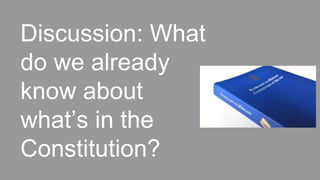
Discussion: What
do we already
know about
what’s in the
Constitution?
Bunreacht na hÉireann
● Primary source of law
● Sets out how Ireland is governed
● 50 Articles on language, the state, the
government, who can run for president, the
courts, who can marry and divorce, the
rights that children have, and many more.
Unconstitutional
Article 15 of the Constitution says that the Oireachtas
cannot enact a law that is repugnant to the Constitution.
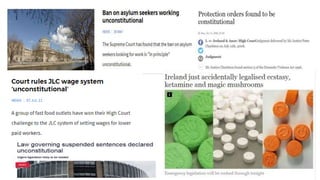
These will be declared invalid or unconstitutional.
The effect of this is that all laws passed in the Dáil must
be constitutional.
All laws passed
must comply with
the Constitution.
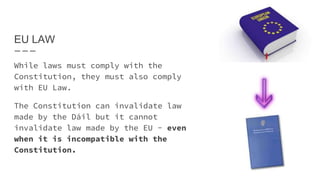
EU LAW
While laws must comply with the
Constitution, they must also comply
with EU Law.
The Constitution can invalidate law
made by the Dáil but it cannot
invalidate law made by the EU - even
when it is incompatible with the
Constitution.
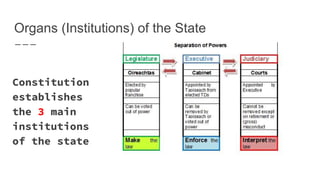
Organs (Institutions) of the State
Constitution
establishes
the 3 main
institutions
of the state
1.President
and the
Oireachtas
President is head of state
Mostly ceremonial
functions
But Can refuse to sign a
bill if they think it’s
unconstitutional
Elected every 7 years
President and the Oireachtas =
LEGISLATURE
1.President
and the
Oireachtas
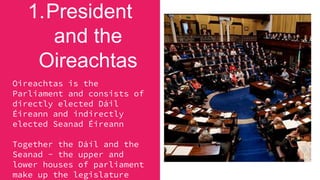
Oireachtas is the
Parliament and consists of
directly elected Dáil
Éireann and indirectly
elected Seanad Éireann
Together the Dáíl and the
Seanad - the upper and
lower houses of parliament
make up the legislature
The president has
no executive
powers and acts
only on advice of
the government.
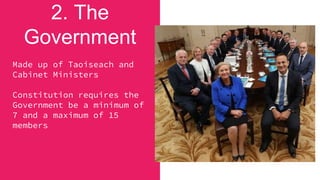
2. The
Government
Made up of Taoiseach and
Cabinet Ministers
Constitution requires the
Government be a minimum of
7 and a maximum of 15
members
Government = EXECUTIVE
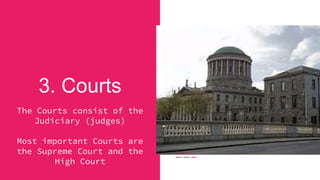
3. Courts
The Courts consist of the
Judiciary (judges)
Most important Courts are
the Supreme Court and the
High Court
Courts = JUDICIARY
The Constitution
sets out each of
those branches of
powers and how
they should be
run.
“Separation of
Powers” is
important
because it
ensures that no
one branch has
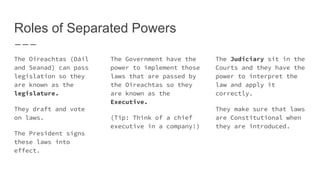
Roles of Separated Powers
The Oireachtas (Dáil
and Seanad) can pass
legislation so they
are known as the
legislature.
They draft and vote
on laws.
The President signs
these laws into
effect.
The Government have the
power to implement those
laws that are passed by
the Oireachtas so they
are known as the
Executive.
(Tip: Think of a chief
executive in a company!)
The Judiciary sit in the
Courts and they have the
power to interpret the
law and apply it
correctly.
They make sure that laws
are Constitutional when
they are introduced.
Fundamental Rights and Freedoms
The Constitution gives every citizen a set of fundamental
rights and freedoms like:
● The right to equality before the law
● The right to education
● The right to bodily integrity
● The freedom to travel
● The right to fair procedures
We can bring challenges when our rights are
infringed
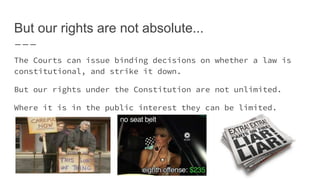
But our rights are not absolute...
The Courts can issue binding decisions on whether a law is
constitutional, and strike it down.
But our rights under the Constitution are not unlimited.
Where it is in the public interest they can be limited.
Amending the Constitution
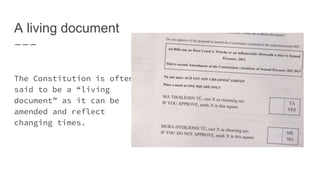
A living document
The Constitution is often
said to be a “living
document” as it can be
amended and reflect
changing times.
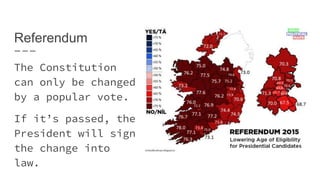
Referendum
The Constitution
can only be changed
by a popular vote.
If it’s passed, the
President will sign
the change into
law.
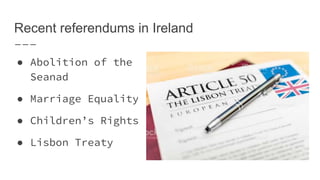
Recent referendums in Ireland
● Abolition of the
Seanad
● Marriage Equality
● Children’s Rights
● Lisbon Treaty
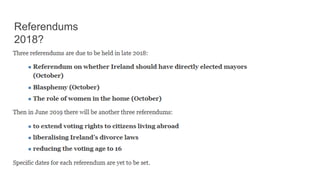
Referendums
2018?
Do you think there is an
even distribution of
powers between the
three branches of the
state?
Do you think there should
There are no wrong answers to those
questions.
Email:
msstephanielord@yahoo.co
m

Law and ethics 1 b the constitution (2)

  • 1.
    Law and Ethics TheIrish Legal System: The Constitution of Ireland
  • 2.
    Why does theConstitution matter?
  • 3.
    Discussion: What do wealready know about what’s in the Constitution?
  • 4.
    Bunreacht na hÉireann ●Primary source of law ● Sets out how Ireland is governed ● 50 Articles on language, the state, the government, who can run for president, the courts, who can marry and divorce, the rights that children have, and many more.
  • 5.
    Unconstitutional Article 15 ofthe Constitution says that the Oireachtas cannot enact a law that is repugnant to the Constitution. These will be declared invalid or unconstitutional. The effect of this is that all laws passed in the Dáil must be constitutional.
  • 7.
    All laws passed mustcomply with the Constitution.
  • 8.
    EU LAW While lawsmust comply with the Constitution, they must also comply with EU Law. The Constitution can invalidate law made by the Dáil but it cannot invalidate law made by the EU - even when it is incompatible with the Constitution.
  • 9.
    Organs (Institutions) ofthe State Constitution establishes the 3 main institutions of the state
  • 10.
    1.President and the Oireachtas President ishead of state Mostly ceremonial functions But Can refuse to sign a bill if they think it’s unconstitutional Elected every 7 years
  • 11.
    President and theOireachtas = LEGISLATURE
  • 12.
    1.President and the Oireachtas Oireachtas isthe Parliament and consists of directly elected Dáil Éireann and indirectly elected Seanad Éireann Together the Dáíl and the Seanad - the upper and lower houses of parliament make up the legislature
  • 13.
    The president has noexecutive powers and acts only on advice of the government.
  • 14.
    2. The Government Made upof Taoiseach and Cabinet Ministers Constitution requires the Government be a minimum of 7 and a maximum of 15 members
  • 15.
  • 16.
    3. Courts The Courtsconsist of the Judiciary (judges) Most important Courts are the Supreme Court and the High Court
  • 17.
  • 18.
    The Constitution sets outeach of those branches of powers and how they should be run.
  • 19.
    “Separation of Powers” is important becauseit ensures that no one branch has
  • 20.
    Roles of SeparatedPowers The Oireachtas (Dáil and Seanad) can pass legislation so they are known as the legislature. They draft and vote on laws. The President signs these laws into effect. The Government have the power to implement those laws that are passed by the Oireachtas so they are known as the Executive. (Tip: Think of a chief executive in a company!) The Judiciary sit in the Courts and they have the power to interpret the law and apply it correctly. They make sure that laws are Constitutional when they are introduced.
  • 21.
    Fundamental Rights andFreedoms The Constitution gives every citizen a set of fundamental rights and freedoms like: ● The right to equality before the law ● The right to education ● The right to bodily integrity ● The freedom to travel ● The right to fair procedures
  • 22.
    We can bringchallenges when our rights are infringed
  • 23.
    But our rightsare not absolute... The Courts can issue binding decisions on whether a law is constitutional, and strike it down. But our rights under the Constitution are not unlimited. Where it is in the public interest they can be limited.
  • 24.
  • 25.
    A living document TheConstitution is often said to be a “living document” as it can be amended and reflect changing times.
  • 26.
    Referendum The Constitution can onlybe changed by a popular vote. If it’s passed, the President will sign the change into law.
  • 27.
    Recent referendums inIreland ● Abolition of the Seanad ● Marriage Equality ● Children’s Rights ● Lisbon Treaty
  • 28.
  • 29.
    Do you thinkthere is an even distribution of powers between the three branches of the state? Do you think there should
  • 30.
    There are nowrong answers to those questions.
  • 31.

Editor's Notes