Constitutional Law I
MS.ISIRI NADEEJA FERNANDO
LECTURER ( OUSL)
LL.B (HONS) UNIVERSITY OF COLOMBO
ATTORNEY –AT-LAW
WHAT IS THE CONSTITUTIONAL LAW
 The law relating to the Constitution of a State
 The State
 Define in Harold Laski‘s A Grammar of Politics
 State is a temporal society divided into government and subjects claiming with its allocated
physical area, a supremacy over all other institutions. population, territory, sovereignty,
and government.
For Constitutional law to exist, a State does not have to be an independent political society
recognized in international law.
NATURE OF THE CONSTITUTIONAL LAW
FIRST LESSON
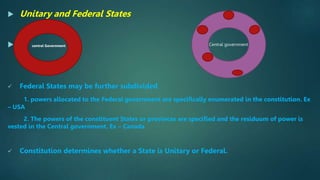
 Unitary and Federal States
 central Government
 Federal States may be further subdivided
1. powers allocated to the Federal government are specifically enumerated in the constitution. Ex
– USA
2. The powers of the constituent States or provinces are specified and the residuum of power is
vested in the Central government. Ex – Canada
 Constitution determines whether a State is Unitary or Federal.
Central government
State and Government
 There is a distinction between the terms “State” and “government”
 Generally the term “state” and “government” are synonymously used
 A government defined as the machinery through which the purposes of the
state are sought to be achieved.
 List down the differences between the state and the Government.
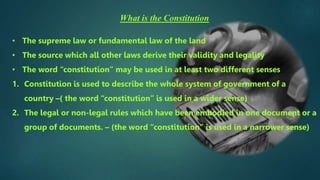
What is the Constitution
• The supreme law or fundamental law of the land
• The source which all other laws derive their validity and legality
• The word “constitution” may be used in at least two different senses
1. Constitution is used to describe the whole system of government of a
country –( the word “constitution” is used in a wider sense)
2. The legal or non-legal rules which have been embodied in one document or a
group of documents. – (the word “constitution” is used in a narrower sense)
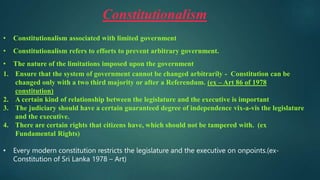
Constitutionalism
• Constitutionalism associated with limited government
• Constitutionalism refers to efforts to prevent arbitrary government.
• The nature of the limitations imposed upon the government
1. Ensure that the system of government cannot be changed arbitrarily - Constitution can be
changed only with a two third majority or after a Referendum. (ex – Art 86 of 1978
constitution)
2. A certain kind of relationship between the legislature and the executive is important
3. The judiciary should have a certain guaranteed degree of independence vix-a-vis the legislature
and the executive.
4. There are certain rights that citizens have, which should not be tampered with. (ex
Fundamental Rights)
• Every modern constitution restricts the legislature and the executive on onpoints.(ex-
Constitution of Sri Lanka 1978 – Art)
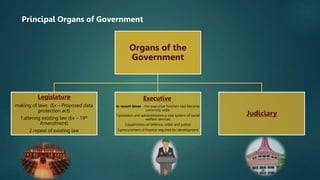
Principal Organs of Government
Organs of the
Government
Legislature
making of laws (Ex – Proposed data
protection act)
1.altering existing law (Ex – 19th
Amendment)
2.repeal of existing law
Executive.
In recent times - the executive function had become
extremely wide.
1.provision and administration a vast system of social
welfare services
2.supervision of defence, order and justice
3.procurement of finance required for development
Judiciary
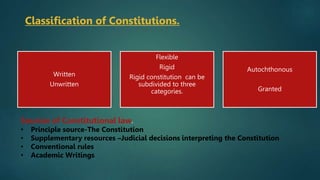
Written
Unwritten
Flexible
Rigid
Rigid constitution can be
subdivided to three
categories.
Autochthonous
Granted
Classification of Constitutions.
Sources of Constitutional law.
• Principle source-The Constitution
• Supplementary resources –Judicial decisions interpreting the Constitution
• Conventional rules
• Academic Writings
Second lesson
Principles of Constitutional Autochthony
It means ,If the Constitution of a country has its origins in its own country .
“The constitution has sprung from the home soil.”
It has three ideas
1. Autonomy (1946 ceylon independence order 19 (1)section, and
Ibralebbe v.Queen (1963)
2. Break in the legal continuity(This is not an essential pre-condition –
British Constitution )
3. self sufficiency
Autonomy
(1946 ceylon independence order 19 (1)section, and Ibralebbe v.Queen (1963)
Break in the Legal Continuity
• The first republican Constitution a major break in the legal continuity.
• Background to the First republican Constitution .
• Issued an election manifesto ,requesting to mandate from the people
todraft,adopt and operate a new Constitution.
There were two actions available
• Enact a new constitution without going outside the existing legal framework.
• Constitute a Constituent Assembly to draft and adopt a new constitution. -
selected one
Why they choose that option?
• Section 29(4) of the Soulbury Constitution.
• The necessity to establish a break in the legal continuity of the existing
constitutional structure.
• The manner in which the new constitution came in to operation is contrary to the previous
one.The new Constitution came into operation on a motion brought by the Prime Minister in the
Constituent Assembly and not in the House of Representatives.
• The President of the Constituent Assembly certifying the adoption, and enactment of it by the
Constituent Assembly.
• Why Sri Lanka wanted a break from its constitutional past?
•
• The court said:
•
• we were independent we still continued to owe allegiance to a foreign
sovereign. In short, we were not an Independent Republic.
• Our highest Court of Appeal continued to be the Judicial Committee of the
Privy Council sitting beyond the seas.
• Our judges were the Queen’s judges and they drew their judicial power not
from the people but from a foreign sovereign.
• The head of the executive, the Governor-General, was appointed by a
foreign sovereign.
Principle of Self-Sufficiency
Break in the legal continuity and the principle of “self
sufficiency”are closely connected to one another .But it
is an essential prerequisite.
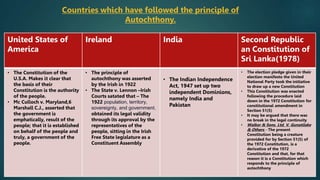
Countries which have followed the principle of
Autochthony.
United States of
America
Ireland India Second Republic
an Constitution of
Sri Lanka(1978)
• The Constitution of the
U.S.A. Makes it clear that
the basis of their
Constitution is the authority
of the people.
• Mc Culloch v. Maryland,6
Marshall C.J., asserted that
the government is
emphatically, result of the
people; that it is established
on behalf of the people and
truly, a government of the
people.
• The principle of
autochthony was asserted
by the Irish in 1922
• The State v. Lennon –Irish
Courts satated that – The
1922 population, territory,
sovereignty, and government.
obtained its legal validity
through its approval by the
representatives of the
people, sitting in the Irish
Free State legislature as a
Constituent Assembly
• The Indian Independence
Act, 1947 set up two
independent Dominions,
namely India and
Pakistan
• The election pledge given in their
election manifesto the United
National Party took the initiative
to draw up a new Constitution
• This Constitution was enacted
following the procedure laid
down in the 1972 Constitution for
constitutional amendment in
Section 51(5)
• It may be argued that there was
no break in the legal continuity
• Walker & Sons. Ltd. V. Gunatilake
& Others - The present
Constitution being a creature
provided for by Section 51(5) of
the 1972 Constitution, is a
derivative of the 1972
Constitution and that, for that
reason it is a Constitution which
responds to the principle of
autochthony
Third lesson
Constitutional History
Early period
• 1796-1798 – British India Company as part of the Madras
presidency
• Appointed a separate Governer(Sir Fedrick North)
• 1815 –The whole island to the British became complete
• 1815_1833- Governor of Ceylon exercised the all power.
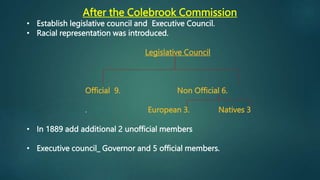
After the Colebrook Commission
• Establish legislative council and Executive Council.
• Racial representation was introduced.
Legislative Council
Official 9. Non Official 6.
. European 3. Natives 3
• In 1889 add additional 2 unofficial members
• Executive council_ Governor and 5 official members.
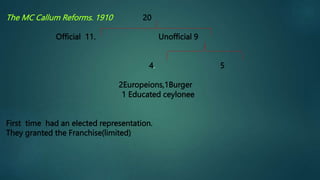
The MC Callum Reforms. 1910 20
Official 11. Unofficial 9
4. 5
2Europeions,1Burger
1 Educated ceylonee
First time had an elected representation.
They granted the Franchise(limited)
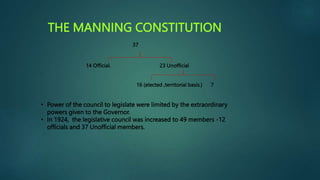
THE MANNING CONSTITUTION
37
14 Official. 23 Unofficial
.
16 (elected ,territorial basis.) 7
• Power of the council to legislate were limited by the extraordinary
powers given to the Governor.
• In 1924, the legislative council was increased to 49 members -12
officials and 37 Unofficial members.
Lesson 4
THE DONOUGHMORE CONSTITUTION
Content......
• Introduction
• Governor
• State Council
• Board of Ministers
• Executive Committe
• Officers of State
• Public service
• The judiciary
• The working of the DONOUGHMORE constitution
INTRODUCTION
• 1931_1947
• By the report of the commission was submitted to the British
Parliament.
• Introduced a hitherto Untried constitutional device.
• Form a council which combined legislative and executive functions
. But considerable powers were retained by the Governor
• This is not a full responsible Government
GOVERNOR
• He continued to perform the formal and ceremonial powers and
controlled external affairs
• The power to take a department when there is a state emergency
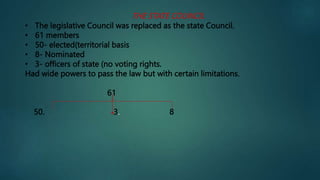
THE STATE COUNCIL
• The legislative Council was replaced as the state Council.
• 61 members
• 50- elected(territorial basis
• 8- Nominated
• 3- officers of state (no voting rights.
Had wide powers to pass the law but with certain limitations.
61
50. 3. 8
Executive Committee.
There was seven committees.
1. Home affairs
2. Agriculture and Lands
3. Local Administration
4. Health
5. Labour
6. Industry and Commerce
7. Education and Communication.
Enabled every member to participate in the government and this was a special
significance to the minority representative s.
THE OFFICERS OF STATE.
Officers of state as,
• Political
• Financial
• Legal advisors
They were responsible only to the Governor
The chief secretary was the most important of the three.
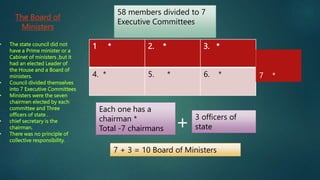
The Board of
Ministers
• The state council did not
have a Prime minister or a
Cabinet of ministers ,but it
had an elected Leader of
the House and a Board of
ministers.
• Council divided themselves
into 7 Executive Committees
• Ministers were the seven
chairmen elected by each
committee and Three
officers of state .
• chief secretary is the
chairman.
• There was no principle of
collective responsibility.
3 officers of
state
58 members divided to 7
Executive Committees
1 * 2. * 3. *
4. * 5. * 6. * 7 *
Each one has a
chairman *
Total -7 chairmans +
7 + 3 = 10 Board of Ministers
Judiciary
• Prior to the independence by the Court Ordinance ,1901chief Justice
and the judges of the supreme court were appointed by the king by
letters patent
• After 1938 they were appointed by the Legal Secretary
• After 1939,Appointments thereafter were made by the Governor with
the advice of the judicial Appointment s Board and subject to the
approval of the Secretary of state.
Public Service
• Public service commission
• The Constitution itself vested in the Governor ,the powers of
“appointment,promotion,transfer,dismissal,and disciplinary control of public
officers.
The working of the DONOUGHMORE
Constitution?
What do you think ?examined with the minorities,majority
community and the British Government, Universal Franchise
THE SOULBURY CONSTITUTION (1947-1972)
CONTENT
• Back ground
• Independence
• Generall Features of the Soulbury Constitution.
Background
• In1943 to declare this intention to grant “full responsible
Government under the crown in all matters of internal civil
administration.
• The demand in the country had changed to a claim for the granting
of Dominian status.
• British Government published a White Paper rejecting the claim for
Dominian status and approving the Soulbury proposals
• In 1946 published the new constitutional frame work.It fell short of
Dominian status.
INDEPENDENCE
In the preamble to the Ceylon order in council (1946) repeating the White paper
gave promise of ultimate Dominian status by amending of the existing Constitution.
After the election under the new constitution in 1947 ,These Act was passed by the
U.K.Parliment.
• 1947 Ceylon Independence Act
• The Ceylon Independence Order (1947)
What is the Effect?
Generall Features of the Soulbury Constitution.
Soulbury constitution is on the model of WESTMINSTER.
KEY CHARACTERISTICS OF THE WESTMINSTER MODEL
1. A Head of state (Governor –General)
2. A Cabinet lead by the Head of Governor
3. A multi Party
4. Bicamarel state
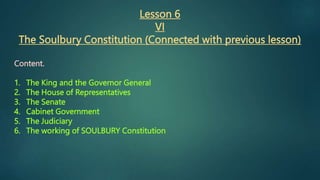
Lesson 6
VI
The Soulbury Constitution (Connected with previous lesson)
Content.
1. The King and the Governor General
2. The House of Representatives
3. The Senate
4. Cabinet Government
5. The Judiciary
6. The working of SOULBURY Constitution
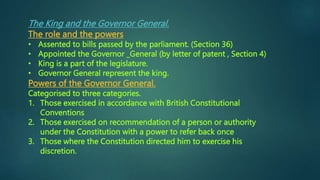
The King and the Governor General.
The role and the powers
• Assented to bills passed by the parliament. (Section 36)
• Appointed the Governor _General (by letter of patent , Section 4)
• King is a part of the legislature.
• Governor General represent the king.
Powers of the Governor General.
Categorised to three categories.
1. Those exercised in accordance with British Constitutional
Conventions
2. Those exercised on recommendation of a person or authority
under the Constitution with a power to refer back once
3. Those where the Constitution directed him to exercise his
discretion.
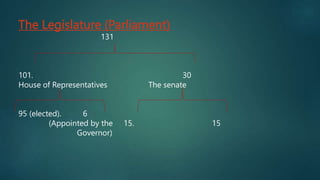
The Legislature (Parliament)
131
101. 30
House of Representatives The senate
95 (elected). 6
(Appointed by the 15. 15
Governor)
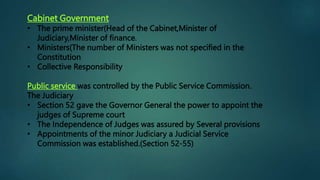
Cabinet Government
• The prime minister(Head of the Cabinet,Minister of
Judiciary,Minister of finance.
• Ministers(The number of Ministers was not specified in the
Constitution
• Collective Responsibility
Public service was controlled by the Public Service Commission.
The Judiciary
• Section 52 gave the Governor General the power to appoint the
judges of Supreme court
• The Independence of Judges was assured by Several provisions
• Appointments of the minor Judiciary a Judicial Service
Commission was established.(Section 52-55)
Good features of Soulbury.
• Modification of Ceylon as of Dominium State
• Designed as a Westminster format
• Governor replace with Governor General
• Two chambers of prime minister and Cabinet of parliament
• Establishment of Public service commission and Judicial Service
Commission
• Commencement of Party political system
• Appeal possible to privy Council
• Provisions for the protection of minors.
Thank you .

constituitional law introduction (Lessons 1 - 6).pptx

  • 1.
    Constitutional Law I MS.ISIRINADEEJA FERNANDO LECTURER ( OUSL) LL.B (HONS) UNIVERSITY OF COLOMBO ATTORNEY –AT-LAW
  • 2.
    WHAT IS THECONSTITUTIONAL LAW  The law relating to the Constitution of a State  The State  Define in Harold Laski‘s A Grammar of Politics  State is a temporal society divided into government and subjects claiming with its allocated physical area, a supremacy over all other institutions. population, territory, sovereignty, and government. For Constitutional law to exist, a State does not have to be an independent political society recognized in international law. NATURE OF THE CONSTITUTIONAL LAW FIRST LESSON
  • 3.
     Unitary andFederal States  central Government  Federal States may be further subdivided 1. powers allocated to the Federal government are specifically enumerated in the constitution. Ex – USA 2. The powers of the constituent States or provinces are specified and the residuum of power is vested in the Central government. Ex – Canada  Constitution determines whether a State is Unitary or Federal. Central government
  • 4.
    State and Government There is a distinction between the terms “State” and “government”  Generally the term “state” and “government” are synonymously used  A government defined as the machinery through which the purposes of the state are sought to be achieved.  List down the differences between the state and the Government.
  • 5.
    What is theConstitution • The supreme law or fundamental law of the land • The source which all other laws derive their validity and legality • The word “constitution” may be used in at least two different senses 1. Constitution is used to describe the whole system of government of a country –( the word “constitution” is used in a wider sense) 2. The legal or non-legal rules which have been embodied in one document or a group of documents. – (the word “constitution” is used in a narrower sense)
  • 6.
    Constitutionalism • Constitutionalism associatedwith limited government • Constitutionalism refers to efforts to prevent arbitrary government. • The nature of the limitations imposed upon the government 1. Ensure that the system of government cannot be changed arbitrarily - Constitution can be changed only with a two third majority or after a Referendum. (ex – Art 86 of 1978 constitution) 2. A certain kind of relationship between the legislature and the executive is important 3. The judiciary should have a certain guaranteed degree of independence vix-a-vis the legislature and the executive. 4. There are certain rights that citizens have, which should not be tampered with. (ex Fundamental Rights) • Every modern constitution restricts the legislature and the executive on onpoints.(ex- Constitution of Sri Lanka 1978 – Art)
  • 7.
    Principal Organs ofGovernment Organs of the Government Legislature making of laws (Ex – Proposed data protection act) 1.altering existing law (Ex – 19th Amendment) 2.repeal of existing law Executive. In recent times - the executive function had become extremely wide. 1.provision and administration a vast system of social welfare services 2.supervision of defence, order and justice 3.procurement of finance required for development Judiciary
  • 8.
    Written Unwritten Flexible Rigid Rigid constitution canbe subdivided to three categories. Autochthonous Granted Classification of Constitutions. Sources of Constitutional law. • Principle source-The Constitution • Supplementary resources –Judicial decisions interpreting the Constitution • Conventional rules • Academic Writings
  • 9.
    Second lesson Principles ofConstitutional Autochthony It means ,If the Constitution of a country has its origins in its own country . “The constitution has sprung from the home soil.” It has three ideas 1. Autonomy (1946 ceylon independence order 19 (1)section, and Ibralebbe v.Queen (1963) 2. Break in the legal continuity(This is not an essential pre-condition – British Constitution ) 3. self sufficiency
  • 10.
    Autonomy (1946 ceylon independenceorder 19 (1)section, and Ibralebbe v.Queen (1963) Break in the Legal Continuity • The first republican Constitution a major break in the legal continuity. • Background to the First republican Constitution . • Issued an election manifesto ,requesting to mandate from the people todraft,adopt and operate a new Constitution. There were two actions available • Enact a new constitution without going outside the existing legal framework. • Constitute a Constituent Assembly to draft and adopt a new constitution. - selected one Why they choose that option? • Section 29(4) of the Soulbury Constitution. • The necessity to establish a break in the legal continuity of the existing constitutional structure.
  • 11.
    • The mannerin which the new constitution came in to operation is contrary to the previous one.The new Constitution came into operation on a motion brought by the Prime Minister in the Constituent Assembly and not in the House of Representatives. • The President of the Constituent Assembly certifying the adoption, and enactment of it by the Constituent Assembly. • Why Sri Lanka wanted a break from its constitutional past? • • The court said: • • we were independent we still continued to owe allegiance to a foreign sovereign. In short, we were not an Independent Republic. • Our highest Court of Appeal continued to be the Judicial Committee of the Privy Council sitting beyond the seas. • Our judges were the Queen’s judges and they drew their judicial power not from the people but from a foreign sovereign. • The head of the executive, the Governor-General, was appointed by a foreign sovereign.
  • 12.
    Principle of Self-Sufficiency Breakin the legal continuity and the principle of “self sufficiency”are closely connected to one another .But it is an essential prerequisite.
  • 13.
    Countries which havefollowed the principle of Autochthony. United States of America Ireland India Second Republic an Constitution of Sri Lanka(1978) • The Constitution of the U.S.A. Makes it clear that the basis of their Constitution is the authority of the people. • Mc Culloch v. Maryland,6 Marshall C.J., asserted that the government is emphatically, result of the people; that it is established on behalf of the people and truly, a government of the people. • The principle of autochthony was asserted by the Irish in 1922 • The State v. Lennon –Irish Courts satated that – The 1922 population, territory, sovereignty, and government. obtained its legal validity through its approval by the representatives of the people, sitting in the Irish Free State legislature as a Constituent Assembly • The Indian Independence Act, 1947 set up two independent Dominions, namely India and Pakistan • The election pledge given in their election manifesto the United National Party took the initiative to draw up a new Constitution • This Constitution was enacted following the procedure laid down in the 1972 Constitution for constitutional amendment in Section 51(5) • It may be argued that there was no break in the legal continuity • Walker & Sons. Ltd. V. Gunatilake & Others - The present Constitution being a creature provided for by Section 51(5) of the 1972 Constitution, is a derivative of the 1972 Constitution and that, for that reason it is a Constitution which responds to the principle of autochthony
  • 14.
  • 15.
    Early period • 1796-1798– British India Company as part of the Madras presidency • Appointed a separate Governer(Sir Fedrick North) • 1815 –The whole island to the British became complete • 1815_1833- Governor of Ceylon exercised the all power.
  • 16.
    After the ColebrookCommission • Establish legislative council and Executive Council. • Racial representation was introduced. Legislative Council Official 9. Non Official 6. . European 3. Natives 3 • In 1889 add additional 2 unofficial members • Executive council_ Governor and 5 official members.
  • 17.
    The MC CallumReforms. 1910 20 Official 11. Unofficial 9 4. 5 2Europeions,1Burger 1 Educated ceylonee First time had an elected representation. They granted the Franchise(limited)
  • 18.
    THE MANNING CONSTITUTION 37 14Official. 23 Unofficial . 16 (elected ,territorial basis.) 7 • Power of the council to legislate were limited by the extraordinary powers given to the Governor. • In 1924, the legislative council was increased to 49 members -12 officials and 37 Unofficial members.
  • 19.
    Lesson 4 THE DONOUGHMORECONSTITUTION Content...... • Introduction • Governor • State Council • Board of Ministers • Executive Committe • Officers of State • Public service • The judiciary • The working of the DONOUGHMORE constitution
  • 20.
    INTRODUCTION • 1931_1947 • Bythe report of the commission was submitted to the British Parliament. • Introduced a hitherto Untried constitutional device. • Form a council which combined legislative and executive functions . But considerable powers were retained by the Governor • This is not a full responsible Government GOVERNOR • He continued to perform the formal and ceremonial powers and controlled external affairs • The power to take a department when there is a state emergency
  • 21.
    THE STATE COUNCIL •The legislative Council was replaced as the state Council. • 61 members • 50- elected(territorial basis • 8- Nominated • 3- officers of state (no voting rights. Had wide powers to pass the law but with certain limitations. 61 50. 3. 8
  • 22.
    Executive Committee. There wasseven committees. 1. Home affairs 2. Agriculture and Lands 3. Local Administration 4. Health 5. Labour 6. Industry and Commerce 7. Education and Communication. Enabled every member to participate in the government and this was a special significance to the minority representative s.
  • 23.
    THE OFFICERS OFSTATE. Officers of state as, • Political • Financial • Legal advisors They were responsible only to the Governor The chief secretary was the most important of the three.
  • 24.
    The Board of Ministers •The state council did not have a Prime minister or a Cabinet of ministers ,but it had an elected Leader of the House and a Board of ministers. • Council divided themselves into 7 Executive Committees • Ministers were the seven chairmen elected by each committee and Three officers of state . • chief secretary is the chairman. • There was no principle of collective responsibility. 3 officers of state 58 members divided to 7 Executive Committees 1 * 2. * 3. * 4. * 5. * 6. * 7 * Each one has a chairman * Total -7 chairmans + 7 + 3 = 10 Board of Ministers
  • 25.
    Judiciary • Prior tothe independence by the Court Ordinance ,1901chief Justice and the judges of the supreme court were appointed by the king by letters patent • After 1938 they were appointed by the Legal Secretary • After 1939,Appointments thereafter were made by the Governor with the advice of the judicial Appointment s Board and subject to the approval of the Secretary of state.
  • 26.
    Public Service • Publicservice commission • The Constitution itself vested in the Governor ,the powers of “appointment,promotion,transfer,dismissal,and disciplinary control of public officers. The working of the DONOUGHMORE Constitution? What do you think ?examined with the minorities,majority community and the British Government, Universal Franchise
  • 27.
    THE SOULBURY CONSTITUTION(1947-1972) CONTENT • Back ground • Independence • Generall Features of the Soulbury Constitution.
  • 28.
    Background • In1943 todeclare this intention to grant “full responsible Government under the crown in all matters of internal civil administration. • The demand in the country had changed to a claim for the granting of Dominian status. • British Government published a White Paper rejecting the claim for Dominian status and approving the Soulbury proposals • In 1946 published the new constitutional frame work.It fell short of Dominian status.
  • 29.
    INDEPENDENCE In the preambleto the Ceylon order in council (1946) repeating the White paper gave promise of ultimate Dominian status by amending of the existing Constitution. After the election under the new constitution in 1947 ,These Act was passed by the U.K.Parliment. • 1947 Ceylon Independence Act • The Ceylon Independence Order (1947) What is the Effect?
  • 30.
    Generall Features ofthe Soulbury Constitution. Soulbury constitution is on the model of WESTMINSTER. KEY CHARACTERISTICS OF THE WESTMINSTER MODEL 1. A Head of state (Governor –General) 2. A Cabinet lead by the Head of Governor 3. A multi Party 4. Bicamarel state
  • 31.
    Lesson 6 VI The SoulburyConstitution (Connected with previous lesson) Content. 1. The King and the Governor General 2. The House of Representatives 3. The Senate 4. Cabinet Government 5. The Judiciary 6. The working of SOULBURY Constitution
  • 32.
    The King andthe Governor General. The role and the powers • Assented to bills passed by the parliament. (Section 36) • Appointed the Governor _General (by letter of patent , Section 4) • King is a part of the legislature. • Governor General represent the king. Powers of the Governor General. Categorised to three categories. 1. Those exercised in accordance with British Constitutional Conventions 2. Those exercised on recommendation of a person or authority under the Constitution with a power to refer back once 3. Those where the Constitution directed him to exercise his discretion.
  • 33.
    The Legislature (Parliament) 131 101.30 House of Representatives The senate 95 (elected). 6 (Appointed by the 15. 15 Governor)
  • 34.
    Cabinet Government • Theprime minister(Head of the Cabinet,Minister of Judiciary,Minister of finance. • Ministers(The number of Ministers was not specified in the Constitution • Collective Responsibility Public service was controlled by the Public Service Commission. The Judiciary • Section 52 gave the Governor General the power to appoint the judges of Supreme court • The Independence of Judges was assured by Several provisions • Appointments of the minor Judiciary a Judicial Service Commission was established.(Section 52-55)
  • 35.
    Good features ofSoulbury. • Modification of Ceylon as of Dominium State • Designed as a Westminster format • Governor replace with Governor General • Two chambers of prime minister and Cabinet of parliament • Establishment of Public service commission and Judicial Service Commission • Commencement of Party political system • Appeal possible to privy Council • Provisions for the protection of minors.
  • 36.