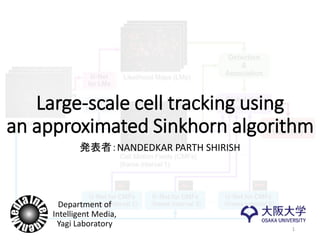
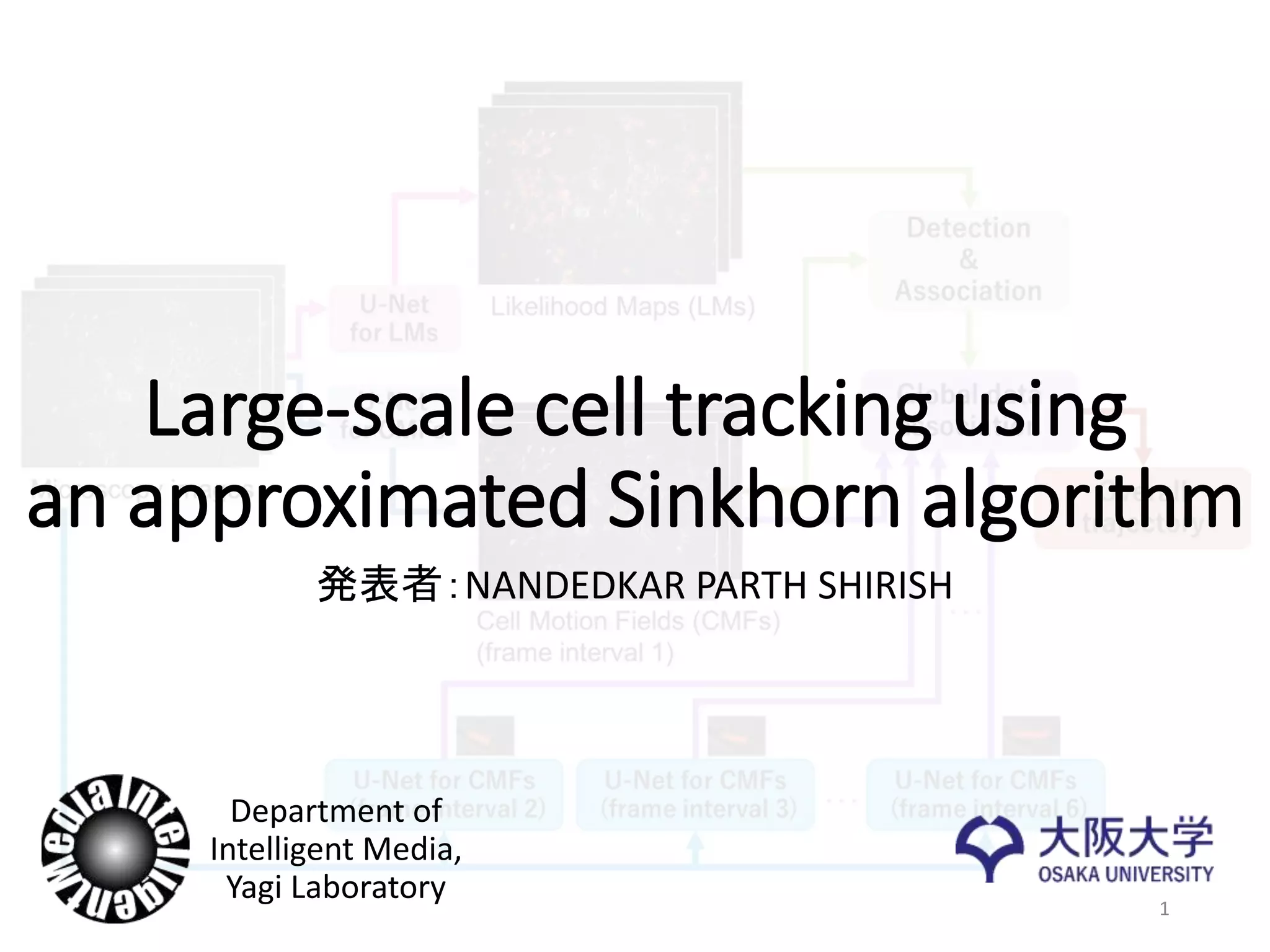
Large-scale cell tracking using
an approximated Sinkhorn algorithm
発表者:NANDEDKAR PARTH SHIRISH
1
Department of
Intelligent Media,
Yagi Laboratory
Automation of cell image analysis
• Detection and tracking
• Shape, colour and motion analysis
2
Sub-million cells captured by trans-scale-scope [Ichimura+ 2020]
Our Challenge: Efficient large-scale cell tracking
Background
Non deep learning based
CancerCellTracker [Li+ 2010], Hungarian
algorithm [Tashita+ 2015], Probabilistic
[Huh+ 2011], Particle Filter [Fujimoto+ 2020]
+ Does not require huge training
data
- Tracking by global association
is time consuming
Deep learning-based
MPM [Hayashida+ 2020], CellNucleiTracker [Chen+
2019], Deep MOT [Xu+ 2020]
+ Better accuracies in detection
and tracking
- Require huge training data by
manual annotation
Related Work
3
[Hayashida+ 2020] [Chen+ 2019] [Li+ 2010]
Efficient large-scale cell tracking
• Non-deep learning-based approach
(i.e., huge training data is unnecessary)
• Tracking by global association
 Hungarian algorithm
 Sinkhorn algorithm
 Approximate Sinkhorn algorithm (proposed)
4
Objective
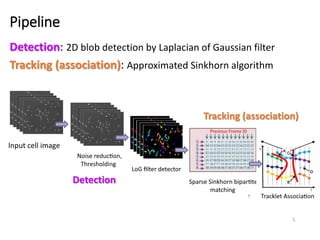
Pipeline
5
Detection: 2D blob detection by Laplacian of Gaussian filter
Tracking (association): Approximated Sinkhorn algorithm
Tracking (association)
Detection
Input cell image
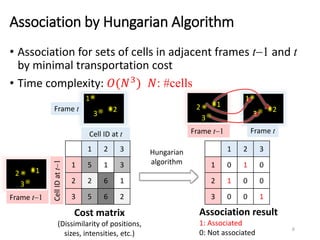
Association by Hungarian Algorithm
• Association for sets of cells in adjacent frames t-1 and t
by minimal transportation cost
• Time complexity: 𝑂(𝑁3) 𝑁: #cells
6
Cost matrix
(Dissimilarity of positions,
sizes, intensities, etc.)
1
3
2
2
3
1
1 2 3
1 5 1 3
2 2 6 1
3 5 6 2
Frame t-1
Frame t
Hungarian
algorithm
Cell
ID
at
t-1
Cell ID at t
1 2 3
1 0 1 0
2 1 0 0
3 0 0 1
Association result
1: Associated
0: Not associated
2
3
1
Frame t
1
3
2
Frame t-1
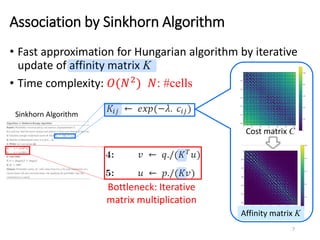
Association by Sinkhorn Algorithm
• Fast approximation for Hungarian algorithm by iterative
update of affinity matrix K
• Time complexity: 𝑂(𝑁2) 𝑁: #cells
7
Sinkhorn Algorithm
Affinity matrix K
Cost matrix C
Bottleneck: Iterative
matrix multiplication
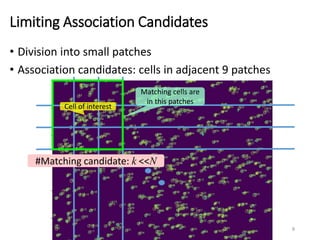
Limiting Association Candidates
• Division into small patches
• Association candidates: cells in adjacent 9 patches
8
Cell of interest
Matching cells are
in this patches
#Matching candidate: k <<N
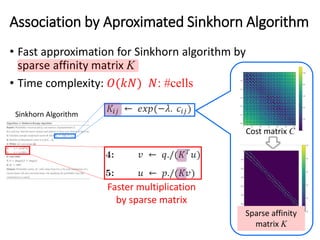
Association by Aproximated Sinkhorn Algorithm
• Fast approximation for Sinkhorn algorithm by
sparse affinity matrix K
• Time complexity: 𝑂(𝑘𝑁) 𝑁: #cells
9
Sinkhorn Algorithm
Cost matrix C
Faster multiplication
by sparse matrix
Affinity matrix K
Sparse affinity
matrix K
• Data
• Fluorescent images of malnourished Dictyostelium cells
captured by trans-scale-scope [Ichimura+ 2020]
• Evaluation items
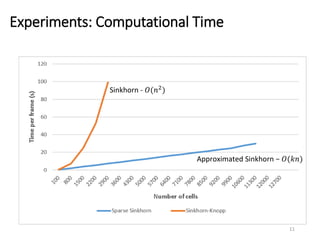
• Computational time for association per frame
over various #cells
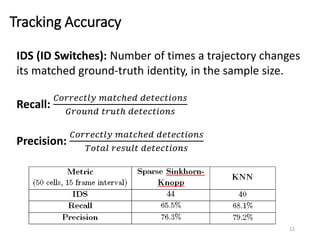
• Tracking accuracy over 50 ground-truth tracklets
• Comparison
• Sinkhorn algorithm
• Approximated Sinkhorn algorithm (proposed)
10
Experiments: Setup
Experiments: Computational Time
11
Sinkhorn - 𝑂(𝑛2
)
Approximated Sinkhorn − 𝑂(𝑘𝑛)
Tracking Accuracy
12
IDS (ID Switches): Number of times a trajectory changes
its matched ground-truth identity, in the sample size.
Recall:
𝐶𝑜𝑟𝑟𝑒𝑐𝑡𝑙𝑦 𝑚𝑎𝑡𝑐ℎ𝑒𝑑 𝑑𝑒𝑡𝑒𝑐𝑡𝑖𝑜𝑛𝑠
𝐺𝑟𝑜𝑢𝑛𝑑 𝑡𝑟𝑢𝑡ℎ 𝑑𝑒𝑡𝑒𝑐𝑡𝑖𝑜𝑛𝑠
Precision:
𝐶𝑜𝑟𝑟𝑒𝑐𝑡𝑙𝑦 𝑚𝑎𝑡𝑐ℎ𝑒𝑑 𝑑𝑒𝑡𝑒𝑐𝑡𝑖𝑜𝑛𝑠
𝑇𝑜𝑡𝑎𝑙 𝑟𝑒𝑠𝑢𝑙𝑡 𝑑𝑒𝑡𝑒𝑐𝑡𝑖𝑜𝑛𝑠
Summary and Future Work
13
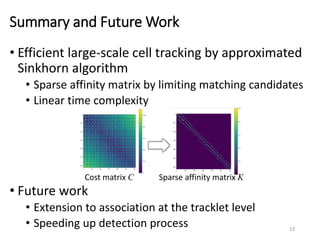
• Efficient large-scale cell tracking by approximated
Sinkhorn algorithm
• Sparse affinity matrix by limiting matching candidates
• Linear time complexity
• Future work
• Extension to association at the tracklet level
• Speeding up detection process 13
Cost matrix C Sparse affinity matrix K

Large scale cell tracking using an approximated Sinkhorn algorithm

  • 1.
    Large-scale cell trackingusing an approximated Sinkhorn algorithm 発表者:NANDEDKAR PARTH SHIRISH 1 Department of Intelligent Media, Yagi Laboratory
  • 2.
    Automation of cellimage analysis • Detection and tracking • Shape, colour and motion analysis 2 Sub-million cells captured by trans-scale-scope [Ichimura+ 2020] Our Challenge: Efficient large-scale cell tracking Background
  • 3.
    Non deep learningbased CancerCellTracker [Li+ 2010], Hungarian algorithm [Tashita+ 2015], Probabilistic [Huh+ 2011], Particle Filter [Fujimoto+ 2020] + Does not require huge training data - Tracking by global association is time consuming Deep learning-based MPM [Hayashida+ 2020], CellNucleiTracker [Chen+ 2019], Deep MOT [Xu+ 2020] + Better accuracies in detection and tracking - Require huge training data by manual annotation Related Work 3 [Hayashida+ 2020] [Chen+ 2019] [Li+ 2010]
  • 4.
    Efficient large-scale celltracking • Non-deep learning-based approach (i.e., huge training data is unnecessary) • Tracking by global association  Hungarian algorithm  Sinkhorn algorithm  Approximate Sinkhorn algorithm (proposed) 4 Objective
  • 5.
    Pipeline 5 Detection: 2D blobdetection by Laplacian of Gaussian filter Tracking (association): Approximated Sinkhorn algorithm Tracking (association) Detection Input cell image
  • 6.
    Association by HungarianAlgorithm • Association for sets of cells in adjacent frames t-1 and t by minimal transportation cost • Time complexity: 𝑂(𝑁3) 𝑁: #cells 6 Cost matrix (Dissimilarity of positions, sizes, intensities, etc.) 1 3 2 2 3 1 1 2 3 1 5 1 3 2 2 6 1 3 5 6 2 Frame t-1 Frame t Hungarian algorithm Cell ID at t-1 Cell ID at t 1 2 3 1 0 1 0 2 1 0 0 3 0 0 1 Association result 1: Associated 0: Not associated 2 3 1 Frame t 1 3 2 Frame t-1
  • 7.
    Association by SinkhornAlgorithm • Fast approximation for Hungarian algorithm by iterative update of affinity matrix K • Time complexity: 𝑂(𝑁2) 𝑁: #cells 7 Sinkhorn Algorithm Affinity matrix K Cost matrix C Bottleneck: Iterative matrix multiplication
  • 8.
    Limiting Association Candidates •Division into small patches • Association candidates: cells in adjacent 9 patches 8 Cell of interest Matching cells are in this patches #Matching candidate: k <<N
  • 9.
    Association by AproximatedSinkhorn Algorithm • Fast approximation for Sinkhorn algorithm by sparse affinity matrix K • Time complexity: 𝑂(𝑘𝑁) 𝑁: #cells 9 Sinkhorn Algorithm Cost matrix C Faster multiplication by sparse matrix Affinity matrix K Sparse affinity matrix K
  • 10.
    • Data • Fluorescentimages of malnourished Dictyostelium cells captured by trans-scale-scope [Ichimura+ 2020] • Evaluation items • Computational time for association per frame over various #cells • Tracking accuracy over 50 ground-truth tracklets • Comparison • Sinkhorn algorithm • Approximated Sinkhorn algorithm (proposed) 10 Experiments: Setup
  • 11.
    Experiments: Computational Time 11 Sinkhorn- 𝑂(𝑛2 ) Approximated Sinkhorn − 𝑂(𝑘𝑛)
  • 12.
    Tracking Accuracy 12 IDS (IDSwitches): Number of times a trajectory changes its matched ground-truth identity, in the sample size. Recall: 𝐶𝑜𝑟𝑟𝑒𝑐𝑡𝑙𝑦 𝑚𝑎𝑡𝑐ℎ𝑒𝑑 𝑑𝑒𝑡𝑒𝑐𝑡𝑖𝑜𝑛𝑠 𝐺𝑟𝑜𝑢𝑛𝑑 𝑡𝑟𝑢𝑡ℎ 𝑑𝑒𝑡𝑒𝑐𝑡𝑖𝑜𝑛𝑠 Precision: 𝐶𝑜𝑟𝑟𝑒𝑐𝑡𝑙𝑦 𝑚𝑎𝑡𝑐ℎ𝑒𝑑 𝑑𝑒𝑡𝑒𝑐𝑡𝑖𝑜𝑛𝑠 𝑇𝑜𝑡𝑎𝑙 𝑟𝑒𝑠𝑢𝑙𝑡 𝑑𝑒𝑡𝑒𝑐𝑡𝑖𝑜𝑛𝑠
  • 13.
    Summary and FutureWork 13 • Efficient large-scale cell tracking by approximated Sinkhorn algorithm • Sparse affinity matrix by limiting matching candidates • Linear time complexity • Future work • Extension to association at the tracklet level • Speeding up detection process 13 Cost matrix C Sparse affinity matrix K