This Place Matters An Taisce – The National Trust for Ireland Tailor’s Hall, Back Lane, Dublin 8 Promoting Community Participation in the Development Plan Process Laois
To highlight the   importance   of community, ENGO and stakeholder  participation in the planning process ; To provide an  overview of the role of the Planning System  with respect to achieving sustainable development & Environmental Protection; To  understand the key lessons of the past and the key challenges of the future  and the role of the land use planning system in addressing these challenges; To provide an overview of the Irish planning system and the  process of making a development plan. To provide an overview of  how to undertake a review of a development plan, to make a submission and to follow up  to ensure your view is taken into consideration. Q & A Objective - Participation
01: INTRODUCTION
What is the Development Plan The   primary statement on land-use planning Provides the   policy context   for planning applications . The function is to support the   sustainable development   of land in the interests of the   common good . ‘ The plan is a statement of objectives; it informs the community, in its draft form, of the intended objectives and affords the community the opportunity of inspection, criticism, and, if thought proper, objection. When adopted it forms an   environmental contract   between the planning authority, the council, and the community, embodying a promise by the council that it will regulate private development in a manner consistent with the objectives stated in the plan . . .’   The Attorney General (McGarry) v. Sligo County Council  [1991] 1 I.R. 99 The legal status of a development plan   SHOULD   create a strong incentive for all stakeholder partners to   engage in a process   which can   create certainty   about  our collective future .
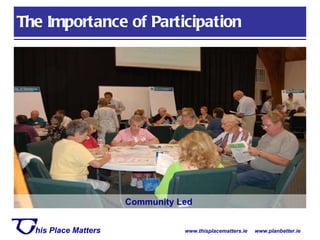
The Importance of Participation Development Led Retrospective Confrontational Community Led
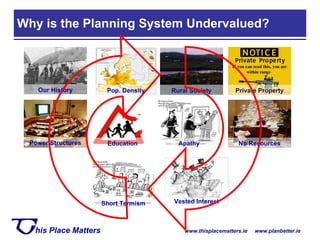
Why is the Planning System Undervalued? Our History Pop. Density Rural Society Private Property Power Structures Education  Apathy Vested Interest No Resources Short Termism
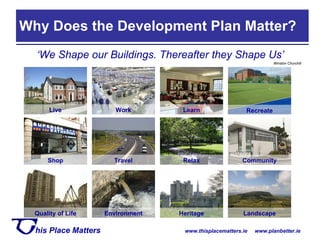
‘ We Shape our Buildings. Thereafter they Shape Us’ Winston Churchill Why Does the Development Plan Matter? Live Work Learn Recreate Shop Travel Relax Landscape Community Environment Heritage Quality of Life
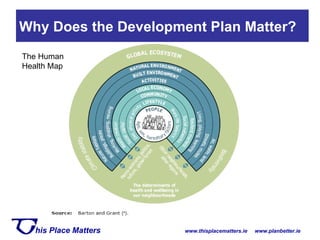
Why Does the Development Plan Matter? The Human Health Map
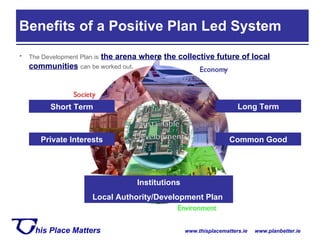
Benefits of a Positive Plan Led System The Development Plan is   the arena where   the collective future of local communities   can be worked out . Short Term Long Term Private Interests Common Good Institutions Local Authority/Development Plan
RIO Earth Summit (1992) -  LA 21 Plans -  Aalborg Charter (1994) – 8 Steps (Vision, Participation,  Implementation..) Aarhus Convention (1998) - Links environmental rights and human rights.  - Establishes that sustainable development can be achieved only  through the involvement of all stakeholders - Links government accountability and environmental protection. - Focuses on interactions between the public and public authorities in a  democratic context. Achieving Sustainability
03: LOOKING BACK
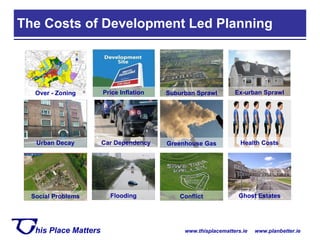
The Costs of Development Led Planning Over - Zoning Price Inflation Suburban Sprawl Ex-urban Sprawl Car Dependency Health Costs Social Problems Flooding Conflict Ghost Estates Greenhouse Gas Urban Decay
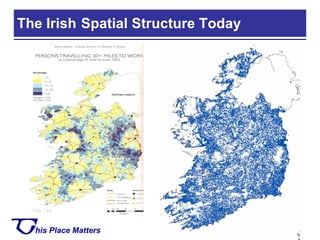
The Irish  Spatial Structure Today
04: LOOKING FORWARD
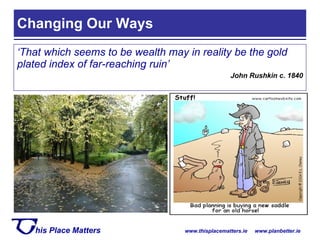
‘ That which seems to be wealth may in reality be the gold plated index of far-reaching ruin’ John Rushkin c. 1840 Changing Our Ways
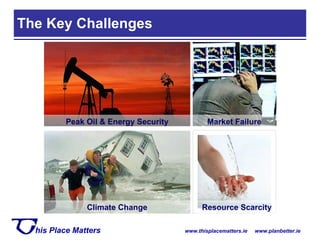
The Key Challenges Market Failure Peak Oil & Energy Security Resource Scarcity Climate Change
The Energy Challenge International Energy Agency (IEA) – World Energy Outlook (10 th  of November 2009) ‘ The scale and breadth of the energy challenge is  enormous   – far greater than many people realise .   An unprecedented, yet relatively  narrow, window of opportunity  to take action to concentrate investment on low-carbon technology.’ ‘ Current trends have  profound implications for environmental protection, energy security and economic development ’ ‘ Households and businesses are largely responsible for making the required investments, but  governments hold the key to changing the mix of energy investment Continuing on today’s energy path, without any change in government policy, would mean rapidly increasing dependence on fossil fuels,  with alarming consequences for climate change and energy security ’ [crude oil] prices approach $102 per bbl by 2015, $131 per bbl by 2020 and almost  $190 bbl by 2030.
06: THE IRISH PLANNING SYSTEM
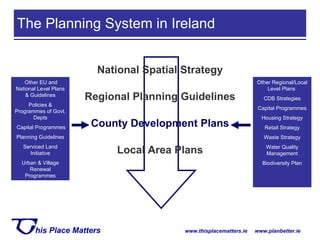
National Spatial Strategy Regional Planning Guidelines County Development Plans Local Area Plans The Planning System in Ireland Other EU and National Level Plans & Guidelines Policies & Programmes of Govt. Depts Capital Programmes Planning Guidelines Serviced Land Initiative Urban & Village Renewal Programmes Other Regional/Local Level Plans  CDB Strategies Capital Programmes Housing Strategy Retail Strategy Waste Strategy Water Quality Management Biodiversity Plan
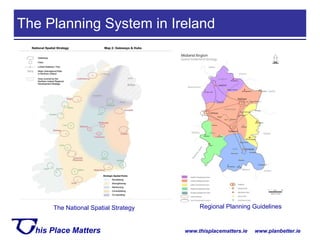
The Planning System in Ireland The National Spatial Strategy Regional Planning Guidelines
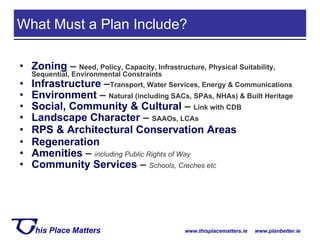
Zoning  –  Need, Policy, Capacity, Infrastructure, Physical Suitability, Sequential, Environmental Constraints Infrastructure  – Transport, Water Services, Energy & Communications Environment  –  Natural (including SACs, SPAs, NHAs) & Built Heritage  Social, Community & Cultural  –  Link with CDB Landscape Character  –  SAAOs, LCAs RPS & Architectural Conservation Areas  Regeneration Amenities  –  including Public Rights of Way Community Services  –  Schools, Creches etc What Must a Plan Include?
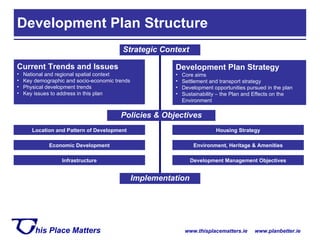
Development Plan Structure Development Plan Strategy Core aims Settlement and transport strategy Development opportunities pursued in the plan Sustainability – the Plan and Effects on the Environment Strategic Context Current Trends and Issues National and regional spatial context Key demographic and socio-economic trends Physical development trends Key issues to address in this plan Policies & Objectives Location and Pattern of Development Housing Strategy Economic Development Environment, Heritage & Amenities Infrastructure Development Management Objectives Implementation
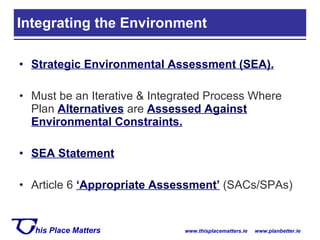
Strategic Environmental Assessment (SEA). Must be an Iterative & Integrated Process Where Plan  Alternatives  are  Assessed Against Environmental Constraints. SEA Statement Article 6  ‘Appropriate Assessment’  (SACs/SPAs) Integrating the Environment
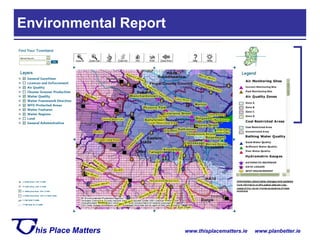
Environmental Report Mitigation Measures Monitoring SEA STATEMENT Alternatives Human Population Biodiversity Landscapes & Soil Agriculture/ Forestry Waste Management Water Quality Air Quality Noise Pollution Cultural Assets Material Assets Climate Change Sustainability
05: THE PLAN MAKING PROCESS
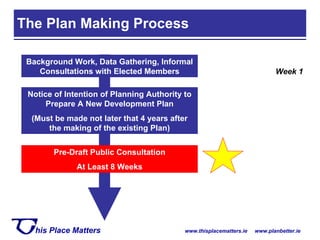
The Plan Making Process Background Work, Data Gathering, Informal Consultations with Elected Members Notice of Intention of Planning Authority to Prepare A New Development Plan (Must be made not later that 4 years after the making of the existing Plan) Pre-Draft Public Consultation At Least 8 Weeks Week 1
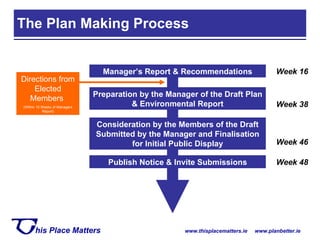
The Plan Making Process Manager’s Report & Recommendations Preparation by the Manager of the Draft Plan & Environmental Report Consideration by the Members of the Draft Submitted by the Manager and Finalisation for Initial Public Display Publish Notice & Invite Submissions Directions from Elected Members  (Within 10 Weeks of Managers Report) Week 16 Week 38 Week 46 Week 48
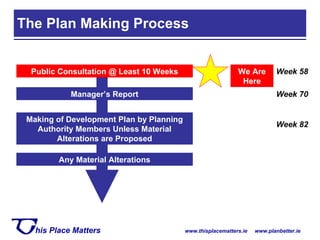
The Plan Making Process Public Consultation @ Least 10 Weeks Manager’s Report Making of Development Plan by Planning Authority Members Unless Material Alterations are Proposed Any Material Alterations Week 58 Week 70 Week 82 We Are Here
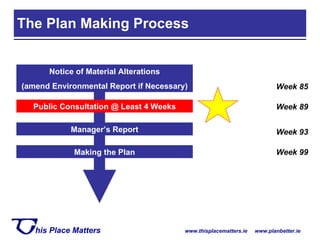
The Plan Making Process Notice of Material Alterations (amend Environmental Report if Necessary) Public Consultation @ Least 4 Weeks Manager’s Report Making the Plan Week 85 Week 89 Week 93 Week 99
06: REVIEWING A DEVELOPMENT PLAN
A good development plan should be: Consistent with the planning hierarchy Consistent with national guidelines Compliant with EU and National Policy & Legislation Take views of local people into account A catalyst for positive change & sustainable development Anticipate future needs on an objective basis Have a strong role in protecting environment and heritage Be capable of implementation and monitoring What Should A Good Plan Include?
07: MAKING A SUBMISISON
Tips on Making a Submission  Introduce your group briefly explaining the aims of the group, who your target group are and why you are making this submission. Explain briefly how the submission was prepared including the consultation process carried out such as dates, numbers that attended etc. Make sure that the points made are clear, relevant and focused. For clarity purposes, try to link your points directly to a section, chapter or page of the plan or policy. If handwriting the submission, ensure that the writing is legible. Conclude your submission by summarising your main points and give a brief outline of past experiences based on all the information you have gathered about the plan or policy. Watch timeframes. Make sure you know the exact deadline date (month, day, hour). Deadline dates are strictly adhered to.
Always make sure the agency acknowledges receipt of your group’s submission. This receipt proves that the submission is in ‘the system’. Make a recommendation or an idea that can be used in the future to make the plan or policy work better. Address issues for which the Development Plan has competence  Location of the site your submission relates to (if applicable) Use precedents or best practice examples Be succinct and include a short executive summary Send a copy to your Elected Members www.laoiscoco.ie www.thisplacematters.ie www.planbetter.ie Tips on Making a Submission
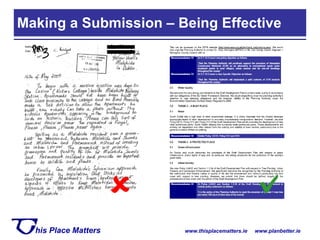
Making a Submission – Being Effective  
08: FOLLOWING UP
The most important  reserved function of the Elected Members; Follow   the statutory preparation process and Council Meeting Minutes. Watch   for the Publication of the Draft Plan Remind   Councillors and Management of their statutory obligations Its Your Development Plan  “ The greatest mistake a man can ever make is to do nothing for fear of not being able to do enough’ Edmund Burke
www.thisplacematters.ie
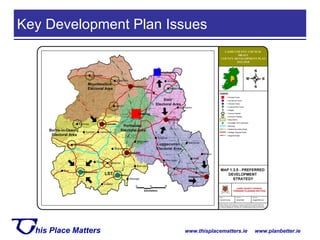
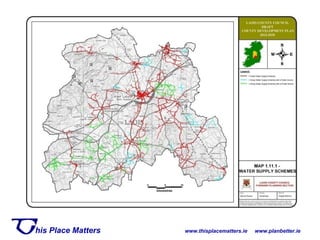
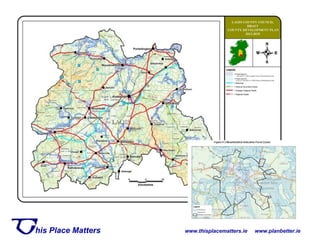
Key Development Plan Issues


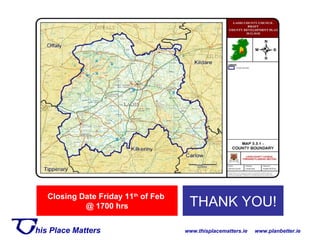
THANK YOU! Closing Date Friday 11 th  of Feb  @ 1700 hrs

Laois presentation1

  • 1.
    This Place MattersAn Taisce – The National Trust for Ireland Tailor’s Hall, Back Lane, Dublin 8 Promoting Community Participation in the Development Plan Process Laois
  • 2.
    To highlight the importance of community, ENGO and stakeholder participation in the planning process ; To provide an overview of the role of the Planning System with respect to achieving sustainable development & Environmental Protection; To understand the key lessons of the past and the key challenges of the future and the role of the land use planning system in addressing these challenges; To provide an overview of the Irish planning system and the process of making a development plan. To provide an overview of how to undertake a review of a development plan, to make a submission and to follow up to ensure your view is taken into consideration. Q & A Objective - Participation
  • 3.
  • 4.
    What is theDevelopment Plan The primary statement on land-use planning Provides the policy context for planning applications . The function is to support the sustainable development of land in the interests of the common good . ‘ The plan is a statement of objectives; it informs the community, in its draft form, of the intended objectives and affords the community the opportunity of inspection, criticism, and, if thought proper, objection. When adopted it forms an environmental contract between the planning authority, the council, and the community, embodying a promise by the council that it will regulate private development in a manner consistent with the objectives stated in the plan . . .’ The Attorney General (McGarry) v. Sligo County Council [1991] 1 I.R. 99 The legal status of a development plan SHOULD create a strong incentive for all stakeholder partners to engage in a process which can create certainty about our collective future .
  • 5.
    The Importance ofParticipation Development Led Retrospective Confrontational Community Led
  • 6.
    Why is thePlanning System Undervalued? Our History Pop. Density Rural Society Private Property Power Structures Education Apathy Vested Interest No Resources Short Termism
  • 7.
    ‘ We Shapeour Buildings. Thereafter they Shape Us’ Winston Churchill Why Does the Development Plan Matter? Live Work Learn Recreate Shop Travel Relax Landscape Community Environment Heritage Quality of Life
  • 8.
    Why Does theDevelopment Plan Matter? The Human Health Map
  • 9.
    Benefits of aPositive Plan Led System The Development Plan is the arena where the collective future of local communities can be worked out . Short Term Long Term Private Interests Common Good Institutions Local Authority/Development Plan
  • 10.
    RIO Earth Summit(1992) - LA 21 Plans - Aalborg Charter (1994) – 8 Steps (Vision, Participation, Implementation..) Aarhus Convention (1998) - Links environmental rights and human rights. - Establishes that sustainable development can be achieved only through the involvement of all stakeholders - Links government accountability and environmental protection. - Focuses on interactions between the public and public authorities in a democratic context. Achieving Sustainability
  • 11.
  • 12.
    The Costs ofDevelopment Led Planning Over - Zoning Price Inflation Suburban Sprawl Ex-urban Sprawl Car Dependency Health Costs Social Problems Flooding Conflict Ghost Estates Greenhouse Gas Urban Decay
  • 13.
    The Irish Spatial Structure Today
  • 14.
  • 15.
    ‘ That whichseems to be wealth may in reality be the gold plated index of far-reaching ruin’ John Rushkin c. 1840 Changing Our Ways
  • 16.
    The Key ChallengesMarket Failure Peak Oil & Energy Security Resource Scarcity Climate Change
  • 17.
    The Energy ChallengeInternational Energy Agency (IEA) – World Energy Outlook (10 th of November 2009) ‘ The scale and breadth of the energy challenge is enormous – far greater than many people realise . An unprecedented, yet relatively narrow, window of opportunity to take action to concentrate investment on low-carbon technology.’ ‘ Current trends have profound implications for environmental protection, energy security and economic development ’ ‘ Households and businesses are largely responsible for making the required investments, but governments hold the key to changing the mix of energy investment Continuing on today’s energy path, without any change in government policy, would mean rapidly increasing dependence on fossil fuels, with alarming consequences for climate change and energy security ’ [crude oil] prices approach $102 per bbl by 2015, $131 per bbl by 2020 and almost $190 bbl by 2030.
  • 18.
    06: THE IRISHPLANNING SYSTEM
  • 19.
    National Spatial StrategyRegional Planning Guidelines County Development Plans Local Area Plans The Planning System in Ireland Other EU and National Level Plans & Guidelines Policies & Programmes of Govt. Depts Capital Programmes Planning Guidelines Serviced Land Initiative Urban & Village Renewal Programmes Other Regional/Local Level Plans CDB Strategies Capital Programmes Housing Strategy Retail Strategy Waste Strategy Water Quality Management Biodiversity Plan
  • 20.
    The Planning Systemin Ireland The National Spatial Strategy Regional Planning Guidelines
  • 21.
    Zoning – Need, Policy, Capacity, Infrastructure, Physical Suitability, Sequential, Environmental Constraints Infrastructure – Transport, Water Services, Energy & Communications Environment – Natural (including SACs, SPAs, NHAs) & Built Heritage Social, Community & Cultural – Link with CDB Landscape Character – SAAOs, LCAs RPS & Architectural Conservation Areas Regeneration Amenities – including Public Rights of Way Community Services – Schools, Creches etc What Must a Plan Include?
  • 22.
    Development Plan StructureDevelopment Plan Strategy Core aims Settlement and transport strategy Development opportunities pursued in the plan Sustainability – the Plan and Effects on the Environment Strategic Context Current Trends and Issues National and regional spatial context Key demographic and socio-economic trends Physical development trends Key issues to address in this plan Policies & Objectives Location and Pattern of Development Housing Strategy Economic Development Environment, Heritage & Amenities Infrastructure Development Management Objectives Implementation
  • 23.
    Strategic Environmental Assessment(SEA). Must be an Iterative & Integrated Process Where Plan Alternatives are Assessed Against Environmental Constraints. SEA Statement Article 6 ‘Appropriate Assessment’ (SACs/SPAs) Integrating the Environment
  • 24.
    Environmental Report MitigationMeasures Monitoring SEA STATEMENT Alternatives Human Population Biodiversity Landscapes & Soil Agriculture/ Forestry Waste Management Water Quality Air Quality Noise Pollution Cultural Assets Material Assets Climate Change Sustainability
  • 25.
    05: THE PLANMAKING PROCESS
  • 26.
    The Plan MakingProcess Background Work, Data Gathering, Informal Consultations with Elected Members Notice of Intention of Planning Authority to Prepare A New Development Plan (Must be made not later that 4 years after the making of the existing Plan) Pre-Draft Public Consultation At Least 8 Weeks Week 1
  • 27.
    The Plan MakingProcess Manager’s Report & Recommendations Preparation by the Manager of the Draft Plan & Environmental Report Consideration by the Members of the Draft Submitted by the Manager and Finalisation for Initial Public Display Publish Notice & Invite Submissions Directions from Elected Members (Within 10 Weeks of Managers Report) Week 16 Week 38 Week 46 Week 48
  • 28.
    The Plan MakingProcess Public Consultation @ Least 10 Weeks Manager’s Report Making of Development Plan by Planning Authority Members Unless Material Alterations are Proposed Any Material Alterations Week 58 Week 70 Week 82 We Are Here
  • 29.
    The Plan MakingProcess Notice of Material Alterations (amend Environmental Report if Necessary) Public Consultation @ Least 4 Weeks Manager’s Report Making the Plan Week 85 Week 89 Week 93 Week 99
  • 30.
    06: REVIEWING ADEVELOPMENT PLAN
  • 31.
    A good developmentplan should be: Consistent with the planning hierarchy Consistent with national guidelines Compliant with EU and National Policy & Legislation Take views of local people into account A catalyst for positive change & sustainable development Anticipate future needs on an objective basis Have a strong role in protecting environment and heritage Be capable of implementation and monitoring What Should A Good Plan Include?
  • 32.
    07: MAKING ASUBMISISON
  • 33.
    Tips on Makinga Submission Introduce your group briefly explaining the aims of the group, who your target group are and why you are making this submission. Explain briefly how the submission was prepared including the consultation process carried out such as dates, numbers that attended etc. Make sure that the points made are clear, relevant and focused. For clarity purposes, try to link your points directly to a section, chapter or page of the plan or policy. If handwriting the submission, ensure that the writing is legible. Conclude your submission by summarising your main points and give a brief outline of past experiences based on all the information you have gathered about the plan or policy. Watch timeframes. Make sure you know the exact deadline date (month, day, hour). Deadline dates are strictly adhered to.
  • 34.
    Always make surethe agency acknowledges receipt of your group’s submission. This receipt proves that the submission is in ‘the system’. Make a recommendation or an idea that can be used in the future to make the plan or policy work better. Address issues for which the Development Plan has competence Location of the site your submission relates to (if applicable) Use precedents or best practice examples Be succinct and include a short executive summary Send a copy to your Elected Members www.laoiscoco.ie www.thisplacematters.ie www.planbetter.ie Tips on Making a Submission
  • 35.
    Making a Submission– Being Effective  
  • 36.
  • 37.
    The most important reserved function of the Elected Members; Follow the statutory preparation process and Council Meeting Minutes. Watch for the Publication of the Draft Plan Remind Councillors and Management of their statutory obligations Its Your Development Plan “ The greatest mistake a man can ever make is to do nothing for fear of not being able to do enough’ Edmund Burke
  • 38.
  • 39.
  • 40.
  • 41.
  • 42.
  • 43.
  • 44.
  • 45.
  • 46.
  • 47.
  • 48.
  • 49.
  • 50.
    THANK YOU! ClosingDate Friday 11 th of Feb @ 1700 hrs

Editor's Notes

  • #2 How do we shape our community, our society, our economy, our environment
  • #5 Legally required under the P & D Acts Cornerstone Provides a panacea for environmental protection & sustainable development
  • #6 Deficit of Community Engagement Vested Interests have in effect been able to hijack the system to meet their own ends
  • #7 Cinderella Syndrome For Evil to Triumph all it Takes is for Good Men to do Nothing Immaturity Break this cycle/Shock All Development is Good Development
  • #8 Human Civilisation has outpaced our evolution
  • #13 All Development is Good Development The Celtic Tiger Years Over Zoning
  • #14 Put in cupboard picture Gazelles Village costs
  • #16 Planning Act 2000 Smart Development Quarry Pic Pre-Analytic Vision
  • #17 Economic Renewal/Fit For Purpose