LANGUAGE & ETHNICITY
Some Key Questions
• Who’s ethnic?

• Would you call yourself ethnic? Why/why not?

• What characteristics make up an ethnic identity?

• How does a group’s ethnicity relate to the
  language(s) they speak?
Who’s Ethnic?
• Origins that precede or are external to the state
• Group membership that is involuntary
• Ancestral tradition rooted in a shared sense of
  peoplehood
• Distinctive value orientations and behavior
  patterns
• Influence of the group on the lives of its members
• Group membership defined by how members
  define themselves and how they are defined by
  others
What is ethnicity?
Ethnicity is a social construction that
indicates identification with a particular
group which is often descended from
common ancestors. Members of the
group share common cultural traits
(such as language, religion, and dress)
and are an identifiable minority within
the larger nation-state.
Ethnic Varieties of English (USA)
•   Italian English      • American Indian
•   Jewish English         English
•   Irish English        • Vietnamese English
•   German English       • African American
•   Puerto Rican English   English
•   Chicano English
Do you know of any in the Caribbean?
In your country of origin?
Characteristics of an Ethnic variety
•   Lexical differences from standard English
•   Phonological differences (vowels, intonation)
•   Isolated grammatical features
•   Conversational style
Where do these characteristics come
               from?

• Transfer from the first language
• Process of second language learning
Spread of Dialect features
Some lexical and grammatical features of ethnic
varieties of English are no longer identified with
people of that ethnic group. They have spread
into mainstream varieties of English.
Spread of Dialect features
What variety of English do you associate with
these expressions?

– I need this like a hole in the head.
– chutzpah = impudence or guts
– schlep = to haul or to take
– wunna = all of you
Spread of Dialect features
What variety of English do you associate with
these expressions?

• Bogus – fake or deceitful: false, dishonest, or
fraudulently imitating something
• Cat – He’s a real cool cat.
• Hip – aware of and influenced by the latest
fashions in clothes, music, or ideas
• Dig – to understand something fully or with
sympathy
Spread of Dialect features
bogus comes from Hausa boko (deceit or fraud)
cat comes from Wolof –kat (suffix for a person)
hip comes from Wolof hepi (to open one’s eyes)
dig comes from Wolof deg (to understand, appreciate)

• Hausa is a language widely spoken in Nigeria, Niger,
and other parts of eastern West Africa.
• Wolof is a language spoken in Senegal and The
Gambia, belonging to the Niger-Congo language
family.
Consequences?
• What are the consequences of speaking ethnic
  varieties of English?
  – Do we load certain types of English with values?
  – What values? What types of English?
  – Why?
  – Where do you think some of the varieties you
    know of may have come from?
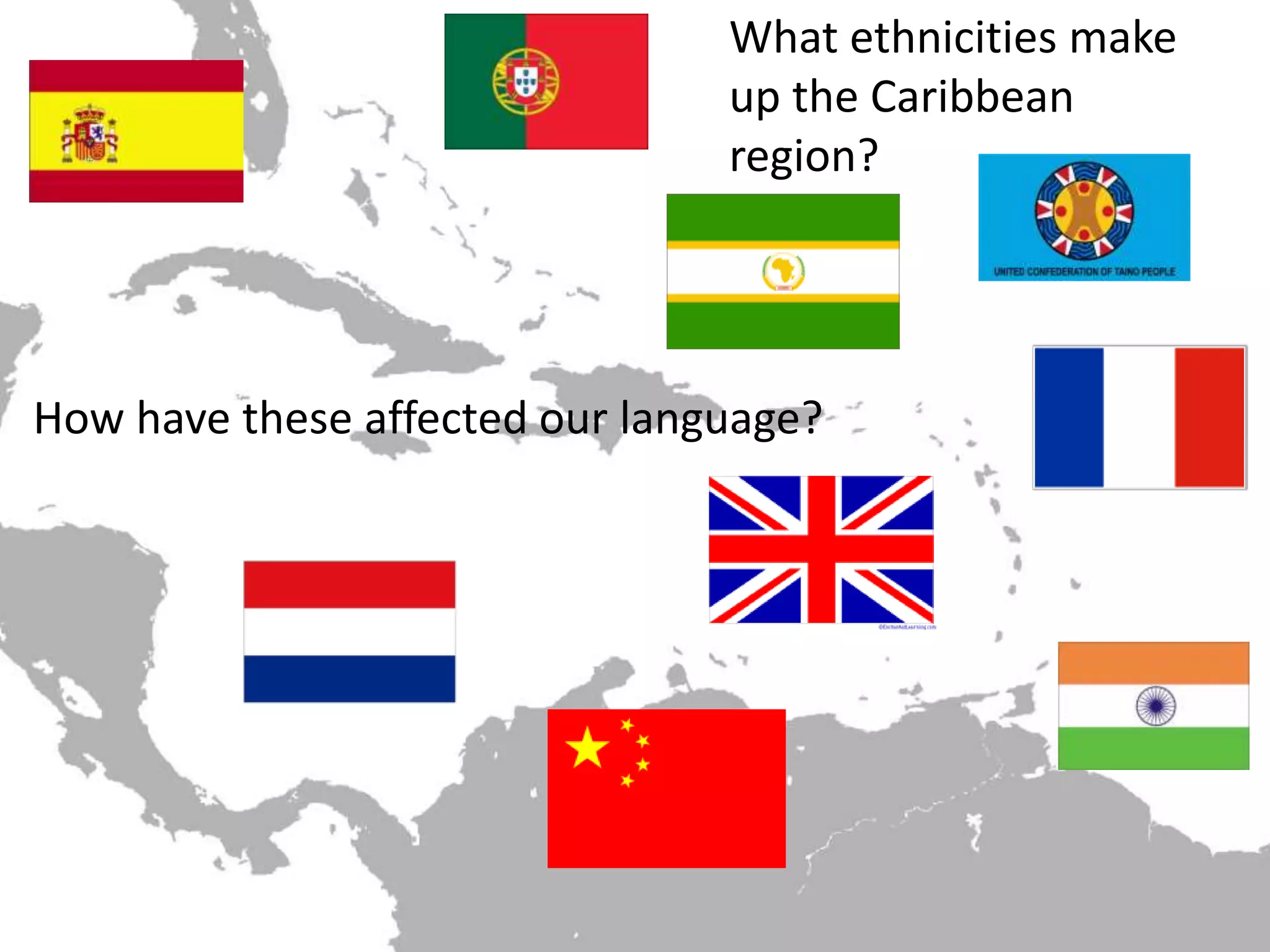
What ethnicities make
                                up the Caribbean
                           1    region?


How have these affected our language?
Language & Ethnicity

Language & Ethnicity

  • 1.
  • 2.
    Some Key Questions •Who’s ethnic? • Would you call yourself ethnic? Why/why not? • What characteristics make up an ethnic identity? • How does a group’s ethnicity relate to the language(s) they speak?
  • 3.
    Who’s Ethnic? • Originsthat precede or are external to the state • Group membership that is involuntary • Ancestral tradition rooted in a shared sense of peoplehood • Distinctive value orientations and behavior patterns • Influence of the group on the lives of its members • Group membership defined by how members define themselves and how they are defined by others
  • 4.
    What is ethnicity? Ethnicityis a social construction that indicates identification with a particular group which is often descended from common ancestors. Members of the group share common cultural traits (such as language, religion, and dress) and are an identifiable minority within the larger nation-state.
  • 5.
    Ethnic Varieties ofEnglish (USA) • Italian English • American Indian • Jewish English English • Irish English • Vietnamese English • German English • African American • Puerto Rican English English • Chicano English Do you know of any in the Caribbean? In your country of origin?
  • 6.
    Characteristics of anEthnic variety • Lexical differences from standard English • Phonological differences (vowels, intonation) • Isolated grammatical features • Conversational style
  • 7.
    Where do thesecharacteristics come from? • Transfer from the first language • Process of second language learning
  • 8.
    Spread of Dialectfeatures Some lexical and grammatical features of ethnic varieties of English are no longer identified with people of that ethnic group. They have spread into mainstream varieties of English.
  • 9.
    Spread of Dialectfeatures What variety of English do you associate with these expressions? – I need this like a hole in the head. – chutzpah = impudence or guts – schlep = to haul or to take – wunna = all of you
  • 10.
    Spread of Dialectfeatures What variety of English do you associate with these expressions? • Bogus – fake or deceitful: false, dishonest, or fraudulently imitating something • Cat – He’s a real cool cat. • Hip – aware of and influenced by the latest fashions in clothes, music, or ideas • Dig – to understand something fully or with sympathy
  • 11.
    Spread of Dialectfeatures bogus comes from Hausa boko (deceit or fraud) cat comes from Wolof –kat (suffix for a person) hip comes from Wolof hepi (to open one’s eyes) dig comes from Wolof deg (to understand, appreciate) • Hausa is a language widely spoken in Nigeria, Niger, and other parts of eastern West Africa. • Wolof is a language spoken in Senegal and The Gambia, belonging to the Niger-Congo language family.
  • 12.
    Consequences? • What arethe consequences of speaking ethnic varieties of English? – Do we load certain types of English with values? – What values? What types of English? – Why? – Where do you think some of the varieties you know of may have come from?
  • 13.
    What ethnicities make up the Caribbean 1 region? How have these affected our language?