D I A L E C T S
D I A L E C T S
These are mutually intelligible forms
of a language that differ in systematic
ways. –Fromkin, Rodman, Hyams (2011)
Regional Dialects
It is formed when various linguistic
differences accumulate in a particular
geographic region and when the
language spoken has its own
character. –Fromkin, Rodman, Hyams (2011)
Regional Dialects
When a language in a wide
geographical area spoken in at least
many hundred years has differences
in pronunciation, in choices and forms
of words, and in syntax. –Ronald Wardaugh (2006)
Regional Dialects
It is a distinct form of a language
spoken in a particular geographical
area. – grammar.com
Regional Dialects
Also known as regiolect or topolect.
Regional Dialects
Regional dialects may differ in:
• pronunciation (phonology)
• lexical choices
• grammatical rules
Phonological Differences
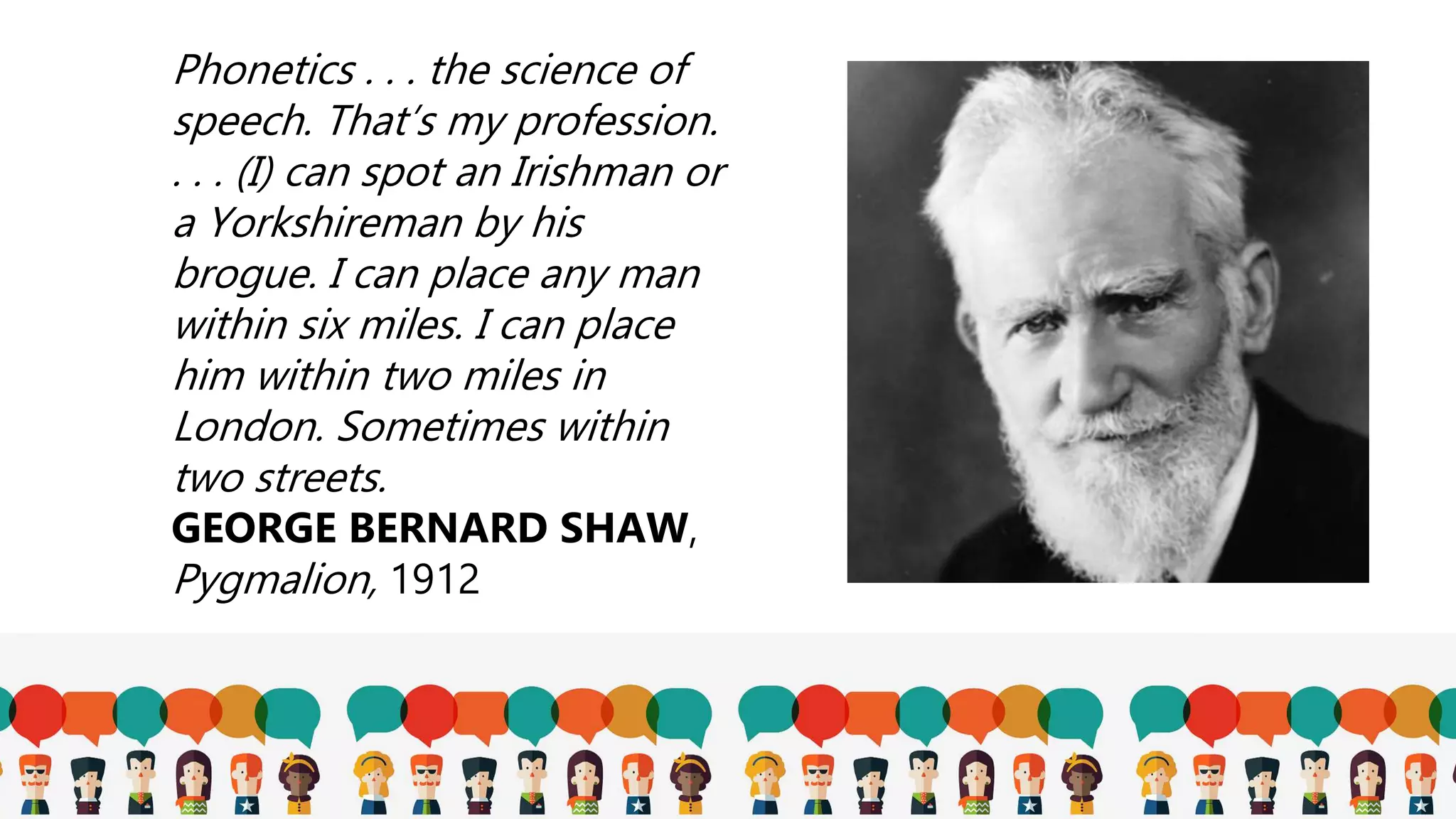
Phonetics . . . the science of
speech. That’s my profession.
. . . (I) can spot an Irishman or
a Yorkshireman by his
brogue. I can place any man
within six miles. I can place
him within two miles in
London. Sometimes within
two streets.
GEORGE BERNARD SHAW,
Pygmalion, 1912
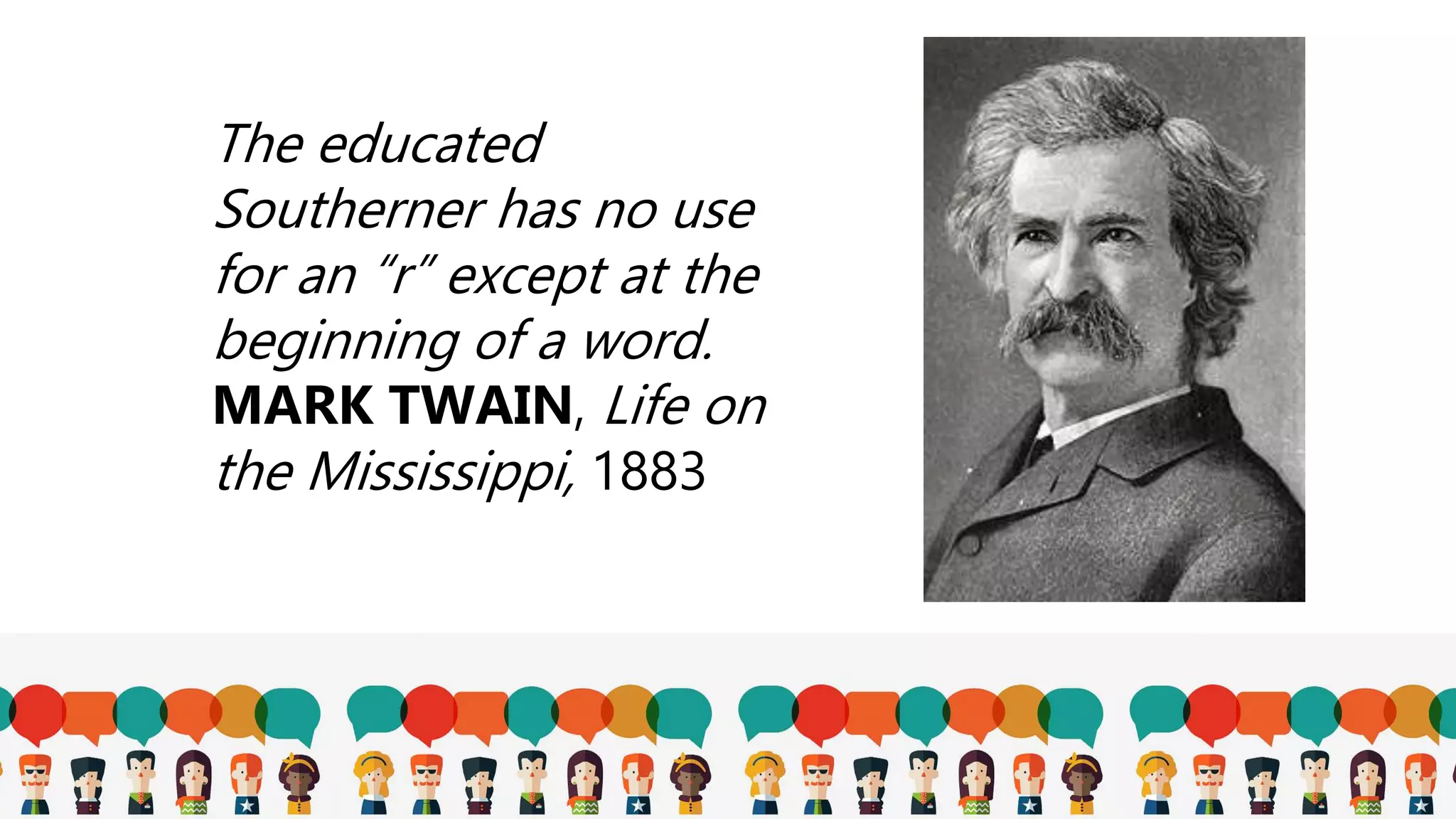
The educated
Southerner has no use
for an “r” except at the
beginning of a word.
MARK TWAIN, Life on
the Mississippi, 1883
Regional phonological or
phonetic distinctions
Phonological differences caused by
one’s native language.
luxury
48% of the Americans pronounced the mid
consonants in luxury as voiceless [lʌkʃəri],
whereas 96 percent of the British
pronounced them as voiced [lʌgʒəri].
data
Sixty-four percent of the Americans
pronounced the first vowel in data as [ā]
and 35 percent as [ä], as opposed to 92
percent of the British pronouncing it with
an [ā] and only 2 percent with [ä].
applicable
formidable
laboratory
cigarette
Lexical Differences
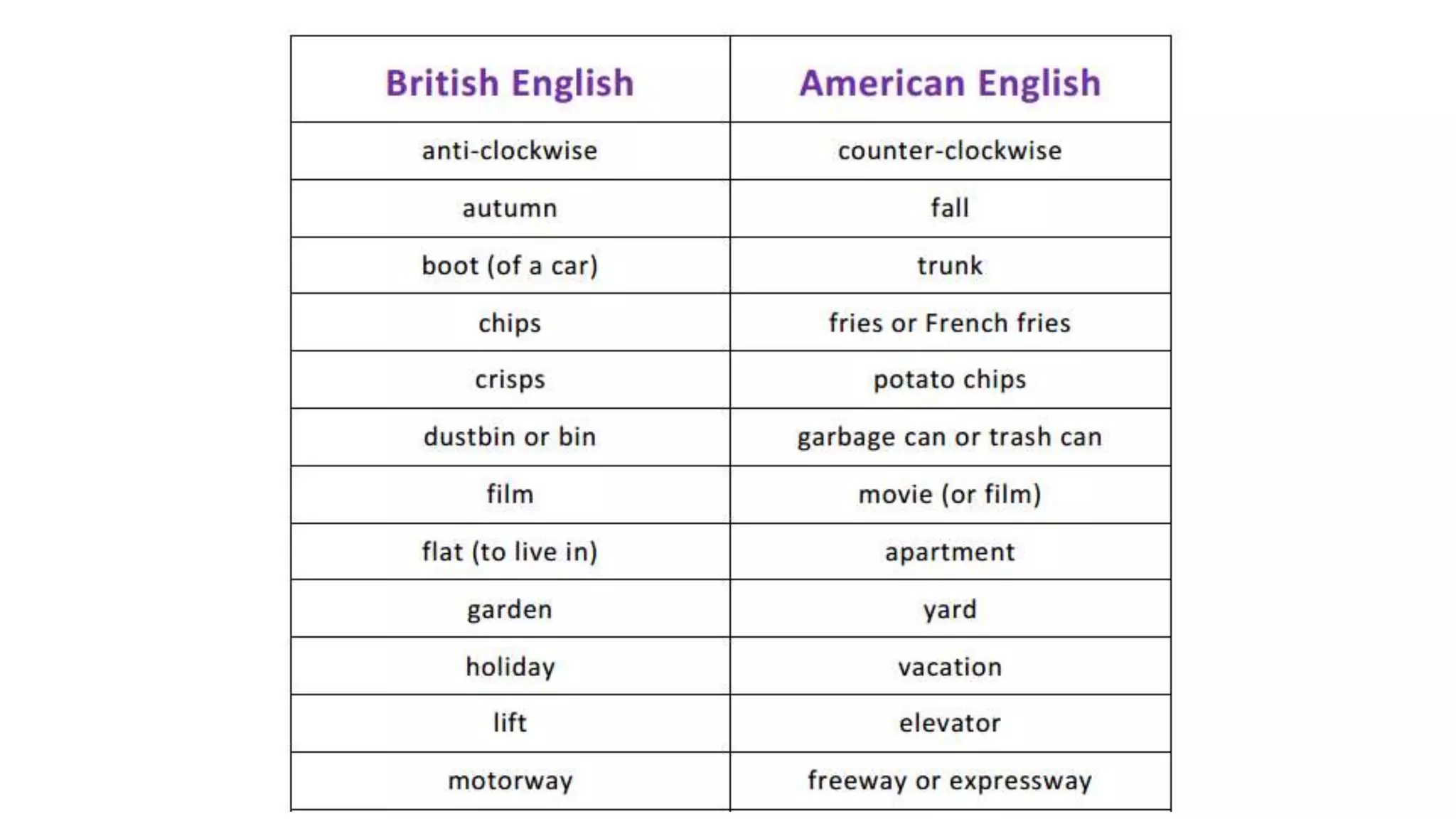
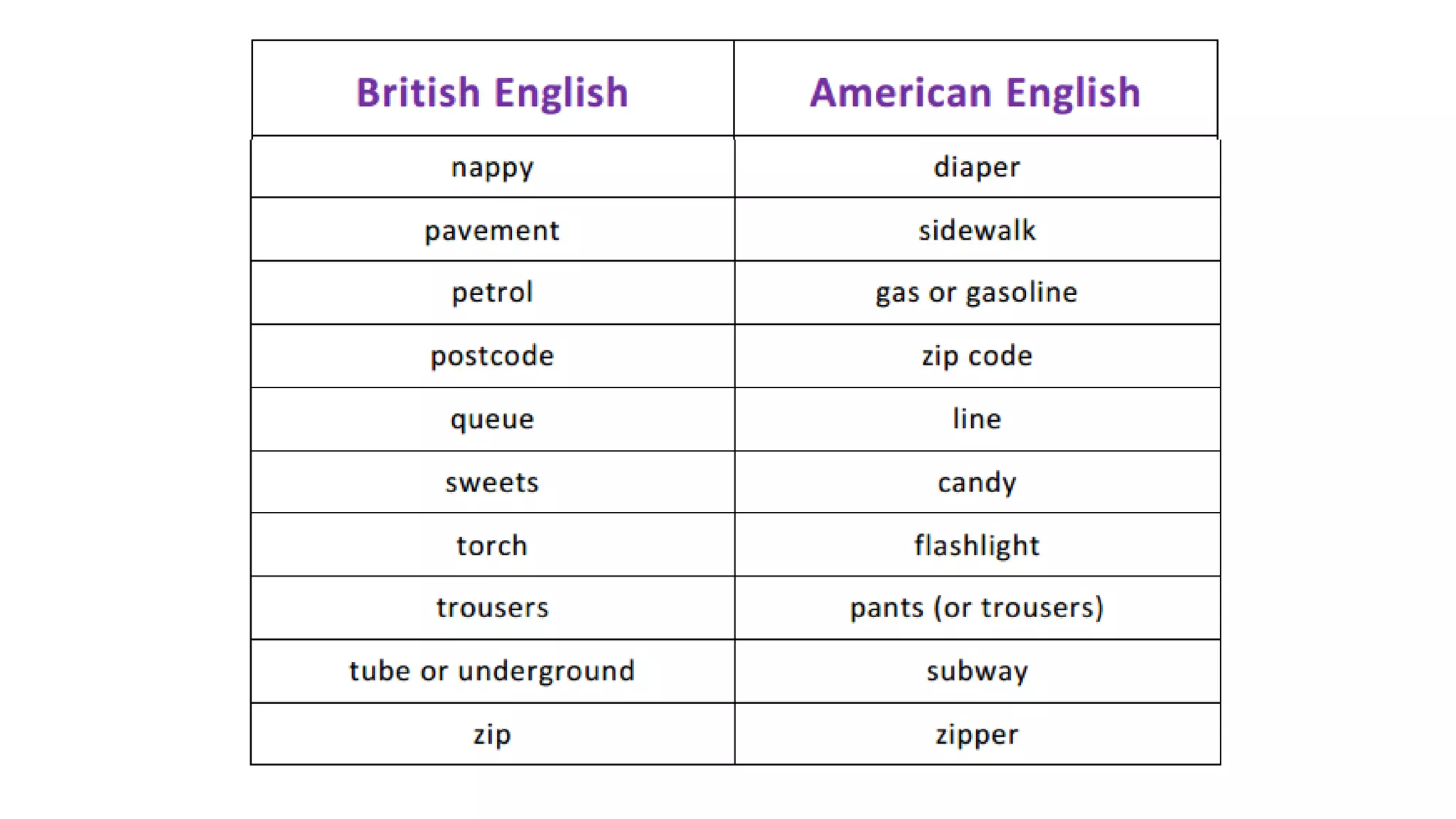
Lexical Differences
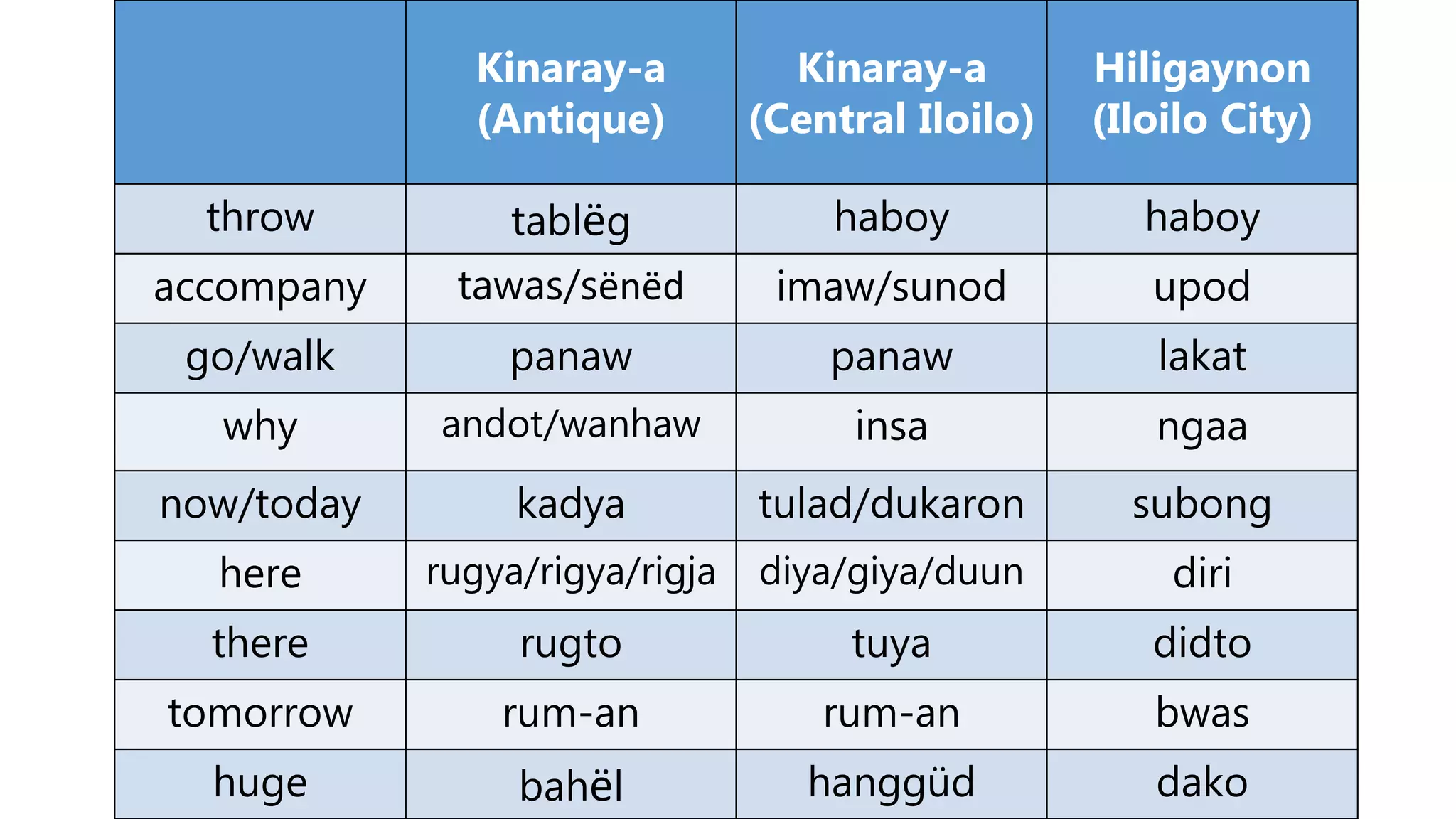
Differences in the words people use for
the same object.
Kinaray-a
(Antique)
Kinaray-a
(Central Iloilo)
Hiligaynon
(Iloilo City)
lizard sёksёk tiki tiki
gecko taka tuko tuko
scold kara akig akig
do the laundry mamunak manglaba manglaba
light sulo suga suga
give tugro ta-o hatag
watch tёrёk/sёlёng lantaw tan-aw
dog ayam/iro ayam ido
cat kuring miyaw/kuring kuring
Kinaray-a
(Antique)
Kinaray-a
(Central Iloilo)
Hiligaynon
(Iloilo City)
throw tablёg haboy haboy
accompany tawas/sёnёd imaw/sunod upod
go/walk panaw panaw lakat
why andot/wanhaw insa ngaa
now/today kadya tulad/dukaron subong
here rugya/rigya/rigja diya/giya/duun diri
there rugto tuya didto
tomorrow rum-an rum-an bwas
huge bahёl hanggüd dako
Syntactic Differences
John will eat and Mary will eat.
John and Mary will eat.
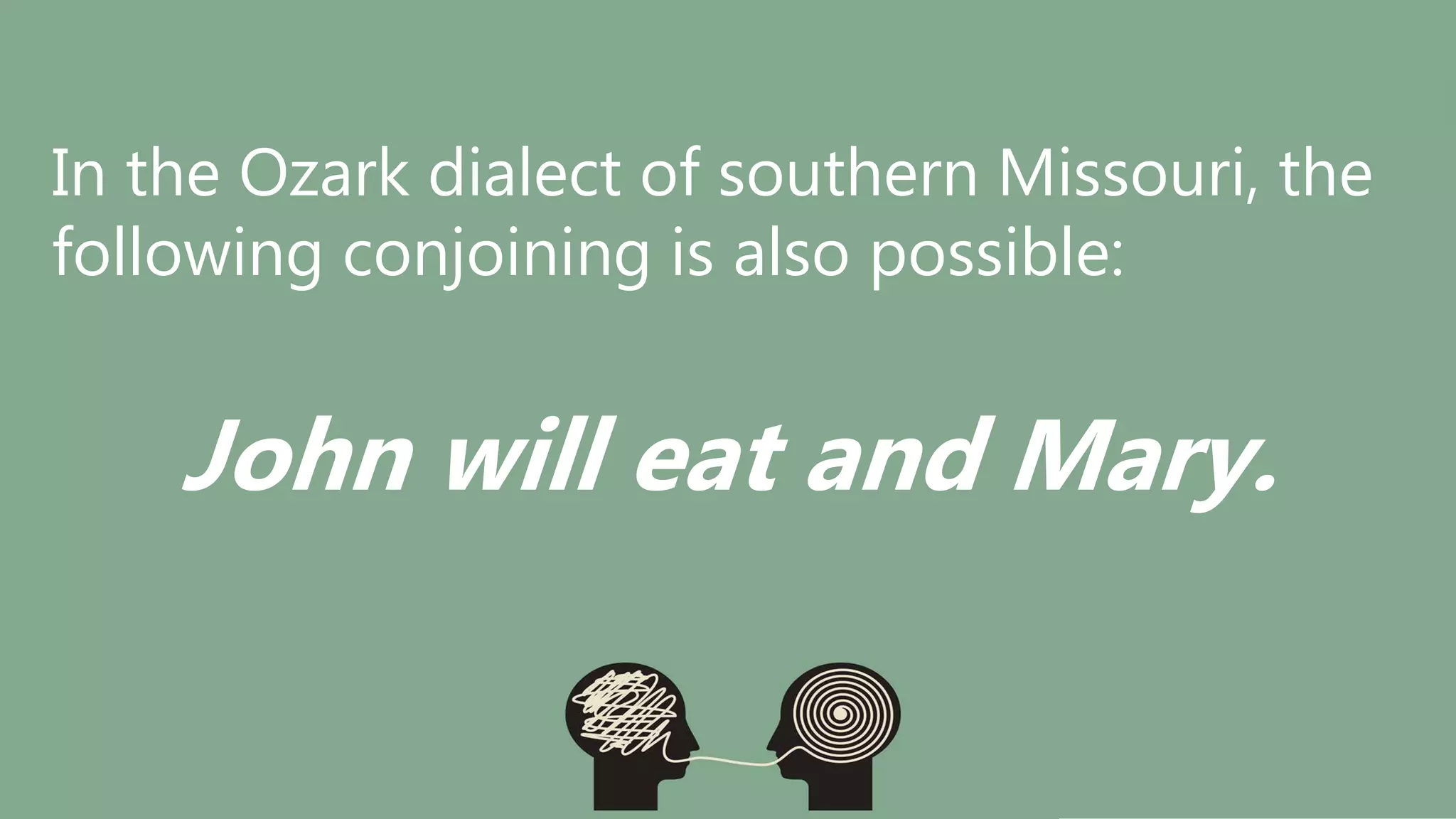
In the Ozark dialect of southern Missouri, the
following conjoining is also possible:
John will eat and Mary.
double modals
He might could do it.
You might should go home.
double objects
I caught me a fish.
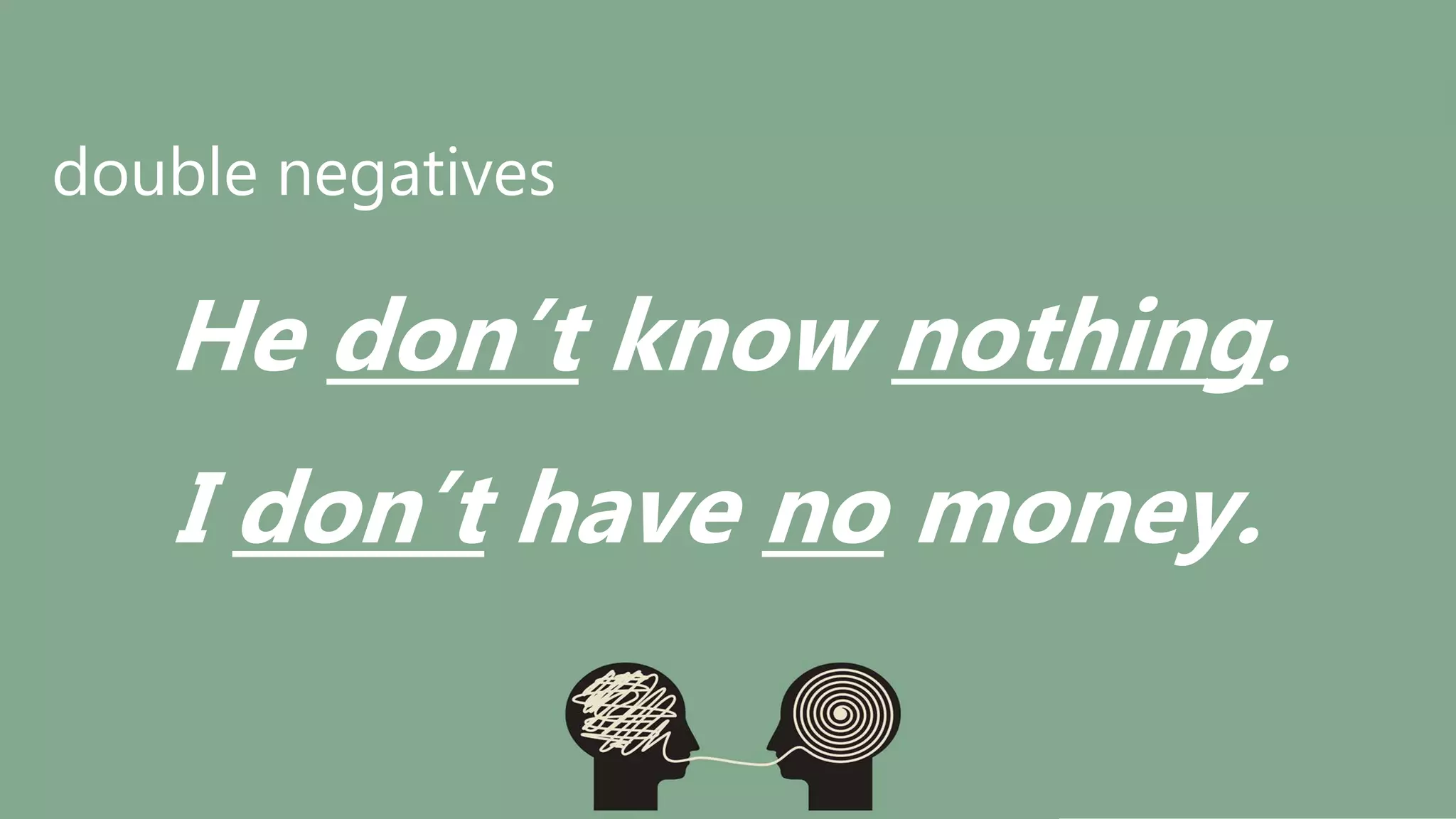
double negatives
He don’t know nothing.
I don’t have no money.
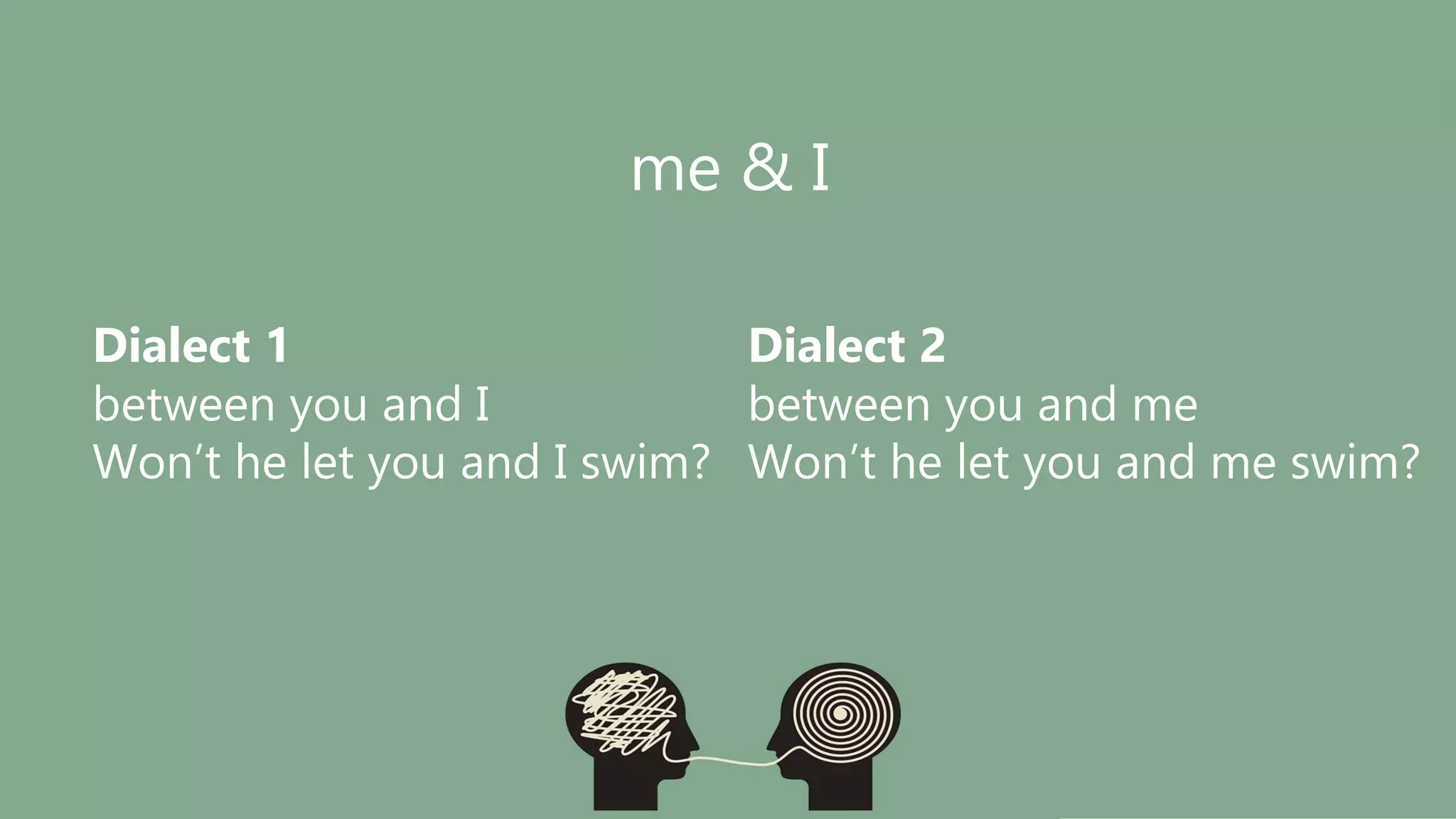
me & I
Dialect 1 Dialect 2
between you and I between you and me
Won’t he let you and I swim? Won’t he let you and me swim?
I could have done it.
British: I could have done.
American: I could have.
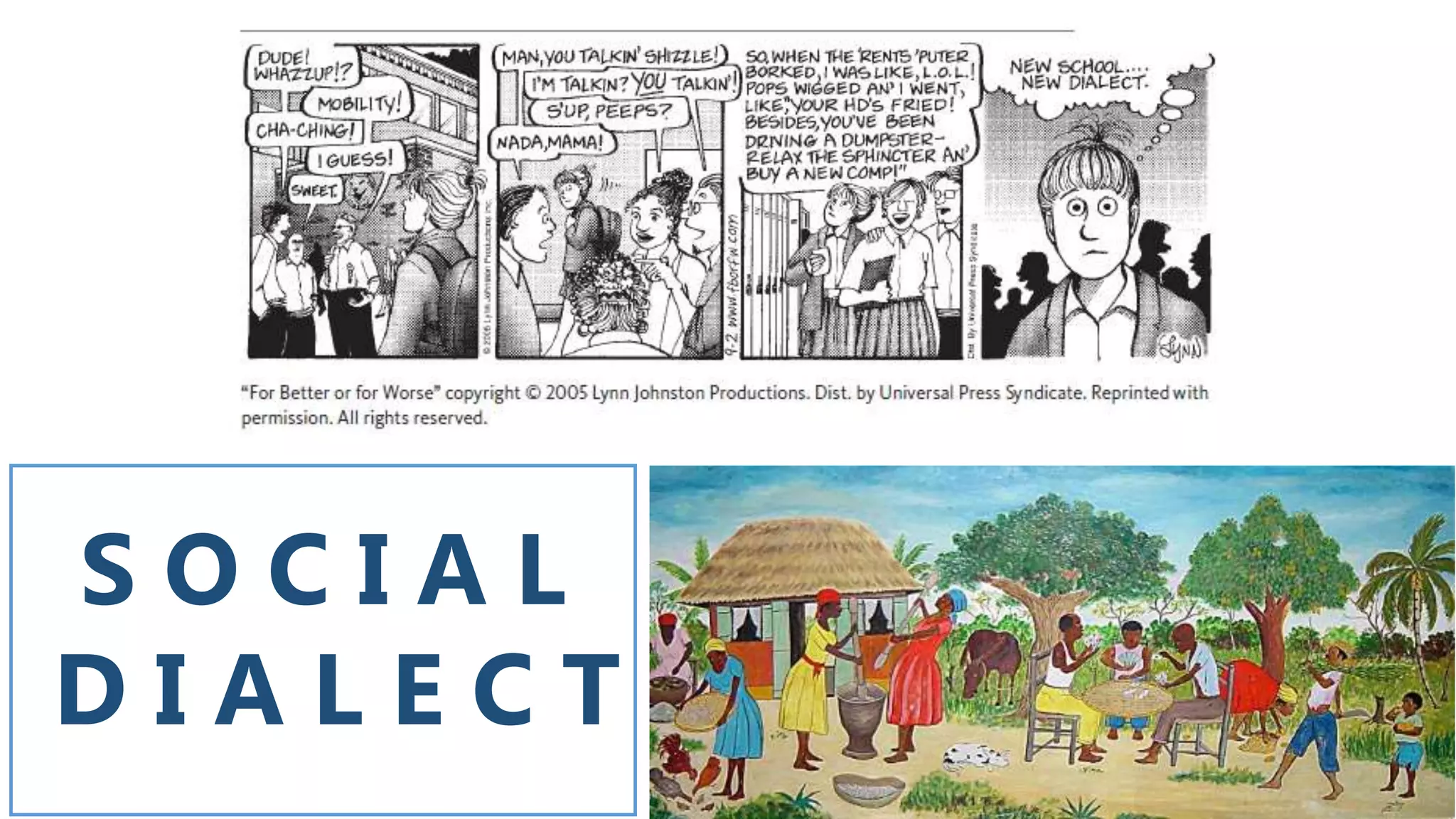
S O C I A L D I A L E C T
S O C I A L
D I A L E C T
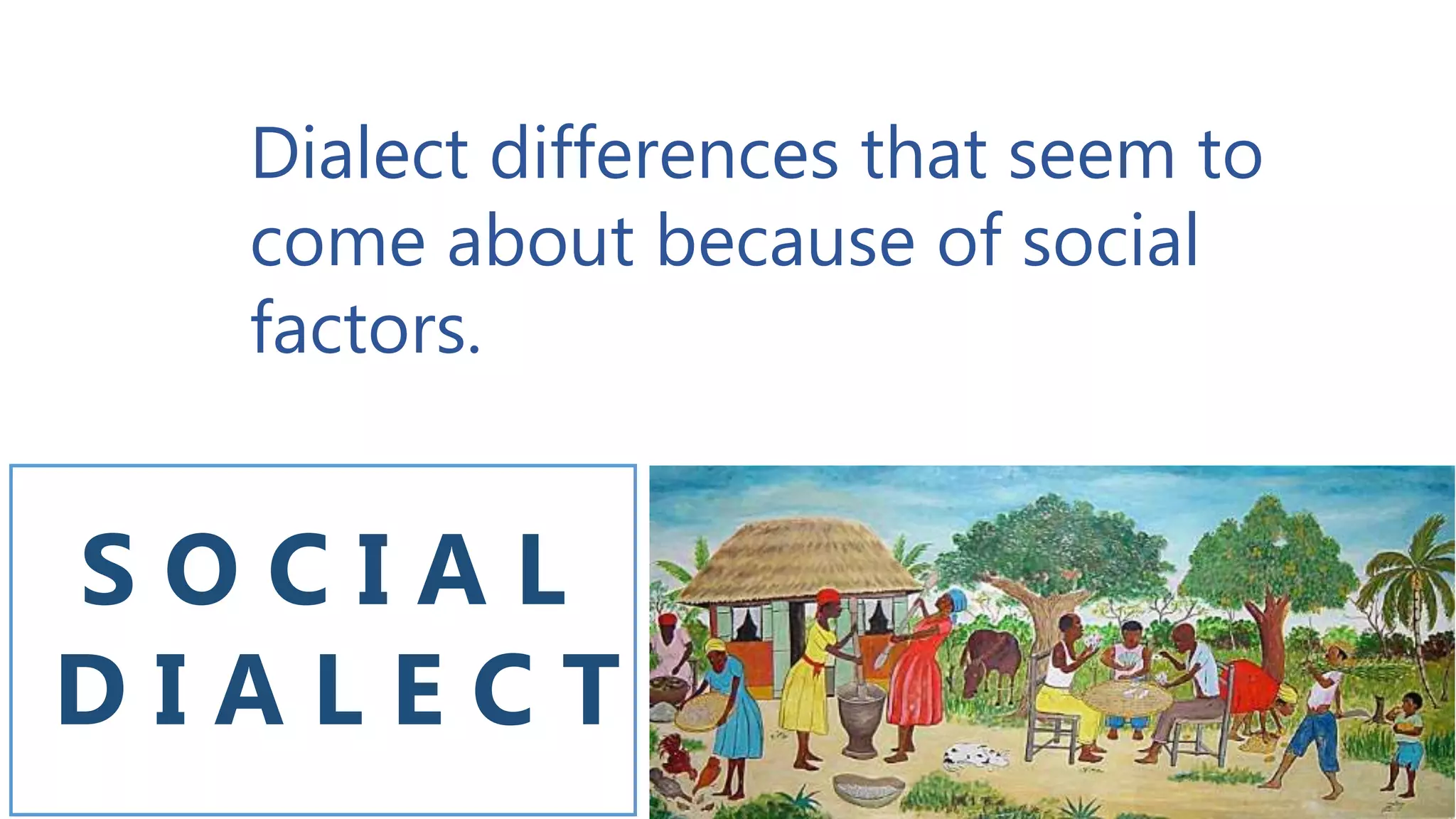
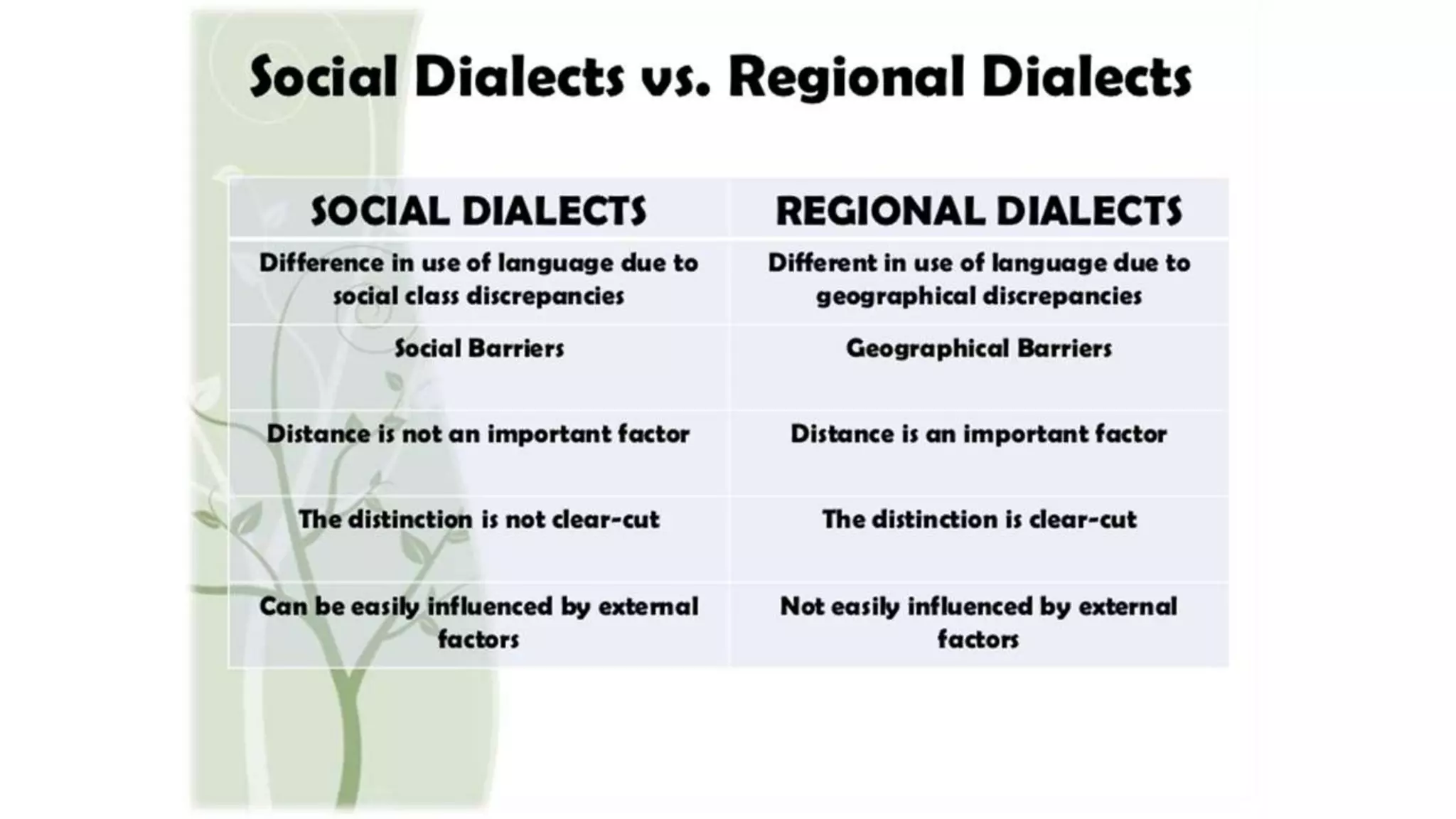
Dialect differences that seem to
come about because of social
factors.
S O C I A L
D I A L E C T
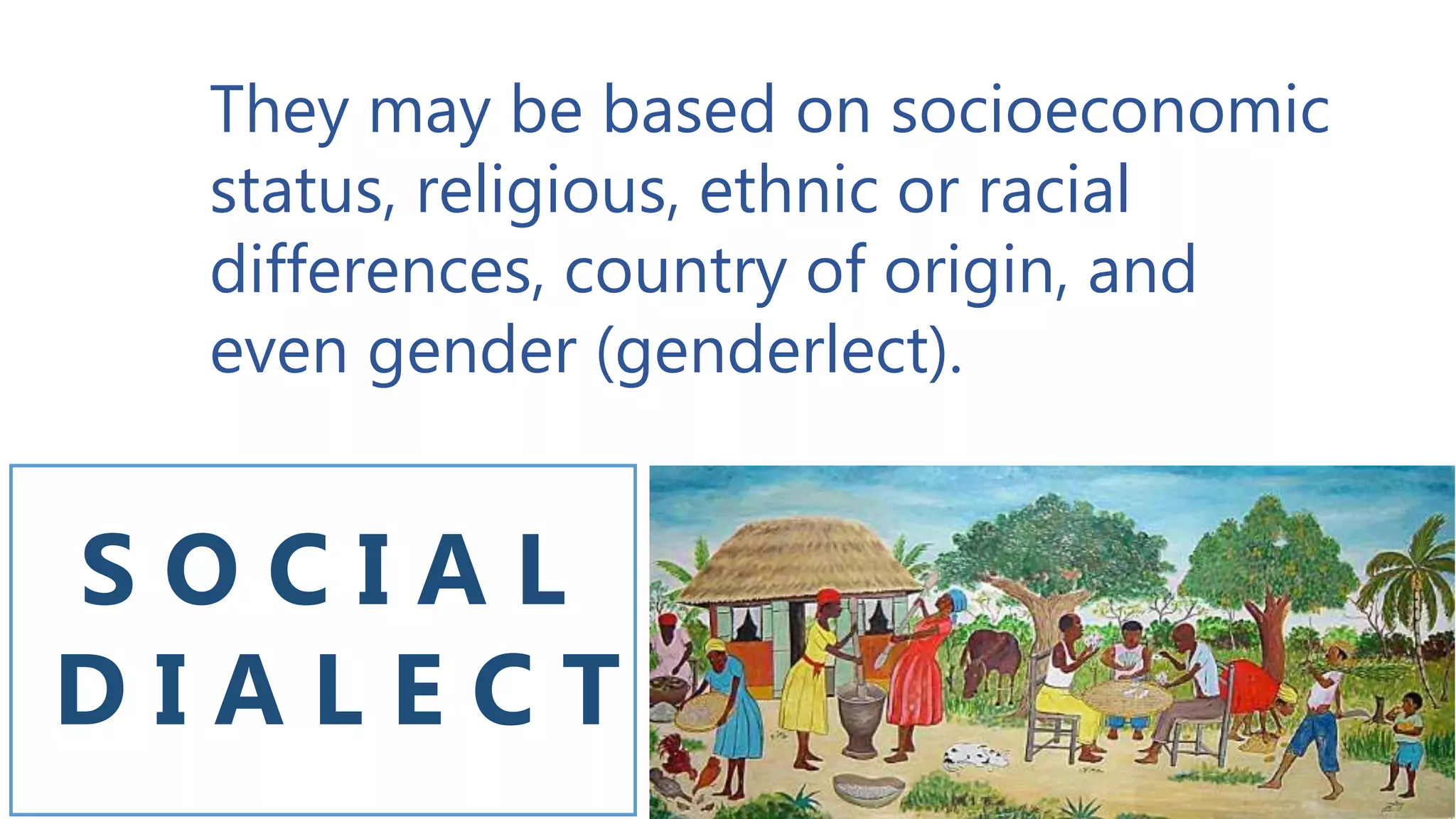
They may be based on socioeconomic
status, religious, ethnic or racial
differences, country of origin, and
even gender (genderlect).
S O C I A L
D I A L E C T
S O C I A L
D I A L E C T
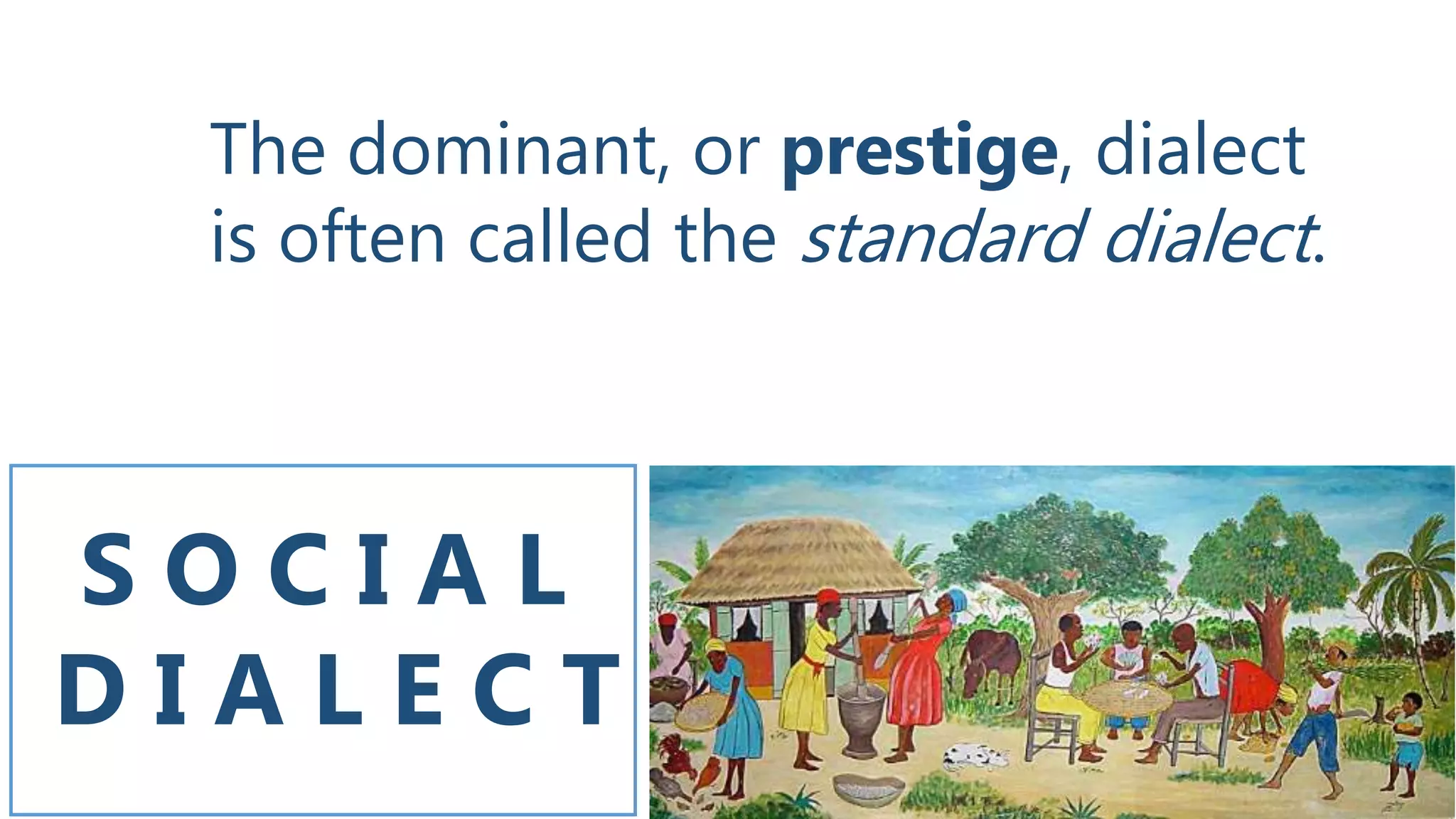
The dominant, or prestige, dialect
is often called the standard dialect.
S O C I A L
D I A L E C T
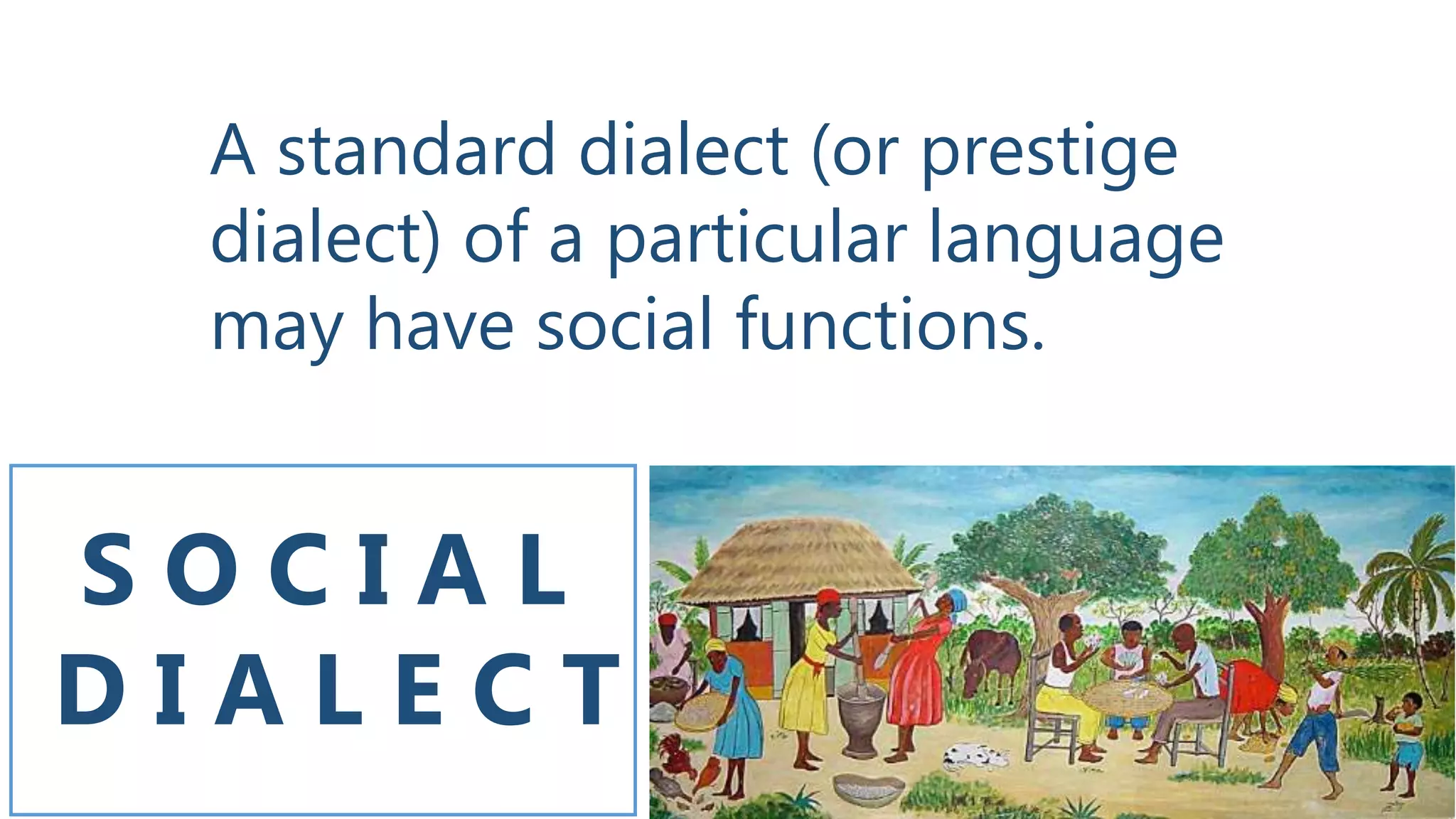
A standard dialect (or prestige
dialect) of a particular language
may have social functions.
S O C I A L
D I A L E C T
Standard American English (SAE)
is a dialect of English that many
Americans nearly speak.
S O C I A L
D I A L E C T
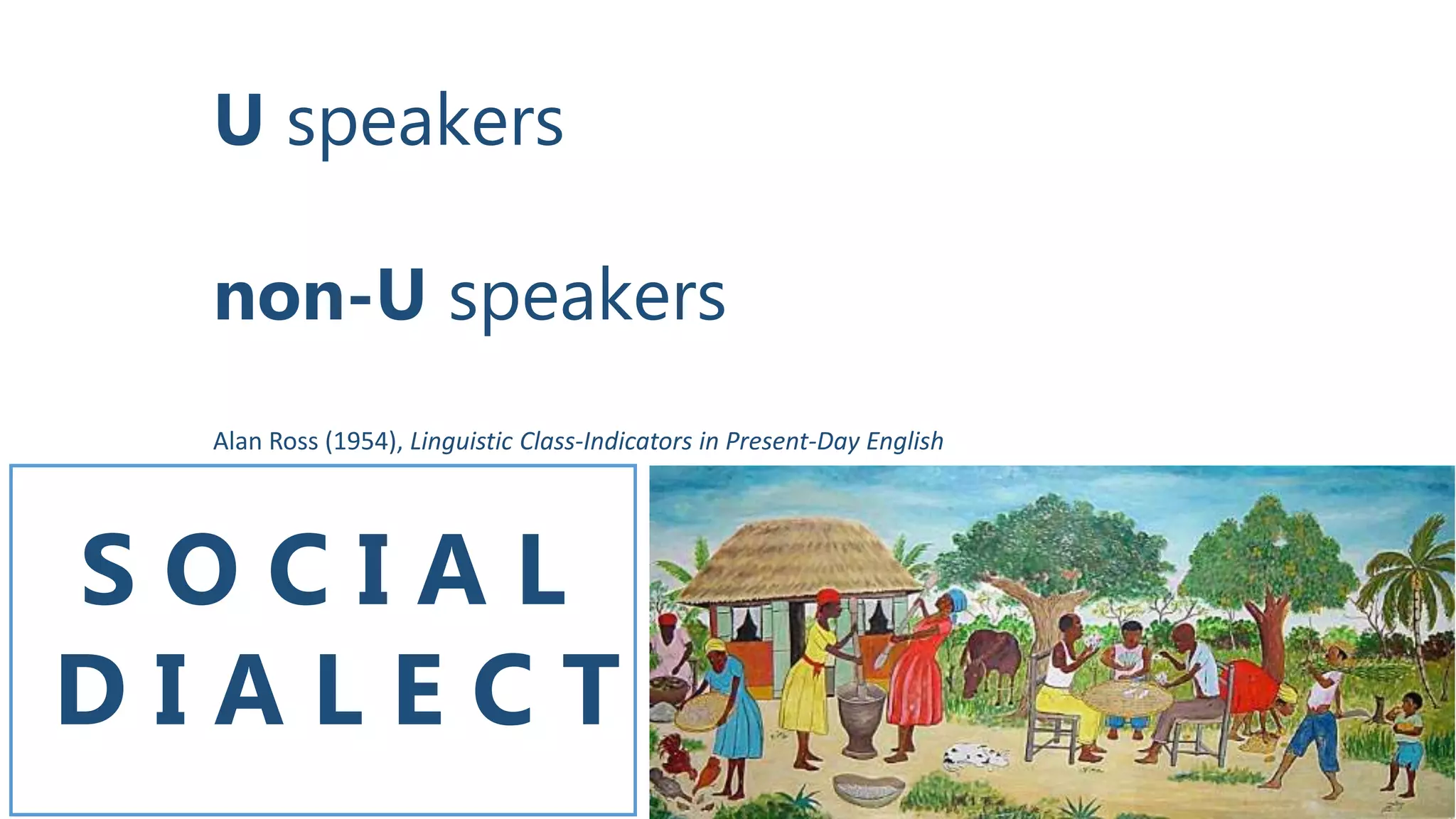
U speakers
non-U speakers
Alan Ross (1954), Linguistic Class-Indicators in Present-Day English
S O C I A L
D I A L E C T
hypercorrection
S O C I A L
D I A L E C T
banned languages
me & I
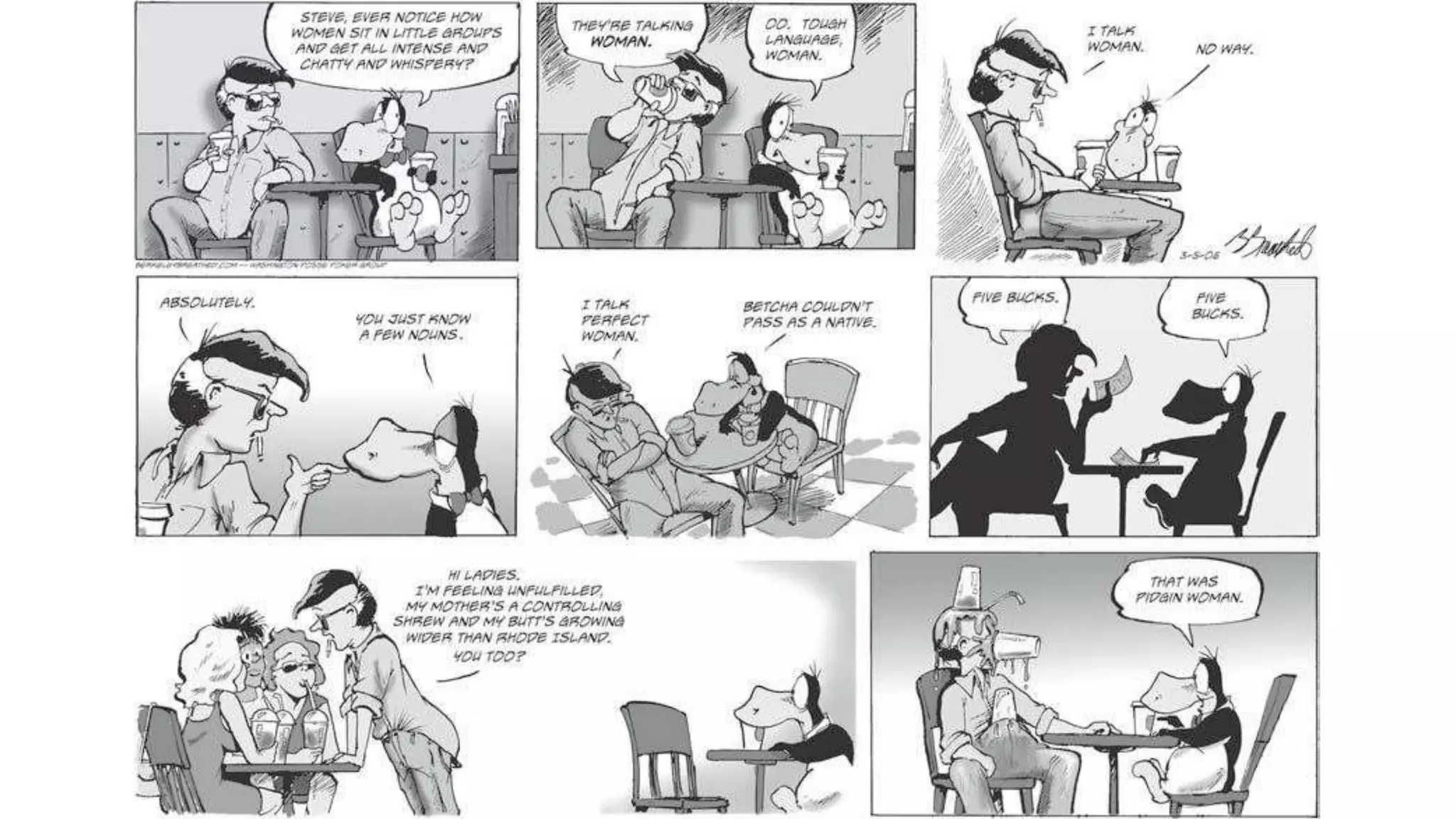
GENDERLECT
me & I
GENDERLECT
Genderlect is a term coined by
the linguist Deborah Tannen.
me & I
GENDERLECT
Genderlect refers to the
different variants of English
used by men and women.
me & I
GENDERLECT
Variations in the language of
men and women occur in
many, if not all, languages.
GENDERLECT
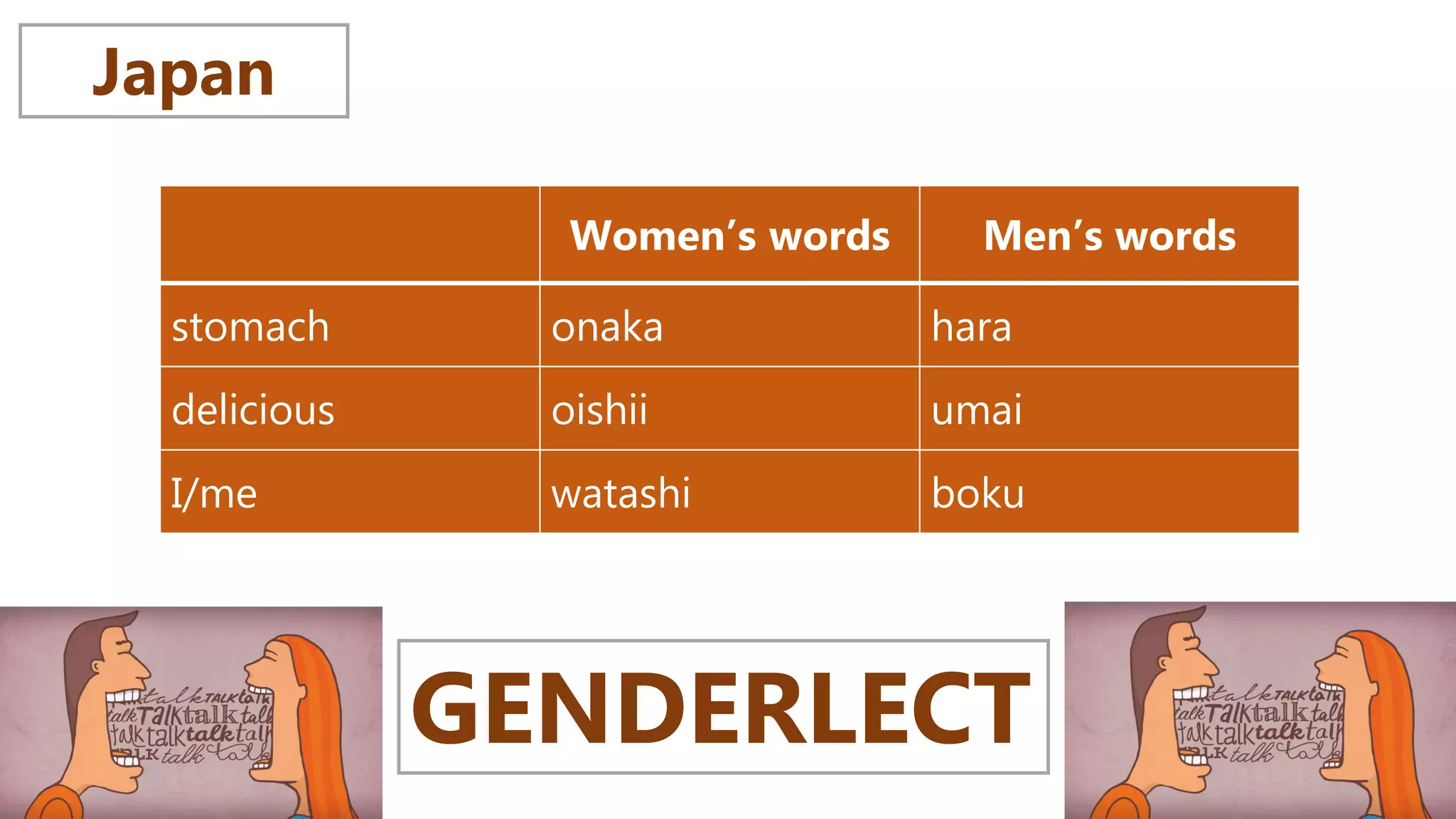
Japan
Women’s words Men’s words
stomach onaka hara
delicious oishii umai
I/me watashi boku
GENDERLECT
Japan
Women’s words Men’s words
eat a meal gohan-o taberu meshi-o kuu
be hungry onaka-ga suita hara-ga hetta
me & I
GENDERLECT
Robin Lakoff (1973) identified a number of features that
occurred more frequently in women’s speech than in men’s.
Some of these are:
1. Women “hedge” their speech more often than men do.
2. Women also use tag questions more frequently to
qualify their statements.
me & I
GENDERLECT
Robin Lakoff (1973) identified a number of features that
occurred more frequently in women’s speech than in men’s.
Some of these are:
3. Women use words of politeness.
4. They also use intensifying adjectives.
me & I
GENDERLECT
There is a widespread belief that when men and women
converse, women talk more and also that they tend to
interrupt more than men in conversation.
me & I
GENDERLECT
However, serious studies of mixed-sex conversations show
that in a number of different contexts men dominate the
talking, particularly in non-private conversation such as
television interviews, business meetings, and conference
discussion where talking can increase one’s status.
me & I
GENDERLECT
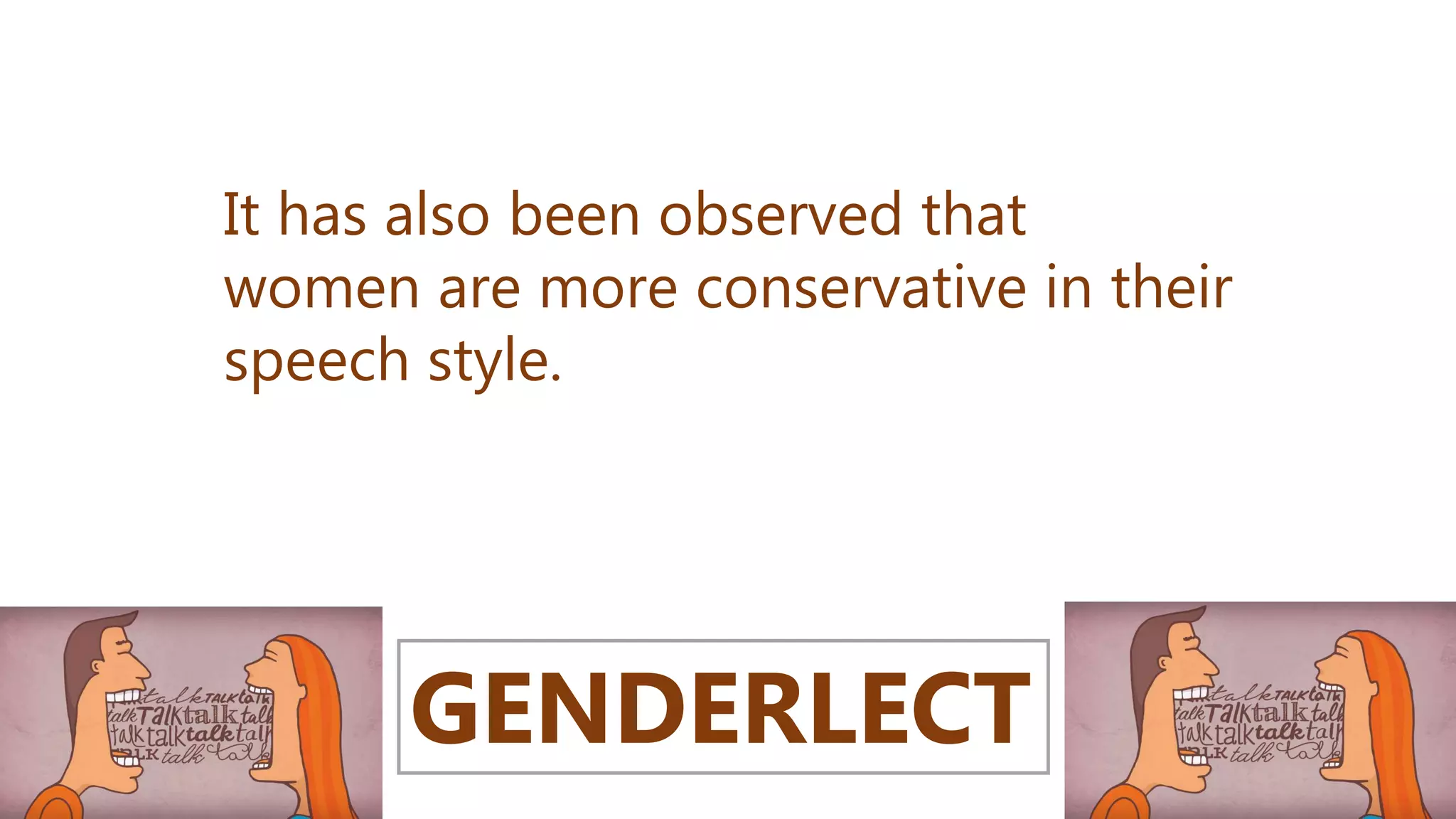
It has also been observed that
women are more conservative in their
speech style.
me & I
GENDERLECT
The linguist Janet Holmes has also
suggested that most sociolinguistic
experiments are conducted by middle-
class, well-educated academics.
References:
Hyams, N., Fromkin, V. & Rodman, R. (2011). An introduction to
language (9th ed). Canada: Cengage Learning
Wardaugh, R. (2006). An introduction to sociolinguistics (5th ed).
Victoria, Australia: Blackwell Publishing

Regional and social dalects

  • 1.
    D I AL E C T S
  • 4.
    D I AL E C T S These are mutually intelligible forms of a language that differ in systematic ways. –Fromkin, Rodman, Hyams (2011)
  • 5.
    Regional Dialects It isformed when various linguistic differences accumulate in a particular geographic region and when the language spoken has its own character. –Fromkin, Rodman, Hyams (2011)
  • 6.
    Regional Dialects When alanguage in a wide geographical area spoken in at least many hundred years has differences in pronunciation, in choices and forms of words, and in syntax. –Ronald Wardaugh (2006)
  • 7.
    Regional Dialects It isa distinct form of a language spoken in a particular geographical area. – grammar.com
  • 8.
    Regional Dialects Also knownas regiolect or topolect.
  • 9.
    Regional Dialects Regional dialectsmay differ in: • pronunciation (phonology) • lexical choices • grammatical rules
  • 10.
  • 11.
    Phonetics . .. the science of speech. That’s my profession. . . . (I) can spot an Irishman or a Yorkshireman by his brogue. I can place any man within six miles. I can place him within two miles in London. Sometimes within two streets. GEORGE BERNARD SHAW, Pygmalion, 1912
  • 12.
    The educated Southerner hasno use for an “r” except at the beginning of a word. MARK TWAIN, Life on the Mississippi, 1883
  • 13.
    Regional phonological or phoneticdistinctions Phonological differences caused by one’s native language.
  • 14.
  • 15.
    48% of theAmericans pronounced the mid consonants in luxury as voiceless [lʌkʃəri], whereas 96 percent of the British pronounced them as voiced [lʌgʒəri].
  • 16.
  • 17.
    Sixty-four percent ofthe Americans pronounced the first vowel in data as [ā] and 35 percent as [ä], as opposed to 92 percent of the British pronouncing it with an [ā] and only 2 percent with [ä].
  • 18.
  • 21.
  • 22.
    Lexical Differences Differences inthe words people use for the same object.
  • 27.
    Kinaray-a (Antique) Kinaray-a (Central Iloilo) Hiligaynon (Iloilo City) lizardsёksёk tiki tiki gecko taka tuko tuko scold kara akig akig do the laundry mamunak manglaba manglaba light sulo suga suga give tugro ta-o hatag watch tёrёk/sёlёng lantaw tan-aw dog ayam/iro ayam ido cat kuring miyaw/kuring kuring
  • 28.
    Kinaray-a (Antique) Kinaray-a (Central Iloilo) Hiligaynon (Iloilo City) throwtablёg haboy haboy accompany tawas/sёnёd imaw/sunod upod go/walk panaw panaw lakat why andot/wanhaw insa ngaa now/today kadya tulad/dukaron subong here rugya/rigya/rigja diya/giya/duun diri there rugto tuya didto tomorrow rum-an rum-an bwas huge bahёl hanggüd dako
  • 29.
  • 30.
    John will eatand Mary will eat. John and Mary will eat.
  • 31.
    In the Ozarkdialect of southern Missouri, the following conjoining is also possible: John will eat and Mary.
  • 32.
    double modals He mightcould do it. You might should go home.
  • 33.
  • 34.
    double negatives He don’tknow nothing. I don’t have no money.
  • 35.
    me & I Dialect1 Dialect 2 between you and I between you and me Won’t he let you and I swim? Won’t he let you and me swim?
  • 36.
    I could havedone it. British: I could have done. American: I could have.
  • 37.
    S O CI A L D I A L E C T
  • 38.
    S O CI A L D I A L E C T Dialect differences that seem to come about because of social factors.
  • 39.
    S O CI A L D I A L E C T They may be based on socioeconomic status, religious, ethnic or racial differences, country of origin, and even gender (genderlect).
  • 40.
    S O CI A L D I A L E C T
  • 42.
    S O CI A L D I A L E C T The dominant, or prestige, dialect is often called the standard dialect.
  • 43.
    S O CI A L D I A L E C T A standard dialect (or prestige dialect) of a particular language may have social functions.
  • 44.
    S O CI A L D I A L E C T Standard American English (SAE) is a dialect of English that many Americans nearly speak.
  • 45.
    S O CI A L D I A L E C T U speakers non-U speakers Alan Ross (1954), Linguistic Class-Indicators in Present-Day English
  • 46.
    S O CI A L D I A L E C T hypercorrection
  • 47.
    S O CI A L D I A L E C T banned languages
  • 48.
  • 50.
    me & I GENDERLECT Genderlectis a term coined by the linguist Deborah Tannen.
  • 51.
    me & I GENDERLECT Genderlectrefers to the different variants of English used by men and women.
  • 52.
    me & I GENDERLECT Variationsin the language of men and women occur in many, if not all, languages.
  • 53.
    GENDERLECT Japan Women’s words Men’swords stomach onaka hara delicious oishii umai I/me watashi boku
  • 54.
    GENDERLECT Japan Women’s words Men’swords eat a meal gohan-o taberu meshi-o kuu be hungry onaka-ga suita hara-ga hetta
  • 55.
    me & I GENDERLECT RobinLakoff (1973) identified a number of features that occurred more frequently in women’s speech than in men’s. Some of these are: 1. Women “hedge” their speech more often than men do. 2. Women also use tag questions more frequently to qualify their statements.
  • 56.
    me & I GENDERLECT RobinLakoff (1973) identified a number of features that occurred more frequently in women’s speech than in men’s. Some of these are: 3. Women use words of politeness. 4. They also use intensifying adjectives.
  • 57.
    me & I GENDERLECT Thereis a widespread belief that when men and women converse, women talk more and also that they tend to interrupt more than men in conversation.
  • 58.
    me & I GENDERLECT However,serious studies of mixed-sex conversations show that in a number of different contexts men dominate the talking, particularly in non-private conversation such as television interviews, business meetings, and conference discussion where talking can increase one’s status.
  • 59.
    me & I GENDERLECT Ithas also been observed that women are more conservative in their speech style.
  • 60.
    me & I GENDERLECT Thelinguist Janet Holmes has also suggested that most sociolinguistic experiments are conducted by middle- class, well-educated academics.
  • 62.
    References: Hyams, N., Fromkin,V. & Rodman, R. (2011). An introduction to language (9th ed). Canada: Cengage Learning Wardaugh, R. (2006). An introduction to sociolinguistics (5th ed). Victoria, Australia: Blackwell Publishing

Editor's Notes

  • #14 1. The characteristics of speech that convey information about the native speaker’s dialect, which may reveal in what country or in what part of the country the speaker grew up, or to which sociolinguistic group the speaker belongs 2. also used to refer to the speech of non-native speakers, who have learned a language as a second language. For example, a native French speaker’s English is described as having a French accent. Ilonggo speaking in Tagalog (sing-song)
  • #15 RECEIVED PRONUNCIATION (QUEEN’S ENGLISH/OXFORD ENGLISH/BBC ENGLISH)
  • #29 GAY LINGO
  • #33 Appalachian models
  • #34 Appalachian models
  • #36 In some American English dialects, the pronoun I occurs when me would be used in other dialects. This difference is a syntactically conditioned morphological difference.
  • #39 However, there are regional aspects to social dialects and, clearly, social aspects to regional dialects, so the distinction is not entirely cut and dried.
  • #40 Middle-class American and British speakers are often distinguishable from working-class speakers; in Baghdad the Christian, Muslim, and Jewish groups all speak different varieties of Arabic; in India people often use different dialects of a standard regional language such as Hindi, Gujarati, or Bengali depending on the social caste they belong to; in America, many speakers of African descent speak a different dialect than those of European, Asian, or Hispanic descent; and, as we shall see, women and men each have their own distinguishing speech characteristics.
  • #41 Middle-class American and British speakers are often distinguishable from working-class speakers; in Baghdad the Christian, Muslim, and Jewish groups all speak different varieties of Arabic; in India people often use different dialects of a standard regional language such as Hindi, Gujarati, or Bengali depending on the social caste they belong to; in America, many speakers of African descent speak a different dialect than those of European, Asian, or Hispanic descent; and, as we shall see, women and men each have their own distinguishing speech characteristics.
  • #44 Its use in a group may bind people together or provide a common written form for multidialectal speakers. If it is the dialect of the wealthy, influential, and powerful members of society, this may have important implications for the entire society. All speakers who aspire to become successful may be required to speak that dialect even if it isn’t their own.
  • #45 divergences from this “norm” are labeled “Philadelphia dialect,” “Chicago dialect,” “African American English,” and so on. RECEIVED PRONUNCIATION (QUEEN’S ENGLISH/OXFORD ENGLISH/BBC ENGLISH) = typically British
  • #46 British scholar Ross concluded that although the upper class had words and pronunciations peculiar to it, the main characteristic of U speech is the avoidance of non-U speech; and the main characteristic of non-U speech is, ironically, the effort to sound U. “They’ve a lovely home,” for example, is pure non-U, because it is an attempt to be refined. Non-U speakers say “wealthy” and “ever so”; U speakers say “rich” and “very.” Non-U speakers “recall”; U-speakers simply “remember.”
  • #47 deviations from the norm thought to be “proper English,” such as pronouncing often with a [t], or saying between you and I, while U speakers, who are generally more secure about their dialect, say [ɔfə̃n] and between you and me. Ironically, in some cases non-U speech is so pervasive it eventually becomes part of the prestige dialect, as we are seeing today with often and between you and I/me.
  • #48 deviations from the norm thought to be “proper English,” such as pronouncing often with a [t], or saying between you and I, while U speakers, who are generally more secure about their dialect, say [ɔfə̃n] and between you and me. Ironically, in some cases non-U speech is so pervasive it eventually becomes part of the prestige dialect, as we are seeing today with often and between you and I/me.
  • #50 Surprisingly, the most obvious division of humankind into groups—women and men—has not engendered (if you’ll pardon the expression) much dialectal attention until relatively recently.
  • #55 One effect of the different genderlects of Japanese shows up in the training of guide and helper dogs. The animals learn their commands in English because the sex of the owner is not known in advance, and it is easier for an impaired person to use English commands than it is for trainers to train the dog in both language styles.
  • #56 with expressions like I suppose, I would imagine, This is probably wrong, sort of, but . . . He’s not a very good actor, is he?
  • #57 Lakoff claimed that the use of these devices was due to uncertainty and a lack of confidence on the part of women. However, Many sociolinguists studying gender differences in speech now believe that women use hedges and other, similar devices not because they lack confidence but in order to express friendliness and solidarity, a sharing of attitudes and values, with their listeners.
  • #59 This dominance of males in mixed speech situations seems to develop at an early age. It occurs in classroom situations in which boys dominate talk time with the teachers. One study found that boys were eight times more likely to call out answers than girls. There is also evidence that teachers encourage this dominant behavior, reprimanding girls more often than boys when they call out.
  • #60 Lakoff observed this effect in her early study and proposed that women spoke more “proper” English than men because of an insecurity caused by sexism in society. Supported by other linguists. Among the more specific reasons that have been suggested are that women use more standard language to gain access to senior level jobs that are often less available to them, that society tends to expect “better” behavior in general from women than men, that people who find themselves in subordinate roles (as women do in many societies) must be more polite, and that men prefer to use more vernacular forms because it helps to identify them as tough and strong.