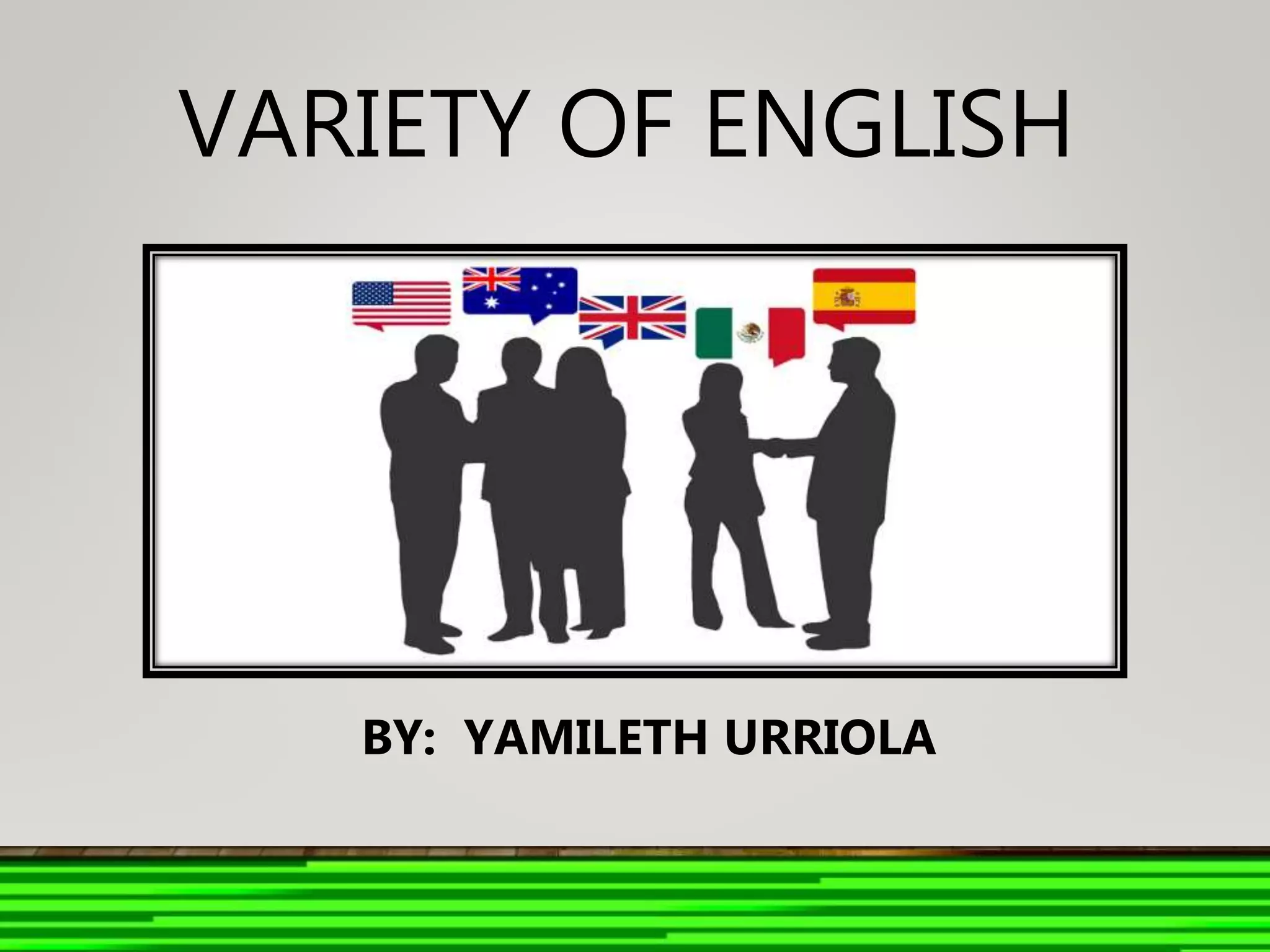
VARIETY OF ENGLISH
BY: YAMILETH URRIOLA
LANGUAGE DEFINITION
Henry Sweet, an English phonetician and language scholar,
stated:
“Language is the expression of ideas by means of speech-sounds
combined into words. Words are combined into sentences, this
combination answering to that of ideas into thoughts.”
The American linguists Bernard Bloch and George L. Trager
formulated the following definition:
“A language is a system of arbitrary vocal symbols by means of
which a social group cooperates.”
LANGUAGE FUNCTIONS
The functions of
language
include communication,
the expression
of identity, play,
imaginative expression,
and emotional release.
LANGUAGE, LINGUA, NORM, SPEECH
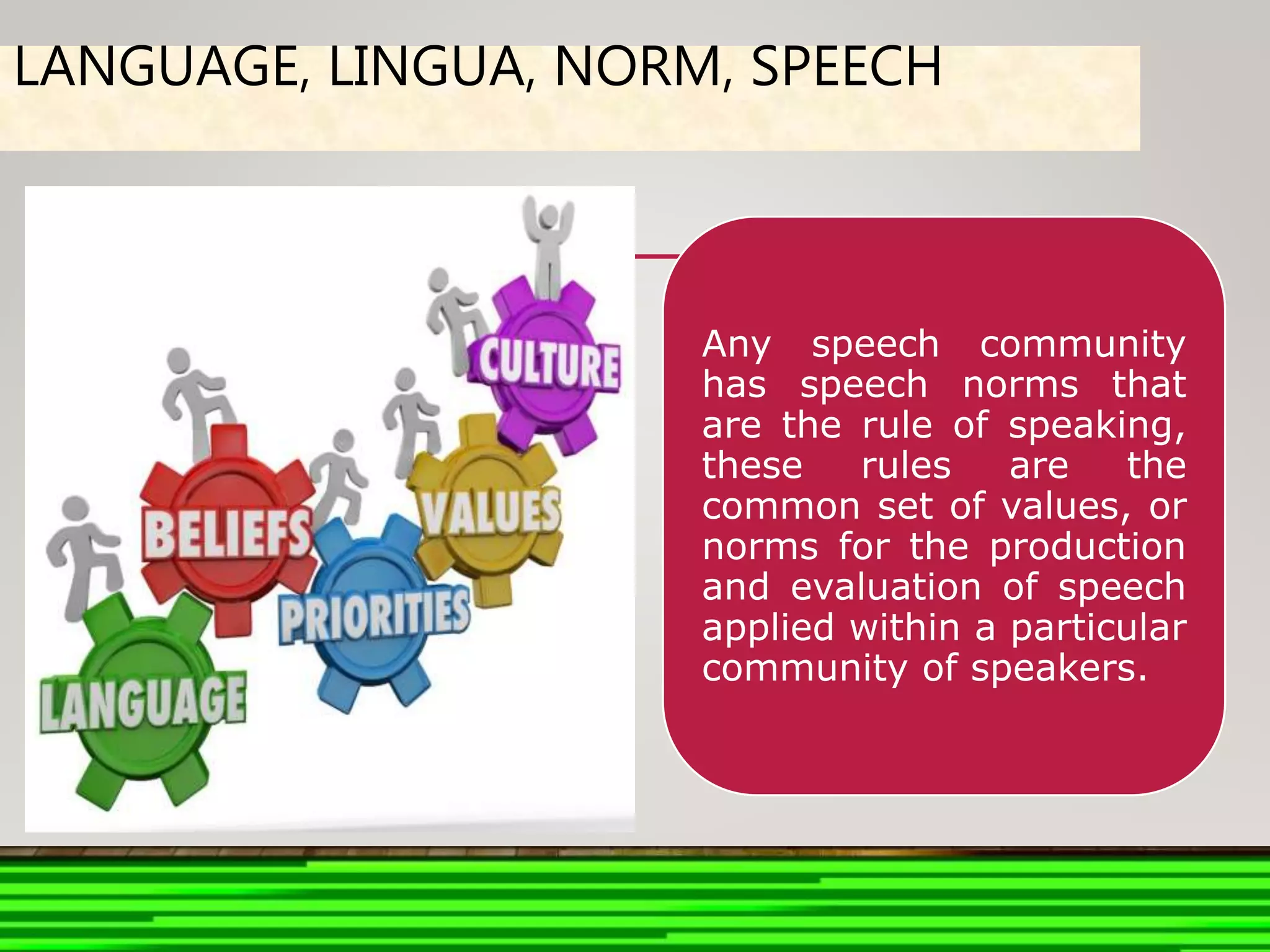
Any speech community
has speech norms that
are the rule of speaking,
these rules are the
common set of values, or
norms for the production
and evaluation of speech
applied within a particular
community of speakers.
STANDARD LANGUAGE
Standard English is
a controversial term for a form
of the English language that is
written and spoken by
educated users.
For some linguists, standard
English is a synonym
for good or correct English usa
ge.
ENGLISHES
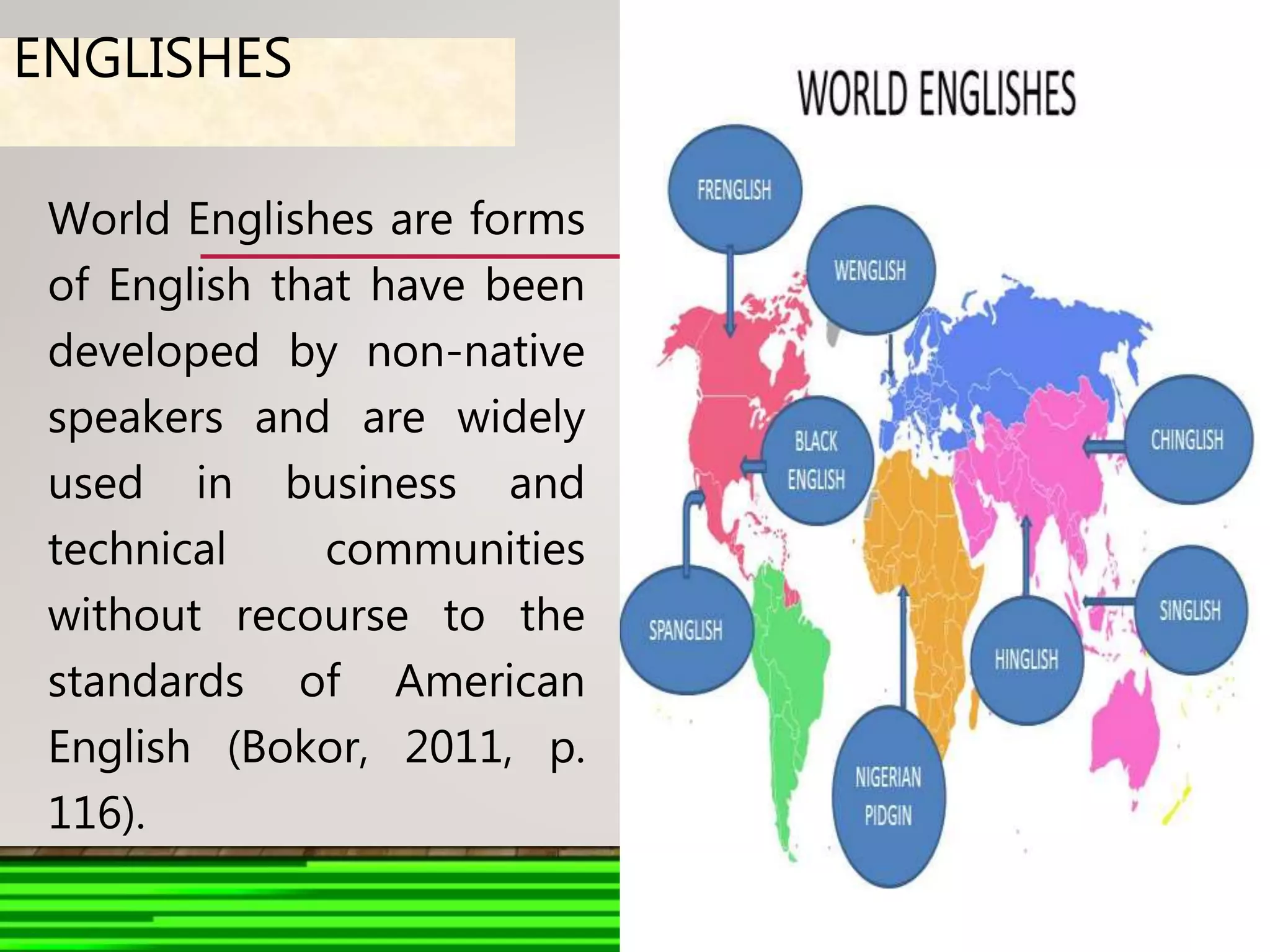
World Englishes are forms
of English that have been
developed by non-native
speakers and are widely
used in business and
technical communities
without recourse to the
standards of American
English (Bokor, 2011, p.
116).
VERNACULAR LANGUAGE
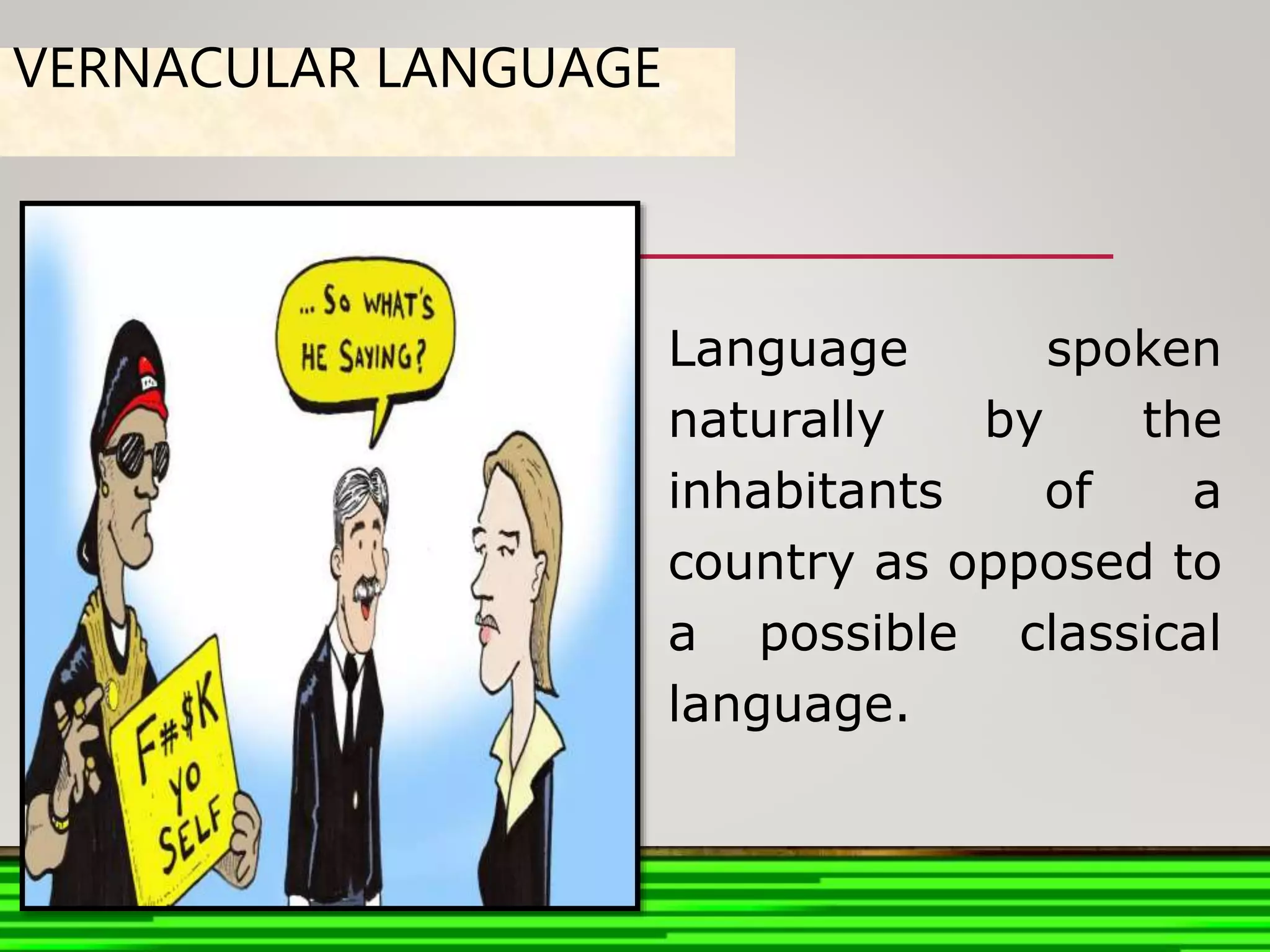
Language spoken
naturally by the
inhabitants of a
country as opposed to
a possible classical
language.
LINGUA FRANCA
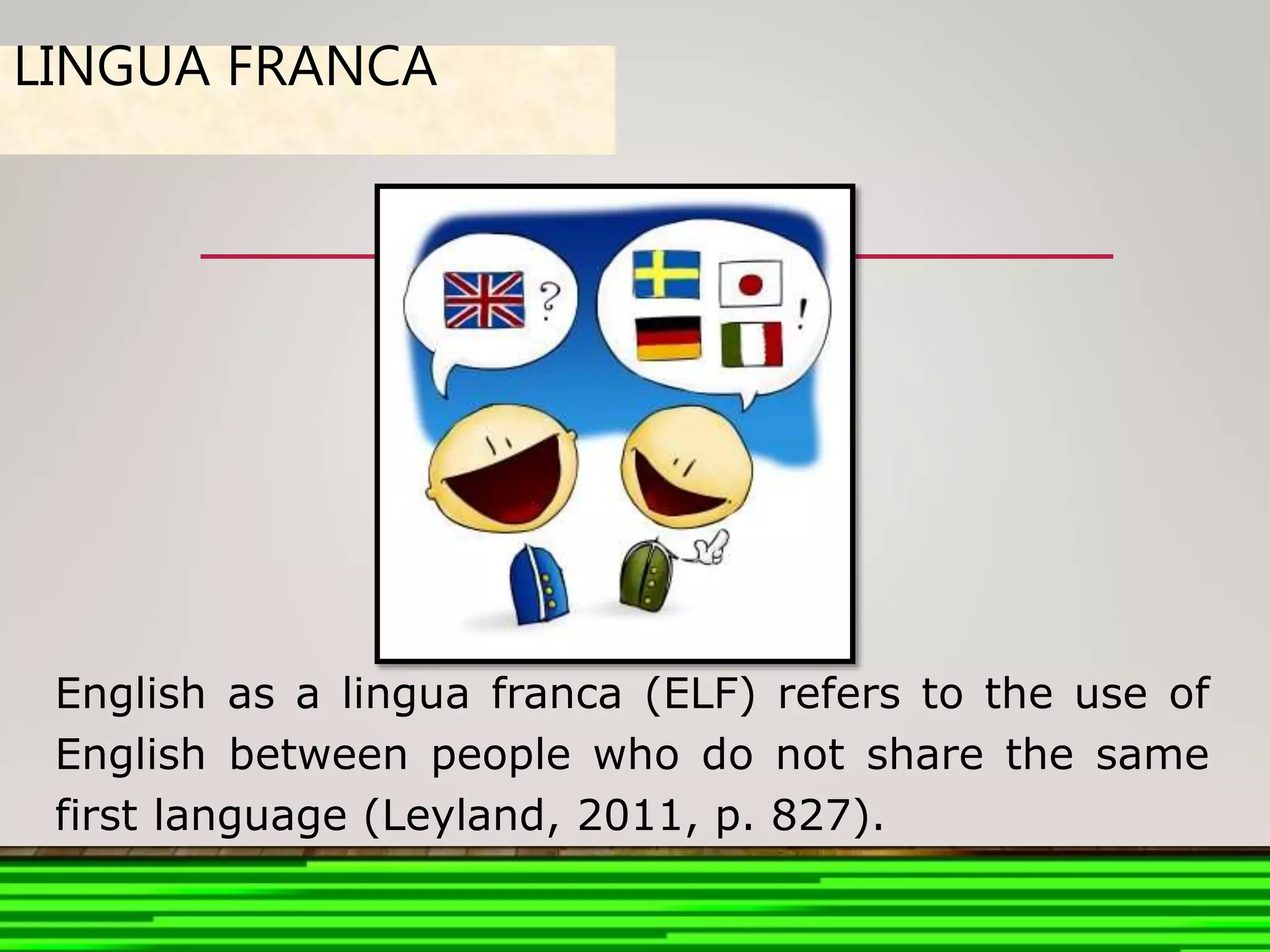
English as a lingua franca (ELF) refers to the use of
English between people who do not share the same
first language (Leyland, 2011, p. 827).
PIDGIN
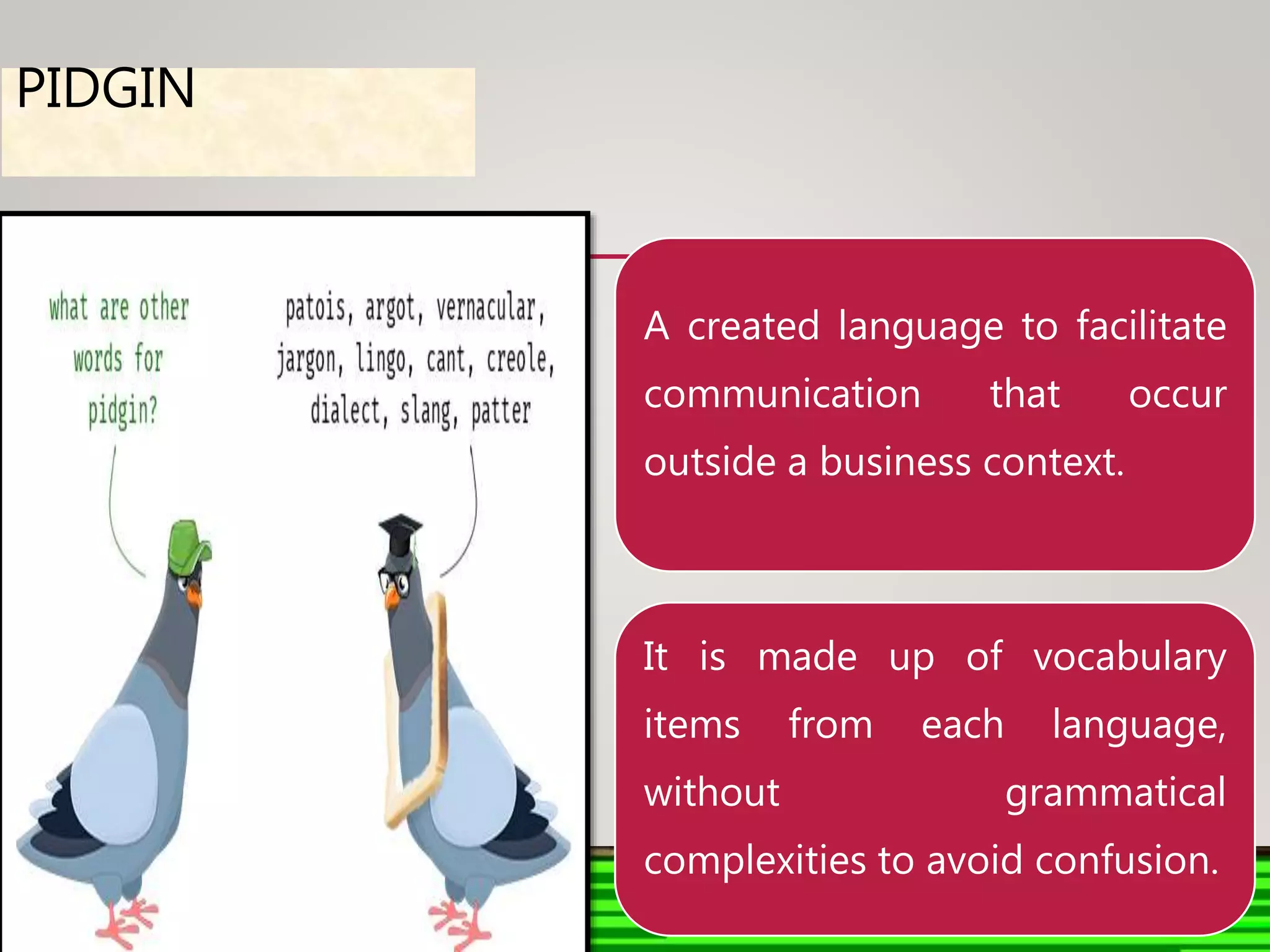
A created language to facilitate
communication that occur
outside a business context.
It is made up of vocabulary
items from each language,
without grammatical
complexities to avoid confusion.
CREOLE
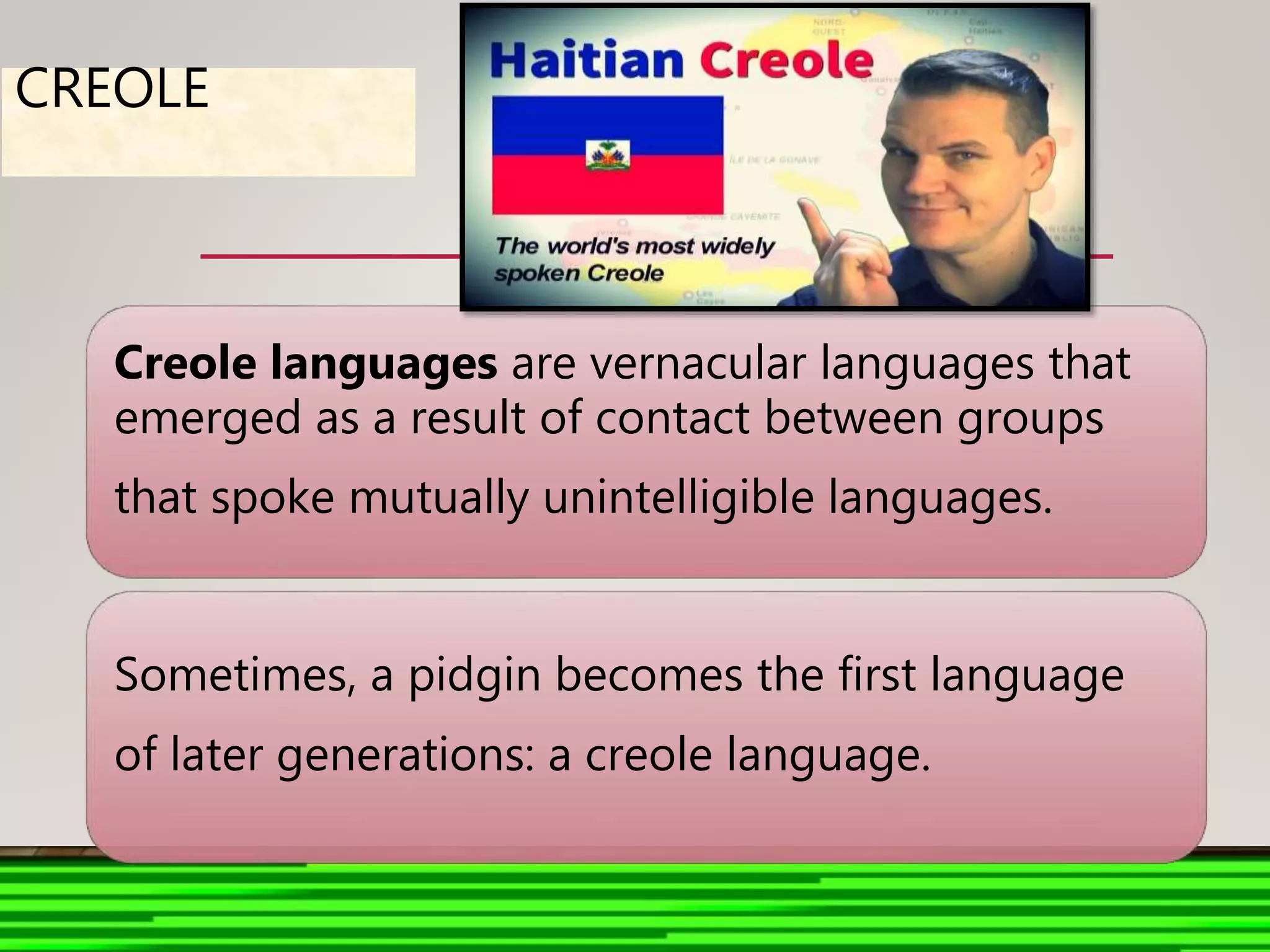
Creole languages are vernacular languages that
emerged as a result of contact between groups
that spoke mutually unintelligible languages.
Sometimes, a pidgin becomes the first language
of later generations: a creole language.
NATIONAL AND OFFICIAL LANGUAGE
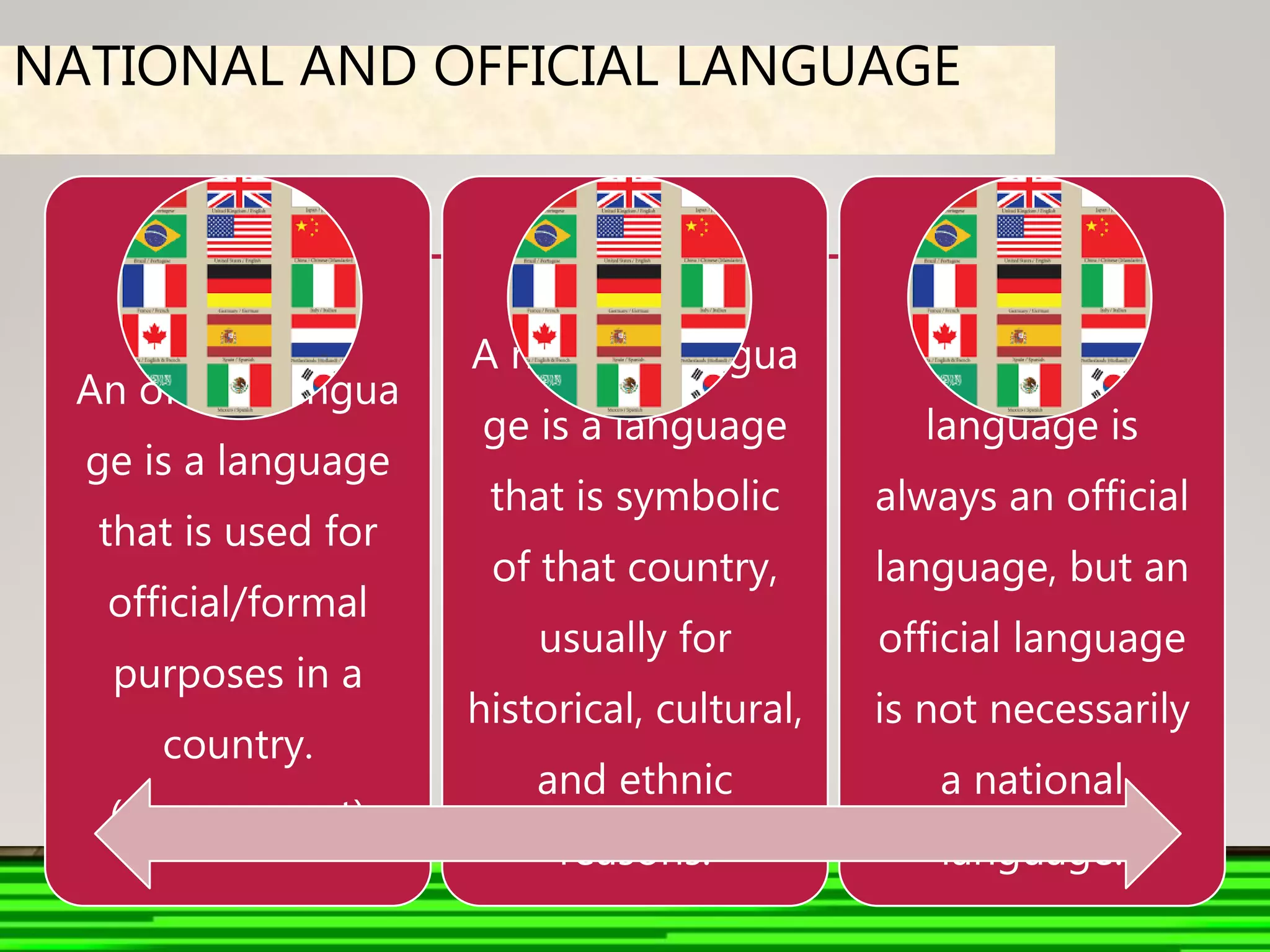
An official langua
ge is a language
that is used for
official/formal
purposes in a
country.
(Government)
A national langua
ge is a language
that is symbolic
of that country,
usually for
historical, cultural,
and ethnic
reasons.
A national
language is
always an official
language, but an
official language
is not necessarily
a national
language.
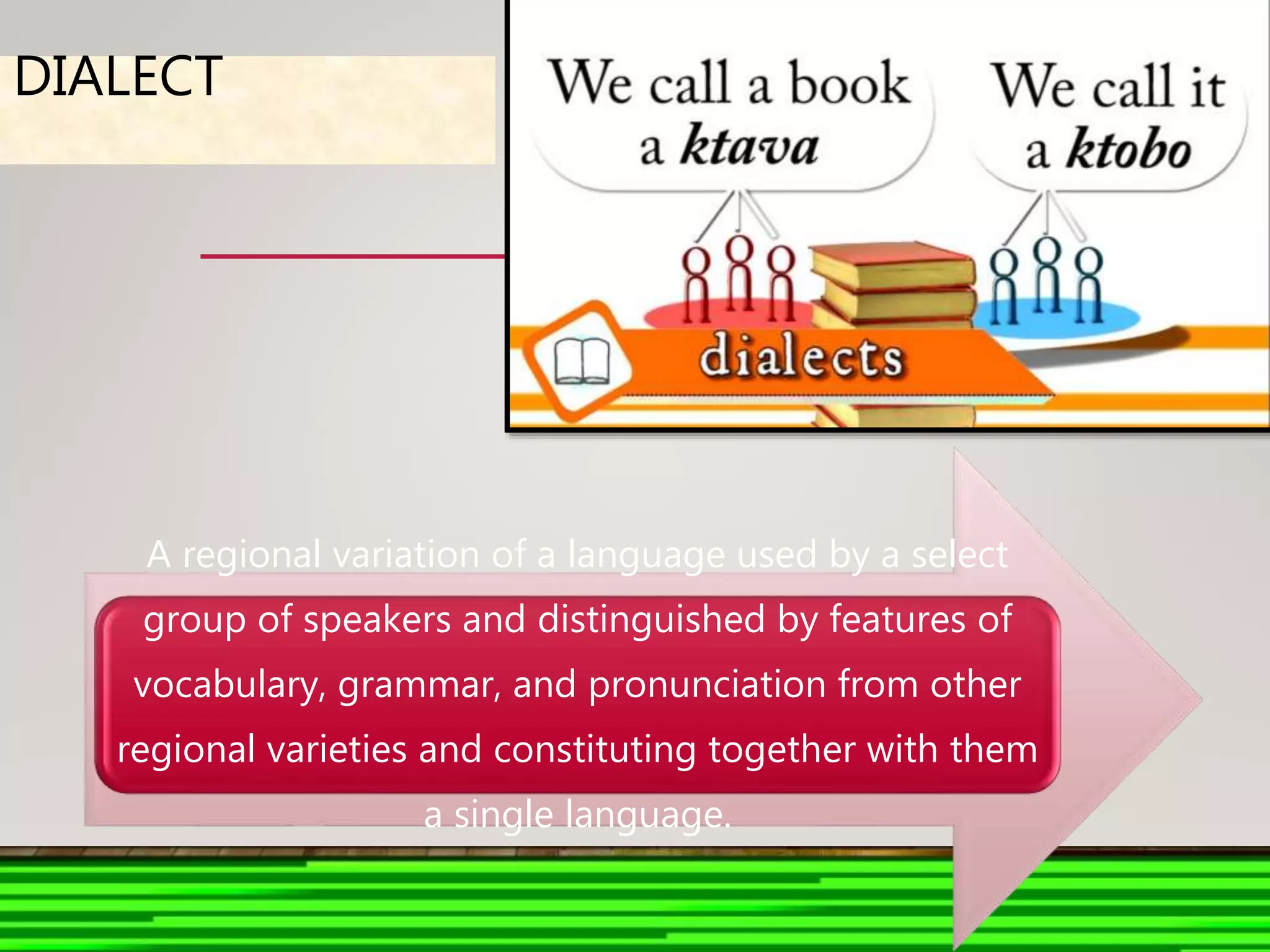
DIALECT
A regional variation of a language used by a select
group of speakers and distinguished by features of
vocabulary, grammar, and pronunciation from other
regional varieties and constituting together with them
a single language.
• Can be identified by variation of
vocabulary.
• Can be identified by variation
of prosody.
• Can be identified by variation of
sentence structure.
• Can be identified by variation of
figures of speech.
• Variance of parent language by social
class of speakers.
• Variance of parent language by region
inhabited by speakers.
• Likely will not have its own written
10
of Dialect
DIALECT VARIANTS
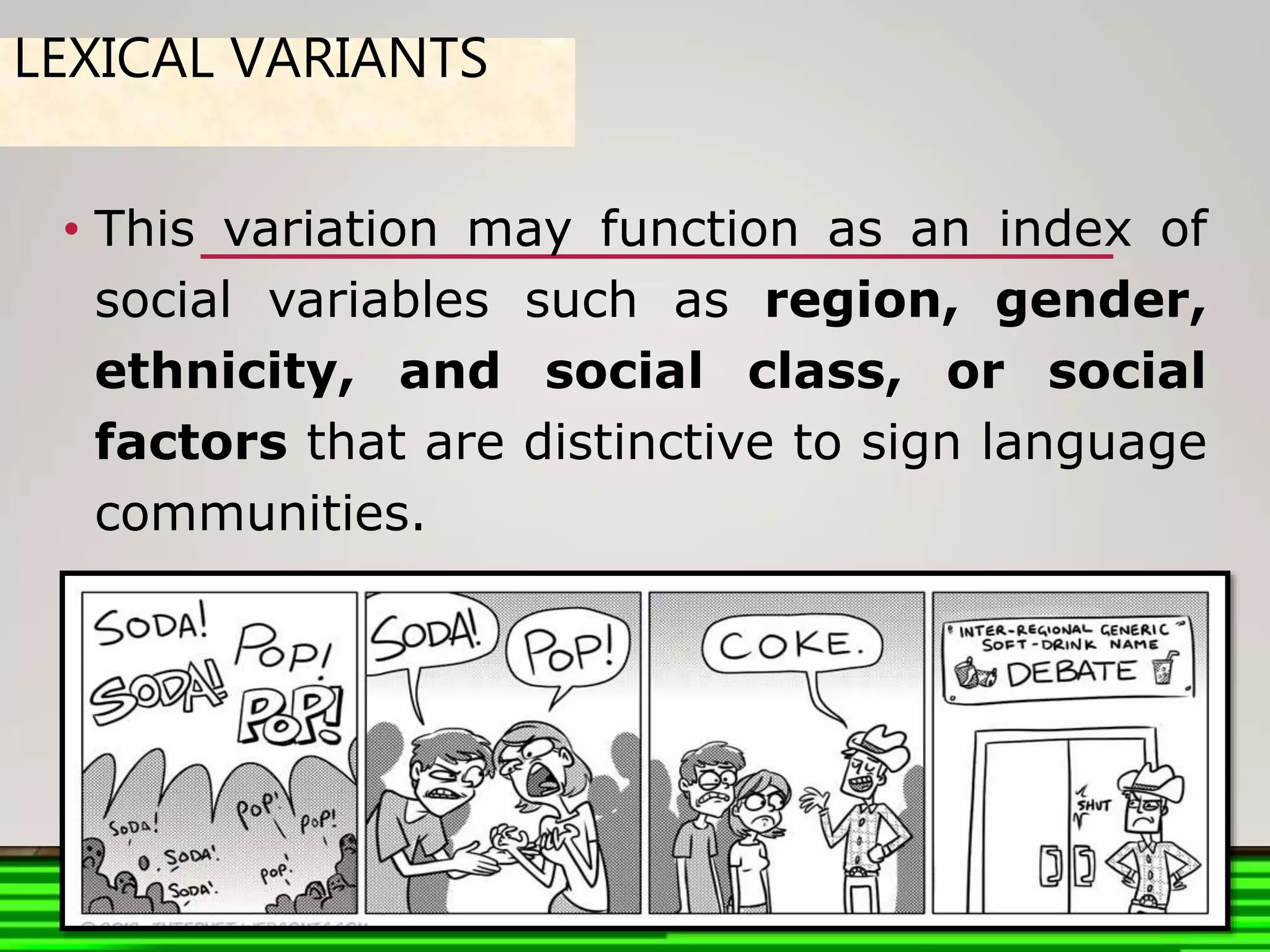
LEXICAL VARIANTS
• This variation may function as an index of
social variables such as region, gender,
ethnicity, and social class, or social
factors that are distinctive to sign language
communities.
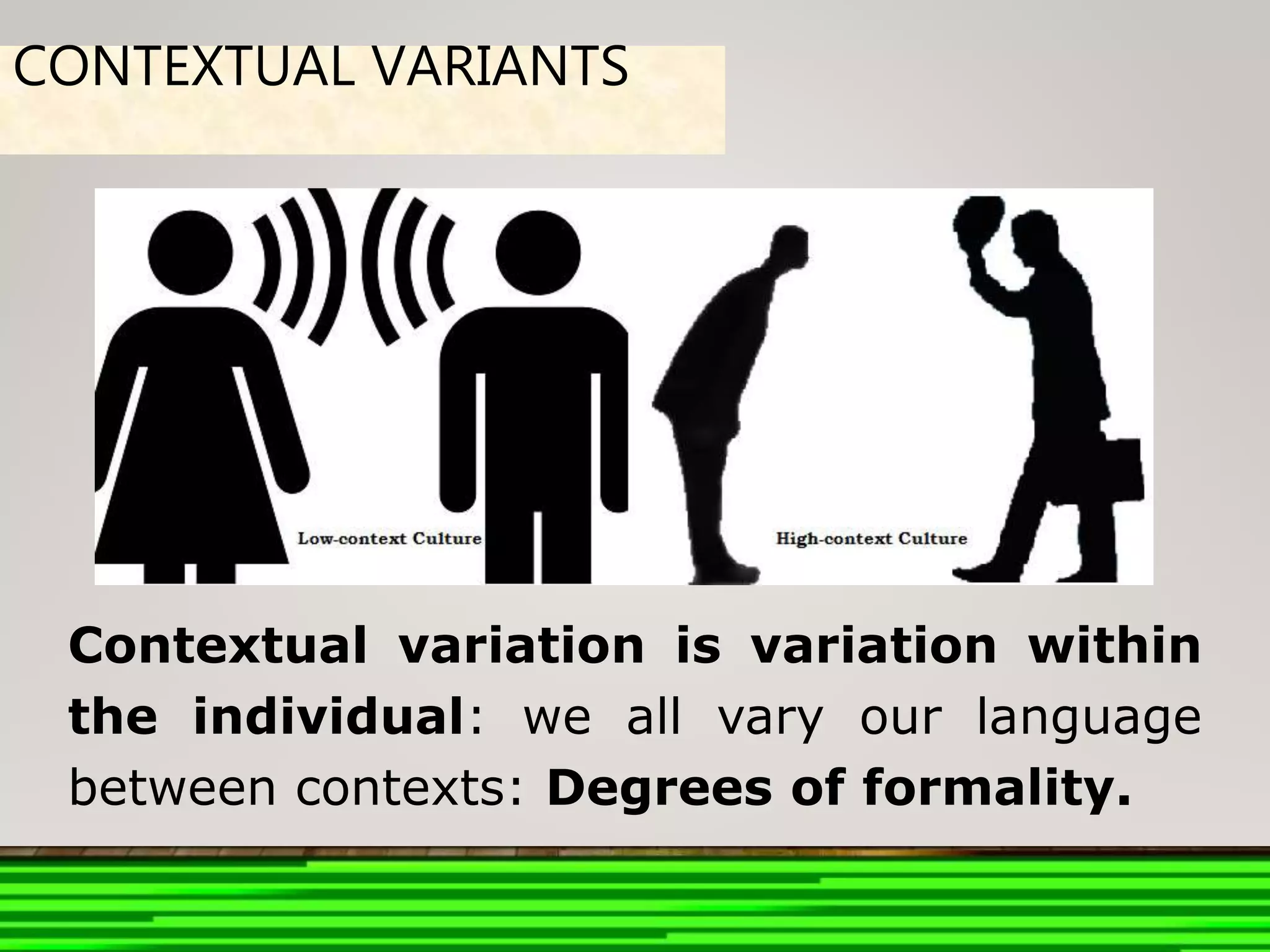
Contextual variation is variation within
the individual: we all vary our language
between contexts: Degrees of formality.
CONTEXTUAL VARIANTS
HISTORICAL VARIANTS
Historical variation
deals with the
political and social
history of each
country.
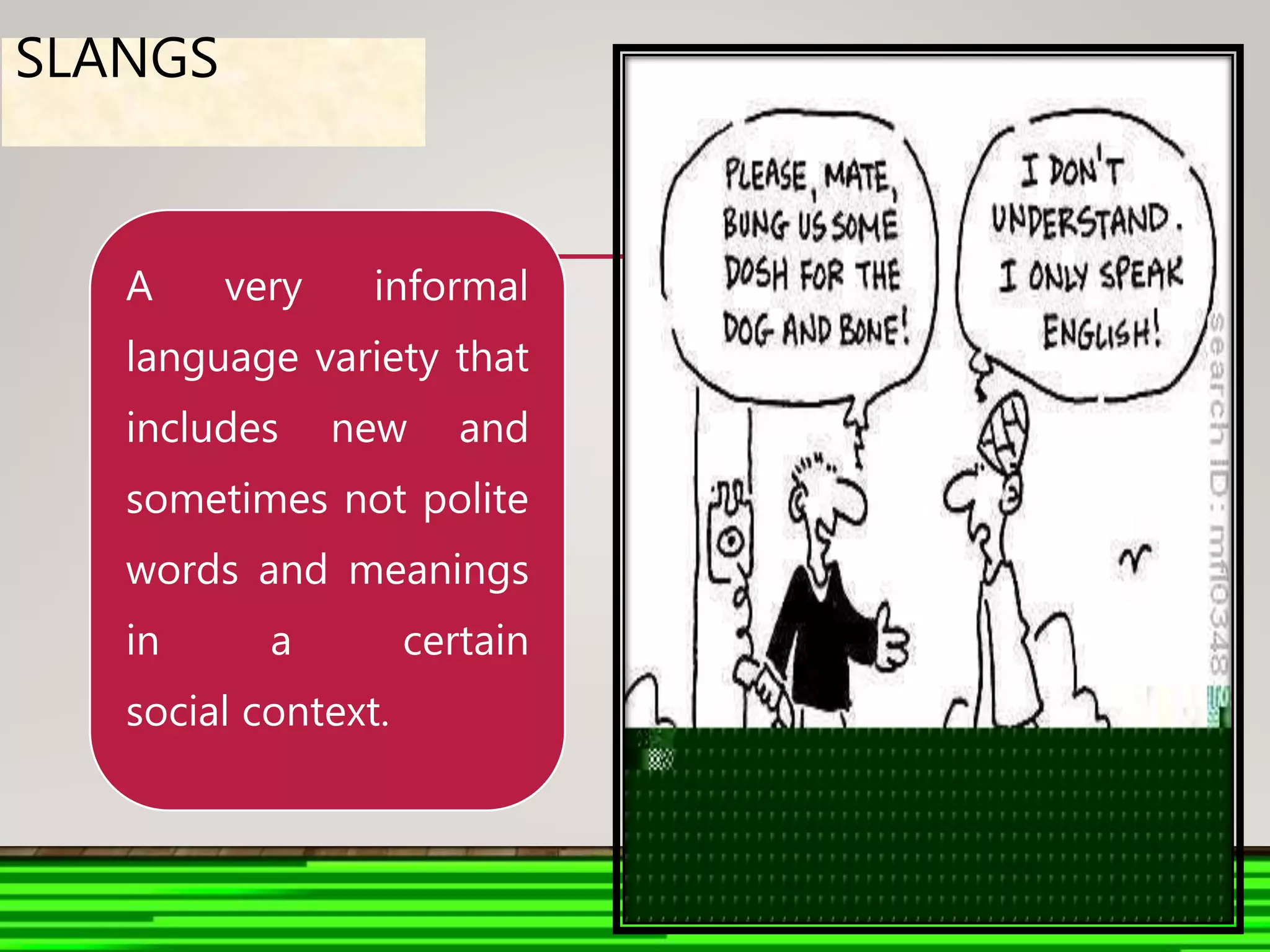
A very informal
language variety that
includes new and
sometimes not polite
words and meanings
in a certain
social context.
SLANGS
DIFFERENCE BETWEEN LANGUAGE AND DIALECT
English tempts one with a tidy dialect-language distinction based on
'intelligibility':
If you can understand it without training, it’s a dialect of your own
language; if you can’t, it’s a different language.
In popular usage, a language is written in addition to being spoken, while
a dialect is just spoken.
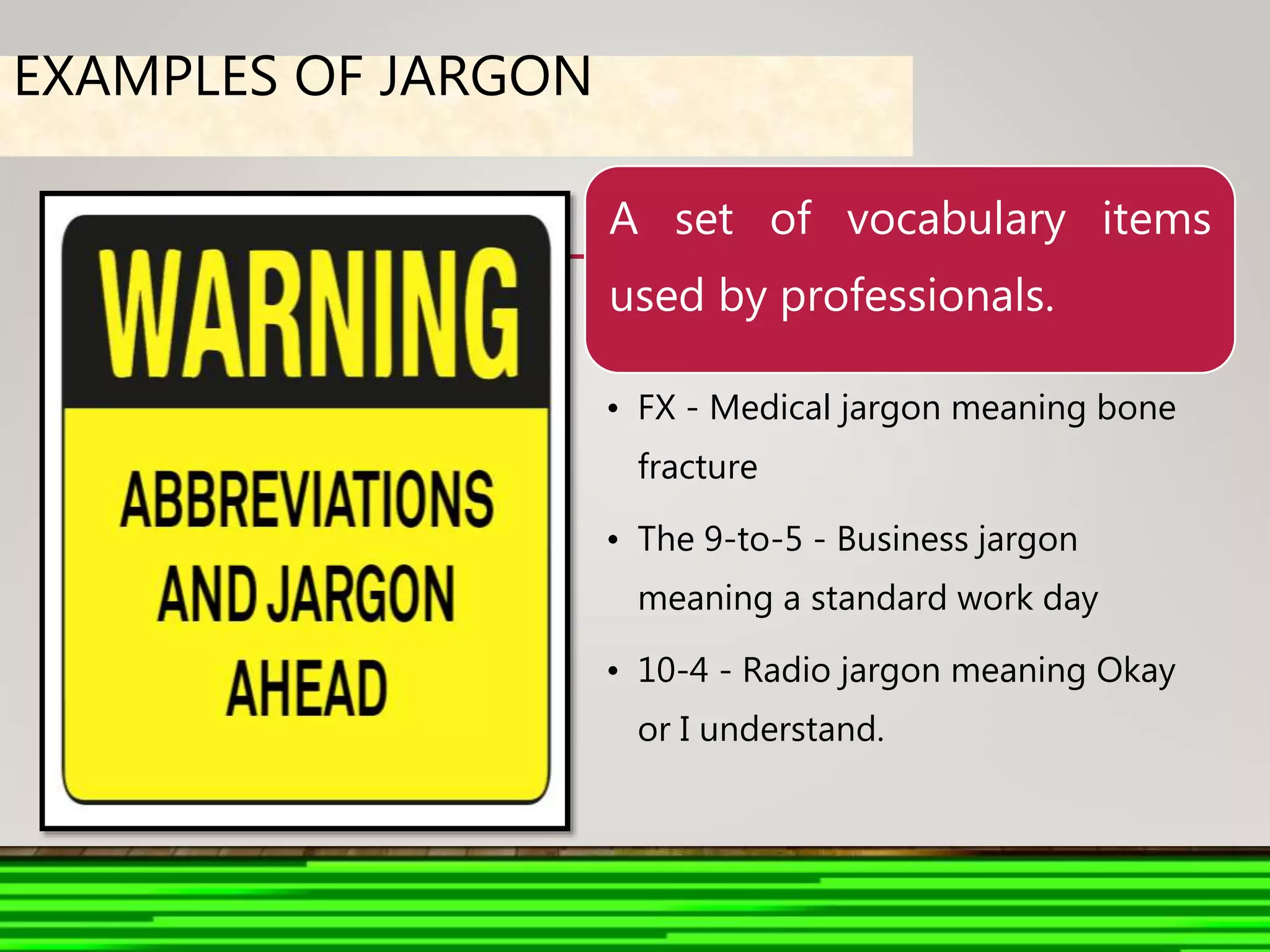
EXAMPLES OF JARGON
A set of vocabulary items
used by professionals.
• FX - Medical jargon meaning bone
fracture
• The 9-to-5 - Business jargon
meaning a standard work day
• 10-4 - Radio jargon meaning Okay
or I understand.
EXAMPLES OF REGIONAL LEXICON
sneakers (Northeast and fairly widespread), tennis shoes (widespread
outside the Northeast) and gym shoes (Chicago and Cincinnati)
soda (Northeast, Greater Milwaukee, Great St. Louis, California, and
Florida), pop (Inland North, Upper Midwest, and
Northwest), coke (South), and tonic (Eastern New England possibility
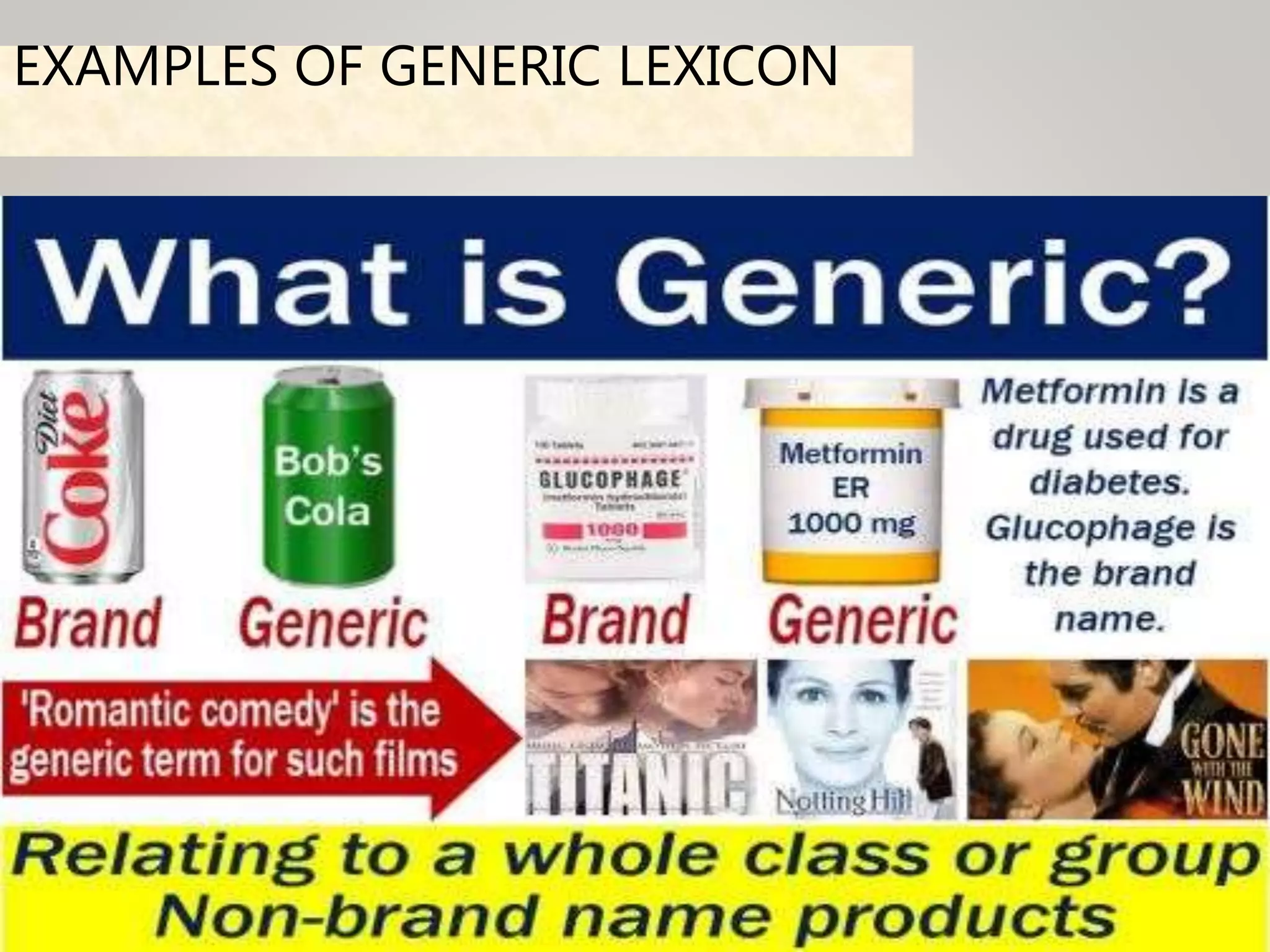
EXAMPLES OF GENERIC LEXICON
COMMON VULGARISMS
An expression
considered
non-standard
or characteristic
of uneducated
speech or
writing.
It may be
synonymous
with profanity
or obscenity.
It includes
errors of
pronunciation,
misspellings,
and word
malformations.
“damn”
“bloody”
“to hell”
“asshole”
“bitch”
WHAT ARE LINGUISTICS VARIATIONS
In sociolinguistics, language variety—
also called lect—is a general term for
any distinctive form of a language.
Linguists use language variety as a
cover term for any of the overlapping
subcategories of a language, including
dialect, register, jargon, and idiolect.
Differences can
come about for
geographical
reasons; people
who live in
different
geographic areas
often develop
distinct dialects. Those who
belong to a
specific
group, often
academic or
professional
(Jargons)
Even
individuals
develop
idiolects, their
own specific
ways of
speaking.
DIFFERENCES
SOCIOLECT EXAMPLES
Social dialects refers to factors
with social groups such as:
education, occupation, income
level etc.
• toilet / loo
• horse riding / riding
• living room / sitting room
• settee / sofa
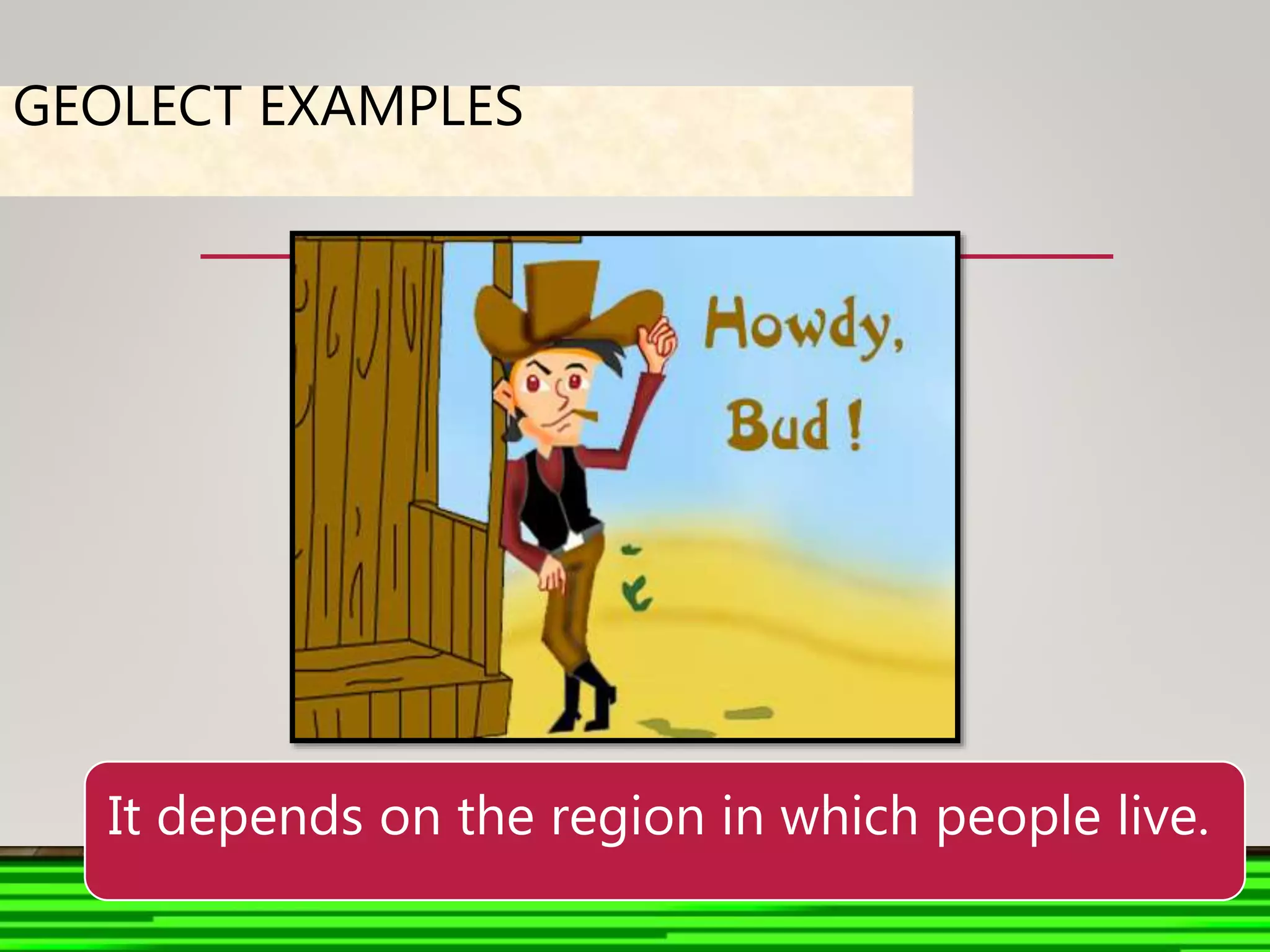
GEOLECT EXAMPLES
It depends on the region in which people live.
CLASSISISM EXAMPLES
• Baroque
• Rococo
• Neoclassicism
• Renaissance
ECOLECT EXAMPLES
A language variety unique to a household.
It is also called oikolect.
“Lemonade”
ETHNOLECT
It is a lect spoken by a
specific ethnic group.
IDEOLECT
An idiolect is a
person’s
specific,
unique way of
speaking.
It is like your
fingerprint.
It’s kind of
like a micro-
dialect.
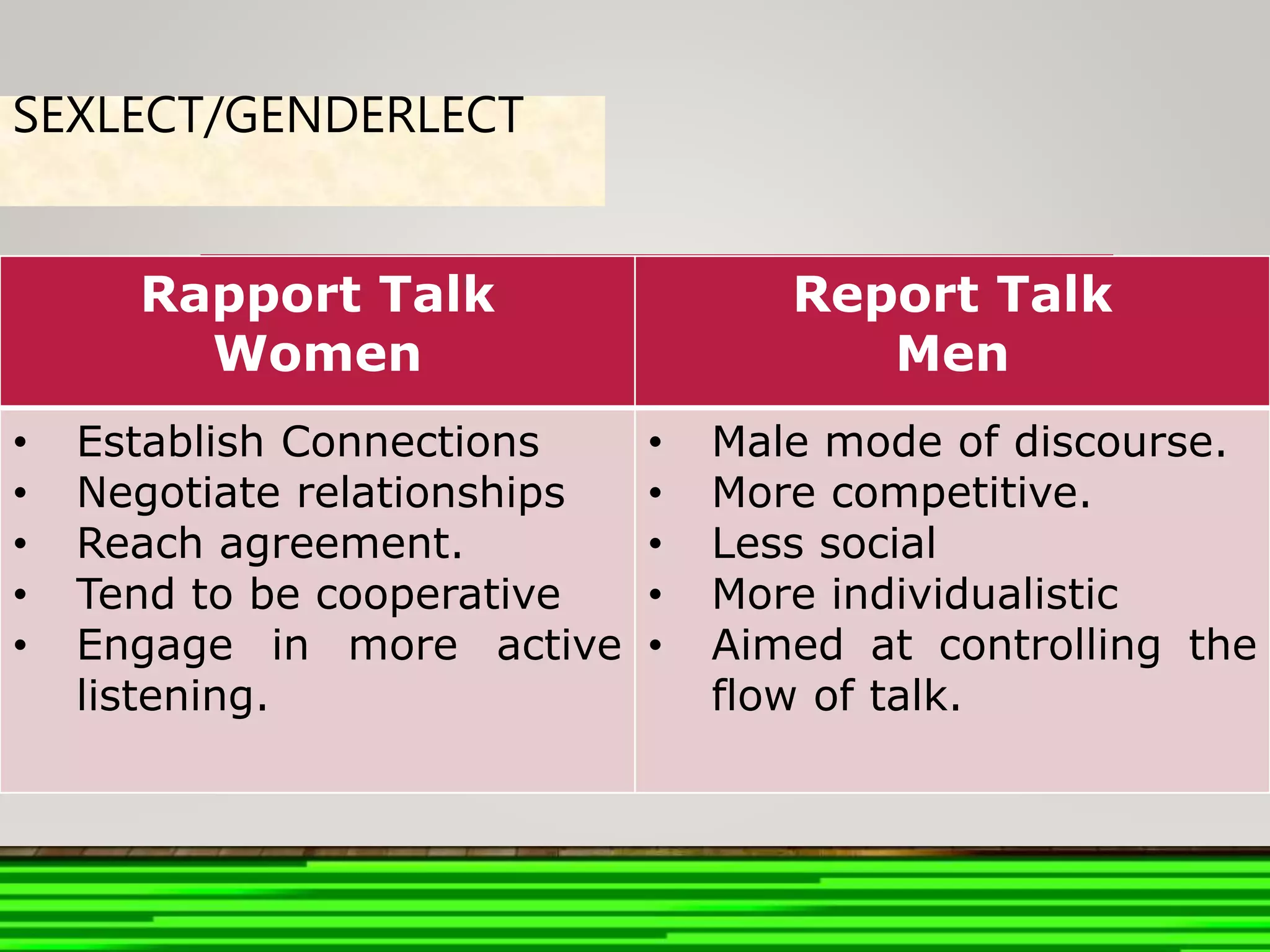
SEXLECT/GENDERLECT
Rapport Talk
Women
Report Talk
Men
• Establish Connections
• Negotiate relationships
• Reach agreement.
• Tend to be cooperative
• Engage in more active
listening.
• Male mode of discourse.
• More competitive.
• Less social
• More individualistic
• Aimed at controlling the
flow of talk.
TYPES OF LINGUISTICS VARIANTS
Diachronic
variation
Diatopic
variation
Diastratic
variation
Diaphasic
variation
Diamesic
variation
across time across place across social
groups
across
degrees of
formality
across medium
of
communication
Old English
vs
Middle
English
Vs
Modern
English
Vs
Present-day
English
English in
the United
States
Vs
English in
Great
Britain vs
English in
India
English of
the
educated
Vs
English of
the
uneducated
English
during a
business
lunch
Vs
English
during a
dinner with
friends
English over
the phone
Vs
English over
email
Vs
English over
IM
REFERENCES

Phonetics: Varieties of English Language

  • 1.
    VARIETY OF ENGLISH BY:YAMILETH URRIOLA
  • 3.
    LANGUAGE DEFINITION Henry Sweet,an English phonetician and language scholar, stated: “Language is the expression of ideas by means of speech-sounds combined into words. Words are combined into sentences, this combination answering to that of ideas into thoughts.” The American linguists Bernard Bloch and George L. Trager formulated the following definition: “A language is a system of arbitrary vocal symbols by means of which a social group cooperates.”
  • 4.
    LANGUAGE FUNCTIONS The functionsof language include communication, the expression of identity, play, imaginative expression, and emotional release.
  • 5.
    LANGUAGE, LINGUA, NORM,SPEECH Any speech community has speech norms that are the rule of speaking, these rules are the common set of values, or norms for the production and evaluation of speech applied within a particular community of speakers.
  • 6.
    STANDARD LANGUAGE Standard Englishis a controversial term for a form of the English language that is written and spoken by educated users. For some linguists, standard English is a synonym for good or correct English usa ge.
  • 7.
    ENGLISHES World Englishes areforms of English that have been developed by non-native speakers and are widely used in business and technical communities without recourse to the standards of American English (Bokor, 2011, p. 116).
  • 8.
    VERNACULAR LANGUAGE Language spoken naturallyby the inhabitants of a country as opposed to a possible classical language.
  • 9.
    LINGUA FRANCA English asa lingua franca (ELF) refers to the use of English between people who do not share the same first language (Leyland, 2011, p. 827).
  • 10.
    PIDGIN A created languageto facilitate communication that occur outside a business context. It is made up of vocabulary items from each language, without grammatical complexities to avoid confusion.
  • 11.
    CREOLE Creole languages arevernacular languages that emerged as a result of contact between groups that spoke mutually unintelligible languages. Sometimes, a pidgin becomes the first language of later generations: a creole language.
  • 12.
    NATIONAL AND OFFICIALLANGUAGE An official langua ge is a language that is used for official/formal purposes in a country. (Government) A national langua ge is a language that is symbolic of that country, usually for historical, cultural, and ethnic reasons. A national language is always an official language, but an official language is not necessarily a national language.
  • 13.
    DIALECT A regional variationof a language used by a select group of speakers and distinguished by features of vocabulary, grammar, and pronunciation from other regional varieties and constituting together with them a single language.
  • 14.
    • Can beidentified by variation of vocabulary. • Can be identified by variation of prosody. • Can be identified by variation of sentence structure. • Can be identified by variation of figures of speech. • Variance of parent language by social class of speakers. • Variance of parent language by region inhabited by speakers. • Likely will not have its own written 10 of Dialect DIALECT VARIANTS
  • 15.
    LEXICAL VARIANTS • Thisvariation may function as an index of social variables such as region, gender, ethnicity, and social class, or social factors that are distinctive to sign language communities.
  • 16.
    Contextual variation isvariation within the individual: we all vary our language between contexts: Degrees of formality. CONTEXTUAL VARIANTS
  • 17.
    HISTORICAL VARIANTS Historical variation dealswith the political and social history of each country.
  • 18.
    A very informal languagevariety that includes new and sometimes not polite words and meanings in a certain social context. SLANGS
  • 19.
    DIFFERENCE BETWEEN LANGUAGEAND DIALECT English tempts one with a tidy dialect-language distinction based on 'intelligibility': If you can understand it without training, it’s a dialect of your own language; if you can’t, it’s a different language. In popular usage, a language is written in addition to being spoken, while a dialect is just spoken.
  • 20.
    EXAMPLES OF JARGON Aset of vocabulary items used by professionals. • FX - Medical jargon meaning bone fracture • The 9-to-5 - Business jargon meaning a standard work day • 10-4 - Radio jargon meaning Okay or I understand.
  • 21.
    EXAMPLES OF REGIONALLEXICON sneakers (Northeast and fairly widespread), tennis shoes (widespread outside the Northeast) and gym shoes (Chicago and Cincinnati) soda (Northeast, Greater Milwaukee, Great St. Louis, California, and Florida), pop (Inland North, Upper Midwest, and Northwest), coke (South), and tonic (Eastern New England possibility
  • 22.
  • 23.
    COMMON VULGARISMS An expression considered non-standard orcharacteristic of uneducated speech or writing. It may be synonymous with profanity or obscenity. It includes errors of pronunciation, misspellings, and word malformations. “damn” “bloody” “to hell” “asshole” “bitch”
  • 24.
    WHAT ARE LINGUISTICSVARIATIONS In sociolinguistics, language variety— also called lect—is a general term for any distinctive form of a language. Linguists use language variety as a cover term for any of the overlapping subcategories of a language, including dialect, register, jargon, and idiolect.
  • 25.
    Differences can come aboutfor geographical reasons; people who live in different geographic areas often develop distinct dialects. Those who belong to a specific group, often academic or professional (Jargons) Even individuals develop idiolects, their own specific ways of speaking. DIFFERENCES
  • 26.
    SOCIOLECT EXAMPLES Social dialectsrefers to factors with social groups such as: education, occupation, income level etc. • toilet / loo • horse riding / riding • living room / sitting room • settee / sofa
  • 27.
    GEOLECT EXAMPLES It dependson the region in which people live.
  • 28.
    CLASSISISM EXAMPLES • Baroque •Rococo • Neoclassicism • Renaissance
  • 29.
    ECOLECT EXAMPLES A languagevariety unique to a household. It is also called oikolect. “Lemonade”
  • 30.
    ETHNOLECT It is alect spoken by a specific ethnic group.
  • 31.
    IDEOLECT An idiolect isa person’s specific, unique way of speaking. It is like your fingerprint. It’s kind of like a micro- dialect.
  • 32.
    SEXLECT/GENDERLECT Rapport Talk Women Report Talk Men •Establish Connections • Negotiate relationships • Reach agreement. • Tend to be cooperative • Engage in more active listening. • Male mode of discourse. • More competitive. • Less social • More individualistic • Aimed at controlling the flow of talk.
  • 33.
    TYPES OF LINGUISTICSVARIANTS Diachronic variation Diatopic variation Diastratic variation Diaphasic variation Diamesic variation across time across place across social groups across degrees of formality across medium of communication Old English vs Middle English Vs Modern English Vs Present-day English English in the United States Vs English in Great Britain vs English in India English of the educated Vs English of the uneducated English during a business lunch Vs English during a dinner with friends English over the phone Vs English over email Vs English over IM
  • 34.