Presented By
1. Surjya Prakash Sahoo(230301120309)
2. Priyaranjan Dalasingharay(230301120298)
3. Satyajeet Parida(230301120267)
4.Smruti Das(230301120302)
Language Detection Model
Machine Learning using Python
CUTM1019
Guided By
Swarna Prava Jena
CSE
POINT TO BE DISCUSSED
1. Introduction
2. Objective
3. Roadmap/TimeLine
4. Literature Survey
5. Research Gap
6. Requirements
7. Flow chart
8. Output
9. Conclusion
10. Future Scopes
11. References
DT-22.04.24 2
Centurion University of Technology and Management, Bhubaneswar
INTRODUCTION
In today's globalized world, the ability to understand and identify differ
ent languages is crucial for effective communication and collaboration.
Our project focuses on developing a language detection model using
machine learning techniques. By leveraging a dataset containing text sa
mples in various languages, i've trained a model capable of accurately
predicting the language of a given text sample. Our work not only highli
-ghts the importance of language detection but also offers insights into
the underlying technologies and methodologies used to achieve these
results.
DT-22.04.c2024 3
Centurion University of Technology and Management, Bhubaneswar
OBJECTIVE
• Develop a Language Detection Model: Create a machine learning model that can accurat
ely detect and classify the language of a given text sample.
• Improve Multilingual Communication: Enhance communication by providing a tool that
can identify the language of text inputs, which can be useful in multilingual environment
s.
• Showcase Practical Applications: Demonstrate how language detection can be applied to
real-world scenarios, such as translation services, customer support, and content analysis
.
• Enhance Data-Driven Decision Making: Provide a model that supports data-driven decisi
-on making in organizations by facilitating language-specific analytics and insights.
• Encourage Language Inclusivity: Promote inclusivity by offering language detection as a
tool to bridge language barriers and improve understanding among diverse groups.
4
Centurion University of Technology and Management, Bhubaneswar
LITERATURE SURVEY
• Early Approaches: Initial language detection methods relied on rule-based techniqu
es and simple frequency analysis, which had limitations in handling diverse languag
es and text styles.
• Statistical Methods: The introduction of statistical approaches, such as, improved la
nguage detection accuracy and enabled support for more languages.
• Machine Learning Algorithms: Machine learning algorithms, such as Support Vecto
r Machines (SVM) and Naive Bayes, have been widely used for language detection
due to their efficiency and ability to handle large datasets.
DT-22.04.2024 5
Centurion University of Technology and Management, Bhubaneswar
Dataset
DT-22.04.2024 6
Centurion University of Technology and Management, Bhubaneswar
This dataset contains text samples in various languages,
labeled for supervised learning. It should be balanced,
diverse, and preprocessed.
Dataset
7
Centurion University of Technology and Management, Bhubaneswar
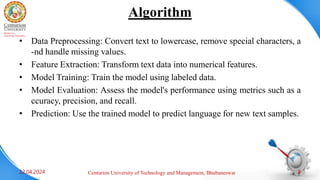
Algorithm
• Data Preprocessing: Convert text to lowercase, remove special characters, a
-nd handle missing values.
• Feature Extraction: Transform text data into numerical features.
• Model Training: Train the model using labeled data.
• Model Evaluation: Assess the model's performance using metrics such as a
ccuracy, precision, and recall.
• Prediction: Use the trained model to predict language for new text samples.
22.04.2024 8
Centurion University of Technology and Management, Bhubaneswar
REQUIREMENTS
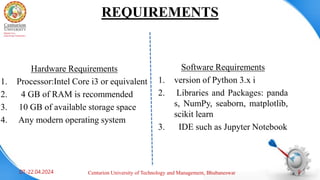
Hardware Requirements
1. Processor:Intel Core i3 or equivalent
2. 4 GB of RAM is recommended
3. 10 GB of available storage space
4. Any modern operating system
DT-22.04.2024 9
Centurion University of Technology and Management, Bhubaneswar
Software Requirements
1. version of Python 3.x i
2. Libraries and Packages: panda
s, NumPy, seaborn, matplotlib,
scikit learn
3. IDE such as Jupyter Notebook
Model Evaluation
DT-22.04.2024 10
Centurion University of Technology and Management, Bhubaneswar
• Accuracy: Measures overall correctness of predictions.
• Precision: Ratio of true positives to total predicted positives.
• Recall: Ratio of true positives to actual positives.
• F1-Score: Harmonic mean of precision and recall.
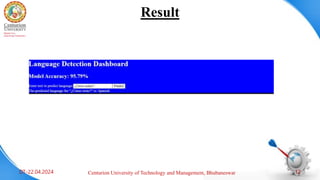
Result
DT-22.04.24 11
Centurion University of Technology and Management, Bhubaneswar
Result
DT-22.04.2024 12
Centurion University of Technology and Management, Bhubaneswar
Result
DT-22.04.2024 13
Centurion University of Technology and Management, Bhubaneswar
Result
Data:-22/02/2024 14
Centurion University of Technology and Management, Bhubaneswar
FUTURE SCOPE
DT-22.04.2024 15
Centurion University of Technology and Management, Bhubaneswar
• Enhanced Language Coverage: Expand to support more languages and dialects for broader applicability.
• Real-Time Language Detection: Improve processing speed for real-time applications such as chatbots.
• Multi-Language Identification: Enable detection of mixed languages within the same text sample.
• Domain Adaptation: Tailor models for specific domains (e.g., legal, medical) for better accuracy.
• Contextual Understanding: Incorporate context to improve detection accuracy in complex or ambiguous
cases.
• Improved Model Interpretability: Enhance explain ability to understand model decisions and improve tr
ust.
• Edge Deployment: Develop lightweight models for on-device deployment and offline use.
CONCLUSION
DT-22.04.2024 16
Centurion University of Technology and Management, Bhubaneswar
The language detection project demonstrates the effective use of Supervised Le
arning techniques to accurately identify the language of text samples. Through
careful data preprocessing, model selection, and evaluation, the project achieve
s reliable results across various languages. The successful implementation open
s avenues for real-time language recognition in diverse applications, such as ch
atbots, translation services, and content filtering. Future work can expand langu
age coverage, improve model performance, and integrate with other NLP tasks
for more advanced language processing capabilities.
REFERENCES
22.04.2024 17
Centurion University of Technology and Management, Bhubaneswar
1. Datasets: Datasets used in the project is from Kaggle
2. Research Papers: Include references to academic papers on language detect
ion techniques, algorithms, and models.
3. Libraries and Tools: Libraries and tools utilized in the project, such as scik
it-learn, pandas, and matplotliub.
4. GitHub: Analyzed the repos to take ideas to build the model.
22.04.24 18
Centurion University of Technology and Management, Bhubaneswar

Language detection model presentations. Machine learning

  • 1.
    Presented By 1. SurjyaPrakash Sahoo(230301120309) 2. Priyaranjan Dalasingharay(230301120298) 3. Satyajeet Parida(230301120267) 4.Smruti Das(230301120302) Language Detection Model Machine Learning using Python CUTM1019 Guided By Swarna Prava Jena CSE
  • 2.
    POINT TO BEDISCUSSED 1. Introduction 2. Objective 3. Roadmap/TimeLine 4. Literature Survey 5. Research Gap 6. Requirements 7. Flow chart 8. Output 9. Conclusion 10. Future Scopes 11. References DT-22.04.24 2 Centurion University of Technology and Management, Bhubaneswar
  • 3.
    INTRODUCTION In today's globalizedworld, the ability to understand and identify differ ent languages is crucial for effective communication and collaboration. Our project focuses on developing a language detection model using machine learning techniques. By leveraging a dataset containing text sa mples in various languages, i've trained a model capable of accurately predicting the language of a given text sample. Our work not only highli -ghts the importance of language detection but also offers insights into the underlying technologies and methodologies used to achieve these results. DT-22.04.c2024 3 Centurion University of Technology and Management, Bhubaneswar
  • 4.
    OBJECTIVE • Develop aLanguage Detection Model: Create a machine learning model that can accurat ely detect and classify the language of a given text sample. • Improve Multilingual Communication: Enhance communication by providing a tool that can identify the language of text inputs, which can be useful in multilingual environment s. • Showcase Practical Applications: Demonstrate how language detection can be applied to real-world scenarios, such as translation services, customer support, and content analysis . • Enhance Data-Driven Decision Making: Provide a model that supports data-driven decisi -on making in organizations by facilitating language-specific analytics and insights. • Encourage Language Inclusivity: Promote inclusivity by offering language detection as a tool to bridge language barriers and improve understanding among diverse groups. 4 Centurion University of Technology and Management, Bhubaneswar
  • 5.
    LITERATURE SURVEY • EarlyApproaches: Initial language detection methods relied on rule-based techniqu es and simple frequency analysis, which had limitations in handling diverse languag es and text styles. • Statistical Methods: The introduction of statistical approaches, such as, improved la nguage detection accuracy and enabled support for more languages. • Machine Learning Algorithms: Machine learning algorithms, such as Support Vecto r Machines (SVM) and Naive Bayes, have been widely used for language detection due to their efficiency and ability to handle large datasets. DT-22.04.2024 5 Centurion University of Technology and Management, Bhubaneswar
  • 6.
    Dataset DT-22.04.2024 6 Centurion Universityof Technology and Management, Bhubaneswar This dataset contains text samples in various languages, labeled for supervised learning. It should be balanced, diverse, and preprocessed.
  • 7.
    Dataset 7 Centurion University ofTechnology and Management, Bhubaneswar
  • 8.
    Algorithm • Data Preprocessing:Convert text to lowercase, remove special characters, a -nd handle missing values. • Feature Extraction: Transform text data into numerical features. • Model Training: Train the model using labeled data. • Model Evaluation: Assess the model's performance using metrics such as a ccuracy, precision, and recall. • Prediction: Use the trained model to predict language for new text samples. 22.04.2024 8 Centurion University of Technology and Management, Bhubaneswar
  • 9.
    REQUIREMENTS Hardware Requirements 1. Processor:IntelCore i3 or equivalent 2. 4 GB of RAM is recommended 3. 10 GB of available storage space 4. Any modern operating system DT-22.04.2024 9 Centurion University of Technology and Management, Bhubaneswar Software Requirements 1. version of Python 3.x i 2. Libraries and Packages: panda s, NumPy, seaborn, matplotlib, scikit learn 3. IDE such as Jupyter Notebook
  • 10.
    Model Evaluation DT-22.04.2024 10 CenturionUniversity of Technology and Management, Bhubaneswar • Accuracy: Measures overall correctness of predictions. • Precision: Ratio of true positives to total predicted positives. • Recall: Ratio of true positives to actual positives. • F1-Score: Harmonic mean of precision and recall.
  • 11.
    Result DT-22.04.24 11 Centurion Universityof Technology and Management, Bhubaneswar
  • 12.
    Result DT-22.04.2024 12 Centurion Universityof Technology and Management, Bhubaneswar
  • 13.
    Result DT-22.04.2024 13 Centurion Universityof Technology and Management, Bhubaneswar
  • 14.
    Result Data:-22/02/2024 14 Centurion Universityof Technology and Management, Bhubaneswar
  • 15.
    FUTURE SCOPE DT-22.04.2024 15 CenturionUniversity of Technology and Management, Bhubaneswar • Enhanced Language Coverage: Expand to support more languages and dialects for broader applicability. • Real-Time Language Detection: Improve processing speed for real-time applications such as chatbots. • Multi-Language Identification: Enable detection of mixed languages within the same text sample. • Domain Adaptation: Tailor models for specific domains (e.g., legal, medical) for better accuracy. • Contextual Understanding: Incorporate context to improve detection accuracy in complex or ambiguous cases. • Improved Model Interpretability: Enhance explain ability to understand model decisions and improve tr ust. • Edge Deployment: Develop lightweight models for on-device deployment and offline use.
  • 16.
    CONCLUSION DT-22.04.2024 16 Centurion Universityof Technology and Management, Bhubaneswar The language detection project demonstrates the effective use of Supervised Le arning techniques to accurately identify the language of text samples. Through careful data preprocessing, model selection, and evaluation, the project achieve s reliable results across various languages. The successful implementation open s avenues for real-time language recognition in diverse applications, such as ch atbots, translation services, and content filtering. Future work can expand langu age coverage, improve model performance, and integrate with other NLP tasks for more advanced language processing capabilities.
  • 17.
    REFERENCES 22.04.2024 17 Centurion Universityof Technology and Management, Bhubaneswar 1. Datasets: Datasets used in the project is from Kaggle 2. Research Papers: Include references to academic papers on language detect ion techniques, algorithms, and models. 3. Libraries and Tools: Libraries and tools utilized in the project, such as scik it-learn, pandas, and matplotliub. 4. GitHub: Analyzed the repos to take ideas to build the model.
  • 18.
    22.04.24 18 Centurion Universityof Technology and Management, Bhubaneswar