Outdoor Photography 13
12 Outdoor Photography
Trevor Sherwin
In conversation with
From confident London cityscapes to subtle
reinterpretations of the English woodlands,
Trevor Sherwin’s work is all about
‘simplifying the structure’
Interview by Nick Smith
Outdoor Photography 15
14 Outdoor Photography
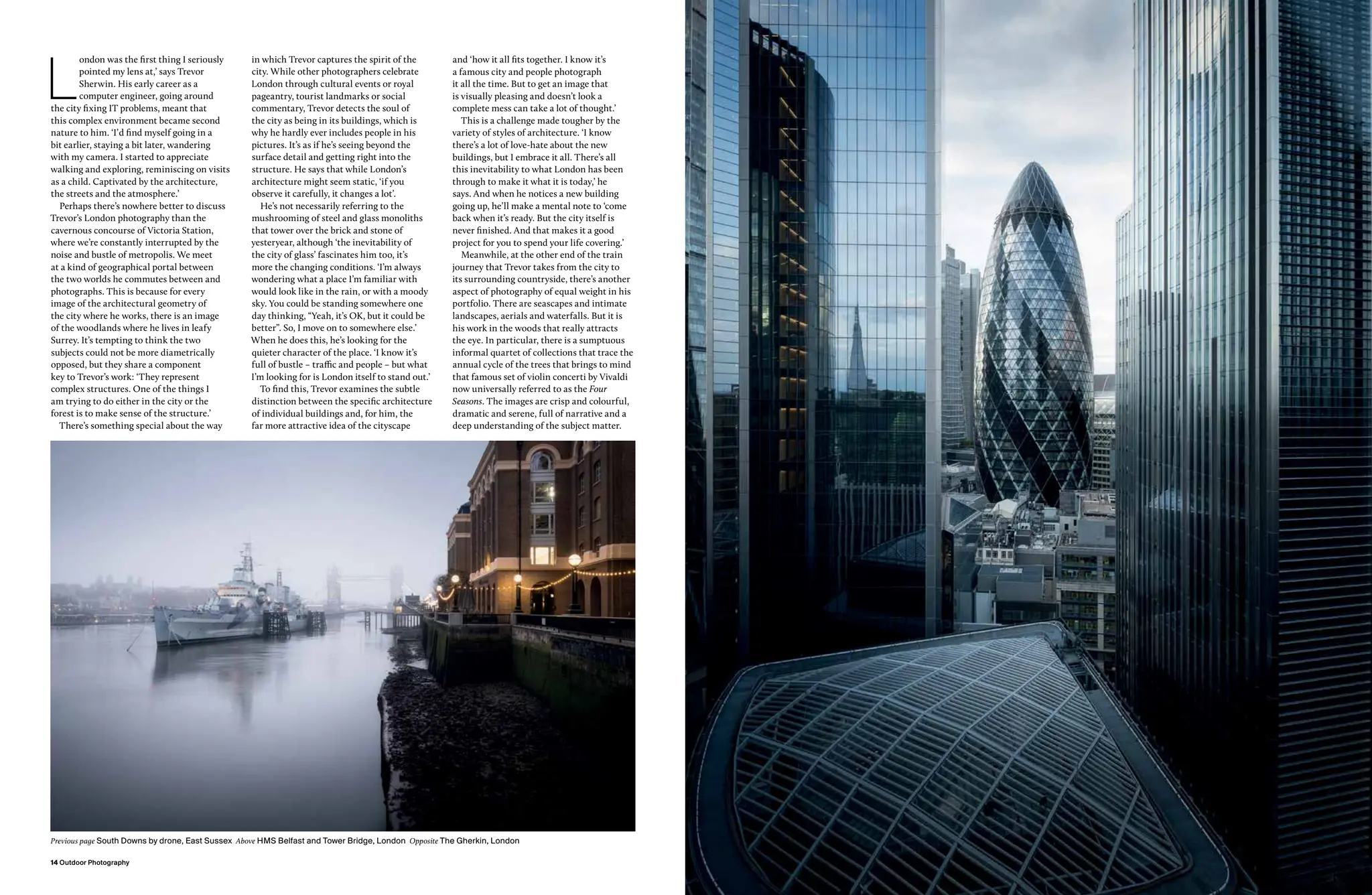
Previous page South Downs by drone, East Sussex Above HMS Belfast and Tower Bridge, London Opposite The Gherkin, London
L
ondon was the first thing I seriously
pointed my lens at,’ says Trevor
Sherwin. His early career as a
computer engineer, going around
the city fixing IT problems, meant that
this complex environment became second
nature to him. ‘I’d find myself going in a
bit earlier, staying a bit later, wandering
with my camera. I started to appreciate
walking and exploring, reminiscing on visits
as a child. Captivated by the architecture,
the streets and the atmosphere.’
Perhaps there’s nowhere better to discuss
Trevor’s London photography than the
cavernous concourse of Victoria Station,
where we’re constantly interrupted by the
noise and bustle of metropolis. We meet
at a kind of geographical portal between
the two worlds he commutes between and
photographs. This is because for every
image of the architectural geometry of
the city where he works, there is an image
of the woodlands where he lives in leafy
Surrey. It’s tempting to think the two
subjects could not be more diametrically
opposed, but they share a component
key to Trevor’s work: ‘They represent
complex structures. One of the things I
am trying to do either in the city or the
forest is to make sense of the structure.’
There’s something special about the way
in which Trevor captures the spirit of the
city. While other photographers celebrate
London through cultural events or royal
pageantry, tourist landmarks or social
commentary, Trevor detects the soul of
the city as being in its buildings, which is
why he hardly ever includes people in his
pictures. It’s as if he’s seeing beyond the
surface detail and getting right into the
structure. He says that while London’s
architecture might seem static, ‘if you
observe it carefully, it changes a lot’.
He’s not necessarily referring to the
mushrooming of steel and glass monoliths
that tower over the brick and stone of
yesteryear, although ‘the inevitability of
the city of glass’ fascinates him too, it’s
more the changing conditions. ‘I’m always
wondering what a place I’m familiar with
would look like in the rain, or with a moody
sky. You could be standing somewhere one
day thinking, “Yeah, it’s OK, but it could be
better”. So, I move on to somewhere else.’
When he does this, he’s looking for the
quieter character of the place. ‘I know it’s
full of bustle – traffic and people – but what
I’m looking for is London itself to stand out.’
To find this, Trevor examines the subtle
distinction between the specific architecture
of individual buildings and, for him, the
far more attractive idea of the cityscape
and ‘how it all fits together. I know it’s
a famous city and people photograph
it all the time. But to get an image that
is visually pleasing and doesn’t look a
complete mess can take a lot of thought.’
This is a challenge made tougher by the
variety of styles of architecture. ‘I know
there’s a lot of love-hate about the new
buildings, but I embrace it all. There’s all
this inevitability to what London has been
through to make it what it is today,’ he
says. And when he notices a new building
going up, he’ll make a mental note to ‘come
back when it’s ready. But the city itself is
never finished. And that makes it a good
project for you to spend your life covering.’
Meanwhile, at the other end of the train
journey that Trevor takes from the city to
its surrounding countryside, there’s another
aspect of photography of equal weight in his
portfolio. There are seascapes and intimate
landscapes, aerials and waterfalls. But it is
his work in the woods that really attracts
the eye. In particular, there is a sumptuous
informal quartet of collections that trace the
annual cycle of the trees that brings to mind
that famous set of violin concerti by Vivaldi
now universally referred to as the Four
Seasons. The images are crisp and colourful,
dramatic and serene, full of narrative and a
deep understanding of the subject matter.
Outdoor Photography 17
16 Outdoor Photography
‘When I talk about London being
sometimes hard to line up, simplify and make
pleasing, that’s the same with woodland.
And sometimes it just doesn’t work,’ he
says. ‘You’re sitting there trying to make
sense of a scene. Whether it’s the city or the
woods, it’s just the way I compose. Simplify
and declutter. Chaos bothers me and I like
to remove it from whatever I photograph.
The thing about woodland is that the
chaos is natural, and so you’ve got to make
sense of it, and I do that by looking for
quiet and calm. If I can do that, jackpot.
‘I photograph for my own satisfaction and
wellbeing, and because I get so much out of
it,’ adds Trevor, who describes himself not so
much as an amateur but ‘not professional’.
He’s not chasing the trappings of the well-
known photographer, preferring to balance his
creative persona quietly with a job in London
and his family in Surrey. He rarely enters
competitions – his one experience saw him
shortlisted and left him with a deep-seated
sense of ambivalence. He’s not particularly
interested in publicity, he says, but is content
to spend an hour discussing his photography
over an early evening cup of coffee. He’s more
pleased that his work was recommended to
me by Vanda Ralevska, whose landscapes
he admires and whose opinion he values.
‘Not chasing’ is an expression Trevor uses
several times in our conversation. He’s not
interested in monetising his photography:
‘I’ve got a career and I’m happy to just enjoy
my photography.’ In his early forties, he
is still a comparative newcomer to taking
pictures, recalling how he started to get
serious in 2016 after ‘picking it up here and
there, occasionally photographing in London’.
Up until that point, he cheerfully admits, he
didn’t know what he was doing or why he
was doing it, ‘but I knew I wanted to take
photographs’. So, what happened in 2016?
‘Maybe I got some filters or started with long
exposures or something. But I started to get
my head around it, and it just sort of clicked.’
Trevor has no recollection of photography
playing a role in his early life. ‘I don’t have
that story where my dad had a camera,
and I don’t have photographers in my family.
I just sort of grew up and went to work and
had a family.’ When pushed, he remembers
going to a car race meeting with a friend who
had a camera ‘and I was a bit in awe when
he got some panning shots, and I thought
I wanted to buy a camera like that. So I
did, and I had a dabble. Nothing serious.’
Trevor tells me how he graduated
through a series of cameras of increasing
Left (top) Beachy Head lighthouse, East Sussex
Left (below) Beachy Head by drone, East Sussex
Opposite (top) Nutley, East Sussex
Opposite (below) The Rumps by drone, Cornwall
Outdoor Photography 19
18 Outdoor Photography
sophistication while explaining that he
doesn’t think success in photography has
‘anything much to do with the gear’.
But he took a ‘decent’ camera up to London
on an early trip where ‘weirdly, I fell in love
with the tactile, tangible aspect of it. In fact,
one of the photos I took that evening is one
of the best photos I’ve ever taken.’ Why’s that?
‘I don’t know. It was a classic photo from the
arch under Westminster Bridge. It’s not the
best photo I’ve ever taken, but it represents
that this is something I enjoy doing.’
He’s also amused by how much he didn’t
know about photography in those days.
‘I was doing HDR and over-manipulating
and I was, like, “This is the best stuff
ever”. When you start, you just don’t know
how much you don’t know,’ he says.
Looking back, he is honest enough to say
‘my early work was mostly ghastly stuff, but
it was new. I was creating something, and
my enthusiasm for the process of making an
image that didn’t look just like a documentary
photo took over. I think I was blinded by that.’
The ‘ghastly stuff’ soon disappeared in
the rear-view mirror following a process of
learning how to ‘control the camera rather
than letting it control you’. This is vital to
Trevor’s progress as a photographer because
success comes from ‘having an input into
what you want the photo to be, both from a
technical point of view and creative vision.’
But you also have to ‘plug away and
practise, and you’ve got to keep going back
to places and learn about what works and
what doesn’t work. The technology gets
better and the software catches up with
what you want to achieve. But mostly, you
have to think about what you’re doing.’
Talking with Trevor, you get the sense that
he thinks a lot about his photography.
Consideration of what the image will look
like is a thread that runs through the fabric
of his work. Whether the viewer is looking
at his urban or pastoral compositions, his
intimate landscapes, aerial photography or
his handful of stunning shots of Beachy Head
Lighthouse, they are all unmistakably the
work of the same photographer. He attributes
this cohesion across the whole portfolio to his
tendency to react to his own instincts while
sticking firmly to the established thought
processes. He’s particularly pleased that
people might think his work is stylistically
consistent. ‘That’s quite an accolade, isn’t it?’
To see more of Trevor’s work,
visit trevorsherwin.co.uk
Opposite (top) Fairy Glen, Eryri, Wales
Opposite (below) Forest Row, East Sussex
Right (top) Forest Row, East Sussex
Right (middle) Rock pool, Sussex
Right (below) Limpet on a yellow rock, Sussex

Landscape photography Feature - Trevor Sherwin

  • 1.
    Outdoor Photography 13 12Outdoor Photography Trevor Sherwin In conversation with From confident London cityscapes to subtle reinterpretations of the English woodlands, Trevor Sherwin’s work is all about ‘simplifying the structure’ Interview by Nick Smith
  • 2.
    Outdoor Photography 15 14Outdoor Photography Previous page South Downs by drone, East Sussex Above HMS Belfast and Tower Bridge, London Opposite The Gherkin, London L ondon was the first thing I seriously pointed my lens at,’ says Trevor Sherwin. His early career as a computer engineer, going around the city fixing IT problems, meant that this complex environment became second nature to him. ‘I’d find myself going in a bit earlier, staying a bit later, wandering with my camera. I started to appreciate walking and exploring, reminiscing on visits as a child. Captivated by the architecture, the streets and the atmosphere.’ Perhaps there’s nowhere better to discuss Trevor’s London photography than the cavernous concourse of Victoria Station, where we’re constantly interrupted by the noise and bustle of metropolis. We meet at a kind of geographical portal between the two worlds he commutes between and photographs. This is because for every image of the architectural geometry of the city where he works, there is an image of the woodlands where he lives in leafy Surrey. It’s tempting to think the two subjects could not be more diametrically opposed, but they share a component key to Trevor’s work: ‘They represent complex structures. One of the things I am trying to do either in the city or the forest is to make sense of the structure.’ There’s something special about the way in which Trevor captures the spirit of the city. While other photographers celebrate London through cultural events or royal pageantry, tourist landmarks or social commentary, Trevor detects the soul of the city as being in its buildings, which is why he hardly ever includes people in his pictures. It’s as if he’s seeing beyond the surface detail and getting right into the structure. He says that while London’s architecture might seem static, ‘if you observe it carefully, it changes a lot’. He’s not necessarily referring to the mushrooming of steel and glass monoliths that tower over the brick and stone of yesteryear, although ‘the inevitability of the city of glass’ fascinates him too, it’s more the changing conditions. ‘I’m always wondering what a place I’m familiar with would look like in the rain, or with a moody sky. You could be standing somewhere one day thinking, “Yeah, it’s OK, but it could be better”. So, I move on to somewhere else.’ When he does this, he’s looking for the quieter character of the place. ‘I know it’s full of bustle – traffic and people – but what I’m looking for is London itself to stand out.’ To find this, Trevor examines the subtle distinction between the specific architecture of individual buildings and, for him, the far more attractive idea of the cityscape and ‘how it all fits together. I know it’s a famous city and people photograph it all the time. But to get an image that is visually pleasing and doesn’t look a complete mess can take a lot of thought.’ This is a challenge made tougher by the variety of styles of architecture. ‘I know there’s a lot of love-hate about the new buildings, but I embrace it all. There’s all this inevitability to what London has been through to make it what it is today,’ he says. And when he notices a new building going up, he’ll make a mental note to ‘come back when it’s ready. But the city itself is never finished. And that makes it a good project for you to spend your life covering.’ Meanwhile, at the other end of the train journey that Trevor takes from the city to its surrounding countryside, there’s another aspect of photography of equal weight in his portfolio. There are seascapes and intimate landscapes, aerials and waterfalls. But it is his work in the woods that really attracts the eye. In particular, there is a sumptuous informal quartet of collections that trace the annual cycle of the trees that brings to mind that famous set of violin concerti by Vivaldi now universally referred to as the Four Seasons. The images are crisp and colourful, dramatic and serene, full of narrative and a deep understanding of the subject matter.
  • 3.
    Outdoor Photography 17 16Outdoor Photography ‘When I talk about London being sometimes hard to line up, simplify and make pleasing, that’s the same with woodland. And sometimes it just doesn’t work,’ he says. ‘You’re sitting there trying to make sense of a scene. Whether it’s the city or the woods, it’s just the way I compose. Simplify and declutter. Chaos bothers me and I like to remove it from whatever I photograph. The thing about woodland is that the chaos is natural, and so you’ve got to make sense of it, and I do that by looking for quiet and calm. If I can do that, jackpot. ‘I photograph for my own satisfaction and wellbeing, and because I get so much out of it,’ adds Trevor, who describes himself not so much as an amateur but ‘not professional’. He’s not chasing the trappings of the well- known photographer, preferring to balance his creative persona quietly with a job in London and his family in Surrey. He rarely enters competitions – his one experience saw him shortlisted and left him with a deep-seated sense of ambivalence. He’s not particularly interested in publicity, he says, but is content to spend an hour discussing his photography over an early evening cup of coffee. He’s more pleased that his work was recommended to me by Vanda Ralevska, whose landscapes he admires and whose opinion he values. ‘Not chasing’ is an expression Trevor uses several times in our conversation. He’s not interested in monetising his photography: ‘I’ve got a career and I’m happy to just enjoy my photography.’ In his early forties, he is still a comparative newcomer to taking pictures, recalling how he started to get serious in 2016 after ‘picking it up here and there, occasionally photographing in London’. Up until that point, he cheerfully admits, he didn’t know what he was doing or why he was doing it, ‘but I knew I wanted to take photographs’. So, what happened in 2016? ‘Maybe I got some filters or started with long exposures or something. But I started to get my head around it, and it just sort of clicked.’ Trevor has no recollection of photography playing a role in his early life. ‘I don’t have that story where my dad had a camera, and I don’t have photographers in my family. I just sort of grew up and went to work and had a family.’ When pushed, he remembers going to a car race meeting with a friend who had a camera ‘and I was a bit in awe when he got some panning shots, and I thought I wanted to buy a camera like that. So I did, and I had a dabble. Nothing serious.’ Trevor tells me how he graduated through a series of cameras of increasing Left (top) Beachy Head lighthouse, East Sussex Left (below) Beachy Head by drone, East Sussex Opposite (top) Nutley, East Sussex Opposite (below) The Rumps by drone, Cornwall
  • 4.
    Outdoor Photography 19 18Outdoor Photography sophistication while explaining that he doesn’t think success in photography has ‘anything much to do with the gear’. But he took a ‘decent’ camera up to London on an early trip where ‘weirdly, I fell in love with the tactile, tangible aspect of it. In fact, one of the photos I took that evening is one of the best photos I’ve ever taken.’ Why’s that? ‘I don’t know. It was a classic photo from the arch under Westminster Bridge. It’s not the best photo I’ve ever taken, but it represents that this is something I enjoy doing.’ He’s also amused by how much he didn’t know about photography in those days. ‘I was doing HDR and over-manipulating and I was, like, “This is the best stuff ever”. When you start, you just don’t know how much you don’t know,’ he says. Looking back, he is honest enough to say ‘my early work was mostly ghastly stuff, but it was new. I was creating something, and my enthusiasm for the process of making an image that didn’t look just like a documentary photo took over. I think I was blinded by that.’ The ‘ghastly stuff’ soon disappeared in the rear-view mirror following a process of learning how to ‘control the camera rather than letting it control you’. This is vital to Trevor’s progress as a photographer because success comes from ‘having an input into what you want the photo to be, both from a technical point of view and creative vision.’ But you also have to ‘plug away and practise, and you’ve got to keep going back to places and learn about what works and what doesn’t work. The technology gets better and the software catches up with what you want to achieve. But mostly, you have to think about what you’re doing.’ Talking with Trevor, you get the sense that he thinks a lot about his photography. Consideration of what the image will look like is a thread that runs through the fabric of his work. Whether the viewer is looking at his urban or pastoral compositions, his intimate landscapes, aerial photography or his handful of stunning shots of Beachy Head Lighthouse, they are all unmistakably the work of the same photographer. He attributes this cohesion across the whole portfolio to his tendency to react to his own instincts while sticking firmly to the established thought processes. He’s particularly pleased that people might think his work is stylistically consistent. ‘That’s quite an accolade, isn’t it?’ To see more of Trevor’s work, visit trevorsherwin.co.uk Opposite (top) Fairy Glen, Eryri, Wales Opposite (below) Forest Row, East Sussex Right (top) Forest Row, East Sussex Right (middle) Rock pool, Sussex Right (below) Limpet on a yellow rock, Sussex