SEPTEMBER 2010
FACT FINDING JOURNAL
TOPIC: SCHOOL OF ENVIRONMENTAL STUDIES
(LAGOS STATE POLYTECHNIC, NIGERIA).
COURSE: MANAGEMENT INFORMATION SYSTEM I
DEPT.: BUSINESS ADMINISTRATION AND MGT.
LEVEL: HND 1
MATRIC NO: NAMES OF STUDENT
094032104 OLONADE BABATUNDE MICHAEL
NOTE: All information therein is as at September 2010 and is subject to change.
This is to assist all students that may need this journal, as a useful material in their
project.
For Info Call: +2348053038580, +2348139453030
LECTURER:
MR. W. A. AKANJI.
INTRODUCTION
The school of environmental studies, commence its academics activities in September
1978 when the institution was previously known as Lagos State College of science and
GROUP 11 ASSIGNMENT
Page | 2
technology (LACOSTECH) of Nigeria, which was founded with the promulgation of the
Lagos State Edict No;1 of 1978.
In this report, the fact findings are based on; Description of school, Reason for the
activities, How the described activities are done, The Hierarchy of staffs, The school
proposed system, Problems and Solutions to the school, Various tools used as well as
maintenance and evaluations, Justification of the studies and Benefit of the new
system.
DESCRIPTION OF SCHOOL
School of environmental was academically to transform individual students that have
ambition in art, design and building career, in other to make them the best in labour
market, currently the school is consist of six (6) departments which are Architectural
Department, Art and Industrial Design Department, Building Technology Department,
Estate Management Department, Quantity Survey Department and Urban and Regional
Planning Department. These departments are created to suit student’s area of
specialization and interest which will be detailed later on this report.
REASON FOR THE ACTIVITIES
As its clear that school of environmental as serve as umbrella that unite many
departments, this makes the reasons to be similar which are:
 To build students who can depict structures.
 To provide technocrats in their area of specialization,
 To bring out inner creativity in students,
 To make students socialize themselves with the environment,
 To emulate students to remember and be part of their origin/cultural linage,
 To build students on how to study the mindset of people,
 And build students on how to relate with outside world through a distinct design,
etc.
HOW THE DESCRIBED ACTIVITIES ARE DONE
GROUP 11 ASSIGNMENT
Page | 3
The school of environmental studies controls all the affairs of departments therein, to
ensure efficiency and accuracy in attendance of staffs (academics and non academic)
and punctuality of students in their various departments. The school codes of conduct
is another activities that the school take seriously, in other to ensure students are
politely and decently dress as well as staffs and monitoring of students from sexual
harassment, cultism and other irregularities.
GROUP 11 ASSIGNMENT
Page | 4
PRINCIPAL
LECTURER
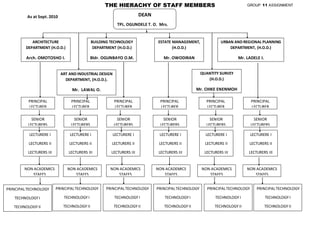
THE HIERACHY OF STAFF MEMBERS
As at Sept. 2010
ARCHITECTURE
DEPARTMENT (H.O.D.)
Arch. OMOTOSHO I.
ART AND INDUSTRIAL DESIGN
DEPARTMENT, (H.O.D.).
Mr. LAWAL O.
BUILDING TECHNOLOGY
DEPARTMENT (H.O.D.)
Bldr. OGUNBAYO O.M.
ESTATE MANAGEMENT,
(H.O.D.)
Mr. OWODIRAN
QUANTITY SURVEY
(H.O.D.)
Mr. CHIKE ENENMOH
DEAN
TPL. OGUNDELE T. O. Mrs.
URBAN AND REGIONAL PLANNING
DEPARTMENT, (H.O.D.)
Mr. LADELE I.
PRINCIPAL
LECTURER
SENIOR
LECTURERS
LECTURERE I
LECTURERS II
LECTURERS III
NON ACADEMICS
STAFFS
PRINCIPALTECHNOLOGY
TECHNOLOGY I
TECHNOLOGY II
PRINCIPAL
LECTURER
PRINCIPAL
LECTURER
PRINCIPAL
LECTURER
PRINCIPAL
LECTURER
SENIOR
LECTURERS
SENIOR
LECTURERS
SENIOR
LECTURERS
SENIOR
LECTURERS
SENIOR
LECTURERS
LECTURERE I
LECTURERS II
LECTURERS III
LECTURERE I
LECTURERS II
LECTURERS III
LECTURERE I
LECTURERS II
LECTURERS III
LECTURERE I
LECTURERS II
LECTURERS III
LECTURERE I
LECTURERS II
LECTURERS III
NON ACADEMICS
STAFFS
NON ACADEMICS
STAFFS
NON ACADEMICS
STAFFS
NON ACADEMICS
STAFFS
NON ACADEMICS
STAFFS
PRINCIPALTECHNOLOGY
TECHNOLOGY I
TECHNOLOGY II
PRINCIPALTECHNOLOGY
TECHNOLOGY I
TECHNOLOGY II
PRINCIPALTECHNOLOGY
TECHNOLOGY I
TECHNOLOGY II
PRINCIPALTECHNOLOGY
TECHNOLOGY I
TECHNOLOGY II
PRINCIPALTECHNOLOGY
TECHNOLOGY I
TECHNOLOGY II
GROUP 11 ASSIGNMENT
Page | 5
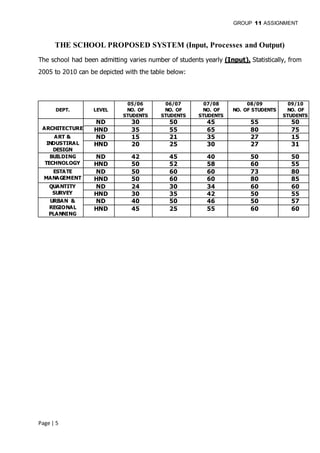
THE SCHOOL PROPOSED SYSTEM (Input, Processes and Output)
The school had been admitting varies number of students yearly (Input). Statistically, from
2005 to 2010 can be depicted with the table below:
DEPT. LEVEL
05/06
NO. OF
STUDENTS
06/07
NO. OF
STUDENTS
07/08
NO. OF
STUDENTS
08/09
NO. OF STUDENTS
09/10
NO. OF
STUDENTS
ARCHITECTURE
ND 30 50 45 55 50
HND 35 55 65 80 75
ART &
INDUSTIRAL
DESIGN
ND 15 21 35 27 15
HND 20 25 30 27 31
BUILDING
TECHNOLOGY
ND 42 45 40 50 50
HND 50 52 58 60 55
ESTATE
MANAGEMENT
ND 50 60 60 73 80
HND 50 60 60 80 85
QUANTITY
SURVEY
ND 24 30 34 60 60
HND 30 35 42 50 55
URBAN &
REGIONAL
PLANNING
ND 40 50 46 50 57
HND 45 25 55 60 60
GROUP 11 ASSIGNMENT
Page | 6
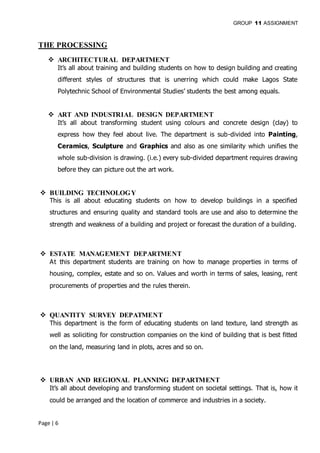
THE PROCESSING
 ARCHITECTURAL DEPARTMENT
It’s all about training and building students on how to design building and creating
different styles of structures that is unerring which could make Lagos State
Polytechnic School of Environmental Studies’ students the best among equals.
 ART AND INDUSTRIAL DESIGN DEPARTMENT
It’s all about transforming student using colours and concrete design (clay) to
express how they feel about live. The department is sub-divided into Painting,
Ceramics, Sculpture and Graphics and also as one similarity which unifies the
whole sub-division is drawing. (i.e.) every sub-divided department requires drawing
before they can picture out the art work.
 BUILDING TECHNOLOGY
This is all about educating students on how to develop buildings in a specified
structures and ensuring quality and standard tools are use and also to determine the
strength and weakness of a building and project or forecast the duration of a building.
 ESTATE MANAGEMENT DEPARTMENT
At this department students are training on how to manage properties in terms of
housing, complex, estate and so on. Values and worth in terms of sales, leasing, rent
procurements of properties and the rules therein.
 QUANTITY SURVEY DEPATMENT
This department is the form of educating students on land texture, land strength as
well as soliciting for construction companies on the kind of building that is best fitted
on the land, measuring land in plots, acres and so on.
 URBAN AND REGIONAL PLANNING DEPARTMENT
It’s all about developing and transforming student on societal settings. That is, how it
could be arranged and the location of commerce and industries in a society.
GROUP 11 ASSIGNMENT
Page | 7
THE SCHOOL PROPOSED OBJECTIVES (output)
The aims is to produce students with full of ideas, creative’s that will be the best in
labour market and providing and issuing a distinct certificates to students which will
rate Lagos State Polytechnic School of Environmental the best among equals. The
prospect of students produced so far could be statically depicted below:
DEPARTMENT DISTINCTION UPPER
CLASS
LOWER
CLASS
PASS FAIL
ARCHITECTURE 32 202 505 100 20
ART & DESIGN 41 211 502 50 12
ESTATE MGT. 34 205 707 60 25
URBAN & R.
PLAN
25 215 715 71 27
QUANTITY
SURV.
35 222 607 52 12
BUILDING
TECH.
40 250 668 52 12
TOTAL 207 1305 3704 385 108
NOTE: majority of pass and fail students, drop during their section with one reasons best
known to them.
THE VARIOUS TOOLS USE IN THE SCHOOL
HARDWARE
Mallet, Spatula, Modeling Knife, Dye, Soda, Hydro Sulphate, Laka, Clay, Chi board,
Straw Board, Top Board, Cottons(Teru), Paint, Saw, Cement, Industrial Tape, Cutlass,
Plumb Ruler, Drawing Board, Painting Brush, Shovel, Spade, Rake and so on.
SOFTWARE
 The chain of command within the school of environmental studies
 The pear interaction that brings sharing of ideas among the students, lecturers, staffs
as a whole.
 The implementation of task information within the system.
 The ending point of all creative design outlooks
 The interaction of all departments therein.
 Sharing of hardware tools among the departments and so on.
GROUP 11 ASSIGNMENT
Page | 8
THE TECHNIQUES USED
 Collections of Evidence:
These are the evidence information collected from the Dean’s office.
 Investigation and interview:
Face to face questions are use to get some factual things from the staffs (academic
and non-academic) and students.
 Record Examinations:
All the previous records examination result are located and use to produce facts data
require for the report.
 Questionnaire:
This is use to enable the respondent to give his/her own opinion.
THE SHORTCOMMINGS OF THE SCHOOL
 Administrative Challenges:
These entails conflicts encountered while managing the activities of the school such as: lack of
electricity, low salary to staffs and so on.
 Operational Challenges:
These are challenges facing when carried out a functions by lecturers, students and
inadequate supply of tools to embark on valid experiment by students and lecturers.
 Environmental Challenges:
These includes poor living environment of staff, non accommodations for students and
lecturers and so on.
GROUP 11 ASSIGNMENT
Page | 9
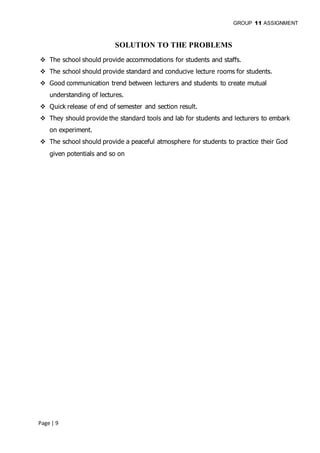
SOLUTION TO THE PROBLEMS
 The school should provide accommodations for students and staffs.
 The school should provide standard and conducive lecture rooms for students.
 Good communication trend between lecturers and students to create mutual
understanding of lectures.
 Quick release of end of semester and section result.
 They should provide the standard tools and lab for students and lecturers to embark
on experiment.
 The school should provide a peaceful atmosphere for students to practice their God
given potentials and so on
GROUP 11 ASSIGNMENT
Page | 10
JUSTIFICATIONS OF THE STUDIES
 Design a simple and unambiguous questionnaire,
 Dispatch the questionnaire to the individual understanding,
 Try as much as possible to treat the background with a great level of confidentiality,
 Select and develop the background checked and ensure they know what, how, when to
carried out the process.
 Educate the staffs to ensure efficiency and effectiveness with a promise to apply strick
professionalism in the process.
THE SYSTEM MAINTENANCE AND EVALUATION
This is all about ensuring continues interaction and transformation among the school
with consistence hardware and software in operation positive responds of staffs. It’s a
consistence process of upgrading and updating the various part of the school and also
uses to confirm the performance of students and their lectures. The more effectives the
hardware and software is the greater efficiency the performance of students in school
output.
THE BENEFIT OF THE NEW SYSTEM
The appreciable benefit of this system begins from number of graduating students
which will immensely greater in quality and quantity (output). With the availabilities of
standard software and advance technological hardware, it will go a long way in build
the students and lecturers and find it comfortable to lecture using current standard
tools.

LAGOS STATE POLYTECHNIC JOURNAL

  • 1.
    SEPTEMBER 2010 FACT FINDINGJOURNAL TOPIC: SCHOOL OF ENVIRONMENTAL STUDIES (LAGOS STATE POLYTECHNIC, NIGERIA). COURSE: MANAGEMENT INFORMATION SYSTEM I DEPT.: BUSINESS ADMINISTRATION AND MGT. LEVEL: HND 1 MATRIC NO: NAMES OF STUDENT 094032104 OLONADE BABATUNDE MICHAEL NOTE: All information therein is as at September 2010 and is subject to change. This is to assist all students that may need this journal, as a useful material in their project. For Info Call: +2348053038580, +2348139453030 LECTURER: MR. W. A. AKANJI. INTRODUCTION The school of environmental studies, commence its academics activities in September 1978 when the institution was previously known as Lagos State College of science and
  • 2.
    GROUP 11 ASSIGNMENT Page| 2 technology (LACOSTECH) of Nigeria, which was founded with the promulgation of the Lagos State Edict No;1 of 1978. In this report, the fact findings are based on; Description of school, Reason for the activities, How the described activities are done, The Hierarchy of staffs, The school proposed system, Problems and Solutions to the school, Various tools used as well as maintenance and evaluations, Justification of the studies and Benefit of the new system. DESCRIPTION OF SCHOOL School of environmental was academically to transform individual students that have ambition in art, design and building career, in other to make them the best in labour market, currently the school is consist of six (6) departments which are Architectural Department, Art and Industrial Design Department, Building Technology Department, Estate Management Department, Quantity Survey Department and Urban and Regional Planning Department. These departments are created to suit student’s area of specialization and interest which will be detailed later on this report. REASON FOR THE ACTIVITIES As its clear that school of environmental as serve as umbrella that unite many departments, this makes the reasons to be similar which are:  To build students who can depict structures.  To provide technocrats in their area of specialization,  To bring out inner creativity in students,  To make students socialize themselves with the environment,  To emulate students to remember and be part of their origin/cultural linage,  To build students on how to study the mindset of people,  And build students on how to relate with outside world through a distinct design, etc. HOW THE DESCRIBED ACTIVITIES ARE DONE
  • 3.
    GROUP 11 ASSIGNMENT Page| 3 The school of environmental studies controls all the affairs of departments therein, to ensure efficiency and accuracy in attendance of staffs (academics and non academic) and punctuality of students in their various departments. The school codes of conduct is another activities that the school take seriously, in other to ensure students are politely and decently dress as well as staffs and monitoring of students from sexual harassment, cultism and other irregularities.
  • 4.
    GROUP 11 ASSIGNMENT Page| 4 PRINCIPAL LECTURER THE HIERACHY OF STAFF MEMBERS As at Sept. 2010 ARCHITECTURE DEPARTMENT (H.O.D.) Arch. OMOTOSHO I. ART AND INDUSTRIAL DESIGN DEPARTMENT, (H.O.D.). Mr. LAWAL O. BUILDING TECHNOLOGY DEPARTMENT (H.O.D.) Bldr. OGUNBAYO O.M. ESTATE MANAGEMENT, (H.O.D.) Mr. OWODIRAN QUANTITY SURVEY (H.O.D.) Mr. CHIKE ENENMOH DEAN TPL. OGUNDELE T. O. Mrs. URBAN AND REGIONAL PLANNING DEPARTMENT, (H.O.D.) Mr. LADELE I. PRINCIPAL LECTURER SENIOR LECTURERS LECTURERE I LECTURERS II LECTURERS III NON ACADEMICS STAFFS PRINCIPALTECHNOLOGY TECHNOLOGY I TECHNOLOGY II PRINCIPAL LECTURER PRINCIPAL LECTURER PRINCIPAL LECTURER PRINCIPAL LECTURER SENIOR LECTURERS SENIOR LECTURERS SENIOR LECTURERS SENIOR LECTURERS SENIOR LECTURERS LECTURERE I LECTURERS II LECTURERS III LECTURERE I LECTURERS II LECTURERS III LECTURERE I LECTURERS II LECTURERS III LECTURERE I LECTURERS II LECTURERS III LECTURERE I LECTURERS II LECTURERS III NON ACADEMICS STAFFS NON ACADEMICS STAFFS NON ACADEMICS STAFFS NON ACADEMICS STAFFS NON ACADEMICS STAFFS PRINCIPALTECHNOLOGY TECHNOLOGY I TECHNOLOGY II PRINCIPALTECHNOLOGY TECHNOLOGY I TECHNOLOGY II PRINCIPALTECHNOLOGY TECHNOLOGY I TECHNOLOGY II PRINCIPALTECHNOLOGY TECHNOLOGY I TECHNOLOGY II PRINCIPALTECHNOLOGY TECHNOLOGY I TECHNOLOGY II
  • 5.
    GROUP 11 ASSIGNMENT Page| 5 THE SCHOOL PROPOSED SYSTEM (Input, Processes and Output) The school had been admitting varies number of students yearly (Input). Statistically, from 2005 to 2010 can be depicted with the table below: DEPT. LEVEL 05/06 NO. OF STUDENTS 06/07 NO. OF STUDENTS 07/08 NO. OF STUDENTS 08/09 NO. OF STUDENTS 09/10 NO. OF STUDENTS ARCHITECTURE ND 30 50 45 55 50 HND 35 55 65 80 75 ART & INDUSTIRAL DESIGN ND 15 21 35 27 15 HND 20 25 30 27 31 BUILDING TECHNOLOGY ND 42 45 40 50 50 HND 50 52 58 60 55 ESTATE MANAGEMENT ND 50 60 60 73 80 HND 50 60 60 80 85 QUANTITY SURVEY ND 24 30 34 60 60 HND 30 35 42 50 55 URBAN & REGIONAL PLANNING ND 40 50 46 50 57 HND 45 25 55 60 60
  • 6.
    GROUP 11 ASSIGNMENT Page| 6 THE PROCESSING  ARCHITECTURAL DEPARTMENT It’s all about training and building students on how to design building and creating different styles of structures that is unerring which could make Lagos State Polytechnic School of Environmental Studies’ students the best among equals.  ART AND INDUSTRIAL DESIGN DEPARTMENT It’s all about transforming student using colours and concrete design (clay) to express how they feel about live. The department is sub-divided into Painting, Ceramics, Sculpture and Graphics and also as one similarity which unifies the whole sub-division is drawing. (i.e.) every sub-divided department requires drawing before they can picture out the art work.  BUILDING TECHNOLOGY This is all about educating students on how to develop buildings in a specified structures and ensuring quality and standard tools are use and also to determine the strength and weakness of a building and project or forecast the duration of a building.  ESTATE MANAGEMENT DEPARTMENT At this department students are training on how to manage properties in terms of housing, complex, estate and so on. Values and worth in terms of sales, leasing, rent procurements of properties and the rules therein.  QUANTITY SURVEY DEPATMENT This department is the form of educating students on land texture, land strength as well as soliciting for construction companies on the kind of building that is best fitted on the land, measuring land in plots, acres and so on.  URBAN AND REGIONAL PLANNING DEPARTMENT It’s all about developing and transforming student on societal settings. That is, how it could be arranged and the location of commerce and industries in a society.
  • 7.
    GROUP 11 ASSIGNMENT Page| 7 THE SCHOOL PROPOSED OBJECTIVES (output) The aims is to produce students with full of ideas, creative’s that will be the best in labour market and providing and issuing a distinct certificates to students which will rate Lagos State Polytechnic School of Environmental the best among equals. The prospect of students produced so far could be statically depicted below: DEPARTMENT DISTINCTION UPPER CLASS LOWER CLASS PASS FAIL ARCHITECTURE 32 202 505 100 20 ART & DESIGN 41 211 502 50 12 ESTATE MGT. 34 205 707 60 25 URBAN & R. PLAN 25 215 715 71 27 QUANTITY SURV. 35 222 607 52 12 BUILDING TECH. 40 250 668 52 12 TOTAL 207 1305 3704 385 108 NOTE: majority of pass and fail students, drop during their section with one reasons best known to them. THE VARIOUS TOOLS USE IN THE SCHOOL HARDWARE Mallet, Spatula, Modeling Knife, Dye, Soda, Hydro Sulphate, Laka, Clay, Chi board, Straw Board, Top Board, Cottons(Teru), Paint, Saw, Cement, Industrial Tape, Cutlass, Plumb Ruler, Drawing Board, Painting Brush, Shovel, Spade, Rake and so on. SOFTWARE  The chain of command within the school of environmental studies  The pear interaction that brings sharing of ideas among the students, lecturers, staffs as a whole.  The implementation of task information within the system.  The ending point of all creative design outlooks  The interaction of all departments therein.  Sharing of hardware tools among the departments and so on.
  • 8.
    GROUP 11 ASSIGNMENT Page| 8 THE TECHNIQUES USED  Collections of Evidence: These are the evidence information collected from the Dean’s office.  Investigation and interview: Face to face questions are use to get some factual things from the staffs (academic and non-academic) and students.  Record Examinations: All the previous records examination result are located and use to produce facts data require for the report.  Questionnaire: This is use to enable the respondent to give his/her own opinion. THE SHORTCOMMINGS OF THE SCHOOL  Administrative Challenges: These entails conflicts encountered while managing the activities of the school such as: lack of electricity, low salary to staffs and so on.  Operational Challenges: These are challenges facing when carried out a functions by lecturers, students and inadequate supply of tools to embark on valid experiment by students and lecturers.  Environmental Challenges: These includes poor living environment of staff, non accommodations for students and lecturers and so on.
  • 9.
    GROUP 11 ASSIGNMENT Page| 9 SOLUTION TO THE PROBLEMS  The school should provide accommodations for students and staffs.  The school should provide standard and conducive lecture rooms for students.  Good communication trend between lecturers and students to create mutual understanding of lectures.  Quick release of end of semester and section result.  They should provide the standard tools and lab for students and lecturers to embark on experiment.  The school should provide a peaceful atmosphere for students to practice their God given potentials and so on
  • 10.
    GROUP 11 ASSIGNMENT Page| 10 JUSTIFICATIONS OF THE STUDIES  Design a simple and unambiguous questionnaire,  Dispatch the questionnaire to the individual understanding,  Try as much as possible to treat the background with a great level of confidentiality,  Select and develop the background checked and ensure they know what, how, when to carried out the process.  Educate the staffs to ensure efficiency and effectiveness with a promise to apply strick professionalism in the process. THE SYSTEM MAINTENANCE AND EVALUATION This is all about ensuring continues interaction and transformation among the school with consistence hardware and software in operation positive responds of staffs. It’s a consistence process of upgrading and updating the various part of the school and also uses to confirm the performance of students and their lectures. The more effectives the hardware and software is the greater efficiency the performance of students in school output. THE BENEFIT OF THE NEW SYSTEM The appreciable benefit of this system begins from number of graduating students which will immensely greater in quality and quantity (output). With the availabilities of standard software and advance technological hardware, it will go a long way in build the students and lecturers and find it comfortable to lecture using current standard tools.