KRA 1, Objective 2 – Use a range
of teaching strategies that enhance
learner achievement in literacy and
numeracy skills. (PPST 1.4.2)
By MONINA L. ESMADE
Master Teacher II
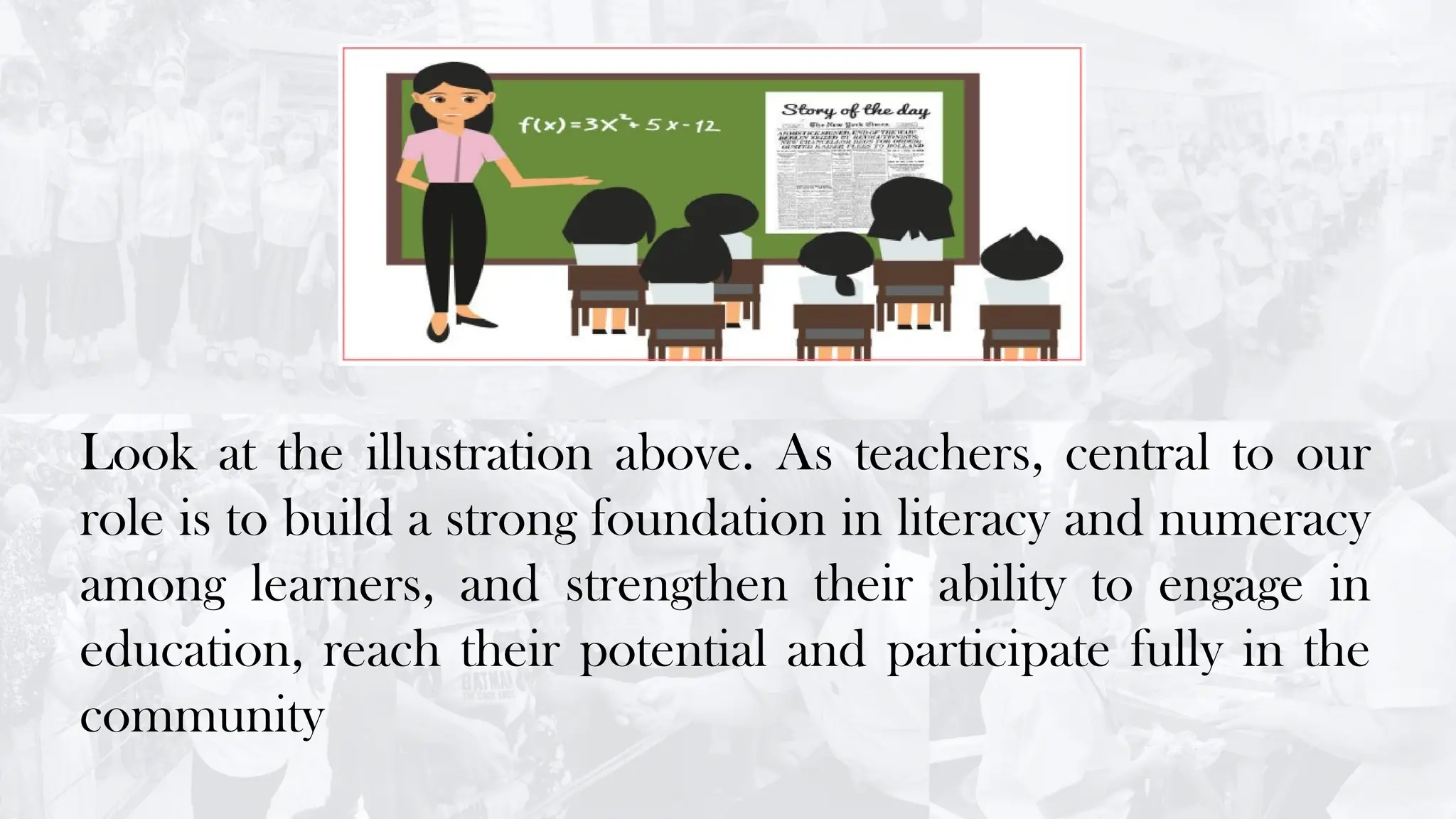
Look at the illustration above. As teachers, central to our
role is to build a strong foundation in literacy and numeracy
among learners, and strengthen their ability to engage in
education, reach their potential and participate fully in the
community
Literacy and numeracy skills are crucial for accessing the
broader curriculum as they are used in many aspects of
our lives. Obtaining an acceptable level of literacy and
numeracy can greatly enhance learners’ achievement
because they are used in many aspects of their lives.
Workplace numeracy, literacy and employability skills are
often used in conjunction with one another. These
required skills often overlap and are necessary for any task
“As soon as a child is born, he or she begins to ‘read’ the
world, to make sense of what he or she sees, hears and
does, over time. Parents, siblings and the wider family help
the child become involved in the community and culture
and learn different ways of communicating. This is the
starting point of the development of literacy skills. A strong
foundation in literacy takes time to build; it requires
exposure to listening, speaking, reading and writing.
Reflection:
Many young pupils may lack exposure to preschool
education and a culture of reading and storytelling at
home. Therefore, the role of the elementary school
teacher is crucial in making sure possible gaps in the
development of literacy skills are compensated for during
the first years of schooling. Indeed, elementary school
teachers have a huge role to play in ensuring that children
develop a strong foundation in literacy skills
Reflection:
LITERACY. This refers to the capability one acquires in
order to read, understand, and construct textual material.
This ability is useful in regular academic and non-
academic situations and contexts within the school
community and in different occupational areas. Literacy
is not confined to merely learning to read and write; it
also encompasses a range of more complex skills
including the ability to apprehend ideas and concepts
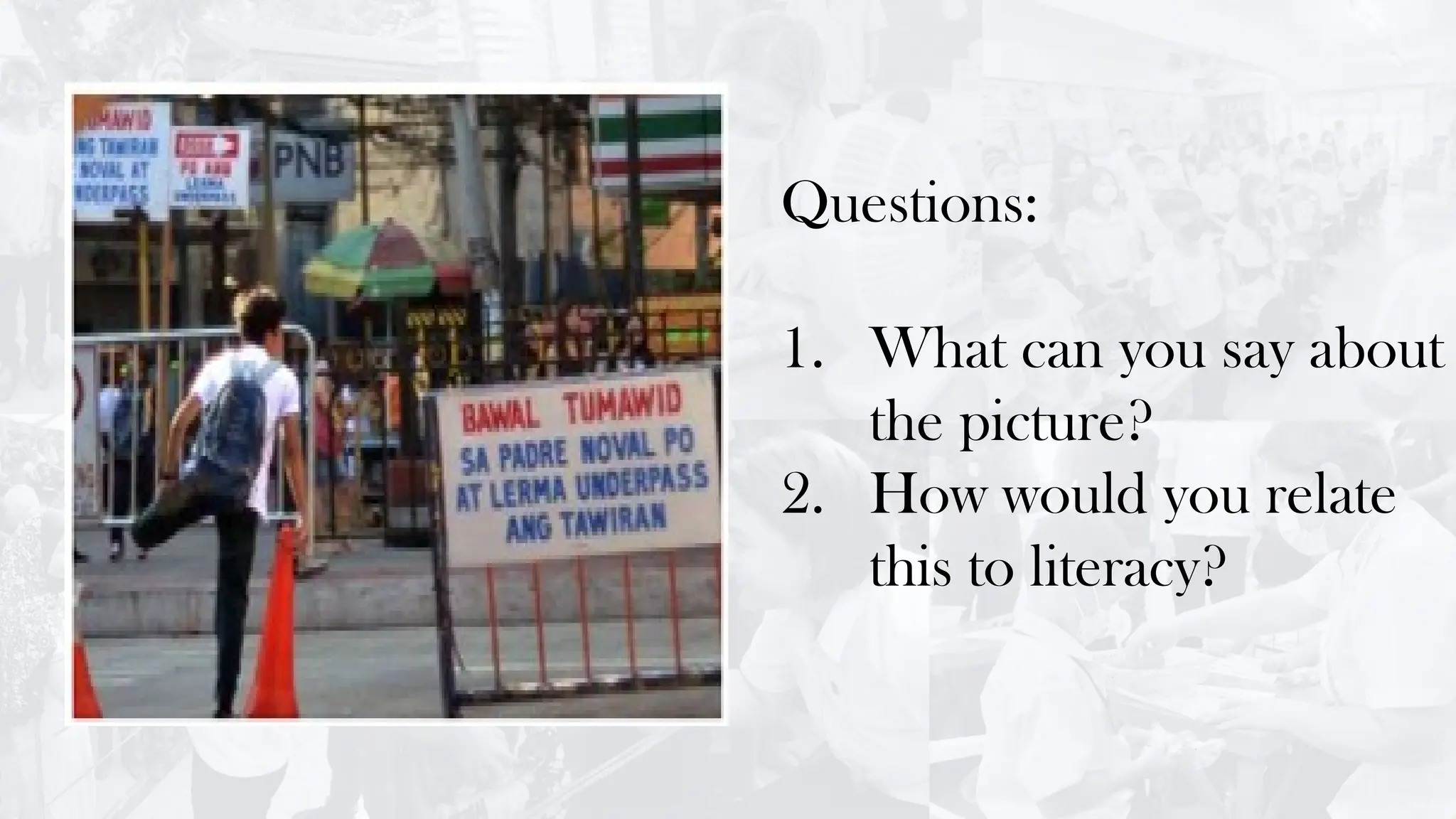
Questions:
1. What can you say about
the picture?
2. How would you relate
this to literacy?
NUMERACY. This refers to the ability to
understand and use mathematical knowledge for
calculating, problem solving, and interpreting
information in order to arrive at educated and
well-informed decisions. Numeracy is an
important skill for learners to master to help them
prepare for life beyond the school and within the
workplace and greater community.
3. How do you think the concept of numeracy relate
to ordinary people?
Then the responsibility for literacy and numeracy
must not just lie with the language teachers and
mathematics teachers, who admittedly are at the
center of the task, but with teachers of all subjects
who have the responsibility of supporting children in
developing their literacy and numeracy skills.
Developing literacy and numeracy skills not only
supports learning but also enhances understanding
within the curriculum area and is a keyway of raising
standards and outcomes in all subjects.”
Evidence of Practice
(Literacy Skills)
Lea teaches Grade 7 learners. Knowing the importance
of developing literacy skills among her learners, she
integrates literacy skills in her TLE class. On one
occasion, she asks them to collect empty food packets
(for example chips, biscuits, juice, milk), wash them and
bring them to school. At school, the learners are
instructed to look at the different packets and what is
written on them. They learn many new words this way,
such as the names of the ingredients
Sample 1
2. In another activity, Teacher Lea instructs the
Grade 7 learners to bring one daily newspaper to
their Filipino class. She tells the learners to select an
article that interests them and make notes about it.
Then she arranges them in groups of four to six,
putting learners who have chosen the same article
together so they could hear each other’s
interpretation of the story and discuss the different
ways of describing the same story
3. For instance, to expose your learners in real setting for
language, you may take them to offices, museums, shops,
and other places in your community. This can give them
exposure in reading and understanding language in
authentic use. Likewise, you may integrate ICT such as
computers, mobile phones and other ways of utilizing
them for information sharing and communication. To
develop their writing skills, encourage your learners to
compose varied text types- advertisements,
announcements, letters, stories, factual texts and so on
(United Nations Relief and Works Agency, 2013).
4. Jonalyn teaches MAPEH to Grade 7 learners. Many of her
learners have difficulty in reading Music textbooks so Jonalyn plans a
way of teaching Music that makes it easier for them to access the
information in the textbook. Teacher Jonalyn plans to teach the class
about the different types of instruments. She starts the lesson by
showing the learners names of the different instruments: wind,
percussion and string.
She writes these on flashcards. These flashcards are displayed
on the board. She also gives each learner a picture of an instrument.
She asks each learner to come up in front and put the picture next to
the flashcard with the name of the instrument to which they think it
belongs. Then she asks questions about what they know about the
different types of instruments, the characteristics of each type and the
difference between and among them.
Jonalyn then divides the class into three groups and
gives each group one of the types of instruments. She asks
them to create something, for example, make up a song or
design a poster to show what they know about the
instruments. Or they can draw different instruments under
the type of instrument and write about them, which they
could make into a book.
In the next lesson, Jonalyn asks each group to present
their work to the rest of the class. The learners are excited
about the activities, and some ask if they could do more
work on their instruments at home
5.Teacher Karen encourages the young learners in her class to
hone their observation skills by asking them to take note of and
write down names of streets and stores, outdoor
advertisements, and other street signs on their way home from
school. This “noticing” assignment is reviewed during the next
class meeting when learners share the words they saw. Teacher
Karen writes on the board the words that the learners put
together in their list. From this list, Teacher Karen can ask
learners to use the words in a sentence or a paragraph. She can
also encourage the learners to use their creativity to come up
with a story based on the words they collected.
Evidence of Practice
Numeracy Skill
A social studies teacher wanted to deepen the
understanding of his Grade 7 learners to compare the
local agricultural products in their community. As part of
the extended classroom activity, he asked his learners to
conduct data gathering among the locals on the number of
agricultural products harvested for a week. The next day,
he facilitated the learners’ discussion that included these
numeracy concepts: Which agricultural product got the
highest produce? Which was least produced? Which area
harvested the most?
Listed are some of the strategies that show how numeracy concepts
and skills can be applied in other subjects (United Nations Relief
and Works Agency, 2013):
• History: Teacher Marites includes concept of time, concept of number and
dates, sequencing events and dates, understanding and comparing large
numbers, using a timeline, logical reasoning. She includes activities, such as
sequencing numbers and dates to help learners see why some events, such as
the start of a war, happened.
• Science: Teacher Melody includes making measurements, collecting data,
comparing, and interpreting data, graphs and diagrams, estimation, logical
reasoning. In her Grade 8 Science class, she asks learners to measure the
extension of a spring with different weights that will involve them in various
measuring tasks and devising ways of recording their results
• English: Teacher Lalaine includes reading and writing
numbers, time and measurement concepts in English in her
Grade 8 English class.
• Vocational education and training: Teacher Ronnie
includes making measurements (distance, area, volume,
timing), geometry (shapes), and estimation in his SHS Tile
Setting class. He asks learners to estimate how much of
each material they will need to tile a floor and work out the
actual cost to help them see how to judge the possibility of
being able to afford to do the job.
• Physical education: Teacher Jho includes number
concept, measurements, and practical activities of
measuring distance. In her Physical Education class, she
asks her learners to measure heartbeat, pulse rates and
recovery rates to judge their fitness.
• Arts: Teacher Imelda includes geometry (shapes)
perspective in her Grade 8 Arts class. She knows that
understanding how shapes tessellate will help her learners
design their own patterns in traditional styles.
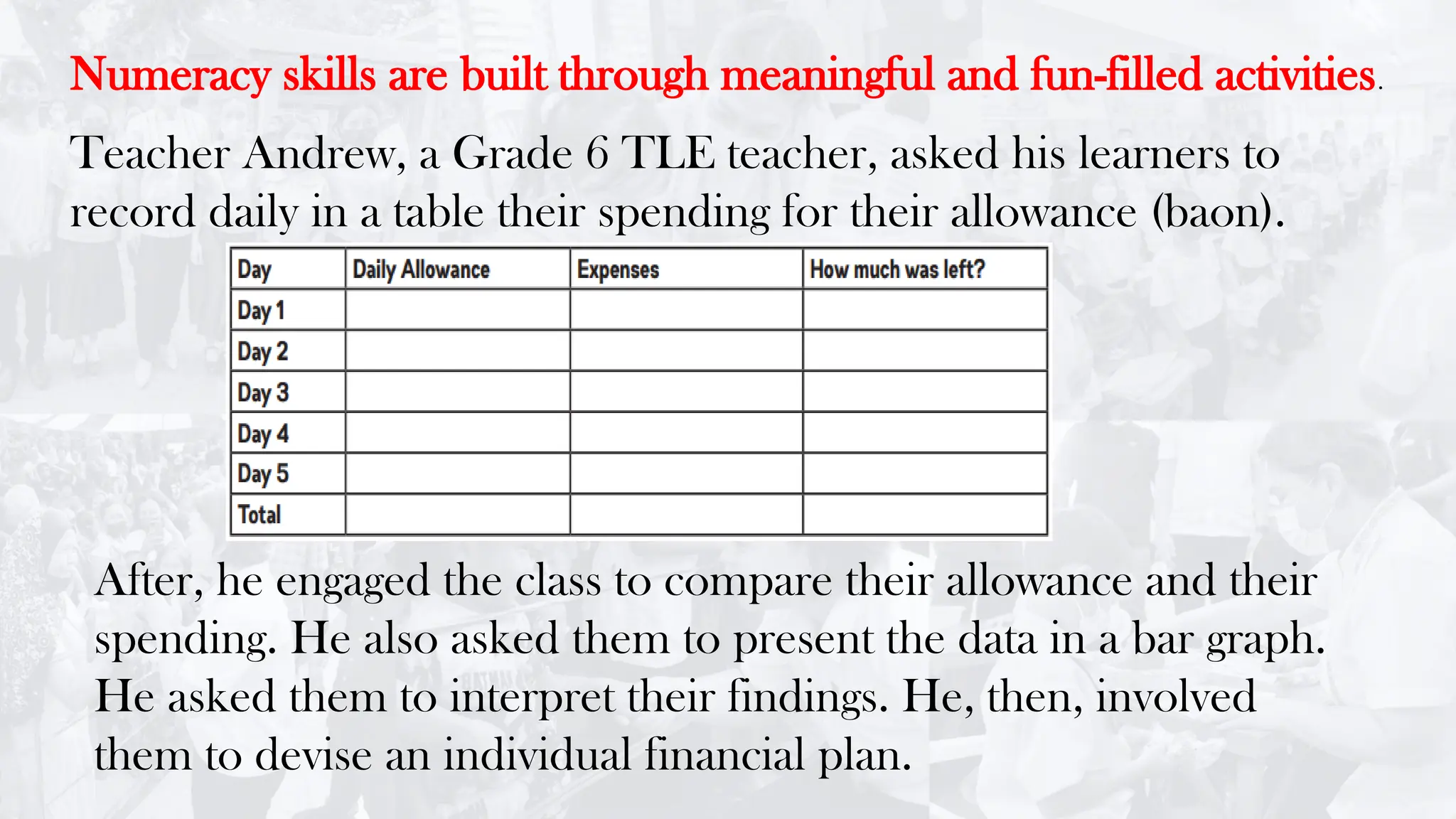
Numeracy skills are built through meaningful and fun-filled activities.
Teacher Andrew, a Grade 6 TLE teacher, asked his learners to
record daily in a table their spending for their allowance (baon).
After, he engaged the class to compare their allowance and their
spending. He also asked them to present the data in a bar graph.
He asked them to interpret their findings. He, then, involved
them to devise an individual financial plan.
To strengthen numeracy, you should create a rich and supportive learning environment that
will support a skillful mix of a variety of approaches, including:
• active learning and planned, purposeful play;
• development of problem-solving capabilities;
• developing mental agility;
• frequently asking children to explain their thinking;
• use of relevant contexts and experiences, familiar to children and young people;
• using technology in appropriate and effective ways;
• building on the principles of Assessment is for Learning, including understanding the
purpose and relevance of the activities;
• both collaborative and independent learning;
• making frequent links across the curriculum, so that concepts and skills are developed
further by being applied in different, relevant contexts;
• promoting an interest and enthusiasm for numeracy.
Source: Curriculum for excellence: numeracy
across learning principles and practice
LAC (COT Objective 2) exploring objective number 2.pptx

LAC (COT Objective 2) exploring objective number 2.pptx

  • 1.
    KRA 1, Objective2 – Use a range of teaching strategies that enhance learner achievement in literacy and numeracy skills. (PPST 1.4.2) By MONINA L. ESMADE Master Teacher II
  • 2.
    Look at theillustration above. As teachers, central to our role is to build a strong foundation in literacy and numeracy among learners, and strengthen their ability to engage in education, reach their potential and participate fully in the community
  • 3.
    Literacy and numeracyskills are crucial for accessing the broader curriculum as they are used in many aspects of our lives. Obtaining an acceptable level of literacy and numeracy can greatly enhance learners’ achievement because they are used in many aspects of their lives. Workplace numeracy, literacy and employability skills are often used in conjunction with one another. These required skills often overlap and are necessary for any task
  • 4.
    “As soon asa child is born, he or she begins to ‘read’ the world, to make sense of what he or she sees, hears and does, over time. Parents, siblings and the wider family help the child become involved in the community and culture and learn different ways of communicating. This is the starting point of the development of literacy skills. A strong foundation in literacy takes time to build; it requires exposure to listening, speaking, reading and writing. Reflection:
  • 5.
    Many young pupilsmay lack exposure to preschool education and a culture of reading and storytelling at home. Therefore, the role of the elementary school teacher is crucial in making sure possible gaps in the development of literacy skills are compensated for during the first years of schooling. Indeed, elementary school teachers have a huge role to play in ensuring that children develop a strong foundation in literacy skills Reflection:
  • 6.
    LITERACY. This refersto the capability one acquires in order to read, understand, and construct textual material. This ability is useful in regular academic and non- academic situations and contexts within the school community and in different occupational areas. Literacy is not confined to merely learning to read and write; it also encompasses a range of more complex skills including the ability to apprehend ideas and concepts
  • 7.
    Questions: 1. What canyou say about the picture? 2. How would you relate this to literacy?
  • 8.
    NUMERACY. This refersto the ability to understand and use mathematical knowledge for calculating, problem solving, and interpreting information in order to arrive at educated and well-informed decisions. Numeracy is an important skill for learners to master to help them prepare for life beyond the school and within the workplace and greater community.
  • 9.
    3. How doyou think the concept of numeracy relate to ordinary people?
  • 10.
    Then the responsibilityfor literacy and numeracy must not just lie with the language teachers and mathematics teachers, who admittedly are at the center of the task, but with teachers of all subjects who have the responsibility of supporting children in developing their literacy and numeracy skills. Developing literacy and numeracy skills not only supports learning but also enhances understanding within the curriculum area and is a keyway of raising standards and outcomes in all subjects.”
  • 11.
  • 12.
    Lea teaches Grade7 learners. Knowing the importance of developing literacy skills among her learners, she integrates literacy skills in her TLE class. On one occasion, she asks them to collect empty food packets (for example chips, biscuits, juice, milk), wash them and bring them to school. At school, the learners are instructed to look at the different packets and what is written on them. They learn many new words this way, such as the names of the ingredients Sample 1
  • 13.
    2. In anotheractivity, Teacher Lea instructs the Grade 7 learners to bring one daily newspaper to their Filipino class. She tells the learners to select an article that interests them and make notes about it. Then she arranges them in groups of four to six, putting learners who have chosen the same article together so they could hear each other’s interpretation of the story and discuss the different ways of describing the same story
  • 14.
    3. For instance,to expose your learners in real setting for language, you may take them to offices, museums, shops, and other places in your community. This can give them exposure in reading and understanding language in authentic use. Likewise, you may integrate ICT such as computers, mobile phones and other ways of utilizing them for information sharing and communication. To develop their writing skills, encourage your learners to compose varied text types- advertisements, announcements, letters, stories, factual texts and so on (United Nations Relief and Works Agency, 2013).
  • 15.
    4. Jonalyn teachesMAPEH to Grade 7 learners. Many of her learners have difficulty in reading Music textbooks so Jonalyn plans a way of teaching Music that makes it easier for them to access the information in the textbook. Teacher Jonalyn plans to teach the class about the different types of instruments. She starts the lesson by showing the learners names of the different instruments: wind, percussion and string. She writes these on flashcards. These flashcards are displayed on the board. She also gives each learner a picture of an instrument. She asks each learner to come up in front and put the picture next to the flashcard with the name of the instrument to which they think it belongs. Then she asks questions about what they know about the different types of instruments, the characteristics of each type and the difference between and among them.
  • 16.
    Jonalyn then dividesthe class into three groups and gives each group one of the types of instruments. She asks them to create something, for example, make up a song or design a poster to show what they know about the instruments. Or they can draw different instruments under the type of instrument and write about them, which they could make into a book. In the next lesson, Jonalyn asks each group to present their work to the rest of the class. The learners are excited about the activities, and some ask if they could do more work on their instruments at home
  • 17.
    5.Teacher Karen encouragesthe young learners in her class to hone their observation skills by asking them to take note of and write down names of streets and stores, outdoor advertisements, and other street signs on their way home from school. This “noticing” assignment is reviewed during the next class meeting when learners share the words they saw. Teacher Karen writes on the board the words that the learners put together in their list. From this list, Teacher Karen can ask learners to use the words in a sentence or a paragraph. She can also encourage the learners to use their creativity to come up with a story based on the words they collected.
  • 18.
  • 19.
    A social studiesteacher wanted to deepen the understanding of his Grade 7 learners to compare the local agricultural products in their community. As part of the extended classroom activity, he asked his learners to conduct data gathering among the locals on the number of agricultural products harvested for a week. The next day, he facilitated the learners’ discussion that included these numeracy concepts: Which agricultural product got the highest produce? Which was least produced? Which area harvested the most?
  • 20.
    Listed are someof the strategies that show how numeracy concepts and skills can be applied in other subjects (United Nations Relief and Works Agency, 2013): • History: Teacher Marites includes concept of time, concept of number and dates, sequencing events and dates, understanding and comparing large numbers, using a timeline, logical reasoning. She includes activities, such as sequencing numbers and dates to help learners see why some events, such as the start of a war, happened. • Science: Teacher Melody includes making measurements, collecting data, comparing, and interpreting data, graphs and diagrams, estimation, logical reasoning. In her Grade 8 Science class, she asks learners to measure the extension of a spring with different weights that will involve them in various measuring tasks and devising ways of recording their results
  • 21.
    • English: TeacherLalaine includes reading and writing numbers, time and measurement concepts in English in her Grade 8 English class. • Vocational education and training: Teacher Ronnie includes making measurements (distance, area, volume, timing), geometry (shapes), and estimation in his SHS Tile Setting class. He asks learners to estimate how much of each material they will need to tile a floor and work out the actual cost to help them see how to judge the possibility of being able to afford to do the job.
  • 22.
    • Physical education:Teacher Jho includes number concept, measurements, and practical activities of measuring distance. In her Physical Education class, she asks her learners to measure heartbeat, pulse rates and recovery rates to judge their fitness. • Arts: Teacher Imelda includes geometry (shapes) perspective in her Grade 8 Arts class. She knows that understanding how shapes tessellate will help her learners design their own patterns in traditional styles.
  • 23.
    Numeracy skills arebuilt through meaningful and fun-filled activities. Teacher Andrew, a Grade 6 TLE teacher, asked his learners to record daily in a table their spending for their allowance (baon). After, he engaged the class to compare their allowance and their spending. He also asked them to present the data in a bar graph. He asked them to interpret their findings. He, then, involved them to devise an individual financial plan.
  • 25.
    To strengthen numeracy,you should create a rich and supportive learning environment that will support a skillful mix of a variety of approaches, including: • active learning and planned, purposeful play; • development of problem-solving capabilities; • developing mental agility; • frequently asking children to explain their thinking; • use of relevant contexts and experiences, familiar to children and young people; • using technology in appropriate and effective ways; • building on the principles of Assessment is for Learning, including understanding the purpose and relevance of the activities; • both collaborative and independent learning; • making frequent links across the curriculum, so that concepts and skills are developed further by being applied in different, relevant contexts; • promoting an interest and enthusiasm for numeracy. Source: Curriculum for excellence: numeracy across learning principles and practice